

Submitted:
03 December 2024
Posted:
04 December 2024
You are already at the latest version
Abstract
We present a MEMS-array-based approach for micro irises called “ring shutter”, utilizing subfield addressing for applications in advanced micro-optics such as interference microscopy. The study is focused on investigating the homogeneity of electro-mechanical and optical characteristics within and between subfields of a lab demonstrator device. The characterisation aims to ensure cross-talk-free and swift optical performance demonstrated in a previous study. For this purpose, the transmission in the initial state, actuation voltages, and response dynamics are measured per each electrode as well as for the whole device and thoroughly compared. The measurements are conducted by expanding an existing optical actuation setup via tailored 3D-printed apertures al-lowing the isolation of selected rings and zones. Evaluation of measurement data confirms the stable and cross-talk free operation of the ring shutter. Both angular and radial homogeneity are robust and follow the expectations in the experiment. While transmission, actuation voltage and closing time slightly rise (up to 25%) with increased radial position represented by five ring sec-tions A – E, the characteristics for the three angular zones 1 – 3 remain nearly constant. Response times are measured below 40 µs, actuation voltages do not exceed 60 V, and the overall transmis-sion of the ring shutter yields 53.6%.
Keywords:
Optical MEMS
; micro iris
; interference microscopy
; actuation voltage
; response dynamics
; transmission
; circular shape
; curvature
; radial and angular homogeneity
1. Introduction
Micro irises (or more technologically: miniaturized aperture diaphragms) are desirable for a variety of optical systems and implemented via multiple different technologies and approaches, including optofluidics [1,2,3], electrochromism [4], liquid crystal elastomers [5,6] or MEMS [7,8]. A recent publication [9] discusses the use of circular and ring apertures to manipulate the incident angle of illumination light in the context of coherence scanning interferometry, similar to Figure 1 i). This methodology can be used for challenging measurements, such as samples with mesa structures. It modifies the interference signal in shape and spectrum, ultimately enhancing the signal quality and the signal-to-noise ratio. To enable dynamic measurements, the mechanical apertures can be replaced by a micro iris with advanced spatial controllability such as individual annuli sector or ring actuation (see Figure 1 i)). For this purpose, a MEMS-array-based approach for an advanced micro iris called “ring shutter” is developed and studied in a collaboration project at the Institute of Nanostructure Technologies and Analytics (INA) (see Figure 1 i)). Recently, a first lab demonstrator and its convincing overall characteristics were presented [8,10]. Compared to the other approaches, the electro-mechanical performance is strong, while the optical performance yet offers potential for improvements. The unique characteristic of the device is the capability for subfield addressing, allowing spatially controllable actuation states as well as flexibility in design and dimension. Figure 1 ii) introduces the layout of the demonstrator and elaborates the working principle. The MEMS elements adhere on a glass substrate covered with a transparent conductive oxide (TCO; here, FTO) and an insulating layer (here, SiO2). After fabrication and in initial state, these so-called micro shutters are curled out-of-plane—shown in SEM micrograph in Figure 1 ii)—allowing light to transmit while applying a voltage to the TCO with respect to the metallic shutter above the actuation threshold leads to the pull-in of the element. Hence, it closes, and the light cannot transmit anymore (is blocked) as long as the voltage is applied. The ring shutter demonstrator consists of five individual rings A – E filled with MEMS indicated with colour in Figure 1 ii), and is divided into three zones via a structured TCO layer, represented in the same schematic drawing with black lines. The total device diameter is 18 mm.
As a consequence of the circular shape of the iris, the micro shutters’ individual geometry is similar but not identical. Figure 2 shows a schematic overview of the top electrode built by the MEMS elements in top view as well as the two insets of the extreme cases of radial position r: The center (r = 0 mm) holds triangular and strongly curved trapezoids, while the elements at the outer edge (r = 9 mm) are nearly rectangular. In contrast to that, there are no changes in geometry along the angular direction. Note that the zones are not depicted, as they are present on the bottom electrode formed by the structured TCO. Hence, they are also not visible in the final fabricated device shown in Figure 1 (i). The aimed size of the MEMS elements is Lr × Lφ = 150 µm × 400 µm. The radial length Lr is fixed. The angular width Lφ satisfies the boundary condition that the circumference at radius r has to be an integer multiple of the constant angular width Lφ within one subring, leading to minor deviations in the range of 2% between subrings, excluding the first six.
From previous experimental studies and simulations [10,11,12], we know that geometry variations in the MEMS shutters influence the characteristics and can be used to tailor the overall device to specific applications. Hence, we expect a high homogeneity of properties along the angular direction whereas the radial component might offer interesting trends. Furthermore, the micro shutters are organized and actuated in subfields (rings and zones), which can induce inhomogeneities to some degree and need to be studied [13]. Therefore, this investigation focuses on the homogeneity of ring shutter properties, namely the transmission in the initial fully open state, the actuation voltage and the response dynamics (i.e., closing and reopening times) within and between the respective rings A – E and zones 1 – 3 in comparison.
2. Materials and Methods
2.1. Fabrication Process
The fabrication of the ring shutter employs standard MEMS processes and begins with a 2.3 mm thick glass substrate coated with a 650 nm layer of Fluorine-doped Tin Oxide (FTO), which serves as a conductive bottom electrode. To enable the feature of subfield addressing in zones, the FTO layer is sub-structured through an etching process. Subsequently, 1 µm thick SiO2 isolation layer is deposited on the substrate using Plasma Enhanced Chemical Vapour Deposition (PECVD). The next step is optical lithography to create the design of the ring shutter array, which also functions as the top electrode. The lithography process comprises several steps: I) Spin coating the photoresist onto the substrate to achieve a smooth and uniform layer with the desired thickness. II) Aligning the sample with a bi-layered photomask to facilitate contact and proximity lithography in a single step. III) Exposing the sample to UV light at a specific exposure dose. IV) Developing the sample to reveal the desired structured photoresist layer. Afterwards, a multilayer metal system is deposited via Electron Beam Physical Vapour Deposition (EBPVD) under optimized conditions, in order to achieve the ideal radius of curvature (RoC) in curling of the MEMS elements after being released [14]. The photoresist is then removed through a wet etching process, allowing the ring shutter elements to stand freely out of the plane into the initial open state. Finally, the sample is dried and housed in a nitrogen atmosphere, ensuring that the humidity level is maintained below 4%.
2.2. Methodology of Characterization
Figure 3 shows the characterization setup of the ring shutter with respect to actuation voltage, response dynamics and transmission in initial state for each ring (radial steps) and zone (angular steps), individually. For this purpose, a photodiode (DET100A2) measures the light intensity incident from a collimated beam generated by a colour-neutral halogen lamp, transmitted through the ring shutter and monitored with an oscilloscope (LeCroy 610Zi). To enhance the signal-to-noise ratio of the individual subfields, the selected ring or zone is isolated through a corresponding aperture aligned on the back of the device, see Figure 3 on the bottom right for ring C, exemplarily. Furthermore, the light beam diameter Ø is adjustable to enhance the light intensity for inner rings. The device is then actuated using a software-programable eight-channel waveform generator (WFG 600 from FLC Electronics AB) to close and reopen selected subfields independently with an adjustable protection resistor of 750 Ω connected in series for each of the eight channels, illustrated in Figure 3. For example, to obtain the closing and reopening of a selected ring (e.g., C) solely, a potential difference above actuation threshold (here, 80 V is chosen) is applied to the selected top channel (+40 V) with respect to all three bottom channels (– 40 V) while the non-selected rings are put to ground. This bipolar actuation minimizes cross-talk issues in case of complex subfield addressing actuation scenarios since non-selected subfields are partially actuated (±40 V), but well below the threshold and therefore not pulled-in, while the selected subfields are subjected to the full actuation voltage.
Static actuation, i.e., holding a steady closed position of MEMS elements in the targeted subfield, is achieved via DC pulses, whereas dynamic actuation requires customized, advanced waveform designing which is addressed in the corresponding sections. The applied voltage is monitored using the same oscilloscope (LeCroy 610Zi), enabling the tracking of applied voltage and transmission simultaneously. With this, statements about the in-situ actuation state of the MEMS elements can be made, e.g., closing threshold (closing begins), fully closed state, reopening threshold and fully opened state as well as ringing. In the beginning of the experiments, no voltage is applied to the device to measure the transmission in the fully open initial state. After that, a low-frequency bipolar sinusoidal wave is used to identify the actuation voltage via the transmittance-voltage curve (T-V). Lastly, applying a step function allows the analysis of the response dynamics.
3. Results and Discussion
We are evaluating the following measurement data regarding homogeneity within the ring shutter:
- Transmission in the initial fully open state for control of optimized stress-induced curling.
- Transmittance-voltage (T-V) curve for determination of actuation voltage and prevention of cross-talk.
- Response dynamics (closing and reopening speed) for targeted high frequency applications.
The fabricated ring shutter has a pixel error rate of 0.7%, stating that 99.3% of MEMS elements are fully functional and therefore suitable for measurement and evaluation.
3.1. Transmission in the Initial Fully Open State
Initially, no voltage is applied to the device, which exhibits its fully open state. By exchanging and aligning the ring/zone apertures on the back of the ring shutter using a holder (as well as adjusting the collimated beam diameter of the source), the light intensity with and without (as reference) ring shutter is measured for each configuration presented in Figure 4. The total transmission is then calculated as ratio between both values. Additionally, the relative deviation to the overall device is determined. Table 1 shows the summarised results.
The overall transmission of the ring shutter is measured as 53.6%. The individual rings deviate in the range of –17% for the center ring A to around +8% for the outer ring E with respect to the full device, increasing ring by ring. In contrast to that, the zones show only a slight deviation to the reference. The latter result supports a stable fabrication with homogeneous stress distribution in different directions, while the first phenomenon is explained with the observed radius of curvature (RoC) for the out-of-plane curled 3D microstructures discussed in Figure 5. Since the distance of the photodiode to the ring shutter is roughly 40 cm while the total diameter of the device is 18 mm and the height of the MEMS elements is maximum 150 µm, the measured transmission corresponds to the projection of the 3D microstructures on the glass substrate visible when taking micrographs with back illumination in top view (see Figure 5). The contribution of scattered light is negligible. Therefore, the transmission connects to the RoC of the MEMS elements, defining the overlap with the opaque hinge and the transparent gap between them (which is the channel for transmitting the light, see the cross-sectional subfigures in Figure 5). As clearly visible in the two micrographs from the center and outer part in Figure 5 bottom, the curling is optimized for ring E minimizing the overlap with the transparent part while the elements in ring A are underbent. The reason for the difference between the two extremes lies within the geometry of the hinge side. With increasing radius, the (triangular) elements form first a strongly curved trapezoid and finally approximate a rectangular shape. Since the weight of the individual rings to the overall measure is different (decreasing from E to A), the dominant ring E is chosen to be at the edge of overbending, yielding an overall device optimized in terms of transmission.
To further enhance the transmittance of the ring shutter, various methods might be considered including (i) the substrate system (glass substrate with FTO and insulating layer), (ii) the active layer, i.e., the MEMS elements, and (iii) the top cover glass. Considering that at (i) the current substrate system has a measured transmission of 85.8% and at (iii) the top cover glass yields 90.0%, the transmission of (ii) the active layer returns 69.4% in a simplified calculation without consideration of multiple reflections. Methods of improvement include (i) the change of transparent bottom electrode material from FTO to ITO as well as the deposition of an anti-reflection layer on the bottom of the glass substrate, (ii) the reduction of metal grid density and planarization of currently curled MEMS elements, and for (iii) the reduction of top cover glass thickness together with anti-reflection coatings on both sides. With this, near term improvements in transmission in the range of 5%, 15%, and 5%, respectively, are expected.
3.2. Transmittance-Voltage (T-V) Curve
A low-frequency bipolar sinusoidal wave with an amplitude of 76 V is applied between the top and bottom channels of the selected ring/zone, while the photodiode measures the corresponding transmission by the correct choice of ring aperture and light beam diameter, simultaneously. Since the MEMS elements follow the pulse quasi-instantly (µs reaction time vs. ms pulse steps), the actuation state can be directly connected with the present voltage by analysing the T-V curve. Figure 6 shows a typical T-V curve of zone 2 as an example. The transmission is normalized, i.e., a value of “0” refers to the fully closed state, whereas “1” represents the fully open initial state. For the positive half-cycle of the sinusoidal wave: The curves begin at the lower center until the elements are beginning to be pulled-in at a certain closing threshold Vp-close and finally reach the fully closed state (transmission value is 0) at Vpf-closed. When the applied voltage is decreasing again, the MEMS elements stay fully closed even at reduced voltage due to the minimum distance between the electrodes (holding gap), until they are starting to be pulled-out at the opening threshold Vp-open reaching the fully open state again at Vpf-open. This procedure is then repeated for the negative half of the bipolar sinusoidal wavefunction resulting in a double-sided hysteresis curve (see Figure 6). Using this curve, the closing and reopening threshold as well as fully closed and fully open state can be identified as 2.5% and 97.5% signal, respectively.
The positive/negative closing range is defined as the absolute difference between voltages for the fully closed state and closing threshold for both polarities in a subfield. It describes how homogeneous the MEMS elements within one ring/zone (e.g., zone 2 in Figure 6) close. The smaller this value, the less differences between the shutters in terms of pull-in behavior.
The deviation in positive/negative closing threshold is defined as the ratio of closing threshold between the selected ring/zone and the overall device. It determines the homogeneity of actuation voltage between different rings/zones. In this regard, a small value is attractive since cross-talk is reduced and prevented.
As the last critical parameter we define the holding gap as the absolute difference in applied voltage between the fully closed state as well as the (re)opening threshold within the selected ring/zone. It describes how much the applied voltage can be effectively reduced without letting the selected shutters reopen (after they reached the fully closed state), i.e., to still hold them in closed state. The larger the value, the higher the possible reduction of voltage after pull-in to reduce the load on the insulating layer and enhance its lifetime. Furthermore, potential cross-talk, which might arise during actuation due to finite (not small) deviation in closing threshold between the subfields and large closing range of the selected subfield, can be cured. In other words, the subfield addressing in the ring shutter application aims for low closing range, low deviation in closing threshold, moderate/high holding gap, and high symmetry between positive and negative half-cycle (± values in the table are as similar as possible) for each ring/zone individually as well as in comparison.
Table 2 shows the evaluation results. The positive and negative measurements are directly summarized and indicated in red and blue, respectively. The terms in the table are introduced previously in Figure 6 and the main text. A positive deviation in closing threshold means that a higher voltage with respect to the whole device is required.
As can be seen in Table 2, the symmetry between the positive and negative half cycle is high with a tendency to lower required voltages in the first positive half. The closing range is very consistent, ranging from around 8 V to 11.2 V maximum for ring D in the negative half, while the holding gap exceeds by a factor of two for nearly every ring and zone. The deviations in the closing threshold are typically within 3%, with the exception of the positive half-cycle in rings B – D. Interestingly, the rings slightly increase in closing threshold from inside to outside (A – E), stating that the curvature influences the effective closing threshold of the elements. The stronger the curvature, the less voltage is required. This is consistent with the micrographs in Figure 5, indicating that the elements in ring A are less curled and, therefore, closer to the counter electrode. The zones are again very consistent with the overall measure. In summary, the T-V measurements are highly homogeneous and support the cross-talk-free operation demonstrated in [8].
3.3. Response Dynamics (Closing and Reopening Speed)
Finally, a rectangular step function with a step-width of 500 ms and amplitude above the actuation voltage (here, 80 V) is applied to the device, and the transmission of the ring/zone is measured simultaneously within ±100 µs before and after the step occurred. The resulting transmittance-time (T-t) curve captures the closing as well as the reopening dynamics of the ring shutter. The threshold is set to 10% and 90%, respectively. Figure 7 shows the closing at the example of the overall ring shutter device, with the diode signal displayed in magenta and the applied voltage in green. Due to the protection resistance of 750 Ω, the voltage curve depicts a finite rise time (around 10 µs) influencing the measurement. Since this is the case for all the following measurements, the relative comparison of overall, ring and zone is still valid.
Interestingly, the applied voltage drops again once the diode signal significantly decreased. When the elements are pulled-in and hit the surface, this resulted in the reduction of the distance to the other electrode. Hence, the temporal position of the voltage dip indicates the fully closed state of the elements. The diode signal shows that after a short delay (around 5 µs) during the applied voltage rising the MEMS elements start to close continuously until reaching the fully closed state. The evaluated response times are listed in Table 3.
The closing completes within 35 µs for all rings and zones. The response time is rising with increased radial position, i.e., ring A closes the first and ring E the last, which is consistent with the findings for closing threshold as well as transmission (RoC). The overall deviation is within ±20%. It is worth mentioning again that the full device measurement resembles the average of all rings weighted with their effective area. Once more, the zones do not show significant variations.
While the closing is achieved by electrostatic force rapidly exceeding mechanical counterforces and therefore abruptly pulling the MEMS elements in, the reopening solely relies on elastic restoring and inertia, leading to differences in movement and response time. Indeed, the reopening dynamics show a strongly damped harmonic oscillation (ringing), as shown in Figure 8 above t > 25 µs for ring D as an example. This time, a finite fall time of the applied voltage of around 10 µs is introduced to all measurements by the protection resistor valued at 750 Ω, leading to a delay in the MEMS shutter response (see Figure 8).
As can be identified in Table 3, the trends in the reopening response are not as clear as in the case of closing due to the purely mechanical driving force and the occurring oscillation. Individual rings tend to reopen faster, and zones are behaving similar. Absolute deviations lie within 8 µs. The overall device as sum of the rings (or the zones) reaches the 90% threshold within 40 µs.
To conclude, the response dynamics are fairly homogeneous and reasonably fast, at less than 40 µs. Both closing and reopening responses are tailored by design modifications [11,12]. Additionally, the response times can be further decreased by either increasing the voltage amplitude of the waveform or decreasing the protection resistance. Based on the swift response of the ring shutter, actuation frequencies above 5 kHz can be applied.
4. Conclusions
In this study, a MEMS-array-based approach for advanced micro irises called ring shutter was introduced and a lab demonstrator thoroughly characterized with respect to its homogeneity in transmission in initial fully open state, actuation voltages and response dynamics. For this purpose, an existing optical actuation setup was expanded by tailored 3D-printed apertures allowing the isolation of selected rings and zones of the device. The measured transmittance-voltage (T-V) curve gave rise to a high degree of homogeneity in the actuation voltages, supporting the cross-talk-free operation demonstrated in a previous study. Despite the very consistent behavior of the different zones observed, the rings showed a clear trend of slightly increasing closing threshold (up to 7%) with increasing radial position. The same was identified in the transmission measurements (up to 25%), which could be related to the curling RoC of the MEMS elements and the resulting projection on the substrate plane in top view. While the closing times followed this trend as well (deviations within ±20% to the overall device), the reopening times were less clear and dependent on the mechanical restoring force leading to a strongly damped harmonic oscillation. In general, the homogeneity of characteristics is robust as they do not interfere with the required functionality, and deviations are reasonable and can be related to the geometry of the MEMS elements. Response times are measured below 40 µs, actuation voltages do not exceed 60 V, and the overall transmission of the ring shutter yields 53.6% making it attractive for applications in interference microscopy.
5. Patent
H. Hillmer: Spiegel-Shutter Array; Patent DE 10 22020 123 024 A1 (2020)
Author Contributions
Conceptualization, P.K., B.E. and M.S.Q.I.; methodology, P.K., B.E., M.S.Q.I. and S.L.; software, P.K. and M.S.Q.I.; validation, P.K., B.E., R.D. and S.L.; formal analysis, P.K. and B.E.; investigation, P.K., B.E. and R.D.; resources, H.H.; data curation, P.K.; writing—original draft preparation, P.K. and B.E.; writing—review and editing, all authors; visualization, P.K., B.E. and M.S.Q.I.; supervision, P.K. and H.H.; project administration, P.K.; funding acquisition, H.H. All authors have read and agreed to the published version of the manuscript.
Funding
This research was funded by German Research Foundation DFG (grant agreement Hi 763/19-1; project number 469360309).
Acknowledgments
Stimulating discussions with H. Rehman, M. Smolarczyk, P. Graßhoff, Md. K. Hasan, M. H. Qasim, J. Chen, S. Baby, D. Löber, E. B. Käkel, B. Kaban, X. Yang, N. Ahmed, E. Farrag, G. Xu, J. Juraev, M. Trachsel and T. Kusserow, and technological support from J. Krumpholz and A. Friedrichsen are gratefully acknowledged.
Conflicts of Interest
The authors declare no conflicts of interest.
References
- Draheim, J.; Burger, T.; Korvink, J.G.; Wallrabe, U. Variable Aperture Stop Based on the Design of a Single Chamber Silicone Membrane Lens with Integrated Actuation. Opt Lett 2011, 36, 2032–2034. [CrossRef]
- Murade, C.U.; Oh, J.M.; van den Ende, D.; Mugele, F. Electrowetting Driven Optical Switch and Tunable. Opt Express 2011, 19, 15525–15531. [CrossRef]
- Muller, P.; Feuerstein, R.; Zappe, H. Integrated Optofluidic Iris. Journal of Microelectromechanical Systems 2012, 21, 1156–1164. [CrossRef]
- Hein, A.; Kaiser, B.; Kortz, C.; Oesterschulze, E. Tunable Electrochromic Filter for in Situ Fourier Spatial Frequency Filtering. Opt Express 2021, 29, 7858–7865. [CrossRef]
- Schuhladen, S.; Preller, F.; Rix, R.; Petsch, S.; Zentel, R.; Zappe, H. Iris-like Tunable Aperture Employing Liquid-Crystal Elastomers. Adv Mater 2014, 26, 7247–7251. [CrossRef]
- Zeng, H.; Wani, O.M.; Wasylczyk, P.; Kaczmarek, R.; Priimagi, A. Self-Regulating Iris Based on Light-Actuated Liquid Crystal Elastomer. Advanced Materials 2017, 29. [CrossRef]
- Kim, C.-H.; Jung, K.-D.; Kim, W. A Wafer-Level Micro Mechanical Global shutter for a Micro Camera. In Proceedings of the 22nd IEEE International Conference on Micro Electro Mechanical Systems; IEEE Robotics and Automation Society, Institute of Electrical and Electronics Engineers: Sorrento, Italy, January 25 2009. [CrossRef]
- Kästner, P.; Elsaka, B.; Donatiello, R.; Hillmer, H. Ring-Shaped MEMS Shutter Array with Subfield Addressing for Interference Microscopy: Concept, Fabrication and Characterisation. Comms. Eng. 2024, submitted.
- Künne, M.; Stelter, A.; Pahl, T.; Lehmann, P. Frequency Selective Illumination for High Aperture Coherence Scanning Interferometry. Meas Sci Technol 2024, 35, 115025. [CrossRef]
- Kästner, P.; Ur Rehman, H.; Donatiello, R.; Elsaka, B.; Hasan, M.K.; Hillmer, H. Ring-Shaped MEMS Shutter Arrays for Interference Microscopy: Designs, Fabrication, Characterization. In Proceedings of the 2024 International Conference on Optical MEMS and Nanophotonics (OMN); IEEE, July 28 2024; pp. 1–2. [CrossRef]
- Yang, X.; Kästner, P.; Käkel, E.; Smolarczyk, M.; Liu, S.; Li, Q.; Hillmer, H. Study of Dynamics in Metallic MEMS Cantilevers—Pull-In Voltage and Actuation Speed. Applied Sciences 2023, 13, 1118. [CrossRef]
- Liu, S.; Kästner, P.; Donatiello, R.; Shrivastava, A.; Smolarczyk, M.; Iskhandar, M.S.Q.; Hasan, M.K.; Caruso, G.; Chen, J.; Elsaka, B.; et al. State-of-the-Art Materials Used in MEMS Micromirror Arrays for Photonic Applications. Photonics 2024, 11, 253. [CrossRef]
- Iskhandar, M.S.Q. Development of Selectively Actuatable Micromirror Arrays and Scalable Lithography. Doctoral Dissertation, University Kassel, Germany, 2022.
- Elsaka, B.; Kästner, P.; Käkel, E.; Donatiello, R.; Hillmer, H. Investigation of the Influence of Sublayer Thickness on Pairing of Metallic MEMS Shutter Blades. Applied Sciences 2023, 13, 1538. [CrossRef]
Figure 1.
i) Ring shutter in different actuation states applied as a light manipulator for control of incident angle in e.g., coherence scanning interferometry. The depicted states are switched within several µs using a multichannel waveform generator. ii) Schematic illustration of the ring shutter with an SEM micrograph of the thoroughly fabricated inner ring A in the initial state as an inset. To the right, a cross-sectional view of individual MEMS shutters illustrating the layer system and bistable actuation states “open” and “closed”.
Figure 1.
i) Ring shutter in different actuation states applied as a light manipulator for control of incident angle in e.g., coherence scanning interferometry. The depicted states are switched within several µs using a multichannel waveform generator. ii) Schematic illustration of the ring shutter with an SEM micrograph of the thoroughly fabricated inner ring A in the initial state as an inset. To the right, a cross-sectional view of individual MEMS shutters illustrating the layer system and bistable actuation states “open” and “closed”.
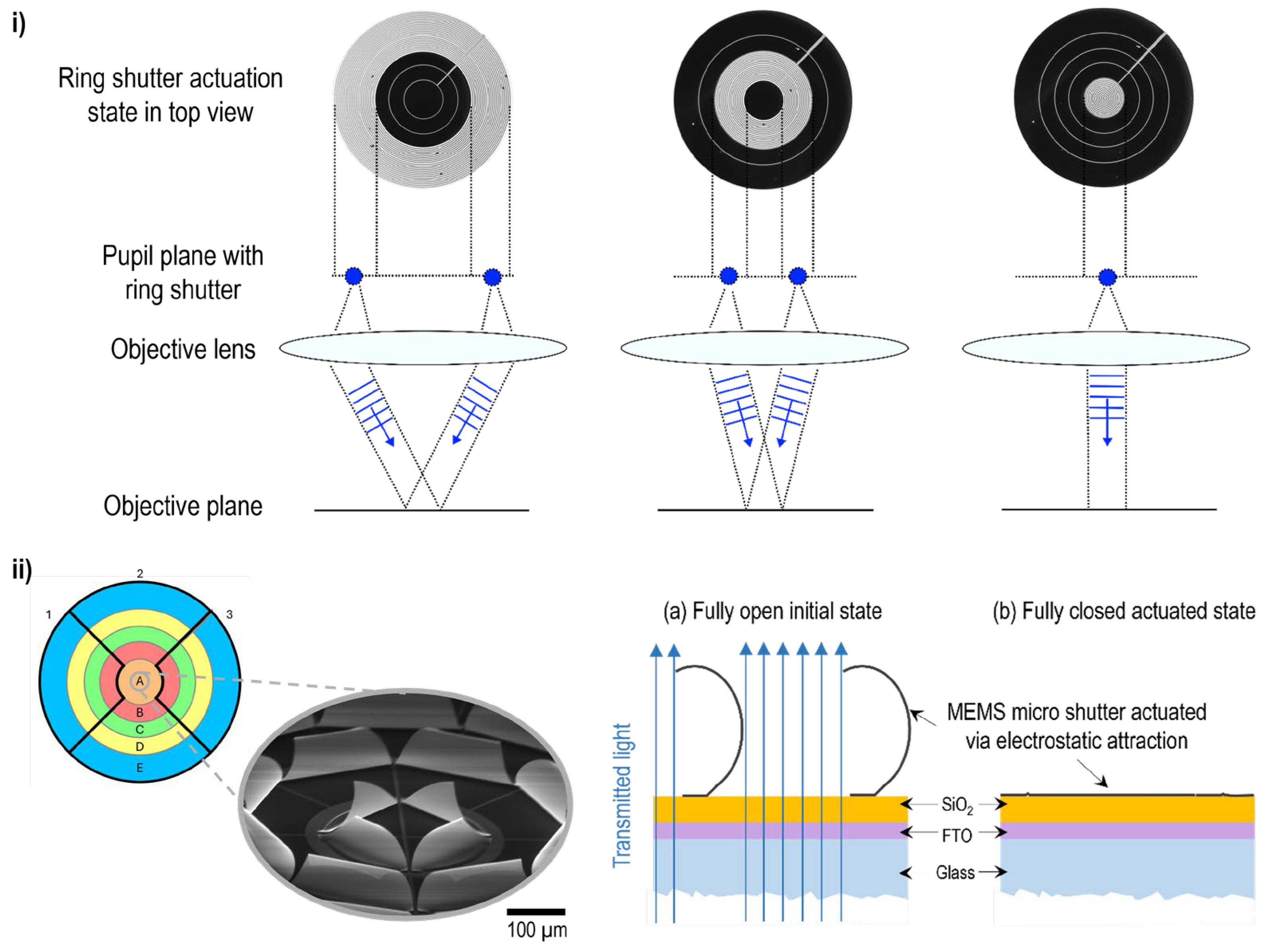
Figure 2.
(b) Schematic overview of the MEMS elements design of the ring shutter in top view. a) and c) Insets of the outer edge (radial coordinate r = 9 mm) and center (r = 0 mm) displaying the last ten (a) and the first three (c) subrings. The MEMS shutters are electronically connected but mechanically decoupled via an opaque metal grid visible as black gridlines in the subfigures. Therefore, one cell of the grid resembles one element. All illustrations are drawn to scale. The aimed size of an element is Lr × Lφ = 150 µm × 400 µm, theoretically reached at infinite radius r.
Figure 2.
(b) Schematic overview of the MEMS elements design of the ring shutter in top view. a) and c) Insets of the outer edge (radial coordinate r = 9 mm) and center (r = 0 mm) displaying the last ten (a) and the first three (c) subrings. The MEMS shutters are electronically connected but mechanically decoupled via an opaque metal grid visible as black gridlines in the subfigures. Therefore, one cell of the grid resembles one element. All illustrations are drawn to scale. The aimed size of an element is Lr × Lφ = 150 µm × 400 µm, theoretically reached at infinite radius r.
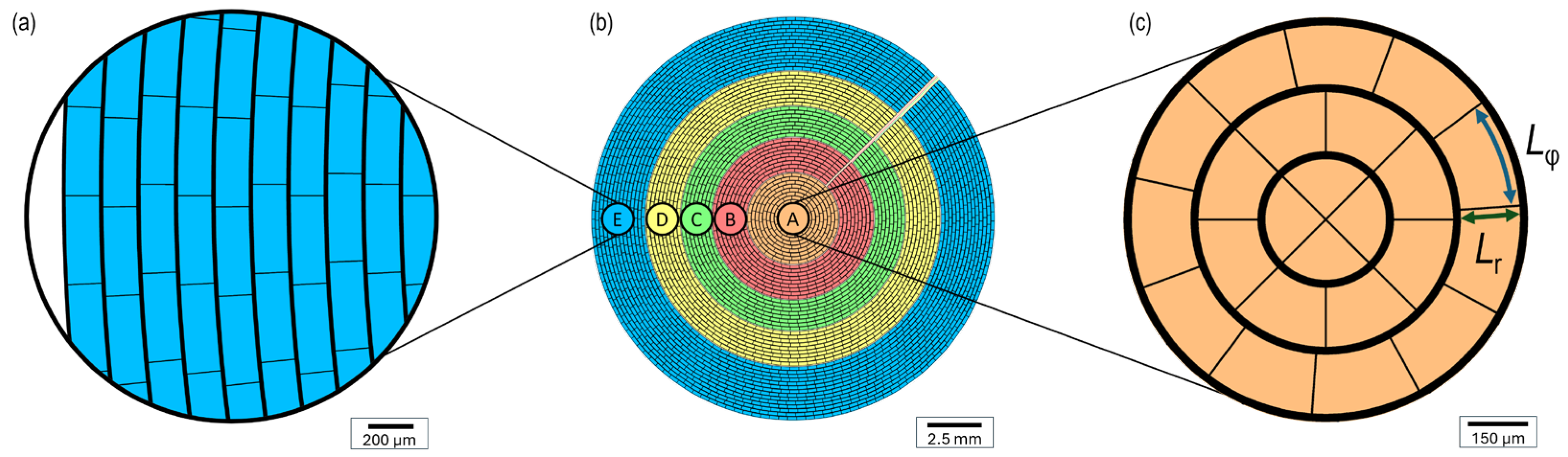
Figure 3.
Schematic overview of the optical actuation setup. The ring shutter is actuated using an eight-channel waveform generator and is illuminated by a collimated light beam from a halogen lamp which passes an exchangeable 3d printed aperture depending on the investigated ring or zone (see Figure 4). The light is collected with a photodiode. Both the resultant collected light signal as well as applied waveform are monitored and tracked on an oscilloscope.
Figure 3.
Schematic overview of the optical actuation setup. The ring shutter is actuated using an eight-channel waveform generator and is illuminated by a collimated light beam from a halogen lamp which passes an exchangeable 3d printed aperture depending on the investigated ring or zone (see Figure 4). The light is collected with a photodiode. Both the resultant collected light signal as well as applied waveform are monitored and tracked on an oscilloscope.
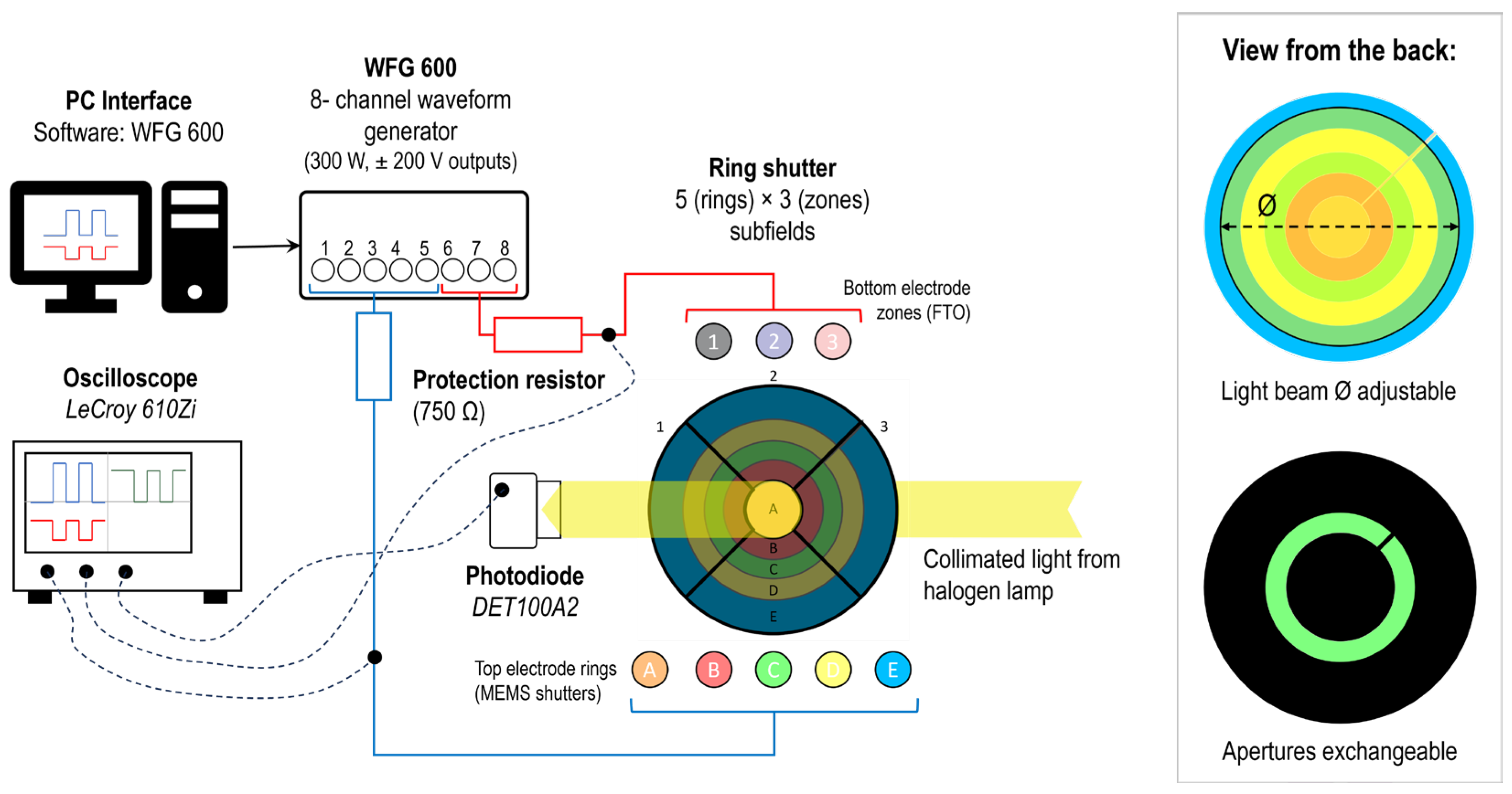
Figure 4.
Illustration of the 3D printed apertures used for the developed measurement methodology, resembling the zones 1 – 3 as well as the rings A – E. The measurement for the whole ring shutter (overall) where no aperture is applied is used as comparison. Note that in each case, except the overall, the contact stripes visible on the inset at the top right are covered.
Figure 4.
Illustration of the 3D printed apertures used for the developed measurement methodology, resembling the zones 1 – 3 as well as the rings A – E. The measurement for the whole ring shutter (overall) where no aperture is applied is used as comparison. Note that in each case, except the overall, the contact stripes visible on the inset at the top right are covered.
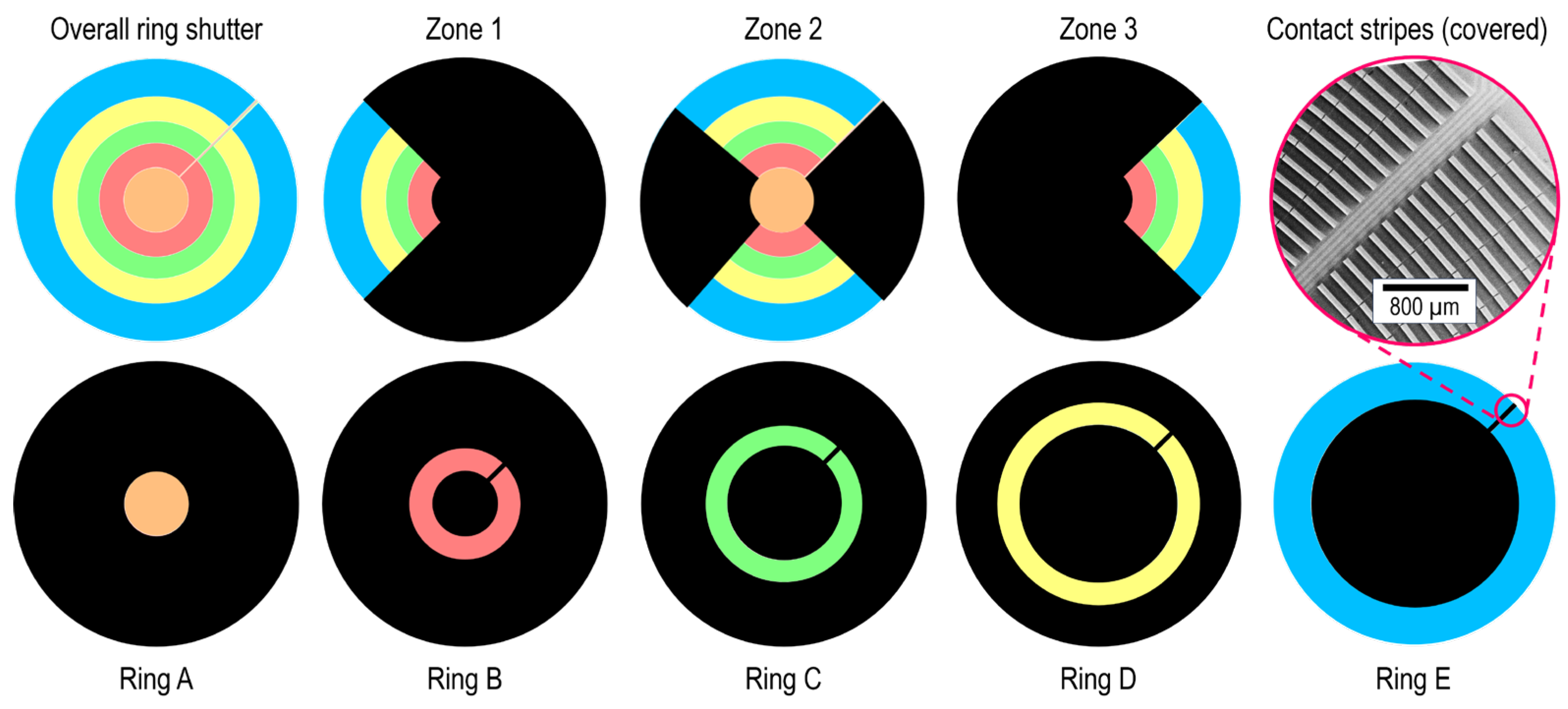
Figure 5.
Mapping the region of interest (RoI), i.e., rings A – E, to the radius of curvature (RoC) observed in micrographic investigation supports the explanation of the transmission findings. The schematics on the top part of the figure depict different situations of illumination due to the given RoC of the freestanding micro shutters: a) Overbent micro shutters with lower RoC, b) optimized/ ideal RoC allowing maximum transmission, and c) underbent micro shutters with higher RoC. The graph at the bottom part of the figure shows the distribution of the resulting transmission measurements which are in accordance with the qualitative rating of the RoC. The two micrographic insets are taken in top view with back illumination.
Figure 5.
Mapping the region of interest (RoI), i.e., rings A – E, to the radius of curvature (RoC) observed in micrographic investigation supports the explanation of the transmission findings. The schematics on the top part of the figure depict different situations of illumination due to the given RoC of the freestanding micro shutters: a) Overbent micro shutters with lower RoC, b) optimized/ ideal RoC allowing maximum transmission, and c) underbent micro shutters with higher RoC. The graph at the bottom part of the figure shows the distribution of the resulting transmission measurements which are in accordance with the qualitative rating of the RoC. The two micrographic insets are taken in top view with back illumination.
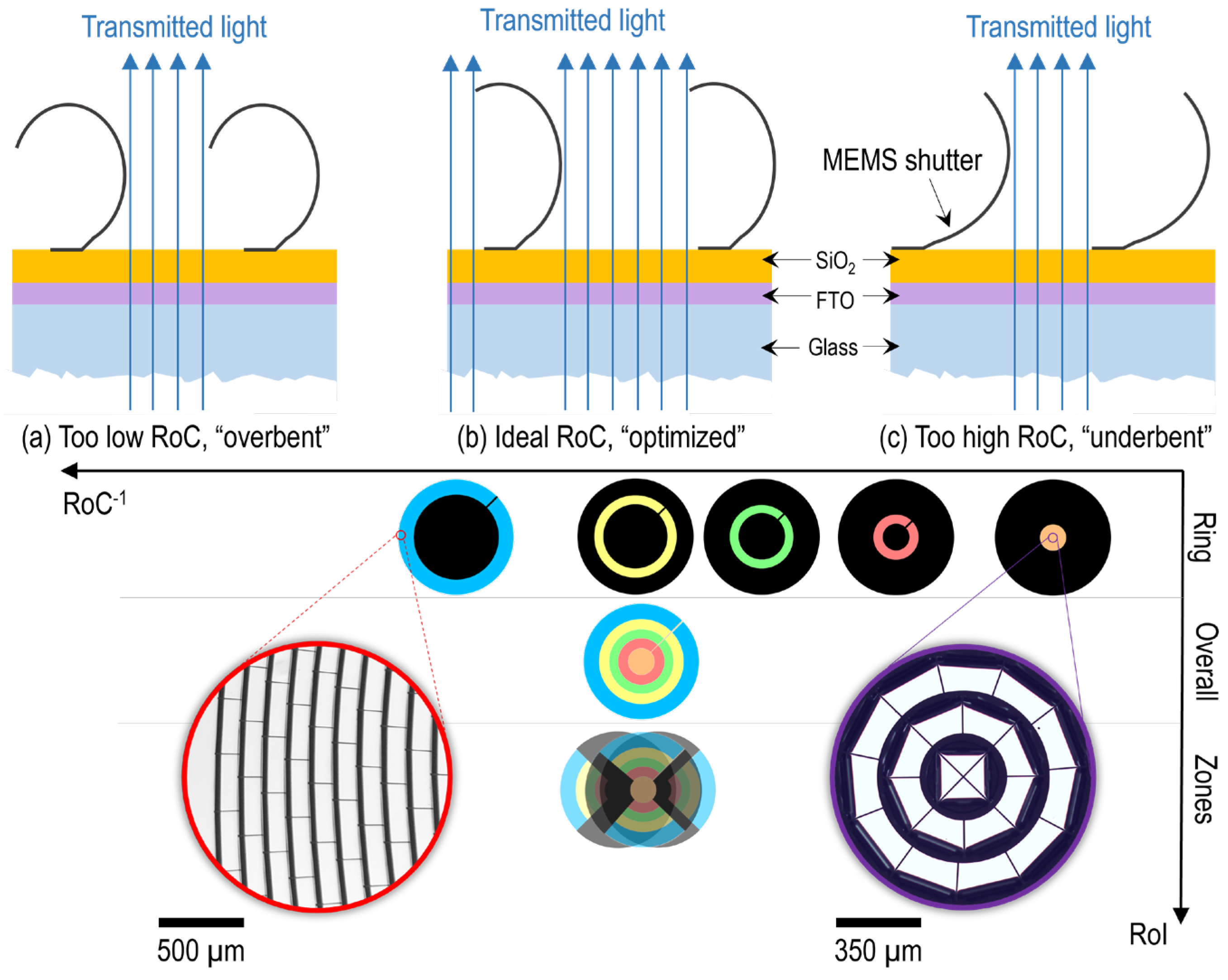
Figure 6.
Transmittance-voltage (T-V) curve for zone 2. The applied voltage is on the horizontal axis, and the normalized transmission is on the vertical axis. The resulting hysteresis curve traversing the characteristic points of I. Closing threshold, II. Fully closed state, III. Opening threshold and IV. Fully open state of the micro shutters is observed in both the negative and positive half cycle of the bipolar sinusoidal wave. With this, the closing range and holding gap can be defined.
Figure 6.
Transmittance-voltage (T-V) curve for zone 2. The applied voltage is on the horizontal axis, and the normalized transmission is on the vertical axis. The resulting hysteresis curve traversing the characteristic points of I. Closing threshold, II. Fully closed state, III. Opening threshold and IV. Fully open state of the micro shutters is observed in both the negative and positive half cycle of the bipolar sinusoidal wave. With this, the closing range and holding gap can be defined.
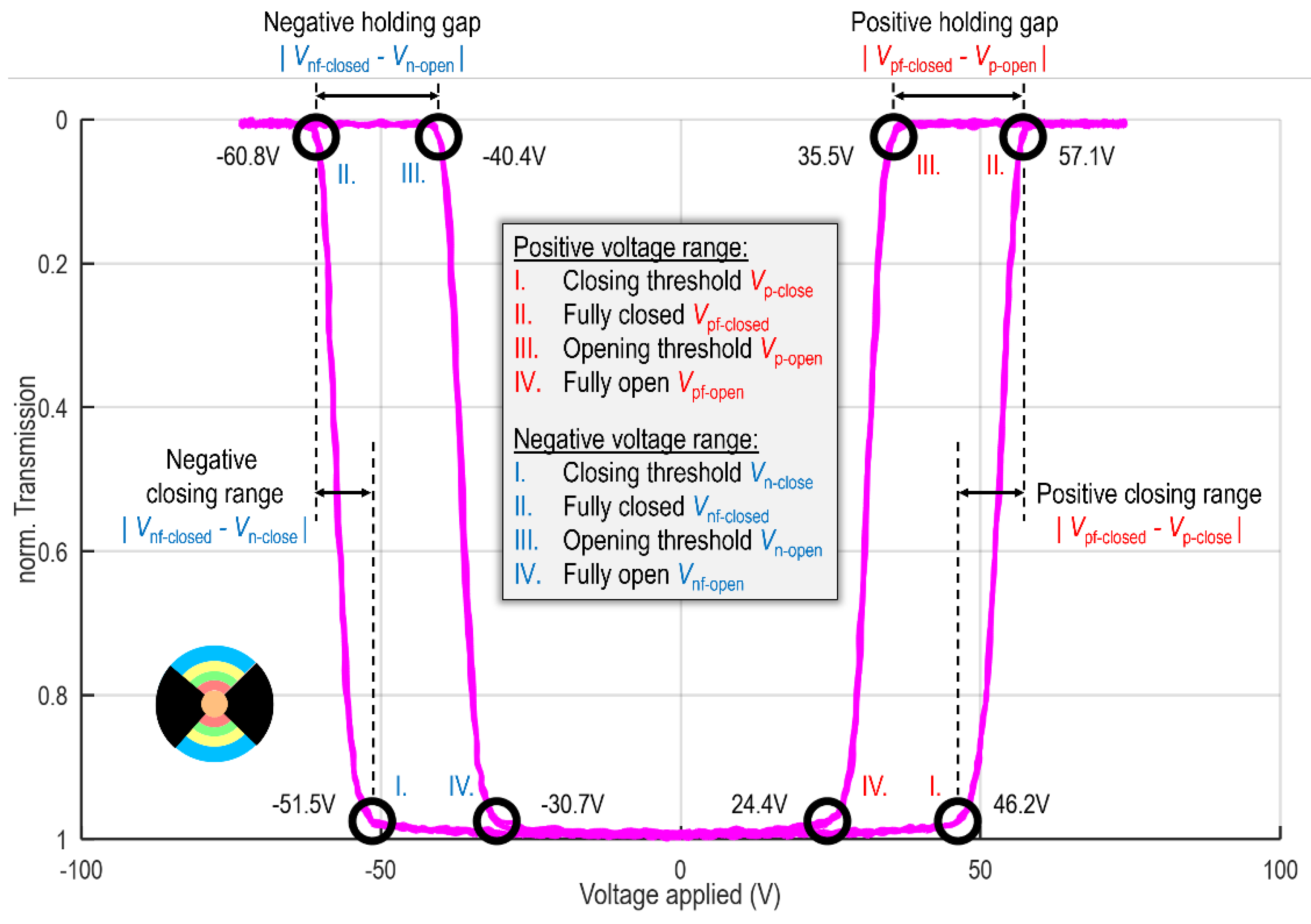
Figure 7.
Closing dynamics of the overall ring shutter device. The photodiode signal is drawn in magenta, while the applied voltage is indicated with green. The finite rise time of the applied voltage is a result of the protection resistance, the drop indicates the fully closed state of the elements. For the evaluation of closing time tclos., the 10% threshold is considered.
Figure 7.
Closing dynamics of the overall ring shutter device. The photodiode signal is drawn in magenta, while the applied voltage is indicated with green. The finite rise time of the applied voltage is a result of the protection resistance, the drop indicates the fully closed state of the elements. For the evaluation of closing time tclos., the 10% threshold is considered.
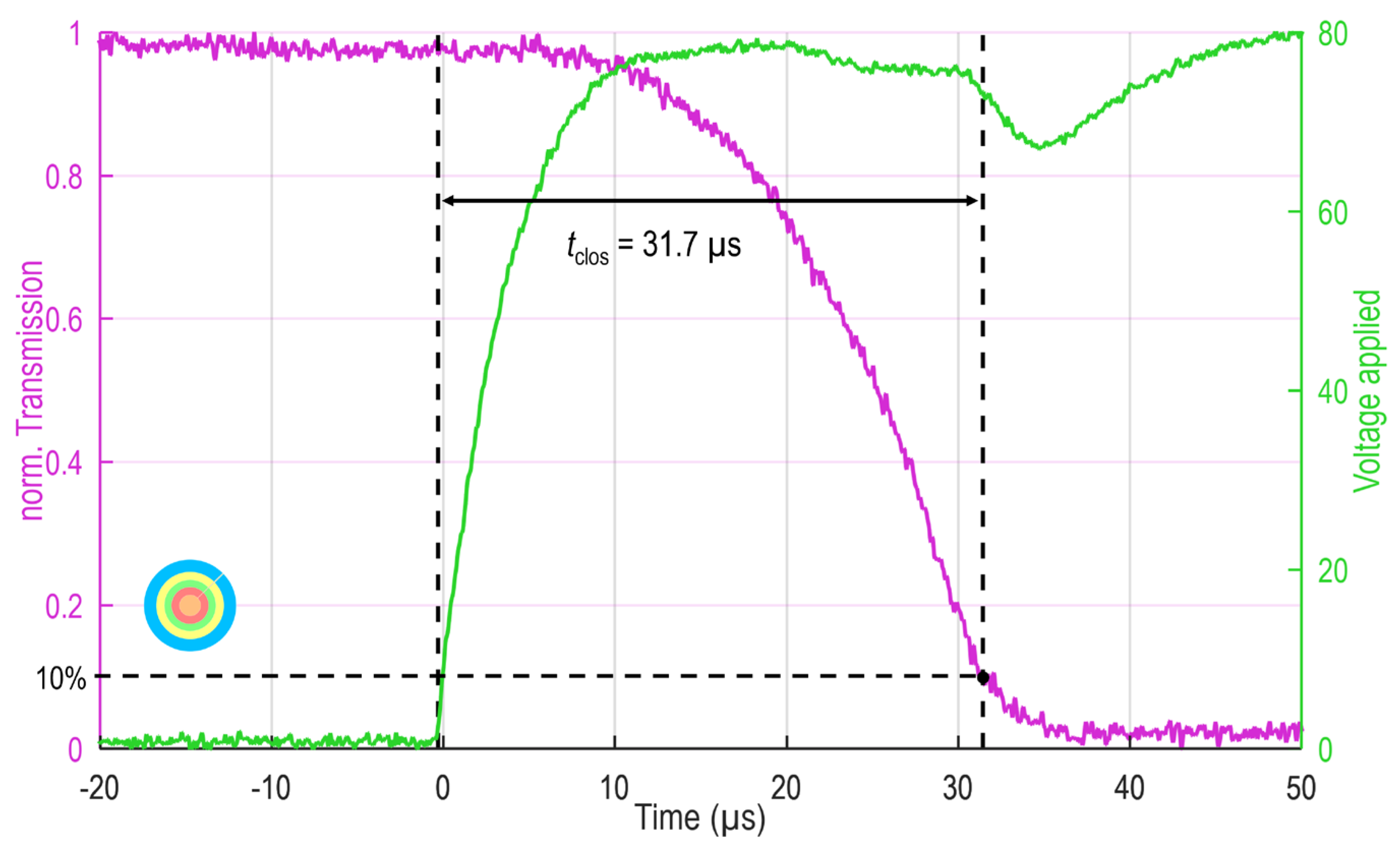
Figure 8.
Reopening dynamics of ring D. The photodiode signal is drawn in magenta, while the applied voltage is indicated with green. The finite fall time of the applied voltage is a result of the protection resistance. The MEMS elements show a strongly damped oscillation (ringing). For the evaluation of reopening time treop., the 90% threshold is considered.
Figure 8.
Reopening dynamics of ring D. The photodiode signal is drawn in magenta, while the applied voltage is indicated with green. The finite fall time of the applied voltage is a result of the protection resistance. The MEMS elements show a strongly damped oscillation (ringing). For the evaluation of reopening time treop., the 90% threshold is considered.
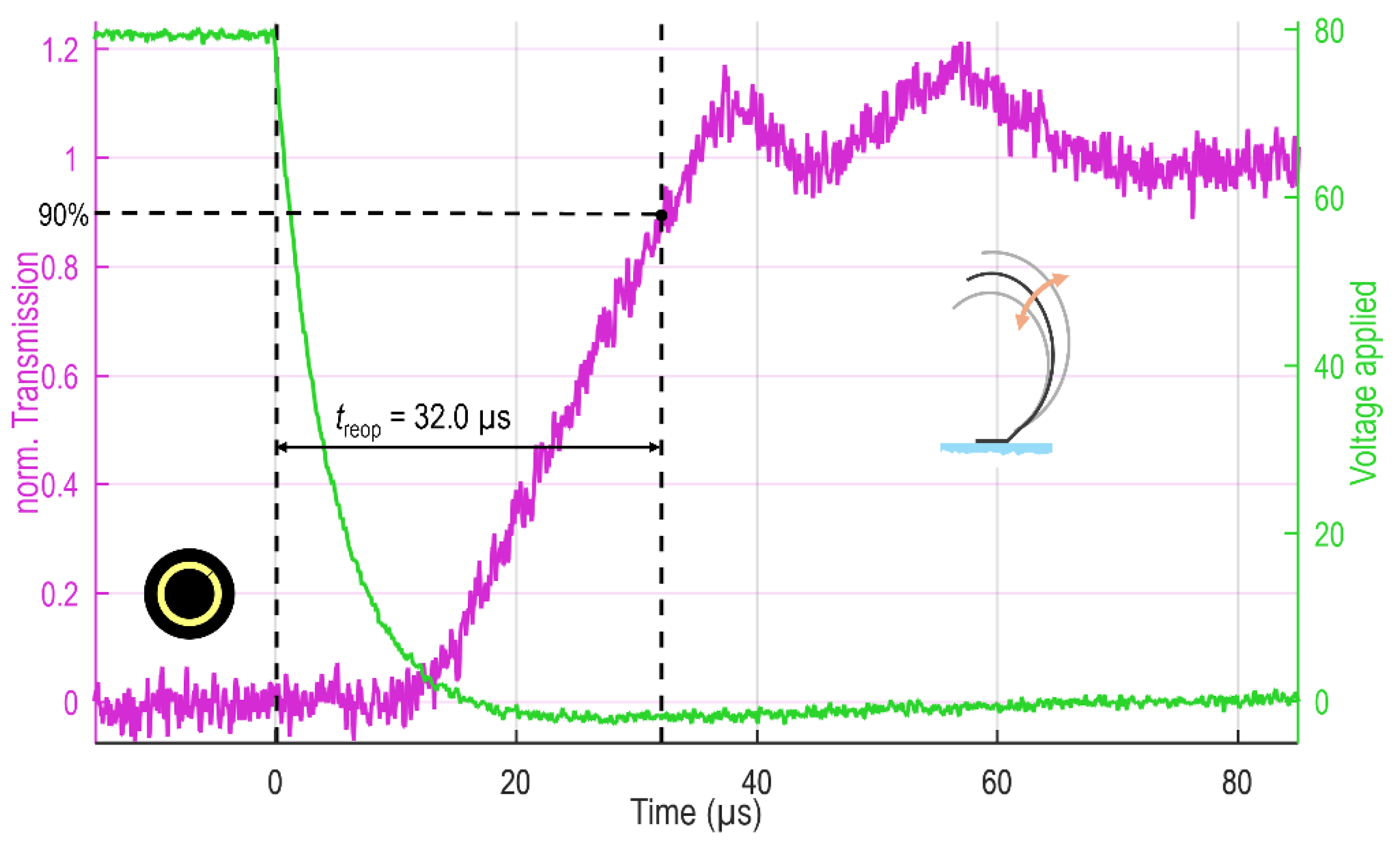

Table 1.
Transmission results in the initial fully open state. The first row resembles the measured total transmission whereas in the second row the relative deviation with respect to the overall device measure is calculated.
Table 1.
Transmission results in the initial fully open state. The first row resembles the measured total transmission whereas in the second row the relative deviation with respect to the overall device measure is calculated.
| Measure | Overall | Ring A | Ring B | Ring C | Ring D | Ring E | Zone 1 | Zone 2 | Zone 3 |
|---|---|---|---|---|---|---|---|---|---|
| Total Transmission in % | 53.6 | 44.5 | 49.4 | 51.9 | 53,9 | 58.1 | 54.3 | 53.4 | 52.9 |
| Relative Deviation in % | 0 (Ref.) | -17.0 | -7.9 | -3.1 | 0.6 | 8.3 | 1.3 | -0.4 | -1.3 |
Table 2.
Results based on the evaluation of the T-V curves for rings, zones and the overall device.
| Measure | Evaluation | Overall | Ring A | Ring B | Ring C | Ring D | Ring E | Zone 1 | Zone 2 | Zone 3 |
|---|---|---|---|---|---|---|---|---|---|
| Closing threshold in V |
+ 46.5 - 51.7 |
+ 46.5 - 51.3 |
+ 46.8 - 51.8 |
+ 49.1 - 52.8 |
+ 49.3 - 51.0 |
+ 49.9 - 53.2 |
+ 47.2 - 53.5 |
+ 46.2 - 51.5 |
+ 46.1 - 51.6 |
| Fully closed in V |
+ 56.0 - 61.3 |
+ 55.8 - 61.6 |
+ 54.6 - 62.4 |
+ 59.1 - 63.5 |
+ 59.1 - 62.2 |
+ 60.2 - 62.9 |
+ 57.7 - 63.0 |
+ 57.1 - 60.8 |
+ 54.4 - 59.6 |
| Opening threshold in V |
+ 32.9 - 39.0 |
+ 32.0 - 39.4 |
+ 33.1 - 38.4 |
+ 33.7 - 38.5 |
+ 34.8 - 38.2 |
+ 34.8 - 38.2 |
+ 33.8 - 40.4 |
+ 35.5 - 40.4 |
+ 32.9 - 40.2 |
| Fully open in V |
+ 25.9 - 32.4 |
+ 23.6 - 30.1 |
+ 26.2 - 31.0 |
+ 26.9 - 30.1 |
+ 27.6 - 29.7 |
+ 27.4 - 30.8 |
+ 25.3 - 32.5 |
+ 24.4 - 30.7 |
+ 25.9 - 31.9 |
| Closing range in V |
9.5 9.6 |
9.3 10.3 |
7.8 10.6 |
10.0 10.7 |
10.7 11.2 |
10.3 9.7 |
10.5 9.5 |
10.9 9.3 |
8.3 8.0 |
| Deviation in closing threshold in V | % |
0|0 0|0 |
0.0|0.0 -0.4|-0.8 |
0.3|0.7 0.1|0.2 |
2.6|5.6 1.1|2.1 |
2.8|6.0 -0.7|-1.4 |
3.4|7.3 1.5|2.9 |
0.7|1.5 1.8|3.5 |
-0.3|-0.7 -0.2|-0.4 |
-0.4|-0.9 -0.1|-0.2 |
| Holding gap in V |
23.1 22.3 |
23.8 22.2 |
21.5 24.0 |
25.4 25.0 |
25.3 25.2 |
25.4 24.7 |
23.9 22.6 |
21.6 20.4 |
21.5 19.4 |
Table 3.
Response dynamics, i.e., closing and reopening times, of rings, zones and the overall device.
Table 3.
Response dynamics, i.e., closing and reopening times, of rings, zones and the overall device.
| Response time | Overall | Ring A | Ring B | Ring C | Ring D | Ring E | Zone 1 | Zone 2 | Zone 3 |
|---|---|---|---|---|---|---|---|---|---|
| Closing in µs | 31.7 | 26.4 | 28.5 | 30.3 | 33 | 35.2 | 31.9 | 31.6 | 33.9 |
| Opening in µs | 39.3 | 34.3 | 31.5 | 31.6 | 32.0 | 37.6 | 36.8 | 38.3 | 36.9 |
Disclaimer/Publisher’s Note: The statements, opinions and data contained in all publications are solely those of the individual author(s) and contributor(s) and not of MDPI and/or the editor(s). MDPI and/or the editor(s) disclaim responsibility for any injury to people or property resulting from any ideas, methods, instructions or products referred to in the content. |
© 2024 by the authors. Licensee MDPI, Basel, Switzerland. This article is an open access article distributed under the terms and conditions of the Creative Commons Attribution (CC BY) license (http://creativecommons.org/licenses/by/4.0/).
Copyright: This open access article is published under a Creative Commons CC BY 4.0 license, which permit the free download, distribution, and reuse, provided that the author and preprint are cited in any reuse.


