

Submitted:
03 December 2024
Posted:
03 December 2024
You are already at the latest version
Abstract
In this study, anthocyanin glycosides from nine cultivars of highbush blueberries grown in Korea were characterized using UPLC-DAD-QToF/MS and UPLC-Qtrap-MS/MS. A total of twenty-two derivatives were identified, consisting of mono-glycosides with galactose, glucose, arabinose, acetyl-galactose, or acetyl-glucose moieties attached to aglycones such as cyanidin, peonidin, delphinidin, petunidin, and malvidin. Among them, seven acetylated glycosides were tentatively determined by comparing the related authentic standards and previous reports, and presented mass fragmentation in which the acetyl group remained as form attached to the sugar without deesterification in positive ionization mode. The mid-season cultivar ‘New Hanover’ showed the highest total anthocyanin content (1011.7 mg/100 g dry weight) with predominant malvidin and delphinidin glycosides. Particularly, the ‘Patriot’ (early-season) recorded the highest proportion of acetylated glycosides (19.7%). These detailed anthocyanin profiles will be supported as fundamental data for the development of superior cultivars and functional blueberry-based products as well as the further research of anthocyanin changes by cultivars, harvest time, cultivated methods, storage conditions, etc..
Keywords:
blueberry
; anthocyanin
; acetylated glycoside
; UPLC-DAD-QToF/MS
; UPLC-Qtrap-MS/MS
1. Introduction
Blueberries (Vaccinium spp.), along with bilberries, belonging to the Vaccinium genus of Ericaceae family, which comprises approximately 400 species, mainly distributed in Southeast Asia. These species are classified into highbush (V. corymbosum L.), lowbush (V. angustifolium L.), and rabbiteye (V. ashei L.). The blueberries grown in Korea are of the highbush type, which is characterized by cold hardiness and suitability for cultivation [1]. In general, highbush blueberries can be further classified as northern and southern depending on chilling requirements [2], and early-, mid-, and late-season by harvest time [3].
Blueberries are known to be rich in phenolic compounds (anthocyanins, flavonoids), carotenoids, and vitamin C [4], and closely related to their antioxidant [5], anticancer [6], antidiabetic [7], and cardiovascular disease prevention [8]. Blueberry anthocyanins are composed of aglycones such as delphinidin, cyanidin, petunidin, peonidin, and malvidin, with sugar moieties (glucose, galactose, and arabinose) attached. Among them, malvidin (37–52%) and delphinidin (27–31%) glycosides are the most commonly identified [9,10]. Additionally, acetylated anthocyanins, which are present in small amounts in blueberries, have a structure in which an acetyl group is acylated at the 6”-OH position of glucose or galactose. These compounds are reported to contribute to the intensity, stability of pigments in foods [11] and exhibit antioxidant effects [12].
Recently, studies on the identification of individual anthocyanin have been actively conducted in blueberries using mass spectrometry (MS). A total of 25 anthocyanin glycosides were detected and fragmented through positive ionization mode of ESI-ToF-MS from southern highbush blueberries in the United States [13]. The anthocyanin composition and content in blueberries were distributed differently depending on their cultivar and cultivated condition [14,15]. Although 74 cultivars grown in China were characterized by Chai et al. [16], only total content was provided without detailed individual components for acetylated glycosides, which account for 0-42% of total anthocyanin. The structural elucidation of acetylated glycosides have been rarely performed through NMR [17] and LC-MS [18,19] analyses. Since the overall quantification of blueberry anthocyanins primarily focused on major group such as non-acetylated glycosides [20], these detailed profiles are still limited.
The objective of this study was to rapidly and precisely identify and quantify individual anthocyanins including acetylated glycosides from nine highbush blueberry cultivars (Reka, Hannah’s Choice, Spartan, Draper, Suziblue, Legacy, New Hanover, Farthing, and Patriot) grown in Korea based on ultra-performance liquid chromatography-diode array detection quadrupole time-of-flight mass spectrometry (UPLC-DAD-QToF/MS) and ultra-performance liquid chromatography-quadrupole trap tandem mass spectrometry (UPLC-Qtrap-MS/MS) with internal and external quantification methods. Thus, it is considered that the anthocyanin profiles provided will be supported as fundamental data for the development of superior cultivars and functional blueberry-based products.
2. Materials and Methods
2.1. Plant Materials
Blueberries (Vaccinium spp.) were obtained from a farm in Anseong-si, Gyeonggi-do (latitude/longitude: 37°0′4.7″N/127°12′35.7″E), in June 2023, respectively. The samples were collected with permission of Rural Development Administration (RDA, Republic of Korea), and identified by the author (Heon-Woong Kim) of this article. Detailed information about each cultivar is provided in Table 1. Experimental research, including the collection of plant material, complied with relevant institutional, national, and international guidelines and legislation. All samples were lyophilized, crushed with a grinding machine, and sieved through a 30 mesh sieve.
2.2. Chemicals
Cyanidin 3-O-arabinoside, cyanidin 3-O-galactoside, cyanidin 3-O-glucoside, delphinidin 3-O-glucoside, malvidin 3-O-galactoside, malvidin 3-O-glucoside, peonidin 3-O-arabinoside, peonidin 3-O-galactoside, peonidin 3-O-glucoside, petunidin 3-O-glucoside, and delphinidin 3,5-di-O-glucoside (delphin) were purchased from Extrasynthese (Genay Cedex, France). Petunidin 3-O-galactoside was provided by Chemfaces (Wuhan, China). LC-MS-grade acetonitrile and water were obtained from Thermo Fisher Scientific (Fair Lawn, NJ, USA), and formic acid from Junsei Chemical Co. (Tokyo, Japan).
2.3. Extraction and Sample Preparation
For UPLC-DAD-QToF/MS and UPLC-QTrap-MS/MS analyses, powdered blueberry (0.5 g) was extracted with 10 mL of 5% formic acid in water using an orbital shaker (for 40 min at 200 rpm), and centrifuged at 2,016×g and 10 °C for 15 min (LABOGENE 1580R, Bio-Medical Science Co., Seoul, Korea). The supernatant was filtered through a 0.45 μm syringe filter and purified using a HyperSep Retain-PEP solid-phase extraction (SPE) cartridge (Thermo Scientific, Bellefonte, PA, USA). In order to remove undesirable components and improve separation and detection in UPLC-MS, the SPE was performed and the process was as follows: The catridge was conditioned with methanol (4 mL) and water (8 mL). The samples (0.5 mL) and internal standard solution (delphin, 100 ppm; 1 mL) were loaded into cartridge and washed with water (6 mL). Finally, the loaded samples were eluted with 1% formic acid in methanol (12 mL) and concentrated using N2 gas, then re-dissolved with 5% formic acid in water (0.5 mL).
2.4. Anthocyanin Identification and Quantification
The anthocyanin derivatives in different blueberry cultivars were comprehensively performed using an UPLC system coupled with a diode array detector (DAD) (ACQUITY UPLC™ system, Waters Co., Milford, MA, USA) and a QToF-MS (Xevo G2-S QToF, Waters MS Technologies, Manchester, UK). Chromatographic conditions were as follows: CORTECS UPLC T3 (2.1 x 150 mm, 1.6 μm, Waters, Wexford, Ireland) column and CORTECS UPLC T3 VanGuard™ pre-column (2.1 x 50 mm, 1.6 μm, Waters), representative detection wavelength: cyanidin and peonidin, 515 nm; delphinidin, 520 nm; petunidin and malvidin, 525 nm; flow rate, 0.3 mL/min; Column oven temperature, 30℃; Sample injection volume, 1 μL; Mobile phase, 5% formic acid in water (A), 5% formic acid in water/acetonitrile (1:1, v/v) (B). Elution gradient conditions: 0 min, 10% B; 28 min, 50% B; 33-38 min, 90% B; 43-50 min, 10% B. Mass spectra were simultaneously scanned with the range of 50-1200 m/z in positive ionization mode using an electrospray ionization (+ESI) source, and their parameters used were: capillary voltage, 3500 V; sampling cone voltage, 40 V; extraction cone, 4.0 V; Ion source, 120℃; desolvation temperature, 500℃; desolvation N2 gas flow, 1020 L/h. All standard compounds were externally quantified based on multiple reaction monitoring (MRM) mode using UPLC-QTrap-MS/MS (SCIEX QTrap 4500, SCIEX CO.), whereas other anthocyanins internally using QToF/MS (Xevo G2-S QToF, Waters MS Technologies, Manchester, UK). The optmizing MRM conditions are shown in Table 2. Internal quantification was implemented by calculating the relative peak areas of the compounds compared to an internal standard (delphin), and the external quantification was performed in MRM mode with selected 11 standards. The contents of anthocyanin derivatives were expressed in mg/100 g DW (dry weight). The triplicate results are expressed as mean ± standard deviation. One-way ANOVA was performed with SPSS (version 28.0), SPSS institute; Chicago, IL, USA) to determine a significant difference between individual averages using Duncan’s multiple range test (p < 0.05). To quantify anthocyanins from blueberry, linearity was determined by analyzing standard solutions at concentrations of 0.01, 0.05, 0.1, 0.5, 1, 2, and 5 µg/mL using UPLC-QTrap-MS/MS, with each concentration analyzed in triplicate. The calibration curves were constructed by plotting the peak area against the concentration of the corresponding standards using least-square linear regression (Table 2). LOD and LOQ for used standards were calculated using the equations LOD = 3.3 × SD/δ and LOQ = 10 × SD/δ, respectively, where SD represents the standard deviation of response (y-intercept), and δ is a slope of calibration curve Intra- and Inter-day precision was evaluated by analyzing standard mixtures (0.5 μg/mL, n=6) on single day and 6days. The variations were expressed as the relative standard deviation (RSD) of the replicates (Table 3).
3. Results and Discussion
3.1. Identification of 22 Anthocyanin Glycosides from Blueberry Cultivars
In blueberries, anthocyanins are primarily identified as glycosides of cyanidin (m/z 287), peonidin (m/z 301), delphinidin (m/z 303), petunidin (m/z 317), and malvidin (m/z 331). These compounds consist of a sugar moiety (galactose, glucose, or arabinose) attached to the 3-OH position of the aglycone and acylated with acetic acid at the 6”-OH position of the sugar (Table 4, Figure 1).
A total of twenty-two derivatives were tentatively identified as galactoside (5), glucoside (5), arabinoside (5), acetyl-galactoside (2), and acetyl-glucoside (5) based on cyanidin, peonidin, delphinidin, petunidin, and malvidin aglycones and confirmed with the presence of galactose (162 Da), glucose (162 Da), arabinose (132 Da), acetyl-galactose (42 + 162 Da), and acetyl-glucose (42 + 162 Da) moieties from whole structure. Particularly, in positive ionization mode, the acetylated glycosides were fragmented in which the acetyl group remained as form attached to the sugar without deesterification [21,22]. To further characterize these compounds, the previously reported retention times (Rt, min) [23], fragmentation patterns [24], ultraviolet spectra (UV) [25], and other sources [26] supported the isolation and identification of individual anthocyanins with UPLC-DAD-QToF/MS experimental data (Table 4, Figure 2, Figure 3 and Figure 4).
Peaks 1 and 4 were identified as delphinidin glycosides. Peak 1 had a fragmentation pattern indicating the loss of galactose or glucose from m/z 465 ([M]+), while peak 4 (Rt = 7.79) showed a pattern consistent with arabinose dissociated from m/z 435 ([M]+). Delphinidin derivatives eluted in the following order: peak 1 (Rt = 5.99) < peak 2 (delphinidin 3-O-glucoside) < peak 4 (Rt = 7.52). This elution order is consistent with the previously reported order of compounds with the same aglycone attached to sugars at the 3-OH position (galactose < glucose < arabinose) [27]. Consequently, peaks 1 and 4 were identified as delphinidin 3-O-galactoside and delphinidin 3-O-arabinoside, respectively.
Peaks 10 and 15 were found to be petunidin and malvidin glycoside, respectively. Based on the parent ion, aglycone ion, and differences in elution times corresponding to the linked sugars, they were further identified as petunidin 3-O-arabinoside (peak 10), and malvidin 3-O-arabinoside (peak 15).
Meanwhile, acetylated glycosides have been identified in blueberries with fragmented characteristics of acetyl-galactoside (42 + 162 Da) and acetyl-glucoside (42 + 162 Da), where deacetylation did not occur in positive mode [28]. A total of seven acetylated glycosides were identified. Among them, delphinidin 3-O-(6”-O-acetyl)glucoside (peak 16), cyanidin 3-O-(6”-O-acetyl)glucoside (peak 18), petunidin 3-O-(6”-O-acetyl)glucoside (peak 19), and malvidin 3-O-(6”-O-acetyl)glucoside (peak 22) have been previously reported in berries and wine [29]. Additionally, three acetylated glycosides were identified: petunidin 3-O-(6”-O-acetyl)galactoside (peak 17), malvidin 3-O-(6”-O-acetyl)galactoside (peak 20), and peonidin 3-O-(6”-O-acetyl)glucoside (peak 21). Especially, the acetylated petunidin glycosides (peaks 17 and 19) showed a parent ion at m/z 521 ([M]+), eluted similarly to peaks 6 (petunidin 3-O-galactoside) and 8 (petunidin 3-O-glucoside), but were detected later due to the acetyl group at the at the sugar’s 6”-OH position [26]. Thus, peaks 17 and 19 were identified as petunidin 3-O-(6”-O-acetyl)galactoside and petunidin 3-O-(6”-O-acetyl)glucoside, respectively.
Peak 16 (m/z 507, 303), 18 (m/z 491, 287), 20 and 22 (m/z 535, 331), and 21 (m/z 505, 301) were assigned to delphinidin 3-O-(6”-O-acetyl)glucoside, cyanidin 3-O-(6”-O-acetyl)glucoside, malvidin 3-O-(6”-O-acetyl)galactoside and malvidin 3-O-(6”-O-acetyl)glucoside, and peonidin 3-O-(6”-O-acetyl)glucoside, respectively, based on their elution times, parent and aglycone ions, and characteristic MS spectra of acetylated glycosides.
3.2. Variation in Anthocyanin Contents Depending on Highbush Blueberry Cultivars
Table 5 presents the composition and content of 22 anthocyanins from nine blueberry cultivars. Total anthocyanin content ranged from 581.1 to 1011.7 mg/100 g dry weight (DW), similar to the Chinese results for variation (108.1–279.1 mg/100 g fresh weight) by highbush cultivars (Spartan, Northland, Bluecrop, and Duke) and regions (Dandong, Qingdao, and Zhuanghe) [30]. In total contents, Legacy and New Hanover as mid-season cultivars were 725.4 and 1011.7 mg/100 g, respectively, and the early-season cultivars were observed in the following order: Patriot (910.4) > Spartan (855.5) > Draper (795.3) > Suziblue (771.1) > Reka (635.9) > Farthing (599.3) > Hannah’s Choice (581.1).
In the two mid-season cultivars (Legacy and New Hanover), malvidin glycosides accounted for 34 and 41% of total content, followed by delphinidin, petunidin, cyanidin, and peonidin derivatives. The seven early-season cultivars (Reka, Hannah’s Choice, Spartan, Draper, Suziblue, Farthing, and Patriot) accounting for malvidin 34–50%, delphinidin 24–32%, petunidin 20–26%, cyanidin 2–9%, and peonidin 1–5% were similar with mid-season cultivars. These results indicated that delphinidin, petunidin, and malvidin derivatives affected the total content regardless of cultivar, and also consistent with the aglycone proportions (delphinidin 27–40%, malvidin 22–33%, petunidin 19–26%, cyanidin 6–14%, peonidin 1–5%) reported by Cho et al. [29]. In particular, delphinidin, petunidin, and malvidin derivatives identified as major components are closely associated with blue and purple colors, while cyanidin, peonidin, and pelargonidin contribute to red colors [31].
The color of anthocyanins is influenced by the position and number of hydroxyl (-OH) or methoxyl (-OCH3) groups on the B-ring. Furthermore, Jung et al. [32] suggested that the biosynthetic pathway for malvidin is more dominant than that cyanidin in highbush blueberries, which plays a crucial role in the berries’ blue color and antioxidant properties.
In other cultivars except for ‘Patriot’, delphinidin 3-O-galactoside, petunidin 3-O-galactoside, and malvidin 3-O-galactoside were identified as major components [9,10], and the ‘Patriot’ contained mainly glucose-bound anthocyanins in the present study, where galactose was the predominant glycoside in ‘Patriot’ blueberries provided from Italy and China [33,34]. The differences in composition and content of blueberry anthocyanins are considered to be generated by cultivars as well as various environmental factors, such as cultivated conditions [35], temperature [36], UV radiation [37], soil conditions [38], and genetic factors [39].
The seven acetylated glycosides (peaks 16–22) accounted for 0–19.7% of total anthocyanin were highest in ‘Patriot’ (179.5), whereas non-acetylated glycosides were only detected in Legacy, Draper, and Farthing (Table 5). Similarly, acetylated glycosides also showed significant proportions of delphinidin and malvidin derivatives relative to their total content as follows: Delphinidin 3-O-(6”-O-acetyl)glucoside (2–24%), malvidin 3-O-(6”-O-acetyl)galactoside (3–72%), malvidin 3-O-(6”-O-acetyl)glucoside (4–48%) (Table 5). These values were comparable to those reported for Canadian lowbush and highbush blueberries [40].
The synthesis of acylated anthocyanins is facilitated by acyltransferases and has been shown to improve metabolic health, including improved insulin sensitivity, reduced inflammation, and regulation of gut microbiota [41]. In particular, malvidin 3-O-(6”-O-acetyl)glucoside presented free radical scavenging activity [42] and potential anti-inflammatory effects via selective COX-2 inhibition [43]. Further research is required to investigate not only the in vivo metabolism and biological activities of these anthocyanins including acetylated glycosides, but also the changes of anthocyanin profile by blueberry cultivar, harvest time, cultivated methods, storage conditions, etc..
4. Conclusions
A total of 22 anthocyanins from nine highbush blueberry cultivars include 4 delphinidin, 4 cyanidin, 5 petunidin, 4 peonidin, and 5 malvidin derivatives. ‘New Hanover’ (1011.7 mg/100 g DW) showed the highest total anthocyanin content among all cultivars, with malvidin and delphinidin glycosides accounting for over 70% of its total content. Especially, ‘Patriot’ (910.4), an early-season cultivar, recorded the highest proportion of acetylated anthocyanins (up to 19.7%), while non-acetylated anthocyanins were only detected in ‘Legacy,’ ‘Draper,’ and ‘Farthing.’ These study provided detailed chemical profiles on both major and trace components of acetylated anthocyanins from nine cultivars grown in Korea. Furthermore, it is believed that a comprehensive anthocyanin profile of blueberries will be suggested as fundamental data for breeding superior cultivars, evaluation of related products, and application in various industries.
Author Contributions
Conceptualization, J.H.K. and H.-W.K.; methodology, J.H.K. and H.-W.K.; validation, J.H.K.; investigation, J.H.K.; writing-original draft preparation, J.H.K.; writing-review and editing, R.H.K., S.A.K. and H.N.; supervision, J.-Y.C. and H.-W.K.; funding acquisition, H.-W.K.; All authors have read and agreed to the published version of the manuscript.
Funding
This research is a part of the K-Agricultural Food Resources Functional Component Utilization Base Advancement Joint Research Project (Project Number: PJ017054012023 (RS-2023-RD010364)) of the Rural Development Administration and was supported by funds for professional researchers and academic research cooperation programs.
Data Availability Statement
Data is contained within the article.
Conflicts of Interest
The authors declare no conflict of interest.
References
- Kim, J.G.; Ryou, M.S.; Jung, S.M.; Hwang, Y.S. Effects of cluster and flower thinning on yield and fruit quality in highbush ’Jersey’ blueberry. J. Bio-Env. Con. 2010, 19, 392–396. [Google Scholar]
- Kogan, C.; DeVetter, L.W.; Hoheisel, G.-A. Modeling northern Highbush blueberry cold hardiness for the Pacific Northwest. HortScience 2023, 11, 1314–1320. [Google Scholar] [CrossRef]
- Giacalone, G.; Peano, C.; Guarinoni, A.; Beccaro, G.; Bounous, G. Ripening curve of early, midseason and late maturing highbush blueberry cultivars. In VII International Symposium on Vaccinium Culture 2000, 574, 119–121. [Google Scholar] [CrossRef]
- Baenas, N.; Ruales, J.; Moreno, D.A.; Barrio, D.A.; Stinco, C.M.; Martinez-Cifuentes, G.; Melendez-Martinez, A.J.; Garcia-Ruiz, A. Characterization of Andean blueberry in bioactive compounds, evaluation of biological properties, and in vitro bioaccessibility. Foods 2020, 9, 1483. [Google Scholar] [CrossRef]
- Heinonen, I.M.; Lehtonen, P.J.; Hopia, A.I. Antioxidant activity of berry and fruit wines and liquors. J. Agric. Food Chem. 1998, 46, 25–31. [Google Scholar] [CrossRef]
- Seeram, N.P.; Adams, L.S.; Zhang, Y.; Lee, R.; Sand, D.; Scheuller, H.S.; Heber, D. Blackberry, black raspberry, blueberry, cranberry, red raspberry, and strawberry extracts inhibit growth and stimulate apoptosis of human cancer cells in vitro. J. Agric. Food Chem. 2006, 54, 9329–9339. [Google Scholar] [CrossRef]
- Martineau, L.C.; Couture, A.; Spoor, D.; Benhaddou-Andaloussi, A.; Harris, C.; Meddah, B.; Leduc, C.; Burt, A.; Vuong, T.; Le, P.M.; Prentki, M.; Bennett, S.A.; Arnason, J.T.; Haddad, P.S. Anti-diabetic properties of the Canadian lowbush blueberry Vaccinium angustifolium Ait. Phytomedicine 2006, 13, 612–623. [Google Scholar] [CrossRef]
- Wang, Y.; Gallegos, J.L.; Haskell-Ramsay, C.; Lodge, J.K. Effects of blueberry consumption on cardiovascular health in healthy adults: A cross-over randomised controlled trial. Nutrients 2022, 14, 2562. [Google Scholar] [CrossRef]
- Bornsek, S.M.; Ziberna, L.; Polak, T.; Vanzo, A.; Ulrih, N.P.; Abram, V.; Tramer, F.; Passamonti, S. Bilberry and blueberry anthocyanins act as powerful intracellular antioxidants in mammalian cells. Food Chem. 2012, 4, 1878–1884. [Google Scholar] [CrossRef]
- Kader, F.; Rovel, B.; Girardin, M.; Metche, M. Fractionation and identification of the phenolic compounds of Highbush blueberries (Vaccinium corymbosum, L.). Food Chem. 1995, 55, 35–40. [Google Scholar] [CrossRef]
- Rinaldo, A.R.; Cavallini, E.; Jia, Y.; Moss, S.M.A.; McDavid, D.A.J.; Hooper, L.C.; Robinson, S.P.; Tornielli, G.B.; Zenoni, S.; Ford, C.M.; Boss, P.K.; Walker, A.R. A Grapevine anthocyanin acyltransferase, transcriptionally regulated by VvMYBA, can produce most acylated anthocyanins present in grape skins. Plant Physiol. 2015, 169, 1897–1916. [Google Scholar] [CrossRef] [PubMed]
- Kähkönen, M.P.; Heinämäki, J.; Ollilainen, V.; Heinonen, M. Berry anthocyanins: isolation, identification and antioxidant activities. J. Sci. Food Agric. 2003, 14, 1403–1411. [Google Scholar] [CrossRef]
- Barnes, J.S.; Nguyen, H.P.; Shen, S.; Schug, K.A. General method for extraction of blueberry anthocyanins and identification using high performance liquid chromatography-electrospray ionization-ion trap-time of flight-mass spectrometry. J. Chromatogr. A 2009, 1216, 4728–4735. [Google Scholar] [CrossRef]
- Spinardi, A.; Cola, G.; Gardana, C.S.; Mignani, I. Variation of anthocyanin content and profile throughout fruit development and ripening of highbush blueberry cultivars grown at two different altitudes. Front. Plant Sci. 2019, 10, 1045. [Google Scholar] [CrossRef]
- Smrke, T.; Veberic, R.; Hudina, M.; Stamic, D.; Jakopic, J. Comparison of highbush blueberry (Vaccinium corymbosum L.) under ridge and pot production. Agriculture 2021, 11, 929. [Google Scholar] [CrossRef]
- Chai, Z.; Herrera-Balandrano, D.D.; Yu, H.; Beta, T.; Zeng, Q.; Zhang, X.; Tian, L.; Niu, L.; Huang, W. A comparative analysis on the anthocyanin composition of 74 blueberry cultivars from China. J. Food Compos. Anal. 2021, 102, 104051. [Google Scholar] [CrossRef]
- De la Cruz, A.A.; Hilbert, G.; Rivière, C.; Mengin, V.; Ollat, N.; Bordenave, L.; Decroocq, S.; Delaunay, J.-C.; Delrot, S.; Mérillon, J.-M.; Monti, J.-P.; Gomes, E.; Richard, T. Anthocyanin identification and composition of wild Vitis spp. accessions by using LC–MS and LC–NMR. Anal. Chim. Acta 2012, 732, 145–152. [Google Scholar] [CrossRef]
- Rosso, V.V.d.; Hillebrand, S.; Montilla, E.C.; Bobbio, F.O.; Winterhalter, P.; Mercadante, A.Z. Determination of anthocyanins from acerola (Malpighia emarginata DC.) and açai (Euterpe oleracea Mart.) by HPLC–PDA–MS/MS. J. Food Compos. Anal. 2008, 21, 291–299. [Google Scholar] [CrossRef]
- Prior, R.L.; Lazarus, S.A.; Cao, G.; Muccitelli, H.; Hammerstone, J.F. Identification of procyanidins and anthocyanins in blueberries and cranberries (Vaccinium spp.) using high-performance liquid chromatography/mass spectrometry. J. Agric. Food Chem. 2001, 49, 1270–1276. [Google Scholar] [CrossRef]
- Li, X.; Wang, W.; Sun, S.; Wang, J.; Zhu, J.; Liang, F.; Zhang, Y.; Hu, G. Quantitative analysis of anthocyanins in grapes by UPLC-Q-TOF MS combined with QAMS. Separations 2022, 9, 140. [Google Scholar] [CrossRef]
- Kwon, R.H.; Kim, H.-W.; Lee, S.; Lee, S.-J.; Na, H.; Kim, J.H.; Wee, C.-D.; Yoo, S.M.; Lee, S.H. Isoflavone characterization in soybean seed and fermented products based on high-resolution mass spectrometry. J. Korean Soc. Food Sci. Nutr. 2021, 50, 950–961. [Google Scholar] [CrossRef]
- Lee, S.-J.; Kim, H.-W.; Lee, S.; Na, H.; Kwon, R.H.; Kim, J.H.; Yoon, H.; Choi, Y.-M.; Wee, C.-D.; Yoo, S.M.; Lee, S.H. Characterization of isoflavones from seed of selected soybean (Glycine max L.) resources using high-resolution mass spectrometry. Korean J. Food Nutr. 2020, 33, 655–665. [Google Scholar]
- Cardenosa, V.; Girones-Vilaplana, A.; Muriel, J.L.; Moreno, D.A.; Moreno-Rojas, J.M. Influence of genotype, cultivation system and irrigation regime on antioxidant capacity and selected phenolics of blueberries (Vaccinium corymbosum L.). Food Chem. 2016, 202, 276–283. [Google Scholar] [CrossRef] [PubMed]
- Nakajima, J.-i.; Tanaka, I.; Seo, S.; Yamazaki, M.; Saito, K. LC/PDA/ESI-MS profiling and radical scavenging activity of anthocyanins in various berries. J. Biomed. Biotechnol. 2004, 2004, 241–247. [Google Scholar] [CrossRef]
- Kouari, Y.E.; Migalska-Zalas, A.; Arof, A.K.; Sahraoui, B. Computations of absorption spectra and nonlinear optical properties of molecules based on anthocyanidin structure. Opt. Quantum Electron. 2015, 47, 1091–1099. [Google Scholar] [CrossRef]
- Lee, M.-K.; Kim, H.-W.; Lee, S.-H.; Kim, Y.J.; Jang, H.-H.; Jung, H.-A.; Hwang, Y.-J.; Choe, J.-S.; Kim, J.-B. Compositions and contents anthocyanins in blueberry (Vaccinium corymbosum L.) varieties. Korean J. Environ. Agric. 2016, 35, 184–190. [Google Scholar] [CrossRef]
- Brown, P.N.; Shipley, P.R. Determination of anthocyanins in cranberry fruit and cranberry fruit products by high-performance liquid chromatography with ultraviolet detection: Single-laboratory validation. J. AOAC Int. 2011, 94, 459–466. [Google Scholar] [CrossRef]
- Wu, X.; Prior, R.L. Systematic identification and characterization of anthocyanins by HPLC-ESI-MS/MS in common foods in the United States: Fruits and Berries. J. Agric. Food Chem. 2005, 53, 2589–2599. [Google Scholar] [CrossRef]
- Cho, M.J.; Howard, L.R.; Prior, R.L.; Clark, J.R. Flavonoid glycosides and antioxidant capacity of various blackberry, blueberry and red grape genotypes determined by high-performance liquid chromatography/mass spectrometry. J. Sci. Food Agric. 2004, 84, 1771–1782. [Google Scholar] [CrossRef]
- Li, D.; Meng, X.; Li, B. Profiling of anthocyanins from blueberries produced in China using HPLC-DAD-MS and exploratory analysis by principal component analysis. J. Food Compos. Anal. 2016, 47, 1–7. [Google Scholar] [CrossRef]
- Chung, S.W.; Yu, D.J.; Lee, H.J. Changes in anthocyanidin and anthocyanin pigments in highbush blueberry (Vaccinium corymbosum cv. Bluecrop) fruits during ripening. Hortic. Environ. Biotechnol. 2016, 57, 424–430. [Google Scholar] [CrossRef]
- Jung, Y.S.; Kwak, I.A.; Lee, S.G.; Cho, H.-S.; Cho, Y.-S.; Kim, D.-O. Influence of production systems on phenolic characteristics and antioxidant capacity of highbush blueberry cultivars. J. Food Sci. 2021, 86, 2949–2961. [Google Scholar] [CrossRef] [PubMed]
- Giovanelli, G.; Buratti, S. Comparison of polyphenolic composition and antioxidant activity of wild Italian blueberries and some cultivated varieties. Food Chem. 2009, 112, 903–908. [Google Scholar] [CrossRef]
- Wang, S.; Wang, B.; Dong, K.; Li, J.; Li, Y.; Sun, H. Identification and quantification of anthocyanins of 62 blueberry cultivars via UPLC-MS. Biotechnol. Biotechnol. Equip. 2022, 36, 587–597. [Google Scholar] [CrossRef]
- Latti, A.K.; Kainulainen, P.S.; Hayirlioglu-Ayaz, S.; Ayaz, F.A.; Riihinen, K.R. Characterization of anthocyanins in Caucasian blueberries (Vaccinium arctostaphylos L.) native to Turkey. J. Agric. Food Chem. 2009, 57, 5244–5249. [Google Scholar] [CrossRef]
- Liu, Y.; Liu, Y.; Tao, C.; Liu, M.; Pan, Y.; Lv, Z. Effect of temperature and pH on stability of anthocyanin obtained from blueberry. J. Food Meas. Charact. 2018, 12, 1744–1753. [Google Scholar] [CrossRef]
- Ubi, B.E.; Honda, C.; Bessho, H.; Kondo, S.; Wada, M.; Kobayashi, S.; Moriguchi, T. Expression analysis of anthocyanin biosynthetic genes in apple skin: Effect of UV-B and temperature. Plant Sci. 2006, 170, 571–578. [Google Scholar] [CrossRef]
- Cheng, G.; He, Y.N.; Yue, T.X.; Wang, J.; Zhang, Z.W. Effects of climatic conditions and soil properties on Cabernet Sauvignon berry growth and anthocyanin profiles. Molecules 2014, 19, 13683–13703. [Google Scholar] [CrossRef]
- Connor, A.M.; Luby, J.J.; Tong, C.B.S.; Finn, C.E.; Hancock, J.F. Genotypic and environmental variation in antioxidant activity, total phenolic content, and anthocyanin content among blueberry cultivars. J. Am. Soc. Hortic. Sci. 2002, 127, 89–97. [Google Scholar] [CrossRef]
- Gao, L.; Mazza, G. Quantitation and distribution of simple and acylated anthocyanins and other phenolics in blueberries . J. Food Sci. 1994, 59, 1057–1059. [Google Scholar] [CrossRef]
- Overall, J.; Bonney, S.A.; Wilson, M.; Beermann, A.; Grace, M.H.; Esposito, D.; Lila, M.A.; Komarnytsky, S. Metabolic effects of berries with structurally diverse anthocyanins. Int. J. Mol. Sci. 2017, 18, 422. [Google Scholar] [CrossRef] [PubMed]
- Gui, H.; Dai, J.; Tian, J.; Jiang, Q.; Zhang, Y.; Ren, G.; Song, B.; Wang, M.; Saiwaidoula, M.; Dong, W.; Li, B. The isolation of anthocyanin monomers from blueberry pomace and their radical-scavenging mechanisms in DFT study. Food Chem. 2023, 418, 135872. [Google Scholar] [CrossRef] [PubMed]
- Trikas, E.D.; Melidou, M.; Papi, R.M.; Zachariadis, G.A.; Kyriakidis, D.A. Extraction, separation and identification of anthocyanins from red wine by-product and their biological activities. J. Funct. Foods 2016, 25, 548–558. [Google Scholar] [CrossRef]
Figure 1.
Chemical structure of 22 anthocyanin derivatives according to position of functional groups.
Figure 1.
Chemical structure of 22 anthocyanin derivatives according to position of functional groups.
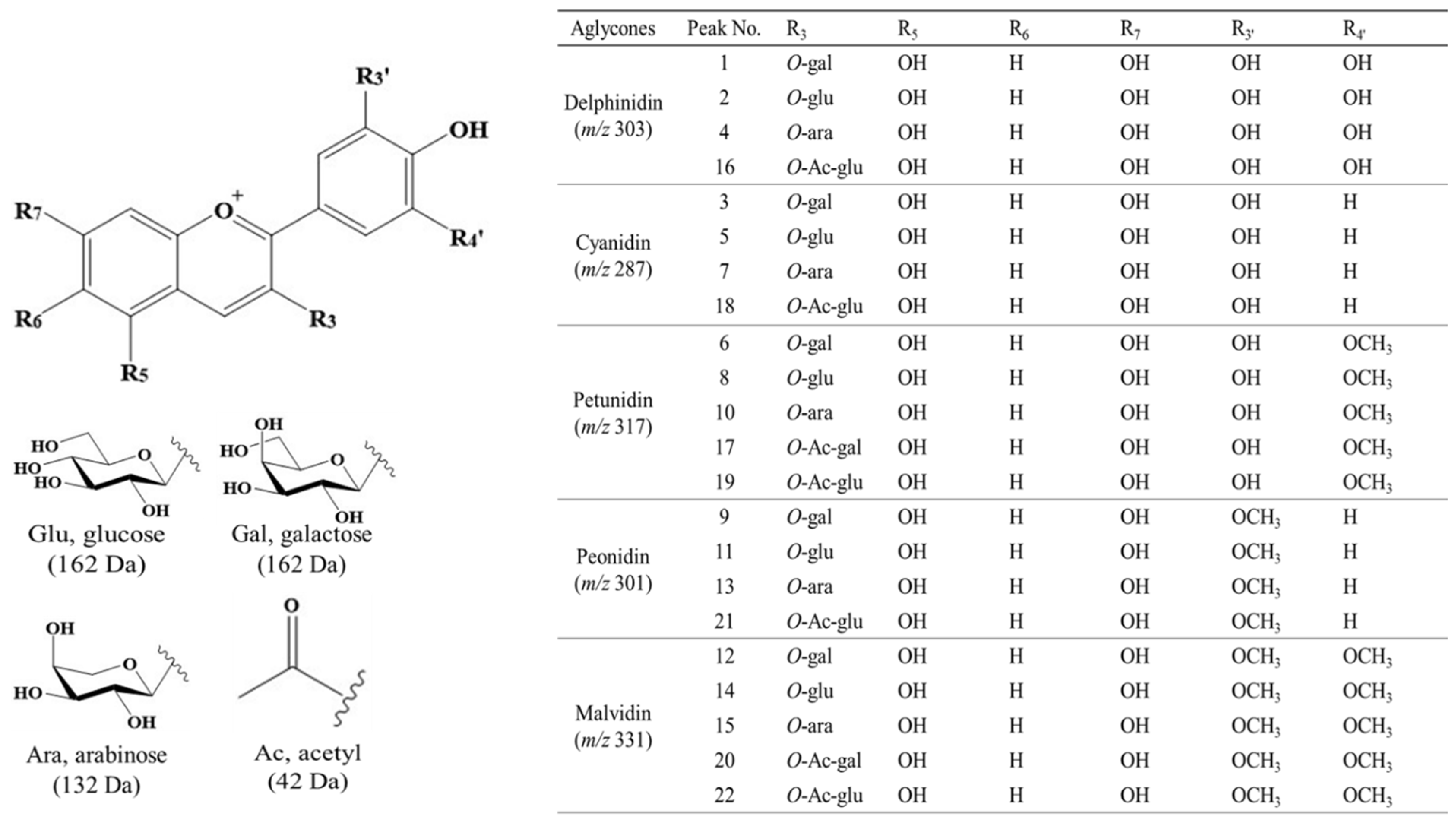
Figure 2.
Fragmentation (m/z, [M]+) patterns of two major and seven acetylated anthocyanins identified in highbush blueberry (a, peak 1) Delphinidin 3-O-galactoside, (b, peak 12) malvidin 3-O-galactoside, (c, peak 16) delphinidin 3-O-(6’‘-O-acetyl)glucoside, (d, peak 17) petunidin 3-O-(6’‘-O-acetyl)galactoside, (e, peak 18) cyanidin 3-O-(6’‘-O-acetyl)glucoside, (f, peak 19) petunidin 3-O-(6’‘-O-acetyl)glucoside, (g, peak 20) malvidin 3-O-(6’‘-O-acetyl)galactoside, (h, peak 21) peonidin 3-O-(6’‘-O-acetyl)glucoside, (i, peak 22) malvidin 3-O-(6’‘-O-acetyl)glucoside.
Figure 2.
Fragmentation (m/z, [M]+) patterns of two major and seven acetylated anthocyanins identified in highbush blueberry (a, peak 1) Delphinidin 3-O-galactoside, (b, peak 12) malvidin 3-O-galactoside, (c, peak 16) delphinidin 3-O-(6’‘-O-acetyl)glucoside, (d, peak 17) petunidin 3-O-(6’‘-O-acetyl)galactoside, (e, peak 18) cyanidin 3-O-(6’‘-O-acetyl)glucoside, (f, peak 19) petunidin 3-O-(6’‘-O-acetyl)glucoside, (g, peak 20) malvidin 3-O-(6’‘-O-acetyl)galactoside, (h, peak 21) peonidin 3-O-(6’‘-O-acetyl)glucoside, (i, peak 22) malvidin 3-O-(6’‘-O-acetyl)glucoside.
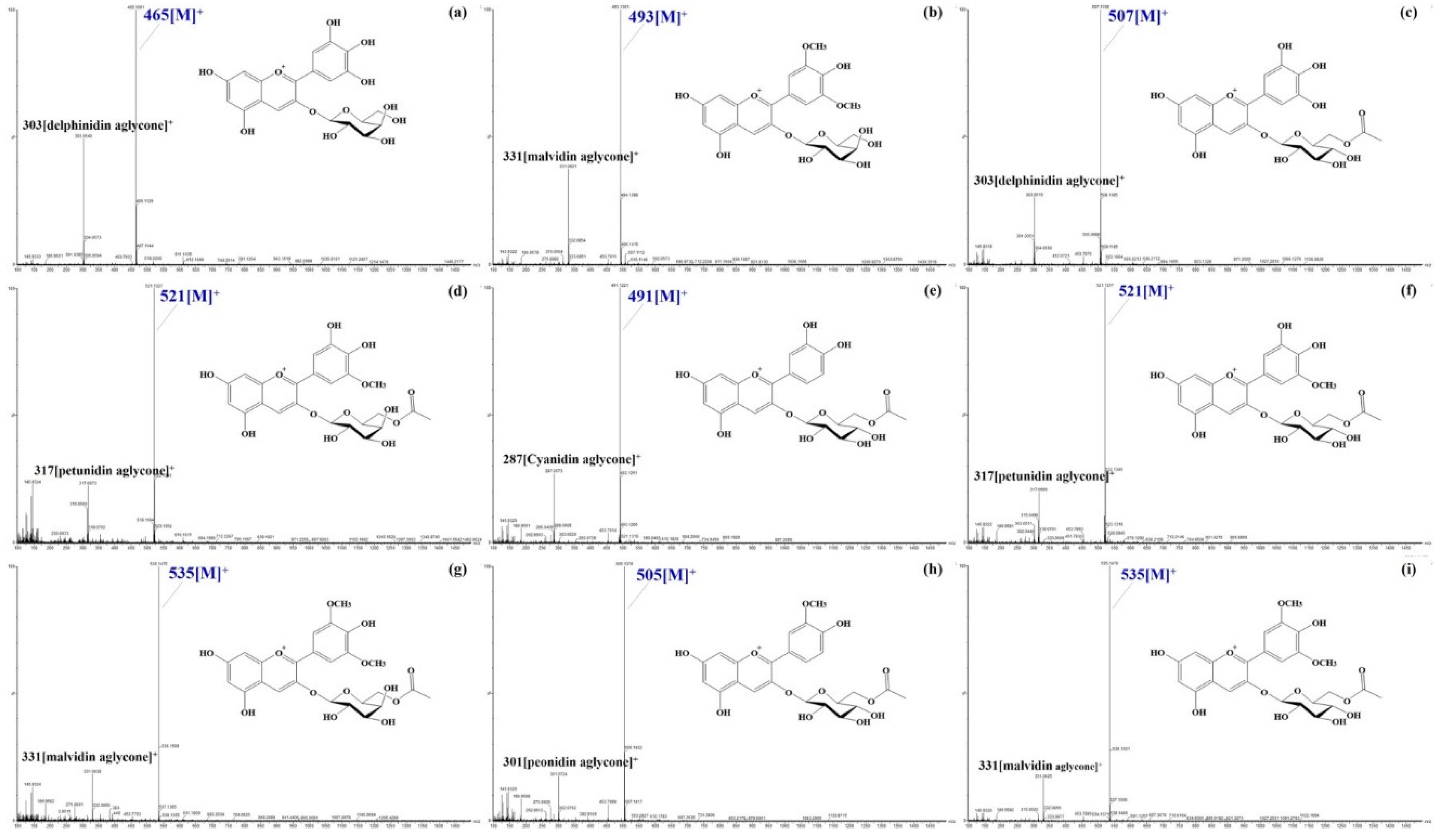
Figure 3.
MRM chromatograms of 11 mixed standards (a) and UPLC-DAD chromatograms of 22 anthocyanins in Patriot (wavelength at 520 nm) (b). IS (internal standard): delphin 100 ppm.
Figure 3.
MRM chromatograms of 11 mixed standards (a) and UPLC-DAD chromatograms of 22 anthocyanins in Patriot (wavelength at 520 nm) (b). IS (internal standard): delphin 100 ppm.
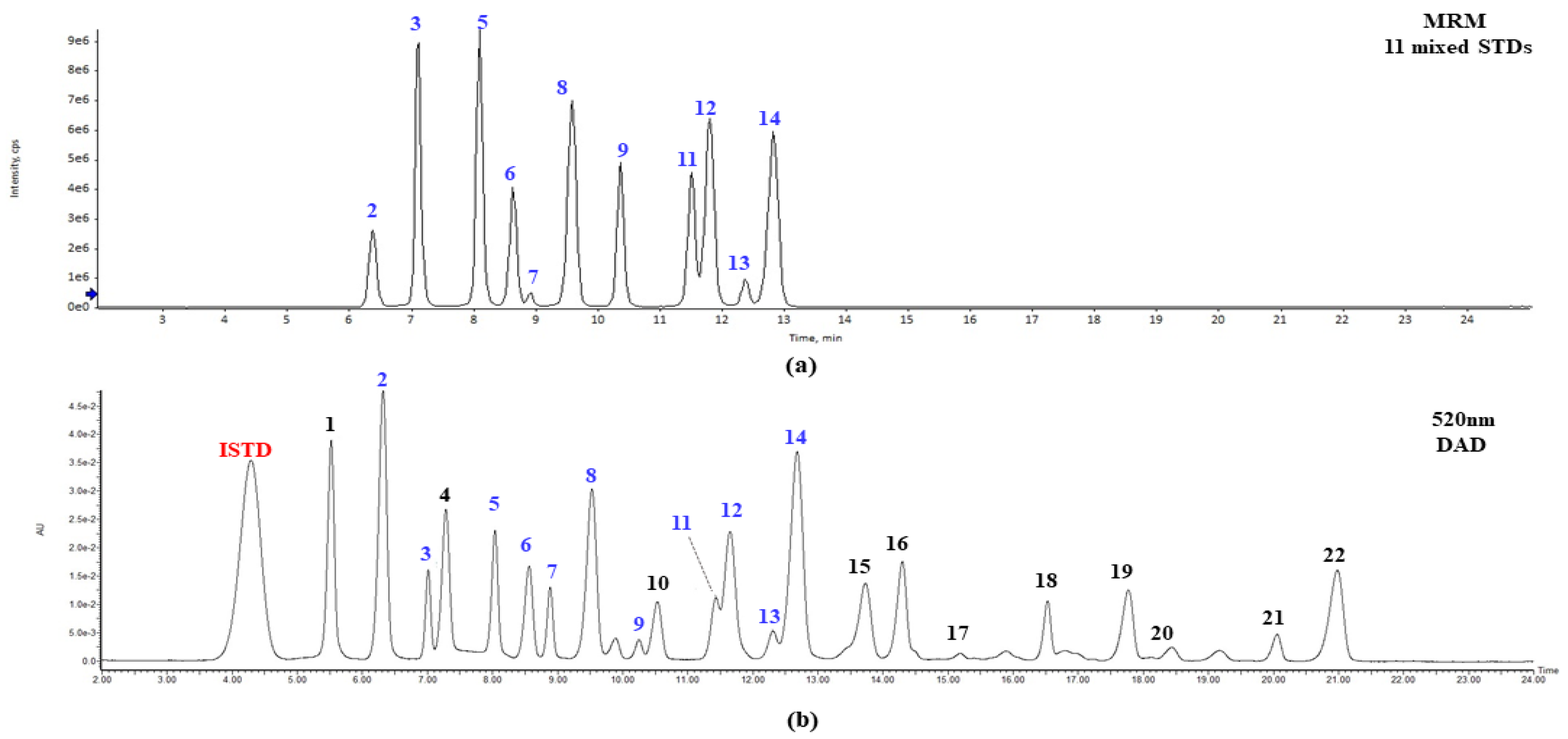
Figure 4.
UPLC chromatogram of 22 anthocyanins (wavelength at 520 nm) from Patriot (a), Reka (b), Hannah’s choice (c), Spartan (d), Legacy (e), Draper (f), New hanover (g), Suziblue (h), and Farthing (i) highbush blueberry samples (V. corymboums L.) are presented according to peak number in Table 4. IS (internal standard): delphin 100 ppm.
Figure 4.
UPLC chromatogram of 22 anthocyanins (wavelength at 520 nm) from Patriot (a), Reka (b), Hannah’s choice (c), Spartan (d), Legacy (e), Draper (f), New hanover (g), Suziblue (h), and Farthing (i) highbush blueberry samples (V. corymboums L.) are presented according to peak number in Table 4. IS (internal standard): delphin 100 ppm.
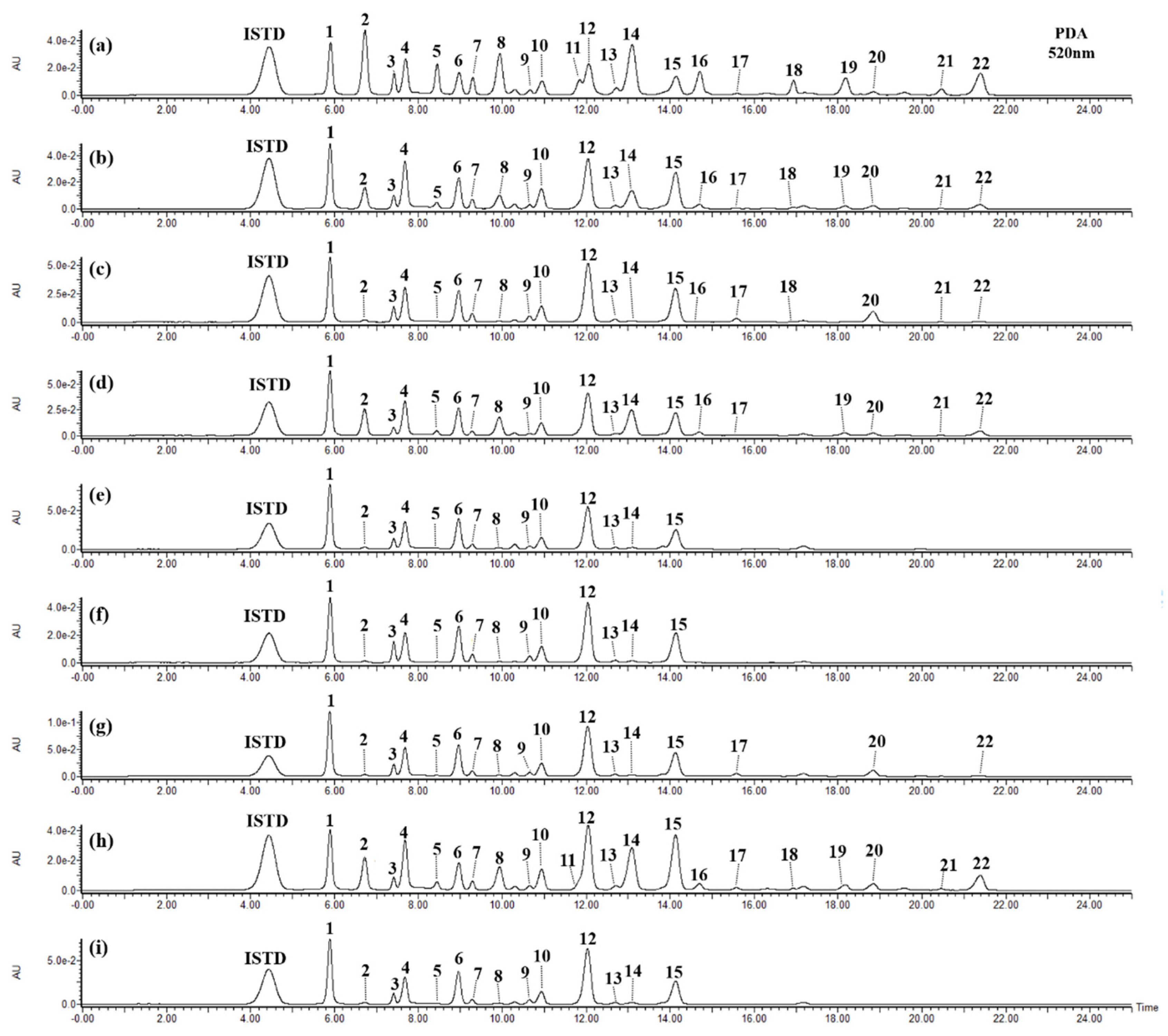

Table 1.
List of 9 highbush blueberry cultivars in Korea.
| Cultivar | Harvest season | Species |
|---|---|---|
| Reka | Early | northern highbush |
| Hannah’s choice | Early | northern highbush |
| Spartan | Early | northern highbush |
| Draper | Early | northern highbush |
| Patriot | Early | northern highbush |
| Legacy | Mid | northern highbush |
| Suziblue | Early | southern highbush |
| Farthing | Early | southern highbush |
| Newhanover | Mid | southern highbush |
Table 2.
Optimized MRM conditions for quantitative analysis of blueberry anthocyanins.
| No. | Compound name | Formula | RT1) (min) |
Precursor ion (m/z) |
Product ion (m/z) |
DP (V)2) | CE (V)3) |
|---|---|---|---|---|---|---|---|
| 2 | Delphinidin 3-O-glucoside (mirtillin) | C25H21O12+ | 6.36 | 465 | 303 | 86 | 29 |
| 3 | Cyanidin 3-O-galactoside (ideain) | C21H21O11+ | 7.09 | 449 | 287 | 86 | 33 |
| 5 | Cyanidin 3-O-glucoside (asterin) | C21H21O11+ | 8.08 | 449 | 287 | 31 | 39 |
| 6 | Petunidin 3-O-galactoside | C22H23O12+ | 8.62 | 479 | 317 | 86 | 35 |
| 7 | Cyanidin 3-O-arabinoside | C20H19O10+ | 8.87 | 419 | 287 | 236 | 27 |
| 8 | Petunidin 3-O-glucoside | C22H23O12+ | 9.57 | 479 | 317 | 86 | 31 |
| 9 | Peonidin 3-O-galactoside | C22H23O11+ | 10.35 | 463 | 301 | 20 | 33 |
| 11 | Peonidin 3-O-glucoside | C22H23O11+ | 11.50 | 463 | 301 | 20 | 33 |
| 12 | Malvidin 3-O-galactoside (primulin) | C22H25O12+ | 11.79 | 493 | 331 | 11 | 35 |
| 13 | Peonidin 3-O-arabinoside | C21H21O10+ | 12.36 | 433 | 301 | 104 | 33 |
| 14 | Malvidin 3-O-glucoside (enin) | C22H25O12+ | 12.81 | 493 | 331 | 16 | 37 |
1) RT: retention time 2) DP: declustering potential 3) CE: collision energy.
Table 3.
Linearity, regression equation, LOD and LOQ, intra- and inter-day precisions of 11 anthocyanin standards.
Table 3.
Linearity, regression equation, LOD and LOQ, intra- and inter-day precisions of 11 anthocyanin standards.
| Compound name | Regression equation | Correlation coefficient1) (R2) | LOD2) (µg/mL) |
LOQ3) (µg/mL) |
Precision RSD (%) | |
|---|---|---|---|---|---|---|
| intraday (n = 6) |
interday(n = 6) | |||||
| Delphinidin 3-O-glucoside | Y = 1779297.1511X + 9835.2387 | 0.9999 | 0.0025 | 0.0076 | 1.83 | 6.54 |
| Cyanidin 3-O-galactoside | Y = 2178374.9200X + 25655.6942 | 1.0000 | 0.0026 | 0.0080 | 0.50 | 5.63 |
| Cyanidin 3-O-glucoside | Y = 3597678.5489X + 27299.5857 | 1.0000 | 0.0030 | 0.0091 | 0.03 | 5.27 |
| Petunidin 3-O-galactoside | Y = 1184176.7790X + 8718.2247 | 0.9998 | 0.0011 | 0.0033 | 5.90 | 4.34 |
| Cyanidin 3-O-arabinoside | Y = 532110.7X + 5725.4070 | 0.9999 | 0.0039 | 0.0117 | 0.50 | 1.96 |
| Petunidin 3-O-glucoside | Y = 2320782.4X + 22315.0959 | 0.9999 | 0.0017 | 0.0053 | 0.03 | 3.42 |
| Peonidin 3-O-galactoside | Y = 1537207.3321X + 46.9756 | 0.9999 | 0.0035 | 0.0106 | 5.43 | 3.21 |
| Peonidin 3-O-glucoside | Y = 1639444.6549X + 6829.8984 | 0.9999 | 0.0035 | 0.0105 | 0.49 | 4.57 |
| Malvidin 3-O-galactoside | Y = 3097011.3147X + 49762.1926 | 0.9998 | 0.0042 | 0.0128 | 0.03 | 3.31 |
| Peonidin 3-O-arabinoside | Y = 817530.9732X + 15169.9675 | 0.9998 | 0.0028 | 0.0085 | 6.69 | 3.84 |
| Malvidin 3-O-glucoside | Y = 3094396.6155X + 62198.3776 | 0.9998 | 0.0017 | 0.0051 | 0.49 | 3.95 |
1) Correlation coefficient (R2) of calibration curve (range; 0.01-5 µg/mL), Y= Peak area, X= concentration (ppm) 2) LOD: limit of detection 3) LOQ: limit of quantitation.
Table 4.
22 Anthocyanins identified from highbush blueberry cultivars.
| Peak No. |
RT (min) |
Compound name | Formula | Experimental ion (m/z, [M]+) | Error (ppm) 1) |
Product ions (m/z) | Species 2) |
|---|---|---|---|---|---|---|---|
| 1 | 5.99 | Delphinidin 3-O-galactoside | C21H21O12+ | 465.1022 | −1.2 | 465, 303 | a, b, c, d, e, f, g, h, i |
| 2 | 6.82 | Delphinidin 3-O-glucoside | C25H21O12+ | 465.1021 | −1.4 | 465, 303 | a, b, c, d, e, f, g, h, i |
| 3 | 7.52 | Cyanidin 3-O-galactoside | C21H21O11+ | 449.1080 | 0.4 | 449, 287 | a, b, c, d, e, f, g, h, i |
| 4 | 7.79 | Delphinidin 3-O-arabinoside | C20H19O11+ | 435.0922 | 0.0 | 435, 303 | a, b, c, d, e, f, g, h, i |
| 5 | 8.56 | Cyanidin 3-O-glucoside | C21H21O11+ | 449.1080 | 0.4 | 449, 287 | a, b, c, d, e, f, g, h, i |
| 6 | 9.09 | Petunidin 3-O-galactoside | C22H23O12+ | 479.1184 | 0.0 | 479, 317 | a, b, c, d, e, f, g, h, i |
| 7 | 9.41 | Cyanidin 3-O-arabinoside | C20H19O10+ | 419.0975 | 0.5 | 419, 287 | a, b, c, d, e, f, g, h, i |
| 8 | 10.06 | Petunidin 3-O-glucoside | C22H23O12+ | 479.1185 | 0.2 | 479, 317 | a, b, c, d, e, f, g, h, i |
| 9 | 10.79 | Peonidin 3-O-galactoside | C22H23O11+ | 463.1270 | 0.5 | 463, 301 | a, b, c, d, e, f, g, h, i |
| 10 | 11.08 | Petunidin 3-O-arabinoside | C21H21O11+ | 449.1078 | −0.1 | 449, 317 | a, b, c, d, e, f, g, h, i |
| 11 | 11.98 | Peonidin 3-O-glucoside | C22H23O11+ | 463.1234 | −0.2 | 463, 301 | e, g |
| 12 | 12.20 | Malvidin 3-O-galactoside | C22H25O12+ | 493.1337 | −0.7 | 493, 331 | a, b, c, d, e, f, g, h, i |
| 13 | 12.85 | Peonidin 3-O-arabinoside | C21H21O10+ | 433.1133 | 0.9 | 433, 301 | a, b, c, d, e, f, g, h, i |
| 14 | 13.25 | Malvidin 3-O-glucoside | C22H25O12+ | 493.1342 | 0.3 | 493, 331 | a, b, c, d, e, f, g, h, i |
| 15 | 14.30 | Malvidin 3-O-arabinoside | C22H23O11+ | 463.1235 | 0.0 | 463, 331 | a, b, c, d, e, f, g, h, i |
| 16 | 14.88 | Delphinidin 3-O-(6’‘-O-acetyl)glucoside | C23H23O13+ | 507.1135 | 0.4 | 507, 303 | a, b, c, e, g |
| 17 | 15.78 | Petunidin 3-O-(6’‘-O-acetyl)galactoside | C24H25O13+ | 521.1292 | 0.4 | 521, 317 | a, b, c, e, g, i |
| 18 | 17.13 | Cyanidin 3-O-(6’‘-O-acetyl)glucoside | C23H23O12+ | 491.1187 | 0.6 | 491, 287 | a, b, c, e, g |
| 19 | 18.39 | Petunidin 3-O-(6’‘-O-acetyl)glucoside | C24H25O13+ | 521.1292 | 0.4 | 521, 317 | a, b, c, e, g |
| 20 | 19.06 | Malvidin 3-O-(6’‘-O-acetyl)galactoside | C25H27O13+ | 535.1449 | 0.5 | 535, 331 | a, b, c, e, g, i |
| 21 | 20.69 | Peonidin 3-O-(6’‘-O-acetyl)glucoside | C24H25O12+ | 505.1343 | 0.4 | 505, 301 | a, b, c, e, g |
| 22 | 21.62 | Malvidin 3-O-(6’‘-O-acetyl)glucoside | C25H27O13+ | 535.1448 | 0.3 | 535, 331 | a, b, c, e, g, i |
1) Error (ppm) indicates the mass accuracy of QToF data and was calculated as [(calculated ion – observed ion) / (calculated ion)] × 106 based on m/z [M+H]+. 2) a, Reka; b, Hannah’s choice; c, Spartan; d, Draper; e, Patriot; f, Legacy; g, Suziblue; h, Farthing; i, New Hanover.
Table 5.
Contents of individual anthocyanin glycosides in different highbush blueberry (Vaccinum corymbosum L.) cultivars.
Table 5.
Contents of individual anthocyanin glycosides in different highbush blueberry (Vaccinum corymbosum L.) cultivars.
| Peak No. 1) | Anthocyanin content (mg/100 gdry weight) | ||||||||
|---|---|---|---|---|---|---|---|---|---|
| Reka | Hannah’s choice | Spartan | Suziblue | Farthing | Patriot | Draper | Legacy | New Hanover | |
| Early-season | Mid-season | ||||||||
| 1 | 86.7 ± 1.4d | 94.7 ± 1.8d | 123.4 ± 7.7c | 71.2 ± 2.1e | 119.7 ± 2.6c | 72.8 ± 2.5e | 164.4 ± 19.4b | 165.1 ± 3.1b | 200.4 ± 16.8a |
| 2* | 33.2 ± 1.9d | 4.1 ± 0.2e | 74.2 ± 2.2b | 49.0 ± 2.0c | 3.3 ± 1.3e | 110.0 ± 0.9a | 4.0 ± 0.6e | 4.8 ± 0.7e | 4.8 ± 0.4e |
| 3* | 10.7 ± 0.7fg | 14.8 ± 0.5de | 8.3 ± 0.1e | 9.0 ± 0.5ge | 12.2 ± 1.4ef | 17.0 ± 1.6c | 27.7 ± 3.0a | 16.2 ± 2.2cd | 22.8 ± 2.5b |
| 4 | 65.7 ± 0.9cd | 51.8 ± 0.9e | 71.1 ± 2.9bc | 59.5 ± 2.7d | 52.0 ± 1.5e | 49.4 ± 2.6e | 74.3 ± 6.7b | 74.4 ± 1.5b | 91.7 ± 7.4a |
| 5* | 5.4 ± 0.7b | 0.7 ± 0.2c | 6.9 ± 0.2b | 6.2 ± 0.5b | 0.4 ± 0.1c | 33.7 ± 2.3a | 0.7 ± 0.2c | 0.6 ± 0.2c | 0.6 ± 0.1c |
| 6* | 84.4 ± 3.7de | 102.7 ± 5.9d | 108.0 ± 1.5d | 73.8 ± 6.0ef | 127.8 ± 10.3c | 61.9 ± 0.3f | 159.4 ± 13.4b | 157.3 ± 14.6b | 193.6 ± 18.3a |
| 7* | 7.5 ± 0.8c | 7.3 ± 1.2c | 3.6 ± 0.3f | 6.0 ± 0.5de | 5.3 ± 0.4e | 13.2 ± 0.9a | 11.0 ± 0.1b | 7.0 ± 0.6cd | 10.6 ± 0.8b |
| 8* | 22.5 ± 2.1d | 2.8 ± 0.0e | 56.0 ± 1.0b | 38.6 ± 2.6c | 2.7 ± 0.1e | 72.1 ± 3.9a | 3.4 ± 0.1e | 3.8 ± 0.3e | 3.8 ± 0.3e |
| 9* | 5.0 ± 1.0ef | 8.6 ± 2.1b | 3.4 ± 0.1g | 4.5 ± 0.2f | 7.5 ± 1.1bc | 6.1 ± 0.3de | 11.2 ± 0.8a | 6.7 ± 0.6cd | 11.2 ± 1.0a |
| 10 | 35.4 ± 0.5d | 27.1 ± 0.5e | 32.8 ± 1.8d | 32.5 ± 1.8d | 27.8 ± 1.0e | 22.7 ± 1.3f | 42.6 ± 1.4b | 39.4 ± 0.8c | 47.5 ± 3.5a |
| 11* | 4.4 ± 0.7d | 1.0 ± 0.3e | 5.8 ± 0.6c | 7.7 ± 0.5b | 0.7 ± 0.1e | 23.1 ± 1.4a | 0.9 ± 0.2e | 0.8 ± 0.1e | 0.9 ± 0.1e |
| 12* | 103.5 ± 3.2d | 133.8 ± 11.7c | 121.8 ± 3.1cd | 120.9 ± 7.3cd | 157.9 ± 14.0b | 59.9 ± 3.7e | 177.9 ± 15.9b | 157.7 ± 13.1b | 238.1 ± 22.7a |
| 13* | 0.8 ± 0.5e | 2.2 ± 0.2c | NDf | 0.7 ± 0.1e | 1.5 ± 0.1d | 1.9 ± 0.1c | 2.2 ± 0.2b | 1.2 ± 0.1d | 2.7 ± 1.1a |
| 14* | 49.7 ± 2.6c | 3.9 ± 0.3d | 109.4 ± 7.9b | 110.5 ± 6.6b | 4.0 ± 0.4d | 140.9 ± 9.0a | 4.5 ± 0.3d | 4.7 ± 0.4d | 5.8 ± 0.4d |
| 15 | 85.1 ± 1.5c | 87.1 ± 1.7c | 78.7 ± 3.6d | 109.7 ± 5.8b | 76.4 ± 2.0d | 46.2 ± 3.4e | 111.1 ± 4.7b | 85.6 ± 0.5c | 133.2 ± 7.5a |
| 16 | 6.9 ± 0.1c | 0.9 ± 0.3d | 9.0 ± 0.5b | 9.0 ± 0.6b | NDd | 43.9 ± 2.8a | NDd | NDd | NDd |
| 17 | 1.4 ± 0.0e | 6.5 ± 0.4b | 1.7 ± 0.3de | 3.2 ± 0.1c | NDf | 2.1 ± 0.2d | NDf | NDf | 10.5 ± 0.9a |
| 18 | 2.3 ± 0.5b | 0.9 ± 0.1de | 1.3 ± 0.1cd | 2.0 ± 0.2bc | NDe | 21.0 ± 1.1a | NDe | NDe | NDe |
| 19 | 5.8 ± 0.4c | NDd | 9.8 ± 0.4b | 9.3 ± 0.6b | NDd | 36.0 ± 1.5a | NDd | NDd | NDd |
| 20 | 6.7 ± 0.2e | 26.9 ± 0.5b | 8.9 ± 0.3d | 11.8 ± 0.8c | NDf | 6.2 ± 0.3e | NDf | NDf | 31.6 ± 2.0a |
| 21 | 1.3 ± 0.0c | 0.7 ± 0.0d | 0.9 ± 0.1cd | 2.1 ± 0.2b | NDe | 11.2 ± 0.7a | NDe | NDe | NDe |
| 22 | 11.5 ± 0.0d | 2.7 ± 0.1e | 20.7 ± 0.5c | 34.0 ± 1.8b | NDf | 59.2 ± 3.9a | NDf | NDf | 1.9 ± 0.1e |
| Total anthocyanin |
635.9 ± 18.9d | 581.1 ± 23.8de | 855.5 ± 27.3bc | 771.1 ± 32.7c | 599.3 ± 12.5e | 910.4 ± 36.8ab | 795.3 ± 31.5c | 725.4 ± 36.8ab | 1011.7 ± 66.4a |
1) 1, delphinidin 3-O-galactoside; 2, delphinidin 3-O-glucoside; 3, cyanidin 3-O-galactoside; 4, delphinidin 3-O-arabinoside; 5. cyanidin 3-O-glucoside; 6, petunidin 3-O-galactoside; 7, cyanidin 3-O-arabinoside; 8, petunidin 3-O-glucoside; 9, peonidin 3-O-galactoside; 10, petunidin 3-O-arabinoside; 11, peonidin 3-O-glucoside; 12, malvidin 3-O-galactoside; 13, peonidin 3-O-arabinoside; 14, malvidin 3-O-glucoside; 15, malvidin 3-O-arabinoside; 16, delphinidin 3-O-(6’‘-O-acetyl)glucoside; 17, petunidin 3-O-(6’‘-O-acetyl)galactoside; 18, cyanidin 3-O-(6’‘-O-acetyl)glucoside; 19, petunidin 3-O-(6’‘-O-acetyl)glucoside; 20, malvidin 3-O-(6’‘-O-acetyl)galactoside; 21, peonidin 3-O-(6’‘-O-acetyl)glucoside; 22, malvidin 3-O-(6’‘-O-acetyl)glucoside.* External standard. a-f Different superscript letters next to mean values (n = 3) indicate significant differences (p < 0.05) according to Duncan’s multiple range test.
Disclaimer/Publisher’s Note: The statements, opinions and data contained in all publications are solely those of the individual author(s) and contributor(s) and not of MDPI and/or the editor(s). MDPI and/or the editor(s) disclaim responsibility for any injury to people or property resulting from any ideas, methods, instructions or products referred to in the content. |
© 2024 by the authors. Licensee MDPI, Basel, Switzerland. This article is an open access article distributed under the terms and conditions of the Creative Commons Attribution (CC BY) license (https://creativecommons.org/licenses/by/4.0/).
Copyright: This open access article is published under a Creative Commons CC BY 4.0 license, which permit the free download, distribution, and reuse, provided that the author and preprint are cited in any reuse.


