

Submitted:
02 December 2024
Posted:
03 December 2024
You are already at the latest version
Abstract
Greek yogurt, a traditional food with roots in Ancient Greece, Mesopotamia, and Central Asia, has become a dietary staple worldwide due to its creamy texture, distinct flavor, and rich nutritional profile. The contemporary emphasis on health and wellness has elevated Greek yogurt as a functional food, recognized for its high protein content and bioavailable probiotics that support overall health. This study investigates the sensory attributes and consumer preferences driving the acceptance of Greek yogurt formulations. Samples with higher consumer acceptance were characterized by sensory attributes such as "high texture in the mouth, surface uniformity, creaminess, apparent homogeneity, mouth filling, grip in the mouth, ease of pick-up with a spoon, milk cream flavor, sweetness, and dairy flavor." These attributes strongly correlated with consumer preferences, underscoring their importance in product optimization. The findings provide a framework for refining Greek yogurt formulations to address diverse market demands, achieving a balance between sensory excellence and practical formulation strategies. This research reinforces the significance of Greek yogurt as a culturally adaptable, health-promoting dietary component and a promising market segment for ongoing innovation.
Keywords:
Greek yogurt
; sensory attributes
; consumer preferences
; functional food
; product optimization
; market trends
1. Introduction
Yogurt, a food with ancient origins, has been integral to diets across civilizations such as Ancient Greece, Mesopotamia, and Central Asia. Its production began with the spontaneous fermentation of milk in animal-skin containers, resulting in a creamy texture and distinct flavor [1]. Over time, yogurt has been woven into cultural traditions worldwide, becoming a staple in many regions.
Among its many variations, Greek yogurt has recently gained global acclaim for its thick texture and slightly acidic taste, along with notable nutritional benefits [2,3,4]. The straining process used to make Greek yogurt removes whey, yielding a product with higher protein content and lower levels of lactose and carbohydrates [5,6]. This process concentrates essential nutrients, such as calcium, probiotics, and vitamins, while contributing to the yogurt’s creamy consistency and tangy flavor—attributes that have heightened consumer appreciation [7].
Notably, Greek yogurt contains up to twice the protein of traditional yogurt, further enhancing its reputation as a nutritious and versatile food option [8].
The contemporary emphasis on health and wellness has driven the promotion of Greek yogurt as a functional food, rich in bioavailable proteins and probiotics that support digestion, bone health, and muscle function [9,10]. Its popularity is evident in market trends, with Greek yogurt representing a significant share of global sales, especially in regions like North America and Europe, where demand for health-oriented, convenient foods is high [11].
Despite its success, producing low-fat Greek yogurt presents notable challenges. Reducing fat content adversely affects sensory properties, particularly texture and flavor. As a result, research has explored the use of whey protein concentrates and hydrocolloids to mitigate these sensory deficits [5,12]. Innovations in formulation are essential to maintain product appeal and nutritional integrity, addressing evolving consumer preferences and supporting industry growth [13].
Understanding consumer preferences and sensory attributes is pivotal for advancing Greek yogurt products. Sensory studies have identified key attributes, such as texture and flavor profile, that influence consumer satisfaction and drive product development [14]. These evaluations are critical for optimizing production processes and ensuring consistent product quality, aligning with consumer expectations.
In summary, Greek yogurt stands out as a highly desirable functional food due to its rich nutritional and sensory profile. Ongoing research and innovation, underpinned by consumer insights, remain vital for the continued expansion and success of this market segment. Furthermore, yogurt’s widespread appeal and adaptability underscore its cultural significance and enduring role as a health-promoting dietary component [15]
From its artisanal roots to large-scale industrial production beginning in the early 20th century, yogurt has evolved to meet modern demands, providing an accessible, nutritious, and enjoyable food choice [16].
Key to yogurt’s sensory appeal are its flavor compounds, derived from milkfat lipolysis and microbial transformations of lactose and citrate. Over 100 volatile compounds contribute to yogurt’s characteristic aroma and taste, with lactic acid, acetaldehyde, diacetyl, and acetoin among the primary contributors [7]. Understanding these complexities continues to shape innovations in yogurt production, ensuring products remain flavorful and nutritionally robust.
Considering the importance of determining the descriptive sensory profile and consumer acceptance because are factors that significantly influence the sensory quality of foods, this study aimed to identify the sensory descriptors that positively drive consumer preference for Greek yogurt. The findings are intended to contribute to innovation and the development of new products that meet market demands. The application of sensory evaluation methods serves as a valuable tool for optimizing production processes and ensuring consistent product quality for consumers.
In summary, Greek yogurt, due to its nutritional and sensory characteristics, stands out as a highly demanded functional food. Continuous development and innovation, grounded in understanding consumer preferences, are essential for the industry’s success and for the expansion of the global yogurt market.
Material and Methods
Samples
Eleven 11 traditional Greek yogurt samples were analyzed: three Brazilian market leaders being 2 produced by multinational companies (coded 1-GYMML and 2-GYMML), and one produced by National company (coded 3-GYNML) and another eight developed Greek yogurts, prepared in the LCSEC (Prototype 1 to 8), that presented variation in sugar syrup, cream milk, Milk Protein Concentrate, Concentrated milk Fat, culture for yogurt, and presence or no of modified starch and tasteless and colorless gelatine. The basic formulation of the eight prototypes (P1; P2; P3; P4; P5; P6; P7; P8) are presented in Table 1.
Methods
Sensory Analysis
The three commercial samples were obtained from local supermarkets in Campinas (São Paulo State, Brazil). Approximately 30 grams of each sample, refrigerated at 4°C, were served in 30 mL disposable cups coded with random three-digit numbers for sensory analysis. Water and cream-cracker biscuits were also provided for palate cleansing. The study was approved by the Ethics Committee of the State University of Campinas (CAAE: 79768517.3.0000.5404), and informed consent was obtained from all volunteers.
Sensory analyses were conducted at the Laboratory of Sensory Science and Consumer Studies (LCSEC) of the School of Food Engineering (FEA), University of Campinas (UNICAMP), according to official methods American Society of Testinh and Materials to consumers study [17] and ISO 8589:2007 standards [18]. The sensory panelists included young adults and adults (aged 18 to 40 years) who were regular Greek yogurt consumers. Participants were recruited through advertisements posted on flyers and social media platforms. For the experimental design, all sensory tests utilized a complete block design with balanced sample presentation [19].
Prior to product evaluation, all panelists received and signed an Informed Consent Form as required by the UNICAMP Research Ethics Committee. This document, which outlined the research details, was presented to ensure full understanding and to confirm participants’ willingness to partake in the study.
Descriptive Quantitative Analysis
Pre-Selection of Assessors
To efficiently analyze the data of descriptive sensory profile, the panel members must have discriminatory power. Thus, a preselection applied with triangular tests, was carried out of the pre-candidate assessors for the Quantitative Descriptive Analysis® [23] of Greek yogurt. A total of 25 pre-candidates were recruited, all consumers of the product having no restrictions in consuming the product and showing interest in taking part in the test.
The candidates were instructed to evaluate the samples from left to right and identify which coded sample was different from the others. The discriminative power was evaluated by Wald’s sequential analysis [20], using triangular difference tests with a significant difference at the 1% level with respect to sweetness, the objective being to select the candidates best able to discriminate the samples.
Each candidate performed 3 triangular tests per day to preserve their sensory capacity. The parameters used to analyze the discriminatory capacity in Wald’s sequential analysis were prefixed at ρ0 = 0.45 (maximum acceptable lack of ability), ρ1 = 0.70 (minimum acceptable ability), and for the risks α = 0.05 (probability of accepting a candidate without acuity) and β = 0.05 (probability of rejecting a candidate without acuity) [21]. Having defined the parameters, 2 lines of equation were obtained and used to construct the Wald graph with 3 defined areas was obtained: acceptance, indecisive, and rejection area of the panelists [20].
Thus, the panelists were selected or rejected according to the number of correct replies in the triangular tests applied and projected in the Wald graph [20]. In the end, 22 panelists were selected for the QDA® of Greek yogurts samples.
Quantitative Descriptive Analysis
Twenty and two selected panelists (twelve women and ten men, mean age=32) were recruited based on their willingness to participate and their consumption of Greek Yogurt on a regular basis. Six times by one hour training sessions were conducted. The samples that were evaluated were gently stirred to homogenize them, filled in 30 g plastic containers, covered, and stored in the refrigerator at 4°C until served to the assessors. The samples were coded with three-digit random numbers.
Table 2 summarizes the descriptor terms along with definitions, anchor words, and references to none/weak (0,0), moderate/medium (4,5) and strong (9,0) used to training and selection of assessor panel.
The participants selected presented p-value of sample <0.50, p-value of repetition >0.05 and agreement among them respective for the 41 descriptor terms [22]. The intensity for each descriptor terms were marked in a 9 points scale with Compusense software. The assessors were the analysis in triplicate. Significant means for sensory analyses were separated by Tukey’s honestly significant difference. Significance was pre-established at Alpha<0.05. Principal component analysis was performed using the means obtained from descriptive analysis (QDA®) [23].
The potential first-order carry-over effect was mitigated through a balanced design based on MacFie et al. (1989) [19]. The data were collected using Compusense software.
Statistical analysis of analysis of variance and Tukey’s test and multivariate Principal Component Analysis to check the preference mapping were performed using SAS software (V.9.4, 2024, SAS, Cary, NC).
Acceptance Analysis
An acceptance [23] test was conducted with 150 consumers (67 men and 83 women, mean age=32 years). Samples were served over two consecutive days. Consumers were asked to mark their liking in relation to appearance, flavor, texture, and overall acceptability using the 9-point hedonic scale (from 1=dislike extremely to 9=like extremely).
The inclusion criteria required participants to consume yogurt at least once a week and to have no milk allergies. The tests were conducted in a controlled environment (temperature maintained at 20 °C), where 30 mg of each sample was served at 5 °C in plastic cups labeled with three-digit codes. Prior to participation, all individuals read and signed an informed consent form. To cleanse their palate between samples, participants were provided with cream-cracker biscuits and water.
Physical-Chemical Tests
Physicochemical analyses (pH determination, soluble solids content, and instrumental texture analysis) were carried out at the Central Instrumental Laboratory of the School of Food Engineering, State University of Campinas (UNICAMP).
pH
The pH of the yogurt samples was determined using an electrometric method with a pH meter, in an Orion Expandable Ion Analyzer EA 940 [24]. The measurements were taken after the package was opened. A twenty-minute interval was given between each evaluation for each measurement. The analyses were performed in triplicate. The results were analyzed using the SAS program through analysis of variance and Tukey’s mean tests (p<0.05).
Soluble Solids
The concentration of soluble solids was determined with direct reading in a Carl ZEISS Jena bench refractometer, according to method no. 932.12 of the AOAC [24]. It was performed in triplicate at a temperature of 20 °C and the results were expressed in ° Brix.
Instrumental Texture
Texture analysis was performed following the method of Rawson & Marshall (1997) [25] using a TAXT2 universal texture analyzer equipped with a 35 mm diameter flat-bottom cylindrical probe (A/BE 35). The results were processed using Texture Expert software version 1.11 for Texture Profile Analysis (TPA).
Statistical Analysis of Data
Data from Quantitative Descriptive Analysis (QDA), consumer tests, and physicochemical tests were analyzed using univariate analysis of variance (ANOVA) and Tukey’s mean comparison tests. The mean results from descriptive terms, consumer tests, and physicochemical analyses were further analyzed using multivariate statistical analysis, specifically partial least squares regression [26].
The results presented in this study can serve as a valuable guideline for the formulation of developing Greek yogurts, as well as for existing products on the market, by highlighting sensory characteristics of importance to consumers.
For instance, samples P1, P3, P5, P8, and 1-GYMML could utilize the findings from the present study to enhance dairy flavor (milk), milk cream flavor, and texture in the mouth, while simultaneously reducing metallic flavor, cheese flavor (sour milk), sulfurous flavor, and rancid flavor to improve product quality and acceptance.
It is important to emphasize that these adjustments should also be supported by additional information about the products, as well as manufacturing and storage conditions, such as shelf life, environmental factors, ingredient temperatures, and other relevant data to better inform decision-making.
Figure 1 represents the results obtained from hierarchical cluster analysis, showing the formation of four similarity groups based on the descriptive sensory profile.
The first group comprised samples P4, P7, 2-GYMML, and 3-GYNML, characterized by high intensities of dairy aroma, sweet aroma, texture in the mouth, surface uniformity, creamy in the mouth, apparent uniformity, mouth filling, sweetness, milk cream flavor, and dairy flavor. These samples also exhibited low or negligible intensities of rancid-oil flavor, metallic, sulfurous, salty, lump formation, grip in the mouth, syneresis, bitterness, cheese flavor, and cottage-cheese flavor. Additionally, they presented intermediate levels of acidic aroma, acidity, and viscosity.
The second group included yogurt samples P2, P6, and P8, which were characterized by low intensities of metallic flavor, cottage-cheese flavor, lump formation, cheese flavor sulfurous, and cheese flavor. Conversely, these samples showed high intensities of texture in the mouth, surface uniformity, homogeneity and uniformity, and intermediate levels of dairy flavor and milk cream flavor.
The third group consisted of yogurt samples P1, P3, and P5, primarily marked by low intensities of cottage-cheese flavor, lump formation, and bitterness. They exhibited high intensities of dairy aroma, sweet aroma, texture in the mouth, creamy in the mouth, apparent uniformity, and mouth filling, along with intermediate levels of caramel flavor and acidity.
The fourth group was represented by a single sample, 1-GYMML (the least preferred), which showed low intensities of buttery flavor, diacetyl aroma, vanilla flavor, and caramel aroma. However, it was characterized by high intensities of filament formation when picking up with a spoon, viscous texture, bitterness, cheese flavor, and residual bitterness. It also presented intermediate levels of dairy aroma, sweet aroma, texture in the mouth, surface uniformity, mouth filling, buttery aroma, and caramel flavor.
It is possible to observe that the samples with higher acceptance formulations (2-GYMML, 3-GYNML, P4 and P7) exhibited characteristics like "high texture in the mouth, surface uniformity, creaminess in the mouth, apparent homogeneity, mouth filling, grip in the mouth, texture whine pick in up with spoon, milk cream flavor, sweetness, dairy flavor and sweetness".
Samples with higher acceptance formulations (2-GYMML, 3-GYNML, P4 and P7) exhibited characteristics like "high texture in the mouth, surface uniformity, creaminess in the mouth, apparent homogeneity, mouth filling, grip in the mouth, texture whine pick in up with spoon, milk cream flavor, sweetness, dairy flavor and sweetness higher as shown in Table 2 and evidenced in the Figure 1.
When considering the information from the results of the descriptive sensory profile and the overall consumer acceptance presented, it is essential to consider the characteristics that contribute positively or negatively, as well as those that do not influence consumer preference. However, it is crucial to consider the minimum and maximum limits of the ingredients used in each formulation to achieve a successful response.
The preference did not differ significantly among 2-GYMML, 3-GYNML, P4, and P7 (p>0.05). This is a relevant result, as it demonstrates the development of two formulations with acceptance levels comparable to the market-leading Greek yogurt. Greek yogurt represents one of the most rapidly expanding categories within the dairy sector. Also known as strained yogurt, it is produced by removing whey through a straining process, resulting in a product with higher total solids and reduced lactose content compared to conventional yogurt. Due to its concentrated nature, Greek yogurt exhibits distinctive sensory properties [27].
The results presented in Table 3, highlight the limits found in the four preferred samples Greek yogurt, relative to solid soluble with values 18.00 to 18.86 oBrix (no significant difference p>0.05), pH values 4.17 to 4.26 (no significant difference p>0.05), and texture from 18.264 to 30.900 F/g (means significantly different at p<0.05).

Table 3.
Means* of descriptor terms of Greek yogurt.
| Descriptor Terms | P1 | P2 | P3 | P4 | P5 | P6 | P7 | P8 | 1-GYMML | 2-GYMML | 3-GYNML |
|---|---|---|---|---|---|---|---|---|---|---|---|
| Yellow color | 5.1 c | 6.5 b | 3.1 f | 5.7 c | 2.1 g | 6.3 b | 4.0 e | 4.5 d | 7.1 a | 7.2 a | 6.4 b |
| Apparent Homogeneity | 8.8 a | 8.9 a | 5.7 b | 8.8 a | 8.8 a | 8.6 a | 8.8 a | 8.7 a | 4.5 c | 8.7 a | 8.8 a |
| Syneresis | 6.1 a | 0.1 b | 0.2 b | 0.2 b | 0.3 b | 6.2 a | 0.2 b | 0.2 b | 5.7 a | 0.1 b | 0.2 b |
| Texture when picking up with a spoon | 8.3 a | 8.4 a | 8.1 a | 7.6 b | 7.9 a | 8.3 a | 8.2 a | 8.4 a | 4.2 c | 7.2 b | 8.5 a |
| Filament formation when picking up with a spoon | 3.3 c | 3.5 c | 5.4 b | 1.1 d | 5.3 b | 1.2 d | 1.1 d | 1.2 d | 8.4 a | 5.3 b | 1.2 d |
| Shine | 8.4 a | 8.6 a | 8.5 a | 8.3 a | 8.5 a | 8.5 a | 8.6 a | 8.5 a | 6.8 b | 8.5 a | 8.5 a |
| Surface uniformity | 8.3 a | 8.5 a | 8.2 a | 8.5 a | 8.5 a | 8.5 a | 8.4 a | 8.4 a | 4.5 b | 8.4 a | 8.5 a |
| Acid Aroma | 3.4 d | 4.4 c | 5.1 b | 3.3 d | 3.5 d | 3.6 d | 3.5 d | 3.4 d | 6.7 a | 3.5 d | 3.6 d |
| Sweet aroma | 7.7 a | 7.6 a | 7.8 a | 4.2 b | 7.6 a | 7.7 a | 7.5 a | 4.1 b | 4.0 b | 7.6 a | 7.7 a |
| Dairy aroma | 8.3 a | 8.2 a | 8.2 a | 5.4 b | 8.0 a | 5.7 b | 8.1 a | 3.7 c | 3.9 c | 8.1 a | 8.3 a |
| Buttery Aroma | 3.4 c | 6.4 b | 3.6 c | 2.2 d | 6.5 b | 3.9 c | 6.5 b | 6.5 b | 2.0 d | 3.8 c | 7.3 a |
| Vanilla Aroma | 4.6 c | 7.5 b | 4.4 c | 3.0 d | 7.6 b | 4.8 c | 7.6 b | 7.7 a | 2.8 d | 4.7 c | 8.2 a |
| Diacetyl Aroma | 5.3 c | 3.7 d | 5.4 c | 3.5 d | 7.5 a | 7.6 a | 7.6 a | 6.1 b | 3.6 d | 7.4 a | 7.6 a |
| Caramel Aroma | 3.8 b | 6.1 a | 3.3 b | 1.3 c | 6.1 a | 6.1 a | 6.0 a | 5.9 a | 1.2 c | 3.7 b | 6.1 a |
| Cheese Aroma | 5.1 b | 5.0 b | 5.2 b | 3.4 d | 7.2 a | 3.5 d | 7.2 a | 4.2 c | 1.5 e | 7.3 a | 7.1 a |
| Dairy flavor (milk) | 0.2 c | 2.3 b | 0.3 c | 4.7 a | 0.1 c | 0.2 c | 0.1 c | 0.3 c | 4.6 a | 0.3 c | 0.4 c |
| Metallic Flavor | 7.0 b | 4.5 c | 4.8 c | 8.1 a | 4.7 c | 4.6 c | 3.3 d | 4.6 c | 2.7 e | 3.5 d | 3.2 d |
| Cheese flavor (sour milk) | 7.1 a | 0.0 c | 0.0 c | 0.0 c | 0.0 c | 0.0 c | 0.0 c | 0.0 c | 4.8 b | 0.0 c | 0.0 c |
| Cottage cheese flavor | 0.0 d | 0.0 d | 1.8 c | 0.0 d | 0.0 d | 0.0 d | 0.0 d | 2.8 b | 8.2 a | 0.0 d | 0.0 d |
| Sulfurous Flavor | 0.3 c | 0.2 c | 0.4 c | 0.4 c | 0.4 c | 0.2 c | 0.3 c | 0.4 c | 5.5 a | 3.1 b | 0.3 c |
| Rancid oil flavor | 0.0 d | 0.0 d | 5.2 b | 0.0 d | 4.8 c | 0.0 d | 0.0 d | 0.0 d | 5.7 a | 0.0 d | 0.0 d |
| Sweetness | 7.5 a | 0.0 d | 7.7 a | 0.0 d | 4.7 b | 0.0 d | 0.0 d | 0.0 d | 2.8 c | 0.0 d | 0.0 d |
| Acidity | 6.6 b | 2.3 d | 7.3 a | 6.5 b | 6.6 b | 4.5 c | 7.3 a | 3.8 c | 6.5 b | 7.4 a | 7.2 a |
| Salty | 4.6 d | 7.9 a | 4.4 d | 4.5 d | 4.5 d | 6.5 b | 4.7 d | 6.6 b | 4.7 d | 4.6 d | 5.5 c |
| Bitterness | 1.2 c | 1.3 c | 1.2 c | 1.3 c | 1.3 c | 1.3 c | 1.1 c | 1.2 c | 5.1 a | 3.3 b | 0.2 d |
| Astringency | 0.0 c | 0.0 c | 0.0 c | 0.0 c | 1.5 b | 0.0 c | 0.0 c | 0.0 c | 6.7 a | 0.0 c | 0.0 c |
| Vanilla Flavor | 2.2 b | 2.7 b | 2.6 | 3.1 a | 3.0 a | 3.2 a | 2.4 b | 3.0 a | 3.2 a | 2.3 b | 2.5 b |
| Caramel Flavor | 4.8 d | 4.0 e | 6.9 c | 4.1 e | 6.8 c | 4.0 e | 6.9 c | 4.0 e | 0.8 f | 7.8 b | 8.7 a |
| Residual Sweetness | 7.2 a | 4.1 b | 7.3 a | 4.2 b | 7.2 a | 7.3 a | 7.1 a | 4.0 b | 4.2 b | 4.2 b | 7.2 a |
| Residual Bitterness | 6.3 b | 2.3 d | 7.0 a | 6.2 b | 6.4 b | 4.2 b | 6.6 c | 3.5 c | 6.5 b | 6.8 b | 6.7 b |
| Milk Cream Flavor | 0.2 d | 0.3 d | 0.1 d | 0.3 d | 1.5 c | 6.1 b | 0.2 d | 0.2 d | 7.5 a | 0.2 d | 0.3 d |
| Buttery Flavor | 6.7 b | 4.2 c | 4.0 c | 7.8 a | 4.7 c | 4.6 c | 7.9 a | 4.5 c | 2.9 d | 7.3 a | 7.8 a |
| Creamy in the mouth | 8.7 a | 8.8 a | 8.8 a | 8.7 a | 8.8 a | 8.6 a | 8.9 a | 8.7 a | 2.8 c | 7.8 b | 8.6 a |
| Grip in the Mouth | 7.5 a | 7.7 a | 7.3 a | 7.6 a | 7.4 a | 7.5 a | 7.6 a | 7.8 a | 3.8 b | 7.6 a | 7.6 a |
| Mouth Filling | 7.9 a | 8.0 a | 7.9 a | 8.1 a | 7.8 a | 7.9 a | 7.8 a | 7.7 a | 4.3 a | 8.0 a | 7.7 a |
| Greasy | 2.3 b | 2.0 b | 2.2 b | 2.3 b | 2.4 b | 6.2 a | 2.1 b | 2.1 b | 2.2 b | 2.2 b | 2.4 b |
| Aeration | 6.5 c | 6.5 c | 7.5 b | 6.3 c | 6.5 c | 8.1 a | 6.6 c | 6.6 c | 6.4 c | 6.5 c | 6.5 c |
| Viscous | 4.4 b | 4.7 b | 4.3 b | 4.5 b | 4.6 b | 4.7 b | 4.5 b | 4.7 b | 7.8 a | 4.5 b | 4.5 b |
| Perception of lightness | 7.0 b | 7.0 b | 7.9 a | 7.2 b | 7.0 b | 8.0 a | 7.1 b | 6.9 b | 7.1 b | 6.9 b | 7.1 b |
| Lump Formation | 0.6 b | 0.6 b | 0.4 b | 0.6 b | 0.7 b | 0,5b | 0.5 b | 0.7 b | 2.1 a | 0.6 b | 0.6 b |
| Homogeneity in the mouth | 7.9 a | 8.2 a | 8.0 a | 8.2 a | 8.0 a | 8.0 a | 8.2 a | 7.8 a | 6.7 b | 8.1 a | 8.1 a |
| Texture in the Mouth | 8.0 a | 8.7 a | 8.2 a | 8.8 a | 8.3 a | 8.1 a | 8.7 a | 8.2 a | 4.9 b | 8.5 a | 8.7 a |
*Means with same letters in the same line do not differ significantly according to Tukey’s test (p>0.05).
Table 3.
Means* of solid soluble ºBrix, pH and instrumental texture (F/g).
| Sample | ºBrix | pH | Textura (F/g) |
|---|---|---|---|
| P1 | 20.63 a | 4.27 a | 27.651 c |
| P2 | 20.73 a | 4.09 a | 24.124 e |
| P3 | 20.43 a | 4.27 a | 28.648 b |
| P4 | 18.60 b | 4.26 a | 30.900 a |
| P5 | 20.57 a | 4.36 a | 28.170 b |
| P6 | 16.13 d | 4.16 a | 18.040 f |
| P7 | 18.00 b | 4.24 a | 25.149 d |
| P8 | 17.00 c | 4.15 a | 18.837 f |
| 1-GYMML | 20.20 a | 4.36 a | 14.468 g |
| 2-GYMML | 18.86 b | 4.22 a | 18.264 f |
| 3-GYNML | 18.30 b | 4.17 a | 21.384 e |
*Means with same letters in the same column do not differ significantly according to Tukey’s test (p>0.05).
A study conducted by Pappa et al. [28] mentions that a pH range of 4.1–4.6 is preferable for developing the desired flavor, which can be considered the main characteristic of Greek yogurt—exactly the range found in the samples in the Table 3. Additionally, this range is important for the aggregation of casein particles, the formation of a coagulum avoiding syneresis, and the prevention of the growth of undesirable microorganisms. [28,29,30].
The solid solubles (oBrix) values found in the present research were in line with those reported in literature with Greek yogurt [28,31]
However, it is important to highlight that the results presented in this article are limited to Greek yogurt and the sensory evaluation methodologies discussed. The insights provided aim to establish a scientific foundation for the Greek yogurt industry, enabling the optimization of existing products and fostering the development of innovative formulations through the application of food sensory analysis techniques.
Brow and Chambers [32] studied the descriptive sensory profile of commercial Greek yogurt samples and two prototypes produced in a local laboratory (Kansas University). The prototypes, which required less processing input and could therefore be considered “more sustainable” than current products, closely resembled both the flavor and texture of market-leading Greek yogurts. The authors noted the potential viability of the lab-made Greek yogurts. The results observed by Brow and Chambers align with those obtained in the present study.
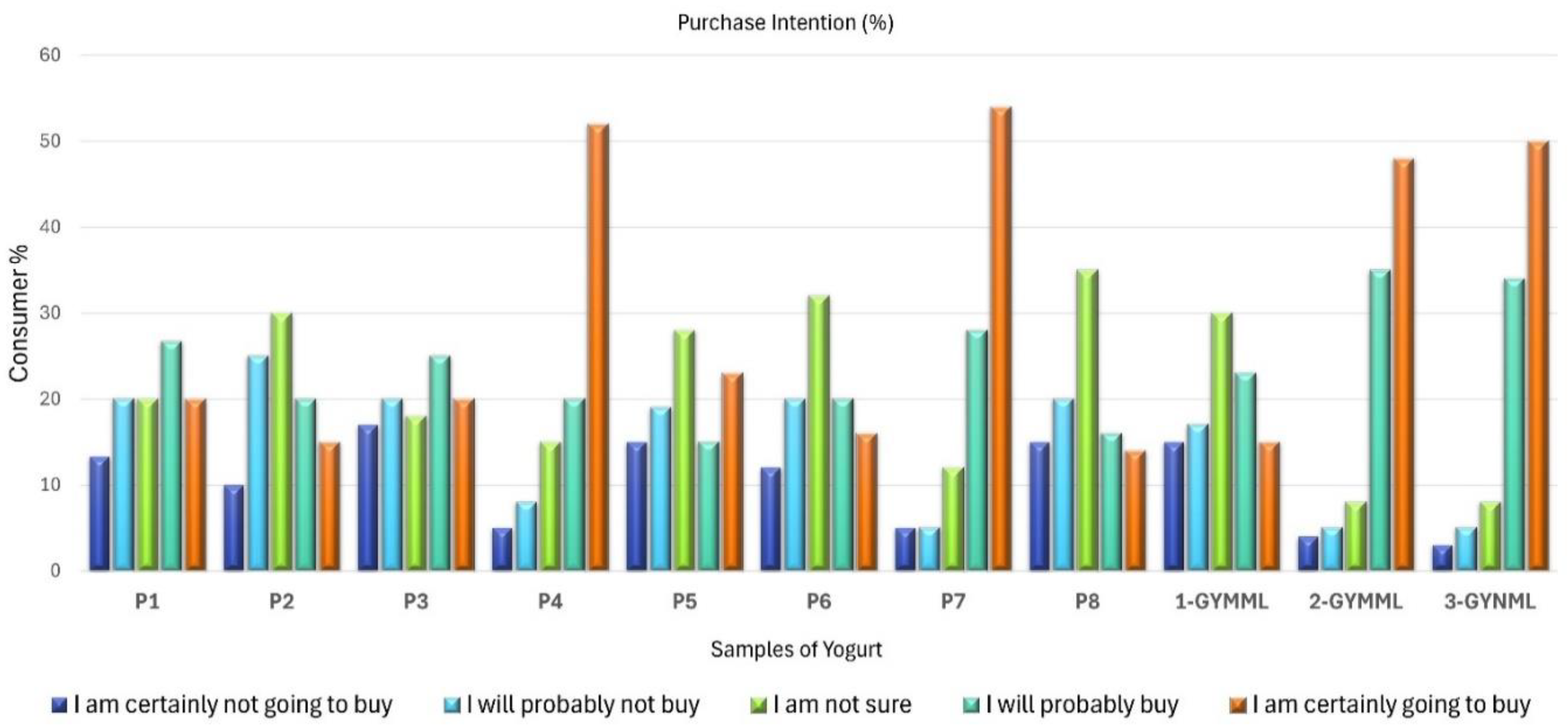
The results presented in Figure 1 (highlighting clusters formed based on similarities in descriptive sensory terms), along with the findings from Figure 3 (external preference mapping obtained using the descriptive sensory profile and consumers’ individual ratings of overall impression) and Figure 4 (Partial least squares standardized coefficients of Greek yogurt attributes that positively or negatively influence consumer perception, based on the average overall impression scores), provide insights into the likely reasons behind the mean acceptance ratings for flavor and overall impression shown in Figure 2. These findings also relate to the purchase intention data illustrated in Figure 5, reflecting consumer preferences for the analyzed yogurts in this study. This results would be very useful information for helping the Greek yogurt industry to improve its current products as well as develop innovative products for the future [5]. This present study is in line with other published [33] related the textural attributes and the water holding capacity define yogurt quality and determine consumer acceptance
Figure 2.
Acceptance of Greek yogurts about appearance, consistence in the spoon, flavor, texture and overall impression.
Figure 2.
Acceptance of Greek yogurts about appearance, consistence in the spoon, flavor, texture and overall impression.
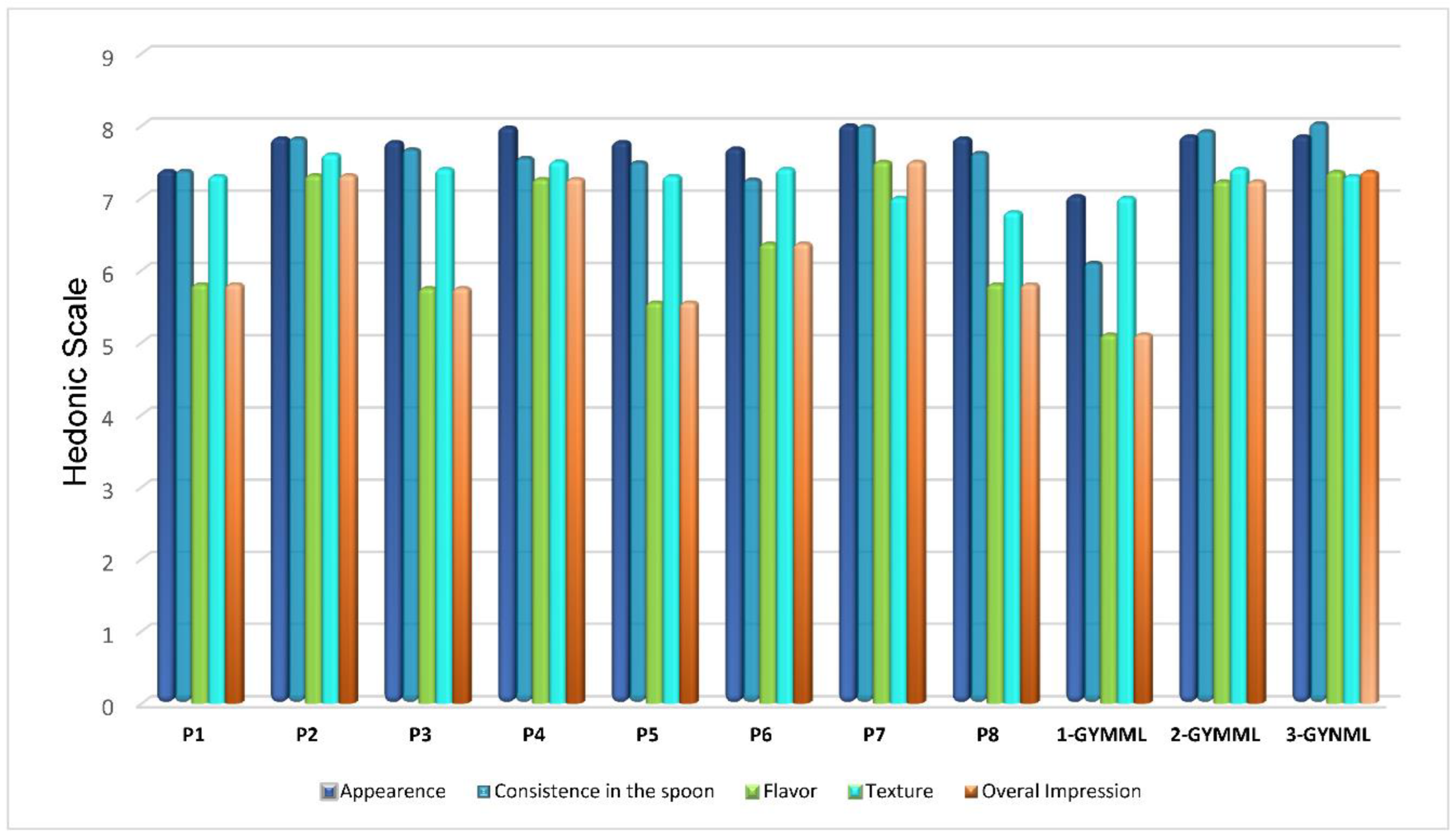
Figure 3.
External preference mapping obtained by partial least squares regression of the descriptive sensory profile and consumers’ overall impressions of the Greek yogurt. (diamond = Greek yogurt samples; blue points = consumers; red points = quantitative descriptive analysis attributes). The partial least square regression used the individual notes of consumers to overall impression.
Figure 3.
External preference mapping obtained by partial least squares regression of the descriptive sensory profile and consumers’ overall impressions of the Greek yogurt. (diamond = Greek yogurt samples; blue points = consumers; red points = quantitative descriptive analysis attributes). The partial least square regression used the individual notes of consumers to overall impression.
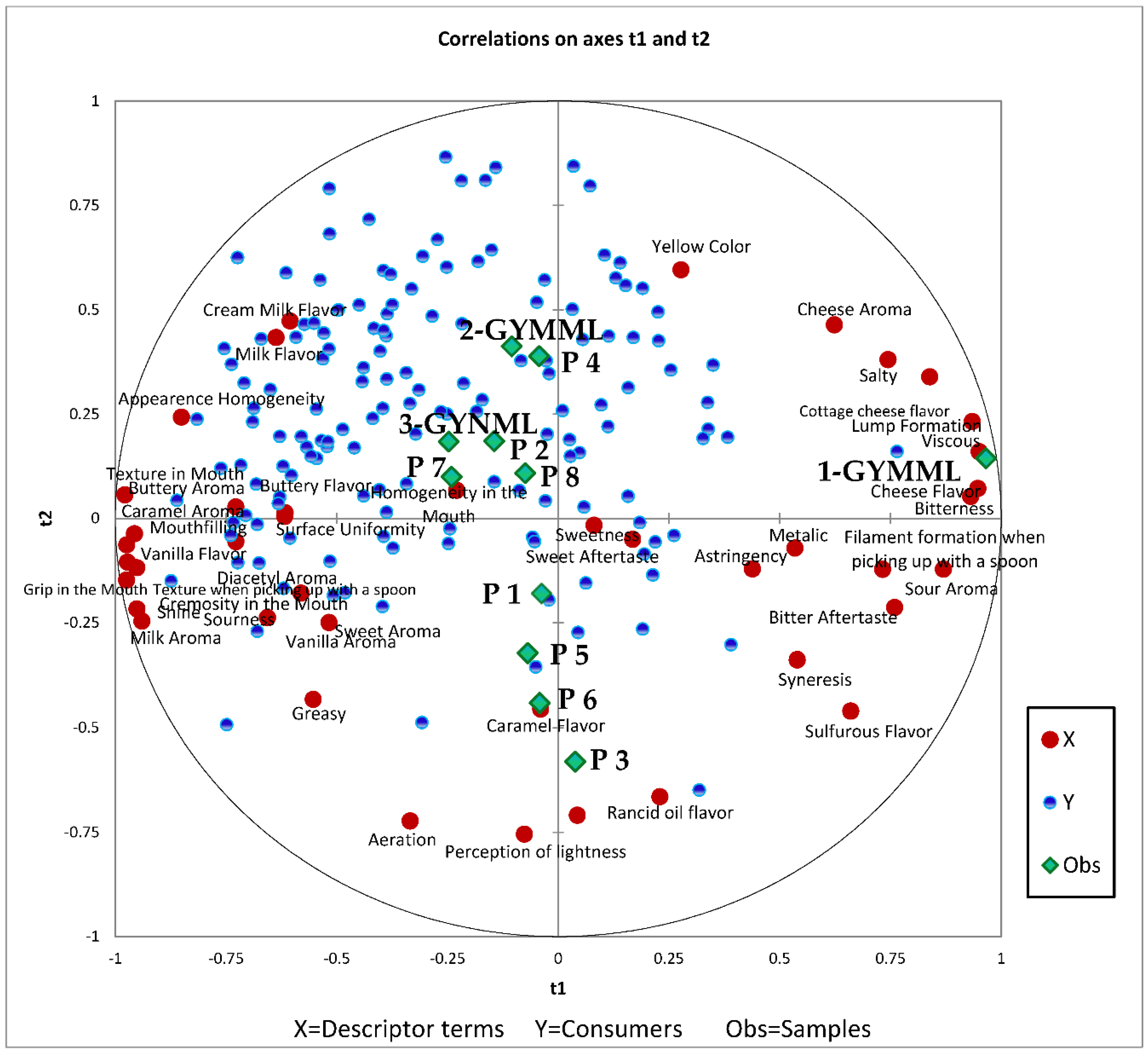
Figure 4.
Partial least squares standardized coefficients of Greek yogurt (green=descriptor terms that contribute positively to consumer acceptance; blue= descriptive terms that did not significantly contribute to consumer acceptance; red=descriptor terms that contribute negatively to consumer acceptance) 95% confidence interval. The partial least square regression used the average of notes of consumers to overall impression.
Figure 4.
Partial least squares standardized coefficients of Greek yogurt (green=descriptor terms that contribute positively to consumer acceptance; blue= descriptive terms that did not significantly contribute to consumer acceptance; red=descriptor terms that contribute negatively to consumer acceptance) 95% confidence interval. The partial least square regression used the average of notes of consumers to overall impression.
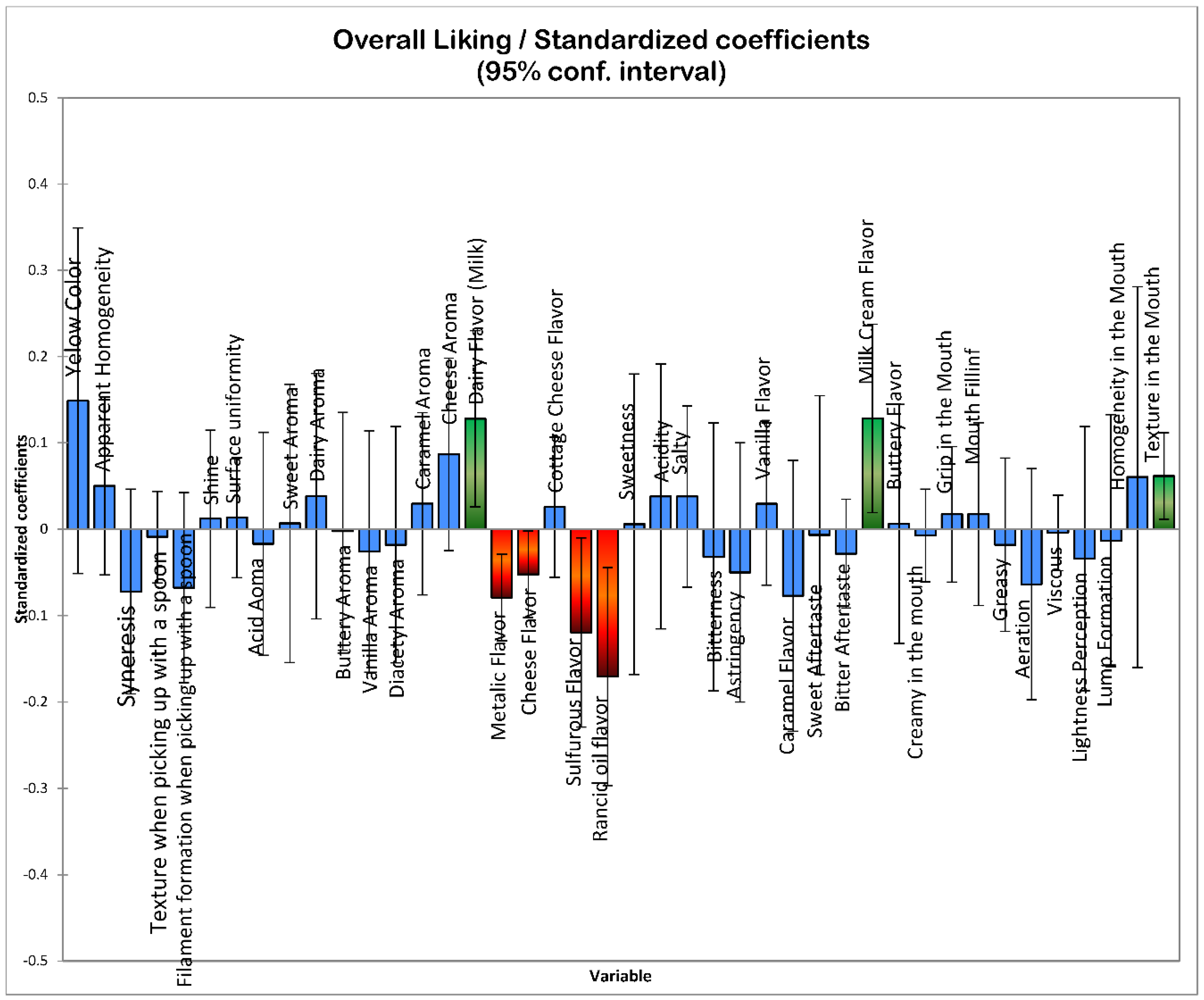
Figure 5.
Consumer purchase intention regarding the Greek yogurt samples.
Conclusion
The results obtained provide valuable insights into the drivers of preference for Greek yogurt formulations. Samples 2-GYMML, 3-GYNML, P4, and P7 consistently exhibited higher acceptance levels, characterized by attributes such as "high texture in the mouth, surface uniformity, creaminess, apparent homogeneity, mouth filling, grip in the mouth, ease of pick-up with a spoon, milk cream flavor, sweetness, and dairy flavor." These sensory attributes showed strong correlations with consumer preferences, emphasizing their relevance in product optimization.
Additionally, the external preference mapping and preference driver analysis validated the importance of specific sensory properties as key determinants of consumer liking. Understanding these attributes enables targeted adjustments to formulations, ensuring optimal sensory appeal while respecting ingredient constraints and production practicality.
This study highlights the critical role of aligning sensory attributes with consumer expectations to improve product acceptance. By exploring sensory characteristics alongside consumer segmentation, the results pave the way for further refinement of Greek yogurt formulations to address diverse market demands. These findings offer a robust framework for designing successful products that achieve a balance between sensory excellence and practical formulation strategies.
Author Contributions
Conceptualization, H.M.A.B., A.C.M., F.V. and H.M.; methodology, H.M.A.B., A.C.M., F.V. and H.M.; formal analysis, H.M.A.B., A.C.M., F.V. and H.M.; investigation, H.M.A.B., A.C.M., F.V. and H.M.; H.M.A.B., A.C.M., F.V. and H.M.; resources, H.M.A.B.; writing—original draft preparation, H.M.A.B., A.C.M., F.V. and H.M.; writing—review and editing, H.M.A.B., A.C.M., F.V. and H.M.; supervision, H.M.A.B. All authors have read and agreed to the published version of the manuscript.
Funding
This study was financed in part by the Coordination for the Improvement of Higher Education Personnel in Brazil (CAPES)—Finance Code 001 and the Brazilian National Council for Scientific and Technological Development (CNPq).
Institutional Review Board Statement
The study was conducted according to the guidelines of the Declaration of Helsinki and approved by the Research Ethics Committee of the State University of Campinas (UNICAMP), Brazil (CAAE: 79768517.3.0000.5404).
Informed Consent Statement
Informed consent was obtained from all participants involved in the study.
Data Availability Statement
Data is contained within the article.
Conflicts of Interest
The authors declare no conflicts of interest.
References
- Tamime, A.Y.; Robinson, R.K. Yoghurt: Science and Technology; CRC Press: Boca Raton, FL, USA, 2007. [Google Scholar]
- Tseng, M.; Wu, S. The Popularization of Greek Yogurt: Effects on Greek Yogurt Consumption Among U.S. Consumers. Journal of Food Products Marketing 2015, 21, 123–136. [Google Scholar]
- Ganapathy, R. Consumer Perception and Market Trends of Greek Yogurt in the U.S. International Journal of Food Science 2018, 23, 245–258. [Google Scholar]
- Bourrie, B.C.; Willing, B.P.; Cotter, P.D. The Microbiota and Health Promoting Characteristics of the Fermented Dairy Product Kefir. Frontiers in Microbiology 2016, 7, 647. [Google Scholar] [CrossRef] [PubMed]
- Gyawali, R.; Ibrahim, S.A. Addition of Pectin and Whey Protein Concentrate Minimizes the Generation of Acid Whey in Greek-Style Yogurt. Journal of Dairy Research 2018, 85, 238–242. [Google Scholar] [CrossRef] [PubMed]
- Hutkins, R.W.; Nondorf, H.A. Fermented Milk Products with Reduced Lactose Content. Dairy Science & Technology 2012, 92, 181–197. [Google Scholar]
- Cheng, H. Volatile Flavor Compounds in Yogurt: A Review. Critical Reviews in Food Science and Nutrition 2010, 50, 938–950. [Google Scholar] [CrossRef]
- USDA - The United States Department of Agriculture. National Nutrient Database for Standard Reference. 2021. Available online: https://fdc.nal.usda.gov/ (accessed on 14 June 2024).
- Marco, M.L.; Sanders, M.E.; Gänzle, M.; Arrieta, M.C.; Cotter, P.D.; De Vuyst, L. The International Scientific Association for Probiotics and Prebiotics (ISAPP) Consensus Statement on Fermented Foods. Nature Reviews Gastroenterology & Hepatology 2017, 14, 196–208. [Google Scholar]
- Sanders, M.E.; Merenstein, D.J.; Reid, G.; Gibson, G.R.; Rastall, R.A. Probiotics and Prebiotics in Intestinal Health and Disease: From Biology to the Clinic. Nature Reviews Gastroenterology & Hepatology 2013, 10, 689–699. [Google Scholar]
- Euromonitor International. Global Yogurt Market Trends. Euromonitor International, 2023. [Google Scholar]
- Wouters, J. Low Fat Yet Rich in Texture, Greek Yoghurt Proves Irresistible to Consumers. Wellness Foods Europe 2012, 3, 4–8. [Google Scholar]
- Desai, N.T.; Shepard, L.; Drake, M.A. Sensory Properties and Drivers of Liking for Greek Yogurts. Journal of Dairy Science 2013, 96, 7454–7464. [Google Scholar] [CrossRef]
- Dou, D.; Wang, Z. Consumer Preferences for Greek Yogurt: A Review. Journal of Dairy Science 2018, 101, 144–152. [Google Scholar]
- Yildiz, F. Overview of Yogurt and other fermented dairy products. In Development and manufacture of yogurt and other functional dairy products; CRC Press - Taylor &Francis Group, 2010; 454p. [Google Scholar]
- Danone. History of Yogurt and Current Patterns of Consumption. 2020. Available online: [URL]. (accessed on 20 June 2024).
- ASTM Manual on Consumer Sensory Evaluation; ASTM International: West Conshohocken, PA, USA, 1979.
- ISO 8589:2007; Sensory Analysis—General Guidance for the Design of Test Rooms. The International Organization for Standardization: Geneva, Switzerland, 2007.
- Macfie, H.J.; Bratchell, N.; Greenhoff, K.; Vallis, L.V. Designs to balance the effect of order of presentation and first-order carry-over effects in Hall tests. Journal of Sensory Studies 1989, 4, 129–148. [Google Scholar] [CrossRef]
- Civille, G.V.; Carr, B.T.; Osdoba, K.E. Sensory evaluation techniques, 6th ed.; CRC press, 2024. [Google Scholar]
- Moraes, P.C.B.; Bolini, H.M.A. Different sweeteners in beverages prepared with instant and roasted ground coffee: Ideal and equivalent sweetness. Journal of Sensory Studies 2010, 25, 215–225. [Google Scholar] [CrossRef]
- Meilgaard, M.; Civille, G.V.; Carr, B.T. Sensory Evaluation Techniques, 4th ed.; CRC Press: Boca Raton, FL, USA, 2006; pp. 25–38. [Google Scholar]
- Stone, H.; Bleibaum, R.I.; Thomas, H.A. Sensory evaluation practices, 4th ed.; Academic Press: New York, 2012; 438p. [Google Scholar]
- AOAC—Association of Official Analytical Chemists. Official methods of analysis of AOAC international, 16 ed.; AOAC: Washington, DC, USA, 1995. [Google Scholar]
- Rawson, H.L.; Marshall, V.M. Effect of “ropy”strains of Lactobacillus delbrueckii ssp. bulgaricus and Streptococcus thermophilus on rheology of stirred yogurt. Int. Journal of Food Science and Technology 1997, 32, 213–220. [Google Scholar] [CrossRef]
- Tenenhaus, M.; Pagès, J.; Ambroisine, L.; Guinot, C. PLS methodology to study relationshipsbetween hedonic judgements and product characteristics. Food Quality and Preference 2005, 16, 315–325. [Google Scholar] [CrossRef]
- Esmerino, E.A.; Tavares Filho, E.R.; Carr, B.T.; Ferraz, J.P.; Silva, H.L.A.; Pinto, L.P.F.; Freitas, M.Q.; Cruz, A.G.; Bolini, H.M.A. Consumer-Based Product Characterization Using Pivot Profile, Projective Mapping and Check-All-That-Apply (CATA): A Comparative Case with Greek Yogurt Samples. Food Research International 2017, 99, 375–384. [Google Scholar] [CrossRef]
- Pappa, E.C.; Kondyli, E.; Pappas, A.C.; Kyriakaki, P.; Zoidis, E.; Papalamprou, L.; Karageorgou, A.; Simitzis, P.; Goliomytis, M.; Tsiplakou, E.; et al. Physicochemical Characteristics of Commercially Available Greek Yoghurts. Dairy 2024, 5, 436–450. [Google Scholar] [CrossRef]
- Kroger, M. Quality of yoghurt. J. Dairy. Sci. 1975, 59, 344–450. [Google Scholar] [CrossRef]
- Tamine, A.Y.; Robinson, R.K. Yoghurt Science and Technology, 3rd ed.; CRC Press: Boca Raton, FL, USA, 2007. [Google Scholar]
- Mukisa, I.M.; Kyoshabire, R. Microbiological, physicochemical, and sensorial quality of small-scale produced stirred yoghurt on the market in Kampala city, Uganda. Nutr. Food Sci. 2010, 40, 409–418). [Google Scholar] [CrossRef]
- Brown, M.D.; Chambers, D.H. Sensory characteristics and comparison of commercial plain yogurts and 2 new production sample options. Journal of Food Science 2015, 80, S2957–S2969. [Google Scholar] [CrossRef]
- Lange, I.; Mleko, S.; Tomczyńska-Mleko, M.; Polischuk, G.; Janas, P.; Ozimek, L. Technology and factors influencing Greek-style yogurt – a Review. Ukrainian Food Journal 2020, 9, 7–35. [Google Scholar] [CrossRef]
Figure 1.
Dendrogram two-way (descriptive sensory terms and yogurt samples) obtained through Hierarchical Cluster Analysis using the Ward method algorithm and the Euclidean distance similarity index. Representative clusters of descriptive terms to Greek yogurt.
Figure 1.
Dendrogram two-way (descriptive sensory terms and yogurt samples) obtained through Hierarchical Cluster Analysis using the Ward method algorithm and the Euclidean distance similarity index. Representative clusters of descriptive terms to Greek yogurt.
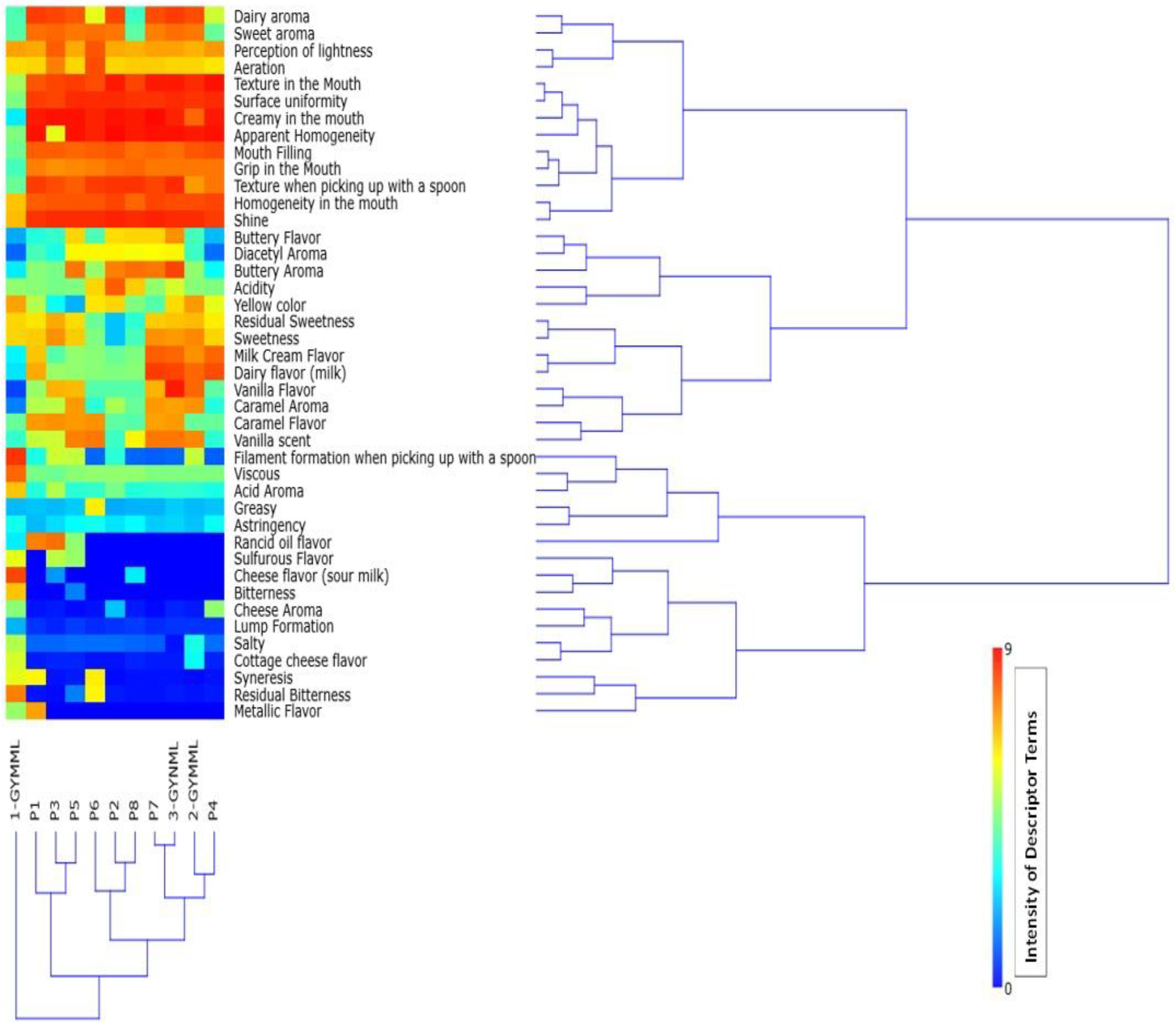
Table 1.
Basic ingredients to formulation of Greek yogurt produced in laboratory. The quantities are expressed in grams/100 grams.
Table 1.
Basic ingredients to formulation of Greek yogurt produced in laboratory. The quantities are expressed in grams/100 grams.
| Ingredients | P1 | P2 | P3 | P4 | P5 | P6 | P7 | P8 |
|---|---|---|---|---|---|---|---|---|
| Sugar syrup | 15.0000 | 15.0000 | 15.0000 | 13.0000 | 15.0000 | 13.0000 | 15.0000 | 13.0000 |
| Skimmed milk powder | 1.4000 | 1.4000 | 1.4000 | 1.4000 | 1.4000 | 1.4000 | 1.4000 | 1.4000 |
| Cream milk | 11.2000 | 21.5000 | 13.2000 | 13.8000 | 13.2000 | 13.8000 | 13.2000 | 13.8000 |
| Milk Protein Concentrate 70 | 3.7000 | 4.8000 | 3.7000 | 3.7000 | 3.7000 | 3.7000 | 4.0000 | 3.7000 |
| Concentrated milk Fat: 3,0%/SNF 8,5% | 68.6983 | 57.2983 | 65.8983 | 67.7983 | 65.8983 | 67.7983 | 65.9000 | 67.7983 |
| Culture Yoflex Premium 3.0 | 0.0017 | 0.0017 | 0.0017 | 0.0017 | 0.0017 | 0.0017 | 0.0017 | 0.0017 |
| Modifed Starch | 0.0000 | 0.0000 | 0.6000 | 0.3000 | 0.6000 | 0.3000 | 0.6000 | 0.3000 |
| Tasteless and colorless gelatin | 0.0000 | 0.0000 | 0.2000 | 0.2000 | 0.2000 | 0.2000 | 0.2000 | 0.2000 |
Table 2.
Descriptor terms of Greek yogurt.
| Descriptor term | Definition | References |
|---|---|---|
| Yellow color | Light yellow color, like butter | None: Pasteurized Fresh Milk Cream "Fazenda Bela Vista" Brand Moderate/Medium: 100 ml Pasteurized Fresh Milk Cream "Fazenda Bela Vista" Brand + 0.25 ml of prepared Oetker pineapple gelatin, as per package instructions, without allowing it to set Strong: 200 ml Pasteurized Fresh Milk Cream "Fazenda Bela Vista" Brand + 1 ml of prepared Oetker pineapple gelatin, as per package instructions, without allowing it to set |
| Homogeneous appearance | Homogeneous, smooth and lump-free appearance of the surface of the yogurt | Slight/Weak: 100 ml of Salute brand plain liquid yogurt + 50 grams of Nestlé cream without whey Moderate/Medium: 100 ml of Salute brand plain liquid yogurt + 50 grams of Nestlé cream without whey slowly mixed with spoon on a glass plate for 10 seconds Strong: 100 g of Salute brand plain liquid yogurt + 100 g of Nestlé cream without whey, blended |
| Syneresis | Separation of whey from yogurt, accompanied by a reduction in its volume and intensified by changes in temperature, pH and mechanical factors | None: Greek yogurt Vigor brand Moderate/Medium: commercial lactose-free plain yogurt with skimmed milk Strong: Commercial whole plain yogurt containing 10% added water |
| Texture when picked up with a spoon | Force applied to place the spoon and remove a little of the product to be consumed | Slight/Weak: 100 g Pasteurized Fresh Milk Cream "Fazenda Bela Vista" Brand + 100 g Salute brand plain liquid yogurt Moderate/Medium: 100 g milk cream Nestlé Tetrapack package Strong: Canned Desert “Brigadeiro” Nestlé |
| Filament formation when picked up with a spoon | Filaments formed between the product in the jar and the product in the spoon | None: Pasteurized Fresh Milk Cream "Fazenda Bela Vista" Brand Moderate/Medium: 100 ml Pasteurized Fresh Milk Cream "Fazenda Bela Vista" Brand + 50 ml Nestlé Condensed milk Strong: Nestlé Condensed milk |
| Shine | Reflection of light on the surface of the product | Slight/Weak: None: Pasteurized Fresh Milk Cream "Fazenda Bela Vista" Brand Moderate/Medium: Flan Danette White chocolate Strong: Orange blossom honey Melbee brand |
| Surface Uniformity | Regularity of the apparent texture on the surface of the product | Slight/Weak: creme de leite fresco pasteurizado marca Fazenda Bella Vista Moderate/Medium: yogurt Grego marca Danone Strong: 5 mg of butyric acid + 10 mg of caprylic acid in 1 liter of pasteurized fresh cream, Fazenda Bella Vista brand |
| Acid Aroma | Aroma that is felt when inhaling near a product that contains acids, especially lactic acid | None: pasteurized fresh cream, Fazenda Bella Vista brand Moderate/Medium: 100 g creme de leite fresco pasteurizado marca Fazenda Bella Vista + 1 ml de Lactic acid láctico Strong: 10 g of pasteurized fresh cream, Fazenda Bella Vista brand + 1 ml of lactic acid + 50 g of whipped yogurt, Salute brand |
| Sweet Aroma | Aroma that is felt when inhaling near sweet foods | None: pasteurized fresh cream, Fazenda Bella Vista brand Moderate/Medium: pasteurized fresh cream, Fazenda Bella Vista brand + 10 ml Karo Corn Glucose Strong: homogenized 100 g pasteurized fresh cream, Fazenda Bella Vista brand + 20 ml de Karo Corn Glucose + 20 g of dulce de leche Itambé brand |
| Milky Aroma | Aroma that is felt when inhaling dairy products | None: distilled water Moderate/Medium: Whole milk Sheffa brand Strong: homogenized 50 g pasteurized fresh cream, Fazenda Bella Vista brand + 100 g Ninho powder milk |
| Vanilla Aroma | Aroma that is felt when inhaling near vanilla essence, or products containing vanilla | None: Whole milk Sheffa brand Moderate/Medium: 0.5 ml IFF vanilla essence F in 50 ml Whole milk Sheffa brand Strong: 1 IFF vanilla essence F in 50 ml Whole milk Sheffa brand |
| Aroma Amanteigado (Diacetil) | Aroma that is felt when inhaling near butter and buttery products (Diacetil) | None: Whole milk Sheffa brand Moderate/Medium: 50 ml Whole milk Sheffa brand+ 0,0001 ml diacetyl Sigma Aldrich PA Strong: 50 ml Whole milk Sheffa brand + 0.0025 ml de diacetyl Sigma Aldrich PA |
| Caramel Aroma | Aroma that is felt when inhaling near foods that contain caramelized sugar | None: Ninho Whole milk Moderate/Medium: 20 g of sucrose União caramelized in 1 liter Ninho Whole milk UHT Strong: 50 g of sucrose União caramelized in 1 liter Ninho Whole milk UHT |
| Cheese Aroma | Aroma that is felt when inhaling near curdled (sour) milk | None: 100 g Pasteurized Fresh Milk Cream "Fazenda Bela Vista" Brand Moderate/Medium: 2 mg butanoic acid + 2 mg caplilic acid in 100 g Pasteurized Fresh Milk Cream "Fazenda Bela Vista" Brand Strong: 5 mg butanoic acid + 5 mg caplilic acid in 100 g Pasteurized Fresh Milk Cream "Fazenda Bela Vista" Brand Vista |
| Mikky Flavor | Characteristic flavor of instant whole milk powder dissolved in water | Slight/Weak: 50 g of Ninho Nestlé instant whole milk powder in 1 liter of deionized water Moderate/Medium: 150 g of Ninho Nestlé instant whole milk powder in 1 liter of deionized water Strong: 500 g of Ninho Nestlé instant whole milk powder in 1 liter of deionized water |
| Metalic Taste | Characteristic flavor of foods containing iron or some canned foods | None: Pasteurized Fresh Milk Cream Verde Campo brand Moderate/Medium: 50 ml Pasteurized Fresh Milk Cream Verde Campo brand + 0,0005g de FeSO4.7H2O in 10 ml Whole milk Shefa brand Strong: 50 ml Pasteurized Fresh Milk Cream Verde Campo brand + 0,001g de FeSO4.7H2O in 10 ml Whole milk Shefa brand |
| Cheese flavor (sour milk) | Sour milk flavor | None: Pasteurized Fresh Milk Cream Verde Campo brand Moderate/Medium: 50 ml of Pasteurized Fresh Milk Cream Verde Campo brand + 0,25 mg butiric acid and 0.25 mg caprilic acid diluted in 10 ml Whole milk Shefa brand Strong: 50 ml Pasteurized Fresh Milk Cream Verde Campo brand + 0,75 mg butiric acid + 0.75 mg of caprilic acid diluted in 10 ml Whole milk Shefa brand |
| Cottage cheese flavor | Characteristic flavor of cream cheese | None: desionized water Moderate/Medium: 200 ml Whole milk Sheffa with 30 g of cream cheese Danúbio brand Strong: 100 g cream cheese Danúbio brand + 100 g Pasteurized Fresh Milk Cream "Fazenda Bela Vista" Brand |
| Sulfurous Flavor | Characteristic flavor of freshly peeled boiled egg white | None: Pasteurized Fresh Milk Cream "Fazenda Bela Vista" Brand Moderate/Medium 2 mg dimethyl sulfide Sigma Aldrich PA in 1 liter of Pasteurized Fresh Milk Cream "Fazenda Bela Vista" Brand Strong: 5 mg dimethyl sulfide Sigma Aldrich PA in 1 liter of Pasteurized Fresh Milk Cream "Fazenda Bela Vista" Brand |
| Oxidized oil flavor | The flavor of oxidized oil, known as rancid oil | None: Pasteurized Fresh Milk Cream "Fazenda Bela Vista" Brand Moderate/Medium:3 mg of butiric acid in 1liter Pasteurized Fresh Milk Cream "Fazenda Bela Vista" Brand Strong: 5 mg mg of butiric acid in 1liter Pasteurized Fresh Milk Cream "Fazenda Bela Vista" Brand |
| Sweetness | Characteristic taste of sucrose | None: 100 g plain yogurt Salute brand + 4 g of sucrose Moderate/Medium: 100 g plain yogurt Salute brand + 10 g of sucrose Strong: 100 g plain yogurt Salute brand + 16 g of sucrose |
| Sourness | Acidic taste also known as sour, present in dairy products such as yogurt, curd and fermented milk | None: Pasteurized Fresh Milk Cream "Fazenda Bela Vista" Brand Moderate/Medium: 10 mg of lactic acid + 500 ml of Pasteurized Fresh Milk Cream "Fazenda Bela Vista" Brand Strong: 10 mg of lactic acid + 1,000 ml of Pasteurized Fresh Milk Cream "Fazenda Bela Vista" Brand |
| Salty | Characteristic taste of salty foods such as cream cheese | None: Pasteurized Fresh Milk Verde Campo Moderate/Medium: 50 ml Pasteurized Fresh Milk Cream "Fazenda Bela Vista" Brand Verde Campo + 0,05 g of cream cheese Vigor diluted in 10 ml of Whole Milk Shefa UHT Strong: 50 ml Pasteurized Fresh Milk Cream "Fazenda Bela Vista" Brand + 0.2 g of cream cheese Vigor diluted in 10 ml of Whole Milk Shefa UHT |
| Bitterness | Characteristic taste of products containing caffeine | None: Whole Milk Ninho UHT Moderate/Medium: 0,02 g cafeine Sigma Aldrich PA in 100 ml of Whole Milk Ninho UHT Strong: 0.04 g of cafeine Sigma Aldrich PA in 100 ml of Whole Milk Ninho UHT |
| Asstringency | A sensation of “tying” the mouth, such as green banana and cashew pulp | None: Whole Milk Ninho UHT Moderate/Medium: 20 ml whole milk Ninho UHT + 0,1 g de tanic acid Sigma Aldrich PA Strong: 20 ml whole milk Ninho UHT + 0.5 g of tanic acid Sigma Aldrich PA |
| Vanilla Flavor | Characteristic flavor of foods containing vanilla essence | None: Pasteurized Fresh Milk Cream "Fazenda Bela Vista" Brand Moderate/Medium: 3 ml vanilla essence IFF in 1,000 ml of Pasteurized Fresh Milk Cream "Fazenda Bela Vista" Brand Strong: 10 ml of vanilla essence IFF in 1,000 ml of Pasteurized Fresh Milk Cream "Fazenda Bela Vista" Brand |
| Flavor Caramel | Characteristic flavor of sugar subjected to high temperatures, such as pudding syrups | None: Whole Milk Ninho UHT Moderate/Medium: 20 gramas de açúcar caramelizado dissolvido em 1,000 ml of Whole Milk Ninho UHT Strong: 50 g of inverted sucrose solved in 1,000 ml of Whole Milk Ninho UHT |
| Sweet Aftertaste | Sweet taste that lingers after swallowing the food | None: 1,000 ml of Whole Milk Ninho UHT Moderate/Medium: 100 ml of Whole Milk Ninho UHT + 0.2 g of Sodium saccharin Sigma Aldrich Strong: 100 ml of Whole Milk Ninho UHT + 0.5 g of Sodium saccharin Sigma Aldrich |
| Bitter Aftertaste | Bitter taste that lingers after swallowing the food | None: 1,000 ml of Whole Milk Ninho UHT Moderate/Medium: 100 ml of Whole Milk Ninho UHT + 2 g of stevia from Steviafarma Strong: 100 ml of Whole Milk Ninho UHT + 4 g of stevia from Steviafarma |
| Milk Cream Flavor | Characteristic flavor of milk cream | None: water Moderate/Medium: 100 ml of Whole Milk Ninho UHT + 50 g Fresh Milk Cream Nestle Strong: 100 ml of Whole Milk Ninho UHT + 100 g Fresh Milk Cream Nestle |
| Butter Flavor | Characteristic flavor of whipped cream | Slight/Weak: Freshly prepared cream from the surface formed on fresh whole milk by Fazenda Bella Vista after boiling and cooling, homogenized using a pistil in a mortar. Moderate/Medium: 40 mg of Diacetyl in 1 liter of fresh pasteurized cream by Fazenda Bella Vista brand Strong: 100 mg of diacetyl in 1 liter of fresh pasteurized cream by Fazenda Bella Vista brand |
| Creamy in the mouth | creaminess in the mouth | Slight/Weak: 100 g in 1 liter of fresh pasteurized cream by Fazenda Bella Vista brand + 200 ml Whole Milk Ninho UHT Moderate/Medium: 100 g fresh pasteurized cream by Fazenda Bella Vista brand + 50 ml Whole Milk Ninho UHT Strong: Chandelle Desert |
| Yogurt coating inside the mouth | Sensation of certain foods sticking to the tongue and palate. | None: Deionized water at room temperature. Moderate/Medium: 100 g Fresh Milk Cream Nestle + 100 ml Whole Milk Ninho Strong: Fresh Milk Cream Nestle at room temperature |
| Mouth filling | Characteristic of certain foods filling the mouth evenly and quickly | Slight/Weak: Cornstarch porridge prepared with 200 ml of milk, 10 g of cornstarch, 20 g of sugar, and 20 g of Nestlé cream without whey. Moderate/Medium: Cornstarch porridge prepared with 200 ml of milk, 15 g of cornstarch, 25 g of sugar, and 20 g of Nestlé cream without whey. Strong: Cornstarch porridge prepared with 200 ml of milk, 25 g of cornstarch, 25 g of sugar, 20 g of Nestlé cream without whey, and 100 g of melted Nestlé milk chocolate bar. |
| Greasy | Slippery sensation between the tongue and palate when eating a high-fat food | None: Greek yogurt Danone light Moderate/Medium: 100 g Greek yogurt Danone + 20 g Nestlé cream without whey Strong: 100 g Greek yogurt Danone + 70 g Nestlé cream without whey |
| Aeration | Sensation of food containing air and lightness | None: Pasteurized Fresh Milk Cream "Fazenda Bela Vista" Brand Moderate/Medium: Danone Greek yogurt mixed in a blender for 1 minute. Strong: Danone Greek yogurt mixed in a blender for 3 minute. |
| Viscous | Sensation of threads of creamy food forming between the tongue and the palate | None: water Moderate/Medium: Vigor light cream cheese Strong: Orange blossom honey Melbee brand |
| Perception of lightness | Sensation of airy food, like whipped egg whites | Slight/Weak: Pasteurized Fresh Milk Cream "Fazenda Bela Vista" Brand Moderate/Medium: Egg whites freshly whipped in a planetary mixer, added with 10% cornstarch. Strong: Egg white freshly whipped in a planetary mixer. |
| Lump Formation | Division that some creamy foods make with parts denser than others | None: Pasteurized Fresh Milk Cream "Fazenda Bela Vista" Moderate/Medium: 50 g Pasteurized Fresh Milk Cream "Fazenda Bela Vista"+ 50 g plain yogurt light Batavo Strong: 10 g Pasteurized Fresh Milk Cream "Fazenda Bela Vista" + 50 g plain yogurt light Batavo |
| Homogeneity in the mouth | Uniformity of food in the mouth | Slight/Weak: plain yogurt light Batavo Moderate/Medium: light cream cheese Danúbio Strong: Desert Chandelle |
| Texture in Mouth | Property of some foods that cause a sensation of firmness (or the opposite, softness) | Slight/Weak: Pasteurized Fresh Milk Cream "Fazenda Bela Vista" Moderate/Medium: Danone plain yogurt Strong: Cheddar cheese Polenghi |
Disclaimer/Publisher’s Note: The statements, opinions and data contained in all publications are solely those of the individual author(s) and contributor(s) and not of MDPI and/or the editor(s). MDPI and/or the editor(s) disclaim responsibility for any injury to people or property resulting from any ideas, methods, instructions or products referred to in the content. |
© 2024 by the authors. Licensee MDPI, Basel, Switzerland. This article is an open access article distributed under the terms and conditions of the Creative Commons Attribution (CC BY) license (http://creativecommons.org/licenses/by/4.0/).
Copyright: This open access article is published under a Creative Commons CC BY 4.0 license, which permit the free download, distribution, and reuse, provided that the author and preprint are cited in any reuse.


