

Submitted:
30 November 2024
Posted:
02 December 2024
You are already at the latest version
Abstract
The structural assessment of masonry construction often requires the use of nonlinear 2- and 3D finite element analysis. This work describes a strategy for using energy outputs from such analyses to accurately assess failure conditions precipitated by increasing lateral load. The methodology relies on the analogy between plastic strains and fracture that is inherent to the concrete damaged plasticity (CDP) macro-model used to represent the quasi-brittle behavior of masonry material. At critical conditions, energy imparted to a structure by loading can no longer be completely stored as elastic strain energy and must be dissipated. This occurs with fractures in masonry, which are represented with plastic strains when using a CDP material. The development of plastic dissipation energy can therefore be used as a measure for understanding the progressive collapse of a structure, as we illustrate with three case studies analyzed using Abaqus/CAE Explicit: the massive, earthen pyramid at Huaca de la Luna (Trujillo, Peru), the Roman pozzolanic concrete vault of Diocletian’s Frigidarium (Rome, Italy), and mixed material triumphal arch of the San Pedro Apóstol Church of Andahuaylillas (Peru). The method is verified with other measures of failure and has particular applicability for seismic analysis of complex masonry and earthen structures.
Keywords:
failure of masonry structures
; nonlinear finite element analysis
; concrete damaged plasticity
; monumental masonry structures
; heritage constructions
; energy-based failure criteria
; explicit dynamic analysis
1. Introduction & Objectives
Historic monuments have often survived years of renovation, repurposing, additions, subtractions – to say nothing of the irregularities in material and form that many of these monuments were originally built with. For heritage buildings, non-standard is the standard. Code-based analyses of structural integrity have been implemented and even specialized for the assessment of historic monuments [1,2]. However, as these and other authors note, there are instances when common practices are not ideal. To assess such unique structures and to recommend appropriate interventions for their preservation requires analytical creativity. This work summarizes a strategy that utilizes energy outputs from nonlinear finite element (FE) models to assess the time-evolution of failure in a way that is compatible with modelling the mechanical peculiarities of heritage structures.
Unique circumstances may arise due to the scale and complexity of a monument. Analyses that track nodal displacement require a representative node. For relatively simple, small structures, there may be an obvious choice – the apex of a gabled roof or cupola at the top of a dome. However, such a choice becomes more difficult when the structure includes, perhaps, multiple gabled roofs, or is sufficiently large that the failure of one gable is not indicative of the failure condition for the rest of the structure. Tracking failure by monitoring variations in the supporting reactions may become challenging or even numerically unfeasible for a large or irregular massive structure.
Non-standardized materials produce additional challenges. The extremely nonlinear behavior of brittle materials produces complex models that require careful analysis. To efficiently model masonry bricks and blocks, macromodels that reduce the material and its morphology to a continuum can be adopted. One such macromodel is the concrete damaged plasticity (CDP) model [3]. Utilizing the CDP material macromodel in Abaqus/CAE Explicit [4] allows us to interpret energy outputs to address these challenges.
We first detail the proposed methodology of evaluating the development of energy outputs to determine failing conditions. The concepts are illustrated with the static pushover analysis of a 3D wall, the 2D plane stress analysis of a panel loaded by acceleration applied at the base, and three simple walls loaded with applied displacement. The examples are used to explain the assessment steps and for comparisons with other measures of stability.
The final section of the paper presents the utility of the methodology when applied to case studies of varying complexity, with each case illustrating issues of irregularity in archaeological and historical architecture discussed above. The first case study is an analysis of Huaca de la Luna’s main pyramid, a monument of massive scale and extremely brittle adobe material, which was constructed and reconstructed over a period of six centuries with an unintuitive system of adobe brick piers [6]; second, the Frigidarium of Diocletian, a gigantic Imperial Roman concrete vaulted structure [7]; and third, the triumphal arche of the San Pedro Apóstal Church in Andahuaylillas, an Andean Spanish church of mixed adobe, stone, and brick material [8]. Through these analyses, we show that the benefits of this methodology are that a) the evolution of collapse can be monitored from initiation to total failure and b) the method is well-suited to modelling failure under seismic action as the result of inertial forces excited by acceleration applied to the base of the structure.
2. Materials and Methods
Nonlinear finite element (FE) models characterized by a CDP material formulation are widely used for the structural assessment of historic masonry buildings under static or dynamic loading [9,10,11,12,13]. In these models, the interpretation of energy results to determine structural failure offers a rational and verifiable strategy both to numerically determine lateral capacity and to evaluate the enucleation of local damage to structural failure. The underlying postulate is that the structural failure of masonry constructions modelled as a continuum can be defined as a transition from stable to unstable equilibrium via fracture into disconnected parts. This leads to a sudden variation in support reactions. In a nonlinear dynamic FE formulation, this transition can also be detected from the time evolution of elastic strain energy, plastic dissipation energy due to fracture propagation, and kinetic energy arising from disconnected parts moving away from each other.
Starting with the adoption of the CDP formulation [14], we highlight the analogy between plastic strains and fracture given by Lubliner et al: “…plastic strain may be identified with any and all inelastic strain, including cracking strain” [3]. The direct analogy between plastic strains and fracture means that the growth of plastic strains implies propagation of fractures. Therefore, plastic dissipation energy (PD) can serve a proxy measure for fracture growth. Sharp asymptotic behavior occurs after a structure can no longer dissipate enough energy from loading via small or slow-propagating cracks, and the structure loses equilibrium and separates into parts. Thus, in the limit, for disconnected parts to move independently, plastic strains – and with them plastic dissipation energy – must grow asymptotically.
Under static loading conditions, failure detected from the asymptotic growth of PD is also reflected in the growth of kinetic energy (KE). When the structure separates into parts at failure, each of the disconnected elements move with increasing velocity under the applied loads. KE, negligible during the phase of stability of the simulation, begins to manifest itself as portions begin to accelerate independently of the whole. Ultimately, the KE grows asymptotically, inevitably intersecting the elastic strain energy (SE) curve.
Structural failure also affects the evolution of elastic strain energy, since elastic strains will actually decrease during fracture growth. Thus, when approaching failure conditions, SE will sharply decrease in the presence of total failure or continue to grow at a lower rate for a failure involving only a portion of the structure. Under the stated conditions, SE will never exhibit the same asymptotic behavior of either PD or KE, thus the two curves can be expected to intersect in close proximity to failure. This point can be taken as a logical point of measure for failure.
This methodology for determining lateral capacity, and the measures used for its validation, are discussed below in the analysis of simple masonry walls under (1) static pushover loading, (2) dynamic loading via ground acceleration, and (3) static displacement loading. The first two cases are analyzed in Abaqus/CAE Explicit, while the third is formulated in Abaqus/CAE Standard for purposes of comparison with original published results.
2.1. Validation with a Static Pushover Test
Pushover analysis is a well-established approach for assessing the lateral capacity of a structure subjected to a monotonically increasing lateral load pattern [15,16]. These can be implemented as a lateral displacement or force distribution acting on one side of the structure, or by directly applying a horizontal acceleration to the entire mass. We illustrate the applicability of our methodology to the pushover analysis by considering an unreinforced concrete wall with dimensions 10 m x 2 m x 0.6 m, subjected to a uniform horizontal acceleration field normal to the plane of the wall (Figure 1a). The material is modelled using CDP material. The wall is free standing and fully constrained at the bottom to a rigid surface. The analysis is performed in Abaqus/CAE Explicit in two steps: full gravitational loading is applied first, followed by a uniform, monotonically increasing lateral acceleration acting over the entire mass of the wall in the +Z direction. Quasi-static conditions are enforced by adopting long time intervals for the application of both gravitation and lateral accelerations: 5 seconds for gravitation to increase linearly from 0 to 1g, followed by 10 seconds of lateral acceleration increasing linearly from 0 to 0.8g.
As shown in Figure 1b, the structural response of the wall is accurately represented by the time-evolution of elastic strain energy (SE), kinetic energy (KE), and plastic dissipation energy (PD). During gravitational loading, the response remains purely static. No significant KE is developed during gravitation loading, such that SE is the only energy present at total gravitational load. Thereafter, the response continues to be static under increasing lateral acceleration until the structural integrity is compromised and the wall collapses. The development of fracture damage at the base of the wall corresponds to the growth of PD after 6 seconds. The subsequent appearance of KE marks the beginning of the separation of the wall from its base. This is closely followed by structural collapse, characterized by the sudden transition from a quasi-static to a fully dynamic state as indicated by the asymptotic growth of KE. The energy released, PD, follows an identical asymptotic growth pattern, while SE immediately decreases, having reached a peak just before collapse. Viscous dissipation energy (VD) produced by the artificial viscosity parameter used in Abaqus/CAE Explicit to dampen possible oscillatory behavior remains negligible during static conditions but grows asymptotically at failure.
Figure 1c shows the concomitant time-evolution of the horizontal and vertical reactions normalized by the weight of the wall and expressed as fractions of g. In the first five seconds, only the gravitational load is applied and thus, only a vertical reaction develops. Thereafter, as a result of the lateral acceleration applied to the mass, an equilibrating horizontal reaction (base shear) develops at the constrained boundary. While the vertical reactions hold constant, the base shear increases monotonically versus time. At structural failure, both reactions show a sudden decrease, indicating that the structure has lost the capability of resisting the lateral load and, in this case, the mass of the wall has nearly separated from its base. As expected, failure occurs by outward rotation about the base of the wall. The fracture pattern at failure – represented in the CDP formulation as plastic strains – is represented by black zones that appear at the base of the wall in Figure 1a.
Examination of the energy and reaction plots in Figure 1b and c suggests complementary ways to associate a specific time interval to failure. KE begins to develop at 7.3 seconds, reaches 10% of SE at 7.7 seconds, and finally becomes asymptotic at 7.9 seconds. The PD curve, which can be taken to represent the work necessary to propagate the fractures at the base of the wall, begins to appear at 6.6 seconds and crosses the SE curve at 7.85 seconds. Thus, based purely on energy considerations, total failure (structural collapse) can be reasonably defined to happen between t = 7.7 seconds (when the structural response cannot anymore be regarded as static) and t = 7.85 seconds (when PD intersects SE).
Finally, the capacity curve of the wall under lateral acceleration (Figure 1d) can be used to illustrate the close relationship in structural capacity identified from the energy-based approach and from taking the maximum of the capacity curve, commonly used as a point of comparison [5,13,17,18,19,20,21,22]. In the present case, the curve is constructed by plotting the normalized base shear against the horizontal displacement of point P in Figure 1a. By convention, the lateral capacity is determined by the maximum base shear, in this case 0.201g, whereas the KE 10% criterion and the PD/SE intersection give a lateral capacity of 0.194g and 0.189g respectively. Of relevance, the energy-based approaches predict more conservative values, which remain within 6% of the maximum shear.
2.2. Validation with a Dynamic Ground Acceleration Test
Using a simple, 5 m x 5 m plane stress adobe wall (Figure 2), we now illustrate the application of the methodology to a model undergoing applied ground acceleration. In Figure 2a, the basic model and its regular mesh are presented. After being subjected to gravitational loading for 4 seconds, linearly increasing acceleration is applied to the base of the model from 0 to 0.8g over 6 seconds of simulation time. Figure 2b shows the development of fractures via plastic strain visualizations at the time steps just before, during, and just after the identified failure, defined by the energy results in Figure 2c and reaction forces in Figure 2d. Note that Figure 2c and d independently identify 0.69g as the lateral capacity.
In Figure 2c, energy curves from the model slowly increase before intersecting at 0.69g applied base acceleration. During the course of loading, SE increases. For much of this time, PD remains low: the structure can accommodate the load with little to no fracture. However, the increasing base acceleration and the opposing inertial force of the wall produce a tensile stress concentration at the lower right side, where a crack begins to propagate (Figure 2b). As it propagates, the contact surface at the base of the model is reduced and compressive loads at the lower left corner exceed their elastic range. The initiation of a diagonal shear plane weakens the model’s integrity further. The initiation and development of the separation, crushing and shearing zones within the monument dissipate energy from loading via fracture, which manifests as PD in the CDP material model. Fractures in weakened zones of the model propagate rapidly as increasing acceleration is applied, together producing asymptotic growth of PD and the failure identified at 0.69g.
This failure is verified in Figure 2d, where linearly increasing base acceleration produces linearly increasing shear force until 0.69g, at which point the reaction suddenly drops off. The vertical reaction remains constant until then, at which point it too drops. As discussed above, the separation of the model along the shear plane visible in Figure 2b produces an unstable condition in which the reactions at the base can no longer equilibrate all portions of the model. This marks the transition from stable equilibrium to a failure condition.
For this model, KE cannot be used to evaluate failure due to the load application at the base. Unlike the pushover analysis, the applied base acceleration load induces failure that is the result of the structure’s inertial and thus dynamic response, which is non-uniform. The relative kinetic energy immediately starts to rise with the application of acceleration, and continues to do so, since the magnitude linearly increases over the course of the simulation. KE reaches a point of asymptotic growth that is related to the increasing applied load before failure is reached, and so is not useful for this load case.
2.3. Validation with an Axial Loading and Shear Displacement Test
The methodology presented here identifies critical applied loads that correlate with measures of critical load presented elsewhere. For this example of a shear displacement test, we recreate three simple panels that are originally described in detail for the purposes of a material calibration study [5]. Our use of these models is entirely based on the detailed description of geometry and material that gives us the ability to recreate the simple models and related capacity curves. By following the given example, we verify that our numerical results for applied displacement versus shear reaction match the published results. Then, we correlate the maximum capacity defined by applied displacement versus shear reaction curves, in blue, with that defined by the energy method, in black (Figure 3).
We closely follow the descriptions of geometry, material, mesh, and loading given in [5], repeating the most fundamental information here for clarity. The analyses consider three configurations defined with the following geometries (B x H x t):
A square panel, 2.5 m x 2.5 m x 0.5 m
A slender panel, 1.25 m x 2.5 m x 0.5 m
A thick panel, 5 m x 2.5 m x 0.5 m
The geometries are discretized into 4-node linear tetrahedral elements of approximately 0.25 m size; their material is an isotropic plastic-damaging 3D continuum with numerical inputs for the definition of masonry given by Table 5 in [5].
This model is analyzed with a fully constrained boundary condition at the base and loading is performed in two steps. We illustrate the given loading conditions in Figure 3a,b. The first step, axial loading, is a pressure defined as 75% of the given compressive strength of the material; the second step maintains axial pressure and applies a linearly increasing displacement of 25 mm along the top of the panel.
The capacity curves presented in Figure 3d,e, and f are obtained from our static analysis, performed in Abaqus/CAE 2022. These capacity curve results match the published data for models undergoing 75% axial load ratio (see Figure 11, Figure 12 and Figure 18 in [5]), and the maximum shear of each capacity curve is shown to fall on the flexural and shear failure curves defined in Figure 11 of [5].
Furthermore, the critical shear loads obtained from the capacity curves correspond within 5% to the critical shear load obtained from the intersection of SE and PD curves (Figure 3d–f). A thin black dotted line links the energy intersection point with the shear reaction at that instant, noted with a red dot. The absolute maximum of the blue capacity curve is also noted with a red dot. Notably, the critical shear load defined by the energy outputs is slightly more conservative than the capacity curve maximum, for all three configurations.
3. Application Cases
3.1. Huaca de la Luna, Trujillo, Perú
The interpretation of energy outputs is adaptable to unique structural and foundational conditions and offers a tracking mechanism to understand failure from crack-onset to collapse. The main pyramid of Huaca de la Luna, a major Moche cultural monument built and expanded from 100-650 C.E., illustrates these aspects of the method’s utility [6,23,24,25]. The pyramid started as a platform and was significantly expanded over generations. In its extant condition, it reaches approximately 28 meters in height – approximately the limit of its adobe material’s compressive strength – and has an area of approximately 44,000 square meters. Sloping bedrock from nearby Cerro Blanco (Figure 4a, background) and soft soil (foreground) make up an irregular foundation. Damage has resulted from anthropogenic activity on the north and west façades and natural erosion throughout, and the northwest corner and potentially northern façade show signs of structural problems (Figure 4b,c).
The main pyramid’s massive scale, uncommon foundation, and brittle material (defined in detail in [23]) is accommodated with nonlinear FE simulations using Abaqus/CAE Explicit. An initial sensitivity analysis of various geometrical and material parameters was undertaken given the complexity of the monument. From the energy results of one of these 2D simulations (Figure 5), we can evaluate how linearly increasing ground acceleration produces fractures that lead to failure. By the end of gravitational loading at 5 seconds of analytical time (Figure 5a), parts of the model have exceeded the elastic range, producing limited zones of plastic strains. As ground acceleration is increased, plastic strains increase at an increasing rate (points b and c) until their asymptotic growth signals a collapse (point c to d, and beyond). The plastic strain maps for the labelled points of the energy plot show that significant, rapid growth of fractures correspond to damage at the west façade. This is consistent with the extant condition.
By extruding the 2D model, we obtain a simplified 3D model. First, we test eastward acceleration, utilizing a symmetry plane to reduce the cost of the analysis (Figure 6). The energy plot considers total damage to the monument under lateral acceleration, showing a lateral capacity of approximately 0.07g (Figure 6b). From the capacity curves in Figure 6c, we identify the maximum elastic deformation along the west façade occurring at approximately 0.05g; deformations beyond the plastic regime increase by as much as factor of 10 at the point of failure defined by the energy curves. Together with the overall development of energy and the plastic strain visualization, we identify an evolution of failure that involves a sliding collapse of the entire west façade, with displacements at both noted points largely matching as base acceleration increases.
The entire symmetrical model is then tested under southward acceleration (Figure 7). Under this condition, the majority of damage appears at the northwest corner (Figure 7a) – where damage is presently best observed at the site (Figure 4c). The collapse culminates at approximately 0.11g (Figure 7b). Under increasing base acceleration, damage extends eastward along the north façade. This concentration of damage to the northwest corner is illustrated by the plots showing deformation measured at the northwest corner and at the center of the west façade (Figure 7c). At the midpoint of the west façade, measured displacements are still well within the elastic range at the maximum load defined for the structure from energy outputs. In contrast, the northwest corner exceeds the elastic regime with deformations more than 10 times greater than the maximum elastic deformation. The greatest vulnerability defined by this analysis is associated with sliding failure of a portion of the north façade and northwest corner, with the sliding plane visible in the inset of Figure 7a.
Notably, the 3D models introduce out of plane behavior that is impossible to capture with the 2D plane strain models and which increases the vulnerability of the structure. Damage patterns produced by the simulations correspond in form and location to damage observed at the monument. The comparatively lower lateral capacity in 3D is correctly identified – 0.07g and 0.11g versus the 0.15g identified from 2D models. This example demonstrates a successful application of the method to 3D space, where the measure of load capacity of the entire structure is defined based on accumulated damage throughout the structure.
3.2. Frigidarium of the Baths of Diocletian, Rome, Italy
The Frigidarium of the Baths of Diocletian in Rome (298-306 C.E.) is one of the largest vaulted structures of Roman Imperial architecture and is built almost entirely with opus caementicium (unreinforced Roman pozzolanic concrete). Located at the center of the bath complex, the Frigidarium proper is a gigantic rectangular hall (about 63 m long, 24 m wide, and 30 m high). The hall is partitioned into three bays, each covered by concrete cross vaults carried by monolithic granite columns and laterally stabilized by contrasting arches positioned on massive flanking shear walls. This hall is surrounded by smaller side halls, formed by the shear walls and covered by concrete barrel vaults (Figure 8a). The lateral capacity of the Frigidarium was assessed in a previous study by pushover analysis based on the modified kinematic limit analysis (KLA) of a modular 3D section of the bay architecture (Figure 8b). By assuming it had fractured into a series of discrete rigid elements, the structure was transformed into a mechanism. The elements were connected together by non-dissipative hinges and then subjected to weights and horizontal forces due to lateral acceleration acting at the element centroids. Pushover analysis was then reduced to finding the critical value of acceleration that would cause the mechanism to transition from static to dynamic conditions [7].
The failure analysis of the Frigidarium based on nonlinear FE energy outputs resulting from monotonically increasing ground acceleration shows the method’s applicability to a complex historical structure built with unreinforced concrete. Using symmetry planes as shown in Figure 8a, an equivalent modular section of the Frigidarium was analyzed as a 3D nonlinear model in Abaqus/CAE Explicit. Following [27], the CDP formulation was implemented for opus caementicium while the granite columns were considered to be linearly elastic. The FE mesh for CDP material elements consisted of 33, 312 linear hexahedral and 288 linear plate elements, and 80 beam elements representing the columns. The model was subjected to gravitational loads over the first 5 seconds, followed by ground acceleration, linearly increasing from 0 to 0.3g over 8 seconds.
The energy plots in Figure 9a show the evolution of SE and PD from the beginning of ground acceleration until structural collapse due to dynamic inertial load. At point 1, PD corresponds to the fracture along the crown of the vault intrados and the damage on the left side shear wall (Figure 9b). From point 1 to failure at point 2, PD rapidly increases to produce the fracture pattern visualized in Figure 9c, with extensive additional damage at the left shear wall and on the vault extrados. The intersection between PD and SE determines structural collapse – and thus lateral capacity – at 0.225g.
The fracture pattern at collapse corresponds to the structure’s separation into rigid elements, which was explored using KLA (Figure 10). Whereas the nonlinear FE based energy procedure yields a unique capacity, the KLA results are markedly affected by (i) the location of the separating planes and the position of the hinges, and (ii) the assumed infinite material compressive strength inherent to the elements’ rigidity. This is clearly illustrated in [7]. The initial 5-block model shown Figure 10 – which follows as closely as possible the FE collapse fracture pattern for the same geometry – produces a capacity of 0.440g. Repositioning the separation plane between block 1 and 3 lowers the capacity to 0.328g. The successive inclusion of material crushing strength through iterative adjustments of the contact conditions between blocks reduces the capacity to 0.273g. Finally, by exploring the sensitivity of the kinematic chain to the orientation of the contact surfaces, the capacity is further reduced to 0.266g.
Taken together, these results show that the kinematic analysis technique – although computationally much simpler than nonlinear finite element modeling – inevitably produces an arbitrary capacity, depending on how failure mechanisms are introduced to the kinematic model. The more conservative estimate of failure extracted from energy results considers quasi-brittle material behavior both in tension and in compression that can only be approximated with KLA. This establishes a rational methodology for determining a quantifiable failure point even for complex architectural configurations.
3.3. Church of San Pedro de Andahuaylillas, Perú
Energy output analysis may also be performed on a structure with conventional quasi-static pushover analysis, as in the study of the mixed material triumphal arch of the Church of San Pedro de Andahuaylillas [8]. Built by the Jesuits over a Pre-Columbian temple and located along the so-called Andean baroque route, the church of St. Peter Apostle of Andahuaylillas is one of the most important monuments of early colonial religious architecture in the Andes and dates from the late 16th or early 17th century. The church is characterized by a triumphal arch made with fired clay bricks and surmounted by a high tympanum of adobe masonry. The arch is stabilized by lateral walls of mixed stone-adobe masonry construction.
As part of the seismic assessment of the building, this work focused on the pushover analysis of the lateral capacity of the triumphal arch subjected to in-plane accelerations. Detailed 2- and 3D FE models were constructed from measurements taken on site and observed material distributions of adobe, fired bricks, and stone. After gravitational loading, a uniform monotonically increasing lateral acceleration was applied to the entire model using the Abaqus/CAE Explicit nonlinear FE formulation. The desired quasi-static condition was enforced by adopting long time intervals: three seconds for gravitational load followed by seven seconds of monotonically increasing lateral acceleration from 0 to 0.6g. Figure 11 and Figure 12 show the materials used for each model, where green represents portions that are adobe masonry, gray those that are fired bricks, and red those that are stone masonry. All materials are modelled using the CDP formulation, with the properties of each defined in detail in [8].
Four 2D plane stress models – labelled 1-4 in Figure 11– are used to evaluate the effect of the architectural elements and structural materials on the lateral stability of the triumphal arch. Quadratic triangular elements are employed in all models. Model 1, consisting only of adobe material, represents the arch proper surmounted by the tympanum and with abutting lateral shear walls without windows. Lateral wall windows are introduced in Model 2, while still maintaining adobe material only. Models 3 and 4 are geometrically identical to 2, but the arch intrados is assigned brick properties in 3 and then stone masonry properties are added to the lateral walls in 4. The base of all models is fully constrained.
For each test case, results are shown in terms of the capacity curve (base shear versus the lateral displacement of the same reference point) together with the corresponding image of structural damage distribution at failure conditions (Figure 11b). The damaged status is shown in terms of maximum principal plastic strain distributions superimposed on the actual deformed configuration, with black bands representing areas where these strains exceed a 10-2 threshold. In all models, the lateral acceleration is directed from left to right, in order to account for the structural weakness due to the right lateral wall being smaller than the left one. The curves show that the presence of windows on the shear walls produces a significant reduction of capacity (30%, from 0.383g for Model 1 to 0.270g for Model 2). With the introduction of brick and stone masonry, the capacity is almost fully recuperated, rising to 0.316g for Model 3 (with the introduction of brick) and 0.355g for Model 4 (with the introduction of stone).
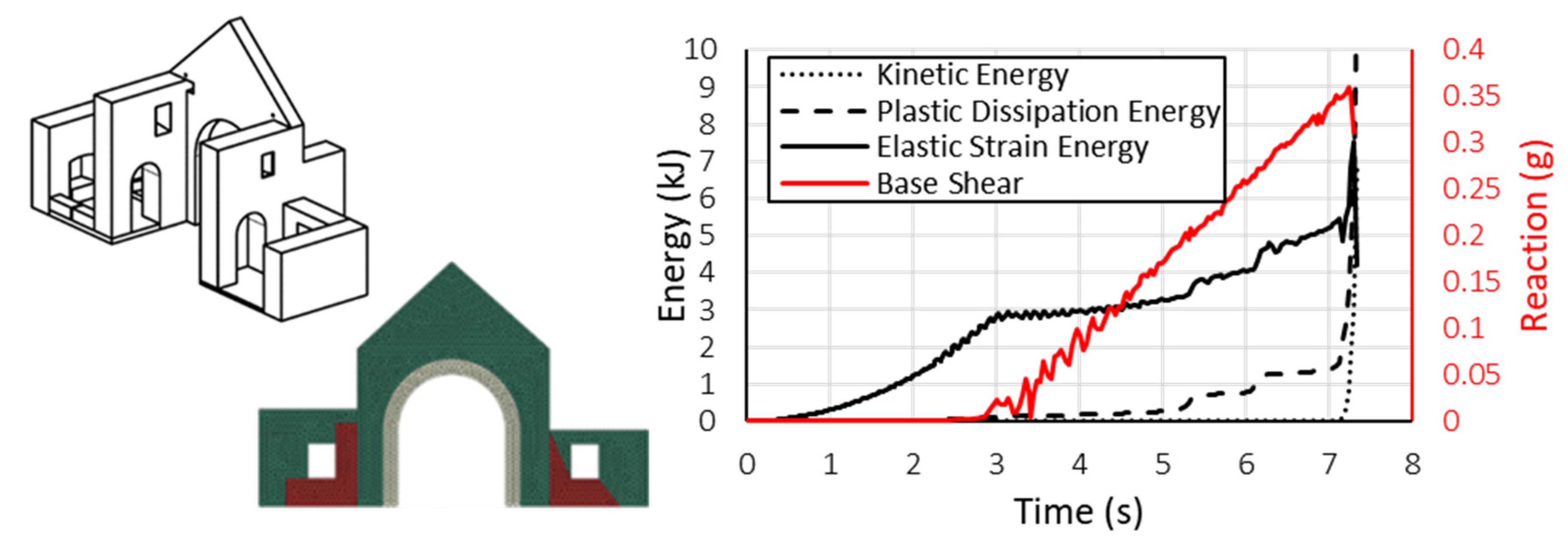
Figure 12 illustrates the time evolution until failure of SE, PD, and KE, and the base shear for Model 4, all indicating failure at 7.3 seconds of lateral acceleration, which corresponds to 0.365g. These results closely match the maximum lateral capacity for the same model in Figure 11 (0.355g), defined by the capacity curve. Because this simulation uses quasi-static pushover loading, kinetic energy remains negligible until a portion or portions of the structure enters an unstable condition and grows asymptotically.
The spike in kinetic energy verifies the failure acceleration as determined from the asymptotic growth of PD (Figure 12). The drop in equilibrating shear force at the base, within the same plot, offers another verification of the energy-defined failure point. Beyond the lateral capacity, the PD curve in Figure 12 shows the successive stages of fracture propagation – the discrete jumps that are evident just after 5 and 6 seconds, or at approximately 0.18g and 0.26g. This additional information about the evolution of fracture damage through the structure is not easily detectable from the capacity curves or reaction data.
4. Conclusions
The major contribution of the present work is to the analysis of masonry structures under lateral accelerations whose fracture-related failure, due to complexity or uniqueness, proves difficult to capture with failure analysis standards. This paper provides a rationale for the method using straightforward wall examples. With these examples, we show that the failure point obtained by analyzing the plastic dissipation (PD) and elastic strain energy (SE) outputs of structures modelled with concrete damaged plasticity (CDP) material corresponds to other measures of failure. We then show complex applications for which standard measures of failure are difficult to implement: the massive earthen pyramid of Huaca de la Luna, the complex Frigidarium of Diocletian’s Baths, and the mixed-material triumphal arch of the Church of Andahuaylillas all present challenges to typical analysis.
Considering the proposed procedure in the context of seismic loading, the main advantages are the following:
- It is not necessary to impose static load distributions a priori, based on modal superposition. In fact, the relative distributions of inertial forces acting on the superstructure are a direct consequence of the application of accelerations (or alternatively of velocities) directly at the base: in the context of a nonlinear dynamic analysis, such inertial forces are automatically computed and considered in the step-by-step solution of the equations of motion.
- Moreover, the use of slow dynamic analyses solves to some extent the issues related to calculating modal participation factors and to adapting them to reflect progressive damage. For a nonlinear static analysis, the hypothesis of a linear elastic material for masonry is used for these calculations, but it is unrealistic, especially when masonry is subjected to progressively increasing horizontal accelerations. Such an assumption, already questionable at the beginning of the analyses for monumental historic masonry buildings (which are often damaged by previous seismic events and may exhibit pre-existing states of cracking that occurred over a long period of time, for example induced by foundation settlements) would require adaptive procedures, as for instance adaptive pushover analyses, which are typically carried out in a static fashion. Indeed, with the progressive application of the horizontal loads, cracks spread, and the damage pattern tends to evolve, with the progressive shift of the period of the structure towards the right portion of the spectrum. The presence of evolving crack patterns changes the natural frequencies and the corresponding participating mass. The slow dynamic analysis proposed here automatically takes into account the progressive damage of the structure, making the step-by-step adaptation of the distribution of equivalent loads unnecessary.
- It is possible to quantitatively predict the displacement that the structure can reach in ultimate limit state conditions, even in the absence of softening of the global pushover curve. This feature makes the proposed procedure particularly suitable and appealing in the context of the so-called "displacement-based design." The substantial inability of finite element models conceived in the static field to accurately predict the ultimate displacements for historical buildings is well documented in the literature [28,29,30,31]. The Italian guidelines for cultural heritage (probably the most advanced for numerical analysis of monumental structures), address this limitation by suggesting nonlinear static analyses – in the absence of a clear drop in the load-bearing capacity and for materials unable to withstand tensile stresses – up to “relevant displacements” of the pushover curve (§5.2.4 [32]).
- The explicit algorithm used in any nonlinear dynamic analysis allows for better convergence, as its stability is significantly higher than that of a classical nonlinear static analysis. Nonlinear static analyses often exhibit lack of convergence for applied loads still far from the collapse limit state and/or premature halting. These issues can be solved by dynamic analyses in which the equations of motion are solved at each load step by means of well-known integration schemes that do not require sub-iterations based on return mapping procedures. This easily justifies the potentially high cost of using the explicit formulation instead of a standard formulation.
Author Contributions
Conceptualization, R.P.; methodology, R.P., G.M., S.T., J.S., and A.R.; validation, A.R.; investigation, A.R., J.S., and S.T.; resources, R.P.; data curation, A.R.; writing—original draft preparation, A.R., R.P., G.M.; writing—review and editing, R.P., A.R., G.M., S.T.; visualization, A.R., R.P., and J.S.; supervision, R.P. All authors have read and agreed to the published version of the manuscript. Please turn to the CRediT taxonomy for the term explanation. Authorship must be limited to those who have contributed substantially to the work reported.
Funding
Partial support for this research was provided by the Ministry of National Education of Türkiye and the University of Rochester Hajim School of Engineering’s Department of Mechanical Engineering.
Data Availability Statement
Dataset available on request from the authors.
Conflicts of Interest
The authors declare no conflicts of interest.
References
- D’Ayala, D.; Lagomarsino, S. Performance-Based Assessment of Cultural Heritage Assets: Outcomes of the European FP7 PERPETUATE Project. Bull Earthquake Eng 2015, 13, 5–12. [Google Scholar] [CrossRef]
- Diaferio, M.; Foti, D.; Sabbà, M.F.; Lerna, M. A Procedure for the Seismic Risk Assessment of the Cultural Heritage. Bull Earthquake Eng 2021, 19, 1027–1050. [Google Scholar] [CrossRef]
- Lubliner, J.; Oliver, J.; Oller, S.; Oñate, E. A Plastic-Damage Model for Concrete. International Journal of Solids and Structures 1989, 25, 299–326. [Google Scholar] [CrossRef]
- Abaqus CAE/Explicit 2022.
- D’Altri, A.M.; Cannizzaro, F.; Petracca, M.; Talledo, D.A. Nonlinear Modelling of the Seismic Response of Masonry Structures: Calibration Strategies. Bull Earthquake Eng 2022, 20, 1999–2043. [Google Scholar] [CrossRef]
- Tezcan, S.; Pando, M.A.; Aguilar, R.; Perucchio, R. Nonlinear 2D and 3D Finite Element Static and Dynamic Analysis of the Main Pyramid of Huaca de La Luna, Peru. In Proceedings of the 13th International Conference on Structural Analysis of Historical Construction (SAHC 2023); Springer International Publishing: Cham, 2023; Vol. 47. [Google Scholar]
- Sadholz, A.; Muir, C.; Perucchio, R. Limit Analysis to Assess the Seismic Capacity of Diocletian’s Frigidarium. In Proceedings of the Structural Analysis of Historical Constructions: Anamnesis, Diagnosis, Therapy, Controls; Van Balen, K., Verstrynge, E., Eds.; Taylor & Francis Group: London, 2016; pp. 272–278. [Google Scholar]
- Tezcan, S.; Tambe, N.; Muir, C.; Aguilar, R.; Perucchio, R. Nonlinear FE Analysis of the Response to Lateral Accelerations of the Triumphal Arch of the Church of Andahuaylillas, Peru. In Structural Analysis of Historical Constructions; Aguilar, R., Torrealva, D., Moreira, S., Pando, M.A., Ramos, L.F., Eds.; RILEM Bookseries; Springer International Publishing: Cham, 2019; Vol. 18, pp. 1301–1309. ISBN 978-3-319-99440-6. [Google Scholar]
- Bayraktar, A.; Hökelekli, E.; Yang, T.T.Y. Seismic Failure Behavior of Masonry Domes under Strong Ground Motions. Engineering Failure Analysis 2022, 142, 106749. [Google Scholar] [CrossRef]
- Rainone, L.S.; Tateo, V.; Casolo, S.; Uva, G. About the Use of Concrete Damage Plasticity for Modeling Masonry Post-Elastic Behavior. Buildings 2023, 13, 1915. [Google Scholar] [CrossRef]
- Valente, M.; Milani, G. Seismic Response and Damage Patterns of Masonry Churches: Seven Case Studies in Ferrara, Italy. Engineering Structures 2018, 177, 809–835. [Google Scholar] [CrossRef]
- Misir, I.S.; Yucel, G. Numerical Model Calibration and a Parametric Study Based on the Out-Of-Plane Drift Capacity of Stone Masonry Walls. Buildings 2023, 13, 437. [Google Scholar] [CrossRef]
- Shehu, R. Implementation of Pushover Analysis for Seismic Assessment of Masonry Towers: Issues and Practical Recommendations. Buildings 2021, 11, 71. [Google Scholar] [CrossRef]
- ABAQUS Analysis User’s Manual (v6.6) Available online:. Available online: https://classes.engineering.wustl.edu/2009/spring/mase5513/abaqus/docs/v6.6/books/usb/default.htm?startat=pt05ch18s03abm30.html (accessed on 20 March 2023).
- Chopra, A.K. Dynamics of Structures: Theory and Applications to Earthquake Engineering; Prentice-Hall international series in civil engineering and engineering mechanics; 3rd ed. Pearson/Prentice Hall: Upper Saddle River, N.J, 2007; ISBN 978-0-13-156174-8. [Google Scholar]
- Pinho, R. Using Pushover Analysis for Assessment of Buildings and Bridges. In Advanced Earthquake Engineering Analysis; Pecker, A., Ed.; Springer: Vienna, 2007; pp. 91–120. ISBN 978-3-211-74214-3. [Google Scholar]
- Silva, V.; Crowley, H.; Varum, H.; Pinho, R.; Sousa, R. Evaluation of Analytical Methodologies Used to Derive Vulnerability Functions. Earthquake Engineering & Structural Dynamics 2014, 43, 181–204. [Google Scholar] [CrossRef]
- Ferretti, F.; Simoni, E.; Buratti, N.; Mazzotti, C. Typological Fragility Analysis of Masonry Buildings in Emilia Romagna Region (Italy). Bull Earthquake Eng 2023, 21, 3321–3356. [Google Scholar] [CrossRef]
- Aşıkoğlu, A.; Vasconcelos, G.; Lourenço, P.B.; Pantò, B. Pushover Analysis of Unreinforced Irregular Masonry Buildings: Lessons from Different Modeling Approaches. Engineering Structures 2020, 218, 110830. [Google Scholar] [CrossRef]
- Gaggero, M.B.; Korswagen, P.A.; Esposito, R.; Rots, J.G. In-Plane Behaviour of Unreinforced Masonry Strengthened with a Structural Glass Window: A Proof of Concept. Buildings 2023, 13, 361. [Google Scholar] [CrossRef]
- Cannizzaro, F.; Pantò, B.; Lepidi, M.; Caddemi, S.; Caliò, I. Multi-Directional Seismic Assessment of Historical Masonry Buildings by Means of Macro-Element Modelling: Application to a Building Damaged during the L’Aquila Earthquake (Italy). Buildings 2017, 7, 106. [Google Scholar] [CrossRef]
- Betti, M.; Galano, L.; Vignoli, A. Time-History Seismic Analysis of Masonry Buildings: A Comparison between Two Non-Linear Modelling Approaches. Buildings 2015, 5, 597–621. [Google Scholar] [CrossRef]
- Tezcan, S.; Pando, M.A.; Aguilar, R.; Castañeda, B.; Rojas, C.; Perucchio, R. Preliminary Nonlinear Static and Dynamic Analysis of the Main Pyramid of Huaca de La Luna, Peru. In Proceedings of the COMPDYN 2021: 8th ECCOMAS Thematic Conference on Computational Methods in Structural Dynamics and Earthquake Engineering; Papadrakakis, M., Fragiadakis, M., Eds.; Athens, Greece, 2021; pp. 244–257. [Google Scholar]
- Riccio, C.; Remus, A.; Tezcan, S.; Silva, L.C.; Milani, G.; Perucchio, R. A Macroblock 2D Finite Element Model for Assessing the Roots of Failure of Huaca de La Luna’s Main Pyramid (Peru) under Seismic Action. Engineering Failure Analysis 2023. [Google Scholar] [CrossRef]
- Remus, A.; Yılmaz, L.; Tezcan, S.; Perucchio, R. Effect of Eastern Architecture and Sloping Foundation Conditions on the Static and Dynamic Response of the Adobe Pyramid Huaca De La Luna (Perú). In Proceedings of the 13th International Conference on the Structural Analysis and Historical Constructions (SAHC 2023); Springer International Publishing: Cham, September 2023; Vol. 47. [Google Scholar]
- Aguilar, R.; Pando, M.A.; Briceño, C.; Zavala, G.; Castañeda, B.; Perucchio, R.; Uceda, S. Structural and Geotechnical Engineering Assessment of Huaca de La Luna – A Massive Earthen Moche Culture Pyramid in Northern Peru. Journal of Cultural Heritage 2018, 34, 83–94. [Google Scholar] [CrossRef]
- Brune, P. The Mechanics of Imperial Roman Concrete and the Structural Design of Vaulted Monuments. PhD, University of Rochester: Rochester, NY, 2010.
- Milani, G.; Valente, M. Comparative Pushover and Limit Analyses on Seven Masonry Churches Damaged by the 2012 Emilia-Romagna (Italy) Seismic Events: Possibilities of Non-Linear Finite Elements Compared with Pre-Assigned Failure Mechanisms. Engineering Failure Analysis 2015, 47, 129–161. [Google Scholar] [CrossRef]
- Vitorino, S.; Corazzi, R.; Doz, G. Seismic Performance Assessment of the Historical Cathedral of Santa Maria Del Fiore Dome by Numerical Analysis. Engineering Failure Analysis 2024, 165, 108734. [Google Scholar] [CrossRef]
- Nastri, E.; Tenore, M.; Todisco, P. Calibration of Concrete Damaged Plasticity Materials Parameters for Tuff Masonry Types of the Campania Area. Engineering Structures 2023, 283, 115927. [Google Scholar] [CrossRef]
- Kalkbrenner, P.; Pelà, L.; Sandoval, C. Multi Directional Pushover Analysis of Irregular Masonry Buildings without Box Behavior. Engineering Structures 2019, 201, 109534. [Google Scholar] [CrossRef]
- Direttiva del Presidente del Consiglio dei Ministri, DPCM Gazzetta Ufficiale della Repubblica Italiana G.U. Valutazione e riduzione del rischio sismico del patrimonio culturale con riferimento alle norme tecniche per le costruzioni di cui al decreto ministeriale 14 gennaio 2008. 54, 2011.
Figure 1.
Pushover analysis of a 3D wall (a) with accompanying energy outputs (b), reaction forces (c) and pushover curve (d).
Figure 1.
Pushover analysis of a 3D wall (a) with accompanying energy outputs (b), reaction forces (c) and pushover curve (d).
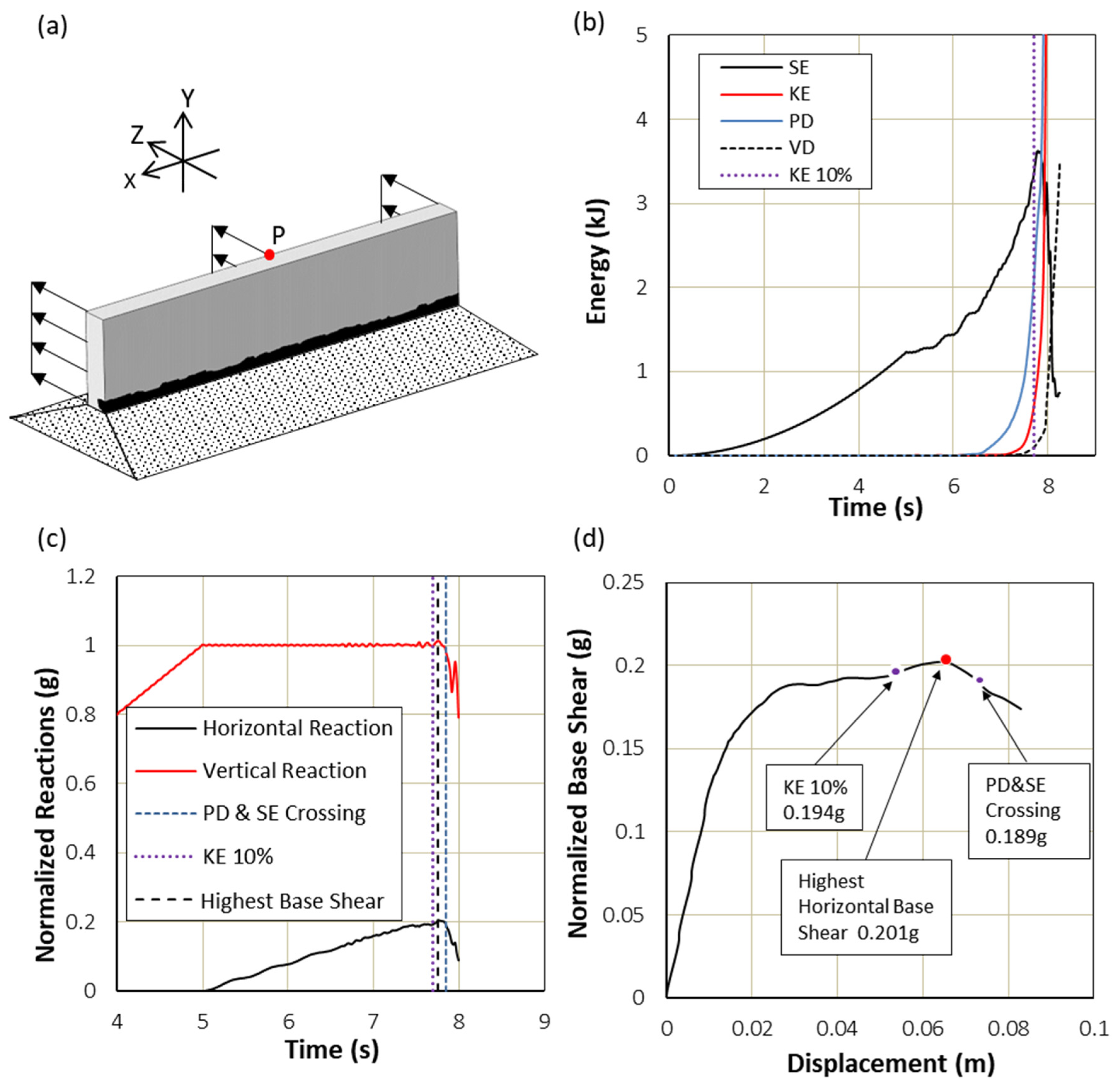
Figure 2.
Wall section damaged under base acceleration with energy and equilibrating reaction results.
Figure 2.
Wall section damaged under base acceleration with energy and equilibrating reaction results.
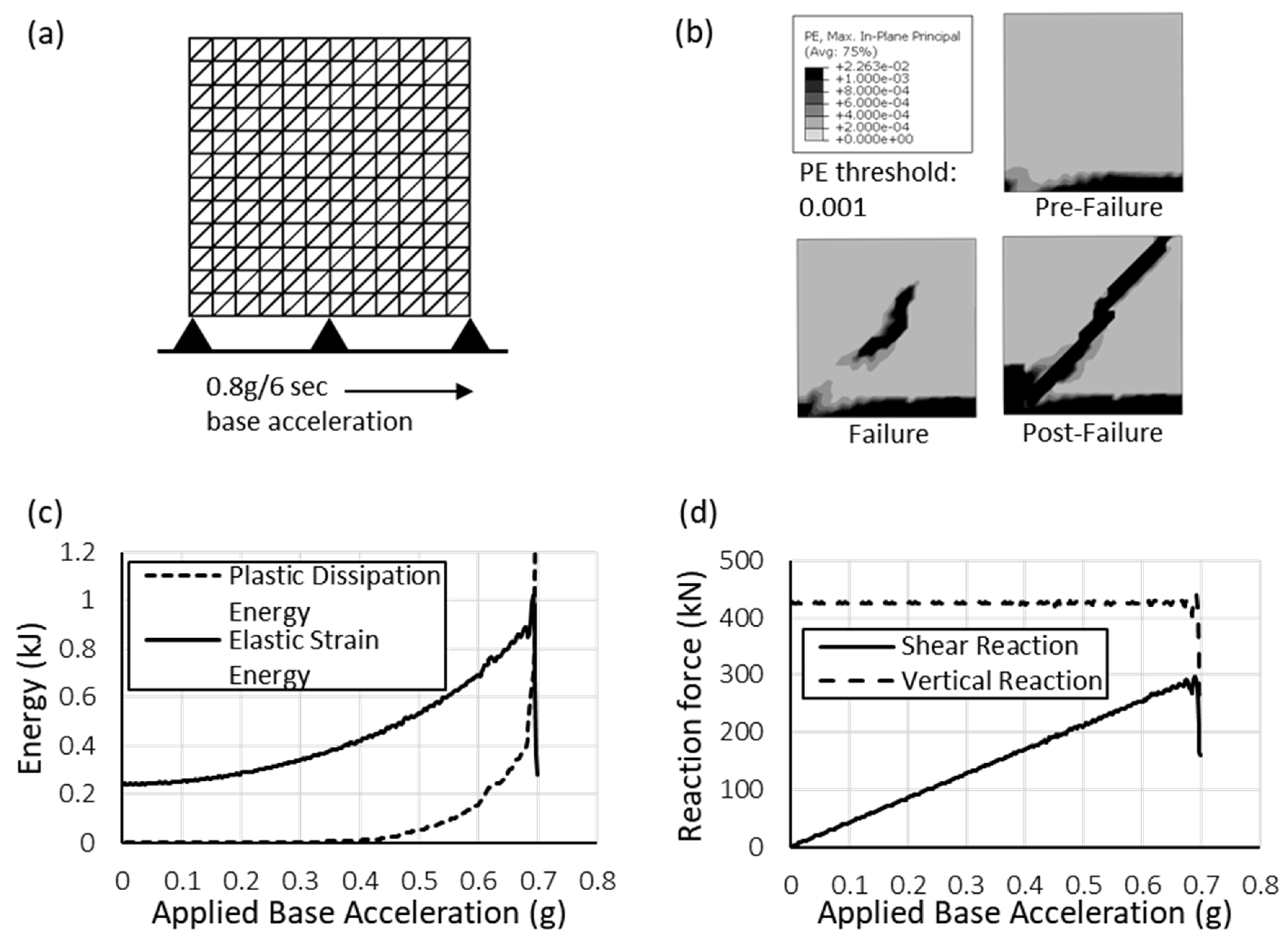
Figure 3.
Three simple panel models are recreated following [5] to compare maximum capacity defined by capacity curves and defined by the proposed methodology.
Figure 3.
Three simple panel models are recreated following [5] to compare maximum capacity defined by capacity curves and defined by the proposed methodology.
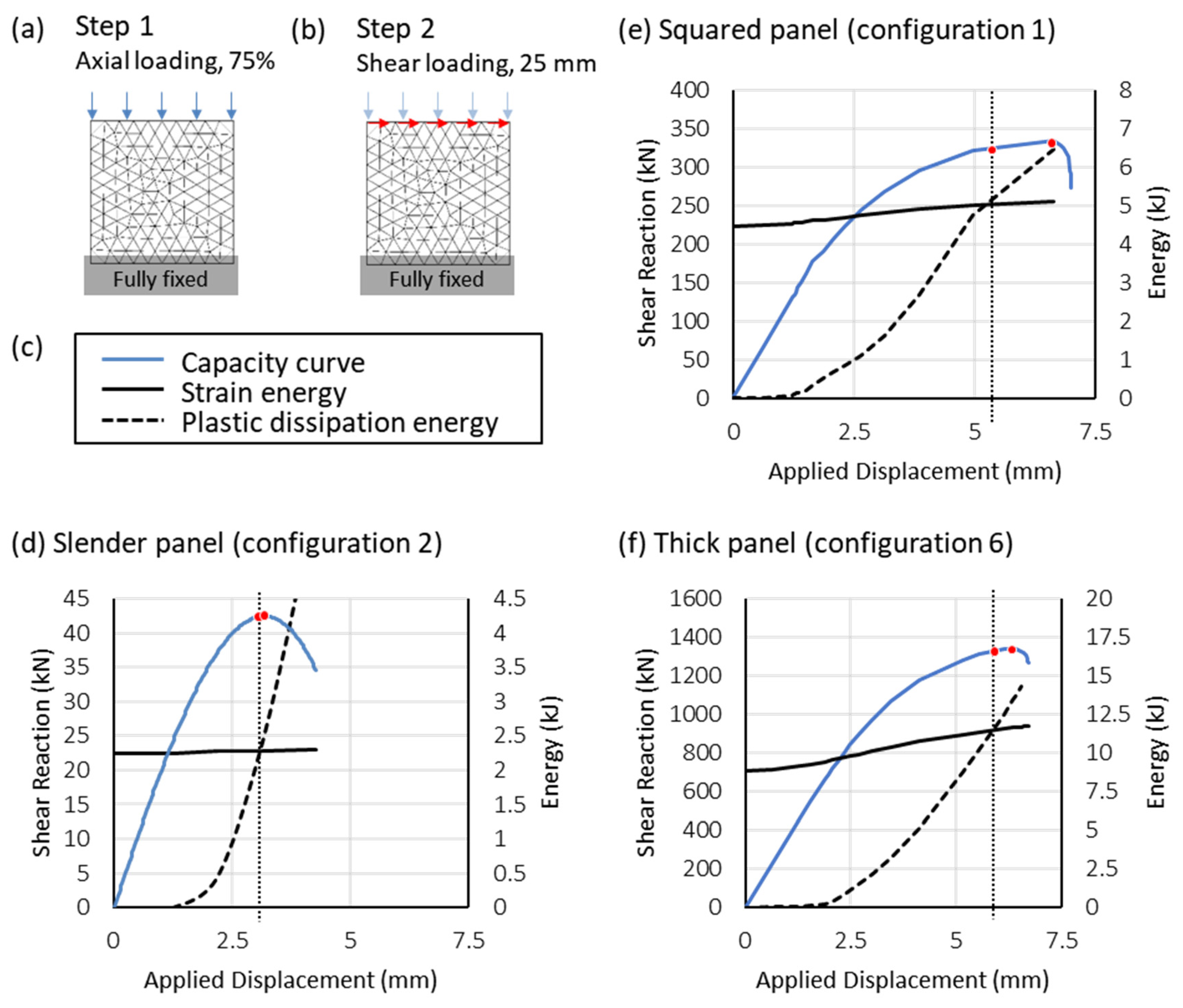
Figure 4.
Huaca de la Luna complex as (a) 3D reconstruction, (b) laser scan, and (c) photograph [26].
Figure 4.
Huaca de la Luna complex as (a) 3D reconstruction, (b) laser scan, and (c) photograph [26].
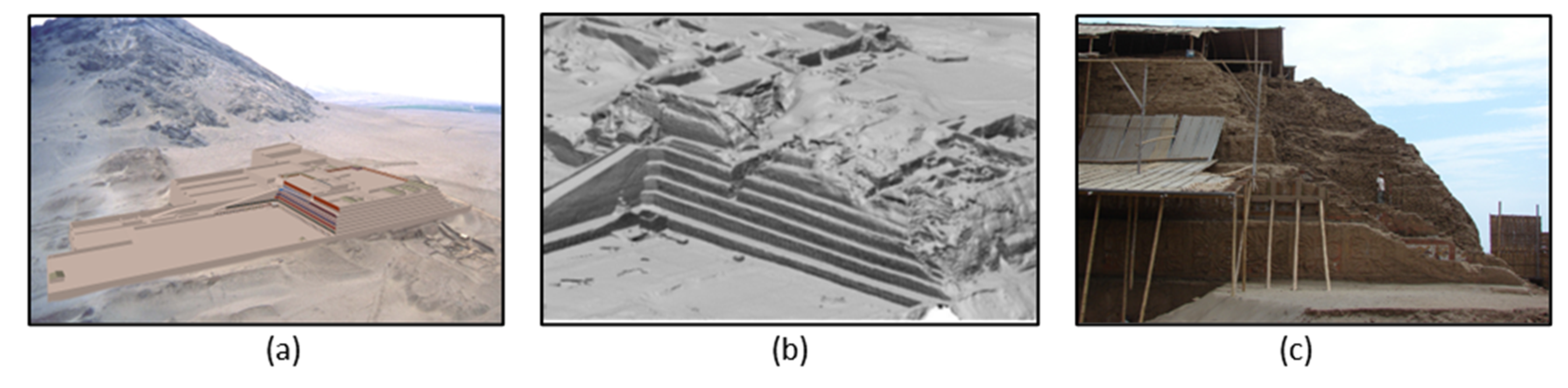
Figure 5.
Evolution of elastic and plastic dissipation energies under gravitation (a) and lateral acceleration loads up to collapse (b-d). Arrows denote an eastward acceleration applied to the base.
Figure 5.
Evolution of elastic and plastic dissipation energies under gravitation (a) and lateral acceleration loads up to collapse (b-d). Arrows denote an eastward acceleration applied to the base.
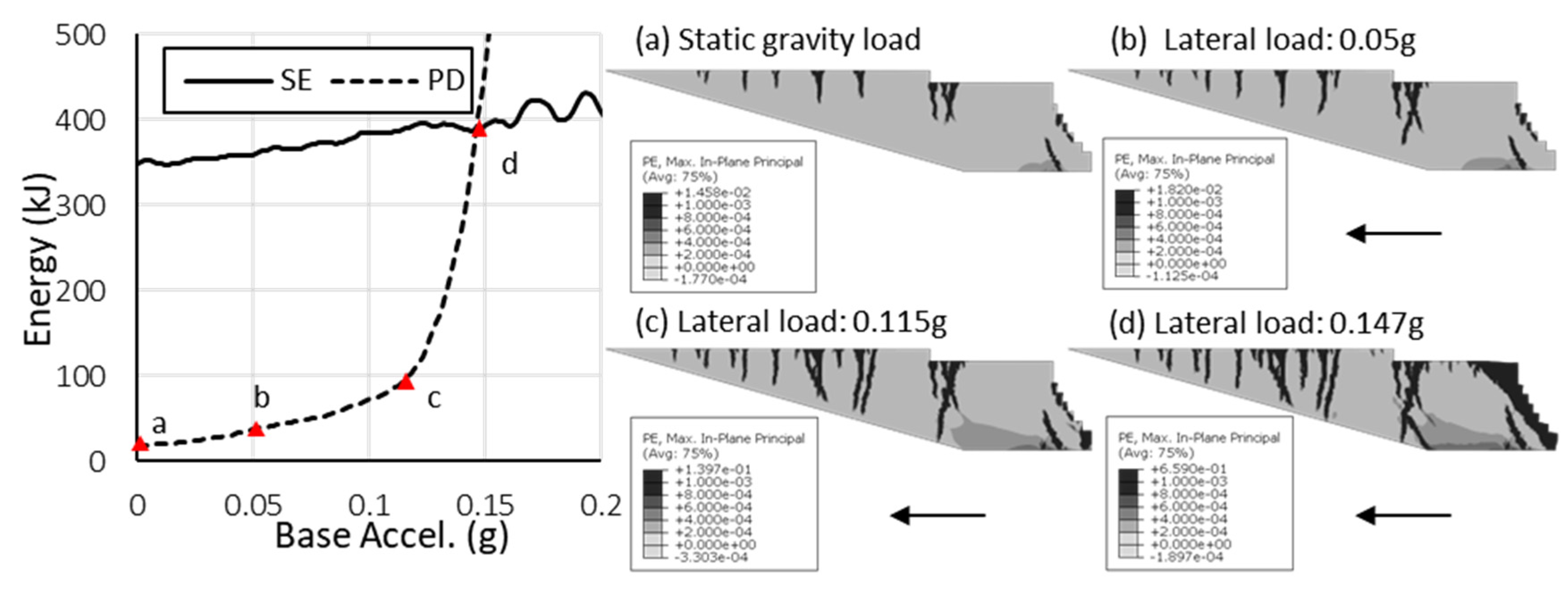
Figure 6.
Simplified 3D model under W-E ground acceleration (N-S symmetry applied at the boundary) produces (a) fracture patterns shown with plastic strains, (b) energy outputs and (c) capacity curves.
Figure 6.
Simplified 3D model under W-E ground acceleration (N-S symmetry applied at the boundary) produces (a) fracture patterns shown with plastic strains, (b) energy outputs and (c) capacity curves.
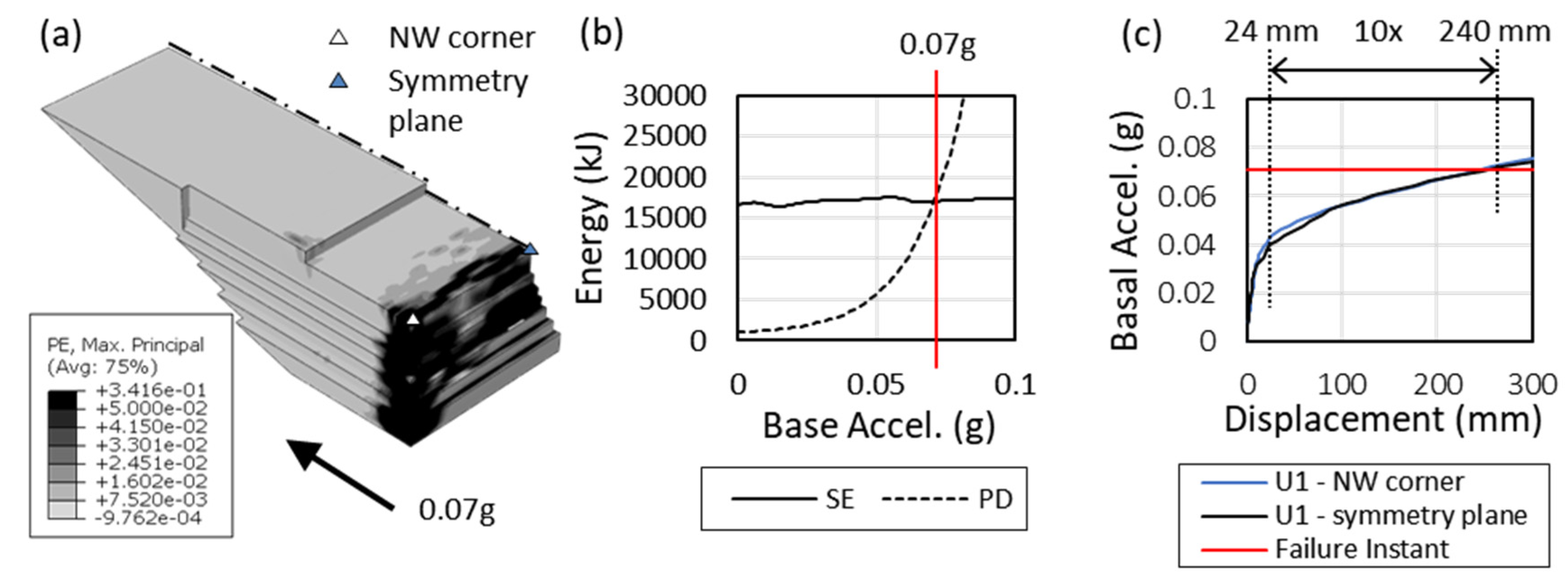
Figure 7.
Simplified 3D model under N-S ground acceleration produces (a) fracture patterns shown with plastic strains, (b) energy outputs and (c) capacity curves.
Figure 7.
Simplified 3D model under N-S ground acceleration produces (a) fracture patterns shown with plastic strains, (b) energy outputs and (c) capacity curves.
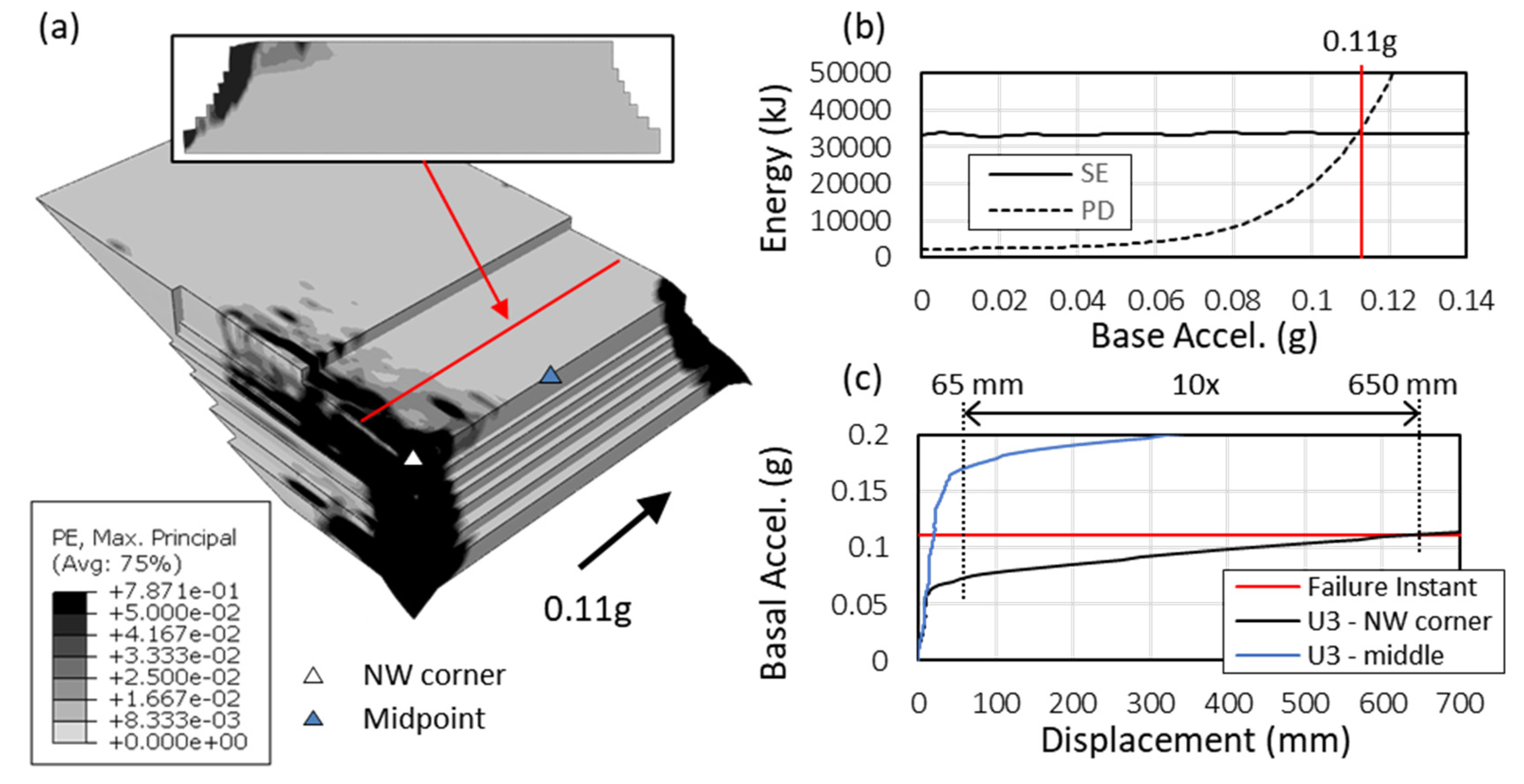
Figure 8.
Frigidarium section (a) and geometry used for nonlinear FEA under lateral acceleration (b).
Figure 8.
Frigidarium section (a) and geometry used for nonlinear FEA under lateral acceleration (b).
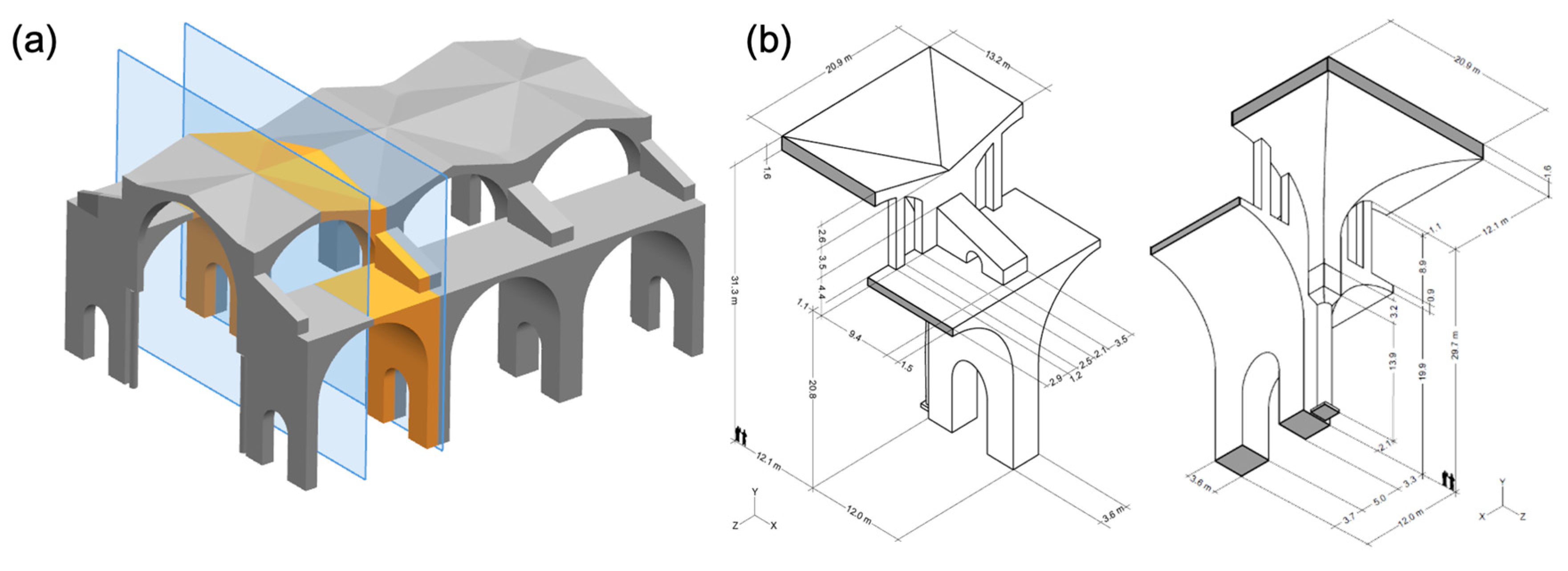
Figure 9.
Base acceleration applied to the FE model: (a) energy results, (b) initial fracture pattern, and (c) fracture pattern at collapse.
Figure 9.
Base acceleration applied to the FE model: (a) energy results, (b) initial fracture pattern, and (c) fracture pattern at collapse.
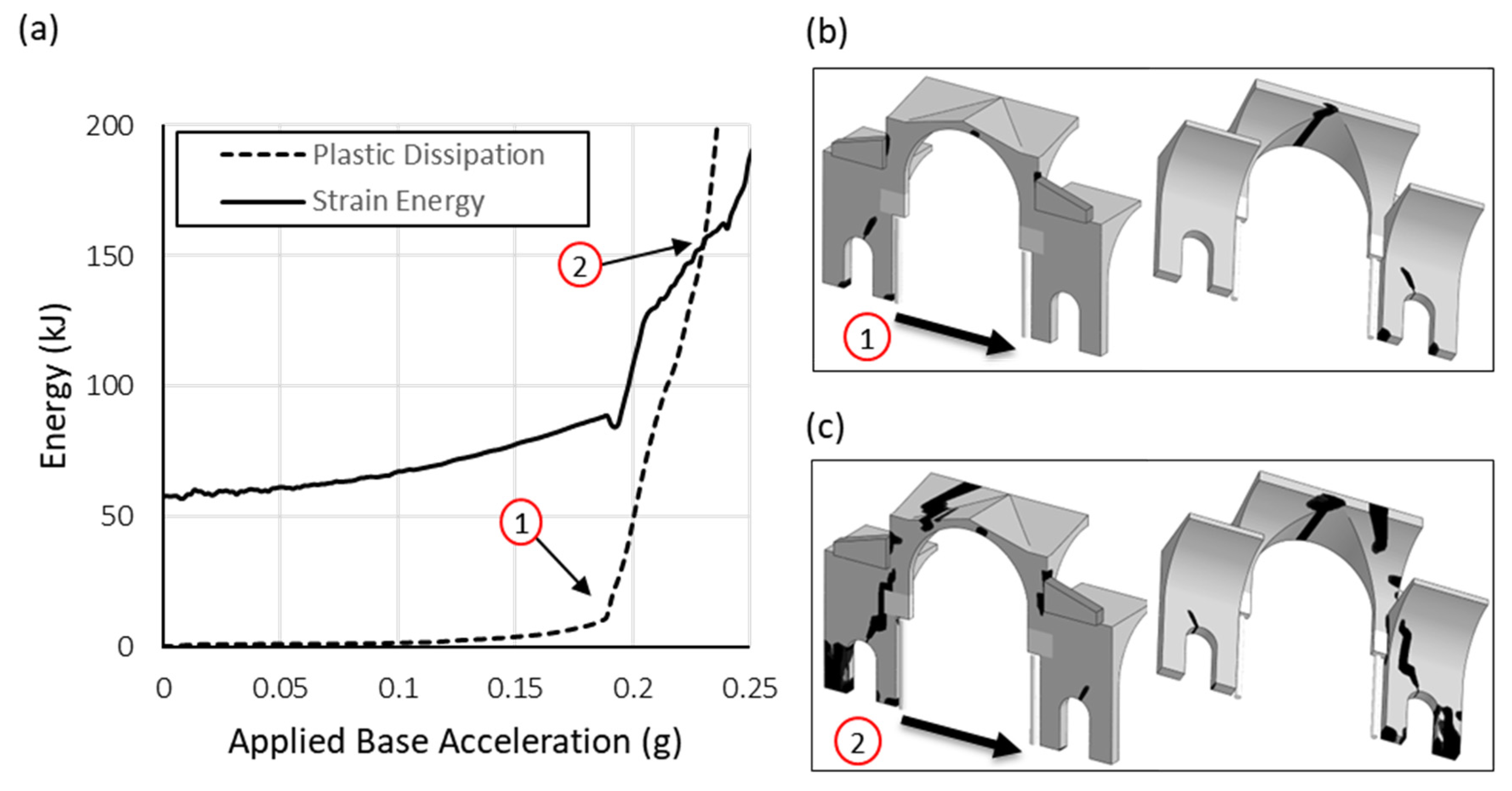
Figure 10.
Kinematic limit analysis: (a) assumed rigid element configuration with connecting hinges and (b) attendant collapse mechanism [7].
Figure 10.
Kinematic limit analysis: (a) assumed rigid element configuration with connecting hinges and (b) attendant collapse mechanism [7].
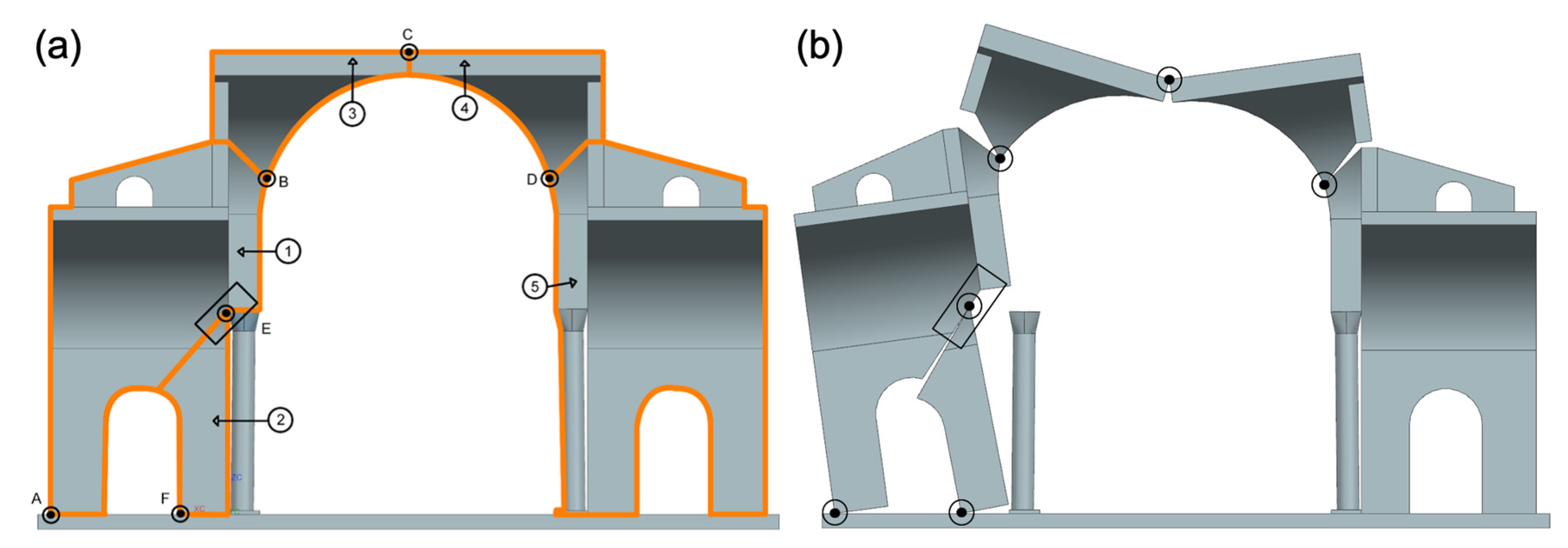
Figure 11.
Capacity curves (a) and fracture patterns at failure (b) for the four models of the triumphal arch. The red triangle denotes the reference point where the lateral displacements are measured.
Figure 11.
Capacity curves (a) and fracture patterns at failure (b) for the four models of the triumphal arch. The red triangle denotes the reference point where the lateral displacements are measured.
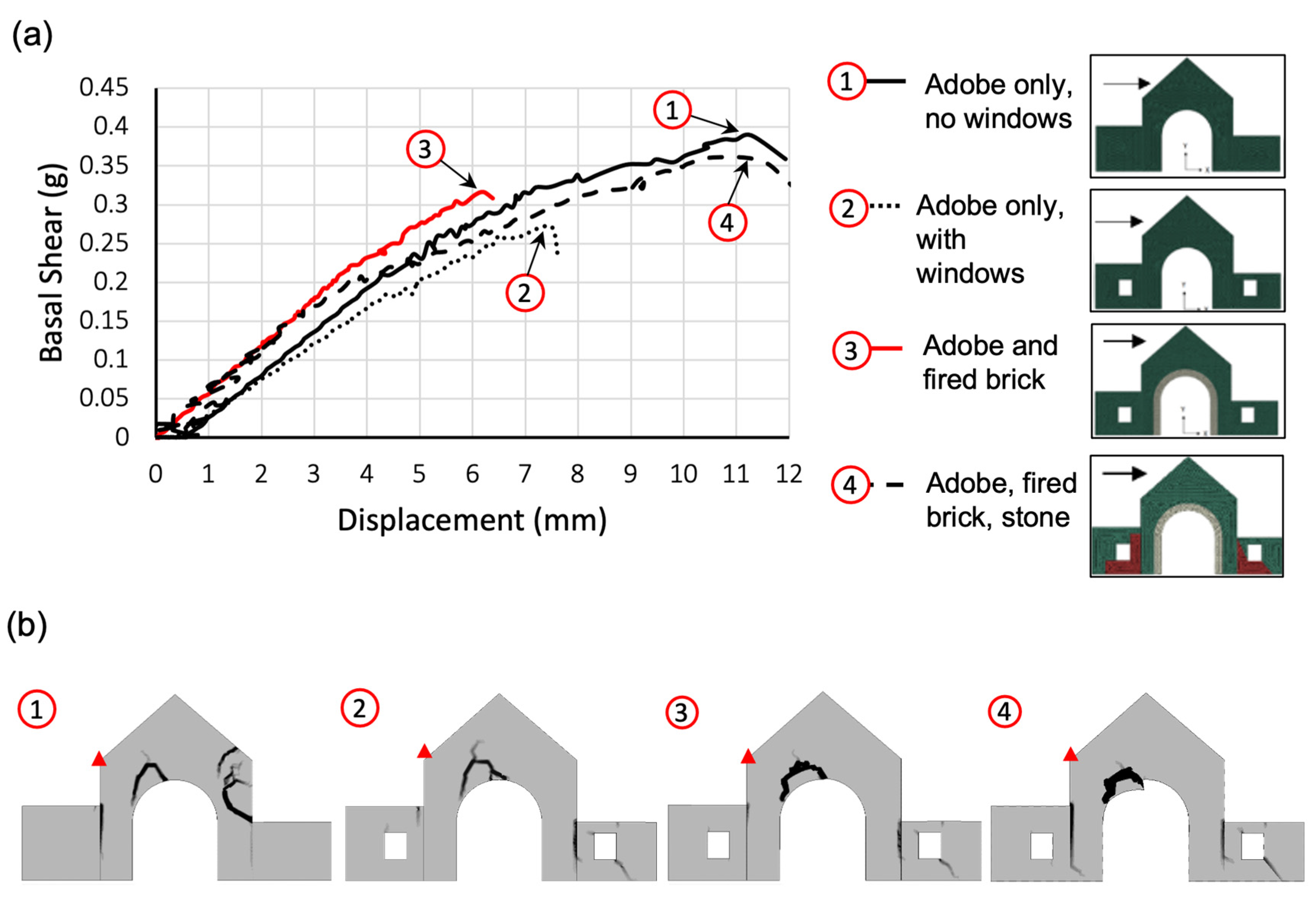
Figure 12.
Triumphal arch architecture and material distribution for model D in Figure 11 (adobe, fired bricks, and stone masonry) (left) and combined energy and reaction plot (right).
Figure 12.
Triumphal arch architecture and material distribution for model D in Figure 11 (adobe, fired bricks, and stone masonry) (left) and combined energy and reaction plot (right).
Disclaimer/Publisher’s Note: The statements, opinions and data contained in all publications are solely those of the individual author(s) and contributor(s) and not of MDPI and/or the editor(s). MDPI and/or the editor(s) disclaim responsibility for any injury to people or property resulting from any ideas, methods, instructions or products referred to in the content. |
© 2024 by the authors. Licensee MDPI, Basel, Switzerland. This article is an open access article distributed under the terms and conditions of the Creative Commons Attribution (CC BY) license (http://creativecommons.org/licenses/by/4.0/).
Copyright: This open access article is published under a Creative Commons CC BY 4.0 license, which permit the free download, distribution, and reuse, provided that the author and preprint are cited in any reuse.


