
Submitted:
27 November 2024
Posted:
28 November 2024
You are already at the latest version
Abstract
Location privacy is a crucial factor to consider in the vehicular ad hoc networks. The plaintext broadcast of information such as location and speed during vehicle communication is vulnerable to eavesdroppers, leading to risks of user privacy breaches. While current pseudonym-changing strategies can provide some level of privacy protection, their effectiveness is limited against attackers with machine learning capabilities. Moreover, some strategies, such as encryption and silence mechanisms, may introduce additional delay and communication overhead, making it difficult to ensure both road safety and location privacy simultaneously.This paper proposes a Trajectory Converged Chaff-Based Mix-zone strategy (TCCM). This strategy generates chaff messages within a mix-zone that resembles the real vehicle trajectory, confusing eavesdroppers, reducing traceability, increasing entropy within the mix-zone, and minimizing the overhead of chaff. Additionally, the strategy does not rely on encryption or silence mechanisms, ensuring the safety of vehicle operations. Furthermore, TCCM utilizes a genetic algorithm to optimize the deployment locations of the mix-zones to maximize privacy protection for vehicles.
Keywords:
1. Introduction
- We propose the TCCM pseudonym change strategy, which uses chaff traffic to protect the location privacy of vehicles without affecting their driving safety mechanisms. The strategy does not use encryption mechanisms and can effectively defend against adversaries with machine learning capabilities from conducting syntax linking attacks and semantic linking attacks. The strategy selects better mix-zone deployment locations based on the privacy level of the vehicles, balancing the privacy level of the vehicles.
- We propose a chaff traffic generation method based on the sequence-to-sequence (Seq2Seq) model, using neural networks to generate chaff traffic that closely resembles real traffic, and converge the chaff traffic with the trajectories of assisting vehicles within the mix-zone. This ensures that the chaff traffic only exists within the mix-zone and does not affect other vehicles outside the mix-zone, while reducing the communication overhead of the assisting vehicles.
- Compared to existing pseudonym change strategies, although TCCM requires RSUs to use computational resources to generate chaff traffic, it can achieve a high level of privacy protection without affecting the driving safety mechanisms of vehicles.
2. Related Work
2.1. Pseudonym Change Strategies
2.2. Vehicle Tracking Schemes
3. Adversary Model
4. Trajectory Converged Chaff-Based Mix-Zone (TCCM)
4.1. Existing Problems and Challenges
- Unable to simultaneously guarantee vehicle driving safety and location privacy security. The security strategy based on the silent period requires vehicles to temporarily stop sending broadcast messages during driving, which poses the risk of vehicle collisions due to missing broadcast messages. Additionally, the use of encrypted mix-zones introduces additional encryption and decryption delays, which will affect the vehicle’s driving safety strategy.
- Unable to effectively defend against syntactic and semantic linking attacks, especially machine learning-based semantic linking attacks. Even with periodic pseudonym changes and use of silent period, attackers can still successfully match new and old pseudonyms with a high probability through trajectory prediction algorithms, thereby compromise the privacy security of vehicles.
- Interfere with normal vehicles in the VANET. The pseudonym change strategies set up to protect vehicle location privacy may have impacts on vehicle driving safety, increased overhead, and inability to filter chaff, which may bring risks to the VANET. For example, the strategies that based on chaff messages have the problem that vehicles outside the mix-zone cannot filter out the chaff messages.
4.2. General Architecture
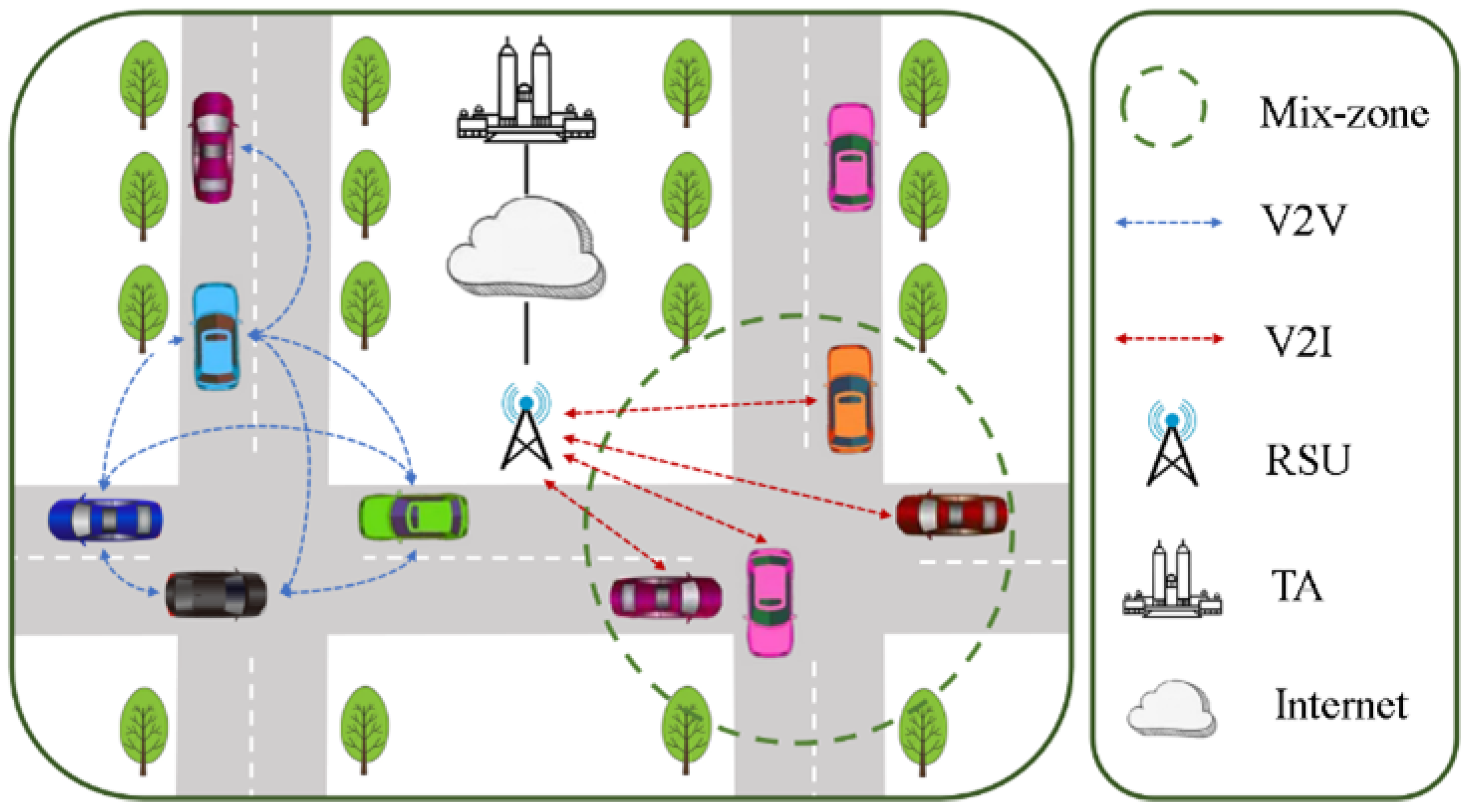
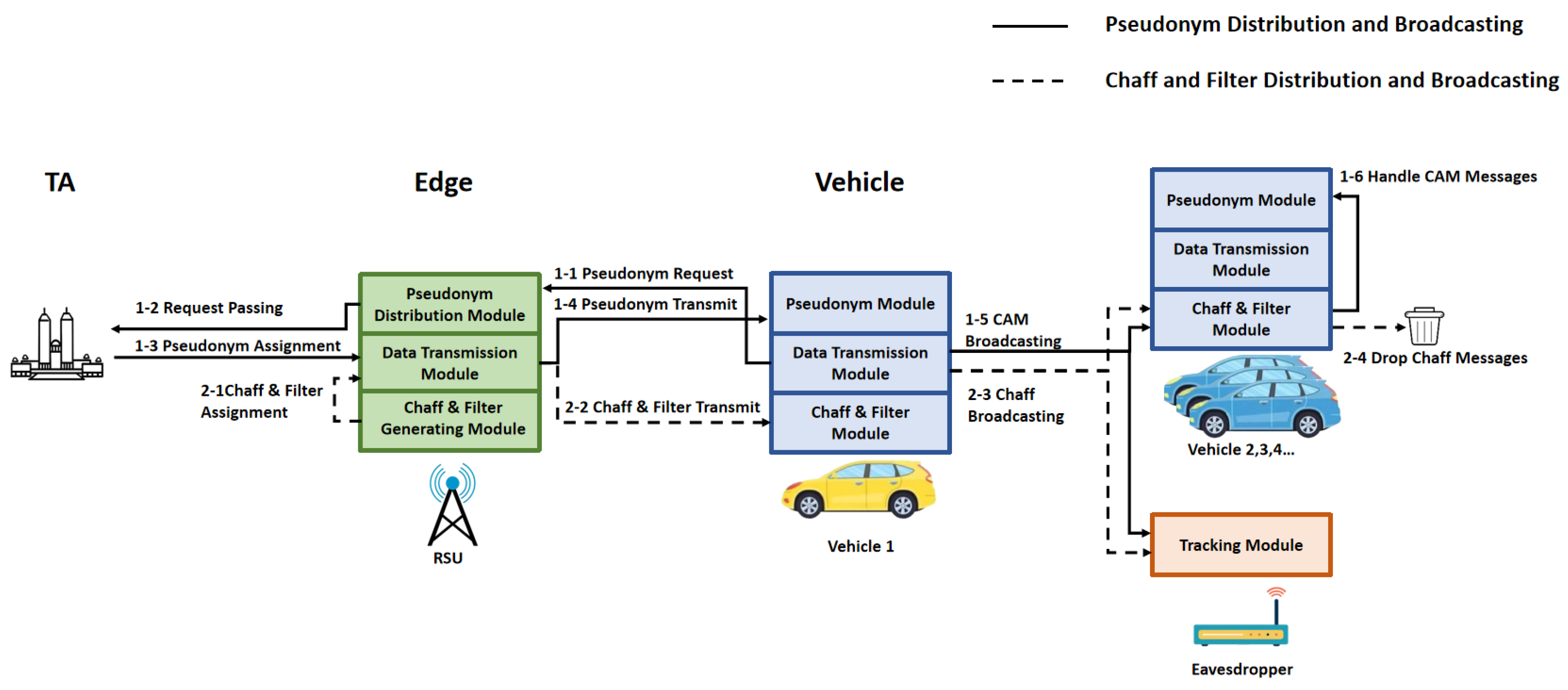
- TA: The Trusted Authority (TA) is a government-led institution. We assume that each legitimate vehicle must register with the TA before joining the Vehicular Ad Hoc Network (VANET), creating a public key, a private key, and a certificate. The TA is responsible for tracking and revoking the pseudonyms of any non-compliant vehicles, as well as generating and delivering requested pseudonyms to the Roadside Unit (RSU).
- RSU: RSU collects broadcast information from vehicles, performs mix-zone partitioning, delivers vehicle pseudonym generation requests, and generates and distributes chaff messages. Compared to vehicles, RSU has larger storage and computing resources.
- OBU: Each vehicle is equipped with an on-board unit (OBU) and a satellite positioning device. Vehicles use the OBU to communicate with other vehicles and the RSU, and only legitimate OBU devices can pass the authentication and receive the chaff traffic filters sent by the RSU.
4.3. Mix-zone Deployment
4.4. Pseudonym Change Strategy
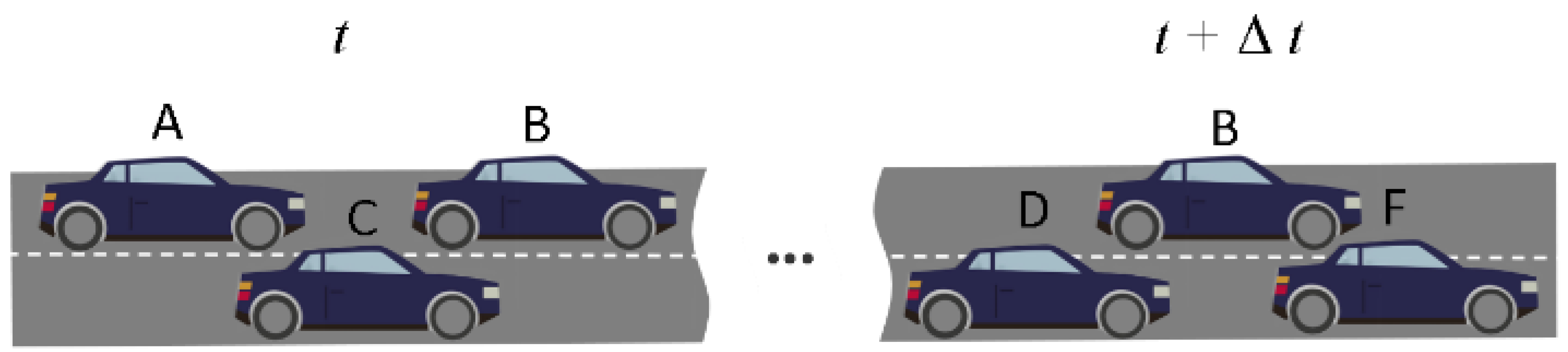
- Authentication/Chaff Message Distribution. The RSU verifies the identity of vehicle A and distributes the pseudonyms , chaff messages , , and filters;
- Start of Chaff Message Broadcast. The RSU synchronizes the pseudonym change for vehicles, vehicle A changes its pseudonym to and simultaneously starts sending chaff message .
- Separation of Vehicle and Chaff Message. Vehicle A and chaff message C simultaneously change their pseudonyms to and respectively and proceed on their respective paths.
- Start of Chaff Trajectory Converging. Vehicle A, as an assistant broadcaster for chaff message , Converging its trajectory with chaff after passing the intersection.
- Trajectory Converging Complete. The trajectory converging of vehicle A and chaff message is complete, vehicle A is prepared for a uniform pseudonym change and stopping the chaff message broadcast.
- Stop Chaff Message Broadcast. At the next synchronized pseudonym change, vehicle A changes its pseudonym and stops broadcasting chaff message , then leaves the mix-zone.
| Algorithm 1:Chaff Partner Selection Algorithm. |
|
4.5. Chaff Generation
-
Trajectory Prediction Stage: In this stage, the RSU will use the large amount of data collected in the mix-zone as the dataset, based on the broadcast information of the assisted vehicle in the past period to generate the possible trajectory of the assisted vehicle in the next period as part of the chaff traffic. We use the Seq2Seq model to complete the task of generating the trajectory of the chaff traffic, the dataset for model training is based on the vehicle broadcast messages collected by each RSU in its responsible mix-zones.The RSU will separately generate a segment of trajectory on all possible roads that the assisted vehicle may travel. These chaff messages are broadcasted by the assisting vehicle. After the assisting vehicle passes through the intersection and the road it heading is determined, the assisting vehicle will only retain the chaff trajectory in the same direction in the next stage. If the RSU can somehow obtain the driving intention of the assisting vehicle in advance, such as obtaining the navigation information of the assisting vehicle, then only one correct trajectory need to be generated.
- Trajectory Converging Stage: The purpose of trajectory converging is to confuse the eavesdropper. In this stage, the RSU generates a sequence of the relative positions between the chaff traffic and the assisting vehicle, based on the relative position, the assisting vehicle perform a simple weighted calculation of its own coordinates and the relative position to obtain the actual coordinate of the chaff traffic, in which the absolute value of the relative position gradually approaches zero. After a certain time, the assisting vehicle will travel on the road with the same coordinates as the chaff traffic. Then, In the next pseudonym change time point, the assisting vehicle will stop sending chaff traffic and change its own pseudonym, and then the chaff traffic mechanism will end. Finally, the assisted vehicle and the assisting vehicle will leave the mix-zone.
4.6. Chaff Filter
5. Performance Evaluation
6. Discussion
7. Conclusions
Funding
Conflicts of Interest
References
- Qiu, J.; Chen, Y.; Tian, Z.; Guizani, N.; Du, X. The security of internet of vehicles network: Adversarial examples for trajectory mode detection. IEEE Network 2021, 35, 279–283. [Google Scholar] [CrossRef]
- Gräfling, S.; Mähönen, P.; Riihijärvi, J. Performance evaluation of IEEE 1609 WAVE and IEEE 802.11 p for vehicular communications. In 2010 Second International Conference on Ubiquitous and Future Networks (ICUFN); IEEE: 2010; pp. 344–348.
- Festag, A. Cooperative intelligent transport systems standards in Europe. IEEE Communications Magazine 2014, 52, 166–172. [Google Scholar] [CrossRef]
- Priyan, M.K.; Devi, G.U. A survey on internet of vehicles: applications, technologies, challenges and opportunities. International Journal of Advanced Intelligence Paradigms 2019, 12, 98–119. [Google Scholar] [CrossRef]
- Memon, I.; Mirza, H.T.; Arain, Q.A.; Memon, H. Multiple mix zones de-correlation trajectory privacy model for road network. Telecommunication Systems 2019, 70, 557–582. [Google Scholar] [CrossRef]
- Jeong, D.; Baek, M.; Lee, S.-S. Long-term prediction of vehicle trajectory based on a deep neural network. In 2017 International Conference on Information and Communication Technology Convergence (ICTC); IEEE: 2017; pp. 725–727.
- Freudiger, J.; Raya, M. Mix-zones for location privacy in vehicular networks. In Proc. of ACM Workshop on Wireless Networking for Intelligent Transportation Systems 2007. [Google Scholar]
- Boualouache, A.; Senouci, S.-M.; Moussaoui, S. Vlpz: The vehicular location privacy zone. Procedia Computer Science 2016, 83, 369–376. [Google Scholar] [CrossRef]
- Lefevre, S.; Petit, J.; Bajcsy, R.; Laugier, C.; Kargl, F. Impact of v2x privacy strategies on intersection collision avoidance systems. In 2013 IEEE Vehicular Networking Conference; IEEE: 2013; pp. 71–78.
- Li, Y.; Yin, Y.; Chen, X.; Wan, J.; Jia, G.; Sha, K. A secure dynamic mix zone pseudonym changing scheme based on traffic context prediction. IEEE Transactions on Intelligent Transportation Systems 2021, 23, 9492–9505. [Google Scholar] [CrossRef]
- Li, H.; Lai, Y.X.; Chen, Y. Broadcast and Silence Period (BSP): A Pseudonym Change Strategy. IEEE Transactions on Vehicular Technology 2023, 72, 13618–13630. [Google Scholar] [CrossRef]
- Vaas, C.; Khodaei, M.; Papadimitratos, P.; Martinovic, I. Nowhere to hide? Mix-zones for private pseudonym change using chaff vehicles. In 2018 IEEE Vehicular Networking Conference (VNC); IEEE: 2018; pp. 1–8.
- Abuarqoub, A.; Alzu’bi, A.; Hammoudeh, M.; Ahmad, A.; Al-Shargabi, B. A Survey on Vehicular Ad hoc Networks Security Attacks and Countermeasures. In Proceedings of the 6th International Conference on Future Networks & Distributed Systems; 2022; pp. 701–707.
- Jaiswal, R.K.; Jaidhar, C.D. Location prediction algorithm for a nonlinear vehicular movement in VANET using extended Kalman filter. Wireless Networks 2017, 23, 2021–2036. [Google Scholar] [CrossRef]
- Huang, L.; Matsuura, K.; Yamane, H.; Sezaki, K. Enhancing wireless location privacy using silent period. In IEEE Wireless Communications and Networking Conference; IEEE: 2005; pp. 1187–1192.
- Benarous, L.; Bitam, S.; Mellouk, A. CSLPPS: Concerted silence-based location privacy preserving scheme for internet of vehicles. IEEE Transactions on Vehicular Technology 2021, 70, 7153–7160. [Google Scholar] [CrossRef]
- Huang, L.; Yamane, H.; Matsuura, K.; Sezaki, K. Silent cascade: Enhancing location privacy without communication QoS degradation. In Security in Pervasive Computing: Third International Conference, SPC 2006, York, UK, April 18-21, 2006. Proceedings; Springer: 2006; pp. 165–180.
- Khodaei, M.; Papadimitratos, P. Evaluating on-demand pseudonym acquisition policies in vehicular communication systems. In Proceedings of the First International Workshop on Internet of Vehicles and Vehicles of Internet; 2016; pp. 7–12.
- Emara, K.; Woerndl, W.; Schlichter, J. CAPS: Context-aware privacy scheme for VANET safety applications. In Proceedings of the 8th ACM Conference on Security & Privacy in Wireless and Mobile Networks; 2015; pp. 1–12.
- Zhang, Z.; Feng, T.; Wong, W.-C.; Sikdar, B. A Geo-Indistinguishable Context-Based Mix Strategy for Trajectory Protection in VANETs. IEEE Transactions on Vehicular Technology 2023. [Google Scholar] [CrossRef]
- Liu, X.; Zhao, H.; Pan, M.; Yue, H.; Li, X.; Fang, Y. Traffic-aware multiple mix zone placement for protecting location privacy. In 2012 Proceedings IEEE INFOCOM; IEEE: 2012; pp. 972–980.
- Li, X.; Zhang, H.; Ren, Y.; Ma, S.; Luo, B.; Weng, J.; Ma, J.; Huang, X. PAPU: Pseudonym swap with provable unlinkability based on differential privacy in VANETs. IEEE Internet of Things Journal 2020, 7, 11789–11802. [Google Scholar] [CrossRef]
- Khodaei, M.; Papadimitratos, P. Cooperative location privacy in vehicular networks: Why simple mix zones are not enough. IEEE Internet of Things Journal 2020, 8, 7985–8004. [Google Scholar] [CrossRef]
- Fan, B.; Andersen, D.G.; Kaminsky, M.; Mitzenmacher, M.D. Cuckoo filter: Practically better than bloom. In Proceedings of the 10th ACM International Conference on Emerging Networking Experiments and Technologies; 2014; pp. 75–88.
- Wang, J.; Sun, Y.; Phillips, C. Enhanced Pseudonym Changing in VANETs: How Privacy is Impacted Using Factitious Beacons. In 2023 Wireless Telecommunications Symposium (WTS); IEEE: 2023; pp. 1–6.
- Emara, K. Safety-aware location privacy in VANET: Evaluation and comparison. IEEE Transactions on Vehicular Technology 2017, 66, 10718–10731. [Google Scholar] [CrossRef]
- Xu, Z.; Zhang, H.; Yu, X. Multiple mix-zones deployment for continuous location privacy protection. In 2016 IEEE Trustcom/BigDataSE/ISPA; IEEE: 2016; pp. 760–766.
- Emara, K.; Woerndl, W.; Schlichter, J. On evaluation of location privacy preserving schemes for VANET safety applications. Computer Communications 2015, 63, 11–23. [Google Scholar] [CrossRef]
- Wiedersheim, B.; Ma, Z.; Kargl, F.; Papadimitratos, P. Privacy in inter-vehicular networks: Why simple pseudonym change is not enough. In 2010 Seventh International Conference on Wireless On-Demand Network Systems and Services (WONS); IEEE: 2010; pp. 176–183.


| Parameter | Value |
|---|---|
| Map | LuST Scenario |
| Simulation Period | 24 h |
| Pseudonym Change Interval | 5 s |
| Transmission Range | 300 m |
| Beacon Sending Period | 100 ms |
| Vehicle Maximum Density | 68 veh/km2 |
| Mix-zone Radius | 50 m |
| Vehicle Communication Range | 300 m |
| Chaff Filter Distribute Range | 300 m |
Disclaimer/Publisher’s Note: The statements, opinions and data contained in all publications are solely those of the individual author(s) and contributor(s) and not of MDPI and/or the editor(s). MDPI and/or the editor(s) disclaim responsibility for any injury to people or property resulting from any ideas, methods, instructions or products referred to in the content. |
© 2024 by the authors. Licensee MDPI, Basel, Switzerland. This article is an open access article distributed under the terms and conditions of the Creative Commons Attribution (CC BY) license (http://creativecommons.org/licenses/by/4.0/).