

Submitted:
26 November 2024
Posted:
26 November 2024
You are already at the latest version
Abstract
Aggressive and antisocial behaviors are symptomatic indicators of antisocial psychopathologies and can be explained through transdiagnostic variables applied at structural, emotional, and cognitive levels. The aim of this study was to develop a preliminary multivariate explanatory model incorporating structural (Behavioral Activation and Inhibition Systems [BIS-BAS], Negative Affect Trait [NA-Trait]), emotional (Emotional Dysregulation [ED]), and cognitive (Anger Ru-mination [AR]) variables underlying aggressive and antisocial behaviors in adolescents and adults. A sample of 351 male adolescents and young adults aged 14 to 25 (M = 17.81, SD = 3.11) was drawn from two educational institutions and two correctional facilities in Sonora, Mexico. Path analysis results indicated that structural, emotional, and cognitive variables are predictors of aggression and antisocial behaviors. Evidence showed associations between structural variables, specifically BIS and NA-Trait, and increased ED in reactive aggression, whereas BAS was associ-ated with increased AR in proactive and antisocial aggressive behaviors. Findings suggest that transdiagnostic model variables offer a greater explanatory capacity for aggression-related symptoms (reactive aggression R² = .35, proactive aggression R² = .28) compared to antisocial behaviors (R² = .17).
Keywords:
psychopathology
; behavioral activation
; emotional dysregulation
; affect
; rumination
1. Introduction
Aggressive and antisocial behaviors have been recognized as fundamental clinical indicators for understanding antisocial disorders across childhood, adolescence, and adulthood. These behaviors are associated with disruptive or impulsive tendencies, forming a diagnostic spectrum of externalizing psychopathologies organized by shared etiologies [1] and comorbid symptoms, including psychopathy [2] and reactive or proactive aggression [3].
In line with this, investigating aggressive and antisocial behaviors supports a transdiagnostic model of psychopathology research. This model aims to develop explanatory frameworks across multiple diagnoses and processes by identifying symptom commonalities. The goal is to isolate a limited set of key mechanisms with high explanatory power to enhance the understanding of comorbid psychopathologies [4].
This transdiagnostic approach highlights several empirically supported variables for understanding aggressive and antisocial behaviors, including anger rumination and emotional dysregulation. It also incorporates established theoretical foundations, such as Gray’s reinforcement sensitivity theory [5], a neurobiological model explaining behavior and emotion regulation through three systems: 1) the Behavioral Activation System (BAS), which drives motivation and approach behaviors towards appetitive stimuli (rewards) and pleasurable emotions; 2) the Behavioral Inhibition System (BIS), related to punishment sensitivity and reward omission; and 3) the Fight-Flight-Freeze System (FFFS), which mediates responses to aversive, conditioned, and unconditioned stimuli [6].
It can be posited that both approach and avoidance mechanisms serve as explanatory factors in the development of various psychopathologies. Evidence has shown that elevated BAS predicts pathological narcissistic behaviors, often comorbid with substance abuse and linked to low self-control (low BIS) [7]. These systems act as mediators in psychopathic traits and externalizing behaviors [8]. Thus, structural personality variables are associated with chronic experiences of discomfort or negative affect. For example, the transdiagnostic trait Negative Affect (NA-Trait) is related to behavioral inhibition and emotional regulation difficulties, suggesting it as an additional structural variable linked to the activation and inhibition systems [9].
These findings imply that processes with high predictive power for aggressive and antisocial behaviors align with the transdiagnostic framework. However, these variable relationships are non-unidirectional and appear to involve multiple mediating variables. Emotional dysregulation is one such mediator, given deficits in skills such as acceptance, tolerance, and the ability to modify experience, expression, and physiological responses to unwanted emotions in response to contextual demands [10]. Specifically, adolescents with emotional dysregulation are at increased risk for psychoactive substance use, externalizing and internalizing symptoms [11], aggressive behavior, and diminished inhibitory control [12]. Thus, emotional dysregulation is seen as a key factor in understanding aggressive and antisocial behaviors, due to deficits in executive function, decision-making, and adaptive coping [13]. Additionally, emotional dysregulation is strongly linked to experiential avoidance—the tendency to avoid unwanted internal experiences such as memories, images, bodily sensations, thoughts, and emotions [14]. Emerging evidence indicates that experiential avoidance involves emotional regulation strategies such as behavioral avoidance, cognitive reevaluation, and response suppression [15]. In this context, experiential avoidance is associated with externalizing psychopathologies, especially in response to distress (e.g., NA-Trait) as a motivational factor within a contextual model, predisposing individuals to physical, psychological, and sexual aggression [16].
At the cognitive level, anger rumination is a perseverative thought process involving a significant anger-inducing event, engaging prefrontal and subcortical regions involved in self-referential processing, social cognition, and emotional dysregulation, manifesting as difficulties with thought suppression and self-control [17]. Anger rumination involves processes such as memory recall of anger-inducing events as triggers, attention to recent anger experiences as intensifiers, and post-anger thoughts as reinforcing factors [18]. This rumination pattern has been widely recognized as a direct risk factor for both proactive and reactive aggression [19]. It also predicts aggression tendencies stemming from emotional dysregulation [20] and secondary psychopathy in young adults [21]. These findings suggest that anger rumination could be considered a relevant transdiagnostic variable in models explaining antisocial and aggressive behavior [22].
1.1. The Present Study
Within the Research Domain Criteria (RDoC) framework, variables associated with positive and negative valence systems, as well as cognitive and regulatory systems, are aimed at advancing integrative psychopathology by addressing key questions in the field [23]. Theoretically, aggressive and antisocial behaviors are posited to emerge from interactions among BIS/BAS and NA-Trait variables, which serve as foundational components of emotional dysregulation and experiential avoidance, differentially associated with BIS and BAS systems [24]. This is consistent with findings linking reward-seeking with introversion and extraversion dimensions [25].
From a transdiagnostic perspective, integrating these variables into a multivariate model could enhance our understanding of the underlying causes of aggressive and antisocial behavior. In this study, we hypothesized that the BIS and BAS motivational systems, along with NA-Trait as structural variables [26], interact with emotional dysregulation (including experiential avoidance) and anger rumination within a preliminary transdiagnostic model of aggressive and antisocial behaviors.
Accordingly, two key components—high emotional dysregulation and anger rumination—emerge as predisposing factors in the anger responses associated with aggressive and antisocial behaviors. Although the causal role of these cognitive and emotional variables in antisocial psychopathologies remains unclear [27], a significant association between emotional dysregulation and consequent aggressive and antisocial behaviors is generally assumed. Moreover, anger rumination, as a cognitive process inherent in anger responses, is recognized as a key predictor of subsequent aggressive behaviors [19,20,21]. The study hypotheses propose that BIS, BAS, and NA-Trait (structural level) act as significant predictors of emotional dysregulation associated with experiential avoidance (emotional level), and anger rumination (cognitive level), leading to aggressive and antisocial behaviors, which are indicators of antisocial psychopathology.
2. Materials and Methods
2.1. Participants
A non-probabilistic sampling method was used, resulting in a sample of 351 males aged between 14 and 25 years (M = 17.81, SD = 3.11), drawn from two educational institutions and two correctional and prison centers in a northwestern state of Mexico (minors: M = 17.29, n = 106; young adults: M = 22.40, n = 61). Inclusion criteria required voluntary participation in the study, while exclusion criteria involved medical or psychiatric conditions or being under the influence of psychoactive substances at the time of completing the psychometric instruments. Exclusion was confirmed via prior verification with the directors of participating centers and the psychology departments, based on their evaluation and admission procedures. Three individuals declined participation, and no participants were excluded based on other exclusion criteria. Table 1 presents the characteristics of the sample, and the groups formed.
2.2. Instruments
2.2.1. International Item Pool Revised for BIS/BAS Personality [BIS-BAS IPIP-R]
The scale developed to assess the BIS/BAS dimensions as personality measures in which each item describes typical behaviors of individuals (items 1 through 8 make up the BAS subscale, and items 9 through 16 the BIS subscale) [28]. The response is given on a Likert scale with five options (1 = "strongly disagree", up to 5 = "strongly agree"). The Spanish language version was used [29], an instrument that showed favorable Cronbach's Alpha indexes α=.74 in the BIS dimension and α=.86 in the BAS.
2.2.2. Positive and Negative Affect Schedule [PANAS]
The PANAS is a scale designed to assess negative and positive affect; it contains ten items for each dimension, with a Likert-type response format (1 = "Very little or none," up to 5 = "Extremely") [30]. In this study, we used the version adapted for Mexico [31]. As part of its application, the participant is asked to answer the affective states that were present in the last week (state) and generally (trait). In this version, the authors reported favorable internal consistency for positive (α=.85), and negative affect (α=.81), and test-rest stability (r=.31 in negative affect and r=.34 in positive affect).
2.2.3. Difficulties in Emotion Regulation Scale [DERS]
The DERS was designed to assess difficulties in emotional dysregulation in four related factors: non-acceptance of emotional responses, difficulties in implementing goal-directed behaviors, lack of emotional awareness, and lack of emotional clarity [32]. The DERS contains 24 items that are scored on a Likert scale (1 = "rarely", up to 5 = "almost always"). The Mexican version was used in this study [33], which reported favorable indicators of total internal consistency (α=.89) and in the subscales (Non-acceptance α=.89, Goals α=.79, Consciousness α=.71 and for the Clarity factor α=.68).
2.2.4. The Anger Rumination Scale [ARS]
The ARS was designed to assess anger rumination characterized by the attention focused on thoughts, memories, and past and present experiences of anger [18]. This test contains 19 items with a Likert type scale (1 = "Almost never", up to 4 = "Almost always"), which make up four subscales: Thoughts of Revenge (4 items, α=.72), Angry Afterthoughts (6 items, α=.86); Angry Memories (5 items, α=.85), and Understanding of Causes (4 items, α=.77). The Spanish version of the study was used [34], in which internal consistency coefficients similar to those originally reported were reported (α=.72 and α=.89).
2.2.5. The Acceptance and Action Questionnaire-II [AAQ-II]
This instrument was designed to obtain a general measure of experiential avoidance and psychological inflexibility. The AAQ-II is composed of seven items with a Likert type scale (1 = "Never true", up to 7 = "Always true") [35]. In this study, we used the version adapted for Colombia [36], which obtained an adequate internal consistency (α=.88 and α=.91 in population and clinical samples) and maintained the one-dimensionality of the original version of the test.
2.2.6. Reactive-Proactive Aggression Questionnaire [RPQ]
This instrument was developed to assess aggression in its reactive (RA) and proactive (PA) dimensions [37]. The first subscale of the RPQ assesses RA that presents high emotional activation, impulsiveness, and hostility, while the second subscale assesses PA that presents a tendency towards instrumental, planned behavior, low in empathy, and cold strategy. The RPQ contains 23 combined items (11 for RA, 12 for PA), on a Likert frequency scale (0 = "never", up to 2 = "often"). The Spanish language version was used for this study [38], which obtained a favorable overall internal consistency (α=.91) and in the subscales RA (α=.84) and PA (α=.87).
2.2.7. Normative Deviance Scale [NDS]
The NDS was designed as a multicultural measure of adolescent behavior that breaks social norms, independent of legal definitions of crime or deviance [39]. The Spanish translation was used in this study, which contains 26 items with a Likert response format (0 = "Never, up to 6 = "More than 20 times"), in which actions appear that reflect the number of times minors reported hitting someone, stealing, or damaging someone else's property in the last year [40]. This version of the NDS contains the Vandalism ("You have vandalized or damaged things in public places", α=.84), School Misconduct ("You have cheated at work or school, or altered results", α=.76), Theft ("You have made money by threatening weaker people", α=.83) subscales, and the general measure of General Deviance that contains behaviors such as stealing the change from the ATM, getting air out of tires, lying to get into nightclubs, making obscene phone calls, using fake coins in machines, or deliberately setting off car alarms (α=.81). The NDS presented a total internal consistency of α=.75.
2.3. Procedure
The data collection was carried out at the institutions that authorized us to apply the instruments; with the minors (under the age of 18), we sent an informed consent of participation to their parents one day before the evaluation. When answering the psychometric tests, we explained the purpose of the study and clarified ethical considerations such as anonymity of responses, voluntary acceptance, and the signing of the informed consent. An investigator was available to answer questions during the evaluation. Once the applications were consolidated, the data obtained were tabulated, and the documents were placed in private storage.
2.3.1. Data Analysis
We prepared the data by reviewing the assumptions of univariate normality for each variable according to the asymmetric dispersion (-1.7 and 1.7) and kurtosis (-3.5 and 3.9) indices [41]. In multivariate normality, we reviewed if the Mardia's coefficient that according to Bollen (1989) [42] should be less than p(p+2), where p corresponds to the number of variables in the model, to assimilate a normal distribution and to consider it viable for a path model based on the maximum likelihood method. We verified the reliability of the scales according to Cronbach's Alpha coefficient and McDonald's coefficient omega.
Afterward, we verified the absence of multicollinearity and homoscedasticity among the variables. In the path analysis, using structural equations, we verified if there was a fit between the hypothetical and the empirical model, examining the consistencies in the matrix of observed covariances. For this, we used the adjustment indexes recommended by Hu and Bentler (1999)[43] for varied samples and different distributions, such as Satorra–Bentler robust Chi-Square values (S–Bχ2, cut-off point p>.05) a recommended statistic for normal distributions and a method of maximum likelihood; also, the Comparative Fit Index (CFI>0.95), the Tucker-Lewis Index (TLI>0.95), the Root Mean Square Error of Approximation (a very good fit if RMSEA < .05; a good fit for RMSEA ≤ .05 and .08; IC95% and p close), and the Standardized Root Mean Square Residual (SRMR<0.08), were verified [43,44]. Next, we observed the variations of the models by the dependent variables aggression and antisocial behaviors in an analysis of the variations between the obtained models, assuming a value p<.05 in the χ2. Also, we reviewed the determination coefficients R2 and β to analyze the validity of the transdiagnostic hypotheses specified in the best model. Also, based on these results, the bootstrapped direct, indirect, and total effects were calculated for significant support paths (1000 bootstrap samples), with confidence intervals using the bias-corrected percentile [45]. Data analysis was performed using JASP 0.11.1.0 and RStudio Version 1.2.1335 (R package lavaan 0.6-1, and its emulation of Mplus) [46,47].
2.3.2. Ethical Considerations
We ensured that the Declaration of Helsinki [48] guidelines on the well-being and rights of all participants were followed, ensuring in writing that each participant signed and agreed to an assent and informed consent document, which explicitly stated that the handling of personal data was for research purposes, guaranteeing confidentiality, the professional handling of the data obtained, and the results that would be part of a scientific publication.
3. Results
3.1. Preliminary Analysis
We ensured that Table 2 presents the descriptive statistics for each variable examined in the sample, including measures of central tendency and univariate distribution with expected asymmetric dispersion (ranging from -0.13 to 1.50) and kurtosis (from -0.56 to 1.60) indices [41]. Additionally, Table 2 displays data for each subgroup and the score differences in the variables of interest. Regarding the multivariate distribution, the kurtosis was 119.46, and skewness was 11.94 (p < .001); since these values exceeded p(p+2) = 99, multivariate normality could not be confirmed [42]. Therefore, the analysis was conducted using Satorra-Bentler scaled comparative values (S-Bχ2), which are recommended for non-normal distributions [44].
The table also presents the differential values between the two study samples (institutionalized and non-institutionalized); statistically significant differences were found in all variables except the first three (BIS, BAS, and NA-Trait with p > .05). Effect sizes for differences in aggression and antisocial behavior variables were moderate to high (Cohen's d = 0.48 and 1.15, respectively). Other effect sizes were moderate to small, suggesting that differences aligned with expected variations between institutionalized and non-institutionalized samples, as reflected in higher scores for the institutionalized group and negative t-scores. Additionally, reliability values for all study variables were within acceptable margins for both Cronbach's alpha and McDonald's omega coefficients.
3.2. Structural Transdiagnostic Model
After reviewing the descriptive data of the sample, we verified multicollinearity and homoscedasticity among the variables to ensure the assumptions for linear regressions in the hypothetical transdiagnostic model. Results indicated that the model was viable for analysis with structural equations, as no bivariate correlations exceeded .90. We then proposed a preliminary, theoretically-based model in which structural, emotional, and cognitive levels were established as predictors of aggressive and antisocial behaviors.
In this model, we reviewed fit indices and regression coefficients to determine the significance of each predictor variable. Table 3 presents the fit indices for this initial model, which showed a strong fit (CFI = .987, TLI = .951, RMSEA = .068, SRMR = .028). The model explained a total variance of R² = .350 for reactive aggression (RA), R² = .283 for proactive aggression (PA), and R² = .172 for antisocial behavior (AB).
To independently assess the predictive capacity of the hypothetical model, we examined the multidimensional structure of antisocial behavior, analyzing its components separately [49]. A structural equation model for antisocial behavior was developed, demonstrating good fit (CFI=.978, TLI=.943, RMSEA=.078, SRMR=0.027).
Given the strong association between reactive and proactive aggression with antisocial personality disorders and other psychopathologies e.g., [50,51], we also tested a structural model for these two constructs. This model exhibited better fit (CFI=.984, TLI=.951, RMSEA=.075, SRMR=0.029) compared to the antisocial behavior model.
The fit indices for each model indicated adequate model fit. However, comparisons of nested models revealed no significant differences between the initial model and models with reduced fit indices (Δχ² < 0.4539, p > .001). Therefore, the full model incorporating aggression and antisocial behavior variables was retained. As depicted in Figure 1, the structural variables (BIS/BAS, and NA-trait) significantly predict emotional dysregulation (EA and DERS). Furthermore, the model demonstrates that rumination-anger, influenced by these structural variables, is a stronger predictor of reactive aggression (RA) and proactive aggression (PA), while showing a weaker, though still significant, predictive relationship with antisocial/delinquent behaviors (AB).
After verifying the most parsimonious model, we examined the relationships between predictor and criterion variables. Results indicated that both Behavioral Activation System (BAS) and Negative Affect (NA-trait) were positively associated with reactive aggression (β = 0.215, p < .001; β = 0.133, p = .029, respectively). However, Behavioral Inhibition System (BIS) was not significantly associated with reactive aggression (β = -0.057, p = .308). For proactive aggression, both BIS and BAS were significantly associated, with BIS showing a negative relationship (β = -0.145, p = .011) and BAS a positive relationship (β = 0.280, p < .001). NA-trait was not significantly associated with proactive aggression (β = -0.023, p = .722). These findings support the hypothesis that BAS and NA-trait are associated with reactive aggression, while high BAS and low BIS are associated with proactive aggression, independent of NA-trait.
BIS and BAS were negatively and positively associated with antisocial behavior, respectively (BIS β = -0.140, p = .028; BAS β = 0.256, p < .001), while NA-trait was not significantly associated (β = -0.060, p = .417). These findings further support the link between BAS, BIS, and antisocial behavior. A strong positive relationship was found between emotional dysregulation (ED) and reactive aggression (β = 0.708, p < .001). Additionally, BIS, NA-trait, and to a lesser extent, BAS, were positively associated with ED (BIS β = 0.320, p < .001; NA-trait β = 0.498, p < .001; BAS β = 0.146, p < .001).
Furthermore, the cognitive variable of attention regulation (AR) was significantly associated with reactive aggression (β = 0.495, p < .001), proactive aggression (β = 0.436, p < .001), and antisocial behavior (β = 0.235, p = .009). These results support the hypothesized relationship between BIS, BAS, NA-trait, ED, and AR, with ED being a significant predictor of aggressive and antisocial behavior.
Finally, we reviewed the bootstrapped direct, indirect, and total effects among the predictor variables and criteria. We found standardized evidence of partial mediation BIS→AR→AB (β=0.126, IC95% 0.078-0.184, p<.001), and BIS→AR→PA (β=0.057, IC95%0.033-0.092, p<.001), and full mediation BIS→AR→RA (β=0.044, IC95%0.013-0.082, p=.003), while the ED variable obtained no evidence of mediation in the BIS, aggression, and AB relationship (p>.001). Regarding BAS, we verified that AR followed a partial mediation model BAS→AR →AB (β=0.137, IC95%0.079-0.197, p<.001), BAS→AR →PA (β=0.062, IC95%0.036-0.102, p<.001), and BAS→AR→PA (β=0.048, IC95%0.013-0.095, p=.003), while ED did not obtain evidence of mediation either (p>.001). Finally, the NA-trait obtained evidence of full mediation in the NA-trait→AR→PA relationship (β=0.243, IC95%0.099-0.500, p=.003) and NA-trait→AR (β=0.532, IC95%0.209-0.972, p<.001), and partial mediation in the NA-trait→AR→RA relationship (β=0.185, IC95%0.051-0.407, p<.001). In this analysis, ED obtained no evidence of full or partial mediation (p>.001) (Figure 2).
4. Discussion
The objective of the study was to elaborate a preliminary explanatory multivariate model of the structural, emotional and cognitive variables that are at the base of aggressive and antisocial behaviors in adolescence and youth. Firstly, the hypothesis raised around the predictive capacity of the identified transdiagnostic constructs, according to the analysis of the differences in the average score between the inmates in the detention centers and the students without deprivation of liberty. These data allowed us to obtain evidence of significant differences with moderate and high effect sizes, except in the base variables BIS, BAS, and NA-trait (p > .05). Interactions that suggest that they can become indicators of vulnerability to aggressive and antisocial behavior, in a model composed of transdiagnostic variables although emotional variables such as emotional dysregulation, experiential avoidance, and cognitive rumination have the greatest explanatory capacity.
These comparative values are consistent with previous reports on the predictive ability of these transdiagnostic variables in predicting aggressive and antisocial behavior in adolescents and young adults [19,20,21,22,23,24,25,26,27]. The findings suggest that people who have difficulty controlling their emotions, either through impulsive or avoidant behaviors, present ruminative thinking around the emotion of anger, would be more vulnerable to presenting aggressive and antisocial behaviors in adolescence and youth. A value evident in the statistically significant differences in measures of reactive, proactive, and antisocial behaviors (p < .001, Cohen’s d between 0.48 y 1.15).
Secondly, we conducted a transdiagnostic model that integrates the BIS and BAS variables in this study. The results obtained suggest that these neurobiological variables have a causal role del BIS/BAS and antisocial behaviors that would be mediated by emotional dysregulation and anger rumination. In this regard, evidence was obtained for the elevated relationship between inhibition-behavioral activation, and the negative affect trait, with emotional dysregulation and anger-rumination, these data confirm the role of sensitivity to reward and punishment in the regulation of emotions and cognition [24,25,26]. Furthermore, these data suggest that high levels of emotional reactivity coupled with high inhibition of responses, may favor emotional dysregulation, and therefore, this combination could increase vulnerability to dysfunctional behaviors such as aggressive or antisocial behavior [26].
Given the values obtained, it is assumed that negative affect and inhibition systems are associated with reactive aggression, while high behavioral activation and low inhibition were associated with proactive aggression and antisocial behaviors. These findings are consistent with previous reports on the predictive capacity of reward systems in externalizing problems [52], and BAS-type sensitivity as a multidimensional construct [53]. Concerning BIS, these results support the role of these two motivational factors based on the sensibility to reinforcement, in explaining emotion-related impulsivity and low inhibitory response capacity in aggression. It was reported in previous studies that highlight the explanatory capacity of BIS [54], and provide evidence for models in which reactivity to emotion appears on an internalizing - externalizing psychopathological continuum and high - low emotional control [55].
Meanwhile, high BAS appears to have a significant predictive role in the models reviewed, although low with emotional dysregulation, suggesting that this variable associated with sensitivity to reinforcement and procedural mechanisms of reward, predicts with greater explained variance the cognitive responses associated with anger and aggressive and antisocial behaviors, as suggested by the conclusions of previous studies [12,13,14,15,16,17,18,19,20,21,22,23,24,25,26,27,28,29,30,31,32,33,34,35,36,37,38,39,40,41,42,43,44,45,46,47,48,49,50,51,52,53,54,55,56]. These findings suggest new directions in research advances in integrative models both neurobiological, symptomatic, and contextual (v.g. RDoC), around the role of the structural variables BIS, BAS, and NA-trait as keys to the motivational understanding of approach or avoidance behaviors, as well as negative emotionality, within a preliminary transdiagnostic model.
At a theoretical level, previous reports have suggested the role of the regulatory variables of emotional and behavioral response, not only investigating the role of experiential avoidance in externalizing behavior problems but others of greater explanatory scope such as forced control and executive function. For example, experiential avoidance has been reported to be an emotional regulatory function involving behavioral avoidance, cognitive reevaluation, and response suppression [15]. In other reports, it has been indicated that adolescents who are predisposed to emotional dysregulation because of their low tolerance for discomfort and high experiential avoidance will have a worsening of symptoms [57], as it is a strategy to avoid aversive private experiences (discomfort intolerance) that increase emotional dysregulation [58].
The model we obtained suggests that, in addition to difficulties in emotional and behavioral regulation, the role of anger rumination as an antecedent to aggressive and antisocial responses, appears to have a high predictive capacity. These results corroborate previous reports on the importance of this transdiagnostic variable and its relationship with executive functions [59], aggressive reactive and proactive behaviors [19], relational aggression [60], and secondary psychopathy in young adults [21]. In turn, anger rumination appears to increase hostility and anger responses, primarily in aggressive responses [61]. It can be stated that at a transdiagnostic level, anger rumination is due to deficiencies in executive functions, especially the metacognitive skills needed to regulate emotions [62]. If they fail, the psychopathological risk increases [59], by interrupting executive processes such as inhibition and negative self-focus [63]. However, evidence on the explanatory capacity of anger rumination, regardless of executive functions, is scarce and requires further investigation [22]. We consider that these deficiencies in executive functions are due to the variations obtained in the ages of the participating groups, which suggests that for further research, it is necessary to consider the role of age as a moderating variable in this association in the transdiagnostic model obtained.
The development of the study had some limitations to be acknowledged. Firstly, cross-sectional designs as a strategy for the development of models with predictive capacity often present difficulties in interpreting the causality of the phenomenon, unlike longitudinal designs applied to models with structural equations that usually incorporate factor invariance at different times, and include the moderation of the temporal component, among other strategies [64]. We recommend further studies to incorporate these measures and complementary statistical analyses to evidence a greater precision of the proposed model.
Additionally, the differences between the average scores in the ages of both groups, it is recognized that 36% were older, which could increase the average values and generate a possible source of error in the predictive capacity of the explanatory models presented. We recommend for new studies, analyzing the moderating role of belonging or not to a center for minors or adults who are incarcerated. As well as carrying out a multi-group SEM analysis, using this condition as a grouping variable, checking the invariance indicators in the nested groups.
Another limitation of the study, since the transdiagnostic model seems to predict aggression better and measures of antisocial behavior less [51], was the consideration that the differences were due to not incorporating additional measures of aggression and antisocial behavior, that is, a possible source of error due to the quality of the psychometric measures used in the study. Furthermore, considering that measures for antisocial behaviors have difficulties in their accuracy due to factors such as social desirability or low frequency in response (high positive asymmetry), in subsequent research. We recommend including additional psychopathological and behavioral measures for greater accuracy of the construct. A final limitation that was identified corresponds to the possible sources of error variance derived from the lack of investigation into the types of crimes of the institutionalized participants, as well as the variations in ages as covariates in the final adjustments of the transdiagnostic model obtained, something that should be considered for future studies to verify the scope of the model.
In this way, the clinical implications of including variables such as BIS and BAS from the Gray's Reinforcement Sensitivity Theory (RST), can provide a necessary theoretical framework for understanding the underlying mechanisms of these problems. However, further research is required among the contributions that BIS and BAS provide separately in different psychological disorders, verifying the variance explained for each DSM V clinical diagnosis in the different antisocial disorders. It has been recommended to deepen the differences between primary and secondary psychopathy in terms of the role of BIS in the avoidance of punishment and BAS in reward gain [65], this field of research at the explanatory level still requires further development in wide-ranging studies in psychopathological theory. These advances at a methodological level will allow researchers to generate new hypotheses about the transdiagnostic mechanisms underlying these disorders, especially those related to variables of wide explanatory variance (such as BIS and BAS, or P-Factor, or NA-trait as Neuroticism). At the same time, this will allow a functional review of the role of emotional dysregulation and rumination in the appearance and modulation of aggressive symptoms that deviate from the norm [66], by means of longitudinal follow-up studies and growth of latent curves [67].
5. Conclusions
To conclude, the model presented entails progress in the study of antisocial psychopathologies, particularly those presenting aggressive, and antisocial behavior. In this new model, evidence was obtained for structural variables (behavioral inhibition and activation, and negative affectivity as a feature), associated to difficulties in emotional regulation and rumination-anger, as statistically significant predictors of antisocial behaviors. In this study, evidence was generated of the predictive capacity of transdiagnostic variables in a set that will allow the advancement of understanding based on the RDoC model, and a future, new directions in research are encouraged that will result in further progress towards the improvement of currently available treatments.
Supplementary Materials
Dataset and Supplementary Materials available at open science framework [OSF]: osf.io/6qzkc.
Author Contributions
Conceptualization FZ, MF, JG, and RT; methodology, JG, MF, and RT; formal analysis, RT, JG and MF; data collection, RT and MF; writing—original draft preparation, RT and MF; writing—review and editing, JG and FZ; supervision, MF, JG and FZ. All authors have read and agreed to the published version of the manuscript.
Funding
This research is part of a research project ‘Personalised Multidimensional Evidence-Based Juvenile Justice Assessment and Intervention System'. Advanced strategies of intelligent analysis and virtual reality‘ funded by the Junta de Andalucia, code: P18-RT-1469. Main researcher: Juan Garcia-García.
Institutional Review Board Statement
The study was conducted in accordance with the Declaration of Helsinki and approved by the Institutional Review Board of the International Doctoral School (EIDUAL) at the University of Almería, within the framework of advancements in assessment and intervention at the Social and Human Sciences Research Center for studies involving human participants (approval granted on June 27, 2017).
Informed Consent Statement
Informed consent was obtained from all subjects involved in the study. We prepared informed consent forms for parents or responsible adults in adolescents not of legal age to sign, and assent to participation forms for minor participants. Also, we received prior approvals of the ethical procedures and guidelines from the state institutions that were part of the study.
Data Availability Statement
Dataset available at: Toro, R.; Garcia-García, J.; Zaldivar-Basurto, F.; Frias-Armenta, M. (2024, November 5). Behavioral inhibition and activation systems, negative affect, dysregulation and anger rumination as explanatory variables of aggressive and antisocial behaviors. Dataset Available online: https://doi.org/10.17605/OSF.IO/W8J7X.
Acknowledgments
The authors thank the University of Almería and the University of Sonora for their support in conducting this research.
Conflicts of Interest
The authors declare no conflicts of interest.
References
- Krueger, R.F.; Markon, K.E.; Patrick, C.J.; Iacono, W.G. Externalizing Psychopathology in Adulthood: A Dimensional-Spectrum Conceptualization and Its Implications for DSM–V. J. Abnorm. Psychol. 2005, 114(4), 537–550. [CrossRef]
- Wygant, D.B.; Sellbom, M.; Sleep, C.E.; Wall, T.D.; Applegate, K.C.; Krueger, R.F.; Patrick, C.J. Examining the DSM–5 Alternative Personality Disorder Model Operationalization of Antisocial Personality Disorder and Psychopathy in a Male Correctional Sample. Pers. Disord. Theory Res. Treat. 2016, 7(3), 229–239. [CrossRef]
- Penado, M.; Andreu, J.M.; Peña, E. Agresividad Reactiva, Proactiva y Mixta: Análisis de los Factores de Riesgo Individual. Anu. Psicol. Jurídica 2014, 24, 37–42. [CrossRef]
- Mansell, W.; Harvey, A.; Watkins, E.; Shafran, R. Conceptual Foundations of the Transdiagnostic Approach to CBT. J. Cogn. Psychother. 2009, 23(1), 6–19. [CrossRef]
- Gray, J.A. The Psychophysiological Basis of Introversion–Extraversion. Behav. Res. Ther. 1970, 8(3), 249–266. [CrossRef]
- Gray, J.A.; McNaughton, N. The Neuropsychology of Anxiety; Oxford University Press: London, UK, 2000.
- Mowlaie, M.; Abolghasemi, A.; Aghababaei, N. Pathological Narcissism, Brain Behavioral Systems and Tendency to Substance Abuse: The Mediating Role of Self-Control. Pers. Individ. Differ. 2016, 88, 247–250. [CrossRef]
- Johnson, A.K.; Sellbom, M.; Phillips, T.R. Elucidating the Associations between Psychopathy, Gray’s Reinforcement Sensitivity Theory Constructs, and Externalizing Behavior. Pers. Individ. Differ. 2014, 71, 1–8. [CrossRef]
- Purnamaningsih, E.H. Personality and Emotion Regulation Strategies. Int. J. Psychol. Res. 2017, 10(1), 53–60. [CrossRef]
- Gross, J.J. Conceptual and Empirical Foundations. In Handbook of Emotion Regulation; Gross, J.J., Ed.; Guilford Press: New York, NY, USA, 2013; pp. 13–21.
- Wills, T.A.; Simons, J.S.; Sussman, S.; Knight, R. Emotional self-control and dysregulation: A dual-process analysis of pathways to externalizing/internalizing symptomatology and positive well-being in younger adolescents. Drug Alcohol Depend. 2015, 163, S37-S45. [CrossRef]
- Verona, E.; Bresin, K. Aggression proneness: Transdiagnostic processes involving negative valence and cognitive systems. Int J Psychophysiol. 2015, 98(2), 321-329. [CrossRef]
- Modecki, E.M.; Zimmer-Gembeck, M. Emotion regulation, coping, and decision making: Three linked skills for preventing externalizing problems in adolescence. Child Dev. 2017, 88(2), 417-426. [CrossRef]
- Hayes, S.C.; Strosahl, K.D.; Wilson, K.G. Acceptance and commitment therapy: An experiential approach to behavior change. Guilford Press: New York, 1999.
- Wolgast, M.; Lundh, L.; Viborg, G. Experiential Avoidance as an Emotion Regulatory Function: An Empirical Analysis of Experiential Avoidance in Relation to Behavioral Avoidance, Cognitive Reappraisal, and Response Suppression. Cogn. Behav. Ther. 2013, 42(3), 224–232. [CrossRef]
- Shorey, R.C.; Elmquist, J.; Zucosky, H.; Febres, J.; Brasfield, H.; Stuart, G.L. Experiential Avoidance and Male Dating Violence Perpetration: An Initial Investigation. J. Contextual Behav. Sci. 2014, 3(2), 117–123. [CrossRef]
- Denson, T.F. The Multiple Systems Model of Angry Rumination. Pers. Soc. Psychol. Rev. 2012, 17(2), 103–123. [CrossRef]
- Sukhodolsky, D.G.; Golub, A.; Cromwell, E.N. Development and Validation of the Anger Rumination Scale. Pers. Individ. Differ. 2001, 31(5), 689–700. [CrossRef]
- Wang, X.; Yang, L.; Yang, J.; Gao, L.; Zhao, F.; Xie, X.; Lei, L. Trait Anger and Aggression: A Moderated Mediation Model of Anger Rumination and Moral Disengagement. Pers. Individ. Differ. 2018, 125, 44–49. [CrossRef]
- Martino, F.; Caselli, G.; Berardi, D.; Fiore, F.; Marino, E.; Menchetti, M.; Sassaroli, S. Anger Rumination and Aggressive Behaviour in Borderline Personality Disorder. Pers. Ment. Health 2015, 9(4), 277–287. [CrossRef]
- Guerra, R.C.; White, B.A. Psychopathy and Functions of Aggression in Emerging Adulthood: Moderation by Anger Rumination and Gender. J. Psychopathol. Behav. Assess. 2017, 39(1), 35–45. [CrossRef]
- du Pont, A.; Rhee, S.H.; Corley, R.P.; Hewitt, J.K.; Friedman, N.P. Rumination and Psychopathology: Are Anger and Depressive Rumination Differentially Associated with Internalizing and Externalizing Psychopathology? Clin. Psychol. Sci. 2017, 6(1), 18–31. [CrossRef]
- Shankman, S.A.; Gorka, S.M. Psychopathology Research in the RDoC Era: Unanswered Questions and the Importance of the Psychophysiological Unit of Analysis. Int. J. Psychophysiol. 2015, 98(2 Pt 2), 330–337. [CrossRef]
- Hundt, N.E.; Brown, L.H.; Kimbrel, N.A.; Walsh, M.A.; Nelson-Gray, R.; Kwapil, T.R. Reinforcement Sensitivity Theory Predicts Positive and Negative Affect in Daily Life. Pers. Individ. Differ. 2013, 54(3), 350–354. [CrossRef]
- Pederson, C.A.; Fite, P.J.; Bortolato, M. The Role of Functions of Aggression in Associations between Behavioral Inhibition and Activation and Mental Health Outcomes. J. Aggress. Maltreat. Trauma 2018, 27(8), 811–830. [CrossRef]
- Merchán-Clavellino, A.; Alameda-Bailén, J.R.; Zayas-García, A.; Guil, R. Mediating Effect of Trait Emotional Intelligence between the Behavioral Activation System (BAS)/Behavioral Inhibition System (BIS) and Positive and Negative Affect. Front. Psychol. 2019, 10, 424. [CrossRef]
- Donahue, J.J.; Goranson, A.C.; McClure, K.S.; Van Male, L.M. Emotion Dysregulation, Negative Affect, and Aggression: A Moderated, Multiple Mediator Analysis. Pers. Individ. Dif. 2014, 70, 23–28. [CrossRef]
- Goldberg, L.R. A Broad-Bandwidth, Public Domain, Personality Inventory Measuring the Lower Level Facets of Several Five-Factor Models. In Personality Psychology in Europe; Mervielde, I., Deary, I., De Fruyt, F., Ostendorf, F., Eds.; Tilburg University Press: Tilburg, The Netherlands, 1999; Volume 7, pp. 7–28. Retrieved from https://ipip.ori.org/A%20broad-bandwidth%20inventory.pdf.
- Martínez, M.V.; Zalazar-Jaime, M.F.; Pilatti, A.; Cupani, M. Adaptación del Cuestionario de Personalidad BIS BAS IPIP a una Muestra de Estudiantes Argentinos y su Relación con Patrones de Consumo de Alcohol. Av. Psicol. Latinoam. 2012, 30(2), 304–316. Retrieved from http://www.scielo.org.co/pdf/apl/v30n2/v30n2a07.pdf.
- Watson, D.; Clark, L.; Tellegen, A. Development and Validation of Brief Measures of Positive and Negative Affect: The PANAS Scales. J. Pers. Soc. Psychol. 1988, 54, 1063–1070. [CrossRef]
- Robles, R.; Páez, F. Estudio sobre la Traducción al Español y las Propiedades Psicométricas de las Escalas de Afecto Positivo y Negativo (PANAS). Salud Ment. 2003, 26(1), 69–75. Retrieved from http://www.redalyc.org/articulo.oa?id=58212608.
- Gratz, K.L.; Roemer, L. Multidimensional Assessment of Emotion Regulation and Dysregulation: Development, Factor Structure, and Initial Validation of the Difficulties in Emotion Regulation Scale. J. Psychopathol. Behav. Assess. 2004, 26(1), 41–54. [CrossRef]
- Marin, M.; Robles, R.; González, C.; Andrade, P. Propiedades Psicométricas de la Escala “Dificultades en la Regulación Emocional” en Español (DERS-E) para Adolescentes Mexicanos. Salud Ment. 2012, 35(6), 521–526. Retrieved from http://www.scielo.org.mx/pdf/sm/v35n6/v35n6a10.pdf.
- Ortega-Andrade, N.; Alcázar-Olán, R.; Matías, O.M.; Rivera-Guerrero, A.; Domínguez-Espinosa, A. Anger Rumination Scale: Validation in Mexico. Span. J. Psychol. 2017, 20(e1), 1–9. [CrossRef]
- Bond, F.W.; Hayes, S.C.; Baer, R.A.; Carpenter, K.M.; Guenole, N.; Orcutt, H.K.; Zettle, R.D. Preliminary Psychometric Properties of the Acceptance and Action Questionnaire–II: A Revised Measure of Psychological Inflexibility and Experiential Avoidance. Behav. Ther. 2011, 42(4), 676–688. [CrossRef]
- Ruiz, F.J.; Suárez-Falcón, J.C.; Cárdenas-Sierra, S.; Durán, Y.; Guerrero, K.; Riaño-Hernández, D. Psychometric Properties of the Acceptance and Action Questionnaire–II in Colombia. Psychol. Rec. 2016, 66(3), 429–437. [CrossRef]
- Raine, A.; Dodge, H.; Loeber, R.; Gatzke-Kopp, L.; Lynam, D.; Reynolds, C.; Liu, J. The Reactive-Proactive Aggression Questionnaire: Differential Correlates of Reactive and Proactive Aggression in Adolescent Boys. Aggress. Behav. 2006, 32(2), 159–171. [CrossRef]
- Andreu, J.; Peña, M.; Ramírez, J. Cuestionario de Agresión Reactiva y Proactiva: Un Instrumento de Medida de la Agresión en Adolescentes. Rev. Psicopatol. Psicol. Clín. 2009, 14(1), 37–49. Retrieved from http://www.aepcp.net/arc/(4)_2009(1)_Andreu_Pena_Ramirez.pdf.
- Vazsonyi, A.T.; Pickering, L.E.; Junger, M.; Hessing, D. An Empirical Test of a General Theory of Crime: A Four-Nation Comparative Study of Self-Control and the Prediction of Deviance. J. Res. Crime Delinq. 2001, 38(2), 91–131. [CrossRef]
- Frías, M.; Ramírez, J.M.; Soto, R.; Castell, I.; Corral, V. Repercusiones del Castigo Corporal en Niños: Un Estudio con Grupos de Alto Riesgo. In Asociación Mexicana de Psicología Social (AMEPSO), Eds.; La Psicología Social en México; Vol. VI, México: AMEPSO, 2000.
- Lei, M.; Lomax, R.G. The Effect of Varying Degrees of Nonnormality in Structural Equation Modeling. Struct. Equ. Model. Multidiscip. J. 2005, 12(1), 1–27. [CrossRef]
- Bollen, K.A. Structural Equations with Latent Variables; John Wiley & Sons: New York, NY, USA, 1989.
- Hu, L.; Bentler, P.M. Cutoff Criteria for Fit Indexes in Covariance Structure Analysis: Conventional Criteria versus New Alternatives. Struct. Equ. Model. Multidiscip. J. 1999, 6(1), 1–55. [CrossRef]
- Satorra, A.; Bentler, P.M. Ensuring Positiveness of the Scaled Difference Chi-square Test Statistic. Psychometrika 2010, 75(2), 243–248. [CrossRef]
- Biesanz, J.C.; Falk, C.F.; Savalei, V. Assessing Mediational Models: Testing and Interval Estimation for Indirect Effects. Multivar. Behav. Res. 2010, 45(4), 661–701. [CrossRef]
- Rosseel, Y. lavaan: An R Package for Structural Equation Modeling. J. Stat. Softw. 2012, 48(2), 1–36. [CrossRef]
- JASP Team. JASP (Version 0.11.1.0) [Computer software]. 2019. Retrieved from https://jasp-stats.org/.
- World Medical Association. World Medical Association Declaration of Helsinki. Ethical Principles for Medical Research Involving Human Subjects. Bull. World Health Organ. 2001, 79(4), 373–374. Retrieved from https://apps.who.int/iris/handle/10665/268312.
- Santos, W.; Holanda, L.; Meneses, G.; Luengo, M.; Gomez-Fraguela, J. Conducta Antisocial: ¿Un Constructo Unidimensional o Multidimensional?. Av. Psicol. Latinoam. 2019, 37(1), 13–27. [CrossRef]
- Lobbestael, J.; Cima, M.; Arntz, A. The Relationship between Adult Reactive and Proactive Aggression, Hostile Interpretation Bias, and Antisocial Personality Disorder. J. Pers. Disord. 2013, 27(1), 53–66. [CrossRef]
- Whipp, A.M.; Korhonen, T.; Raevuori, A.; Heikkilä, K.; Pulkkinen, L.; Rose, R.J.; Vuoksimaa, E. Early Adolescent Aggression Predicts Antisocial Personality Disorder in Young Adults: A Population-Based Study. Eur. Child Adolesc. Psychiatry 2019, 28(3), 341–350. [CrossRef]
- Taubitz, L.E.; Pedersen, W.S.; Larson, C.L. BAS Reward Responsiveness: A Unique Predictor of Positive Psychological Functioning. Pers. Individ. Differ. 2015, 80, 107–112. [CrossRef]
- Leone, L.; Russo, P.M. Components of the Behavioral Activation System and Functional Impulsivity: A Test of Discriminant Hypotheses. J. Res. Pers. 2009, 43(6), 1101–1104. [CrossRef]
- Madole, J.W.; Johnson, S.L.; Carver, C.S. A Model of Aggressive Behavior: Early Adversity, Impulsivity, and Response Inhibition. J. Aggress. Maltreat. Trauma 2019, Advance online publication. [CrossRef]
- Carver, C.S.; Johnson, S.L. Impulsive Reactivity to Emotion and Vulnerability to Psychopathology. Am. Psychol. 2018, 73(9), 1067–1078. [CrossRef]
- Broerman, R.L.; Ross, S.R.; Corr, P.J. Throwing More Light on the Dark Side of Psychopathy: An Extension of Previous Findings for the Revised Reinforcement Sensitivity Theory. Pers. Individ. Differ. 2014, 68, 165–169. [CrossRef]
- Schramm, A.T.; Venta, A.; Sharp, C. The Role of Experiential Avoidance in the Association between Borderline Features and Emotion Regulation in Adolescents. Pers. Disord. Theory Res. Treat. 2013, 4(2), 138–144. [CrossRef]
- Jones, J.; Penner, F.; Schramm, A.T.; Sharp, C. Experiential Avoidance in Adolescents with Borderline Personality Disorder: Comparison with a Non-BPD Psychiatric Group and Healthy Controls. Cogn. Behav. Ther. 2019, 48(4), 622–632. [CrossRef]
- du Pont, A.; Rhee, S.H.; Corley, R.P.; Hewitt, J.K.; Friedman, N.P. Rumination and Executive Functions: Understanding Cognitive Vulnerability for Psychopathology. J. Affect. Disord. 2019, 256, 550–559. [CrossRef]
- Harmon, S.L.; Stephens, H.F.; Repper, K.K.; Driscoll, K.A.; Kistner, J.A. Children’s Rumination to Sadness and Anger: Implications for the Development of Depression and Aggression. J. Clin. Child Adolesc. Psychol. 2017, 48(4), 622–632. [CrossRef]
- White, B.A.; Turner, K.A. Anger Rumination and Effortful Control: Mediation Effects on Reactive but not Proactive Aggression. Pers. Individ. Differ. 2014, 56, 186–189. [CrossRef]
- Friedman, N.P.; Miyake, A. Unity and Diversity of Executive Functions: Individual Differences as a Window on Cognitive Structure. Cortex 2017, 86, 186–204. [CrossRef]
- van Vugt, M.K.; van der Velde, M. How Does Rumination Impact Cognition? A First Mechanistic Model. Top. Cogn. Sci. 2018, 10(1), 175–191. [CrossRef]
- Hamaker, E.L.; Asparouhov, T.; Brose, A.; Schmiedek, F.; Muthén, B. At the Frontiers of Modeling Intensive Longitudinal Data: Dynamic Structural Equation Models for the Affective Measurements from the COGITO Study. Multivar. Behav. Res. 2018, 53(6), 820–841. [CrossRef]
- Wallace, J.; Newman, J. RST and Psychopathy: Associations between Psychopathy and the Behavioral Activation and Inhibition Systems. In The Reinforcement Sensitivity Theory of Personality; Corr, P., Ed.; Cambridge University Press: Cambridge, UK, 2008; pp. 398–414. [CrossRef]
- Toro, R.; García-García, J.; Zaldívar-Basurto, F. Antisocial Disorders in Adolescence and Youth, According to Structural, Emotional, and Cognitive Transdiagnostic Variables: A Systematic Review. Int. J. Environ. Res. Public Health 2020, 17(9), 3036. [CrossRef]
- Rosel, J.; Plewis, I. Longitudinal Data Analysis with Structural Equations. Methodology 2008, 4(1), 37–50. [CrossRef]
Figure 1.
The structural model obtained for aggressive and antisocial behaviors. The structural variables demonstrate a high coefficient of determination on emotional dysregulation (R2=.68), as well as this set of indicators on rumination-anger (R2=.50). The criterion variables in the final paths show the greatest predictive power for reactive aggression (R2=.35), followed by proactive aggression (R2=.28), and to a lesser but statistically significant extent for antisocial-delinquent behaviors (R2=.17). **p<0.01
Figure 1.
The structural model obtained for aggressive and antisocial behaviors. The structural variables demonstrate a high coefficient of determination on emotional dysregulation (R2=.68), as well as this set of indicators on rumination-anger (R2=.50). The criterion variables in the final paths show the greatest predictive power for reactive aggression (R2=.35), followed by proactive aggression (R2=.28), and to a lesser but statistically significant extent for antisocial-delinquent behaviors (R2=.17). **p<0.01
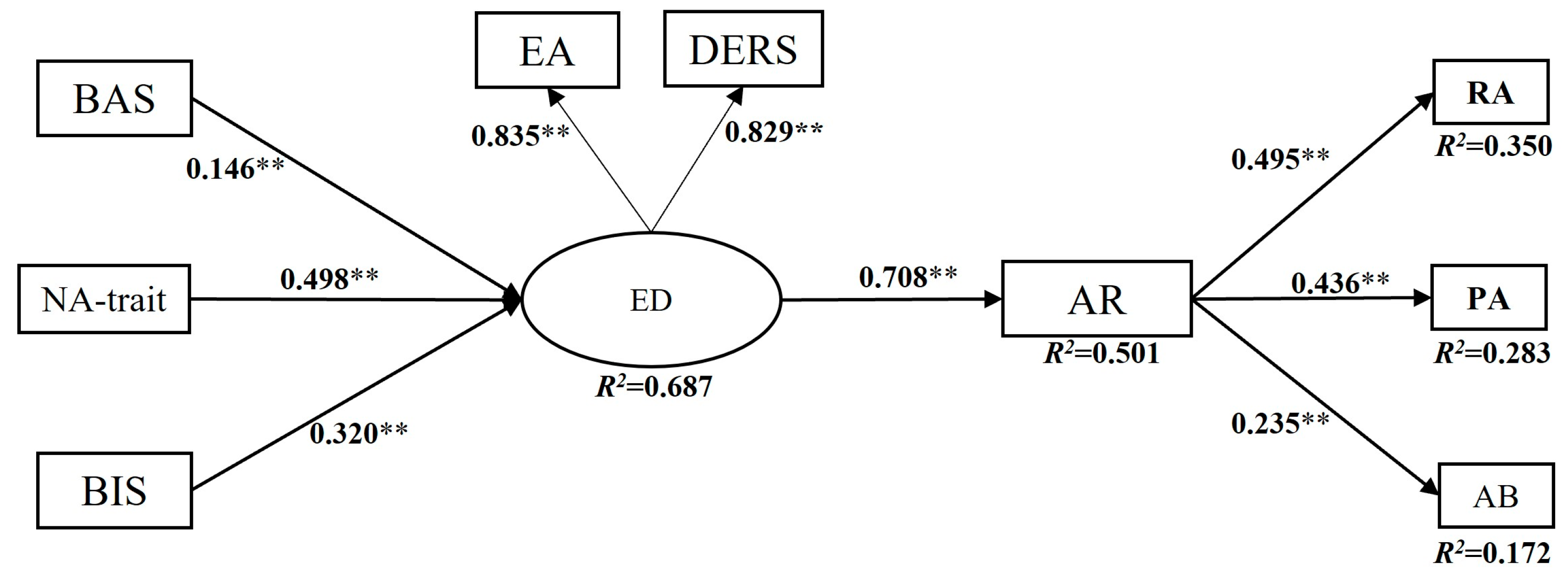
Figure 2.
Partial (solid line) and total mediations (dotted line) between structural variables (BIS/BAS at the top, and NA-Trait at the bottom), cognitive variables (AR), and indicators of antisocial disorders (reactive aggression [RA], proactive aggression [PA], and antisocial-delinquent behaviors [AB]). **p<0.01; ***p<0.01.
Figure 2.
Partial (solid line) and total mediations (dotted line) between structural variables (BIS/BAS at the top, and NA-Trait at the bottom), cognitive variables (AR), and indicators of antisocial disorders (reactive aggression [RA], proactive aggression [PA], and antisocial-delinquent behaviors [AB]). **p<0.01; ***p<0.01.
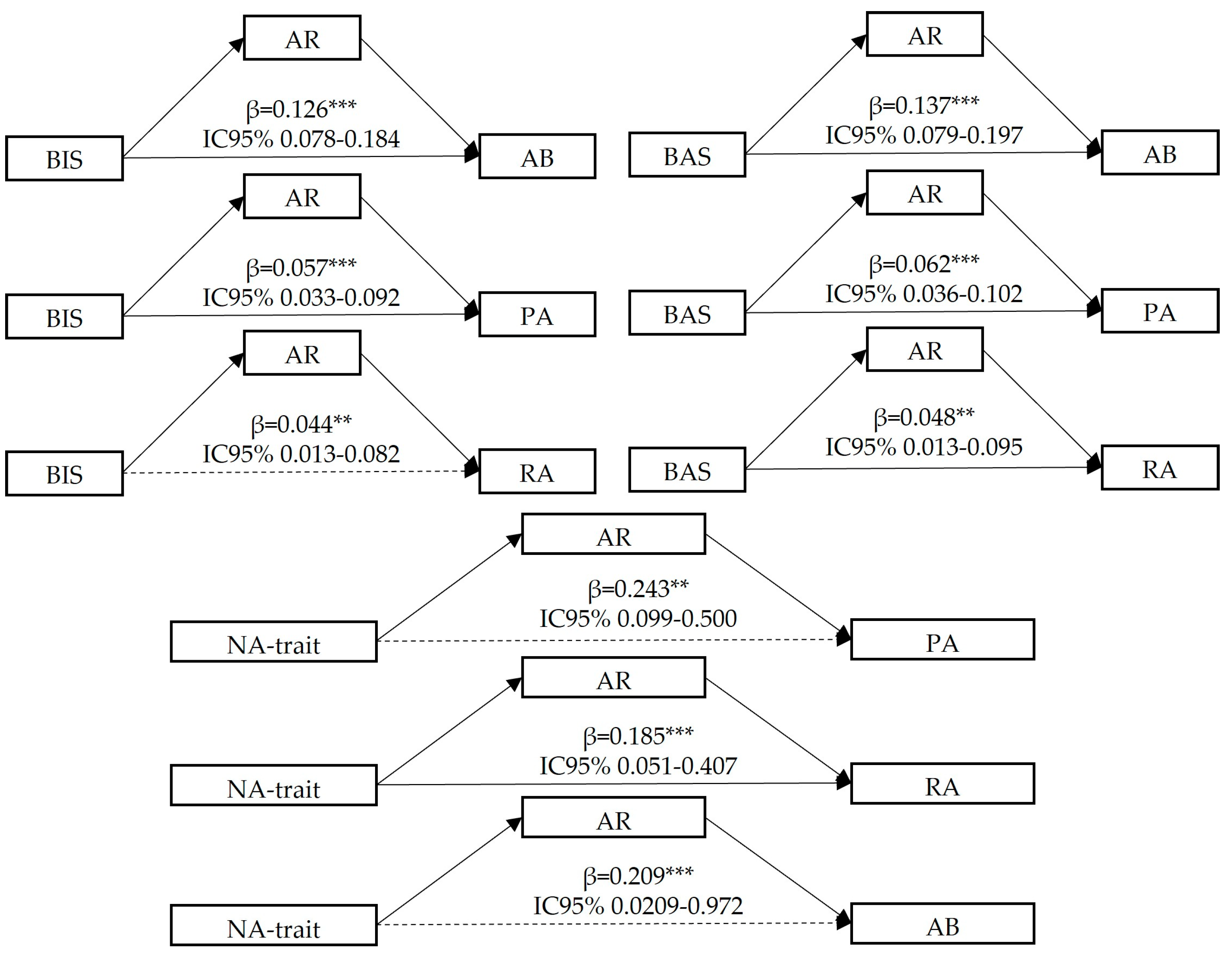

Table 1.
Demographic characteristics of participants (n = 351).
| Variable (total sample) |
Institutionalized (sample 1) | Students (sample 2) |
|---|---|---|
|
Age n = 351 M = 17.811 years, SD = 3.11, minimum 14 and maximum 25 years. |
n = 167 M = 19.16, SD = 3.09, minimum 14 y maximum 25 years |
n = 184 M = 16.58, SD = 2.59 minimum 14 y maximum 25 years |
|
Scholarship Without studies n = 3, 0.85% Elementary n = 32, 9.11% Middle n = 90, 25.64% High School n = 187, 53.27% College n = 39, 11.11% Total n = 351, 100% |
n = 3, 1.79% n = 32, 19.16% n = 87, 52.09% n = 44, 26.34% n = 1, 0.59% n = 167, 47.58% |
n = 0, 0% n = 0, 0% n = 3, 1.63% n = 143, 77.71% n = 38, 20.65% n = 184, 52.42% |
Note: M (Mean), SD (Standard Deviation). Source: Authors.
Table 2.
Descriptive statistics and differences in scores of internal and non-internal participants (n = 351).
Table 2.
Descriptive statistics and differences in scores of internal and non-internal participants (n = 351).
| Vble | M | SD | sk | k | Min | Max | ω (α) | T-tests* | p | d |
|---|---|---|---|---|---|---|---|---|---|---|
| BIS | 23.69 | 6.96 | 0.12 | -0.43 | 8 | 40 | .808 (.805) | -1.42 | 0.157 | -0.15 |
| BAS | 25.18 | 6.77 | -0.13 | -0.56 | 9 | 40 | .822 (.820) | -1.92 | 0.055 | -0.20 |
| NA-trait | 19.58 | 6.66 | 0.81 | 0.57 | 10 | 43 | .793 (.791) | -1.45 | 0.147 | -0.15 |
| DERS | 53.08 | 15.30 | 0.94 | 0.70 | 25 | 103 | .890 (.881) | -2.78 | 0.006 | -0.29 |
| AR | 36.50 | 11.34 | 0.92 | 0.68 | 19 | 74 | .907 (.906) | -3.17 | 0.002 | -0.33 |
| EA | 18.29 | 10.11 | 0.87 | -0.10 | 7 | 49 | .903 (.903) | -3.60 | < .001 | -0.38 |
| RA | 8.92 | 4.10 | 0.44 | 0.23 | 0 | 22 | .798 (.796) | -4.49 | < .001 | -0.48 |
| PA | 5.69 | 4.95 | 0.94 | 0.34 | 0 | 24 | .882 (.879) | -9.31 | < .001 | -0.99 |
| AB | 30.38 | 32.67 | 1.50 | 1.60 | 0 | 156 | .965 (.964) | -10.79 | < .001 | -1.15 |
Note: Vble (Variable), Sk(Skewness), k(Kurtosis), ω (α) (Internal consistency), d(Effect size by Cohen), *(Degrees of freedom df = 349).
Table 3.
Fit indices for path analysis of the three proposed models.
| Model | χ² | df | CFI | TLI | RMSEA | IC95% RMSEA |
p close RMSEA |
SRMR | ΔS-Bχ² |
|---|---|---|---|---|---|---|---|---|---|
| Ag and AB | 23749* | 9 | 0.987 | 0.951 | 0.068 | 0.037-0.101 | 0.150 | 0.028 | - |
| Only AB | 22081* | 7 | 0.978 | 0.943 | 0.078 | 0.046-0.113 | 0.074 | 0.027 | 0.4539 |
| Only Ag | 23743* | 8 | 0.984 | 0.951 | 0.075 | 0.043-0.109 | 0.094 | 0.029 | 0.0685 |
Note: Ag (Aggression), AB (Antisocial Behavior). Source: Authors. *p<0.01.
Disclaimer/Publisher’s Note: The statements, opinions and data contained in all publications are solely those of the individual author(s) and contributor(s) and not of MDPI and/or the editor(s). MDPI and/or the editor(s) disclaim responsibility for any injury to people or property resulting from any ideas, methods, instructions or products referred to in the content. |
© 2024 by the authors. Licensee MDPI, Basel, Switzerland. This article is an open access article distributed under the terms and conditions of the Creative Commons Attribution (CC BY) license (http://creativecommons.org/licenses/by/4.0/).
Copyright: This open access article is published under a Creative Commons CC BY 4.0 license, which permit the free download, distribution, and reuse, provided that the author and preprint are cited in any reuse.


