

Submitted:
26 November 2024
Posted:
26 November 2024
You are already at the latest version
Abstract
Soil degradation and climate change are the most degrading (human and/or naturally induced) processes, making agricultural production more challenging than ever before. Traditional tillage methods, characterized by intensive mechanical soil disturbance (dominantly using a plow), have come under question for their role in exacerbating soil erosion, depleting organic matter, and contributing to the decline in soil biodiversity and other degrading processes. These practices, while effective in the short term for crop production, undermine the sustainability of agricultural systems, posing a threat to food security and environmental stability. Conservation soil tillage (CST) emerges as a promising alternative platform. By reducing the intensity and frequency of tillage, CST practices aim to maintain adequate soil cover, minimize erosion, and encourage biological activity and organic matter accumulation, thus ensuring soil productivity and resilience against additional degradation and climate variation. Efforts made by scientists and the government to go over it sometimes are not sufficient. Farmers' expectations of benefits are the final keystone for the integration of CST as a dominant sustainable practice. Analyses from six European countries pointed to a high level of diversity in readiness and willingness to accept and different levels of knowledge about the adoption of CST.
Keywords:
soil degradation
; climate change
; sustainable agriculture
; conservation agriculture
; soil tillage
; crop production
; farmers experience
1. Introduction
Conservation Soil Tillage (CST) can be defined in several ways, but the most common definition worldwide and in the EU is described as a tillage system where, after all tillage operations and seeding/sowing of the next crop, soil surface cover needs to be at least 30% with crop remains [1]. Its priority goals are to protect the soil from erosion, maintain favorable soil moisture, and preserve the soil’s physical, chemical, and biological amendments [2]. CST is gradually being adopted in the agricultural sector throughout the European continent, as well as the European Union. Given that CST is a sustainable practice that not only prevents but also revitalizes agricultural soils, the EU has established guidelines for the transformation of European agriculture through the European Green Deal [3]. As part of the implementation, the plan consists of two primary objectives: reduction/elimination of plowing as the most common tillage operation and promotion of soil conservation systems including CST.
Agricultural/crop production is defined by many factors, some of which we can influence (mainly anthropogenic), and some of which are almost completely out of our control (primarily natural). As soil is a natural, non-renewable resource primarily used for food production, by degrading it we put under question the existence of humanity. As one of the soil’s most degradable drivers is plowing, many scientists consider it (based on publications) the most degrading and devastating tillage operation in agricultural production since the beginning of the human consciousness of food production [4]. Compared to Conventional Tillage Systems (ST), based on plowing, CST offers numerous advantages, which can be simplified and divided into:
Short-term benefits:
- Increased water infiltration and improved soil structure due to crop residues on the surface,
- Reduced surface water runoff and soil erosion (water and soil retention by crop residues),
- Reduced evaporation and increased soil surface protection from solar radiation due to crop residues on the surface,
- Reduced crop stress intensity due to lack or excess of soil moisture (increased infiltration and reduced evaporation), due to day-night temperature oscillations, as well as due to high air temperatures,
- Reduced need for mechanization and human labor in soil tillage,
- Lower input costs (price) of fuel and human labor.
Long-term benefits:
- Increased soil organic matter (SOM) content results in better soil structure, higher cation exchange capacity (CEC), better nutrient accessibility, and greater soil water capacity,
- Increased and stabilized crop yield levels,
- Reduction in production costs (lower capital investments),
- Increased biological activity in the soil and environment (better biological pest control).
- Reduced weed infestation.
In addition to the mentioned benefits, several other positive effects can be achieved by applying CST, which can be classified not only in the agronomic aspect but also in other aspects of crop production (e.g., sociological and organizational).
Although various institutions participate in the creation of relevant policies related to the application of CST, farmers still have the final word. Various factors influence the effectiveness of CST implementation and adoption, and according to Ogieriakha and Woodward [5], these factors influence farmers’ decision to accept or reject CST.
This paper provides an overview of the science and farmers’ expectations of CST in six European countries, including Croatia, Serbia, Hungary, Slovakia, Czech Republic and Poland. The paper begins with a brief overview of the main concept and criteria of CST, followed by an analysis of the historical overview and perspectives of EU countries from the south to the north of Europe. This is followed by a discussion of the farmer’s perspectives, expectations, benefits and risks of CST practices, and concludes with final remarks.
2. Perspectives of Conservation Soil Tillage from Southern to Northern Europe
Observing agroecological conditions in selected European countries, in orientation from south to north of Europe (Figure 1), are still relatively favorable for crop production but with some stated disadvantages. However, the observed area is recognized with some difficulties, inequalities, heterogeneities, challenges, and differences in two main ways: soil-base and climate change-base [6]. The generally defined advantages of CST (without going into its definition in detail) as a measure for stopping further soil degradation [48] and a measure that can help in the adaptation (and mitigation) of CC [7,49], make it a desirable and promising platform [8].
Besides the soil base as a fundamental factor, and recently maybe be the most important limiting factor in crop production is weather/climate/climate change [9]. Both soil and climate determine the intensity, modality, applicability and ultimately successful adoption and application of CST [10].
CST practices, as an irreplaceable measure in Conservation Agriculture (CA) systems, are designed to minimize negative impacts on soil and the environment while still providing the benefits of tillage [11]. In achieving the goals of tillage, the main requirement for soil tillage could be set as: The depth of tillage and the number of passes by machines and tools over the soil surface should be adapted to the agroecological conditions, and the production level should be economically harmonized. The decision of whether or not to adopt CST practices is a complex one that must be made on a case-by-case basis.
Each country has its own way and historical path of CST development. Below are descriptions of the development of CST, described as case studies for each of the six selected European countries.
2.1. Croatia Case Study
According to relief regionalization (based on morpho-structural, orographic, morphogenetic and lithologic conditions) Croatia belongs to a highly diversified terrain [12]. Accordingly, based on relief regionalization and agroecological conditions, the agricultural production area is also divided into three main and nine subregions [13]. The most productive region in arable crop production is Pannonian region which is separated into four subregions, to which belong 70% of all arable land or 46.2% of the entire country [13].
Due to wide regional and agroecological, but also socio-economic diversification, Croatian agriculture in general, but especially in acceptance of new/advanced techniques and technology, has developed with different intensity but also success [14]. The most advanced region in the adoption of new technologies is precisely the Pannonian region This statement is justified by the fact that the first researches on reduced tillage began to be carried out in the sixties and early seventies of the last century [15,16,17,18,19,20,21,22]. Mihalić was among the first Croatian authors who wrote about the reduction of classic tillage systems, and he stated the main postulate: first „maximization” and then „minimization”. He also states that this rule is not universal, but depends on the type of soil, climatic conditions of the growing area, and the properties of the cultivated cultivar [23,24]. Mihalić also one of the founders of the International Soil Tillage Organization (ISTRO), [25], founded on 27 September 1973 at Wageningen (The Netherlands) during the closing session of the 6th International Conference on Soil Tillage. This act put Croatian soil science on the map of the most advanced European countries in the acceptance of modern approaches in soil tillage. Soon after these researches, more extensive research on reduced tillage continued and concentrated on the different aspects of agricultural production (such as fertilization, crop protection, pedosystematic bases, etc.) and not only on yields like it was in the beginning [26,27,28,29,30,31]. In 1982, Croatia was a host of the 9th Conference of the International Soil Tillage Organization. This host was a confirmation of the strong commitment and reputation of Croatian soil tillage scientists on the global map [32]. From the end of the 1980s to the end of the 1990s, the first intellectual discussions and scientific research on Conservation Soil Tillage (CST) came as the very beginning of new paradigms as a logical continuation of reduced tillage. From this period need to be mentioned some authors, such as Butorac et al. [33], Košutić et al. [34,35], Žugec et al. [36], Stipešević [37], Butorac [38,39].
After the 2000s, climate change and its negative impact on agriculture and increasing awareness of multiple soil degradation processes [40] in crop production [41], are increasingly being discussed with strong demands for action. Changes that follow become imperative which motivates action not only from scientists, government and other relevant institutions but also from enthusiastic farmers. CST becomes a tool for the achievement of sustainable crop production and also a tool for stopping and preventing additional soil degradation processes. In that period, an extremely important official document was adopted by the Ministry of Agriculture (Regulation on Agrotechnical Measures) [42], which for the first time in Croatia defined the term „Conservation Soil Tillage” at formal level. In the last 10-15 years teaching courses in two of Croatian biggest Faculty of Agriculture (and some other Faculties and Universities), students learn about CST regularly at all academic levels including doctoral studies [2,43,44,45]. No less attention has been paid to the education of farmers, through different scales of knowledge transfer, e.g., lectures, pamphlets, brochures, field days, textbooks, etc. [44,45,46].
From 2020, the period after the European Commission adopted the European Green Deal [3] significant efforts have been made in promoting and further embracing CST. Eco-schemes are one of those measures, but extremely important in more successful adoption of CST in Croatia. Through Common Agricultural Policy (CAP) 2023-27, Eco-schemes support farmers in adopting practices that minimize the negative impact of agriculture on the environment and climate [47]. The most attractive and „cost-effective” Eco scheme in Croatia is „Conservation Agriculture (CA)”, which basically represents CST.
According to ARKOD (Land Parcel Identification System – LPIS) – (A national program establishing a database that records the actual use of agricultural land), in the year of establishment Eco-scheme measure „Conservation Agriculture”, in 2023, from the total of agricultural land, 11% was under CT, while that share in 2024 was 16% (Table 1).
The spatial distribution of agricultural land under the Eco-scheme „Conserved Agriculture” is dominant in Croatia’s continental part, and denser areas are further north and east in that part (Figure 2).
Comparing farmers’ awareness of the importance of the application of adequate tillage technology in sustainable soil management and environment per se 60 years ago with today’s perspective, relations are incomparable. Still, the main driving (but not exclusive) motivation for applying CST and leaving out conventional tillage (with plowing) is financial gain.
From the practical aspects, it’s important to note that the principle of CST, in terms of the amount of crop residue, can be implemented by „accumulating” crop residues over one to two or more years. In Croatian regulations (Eco-schemes), CA can be implemented on a „year-by-year” principle, which means that there is no conditionality or obligation for permanent implementation of CST. This fact has its advantages (easy to opt-out) but also disadvantages (short period to fully evaluate all the benefits this system offers).
However, although the „door is wide open” to support the adoption of CST, there is a large difference in knowledge and different levels of support in practical application between the farmers/crop producers. In Croatian agricultural society, from government/decision makers, scientists, extension services, farmers, and other relevant institutions and individuals, the future is challenging. Climate change and soil degradation are the most important negative and most challenging factors on which it depends our future. Farmers are more and more aware of the importance of rebuilding mutual trust and dependence between science and agricultural production.
2.2. Serbia Case Study
In response to many adaptation efforts and positive examples from other countries, farmers in Serbia are showing great enthusiasm for adopting CST methods. It is estimated that currently 75% of arable land in Serbia is cultivated by plowing, 24% by CST and 1% by no-tillage [50]. Therefore. the area under CST is increasing compared to the data before 2000, when alternative tillage systems were estimated at 3-5%. The introduction of CST in Serbia began after 1978 with the methodological establishment of field trials, mainly on winter wheat, with parallel education of the agronomists mostly in the Northern part of Serbia. In the period from 1982-1987, a total of 123 experiments were carried out with CST methodology on agricultural holdings, with different preceding crops and soil types. Subsequently, a similar concept was accepted and further developed by a group of researchers in the Banat region of Vojvodina Province [51]. In this context, CA has gradually been promoted as a system capable of achieving the sustainable intensification of crop production needed to meet national food needs, while conserving and protecting soil, water and biological resources [52]. Taking into account the considerable duration since the introduction of CST in Serbia, this period can be divided into several phases:
- Before 2000, the limited expansion of CST - mainly driven by the intention for yield increase, tillage effectiveness (energy consumption, testing the equipment and labor cost lowering) and efficiency compared with classical plowing. During this period, conservation tillage methods served as an educational example and scientific platform for research of alternatives to plowing [55,56,57].
- After 2000 the first evidence of climate change became apparent. Thus, in the 21st century, the main requirement for the change from ST to CST comes to the fore with decreasing soil quality, extreme climatic events and adaptation of a new crop variety suitable for novel machinery. It has also been observed that intensive tillage is the main driver of accelerated mineralization and loss of organic matter, and thus loss of carbon and nitrogen [58].
- In the period after 2020, significant advances related to information and communication technology became broadly available for agriculture, and the demand for adaptation of CST practices comes from the circumstance of increased use of precision farming and GPS tracking, which are fully compatible with the new approach to tillage. The availability and diversity of CST machinery as well as the digitalization of agriculture has become fully accessible to farmers and supported by national and European strategies [59,60].
Although CST technology has become the key driver for the efficiency of production for larger producers in Serbia, there has been a regional disbalance of knowledge and methodology acceptance. This disproportion can be explained by the slow introduction of CST and in some cases resulted in failure of acceptance because transition requires the deep revision of existing crop production systems to gain the benefits of new tillage methods. In addition to that, agricultural inputs (hybrids/varieties, fertilization, crop rotation, etc.) lagged in adaptation, as well as the value chain in which CST was integrated. This implies that only were proposed technologies were sufficiently „mature” the CST system work successfully with measurable results. Given the initial impediments, the performance of CST was lower compared with ST Kovačević et. al. [61]. However recent results by Meši et al. [62], Malinović and Meši [63]; Videnović et al. [64]; Mileusnić et al. [65,66]; Momirović et al. [67]; Dolijanović et al. [52] showed many advantages of CST but some barriers still remain. For many farmers, the challenges to adopting new technologies can be attributed to deficient knowledge, insufficient time for implementation, and capital to invest [51]. One of the major difficulties in CST implementation was crop residue management [68]. The positive effects of leaving crop residues on soil properties are relevant in areas where the soil is exposed to water and aeolian erosion and in semi-arid climatic conditions due to a significant reduction in evaporation [57]. Soil properties are becoming also an important driver in the implementation of CST after confirmation of the link between plowing and loss of soil organic carbon loss [58,69]. Soil degradation with ST can be also attributed to changes in soil’s physical properties. Gajić [70] found that significant removal of natural vegetation and tillage by turning the soil longer than 100 years has resulted in an extensive deterioration of soil quality indicators and soil organic carbon in the topsoil. Weeds were also one of the problems that appeared with the introduction of different CST methods, but the solution for their effective suppression has not been successfully developed because of their adaptation and the pressure of CC [71,72]. However, despite some limitations, advantages recommend CST as a comprehensive systemic approach that offers the possibility of adaptation to other measures (cover crops, intercropping, crop rotation, digitalization, etc.) that increase the sustainability and long-term stability of the agroecosystem.
Although there are some doubts in the implementation of CST many barriers can be easily overcome if we agree on common goals and outcomes. To continue the implementation of CST in Serbia it is necessary to establish the following procedures:
- Reestablish connection between academia, extension service, machine dealers and farmers by organizing the field days, focus groups, or interactive workshops on the selected topic,
- Establish long-term trials with CST systems vs ST systems,
- Introduce special incentives for those applying the selected types of CST adaptable to the regional level,
- Create a national strategy for adaptation of tillage technologies for mitigation of CC including C-farming agenda,
- Provide a dedicated ICT (Information and communication technology) solution to support conservation practices, with specific guidance to demonstrate their benefits
2.3. Hungary Case Study
In Hungary, the interest in CST goes back about 120 years, but significant changes have only occurred in recent decades [73]. Birkás [74] divides the history of tillage in Hungary into seven eras. Most of the cultivation procedures carried out in these eras had a negative, while others had a positive effect on the quality of our soils [75,76].
Soil degradation in the multiple-plowing system was first observed by agricultural specialists. Cserháti [77] stated that the main cause of the problem was the high number of cultivation operations and the improper timing of soil cultivation. At the beginning of the 1900s, interest in Campbell’s ‘dry farming’ soil cultivation system [78] grew, as soil cultivation caused difficulties in dry periods, so many researchers dealt with dry farming [79,80]. Campbell’s disc enabled the abandonment of plowing in stubble cultivation and the foundation cultivation of crops sown in autumn [81,82]. Gyárfás [80] suggested reducing the number of plowing and avoiding the repetition of autumn plowing in the spring, while other authors recommended abandoning the plow, disc cultivation, and the use of cultivators [81,83,84].
In the following decades, technological development, mechanization, and large-scale use of fertilizers were typical in crop production. The era was characterized by farming and soil cultivation that focused on crops and prioritized yield quantity. From the 1970s, the importance of energy-saving tillage increased, together with the knowledge and acceptance of soil-protective tillage. In Hungary, experiments with energy-saving, reduced number of tillage operations (reduced tillage), direct seeding, and strip cultivation systems were conducted in several research sites where their applicability and effectiveness were studied [85,86,87,88,89].
In recent decades, soil cultivation research has mostly focused on adapting to our changing, increasingly hot and drier climate. Many researchers have proven that by abandoning plowing and application of mulching, soil resistance is significantly reduced, soil compaction and moisture loss can be reduced, thereby improving the soil’s water balance, slowing down the loss of organic carbon, increasing its fertility, and thus making the soil less vulnerable to climate-related damages [74,90,91,92,93,94,95,96]. Domonkos et al. [97] figured out higher microbial enzyme activity and higher humus content in the case of the application of soil-protective cultivation than in the case of plowing.
Researchers from Karcag have shown on the compact soil typical of the Great Hungarian Plain that, in the case of CST, the traction power requirement of the tillage equipment is only 35% of that of plowing in the case of loosening the soil at the same depth as the plowing depth [98,99], while 42% fuel savings can be achieved per hectare. The reduced tillage system can be considered moisture-preserving, compared to the conventional one, soil compaction is reduced due to the lower number of passes, the plow pan can be eliminated by loosening the soil deeper than the plowing depth, and the level of compaction is lower due to the moisture-preserving mulch cultivation [100]. Mulch cultivation creates a layer rich in organic matter close to the porous surface, which has an excellent ability to absorb water, and at the same time, it reduces evaporation resulting in a favorable water balance. Without plowing, even in droughty years and much wetter than the long-term average, resulting in better moisture conditions in the regularly cultivated layer, while the average yield of the cultivated crops did not lag significantly behind the yields achieved in conventional cultivation [101].
There are no reliable, accurate, long-term data on the spread of soil-saving cultivation in Hungary. In the 1990s, CST was carried out on 10-25% of the arable land in Hungary [102,103]. According to the currently available data, this area has decreased significantly [104].
During a survey conducted by the Institute of Agricultural Economy [105], 112 out of 656 farmers answered that they practice CST. Almost a third of the farmers reported an increase in yields attributable to soil-protective cultivation. About half of the respondents reported the profitability of the technology, and 22.3% did not notice an improvement in profitability as a result of cultivation. The cost per hectare slightly decreased on 44.6% of the farms and significantly decreased for 18.8% of them. Nowadays, according to our experience, the number of farmers using CST in Hungary is increasing slightly, but the number of farmers who know about these cultivation techniques is increasing to a greater extent.
2.4. Slovakia Case Study
Environmental and Economic Challenges: Slovakia faces issues such as soil erosion [106,107], decline in soil organic matter, and degradation of soil structure [108], making CST a critical topic. An economic incentive to reduce input costs is a significant driving factor for adopting CST.
A comprehensive understanding of the impacts of ST and CST practices on agricultural systems’ fundamental soil physical, chemical and biological properties is critical for addressing long-term sustainability. Researchers and practitioners can better tailor land management strategies to promote soil resilience and fertility while mitigating erosion and degradation by evaluating how these practices alter soil structure, compaction, infiltration rates, and chemical composition. This knowledge is essential for implementing sustainable agricultural practices that balance productivity with environmental conservation, as highlighted in numerous studies [109,110,111,112,113].
The suitability of soils for CST varies in Slovakia [114]. Spatial analysis of soil suitability was essential for the environmentally and economically effective implementation of CST technologies in Slovakia. Table 2 provides an overview of the distribution of arable land suitable for CST or reduced technologies across different regions of Slovakia at the NUTS 2 and NUTS 3 levels in 2010 [115]. The evaluation applied 7 Primary limits such as an altitude up to 350 m, annual precipitation up to 600 mm, annual air temperature over 8 °C, soil granularity – medium heavy soils – loamy and sandy-loamy soils (25%-45% of clayey particles), topsoil depth of more than 0.3 meters, soil skeletally - seldom appearance of 10 mm particles and soil steepness up to 12°. Additional limit parameters for soil compactness (both uncompacted topsoil and subsoil layers), pH higher than 5.6, and humus content of about 2.5 in topsoil were applied.
Of the total 1,417,983 hectares of arable land in Slovakia in 2010, 693,520 hectares were classified as suitable for CST or minimal tillage technology. This represented 48.9% of the arable land and 28.7% of the total agricultural land which includes permanent grasslands - 878,470 hectares, as well as orchards, vineyards (permanent crops), and kitchen gardens -121,479 hectares.
The data highlights significant regional differences in the availability of arable land for minimal tillage technologies. Western Slovakia, particularly the Nitra Region, has the largest share of arable land with over 300,000 ha. In contrast, Central Slovakia, specifically the Žilina Region, shows no availability of suitable land for minimal tillage in the dataset. Such discrepancies could be due to natural factors like soil types, topography, and climatic conditions.
Western Slovakia, accounts for the majority of arable land suitable for CST, with a total of 519,966 ha. This represents a major agricultural center in the country, which may reflect the region’s more favorable soil conditions, infrastructure, and historical importance in agricultural production.
In Central and Eastern Slovakia, the suitability for CST technologies is notably lower compared to Western Slovakia. This can be attributed to several key factors that influence land use and the adoption of agricultural practices in these areas.
Central Slovakia is characterized by more mountainous and hilly terrain and has limited arable land. The region’s soil types are often less conducive to minimal tillage due to higher soil erosion risk, shallow soil depth, and less fertile soils. In Eastern Slovakia, the soils are more variable, with certain areas having heavier clay soils that can be difficult to manage with minimal tillage due to compaction risks and drainage issues.
Further Spatial identification and soil quantification of soil corresponding to the given parameters were processed based on informative layer extension of the soil-ecologic unit of Slovakia in the geographic informative system of Soil Science and Conservation Research Institute (SSCRI) in Bratislava [117].
Previous works were focused on the potential application of minimized technologies according to agricultural production areas and regions [116,117]. To implement CST practices, precise identification of locations where reduced tillage was applied was the next research step. Vilček et al. [118] categorized soils suitable for reduced or CST using data deposited in databases in the Soil Science and Conservation Research Institute in Bratislava, Slovakia (SSCRI) regarding the properties of agricultural soils available as separate vector layers in digital form. For reduced soil tillage, the following soil properties were analyzed: soil texture, soil depth, slope, gravel content, and altitude.
The findings indicate that 25.3% of soils in Slovakia are suitable for reduced tillage technologies, with 20.4% classified as highly suitable and 4.9% as moderately suitable, while 74.7% of soils are unsuitable. This second assessment, compared to 2010, has a lower percentage share of soils. Among the highly suitable soils, Chernozems [119] dominate, covering 47.6% of this category. In the group of less suitable soils, Cutanic Luvisols are the most common, accounting for 41.7% of the area.
Widespread application of CST technologies presents opportunities for targeted research and development. Improving soil management practices, adapting tillage techniques to local conditions, and economic support for adopting CA could help expand sustainable practices in these regions.
In scientific literature and agricultural practice of Slovakia origin, the broader terms „minimum tillage”, and more recently „reduced tillage”, have been commonly used. This terminology does not necessarily consider the aspect of a minimum of 30% biomass cover or crop residues from preceding crops. As also stated in the global literature, CST is often confused with no-till or variants of CST described in vague terms, such as minimum tillage, mulch tillage, ridge tillage, strip tillage, and reduced tillage, where planting is achieved on specially prepared surfaces with various amounts of crop residue cover [120].
To unify terminology in Slovakia, a proposal for precise terminology related to soil conservation technologies was proposed by a team of authors from the Slovak University of Agriculture in Nitra and the Research Institute of Plant Production (RIPP) in Piešťany [121]. This proposal considers relevant sources and standards including CTIC, KTBL, ASAE, ECAF, and others, [122,123,124,125]. The following tillage practices were classified as soil conservation technologies: strip-till, ridge-till, and reduced tillage, which involve maintaining 15-30% cover crop residues on the soil surface and tilling the soil to a depth greater than 15 cm. Additionally, CST is defined as tillage to a depth of up to 15 cm with a minimum of 30% cover of crop residues on the soil surface. Organic matter incorporated into the soil, up to a maximum depth of 5 cm, is also considered part of the crop residues.
The adoption of conservation technologies in Slovakia has evolved over the years, with data from Eurostat (2010 and 2016) and recent estimates from the NPCC (2023) providing insights into this trend (Figure 3).
Cumulative bar chart showing the adoption of conservation tillage and zero tillage across Slovakia for the years 2010, 2016, and 2023. The most recent estimate from NPCC (2023) suggests a continued upward trend, reflecting the importance of environmental sustainability in Slovak agriculture. Despite these advancements, challenges remain regarding widespread adoption, with factors such as farm size, economic viability, and regional variations playing a significant role in determining the rate of technology adoption. CST adoption in different regions of Slovakia (Bratislava, Western Slovakia, Central Slovakia, and Eastern Slovakia) for the years 2010, 2016, and 2023 highlights the growth, especially in Western Slovakia, while Bratislava Region shows a slight decrease over time.
Scientific Research Base, Dissemination, and Knowledge Transfer to Farming Practice: Scientific research activities focused on CST and its environmental implications are carried out by 2 key research institutions in the frame of the National Agricultural and Food Center (NPPC), a contributory organization of the Ministry of Agriculture and Rural Development of the Slovak Republic.
- 1a. The Research Institute of Plant Production (RIPP), an important entity within the National Agricultural and Food Center (NPPC), serves as a leading center for agricultural research. It focuses on investigating soil tillage practices and the agroecological dynamics of cropping systems. A major component of its work includes conducting long-term field trials, with particular emphasis on CST methods and their impact on promoting sustainable agricultural practices (RIPP– National Agricultural and Food Center [128].
- 1b. The Research Institute of Soil Science and Conservation (SSCRI) as a body of NPCC plays a pivotal role in pedological, agricultural, and environmental research (Research Institute of Soil Science and Soil Protection - National Agricultural and Food Center [129]. The institute is responsible for conducting soil surveys and pedological research, and it manages the Register of Slovak Soils, which is part of a comprehensive Soil Information System. SSCRI also administers the publicly accessible soil and landscape information system, available through the Soil Information Portal [130]. This platform provides farmers with spatial mapping data, enabling them to identify soil blocks suitable for minimal tillage, thus supporting the application of conservation tillage. The relevance of this information was previously highlighted by Vilček et al. [118].
Slovak University of Agriculture in Nitra (IZPI) has attained the position of one of Slovakia’s leading universities. The university provides education in the field of agriculture and related research areas such as Agrobiology, Sustainable agriculture, and Engineering of Agricultural Machinery and Equipment. Research on CST systems is concentrated within some Institutes of the Faculty of Agrobiology and Food Resources, as well as the Faculty of Engineering. This research is aimed at developing innovative approaches to soil conservation, enhancing soil health, and improving the sustainability of agricultural practices. The findings from these studies are regularly disseminated through peer-reviewed scientific publications, contributing to the global body of knowledge on sustainable soil management and CA (Slovak University of Agriculture in Nitra) [131].
Dissemination and Transfer of New Scientific Information into Farming Practice: The Agricultural Knowledge and Innovation Institute in Nitra, a departmental educational institution under the Ministry of Agriculture and Rural Development of the Slovak Republic, plays a key role in disseminating scientific knowledge and innovations to the agricultural sector. It provides ongoing vocational education and training aimed at enhancing the skills and competencies of farmers, facilitating the practical application of cutting-edge agricultural research and technologies [132]. In the CAP Strategic Plan 2023-2027 for Slovakia, there is no direct intervention under either Pillar I or Pillar II to support CST practices [133]. However, under the conditionality framework—specifically for maintaining soil in good agricultural and environmental condition—GAEC 5 (Management of soil tillage to reduce the risk of soil degradation and erosion) mandates that farmers apply anti-erosion agrotechnical measures on land at risk of water erosion, including considering slope gradients. The suitability of applying soil conservation technologies, such as CST and no-till, is identified within a corresponding digital GIS layer, accessible to farmers through the Soil Information Portal [130], (see Figure 4).
State-supported research in Slovakia focuses on CST, addressing all aspects of agricultural sustainability and the protection of natural resources. The primary driving force behind CST research is the expansion of environmentally acceptable technologies, alongside efforts to mitigate and adapt to climate change. The main reason for the commercial adoption of soil conservation technologies is the economic advantage of CST over conventional methods, with environmental benefits often viewed as secondary. Additionally, soil erosion prevention, as mandated by conditionality requirements, is another key factor promoting the use of these technologies.
2.5. Czech Republic Case Study
The Czech Republic (CR) is a country located in the central part of Europe with an area of 78,887 km2. Its relief is moderately hilly, with most of the area (78.6%) lying at an elevation between 200 and 600 m a.s.l. Compared with other EU countries, the CR has a high percentage of arable land. Agricultural lands cover 42,002 km2, which is approximately 53% of the total land area (arable land 42.2%), and forests cover 26,773 km2, which is 34% of the total land area. The most abundant soil types in the Czech farmlands are Cambisols, followed by Luvisols, Chernosols, Stagnosols, and Fluvisols [134]. The most widespread crops in the CR are wheat, oilseed rape, and barley followed by maize. The diversity of crops has decreased in the last 25 years [135]. In the long term, maize has been the most problematic crop from the soil erosion perspective, with approximately one-half of significant erosion events occurring on maize fields.
According to data from Eurostat [136] is typical that a relatively small number of farms account for a substantial majority of the agricultural area. The average agricultural holding size of a farm in the CR is 152 ha, which is by far the largest among the EU countries. However, soil degradation results in lower soil fertility, soil and water contamination, loss of biodiversity, and changes in land use [134]. Most of the soil-related degradation processes are in line with similar trends in Central Europe. However, there are a few specific issues in the CR which are related mainly to the abrupt changes in agricultural management in the second half of the twentieth century [137]. Former privately owned small arable parcels were merged into large soil blocks (through the process of collectivization), small landscape features were removed and fertilization and crop production were intensified [138]. A total of 43% of the arable land is on slopes ranging from 3 to 7°, and 10% of the land is on slopes exceeding 7°. Roughly 60% of agricultural land is potentially threatened by some form of water erosion. Currently, the maximum soil loss in the CR is estimated at approximately 21 million tons of topsoil per year, which can be expressed as an economic loss of at least CZK 4.3 billion [139]. About 45% of agricultural land in the CR is potentially threatened by various degrees of wind erosion. It is expected that climate change will bring a more frequent occurrence of weather extremes such as floods and drought. For this reason, it is necessary to focus on the options for promoting natural infiltration and water retention in soil. In the CR about 40% of agricultural land is at risk through compaction.
The effect of tillage systems on soil particle translocation has also been studied [140]. Up to 16% of arable land is negatively affected by the tillage operations, especially in the most fertile regions of south and northeast Moravia [141].
Dostál et al. [142] identified the following dominant factors that have contributed to a dramatic increase in soil erosion:
- large fields (on an average 20 ha, but there are even parcels of 200 ha),
- reduction of the dense network of linear features and spot elements in the landscape (such as paths, grass belts, groves, ties, etc.) which could potentially prevent or reduce surface runoff,
- – extensive soil amelioration with the introduction of dense networks of tile drains, straightening and deepening of streams,
- drainage of inundation areas, leading to more arable land but too lower water retention capacity of the landscape,
- transformation of grasslands and pastures into arable areas in morphologically unfavorable landscape areas (foothills, slope areas),
- usage of heavy machinery, which has resulted in soil compaction and reduced soil infiltration capacity,
- planting of wide row crops with higher sensitivity to water erosion (e.g., maize, sunflower, potatoes, sugar beet),
- a drastic reduction in organic matter inputs, due to reduced livestock production since the 1990s,
- increased application of mineral fertilizers since the 1970s,
- insufficient use of modern CST technologies, and a lack of political support for soil protective cultivation of the land.
A decline in the soil organic matter (SOM) and the microbial biomass in the topsoil has been considered a major agronomic and environmental problem, mainly due to its negative impact on soil properties [143]. Several studies based on long-term monitoring of SOM on various soil types in the Czech Republic indicate a lower current SOM content with worse qualitative parameters than decades ago [144]. The SOM decline is attributed mainly to tillage, to the intensification of farming, and reduced application of manure due to the reduced numbers of livestock. Bednář and Šarapatka [145] showed high SOM losses on drained fields and parcels affected by water erosion.
Effective measures against soil erosion are well known and they have been increasingly applied in many fields, especially in so-called areas at risk of erosion, according to legislation. The main policy tools implemented by the Ministry of Agriculture are the standards of Good Agricultural and Environmental Conditions (GAEC), which support agricultural management in compliance with environmental protection [146]. Farmers and smallholders are motivated to take care of the soil. The Ministry of Agriculture, together with the Research Institute for Soil and Water Conservation, established, among others, a website [147] with up-to-date information, guidelines, and interactive tools (an erosion calculator, soil maps, contaminated sites, etc.) [148]. Areas at risk of erosion have been identified where CST techniques need to be applied depending on the crops grown (erosion hazard crops). The set of anti-erosion measures includes organizational changes, such as proper crop structure, and complex landscape consolidation. Leveling, field balks, and terracing are some of the technical measures. Agrotechnical measures include contour tillage, soil conservation practices, conservation tillage, mulching, direct seeding, and other practices that are being implemented in larger and larger areas. Conservation and minimum tillage technologies, which are based on the principle of covering the soil with crop residues from previous crops or cover crop mulch, are the main practices in the Czech Republic, while direct seeding is marginal. According to the requirements of the legislation, these technologies mainly use multi-species mixtures of cover crops.
Nowadays growing cover crops mixtures is a more and more common farming practice. Strip-tillage is a technology that has great potential in sustainable farming. Reduction of soil loss by erosion using CST methods (strip-till technique - STT applied into rye stubble and direct sowing - DS) in comparison with conventional tillage (CT, plowing) is documented by Menšík et al. [149] on Haplic Luvisol in South Moravian Region. The mean production of the dry mass of silage maize (2016–2018) was statistically higher in CT (20.4 t ha−1) compared with DS (15.8 t ha−1). No statistical differences were recorded in the ST. The average loss of soil caused by erosion (in three different growth stages) was significantly lower in STT (0.40 t ha−1) and DS (0.13 t ha−1) treatments in individual years in the period 2016–2018 compared with CT treatment (2.96 t ha−1). Also, Procházková et al. [150] found a decrease in the soil loss of about 98% in the strip-till of maize sowing into the tilled strip grass cover (after herbicide desiccation) compared to conventional cultivation. Moreover, the surface run-off was reduced by 79%. Brant et al. [151] observed lower splash erosion in maize when strip tillage in combination with appropriate mulch was used in comparison to conventional full-surface soil preparation before sowing. This experiment showed a 35.9% reduction of splash erosion in the variant with autumn plowing followed by strip ryegrass cover (terminated by herbicide) and a 39.5% reduction in the variant with autumn shallow noninversion tillage leaving cereals straw mulch. Anyway, a variant with autumn plowing and soil covered by weed plants (terminated by herbicide) showed 18.7% higher erosion than the control.
Particularly in research, attention has been paid in recent years to the technology of growing maize with under-sowing crops. In field conditions, the use of establishing stands of different crop species in the space between the rows of maize was verified using a multifunctional machine (inter-row cultivation, under-sowing, application of liquid fertilizer, and band application of herbicides) during the growth stage of 3–4 leaves. The positive effect of under-sowing crops in maize on soil biological properties (pH, soil respiration, selected enzymatic activities, soil structure and water aggregate stability) and the related improvement of the nutrient mineralization process was demonstrated. The results of the maize cultivation practice with under-sowing crops showed a favorable effect on the reduction of water erosion. Yields and forage quality of silage maize, found in single-species and mixed under-sowing crops, were comparable to the variant without under-sowing. The decrease in yield was more often recorded in those types of under-sowing or mixtures with higher biomass production. In relative terms, the differences in yield were in units of percentages (4–9%) compared to the variant without under-sowing. This technology enables the targeted band application of the herbicide only in the maize row (58% of the area) within anti-drift screens. Reducing the number of passes on the plot, targeted application of nitrogen to the soil and reduction of herbicide usage are the environmental benefits of this technology.
For example, Kincl et al. [152] examined the soil-conservation effect of quite wide range of intercrops in maize using rainfall simulator. The study held in the sugar beet growing region documents effect of particular species (Lolium perenne L., Trifolium repens L., Vicia villosa Roth, Lolium multiflorum Lam., Festuca arundinacea Schreb., Triticum aestivum L., Secale cereale L., Trifolium incarnatum L., Phacelia tanacetifolia Benth., Vicia pannonica Crantz and Lupinus albus) and their mixtures on surface runoff and infiltration in several growth stages of maize. Two months after sowing maize the best anti-erosion effect was observed for grass intercrops. Clover species, cereals and mixtures showed slightly worse results. About one month before the harvest of maize were the best anti-erosion effect recorded for mixtures and grasses had the lowest effect.
Kroulík et al. [153] showed that the ground area percentage that is trafficked at least once in a year is almost 90% for conventional tillage and 72% for CST. Controlled traffic farming with a fixed track system, which has been introduced on many farms, reduces the trafficked area to nearly 30%.
Contour farming is a prospective approach that is developed in some progressive agricultural farms. The principle is to exploit the protective effect of specific crop types growing in strips (20–40 m width). Narrow strips alternate between low-protection crops - such as root crops, maize, or rape - and strips of high-protection crops - such as grassland, densely sown cereals, or legumes. It is important to establish these strips in a direction that follows the contours [154].
2.6. Poland Case Study
In Polish agriculture, the traditional plowing tillage system dominates [155]. Some simplified tillage technologies, as an alternative to expensive plowing tillage, appeared in Poland and other countries of Central and Eastern Europe, as well as in Great Britain in the 1960s and 1970s. However, until 2000 their importance was very small [156]. The most common simplifications involved replacing plowing with loosening the soil, but without furrow turning. To carry out CST cultivators, disc harrows, and sometimes active machines are used [65,73,157]. Crop cultivation using direct sowing in the so-called zero tillage technology is also sometimes used. In this case, sowing is carried out using a seeder equipped with disc colters, which allow cutting the soil surface to place the sown seeds in it. Soil loosening in this system is shallow and covers no more than 25% of the field surface [158].
Simplified soil tillage systems in the last few decades are becoming more and more popular in Poland. In the 1990s, and especially in the 2000s, technologies covering the entire surface, plowless cultivation, performed to a depth of 10 to 30 cm, gained importance. However, the plowing tillage system is still dominant. It ensures good soil aeration, deeper coverage of weed seeds and forecrops seeds, limiting the growth of perennial weeds and thorough coverage of natural and organic fertilizers [159]. The plow system makes it possible to reduce the number and weight of weeds in crops [160,161]. The problem with this system is the unfavorable impact on the content of organic matter in the soil [162,163] and the high labor and cost intensity of tillage [164,165]. According to Białczyk et al., [164] elimination of plowing reduces about 20 dm3 of diesel fuel consumption per 1 ha.
CST could help in the reduction of soil degradation [160]. This is related to the reduction of soil aeration and, as a result, limiting the loss of organic matter. Moreover, the lack of turning the soil over in CST systems results in crop biomass remaining on the soil surface, which contributes to the protection of the soil from erosion [166]. Additional plant biomass is also introduced, which contributes to improving the biological activity of the soil, which leads to an increase in its fertility [167,168]. Currently, the most dynamically developing preservation system in Poland is strip tillage, which, especially when performed simultaneously with the application of fertilizers and the sowing of seeds, is more and more popular in the Country [169,170]. Strip tillage combines beneficial features of deep loosening of the soil, typical of conventional cultivation with non-loosened interrows, as in the no-till system [171]. This technology began to develop very intensively in Poland after 2010. Initially, available strip-till units were very expensive and required high tractor power. These aggregates were poorly adapted to the agrarian structure of Poland, which is dominated by small farms, with an area of 10-15 ha, equipped mainly with low-power tractors. Due to the great diversity of farms in terms of arable land area, the offer of strip tillage aggregates was significantly expanded in the years 2015-2023. Currently, 15 manufacturers offer strip tillage units at prices ranging from 30,000 to 200,000 euros, with a working width from 2.1 to 6.0 m and a tractor power requirement from 75 to 25 kW [172]. In addition, there are companies providing services to farmers in the field of tillage and sowing using strip-till technology [169]. Therefore, even the smallest farms can use this tillage technology.
A significant number of strip-till aggregates available in Poland offer the possibility of cultivating crops using strip-till one-pass technology, enabling tillage, fertilizer application and seed sowing in one pass through the field [165]. In other cases, it is possible to achieve the same goal by combining the aggregate with a seeder. This is especially justified in the cultivation of crops with low seeding density, grown in wide row spacing, the seeds of which are sown with precision seed drills.
An important element of conservation farming systems is covering at least 30% of the soil surface with crop biomass in the form of post-harvest residues [157,173]. Numerous field studies have demonstrated many benefits resulting from the use of CST. They are concerned not only with the reduction of fuel consumption but above all the beneficial impact of this technology on the content of organic matter in the soil and its physical and biological properties [162,170,174,175].
The biomass of catch crops is also used as an important element of CST to mulch the soil surface. It has a beneficial effect on the activity of soil enzymes and the content of mineral nitrogen [176] and other available macronutrients in the arable layer [174,175,177]. Legumes (fodder peas, vetch, serradella) are particularly useful for cultivation in stubble catch crops intended for green manure, as they contribute large amounts of nitrogen to the soil, and their biomass undergoes rapid mineralization in the soil [178]. As a result, they have a beneficial effect on the yield of crops grown in the following year [175].
3. Farmer’s relation to Conservation Soil Tillage
In farmers’ perspectives of Conservation soil tillage, there a two completely opposite sides, and they can be paraphrased as follows:
- -
- „Conservation soil tillage is a new technique or technology and sounds like a novelty created by someone (usually scientists), provided by the government to bother farmers and complicate the process of crop production”, or opposite
- -
- „Conservation soil tillage is not a new technique or technology, and its application can help my farm, my financials, and the environment”.
However, the reality is usually somewhere in the middle, with different variations of understanding, rejecting, or accepting CST concepts.
Across the observed countries we found different opinions among farmers about their experiences with CST. Also, we found similar concerns occurred among the farmers qualified as „beginners” (irrespective of the size of the estate) regarding the transition from conventional tillage (ST) to CST. Since the basic prerequisite for CST is the omission of plowing, this concept is at the same time repulsive to some farmers. Based on more than twenty years of experience working with farmers, we have selected, and listed below, the most frequently asked questions of beneficiaries/users about CST, and they reflected the personal experience of the authors:
- What is the basic difference between Conservation Agriculture and Conservation Tillage?
- On which types of soil CST can be implemented?
- What types of tools are allowed in the CST system?
- Which crops can be grown in the CST system?
- What is the minimum, maximum and optimal coverage of the soil surface with crop residues in CST?
- Does the CST system allow the use of plowing if the soil surface is mulched afterward?
- How many years should pass in the CST system to re-plow the soil?
- What is the allowed (minimum, maximum, optimal) depth of tillage in the CST system?
- Can CST be applied for just one year, or must it be carried out continuously?
- What is the simplest way to measure/estimate the coverage (amount) of crop residues on the soil surface in the CST system?
- How important is it to finely chop crop residues, and does it affect the quality of CST performance?
- How to apply mineral fertilizers in the CST system?
- How to „deal” with an excessive amount of crop residues on the soil surface (can the crop residues be burned) in the CST system?
- What yields can be expected in a CST system?
- How are other agronomic practices (protection, fertilization, irrigation) carried out in the CST system?
- And maybe the most frequent questions: what are the risks, benefits, and support?
Also, we found and noted some a priori and without previous experience in applications of CST, „statements/conclusions” from farmers, and the most memorable are listed below:
- Agriculture without plowing actually is not agriculture!
- My soil type* is not suitable for application of CST (*soil texture, field on a slope or in a hilly region, dry region, or region with precipitation in surplus)!
- Only plowing can accumulate enough moisture in the soil – not the CST system!
- There is no efficient system of mineral fertilizer application in the CST system!
- High and stable yields can only be achieved by plowing!
In addition to the negative qualification of CST, some real potential challenges may arise, but they primarily arise from subjective reasons (insufficient understanding of the breeding system). The following problems are commonly cited as disadvantages:
- Inadequate and expensive machinery/tools, primarily seed drills,
- Difficulties in handling a large amount of crop residues on the soil surface,
- Problems with the application of mineral and organic fertilizers at higher depths, especially in a direct seeding/planting system,
- Increased soil compaction,
- Poorer root development,
- Insufficiently effective crop protection from weeds, diseases, and pests,
- Increased surface accumulation of nutrients (primarily phosphorus and potassium),
- Challenges in implementing ameliorative measures for soil conditioning (e.g., liming),
- Lower soil temperature (in spring, it may delay sowing/planting),
- Slower soil drying (due to cover from crop residues on the soil surface).
These challenges highlight the importance of adapting management practices and technologies to effectively harness the benefits of conservation agriculture while mitigating its potential disadvantages.
Among the farmers qualified as experienced in the application of CST, the situation is completely different, and the majority of identified statements were in accordance with the following sentence „…once the CST system is accepted, we don’t want to go back to ST (plowing)…”. These farmers seek answers on how to improve and upgrade the existing/applied CST system. However, it is very important to conclude that most of these farmers started using different CST techniques by themselves and in most cases without any financial support from the state.
4. Conclusions
A review and comparison of tillage practices between the observed European countries show quite large differences, starting from historical assumptions to the present day. The idea of CST is a quality one, and it can prevail many negative aspects and/or consequences of anthropogenic (e.g., plowing, burning crop residues, trafficking, etc.) and/or natural influences (climate change, drought and wet waves, etc.). CST is not perfect, but represents a quality platform that can offer a sustainable approach to crop production, including socio-economic, technical, organizational, and other aspects. Farmers more and more recognizing its positivity and advantage in crop production. CST practices are a promising way to stop additional soil degradation, improve soil health and reduce negative environmental impacts. However, there are many challenges to the adoption of these practices. These challenges include the need for new technologies, the need for education and training, and the need for financial incentives. However, there are still many open questions related to CST adoption and implementation. Question: how to ensure further strengthening of farmers’ commitment to accept CST? need to be addressed and shared between the three-angle stakeholders: Government – Scientists – Farmers.
…and that is the only way for success.
Author Contributions
Conceptualization, D.J. and I.J.; methodology, D.J. and I.J.; investigation, D.J., I.J., E.W., B.B., S.Š., Ž.D., J.Z., A.U., J.M., V.S., S.D., L.N. and B.Đ.; writing—original draft preparation, D.J., I.J., E.W., B.B., S.Š., Ž.D., J.Z., A.U., J.M., V.S., S.D., L.N. and B.Đ.; writing—review and editing, D.J., I.J., E.W., B.B., S.Š., Ž.D., J.Z., A.U., J.M., V.S., S.D., L.N. and B.Đ.; visualization, D.J. and I.J.; supervision, D.J. and I.J.; project administration, D.J.; funding acquisition, D.J. All authors have read and agreed to the published version of the manuscript.
Institutional Review Board Statement
Not applicable.
Data Availability Statement
Not applicable.
Acknowledgments
The study has been fully supported by Croatian Science Foundation under the project „Assessment of conservation soil tillage as advanced methods for crop production and prevention of soil degradation – ACTIVEsoil” (IP-2020-02-2647).
Conflicts of Interest
“The authors declare no conflicts of interest.”
References
- SARE. Available online: https://www.sare.org/publications/conservation-tillage-systems-in-the-southeast/chapter-1-introduction-to-conservation-tillage-systems/what-is-conservation-tillage/ (accessed on 21 November 2024).
- Jug, I., Jug, D., Brozović, B., Vukadinović, V., Đurđević, B. Basic of Soil Science and Plant Production (In Croatian). University of Josip Juraj Strossmayer in Osijek, Faculty of Agrobiotechnical Sciences Osijek, Osijek, Croatia, 2022; pp. 303-395.
- European Green Deal. Available online: https://commission.europa.eu/strategy-and-policy/priorities-2019-2024/european-green-deal_en (accessed on 20 November 2024).
- Lal, R., Reicosky, D.C., Hanson, J.D. Evolution of the plow over 10,000 years and the rationale for no-till farming. Soil Tillage Res. 2007, 93(1), 1-12. [CrossRef]
- Ogieriakhi, M.O., Woodward, R.T. Understanding why farmers adopt soil conservation tillage: A systematic review. Soil Security 2022, 9(100077), 1-11. [CrossRef]
- WCRP Report: 3/2019. Available online: https://www.wcrp-climate.org/WCRP-publications/2019/WCRP-Report-No3-2019-PannEx-WB.pdf (accessed on 21 November 2024).
- Jug, D.; Jug, I.; Brozović, B.; Vukadinović, V.; Stipešević, B.; Ðurđević, B. The Role of Conservation Agriculture in Mitigation and Adaptation to Climate Change. Poljoprivreda 2018, 24, 35–44. [Google Scholar] [CrossRef]
- Baumhardt, R.L., Stewart, B.A., Sainju, U.M. North American Soil Degradation: Processes, Practices, and Mitigating Strategies. Sustainability 2015, 7, 2936–2960. [CrossRef]
- Ceglar, A., Croitoru, A.E., Cuxart, J., Djurdjevic, V., Güttler, I., Ivančan-Picek, B., Jug, D., Lakatos, M., Weidinger, T. PannEx: The Pannonian Basin Experiment. Clim. Serv. 2018, 11, 78-85. [CrossRef]
- Birkas, M., Jug, D., Kende, Z., Kisic, I., Szemok, A. Soil Tillage Responses to the Climate Threats – Revaluation of the Classic Theories. Agric. conspec. sci., 2018, 83(1), 1-9.
- Rodríguez, B.C., Durán-Zuazo, V.H., Rodríguez, M.S., García-Tejero, I.F., Ruiz, B.G., Tavira, S.C. Conservation Agriculture as a Sustainable System for Soil Health: A Review. Soil Syst. 2022, 6(87), 1-37. [CrossRef]
- Bognar, A. Geomorphological regionalisation of Croatia. Acta Geogr. Croatica 2001, 34(1999), 7-29.
- Bašić, F., Bogunović, M., Božić, M., Husnjak, S., Jurić, I., Kisić, I., Mesić, M., Mirošević, N., Romić, D., Žugec I. Regionalisation of Croatian Agriculture. Agric. conspec. sci. 2007, 72(1), pp. 27-38.
- Hadelan, L., Šakić Bobić, B., Mikuš, O., Zrakić Sušac, M. The relationship between farm diversification and socio-economic indicators in agriculture. Ekonomska misao i praksa, 2019, 28(2), pp. 515-531.
- Mihalić, V., Butorac, A., Bišof, R. Izvještaj o utvrđivanju optimalne dubine i produžnog djelovanja duboke obrade na glavnim tipovima tla u Hrvatskoj za godinu, 1962. Zagreb, Croatia.
- Mihalić, V., Butorac, A., Bišof, R. Izvještaj o utvrđivanju optimalne dubine i produžnog djelovanja duboke obrade na glavnim tipovima tla u Hrvatskoj za godinu, 1963. Zagreb, Croatia.
- Radić, Lj., Mušac I. Utjecaj reducirane obrade kukuruza na prinos i troškove proizvodnje. Poljoprivredni institut, 1967, p.31. Osijek, Croatia.
- Mihalić, V. Razvojne tendencije u obradi tla. Suvremena poljoprivreda, 1968, 1, Novi Sad, Jugoslavija.
- Mihalić, V. Istraživački rad u oblasti obrade tla u Hrvatskoj. Agronomski glasnik, 1969, 8-9, Zagreb. Croatia.
- Radić, Lj. Utjecaj izostavljanja međurednih kultivacija na prinose kukuruza na degradiranom černozemu. Poljoprivredni institut, 1968, Osijek, Croatia.
- Radić, Lj. Reduciranje operacija u pripremi tla, Poljoprivredni institut, 1969, p.48. Osijek, Croatia.
- Butorac, A., Lacković, L., Beštak, T. Comparation studies of different ways of seedbed preparation for maize (Zea mays L.) in combination with mineral fertilizers. In Proceedings 7th of ISTRO Conference, Uppsala, Sweden, 1976.
- Mihalić, V. Uloga obrade tla u intenzivnoj proizvodnji ratarskih kultura. Agronomski glasnik, 1978, 3, Zagreb, Croatia.
- Mihalić, V. Opća proizvodnja bilja, 3rd ed.; Publisher: Školska knjiga, Zagreb, Croatia, 1988; pp. 152-158.
- ISTRO. Available online: https://www.istro.org/index.php/istro-organisation/constitution (accessed on 20 November 2024).
- Butorac, A., Lacković, L., Beštak, T., Vasilj, Đurđica, Seiwerth, V. Interrelationship of soil tillage and fertilizing in growing main field crops on hypogley. In Proceedings 8th Conference of ISTRO, Hohenheim, Stuttgart, Germany 1979.
- Butorac, A., Lacković, L., Beštak, T., Vasilj, Đurđica, Seiwerth, V. Istraživanje sistema reducirane i konvencionalne obrade tla u kombinaciji s mineralnom gnojidbom za glavne oranične kulture na hipogleju srednje Podravine. Zbornik radova sa savjetovanja „Aktualni problemi poljoprivredne mehanizacije”, Poreč, Croatia, 1981a.
- Butorac, A., Lacković, L., Beštak, T., Vasilj, Đurđica, Seiwerth, V. Proučavanje uzajamnog djelovanja minimalizacije obrade tla i mineralne gnojidbe na lesiviranom smeđem tlu. Poljoprivredna znanstvena smotra, 1981b, 55, Zagreb, Croatia.
- Butorac, A., Lacković, L., Beštak, T., Vasilj, Đurđica, Seiwerth, V. Efikasnost reducirane i konvencionalne obrade tla u interakciji s mineralnom gnojidbom u plodosmjeni ozima pšenica – šećerna repa – kukuruz na lessivé pseudogleju. Poljoprivredna znanstvena smotra, 1981c, 54, Zagreb, Croatia.
- Žugec I. The influence of reduced tillage on the yield of maize in the ecological conditions of Slavonia (In Croatian). Doctoral thesis, 1984, Zagreb, Croatia.
- Žugec I. The effect of reduced soil tillage on maize (Zea mays L.) grain yield in eastern Croatia. Soil Tillage Res. 1984a, 7, 19-28. [CrossRef]
- ISTRO Conference. Available online: https://www.istro.org/index.php/publications/proceedings (accessed on 20 November 2024).
- Butorac, A., Žugec, I., Bašić, F. The status and perspectives of reduced tillage in the world and our country (In Croatian). Poljoprivredne aktualnosti, 1986, 1-2, 159-262, Zagreb, Croatia.
- Košutić, S., Ivančan, S., Štefanek, E. Iskustvo s reduciranom obradom tla u proizvodnji kukuruza i jarog ječma u Posavini. In Proceedings of Aktualni zadaci mehanizacije poljoprivrede, 1994, 376-381, Opatija, Croatia.
- Košutić S., Filipović D., Gospodarić Z. Utrošak energije različitih načina obrade tla u proizvodnji kukuruza i jare pšenice. In Proceedings of Aktualni zadaci mehanizacije poljoprivrede, 1996, 121-128 Opatija, Croatia.
- Žugec, I., Jurić, I., Josipović, M. Neke mogućnosti reduciranja obrade tla u uzgoju soje na području istočne Hrvatske. Poljoprivreda 1995, 105-114, Osijek, Croatia.
- Stipešević, B. Impact of reduced tillage on winter wheat yield and soil resistance on hydromeliorated clay soil in northeastern Croatia (In Croatian). Master thesis, 1997, Zagreb, Croatia.
- Butorac, A. Uređenje zemljišta u ratarskoj proizvodnji - Sistemi konzervacijske obrade tla u Europi. Agronomski fakultet Sveučilišta u Zagrebu. Zavod za opću proizvodnju bilja. Personal communication, 1992.
- Butorac, A. Opća agronomija. Školska knjiga, Zagreb. 1st ed. Zagreb, Croatia, 1999; pp. 278-305.
- Kisić, I., Bašić, F., Mesić, M., Butorac, A., Sabolić, M. Influence of Different Tillage Systems on Yield of Maize on Stagnic Luvisols of Central Croatia. Agric. conspec. sci. 2002, 67(2), 81-89.
- Butorac, A., Butorac, J., Kisić, I. Soil conservation tillage systems in Europe (In Croatian). Agronomski glasnik, 2006, 1, 43-57.
- Regulation on Agrotechnical Measures (In Croatian: Pravilnik o agrotehničkim mjerama). Available online: https://narodne-novine.nn.hr/clanci/sluzbeni/2013_11_142_3051.html (accessed on 20 November 2024).
- Bašić, F., Herceg, N. Principles in Agronomy (In Croatian). Synopsis, Zagreb. 1st ed, Zagreb, Croatia, 2010; pp. 192-237.
- Jug D., Birkás M., Kisić I. Soil tillage in agroecology framework (In Croatian). Croatian Soil Tillage Research Organization, 1st ed, Osijek, Croatia, 2015; pp. 1-275.
- Jug D., Grubišić Ćurić I. Multilingual Soil Tillage Dictionary – Croatian-English-German, English-Croatian-German, German-Croatian-English dictionary. University of Josip Juraj Strossmayer in Osijek, Faculty of Agrobiotechnical Sciences Osijek, Osijek, Croatia, 2024; pp. 1-173.
- Jug D., Jug I., Vukadinović V., Đurđević B., Stipešević B., Brozović B. Conservation soil tillage as a measure for climate change mitigation (In Croatian). Croatian Soil Tillage Research Organization,1st ed, Osijek, Croatia, 2017; pp. 1-176.
- Eco-scheme. Available online: https://agriculture.ec.europa.eu/common-agricultural-policy/income-support/eco-schemes_en (accessed on 20 November 2024).
- Nyakudya, I.W.; Stroosnijder, L. Conservation Tillage of Rainfed Maize in Semi-Arid Zimbabwe: A Review. Soil Tillage Res. 2015, 145, 184–197. [CrossRef]
- Bregaglio, S., Mongiano, G., Ferrara, R.M., Ginaldi, F., Lagomarsino, A., Rana, G. Which are the most favourable conditions for reducing soil CO2 emissions with no-tillage? Results from a meta-analysis. Int. Soil Water Conserv. Res. 2022, 10(3), 497-506. [CrossRef]
- RZS. 2018. Survey on the structure of agricultural holdings - Soil. Available online: https://www.stat.gov.rs/sr-latn/oblasti/poljoprivreda-sumarstvo-i-ribarstvo/anketaostrukturipopgazdinstava/ (accessed on 26 April 2024).
- Harper, J.K.; Roth, G. W.; Garalejić, B.; Škrbić, N. Programs to promote adoption of conservation tillage: A Serbian case study. Land Use Policy 2018, 78, 295–302. [Google Scholar] [CrossRef]
- Dolijanović, Ž.; Nikolić, S.R.; Dragicevic, V.; Mutić, J.; Šeremešić, S.; Jovović, Z.; Popović Djordjević, J. Mineral Composition of Soil and the Wheat Grain in Intensive and Conservation Cropping Systems. Agronomy 2022, 12(6), 1321. [CrossRef]
- Milojić, B. Prilog proučavanju redukovane obrade za kukuruz. J. Agric. Sci. 1964, 12, 369–386. [Google Scholar]
- Drezgić, P. Uticaj redukovane obrade na prinos kukuruza na čenozemu. Cont agri 1968, 21. (In Serbian).
- Momirović, N.; Đević, M.; Dumanović, Z. Konzervacijska obrada zemljišta u konceptu održive poljoprivrede. Mehanizacija 1995, 3-4, 56–61. [Google Scholar]
- Kovačević, D.; Oljača, S.; Radošević, Ž.; Birkas, M.; Schmidt, R. Konvencionalni i konzervacijski sistemi obrade zemljišta u glavnim ratarskim usevima. Poljoprivredna tehnika 1999, 23(1-2), 83-93.
- Molnar, I.; Đević, M.; Marković, D.; Martinov, M.; Momirović, N.; Lazić, V.; Škrbić, N.; Turan, J.; Kurjački, J. Terminologija i klasifikacija konzervacijske obrade zemljišta. Savr. polj. tehn. 1999, 25, 139–153. [Google Scholar]
- Šeremešić, S.; Ćirić, V.; Djalović, I.; Vasin, J.; Zeremski, T.; Siddique, K.H.; Farooq, M. Long-term winter wheat cropping influenced soil organic carbon pools in different aggregate fractions of Chernozem soil. Arch. Agron. Soil Sci. 2020, 66, 2055–2066. [Google Scholar] [CrossRef]
- Sedlar, A.; Višacki, V.; Bugarin, R.; Turan, J.; Ponjičan, O. Implementation of precision agriculture systems in the production of oil and other field crops. Savr. polj. tehn 2019, 45(4), 143-150. [CrossRef]
- Ivošević, B.; Kostić, M.; Ljubičić, N.; Grbović, Ž.; Panić, M. Application of unmanned aerial systems to address real-world issues in precision agriculture. In Unmanned Aerial Systems in Agriculture. 2023, Academic Press., 51-69. [CrossRef]
- Kovačević, D.; Oljača, S.; Dolijanović, Ž.; Oljača, M. Uticaj savremenih sistema obrade zemljišta na prinos važnijih ratarskih useva. Poljoprivredna tehnika 2008, 33(2), 73-80.
- Meši, M.; Malinović, N.; Kostić, M.; Anđelković, S. Proizvodnja šećerne repe u uslovima konvencijalne i konzervacijske obrade zemljišta. Savr. Polj. Tehn. 2010, 36(2), 129-137.
- Malinović, N.; Meši, M. Pravci razvoja mehanizacije za racionalniju i ekološku proizvodnju hrane. Savr. Polj. Tehn. 2008, 34(3-4), 171-180.
- Videnović, Ž.; Simić, M.; Srdić, J.; Dumanović, Z. Long term effects of different soil tillage systems on maize (Zea mays L.) yields. Plant Soil Environ 2011, 57(4), 186-192. [CrossRef]
- Mileusnić, I.Z.; Petrović, V.D.; Ðević, S.M. Comparison of tillage systems according to fuel consumption. Energy 2010, 35(1), 221–228. [CrossRef]
- Mileusnić, Z. I.; Saljnikov, E.; Radojević, R. L.; Petrović, D. V. Soil compaction due to agricultural machinery impact. J Terramechanics 2022, 100, 51–60. [Google Scholar] [CrossRef]
- Momirović, N.; Dolijanović, Ž.; Oljača, M.V.; Videnović, Ž. Višegodišnji uticaj različitih sistema obrade zemljišta na energetsku efikasnost i prinos kukuruza. Poljoprivredna tehnika 2011, 36(1), 97-104.
- Jaćimović, G.; Aćin, V.; Crnobarac, J.; Latković, D.; Manojlović, M. Effects of crop residue incorporation on the wheat yield in a long-term experiment. Ann of Agron. 2017, 41(1), 1-8.
- Šeremešić, S.; Ćirić, V.; Jaćimović, G.; Milošev, D.; Belić, M.; Vojnov, B.; Živanov, M. Uticaj konvencionalne i redukovane obrade zemljišta na sadržaj ukupne i lakopristupačne organske materije. Zemlj biljka 2016, 65(1), 7-18.
- Gajić, B. Physical properties and organic matter of Fluvisols under forest, grassland, and 100 years of conventional tillage. Geoderma 2013, 200, 114–119. [Google Scholar] [CrossRef]
- Kovačević, D.; Oljača, S.; Dolijanović, Ž. Uticaj sistema obrade zemljišta na korovsku sinuziju ozime pšenice. Poljoprivredna tehnika 2006, 31(2), 107-112.
- Simić, M.; Dragičević, V.; Mladenović Drinić, S.; Vukadinović, J.; Kresović, B.; Tabaković, M.; Brankov, M. The Contribution of Soil Tillage and Nitrogen Rate to the Quality of Maize Grain. Agronomy 2020, 10(7), 976. [CrossRef]
- Kovács, G.P.; Simon, B.; Balla, I.; Bozóki, B.; Dekemati, I.; Gyuricza, C.; Percze, A.; Birkás, M. Conservation Tillage Improves Soil Quality and Crop Yield in Hungary. Agronomy 2023, 13, 894. [Google Scholar] [CrossRef]
- Birkás, M; Antos, G; Neményi, M; Szemők, A; Birkás, M (szerk.) Environmentally-sound adaptable tillage, Budapest, Magyarország: Akadémiai Kiadó, 2008, 354 p. ISBN: 9789630586313.
- Birkás, M.; Dekemati, I.; Kende, Z.; Pósa, B. Review of soil tillage history and new challenges in Hungary. Hung. Geogr. Bull. 2017, 66, 55–64. [Google Scholar] [CrossRef]
- Birkás, M.; Balla, I.; Gyuricza, Cs.; Kende, Z.; Kovács, G.P.; Percze, A. Hátráltató és előrevivő tényezők a hazai talajművelésben. Agrokémia és Talajtan 2021, 70(2) pp. 155–170. [CrossRef]
- Cherháti, S. A Talajnak Mélyművelése Hazánkban (Deep Tillage of the Soil in Hungary); Könyvnyomda: Magyar-Óvár, Hungary, 1891.
- Campbell, H.W. Soil Culture Manual. F.F. Matenaers, Milwauke, Wisc., fordította K. Ruffy P., Pátria Nyomda, 1907, Budapest. Hungary.
- Kerpely, K. Az okszerű talajmívelés szerepe a szárazság elleni küzdelemben. Pátria Nyomda, 1910, Budapest, Hungary.
- Gyárfás, J. Sikeres gazdálkodás szárazságban. A magyar dry farming. Pátria Nyomda, 1925, Budapest, Hungary.
- Baross, L., Tárcsásborona és szuperfoszfát. Köztelek. 1909, 19. 2108–2110, Budapest, Hungary.
- Manninger, G.A. A talaj sekély művelése. Mezőgazdasági Kiadó. 1957, Budapest, Hungary.
- Beke, L. Az eke alkonya. Gazdasági Lapok. 74. 137–138, 1922, Budapest, Hungary.
- Manninger, G.A. A kultivátor, mint egyetemes művelő-szerszám. In: Marschall, F.: A tarlótól a magágyig. Révai Nyomda. Budapest, pp. 84–90., 1938, Budapest, Hungary.
- Koltay, Á. Talajművelés nélküli búzatermesztés monokultúrában. Talajtermékenység. 5. 11–17., 1974, Budapest, Hungary.
- Győrffy, B., Szabó, J.L. A zero, minimum és normál tillage vizsgálata tartamkísérletekben. In: I’SÓ, I.: Kukoricatermesztési Kísérletek 1965–1968. Akadémiai Kiadó. Budapest. 1969, pp. 143–155, Budapest, Hungary.
- Kapocsi, I. A nehézkultivátorok alkalmazásának jelentősége az őszi vetésű növények talajának energiatakarékosabb előkészítésében. Tessedik Sámuel Tiszántúli Mezőgazdasági Tudományos Nap, 1982, 185-187. Debrecen, Hungary.
- Kapocsi, I.; Andrási, I.; Bene, S. Energiatakarékos talajművelés. Korszerű technológiák a gabonatermesztésben. Magyar Mezőgazdaság 1987, 42. 32.
- Birkás, M.; Antal, J.; Dorogi, I. Conventional and reduced tillage in Hungary – A review. Soil Tillage Res. 1989, 13, 233–252. [Google Scholar] [CrossRef]
- Rátonyi, T.; Megyes, A.; Nagy, J. Talajvédő termesztéstechnológiai rendszerek értékelése. In: Nagy, J. (szerk.) Kukorica hibridek adaptációs képességének és termésbiztonságának javítása. Debrecen, Magyarország: Debreceni Egyetem Agrártudományi Centrum. 2003, 141–149.
- Sulyok, D.; Rátonyi, T.; Huzsvai, L. Alternatív talajművelési rendszerek vizsgálata kötött réti talajon. In: Agrárinformatika. Debrecen, Magyarország: Debreceni Egyetem Agrártudományi Centrum. 2006, 150–165.
- Zsembeli, J.; Kovács, Gy. Dynamics of CO2-emission of the Soil in Conventional and Reduced Tillage Systems. Cereal Res Commun. 2007, 35(2), 1337-340. [CrossRef]
- Kovács, Gy.; Őri, N.; Tuba, G. Effects of soil cultivation systems on the factors of the soil carbon cycle. Növénytermelés 2010, 59, 37–40. [Google Scholar]
- Birkás, M; Kende, Z.; Pósa, A. Környezetkímélő talajművelés szerepe a klímakár-enyhítésben In: Balázs, Madarász (szerk.) Környezetkímélő talajművelési rendszerek Magyarországon: elmélet és gyakorlat Budapest, Magyarország: MTA CSFK Földrajztudományi Intézet, 2015, 32-40.
- Dekemati, I.; Simon, B.; Bogunovic, I.; Vinogradov, S.; Modiba, M.M.; Gyuricza, Cs.; Birkás, M. Three-Year Investigation of Tillage Management on the Soil Physical Environment, Earthworm Populations and Crop Yields in Croatia. Agronomy 2021, 11(5), 825. [CrossRef]
- Ibrahim, H.Th.M.; Modiba, M.M.; Dekemati, I.; Gelybó, Gy.; Birkás, M.; Simon, B. Status of soil health indicators after 18 years of systematic tillage in a long-term experiment Agronomy 2024, 14(2), 278. [CrossRef]
- Domonkos, M.; Horváth, Z; Madarász, B; Biró, B. Művelési módok összehasonlító értékelése mikrobiológiai és mikromorfológiai vizsgálatokkal In: Balázs, Madarász (szerk.) Környezetkímélő talajművelési rendszerek Magyarországon : elmélet és gyakorlat. Budapest, Magyarország : MTA CSFK Földrajztudományi Intézet, 2015, 63-76.
- Forgács, L.; Zsembeli, J.; Tuba G. Examination of a soil protective cultivation method in the Research Institute of Karcag. In: Realizáciou poznatkov vedy a vyskumu k trvalo udrzatel’nému pol’nohospodárstvu. 2005, pp. 64-68.
- Czimbalmos, R. Helyspecifikus gazdálkodás alkalmazásának tapasztalatai a forgatás nélküli művelésben Karcagon. In: Balázs, B (szerk.) Az elmélet és a gyakorlat találkozása a térinformatikában VIII. = Theory meets practice in GIS Debrecen, Magyarország: Debreceni Egyetemi Kiadó. 2017, 462, 73–80.
- Zsembeli, J.; Szűcs, L.; Tuba, G.; Czimbalmos, R. Nedvességtakarékos talajművelési rendszer fejlesztése Karcagon. In: Balázs, Madarász (szerk.) Környezetkímélő talajművelési rendszerek Magyarországon: elmélet és gyakorlat. Budapest, Magyarország: MTA CSFK Földrajztudományi Intézet. 2015, 122–133.
- Tuba, G.; Nagy, P.; Kovács, G.; Sinka, L.; Arzu, R.G.; Zsembeli, J. A redukált talajművelési rendszer alkalmazása a Nagykunság kötött talajain. In: Zsembeli, József (szerk.) 75 éves a Karcagi Kutatóintézet 1947-2022: Válogatás a MATE Karcagi Kutatóintézet kutató-fejlesztő munkájának eredményeiből. Gödöllő, Magyarország: Magyar Agrár- és Élettudományi Egyetem. 2022, 164, 17-25.
- Bádonyi, K.A. Hagyományos és a kímélő talajművelés hatása a talajerózióra és az élővilágra. Tájökológiai Lapok / Journal of Landscape Ecology, 2006, 4(1), 1-16.
- Birkás, M. Tennivalók a talajvédő művelésben. In: Pepó, P., Jávor, A. (szerk.): Talajjavítás – talajvédelem. Debreceni Egyetem Agrártudományi Centrum, Debrecen, 2003, 139–144.
- ECAF. European Conservation Agriculture Federation. Available online: https://ecaf.org/adoption-of-conservation-agriculture-in-europe/ (accessed on 10 October 2024).
- Gaál et al. A precíziós és a talajkímélő gazdálkodás elterjedtsége, alkalmazásának színvonala és termelői megítélése. in: A precíziós szántóföldi növénytermesztés összehasonlító vizsgálata, 2017. [CrossRef]
- Ilavská, B.; Jambor, P.; Lazúr, R. Identification of Soil Quality Degradation by Water and Wind Erosion and Proposals of Actions (Identifikácia ohrozenia kvality pôdy vodnou a veternou eróziou a návrhy opatrení), 1st ed.; Soil Science and Conservation Research Institute: Bratislava, Slovakia, 2005; p. 60. Available online: https://www.vupop.sk/dokumenty/rozne_identifikacia_ohrozenia_kvality.pdf (accessed on 10 October 2024).
- Macák, M.; Galambošová, J.; Kumhála, F.; Barát, M.; Kroulík, M.; Šinka, K.; Novák, P.; Rataj, V.; Misiewicz, P.A. Reduction in Water Erosion and Soil Loss on Steep Land Managed by Controlled Traffic Farming. Land 2023, 12(1), 239. [CrossRef]
- Tobiašová, E.; Lemanowicz, J.; Dębska, B.; Kunkelová, M.; Sakáč, J. The Effect of Reduced and Conventional Tillage Systems on Soil Aggregates and Organic Carbon Parameters of Different Soil Types. Agriculture 2023, 13(4), 818. [CrossRef]
- Kováč, K.; Macák, M.; Švančárková, M. The effect of soil conservation tillage on soil moisture dynamics under single cropping and crop rotation. Plant Soil Environ., 2005, 51(3):124-130. [CrossRef]
- Smatana, J.; Macák, M.; Demjanová, E. The Influence of Different Tillage Practices on Soil Physical Characteristics. Res. J. Agric. Sci. 2010, 42(3), 315–319. Available online: The Influence of Different Tillage Practices on Soil Physical Characteristics (accessed on 3 October 2024).
- Smatana, J.; Macák, M.; Demjanová, E.; Smatanová, N. Tillage Practices and Their Influence on Soil Physical Characteristics in South-West of Slovakia. Res. J. Agric. Sci. 2011, 43(3), 206–211. Available online: Tillage practices and their influence on soil physical characteristics in South-West of Slovakia (accessed on 3 October 2024).
- Pospišil, R. Pôdoochranné technológie obrábania pôdy/Technologies of conservation tillage. Životné Prostredie 2020, 54(2), 83–89. Available online: http://147.213.211.222/sites/default/files/ZP_2020_02_83_89_pospisil.pdf (accessed on 12 September 2024).
- Polláková N., Šimanský V., Jonczak J., Parzych A. Effects of conventional and reduced tillage technologies on basic soil chemical properties. J. Elem. 2020, 25(3): 1101-1114. [CrossRef]
- Polláková, N., Wójcik-Gront, E., Jonczak, J., Juriga, M. Effect of tillage systems on the quality of different soil types. Acta fytotechn zootechn 2023 26(3), 332–341. [CrossRef]
- Eurostat. Available online: https://ec.europa.eu/eurostat/web/nuts (accessed on 09 November 2024).
- Kováč, K.; Antal, J.; Lehocká, Z.; Macák, M.; Horák, J.; Nozdrovický, L.; Špánik, F.; Vilček, J.; Žák, Š. Minimisation and soil-protective technologies (In Slovak: Minimalizačné a pôdoochranné technológie). Agroinstitut Nitra: Nitra, 2010; 142 p. ISBN 978-80-7139-139-5.
- Vilček, J.; Kováč, K. Sites Availability for Minimalizing and Soil-Conservation Tillage of Soils in Slovakia. Agriculture (Poľnohospodárstvo) 2011, 57(2), 68–75. [CrossRef]
- Vilček, J., Koco, Š., Torma, S., Lošák , T., Antonkiewicz. J. Identifying Soils for Reduced Tillage and No-Till Farming Using GIS. Pol. J. Environ. Stud. 2019, 28(4), 2407-2413. [CrossRef]
- WRB, World reference base for soil resources 2006. 2nd edition. World Soil Resources Reports No. 103. FAO Publishing: Rome. ISBN 92-5-105511-4.
- Reicosky, D.C. Conservation tillage is not conservation agriculture. J. Soil Water Conserv., 2015, 70(5) 103A-108A. [CrossRef]
- Macák, M., Galambošová, J. Ernst, D., Bušo, R., Hašana, R. Súčasné technológie obrábania pôdy a zakladania porastu (Current soil cultivation and crop establishment technologies). Naše pole 2023, 11, p.p. 22-28. ISSN 1335-2466.
- CTIC. Tillage Type Definitions; Conservation Technology Information Center, 2011. Available online: https://www.mssoy.org/uploads/files/ctic.pdf (accessed on 10 October 2024).
- KTBL. Bodenbearbeitung und Bestellung (Definition von Bodenbearbeitungs- und Bestellsystemen); KTBL, 2015. Available online: https://www.ktbl.de/fileadmin/user_upload/Artikel/Pflanzenbau/Bodenbearbeitung/Bodenbearbeitung_und_Bestellung_2015.pdf (accessed on 10 October 2024).
- ASAE EP291.3 Standard FEB2005 (R2018). Terminology and Definitions for Soil Tillage and Soil-Tool Relationships.
- ECAF. What is Conservation Agriculture? Available online: https://ecaf.org/what-is-conservation-agriculture/ (accessed on 10 October 2024).
- Eurostat. Available online: https://ec.europa.eu/eurostat/databrowser/view/ef_mp_prac/default/table?lang=en (accessed on 09 November 2024).
- NPCC. Available online: https://www.era-learn.eu/network-information/organisations/national-agricultural-and-food-centre (accessed on 09 November 2024).
- RIPP. Available online: https://www.nppc.sk/VURV%20-%20historia/ (accessed on 09 November 2024).
- SSCRI. Available online: https://www.nppc.sk/vyskumny-ustav-podoznalectva-a-ochrany-pody/ (accessed on 09 November 2024).
- Soil Information Portal. Available online: http://www.podnemapy.sk/default.aspx (accessed on 09 November 2024).
- Slovak University of Agriculture in Nitra. Available online: https://www.uniag.sk/en/main-page (accessed on 09 November 2024).
- Agricultural Knowledge and Innovation Institute. Available online: https://izpi.sk/en (accessed on 09 November 2024).
- Slovakia – CAP Strategic Plan. Available online: https://agriculture.ec.europa.eu/cap-my-country/cap-strategic-plans/slovakia_en (accessed on 09 November 2024).
- Zumr, D. Correction to: Agricultural Land Degradation in the Czech Republic. In: Impact of Agriculture on Soil Degradation II. The Handbook of Environmental Chemistry, 1st ed.; Pereira, P., Muñoz-Rojas, M., Bogunovic, I., Zhao, W., Eds.; Springer, 2023; vol. 121, pp. 35-58. [CrossRef]
- Gebeltová, Z., Malec, K., Maitah, M., Smutka, L., Appiah-Kubi, S. N. K., Maitah, K., Sahatqija, J., Sirohi, J. The impact of crop mix on decreasing soil price and soil degradation: a case study of selected regions in Czechia (2002–2019). Sustainability 2020, 12(2), 444. [CrossRef]
- EUROSTAT. 2007. Farm structure survey. National methodological report Czech Republic. Available online: https://ec.europa.eu/eurostat/documents/749240/749316/CZ_NMR_FSS_2007.pdf/1a377c48-2af2-4fa2-8219-58687710323c (accessed on 02 October 2024).
- Bičík, I., Kupková, L., Jeleček, L., Kabrda, J., Štych, P., Janoušek, Z., Winklerová, J. Land use changes in the Czech Republic 1845-2010: Socio-economic driving forces. 1st ed.; Springer Nature; 2015, 1–215. [CrossRef]
- Szturc, J., Karásek, P., Podhrázská, J. Historical changes in the land use connected with appropriation of agricultural land - case study of Cadastral Areas Dolní Věstonice and Modřice (Czech Republic). Eur Countrys. 2017, 9(4), 658–678. [CrossRef]
- Podhrázská, J., Kučera, J., Karásek, P., Konečná, J. Land degradation by erosion and its economic consequences for the region of South Moravia (Czech Republic). Soil Water Res. 2016, 10, 105–113. [CrossRef]
- Novák, P., Hůla, J., Kumhálová, J. Translocation of soil particles ad different speed of tillers. In: Proceedings of 6th international conference on trends in agricultural engineering. Prague, Czech Republic, 7-9 September 2016, 2006, 433–437.
- Žížala, D., Juřicová, A., Kapička, J., Novotný, I. The potential risk of combined effects of water and tillage erosion on the agricultural landscape in Czechia. Journal of Maps 2021, 17(2), 428-438. [CrossRef]
- Dostál, T., Janecek, M., Kliment, Z., Krása, J., Langhammer, J., Váška, J., Vrana, K. Czech Republic. In: Soil erosion in Europe, 1st ed.; Boardman, J., Poesen, J., Eds.; Wiley, Chichester, England, 2006; 107–116.
- Hofman, J., Dušek, L., Klánová, J., Bezchlebová, J., Holoubek, I. Monitoring microbial biomass and respiration in different soils from the Czech Republic - a summary of results. Environ Int. 2004, 30(1), 19–30. [CrossRef]
- Menšík, L., Hlisnikovský, L., Kunzová, E. The state of the soil organic matter and nutrients in the long-term field experiments with application of organic and mineral fertilizers in different soil-climate conditions in the view of expecting climate change. In: Organic fertilizers - history, production and applications, 1st ed.; Larramendy, M.L., Soloneski, S., Eds.; IntechOpen, Rijeka, Croatia, 2019. 144. [CrossRef]
- Bednář, M., Šarapatka, B. Relationships between physical–geographical factors and soil degradation on agricultural land. Environ Res. 2018, 164, 660–668. [CrossRef]
- Novotný, I., Žížala, D., Kapička, J., Beitlerová, H., Mistr, M., Kristenová, H., Papaj, V. Adjusting the CPmax factor in the Universal Soil Loss Equation (USLE): Areas in need of soil erosion protection in the Czech Republic. J Maps. 2016, 12, 58–62. [CrossRef]
- Ministry of Agriculture of the Czech Republic. Available online: (accessed on 02 October 2024).
- Zumr, D., Dostál, T., Devátý, J., Valenta, P., Rosendorf, P., Eder, A., Strauss, P. Experimental determination of the flood wave transformation and the sediment resuspension in a small regulated stream in an agricultural catchment. Hydrol. Earth Syst. Sci. 2017, 21(11), 5681–5691. [CrossRef]
- Menšík, L., Kincl, D., Nerušil, P., Srbek, J., Hlisnikovský, L., Smutný, V. Water erosion reduction using different soil tillage approaches for maize (Zea mays L.) in the Czech Republic. Land 2020, 9(10), 358. [CrossRef]
- Procházková, E., Kincl, D., Kabelka, D., Vopravil, J., Nerušil, P., Menšík, L., Barták, V. The impact of the conservation tillage „maize into grass cover” on reducing the soil loss due to erosion. Soil & Water Res. 2020, 15, 158–165. [CrossRef]
- Brant, V., Kroulík, M., Pivec, J., Zábranský, P., Hakl, J., Holec, J., Kvíz, Z.; Procházka, L. Splash erosion in maize crops under conservation management in combination with shallow strip-tillage before sowing. Soil & Water Res. 2017, 12(2), 106-116. [CrossRef]
- Kincl, D., Formánek, P., Vopravil, J., Nerušil, P., Menšík, L., Janků, J. Soil-conservation effect of intercrops in silage maize. Soil & Water Res. 2022, 17(3), 180–190. [CrossRef]
- Kroulík, M., Kvíz, Z., Kumhála, F., Hůla, J., Loch, T. Procedures of soil farming allowing reduction of compaction. Precis Agric. 2011, 12, 317–333. [CrossRef]
- Dumbrovský, M. Pásové střídání plodin jako protierozní a adaptační opatření v pozemkových úpravách: certifikovaná metodika. Olomouc: Univerzita Palackého v Olomouci, 2023. ISBN 978-80-244-6377-3.
- Smagacz, J. Znaczenie konserwującej uprawy roli w kształtowaniu żyzności gleby. Studia i Raporty IUNG-PIB, 2023, 71(25), 87-103. [CrossRef]
- Ball, B.C. Minimum tillage technology as an alternative to traditional systems: Environmental implications and their relevance to Poland and other CEES. In: Soil Quality, Sustainable Agriculture and Environmental Security in Central and Eastern Europe. (Wilson, M.J. and Maliszewska-Kordybach, B. eds.), Kluwer Academic Publishers, 2000, 139-15l.
- Khursheed, S.; Simmons, C.; Wani, S.A.; Ali, T.; Raina SK, Najar G.R. Conservation tillage: impacts on soil physical conditions–an overview. Advances in Plants & Agriculture Research 2019, 9(2), 342‒346.
- Verhulst, N., Govaerts, B., Verachtert, E., Castellanos-Navarrete, A., Mezzalama, M., Wall, P., Deckers, J., Sayre, K.D. Conservation Agriculture, Improving Soil Quality for Sustainable Production Systems? In Advances in Soil Science: Food Security and Soil Quality.; Lal, R., Stewart, B.A., Eds.; CRC Press, Boca Raton, FL, USA, 2010, pp. 137-208.
- Smagacz, J., Martyniuk, S. Soil properties and crop yields as influenced by the frequency of straw incorporation in rape-wheat-triticale rotation. J. Water Land Dev. 2023, 56, 1–6. [CrossRef]
- Minhas, W.A.; Mumtaz, N.; Ur-Rehman, H.; Farooq, S.; Farooq, M.; Ali, H.M.; Hussain, M. Weed infestation and productivity of wheat crop sown in various cropping systems under conventional and conservation tillage. Front. Plant Sci. 2023, 14, 1176738. [Google Scholar] [CrossRef] [PubMed]
- Kotwica, K.; Gałęzewski, L.; Wilczewski, E.; Kubiak, W. Reduced Tillage, Application of Straw and Effective Microorganisms as Factors of Sustainable Agrotechnology in Winter Wheat Monoculture. Agronomy 2024, 14, 738. [Google Scholar] [CrossRef]
- Breza-Boruta, B.; Kotwica, K.; Bauza-Kaszewska, J. Effect of Tillage System and Organic Matter Management Interactions on Soil Chemical Properties and Biological Activity in a Spring Wheat Short-Time Cultivation. Energies 2021, 14, 7451. [Google Scholar] [CrossRef]
- Woźniak, A.; Rachoń, L. Effect of Tillage Systems on the Yield and Quality of Winter Wheat Grain and Soil Properties. Agriculture 2020, 10(9), 405. [CrossRef]
- Białczyk, W.; Cudzik, A.; Koryło, S. Evaluation of the cultivation simplifications in the aspect of their energy and time consumption, and crop yield. Inżynieria Rolnicza, 2008. 12, 75-80.
- Jaskulska, I.; Jaskulski, D. Strip-till one-pass technology in central and eastern Europe: A Mzuri Pro-Til Hybrid machine case study. Agronomy 2020, 10, 925. [Google Scholar] [CrossRef]
- Seitz, S.; Goebes, P.; Puerta, V.L.; Pereira, E.I.P.; Wittwer, R.; Six, J.; van der Heijden, M.G.A; Scholten, T. Conservation tillage and organic farming reduce soil erosion. Agronomy for Sustainable Development 2019, 39, 4. [Google Scholar] [CrossRef]
- Lahmar, R.; Bationo, B.A.; Lamso, N.D.; Guéro, Y.; Tittonell, P. Tailoring conservation agriculture technologies to West Africa semi-arid zones: Building on traditional local practices for soil restoration. Field Crops Research 2012, 132, 158–167. [Google Scholar] [CrossRef]
- Li, Y.; Li, Z.; Cui, S.; Jagadamma, S.; Qingping, Z. Residue retention and minimum tillage improve physical environment of the soil in croplands: A global meta-analysis. Soil Tillage Res. 2019, 194, 104292. [Google Scholar] [CrossRef]
- Różewicz, M. Review of current knowledge on strip-till cultivation and possibilities of its popularization in Poland. Pol. J. Agron. 2022, 49, 20–30. [Google Scholar] [CrossRef]
- Jaskulska, I.; Lemanowicz, J.; Dębska, B.; Jaskulski, D.; Breza-Boruta, B. Changes in Soil Organic Matter and Biological Parameters as a Result of Long-Term Strip-Till Cultivation. Agriculture 2023, 13, 2188. [Google Scholar] [CrossRef]
- Górski, D.; Gaj, R.; Ulatowska, A.; Miziniak,W. Effect of Strip-Till and Variety on Yield and Quality of Sugar Beet against Conventional Tillage. Agriculture 2022, 12, 166. [CrossRef]
- Tyrakowski, Ł. Oferta maszyn do uprawy w Strip Tillu coraz szersza (The offer of tillage machines in Strip-Till is getting more and more wider). Wieści Rolnicze, Maszyny, 2023. Available online: https://wiescirolnicze.pl/maszyny/oferta-maszyn-do-uprawy-w-strip-tillu-coraz-szersza/ (accessed on 21 October 2024).
- Jarecki, M.K.; Lal, R. Crop management for soil carbon sequestration. Crit. Rev. Plant Sci. 2003, 22, 471–502. [Google Scholar] [CrossRef]
- Piotrowska-Długosz, A.; Wilczewski, E. Influences of catch crop and its incorporation time on soil carbon and carbon-related enzymes. Pedosphere 2015, 25, 569–579. [Google Scholar] [CrossRef]
- Wilczewski, E., Piotrowska-Długosz, A., Lemańczyk, G. Properties of Alfisol and yield of spring barley as affected by catch crop. Zemdirbyste-Agriculture, 2015, 102(1), 23-30. [CrossRef]
- Jug, I.; Brozovič, B.; Ðurdevič, B.; Wilczewski, E.; Vukadinovič, V.; Stipeševič, B.; Jug, D. Response of Crops to Conservation Tillage and Nitrogen Fertilization under Different Agroecological Conditions. Agronomy 2021, 11, 2156. [Google Scholar] [CrossRef]
- Wilczewski E., Sadkiewicz J., Piotrowska-Długosz A., Gałęzewski L. Change of Plant Nutrients in Soil and Spring Barley Depending on the Field Pea Management as a Catch Crop. Agriculture, 2021, 11, 394. [CrossRef]
- Vogeler, I.; Matthias Böldt, M.; Taube, F. Mineralisation of catch crop residues and N transfer to the subsequent crop. Sci. Total Environ. 2022, 810, 152142. [Google Scholar] [CrossRef]
Figure 1.
General spatial distribution of temperature and precipitation in Europe with highlighted studied countries.
Figure 1.
General spatial distribution of temperature and precipitation in Europe with highlighted studied countries.
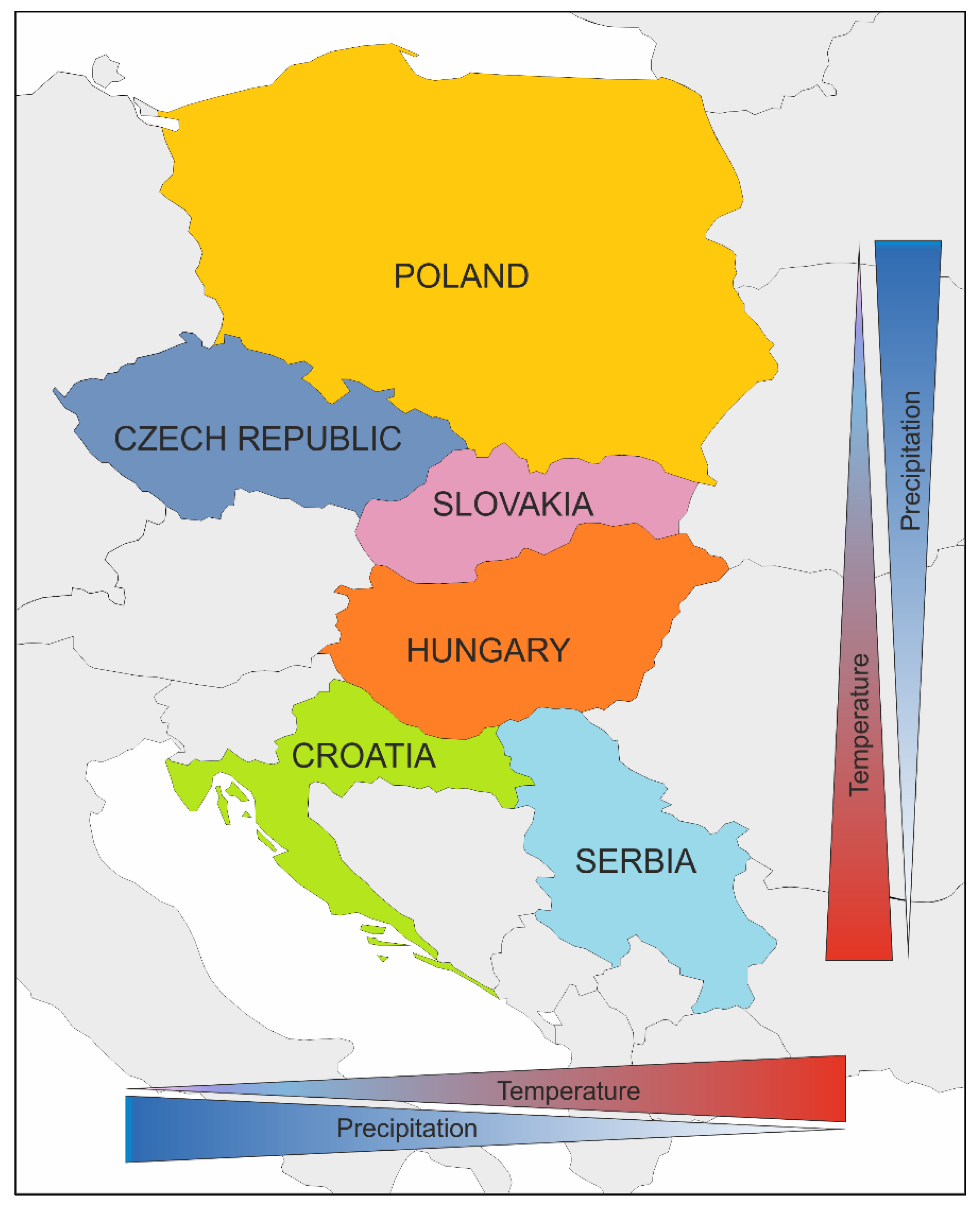
Figure 2.
Spatial distribution of Eco-scheme „Conserved Agriculture” according to ARKOD (a) in 2023; (b) in 2024.
Figure 2.
Spatial distribution of Eco-scheme „Conserved Agriculture” according to ARKOD (a) in 2023; (b) in 2024.
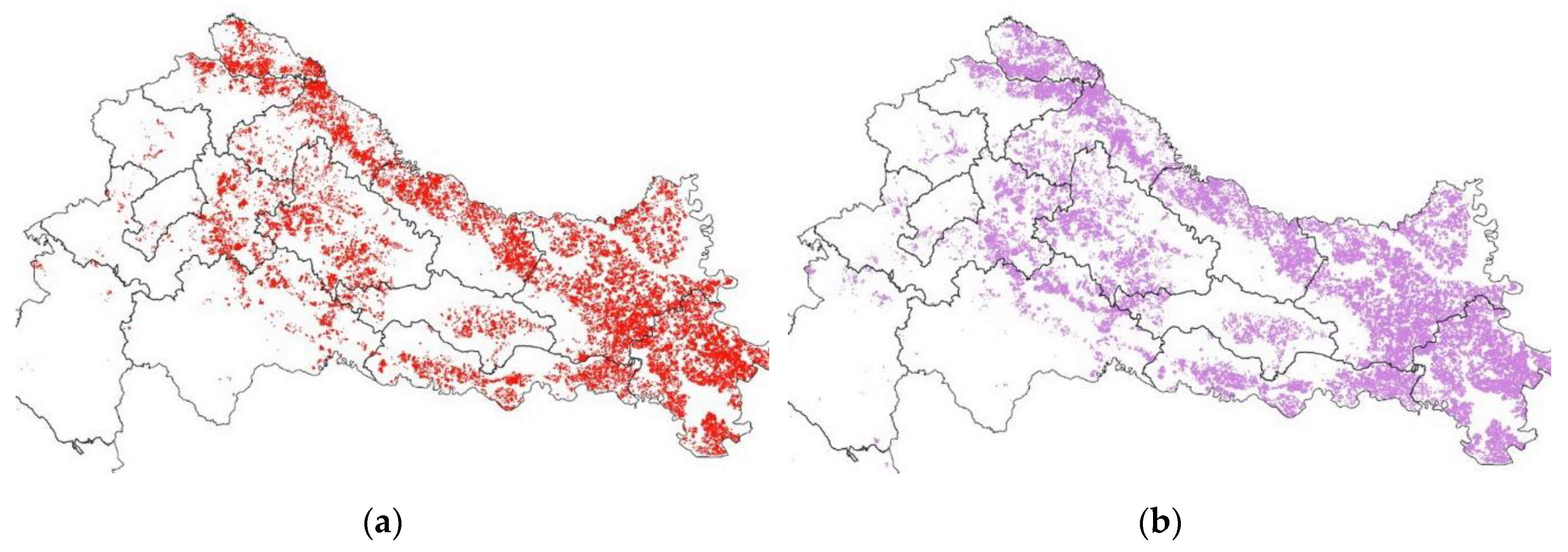
Figure 3.
Conservation technologies adoption in Slovakia. Source: 2010 and 2016 Eurostat [126] and 2023 estimation of NPCC data [127].
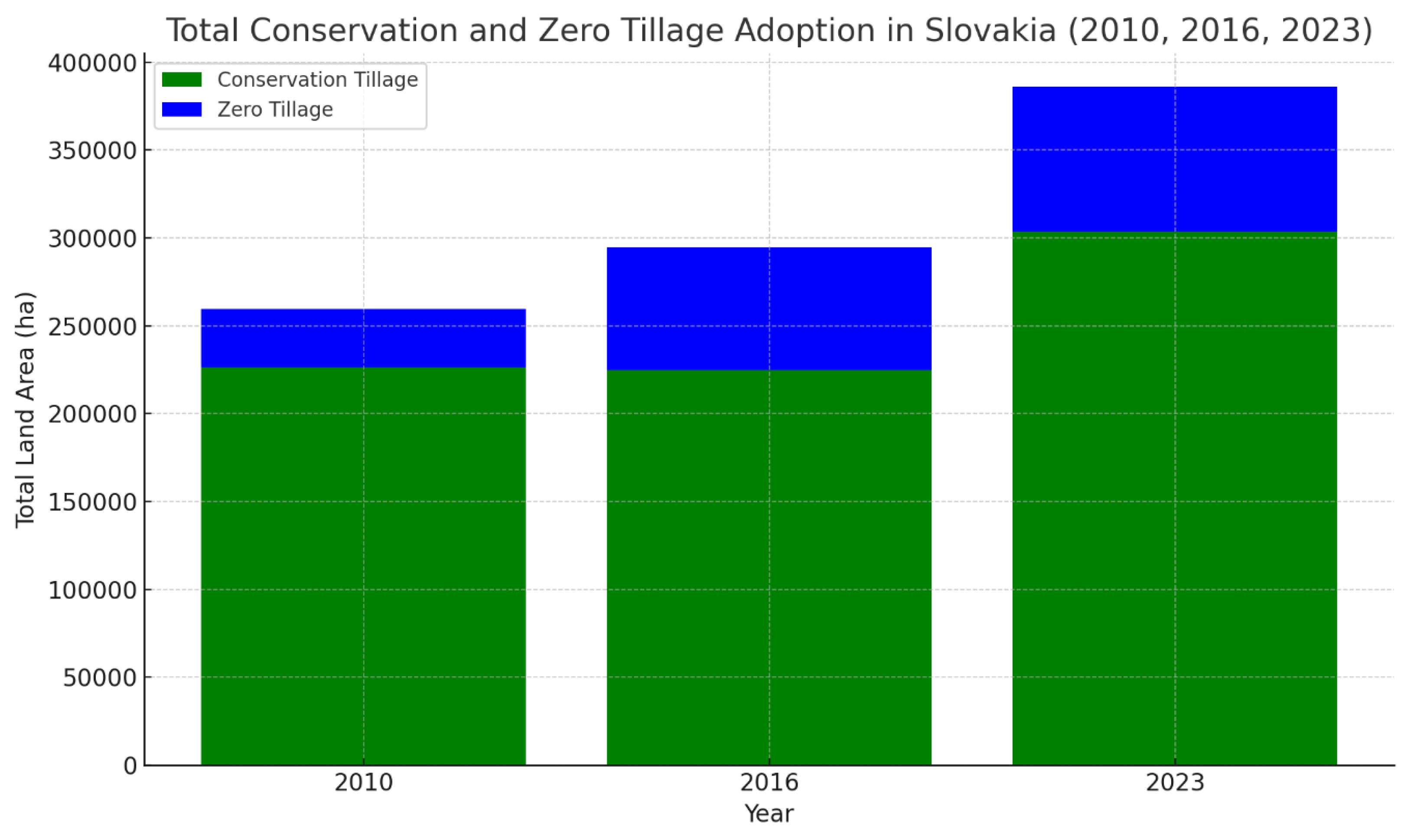
Figure 4.
An example of GIS tool application in predictions of soil suitability for CST in Western Slovakia.
Figure 4.
An example of GIS tool application in predictions of soil suitability for CST in Western Slovakia.
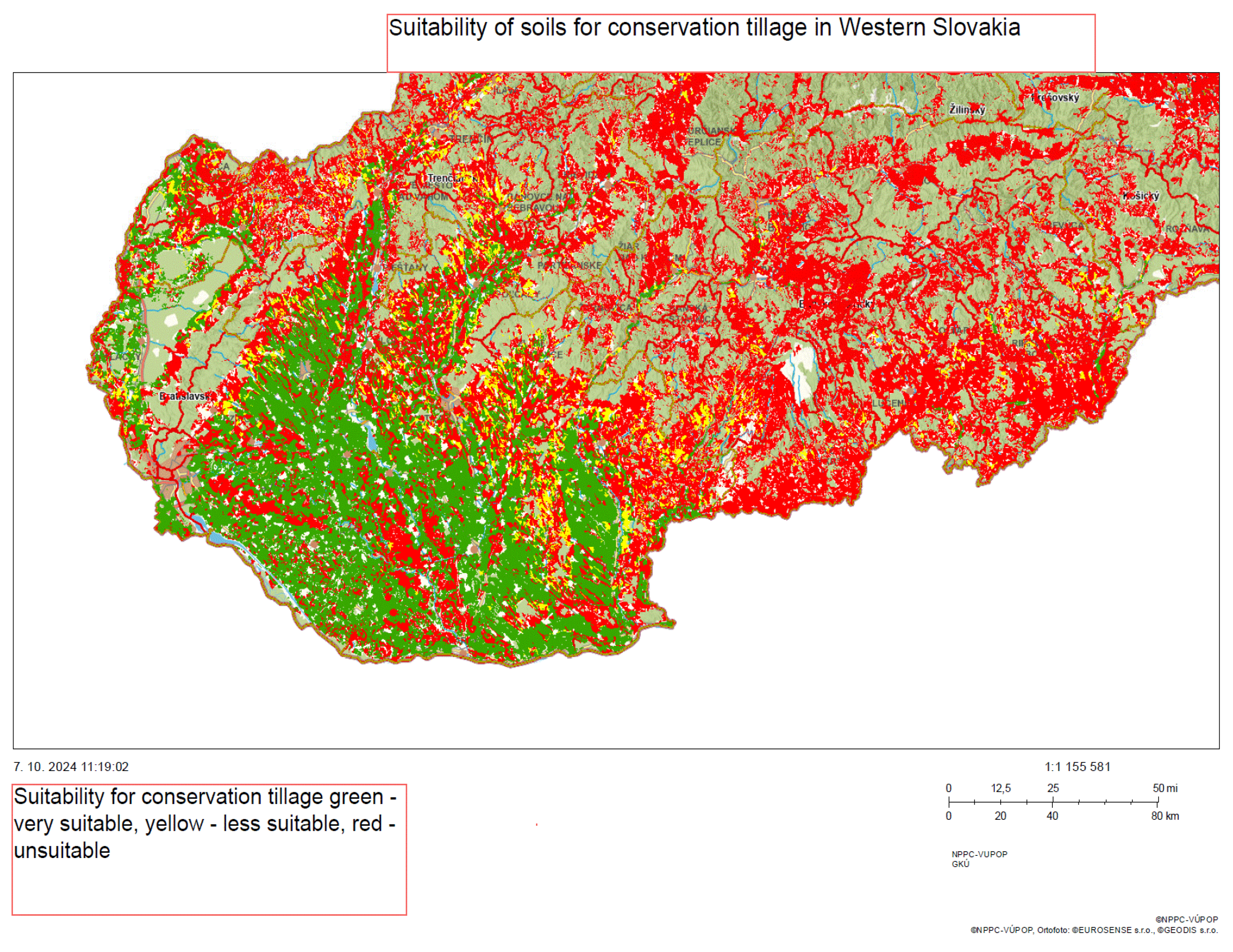

Table 1.
Summary of area and number of users who registered „Conservation Agriculture” on a single request in 2023 and 2024, Croatia.
Table 1.
Summary of area and number of users who registered „Conservation Agriculture” on a single request in 2023 and 2024, Croatia.
| Year 1 | Area (ha) - CA | Total area | Proportion of CA (%) |
Number of users - CA |
Total number of users |
Proportion – CA (%) |
| 2023 | 126,059 | 1,117,204 | 11 | 4,066 | 107,393 | 4 |
| 2024 | 177,325 | 1,109,947 | 16 | 5,599 | 100,946 | 6 |
1 By courtesy of Mislav Šatović, Assistant Director, Paying Agency for Agriculture, Fisheries and Rural Development, Croatia.
Table 2.
Overview of Soils Suitable for the Application of Conservation (Minimal Tillage) Technologies by NUTS 2 and NUTS 3 Regions in 2010.
Table 2.
Overview of Soils Suitable for the Application of Conservation (Minimal Tillage) Technologies by NUTS 2 and NUTS 3 Regions in 2010.
| NUTS 2 | NUTS 3 | Arable land ha-1 |
| Bratislava Region | Bratislava Region | 36,803 |
| Bratislava Region Total | 36,803 | |
| Western Slovakia | Trnava Region | 184,934 |
| Trenčín Region | 34,522 | |
| Nitra Region | 300,510 | |
| Western Slovakia Total | 519,966 | |
| Central Slovakia | Žilina Region | 0 |
| Banská Bystrica Region | 64,903 | |
| Central Slovakia Total | 64,903 | |
| Eastern Slovakia | Prešov Region | 7,166 |
| Košice Region | 64,682 | |
| Eastern Slovakia Total | 71,848 | |
| NUTS 1 Slovakia | 693,520 | |
| NUTS 1 Slovakia | Arable land | 1,417,983 |
| NUTS 1 Slovakia | Total agricultural land | 2,417,932 |
Disclaimer/Publisher’s Note: The statements, opinions and data contained in all publications are solely those of the individual author(s) and contributor(s) and not of MDPI and/or the editor(s). MDPI and/or the editor(s) disclaim responsibility for any injury to people or property resulting from any ideas, methods, instructions or products referred to in the content. |
© 2024 by the authors. Licensee MDPI, Basel, Switzerland. This article is an open access article distributed under the terms and conditions of the Creative Commons Attribution (CC BY) license (http://creativecommons.org/licenses/by/4.0/).
Copyright: This open access article is published under a Creative Commons CC BY 4.0 license, which permit the free download, distribution, and reuse, provided that the author and preprint are cited in any reuse.


