

Submitted:
26 November 2024
Posted:
26 November 2024
You are already at the latest version
Abstract
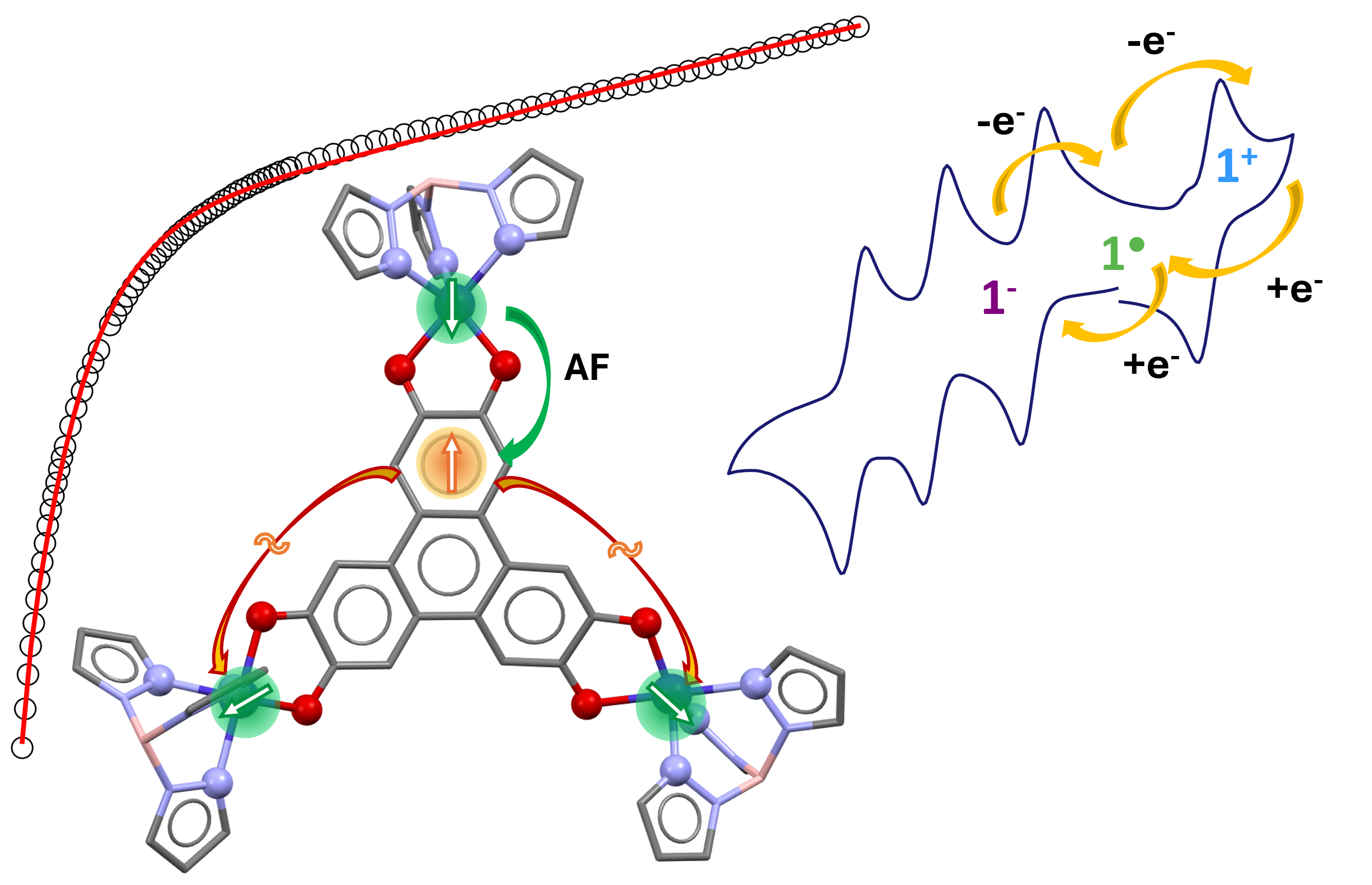
A trinuclear Co(II)-containing complex was assembled using the non-innocent hexahydroxytriphenylene bridging ligand. Cyclovoltammetry and spectro-electrochemistry studies revealed that the central ligand can sustain five reversible redox events leading to different spices with diverse optical behavior. Complementary analysis of the molecular structure confirmed by ab initio theoretical calculations are consistent with the bridge in the tris-semiquinone (sq) state for the trinuclear complex. The exchange coupling among the electrons of the bridge results in a spin doublet (s = ½) localized close to one of the three Co(II) ions, as suggested by the experimental magnetic data. The central doublet undergoes one large antiferromagnetic exchange coupling with one Co(II) and almost no coupling with the two other metal ions.
Keywords:
hexahydroxytriphenylene
; non-innocent bridge
; trinuclear Co complex
; spectroelectrochemistry
; Co magnetism
; ab initio calculations
1. Introduction
Hexahydroxytriphenylene (noted H6HHTP; C18O6H12, Figure 1a) may, when deprotonated, present 7 oxidation states from the fully reduced tris catecholate (HHTP6-; [cat-cat-cat]) to the fully oxidized tris quinone (HHTP; [q-q-q]), as it has been shown by Ward et al. when the ligand bridges Ru(II)-containing complexes.[1,2,3].
Trinuclear complexes were also prepared with first row transition paramagnetic metal ions (Ni(II) and Cu(II)).[4,5,6,7] For all these molecules, the most stable state of the bridging HHTP is [sq-sq-sq] (sq = semiquinone). In our effort to understand the electronic and magnetic behavior of these complexes, we have shown that, because the bridging ligand adopts the mesomeric form HHTP3--1 (Figure 1b) instead of a three-fold symmetry axis (HHTP3--2, Figure 1c), the interaction between the three unpaired sq electrons stabilizes a doublet ground state (s = ½) that is mainly localized on one of the OCCO dioxolene moiety, leading to a large antiferromagnetic exchange coupling with one of the Ni(II) metal ions, and one ferro- and one antiferromagnetic couplings with the other two Ni(II), of weaker magnitudes.[7] Both experimental data (structure and magnetic) and ab initio theoretical calculations supported this view of the electronic structure, independently from the nature of the metal ions and from their geometry that can be a distorted octahedron, a distorted square pyramid or a distorted trigonal bipyramid.[7]
The aim of this article is i) to extend our study to a trinuclear complex with the paramagnetic Co(II) metal ions (s = 3/2) where each metal center possesses three unpaired electrons, ii) to verify whether the tris-semiquinone state remains the most stable and iii) to assess the extent to which the presence of Co(II) metal ions instead of Ni(II) ions affects both the electronic structure of the HHTP, the exchange coupling within the complex, the redox and the optical behaviors. A trinuclear complex containing Co was reported but the metal ions were diamagnetic in the oxidation state III, probably because the capping tetradentate ligand imposes a strong ligand field that stabilizes Co(III).[8] We therefore used [Co(BH(TpPh,Ph)3)]+, where (BH(TpPh,Ph)3 is the tris(3,5- diphenyl-1H-pyrazol-1-yl)(hydridoborate)) as a building block with a tridentate capping ligand induces a relatively weak ligand field and is expected to stabilize Co(II) in the high spin state.[9]
We report the preparation (details of the synthesis and full characterization are given in SI), the crystal structure, the redox, the optical and the magnetic behavior of the trinuclear complex of formula [HHTP{Co(BH(TpPh,Ph)3)}] noted 1. Ab initio calculations were also carried out in order to determine the electronic structure of the complex and to facilitate the analysis of its magnetic properties.
2. Materials and Methods
2.1. Cyclic Voltammetry
The cyclic voltammetry experiments were carried out on solutions of 1mM of the complex dissolved in dichloromethane with (NBu4)PF6 at 0.1M as supporting electrolyte. The potentiostat is an AUTOLAB PGSTAT320 from Metrohm Autolab, and the three-electrode setup comprises a glassy carbon working electrode (Ø = 1mm), a platinum wire as counter electrode and a Saturated Calomel Electrode as reference. Ferrocene was used as an internal reference and the presented voltammogram is acquired with a voltage sweeping speed of 100 mV/s.
2.2. Spectroelectrochemistry
UV-Vis-NIR spectra were recorded using a Cary 5000 UV-Vis-NIR Spectrometer from Varian in double beam mode. Quartz cuvettes of 1 cm optical path length have been used. For the spectro-electrochemical tandem measurements the Varian Cary 5000 UV-Vis-NIR Spectrometer was used in single beam mode. The cuvette from Pine Research is made out of quartz and has a 1.7 mm optical path length. A combined platinum electrode has been used as counter and working electrodes as well as reference electrode. The working electrode is of mesh-type. For reduction experiments an argon flux was adapted on the cuvette in order to perform the reduction under a controlled atmosphere. The applied voltage was delivered by an Autolab PGSTAT204 potentiostat from Metrohm Autolab.
2.3. Magnetic Measurements
The magnetic data were acquired using a SQUID magnetometer operating in the 2-300 K temperature range and in the 0 - 6 T field range. Crystalline powder of 1 were ground and a pellet was made in order to prevent torquing effects at low temperatures and high magnetic fields. Diamagnetic correction of the sample holder was made.
2.4. Preparation of the Different Compounds
The synthesis and full characterization of the precursors and of 1 are given in Supplementary Information.
2.5. Single Crystal X-ray Diffraction
X-ray diffraction data for compound 1 were collected by using a VENTURE PHOTON 100 Bruker diffractometer with Micro-focus IuS source Mo-Kα radiation. Crystal of compounds was selected under optical microscope and glued in paratone oil. Crystal was mounted on a CryoLoop (Hampton Research) with Paratone-N (Hampton Research) as cryoprotectant and then placed in a nitrogen-gas stream at low temperature. The temperature of the crystal was maintained at the selected value by means of a cooling device by a N-Helix Cryostream cooling device to with an accuracy of ±1K. Data reduction was accomplished using SAINT V7.53a. The substantial redundancy in data allowed a semi-empirical absorption correction (SADABS V2.10) to be applied, on the basis of multiple measurements of equivalent reflections. The structures were solved by direct methods using SHELXS-97,[10] and refined against F2 by full-matrix least-squares techniques using SHELXL-2018,[11] with anisotropic displacement parameters for all non-hydrogen atoms. Hydrogen atoms were introduced into the calculations as a riding model with isotropic thermal parameters. All calculations were performed by using the Crystal Structure crystallographic software package WINGX.[12] CCDC 2403865 contains the supplementary crystallographic data for this paper. These data can be obtained free of charge from the Cambridge Crystallographic Data Centre and Fachinformationszentrum Karlsruhe via http://www.ccdc.cam.ac.uk/structures/.
2.6. ab Initio Calculations
Ab initio wave function-based calculations were performed using the ORCA5 code.[13] The treatment of the spin-orbit couplings (SOC) was achieved using the spin-orbit state interaction (SO-SI) method.[14] For the Zn3HHTP model, Def2-TZVP atomic basis sets were used for all atoms of the HHTP ligand (C and O: 5s3p2d1f) and Def2-SVP atomic basis sets for other atoms (Zn: 5s3p2d1f, B, C, N and O: 3s2p1d, H:2s1p). For 1, Def2-TZVP atomic basis sets were used for all atoms (Co: 6s4p4d1f, B, C, N and O: 5s3p2d1f) except H for which Def2-SVP atomic basis sets were used (2s1p) and for the Zn2Co1, Zn2Co2 and Zn2Co3 models Def2-TZVP atomic basis sets were used for the Co ions and the atoms of its coordination sphere (Co: 6s4p4d1f, N and O: 5s3p2d1f) while Def2-SVP atomic basis sets were used for other atoms (Zn: 5s3p2d1f, B, C, N and O: 3s2p1d, H: 2s1p).
3. Results and Discussion
3.1. Crystal Structure
The crystal data collection and refinement parameters for 1 are given in Table S1. 1 is a trinuclear complex made from the assembly of a central HHTP ligand bridging three [Co(BH(TpPh,Ph)3)] complexes through the three dioxolene groups (Figure 2, Figure S1).
The Co atoms are pentacoordinate with a geometry close to trigonal bipyramidal (tbp; Addison parameter[15] τ close to 0.65). The pseudo three-fold symmetry axes of the three Co(II) complexes lie within the plane of the molecule and correspond to the N2-O2, N7-O3 and N14-O5 directions for Co1, Co2 and Co3, respectively. The bond distances in the coordination sphere of the Co atoms are shorter in the tbp plane than along the pseudo three-fold axes (Table 1). The difference in the C-O bond lengths for the OCCO dioxolene moieties (Table 2) indicates that the unpaired sq electrons close to Co1 and Co3 are located on C1 and C14 (Figure2b). For the OCCO moiety close to Co2, the difference in the C-O bond lengths is much smaller indicating a relative delocalization of the sq unpaired electron over the OCCO moiety. The Co-O bond lengths are correlated with the C-O distances. The short Co-O bond distances are those with the oxygen atoms that have the longer C-O bonds (i.e. O1, O4 and O6 for Co1, Co2 and Co3, respectively), those that are formally negatively charged.
These structural characteristics are consistent with the electronic structure of the central HHTP ligand depicted in Figure 1b, where the sq unpaired electrons of the OCCO moieties close to Co1 and Co3 are separated by 5 C-C bonds. The interaction between the three s = ½ spins of the three sq unpaired electrons leads to two doublet and one quadruplet states. The electronic structure that emerges from the crystallographic analysis should, therefore, lead to a ground doublet spin state (s = ½) well separated in energy from the other doublet and the quadruplet states, because of a large antiferromagnetic exchange coupling between the two sq electrons separated by 5 C-C bonds. Theoretical calculations were, thus, carried out in order to confirm the electronic structure that emerges from the crystallographic structural analysis and to evaluate the exchange coupling between the central spin and those of the Co(II) metal ions.
3.2. Theoretical Calculations
Ab initio wave function-based calculations were first carried out on a model complex labelled Zn3HHTP where Co(II) were replaced by diamagnetic Zn(II) in order to examine the electronic structure of the HHTP bridging ligand. The orbitals were optimized at the Complete Active Space Self Consistent Field CAS(3,3)SCF level with an active space containing 3 electrons in 3 HHTP orbitals. Then calculations on a CAS(12,12) active space (12 electrons, 3 from the HHTP and 9 from the three Co(II) in 12 orbitals) were performed on the whole complex. Finally, we carried out calculations on one-electron oxidized model complexes Zn2Co1, Zn2Co2 and Zn2Co3 with the CAS(7,5) active space involving the 7 valence electrons of each Co(II) in their 5 3d orbitals in order to determine the axial (D) and rhombic (E) zero-field splitting (ZFS) parameters of the three Co fragments corresponding to the spin Hamiltonian:
The molecular orbitals of the model complex Zn3HHTP optimized for the doublet ground state at the CAS(3,3)SCF level show one bonding (HOMO), one non-bonding (SOMO) and one antibonding (LUMO) orbitals depicted in Figure 3. The SOMO (Figure 3b) is mainly localized on the OCCO moiety close to Co2 and has almost no contribution on the two other OCCO groups.
The low energy spectrum was calculated using state average CAS(3/3)SCF+NEVPT2 calculations for the 2 lowest s = ½ and the lowest s = 3/2 spin states. It shows a doublet ground state (s = ½), an excited doublet (s = ½) at 5144 cm-1 and a quadruplet (s = 3/2) at 5468 cm-1. Enlarging the active space does not change qualitatively the spectrum: the energy of excited s = ½ and the s = 3/2 states with respect to the ground state are 4705 cm-1 and 6566 cm-1, respectively, for CAS(7,7)SCF+NEVPT2 calculations. The central ligand can thus be described as having one unpaired electron (= ½) expected to interact mainly with the unpaired electrons of Co2.
We then studied Co3HHTP using a state average CAS(12,12)SCF calculation for all states generated by the interaction of three s=3/2 on the Co2+ ions and one =1/2 on the bridging ligand (i.e. one S=5, three S=4, five S=3, seven S=2, six S=1 and two S=0 states). The obtained molecular orbital energy diagram for Co3HHTP (Figure 4) shows three sets of orbitals: one set where the orbitals are localized only on Co(II) with no contribution on HHTP (Figure 4, blue lines and Figure S2 for orbitals representation); one set with one bonding and one antibonding MOs localized on HHTP (Figure 4, green lines) that are almost the same as those computed for Zn3HHTP (Figure 3a and Figure 3c); and one set with a bonding and an antibonding MOs involving the SOMO of HHTP and one d orbital of Co2 (Figure 4, red lines). This orbital energy diagram indicates that the electronic structure of Co3HHTP is mainly governed by the interaction between the SOMO of HHTP and one d orbital of one of the three Co(II) metal ions, namely Co2. We, therefore, expect that the magnetic behavior of the trinuclear complex will be mainly governed by the exchange coupling between the spins of these two moieties, and by the local anisotropy of Co(II) ions that also needs to be evaluated.
The corresponding model Hamiltonian involves the exchange coupling parameters between the ligand doublet spin momentum and the one of Co2 and the local anisotropies of the three Co(II) ions:
CAS(12,12)SCF+NEVPT2 energy spectrum (Table S2) confirms a strong antiferromagnetic coupling between the ligand and Co2 spins of the order of 65cm-1 (see SI). It results in an effective local metal-ligand ground triplet state () and an excited quintet state (). Indeed, the analysis of the spectrum shows a low energy first set of 10 quasi-degenerate states (spectrum width ~7cm-1) corresponding to small couplings (few cm-1) between and and and a second set (14 states) higher in energy (=130cm-1, bandwidth ~20cm-1) corresponding as well to small couplings (few cm-1) between and and .
The ZFS parameters (Table 3) were extracted using an already reported method.[16] We find relatively large negative D values for the three Co(II) metal ions with a large rhombicity (we recall that the maximum rhombicity corresponds to E/|D| = 0.33). As ZFS values are particularly large, we have checked that the first-order SOC contributions were negligible. The easy axis of magnetization for the three Co(II) (Figure 5) is aligned along the Co-O short bonds and not along the pseudo three-fold axis of the tbp. In order to analyze the origin of the negative D values, we focus on one Co(II) species (Co2), as the interpretation of the results are the same for the three metal ions (see Table S3 and Table S4 for the composition of the wave function of the ground and excited s = 3/2 states obtained from calculations on Zn2Co1 and Zn2Co2 complexes). The calculation also provides the contribution at the second order of perturbation of each excited state to the overall D value. The first excited state is mainly responsible of the large negative D values for the Co(II) species (Table S3 and Table S4). If we consider the Co2 fragment, the contribution of the first excited state is found equal to -53 cm-1 (Table S3) and corresponds to an excitation between and orbitals that are linear combinations of the l = 2, ml = ±2 spherical harmonics and therefore it is the part of the spin-orbit operator that couples this state to the ground state. When SO couples through states of the same spin, it stabilizes the largest |ms| values (±3/2) of the ground state and therefore contributes negatively to D.[17,18] The third excited state is obtained by an excitation between the and orbitals (linear combinations of ml = ±1) and has, for the same reasons, a negative contribution to D but weaker in magnitude (-15.6 cm-1 instead of -53.1 cm-1) because of the weaker |ml| values and to the larger energy separation with the ground state (5451 cm-1 instead of 1138 cm-1). The second and the fourth excited states have positive contributions (Table S3), but of much weaker magnitude so that the overall D value remains negative and large. For Co1, the same analysis justifies its negative D value (Table S4).
3.3. Redox and Optical Properties
In order to investigate the redox and optical behavior of 1, we performed cyclovoltammetry (CV) and spectro-electrochemistry studies to evaluate the stability of the different species. Those data were compared with the previously reported Ni(II) containing compound that possesses a similar structure with the same capping ligand (noted Ni3HHTP in the following) and where HHTP is also in the [sq-sq-sq] state.[4] The CV of 1 shows four reversible redox waves similar to those observed for the Ni(II) complex; three one-electron reduction waves and one one-electron oxidation wave (Figure 6, Table S5). The first reduction wave has the same redox potential as that of Ni3HHTP, while the other waves are slightly shifted anodically, indicating a higher energy requirement for the oxidation process and a more energetically accessible second and third reduction processes for 1 compared to Ni3HHTP. In the latter, the redox processes are mainly located on HHTP because Ni(II) is redox-inactive in the observed potential window. The very close redox potential values for 1 indicates that the redox processes are also not metal-centered in 1 as for Ni3HHTP and that they, therefore, mainly involve the bridging ligand HHTP.
The electronic spectra of 1 as well as its one-electron reduced and one-electron oxidized analogues were recorded using UV-Vis-NIR spectro-electrochemistry. The three species show two sets of absorption bands: in the near infra-red (NIR) and in the visible region (Figure 7). We focus in the following on the NIR region. 1 displays an absorption band at 1140 nm that is red-shifted to 1315 nm (this band is probably due to two transitions at 1292 and 1370 nm) upon a one-electron reduction and blue-shifted to 1183 nm for the one-electron oxidized species. In order to propose a qualitative assignment for these bands, we compared the electronic spectra to those of Ni3HHTP (Figure 8).
The absorption bands in the NIR region of 1 and Ni3HHTP (Figure 8a) are almost identical leading to the conclusion that the nature of the metal ions has almost no effect on the electronic transitions and that, therefore, these bands are due to transition(s) within the HHTP when it is in the [sq-sq-sq] state. In fact, within this hypothesis one can expect three absorption bands for the [sq-sq-sq] HHTP based on the MOs energy diagram of Zn3HHTP (Figure 3d), corresponding to the promotion of an electron between the three couple of MOs: HOMO SOMO, SOMO LUMO and HOMO LUMO. The first two transitions are expected at lower energy than the latter. Figure 8a displays two absorption bands at 1139 and 952 nm that may be due to the transition expected at higher energy.
The spectra of the one-electron reduced species (Figure 8b) are also very similar in the NIR region, confirming that these transitions are mainly centered on the bridging ligand that is in the [sq-sq-cat] state and that the nature of the metal ions does not have a significant effect on the electronic structure of the bridging ligand. The situation is different for the one-electron oxidized species (Figure 8c), where a blue-shift of 60 nm (468 cm-1) is observed for the most intense band when going from the Co to the Ni-containing complexes. The analysis performed here is only qualitative. A better understanding of the impact of the metal ions on the optical properties of the trinuclear species and their redox behavior requires an assignment of the different absorption bands that can be eventually done with the help of time-dependent Density Functional calculations that are underway.
3.4. Magnetic Properties
The magnetic properties of 1 were investigated by measuring the thermal dependence of the χT product (Figure 9a) and the magnetization vs. the magnetic field at T = 2, 4, 6 K (Figure 9b). The value of the χT product at T = 300 K (8.51 cm3mol-1K) may correspond to one s = ½ with g = 2 and three s = 3/2 with g = 2.4 non interacting species. Such g value for Co(II) is not unreasonable. Upon cooling, χT decreases monotonically until a value of 7.5 cm3mol-1K at T = 75 K and then more abruptly. It reaches a value of 3 cm3mol-1K at 2 K. The relatively large χT value at low temperature indicates a magnetic ground state and the decrease an antiferromagnetic coupling with certainly magnetic anisotropy as indicated from theoretical calculations. The M= f(B/T) curves are not superimposable, which confirms the presence of magnetic anisotropy within the complex.
The data were fitted using PHI,[19] assuming a model with a central s = ½ and three peripheral s = 3/2 spins introducing TIP in the fit procedure. The number of parameters is large (3 g values, 6 ZFS parameters and three exchange coupling parameters). We therefore proceeded in several steps in order to delimit the values of the different parameters and relied on theoretical calculation by considering one large antiferromagnetic exchange coupling and two very weak, on one hand, and on the other hand, we assumed first the same or very close ZFS parameters for the three Co(II) ions. Considering this last assumption, it was not possible to reach a satisfactory solution. We, therefore, used different ZFS parameters but still negative ones because distorted pentacoordinate Co(II) complexes were found to have negative D in many cases.[17,20,21,22] The best fit parameters are given in Table 4.
Overall, the parameters that best fit the magnetic data are qualitatively in agreement with those extracted from calculations, even though the figures may differ when we examine those corresponding to each Co(II) species. There is a large antiferromagnetic exchange coupling between the unpaired electron of HHTP and one of the Co(II) species and two weak couplings with the two other Co(II), as calculations predict. The axial ZFS D values are all negative, but we find weaker values (in absolute value) for two Co(II), while for the third Co(II) the D value is almost the same as that extracted from calculations. The rhombic ZFS parameters E found from the fit are weaker than those evaluated from calculations.
4. Conclusions
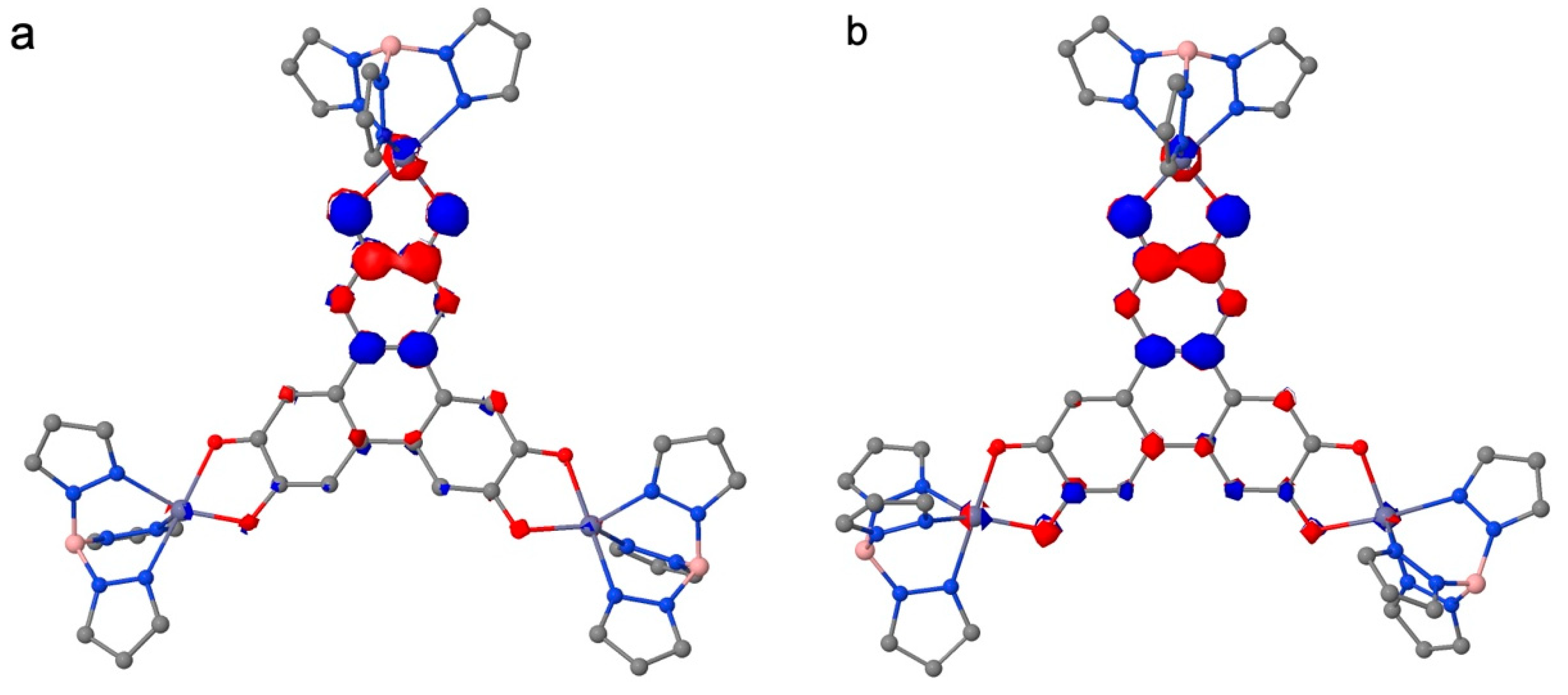
We reported the preparation, under aerobic conditions, of a trinuclear Co(II)-containing complex using the tris-dioxolene triphenylene bridging ligand (HHTP). The crystal structure analysis and particularly the C-O bond distances of the OCCO moieties of the ligand suggest that HHTP is in the [sq-sq-sq] state even when the synthesis is carried out starting from the tris-catecholate species. The cyclovoltammetry study confirms that, in solution, the complex remains in the [sq-sq-sq] state with four accessible species, namely [cat-cat-cat], [cat-cat-sq], [cat-sq-sq] and [sq-sq-q]. The spectro-electrochemical studies of 1 and of the similar Ni(II)-containing complex indicate that, qualitatively, the electronic structure of HHTP is independent from the nature of the metal ions for the [cat-sq-sq], and the [sq-sq-sq] states. Ab initio calculations are consistent with a strong antiferromagnetic exchange coupling among the three unpaired electrons of the HHTP and lead to a ground doublet state localized mainly on one OCCO moiety close to one of the three peripheral Co(II) complexes, as already found for Ni3HHTP. Consequently, the magnetic properties are the result of a large antiferromagnetic exchange coupling with one Co(II) and much weaker couplings with the other two Co(II) ions. The main difference in the magnetic properties between 1 and Ni3HHTP is that the two weak exchange coupling parameters are much weaker for 1 than for Ni3HHTP (less than 1 cm-1 for 1 and larger than 20 cm-1 for Ni3HHTP[7]), as found from fitting the magnetic data . This is due to the larger localization of the central doublet of HHTP for 1 than for Ni3HHTP (Figure 9a and Figure 9b)). This larger localization stems from a larger distortion of the HHTP skeleton in 1 than in Ni3HHTP (Figure 9c and Figure 9d).
Figure 9.
Representation of the SOMOs of the model complexes Zn3HHTP for 1(a) and for Ni3HHTP (b) where a larger localization of the orbital can be observed for 1; and view of the geometry of HHTP for the two complexes with the central cycle of HHTP perpendicular to the plane, highlighting its larger distortion for 1 than for Ni3HHTP.
Figure 9.
Representation of the SOMOs of the model complexes Zn3HHTP for 1(a) and for Ni3HHTP (b) where a larger localization of the orbital can be observed for 1; and view of the geometry of HHTP for the two complexes with the central cycle of HHTP perpendicular to the plane, highlighting its larger distortion for 1 than for Ni3HHTP.
Supplementary Materials
The following supporting information can be downloaded at the website of this paper posted on Preprints.org. Figure S1: An ORTEP drawing of compound 1. Thermal ellipsoids are shown at the 30% level. Solvent molecules (C3H6O & H2O) were omitted for clarity. Hydrogen atoms are omitted for clarity; Figure S2: Molecular Orbitals localized on the Co calculated for Co3HHTP at the CAS(12,12)SCF level; Table S1: Crystallographic data and structure refinement details for 1; Table S2: Energy spectrum of 1 obtained from CAS(12/12)SCF+NEVPT2 calculations; Table S3: Contribution to D of the first four excited states for the Co2 magnetic center. The occupation of the orbitals in the dominant determinants of each state are given for the following orbital sequence|z2 xz yz x2-y2 xy| followed by their weight in the CAS(7,5) wave function. Determinants contributing to less than 10% are not reported. GS = ground state, ESi=excited states numbering i = 1 to 4; Table S4: Contribution to D of the first four excited states for the Co1 magnetic center. The occupation of the orbitals in the dominant determinants of each state are given for the following orbital sequence|z2 xz yz x2-y2 xy| followed by their weight in the CAS(7,5) wave function. Determinants contributing to less than 10% are not reported. GS= ground state, ESi = excited states numbering i = 1 to 4; Table S5: Anodic (Ea) and cathodic (Ec) peaks potentials, half-wave potentials and differences of the half-wave potentials from the CV of Ni3HHTP and for 1.
Author Contributions
Conceptualization, T.M.; Synthesis, A.C., Y.W. and F.L.; Theory, N.S. and N.G.; Crystallography, R.G.; Magnetic study and analysis, E.R. and A.C., Electrochemistry, and optical measurements, A.C. and Z.H.; Data analysis, A.C., Y.W. and N.B.; Supervision, N.B., F.L. and S.O.; writing-original draft, T.M; writing-reviewing and editing, N.B., Z.H., N.G., T.M. and S. O. All authors have read and agreed to the published version of the manuscript.
Funding
This work is supported by the "ADI 2021" project funded by the IDEX Paris-Saclay, ANR-11-IDEX-0003-02 and JST SPRING (JPMJSP2108). This work was also supported by the ANR (project SMOLMAGIQ ANR-20-CE29-0010) and Grant-in-Aid for Scientific Research (A) from the Japan Society for the Promotion of Science (JSPS) (20H00369).
Data Availability Statement
The original contributions presented in the study are included in the article/supplementary material, further inquiries can be directed to the corresponding author.
Acknowledgments
A.C. acknowledge the University Paris-Saclay and the University of Tokyo for financial support within the framework of the double diploma agreement. The authors thank the CNRS (Centre de la Recherche Scientifique) for financial support.
Conflicts of Interest
The authors declare no conflicts of interest.
References
- M. Barthram, A.; L. Cleary, R.; Kowallick, R.; D. Ward, M. A new redox-tunable near-IR dye based on a trinuclear ruthenium(II) complex of hexahydroxytriphenylene. Chem. Commun. 1998, 2695–2696. [Google Scholar]
- Ward, M. D.; McCleverty, J. A. Non-innocent behaviour in mononuclear and polynuclear complexes: consequences for redox and electronic spectroscopic properties. J. Chem. Soc. Dalton Trans. 2002, 275–288. [Google Scholar] [CrossRef]
- Grange, C. S.; Meijer, A. J. H. M.; Ward, M. D. Trinuclear ruthenium dioxolene complexes based on the bridging ligand hexahydroxytriphenylene: electrochemistry, spectroscopy, and near-infrared electrochromic behaviour associated with a reversible seven-membered redox chain. Dalton Trans. 2010, 39, 200–211. [Google Scholar] [CrossRef] [PubMed]
- Wang, Y. T.; Lambert, F.; Rivière, E.; Guillot, R.; Herrero, C.; Tissot, A.; Halime, Z.; Mallah, T. Electronic and spin delocalization in a switchable trinuclear triphenylene trisemiquinone bridged Ni complex. Chem. Commun. 2019, 55, 12336–12339. [Google Scholar] [CrossRef]
- Yang, L. M.; He, X.; Dinca, M. Triphenylene-Bridged Trinuclear Complexes of Cu: Models for Spin Interactions in Two-Dimensional Electrically Conductive Metal-Organic Frameworks. J. Am. Chem. Soc. 2019, 141, 10475–10480. [Google Scholar] [CrossRef]
- Yang, L. M.; Dinca, M. Redox Ladder of Ni Complexes with Closed Shell, Mono-, and Diradical Triphenylene Units: Molecular Models for Conductive 2D MOFs. Angew. Chem. Int. Ed. 2021, 60, 23784–23789. [Google Scholar] [CrossRef]
- Suaud, N.; Colin, A.; Bouammali, M.; Mallah, T.; Guihéry, N. Understanding the Electronic Structure of Magnetic Trinuclear Complexes Based on the Tris-dioxolene Triphenylene Non-innocent Bridging Ligand, a Theoretical Study. Chem. Eur. J. 2024, 30. [Google Scholar] [CrossRef]
- Suenaga, Y.; Inada, H.; Inomata, M.; Yamaguchi, R.; Okubo, T.; Maekawa, M.; Kuroda-Sowa, T. Crystal Structure and Characterization of Trinuclear Cobalt(III) Complex with 2,3,6,7,10,11-Hexahydroxytriphenylene. Chem. Lett. 2014, 43, 562–564. [Google Scholar] [CrossRef]
- Uehara, K.; Hikichi, S.; Akita, M. Highly labile cationic tris-acetonitrile complexes, [TpM(NCMe)]OTf (M = Ni, Co; Tp:: hydrotrispyrazolylborato, R = Ph, Me and iPr):: versatile precursors for Tp-containing nickel and cobalt complexes. J. Chem. Soc. Dalton Trans. 2002, 3529–3538. [Google Scholar] [CrossRef]
- Sheldrick, G. M. SHELXS-97, Program for Crystal Structure Solution, University of Göttingen, Göttingen, Germany,. 1997.
- Sheldrick, G. A short history of SHELX. Acta Christ. Sec. A 2008, 64, 112–122. [Google Scholar]
- Farrugia, L. J. WinGX suite for small-molecule single-crystal crystallography. J. Appl. Cryst. 1999, 32, 837. [Google Scholar] [CrossRef]
- Neese, F.; Wennmohs, F.; Becker, U.; Riplinger, C. The ORCA quantum chemistry program package. J. Chem. Phys. 2020, 152. [Google Scholar] [CrossRef] [PubMed]
- Malmqvist, P. Å.; Roos, B. O.; Schimmelpfennig, B. The restricted active space (RAS) state interaction approach with spin-orbit coupling. Chem. Phys. Lett. 2002, 357, 230–240. [Google Scholar] [CrossRef]
- Addison, A. W.; Rao, T. N.; Reedijk, J.; Vanrijn, J.; Verschoor, G. C. Synthesis, Structure, and Spectroscopic Properties of Copper(Ii) Compounds Containing Nitrogen Sulfur Donor Ligands - the Crystal and Molecular-Structure of Aqua[1,7-Bis(N-Methylbenzimidazol-2'-Yl)-2,6-Dithiaheptane]Copper(Ii) Perchlorate. J. Chem. Soc. Dalton Trans. 1984, 1349–1356. [Google Scholar] [CrossRef]
- Maurice, R.; Bastardis, R.; de Graaf, C.; Suaud, N.; Mallah, T.; Guihéry, N. Universal Theoretical Approach to Extract Anisotropic Spin Hamiltonians. J. Chem. Th. Comput. 2009, 5, 2977–2984. [Google Scholar] [CrossRef]
- Gomez-Coca, S.; Cremades, E.; Aliaga-Alcalde, N.; Ruiz, E. Mononuclear Single-Molecule Magnets: Tailoring the Magnetic Anisotropy of First-Row Transition-Metal Complexes. J. Am. Chem. Soc. 2013, 135, 7010–7018. [Google Scholar] [CrossRef]
- Ruamps, R.; Batchelor, L. J.; Maurice, R.; Gogoi, N.; Jiménez-Lozano, P.; Guihéry, N.; de Graaf, C.; Barra, A. L.; Sutter, J. P.; Mallah, T. Origin of the Magnetic Anisotropy in Heptacoordinate Ni and Co Complexes. Chem. Eur. J. 2013, 19, 950–956. [Google Scholar] [CrossRef] [PubMed]
- Chilton, N. F.; Anderson, R. P.; Turner, L. D.; Soncini, A.; Murray, K. S. PHI: A powerful new program for the analysis of anisotropic monomeric and exchange-coupled polynuclear d- and f-block complexes. J. Comput. Chem. 2013, 34, 1164–1175. [Google Scholar] [CrossRef]
- Ruamps, R.; Batchelor, L. J.; Guillot, R.; Zakhia, G.; Barra, A. L.; Wernsdorfer, W.; Guihéry, N.; Mallah, T. Ising-type magnetic anisotropy and single molecule magnet behaviour in mononuclear trigonal bipyramidal Co(II) complexes. Chem. Sci. 2014, 5, 3418–3424. [Google Scholar] [CrossRef]
- Cahier, B.; Perfetti, M.; Zakhia, G.; Naoufal, D.; El-Khatib, F.; Guillot, R.; Rivière, E.; Sessoli, R.; Barra, A. L.; Guihéry, N.; Mallah, T. Magnetic Anisotropy in Pentacoordinate Ni and Co Complexes: Unraveling Electronic and Geometrical Contributions. Chem. Eur. J. 2017, 23, 3648–3657. [Google Scholar] [CrossRef] [PubMed]
- Devkota, L.; SantaLucia, D. J.; Wheaton, A. M.; Pienkos, A. J.; Lindeman, S. V.; Krzystek, J.; Ozerov, M.; Berry, J. F.; Telser, J.; Fiedler, A. T. Spectroscopic and Magnetic Studies of Co(II) Scorpionate Complexes: Is There a Halide Effect on Magnetic Anisotropy? Inorg. Chem. 2023, 62, 5984–6002. [Google Scholar] [CrossRef] [PubMed]
Figure 1.
Chemical formula for H6HHTP (a), mesomeric form the tris-semiquinone state HHTP3- that lacks three-fold symmetry axis (b) and mesomeric form the tris-semiquinone with a three-fold symmetry axis (c).
Figure 1.
Chemical formula for H6HHTP (a), mesomeric form the tris-semiquinone state HHTP3- that lacks three-fold symmetry axis (b) and mesomeric form the tris-semiquinone with a three-fold symmetry axis (c).
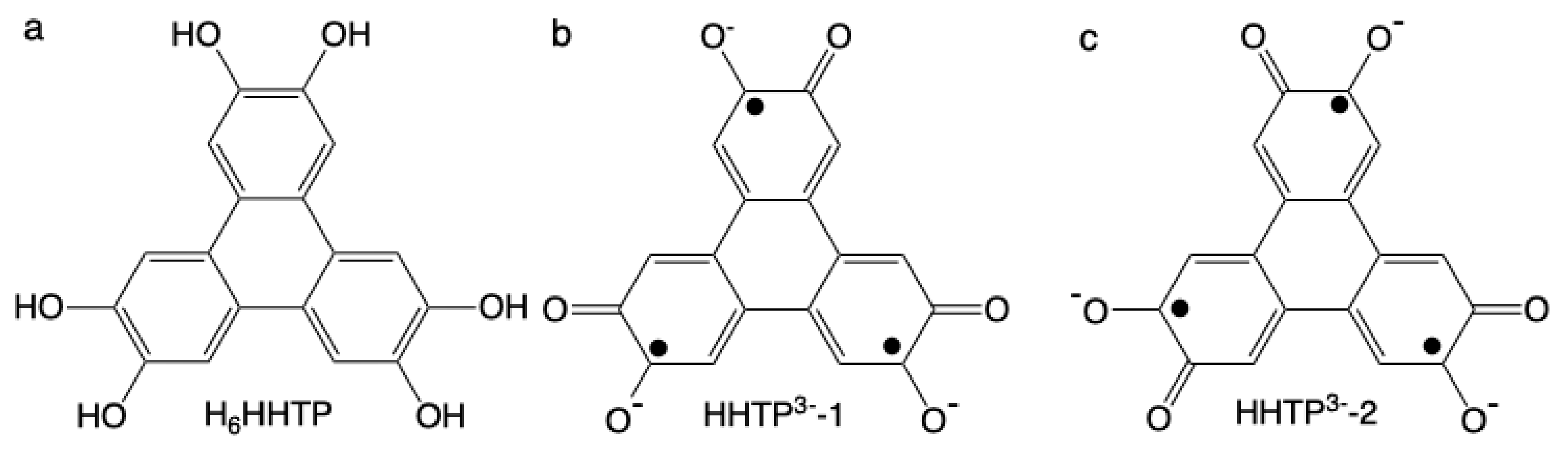
Figure 2.
View of the molecular structure of 1 (a) and with atoms numbering, part of the peripheral tridentate ligand was removed (b).
Figure 2.
View of the molecular structure of 1 (a) and with atoms numbering, part of the peripheral tridentate ligand was removed (b).
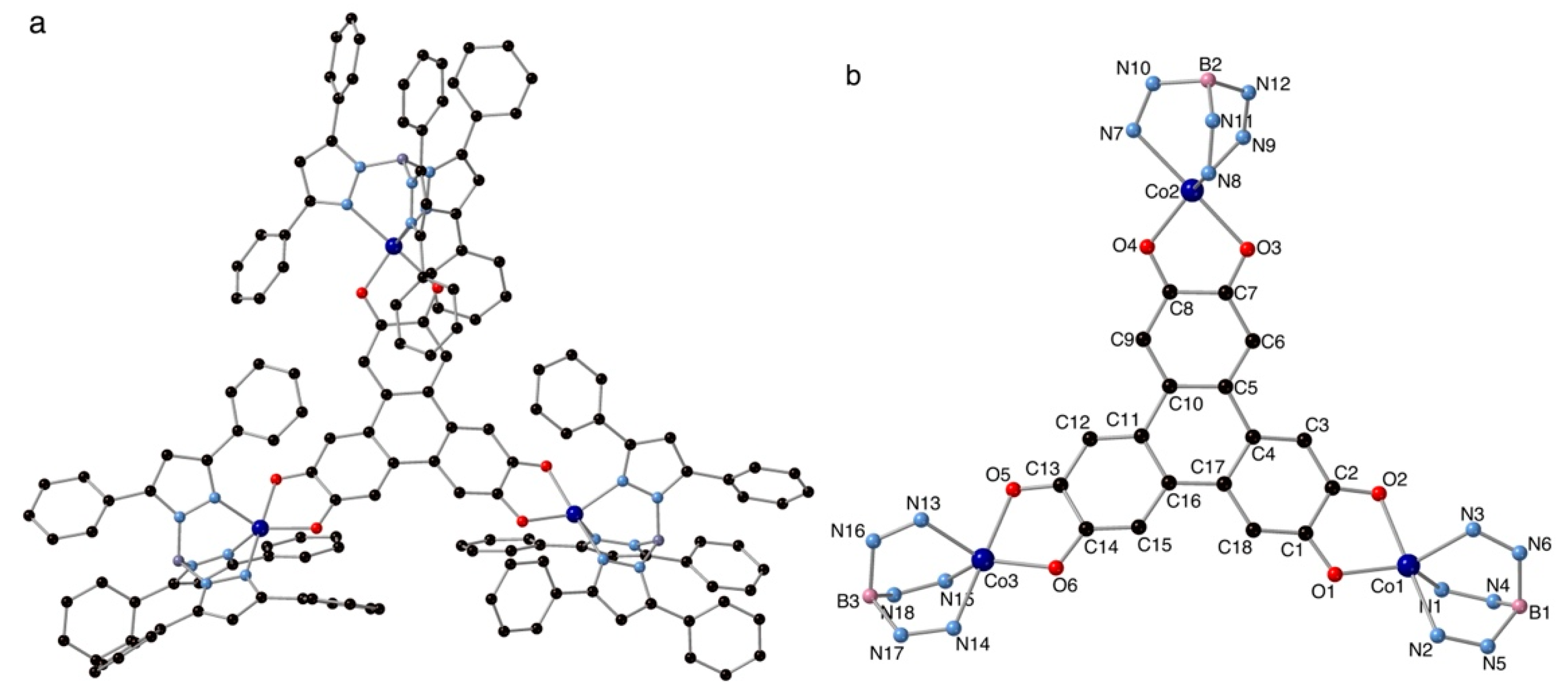
Figure 3.
Frontier π orbitals HOMO (a), SOMO (b) and LUMO (c) for Zn3HHTP computed at the CAS(3,3)SCF level, electron occupation numbers are 1.91, 1.00 and 0.09, respectively, and MO energy diagram (d).
Figure 3.
Frontier π orbitals HOMO (a), SOMO (b) and LUMO (c) for Zn3HHTP computed at the CAS(3,3)SCF level, electron occupation numbers are 1.91, 1.00 and 0.09, respectively, and MO energy diagram (d).
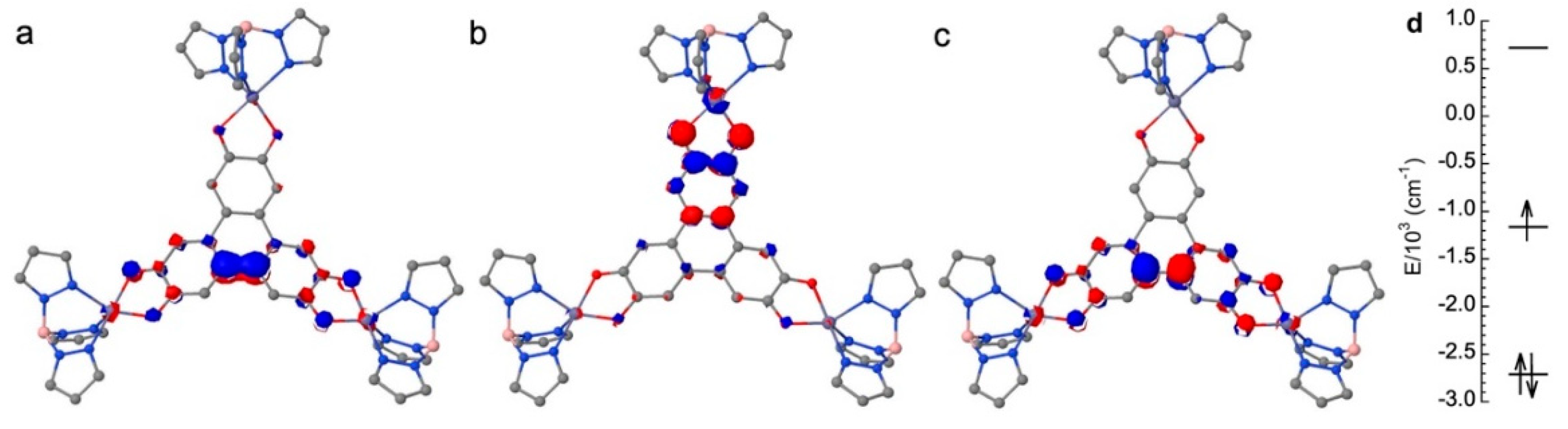
Figure 4.
Energy levels of the MOs calculated for Co3HHTP at the CAS(12,12)SCF level and representation of the MOs localized on HHTP (a and d) and of the MOs resulting from the interaction between the SOMO of HHTP and one d orbital of one Co(II) (c and d). A representation of the MOs localized on the Co atoms is given in SI (Figure S2).
Figure 4.
Energy levels of the MOs calculated for Co3HHTP at the CAS(12,12)SCF level and representation of the MOs localized on HHTP (a and d) and of the MOs resulting from the interaction between the SOMO of HHTP and one d orbital of one Co(II) (c and d). A representation of the MOs localized on the Co atoms is given in SI (Figure S2).
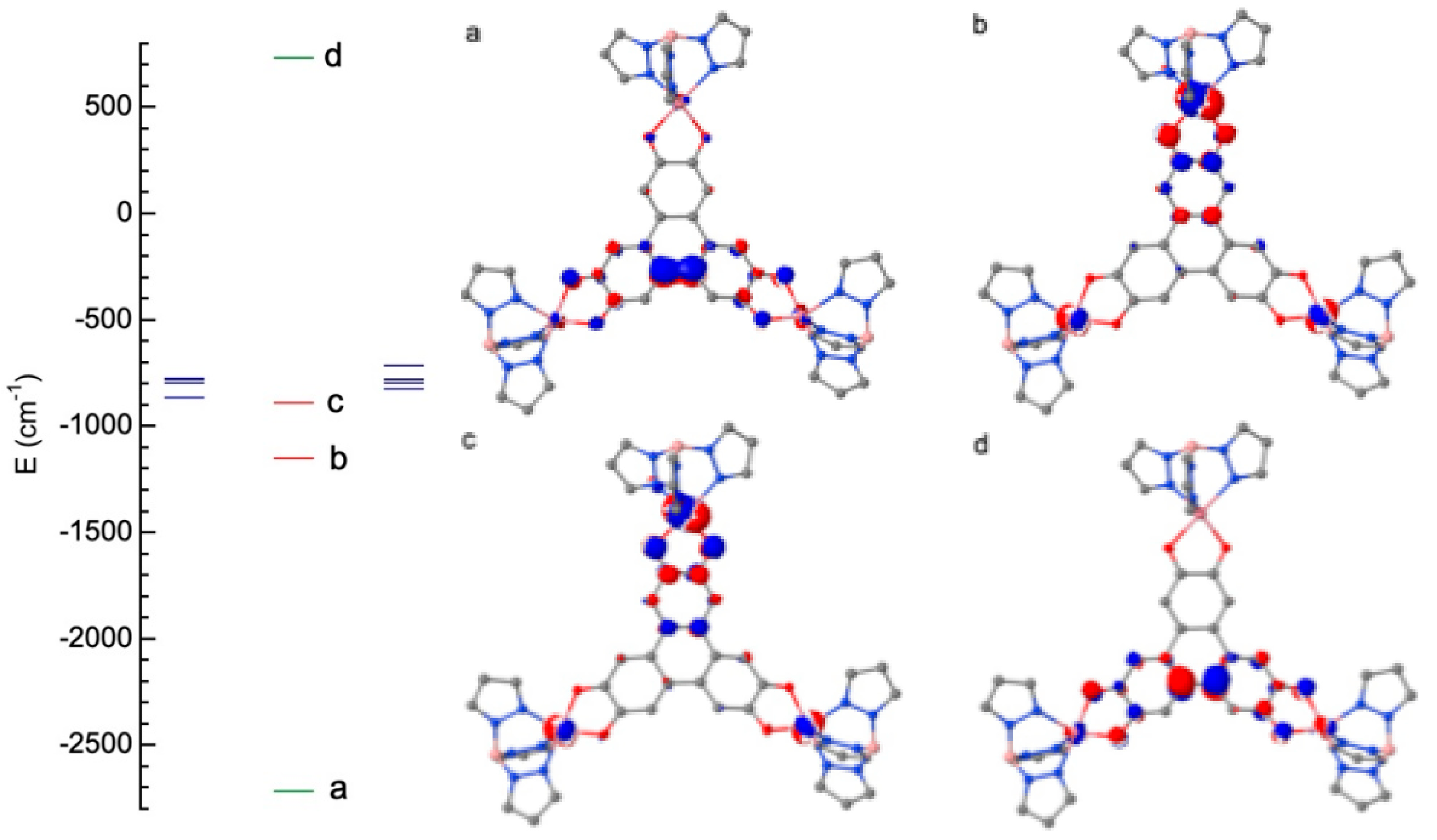
Figure 5.
Relative orientation of the D tensor axes (blue, easy axis: green, intermediate axis and red, hard axis).
Figure 5.
Relative orientation of the D tensor axes (blue, easy axis: green, intermediate axis and red, hard axis).
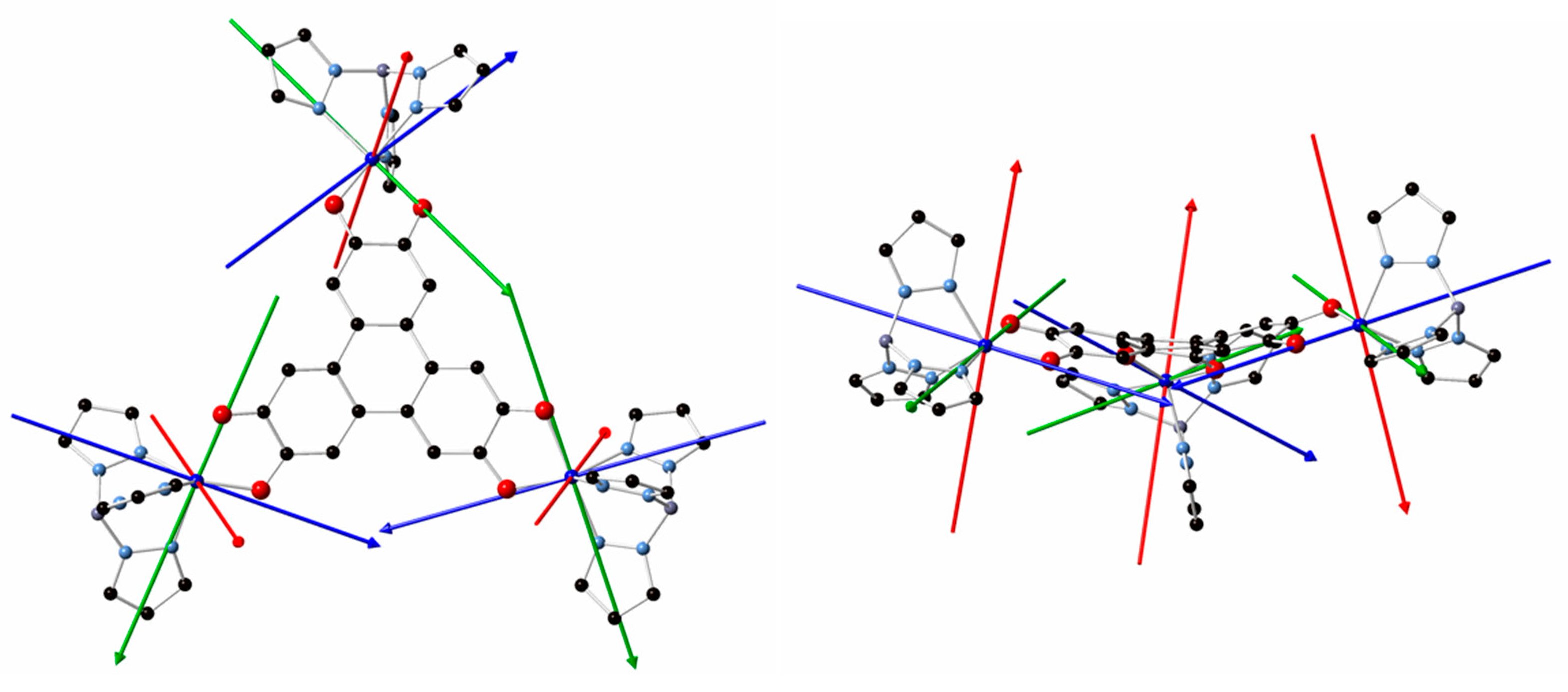
Figure 6.
Cyclic voltammogram of 1 mM of 1 (blue trace) and of [HHTP{Ni(BH(TpPh,Ph)3)}] in argon-degassed dichloromethane containing 0.1 M [Bu4N]PF6 at 25 °C and recorded using a glassy carbon working electrode, a platinum mesh as the counter electrode and a saturated calomel electrode (SCE) as the reference electrode.
Figure 6.
Cyclic voltammogram of 1 mM of 1 (blue trace) and of [HHTP{Ni(BH(TpPh,Ph)3)}] in argon-degassed dichloromethane containing 0.1 M [Bu4N]PF6 at 25 °C and recorded using a glassy carbon working electrode, a platinum mesh as the counter electrode and a saturated calomel electrode (SCE) as the reference electrode.
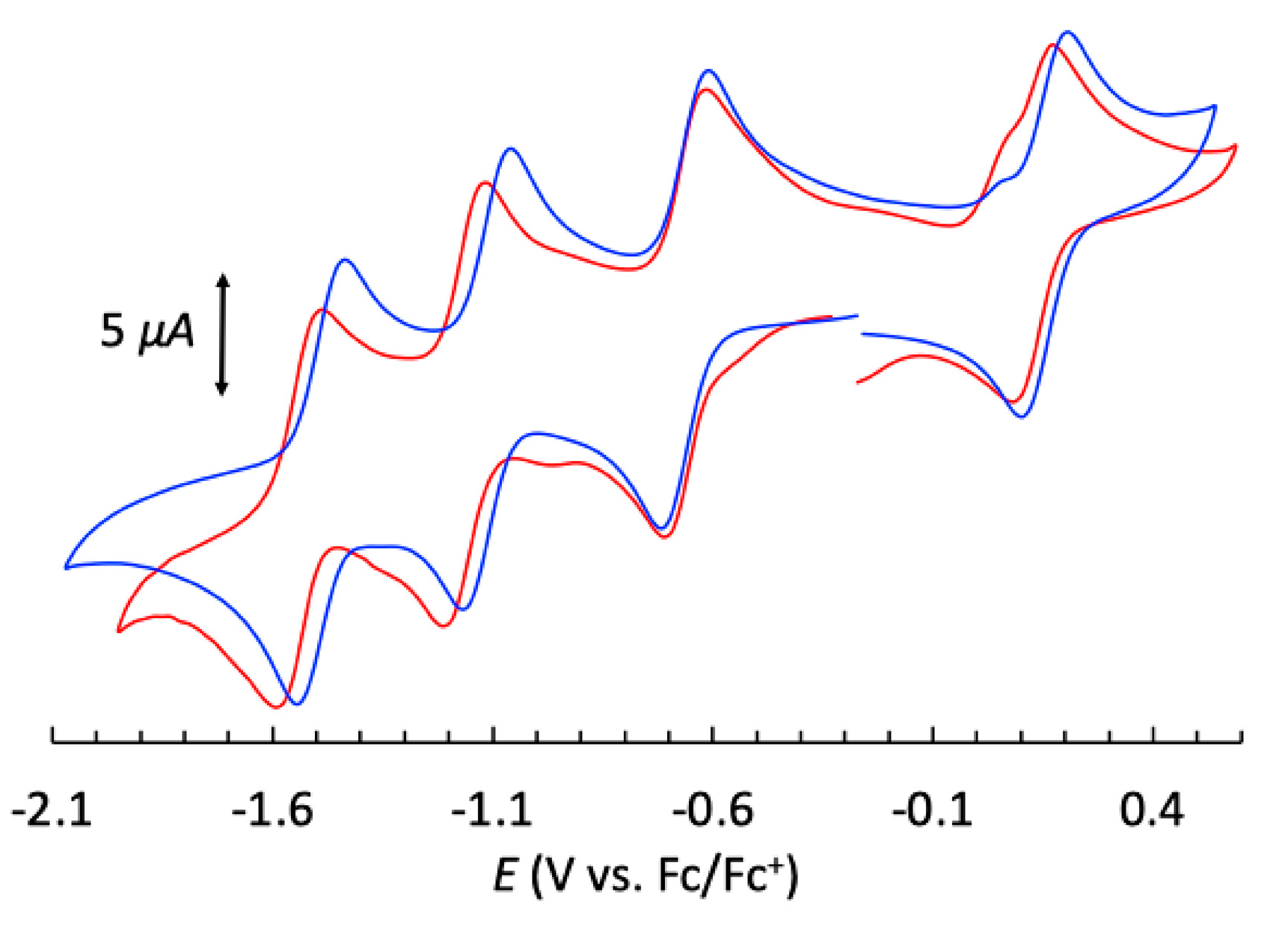
Figure 7.
Electronic absorption spectra of 1 (red trace), the one-electron reduced species (black trace) and the one-electron oxidized species (green trace) in dichloromethane.
Figure 7.
Electronic absorption spectra of 1 (red trace), the one-electron reduced species (black trace) and the one-electron oxidized species (green trace) in dichloromethane.
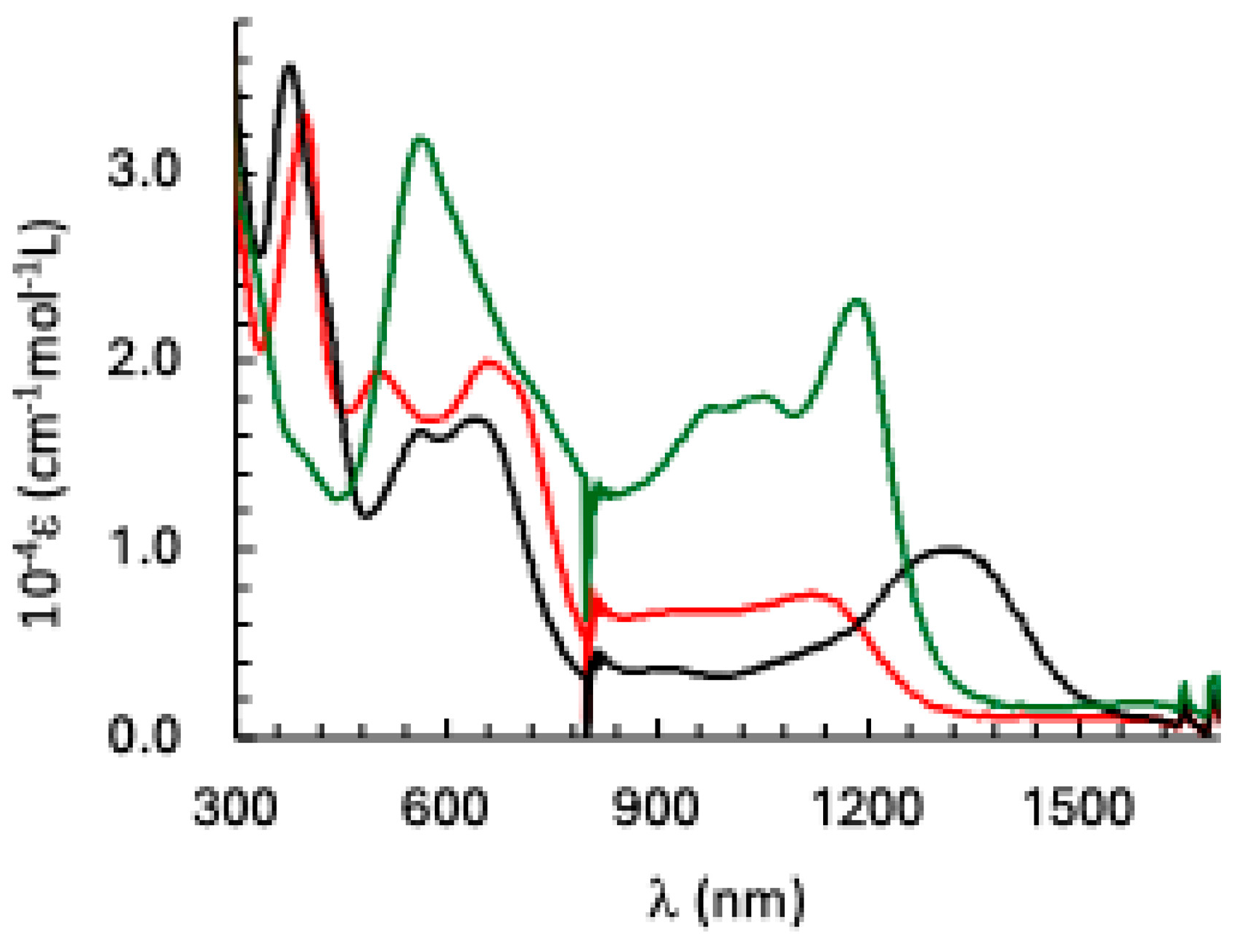
Figure 8.
Electronic spectra recorded in UV-Vis-NIR spectro-electrochemistry experiments for (a) 1 and Ni3HHTP, (b) the one-electron reduced species and (c) the one-electron oxidized species, blue and red traces for the Co and Ni containing species, respectively, in dichloromethane containing 0.1 M [Bu4N]PF6 at 25 °C.
Figure 8.
Electronic spectra recorded in UV-Vis-NIR spectro-electrochemistry experiments for (a) 1 and Ni3HHTP, (b) the one-electron reduced species and (c) the one-electron oxidized species, blue and red traces for the Co and Ni containing species, respectively, in dichloromethane containing 0.1 M [Bu4N]PF6 at 25 °C.
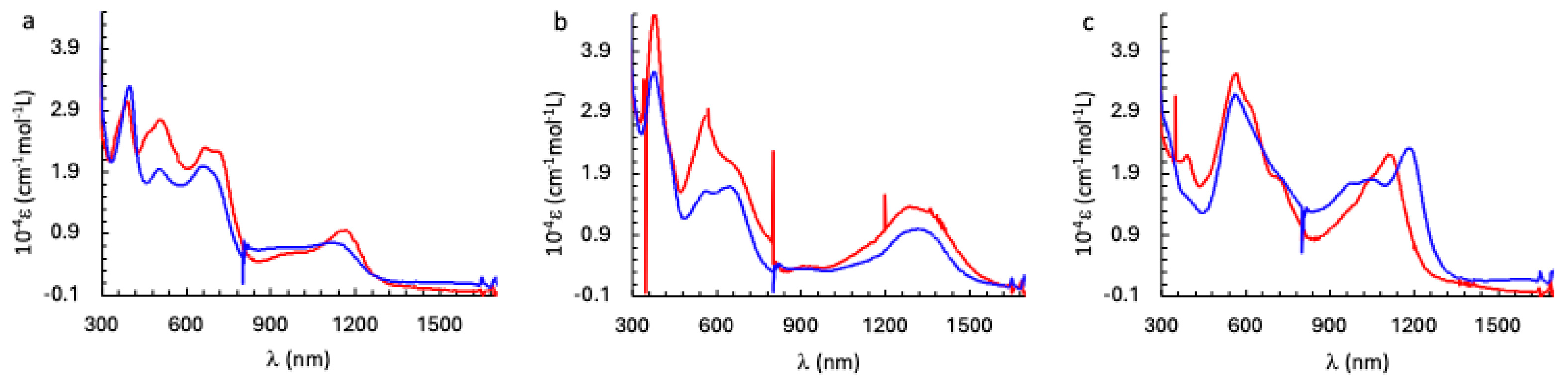
Figure 9.
χT = f(T) plot (a) and M=f(B/T) plots at T = 2(green), 4(red) and 6(blue) K (b) for 1; experimental data (◯) and fit (––) with the parameters in Table 4.
Figure 9.
χT = f(T) plot (a) and M=f(B/T) plots at T = 2(green), 4(red) and 6(blue) K (b) for 1; experimental data (◯) and fit (––) with the parameters in Table 4.
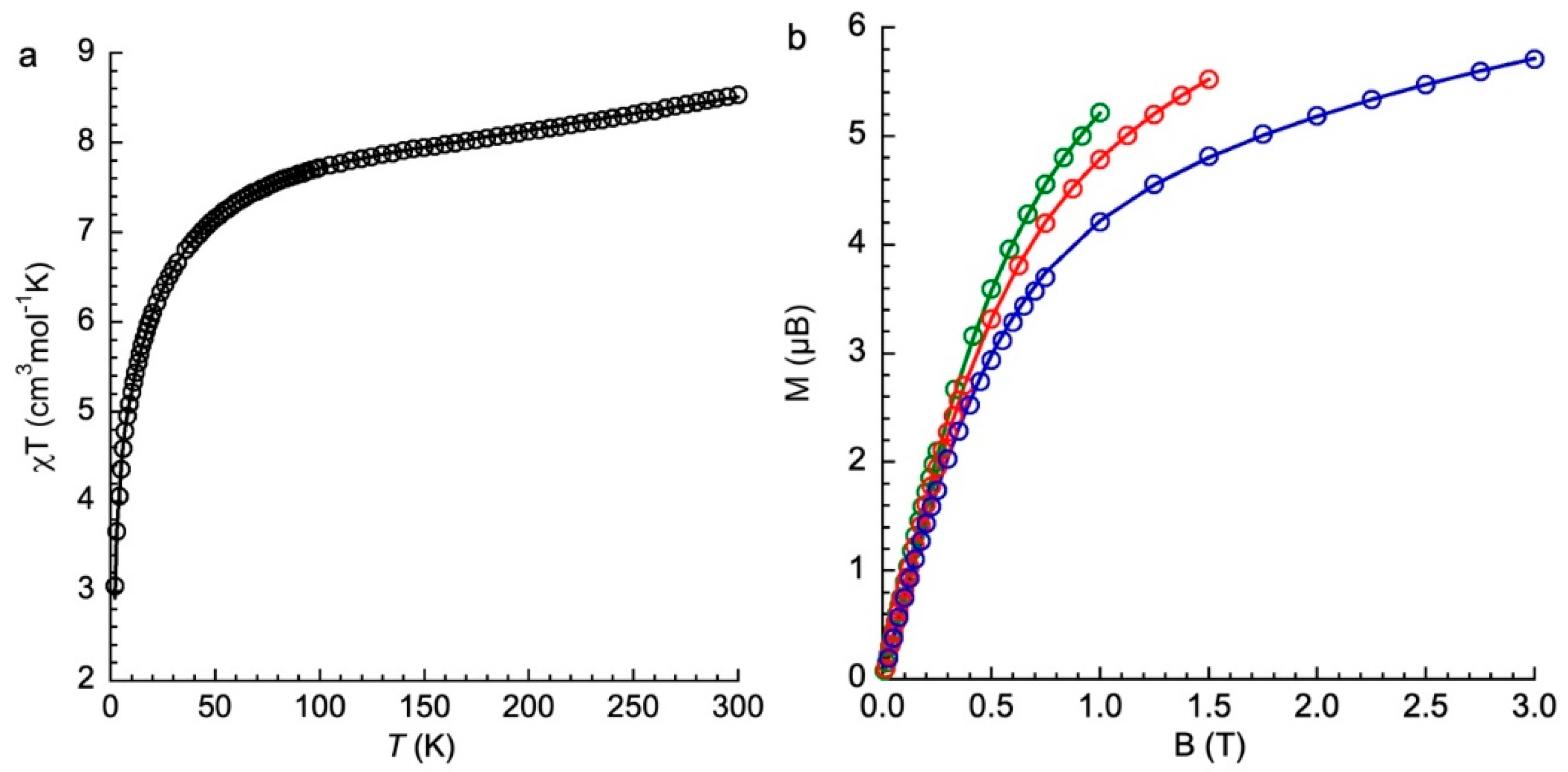

Table 1.
Bond distances (in Å) in the coordination sphere of Co
| Co-ligand distances along the pseudo three-fold axes | Co-ligand distances in the equatorial plane | |||
| Co1-O2 | Co1-N2 | Co1-O1 | Co1-N1 | Co1-N3 |
| 2.113 | 2.141 | 1.960 | 2.046 | 2.042 |
| Co2-O3 | Co2-N7 | Co2-O4 | Co2-N8 | Co2-N9 |
| 2.077 | 2.152 | 1.960 | 2.040 | 2.030 |
| Co3-O5 | Co3-N14 | Co3-O6 | Co3-N15 | Co3-N13 |
| 2.110 | 2.113 | 1.960 | 2.054 | 2.041 |
Table 2.
C-O bond lengths (in Å) and their difference for the OCCO moieties
| C1-O1 | C2-O2 | Δ(C-O)_Co1 |
| 1.316 | 1.258 | 0.058 |
| C8-O4 | C7-O3 | Δ(C-O)_Co2 |
| 1.292 | 1.277 | 0.015 |
| C14-O6 | C13-O5 | Δ(C-O)_Co3 |
| 1.304 | 1.256 | 0.048 |
Table 3.
Axial D and rhombic E ZFS parameters (in cm-1) calculated using the SO-SI method with the CAS(7,5)NEVPT2 energies for the three Co(II) metal ions
Table 3.
Axial D and rhombic E ZFS parameters (in cm-1) calculated using the SO-SI method with the CAS(7,5)NEVPT2 energies for the three Co(II) metal ions
| ZFS parameters | Co1 | Co2 | Co3 |
| D | -67.1 | -58.9 | -63.7 |
| E | 16.4 | 15.2 | 15.5 |
| E/|D| | 0.24 | 0.26 | 0.24 |
Table 4.
Magnetic data fit parameters for 1. The ZFS and the exchange parameters in cm-1
| g1 = g2 = g3 | D1 = D3 | D2 | E1 = E3 | E2 | J1 = J3 | J2 | TIP |
| 2.55 | -22.4 | -59.7 | 3.3 | 6.7 | -0.1 | -129 | 1.1x10⁻³ |
Disclaimer/Publisher’s Note: The statements, opinions and data contained in all publications are solely those of the individual author(s) and contributor(s) and not of MDPI and/or the editor(s). MDPI and/or the editor(s) disclaim responsibility for any injury to people or property resulting from any ideas, methods, instructions or products referred to in the content. |
© 2024 by the authors. Licensee MDPI, Basel, Switzerland. This article is an open access article distributed under the terms and conditions of the Creative Commons Attribution (CC BY) license (http://creativecommons.org/licenses/by/4.0/).
Copyright: This open access article is published under a Creative Commons CC BY 4.0 license, which permit the free download, distribution, and reuse, provided that the author and preprint are cited in any reuse.


