
Submitted:
25 November 2024
Posted:
27 November 2024
Read the latest preprint version here
Abstract
Ethnic segregation, a global phenomenon shaping social dynamics, urban development, and political behavior, is typically studied between distinct racial or national groups. This study provides insights into internal divisions within seemingly unified populations by investigating intra-group segregation within Israel’s ultra-Orthodox (Haredi) Jewish communities. By analyzing Knesset voting patterns as a proxy for residential distribution, I quantify segregation between two major ethnic groups within the Haredi community and identify significant segregation across Haredi-majority cities and clusters. Dissimilarity indices reveal distinct voluntary segregation. Larger Haredi populations correlate with greater segregation, likely as these communities sustain separate cultural hubs.
A comparison with Black-White segregation in U.S. metro areas shows that dissimilarity index values in Haredi communities are lower than typical U.S. levels, suggesting different drivers rooted in cultural and religious dynamics. Highlighting the interplay of ethnicity, religion, and political behavior, this study provides a replicable framework using electoral data to analyze segregation globally.
Keywords:
Ethnic segregation
; Haredi communities
; dissimilarity index
; intra-group segregation
; cultural hubs
; voluntary segregation
; religious dynamics
; urban development
Introduction
Ethnic segregation is a pervasive phenomenon observed globally, shaping social dynamics, urban development, and political behavior [1,2]. Understanding the patterns and drivers of ethnic segregation is essential for addressing social inequality and fostering community cohesion. While most research examines segregation between distinct national or racial groups, intra-group ethnic segregation—divisions within broader cultural or religious communities—also plays a significant role in shaping societal structures [3].
This paper investigates the extent and nature of ethnic segregation within Israel’s Haredi (ultra-Orthodox Jewish) population, a case study that provides insights relevant to other multicultural societies where internal divisions exist within seemingly unified communities. The ultra-Orthodox Jewish community is collectively referred to as Haredi society, while individuals are termed Haredi (singular) or Haredim (plural).
Israel offers a compelling context for examining ethnic segregation due to its diverse population and complex social fabric. Beyond the well-documented Jewish-Arab divide, ethnic distinctions within the Jewish population itself—particularly between Ashkenazi (of European descent) and Sephardic (of Middle Eastern and North African descent) Jews—reflect broader global patterns where cultural, ethnic, and religious affiliations intersect with societal dynamics [4,5].
Focusing on ultra-Orthodox communities, this paper explores ethnic segregation within a sector defined by strict religious adherence and substantial societal influence. Despite shared religious beliefs and practices, Ashkenazi and Sephardic Haredim often form distinct sub-communities, maintaining separate institutions and social networks [4]. This research examines the drivers and impacts of intra-group segregation, offering insights into community formation and societal dynamics that extend beyond the Israeli context.
Residential segregation among Haredi communities is quantified by analyzing Knesset voting patterns. Specifically, this study examines the voting tendencies for two primary Haredi political parties: Shas, predominantly supported by Sephardic Haredim, and United Torah Judaism (UTJ), favored by Ashkenazi Haredim. This strong alignment with these parties allows us to use voting data as a reliable proxy for the geographic distribution of these sub-communities.
Our approach infers the geographic distribution of these communities without relying on traditional Geographic Information System (GIS) techniques. While not entirely new (see [6]), this approach demonstrates how political behavior can be leveraged to study ethnic segregation in diverse contexts.
Shas and UTJ represent distinct segments of the Haredi population in Israel but also highlight broader dynamics of intra-group identity politics. Shas, in particular, appeals to a wider constituency, including economically disadvantaged Sephardic voters, by promoting an integrative ideology that addresses socio-economic and cultural grievances. This strategy mirrors trends in other societies where political movements address marginalized sub-groups within larger cultural or religious communities [7].
Previous studies have highlighted a strong correlation between ethnic identity and political affiliation within Haredi communities [8,9,10]. These correlations offer a unique lens to analyze intra-group segregation through electoral data, a methodology that can be applied to other contexts where political behavior reflects ethnic divisions.
Our findings reveal significant voluntary segregation in Haredi cities and neighborhoods throughout Israel. This raises critical questions about the factors driving such segregation, its implications for social cohesion, and its broader relevance to understanding ethnic dynamics in diverse societies. By quantifying these patterns, this research contributes to a deeper understanding of the intersection between ethnicity, religion, and political behavior.
Finally, this study demonstrates how political data can infer demographic patterns, providing a methodological framework applicable beyond the Israeli case. By enriching discussions on ethnic segregation, community formation, and the interplay between politics and demography, this research addresses issues central to multicultural societies worldwide.
Methods
To quantify residential segregation between Ashkenazi and Sephardic Haredi communities, I utilized voting data from the 25th Knesset elections, which took place on November 1, 2022. The data was obtained from the official website of the Central Elections Committee [11] and additional demographic information was sourced from Israel Democracy Institute (IDI) [12]. This dataset includes voting patterns from cities and areas with a prominent Haredi presence, focusing on the two main Haredi political parties: Shas and United Torah Judaism (UTJ).
Each Israeli citizen is assigned to a specific polling station based on their registered residential address. Polling stations can contain one or more ballot boxes, with each ballot box representing between 536 and 650 registered voters (25th and 75th percentiles, based on data from the most recent elections). This makes a single ballot box a proxy for relatively small residential areas. I identified ballot boxes where at least 75% of the votes were cast for Shas and UTJ combined, classifying these as homogeneous Haredi boxes. In cities with large non-Haredi populations, only the homogeneous Haredi boxes were analyzed to focus on clusters of the Haredi population. The analysis was limited to cities and towns with at least five such homogeneous Haredi boxes. No further preprocessing, such as anomaly detection or removal, was performed.
If no internal segregation exists, the Shas/UTJ vote ratio within a city or area would remain approximately the same across all ballot boxes. To quantify deviations from this expectation, I calculated the Index of Dissimilarity for each city or area to measure the degree of segregation between the two groups. The Index of Dissimilarity (D) is defined as:
,
where:
• Ai: Number of votes for Shas in the i-th box,
• A: Total number of votes for Shas in the city,
• Bi: Number of votes for UTJ in the i-th box,
• B: Total number of votes for UTJ in the city.
The index ranges from 0 to 1, where 0 represents complete integration (even distribution), and 1 represents complete segregation (no overlap between groups). To provide a reference, I shuffled each city’s voting data 1,000 times and calculated the distribution of the dissimilarity index for these randomized datasets. I then ranked each haredi population cluster based on their dissimilarity scores to highlight relative segregation levels.
To examine factors contributing to segregation levels, I analyzed the correlation between the dissimilarity index and several variables, including the number of Haredi voting boxes, Haredi voters, and Haredi legal voters, as well as the overall Haredi population. Additional variables included the total number of voting boxes, total voters, total legal voters, and the ratios of Haredi-to-total voting boxes and Haredi-to-total legal votes.
Since these variables are closely related, regression analysis was deemed infeasible due to high collinearity. Instead, I performed Spearman correlation analysis to assess relationships between key variables and segregation levels. Spearman was chosen over Pearson correlation to avoid reliance on assumptions such as normality and linearity.
To control for multiple comparisons, I applied the Benjamini-Yekutieli [13] correction to the regression p-values.
The analysis was conducted using Python and associated libraries, including pandas and the multitest package by Josef Perktold, which is part of statsmodels [14].
While the dissimilarity index provides a useful measure of segregation, it has some limitations. The index is sensitive to the geographic scale of analysis, as the size and boundaries of the geographic units (ballot boxes in this study) can affect the results. Additionally, the index does not account for spatial separation or physical distances between groups, focusing solely on proportional representation. Incorporating Geographic Information System (GIS) data, such as residential coordinates or neighborhood boundaries, would allow for more nuanced spatial analysis and help address these limitations [15]. However, the geographical boundaries of citizens assigned to each ballot box are not publicly available in Israel, limiting the ability to incorporate precise spatial data into this analysis.
Results and Discussion
Overview of Data
The collected dataset includes voting patterns from multiple Haredi-majority areas, providing insights into ethnic segregation between Ashkenazi and Sephardic Haredim. Table 1 presents key metrics, including city name, number of voters, dissimilarity index values, and predominant party support. The total number of registered voters in Haredi-homogeneous ballot boxes was 1,226,667, of whom 789,393 cast legal votes. This is higher than the total Haredi population reported in these areas by the Israel Democracy Institute (936,602) [12]. This discrepancy may arise from several factors, including IDI survey limitations, mixed populations in some neighborhoods, and the fact that non-Haredi individuals may vote for UTJ or Shas, particularly the latter [7].
Segregation Analysis
Our analysis reveals significant levels of ethnic segregation within Israel’s Haredi communities, as quantified by the dissimilarity index. Cities such as Ashdod, Elad, and Bnei Brak exhibit the highest segregation levels, with dissimilarity scores of 0.125, 0.107, and 0.097, respectively. These values are substantially higher than the 95% confidence intervals of randomized shuffled data, demonstrating that the observed patterns are not random but reflect meaningful geographic and social separation (Figure 1).
In comparison, a 2022 analysis of Black-White segregation in U.S. metro/micro areas [16] reports a median dissimilarity index of 0.462, with values ranging from 0.211 to as high as 0.835 in the most segregated areas. This highlights the much higher levels of segregation observed in racial contexts within the United States. While Black-White segregation in the U.S. is often attributed to structural inequalities and systemic discrimination, segregation in Haredi communities appears to be driven more by cultural and religious differences. The relatively lower dissimilarity scores in this study may reflect the shared religious identity of Ashkenazi and Sephardic Haredim, which fosters some cohesion despite ethnic distinctions. Nonetheless, cultural and institutional factors, such as separate synagogues, schools, and community networks, likely reinforce residential separation. This underscores the need to interpret segregation indices within their specific social and cultural contexts.
Correlation Analysis
The Spearman correlation analysis identified a significant positive relationship between segregation levels and variables such as the number of Haredi voting boxes () and the total number of Haredi voters (). These findings suggest that segregation becomes more pronounced in areas with larger Haredi populations, potentially due to the capacity to establish separate religious, cultural, and communal hubs for Ashkenazi and Sephardic communities (Figure 2).
Discussion
These results highlight the deep cultural and organizational divides within Israel’s Haredi society. Although both Ashkenazi and Sephardic Haredim share religious beliefs, their differences in liturgy, customs, and community structures often result in physical separation. This divide reflects broader dynamics of ethnic and value-based segregation [17].
Our findings also align with theories of homophily and xenophobia, which may simultaneously drive segregation. Homophily reflects in-group preferences for shared culture and customs, while xenophobia stems from out-group avoidance. While our data does not distinguish between these mechanisms, their combined influence likely reinforces segregation. Future studies should explore their relative contributions, potentially through survey data or experimental approaches.
Urban venues such as synagogues, schools, and community centers specific to each ethnic group may further entrench segregation, as they act as cultural anchors shaping residential patterns [18]. The persistence of these institutions underscores the role of physical and social infrastructure in maintaining ethnic divides.
Finally, integrating quantitative approaches like agent-based modeling [1] could provide deeper insights into the long-term evolution of segregation in Haredi communities. Such methods would complement this study’s findings by simulating how individual preferences and institutional factors interact to shape residential patterns over time.
Conclusions
This study highlights the extent of ethnic segregation within Israel’s Haredi communities, demonstrating that even within a seemingly homogenous religious group, significant intra-community divisions persist. Using voting data as a proxy for residential segregation, I offer a novel approach that complements traditional Geographic Information System (GIS) methods. This approach not only corroborates known segregation patterns but also sheds light on the sociopolitical factors driving these divisions. Future research could benefit from the inclusion of GIS data, if made available by governmental institutions in a responsible and anonymous manner, to enhance the depth and precision of such analyses.
The distinct patterns of support for Shas and UTJ across different localities underline the enduring influence of ethnic identity in shaping community structures. These findings align with Schelling’s classic segregation model, which illustrates how even slight preferences for similarity can produce significant segregation at the macro level. This study extends these theoretical insights into the domain of intra-religious ethnic segregation, revealing that such divisions endure even within communities united by shared religious values, practices, and political goals.
By empirically demonstrating intra-community ethnic segregation and linking these patterns to broader theoretical frameworks, this study advances our understanding of the interplay between ethnicity, religion, and urban dynamics. It provides a foundation for future investigations into the mechanisms that sustain segregation and their implications for urban planning, community cohesion, and social integration.
Funding
This research received no external funding.
Data Availability Statement
The data and the code used in this research is available at https://github.com/bgbg/segregation_paper.
Conflicts of Interest
The authors declares no conflicts of interest.
References
- Bakens, J.; Pryce, G. Homophily Horizons and Ethnic Mover Flows among Homeowners in Scotland. Hous Stud 2019, 34, 925–945. [Google Scholar] [CrossRef]
- Zuccotti, C. V.; Lorenz, J.; Paolillo, R.; Rodríguez Sánchez, A.; Serka, S. Exploring the Dynamics of Neighbourhood Ethnic Segregation with Agent-Based Modelling: An Empirical Application to Bradford, UK. J Ethn Migr Stud 2023, 49, 554–575. [Google Scholar] [CrossRef]
- Petrescu-Prahova, M. Beyond Schelling: The Role of Attitudes toward In-Group and Out-Group Members in Ethnic Residential Settlement and Segregation 1; 2009.
- Friedman, M. The Haredi (Ultra-Orthodox) Society: Sources, Trends and Processes; The Jerusalem Institute for Israel Studies: Jerusalem, 1991. [Google Scholar]
- Munro, H. Identity, Religion, and the State: Haredi Politics and Social Change in Israel, Durham University, 2021.
- Hershkowitz, S. Residential Segregation by Religion: A Conceptual Framework. Tijdschrift voor economische en sociale geografie 1987, 78, 44. [Google Scholar] [CrossRef]
- Peled, Y. Towards a Redefinition of Jewish Nationalism in Israel? The Enigma of Shas. Ethn Racial Stud 1998, 21, 703–727. [Google Scholar] [CrossRef]
- Cohen, A.; Susser, B. Stability in the Haredi Camp and Upheavals in Nationalist Zionism: An Analysis of the Religious Parties in the 2009 Elections. Israel Affairs 2010, 16, 82–104. [Google Scholar] [CrossRef]
- Nissim Leon The Ethnic Structuring of “Sephardim” in Haredi Society in Israel. Jew Soc Stud 2016, 22, 130. [CrossRef]
- Katz, Y. Identity Politics and Religious in Modern Society. International Journal of Scientific and Management Research 2024, 07, 49–60. [Google Scholar] [CrossRef]
- Israel’s Central Election Committee.
- Israel Democracy Institute Statistical Report on Ultra-Orthodox Society in Israel 2023; 2023.
- Emmert-Streib, F.; Moutari, S.; Dehmer, M. Multiple Testing Corrections. Elements of Data Science, Machine Learning, and Artificial Intelligence Using R 2023, 421–454. [CrossRef]
- Seabold, S.; Perktold, J. Statsmodels: Econometric and Statistical Modeling with Python. 2010.
- Wong, D.W. From Aspatial to Spatial, from Global to Local and Individual: Are We on the Right Track to Spatialize Segregation Measures? Recapturing Space: New Middle-Range Theory in Spatial Demography 2016, 77–98. [CrossRef]
- Pendergrass, R.W. The Relationship between Urban Diversity and Residential Segregation. Urban Science 2022, 6, 66. [Google Scholar] [CrossRef]
- Paolillo, R.; Lorenz, J. How Different Homophily Preferences Mitigate and Spur Ethnic and Value Segregation: Schelling’s Model Extended. 2018. [CrossRef]
- Rae, J.R.; Skinner-Dorkenoo, A.L.; Reiman, A.K.; Schmid, K.; Hewstone, M. Mixed Evidence for Interactive Effects of Outgroup Proportions and Intergroup Contact on Racial Bias in the United States. Soc Psychol Personal Sci 2022, 13, 476–489. [Google Scholar] [CrossRef]
Figure 1.
Dissimilarity index values for ethnic segregation in Israel’s ultra-orthodox communities. The plot shows segregation levels between Ashkenazi and Sephardic Haredi populations across cities, ranked by dissimilarity index. Higher values indicate greater segregation. Error bars represent 95% confidence intervals based on randomized data.
Figure 1.
Dissimilarity index values for ethnic segregation in Israel’s ultra-orthodox communities. The plot shows segregation levels between Ashkenazi and Sephardic Haredi populations across cities, ranked by dissimilarity index. Higher values indicate greater segregation. Error bars represent 95% confidence intervals based on randomized data.
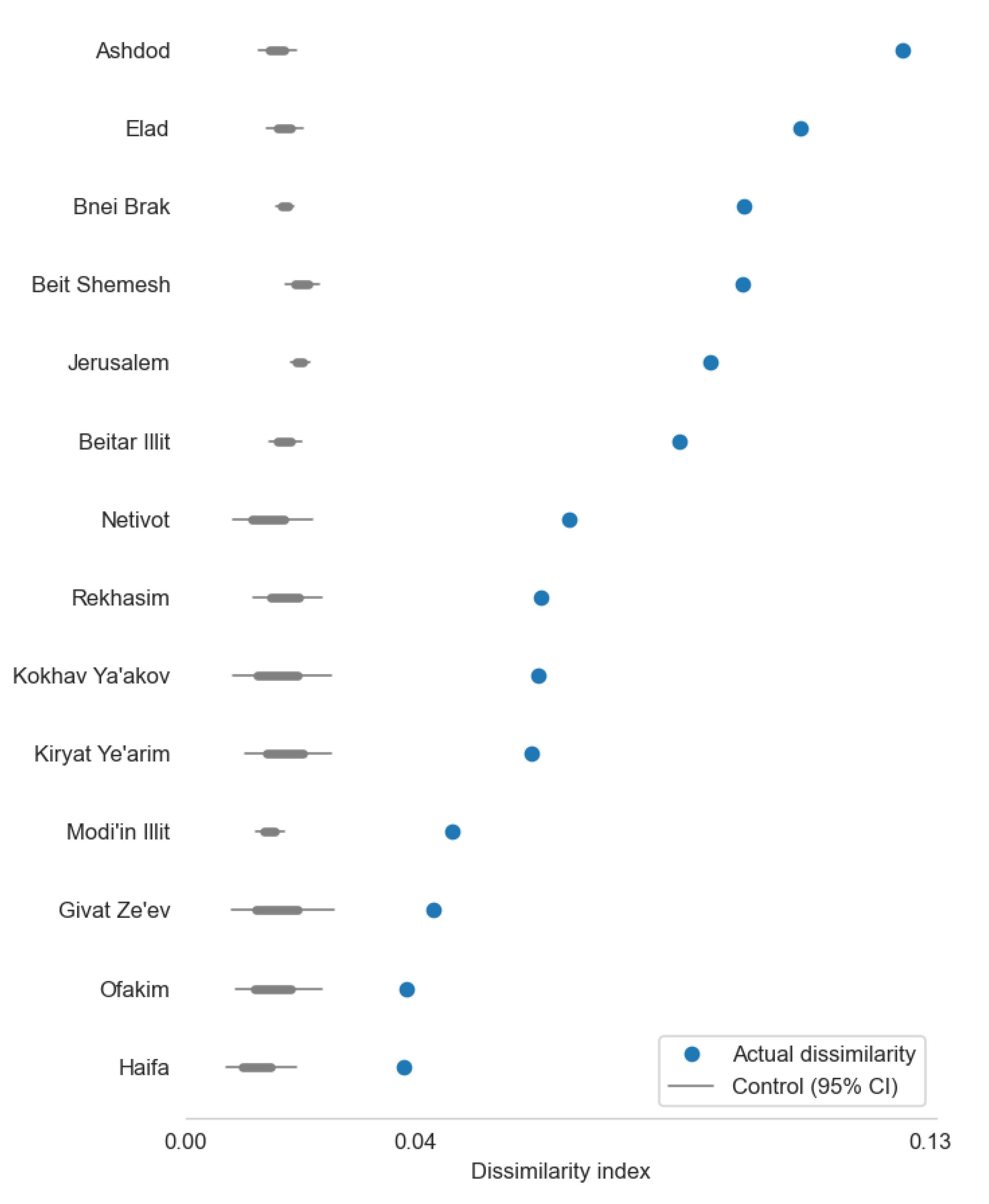
Figure 2.
Spearman correlation between dissimilarity index and demographic variables in Israel’s ultra-Orthodox communities. Scatter plots show relationships between the dissimilarity index and various metrics (as indicated by the subgraph titles). The color of the plots indicates whether p-values are below 0.05, with corrected values using the Benjamini-Yekutieli method shown in parentheses. Shaded regions represent 95% confidence intervals for the regression lines.
Figure 2.
Spearman correlation between dissimilarity index and demographic variables in Israel’s ultra-Orthodox communities. Scatter plots show relationships between the dissimilarity index and various metrics (as indicated by the subgraph titles). The color of the plots indicates whether p-values are below 0.05, with corrected values using the Benjamini-Yekutieli method shown in parentheses. Shaded regions represent 95% confidence intervals for the regression lines.
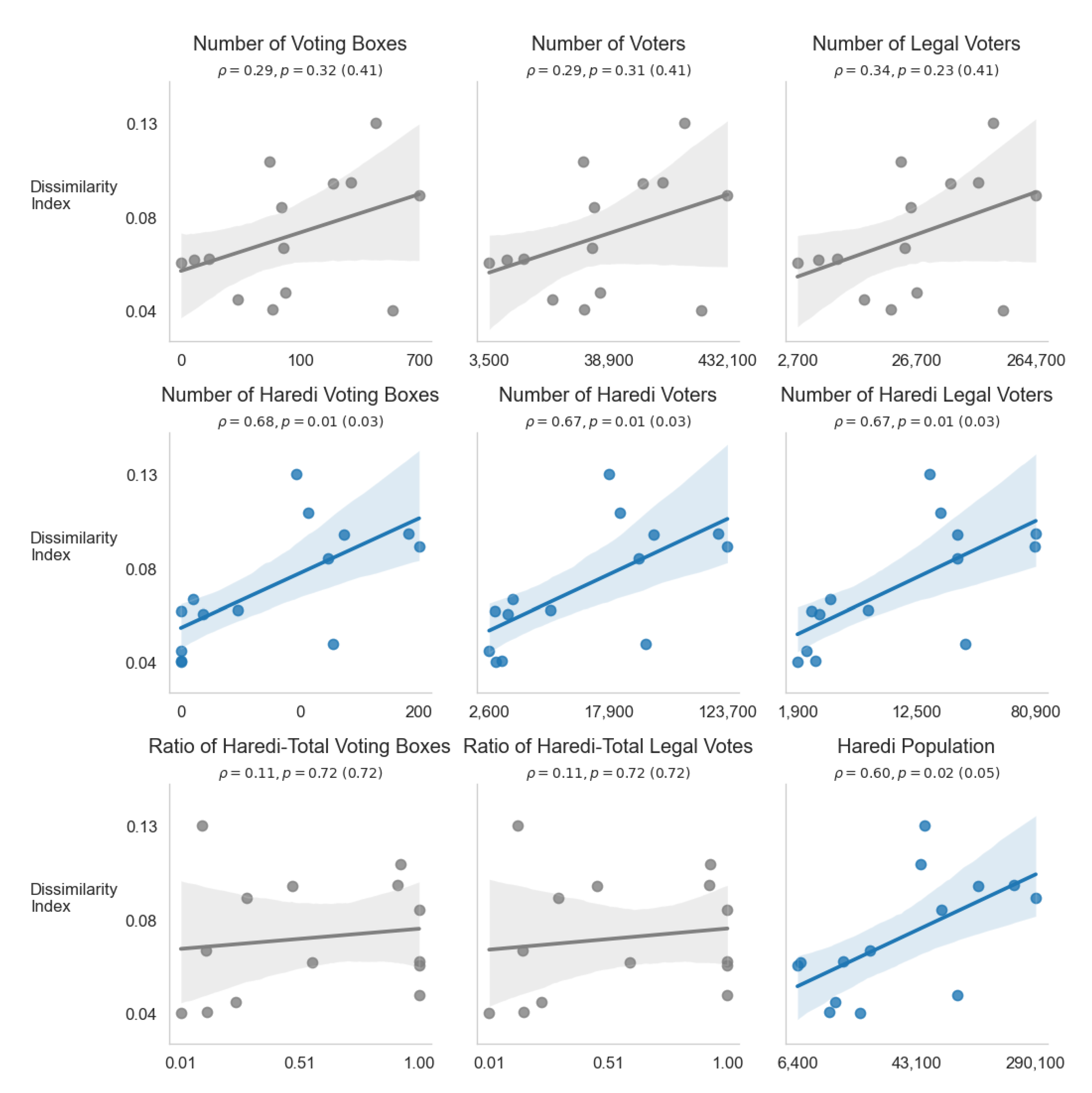

Table 1.
Key metrics for ethnic segregation in Haredi-majority areas in Israel. The table displays dissimilarity index values, voting data, and population estimates for cities with significant Haredi populations. Data in the “Haredi Population” and “Fraction of Haredim Within the City Population” columns are based on Israel Democracy Institute estimations for 2023, while all other data are derived from the 25th Knesset voting data, unless specified otherwise.
Table 1.
Key metrics for ethnic segregation in Haredi-majority areas in Israel. The table displays dissimilarity index values, voting data, and population estimates for cities with significant Haredi populations. Data in the “Haredi Population” and “Fraction of Haredim Within the City Population” columns are based on Israel Democracy Institute estimations for 2023, while all other data are derived from the 25th Knesset voting data, unless specified otherwise.
| City Name | DissimilarityIndex | VotingBoxes | HarediVoting Boxes | HarediLegal Votes | HarediPopulation | % of Haredim Withinthe City Population | ||
|---|---|---|---|---|---|---|---|---|
| Ashdod | 0.125 | 302 | 30 | 15,277 | 48,626 | 21% | ||
| Elad | 0.107 | 39 | 36 | 18,231 | 46,058 | 93% | ||
| Bnei-Brak | 0.097 | 187 | 170 | 80,933 | 202,959 | 93% | ||
| Beit-Shemesh | 0.097 | 133 | 63 | 23,530 | 115,398 | 75% | ||
| Jerusalem | 0.092 | 706 | 202 | 79,019 | 290,090 | 30% | ||
| Beitar Illit | 0.086 | 49 | 49 | 23,688 | 63,606 | 99% | ||
| Netivot | 0.067 | 51 | 6 | 3,221 | 20,532 | 44% | ||
| Rekhasim | 0.062 | 12 | 12 | 5,837 | 13,295 | 94% | ||
| Kokhav Ya’akov | 0.062 | 9 | 5 | 2,391 | 6,708 | 69% | ||
| Kiryat Ye’arim | 0.060 | 7 | 7 | 2,703 | 6,390 | 98% | ||
| Modi’in Illit | 0.046 | 53 | 53 | 26,655 | 83,168 | 100% | ||
| Givat Ze’ev | 0.043 | 21 | 5 | 2,215 | 11,724 | 56% | ||
| Ofakim | 0.039 | 41 | 5 | 2,568 | 10,716 | 30% | ||
| Haifa | 0.038 | 424 | 5 | 1,926 | 17,332 | 6% |
Disclaimer/Publisher’s Note: The statements, opinions and data contained in all publications are solely those of the individual author(s) and contributor(s) and not of MDPI and/or the editor(s). MDPI and/or the editor(s) disclaim responsibility for any injury to people or property resulting from any ideas, methods, instructions or products referred to in the content. |
© 2024 by the authors. Licensee MDPI, Basel, Switzerland. This article is an open access article distributed under the terms and conditions of the Creative Commons Attribution (CC BY) license (http://creativecommons.org/licenses/by/4.0/).
Copyright: This open access article is published under a Creative Commons CC BY 4.0 license, which permit the free download, distribution, and reuse, provided that the author and preprint are cited in any reuse.