

Submitted:
25 November 2024
Posted:
26 November 2024
You are already at the latest version
Abstract
In this study, we provide an exact solution to the Lindblad master equation that describes the interaction of two quantized electromagnetic fields in a decaying cavity, coupled to a thermal reservoir at finite temperature. The solution is obtained using the superoperator technique, leveraging commutation relations to express the exponential of the Lindblad operators as a product of exponentials. This method allows for the solution to be directly applied to any initial condition of the system, offering a versatile approach to a wide range of configurations. To demonstrate its utility, we explore the case where the field modes are initially in non-entangled coherent states and investigate how the interaction with the reservoir affects the preservation or modification of the non-entanglement feature over time.
Keywords:
Lindblad master equation
; superoperators
; entanglement
1. Introduction
The study of quantum systems in optical cavities has played a pivotal role in the advancement of quantum optics [1,2]. Optical cavities provide a controlled environment that enables exploration of non-classical behaviors of quantized electromagnetic fields, making them ideal platforms for observing phenomena such as spontaneous emission, quantum decoherence, and system thermalization [3,4,5,6]. In the absence of dissipation, the field modes within these cavities remain isolated and their dynamics can be accurately described using the Schrödinger equation [7,8,9,10,11,12]. However, when the cavity experiences decay and interacts with a thermal reservoir, the system undergoes irreversible processes, such as dissipation and decoherence, requiring the use of the Lindblad master equation to describe its time evolution [13,14,15].
Although the Lindblad master equation is a powerful tool for modeling open quantum systems, obtaining exact solutions is often an intractable task. Recent advances, however, have employed techniques based on superoperators and non-unitary transformations to derive exact solutions for systems comprising two decaying field modes, both at zero and finite temperatures [16,17]. These studies have shown that, in fact, at zero temperature, the dynamics of the system is dominated solely by cavity dissipation, while at finite temperatures, thermal excitations from the reservoir introduce significant modifications [17].
On the other hand, entanglement stands out due to its fundamental role in quantum technologies such as quantum computing, cryptography, and communication [18,19,20,21]. Entangled states arise from the interaction of quantized fields and exhibit correlations that challenge classical explanations, while also being highly susceptible to environmental interactions, which can induce quantum decoherence and even lead to loss of entanglement as the system interacts with a thermal reservoir [4,22]. This sensitivity underscores the importance of understanding how entangled and unentangled states evolve under dissipative conditions, as well as how the system transitions between quantum and classical regimes [23,24].
This work aims to provide a detailed analysis of the Lindblad master equation describing the interaction of two quantized field modes in an optical cavity coupled to a thermal reservoir. Using the superoperator formalism, we investigate how the initial states of the system—entangled or otherwise—affect its temporal evolution under thermal dissipation. In Section 2, we introduce the theoretical framework that describes the physical system and the Lindblad equation governing its dynamics. Section 3 details the solution methodology, employing superoperator techniques to express the evolution operator in terms of commutation relations. In Section 4, we apply the derived solution to analyze the time evolution of an initially unentangled coherent state. In Section , we present and discuss the results obtained, evaluating the persistence or alteration of the entanglement. Finally, Section 5 summarizes the main findings and outlines potential directions for future research.
2. Lindblad Master Equation
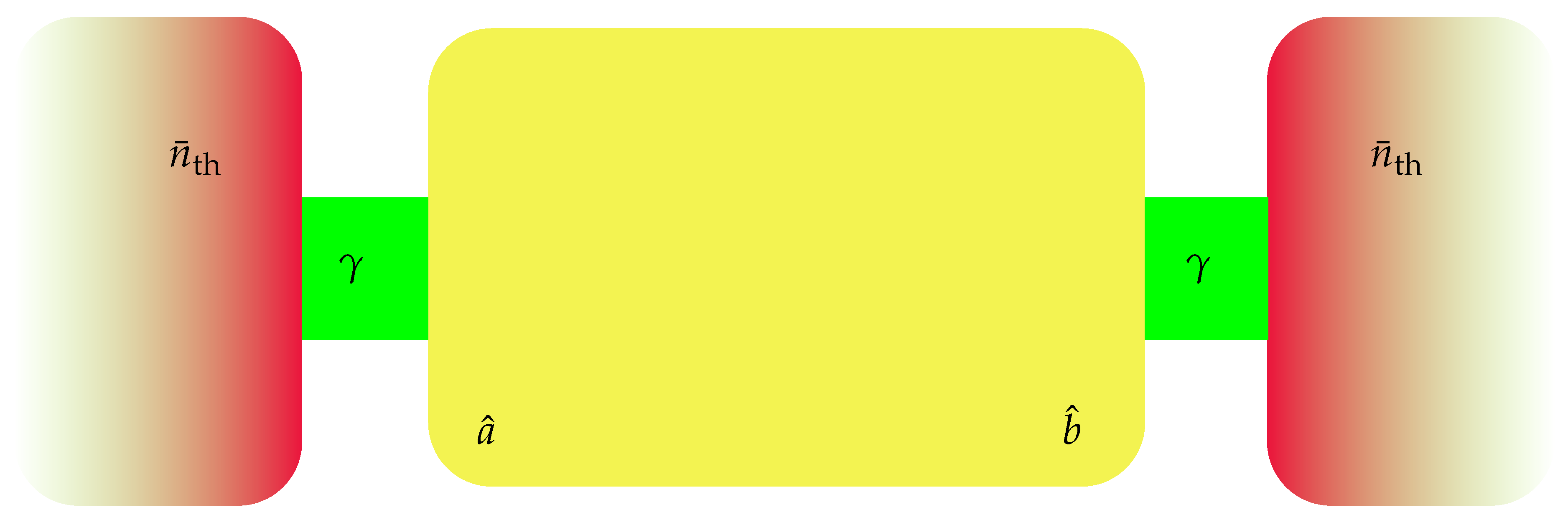
Consider the interaction between two quantized fields, denoted by and , each subject to Markovian decay processes with a common loss rate, . Both fields are coupled to a thermal reservoir characterized by an average thermal excitation number, , as shown in Figure 1.
The Markovian dynamics of the reduced density matrix, , in the interaction picture is described by the Lindblad master equation [13,14,15]
where represents the coherent interaction between the two fields or light modes. Here, () and () are the annihilation (creation) operators for each mode, and g denotes the coupling strength between the two bosonic modes [7,8,9,10,11,12]. The terms , with , represent the Lindblad superoperators, also known as the Lindbladian for the decay processes of each field. The Lindbladian is defined as:
The Lindbladian describes how the bosonic system interacts with the thermal environment, capturing both the loss and gain of excitations. The first term accounts for the loss of excitations due to the interaction with the environment, where the factor represents the total number of excitations, including those induced by the thermal reservoir. This dissipation is modeled through the annihilation operators , with . The second term captures the gain of thermal excitations, with representing the average number of excitations in equilibrium, and the creation operators modeling this gain. Together, these terms offer a comprehensive description of the dynamics of the system influenced by both the mutual interaction and the thermal environment. It is also evident that at zero temperature, where , the Eq. (1) reduces to the case where only decay is present, as analyzed in [16].
3. Solution to the Lindblad Master Equation
In order to solve the Lindblad master equation (1), it is important to note that, although the Lindbald operators individually do not commute with the interaction term, surprisingly, the sum of the Lindblad superoperators and commutes with the superoperator , that is,
and, obviously, the Lindblad superoperators commute with each other. From this, we can derive the formal solution to the Lindblad master equation (1), given an initial condition , as
This solution implies that we must apply the exponential functions of the superoperators to the initial condition in some manner. This is far from straightforward, as each superoperator is composed of a product or sum of operators. To demonstrate how these can be applied, we need to separate each exponential of the superoperators in a certain way. Therefore, we will show in detail how to separate each of these superoperators as follows.
3.1. Decomposition of the First Exponential
To apply the first exponential term to an arbitrary initial condition , it is necessary to decompose or separate it in a way that allows its effective application. For this purpose, we define the operators
which leads to the relation
3.2. Decomposition of the Second and Third Exponentials
The application of the second and third exponentials, with , corresponds to the dynamics of the modes and , respectively. Although their roles are analogous, the challenge lies in decomposing the Lindbladian exponential . To achieve this, we rewrite the Lindbladian operator , defined in (2), in the following form [17,25,26,27]
where we have used the identity and defined the following superoperators [17,26,27,28]
This reformulation allows us to express the Lindbladian exponential as
In this form, the term corresponds to a straightforward exponential decay factor, while the more intricate dynamics is encapsulated in the exponential operator .
It is easy to show that these superoperators satisfy the commutation relations of the algebra, given by
Based on these commutation relations, we propose an ansatz to separate the sum of the superoperators in (11), expressed as a product of exponentials involving the superoperators. It is important to note that the order of application of these operators can be chosen freely. However, for simplicity and to facilitate the application of the solution to initial conditions where the field modes are in coherent states, it is convenient to act first with powers of the annihilation operator, represented by the superoperator , and finally with powers of the creation operator, represented by . This leads to the following ansatz:
Taking the time derivative of (11) and (13), equating terms, and solving the resulting system of coupled equations, we obtain the following solutions [27]
Substituting these results into (13), we obtain the final solution to the Lindblad master equation, as given in (4). This result holds for both and , as their action is analogous. Importantly, this solution is now ready to be applied to any initial condition of the cavity, making it particularly useful for studying a variety of quantum systems.
4. Time Evolution of Non-Entangled Coherent States
In this section, we analyze the temporal evolution of a system consisting of two field modes initially prepared in a non-entangled state described by
This initial condition serves as the basis for studying how nonentangled coherent states evolve under the influence of the Lindblad dynamics, particularly focusing on the effects of dissipation and thermalization in the presence of a thermal reservoir.
4.1. Action of the First Exponential Operator
We begin by applying the first exponential operator, as expressed in Eq. (7). Using the results of Eqs. (8) and (A4), along with the property (where is the number operator), we find that the transformed state evolves as
Using the transformation derived from Eq. (A6), we map the evolved state back to the original field modes and . This yields the following expression for the state after the application of the first exponential operator
where
This result demonstrates how the initial nonentangled state evolves under the influence of the first exponential operator, effectively incorporating the interactions between the modes. The transformed coherent states, and , now reflect the effects of the interaction parameters and the temporal evolution while preserving the nonentangled structure of the system. This shows that the action of the operator transforms the initial state into another nonentangled state, with its coherent amplitudes modified by the dynamics of the system. This property is crucial for understanding the subsequent evolution of the system under dissipation and thermal excitation.
4.2. Action of the Second and Third Exponential Operators
As mentioned above, since the decay rate and the number of thermal excitations in the reservoir are the same for each mode in the cavity, the action of the exponential operators of the Lindblad superoperators and is practically identical. Therefore, it is sufficient to derive the results for a single mode (for example, for the operator ) and then perform the tensor product with the other mode ().
Thus, we are now interested in showing how to apply the solution (13) to the previous result given by Eq. (17). To do this, we will use the following results (for a more detailed derivation, the reader may refer to references [7,26,27]):
where , , and is the displaced number operator [7,8,9,10,11,12].
Finally,
Note that as , and . Therefore, we recover the probability distribution associated with a thermal distribution
5. Conclusions
In this study, we have derived an exact solution to the Lindblad master equation describing the interaction of two electromagnetic field modes in a decaying cavity coupled to a thermal reservoir at finite temperature. The results show that when the system begins in an entangled coherent state, the entanglement is preserved throughout the temporal evolution, even in the presence of decay and finite temperature, highlighting the robustness of entangled states against certain types of dissipation. In contrast, when the system starts in a nonentangled coherent state, no entanglement is generated during the evolution, and the system remains nonentangled. The final state is not entangled and its coherent nature is relatively preserved as a mixture of displaced number states, albeit modified by decay and environmental effects.
These findings have significant implications for the study of dissipative quantum systems, particularly in fields such as quantum optics and quantum computing, where the preservation of entanglement is crucial for the advancement of quantum technologies. Future work will aim to extend the analysis to more complex systems, incorporating additional interactions in the cavity and variations in environmental conditions.
Author Contributions
All authors contributed equally to each of the requirements necessary for the elaboration of this manuscript. All authors have read and agreed to the published version.
Funding
This research received no external funding.
Institutional Review Board Statement
Not applicable.
Informed Consent Statement
Not applicable.
Data Availability Statement
The data presented in this study are available on request from the corresponding author.
Acknowledgments
L. Hernández-Sánchez acknowledges the Instituto Nacional de Astrofísica, Óptica y Electrónica (INAOE) for the collaboration scholarship granted and the Consejo Nacional de Humanidades, Ciencias y Tecnologías (CONAHCYT) for the SNI Level III assistantship (CVU No. 736710).
Conflicts of Interest
The authors declare no conflicts of interest.
Appendix A. Properties and Representation of Non-Entangled Coherent States
It is well-known that the Glauber displacement operator [29,30] defines coherent states as:
where , and represents the vacuum state [7,8,9,10,11,12].
A state composed of two independent coherent states, (associated with mode ) and (associated with mode ), can be written as a non-entangled state of the form [31]
Using the definitions for the operators and , introduced in Eq. (5), the product of the displacement operators can be rewritten as
Thus, the state in Eq. (A2) can be expressed as
Similarly, if we introduce a relative phase between the components of the state, it becomes
which can be rewritten in terms of the original modes and as
References
- Haroche, S.; Raimond, J.M. Exploring the Quantum: Atoms, Cavities, and Photons; Oxford University Press, 2006. [CrossRef]
- Garrison, J.C.; Chiao, R.Y. Quantum Optics; Oxford University Press, 2008. [CrossRef]
- Meschede, D.; Walther, H.; Müller, G. One-Atom Maser. Phys. Rev. Lett. 1985, 54, 551–554. [Google Scholar] [CrossRef] [PubMed]
- Dalibard, J.; Castin, Y.; Mølmer, K. Wave-function approach to dissipative processes in quantum optics. Phys. Rev. Lett. 1992, 68, 580–583. [Google Scholar] [CrossRef] [PubMed]
- Scully, M.O.; Zubairy, M.S. Quantum Optics; Cambridge University Press: Cambridge, 1997. [Google Scholar] [CrossRef]
- Gardiner, C.W.; Zoller, P. Quantum Noise: A Handbook of Markovian and Non-Markovian Quantum Stochastic Methods with Applications to Quantum Optics, 3rd ed.; Springer, 2004.
- Louisell, W.H. Quantum Statistical Properties of Radiation; John Wiley & Sons, Inc.: New York, 1990. [Google Scholar]
- Fox, M. Quantum Optics: An Introduction; Oxford Master Series in Physics, OUP Oxford, 2006.
- Klimov, A.B.; Chumakov, S.M. A Group-Theoretical Approach to Quantum Optics; John Wiley & Sons, Ltd, 2009. [CrossRef]
- Moya-Cessa, H.M.; Soto-Eguibar, F. Introduction To Quantum Optics; Rinton Press, 2011.
- Agarwal, G. Quantum Optics; Quantum Optics, Cambridge University Press, 2013.
- Gerry, C.; Knight, P. Introductory Quantum Optics; Cambridge University Press, 2004. [CrossRef]
- Carmichael, H.J. An open systems approach to quantum optics; Springer-Verlag, 1993.
- Breuer, H.P.; Petruccione, F. The theory of open quantum systems; Oxford University Press on Demand, 2002.
- Manzano, D. A Short Introduction to the Lindblad Master Equation. AIP Advances 2020, 10, 025106. [Google Scholar] [CrossRef]
- Hernández-Sánchez, L.; Ramos-Prieto, I.; Soto-Eguibar, F.; Moya-Cessa, H.M. Exact solution for the interaction of two decaying quantized fields. Opt. Lett. 2023, 48, 5435–5438. [Google Scholar] [CrossRef] [PubMed]
- Hernández-Sánchez, L.; Bocanegra-Garay, I.A.; Ramos-Prieto, I.; Soto-Eguibar, F.; Moya-Cessa, H.M. 2024; arXiv:quant-ph/2410.08428].
- Horodecki, R.; Horodecki, P.; Horodecki, M.; Horodecki, K. Quantum entanglement. Rev. Mod. Phys. 2009, 81, 865–942. [Google Scholar] [CrossRef]
- Nielsen, M.A.; Chuang, I.L. Quantum Computation and Quantum Information: 10th Anniversary Edition; Cambridge University Press: Cambridge, 2010. [Google Scholar] [CrossRef]
- Zou, N. Quantum Entanglement and Its Application in Quantum Communication. J. Phys.: Conf. Ser. 2021, 1827, 012120. [Google Scholar] [CrossRef]
- Duarte, F.J.; Taylor, T.S. Quantum Entanglement Engineering and Applications; IOP Publishing, 2021. [CrossRef]
- Zurek, W.H. Decoherence and the Transition from Quantum to Classical. Phys. Today 1991, 44, 36–44. [Google Scholar] [CrossRef]
- Bouwmeester, D.; Pan, J.W.; Mattle, K.; Eibl, M.; Weinfurter, H.; Zeilinger, A. Experimental quantum teleportation. Nature 1997, 390, 575–579. [Google Scholar] [CrossRef]
- Wootters, W.K. Entanglement of Formation of an Arbitrary State of Two Qubits. Phys. Rev. Lett. 1998, 80, 2245–2248. [Google Scholar] [CrossRef]
- Barnett, S.M.; Knight, P.L. Dissipation in a fundamental model of quantum optical resonance. Phys. Rev. A 1986, 33, 2444–2448. [Google Scholar] [CrossRef] [PubMed]
- Phoenix, S.J.D. Wave-packet evolution in the damped oscillator. Phys. Rev. A 1990, 41, 5132–5138. [Google Scholar] [CrossRef] [PubMed]
- Arévalo-Aguilar, L.M.; Moya-Cessa, H. Solution to the master equation for a quantized cavity mode. Quantum Semiclass. Opt. 1998, 10, 671. [Google Scholar] [CrossRef]
- Arévalo-Aguilar, L.M.; Moya-Cessa. , H. Cavidad con pérdidas: una descripción usando superoperadores. Rev. Mex. Fis. 1995, 42, 675–683. [Google Scholar]
- Glauber, R.J. The Quantum Theory of Optical Coherence. Phys. Rev. 1963, 130, 2529–2539. [Google Scholar] [CrossRef]
- Glauber, R.J. Coherent and Incoherent States of the Radiation Field. Phys. Rev. 1963, 131, 2766–2788. [Google Scholar] [CrossRef]
- Mar-Sarao, R.; Soto-Eguibar, F.; Moya-Cessa, H. Many fields interaction: Beam splitters and waveguide arrays. Ann. Phys. 2011, 523, 402–407. [Google Scholar] [CrossRef]
Figure 1.
Schematic representation of two bosonic fields, and , both coupled to the same thermal reservoir with average thermal photon number . The fields experience decay at the same rate, denoted by , reflecting identical dissipation mechanisms for each field.
Figure 1.
Schematic representation of two bosonic fields, and , both coupled to the same thermal reservoir with average thermal photon number . The fields experience decay at the same rate, denoted by , reflecting identical dissipation mechanisms for each field.
Disclaimer/Publisher’s Note: The statements, opinions and data contained in all publications are solely those of the individual author(s) and contributor(s) and not of MDPI and/or the editor(s). MDPI and/or the editor(s) disclaim responsibility for any injury to people or property resulting from any ideas, methods, instructions or products referred to in the content. |
© 2024 by the authors. Licensee MDPI, Basel, Switzerland. This article is an open access article distributed under the terms and conditions of the Creative Commons Attribution (CC BY) license (https://creativecommons.org/licenses/by/4.0/).
Copyright: This open access article is published under a Creative Commons CC BY 4.0 license, which permit the free download, distribution, and reuse, provided that the author and preprint are cited in any reuse.


