Preprint
Article

This version is not peer-reviewed.

Analysis of Multifractal Cross-Correlation Characteristics and Information Flow of Typical Stock Prices in the U.S. Industry Sectors

A peer-reviewed article of this preprint also exists.

Submitted:

25 November 2024

Posted:

26 November 2024

You are already at the latest version

Abstract

This paper investigates multifractal cross-correlations and information flow among daily closing prices of stock-typical U.S. industry sectors, combining multifractal detrended cross-correlation analysis (MFDCCA), transfer entropy (TE), and complex network methods. Firstly, the ensemble empirical mode decomposition (EEMD) method estimates the dominant frequency. Then, the DCCA coefficient is computed, revealing that JPM exhibits nonlinear cross-correlations with all seven other stocks. Secondly, a more detailed examination using MFDCCA elucidates fractal characteristics. The experimental results reveal long-range and multiple fractal characteristics in the cross-correlations between JPM and the remaining seven stocks. Notably, the strongest multifractal cross-correlation is observed between JPM and XOM, while the weakest is between JPM and SPG. Thirdly, transfer entropy is calculated for each pair of the eight stocks to research the direction of information flow. The analysis reveals bidirectional information transfers, which are notable for the high information transfer from PG to XOM, as indicated by the transfer entropy matrix. Finally, utilizing a complex network approach to visualize the transfer entropy results, it is evident that AAPL possesses the most significant information outflow, while XOM exhibits the most substantial information inflow. These findings present critical insights beneficial for portfolio decision-making in the stock markets.

Keywords: 
;  ;  ;  ;  

1. Introduction

Stock markets are generally considered a barometer of the economy, while the U.S. stock markets play a significant role in the global economy. As one of the world’s largest financial markets, the U.S. stock markets change impact the domestic economy and have far-reaching implications for the global economic landscape [1,2,3,4]. Moreover, industry sectors exhibit unique characteristics and cross-correlations throughout various economic cycles. Understanding the information flow between stocks in these industry sectors can uncover potential market trends and investment opportunities [5,6,7]. Therefore, studying the information flow of typical industry sector stocks in the U.S. is essential for helping investors comprehend market dynamics, optimize asset allocation, and effectively manage investment risks.
Presently, various methodologies have been suggested to elucidate the cross-correlation dynamics across stock markets, including basic correlation analysis [8,9], Granger causality [10], and mutual information analysis [11,12,13]. Each of these methodologies possesses distinct advantages and limits. Simple correlation analysis is comprehensible, nevertheless, it is solely relevant to linear connections [14]. Furthermore, temporal aggregation may yield misleading consequences for Granger causality tests, as Granger causality has traditionally relied on the assumption of a linear vector autoregressive (VAR) model. [15,16]. Mutual information does not rely on specific distributions of the variables, making it applicable to various data types; however, it is sensitive to noise in the data and may require significant computational resources [17].
The multifractal theory is particularly effective in capturing the dynamic behaviors and patterns present in financial market [18]. Peng et al. [19] initially proposed employing Detrended Fluctuation Analysis (DFA) to investigate the detrended autocorrelation and self-similarity in univariate non-stationary signals. This method solely demonstrates monofractal properties. Kantelhardt et al. [20] proposed Multifractal Detrended Fluctuation Analysis (MFDFA), an extended variant of Detrended Fluctuation Analysis (DFA), to capture the multifractal characteristics of a sequence. Nonetheless, MFDFA applies solely to individual time series and cannot detect cross-correlation between two time series. Thus, Podobnik and Stanley [21] introduced Detrended Cross-Correlation Analysis (DCCA) as a technique for detecting detrended cross-correlation between two signals. Zhou [22] integrated MFDFA and DCCA to introduce Multifractal Detrended Cross-Correlation Analysis (MFDCCA), a technique for detecting multifractal features in the cross-correlation of two non-stationary signals.
Multifractal Detrended Cross-Correlation Analysis is widely applied in various fields. In the domain of natural sciences, Shadkhoo et al. [23] employed the MultiFractal Detrended Cross-Correlation Analysis (MFDCCA) method to examine the cross-correlation of temporal and spatial interevent seismic data, revealing that these time series are interconnected across multiple scales and exhibit multifractal behaviour. Zhuang et al. [24] performed a multifractal detrended cross-correlation analysis in the crude oil market, revealing power-law cross-correlations between the carbon and crude oil markets. Gong and Jia [25] employ Multifractal Detrended Cross-Correlation Analysis (MFDCCA) to investigate the multifractal characteristics of the cross-correlation between Tesla stock price (TSLA) and Brent crude oil price, as well as between TSLA and other NEV stocks (excluding TSLA). The experimental results indicate persistent durability and diverse fractal characteristics in the cross-correlations. In econometrics, Ahmed et al. [26] investigate the nonlinear framework and dynamic variations in the multifractal characteristics of the cross-correlation between the financial stress index (FSI) and four major commodities indices. Their analysis indicates that all selected commodity market indices exhibit cross-correlations with the FSI. Acikgoz et al. [27] employ multifractal detrended cross-correlation analysis (MFDCCA) on return and volatility series, revealing that green bonds and commodities display multifractal properties. The analysis demonstrates long-range power-law cross-correlations between the two markets. MFDCCA is utilized in the cryptocurrency industry as well. Ma et al. [28] investigated the multifractality between Bitcoin and the US Economic Policy Uncertainty Index, revealing a robust multifractal cross-correlation. MFDCCA is predominantly utilized in the stock markets. Zhao et al. [29] demonstrated that MFDCCA is among the most successful techniques for identifying long-range cross-correlation between two non-stationary variables, illustrating the multifractal properties of the Chinese stock markets. Yin et al. [30] examine the multifractal characteristics of cross-correlations among these financial time series with the MFDCCA method. Gu et al. [31] identified multifractal cross-correlations between the SSEC and SZSE and between the DJI and NASDAQ, utilizing the EEMD-based MFDCCA methodology for their analysis. The cross-correlation between the two Chinese stocks is more robust than the two US stocks.
While MFDCCA proficiently captures the cross-correlations of a bivariate time series, it cannot assess the directional flow of information. Transfer entropy [32] quantifies the direction and magnitude of information flow between distinct time series, offering enhanced insights. Consequently, integrating MFDCCA and transfer entropy methodologies facilitates a more thorough comprehension of the information flow between industry sectors and its underlying impact mechanisms.
Transfer entropy is a commonly employed technique for examining causality and information flow, adeptly quantifying the asymmetrical causal connections across time series through probability analysis. This approach, first developed by Schreiber in 2000, accurately tracks and quantifies information flow between nonlinear systems while discerning the direction of information transfer. The transfer entropy approach has been extensively utilized across several domains, such as biology [33], climate science [34], and neurology [35], especially within stock markets. Sandoval [36] employed Transfer Entropy to examine the causal links among the stocks of the 197 major global financial sector corporations from 2003 to 2012, evaluating which companies were most affected by the stocks of nations in crisis. Wang et al. [37] investigate the causal relationships among the values of Chinese mining equities over various time frames. The results demonstrate an asymmetric and time-dependent causative relationship between mining stocks and subindustries, with the strength of this causal association intensifying during periods of economic expansion. This article employs the transfer entropy approach to measure the information flow across typical equities across eight industry sectors in the U.S. This approach is especially efficacious for assessing causal linkages in nonlinear time series, specifically about stock price time series.
Characterizing dynamical processes in time-dependent complex systems using observed time series is essential across disciplines such as mathematics, chemistry, economics, and social sciences. Diverse methodologies, such as complexity measures [38], multiscale entropy [39], time-frequency representation [40], and recurrence plots [41], have been established for the analysis of time series. As system complexity escalates, articulating dynamic behavior from time series data becomes challenging, and conventional time series analysis techniques struggle to address the particular demands of this heightened complexity. A novel multidisciplinary methodology employing complex networks has arisen to characterize complex systems [42,43,44,45,46]. This entails mapping time series into intricate networks to examine the system’s dynamical behavior by analyzing their topological structures.
Although there is extensive literature on cross-correlations between individual stocks, research on inter-industry correlations remains relatively limited. Oh et al. [50] investigated information flow across 22 industry sectors inside the Korean stock exchanges. Nevertheless, research investigating cross-correlations and information transfer among industry sectors in the U.S. stock markets is infrequent. This paper examines the cross-correlation and information flow among principal U.S. industry sectors to overcome the gap. The results will enhance comprehension of inter-industry relationships and the impact of information dissemination on investment choices and market dynamics.
The following sections of this paper are organized as follows: Section 2 introduces the main methods we used: MFDCCA, TE, complex networks; Section 3 presents the data sources, preliminary test statistics, and the EEMD preprocessing is applied to the data; Section 4 presents the empirical results; and Section 5 presents our conclusions.

2. Methodology

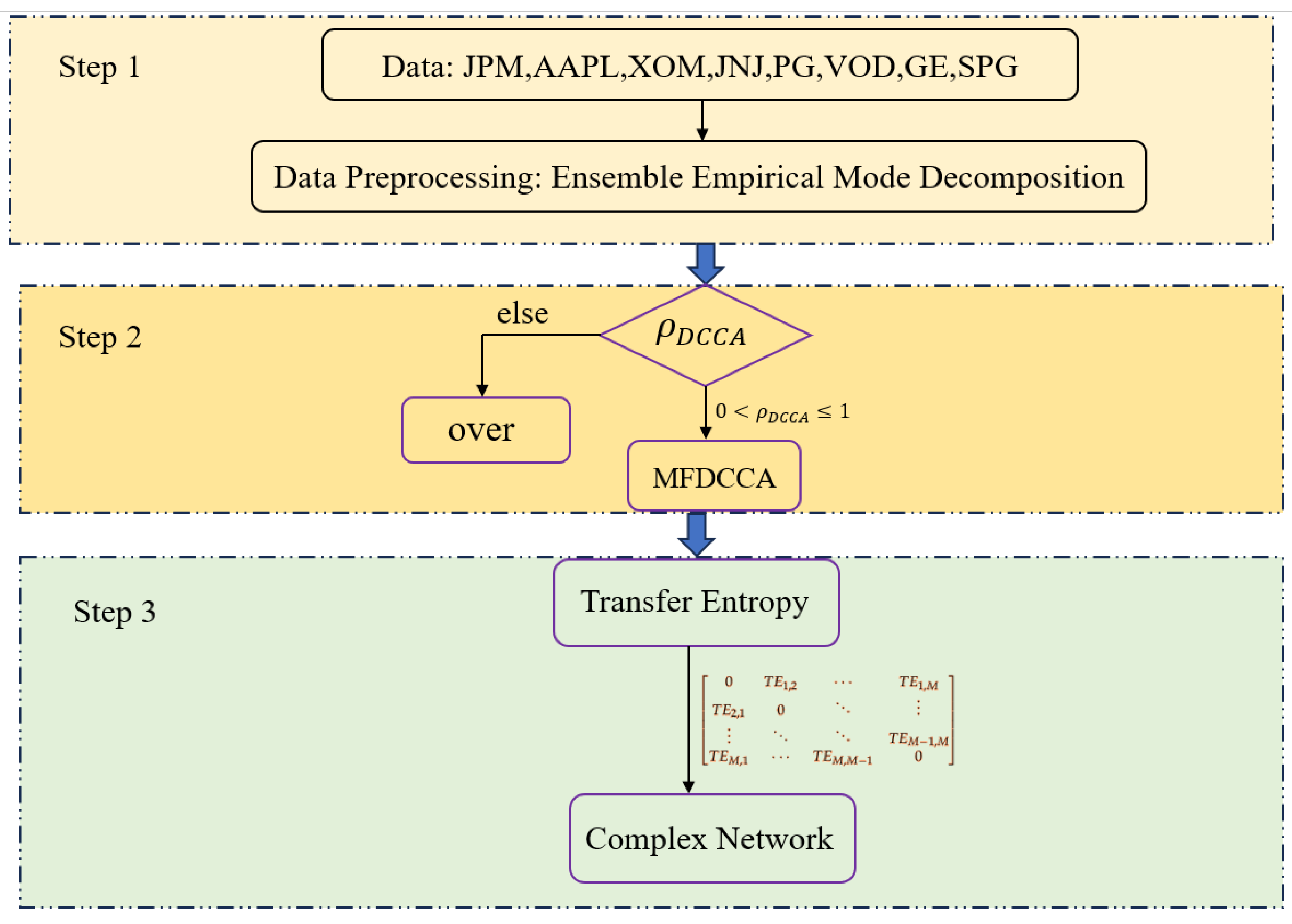
Owing to stock markets’ nonlinear and volatile nature, we utilized ensemble empirical mode decomposition (EEMD) [51] to denoise standard stock data from U.S. industry sectors and identify the principal patterns. After that, we employed the DCCA coefficient as per the research conducted by Podobnik et al. [52] to measure the cross-correlation associations. To accurately identify and quantify the multifractal cross-correlations of typical stocks within U.S. industry sectors, we subsequently utilized the Multifractal Detrended Cross-Correlation Analysis (MFDCCA) method to examine the multifractal cross-correlations between the financial sector and the remaining seven sectors. This paper employs a transfer entropy utilizing k-nearest neighbors to quantify the information flow across typical stocks across eight U.S. industry sectors, aiming to examine the uneven causation between these sectors. We developed a directed weighted complex network by considering stocks as nodes and employing transfer entropy values as weights. We displayed the transfer entropy matrix and studied various metrics within the network to determine the most significant information sources and recipients.
The general flow chart for this paper is as follows:
Figure 1. Algorithm flowchart of the paper
Preprints 140749 g001

2.1. Multifractal Detrended Cross-Correlation Analysis–MFDCCA

This paper utilizes the MFDCCA to examine the multifractal cross-correlations among typical equities from various industry sectors in the U.S. stock markets. The MFDCCA algorithm is delineated as follows:
Algorithm 1: MFDCCA Method
Step 1: Consider two time series x ( i ) and y ( i ) , i = 1 , 2 , , N , X ( i ) = i = 1 i ( x ( t ) x ¯ ) and Y ( i ) = i = 1 i ( y ( t ) y ¯ ) , where N is the length of the time series, x ¯ = 1 N t = 1 N x ( t ) , y ¯ = 1 N t = 1 N y ( t ) .
Step 2: Partition the profiles x ( i ) and y ( i ) into N s = N / s non-overlapping segments of uniform length s. As the series length N is not required to be a multiple of the specified time scale s, a brief segment near the conclusion of the profiles may remain. The identical method is reiterated from the other end to incorporate this segment of the original series. Consequently, 2 N s segments are acquired.
Step 3: For each segment ν , where ν = 1 , 2 , , 2 N s , the local trends X ˜ ( i ) and Y ˜ ( i ) are determined by least-squares linear regression of the series. Consequently, for each segment ν , where ν = 2 , , 2 N s , the covariance of the residuals is computed as follows: F 2 ( s , ν ) = 1 s i = 1 s | X ( ( v 1 ) s + i ) X ˜ ν ( i ) | · | Y ( ( v 1 ) s + i ) Y ˜ ν ( i )   F 2 ( s , ν ) = 1 s i = 1 s | X ( N ( v N s ) s + i ) X ˜ ν ( i ) | · | Y ( N ( v N s ) s + i ) Y ˜ ν ( i ) for each segment ν , ν = N s + 1 , N s + 2 , , 2 N s .
Step 4: Then, average over all segments to obtain the q-order fluctuation function. F q ( s ) 1 2 N s ν = 1 2 N s [ F 2 ( s , ν ) ] q 2 1 q , f o r a n y q 0 ,   F 0 ( s ) = exp 1 4 N s ν = 1 2 N s ln [ F 2 ( s , ν ) ] , f o r q = 0 , where the order q can take any real value. When q = 2 , the algorithm becomes the standard detrended cross-correlation analysis (DCCA).
Step 5: Ultimately, if two time series x ( i ) and y ( i ) exhibit long-range power-law cross-correlation, then F q ( s ) s H ( q ) , where H ( q ) is referred to as the generalized cross-correlation exponent.
In this context, H ( q ) represents a generalized cross-correlation exponent, calculable by Equation (1), specifically as the slope of the log-log plot of F q ( s ) against s:
F q ( s ) s H ( q ) log F q ( s ) = H ( q ) log ( s ) + log C
where C is the constant, and H ( q ) describes the scaling behavior of significant and minor fluctuations of positive and negative q, respectively. If the value of H ( q ) varies with q, the mutual correlation between the two-time series exhibits multifractality; if not, it is categorized as monofractal.When the scaling exponent H ( q ) > 0.5 , the cross-correlation between the two-time series is long-range, signifying that positive (or negative) fluctuations in one series are statistically likely to be followed by analogous positive (or negative) fluctuations in the other series. Conversely, when 0 < H ( q ) < 0.5 , an anti-persistent cross-correlation is present between two temporal time series. When H ( q ) = 0.5 , there is a lack of long-range cross-correlation between the two-time series. If the series x ( i ) and y ( i ) are identical, the MFDCCA method is equivalent to MFDFA.
One measure of multifractal properties is the Δ H . Larger values of Δ H indicate a stronger multifractal cross-correlation between two series.
Δ H ( q ) = H max ( q ) H min ( q )
Besides examining the log-log plot and the scaling exponent H ( q ) , further evidence must be investigated to substantiate the multifractal link between the two series. Zou and Zhang [53] propose investigating the Renyi exponent.
τ ( q ) = q H ( q ) 1
If the Renyi exponent exhibits a nonlinear increasing trend with increasing q, it can be considered that the two-time series have a multifractal cross-correlation relationship. Conversely, if the Renyi exponent shows a linear relationship with q, the two-time series are characterized as monofractal.
Another method to assess the multifractality of cross-correlation involves analyzing the singularity strength α and the multifractal spectrum f ( α ) . These values are computed through the Legendre transform.
α = τ = H ( q ) + q H ( q )
f ( α ) = q α τ ( q ) = q ( α H ( q ) ) + 1
In this context, α denotes the singularity strength or Hölder exponent. The multifractal spectrum f ( α ) is a concave function of the singularity strength α when multifractal cross-correlation is present. Another indicator for measuring the degree of multifractality is as follows:
Δ α = α m a x α m i n
The greater the Δ α , the more robust the multifractal cross-correlation between the two-time series.

2.2. Transfer Entropy Based on KNN

Before introducing transfer entropy, it is necessary to discuss mutual information, which was initially proposed by Shannon et al. [54] in 1948. Mutual information measures the extent of information exchanged between two random variables [55]. By calculating mutual information, one can identify the dependency relationships between variables. Mutual information can still reflect their association even when two variables do not exhibit a linear relationship. The mutual information of two sources, X and Y, can be defined as the quantity measured in bits per symbol:
I ( X ; Y ) = x X y Y p ( x , y ) log p ( x , y ) p ( x ) p ( y )
Furthermore, Kraskov et al. [56] introduced an enhanced estimation of mutual information I ( X ; Y ) utilizing entropy estimates obtained from k-nearest neighbor distances. The fundamental concept is depicted as follows:
Assume certain metrics are provided for the spaces spanned by X, Y, and Z = ( X , Y ) . Subsequently, we can order, for each point z i = ( x i , y i ) , i = 1 , , N , its neighbors based on the distance d i j = z i z j : d i j 1 d i j 2 d i j 3 . Comparable rankings can be conducted within the subspaces X and Y. The fundamental concept of [57,58,59] is to approximate H ( X ) based on the mean distance to the k-nearest neighbor, averaged across all x i . The estimation for MI is subsequently
I ( X ; Y ) = ψ ( k ) < ψ ( n x + 1 ) + ψ ( n y + 1 ) > + ψ ( N )
Here, ψ ( x ) is the digamma function, ψ ( x ) = Γ ( x ) 1 d Γ ( x ) / d x . It satisfies the recursion ψ ( x + 1 ) = ψ ( x ) + 1 / x and ψ ( 1 ) = C , where C = 0.577 215 6 is the EulerMascheroni constant. we count the number n x ( i ) of points x j whose distance from x i is strictly less than ϵ ( i ) / 2 , and similarly for y instead of x. We denote by the averages both over all i [ 1 , , N ] and over all realizations of the random samples.
= N 1 i = 1 N E [ ( i ) ] .
However, mutual information concerning the two random variables is symmetric and does not contain any directional sense. In contrast, transfer entropy is explicitly nonsymmetric, thereby reflecting the directionality of information flow, which addresses the limitations of mutual information. Schreiber introduced the Transfer Entropy (TE) approach [32] utilizing principles from information theory. It evaluates the information exchange between variables by investigating if the historical states of one variable might diminish the uncertainty regarding the future states of another variable. The TE method quantifies the non-equilibrium causal relationship between two-time series and effectively assesses the strength and asymmetry of coupling in dynamic systems [60]. Transfer Entropy is defined as follows:
T x y ( k , l ) = p ( y n + 1 , y n ( k ) , x n ( l ) ) log p ( y n + 1 | y n ( k ) , x n ( l ) ) p ( y n + 1 | y n ( k ) ) ,
where X and Y denote two weakly smooth Markov processes of degree k and j[61], x j ( k ) = ( X i , X i 1 , , X i k + 1 ) , y i ( l ) = ( Y i , Y i 1 , , Y i l + 1 ) based on the Markov property of financial time series, k = 1 and l = 1 in this paper [62]. So, the transfer entropy formula can be simplified to:
T x y = p ( y n + 1 , y n , x n ) log p ( y n + 1 | y n , x n ) p ( y n + 1 | y n ) ,
T y x information flow can be calculated as well.
Kaiser et al. [63] listed the equivalence relationships between transfer entropy and conditional mutual information.
T x y = I ( y n + 1 ; x n | y n )
Therefore, this paper employs the k-nearest neighbors method to estimate mutual information, and then utilizes Equation (12) to convert the results into transfer entropy.

2.3. Complex Networks

Complex networks are a method for studying the dynamic behaviour of systems by mapping time series into complex networks and exploring their topology. Consider a set of M time series defined as follows: X 1 = { x 11 , x 12 , , x 1 N } , X 2 = { x 21 , x 22 , , x 2 N } , X M = { x M 1 , x M 2 , , x M N } , where each sequence is of length N.Additionally, let A be an M * M adjacency matrix representing a complex network.
A = 0 ω 1 , 2 ω 1 , M ω 2 , 1 0 ω M 1 , M ω M , 1 ω M , M 1 0
where ω i j denotes the weight between node i and node j.This paper uses the transfer entropy matrix between two-time series as the network’s weight matrix. Thus, the matrix A can be expressed in the following form.
A = 0 T E 1 , 2 T E 1 , M T E 2 , 1 0 T E M 1 , M T E M , 1 T E M , M 1 0
Weighted networks are widely presented in many natural relationships and provide a meaningful representation of the architecture of many complex systems [64]. The best-known parameter for characterizing the network topology in complex networks is the clustering coefficient(CC) [65]. The clustering coefficient of a node in a network represents a numerical indicator of the nodes clustered with other neighboring nodes. We calculate the weighted network’s weighted clustering coefficient (WCC) based on Equation (15).
C i ω = j , k ω i j ω i k ω j k 1 / 3 k i ( k i 1 ) , k i 0 , 1
where C i ω represents the local weighted clustering coefficient of node i . k i represents the degree of node i, and N denotes the number of nodes. A node’s clustering coefficient reflects the network’s local connectivity at that point.
This paper also consider the weighted degree (WD), as well as the net transfer entropy (NTE) [66] metric in the context of transfer entropy. ω i n ( i ) represents the in-weighted degree of node i, calculated as: ω i n ( i ) = j ω j i ; ω o u t ( i ) represents the out-weighted degree of node i, calculated as: ω o u t ( i ) = j ω i j .The calculation formulas for WD and NTE are shown in Equations (16) and (17).
W D ( i ) = ω i n ( i ) + ω o u t ( i )
N E T ( i ) = ω o u t ( i ) ω i n ( i )
The weighted degree considers both the in-degree and out-degree of a node, reflecting the overall connection strength of the node within the network. A higher weighted degree indicates a more vigorous interaction intensity between the node and other nodes. Nodes with high-weighted degrees typically occupy central positions in the network and play essential roles. These nodes may serve as hubs or key players for information.
Net transfer entropy reflects the difference between the information flowing out of a node and the information flowing into it. A positive value indicates that the outflow of information exceeds the inflow, while a negative value suggests that the inflow exceeds the outflow. The sign of net transfer entropy can be used to determine the role of a node in information propagation. A positive value implies that the node may act as a source of information, while a negative value indicates that the node is more inclined to be a receiver of information.

3. Data Description and Preprocessing

3.1. Data Description

This paper investigates the multifractal cross-correlations and information flow among typical stocks from various industry sectors in the US. Specifically, we utilize daily closing price data from eight stocks to represent their respective major industry sectors: JPMorgan Chase (JPM) for the financial sector, Apple Inc. (AAPL) for the technology sector, ExxonMobil (XOM) for the energy sector, Johnson & Johnson (JNJ), Procter & Gamble (PG), Vodafone (VOD), General Electric (GE), and Simon Property Group (SPG) for the healthcare, consumer staples, telecommunications, industrial, and real estate sectors, respectively. For detailed information, see Table 2. These typical stocks are selected based on market share within their industry sectors. The stock data used in this paper is sourced from Yahoo Finance and downloaded via the Python library yfinance. The dataset encompasses daily closing price information from January 4, 2010, to October 14, 2024, totaling 3,720 observations.
Table 3 provides the descriptive statistics for the typical stocks in the U.S. industry sectors. All eight stocks exhibit kurtosis values below 3, indicating relatively flat distributions. VOD has the most minor standard deviation, suggesting lower price volatility for both the stock and the telecommunications sector, making it suitable for risk-averse investors. In contrast, AAPL has the highest standard deviation, indicating more significant price fluctuations in the technology sector, appealing to risk-seeking investors. JPM, AAPL, PG, and GE show positive skewness, with values greater than 0 but less than 1, reflecting a longer right tail and an upward bias, which implies relatively higher upside risks in the financial, technology, consumer staples, and industrial sectors. The remaining four stocks exhibit negative skewness, with values less than 0 but greater than -1, indicating a longer left tail and a downward bias, suggesting lower upside risks in the energy, healthcare, telecommunications, and real estate sectors. Additionally, the JB test’s p-values indicate that the data for these eight stocks is non-normally distributed.

3.2. Data Preprocessing

Multiple research studies have evidenced the stock market’s nonlinear and volatile characteristics [67,68]. Wu et al. [69] presented the ensemble empirical mode decomposition (EEMD), which effectively decomposes unstable and nonlinear signals. The recovered oscillations reliably represent the time series since EEMD operates purely a posteriori, with the decomposition process grounded in the local time scale of the time series. EEMD performs EMD many times to mitigate noise effects and incorporates Gaussian white noise into the original signal. The findings are subsequently averaged. This enhances the stability and accuracy of decomposition, addresses mode mixing, and maintains the advantages of EMD. The following are the steps of the EEMD algorithm:
Algorithm 2: EEMD Method
Step 1: Add a group of white noise ϵ ( t ) to form a new signal X ( t ) :
X ( t ) = x ( t ) + ϵ ( t )
Step 2: Perform EMD decomposition on X ( t ) to obtain n IMF components and a residual:
X ( t ) = i = 1 n I M F i + r
Step 3: Add N groups of different white noises to the original time series signal x ( t ) and
repeat the previous steps:
X i ( t ) = x ( t ) + ϵ i ( t ) , i ( 1 , N )
Step 4: After EMD decomposition, the IMFs of each group can be expressed as follows:
X i ( t ) = j = 1 n h i j + r i , i ( 1 , N )
Step 5: The average value of the decomposed IMFs is obtained as the final result:
h j ( t ) = 1 N i = 1 N h i j ( t ) , r ( t ) = 1 N i = 1 N r i ( t )
where h j ( t ) is the jth IMF component obtained by EEMD decomposition of the
original series.
The quantity of white noise introduced is represented by N. We establish the amplitude of white noise at 0.25 and the quantity at 2000. This section presents the results of the Ensemble Empirical Mode Decomposition (EEMD) applied to Apple Inc. (AAPL) stock data.
Figure 2 shows the results of applying the EEMD method to AAPL stock data, illustrating the decomposition into modes from IMF1 to IMF10. Lower-order IMFs (such as IMF1-IMF3) capture high-frequency fluctuations, while higher-order IMFs (like IMF8-IMF10) reflect low-frequency trend components. The final plot represents the residual component, indicating the portion of the original data that remains unexplained by the IMF components. This residual reflects a longer-term trend in the data.
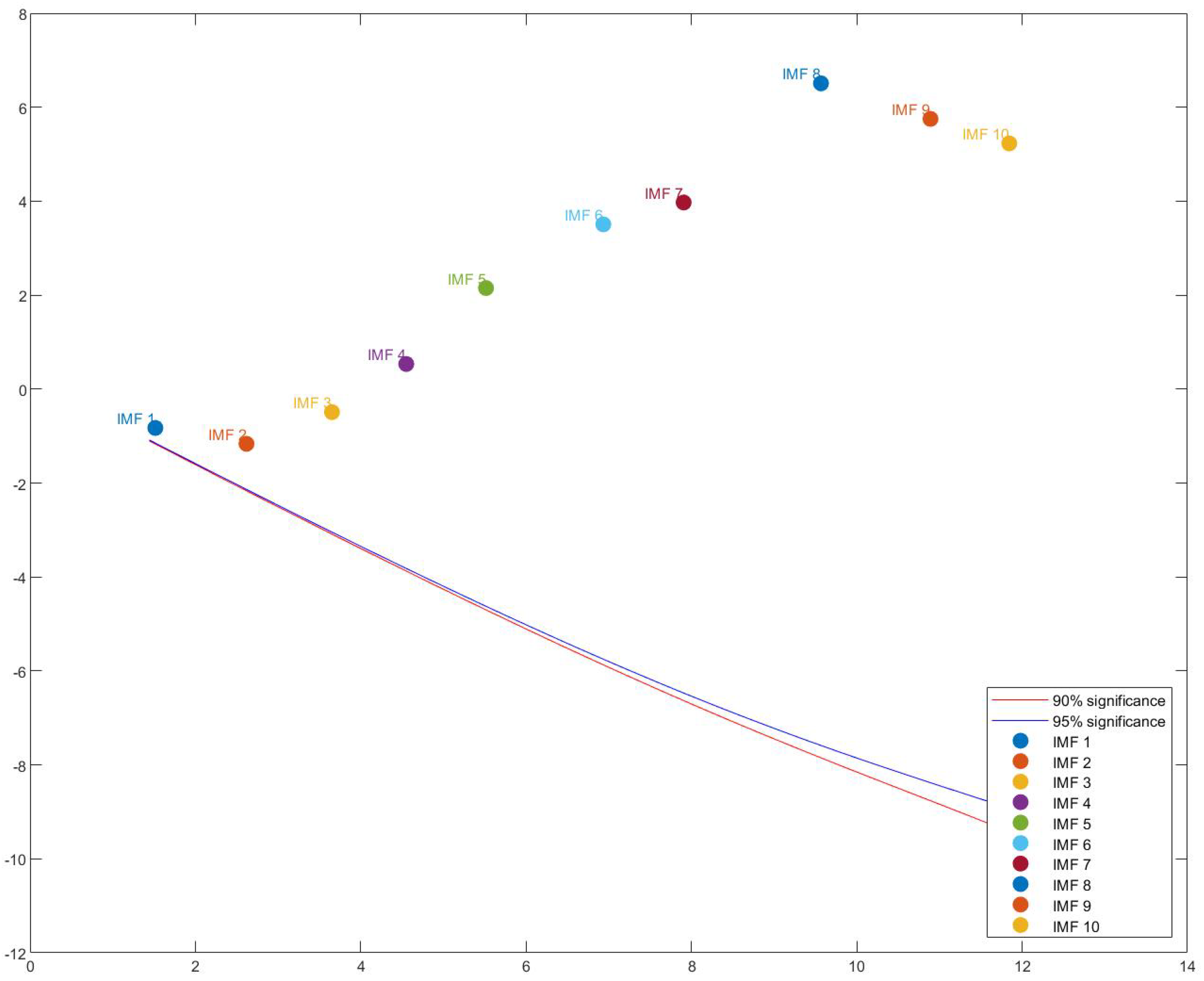
Table 5 presents five metrics for the screened and reconstructed IMFs, with lnE and lnT representing the natural logarithms of the mean energy and mean period. The last column indicates the variance contribution ratio, which reflects the ratio of the IMF’s variance to that of the original series. Figure 3 visualizes the significance of each IMF relative to the expected significance from white noise. It computes two confidence interval lines for white noise at the 90 % and 95 % significance levels, which serve as references for assessing the IMFs’ significance. This allows determining which IMFs are statistically significant at the given confidence levels. Based on a comprehensive analysis of Table 5 and Figure 3, the paper selected IMF8, IMF9, IMF10, and the residual sequence to reconstruct the AAPL series. This concludes the data preprocessing for the AAPL dataset, and a similar approach is applied to the other datasets.
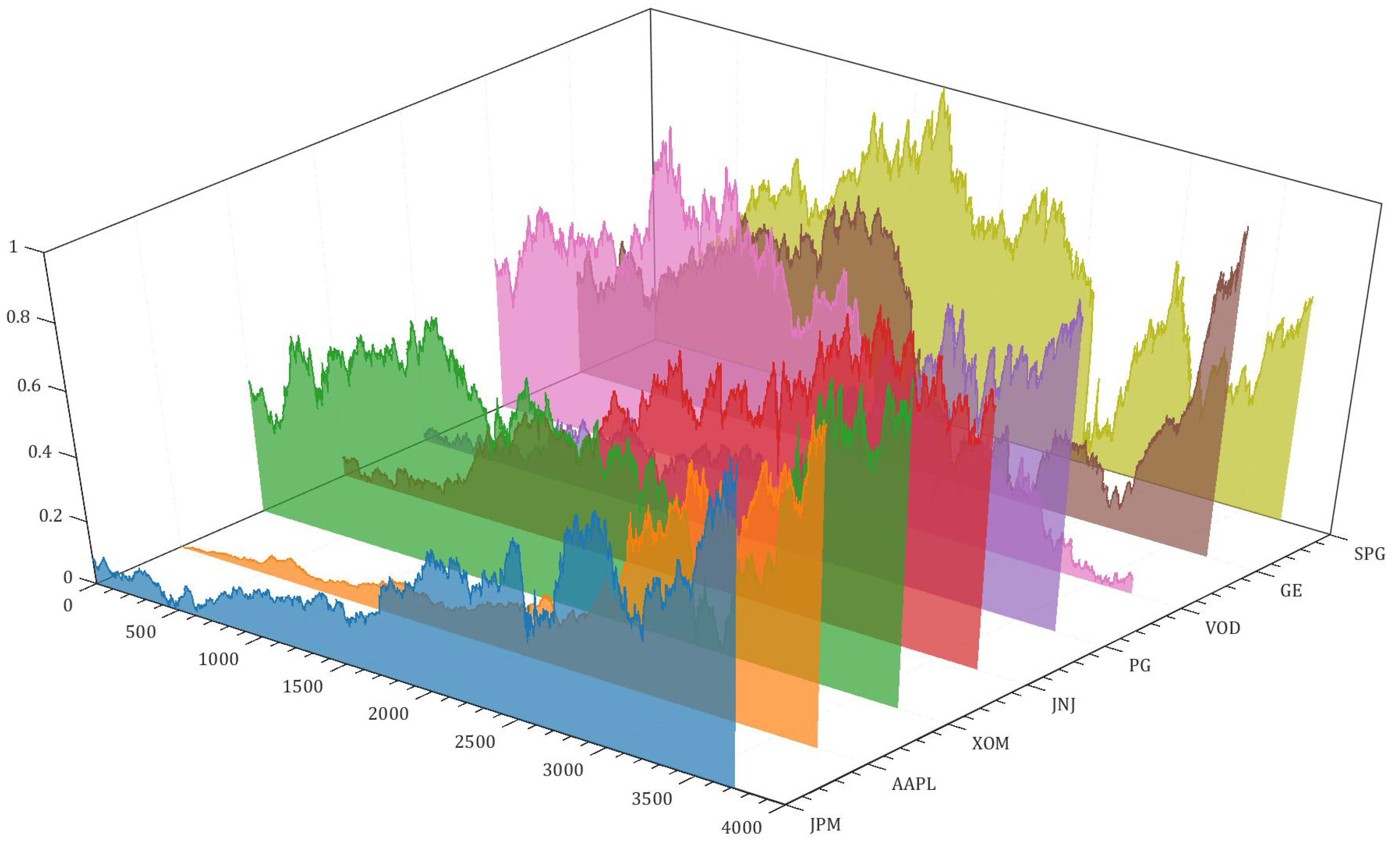
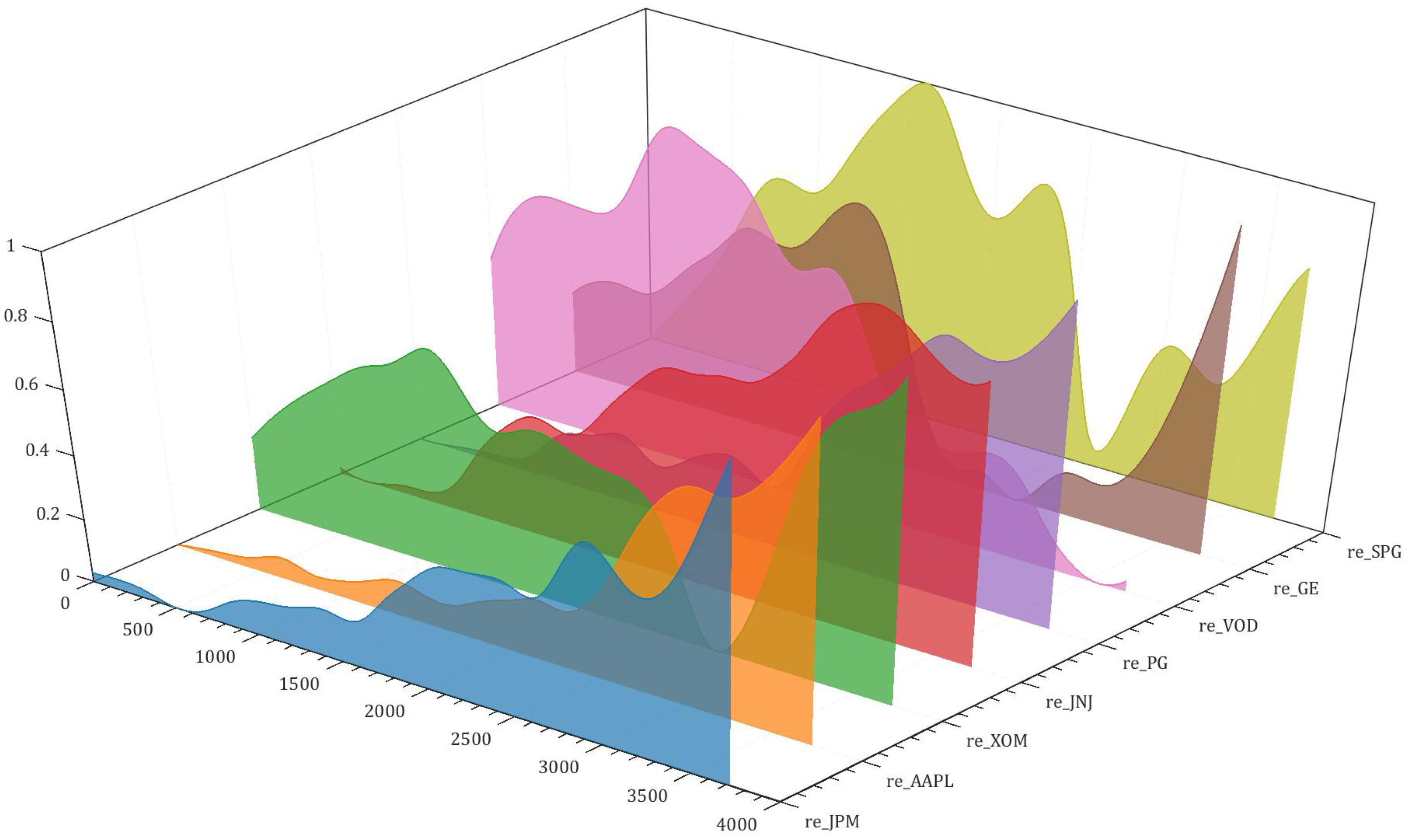
For unified analysis, we normalize the daily closing prices of eight typical U.S. stocks to the range [ 0 , 1 ] and present the original data 3D plot Figure 4 as well as the 3D plot of the data after EEMD processing Figure 5. The series after EEMD processing is smoother, reducing the high-frequency fluctuations and noise in the original data. This facilitates a better reveal of the underlying trends and periodic features.

4. Empirical Results

4.1. DCCA Coefficient

The detrended cross-correlation coefficient integrates detrended cross-correlation analysis (DCCA) and detrended fluctuation analysis (DFA) to qualitatively assess bivariate cross-correlations.The DCCA coefficient ρ D C C A represents the ratio of the fluctuation function of detrended covariance F D C C A 2 ( x , y ) to the product of the two detrended variances F D F A 2 ( x ) and F D F A 2 ( y ) .
ρ D C C A = F D C C A 2 ( x , y ) F D F A ( x ) F D F A ( y )
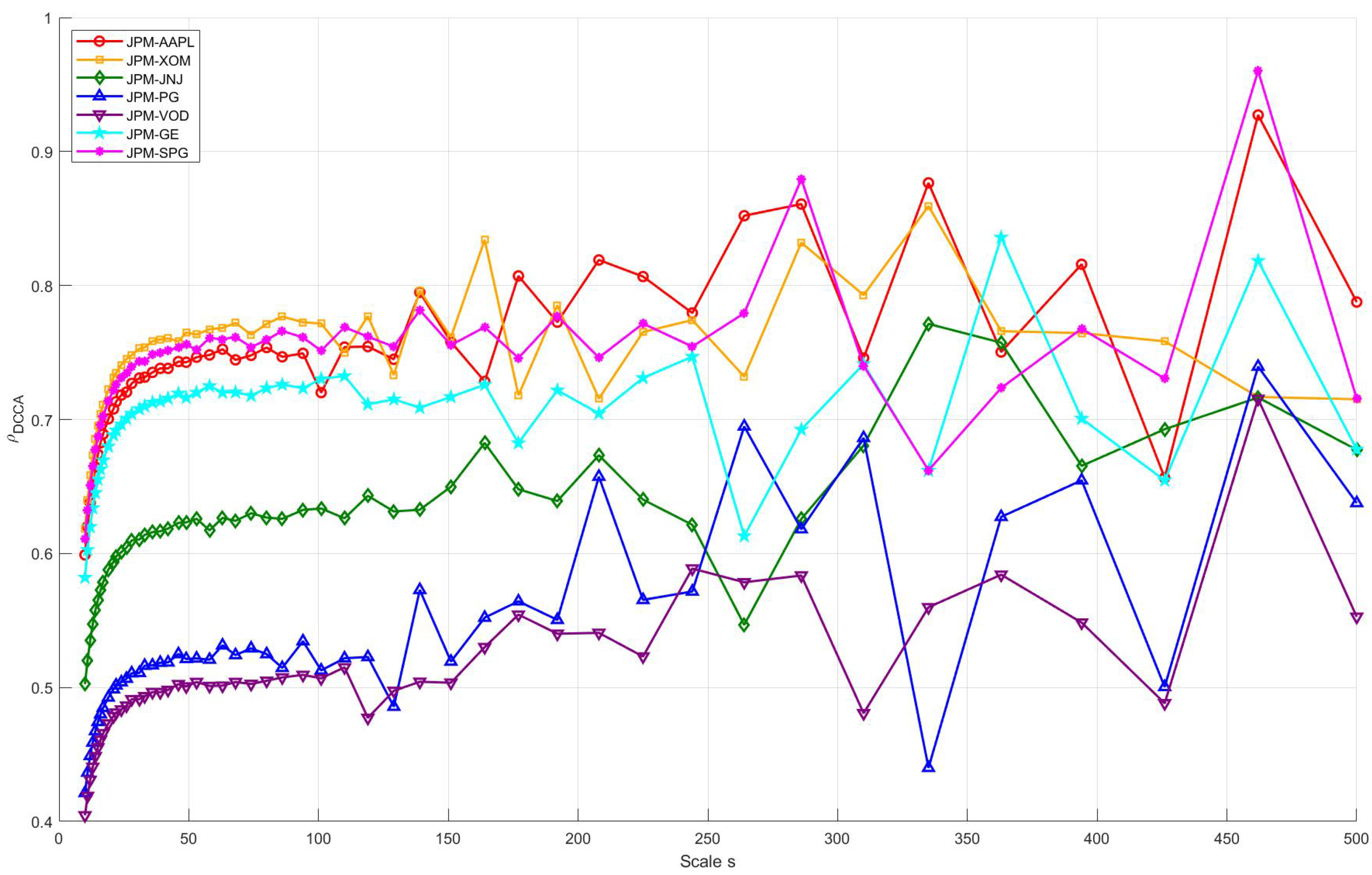
where F D C C A 2 ( x , y ) represents the detrended covariance wave function of the two-time series { x ( t ) } and { y ( t ) } . F D F A ( x ) and F D F A ( y ) are the detrended covariance fluctuation functions for a single time series { x ( t ) } and { y ( t ) } respectively. ρ DCCA ranges from 1 < ρ DCCA < 1 [71]. ρ DCCA = 1 shows perfectly antipersistent cross-comovement; when ρ DCCA = 1 , there is a perfect cross-correlation between the two series; if ρ DCCA = 0 , there is no cross-correlation. The DCCA coefficients for the eight pairs of time series are plotted in Figure 6. All the DCCA coefficients 0 < ρ D C C A < 1 indicate the presence of nonlinear correlations between the U.S. financial industry sector and the other seven major industry sectors.

4.2. MFDCCA

While the DCCA coefficients have demonstrated efficacy in assessing cross-correlations within multivariate time series, their application is inherently qualitative in nature. Consequently, to empirically quantify the multifractal cross-correlations among typical stock markets across various U.S. industry sectors, we employ the Multifractal Detrended Cross-Correlation Analysis (MFDCCA) methodology. This approach is applied to the reconstructed time series data of JPM, a typical stock in the financial sector, as well as to the reconstructed time series of typical stocks from the remaining seven industry sectors.
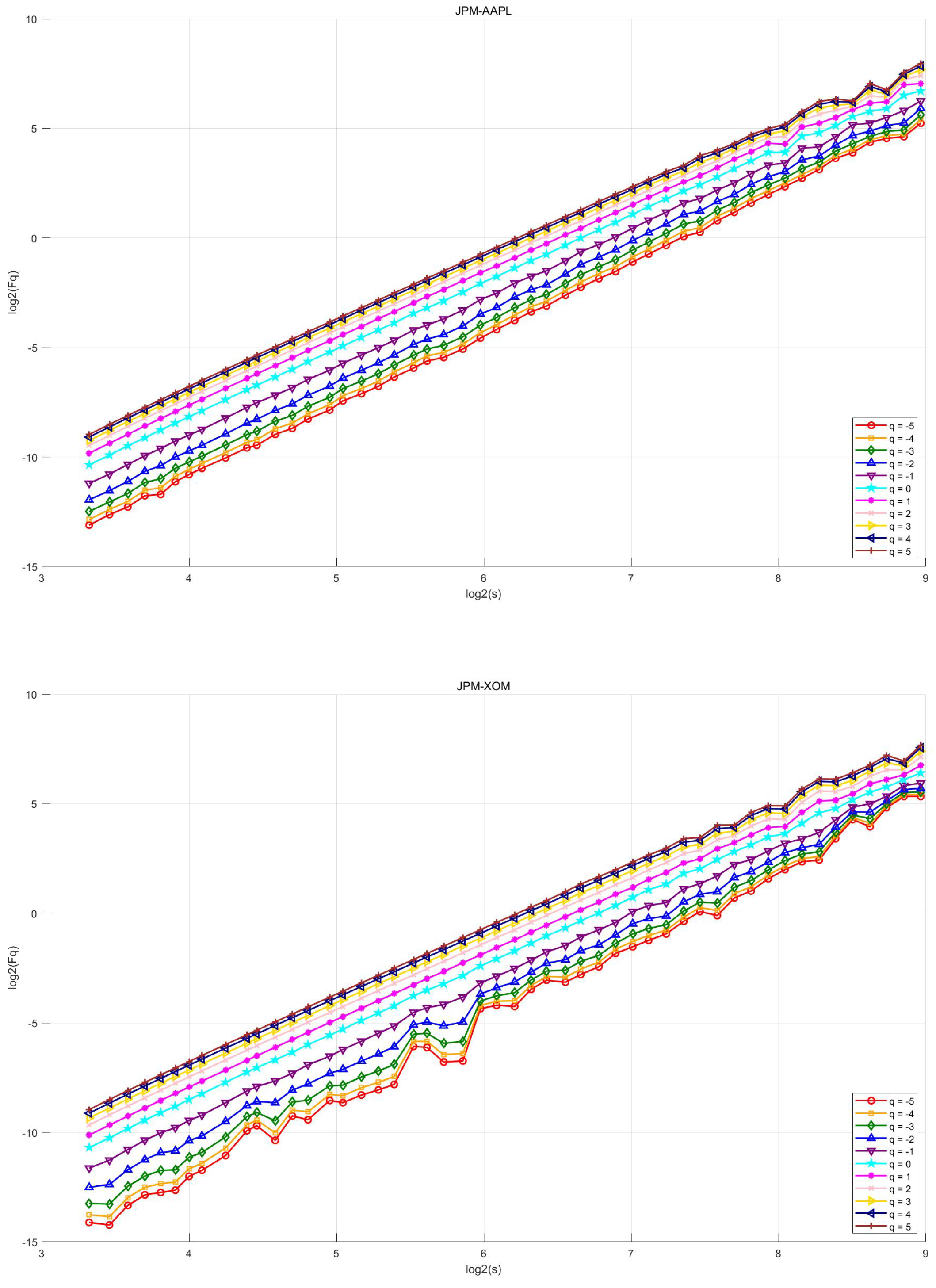
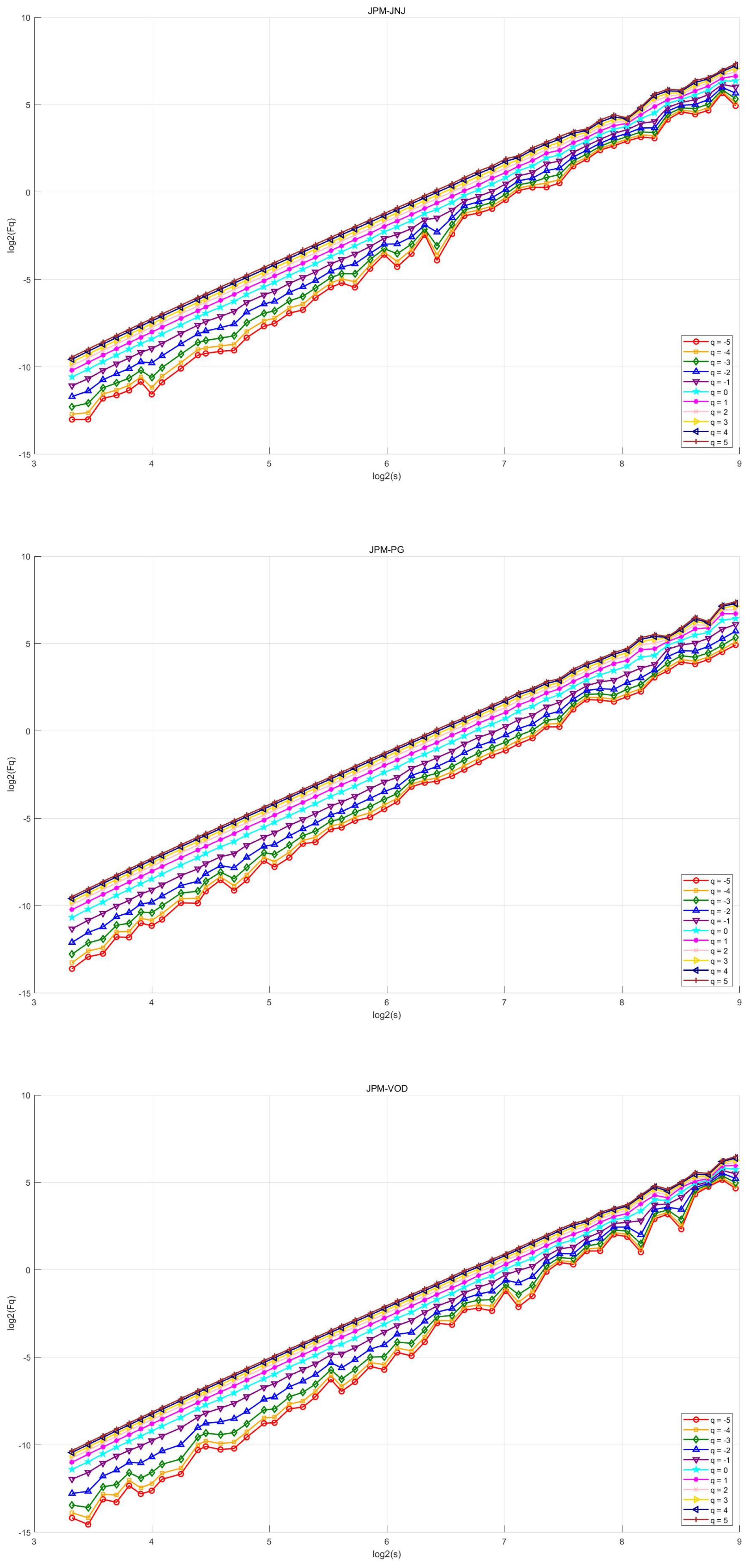
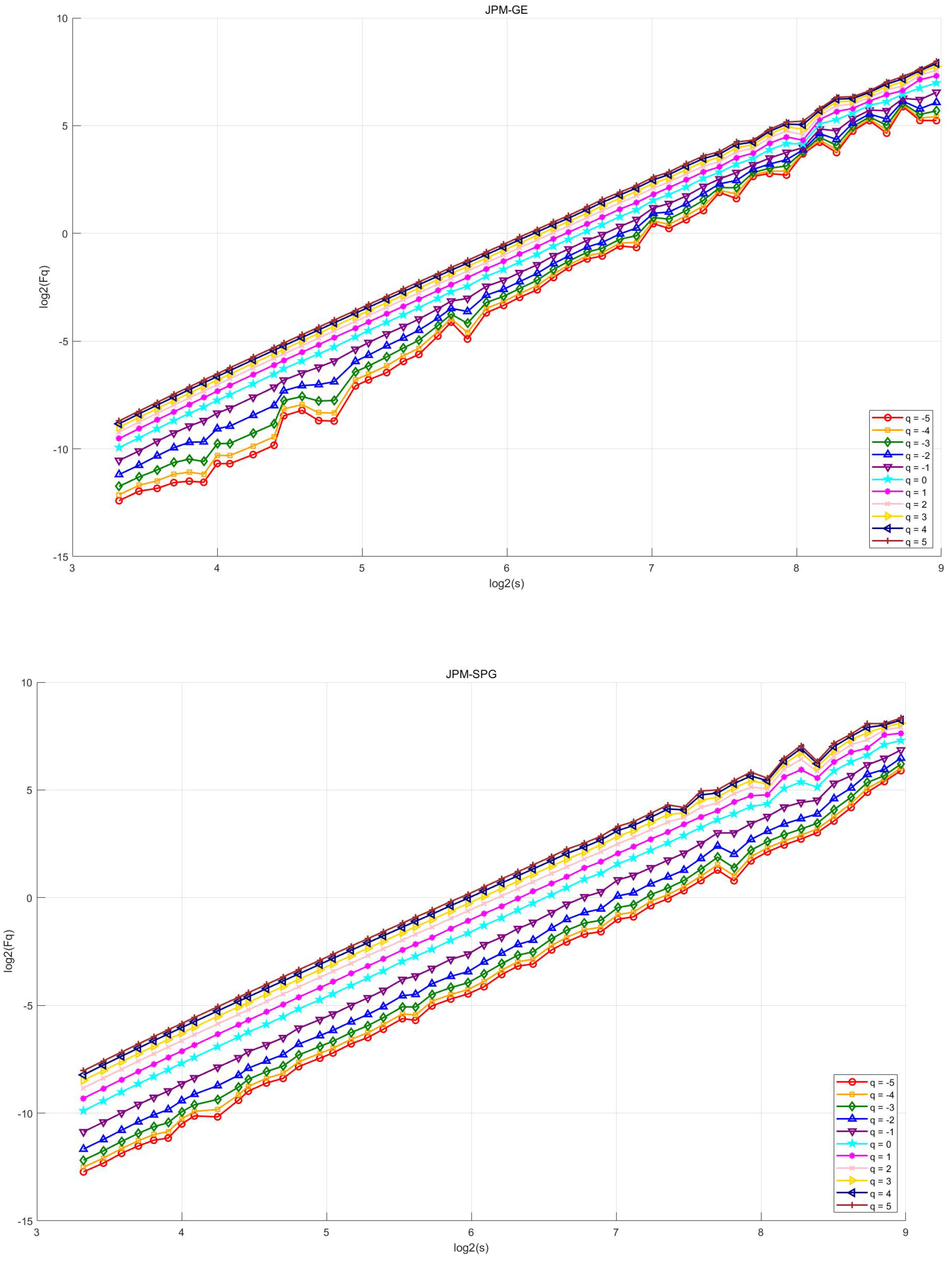
In the MFDCCA method, the values of segment lengths s and q must be carefully selected [72]. If s is less than 10, the polynomial fitting error tends to increase, leading to greater systematic deviations in the behavior of the time-varying scale. Consequently, in this paper, the value of s is set within the range of [10, 500] with 50 points. The value of q is taken from the interval [ 5 , 5 ] , with a total of 11 values.
Figure presents a log-log plot of the fluctuation function F q ( s ) against the time scale s for both JPM and AAPL, as well as JPM and XOM, JPM and JNJ, JPM and PG, JPM and VOD, JPM and GE, JPM and SPG. As observed in Figure ,The fluctuation function rises with increasing s, and all curves demonstrate linear correlation at varying q values, signifying the existence of power-law behaviour and multifractal cross-correlation among JPM, AAPL, XOM, JNJ, PG, VOD, GE, and SPG. The findings indicate that substantial price changes in the financial sector are more likely to induce price volatility in the seven industry sectors. Nonetheless, numerous records do not demonstrate a straightforward monofractal scaling behaviour, which a singular scaling exponent cannot describe. In certain instances, there are crossover (time) scales s * [73,74] that delineate regimes characterized by distinct scaling exponents. Unique scaling laws and scaling exponents for time scales exceeding and falling below s * . It can be observed in Figure that the log-log plots of JPM with XOM, JPM with VOD, and JPM with GE show more crossovers, indicating that their scaling behavior varies across multiple scales, with different local scaling characteristics. This suggests the presence of relatively strong multifractal cross-correlation. In contrast, the log-log plots of JPM with AAPL and JPM with SPG are relatively smooth, with fewer crossovers, indicating that they exhibit similar scaling behavior across most scales, with consistent trends or volatility. This generally suggests weaker multifractal cross-correlation.
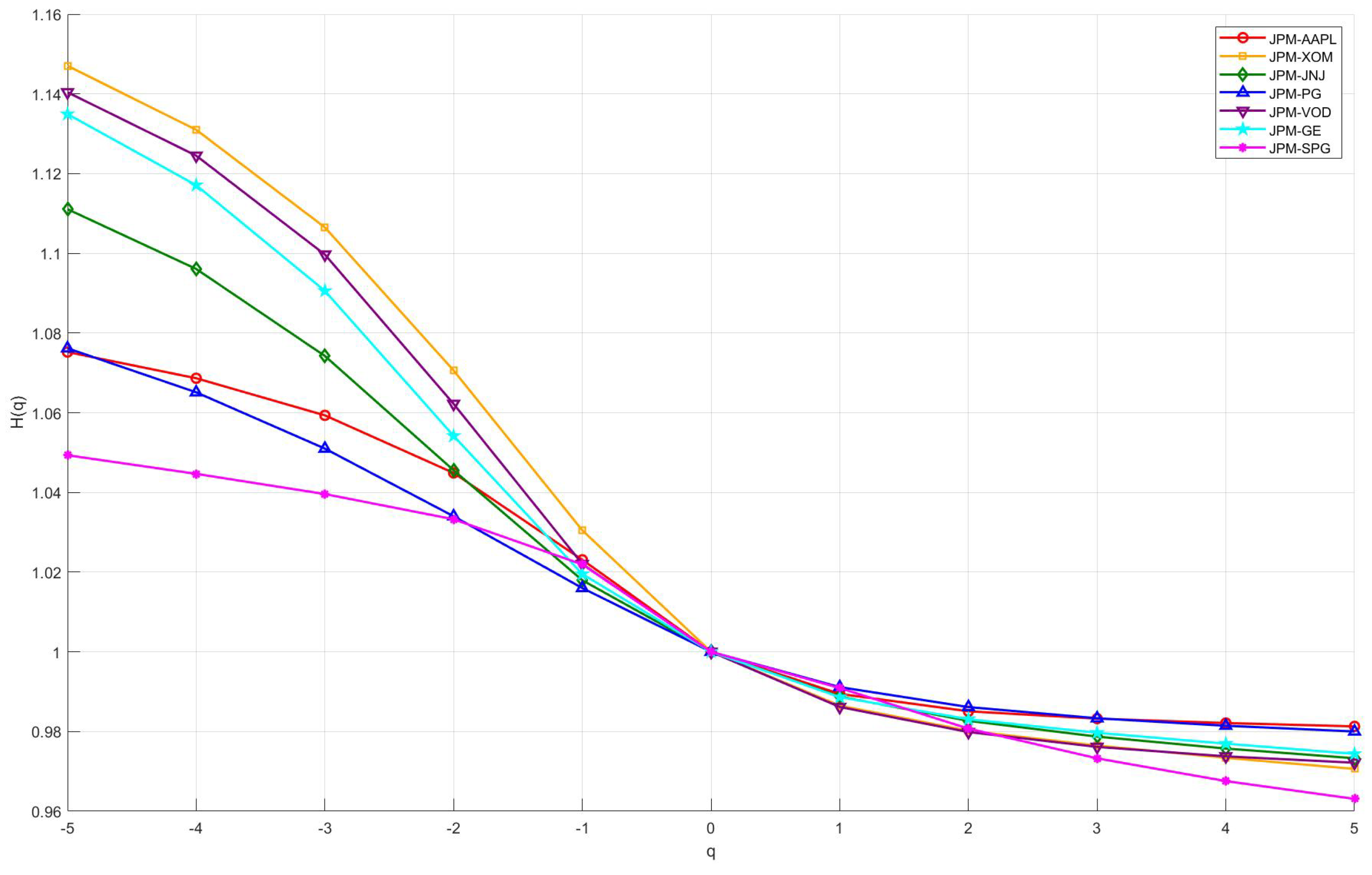
The slope of the double-logarithmic curve in Figure indicates the Hurst exponent H ( q ) for various orders of q, with the results presented in Figure 8. We examine the Hurst exponent to determine whether the cross-correlation is a random walk or exhibits a multifractal structure. Empirical results show that the H ( q ) for all stock pairs exceed 0.5, indicating that the cross-correlation between the financial sector and the other seven sectors is not a random walk.
As commonly understood, multifractality is observed when the scaling exponent H ( q ) varies with different q values, while, conversely, it is mono-fractal when this exponent remains constant. Figure 8 illustrates the decrease in H ( q ) as the value of q increases, indicating an apparent multifractal characteristics. The causes of these multifractal characteristics may involve several aspects. Firstly, the price fluctuations between these stocks exhibit a certain degree of long-range correlation, which persists across different time scales. Secondly, the diversity of market participants and the information asymmetry impact the long-range correlations between different time series, thereby leading to multifractal phenomena. Finally, the impact of extreme events, such as market crashes or rapid rebounds, also plays a crucial role. Since these stocks come from different industry sectors and have distinct risk characteristics, extreme events may have varying effects on them, thus resulting in cross-correlations of multifractality.The varying trends of the H ( q ) curves for different stock pairs indicate that their multifractal characteristics are distinct. This may reflect the differences in factors such as the industry sectors and scales to which these stocks belong.
Further, we investigate the direction of multifractal cross-correlations with the Hurst exponent at q = 2 . The Hurst exponent H ( 2 ) for JPM and the other seven stocks is more significant than 0.5, indicating the long-range persistent multifractal cross-correlation. For 5 q 5 , the cross-correlation index H ( q ) for JPM and the other seven stocks pair consistently exceeds 0.5, so cross-correlation between these series persists irrespective of the magnitude of fluctuations. This indicates that when one stock price series experiences small fluctuations, the corresponding other stock price series also exhibits small fluctuations. Similarly, when one stock price series encounters large fluctuations, the other shares follow suit with large fluctuations.
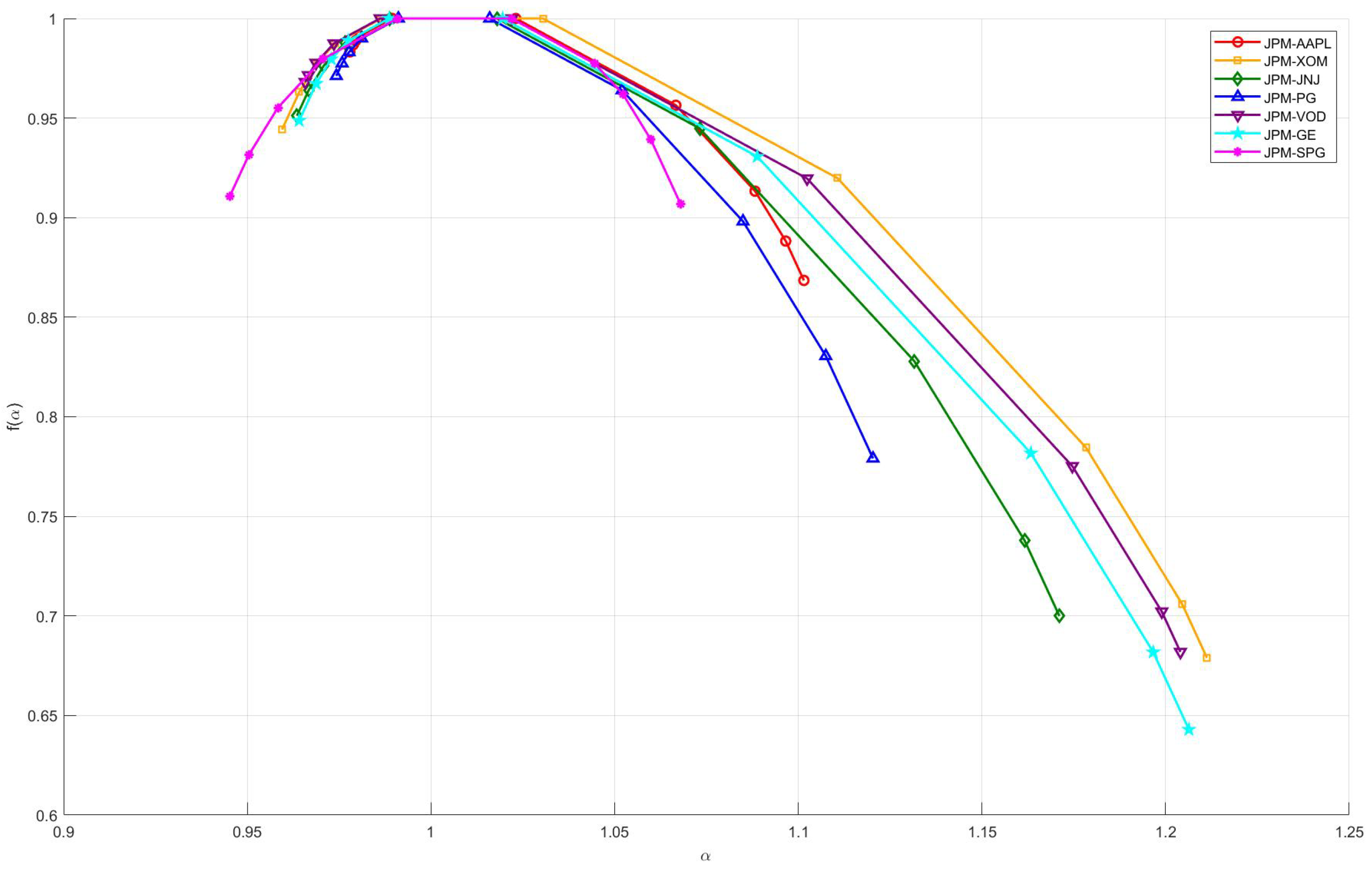
In addition to the findings on the power-law relationship of the fluctuation function and time scale and the generalized Hurst exponent, we present multifractal spectrum f ( α ) in Figure 9. Figure 9 presents the singularity strength α and multifractal spectrum f ( α ) . The multifractal spectrum curves for the JPM stock and the other seven typical stocks all exhibit a concave function shape, a typical characteristic of a multifractal system. The concave function reflects the multi-scale nonlinearity and heterogeneity present in the time series.The varying trends of the multifractal spectrum curves for different stocks indicate that their multifractal characteristics are distinct. This may be attributed to differences in factors such as the industry sectors, scales, and trading mechanisms to which these stocks belong.The width of the curves reflects the strength of the multifractal features. The wider the curve, the stronger the sequence’s multifractal properties. As can be seen from the Figure 9, the curve widths differ significantly across the stock pairs. Therefore, we can further conclude that there is a strongly fractal cross-correlation between the financial industry sector and the other seven industry sectors.
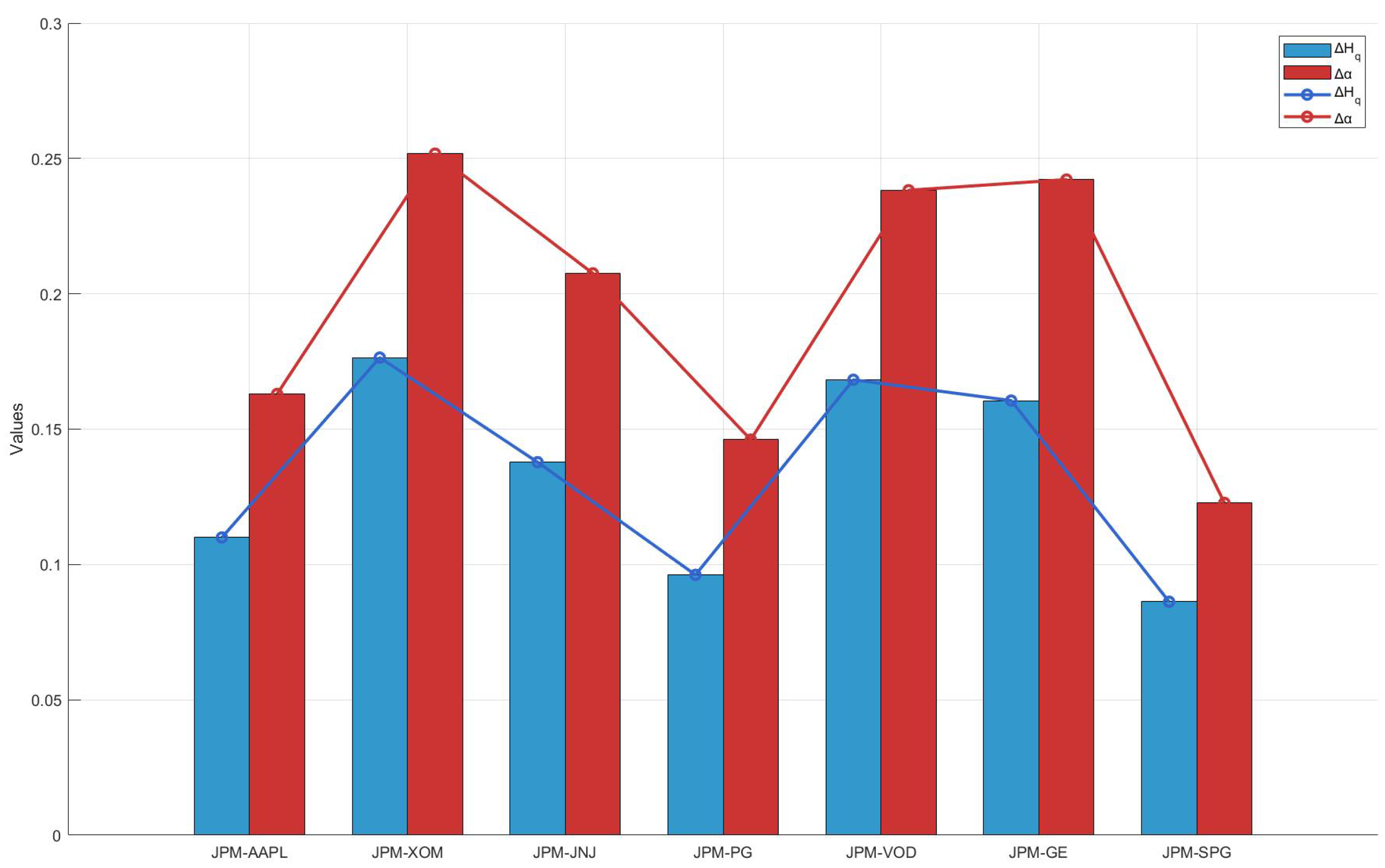
We compute the multifractality degree Δ H ( q ) and the multifractality spectrum width Δ α using Equation (2) and Equation (6), respectively, in order to assess the mulfractality cross-correlations. The strength of the multifractal cross-correlation is positively correlated with Δ H ( q ) and Δ α . The results are shown in Figure 10. It is evident from the results that the rank of Δ H ( q ) is as follows: Δ H J P M X O M > Δ H J P M V O D > Δ H J P M G E > Δ H J P M J N J > Δ H J P M A A P L > Δ H J P M P G > Δ H J P M S P G . The ranking of Δ α is the same as the ranking of Δ H , except that Δ α J P M V O D < Δ α J P M G E , which is the opposite. This suggests a robust multifractal cross-correlation between JPM and XOM. Therefore, it implies that the relationship between the financial and energy sectors is more complex and contains more significant financial risks. On the contrary, the weaker multifractal cross-correlation between JPM and SPG implies that the multifractal strength between the financial and real estate sectors is lower and is a favourable choice for investors. Selecting the JPM-PG combination in a portfolio reduces financial risk and increases the likelihood of profitability. In addition, the multifractal cross-correlations between JPM and VOD and JPM and GE are also strong, suggesting that the volatility of the Financial-Telecommunications and Financial-Manufacturing sectors is also relatively intense.

4.3. TE Based on KNN

Although Multifractal Detrended Cross-Correlation Analysis (MFDCCA) can quantify the multifractal cross-correlation between two stocks, it has certain limitations, such as the inability to determine the direction and strength of information transfer. Therefore, this paper further employs transfer entropy to provide a more comprehensive analysis of the information flow among typical stocks in the U.S. industry sectors. In our paper, we calculated the transfer entropy between every pair of the eight typical stocks from the U.S. industry sectors, with each sequence having a length of 3720. After iterating through each pair, we obtained the corresponding 8 * 8 transfer entropy matrix A, as detailed in Table 6.
Observing Table 6 from the information inflow perspective, the following lists the primary information source stocks for each industry’s typical stocks.
  • JNJ→JPM, indicating that the healthcare industry sector has the most significant impact on the financial industry sector. This may reflect the healthcare sector’s stability and growth potential, attracting investment and attention from financial institutions. As global healthcare awareness continues to rise, the financial industry’s support and investment in healthcare also increase, further enhancing the interaction between the two sectors.
  • JPM→AAPL, suggesting that the financial industry sector exerts a notable influence on the technology industry sector. This impact can be attributed to the enthusiasm of financial markets for investing in tech companies, as well as the essential role of the technology sector in driving economic growth and innovation. Financial institutions’ capital investment in the tech industry promotes the development of technology companies and accelerates the evolution of financial technology.
  • PG→XOM, indicating that the consumer staples industry sector significantly influences the energy industry sector. This may be because the production and transportation of consumer staples heavily rely on energy, and fluctuations in energy prices directly affect the costs and market prices of these goods, thus forming a close relationship between the two.
  • AAPL→JNJ, showing that the technology industry sector’s influence on healthcare is not to be overlooked. Technological innovations in medical devices, digital healthcare, and health management are transforming the operations of the traditional healthcare industry sector, improving the efficiency and quality of healthcare services.
  • AAPL→PG, indicating that the technology industry sector’s impact on the consumer staples industry sector is growing. With the rise of e-commerce and digital marketing, technology companies provide new sales channels and operational models for the consumer staples sector, driving its transformation and development.
  • PG→VOD, suggests a strong influence of the consumer staples industry sector on the telecommunications industry sector. This may be due to consumer staples companies needing telecommunications services for market promotion and consumer communication, with the quality and cost of telecom services directly impacting consumer staples’ sales strategies.
  • JNJ→GE, indicating that the healthcare industry sector significantly influences the manufacturing industry sector. Advancements in medical devices and technology are driving innovation in industrial manufacturing, particularly in biotechnology and pharmaceutical manufacturing, where the demand from the healthcare sector directly influences industrial production.
  • AAPL→SPG, demonstrating the substantial impact of the technology industry sector on the real estate industry sector. The application of technology in real estate is becoming increasingly widespread, with developments such as smart homes and building automation changing the operational models and market demands of the real estate sector.
In addition, from the perspective of information outflow, the maximum information outflows for typical stocks in each industry sector are as follows: JPM → XOM, AAPL → XOM, XOM → SPG, JNJ → GE, PG → XOM, VOD → XOM, GE → XOM, SPG → XOM.
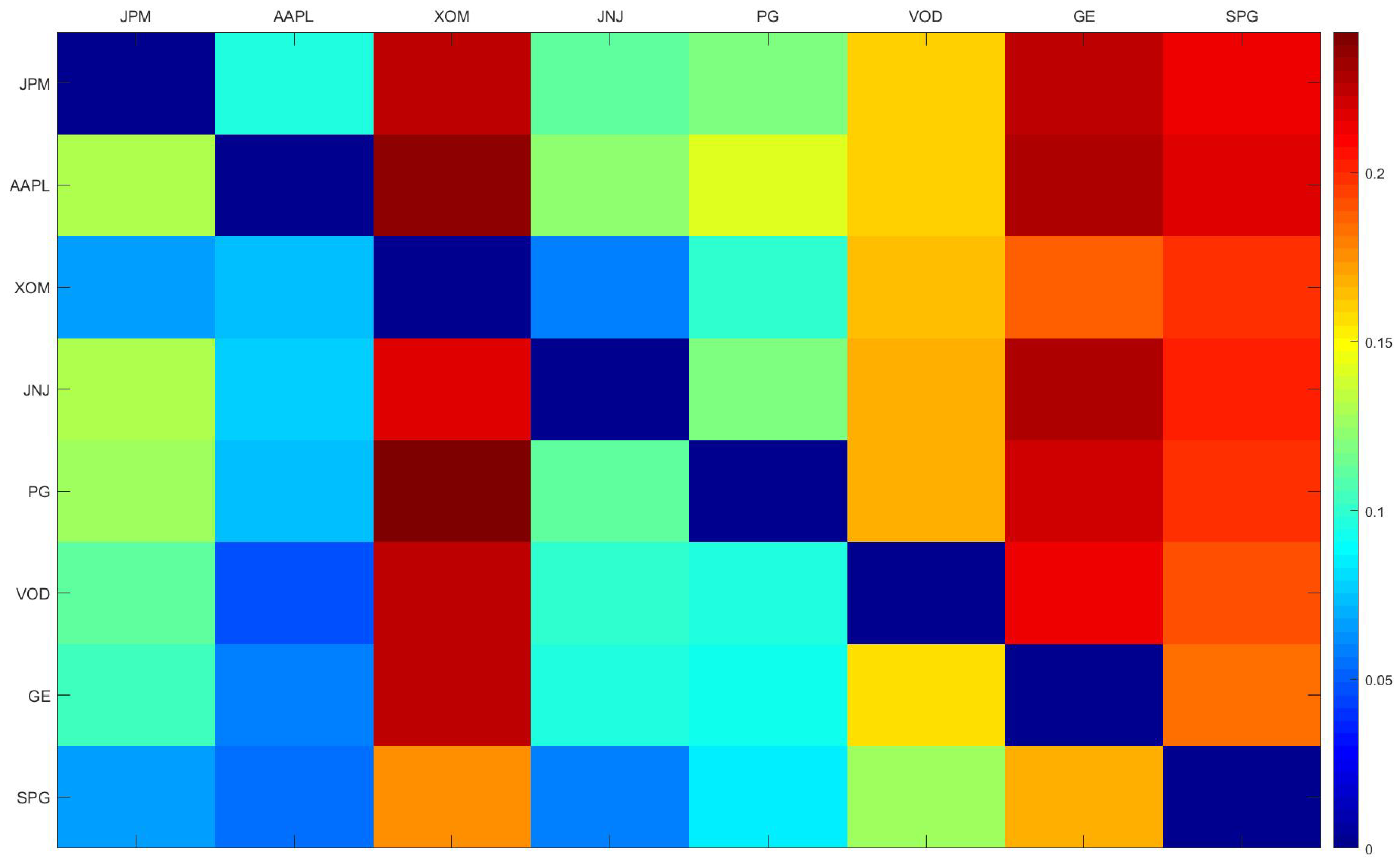
In summary, the information outflow from AAPL is the largest.Possible reasons include: AAPL, one of the world’s largest technology companies, possesses significant market influence. AAPL is also renowned for its continuous innovation, consistently introducing new technologies and products that drive the development of the technology sector and impact the operations of other industries. Its products and services are widely applied across multiple sectors, resulting in more frequent information flow between AAPL and other industries, further enhancing its role as an information bridge. Consequently, its stock price and market dynamics have a notable guiding effect on companies in other sectors.Meanwhile, the information inflow for XOM, Possible reasons include the following: As one of the world’s largest oil and gas companies, XOM’s stock price is highly dependent on energy prices, particularly oil and natural gas prices. Fluctuations in energy prices in the global market are typically driven by a range of factors, including international supply and demand dynamics, decisions made by OPEC (the Organization of the Petroleum Exporting Countries), political events (such as conflicts in the Middle East), and shifts in the global economy. Consequently, XOM’s stock price exhibits high sensitivity to global economic conditions, policies, regulatory changes, geopolitical events, and fluctuations in energy demand. This sensitivity links XOM’s stock performance closely with the dynamics of other global industries, which is further reflected in the transfer entropy calculations as a higher information inflow.The heatmap below also reaches similar conclusions.
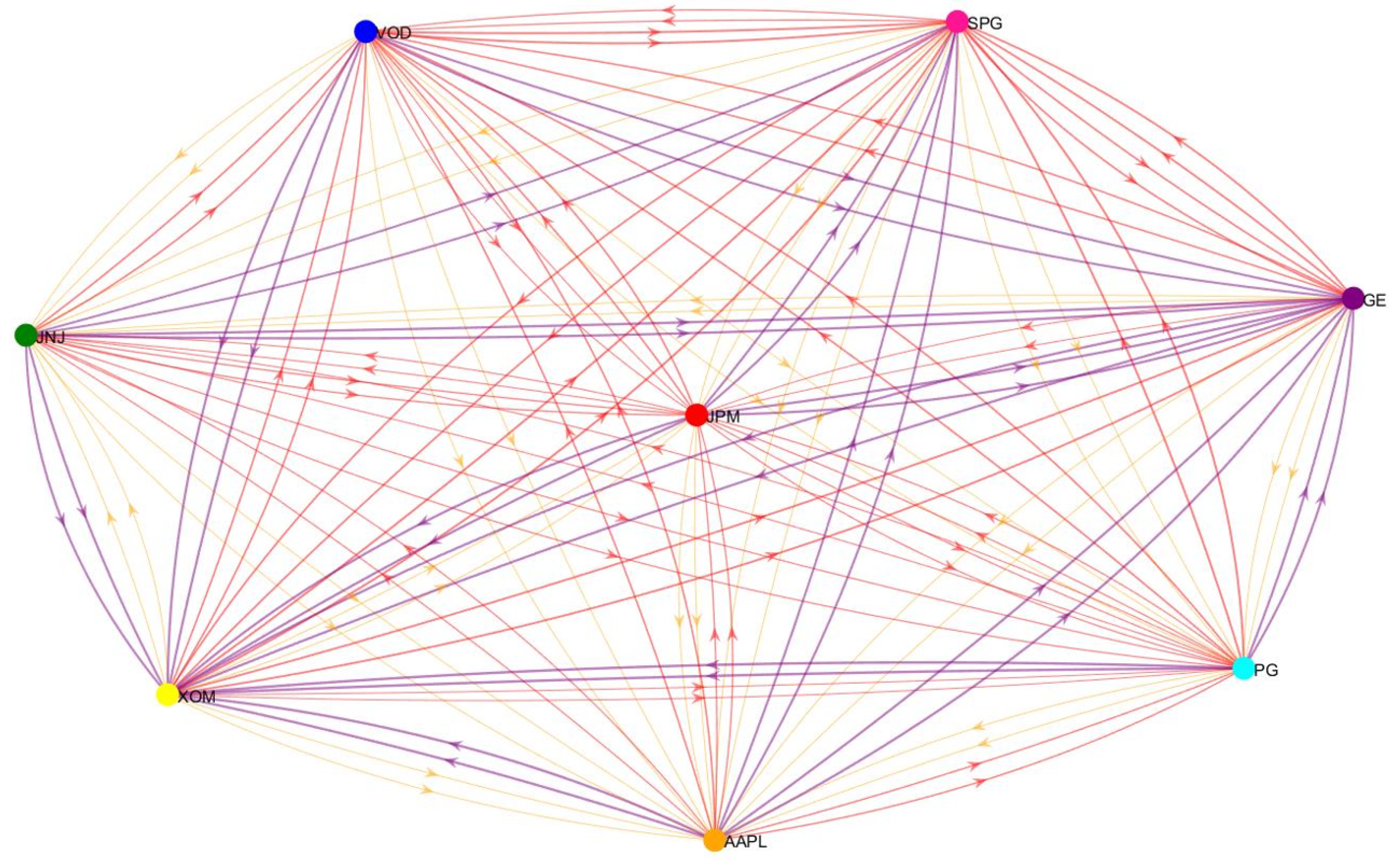
Figure 11 is a heatmap of the transfer entropy among stock in the U.S. industry sectors.The darker the colour, the greater the value of transfer entropy between the two stocks and the stronger the information flow.XOM, GE and SPG receive more information flow and less information flow to AAPL; on the contrary, AAPL has more outgoing information; suggesting that AAPL may be an important source of information in the whole network. For a more refined analysis, this paper constructed a directed weighted network using these eight typical the U.S. industry sector stocks as nodes and the transfer entropy matrix as the weights, displayed in Figure 12. And the weighted out degree, weighted in degree, weighted degree, net transfer entropy, and clustering coefficients of each node were calculated and listed in Table 7.

4.4. Complex Networks

In this section, the transfer entropy matrix of Table 6 is used as the adjacency matrix of the network, and the eight typical industry sector stocks under paper: JPM, AAPL, XOM, JNJ,PG,VOD,GE,SPG are used as the nodes of the network to build a directed weighted network graph.
Figure 12 displays the information flow relationships among typical stocks of eight U.S. industry sectors. The positions of the nodes and the connections reflect the magnitudes and directions of the transfer entropy between different stocks.The color of the connections represents the strength of the information interaction: yellow lines indicate the minor information flow, where the transfer entropy value is less than or equal to 0.1; red lines represent medium information flow, with transfer entropy values between (0.1, 0.2]; and purple lines denote the most vital information flow, where the transfer entropy is more significant than 0.2. Observing Figure 12, we can see that the XOM and GE nodes have the most purple lines, suggesting they have the most significant inbound and outbound information flows among the stocks. This indicates that these two energy sector stocks are highly active and play important hub roles within the financial network.A set of metrics for this directed weighted network is shown in Table 7.
Observing Table 7, the elevated ω o u t associated with AAPL signifies its substantial influence and expansive impact on other firms within the industry network. This observation underscores the technology sector’s critical role, preeminent players like Apple, in fostering economic growth and facilitating industry interconnections. In contrast, XOM exhibits the highest ω i n , indicating the energy sector’s vulnerability to fluctuations in other industry sectors. It positions the sector in a relatively passive and unstable state that necessitates improved management of external risk factors. XOM and GE demonstrate high WD, suggesting that the energy and industrial sectors are integral components of the overall network and actively participate in the supply chain.
The positive NTE values for JPM, AAPL, JNJ, and PG imply that the finance, technology, healthcare, and consumer staples sectors possess a positive predictive capacity or influence over other industry sectors. Notably, AAPL’s NTE value of 0.751 further solidifies its leadership role within the technology sector, indicating that its market performance and strategic decisions significantly positively affect other stocks.Conversely, the negative NTE values observed for XOM, VOD, GE, and SPG suggest that the energy, telecommunications, manufacturing, and real estate sectors are more susceptible to fluctuations in other industry sectors, reflecting a degree of passivity or vulnerability within the market. XOM’s NTE value of 0.7019 may indicate the energy sector’s sensitivity to external factors, such as policy changes and variations in market demand, thereby highlighting its potential fragility within the global economy. Furthermore, the high WCC for AAPL and JNJ suggest a robust competitive presence and influence within the market, whereas XOM and GE exhibit lower WCC.

5. Conclusions

This paper comprehensively examines the multifractal cross-correlations between JPM and seven other typical stocks from various industry sectors, as well as the information flow among these eight typical U.S. industry sector stocks, using MFDCCA, Transfer Entropy (TE), and complex network methods. The findings are as follows:
  • All of the selected typical stocks in U.S. industry sectors (except for JPM) exhibit long-range correlations and multifractal cross-correlations with JPM.
  • The multifractal cross-correlation between JPM and XOM is the strongest, which implies that price volatility may have self-similarity and long memory characteristics at different time scales, i.e. there may be some degree of self-similarity and volatility aggregation characteristics in their price change patterns over a specific time horizon. During upswings in the economic cycle, increased demand for energy drives up oil prices and the earnings of energy firms, while economic expansion also tends to drive financial market activity and boost bank performance. Conversely, during economic downturns, falling energy demand and weakening financial activity can occur in tandem. Thus, the linkage effects between the financial and energy sectors are strong, making the multifractal cross-correlation between the two significant.
  • The multifractal cross-correlation between JPM and VOD, as well as JPM and GE, is also strong. Volatility in the financial market and changes in interest rates affect VOD’s share price through, for example, the cost of funds. Both JPM and VOD are multinational companies, and in the context of globalization, complex multifractal characteristics are often reflected in the share price series of JPM and VOD, which implies that there is some self-similarity in the volatility behaviour of the two on different time scales in the short and long term and that when the market is volatile, the share prices of the two exhibit synchronicity.On the other hand, GE’s business covers a wide range of sectors, including aerospace, energy, and medical devices, which are closely related to the economic cycle and capital expenditures. When the economy is on the upswing, corporate capex increases, driving GE’s growth, while demand for loans and investments in the financial sector increases, positively affecting JPM. During economic downturns, capital expenditures decline, and demand for energy and industrial equipment weakens, affecting GE’s performance, reducing loan demand, increasing risk, and negatively impacting JPM. The similarity between the two over the economic cycle enhances their multiple fractal cross-correlation.
  • From the perspective of information inflow analysis, the primary information source stocks for each stock are as follows:JNJ→JPM,JPM→AAPL,PG→XOM, AAPL→JNJ, AAPL→PG,PG→VOD,JNJ→GE, AAPL→SPG.From the perspective of information outflow analysis, the maximum information outflows for typical stocks in each industry sector are as follows: JPM → XOM, AAPL → XOM, XOM → SPG, JNJ → GE, PG → XOM, VOD → XOM, GE → XOM, SPG → XOM.
  • In the complex network where the transfer entropy matrix is the adjacency matrix, AAPL has the highest ω o u t , indicating that AAPL strongly influences other stocks. AAPL’s market performance and strategic decisions can significantly impact other companies’ stock prices and trends, reflecting its leadership position within the technology sector. Conversely, XOM has the highest ω i n , which indicates that XOM is more reliant on the influences of other industries, suggesting that the energy sector is driven to some extent by fluctuations in other sectors. Furthermore, XOM and GE have the highest WD, indicating that these two companies play important intermediary roles within the overall network, potentially facilitating the transmission of information and influence across multiple industries.
Our paper reveals the multifractal cross-correlations characteristics and information interactions of typical stock markets in the U.S. industry sectors and provides new perspectives for understanding the interactions among the sectors. These findings help investors and policymakers better grasp market trends, optimize their investment portfolios, and provide a theoretical foundation and empirical support for future stock market research. Adopting a complex network approach allows us to understand the complexity of the stock markets in a new way, exploring the correlations and information flows between industry sectors. This provides a foundation for subsequent research and empirical support for the effectiveness and stability of the stock market. In conclusion, our paper enriches the connotation of stock market theory and provides a feasible reference basis for practical investment decisions.
However, our research also has certain limitations. Firstly, it uses a single stock to represent an entire industry sector, which could be overly simplistic. Secondly, it does not delve deeply into other potential influencing factors, such as political and macroeconomic variables, which could also significantly impact the market. Lastly, our paper relies on historical data for analysis, as future market conditions may change. Therefore, we should exercise caution when applying our findings to long-range decision-making. Future research could delve deeper into the fractal characteristics and information interactions between industry sectors, capturing the effects of various potential factors (including policy and market sentiment) on different sectors. Additionally, future studies could apply other methods, such as wavelet analysis or empirical mode decomposition, to other time series to further understand the complex relationships between them.

Author Contributions

Conceptualization, J.H.; methodology, J.H.; software, W.Z.; validation, J.H. and W.Z.; formal analysis, W.Z.; investigation, J.H. and W.Z.; resources, M.W.; data curation, W.Z.; writing—original draft preparation, W.Z.; writing—review and editing, J.H. and M.W.; visualization, J.H. and W.Z.; supervision, J.H. and M.W.; project administration, M.W.; funding acquisition, M.W.; All authors have read and agreed to the published version of the manuscript.

Funding

This research was partially funding supported by the National Natural Science Founda- tion of China (No.12272058 and No. 42164002.)

Data Availability Statement

Publicly available datasets were analyzed in this paper. This data can be found here: https://finance.yahoo.com (accessed on 14 October 2024)

Acknowledgments

The authors gratefully acknowledge the support of the funding sources.

Conflicts of Interest

The authors declare no conflicts of interest.

References

  1. Fama, E. F.; French, K. R. Business conditions and expected returns on stocks and bonds. Journal of Financial Economics 1989, 25(1), 23–49. [Google Scholar] [CrossRef]
  2. Bekaert, G.; Harvey, C. R. Foreign speculators and emerging equity markets. The Journal of Finance 2000, 55(2), 565–613. [Google Scholar] [CrossRef]
  3. Lehkonen, H. Stock market integration and the global financial crisis. Review of Finance 2015, 19(5), 2039–2094. [Google Scholar] [CrossRef]
  4. Borio, C.; Zhu, H. Capital regulation, risk-taking and monetary policy: a missing link in the transmission mechanism? Journal of Financial Stability 2012, 8(4), 236–251. [Google Scholar] [CrossRef]
  5. Chen, N. F.; Roll, R.; & Ross, S. A. Economic forces and the stock market. Journal of Business 1986, 383–403.
  6. Fama, E. F.; French, K. R. Industry costs of equity. Journal of Financial Economics 1997, 43(5), 153–193. [Google Scholar] [CrossRef]
  7. Kang, J. K. Why is there a home bias? An analysis of foreign portfolio equity ownership in Japan. Journal of Financial Economics 1997, 46(1), 3–28. [Google Scholar] [CrossRef]
  8. Zou, K. H.; Tuncali, K.; Silverman, S. G. Correlation and simple linear regression. Radiology 2003, 227(3), 617–628. [Google Scholar] [CrossRef]
  9. Zhang, Z.; Zhang, Y.; Shen, D.; Zhang, W. The dynamic cross-correlations between mass media news, new media news, and stock returns. Complexity 2018, 2018(1), 7619494. [Google Scholar] [CrossRef]
  10. Shan, J.; Pappas, N. The relative impacts of Japanese and US interest rates on local interest rates in Australia and Singapore. Applied Financial Economics 2000, 10, 291–298. [Google Scholar] [CrossRef]
  11. Dionisio, A.; Menezes, R.; Mendes, D. A. Mutual information: a measure of dependency for nonlinear time series. Physica A 2004, 344, 326–329. [Google Scholar] [CrossRef]
  12. Abigail, J. A complex network model for seismicity based on mutual information. Physica A 2013, 392, 2498–2506. [Google Scholar]
  13. Fiedor, P. Networks in financial markets based on the mutual information rate. Physical Review E 2014, 89, 052801. [Google Scholar] [CrossRef] [PubMed]
  14. Bland, J. M.; Altman, D. G. Statistical methods for assessing agreement between two methods of clinical measurement. The Lancet 1986, 327(8476), 307–310. [Google Scholar] [CrossRef]
  15. Ghysels, E.; Hill, J. B.; Motegi, K. Testing for Granger causality with mixed frequency data. Journal of Econometrics 2016, 192, 207–230. [Google Scholar] [CrossRef]
  16. Shojaie, A.; Fox, E. B. Granger causality: A review and recent advances. Ann. Rev. Stat. Appl. 2022, 9(1), 289–319. [Google Scholar] [CrossRef]
  17. Dionisio, A.; Menezes, R.; Mendes, D. A. Mutual information: a measure of dependency for nonlinear time series. Physica A: Statistical Mechanics and its Applications 2004, 344(1-2). 326–329. [CrossRef]
  18. Pan, Y.; Hou, L.; Pan, X. Interplay between stock trading volume, policy, and investor sentiment: A multifractal approach. Physica A: Statistical Mechanics and its Applications 2022, 603, 127706. [Google Scholar] [CrossRef]
  19. Peng, C.-K.; Buldyrev, S. V.; Havlin, S.; Simons, M.; Stanley, H. E.; Goldberger, A. L. Mosaic organization of DNA nucleotides. Physical Review E 1994, 49, 1685–1689. [Google Scholar] [CrossRef]
  20. Kantelhardt, J. W.; Zschiegner, S. A.; Koscielny-Bunde, E.; Havlin, S.; Bunde, A.; Stanley, H. E. Multifractal detrended fluctuation analysis of nonstationary time series. Physica A: Statistical Mechanics and its Applications 2002, 316, 87–114. [Google Scholar] [CrossRef]
  21. Podobnik, B.; Stanley, H. E. Detrended cross-correlation analysis: a new method for analyzing two nonstationary time series. Physical Review Letters 2008, 100, 84102. [Google Scholar] [CrossRef] [PubMed]
  22. Zhou, W.-X. Multifractal detrended cross-correlation analysis for two nonstationary signals. Physical Review E 2008, 77, 66211. [Google Scholar] [CrossRef] [PubMed]
  23. Shadkhoo, S.; Jafari, G. R. Multifractal detrended cross-correlation analysis of temporal and spatial seismic data. The European Physical Journal B 2009, 72, 679–683. [Google Scholar] [CrossRef]
  24. Zhuang, X.; Wei, Y.; Zhang, B. Multifractal detrended cross-correlation analysis of carbon and crude oil markets. Physica A: Statistical Mechanics and its Applications 2014, 399, 113–125. [Google Scholar] [CrossRef]
  25. Gong, X.; Jia, G. Z. Exploring the Cross-Correlations between Tesla Stock Price, New Energy Vehicles and Oil Prices: A Multifractal and Causality Analysis. Fluctuation and Noise Letters 2024, 2450024. [Google Scholar] [CrossRef]
  26. Ahmed, H.; Aslam, F.; Ferreira, P. Navigating Choppy Waters: Interplay between Financial Stress and Commodity Market Indices. Fractal and Fractional 2024, 8, 96. [Google Scholar] [CrossRef]
  27. Acikgoz, T.; Gokten, S.; Soylu, A.B. Multifractal Detrended Cross-Correlations between Green Bonds and Commodity Markets: An Exploration of the Complex Connections between Green Finance and Commodities from the Econophysics Perspective. Fractal and Fractional 2024, 8, 117. [Google Scholar] [CrossRef]
  28. Ma, J.; Wang, T.; Zhao, R. Quantifying cross-correlations between economic policy uncertainty and Bitcoin market: Evidence from multifractal analysis. Discrete Dyn. Nat. Soc. 2022, 2022, 1072836. [Google Scholar] [CrossRef]
  29. Zhao, X.; Shang, P.; Shi, W. Multifractal cross-correlation spectra analysis on Chinese stock markets. Physica A: Statistical Mechanics and Its Applications 2014, 402, 84–92. [Google Scholar] [CrossRef]
  30. Yin, Y.; Shang, P. Modified cross sample entropy and surrogate data analysis method for financial time series. Physica A: Statistical Mechanics and its Applications 2015, 433, 17–25. [Google Scholar] [CrossRef]
  31. Gu, D.; Huang, J. Multifractal detrended cross-correlation analysis of high-frequency stock series based on ensemble empirical mode decomposition. Fractals 2020, 28(02), 2050035. [Google Scholar] [CrossRef]
  32. Schreiber, T. Measuring information transfer. Phys. Rev. Lett. 2000, 85(2), 461. [Google Scholar] [CrossRef] [PubMed]
  33. Servadio, J. L.; Convertino, M. Optimal information networks: application for data-driven integrated health in populations. Sci. Adv. 2018, 4. [Google Scholar] [CrossRef]
  34. Tongal, H.; Sivakumar, B. Forecasting rainfall using transfer entropy coupled directed-weighted complex networks. Atmos. Res. 2021, 255. [Google Scholar] [CrossRef]
  35. Gao, Y.; Su, H.; Li, R.; Zhang, Y. Synchronous analysis of brain regions based on multi-scale permutation transfer entropy. Comput. Biol. Med. 2019, 109, 272–279. [Google Scholar] [CrossRef]
  36. Sandoval Jr, L. Structure of a global network of financial companies based on transfer entropy. Entropy 2014, 16(8), 4443–4482. [Google Scholar] [CrossRef]
  37. Wang, X.; Gao, X.; Wu, T.; Sun, X. Dynamic multiscale analysis of causality among mining stock prices. Resources Policy 2022, 77, 102708. [Google Scholar] [CrossRef]
  38. Lempel, A.; Ziv, J. On the complexity of finite sequences. IEEE Trans. Inf. Theory 1976, 22, 75–81. [Google Scholar] [CrossRef]
  39. Costa, M.; et al. A study on the properties of complex systems. Phys. Rev. Lett. 2002, 89, 068102. [Google Scholar] [CrossRef]
  40. Gao, Z. K.; et al. Analysis of chemical engineering processes. Chem. Eng. J. 2016, 291, 74. [Google Scholar] [CrossRef]
  41. Marwan, N.; et al. Recurrence plots for the analysis of complex systems. Phys. Rep. 2007, 438, 237. [Google Scholar] [CrossRef]
  42. Albert, R.; Barabási, A. L. Statistical mechanics of complex networks. Rev. Mod. Phys. 2002, 74(1), 47. [Google Scholar] [CrossRef]
  43. Watts, D. J.; Strogatz, S. H. Collective dynamics of ‘small-world’ networks. Nature 1998, 393(6684), 440–442. [Google Scholar] [CrossRef] [PubMed]
  44. Barabási, A. L.; Albert, R. Emergence of scaling in random networks. Science 1999, 286(5439), 509–512. [Google Scholar] [CrossRef]
  45. Newman, M. E. Properties of highly clustered networks. Phys. Rev. E 2003, 68(2), 026121. [Google Scholar] [CrossRef] [PubMed]
  46. Dorogovtsev, S. N.; Goltsev, A. V.; Mendes, J. F. Critical phenomena in complex networks. Rev. Mod. Phys. 2008, 80(4), 1275–1335. [Google Scholar] [CrossRef]
  47. Albert, R.; Barabási, A. L. Statistical mechanics of complex networks. Rev. Mod. Phys. 2002, 74(1), 47–97. [Google Scholar] [CrossRef]
  48. Zhang, J.; Small, M. Complex network from pseudoperiodic time series: Topology versus dynamics. Phys. Rev. Lett. 2006, 96(23), 238701. [Google Scholar] [CrossRef]
  49. Sun, X.; Small, M.; Zhao, Y. et al. Characterizing system dynamics with a weighted and directed network constructed from time series data. Chaos 2014, 24(2), 024402. [Google Scholar] [CrossRef]
  50. Oh, G.; Oh, T.; Kim, H.; Kwon, O. An information flow among industry sectors in the Korean stock market. Journal of the Korean Physical Society 2014, 65, 2140–2146. [Google Scholar] [CrossRef]
  51. Wu, Z.; Huang, N.E. Ensemble empirical mode decomposition: A noise-assisted data analysis method. Adv. Adapt. Data Anal. 2009, 1, 1–41. [Google Scholar] [CrossRef]
  52. Podobnik, B.; Jiang, Z.Q.; Zhou, W.X.; Stanley, H.E. Statistical tests for power-law cross-correlated processes. Phys. Rev. E 2011, 84, 066118. [Google Scholar] [CrossRef] [PubMed]
  53. Zou, S.; Zhang, T. Multifractal Detrended Cross-Correlation Analysis of the Relation between Price and Volume in European Carbon Futures Markets. Phys. A Stat. Mech. Its Appl. 2020, 537, 122310. [Google Scholar] [CrossRef]
  54. Shannon, C. E. A mathematical theory of communication. The Bell System Technical Journal 1948, 27(3), 379–423. [Google Scholar] [CrossRef]
  55. Pluim, J. P.; Maintz, J. A.; Viergever, M. A. Mutual-information-based registration of medical images: a survey. IEEE Transactions on Medical Imaging 2003, 22(8), 986–1004. [Google Scholar] [CrossRef]
  56. Kraskov, A.; Stögbauer, H.; Grassberger, P. Estimating mutual information. Physical Review E 2004, 69, 066138. [Google Scholar] [CrossRef]
  57. Grassberger, P. Physical Review Letters 1985, 107A, 101.
  58. Somorjai, R. L. Methods for Estimating the Intrinsic Dimensionality of High-Dimensional Point Sets. In Dimensions and Entropies in Chaotic Systems; Mayer-Kress, G., Ed.; Springer: Berlin, 1986.
  59. Kozachenko, L. F.; Leonenko, N. N. Problems of Information Transmission 1987, 23, 95.
  60. Lee, J. , Nemati, S., Silva, I., Edwards, B. A., Butler, J. P., & Malhotra, A. Transfer entropy estimation and directional coupling change detection in biomedical time series. Biomedical Engineering Online 2012, 11, 1–17. [Google Scholar]
  61. Neto, D. Examining interconnectedness between media attention and cryptocurrency markets: A transfer entropy story. Economics Letters 2022, 214, 110460. [Google Scholar] [CrossRef]
  62. Bekiros, S. , Nguyen, D.K., Junior, L.S., Uddin, G.S. Information diffusion, cluster formation and entropy-based network dynamics in equity and commodity markets. European Journal of Operational Research 2017, 256. [Google Scholar] [CrossRef]
  63. Kaiser, A. , Schreiber, T. Information transfer in continuous processes. Physica D: Nonlinear Phenomena 2002, 166, 43–62. [Google Scholar] [CrossRef]
  64. Unicomb, S.; Iñiguez, G.; Karsai, M. Threshold driven contagion on weighted networks. Scientific Reports 2018, 8(1), 3094. [Google Scholar] [CrossRef] [PubMed]
  65. Albert, R.; Barabási, A. L. Statistical mechanics of complex networks. Rev. Mod. Phys. 2002, 74(1), 47–97. [Google Scholar] [CrossRef]
  66. He, J.; Shang, P. Comparison of transfer entropy methods for financial time series. Phys. A Stat. Mech. Appl. 2017, 482, 772–785. [Google Scholar] [CrossRef]
  67. Wang, M. Analyzing the non-linearity of Chinese stock market using R/S method. Forecasting 2002, 21, 42–45. [Google Scholar]
  68. Li, Y.; Vilela, A.L.M.; Stanley, H.E. The institutional characteristics of multifractal spectrum of China’s stock market. Phys. Stat. Mech. Appl. 2020, 550. [Google Scholar] [CrossRef]
  69. Wu, Z.; Huang, N.E. Ensemble empirical mode decomposition: A noise-assisted data analysis method. Adv. Adapt. Data Anal. 2009, 1, 1–41. [Google Scholar] [CrossRef]
  70. Zebende, G.F. DCCA Cross-Correlation Coefficient: Quantifying Level of Cross-Correlation. Phys. A Stat. Mech. Its Appl. 2011, 390, 614–618. [Google Scholar] [CrossRef]
  71. Podobnik, B.; Jiang, Z. Q.; Zhou, W. X.; Stanley, H. E. Statistical tests for power-law cross-correlated processes. Physical Review E—Statistical, Nonlinear, and Soft Matter Physics 2011, 84(6), 066118. [Google Scholar] [CrossRef]
  72. Rizvi, S. A. R.; Dewandaru, G.; Bacha, O. I.; Masih, M. An analysis of stock market efficiency: Developed vs Islamic stock markets using MF-DFA. Physica A: Statistical Mechanics and its Applications 2014, 407, 86–99. [Google Scholar] [CrossRef]
  73. Kantelhardt, J. W.; Koscielny-Bunde, E.; Rego, H. H.; Havlin, S.; Bunde, A. Detecting long-range correlations with detrended fluctuation analysis. Physica A: Statistical Mechanics and its Applications 2001, 295(3-4). 441–454. [CrossRef]
  74. Hu, K.; Ivanov, P. C.; Chen, Z.; Carpena, P.; Stanley, H. E. Effect of trends on detrended fluctuation analysis. Physical Review E 2001, 64(1), 011114. [Google Scholar] [CrossRef] [PubMed]
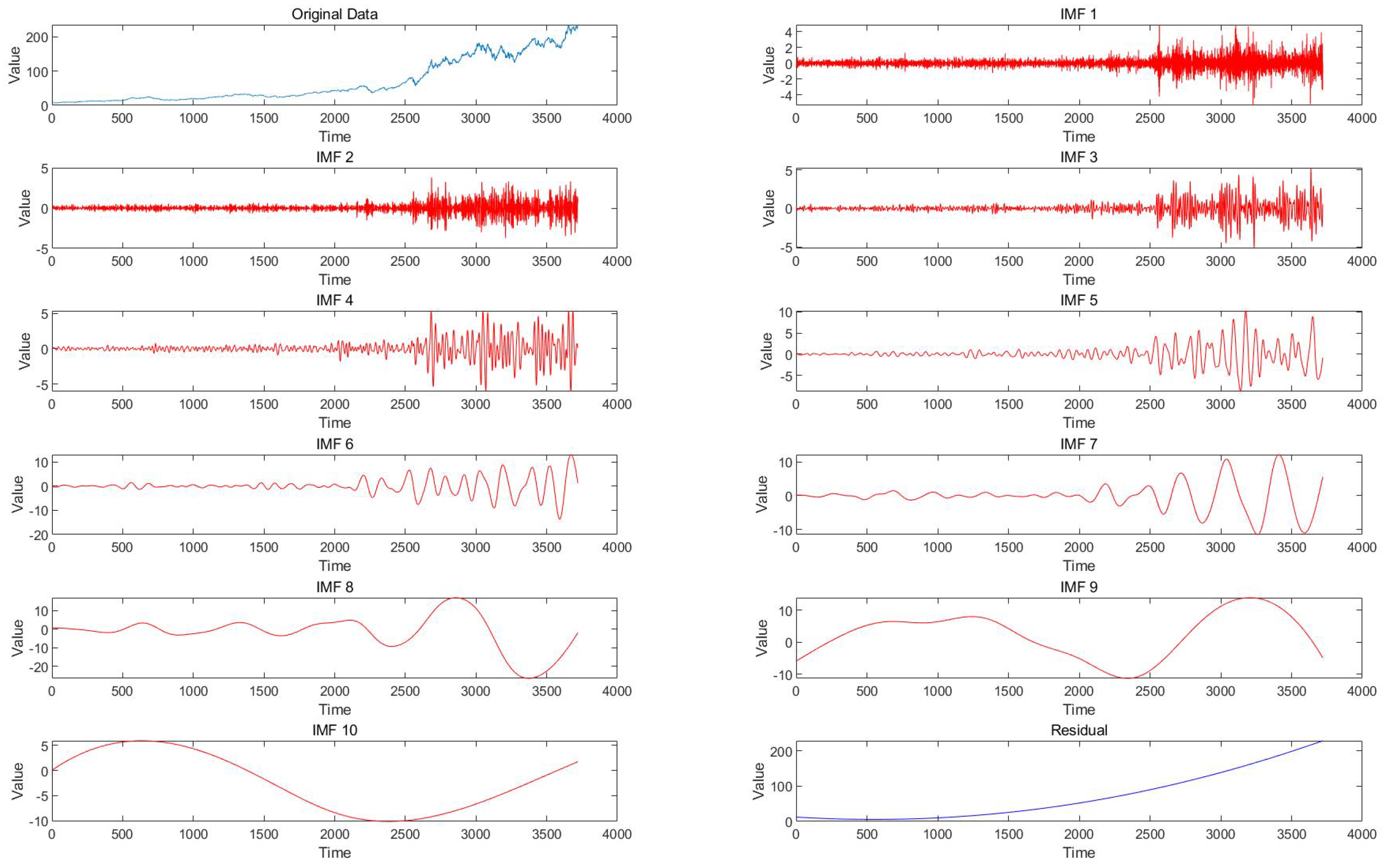
Figure 2. EEMD results of AAPL
Preprints 140749 g002
Figure 3. The significance testing of IMF based on lnE and lnT
Preprints 140749 g003
Figure 4. Original time series chart of typical the U.S. stocks
Preprints 140749 g004
Figure 5. Time series chart of typical the U.S. stocks after EEMD processing
Preprints 140749 g005
Figure 6. DCCA coefficients of JPM versus the other seven stocks.
Preprints 140749 g006
Figure 7. The log-log plot of fluctuation function F q ( s ) vs. time series scale s
Preprints 140749 g007aPreprints 140749 g007bPreprints 140749 g007c
Figure 8. The cross-correlation Hurst exponents
Preprints 140749 g008
Figure 9. Singularity strength α vs. multifractal spectrum f ( α ) .
Preprints 140749 g009
Figure 10. The histogram line plot of Δ H ( q ) and Δ α .
Preprints 140749 g010
Figure 11. The transfer entropy heatmap between the typical stocks in the U.S. industry sectors.
Preprints 140749 g011
Figure 12. Directed weighted network diagram with transfer entropy as weights.
Preprints 140749 g012
Table 1. Stocks information.
Ticker Symbol Listed Company Industry Sector
IPM JPMorgan Chase & Co. Financial
AAPL Apple Inc. Technology
XOM Exxon Mobil Corporation Energy
JNJ Johnson & Johnson Healthcare
PG Procter & Gamble Co. Consumer staples
VOD Vodafone Group Plc Telecommunications
GE General Electric Company Manufacturing
SPG Simon Property Group, Inc. Real estate
Table 2. The descriptive statistics for typical stocks in the U.S. industry sectors
JPM AAPL XOM JNJ PG VOD GE SPG
Min 28.38 6.86 31.45 57.02 58.51 8.06 27.36 44.01
Max 224.80 234.82 125.37 186.01 177.79 41.57 192.63 227.60
Mean 92.22 67.33 82.15 118.82 100.79 23.55 92.53 141.62
Std 46.00 62.54 17.89 37.16 33.44 8.47 36.40 37.27
Skewness 0.61 0.99 -0.35 -0.16 0.60 -0.18 0.23 -0.32
Kurtosis -0.50 -0.50 0.28 -1.25 -1.09 -1.07 -0.93 -0.55
JB_test 273.17*** 645.79*** 87.30*** 260.37*** 403.89*** 195.62*** 165.70*** 109.04***
Probability 4.80e-60 5.87e-141 1.10e-19 2.90e-57 1.98e-88 3.32e-43 1.04e-36 2.10e-24
* JB denotes the Jarque–Bera test for normality. *** denotes the rejection of the null hypothesis at the 0.01 significance level.
Table 3. Indicators for assisting in IMF selection
IMF/Res Pearson Corr Kendall Corr lnE lnT Var Contrib
IMF 1 0.0166 0.0063 -0.8273 1.5179 0.0001
IMF 2 0.0193 0.0181 -1.1965 2.5665 0.0001
IMF 3 0.0210 0.0074 -0.4544 3.6371 0.0002
IMF 4 0.0399 0.0110 0.5349 4.7042 0.0004
IMF 5 0.0180 0.0005 2.1469 5.8911 0.0011
IMF 6 0.1460 0.0380 3.5085 6.9376 0.0029
IMF 7 -0.0239 0.0096 3.9466 6.2160 0.0040
IMF 8 -0.3526 -0.0577 6.5376 9.5644 0.0230
IMF 9 0.3714 0.1371 5.7326 10.8955 0.0124
IMF 10 -0.3299 -0.3498 5.2111 11.8322 0.0081
Residual 0.9750 0.8128 N/A N/A 1.1231
Table 4. Transfer entropy between typical stocks in different industry sectors.
JPM AAPL XOM JNJ PG VOD GE SPG
JPM 0 0.0977 0.2264 0.1100 0.1206 0.1619 0.2254 0.2149
AAPL 0.1292 0 0.2363 0.1231 0.1430 0.1606 0.2277 0.2155
XOM 0.0667 0.0729 0 0.0574 0.1011 0.1627 0.1850 0.1980
JNJ 0.1306 0.0770 0.2184 0 0.1200 0.1663 0.2288 0.2019
PG 0.1251 0.0748 0.2415 0.1118 0 0.1676 0.2196 0.1981
VOD 0.1118 0.0489 0.2229 0.0995 0.0960 0 0.2130 0.1922
GE 0.1038 0.0582 0.2255 0.0951 0.0943 0.1560 0 0.1827
SPG 0.0678 0.0544 0.1749 0.0570 0.0862 0.1271 0.1674 0
*The information flow direction is from left to right.
Table 5. network indicators
ω o u t ω i n WD NTE WCC
JPM 1.1569 0.7351 1.8919 0.4218 0.1490
AAPL 1.2348 0.4838 1.7187 0.7510 0.1532
XOM 0.8439 1.5458 2.3898 -0.7019 0.1372
JNJ 1.1429 0.6540 1.7969 0.4889 0.1513
PG 1.1383 0.7611 1.8995 0.3772 0.1489
VOD 0.9843 1.1021 2.0864 -0.1179 0.1444
GE 0.9155 1.4662 2.3817 -0.5506 0.1374
SPG 0.7348 1.4034 2.1382 -0.6685 0.1432
Disclaimer/Publisher’s Note: The statements, opinions and data contained in all publications are solely those of the individual author(s) and contributor(s) and not of MDPI and/or the editor(s). MDPI and/or the editor(s) disclaim responsibility for any injury to people or property resulting from any ideas, methods, instructions or products referred to in the content.
Copyright: This open access article is published under a Creative Commons CC BY 4.0 license, which permit the free download, distribution, and reuse, provided that the author and preprint are cited in any reuse.
Prerpints.org logo

Preprints.org is a free preprint server supported by MDPI in Basel, Switzerland.

Subscribe

Disclaimer

Terms of Use

Privacy Policy

Privacy Settings

© 2025 MDPI (Basel, Switzerland) unless otherwise stated