

Submitted:
22 November 2024
Posted:
26 November 2024
You are already at the latest version
Abstract
Since Dirac’s paper from 1930 on the theory of electrons and protons, the question aboutnothingness has pervaded the right conception of reality at large. Quantum Mechanics (QM)both allows and demands, at the same time, a highly counterintuitive take on the universeand the world. However, science at large remains cautious about the issue of nothingness.Apparently a referential and objectivistic view of the universe and things is preferred. Thispaper argues in favor of nothingness based on non-classical logics (NCLs) in general, andfree logic, in particular. The crux of the issue is about thinking without presuppositions, oralso, thinking about phenomena, systems and behaviors free of existence.
Keywords:
Emptiness
; Dirac
; The Real and the Possible
; Quantum Mechanics
; Representation and Objectivity
1. Introduction
There is from start an ambiguity in quantum physics related to the use of emptiness, sometimes called even nothingness, and vacuum. Different authors relate to one or another of those terms. The origins of the problem of emptiness are found in Dirac’s classical paper on the theory of the electron (Dirac, 1930; Pais, n.d.). In any case, it is a highly serious and sensitive problem. Various approaches have been undertaken aiming at understanding and explaining the issue (Heller, 2018; Hossenfelder, 2023). This paper explains quantum emptiness via non-classical logics in general, and thanks to free logic, in particular. There is, to the best of my knowledge, no explanation of quantum emptiness along this research line (Soo, & Chang, 1994).
Non-classical logics (NCLs) comprise a logical pluralism aimed at using logics in general with a non-metaphysical presupposition and focusing on the realm of the possible, rather than the actual. It is in this sense that the semantics of (NCLs) are said the semantics of possible worlds, or also, as non-monotonic logics. Non-monotonicity entails that these are logics that learn; in other words, new information can modify information previously acquired. Several (NCLs) provide a solid ground for grasping emptiness, in science as well in the world or in nature.
As for free logic, it is a non-classical logic that assesses, contrary to standard logic (Wang, 1997), that there is no need for a reference or object in thought and language (Indrzejczak, 2021). Hence, emptiness and, moreover nothingness can be understood and explained differently from the classical or standard ways. There is no need to assess or not even to presuppose a given realm of existence, hence after.
Dirac’s theory of electrons and protons discovers mathematically that the world and the universe are grounded, so to speak, in a sea of emptiness. Such emptiness at its best should be understood as virtual Amano and Iwama, 1999. Thereafter a sea of virtual particles is to be set as conditio sine qua non for ordinary matter and energy. More exactly, Dirac’s theory assesses that there is negative energy. It is such negative states which gives rose to the theory of holes. Indeed, according to Dirac, all states of negative energy to be occupied except perhaps a few of small velocity. The whole process is completely (empirically) unobservable, even though the mathematics are consistent (Jansen, 2018).
In other words, physics is at odds in two respects closely intertwined, namely it offers an inaccurate description of nature, and it encounters itself with no physical meaning. Dirac’s equation depicts a violation of the law of conservation of energy. Even though Dirac does succeed in bringing together quantum mechanics and the theory of relativity – his theory is a quantum relativity theory, which is certainly not a minor achievement. In any case, physics must openly acknowledge its status: physics is not concerned with ontology. More exactly, physics is not an ontology in any sense of the word. This means, physics does not speak about what is, but just about what is measured, or also, about what can and cannot be spoken about, in terms of Bell (Bell, 2011). The crux of the issue is, briefly said, emptiness, vacuum, or nothingness.
This paper argues that free logics provides sufficient arguments to fully grasp and, moreover, to understand the real implications of emptiness, i.e. nothingness (Pavlović & Gratzl, 2021). Nothingness is a non-empirical reality which gives meaning to the actual. Thus, reality is to be conceived as a subset of a larger and vast dimension that is basically empty in the sense of Dirac, or also, non-referential and non-representational. (NCLs) in general, and free logic in particular open the gate to relating with emptiness as a sea of potentialities (Rami, 2021). The first section is sets on the table, so to speak the trouble about emptiness, i.e. nothingness. However, it is not my concern here to discuss the relationship between being and nothingness as it is largely taken in philosophy, theology and cultural studies, for instance (Shakoor, 2023). Rather I shall focus on quantum mechanics, for it provides a solid scientific ground to understand the problem without metaphysical presuppositions.
This is why, the second section is a presentation and discussion in a nutshell of Dirac’s arguments. The English physician has the merit of having open the gate to the problem between matter and antimatter, i.e., the known and the un-known – and yet to-be-known. Thinking in quantum-mechanics terms consists in thinking about relations and frames – entanglement and fields (Pavlović & Gratzl, 2023). The third section concentrates in the nodal specter of quantum-mechanical thinking. The fourth section presents and justifies the novelty of free logic vis-à-vis the problem and claim set out. We can and must think – and, I add, live, without any presupposition. Hence, a representational mode of relating to the world and nature can be overcome. At the end some conclusions are drawn.
2. Clarifying the Problem
In the western tradition, Leibniz was the first to point out to the very core of the problem, thus: why is there something rather than nothing? It should be clear from start that the framework of the problem is theodicy – something that remains albeit far from physics. Quantum mechanics in general, and P. Dirac provide an answer to Leibniz. I shall come to it at the conclusions.
Quantum physics emerges as a science of light already from the cradle of thermodynamics. Its basic unit was from start the electron and its behavior – always in the backyard of the two-slice experiment and the question about the black body radiation. Dirac’s paper from 1924 develops a theory, namely an equation that sets out a brand-new realm in physics, namely states of negative energy. Dirac is of all the authors that originally contributed to the birth of quantum physics and quantum mechanics the less philosophically inclined. Nonetheless, Dirac’s equation – which has been called as the most beautiful equation in the history of physics, inaugurates a serious concern, namely reality is definitely not what we see, touch, and perceive. More exactly, reality invites us to a highly counterintuitive dimension. Reality invites us from itself beyond itself.
Semantically, a problem arises. Is it equivalent to speak about emptiness, vacuum and nothingness? Apparently, the literature moves across as if there was no problem at all. Nonetheless a review paper would be helpful about it. Here I shall briefly distinguish these terms, as follows:
- Emptiness. Quantum physics does not exactly speak ever about emptiness. It is rather a Buddhist interpretation of the problem. Emptiness is the Buddhist take on Dirac’s Sea, or the hole theory (Nelson, 2023).
- Vacuum. In quantum field theory the vacuum state refers to the state with the lowest possible energy, i.e. that state in which there are no physical particles. Another way to state is that it is the zero-point energy or also the ground state out of which excitation emerges (Degichi, Matsui, 2010).
- Nothingness. It is the quantum field theory that assesses that we live in a universe of energy fields that interact with each other creating things all around us. It is exactly in this sense that something is created out of nothing (Vedral, 2010). Something exists because it is created out of nothing. If so, nothingness needs a further clarification.
In any case, it is obligatory so overcome Platonism, which is the wrong belief that the universe can be thought from outside. We live in a restless universe (Born, 1935). It must be sufficiently clear that there is nothing outside of the universe, even if yet we don’t fully know what the universe is all about (Impey, 2010). If Platonism can once and for all be overcome, we can open a gate to nothingness, Hence, Dirac’s ideas and its consequences.
3. Dirac’s Problem, Revised
In 1930 Dirac formulated a theory of electrons and protons according to which “an electron with negative energy moves an external field as though it carries a positive charge”. In 1932, C. D. Anderson experimentally proved the existence of such particles and were dubbed as positrons. Positrons implied a negative energy. Along the years, both physicists and cosmologists called it as “dark energy”.
Dirac’s paper has four axes, as follows: firstly, it combines a quantum relativity theory, it clearly shows that the description of nature is inaccurate, thirdly, the description and understanding of nature has no physical meaning, and finally, it makes clear that we assist to a violation of the principle of conservation of energy. More particularly, the “hole theory” or also, the Dirac’s Sea is a theoretical model of the vacuum as in infinite sea of particles with negative energy. The Dirac equation as he formulated originally says:
which can be expressed also as follows:
Rightly understood, vacuum energy is an underlying background energy that exists in space throughout the entire universe. The vacuum energy is a special case of zero-point energy that relates to the quantum vacuum. The effects of vacuum energy have been experimentally tested and proved several times by the Casimir effect or the Lamb shift, for instance.
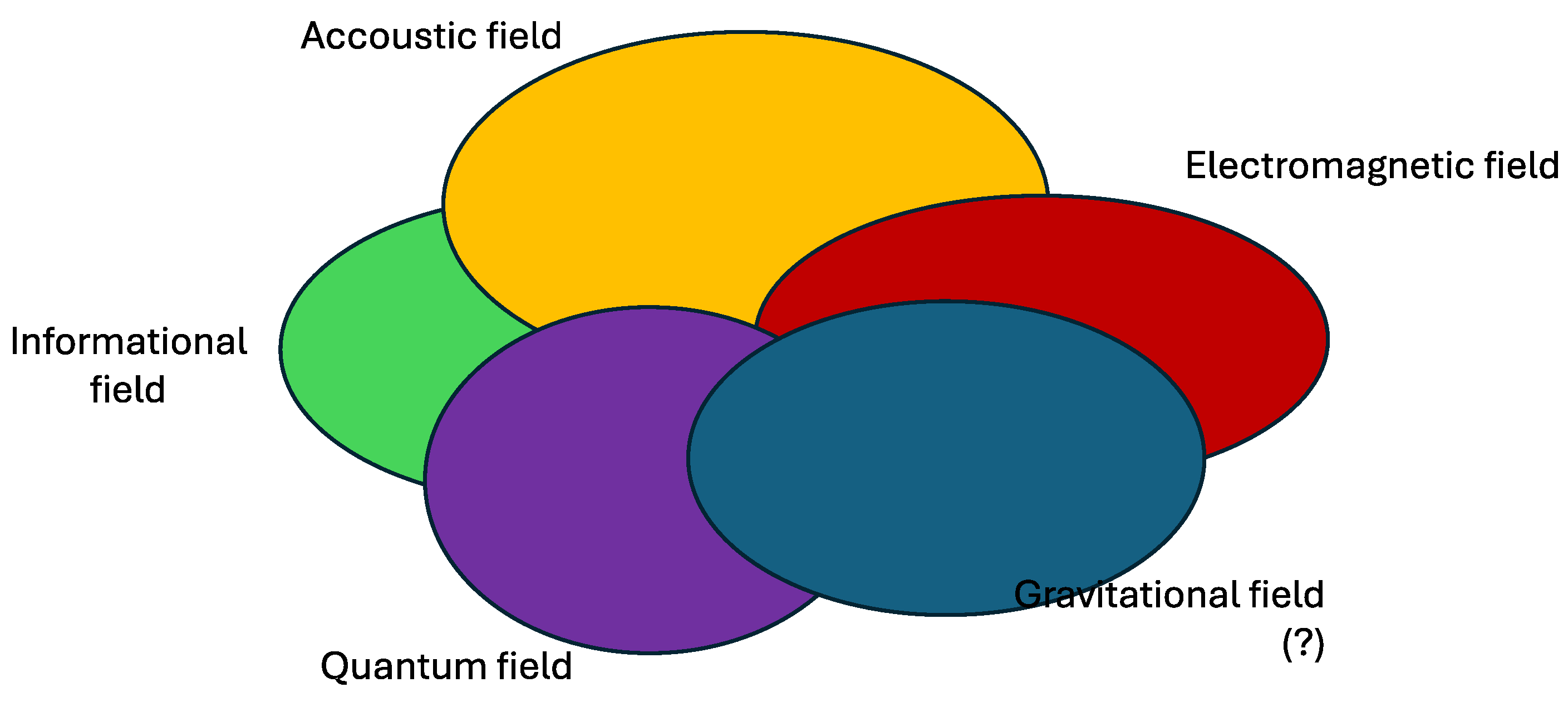
Now, a good way to think of the vacuum is as a superposition of states for many kinds of field. The crux of the issue arises from the external field, which defines the character of positrons. More amply, sub-atomic particles exist at the crossroad, so to speak of different fields. Figure 1 depicts the interplay of such fields:
One remark becomes necessary: no one truly knows what gravitation is, although it is well-known what it does (Klein, 1974).
4. Nothingness as a Nodal Reality
Understanding emptiness, vacuum or nothingness has been (classically) undertaken by Buddhists or Buddhist scholars relating Dirac’s issue with Nagarjuna’s philosophy (Nelson, 2023; Wirtz, 2023). The concept used by Nagarjuna to refer to emptiness is Sunyata. Reality is basically empty. Enlightenment if it does not consist of, at least it crossed through, realizing about emptiness. Moreover, in the Buddhist take of reality, there is no ontology in the sese that the very quarrion about the nature of reality is nonsense (Wirtz, 2023). Ontology is the presupposition that there is something independent of the act of observation.
Properly speaking Nagarjuna's philosophy is a relational ontology, because the notion of individuality is considered empty.
Traditionally, physics was conceived as the science concerned with understanding and explaining what the world, the universe or reality are: ta physiká, peri physeos (in Greek). Such a take characterizes physics from Aristotle to classical mechanics. With quantum physics the issue is radically shifted.
Heller (2018) undertakes an examination of what does it mean to exist in physics from a logical standpoint, based on Quine’s ideas. A twofold approach is highlighted, thus: firstly, thanks to Mach we can only speak of what we can measure. This sets the ground for the entire discussion about reality within the framework of the Copenhagen debate. Then, also, mainly thanks to J. Bell, it is necessary to distinguish between the speakable and the unspeakable (Bell, 2011). In this tenure, physics is not so much about what the world in general is, but about what we can know and speak about.
According to Heller, there exist mathematical structures, a domain to which they refer, and rules establishing this reference. We depart form language, and we remain apparently within the domains of language. And yet, language allows us to see beyond what language says. It is, namely the potential the non-existent. Not ultimately, it is worth remembering that the mathematics of quantum mechanics is imaginary, mathematically speaking.
A careful study of quantum mechanics (QM) makes clear that the notion of property of a quantum object is untenable (Caponigro and Prakash, 2009). We can only speak about relational property of the object (Naschie, 2016a). Quantum events exist only in interactions and the reality of each quantum event is only relative to the system involved in the interaction. The quantum wave is an empty set representing the surface, i.e. boundary of the zero-set quantum particle and in turn quantum spacetime is simply the boundary or the surface of the quantum wave empty set. The essential difference of the quantum wave and quantum spacetime is that the wave is a simple empty set while spacetime is a multi-fractal type of infinitely many empty sets with increasing degrees of emptiness. Straightforwardly said, (QM) violates the classical supposition of ‘value definiteness’, according to which the properties—a.k.a. ‘observables’—of a particle or system always have precise values.
(QM) is rooted, if allowed, in indefiniteness or indeterminacy (Heisenberg, 1927). These features are core to what is supposed to be distinctive about quantum phenomena. Indeterminacy is probably the cornerstone of quantum theory. It was first conceived and coined by Heisenberg in 1927. Unluckily, it has been translated and misinterpreted as uncertainty. The truth is that Heisenberg uses the concept Unbestimmtheit, and never either Unsicherheit or Ungewissheit (Heisenberg, 1927).
Reality is itself undetermined. Thus, indeterminacy, as it is well known, does not depend on any subjective consideration (Calosi, Wilson, 2021). Indeterminacy constitutes the core of the complexity of the world and nature, at large.
Therefore, a right conception of reality at large entails a take different form a representation or an objectivization in any sense of the word (Naschie, 2016b). Not only is reality afar from perception and the natural senses, but also its roots, so to speak, in a sea of probabilities, virtuality, alas, nothingness. In cosmological terms, most probably, the energy needed for the expansion of the universe is just a loan in the form of quantum transaction of the potential of emptiness (Impey, 2010).
After all, the wave function serves to calculate probabilities. In other words, superposition, incompatible observables, or entanglement can be viewed as sources for a correct explanation of what is and what happens, after a fantastic real of potentialities. As a matter of fact, the Hartle–Hawking model of the quantum creation of the universe from nothing, solving thus the paradoxes of the big-bang model (Vedral, 2010).
Being as it may be, three interpretations about quantum nothingness can be hence after identified, namely:
- A sea of potentialities (Dirac)
- A relational reality (Nagarjuna)
- A logical emptiness (no denotation)
I now turn to the latter.
5. The Contribution of Free Logic to the Question at Stake
Free logic means logic free of existence[1]. Originally developed by K. Lambert (Lambert, 2003), free logic allows to think with fewer existential presuppositions than classical logic. It is a logic in which terms do not denote any object. In other words, it allows seeing terms that are or might be empty. A term is empty if it either has no referent or refers to an object outside the domain (Nolt, 2021). Free Logic is free of existence assumptions with respect to its terms, general and singular.
In free logic, all things and events, whether material, mental or even abstract concepts like time, are devoid of objective, independent existence. Plainly said, they do need to have a reference – to have meaning. Significantly, most meaningful events, experiences, concepts lack a refence in the empirical sense of the word.
Therefore, nothingness can be grasped as a non-object, or a non-reference, which is quite odd vis-à-vis of the western mindset used to conceive entities as present or presence, and everything as a reference – even if not an object, necessarily. In German, for instance, there are the distinctions between Objekt, Ding, Sache, Gegenstand. None of them quite fit the issue at stake in this paper. English, French or Spanish are even less capable or being taken into account.
More radically, I wish to argue that there is just emptiness or nothingness. Reality is made up of quantum bits, each arising from causeless click. This is exactly what Dirac himself meant.
Based on the notion of nothigness, "phenomena" exist in a relative way, that is, they are empty of any kind of inherent and independent existence. Thinking about free of existence systems, phenomena or behavior allow for maximum degrees of freedom. The quantum realm, it appears, seems to be – to-date, the dimension with the maximum degrees of freedom possible.
All things and events, whether material, mental or even abstract concepts like time, are devoid of objective, independent existence. To possess such independent, intrinsic existence would imply that things and events are somehow "complete" unto them and are therefore entirely self-contained. This would mean that nothing has the capacity to interact with and exert influence on other phenomena. Moreover, the notion of intrinsic, independent existence is incompatible with the concept of causation. (QM) can be said to consist in an acausal physics (Svozil 2018).
Now, if we adopt the concept of relational as basic level, we accept the philosophy of the relations and we renounce at the possible existence of intrinsic properties. This is the crux of the argument.
Nothingness can be grasped as a non-object, or a non-reference, which is quite odd vis-à-vis of the western mindset used to conceive entities as present or presence, and everything as a reference – even if not an object, necessarily.
6. Conclusions
It should always be clear that physics is not ontology. Nonetheless, physical theories and models can be interpreted ontologically, i.e. about what there is, or not.
Ontology is not just a matter of philosophy. Moreover, it is question directly pertaining to both logics and mathematics. Classical logics encounters numerous hindrances (Wang, 1997). Mathematics is continuously developing and growing (Zalamea, 2021; 2012).
There are two main ways to prove something in science, at large. The most common one is via experiments. This, I argue, is a physical o physicalist approach. However, it is also possible to demonstrate something thanks to logics i.e., logical reasoning. In any case, the purpose of logics or experiments consist in shedding brand new lights; in other words, understanding.
Leibniz challenged both science and philosophy at some time at the beginning of modernity. QM provide the answer. There is nothing, and being is just a limit case of nothingness (Zolghadr, 2023). Surprising as it is, the answer is highly counterintuitive. It either requires a specific spiritual evolution, say, Buddhism, or a strongly scientific education.
This paper argues that free logic can be taken as a propaedeutics to nothingness. We can and indeed should know that knowing about the universe, the world or nature entails a presuppositionless attitude. Nothing goes without saying, nothing should be taken for granted. In science – very much as in life nothing is obvious or evident; reality is not what it seems (Rovelli, 2018). Another answer to the question is: Why is there something rather than nothing? Simply because something is one mode of what can and could be possible and does not exhaust in the actual.
Most of the universe is empty. Solid bodies constitute a meaningful minority of the universe. In fact, no body truly knows what matter is. Yet, beyond this, we have come to know about a physics of the immaterial (Landauer, 1991; Maldonado, 2022).
Conflicts of Interest
I declare this paper has no conflict of interest.
References
- Amano, M., and Iwama, K., (1999). “Undecidability on Quantum Finite Automata”, in: STOC '99: Proceedings of the thirty-first annual ACM symposium on Theory of Computing, May, pages 368-375. [CrossRef]
- Bell, J., (2011). Speakable and Unspeakable in Quantum Mechanics. 2nd Edition. Cambridge: Cambridge University Press.
- Born, M., (1935). The Restless Universe. London & Glasgow: Blackie & Son Limited. B: & Glasgow.
- Calosi, C., Wilson, J., (2021). “Quantum indeterminacy and the double-slit experiment”, in: Philos Stud (2021) 178:3291–3317. [CrossRef]
- Caponigro, M., Prakash, R., (2009). “Interpretations of Quantum Mechanics and Emptiness”, in: Neuroquantology, June, vol. 7, issue 2, Page 198-203; available at: https://philarchive.org/archive/CAPIOQ-2.
- Degichi, T., Matsui, C., (2010). “Correlation functions of the integrable higher-spin XXX and XXZ spin chains through the fusion method”, in: Nuclear Physics B 831 [FS], 359–407. [CrossRef]
- Dirac, P., (1930). “A theory of electrons and protons”, in: Proceedings of the Royal Society of London, vol. 106, issue 739, págs. 360-365. [CrossRef]
- Heisenberg, W., (1927). “Über den anschaulichen Inhalt der quantentheoretischen Kinematik und Mechanik“, in: Z. Physik 43, 172–198 (1927). [CrossRef]
- Heller, M., (2018). „What does it mean “to exist” in physics?”, in: (Zagadnienia Filosozoficzne w Nauce), Philosophical Problems in Science, No. 65, pp. 9-22; available at: https://zfn.edu.pl/index.php/zfn/article/view/436.
- Hossenfelder, S., (2023). „What is Nothing? “, in: https://www.youtube.com/watch?v=PhfqdBk8qxk.
- Impey, C., (2010). How It Ends: From You to the Universe. New York: W. W. Norton & Company.
- Indrzejczak, A. (2021). Free Logics are Cut-Free. Studia Logica, 109(4), 859–886. [CrossRef]
- Jansen, F. K. (2018). Quantum mechanics requires an observer context distinguishing between reality and its mental representation. NeuroQuantology, 16(5), 110–121. [CrossRef]
- Klein, O., (1974). Generalization of Einstein's Principle of Equivalence so as to Embrace the Field Equations of Gravitation. Physical Scripta, vol. 9, No. 2: 69.
- Lambert, K., (2003). Free Logic: Selected Essays. Cambridge: Cambridge University Press.
- Landauer, R., (1991). Information Is Physical. Physics Today, 44, 23-29. [CrossRef]
- Maldonado, C. E., (2022) “Five Arguments toward Understanding Life in Light of a Physics of the Immaterial”. Proceedings 2022, 81, 19. [CrossRef]
- Naschie, M. E., (2016a). “Einstein-Rosen Bridge (ER), Einstein-Podolsky-Rosen Experiment (EPR) and Zero Measure Rindler-KAM Cantorian Spacetime Geometry (ZMG) Are Conceptually Equivalent”, in: Journal of Quantum Information Science, 2016, 6, 1-9 Published Online March 2016 in SciRes. http://www.scirp.org/journal/jqis. [CrossRef]
- Naschie, M. E., (2016b). “The Emergence of Spacetime from the Quantum in Three Steps”, in: Advances in Pure Mathematics, 2016, 6, 446-454 Published Online May 2016 in SciRes. http://www.scirp.org/journal/apm http://dx.doi.org/10.4236/apm.2016.66032. [CrossRef]
- Nelson, E. S. (2023). Emptiness, negation, and skepticism in Nāgārjuna and Sengzhao. Asian Philosophy, 33(2), 125–144. [CrossRef]
- Nolt, John, "Free Logic", The Stanford Encyclopedia of Philosophy (Fall 2021 Edition), Edward N. Zalta (ed.), URL = https://plato.stanford.edu/archives/fall2021/entries/logic-free/.
- Pais, A., (n.d.). “On the Dirac Theory of the Electron (1930- 1936)”, available at: https://link.springer.com/content/pdf/bfm:978-3-642-70078-1/2/1.pdf.
- Pavlović, E., & Gratzl, N. (2023). Neutral Free Logic: Motivation, Proof Theory and Models. Journal of Philosophical Logic, 52(2), 519–554. [CrossRef]
- Pavlović, E., & Gratzl, N. (2021). A More Unified Approach to Free Logics. Journal of Philosophical Logic, 50(1), 117–148. [CrossRef]
- Rami, D. (2021). Single-domain free logic and the problem of compositionality. Synthese, 198(10), 9479–9523. [CrossRef]
- Rovelli, C., (2018). Reality Is Not What It Seems. The Journey to Quantum Gravity. Riverhead Books.
- Shakoor, J. (2023). Being and nothingness. In Deep Reading, Deep Learning: Deep Reading Volume 2 (pp. 3–4). Peter Lang AG. [CrossRef]
- Soo, C., & Chang, L. N. (1994). Superspace dynamics and perturbations around “emptiness.” International Journal of Modern Physics D, 03(03), 529–543. [CrossRef]
- Svozil, K., (2018). Physical (A)Causality. Determinism, Randomness and Uncaused Events. Springer Verlag.
- Vedral, V., (2010). Decoding Reality. The universe as quantum information. Oxford: Oxford University Press.
- Wang, H., (1997). A Logical Journey: From Gödel to Philosophy. Cambridge, MA: The MIT Press. T: MA.
- Wirtz, M. (2023). Emptying the Mind: Nothingness in Mahayana Buddhism and in the Chan Tradition in Comparison to Western Philosophical Conceptualizations of Nothingness. Journal of Chinese Philosophy, 50(2), 141–154. [CrossRef]
- Zalamea, F., (2021). Modelos en haces para el pensamiento matemático. Bogotá: Ed. Universidad Nacional de Colombia.
- Zalamea, F., (2012). Synthetic Philosophy of Contemporary Mathematics. Urbanomic/Sequence Press.
- Zolghadr, B., (2023). “Gluon Theory: Being and Nothingness”. Australasian Journal of Logic (16:3) 2019, Article no. 2, pp. 68-82.
| 1 | I leave here aside the origins of free logic and its developments. I straightforwardly focus on the importance of free logic for understanding nothingness (Nolt, John, 2021). |
Figure 1.
A Synthetical View of Fields. Source: Own Elaboration.
Disclaimer/Publisher’s Note: The statements, opinions and data contained in all publications are solely those of the individual author(s) and contributor(s) and not of MDPI and/or the editor(s). MDPI and/or the editor(s) disclaim responsibility for any injury to people or property resulting from any ideas, methods, instructions or products referred to in the content. |
© 2024 by the authors. Licensee MDPI, Basel, Switzerland. This article is an open access article distributed under the terms and conditions of the Creative Commons Attribution (CC BY) license (http://creativecommons.org/licenses/by/4.0/).
Copyright: This open access article is published under a Creative Commons CC BY 4.0 license, which permit the free download, distribution, and reuse, provided that the author and preprint are cited in any reuse.


