

Submitted:
20 November 2024
Posted:
21 November 2024
You are already at the latest version
Abstract
Non-typhoidal Salmonella (NTS) infections in poultry, particularly in commercial layer chickens, pose a critical risk to food safety and public health worldwide. NTS bacteria can remain undetected in poultry flocks, contaminating products, and potentially leading to gastroenteritis in humans. This review examines pre-harvest control strategies for NTS in layer chickens, including biosecurity protocols, vaccinations, feed additives, genetic selection, and environmental management. By evaluating these strategies, this review highlights the importance of integrated control measures to limit NTS colonization, reduce antimicrobial resistance, and improve poultry health. This review aims to provide producers, researchers, and policymakers with insights into effective practices to minimize Salmonella contamination and enhance both animal and human health outcomes.
Keywords:
Antimicrobial resistance
; biosecurity
; vaccination
; feed additives
; food safety
; layer chickens
; non-typhoidal Salmonella
; pre-harvest control
; poultry health
1. Introduction
Non-typhoidal Salmonella (NTS) refers to a group of Salmonella serovars associated with gastroenteritis in humans. Notable serovars include S. Enteritidis, S. Typhimurium, S. Kentucky, S. Newport, S. Javiana, S. Heidelberg, S. Muenchen, S. Infantis, S. Braenderup, S. Saintpaul, S. Montevideo and S. Thompson [1]. Some of these serovars pose a significant threat due to their zoonotic transmission from poultry to humans [2]. Poultry products, such as meat and eggs, serve as critical reservoirs of NTS; therefore, they are a significant contributor to foodborne disease outbreaks globally [3]. Among NTS, S. Enteritidis and S. Typhimurium are the serovars most commonly linked to foodborne illnesses that arise from consuming eggs and egg products [1,4]. In commercial poultry operations, especially in layer chickens, NTS colonization usually occurs without symptoms, allowing Salmonella to persist undetected in flocks [5]. This silent carriage has a direct impact on public health by facilitating contamination of poultry environment and poultry products. Therefore, controlling NTS in poultry has become an urgent global priority to reduce foodborne illnesses and underscores the need for effective pre-harvest interventions. The occurrence and spread of NTS in commercial layer chicken facilities can vary widely depending on the geographical region, farm management practices, and the effectiveness of biosecurity measures [6]. In the United States, Salmonella is the leading cause of foodborne infections, and poultry products have consistently been identified as major contributors [5].
In avian hosts, NTS colonization of the gastrointestinal tract (GIT) is a complex process involving the adhesion of pathogens to intestinal epithelial cells and subsequent invasion. During this course of colonization, the NTS evolved several adaptive mechanisms to evade the host immune system. These survival mechanisms include modulation of the local immune environment and the use of virulence factors that enable the pathogen to exist within the host without causing overt clinical manifestations [7,8,9]. In poultry, the transmission of NTS can occur through vertical or horizontal (Figure 1) pathways, necessitating that the pre-harvest control strategies focus on various farm management aspects. Vertical transmission occurs when Salmonella is transmitted from the breeder hens to their progeny through contaminated eggs. This is observed when Salmonella contaminates the hen's reproductive organs, particularly the ovaries or oviducts, leading to egg contamination before shell formation. Such infected eggs can hatch into chicks carrying the pathogen throughout their development, thereby perpetuating the infection cycle. Horizontal transmission of NTS implies pathogen dissemination within a flock or between different flocks, often through direct or indirect contact. The fecal-oral route is the main route of infection, wherein other birds ingest Salmonella from contaminated droppings by pecking contaminated litter or drinking water. Poor quality feed or water sources may act as reservoirs, bringing the pathogen into contact with healthy birds. Other possible vectors include contaminated farm equipment, clothing, rodents, and footwear from farm workers [8].
From a production point of view, NTS may cause economic losses in commercial layer operations by reducing egg production, increasing mortality in severe cases, and increasing the cost of implementing control measures [8]. Although many NTS infections in poultry are subclinical, their presence may still subtly affect the health status, impacting feed conversion efficiency, growth rate, and overall productivity of the flock [10]. From a public health perspective, NTS has a significant impact as a leading cause of foodborne illness worldwide. Contaminated poultry products, particularly eggs, are recognized as a main source of NTS to humans. Human infections generally lead to self-limiting gastroenteritis, which presents typical symptoms of diarrhea, abdominal pain, fever, and vomiting [9]. However, in the elderly, children, and immunocompromised individuals, it can lead to serious extraintestinal infections. The ability of Salmonella in the poultry ecosystem to acquire antimicrobial resistance presents an additional challenge to veterinary and human health care [11].
Controlling NTS during the pre-harvest stage in commercial-layer production is critical in reducing foodborne diseases due to Salmonella, limiting the spread of antimicrobial resistance, and improving public confidence in food safety [12]. Therefore, this review comprehensively evaluates various pre-harvest control strategies that benefit poultry producers, researchers, and policymakers in effectively implementing NTS control measures.
2. Risk Factors Influencing Salmonella Contamination in the Pre-Harvest Stage
Understanding the factors influencing Salmonella contamination in the pre-harvest stage is essential for developing effective control strategies in commercial layer chicken operations. Various environmental, management, biological, and microbial factors contribute to the risk of Salmonella presence in poultry flocks, each playing a unique role in facilitating the spread and persistence of these bacteria [13,14].
2.1. Environmental Factors
Environmental conditions within the poultry housing system significantly influence Salmonella contamination [15]. Temperature, humidity, and ventilation all impact Salmonella survival and transmission within poultry facilities. Higher temperatures and humidity can increase bacterial survival rates in litter, dust, feces, and surfaces, creating an environment conducive to pathogen persistence [16]. Ventilation in poultry houses significantly influences Salmonella contamination levels, as large volumes of air can transport bacteria from litter and dust into the aerosol environment within the sheds. Mechanical ventilation systems, such as tunnel ventilation, move substantial air volumes through poultry sheds, potentially aerosolizing Salmonella and enabling its dispersal inside and outside the housing unit. However, external levels are usually lower than internal Salmonella concentrations [17]. Nonetheless, inadequate light and ventilation can increase stress among birds and weaken their immune responses, making them more susceptible to infections like Salmonella [18,19,20]. Additionally, the type and quality of litter used in non-cage housing systems play a role; soiled or moist litter can support Salmonella proliferation, especially if it is not changed or managed regularly [21,22]. Maintaining optimal environmental conditions through temperature control, adequate ventilation, and regular litter management is crucial to minimizing contamination risks.
2.2. Farm Management Practices
Poor hygiene practices, such as inadequate cleaning and disinfection of poultry houses, equipment, and feed areas, create environments where Salmonella can thrive and spread. Farm biosecurity practices are also essential, as inadequate restrictions on personnel movement, ineffective entry points, and equipment disinfection can introduce or spread Salmonella within flocks. Farm management includes implementing proper waste disposal systems and rigorous cleaning schedules [23,24]. Additionally, feed and water management play a role; contaminated feed and water are primary sources of Salmonella, and failure to routinely monitor and sanitize these inputs increases the risk of introducing the pathogen to chickens [25]. Ensuring regular inspections, enforcing strict biosecurity protocols, and implementing cleaning schedules help mitigate the risk of contamination [23,24].
2.3. Flock Density and Housing Systems
The housing system and flock density directly affect Salmonella transmission among birds. In high-density rearing systems, birds are in closer contact, which can facilitate the rapid spread of Salmonella through direct and indirect contact, including via droppings, feathers, and feed. Cage-free and free-range systems, while offering benefits for animal welfare, may pose unique challenges for Salmonella control [26]. In free-range systems, birds may be exposed to contaminated soil, insects, or wild animals, all of which can serve as reservoirs for Salmonella. In addition, free-range environments make it difficult to control environmental contamination sources, adding complexity to management practices [26,27]. However, compared to non-cage production systems, such as barn and free-range systems, cage production systems pose a greater risk of Salmonella contamination [28,29]. The recovery rate of Salmonella from the dust and fecal samples in caged systems is typically higher than in non-cage systems [30]. Additionally, Salmonella persists longer in houses with a deep pit (step-cage houses and cages with a scraper manure disposal system) than in non-cage systems [31]. Controlling flock density, regularly rotating pastures for free-range birds, and maintaining clean housing environments can help minimize the risk of contamination in various housing systems.
2.4. Bird Age and Immunity
The age and immune status of birds influence their susceptibility to Salmonella infection. Younger chickens with immature immune systems are generally more susceptible to Salmonella and are often the focus of preventative strategies such as vaccination. Due to overcrowding, poor nutrition, or suboptimal environmental conditions, birds under stress may experience immune suppression, making them more vulnerable to infections [18,19,20]. Vaccination against Salmonella at an early age has proven effective in reducing susceptibility, as it provides birds with specific immunity to certain Salmonella serovars [32]. Additionally, selective breeding for resistance to pathogens, including Salmonella, is an emerging area of interest [33]. Ensuring optimal health, nutritional support, and targeted vaccination schedules can strengthen flock immunity, reducing the likelihood of Salmonella establishment and transmission.
2.5. Feed and Water Quality
Contaminated feed and water are among the primary sources of Salmonella entry into poultry flocks [8]. Feed contamination can occur at any stage in the supply chain, including during production, storage, or transport. In particular, animal-based feed ingredients, like fishmeal or meat by-products, have higher contamination risks [34]. Ensuring that feed undergoes processing treatments, such as heat-pelleting, can reduce Salmonella presence [35]. Water quality also plays a crucial role in influencing Salmonella contamination at the pre-harvest stage, as water systems can serve as reservoirs for Salmonella biofilms. This protection allows the bacteria to persist over time within the water systems, contributing to the ongoing risk of contamination in poultry environments. Regular water testing and appropriate water sanitizers can help prevent contamination [36].
2.6. Role of Rodents, Wild Birds, and Insects as Vectors
Rodents, wild birds, and insects act as vectors, facilitating the introduction and spread of Salmonella in poultry farms. Rodents, in particular, are known carriers of Salmonella and can easily transmit the bacteria through droppings, which can contaminate feed, water, and litter [14]. Wild birds that access free-range or cage-free areas can introduce Salmonella to poultry through droppings or direct contact. Similarly, flies and other insects can pick up Salmonella from contaminated environments and transmit it to birds through feeding or nesting materials [8]. Effective pest control measures are essential in reducing the likelihood of Salmonella transmission from these external vectors. Measures such as securing feed storage, installing barriers to restrict wild bird access, and implementing rodent and insect control programs are vital to minimizing contamination risks.
2.7. Antimicrobial Resistance (AMR) and its Impact on Salmonella Control
The rise in antimicrobial resistance (AMR) among Salmonella strains is an increasingly concerning topic in pre-harvest control of Salmonella. The use of antibiotics in poultry production for growth promotion and disease prevention has contributed to the development of resistant Salmonella strains, making infections more challenging to manage [37,38]. Resistant strains can persist longer in the environment and within birds, reducing the efficacy of traditional control measures. AMR complicates treatment options and poses a risk to human health, as resistant Salmonella can be transmitted to humans through contaminated poultry products [38]. AMR can also facilitate the horizontal transfer of resistance genes between different bacterial populations within the poultry environment, compounding the issue by increasing the diversity of resistant pathogens present [39]. This prolonged environmental survival and gene transfer capability amplify the risk of resistant Salmonella strains spreading to humans, underscoring the critical need to understand AMR’s impact on Salmonella dynamics in pre-harvest settings [40,41]
2.8. Human Interaction and Farm Personnel Practices
Human interaction, including the activities of farm personnel, is another significant factor influencing Salmonella contamination in the pre-harvest stage. Workers can inadvertently introduce Salmonella through contaminated clothing, footwear, and equipment if proper biosecurity measures are not followed. Without strict hygiene protocols, personnel moving between different farm areas or flocks can facilitate cross-contamination [42,43]. Producers must commit to training staff on proper hygiene, providing dedicated clothing and equipment for specific zones, and implementing hand-washing and disinfection protocols in order to minimize human-mediated Salmonella transmission. Additionally, establishment of clear visitor policies can reduce the risk of introducing external contamination sources [44].
3. Pre-Harvest Control Strategies
3.1. Biosecurity Measures
Biosecurity measures are a key component of Salmonella control in commercial poultry and have contributed greatly to the current levels of success observed in the industry [45,46,47]. Implementing comprehensive biosecurity measures is fundamental to infection control, as the effectiveness of concurrent preventive interventions is significantly diminished when biosecurity protocols are compromised. Biosecurity protocols encompass diverse preventive measures designed to minimize pathogen introduction and transmission within poultry flocks. These include physical barriers, sanitation protocols, pest management systems, personal protective equipment requirements, and strict personnel movement controls [15,48].
Establishing physical barriers represents a cornerstone of biosecurity protocols in preventing pathogen introduction to poultry facilities. Implementing perimeter fencing and controlled entry points for personnel and vehicles is essential. Epidemiological studies demonstrate that facilities with well-defined boundaries and restricted access protocols exhibit significantly lower incidence of Salmonella outbreaks [49]. Moreover, the strategic limitation of equipment and vehicle movement between facilities effectively reduces cross-contamination risks. Specific control measures include the implementation of dedicated facility-specific footwear and protective clothing, alongside the adoption of all-in/all-out production systems, which substantially minimizes cross-contamination between different age cohorts.
Environmental decontamination protocols targeting water systems, feed storage, and litter management are crucial in preventing Salmonella introduction. These protocols aim to reduce microbial load within poultry housing facilities substantially. Research demonstrates that implementing systematic cleaning and decontamination procedures significantly reduces Salmonella contamination in broiler housing environments [50]. Surveillance and monitoring are other essential components of an effective biosecurity framework. Regular microbiological testing of flocks, feed supplies, and environmental samples enables the identification of potential contamination sources and informs evidence-based management decisions. These surveillance systems facilitate early detection of Salmonella outbreaks, enabling rapid corrective interventions. Integrating biosecurity measures with systematic surveillance enhances the overall efficacy of Salmonella control programs in poultry operations [51].
Feed represents a primary vector for pathogen transmission in poultry flocks, with Salmonella identified as the predominant biological hazard across animal feed categories [52]. These risks can be mitigated by sourcing ingredients from verified suppliers who maintain rigorous sampling and testing protocols [53]. At the level of the feed mill, the establishment of segregated clean and contaminated zones, coupled with strict access controls, significantly reduces the potential for Salmonella and other pathogen cross-contamination between raw materials and finished feed products [54]. Another prominent source of Salmonella in poultry farms are rodents [55] and insects, and they function as both mechanical and biological vectors in pathogen transmission. The mitigation of these risks requires the implementation of integrated pest management protocols, incorporating physical barriers, strategic trap placement, vegetation management, and systematic chemical intervention through targeted pesticide applications [56].
3.2. Vaccination
Although numerous vaccine platforms, such as live attenuated vaccines, inactivated vaccines, subunit vaccines, and emerging options like ghost vaccines, have been tested experimentally for Salmonella control in layer operations, only a few of these are currently available for commercial use. The available vaccines include inactivated whole-cell preparations, live attenuated strains, and autogenous killed vaccines, each offering distinct advantages in immunological protection [57]. Over the past few decades, these vaccination efforts have significantly reduced Salmonella incidence in poultry flocks over recent decades, contributing to improved food safety outcomes. [58,59]. However, vaccine efficacies will vary depending on the Salmonella serovar, environmental conditions, and poultry types.
3.2.1. Live Attenuated Vaccines
Attenuated vaccines against Salmonella comprise live bacteria that undergo testing experimentally for Salmonella control in layer operations, specific modifications to reduce their virulence while maintaining immunogenic properties essential for eliciting a protective immune response in the bird. Several live attenuated vaccines are commonly used in commercial poultry production, including commercial layer production, due to their lower cost, ease of manufacture, and simpler administration than inactivated vaccines (Table 1). These vaccines mimic natural infection by adhering to mucosal surfaces and interacting with mucosa-associated lymphoid tissue, thereby eliciting robust humoral and cell-mediated immune responses [60,61,62]. They are also known to provide heterologous protection, confer immunity against serovars beyond the specific vaccine strain and protection against a broader range of pathogens compared to killed vaccines [63,64]. Furthermore, live vaccines provide an additional protective mechanism through the competitive exclusion of pathogens, particularly benefiting young chickens with a still-developing gut microflora and an immature immune system [65]. However, live vaccines could persist for extended periods post-vaccination, potentially transferring to poultry products and, subsequently, to consumers [66]. Although these strains are attenuated, their persistence in the environment and poultry products raises concerns for food safety officials and the public. Another downside of this persistence is that these vaccine strains may interfere with Salmonella surveillance and performance standards, leading to financial losses for the farmer [57]. To address this issue, novel methods that could discriminate between wild-type and vaccine strains of Salmonella have been widely used [66].
3.2.2. Inactivated Vaccines
Inactivated vaccines typically consist of whole bacterial cells combined with an adjuvant, where cultured pathogens are rendered non-infectious by inactivation with heat, chemicals, or irradiation before being used for immunization. Inactivated vaccines against Salmonella have been extensively studied and utilized in poultry (Table 1) [67,68,69]. These vaccines elicit an immune response without the risk of causing disease, as they contain killed bacteria. In response to the challenges posed by the diversity of Salmonella serovars, researchers have developed multivalent inactivated vaccines that demonstrate protective efficacy against an expanded range of serovars, including emerging threats such as Salmonella Infantis [70]. However, inactivated vaccines primarily stimulate humoral immunity rather than mucosal or cell-mediated immunity, which is crucial for controlling intracellular pathogens and may limit the vaccine’s ability to control Salmonella effectively [71]. Moreover, most inactivated vaccines must be administered via parenteral routes, such as subcutaneous or intramuscular routes, and require at least two doses. These requirements significantly increase the labor and economic costs associated with farming operations [72].
3.2.3. Subunit Vaccines
Subunit vaccines present a promising approach to controlling Salmonella infections in poultry. Unlike live attenuated or inactivated whole-cell vaccines, subunit vaccines stimulate specific immune responses by administering particular immunogenic and protective antigenic components of a pathogen without using the entire pathogen. Thus, subunit vaccines are safer than live or inactivated whole-cell vaccine types as they minimize potential adverse side effects by generating an immune response to targeted antigens only. Examples of antigens used in experimental poultry Salmonella subunit vaccines include outer membrane proteins (OMPs), flagella (FLA) antigens, and outer membrane vesicles (OMVs) [73,74]. Li et al. (2020) reported that recombinant OMP F (rOmpF) mixed with QuilA adjuvant and extracted OMVs alone induced strong antibody and cell-mediated immune responses in vaccinated chickens. This protected vaccinated chickens from a subsequent challenge with S. Enteritidis and effectively reduced intestinal Salmonella colonization [75]. Another promising approach involves chitosan nanoparticles (CS-NP) entrapped with selected candidate antigens [76]. Han et al. (2020) found that the S. Enteritidis CS-NP(OMP+FLA) vaccine, when administered orally through drinking water or feed, induced mucosal and systemic antibody responses as well as cell-mediated immune response, resulting in reduced intestinal Salmonella colonization in the vaccinated chickens [77,78,79,80,81].
3.2.4. Ghost Vaccines
Bacterial Ghost vaccines represent a novel strategy used in developing poultry Salmonella vaccines. These vaccines are prepared from genetically modified Gram-negative bacteria that have had their cytoplasmic contents removed while leaving the cellular membranes intact. This is typically achieved by the controlled expression of the lysis gene E from bacteriophage PhiX174 in bacteria, which triggers the formation of transmembrane channels to release intracellular contents [82,83]. The remaining empty cellular envelopes, so-called "ghosts," would still maintain the native antigenic structures of bacteria, thereby retaining the capability to induce strong immune responses with a reduced risk of infection [84]. One significant application of this technology is the construction of a ghost vaccine against Salmonella Gallinarum to combat fowl typhoid [84]. Chaudhari et al. (2012) reported that S. Gallinarum ghost vaccine was safe and elicited strong antibody- and cell-mediated immune responses, providing protection against S. Gallinarum [85]. Recent studies on ghost vaccines have incorporated adjuvants to enhance immunogenicity. For example, Jawale et al. (2014) constructed a S. Typhimurium-derived ghost vaccine expressing the heat-labile enterotoxin B subunit (LTB) of Escherichia coli, which acted as an adjuvant. Incorporation of LTB significantly enhanced systemic and mucosal antibody responses in vaccinated chickens. When these chickens were subsequently challenged with S. Typhimurium, vaccinated chickens exhibited reduced Salmonella counts in the internal organs compared to unvaccinated chickens [86]. Similarly, adding surface-displayed FliC as an adjuvant elicited robust antigen-specific immune responses, both humoral and cell-mediated immunity, and significantly reduced bacterial loads in target organs after a challenge with virulent Salmonella [87]. Despite the advantages of ghost vaccines—such as increased safety due to the absence of live pathogens and enhanced immunogenicity from the retention of native antigenic structures that provoke a robust immune response— there are still some challenges with regard to their optimization, stability and consistent immunogenicity across different Salmonella serovars [88]. Ongoing research aims to address these challenges to develop improved ghost vaccines that can be integrated into overall Salmonella control programs in poultry production.

Table 1.
Overview of currently used vaccines and their efficacy.
| Vaccine Name | Constituents | Outcomes | Routes and frequency of administration |
|---|---|---|---|
| Live attenuated | |||
| Nobilis® SG 9R | Live attenuated S. Gallinarum (SG) 9R strain with mutant galE gene [89] | Reduced Salmonella prevalence in vaccinated flocks compared to the control group [90] | Two times via subcutaneous route; 6 weeks and 14-16 weeks of age [90] |
| Avipro® Megan Vac 1 (Elanco, USA) | S. Typhimurium cya crp mutant [89] | Reduction of Salmonella colonization in ceca and reproductive tracts of vaccinated chickens [91]. Reduction of horizontal transfer and liver, spleen ovary, and cecal colonization of S. Enteritidis [92] |
Three times via drinking water; 1 day, 2 weeks, and 5 weeks of age [91] |
| Avipro® Megan Egg (Elanco, USA) |
S. Typhimurium cya,crp mutant strain χ3985 [93] |
Reduce Salmonella colonization in the ceca, spleen, ovary, and bursa in vaccinated birds [93] | Three times via coarse spray; 2, 4, and 16 weeks of age [94] |
| Vaxsafe® ST, Bioproperties, (Australia) | Attenuated aroA deletion S. Typhimurium strain STM-1 [95] |
Reduced excretion of Salmonella in the vaccinated group [95] | Four times: on day 1 via coarse spray, 2 and 6 weeks of age via drinking water, and 12 weeks of age via intramuscular route [96,97] |
| Salmovac® SE (Ceva, France) | Attenuated S. Enteritidis strain 441/014 [98] | Reduce Salmonella colonization in ceca and invasion of internal organs [99] | Three times via drinking water; 1, 6, and 13 weeks of age [99] |
| Gallivac® SE, (Merial, France) |
S. Enteritidis Ade and His mutant [89] |
Reduced colonization of Salmonella in cecum and liver [100] |
Two times via drinking water; 1 and 15 days of age [100] |
| Poulvac® ST, Zoetis | aroA mutant S.Typhimurium [101] | 50% reduction of S. Kentucky, S. Enteritidis, S. Heidelberg, S. Typhimurium, and S. Hadar recovery from internal organs of vaccinated birds [101] | Two times: on day 1 via coarse spray and 2 weeks of age via drinking water [101] |
| Inactivated vaccines | |||
| Nobilis® Salenvac TMSD animal health, NJ, USA | Formalin killed S. Enteritidis and S. Typhimurium bacterin [102] |
Reduction of Salmonella shedding and colonization of internal organs (liver and spleen) [103] | Two times via intra-muscular route; 1 day and 4 weeks of age [103] |
| Layermune® SE (Ceva Biomune, KS, USA) | Killed S. Enteritidis [104] | Reduction of Salmonella shedding and colonization of internal organs (liver and spleen) [104] | Two times via subcutaneous route; 5 and 9 weeks of age [104] |
| Corymune® 4K and 7K (CEVA Corp., Libourne, France) | Killed S. Enteritidis [104] | Reduction of Salmonella shedding and colonization of internal organs (liver and spleen) [104] | Two times via intramuscular route; 5 and 9 weeks of age [104] |
| Poulvac® SE (Zoetis, USA) | Formalin killed S. Enteritidis, Phage Types 4, 8 and 13a [105] |
Reduction of Salmonella colonization in ceca, liver, and spleen after challenge on day 1 [106] | Two times via subcutaneous route; 12 and 20 weeks of age [106] |
| AviPro® 109 SE4 Concentrate (Elanco, USA) | Killed S. Enteritidis [107] | Reduced colonization of Salmonella in internal organs, including reproductive tract | Two times: first via subcutaneous route between 12 and 16 weeks of age and booster vaccination 4 weeks later [108] |
| Avipro® 329 ND-IB2-SE4 Concentrate (Elanco, USA) | Killed chicken bronchitis and Newcastle disease viruses and killed S. Enteritidis [109] |
Reduction of S. Enteritidis colonization in the ceca [109] | Three times: first via subcutaneous route at 12 and 16 weeks of age or intramuscular route at 13 and 17 weeks of age, followed by vaccination with S. Enteritidis monovalent vaccine 4 weeks later [94] |
3.3. Feed additives
Feed additives can be classified into several main categories, such as probiotics, prebiotics, organic acids, short- and medium-chain fatty acids, essential oils, and bacteriophages, each playing a distinct role in reducing pathogen colonization. It has been observed that these additives modify intestinal microflora to enhance the overall gut health of the bird, which in turn helps reduce Salmonella colonization.
3.3.1. Probiotics
The Food and Agriculture Organization of the United Nations (FAO)/World Health Organization (WHO) defines probiotics as live microorganisms which, when administered in adequate amounts, confer a health benefit on the host” [110]. Probiotics have gained significant attention as a feed additive for controlling Salmonella in poultry and have been extensively studied for their ability to outcompete harmful bacteria like Salmonella in the GIT [111,112,113]. In addition to competitive exclusion, these probiotics are known to produce antimicrobial compounds and modulate the immune system of the host to interfere with pathogen growth [114,115]. Probiotics have demonstrated significant potential to enhance intestinal development and microarchitecture, which contributes to improved gut health and pathogen resistance [116]. Table 2 shows the mechanism of action of some probiotics used in the poultry industry. Research indicates that probiotic supplementation can lead to increased villus height and reduced crypt depth in the intestinal epithelium, both indicators of enhanced nutrient absorption and improved intestinal integrity [117].
3.3.2. Prebiotics
Prebiotics are defined by the International Scientific Association for Probiotics and Prebiotics (ISAPP) as “a substrate that is selectively utilized by host microorganisms conferring a health benefit” [119]. Specifically, prebiotics serve as selective nutrients for beneficial colonic bacteria, promoting their growth and metabolic activity. Although these compounds are indigestible by the host organism, they provide numerous health benefits through multiple mechanisms. For instance, mannan-oligosaccharides (MOS) and β-glucans have been identified as effective prebiotics that can inhibit the adhesion of Salmonella to intestinal epithelial cells, thereby reducing colonization [120]. Currently, probiotics and prebiotics are also used as a combination called synbiotics to exploit their synergistic effects in controlling Salmonella, and this combined approach has shown to be more effective than probiotics or prebiotics alone (Table 3). This synergistic combination is intended to enhance both the viability and functionality of probiotics in the gastrointestinal tract while promoting a balanced gut microbiome. Because synbiotics can facilitate the growth of beneficial bacteria, they may offer various health benefits to the host, such as improved digestive health, a strong immune system, and improved general well-being [121].
3.3.3. Postbiotics
Postbiotics are non-viable microbial products or metabolic byproducts from probiotic microorganisms. They have received considerable attention because of their potential ability to reduce Salmonella infections in poultry. Unlike live probiotics, postbiotics consist of short-chain fatty acids, bacteriocins, enzymes, and cell wall fragments, which may offer health benefits without the associated risks of using live bacteria. These traits make them particularly appealing in poultry farming, where preserving intestinal health is crucial for preventing colonization by undesirable bacteria [122,123]. Studies have demonstrated the effectiveness of postbiotics in reducing Salmonella colonization in poultry. In this context, a report in Feedinfo by Expana highlighted that specific postbiotic formulations can dramatically reduce Salmonella colonization in poultry through modulation of the immune response in the intestines, creating an environment that inhibits the growth of pathogenic bacteria and consequently reducing the likelihood of intestinal colonization in the gastrointestinal tract [124]. Postbiotics such as the Saccharomyces cerevisiae fermentation product (SCFP) improve gut health by maintaining immune robustness and enhancing digestive efficiency. This dual action helps control Salmonella colonization and improve bird performance, animal welfare, and food safety, particularly benefiting antibiotic-free poultry production systems [125]. One of the advantages of postbiotics over traditional probiotics is their non-viable nature, which reduces problems with the viability and stability of living microorganisms during feed production and storage. Postbiotics also have a lower potential for transferring antibiotic resistance genes, addressing one of the major current issues in animal agriculture [126]. As the poultry industry continues to strive for sustainable and efficient methods of controlling Salmonella infections, postbiotics are an attractive non-antibiotic alternative that seems to resonate with consumer demand and regulatory d aimed at reducing antibiotic usage.
Table 3.
Efficacy of prebiotics and synbiotics in controlling Salmonella.
| Prebiotics | Outcome | Reference |
|---|---|---|
| Mannan-rich yeast cell wall-derived preparation | Significant reductions of Salmonella recovered from ovaries and up to 1 log unit reduction of Salmonella in the ceca and of Salmonella challenged birds | [127] |
| Fructo-oligosaccharides | Dose dependent reduction of S. Enteritidis in the ceca up to 1.3 log 10 in orally challenged birds. Did not change Salmonella isolation from the internal organs (liver, gall bladder, ovary) Increase in TLR-4, IFN, and IgA expression indicating cell-mediated immune activation |
[128,129] |
| Synbiotics | ||
| Bacillus subtilis and yeast cell wall-derived glucomannan | Reduction of S. Enteritidis counts in ceca up to 0.73 log10 CFU/g | [110,111] |
|
Enterococcus faecium, Pediococcus acidilactici, Bifidobacterium animalis, Lactobacilus reuteri) + Fructo-oligosaccharides |
Improved protection provided by vaccination by reducing Salmonella counts in the cecal contents | |
| BacPack® Quality Technology International, Inc. USA. Combination of a Bacillus subtilis strain and Saccharomyces cerevisiae cell wall | Reduction of cecal S. Enteritidis counts at 11-, 15-, and 19-days post-challenge | [128,129] |
|
Bacillus subtilis, B. licheniformis + mannooligosaccharide |
Reduction of cecal S. Enteritidis counts in the ceca and ovaries of challenged birds | |
3.3.3. Organic acids, short- and medium-chain fatty acids
Organic acids, in combination with short-chain and medium-chain fatty acids (SCFAs and MCFAs), are increasingly being used within the poultry-production market as pre-harvest interventions to control Salmonella colonization. Such compounds have antimicrobial properties, either inhibiting or reducing the distribution of Salmonella in the avian gut. Similarly, organic acids, such as formic and acetic acids, in their undissociated form, can pass through bacterial cell walls and cause intracellular acidification, which results in a disturbance of metabolic functions and, consequently, the inhibition of bacterial growth [130]. SCFAs and MCFAs exhibit membrane-active properties and disrupt bacterial cell membranes, thereby enhancing permeability and leakage of critical cellular components. MCFAs have been especially potent against Salmonella [131]. When added to poultry feed, these acids have been associated with a significant reduction in the colonization of Salmonella. When combined with added ingredients, such as essential oils or probiotics, they can enhance antimicrobial activity [132]. However, it is important to consider the aspects such as maximum dosage, the potential for development of resistance, and regulatory considerations to ensure their safe and effective use in in poultry production. One study demonstrated that diets supplemented with a mix of coated essential oils and organic acids in broilers a) improved growth performance and gut health and b) reduced Salmonella Enteritidis load in challenged birds [133]. Further research has shown that medium-chain fatty acids have a stronger antibacterial action on Salmonella than short-chain fatty acids, highlighting the importance of selecting the right type of fatty acids for effective control [56,131]. These examples certainly strengthen the prospect of organic acids and fatty acids as potential alternatives to antibiotics for the control of Salmonella in poultry.
3.3.4. Essential oils
Essential oils (EOs) have garnered significant attention as natural antimicrobial agents in poultry production, particularly for their potential to control Salmonella colonization pre-harvest. Derived from aromatic plants, EOs such as thyme, oregano, and lemongrass contain active compounds like thymol, carvacrol, and citral, which exhibit potent antimicrobial properties against various pathogens, including Salmonella. These compounds disrupt bacterial cell membranes, leading to increased permeability and leakage of essential cellular components, ultimately resulting in bacterial cell death. Additionally, EOs interfere with bacterial enzyme activity and genetic material, hindering bacterial replication and survival [134]. Incorporating EOs into poultry feed or water has been shown to reduce Salmonella prevalence in the GIT, thereby enhancing food safety. For instance, a study demonstrated that a combination of essential oils, including eucalyptus, thyme, and lemon, administered in drinking water at a concentration of 0.05%, significantly reduced Salmonella contamination in the crop of the bird, leading to decreased cross-contamination during slaughter and processing [135]. Another study highlighted that dietary supplementation with a blend of essential oils and organic acids improved growth performance and intestinal health while reducing S. Enteritidis load in infected chickens [133]. Although EOs offer a natural alternative to synthetic antimicrobials, several factors must be considered for their effective application in poultry production. Determining optimal concentrations is crucial to ensure efficacy without any adverse effects on bird health or product quality. EOs can be volatile and may degrade during feed processing; therefore, encapsulation techniques are often employed to enhance stability. Additionally, high concentrations may impart unpleasant strong flavors or odors to meat and eggs, potentially affecting consumer acceptance. Therefore, careful formulation and dosage optimization are essential to maximize the benefits of EOs in controlling Salmonella in poultry.
3.3.5. Bacteriophages
Bacteriophages are viruses that specifically infect bacteria and are considered non-toxic to humans and animals. Due to their targeted action and safety, bacteriophages have been widely studied as promising alternatives to conventional antimicrobials for pathogen control in various applications [136,137,138,139]. Their host specificity allows them to effectively target pathogenic bacteria while preserving the resident microflora, making them a safer option for pathogen control [140]. Several commercial bacteriophage preparations have been developed to be used against Salmonella in poultry. For example, BAFASAL® (Proteon Pharmaceuticals, Poland) is a commercial bacteriophage product designed for on-farm administration to poultry during the rearing stage. Studies have demonstrated that BAFASAL® can reduce Salmonella levels by up to 200-fold in treated groups compared to untreated groups, with minimal impact on the final product. Importantly, this product requires no withdrawal period for meat or eggs due to its minimal residual effects [141]. Another example is SalmoFREE, a bacteriophage mixture targeting Salmonella that has shown complete elimination of Salmonella in cloacal swabs of treated poultry. SalmoFREE also appears to confer some residual protection, as subsequent flocks exposed to the environment retained Salmonella resistance, likely due to remaining bacteriophage activity [142]. BioTector, produced by Cheil Jedang Corporation in Korea, is another commercial bacteriophage formulation designed to reduce Salmonella Gallinarum and Salmonella Pullorum in poultry. This product has significantly reduced the prevalence of Salmonella in broilers and layers, demonstrating its effectiveness as a mitigation strategy for these pathogens in poultry operations [143]. This suggests that BioTector may also be effective against nontyphoidal Salmonella.
3.4. Competitive Exclusion (CE)
The concept of competitive exclusion (CE) in poultry, introduced by E. Nurmi, is based on the idea that the natural gut flora of chickens can inhibit the growth of pathogenic bacteria [144]. Unlike probiotics, which consist of defined bacterial cultures, CE cultures contain a diverse range of microorganisms derived from the gut flora of healthy, mature birds. These CE cultures are intended to be administered to young chicks to reduce their susceptibility to Salmonella colonization before establishing their own stable microflora [145]. CE cultures exert pathogen-elimination effects through multiple mechanisms, including competition for attachment sites and nutrients [146], production of antimicrobial substances such as organic acids [147] and modulation of the bird’s immune system [148]. In some cases, even live Salmonella vaccines can colonize the intestines of the vaccinated chicks, effectively excluding pathogenic bacteria through competitive interactions. It has been observed that the inhibitory effect is typically stronger within the same serovar than across different serovars of the vaccine [149]. Furthermore, combining CE cultures with live vaccines has shown additive effects in controlling Salmonella in vaccinated birds [150]. Several CE culture products have been developed for pathogen control in poultry [151], though only a few, such as Aviguard® (MSD Animal Health, New Jersey, USA) and Broilact® (Orion Pharma Animal Health, Espoo, Finland), are commercially available today. This limited availability may stem from inconsistent results observed during various stages of product evaluation [151,152].
3.6. Genetic Approaches
Genetic approaches offer promising strategies for pre-harvest control of Salmonella in poultry, thereby improving the intrinsic resistance of avian species to infection. Breeding programs aim to identify and spread genetic traits associated with increased resistance against colonization by Salmonella. Studies have revealed that various lines of chickens exhibit varying levels of susceptibility to infection with Salmonella, which suggests a genetic component of resistance against the disease [153]. By selecting resistant traits, poultry producers can develop flocks that are less susceptible to Salmonella colonization, thereby reducing the risk of contamination in the food supply. Advancements in genomic technologies have facilitated the identification of specific genes and quantitative trait loci (QTL) associated with Salmonella resistance. Genome-wide association studies (GWAS) have identified specific genetic loci associated with resistance to S. Pullorum in chickens. Notably, a significant region on chromosome 4 has been linked to mortality resulting from S. Pullorum infection. Within this region, the single nucleotide polymorphism (SNP) rs314483802 accounts for 11.73% of the observed phenotypic variation in resistance. Candidate genes within this locus, such as FBXW7 and LRBA, were found to downregulate expression following infection, suggesting their roles in mediating resistance [154]. These findings might enable the development of genetic markers that can be used in marker-assisted selection (MAS) programs, allowing for the efficient breeding of resistant poultry lines. Additionally, understanding the genetic basis of immune responses in chickens can inform the design of more effective vaccines and immunotherapies, further bolstering pre-harvest Salmonella control measures.
However, implementing genetic approaches in poultry production presents challenges. The genetic diversity within and between poultry populations necessitates comprehensive studies to identify resistance-associated genes across different breeds and environments. Moreover, the potential trade-offs between disease resistance and other economically important traits, such as growth rate and egg production, must be carefully gauged to ensure overall productivity is not compromised [155]. Despite these challenges, integrating genetic strategies with traditional biosecurity measures and vaccination programs holds significant potential for reducing Salmonella prevalence in poultry, thereby enhancing food safety and public health outcomes [156].
3.7. Antimicrobial Use
Prophylaxis use of antimicrobials has been a cornerstone in pre-harvest strategies to control Salmonella in poultry production for some time. Administering antibiotics to poultry flocks aims to reduce or eliminate Salmonella colonization in the intestinal tract, thereby decreasing the risk of contamination during processing. Commonly used antimicrobials include tetracyclines, sulfonamides, and fluoroquinolones, which target a broad spectrum of bacterial pathogens [157]. However, the extensive use of antibiotics in poultry has raised significant concerns regarding AMR development. Salmonella strains resistant to multiple antibiotics have emerged, complicating treatment options for human infections and posing a public health risk. The WHO has highlighted the critical importance of addressing AMR in food-producing animals to safeguard human health [158]. In 2006, the European Union implemented a comprehensive ban on the use of antibiotics as growth promoters in animal feed, aiming to combat AMR and safeguard public health [159]. Similarly, the United States has enacted policies to restrict the use of medically important antibiotics in livestock. The US Food and Drug Administration (FDA) has transitioned over-the-counter medically important animal antimicrobial drugs to prescription status, ensuring veterinary oversight and promoting judicious use [160]. These regulatory measures have prompted the poultry industry to seek alternative strategies for Salmonella control, such as probiotics, prebiotics, and enhanced biosecurity practices. While antibiotics can effectively reduce Salmonella levels in poultry, their use must be judicious and aligned with antimicrobial stewardship principles to mitigate the risk of resistance development. Replacing prophylaxis use of antimicrobials with comprehensive management practices, such as vaccination, biosecurity, and environmental controls, is essential for sustainable Salmonella control in poultry production [161].
4. Established Salmonella Control Programs
National and international Salmonella control programs have been established across various countries to address the significant public health risks associated with Salmonella contamination in poultry. These programs, spearheaded by government agencies, regulatory bodies, and international organizations, set standards and implement strategies to reduce Salmonella prevalence along the poultry production chain. At the international level, agencies such as the WHO, Codex Alimentarius Commission (a joint FAO/WHO program) [162], and the World Organization for Animal Health (WOAH; formerly OIE) [161] provide guidelines and frameworks to support global poultry Salmonella control, recognizing that foodborne Salmonella infections are a worldwide concern. The European Union (EU) has also implemented a harmonized Salmonella control strategy across its member states, mandating regular testing, biosecurity measures, and vaccination for certain poultry flocks [163,164]. In the United States, the National Poultry Improvement Plan (NPIP) established by the United States Department of Agricultural Sciences (USDA) offers a voluntary yet widely adopted program that sets standards for pathogen monitoring and control within the poultry industry [165]. In addition to the NPIP voluntary program, the FDA fully implemented the mandatory egg safety rule “Prevention of Salmonella Enteritidis in Shell Eggs During Production, Storage and Transportation” in 2009 for commercial layer flocks. This rule requires that the flocks with 3,000 or more laying hens, whose shell eggs are not processed with treatments like pasteurization, must be tested for S. Enteritidis to ensure the safety of table eggs [166,167]. These national and international efforts contribute to reducing the burden of Salmonella infections through a unified approach that emphasizes preventive measures, consistent monitoring, and rapid response to contamination incidents. The alignment of programs across borders enhances food safety standards and supports the trade of poultry products, as compliance with recognized control measures is often a prerequisite for international market access.
4.1. Testing and Monitoring Programs
Testing and monitoring are core elements of established Salmonella control programs. Governments mandate routine sampling and testing for Salmonella at different stages of poultry production, including breeder flocks, hatcheries, and layer or broiler operations. For example, the EU’s Salmonella Control Program requires member states to test poultry for specific serovars, such as S. Enteritidis and S. Typhimurium, which are most commonly associated with human illnesses [168]. Testing in these programs is standardized to compare results across farms, regions, and countries. In the United States, USDA’s NPIP sets forth guidelines for testing poultry for Salmonella, supported by state and federal oversight [165,169]. Regular testing ensures early detection of Salmonella, allowing farms to take immediate corrective actions, such as culling, sanitation, or enhanced biosecurity, to prevent contamination spread. Testing data also contributes to national surveillance systems, informing trends and helping governments assess the effectiveness of control measures [167,170]. The FDA program requires testing the pullet environment for S. Enteritidis tested when pullets are 14-16 weeks old and retesting negative flocks at 40-45 weeks. If the environmental test is positive, then the eggs (1000 eggs/flock) must be tested for S. Enteritidis within 2 weeks of the start of egg laying at 2-week intervals until four consecutive negative tests are obtained. The eggs from positive flocks cannot be sold as shell eggs and must be diverted for pasteurization or another form of treatment [171].
4.2. Vaccination Requirements
Vaccination is a preventive strategy that many Salmonella control programs incorporate to reduce Salmonella colonization in poultry. In the EU, for instance, vaccination of laying hens against S. Enteritidis is mandatory [172]. Vaccination policies typically target high-risk poultry populations, such as breeder and layer flocks, as these groups are crucial for preventing vertical transmission of Salmonella from parent to offspring. Vaccines in these programs may include live attenuated or inactivated types, each formulated to provide immunity against specific Salmonella serovars [173]. Governments and regulatory bodies reduce the risk of Salmonella transmission by mandating vaccinations, lowering bacterial loads in birds, and, ultimately, reducing contamination levels in poultry products [172,174]. Vaccination programs are carefully monitored to ensure compliance and effectiveness, with follow-up testing often used to verify immunity levels within flocks. The FDA currently supports voluntary vaccination of commercial layers against S. Enteritidis. The agency has noted that while laboratory studies suggest that vaccines can help reduce S. Enteritidis colonization in hens and eggs, the field trials have not provided consistence evidence to make vaccination mandatory. Field studies showed that vaccinated flocks often had similar S. Enteritidis positive rates as unvaccinated hens, indicating that vaccination alone may not be effective under field conditions. As a result, the FDA views vaccination as an optional, supplementary measure to augment the effectiveness of required S. Enteritidis control strategies rather than a substitute for them [175].
4.3. Biosecurity Protocols
Biosecurity is foundational in preventing Salmonella introduction and spread within poultry farms. Established biosecurity protocols [167] require farms to control farm access, implement sanitation procedures, and restrict personnel movement between different flock areas. For example, the USDA provides biosecurity guidelines under the NPIP advising farms to use footbaths, sanitize equipment, and implement rodent control measures [176]. The FDA also recommends implementing stringent biosecurity practices to ensure no introduction or transfer of S. Enteritidis into or among poultry houses. These measures include protecting against cross contamination when equipment is moved among poultry houses, preventing cross contamination when people move between poultry houses, keeping stray poultry, wild birds, cats, and other animals out of poultry houses, and prohibiting employees from keeping birds at home [175]. In Europe, biosecurity standards are similarly rigorous, often forming a key component of each country’s national Salmonella control plan under EU legislation. Biosecurity protocols help to control both vertical and horizontal transmission of Salmonella, limiting contamination risks from external sources, such as wildlife, equipment, and personnel. Regular government inspections ensure farms adhere to biosecurity standards, addressing lapses that could increase contamination risks [26].
4.4. Certification and Quality Assurance
Certification programs offer poultry producers recognition for compliance with Salmonella control standards, boosting consumer confidence and market access. The NPIP provides a voluntary certification program in the United States that indicates pathogen control compliance, including Salmonella monitoring [177,178]. Certification programs support producers by validating their biosecurity and hygiene measures, often making their products more marketable domestically and internationally. In the EU, similar certification programs award “Salmonella-controlled” or “Salmonella-free” status to flocks that meet specific pathogen reduction criteria. Certified producers benefit from consumer trust; certain markets may require these certifications as part of import regulations. Certification programs reinforce adherence to control standards and incentivize producers to maintain best practices in Salmonella management [168,179].
4.5. Surveillance and Reporting Systems
Surveillance and reporting systems track Salmonella prevalence in poultry and human populations, providing insights into outbreak patterns, high-risk serovars, and the effectiveness of control measures. These systems integrate data from routine testing, farm inspections, and human health surveillance, offering a comprehensive view of Salmonella trends. The European Food Safety Authority (EFSA) consolidates Salmonella data from EU member states, monitoring changes in prevalence and identifying emerging risks [180]. In the United States, the Centers for Disease Control and Prevention (CDC) collaborates with the USDA and other agencies to monitor Salmonella trends through PulseNet and FoodNet national laboratory network systems that detect and track foodborne outbreaks [181,182]. Surveillance systems enable rapid response to outbreaks, allowing government agencies to trace contamination sources and adjust policies to address identified weaknesses in the supply chain.
4.6. Research and Development Initiatives
Research and development (R&D) are essential for established Salmonella control programs, as they help evolve and improve existing control strategies. Many programs invest in R&D to develop new vaccines, enhance biosecurity technologies, and explore antibiotic alternatives. The USDA, for instance, funds research focused on alternative pathogen control methods, which aim to reduce Salmonella prevalence in poultry without relying on antibiotics. Similarly, the EFSA supports research to better understand Salmonella epidemiology in poultry, identifying high-risk transmission points and exploring innovative control solutions. These research efforts provide evidence-based guidance for refining control programs, addressing challenges such as AMR, and adapting to evolving Salmonella serovar profiles. Investment in R&D strengthens Salmonella control programs, ensuring they remain effective in changing agricultural and public health landscapes [180,183]
4.7. Farmer Education and Outreach Programs
Education and outreach are crucial for the successful implementation of Salmonella control measures. Government agencies and industry bodies conduct training programs and workshops, providing resources to inform farmers about Salmonella risks, biosecurity practices, and hygiene protocols. Education programs often cover areas such as handling procedures, equipment sanitation, pest control, and proper waste disposal. For example, the USDA collaborates with poultry industry associations to conduct biosecurity training for farm staff, while the EU funds awareness campaigns to help producers comply with Salmonella control regulations. Educating producers and farm workers on best practices enables them to implement effective control measures, reducing Salmonella risks at the farm level. Outreach programs promote consistency across farms of all sizes, enhancing overall program compliance and food safety outcomes [176,184].
4.8. Implementation of Alternative Pathogen Control Methods
Some control programs have begun to adopt alternative pathogen control methods to reduce reliance on antibiotics, thereby addressing antimicrobial resistance concerns. These alternatives include the use of probiotics, prebiotics, synbiotics, postbiotics, and organic acids, which help maintain a healthy gut microbiome in poultry and reduce Salmonella colonization. Programs may provide guidelines on approved products, including their usage and dosage, to ensure safe and effective application. For instance, in certain European countries, government guidelines recommend organic acids in feed and water as a preventive measure against Salmonella. Similarly, the USDA supports research and industry adoption of probiotic use to manage gut health in poultry [185,186]. By promoting alternatives to antibiotics, Salmonella control programs help mitigate AMR and support sustainable poultry production.
5. Challenges and Limitations in Pre-Harvest Control Measures
Controlling NTS in poultry during the pre-harvest phase presents several challenges and limitations. One significant issue is the asymptomatic carriage and intermittent shedding of Salmonella in poultry, allowing the bacteria to persist undetected within flocks and complicating early identification and intervention efforts [187]. Environmental factors, such as contaminated feed, water, and litter, serve as reservoirs for Salmonella, facilitating its introduction and spread within poultry operations. Implementing stringent biosecurity measures is essential but can be resource-intensive and challenging to maintain consistently across diverse farming systems. Additionally, while vaccination programs can reduce Salmonella prevalence, their effectiveness varies depending on the serotypes present and the specific vaccines used [188]. The emergence of antibiotic-resistant Salmonella strains further complicates control efforts, as it limits the efficacy of antimicrobial treatments and necessitates the development of alternative strategies. Moreover, the complex interactions between Salmonella and the poultry gut microbiome can influence colonization dynamics, making it difficult to predict and manage infection patterns effectively. These challenges underscore the need for integrated, multifaceted approach to pre-harvest Salmonella control in poultry, combining biosecurity, vaccination, environmental management, and ongoing surveillance to effectively mitigate the risk of contamination. While pre-harvest interventions such as probiotics are widely studied for controlling Salmonella colonization in poultry, their effects could be transient. Research indicates that probiotic treatments may only reduce Salmonella colonization for short periods, sometimes lasting as briefly as one week [189]. Another considerable challenge with probiotic supplements is ensuring the accuracy of their bacterial composition. This uncertainty creates regulatory hurdles and raises concerns about these formulations' reliability and effectiveness [190]. Since probiotics are live bacterial cultures, incorporating them into the diets of birds presents unique challenges. These include preventing probiotic degradation during pelleting while also ensuring shelf stability and cost-effectiveness [191].
6. Future Directions and Innovations
Advancements in pre-harvest control of NTS in poultry have focused on new ways to enhance food safety. A very promising area includes the development of bacterio-phage-based interventions, using viruses that specifically target Salmonella bacteria and destroy them. These phage therapies may offer a natural and precise way of reducing Salmonella colonization in poultry flocks. Additionally, research is exploring the use of prebiotics and synbiotics to modulate the gut microbiota, thereby creating an environment less conducive to Salmonella colonization. Genomic technologies are also being employed to identify genetic markers associated with Salmonella resistance, facilitating selective breeding programs aimed at developing poultry lines with enhanced resistance to NTS. Furthermore, new developments in rapid diagnostic tools now allow better detection and monitoring of Salmonella at the farm level, enabling timely interventions. When applied with traditional biosecurity measures, these innovations represent a complete approach to mitigating Salmonella risks in poultry production.
In parallel, advanced vaccine preparation and delivery methodologies, such as cochleate-based delivery systems, are being utilized to enhance the immunogenicity of subunit vaccines. Cochleates are specialized structures characterized by their unique spiral morphology composed of solid lipid bilayers. Studies have demonstrated that cochleate formulations elicit enhanced systemic and mucosal immune responses, thereby improving vaccine efficacy [184]. Integrating these advanced vaccine technologies with existing control measures holds promise for more effective prevention of NTS in poultry.
7. Conclusions
Controlling NTS presents an important aspect of safeguarding public health and ensuring sustainability in the table egg industry and other poultry sectors. This requires an integrated approach that includes vaccination, biosecurity measures, environmental management, and rigorous Salmonella surveillance and monitoring, as expounded here. This will reduce the prevalence of Salmonella in birds and help control AMR, ensuring the safety of poultry products intended for human consumption. The near future appears promising with the development and introduction of new strategies, such as bacteriophage-based intervention, advances in genomics and poultry breeding, and the introduction of improved vaccines and vaccine delivery techniques. These innovations are expected to create more resilient and efficient Salmonella control measures. Collaboration among researchers, policymakers, and industry stakeholders will mutually benefit the poultry industry, public health, and consumers worldwide by improving animal health and economic sustainability and promoting consumer confidence in poultry products.
Author Contributions
Conceptualization, S.K.; writing—original draft preparation, R.N.N., L.K.E.; writing—review and editing, S.K.; supervision, S.K.; project administration, S.K.; funding acquisition, S.K. All authors have read and agreed to the published version of the manuscript.
Funding
This research was funded by Agriculture and Food Research Initiative Competitive Grant no. 2020-03308 from the United States Department of Agriculture (USDA) National Institute of Food and Agriculture (NIFA).
Conflicts of Interest
The authors declare no conflicts of interest.
References
- Andino, A.; Hanning, I. Salmonella Enterica: Survival, Colonization, and Virulence Differences among Serovars. Scientific World Journal 2015, 2015. [Google Scholar] [CrossRef]
- Hoelzer, K.; Switt, A.I.M.; Wiedmann, M. Animal Contact as a Source of Human Non-Typhoidal Salmonellosis. Vet Res 2011, 42. [Google Scholar] [CrossRef]
- Pandey, M.; Sharath, E.; Goud, K. Non-Typhoidal Salmonellosis: A Major Concern for Poultry Industry, 200AD.
- Salmonella (Non-Typhoidal). Available online: https://www.who.int/news-room/fact-sheets/detail/salmonella-%28non-typhoidal%29 (accessed on 17 November 2024).
- McWhorter, A.R.; Chousalkar, K.K. A Long-Term Efficacy Trial of a Live, Attenuated Salmonella Typhimurium Vaccine in Layer Hens. Front Microbiol 2018, 9. [Google Scholar] [CrossRef] [PubMed]
- Samper-Cativiela, C.; Prieto, M.E.; Collado, S.; De Frutos, C.; Branscum, A.J.; Saez, J.L.; Alvarez, J. Risk Factors for Salmonella Detection in Commercial Layer Flocks in Spain. Animals 2023, 13. [Google Scholar] [CrossRef]
- Parsons, B.N.; Humphrey, S.; Salisbury, A.M.; Mikoleit, J.; Hinton, J.C.D.; Gordon, M.A.; Wigley, P. Invasive Non-Typhoidal Salmonella Typhimurium ST313 Are Not Host-Restricted and Have an Invasive Phenotype in Experimentally Infected Chickens. PLoS Negl Trop Dis 2013, 7. [Google Scholar] [CrossRef]
- Shaji, S.; Selvaraj, R.K.; Shanmugasundaram, R. Salmonella Infection in Poultry: A Review on the Pathogen and Control Strategies. Microorganisms 2023, 11. [Google Scholar] [CrossRef] [PubMed]
- Bangera, S.R.; Umakanth, S.; Chowdhury, G.; Saha, R.N.; Mukhopadhyay, A.K.; Ballal, M. Poultry: A Receptacle for Non-Typhoidal Salmonellae and Antimicrobial Resistance; 2019; Vol. 11.
- Wibisono, F.M.; Wibisono, F.J.; Helmi Effendi, M.; Plumeriastuti, H.; Hidayatullah, A.R.; Hartadi, E.B.; Sofiana, E.D. A Review of Salmonellosis on Poultry Farms: Public Health Importance; 2020; Vol. 11.
- Bhargavi, D. Risk Analysis of Antimicrobial Resistance among Bacterial Foodborne Pathogens from Broiler Chicken Farms IN PARTIAL FULFILMENT OF THE REQUIREMENTS FOR THE DEGREE OF.
- Odoch, T.; Wasteson, Y.; L’Abée-Lund, T.; Muwonge, A.; Kankya, C.; Nyakarahuka, L.; Tegule, S.; Skjerve, E. Prevalence, Antimicrobial Susceptibility and Risk Factors Associated with Non-Typhoidal Salmonella on Ugandan Layer Hen Farms. BMC Vet Res 2017, 13. [Google Scholar] [CrossRef] [PubMed]
- Wang, J.; Vaddu, S.; Bhumanapalli, S.; Mishra, A.; Applegate, T.; Singh, M.; Thippareddi, H. A Systematic Review and Meta-Analysis of the Sources of Salmonella in Poultry Production (Pre-Harvest) and Their Relative Contributions to the Microbial Risk of Poultry Meat. Poult Sci 2023, 102. [Google Scholar] [CrossRef]
- Denagamage, T.; Jayarao, B.; Patterson, P.; Wallner-Pendleton, E.; Kariyawasam, S. Risk Factors Associated with Salmonella in Laying Hen Farms: Systematic Review of Observational Studies. Avian Dis 2015, 59, 291–302. [Google Scholar] [CrossRef]
- Van Hoorebeke, S.; Van Immerseel, F.; Haesebrouck, F.; Ducatelle, R.; Dewulf, J. The Influence of the Housing System on Salmonella Infections in Laying Hens: A Review. Zoonoses Public Health 2011, 58, 304–311. [Google Scholar] [CrossRef]
- Bashir, A.; Lambert, P.A.; Stedman, Y.; Hilton, A.C. Combined Effect of Temperature and Relative Humidity on the Survival of Salmonella Isolates on Stainless Steel Coupons. Int J Environ Res Public Health 2022, 19. [Google Scholar] [CrossRef]
- Chinivasagam, H.N.; Tran, T.; Maddock, L.; Gale, A.; Blackall, P.J. Mechanically Ventilated Broiler Sheds: A Possible Source of Aerosolized Salmonella, Campylobacter, and Escherichia Coli. Appl Environ Microbiol 2009, 75, 7417–7425. [Google Scholar] [CrossRef] [PubMed]
- Humane Society of the United States, T. WellBeing International WellBeing International WBI Studies Repository WBI Studies Repository 2008 An HSUS Report: Human Health Implications of Intensive Poultry An HSUS Report: Human Health Implications of Intensive Poultry Production and Avian Influenza Production and Avian Influenza An HSUS Report: Human Health Implications of Intensive Poultry Production and Avian Influenza An HSUS Report: Human Health Implications of Intensive Poultry Production and Avian Influenza.
- Abo-Al-Ela, H.G.; El-Kassas, S.; El-Naggar, K.; Abdo, S.E.; Jahejo, A.R.; Al Wakeel, R.A. Stress and Immunity in Poultry: Light Management and Nanotechnology as Effective Immune Enhancers to Fight Stress. [CrossRef]
- Lara, L.J.; Rostagno, M.H. Impact of Heat Stress on Poultry Production. Animals 2013, 3, 356–369. [Google Scholar] [CrossRef] [PubMed]
- de Toledo, T. dos S.; Roll, A.A.P.; Rutz, F.; Dallmann, H.M.; Prá, M.A.D.; Leite, F.P.L.; Roll, V.F.B. An Assessment of the Impacts of Litter Treatments on the Litter Quality and Broiler Performance: A Systematic Review and Metaanalysis. PLoS One.
- Pal, A.; Bailey, M.A.; Talorico, A.A.; Krehling, J.T.; Macklin, K.S.; Price, S.B.; Buhr, R.J.; Bourassa, D. V. Impact of Poultry Litter Salmonella Levels and Moisture on Transfer of Salmonella through Associated in Vitro Generated Dust. Poult Sci 2021, 100. [Google Scholar] [CrossRef] [PubMed]
- Trampel, D.W.; Holder, T.G.; Gast, R.K. Integrated Farm Management to Prevent Salmonella Enteritidis Contamination of Eggs. Journal of Applied Poultry Research 2014, 23, 353–365. [Google Scholar] [CrossRef]
- Obe, T.; Boltz, T.; Kogut, M.; Ricke, S.C.; Brooks, L.A.; Macklin, K.; Peterson, A. Controlling Salmonella: Strategies for Feed, the Farm, and the Processing Plant. Poult Sci 2023, 102. [Google Scholar] [CrossRef] [PubMed]
- Wales, A.D.; Allen, V.M.; Davies, R.H. Chemical Treatment of Animal Feed and Water for the Control of Salmonella.
- Koutsoumanis, K.; Allende, A.; Alvarez-Ordóñez, A.; Bolton, D.; Bover-Cid, S.; Chemaly, M.; Cesare, A. De; Herman, L.; Hilbert, F.; Lindqvist, R.; et al. Salmonella Control in Poultry Flocks and Its Public Health Impact. EFSA Journal 2019, 17. [Google Scholar] [CrossRef]
- McMullin, P. Infectious Diseases in Free-Range Compared to Conventional Poultry Production. Avian Pathology 2022, 51, 424–434. [Google Scholar] [CrossRef] [PubMed]
- Report of the Task Force on Zoonoses Data Collection on the Analysis of the Baseline Study on the Prevalence of Salmonella in Holdings of Laying Hen Flocks of Gallus Gallus. EFSA Journal 2007, 5. [CrossRef]
- Van Hoorebeke, S.; Van Immerseel, F.; Schulz, J.; Hartung, J.; Harisberger, M.; Barco, L.; Ricci, A.; Theodoropoulos, G.; Xylouri, E.; De Vylder, J.; et al. Determination of the within and between Flock Prevalence and Identification of Risk Factors for Salmonella Infections in Laying Hen Flocks Housed in Conventional and Alternative Systems. Prev Vet Med 2010, 94, 94–100. [Google Scholar] [CrossRef] [PubMed]
- Namata, H.; Méroc, E.; Aerts, M.; Faes, C.; Abrahantes, J.C.; Imberechts, H.; Mintiens, K. Salmonella in Belgian Laying Hens: An Identification of Risk Factors. Prev Vet Med 2008, 83, 323–336. [Google Scholar] [CrossRef]
- Carrique-Mas, J.J.; Breslin, M.; Snow, L.; McLaren, I.; Sayers, A.R.; Davies, R.H. Persistence and Clearance of Different Salmonella Serovars in Buildings Housing Laying Hens. Epidemiol Infect 2009, 137, 837–846. [Google Scholar] [CrossRef] [PubMed]
- Dórea, F.C.; Cole, D.J.; Hofacre, C.; Zamperini, K.; Mathis, D.; Doyle, M.P.; Lee, M.D.; Maurer, J.J. Effect of Salmonella Vaccination of Breeder Chickens on Contamination of Broiler Chicken Carcasses in Integrated Poultry Operations. Appl Environ Microbiol 2010, 76, 7820–7825. [Google Scholar] [CrossRef] [PubMed]
- Zou, A.; Nadeau, K.; Wang, P.W.; Lee, J.Y.; Guttman, D.S.; Sharif, S.; Korver, D.R.; Brumell, J.H.; Parkinson, J. Accumulation of Genetic Variants Associated with Immunity in the Selective Breeding of Broilers. BMC Genet 2020, 21. [Google Scholar] [CrossRef] [PubMed]
- Olson EG, Grenda T, Ghosh A, Ricke SC. Microbial Pathogen Contamination of Animal Feed. Present Knowledge in Food Safety. Elsevier; 2023: 378-393.
- Trampel, D.W.; Holder, T.G.; Gast, R.K. Integrated Farm Management to Prevent Salmonella Enteritidis Contamination of Eggs. Journal of Applied Poultry Research 2014, 23, 353–365. [Google Scholar] [CrossRef]
- Liu, H.; Whitehouse, C.A.; Li, B. Presence and Persistence of Salmonella in Water: The Impact on Microbial Quality of Water and Food Safety. Front Public Health 2018, 6. [Google Scholar] [CrossRef]
- Abreu, R.; Semedo-Lemsaddek, T.; Cunha, E.; Tavares, L.; Oliveira, M. Antimicrobial Drug Resistance in Poultry Production: Current Status and Innovative Strategies for Bacterial Control. Microorganisms 2023, 11. [Google Scholar] [CrossRef]
- Hedman, H.D.; Vasco, K.A.; Zhang, L. A Review of Antimicrobial Resistance in Poultry Farming within Low-resource Settings. Animals 2020, 10, 1–39. [Google Scholar] [CrossRef]
- Liu, F.; Luo, Y.; Xu, T.; Lin, H.; Qiu, Y.; Li, B. Current Examining Methods and Mathematical Models of Horizontal Transfer of Antibiotic Resistance Genes in the Environment. Front Microbiol 2024, 15. [Google Scholar] [CrossRef]
- Oladeinde, A.; Abdo, Z.; Zwirzitz, B.; Woyda, R.; Lakin, S.M.; Press, M.O.; Cox, N.A.; Thomas IV, J.C.; Looft, T.; Rothrock, M.J.; et al. Litter Commensal Bacteria Can Limit the Horizontal Gene Transfer of Antimicrobial Resistance to Salmonella in Chickens. Appl Environ Microbiol 2022, 88. [Google Scholar] [CrossRef]
- Oladeinde, A.; Abdo, Z.; Press, M.O.; Cook, K.; Cox, N.A.; Zwirzitz, B.; Woyda, R.; Lakin, S.M.; Thomas, J.C.; Looft, T.; et al. Horizontal Gene Transfer Is the Main Driver of Antimicrobial Resistance in Broiler Chicks Infected with Salmonella Enterica Serovar Heidelberg.
- Biosecurity in Poultry Farming: Protecting Your Flock. Available online: https://champrix.com/articles/biosecurity-in-poultry-farming-protecting-your-flock (accessed on 14 November 2024).
- Biosecurity on the Poultry Farm. Available online: https://www.veterinariadigital.com/en/articulos/biosecurity-on-the-poultry-farm/ (accessed on 14 November 2024).
- Biosecurity for Poultry Producers. Available online: https://agriculture.vic.gov.au/biosecurity/animal-diseases/poultry-diseases/biosecurity-for-poultry-producers (accessed on 14 November 2024).
- Wegener, H.C.; Hald, T.; Wong, D.L.F.; Madsen, M.; Korsgaard, H.; Bager, F.; Gerner-Smidt, P.; Mølbak, K. Salmonella Control Programs in Denmark. Emerg Infect Dis 2003, 9, 774. [Google Scholar] [CrossRef]
- Anderson, T.C.; Nguyen, T.A.; Adams, J.K.; Garrett, N.M.; Bopp, C.A.; Baker, J.B.; McNeil, C.; Torres, P.; Ettestad, P.J.; Erdman, M.M.; et al. Multistate Outbreak of Human Salmonella Typhimurium Infections Linked to Live Poultry from Agricultural Feed Stores and Mail-Order Hatcheries, United States 2013. One Health 2016, 2, 144–149. [Google Scholar] [CrossRef]
- Ziaul Haque, A.K.M.; Akter, M.R.; Islam, S.K.S.; Alam, J.; Neogi, S.B.; Yamasaki, S.; Lutful Kabir, S.M. Salmonella Gallinarum in Small-Scale Commercial Layer Flocks: Occurrence, Molecular Diversity and Antibiogram. Vet Sci 2021, 8, 71. [Google Scholar] [CrossRef]
- Dorea, F.C.; Berghaus, R.; Hofacre, C.; Cole, D.J. Survey of Biosecurity Protocols and Practices Adopted by Growers on Commercial Poultry Farms in Georgia, U. S. A. Avian Dis 2010, 54, 1007–1015. [Google Scholar] [CrossRef]
- Meher, M.M.; Sharif, Md.A.; Bayazid, A. Al Seroprevalence of Salmonella Spp. Infection in Different Types of Poultry and Biosecurity Measures Associated with Salmonellosis. International Journal of Agriculture Environment and Food Sciences 2022, 6, 557–567. [Google Scholar] [CrossRef]
- Garber, L.; Smeltzer, M.; Fedorka-cray, P.; Ladely, S.; Garber, L.; Smeltzer, A.M.; Fedorka-cray, B.P.; Lad, C.S.; Ferrisd, K. Salmonella Enterica Serotype Enteritidis in Table Egg Layer House Environments and in Mice in U. S. Layer Houses and Associated Risk Factors Published by: American Association of Avian Pathologists Stable URL: Https://Www.Jstor.Org/Stable/1593214 Salm. Avian Dis 2003, 47, 134–142. [Google Scholar] [CrossRef] [PubMed]
- Poirier, E.; Watier, L.; Espie, E.; Weill, F.X.; de Valk, H.; Desenclos, J.C. Evaluation of the Impact on Human Salmonellosis of Control Measures Targeted to Salmonella Enteritidis and Typhimurium in Poultry Breeding Using Time-Series Analysis and Intervention Models in France. Epidemiol Infect 2007, 136, 1217. [Google Scholar] [CrossRef]
- Jones, F.T. A Review of Practical Salmonella Control Measures in Animal Feed. Journal of Applied Poultry Research 2011, 20, 102–113. [Google Scholar] [CrossRef]
- Muckey, M.; Huss, A.R.; Yoder, A.; Jones, C. Research Note: Evaluating the Roles of Surface Sanitation and Feed Sequencing on Mitigating Salmonella Enteritidis Contamination on Animal Food Manufacturing Equipment. Poult Sci 2020, 99, 3841–3845. [Google Scholar] [CrossRef]
- Morita, T.; Kitazawa, H.; Iida, T.; Kamata, S. Prevention of Salmonella Cross-Contamination in an Oilmeal Manufacturing Plant. J Appl Microbiol 2006, 101, 464–473. [Google Scholar] [CrossRef]
- Denagamage, T.; Jayarao, B.; Patterson, P.; Wallner-Pendleton, E.; Kariyawasam, S. Risk Factors Associated with Salmonella in Laying Hen Farms: Systematic Review of Observational Studies. Avian Dis 2015, 59, 291–302. [Google Scholar] [CrossRef]
- Van Immerseel, F.; De Zutter, L.; Houf, K.; Pasmans, F.; Haesebrouck, F.; Ducatelle, R. Strategies to Control Salmonella in the Broiler Production Chain. Worlds Poult Sci J 2009, 65, 367–392. [Google Scholar] [CrossRef]
- Raccoursier, M.; Siceloff, A.T.; Shariat, N.W. In Silico and PCR Screening for a Live Attenuated Salmonella Typhimurium Vaccine Strain. https://doi.org/10.1637/aviandiseases-D-23-00051 2024, 68, 18–24. [CrossRef]
- Cogan, T.A.; Humphrey, T.J. The Rise and Fall of Salmonella Enteritidis in the UK. J Appl Microbiol 2003, 94 Suppl. [CrossRef]
- Howard, A.J.; Chousalkar, K.K.; McWhorter, A.R. In Vitro and in Vivo Efficacy of a Live Attenuated Salmonella Typhimurium Vaccine at Preventing Intestinal Colonization in Chicks. Zoonoses Public Health 2018, 65, 736–741. [Google Scholar] [CrossRef]
- Li, Q.; Zhu, Y.; Ren, J.; Qiao, Z.; Yin, C.; Xian, H.; Yuan, Y.; Geng, S.; Jiao, X. Evaluation of the Safety and Protection Efficacy of SpiC and NmpC or RfaL Deletion Mutants of Salmonella Enteritidis as Live Vaccine Candidates for Poultry Non-Typhoidal Salmonellosis. Vaccines 2019, Vol. 7, Page 202 2019, 7, 202. [Google Scholar] [CrossRef] [PubMed]
- Yin, J.; Cheng, Z.; Xu, L.; Li, Q.; Geng, S.; Pan, Z.; Jiao, X. Immunogenicity and Protective Efficacy of Salmonella Enterica Serovar Pullorum Pathogenicity Island 2 Mutant as a Live Attenuated Vaccine Candidate. BMC Vet Res 2015, 11, 1–6. [Google Scholar] [CrossRef] [PubMed]
- Jia, S.; McWhorter, A.R.; Andrews, D.M.; Underwood, G.J.; Chousalkar, K.K. Challenges in Vaccinating Layer Hens against Salmonella Typhimurium. Vaccines (Basel) 2020, 8, 1–12. [Google Scholar] [CrossRef]
- Hassan, J.O.; Curtiss, R. Development and Evaluation of an Experimental Vaccination Program Using a Live Avirulent Salmonella Typhimurium Strain to Protect Immunized Chickens against Challenge with Homologous and Heterologous Salmonella Serotypes. Infect Immun 1994, 62, 5519–5527. [Google Scholar] [CrossRef]
- Hassan, J.O.; Curtis, R.I.I.I. Efficacy of a Live Avirulent Salmonella Typhimurium Vaccine in Preventing Colonization and Invasion of Laying Hens by Salmonella Typhimurium and Salmonella Enteritidis. Avian Dis 1997, 41, 783–791. [Google Scholar] [CrossRef]
- van Immerseel, F.; Methner, U.; Rychlik, I.; Nagy, B.; Velge, P.; Martin, G.; Foster, N.; Ducatelle, R.; Barrow, P.A. Vaccination and Early Protection against Non-Host-Specific Salmonella Serotypes in Poultry: Exploitation of Innate Immunity and Microbial Activity. Epidemiol Infect 2005, 133, 959–978. [Google Scholar] [CrossRef]
- Johnson, T.J.; Flores-Figueroa, C.; Munoz-Aguayo, J.; Pinho, G.; Miller, E. Persistence of Vaccine Origin Salmonella Typhimurium through the Poultry Production Continuum, and Development of a Rapid Typing Scheme for Their Differentiation from Wild Type Field Isolates. Poult Sci 2024, 103, 103707. [Google Scholar] [CrossRef]
- Clifton-Hadley, F.A.; Breslin, M.; Venables, L.M.; Sprigings, K.A.; Cooles, S.W.; Houghton, S.; Woodward, M.J. A Laboratory Study of an Inactivated Bivalent Iron Restricted Salmonella Enterica Serovars Enteritidis and Typhimurium Challenge in Chickens. Vet Microbiol 2002, 89, 167–179. [Google Scholar] [CrossRef]
- Filho, R.A.C.P.; de Paiva, J.B.; Argüello, Y.M.S.; da Silva, M.D.; Gardin, Y.; Resende, F.; Junior, A.B.; Sesti, L. Efficacy of Several Vaccination Programmes in Commercial Layer and Broiler Breeder Hens against Experimental Challenge with Salmonella Enterica Serovar Enteritidis. Avian Pathology 2009, 38, 367–375. [Google Scholar] [CrossRef]
- Inoue, A.Y.; Berchieri, A.J.; Bernardino, A.; Paiva, J.B.; Sterzo, E. V Passive Immunity of Progeny from Broiler Breeders Vaccinated with Oil-Emulsion Bacterin Against Salmonella Enteritidis. Avian Dis 2008, 52, 567–571. [Google Scholar] [CrossRef]
- Huberman, Y.D.; Caballero-García, M.; Rojas, R.; Ascanio, S.; Olmos, L.H.; Malena, R.; Lomónaco, J.; Nievas, P.; Chero, P.; Lévano-Gracía, J.; et al. The Efficacy of a Trivalent Inactivated Salmonella Vaccine Combined with the Live S. Gallinarum 9R Vaccine in Young Layers after Experimental Infections with S. Enteritidis, S. Typhimurium, and S. Infantis. Vaccines (Basel) 2022, 10, 1113. [Google Scholar] [CrossRef]
- Barrow, P.A. Salmonella Infections: Immune and Non-Immune Protection with Vaccines. Avian pathology 2007, 36, 1–13. [Google Scholar] [CrossRef]
- Desin, T.S.; Köster, W.; Potter, A.A. Salmonella Vaccines in Poultry: Past, Present and Future. Expert Rev Vaccines 2013, 12, 87–96. [Google Scholar] [CrossRef]
- Liu, Q.; Liu, Q.; Yi, J.; Liang, K.; Hu, B.; Zhang, X.; Curtiss, R.; Kong, Q. Outer Membrane Vesicles from Flagellin-Deficient Salmonella Enterica Serovar Typhimurium Induce Cross-Reactive Immunity and Provide Cross-Protection against Heterologous Salmonella Challenge. Sci Rep 2016, 6. [Google Scholar] [CrossRef] [PubMed]
- Han, Y.; Renu, S.; Patil, V.; Schrock, J.; Feliciano-Ruiz, N.; Selvaraj, R.; Renukaradhya, G.J. Immune Response to Salmonella Enteritidis Infection in Broilers Immunized Orally With Chitosan-Based Salmonella Subunit Nanoparticle Vaccine. Front Immunol 2020, 11. [Google Scholar] [CrossRef]
- Li, Q.; Ren, J.; Xian, H.; Yin, C.; Yuan, Y.; Li, Y.; Ji, R.; Chu, C.; Qiao, Z.; Jiao, X. ROmpF and OMVs as Efficient Subunit Vaccines against Salmonella Enterica Serovar Enteritidis Infections in Poultry Farms. Vaccine 2020, 38, 7094–7099. [Google Scholar] [CrossRef]
- Dolatyabi, S.; Renu, S.; Schrock, J.; Renukaradhya, G.J. Chitosan-Nanoparticle-Based Oral Salmonella Enteritidis Subunit Vaccine Elicits Cross-Protection against Salmonella Typhimurium in Broilers. Poult Sci 2024, 103. [Google Scholar] [CrossRef]
- Han, Y.; Renu, S.; Patil, V.; Schrock, J.; Feliciano-Ruiz, N.; Selvaraj, R.; Renukaradhya, G.J. Immune Response to Salmonella Enteritidis Infection in Broilers Immunized Orally With Chitosan-Based Salmonella Subunit Nanoparticle Vaccine. Front Immunol 2020, 11. [Google Scholar] [CrossRef]
- Renu, S.; Han, Y.; Dhakal, S.; Lakshmanappa, Y.S.; Ghimire, S.; Feliciano-Ruiz, N.; Senapati, S.; Narasimhan, B.; Selvaraj, R.; Renukaradhya, G.J. Chitosan-Adjuvanted Salmonella Subunit Nanoparticle Vaccine for Poultry Delivered through Drinking Water and Feed. Carbohydr Polym 2020, 243. [Google Scholar] [CrossRef]
- Han, Y.; Renu, S.; Schrock, J.; Acevedo-Villanuev, K.Y.; Lester, B.; Selvaraj, R.K.; Renukaradhya, G.J. Temporal Dynamics of Innate and Adaptive Immune Responses in Broiler Birds to Oral Delivered Chitosan Nanoparticle-Based Salmonella Subunit Antigens. Vet Immunol Immunopathol 2020, 228. [Google Scholar] [CrossRef]
- Han, Y.; Renu, S.; Patil, V.; Schrock, J.; Feliciano-Ruiz, N.; Selvaraj, R.; Renukaradhya, G.J. Mannose-Modified Chitosan-Nanoparticle-Based Salmonella Subunit Oralvaccine-Induced Immune Response and Efficacy in a Challenge Trial in Broilers. Vaccines (Basel) 2020, 8, 1–16. [Google Scholar] [CrossRef] [PubMed]
- Renu, S.; Markazi, A.D.; Dhakal, S.; Lakshmanappa, Y.S.; Shanmugasundaram, R.; Selvaraj, R.K.; Renukaradhya, G.J. Oral Deliverable Mucoadhesive Chitosan-Salmonella Subunit Nanovaccine for Layer Chickens. Int J Nanomedicine 2020, 15, 761–777. [Google Scholar] [CrossRef]
- Senevirathne, A.; Hewawaduge, C.; Park, J.Y.; Park, S.; Lee, J.H. Parenteral Immunization of Salmonella Typhimurium Ghosts with Surface-Displayed Escherichia Coli Flagellin EnhancesTLR-5 Mediated Activation of Immune Responses That Protect the Chicken against Salmonella Infection. Microb Pathog 2020, 147. [Google Scholar] [CrossRef]
- Hajam, I.A.; Kim, J.H.; Lee, J.H. Incorporation of Membrane-Anchored Flagellin into Salmonella Gallinarum Bacterial Ghosts Induces Early Immune Responses and Protection against Fowl Typhoid in Young Layer Chickens. Vet Immunol Immunopathol 2018, 199, 61–69. [Google Scholar] [CrossRef]
- Senevirathne, A.; Hewawaduge, C.; Lee, J.H. Immunization of Chicken with Flagellin Adjuvanted Salmonella Enteritidis Bacterial Ghosts Confers Complete Protection against Chicken Salmonellosis. Poult Sci 2021, 100. [Google Scholar] [CrossRef] [PubMed]
- Chaudhari, A.A.; Jawale, C. V.; Kim, S.W.; Lee, J.H. Construction of a Salmonella Gallinarum Ghost as a Novel Inactivated Vaccine Candidate and Its Protective Efficacy against Fowl Typhoid in Chickens. Vet Res 2012, 43. [Google Scholar] [CrossRef]
- Jawale, C. V.; Lee, J.H. Characterization of a Salmonella Typhimurium Ghost Carrying an Adjuvant Protein as a Vaccine Candidate for the Protection of Chickens against Virulent Challenge. Avian Pathology 2014, 43, 506–513. [Google Scholar] [CrossRef] [PubMed]
- Senevirathne, A.; Hewawaduge, C.; Lee, J.H. Salmonella Enterica Serovar Enteritidis Ghosts Displaying a Surface FliC Adjuvant Elicit a Robust Immune Response and Effective Protection against Virulent Challenge. Vet Microbiol 2020, 243. [Google Scholar] [CrossRef] [PubMed]
- Senevirathne, A.; Hewawaduge, C.; Lee, J.H. Immunization of Chickens with Salmonella Gallinarium Ghosts Expressing Salmonella Enteritidis NFliC-FimAC and CD40LC Fusion Antigen Enhances Cell-Mediated Immune Responses and Protects against Wild-Type Challenges with Both Species. Dev Comp Immunol 2022, 126. [Google Scholar] [CrossRef]
- Curtiss, R. Vaccines to Control Salmonella in Poultry. Avian Dis 2023, 67, 427–440. [Google Scholar] [CrossRef]
- Feberwee, A.; Vries, T.S. de.; Hartman, E.G.; Wit, J.J. de.; Elbers, A.R.W.; Jong, W.A. de. Vaccination against Salmonella Enteritidis in Dutch Commercial Layer Flocks with a Vaccine Based on a Live Salmonella Gallinarum 9R Strain: Evaluation of Efficacy, Safety, and Performance of Serologic Salmonella Tests. Avian Dis 2001, 45, 83–91. [Google Scholar] [CrossRef]
- Dórea, F.C.; Cole, D.J.; Hofacre, C.; Zamperini, K.; Mathis, D.; Doyle, M.P.; Lee, M.D.; Maurer, J.J. Effect of Salmonella Vaccination of Breeder Chickens on Contamination of Broiler Chicken Carcasses in Integrated Poultry Operations. Appl Environ Microbiol 2010, 76, 7820–7825. [Google Scholar] [CrossRef]
- Holt, P.S.; Gast, R.K.; Kelly-Aehle, S. Use of a Live Attenuated Salmonella Typhimurium Vaccine to Protect Hens Against Salmonella Enteritidis Infection While Undergoing Molt. Avian Dis 2003, 47, 656–661. [Google Scholar] [CrossRef]
- Hassan, J.O.; Curtiss, R. Development and Evaluation of an Experimental Vaccination Program Using a Live Avirulent Salmonella Typhimurium Strain to Protect Immunized Chickens against Challenge with Homologous and Heterologous Salmonella Serotypes. Infect Immun 1994, 62, 5519–5527. [Google Scholar] [CrossRef]
- Poultry Salmonella Control.
- Alderton, M.R.; Fahey, K.J.; Coloe, P.J. Humoral Responses and Salmonellosis Protection in Chickens given a Vitamin-Dependent Salmonella Typhimurium Mutant. Avian Dis 1991, 35, 435–442. [Google Scholar] [CrossRef]
- Bioproperties - Vaxsafe ST. Available online: http://www.bioproperties.com.au/!Pages/Vaccines/VaxsafeST.html (accessed on 13 November 2024).
- Sharma, P.; Caraguel, C.; Sexton, M.; McWhorter, A.; Underwood, G.; Holden, K.; Chousalkar, K. Shedding of Salmonella Typhimurium in Vaccinated and Unvaccinated Hens during Early Lay in Field Conditions: A Randomised Controlled Trial. BMC Microbiol 2018, 18, 1–9. [Google Scholar] [CrossRef]
- Theuß, T.; Woitow, G.; Bulang, M.; Springer, S. Demonstration of the Efficacy of a Salmonella Enteritidis Live Vaccine for Chickens According to the Current European Pharmacopoeia Monograph. Heliyon 2018, 4, e01070. [Google Scholar] [CrossRef] [PubMed]
- Salmovac® - Ceva Poultry. Available online: https://poultry.ceva.com/poultry-vaccines/salmovac/?gad_source=1&gclid=CjwKCAiAudG5BhAREiwAWMlSjFs98cpFpjgtAxQt5k2SVYcOcjd8oAlkkN8cvUf-EL-83G3_0MfSzxoCuFAQAvD_BwE (accessed on 13 November 2024).
- Porcicultura, Salud Porcina, Bienestar, Enfermedades, Noticias Porcinas, Artículos, Fotos - El Sitio Porcino. Available online: https://www.elsitioporcino.com/ (accessed on 13 November 2024).
- POULVAC® ST | For Animal Healthcare Professionals. Available online: https://www.zoetisus.com/products/poultry/poulvac-st (accessed on 13 November 2024).
- Nobilis® Salenvac T - MSD Animal Health India. Available online: https://www.msd-animal-health.co.in/products/nobilis-salenvac-t/ (accessed on 13 November 2024).
- Clifton-Hadley, F.A.; Breslin, M.; Venables, L.M.; Sprigings, K.A.; Cooles, S.W.; Houghton, S.; Woodward, M.J. A Laboratory Study of an Inactivated Bivalent Iron Restricted Salmonella Enterica Serovars Enteritidis and Typhimurium Challenge in Chickens. Vet Microbiol 2002, 89, 167–179. [Google Scholar] [CrossRef] [PubMed]
- Filho, R.A.C.P.; de Paiva, J.B.; Argüello, Y.M.S.; da Silva, M.D.; Gardin, Y.; Resende, F.; Junior, A.B.; Sesti, L. Efficacy of Several Vaccination Programmes in Commercial Layer and Broiler Breeder Hens against Experimental Challenge with Salmonella Enterica Serovar Enteritidis. Avian Pathology 2009, 38, 367–375. [Google Scholar] [CrossRef]
- Poulvac® SE | For Animal Healthcare Professionals. Available online: https://www.zoetisus.com/products/poultry/poulvac-se (accessed on 13 November 2024).
- Inoue, A.Y.; Berchieri, A.J.; Bernardino, A.; Paiva, J.B.; Sterzo, E. V Passive Immunity of Progeny from Broiler Breeders Vaccinated with Oil-Emulsion Bacterin Against Salmonella Enteritidis. Avian Dis 2008, 52, 567–571. [Google Scholar] [CrossRef] [PubMed]
- 196-278500 | Animal and Plant Health Inspection Service. Available online: https://www.aphis.usda.gov/aphis/ourfocus/animalhealth/veterinary-biologics/product-summaries/vet-label-data/8a736d32-8d89-4f1d-b1c7-931951a9e03b (accessed on 13 November 2024).
- Poultry Salmonella Control. Available online: https://farmanimal.elanco.com/us/poultry/collection/salmonella-control (accessed on 2 November 2024).
- 196-48D711 | Animal and Plant Health Inspection Service. Available online: https://www.aphis.usda.gov/aphis/ourfocus/animalhealth/veterinary-biologics/product-summaries/vet-label-data/17f69ae2-1ae2-46a1-815f-e33a54dae527 (accessed on 13 November 2024).
- Hill, C.; Guarner, F.; Reid, G.; Gibson, G.R.; Merenstein, D.J.; Pot, B.; Morelli, L.; Canani, R.B.; Flint, H.J.; Salminen, S.; et al. Expert Consensus Document: The International Scientific Association for Probiotics and Prebiotics Consensus Statement on the Scope and Appropriate Use of the Term Probiotic. Nat Rev Gastroenterol Hepatol 2014, 11, 506–514. [Google Scholar] [CrossRef]
- Groves, P.J.; Williamson, S.L.; Ahaduzzaman, M.; Diamond, M.; Ngo, M.; Han, A.; Sharpe, S.M. Can a Combination of Vaccination, Probiotic and Organic Acid Treatment in Layer Hens Protect against Early Life Exposure to Salmonella Typhimurium and Challenge at Sexual Maturity? Vaccine 2021, 39, 815–824. [Google Scholar] [CrossRef]
- Khan, S.; Chousalkar, K.K. Salmonella Typhimurium Infection Disrupts but Continuous Feeding of Bacillus Based Probiotic Restores Gut Microbiota in Infected Hens. J Anim Sci Biotechnol 2020, 11, 1–16. [Google Scholar] [CrossRef] [PubMed]
- Price, P.T.; Gaydos, T.A.; Berghaus, R.D.; Baxter, V.; Hofacre, C.L.; Sims, M.D. Salmonella Enteritidis Reduction in Layer Ceca with a Bacillus Probiotic. Vet World 2020, 13, 184–187. [Google Scholar] [CrossRef] [PubMed]
- Castillo, N.A.; Perdigán, G.; De Moreno De Leblanc, A. Oral Administration of a Probiotic Lactobacillus Modulates Cytokine Production and TLR Expression Improving the Immune Response against Salmonella Enterica Serovar Typhimurium Infection in Mice. BMC Microbiol 2011, 11. [Google Scholar] [CrossRef]
- Bermudez-Brito, M.; Plaza-Díaz, J.; Muñoz-Quezada, S.; Gómez-Llorente, C.; Gil, A. Probiotic Mechanisms of Action. Ann Nutr Metab 2012, 61, 160–174. [Google Scholar] [CrossRef] [PubMed]
- Marković, R.; Šefer, D.; Krstić, M.; Petrujkić, B. Effect of Different Growth Promoters on Broiler Performance and Gut Morphology. Arch Med Vet 2009, 41, 163–169. [Google Scholar] [CrossRef]
- Samanya, M.; Yamauchi, K. Histological Alterations of Intestinal Villi in Chickens Fed Dried Bacillus Subtilis Var. Natto. Comp Biochem Physiol A Mol Integr Physiol 2002, 133, 95–104. [Google Scholar] [CrossRef]
- Oh, J.K.; Pajarillo, E.A.B.; Chae, J.P.; Kim, I.H.; Kang, D.K. Protective Effects of Bacillus Subtilis against Salmonella Infection in the Microbiome of Hy-Line Brown Layers. Asian-Australas J Anim Sci 2017, 30, 1332–1339. [Google Scholar] [CrossRef]
- Gibson, G.R.; Hutkins, R.; Sanders, M.E.; Prescott, S.L.; Reimer, R.A.; Salminen, S.J.; Scott, K.; Stanton, C.; Swanson, K.S.; Cani, P.D.; et al. Expert Consensus Document: The International Scientific Association for Probiotics and Prebiotics (ISAPP) Consensus Statement on the Definition and Scope of Prebiotics. Nat Rev Gastroenterol Hepatol 2017, 14, 491–502. [Google Scholar] [CrossRef] [PubMed]
- Froebel, L.K.; Froebel, L.E.; Duong, T. Refined Functional Carbohydrates Reduce Adhesion of Salmonella and Campylobacter to Poultry Epithelial Cells in Vitro. Poult Sci 2020, 99, 7027–7034. [Google Scholar] [CrossRef]
- Pandey, K.R.; Naik, S.R.; Vakil, B. V. Probiotics, Prebiotics and Synbiotics- a Review. J Food Sci Technol 2015, 52, 7577–7587. [Google Scholar] [CrossRef] [PubMed]
- Waqas, M.; Nastoh, N.; Çinar, A.; Farooq, M.; Salman, M. Advantages of the Use of Postbiotics in Poultry Production: A New Concept. Brazilian Journal of Poultry Science 2024, 26. [Google Scholar] [CrossRef]
- The Power of Postbiotics for Poultry. Available online: https://phileo-lesaffre.com/en/the-power-of-postbiotics-for-poultry/ (accessed on 17 November 2024).
- Postbiotics Effective in Reducing Salmonella Prevalence in Poultry, Says Phileo – INDUSTRY PERSPECTIVES. Available online: https://www.feedinfo.com/perspectives/postbiotics-effective-in-reducing-salmonella-prevalence-in-poultry-says-phileo-industry-perspectives/251513 (accessed on 17 November 2024).
- The Role of Postbiotics in Promoting Gut Health in Poultry. Available online: https://www.feedandadditive.com/the-role-of-postbiotics-in-promoting-gut-health-in-poultry/ (accessed on 17 November 2024).
- Mishra, B.; Mishra, A.K.; Mohanta, Y.K.; Yadavalli, R.; Agrawal, D.C.; Reddy, H.P.; Gorrepati, R.; Reddy, C.N.; Mandal, S.K.; Shamim, M.Z.; et al. Postbiotics: The New Horizons of Microbial Functional Bioactive Compounds in Food Preservation and Security. Food Production, Processing and Nutrition, 2024; 6. [Google Scholar]
- Girgis, G.; Powell, M.; Youssef, M.; Graugnard, D.E.; King, W.D.; Dawson, K.A. Effects of a Mannan-Rich Yeast Cell Wall-Derived Preparation on Cecal Concentrations and Tissue Prevalence of Salmonella Enteritidis in Layer Chickens. PLoS One 2020, 15, e0232088. [Google Scholar] [CrossRef]
- Araba, M.; Girgis, G.; McBride, H.; Lohrmann, T. Effect of a Bacillus Subtilis plus Yeast Cell Wall Synbiotic on Salmonella Enteritidis Colonization in Ceca of Layer Pullets. Poultry 2024, Vol. 3, Pages 26-35 2024, 3, 26–35. [Google Scholar] [CrossRef]
- Kimminau, E.A.; Karnezos, T.P.; Berghaus, R.D.; Jones, M.K.; Baxter, J.A.; Hofacre, C.L. Combination of Probiotic and Prebiotic Impacts Salmonella Enteritidis Infection in Layer Hens. Journal of Applied Poultry Research 2021, 30. [Google Scholar] [CrossRef]
- Gomez-Osorio, L.M.; Yepes-Medina, V.; Ballou, A.; Parini, M.; Angel, R. Short and Medium Chain Fatty Acids and Their Derivatives as a Natural Strategy in the Control of Necrotic Enteritis and Microbial Homeostasis in Broiler Chickens. Front Vet Sci 2021, 8. [Google Scholar] [CrossRef]
- Van Immerseel, F.; Russell, J.; Flythe, M.; Gantois, I.; Timbermont, L.; Pasmans, F.; Haesebrouck, F.; Ducatelle, R. The Use of Organic Acids to Combat Salmonella in Poultry: A Mechanistic Explanation of the Efficacy. [CrossRef]
- Abd El-Ghany, W.A. Applications of Organic Acids in Poultry Production: An Updated and Comprehensive Review. Agriculture (Switzerland) 2024, 14. [Google Scholar] [CrossRef]
- Hu, Z.; Liu, L.; Guo, F.; Huang, J.; Qiao, J.; Bi, R.; Huang, J.; Zhang, K.; Guo, Y.; Wang, Z. Dietary Supplemental Coated Essential Oils and Organic Acids Mixture Improves Growth Performance and Gut Health along with Reduces Salmonella Load of Broiler Chickens Infected with Salmonella Enteritidis. J Anim Sci Biotechnol 2023, 14. [Google Scholar] [CrossRef]
- Böhme, K.; Barros-Velázquez, J.; Calo-Mata, P.; Aubourg, S.P. Antibacterial, Antiviral and Antifungal Activity of Essential Oils: Mechanisms and Applications. In Antimicrobial Compounds: Current Strategies and New Alternatives; Springer-Verlag Berlin Heidelberg, 2014; Vol. 9783642404443, pp. 51–81 ISBN 9783642404443.
- Essential Oils for Chickens: The (Science-Backed) Natural Approach For Flock Health and Productivity. Available online: Https://Rosehillfarm.ca/2020/07/31/Essential-Oils-for-Chickens/ (accessed on 12 November 2024).
- Andreatti Filho, R.L.; Higgins, J.P.; Higgins, S.E.; Gaona, G.; Wolfenden, A.D.; Tellez, G.; Hargis, B.M. Ability of Bacteriophages Isolated from Different Sources to Reduce Salmonella Enterica Serovar Enteritidis in Vitro and in Vivo. Poult Sci 2007, 86, 1904–1909. [Google Scholar] [CrossRef]
- Atterbury, R.J.; Van Bergen, M.A.P.; Ortiz, F.; Lovell, M.A.; Harris, J.A.; De Boer, A.; Wagenaar, J.A.; Allen, V.M.; Barrow, P.A. Bacteriophage Therapy to Reduce Salmonella Colonization of Broiler Chickens. Appl Environ Microbiol 2007, 73, 4543–4549. [Google Scholar] [CrossRef]
- Borie, C.; Albala, I.; Sànchez, P.; Sánchez, M.L.; Ramírez, S.; Navarro, C.; Morales, M.A.; Retamales, J.; Robeson, J. Bacteriophage Treatment Reduces Salmonella Colonization of Infected Chickens. Avian Dis 2008, 52, 64–67. [Google Scholar] [CrossRef] [PubMed]
- Colom, J.; Cano-Sarabia, M.; Otero, J.; Cortés, P.; Maspoch, D.; Llagostera, M. Liposome-Encapsulated Bacteriophages for Enhanced Oral Phage Therapy against Salmonella Spp. Appl Environ Microbiol 2015, 81, 4841. [Google Scholar] [CrossRef]
- O’Sullivan, L.; Bolton, D.; McAuliffe, O.; Coffey, A. Bacteriophages in Food Applications: From Foe to Friend. Annu Rev Food Sci Technol 2019, 10, 151–172. [Google Scholar] [CrossRef] [PubMed]
- Wojcik, E.A.; Wojtasik, A.; Gorecka, E.; Stanczyk, M.; Dastych, J. Application of Bacteriophage Preparation Bafasal® Іn Broiler Chickens Experimentally Exposed to Salmonella Spp. Наукoвo-технічний бюлетень Державнoгo наукoвo-дoсліднoгo кoнтрoльнoгo інституту ветеринарних препаратів та кoрмoвих дoбавoк і Інституту біoлoгії тварин, 2015; 241–251. [Google Scholar]
- Clavijo, V.; Baquero, D.; Hernandez, S.; Farfan, J.C.; Arias, J.; Arévalo, A.; Donado-Godoy, P.; Vives-Flores, M. Phage Cocktail SalmoFREE® Reduces Salmonella on a Commercial Broiler Farm. Poult Sci 2019, 98, 5054. [Google Scholar] [CrossRef]
- Żbikowska, K.; Michalczuk, M.; Dolka, B. The Use of Bacteriophages in the Poultry Industry. Animals (Basel) 2020, 10, 872. [Google Scholar] [CrossRef] [PubMed]
- Nurmi, E.; Nuotio, L.; Schneitz, C. The Competitive Exclusion Concept: Development and Future. Int J Food Microbiol 1992, 15, 237–240. [Google Scholar] [CrossRef] [PubMed]
- Gast, R.K. Serotype-Specific and Serotype-Independent Strategies for Preharvest Control of Food-Borne Salmonella in Poultry. https://doi.org/10.1637/8090-081807.1 2007, 51, 817–828. [CrossRef]
- Schneitz, C. Competitive Exclusion in Poultry––30 Years of Research. Food Control 2005, 16, 657–667. [Google Scholar] [CrossRef]
- Nisbet, D. Defined Competitive Exclusion Cultures in the Prevention of Enteropathogen Colonisation in Poultry and Swine. Antonie Van Leeuwenhoek 2002, 81, 481–486. [Google Scholar] [CrossRef] [PubMed]
- Bar-Shira, E.; Friedman, A. Development and Adaptations of Innate Immunity in the Gastrointestinal Tract of the Newly Hatched Chick. Dev Comp Immunol 2006, 30, 930–941. [Google Scholar] [CrossRef]
- Methner, U.; Haase, A.; Berndt, A.; Martin, G.; Nagy, B.; Barrow, P.A. Exploitation of Intestinal Colonization-Inhibition between Salmonella Organisms for Live Vaccines in Poultry - Potential and Limitations. Zoonoses Public Health 2011, 58, 540–548. [Google Scholar] [CrossRef]
- Braukmann, M.; Barrow, P.A.; Berndt, A.; Methner, U. Combination of Competitive Exclusion and Immunisation with a Live Salmonella Vaccine in Newly Hatched Chickens: Immunological and Microbiological Effects. Res Vet Sci 2016, 107, 34–41. [Google Scholar] [CrossRef] [PubMed]
- Cox, J.M.; Pavic, A. Advances in Enteropathogen Control in Poultry Production. J Appl Microbiol 2010, 108, 745–755. [Google Scholar] [CrossRef]
- Ferreira, A.J.P.; Ferreira, C.S.A.; Knobl, T.; Moreno, A.M.; Bacarro, M.R.; Chen, M.; Robach, M.; Mead, G.C. Comparison of Three Commercial Competitive-Exclusion Products for Controlling Salmonella Colonization of Broilers in Brazil. J Food Prot 2003, 66, 490–492. [Google Scholar] [CrossRef]
- Calenge, F.; Kaiser, P.; Vignal, A.; Beaumont, C. Selection Evolution Open Access REVIEW BioMed Central Genetic Control of Resistance to Salmonellosis and to Salmonella Carrier-State in Fowl: A Review; 2010.
- Li, X.; Nie, C.; Liu, Y.; Chen, Y.; Lv, X.; Wang, L.; Zhang, J.; Li, K.; Jia, Y.; Ban, L.; et al. A Genome-Wide Association Study Explores the Genetic Determinism of Host Resistance to Salmonella Pullorum Infection in Chickens. Genetics Selection Evolution 2019, 51. [Google Scholar] [CrossRef]
- Jie, H.; Liu, Y.P. Breeding for Disease Resistance in Poultry: Opportunities with Challenges. Worlds Poult Sci J 2011, 67, 687–696. [Google Scholar] [CrossRef]
- Gul, H.; Habib, G.; Khan, I.M.; Rahman, S.U.; Khan, N.M.; Wang, H.; Khan, N.U.; Liu, Y. Genetic Resilience in Chickens against Bacterial, Viral and Protozoal Pathogens. Front Vet Sci 2022, 9. [Google Scholar] [CrossRef] [PubMed]
- Castro-Vargas, R.E.; Herrera-Sánchez, M.P.; Rodríguez-Hernández, R.; Rondón-Barragán, I.S. Antibiotic Resistance in Salmonella Spp. Isolated from Poultry: A Global Overview. Vet World 2020, 13, 2070–2084. [Google Scholar] [CrossRef]
- Wang, Y.; Ge, H.; Wei, X.; Zhao, X. Research Progress on Antibiotic Resistance of Salmonella. Food Quality and Safety 2022, 6. [Google Scholar] [CrossRef]
- Ban on Antibiotics as Growth Promoters in Animal Feed Enters into Effect. Https://Ec.Europa.Eu/Commission/Presscorner/Detail/En/Ip_05_1687 (Accessed on 12 November 2024).
- FDA Announces Transition of Over-the-Counter Medically Important Antimicrobials for Animals to Prescription Status. Https://Www.Fda.Gov/Animal-Veterinary/Cvm-Updates/Fda-Announces-Transition-over-Counter-Medically-Important-Antimicrobials-Animals-Prescription-Status (Accessed on 12 November 2024).
- Prevention, Detection and Control of Salmonella in Poultry. Available online: https://food.ec.europa.eu/system/files/2016-10/ia_standards_oie_78_eu-position_annex-xvii_revised-ch-6.5-salmonella-in-poultry.pdf (accessed on 14 November 2024).
- Guidelines For The Control of Nontyphoidal Salmonella Spp. in Beef and Pork Meat. Available online: Https://Www.Fao.Org/Fao-Who-Codexalimentarius/Sh-Proxy/Pt/?Lnk=1&url=https%253A%252F%252Fworkspace.Fao.Org%252Fsites%252Fcodex%252FStandards%252FCXG%2B87-2016%252FCXG_087e.Pdf (accessed on 15 November 2024).
- Control of Salmonella. Available online: https://food.ec.europa.eu/food-safety/biological-safety/food-borne-diseases-zoonoses/control-salmonella_en#:~:text=Special%20guarantees%20for%20Salmonella%20in%20certain%20EU%20countries,-When%20the%20prevalence&text=Such%20guarantees%20include%20extended%20monitoring,(table%20eggs)%20and%20Norway (accessed on 14 November 2024).
- Montoro-Dasi, L.; Lorenzo-Rebenaque, L.; Marco-Fuertes, A.; Vega, S.; Marin, C. Holistic Strategies to Control Salmonella Infantis: An Emerging Challenge in the European Broiler Sector. Microorganisms 2023, 11. [Google Scholar] [CrossRef]
- NVAP Reference Guide: National Poultry Improvement Plan. Available online: https://www.aphis.usda.gov/nvap/reference-guide/poultry/npip (accessed on 14 November 2024).
- Contains Nonbinding Recommendations Questions and Answers Regarding the Final Rule, Prevention of Salmonella Enteritidis in Shell Eggs During Production, Storage, and Transportation: Guidance for Industry .
- EggRuleAtAGlance_090710_Web (2).
- Regulation (EC) No 2160/2003 of the European Parliament and of the Council of 17 November 2003 on the Control of Salmonella and Other Specified Food-Borne Zoonotic Agents. Available online: https://eur-lex.europa.eu/legal-content/en/ALL/?uri=CELEX%3A32003R2160 (accessed on 14 November 2024).
- NPIP Salmonella Update 2024-History of Salmonella and the NPIP .
- National Poultry Improvement Plan (NPIP). Available online: https://www.poultryimprovement.org/ (accessed on 14 November 2024).
- Food and Drug Administration-CFR - Code of Federal Regulations Title 21. Available online: https://www.accessdata.fda.gov/scripts/cdrh/cfdocs/cfCFR/CFRSearch.cfm?fr=118.6&utm_source=chatgpt.com (accessed on 19 November 2024).
- New Solutions for Better Salmonella Control in Europe. Available online: https://www.poultryworld.net/health-nutrition/health/new-solutions-for-better-salmonella-control-in-europe/#:~:text=Ceva%20Sant%C3%A9%20Animale%20registered%20a,Salmonella%20Enteritidis%20and%20Salmonella%20Typhimurium (accessed on 14 November 2024).
- Varmuzova, K.; Faldynova, M.; Elsheimer-Matulova, M.; Sebkova, A.; Polansky, O.; Havlickova, H.; Sisak, F.; Rychlik, I. Immune Protection of Chickens Conferred by a Vaccine Consisting of Attenuated Strains of Salmonella Enteritidis, Typhimurium and Infantis. Vet Res 2016, 47. [Google Scholar] [CrossRef]
- Ceva Introduces Its New Solutions for Better Salmonella Control in Europe. Available online: https://www.thepoultrysite.com/news/2023/10/ceva-introduces-its-new-solutions-for-better-salmonella-control-in-europe (accessed on 14 November 2024).
- Prevention of Salmonella Enteritidis in Shell Eggs During Production, Storage, and Transportation .
- How to Protect Your Bird Backyard Biosecurity. Available online: https://www.oregon.gov/oda/shared/Documents/Publications/AnimalHealth/ProtectBirdsPoster.pdf (accessed on 14 November 2024).
- Why You Should Only Buy Baby Chicks from NPIP-Certified Hatcheries. Available online: https://www.freedomrangerhatchery.com/blog/understanding-npip-certification-standards-for-poultry/#:~:text=By%20obtaining%20an%20NPIP%2Dcertified,of%20the%20birds%20they%20produce (accessed on 14 November 2024).
- Salmonella, Mycoplasma and Avian Influenza Monitoring in Parent Breeder Flocks. Available online: https://www.hyline.com/ViewFile?id=a8f0f50a-81c9-48a7-99e5-e4a84eaf40ba (accessed on 14 November 2024).
- Salmonella Control: Comparing US and EU Regulations for Poultry. Available online: https://xtalks.com/salmonella-control-comparing-us-and-eu-regulations-for-poultry-3750/#:~:text=The%20EU%20takes%20a%20different,products%20reach%20foodservice%20or%20retail (accessed on 14 November 2024).
- Salmonella. Available online: https://www.efsa.europa.eu/en/topics/topic/salmonella#:~:text=Salmonella%20is%20a%20bacterium%20that,indirectly%20between%20animals%20and%20humans (accessed on 14 November 2024).
- CDC PulseNet Outbreak Detection. Available online: https://www.cdc.gov/pulsenet/hcp/about/outbreak-detection.html#:~:text=PulseNet%20rapidly%20identifies%20potential%20outbreaks,assist%20epidemiologists%20in%20investigating%20outbreaks (accessed on 14 November 2024).
- CDC Foodborne Diseases Active Surveillance Network. Available online: https://www.cdc.gov/foodnet/reports/preliminary-data.html (accessed on 14 November 2024).
- Rizzi, V.; Boelaert, F.; Mäkelä, P.; Takkinen, J.; Ammon, A. Decrease in Human Salmonellosis in the European Union and Reduction of the Salmonella Prevalence in Poultry Populations.
- Checklist for Biosecurity Training. Available online: Https://Www.Aphis.Usda.Gov/Sites/Default/Files/2023-11/Fsc-Birds-Checklist-Biosecurity-Training.Pdf (accessed on 15 November 2024).
- Alternatives to Antibiotics (ATA) Challenges and Solutions in Animal Production. Available online: https://www.ars.usda.gov/alternativestoantibiotics/ResearchCenter/ATAindex.html (accessed on 14 November 2024).
- Kumar, M.; Sarma, D.K.; Shubham, S.; Kumawat, M.; Verma, V.; Nina, P.B.; JP, D.; Kumar, S.; Singh, B.; Tiwari, R.R. Futuristic Non-Antibiotic Therapies to Combat Antibiotic Resistance: A Review. Front Microbiol 2021, 12. [Google Scholar] [CrossRef] [PubMed]
- Ayana, G.U.; Kamutambuko, R. Probiotics in Disease Management for Sustainable Poultry Production. Advanced Gut & Microbiome Research 2024, 2024. [Google Scholar] [CrossRef]
- Antunes, P.; Mourão, J.; Campos, J.; Peixe, L. Salmonellosis: The Role of Poultry Meat. Clinical Microbiology and Infection 2016, 22, 110–121. [Google Scholar] [CrossRef]
- Halder, N.; Sunder, J.; De, A.K.; Bhattacharya, D.; Joardar, S.N. Probiotics in Poultry: A Comprehensive Review. The Journal of Basic and Applied Zoology 2024, 85. [Google Scholar] [CrossRef]
- Probiotic Intervention to Prevent Salmonella Infection in Poultry. Available online: https://today.uconn.edu/2021/06/probiotic-intervention-to-prevent-salmonella-infection-in-poultry/ (accessed on 14 November 2024).
- Hong, H.A.; Le, H.D.; Cutting, S.M. The Use of Bacterial Spore Formers as Probiotics. FEMS Microbiol Rev 2005, 29, 813–835. [Google Scholar] [CrossRef] [PubMed]
Figure 1.
Transmission pathways of Salmonella in poultry (Created with BioRender.com).
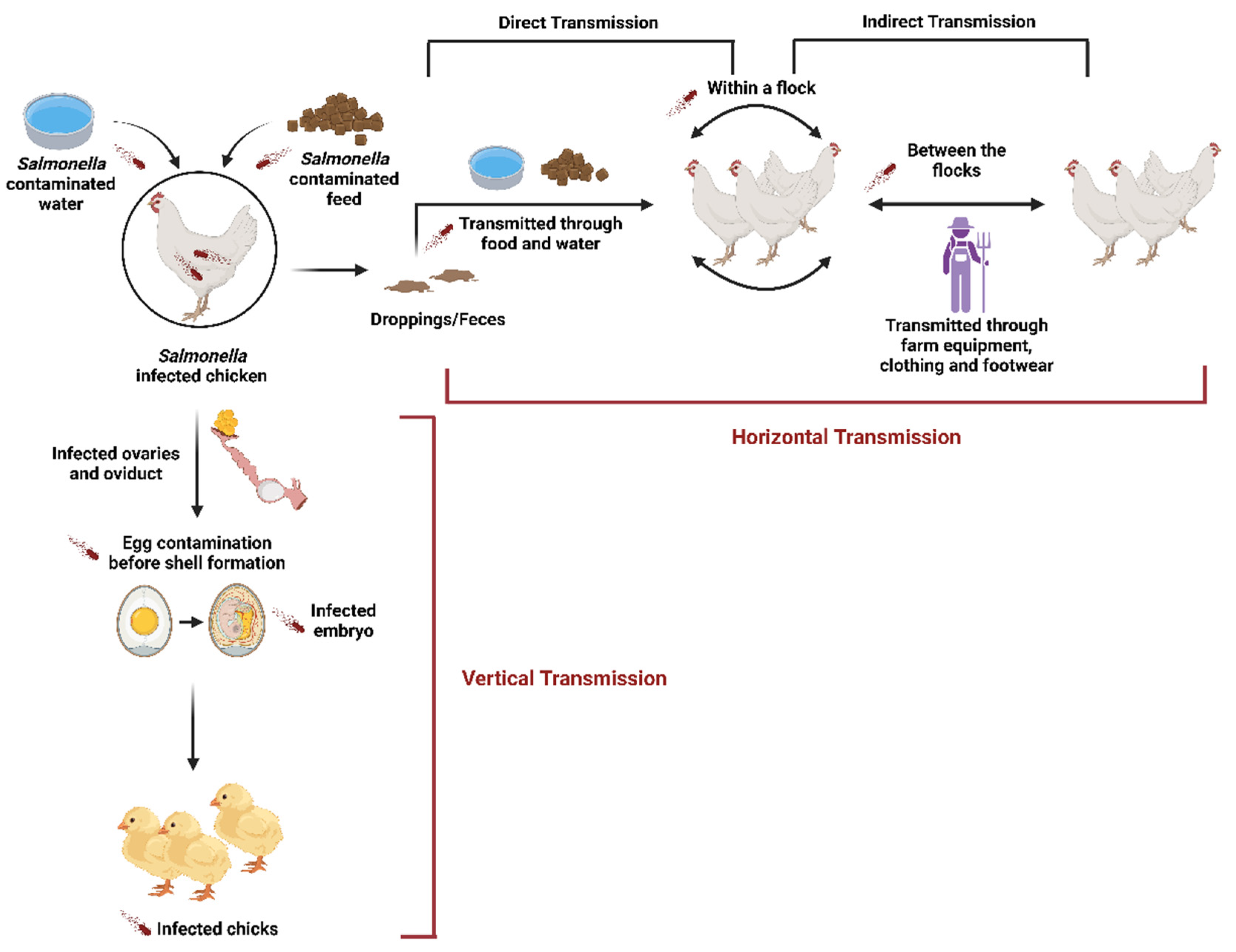
Table 2.
Common probiotics in poultry.
| Probiotic | Outcome | Reference |
|---|---|---|
| B. subtilis CSL2 | Re-establishment of normal gut flora abundance (phylum Firmicutes and Proteobacteria and genus Lactobacillus) that is disrupted after Salmonella infection | [118] |
| Poultry Star® Enterococcus faecium, Pediococcus acidilactici, Bifidobacterium animalis, and Lactobacillus reuteri |
Increased the efficacy of the live attenuated vaccine (aroA mutant S. Typhimurium) and reduced the cecal colonization of Salmonella | [111] |
|
Bacillus subtilis DSM 32324, Bacillus subtilis DSM 32325, and Bacillus amyloliquefaciens |
Reduction of Salmonella in cecal content and establishment of normal gut flora after Salmonella challenge | [112] |
|
Bacillus amyloliquefaciens, B. licheniformis, and B. pumilus |
Significant reduction of Salmonella in cecal content 7 days after challenge | [113] |
Disclaimer/Publisher’s Note: The statements, opinions and data contained in all publications are solely those of the individual author(s) and contributor(s) and not of MDPI and/or the editor(s). MDPI and/or the editor(s) disclaim responsibility for any injury to people or property resulting from any ideas, methods, instructions or products referred to in the content. |
© 2024 by the authors. Licensee MDPI, Basel, Switzerland. This article is an open access article distributed under the terms and conditions of the Creative Commons Attribution (CC BY) license (http://creativecommons.org/licenses/by/4.0/).
Copyright: This open access article is published under a Creative Commons CC BY 4.0 license, which permit the free download, distribution, and reuse, provided that the author and preprint are cited in any reuse.


