

Submitted:
19 November 2024
Posted:
20 November 2024
You are already at the latest version
Abstract
The world is increasingly turning to renewable energy sources (RES) to address climate change issues and achieve net-zero Carbon emissions. Integrating RES into existing power grids is necessary for sustainability because the unpredictability and irregularity of the RES can affect grid stability and generate power quality issues, which can lead to equipment damage and increase operational costs. As a result, the importance of RES is severely compromised. To tackle these challenges, traditional power systems (TPS) will have to become more innovative. Smart grids use advanced technology such as two-way communication between consumers and service providers, automated control, and real-time monitoring to manage power flow effectively. Inverters are effective tools for solving power quality problems in renewable-powered smart grids. However, their effectiveness depends on the topology, control method and design. This review paper focuses on the role of multilevel inverters (MLIs) in mitigating power quality issues such as voltage sag, swell and Total Harmonics Distortion (THD) in RES-integrated smart grids. The comprehensive review also examines the drawbacks of TPS to understand the importance and necessity of developing a smart power system. Finally, the paper discusses future trends in MLI control technology, addressing power quality problems in smart grid environments.
Keywords:
Multilevel Inverters
; Power Quality
; Voltage Sag and Swell
; Total Harmonics Distortion
; Smart Grids
1. Introduction
The world is adopting more RES because of concern about climate change issues. RES, such as solar (rooftop-solar), wind, hydropower, biofuel, and ocean energy integration into existing power grids, is necessary for sustainability. As per the International Energy Agency (IEA), wind and solar combined will generate more electricity than hydropower to help achieve sustainability and reach net-zero carbon goals [1]. The use of solar and wind power has been increasing exponentially due to their ability to supply electric power and reduce installation costs [2]. Despite such benefits of the RES, their unpredictability and inconsistency pose significant technical challenges to power grid stability and power quality [3]. Smart grids utilize modern technology to control and manage the flow of electrical power from all generation sources to meet variable electric power demands for the end users [4]. Compared to TPS. smart grids offer improvement in stability, reliability, and efficiency to make the electrical power grid capable of handling distributed generation of RES [5].
MLI is the key power electronics technology in advancing RES-integrated smart grids. Unlike traditional two-level inverters, MLI generates an output voltage in multiple steps to create an approximate sine wave, reducing power quality challenges like THD, poor power factor, etc. [6].There are a few advantages of MLI in RES-integrated smart grids due to their ability to handle higher output voltage, improved efficiency and reduced switching losses. Thus, their use is essential in smart grids. Different topologies of MLI, such as Diode Clamped, flying capacitor, and cascade H-bridge inverters, are being researched currently [7].
A smart grid is a modern power grid equipped with advanced two-way communication, real-time monitoring and advanced control strategies. These features make a smart grid to manage the stability, reliability and efficiency of the distributed generation of RES [8]. The MLI-integrated smart grid plays a crucial role in ensuring a reliable operation and improves the power quality challenges which occur due to voltage and frequency fluctuations when integrated with RES [9]. Power quality challenges should be addressed with the increased adoption of RES-based systems and electrical vehicles (EVs). If not, equipment overheating, increased distribution losses and damage to sensitive equipment can occur. Thus, it is essential to implement MLI to solve such problems [10]. Despite considerable progress in MLI and smart grids, several research issues remain unresolved. Most studies have focused on MLI topologies and their potential to improve power quality. MLI has proven to be effective in reducing THD. Its performance depends on a high penetration of RES, especially in decentralized power systems such as microgrids and distributed generation networks, which has not been fully explored [11]. Figure 1 shows an MLI-based RES-powered smart grid, traditional power plants, and electric vehicle (EV) charging stations. This figure represents a smart grid design that promotes sustainability by integrating RES and advanced power electronics. The use of MLI helps to improve power quality with distributed generation. The smart meters and Supervisory Control and Data Acquisition (SCADA) systems provide real-time control and monitoring of the system. Integrating the energy storage system with the grid improves reliability by controlling the generation and demand of the system.
This review aims to fill some of the existing research gaps by providing a detailed analysis of the role of MLI in mitigating THD and improving power quality in RES-integrated smart grids.
- To study existing MLI topologies to reduce THD and enhance voltage stability in RES-integrated smart grids.
- To study the role of MLIs on power quality improvement in RES-powered smart grids.
- To identify present challenges and suggest future research areas for optimizing MLI performance in RES-integrated smart grids.
This review studies different MLI technologies and their application in RES-integrated smart grids. It explores different MLI designs and control methods and their effectiveness in reducing THD and improving power quality.
2. Power Quality Challenges of RES Integrated Smart Grids
Adopting RES, such as solar and wind energies, into power grids is essential for achieving global sustainability goals. Integrating RES introduces power quality challenges. These challenges arise because of the discontinuous generation of RES, power electronic converters and distributed generation. Some of the key aspects of power quality, such as power factor, harmonic distortion, frequency stability, and voltage stability, are essential to grid stabilisation, equipment life spans, and system efficiency [12]. Solar and wind energies have unique behaviours and issues affecting grid performance. Understanding these challenges and identifying current trends is essential to integrate renewable energy into the smart grid better [13]. Improving power quality issues in RES-powered smart grids is essential for maintaining grid reliability. Table 1 gives some of the key power quality issues of solar and wind energies. The table highlights the differences in how these issues occur and can help identify the unique challenges associated with the above energy sources.
Table 1 shows that addressing power quality issues and the impact of power systems is necessary. There are several methods to solve the power quality issues. Reactive power compensation using power electronics-based control devices like thyristor-controlled reactors (TCR) and thyristor-switched capacitors (TSC) has been used to reduce THD [22]. Unified Power Quality Conditioners (UPQC) effectively improve voltage sags, swells, harmonics, and power quality. Series and shunt active power filters are used to reduce voltage harmonics and improve the performance of RES-powered grids [23]. Advanced control topologies of MLI help in reducing harmonics, managing reactive power, and stabilising voltage and frequency levels [24]. Energy Storage Systems (ESS) are used to improve discontinuous generation of RES by storing excess energy generated during periods of high generation for supply in periods of low generation [25]. It can also manage frequency and voltage variation and improve overall grid stability. Flexible AC Transmission Systems (FACTS) devices (static synchronous compensators (STATCOM),static var compensator(SVC) and dynamic voltage restorers (DVR)) are used to stabilise voltage, improve power factor and reduce THD in power grids[26]. Smart grids are digital communication technologies and bidirectional power grids. These systems can do real-time reactive power compensation, which is important for grid stability in RES-integrated grids[27]. Integrating RES into smart grids is an innovative step in power flow management to improve efficiency and sustainability and meet increasing power demands [28]. They create a more efficient, reliable and flexible power grid. They can accommodate the increasing complexity of renewable energy integration [29]. They facilitate real-time monitoring and control of power supply and demand. They provide improved demand-side management through smart meters and dynamic pricing strategies [30]. Smart grids increase efficiency and reduce peak loads by making real-time monitoring of power flow consumption and cost available to consumers[31]. Integrating EV and vehicle-to-grid (V2G) technologies allows bidirectional power flow between vehicles and the power grid [32]. V2G can be used as mobile energy storage with discharging power back to the grid during peak hours to improve overall system reliability and efficiency [33]. This adoption integrated the distributed generation systems such as solar and wind with TPS. The integration of RES introduces challenges with power quality and harmonic distortion [34]. They can affect grid stability and the performance of the distribution network[35]. Smart grids are integrated with advanced technologies such as MLI and FACTS to overcome such issues. Table 2 compares MLI with alternative tools like conventional inverters and FACTS devices on different RES-integrated smart grid challenges and factors. The comparison overviews recent challenges and trends in RES-powered smart grids.
3. A Brief Introduction to Multilevel Inverters
This section may be divided by subheadings. It should provide a concise and precise description of the experimental results, their interpretation, as well as the experimental conclusions that can be drawn.
In recent years, power electronics technologies like MLI have shown advances in reducing complexity with RES integration with the grid. They not only improve THD but also improve the RES distributed generation to maintain grid stability [47]. MLI are power electronic devices designed to convert DC voltage into AC voltage with improved output voltage compared to traditional two-level inverters [48]. The innovative MLI design controls the output voltage and current [49]. The basic configuration contains several power semiconductor devices (insulated gate bipolar transistors (IGBTs) and diodes) arranged in a specific topology to create multiple output voltage levels [50]. The basic configurations are diode-clamped MLI, capacitor-clamped MLI, and cascaded H-bridge MLI. Each configuration has characteristics that make its application unique in various uses [51]. Figure 2 shows the classification of MLIs.
There are various classification methods for MLIs; in this paper, MLIs are mainly classified into two broad categories: structure, application, and control. They are traditional and modified MLIs. The traditional MLI contains traditional MLI like diode-clamped MLI, flying capacitor MLI and cascaded H-bridge MLI. The modified MLI is developed by modifying traditional MLI for specific application/s. They can be either hybrid MLI, modular MLI, or switched capacitor MLI, amongst many others [53]
The modulation techniques also reduce electromagnetic interference and directly control power quality standards. This makes MLI suitable for modern electrical grids. Modulation techniques such as fundamental switching frequency or high switching frequency are utilized in MLI. The fundamental switching frequency has one or two commutations per cycle, whereas the high switching frequency has multiple commutations per cycle [54]. Selective harmonic elimination and space vector control are typical fundamental switching frequency modulation types. The high-frequency modulation techniques are classified into two major techniques - Pulse Width Modulation (PWM) and Space Vector Modulation (SVM). The PWM modulation is further classified into Multicarrier and Single Carrier modulations. Multicarrier modulation contains phase disposition (PD), phase opposite disposition (APOD), and alternative phase opposite disposition (APOD) [55]. They play a vital role in renewable energy systems and smart grids. These techniques improve the efficiency and reliability of power inverters. It also improves power quality by reducing THD and providing control over the power flow [56]. The various modulation techniques are shown in Figure 3.
MLIs are one of the most promising technologies in power electronics to improve the power quality issues in RES-powered smart grids [58]. Unlike traditional two-level inverters, MLIs generate multiple voltage levels, all nearly sinusoidal, and will reduce THD without using any complex filters. They also minimise electromagnetic interference (EMI) and switch losses [59]. These characteristics make MLIs ideal for applications in smart grids that integrate with various renewable energy sources (RES) like solar and wind. Different MLI topologies have been developed for multiple grid requirements; each topology offers benefits to solve challenges in terms of complexity, control strategies, and harmonic performance [60]Based on their structure, operation, and control, they can be classified into several types, as shown in Table 3. This classification is important for determining their suitability in various RES-powered grid applications.
The MLI's design involves various challenges and complexity. This issue increases system costs and requires advanced control algorithms to improve effectiveness. Multiple switching devices introduce the need for advanced fault detection and protection strategies.
3.1. Advantages of Multilevel Inverters
-
Harmonic performance
-
Reliability and operational flexibility
- Improved reliability: MLIs are designed in such a way that the system can continue functioning even if one module or switch fails [69].
- Modular expansion: MLIs allow for modular expansion with other inverter modules to be integrated into the system. This adaptability is important for RES integration with the TPS [70].
-
Power factor correction and grid stability
- Power factor correction: MLIs offer power factor correction that reduces reactive power penalties imposed by distribution companies. They also improve the transmission and distribution of power [71].
- Grid stability: MLIs can improve voltage and frequency variation and provide stability and reliability [72].
-
Versatility and modulation techniques
- Compatibility with modulation techniques: MLIs are compatible with modulation techniques such as PWM and sine wave PWM. This flexibility allows designers to improve inverter performance based on specific requirements [73].
- Minimised switching losses: Different modulation strategies can be used to minimise switching losses and improve overall system efficiency [74].
-
Environmental benefits
- Support for renewable energy: MLIs solve power quality and distributed generation challenges with RES [75].
3.2. Applications of Multilevel Inverters in Renewable Energy-Integrated Smart Grids and EV Charging Stations
Integrating smart grids with RES and EV has various applications in power grids. MLIs improve the power quality and efficiency of the system. This section will discuss the use of MLIs in RES-integrated smart grids and EV charging stations, along with their benefits and their role in improving the system's stability and efficiency
-
Improving power quality in smart grids
- Reduction of harmonic distortion: The advantage of MLIs is their ability to produce an approximate sinusoidal voltage to improve THD. This reduction in harmonics is essential to maintain power quality and solve other issues like equipment overheating and increased losses [76].
- Voltage regulation and stability: MLI improve voltage regulation and stability in smart grids by providing a stable and continuous power supply. This is important for RES-powered grids [77].
-
Integration with renewable energy sources
-
Supporting EV charging infrastructure
- Bidirectional charging (V2G): MLIs provide bidirectional charging, allowing EVs to consume power from the grid and supply it back to it. V2G technology helps to maintain supply and demand during peak hours and frequency variation [80].
- Load management: Integrating MLIs in EV charging stations improves load management. It also ensures that the charging process does not overload the grid. This is achieved by real-time monitoring and control. MLIS also help to optimise the charging schedules based on grid conditions and the availability of renewable energy [81].
-
Improving system reliability and flexibility
- Modular design: The system can continue to operate at reduced capacity and maintain reliability in critical situations such as undervoltage due to the flexibility of MLIs [82].
-
Economic Benefits
- Cost savings: MLIs improve the efficiency and reliability of the generation, transmission and distribution networks. This leads to cost savings in power generation. They are also able to manage peak loads, which reduces the need for conventional peak-load power plants like diesel plants [85].
4. Future Directions
Authors should discuss the results and how they can be interpreted from the perspective of previous studies and of the working hypotheses. The findings and their implications should be discussed in the broadest context possible. Future research directions may also be highlighted.
MLIs play a significant role in enhancing power quality in RES-powered smart grids. The increasing RES needs to improve MLI technologies and control strategies to solve the power quality challenges of RES-powered smart grids. Despite the benefits of using MLIs to enhance the quality of power, more research work must be done to overcome their disadvantages and improve their use in smart grids.
The implementation of MLIs within existing power grids presents some challenges. Some of the significant challenges are as follows:
-
Technical Challenges
- Synchronisation with existing systems: Integration of MLIs with existing grid requires maintenance of synchronisation standards. This can be complex due to the diverse range of equipment and technologies already in use [86].
- Harmonics management: MLIs are used to reduce THD. This can be challenging in RES-powered grids. It is difficult to ensure that all components operate without introducing any problems [87].
- Control and coordination: It is important to maintain control and coordination for MLIs with other grid components, such as traditional inverters and transformers, to maintain grid stability and performance [88].
-
Economic Challenges
- High initial costs: The development of MLIs requires high capital costs in terms of equipment, installation and integration. This can be a barrier for utilities and grid operators, especially in sectors with limited financial resources [89].
- Operational and maintenance costs: MLIs require ongoing maintenance and operational management. It can be added to the overall costs. It is essential for long-term sustainability [90].
-
Regulatory and standardization challenges
- Compliance with standards: It is essential to ensure that MLIs meet existing grid regulations and standards [91].
-
Integration with renewable energy sources (RES)
- Intermittency of RES: The variable nature of RES introduces challenges for the stable operation of MLI. Effective integration requires advanced control strategies to manage intermittency and ensure a reliable power supply [92].
- Energy storage integration: Integrating energy storage systems with MLIs is essential to mitigate the unpredictability of RES. It also adds another layer of complexity and cost to the implementation process [93].
-
Infrastructure and grid management
- Grid modernization: Upgrading the existing grid with MLI and RES integration is necessary. This includes transmission and distribution networks and implementing smart metering and system control technologies [94].
- Cybersecurity: As MLIs and smart grid technologies are highly dependent on digital communication., it is critical to ensure appropriate cybersecurity measures to protect against potential cyber threats [95].
- Smart grid integration: Research how MLIs work on demand response and are integrated with microgrid technologies. This can lead to a more integrated approach to improving power quality [96].
- Impact of Distributed Generation (DG): The presence of DG is increasing with the rise of RES. It is, therefore, important to study the impact of DG on grid stability and power quality. Long-term studies of real-time data will provide guidelines to integrate DG technologies using MLIs [97].
5. Conclusions
This review highlights the role of MLI in improving power quality and reducing harmonic distortion in RES-powered smart grids. As RES increases, it is important to control power quality and harmonics, which are thus essential for grid stability and performance. The review focuses on the versatility of MLI configurations in various applications. These inverters control voltage regulation and reliability and maintain power quality standards. The review highlights the need for continued innovation and development in the field of MLI to support the RES generations. Future research should focus on the long-term analysis of MLIs with RES-powered grids, energy storage, and advanced control algorithms. The environmental and economic impacts of MLIs are important for advancing towards a sustainable energy future. In conclusion, MLIs are important in achieving efficient and environmentally friendly power systems.
Author Contributions
“Shanikumar Vaidya managed the conceptualization, methodology, investigation, and writing of the original draft. Krishnamachar Prasad contributed to the methodology and reviewed and edited the manuscript. Jeff Kilby reviewed and edited the manuscript. All authors have read and agreed to the published version of the manuscript.
Funding
This research received no external funding.
Data Availability Statement
NA.
Conflicts of Interest
The authors declare no conflict of interest.
References
- IEA (2024), Share of renewable electricity generation by technology, 2000-2028, IEA, Paris. (2024); Available from: https://www.iea.org/data-and-statistics/charts/share-of-renewable-electricity-generation-by-technology-2000-2028, Licence: CC BY 4.0.
- Amamra, S.-A., K. Meghriche, A. Cherifi, and B. Francois, Multilevel Inverter Topology for Renewable Energy Grid Integration. IEEE Transactions on Industrial Electronics, 2017. 64(11): p. 8855-8866. [CrossRef]
- Al-Shetwi, A.Q., et al., Power Quality Assessment of Grid-Connected PV System in Compliance with the Recent Integration Requirements. Electronics, 2020. 9(2).
- Appasani, B., Smart Grid 3.0: Grid with Proactive Intelligence, in Smart Grid 3.0: Computational and Communication Technologies, B. Appasani and N. Bizon, Editors. 2023, Springer International Publishing: Cham. p. 1-22.
- Khan, K.A., et al., Smart grid infrastructure and renewable energy deployment: A conceptual review of Saudi Arabia. Energy Strategy Reviews, 2023. 50: p. 101247-101267.
- Ch. Santosh, K. and S.T. Kalyani, Improvement of Power Quality in Smart Grid Connected PV System Using Multilevel Inverter. Journal of Advanced Research in Applied Sciences and Engineering Technology, 2023. 31(1): p. 1-13.
- Choudhury, S., et al., Multilevel Inverter: A Survey on Classical and Advanced Topologies, Control Schemes, Applications to Power System and Future Prospects. Energies, 2021. 14(18).
- Nagar, R., et al., A Survey on Conventional Multilevel Inverter Topologies. 2024, Springer Nature Singapore: Singapore. p. 249-262.
- Zhao, S., L. Zhang, Y. Liu, and P. Yu, Overview of Multilevel Inverter Topologies and Modulation Methods. 2022, Springer Nature Singapore: Singapore. p. 1-13.
- Ben Mahmoud, Z. and A. Khedher, A Comprehensive Review on Space Vector Based-PWM Techniques for Common Mode Voltage Mitigation in Photovoltaic Multi-Level Inverters. Energies, 2024. 17(4).
- Nyamathulla, S. and D. Chittathuru, A Review of Multilevel Inverter Topologies for Grid-Connected Sustainable Solar Photovoltaic Systems. Sustainability, 2023. 15(18): p. 44.
- Gümüş, B., Integration of Renewable Energy Sources to Power Networks and Smart Grids, in Renewable Energy Based Solutions, T.S. Uyar and N. Javani, Editors. 2022, Springer International Publishing: Cham. p. 81-103.
- Bhatti, A.R., et al., Electric vehicle charging stations and the employed energy management schemes: a classification based comparative survey. Discover Applied Sciences, 2024. 6(10). [CrossRef]
- Mahlobo, A., O.E. Oni, and K.T. Akindeji, Voltage Fluctuation Correction for Renewable Energy Systems in Distribution Network, in 2023 International Conference on Electrical, Computer and Energy Technologies (ICECET). 2023. p. 1-7.
- Razmi, D., et al., An Overview on Power Quality Issues and Control Strategies for Distribution Networks With the Presence of Distributed Generation Resources. IEEE Access, 2023. 11: p. 10308-10325.
- Eid, D., et al., Frequency control enhancement for hybrid microgrid using multi-terminal multi-function inverter. International Journal of Renewable Energy Development, 2024. 13(4): p. 683-696.
- Souza Junior, M.E.T. and L.C.G. Freitas, Power Electronics for Modern Sustainable Power Systems: Distributed Generation, Microgrids and Smart Grids—A Review. Sustainability, 2022. 14(6).
- Purkait, P., M. Basu, and S.R. Nath, Renewable Energy Integration to Electric Power Grid: Opportunities, Challenges, and Solutions, in Challenges and Opportunities of Distributed Renewable Power, S. De, A.K. Agarwal, and P. Kalita, Editors. 2024, Springer Nature Singapore: Singapore. p. 37-100.
- Ayodeji S. Akinyemi, P.I.E.D., Impact of Renewable Energy Generation on Voltage Flicker with Dynamic Load Connected to Distribution Network. International Journal of Applied Engineering Research, 2019. 14,.
- Rana, M.M., et al., Applications of energy storage systems in power grids with and without renewable energy integration — A comprehensive review. Journal of Energy Storage, 2023. 68.
- Buzdugan, M.I., Voltage Dips in Power Quality - a Brief Review, in AEIT International Annual Conference (AEIT),. 2019, IEEE Access: Florence, Italy. p. 1-6.
- Nigam, A., et al., Reactive power compensation during the convergence of grid system with FACTS devices. Results in Engineering, 2024. 23.
- Hossain, E., et al., Analysis and Mitigation of Power Quality Issues in Distributed Generation Systems Using Custom Power Devices. IEEE Access, 2018. 6: p. 16816-16833.
- Bansal, P. and A. Singh, Multilevel Inverter Based Power Quality Enhancement Using Improved Immune Control Algorithm. International Journal of Electronics, 2021. 108(12): p. 1999-2018.
- Majeed Butt, O., M. Zulqarnain, and T. Majeed Butt, Recent advancement in smart grid technology: Future prospects in the electrical power network. Ain Shams Engineering Journal, 2021. 12(1): p. 687-695.
- Gobu R, et al., Review of Power Quality Issues in Smart Grid, in 2023 7th International Conference on Computing Methodologies and Communication (ICCMC). 2023. p. 32-38.
- Bajaj, M. and A.K. Singh, Grid integrated renewable DG systems: A review of power quality challenges and state-of-the-art mitigation techniques. International Journal of Energy Research, 2019. 44(1): p. 26-69.
- Alves, E., S. Sanchez, D. Brandao, and E. Tedeschi, Smart Load Management with Energy Storage for Power Quality Enhancement in Wind-Powered Oil and Gas Applications. Energies, 2019. 12(15).
- Rini Ann Jerin, A., et al., Smart grid and power quality issues, in Hybrid-Renewable Energy Systems in Microgrids. 2018. p. 195-202.
- Naderi, Y., et al., An overview of power quality enhancement techniques applied to distributed generation in electrical distribution networks. Renewable and Sustainable Energy Reviews, 2018. 93: p. 201-214. [CrossRef]
- Tuballa, M.L. and M.L. Abundo, A review of the development of Smart Grid technologies. Renewable and Sustainable Energy Reviews, 2016. 59: p. 710-725.
- Mwasilu, F., et al., Electric vehicles and smart grid interaction: A review on vehicle to grid and renewable energy sources integration. Renewable and Sustainable Energy Reviews, 2014. 34: p. 501-516.
- Brenna, M., F. Foiadelli, C. Leone, and M. Longo, Electric Vehicles Charging Technology Review and Optimal Size Estimation. Journal of Electrical Engineering & Technology, 2020. 15(6): p. 2539-2552.
- Rahman, I. and J. Mohamad-Saleh, Hybrid bio-Inspired computational intelligence techniques for solving power system optimization problems: A comprehensive survey. Applied Soft Computing, 2018. 69: p. 72-130.
- Hirsch, A., Y. Parag, and J. Guerrero, Microgrids: A review of technologies, key drivers, and outstanding issues. Renewable and Sustainable Energy Reviews, 2018. 90: p. 402-411.
- Moharana, N., D. Dash, and S.K. Dalai, Power Quality Improvement in PVGrid System, in 2021 International Conference in Advances in Power, Signal, and Information Technology (APSIT). 2021. p. 1-5.
- Jayaraman, M. and S. Vt, Power Quality Improvement in a Cascaded Multilevel Inverter Interfaced Grid Connected System Using a Modified Inductive–Capacitive–Inductive Filter with Reduced Power Loss and Improved Harmonic Attenuation. Energies, 2017. 10(11).
- Luo, A., Q. Xu, F. Ma, and Y. Chen, Overview of power quality analysis and control technology for the smart grid. Journal of Modern Power Systems and Clean Energy, 2016. 4(1): p. 1-9.
- Srivastava, A., M. Manas, and R.K. Dubey, Integration of power systems with electric vehicles: A comprehensive review of impact on power quality and relevant enhancements. Electric Power Systems Research, 2024. 234.
- Kadhim, I.J. and M.J. Hasan, Enhancing power stability and efficiency with multilevel inverter technology based on renewable energy sources. Electric Power Systems Research, 2024. 231.
- Zhuang, P., T. Zamir, and H. Liang, Blockchain for Cybersecurity in Smart Grid: A Comprehensive Survey. IEEE Transactions on Industrial Informatics, 2021. 17(1): p. 3-19.
- Cherkaoui Jaouad, N., H. Chaikhy, F. Belhora, and A. Hajjaji, Comparison between two levels and multi-level (NPC and Cascad) inverters. Materials Today: Proceedings, 2022. 66: p. 162-180.
- Chawda, G.S., et al., Comprehensive Review of Distributed FACTS Control Algorithms for Power Quality Enhancement in Utility Grid With Renewable Energy Penetration. IEEE Access, 2020. 8: p. 107614-107634.
- Sunddararaj, S.P., S. Srinivasarangan Rangarajan, and S. N, An Extensive Review of Multilevel Inverters Based on Their Multifaceted Structural Configuration, Triggering Methods and Applications. Electronics, 2020. 9(3). [CrossRef]
- Mosepele, B., R. Samikannu, and L. Amuhaya, A structural review on reduced switch count and hybrid multilevel inverters. Frontiers in Energy Research, 2024. 12.
- Munawar, S., et al., Multilevel Inverters Design, Topologies, and Applications: Research Issues, Current, and Future Directions. IEEE Access, 2024. 12: p. 149320-149350.
- Choi, W., W. Lee, D. Han, and B. Sarlioglu, New Configuration of Multifunctional Grid-Connected Inverter to Improve Both Current-Based and Voltage-Based Power Quality. IEEE Transactions on Industry Applications, 2018. 54(6): p. 6374-6382.
- K, V., N.M. C M, J. P, and U. Subramaniam, Modified H-bridge Multilevel Inverter for Grid Integration with Voltage Balancing Circuit, in 2020 International Conference on Power Electronics and Renewable Energy Applications (PEREA). 2020. p. 1-6.
- Mittal, A., K. Janardhan, and A. Ojha, Multilevel inverter based Grid Connected Solar Photovoltaic System with Power Flow Control, in 2021 International Conference on Sustainable Energy and Future Electric Transportation (SEFET). 2021. p. 1-6.
- Salem, M., et al., A Comprehensive Review on Multilevel Inverters for Grid-Tied System Applications. Energies, 2022. 15(17).
- Mehta, S. and V. Puri, A review of different multi-level inverter topologies for grid integration of solar photovoltaic system. Renewable Energy Focus, 2022. 43: p. 263-276.
- Prabaharan, N. and K. Palanisamy, A comprehensive review on reduced switch multilevel inverter topologies, modulation techniques and applications. Renewable and Sustainable Energy Reviews, 2017. 76: p. 1248-1282.
- Memon, A.J., M.A. Mahar, A.S. Larik, and M.M. Shaikh, A Comprehensive Review of Reduced Device Count Multilevel Inverters for PV Systems. Energies, 2023. 16(15).
- Ahmad, A., et al., Realization of an asymmetric Switched-Capacitor Multilevel Inverter using Nearest Level Control, in 2019 2nd International Conference on Power Energy, Environment and Intelligent Control (PEEIC). 2019. p. 522-527.
- Bano, K., et al., Phase Shift APOD and POD Control Technique in Multi-Level Inverters to Mitigate Total Harmonic Distortion. Mathematics, 2024. 12(5).
- Bhimireddy, P.R., S. Keerthipati, and A. Iqbal, Phase Reconfiguring Technique for Enhancing the Modulation Index of Multilevel Inverter Fed Nine-Phase IM Drive. IEEE Transactions on Industrial Electronics, 2021. 68(4): p. 2898-2906.
- Poorfakhraei, A., M. Narimani, and A. Emadi, A Review of Modulation and Control Techniques for Multilevel Inverters in Traction Applications. IEEE Access, 2021. 9: p. 24187-24204.
- Ibrahim, M.S., W. Dong, and Q. Yang, Machine learning driven smart electric power systems: Current trends and new perspectives. Applied Energy, 2020. 272.
- Mahalakshmi, R. and K.C.S. Thampatty, Grid Connected Multilevel Inverter for Renewable Energy Applications. Procedia Technology, 2015. 21: p. 636-642.
- Karasani, R.R., et al., A Three-Phase Hybrid Cascaded Modular Multilevel Inverter for Renewable Energy Environment. IEEE Transactions on Power Electronics, 2017. 32(2): p. 1070-1087.
- Kishore, G.I., T.S.L.V. Ayyarao, and M. Venkatesh, Performance of Integrated High Voltage Gain DC-DC Converter and Diode Clamped Multi Level Inverter with Renewable Energy Source in Standalone Applications. Journal of The Institution of Engineers (India): Series B, 2024: p. 9.
- Ahamad, I., et al., Performance assessment of solar energy driven cascaded H-bridge multilevel inverters. Microsystem Technologies, 2024.
- Mahafzah, K.A., R.M. Negry, M.A. Obeidat, and H. Alsalem, An improved modulation technique suitable for a three level flying capacitor multilevel inverter. International Journal of Electrical and Computer Engineering (IJECE), 2024. 14(3).
- Yehia, R.F. and F.Z. Peng, Staircase Matrix Modulation for the Switched-Capacitor Modular Multilevel Converter with Sensor-less Voltage Balancing, in 2023 IEEE Applied Power Electronics Conference and Exposition (APEC). 2023. p. 2839-2844.
- Chappa, A., et al., Machine learning based fault detection technique for hybrid multi level inverter topology. The Journal of Engineering, 2024. 2024(9).
- Mondal, S., et al., A 3-Phase Switched-Capacitor Single-Source MLI With Self-Voltage Balancing and Boosting Ability. IEEE Transactions on Applied Superconductivity, 2024. 34(8): p. 1-5.
- P, N.B., Adaptive grid-connected inverter control schemes for power quality enrichment in microgrid systems: Past, present, and future perspectives. Electric Power Systems Research, 2024. 230. [CrossRef]
- Kumar, G.S. and M. Krishna Paramathma, Optimal design of PV-SMES systems for power quality enhancement using pelicon optimized multi-level inverter model. Computers and Electrical Engineering, 2024. 118.
- Mukundan C M, N., et al., A New Multilevel Inverter Based Grid Connected Reliable Solar Power Transfer Unit With Power Quality Enhancement. IEEE Transactions on Industry Applications, 2023. 59(2): p. 1887-1900.
- Bansal, P. and A. Singh, Solar PV integrated simplified multilevel inverter configuration for power quality improvement using multilayer Gamma filter. Electrical Engineering, 2024.
- B, R. and R. H․ R, Novel MLI-based DVR and DSTATCOM with ANFIS control for enhanced power quality improvement. Electric Power Systems Research, 2024. 235.
- Mahendravarman, I., A. Ragavendiran, and S.A. Chithradevi, Improved power quality for photovoltaic grid integration power system using an intelligent controller fed SL–SC boost converter supplied reduced switch cascade multilevel inverter. Electrical Engineering, 2023.
- Choudhury, S. and G.K. Sahoo, A critical analysis of different power quality improvement techniques in microgrid. e-Prime - Advances in Electrical Engineering, Electronics and Energy, 2024. 8.
- Xie, J., Application of optimized photovoltaic grid-connected control system based on modular multilevel converters. Energy Informatics, 2024. 7(1).
- Wadi, M., A. Shobole, W. Elmasry, and I. Kucuk, Load frequency control in smart grids: A review of recent developments. Renewable and Sustainable Energy Reviews, 2024. 189.
- Ullah, F., et al., A comprehensive review of wind power integration and energy storage technologies for modern grid frequency regulation. Heliyon, 2024. 10(9): p. e30466.
- Rangarajan, S.S., et al., DC Microgrids: A Propitious Smart Grid Paradigm for Smart Cities. Smart Cities, 2023. 6(4): p. 1690-1718.
- Srivastava, A., A. Chauhan, and A. Tripathi, Design and performance evaluation of a novel modular asymmetrical multilevel inverter with minimal switches. e-Prime - Advances in Electrical Engineering, Electronics and Energy, 2024. 9. [CrossRef]
- Shao, H., R. Henriques, H. Morais, and E. Tedeschi, Power quality monitoring in electric grid integrating offshore wind energy: A review. Renewable and Sustainable Energy Reviews, 2024. 191: p. 20.
- Nair, D.R., M.G. Nair, and T. Thakur, A Smart Microgrid System with Artificial Intelligence for Power-Sharing and Power Quality Improvement. Energies, 2022. 15(15).
- Soudagar, M.E.M., et al., An overview of the existing and future state of the art advancement of hybrid energy systems based on PV-solar and wind. International Journal of Low-Carbon Technologies, 2024. 19: p. 207-216.
- Selvam, N., et al., Enhancing Power Quality in a Solar Powered Bidirectional Smart Grid with Electric Vehicle Integration, in 2024 2nd International Conference on Artificial Intelligence and Machine Learning Applications Theme: Healthcare and Internet of Things (AIMLA). 2024. p. 1-5.
- Sarkar, P.R., et al., Power Quality Assessment and Enhancement using FLC based SPV Supported Cascaded H-Bridge Multilevel Inverter. e-Prime - Advances in Electrical Engineering, Electronics and Energy, 2024. 7.
- Satheesh Kumar, S., B. Ashok Kumar, and S. Senthilrani, Review of electric vehicle (EV) charging using renewable solar photovoltaic (PV) nano grid. Energy & Environment, 2023. 35(2): p. 1089-1117.
- Raza, A., et al., SAARC super smart grid: Navigating the future - unleashing the power of an energy-efficient integration of renewable energy resources in the saarc region. Computers and Electrical Engineering, 2024. 118.
- Rabie, A.H., A. I. Saleh, S.H.A. Elkhalik, and A.E. Takieldeen, An Optimum Load Forecasting Strategy (OLFS) for Smart Grids Based on Artificial Intelligence. Technologies, 2024. 12(2).
- Powell, J., A. McCafferty-Leroux, W. Hilal, and S.A. Gadsden, Smart grids: A comprehensive survey of challenges, industry applications, and future trends. Energy Reports, 2024. 11: p. 5760-5785. [CrossRef]
- Pawar, V.S. and P. Gaidhane, A resilient approach for optimizing power quality in grid integrated solar photovoltaic with asymmetric 15-level inverter. Computers and Electrical Engineering, 2024. 116.
- Parimalasundar, E., et al., Enhancing Efficiency and Improving Power Quality in Grid-Connected 17-Level Multilevel Inverters for Renewable Energy Applications, in 2024 Second International Conference on Smart Technologies for Power and Renewable Energy (SPECon). 2024. p. 1-5.
- Norambuena, M., et al., Model Predictive Control in Multi-Level Inverters Part II: Renewable Energies and Grid Applications. IEEE Open Journal of Industry Applications, 2024: p. 1-15.
- Nile, N.O., A. Jafar Mahdi, M.H. Nawir, and B. Abbas Fadheel, Performance Evaluation of a Small-Scale Microgrid Based on Centralized Multilevel Inverters, in 2024 12th International Conference on Smart Grid (icSmartGrid). 2024. p. 597-602.
- Nagendra Prasad, H.K., L.S. Kumar, J. Shri Harsha, and A. Sowmya, Review paper on multilevel converters topology for VSC-based HVDC transmission system connected offshore wind power plant. World Journal of Advanced Research and Reviews, 2024. 22(1): p. 924-937.
- Mathew, D. and R.C. Naidu, A review on single-phase boost inverter technology for low power grid integrated solar PV applications. Ain Shams Engineering Journal, 2024. 15(2).
- Khalid, M., Smart grids and renewable energy systems: Perspectives and grid integration challenges. Energy Strategy Reviews, 2024. 51: p. 26.
- Boscaino, V., et al., Grid-connected photovoltaic inverters: Grid codes, topologies and control techniques. Renewable and Sustainable Energy Reviews, 2024. 189.
- Ji, X., H. Wang, and L. He, New energy grid-connected power quality management system based on internet of things. Sustainable Computing: Informatics and Systems, 2021. 30.
- Badal, F.R., et al., Microgrid to smart grid's evolution: Technical challenges, current solutions, and future scopes. Energy Science & Engineering, 2022. 11(2): p. 874-928. [CrossRef]
Figure 1.
MLI-based RES Power Smart Grid.
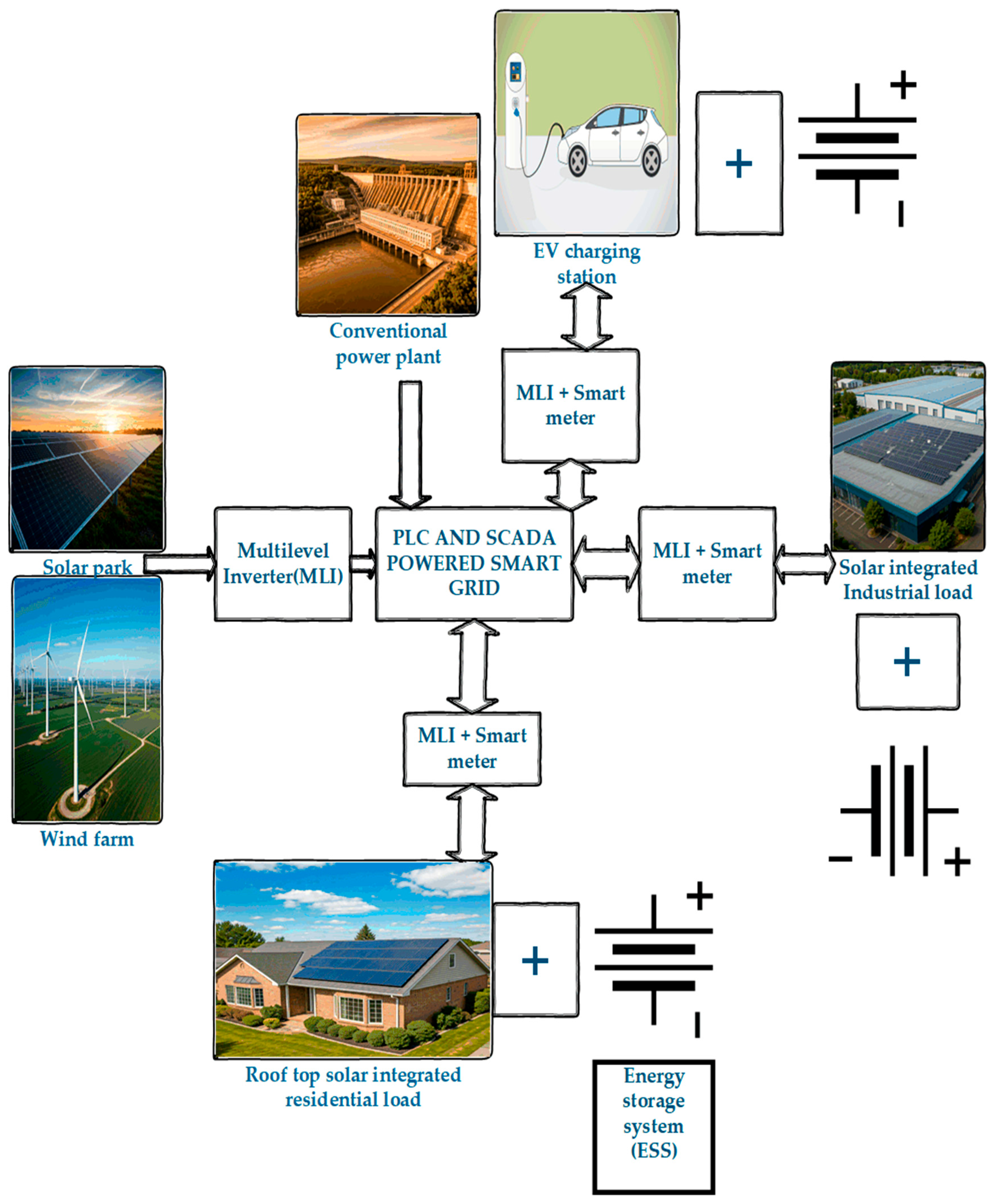
Figure 2.
Classification of MLI [52]
Figure 2.
Classification of MLI [52]
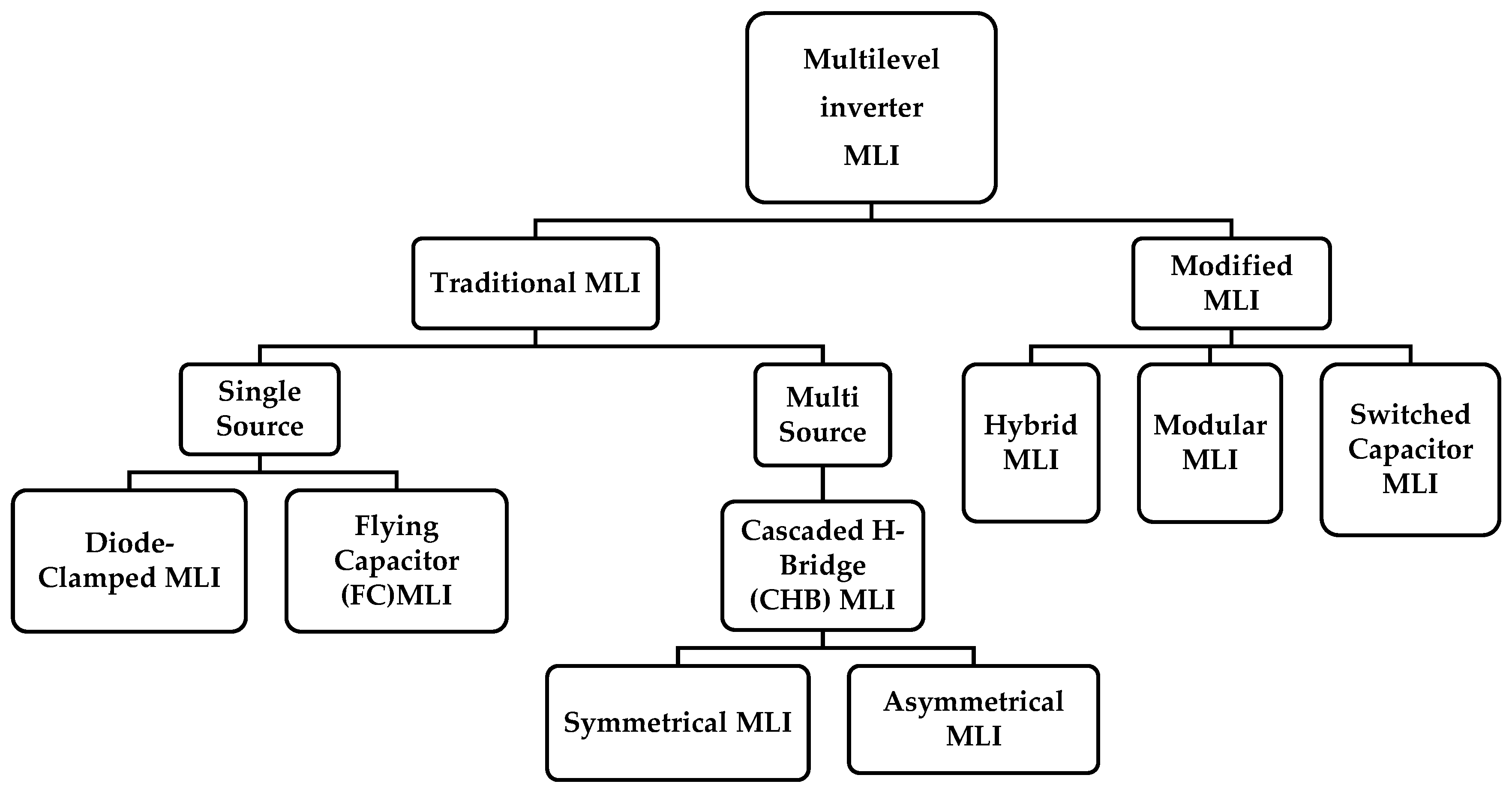
Figure 3.
Classification of Modulation Technique [57].
Figure 3.
Classification of Modulation Technique [57].
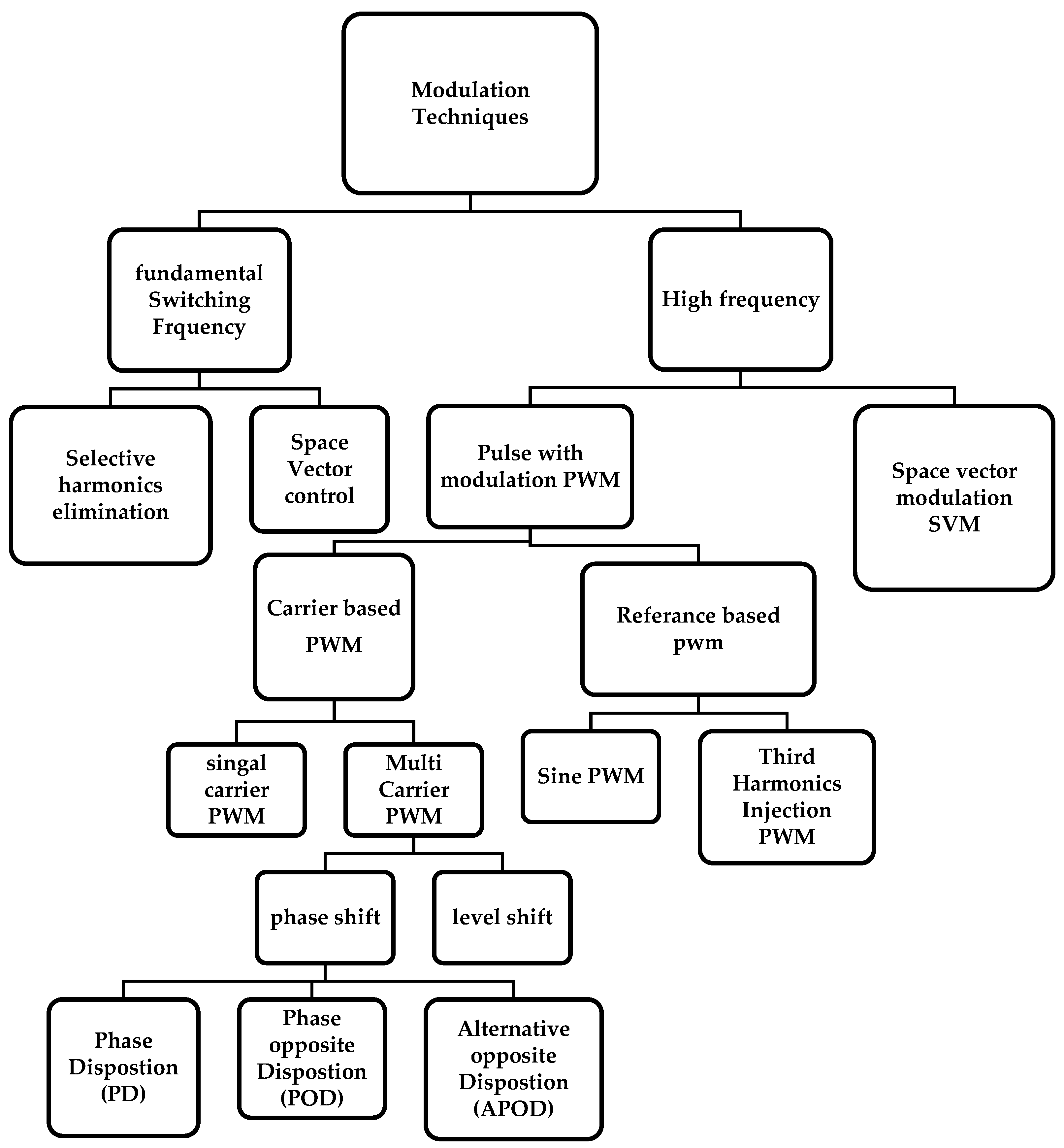

Table 1.
Power quality issues with solar and wind integrated grid.
| Power Quality Issue | Solar energy | Wind energy | Impact on system | Reference |
|---|---|---|---|---|
| Voltage Fluctuations | Variations in sunlight intensity cause it. It follows a daily cycle, but rapid changes during weather changes can cause variation. | It is caused by unpredictable wind speeds, which are more erratic than solar. | It can affect sensitive equipment and lead to power quality issues. | [14] |
| Harmonics | Caused by inverters; depends on inverter quality and power electronic devices used. | Mitigation is more complex because of inverters and mechanical components in wind turbines. | It can cause equipment overheating and increase transmission losses. | [15] |
| Frequency Variations | Less Important: follows a pattern that is easy to predict, but sudden clouds can bring about rapid changes. | More importantly, significant frequency variations can occur due to unpredictable wind speed. | It can affect the stability of power grid operations, requiring quick response and monitoring. | [16] |
| Voltage Imbalance | Because of the unequal distribution of solar modules across the phases, they can be controlled by proper design. | This is more critical due to uneven wind speed across turbines, which may be even more important in large wind farms. | It reduces equipment life and efficiency. | [17] |
| Poor Power Factor | Cause by inverter-related operation can be mitigated with power factor correction devices. | More impact due to large wind farms; reactive power compensation is required. | It leads to poor efficiency transmission and makes the grid unstable. | [18] |
| Flicker | It is less common but can occur where sunlight is changing rapidly. | Occurs due to unpredictable wind speed. Mitigated by the static var compensator. | It causes visible light to flicker and interfere with grid equipment. | [19] |
| Overvoltage | This occurs when solar generation is extremely high, and demand is at its lowest; it is commonly seen in regions with high rooftop solar penetration. | It occurs when the wind speed is high, and the demand is at its lowest; it is commonly seen in remote areas where large wind farms exist. | It can damage grid equipment and reduce the equipment's life. | [20] |
| Voltage Dips | A sudden drop in sunlight intensity, such as shading or cloud cover, causes it. | Occurs due to sudden changes in wind speed. | It may impact sensitive equipment. | [21] |
Table 2.
Comparison of MLIs and alternative tools in RES-powered Smart Grids.
| RES integrated smart grids challenges and factors | MLI | Convectional Inverters | FACTS devices |
|---|---|---|---|
| THD | It offers THD with less use of external filters. It can be a cost-effective solution for a RES-powered smart grid[36]. | It requires External filters for harmonics mitigation [36]. | STATCOM and SVC are used for reducing harmonics but depend on the external filters [37]. |
| Voltage control and stability | It is more effective in controlling voltage fluctuations in RES-integrated grids by real-time monitoring [38]. | Voltage Regulators are used to control fluctuations but are less flexible in RES-integrated grids [38]. | It provides fast voltage and power flow control response times but is less flexible[38]. |
| Efficiency | It provides high efficiency due to reduced voltage stress on semiconductor devices[39]. | Low efficiency, especially for high-power applications [39]. | It improves overall efficiency by optimizing power flow [39]. |
| Integration with energy storage systems | It is easily integrated with external battery sources and hybrid storage to maintain supply and demand [40]. | An external system requires control and synchronization with batteries, which increases the system's complexity [40]. | It can be integrated with an external storage system, but an additional control system is required [40]. |
| Cybersecurity | AI and blockchain improve security levels and minimize cybersecurity threats [41]. | It is highly dependent on centralized control; thus, they are prone to cyber threats [41]. | These devices require robust cybersecurity measures [41]. |
| Power quality improvement | It improves power quality by reducing harmonics, voltage flicker and transient [42]. | Additional power electronics devices are required to improve power quality [42]. | It improves power quality by providing reactive power compensation [43]. |
| Suitability for sensitive loads | It is suitable for sensitive loads and highly unpredictable and distributed renewable power generation [44]. | It is suitable for low-powered applications [44]. | It is suitable for modern power grids and EVs but requires additional control systems [44]. |
| Fault tolerance capacity | High, due to modular and hybrid design [45]. | Lows [45]. | High, due to fast response capability for voltage and frequency variations [45]. |
| Cost | Due to its complex design and the presence of more components, such as capacitors, diodes, and semiconductor switches, it has high capital and maintenance costs [46]. | It has less capital and operational cost, but external filter design affects the price and design [46]. | It has high maintenance and installation costs [46]. |
Table 3.
Role of MLI in RES Powered Smart Grid.
| MLIs Topology | Key Features | Challenges | Recent Trends and Innovations |
|---|---|---|---|
| Diode-Clamped MLI or Neutral Point Clamped Multilevel Inverter(NPC) [61] | It uses diodes to clamp the voltage at specific levels. It reduces voltage stress on switches. | Complexity increases with the number of levels due to more diodes. | Reduction in the number of clamping diodes through advanced topologies like Hybrid NPC inverters. |
| Ideal for medium to high-voltage applications. | Deficient performance under unbalanced load conditions. | Applications in offshore wind farms due to high voltage requirements. | |
| Cascaded H-Bridge (CHB) Inverter [62] | Series connection of multiple single-phase H-bridge cells. | It requires separate isolated DC sources for each H-bridge module. | The modular design makes it suitable for solar PV and wind energy systems. |
| It can generate higher voltage levels without increasing complexity. | More complex control algorithms are needed for harmonics and balancing. | It can be used for hybrid energy sources (solar, wind, + battery) to reduce the number of isolated DC sources. | |
| Flying Capacitor (FC) Inverter [63] | It uses high frequency. capacitors to achieve multiple voltage levels. |
It requires more capacitors, which increases cost and volume. | Advanced voltage control algorithms are required to reduce complexity. |
| Capacitors provide self-balancing without any complex control schemes. | Balancing becomes difficult as the number of levels increases. | Simplified designs for medium-voltage applications. | |
|
Modular MLI [64] |
It’s simple, modular design makes it suitable for high-voltage applications. | It requires complex control for balancing and synchronisation across modules. | It is widely used in high-voltage direct current (HVDC) transmission. |
| Each can module runs at low voltage. It reduces stress on power devices. | Excessive cost and increased footprint due to many submodules. | It is used in STATCOM-based systems. | |
| Hybrid MLI [65] | It gives combined features from different MLI topologies to create a hybrid design. | It creates complexity in design and control challenges due to combining different topologies. | Hybrid (CHB + NPC) inverters can reduce harmonics in large-scale renewable energy plants. |
| It can reduce component count while achieving higher voltage levels. | Hybrid configurations may require advanced control algorithms. | It requires a focus on cost-effective hybrid designs for medium-voltage applications. | |
| Switched Capacitor MLI [66] | It uses DC link capacitors to achieve multiple levels without using separate DC sources. | It increases control complexity due to switching capacitors at high frequencies | It uses self-balancing capacitor control algorithms to improve efficiency. |
| It reduces the number of DC sources compared to traditional MLIs. | Limited use into high voltage levels. | It can be used in distributed generation systems. |
Disclaimer/Publisher’s Note: The statements, opinions and data contained in all publications are solely those of the individual author(s) and contributor(s) and not of MDPI and/or the editor(s). MDPI and/or the editor(s) disclaim responsibility for any injury to people or property resulting from any ideas, methods, instructions or products referred to in the content. |
© 2024 by the authors. Licensee MDPI, Basel, Switzerland. This article is an open access article distributed under the terms and conditions of the Creative Commons Attribution (CC BY) license (http://creativecommons.org/licenses/by/4.0/).
Copyright: This open access article is published under a Creative Commons CC BY 4.0 license, which permit the free download, distribution, and reuse, provided that the author and preprint are cited in any reuse.


