

Submitted:
18 November 2024
Posted:
19 November 2024
You are already at the latest version
Abstract
A review of the violent knife crime literature suggests that the experiential perspective is one which has not been addressed in academic study. The research presented hereafter aims to address this literary gap and generate transferable knowledge relevant to the lived experience of violent knife crime. The experiential study of the single case within psychological research involves detailed examination of a particular event. Participant ‘J’ is the survivor of an extremely violent attack, involving the use of a knife, in his own home. J’s experience was analysed using Interpretative Phenomenological Analysis with reference to elements of the lifeworld: temporality, spatiality, intersubjectivity, and embodiment. Three themes were identified: 1. Switching from past to present tense when relaying traumatic experience, 2. Presence of redemption sequences, and 3. Making sense as a temporal process which included an additional two subthemes; ‘The long journey’, and ‘Seeking belongingness’. This case emphasises that the traumatic event is conceptualised as one part of a longer journey towards recovery, and that recovery itself is central to the experience of violent knife crime. Finally, the need to understand recovery as temporal process highlights the need to provide victims with appropriate support in order to avoid negative outcomes.
Keywords:
Traumatic Violence
; Interpretative Phenomenological Analysis
; Post-Traumatic Growth
; Victim
; Knife-enabled Violence
; Social Identity Model of Identity Change
; Public Health Approach
1. Introduction
Violent Knife Crime (VKC) has been evident in news reporting and academic literature since the early 2000s [1]. Despite consistent media attention and persistence of VKC in the UK, there is currently no Home Office definition for knife crime or indeed, for VKC [1]. Therefore, for the purpose of the current research we have devised a working definition for VKC as: The intentional and actual use of physical force or power using a knife or sharp instrument against another person or persons that results in injury or death.
Research on VKC has predominantly focused upon risk factors for becoming involved as a victim or perpetrator [2,3,4,5] and the motivations and justifications for knife carrying [6,7,8,9,10,11]. Risk factors include being male [12,13,14,15], deprivation and poverty [4,9,16], exposure to gangs [17], adverse childhood experiences, and mental ill health [4]. Motivations for knife carrying include fear of crime and a need for protection [14,17,18,19], feelings of mistrust towards police and other agencies [18,20,21], and peer influence and status [14]. Further, the majority of literature on knife crime in the UK is focused on adolescents and young adults [5,6,22,23]. It is therefore argued that risk factors and knife carrying motivations for young people are well established within the existing literature and that research should be conducted that goes beyond these themes.
In contrast to the existing literature, the present study presents an alternative approach to the study of knife crime to those commonly explored. Currently, academic literature is lacking the insight gained from the detailed analysis of the lived experience of those who are victims of VKC. A database search was conducted on 4th April 2024 (ProQuest, Science Direct, SAGE Journals) using the search terms “‘lived experience’ OR experiential OR involvement OR ‘first-hand’” AND “‘knife crime’ OR ‘knife-enabled’ OR ‘sharp instrument’ OR ‘knife violence’” AND “’United Kingdom’ OR UK OR England or Ireland OR Scotland OR Wales’” to identify research specifically addressing VKC in the UK. Searches were limited to UK papers because the focus of the study is to better understand the nature of VKC in the UK specifically to understand how to prevent it. Two pieces of academic research were identified; however, these did not explore the lived experience of actual events of VKC. Instead, the identified literature investigated the lived experience and perceptions of VKC from the perspective of young people in general and the police [23], and the lived experience of stop and search practices [24]. It is therefore our argument that the detailed examination of the lived experience of an event of VKC is lacking from the VKC academic literature.
According to Cook and Walklate [25], victim’s stories offer valuable insight into the experience of victimisation and harm, injustice, resilience, and recovery. Studying the lived experience of violent crime can facilitate a more in-depth understanding of the individual impact of VKC victimology and thus generate transferable knowledge. To this end, we present herein the experiential analysis of a single case of VKC victimisation.
The importance of the contribution of lived experience to the academic literature on VKC victimisation can best be understood if some consideration is given to the elements of a public health approach to tackling VKC. Public health approaches are arguably the most effective at addressing knife crime and take a preventative stance to addressing social issues [26]. Such an approach is based upon research which informs the implementation of primary, secondary, and tertiary prevention strategies [27,28]. Primary prevention interventions focus on the prevention of violence prior to the emergence of risk factors, secondary prevention interventions address the issue once risk factors have emerged, and tertiary prevention is aimed at understanding violence after its occurrence to prevent its reoccurrence in the future [28,29]. The purpose of the current research is to inform tertiary prevention strategies, via the analysis of a single case of VKC. Post traumatic growth (PTG) and post-traumatic stress (PTS) are also considered. Research indicates the presence of victim-offender overlaps within the context of knife crime, which suggest that individuals that engage in crime are more likely to become victims and vice versa due to shared risk factors [13]. Additionally, knife crime literature indicates that previous victimisation is a risk factor for engagement in knife crime [4].
Analysis of the lived experience of VKC victimisation may highlight specific elements of experience relevant to victims that make them vulnerable to future offending or re-victimisation and thus enable action to prevent such vulnerabilities. The manner in which victims internalise victimhood as a social identity process may be relevant to this process, allowing insight into the mechanisms that encourage internalisation of victim social identity. Research indicates that identification with victim identity, as opposed to survivor identity, has a greater negative impact on the emotional state of males who have experience sexual assault in comparison to their female counterparts [30]. In the domain of health, research suggests that appraisal of symptoms and salient social identity has a profound impact on wellbeing outcomes [31]. Empirical evidence suggests that when individuals are encouraged to self-categorise as elderly, they are more likely to believe that they experience of hearing loss as opposed to when they do not self-categorise as elderly [32]. Additionally, individuals with asthma are more likely to access medication if they identify strongly as an asthma suffer [33]. Therefore, the act of self-categorisation may also have a profound impact on the wellbeing of victims of VKC, those who identify with victim social identity may experience more negative trauma outcomes because they may be more likely to accept the associated symptoms of PTS associated with victims. Alternatively, victim social identity may actually be useful, as victims may be more open to accessing the services they require to facilitate recovery. Analysis therefore may highlight the tendency towards or avoidance of such identification and its impact on well-being, thus illustrating ways that social identity processes are relevant to the treatment of victims. Additionally, analysis may highlight protective factors and elements of experience that promote PTG preventing individuals from future involvement, and thus enable the conceptualisation of preventative strategies that enable positive outcomes.
1.1. Post Traumatic Growth
PTG refers to the presence of positive psychological outcomes and changes following traumatic experiences [34]. Individuals that experience PTG may continue to be emotionally impacted by their experience but domains such as personal strength, sense of self, future goals, connection to others, and behaviours are subject to positive reconfiguration [35,36]. Such positive outcomes occur because of the struggle, which manifests as PTS, that is endured following experiences of trauma or challenging life circumstances [37]. The presence of PTG does not necessarily indicate the absence of symptoms of PTS, instead, PTG and PTS often go ‘hand in hand’ [35], with the emergence of PTG believed to occur due to efforts to adapt to PTS [38]. Additionally, moderate levels of PTS are suggested to be necessary for the level of cognitive processing required for PTG to occur [35].
The current study analyses a single case study using Interpretive Phenomenological Analysis (IPA). One of the foundational philosophies within IPA, phenomenology, has previously influenced the experiential study of neuropsychology through single case study [39], in particular, within the works of Alexander Luria and Oliver Sacks. Luria recognised the importance of experiential elements of neuropsychological pathologies, studied through analysis of the single case [40]. Luria strove to combine the objective, scientific with the subjective, romantic aspects of reality to propose a unified approach to neuroscientific study, which he termed “Romantic Science” [41]. Central to such an analysis is the detailed examination of the narrative account. According to Sacks [41], analysis of human experience “demands a narrative structure and sensibility of science.” (p527). Inspired by Luria’s works Sacks utilised case studies to integrate the scientific and human elements of neuropsychological study [39]. The works of Luria and Sacks demonstrate the richness of data that can be obtained from the qualitative study of the individual case study with emphasis on the lived experience of the individual. To access the experiential element of VKC experience using the single case, the research presented here utilises the elements of the lifeworld to understand one man’s narrative account of the experience of VKC victimisation.
1.2. Theoretical Concepts
1.2.1. The Lifeworld
Analysis of lived experience can be conducted by giving equal attention to the analysis of elements of the lifeworld within narrative accounts. The lifeworld refers to the world which is experienced by humans and through them [42]. The lifeworld is relational, meaningful, and experienced [43]. It is the world in which individual experience is situated and from which meaning can be obtained [44]. VKC is traumatic for victims, perpetrators, and witnesses. Trauma directly impacts an individual’s sense of self and the ways in which they relate to and interact in the world [45]. Therefore, the ways in which individuals make sense of their experience of trauma and the resulting psychological impact can be interpreted via the aspects of lifeworld within their accounts. Experience in the lifeworld can be understood and explored through temporality, spatiality, intersubjectivity, and embodiment [42].
Temporality. Temporality refers to an individual’s experience and perception of time [42] an hour can pass in the blink of an eye while a moment can seem to last an eternity. This element of the lifeworld relates to the temporal flow of experience [44]. Thus, an experiential study should consider how participants perceive time, duration, and biography and how this impacts their sense making and experience [44].
Spatiality. Spatiality refers to proximal existence in relation to other objects, entities, and individuals. It considers closeness, space, and positioning within the lifeworld and what this means to the individual [43]. Spatiality can be understood as going beyond the physical, extending to geographical perceptions and the social norms and meaning associated with places [44]
Intersubjectivity. This is concerned with the relevance of, and relationship with other people. It includes their involvement and significance within experience, and how others are affected by situations [44]. Intersubjectivity refers to the concept that the lifeworld is relational, one which is shared with other people, and refers to the meaning that is attached to their presence or the things they leave behind, such as ideas, objects, and memories [46]. Analysis of the meaning derived from interaction with others is relevant here as it indicates the impact of social experience, as is the influence of culture and tradition on the view of the self [42].
Embodiment. This refers to the body and its experience within the lived world [43]. Consciousness is an embodied phenomenon and meaning is derived from the interaction between the body, the environment, and others in it [42]. Physical sensation and sensory input are integral to embodiment, as are concepts such as gender, disability, and emotion [44].
1.2.2. Social Identity Approach
The Social Identity Approach (SIA) is a social psychology metatheory, useful in the explanation of wide range of social phenomena as products of group processes [47]. SIA is inclusive of Social Identity Theory (SIT) and Self-Categorisation Theory (SCT). SIT is concerned with the meaning and self-esteem derived from group membership [48], while SCT relates to the ways in which individuals define themselves in terms of individual and group identification [49]. The Social Identity Model of Identity Change (SIMIC) posits that life changes, such as traumatic experiences, represent identity transitions [50] and an individual’s ability to cope with the change is dependent on the individual’s readiness to identify with old and new groups [51].
Change that results in loss is experienced as negative, change that results in gain is experienced as positive. The SIMIC proposes that significant life changes involve the loss of old social identities and stress that occurs due to social identity loss can be mitigated if new social identities are embraced, thus reducing the quanta of identity loss [51]. Research indicates that the ability to maintain multiple social identities (social identity continuity) following a stressful experience protects wellbeing [50]. Additionally, life transitions are perceived as threatening to wellbeing when identity loss is expected, and identity loss mediates the relationship between the source of stress and reduced wellbeing [50]. Relevant to the study of traumatic experiences, trauma pathways and outcomes entail elements of social identity discontinuity and social identity loss, which in turn impact accessibility of social identity resources such as support, solidarity and control [52].
Research suggests that the occurrence of PTG may be best understood as being social identity based [53] and that social identity change may promote meaning making and facilitate PTG [36]. Furthermore, and consistent with SIMIC, development of new social identities and social group identifications (social identity gain) are suggested to be related to differences in trauma outcomes with regards to the severity of PTS symptoms and the presence of PTG [38]. In addition, shared social identity and establishing a shared common fate with others is considered to be related to positive trauma outcomes [54]. Thus, in the context of the current study, an analysis of social identity continuity/discontinuity and social identity gain/loss following traumatic experience offers useful conceptual tools to contemplate the presence or absence of wellbeing and may be indicative of PTS and/or PTG.
1.2.3. Redemption Narratives
Narrative identity refers to the way in which individuals make sense of and give meaning to their lives via the internalisation of evolving and self-defining stories [55]. Narratives situate a life ‘in time’ [56] and also within the lifeworld as they include plots, themes, characters (intersubjectivity), scenes, and settings (spatiality/embodiment). The narrative self, or personal myth, is a continually developing inner story revealed to the self and to others throughout the lifespan [57]. The study of narrative identity, via the narrative accounts of individual experience enables the identification of features and dimensions of experience which, in turn, give insight into the personal myths and narratives of individuals [56]. As such, the way in which individuals make sense of their stories alludes to the way in which they make sense of themselves and their experiences.
Relative to the analytic methods of IPA and the lifeworld existentials, narrative accounts are arguably intersubjective in nature. Vygotsky’s sociocultural theory [58] emphasises the role of social interaction and culture in the development of higher psychological processes, including language. Through social interaction with adults and more experienced peers, Vygotsky suggests that children learn and develop internal processes which enable them to progress through developmental stages [58]. In line with Vygotsky’s assertion that inner processes are socially and culturally constructed, narrative accounts are intersubjectively negotiated through social interaction and cultural influence and are communicated through language. As McAdams [59] argues “Narrative identity derives from storytelling, and storytelling derives ultimately from human sociality” (p. 2). Therefore, the ways in which individuals tell their stories, through their use of language within their narrative accounts, indicates the intersubjective, socially influenced nature of their experiences.
Redemption sequences within narrative accounts are those in which the narrator describes circumstances as evolving from negative to positive [56,60]. Research on addiction recovery has noted the presence of redemption narratives in which individuals narrate social identity loss with peers and renewal via social identity gain with support groups [61]. While the concept of redemption may seem at odds with the study of victimisation, because it suggests a need to be redeemed from some wrongdoing, this is not the intended assertion within the presented analysis. Previous research has highlighted that redemptive sequences within narratives enable victims to make sense of painful and traumatic experience and give meaning to their future, thus enabling victims to move on positively [25]. Thus, the current study highlights the presence of redemptive sequences within the narrative account of a victim of VKC and how this may indicate the presence of, or potential for, PTG.
1.3. The Present Study
The present research applies a consideration of lifeworld, the SIA, and redemption sequences, to an analysis of one man’s experiential account of VKC. The aim is to produce transferable knowledge that can inform public health prevention strategies by understanding the psychological processes relevant to victims and how these may be incorporated into treatments that promote positive trauma outcomes. Ultimately, the aim of the research is to answer the question ‘What is the lived experience of VKC?’
2. Materials and Methods
2.1. Procedure
Ethical approval was granted by the institution (IRB number: 42440). J was provided with an information sheet prior to the interview and completed a consent form. The interview was conducted remotely using Microsoft Teams and lasted approximately one hour and twenty minutes. J was given the opportunity to ask questions about the research both prior to and following the interview. The interview was recorded and transcribed using Microsoft Teams and the transcription was edited to ensure accuracy by the interviewer in the days following interview.
2.2. Participant
Single case study research involves the meticulous and extensive examination of a particular experienced event [62]. It is suggested that particularly powerful data can be obtained via single case studies and that data quality, and not quantity, is the important factor in the study of human experience [63]. The current study utilised the single case approach in the context of one man’s experience of being a victim of a premeditated, prolonged, and violent attack involving the use of a knife, amongst other attack methods. The use of the single case aligns with the idiographic principals of IPA, which emphasises the subjective lived experienced as opposed to generalisable findings derived from large samples [63]. IPA’s focus is on detailed exploration of individual experience, which enables a nuanced, in-depth understanding of the individual’s sense making of a particular experience [63]. In utilising the single case in the context of VKC, personal meaning-making is explored through elements of the lifeword and interpreted through application of psychological theory.
Participant ‘J’ was recruited after he was directed to the researcher’s recruitment material through existing professional networks. The nature of J’s lived experience is such that the preservation of his anonymity is of the utmost importance. Therefore, any identifying information is omitted from this report with only general participant details being included. J introduced himself to the interviewer (ZP) as a 55-year-old man, who grew up with both of his parents and four siblings. J described the area he grew up in as ‘a really nice area’ and while he described his early life with fondness, he noted a challenge for him during childhood was the realisation at the age of 9 or 10 that he is gay.
Later in his life, J was subjected to an unprovoked, prolonged, and violent attack in his own home. The offender was an individual he had met using online dating apps and who J had met on other occasions prior to the incident. After a small number of encounters, the two naturally drifted apart and contact had ceased until the day of the VKC.
2.3. Analysis
2.3.1. Interpretative Phenomenological Analysis
IPA is a qualitative method of research which concerns itself with the lived experience of participants to produce transferable knowledge [63]. Smith et al., [63] assert that there is no ‘right’ way to conduct IPA, and that it is a recursive and iterative process. Central to IPA is the concept of the double hermeneutic, presented hereafter through the researcher’s sense making of J’s own sense-making throughout his account. In integrating the results and discussion, the double hermeneutic is made transparent and accentuates the narrative that recovery from traumatic violence is a temporal process, and one which represents a process of social identity change.
IPA analysis was conducted, using a single case study research paradigm, in line with the guidance from Smith et al., [63] who detail four phases necessary to conduct effective IPA: 1. Reading and rereading while highlighting significant statements; 2. Exploratory noting; 3. Construction of experiential statements; and 4. Searching for connections and themes across those experiential statements. To allow for analysis which was independent from the narrative flow of J’s account, the transcript was scrutinised from start to finish, line by line, paragraph by paragraph, and backwards [63]. To ‘achieve excellence’ with regards to IPA, the analysis was conducted to ensure the inclusion of four qualities deemed hallmarks for high quality IPA; construction of a compelling and unfolding narrative; production of experiential or existential account; detailed analytic consideration of participant’s words; and attending to divergence and convergence [64]. Initial coding was conducted by the primary researcher. Preliminary themes were identified, then reviewed by the second author and revised until it was agreed that the themes identified were relevant and valid.
With regards to the current research, it was hypothesised that aspects of the lifeworld would be evident in Participant J’s narrative account. Through application of lifeworld existentials (temporality, spatiality, intersubjectivity, and embodiment), all elements of lived experience are acknowledged and explored, not just those which feature most prominently within transcript data [65]. Therefore, in utilising the four existentials of the lifeworld in analysis of J’s account, the meaningful interpretation of the lived experience of VKC victimisation and its consequences can be better understood. Such an understanding may contribute to knowledge that informs the treatment of victims, the understanding of the consequences of VKC, and prevention of VKC reoccurrence.
3. Results and Discussion
The present research applied IPA to a single case study of the lived experience of VKC to better understand VKC and to inform tertiary preventative strategies to address it. In following the procedural guidance as outlined by Smith et al. [63] and in the application of the aspects of the lifeworld; temporality, spatiality, intersubjectivity, and embodiment, three themes and two subthemes were identified (see Figure 1).
In his description of the events immediately prior to and at the commencement of the attack, J explained that there had been no interaction between himself and the offender for several months before the incident. He explained that on the evening of the incident, the offender surprised J by visiting him at his home, unexpectedly.
J further explained that the two spent some time watching television and chatting. The events immediately prior to and beginning the attack are described in J’s own words:
“He just says to me. ‘Ohh, I’d like to give you a massage.’
I said ‘OK’, so we’re on my sofa, so I lie on my stomach face down and he gets right on top of me. So, he’s sort of straddled me. I’ve taken my top off. And he starts to massage my shoulders. And at that moment it’s just a little bit… not rough but not massaging, he said. ‘How was that?’ I said ‘Oh, just further up here. Do that bit there’. And he says, ‘How’s this?’ And I [sic]…, ‘That’s better’. Then he says. ‘And how’s this?’ And then when he says, ‘How’s this?’ It felt like he’d punched me.
I’m, I’m on, face down because I, I can feel myself lifting up almost even though I got his weight on me. It’s like punched me in the side there. At some point my body slightly moves around and all you can see is his hand there. And… all of a [sic]… I just start to see blood forming around his hand and what I’ve realised at some point, he’s holding a blade of a [sic]…, and he’s stabbed me really high up. Sort of like, chest level on my side, almost round like that where I was, I lay flat down.”
J goes on to detail a prolonged attack of 20–25-minute duration. In addition to being stabbed, he was bitten, strangled, suffocated, gagged, and bludgeoned with a hammer.
3.1. Switching from Past to Present Tense When Relaying Traumatic Experience
An interesting feature of J’s narrative is a distinct switch from past tense to present tense as he relives the more traumatic elements of his experience. When J is describing the non-traumatic, contextual elements of his experience he does so in the past tense:
“I was the ground floor flat and there was a knock at my window, and I just had some blinds, so I pulled the blinds to one side, and I saw this face and it took me a minute to think who it was. Then I realised who it was.”
However, as J begins to detail the moments preceding the attack, where he begins to interact with his attacker, he switches from past tense to present tense:
“And. He. So, then I have to go to the front door. The, the main, it’s a shared, shared entrance and he’s there and he says, something like to paraphrase, Erm... I was. I thought… I was in, you know, I was in the area. I just thought I’d pop in and say hi.”
In relation to the attack he experienced, J uses entirely present tense descriptions. The use of present tense language within his descriptions, as he relives his experience, gives insight into J’s experience and sense-making in terms of spatiality and temporality. In using present tense language, it is clear to the researchers that J has situated himself closer to the memory of the attack in both space and time and is experiencing these dimensions exactly as his memory indicates they occurred. The experience is imminent.
Dramatic shifts from past to present tense have previously been found to occur in trauma narrations at the point in which a threat to life becomes apparent, suggesting a shift from narrative-based memory to image-based [66]. Specific imagistic memories, in relation to traumatic experience, are linked to higher levels of wellbeing via the narrator’s flexibility in linking memory specificity and coherence to conceptual structures of the self through meaning making [67,68]. In contrast, difficulties in the recall of specific memories is linked to Post Traumatic Stress Disorder (PTSD) and depression [68]. J is reliving the event in his memory and in doing so he provides an authentic account of his sense making during the attack ‘in the moment’. In addition, his present tense recall demonstrates a level of memory specificity that suggests a potential for the presence of positive trauma outcomes, current wellbeing, and effective functioning of the self.
3.2. Presence of Redemption Sequences
The narrative concept of redemption is useful in making sense of J’s account of his experience of VKC. Redemption describes a situation whereby circumstances evolve over time from negative to positive [60]. Smith et al., [63] assert that story telling holds personal significance, and that it is a fundamental aspect of what it means to have an identity. According to McAdams, [59] narrative identity arises from telling stories, and storytelling is grounded in social interaction. As McAdams and Bowman [69] explain, redemption sequences are a narrative strategy employed by individuals to facilitate sense making during life transitions, thus, the sequences embedded within the stories of individuals are indicative of the ways in which individuals make sense of personal experience. Redemptive sequences were first identified through J’s many references to being lucky throughout his life, an example of which is detailed below:
“So, I’m, I’m lucky in some points if I’m born one generation earlier, then you know I’d never have the opportunity to sort of be authentic.”
In referring to himself as being lucky, J reflects on his experiences from a position of positivity as opposed to focusing on more negative circumstances in which he may describe himself as unlucky. Redemption sequences are evident throughout J’s narrative account. In his description of the attack, redemption sequences are notable in J’s descriptions of being forensically aware and, in accepting the gravity of his situation, making attempts to ensure there is evidence to secure justice and achieve a positive outcome in this way. Through the concept of embodiment, J explains:
“There’s other little things I remember distinctly, during the attack I took loads of his blood in my mouth.
And I remem… it’s so weird, I remember distinctly... I turned to the wall and spat it on the wall. Because I thought ‘I’m gonna die’, but at least his DNA will be. Will be there.”
Later, in describing the incident itself, he concludes the narrative of the attack with the positive outcome of the offender being apprehended almost immediately and referencing his luck at being in close proximity to a hospital:
“My attacker flees out the flat with the hammer swings at the neighbour, swings and runs out, but the police pick him up on the next road away. You know he’s; he’s made it around one corner, and they’ve picked him up, someone running away.”
“…it was dialled in as maybe a violent thing, it was these was these, erm, first responders. Which is the. [Redacted] police and they come in with, with guns, you see, because they said that there might be an attack going on anyway… the attackers gone. He’s been picked up then quite quickly then there’s the ambulance people are there. And then. They sort of attend to me. What they can there, mainly stop the bleeding. And then some point soon after… Luckily, I wasn’t too far from the hospital…. I, I’m taken to hospital.”
Narrative accounts that tend to follow redemptive scripts and describe difficult experiences in a transformative way are related to higher levels of happiness and wellbeing in the narrator [70]. Additionally, redemptive processing has been found to be a predictor of psychological adjustment [71] and wellbeing [72]. The redemption narrative is clear when J discusses his current circumstances which he describes positively, thus indicating an overall positive outcome despite his negative experiences:
“Now I’m back on my feet. Obviously, I’m working again. I’ve got my own place again. Erm, I’m very proud of myself, for get… for managing that. I really am. But I think I’m more. But then I realised I am lucky, whether it’s just people around me or some… integral spirit in me that’s got there, but some people are not that lucky that some people are victims of crime, and they never get back on their feet.”
Despite experiencing extreme trauma and the physical and mental health difficulties he experienced as a result; J is now in a positive place in his life. With consideration of the SIMIC, J’s experience evidences a recognition of identity loss following his victimisation when he describes the loss of employment, home and relationships by some victims. Additionally, J states that he is back on his feet, suggesting that he experienced significant losses himself which he has since overcome. Indeed, he later describes his loss of employment due to his physical health following the attack, and his relocation back to his hometown, demonstrated below through spatiality, as J describes physically leaving his previous workplace, home and area of residence:
“I had to then sort of, leave my job. Which meant leaving my flat. Which meant leaving [Redacted]…and I’m glad now I’m back here, at the time, it didn’t feel that way. I felt like. I felt a direct correlation between. Being a…. someone trying to kill me and being homeless.”
Such significant changes indicate that J experienced the loss of multiple social identities in the days and months following the attack, including those related to his work life and those established in the area he lived. However, J recognises the important role of others when he states ‘whether it’s just people around me’ while referring to his ability to get back on his feet. It is unclear whether the people he refers to are representative of old or new social identifications, however what is clear through J’s passing reference is that he perceives his relationships with those around him as a positive influence on his recovery.
Identification with social groups has been shown to positively impact stressful experience because it allows access to social support [73]. Furthermore, research suggests that individuals are more likely to provide and accept social support when group identification is present [74]. Social support efficacy is increased when it is provided by ingroup members [75] and research indicates that lower neuroendocrine stress reactions occur when social support is provided by a committee with whom participants have established shared social identity [76]. Thus, evidence suggests that social support acts as a buffer to stress, facilitating coping. In alluding to people around him, J is referencing his ability to access social support, thus facilitating his ability to cope following traumatic experience and move on positively.
Another interesting feature of the above extract is that it offers perspective into the extent to which J internalises victim social identity. J states that he ‘felt a direct correlation between ‘Being a…. someone trying to kill me and being homeless’ and in doing so demonstrates reluctance to refer to himself as a victim. Evidence shows that men’s recovery from traumatic experience is facilitated by transformation of the self-view from that of victim to that of survivor [77]. While this research highlights such processes in the context of sexual victimisation, the same processes may explain J’s hesitation towards using the word victim within the extract. It is logical to suggest that J does not currently internalise victimhood via self-categorisation due to his reluctance to refer to himself as a victim. Research suggests that individuals who self-categorise as elderly are more likely to believe that they experience symptoms of hearing loss [32], suggesting the opposite is true for those who do not self-categorise as elderly. J’s demonstration of a lack of self-categorisation as a victim may suggest that he does not experience the full extent of the associated negative consequences of victimisation at this point in time. This may therefore indicate the presence of recovery, reduced symptoms of PTS, and potential PTG.
Within the transcript, J references his contact with services and processes targeted towards victims, namely victim support services and engagement in parole processes:
“And even though I made contact with Victim Support at the time, they didn’t do like… erm… I can go, I could go and see someone or they, they would recommend a therapist”
“I’m given the, I’m able to update my impact statement or in the unlikely event he got released I could do something called a non-molestation order which meant I could restrict where he could travel.”
In line with research which suggests asthma sufferers are more likely to comply with medication if they internalise their diagnosis through social identity [33], J’s willingness to engage with victim support and parole processes may suggest that he did at one time internalise victim identity. This, appears to no longer be the case, seemingly substantiating the findings of Ralston [77] that recovery in men is facilitated through transformation of the view of the self from that of victim to that of survivor. Such an interpretation, consistent with the SIMIC, further evidences the presented argument that recovery from traumatic experience is a process of social identity transformation.
Arguably, one significant turning point within J’s narrative account is the decision he took to support the potential deportation of his attacker. A difficult decision which caused conflict for J, described below, through embodiment, where discusses his thoughts in terms of what his decision did to his head, and through expressing his decision as his voice. In addition, according to Damasio’s Somatic Marker Hypothesis [78], cognition, or thought, is an embodied process which occurs in physiologically in the brain and which invokes feelings and emotions leading to reasoning and decision making. J’s description of his thoughts and related emotions that drove his decision making with regards the deportation of the offender are thus communicated through the concept of embodiment:
“Erm, they, they did ask me what I thought, whether I would support them going for a deportation. Erm and it’s such a weird thing because I thought, gosh, after those years I could say ‘Yes, deport him’ knowing he’d be released, now that, that did two things to my head. One thing was. My thought of… him… erm, being free again and what, he could hurt somebody again. So, by me by me supporting it. Not that they would have… [sic] I was the deal maker, but I imagine my decision… My voice mattered. Or was the deciding factor… [sic] thought ‘Can I live with the idea that he’s gonna be released and hurt somebody again?’
And then I thought, gosh, and also. It’s an act of kindness. I could actually do something that could give him his freedom. How, sort of, perverse is that?”
J continues his discussion around deportation by referencing the unlikelihood of his attacker being released due to his behaviour while incarcerated:
“And so, I, and he was so far off ever been released, you know, he was showing violent behaviour in prison to prisoners, to prison guards. Wouldn’t engage in prison programs for reform. Would not erm, take full responsibility for the attacks. Still, after years, so he was gonna rot in there. And this lifeline was thrown him to be deported and I said. ‘Yeah, deport him.’”
This extract is interesting from a social identity perspective. J’s knowledge that the offender was engaging in problematic behaviour, enables him to access the offender’s inner world and is thus intersubjective in nature [79]. Having access to this information may have enabled J to employ a strategy of dehumanisation and depersonalisation of the offender which enabled him to firmly position the offender in the category of ‘other’. The view that the offender is displaying problematic behaviour offers J the possibility of depersonalising his attacker as the prototypical perpetrator of violence. Research suggests that when perpetrator status is afforded to the out-group, dehumanization is possible due to the perception of low morality [80]. Such a strategy may be conceptualised as adaptive depersonalisation and dehumansation, freeing J from the intersubjective ties to the offender, and thus enabling him to enact the ultimate process of othering, by supporting deportation and the physical removal of the offender from the country.
Ultimately, despite his inner conflict, J’s decision to support deportation allowed him to move on from the repeated re-traumatisation of engaging with criminal justice procedures. J describes this moving on with reference the intersubjectivity of no longer engaging with criminal justice professionals and court proceedings, ending that chapter of his journey, and freeing him completely from the intersubjective connection to the offender:
“And that does feel more final now because there’s no more parole hearings. There’s no more things, no more victim impact statements for me to write. So, it did feel like. Something finishing it did feel like a back of a book closing.”
In describing this event as ‘something finishing’ and ‘like the back of a book closing’, J demonstrates that he understood this situation as transformative and a turning point from which he was able to move on more positively. Research suggests that the ability to narrate causal turning points within narrative accounts is associated with current and long-term well-being [81].
The presence of redemption sequences throughout J’s account, and the overarching redemption narrative across his biographical account indicates J’s ability to be adaptable and to maintain hope and confidence when facing difficult situations in his life [56]. This is evidenced below, where J discusses how his experience has changed his view of the world in positive terms:
“It has, it has, changed and I do I think I’m more compassionate now, which is a strange thing to say, I suppose”.
Additionally, J’s frequent use of redemption sequences [70] along with his use of causal turning points [81] demonstrates his tendency towards positive outcomes, enabling him reframe his experience as one which is transformative, giving him renewed purpose [25]. As demonstrated below, where J describes his progress in terms of increased empathy and connection to others, highlighting the intersubjective nature of his experience:
“I’m not really paying much attention to the news recently, so I’m not tuned into that one, but occasionally it just, one of them clicks like and it just and it lingers in my head. It’s like a bit of an intrusive thought. Erm, but so like I was saying, I think I’m a bit. I have a bit more empathy. I didn’t for a while. I think after my attack went the opposite, where I was a bit self… absorbed. And not the best friend. I don’t think for a long time. But then I think since I feel like I’ve come out the other side slightly, is that I feel more empathetic now. Erm, so, in other words I got back at it, took me a lot to get back on my feet.”
This indicates the presence of positive psychological wellbeing, psychological adjustment, and a degree of happiness on J’s part at this point in time. While J attributes this to being ‘lucky’, he makes passing reference to the people around him, and the types of social identity loss that he experienced, suggesting that he recognises the importance of social belonging and support with regards to his recovery. J’s experiences of PTS and his tendency to narrate experience and specific memories into wider frameworks and redemptive sequences appears to have facilitated PTG, through increased connection to others and social identity gain. Therefore, the effectiveness of enabling victims of VKC to frame their own experiences within redemptive sequences may be a beneficial tool within their treatment. In addition, the experience of social identity loss may be reduced within treatment by including strategies that enable the development of new social identities via support groups [38].
3.3. Making Sense as a Temporal Process
The recovery from traumatic experience can be understood in the context of searching for new meaning following adverse experience [35]. The inability to make sense of traumatic experience is suggested to impede the healing process, if not make healing impossible. Academic literature suggests that emotional processing and sense making of traumatic experiences can reduce adverse psychological symptoms and positively impact wellbeing [82]. Much like cognition, and relative the position of IPA which argues that emotion is embodied [63], Damasio [78] argues that emotion is an embodied phenomena, influencing reasoning and thus facilitating meaning making. Additionally, meaning making, in which individuals can make-sense of their experiences and identify positive outcomes has been shown to be positively correlated with post traumatic growth [83]. For J, his attacker’s continued denial of responsibility has likely inhibited his ability to make sense of why he was attacked and thus his sense making, and post traumatic growth is an ongoing process. J’s emotional discomfort regarding the offender’s denial, and not-guilty plea is demonstrated below. Within the extract, J makes specific reference to the passing of time, highlighting the temporality of this situation:
“Erm, so yeah, it would’ve been nice if he said guilt…, he pleaded guilty, but it so that that was quite a long. That was a very difficult process because it was erm, I was in the stand two days, one day with the Crown barrister, sort of like on my side I suppose and then this defence barrister.”
J’s continued efforts to makes sense of his experience is demonstrated throughout his account, and when reflecting upon his experience he states:
“I won’t feel any anxiety about it, I suppose. It’s just a thing I just reflect upon really. Like my cenotaph in my head… Really. Where, I lay a wreath. Erm and pause and think really. Yeah.”
In describing ‘my cenotaph’, J makes a very symbolic statement which, by referencing a war memorial, suggests that he makes sense of his experience as one which has been a kind of personal war. The experience is a part of J and making sense of the experience is an ongoing process for J which will continue throughout his life. In noting a lack of anxiety when he reflects on the incident, J indicates that this type of reflection is not associated with negative emotional responses and distress, indicating that post traumatic growth may be present and ongoing [83]. This type of reflective rumination is said to be characteristic of a search for meaning and a reframing of experience into the life narrative [35].
Event centrality is a concept that refers to the extent to which a person incorporates a traumatic event and perceives it to be central to their identity [84]. J’s discussions of his experience of time following the incident are indicative of his initial tendency to conceptualise the event as central to his being, as demonstrated through temporality in the extracts below, where J directly references periods of time since the attack occurred, and his revisiting of the incident at 8pm, the time the events unfolded:
“It’s strange the first year after my attack the…. This is very interesting; I’ve found is that. I was probably not conscious maybe three or four days after and when I was conscious and every night… Let’s say 5 days post attack you got to 8:00 PM. It would overwhelm me, this time 5 days ago I was being attacked. Then it got to a week anniversary. This time last week I was being attacked and then it got to the first year, you know, I think. Oh my God. 8:00 PM, he’s knocking on my window now”.
The above extract demonstrates J’s tendency to reexperience the incident initially, however, J goes on to state that this has lessened over time, and he no longer experiences any anxiety when he does think back to the exact time that the event occurred:
“Now, when I reflect back on it, that’s a massive part of it, but I often just feel a lot more of a... Collective emotion over the last (redacted) years I suppose, and the journey that I’ve been on. And, and I just, I don’t feel incredibly sad, but I just sort of. You know, think about it. Think about things, people. I’ll find a quiet time.”
“I still think at 8:00 PM, by the way, I still, it’ll still happen to me. I’ll be thinking tomorrow, 8:00 PM tomorrow night thinking ‘ohh’. But it won’t be. I won’t feel any anxiety about it, I suppose. It’s just a thing I just reflect upon really.”
While J has certainly incorporated his experience of the attack into his life narrative and acknowledges difficulties he experiences since the attack, he does not appear to view it as the central aspect of his identity that it once was. However, it does influence the way in which J interacts with the world and others as described below, giving insight into the spatiality of his experience, through his perceptions of the places he may encounter risk:
“Erm… so my brains never been the same since, I am absolutely fine, by the way, but there’s definitely it’s not something I feel like I’ve. In the past, got over, end of, it’s definitely fed into some of my things I do now, even now, erm, for no reason sometimes I can just get a little bit…. Erm… see risk in places that are not there. Like walking past, you know, some scaffolders. I think ‘Oh God, someone’s gonna drop a hammer on my head’”
Although J states he does not feel anxious when reflecting on his experience, he does describe embodied distress as he begins to describe and re-live details of the event itself when he states, ‘so this, I suppose, [is] a bit more difficult for me’ and ‘Just my breathing goes a bit funny sometimes’. This type of reflection positions J closer to the incident in time and space, to a point where the event was central to J’s being, the point at which the event was being experienced and is demonstrated by a switch from past to present tense narration. While it may seem paradoxical, literature indicates that periodical cognitive revisiting of traumatic experience and reflection upon ‘what is lost’ may be necessary in the maintenance of personal growth following traumatic experience [85]. Reflection, although potentially unpleasant, emphasises that which has been gained over time [85]. Furthermore, repeated reflection upon adverse and traumatic experience, can be understood in the context of attempting to make sense of the experience, accepting the new reality following the event and incorporating these aspects into the life story [35]. With this in mind, the SIMIC may offer some understanding as to the role of social identity and personal growth following traumatic experience. Reflection upon social identity loss may highlight the positive aspects of social identity gain that have occurred since the traumatic experience and repeated reflection may enable victims to accept their new social realities more readily. Therefore, consideration of the manner in which victims of VKC reflect upon their experience may be useful in the construction of treatment strategies. In addition, victims should be deterred from avoiding unpleasant memories, but may instead benefit from strategies that enable reflection in way that promotes acceptance of new social identities and PTG.
3.3.1. Subtheme – The Long Journey
The ‘long journey’ was identified as a subtheme and demonstrates that J makes sense of his experience as one which has shaped his life over a long period of time and as one which he continues to seek meaning through the temporality of his experience. To demonstrate this ongoing ‘long journey’ J makes references to his experiences of time throughout his account. These are most evident when he discusses his physical recovery and criminal justice procedures. This appears to enable J to emphasise that both these aspects of his account, to him, seemed to occur over prolonged periods of time. This also enables J to document these long processes in terms of his progress across time which resulted in positive outcomes. As such, J’s experience of time is framed within redemptive sequences and causal turning points are included within these sequences as specific points in time, thus J indicates the temporality of his experience.
“I was in the stand two days, one day with the Crown barrister, sort of like on my side I suppose and then this defense barrister. And then he took the stand and eventual long story cut short. After three weeks, the jury goes out and he was found guilty of attempted murder. And then…That was the [date redacted]. And it’s come back for sentencing. And we came back nine times for sentencing, and it was the following [date redacted] he finally got his sentence of [sentence redacted] years.”
Here, each reference to time appears to emphasise the ‘long journey’ of J’s experience, however it also refers to a particular hurdle that J must overcome to progress on his journey. In achieving each milestone, J moves closer in time towards the positive outcome of a guilty verdict and prison sentence for the offender. J’s ‘long journey’ is also demonstrated in his projection of his experience into his perceived future, particularly with regards to his reluctance to pursue intimate relationships giving insight into intersubjectivity:
“Also, the other one is intimacy, of course, is that I’ve… that I did have a I did end up dating someone very for a short time, that didn’t work. And, about six years ago, I decided right. That’s it. I’m not gonna let anybody… I’m not gonna date anyone, no one’s gonna touch me.”
In the same way that narrative identity states that experience incorporates the past and informs the expected future [56], the attack that J experienced is incorporated into his experiences and sense making and informs his expectations of his own future, in which he anticipates continued reluctance to engage in intimate relationships. J’s descriptions of intersubjectivity represent a highly significant example of social identity loss which J has not yet been able to renew and has resulted in social identity discontinuity. This indicates an area in J’s life in which he continues to experience PTS [38] which manifests as avoidance of intimacy.
While J can look to the future in a positive way across certain domains, for example when discussing his career, J’s expectations regarding future intimate relationships are viewed in a more negative light. Intimate relationships represent a part of J’s long journey yet to be resolved, which may continue for some time. Analysis of J’s long journey offers insight into the ways in which victims may utilise causal turning points within their narratives or project particular difficulties into their futures and may be indicative of the areas in which PTS is present and where PTG is possible. Practitioners involved in victim treatment may therefore benefit from consideration of the ways these concepts feature within trauma narratives and utilise these features to personalise interventions.
3.3.2. Subtheme –Seeking Belongingness
While J’s difficulties around intimate relations are evident within the subtheme ‘The Long Journey’, they are also highly significant to the subtheme ‘Seeking Belongingness’. One particularly insightful quote demonstrates J’s understanding of the attack as an extreme abuse of trust on the part of his attacker. This abuse of trust is assimilated and projected by J into his future narrative, where he makes sense of future intimacy as a potential threat. By projecting this uncertainty around intimate relationships going forwards, demonstrated in the extract below, J indicates this as an area he continues to try to make sense of and offers insight to the intersubjectivity of his experience, though his projection of expected outcomes related to intimate relationships:
“My life plan right now is not to have… Anybody… Not to be intimate again, or let, put myself in… it… because it was very intimate what happened to me”.
This pattern of distancing from others is one previously adopted by J at time of him making sense of his sexuality indicating consistency in communion, or connection to others, across J’s lifespan narrative. This suggests that such distancing and avoidance, may be a pattern of behaviour that J has adopted previously at a time when he has felt that social relationships may threaten his safety and wellbeing, potentially resulting in social identity loss. According to the SIMIC, social identity loss impacts domains such as health and well-being because it compromises access to social support. These notions are evidenced through academic research on which highlights the importance of social identity loss and gain within contexts such as retirement [86], during transition from adolescent to mental health services [87], and when understanding health and wellbeing outcomes following mental and physical health diagnoses [88,89,90,91]. Where social identity loss is experienced, the negative consequences on health and wellbeing are accentuated [90] through a lack of access to social identity resources. Within J’s account, his avoidance of intimate relationships highlights a significant social identity loss and is an area he continues to experience PTS. In seeking belongingness, J attempts to address his social identity loss through social identity gain with others, thus enabling access to social support to facilitate recovery, alleviate PTS and potentially work toward PTG.
Avoidance-orientated approaches to coping following traumatic experience, while somewhat problematic, are fundamental to post traumatic stress which, in turn, is necessary for PTG to occur [35]. The presence of PTS in the domain of intimate relationships is not surprising when it is considered from a social identity approach. According to Muldoon et al. [53], PTS is heightened when traumatic experience threatens valued social identity. J’s trauma occurred at a time when he was able to be open about his sexuality and during a very intimate moment, a context in which his sexuality likely became a salient social identity. Following the attack, J’s experience of discontinuity and loss around intimacy and sexuality, continues to be an area in which he experiences tension and uncertainty. The attack he endured represents a threat to that social identity, and a significant social identity discontinuity between his old-self and his new reality. This impacts the sense of belongingness that J has sought since the attack, and represents his need to access social identity resources in the form of support, solidarity and perceived control [52]. J therefore maintains control through his continued avoidance of intimate relationships.
While J makes sense of others as a threat in an intimate capacity and distances himself as result, his intersubjective experience is further indicated as he explores his desire to seek affinity, connection, and solidarity, albeit with other victims of violent crime. In other words, J seeks out social belonging with other victims, in an effort to address the social identity loss and access to social identity resources experienced through avoidance of intimate relationships:
“…one thing I really was, I sought like, was, was, trying, trying, trying, to find somebody who’s been through something similar.”
In terms of PTG, this indicates a time whereupon J explored his ability to increase his connection to others and demonstrates increased compassion for other victims [36]. J’s desire to connect with other victims represents his attempts at social identity gain. J attempts to forge new, meaningful social identities, which are suggested to enhance resilience and increase the likelihood of PTG [38]. Research indicates that the formation of new valued social identities is vital to positive recovery outcomes [53,92]. Through connecting with others, J makes efforts to make sense of his own experiences through shared understanding, he states “I wanted maybe to, to talk to somebody and have somebody and just look at them and say “ohh you know”. J explains this was something he sought out initially but was unable to find other victims with whom he could connect. Social belongingness is a mediator of PTG [93] and in seeking social belonginess, J demonstrates his ongoing efforts to make sense of his experiences through validation, shared experience, and shared social identity with others. In other words, following multiple significant social identity losses and discontinuity, J actively sought out new shared social identities which diminished his stress and facilitated PTG through connection with others.
Group identification is suggested to enable individuals to regain control of individual narrative identity, something that can be perceived as being lost following trauma [45]. Further, group membership that arises in the context of the experienced trauma provides social support and a sense of purpose, enabling positive development [45]. Applying J’s experiences of seeking belongingness to the treatment of victims of VKC highlights the potential need for victims to establish social identity with individuals with similar experiences. Victim support groups may be impactful in this endeavour [38], however potential rivalries between victims of VKC may impede the effectiveness of support groups. It is therefore necessary to consider ways in which victims can establish a sense of belonging in manner which prevents exposure to rivals, revictimisation, and/or future offending.
3.4. Strengths and Limitations, Implications, and Directions for Future Research
The current study has given insight into the psychological mechanisms that may facilitate PTG following an incident of VKC. In making sense of J’s sense making of his experiences, the researchers have attempted to capture J’s reframing of his experience into positive outcomes. The intention was to mirror this reframing in the presented analysis and conceptualising this in terms of PTG enabled the researcher to demonstrate J’s tendency towards the positive and doing so, demonstrate his sense making as a temporal process. A particular strength of the study was the transferability of the research findings to victims of traumatic experience including VKC. The understanding that PTG and recovery from traumatic experience is an ongoing process is important when considering tertiary prevention strategies that may help reduce VKC. J’s continual recovery process demonstrates the need for practitioners to continually work with victims. Within the context of VKC, this is particularly important given the extent to which victim offender overlaps occur [13] and evidence which suggests previous victimisation to be a risk factor for future offending [4]. Treatment of victims which promotes PTG may be effective in preventing future knife related offending and incorporation of elements such as redemptive narrative framing, social identity continuity and gain, and shared social identity that promotes positive outcomes may be effective strategies. Such an approach is relevant to tertiary prevention strategies of public health approach to tackling knife crime, which focuses on understanding the consequences of VKC after its emergence to inform strategies to prevent its reoccurrence [28].
A limitation of having retrieved such rich data derived from J’s account meant that there was too much data for a single study. J’s experiences of the criminal justice system are an example of experiential data that were beyond the scope of the current analysis. Analysis of these aspects of J’s experience would undoubtedly allow deeper understanding of specific difficulties experienced by victims of traumatic crimes who encounter criminal justice procedures that may contribute to retraumatisation. Therefore, a recommended direction for future research is the experiential study of encountering the criminal justice system following traumatic victimisation. Additional directions for future research may include investigation of the effectiveness of implementation of redemption narrative framing and promotion of shared social identity within treatment of victims of VKC. Such strategies seem to have facilitated J’s PTG following his experience and may therefore have a positive impact on other victims.
4. Conclusion
The current study provided insight into VKC utilising a single case study. J’s account of his experience of an extremely violent attack, generated transferable knowledge related to the ongoing sense making of victims of violent crimes. The research question ‘What is the lived experience of VKC?’ is answered via J’s account. The lived experience of VKC goes beyond making sense during the incident itself and continues across time. J’s experience highlights the significance of redemptive processing in recovery and the importance of acknowledging traumatic experience as transformative to social identity. Due to the ongoing nature of recovery from VKC, to focus only on the violent event, is to neglect the full experience of traumatic violent victimisation. Indeed, much of J’s sense making is seen to take place in his experiences since the event. J’s experience highlights the ongoing impact of traumatic experience as he continues to make sense of the incident and its psychological effects. The mechanisms J utilises to make sense of the incident include reframing of experience into redemptive narratives, and acceptance and formation of new shared social identities. These mechanisms have seemingly enabled J to achieve positive outcomes following traumatic experience therefore may provide a framework from which victims of VKC can be researched in future and ultimately inform how they are treated as part of tertiary prevention strategies within a public health approach.
Author Contributions
Conceptualization, Zoe Partington, R. Stephen Walsh and Danielle Labhardt; Data curation, Zoe Partington; Formal analysis, Zoe Partington and R. Stephen Walsh; Investigation, Zoe Partington; Methodology, Zoe Partington; Supervision, R. Stephen Walsh and Danielle Labhardt; Writing – original draft, Zoe Partington; Writing – review & editing, Zoe Partington.
Institutional Review Board Statement
The study was conducted in accordance with the Declaration of Helsinki, and approved by the Institutional Review Board (or Ethics Committee) of MANCHESTER METROPOLITAN UNIVERSITY (IRB number: 42440; 23 September 2022).
Informed Consent Statement
Informed consent was obtained from all subjects involved in the study. Written informed consent has been obtained from the patient(s) to publish this paper” if applicable.
Data Availability Statement
Transcript data contains identifiable information and is thus not available to preserve the anonymity of participant ‘J’.
Conflicts of Interest
The authors declare no conflicts of interest.
References
- Williams, E.; Squires, P. Rethinking Knife Crime: Policing, violence and moral panic? 2022, Switzerland: Palgrave Macmillan.
- Browne, K.D.; et al. Knife crime offender characteristics and interventions—A systematic review. Aggression and Violent Behavior 2022, 67, 101774. [Google Scholar] [CrossRef]
- Cook, E.; Walklate, S.L. Gendered objects and gendered spaces: The invisibilities of ‘knife’ crime. Current Sociology 2020, 70, 61–76. [Google Scholar] [CrossRef]
- Haylock, S.; et al. Risk factors associated with knife-crime in United Kingdom among young people aged 10–24 years: A systematic review. BMC Public Health 2020, 20, 1–19. [Google Scholar] [CrossRef]
- Wood, R. UK: The reality behind the ‘knife crime’ debate. Race & Class 2010, 52, 97–103. [Google Scholar] [CrossRef]
- Brenner, E. Youth Knife Crime in London and Croyden: A Data and Literary Analysis. Contemporary Challenges: The Global Crime, Justice and Security Journal 2022, 3. [Google Scholar]
- Gilbert, E.; Sinclair, P. Devastating after effects: Anti-knife crime sessions, in Impact evaluation. 2019, The Flavasum Trust.
- Harding, S. Getting to the point? reframing narratives on Knife Crime. Youth Justice 2020, 20, 31–49. [Google Scholar] [CrossRef]
- Phillips, J.; et al. Promising approaches to knife crime: An exploratory study. 2022, Her Majesty’s Inspectorate of Probation: Manchester.
- Squires, P. The knife crime ‘epidemic’ and British politics. British Politics 2009, 4, 127–157. [Google Scholar] [CrossRef]
- Stephen, D.E. Time to stop twisting the knife: A critical commentary on the rights and wrongs of criminal justice responses to problem youth in the UK. Journal of Social Welfare and Family Law 2009, 31, 193–206. [Google Scholar] [CrossRef]
- Ajayi, B.; et al. The rising burden of penetrating knife injuries. Injury Prevention 2021, 27, 467. [Google Scholar] [CrossRef]
- Bailey, L.; Harinam, V.; Ariel, B. Victims, offenders and victim-offender overlaps of knife crime: A social network analysis approach using police records. PLoS ONE 2020, 15, e0242621. [Google Scholar] [CrossRef]
- Lemos, G. Fear and fashion: The use of knives and other weapons by young people. Working with Young Men 2004, 4, 11–16. [Google Scholar] [CrossRef]
- Vinnakota, D.; et al. Exploring UK Knife crime and its associated factors: A content analysis of online newspapers. Nepal J Epidemiol 2022, 12, 1242–1247. [Google Scholar] [CrossRef] [PubMed]
- Reilly, J.-J.; et al. Injury by knife crime amongst children is associated with socioeconomic deprivation: An observational study. Pediatric Surgery International 2023, 39, 2023. [Google Scholar] [CrossRef]
- Harding, S. A reputational extravaganza? The role of the urban street gang in the riots in London 2012 [cited 2022 November 2021]; Available from: https://www.crimeandjustice.org.uk/publications/cjm/article/reputational-extravaganza-role-urban-street-gang-riots-londo.
- Foster, R. Knife Crime interventions: ‘What works’? 2013, The Scottish Centre for Crime and Justice Research: www.sccjr.ac.uk.
- Ramshaw, N.; Dawson, P. Exploring the impact of knife imagery in anti-knife crime campaigns. Policing: A Journal of Policy and Practice 2022, 17, paac045. [Google Scholar] [CrossRef]
- McVie, S. Gang Membership and Knife Carrying: Findings from the Edinburgh Study of Youth Transitions and Crime. 2010.
- Traynor, P.R. Closing the ‘security gap’: Young people, ‘street life’ and knife crime. 2016, University of Leeds: White Rose eTheses Online.
- Clement, M. Teenagers under the knife: A decivilising process. Journal of Youth Studies 2010, 13, 438–451. [Google Scholar] [CrossRef]
- Skarlatidou, A.; et al. Understanding Knife Crime and Trust in Police with Young People in East London. Crime and Delinquency, 2021.
- Deuchar, R.; Miller, J.; Densley, J. The Lived Experience of Stop and Search in Scotland: There Are Two Sides to Every Story. Police Quarterly 2019, 22, 416–451. [Google Scholar] [CrossRef]
- Cook, E.A.; Walklate, S. Excavating Victim Stories: Making Sense of Agency, Suffering and Redemption, in The Emerald Handbook of Narrative Criminology, J. Fleetwood; et al., Editors. 2019, Emerald Publishing Limited: ProQuest Ebook Central, https://ebookcentral.proquest.com/lib/mmu/detail.action?docID=5900353.
- Sethi, D. European report on preventing violence and knife crime among young people, D. Sethi; et al., Editors. 2010, World Health Organization: London.
- Bullock, K.; et al. Police practitioner views on the challenges of analysing and responding to knife crime. Crime Science 2023, 12, 2. [Google Scholar] [CrossRef]
- Neville, F.; et al. Public Health, Youth Violence, and Perpetrator Well-Being. Peace and Conflict: Journal of Peace Psychology 2015, 21, 322–333. [Google Scholar] [CrossRef]
- Haegerich, T.M.; Dahlberg, L.L. Violence as a Public Health Risk. American Journal of Lifestyle Medicine 2011, 5, 392–406. [Google Scholar] [CrossRef]
- Boyle, K.M.; Rogers, K.B. Beyond the Rape “Victim”–“Survivor” Binary: How Race, Gender, and Identity Processes Interact to Shape Distress. Sociological Forum 2020, 35, 323–345. [Google Scholar] [CrossRef]
- Haslam, S.A.; et al. Social Identity, Health and Well-Being: An Emerging Agenda for Applied Psychology. Applied Psychology: An International Review 2009, 58, 1–23. [Google Scholar] [CrossRef]
- St Claire, L.; He, Y. How Do I Know if I Need a Hearing Aid? Further Support for the Self-Categorisation Approach to Symptom PerceptionAbstract. Applied Psychology 2009, 58, 24–41. [Google Scholar] [CrossRef]
- Adams, S.; Pill, R.; Jones, A. Medication, chronic illness and identity: The perspective of people with asthma. Soc Sci Med 1997, 45, 189–201. [Google Scholar] [CrossRef]
- Jayawickreme, E.; et al. Post-traumatic growth as positive personality change: Challenges, opportunities, and recommendations. Journal of Personality 2021, 89, 145–165. [Google Scholar] [CrossRef]
- Joseph, S. What Doesn’t Kill Us: A Guide to Overcoming Adversity and Moving Forward. 2013, London: Piatkus.
- Kinsella, E.L.; et al. Post-traumatic growth following acquired brain injury: A systematic review and meta-analysis. Frontiers in Psychology 2015, 6, 1162. [Google Scholar] [CrossRef]
- Tedeschi, R.G. Posttraumatic growth: Theory, research and applications. 2018, Routledge, Taylor & Francis Group: New York, NY.
- Muldoon, O.T.; et al. The social psychology of responses to trauma: Social identity pathways associated with divergent traumatic responses. European Review of Social Psychology 2019, 30, 311–348. [Google Scholar] [CrossRef]
- Hull, A.J. Fictional father?: Oliver Sacks and the revalidation of pathography. Medical Humanities 2013, 39, 105–114. [Google Scholar] [CrossRef]
- Proctor, H. Astronomers of the inward: On the histories and case histories of Alexander Luria and Oliver Sacks. Studies in East European Thought 2022, 74, 39–55. [Google Scholar] [CrossRef]
- Sacks, O. Luria and “Romantic Science”, in The Cambridge Handbook of Cultural-Historical Psychology, A. Yasnitsky, R. van der Veer, and M. Ferrari, Editors. 2014, Cambridge University Press: Cambridge. p. 517-528.
- Hemingway, A. Lifeworld-led care: Is it relevant for well-being and the fifth wave of public health action? International Journal of Qualitative Studies on Health and Well-being 2011, 6, 10364. [Google Scholar] [CrossRef]
- Todres, L.; Galvin, K.; Dahlberg, K. Lifeworld-led healthcare: Revisiting a humanising philosophy that integrates emerging trends. Med Health Care Philos 2007, 10, 53–63. [Google Scholar] [CrossRef]
- Ashworth, P. The lifeworld—Enriching qualitative evidence. Qualitative Research in Psychology 2016, 13, 20–32. [Google Scholar] [CrossRef]
- Haslam, C.; et al. The New Psychology of Health : Unlocking the Social Cure. 2018, Florence, UNITED STATES: Routledge.
- Vargas, G.M. Alfred Schutz’s Life-World and Intersubjectivity. Open Journal of Social Sciences 2020, 8, 417–425. [Google Scholar] [CrossRef]
- Abrams, D. Social identity and intergroup relations, in APA handbook of personality and social psychology, Volume 2: Group processes. 2015, American Psychological Association: Washington, DC, US. pp. 203-228.
- Tajfel, H.; Turner, J.C. An integrative theory of inter-group conflict., in The social psychology of inter-group relations, W.G. Austin and S. Worchel, Editors. 1979, Brooks/Cole: Monterey, CA.
- Turner, J.C. Social categorisation and the self-concept: A social cognitive theory of group behaviour, in Advances in Group Processes, E.J. Lawler, Editor. 1985, JAI Press: Greenwch, CT. p. 77-122.
- Praharso, N.F.; Tear, M.J.; Cruwys, T. Stressful life transitions and wellbeing: A comparison of the stress buffering hypothesis and the social identity model of identity change. Psychiatry Research 2017, 247, 265–275. [Google Scholar] [CrossRef]
- Jetten, J.; et al. Turning to Others in Times of Change: Social Identity and Coping with Stress, in The Psychology of Prosocial Behavior : Group Processes, Intergroup Relations, and Helping, S. Stürmer and M. Snyder, Editors. 2009, John Wiley & Sons Ltd.
- Haslam, C.; et al. Life Change, Social Identity, and Health. Annual Review of Psychology 2021, 72, 635–661. [Google Scholar] [CrossRef]
- Muldoon, O.T.; et al. Social cure and social curse: Social identity resources and adjustment to acquired brain injury. European Journal of Social Psychology 2019, 49, 1272–1282. [Google Scholar] [CrossRef]
- Drury, J.; Williams, R. Children and young people who are refugees, internally displaced persons or survivors or perpetrators of war, mass violence and terrorism. Curr Opin Psychiatry 2012, 25, 277–284. [Google Scholar] [CrossRef]
- McAdams, D.P.; Josselson, R.; Lieblich, A. Identity and story: Creating self in narrative. 2006: American Psychological Association.
- McAdams, D.P.; McLean, K.C. Narrative Identity. Current Directions in Psychological Science 2013, 22, 233–238. [Google Scholar] [CrossRef]
- McAdams, D.P. The Stories we Live by: Personal Myths and the Making of the Self. 1993, New York: William Morrow & Company.
- Vygotsky, L.S. Mind in society: The development of higher psychological processes. 1978, Cambridge, MA: Harvard University Press.
- McAdams, D.P. “First we invented stories, then they changed us”: The Evolution of Narrative Identity. Evolutionary Studies in Imaginative Culture 2019, 3, 1. [Google Scholar] [CrossRef]
- McAdams, D.P. The Redemptive Self: Stories Americans Live By. 2006: Cambridge University Press.
- Dingle, G.A.; Cruwys, T.; Frings, D. Social Identities as Pathways into and out of Addiction. Front Psychol 2015, 6, 1795. [Google Scholar] [CrossRef]
- Schoch, K. Case Study Research, in Research Design and Methods: An Applied Guide for the Scholar-Practitioner G.J. Burkholder; et al., Editors. 2019, SAGE Publications Inc: Thousand Oaks, United States.
- Smith, J.A. Flowers, and M. Larkin, Interpretative phenomenological analysis: Theory, method and research. 2009, London: SAGE.
- Nizza, I.E.; Farr, J.; Smith, J.A. Achieving excellence in interpretative phenomenological analysis (IPA): Four markers of high quality. Qualitative Research in Psychology 2021, 18, 369–386. [Google Scholar] [CrossRef]
- Rich, S.; et al. Navigating the Terrain of Lived Experience: The Value of Lifeworld Existentials for Reflective Analysis. International Journal of Qualitative Methods 2013, 12, 498–510. [Google Scholar] [CrossRef]
- Pillemer, D.B. Momentous events, Vivid memories. 2009: Harvard University Press.
- Singer, J.A.; et al. Self-Defining Memories, Scripts, and the Life Story: Narrative Identity in Personality and Psychotherapy. Special Issue: Personality Psychology and Psychotherapy 2012, 81, 569–582. [Google Scholar] [CrossRef]
- Vanderveren, E.; Bijttebier, P.; Hermans, D. The Importance of Memory Specificity and Memory Coherence for the Self: Linking Two Characteristics of Autobiographical Memory. Frontiers in Psychology 2017, 8. [Google Scholar] [CrossRef]
- McAdams, D.P.; Bowman, P.J. Narrating life’s turning points: Redemption and contamination, in Turns in the road: Narrative studies of lives in transition. 2001, American Psychological Association: Washington, DC, US. p. 3-34.
- Bauer, J.J.; McAdams, D.P.; Pals, J.L. Narrative identity and eudaimonic well-being. Journal of Happiness Studies 2008, 9, 81–104. [Google Scholar] [CrossRef]
- McAdams, D.P.; et al. Stories of commitment: The psychosocial construction of generative lives. Journal of Personality and Social Psychology 1997, 72, 678–694. [Google Scholar] [CrossRef]
- McAdams, D.P.; et al. When Bad Things Turn Good and Good Things Turn Bad: Sequences of Redemption and Contamination in Life Narrative and their Relation to Psychosocial Adaptation in Midlife Adults and in Students. Personality and Social Psychology Bulletin 2001, 27, 474–485. [Google Scholar] [CrossRef]
- Haslam, S.A.; et al. Taking the strain: Social identity, social support, and the experience of stress. British Journal of Social Psychology 2005, 44, 355–370. [Google Scholar] [CrossRef]
- Levine, M.; et al. Identity and Emergency Intervention: How Social Group Membership and Inclusiveness of Group Boundaries Shape Helping Behavior. Personality and Social Psychology Bulletin 2005, 31, 443–453. [Google Scholar] [CrossRef]
- Haslam, S.A.; et al. Social identity, social influence and reactions to potentially stressful tasks: Support for the self-categorization model of stress. Stress and Health: Journal of the International Society for the Investigation of Stress 2004, 20, 3–9. [Google Scholar] [CrossRef]
- Frisch, J.U.; et al. Making support work: The interplay between social support and social identity. Journal of Experimental Social Psychology 2014, 55, 154–161. [Google Scholar] [CrossRef]
- Ralston, K.M. “If I Was a ‘Real Man’”: The Role of Gender Stereotypes in the Recovery Process for Men Who Experience Sexual Victimization. The Journal of Men’s Studies 2020, 28, 127–148. [Google Scholar] [CrossRef]
- Damasio, A.R.; et al. The somatic marker hypothesis and the possible functions of the prefrontal cortex. Philosophical Transactions of the Royal Society of London. Series B: Biological Sciences 1996, 351, 1413–1420. [Google Scholar] [CrossRef]
- Harrison, A.; Tronick, E. Intersubjectivity: Conceptual Considerations in Meaning-Making With a Clinical Illustration. Frontiers in Psychology 2022, 12, 715873. [Google Scholar] [CrossRef]
- Formanowicz, M.; Bulska, D.; Shnabel, N. The role of agency and communion in dehumanization—An integrative perspective. Current Opinion in Behavioral Sciences 2023, 49, 101236. [Google Scholar] [CrossRef]
- Mitchell, C.; et al. Narrative coherence, psychopathology, and wellbeing: Concurrent and longitudinal findings in a mid-adolescent sample. Journal of Adolescence 2020, 79, 16–25. [Google Scholar] [CrossRef]
- Greenhoot, A.F.; et al. Making sense of traumatic memories: Memory qualities and psychological symptoms in emerging adults with and without abuse histories. Memory 2013, 21, 125–142. [Google Scholar] [CrossRef]
- Larsen, S.E.; Berenbaum, H. Are Specific Emotion Regulation Strategies Differentially Associated with Posttraumatic Growth Versus Stress? Journal of Aggression, Maltreatment & Trauma 2015, 24, 794–808. [Google Scholar] [CrossRef]
- Boals, A.; Murrell, A.R. I Am > Trauma: Experimentally Reducing Event Centrality and PTSD Symptoms in a Clinical Trial. Journal of Loss and Trauma 2016, 21, 471–483. [Google Scholar] [CrossRef]
- Henson, C.; Truchot, D.; Canevello, A. What promotes post traumatic growth? A systematic review. European Journal of Trauma & Dissociation 2021, 5, 100195. [Google Scholar] [CrossRef]
- Haslam, C.; et al. The Importance of Social Groups for Retirement Adjustment: Evidence, Application, and Policy Implications of the Social Identity Model of Identity Change. Social Issues and Policy Review 2019, 13, 93–124. [Google Scholar] [CrossRef]
- McNamara, N.; et al. Exploring social identity change during mental healthcare transition. European Journal of Social Psychology 2017, 47, 889–903. [Google Scholar] [CrossRef]
- Barker, A.B.; et al. Social identity in people with multiple sclerosis: A meta-synthesis of qualitative research. Social Care and Neurodisability 2014, 5, 256–267. [Google Scholar] [CrossRef]
- Conneely, M.; et al. Understanding Identity Changes in Psychosis: A Systematic Review and Narrative Synthesis. Schizophrenia Bulletin 2020, 47, 309–322. [Google Scholar] [CrossRef]
- Haslam, C.; et al. Maintaining group memberships: Social identity continuity predicts well-being after stroke. Neuropsychol Rehabil 2008, 18, 671–691. [Google Scholar] [CrossRef]
- Walsh, R.S.; et al. The man who used to shrug—One man’s lived experience of TBI. NeuroRehabilitation 2020, 47, 11–24. [Google Scholar] [CrossRef]
- Jones, J.M.; et al. The role of psychological symptoms and social group memberships in the development of post-traumatic stress after traumatic injury. British Journal of Health Psychology 2012, 17, 798–811. [Google Scholar] [CrossRef]
- Levi-Belz, Y. With a little help from my friends: A follow-up study on the contribution of interpersonal characteristics to posttraumatic growth among suicide-loss survivors. Psychological Trauma: Theory, Research, Practice, and Policy 2019, 11, 895–904. [Google Scholar] [CrossRef]
Figure 1.
Diagram depicting identified themes and subthemes within J’s interview transcript.
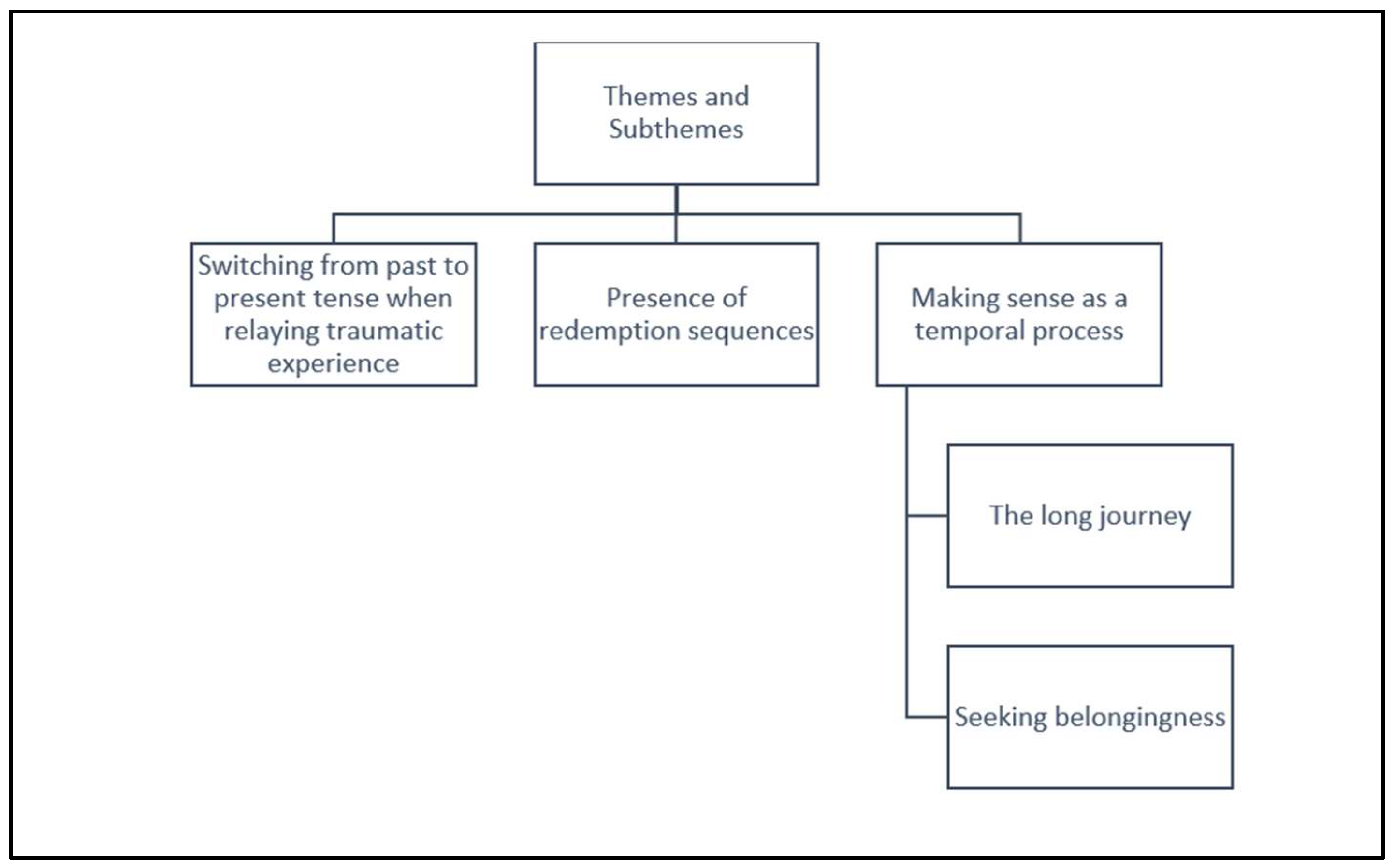
Disclaimer/Publisher’s Note: The statements, opinions and data contained in all publications are solely those of the individual author(s) and contributor(s) and not of MDPI and/or the editor(s). MDPI and/or the editor(s) disclaim responsibility for any injury to people or property resulting from any ideas, methods, instructions or products referred to in the content. |
© 2024 by the authors. Licensee MDPI, Basel, Switzerland. This article is an open access article distributed under the terms and conditions of the Creative Commons Attribution (CC BY) license (http://creativecommons.org/licenses/by/4.0/).
Copyright: This open access article is published under a Creative Commons CC BY 4.0 license, which permit the free download, distribution, and reuse, provided that the author and preprint are cited in any reuse.


