Preprint
Article

This version is not peer-reviewed.

An In Silico Investigation of Human NEK10 Reveals Novel Domain Architecture and Protein-Protein Interactions

Submitted:

18 November 2024

Posted:

19 November 2024

You are already at the latest version

Abstract

Cancer is the second leading cause of death worldwide, with 27.5 million new cases projected by 2040. Disruptions in cell cycle control cause DNA errors to accumulate during cell growth, mak-ing proteins that regulate cell cycle progression crucial targets for cancer therapy. NIMA-related kinases (NEKs) are involved in regulating the cell cycle and checkpoints in humans. Among these, NEK10 is the most divergent member and has been associated with both cancer and ciliopathies. Despite its biological significance and distinctive domain architecture, structural details of NEK10 remain unknown. To address this gap, we modeled the complete structure of the NEK10 protein. Our analysis revealed a catalytic domain flanked by two coiled-coil domains, armadil-lo-type repeats, an ATP binding site, two putative UBA domains and a PEST sequence. Further-more, we mapped a comprehensive interactome of NEK10, uncovering previously unknown in-teractions with the cancer-related proteins MAP3K1 and HSPB1. MAP3K1, a serine/threonine kinase and E3 ubiquitin ligase frequently mutated in cancers, interacts with NEK10 via its scaf-fold regions. The interaction with HSPB1, a chaperone associated with poor cancer prognosis is mediated by NEK10’s armadillo repeats. Our findings underscore a connection of NEK10 with ciliogenesis and cancer, suggesting its important role in cancer development and progression.

Keywords: 
;  ;  ;  ;  ;  

1. Introduction

Ensuring genome stability is critical for preserving cell integrity and preventing mistakes during DNA replication. This stability is required to resist both internal sources of DNA damage, such as reactive oxygen species (ROS) created during cellular metabolism, and external influences such as UV light, ionizing radiation, and cancer-causing chemicals. Tumors initiation and progression are thought to occur due to acquired genomic alterations in the original normal cells, followed by the selection of more aggressive sub clones [1]. Cells, predictably, have evolved sophisticated and frequently replicated systems that enable them to undergo mitosis without error. One of the most well-studied techniques of mitotic control is reversible phosphorylation. Cyclin-dependent kinases (CDKs), in collaboration with opposing phosphatases, regulate the phosphorylation state of numerous substrate proteins, which in turn regulate the processes that coordinate mitosis. Only a few protein kinase families that govern mitosis have been found thus far, including Aurora kinases, and Polo-like kinases (PLKs). Nonetheless, there is an additional protein kinase family that is less well-defined yet performs critical roles in mitosis. This group is known as NIMA-related kinases, or NEKs [2,3,4].
Human cells express a total of eleven genes, specifically NEK1 through NEK11. Except for NEK10, these proteins possess a protein domain structure that encompasses an N-terminal catalytic kinase domain. Functionally, multiple studies conducted in different systems, including humans, offer evidence that most NEKs have a role, either directly or indirectly, in promoting the cell cycle and/or the development of cilia [3,4]. Hence, any change in the expression or mutation of NEKs can potentially disturb these crucial processes, indicating their potential role in both human cancer and inherited ciliopathies. While the exact roles of most mammalian NEKs are not fully understood, it is established that certain NEK family members participate in one or more of the following functions: cell cycle [5,6], centrosome regulation [7,8], primary cilia [9,10], DNA damage response (DDR) [11,12], RNA splicing [13], myogenic differentiation [14], intracellular protein transport [15], and mitochondria homeostasis [16]. Furthermore, there is a growing body of evidence indicating that NEKs play a role in the development of cancer. Elevated expression is the primary cause, while a limited number of rare mutations in NEKs have been identified through cancer genome screenings [3].
The NEK10 protein consisting of 1,172 amino acids [2] and is the most structurally divergent member of the family with a centrally located catalytic kinase domain, flanked by two large regulatory domains and a coiled-coil regions but remains the least studied members of the human NEK protein family. In its N-terminal regulatory region, NEK10 displays four armadillo motifs and a PEST region, which are thought to be important for protein-protein interactions and proteolytic regulation, respectively [17]. NEK10 exhibits dual-specificity kinase activity, effectively catalyzing the phosphorylation of both itself, and peptide substrates on serine and tyrosine residues. The enzymatic function is enhanced by the process of tyrosine auto-phosphorylation. T657, I693, S696, and C697 were identified to be unique to the activation region of NEK10 and mutations in D655 and I693 lead to a kinase dead NEK10. NEK10 homologs from nematodes to humans show conservation of these four key residues [18]. Functionally, NEK10 is thought to be involved in ciliogenesis [19], DDR [11], and mitochondrial homeostasis [16]. Recent studies demonstrate NEK10’s involvement in several diseases, such bronchiectasis syndrome [20], breast cancer [11], and lung cancer [16]. Despite its functional significance, NIH has termed it an understudied kinase [21]. We hypothesize that the unique structural features of NEK10 underlie fundamental functional differences and selection of unique binding partners in the NEK family of proteins.
The structural information for NEK10 and its predicted partners is either unavailable or only partially available. In this study we present a complete structural representation of NEK10 and elucidate the protein-protein binding mechanisms of NEK10 with select novel cancer related protein partners using in silico approaches. Structural modeling and in silico analysis tools provide valuable insights into knowledge gaps while also providing a cost-effective and logical starting point in experimental design. Finally, the results of this study can pave the way for future research aimed at identifying novel drug targets to control NEK10 functions in gene expression during tumor development.

2. Materials and Methods

A flowchart summarizing the general protocol of the present study with the various tools used to analyze NEK10 and its interactions (discussed in detail below) is shown in the supporting Figure S1.

Modeling and Characterization of NEK10

Domain Architecture

To obtain domain architecture information for NEK10, we utilized its full-length amino acid sequence (1172AA; UniProt ID: Q6ZWH5) as input for following databases: PROSITE [22], PFAM [23], SMART [24], and Conserved Domain Database (CDD) [25]. The E-values of the individual results were used to distinguish between findings from each database that could have occurred by chance and results that are more likely to occur in the deposited sequence. The farthest boundary boundaries were used to map the consensus domain architecture. The secondary structure prediction was used to refine the results. To detect PEST motifs, ePESTfind [26] was used. Since there is no clear motif for a UBA domain, a manual evaluation approach was used, guided by the description of a solved structure of HHR23A UBA [27] and identified by a combination of sequence and structural analyses. Hydrophobic patches were visualized using PyMOL and Yellow-Red-Blue (YRB) script [28]. Angle between helices were measured in PyMOL using the Python script AngleBetweenHelices [29]. Surface potential maps were calculated using APBS [30]. Net charge on both putative UBA domains was calculated using a built-in PyMOL feature. Sequence conservation and multiple sequence alignment was analyzed using pBLAST [31] and UGENE [32]. Manual analysis of coincidence of UBA domain with PEST sequence was analyzed using ePESTfind, Microsoft Excel, and RSCB Protein Data Bank (PDB) public database.

Secondary Structure Prediction (SSP), and Prediction of Intrinsically Disordered Regions (IDRs)

To obtain secondary structure predictions for NEK10, we submitted its full-length amino acid sequence (1172AA; UniProt ID: Q6ZWH5) in the SSPRED webserver [33], which forms a consensus of SSP obtained from the following SSP databases: PSIPRED [34], YASPIN [35], PSSpred [36], JPred4 [37], SABLE [38], RaptorX [39], and SCRATCH [40]. Following, the domain borders were refined using the results from consensus secondary predictions, and we used Biological Sequences (IBS) [41] to generate a new refined domain architecture graphic. Furthermore, the full-length sequence of NEK10 was utilized to predict its intrinsically disordered regions (IDRs) via the following computational tools: DISOPRED [42], IUPred2A [43], MFDp2 [44], and CSpritz [45]. Consideration was given to the predicted intrinsic disorder regions (IDRs) results when selecting the method for predicting the tertiary structure of NEK10.

Tertiary Structure Prediction of NEK10, Evaluation, Refining and Visualization

To build a full-length model for NEK10, we utilized NEK2 (PDB ID:2W5A) as a template. Because NEK10's structure contains over a thousand residues, we used multiple modelling tools to create models by parts and then assembled the full-length model using advanced MODELLER scripts [46]. The generated final models were then evaluated for optimal quality using the following programs: VERIFY3D [47], ProsaWEB [48], VoroMQA [49], and ProQ3 [50]. Top quality models were then refined as needed using ModRefiner [51], and 3DRefine [52]. For model visualization as well as biophysical/biochemical characterization, we used both Pymol [53] and Chimera software [54].

Protein-Protein Interaction Predictions for NEK10

To obtain PPI predictions for NEK10, we utilized its UniProt accession number (Q6ZWH5) as the input for the following PPI prediction databases: (a) The Biological General Repository for Interaction Datasets (BioGRID), a public database that stores and shares genetic and protein interaction data from humans and other model organisms. BioGRID has more than 1,740,000 interactions, gathered from both large datasets and smaller, more focused studies. These interactions come from more than 70,000+ papers in the primary literature [55], (b) IntAct, a free, open-source database system as well as molecular interaction data analysis tool. All interactions are based on either curated literature or direct user submissions [56], (c) STRING, a database of predicted and known protein-protein interactions. The interactions include direct (physical) and indirect (functional) associations; they stem from computational prediction, from knowledge transfer between organisms, and from interactions aggregated from other (primary) databases [57], (d) PrePPI, a database of predicted protein-protein interactions. The database's predicted interactions are determined using a Bayesian framework that incorporates structural, functional, evolutionary, and expression information [58], (e) Mentha, a protein interaction database archive information about protein-protein interactions (PPI) from published articles [59], and (f) InnateDB, a database that provides manually-curated knowledge of genes, proteins, and signaling responses in mammalian innate immunity and integrates interactions and pathways from many major public databases [60]. Results were then compiled and NEK10 interactors that appeared in 3 or more webservers were considered for further studies.

Interactome for NEK10

In a biological network known as the "interactome," the molecular interactions of a specific protein can be mapped functionally. The study of the interactome could accelerate the discovery of biomarkers and therapeutics and assist in the detection of malfunctioning pathways [61]. To construct a complete interactome for NEK10 based on the obtained protein-protein predictions, we first compiled the following information from “The Human Protein Atlas” [62]: interactor protein name, molecular function, and cancer location. These data were added to a spreadsheet which served as input to Cytoscape [63]. Cytoscape allowed us to obtain a protein-protein interaction network for NEK10 and further categorize the location of each protein interactor of NEK10. We decided to focus on MAP3K1 and HSPB1 in more detail as these proteins appeared in more than three protein-protein prediction databases but have not been reported previously in the literature as interactors, lack complete structural information and are known cancer proteins.

Modeling and Characterization of Interaction Partners of NEK10

MAP3K1 (1512 aa; UniProt ID: Q13233) and HSPB1 (205 aa; UniProt ID: P04792) were investigated for domain architecture, secondary structure prediction, IDR analysis, and tertiary structure prediction/characterization using the same methodology as described for NEK10 above. To construct a full-length model of MAP3K1, we used its FASTA sequence, together with the backbone model from AlphaFold (ID: AF-Q13233-F1) for comparative modeling in the Robetta server [64]. To construct a full-length model of HSPB1 (Hsp27), we also chose the Robetta server for comparative modeling using the backbone model for HSPB1 from AlphaFold (ID: AF-P04792-F1) with HSPB1 FASTA sequence.

Prediction of NEK10–MAP3K1 Interaction and NEK10–HSPB1 Interactions

We utilized ClusPro [65], and HDOCK [66] to predict putative interaction scenarios of interaction of NEK10 with MAP3K1 as well as HSPB1. PDBsum [67] was used to analyze the interactions within the docked complexes and complexes were visualized in Pymol.

3. Results

Modeling and Characterization of NEK10

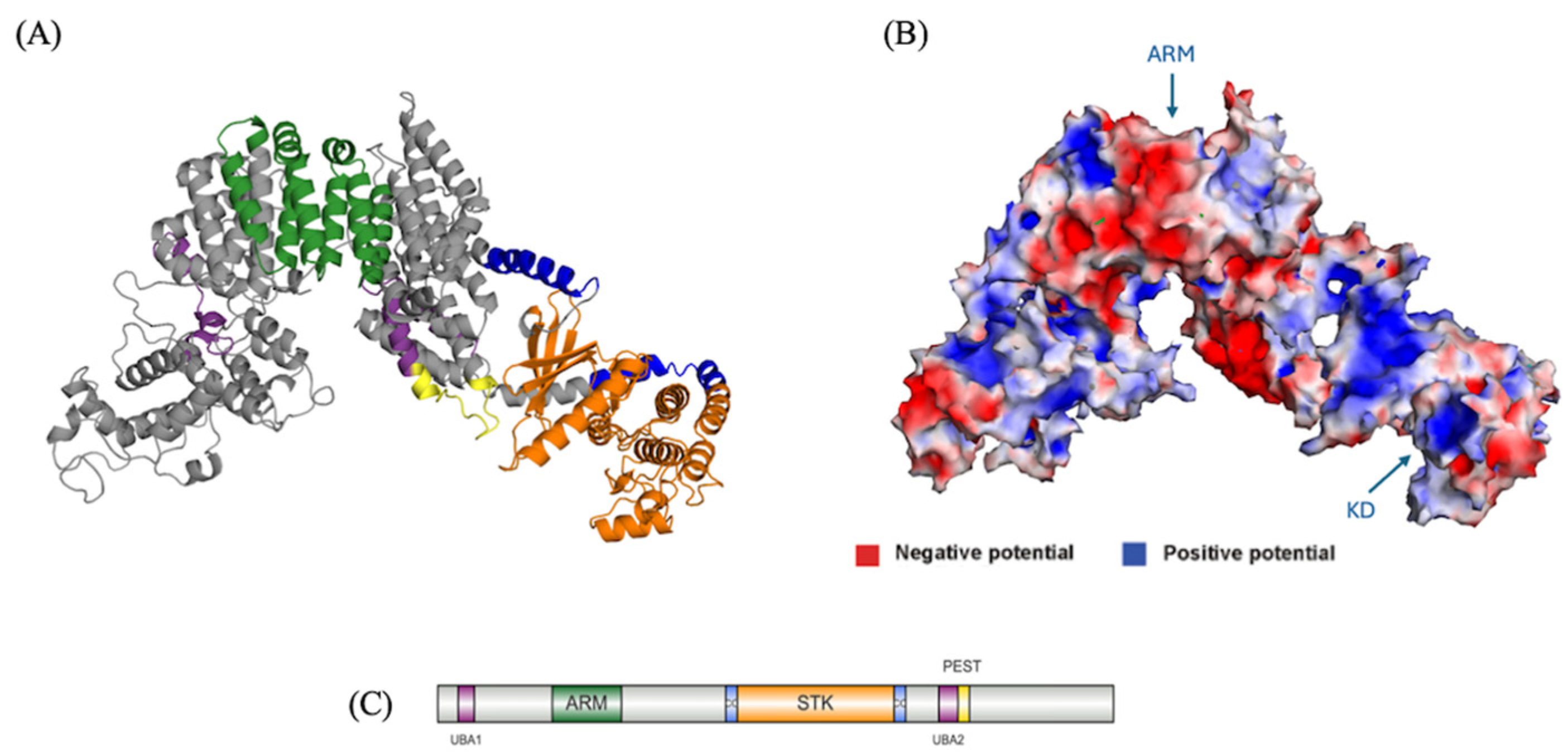
Currently, the PDB does not contain any full-length structures for NEK10. Although The AlphaFold database [68] offers a three-dimensional model of the complete NEK10 structure, certain regions of the protein, specifically its N-terminus, exhibit a remarkably low quality. We employed a range of computational techniques to predict the domain architecture, secondary structure, IDRs, and tertiary structure of NEK10 to complete and detailed structural representation of the full length NEK10 protein. In this study, we used the full-length amino acid sequence of NEK10 (1172AA) to derive a consensus from a variety of domain architecture prediction tools. These findings revealed that NEK10 has Serine-Threonine Kinase domain spanning residues N518 to L791 flanked by two coiled-coil, four armadillo-like fold domains covering residues K199 to C319, two putative UBA domains located at L36-I64 and F868-E901 (Figure 1C). In addition, NEK10 has a small IDR predicted to be involved in binding (Figure S2) identified by a consensus of predictions from four disordered prediction programs. The secondary structure prediction of NEK10 conforms to expected secondary structure elements in the structured regions of the domain architecture, e.g., multiple alpha helices typical of Armadillo repeats.

Tertiary Structure Prediction of NEK10

To build a full-length model for NEK10, we utilized NEK2 (PDB ID:2W5A) as a template. Because NEK10's structure contains over a thousand residues, we used multiple modelling tools to create models by parts and then assembled the full-length model using advanced MODELLER scripts. Our final models were then tested for optimal quality to find the top model (Table S1). In VERIFY3D, the top model (model 5) averaged 3D-1D scores showing 71.14% of residues with >0.2 score. VoroMQA score for model 5 is 0.426 (the highest of all other models), a model scoring above 0.4 in VoroMQA is considered a high-quality model. In ProsaWeb, model 5 scored -14.2 demonstrating that our model falls within the acceptable range for similar x-ray and NMR structures. Finally, in ProQ2, model 5 scored better than all other models and was the only model to meet the 0.4 ProQ2 established threshold for a high-quality model.
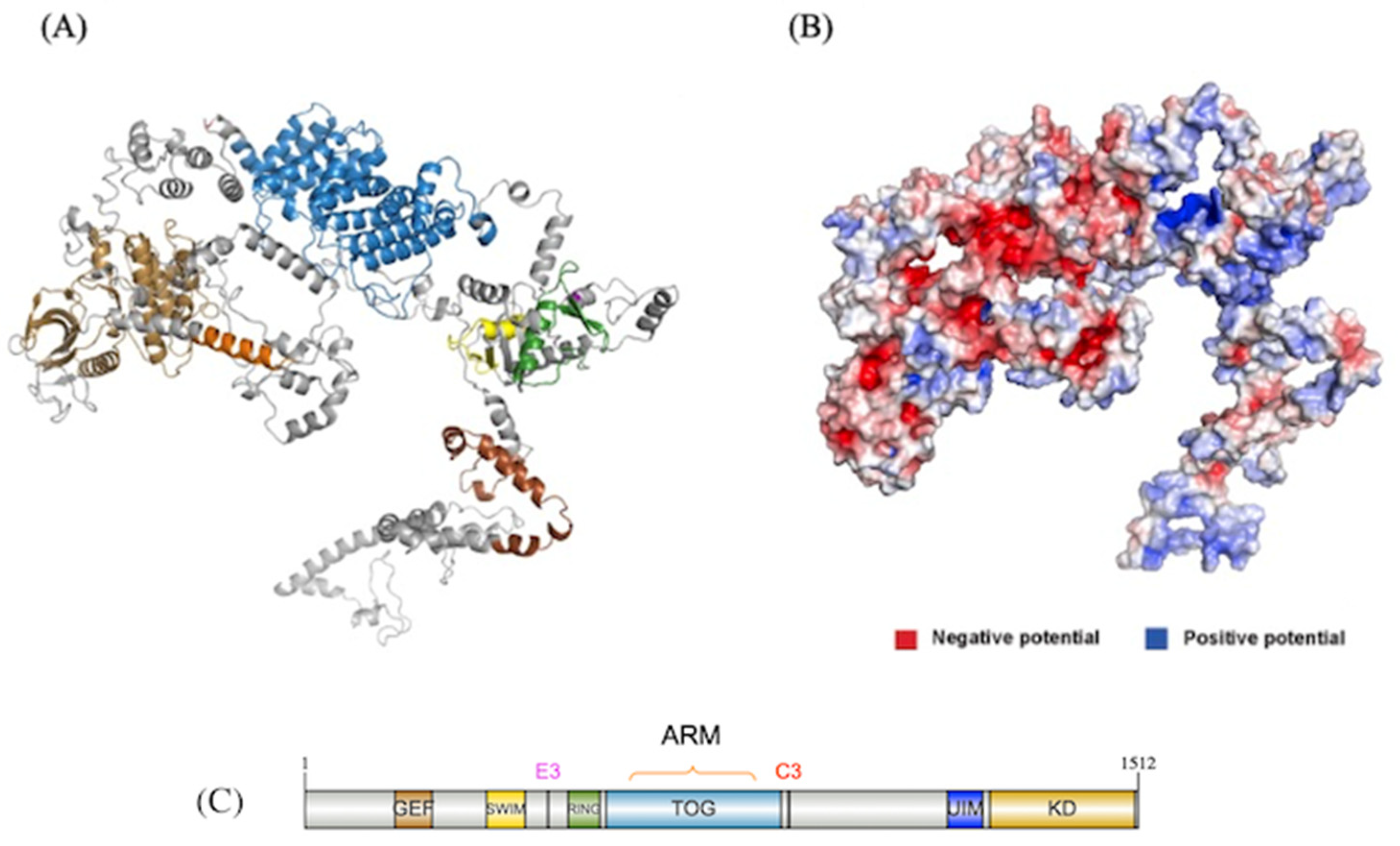
Our findings show that the binding motif-containing areas are centrally located, with the armadillo repeats positioned near the NEK10 N-terminus (Figure 1A,C). Surface electrostatic profile of the UBA domains excluded one of the domains from further analysis (detailed in the result section ‘The presence of a PEST sequence and putative UBA domains suggest it is regulated via ubiquitination’). Surface electrostatic profile of the complete model shows that the armadillo repeats and the second UBA domain are located in a highly negative (red) region, while the kinase domain is seen in a mostly positive (blue) region (Figure 1B).

Comparison Between NEK10 Predicted Models: AlphaFold Versus Our Model

Significant advancements have been made in computational protein structure prediction, particularly in template-free modeling [69]. In the absence of experimental structures, it is preferable to obtain an estimate of the local and global quality of predicted 3D models, which is done via model quality assessment [70]. We compared our NEK10 protein model to the NEK10 model in the AlphaFold Database using various model evaluation methods (Figure S3). Our results reveal that our NEK10 model outperformed AlphaFold's model in terms of quality, and therefore is better suited for docking and protein-protein studies. In VERIFY3D, averaged 3D-1D scores for our NEK10 model show 71.14% of residues with >0.2 score. For AlphaFold’s NEK10 model, averaged 3D-1D score shows 57.29% of residues with >=0.2 score. By looking at both plots and focusing on the orange arrows, we can see that in our model for NEK10 most residues on its N-terminus score above or equal 0.2. The same is not true for AlphaFold’s NEK10 model. Most residues on its N-terminus score are lower than 0.2.

Protein-Protein Interaction Predictions for NEK10: Mapping a Comprehensive Interactome for NEK10

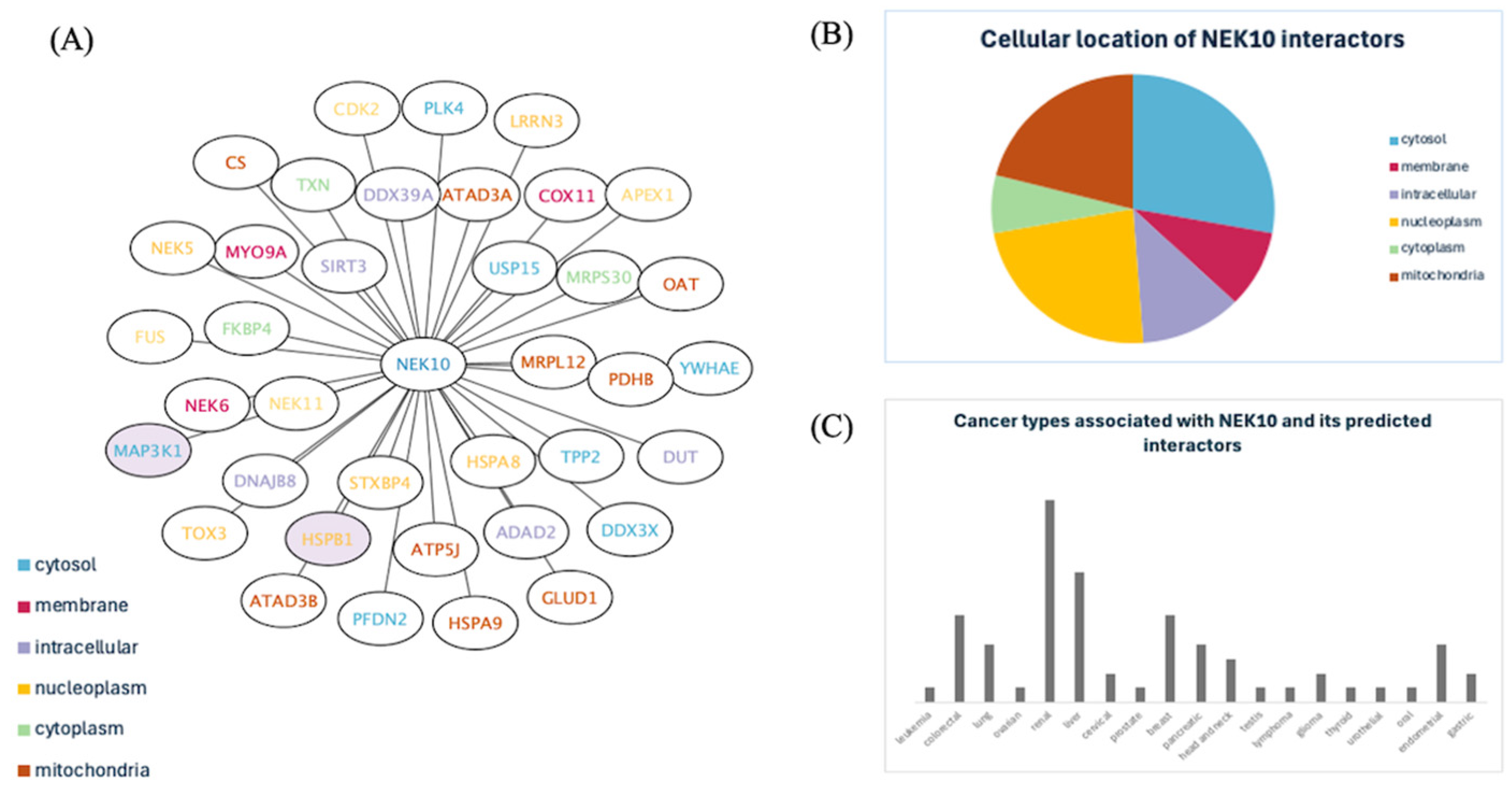
Four protein-protein interaction prediction databases were probed to map a comprehensive model for the network of NEK10’s protein-protein interactions. Several predictions of NEK10’s protein-protein interactions that are relevant to a cancer phenotype can be seen in our constructed interactome (Figure 2A; Table S2), including previously reported NEK10 interactions such as GLUD1 and CS [16]. We observed that the proteins HSPB1 and MAP3K1, which are associated with cancer, were predicted to have interactions with NEK10 in more than three protein-protein interaction (PPI) databases (Figure 2A). Consequently, we conducted a more in-depth investigation on these novel interactions.
The interactome for NEK10 visualized in Cytoscape shows the cellular localization of the NEK10 interactors and involvement in different cancers. Our prediction results indicate that the majority of NEK10 interactions localized to the nucleoplasm, cytosol and mitochondria (Figure 2B). Furthermore, NEK10 was predicted to associate with several renal, liver, colorectal, and breast cancer proteins (Figure 2C).

Investigation of NEK10’s Previously Uncharacterized Protein-Protein Interactions of NEK10

Prediction of NEK10–HSPB1 Interaction

NEK10 – HSPB1 interaction is novel, however this interaction is predicted by more than three protein-protein prediction databases (Figure 2). The small heat shock proteins (sHSPs) include HSPB1, also known as heat shock protein 27. Its function is to prevent or delay the denaturation or unfolding of cellular proteins in response to stress or high temperatures. Many pathogenic processes in cancer are regulated by HSPB1, including drug resistance, apoptosis, and metastasis. For instance, HSPB1 is regarded as a critical molecular target for tumor growth suppression and apoptosis induction [71]. However, it is still unclear what structural domains of HSPB1 are implicated in its function and which client types are bound. The current state of knowledge is that sHSPs' natural clients remain unknown [72].

Modeling and Characterization of HSPB1

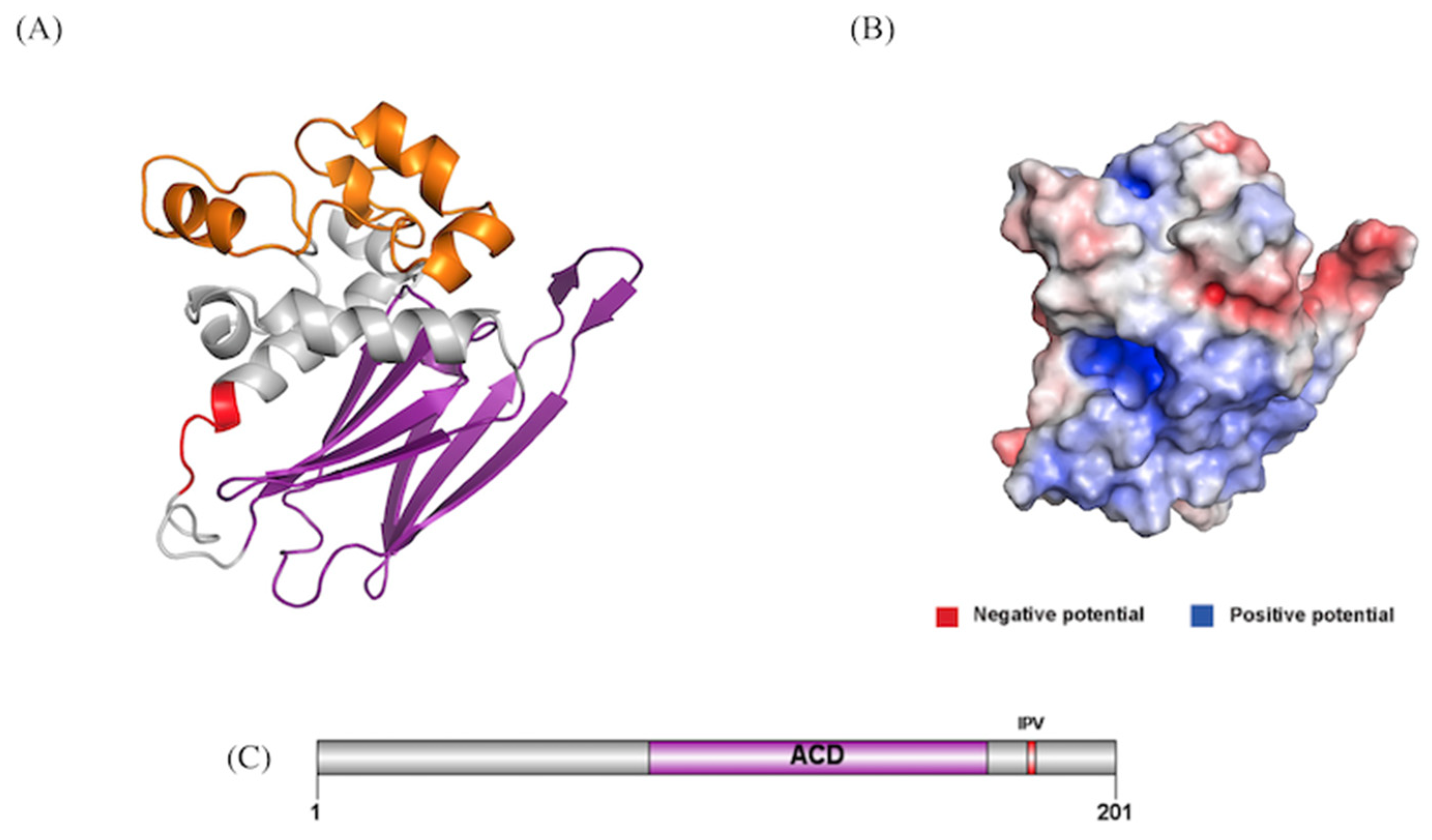
The PDB Database contains seven incomplete structures for HSPB1 and the AlphaFold model for HSPB1 (AF ID P04791) displays very low confidence in several regions of the protein model. The structural components of HSPB1 that enable its interaction with NEK10 remain poorly understood. HSPB1 is composed of a lengthy intrinsically disordered region starting at its N-terminus, and most of the IDR is further predicted to be involved in binding (Figure S4). The protein also displays β sheets and a few helices characteristic of an ACD, which matches its domain architecture (Figure 3C).

Tertiary Structure Prediction of HSPB1

Our results show that HSPB1’s N-terminal IDR is predicted to assume a helical shape, followed by a classic α-crystallin domain (ACD) connected through a loop to the PPI hotspot IXIXV sequence (ITIPV) (Figure 3A). Surface electrostatic studies of HSPB1 reveal a positively charged cleft formed between the α-crystallin domain (ACD) and the PPI hotspot IXIXV sequence (ITIPV) (Figure 3B). Our models for HSPB1 were constructed utilizing the Robetta server for comparative modeling using the backbone model for HSPB1 from AlphaFold (ID: AF-P04792-F1) with HSPB1 FASTA sequence. Model quality evaluation scores were very high for all our models, specifically model 2 (Table S3) which we chose for docking with NEK10.

Prediction of NEK10 – HSPB1 Interaction

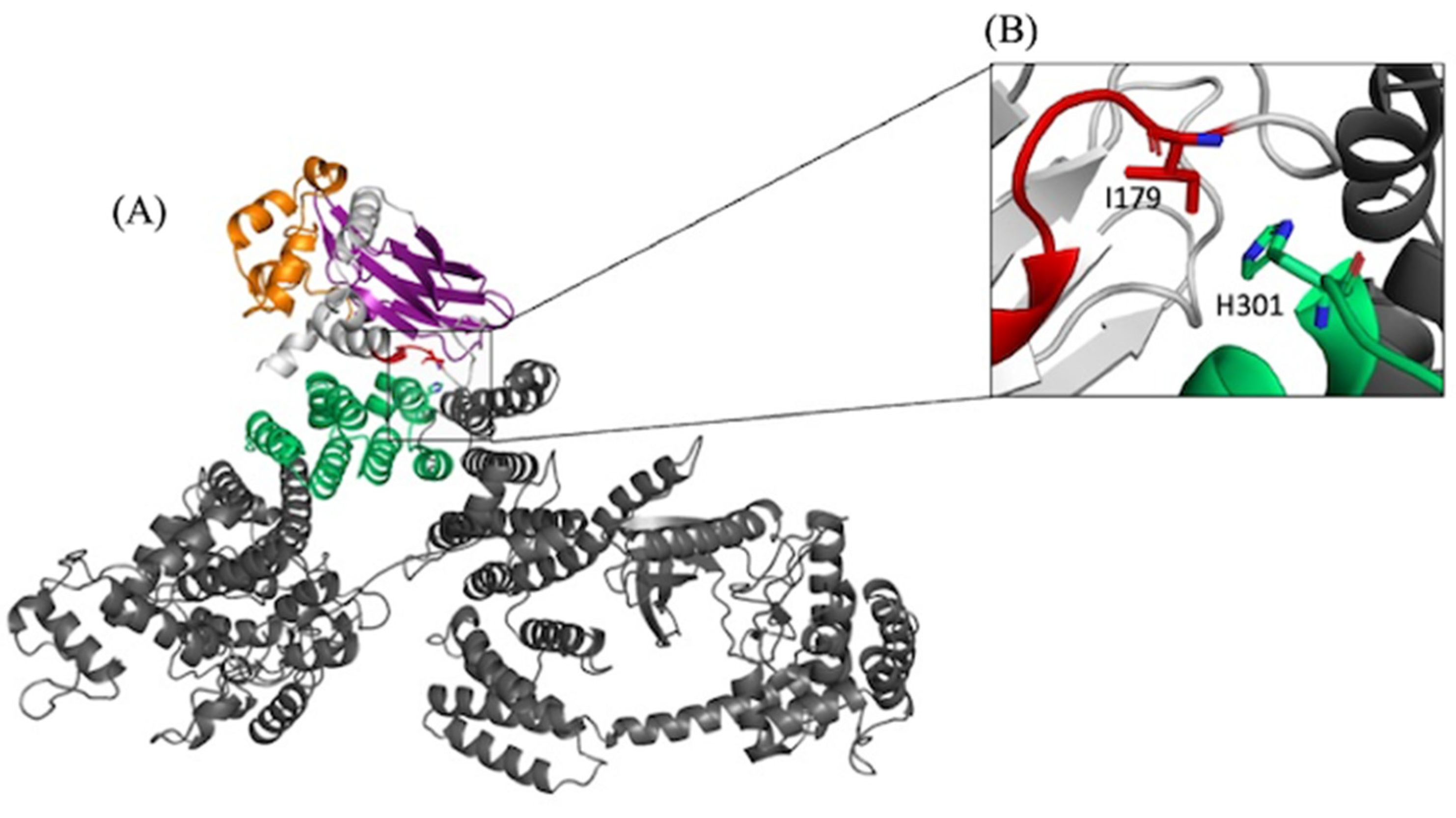
Our results (Figure 4A,B) show that the distinctive armadillo repeats of NEK10 participates in its interaction with HSPB1. Residue H301 located in the ARM region of NEK10 forms a salt bridge with I179 of HSPB1. These results corroborate the current literature, as Isoleucine (Ile179), located within an unusual, extended IXIXV sequence (ITIPV), is a known PPI hotspot for HSPB1 [73].

Modeling and Characterization of MAP3K1

Results from our predictions of protein-protein interactions for NEK10 suggest a significant likelihood of a NEK10-MAP3K1 interaction. In addition, NEK10 is known to participate in the MAPK pathway [2]. To understand the interaction between NEK10 and MAP3K1, a high-quality structure of MAP3K1 is required. Unfortunately, there is only one incomplete structure for MAP3K1 in the PDB Database, covering only 19% of the proteins length. Furthermore, the AlphaFold model for MAP3K1 displays very low confidence in multiple regions (AF ID Q13233). Therefore, to characterize MAP3K1, and further study its interaction with NEK10, we used a variety of computational tools for Secondary Structure, IDRs, and Tertiary Structure of MAP3K1 predictions, as well as Molecular Electrostatic Potential (MEP) surface analysis, docking, and docking analysis. According to IDRs and Secondary Structure predictions, MAP3K1 is composed by a few ß sheets, and several alpha helices. These results seem to be in accordance with published domain architecture. Although MAP3K1 is a very large protein containing over 1500 amino acids, MAP3K1 does not seem to display any large IDRs (Figure S5).

Tertiary Structure Prediction of MAP3K1

Our models score well in every model evaluation tool used (Table S4). Our results show that the Kinase Domain and the Ubiquitin interaction motif (UIM) (Figure 5A,C) are in a highly negatively charged region of the protein (Figure 5B). The TOG domain (same region as ARM) falls within a mostly positive region of the protein (Figure 5C), and GEF is seen in a mostly positively charged pocket near MAP3K1’s N-terminus (Figure 5B).

Prediction of NEK10 – MAP3K1 Interaction

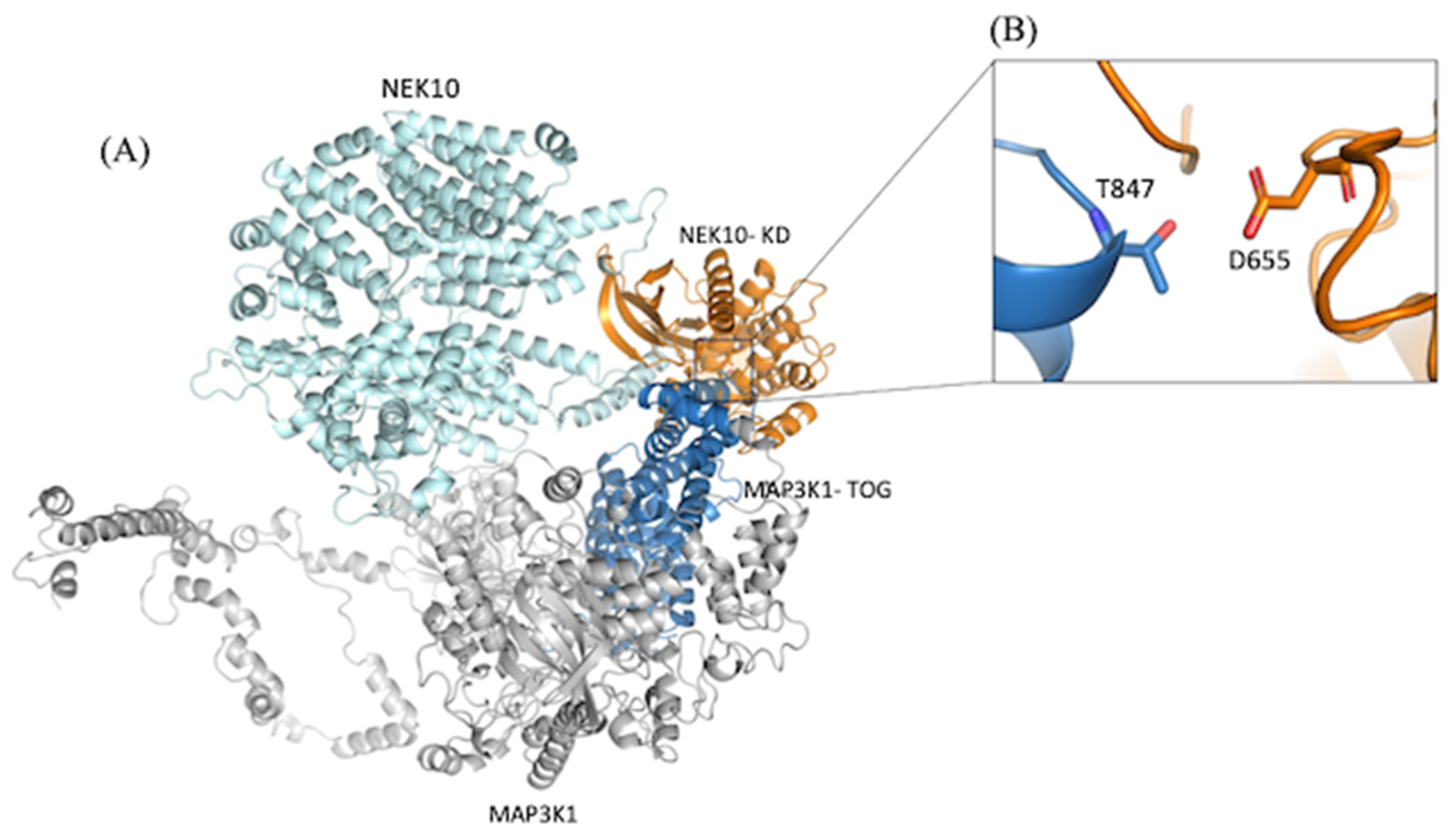
Details of the docking scenario reveal NEK10’s Kinase residue D655 interacting with MAP3K1’s TOG domain residue T847 (Figure 6A,B).

The Presence of a PEST Sequence and Putative UBA Domains Suggest it is Regulated via Ubiquitination

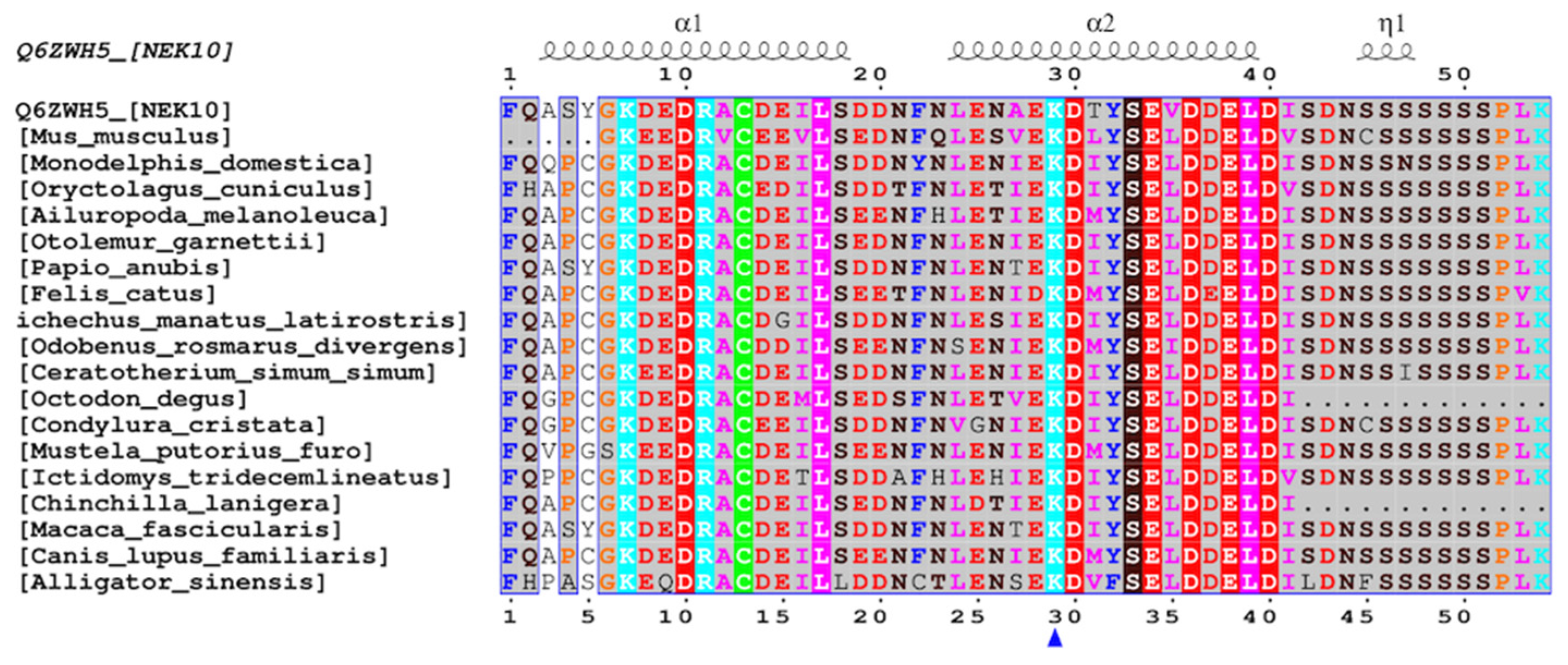
We found a potential PEST motif with 24 amino acids between position N890 and K921. The multiple sequence alignment of the region containing a putative UBA domain, and the PEST sequence (F868-K921) has a high sequence conservation amongst 1177 homologues in 331 animal species (Figure S6). Residue K896 has a conservation level of 99.8% and likely the prime candidate for interaction with ubiquitin (Figure 7) which is also corroborated with our docking predictions (Figure 8).
Our analysis suggests the presence of at least one UBA domain, located between residues F868 and E901 (Figure S7). The second putative UBA (L36-I64) domain was excluded from further analysis based on a few important determinants outlined in the solved crystal structure analysis [27] and a high throughput study of UBA domains [76]. The presumptive area of interaction with ubiquitin showed a net positive surface charge, which apparently prevents the interaction with a positively charged C-terminus of ubiquitin. To avoid inconsistencies in our methodology, we attempted docking of NEK10 and ubiquitin using the full model of NEK10, a fragment of a model containing full length of this putative domain, and a scenario with a full model but with explicit instruction to algorithm to attempt docking in the region of interest. All three jobs returned results that did not show the interaction of ubiquitin’s diGly terminal with any of two available lysine residues (K42 and K59) in the focused region. Ubiquitin-associated (UBA) domains allow proteins to undergo ubiquitination by mono- or poly-ubiquitin complexes. Binding of a ubiquitin complex to a protein mark it for degradation via the proteosome pathway. Ubiquitination of the proteins plays a crucial role in the recycling and cell-cycle as it allows for rapid degradation of the regulatory proteins whose function is no longer required [74,75]. Its structure, function, and residue composition appear to be like that of PEST sequences. Analysis of NEK10 and 17 other kinases with known UBA domains, showed that 58.82% of them contain a UBA domain concurrently with a PEST sequence (in some, one PEST sequence for each UBA domain, if there are more than one). It is also of interest that both motifs have lysine as the target residue where ubiquitination takes place [76].
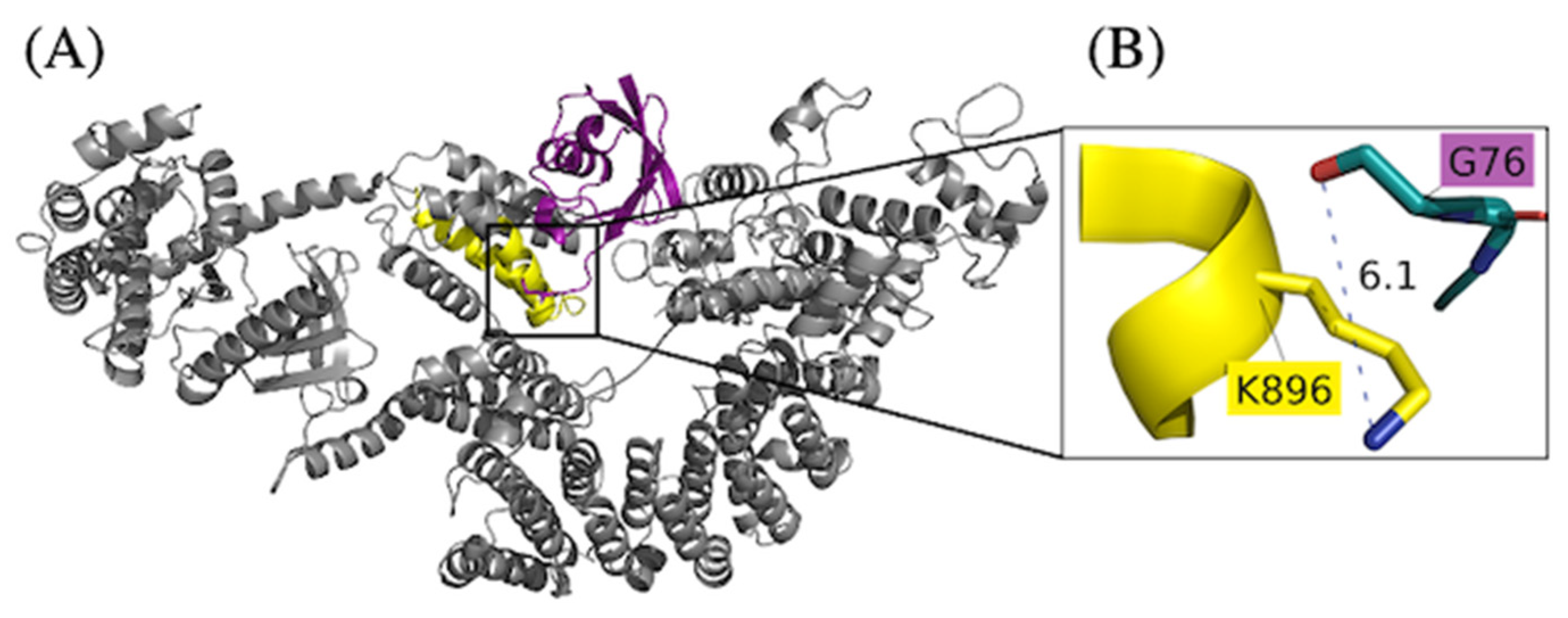
Our docking results show that K896 of NEK10 interacts with G76 of ubiquitin (PDB ID: 1TBE) (Figure 8). Distance of interaction between the interacting side chains measures 6.1 Å. For reference, tetraubiquitin chain interaction between Lys and Gly of adjacent subunits measures 5.07 Å. The angles between helices are listed in Table S5. Another piece of evidence that points to the existence of a putative UBA domain appears to be the local net negative charge (Figure S7A). According to a high-throughput study [76], a pronounced shift towards negative local net charge was observed surrounding lysines interacting with ubiquitin’s diglycine terminal in analysis of 2879 proteins. This evidence fits the observed complementing local net positive charge in the ubiquitin diglycine terminal (Figure S7B), which also is consistent with the docking results. The measured angles are out of the reference range of the angles presented in the HHR23A UBA(2) solved structure. The UBA domain region also contains a hydrophobic patch (Figure S8) consistent with the solved structure of the reference protein (HHR23A).

4. Discussion

Functional Insights of NEK10 Revealed from the NEK10 Full Length Model

The full-length model of NEK10 generated in this study (Figure 1) nicely supports the results obtained for domain architecture SSP, and IDR predictions (Figure S2). In addition to the centrally located catalytic domain we show that the other component domains of NEK10 (1) The Armadillo (ARM)-repeats, (2) two coiled coil regions, (3) a PEST region, and a (4) UBA domain have functional significance in NEK10. (1) The Armadillo (ARM)-repeat is a 42 amino acid motif that repeats and is made up of three a-helices is what distinguishes Armadillo (ARM)-repeat proteins. This motif was initially identified in the Drosophila segment polarity protein Armadillo [77]. Several ARM-repeat proteins have had their crystal structures determined, demonstrating that although their sequences are not always very similar, they do share a common structure [78]. In eukaryotes, armadillo repeat-containing proteins (ARMCs) are widely distributed and involved in a variety of processes, such as cell adhesion, signal transduction, carcinogenesis, and mitochondrial function regulation. There have been reports of oncogenic mutations in Armadillo repeats. For instance, armadillo repeats 5 and 6 (K335, W383, and N387) of β-catenin show amino acid mutations in several tumor forms, including liver cancers [79]. (2) The two CC regions flaking NEK10’s Kinase Domain are suggestive of regulation and protein-protein interactions, as seen in other proteins coils [2,80]. (3) The PEST region contains high concentrations of proline (P), glutamate (E) or aspartic acid, serine (S), and threonine (T), these regions were named PEST motifs [27]. There are specific post-translational modifications (PTMs) that the PEST motif oversees. These PTMs give PEST-containing nuclear protein (PEST-NPs) unique features that oversee their activation/inhibition, intracellular localization, stability/degradation, and other functions. PEST-NPs function as oncogenes or tumor suppressors in the metabolism, immunity, and protein transcription of cancer. PEST-NPs show promise as anti-cancer therapeutic agents. PTMs of PEST-NPs have demonstrated that these proteins play a multifarious role in cancer biology by drawing other proteins to and from their active location in addition to interacting with one another to either promote or hinder tumor growth [81]. Furthermore, the PEST region may play a role in the proteolytic control of protein abundance. Finally, the (4) UBA domain is a short sequence of approximately 45 amino acids that is found on many eukaryotic enzymes, among which, protein kinases and enzymes involved in cell-cycle control [27]. UBA domains serve as a region for binding of ubiquitin in the process of ubiquitination. Polyubiquitination seems to be involved in proteasome pathway where multi-ubiquitin chains allow for better recognition by proteosomes. Monoubiquitylation is thought to be involved in the alteration of the protein function or location [82]. Since NEK10 is believed to be involved in the arrest of cell cycle in G2/M in response to UV irradiation of the cell, it might be a target for therapeutics in cancer treatments [2]. After obtaining the tertiary structure of NEK10 (Figure 1A), we conducted electrostatic studies, that show the unique armadillo repeats display predominantly negative electrostatic potential, while the Kinase Domain display a positive electrostatic profile (Figure 1B). This distinction in electrostatic profiles within NEK10s domain may be the basis for selective binding of its substrate and interaction partners.

The Comprehensive NEK10 Interactome Suggests Key Roles in Cellular Processes, Subcellular Localization, and Cancer Associations

A robust interactome for NEK10 can give us insight on NEK10’s function, location, associated cancers, and mechanism. From our generated interactome (Figure 2A), we can speculate that NEK10’s nuclear subcellular localization may be an important for its overall function as most of its interactors appear to be in the nucleoplasm. Proteins found in the nucleoplasm play important roles in RNA processing, transcription, chromatin modification, and DNA repair, as well as differentiation and development. Indeed, as previously mentioned, NEK10 participates in DDR [2]. This suggests that NEK10 may be involved in functions such as RNA processing, in a similar way as NEK2 [86]. However, such a role for NEK10 still needs to be investigated. Our prediction results indicate that the majority of NEK10 interactions localized to the nucleoplasm, cytosol and mitochondria (Figure 2B).This result is further corroborated by a recent study that showed NEK10’s novel functions in mitochondrial homeostasis [2]. Furthermore, NEK10 was predicted to associate with several renal, liver, colorectal, and breast cancer proteins (Figure 2C). Our NEK10 interaction with breast cancer proteins prediction results are in accordance with a 2019 study, which reported that abnormalities with NEK10 expression have been associated with breast cancer [83].

NEK10’s Interaction with HSPB1 Is Mediated by Its Armadillo Repeats, with Key Residues Forming Crucial Protein-Protein Interaction Hotspots

HSPB1’s function is to prevent or delay the denaturation or unfolding of cellular proteins in response to stress or high temperatures. Many pathogenic processes in cancer are regulated by HSPB1, including drug resistance, apoptosis, and metastasis. For instance, HSPB1 is regarded as a critical molecular target for tumor growth suppression and apoptosis induction [72]. HSPB1, like all sHSPs, has a highly conserved α-crystallin domain (ACD), which is flanked by disordered N- and C-terminal domains (NTD and CTD) (Figure 3C). The ACD is necessary for sHSPs’s dimerization [84]. For certain protein ‘clients’ (proteins aided by chaperones) the ACD appears to be sufficient to prevent aggregation, whilst the NTD is required for others [85]. However, it is still unclear what aspects of HSPB1 (such as ACD, NTD, and CTD) are implicated and which client types are bound. The current state of knowledge is that sHSPs' natural clients are frequently unknown [72]. In 2018, a study added to HSPB1’s PPI information by showing its interaction with protein Tau. Details revealed that HspB1’s motif contains an unusual, extended IXIXV sequence (ITIPV), and isoleucine (Ile179) and valine (Val181) of the canonical IPV are the major contributors to affinity between the two proteins; mutating either one of these residues completely ablated the interaction [86].
HSPB1 is composed by a lengthy intrinsically disordered region starting at its N-terminus, most of the IDR is further predicted to be involved in binding (Figure S4). The protein also displays β sheets and a few helices characteristic of an ACD, which matches its domain architecture. The 3D model constructed for HSPB1 (Figure 3A) aligns with the findings obtained for the Domain Architecture, Secondary Structure, and IDR Predictions. Electrostatic analysis reveals the molecular electrostatic potential surface of HSPB1.Results reveal a positively charged cleft formed between the α-crystallin domain (ACD) and the PPI hotspot IXIXV sequence (ITIPV) (Figure 3B). This could imply a type of preference for binding negatively charged interactors in the cleft.
NEK10 – HSPB1 interaction is predicted by several protein-protein prediction databases. Our results (Figure 4A) show that the distinctive armadillo repeats of NEK10 participates in its interaction with HSPB1. Residue H301 located in the ARM region of NEK10 forms a salt bridge with I179 of HSPB1 (Figure 4B). Our results corroborate the current literature, as Isoleucine (Ile179), located within an unusual, extended IXIXV sequence (ITIPV), is a known PPI hotspot for HSPB1. A study conducted in 2018 demonstrated that the isoleucine (Ile179) and valine (Val181) residues within the canonical IPV play a significant role in determining affinity. Notably, any mutation occurring in either of these residues completely ablated the interaction between HSPB1 and the tau protein [86]. Our docking results are also in agreement with our electrostatic studies. In NEK10, the armadillo repeats display predominantly negative electrostatic potential, meaning it would preferentially bind to positively charged protein region. Indeed, the PPI hotspot IXIXV sequence (ITIPV), where I179 is located, is positively charged (Figure 3B). HSPB1 not only functions as a chaperone, but also is reported to recruit proteins for degradation through the “Unfolded proteinHsp70-ADP” complex leading to client protein degradation via CHIP [87]. Interestingly, a study from 2018 describes a stable complex between NEK10, C terminal Hsp70 binding protein (CHIP), and HSP70 isolated from cell lysates during cilium disassembly, with increased expression of CHIP linked to reduced NEK10 levels and reduced ciliogenesis in human cancers [19].

NEK10-MAP3K1 Interaction Connects Kinase Activity and Microtubule Regulation, with Implications for Ciliogenesis and Cancer Progression

Mitogen-activated protein kinases (MAPKs) are activated by an evolutionarily conserved three component signal transduction cascade formed of a MAP3K1, a MAP2K, and a MAPK [88]. The MAP3Ks receive signals from upstream stimuli and convey them downstream by phosphorylating and activating the MAP2Ks, which then phosphorylate the MAPKs. MAPKs can influence transcription factor activity and gene expression, hence regulating a variety of biological processes. MAP3K1, also known as MEKK1, is a member of the MAP3K superfamily, which is known to play cell type-specific roles. MAP3K1 is commonly recognized as an upstream enzyme of the JNK/p38 pathways; nevertheless, it has been observed to possess the ability to regulate the ERK and nuclear factor-κB (NF-κB) pathways [89]. Activation of MAP2K4/7-JNK-c-Jun, MAP2K1/2-ERK1/2, and NF-κB mediated by full-length MAP3K1 promotes cell survival while caspase cleavage, which generates the soluble active kinase domain, induces apoptosis. MAP3K1 also ubiquitylates c-Jun and ERK1/2, leading to their degradation.
Structurally, MAP3K1 has a conserved caspase-3 cleavage site and a Ubiquitin Interacting Motif (UIM) are located upstream of the kinase domain, which is located at its C-terminus and responsible for both interaction with and the phosphorylation of the downstream MAP2Ks [90]. The N-terminal region of MAP3K1 encompasses several distinct functional domains, namely SWI2/SNF2 and MuDR (SWIM), RING finger (RING), Armadillo Repeats (ARM), and Tumor Overexpressed Gene 111 (TOG). Among these, the SWIM domain plays a role in facilitating protein-protein interactions and specifically binds to c-Jun, hence promoting the subsequent process of c-Jun ubiquitination and destruction [91]. Furthermore, the TOG domain, which overlaps with ARM, preferentially binds curved tubulin heterodimers. Nonetheless, the biological functions of the MAP3K1-tubulin interactions are still widely unknown [92]. In vivo investigations utilizing animals lacking either the full-length protein (MAP3K1-null or Map3k1-/-) or its kinase domain (Map3k1 ΔKD/KD) have revealed that MAP3K1 is involved in immune system development and function, injury repair, vasculature remodeling, and tumor growth [93].
The 3D model constructed for MAP3K1 (Figure 5A) aligns with the findings obtained for the Domain Architecture (Figure 5C), Secondary Structure, and IDR Predictions (Figure S5). Electrostatic analysis reveals areas of distinctive charges throughout the protein, which can affect binding and protein partners selectivity (Figure 5B).
Our docking analysis shows that D655 of NEK10 situated within its kinase domain, and reported necessary for kinase function, interacts with T847 of MAP3K1 located in its TOG domain (Figure 6). Residue D655 is an essential residue for catalytic activity of NEK10, and mutation D655N is known to a result in a kinase dead mutant NEK10 [18]. Residue T847 in MAP3K1 is in its TOG domain. TOG domains are traditionally involved in the regulation of microtubule dynamics. Indeed, the TOG domain of MAP3K1 is reported to interact with tubulin and mutations that hinder the interaction between MAP3K1, and tubulin may be relevant to cancer progression [94]. Recent studies indicate that tubulin PTMs contribute to the assembly, disassembly, maintenance, and motility of cilia [95]. Interestingly, NEK10 has been established as a ciliated-cell specific kinase whose activity regulates the motile ciliary proteome to promote ciliary length and mucociliary transport, but which is dispensable for normal ciliary number, radial structure, and beat frequency [20]. This connection places both MAP3K and NEK10 in ciliogenesis, establishing the framework for elucidating the detailed molecular mechanisms of NEK10 – MAP3K1 interaction in the context of ciliogenesis.

Regulation of NEK10 by Ubiquitination May Be Linked with a Cancer Phenotype

Our docking results show that K896 of NEK10 interacts with G76 of ubiquitin (PDB ID:1TBE (Figure 8). The UBA domain serves as a target on the protein for ubiquitination and consequent degradation in the proteasome pathway [96]. Mutations in this domain may lead to numerous diseases and cancers. When Yu et al. (2021) induced a mutation in UBA domain of p62 it resulted in increased survivability of the cell line and led to ovarian cancer proliferation [97]. Another research in tyrosine kinase ACK1 by showed that mutation in UBA domain at S985N leads to a defective UBA domain and prevents the degradation of ACK1 resulting in overexpression of this protein consistent with observation of human cervical cancer derived cell line (HeLa) [98].
A sizable body of research with proteins containing a mutation in UBA domains exists; they cause a wide variety of diseases, including breast cancer [99], ovarian cancer [97], and cervical cancer [97,99,100]. The presence of UBA domain may provide ways to uncover mechanisms of cancer proliferation that involves NEK10. The mutation in UBA domain would lead to an aggregation of NEK10 in a cell, leading to cancer proliferation, as it was previously highlighted that elevated levels of NEK proteins were identified in this process.

Supplementary Materials

Figure S1. The workflow and tools used in this study.; Figure S2. NEK10: Secondary structure prediction, and prediction of IDRs.; Figure S3. Evaluation: Present NEK10 model vs. AlphaFold’s NEK10 model.; Figure S4. HSPB1: Secondary structure prediction, and prediction of IDRs.; Figure S5. MAP3K1: Secondary structure prediction, and prediction of IDRs. Figure S6. Taxonomy of the putative UBA region.; Figure S7. Electrostatic maps of NEK10. Figure S8. Hydrophobic map of NEK10. Table S1. Evaluation scores for the full-length model of NEK10; Table S2. Protein-protein interaction predictions for NEK10.; Table S3. Evaluation scores for the full-length model of HSPB1.; Table S4. Evaluation scores for the full-length mode of MAP3K1.; Table S5. Angles between helices on NEK10’s UBA domain.

Author Contributions

The following statements should be used “Conceptualization, S.S.; methodology, A.E., and N.Z., and S.S.; software, A.E., N.Z.; validation, A.E., N.Z., and S.S..; formal analysis, A.E., and N.Z .; writing—original draft preparation, A.E., and N.Z .; writing—review and editing, A.E., and N.Z., and S.S.; visualization, A.E., and N.Z..; supervision, S.S.; project administration, S.S.; funding acquisition, S.S. All authors have read and agreed to the published version of the manuscript.

Funding

This research was funded by PSC-CUNY Trad A award, grant number 64235-00.

Institutional Review Board Statement

Not applicable.

Data Availability Statement

The original contributions presented in the study are included in the article/supplementary material, further inquiries can be directed to the corresponding author/s.

Acknowledgments

A.S. acknowledges the support of the CompBioAsia 2022 workshop in Bangkok, Thailand, organized by the TEIN* Cooperation Center and the National Science Foundation (USA). All simulations were conducted using supercomputing resources and expertise provided by CompBioAsia 2022, under NSF grant 1953405 and XSEDE educational grant BIO220047.

Conflicts of Interest

The authors declare no conflicts of interest.

References

  1. Nowell, P. C. (1976). The clonal evolution of tumor cell populations. Science, 194(4260), 23–28. [CrossRef]
  2. Moniz, L. S., & Stambolic, V. (2011). Nek10 mediates G2/M cell cycle arrest and MEK autoactivation in response to UV irradiation. Molecular and Cellular Biology, 31(1), 30–42. [CrossRef]
  3. O’Regan, L., Blot, J., & Fry, A. M. (2007). Mitotic regulation by NIMA-related kinases. Cell Division, 2(1). [CrossRef]
  4. Quarmby, L. M., & Mahjoub, M. R. (2005). Caught Nek-ing: cilia and centrioles. Journal of Cell Science, 118(22), 5161–5169. [CrossRef]
  5. Fry, A. M., Schultz, S. J., Bartek, J., & Nigg, E. A. (1995). Substrate specificity and cell cycle regulation of the Nek2 protein kinase, a potential human homolog of the mitotic regulator NIMA of Aspergillus nidulans. Journal of Biological Chemistry, 270(21), 12899–12905. [CrossRef]
  6. Schultz, S. J., Fry, A. M., Sütterlin, C., Ried, T., & Nigg, E. A. (1994). Cell cycle-dependent expression of Nek2, a novel human protein kinase related to the NIMA mitotic regulator of Aspergillus nidulans. PubMed, 5(6), 625–635. PMID: 7522034.
  7. Bahmanyar, S., Kaplan, D. D., DeLuca, J. G., Giddings, T. H., O’Toole, E. T., Winey, M., Salmon, E. D., Casey, P. J., Nelson, W. J., & Barth, A. I. M. (2008). β-Catenin is a Nek2 substrate involved in centrosome separation. Genes & Development, 22(1), 91. [CrossRef]
  8. Fry, A. M., Mayor, T., Meraldi, P., Stierhof, Y. D., Tanaka, K., & Nigg, E. A. (1998). C-Nap1, a novel centrosomal coiled-coil protein and candidate substrate of the cell cycle-regulated protein kinase Nek2. The Journal of Cell Biology, 141(7), 1563–1574. [CrossRef]
  9. Upadhya, P., Birkenmeier, E. H., Birkenmeier, C. S., & Barker, J. E. (2000). Mutations in a NIMA-related kinase gene, Nek1, cause pleiotropic effects including a progressive polycystic kidney disease in mice. Proceedings of the National Academy of Sciences of the United States of America, 97(1), 217–221. [CrossRef]
  10. Vogler, C., Homan, S., Pung, A., Thorpe, C., Barker, J., Birkenmeier, E. H., & Upadhya, P. (1999). Clinical and pathologic findings in two new allelic murine models of polycystic kidney disease. Journal of the American Society of Nephrology : JASN, 10(12), 2534–2539. [CrossRef]
  11. Haider, N., Dutt, P., Van De Kooij, B., Ho, J., Palomero, L., Pujana, M. À., Yaffe, M. B., & Stambolic, V. (2020). NEK10 tyrosine phosphorylates p53 and controls its transcriptional activity. Oncogene, 39(30), 5252–5266. [CrossRef]
  12. Polci, R., Peng, A., Chen, P. L., Riley, D. J., & Chen, Y. (2004). NIMA-related protein kinase 1 is involved early in the ionizing radiation-induced DNA damage response. Cancer Research, 64(24), 8800–8803. [CrossRef]
  13. Basei, F. L., Meirelles, G. V., Righetto, G. L., Migueleti, D. L. dos S., Smetana, J. H. C., & Kobarg, J. (2015). New interaction partners for Nek4.1 and Nek4.2 isoforms: from the DNA damage response to RNA splicing. Proteome Science, 13(1). [CrossRef]
  14. Shimizu, K., & Sawasaki, T. (2013). Nek5, a novel substrate for caspase-3, promotes skeletal muscle differentiation by up-regulating caspase activity. FEBS Letters, 587(14), 2219–2225. [CrossRef]
  15. De Souza, E. E., Hehnly, H., Da Silva Perez, A. P., Meirelles, G. V., Smetana, J. H. C., Doxsey, S., & Kobarg, J. (2015). Human Nek7-interactor RGS2 is required for mitotic spindle organization. Cell Cycle, 14(4), 656–667. [CrossRef]
  16. De Oliveira, A. P., Basei, F. L., Slepicka, P. F., De Castro Ferezin, C., Melo-Hanchuk, T. D., De Souza, E. E., Lima, T. I., Santos, V. T. D., Mendes, D., Silveira, L. R., Menck, C. F. M., & Kobarg, J. (2020). NEK10 interactome and depletion reveal new roles in mitochondria. Proteome Science, 18(1). [CrossRef]
  17. De Souza, E. E., Meirelles, G. V., Godoy, B. B., Perez, A. M., Smetana, J. H. C., Doxsey, S. J., McComb, M. E., Costello, C. E., Whelan, S. A., & Kobarg, J. (2014). Characterization of the human NEK7 interactome suggests catalytic and regulatory properties distinct from those of NEK6. Journal of Proteome Research, 13(9), 4074–4090. [CrossRef]
  18. Kooij, B. van de, Creixell, P., Vlimmeren, A. van, Joughin, B. A., Miller, C. J., Haider, N., Simpson, C. D., Linding, R., Stambolic, V., Turk, B. E., & Yaffe, M. B. (2019). Comprehensive substrate specificity profiling of the human Nek kinome reveals unexpected signaling outputs. ELife, 8. [CrossRef]
  19. Porpora, M., Sauchella, S., Rinaldi, L., Delle Donne, R., Sepe, M., Torres-Quesada, O., Intartaglia, D., Garbi, C., Insabato, L., Santoriello, M., Bachmann, V. A., Synofzik, M., Lindner, H. H., Conte, I., Stefan, E., & Feliciello, A. (2018). Counterregulation of cAMP-directed kinase activities controls ciliogenesis. Nature Communications, 9(1). [CrossRef]
  20. Chivukula, R. R., Montoro, D. T., Leung, H. M., Yang, J., Shamseldin, H. E., Taylor, M. S., Dougherty, G. W., Zariwala, M. A., Carson, J., Daniels, M. L. A., Sears, P. R., Black, K. E., Hariri, L. P., Almogarri, I., Frenkel, E. M., Vinarsky, V., Omran, H., Knowles, M. R., Tearney, G. J., … Sabatini, D. M. (2020). A human ciliopathy reveals essential functions for NEK10 in airway mucociliary clearance. Nature Medicine, 26(2), 244. [CrossRef]
  21. Nguyen, K., Julia, B., Tran, T., Rivera, A., Collins-Burow, B. M., … & Burow, M. E. (2023). Nek family review and correlations with patient survival outcomes in various cancer types. Cancers, 15(7), 2067. [CrossRef]
  22. Sigrist, C. J. (2002). PROSITE: A documented database using patterns and profiles as motif descriptors. Briefings in Bioinformatics, 3(3), 265–274. [CrossRef]
  23. Mistry, J., Chuguransky, S., Williams, L., Qureshi, M., Salazar, G. A., Sonnhammer, E. L. L., Tosatto, S. C. E., Paladin, L., Raj, S., Richardson, L. J., Finn, R. D., & Bateman, A. (2021). Pfam: The protein families database in 2021. Nucleic acids research, 49(D1), D412–D419. [CrossRef]
  24. Schultz, J., Milpetz, F., Bork, P., & Ponting, C. P. (1998). SMART, a simple modular architecture research tool: identification of signaling domains. Proceedings of the National Academy of Sciences of the United States of America, 95(11), 5857–5864. [CrossRef]
  25. Marchler-Bauer, A., Panchenko, A. R., Shoemaker, B. A., Thiessen, P. A., Geer, L. Y., & Bryant, S. H. (2002). CDD: a database of conserved domain alignments with links to domain three-dimensional structure. Nucleic acids research, 30(1), 281–283. [CrossRef]
  26. Rogers, S., Wells, R., & Rechsteiner, M. (1986). Amino acid sequences common to rapidly degraded proteins: the PEST hypothesis. Science, 234(4774), 364–368. [CrossRef]
  27. Mueller, T. D., & Feigon, J. (2002). Solution structures of UBA domains reveal a conserved hydrophobic surface for protein-protein interactions. Journal of molecular biology, 319(5), 1243–1255. [CrossRef]
  28. Hagemans, D., van Belzen, I. A., Morán Luengo, T., & Rüdiger, S. G. (2015). A script to highlight hydrophobicity and charge on protein surfaces. Frontiers in molecular biosciences, 2, 56. [CrossRef]
  29. Holder, T. (2016, December 15). Anglebetweenhelices. PyMOLWiki. https://pymolwiki.org/index.php/AngleBetweenHelices.
  30. Jurrus, E., Engel, D., Star, K., Monson, K., Brandi, J., Felberg, L. E., Brookes, D. H., Wilson, L., Chen, J., Liles, K., Chun, M., Li, P., Gohara, D. W., Dolinsky, T., Konecny, R., Koes, D. R., Nielsen, J. E., Head-Gordon, T., Geng, W., Krasny, R., … Baker, N. A. (2018). Improvements to the APBS biomolecular solvation software suite. Protein science : a publication of the Protein Society, 27(1), 112–128. [CrossRef]
  31. Altschul, S. F., Gish, W., Miller, W., Myers, E. W., & Lipman, D. J. (1990). Basic local alignment search tool. Journal of molecular biology, 215(3), 403–410. [CrossRef]
  32. Okonechnikov, K., Golosova, O., Fursov, M., & UGENE team (2012). Unipro UGENE: a unified bioinformatics toolkit. Bioinformatics (Oxford, England), 28(8), 1166–1167. [CrossRef]
  33. Hoque, Huang, Mumtaz, and S. Singh. Secondary structure visualization app.
  34. McGuffin, L. J., Bryson, K., & Jones, D. T. (2000). The PSIPRED protein structure prediction server. Bioinformatics, 16(4), 404–405. [CrossRef]
  35. Lin, K., Simossis, V. A., Taylor, W. R., & Heringa, J. (2005). A simple and fast secondary structure prediction method using hidden neural networks. Bioinformatics, 21(2), 152–159. [CrossRef]
  36. Yan, R., Xu, D., Yang, J., Walker, S. E., & Zhang, Y. (2013). A comparative assessment and analysis of 20 representative sequence alignment methods for protein structure prediction. Scientific Reports, 3(1), 2619. [CrossRef]
  37. Drozdetskiy, A., Cole, C., Procter, J., & Barton, G. J. (2015). JPred4: a protein secondary structure prediction server. Nucleic Acids Research, 43(W1), W389–W394. [CrossRef]
  38. Adamczak, R., Porollo, A., & Meller, J. (2004). Accurate prediction of solvent accessibility using neural networks-based regression. Proteins, 56(4), 753–767. [CrossRef]
  39. Wang, S., Li, W., Liu, S., & Xu, J. (2016). Raptorx-property: A web server for protein structure property prediction. Nucleic Acids Research, 44(W1). [CrossRef]
  40. Cheng, J., Randall, A., Sweredoski, M. J., & Baldi, P. (2005). Scratch: a protein structure and structural feature prediction server. Nucleic Acids Research, 33(Web Server), W72-W76. [CrossRef]
  41. Liu, W., Xie, Y., Ma, J., Luo, X., Nie, P., Zuo, Z., Lahrmann, U., Zhao, Q., Zheng, Y., Zhao, Y., Xue, Y., & Ren, J. (2015). IBS: an illustrator for the presentation and visualization of biological sequences. Bioinformatics, 31(20), 3359–3361. [CrossRef]
  42. Ward, J. J., McGuffin, L. J., Bryson, K., Buxton, B. F., & Jones, D. T. (2004). The DISOPRED server for the prediction of protein disorder. Bioinformatics, 20(13), 2138–2139. [CrossRef]
  43. Mészáros, B., Erdős, G., & Dosztányi, Z. (2018). IUPRED2A: Context-dependent prediction of protein disorder as a function of redox state and protein binding. Nucleic Acids Research, 46(W1). [CrossRef]
  44. Mizianty, M. J., Stach, W., Chen, K., Kedarisetti, K. D., Disfani, F. M., & Kurgan, L. (2010). Improved sequence-based prediction of disordered regions with multilayer fusion of multiple information sources. Bioinformatics, 26(18), 489–496. [CrossRef]
  45. Walsh, I., Martin, A. J. M., Di Domenico, T., Vullo, A., Pollastri, G., & Tosatto, S. C. E. (2011). CSpritz: accurate prediction of protein disorder segments with annotation for homology, secondary structure and linear motifs. Nucleic Acids Research, 39(Web Server issue), W190. [CrossRef]
  46. Webb, B., & Sali, A. (2016). Comparative Protein Structure Modeling Using MODELLER. Current protocols in bioinformatics, 54, 5.6.1–5.6.37. [CrossRef]
  47. Eisenberg, D., Lüthy, R., & Bowie, J. U. (1997). VERIFY3D: Assessment of protein models with three-dimensional profiles. Methods in Enzymology, 396–404. [CrossRef]
  48. Wiederstein, M., & Sippl, M. J. (2007). ProSA-web: interactive web service for the recognition of errors in three-dimensional structures of proteins. Nucleic Acids Research, 35(Web Server), W407–W410. [CrossRef]
  49. Olechnovič, K., & Venclovas, Č. (2017). VoroMQA: Assessment of protein structure quality using interatomic contact areas. Proteins: Structure, Function, and Bioinformatics, 85(6), 1131–1145. [CrossRef]
  50. Uziela, K., Shu, N., Wallner, B., & Elofsson, A. (2016). ProQ3: Improved model quality assessments using Rosetta energy terms. Scientific Reports, 6(1), 33509. [CrossRef]
  51. Xu, D., & Zhang, Y. (2011). Improving the physical realism and structural accuracy of protein models by a two-step atomic-level energy minimization. Biophysical Journal, 101(10), 2525–2534. [CrossRef]
  52. Bhattacharya, D., Nowotny, J., Cao, R., & Cheng, J. (2016). 3Drefine: An interactive web server for efficient protein structure refinement. Nucleic Acids Research, 44(W1). [CrossRef]
  53. Schrödinger, LLC. (2015). The PyMOL molecular graphics system, version 1.8. Retrieved from https://pymol.org/.
  54. Pettersen, E. F., Goddard, T. D., Huang, C. C., Couch, G. S., Greenblatt, D. M., Meng, E. C., & Ferrin, T. E. (2004). UCSF Chimera—a visualization system for exploratory research and analysis. Journal of Computational Chemistry, 25(13), 1605–1612. [CrossRef]
  55. Oughtred, R., Rust, J., Chang, C. S., Breitkreutz, B., Stark, C., Willems, A., Boucher, L., Leung, G., Kolas, N. K., Zhang, F., Dolma, S., Coulombe-Huntington, J., Chatr-aryamontri, A., Dolinski, K., & Tyers, M. (2020). The BioGRID database: A comprehensive biomedical resource of curated protein, genetic, and chemical interactions. Protein Science, 30(1), 187–200. [CrossRef]
  56. Orchard, S., Ammari, M., Aranda, B., Breuza, L., Briganti, L., Broackes-Carter, F., Campbell, N., Chavali, G., Chen, C., Del-Toro, N., Duesbury, M., Dumousseau, M., Galeota, E., Hinz, U., Iannuccelli, M., Jagannathan, S., Jiménez, R. C., Khadake, J., Lagreid, A., . . . Hermjakob, H. (2013). The MIntAct project—IntAct as a common curation platform for 11 molecular interaction databases. Nucleic Acids Research, 42(D1). [CrossRef]
  57. Snel, B., Lehmann, G., Bork, P., & Huynen, M. A. (2000). STRING: a web-server to retrieve and display the repeatedly occurring neighbourhood of a gene. Nucleic acids research, 28(18), 3442–3444. [CrossRef]
  58. Zhang, Q. C., Petrey, D., Garzón, J. I., Deng, L., & Honig, B. (2012). PrePPI: a structure-informed database of protein–protein interactions. Nucleic Acids Research, 41(D1), D828–D833. [CrossRef]
  59. Calderone, A., Castagnoli, L., & Cesareni, G. (2013). mentha: a resource for browsing integrated protein-interaction networks. Nature Methods, 10(8), 690–691. [CrossRef]
  60. Breuer, K., Foroushani, A. K., Laird, M. R., Chen, C., Sribnaia, A., Lo, R., Winsor, G. L., Hancock, R. E., Brinkman, F. S., & Lynn, D. J. (2013). InnateDB: systems biology of innate immunity and beyond--recent updates and continuing curation. Nucleic acids research, 41(Database issue), D1228–D1233. [CrossRef]
  61. Caliskan, A., Gulfidan, G., Sinha, R., & Arga, K. Y. (2021). Differential Interactome Proposes Subtype-Specific Biomarkers and Potential Therapeutics in Renal Cell Carcinomas. Journal of personalized medicine, 11(2), 158. [CrossRef]
  62. Uhlén, M., Fagerberg, L., Hallström, B. M., Lindskog, C., Oksvold, P., Mardinoğlu, A., Sivertsson, Å., Kampf, C., Sjöstedt, E., Asplund, A., Olsson, I., Edlund, K., Lundberg, E., Navani, S., Szigyarto, C. A., Odeberg, J., Djureinovic, D., Takanen, J. O., Hober, S., . . . Pontén, F. (2015). Tissue-based map of the human proteome. Science, 347(6220). [CrossRef]
  63. Shannon, P., Markiel, A., Ozier, O., Baliga, N. S., Wang, J. T., Ramage, D., Amin, N., Schwikowski, B., & Ideker, T. (2003). Cytoscape: A Software Environment for Integrated Models of Biomolecular Interaction Networks. Genome Research, 13(11), 2498–2504. [CrossRef]
  64. Kim, D. E., Chivian, D., & Baker, D. (2004). Protein structure prediction and analysis using the Robetta server. Nucleic acids research, 32(Web Server issue), W526–W531. [CrossRef]
  65. Kozakov, D., Hall, D. R., Xia, B., Porter, K. A., Padhorny, D., Yueh, C., Beglov, D., & Vajda, S. (2017). The ClusPro web server for protein–protein docking. Nature Protocols, 12(2), 255–278. [CrossRef]
  66. Yan Tao, H., He, J., & Huang, S. (2020). The HDOCK server for integrated protein–protein docking. Nature Protocols, 15(5), 1829–1852. [CrossRef]
  67. Laskowski, R. A. (2001). PDBsum: summaries and analyses of PDB structures. Nucleic Acids Research, 29(1), 221. [CrossRef]
  68. Jumper, J., Evans, R., Pritzel, A., Green, T., Figurnov, M., Ronneberger, O., Tunyasuvunakool, K., Bates, R., Žídek, A., Potapenko, A., Bridgland, A., Meyer, C., Kohl, S. a. A., Ballard, A. J., Cowie, A., Romera-Paredes, B., Nikolov, S., Jain, R., Adler, J., . . . Hassabis, D. (2021). Highly accurate protein structure prediction with AlphaFold. Nature, 596(7873), 583–589. [CrossRef]
  69. Senior, A. W., Evans, R., Jumper, J., Kirkpatrick, J., Sifre, L., Green, T., Qin, C., Žídek, A., Nelson, A. W. R., Bridgland, A., Penedones, H., Petersen, S., Simonyan, K., Crossan, S., Kohli, P., Jones, D. T., Silver, D., Kavukcuoglu, K., & Hassabis, D. (2020). Improved protein structure prediction using potentials from deep learning. Nature, 577(7792), 706–710. [CrossRef]
  70. Park, H., Lee, G. R., Kim, D. E., Anishchenko, I., Cong, Q., & Baker, D. (2019). High-accuracy refinement using Rosetta in CASP13. Proteins, 87(12), 1276–1282. [CrossRef]
  71. Chen, X., Dong, X. S., Gao, H. Y., Jiang, Y. F., Jin, Y. L., Chang, Y. Y., Chen, L. Y., & Wang, J. H. (2016). Suppression of HSP27 increases the anti-tumor effects of quercetin in human leukemia U937 cells. Molecular Medicine Reports, 13(1), 689–696. [CrossRef]
  72. Cox, D., Selig, E., Griffin, M. D. W., Carver, J. A., & Ecroyd, H. (2016). Small Heat-shock Proteins Prevent α-Synuclein Aggregation via Transient Interactions and Their Efficacy Is Affected by the Rate of Aggregation. The Journal of Biological Chemistry, 291(43), 22618–22629. [CrossRef]
  73. Chen, Y. C., Sargsyan, K., Wright, J. D., Chen, Y. H., Huang, Y. S., & Lim, C. (2024). PPI-hotspotID for detecting protein-protein interaction hot spots from the free protein structure. eLife, 13, RP96643. [CrossRef]
  74. Mueller, T. D., & Feigon, J. (2002). Solution structures of UBA domains reveal a conserved hydrophobic surface for protein-protein interactions. Journal of molecular biology, 319(5), 1243–1255. [CrossRef]
  75. Wilkinson, C. R., Seeger, M., Hartmann-Petersen, R., Stone, M., Wallace, M., Semple, C., & Gordon, C. (2001). Proteins containing the UBA domain are able to bind to multi-ubiquitin chains. Nature cell biology, 3(10), 939–943. [CrossRef]
  76. Kim, W., Bennett, E. J., Huttlin, E. L., Guo, A., Li, J., Possemato, A., Sowa, M. E., Rad, R., Rush, J., Comb, M. J., Harper, J. W., & Gygi, S. P. (2011). Systematic and quantitative assessment of the ubiquitin-modified proteome. Molecular cell, 44(2), 325–340. [CrossRef]
  77. Peifer, M., Berg, S., & Reynolds, A. B. (1994). A repeating amino acid motif shared by proteins with diverse cellular roles. Cell, 76(5), 789–791. [CrossRef]
  78. Choi, H. J., & Weis, W. I. (2005). Structure of the Armadillo Repeat Domain of Plakophilin 1. Journal of Molecular Biology, 346(1), 367–376. [CrossRef]
  79. Huang, Y., Jiang, Z., Gao, X., Luo, P., & Jiang, X. (2021). ARMC subfamily: Structures, functions, evolutions, interactions, and diseases. Frontiers in Molecular Biosciences, 8. [CrossRef]
  80. Sahota, N., Sabir, S., O’Regan, L., Blot, J., Zalli, D., Baxter, J., Barone, G., & Fry, A. (2018). NEKs, NIMA-Related Kinases. Encyclopedia of Signaling Molecules, 3407–3419. [CrossRef]
  81. Sarfraz, M., Afzal, A., Khattak, S., Saddozai, U. A. K., Li, H. M., Zhang, Q. Q., Madni, A., Haleem, K. S., Duan, S. F., Wu, D. D., Ji, S. P., & Ji, X. Y. (2021). Multifaceted behavior of PEST sequence enriched nuclear proteins in cancer biology and role in gene therapy. Journal of Cellular Physiology, 236(3), 1658–1676. [CrossRef]
  82. Thrower, J. S., Hoffman, L., Rechsteiner, M., & Pickart, C. M. (2000). Recognition of the polyubiquitin proteolytic signal. The EMBO Journal, 19(1), 94–102. [CrossRef]
  83. Gao, W. L., Niu, L., Chen, W. L., Zhang, Y. Q., & Huang, W. H. (2022). Integrative Analysis of the Expression Levels and Prognostic Values for NEK Family Members in Breast Cancer. Frontiers in genetics, 13, 798170. [CrossRef]
  84. Rajagopal, P., Liu, Y., Shi, L., Clouser, A. F., & Klevit, R. E. (2015). Structure of the α-crystallin domain from the redox-sensitive chaperone, HSPB1. Journal of Biomolecular NMR, 63(2), 223–228. [CrossRef]
  85. Hochberg, G. K. A., Ecroyd, H., Liu, C., Cox, D., Cascio, D., Sawaya, M., Collier, M., Stroud, J. C., Carver, J. A., Baldwin, A. J., Robinson, C. V., Eisenberg, D., Benesch, J. L. P., & Laganowsky, A. (2014). The structured core domain of αB-crystallin can prevent amyloid fibrillation and associated toxicity. Proceedings of the National Academy of Sciences of the United States of America, 111(16), 6726–6731. [CrossRef]
  86. Freilich, R., Betegon, M., Tse, E., Mok, S. A., Julien, O., Agard, D. A., Southworth, D. R., Takeuchi, K., & Gestwicki, J. E. (2018). Competing protein-protein interactions regulate binding of Hsp27 to its client protein tau. Nature Communications, 9(1). [CrossRef]
  87. Lang, B., Guerrero-Gimenez, M. E., Prince, T., Ackerman, A., Bonorino, C., & Calderwood, S. K. (2019). Heat shock proteins are essential components in transformation and tumor progression: cancer cell intrinsic pathways and beyond. International Journal of Molecular Sciences, 20(18), 4507. [CrossRef]
  88. Davis, R. J. (1995). Transcriptional regulation by MAP kinases. Molecular Reproduction and Development, 42(4), 459–467. [CrossRef]
  89. Pham, T. T. T., Angus, S. P., & Johnson, G. L. (2013). MAP3K1: Genomic alterations in cancer and function in promoting cell survival or apoptosis. Genes & Cancer, 4(11–12), 419–426. [CrossRef]
  90. Xia, Y., Wu, Z., Su, B., Murray, B., & Karin, M. (1998). JNKK1 organizes a MAP kinase module through specific and sequential interactions with upstream and downstream components mediated by its amino-terminal extension. Genes & Development, 12(21), 3369–3381. [CrossRef]
  91. Rieger, M. A., Duellman, T., Hooper, C., Ameka, M., Bakowska, J. C., & Cuevas, B. D. (2012). The MEKK1 SWIM domain is a novel substrate receptor for c-Jun ubiquitylation. Biochemical Journal, 445(3), 431–439. [CrossRef]
  92. Chamberlin, A., Huether, R., Machado, A. Z., Groden, M., Liu, H. M., Upadhyay, K., Vivian, O., Gomes, N. L., Lerario, A. M., Nishi, M. Y., Costa, E. M. F., Mendonca, B., Domenice, S., Velasco, J., Loke, J., & Ostrer, H. (2019). Mutations in MAP3K1 that cause 46,XY disorders of sex development disrupt distinct structural domains in the protein. Human Molecular Genetics, 28(10), 1620–1628. [CrossRef]
  93. Xia, Y., Geh, E., Meng, Q., Mongan, M. M., Wang, J., & Puga, A. (2011). MAP3K1 Integrates Developmental Signals for Eyelid Closure. Investigative Ophthalmology & Visual Science, 52(14), 1186–1186. doi: 10.1073/pnas.1102297108.
  94. Filipčík, P., Latham, S. L., Cadell, A. L., Day, C. L., Croucher, D. R., & Mace, P. D. (2020). A cryptic tubulin-binding domain links MEKK1 to curved tubulin protomers. Proceedings of the National Academy of Sciences of the United States of America, 117(35), 21308–21318. [CrossRef]
  95. Wloga, D., Joachimiak, E., Louka, P., & Gaertig, J. (2017). Posttranslational Modifications of Tubulin and Cilia. Cold Spring Harbor Perspectives in Biology, 9(6). [CrossRef]
  96. Hofmann, K., & Bucher, P. (1996). The UBA domain: a sequence motif present in multiple enzyme classes of the ubiquitination pathway. Trends in biochemical sciences, 21(5), 172–173.
  97. Yu, S., Yan, X., Tian, R., Xu, L., Zhao, Y., Sun, L., & Su, J. (2021). An Experimentally Induced Mutation in the UBA Domain of p62 Changes the Sensitivity of Cisplatin by Up-Regulating HK2 Localisation on the Mitochondria and Increasing Mitophagy in A2780 Ovarian Cancer Cells. International journal of molecular sciences, 22(8), 3983. [CrossRef]
  98. Mahajan, K., & Mahajan, N. P. (2013). ACK1 tyrosine kinase: targeted inhibition to block cancer cell proliferation. Cancer letters, 338(2), 185–192. [CrossRef]
  99. Cheng, H., Liu, P., Wang, Z. C., Zou, L., Santiago, S., Garbitt, V., Gjoerup, O. V., Iglehart, J. D., Miron, A., Richardson, A. L., Hahn, W. C., & Zhao, J. J. (2009). SIK1 couples LKB1 to p53-dependent anoikis and suppresses metastasis. Science signaling, 2(80), ra35. [CrossRef]
  100. Lee, J. J., Kim, Y. M., Jeong, J., Bae, D. S., & Lee, K. J. (2012). Ubiquitin-associated (UBA) domain in human Fas associated factor 1 inhibits tumor formation by promoting Hsp70 degradation. PloS one, 7(8), e40361. [CrossRef]
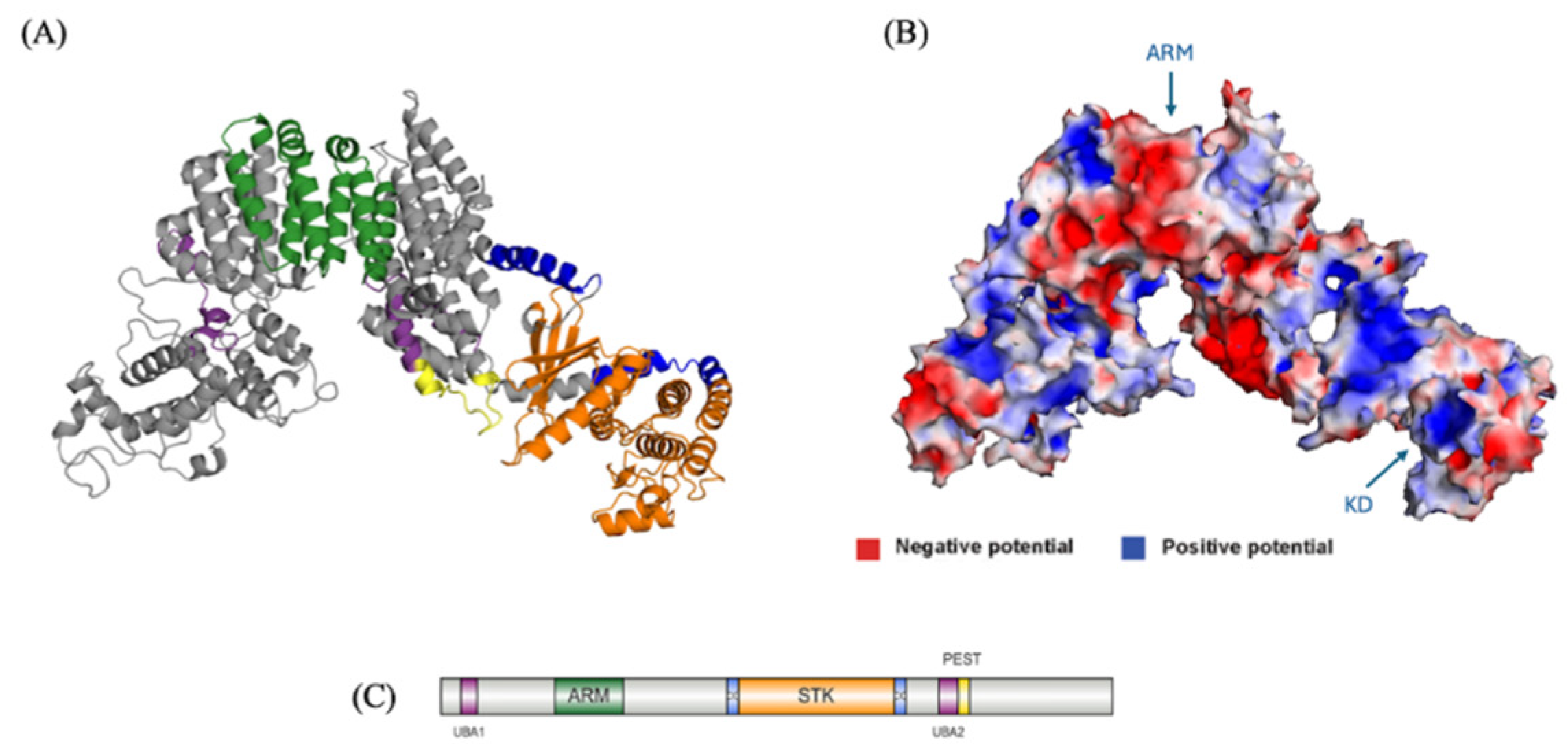
Figure 1. (A) Structural model of NEK10 (1172AA). A full-length NEK10 protein structure composed of 1172 amino acids predicted based on the amino-acid sequence and known structural information (PDB ID:2W5A). (B) Surface electrostatic profile of NEK10. Blue – Positive; Red – Negative (-5 to +5kT/e). (C) Domain architecture: The grey line represents the full-length of the protein. The orange rectangle represents the Serine-Threonine domain spanning residues N518 to C791, the green rectangle represents the armadillo motifs covering residues K199 to C319, coiled-coils are seen as blue boxes, and the PEST motif is displayed as a yellow rectangle between positions N890 and K921. Red boxes represent putative UBA domains in regions L36-I64 and F868-E901; the F868-E901 UBA domain has an overlap with PEST sequence.
Preprints 140045 g001aPreprints 140045 g001b
Figure 2. (A) NEK10’s protein-protein interaction network drawn using Cytoscape. The network map was constructed from our protein-protein interaction predictions. NEK10 is predicted to interact with several cancer proteins located in different regions of the cell: cytoplasm (green), cytosol (blue), intracellular (purple), membrane (magenta) and nucleoplasm (yellow), and mitochondria (orange). The previous reported physical interactions are encircled by dotted line, while predictions are encircled by a solid line; (B) Cellular location of NEK10 interactors. (C) Cancer types associated with NEK10 and its predicted interactors.
Preprints 140045 g002
Figure 3. (A) Full-length structure of HSPB1 (205 AA). The full-length HSPB1 model contains 205 amino acids. The α-crystallin domain (ACD) is depicted in deep purple, the PPI hotspot IXIXV sequence (ITIPV) in red, and the N-terminal IDR in orange. (B) Surface electrostatic profile of HSPB1. Blue – Positive; Red – Negative (-5 to +5kT/e). (C) Domain Architecture: HSPB1 contains 205AA, a highly conserved α-crystallin domain (purple) and a known PPI hotspot for HSPB1(red).
Preprints 140045 g003
Figure 4. (A) Docking of NEK10 with HSPB1. The full-length model shows the extended IXIXV sequence (ITIPV) in red. (B) A zoom-in image shows details of the docking scenario of NEK10’s ARM (green) residue H301 interaction with HSPB I179 (red).
Preprints 140045 g004
Figure 5. (A) Full-length structure of MAP3K1 1512 AA). A full-length MAP3K1 protein structure composed of 1512 amino acids was predicted based on the amino-acid sequence and known structure information. Motifs, domains, and important sites are represented in different colors: GEF (brown), SWIM (yellow), E3 (purple), RING (green), TOG (blue), UIM (orange), and KD (sand). (B) Surface electrostatic profile of MAP3K1. Blue – Positive; Red – Negative (-5 to +5 kT/e). The C-terminus of MAP3K1 is mostly negatively charged, while its N-terminus is mostly positively charged. (C) Domain Architecture: GEF (brown), SWIM (yellow), E3 (purple), RING (green), TOG (blue), UIM (orange), and KD (sand).
Preprints 140045 g005
Figure 6. (A) Docking of NEK10 with MAP3K1. A zoom-out image shows full-length NEK10 model (light cyan – Kinase Domain in orange) interacting with MAP3K1 (grey – TOG domain in blue). (B) A zoom-in image shows details of the docking scenario of NEK10’s Kinase Domain (orange) residue D655 interaction with MAP3K1’s TOG domain (blue) residue T847.
Preprints 140045 g006
Figure 7. Multiple sequence alignment of select NEK10 homologs. Sequence F868-K921 shows high conservation. Blue arrow indicates Lys896 – a prime candidate for ubiquitin interaction. Lys896 (K29 on the figure) has a 99.8% conservation across 1177 protein species in 331 animal species (only 20 shown) in this alignment. Color scheme: HKR cyan, DE red, STNQ maroon, AVLIM pink, FYW blue, PG orange, C green.
Preprints 140045 g007
Figure 8. Docking of NEK10 with ubiquitin. Full-length NEK10 model (gray – UBA Domain in yellow) interacting with ubiquitin (PDB ID:1TBE; magenta). (B) Inset showing a zoomed-in with details of the docking scenario of NEK10’s UBA Domain slice (yellow) residue K896 interaction with ubiquitin’s (magenta) residue G76. The value of 6.1 Å is the distance between the side chains of K896 and G76.
Preprints 140045 g008
Disclaimer/Publisher’s Note: The statements, opinions and data contained in all publications are solely those of the individual author(s) and contributor(s) and not of MDPI and/or the editor(s). MDPI and/or the editor(s) disclaim responsibility for any injury to people or property resulting from any ideas, methods, instructions or products referred to in the content.
Copyright: This open access article is published under a Creative Commons CC BY 4.0 license, which permit the free download, distribution, and reuse, provided that the author and preprint are cited in any reuse.
Prerpints.org logo

Preprints.org is a free preprint server supported by MDPI in Basel, Switzerland.

Subscribe

Disclaimer

Terms of Use

Privacy Policy

Privacy Settings

© 2025 MDPI (Basel, Switzerland) unless otherwise stated