
Submitted:
18 November 2024
Posted:
18 November 2024
You are already at the latest version
Abstract
Nuclear fusion energy, as well as nuclear fission energy, is considered as a clean energy with regar to its $C{O_2}$ emissions. Compare with fission energy, fusion energy has higher energy density and no spent fuel is discharged. A fusion reactor needs operate under the conditions of high temperature, high pressure, and tight sealing, and the excellent physical and mechanical performances of the structural materials in the reactor are required. The tritium breeding zone is a key component in a fusion reactor acts as the production of tritium, breeding of neutron, and transferring of heat. The lithium-based alloys, which have high tritium breeding ratio, are usually selected as the materials in this zone. In this paper, the development of various liquid and solid lithium materials is introduced. Liquid lithium materials mainly include liquid lithium, molten lithium compounds, and liquid lithium-lead alloy. Solid lithium materials cover lithium-based ceramics oxides, and lithium-lead alloy with high melting points. The tritium breeding ability, the durance characteristics, and the compatibility of these materials are comprehensively compared and analyzed. Among these materials, solid lithium-lead alloy, although in the stage of theoretic studies, is still considered to be a very promising material used as the tritium breeding agent. This paper will provide the insights into the further development of tritium breeding materials with better performances in the future.
Keywords:
tritium breeding material
; fusion energy
; fusion reactor
; blanket
; cladding
1. Introduction
Nuclear fusion [1] is a kind of clean energy source shown in Figure 1 which does not produce greenhouse gas emissions such as carbon dioxide, and has a relatively small impact on the environment benefit to address climate change issues. Nuclear fusion uses hydrogen isotope deuterium tritium (DT) [2] as the main raw material, which can reduce dependence on limited resources [3]. Non radioactive helium (He) is the main reaction product of controllable nuclear fusion energy, which has inherent safety. Nuclear fusion can release more energy than it is done in the traditional nuclear energy sector, what makes it more efficient. Once controllable nuclear fusion is achieved, its energy density will provide a huge energy supply for humanity.
Nuclear fusion Tritium breeding materials research started in the early 1970s, one decade after the first commercial fission reactors started operation [4]. In November 2006, the United States [5], the European Union [6], Japan [7], South Korea [8], Russia [9], India [10] and China [11,12] officially signed an agreement to launch the construction of the International Thermonuclear Experimental Reactor (ITER) with fully superconducting magnetic confinement, in order to verify the scientific and engineering feasibility of peaceful use of nuclear fusion energy for power generation. In order to address the technical issues between ITER and Demonstration Fusion Power Plant (DEMO) [13], the United States plans to build the Fusion Nuclear Science Facility (FNSF) [14,15] to understand the complex interactions between fusion plasma and materials, nuclear material interactions, tritium fuel management, and power extraction in fusion reactors. Based on the same purpose as FNSF, China plans to build the China Fusion Engineering Test Reactor (CFETR) [16,17].
The fusion reactor cladding is an important structure used in nuclear fusion reactors to protect the reactor walls and reduce energy loss. It is composed of multiple different materials and typically consists of three main parts: inner layer, middle layer, and outer layer shown as Figure 2. The inner layer is usually made of metal or ceramic materials, used to protect the reactor wall from high temperature and other factors. The intermediate layer is made of materials such as hydrides or carbides, which are used to absorb neutrons and control the reaction rate. The outer layer is usually made of metal materials such as iron or tungsten, mainly used to withstand pressure in extreme environments such as high temperature and radiation.
This review summarizes and prospects from the perspective of tritium breeder materials. The second part introduces the engineering requirements of tritium breeding materials for nuclear fusion reactor. The third part provides a detailed introduction to liquid tritium breeding materials, including liquid lithium, molten salt and liquid lithium-lead alloy. The fourth part analyzes the research status of solid-state tritium breeding materials.
2. Tritium Breeding Material for Fusion Reactor Cladding
Fusion reactor uses nuclear fusion reaction to produce energy, and its core component is the fusion core, which is composed of fusion fuel, and carries out nuclear fusion reaction under high temperature and pressure to produce a lot of energy. However, the operation of fusion reactors requires extremely high temperatures and pressures, which puts high demands on the safety and stability of fusion reactors. In order to ensure the normal operation of the fusion reactor, it is necessary to set up a cladding around the core of the fusion reactor, which is called the fusion reactor cladding [18]. The role of fusion reactor cladding mainly includes the following aspects:
- Fusion core is the core part of fusion reactor to produce energy. In order to protect the core from external interference and damage, cladding is needed to provide insulation, isolation and protection to prevent the core from being affected by external factors;
- The fusion reaction is a high-temperature and high-pressure reaction. By adjusting the temperature and pressure of the cladding, the speed and intensity of the fusion reaction can be controlled to ensure the normal operation of the fusion reactor;
- The cladding of a nuclear fusion reactor can play a role in collecting energy, and the generated energy is collected and converted into electricity or other forms of energy output through pipes and devices inside the cladding;
- Through the control system and equipment inside the cladding, the fusion reactor can be monitored and adjusted to ensure its stable operation.
The Blanket system [19] is a core component in the fusion reactor, providing shielding for neutrons and high heat loads for the entire fusion device, and is a critical system of the fusion device. Among them, the first wall [20] material is the material that first comes into contact with fusion reactions in nuclear fusion devices, therefore it must have high temperature resistance and radiation damage defense capabilities. Typically, graphite [21], carbon-carbon composite materials [22], silicon carbide composites [23] and beryllium oxide [24] are used as first wall surface coating materials; Stainless steel [25], vanadium alloy [26], molybdenum [27], and tungsten [28] are used as supporting materials for the first wall structure.
In addition, the tritium breeding zone is the core functional component of the nuclear fusion reactor, located between the first wall of the vacuum chamber and the shielding layer, and is a key component of the self-sufficiency [29] of controlled fusion fuel, so as to realize the role of tritium breeding and energy conversion. Its core functions mainly include three aspects: firstly, the main function of the tritium breeding zone is to produce tritium by reacting fusion neutrons with tritium breeding materials [30] in the blanket, and to supplement the extracted tritium into the reactor to compensate for tritium consumption and achieve self sufficiency of tritium. Second, the tritium breeding zone effectively cools itself by converting the energy of the fusion particles into usable energy, providing high-quality heat for power generation. Finally, the tritium breeding area provides radiation protection for superconducting coils and organisms, reduces the activation of peripheral equipment materials, and plays a role in shielding radiation.
The neutron energy generated by deuterium tritium fusion is extremely high, up to 14.1MeV, and these high-energy neutrons can undergo tritium proliferation reactions with lithium nuclei:
n + 6Li ⟶ T + 4He + 4.75MeV
n + 7Li ⟶ T + 4He + n - 2.47MeV
With this reaction, the generated tritium is reintroduced into a new deuteriu m-tritium fusion reaction, thus forming the tritium cycle. As Figure 3 shown, it is expected that the breeding reaction will produce more tritium than the deuterium tritium reaction consumes, thus achieving tritium self-sustaining, which is a key step for the commercial operation of fusion reactors.
In order to improve the utilization efficiency of high-energy neutrons in the cladding and enhance the breeding capacity of tritium, neutron breeding materials containing beryllium or lead can be installed in the tritium breeding zone. Neutrons can undergo neutron multiplying reactions with beryllium or lead, increasing the number (flux) of neutrons and thus increasing the likelihood of reactions between neutrons and lithium nuclei.
The blanket may be distinguished as solid tritium breeding blanket and liquid tritium breeding blanket. The tritium breeding materials for solid cladding [31] mainly include ceramics such as Li2TiO3, LiAlO2, Li4SiO4, LiZrO3, etc. Due to the limitations of lithium atom density and filling rate of solid-state tritium breeders, in order to meet the requirements of deuterium breeder rate, neutron multiplier agents such as metal Be and Pb need to be used. Liquid breeding agents mainly include liquid lithium (Li), liquid lithium-lead eutectic (LiPb) [32], molten salt (FLiBe) [33], etc. The effective tritium breeding element Li has a high atomic density in liquid lithium metal breeding agents, and has the strongest tritium breeding ability among all tritium breeding agents. In liquid LiPb alloy, Pb is the neutron multiplier.
Different types of tritium breeder have high requirements for reactor structure, self-sustaining reaction and various physico chemical parameters in the reactor. The tritium breeding material should not only meet the requirements of neutron, thermal stability, toughness and other aspects of fusion reaction, but also meet the requirements of reducing high cost, so as to make full preparation for the feasibility of future fusion civil power generation.
3. Liquid Tritium Breeding Material
Liquid breeding materials mainly refer to liquid metal lithium or lithium alloys, such as lithium lead alloys (Li17Pb83), lithium tin alloys (Li25Sn75) [34], and lithium fluoride beryllium molten salts (Li2BeF2) [35]. Liquid breeding materials have the following advantages:
- Good fluidity, easy to change materials, cladding structure is relatively simple, easy to design and construct;
- Good thermal conductivity, high lithium content, easy to exchange heat through the flow of liquid metal, to achieve tritium breeding;
- Tritium recovery is convenient.
Liquid lithium was used as a material for tritium breeding [36]. It has a high tritium breeding ratio (TBR) [37] which excess tritium can be generated to the new device for initial use. In the middle stage of operation, the TBR can be reduced to around 1 by mixing liquid tin, achieving self-sufficiency of tritium and obtaining higher energy gain.
Previously, liquid lithium, as a low atomic number material, was considered a major candidate material for tritium breeders, coolants, and first walls in cladding modules due to its low cost, high tritium breeding rate, high heat load transport capacity, and good compatibility with plasma. However, lithium is a kind of active alkali metal and has strong corrosiveness at high temperatures, which can cause certain damage to the cladding structure material. Moreover, due to the advantages and wide applications of lithium lead alloys, liquid metal lithium as a tritium breeding material for fusion cladding has become a thing of the past.
3.1. Fluorine Containing Molten Salt Tritium Breeding Material
Molten salt is solid at room temperature and trans to liquid at high temperature. In the liquid stage it can be a coolant, and function at high temperatures without vaporizing. New advanced fusion reactor technologies use liquid eutectic alloy and molten salt mixtures as tritium breeding materials, such as Li17Pb83, FLiBe, LiSn and other candidates. FLiBe is a combination of lithium fluoride (LiF) and beryllium fluoride (BeF2), and it conducts heat well and therefore has a good cooling effect. It has been greatly researched in the American Oak Ridge National Laboratory for molten-salt reactor experiment. The melting point of Li2BeF4 is 460°C, boiling point is 1430°C, and density is 1.94 g/cm3. In liquid state, the heat capacity is 4540 kJ/cm3 which is more than four times that of sodium, and also more than 200 times that of helium at ordinary reactor conditions. The eutectic mixture alloy is a bit greater than 50% BeF2 and has 360°C melting point. The low atomic weight of lithium, beryllium and to a lesser extent fluorine make FLiBe an effective neutron moderator. After FLiBe molten salt passes through the heat exchanger, tritium is extracted in the fuel processing chamber to satisfy the tritium self-sustaining cycle of fusion reaction.
In 1999, the Abdou team designed the APEX Magnetic fusion reactor [38], which uses a liquid envelope containing FLiBe coolant to achieve high NWLs and extended the life of the first wall, and the fusion power of this APEX type fusion reactor is up to 4000 MWth. In addition, adding heavy metal salts UF4 or ThF4 to FLiBe increases energy diffusion and fission fuel production, improving neutron performance. In 2006, Mustafa Ubeyli [39] studied the influence of the flow liquid wall thickness on the main neutron parameters of APEX fusion reactor when 10%(mol) UF4 or ThF4 doped FLiBe. When the cladding liquid wall thickness of FLiBe + 10% UF4 is 38cm, and the cladding liquid wall thickness of FLiBe +10%ThF4 is 56cm, the doubling effect of heavy metal salt can maintain the self-sufficiency of tritium and achieve high quality fission fuel.
In previous studies, it was shown that heavy molten salt (FLiBe + UF4/ThF4) improved the neutronic performance of the APEX fusion reactor with respect to energy multiplication and fissile fuel breeding. In another research, radiation damage behavior of the ferritic steel first wall structure in the APEX reactor using liquid walls of FLiBe + 4% mol ThF4 or FLiBe + 8% mol ThF4 was examined. Moreover, radiation damage study at the first wall made of V-4Cr-4Ti and SiCf/SiC composite was also performed by using FLiBe, FLiBe + 4% ThF4 or FLiBe + 8% ThF4 or Li20Sn80. Compared to the previous study, it was pointed out that addition of 4 or 8 mol% ThF4 into the Flibe slightly affected the radiation damage parameters of solid first wall and the best first wall material—coolant couple is the ferritic steel and Flibe molten salt.
In 2007, Youssef and Abdou [40] used molten salt layers composed of FLiBe, LiSn, LixPby and Li to study the relationship between radiation damage parameters of the first wall of ferritic steel of APEX fusion reactor and liquid wall thickness. With a 42cm thick FLiBe liquid layer, the service life of the first wall of ferritic steel can be extended to 30 years. They studied the effects of different thorium molten salt wall thickness on the first wall material damage and tritium proliferation characteristics of APEX fusion reactor. At the ∆R envelope, with the increase of the liquid wall thickness and the content of three different thorium molten salts, tritium proliferation increased relatively quickly, reaching a liquid wall thickness of 40cm. But at ∆R > 40cm it becomes much slower. Only 75% LiF-23% ThF4-2% 233UF4 coolant maintained the self-sufficiency rate of tritium, and the TBR of the other coolants was lower than 1.05.
In 2008, Mustafa Ubeyli and Huseyin Yapci [41] investigated the neutron performance of an ARIES RS fusion reactor using Li2BeF4 alloy mixed with ThF4 or UF4 molten salt. Studies have shown that only Flibe salts containing 2% UF4 or ThF4 and 4% UF4 can provide sufficient tritium reproduction, and higher heavy metal salts reduce tritium production to less than 1.05. So, the molecular percentage of ThF4 or UF4 in the molten salt mixture should not exceed 3 and 4.
In 2015, Mingzhun Lei et al. [42] reported a $FLiBe$ molten salt blanket structure for a fusion reactor. They adopted low-activation ferrite/martensitic steel serves as a structural material, helium cools the structural material, and flowing FLiBe molten salt is used as tritium breeder and coolant. The breeder blanket and the shield blanket are integrally designed, remote operation and maintenance are facilitated, the design of the blanket structure is simplified, and machining of the cladding structure is facilitated. This FLiBe molten salt blanket structure type solves the problem that a solid blanket does not easily realize online material change and tritium extraction, magneto-hydrodynamic problems caused by traditional liquid lithium lead metal blanket liquid metal flow are solved, and safety and reliability of the blanket structure are improved.
In 2022, Haci Mehmet Sahin et al. [43] designed coolant and tritium breeding materials containing fluorine molten salt such as FLiBe, FLiNaBe, FLiPb and LiO2. The increase of the ratio of FLiPb to total TBR indicates a sharp increase in tritium production in the tritium breeding area, and the coolant of FLiPb has the highest DPA value. FLiPb has the lowest He output, while FLiBe and FLiNaBe have the highest He output.
Many researchers have studied and compared the fluorinated molten salt tritium breeder materials of various fusion reactors, and found that these materials have better performance, higher tritium breeder ratio, neutron breeder effect and higher reactor type adaptability, which is worthy of further development and research.
3.2. Li17Pb83 Tritium Breeding Materials
Generally speaking, Li17Pb83 [44] is more popular than pure lithium because its chemical reactions with water, air, and nitrogen are much smaller. The blanket can be distinguished into two types: the cladding concept using only a single coolant, Li17Pb83 for tritium breeding, and the cladding concept using Li17Pb83 for breeding and self cooling (sometimes using another coolant).
Under the bombardment of high-energy neutrons, the lithium-lead alloy [45] in nuclear fusion reactor uses lithium to produce hydrogen isotope tritium, and tritium and deuterium undergo nuclear fusion reaction to produce huge energy. The lead in the alloy reflects neutrons and carries away the energy produced by nuclear fusion through cyclic cooling. Therefore, low-melting point lithium-lead alloy has become a key material in nuclear fusion reactors that integrates three functions: tritium breeder, neutron multiplier, and cooling medium, and has important applications in the field of nuclear fusion. In 2005, the first liquid metal LixPby loop named DRAGON-I was built in China in order to study the characteristics of liquid LixPby alloy such as its corrosion to structural materials of the blankets and so on [46]. The European Union, the United States, India and China have proposed helium-cooled lithium-lead (HCLL) blankets, water-cooled lithium-lead (WCLL) blankets, lithium-lead ceramic breeder felt and bifunctional lithium lead (DFLL) blankets.
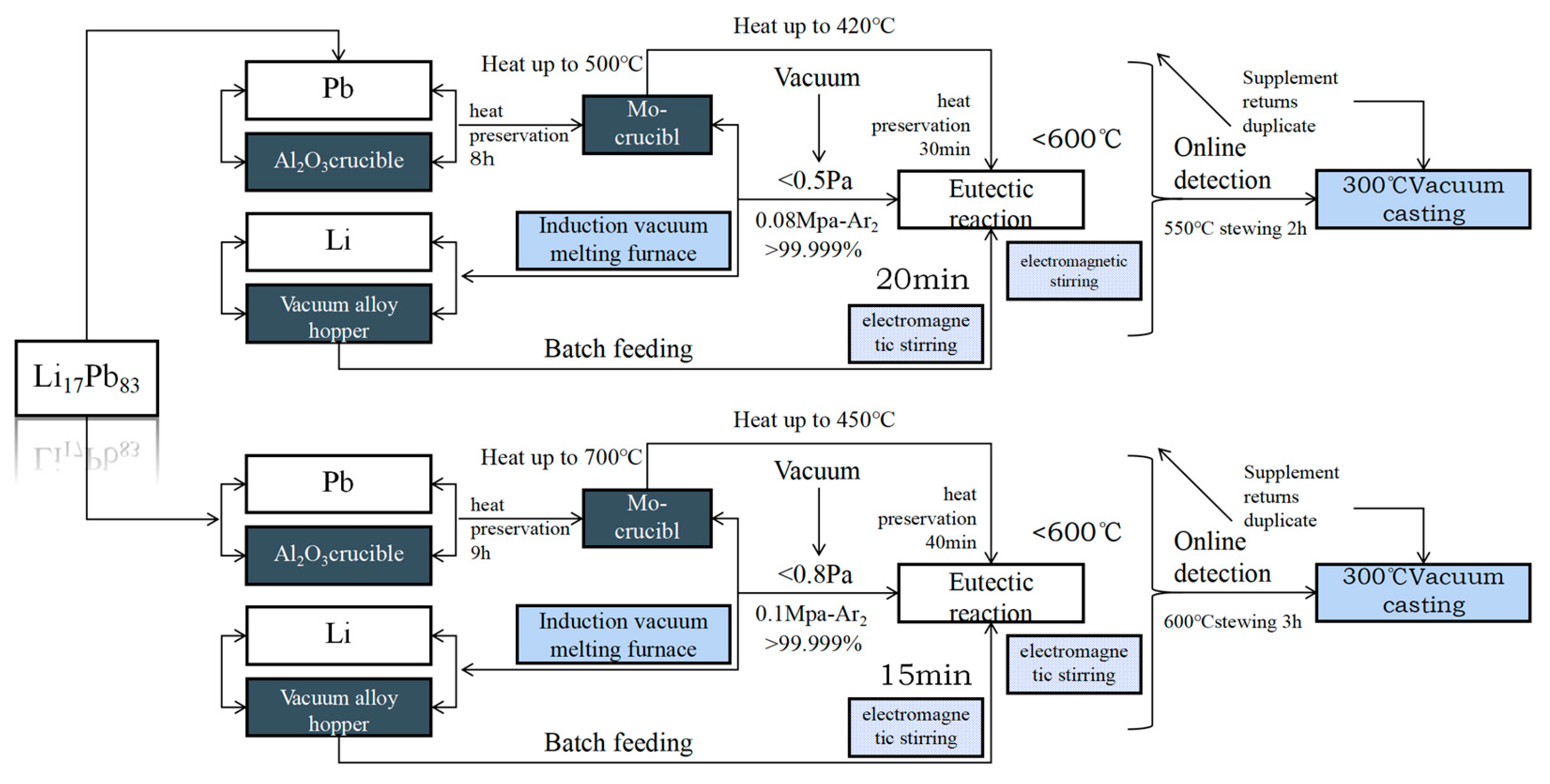
Besides, what’s important is that the preparation of lithium-lead alloys [47] that meet the needs of the nuclear industry, especially the fusion reactor industry, is the primary condition for studying key scientific and technological issues in fusion reactors. All countries have carried out experimental and semi-industrial production scale preparation of lithium lead alloys. However, there are many difficulties in the preparation of lithium lead alloy, such as the metal lithium is very active and easy to oxidize, reacts violently with water, the alloying speed of Li and Pb is extremely fast, while releasing a lot of heat, the melt temperature is difficult to control during the preparation process, the density difference between Li and Pb is large, and the lithium content is difficult to control during the preparation process. Uneven agitation may result in segregation of components or formation of high melting point compounds. In 2008, the team of academicians Sheng Gao and Yichan Wu et al. [48] from the Institute of Plasma Physics of the Chinese Academy of Sciences gave a preparation scheme of lithium lead-alloy in the VIM (Vacuum induction melting furnace) [49] as Figure 4 shows.
In 2010, XIE Bo et al. [50] studied the recovery of trace amounts of tritium in liquid Li17Pb83 alloy. It was shown that the isotope exchange process is an effective way of tritium recovery from the residue of Li17Pb83 alloy, and the optimum composition of the exchange carrier gas is He with 0.1% D2. Trace tritium recovery efficiency increases with increasing exchange temperature and number of times of exchange. After 6 treatments at 823K, the recovery rate of tritium can reach 80%. On this basis, a gas-liquid two-phase contact model describing the release of tritium from liquid Li17Pb83 alloy is established.
In 2014, X.S.I et al. [50] used a mass spectrometer to quantitatively analyze the by-product 4He and obtained the mass of tritium generated by the reaction of 6Li(α,n)T, which clarified the problem that the incomplete release of tritium in lithium alloy led to the inability to accurately analyze and determine the tritium content.
In 2021, Muhammad Salman Khan et al. [51] proposed helium (He gas)/lithium lead (LiPb) dual cooled LiPb (DLL) cladding as a promising candidate materials for DEMO fusion reactors for power generation. According to Colin Baus et al. [52] team in 2023, the SCYLLA design uses a LixPby eutectic as a breeder and coolant, and Pb serves as a neutron multiplier. With this design, tritium can be extracted without additional media and reduce engineering complexity.
So at present, although liquid lithium-lead alloy has some shortcomings and needs to be further studied and improved, and the properties of candidate liquid tritium breeders are shown in the Table 1, it is still the most promising tritium breeding material for fusion reactor at this stage.
4. Solid Tritium Breeding Material
Ceramics are capable of withstanding harsh high-temperature environments and unique functions, and many fusion reactor concepts call for the use of monolithic or composite forms of ceramics as various components. Lithium based solid tritium breeder has been paid more and more attention for its advantages of high chemical stability, good safety and no magnetic fluid effect. At ITER [54], the world’s largest nuclear fusion experimental facility, member states have come up with their own tritium breeder layer designs. To meet the special requirements in ITER design, the functional requirements and selection principles are as follows:
- Ceramic microspheres must be able to support or withstand various stresses from ITER operation, such as pressure, temperature, temperature gradient and thermal shock, to avoid washing gas leakage;
- The ball bed has a stable thermal conductivity parameter when working to avoid too high or too low temperature;
- Ensure good compatibility between the ceramic breeding agent ball bed and EUROFER steel under maximum temperature range and other conditions;
- A higher tritium breeding ratio (TBR) requires TBR>1;
- Ensure the stability of ceramic microsphere materials during the process of structural changes caused by lithium atom migration under high temperature conditions;
- Ceramic ball beds must have a certain ability to resist neutron irradiation, in order to prevent serious consequences such as container wall rupture caused by neutron irradiation damage to the bed and leakage of washing gas;
- Good tritium release performance and lower tritium retention;
- Minimize neutron irradiation activity of materials and impurities.
In 2015, Xinggui Long et al. [55] summarized the advantages and disadvantages of the current candidate solid tritium breeder materials in Table 2, and the selection and development of tritium breeder depends on the design of the breeder envelope. With the improvement of the breeder envelope design requirements, the future development of tritium breeder has several directions: the design and development of new tritium breeder, the innovation of the breeder pellet preparation method, the improvement of the breeder performance and the in-depth study of the tritium release mechanism.
4.1. Lithium Based Ceramic Oxide Particles
Generally, solid fusion tritium breeding materials are Li2O, LiAlO2, Li4SiO4, Li2ZrO3, Li8ZrO6 and Li2TiO3. These lithium based oxide ceramic particles can be used for tritium production in cladding systems. Table 3 shows some important characteristics of candidate solid breeding varieties. From this table, the highest density of lithium atoms is LiAlO2, and the lowest is LiAlO2. Tritium breeding materials with the highest melting point is Li2ZrO3, however the latest research [56] shows that the high melting point Li72Pb28 alloy is expected to be a promising candidate TBM which the lowest melting point is 999°C.
Since 1980s, ceramic lithium oxides such as Li2O, Li2O, Li2O, Li8ZrO6 and so on. The lithium atom fraction in these lithium-based compounds is so high that the tritium breeding ratio is high. Among them, Li2ZrO3 has advantages such as good radiation resistance, high temperature dimensional stability, good compatibility with structural materials and beryllium reflector, short tritium residence time, high lithium atom density, and low tritium retention rate. In 1992, L.MONTANARO and J.P.LECOMPTE [57] prepared Li2ZrO3 porous material by gel method to make up for the lack of previous A related data. However, Li2ZrO3 faces some challenges. The porous microspheres prepared by traditional methods have irregular structure and spherical morphology. The microspheres prepared by solution gel method, hydrothermal method and solid phase reaction method are easy to agglomerate, have small specific surface area and low porosity, and are difficult to satisfy the requirements of ceramic tritium breeder materials and CO2 adsorption materials. Therefore, the preparation of Li2ZrO3 ceramic particles also needs continuous improvement.
In 2003, A DEPTULA et al. [58] used the inorganic sol gel method to prepare medium sized Li2TiO3 particles as the fusion reactor tritium proliferation material, the synthesis procedure references. However, Li2TiO3 ceramic particles face some challenges. Due to the diverse forms of TiO2, including rutile, rutile, amorphous, and mixed types, it is difficult to prepare a single form of lithium metatitanate. Li2TiO3 powder prepared by solid phase method often has uneven composition, difficult stoichiometry control, wide particle size distribution, coarse particle size, and is limited by the structure and morphology of the raw TiO2, making it difficult to control its structure and morphology; Sol gel method, combustion synthesis method and hydrothermal method are typical wet reaction, and the requirements for reaction conditions and raw materials are high.
6Li rich γ Lithium aluminate phase(γ-LiAlO2) has been widely studied as a candidate cladding material for fusion reactor design. As a solid tritium breeding agent, LiAlO2 has the following advantages: good chemical, thermal, and mechanical stability at high temperatures, good compatibility with other materials, especially excellent radiation behavior, and relatively high lithium content in this material. In 2003, M.CHATTERJEE [59] has adopted a new technology for synthesizing lithium aluminate (LiAlO2) powder from water-based sol. This material has been used to produce combustible absorption rods (tpbars) for tritium to support the tritium maintenance program. In 2020, Weilin Jiang et al. [60] studied deuterium under He+ and D2+ irradiation γ- The diffusion in LiAlO2 microspheres, and its research results contribute to a better understanding and prediction γ-. The diffusion behavior of tritium during neutron irradiation in LiAlO2 microspheres. Among them, LiAlO2 faces the following challenges. There are four main methods for preparing LiAlO2 powder, including solid state reaction, wet chemistry, molten salt reaction, and combustion synthesis. The solid-state reaction method has disadvantages such as high energy consumption, low efficiency, poor sintering performance, and easy inclusion of impurities; Although the combustion synthesis method is simple and environmentally friendly, its cost is relatively high; The molten salt reaction method has high energy consumption and equipment cost; In wet chemical methods, the detergent method has the characteristics of simple equipment, low energy consumption, convenient operation, and effective particle size control; Sol gel method is a new powder preparation technology developed rapidly in recent decades. Its advantages are simple process and equipment, and high product purity. Therefore, it is necessary to further develop and improve the preparation methods for LiAlO2 ceramic particles.
In 2007, M Oyaidzu et al. [61] studied the thermal atomic chemical behavior of tritium in neutron irradiated Li2TiO3 and Li2ZrO3. It was shown that the common characteristics in both samples were that the annihilation process of irradiation defects consisted of two first-order processes. And there is a general rule from tritium proliferation reaction and the generation of radiation defects to the annihilation of radiation defects and the release of tritium.
In 2010, R E.Avila et al. [62] studied the surface desorption and diffusion models of tritium release in Li2TiO3 and Li2ZrO3 ceramic tritium breeding materials, compared the release rates of Li2TiO3 and Li2ZrO3, and applied analytical and numerical analysis methods to temperature programmed desorption (TPD) experiments. In 2020, D I Shlimas et al. prepared Li2TiO3 ceramic particles and studied their resistance to helium expansion performance. It was shown that at irradiation doses of 1-3×10¹⁷ ion/cm2, these ceramics have high radiation resistance to structural changes, while increasing the radiation dose above 5×10¹⁷ ion/cm2 leads to significant changes due to partial degradation of the ceramic surface due to process exposure.
In 2020, Qiang Qi et al. [63] compared the Li2TiO3 and core-shell Li2TiO3-Li4SiO4 two-phase ceramics tritium release behavior of pebble. Research shows that tritium from core-shell Li2TiO3-Li4SiO4 pebbles release behavior by Li2TiO3 and Li4SiO4 release behavior control, total tritium release 25.8 MBq/g, slightly more than Li2TiO3 24.9 MBq/g, and Li2TiO3-Li4SiO4 (104.79 N) coreshell extrusion load is higher than Li2TiO3 48(N), So the coreshell Li2TiO3-Li4SiO4 is a promising candidate tritium breeding materials. Among them, Li4SiO4 ceramic materials face some challenges, such as low loading rate of ceramic microspheres, easy breakage and pulverization of ceramic microspheres, volatility of lithium during the preparation process of Li4SiO4 microspheres can lead to the generation of lithium metasilicate, and the phase purity cannot meet the required standards. The most important point is that Li4SiO4 has a strong water absorption tendency, which is easy to react with H2O to generate decomposition products such as Li2SiO3 and LiOH. It is difficult to maintain phase and structural stability in humid environments, which is also a difficulty encountered in the application process of this material.
In 2023, Deepak Kumar Meena et al. [64] conducted inelastic scattering and first principles studies on Li2TiO3 and Li2ZrO3 lithium based ceramic particles. The electronic properties of Li2TiO3 and Li2ZrO3 are calculated by using first principles methods namely LCAO and FP-LAPW. Based on the mechanical properties, it is predicted that LTO is the hardest material among other lithium ceramics, which ensures its application in tritium breeding materials for fusion reactors.
Besides, Li2TiO3 and Li4SiO4 are also candidate tritium breeding materials. Recently, the design of Li2TiO3-Li4SiO4 biphasic ceramic and composite was proposed to combine the advantage of Li2TiO3 and Li4SiO4. For instance, Li2TiO3 has higher mechanical strength and Li4SiO4 has higher tritium breeding capability due to the higher lithium atom density. It is expected to balance the tritium release and mechanical strength of lithium ceramics via the control of the Li2TiO3 and Li4SiO4 phase ratio.
According to the research of the Qilai Zhou team [65], under the same neutron irradiation conditions, the release of tritium is sequentially Li2TiO3, Li2TiO3-xLi4SiO4(x=0.5), Li2TiO3-xLi4SiO4(x=1), and Li4SiO4, while chemical inertness decreases with increasing lithium atom density. In 2023, their team used Pb as a neutron multiplier to biphasic Li2TiO3-xLi4SiO4, enhancing tritium release without increasing lithium atom density. The results show that the release rate of tritium can be increased by adding Pb. Therefore, it is necessary to further study the effect of lead content on tritium release.
4.1. Feasibility Study on the Latest Solid Clad Li72Pb28 Alloy
Solid cladding usually uses beryllium or alloys (i.e. Be and Be12Ti [66]) as neutron multipliers, however, the scarcity of beryllium resources leads to higher costs and less economically competitive, which hinders its development. Therefore, some fusion institutions have taken the solid-state breeder envelope as the main research direction, such as the Karlsruhe Institute of Technology (KIT) \cite{2010Nuclear} in Germany, the Institute of Quantum Science and Technology (QST) in Japan and the Institute of Plasma Physics of the Chinese Academy of Sciences (ASIPP).
The University of Sheffield (TUoS) designed a solid tritium breeder envelope with a uniform mixture of neutron multiplier and tritium breeder. The volume share of neutron multiplier was linearly increased or decreased along the radial direction of the envelope, so as to adapt to the changes of neutron characteristics along the radial direction of the envelope, including neutron flux, energy, and reaction cross section between neutrons and materials. The tritium production performance of the cladding was not affected. However, the amount of beryllium is only reduced by 10%, which is difficult to meet the economic requirements of fusion reactor cladding.
Furthermore, the Karlsruhe Institute of Technology (KIT) in Germany has synthesized lanthanides with lead to increase the melting point of the neutron multiplier. Lanthanides are cheaper than beryllium, but they are rare earth elements with limited resources, and the cost of using such materials as neutron multipliers in future fusion reactors is still high. In addition, the introduction of lanthanides will increase neutron absorption and reduce the tritium-producing performance of the cladding, so it is necessary to increase the amount of neutron multiplier materials, which will increase the volume of the cladding, increase the construction cost, and reduce the economy of the fusion reactor.
In the latest study in 2023 [56], the Chinese Academy of Sciences developed a solid lithium lead cladding for nuclear fusion reactors and used it as a neutron multiplier, which is cheap and can meet the requirements of producing tritium in nuclear fusion reactors. High melting point lithium lead alloys exist in the form of spherical beds and are always in a non-melting solid state. Tritium can be carried out of the reactor through the air-blown spherical bed to achieve self-sustained tritium. According to the operation conditions of the fusion reactor, the coolant uses water, helium or supercritical carbon dioxide to form water-cooled solid lead-lithium cladding, helium-cooled solid lead-lithium cladding or supercritical carbon dioxide-cooled solid lead-lithium cladding.
Of course, as a new conceptual design tritium breeder material, laboratory samples are needed to verify the feasibility of the concept, and the processing process of high-melting lithium lead alloy is similar to that of liquid lithium lead alloy, but the high lithium content also brings risks to the processing. High lithium content will form lithium steam in the induction vacuum melting furnace, there will be fire phenomenon, in addition, high lithium content and lead reaction violently, will lead to the crucible burst, damage the induction melting furnace, so the processing process of high melting point lithium lead alloy needs more in-depth exploration.
5. Tritium Breeding Rate (TBR)
One of the most important statistics concerning fusion reactors is the Tritium Breeding Ratio [68], and the defination of TBR is as Equation 3 expresses. This is a representation of the ratio of the rate at which tritium is produced in a fusion reactor to the rate at which it is consumed. Since Tritium is the most important fuel source in most reactors, it is essential to produce Tritium within the reactor itself. A TBR greater than 1 indicates that the reactor can produce more tritium than it consumes, ensuring self-sufficiency of the tritium stockpile.
In 1987, KOICHI MAIO Mack [69] adjusts the overall design to meet life and material stress requirements for various structural changes such as material thickness and material volume fraction. By separating the high energy absorption, scattering, neutron breeding and tritium generation cross sections above the multiplication reaction threshold from the low energy cross sections close to heat energy, the analytical TBR formula is derived to estimate the new tritium breeding ratio (TBR) easily and quickly. The formula applies to three types of blankets. The value of the total load rate calculated by this formula is consistent with that of the ANISN transport code within 5%. The formula he summarized is shown below:
where Ab, Af, Tb, and Tf are explained as follows. The escape ratio from absorption of the backscattered neutrons Ab until arrival at the front breeder zone in a blanket is expressed as:
where tbi is the thickness of the layer number i between the front breeder zone and the multiplier. The escape ratio from absorption of the forward neutrons
Af until arrival at the breeder zone is given by:
where tfi is the thickness of the layer number i between the multiplier and breeder region. The tritium production ratio of the backscattered neutrons in the front breeder zone Tb is represented by:
where tF is the thickness of the front breeder zone. The tritium production ratio of the forward-scattered neutrons in the breeder region tF is represented by:
where tB is the thickness of the breeder region.
The formula is suited to three types of tritium breeding blankets: lead neutron multiplier blanket, beryllium neutron multiplier blanket and pre-breeding zone blanket, and beryllium neutron multiplier and Li2O breeder mixed blanket.
In 2003, Mustafa and Uebeyli [70] used W-5Re, TZM, T111, Nb-1Zr as structural materials and the tritium breeding capacity of FLiBe, FLiNaBe and Li20Sn80 coolants in DT-driven fusion-fission (mixed) reactors was investigated. They used the SCALE 4.3 system, the Boltzmann transport equation was solved by XSDRNPM program, and the neutron transport was calculated. The contribution of FLiBe, FLiNaBe and Li20Sn80 to the concentration of 6Li was studied. In addition, the effect of structural material type on the properties of TBR was also investigated. At the same time, Shanliang Zheng and Yican Wu [68] performed a series of neutron calculations using the three-dimensional Monte Carlo neutron-photon transport program MCNP/4C and the International Atomic Energy Agency FENDL-2 database to compare the tritium breeding performance of different tritium breeding materials. The influence of the size of the tritium breeding band and the enrichment degree of Li on the tritium breeding ratio was analyzed, and the influence of Be as a neutron multiplier on TBR was calculated.
In 2008, Adem Acır [71] studied the tritium breeding properties of candidate tritium breeding materials Li2O, LiH, Li2TiO3, Li2ZrO3 and Li4SiO4 in (D-T) driven fusion-fission (hybrid) reactors based on three - and one-dimensional neutron calculations. Monte Carlo transport code (MCNP 4C), SCALE 5 and ANISN nuclear data code were used to calculate the tritium breeding ratio (TBR) of the cladding. The influence of different kernel databases on TBR is investigated, and the calculation results of TBR are compared.
In 2012, B.R. Collingn and S.D. Monk [72] used computer simulations and as part of the test cladding module at the International Thermonuclear Experimental Reactor (ITER) facility to test the feasibility of various material and cladding designs for nuclear fusion reactors. Blanket model simulations were performed using the Monte Carlo simulation package MCNPX (Computational Physics Division Los Alamos National Laboratory [73]) and FISPACT [74] to evaluate the breeding capacity of a variety of solid and liquid tritium breeding materials. The results show that the liquid/molten salt tritium breeding material has a higher tritium breeding ratio (TBR).
In 2017, Miao Yin et al. [75] calculated and analyzed the tritium breeding ratio of the fusion reactor design cladding successively, determined the appropriate module material, clear module division and corresponding module thickness, and finally found the appropriate molten salt design cladding that meets the tritium self-sustaining (TBR=1.3162).
In 2020, a groundbreaking and difficult analytical work has been done on a range of tritium breeding materials by Stefano Segantin et.al [76], especially those containing highly enriched lithium and beryllium compounds. They make sure TBM blankets are thin enough for TBR studies. The results suggest that the blanket is not required to be extremely thick for breeding tritium, which saves on the order of tens of cubic meters of blanket. FLiBe and LiFNaZrF4 are the most thickness-independent breeders. Pure lithium requires additional blanket due to the low density, and PbLi requires additional blanket due to the lower lithium concentration. Especially, PbLi indeed heavily relies on the multiplication effect of Pb over fast neutrons. Both PbLi and pure Li have a higher TBR than the two salts.
In 2023, American and Singapore [77] experts in tritium breeding materials of technology studied the tritium breeding ratio of a series of candidate tritium breeding materials for immersion Tokamak reactors, and different material choices and their TBR were observed from the aspects of material cross-section, dose rate, thermal properties and safety. Using the Paramak Python module to model several geometry shapes and simulations with OpenMC [78], you can observe how neutron multipliers, enrichment, and neutron energy spectra affect TBR. They explained DD and DT plasmas by changing the neutron energy spectrum, noting differences in the tritium breeding efficiency of these compounds. The neutron spectrum is an important factor in optimizing TBR levels because neutrons produced by fusion reactions in the plasma interact with the proliferating material in the envelope and produce tritium by reacting with lithium. TBR The values of several tritium breeder materials are shown in the Table 4.
6. Conclusions
In this paper, the research progress of tritium breeding materials in nuclear fusion cladding systems in recent years is reviewed. At present, the design and research of tritium breeding materials for nuclear fusion reactors are mainly based on lithium. A variety of liquid and solid tritium breeding materials have been developed. The following are the summary and suggestions of tritium breeding materials in this paper:
- Firstly, the liquid tritium breeding material cladding has the advantages of strong fluidity, strong spatial geometry adaptability and high tritium breeding ratio. Lithium has been eliminated as a breeder of tritium, and molten salt can undergo proper transmutation, which has a certain prospect. Liquid lithium lead alloy is still the most promising liquid tritium breeder material, and has been widely used in various types of fusion reactors. However, more in-depth research and solutions are needed for corrosion, air tightness and magnetohydrodynamic effects;
- Secondly, compared with liquid tritium breeder, solid tritium breeder has better tritium production capacity, and there is no strict requirement for corrosion and sealing. However, solid tritium breeding materials require the introduction of high-cost beryllium as a neutron multiplier. The newly published high melting point lithium lead alloy is the most promising solid tritium breeding material because it can satisfy the function of neutron breeding and tritium breeding at the same time, and can run continuously at high temperature;
- Finally, liquid lithium lead alloy with low melting point and solid lithium lead alloy with high melting point are the two most promising tritium breeding materials. Considering the advantages and disadvantages of the two materials, it is concluded that solid lithium lead alloy may be more promising, it is a functional, structural and economically balanced material, currently in the conceptual calculation stage, the need for actual qualified products to verify the engineering feasibility.
Conflicts of Interest
The authors declare no conflicts of interest.
References
- Rebut, P. H., Keen, B. E., Huguet, M., Dietz, K., Hemmerich, J. L., Last, J. R., … Raimondi, T. (1987). Authors. Fusion Technology, 11(1), 1–6.
- Pearson R, Comsa O, Stefan L, et al. Romanian Tritium for Nuclear Fusion[J]. Taylor & Francis, 2017.
- Yasushi S. Conceptual designs of tokamak fusion reactors.[J]. J. Nucl. Sci. Technol. 1989. [CrossRef]
- Knaster J, Moeslang A, Muroga T. Materials research for fusion[J]. Nature Physics, 2016:424-434. [CrossRef]
- Santiago,Cuesta-Lopez, J. M, et al. PROGRESS IN ADVANCED MATERIALS UNDER EXTREME CONDITIONS FOR NUCLEAR FUSION TECHNOLOGY[J]. Fusion science and technology: An international journal of the American Nuclear Society, 2012, 61(1T):385-390. [CrossRef]
- Federici G, Boccaccini L, Cismondi F, et al. An overview of the EU breeding blanket design strategy as an integral part of the DEMO design effort[J]. Fusion Engineering and Design, 2019, 141(APR.):30-42. [CrossRef]
- Tobita K, Hiwatari R, Sakamoto Y, et al. fusion science and technology japans efforts to develop the concept of ja demo during the past decade noriyoshi nakajima & the joint special design team for fusion demo and the joint special design team for fusion demo a[J]. 2018. [CrossRef]
- Cho S, Ahn M Y, Chun Y B, et al. Status of HCCR TBM program for DEMO blanket[J]. Fusion Engineering and Design, 2021, 171(2):112553. [CrossRef]
- Grishina I A, Ivanov V A, Kovrizhnyh L M, et al. Plasma physics and controlled nuclear fusion research in Russia: main achievements in 2006[J]. 2007.
- PREDHIMAN,KAW,SHISHIR,et al. Fusion research programme in India[J]. Sadhana: Academy Proceedings in Engineering Science, 2013, 38(5):839-848. [CrossRef]
- Jiangang L, Yuanxi W. Present State of Chinese Magnetic Fusion Development and Future Plans[J]. Journal of Fusion Energy, 2018:1-12. [CrossRef]
- Sheffield,John.Future World Energy Demand and Supply: China and India and the Potential Role of Fusion Energy[J]. Fusion Science & Technology, 2005, 47(3):323-329. [CrossRef]
- Reinders L, J. Post-ITER: DEMO and Fusion Power Plants[J]. 2021. [CrossRef]
- Peng X, Song Y, Yang Y, et al. [IEEE 2011 IEEE 24th Symposium on Fusion Engineering (SOFE) - Chicago, IL, USA (2011.06.26-2011.06.30)] 2011 IEEE/NPSS 24th Symposium on Fusion Engineering - Design feasibility analysis of the robot for EAST tokamak flexible in-vessel inspection[J]. 2011:1-4. [CrossRef]
- Kessel C E, Blanchard J P, Davis A, et al. Overview of the fusion nuclear science facility, a credible break-in step on the path to fusion energy[J]. North-Holland, 2018. [CrossRef]
- Cai L, Lu K, Lu Y, et al. Progress of Engineering Design of CFETR Machine Assembly[J]. Fusion Science and Technology, 2022, 78:631 - 639. [CrossRef]
- A G R, B J C, A H W, et al. The CFETR tritium plant: Requirements and design progress - ScienceDirect[J]. Fusion Engineering and Design, 159[2024-11-13]. [CrossRef]
- Kaminsky M. Clad materials for fusion applications[J]. Thin Solid Films, 1980, 73(1):117-132. [CrossRef]
- Tanaka S. Development of Fusion Reactor Blanket System[J]. Journal of Plasma & Fusion Research, 1999, 75(8):885-894. [CrossRef]
- Fillo J A. First-wall fusion-blanket heat transfer[J]. begel house inc, 1980. [CrossRef]
- Oku T. Graphite Materials for Nuclear Reactors[J]. Tanso, 2011, 1991(150):338-353. [CrossRef]
- Burchell T D, Eatherly W P, Robbins J M, et al. The effect of neutron irradiation on the structure and properties of carbon-carbon composite materials[J]. Journal of Nuclear Materials, 1992, s 191–194(part-PA):295–299. [CrossRef]
- Nozawa T, Hinoki T, Hasegawa A, et al. Recent advances and issues in development of silicon carbide composites for fusion applications[J]. Journal of Nuclear Materials, 2009, 386(17):622-627. [CrossRef]
- Federici,G.Comprehensive nuclear materials || beryllium as a plasma-facing material for near-term fusion devices[J]. 2012:621-666. [CrossRef]
- Joneja O P, Nargundkar V R. Neutronic Performance of Candidate Neutron Multipliers Beryllium and Lead in a Stainless Steel First Wall[J]. Fusion Technology, 1990, 18(2):310-316. [CrossRef]
- Smith D L, Loomis B A, Diercks D R. Vanadium-base alloys for fusion reactor applications — a review[J]. Journal of Nuclear Materials, 1985, 135(2-3):125-139. [CrossRef]
- Yao W Z, Song S X, Zhou Z J, et al. Study on the Plasma-Sprayed Molybdenum as Plasma Facing Materials in Fusion Reactor[J]. Key Engineering Materials, 2008, 373-374:81-84. [CrossRef]
- Qu,D,D, et.al. DEVELOPMENT OF FUNCTIONALLY GRADED TUNGSTEN/EUROFER COATING SYSTEM FOR FIRST WALL APPLICATION[J]. Fusion Science & Technology An International Journal of the American Nuclear Society, 2015. [CrossRef]
- Abdou M A. Deuterium-Tritium Fuel Self-Sufficiency in Fusion Reactors[J]. Fusion Science and Technology, 1986. [CrossRef]
- Wang C, Ji B L, Gu S X, et al. Recent research progress on the compatibility of tritium breeders with structural materials and coatings in fusion reactors[J]. Tungsten(English), 2022, 4(3):14. [CrossRef]
- Tripathi B M, Tyagi A K, Prakash D. Synthesis and Processing of Li-Based Ceramic Tritium Breeder Materials[J]. 2021. [CrossRef]
- Muyi Ni,Chao Lian,Shichao Zhang, et al. Structural design and preliminary analysis of liquid lead–lithiumblanket for China Fusion Engineering Test Reactor[J]. 2015. [CrossRef]
- Sagara A, Yamanishi H, Imagawa S. Design and development of the Flibe blanket for helical-type fusion reactor FFHR[J]. Fusion Engineering & Design, 2000, 49:661-666. [CrossRef]
- Xie B, Yang T, Hu R. Theoretical analysis of tritium breeding behavior for liquid lithium tin alloy[J]. Nuclear Techniques, 2008. [CrossRef]
- Mathieu, Salanne, Christian, et al. A First-Principles Description of Liquid BeF2 and Its Mixtures with LiF: 2. Network Formation in LiFBeF2[J]. The Journal of Physical Chemistry B, 2006, 110(23):11461–11467. [CrossRef]
- Ono M, Majeski R, Jaworski M A, et al. Liquid lithium loop system to solve challenging technology issues for fusion power plant[J]. Nuclear Fusion, 2017, 57(11):116056.1-116056.9. [CrossRef]
- Mánek, Petr, Van Goffrier G, Gopakumar V, et al. Fast Regression of the Tritium Breeding Ratio in Fusion Reactors[J]. 2021. [CrossRef]
- Abdou M A, Team T A. Exploring novel high power density concepts for attractive fusion systems[J]. Fusion Engineering and Design, 1999, 45(2):145-167. [CrossRef]
- Uebeyli M. Investigation on the Neutronic Performance of a Fusion Reactor Using Flibe with Heavy Metal Fluorides[J]. Journal of Fusion Energy, 2006, 25(1/2):67-72. [CrossRef]
- Uebeyli M. Radiation Damage and Tritium Breeding Study in a Fusion Reactor Using a Liquid Wall of Various Thorium Molten Salts[J]. Journal of Fusion Energy, 2007, 26(4):317-321. [CrossRef]
- Uebeyli M, Yapici H. Utilization of Heavy Metal Molten Salts in the ARIES-RS Fusion Reactor[J]. Journal of Fusion Energy, 2008, 27(3):200-205. [CrossRef]
- Mingzhun Lei, Yuntao Song, Minyou Ye, et al. Flibe molten salt blanket structure for fusion reactor[J]. 2015.
- Ahin H M, Güven Tun, Karako A, et al. Neutronic study on the effect of first wall material thickness on tritium production and material damage in a fusion reactor[J]. Nuclear Science and Techniques, 2022, 33(4):1-18. [CrossRef]
- Azam S, Schaer M, Schneeberger J P, et al. Neutronics Studies of Fusion Blankets: Results on a Simulated Lithium-Lead Module[J]. Fusion Technology, 1991, 20(4P2):888-893. [CrossRef]
- Kim D, Noborio K, Hasegawa T, et al. Development of LiPb–SiC High Temperature Blanket[J]. Green Energy & Technology, 2010. [CrossRef]
- Huang Q, Zhang M, Zhu Z, et al. Corrosion experiment in the first liquid metal LiPb loop of China[J]. Fusion Engineering & Design, 2007, 82(15-24):2655-2659. [CrossRef]
- Kalinin G M, Strebkov Y S. The Structure and Properties of LiPb Eutectic and Near-Eutectic Alloys[J]. Fusion Science and Technology, 2009, 56(2):826-830. [CrossRef]
- Maolian Zhang, Yican Wu, Qunying Huang,, et al. Preparation method of lithium-lead alloy Li17Pb83 for nuclear industry.2015[2024-11-13].
- Min P G, Vadeev V E. Vacuum Induction Furnace Melting Technology for High-Temperature Composite Material Based on Nb–Si System[J]. Metallurgist, 2019, 63(4). [CrossRef]
- XIE,Bo,YANG,et al. Trace tritium recovery from the residue of liquid Li_(17)Pb_(83) alloy[J]. Science China, 2010. [CrossRef]
- Khan M S, Huang Q, Bai Y, et al. Performance Optimization of Power Generation System for Helium Gas/Lead Lithium Dual-coolant Blanket System[J]. Journal of Fusion Energy, 2021, 40(1). [CrossRef]
- Baus C, Barron P, Andrea D'Angiò,et al. Kyoto Fusioneering's Mission to Accelerate Fusion Energy: Technologies, Challenges and Role in Industrialisation[J]. Journal of Fusion Energy, 2023, 42(1). [CrossRef]
- Stankus S V, Khairulin R A, Mozgovoi A G. An experimental investigation of the density and thermal expansion of advanced materials and heat-transfer agents of liquid-metal systems of fusion reactor: Lead-lithium eutectic[J]. High Temperature, 2006, 44(6):829-837. [CrossRef]
- Alejaldre C, L. Rodríguez-Rodrigo, Taylor N, et al. ITER on the Way to Become the First Fusion Nuclear Installation[J]. 2008.
- Linjie Zhao, et al. Research progress of solid tritium breeder materials [J]. Journal of Nuclear and Radiochemistry, 2015, 37(3):129-142. [CrossRef]
- Jiang,K.; Wu,Q.; Chen,L.; Liu, S. Conceptual design of solid-type PbxLiy eutectic alloy breeding blanket for CFETR. Nuclear Fusion 2023, 63, 036023. [CrossRef]
- Montanaro L, Lecompte J P. Preparation via gelling of porous Li2ZrO3 for fusion reactor blanket material[J]. Journal of Materials Science, 1992, 27(14):3763-3769. [CrossRef]
- A,Deptuła,T, et al. Inorganic Sol-Gel Preparation of Medium Sized Microparticles of Li2TiO3 from TiCl4 as Tritium Breeding Material for Fusion Reactors[J]. Journal of Sol Gel Science & Technology, 2003. [CrossRef]
- Chatterjee,M,Naskar,et al. Novel technique for the synthesis of lithium aluminate (LiAlO2) powders from water-based sols.[J]. Journal of Materials Science Letters, 2003.
- Jiang W, Wang T, Wang Y, et al. Deuterium diffusion in γ-LiAlO2 pellets irradiated with He+ and D2+ ions[J]. Journal of Nuclear Materials, 2020:152357. [CrossRef]
- Oyaidzu M, Yoshikawa A, Nishikawa Y, et al. Hot atom chemical behavior of tritium in neutron-irradiated Li2TiO3 and Li2ZrO3[J]. Journal of Radioanalytical and Nuclear Chemistry, 2007, 272(3):657-660. [CrossRef]
- Avila R E, Pea L A, J.C. Jiménez.Surface desorption and bulk diffusion models of tritium release from Li 2TiO 3 and Li 2ZrO 3 pebbles[J]. Journal of Nuclear Materials, 2010, 405(3):244-251. [CrossRef]
- Qi, QiangWang, JingZhou, QilaiZhang, YingchunZhao, MingzhongGu, ShouxiNakata, MoekoZhou, HaishanOya, YasuhisaLuo, Guang-Nan.Comparison of tritium release behavior in Li2TiO3 and promising core-shell Li2TiO3-Li4SiO4 biphasic ceramic pebbles[J]. Journal of Nuclear Materials: Materials Aspects of Fission and Fusion, 2020, 539(1). [CrossRef]
- A D K M, A S K, A A, et al. Inelastic scattering and first principles study of tritium breeder materials Li2TiO3 and Li2ZrO3 - ScienceDirect[J]. Radiation Physics and Chemistry, 203[2024-11-14]. [CrossRef]
- Yang M, Zhao L, Ran G, et al. Tritium release behavior of Li2TiO3 and 2Li2TiO3-Li4SiO4 biphasic ceramic pebbles fabricated by microwave sintering[J]. Fusion Engineering and Design, 2021, 168:112390. [CrossRef]
- Uchida M, Ishitsuka E, Kawamura H. Thermal conductivity of neutron irradiated Be 12Ti[J]. Fusion Engineering & Design, 2003, 69(1/4):499-503. [CrossRef]
- Fischer U, Pereslavtsev P, Grosse D, et al. Nuclear design analyses of the helium cooled lithium lead blanket for a fusion power demonstration reactor[J]. Fusion Engineering & Design, 2010, 85(7-9):1133-1138. [CrossRef]
- Shanliang Z, Yican W. Neutronic Comparison of Tritium-Breeding Performance of Candidate Tritium-Breeding Materials[J]. Plasma science and Technology: English version, 2003, 5(5):1995-2000. [CrossRef]
- Koichi M. An Analytical Formula for Calculating the Tritium Breeding Ratio in Fusion Reactor Blankets[J]. Fusion Technology, 1987, 12(2):310-319. [CrossRef]
- Beyli M. On the Tritium Breeding Capability of Flibe, Flinabe, and Li 20 Sn 80 in a Fusion-Fission (Hybrid) Reactor[J]. Journal of Fusion Energy, 2003, 22(1):51-57. [CrossRef]
- Acir A. Effect of Nuclear Data Libraries on Tritium Breeding in a (D–T) Fusion Driven Reactor[J]. Journal of Fusion Energy, 2008, 27(4):301-307. [CrossRef]
- Colling B R, Monk S D. Development of fusion blanket technology for the DEMO reactor[J]. Appl Radiat Isot, 2012, 70(7):1370-1372. [CrossRef]
- Hendricks J S, Mckinney G W, Waters L S, et al. New MCNPX developments[J]. Military Technology Weaponry & National Defense, 2001.
- Forrest, R.A. FISPACT-2007: User manual 2007.
- Miao Y, Yun-Tao S, Ming-Zhun L, et al. Design of the molten salt blanket and the calculation of tritium breeding ratio[J]. Nuclear Fusion and Plasma Physics, 2017.
- Segantin S, Testoni R, Zucchetti M. Neutronic comparison of liquid breeders for ARC-like reactor blankets[J]. Fusion Engineering and Design, 2020, 160. [CrossRef]
- Goel V, Aslam S, Dua S. Optimization of Tritium Breeding Ratio in a DT and DD Submersion Tokamak Fusion Reactor[J]. 2023.
- A P K R, A N E H, A B R H, et al. OpenMC: A state-of-the-art Monte Carlo code for research and development[J]. Annals of Nuclear Energy, 2015, 82:90-97. [CrossRef]
Figure 1.
(a) The sun’s interior is dominated by nuclear fusion. (b) Artificial nuclear fusion mainly uses deuterium and tritium reaction, but the natural amount of deuterium and tritium on Earth are relatively few. (c) The earth is rich in lithium resources, which can indirectly obtain fusion fuel to maintain the fusion Reaction. (d) Lithium based tritium breeding materials are mainly divided into solid state and liquid state.
Figure 1.
(a) The sun’s interior is dominated by nuclear fusion. (b) Artificial nuclear fusion mainly uses deuterium and tritium reaction, but the natural amount of deuterium and tritium on Earth are relatively few. (c) The earth is rich in lithium resources, which can indirectly obtain fusion fuel to maintain the fusion Reaction. (d) Lithium based tritium breeding materials are mainly divided into solid state and liquid state.
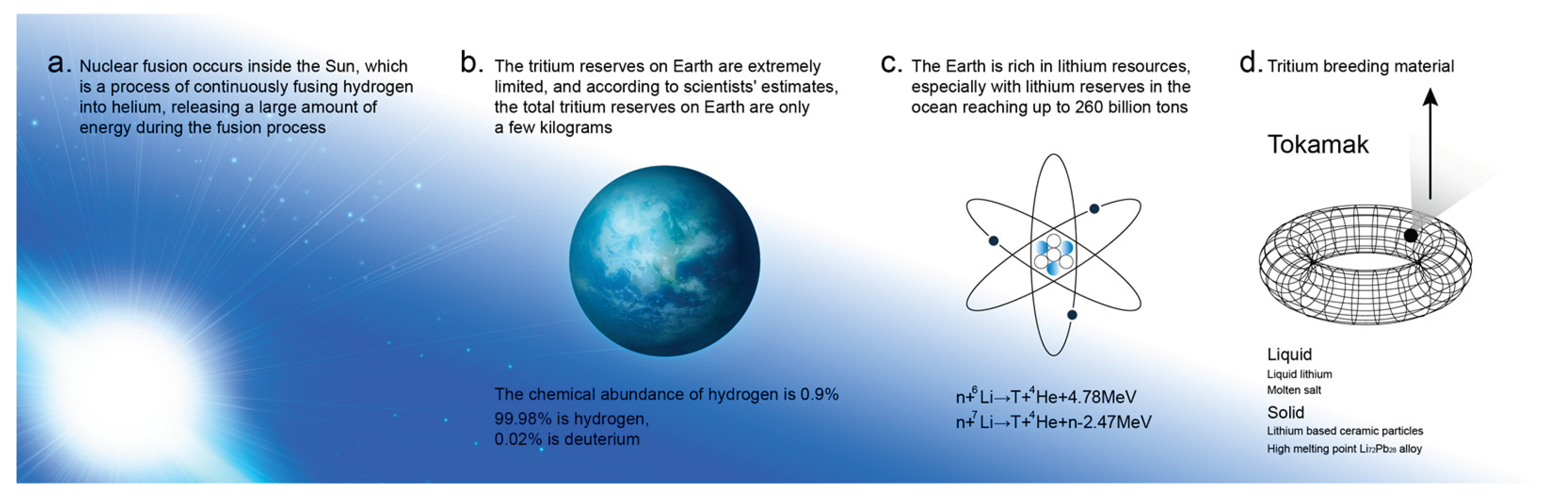
Figure 2.
Schematic diagram of cladding structure.
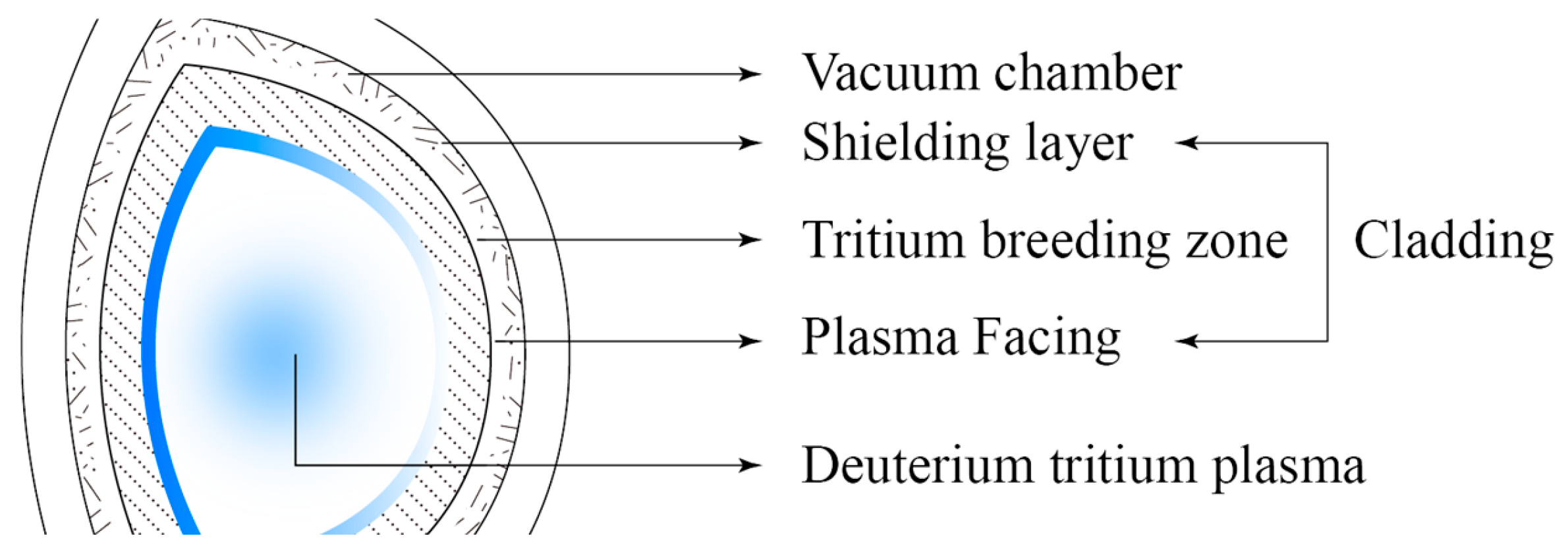
Figure 3.
Schematic diagram of tritium cycle principle.
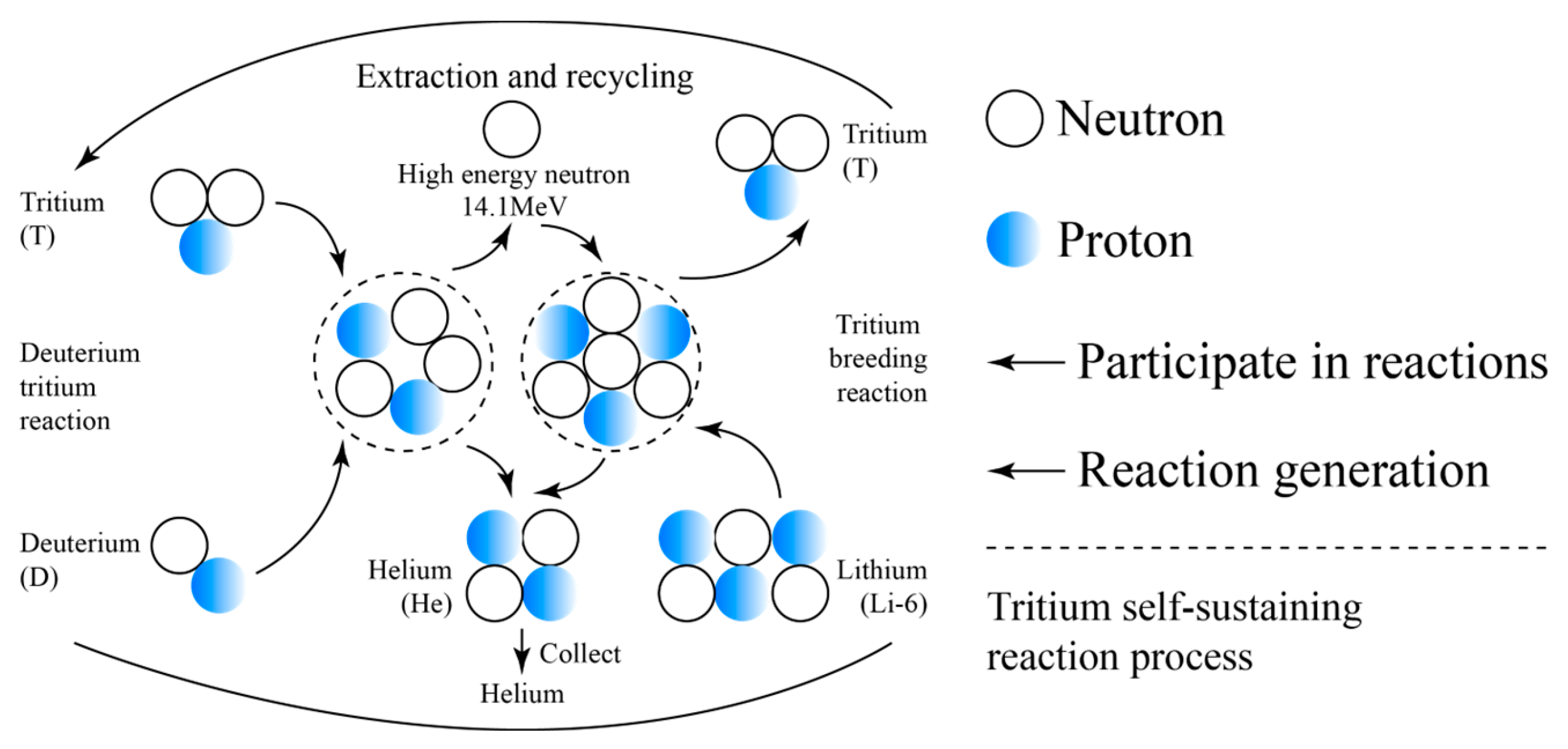
Figure 4.
Process flow diagram for the development of liquid Li17Pb83 alloy by Academician Yichan Wu’s team.
Figure 4.
Process flow diagram for the development of liquid Li17Pb83 alloy by Academician Yichan Wu’s team.

| Properties | Li | Li17Pb83 | Li2BeF4 | Li20Sn80 | Flinabe |
|---|---|---|---|---|---|
| Melting Point(◦C) | 180 | 235 | 459 | 330 | ~300 |
| Density(g/cm3) | 0.48 | 8.98 | 2.0 | 6.2 | 2.0 |
| Li Density(g/cm3) | 0.48 | 0.062 | 0.28 | 0.09 | 0.12 |
Table 2.
Advantages and disadvantages of candidate solid tritium breeding materials [55].
Table 2.
Advantages and disadvantages of candidate solid tritium breeding materials [55].
| Li2O | γ−LiAlO2 | Li2ZrO3 | Li2TiO3 | Li4SiO4 | |
|---|---|---|---|---|---|
| Advantages | High lithium density |
Good chemical stability |
Excellent tritium release performance |
Lowtritium release temperature |
Lowactivation issues |
| Good thermal conductivity |
Stable under irradiation |
--- | Good compatibility |
High lithium density |
|
| Lowactivation issues |
--- | --- | --- | --- | |
| Disadvantages | Sensitivity to moisture |
Lowlithium density |
Activation issues for Zr |
Reduction of Ti | Sensitivity to moisture |
| Significant swelling under irradiation |
Modest tritium release preformance |
--- | --- | --- | |
| High Li vaporization |
--- | --- | --- | --- |
| Candidate solid breeder materials | Melting Point(◦C) | Li Density(g/cm3) | Thermal Conductivity Coefficient at 1000 K (W/mK) |
|---|---|---|---|
| Li2O | 1433 | 0.93 | 3.4 |
| LiAlO2 | 1610 | 0.28 | 2.2 |
| Li4SiO4 | 1250 | 0.54 | 1.5 |
| Li2ZrO3 | 1616 | 0.33 | 1.3 |
| Li8ZrO6 | 1250 | 0.68 | 1.5 |
| Li2TiO3 | 1295 | 0.33 | 2.0 |
| Li72Pb28 | 999 | --- | --- |
| Lithium-Based material | Tritium Breeding Ratio Tally (14MeV) | Tritium Breeding Ratio Tally (2.5MeV) |
|---|---|---|
| Li(Pure Lithium) | 1.10905 | 0.543946 |
| Li2O(Lithium Oxide) | 1.09383 | 0.542774 |
| Li2ZrO3(Lithium Zirconate) | 0.974073 | 0.490369 |
| Li2TiO3(Lithium Titanate) | 0.980266 | 0.501079 |
| Li4SiO4(Lithium Orthosilicate) | 1.00325 | 0.525374 |
| LiCl(Lithium Chloride) | 1.04656 | 0.539386 |
| FLiBe(LiF and BeF2) | 1.08196 | 0.569398 |
| Li17Pb83 | 1.14519 | 0.570423 |
| Li72Pb28 | 1.08(Minimum, atomic ratio of Pb 20%) | 1.15(Maximum, atomic ratio of Pb 28%) |
Disclaimer/Publisher’s Note: The statements, opinions and data contained in all publications are solely those of the individual author(s) and contributor(s) and not of MDPI and/or the editor(s). MDPI and/or the editor(s) disclaim responsibility for any injury to people or property resulting from any ideas, methods, instructions or products referred to in the content. |
© 2024 by the authors. Licensee MDPI, Basel, Switzerland. This article is an open access article distributed under the terms and conditions of the Creative Commons Attribution (CC BY) license (http://creativecommons.org/licenses/by/4.0/).
Copyright: This open access article is published under a Creative Commons CC BY 4.0 license, which permit the free download, distribution, and reuse, provided that the author and preprint are cited in any reuse.


