Preprint
Article

This version is not peer-reviewed.

Predicting Intensive Care Unit Admission in COVID-19 Infected Pregnant Women Using Machine Learning

A peer-reviewed article of this preprint also exists.

Submitted:

18 November 2024

Posted:

19 November 2024

You are already at the latest version

Abstract

Background: The rapid onset of COVID-19 placed immense strain on many already overstretched healthcare systems. The unique physiological changes of pregnancy, amplified by the complex effects of COVID-19 in pregnant women, rendered prioritization of infected expectant mothers more challenging. This work aims to use state-of-the-art machine learning techniques to predict whether a COVID-19-infected pregnant woman will be admitted to ICU (Intensive Care Unit). Methods: A retrospective study using data from COVID-19 infected women admitted to 2 hospital 1 in Astana and 1 in Shymkent, Kazakhstan, from May to July 2021. The developed machine learning platform implements and compares the performance of eight binary classifiers including Gaussian naïve Bayes, K-nearest neighbors, logistic regression with L2 regularization, random forest, AdaBoost, gradient boosting, eXtreme gradient boosting, and linear discriminant analysis. Results: Data from 1168 pregnant women with COVID-19 was analyzed. From them, 9.4% were admitted to ICU. Logistic regression with L2 regularization achieved the highest F1-score during the model selection phase while achieving an AUC of 0.84 on the test set during the evaluation stage. Furthermore, the feature importance analysis conducted by calculating Shapley Additive Explanation values points to leucocyte counts, C-reactive protein, pregnancy week, and eGFR and hemoglobin as the most important features for predicting ICU admission. Conclusion: The predictive model here obtained may be an efficient support tool for prioritizing care of COVID-19 infected pregnant women in clinical practice.

Keywords: 

1. Introduction

The rapid onset of COVID-19 placed immense strain on many already overstretched healthcare systems. As the result of acute shortage of hospital beds and medical staff during the pandemic various stringent patient triage protocols were introduced. The unique physiological changes during pregnancy present challenges in understanding the full scope and effects of the complexity of COVID-19 infection on pregnant women rendering the clinical decision-making in these patients and risk-prioritization of expectant mothers even more challenging.
The disruption of SARS-CoV-2 not only significantly impacted societies, economies, and mental well-being, but also translated into the need to accurately estimate patient prognosis based on patient-specific risk. Identifying patients at high risk of complications is critical in moments of high caseloads. In the gestational period, the presentation of COVID-19 can vary significantly, encompassing asymptomatic cases, mild respiratory symptoms that require minimal supportive treatment, and severe cases leading to hospitalization with multi-organ failure and death [2]. Given the significant changes in the immune, circulatory, respiratory, and hormonal systems in addition to specific problems that appear during this period, such as preeclampsia or gestational diabetes, the full understanding of the COVID-19 impacts on pregnant women is yet to be clarified [3]. Moreover, research exploring the influence of different pregnancy trimesters on the disease's clinical progression and complications is scarce [4].
One of the critical factors during the pandemic was prioritizing patients in need of intensive care to avoid unnecessary consumption of medical resources on low and moderate-risk patients [5]. The sudden COVID-19 outbreak intensified the shortage of hospital beds, critical care equipment, and medical professionals [6]. Proper triage systems to predict the clinical course of patients become essential for efficient management of limited medical resources, including intensive care [7].
Machine Learning may classify severity and assess prognosis for COVID-19 patients across a variety of routinely collected laboratory tests and clinical data [8]. In this regard, machine learning can be viewed as a useful technique for supporting caregivers in medical decision-making, and it has been utilized in multiple COVID-19 studies to construct models that predict the severity of SARS-CoV-2 patients [9-10]. In this study we aim to use machine learning to predict ICU admission in COVID-19 infected pregnant woman. The constructed predictive models accurately assess the risk of the outcome and will allow for individualized preventive measures in clinical settings. Our results also shed light on major factors associated with the higher risk of ICU admission for pregnant women with COVID-19 infection.

2. Materials and Methods

2.1. Study Population

This retrospective study was conducted using de-identified data from medical records of pregnant women with COVID-19 admitted at Astana Perinatal Hospital and at the Department of Obstetrics and Gynecology South Kazakhstan Medical Academy in Shymkent from May 1, 2021, to July 14, 2021. All participants had their SARS-CoV-2 infection confirmed through real-time polymerase chain reaction (RT-PCR). The dataset includes 46 variables, which broadly covers information about days of admission after the onset of the symptoms, length of hospital stay, obstetric history, laboratory tests, clinical symptoms and severity of COVID-19, comorbidities, and complications (see Table 1 for detailed information about the variables). The comorbid disorders were presented as categorical variables encoded as “yes” and “no” subgroups. ICU admission was chosen as an outcome variable for prediction. The dataset is imbalanced, with the ratio of those admitted to ICU to those who are not admitted at 110:1058.
Ethical approval was obtained from Nazarbayev University Institutional Review Ethics Committee (NU-IREC) #745/12062023. The data were extracted from electronic medical records by practicing clinicians from the hospitals and provided de-identified for conducting these analyses. All methods were carried out in accordance with the “Reporting of studies conducted using observational routinely collected health data” (STROBE) guidelines.

2.2. Data Pre-processing

Several pre-processing steps were employed to prepare the dataset for the analysis. Initially, categorical variables were transformed using one-hot encoding. The dataset was randomly split into training and test sets. Missing feature values in the training and test sets were imputed based on the median of those values in the training data to prevent any data leakage between the training and test sets. The training set was normalized by applying standardization, whereas the test set was normalized based on the statistics obtained from the training set.

2.3. Model selection

Eight classifiers were used: Gaussian Naïve Bayes (GNB) [11], K-Nearest Neighbors (KNN) [11], Logistic Regression with L2 regularization (LR) [12], Random Forest (RF) [13], AdaBoost (ADB) [14], Gradient Boost (GB) [15], eXtreme Gradient Boost (XGB) [16], and Linear Discriminant Analysis (LDA) [17]. The best predictive model was selected according to the highest F1-score that was estimated using a stratified 5-fold cross-validation strategy applied on the training set.
It is worth noting that the decision-making threshold was considered as a hyperparameter and tuned in the model selection stage. Particularly, a classifier outputs the predicted class label for a given observation by comparing its assigned score with a predetermined threshold value. In this work, instead of using a default value (often 0 or 0.5), we treated the threshold value as an essential hyperparameter and optimized it along with other hyperparameters as a part of model selection. The hyperparameter space for threshold values comprises values from 0 to 1 with a step size of 0.01. The classifier-specific hyperparameter spaces are detailed in Table S1.

2.4. Model evaluation

The selected and trained predictive model was evaluated on the test set based on the following performance metrics: area under the curve (AUC), precision, sensitivity (recall), specificity, F1-score, and geometric mean of sensitivity and specificity (G-mean). These metrics are defined as follows:
p r e c i s i o n = T P T P + F P ,
s p e c i f i c i t y = T N T N + F P ,
s e n s i t i v i t y = T P T P + F N ,
F 1 s c o r e = 2 p r e c i s i o n r e c a l l p r e c i s i o n + r e c a l l ,
G m e a n = s p e c i f i c i t y s e n s i t i v i t y ,
where TP, FP, TN, and FN are the number of true positives, false positives, true negatives, and false negatives, respectively. The results are shown in Table 3.

2.5. SHAP analysis

Shapley Additive exPlanations (SHAP) analysis was used to examine the effect of each feature on the prediction of the classifier and assess the importance of the feature in predicting admission to the ICU.

2.8. Software and Packages

The entire computational pipeline was implemented in Python (version 3.9.7; Python Software Foundation) using the scikit-learn library. The computations were performed using the MacOS 13.1 (Ventura) operation system with Apple chip M1 and 8GB of RAM.

3. Results

3.1. Data Description

In this study, the initial database included 1287 cases collected from Astana Perinatal Hospital and from the Department of Obstetrics and Gynecology South Kazakhstan Medical Academy Shymkent. After eliminating those with incomplete data, 1168 pregnant women with COVID-19 were available for analysis (see Section 2.1). The data include 22 binary, 2 categorical, and 22 numeric features (see Table S2). The training and test sets were obtained by randomly dividing entire data into two disjoint sets with a splitting ratio of 70:30. The smaller subset was used as a test set, and the larger subset was used for training purposes. Stratification was used to keep the proportion of classes that appear in the training and test splits the same as the full dataset. The training set was used to obtain the best predictive model, while the test set was used for the evaluation of the obtained model. The main characteristics of the data are shown in Table 1. 69% of cases were in 3rd trimester and 10.7% required ICU admission.

3.2. Predictive Performance

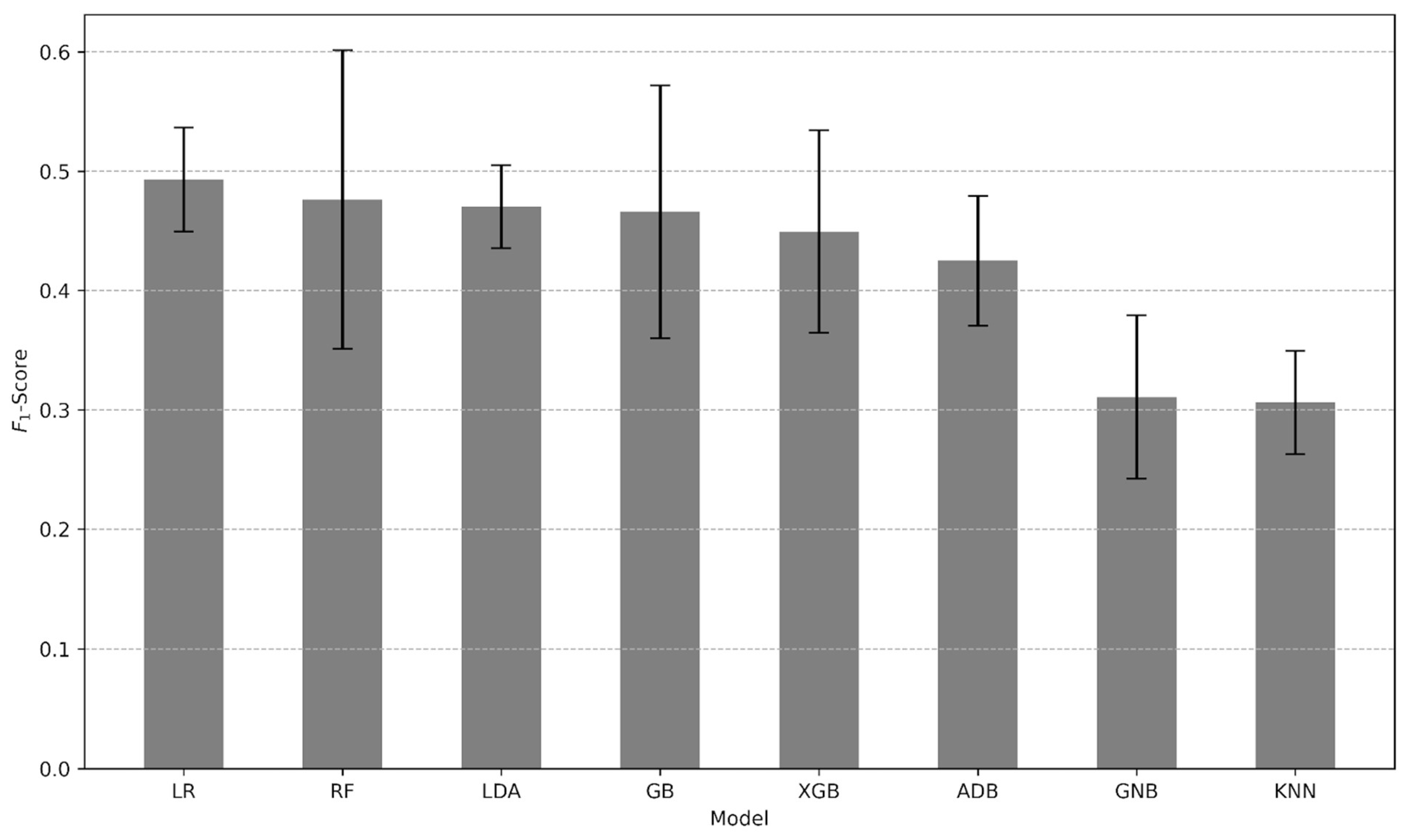
The machine learning pipeline included hyperparameter tuning using the grid search with a stratified 5-fold cross-validation strategy. As a result of model selection, the highest F1-score corresponds to the LR model with 0.4931±0.0434 F1-score (see Figure 1). Ultimately, the LR model with selected parameters and decision-making threshold value was evaluated using the test set. Table 2 presents the test-set performance metrics estimated using the best predictive LR model. The test-set confusion matrix for the LR classifier is presented in Table 3. The confusion matrix reflects a positive predictive value of 86%. 89.6% of ICU admissions were in women in 3rd trimesters. Cases with ICU admission were older, with higher BMI, with more pregnancies and deliveries. They had lower saturation, haemoglobin, and lymphocytes, and more elevated leucocytes, neutrophils, platelets and APTT. Preeclampsia, hypertension, hyperglycaemia and gestational diabetes were also frequent among these women.

3.3. Impact Direction and Importance of Each Feature

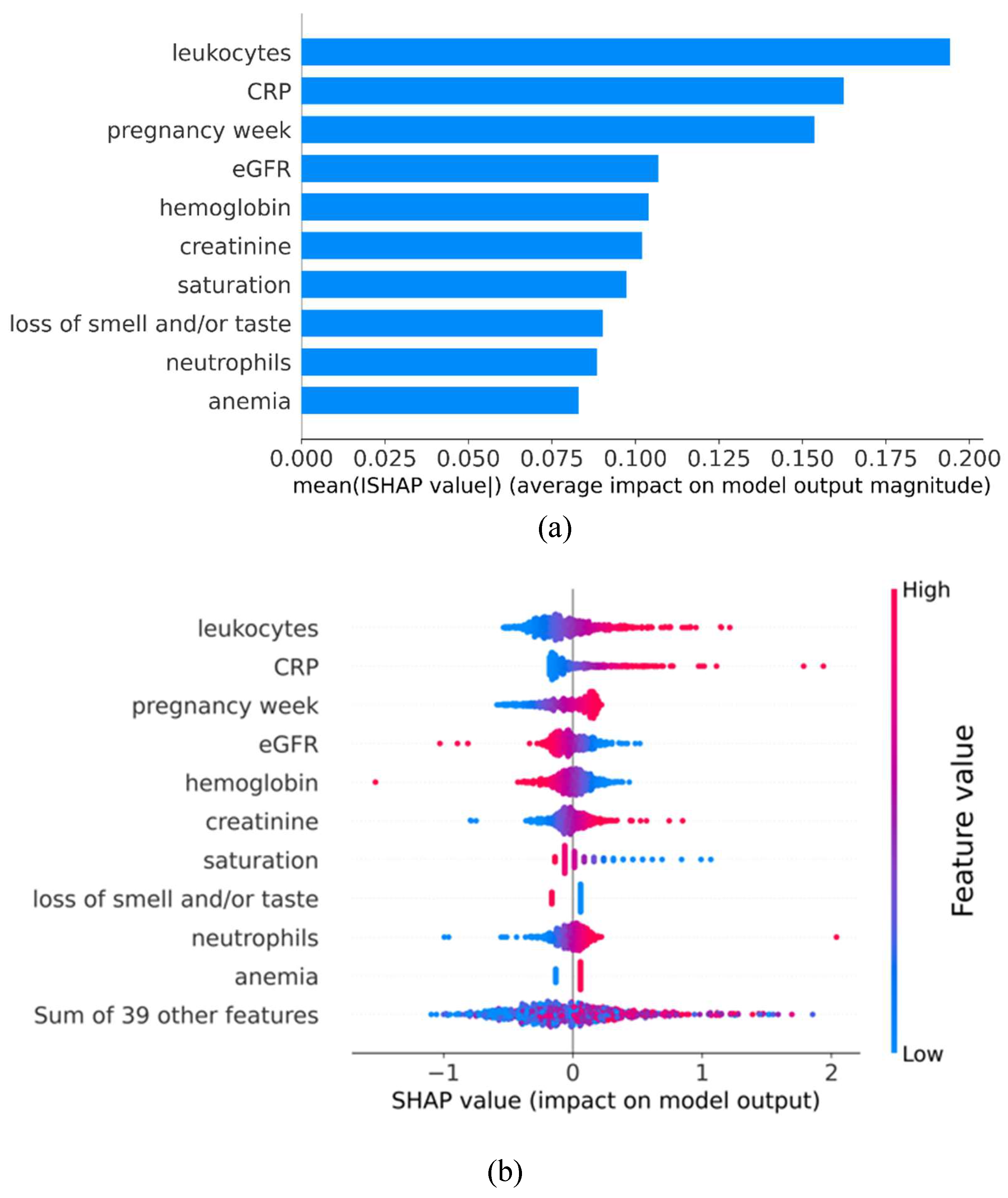
We utilized a SHAP analysis to assess the importance of each feature on ICU admission prediction using the trained LR classifier. Figures 2a and 2b depict the bar and beeswarm plot of the ten most important features according to SHAP values. In particular, the bar plot shows the ranking of the features in terms of their importance. In this case, we can see that leukocytes, CRP, and pregnancy week are the most important features on average. On the other hand, the beeswarm plot is designed to display an information-dense summary of how the top features in a dataset impact the model’s output. Each instance of the given explanation is represented by a single dot on each feature. Each position of the dot is determined by the SHAP value of that feature. Dots “pile up” along each feature row so that the width at a certain point represents the density. The colour code indicates the protective (blue) or higher risk (red) of admission to the ICU. For example, the high value of leukocytes yields positive SHAP values, meaning the direct dependence between leukocytes and a higher risk of admission to the ICU. At the same time, the high value of haemoglobin decreases the risk of ICU admission as it corresponds to negative SHAP values.

4. Discussion

We created a data repository consisting of data from 1168 patients to improve the prediction accuracy of adverse outcomes related to SARS-CoV-2 infection in pregnancy which were then used to train and test an ML algorithm that can predict cases with a low risk of developing adverse outcomes requiring ICU admission during hospitalization with an accuracy of 89%. This algorithm aims to conduct higher-level risk stratification to provide efficient decision-making and advance personalized medicine upon obtaining a positive SARS-CoV2 test in pregnant patients. During the COVID-19 pandemic, the perinatal centers in Astana and Shymkent were repurposed as infectious disease hospitals. All pregnant women with a positive result for coronavirus infection in these cities were admitted to this hospital generating the need for valid triage systems to determine the most efficient process of care for each patient within the consistently limited resources, like intensive care unit beds.
SHAP methodology is one of the most effective feature selection methods in Machine Learning [19], as it provides a relevance score for each parameter in every forecast.
Neutrophilia, leukocytosis, lymphopenia, and elevated platelet counts are hematological parameters associated with more severe COVID-19 infection in pregnant women [21]. While the precise pathophysiological explanation of these hematological abnormalities in COVID-19 patients is still unclear, changes in the number of one or more blood cells have often been reported frequently in patients infected with SARS-CoV-2 [22]. Leukocytosis and neutrophilia are inflammatory responses associated with disease severity and bad outcomes. Although neutrophilia may be more specific to severe disease than leukocytosis [23], leukocyte counts have been observed more frequently, compared with neutrophil ones, in more severe cases and in COVID-19-infected pregnant women [24]. Lymphopenia is another indicator of severe COVID-19 infection. In pregnant women, lymphopenia often signals an impaired immune response, placing these patients at higher risk for severe infection and complications, including ICU admission and preterm delivery. Neutrophil-to-Lymphocyte Ratios are valuable for detecting potentially critical and fatal cases of COVID-19 [25].
In terms of platelet counts, in cases admitted to ICU, even though they showed higher levels, they still remained in the normal range. Mild thrombocytopenia has been reported frequently in COVID-19 infection as well as rebound thrombocytosis [27]; however, none of these factors were detected as major contributing elements associated with ICU admission of COVID-19 infected pregnant women by our predictive models.
C-reactive protein (CRP) is another relevant factor associated with the risk of ICU admissions for pregnant women infected with COVID-19. CRP is recognized as a robust marker of acute systemic inflammation and severe infection [28]. Elevated CRP concentrations are associated with COVID-19 severity but are also typically reported in severe viral infections, including H1N1 influenza pneumonia [30, 31]. Elevated CRP levels are associated with severe COVID-19 cases in pregnancy [32], and have been linked with ICU admission, preterm labor, and poor maternal outcomes [33], as they reflect underlying inflammatory responses that are heightened in severe infections [34].
Anemia and low hemoglobin levels were also associated with a higher risk of severe infection requiring ICU [35]. From an etiological standpoint thrombosis, hemorrhage, and autoimmunity have been suggested for this association. During pregnancy, hemoglobin concentration is decreased. This is due to higher blood volume to supply oxygen and nutrients to the uterus, placenta, and other organs. Iron deficiency may also occur in pregnant women, due to increased need for iron, leading to further exacerbation of anemia during this period [36]. A decrease in circulating hemoglobin levels results in the reduction of oxygen availability for cells, which intensifies the hypoxia caused by COVID-19-induced acute respiratory distress syndrome [37]. In our study, anemia and hemoglobin counts had direct and inverse dependence respectively, on the risk of ICU admissions of COVID-19 infected pregnant women. Nevertheless, none of these factors were highly associated with the risk of ICU admission for these patients.
“Loss of smell” a common symptom in COVID-19 cases, has been found primarily in the less severe cases [38-39]. The mechanism that explains “loss of smell” in COVIDO-19 is largely unknown, so it’s unclear whether these findings may contradict or not previous evidence.
Gestational age at infection ≥ 31 weeks was an independent risk factor for severe–critical COVID-19 [40-42]. This phenomenon has been observed also in influenza infection [43], probably because of the physiological changes during pregnancy [44], such as reduced respiratory capacity, vascular and hemodynamic changes like an increased body fluid in the third space and compromised immune system due to the need for immune tolerance for the fetus, develop as pregnancy advances [45]. There is, however, some controversy regarding whether the risk that gestational age represents for COVID-19 infected pregnant women. There is, however, some controversy regarding the risk that gestational age represents for COVID-19-infected pregnant women [46-47]: as not all studies have identified this association.
A bidirectional relationship between kidney function and COVID-19 disease has been suggested [48]. Patients with low renal function have an increased risk of critical COVID-19 [49], higher risk of ICU admission [50-51] or mortality [52], although none of these studies have exclusively considered pregnant women population. Furthermore, while chronic kidney disease is associated with impairment of the immune system, it is still not known whether their worse COVID-19 outcome can be explained by a weaker antiviral response or by systemic inflammation [53].
Other studies have identified that more advanced age, due to possible age-related immune changes and potential comorbidities, and elevated BMI to represent a risk factor for more severe COVID-19 infection in pregnant women [47]. Previous research found pre-pregnancy obesity as a strong predictor of ICU admission, as it is linked with more severe COVID-19 cases, respiratory issues, and other metabolic complications [54]. Although in the unadjusted data we found this association, the final ML model did not include these variables as having relevant effect.
Similar lack of effects in the final ML model occur with comorbidities, like preeclampsia, hypertension, hyperglycemia or gestational diabetes [55]. Hypertension and other cardiovascular may elevate the likelihood of ICU admission for pregnant patients with COVID-19, as these conditions exacerbate the body’s inflammatory response, as well as diabetes and gestational diabetes, or preeclampsia. A possible explanation for the lack of effect of these problems is that they are actually reflected in the alterations in the inflammatory biomarkers (altered white blood cell count, and elevated CRP) that in this study are actually associated with a higher risk of admission to ICU, since these are parameters that are also altered in these obstetric conditions.
Severe dyspnea, low oxygen saturation (<94%), and the need for mechanical ventilation are direct predictors for ICU care. Respiratory complications are often more severe in pregnant women due to reduced lung capacity as the pregnancy progresses and are linked to pneumonia and Need for Ventilation. COVID-19-related pneumonia is a primary predictor of ICU admission, as it often requires mechanical ventilation to support oxygen levelsi [56].
Pregnancy maintenance relies on finely tuned immune adaptations as it has to maintain tolerance to the fetus while preserving innate and adaptive immune mechanisms for protection against microbial challenges [58]. These adaptations of active immunologic tolerance are precisely timed and reflect an immune clock of pregnancy in women delivering at term. The differences in susceptibility, variability in progression, and differences in the risk of COVID-19 infection severity are also associated with host genetic factors [58], like unfavorable genotypes of IFNL3/IFNL4 SNPs. Among pregnant patients with confirmed SARS-CoV-2 infection, reduced mucosal antibody responses were associated with greater infectious virus recovery and viral RNA levels [59].
Our study has some limitations. It is a retrospective study that was conducted in two centers. Women included in this analysis were those who either through spontaneous demand or being referred from ambulatory care were hospitalized, which could leave more vulnerable groups underrepresented. Because the participants were recruited from 2020 to 2021, they were unvaccinated as vaccination was not authorized in Kazakhstan for pregnant women during that period of time. This period of time covered includes the 2nd wave of COVID-19 cases in the country mostly related to the Delta variant. This variant has been associated with more severe progression in pregnancy with increased ICU admissions and increased need for advanced oxygen support. What may be the impact on pregnant women vaccinated or infected by other variants could not be derived from this data. During this period of time there were no homogeneous protocols/ICU admission criteria for these patients, and they were treated with different drugs (corticosteroids, lopinavir/ritonavir, azithromycin, hydroxychloroquine, interferon beta, tocilizumab, and prophylactic or therapeutic heparin). We could not analyze the possible association with higher risk of ICU admission of parameters like ferritin, interleukin-6 or d-dimer as they were only available for a reduced number of cases.
This study has also some relevant strengths. First, the large number of cases analyzed. Second, the use of methods that facilitate transparency and interpretability of the data, helping to explain not just what the model predicts, but why.

5. Conclusions

Routinely collected clinical and laboratory data of COVID-19-infected pregnant women may help recognize high-risk groups who are more liable for complications and more severe course or prognosis and require an ICU admission. These data may also contribute to enhancing our understanding of the pathogenesis of the disease and subsequently improve the outcome of patients. Our algorithm developed in the present study identifies biomarkers and clinical parameters that may help identify patients based on their risk profile for effective triaging of pregnant women infected with COVID-19. Thus, appropriate management can be planned for such cases before the patient develops further complications. The predictive model here obtained may be an efficient support tool for prioritizing care of COVID-19-infected pregnant women in clinical practice, especially in resource-strained healthcare systems.

Author Contributions

Conceptualization, A.S.S., A.Z., S.Z., Z.K.; methodology, A.S.S., A.Z.; Analysis, A.M., I.A., A.Z., A.Si., A.S.S.; data curation, K.T., A.M., K.J., A.Sa., A.Si.; writing—original draft preparation, A.S.S, A.M., I.A., A.Z., M.T., A.Si., G.G.; writing—review and editing, SZ, KN, ZK, KT, AM, KKJ, ASa, SK, GNA, BAE, KM; visualization, A.M., K.M., A.Z., G.G..; supervision, A.S.S., A.Z., S.Z., Z.K; project administration, A.S.S.; funding acquisition, A.S.S.

Funding

This research was sponsored by Nazarbayev University (Grant No. NU 021220CRP0822)..

Institutional Review Board Statement

Ethical approval was obtained from Nazarbayev University Institutional Review Ethics Committee (NU-IREC) #745/12062023. The data were extracted from electronic medical records by practicing clinicians from the hospitals and provided de-identified for conducting these analyses.

Informed Consent Statement

Data here analyzed was provided de-identify by clinicians from participating hospitals extracted from medical records for analysis. Given the retrospective nature of the study no informed consent was obtained.

Data Availability Statement

Data is available from the correspondence author upon request due to privacy and ethical restrictions.

Conflicts of Interest

The authors declare no conflicts of interest. The funders had no role in the design of the study; in the collection, analyses, or interpretation of data; in the writing of the manuscript; or in the decision to publish the results.

References

  1. McBride, O.; Murphy, J.; Shevlin, M.; Gibson-Miller, J.; Hartman, T.K.; Hyland, P.; Levita, L.; Mason, L.; Martinez, A.P.; McKay, R.; et al. Monitoring the psychological, social, and economic impact of the COVID-19 pandemic in the population: Context, design and conduct of the longitudinal COVID-19 psychological research consortium (C19PRC) study. Int. J. Methods Psychiatr. Res. 2020, 30, e1861. [Google Scholar] [CrossRef] [PubMed]
  2. Weiss, P.; Murdoch, D.R. Clinical course and mortality risk of severe COVID-19. 395, 2020; 395, 1014–1015. [Google Scholar] [CrossRef]
  3. Badr, D.A.; Mattern, J.; Carlin, A.; Cordier, A.-G.; Maillart, E.; El Hachem, L.; El Kenz, H.; Andronikof, M.; De Bels, D.; Damoisel, C.; et al. Are clinical outcomes worse for pregnant women at ≥20 weeks’ gestation infected with coronavirus disease 2019? A multicenter case-control study with propensity score matching. 2020, 223, 764–768. [Google Scholar] [CrossRef]
  4. Rizzo, G.; Mappa, I.; Maqina, P.; Bitsadze, V.; Khizroeva, J.; Makatsarya, A.; D’antonio, F. Effect of SARS-CoV-2 infection during the second half of pregnancy on fetal growth and hemodynamics: A prospective study. Acta Obstet. et Gynecol. Scand. 2021, 100, 1034–1039. [Google Scholar] [CrossRef] [PubMed]
  5. Hwangbo, S.; Kim, Y.; Lee, C.; Lee, S.; Oh, B.; Moon, M.K.; Kim, S.-W.; Park, T. Machine learning models to predict the maximum severity of COVID-19 based on initial hospitalization record. Front. Public Heal. 2022, 10, 1007205. [Google Scholar] [CrossRef]
  6. Artiga-Sainz, L.M.; Sarria-Santamera, A.; Martínez-Alés, G.; Quintana-Díaz, M. New Approach to Managing the COVID-19 Pandemic in a Complex Tertiary Care Medical Center in Madrid, Spain. Disaster Med. Public Heal. Prep. 2021, 16, 2097–2102. [Google Scholar] [CrossRef]
  7. (Sabitova), A.K.; Ortega, M.-A.; Ntegwa, M.J.; Sarria-Santamera, A. Impact of the COVID-19 pandemic on access to and delivery of maternal and child healthcare services in low-and middle-income countries: a systematic review of the literature. Front. Public Heal. 2024, 12, 1346268. [Google Scholar] [CrossRef]
  8. Laatifi, M.; Douzi, S.; Bouklouz, A.; Ezzine, H.; Jaafari, J.; Zaid, Y.; El Ouahidi, B.; Naciri, M. Machine learning approaches in Covid-19 severity risk prediction in Morocco. J. Big Data 2022, 9, 1–21. [Google Scholar] [CrossRef]
  9. Xiong, Y.; Ma, Y.; Ruan, L.; Li, D.; Lu, C.; Huang, L.; the National Traditional Chinese Medicine Medical Team. Comparing different machine learning techniques for predicting COVID-19 severity. Infect. Dis. Poverty 2022, 11, 19. [Google Scholar] [CrossRef]
  10. Wendland, P.; Schmitt, V.; Zimmermann, J.; Häger, L.; Göpel, S.; Schenkel-Häger, C.; Kschischo, M. Machine learning models for predicting severe COVID-19 outcomes in hospitals. Informatics Med. Unlocked 2023, 37, 101188. [Google Scholar] [CrossRef]
  11. Duda RO, Hart PE, Stork DG. Pattern Classification. New York: Wiley; 2001.
  12. Hastie T, Tibshirani R, Friedman JH, The Elements of Statistical Learning. Springer Series in Statistics; 2009.
  13. Breiman, L. Random forests. Mach. Learn. 2001, 45, 5–32. [Google Scholar] [CrossRef]
  14. Freund, Y.; Schapire, R.E. A Decision-Theoretic Generalization of On-Line Learning and an Application to Boosting. J. Comput. Syst. Sci. 1997, 55, 119–139. [Google Scholar] [CrossRef]
  15. Friedman, J.H. Greedy function approximation: A gradient boosting machine. Ann. Stat. 2001, 29, 1189–1232. [Google Scholar] [CrossRef]
  16. Chen, T.; Guestrin, C. XGBoost: A Scalable Tree Boosting System. In Proceedings of the KDD ’16: 22nd ACM SIGKDD International Conference on Knowledge Discovery and Data Mining, San Francisco, CA, USA, 13–17 August 2016; Association for Computing Machinery: New York, NY, USA, 2016; pp. 785–794. [Google Scholar] [CrossRef]
  17. Anderson, T.W. Classification by multivariate analysis. Psychometrika 1951, 16, 31–50. [Google Scholar] [CrossRef]
  18. Lundberg, SM, Lee, SI. A unified approach to interpreting model predictions. Advances in neural information processing systems 2017;30.
  19. El-Kady, A.M.; Aldakheel, F.M.; Allemailem, K.S.; Almatroudi, A.; Alharbi, R.D.; Al Hamed, H.; Alsulami, M.; A Alshehri, W.; El-Ashram, S.; Kreys, E.; et al. Clinical Characteristics, Outcomes and Prognostic Factors for Critical Illness in Hospitalized COVID-19 Patients in Saudi Arabia: A Retrospective Cohort Study. Int. J. Gen. Med. 2022, ume 15, 6945–6963. [Google Scholar] [CrossRef]
  20. Sun, G.; Zhang, Y.; Liao, Q.; Cheng, Y. Blood Test Results of Pregnant COVID-19 Patients: An Updated Case-Control Study. Front. Cell. Infect. Microbiol. 2020, 10, 560899. [Google Scholar] [CrossRef]
  21. Gajendra, S. Spectrum of hematological changes in COVID-19. . 2022, 12, 43–53. [Google Scholar]
  22. Huang, G.; Kovalic, A.J.; Graber, C.J. Prognostic Value of Leukocytosis and Lymphopenia for Coronavirus Disease Severity. Emerg. Infect. Dis. 2020, 26, 1839–1841. [Google Scholar] [CrossRef]
  23. Yazdani, A.N.; Abdi, A.; Velpuri, P.; Patel, P.; DeMarco, N.; Agrawal, D.K.; Rai, V. A Review of Hematological Complications and Treatment in COVID-19. Hematol. Rep. 2023, 15, 562–577. [Google Scholar] [CrossRef]
  24. Wool, G.D.; Miller, J.L. The Impact of COVID-19 Disease on Platelets and Coagulation. Pathobiology 2020, 88, 15–27. [Google Scholar] [CrossRef]
  25. Giannis, D.; Ziogas, I.A.; Gianni, P. Coagulation disorders in coronavirus infected patients: COVID-19, SARS-CoV-1, MERS-CoV and lessons from the past. 127, 1043; 62. [Google Scholar] [CrossRef]
  26. Li, F.; He, M.; Zhou, M.; Lai, Y.; Zhu, Y.; Liu, Z.; Wang, Y.; Wang, Y. Association of C-reactive protein with mortality in Covid-19 patients: a secondary analysis of a cohort study. Sci. Rep. 2023, 13, 1–10. [Google Scholar] [CrossRef]
  27. Ikeagwulonu RC, Ugwu NI, Ezeonu CT, Ikeagwulonu ZC, Uro-Chukwu HC, Asiegbu UV, Obu DC, Briggs DC. C-Reactive Protein and Covid-19 Severity: A Systematic Review. West Afr J Med. 2021;38(10):1011-1023.
  28. Vasileva, D.; Badawi, A. C-reactive protein as a biomarker of severe H1N1 influenza. Inflamm. Res. 2018, 68, 39–46. [Google Scholar] [CrossRef] [PubMed]
  29. Plebani, M. Why C-reactive protein is one of the most requested tests in clinical laboratories? cclm 2023, 61, 1540–1545. [Google Scholar] [CrossRef] [PubMed]
  30. Yamamoto, R.; Asano, H.; Umazume, T.; Takaoka, M.; Noshiro, K.; Saito, Y.; Nakagawa, K.; Chiba, K.; Nakakubo, S.; Nasuhara, Y.; et al. C-reactive protein level predicts need for medical intervention in pregnant women with SARS-CoV2 infection: A retrospective study. J. Obstet. Gynaecol. Res. 2022, 48, 938–945. [Google Scholar] [CrossRef] [PubMed]
  31. Smith, E.R.; Oakley, E.; Grandner, G.W.; Rukundo, G.; Farooq, F.; Ferguson, K.; Baumann, S.; Waldorf, K.M.A.; Afshar, Y.; Ahlberg, M.; et al. Clinical risk factors of adverse outcomes among women with COVID-19 in the pregnancy and postpartum period: a sequential, prospective meta-analysis. Am. J. Obstet. Gynecol. 2022, 228, 161–177. [Google Scholar] [CrossRef]
  32. Chen, M.; Zeng, J.; Liu, X.; Sun, G.; Gao, Y.; Liao, J.; Yu, J.; Luo, X.; Qi, H. Changes in physiology and immune system during pregnancy and coronavirus infection: A review. Eur. J. Obstet. Gynecol. Reprod. Biol. 2020, 255, 124–128. [Google Scholar] [CrossRef]
  33. Abu-Ismail, L.; Taha, M.J.J.; Abuawwad, M.T.; Al-Bustanji, Y.; Al-Shami, K.; Nashwan, A.; Yassin, M. COVID-19 and Anemia: What Do We Know So Far? Hemoglobin 2023, 47, 122–129. [Google Scholar] [CrossRef]
  34. Aziz, M.; Goyal, H.; Haghbin, H.; Lee-Smith, W.M.; Gajendran, M.; Perisetti, A. The Association of “Loss of Smell” to COVID-19: A Systematic Review and Meta-Analysis. Am. J. Med Sci. 2020, 361, 216–225. [Google Scholar] [CrossRef]
  35. Purja, S.; Shin, H.; Lee, J.-Y.; Kim, E. Is loss of smell an early predictor of COVID-19 severity: a systematic review and meta-analysis. Arch. Pharmacal Res. 2021, 44, 725–740. [Google Scholar] [CrossRef]
  36. Berumen-Lechuga, M.G.; Leaños-Miranda, A.; Molina-Pérez, C.J.; García-Cortes, L.R.; Palomo-Piñón, S. Risk Factors for Severe–Critical COVID-19 in Pregnant Women. J. Clin. Med. 2023, 12, 5812. [Google Scholar] [CrossRef]
  37. Kalafat, E.; Prasad, S.; Birol, P.; Tekin, A.B.; Kunt, A.; Di Fabrizio, C.; Alatas, C.; Celik, E.; Bagci, H.; Binder, J.; et al. An internally validated prediction model for critical COVID-19 infection and intensive care unit admission in symptomatic pregnant women. Am. J. Obstet. Gynecol. 2021, 226, 403.e1–403.e13. [Google Scholar] [CrossRef]
  38. Abdelmola, A.; Albasheer, O.; Kariri, A.; Akkam, F.M.; Hakami, R.; Essa, S.; Jali, F.M. Characteristics and Outcomes of Coronavirus Disease- 2019 Among Pregnant Women in Saudi Arabia; a Retrospective Study. Int. J. Women's Heal. 16. [CrossRef]
  39. Dawood, F.S.; Garg, S.; Fink, R.V.; Russell, M.L.; Regan, A.K.; A Katz, M.; Booth, S.; Chung, H.; Klein, N.P.; Kwong, J.C.; et al. Epidemiology and Clinical Outcomes of Hospitalizations for Acute Respiratory or Febrile Illness and Laboratory-Confirmed Influenza Among Pregnant Women During Six Influenza Seasons, 2010–2016. J. Infect. Dis. 2019, 221, 1703–1712. [Google Scholar] [CrossRef] [PubMed]
  40. Vouga, M.; Favre, G.; Martinez-Perez, O.; Pomar, L.; Acebal, L.F.; Abascal-Saiz, A.; Hernandez, M.R.V.; Hcini, N.; Lambert, V.; Carles, G.; et al. Maternal outcomes and risk factors for COVID-19 severity among pregnant women. Sci. Rep. 2021, 11, 1–11. [Google Scholar] [CrossRef] [PubMed]
  41. Shoji, K.; Tsuzuki, S.; Akiyama, T.; Matsunaga, N.; Asai, Y.; Suzuki, S.; Iwamoto, N.; Funaki, T.; Yamada, M.; Ozawa, N.; et al. Clinical Characteristics and Outcomes of Coronavirus Disease 2019 (COVID-19) in Pregnant Women: A Propensity Score–Matched Analysis of Data From the COVID-19 Registry Japan. Clin. Infect. Dis. 2022, 75, e397–e402. [Google Scholar] [CrossRef] [PubMed]
  42. Ghosh, R.; Ghosh, R.; Gutierrez, J.P.; Gutierrez, J.P.; Ascencio-Montiel, I.d.J.; Ascencio-Montiel, I.d.J.; Juárez-Flores, A.; Juárez-Flores, A.; Bertozzi, S.M.; Bertozzi, S.M. SARS-CoV-2 infection by trimester of pregnancy and adverse perinatal outcomes: a Mexican retrospective cohort study. BMJ Open 2024, 14, e075928. [Google Scholar] [CrossRef]
  43. Arakaki, T.; Hasegawa, J.; Sekizawa, A.; Ikeda, T.; Ishiwata, I.; Kinoshita, K. Risk factors for severe disease and impact of severity on pregnant women with COVID-19: a case–control study based on data from a nationwide survey of maternity services in Japan. BMJ Open 2022, 12, e068575. [Google Scholar] [CrossRef]
  44. Schiffl, H.; Lang, S.M. Long-term interplay between COVID-19 and chronic kidney disease. Int. Urol. Nephrol. 2023, 55, 1977–1984. [Google Scholar] [CrossRef]
  45. Cei, F.; Chiarugi, L.; Brancati, S.; Montini, M.S.; Dolenti, S.; Di Stefano, D.; Beatrice, S.; Sellerio, I.; Messiniti, V.; Gucci, M.M.; et al. Early reduction of estimated Glomerular Filtration Rate (eGFR) predicts poor outcome in acutely ill hospitalized COVID-19 patients firstly admitted to medical regular wards (eGFR-COV19 study). Biomed. Pharmacother. 2022, 153, 113454–113454. [Google Scholar] [CrossRef]
  46. Mirijello, A.; Piscitelli, P.; de Matthaeis, A.; Inglese, M.; D’errico, M.M.; Massa, V.; Greco, A.; Fontana, A.; Copetti, M.; Florio, L.; et al. Low eGFR Is a Strong Predictor of Worse Outcome in Hospitalized COVID-19 Patients. J. Clin. Med. 2021, 10, 5224. [Google Scholar] [CrossRef]
  47. Li, W.-X.; Xu, W.; Huang, C.-L.; Fei, L.; Xie, X.-D.; Li, Q.; Chen, L. Acute cardiac injury and acute kidney injury associated with severity and mortality in patients with COVID-19. 25, 2114. [Google Scholar] [CrossRef]
  48. Mikami, T.; Miyashita, H.; Yamada, T.; Harrington, M.; Steinberg, D.; Dunn, A.; Siau, E. Risk Factors for Mortality in Patients with COVID-19 in New York City. J. Gen. Intern. Med. 2020, 36, 17–26. [Google Scholar] [CrossRef]
  49. Blazquez-Navarro, A.; Mittmann, L.; Thieme, C.J.; Anft, M.; Paniskaki, K.; Doevelaar, A.; Seibert, F.S.; Hoelzer, B.; Konik, M.J.; Berger, M.M.; et al. Impact of low eGFR on the immune response against COVID-19. J. Nephrol. 2022, 36, 199–202. [Google Scholar] [CrossRef]
  50. Tossetta, G.; Fantone, S.; Muti, N.D.; Balercia, G.; Ciavattini, A.; Giannubilo, S.R.; Marzioni, D. Preeclampsia and severe acute respiratory syndrome coronavirus 2 infection: a systematic review. J. Hypertens. 2022, 40, 1629–1638. [Google Scholar] [CrossRef] [PubMed]
  51. Aghaeepour, N.; Ganio, E.A.; Mcilwain, D.; Tsai, A.S.; Tingle, M.; Van Gassen, S.; Gaudilliere, D.K.; Baca, Q.; McNeil, L.; Okada, R.; et al. An immune clock of human pregnancy. Sci. Immunol. 2017, 2. [Google Scholar] [CrossRef] [PubMed]
  52. Kinder, J.M.; Turner, L.H.; Stelzer, I.A.; Miller-Handley, H.; Burg, A.; Shao, T.-Y.; Pham, G.; Way, S.S. CD8+ T Cell Functional Exhaustion Overrides Pregnancy-Induced Fetal Antigen Alloimmunization. Cell Rep. 2020, 31, 107784–107784. [Google Scholar] [CrossRef] [PubMed]
  53. Zahid, W.; Farooqui, N.; Zahid, N.; Ahmed, K.; Anwar, M.F.; Rizwan-Ul-Hasan, S.; Hussain, A.R.; Sarría-Santamera, A.; Abidi, S.H. Association of Interferon Lambda 3 and 4 Gene SNPs and Their Expression with COVID-19 Disease Severity: A Cross-Sectional Study. Infect. Drug Resist. 2023, ume 16, 6619–6628. [Google Scholar] [CrossRef]
  54. Clair, L.A.S.; Eldesouki, R.E.; Sachithanandham, J.; Yin, A.; Fall, A.; Morris, C.P.; Norton, J.M.; Abdullah, O.; Dhakal, S.; Barranta, C.; et al. Reduced control of SARS-CoV-2 infection associates with lower mucosal antibody responses in pregnancy. mSphere 2024, 9, e0081223. [Google Scholar] [CrossRef]
i Chinn J, Sedighim S, Kirby KA, et al. Characteristics and Outcomes of Women With COVID-19 Giving Birth at US Academic Centers During the COVID-19 Pandemic. JAMA Netw Open. 2021;4(8):e2120456. doi:10.1001/jamanetworkopen.2021.20456
Figure 1. Estimated F1-scores mean ± standard deviation over 5 folds of 5-fold cross-validation obtained on the training set.
Preprints 139966 g001
Figure 2. a Bar plot of top 10 features (from highest to lowest importance) based on mean |SHAP value|, b Beeswarm plot of top 10 features (from highest to lowest importance) based on SHAP value.
Preprints 139966 g002
Table 1. Baseline Demographic and Clinical Characteristics n=786.
Trimester of gestation
Characteristic 1st trimester
(n=73)
2nd trimester
(n=309)
3rd trimester
(n=770)
ICU Admission
(n=138)
Feature
Age 30.1 29.9 29.6 31
Blood type
A 13 73 252 39
AB 5 27 67 9
B 20 96 225 34
O 28 106 251 31
Rh factor
- 4 16 29 5
+ 62 286 765 108
BMI 23.69 25.09 26.78 29.06
Days of admission after symptoms onset 4.22 4.43 4.70 5.86
Length of hospital stay 7.88 8.40 6.74 9.00
Obstetric history
Number of children 1.42 1.20 1.76 1.96
Number of pregnancies 2.69 2.65 2.81 2.97
Number of deliveries 1.28 1.21 1.74 2.04
Multiple gestation 0 4 4 1
Laboratory tests
Haemoglobin 11.9 10.6 10.6 9.9
Leucocytes 6.89 8.44 9.18 12.5
Neutrophils 71.85 78.38 79.00 85
Lymphocytes 22.77 16.59 17.12 13.1
Platelets 202.8 213.7 220.6 247.5
APTT 29.20 31.57 31.91 35.99
ALT 29.37 38.30 22.92 36.00
ACT 27.40 35.98 29.57 42.00
Comorbidities and complications
Preeclampsia 0 4 27 12
Small for gestational age 0 2 17 2
Intrauterine growth restriction 0 0 17 3
Hypertension 1 20 76 25
Hyperglycaemia 3 58 116 29
Gestational diabetes 1 11 33 13
Anaemia 17 184 636 108
Pneumonia 35 168 499 89
Clinical symptoms and severity of COVID-19
Fever 39 140 274 47
Cough 64 292 689 102
Weakness 71 307 802 124
Sore throat 35 205 480 55
Shortness of breath 16 69 183 45
Myalgia 20 116 259 48
Loss of smell and/or taste 38 116 218 32
Runny nose 53 239 607 77
Diarrhoea 6 13 12 0
Chest discomfort 14 75 185 37
Sweating 3 10 34 7
ICU Admission 0 14 121
Table 2. Test-set performance metrics estimated using the best-predictive Logistic Regression model.
Accuracy Precision Sensitivity Specificity G-mean F1-score ROC AUC
0.866 0.389 0.600 0.896 0.733 0.472 0.845
Table 3. Confusion matrix obtained on the test set using the best-predictive LR model. Positive an negative labels represent ICU admitted and non-admitted, respectively.
Predicted
Actual Negative Positive
Negative True Negative: 283 False Positive: 33
Positive False Negative: 14 True Positive: 21
Disclaimer/Publisher’s Note: The statements, opinions and data contained in all publications are solely those of the individual author(s) and contributor(s) and not of MDPI and/or the editor(s). MDPI and/or the editor(s) disclaim responsibility for any injury to people or property resulting from any ideas, methods, instructions or products referred to in the content.
Copyright: This open access article is published under a Creative Commons CC BY 4.0 license, which permit the free download, distribution, and reuse, provided that the author and preprint are cited in any reuse.
Prerpints.org logo

Preprints.org is a free preprint server supported by MDPI in Basel, Switzerland.

Subscribe

Disclaimer

Terms of Use

Privacy Policy

Privacy Settings

© 2025 MDPI (Basel, Switzerland) unless otherwise stated