

Submitted:
28 March 2025
Posted:
31 March 2025
Read the latest preprint version here
Abstract
Hawking’s cosmology logically leads to an observed multiverse. This article argues it is a superposition of at least three 3-dimensional universes in a 4-dimensional space, of which two dimensions overlap with our universe. Nothing that could disturb the superposition exists outside it. This explains why dark matter causes a linear decrease in gravity with distance to visible mass at large radii in galaxies. To support this, the visible matter distribution in the disks and bulges, calculated by the SPARC team, and the observed rotation velocities have been used. Lelli and Mistele showed that the common way to project dark matter halos around galaxies cannot be valid. Since General Relativity would need these halos too, it must be modified with additional terms, or an added wire-like mass must be modelled in galaxies with the Levi-Civita metric. Bekenstein and the paper in hand respectively do this. Using TeVeS, the decay of the contribution of dark matter to gravity with the expansion of space is confirmed. This explains the rapid development of large galaxies in the early universe as reported by Labbé. A new prediction method for rotation velocities that works at all radii in galaxies is offered. It is 21 to 28 % more accurate than MOND and TeVeS. It gives a logical explanation of the meaning of Milgrom's contant and the Tully-Fisher relationship does directly follow from the hypothesis.
Keywords:
1. Introduction
2. Hawking´s Cosmology and Superposition State of Universe, MOND and TeVeS
2.1. Big Bang Theory
2.2. Hawking´s Cosmology and String theory
2.3. How a Superposition State Can Have Classical Effects
2.4. Introduction to MOND and TeVeS Theories
3. A Hypothesis on the Nature of Dark Matter
- Hawking’s cosmology is a logical combination of two well proven theories, quantum mechanics and Big Bang theory, and thus, it is a good description of the earliest stages of our universe.
- Our universe results from a Big Bang that was in a quantum superposition state at its start, that can be interpreted as 10500 alternative histories in an 11-dimensional space, using the Feynman interpretation of quantum mechanics and String-theory.
- The realization of our universe from the 10500 alternative histories cannot have occurred without a sentient observer.
- Our universe has been realized.
- At least one sentient observer exists, which can have come into being in the universe following the conclusion of Wheeler’s delayed choice experiments.
- Since it is not economical to consider 10500 a fine-tuned number, aimed at creating exactly one universe with sentient being, there still remains a superposition state of more than one alternative histories of the universe. This makes it a multiverse, each universe with sentient beings. This multiverse still exists by means of a state of superposition, which must not necessarily be disturbed by de-coherence, since nothing exists outside the multiverse.
- The other universes in superposition can follow a history comparable with ours that leads to sentient beings, but do not necessarily share all our spatial dimensions in the 11-dimensional space, but do have nearly exactly the same constants of nature. From the delayed choice experiment it follows they all have the same causal status.
- The gravity of these superposed 11-dimensional universes acts together just like the binding force in a deuteron and as a result the gravitational accelerations and potentials caused by baryonic matter in these universes should be added.
- Since there are more ways to yield partly overlapping universes in an 11-dimensional space than fully overlapping, the odds are that there exist multiple universes that share only one or two dimensions with our universe.
- Gravity acting in our universe resulting from the mass in a 2-dimensional cross section of another one, must act through such a 2-dimensional cross section and hence leads to a linear decrease of the gravitational acceleration as a function of distance from such a mass and hence to a logarithmic potential.
- The existence of multiple universes that share two dimensions with our universe in a state of superposition, forms a natural explanation of what dark matter is and together with the previous step to and explanation for the flat rotation curves at large distances from the core of galaxies.
4. Elaboration of the Hypothesis on the Nature of Dark Matter
4.1. Exploring the Logical Consequences of Hawkings’s Cosmology and String theory
4.2. Geometrical Considerations Leading to Logarithmic Potential
4.3. Interpreting Linear MOND-Like Behaviour of Gravity
4.4. Linear Mass Density Describing Dark Matter
4.5. Further Considerations and Summary of Chapter 4
5. Testable Predictions
5.1. First Prediction
5.2. Second Prediction
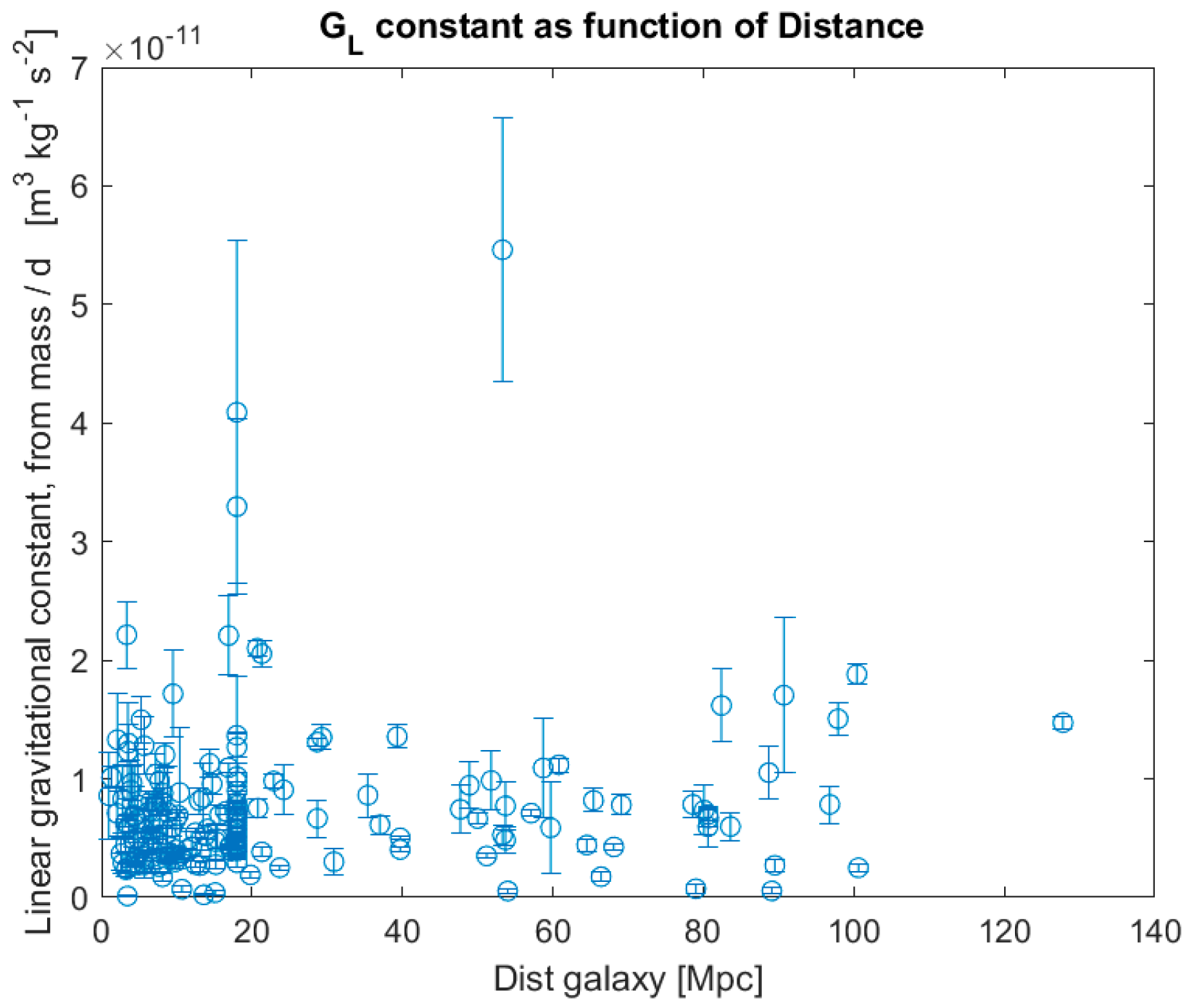
5.3. Third Prediction
5.3.1. Checking consistency with TeVeS
5.3.2. Assessment of Evolution in Time with TeVeS
5.3.3. Further Support for an Evolution in Time
5.4. Fourth Prediction

| Yml | MOND vs. glinear+gbar | TeVeS vs. glinear+gbar |
|---|---|---|
| Prediction one GL | 10 % | 17 % |
| Prediction 175 values for GL | 21 % | 28 % |
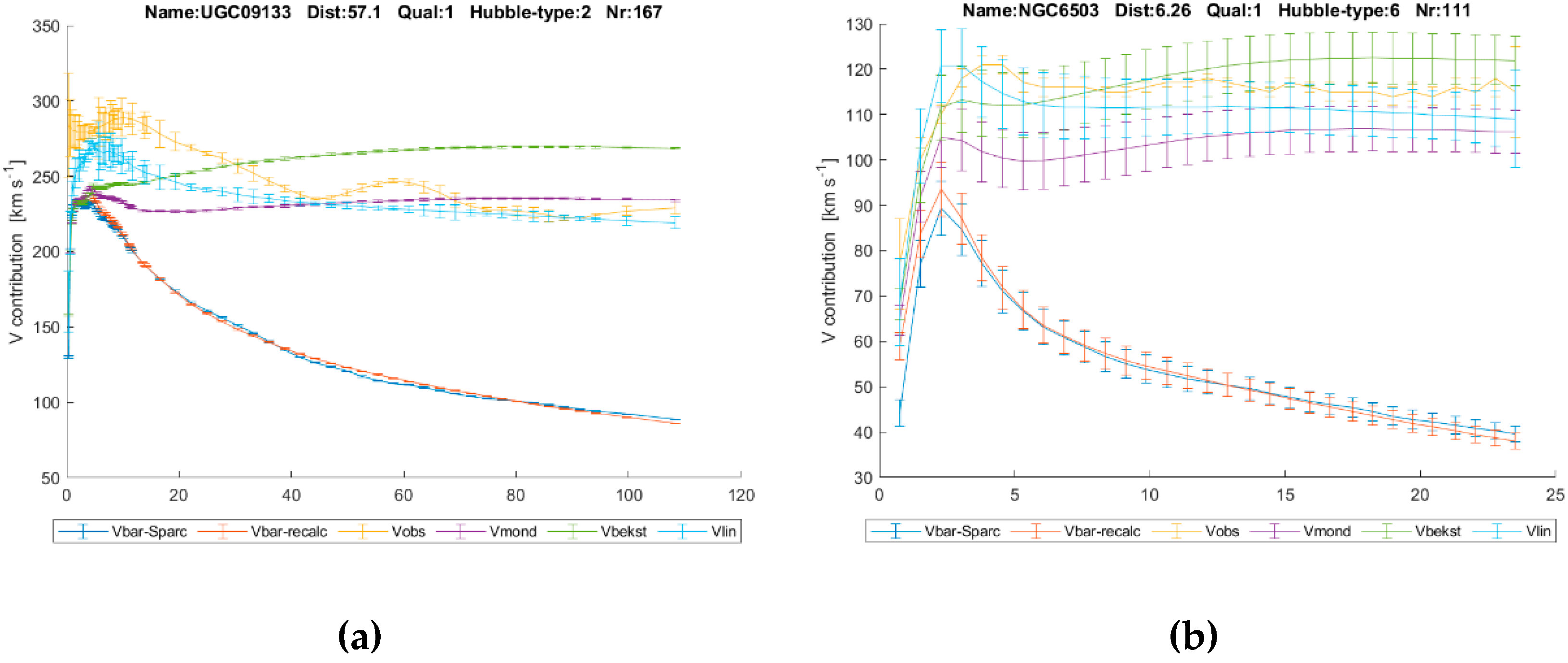
- Calculate the Newtonian gravitational acceleration at R, from the baryonic mass distribution with formulas (17) and (18).
- From the same baryonic mass distribution, already available from step 1), calculate the sum of mass/distance at R, only taking the mass density in the rotation plane into account.
- Assuming a value GL ≈ 4.6 x 10⁻¹² [m3 kg-1 s-2], calculate the additional linear gravitational acceleration with formula (10) and (19).
- Correct the computed linear gravitational acceleration at time t with the ratio current radius of the universe / radius at time t.
- Add the Newtonian gravitational acceleration to the linear gravitational acceleration and compute the rotation velocity.
5.5. Fifth Prediction
5.6. Sixth Prediction
6. Conclusions and Suggestions for Further Work
References
- Milgrom M. 1983, A modification of the Newtonian dynamics as a possible alternative to the hidden mass hypothesis, ApJ 270.
- Banik, I.; Zhao, H. From Galactic Bars to the Hubble Tension: Weighing Up the Astrophysical Evidence for Milgromian Gravity. Symmetry 2022, 14, 1331. [Google Scholar] [CrossRef]
- Bekenstein J.D. 2004, Relativistic gravitation theory for the modified Newtonian dynamics paradigm, PHYSICAL REVIEW D, VOLUME 70, 083509.
- Verlinde, E.P. Verlinde, E. P. 2017, Emergent Gravity and the Dark Universe, In: SciPost Phys. 2 (3 2017).
- Levi-Civita, T. 1915 Rend. Acad. Lincei 28 101.
- Santos N.O., Wang A., Cylindrically Symmetric Fields in General Relativity, arXiv:2304.07353v1, 2023.
- Hartle, J.; Hawking, S. 1983, Wave function of the Universe, Physical Review D. 28 (12): 2960.
- Hawking S.W, Mlodinow L. 2010, The Grand Design (Bantam Press and Transworld Publishers, London, United Kingdom).
- Mistele, T.; et al. Mistele, T. et al. 2024, Indefinitely Flat Circular Velocities and the Baryonic Tully-Fisher Relation from Weak Lensing. arXiv:2406.09685v1 [astro-ph.GA] 14 Jun 2024.
- Hossenfelder S. 2019, (German translation) Das Hässliche Universum, Warum unsere Suche nach Schönheit die Physik in die Sackgasse führt (4th edition; S. FISCHER Verlag, Frankfurt am Main, Germany) (original title: Lost in Math, How Beauty leads Physics astray, Basic Books, New York, USA).
- Lelli F. et al, 2016, SPARC: MASS MODELS FOR 175 DISK GALAXIES WITH SPITZER PHOTOMETRY AND ACCURATE ROTATION CURVES, AJ, 152:157 (14pp), http://astroweb.cwru.edu/SPARC.
- Starkman N. et al. 2018, A New Algorithm to Quantify Maximum Discs in Galaxies, MNRAS 000, 1–10 (2018).
- Heuvel E. P. J. Van den 2012, Oerknal, Oorsprong van de eenheid van het heelal (Big Bang, Origin of the unity of the universe)(Veen Magazines B.V., Diemen, The Netherlands).
- Everett H. 1957, Relative State Formulation of Quantum Mechanics, RvmP, 29,.
- DeWitt B., S. Quantum Theory of Gravity. I. The Canonical Theory. Phys. Rev. 1967, 160, 1113–1148. [Google Scholar] [CrossRef]
- Griffiths D.J., Schroeter D.F. 2018, Introduction to Quantum Mechanics (3rd ed.; Cambridge University Press, Cambridge, United Kingdom).
- Ma, Xiao-song; Kofler, Johannes; Zeilinger, Anton (2016-03-03). "Delayed-choice gedanken experiments and their realizations". Reviews of Modern Physics. 88 (1): 015005.
- Strominger, A., & Vafa, C. (1996). Microscopic Origin of the Bekenstein-Hawking Entropy. Physics Letters B, 379(1-4), 99-104. arXiv:hep-th/9601029.
- Maldacena, J. (1999). The Large N Limit of Superconformal Field Theories and Supergravity. Advances in Theoretical and Mathematical Physics, 2(2), 231-252. arXiv:hep-th/9711200.
- Mathur, S. D. (2005). The Fuzzball Proposal for Black Holes: An Elementary Review. Fortschritte der Physik, 53(7-8), 793-827. arXiv:hep-th/0502050.
- Bethe H.A. 1940, A Meson Theory of Nuclear Forces, Part II, Theory of the Deuteron, PHYSICAL REVIEW VOLUME 57, 390.
- Ginzburg, V. L., & Landau, L. D. (1950). On the theory of superconductivity. ZhETF, 20(6), 1064-1082.
- Guth, A. H. (1981). Inflationary universe: A possible solution to the horizon and flatness problems. Physical Review D, 23(2), 347-356.DOI: 10.1103/PhysRevD.23.347.
- McFadden, J.; Al-Khalili, J. The Origins of Life: Quantum Mechanics and the Emergence of Life. Physics of Life Reviews 2014, 11, 310–327. [Google Scholar] [CrossRef]
- Kroupa, P.; et al. 2022, Asymmetrical tidal tails of open star clusters: stars crossing their cluster's path challenge Newtonian gravitation". Monthly Notices of the Royal Astronomical Society. 517 (3): 3613–3639.
- Schilling G. 2021, (Dutch translation) De Olifant in het Universum, Donkere materie.
- Platschorre A.D. 2019, On Covariant Emergent Gravity, bachelor thesis, Delft University, The Netherlands.
- hou, T., Modesto, L., & Li, Q. (2023). Geometric Origin of the Galaxies’ Dark Side. Universe, 10(1), Article 19. https://doi.org/10.3390/universe10010019.
- Rees M. 2000, Just Six Numbers (Basic Books, New York, USA).
- Lemaître, A. G. 1931, Contributions to a British Association Discussion on the Evolution of the Universe, Nature 128 (3234), 704–706.
- Darling D. 2006, (Dutch translation) Zwaartekracht, van Aristoteles tot Einstein en verder (Uitgeverij Veen Magazines, Diemen, The Netherlands), (original title: Gravity’s Arc, John Wiley & Sons, Hoboken, USA, 2006).
- Han, J.J., Conroy, C., Hernquist, L. 2023, A tilted dark halo origin of the Galactic disk warp and flare. Nat Astron 7, 1481–1485 (2023). https://doi.org/10.1038/s41550-023-02076-9. [CrossRef]
- Kregel M., Kruit P.C., De Grijs R. 2002, Flattening and truncation of stellar discs in edge-on spiral galaxies Mon. Not. R. Astron. Soc. 334, 646–668 (2002).
- Martinsson, T P. K., et al. 2016, The DiskMass Survey. X. Radio synthesis imaging of spiral galaxies, Astronomy & Astrophysics 585.
- Ku, H. H. 1966, Notes on the use of propagation of error formulas, Journal of Research of the National Bureau of Standards 70C (4).
- Kruit P.C. van der, Freeman K.C. 2010, Galaxy disks, Kapteyn Astronomical Institute, University of Groningen, The Netherlands.
- Sparke L.S., Gallagher S. 2007, Galaxies in the Universe, An introduction (2nd ed; Cambridge University Press, Cambridge, United Kingdom).
- Grijs R. de 1998. The global structure of galactic discs, Mon. Not. R. Astron. Soc. 299, 595–610 (1998).
- Begelman M., Rees, M. 2021, Gravity’s Fatal Attraction, Black Holes in the Universe (3rd ed.; Cambridge University Press, Cambridge, United Kingdom).
- Riess A.G. et al. 2022, A Comprehensive Measurement of the Local Value of the Hubble Constant with 1 km s 1 Mpc 1 Uncertainty from the Hubble Space Telescope and the SH0ES Team, The Astrophysical Journal Letters, 934:L7 ( 52pp ) , 2022 July 20.
- Schutz, B.F. 2003, A first course in general relativity (Cambridge University Press, Cambridge, United Kingdom).
- Zhang, P.; Liguori, M.; Bean, R; Dodelson, S. 2007, Probing Gravity at Cosmological Scales by Measurements which Test the Relationship between Gravitational Lensing and Matter Overdensity, Physical Review Letters, 99 (14): 141302.
- Seifert, M. D. 2007, "Stability of spherically symmetric solutions in modified theories of gravity", Physical Review D, 76 (6): 064002, arXiv:gr-qc/0703060, Bibcode:2007PhRvD..76f4002S, doi:10.1103/PhysRevD.76.064002, S2CID 29014948.
- Labbé, I., van Dokkum, P., Nelson, E. et al. 2023, A population of red candidate massive galaxies ~600 Myr after the Big Bang. Nature 616, 266.
- Sanders, R.H. 2008, Forming galaxies with MOND, Mon. Not. R. Astron. Soc. 386, 1588–1596 (2008).
- McGaugh, S.S. , Schombert, J.M., 2024, Accelerated Structure Formation: The Early Emergence of Massive Galaxies and Clusters of Galaxies, The Astrophysical Journal, 976:13 (19pp).
- Zeilinger, A. Experiment and the foundations of quantum physics. Rev. Mod. Phys 1999, 71, S288–S297. [Google Scholar] [CrossRef]
- Matlab 2021, MATLAB® is a registered trademark and MATLAB Grader is a trademark of The MathWorks, Inc, Natick, USA.
Disclaimer/Publisher’s Note: The statements, opinions and data contained in all publications are solely those of the individual author(s) and contributor(s) and not of MDPI and/or the editor(s). MDPI and/or the editor(s) disclaim responsibility for any injury to people or property resulting from any ideas, methods, instructions or products referred to in the content. |
© 2025 by the authors. Licensee MDPI, Basel, Switzerland. This article is an open access article distributed under the terms and conditions of the Creative Commons Attribution (CC BY) license (http://creativecommons.org/licenses/by/4.0/).


