

Submitted:
14 November 2024
Posted:
18 November 2024
You are already at the latest version
Abstract
The Belostomatidae is a family of aquatic Heteropteran insects that normally inhabit swamps of tropical, subtropical and temperate regions where they naturally feed on a large range of prey, mainly fish, amphibians and reptiles. However, these arthropods can occasionally bite humans when provoked, causing pain. The only species of giant water bug known to be found in Europe is Lethocerus (L.) patruelis. We have reported the occasional finding of a specimen of L. patruelis female in Southern Italy. The arthropod was collected by a tourist on his body while he lying down on a beach close to a nature reserve. To finalize the giant water bug identification, both morphological and molecular tools were used for the first time in our country. Herein, information on cases of patients bitten by giant water bugs belonging to Belostomatidae family are reported and circumstances involving their contact with humans are also discussed.
Keywords:
Lethocerus patruelis
; aquatic insects
; freshwater habitats
1. Introduction
Belostomatids are a group of aquatic hemipterans that include the largest – up to 120 mm long- representative of Heteroptera also known as giant water bugs, electric-light bugs or tadpole killers and water cockroaches. These insects are widely distributed in tropical, subtropical and temperate regions [1] and live in limnic environments such as rivers, streams, lakes and ponds. They play a role as bioindicators, predators and biocontrol agents of mosquito’s larvae and snails [2,3]. In different Asiatic Countries, some Belostomatidae members are important edible insects [4].
The family Belostomatidae include about 170 species and it is subdivided into both the subfamilies Belostomatinae, with eight genera, and Lethocerinae, with three genera. The latter includes Lethocerus represented in Europe by one only specie Lethocerus (L.) patruelis [5].
L. patruelis, as well as the other members of this family, naturally catch a large range of prey, such as small reptiles, amphibians, fish, birds and insect larvae, including mosquitoes [6]. The prey, reached through the flight or quickly captured on the ground, is immobilized with hooked limbs and penetrated using a robust chitinous rostrum. Then, prey is injected with a digestive saliva that contains several enzymes with paralyzing agents [7,8]. Although the members of Belastomatidae family are specifically not arthropods of medical interest, some species can occasionally inflict bites to humans, when disturbed [9]. Herein, we describe a case of finding of belostomatid specimen on a man and we provide information on the status and potential role of these insects in human-frequented areas in Italy.
2. Materials and Methods
In late August of 2023, the Local Health Agency (ASL) in Taranto municipality (Italy, Apulia region) delivered a plastic box to the Istituto Zooprofilattico di Puglia e Basilicata which contained a big bug stored in alcohol at 70%, suspected to be dangerous to humans, with an identification request. Anamnesis referred that the arthropod was promptly collected while it was setting down on the foot of a 48-year-old man, who was lying down on the local beach very close to a nature reserve. Very alarmed, the man collected the insect by beach towel, put it in a plastic container and delivered it to the Veterinary Services of the local ASL. The identification was performed according to Novoselsky 's morphological keys [10] and confirmed by molecular methods. The total genomic DNA was extracted with the commercial kit GeneJET Genomic DNA Purification Kit (Thermo Scientific, Vilnius, Lithuania) from the specimen’s visceral component. DNA was used as a template in a PCR targeting the mitochondrial cytochrome c oxidase subunit I (COX1) according to Folmer et al. [11] and PCR products were electrophoresed on 2% agarose gel and stained with Sybr® Safe (Thermo Scientific, Milan, Italy). A standard UV transilluminator (Bio-Rad, Milan, Italy) was used to visualize the separated products. The amplicon was purified by the GeneJET PCR Purification Kit (Thermo Scientific) and was sent to the Eurofins Genomics (Milan, Italy) to determinate their nucleotide sequence using the Sanger technique by the PCR products Big Dye Terminator Kit (Thermo Scientific). Assays were performed strictly according to the manufacturer's instructions. The final sequence was assembled and submitted to GenBank with the accession number OR864365.1. BLAST (https://blast.ncbi.nlm.nih.gov/Blast.cgi) was used to compare this sequence to others in GenBank and the corresponding sequences were chosen and aligned with the one from this study using the ClustalW algorithm [12]. A phylogenetic tree was inferred using the MEGA6 program and the two-parameter Kimura method with branch support estimated from 1000 bootstrap replicates was applied using the Cimex lectularius species as outgroup sequence.
3. Results
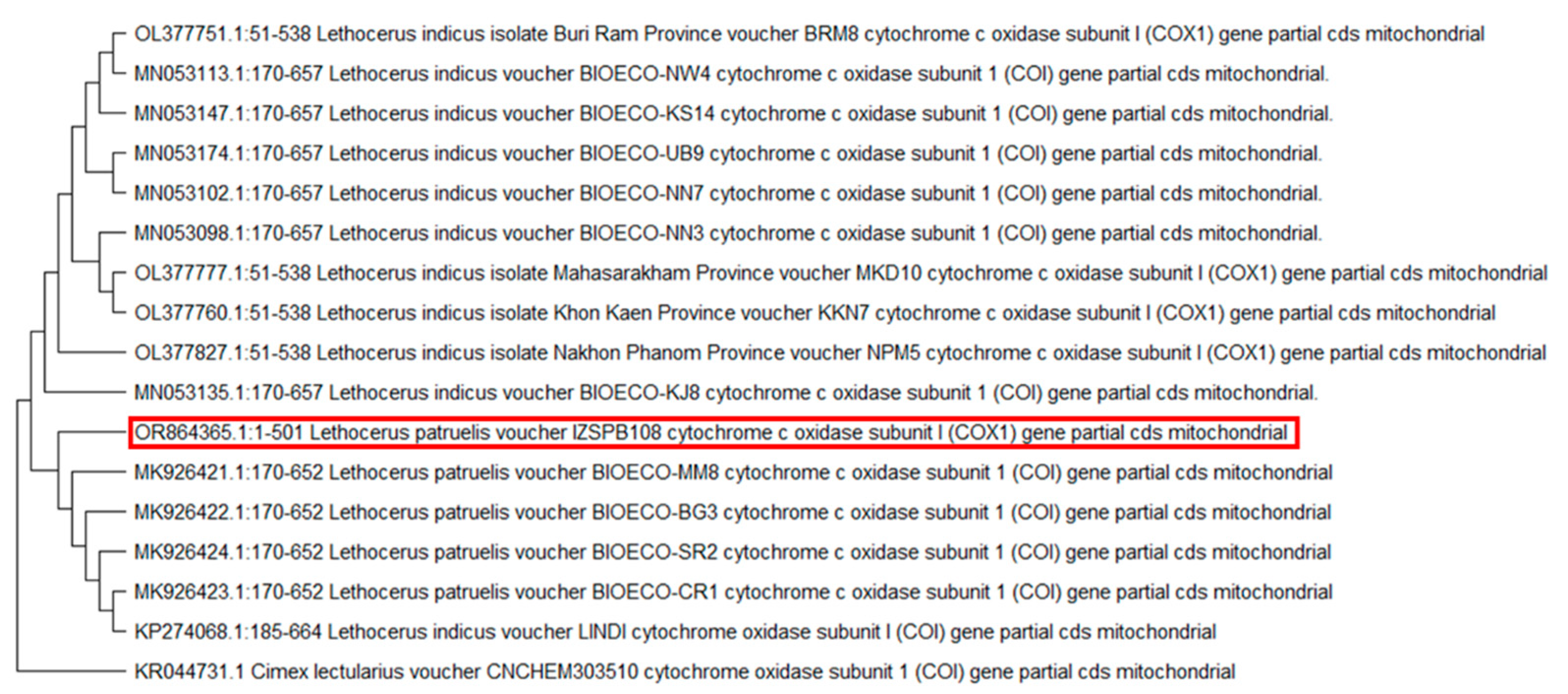
According Novoselsky’s morphological features, the specimen was identified as a female Lethocerus patruelis (80mm long and 20mm large) (Figure 1, Figure 2). A fragment of the cytochrome c oxidase subunit I (COX1) gene (710 base pairs [bp]) was successfully amplified (accession number OR864365.1). The subsequent molecular analysis and the BLAST analysis showed that the yielded amplicon was 98,96% identical to the corresponding region of the NCBI sequences of the L. patruelis mitochondrial partial COX1 gene. The phylogenetic analysis showed that the obtained sequence clusters with those of L. patruelis linked to the Asian group, except for the only one sequence KP274068.1 referred to L. indicus (Figure 3).
4. Discussion
Lethocerus patruelis, Stål, 1854, is the only European Belostomatidae species and the largest true bug in this Continent. This non-native insect is widely distributed in south-eastern European Countries, mainly within the Balkan Peninsula. In the last decades, this arthropod was recorded more times in Southern Italy, in localities close to sea ports and nature reserves. Authors hypothesize that the distribution of L. patruelis in certain Italian areas may be linked to marine traffic [13], likely reflecting a westward expansion [14]. In fact, adults are usually attracted by the lights, including those of ships; this behavior may have favored the repeated introduction of individuals from the Balkan countries to localities close to the Adriatic coasts (Abruzzi and Apulia regions) where favorable ecoclimatic conditions could also permit the reproduction of L. patruelis [14].
This aquatic arthropod naturally preys upon vertebrate animals, such as small fish and amphibians as both adults and larvae living in freshwater habitats such as streams, ponds and coastal areas where they show their ability to swim and hunt their victims. Occasionally, members of the Belostomatidae family can also bite humans. However, medical texts and parasitology manual do not mention them in relation to human injuries because they are not specifically arthropods of medical interest and information on this topic remains poorly and limited to few medical reports. Particularly, Haddad et al. 2010 report seven episodes of human attacks by Belostomatidae from Brazil, occurring in individuals (ichthyologists) working/playing in small rivers and ponds inhabited by giant water bugs. In all the cases, a red point was visible on the bite sites, mostly localized on hands and fingers but also on the forearm and foot. The observed clinical manifestations varied from 1 to 5 hours, and they range from mild to intense edema with severe, excruciating pain sometimes referred as pulsatile; transitory anaesthesia followed by paraesthesia of the forearm was also reported in zoologist attacked by Lethocerus delpontei. In the remaining described cases insect identification was restricted to the level of Belostomatidae family.
In Europe, the only one case of a human puncture by Belostomatidae’s member was observed in Italy in 2010, precisely in Apulia region in a locality close to the Adriatic Sea. The occasional attack involving a woman bathing herself in the sea. Intense pain in the bite site and transitory and mild fever (37.5°C) was registered in the patient for few hours [15]. The case was attributed to member of the genus Lethocerus but it is probable that the involved species was L. patruelis, the only confirmed taxon of the European Belostomatidae family and more than fifty times reported in the Apulia same region where its potential suitable habitats (wetlands, aquatic environments) [14,16]. Authors report that some species (Lethocerus) appear to be able to live in seawater—at least for a while [17].
Although proof of its naturalization has yet to be found, data suggests that a viable population of L. patruelis could be possible in Southern Italy [16]; consequently, the encounter of this alien insect with man could be not a remote possibility in this area. For this reason, in addition to literature, data could be very useful to acquire more information on the presence and diffusion of this belostomatid arthropod through unconventional data sources, such as citizen science, online forums, etc as suggested by Lo Parrino and Tomasi [18].
Because the encounter between this insect and man may accidentally result in a puncture, the sightings of L. patruelis should receive adequate attention by the Health Services other than by the entomologists, mainly in certain areas of the Adriatic coast, such as showed in the reported case herein. Furthermore, belostomatids are also very large insects and even just one encounter with them could raise alarm in tourist localities and in the summer season. In fact, in Southern Italy, a high number of reports of L. patruelis occur in August through September in proximity of seaside areas, such as also observed in the described episode. Summer clothing exposing the body, especially areas such as the feet, could make humans more vulnerable likely in case of puncture due to unexpected defense of the insect. Unsurprisingly, members of the Belastomatidae family have been dubbed "toe-biters" because they can produce excruciating bites if inadvertently harassed by the bare-footed.
L. patruelis specimen examined in this study is included in the Asiatic cluster of L. patruelis. To date, only African Belostomatidae exhibit persistent colonization with Mycobacterium ulcerans, an environmental pathogen causing the Buruli ulcer disease, debilitating cutaneous disease mainly spread in West Africa and they may have a role in the epidemiology of this infection [19]. The molecular approach on belostomatids may provide both correct identifying and useful information on the possible origin of the collected specimens and it is used herein for the first time in Italy. However, the obtained molecular data is not conclusive, and the study of further genes would be necessary to better understand the possible origin of the collected specimens and their role. At the date, this is the first Italian case of finding close to humans securely attributable to L. patruelis and it also adds information on the possible human exposure to this arthropod in wetlands favorable to its colonization. Although this insect is of no specific medical interest, in areas with previous presence of the giant water bug may also be useful provide information to the local Health Services to consider as a possible cause of human dread and injuries when accidently disturbed.
Author Contributions
Conceptualization, M.G.C. and M.A.C.; methodology, M.A.C., D.A.R and M.G.C; software, M.G.C. and D.A.R ; validation, M.A.C, D.A.R, M.G.C ; formal analysis, D.A.R. and M.G.C; investigation, D.A.R., M.G.C., S.P.G., A.C.D., E.F. and M.A.C.; resources, M.A.C.; data curation, M.A.C. and M.G.C.; writing—original draft preparation, M.G.C. and M.A.C.; writing—review and editing, D.A.R.,M.G.C., S.P.G., A.C.D., E.F., M.A.C.; visualization, D.A.R. and M.G.C.; supervision, M.A.C.; project administration, M.A.C.; funding acquisition, M.A.C. All authors have read and agreed to the published version of the manuscript.
Funding
This research received no external funding.
Data Availability Statement
Data are available at https://www.ncbi.nlm.nih.gov/nuccore/OR864365.1.
Conflicts of Interest
The authors declare no conflicts of interest.
References
- Mattson, R.A. An Introduction to the Aquatic Insects of North America. R. W. Merritt, K. W. Cummins. J. North Am. Benthol. Soc. 1996, 15, 401–403. [Google Scholar] [CrossRef]
- Swart, C.C.; Deaton, L.E.; Felgenhauer, B.E. The Salivary Gland and Salivary Enzymes of the Giant Waterbugs (Heteroptera; Belostomatidae). Comp. Biochem. Physiol. A. Mol. Integr. Physiol. 2006, 145, 114–122. [Google Scholar] [CrossRef] [PubMed]
- Ohba, S. Ecology of Giant Water Bugs (Hemiptera: Heteroptera: Belostomatidae). Entomol. Sci. 2019, 22, 6–20. [Google Scholar] [CrossRef]
- Meyer-Rochow, V.B.; Changkija, S. Uses of Insects as Human Food in Papua New Guinea, Australia, and North-East India: Cross-cultural Considerations and Cautious Conclusions. Ecol. Food Nutr. 1997, 36, 159–185. [Google Scholar] [CrossRef]
- Davranoglou, L.-R.; Karaouzas, I. Further Distributional Records of Lethocerus Patruelis (Stål, 1854) (Heteroptera: Belostomatidae) in Greece. Ecol. Montenegrina 2021, 41, 56–61. [Google Scholar] [CrossRef]
- Ribeiro, J.R.I.; Ohba, S.-Y.; Pluot-Sigwalt, D.; Stefanello, F.; Bu, W.; Meyin-A-Ebong, S.E.; Guilbert, E. Phylogenetic Analysis and Revision of Subfamily Classification of Belostomatidae Genera (Insecta: Heteroptera: Nepomorpha). Zool. J. Linn. Soc. 2018, 182, 319–359. [Google Scholar] [CrossRef]
- Silva-Cardoso, L.; Caccin, P.; Magnabosco, A.; Patrón, M.; Targino, M.; Fuly, A.; Oliveira, G.A.; Pereira, M.H.; Do Carmo, M.D.G.T.; Souza, A.S.; et al. Paralytic Activity of Lysophosphatidylcholine from Saliva of the Waterbug Belostoma Anurum. J. Exp. Biol. 2010, 213, 3305–3310. [Google Scholar] [CrossRef] [PubMed]
- Haddad Junior, V.; Amorim, P.C.H.D.; Haddad Junior, W.T.; Cardoso, J.L.C. Venomous and Poisonous Arthropods: Identification, Clinical Manifestations of Envenomation, and Treatments Used in Human Injuries. Rev. Soc. Bras. Med. Trop. 2015, 48, 650–657. [Google Scholar] [CrossRef] [PubMed]
- Haddad, V.; Schwartz, E.F.; Schwartz, C.A.; Carvalho, L.N. Bites Caused by Giant Water Bugs Belonging to Belostomatidae Family (Hemiptera, Heteroptera) in Humans: A Report of Seven Cases. Wilderness Environ. Med. 2010, 21, 130–133. [Google Scholar] [CrossRef] [PubMed]
- Novoselsky, T.; Chen, P.; Nieser, N. A Review of the Giant Water Bugs (Hemiptera: Heteroptera: Nepomorpha: Belostomatidae) of Israel. 2018. [CrossRef]
- Folmer, O.; Black, M.; Hoeh, W.; Lutz, R.; Vrijenhoek, R. DNA Primers for Amplification of Mitochondrial Cytochrome c Oxidase Subunit I from Diverse Metazoan Invertebrates. Mol. Mar. Biol. Biotechnol. 1994, 3, 294–299. [Google Scholar] [PubMed]
- Tamura, K.; Peterson, D.; Peterson, N.; Stecher, G.; Nei, M.; Kumar, S. MEGA5: Molecular Evolutionary Genetics Analysis Using Maximum Likelihood, Evolutionary Distance, and Maximum Parsimony Methods. Mol. Biol. Evol. 2011, 28, 2731–2739. [Google Scholar] [CrossRef] [PubMed]
- Cianferoni, F.; Nardi, G. Lethocerus Patruelis (Stål, 1855) in Italy: A Recent Introduction or a Natural Westward Spread? (Hemiptera: Heteroptera: Nepomorpha: Belostomatidae). Zootaxa 2013, 3664. [Google Scholar] [CrossRef] [PubMed]
- Lo Parrino, E. Is Lethocerus Patruelis (Stål, 1855) Range Expanding Westward? A New Record for Italy Might Suggest This Trend (Hemiptera: Belostomatidae). Aquat. Insects 2019, 40, 375–379. [Google Scholar] [CrossRef]
- Forum Entomologi Italiani. (accessed on 28 May 2024).
- Cianferoni, F.; Mazza, G. THE GIANT WATER BUG LETHOCERUS (HEMIPTERA HETEROPTERA BELOSTOMATIDAE) IS SPREADING IN ITALY: THE FIRST RECORD FOR CAMPANIA. Redia 2023, 106, 161–165. [Google Scholar] [CrossRef]
- Schumacher, F. Belostoma (Lethocerus) cordofanum Mayr, ein riesenhaftes tropisches Wasserinsekt und seine Verbreitung auf der Balkan-halbinsel. In Sitzungsberichte der Gesellschaft Naturforschender Freunde zu Berlin, 1917 (8): 516–519.
- Lo Parrino, E.; Tomasi, F. Using Citizen Science to Monitor Non-Native Species: The Case of Lethocerus Patruelis (Stål, 1855) (Hemiptera: Belostomatidae) in Italy. Biogeogr. – J. Integr. Biogeogr. 2021, 36, s006. [Google Scholar] [CrossRef]
- Mosi, L.; Williamson, H.; Wallace, J.R.; Merritt, R.W.; Small, P.L.C. Persistent Association of Mycobacterium Ulcerans with West African Predaceous Insects of the Family Belostomatidae. Appl. Environ. Microbiol. 2008, 74, 7036–7042. [Google Scholar] [CrossRef] [PubMed]
Figure 1.
Lethocerus (L.) patruelis: (a) dorsal view (b) ventral view.
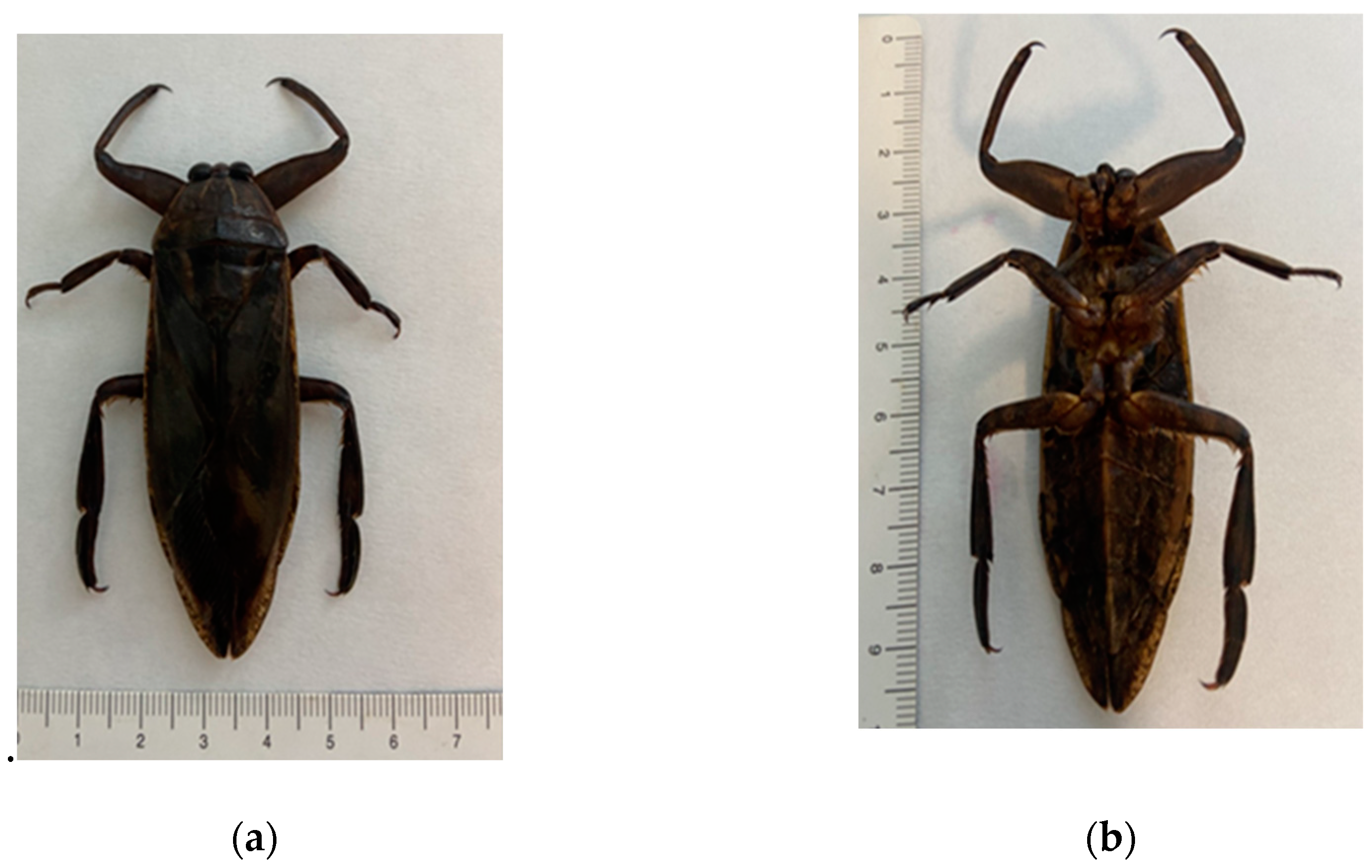
Figure 2.
(a) Enlarged section of the rostrum and (b) foretarsus as claw.
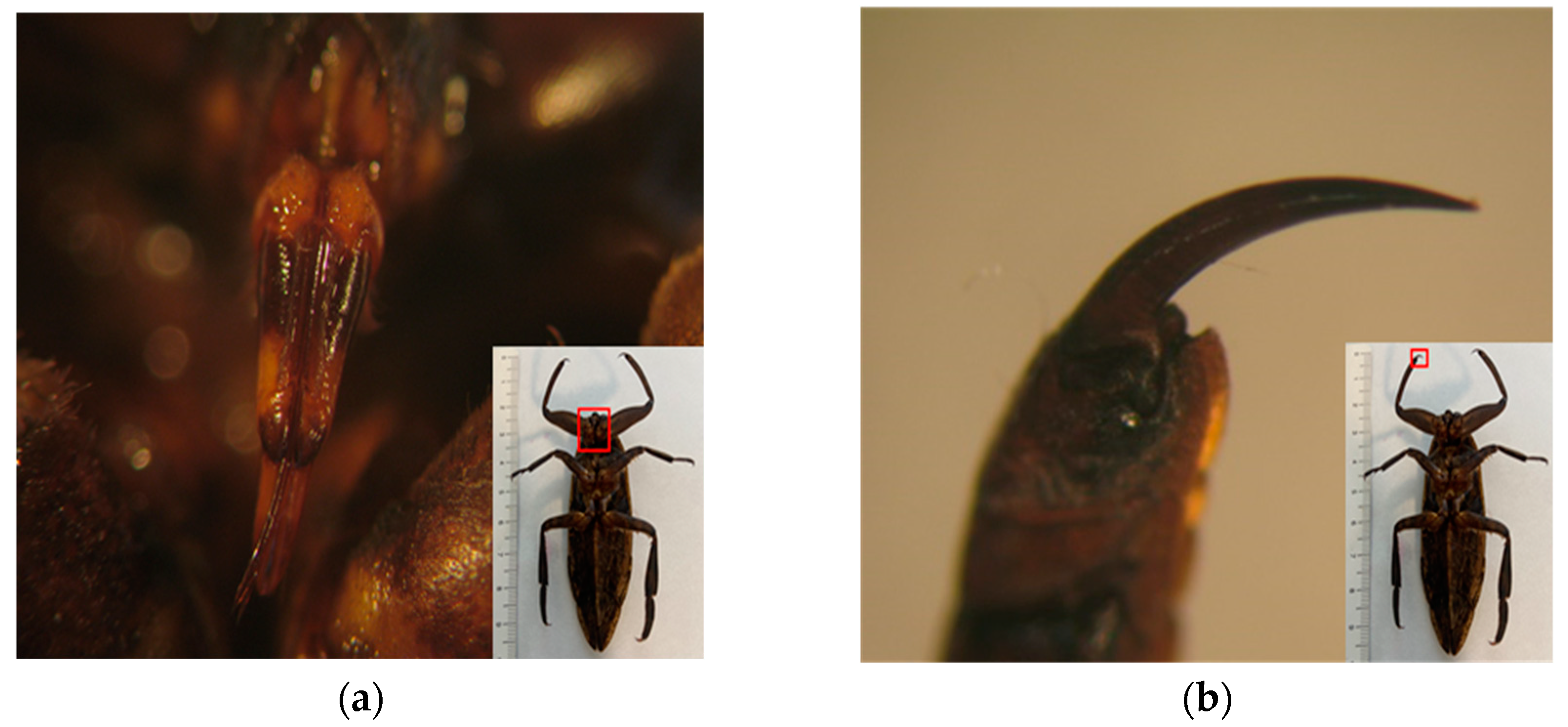
Figure 3.
Phylogenetic relationships among Belastomatidae species inferred by neighbor-joining (NJ) analysis based on mitochondrial COX1 sequences and Cimex lectularius as outgroup. The highlighted branch belongs to the sequence produced in this study.
Figure 3.
Phylogenetic relationships among Belastomatidae species inferred by neighbor-joining (NJ) analysis based on mitochondrial COX1 sequences and Cimex lectularius as outgroup. The highlighted branch belongs to the sequence produced in this study.
Disclaimer/Publisher’s Note: The statements, opinions and data contained in all publications are solely those of the individual author(s) and contributor(s) and not of MDPI and/or the editor(s). MDPI and/or the editor(s) disclaim responsibility for any injury to people or property resulting from any ideas, methods, instructions or products referred to in the content. |
© 2024 by the authors. Licensee MDPI, Basel, Switzerland. This article is an open access article distributed under the terms and conditions of the Creative Commons Attribution (CC BY) license (http://creativecommons.org/licenses/by/4.0/).
Copyright: This open access article is published under a Creative Commons CC BY 4.0 license, which permit the free download, distribution, and reuse, provided that the author and preprint are cited in any reuse.


