

Submitted:
13 November 2024
Posted:
14 November 2024
You are already at the latest version
Abstract
The natural and laboratory-accelerated weathering of wood-plastic composites (WPCs) based on high-density polyethylene (HDPE) and polypropylene (PP) plastics was investigated. Injection molded samples of the WPCs with different loadings of wood fiber ranging from 0 to 36 wt. percent of wood were subjected to laboratory accelerated weathering and natural weathering. The integrity of samples weathered to different extents was tested using a standard tensile test and surface hardness test to investigate the dependence of these properties on the duration of weathering exposure. Tensile data was used to identify the loading of wood fiber in either plastic matrix that afforded superior ultraviolet (UV) stability. The correlation between the tensile and hardness data for the WPC samples was explored.
Keywords:
Wood-Plastic Composites
; Weatherability
; HDPE
; PP
1. Introduction
A clear trend of materials used in building and packaging industries is towards increased environmental sustainability. This emphasis typically demands lowering energy costs, reducing carbon emissions, conserving non-renewable materials such as fossil fuels, and reducing waste generation, in building construction. Using plastics in place of wood not only depletes the non-renewable fossil-fuel resources but also created an increasing stream of non-degradable post-consumer plastic waste that has to be managed. The building industry typically has a high energy demand. In 2020, 30% of the total global energy expenditure and 26% of global carbon emissions that contributed to global warming, were attributed to the building industry [1]. While significant gains in the sustainability of plastics can be achieved by material recycling [2] that conserves fossil-fuel raw material and enables a circular economy [3], effectively managing municipal and especially unmanaged solid waste still poses a significant challenge in most regions of the world. The global production of plastic resins is slated to increase over the near term, and ensuing impacts of plastic waste will exacerbate in the future with the expected doubling of buildings in the World by 2060 adding over 230 billion sq.m.(relative to 2017 data) of built space [4].
Wood is a proven building material heavily used in the construction industry. It is a heterogeneous, cellular, and anisotropic material composed of cellulose (40%–50%) and hemicellulose (15%–25%) fibers with lignin (15%–30%) [5]. It has always been regarded as a low-cost, sustainable building material with a relatively low carbon footprint relative to the material used in building such as concrete, metals, glass, or plastics. Using more wood, that is both renewable and recyclable in buildings increases their environmental sustainability. However, wood as a building material has the drawback of limited durability in outdoor use, especially in decking, fencing, and outdoor furniture. Lignin being a good chromophore, undergoes facile degradation under solar UV exposure resulting in surface degradation [6,7], and the increased hydrophilicity of the affected surface facilitates biodegradation [8]. The effects of common biological degrader species such as white-rot and brown-rot fungi are well known. Some of these limitations can be overcome by using wood-plastic composites (WPC), where wood fibers are used as a filler in a plastic matrix, in place of wood in building construction.
The development of wood-plastic composites (WPC) dates back to the 1970s but has been popularly used as a building material in North America since the 1990s [9]. Natural wood fibers are significantly lower in density (1.15–1.50 g/cm3) than glass fibers (2.4 g/cm3) commonly used in fiber-reinforced composites. Consequently, WPCs provided a significant weight reduction of the products leading to reduced transportation costs. WPC has the advantage of a high strength-to-weight ratio and ease of manufacture [13], associated with plastic materials. The design freedom afforded by WPCs is comparable to that afforded by plastics in that the material can be formed into single-piece building products saving considerable labor, energy, and carbon emission savings [19]. However, wood fibers have lower elastic modulus than glass or carbon fiber [10]. Incorporating wood fiber into a thermoplastic matrix generally affords WPCs that combine the appearance and rigidity of wood, and the toughness and processability of plastics in a single material. The material is used primarily in exterior furniture, decking, playground equipment, fencing, and roofing [11,12]. The wood fibers in the composite can still degrade on environmental exposure, but are relatively than wood. It also has the sustainability advantages of using agricultural waste such as straw [14] or wood flour waste [15,16] as well as recycled waste plastics [17] in its composition [18].
WPC is generally manufactured in a two-step process. A thermoplastic, such as high-density polyethylene (HDPE), low-density polyethylene (LDPE), or polypropylene (PP), is blended with fine wood fiber of sizes ranging from 20 mesh to 60 mesh in a compounding extruder and pelletized as a masterbatch [20], usually in a continuous process in commercial production [21,22]. The compound also often includes compatibilizers, lubricants, flame retardants, and colorants. The compatibilizer, usually a maleated polyolefin, allows intimate mixing of the hydrophilic wood with the hydrophobic polymer while the lubricant yields better surface characteristics in extruded products. The masterbatch is mixed with thermoplastic at the required let-down ratio and extruded into the product [23]. As most wood fibers tend to degrade above 210 °C (410 °F), processing temperatures must be controlled below this limit [24]. However, the common thermoplastics used in WPC applications, polyethylene (PE), poly (vinyl chloride) (PVC), and polypropylene (PP) [25] can be processed below these critical temperatures. Even with exhaustively dried wood fiber, a weak interface obtains poor stress transfer through the composite negatively impacting its mechanical properties [26]. To overcome these shortcomings, the wood fibers can either be treated to render them hydrophobic [27] or a compatibilizer such as maleated polyolefin can be used in the compound [28].
Weathering of WPCs
The most important limitation of WPCs is the deterioration of mechanical properties and the durability of WPC material on weathering [29,30]. This is primarily a consequence of the photostability of the wood fiber fraction in the composite. Solar UV radiation, especially the UV-B range of the spectrum, is well known for its deleterious effect on both wood [31] and plastic [32] components. The breakdown of lignin generates chromophoric water-soluble reaction products, such as carbonyls, carboxylic acids, quinones, and hydroperoxy radicals [33]. WPCs based on PP and HDPE are well known for their sensitivety to UV radiation [34,35,36,37,38].
Exposure of WPCs to solar UV radiation results in surface yellowing of wood affecting its aesthetic appeal. Treating the wood fibers used in WPCs chemically to make them less chromophoric is a reasonable approach to control degradation. For instance, Darabi et al., methylated or acetylated the lignin moieties in wood fibers to effectively control the yellowing of wood-HDPE composites [39]. Solar UV-induced degradation is measured as a decrease in average flexural properties, using conventional UV absorbers [40]. Recent work found the incorporation of 1-2 wt.% of titanium dioxide to protect WPCs against weakening under exposure to solar-simulated UV radiation [30]. However, whether these approaches would work under desert exposure conditions that combine high UV levels and high sample temperatures, is unknown.
The present study is intended to study the weathering of two WPC formulations based on either HDPE or PP as the polymer matrix and commercial wood fiber as the filler, compounded at four different weight percentages of the wood component, with maleated polyolefin used as the compatibilizer. Over 70 percent of WPC production is used in buildings, with polyethylene (PE) and polypropylene (PP) being the most-used plastics in their composition [42]. Both natural and accelerated weathering exposures were employed in the present study. Part I of this paper [41] addressed the mechanical characteristics of PP- and PE-based wood-plastic composites and the present part 2 of the paper is a research effort on the weatherability of the same WPCs exposed to outdoor weathering under harsh desert exposure conditions as shown in Figure 1.
2. Materials and Methods
The wood fiber was obtained from Jelu-Werk (Rosenberg, Germany) as masterbatches with 50% wt. wood fiber (Spruce and Fir) content in either PP (Grade PP-H50-500-14) or HDPE (Grade HDPE-H50-500-09). The two base resins used are injection moldable grades of HDPE and PP with no added UV stabilizers. The bulk density of the masterbatches was 550 g/L and their melt flow index (190°C/21.6 kg) was 33 and 60 g/10 min. according to DIN ES ISO 1133 for the PE and PP masterbatches, respectively. All compounds have a maleated polypropylene bonding agent (2 wt.%) and 1-2% of a lubricant such as ethylene bis-stearamide (EBS), zinc stearate. The masterbatch compounds were mixed with the appropriate proportion of either PP (Hival 2620) or HDPE (Hival 521054) to obtain the requisite weight fractions of wood between 18% and 50%. The masterbatches were dried in the hopper for 5 hours at 80°C before injection molding. Moldings were carried out with a screw temperature of 190°C and mold temperature of 80°C with a screw speed maintained as low as possible to avoid overheating the wood fiber. Standard ASTM Type I dumbbell test pieces were molded and kept refrigerated in the dark.
Natural weathering of the samples was carried out under desert exposure conditions (at an exposure site in Dhahran, Saudi Arabia). The harsh weathering conditions involved are reflected in the plot of average monthly temperature and solar UV flux at the location during the year is shown in Figure 1. Outdoors, factors such as humidity and atmospheric pollutants can affect the rate of weathering of WPCs even though solar UV radiation is the predominant factor. Accelerated weathering in the laboratory was carried out in Q-SUN Xenon test chambers model Q-Sun (Xe-3) at an irradiance of 0.4 W/m2/nm measured at 340 nm wavelength equipped with a daylight filter. Continuous illumination at 70 °C was used without any dark period or water spray.
Tensile testing was done on five sample replicates generally according to ASTM D 638 using an Instron Tensile Testing machine, Model 3367, at room temperature (20 to 22°C) at a strain rate of 10 mm/min strain rate. Load displacement data was recorded digitally using a computer attached to the machine. Hardness measurements on the Shore D scale were done using the Durometer-Digi Test of Bareiss Germany according to ASTM D 2240 standard. An indenter cone with an angle of 300 and a contact pressure load of 5100 g for 3 seconds dwell time was used with the depth of penetration set equal to 2.5 mm.
Microstructural characterization was carried out using a Scanning Electron Microscope, Model JEOL JSM-6064LV. The micrographs were taken at 15 kV accelerating voltage and at various magnifications.
A Mettler Toledo Model DSC 822 Model Differential Scanning Calorimeter: DSC 822
was used to determine the thermal transition temperatures. Typically, the samples were heated from room temperature to 200 °C at a heating rate of 10 °C/min under argon flow. Melting temperature was detected as the peak temperature, and the melting heat was obtained from the area of the peak after the baseline correction.
Fourier transform infrared (FTIR) spectroscopy is commonly used to obtain information on the molecular structure of wood as well as plastics. The infrared (IR) spectrum is related to vibrations in the molecules, is unique to each compound, and yields a ‘fingerprint’ of the polymer composition. Reflectance FTIR was used with the present thicker samples using an IR microscope. Infrared spectra were recorded using a Perkin Elmer Model 16F PC FT-IR spectrophotometer loaded with Spectrum V 2.00 software (Waltham, MA, USA).
The average molecular weight of HDPE and PP were determined using Gel Permeation Chromatography (GPC). GPC is a size exclusion chromatography (SEC) separation technique that separates analytes on the basis of molecular size and is applied to polymers. Chain scission during degradation causes a general decrease in molecular weights—the number average molecular weight (Mn), the weight average molecular weight (Mw), the size average molecular weight (Mz), and the polydispersity index (PDI) can be assessed conveniently using GPC. Polystyrene standards with a PDI of less than 1.2 were used to calibrate the GPC procedure. Gel Permeation Chromatography was carried out at a column/detector temperature of 160 °C in 1,2,4-trichlorobenzene (TCB) at a flow rate of 1.0 mL/min and injection volume of 200 Bl in the Viscotek HT-GPC 350A model.
3. Results
3.1. Tensile Properties
The rate of deterioration in tensile properties of composites either on outdoor or accelerated weathering exposure is a good indicator of their durability. Tensile measurements under uniaxial strain yield average values of tensile strength (TS), low-extension modulus (E), and elongation at break (EB). The average EB is particularly sensitive to weathering and its value drops drastically at even during early weathering in the present exposures. This is likely a result of adhesive failure at the wood/plastic interphase dominating sample rupture. Both natural weathering outdoors and accelerated weathering in the laboratory generally show the tensile strength (TS), and the elongation at break (TE) to decrease with the duration of exposure while the low-extension modulus (E) to increase with the duration of exposure for all samples tested (see Table 1). The change in the average TS of composites with the duration of exposure offers valuable insights (see Figure 2).
The average TS decreases approximately linearly with the duration of weathering with exposure in control samples with no wood fiber and the rate of decrease is faster in PP relative to HDPE. This is an expected consequence of the repeat unit chemical structure of PP that makes it relatively more photolabile [43,44]. The presence of wood fibers at all weight fractions used in the present study also shows a similar near-linear decrease in percent loss of average TS, but the rate of loss is much lower suggesting significant UV stabilization. This result is generally consistent with previous work on the weathering of PP-based [45,46] and HDPE—based [47] WPCs, despite the present exposures being much harsher in terms of UV flux and sample temperatures. Percentage reduction in the average TS at a given duration of exposure depends not only on the loading of wood fiber but also on their type, how well they are dispersed in the matrix, and the compatibilizer used [48]. It is difficult to compare data across different accelerated exposure studies because of these variables.
For instance, Stark et al working with HDPE /Pine (50%) composites, found a 32-34% decrease in average TS in 3000 h. of weatherometer exposure while the present WPCs reached the same in 1180 h. of weatherometer and 12 months of outdoor exposure. The average TS data in Figure 2 (which shows data for the WPCs suggests significant stabilization of composites containing wood fiber, with improvement in durability with wood content in the case of HDPE-based composites. This is true of the present WPCs based on PP as well but their rate of loss in average TS is faster than for the HDPE-based WPCs mechanical integrity of the composites. Furthermore, no marked difference in performance with increasing wood fiber beyond 18 wt.% is observed. That relatively low loading of 18 wt.% wood provides good photostability and is therefore a valuable finding in designing WPCs for outdoor use.
Both, the light shielding by fibers and the UV stabilizing action of phenolic lignin compounds in wood, retard photo-thermal degradation [49] are responsible for the stabilization effect. With UV shielding, the overlapping of wood fibers at the concentrations used in the present composites would make it difficult to observe any dependence of weatherability on wood content. As the exposed WPC samples reach high surface temperatures, especially in the natural weathering environment, concurrent thermal oxidation would also contribute to the observed decrease in tensile strength. Laboratory studies on WPCs of PVC/poplar wood show the effect of temperature alone on tensile strength [50].
In both the control samples and the WPC samples the average E increases with the duration of exposure suggesting extensive crosslinking during exposure. Concurrent chain scission and crosslinking are known to occur in polyolefin photo-oxidation [51] which is a free-radical reaction [52] and under present exposure conditions crosslinking is predominant, leading to increased moduli. Furthermore, increased crystallinity of the polymer component during photodegradation may also have contributed to this increase.
A set of samples containing 18 wt % wood was also exposed for 330¬ MJ/m2 {12,686 MJ/m2 of total energy} in a UA-EMMA (Atlas) to determine their behavior under extended long-term exposure. The UA-EMMA employs twenty focusing mirrors arranged as parabolic facets, to variably concentrate UV energy on a target area approximately 15 cm x 91cm (6 inches x 36 inches) that is protected from overheating. It is used as an accelerated exposure to simulate long-term weathering. Unexpectedly, the samples exposed retained their integrity and their tensile properties could be measured (see Table 1) and their average tensile strength was found to be approximately the same as for samples exposed in the laboratory weatherometer for 743 kJ/sq.m (orders of magnitude lower than the exposure in UA-EMMA. At the very high light intensities in UA-EMMA, the degradation of WPCs likely proceeds via reaction pathways that are very different from those obtained under natural solar or weatherometer irradiation. The data for the high-intensity exposure was inconsistent with the laboratory data from weatherometer exposures, and the samples were not further analyzed.
3.2. Hardness Properties
With thick samples such as those used here photo-thermal degradation is likely localized to a surface layer. This is known to be the case for both wood [53] and polyolefins [54]. With the polymers, the photooxidation is diffusion-controlled in thick sections of the material. Unlike the tensile measurements that assess the bulk of the sample hardness testing that tests the surface characteristics is useful in assessing weathering [55]. Unlike flexure and tensile testing, hardness is rarely used to monitor the weathering of WPCs. But, Hardness, being a surface characteristic is expected to be more sensitive to weathering-related changes.
Including wood fiber filler in a thermoplastics matrix generally includes the hardness of the material [56]. The Shore D hardness of the various WPCs, based on either HDPE or PP, as well as the control samples, decreased with the duration of weathering exposure. With data for accelerated weathering in the laboratory, the percent decrease is linear with the duration of exposure. Table 2 shows the changes in the average Shore D hardness of samples at different durations of exposure. The measurements were carried out on the surface exposed to light. The observed decrease in hardness with duration of exposure is consistent with previous reported studies [55,57]. For instance, Srivabut et al. (2023) [58] studied the natural weathering of PP/Rubberwood composites with 0, 25, and 50 wt. percent wood fiber, with maleated polypropylene compatibilizer. After naturally weathering at two exposure sites, the hardness of the WPCs was found to decrease between 8% to 12.5% depending on the composition and exposure location parameters. The present PP-based WPCs also lost approximately 8% of the original hardness even though were subjected to much harsher weathering conditions.
The wood fiber filler improved the retention of surface hardness in both HDPE and PP composites, relative to the control plastic material. In common with the tensile strength data, changes in hardness also show HDPE composites to be better stabilized relative to those of PP. However, in contrast to the tensile test data, the hardness data shows that different loadings of wood fiber in the HDPE-based WPC make a significant difference in the rate of loss of surface hardness in accelerated weathering studies. However, the natural weathering data for PP does not show such a difference. The mechanisms that result in changes in hardness for PP might be different in natural exposures versus laboratory accelerated exposure scenarios. One such variable is the abrasion of the WPC surface by wind-borne sand in desert environments. Another is the effect of humidity (or water) on the composites. The wood fiber in WPCs absorbs humidity either through exposed fiber ends at the surface or from small amounts of water absorbed by the plastic matrix.
3.3. Tensile Strength versus Surface Hardneses
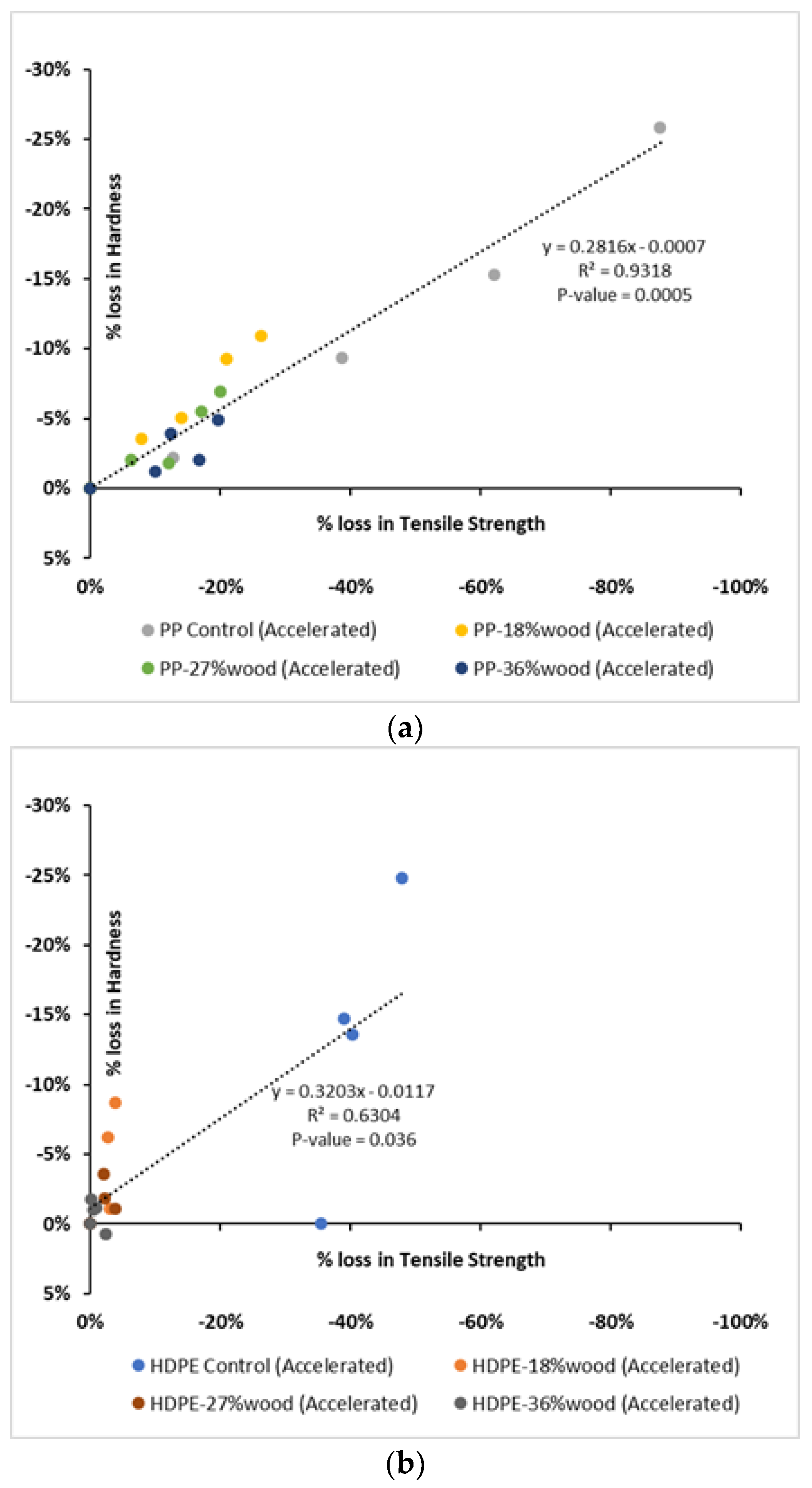
An interesting observation in the data is that loss in changes in the two properties, bulk tensile strength and surface hardness behave similarly on weathering exposures. Figure 3 shows how the two sets of data are related for all PP-based WPCs tested in the study, where a high correlation (R2 = 0.93) between data is apparent. However, the same plot attempted for HDPE-based composites show a poor correlation (R2 = 0.63). With PP-based composites this correlation allows the relatively faster hardness tests using smaller samples to be employed to test durability in place of tensile property measurements.
3.4. FTIR Characterization
Incorporating the wood fiber into a polymer matrix can be monitored with FTIR used in the Attenuated Total Reflection (FTIR-ATR) mode. The spectra of dry composites display the characteristic -OH absorption peak associated with cellulose and hemicellulose fractions, which appears around 3500 cm-1. As expected, both HDPE and PP show this absorption band in that wavelength region. In addition, the intensity of the absorption band in the present samples increased with the fraction of wood fiber in them, as shown in the insert in Figure 4. The blending of wood does not result in a significant change in the melting characteristics of the polymers as the fibers do not undergo any phase transition upon heating.
3.5. Differential Scanning Calorimetry (DSC)
The melting transition in the composites, as measured using Differential Scanning Calorimetry (DSC), shows that the heat flow decreases with increasing wood content (see Figure 5), as expected, but the transition temperature of the polymer fraction is not significantly affected by the presence of wood fibers. The changes in both FTIR and thermal measurements qualitatively relate to the wood content, which suggests that the wood fibers and the polymer were intimately mixed in the composite. The spectra do not show a predominance of either wood fiber or polymer spectral bands associated with polymer- or wood fiber-rich domains.
3.6. Scanning Electron Microscope (SEM)
The primary objective of incorporating wood fiber into a thermoplastic was to obtain reinforcement that improves the mechanical integrity of the material. Any reinforcing effect of the wood filler is next assessed using tensile property measurements. Effective reinforcing generally depends on the intimate mixing of the filler and polymer that in turn requires a low enough melt viscosity at the processing temperature to allow the polymer to flow into the porous woof morphology and obtain good bonding at the interface. A robust interface between the wood fiber and plastic is critical to obtaining good mechanical characteristics in composites. A coupling agent, such as maleated polyethylene used in these samples, often contributes towards a good interface between the hydrophilic and hydrophobic phases in the composite. The scanning electron micrographs (SEMs) of the composites illustrate the very good dispersion achieved in the present samples during processing. No large aggregates of wood fiber were noticed during the SEM study on the different mixes. Selected micrographs are shown in Figure 6.
3.7. Gel Permeation Chromatography (GPC)
The mechanical stresses in the melt experienced during compounding and in the injection molding of the test pieces are expected to degrade the polymer compounds to some extent. This is especially important as the molding has to be carried out at low temperatures to ensure that the wood fibers do not degrade. Any such degradation during processing would occur in both the virgin polymer and polymer/wood mixes, but the degradation in the latter case is expected to be more severe because of the additional friction afforded by the wood filler. This was investigated for the virgin polymers and their composites with low (18 wt.%) wood fiber content using GPC of the polymer fraction before and after processing. The data in Table 3 show a reduction in the number average molecular weight Mn (g/mol) of virgin HDPE and PP as well as their composites. As might be expected from structural considerations of the two polymers, the degradation rate in PP on processing will be relatively larger than for HDPE. The tertiary carbon radical likely generated during the mechanical and mechano-oxidative degradation of PP is more reactive relative to the largely secondary radical species generated by HDPE, leading to higher rates of degradation in the former. The observed percentage decrease in Mn (g/mol) for HDPE and PP in the composites are 15% and 12.6%, respectively, and are not significantly different, at least at 18% weight fraction of wood fiber. The polydispersity of the HDPE samples (PDI) decreased slightly upon being mixed with wood fiber. In the more reactive PP, the PDI suggests that the molecular weight distribution broadened upon mixing with wood fiber. Molecular weights were not determined in composites with higher wood content.
4. Conclusions
The durability of two sets of WPCs, one based on PP and another on HDPE was investigated using both natural weathering under harsh desert exposure as well as laboratory accelerated weathering. The average tensile strength of all composites as well as the respective controls decreased monotonously with both weathering exposures. Their tensile moduli increased with weathering indicating extensive crosslinking and possible increased crystallization during the weathering exposure. Changes in hardness with exposure also stated a similar decrease under both exposure regimens. The changes obtained compare well with those reported for WPCs using a different wood fiber. An interesting correlation between hardness and tensile properties was obtained, but only for PP-based composites.
Author Contributions
Conceptualization, Dr. H. H. Redhwi and Dr. A. L. Andrady; methodology, Dr. H. H. Redhwi, Dr. M. N. Siddiqui and Dr. A. L. Andrady; validation, Dr. M. N. Siddiqui, S. A. Furquan and Hussain S.; formal analysis, Dr. A. L. Andrady, S. A. Furquan, Hussain S.; investigation, Dr. M. N. Siddiqui, S. A. Furquan, and Hussain S.; resources, Dr. H. H. Redhwi and Hussain S.; data curation, Dr. M. N. Siddiqui, S. A. Furquan, and Hussain S.; writing—original draft preparation, Dr. A. L. Andrady and Hussain S.; writing—review and editing, Dr. H. H. Redhwi, Dr. M. N. Siddiqui, Dr. A. L. Andrady, S. A. Furquan, and Hussain S.; visualization, Dr. A. L. Andrady and Hussain S.; supervision, Dr. H. H. Redhwi and Dr. A. L. Andrady; project administration, Dr. H. H. Redhwi and Hussain S.; funding acquisition, Dr. H. H. Redhwi. All authors have read and agreed to the published version of the manuscript.
Funding
This research was funded by the National Plan for Science, Technology and Innovation (MAARIFAH) – King Abdulaziz City for Science and Technology – through the Science & Technology Unit at King Fahd University of Petroleum & Minerals (KFUPM) – the Kingdom of Saudi Arabia, award number 15-ADV5091-04.
Institutional Review Board Statement
Not applicable.
Data Availability Statement
The original contributions presented in the study are included in the article/supplementary material, further inquiries can be directed to the corresponding author/s..
Conflicts of Interest
The authors declare no conflicts of interest. The funders had no role in the design of the study; in the collection, analyses, or interpretation of data; in the writing of the manuscript; or in the decision to publish the results.
References
- IEA. World Energy Outlook 2020. Paris, International Energy Agency. 2020. Available online: https://www.iea.org/reports/world-energy-outlook-2020.
- Balu R.; Dutta N.K.; Roy Choudhury N. Plastic Waste Upcycling: A Sustainable Solution for Waste Management, Product Development, and Circular Economy 2022, Polymers (Basel), Nov 8;14(22):4788.
- Kassab A.; Al Nabhani D.; Mohanty P.; Pannier C.; Ayoub G.Y. Advancing Plastic Recycling: Challenges and Opportunities in the Integration of 3D Printing and Distributed Recycling for a Circular Economy 2023, Polymers (Basel), Sep 25;15(19):3881. [CrossRef]
- Gamboa C. Towards zero-carbon building In Climate 2020. UNA-UK Publication.
- Rowell R.M. Understanding Wood Surface Chemistry and Approaches to Modification: A Review 2021, Polymers, 13(15):2558. [CrossRef]
- Kučerová V.; Hrčka R.; Hýrošová T. Relation of Chemical Composition and Colour of Spruce Wood 2022, Polymers (Basel), Dec 6;14(23):5333. [CrossRef]
- Kumar B.G.; Singh R.P.; Nakamura T. Degradation of carbon fiber-reinforced epoxy composites by ultraviolet radiation and condensation 2002, J. Compos. Mater., 36:2713–2732. [CrossRef]
- Broda M.; Popescu C.M.; Curling S.F.; Timpu D.I.; Ormondroyd G.A. Effects of Biological and Chemical Degradation on the Properties of Scots Pine Wood-Part I: Chemical Composition and Microstructure of the Cell Wall 2022, Materials (Basel), Mar 22;15(7):2348. [CrossRef]
- Friedrich, D. Thermoplastic moulding of Wood-Polymer Composites (WPC): A review on physical and mechanical behaviour under hot-pressing technique. Compos. Struct. 2021, 262, 113649. [CrossRef]
- Muller, U.; Veigel, S. The strength and stiffness of oriented wood and cellulose-fiber materials: A review. Prog. Mater. Sci. 2022, 125, 100916.
- Smith, P.M.; Wolcott, M.P. Opportunities for Wood/Natural Fiber-Plastic Composites in Residential and Industrial applications. For. Prod. J. 2006, 56, 4–11.
- Gardner, D.; Han, Y.; Song, W. Wood plastic composites technology trends. In Proceedings of the 51st International Convention of Society of Wood.
- Olonisakin, K.; He, S.; Yang, Y.; Wang, H.; Li, R.; Yang, W. Influence of stacking sequence on mechanical properties and moisture absorption of epoxy-based woven flax and basalt fabric hybrid composites. Sustain. Struct. 2022, 2, 16. [CrossRef]
- Panthapulakkal, S.; Zereshkian, A.; Saim, M. Preparation and characterization of wheat straw fibers for reinforcing application in injection molded thermoplastic composites. Bioresour. Technol. 2006, 97, 265–272. [CrossRef]
- Zhang, W.; Yao, X.; Khanal, S.; Xu, S. A novel surface treatment for bamboo flour and its effect on the dimensional stability and mechanical properties of high-density polyethylene/bamboo flour composites. Constr. Build. Mater. 2018, 186, 1220–1227. [CrossRef]
- Oladejo, K.O.; Omoniyi, T.E. Dimensional Stability and Mechanical Properties of Wood Plastic Composites Products from Sawdust of Anogeissus leiocarpus (Avin) with Recycled Polyethylene Teraphthalate (PET) Chips. Eur. J. Appl. Eng. Sci. Res. 2017, 5, 28–33.
- Najafi, S.K. Use of Recycled Plastics in Wood Plastic Composites—A Review. Waste Manag. 2013, 33, 1898–1905. [CrossRef]
- Binhussain, M.A.; El-Tonsy, M.M. Palm leave and plastic waste wood composite for out-door structures. Constr. Build. Mater. 2013, 47, 1431–1435. [CrossRef]
- Khan, M.M.H.; Deviatkin, I.; Havukainen, J.; Horttanainen, M. Environmental impacts of wooden, plastic, and wood-polymer composite pallet: A life cycle assessment approach. Int. J. Life Cycle Assess. 2021, 26, 1607–1622. [CrossRef]
- Ratanawilai, T.; Taneerat, K. Alternative polymeric matrices for wood-plastic composites: Effects on mechanical properties and resistance to natural weathering. Constr. Build. Mater. 2018, 172, 349–357. [CrossRef]
- Wu, M.; Zhao, M.; Chang, G.; Hu, X.; Guo, Q. A composite obtained from waste automotive plastics and sugarcane skin flour: Mechanical properties and thermo-chemical analysis. Powder Technol. 2019, 347, 27–34. [CrossRef]
- Dauletbek, A.; Li, H.; Xiong, Z.; Lorenzo, R. A review of mechanical behavior of structural laminated bamboo lumber. Sustain. Struct. 2021, 1, 4. [CrossRef]
- Grubbström, G.; Holmgren, A.; Oksman, K. Silane-crosslinking of recycled low-density polyethylene/wood composites—ScienceDirect. Compos. Part A Appl. Sci. Manuf. 2010, 41, 678–683.
- Oladejo, K.O.; Omoniyi, T.E. Dimensional Stability and Mechanical Properties of Wood Plastic Composites Produced from Sawdust of Anogeissus leiocarpus (Ayin) with Recycled Polyethylene Teraphthalate (PET) ChipsEur J Appl Eng Scientific Res, 5 (2017), pp. 28-33.
- Carus, M., Eder, A. WPC and NFC market trends, bioplastics Magazine 10 (2015) 12-13.
- Nevin G.K.; Ayse A. Effects of maleated polypropylene on the morphology, thermal and mechanical properties of short carbon fiber reinforced polypropylene composites, Materials & Design, Volume 32, Issue 7, 2011, Pages 4069-4073.
- Pickering, K.; Efendy, M.A.; Le, T. A review of recent developments in natural fibre composites and their mechanical performance. Compos. Part A Appl. Sci. Manuf. 2016, 83, 98–112. [CrossRef]
- Mohammad Razavi-Nouri, Masoud Tayefi, Alireza Sabet, Morphology development and thermal degradation of dynamically cured ethylene-octene copolymer/organoclay nanocomposites, Thermochimica Acta, 655, (2017), 302-312. [CrossRef]
- Li, H., Zhang, Z., Song, K., Lee, S., Chun, S.-J., Zhou, D., and Wu, Q. Effect of durability treatment on ultraviolet resistance, strength, and surface wettability of wood plastic composite, BioRes. 2014, 9(2), 3591-3601. [CrossRef]
- Stark, N. M. (2007). Considerations in the weathering of wood-plastic composites. In Proceedings: 3rd Wood Fibre Polymer Composites International Symposium: Innovative Sustainable Materials Applied to Building and Furniture: March 26-27, 2007... Bordeaux, France. [Sl: sn], 2007: 10 pages.
- Teacă, C.-A.; Roşu, D.; Bodîrlău, R.; and Roşu, L. Structural changes in wood under artificial UV light irradiation determined by FTIR spectroscopy and color measurements - A brief review, BioRes. 2013, 8(1), 1478-1507. [CrossRef]
- Doğan M. Ultraviolet light accelerates the degradation of polyethylene plastics. Microsc Res Tech. 2021, Nov;84(11):2774-2783. [CrossRef]
- Hon D.N.S. Wood and Cellulosic Chemistry, Marcel Dekker, Inc., 2001.
- Selden R.; Nystrom B.; Langstrom R. UV aging of polypropylene/wood fiber composites. Polymer Composites 2004, 25 (5): 543–53.
- Beg M.; Pickering K. Accelerated weathering of unbleached kraft wood fibre reinforced polypropylene composites. Polymer Degradation and Stability 2008, 93: 1939–46.
- Mantia F.; Morreale M. Accelerated weathering of polypropylene/wood flour composites. Polymer Degradation and Stability 2008, 93: 1252–58.
- Soccalingame L.; Rerrin D.; Benezet J. Reprocessing of artificial UV weathered wood flour reinforced polypropylene composites. Polymer Degradation and Stability 2015, 120: 313–27. [CrossRef]
- Phiriyawirut M.; Seenpung P.; Calermboom S. Isostatic polypropylene/wood sawdust composite: Effects of natural weathering, water immersion and Ga,,a-Ray Irradiation on Mechanical Properties. Macromolecular Symposia 2008.
- Darabi P.; Karimi A.N.; Mirshokraie S.A.; Thévenon M.F. Lignin blocking effects on weathering process of wood plastic composites. Conference paper: 41st Annual Meeting of the International Research Group on Wood Protection, Biarritz, France, 9-13 May 2010, 2010, IRG-WP 10-40529.
- Lei Z.; Liu J.; Zhang Z.; Zhao X; Li Q. Study on Preparation and Properties of Anti-Ultraviolet Aging Wood-Plastic Composites. Wood Research 2023, 68 (4), 680-691 pp.
- Redhwi, H.H.; Siddiqui, M.N.; Andrady, A.L.; Furquan, S.A.; Hussain, S. Durability of High-Density Polyethylene (HDPE) and Polypropylene (PP) based Wood-Plastic Composites Part 1: Mechanical Properties of the Composite Materials, J. Comps. Sci. 2023, 7, 163. [CrossRef]
- Wood Plastic Composites Market Size. Share & Trend Analysis Report by Product (Polyethylene, Polypropylene), by Application (Automotive Components), by Region, and Segment Forecasts, 2022–2030; Report ID: 978-1-68038-849-7; Grand View Research: San Francisco, CA, USA, 2022; p. 198.
- Umar A.H; Zainudin E.S; Sapuan S.M Effect of Accelerated Weathering n Tensile Properties of Kenaf Reinforced High-Density Polyethylene Composites. Journal of Mechanical Engineering and Sciences (JMES) 2012, ISSN (Print): 2289-4659, Volume 2, pp. 198-205.
- Hung K.C.; Chang W.C.; Xu J.W.; Wu T.L.; Wu J.H. Comparison of the Physico-Mechanical and Weathering Properties of Wood-Plastic Composites Made of Wood Fibers from Discarded Parts of Pomelo Trees and Polypropylene. Polymers (Basel) 2021, Aug 11;13(16):2681.
- Beg M.D.H.; Pickering K.L.; Accelerated weathering of unbleached and bleached Kraft wood fibre reinforced polypropylene composites. Polymer Degradation and Stability 2008, Volume 93, Issue 10, Pages 1939-1946.
- Gunjal J.; Aggarwal P.; Chauhan S. Changes in colour and mechanical properties of wood polypropylene composites on natural weathering. Maderas, Cienc. tecnol. [online]. 2020, vol.22, n.3 [cited 2024-04-25], pp.325-334. [CrossRef]
- López-Naranjo E.J.; Alzate-Gaviria L.M.; Hernández-Zárate G.; Reyes-Trujeque J.; Cruz-Estrada R.H. Effect of accelerated weathering and termite attack on the tensile properties and aesthetics of recycled HDPE-pinewood composites. Journal of Thermoplastic Composite Materials 2014, 27(6):831-844. [CrossRef]
- Stark N.M.; Matuana L.M.; Clemons C.M. Effect of processing method on surface and weathering characteristics of wood-flour/HDPE composites. J. Appl Polym Sci 2004, 93, pp. 1021-1030. [CrossRef]
- Xanthopoulou, E.; Chrysafi, I.; Polychronidis, P.; Zamboulis, A.; Bikiaris, D.N. Evaluation of Eco-Friendly Hemp-Fiber-Reinforced Recycled HDPE Composites. J. Compos. Sci. 2023, 7, 138. [CrossRef]
- Li J.; Huo R.; Liu W.; Fang H.; Jiang L.; Zhou D. Mechanical properties of PVC-based wood–plastic composites effected by temperature. Front. Mater. 2022, 9:1018902.
- Grause G.; Chien M.F.; Inoue C. Changes during the weathering of polyolefins. Polymer Degradation and Stability 2020, Volume 181, 109364, ISSN 0141-3910. [CrossRef]
- Oluwoye I.; Altarawneh M.; Gore J.; Dlugogorski B.Z. Oxidation of crystalline polyethylene. Combustion and Flame 2015, Volume 162, Issue 10, Pages 3681-3690. [CrossRef]
- Kanbayashi T.; Matsunaga M.; Kobayashi M. Cellular-level chemical changes in Japanese beech (Fagus crenata Blume) during artificial weathering. J. Holzforschung 2021, De Gruyter (online). [CrossRef]
- Andrady A.L.; Barnes P.W.; Bornman J.F.; Gouin T.; Madronich S.; White C.C.; Zepp R.G.; Jansen M.A.K. Oxidation and fragmentation of plastics in a changing environment; from UV-radiation to biological degradation. Sci Total Environ. 2022, Dec 10, 851(Pt 2):158022. [CrossRef]
- Homkhiew C.; Ratanawilai T.; Thongruang W. Effects of natural weathering on the properties of recycled polypropylene composites reinforced with rubberwood flour, Industrial Crops and Products 2014, Volume 56, Pages 52-59. [CrossRef]
- Nukala S.G.; Kong I.; Kakarla A.B.; Kong W.; Kong W. Development of wood polymer composites from recycled wood and plastic waste: thermal and mechanical properties J. Compos. Sci. 2022, 6, p. 194.
- Srivabut C.; Homkhiew C.; Rawangwong S.; Boonchouytan W. Possibility of using municipal solid waste for manufacturing wood plastic composites: effects of natural weathering, wood waste types, and contents. J. Mater. Cycles. Waste. Manag. 2022, 24, pp. 1407-1422.
- Srivabut C.; Khamtree S.; Homkhiew C.; Ratanawilai T.; Rawangwong S. Comparative effects of different coastal weathering on the thermal, physical, and mechanical properties of rubberwood–latex sludge flour reinforced with polypropylene hybrid composites, Composites Part C: Open Access 2023, Volume 12, 100383.
Figure 1.
(a) Average Annual Solar Intensity Variation; (b) Average Temperature Variation, at the Desert Exposure Site in Dhahran, Saudi Arabia.
Figure 1.
(a) Average Annual Solar Intensity Variation; (b) Average Temperature Variation, at the Desert Exposure Site in Dhahran, Saudi Arabia.
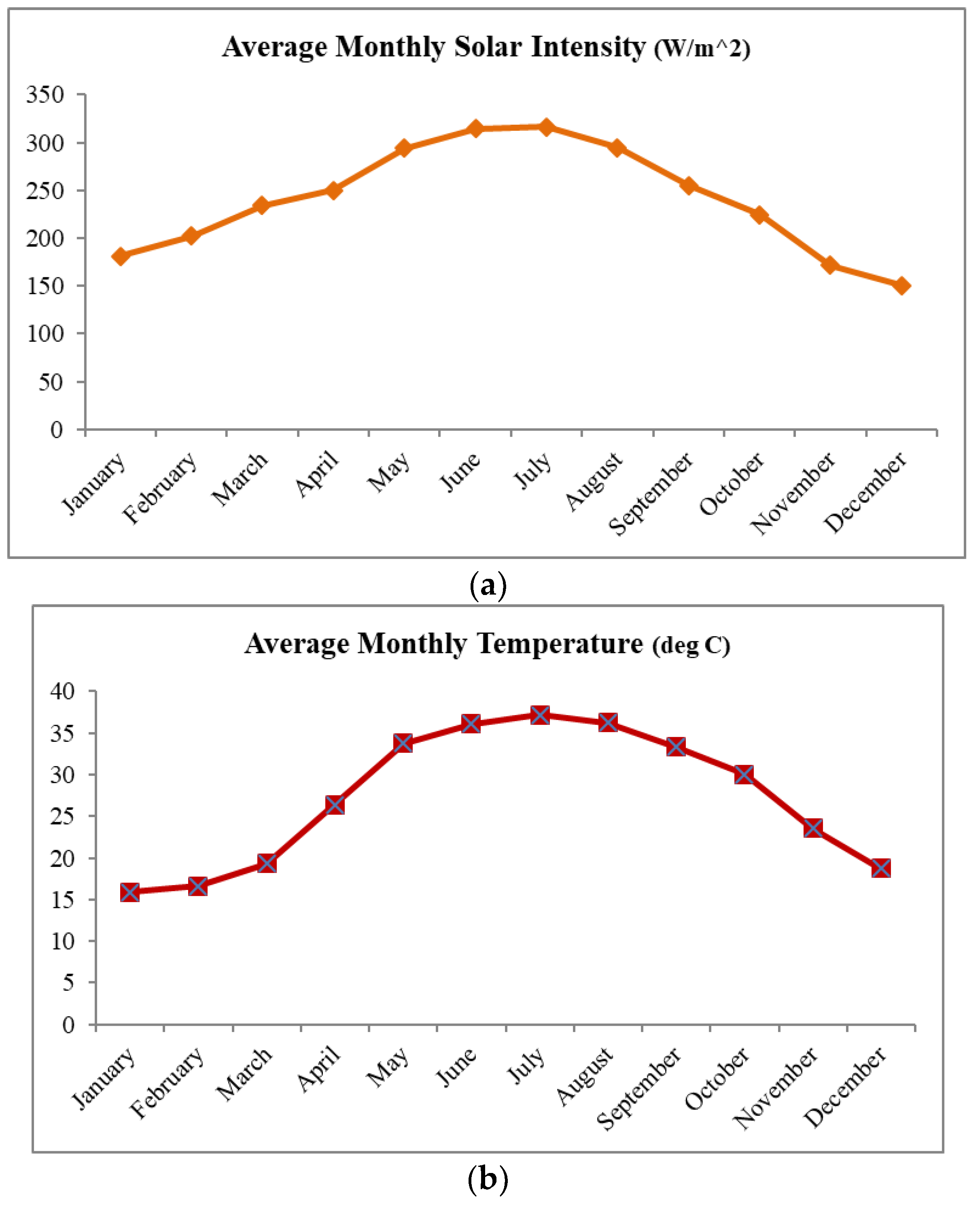
Figure 2.
Average tensile strength data for WPCs based on HDPE and PP. (a) Outdoor exposure for PP composites; (b) Outdoor exposure for HDPE composites; (c) Accelerated exposure for PP composites; and (d) Accelerated exposure for HDPE composites.
Figure 2.
Average tensile strength data for WPCs based on HDPE and PP. (a) Outdoor exposure for PP composites; (b) Outdoor exposure for HDPE composites; (c) Accelerated exposure for PP composites; and (d) Accelerated exposure for HDPE composites.
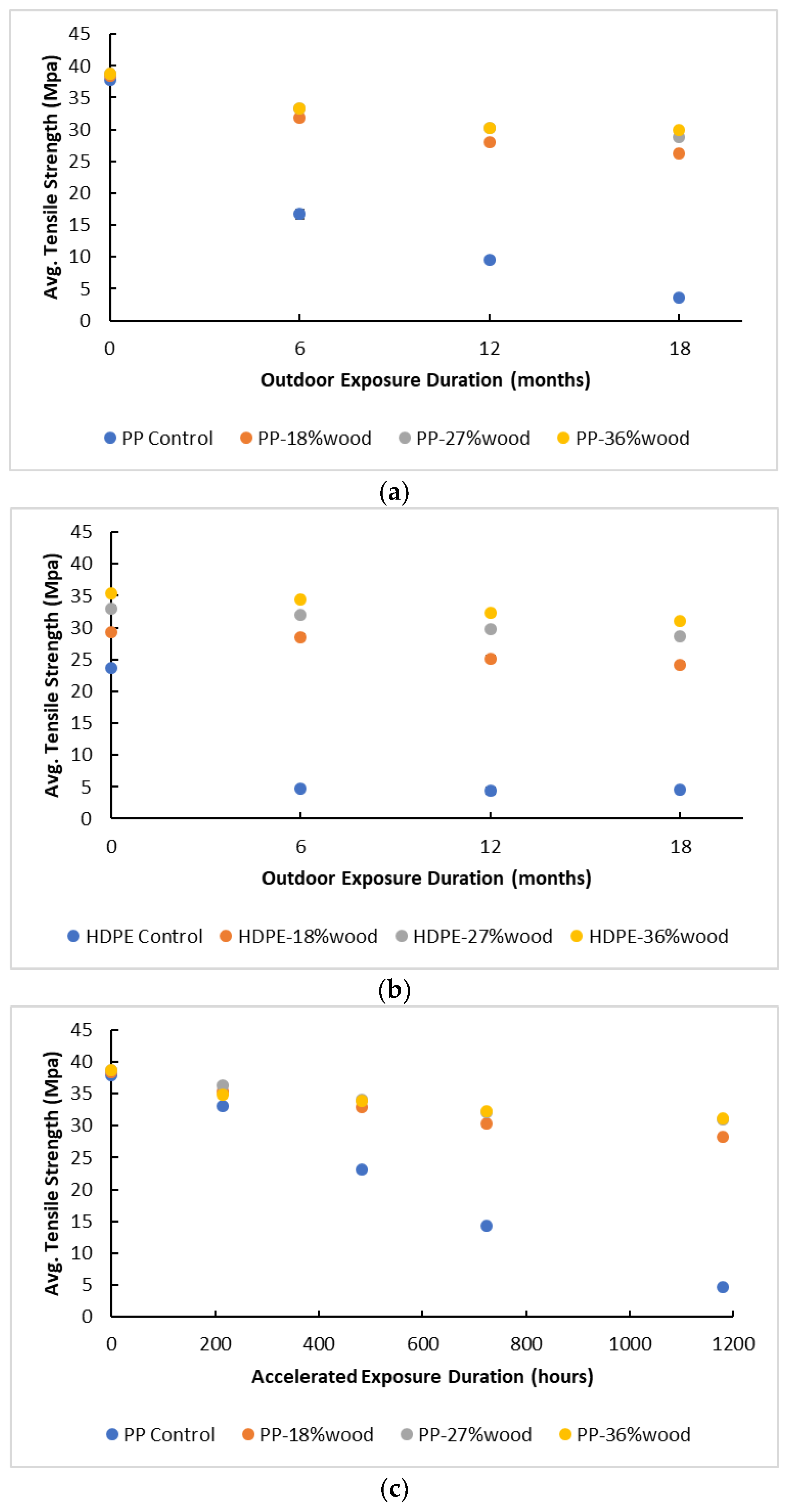
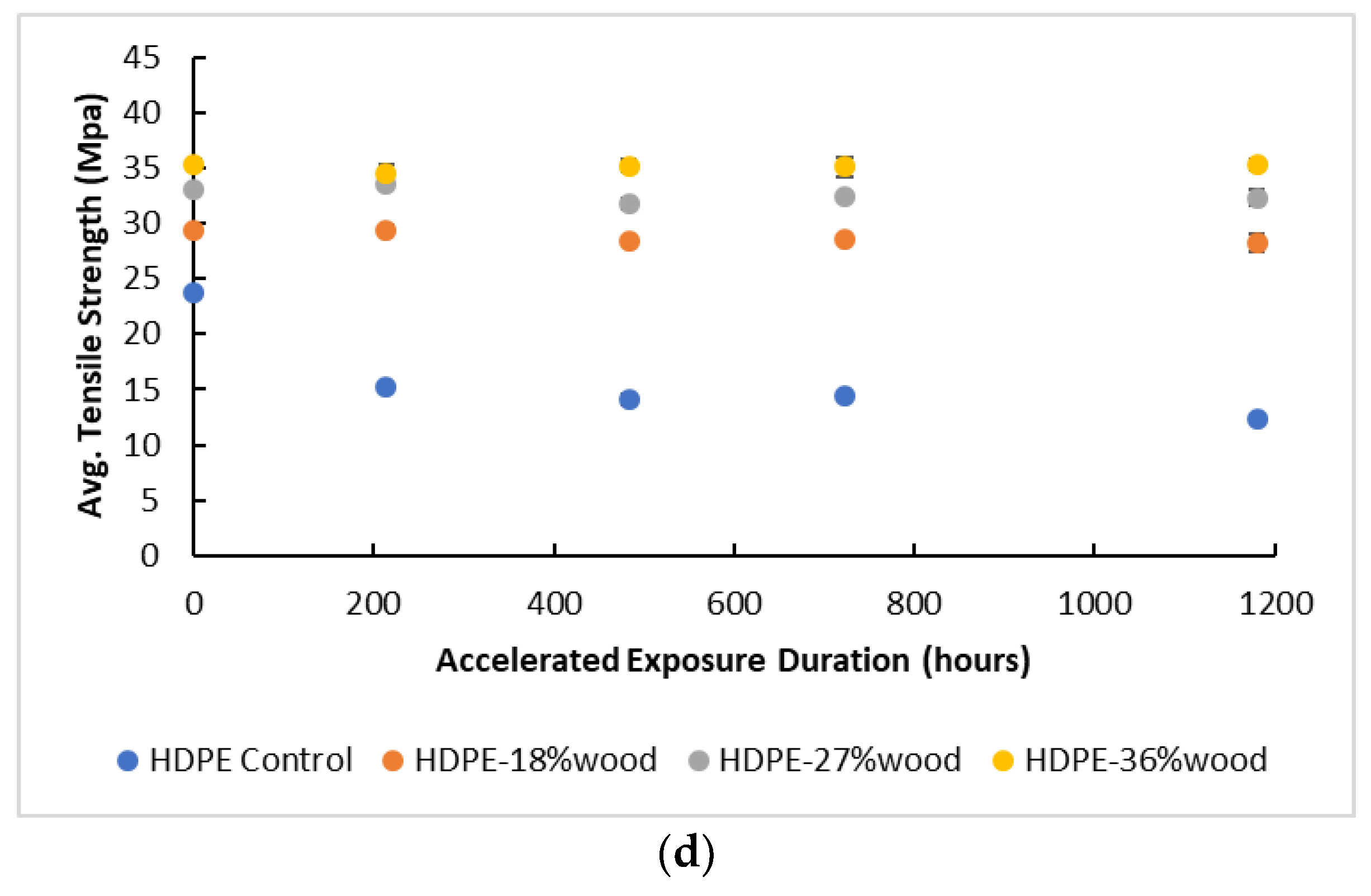
Figure 3.
Percentage loss in bulk tensile strength versus Percentage loss in surface hardness for WPCs based on HDPE and PP. (a) Accelerated exposure for PP composites; (b) Accelerated exposure for HDPE composites.
Figure 3.
Percentage loss in bulk tensile strength versus Percentage loss in surface hardness for WPCs based on HDPE and PP. (a) Accelerated exposure for PP composites; (b) Accelerated exposure for HDPE composites.
| Outdoor Exposure Duration | Average Hardness Value [Std. Dev.] | |||
|---|---|---|---|---|
| HDPE Control | HDPE-18% wood | HDPE-27% wood | HDPE- 36% wood | |
| Unexposed | 63.2 [0.1] | 65.8 [0.2] | 66.7 [0.4] | 68.3 [0.6] |
| 6 months | 56.9 [2.1] | 67.5 [0.3] | 66.4 [0.4] | 68.5 [2.0] |
| 12 months | 56.4 [2.3] | 63.4 [0.8] | 63.6 [1.2] | 67.6 [0.2] |
| 18 months | 56.3 [1.7] | 62.9 [1.7] | 61.2 [0.7] | 64.4 [0.7] |
| Outdoor Exposure Duration | Average Hardness Value [Std. Dev.] | |||
| PP Control | PP-18% wood | PP-27% wood | PP- 36% wood | |
| Unexposed | 73.9 [0.8] | 73.4 [1.0] | 73.3 [0.6] | 73.9 [1.1] |
| 6 months | 67.8 [1.1] | 68.0 [1.7] | 69.8 [0.8] | 68.1 [1.3] |
| 12 months | 68.1 [0.6] | 67.4 [1.2] | 68.1 [1.2] | 69.5 [0.8] |
| 18 months | 60.1 [2.1] | 60.8 [1.9] | 65.3 [1.5] | 67.8 [2.1] |
| Accelerated Exposure Duration | Average Hardness Value [Std. Dev.] | |||
| HDPE Control | HDPE-18% wood | HDPE-27% wood | HDPE- 36% wood | |
| 214 hours | 63.2 [1.2] | 64.4 [0.8] | 66.0 [1.3] | 68.8 [1.1] |
| 483 hours | 54.6 [2.6] | 65.1 [1.4] | 66.0 [1.3] | 67.6 [2.1] |
| 723 hours | 53.9 [1.0] | 61.7 [3.0] | 64.3 [1.6] | 67.5 [1.0] |
| 1180 hours | 47.5 [2.8] | 60.1 [1.1] | 65.5 [0.7] | 67.1 [1.5] |
| Accelerated Exposure Duration | Average Hardness Value [Std. Dev.] | |||
| PP Control | PP-18% wood | PP-27% wood | PP- 36% wood | |
| 214 hours | 72.3 [1.2] | 70.8 [1.0] | 71.8 [1.4] | 73.0 [0.8] |
| 483 hours | 67.0 [0.7] | 69.7 [1.5] | 72.0 [1.3] | 71.0 [1.7] |
| 723 hours | 62.6 [1.5] | 66.6 [1.9] | 69.3 [1.1] | 72.4 [1.0] |
| 1180 hours | 54.8 [1.0] | 65.4 [3.5] | 68.2 [2.4] | 70.3 [0.8] |
| Outdoor Exposure Duration | Material | Tensile Strength (Mpa) | % elongation at break | Modulus of Elasticity (Mpa) | |||
|---|---|---|---|---|---|---|---|
| Average | Std. Dev. | Average | Std. Dev. | Average | Std. Dev. | ||
| Unexposed | HDPE Control | 23.67 | 0.23 | 1011.87 | 3.68 | 619.01 | 35.89 |
| HDPE-18% wood | 29.35 | 0.79 | 24.53 | 3.53 | 1010.31 | 51.08 | |
| HDPE-27% wood | 33.05 | 0.84 | 13.75 | 1.52 | 1226.15 | 38.98 | |
| HDPE-36% wood | 35.36 | 0.79 | 9.45 | 0.90 | 1461.73 | 56.92 | |
| PP Control | 37.84 | 0.18 | 43.15 | 7.41 | 991.73 | 3.07 | |
| PP-18% wood | 38.42 | 0.38 | 9.52 | 0.57 | 1370.90 | 12.70 | |
| PP-27% wood | 38.73 | 0.30 | 6.93 | 0.36 | 1553.33 | 42.83 | |
| PP-36% wood | 38.77 | 0.63 | 5.87 | 0.21 | 1712.30 | 14.51 | |
| 6 Months | HDPE Control | 4.67 | 0.99 | 5.34 | 7.01 | 969.82 | 39.14 |
| HDPE-18% wood | 28.50 | 0.99 | 13.78 | 1.60 | 1051.20 | 44.41 | |
| HDPE-27% wood | 31.97 | 0.76 | 11.05 | 0.91 | 1264.55 | 45.03 | |
| HDPE-36% wood | 34.47 | 0.60 | 8.05 | 0.34 | 1494.55 | 36.63 | |
| PP Control | 16.70 | 1.75 | 2.40 | 0.39 | 1052.09 | 5.26 | |
| PP-18% wood | 31.83 | 0.35 | 6.93 | 0.40 | 1295.30 | 28.43 | |
| PP-27% wood | 33.38 | 0.18 | 5.74 | 0.15 | 1492.23 | 22.43 | |
| PP-36% wood | 33.38 | 0.24 | 4.92 | 0.17 | 1651.79 | 27.03 | |
| 12 Months | HDPE Control | 4.41 | 0.99 | 1.55 | 0.55 | 776.78 | 20.32 |
| HDPE-18% wood | 25.20 | 0.85 | 11.70 | 0.53 | 1004.87 | 32.70 | |
| HDPE-27% wood | 29.82 | 0.49 | 8.70 | 0.80 | 1244.91 | 28.31 | |
| HDPE-36% wood | 32.35 | 0.55 | 7.86 | 0.25 | 1443.60 | 40.78 | |
| PP Control | 9.57 | 0.20 | 1.55 | 0.06 | 833.50 | 21.66 | |
| PP-18% wood | 28.02 | 0.53 | 7.18 | 0.57 | 1132.39 | 25.34 | |
| PP-27% wood | 30.20 | 0.21 | 5.69 | 0.18 | 1378.63 | 22.98 | |
| PP-36% wood | 30.34 | 0.44 | 4.60 | 0.23 | 1544.98 | 31.86 | |
| 18 Months | HDPE Control | 4.55 | 0.55 | 1.09 | 0.15 | 781.58 | 41.13 |
| HDPE-18% wood | 24.23 | 0.94 | 9.98 | 0.92 | 1000.21 | 27.54 | |
| HDPE-27% wood | 28.62 | 0.61 | 9.39 | 0.67 | 1204.85 | 29.77 | |
| HDPE-36% wood | 31.11 | 0.40 | 7.78 | 0.27 | 1376.91 | 24.97 | |
| PP Control | 3.63 | 0.45 | 1.42 | 0.69 | 630.65 | 32.97 | |
| PP-18% wood | 26.30 | 0.20 | 6.53 | 0.34 | 1063.13 | 22.03 | |
| PP-27% wood | 28.75 | 0.46 | 5.63 | 0.30 | 1275.50 | 50.53 | |
| PP-36% wood | 30.00 | 0.24 | 4.67 | 0.29 | 1483.51 | 20.35 | |
| Accelerated Exposure Time/Energy | Material | Tensile Strength (Mpa) | % elongation at break | Modulus of Elasticity (Mpa) | |||
| Average | Std. Dev. | Average | Std. Dev. | Average | Std. Dev. | ||
| 214 h Exposure Energy = 276.8 kJ/sq.mt. | HDPE Control | 15.27 | 0.42 | 6.37 | 2.17 | 793.17 | 77.97 |
| HDPE-18% wood | 29.38 | 0.71 | 15.15 | 1.01 | 1090.50 | 17.23 | |
| HDPE-27% wood | 33.47 | 0.26 | 10.40 | 0.76 | 1361.87 | 18.56 | |
| HDPE-36% wood | 34.52 | 1.44 | 8.16 | 0.56 | 1488.11 | 98.97 | |
| PP Control | 33.05 | - | 8.38 | - | 1034.57 | - | |
| PP-18% wood | 35.38 | 0.45 | 7.59 | 0.38 | 1402.82 | 31.60 | |
| PP-27% wood | 36.33 | 0.22 | 5.65 | 0.26 | 1613.51 | 34.87 | |
| PP-36% wood | 34.91 | 0.58 | 4.60 | 0.28 | 1761.16 | 16.45 | |
| 483 h Exposure Energy = 624.9 kJ/sq.mt. | HDPE Control | 14.14 | 0.79 | 11.14 | 1.62 | 628.23 | 13.99 |
| HDPE-18% wood | 28.44 | 0.48 | 13.50 | 1.46 | 1078.97 | 19.89 | |
| HDPE-27% wood | 31.79 | 0.86 | 10.00 | 0.60 | 1297.29 | 40.10 | |
| HDPE-36% wood | 35.19 | 0.89 | 7.69 | 0.39 | 1566.84 | 54.39 | |
| PP Control | 23.19 | - | 7.12 | - | 853.28 | - | |
| PP-18% wood | 33.01 | 0.19 | 6.33 | 0.12 | 1363.88 | 24.19 | |
| PP-27% wood | 34.06 | 0.01 | 5.58 | 0.22 | 1535.70 | 3.10 | |
| PP-36% wood | 33.94 | 0.27 | 4.53 | 0.19 | 1777.21 | 61.82 | |
| 723 h Exposure Energy = 945 kJ/sq.mt. | HDPE Control | 14.45 | 0.20 | 11.37 | 1.68 | 558.04 | 21.26 |
| HDPE-18% wood | 28.58 | 0.47 | 11.41 | 0.55 | 1119.73 | 12.33 | |
| HDPE-27% wood | 32.38 | 0.17 | 8.85 | 0.09 | 1337.09 | 9.03 | |
| HDPE-36% wood | 35.05 | 1.57 | 7.42 | 0.14 | 1549.66 | 96.14 | |
| PP Control | 14.34 | - | 5.92 | - | 645.15 | - | |
| PP-18% wood | 30.35 | 0.69 | 6.07 | 0.32 | 1253.94 | 23.91 | |
| PP-27% wood | 32.09 | 0.23 | 5.27 | 0.36 | 1488.93 | 58.20 | |
| PP-36% wood | 32.28 | 0.31 | 4.36 | 0.11 | 1665.32 | 11.43 | |
| 1180 h Exposure Energy = 1514.6 kJ/sq.mt. | HDPE Control | 12.35 | - | 9.15 | - | 479.71 | - |
| HDPE-18% wood | 28.22 | 1.39 | 10.37 | 0.56 | 1093.23 | 56.28 | |
| HDPE-27% wood | 32.31 | 1.19 | 8.43 | 0.65 | 1360.65 | 71.09 | |
| HDPE-36% wood | 35.31 | 0.91 | 6.56 | 0.19 | 1579.18 | 49.82 | |
| PP Control | 4.68 | - | 4.58 | - | 353.50 | - | |
| PP-18% wood | 28.35 | 0.46 | 6.12 | 0.13 | 1135.02 | 35.05 | |
| PP-27% wood | 30.97 | 0.33 | 5.15 | 0.35 | 1451.05 | 23.63 | |
| PP-36% wood | 31.13 | 0.35 | 4.14 | 0.14 | 1661.96 | 54.21 | |
Figure 4.
Overlay of FT-IR spectra of naturally exposed samples of WPCs based on HDPE and PP. (a) Outdoor exposed HDPE composites with 0 and 18% wood filler; (b) Outdoor exposed PP composites with 0 and 18% wood filler.
Figure 4.
Overlay of FT-IR spectra of naturally exposed samples of WPCs based on HDPE and PP. (a) Outdoor exposed HDPE composites with 0 and 18% wood filler; (b) Outdoor exposed PP composites with 0 and 18% wood filler.
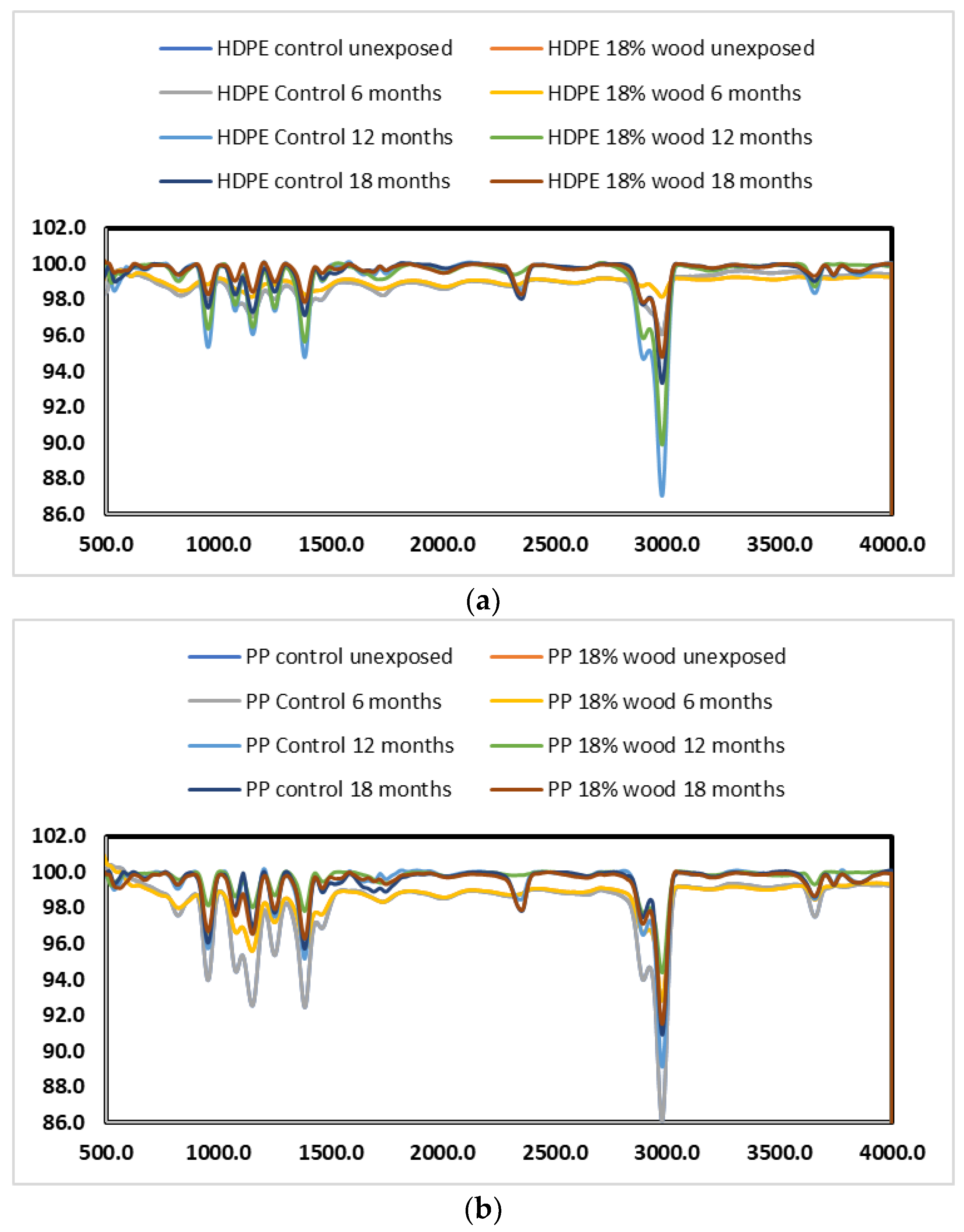
Figure 5.
Differential Scanning Calorimetry of naturally exposed samples of WPCs based on HDPE and PP. (a) Outdoor exposed HDPE composites with 0 and 18% wood filler; (b) Outdoor exposed PP composites with 0 and 18% wood filler.
Figure 5.
Differential Scanning Calorimetry of naturally exposed samples of WPCs based on HDPE and PP. (a) Outdoor exposed HDPE composites with 0 and 18% wood filler; (b) Outdoor exposed PP composites with 0 and 18% wood filler.
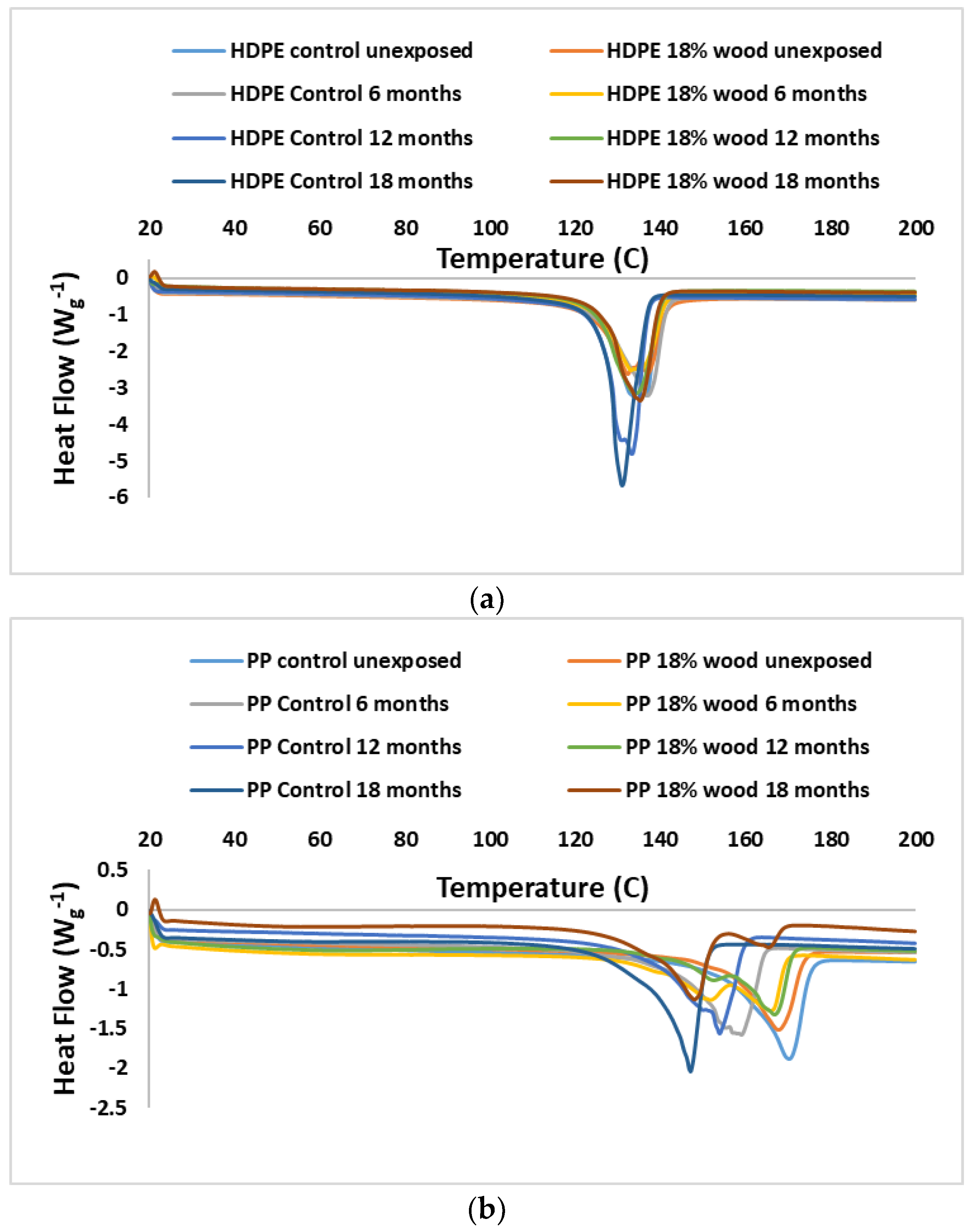
Figure 6.
Scanning electron microscopy of wood composite samples at x30000 magnification (a) HDPE-control sample, (b) HDPE-18 wt. % wood sample, (c) PP-control sample, and (d) PP-18 wt. % wood sample.
Figure 6.
Scanning electron microscopy of wood composite samples at x30000 magnification (a) HDPE-control sample, (b) HDPE-18 wt. % wood sample, (c) PP-control sample, and (d) PP-18 wt. % wood sample.
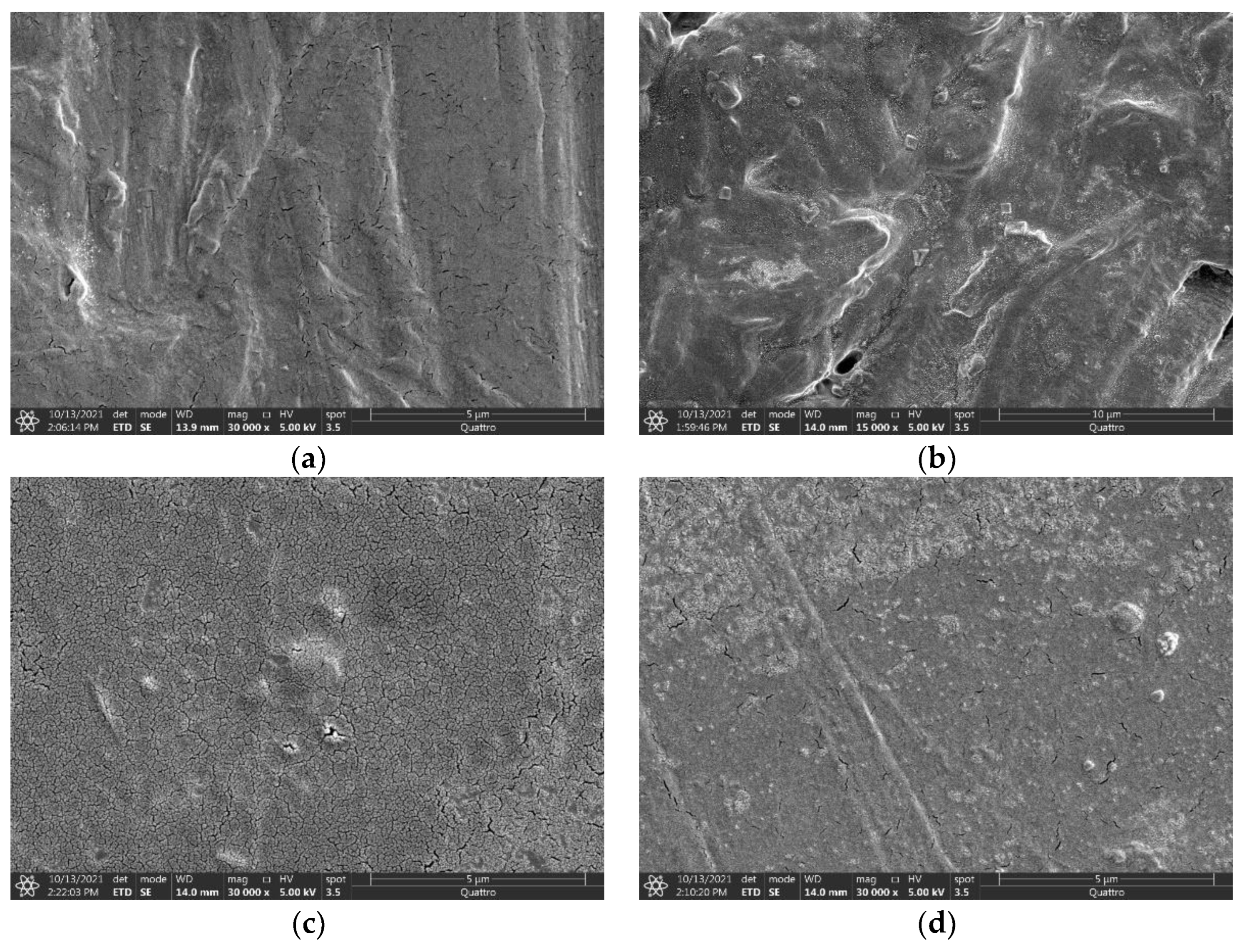

Table 1.
Change in average Tensile properties of the wood-plastic composites of HDPE and PP after weathering exposures.
Table 1.
Change in average Tensile properties of the wood-plastic composites of HDPE and PP after weathering exposures.
| Outdoor Exposure Duration | Material | Tensile Strength (Mpa) | % elongation at break | Modulus of Elasticity (Mpa) | |||
|---|---|---|---|---|---|---|---|
| Average | Std. Dev. | Average | Std. Dev. | Average | Std. Dev. | ||
| Unexposed | HDPE Control | 23.67 | 0.23 | 1011.87 | 3.68 | 619.01 | 35.89 |
| HDPE-18% wood | 29.35 | 0.79 | 24.53 | 3.53 | 1010.31 | 51.08 | |
| HDPE-27% wood | 33.05 | 0.84 | 13.75 | 1.52 | 1226.15 | 38.98 | |
| HDPE-36% wood | 35.36 | 0.79 | 9.45 | 0.90 | 1461.73 | 56.92 | |
| PP Control | 37.84 | 0.18 | 43.15 | 7.41 | 991.73 | 3.07 | |
| PP-18% wood | 38.42 | 0.38 | 9.52 | 0.57 | 1370.90 | 12.70 | |
| PP-27% wood | 38.73 | 0.30 | 6.93 | 0.36 | 1553.33 | 42.83 | |
| PP-36% wood | 38.77 | 0.63 | 5.87 | 0.21 | 1712.30 | 14.51 | |
| 6 Months | HDPE Control | 4.67 | 0.99 | 5.34 | 7.01 | 969.82 | 39.14 |
| HDPE-18% wood | 28.50 | 0.99 | 13.78 | 1.60 | 1051.20 | 44.41 | |
| HDPE-27% wood | 31.97 | 0.76 | 11.05 | 0.91 | 1264.55 | 45.03 | |
| HDPE-36% wood | 34.47 | 0.60 | 8.05 | 0.34 | 1494.55 | 36.63 | |
| PP Control | 16.70 | 1.75 | 2.40 | 0.39 | 1052.09 | 5.26 | |
| PP-18% wood | 31.83 | 0.35 | 6.93 | 0.40 | 1295.30 | 28.43 | |
| PP-27% wood | 33.38 | 0.18 | 5.74 | 0.15 | 1492.23 | 22.43 | |
| PP-36% wood | 33.38 | 0.24 | 4.92 | 0.17 | 1651.79 | 27.03 | |
| 12 Months | HDPE Control | 4.41 | 0.99 | 1.55 | 0.55 | 776.78 | 20.32 |
| HDPE-18% wood | 25.20 | 0.85 | 11.70 | 0.53 | 1004.87 | 32.70 | |
| HDPE-27% wood | 29.82 | 0.49 | 8.70 | 0.80 | 1244.91 | 28.31 | |
| HDPE-36% wood | 32.35 | 0.55 | 7.86 | 0.25 | 1443.60 | 40.78 | |
| PP Control | 9.57 | 0.20 | 1.55 | 0.06 | 833.50 | 21.66 | |
| PP-18% wood | 28.02 | 0.53 | 7.18 | 0.57 | 1132.39 | 25.34 | |
| PP-27% wood | 30.20 | 0.21 | 5.69 | 0.18 | 1378.63 | 22.98 | |
| PP-36% wood | 30.34 | 0.44 | 4.60 | 0.23 | 1544.98 | 31.86 | |
| 18 Months | HDPE Control | 4.55 | 0.55 | 1.09 | 0.15 | 781.58 | 41.13 |
| HDPE-18% wood | 24.23 | 0.94 | 9.98 | 0.92 | 1000.21 | 27.54 | |
| HDPE-27% wood | 28.62 | 0.61 | 9.39 | 0.67 | 1204.85 | 29.77 | |
| HDPE-36% wood | 31.11 | 0.40 | 7.78 | 0.27 | 1376.91 | 24.97 | |
| PP Control | 3.63 | 0.45 | 1.42 | 0.69 | 630.65 | 32.97 | |
| PP-18% wood | 26.30 | 0.20 | 6.53 | 0.34 | 1063.13 | 22.03 | |
| PP-27% wood | 28.75 | 0.46 | 5.63 | 0.30 | 1275.50 | 50.53 | |
| PP-36% wood | 30.00 | 0.24 | 4.67 | 0.29 | 1483.51 | 20.35 | |
| Accelerated Exposure Time/Energy | Material | Tensile Strength (Mpa) | % elongation at break | Modulus of Elasticity (Mpa) | |||
| Average | Std. Dev. | Average | Std. Dev. | Average | Std. Dev. | ||
| 214 h Exposure Energy = 276.8 kJ/sq.mt. | HDPE Control | 15.27 | 0.42 | 6.37 | 2.17 | 793.17 | 77.97 |
| HDPE-18% wood | 29.38 | 0.71 | 15.15 | 1.01 | 1090.50 | 17.23 | |
| HDPE-27% wood | 33.47 | 0.26 | 10.40 | 0.76 | 1361.87 | 18.56 | |
| HDPE-36% wood | 34.52 | 1.44 | 8.16 | 0.56 | 1488.11 | 98.97 | |
| PP Control | 33.05 | - | 8.38 | - | 1034.57 | - | |
| PP-18% wood | 35.38 | 0.45 | 7.59 | 0.38 | 1402.82 | 31.60 | |
| PP-27% wood | 36.33 | 0.22 | 5.65 | 0.26 | 1613.51 | 34.87 | |
| PP-36% wood | 34.91 | 0.58 | 4.60 | 0.28 | 1761.16 | 16.45 | |
| 483 h Exposure Energy = 624.9 kJ/sq.mt. | HDPE Control | 14.14 | 0.79 | 11.14 | 1.62 | 628.23 | 13.99 |
| HDPE-18% wood | 28.44 | 0.48 | 13.50 | 1.46 | 1078.97 | 19.89 | |
| HDPE-27% wood | 31.79 | 0.86 | 10.00 | 0.60 | 1297.29 | 40.10 | |
| HDPE-36% wood | 35.19 | 0.89 | 7.69 | 0.39 | 1566.84 | 54.39 | |
| PP Control | 23.19 | - | 7.12 | - | 853.28 | - | |
| PP-18% wood | 33.01 | 0.19 | 6.33 | 0.12 | 1363.88 | 24.19 | |
| PP-27% wood | 34.06 | 0.01 | 5.58 | 0.22 | 1535.70 | 3.10 | |
| PP-36% wood | 33.94 | 0.27 | 4.53 | 0.19 | 1777.21 | 61.82 | |
| 723 h Exposure Energy = 945 kJ/sq.mt. | HDPE Control | 14.45 | 0.20 | 11.37 | 1.68 | 558.04 | 21.26 |
| HDPE-18% wood | 28.58 | 0.47 | 11.41 | 0.55 | 1119.73 | 12.33 | |
| HDPE-27% wood | 32.38 | 0.17 | 8.85 | 0.09 | 1337.09 | 9.03 | |
| HDPE-36% wood | 35.05 | 1.57 | 7.42 | 0.14 | 1549.66 | 96.14 | |
| PP Control | 14.34 | - | 5.92 | - | 645.15 | - | |
| PP-18% wood | 30.35 | 0.69 | 6.07 | 0.32 | 1253.94 | 23.91 | |
| PP-27% wood | 32.09 | 0.23 | 5.27 | 0.36 | 1488.93 | 58.20 | |
| PP-36% wood | 32.28 | 0.31 | 4.36 | 0.11 | 1665.32 | 11.43 | |
| 1180 h Exposure Energy = 1514.6 kJ/sq.mt. | HDPE Control | 12.35 | - | 9.15 | - | 479.71 | - |
| HDPE-18% wood | 28.22 | 1.39 | 10.37 | 0.56 | 1093.23 | 56.28 | |
| HDPE-27% wood | 32.31 | 1.19 | 8.43 | 0.65 | 1360.65 | 71.09 | |
| HDPE-36% wood | 35.31 | 0.91 | 6.56 | 0.19 | 1579.18 | 49.82 | |
| PP Control | 4.68 | - | 4.58 | - | 353.50 | - | |
| PP-18% wood | 28.35 | 0.46 | 6.12 | 0.13 | 1135.02 | 35.05 | |
| PP-27% wood | 30.97 | 0.33 | 5.15 | 0.35 | 1451.05 | 23.63 | |
| PP-36% wood | 31.13 | 0.35 | 4.14 | 0.14 | 1661.96 | 54.21 | |
Table 2.
Change in average Shore D hardness values of wood-plastic composites of HDPE and PP after weathering exposures.
Table 2.
Change in average Shore D hardness values of wood-plastic composites of HDPE and PP after weathering exposures.
| Outdoor Exposure Duration | Average Hardness Value [Std. Dev.] | |||
|---|---|---|---|---|
| HDPE Control | HDPE-18% wood | HDPE-27% wood | HDPE- 36% wood | |
| Unexposed | 63.2 [0.1] | 65.8 [0.2] | 66.7 [0.4] | 68.3 [0.6] |
| 6 months | 56.9 [2.1] | 67.5 [0.3] | 66.4 [0.4] | 68.5 [2.0] |
| 12 months | 56.4 [2.3] | 63.4 [0.8] | 63.6 [1.2] | 67.6 [0.2] |
| 18 months | 56.3 [1.7] | 62.9 [1.7] | 61.2 [0.7] | 64.4 [0.7] |
| Outdoor Exposure Duration | Average Hardness Value [Std. Dev.] | |||
| PP Control | PP-18% wood | PP-27% wood | PP- 36% wood | |
| Unexposed | 73.9 [0.8] | 73.4 [1.0] | 73.3 [0.6] | 73.9 [1.1] |
| 6 months | 67.8 [1.1] | 68.0 [1.7] | 69.8 [0.8] | 68.1 [1.3] |
| 12 months | 68.1 [0.6] | 67.4 [1.2] | 68.1 [1.2] | 69.5 [0.8] |
| 18 months | 60.1 [2.1] | 60.8 [1.9] | 65.3 [1.5] | 67.8 [2.1] |
| Accelerated Exposure Duration | Average Hardness Value [Std. Dev.] | |||
| HDPE Control | HDPE-18% wood | HDPE-27% wood | HDPE- 36% wood | |
| 214 hours | 63.2 [1.2] | 64.4 [0.8] | 66.0 [1.3] | 68.8 [1.1] |
| 483 hours | 54.6 [2.6] | 65.1 [1.4] | 66.0 [1.3] | 67.6 [2.1] |
| 723 hours | 53.9 [1.0] | 61.7 [3.0] | 64.3 [1.6] | 67.5 [1.0] |
| 1180 hours | 47.5 [2.8] | 60.1 [1.1] | 65.5 [0.7] | 67.1 [1.5] |
| Accelerated Exposure Duration | Average Hardness Value [Std. Dev.] | |||
| PP Control | PP-18% wood | PP-27% wood | PP- 36% wood | |
| 214 hours | 72.3 [1.2] | 70.8 [1.0] | 71.8 [1.4] | 73.0 [0.8] |
| 483 hours | 67.0 [0.7] | 69.7 [1.5] | 72.0 [1.3] | 71.0 [1.7] |
| 723 hours | 62.6 [1.5] | 66.6 [1.9] | 69.3 [1.1] | 72.4 [1.0] |
| 1180 hours | 54.8 [1.0] | 65.4 [3.5] | 68.2 [2.4] | 70.3 [0.8] |
Table 3.
Changes in the average molecular weights (g/mol) of wood-plastic composites of HDPE and PP after outdoor weathering exposure.
Table 3.
Changes in the average molecular weights (g/mol) of wood-plastic composites of HDPE and PP after outdoor weathering exposure.
| Exposure Duration | Material | Mw | Mn | PDI |
|---|---|---|---|---|
| Unexposed | HDPE Control | 78428 | 15208 | 5.16 |
| HDPE-18% wood | 61839 | 12871 | 4.81 | |
| PP Control | 194387 | 37189 | 5.23 | |
| PP-18% wood | 190151 | 32495 | 5.85 | |
| 6 Months | HDPE Control | 26680 | 7481 | 3.57 |
| HDPE-18% wood | 69140 | 15891 | 4.35 | |
| PP Control | 31292 | 7899 | 3.96 | |
| PP-18% wood | 189532 | 30840 | 6.15 | |
| 12 Months | HDPE Control | 23019 | 5929 | 3.88 |
| HDPE-18% wood | 72990 | 14369 | 5.08 | |
| PP Control | 7398 | 3154 | 2.35 | |
| PP-18% wood | 167423 | 26657 | 6.28 | |
| 18 Months | HDPE Control | 23282 | 5426 | 4.29 |
| HDPE-18% wood | 60495 | 15550 | 3.89 | |
| PP Control | 5975 | 2906 | 2.06 | |
| PP-18% wood | 155017 | 28854 | 5.37 |
Disclaimer/Publisher’s Note: The statements, opinions and data contained in all publications are solely those of the individual author(s) and contributor(s) and not of MDPI and/or the editor(s). MDPI and/or the editor(s) disclaim responsibility for any injury to people or property resulting from any ideas, methods, instructions or products referred to in the content. |
© 2024 by the authors. Licensee MDPI, Basel, Switzerland. This article is an open access article distributed under the terms and conditions of the Creative Commons Attribution (CC BY) license (http://creativecommons.org/licenses/by/4.0/).
Copyright: This open access article is published under a Creative Commons CC BY 4.0 license, which permit the free download, distribution, and reuse, provided that the author and preprint are cited in any reuse.


