

Submitted:
12 November 2024
Posted:
13 November 2024
You are already at the latest version
Abstract
Abstract: The observed climate change affects all sectors of human activity. Agricultural management is influenced by changes in temperature and precipitation distribution both during the growing season and in the non-growing period. The contribution of snowmelt erosion to the total annual loss of arable soil has not yet been sufficiently emphasized. Based on the USLE principle, an equation for soil loss caused by snowmelt was derived, and the erosion potential of snow was determined for the conditions of the Czech Republic. In the foothill area of Větřkovice, an analysis of changes in selected climatic characteristics in the years 1961-2020 was elaborated. It was shown that the area is warming and the number of days with temperatures below 0°C is decreasing. The total annual precipitation decreased by 18 mm. Furthermore, the erosion potential was compared in two referential periods for both the entire Czech Republic and the Větřkovice area, and a case study of soil loss due to snowmelt erosion was prepared. Despite a slight reduction of the erosion potential in the model area, the erosion shear from snowmelt reaches values higher than the permissible limit.
Keywords:
erosion potential
; climatic characteristics
; foothill area
; soil loss
; non-vegetation period
; snow water equivalent
1. Introduction
Snow is one of the most variable elements of the hydrological cycle [1] therefore snowmelt combined with rain and soil freezing can lead to severe erosion, even in less vulnerable areas [2]. According to [3] soil erosion is one of the main global environmental problems limiting the sustainable development of the ecological environment. As stated [4], soil loss caused by snowmelt runoff constitutes a significant part of the total annual soil erosion in mid to high latitudes, as confirmed by [5,6,7]. In these vulnerable areas, snowmelt erosion can cause serious damage to soil quality and health, water quality, crop yields, and overall ecological balance [8,9]. With the increasing melting of glaciers and decreasing snow cover, the impact of snowmelt on hydrological processes and soil erosion is becoming more serious [10]. Annual snowfall accounts only 5% of the total global precipitation, referred by [11]. The spatial heterogeneity of snow distribution and the complexity of snowmelt processes, snowmelt runoff in mid to high latitudes likely causes even more severe soil erosion than water erosion [12,13,14,15], as evidenced by erosion studies [16,17,18]. This is further confirmed by [19], who demonstrated that water flows much faster on a frozen slope than on a thawed slope. Erosion caused by snowmelt has its own distinct characteristics [20], such as snowmelt runoff being sensitive to changes in radiation and air temperature, soil surface being affected by freezing and thawing, frozen soil layer reducing infiltration, and low vegetation cover during the snowmelt period.
The primary characteristic of snowmelt erosion is the freezing of soil during the winter, leading to the exclusion of water from the soil, which forms ice crystals around soil aggregates. These crystals break up soil aggregates, resulting in fine particles that are released and transported during snowmelt [10]. The thawed topsoil becomes muddy and susceptible to erosional damage. Another effect of soil freezing is increased soil erodibility in the spring months, when the potential for water infiltration into lower layers is significantly reduced [9]. In this period, relatively strong erosion occurs in the surface layer, even though the amount of melting snow is small. The erosion process during snowmelt is accelerated by the arrival of warm air masses accompanied by rainfall [21,22]. According to [23] the temporal variability of snow cover and the spatial heterogeneity of soil freezing, together with rain-on-snow events, cause complex and dynamic runoff. [24] found that the rate of snowmelt and infiltration of rain into frozen soil depends largely on the initial water content, frost depth, and soil temperature.
Snow cover is also an important indicator of the climatic character of winter. Analysis of spatial and temporal variability of snow cover in a watershed helps to assess changes in flood regimes [25], to predict snowmelt runoff in the spring period [26] and is an important indicator for assessing air temperature in climate studies [27].
Snowmelt, soil freezing, and related erosion events exhibit significant spatial variability [28]. According to [29] spring snowmelt, as well as repeated snowmelt during winter, contributes to annual water runoff and soil particle removal from the entire watershed. Soil particles released by melting snow water are deposited at the foot of slopes when their velocity decreases. Fine soil particles, however, are transported to watercourses, where they constitute most of the sediment. This unchanneled runoff from melting snow causes soil loss if not protected by vegetation and can lead to seasonal flooding [30,31,32]. Soil erosion increases with slope steepness and length and depends on spring weather conditions as well as those during winter and autumn [33]. Microrelief of cultivated land also significantly affects soil erosion. The most intense soil erosion is observed on fields ploughed along the slope and is significantly less intense on fields cultivated along the contour lines, as ridges and furrows reduce and impede the flow of water from melting snow There was also found by [18], that the protective effect of vegetation in the spring is small, and the risk of erosion is particularly high in areas where autumn ploughing leaves the soil unprotected. According to [34], there has been a significant increase in temperature characteristics in the Czech Republic between 1961 and 2019. Due to rising temperatures, an increase in the ratio of rainfall to snowfall, especially at the beginning and end of the cold season, and thus less snow accumulation during the winter season is expected [35].
Snow accumulation and melt are influenced by various factors, primarily elevation, wind, exposure, slope, and vegetation cover. According [36], vegetation is the most significant influencing factor. Other factors such as elevation, orientation, and exposure to the prevailing wind direction act in combination and it is not possible to clearly determine a dominant factor. The melting rate is usually significantly lower than the intensity of rainfall, which is commonly recorded in mm·day-1. However, the soil is frozen and saturated with water in the surface layer during winter, reducing the infiltration rate. As a result, a significant portion of the meltwater runs off, and thus the runoff coefficient from snowmelt on frozen soil is usually higher than that of rainwater. Normal values of snowmelt runoff range from 1.0 to 15 mm.day−1. Although erosion caused by meltwater does not reach the same intensity as erosion caused by rainfall runoff, it acts over a larger area with little vegetation protection, making soil erosion one of the primary consequences [21,22].
Erosion models provide a powerful tool for investigating snowmelt erosion. Conceptual models, which are based on empirical relationships between variables, and physical models, which are grounded in the physics of snowmelt, are commonly employed in such studies [37]. Some of the physical models used include SWAT (Soil and Water Assessment Tool), WEEP (Water Erosion Prediction Project), EUROSEM (European Soil Erosion Models) and LISEM (Limburg Soil Erosion Model). Empirical models are mostly based on the derivation of a universal soil loss equation (USLE) (e.g., RUSLE—Revised Universal Soil Loss Equation, MUSLE—Modified Universal Soil Loss Equation, SHI—The Russian State Hydrological Institute model), as stated by [10].
Based on the USLE principle, [21] derived an equation for soil loss caused by snowmelt for the conditions of the Czech Republic. This equation has been further used in other studies. [38], by determining the R factor value in the post-harvest period and the snowmelt erosion, calculated the total annual soil loss for a selected area using the approach according to [21]. The application of USLE and its modification according to [21] was also dealt with by [39], who presented a method for assessing the erosive potential of snow cover based on data available from the Czech Hydrometeorological Institute (CHMI). The study by [40] presents an evaluation of the erosive potential of snow for the territory of the Czech Republic in the cold periods of 1980/1981 to 2009/2010.
2. Materials and Methods
The intensity of erosion caused by snowmelt, according to [21], is based on the universal soil loss equation [41], where the rainfall erosivity factor R is replaced by the snowmelt rate factor m (mm·day−1) in maximum 20-day period, in which the most intense thawing takes place and factor of amount of water derived from snow during the 20-day period h (cm). The combination of both factor m and h could be assigned as erosive potential of snow cover. The amount of water produced by snowmelt (h) and the snowmelt rate (m) can be derived from long-term measurements at meteorological stations using databases of snow water equivalent (SWE) and snow cover depth (SCE) [39,42].
Determination of the Potential of Snowmelt Erosion
The combination of SWE and SCE factors can be collectively referred to as the erosion potential of water accumulated in the snow cover (Ep). The determination of Ep values using data from available climatic stations can be used for areal distribution of the risk of soil erosion caused by snowmelt. This approach was used to assess the erosion potential for the conditions of the Czech Republic.
To evaluate the impact of climate change on factors causing snowmelt erosion, two periods were selected for the analysis 1981-2010 and 1991-2020.
The erosion potential was calculated for a dataset of 235 Czech Hydrometeorological Institute (CHMI) climatological and precipitation stations, selected based on data availability. Daily values of SWE and SCE were used for the so-called cold period of the year, specifically from October to the following May. In total, data from 1980/1981 to 2019/2020 were processed. Starting from the day with the highest snow water equivalent, the number of days until the total snow depth reached zero was counted. If this did not happen, a maximum of 20 melting days was considered for the erosion potential calculation. The snowmelt rate factor (m) was calculated by dividing the amount of water in the water column by the number of days with the most intense melting, resulting in the amount in mm per day. The erosion potential of snow cower was then calculated by multiplying the values of h (in cm) and m (in mm·day-1) for each "cold period". From the annual values, average erosion potential values were calculated for two periods 1981-2010, and 1991-2020.
Study Area Větřkovice
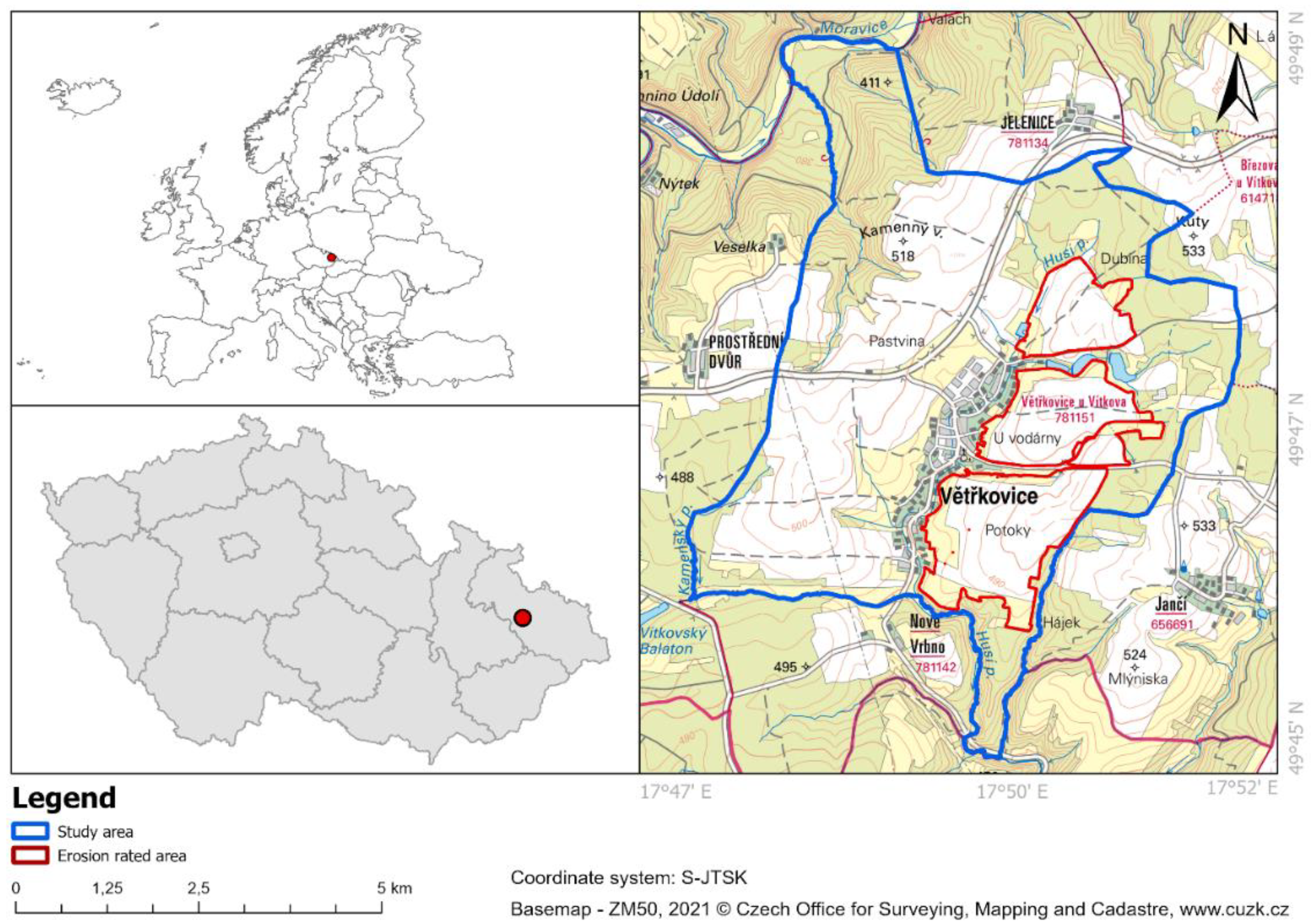
The study area of Větřkovice-located in the foothills of the Nízký Jeseník mountains in the northeastern part of the Czech Republic—(Figure 1), was selected for interpreting the risk of erosion from snowmelt using erosion potential values.
The average altitude of this area is 480-500 m above sea level. The area is characterized by a climate with a very short, moderately cool, and humid summer, a long transition period with a moderately cool spring and mild autumn, and a long, mild to moderately humid winter with a long duration of snow cover. The average annual air temperature in the locality is 7.6 °C, and in winter it is -1.7 °C, with the coldest month being January.
Figure 1.
Location of the study area and the analyzed land blocks (EHP).
As part of the analysis of climatic characteristics, average values for individual months, the year, and seasons were calculated for the locality, focusing on the evaluation primarily in winter and the cold half-year (October to March). To assess the possible change in the occurrence of snowmelt erosion, trends in time series of climatic characteristics related to erosion in winter period, were also processed. Trends were determined from long-term climate data for the period 1961-2020.
To compare the impact of changing climatic characteristics on the risk of erosion from snowmelt, long-term average soil loss was analysed on selected land blocks in the Větřkovice locality, depending on the snow erosion potential (E) for two referential periods 1981/2010 and 1991/2020 according to the modified equation by [21].
ES = EP . k . LS . C. P . K [t·ha-1·yearc]
ES—Intensity of erosion [t·ha-1·year-1]
EP—The erosion potential [-]
k—The runoff coefficient
LS—The topographic factors [-]
C– The cropping management factor in the period of dangerous snowmelt [-]
P—The supporting practices factor [-]
K—The soil erodibility factor [t·h·MJ−1·cm−1]
3. Results
3.1. Overview of Climatological Characteristics of the Větřkovice Area Regard to Snowmelt Erosion and Its Trend
From the daily values of a set of climatic characteristics from the Vítkov meteorological station near Opava, data on average, minimum, and maximum air temperature, total precipitation, new snow cover (i.e., daily increase in snow cover), number of days with a minimum temperature below 0 °C, and number of days with total high of snow cover above 1 cm were processed. The results are documented in Table 1 and Table 2.

Table 1.
Average annual, monthly and seasonal values of climatological characteristics for the period 1961–2020.
Table 1.
Average annual, monthly and seasonal values of climatological characteristics for the period 1961–2020.
| trends – period 1961-2020 | year | winter | spring | summer | autumn | X.-III. | IV.-IX. |
|---|---|---|---|---|---|---|---|
| mean temperature °C | 7.60 | -1.70 | 7.40 | 16.70 | 7.90 | 1.30 | 13.80 |
| maximum temperature °C | 12.00 | 1.20 | 12.30 | 22.30 | 12.00 | 4.70 | 19.20 |
| minimum temperature °C | 3.30 | -4.70 | 2.60 | 11.20 | 4.20 | -1.90 | 8.50 |
| number of days with minimum temperature below 0 °C | 119.00 | 72.60 | 27.50 | 0.00 | 18.60 | 110.70 | 8.70 |
| number of days with total snow depth above 1 cm | 70.80 | 53.30 | 11.90 | 0.00 | 5.70 | 68.90 | 1.90 |
| depth of new snow (cm) | 119.20 | 80.90 | 22.60 | 0.00 | 15.00 | 113.50 | 6.40 |
| precipitation total (mm) | 679.70 | 105.30 | 170.20 | 254.10 | 149.70 | 233.80 | 445.10 |
As part of the trend analysis, linear trends for temperature characteristics were tested using the t-test, and for precipitation characteristics, the Mann-Kendall non-parametric trend test was performed. The results are presented in Figure 2, Figure 3 and Figure 4. (The graph shows the trend value, i.e., the change in the value of the characteristic over 10 years for months, years, and seasons. Orange columns indicate whether the trend is statistically significant, gray indicates insignificance).
Table 2.
Trend values of individual characteristics for months, years and seasons for the period 1961–2020 at Větřkovice (orange is statistically significant trend, p = 0.05).
Table 2.
Trend values of individual characteristics for months, years and seasons for the period 1961–2020 at Větřkovice (orange is statistically significant trend, p = 0.05).
| trends – period 1961-2020 | year | winter | spring | summer | autumn | X.-III. | IV.-IX. |
|---|---|---|---|---|---|---|---|
| mean temperature °C | 0.380 | 0.390 | 0.350 | 0.500 | 0.230 | 0.360 | 0.400 |
| maximum temperature °C | 0.400 | 0.350 | 0.410 | 0.580 | 0.230 | 0.360 | 0.460 |
| minimum temperature °C | 0.370 | 0.430 | 0.250 | 0.470 | 0.300 | 0.400 | 0.350 |
| number of days with minimum temperature below 0 °C | -5.100 | -0.010 | -1.250 | 0.00 | -1.310 | -4.590 | -0.610 |
| number of days with total snow depth above 1 cm | -6.405 | -3.370 | -1.699 | -0.016 | -0.784 | -5.606 | -0.134 |
| depth of new snow (cm) | -14.005 | -6.896 | -2.097 | -0.016 | -3.341 | -13.609 | -1.013 |
| precipitation total (mm) | -18.017 | -5.606 | -10.130 | -5.678 | 4.186 | -12.030 | -7.936 |
The analysis of annual and seasonal averages, minimums, and maximums temperatures clearly shows a significant increase in values towards the present. This is confirmed by the identified trends, where a statistically significant increasing trend in temperature characteristics is evident for most months, as well as for annual and seasonal values. In winter period, a temperature increase trend of 0.4 °C per 10 years was found, while in spring, the average and maximum temperatures show an increase of 0.4 °C per 10 years, and the minimum temperature has a slightly lower increase of approximately 0.3 °C per 10 years. Consistent with this, there is also a trend of decreasing the number of days with a minimum temperature below 0 °C. The annual number of these days, which averages 119 per year, is decreasing at a rate of about 5 days per 10 years. This means that there is a gradual and significant increase in the occurrence of days with snowmelt or precipitation in the form of rain during the winter period. Regarding precipitation, the average annual precipitation in the period 1961-2020 is 679.7 mm, and in the cold half-year, it is 233.8 mm. A statistically significant decreasing trend in precipitation is evident both in annual values and in values for the spring season, and it is also present in the amounts in the cold half-year. The trend of decreasing annual precipitation is 18 mm per 10 years, in the spring season it is approximately 10 mm per 10 years, and in the cold half-year, a decrease of 12 mm per 10 years is recorded (see Table 2). Similarly, there is a change in the recorded sums of total new snow depth, which averages 119.2 cm in the locality. A significant decreasing trend of 14 cm per 10 years was proven for annual values, and in the autumn season, the total sum of new snow decreases by a trend of 3.3 cm per 10 years. An interesting indicator for future estimation of snowmelt erosion development can also be the characteristic of the number of days with a total high of snow cover above 1 cm. On average, there are about 71 such days in the locality per year. According to the trend analysis, a statistically significant decreasing trend of 6.4 days per 10 years was recorded in annual values, and for the winter season 3.4 days/10 years, and in the spring season 1.7 days/10 years.
Warming is also evident from observed measurements across Europe, and the frequency of weather extremes is increasing [43]. The average annual air temperature increased by 0.3 °C per decade between 1961 and 2018, and in the last 28 years (1991–2018), it has risen by 0.9 °C compared to the 1961–1990 average, like the Czech Republic [44]. The trends of increasing temperatures within the three reference periods are also confirmed by [34].
The trends of climatic characteristics in the Větřkovice area correspond with the scenarios processed by [44] for the Czech Republic, where we can expect an increase in air temperature of at least 2 °C by the end of this century compared to the reference period 1981–2010. The highest increase in maximum air temperatures will occur in winter and the smallest in spring. Furthermore, it is expected that by the end of the century, the annual average precipitation in the Czech Republic will increase by 7-16%. There will be an increase in winter precipitation, which may rise by up to 35% by the end of the 21st century, while summer precipitation will decrease. Based on analyses of climatic characteristics and their scenarios in the territory of Ukraine, [45] indicates that episodes of snowmelt will likely decrease, but solid precipitation will be replaced by liquid precipitation. This phenomenon will require further study of the impact of liquid precipitation in the winter period on soil erosion.
3.2. Regionalization of the Potential of Snowmelt Erosion in the Czech Republic
A point layer was processed in ArcGIS software from the set of snowmelt erosion potential values for the periods 1981–2010 and 1991–2020. The snowmelt erosion potential values for individual stations were interpolated across the Czech Republic using regression kriging, dependent on several parameters such as altitude, slope, and aspect, including corrections to the estimated value to maintain the value corresponding to the station’s location. The interpolation was performed using tools contained in the ProClimDB software. The resulting raster model with a spatial resolution of 500 x 500 m was subsequently processed in the ArcGIS software environment, and the raster was smoothed using the low pass filter method.
The categorization of values was done by classifying the erosion potential raster into 5 categories. The boundaries of each category were set at the 20th, 40th, 60th, and 80th percentiles of the raster erosion potential values for the given periods. This categorization using the percentiles was done to determine relatively equally extensive areas within the Czech Republic. Subsequently, the area of land falling into each category and period was calculated.
The differences in erosion potential values for the given periods are presented in Table 3.
The Table 3 shows a gradual trend of decreasing areas with high erosion potential (>85.1) and, conversely, an increase the area of regions where lower EP values (6.1-26) were analysed. This may indicate a decrease in the risk of erosion events in higher-altitude areas, where the amount of fallen snow is decreasing. However, areas with lower erosion potential in the winter period may be affected over a larger area. Since these are mostly areas with intensive farming on arable land than in the foothill areas, more significant erosion events associated with snowmelt may occur here.
By interpolating the erosion potential values across the area of the Czech Republic, erosion potential maps were generated for the analysed periods 1981-2010 and 1991-2020 (Figure 5 and Figure 6).
These maps were used to determine erosion potential values for two referential periods in the Větřkovice locality. Using a modified equation [21], the amount of erosion runoff on erosion-assessed areas was calculated and their difference compared. Methods for quantifying erosion processes from snowmelt are still rarely published. Mostly are presented complex models for quantifying erosion from snowmelt [46] or its intensity [47].
An erosion potential map for the referential period 1981-2010 published by [40], presented results of erosion potential analysis only from 50 climatic stations. The newly processed maps in Figure 5 and Figure 6 represents a more detailed distribution of erosion potential and newly defines the boundaries of individual categories. They allow to compare changes in erosion potential during the two referential period.
3.3. Analysis of Erosion Risk in the Větřkovice Area Using Erosion Potential Maps
The calculation of erosion intensity using the equation required the determination of specific factor values:
Factors LS, P, and K
These factors are determined using standard procedures according to the calculation method for water erosion.
The Runoff Coefficient (k)
The value of the runoff coefficient during the snowmelt period when the soil is saturated with water is equal to 0.5. The value of k is multiplied by a number from the interval 1.5 to 3 according to the soil freezing with respect to the possibility of water infiltration into the soil and the soil susceptibility to erosion. In the case, where data on soil freezing is not available, the mean value of the coefficient for frozen soil can be used 2 (The value of the runoff water coefficient is then k = 1).
The Vegetation Cover Efficiency Factor in the Period of Dangerous Snowmelt (C)
CNO—C factor for non-vegetation season
CVO—C factor for vegetation season
The erosion potential (EP) for the studied area was determined from the erosion potential maps. The EP value was used in two variants: erosion potential from the referential period 1981–2010 (EP past = 54.40) and erosion potential from the referential period 1991-2020 (EP pres = 50.45).
For the factor of runoff water, a value of k = 1 (fully frozen soil) was determined. The LS factor was determined based on the digital elevation model (DEM) using the USLE2D program – algorithm according to McCool. The K factor was determined according to the soil characteristics of the area (main soil type). Its value is 0.41 (soils highly susceptible to erosion). The CNO factor was recalculated based on the determined CVO for the area of interest (CVO = 0.024). For the non-vegetation period, CNO = 0.305. The limit value for soil loss was set according to [50] (Decree on the protection of agricultural land against erosion) at 9 t·ha-1·y-1.
GIS tools were used on a digital elevation model (DEM) to calculate the degree of erosion risk. Four land blocks (EHP 1-4) were evaluated (see Figure 1). The results of the analysis are shown in Table 4.
The results of the analysis indicate a slight decrease in the intensity of erosion caused by snowmelt due to changing climatic conditions. However, the observed values still exceed the limits set by legislation [50]. Considering the erosion potential derived from the map processed for the referential period 1991-2020, the average soil loss due to erosion is 9.9 t·ha-1·y-1. When considering the past EP values determined from the data of 1981-2010, the average soil loss is 10.69 t·ha-1·y-1. Overall, there is an average reduction in erosion intensity in the winter period by 0.79 t·ha-1·y-1. Nevertheless, attention must be paid to erosion from snowmelt, as demonstrated by [4], who found that soil losses were higher during snowmelt periods than during rainfall periods in the northeastern China watershed due to higher surface runoff in early spring. Reduced soil infiltrability during snowmelt periods also significantly contributed to this higher surface runoff. Work by [17] studied the causes of erosion in potato fields and found large soil losses (10-15 t·ha-1·y-1) caused by snowmelt. In agricultural areas of European Russia [51] determined the intensity of soil erosion over periods of snowmelt and storm runoff, as well as the total annual soil loss. The average soil erosion in the studied area is 4.04 t·ha-1·y-1, considering the soil protection coefficients of agricultural vegetation. In the annual soil loss due to erosion, rainfall runoff erosion predominates at 3.78 t·ha-1·y-1, while snowmelt erosion is significantly lower at only 0.26 t·ha-1·y-1. In the Czech Republic [49] calculated the average long-term soil loss due to water from melting snow for selected localities. The calculated soil loss in the non-vegetation period was up to 36 t·ha-1·y-1.
5. Conclusions
The analysis of the development of climatic characteristics of the studied area in the years 1961-2020, with an emphasis on the winter period, showed the following significant results:
- i.
- There is an increase in average, maximum, and minimum air temperatures, and accordingly, a decrease in the number of days with temperatures below 0 °C. The warming of the area is also associated with a decrease in the total depth of new snow cover by 3.3 cm per 10 years and a decrease in the number of days with snow cover height above 1 cm by 6.4 days per 10 years.
- ii.
- The total decrease in precipitation amounts is 12 mm per 10 years in the cold half of the year, and for annual totals, it is 18 mm per 10 years.
- iii.
- From the CHMI database, the erosion potential of snow was calculated at 235 climatic stations. The erosion potential values for individual stations were interpolated across the area of the Czech Republic using the method of regression kriging into an erosion potential map for two referential periods. The results show a change in the spatial distribution of erosion potential values. High EP values, occurring in foothill and mountainous areas, mostly grassed, are decreasing in area. The spatial share of lower EP values, located mainly in lower altitudes, predominantly arable, is increasing. In these areas, more significant erosion events associated with snowmelt on arable land may occur.
- iv.
- The comparison of erosion potential calculated for two referential periods (1981-2010 and 1991-2020) in the Větřkovice case area showed a slight decrease in erosion potential value in the referential period 1991-2020, which corresponds with the analyses of changes in climatic characteristics in the studied area. However, the soil loss due to snowmelt erosion, calculated for selected localities, still exceeds the values set by current legislation by 0.9 t·ha-1·y-1.
In view of the above findings from the analyses, it follows that in the future, the locality is expected to experience further increases in temperatures, both in annual values and in the winter season, along with a decrease in the number of days supporting the formation of continuous snow cover and the total precipitation in the form of snow. However, considering that despite the decrease in the number of days with snow cover, snow still occurs sufficiently in the locality during the winter period, this, combined with the trend of rising winter temperatures and thus a higher probability of rainfall, may indicate more frequent episodes of rapid snowmelt in the future, leading to intensified soil erosion processes.
This fact can be alarming because soil losses due to erosion from both snowmelt and winter liquid precipitation must be considered in the context of year-round erosion events. The total soil loss due to erosion, including that in the non-vegetation period, has not yet been summarized within the Czech Republic, despite potentially exceeding the set limits. Temperature fluctuations can promote more intense snowmelt, leading to more frequent soil particle transport in the winter period and increased sediment presence in watercourses. For these reasons, despite the decreasing amount of snow cover in the winter period, it is necessary to continue addressing the issue of erosion processes in the non-vegetation period. Currently, there are various models for determining erosion from snowmelt; however, the application of snowmelt erosion models in practical research is minimal, which hinders the updating and development of snowmelt erosion models and leads to low model adaptability in the current climate change and multi-extreme event-prone environment.
Author Contributions
Conceptualization: Jana Podhrázská and Josef Kučera; methodology: Jana Podhrázská, Filip Chuchma; software: Filip Chuchma, Josef Kučera; validation: Jan Szturc, Filip Chuchma, Josef Kučera; formal analysis: Filip Chuchma; investigation: Josef Kučera, Jan Szturc; resources: Filip Chuchma; data curation: Josef Kučera; writing—original draft preparation: Jana Podhrázská, Jan Szturc; writing—review & editing: Jana Podhrázská; visualization, Josef Kučera; supervision: Jana Podhrázská; project administration: Jana Podhrázská, Josef Kučera; funding acquisition: Jana Podhrázská. All authors have read and agreed to the published version of the manuscript.
Funding
This research was funded by Technology agency of the Czech Republic, grant number TH 04030363 and Institutional support of MACR – number RO0223. The APC was funded by a publisher.
Data Availability Statement
The raw data supporting the conclusions of this article will be made available by the authors on request.
Acknowledgments
The authors would like to acknowledge all the reviewers and editors. We also thank the CHM Institute for providing valuable data. Special thanks belong to the publisher for providing the full waive.
Conflicts of Interest
The funders had no role in the design of the study; in the collection, analyses, or interpretation of data; in the writing of the manuscript; or in the decision to publish the results.
References
- Doesken, N.J.; Robinson, D.A. The Challenge of Snow Measurements. Historical Climate Variability and Impacts in North America. Springer: Heidelberg, Germany, 2009. [Google Scholar] [CrossRef]
- Øygarden, L. Rill and gully development during an extreme winter runoff event in Norway. Catena 2003, 50, 217–242. [Google Scholar] [CrossRef]
- Quinton, J.N.; Fiener, P. Soil erosion on arable land: An unresolved global environmental threat. Progress in Physical Geography: Earth and Environment 2024, 48(1), 136–161. [Google Scholar] [CrossRef]
- Wu, Y.; Ouyang, W.; Hao, Z.; Yang, B.; Wang, L. Snowmelt water drives higher soil erosion than rainfall water in a mid-high latitude upland watershed. J. Hydrol. 2018, 556, 438–448. [Google Scholar] [CrossRef]
- Lana-Renault, N.; Alvera, B.; García-Ruiz, J.M. Runoff and Sediment Transport during the Snowmelt Period in a Mediterranean. High-Mountain Catchment. Arct. Antarct. Alp. Res. 2018, 43, 213–222. [Google Scholar] [CrossRef]
- Gusarov, A.V. The impact of contemporary changes in climate and land use/cover on tendencies in water flow, suspended sediment yield and erosion intensity in the northeastern part of the Don River basin, SW European Russia. Environ. Res. 2019, 175, 468–488. [Google Scholar] [CrossRef]
- Zhang, L.; Ren, F.P.; Li, H.; Cheng, D.B.; Sun, B.Y. The Influence Mechanism of Freeze-Thaw on Soil Erosion: A Review. Water 2021, 13, 1010. [Google Scholar] [CrossRef]
- Lu, Y.F.; Liu, C.; Ge, Y.; Hu, Y.L.; Wen, Q.; Fu, Z.L.; Wang, S.B.; Liu, Y. Spatiotemporal Characteristics of Freeze-Thawing Erosion in the Source Regions of the Chin-Sha, Ya-Lung and Lantsang Rivers on the Basis of GIS. Remote Sens. 2021, 13, 309. [Google Scholar] [CrossRef]
- Liu, B.; Fan, H.; Jiang, Y.; Ma, R. Linking pore structure characteristics to soil strength and their relationships with detachment rate of disturbed Mollisol by concentrated flow under freeze–thaw effects. Journal of Hydrology 2023, 617, 129052. [Google Scholar] [CrossRef]
- Wu, Z.; Fang, H. Snowmelt erosion: A review. Earth-Science Reviews 2024, 250. [Google Scholar] [CrossRef]
- Li, S.; Liu, M.; Adam, J.C.; Pi, H.; Su, F.; Li, D.; Liu, Z.; Yao, Z. Contribution of snow-melt water to the streamflow over the Three-River Headwater region, China. Remote Sens. 2021, 13(8), 1585. [Google Scholar] [CrossRef]
- Hu, W.; Fan, H.; Li, H.; Zhai, X.Y.; Zhang, X.Y. Snowmelt erosion characteristics of controlled gully in black soil region. J. Soil Water Conserv. 2018, 32(5), 84–90. [Google Scholar] [CrossRef]
- Aygün, O.; Kinnard, C.; Campeau, S. Responses of soil erosion to warming and wetting in a cold Canadian agricultural catchment. Catena 2021, 201, 105184. [Google Scholar] [CrossRef]
- Tang, J.; Liu, G.; Xie, Y.; Dun, X.; Wang, D.; Zhang, S. Ephemeral gullies caused by snowmelt: A ten-year study in northeastern China. Soil Tillage Res. 2021, 212, 105048. [Google Scholar] [CrossRef]
- Wang, L.; Zheng, F.; Liu, G.; Zhang, X.; Wilson, G.; Shi, H.; Liu, X. Seasonal changes of soil erosion and its spatial distribution on a long gentle hillslope in the Chinese Mollisol region. Int. Soil Water Conservation Res. 2021, 9(3), 394–404. [Google Scholar] [CrossRef]
- Demidov, V.; Ostroumov, V.; Nikitishena, I.; Lichko, V. Seasonal freezing and soil erosion during snowmelt. Eurasian Soil Science 1995, 28, 78–87. [Google Scholar]
- Edwards, L.; Richter, G.; Bernsdorf, B.; Schmidt, R.-G.; Burney, J. Measurement of rill erosion by snowmelt on potato fields under rotation in Prince Edward Island (Canada). Can. J. Soil Sci. 1998, 78, 449–458. [Google Scholar] [CrossRef]
- Lundekvam, H.E.; Romstad, E.; Øygarden, L. Agricultural policies in Norway and effects on soil erosion. Environmental Science & Policy 2003, 6, 57–67. [Google Scholar] [CrossRef]
- Ban, Y.; Lei, T.; Liu, Z.; Chen, C. Comparison of rill flow velocity over frozen and thawed slopes with electrolyte tracer method. Journal of Hydrology 2016, 534, 630–637. [Google Scholar] [CrossRef]
- Zhai, J.B.; Zhang, Z.; Melnikov, A.; Zhang, M.Y.; Yang, L.Z.; Jin, D.D. Experimental Study on the Effect of Freeze-Thaw Cycles on the Mineral Particle Fragmentation and Aggregation with Different Soil Types. Minerals 2021, 11, 913. [Google Scholar] [CrossRef]
- Zachar, D. Soil erosion; Elsevier Scientific Publishing Company: Amsterdam, 1982; ISBN 0-444-99725-3. [Google Scholar]
- Bai, Q.; Zhou, L.; Fan, H.; Huang, D.; Yang, D.; Liu, H. Effects of frozen layer on composite erosion of snowmelt and rainfall in a typical black soil of northeast China. Water 2023, 16(15), 2131. [Google Scholar] [CrossRef]
- Sui, J.; Koehler, G. Rain-on-snow induced flood events in Southern Germany. Journal of Hydrology 2001, 252, 205–220. [Google Scholar] [CrossRef]
- Watanabe, K.; Kito, T.; Dun, S.; Wu, J.Q.; Greer, R.C.; Flury, M. Water infiltration into a frozen soil with simultaneous melting of the frozen layer. Vadose Zone Journal 2013, 12(1), vzj2011-0188. [Google Scholar] [CrossRef]
- Hall, D.K.; Riggs, G.A.; DiGirolamo, N.E. Comparison of the NASA Standard MODerate-Resolution Imaging Spectroradiometer and Visible Infrared Imaging Radiometer Suite Snow-Cover Products for Creation of a Climate Data Record: A Case Study in the Great Basin of the Western United States. Remote Sensing 2024, 16, 3029. [Google Scholar] [CrossRef]
- Nester, T.; Kirnbauer, R.; Parajka, J.; Bloschl, G. Evaluating the snow component of a flood forecasting model. Hydrology Research 2012, 43(6), 762–779. [Google Scholar] [CrossRef]
- Pepin, N.; Bradley, R.S.; Diaz, H.F.; Baraer, M.; Caceres, E.B.; Forsythe, N.; Fowler, H.; Greenwood, G.; Hashmi, M.Z.; Liu, X.D.; Miller, J.R.; Ning, L.; Ohmura, A.; Palazzi, E.; Rangwala, I.; Schöner, W.; Severskiy, I.; Shahgedanova, M.; Wang, M.B.; Williamson, S.N.; Yang, D.Q. Elevation-dependent warming in mountain regions of the world. Nature Climate Change 2015, 5, 424–430. [Google Scholar] [CrossRef]
- Ollesch, G.; Sukhanovski, Y.; Kistner, I.; Rode, M.; Meissner, R. Characterization and modelling of the spatial heterogeneity of snowmelt erosion. Earth Surface Processes and Landforms 2005, 30, 197–211. [Google Scholar] [CrossRef]
- Rekolainen, S. Effect of snow and soil frost melting on the concentrations of suspended solids and phosphorus in two rural watersheds in Western Finland. Aquatic Science 1989, 51(3), 211–223. [Google Scholar] [CrossRef]
- Henn, B.; Musselman, K.N.; Lestak, L.; Ralph, F.M.; Molotch, N.P. Extreme runoff generation from atmospheric river driven snowmelt during the 2017 Oroville Dam spillways incident. Geophys. Res. Lett. 2020, 47(14). [Google Scholar] [CrossRef]
- Zhu, G.; Xiao, C.; Chen, B.; Zhao, Y. Spring snowmelt flood estimate in the upper Heihe River under climate change. Clim. Chang. Res. 2020, 16(6), 667–678. [Google Scholar] [CrossRef]
- Huang, D.; Su, L.; Zhou, L. Gully is the dominant sediment source of snowmelt erosion in the black soil region—A case study. Soil & Tillage Research 2022, 215. [Google Scholar] [CrossRef]
- Presnijakova, G. Soil erosion caused by the unregulated runoff from melting snow and its control. Symposium of Bari 1–8 October 1962—Commision of land erosion. Publication no 59, 1962, Gentbrugge, 450p.
- Zahradníček, P.; Brázdil, R.; Štěpánek, P.; Trnka, M. Reflection of global warming in trends of temperature characteristics in the Czech Republic, 1961–2019. Int. J. Climatol. 2020, 41, 1211–1229. [Google Scholar] [CrossRef]
- Potopová, V.; Boroneat, C.; Možný, M.; Soukup, J. Driving role of snowcover on soil moisture and drought developing during the growing season in the Czech Republic. International Journal of Climatology 2016, 36(11), 3741–3758. [Google Scholar] [CrossRef]
- Jeníček, M.; Beitlerová, H.; Hasa, M.; Kučerová, D.; Pevná, H.; Podzimek, S. Modelling Snow Accumulation and Snowmelt Runoff—Present Approaches and Results AUC. Geographica 2012, 47(2), 15–24. [Google Scholar] [CrossRef]
- Zhou, G.; Cui, M.; Wan, J.; Zhang, S. A review on snowmelt models: progress and models prospect. Sustainability 2021, 13(20), 11485. [Google Scholar] [CrossRef]
- Brychta, J. Calculation of average annual soil loss in nongrowing period for South-Moravian region using GIS.In. Mendelnet 2019, Brno, pp. 293–298. ISBN 978-80-7509-688-3.
- Středová, H.; Středa, T.; Rožnovský, J. Snow as a Cause of Soil Erosion—Methodological Approach of Determination. In: Šiška, B. et al.: Snow an ecological phenomenon Smolenice, Slovakia, 19th–21st September 2017. ISBN 978-80-89703-47-0.
- Středová, H.; Toman, F. Erosion potential of snow cover in the Czech Republic. Acta Universitatis Agriculturae et Silviculturae Mendelianae Brunensis 2012, 15(1), 117–124. [Google Scholar] [CrossRef]
- Wischmeier, W.H.; Smith, D.D. Predicting the Rainfall Erosion Losses—A Guide to Conservation Planning. Agricultural Handbook No. 537, 1978, US Department of Agriculture.
- Janeček, M.; et al. Ochrana zemědělské půdy před erozí, metodika. Česká zemědělská univerzita, 2012, Praha. ISBN 978-80-87415-42-9. (In Czech).
- Pradhan, P.; Seydewitz, T.; Zhou, B.; et al. Climate Extremes are Becoming More Frequent, Co-occurring, and Persistent in Europe. Anthr. Sci. 2022, 1, 264–277. [Google Scholar] [CrossRef]
- Czech Hydrometeorological Institute. Update of the 2015 Comprehensive Study of Impacts, Vulnerability and Sources of Climate Change Risks in the Czech Republic, 2019 (In Czech).
- Svetlitchnyi, O.A. Long-term forecast of changes in soil erosion losses during springsnowmelt caused by climate within the plain part of Ukraine. Journ. Geol. Geograph. Geoecology 2020, 29(3), 591–605. [Google Scholar] [CrossRef]
- Starkloff, T.; Stolte, J.; Hessel, R.; Ritsema, C.; Jetten, V. Integrated, spatial distributed modelling of surface runoff and soil erosion during winter and spring. Catena 2018, 166, 147–157. [Google Scholar] [CrossRef]
- Zhang, J.; Liu, S.; Yang, S. The classification and assessment of freeze-thaw erosion in Tibet. Journal of Geographical Sciences 2007, 17, 165–174. [Google Scholar] [CrossRef]
- Pokladníková, H.; Toman, F.; Středa, T. Negative impacts of snowmelting on the soil. Acta universitatis agriculturae et silviculturae Mendelianae Brunensis 2008, 56(1), 143–148. [Google Scholar] [CrossRef]
- Podhrázská, J.; Kučera, J.; Karásek, P.; Křížek, P.; Sobotková, V.; Dumbrovský, M. Postupy hodnocení intenzity eroze v mimovegetačním období a návrhy opatření na zemědělské půdě.2022. Brno: Výzkumný ústav meliorací a ochrany půdy, 2022. ISBN 978-80-88323-76-1. (In Czech).
- Decree No. 240/2021 Coll. Decree on the protection of agricultural land against erosion (In Czech).
- Maltsev, K.; Yermolaev, O. Assessment of soil loss by water erosion in small river basins in Russia. Catena 2020, 195, 104726. [Google Scholar] [CrossRef]
Figure 2.
Values of the linear trend of mean temperature (A), minimum temperature (B), number of days with minimum temperature below 0 °C (C) and number of days with total snow cover above 1 cm (D) in °C/10 years for months, years and seasons for the period 1961-2020 at Větřkovice (orange indicates statistically significant trend, p = 0.05).
Figure 2.
Values of the linear trend of mean temperature (A), minimum temperature (B), number of days with minimum temperature below 0 °C (C) and number of days with total snow cover above 1 cm (D) in °C/10 years for months, years and seasons for the period 1961-2020 at Větřkovice (orange indicates statistically significant trend, p = 0.05).
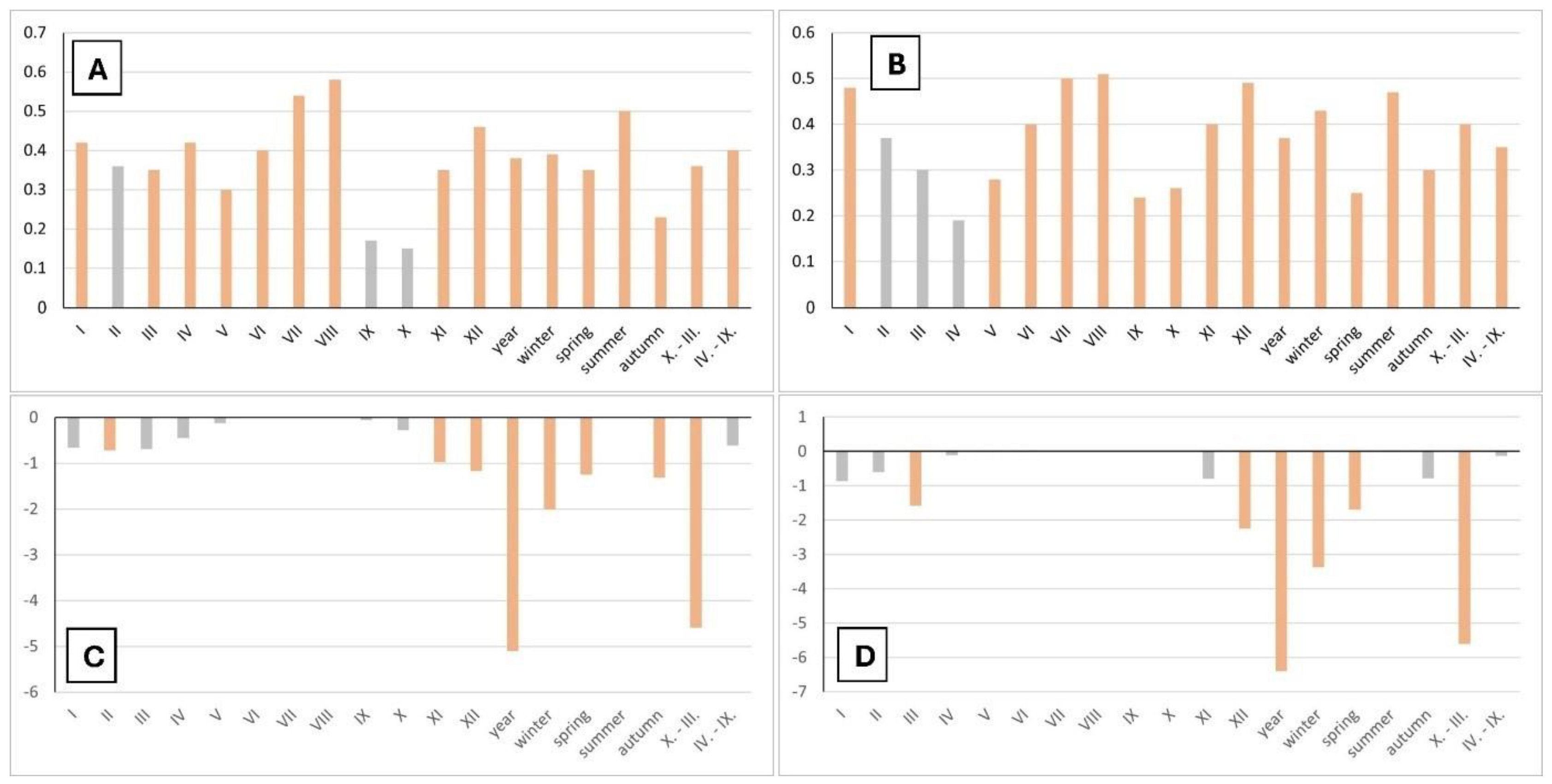
Figure 3.
Values and course of mean temperature (A), minimum temperature (B), number of days with minimum temperature below 0 °C (C) and number of days with total snow cover above 1 cm (D) in °C/10 years for the period 1961-2020 at Větřkovice.
Figure 3.
Values and course of mean temperature (A), minimum temperature (B), number of days with minimum temperature below 0 °C (C) and number of days with total snow cover above 1 cm (D) in °C/10 years for the period 1961-2020 at Větřkovice.
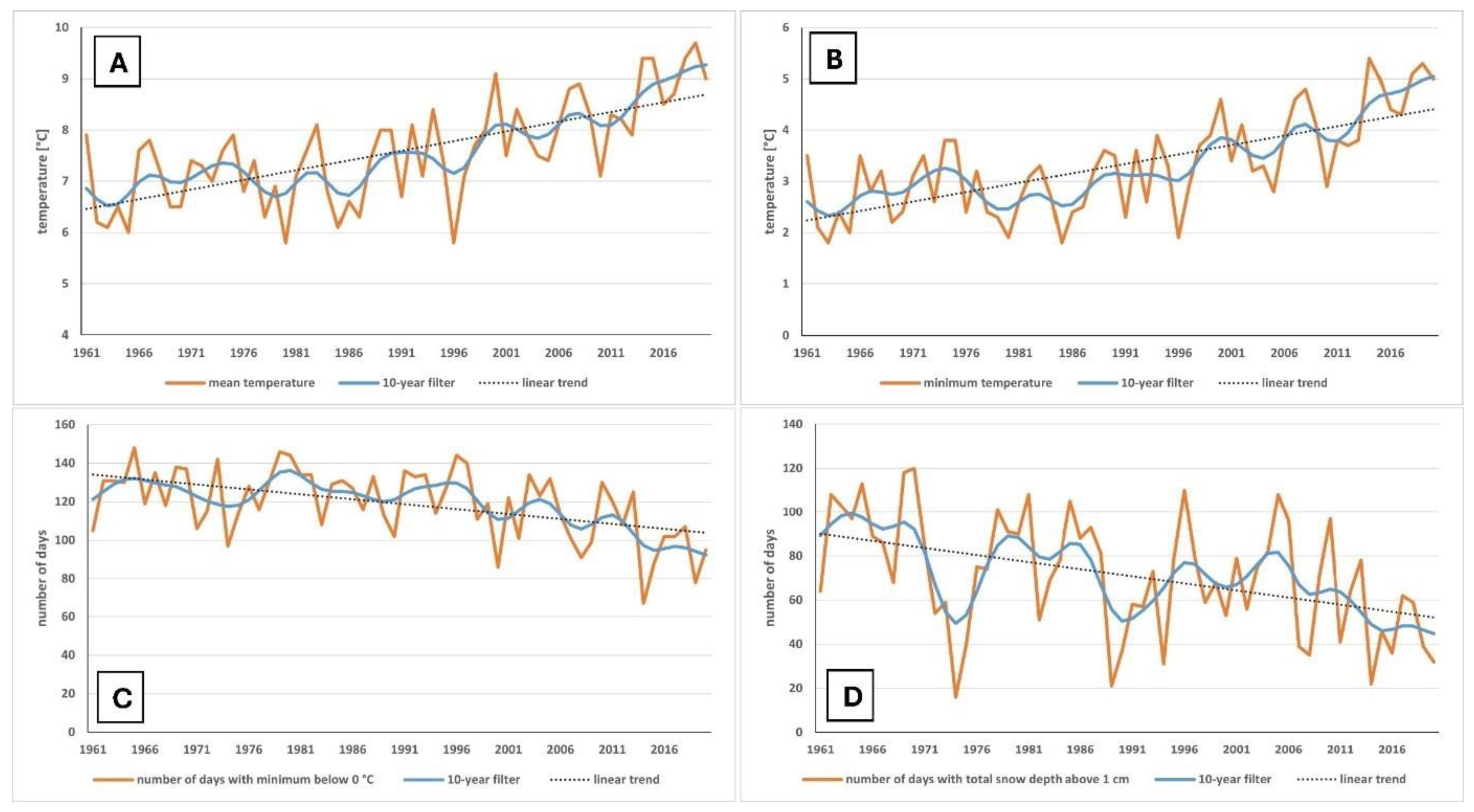
Figure 4.
Linear trend (A) and course of values (B) of the amount of new snow cover (in cm/10 years) for months, years and seasons from 1961 to 2020 at Větřkovice (orange indicates statistically significant trend, p = 0.05).
Figure 4.
Linear trend (A) and course of values (B) of the amount of new snow cover (in cm/10 years) for months, years and seasons from 1961 to 2020 at Větřkovice (orange indicates statistically significant trend, p = 0.05).
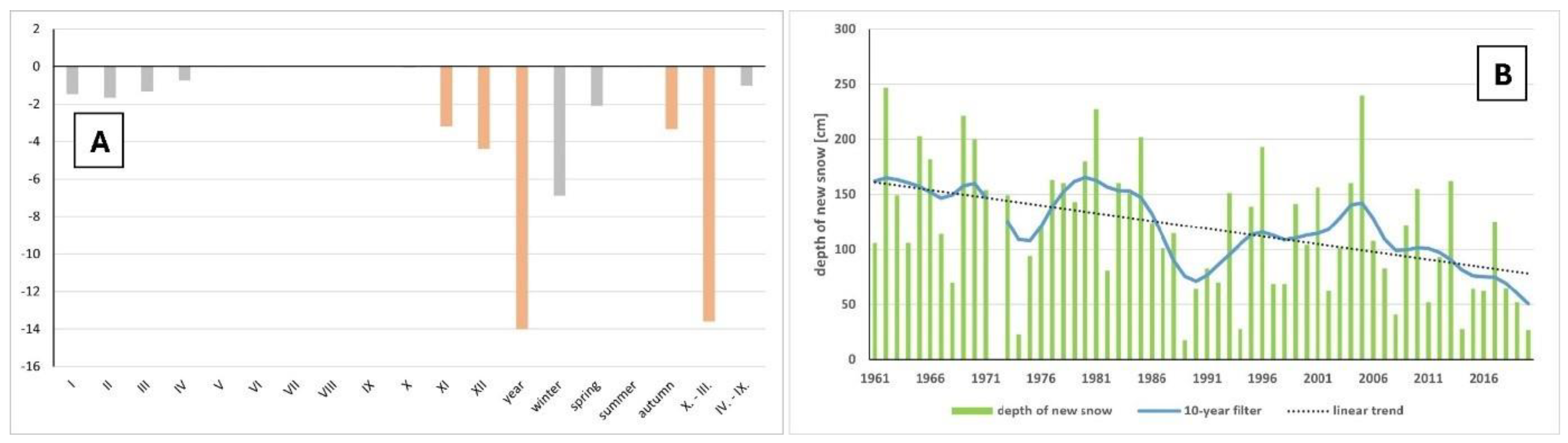
Figure 5.
The erosion potential map for the referential period 1981-2010.
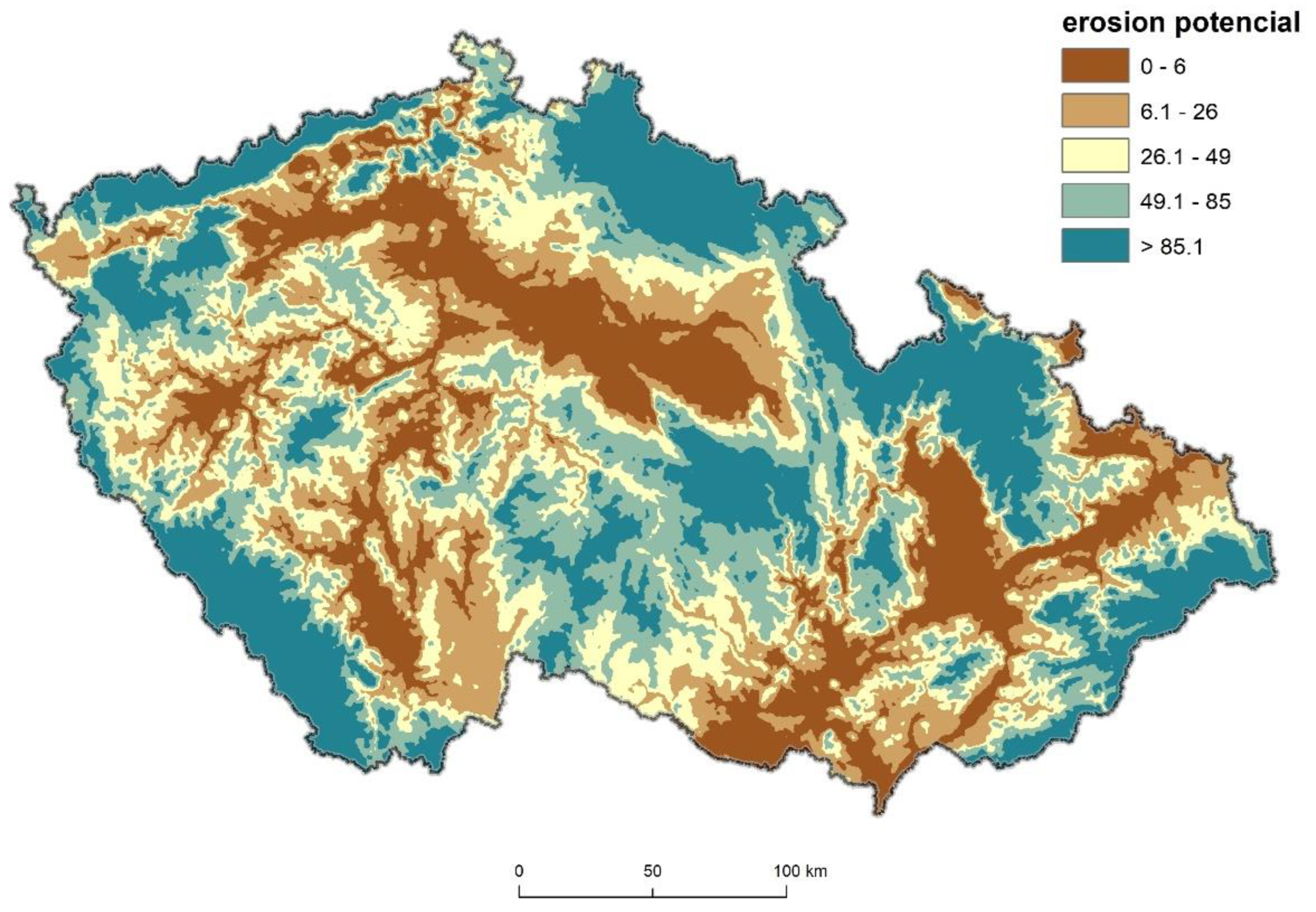
Figure 6.
The erosion potential map for the referential period 1991-2020.
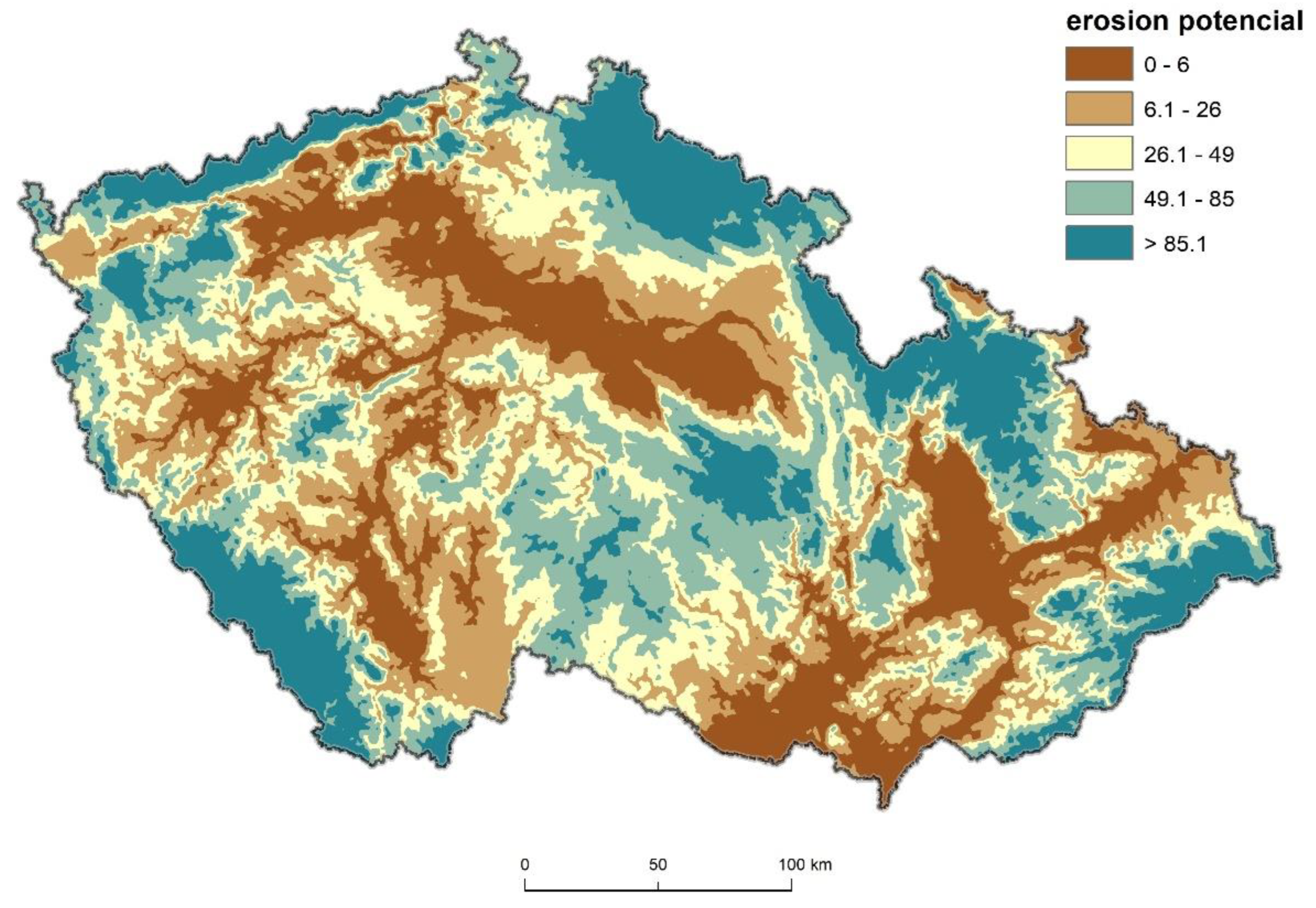
Table 3.
Area representation of individual categories of erosion potential values for two periods within years 1981-2020 as a percentage of the area of Czech Republic.
Table 3.
Area representation of individual categories of erosion potential values for two periods within years 1981-2020 as a percentage of the area of Czech Republic.
| Erosion potential | 1981-2010 | 1991-2020 |
|---|---|---|
| 0-6 | 17.5 | 18.8 |
| 6.1-26 | 20.0 | 22.9 |
| 26.1-49 | 19.4 | 20.8 |
| 49.1-85 | 19.8 | 19.9 |
| >85.1 | 23.2 | 17.6 |
Table 4.
Intensity of snowmelt erosion for two values of erosion potential. (Exceeded erosion limit in red).
Table 4.
Intensity of snowmelt erosion for two values of erosion potential. (Exceeded erosion limit in red).
| The percentage share of the G value interval [t·ha-1·y-1] | ||||||||||||
|---|---|---|---|---|---|---|---|---|---|---|---|---|
| EHP | Area [ha] | < 4 | 4.01-8 | 8.01-12 | 12.01-16 | 16.01-20 | >20 | G (⌀) | GP (permissible) | |||
| EP pres 50.40 (1991-2020) | ||||||||||||
| 1 | 138.70 | 34.80 | 16.00 | 13.30 | 10.90 | 7.90 | 17.10 | 11.45 | 9.00 | |||
| 2 | 81.93 | 42.80 | 15.80 | 9.70 | 8.30 | 8.30 | 15.00 | 9.78 | 9.00 | |||
| 3 | 58.43 | 48.20 | 11.30 | 6.80 | 6.10 | 5.30 | 22.20 | 10.31 | 9.00 | |||
| 4 | 16.65 | 41.20 | 20.30 | 13.20 | 9.30 | 7.10 | 9.00 | 8.06 | 9.00 | |||
| 295.70 | ⌀ 9.90 | 9.00 | ||||||||||
| EP past 54.40 (1981-2010) | ||||||||||||
| 1 | 168.70 | 33.50 | 15.40 | 12.60 | 10.40 | 8.70 | 19.50 | 12.36 | 9.00 | |||
| 2 | 81.93 | 41.10 | 15.60 | 10.00 | 7.10 | 8.30 | 17.90 | 10.56 | 9.00 | |||
| 3 | 58.43 | 46.80 | 11.20 | 7.40 | 5.30 | 5.20 | 24.10 | 11.13 | 9.00 | |||
| 4 | 16.65 | 38.90 | 20.50 | 12.60 | 9.50 | 7.20 | 11.20 | 8.70 | 9.00 | |||
| 295.70 | ⌀ 10.69 | 9.00 | ||||||||||
Disclaimer/Publisher’s Note: The statements, opinions and data contained in all publications are solely those of the individual author(s) and contributor(s) and not of MDPI and/or the editor(s). MDPI and/or the editor(s) disclaim responsibility for any injury to people or property resulting from any ideas, methods, instructions or products referred to in the content. |
© 2024 by the authors. Licensee MDPI, Basel, Switzerland. This article is an open access article distributed under the terms and conditions of the Creative Commons Attribution (CC BY) license (http://creativecommons.org/licenses/by/4.0/).
Copyright: This open access article is published under a Creative Commons CC BY 4.0 license, which permit the free download, distribution, and reuse, provided that the author and preprint are cited in any reuse.


