
Submitted:
12 November 2024
Posted:
13 November 2024
You are already at the latest version
Abstract
The Liucun pluton locates in the area that adjoin to Zhejiang province in the eastern section of the Jiangnan orogenic belt. It is mainly composed of monzonitic granite and granites, with late intrusion of syenite-granite. Numerous deposits (points) were found on the southwest side of the pluton. The characteristics of major elements show that the Liucun rock masses are all silica-rich, potassium-rich and peraluminous high potassium calc-alkaline rocks with right-leaning characteristics of light rare earth element enrichment and heavy rare earth element deficit. The degree of differentiation of light and heavy rare earth elements is similar, with obvious negative Eu anomaly. Zircon LA-ICP-MS U-Pb weighted mean ages of monzonitic granite, porphyritic biotite monzonitic granite and granite are 130.50±0.55Ma, 128.95±0.46Ma and 133.8±1.0Ma, which belong to the late stage of magmatic activity in the Jiangnan uplift belt. The emplacement time of granite is slightly earlier than that of monzonitic granite. The characteristics of major, trace and rare earth elements in Liucun pluton are typical of A-type granites, and the characteristics of major, trace elements and Hf isotopes indicate the shell-source characteristics of Liucun pluton. From the perspective of the whole Jiangnan orogenic belt in southern Anhui, the value of the late stage rock (87Sr/86Sr) i, including the Liucun pluton, is smaller than that of the early stage, and the εNd (t) and εHf (t) values of the late stage rock are larger than that of the early stage, and the distribution range is narrower than that of the early stage, which indicates that the late stage rock is mixed with a greater proportion of new mantle materials than that of the early granitic rock. The Liucun pluton is derived from the secondary partial melting of the ancient lower crust in Mesoproterozoic, and during the melting process, more new mantle source materials were mixed in due to the transformation of tectonic environment. The formation of the main body of Liucun pluton (monzonitic granite) may be influenced by extrusion collision, and the Liucun pluton was formed in the intraplate stretching environment after the Late Jurassic-Early Cretaceous tectonic transition period.
Keywords:
Liucun pluton
; petrogeochemistry
; petrogenesis
; pircon U-Pb age
; Sr-Nd -Hf isotope
; eastern section of Jiangnan orogenic belt
1. Introduction
The late Mesozoic granitoid intrusive rocks are widely distributed in the eastern section of Jiangnan Orogenic belt, which can appear alone or many of them are produced as composite rocks, and are unique in the late Mesozoic magmatic rock belt of the eastern continental margin of China. According to the geological history of Anhui Province, it is named as the southern Anhui magmatic belt of the Lower Yangtze tectonic magmatic belt [1, 2]. Its distribution is bounded by the Zhouwang fault. The Yanshanian monzoniite-syenite-dominated acid intrusive rocks are mainly developed in the south of the fault, and the basaltic (secondary) volcanic rocks are mainly developed in the north of the fault. The main fault structures are near EW, NE, NW, etc. (Figure 1). Based on the formation of Neoproterozoic collision orogeny and metamorphic basement, the magmatic belt was formed through multi-stage tectonic evolution such as early Paleozoic fold uplift and Mesozoic intracontinental tectonics [2,3,4,5,6,7], especially the Yanshanian metallogenic explosion in eastern China triggered strong magmatic activity and mineralization, and the region was rich in copper, tungsten, molybdenum, gold, silver, lead, zinc, uranium and other minerals [8, 9]. In recent years, a series of large or super-large W-Mo-Cu-Au deposits have been discovered in the Jiangnan uplift belt [1, 10–14], which makes the study of magmatic rocks in the zone attract more and more attention from the geological community.
However, few studies have been done on the Liucun pluton, which is located in the eastern part of Jiangnan Orogenic belt, adjacent to Anhui and Zhejiang provinces. Previous studies have only been done on the diagenetic age and petrogeochemistry of the monzonitic granites in the pluton [15, 16], however, there are some shortcomings in the studies of Sr-Nd isotope characteristics of whole rock, Lu-Hf isotope characteristics of zircon, petrogenesis, diagenetic source area and tectonic environment.
Therefore, this paper takes Liucun pluton as the research object. Based on field investigation, the whole rock geochemistry, Sr-Nd isotope age, LA-ICPMS zircon U-Pb isotope age and in situ Lu-Hf isotope geochemistry of zircon are carried out, in an attempt to define its diagenesis age, petrogenesis, diagenesis source area and tectonic environment. The geochronological framework and petrogenesis of magmatic rocks in the Jiangnan orogenic belt are supplemented and enriched, thus providing important basic geological data for further study of the late Mesozoic tectonic evolution and mineralization of the Jiangnan orogenic belt.
2. Geological Survey and Samples
The neighboring area of Anhui and Zhejiang in the eastern section of Jiangnan Orogenic belt is located in the southeast of the Yangtze Plate. It has experienced the Jinning, Caledonian, Hercynian, Indosinian, Yanshan and Himalayan tectonic movements successively. The sedimentary characteristics, magmatic activity, metamorphism and mineralization of different tectonic movements have their own characteristics, which formed the present tectonic pattern. To the northwest are the Tanlu fault belt, Qinling Dabie Orogenic belt, North China plate and Middle Yangtze block; to the south are the Jiangnan Orogenic belt and the Cathaysian block, with a wedge-shaped structural geometry that is narrow in the west and wide in the east (Figure 1a). The division of tectonic units is bounded by the Gaotan fault zone (F5), the Lower Yangtze foreland zone (Lower Yangtze offset transition zone) in the north, and the Jiangnan uplift zone in the south. The stratigraphic division is bounded by the Jiangnan Fault zone (F2), with the Lower Yangtze stratigraphic zone to the north and Jiangnan stratigraphic zone to the south [17,18,19] (Figure 1b).
There are mesoproterozoic to early Paleozoic strata in the area, which can be divided into basement and cover strata. The basement is composed of middle and late proterozoic shallow metamorphic rocks, which are mainly slate, phyllite, metamorphic siltstone, metamorphic sandstone and medium-acid volcanic rocks, distributed in the southern region. The cap layer is composed of three major cap layers since Nanhua Period, which are Nanhua to early Silurian, late Carboniferous to early Triassic and late Triassic to Cretaceous, mainly distributed in the north and near Huangshan City. There are angular unconformity contacts between basement and cover layer and between cover layer [18].
Fault structures developed in the region, mainly Mesozoic NNE-NE trending faults, and controlled the output of major granites and various minerals in the region [20, 21].
The magmatic activity in the region is very strong, and the ultrabasic and acidic rocks are distributed. It mainly developed in Jinning stage and Yanshanian stage. In the early Neoproterozoic period (830~820Ma), the granodiorites of Xiuning, Shexian and Xucun are mainly found near Huangshan City. The late stage (780~760Ma) is the Lingshan, Lianhuashan and Shiershan granitic (porphyry) plutons [22, 23]; The Mesozoic (150~120Ma) consists of granodiorite plutons such as Jingde, Langqiao and Taiping, granodiorite plutons such as Huangshan, Fuling, Liucun, Yaocun and Miaoxi in Yanshanian, and dozens of small rock strains [24, 25] (Figure 1b).
The exposed area of the Liucun pluton is 213.14km2, which is generally elliptic in the northeast direction and is obviously controlled by the structure. The pluton intrudes into the lower Silurian sand mudstone along the anticlinal axis composed of Cambrian strata, and is batholiplike, paraaxial and outward sloping. The boundary of pluton surrounding rock is clear, the contact surface is mostly outward dip, the dip angle is 40°~ 80°, and the northern part of pluton is inward. At the edge of the pluton, sometimes the trap body of angular sandstone can be seen, and the fine-grained (porphyritic) monzonitic granite (condensing edge) with a width ranging from tens of centimeters to hundreds of meters can be developed in local areas. The surrounding rock has silicification, hornification and other alteration, the alteration bandwidth ranges from 1000 to 2500m, and it contains iron and copper quartz veins, crystal and fluorite veins [16].
The main exposed strata around the pluton, from old to new, include the Cambrian Hetang Formation (∈1h), Cambrian to Ordovician Xiyangshan Formation (∈3O1x), Ordovician Yinzhubu Formation and Ningguo Formation union (O1y-n), Silurian Anji Formation (S1a) and Baidi Formation (S1d), Devonian Tangjiawu Formation (D1-2tn), Cretaceous Pukou Formation (K1-2p) ), Quaternary (Q). Hetang Formation consists of black thin layer of carbonaceous, siliceous shale and mudstone with limestone lens. The Xiyangshan Formation is composed of rhythmical layers of gray-dark gray marl, nodular limestone or reticulate limestone. The interformation of Yinzhubu Formation and Ningguo Formation is calcareous mudstone with bluish gray and gray-green color. Anji Formation consists of gray-green, yellow-green fine sandstone, siltstone and sandy mudstone. The Dabaidi Formation consists of gray-green fine sandstone, siltstone with silty mudstone. Tangjiawu Formation is purplish red and gray-green quartz sandstone. The Pukou Formation consists of purple conglomerate, sand conglomerate and sandstone. The quaternary consists of clay, sand and gravel.
The rock types of Liucun pluton are mainly medium-fine grained porphyritic monzonitic granite, and some are medium-coarse grained monzonitic granite. The pluton is invaded by late fine grained syenite with nodules, branches and dike. A large number of deposits (points) have been found around the Liucun pluton, such as Guangde tungsten copper deposit in the middle of the pluton, Qiaotou Xiqiling tungsten ore in Ningguo City, Dali copper lead-zinc ore in Ningguo City and Lujiashan tungsten beryllium ore in Ningguo City in the southwest edge of the rock mass and its contact zone (Figure 2).
On the basis of carefully identifying various lithologic intrusions, fresh monzonitic granite (LC08-2, LC14, LC07, LC09) and granite (LC08-3, LC05, LC02-1) samples were collected from Liucun pluton. Representative samples monzonitic granite (LC08-2, LC14) and granite (LC08-3) were selected for mineralogical description (Figure 3).
LC14 (sampling coordinates 30°48′05″N, 119°21′51″E) is porphyritic biotite monzonitic granite with porphyritic structure, medium-grained to coarse-grained, massive structure. The main minerals are potassium feldspar 30~35%, plagioclase 20~25%, biotite 10~15%, quartz 20~25%. There is a small amount of accessory mineral zircon and magnetite. Quartz particles have biotite, weak strength alteration. Occasionally the phenomenon of mineral inclusion (feldspar inclusion of biotite), occasionally see zircon and other auxiliary minerals. Biotite, flaky, less, 0.5~1 mm. Quartz, round granular mesogranular structure. The quartz particle size can reach 0.5 ~2 mm, and the porphyry can reach 5mm. Potassium feldspar, plate columnar structure, semi-idiomorphic, particle size in 0.5~1.5mm, the largest up to 4mm. Plagioclase, polylamellar twin, long columnar porphyry columnar medium coarse-grained structure, more idiomorphic than potassium feldspar, particle size 0.5 ~2mm. Magnetite, steel gray, sparsely disseminated and stellate occurs in altered biotite. The crystal surface is uneven and has pits. The alteration is weak to moderate in intensity, mainly chlorite, sericite and weak clay alteration.
LC08-2 (sampling coordinates 30°44′29″N, 119°23′07″E), monzonitic granite, holocrystalline structure, coarse grained, massive structure, the main minerals are potassium feldspar 30~35%, plagioclase 25~30%, biotite 5~10%, quartz 20~25%. There is a small amount of accessory minerals and magnetite. Quartz grains have biotite, very little hornblende. The rocks are fresher. The mineral inclusion phenomenon was seen occasionally, and the minor minerals such as zircon, sphene were occasionally seen. Potassium feldspar, plate columnar structure, hemidiomorphic–idiomorphic, particle size of 0.5~2.5mm. Biotite, flaky, less, 1.5~2mm. Plagioclase, polylamellar twin-crystal, long columnar porphyry columnar medium coarse-grained structure, more idiomorphic than potassium feldspar, particle size 0.5~2.5mm. Quartz, round granular mesogranular structure. The quartz particle size can reach 0.5~4mm. Magnetite, steel gray, sparsely disseminated and stellate occurs in altered biotite. The crystal surface is uneven and has pits. Weak claying, and other alterations are weak.
LC08-3 (sampling coordinates 30°44′29″N, 119°23′07″E), weakly altered granite, holocrystalline structure, medium-coarse grained, massive structure, the main minerals are potassium feldspar 30~35%, plagioclase 20~25%, biotite 10~15%, quartz 15~20%. There is a small amount of accessory minerals and magnetite. Quartz particles have biotite, weak strength alteration. Mineral encrustment, zircon, sphene were occasionally seen. Potassium feldspar, plate columnar structure, hemidiomorphic, particle size of 0.5~3 mm. Plagioclase, long columnar porphyry columnar medium coarse-grained structure, more idiomorphic than potassium feldspar, particle size 2~3mm, individual 8mm. Biotite, flaky, less, 0.5~2 mm. Quartz, round granular mesogranular structure. The particle size of quartz can reach 1~2 mm. Magnetite, steel gray, sparsely disseminated and stellate occurs in altered biotite. The crystal surface is uneven and has pits. Medium intensity alteration, medium intensity chlorite, epidotite, weak sericite, and clay alteration.
3. Analytical Methods
3.1. Geochemical Analysis of Whole Rock
The analysis of major and trace elements of the whole rock was completed in Guangzhou Aosi Mineral Laboratory.
The major elements were analyzed by X-ray fluorescence spectrometry (XRF), and the analysis accuracy was better than 5%.
ICP-MS (Inductively coupled plasma mass spectrometry) was used to analyze trace and rare earth elements, and the analysis accuracy of most elements was better than 2%.
3.2. Sr-Nd Isotope Analysis of Whole Rock
The Sr-Nd isotope test was completed at the Laboratory of Solid Isotope Geochemistry, School of Earth and Space Sciences, University of Science and Technology of China. The instrument used was the Finnigan MAT262 multi-channel Mass Spectrometer (LA-MC-ICPMS). The isotopic ratios of Sr and Nd were determined using 87Sr/88Sr = 0.1194 and 146Nd/144Nd = 0.7219, respectively.
3.3. LA-ICP-MS Zircon U-Pb Dating
Zircon selection was completed in Langfang Dike Exploration Technology Service Co., LTD. Zircon target and cathode luminescence image photography are completed by Beijing Zirconia Linghang Technology Co., LTD.
LA-ICP-MS Zircon U-Pb dating test was completed in Nanjing Jupu Detection Technology Co., LTD., using excimer laser ablation system Analyte Excite and quadrupole inductively coupled Plasma Mass Spectrometer (ICP-MS) model Agilent7700x.
3.4. Zircon Lu-Hf isotope
Zircon Lu-Hf isotope testing was performed at Nanjing Jupu Detection Technology Co., LTD., using the Nu Plasma II multi-receive plasma mass spectrometry and the Analyte Excite193nm AR-UV Laser Denudation system (LA-MC-ICP-MS).
4. Results
4.1. Results of Whole Rock Geochemical Analysis
4.1.1. Major Elements
The results of whole rock major and trace element analysis of Liucun pluton are shown in Table 1. The content of SiO2 in monzonite granite ranges from 65.98% to 73.8%, with an average of 68.77%. The Al2O3 content was higher, ranging from 12.90% to 15.42%, with an average of 14.60%. The contents of K2O and Na2O were high, the average values were 4.56% and 3.35%, respectively. The total alkali content (Na2O+K2O) ranges from 7.66% to 8.07%. CaO content ranged from 1.23% to 2.76%, with an average of 2.12%. The contents of MgO ranged from 0.47% to 1.39%, with an average value of 1.06%. Fe2O3T content was low, ranging from 2.33% to 4.58%, with an average of 3.74%. The aluminum saturation index of Liucun monzonitic granite is high, with A/CNK ranging from 0.97 to 1.09 and A/NK ranging from 1.23 to 1.50. The content of SiO2 in granite ranges from 64.79% to 76.67%, with an average of 71.38%. Al2O3 content was higher, ranging from 12.58% to 15.08%, with an average of 13.74%. The contents of K2O and Na2O were high, the average values were 4.71% and 3.39%, respectively. The total alkali content (Na2O+K2O) ranges from 7.64% to 8.47%. CaO content ranged from 0.61% to 3.03%, with an average of 1.67%. The MgO content ranged from 0.07% to 1.65%, with an average value of 1.06%. The content of Fe2O3T was low, ranging from 1.25% to 5.39%, with an average of 3.17%. The aluminum saturation index of Liucun granite is high, with A/CNK ranging from 0.95 to 1.04 and A/NK ranging from 1.13 to 1.47. The characteristics of major elements show that the Liucun pluton is all silica-rich, potassium-rich and peraluminous high potassium calc-alkaline rocks (Figure 4).
According to the Haker diagram (Figure 5), SiO2 of monzonite and granite has a good correlation with the remaining oxides, and the content of SiO2 is negatively correlated with the content of TiO2, Fe2O3, MgO, CaO, P2O5 and MnO, and positively correlated with the content of K2O.
4.1.2. Rare Earth and Trace Elements
∑REE of monzogranite ranges from 181.03×10⁻⁶ to 246.68×10⁻⁶, LREE/HREE ratio from 6.75 to 9.46, (La/Yb) N ratio from 5.77 to 10.79, δEu from 0.35 to 0.64. ∑REE of granite is 118.52×10⁻⁶~335.07×10⁻⁶, LREE/HREE ratio is 1.63~6.11, (La/Yb) N ratio is 0.86~5.45, δEu is 0.10~0.43. The chondrite-normalized patterns show that the magmatic rocks of Liucun complex pluton all have right-leaning characteristics of light rare earth element enrichment and heavy rare earth element deficit, and the degree of differentiation of light and heavy rare earth element is similar, with obvious negative Eu anomaly. Monzonitic granite has stronger right-leaning characteristics than granite. The contents of Cr and Ni in samples are low, ranging from 20×10−6 to 30×10−6 and 0.9×10⁻⁶ to 8.5×10⁻⁶, respectively, which are much lower than the original mantle magmatic values (Cr > 1000×10−6, Ni > 400×10−6, after the paper [26]). It suggests that the magma has undergone a high degree of evolution or the source region is not dominated by the mantle.
The primitive mantle-normalized spider diagrams show that the trace elements curves of monzonitic granite and granite in Liucun complex pluton are similar, showing the enrichment of large ion lithophilic elements (LILE) such as Rb and Ba, and the depletion of high field strength elements (HFSE) such as Nb, Ta and Ce (Figure 6).
In recent years, scholars have paid attention to the general enrichment of rare earth elements in granite weathering crust in southern Anhui province, which has become a deposit in some areas [28]. The concentration of rare earth elements in weathering crust of Liucun pluton is also very high, and the enrichment of rare earth elements deserves further research.
4.2. Whole Rock Sr-Nd Isotope
Sr-Nd isotope analysis of monzonitic granite (LC08-2), porphyritic biotite monzonitic granite (LC14) and granite (LC08-3) in Liucun pluton was conducted, and the experimental results are listed in Table 2.
The results show that the Sr-Nd isotopic characteristics of the three samples from Liucun pluton are similar, which shows the characteristics of homologous magma. The 87Sr/86Sr values of monzonite are 0.711987~0.720512, the 87Sr/86Sr values of granites are 0.713192, and the εNd (t) values of monzonite (-4.7~ -2.42) are slightly lower than those of granites (-1.74). The 143Nd/144Nd values of the two are very similar, ranging from 0.512335 to 0.512503, and the initial 87Sr/86Sr (ISr) is in the same range, ranging from 0.70904 to 0.70934. The depleted mantle model ages (TDM2) are 1122~1306Ma (monzonitic granite) and 1069Ma (granite), respectively.
4.3. LA-ICP-MS U-Pb Isotope Age of Zircon
Zircon LA-ICP-MS U-Pb dating results of monzonitic granite and granites in the Liucun complex pluton are shown in Table 3. The zircon grains have good idiomorphic crystal and clear oscillating zone, which are magmatic zircons. The measured age values represent the formation age of the rock.
The 206Pb/238U ages of 20 zircons (17 effective sites) from the monzonite granite (LC08-2) range from 121.4 to 142.4Ma, with a weighted average age of 130.50±0.55Ma (MSWD=1.18) (Figure 7). The 206Pb/238U ages of 20 zircons (17 effective sites) from porphyritic biotica monzonite granite (LC14) range from 126.8 to 147.7Ma, with a weighted mean age of 128.95±0.46Ma (MSWD=1.12) (Figure 7). The 206Pb/238U ages of 20 zircons (12 effective measurement sites) from the granite (LC08-3) range from 126.7 to 161.8Ma, with a weighted average age of 133.85±0.45Ma (MSWD=5.4) (Figure 7).
3.4. Lu-Hf Isotope Characteristics of Zircon
The results of zircon Lu-Hf isotope testing of monzonitic granite and granite samples from Liucun complex pluton are shown in Table 4. The 176Lu/177Hf ratio of the zircons measured in this study is less than 0.002 except for a few points which slightly exceed 0.002, indicating low radiogenic Hf accumulation after zircon formation [30]. The 176Lu/177Hf and 176Hf/177Hf values of the 17 zircons from the monzonite granite (LC08-2) range from 0.001168 to 0.002417 and from 0.282430 to 0.282499, respectively. εHf (t) value is between -9.3 and -6.9; The TDM2 model age ranges from 1618 to 1771Ma. The 176Lu/177Hf and 176Hf/177Hf values of 15 zircons from porphyritic biotite monzonite (LC14) are between 0.000852 and 0.002410 and 0.282429 and 0.282467, respectively. εHf (t) value is between -9.4 and -8.0; The TDM2 model age ranges from 1687 to 1774Ma. The 176Lu/177Hf and 176Hf/177Hf values of the 16 zircons from the granite (LC08-3) range from 0.001034 to 0.002167 and from 0.282385 to 0.282484, respectively. εHf (t) value is between -10.9 and -7.4; The TDM2 model age ranges from 1651 to 1840Ma.
5. Discussion
5.1. Diagenetic Age of Liucun Pluton and Mesozoic Magmatic Rock Age Framework in Southern Anhui Province
The LA-ICP-MS U-Pb weighted mean ages of zircons from monzonitic granite and porphyritic biotite monzonitic granite in Liucun pluton are 130.50±0.55Ma and 128.95±0.46Ma, respectively. The age data of all measuring points are concentrated in the small variation range of 5Ma, indicating that these zircons are the products of the same magmatic event. The weighted mean age indicates the emplacement time of the monzonite granite. This age is consistent with the previous obtained formation ages of monzonitic granite in the Liucun pluton of 129.0±1.0Ma, 129.7±2.1Ma [31], 132.84±0.57Ma [15] and 124.4±1.0Ma [16].
The LA-ICP-MS U-Pb weighted mean age of the granite zircon is 133.8±1.0Ma, which is larger than that of the monzonitic granite.
The Xianxia, Yaocun and Miaxi plutons surrounding the Liucun pluton have been tested for isotopic age in the past. Among them, the Xianxia complex pluton monzonitic granite (143.0±3.5Ma), granodiorite (140.0±2.0Ma) and potassium feldspar granite (138.6±3.5Ma) [32]. Yaocun pluton granite (127.6±1.4Ma, 127.9±1.4Ma) [28, 33], Miaoxi pluton monzonitic granite (128.2±1.5Ma), syenite granite (124.9±1.5Ma) [34]. The age of Liucun pluton is consistent with that of Miaoxi pluton and Yaocun pluton, and younger than that of Xianxia pluton.
The large-scale magmatism in the magmatic belt of southern Anhui mainly occurred in the late Yanshanian period, often in the form of large batholith and complex pluton. According to the rock type, distribution, isotopic geological age and metallogenic characteristics of magmatic rocks, the Yanshanian magmatism can be divided into two stages: early and late. In the early stage (152~135Ma), the lithology is granodiorite (porphyry), monzonitic granite, granite (porphyry) rock, granitic rock lithology is mostly granodiorite, the rocks are neutral. There are two types of emplacement pluton. One is shallow emplacement plutons, mostly produced by small rock strains, which is related to tungsten and molybdenum polymetallic mineralization. The lithology includes granodiorite porphyry and granite (porphyry) rock, such as Dongyuan, Xiaoyao, Kaobeijian and Lidongkeng pluton. The other is the deep emplacement plutons, which are mainly composed of large batholith and complex intrusions. The lithology is mainly granodiorite, such as Qingyang, Chengan, Langqiao, Jingde and Taiping pluton. In the late stage (135~122Ma), it is mainly complex intrusive pluton, mostly monzonitic granite, syenite granite, granite porphyry, etc., most of which have A-type granite characteristics, such as Jiuhuashan, Huangshan, Fuling, Liucun pluton, etc [2, 31, 35, 36]. This is basically consistent with the statement of the paper [37], who analyzed the Yanshanian granite data in southern Anhui and neighboring areas and concluded that the early (150~132Ma) and late (132~120Ma) stages were divided by 132Ma as the boundary.
Through the induction and analysis of the diagenetic data of two periods of magmatic activity in the late Mesozoic period in southern Anhui, it can be found that the lithology of early granitic rocks (152~135Ma) is mostly granodiorite. Late (135~122Ma) lithology is dominated by granite and syenite-granite (Figure 8). The early granodiorite is often closely related to mineralization, and many large and medium-sized W, Mo, Cu and Au deposits have been found. The deposits associated with late granites are rare. More than 70 deposits discovered in Jiangnan Orogenic belt (Anhui section) are related to Yanshanian magmatism, and the main mineral species are W, Mo, Pb-Zn, Cu and Au. In addition, a large number of extrusive rocks such as rhyolite developed in the Mesozoic in southern Anhui.
The Liucun pluton is the product of late magmatic activity in Jiangnan uplift belt, and the emplacement time of granite is slightly earlier than that of monzonitic granite.
5.2. Geochemical Properties and Petrogenesis
According to different source rock properties, granites are generally classified into type I, type S and type M [47, 48], and A-type granites were first proposed by the paper [49] to define a class of Alkaline, Anhydrous, and non-orogenic granites, which have special geochemical characteristics. The Liucun pluton in southern Anhui province has high content of Na2O+K2O, high content of high field strength elements and rare earth elements, strong loss of Sr and Eu, and enrichment of Yb. These geochemical characteristics are similar to typical A-type granites [47,48,49,50]. In the Na2O-K2O diagram, all the sample points fall in the A-type granite region (Figure 9a), but in the ZR-10000Ga/Al diagram, there are 3 points in the A-type granite region, there are 3 points near the dividing line between A-type granite and I-type granite (Figure 9b), which may have advanced magmatic evolution, and the reason maybe is the increase in the degree of material assimilation and mixing in the upper crust is related to the decrease in the abundance of high field strength elements [39]. In addition, the rare earth element fractionation model table of Liucun pluton also shows a strong negative Eu anomaly characteristic of A-type granite. Therefore, the Liucun pluton has typical A-type granite characteristics, and comprehensive analysis shows that it belongs to A-type granite.
Previous studies on the genesis of early Mesozoic (152~135Ma) granitic rocks (mainly granodiorite, rock type I/S type) in the eastern section of Jiangnan Orogenic belt are consistent, and basically agree that the magma source area is not only dominated by shell source, but also ancient crustal material plays an important role [5, 38, 39]. However, the genesis of late (135~122Ma) granitic pluton(mainly granite and syenite-granite, rock type A) still has a dispute between mantle and shell sources. At present, the genetic model of A-type granite mainly includes extensive separation and crystallization of mantle-derived basaltic magma. Assimilative mixing with or without crustal material [52, 53]; Re-partial melting of a particular continental crust previously depleted by aqueous felsic melt extraction and possibly mixed with additional new mantle-derived material during melting [33, 39, 47, 51, 54–56]. There is a good linear relationship between the major elements of monzonitic granite and granite in Liucun pluton. In Harker’s diagram (Figure 5), from monzonitic granite to granite, TiO2, Al2O3, Fe2O3, MgO, CaO, P2O5 and MnO linearly decrease with the increase of SiO2 content, while K2O is positively correlated with SiO2. It shows typical characteristics of homologous magmatic evolution. In general, the early granite magma is rich in Si and K, while the late monzonitic magma is rich in Fe, Mg and Ca. In the correlation diagrams of La/Sm-La and Rb/Nb-Rb/Zr (Figure 10), the sample values are roughly arranged in oblique lines, showing the trend of partial melting evolution. Therefore, the genesis of Liucun pluton is consistent with the view that the residual refractory material after partial melting is extracted from the melt is partially melted again.
The monzonitic granites and granites of the Liucun pluton are rich in SiO2, poor in MgO, MnO and CaO, with A/CNK close to or greater than 1, rich in light rare earth elements and large ion lithophile elements, and deficient in high field strength elements, and have characteristics similar to island arc magmatic rocks, showing crustal geochemical characteristics [57, 58]. The high n (CaO)/[n (MgO) +n (FeOT)] and low n (Al2O3)/[n (MgO) +n (FeOT)] values also indicate that the primary rocks are mainly derived from partial melting of mafic rocks in the crust [59, 60]. Rocks with εHf (t) < 0 were formed by partial melting of the ancient lower crust [61, 62]. The εHf (t) of the Liucun pluton ranges from -10.93 to -6.91, with an average value of -8.50. The two-stage model age (TDM2) of the Liucun pluton ranges from 1658 to 1880Ma. The TDM2 of the two-stage model age of the Liucun pluton is mainly 1.7Ga. The second-stage model age of zircon Hf from Mesozoic rocks in the middle and lower reaches of the Yangtze River mainly ranges from 1.0 to 1.5Ga, with a peak age of 1.4Ga [31], which is lower than that of the Liucun pluton. The T-εHf (t) diagram of magmatic zircons in the Liucun pluton with εHf (t) < 0 shows that the Hf isotope composition of 49 zircons is located near the lower crust evolution curve, between the paleoproterozoic and the depleted mantle evolution line (Figure 11). This indicates that the magma may be formed by partial melting of the ancient lower crust in the mesoproterozoic, which is far from the chondrite evolution line, indicating that the source material of the Liucun pluton is dominated by the ancient lower crust material. The characteristics of major and trace elements and Hf isotopes in Liucun pluton indicate the shell-source characteristics.
However, the Sr, Nd and Hf isotopic compositions of the late Mesozoic intrusive rocks in the eastern section of Jiangnan orogenic belt, including the Liucun pluton, are obviously different from those in the early period, indicating that they have completely different magmatic source regions. There is often a time interval of more than 10Ma between the late Mesozoic A-type granites including Liucun pluton and the early I/S granodiorite emplacement in the eastern section of Jiangnan orogenic belt. The initial values of 87Sr/86Sr in the late stage ranged from 0.5780 to 0.7122, mostly concentrated in 0.7072 to 0.7122, while the initial values of 87Sr/86Sr in the early stage ranged from 0.6646 to 0.7137, mostly concentrated in 0.7086 to 0.7137. The εNd (t) in the late stage ranges from -6.90 to -1.74, mostly concentrated in -6.90 to -4.65, and the peak value is about -6; the εNd (t) in the early stage ranges from -7.68 to -0.54, mostly concentrated in -7.68 to -3.86, and the peak value is about -7. The distribution range of εNd (t) value in the late stage is narrower than that in the early stage. The εHf (t) in the late stage is also slightly higher than that in the early stage, mainly ranging from -10.93 to -4.63, with a peak value of about -7; the εHf (t) in the early stage ranges from -14.20 to -2.46, with a peak value of about -8, and the distribution range of εHf (t) values is also narrower than that in the early stage (Figure 12 and Figure 13). In general, the late plutons including the Liucun pluton show a loss and relatively uniform isotopic composition, while the early plutons are enriched with a wide range of variations, indicating complex shell source composition characteristics. Compared with the early intrusive rocks, the late rocks contain a larger proportion of new mantly-derived materials.
The magmatism in the eastern part of Jiangnan uplift zone changed from calc-alkaline I/S-type granites to A-type granites, and εNd (t) and εHf (t) values became more enriched, indicating that there was an obvious addition of depleted mantle material. In addition, previous studies have shown that A-type granites generally have higher Zr saturation temperature than I/S-type granites, indicating that new mantle source magma from the asthenosphere has been added to the differentiated magma chamber. Moreover, mafic inclusions have been found in some A-type granites, which all indicate the existence of magmatic mixing [38, 53]. In summary, we believe that the Liucun pluton is derived from the partial melting of the ancient lower crust again in the Mesoproterozoic, and more new mantle source materials were mixed in the melting process due to the transformation of the tectonic environment.
With frequent tectonic movement and magmatic activity, southeast China is one of the regions with the most complex structure and evolution in the global continental lithosphere, as well as one of the most significant research areas in the global continental lithosphere [18]. The study area has experienced many orogeny since the Middle Proterozoic. In Neoproterozoic, the collision between the Yangtze block and the South China block formed the Jiangnan orogenic belt [64, 65]. The Indochin-Yanshan movement triggered strong magmatic activity in this zone, and formed the late Mesozoic intrusions that are currently distributed in bands. As for the dynamic mechanism of late Mesozoic magmatism in the region, most scholars believe that it is closely related to the subduction of the Paleo-Pacific plate to Eurasia and the subsequent recessional of the subduction plate, and is also the key to the late Mesozoic mineralization in South China [18, 39, 66]. Under the influence of the subduction of the Paleo-Pacific plate, the whole South China underwent a dynamic regime transformation at the turn of the late Jurassic-early Cretaceous, and the tectonic environment changed from compressive to tensile [39, 67–70].
According to the Y-Nb tectonic environment discriminant map of Liucun pluton, monzonitic granite falls near the dividing line of volcanic arc granite, synclastic granite and intraplate granite, and the granite falls within the intraplate granite region (Figure 14a). According to the Yb-Ta tectonic environment discriminant map, the monzonitic granite mainly falls in the volcanic arc granite, and the granite is all in the intra-plate granite region (Figure 14b). In the Sr/Y-Y diagram, monzonitic granite and granite all fall into the classical island arc rocks (Figure 14c). In the Y+Nb-Rb diagram, the monzonitic granite falls into the volcanic arc granite zone, and the granite falls into the intra-plate granite and the boundary line with the volcanic arc granite, and all fall into the post-collision granite (Figure 14d). This indicates that the formation of the main body of the Liucun pluton (monzonitic granite) may be affected by collision, and the pluton was formed in post-collision or post-collision intraplate tensile environment, which is consistent with previous research results on A-type granite in southern Anhui province [18, 33, 38, 39, 71, 72].
The formation of I/S-type granites in the eastern section of the Jiangnan uplift belt in the late Mesozoic and early stages may be related to the retraction of the Pacific plate after flat subduction [44, 73], at this time, the whole South China was in a compressive environment in the late Jurassic, which lasted until the early Cretaceous, and the plate movement at this time also caused a small amount of mantle-derived magma to invade the old and thickened lower crust, forming I/S-type granite. Later A-type granites may be formed in the beginning stage of intraplate stretching or continental rift, under the tectonic background of stress relaxation after extrusion to continuous tensile extension [56]. The crust and lithospheric mantle gradually became thin, and the asthenosphere continuously upflowed. The partial melting of the crustal base metamorphic basalt and lower crustal metamorphic sedimentary rock (or metamorphic igneous rock) mixed bodies, which were thickened by introntinental orogeny in the late Triassic and early Jurassic, was triggered successively [39]. From the late Jurassic to early Cretaceous, with the increase of plate subduction angle, the intraplate stretching effect gradually increased. Asthenosphere upsurge led to the melting of the subcontinental lithosphere mantle, resulting in a large number of new basaltic magma. With the floor encroaching of these new mantly-derived materials, the mesoproterozoic basement rocks were melted on a large scale, so the A-type granites were produced. At the same time, one stage mineralization also developed in this magmatism, which is similar to the mineralization of double peak type magmatic rocks in the middle and lower reaches of the Yangtze River metallogenic belt [72], and is also represented by numerous copper polymetallic deposits (points) around the Liucun pluton.
6. Conclusions
The LA-ICP-MS U-Pb weighted mean ages of zircon La-ICP-MS U-Pb from monzonitic granite and porphyritic biotite monzonitic granite in Liucun pluton are 130.50±0.55Ma and 128.95±0.46Ma respectively. The LA-ICP-MS U-Pb weighted mean age of zircon from the granite is 133.8±1.0Ma. It is the product of magmatic activity in the late stage of Jiangnan uplift belt, and the emplacement time of granite is slightly earlier than that of monzonitic granite.
The occurrence characteristics of rare earth elements in the weathering crust of Liucun pluton are worthy of further study. The characteristics of major, trace and rare earth elements in the Liucun pluton are typical A-type granites. Meanwhile, the characteristics of major, trace elements and Hf isotopes indicate the shell source characteristics of the Liucun pluton. The (87Sr/86Sr) i value of the late Mesozoic intrusive rocks in the eastern part of Jiangnan orogenic belt, including the Liucun pluton, is smaller than that in the early stage, and the εNd (t) and εHf (t) values in the late stage are larger than that in the early stage, and the distribution range is narrower than that in the early stage. The Liucun pluton is derived from the secondary partial melting of the ancient lower crust in Mesoproterozoic, and during the melting process, more new mantle source materials were mixed in due to the transformation of tectonic environment.
The main body of the Liucun pluton, the monzonitic granite, has the characteristics of volcanic arc and classical island arc rocks, indicating that the formation of the main body of the pluton was influenced by collision, and the pluton was formed in the intraplate stretching environment after the tectonic transition period from the late Jurassic to the early Cretaceous, and one stage mineralization was also developed in the magmatism during this period, which is manifested by numerous copper polymetallic deposits (points) around the Liucun pluton.
References
- Ding, N.; Chen, F.; Tang, C. Yanshanian metallogenic characteristics and metallogenic specificity of magmatic rocks in southern Anhui. Geology of Anhui 2023, 33, 193–197. [Google Scholar]
- Zheng, W.; Chen, T.H.; Du, J.G.; Chen, F.; Ding, N.; Zhang, S. Petrogenesis of Fuling A- type granite in southern Anhui: Geochemistry, Zircon U-Pb age and Lu-Hf isotope characteristics. Geological Review 2024, 70, 189–206. [Google Scholar]
- Zhou, T.F.; Yuan, F.; Hou, M.J.; Du, J.G.; Fan, Y.; Zhu G and Yue, S.C. Comparative study of metallogenic conditions and resource potential in the eastern section of Jiangnan uplift in Anhui and Jiangxi adjacent areas. Progress in Natural Science 2003, 13, 1036–1041. [Google Scholar]
- Zhou, T.F.; Yuan, F.; Hou, M.J.; Du, J.G.; Fan, Y.; Zhu G and Yue, S.C. Genetic and dynamic background of Yanshanian granitoids in Anhui-Jiangxi adjacent area, eastern Jiangnan orogenic belt. Journal of Mineralogy and Petrology. 2004, 24, 65–71. [Google Scholar]
- Zhou, J.; Jiang YH and Ge, W.Y. High Sr/Y Jingde pluton in the Eastern Jiangnan Orogen, South China: formation mechanism and tectonic implications. Acta Geologica Sinica 2014, 88, 53–62. [Google Scholar]
- Zhou, S.Z.; Xu, S.F.; Yu, X.Q.; Qiu, J.T.; Yang, X.P.; Chen ZW and Liu, X. Zircon LA-ICP-MS U-Pb ages and geochemical features of Taiping pluton in South Anhui—Enlightment of Mesozoic lithospheric thinning for South China. Geological Review 2016, 62, 1549–1564. [Google Scholar]
- Chen, R.L.; Pan, J.Y.; Wu JJ and Chen, F. Study of Zircon U-Pb age and characteristics of Hf isotopes of the Maolin granodiorite in Jiangxi County, southern Anhui Province. Geological Bulletin of China 2019, 38, 1219–1227. [Google Scholar]
- Li, P.J.; Yu, X.Q.; Qiu, J.T.; Li, H.Y.; Chen ZW and Han, Y.C. Petrogenesis, oxygen fugacity characteristics and mineralization significance of two kinds of Jurassic-Cretaceous granites in southern Anhui, SE China. Acta Petrologica Sinica 2016, 32, 399–418. [Google Scholar]
- Mao, J.W.; Xiong, B.K.; Liu, J.; Pirajno, F.; Cheng, Y.B.; Ye, H.S.; Song SW and Dai, P. Molybdenite Re/Os dating, zircon U-Pb age and geochemistry of granitoids in the Yangchuling porphyry W-Mo deposit( Jiangnan tungsten ore belt), China: Implications for petrogenesis, mineralization and geodynamic setting. Lithos 2017, 286–287, 35–52. [Google Scholar] [CrossRef]
- Jiang, S.Y.; Peng, N.J.; Huang, L.C.; Xu, Y.M.; Zhan GL and Dan, X.H. Geological characteristic and ore genesis of the giant tungsten deposits from the Dahutang ore-concentrated district in northern Jiangxi Province. Acta Petrologica Sinica 2015, 31, 639–655. [Google Scholar]
- Chen, F.; Wang, D.H.; Du, J.G.; Xu, W.; Wang, K.Y.; Yu YL and Tang, J.L. Geochemical Characteristics and LA-ICP-MS Zircon U-Pb Age of the Lanhualing Granite in Ningguo, Anhui Province. Geotectonica et Metallogenia 2015, 39, 369–377. [Google Scholar]
- Li, B.; Zhang, Z.Z.; Wu, M.A.; Zhou, T.F.; Zhao, W.G.; Cai XB and Di, Q.S. LA-ICP-MS zircon U-Pb age and molybdenite Re-Os dating of the Dawujian W-Mo polymetallic deposit, Ningguo, Anhui Province. Geological Bulletin of China 2015, 34, 569–578. [Google Scholar]
- Kong, Z.G.; Liang, T.; Mao, J.W.; Xu, S.F.; Xu, H.B.; Yan, P.P.; and Jin, X.Y. Study on perogenesis of granodiorite, metallogenic epoch and petrogenetic-metallogenetic setting in the Zhuxiling tungsten polymetallic deposit, southern Anhui Province, China. Acta Petrologica Sinica 2018, 34, 2632–2656. [Google Scholar]
- Hou, S.Y.; Zhang, D.Y.; Zhang, F.; Lei, X.X.; Hu, M.X.; Weng, W.F.; Noel, C.W. Geochronology, geochemical characteristics, and mineralization significance of the granodiorite porphyry in Sanbao lead-zinc deposit, eastern Jiangnan orogenci belt. Geotectonica et Metallogenia 2024, 48, 879–898. [Google Scholar]
- Chen, F.; Wang, D.H.; Du, J.G.; Xu, W.; Hu, H.F.; Wang, K.Y.; Yu YL and Tang, J.L. Geochemical characteristics and LA-ICP-MS zircon U-Pb geochronology of the Liucun monzogranite in Ningguo, Anhui Province and their geological significance. Acta Geologica Sinica 2014, 88, 869–882. [Google Scholar]
- Wu, J.F.; Lu, X.S.; Chu, D.R. Geochemical features, zircon U-Pb dating and genetic study of the Liucun rockmass in Guangde County, Anhui. Geology of Anhui 2017, 27, 161–167. [Google Scholar]
- Liu, G.S. Deformation characteristics and evolution of the Jiangnan fault zone(segment of southern Anhui) since Sinian Period. Journal of Hefei University of Technology(Natural Science) 1997, 20, 97–102. [Google Scholar]
- Xie, J.C.; Xia, D.M.; Fang, D.; Yan, J.; Yang, X.Y.; Sun WD and Li, Q.Z. Geochemistry of Late Mesozioc granodiorites in southern Anhui Province: Constraints for rock-and ore-forming. Acta Petrologica Sinica 2016, 32, 439–455. [Google Scholar]
- Zhang, G.; Ren, S.L.; Chen, G.T.; Li, L.M.; Song, C.Z.; Li, J.H.; Lin SF and Li, Z.Q. Geochronology, geochemistry and tectonic significance of Houshan and Maolin pluton in the Jiangnan uplift belt. Chinese Journal of Geology 2021, 56, 884–913. [Google Scholar]
- Yu, X.Q.; Jiang, L.L.; Xu, W.; Qiu, R.L.; Du JG and Dai, S.Q. Identification and basic characteristics of the Anhui-Zhejiang-Jiangxi fault zone. Earth Science Frontiers 2007, 14, 102–113. [Google Scholar]
- Zhou, S.Z.; Xu, S.F.; Yu, X.Q.; Qiu, J.T.; Yang, X.P.; Chen ZW and Liu, X. Zircon LA-ICP-MS U-Pb ages and geochemical features of Taiping pluton in South Anhui—Enlightment of Mesozoic lithospheric thinning for South China. Geological Review 2016, 62, 1549–1564. [Google Scholar]
- Wang, X.L.; Zhou, J.C.; Griffin, W.L.; Zhao, G.C.; Yu, J.H.; Qiu, J.S.; Zhang YJ and Xing, G.F. Geochemical zonation across a Neoproterozoic orogenic belt: Isotopic evidence from granitoids and metasedimentary rocks of the Jiangnan orogen, China. Precambrian Research 2014, 242, 154–171. [Google Scholar] [CrossRef]
- Li, L.Y.; Han, Y.; Zhang, C.H. Geochronology, geochemical characteristics and geological significance of Jingtan Formation in Anhui Province. Geological Review 2024, 70, 191–192. [Google Scholar]
- Xue, H.M.; Ma, F.; Song YQ and Xie, Y.P. Geochronology and geochemisty of the Neoproterozoic granitoid association from eastern segment of the Jiangnan orogen, China: Constraints on the timing and process of amalgamation between the Yangtze and Cathaysia blocks. Acta Petrologica Sinica 2010, 26, 3215–3244. [Google Scholar]
- Xie, J.C.; Chen, S.; Rong, W.; Li, Q.Z.; Yang XY and Sun, W.D. Geochronology, geochemistry and tectonic significance of Gunujiang A-type granite in Anhui Province. Acta Petrologica Sinica 2012, 28, 4007–4020. [Google Scholar]
- Wilson, M. Igneous petrogenesis: aglobal tectonic approach. London: Unwin Hyman, 1989, 1-466.
- Sun, S.S.; Mc Donough, W.F. Chemical and isotopic systematics of oceanic basalts: Implications for mantle composition and processes. In: Saunders AD and Norry MJ ( eds.) Magmatism in the Ocean Basins. Geological Society, London. Special Publication 1989, 42, 313–345. [Google Scholar] [CrossRef]
- Gao, L.; Yan, J.; Li, Q.Z.; Xie, J.C. Occurrence characteristics of REE in granite weathering crust of Yaocun granite in southern Anhui. Geological Review 2022, 68, 1820–1838. [Google Scholar]
- DePaolo, D.J. . Trace element and isotopic effects of combined wallrock assimilation and fractional crystallization. Earth and Planwtary Science Letters 1981, 53, 189–202. [Google Scholar] [CrossRef]
- Li, X.H.; Zheng YF and Gao, S. Lu-Hf isotopic systematics and their applications in petrology. Acta Petrologica Sinica 2007, 23, 185–220. [Google Scholar]
- Wu, F.Y.; Ji, W.Q.; Sun, D.H.; Yang YH and Li, X.H. Zircon U-Pb geochronology and Hf isotopic compositions of the Mesozoic granites in southern Anhui Province, China. Lithos 2012, 150, 6–25. [Google Scholar] [CrossRef]
- Fu, X.; Zhang, D.Y.; Jiang, H.; Ye, L.X.; Ren, K.D.; Wang, Y.G.; Yuan F and Zhou, T.F. Genesis of the Xianxia batholith in the Jiangnan Orogenic Belt and its geological significance. Geotectonica et Metallogenia 2020, 44, 543–560. [Google Scholar]
- Wang, C.Z.; Huang, Z.Z.; Zhao, X.L.; Chu, P.L.; Huang, W.C.; Song, S.M.; Xu, Y.; Yang, C. Geochronology, geochemistry and petrogenesis of early Cretaceous Yaocun A-type granite in the Lower Yangtze region. Geology in China. 2021, 48, 549–563. [Google Scholar]
- He, M.; Wang, X.; Deng, J.L.; Wu, J.F.; Wu H and Wu, H. Zircon U-Pb geochronology and petrogeochemistry of the Miaoxi plutons in the Guangde area, Anhui Province. Geology of Anhui 2021, 31, 193–224. [Google Scholar]
- Song, G.X.; Qin, K.Z.; Li, G.M.; Noreen, J.E.; and Li, X.H. Mesozoic Magmatism and Metallogeny in the Chizhou Area, Middle-Lower Yangtze Valley, SE China: Constrained by Petrochemistry, Geochemistry and Geochronology. Journal of Asian Earth Sciences 2014, 91, 137–153. [Google Scholar] [CrossRef]
- Yan, J.; Hou, T.J.; Wang, A.G.; Wang, D.E.; Zhang, D.Y.; Weng, W.F.; Liu, J.M.; Liu XQ and Li, Q.Z. Petrogenetic contrastive studies on the Mesozoic early stage ore-bearing and late stage ore-barren granites from the southern Anhui Province. Science China ( Earth Sciences) 2017, 47, 1920–1941. [Google Scholar] [CrossRef]
- Wang, C.Z.; Zhu, Q.B.; Jin, G.D.; Chu, P.L.; Liu, K. Discussion on the evolution of the Southern Anhui Plateau: Evidence from the Yanshanian two-stage granite in the southern Anhui Province and its adjacent area. Geological Bulletin of China 2024, 42, 390–400. [Google Scholar]
- Xue, H.M.; Wang, Y.G.; Ma, F.; Wang, C.; Wan DE and Zuo, Y.L. Zircon U-Pb SHRIMP ages of the Taiping ( calc-alkaline ) -Huangshan ( alkaline) composite intrusion: Constraints on Mesozoic lithospheric thinning of the southeastern Yangtze Craton, China. Science in China ( Series D) 2009, 52, 1756–1170. [Google Scholar] [CrossRef]
- Xue, H.M. Geochronology, geochemistry and stratospheric interactions of Late Mesozoic granitoids near the boundary between Anhui and Zhejiang provinces in the eastern segment of the Jiangnan orogenic belt. Acta Petrologica Sinica 2021, 37, 433–461. [Google Scholar]
- Qin, Y.; Wang, D.H.; Wu, L.B.; Wang KY and Mei, Y.P. Zircon SHRIMP U-Pb dating of the mineralized porphyry in the Dongyuan W deposit in Anhui Province and its geological significance. Acta Geologica Sinica 2010, 84, 479–484. [Google Scholar]
- Zhou, X.; Yu, X.Q.; Wang, D.E.; Zhang, D.H.; Li, C.L.; Fu JZ and Dong, H.M. Characteristics and geochronology of the, W.; Mo-bearing granodiorite porphyry in Dongyuan, southern Anhui. Geoscience 2011, 25, 201–210. [Google Scholar]
- Zhang, J.J.; Wang, G.J.; Yang, X.Y.; Sun WD and Dai, S.Q. The petrogenesis of the Jingde granodiorite and its MMEs: Constraints from geochemistry, zircon U-Pb dating and Hf isotopic compositions. Acta Petrologica Sinica 2012, 28, 4047–4063. [Google Scholar]
- Su, Y.P.; Zheng, J.P.; Griffin, W.L.; Zhao, J.H.; O’ Reilly, S.Y.; Tang, H.Y.; Ping XQ and Xiong, Q. Petrogenesis and geochronology of Cretaceous adakitic, I- and A-type granitoids in the NE Yangtze Block: Constraints on the eastern subsurface boundary between the North and South China blocks. Lithos 2013, 175/176, 333–350. [Google Scholar] [CrossRef]
- Zhu, H.L.; Yang XY and Sun, W.D. The petrogenesis of granodiorite in Sanbao area, Qimen County, southern Anhui: Constraints from geochemistry, zircon U-Pb dating and Hf isotope. Acta Petrologica Sinica 2015, 31, 1917–1928. [Google Scholar]
- Gao, R.; Yan, J.; Li, Q.Z.; Liu, X.Q.; Wang, S.N. Petrogenesis of Tanshan pluton in the southern Anhui Province: chronological and geochemical constraints. Geological Journal of China Universities 2017, 23, 227–243. [Google Scholar]
- Yue, Q.; Yan, J.; Liu, J.M.; Xie, J.C.; Li QZ and Luo, Q.K. Geochronology, petrogenesis and tectonic implications of the Early Cretaceous granitoids in the Jingde-Guangde area, Anhui Province, South China. Journal of Asian Earth Sciences 2020, 190, 104–150. [Google Scholar] [CrossRef]
- Whalen, J.B.; Currie KL and Chappell, B.W. A-type granites:Geochemical characteristics, discrimination and petrogenesis. Contributions to Mineralogy and Petrology 1987, 95, 407–419. [Google Scholar] [CrossRef]
- Bonin, B. A-type granites and related rocks: Evolution of a concept, problems and prospects. Lithos 2007, 97, 1–29. [Google Scholar] [CrossRef]
- Loiselle, M.C.; Wones, D.R. Characteristics of anorogenic granites. Geological Society of America Abstracts with Programs 1979, 11, 468. [Google Scholar]
- Frost, B.R.; Frost, C.D. A geochemical classification for feldspathic igneous rocks. Journal of Petrology 2008, 49, 1955–1969. [Google Scholar] [CrossRef]
- Collins, W.J.; Beams, S.D.; White, A.J.R.; Chappell, B.W. Nature and origin of A-type granites with particular reference to southeastern Australia. Contributions to Mineralogy and Petrology 1982, 80, 189–200. [Google Scholar] [CrossRef]
- Anderson, I.C.; Frost CD and Frost, B.R. Petrogenesis of the Red Mountain pluton, Laramie anorthosite complex, Wyoming:Implications for the origin of A-type granite. Precambrian Research 2003, 124, 243–267. [Google Scholar] [CrossRef]
- Wong, J.; Sun, M.; Xing, G.F.; Li, X.H.; Zhao, G.C.; Wong, K.; Yuan, C.; Xia, X.P.; Li LM and Wu, F.Y. Geochemical and zircon U-Pb and Hf isotopic study of the Baijuhuajian metaluminous A-type granite:Extension at 125~100Ma and its tectonic significance for South China. Lithos 2009, 112, 289–305. [Google Scholar] [CrossRef]
- Creaser, R.A.; Price RC and Wormald, R.J. A-type granites revisited:Assessment of a residual source model. Geology 1991, 19, 163–166. [Google Scholar] [CrossRef]
- Jiang, Y.H.; Zhao, P.; Zhou, Q.; Liao SY and Jin, G.D. Petrogenesis and tectonic implications of Early Cretaceous S-and A-type granites in the northwest of the Gan-Hang rift, SE China. Lithos 2011, 121, 55–73. [Google Scholar] [CrossRef]
- Yang, S.Y.; Jiang, S.Y.; Zhao, K.D.; Jiang, Y.H.; Ling HF and Luo, L. Geochronology, geochemistry and tectonic significance of two Early Cretaceous A-type granites in the Gan-Hang Belt, Southeast China. Lithos 2012, 150, 155–170. [Google Scholar] [CrossRef]
- Pearce, J.A.; Harris NBW and Tindle, A.G. Trace element discrimination diagrams for the tectonic interpretation of granitic rocks. Journal of Petrology 1984, 25, 956–983. [Google Scholar] [CrossRef]
- Defant MJ and Kepezhinskas, P. Evidence suggests slab melting in arc magmas. EOS(Transactions, American Geophysical Union) 2001, 82, 65–69. [Google Scholar] [CrossRef]
- Altherr, R.; Holl, A.; Hegner, E.; Langer, C.; Kreuzer, H. High-potassium, calcalkaline I- type plutonism in the European Variscides, northern Vosges (France) and northern Schwarzwald(Germany). Lithos 2000, 50, 51–73. [Google Scholar] [CrossRef]
- Wang, Y.J.; Fan, W.M.; Guo, F.; Peng, T.P.; Li, C.W. Geochemistry of Mesozoic mafic rocks adjacent to the Chenzhou Linwu fault, South China:Implications for the lithospheric boundary between the Yangtze and Cathaysia blocks. International Geology Review 2003, 45, 263–286. [Google Scholar] [CrossRef]
- Vervoort, J.D.; Patchett, P.J.; Blichert-Toft, J.; Albarède, F. Relationships between Lu-Hf and Sm-Nd isotopic systems in the global sedimentary system. Earth and Planetary Science Letters 1999, 168, 79–9. [Google Scholar] [CrossRef]
- Griffin, W.L.; Wang, X.; Jackson, S.E.; Pearson, N.J.; O’ Reilly, S.Y.; Xu, X.S.; Zhou, X.M. Zircon chemistry and magma mixing, SE China: In-situ analysis of Hf isotopes, Tonglu and Pingtan igneous complexes. Lithos 2002, 61, 237–269. [Google Scholar] [CrossRef]
- Zhou, X.; Yu, X.Q.; Wang, D.E.; Zhang, D.H.; Li, C.L.; Fu JZ and Dong, H.M. Characteristics and geochronology of the, W.; Mo-bearing granodiorite porphyry in Dongyuan, southern Anhui. Geoscience 2011, 25, 201–210. [Google Scholar]
- Guo, L.Z.; Lu, H.F.; Shi, Y.S.; Ma, R.S.; Sun, Y.; Shu, L.S.; Jia, D.; Zhang, Q.L.; Charvet J and Faure, M. On the Meso-Neoproterozoic Jiangnan island arc: Its kinematics and dynamics. Geological Journal of China Universities 1996, 2, 1–13. [Google Scholar]
- Zhu G and Liu, G.S. Basic characteristics and mesozoic orogenic process of the Jiangnan intracontinental orogenic belt in Southern Anhui. Geotectonica et Metallogenia 2000, 24, 103–111. [Google Scholar]
- Wang, F.Y.; Ling, M.X.; Ding, X.; Hu, Y.H.; Zhou, J.B.; Yang, X.Y.; Liang, H.Y.; Fan WM and Sun, W.D. Mesozoic large magmatic events and mineralization in SE China: Oblique subduction of the Pacific plate. International Geology Review 2011, 53, 704–726. [Google Scholar] [CrossRef]
- Holloway, N.H. North Palawan Block, Pliilippines——its relation to Asian Mainl and role in evolution of South China Sea. The American Association of Petroleum Geologists Bulletin 1982, 66, 1355–1383. [Google Scholar]
- Charvet, J.; Lapierre, H.; Yu, Y.W. Geodynamic significance of the Mesozoic volcanism of southeastern China. J. Southeast Asian Earth Sci. 1994, 9, 387–396. [Google Scholar] [CrossRef]
- Shu, L.S.; and Zhou, X.M. Late Mesozoic tectonism in Southeast China. Geological Review 2002, 48, 249–260. [Google Scholar]
- Yu, X.Q.; Wu, G.G.; Zhang, D.; Di, Y.J.; Zang, W.S.; Zhang, X.X.; and Wang, Q.F. The research progress of the Mesozoic tectonic regime transition in southeastern China. Progress in Natural Science 2005, 15, 1167–1175. [Google Scholar]
- Zhang, S.; Zhang, Z.C.; Ai, Y.; Yuan WM and Ma, L.T. The petrology, mineralogy and geochemistry study of the Huangshan granite intrusion in Anhui Province. Acta Petrologica Sinica 2009, 25, 25–38. [Google Scholar]
- Bai, R.Y.; Xu, X.C.; Du, J.G.; Dai, S.Q.; Zhang, D.Y.; and Che, Y.D. Characteristics and U-Pb dating of zircons for intermediate-acidic dikes in Qingyang-Jingxian area of South Anhui Province and their geological significance. Mineral Deposits 2019, 38, 401–425. [Google Scholar]
- Chen, X.F.; Wang, Y.G.; Sun WD and Yang, X.Y. Zircon U-Pb chronology, geochemistry and genesis of the Zhuxiling granite in Ningguo, southern Anhui. Acta Geologica Sinica 2013, 87, 1662–1678. [Google Scholar]
Figure 1.
Map of location and magmatic rock distribution for the study area. a. Tectonic location map of the eastern section of Jiangnan orogenic belt; b. Sketch map of magmatic rock distribution in the eastern section of Jiangnan orogenic belt (after the paper [19]).
Figure 1.
Map of location and magmatic rock distribution for the study area. a. Tectonic location map of the eastern section of Jiangnan orogenic belt; b. Sketch map of magmatic rock distribution in the eastern section of Jiangnan orogenic belt (after the paper [19]).
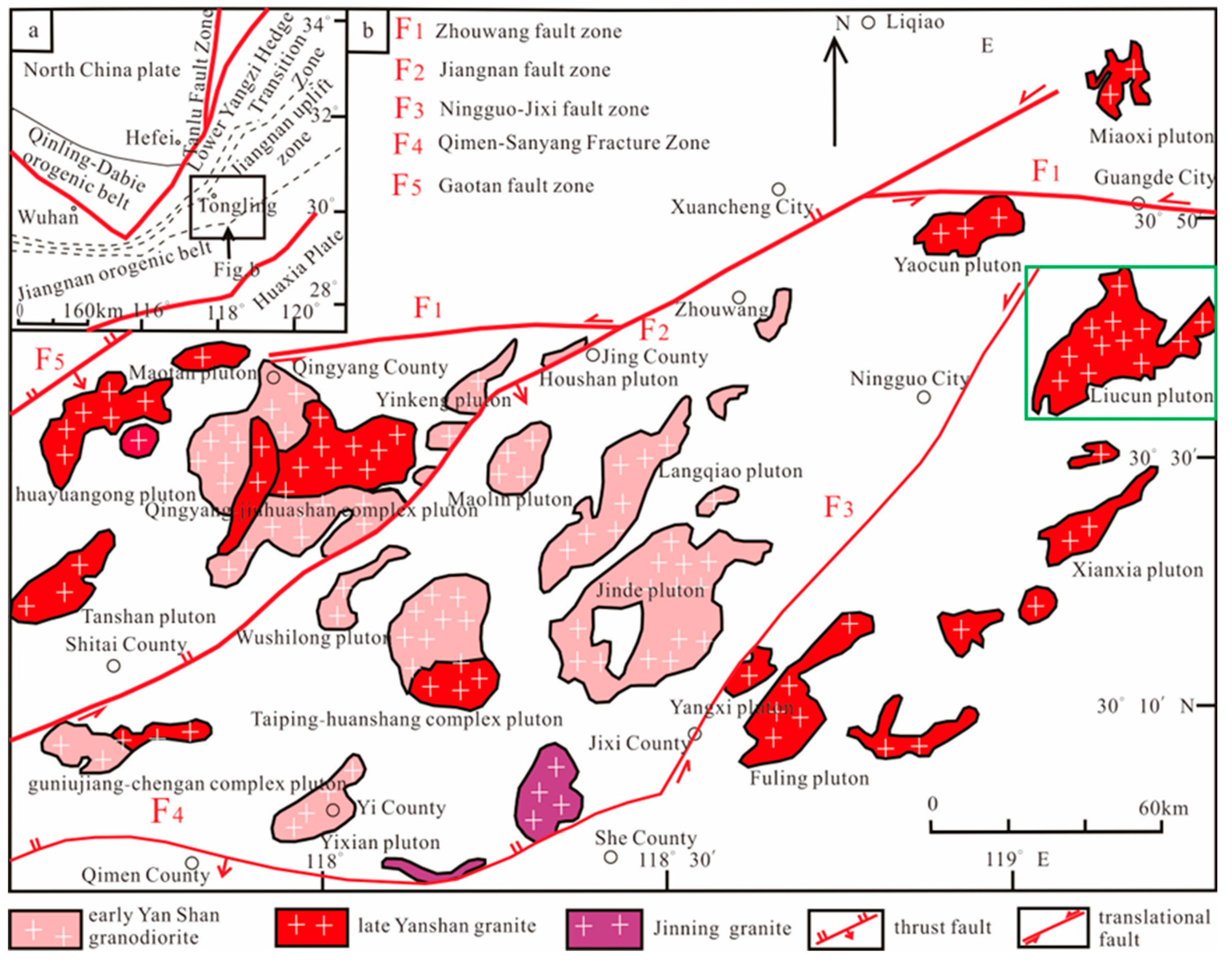
Figure 2.
Geological sketch map of Liucun pluton Q— Quaternary; K1-2p—midddle-lower Cretaceous Pukou Formation; D1-2tn—middle –lower Devonian Tangjiawu Formation; S1d—lower Silurian Dabaidi Formation; S1a—low Silurian Anji Formation; O1y-n—lower Ordovician Yinzhubu Formation and Ningguo Formation; ∈3O1x—upper Cambrian-lower Ordovician Xiyangshan Formation; ∈1h—lower Ordovician Hetang Formation; ηγ—monzonitic granite; ξγ—syenogranit; ①—Tongwu copper ore deposit in Guangde County; ②—Yangchong tungsten-molybdebnum ore deposit in Guangde County; ③—Bridgehead Xiqiling tungsten ore deposit in Ningguo City; ④—Dali Cu-Zn-Pb ore deposit in Ningguo City; ⑤—Shucun tungsten ore deposit in Ningguo City; ⑥—Lujiashan W-Be ore deposit in Ningguo City; ⑦—Wangcun Cu-Zn-Pb ore deposit in Ningguo City.
Figure 2.
Geological sketch map of Liucun pluton Q— Quaternary; K1-2p—midddle-lower Cretaceous Pukou Formation; D1-2tn—middle –lower Devonian Tangjiawu Formation; S1d—lower Silurian Dabaidi Formation; S1a—low Silurian Anji Formation; O1y-n—lower Ordovician Yinzhubu Formation and Ningguo Formation; ∈3O1x—upper Cambrian-lower Ordovician Xiyangshan Formation; ∈1h—lower Ordovician Hetang Formation; ηγ—monzonitic granite; ξγ—syenogranit; ①—Tongwu copper ore deposit in Guangde County; ②—Yangchong tungsten-molybdebnum ore deposit in Guangde County; ③—Bridgehead Xiqiling tungsten ore deposit in Ningguo City; ④—Dali Cu-Zn-Pb ore deposit in Ningguo City; ⑤—Shucun tungsten ore deposit in Ningguo City; ⑥—Lujiashan W-Be ore deposit in Ningguo City; ⑦—Wangcun Cu-Zn-Pb ore deposit in Ningguo City.
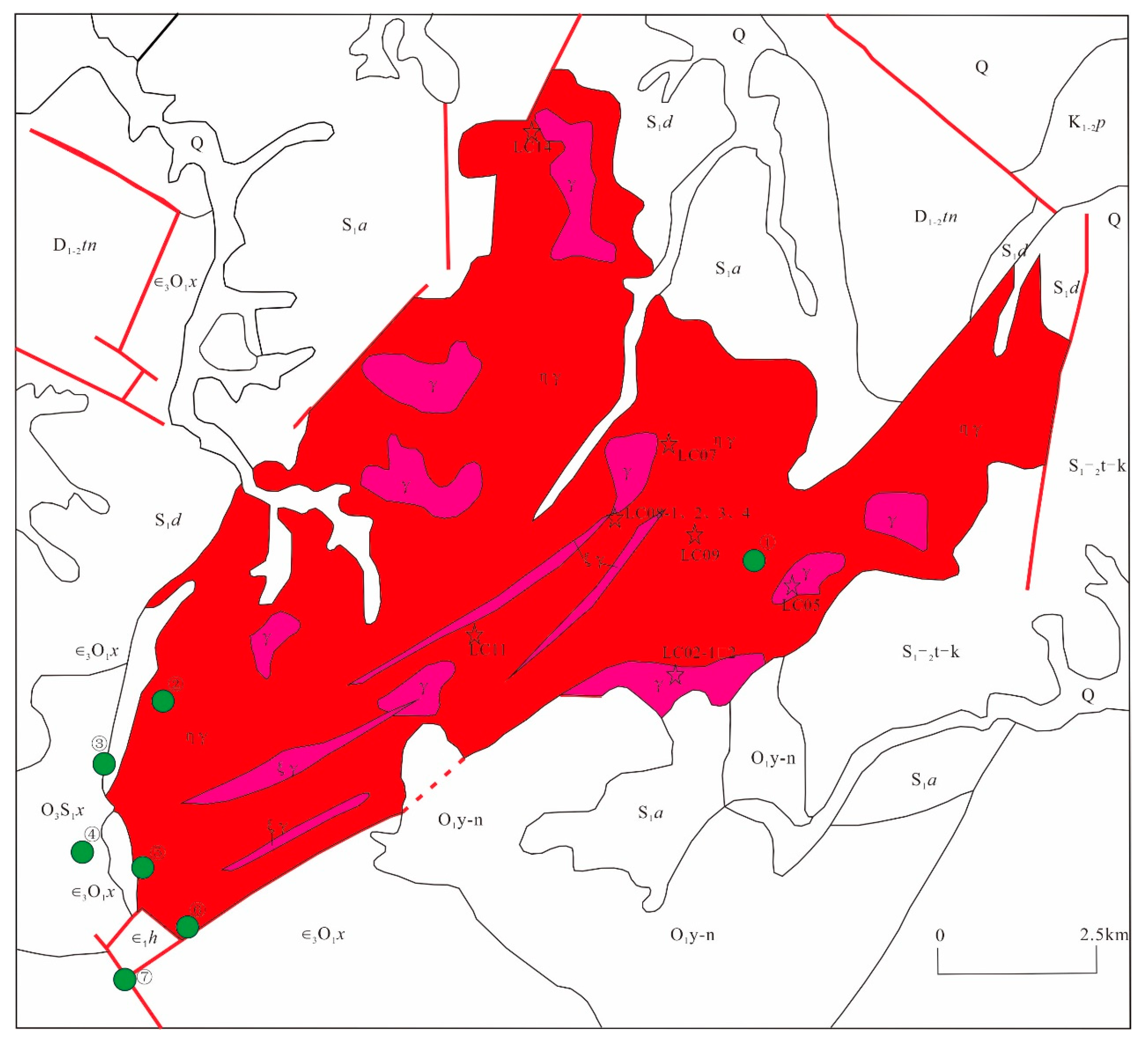
Figure 3.
Hand specimen photos and microscopic characteristics of Liucun pluton.Mineral abbreviations: Qtz-quartz; Kfs-K-feldspar; Pl-plagioclase; Bt-biotite.
Figure 3.
Hand specimen photos and microscopic characteristics of Liucun pluton.Mineral abbreviations: Qtz-quartz; Kfs-K-feldspar; Pl-plagioclase; Bt-biotite.
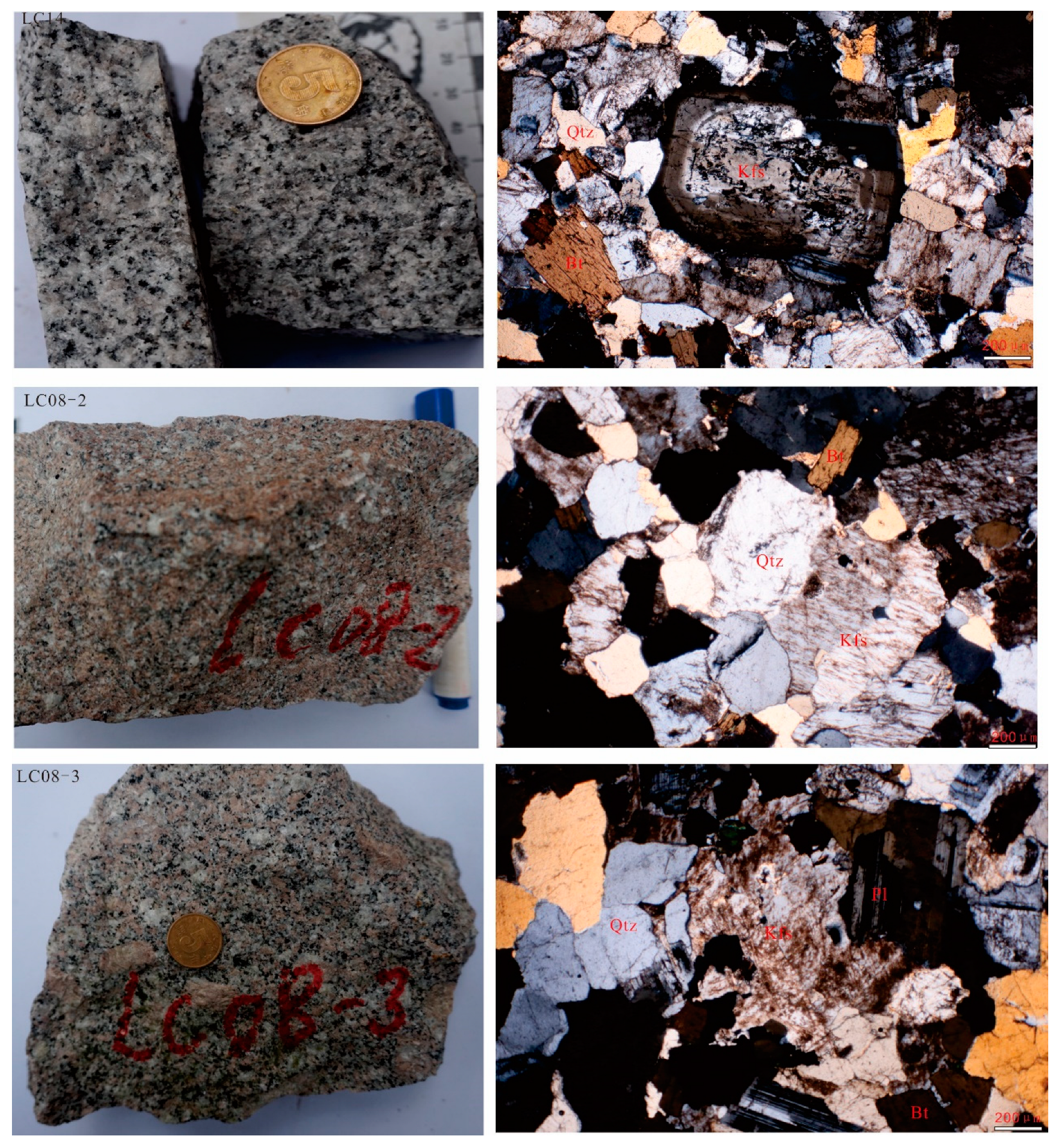
Figure 4.
The whole rock discriminative diagrams of samples from the Liucun pluton.
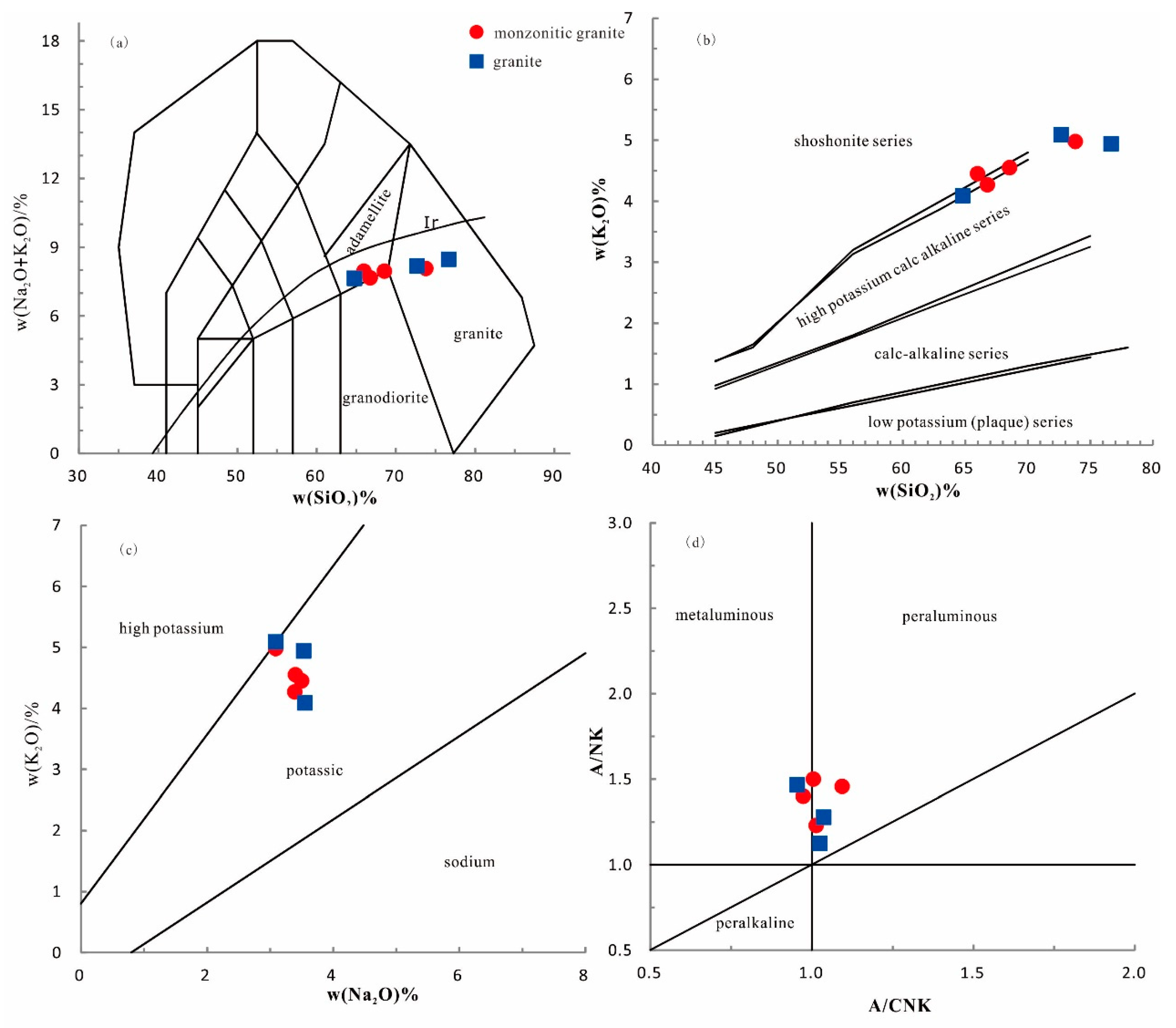
Figure 5.
Diagrams of SiO2 vs. major elements of monzonitic granite and granite from Liucun pluton.
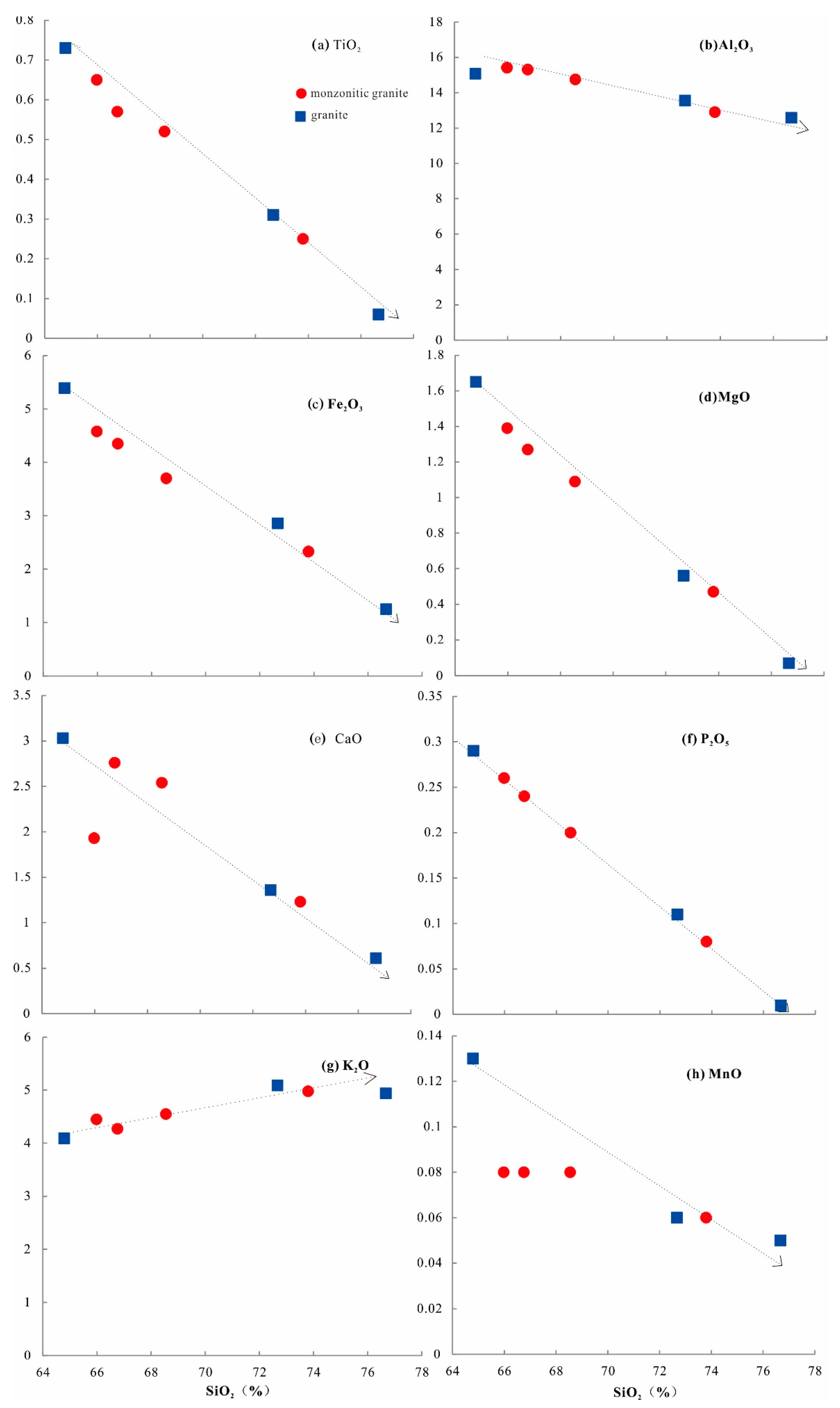
Figure 6.
REE chondrite-normalized patterns(a, c) and primitive mantle-normalized spider diagrams(b, d)of the granodiorite and pegmatite from Liucun pluton( normalization values after the paper [27]).
Figure 6.
REE chondrite-normalized patterns(a, c) and primitive mantle-normalized spider diagrams(b, d)of the granodiorite and pegmatite from Liucun pluton( normalization values after the paper [27]).
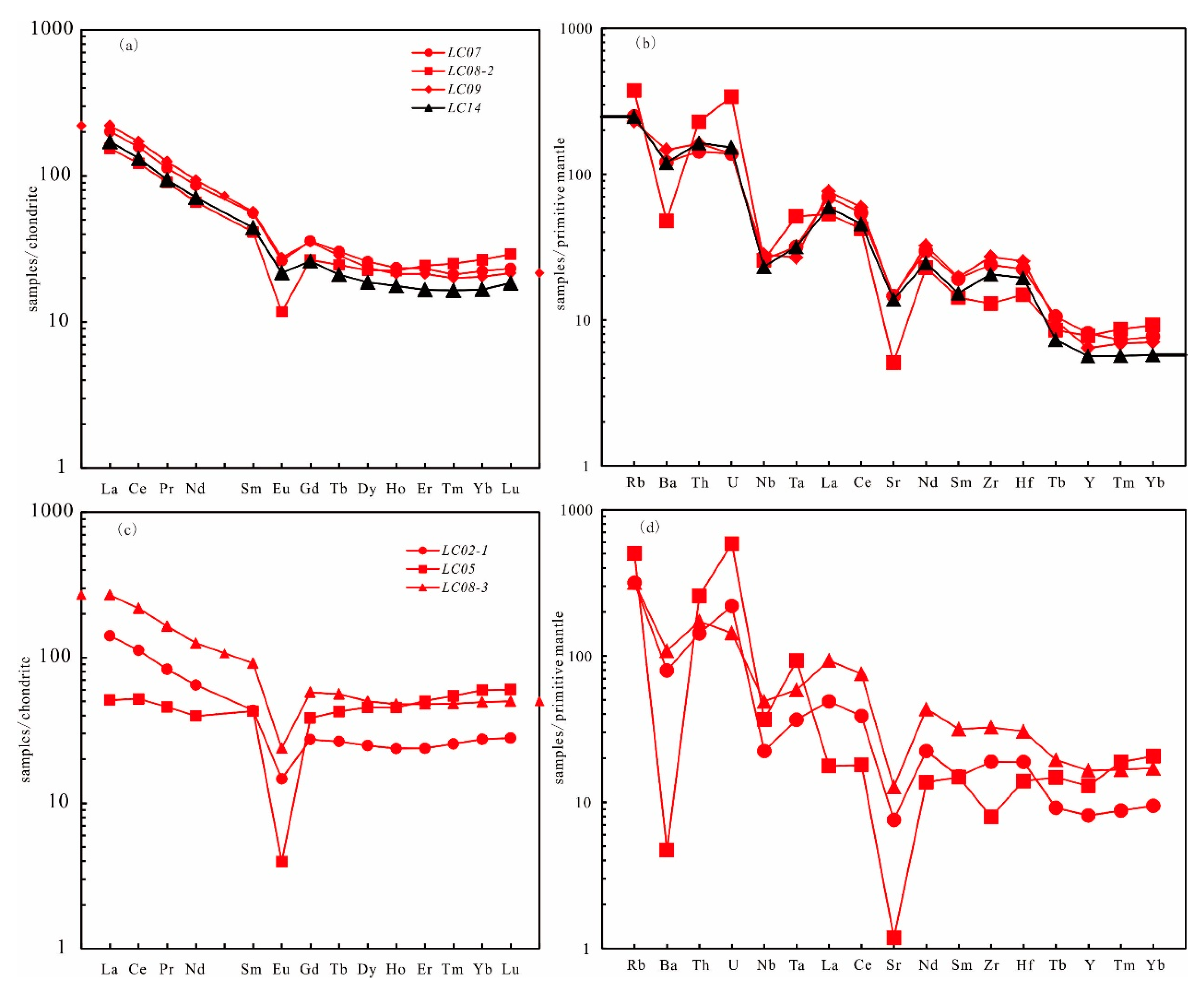
Figure 7.
U-Pb concordant plots of zircon and cathodoluminescence images showing characteristics of representative zircons from the Liucun pluton (The number in the zircon cathode luminescence image represents the point number, the solid coil is the U-Pb age measuring point, and the dashed coil is the Hf isotope analysis point).
Figure 7.
U-Pb concordant plots of zircon and cathodoluminescence images showing characteristics of representative zircons from the Liucun pluton (The number in the zircon cathode luminescence image represents the point number, the solid coil is the U-Pb age measuring point, and the dashed coil is the Hf isotope analysis point).
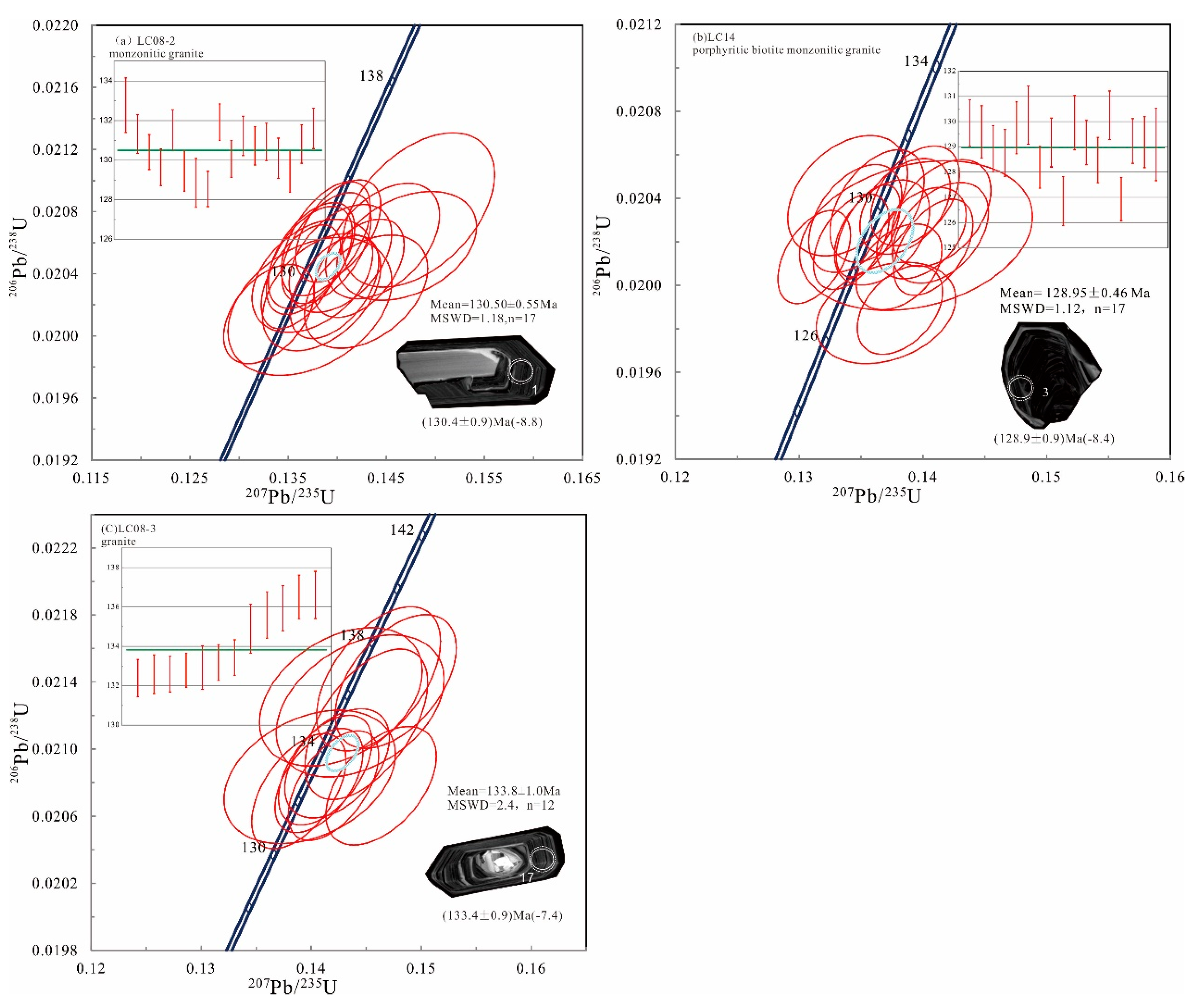
Figure 8.
Age histogram of Mesozoic intrusive rocks in southern Anhui. Data from the papers [8, 11, 25, 28, 31–36, 38–46], and my unpublished data.
Figure 8.
Age histogram of Mesozoic intrusive rocks in southern Anhui. Data from the papers [8, 11, 25, 28, 31–36, 38–46], and my unpublished data.
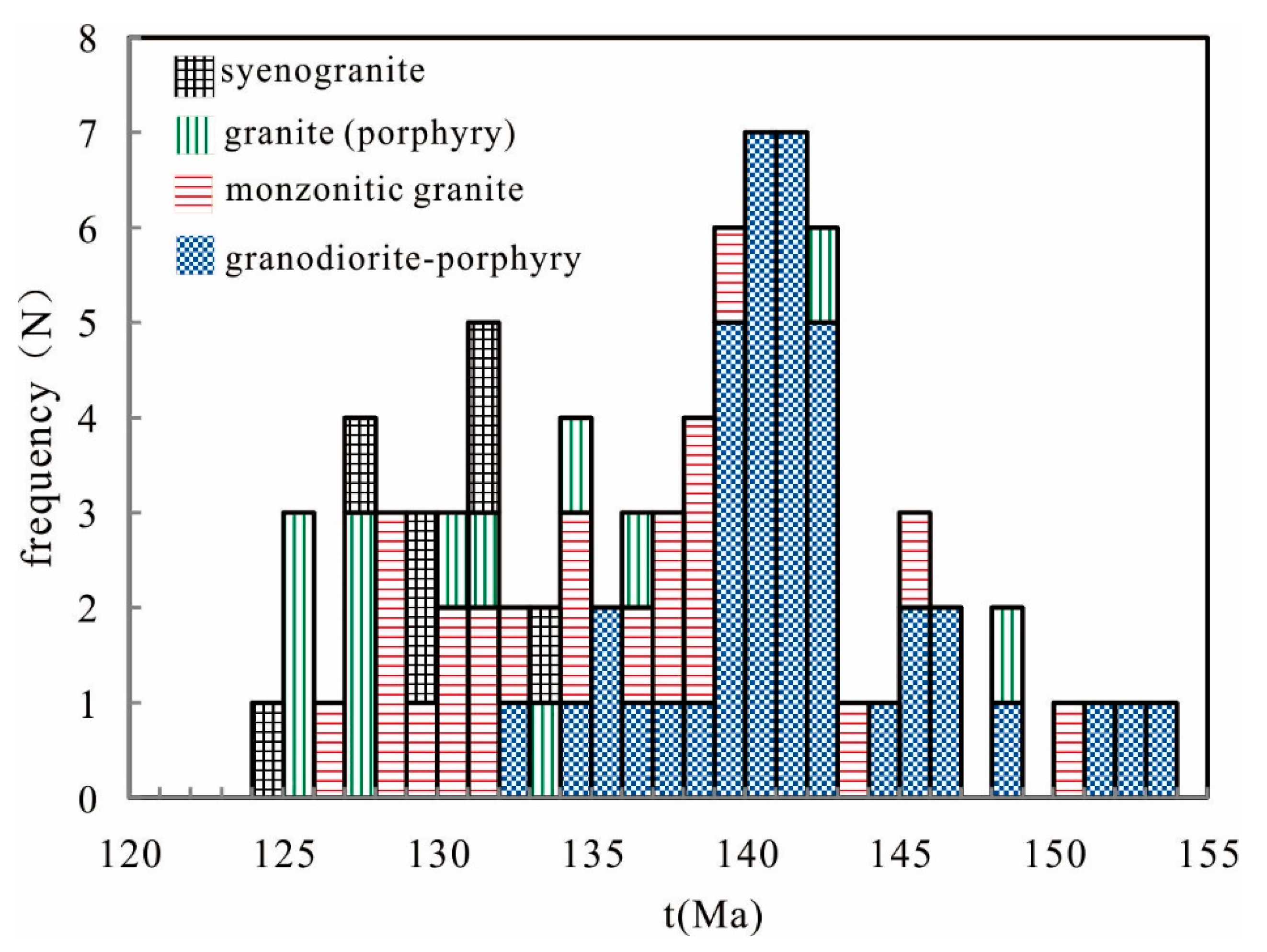
Figure 9.
Na2O-K2O discriminant map (a, after the paper [51]) and Zr- (10000Ga/Al) discriminant map (b, after the paper [47]) of Liucun pluton.
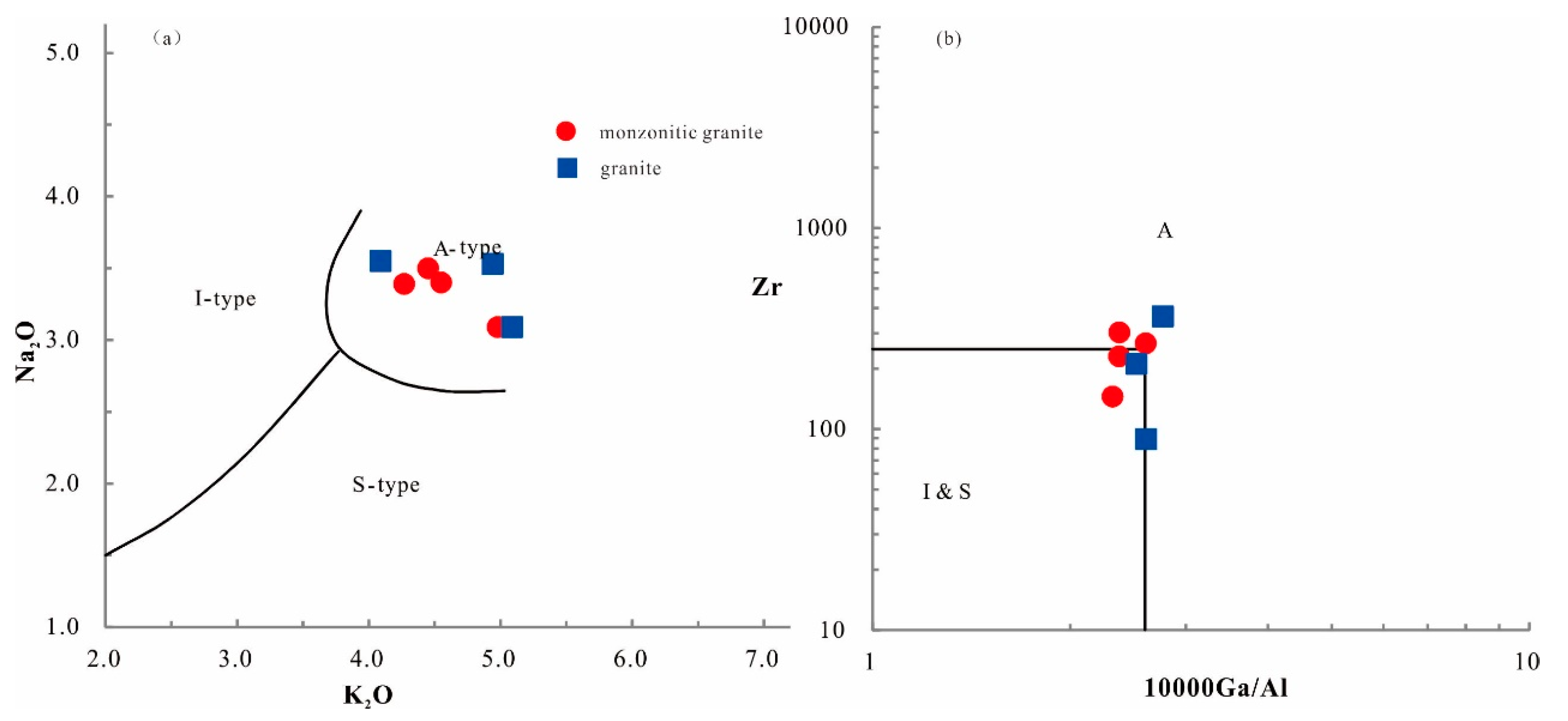
Figure 10.
La/Sm vs. La (a) and Rb/Nb vs. Rb/Zr (b) diagrams for the monzonitic granite and granite from Liucun pluton.
Figure 10.
La/Sm vs. La (a) and Rb/Nb vs. Rb/Zr (b) diagrams for the monzonitic granite and granite from Liucun pluton.
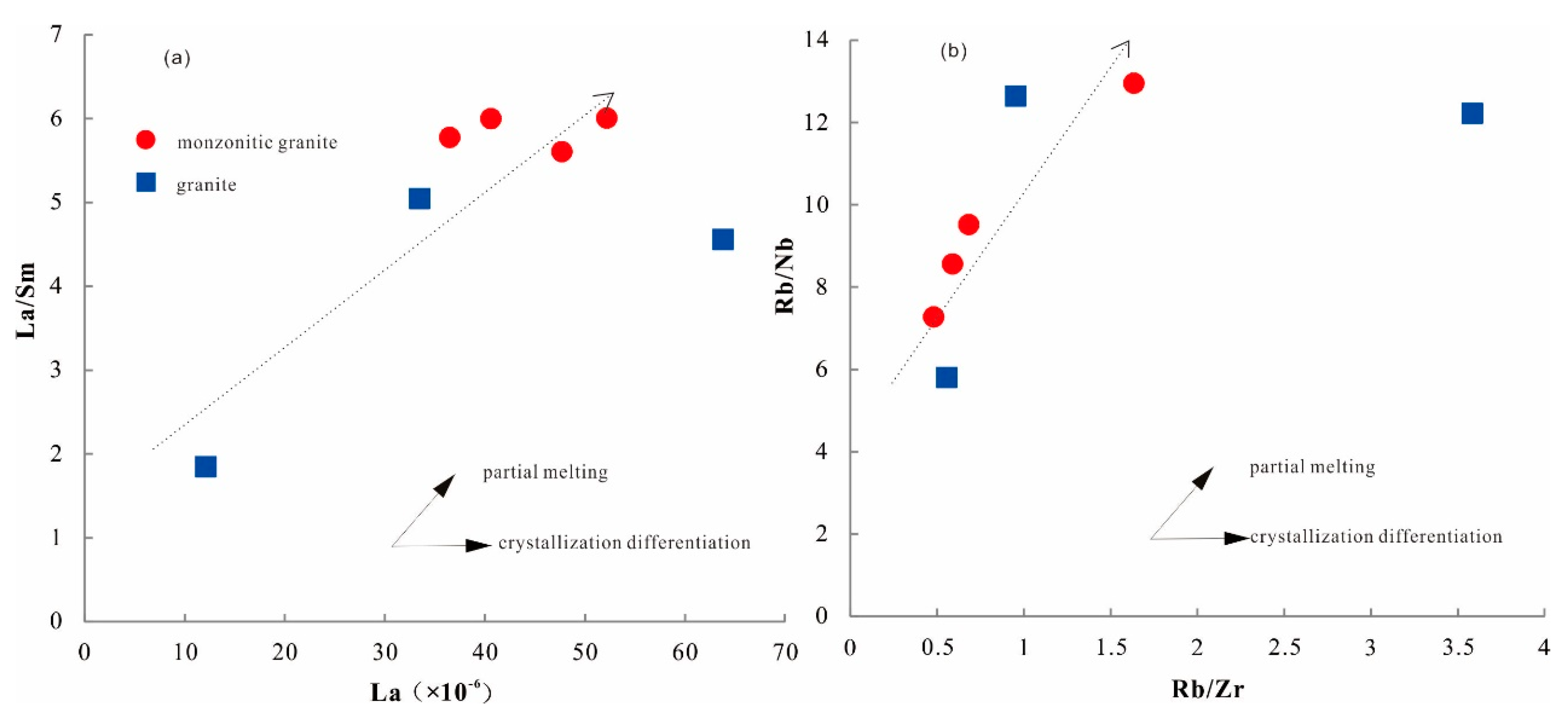
Figure 11.
Relationship between εHf (t) and age of zircon in Liucun pluton.
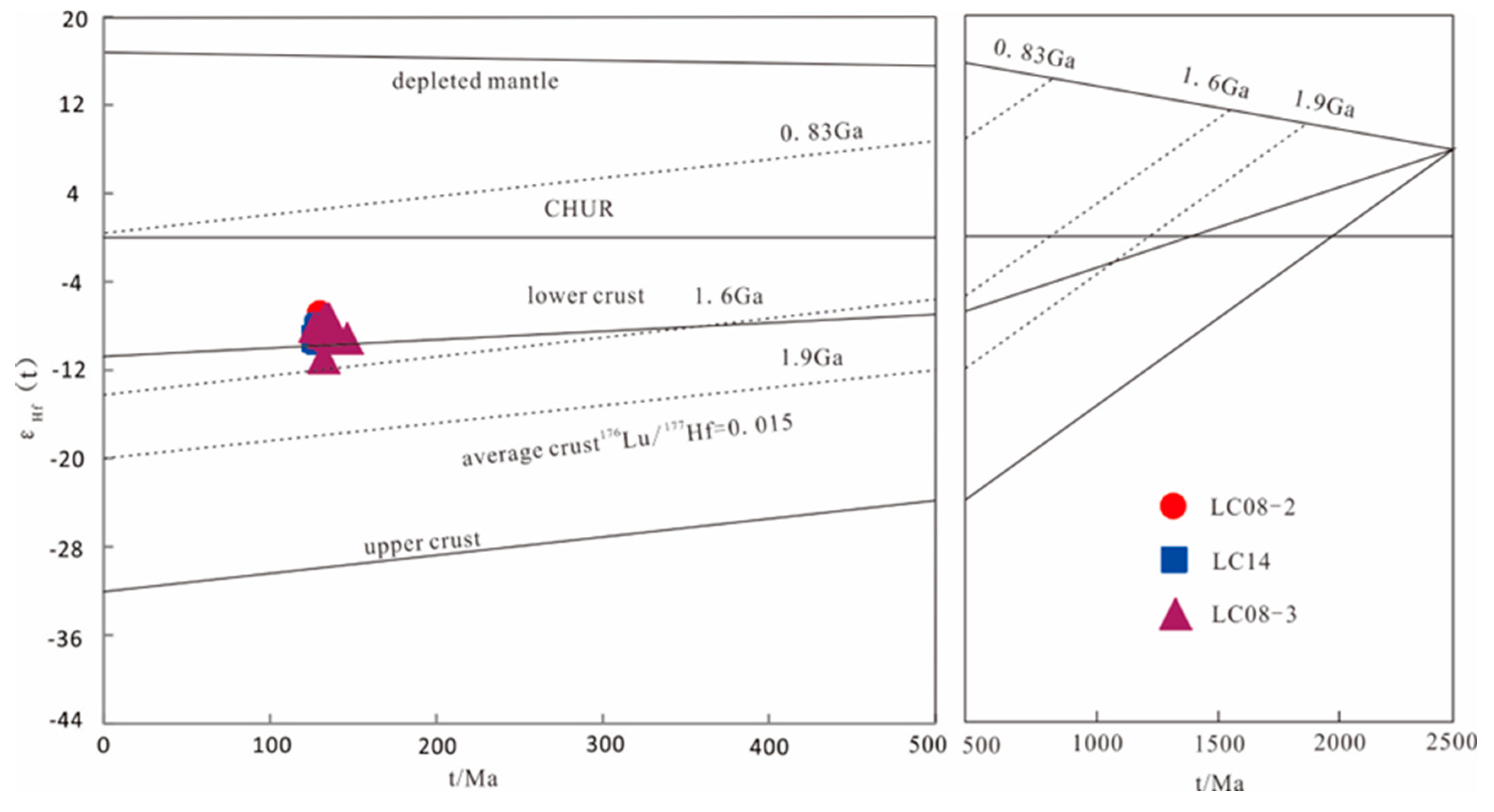
Figure 12.
Frequency distribution map of εNd (t) and εHf (t) values of the Early and Late Mesozoic intrusive rocks in the eastern section of Jiangnan Orogenic Belt (data other than the Liucun pluton from my unpublished data).
Figure 12.
Frequency distribution map of εNd (t) and εHf (t) values of the Early and Late Mesozoic intrusive rocks in the eastern section of Jiangnan Orogenic Belt (data other than the Liucun pluton from my unpublished data).
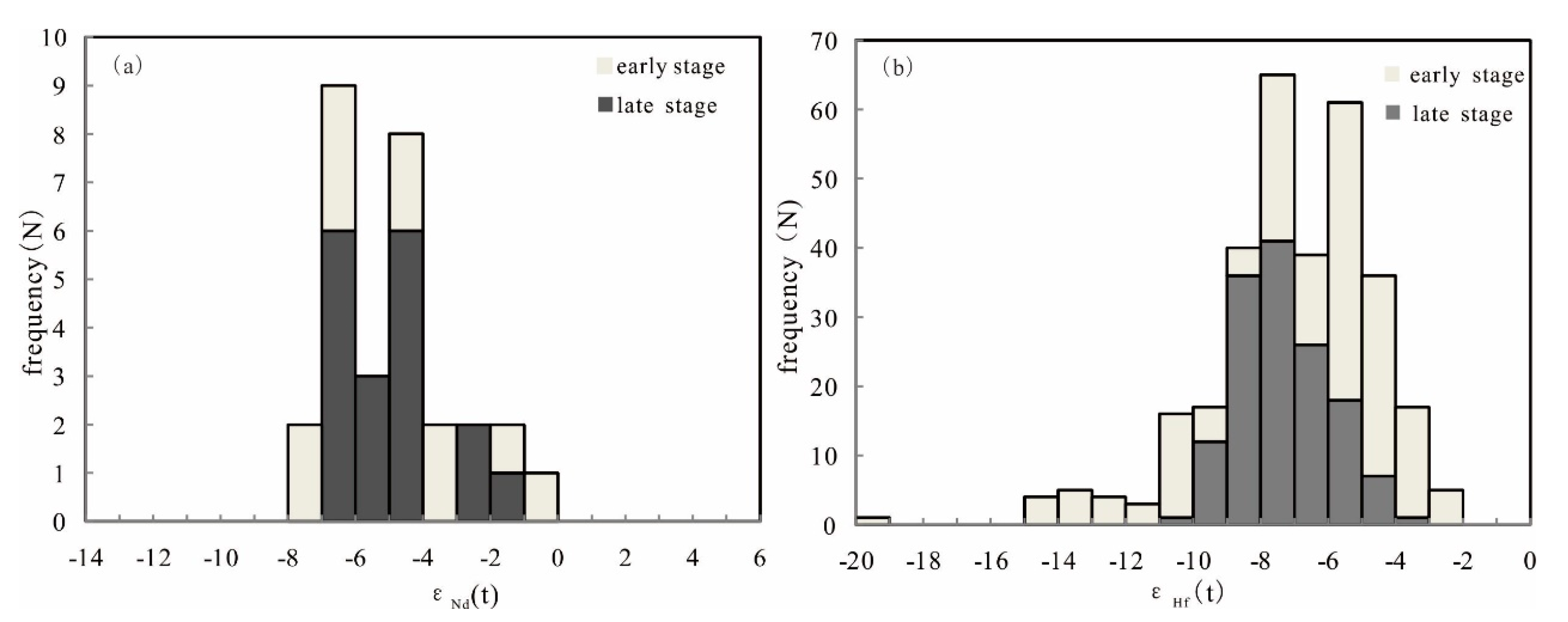
Figure 13.
Relationship between εNd(t) and initial 87Sr/86Sr values of Liucun pluton and the Early and Late Mesozoic intrusive rocks in the eastern part of Jiangnan orogenic belt. Data from the papers [5, 39, 43, 46, 56, 63], including this paper and my unpublished data;.
Figure 13.
Relationship between εNd(t) and initial 87Sr/86Sr values of Liucun pluton and the Early and Late Mesozoic intrusive rocks in the eastern part of Jiangnan orogenic belt. Data from the papers [5, 39, 43, 46, 56, 63], including this paper and my unpublished data;.
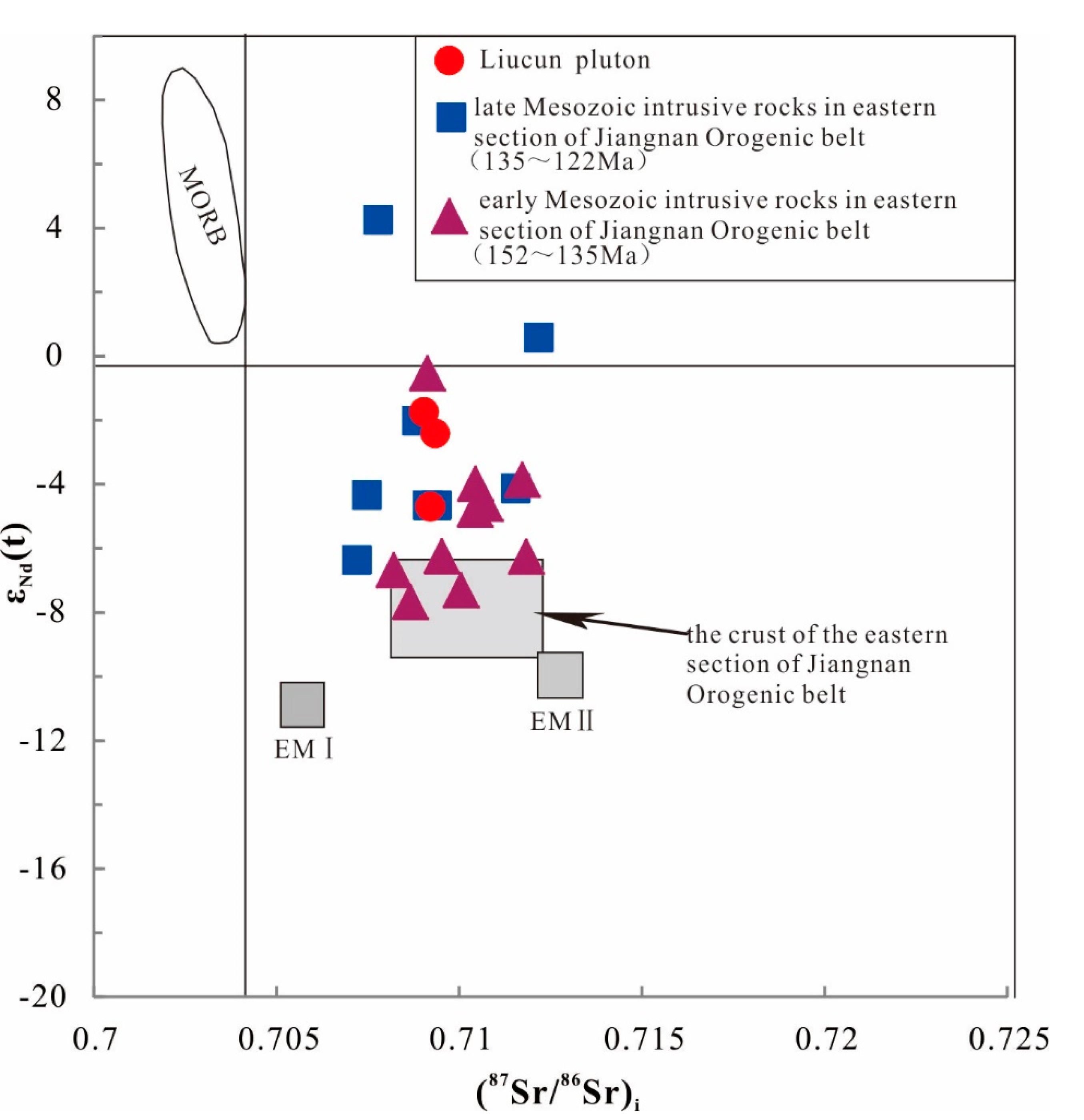
Figure 14.
Discriminant diagram of tectonic background of Liucun pluton (a, b, d after the paper [57]; c after the paper [58]) WPG- withinplate granite; Vag-volcanic arc granite; syn-COLG- syncollisional granite; ORG- mid-ocean ridge plagioclase granite; post-COLG–post-collisional granite.
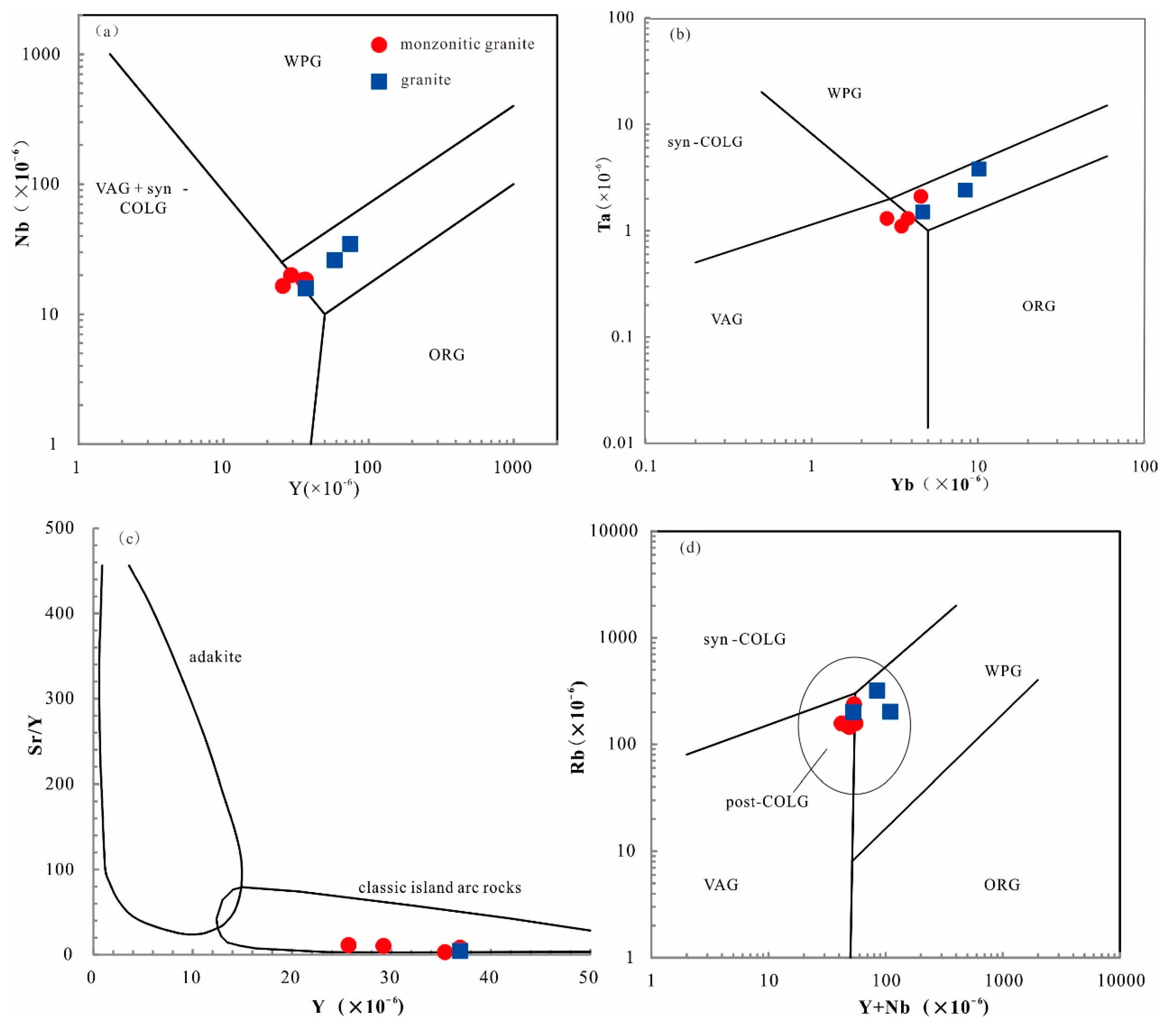

Table 1.
Major (%) and trace element (×10−6) concentrations of samples from the Liucun pluton.
| Sample Number | LC07 | LC08-2 | LC09 | LC14 | LC02-1 | LC05 | LC08-3 |
|---|---|---|---|---|---|---|---|
| Lithology | Monzonitic Granite | Granite | |||||
| SiO2 | 66.76 | 73.8 | 65.98 | 68.55 | 72.67 | 76.67 | 64.79 |
| TiO2 | 0.57 | 0.25 | 0.65 | 0.52 | 0.31 | 0.06 | 0.73 |
| Al2O3 | 15.31 | 12.9 | 15.42 | 14.75 | 13.56 | 12.58 | 15.08 |
| Fe2O3T | 4.35 | 2.33 | 4.58 | 3.7 | 2.86 | 1.25 | 5.39 |
| FeO | 3.05 | 1.66 | 3.32 | 2.46 | 2.06 | 0.94 | 4.05 |
| MnO | 0.08 | 0.06 | 0.08 | 0.08 | 0.06 | 0.05 | 0.13 |
| MgO | 1.27 | 0.47 | 1.39 | 1.09 | 0.56 | 0.07 | 1.65 |
| CaO | 2.76 | 1.23 | 1.93 | 2.54 | 1.36 | 0.61 | 3.03 |
| Na2O | 3.39 | 3.09 | 3.5 | 3.4 | 3.09 | 3.53 | 3.55 |
| K2O | 4.27 | 4.98 | 4.45 | 4.55 | 5.09 | 4.94 | 4.09 |
| P2O5 | 0.24 | 0.08 | 0.26 | 0.2 | 0.11 | 0.01 | 0.29 |
| LOI | 0.68 | 0.51 | 1.62 | 0.55 | 0.68 | 0.35 | 0.66 |
| Total | 102.73 | 101.36 | 103.18 | 102.39 | 102.41 | 101.06 | 103.44 |
| Na2O/K2O | 0.79 | 0.62 | 0.79 | 0.75 | 0.61 | 0.71 | 0.87 |
| Na2O+K2O | 7.66 | 8.07 | 7.95 | 7.95 | 8.18 | 8.47 | 7.64 |
| A/CNK | 1.00 | 1.01 | 1.09 | 0.97 | 1.04 | 1.02 | 0.95 |
| A/NK | 1.50 | 1.23 | 1.46 | 1.40 | 1.28 | 1.13 | 1.47 |
| Mg# | 0.31 | 0.24 | 0.32 | 0.32 | 0.23 | 0.08 | 0.31 |
| La | 47.7 | 36.5 | 52.2 | 40.6 | 33.5 | 12.1 | 63.8 |
| Ce | 96.1 | 74.7 | 105 | 80.7 | 68.6 | 31.8 | 133.5 |
| Pr | 10.75 | 8.58 | 11.9 | 8.95 | 7.89 | 4.34 | 15.6 |
| Nd | 40.2 | 30.9 | 43.7 | 33.2 | 30.2 | 18.5 | 58.6 |
| Sm | 8.51 | 6.32 | 8.69 | 6.77 | 6.64 | 6.55 | 14 |
| Eu | 1.52 | 0.68 | 1.6 | 1.26 | 0.85 | 0.23 | 1.38 |
| Gd | 7.37 | 5.46 | 7.26 | 5.36 | 5.61 | 7.9 | 11.85 |
| Tb | 1.14 | 0.92 | 1.07 | 0.79 | 0.99 | 1.59 | 2.1 |
| Dy | 6.58 | 5.75 | 5.99 | 4.75 | 6.3 | 11.55 | 12.7 |
| Ho | 1.33 | 1.27 | 1.21 | 1 | 1.34 | 2.56 | 2.71 |
| Er | 3.85 | 4.03 | 3.53 | 2.75 | 3.93 | 8.33 | 7.93 |
| Tm | 0.54 | 0.64 | 0.51 | 0.42 | 0.65 | 1.39 | 1.23 |
| Yb | 3.79 | 4.54 | 3.47 | 2.84 | 4.66 | 10.15 | 8.4 |
| Lu | 0.59 | 0.74 | 0.55 | 0.47 | 0.71 | 1.53 | 1.27 |
| Sc | 8.3 | 3.8 | 8.6 | 6.3 | 5.3 | 3.1 | 11.8 |
| V | 58 | 20 | 57 | 48 | 27 | 3 | 74 |
| Cr | 30 | 20 | 20 | 30 | 20 | 20 | 30 |
| Co | 7.3 | 2.6 | 7 | 5.4 | 3.4 | 0.5 | 8.9 |
| Ni | 7.2 | 2.7 | 7.1 | 4.9 | 3.2 | 0.9 | 8.5 |
| Ga | 19.4 | 15.1 | 17.8 | 16.8 | 17 | 16.65 | 21.1 |
| Rb | 157.5 | 237 | 145.5 | 157 | 201 | 319 | 202 |
| Sr | 308 | 107.5 | 303 | 292 | 160 | 24.9 | 267 |
| Y | 36.9 | 35.4 | 29.2 | 25.7 | 36.9 | 58.4 | 74.6 |
| Zr | 267 | 145 | 303 | 230 | 211 | 89 | 363 |
| Nb | 18.4 | 18.3 | 20 | 16.5 | 15.9 | 26.1 | 34.8 |
| Ba | 841 | 333 | 1025 | 835 | 554 | 32.9 | 757 |
| Hf | 6.9 | 4.6 | 7.8 | 6 | 5.8 | 4.3 | 9.4 |
| Ta | 1.3 | 2.1 | 1.1 | 1.3 | 1.5 | 3.8 | 2.4 |
| Pb | 19 | 25.3 | 18.6 | 19.1 | 25.4 | 39.2 | 19 |
| Th | 12.15 | 19.4 | 13.75 | 13.85 | 12.1 | 21.8 | 14.65 |
| U | 2.9 | 7.1 | 2.9 | 3.2 | 4.6 | 12.3 | 3 |
| ∑REE | 229.97 | 181.03 | 246.68 | 189.86 | 171.87 | 118.52 | 335.07 |
| ∑LREE | 204.78 | 157.68 | 223.09 | 171.48 | 147.68 | 73.52 | 286.88 |
| ∑HREE | 25.19 | 23.35 | 23.59 | 18.38 | 24.19 | 45.00 | 48.19 |
| LREE/HREE | 8.13 | 6.75 | 9.46 | 9.33 | 6.11 | 1.63 | 5.95 |
| (La/Yb)N | 9.03 | 5.77 | 10.79 | 10.25 | 5.16 | 0.86 | 5.45 |
| δEu | 0.59 | 0.35 | 0.62 | 0.64 | 0.43 | 0.10 | 0.33 |
| δCe | 1.04 | 1.03 | 1.03 | 1.04 | 1.03 | 1.08 | 1.04 |
Notes: A/NK =Al2O3/(Na2O+K2O) (mol); A/CNK = Al2O3/(CaO+Na2O+K2O) (mol); Mg#=MgO/(MgO+FeO+Fe2O3) (mol).
Table 2.
Sr-Nd isotopic compostions of the monzonitic granite and granite from Liucun pluton.
| Sample number | lithology | t (Ma) | Rb | Sr | 87Rb/86Sr | 87Sr/86Sr | 2σ | Sm | Nd | 147Sm/144Nd | 143Nd/144Nd | 2σ | INd (t) | ISr (t) | εNd (t) | TDM2 (Ma) |
|---|---|---|---|---|---|---|---|---|---|---|---|---|---|---|---|---|
| (×10−6) | (×10−6) | |||||||||||||||
| LC08-2 | monzonitic granite | 130.5 | 237 | 114 | 6.022 | 0.720512 | 0.000010 | 6.32 | 30.9 | 0.1236 | 0.512452 | 0.000011 | 0.512346 | 0.70934 | -2.42 | 1122 |
| LC14 | biotite monzogranite | 128.95 | 157 | 300 | 1.515 | 0.711987 | 0.000015 | 6.77 | 33.2 | 0.1233 | 0.512335 | 0.000010 | 0.512231 | 0.70921 | -4.7 | 1306 |
| LC08-3 | granite | 133.5 | 202 | 267 | 2.190 | 0.713192 | 0.000012 | 14.00 | 58.6 | 0.1444 | 0.512503 | 0.000007 | 0.512377 | 0.70904 | -1.74 | 1069 |
Note: Constants used in the calculations are: λSm = 6.54 × 10⁻¹²; λRb = 1.42 × 10⁻¹². deficit mantle (DM): 147Sm/144Nd = 0.2136, 143Nd/144Nd = 0.513151. deficit mantle model age (TDM2) was calculated using the model of the paper [29].
Table 3.
U-Pb dating results of zircon from the Liucun pluton.
| Test point | Content (μg/g) | Th/U | Isotope Ratio | Age (Ma) | |||||||||
|---|---|---|---|---|---|---|---|---|---|---|---|---|---|
| Th | U | 207Pb/206Pb | 1σ | 207Pb/235U | 1σ | 206Pb/238U | 1σ | 207Pb/235U | 1σ | 206Pb/238U | 1σ | ||
| Monzonitic Granite (LC08-2) | |||||||||||||
| LC08-2-01 | 310.26 | 880.68 | 0.35 | 0.050363 | 0.000675 | 0.142208 | 0.002024 | 0.020436 | 0.000139 | 135.0 | 1.8 | 130.4 | 0.9 |
| LC08-2-02 | 127.72 | 286.21 | 0.45 | 0.052146 | 0.001227 | 0.148254 | 0.003412 | 0.020811 | 0.000219 | 140.4 | 3.0 | 132.8 | 1.4 |
| LC08-2-03 | 265.91 | 1151.47 | 0.23 | 0.049838 | 0.000673 | 0.139726 | 0.001983 | 0.020314 | 0.000146 | 132.8 | 1.8 | 129.6 | 0.9 |
| LC08-2-04 | 411.17 | 714.02 | 0.58 | 0.050719 | 0.000819 | 0.144621 | 0.002552 | 0.020611 | 0.000163 | 137.2 | 2.3 | 131.5 | 1.0 |
| LC08-2-05 | 98.66 | 539.91 | 0.18 | 0.051165 | 0.000940 | 0.142935 | 0.002762 | 0.020285 | 0.000160 | 135.7 | 2.5 | 129.5 | 1.0 |
| LC08-2-07 | 86.27 | 228.30 | 0.38 | 0.049576 | 0.001360 | 0.137211 | 0.003673 | 0.020190 | 0.000195 | 130.6 | 3.3 | 128.9 | 1.2 |
| LC08-2-08 | 216.33 | 1077.78 | 0.20 | 0.047882 | 0.000732 | 0.133046 | 0.002033 | 0.020140 | 0.000140 | 126.8 | 1.8 | 128.5 | 0.9 |
| LC08-2-09 | 123.29 | 466.18 | 0.26 | 0.051557 | 0.001036 | 0.147076 | 0.003130 | 0.020580 | 0.000154 | 139.3 | 2.8 | 131.3 | 1.0 |
| LC08-2-10 | 252.85 | 1208.57 | 0.21 | 0.049078 | 0.000638 | 0.140101 | 0.001904 | 0.020675 | 0.000145 | 133.1 | 1.7 | 131.9 | 0.9 |
| LC08-2-11 | 304.63 | 1576.02 | 0.19 | 0.048461 | 0.000591 | 0.136312 | 0.001787 | 0.020381 | 0.000147 | 129.8 | 1.6 | 130.1 | 0.9 |
| LC08-2-12 | 319.17 | 1239.07 | 0.26 | 0.048918 | 0.000650 | 0.138907 | 0.002003 | 0.020565 | 0.000157 | 132.1 | 1.8 | 131.2 | 1.0 |
| LC08-2-13 | 254.06 | 1262.64 | 0.20 | 0.048533 | 0.000642 | 0.137148 | 0.001925 | 0.020486 | 0.000153 | 130.5 | 1.7 | 130.7 | 1.0 |
| LC08-2-14 | 324.77 | 1116.43 | 0.29 | 0.048508 | 0.000643 | 0.137377 | 0.001936 | 0.020518 | 0.000150 | 130.7 | 1.7 | 130.9 | 0.9 |
| LC08-2-15 | 119.08 | 830.69 | 0.14 | 0.048903 | 0.000885 | 0.137470 | 0.002706 | 0.020387 | 0.000160 | 130.8 | 2.4 | 130.1 | 1.0 |
| LC08-2-16 | 98.00 | 500.82 | 0.20 | 0.049725 | 0.000951 | 0.138404 | 0.002648 | 0.020281 | 0.000166 | 131.6 | 2.4 | 129.4 | 1.1 |
| LC08-2-18 | 151.61 | 672.57 | 0.23 | 0.049484 | 0.000748 | 0.140317 | 0.002297 | 0.020499 | 0.000153 | 133.3 | 2.0 | 130.8 | 1.0 |
| LC08-2-19 | 326.97 | 1282.61 | 0.25 | 0.048769 | 0.000631 | 0.138848 | 0.001992 | 0.020626 | 0.000162 | 132.0 | 1.8 | 131.6 | 1.0 |
| porphyritic biotite monzonitic granite (LC14) | |||||||||||||
| LC14-01 | 390.27 | 816.24 | 0.48 | 0.049287 | 0.000827 | 0.138566 | 0.002407 | 0.020363 | 0.000145 | 131.8 | 2.1 | 129.9 | 0.9 |
| LC14-02 | 180.08 | 520.04 | 0.35 | 0.048164 | 0.000873 | 0.134536 | 0.002478 | 0.020307 | 0.000164 | 128.2 | 2.2 | 129.6 | 1.0 |
| LC14-03 | 254.79 | 838.54 | 0.30 | 0.048314 | 0.000716 | 0.134207 | 0.002016 | 0.020200 | 0.000145 | 127.9 | 1.8 | 128.9 | 0.9 |
| LC14-04 | 310.52 | 997.11 | 0.31 | 0.050644 | 0.000729 | 0.140847 | 0.002110 | 0.020175 | 0.000146 | 133.8 | 1.9 | 128.8 | 0.9 |
| LC14-05 | 264.33 | 651.02 | 0.41 | 0.050359 | 0.000873 | 0.141477 | 0.002651 | 0.020332 | 0.000162 | 134.4 | 2.4 | 129.8 | 1.0 |
| LC14-06 | 107.41 | 351.89 | 0.31 | 0.047631 | 0.001104 | 0.133922 | 0.003197 | 0.020412 | 0.000182 | 127.6 | 2.9 | 130.3 | 1.2 |
| LC14-08 | 842.67 | 741.75 | 1.14 | 0.049784 | 0.000816 | 0.138074 | 0.002288 | 0.020085 | 0.000130 | 131.3 | 2.0 | 128.2 | 0.8 |
| LC14-09 | 279.40 | 558.43 | 0.50 | 0.050595 | 0.000863 | 0.141421 | 0.002559 | 0.020241 | 0.000153 | 134.3 | 2.3 | 129.2 | 1.0 |
| LC14-10 | 288.41 | 291.20 | 0.99 | 0.050337 | 0.001418 | 0.137015 | 0.003717 | 0.019872 | 0.000154 | 130.4 | 3.3 | 126.8 | 1.0 |
| LC14-12 | 213.19 | 583.51 | 0.37 | 0.048467 | 0.000850 | 0.136299 | 0.002509 | 0.020365 | 0.000170 | 129.7 | 2.2 | 130.0 | 1.1 |
| LC14-14 | 220.21 | 542.73 | 0.41 | 0.050189 | 0.000880 | 0.139886 | 0.002385 | 0.020240 | 0.000138 | 132.9 | 2.1 | 129.2 | 0.9 |
| LC14-15 | 379.17 | 825.54 | 0.46 | 0.047007 | 0.000622 | 0.131217 | 0.001938 | 0.020130 | 0.000141 | 125.2 | 1.7 | 128.5 | 0.9 |
| LC14-16 | 254.24 | 617.85 | 0.41 | 0.049446 | 0.000818 | 0.139367 | 0.002364 | 0.020411 | 0.000151 | 132.5 | 2.1 | 130.3 | 1.0 |
| LC14-17 | 355.91 | 636.50 | 0.56 | 0.050432 | 0.000836 | 0.138147 | 0.002275 | 0.019886 | 0.000135 | 131.4 | 2.0 | 126.9 | 0.9 |
| LC14-18 | 160.97 | 1001.76 | 0.16 | 0.048598 | 0.000631 | 0.135582 | 0.001706 | 0.020250 | 0.000140 | 129.1 | 1.5 | 129.2 | 0.9 |
| LC14-19 | 172.69 | 524.79 | 0.33 | 0.049145 | 0.000891 | 0.136698 | 0.002536 | 0.020242 | 0.000159 | 130.1 | 2.3 | 129.2 | 1.0 |
| LC14-20 | 37.66 | 81.67 | 0.46 | 0.051449 | 0.002376 | 0.139445 | 0.006213 | 0.020228 | 0.000227 | 132.5 | 5.5 | 129.1 | 1.4 |
| granite (LC08-3) | |||||||||||||
| LC08-3-01 | 386.53 | 1309.97 | 0.30 | 0.049566 | 0.000611 | 0.142028 | 0.001805 | 0.020782 | 0.000144 | 134.8 | 1.6 | 132.6 | 0.9 |
| LC08-3-02 | 341.87 | 862.40 | 0.40 | 0.049623 | 0.000729 | 0.145009 | 0.002452 | 0.021147 | 0.000198 | 137.5 | 2.2 | 134.9 | 1.2 |
| LC08-3-03 | 140.91 | 839.95 | 0.17 | 0.051072 | 0.000766 | 0.146360 | 0.002207 | 0.020781 | 0.000155 | 138.7 | 2.0 | 132.6 | 1.0 |
| LC08-3-04 | 114.04 | 282.40 | 0.40 | 0.048622 | 0.001074 | 0.142701 | 0.003254 | 0.021311 | 0.000182 | 135.4 | 2.9 | 135.9 | 1.1 |
| LC08-3-09 | 210.01 | 628.17 | 0.33 | 0.049348 | 0.000742 | 0.146119 | 0.002480 | 0.021418 | 0.000189 | 138.5 | 2.2 | 136.6 | 1.2 |
| LC08-3-12 | 133.51 | 241.64 | 0.55 | 0.048753 | 0.001168 | 0.139869 | 0.003430 | 0.020834 | 0.000175 | 132.9 | 3.1 | 132.9 | 1.1 |
| LC08-3-14 | 204.56 | 721.18 | 0.28 | 0.049995 | 0.000786 | 0.147684 | 0.002420 | 0.021402 | 0.000175 | 139.9 | 2.1 | 136.5 | 1.1 |
| LC08-3-15 | 110.58 | 284.74 | 0.39 | 0.049597 | 0.001151 | 0.144450 | 0.003356 | 0.021257 | 0.000186 | 137.0 | 3.0 | 135.6 | 1.2 |
| LC08-3-16 | 181.80 | 962.05 | 0.19 | 0.049042 | 0.000613 | 0.140709 | 0.001758 | 0.020812 | 0.000136 | 133.7 | 1.6 | 132.8 | 0.9 |
| LC08-3-17 | 266.94 | 920.53 | 0.29 | 0.049328 | 0.000701 | 0.142354 | 0.002092 | 0.020914 | 0.000143 | 135.1 | 1.9 | 133.4 | 0.9 |
| LC08-3-18 | 272.80 | 1063.26 | 0.26 | 0.048549 | 0.000644 | 0.138877 | 0.001886 | 0.020748 | 0.000151 | 132.0 | 1.7 | 132.4 | 1.0 |
| LC08-3-19 | 461.70 | 1181.58 | 0.39 | 0.049123 | 0.000641 | 0.141275 | 0.001872 | 0.020875 | 0.000143 | 134.2 | 1.7 | 133.2 | 0.9 |
Table 4.
Lu-Hf isotopic compositions of zircon from the Liucun pluton.
| Test Point | 176Yb/177Hf | 176Lu/177Hf | 2σ | 176Hf/177Hf | 2σ | Age (Ma) | εHf(t) | TDM1 | TDM2 | fLu/Hf |
|---|---|---|---|---|---|---|---|---|---|---|
| LC08-2 | monzonitic granite | |||||||||
| LC08-2-1 | 0.034666 | 0.001297 | 0.000004 | 0.282445 | 0.000008 | 130.4 | -8.81 | 1150 | 1747 | -0.96 |
| LC08-2-2 | 0.042051 | 0.001507 | 0.000012 | 0.282454 | 0.000009 | 132.8 | -8.44 | 1143 | 1726 | -0.95 |
| LC08-2-3 | 0.032602 | 0.001284 | 0.000011 | 0.282460 | 0.000011 | 129.6 | -8.3 | 1128 | 1713 | -0.96 |
| LC08-2-4 | 0.066740 | 0.002417 | 0.000016 | 0.282455 | 0.000008 | 131.5 | -8.54 | 1170 | 1728 | -0.93 |
| LC08-2-5 | 0.028864 | 0.001168 | 0.000006 | 0.282472 | 0.000008 | 129.5 | -7.84 | 1107 | 1685 | -0.96 |
| LC08-2-7 | 0.054482 | 0.002058 | 0.000023 | 0.282477 | 0.000010 | 128.9 | -7.78 | 1127 | 1679 | -0.94 |
| LC08-2-8 | 0.038874 | 0.001476 | 0.000003 | 0.282455 | 0.000007 | 128.5 | -8.5 | 1141 | 1726 | -0.96 |
| LC08-2-9 | 0.028752 | 0.001086 | 0.000005 | 0.282438 | 0.000008 | 131.3 | -9.04 | 1153 | 1761 | -0.97 |
| LC08-2-10 | 0.044404 | 0.001668 | 0.000010 | 0.282446 | 0.000007 | 131.9 | -8.78 | 1159 | 1744 | -0.95 |
| LC08-2-11 | 0.033442 | 0.001169 | 0.000004 | 0.282499 | 0.000008 | 130.1 | -6.91 | 1070 | 1626 | -0.96 |
| LC08-2-12 | 0.061627 | 0.002264 | 0.000011 | 0.282450 | 0.000008 | 131.2 | -8.72 | 1173 | 1740 | -0.93 |
| LC08-2-13 | 0.042694 | 0.001616 | 0.000013 | 0.282482 | 0.000011 | 130.7 | -7.53 | 1107 | 1665 | -0.95 |
| LC08-2-14 | 0.051891 | 0.001905 | 0.000024 | 0.282464 | 0.000008 | 130.9 | -8.2 | 1142 | 1708 | -0.94 |
| LC08-2-15 | 0.034133 | 0.001362 | 0.000023 | 0.282466 | 0.000007 | 130.1 | -8.11 | 1123 | 1702 | -0.96 |
| LC08-2-16 | 0.041585 | 0.001635 | 0.000005 | 0.282458 | 0.000007 | 129.4 | -8.41 | 1141 | 1719 | -0.95 |
| LC08-2-18 | 0.032475 | 0.001197 | 0.000007 | 0.282430 | 0.000008 | 130.8 | -9.33 | 1168 | 1780 | -0.96 |
| LC08-2-19 | 0.037640 | 0.001441 | 0.000001 | 0.282454 | 0.000009 | 131.6 | -8.47 | 1141 | 1726 | -0.96 |
| LC14 | porphyritic biotite monzonitic granite | |||||||||
| LC14-2 | 0.029774 | 0.001261 | 0.000019 | 0.282429 | 0.000011 | 129.6 | -9.43 | 1172 | 1784 | -0.96 |
| LC14-3 | 0.034529 | 0.001316 | 0.000014 | 0.282458 | 0.000009 | 128.9 | -8.42 | 1133 | 1720 | -0.96 |
| LC14-4 | 0.027043 | 0.001151 | 0.000005 | 0.282456 | 0.000008 | 128.8 | -8.46 | 1130 | 1723 | -0.97 |
| LC14-5 | 0.032517 | 0.001319 | 0.000013 | 0.282443 | 0.000012 | 129.8 | -8.9 | 1153 | 1751 | -0.96 |
| LC14-6 | 0.020863 | 0.000881 | 0.000008 | 0.282467 | 0.000009 | 130.3 | -8 | 1106 | 1695 | -0.97 |
| LC14-8 | 0.063363 | 0.002410 | 0.000039 | 0.282435 | 0.000009 | 128.2 | -9.28 | 1199 | 1775 | -0.93 |
| LC14-9 | 0.032816 | 0.001255 | 0.000013 | 0.282452 | 0.000008 | 129.2 | -8.59 | 1139 | 1732 | -0.96 |
| LC14-10 | 0.065406 | 0.002145 | 0.000024 | 0.282440 | 0.000011 | 126.8 | -9.14 | 1184 | 1765 | -0.94 |
| LC14-12 | 0.025735 | 0.001029 | 0.000004 | 0.282453 | 0.000008 | 130.0 | -8.5 | 1130 | 1727 | -0.97 |
| LC14-14 | 0.030085 | 0.001126 | 0.000002 | 0.282450 | 0.000008 | 129.2 | -8.63 | 1137 | 1735 | -0.97 |
| LC14-15 | 0.054421 | 0.002017 | 0.000024 | 0.282458 | 0.000008 | 128.5 | -8.43 | 1153 | 1721 | -0.94 |
| LC14-16 | 0.030100 | 0.001146 | 0.000006 | 0.282434 | 0.000009 | 130.3 | -9.2 | 1160 | 1770 | -0.97 |
| LC14-17 | 0.033861 | 0.001266 | 0.000004 | 0.282437 | 0.000008 | 126.9 | -9.17 | 1159 | 1765 | -0.96 |
| LC14-18 | 0.037303 | 0.001363 | 0.000024 | 0.282439 | 0.000006 | 129.2 | -9.05 | 1160 | 1761 | -0.96 |
| LC14-19 | 0.021867 | 0.000871 | 0.000005 | 0.282456 | 0.000009 | 129.2 | -8.41 | 1122 | 1721 | -0.97 |
| LC14-20 | 0.022815 | 0.000852 | 0.000008 | 0.282462 | 0.000008 | 129.1 | -8.2 | 1112 | 1706 | -0.97 |
| LC08-3 | granite | |||||||||
| LC08-3-1 | 0.048070 | 0.001768 | 0.000012 | 0.282449 | 0.000011 | 132.6 | -8.66 | 1158 | 1738 | -0.95 |
| LC08-3-2 | 0.056244 | 0.002167 | 0.000014 | 0.282471 | 0.000008 | 134.9 | -7.9 | 1140 | 1691 | -0.93 |
| LC08-3-3 | 0.032200 | 0.001130 | 0.000005 | 0.282447 | 0.000009 | 132.6 | -8.69 | 1142 | 1740 | -0.97 |
| LC08-3-4 | 0.040687 | 0.001444 | 0.000006 | 0.282467 | 0.000009 | 135.9 | -7.95 | 1123 | 1695 | -0.96 |
| LC08-3-5 | 0.044623 | 0.001654 | 0.000011 | 0.282435 | 0.000009 | 139.5 | -9 | 1175 | 1766 | -0.95 |
| LC08-3-7 | 0.058329 | 0.001968 | 0.000024 | 0.282427 | 0.000007 | 146.6 | -9.16 | 1196 | 1780 | -0.94 |
| LC08-3-9 | 0.045140 | 0.001562 | 0.000006 | 0.282440 | 0.000010 | 136.6 | -8.89 | 1165 | 1756 | -0.95 |
| LC08-3-11 | 0.031283 | 0.001173 | 0.000007 | 0.282448 | 0.000009 | 138.2 | -8.53 | 1141 | 1734 | -0.96 |
| LC08-3-12 | 0.039362 | 0.001497 | 0.000004 | 0.282449 | 0.000009 | 132.9 | -8.65 | 1151 | 1738 | -0.95 |
| LC08-3-13 | 0.027196 | 0.001034 | 0.000005 | 0.282465 | 0.000010 | 127.1 | -8.14 | 1114 | 1703 | -0.97 |
| LC08-3-14 | 0.048543 | 0.001794 | 0.000026 | 0.282474 | 0.000009 | 136.5 | -7.72 | 1124 | 1681 | -0.95 |
| LC08-3-15 | 0.029626 | 0.001201 | 0.000009 | 0.282482 | 0.000007 | 135.6 | -7.39 | 1095 | 1661 | -0.96 |
| LC08-3-16 | 0.043622 | 0.001730 | 0.000009 | 0.282482 | 0.000012 | 132.8 | -7.48 | 1110 | 1664 | -0.95 |
| LC08-3-17 | 0.041481 | 0.001674 | 0.000007 | 0.282484 | 0.000008 | 133.4 | -7.4 | 1105 | 1658 | -0.95 |
| LC08-3-18 | 0.031496 | 0.001274 | 0.000006 | 0.282385 | 0.000010 | 132.4 | -10.93 | 1234 | 1880 | -0.96 |
| LC08-3-19 | 0.054329 | 0.002152 | 0.000023 | 0.282462 | 0.000009 | 133.2 | -8.25 | 1152 | 1711 | -0.94 |
Disclaimer/Publisher’s Note: The statements, opinions and data contained in all publications are solely those of the individual author(s) and contributor(s) and not of MDPI and/or the editor(s). MDPI and/or the editor(s) disclaim responsibility for any injury to people or property resulting from any ideas, methods, instructions or products referred to in the content. |
© 2024 by the authors. Licensee MDPI, Basel, Switzerland. This article is an open access article distributed under the terms and conditions of the Creative Commons Attribution (CC BY) license (http://creativecommons.org/licenses/by/4.0/).
Copyright: This open access article is published under a Creative Commons CC BY 4.0 license, which permit the free download, distribution, and reuse, provided that the author and preprint are cited in any reuse.


