
Submitted:
11 November 2024
Posted:
12 November 2024
You are already at the latest version
Abstract
As the ‘green version’ of Human Resources Management concept is under-explored, this investigation sought to examine the effect of intervening variables on the relationship between Green Human Resources Management (GHRM) and green performance in the SME sector. Drawing upon the Ability Motivation theory, this study examined green innovation as a mediator and green knowledge sharing as a moderator of the GHRM–green performance relationship. The study employed the partial least square structural equation modeling (PLS-SEM) to analyse 364 responses from senior managers in the SME sector in Zimbabwe. The empirical results confirmed that whilst GHRM had a profound impact on green performance, green innovation partially mediated the relationship between the two variables. Study results also established that green knowledge sharing positively moderated the relationship between GHRM and green innovation. This research signifies the effect of GHRM, green knowledge sharing, and green innovation on the SME's sustainability and environmental management performance. These results are important for managerial decision-making.
Keywords:
Green Human Resources Management
; Green Innovation
; Green Knowledge Sharing
; Green Performance
1. Introduction and Background
The United Nations Sustainable Development Goals emphasise the importance of sustainable business operations which ensures that future generations can meet their own needs [26]. For this reason, 21st-century organisation is required to protect the environment [30]. It therefore unsurprising, that the environmental protection agenda has emerged as one of the most pressing societal priorities (18). Nowadays, governments and organisations alike are more concerned with the impact of business activity on the environment [17]. Most business activities are associated with resource depletion and environmental degradation [1]. Owing to this, the concept of green management has become a buzzword across the spectrum of many industries globally [23]. Green management facilitates the preservation of the natural ecosystem and its resources for future generations, hence it now occupies strategic space in boardroom discussions. Businesses are now expected to adopt environmental management policies and procedures that reduce the impact of organizational activity on the environment. However, the adoption of environmental management activities by an organisation can only have long-lasting effects if employees exhibit a positive mindset toward such activities [18]. In support of this, [15] argued that green activities cannot succeed without integrating human resource practices devoted to environmental management. Accordingly, business managers are now integrating human resource management activities with environmental management strategies giving rise to the concept of Green Human Resources Management (GHRM).
The concept of GHRM has since become a topic of interest amongst researchers and practitioners (see [13,15,18,23,27,30]). This growing body of evidence confirms that GHRM enhances environmental outcomes through activities such as green training [27], green recruitment & selection, and green performance management [13]. Prior studies on green management are largely skewed to the Western world and other parts of Asia (see [4,17,18,23,24,25,27,30]). It can therefore be reasoned that little is empirically known about green management studies in Africa [2]. This calls for more cross-functional research that cuts across functions, organisations and regions [30], especially in Africa.
Authors such as [23] also argued that extant literature on organisational sustainability has generally focused more on larger firms compared to Small to Medium Enterprises (SMEs). This implies that SMEs are under-researched, yet they impact the environment through their commercial activities. For this reason, this study focused on the impact of GHRM on green performance in the Zimbabwean manufacturing SME sector. In general, the Zimbabwean SME sector represents 90% of all businesses, contributing 60% to the Gross Domestic Product and 50 % share of total employment [19]. Specifically, 4.9% of all businesses in the Zimbabwean SME sector are in the manufacturing sector (16). This implies that this sector cannot be ignored anymore as it is an important driver of economic growth. However, manufacturing processes pose a significant risk to the environment through the emission of dangerous gases like carbon monoxide, the dumping of used packaging materials, and the utilisation of scrapped material [1]. Hence, there is an urgent need to monitor the business operations of SMEs and their impact on the environment. A study of this nature has therefore become paramount.
Although the literature on HRM and firm performance is well established, the ‘green version’ of HRM has been under-researched [30]. Not only that but also, as [13] argued, HRM alone is not sufficient for achieving superior green performance, other intervening variables are necessary. This calls for empirical validation of comprehensive models with intervening variables that test the impact of GHRM on organisational outcomes such as green performance. These intervening variables improve employee’s ability and motivation for green creativity. Considering this, this study examined the impact of GHRM on green performance, with green knowledge sharing and green innovation as intervening variables.
This study yields significant contributions, both for academicians and practitioners. First, it addresses the frequent calls for further research on organisational sustainability issues across contexts and organisations [30]. Sustainability research work is mostly confined to Western contexts and large conglomerates. This investigation is critical because it offers new insights into GHRM research from the SME sector in a developing country. The results of this investigation can be compared with those from other jurisdictions. Second, whilst there is ubiquitous literature on the relationship between Human Resources Management and firm performance, the ‘green version’ of these concepts is still limited hence, this study extends the existing GHRM research literature by examining the mediation and moderation role of intervening variables on the relationship between GHRM and green performance.
The next section discusses the literature review and hypotheses development followed by methodology, data analysis, and the discussion of results.
2. Literature Review and Hypotheses Development
2.1. Theoretical Framework
This study adopts the Ability Motivation Opportunity theory. This robust theory has been the most predominant theoretical perspective utilized in several sustainability studies [26]. The theory posits that engaging employees, providing opportunities that support employee involvement, and developing organisational capabilities are crucial in improving employee performance. In fulfilling the basic tenets of the AMO theory, GHRM improves green performance by providing green training (thus upskilling employees), recruiting environmentally conscious workers, and providing opportunities for employee participation (employee involvement) in green management initiatives [3].
2.2. Green Human Resources Management (GHRM)
GHRM has become an important issue in enhancing environmental outcomes [27]. It refers to HR practices that are targeted at the environmental and ecological influence of organisations [23]. In undertaking GHRM, top management must formulate policies that strengthen employee’s participation in green behaviours to reduce the negative impact of business activity on the environment [23]. Previous research identifies three key components of GHRM which include building green abilities among employees, motivation for employee engagement, and providing green opportunities for the employees. [13]. The development of green abilities involves hiring employees who are environmentally conscious and training them to improve their environmental management skills. Environmentally conscious employees comprehend the impact of the organisational activity on the environment. On the other hand, green training increases the level of eco-literacy [15]. Motivation for employee engagement involves the rewarding of employees who achieve environmental management targets. This can be done through developing targets that measure green performance targets[15]. Employees who achieve the targets are then rewarded accordingly. The provision of green opportunities for the employees can include involving employees in the actual environmental management activities in such areas as economic use of resources and waste reduction [13].
2.3. Green Performance
Green Performance is defined as a firm’s initiative to achieve and go beyond societal expectations [3] in terms of protecting the environment. It can also be reasoned that green performance is the eventual outcome of environmentally conscious operational activities [22]. Therefore this study argues that green performance can be measured by the extent to which an organisation puts in place measures such as pollution control initiatives and waste reduction methods in its business operations.
2.4. Green Innovation
Green Innovation has received significant attention from academicians, practitioners, and politicians as a strategy to fight environmental degradation. The destruction of the ozone layer and the associated climatic changes have added further impetus to the need for green innovation. According to [4], green innovation refers to the introduction of solutions that reduce the use of natural resources and decrease the emission of harmful substances during production cycles. Authors such as [23] opined that green innovation encompasses the development of environmentally friendly products and processes through the adoption of eco-design principles targeted at reducing harmful emissions. Furthermore, [13] pointed out that green innovation is concerned with saving energy, preventing pollution, and recycling waste and eco-design. Prior studies categories green innovation into major dimensions such as process, product, and managerial innovation. Green product innovation refers to the process of altering an existing product design to protect the environment throughout the production, use, and disposal of the product [24]. This dimension enhances the product quality (Ben Arfi et al., 2018). On the other hand, green process innovation involves the adoption of techniques that diminish the negative impact on the environment during material acquisition, production, and delivery [24]. This dimension enhances productive efficiency [4]. Managerial innovation involves the implementation of various management activities aimed at reducing environmental impact. This can include developing organisational designs that are lean and flat for quick knowledge sharing. In summing the benefits of green innovation, [1] stated that green innovation reduces production costs, and improves consistency and standards of products as well as resource productivity.
2.5. Green Knowledge Sharing
Knowledge sharing is defined as an action in which employees disseminate relevant information to other people in the workplace [4]. This definition reveals the critical role of knowledge sharing in the green management agenda. Green knowledge must be shared to achieve organisational outcomes such as green innovation and green performance. In defining green knowledge sharing, [25], stated that it is a process of transferring green knowledge among members of the organisation with the ultimate objective of developing new techniques and opportunities for effectively reducing harmful environmental impacts. In the context of this study, green knowledge sharing can encompass technological knowledge such as eco-design principles and pollution reduction techniques. Knowledge sharing is enhanced by factors such as a conducive organizational culture [10] and technology [6]
2.6. Hypotheses Development
2.6.1. GHRM, Green Performance, and Green Innovation
HR systems and practices are related to green performance [3] primarily because GHRM efforts result in the recruitment of environmentally conscious employees [13]. Furthermore, GHRM strategies such as green employer branding also serve to enhance green performance. This is because a green brand is likely to attract environmentally conscious employees who will exert a lot of effort towards accomplishing green targets once they join the organisation. In support of this, P [15] argued that employees are likely to embrace environmental sustainability efforts when their organisations demonstrate environmental awareness. Several GHRM strategies can improve green performance, these include green training and green performance management systems that seek to reward employees who achieve green targets (Awan et al., 2023). On the other hand, GHRM practices can impact administrative, product, and process innovation. For example, GHRM practices dedicated to knowledge sharing at the workplace can positively impact innovation [3]. The exchange of ideas during knowledge-sharing platforms can enhance creativity in such areas as waste management and eco-design. GHRM can also foster innovation through the designing of flatter organisational structures that facilitate extensive communication and faster decision-making. Furthermore, the recruitment and selection of environmentally conscious employees can enhance innovative behaviours [3]. Employees who exhibit environmental awareness traits are eager to learn about environmental management and strive to put into practice their environmental management skills. They can creatively apply the acquired environmental management skills to enhance innovation. Prior studies confirm a positive relationship between GHRM with organisational outcomes such as green performance [3,13,15] and green innovation [14]. It can therefore be hypothesised that:
H1.
GHRM positively impacts green performance.
H2.
GHRM positively influences green innovation
2.6.2. Green Innovation and Green Performance
Innovation in general, has been identified as a strong predictor of firm performance [4]. However, green innovation research is still in its infancy [6] and studies investigating the link between green innovation and green performance are very limited [1]. This study investigated green innovation in the SME sector. Prior studies confirm that green innovation reduces negative externalities such as pollution and improves eco-design principles [3] thus improving environmental performance. Through green product innovation and green processes, modified products can be manufactured that can help to conserve the environment. These modified products and green processes can limit negative externalities such as pollution, and harmful waste [13]. According to [3],eco- design strategies such as utilising green raw materials and minimal materials in product design can result in enhanced green performance primarily through the reduction of harmful substance emissions and eco-efficiencies. Past research also supports the positive relationship between green innovation and green performance [3]. It can therefore be proposed that:
H3.
Green innovation positively influences green performance
2.6.3. The Mediating Role of Green Innovation
The mediating role of green innovation is recognized in the literature [1,11,28], and prior studies also suggest that GHRM positively influences green performance [13,23]. However, intervening variables such as green innovation are also critical in aiding the link between GHRM and green performance. GHRM activities are crucial in aiding green innovative behaviours at the workplace. These include green training and green performance reward mechanisms. Green training facilitates creativity amongst employees which triggers green innovation. Rewarding employees for excellent environmental performance encourages out-of-the-box thinking in the workplace to get more rewards. Hence, creativity and out-of-the-box thinking are innovative behaviors that aid GHRM in achieving exceptional green performance. It can therefore be hypothesised that:
H4.
Green innovation positively mediates the relationship between GHRM and green performance
2.6.4. The Moderating Role of Green Knowledge Sharing
In the context of this research, green knowledge sharing is expected to strengthen the relationship between GHRM and green innovation. This is because innovation activities depend on employee’s knowledge, skills, and experience related to organizational activities. Hence, GHRM initiatives such as green training and environmental education [15] which are critical platforms for green knowledge sharing are likely to trigger green innovation. The dissemination of green knowledge through GHRM mechanisms can enhance employees’ understanding of the ecological impact of green schemes. Equipped with environmental knowledge, the application of employees’ green innovative behaviors such as saving energy, preventing pollution, adopting eco-design principles, and recycling waste [13] can be enhanced. Past research has confirmed the moderating role of knowledge sharing in green management studies [7,9]. It can therefore be proposed that:
H5.
Green knowledge sharing positively moderates the relationship between GHRM and green innovation.
In line with the discussion above, the research model shown in Figure 1 below can be proposed.
3. Material and Methods
3.1. Research Context
The data for this investigation were collected from Small to Medium Enterprises in Zimbabwe. The Zimbabwean manufacturing landscape has a strong presence of small businesses whose commercial activities directly impact the environment. This sector is largely neglected in various research endeavours, yet it offers a rich reservoir of knowledge.
3.2. Population and Sampling
This study targeted 4000 senior managers in Small to Medium Business Enterprises. Senior managers understood the purpose of this investigation. According to [8], a sample size of 364 participants is considered sufficient for a population of such a magnitude. This study followed all ethical guidelines and procedures. Furthermore, participants were assured of confidentiality and could opt out of the research at any time without any coercion. A structured questionnaire with a section on informed consent was developed and uploaded onto the Google Forms platform. An online link generated from the platform was sent to the email addresses of the participants which were obtained from the HR division. Of the approximately 450 potential participants, 370 responses were collected, yielding a response rate of 82 %. The participant’s demographics are summarised in Table 1 below.
4. Measures
With slight modifications, each research variable was examined using previously validated measurement items in the literature. The questionnaire items were piloted with individuals from the research population. A five-point Likert scale was used to measure the constructs ranging from 1 “strongly disagree” to 5 “strongly agree.”
Green Human Resources Management: GHRM was operationalised with a scale developed by [20]. A sample item from the scale was: ‘My company sets green goals for its employees’.
Green Innovation: To measure green innovation, a scale developed by [13] was used. A sample item included on the questionnaire was: ‘Our company uses materials that produce minimal pollution during product design & development’.
Green Knowledge Sharing: Green Knowledge sharing was measured with items adapted from the work of [20]. A sample item was: “I enjoy sharing environment-friendly knowledge with my colleagues’.
Green Performance Scale: To measure the green performance variable, a three-item scale developed by [23] was applied. A sample item from this scale was: ‘Environmental activities significantly reduced costs’
4.1. Reliability and Validity
The data was assessed for validity and reliability. As shown in Table 2 below, the values were within acceptable limits.
4.2. Discriminant Validity
Discriminant validity can be assessed using the Fornell-Larcker criterion which states that the square root of the AVE of each construct should be greater than the correlation with other constructs. As shown in Table 3 below, discriminant validity was achieved. (values are shown diagonally in bold).
5. Results
Figure 2 below shows the path coefficients from the PLS-SEM analysis done using SMART PlS 4
5.1. Direct Effects
Table 4 below shows that GHRM significantly impacted green performance and green organisational commitment (β = 0.467, p value = 0.00; β= 0.303, p value = 0.00). Hence H1 and H2 were accepted. Furthermore, green innovation had a significant impact on the green performance variable (β= 0.261, p-value = 0.00). Hence H3 was accepted.
5.2. Mediation Effects of Green Innovation and the Moderating Effect of Green Knowledge Sharing
The mediation analysis results showed that green innovation partially mediated the relationship between GHRM and green innovation (β = 0.08; p-value = 0.03); hence, H4 was accepted. The results also revealed that green knowledge sharing positively moderated the relationship between GHRM and green innovation (β=0.111, p=0.00).
6. Discussion
This study investigated the impact of GHRM on green performance and the effect of two intervening variables namely knowledge sharing and green innovation. There are several viewpoints to be considered. First, as hypothesised, GHRM had a positive relationship with the green performance variable (β = 0.467, p = 0.00). This resonates with the prior studies [5,12,28]. In line with this finding, the literature confirms that GHRM activities facilitate the building of green abilities amongst employees at the workplace. These green abilities are a product of GHRM initiatives such as green training and development. Green training provides employees with the requisite attitude and skills which are critical ingredients in the green performance matrix [. It is through green training that employees learn how to reduce waste in the production cycle as well as comprehend strategies that reduce the emission of dangerous gases into the atmosphere. Furthermore, HR activities such as green performance evaluation can be used to improve environmental performance. The setting of pro-environmental management targets is critical in eliciting a high level of performance from employees especially, if reward mechanisms are tied to targets. As employees compete to achieve targets, the results are likely to be seen in such areas as effective waste recycling management, economic use of resources, and pollution management. All this results in improved green performance.
Second, in agreement with previous research [14], GHRM had a significant impact on green innovation (β=0.303, p = 0.00). This is because GHRM environmental learning strategy improves employee’s knowledge and abilities which are critical in both process and product innovation. The upskilling of employees’ knowledge can result in enhancing the creativity process which is a critical ingredient in innovation. Not only that, but the development of reward mechanisms that are linked to pro-environmental targets motivates the workforce to continue to devise unique environmental management behaviours.
Third, as hypothesised, green innovation had a positive impact on green performance (β = 0.261, p=0.00). This finding corroborates earlier research [3]. An organisation that focuses on green innovation can enjoy double benefits such as the creation of sustainable products and financial rewards [31]. On one hand, sustainable products enhance eco-efficiencies such as reducing carbon emissions and on the other hand, financial rewards facilitate the acquisition of technology that can be deployed in improving eco-friendly production processes. All this increases green performance. Fourth, green innovation partially mediated the relationship between GHRM and green performance (β= 0.08, p= 0.02). Although the impact is weak, innovative behaviors such as creative thinking aid GHRM activities such as green training in achieving exceptional green performance. Last, this research confirmed the moderating role of knowledge sharing in strengthening the relationship between GHRM and green innovation (β = 0.111, p = 0.00). This finding is in line with prior studies [7,9]. In support of the moderating role of knowledge sharing, authors such as [31] opined that activities that germinate green innovation require extensive and timely knowledge efforts through the support of the HR department. The HR department creates a conducive environment for knowledge acquisition, storage, and sharing. This can be done through green benchmarking visits, green training, green education, and green conferences. Such knowledge management efforts are crucial in upskilling employees’ innovative pro-environmental behaviours.
6.1. Theoretical Significance
The results of this investigation have made manifold contributions to theory. First, the investigation advances the AMO theory. This research suggests that to improve green performance, organisations should undertake green training & development as well as implement green performance evaluation systems to improve people skills and motivational levels respectively. Hence, these findings are in line with the AMO theory which advocates for organisations to increase employees’ competencies (through green training) and motivational levels (through green performance evaluation) to enhance performance [18].
Second, this research advances the ‘green version ‘of HRM research in SMEs which, to date, has been underexplored in literature [23], especially in Sub-Saharan Africa. Study findings therefore validate the predictors of green performance. Although the intervening variables are crucial in green performance, the model tested in this study revealed that GHRM has the greatest impact on green performance (β= 0.467, p= 0.00). The model results of this study can therefore act as a basis for future research in other contexts for comparative purposes.
6.2. Practical Implications
The concept of green management has become a buzzword in corporate boardrooms; hence this research is important for organisational sustainability and environmental management not just for SMEs but for big corporations as well. The practical implications of this study support the employment of green practices in organisations as a way of protecting the environment. This study confirmed that GHRM is a strong predictor of green performance. This implies that executives in SMEs should prioritise HR initiatives such as hiring environmentally conscious employees. Environmentally conscious employees have a positive mindset towards protecting the environment. They will exhibit organisational citizenship behaviours towards environmental management issues. This will improve green performance. Green training and development should also be part of the SME’s upskilling strategy. Training and development can resource employees with the requisite knowledge that is crucial for pro-environmental innovation behaviours.
This research has also underscored the importance of green knowledge sharing in strengthening the link between GHRM and green innovation. Green knowledge sharing can occur both within and outside the oganisation. Internally, various initiatives can be explored such as idea time and debates. An organisation can set aside time when the employees can brainstorm about green management. During the discussions, green ideas can be debated and explored further. The HR departments can also take the lead and host green knowledge-sharing symposiums. Experts can be invited to present ideas about green management in the workplace. In the context of Zimbabwe, HR practitioner bodies such as the Institute of Personal Management in Zimbabwe (IPMZ) can host green management conferences. The idea here is to share ideas about environmental protection issues. Another critical step is to include green management as part of curricula offered in different learning institutions both at tertiary and lower levels. The idea is to embed green management amongst the youth. The private sector can take the lead and lobby relevant government departments to include green management as part of curricula. This will ensure extensive knowledge sharing about environmental awareness.
7. Conclusions
This study investigated the effect of GHRM on green performance and also sought to find out the impact of green innovation and green knowledge as intervening variables. Study results conclude that GHRM has a profound impact on green performance. This implies that SMEs should develop HRM policies and practices to support green policy achievement through the green behaviour of employees. Green HRM policies and practices increase employee’s awareness of pro-environmental behaviours and equip employees with the necessary skills to expedite the implementation of green practices. This investigation underscored the fact that GHRM alone is not a sufficient variable that can increase green performance but intervening variables such as green knowledge sharing could be more effective. SMEs must focus on continuously looking for green information and exchange this to enhance their environmental consciousness.
8. Limitations and Future Research
This study addresses an important concept in business management and has improved our understanding of green management from an HR perspective. However, we caution readers in generalising our findings beyond the study context as it suffers from some limitations. Study context that utilizes SMEs in Zimbabwe limits the generalisability of study findings to firms outside the country. This study utilised a cross-sectional design, it is recommended that future studies may use a longitudinal design to facilitate investigations of mediation and moderation over time. Despite these limitations, this study has provided practical empirical evidence that demonstrates the relationship among variables investigated in this study.
Author Contributions
The author wrote the entire manuscript.
Funding
This research received no external funding.
Institutional Review Board Statement
Not applicable.
Informed Consent Statement
Not applicable.
Data Availability Statement
Data may be available upon reasonable request.
Conflicts of Interest
The authors declare no conflicts of interest.
References
- Abu Seman, N. A., Govindan, K., Mardani, A., Zakuan, N., Mat Saman, M. Z., Hooker, R. E., & Ozkul, S. (2019). The mediating effect of green innovation on the relationship between green supply chain management and environmental performance. Journal of Cleaner Production, 229, 115–127. [CrossRef]
- Agyabeng-Mensah, Y., Ahenkorah, E., Afum, E., Nana Agyemang, A., Agnikpe, C., & Rogers, F. (2020). Examining the influence of internal green supply chain practices, green human resource management, and supply chain environmental cooperation on firm performance. Supply Chain Management, 25(5), 585–599. [CrossRef]
- Awan, F. H., Dunnan, L., Jamil, K., & Gul, R. F. (2023). Stimulating environmental performance via green human resource management, green transformational leadership, and green innovation: a mediation-moderation model. Environmental Science and Pollution Research, 30(2), 2958–2976. [CrossRef]
- Ben Arfi, W., Hikkerova, L., & Sahut, J. M. (2018). External knowledge sources, green innovation, and performance. Technological Forecasting and Social Change, 129, 210–220. [CrossRef]
- Bonneton, D., Schworm, S. K., Festing, M., & Muratbekova-Touron, M. (2022). Do global talent management programs help to retain talent? A career-related framework. International Journal of Human Resource Management, 33(2), 203–238. [CrossRef]
- Fullwood, R., Rowley, J., & McLean, J. (2019). Exploring the factors that influence knowledge sharing between academics. Journal of Further and Higher Education, 43(8), 1051–1063. [CrossRef]
- Guo, J. (2022). The significance of green entrepreneurial self-efficacy: Mediating and moderating role of green innovation and green knowledge sharing culture. Frontiers in Psychology, 13. [CrossRef]
- Israel, G. D. (1992). Determining Sample Size.pdf. https://www.tarleton.edu/academicassessment/documents/Samplesize.pdf%0A.
- Khan, K., Shams, M. S., Khan, Q., Akbar, S., & Niazi, M. M. (2022). Relationship Among Green Human Resource Management, Green Knowledge Sharing, Green Commitment, and Green Behavior: A Moderated Mediation Model. Frontiers in Psychology, 13. [CrossRef]
- Kokt, D., & Makumbe, W. (2020). Towards the innovative university: What is the role of organisational culture and knowledge sharing? SA Journal of Human Resource Management, 18, 1–11. [CrossRef]
- Kraus, S., Rehman, S. U., & García, F. J. S. (2020). Corporate social responsibility and environmental performance: The mediating role of environmental strategy and green innovation. Technological Forecasting and Social Change, 160. [CrossRef]
- Kumar, S. (2022). The impact of talent management practices on employee turnover and retention intentions. Global Business and Organizational Excellence, 41(2), 21–34. [CrossRef]
- Muisyo, P. K., & Qin, S. (2021). Enhancing the FIRM’S green performance through green HRM: The moderating role of green innovation culture. Journal of Cleaner Production, 289. [CrossRef]
- Munawar, S., Yousaf, D. H. Q., Ahmed, M., & Rehman, D. S. (2022). Effects of green human resource management on green innovation through green human capital, environmental knowledge, and managerial environmental concern. Journal of Hospitality and Tourism Management, 52, 141–150. [CrossRef]
- Paillé, P., Valéau, P., & Renwick, D. W. (2020). Leveraging green human resource practices to achieve environmental sustainability. Journal of Cleaner Production, 260. [CrossRef]
- Partnering for MSME development. (n.d.).
- Pham, N. T., Tučková, Z., & Chiappetta Jabbour, C. J. (2019). Greening the hospitality industry: How do green human resource management practices influence organizational citizenship behavior in hotels? A mixed-methods study. Tourism Management, 72, 386–399. [CrossRef]
- Pinzone, M., Guerci, M., Lettieri, E., & Redman, T. (2016). Progressing in the change journey towards sustainability in healthcare: The role of “Green” HRM. Journal of Cleaner Production, 122, 201–211. [CrossRef]
- Promoting SME Competitiveness in Zimbabwe. (2023). http://www.intracen.org.
- Rubel, M. R. B., Kee, D. M. H., & Rimi, N. N. (2020a). The influence of green HRM practices on green service behaviors: the mediating effect of green knowledge sharing. Employee Relations, 43(5), 996–1015. [CrossRef]
- Rubel, M. R. B., Kee, D. M. H., & Rimi, N. N. (2020b). The influence of green HRM practices on green service behaviors: the mediating effect of green knowledge sharing. Employee Relations, 43(5), 996–1015. [CrossRef]
- Sahoo, S., Kumar, A., & Upadhyay, A. (2023). How do green knowledge management and green technology innovation impact corporate environmental performance? Understanding the role of green knowledge acquisition. Business Strategy and the Environment, 32(1), 551–569. [CrossRef]
- Singh, S. K., Giudice, M. Del, Chierici, R., & Graziano, D. (2020). Green innovation and environmental performance: The role of green transformational leadership and green human resource management. Technological Forecasting and Social Change, 150. [CrossRef]
- Song, M., Yang, M. X., Zeng, K. J., & Feng, W. (2020a). Green Knowledge Sharing, Stakeholder Pressure, Absorptive Capacity, and Green Innovation: Evidence from Chinese Manufacturing Firms. Business Strategy and the Environment, 29(3), 1517–1531. [CrossRef]
- Song, M., Yang, M. X., Zeng, K. J., & Feng, W. (2020b). Green Knowledge Sharing, Stakeholder Pressure, Absorptive Capacity, and Green Innovation: Evidence from Chinese Manufacturing Firms. Business Strategy and the Environment, 29(3), 1517–1531. [CrossRef]
- Tanova, C., & Bayighomog, S. W. (2022). Green human resource management in service industries: the construct, antecedents, consequences, and outlook. Service Industries Journal, 42(5–6), 412–452. [CrossRef]
- Úbeda-García, M., Claver-Cortés, E., Marco-Lajara, B., & Zaragoza-Sáez, P. (2021). Corporate social responsibility and firm performance in the hotel industry. The mediating role of green human resource management and environmental outcomes. Journal of Business Research, 123, 57–69. [CrossRef]
- Wang, C. H. (2019). How organizational green culture influences green performance and competitive advantage: The mediating role of green innovation. Journal of Manufacturing Technology Management, 30(4), 666–683. [CrossRef]
- Wang, H., Li, X., Zhu, J., & Chen, X. (2024). The influence of talent management practices on talents’ intention to stay: an empirical study from China. Employee Relations, 46(4), 895–912. [CrossRef]
- Zaid, A. A., Jaaron, A. A. M., & Talib Bon, A. (2018). The impact of green human resource management and green supply chain management practices on sustainable performance: An empirical study. Journal of Cleaner Production, 204, 965–979. [CrossRef]
- Zhou, M., Govindan, K., & Xie, X. (2020). How fairness perceptions, embeddedness, and knowledge sharing drive green innovation in sustainable supply chains: An equity theory and network perspective to achieve sustainable development goals. Journal of Cleaner Production, 260. [CrossRef]
Figure 1.
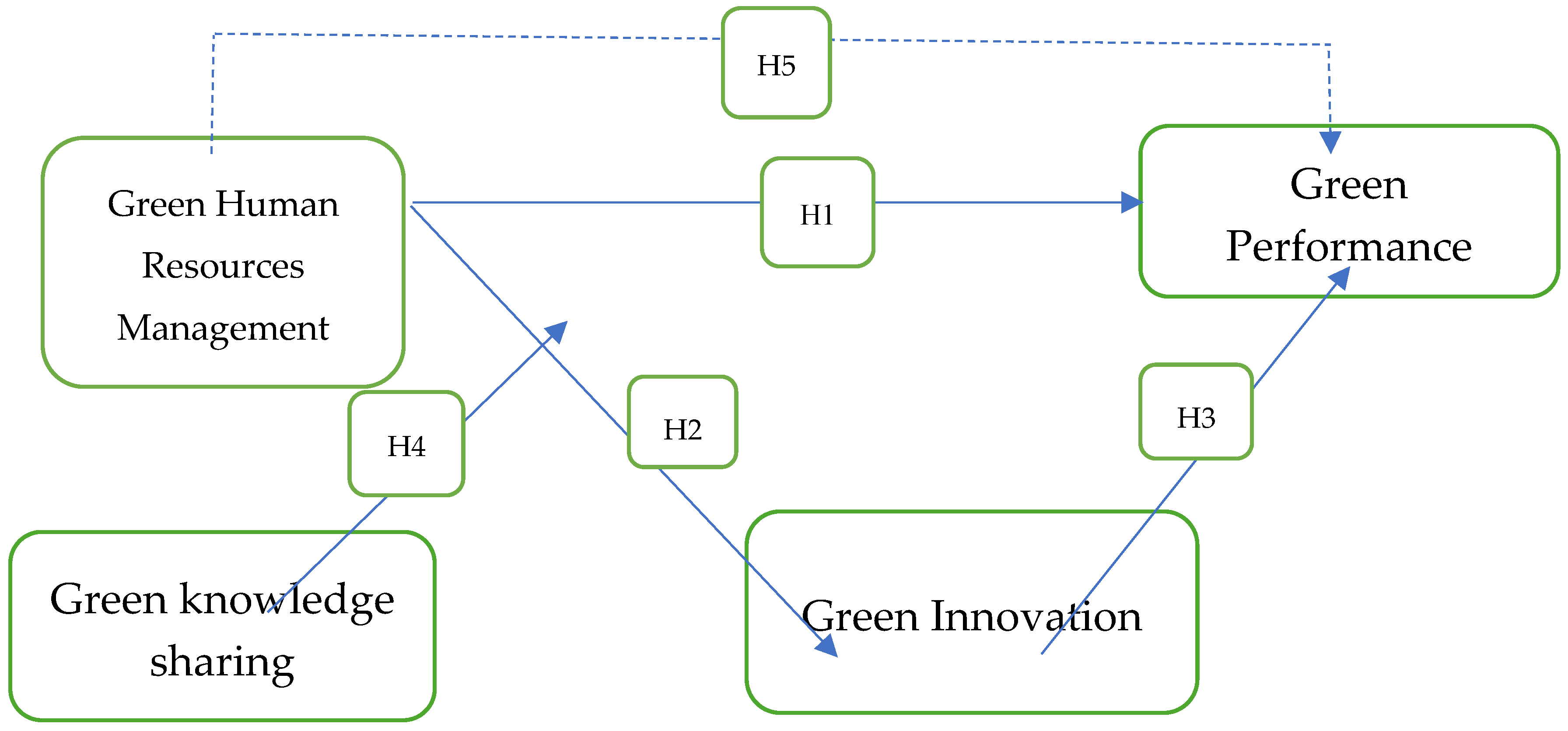
Figure 2.
PLS-SEM Diagram.
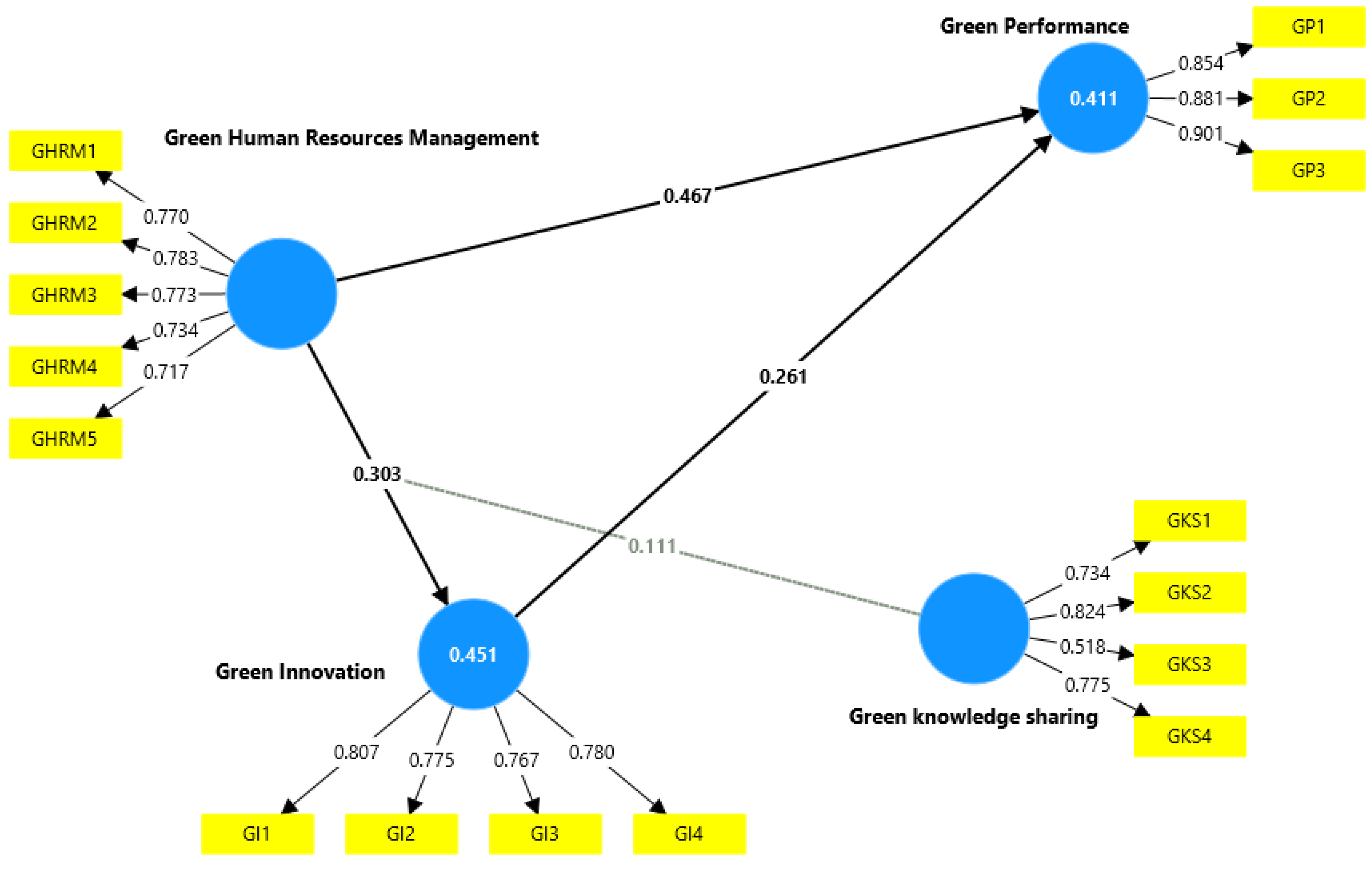

Table 1.
Participants Demographics.
| Percentage | Percentage | ||
| Gender | |||
| Male | 53 | ||
| Female | 47 | ||
| Education Level | |||
| O Level | 12% | ||
| Advanced Level | 15% | ||
| First Degree | 65% | ||
| Post Graduate Degree | 8% | ||
| Organization Tenure | < 10 Years | 20% | |
| 10 -15 years | 45% | ||
| >15 years | 35% |
Table 2.
Factor Score, Mean, Standard Deviation, Alpha, Average Variance Extracted (AVE) and Composite Reliability (CR).
Table 2.
Factor Score, Mean, Standard Deviation, Alpha, Average Variance Extracted (AVE) and Composite Reliability (CR).
| Construct | Factor Score | Mean | Standard Deviation | Alpha | AVE | CR | |
| Acceptable Thresholds | >0.50 | >0.60 | >0.50 | >0.80 | |||
| Green Human Resources Management | 0.82 | 0.57 | 0.88 | ||||
| GHRM1 | My company sets green goals for its employees | 0.770 | 3.84 | 1.12 | |||
| GHRM2 | My company provides employees with green training to develop the knowledge and skills required for green management | 0.783 | 3.87 | 1.17 | |||
| GHRM3 | My company considers employees’ workplace green behaviors in performance appraisals | 0.773 | 3.88 | 1.13 | |||
| GHRM4 | My company considers employees’ workplace green behaviors in promotions | 0.734 | 4.40 | 1.16 | |||
| GHRM5 | My company considers employees’ workplace green behaviors in allocating rewards and compensation | 0.717 | 3.89 | 1.14 | |||
| Green Innovation | 0.70 | 0.53 | 0.70 | ||||
| GI1 | Our company uses materials that produce minimal pollution during product design & development | 0.807 | 4.02 | 1.16 | |||
| GI2 | Our company prefers materials that save energy in product design & development | 0.775 | 4.50 | 1.02 | |||
| GI3 | Our company has adopted manufacturing processes that have scaled down the emission of hazardous wastes | 0.767 | 3.67 | 1.08 | |||
| GI4 | Our company has adopted manufacturing processes that allow the re-use of treated wastes & emissions | 0.780 | 3.87 | 1.04 | |||
| Green Knowledge Sharing | 0.78 | 0.61 | 0.87 | ||||
| GKS1 | I enjoy sharing environment-friendly knowledge with my colleagues | 0.734 | 4.44 | 1.17 | |||
| GKS2 | I always share green knowledge obtained from newspapers, magazines, journals,television and other sources | 0.824 | 4.10 | 1.07 | |||
| GKS3 | In my organization, people share expertise from work experience with each other | 0.518 | 3.90 | 1.16 | |||
| GKS4 | Sharing green knowledge with colleagues is pleasurable | 0.775 | 3.97 | 1.17 | |||
| Green Performance | 0.85 | 0.77 | 0.88 | ||||
| GP1 | Environmental activities significantly reduced costs | 0.854 | 4.25 | 1.27 | |||
| GP2 | Environmental activities significantly reduced waste within the entire value chain process. | 0.881 | 4.37 | 1.13 | |||
| GP3 | Environmental activities significantly enhanced product/ process quality | 0.901 | 4.89 | 1.21 |
Table 3.
Discriminant Validity.
| Green Human Resources Management | Green Innovation | Green Performance | Green knowledge sharing | |
| Green Human Resources Management | 0.756 | |||
| Green Innovation | 0.511 | 0.782 | ||
| Green Performance | 0.600 | 0.500 | 0.879 | |
| Green knowledge sharing | 0.499 | 0.615 | 0.420 | 0.722 |
Table 4.
Path Relationships.
| Path | Beta Value | P. Value | Decision | |
| H1 | GHRM>>>>> green performance | 0.467 | 0.00 | Accepted |
| H2 | GHRM>>>>> green innovation | 0.303 | 0.00 | Accepted |
| H3 | Green Innovation>>>>>Green performance | 0.261 | 0.00 | Accepted |
Disclaimer/Publisher’s Note: The statements, opinions and data contained in all publications are solely those of the individual author(s) and contributor(s) and not of MDPI and/or the editor(s). MDPI and/or the editor(s) disclaim responsibility for any injury to people or property resulting from any ideas, methods, instructions or products referred to in the content. |
© 2024 by the authors. Licensee MDPI, Basel, Switzerland. This article is an open access article distributed under the terms and conditions of the Creative Commons Attribution (CC BY) license (http://creativecommons.org/licenses/by/4.0/).
Copyright: This open access article is published under a Creative Commons CC BY 4.0 license, which permit the free download, distribution, and reuse, provided that the author and preprint are cited in any reuse.


