1. Introduction
The rapid advancement of Internet technology has also facilitated the swift development of social; media, which has had a substantial impact on various aspects of our lives. In our daily lives, short video platforms such as TikTok videos, Instagram Reels, YouTube Shorts, and similar services have become indispensable. Facebook, YouTube, WhatsApp, Instagram, and TikTok comprise the five most widely used social media platforms (Exploding Topics, 2024). As of 2024, TikTok has 1.2 billion monthly active users worldwide and a 5-year search growth rate of 227%, making it one of the fastest-growing social media platforms (Consumer Insights, 2024). The average engagement rate of TikTok videos is 5.3%. These platforms have become crucial commercial marketing channels in addition to providing entertainment content (Johnson, 2021). Consumer Insights (2024) indicates that 68% of YouTube consumers utilize videos to assist in their purchasing decisions. It allows marketers to generate revenue using video advertising, branded content, and in-app purchases (Lee & Watkins, 2016).
Short-form videos rapidly gain traction across social media platforms and demonstrate elevated engagement rates (Exploding Topics, 2024). Over 57% of individuals engage with YouTube, primarily focusing on short video content. Short videos feature minimal entry barriers, abundant information, and rapid transmission speed, effectively meeting viewers' visual and auditory needs at the same time, while fully engaging consumers' virtual senses (Shen and Wang, 2024). The demographic of short video viewers tends to skew younger, particularly among individuals aged 16 to 34. For instance, nearly half of TikTok's users (48%) fall within the age range of 18 to 29, while over half (64%) are either high school or college/university students (Pew Research Center, 2021; Ambalov, 2022). TikTok employs algorithms powered by artificial intelligence to create content that is highly tailored to individual users, which enhances engagement and prolongs the duration of time users spend on the platform (Zannettou, 2024). TikTok's advertising revenue surpassed $15 billion in 2023 (Sensor Tower, 2024). Conversely, when individuals view short videos, they might find themselves drawn to the products or advertisements integrated within those videos. Short videos have a notable impact on consumer purchasing behavior, particularly among younger audiences, who are more inclined to explore and gather product information via these platforms (Zannettou, 2024).
Previous research has indicated that Use & Gratification (U&G) plays a crucial role in media studies, examining the reasons and methods by which individuals actively select particular media to fulfill their needs (Katz et al., 1973; Chin & Lu, 2011). Short videos offer concise and captivating material that can be absorbed in mere seconds to a couple of minutes. Short videos serve to fulfill consumers' demands for entertainment, information, and social interaction, etc. (Kim et al., 2018; Wu & Li, 2020; Louisa and Yang, 2023). While prior studies have examined the effects of U&G on social media, there is a notable scarcity of research concentrating on viewers' U&G and its effects on engagement with short videos. This serves as a primary objective of the study conducted.
Furthermore, as a perceptual aspect of social interaction, social presence is thought to significantly influence the behavioral choices of media users (Kumar & Benbasat, 2006). Studies on social presence and short videos have been increasingly prominent, particularly with the emergence of platforms such as TikTok and Instagram Reels. Can social presence enhance viewer engagement in short videos? What is the impact of social presence on engagement in advertisements that incorporate short videos? (Liu et al., 2021). This is a research question of this study. Moreover, perceived value typically involves an assessment of the cost incurred by customers in relation to the quality and benefits they believe they have gained from using the product. Studies indicate that perceived value significantly impacts user behavior and purchase intentions regarding short videos (Hewei, 2022). Short videos can enhance social interaction and relationship management, potentially increasing their perceived value. Current literature often considers perceived value or attitude as factors influencing purchase intention, yet tends to overlook their potential function as mediating variables in user behavior (Chang & Chen, 2008). This investigation will explore its mediating function between social presence and purchase intention.
Short videos have emerged as a new instrument for communication and dissemination strategies (Liu and Wang, 2023). Although short video marketing has advantages, it may result in an individual becoming digitally dependent. The term “short video dependency” refers to the high frequency with which users view short videos, the challenge they face in regulating their utilization behavior, and the adverse psychological and behavioral consequences that ensue (LaRose et al., 2001; Shao, 2022). With the continued advancement of short video platforms, it will be crucial for social media research to determine the impact of digital dependency on short videos. In conclusion, the purpose of this study is to address the research voids by investigating the influence of U&G and social presence on consumers' product purchase intentions. This concept is encapsulated in the short video. The objective of this study is to offer practical advice for the operation and marketing strategies of short video platforms, with a particular emphasis on the mediating function of perceived value and attitude and digital dependency.
2. Literature Review and Hypothesis Development
2.1. Us e& Gratification Theory and Short Videos
Katz et al. (1973) were the first to propose the Use & Gratification Theory (U&G). The theory's primary focus is on the way individuals utilize media to satisfy specific needs. Unlike other media theories that regard audiences as passive consumers, this theory presupposes that media users are proactive. Katz, Blumler, and Gurevitch (1973) have observed that individuals observe media selectively in accordance with their personal social and psychological requirements, and they derive satisfaction from the media they see. U&G can be defined as the psychological gratification and emotions that consumers experience while consuming products or services. It is a critical determinant in determining the discrepancy between consumers' actual experiences and their expectations of products. U&G is a significant antecedent factor of consumer purchase intention, as per Oliver's (1980) expectation-disconfirmation theory. U&G theory has the potential to not only increase consumers repurchase intention but also to further strengthen their loyalty and trust (Anderson & Srinivasan, 2003; Krishnan, 2020; Lin & Chu, 2021). The U&G theory can also be employed as a theoretical framework to comprehend the reasons and processes by which consumers select specific media (Cahya & Triputra, 2017). This satisfaction can be of various varieties, including cognitive (e.g., information acquisition), emotional (e.g., entertainment or emotional satisfaction), social (e.g., social interaction or relationship development), and other types (Ha et al., 2015).
The U&G theory examines the reasons behind individuals' choices of particular media content and investigates the effects of media consumption, including its influence on attitudes and behaviors (Ruggiero, 2000). Recently, this theory has gained significant traction in elucidating the motivations and behavioral outcomes associated with the use of various media types, particularly in the context of social media. Sung et al. (2010) identified that the primary satisfactions derived from social media usage encompass information acquisition, social interaction, and entertainment needs. Boudkouss and Djelassi (2021) demonstrated that consumers utilize interactive technologies to fulfill a range of needs, including information retrieval, entertainment, and social interaction. Individuals utilize these technologies to fulfill their requirements and anticipations, thereby creating a sense of U&G. Engaging with influencers through short videos offers consumers the satisfaction they seek, encompassing aspects such as practicality, interactivity, sociability, entertainment, exploration, and innovation. The role of internet influencers is a crucial element in the success of online shopping (Ma, 2021).
Considering the growing prevalence of short videos, users who experience satisfaction after viewing a specific video tend to cultivate a favorable perception of the social media platform. This additionally impacts their behavior, including ongoing media usage (Lo & Leung, 2009; Xu et al., 2012), and has a direct effect on users' attitudes towards the brands featured in the video and their intention to purchase (Gan & Wang, 2017; Lin & Chu, 2021).
2.2. Social Presence and Short Videos
The concept of social presence theory emerged from communication studies. The initial proposal was made by Short, Williams & Christie in 1976. This pertains to the extent to which an individual perceives themselves as “real” and engaged within a media communication context. Short et al. (1976) highlighted that intimacy and immediacy serve as the two fundamental components of social presence. The effectiveness of the media in conveying these two elements is contingent upon the quality of the medium itself. Gefen & Straub (2004) indicated that in B2B e-commerce, enhanced social presence can foster customer trust and consequently have a positive impact on online purchase intention. Bailenson & Welch (2018) conducted a systematic analysis to examine the concept, antecedents, and definition of social presence. They differentiated social presence from telepresence and self-presence, with telepresence denoting the feeling of being physically present in a remote or virtual setting, while self-presence pertains to how much users perceive their virtual self or avatar as an extension of their actual self. A greater social presence correlates with a reduced psychological distance among consumers. The decrease in distance may additionally improve their intention to purchase (Hernández-Ortega, 2018).
Furthermore, Andel, de Vreede, Spector, Padmanabhan, Singh, and de Vreede (2020) discovered that when the communicated media lacks audio and visual cues, it becomes challenging to evoke a strong sense of social presence. Consequently, guiding consumers' social interaction and engagement with social presence in a digital context is an important issue for short video platforms such as TikTok, YouTube Shorts, and Instagram Reels. Zheng and colleagues (2024) noted that short video platforms are intense competition; thus, creating interactive, authentic, and immediate content can enhance users' social presence and subsequently affect their emotional experiences. In the realm of short video e-commerce, the presence of social elements can significantly boost consumers' intention to purchase by fostering a feeling of intimacy and trust (Zheng, Ling, Cho and Kim, 2024).
What makes social presence particularly important in a virtual setting? What is the reason behind the social influence exerted by the interaction (i.e., presence) between consumers and social actors? Previous studies have shown that social presence has a positive impact on trust, perceived usefulness, and purchase intention in the context of online shopping (Oh, et al., 2018; Lin et al., 2021). However, there is a deficiency in studies regarding consumer social presence in the context of short videos. This study aims to examine the impact of social presence in short videos on product attitudes and purchase intentions.
2.3. Customer Perceived Value (CPV)
2.3.1. Customer Perceived Value and Use&Gratification
The overall assessment made by consumers regarding a product or service is influenced by their evaluation of its costs and benefits. Zeithaml (1988) highlighted that the perceived value is determined by the balance between the benefits consumers experience after acquiring the product and the cost they incur. In short video marketing, the perceived value is influenced not only by the quality of the content but also by the information presented in the short video, as well as the functional and emotional value of the product. The study conducted by Dodds, Monroe, and Grewal (1991) indicates that an increase in perceived value correlates with a heightened intention to purchase among consumers. This relationship is especially significant in contexts of social commerce. The perceived value, including utilitarian, hedonic, and social values, plays a crucial role in influencing consumer satisfaction and purchase intention (Gan & Wang, 2017). As mentioned earlier, Use & Gratification refers to the psychological satisfaction experienced by consumers following their engagement with a product or service (Oliver, 1997). Elements of U&G include (1) social interaction, which can improve users’ positive emotional experience of the platform and elevate perceived value (Jung et al., 2020; Wu, 2018). Boudkouss and Djelassi (2021) discovered that a more robust interactive technology on the platform correlates with an enhanced sense of engagement and satisfaction among consumers, subsequently increasing its perceived value. (2) Information acquisition: the greater the amount of information obtained from the short video, the higher its perceived value, particularly in educational and product evaluation contexts (Chen & Lin, 2018; Kim & Ko, 2012); (3) time-killing, which may also serve as a motivation for viewing short videos, especially when users experience boredom or seek relaxation (Whiting & Williams, 2013; Eroğlu, 2020). These studies indicate that a high level of U&G can increase consumers’ perceived value of a product, thereby making them more inclined to make repeat purchases or recommend the product (Sweeney & Soutar, 2001; Homburg, Koschate, & Hoyer, 2005). Consequently, we put forth a hypothesis:
H1: The Use and Gratification will have a positive and significant impact on customer perceived value.
2.3.2. Customer Perceived Value and Social Presence
Moreover, social presence relates to the extent to which an individual perceives the presence of another individual during a communicative exchange. This theory is frequently applied to analyze the ways individuals perceive and engage within digital spaces, including virtual classrooms, social media, and online shopping platforms. Hernández-Ortega (2018) emphasized that enhancing social presence can diminish the psychological distance between users and brands. This decrease in distance facilitates consumers' ability to establish trust and connection with the brand, consequently enhancing perceived value. Weidlich, Göksün, & Kreijns (2023) investigate the online learning environment and discover that when students experience a greater sense of social presence, their perceived value and satisfaction with online interactions increase correspondingly. Yin, Huang, Ma (2023) illustrated that in the realm of online shopping, a heightened sense of social presence among consumers correlates with an increased perception of value in the offered products or services, ultimately leading to a greater intention to purchase. In the realm of short video marketing, real interactions and emotional expressions within the content significantly improve brand credibility and foster emotional connections with users. In light of this, the study puts forward the second hypothesis:
H2: Social presence has a significantly positive influence on perceived value.
2.4. Short videos and Digital Dependency
Digital content is highly inclusive because of the widespread use of digital devices. Individuals can swiftly and directly engage with the global landscape, access information, and acquire goods or entertainment (Harley, 2022). The concept of ‘digital wellbeing’ encourages individuals to persist in their engagement with digital resources. Nonetheless, excessive and compulsive engagement with digital platforms can result in a phenomenon of digital addiction (Griffiths, 2000; Chen et al., 2010). Earlier investigations have recognized Intent addiction as an unhealthy psychological reliance on digital technology, which interferes with an individual's cognitive perception and everyday functions (Tian et al., 2023). The concept of digital dependency is similar to digital addiction; however, the negative effect of psychological dependency is viewed as somewhat less severe than that of digital addiction (Sherer, 1997). In contrast to Internet addiction, the phenomenon of short video dependency arises from the widespread use of mobile devices. The extensive adoption of smartphones and short videos has transformed them into a “portable” medium for content consumption, serving as a significant avenue for entertainment, social interaction, and information acquisition (LaRose et al., 2001; Shen and Wang, 2024). Short video platforms utilize an algorithmic system to improve user engagement and extend viewing time (Kwon et al., 2013). These systems subtly promote a tendency among users to engage in regular viewing, potentially leading to psychological addiction or dependency (Fullwood et al., 2017). Moreover, the abundant variety of content, along with immediate responses (likes and comments) on short video platforms, significantly amplifies users’ feelings of dependency (LaRose et al., 2001; Tian et al., 2023). This dependency often presents itself through users dedicating considerable amounts of time to watching short videos and struggling to manage their viewing habits, which can disrupt daily activities, work, or academic pursuits (Kwon et al., 2013; Fullwood et al., 2017).
The impact of short videos varies across different platforms. For instance, mobile devices like smartphones and tablets allow users to access content anytime and anywhere, which may lead to a heightened dependency on these technologies (Harley, 2022). Research has indicated that various forms of short video content, including entertainment, educational, and social types, may exhibit varying levels of user dependency (Kwon et al., 2013;). The formation of short video dependency is strongly connected to user engagement, content preferences, and the design of the platform (Fullwood et al., 2017; Liu and Wang, 2023). Huang and Lu (2020) highlighted that there is a positive correlation between the perceived value of short videos and the level of digital dependency. Individuals who favor short video content are more inclined to engage with this platform regularly. Consequently, we propose the third hypothesis as:
H3: Consumer’s perceived value of short video content significantly positively affects digital dependency.
2.5. Attitude, Digital Dependence, and Purchase Intention
Attitude indicates the ongoing and thorough assessment individuals make regarding a particular subject. This includes elements like product preference, satisfaction, trust, value, and perceived quality (Blackwell et al., 2006). Product attitude can typically be categorized into three primary components: affect, behavior, and cognition, referred to as the ABC model (Breckler, 1984). In the fields of psychology and sociology, attitudes are considered to have various functions that can influence individuals' thoughts, feelings, and actions (Mothersbaugh and Hawkin, 2019). Furthermore, attitudes may influence social interactions. Individuals often engage with others who share similar attitudes, facilitating interaction and creating a sense of resonance. Attitudes can impact how individuals assess others, thereby exerting social influence during interactions (Mothersbaugh and Hawkin, 2019). Lee & Shin (2020) highlighted that emotional resonance and social interaction in short videos can significantly influence consumers’ attitudes toward the video contents.
Tran (2022) indicated that by watching live broadcasts, consumers can more easily recognize the quality of products, thereby increasing their interest and positive attitude towards those products. Short video formats have the potential to swiftly form consumer perceptions by leveraging vivid visuals and emotional resonance, leading to favorable assessments of products or brands (Yin et al., 2023). In this case, short videos effectively and swiftly convey the product's core value while also increasing perceived value through visual and emotional connections. When consumers recognize significant value in products or services, their perceptions of brands and products generally become more favorable. Based on this, we put forward the subsequent hypothesis:
H4: Perceived value has a significantly positive impact on consumers’ attitudes toward the short video content.
The concept of “digital well-being” motivates people to continue using digital resources. When watching short videos with a positive attitude, people tend to spend more time interacting with them (Harley, 2022). In other words, a positive attitude towards this video encourages users to engage more frequently, creating a cycle where positive experience. This dependency can become a significant factor in how consumers interact with digital content and services. Weidlich, Göksün, and Kreijns (2024) pointed out that because short videos provide them with pleasure and satisfaction, viewers who have a positive attitude toward them are more likely to continue exploring and searching the channel. This further exacerbates the users’ reliance on the social media. As a result, we propose the following hypothesis:
H5: The more positive of consumers’ attitude toward short video content is, the higher the dependency on short videos will be.
Purchase intention is the possibility of a consumer buying a particular product or service within a certain period. Engel, Blackwell & Miniard (1995) believed that the psychological activities of consumers during the purchase decision process, along with the impact of marketing stimuli, will ultimately determine their final purchase behavior. Shen and Wang (2024) found that algorithms utilized on short video platforms can provide personalized content customized to users' interests and behavior. This capability enables users to engage more deeply with the platform, consequently enhancing the probability of purchasing. Liu and Wang (2023) also emphasized that short videos featuring both informative and entertaining content significantly enhance consumers’ purchase intention. Thus, we propose the hypothesis:
H6: The greater the digital dependency of consumers on short video content, the stronger their intention to buy the products or services presented in those videos
Short video platforms such as TikTok are designed to be highly engaging, often resulting in behaviors indicative of dependency. However, if individuals engage with these platforms thoughtfully to mitigate adverse effects, they can provide enjoyment and facilitate connections with others. Liu and Wang (2023) emphasized that short videos featuring both informative and entertaining content significantly enhance consumers’ perceived value and purchase intention (Liu et al., 2020; Lin et al., 2021). This study seeks to explore the mediating role of digital dependency and analyzes its impact on purchase intention.
That is, the relationship between perceived value and purchase intention is influenced by digital dependency. Is there a mediating effect of digital dependency on the relationship between attitude, perceived value, and purchase intention? Therefore, we have established the hypotheses:
H7a: Digital dependency has a mediating effect between perceived value and purchase intention.
As mentioned earlier, the greater the interest consumers have in the content of short videos, the more favorable their attitude towards these videos will be (Weidlich et al., 2024). A positive attitude will subsequently affect digital dependency and purchasing intentions (Lee & Shin, 2020).
H7b: Digital dependency plays a mediating role between attitude and purchase intention
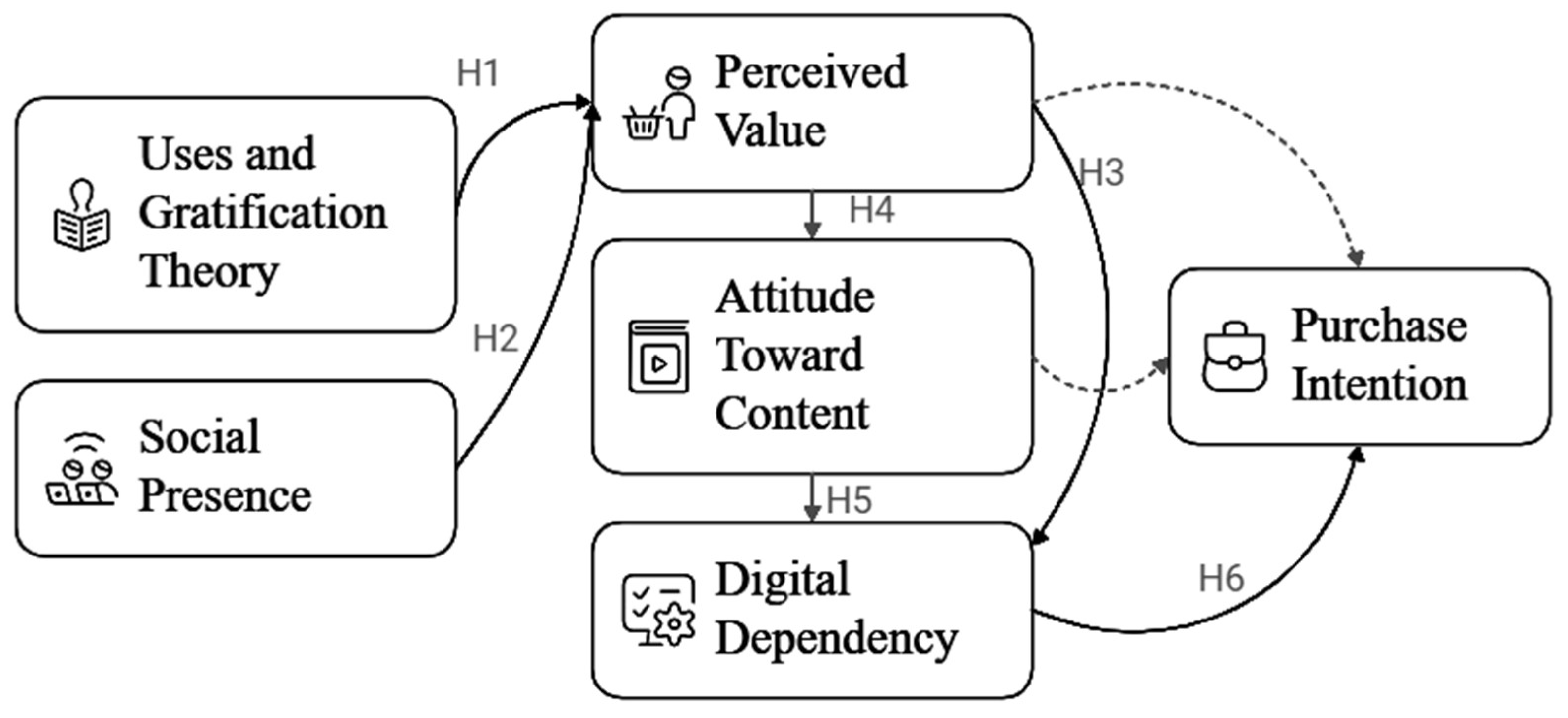
The framework for this study is illustrated in
Figure 1. The literature and hypotheses development suggest that various factors influence consumers’ purchasing decisions after watching short videos. The current research employs the uses and gratification theory along with social presence as antecedent variables, while perceived value, attitude toward the content, and digital dependency serve as mediating variables. Purchase intention is identified as the dependent variable.
3. Methodology
3.1. Research Subjects and Research Design
Short Videos posted on TikTok serve as the main subject of our empirical study. Previous studies have demonstrated that the most effective promotional strategy entails utilizing user-generated short movies distributed via social media platforms (Ge et al., 2021). Organizations may attract their target audience by disseminating a variety of engaging short videos and interacting with them through live streaming to augment the advertising of their products or services. The survey examines the culinary broadcasts of the Internet celebrity “Mi Zijun” as the subject of study (see Appendix 1). “Mi Zijun” gained a considerable following, with over 14.708 million fans. Her short videos examine various kinds of cuisines, highlighting city restaurants, gourmet dining places, and street food specialties. Concurrently, she handles culinary competitions and provides gourmet recipes with new meals.
This study examines Chinese viewers who actively participate in short video platforms, namely those who regularly watch and engage with brand-related contents. The survey will employ a method of convenience sampling for its implementation.
3.2. Questionnaire Design
There are two parts to the survey, the demographic profiles of respondents being the first part, while the second part contains items that measure the dimensions of this study. All the items were adapted for short video context from previous studies and measured by using a Likert scale (starting from 1, “Strongly Disagree,” to 7, “Strongly Agree”).
Table 1 illustrates that the Use & Gratification questionnaire, derived from the research of Whiting and Williams (2013), encompasses three dimensions: social interaction, information acquisition, and time-killing, consisting of 12 measurement items, including “This video is a good platform for me to interact and socialize with others.” The social presence questionnaire is derived from the research of Gefen (2004) and Hassamein (2007), with six items, including the question, “When browsing the content posted by other users, I feel like I am interacting with people.” Perceived value comprises six measurement items, including “Watching food exploration videos can reduce my time cost,” as used by Hew (2016) and Liu & Wang (2023). The short video dependency measurements are derived from Chen, Chen, and Ross (2010) and consist of six questions, including “I feel very focused on watching some short videos.” The questionnaire assessing consumer purchasing intention comprises four measurements derived from Chen & Zhu (2022).
3.3. Data Collection
Convenience sampling is implemented to recruit target users for participation in this investigation, and 500 questionnaires are distributed using an online survey platform. 440 questionnaires were gathered from August 1 to August 14, 2024, and 28 invalid questionnaires were deleted, resulting in a validated questionnaire ratio of 82.4 percent. In
Table 2, the respondents’ basic data is demonstrated.
4. Data Analysis and Results
4.1. Reliability and Validity Analysis
This research employed SPSS for descriptive statistical analysis, as well as for assessing reliability and validity, while the LISREL software was utilized to implement the structural equation model (SEM).
Table 3 demonstrates that (1) each dimension's Cronbach's α value exceeds 0.7, signifying high internal consistency; (2) each variable's KMO value is greater than 0.7, and the p-value from the Bartlett sphericity test is less than 0.01, indicating strong validity and appropriateness for factor analysis.
4.2. Hypothesis Testing
It can be seen from
Table 4 that GFI=0.925, AGFI=0.911, NFI=0.975, NNFI=0.992, and RMSEA=0.0296. All goodness of fit indices satisfy the fitting standards, suggesting that the structural equation model demonstrates a strong overall fit.
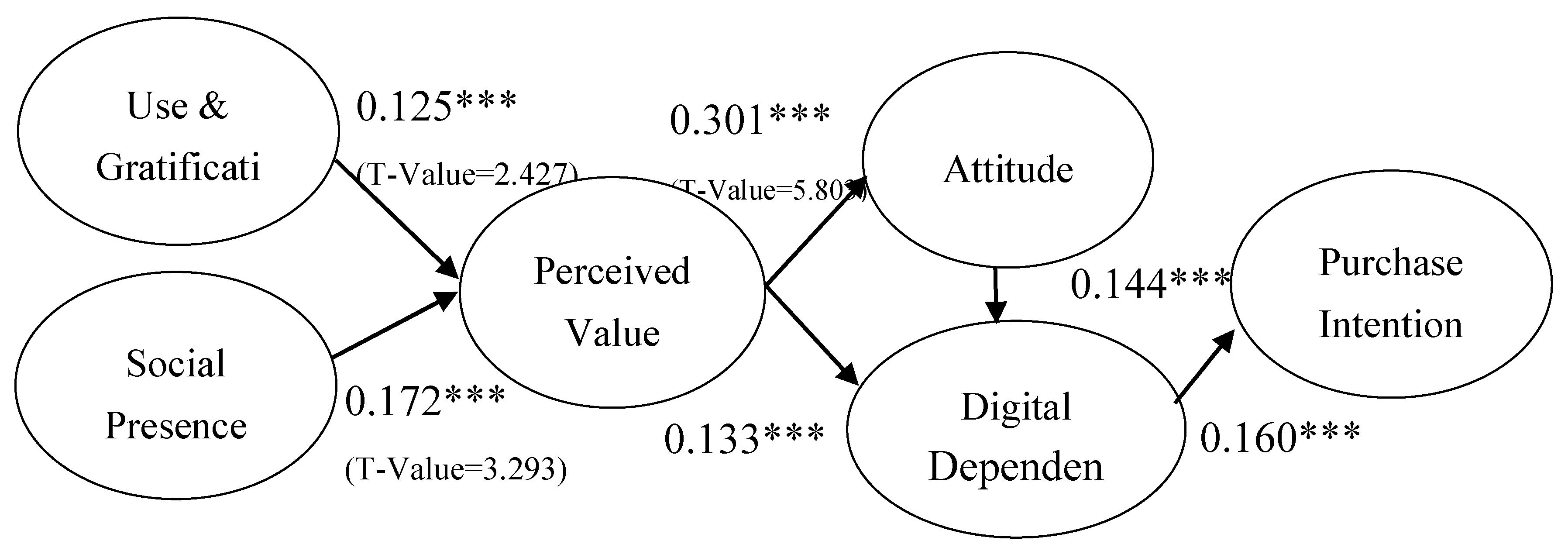
The structural equation model estimation results are presented in
Table 4 and
Figure 2. Path testing results confirm all hypotheses' significance (Hypothesis 1 to Hypothesis 7). Hypothesis one examines the effect of use and gratification on users' Perceived Value.
Table 4 indicates a path coefficient value of 0.125, which is statistically significant. Consequently, the hypothesis is accepted. Hypothesis 2 examines the effect of Social Presence on Perceived Value. The structure coefficient value is 0.171 and is statistically significant. Consequently, Hypothesis 2 is accepted. The path coefficient values for Hypotheses 3 through 6 are all positive and statistically significant, leading to the acceptance of all hypotheses.
Hypothesis 7 and Hypothesis 8 test the mediating role of digital dependency. If digital dependency fully mediates the relationship between perceived value and purchase intention, there will not be a significantly direct effect from perceived value to purchase intention. We add an additional path from perceived value to purchase intention and find that the coefficient value of this path is positive and significant (0.304;
t=5.944). The chi-square test (
=29.69; p>0.00)) also shows that there is no fully mediating effect (Please refer to
Table 5). However, the path coefficient value from digital dependency to purchase intention becomes small but still significant (0.105;
t=2.085) after we add the path from perceived value to purchase intention. That is, the effect of perceived value on purchase intention can be indirectly mediated by digital dependency and directly affect purchase intention. Only a partial mediating effect exists. Therefore, Hypothesis 7 is partially accepted.
Similarly, for Hypothesis 8, an additional path is added from attitude to purchase intention. It can be seen from
Table 5 that the coefficient value of this path is significantly positive (0.305***;
t=5.781). The path coefficient value from digital dependency to purchase intention becomes more minor but still significant (0.103***;
t=2.029). The χ2 test (
=44.34, p >0.00191) indicates no fully mediating effect. However, there is a partial mediating effect. Therefore, Hypothesis 8 is partially accepted.
In addition,
Table 6 shows the results of the direct effect, indirect effect, and total effect of the path. Regarding the total effect on ‘digital dependency,’ perceived value on digital dependency is the strongest and most significant (0.177***), followed by attitude (0.144***), U&G, and social presence. As for the total effect on purchase intention, digital dependence has the strongest and most significant effect on purchase intention (0.160***), followed by perceived value (0.028***) and attitude (0.023***). U&G and social presence have no significant total effect on purchase intention; this may imply that mediating variables in this study play an important role in transferring the effects from U&G and social presence to purchase intention.
5. Research Conclusions and Management Implications
Digital technology is ubiquitous and fascinating, leading to widespread dependency on its different forms and functions (Lambert et al., 2024). This study mainly focuses on short videos and explores the effects of U&G and social presence on digital dependence on perceived value and attitude towards the video; at the same time, digital dependency will affect the intention to buy the products marketed in the video. This study proposed 8 research hypotheses, and its main conclusions are as follows.
First, according to our empirical study, U&G significantly positively affects consumers’ perceived value. It indicates that if the short video content can satisfy users’ social interaction, information search, and killing time needs, they will obtain higher perceived value on the video content (Whiting & Williams, 2013). In short video marketing, companies can focus on enhancing users’ experience, improving interactivity and content entertainment to improve user satisfaction and thereby increasing the conversion rate (transfer watching to purchasing). This conclusion is consistent with the research results of Sweeney and Soutar (2001) and Homburg, Koschate and Hoyer (2005). Another famous influencer Li Ziqi (please refer to
Appendix I), her short videos provide viewers with information search and time-killing functions by showing traditional Chinese food culture and rural life. Through comments and sharing by reviewers that achieve social interaction need. When watching her videos, viewers get a higher level of U&G, which not only improves the perceived value of the video, but also enhances the purchase intention of the products shown in the video.
Second, our study has shown that social presence has a significantly positive impact on perceived value. On short video platforms, consumers can enhance their perceived value of short videos through interaction and participation, as well as emotional interaction and care between them and other users (Meng et al., 2022). Take the Chinese short video influencer Liu Anan as an example. He successfully created a strong sense of social presence by showing the daily life of a scrapyard. The audience can see his expressions and movements in real time through the screen, just like face-to-face communication. He also interacts with the audience through barrage comments and gifts, making both parties feel coexistent. Second, his non-verbal information such as expressions and body language deepens the audience's understanding of the video content and forms a sense of identity in the virtual space. It can be seen from the video that his videos are highly interactive. Third, Liu Anan's positive and optimistic attitude and self-deprecating humor bring intimacy and authenticity to the audience, enhancing the fans' sense of participation and interactivity. In these ways, Liu Anan's videos greatly enhance users' sense of social presence, thereby enhancing users' perceived value of his short videos and attracting a large number of fans' attention and love.
Third, the perceived value of short videos by users will positively affect their digital dependency on the videos. When users feel that watching food exploration videos can reduce their time costs, make the shopping process more efficient, or that the short videos make them happy or better understand the product content compared to other information sources, they will feel better perceived value (Boudkouss and Djelassi, 2021). In this way, users are encouraged to form a habit of repeated viewing, and even regard watching online short videos as a good way to escape daily stress, further forming dependence on the video (digital dependence). This is consistent with the findings of Fullwood, et al. (2017).
Fourth, this study has shown that the perceived value of short videos content positively affects their attitudes toward the videos. This phenomenon is particularly evident in short video marketing, because short videos can quickly and intuitively convey the core value of the product and enhance perceived value through visual and emotional resonance (Lee et al., 2013; Koo & Ju, 2010). For example, MrBeast (see appendix A3), a famous influencer known for extravagant challenges and philanthropy. His short videos capture the essence of his larger-than-life content in bite-sized clips. His content blends humor with impressive stunts and charitable acts, successfully attracting many fans to follow.
Fifth, similar to the studies of Kim & Han (2009) and Mwencha et al., (2014), our empirical results also confirm that attitude has a positive and significant impact on video dependency. When a user likes the short video content very much and feels very delighted after watching it, he will have a more positive attitude towards the video. In order to keep on his enjoyment, users continue to look for similar videos, which further enhances their dependency on the short video platform. In addition, this study also found that users' video dependency will further affect their willingness to purchase the products launched in the video.
Sixth, this study has evidenced the mediating effect existed. U&G and social presentation have no direct effect on purchase intention, but through perceived value, attitude as well as digital dependency. Previous literature has pointed out that when U&G increases, it can enhance consumers’ perceived value of the product, making them more likely to repeat purchases or recommend the product (Kim & Lee, 2016; Lu & Chen, 2021). However, this study found that U&G and social presentation can increase perceived value, but they should be through other mediating variables to affect purchase intention. This mediating variable includes attitude and digital dependency.
Seventh, Digital dependency is an important mediating variable in this study. This study found that although digital dependency did not show a complete mediating effect between perceived value and purchase intention; and between attitude and purchase intention, the partial mediating effect was significant (Louis and Yang, 2023; Mikalef et al., 2013). In other words, digital dependence not only affects users' purchase intention after watching short videos, but also plays a conductive role between perceived value and purchase intention, and between attitude and purchase intention. Take Aimee Song as an example. She is a fashion blogger and influencer who started the blog “Song of Style.” She has her own clothing line, Song of Style, which is known for its chic and trendy designs. Aimee often shares quick styling tips and outfit ideas. Her videos highlight how to mix and match different pieces, accessorize, and create trendy looks. We can find her short video on platforms like TikTok and Instagram, where she engages with her audience through visually appealing and informative content. A lot of users habitually watch Aimee’s short video content, and may form a certain digital dependency, which further affects their purchase intention. This digital dependency serves as a mediating factor between perceived value and attitude on the one hand and purchase intention. The precise recommendations of AI algorithms and the convenience of mobile phones may have exacerbated this digital dependence, allowing users to access Aimee’s short video content anytime and anywhere, further enhancing their willingness to purchase the products she recommends.
This study still has some shortcomings: (1) This study explored the impact of Use & Gratification and social presence on consumer purchase intention, but there may be other variables that could affect online consumer behavior, such as consumer personality traits or brand awareness. Future research can explore different independent variables; (2) The data collection process mainly relies on online questionnaires and fails to consider offline surveys. There may be deficiencies in sample diversity and representativeness. Future research can adopt more comprehensive data collection methods to enhance the universality of research conclusions (Mcknight et al., 2002; Li & Yeh, 2010). (3) As mentioned in previous literature, the performance of short videos in different usage scenarios is also different (Harley, 2022). Therefore, future research can try to analyze different platforms and different short video content categories to examine the impact of short videos on user purchasing behavior.
Appendix A
Figure A1.
Mi Zijun’s TikTok video diagram.
Figure A1.
Mi Zijun’s TikTok video diagram.
Figure A2.
L Zi TikTok video diagram.
Figure A2.
L Zi TikTok video diagram.
Figure A3.
MrBeast video diagram.
Figure A3.
MrBeast video diagram.
Appendix B. Completely Standardized Solution
References
- Aaker, D.A. (1997). Dimensions of brand personality. Journal of Marketing Research, 34(3), 347–356.
- Ajzen, I. (1991). The theory of planned behavior. Organizational Behavior and Human Decision Processes, 50(2), 179–211.
- Ali, S., Ullah, H., Akbar, M., Akhtar, W., & Zahid, H. (2019). Determinants of consumer intentions to purchase energy-saving household products in Pakistan. Sustainability, 11(5), 1462–1481.
- Ambalov, I.A. (2022). An examination of the influences of habit, compatibility, and experience on the continued use of short-form video-sharing services: a case of TikTok. International Journal of e-Collaboration, 18 (1), 1-19.
- Andel, S.A., de Vreede, T., Spector, P.E., Padmanabhan, B., Singh, V.K. & de Vreede, G.J. (2020). Do social features help in video-centric online learning platforms? A social presence perspective. Computers in Human Behavior., 113, 106505.
- Anderson, R.E., & Srinivasan, S.S. (2003). E-satisfaction and e-loyalty: A contingency framework. Psychology & Marketing, 20(2), 123–138.
- Awasthi, B., & Mehta, M. (2022). Relationship between social networking sites and online purchase intention: The mediating role of brand attitude. Journal of Brand Management, 19(2), 65–75.
- Blackwell, R.D., Miniard, P.W. & Engel, J.F., (2006). Consumer Behavior, 10th ed. OH: Thomson South-Western.
- Boudkouss, H., and Djelassi, S., (2021). Understanding in-store interactive technology use: a uses and gratifications theory perspective. International Journal of Retail & Distribution Management, 49(12), 1621-1639.
- Breckler, S. J., 1984. Empirical validation of affect, behavior, and cognition as distinct component of attitude, Journal of Personality and Social Psychology, 47, 1 191-1205.
- Chang, H.H., & Chen, S.W. (2008). The impact of online store environment cues on purchase intention: Trust and perceived risk as a mediator. Online Information Review, 32(6), 818-841.
- Chen, H., & Lin, Y. (2018). A study on the relationship between social media engagement and perceived value: Taking short video as an example. Journal of Consumer Research, 45(3), 342-355.
- Chen, K., Chen, J.V., & Ross, W.H. (2010). Antecedents of online game dependency: The implications of multimedia realism and uses and gratifications theory. Journal of Database Management, 21 (2), 69-99.
- Chen, Z., & Zhu, D.H. (2022) Effect of dynamic promotion display on purchase intention: The moderating role of involvement, Journal of Business Research, 148, 252–261.
- Chin, W.W., & Lu, H.P. (2011). Why do users continue using the Short Message Service (SMS)? A test of competing theories in the Chinese context. Journal of Social Psychology, 151(6), 761-778.
- Choi, S., Liu, Sx & Choi, C. (2022) Robot–Brand Fit the Influence of Brand Personality On Consumer Reactions to Service Robot Adoption. Marketing Letter, 33, 129–142.
- Crisinel, A.S., & Spence, C. (2012). A Conceptual framework for the assessment of brand congruent sensory modalities. Journal of Brand Management, 26(1), 45–51.
- Cyr, D., Head, M., & Ivanov, A. (2009). Perceived interactivity leading to e-loyalty: Development of a model for cognitive-affective user responses. International Journal of Human-Computer Studies, 67(10), 850-869.
- Dodds, WB, Monroe, KB, & Grewal, D. (1991). Effects of price, brand, and store information on buyers' product evaluations. Journal of Marketing Research, 28(3), 307–319.
- Engel, J.F, Blackwell, R.D, & Miniard, P.W. (1995). Consumer Behavior (8th ed.). Dryden Press.
- Exploding Topic, Top 35 Social Media Platforms (2024) (explodingtopics.com).
- Fishbein, M., & Ajzen, I. (1975). Belief, attitude, intention, and behavior: An introduction to theory and research. Addison-Wesley.
- Fullwood, C., Quinn, S., Kaye, L.K. & Redding, C. (2017). My virtual friend: A qualitative analysis of the attitudes and experiences of smartphone users: Implications for smartphone addiction. Computers in Human Behavior, 75, 347-355.
- Gan, C., & Wang, W. (2017). The influence of perceived value on purchase intention in social commerce context. Internet Research, 27(4), 772-785.
- Ge, J., Sui, Y., Zhou X., & Li, G. (2021). Effect of short video ads on sales through social media: the role of advertisement content generators. International Journal of Advertising, 40(6), 870–896.
- Gefen, D., & Straub, D.W. (2004). Consumer trust in B2C e-Commerce and the importance of social presence: experiments in e-products and e-services. Omega, 32(6), 407-424.
- Gong, W., Stump, RL, & Maddox, L.M. (2020). Factors influencing consumers' online buying behavior in a social commerce context. Journal of Business Research, 116, 533–542.
- Griffiths, M.D. (2000). Does Internet and computer "addiction" exist? Some case study evidence. Cyber Psychology & Behavior, 3(2), 211–218.
- Ha, L., & Fang, L. (2012). Uses and gratifications of social media: A comparison of Facebook and instant messaging. Bulletin of Science, Technology & Society, 32(5), 349-361.
- Harley, D. (2022). Digital Wellbeing: Making Sense of Digital Dependency. In: Mindfulness in a Digital World. Palgrave Studies in Cyberpsychology. Palgrave Macmillan, Cham.
- Hernández-Ortega, B. (2018). Don't believe strangers: Online consumer reviews and the role of social psychological distance. Internet Research, 28(2), 454-470.
- Hewei T. (2022). Factors affecting clothing purchase intention in mobile short video app: Mediation of perceived value and immersion experience. PLoS ONE, 17(9), e0273968.
- Homburg, C., Koschate, N., & Hoyer, W.D. (2005). How satisfaction creates value: The mediating role of customer satisfaction. Journal of Marketing, 69(3), 1-16.
- Huang, Y., & Lu, S. (2020). Understanding the influence of mobile short video perceived value on Chinese consumers' purchase intention --based on the mediating effect of user participation and attitude. International Journal of Scientific and Engineering Research, 11(9), 1367-1378.
- John, D.R., Loken, B., Kim, K., & Monga, A.B. (2006). Brand concept maps: A methodology for identifying brand association networks. Journal of Marketing Research, 43(4), 549-563.
- Johnson, E. (2021). Short-form video platforms and their role in modern communication. Journal of Communication Research, 15, 3269–3291.
- Jung, J.H., Sundar, S.S., & Rice, R.E. (2020). The influence of interactive media on perceived social presence and perceived usefulness: A comparative study of web 2.0 and web 1.0 sites. Computers in Human Behavior, 112, 106462.
- Katz, E., Blumler, J.G., & Gurevitch, M. (1973). Uses and gratifications research. Public Opinion Quarterly, 37(4), 509-523.
- Kim, A.J., & Ko, E. (2012). Do social media marketing activities enhance customer equity? An empirical study of luxury fashion brand. Journal of Business Research, 65(10), 1480-1486.
- Kim, J., Song, H., & Yoon, Y. (2018). How to promote sustainable consumption: The impact of perceived benefit and value of sustainability labels on product evaluations. International Journal of Advertising, 37(2), 235 -252.
- Koo, D.M., & Ju, S.H. (2010). The interactional effects of atmospherics and perceptual curiosity on emotions and online shopping intention. Computers in Human Behavior, 26 (3), 377–388.
- Krishnan, G., (2020). Analyzing the Role of Services and Facilities Dimensions in the Customer Gratification Towards Organized Retail Outlets. International Journal of Management, 11(8), 208–216.
- Kujur, F., & Singh, S. (2020). Visual communication and consumer-brand relationship on social networking sites - Uses & Gratifications Theory perspective. Journal of Theoretical and Applied Electronic Commerce Research, 15(1), 30-47.
- Kumar, N., & Benbasat, I. (2006). The influence of recommendations and consumer reviews on evaluations of websites: The moderating role of the consumer need for cognition. Journal of Marketing Research, 43(4), 724-732.
- Kwon, M., Kim, D.J., Cho, H., & Yang, S. (2013). The smartphone addiction scale: Development and validation of a short version for adolescents. PLoS One, 8(12), e83558.
- Lambert, A., Rome, A., & Fornari, F. (2024). Stayin' alive? Reflections on navigating digital dependency. Marketing Theory, 24 (3), 359-366.
- LaRose, R., Mastro, D., & Eastin, M.S. (2001). Understanding Internet usage: A social-cognitive approach to uses and gratifications. Social Science Computer Review, 19(4), 395-413.
- Lee, J., & Watkins, B. (2016). YouTube vloggers' influence on consumer luxury brand perceptions and intentions. Journal of Business Research, 69(12), 5753-5760.
- Lee, K.M., Park, N., & Jin, S.A. (2011). Narrative and interactivity in computer games: Toward an integrative framework. Journal of Communication, 61(6), 1050-1074.
- Lee, Y., Kim, J., & Han, J. (2013). Consumers' trust and emotional responses in mobile shopping. Journal of Retailing and Consumer Services, 20 (5), 503–509.
- Li, Y., & Yeh, Y. (2010). Increasing trust in mobile commerce through design aesthetics. Computers in Human Behavior, 26 (4), 673–684.
- Lin, J., Li, T., & Guo, J. (2021). Factors influencing consumers' continuous purchase intention on fresh food e-commerce platforms: An organic foods-centric empirical investigation. Electronic Commerce Research and Applications, 50, 101103.
- Lin, Y.H., & Chu, M.G. (2021). Online communication self-disclosure and intimacy development on Facebook: The perspective of uses and gratifications theory. Online Information Review, 45 (6), 1234-1256.
- Liu, Y., & Wang, M. (2023). The effect of short video content marketing on consumer purchase intention. Frontiers in Business, Economics and Management, 11 (3), 1-5.
- Liu, Y., Li, Q., & Yin, M. (2020). Research on the influence of webcast shopping features on consumer buying behavior. Soft Science, 34 (06), 108–114.
- Liu, Z., Chen, Z., & Zhang, Z. (2021). Understanding the effectiveness of short video marketing from a dual-path perspective: The role of content and social interaction. Journal of Consumer Behavior, 20(4), 758-769.
- Lo, V.H., & Leung, L. (2009). Effects of gratifications-obtained on social network influences: The mediating role of attitudes. Journal of Broadcasting & Electronic Media, 53(4), 587-606.
- Louisa H., Yang Y. (2023). Research about persuasive effects of social media influencers as online opinion leaders 1990-2020: A review. International Journal of Internet Marketing Advertising, 18(2/3), 220–241.
- Lu, B.J., & Chen, Z.J. (2021). Live streaming commerce and consumers' purchase intention: An uncertainty reduction perspective. Information & Management, 58 (7), 103509.
- Ma, Y., (2021). To Shop or Not: Understanding Chinese Consumers’ Live-Stream Shopping Intentions from the Perspectives of Uses and Gratifications, Perceived Network Size, Perceptions of Digital Celebrities, and Shopping Orientations. Telematics and Informatics, 59(3), 101562.
- Meng, L., Zhao, Y.J., Jiang, Y.S., Bie, Y.Y., & Li, J.P. (2022). Understanding interaction rituals: The impact of interaction ritual chains of the live broadcast on people's wellbeing. Frontiers in Psychology, 13 (13), 1041059.
- Mikalef, P.A., Giannakos, MB, & Pateli, A.A. (2013). Shopping and word-of-mouth intentions on social media. Journal of Theoretical and Applied Electronic Commerce Research, 8 (1), 17–34.
- Mothersbaugh, D.L., Hawkins, D.I., Kleiser, S.B., (2019). Consumer Behavior. Building Marketing Strategy. McGraw-Hills.
- Mwencha, P., Muathe, S., & Thuo, J.K. (2014). Perceived usefulness, ease of use, organizational and social factors influencing adoption of online retailing in Nairobi, Kenya. International Journal of Business and Social Science, 5 (4), 76–85.
- Nasar, J.L., Julian, D., Buchman, S., Humphreys, D., & Mrohaly, M. (2012). The emotional value of a brand in determining purchase intentions. Journal of Consumer Research, 39(2), 332–350.
- Oh, C.S., Bailenson, J.N., & Welch, G. (2018). A Systematic Review of Social Presence: Definition, Antecedents, and Implications. Frontiers in Robotics and AI, 5.
- Oliver, R.L. (1980). A cognitive model of the antecedents and consequences of satisfaction decisions. Journal of Marketing Research, 17(4), 460–469.
- Oliver, R.L. (1997). Satisfaction: A behavioral perspective on the consumer. McGraw-Hill.
- Pavlou, P.A., & Fygenson, M. (2006). Understanding and predicting electronic commerce adoption: An extension of the theory of planned behavior. MIS Quarterly, 30(1), 115-143.
- Ruggiero, T.E. (2000). Uses and gratifications theory in the 21st century. Mass Communication and Society, 3(1), 3–37.
- Scherer, K. (1997). College life online: healthy and unhealthy Internet use. Journal of College Student Development, 38 (6), 655–665.
- Shao, G. (2022). The impact of users' short video dependency on social media addiction: Evidence from Douyin platform. Journal of Media Psychology, 34(3), 151–160.
- Shen, X., Wang, J. (2024). How short video marketing influences purchase intention in social commerce: the role of users' persona perception, shared values, and individual-level factors. Humanities Social Science Communications 11, 290.
- Short, J., Williams, E., Christie, B. (1976). The Social Psychology of Telecommunications; John Wiley & Sons: London, UK.
- Sirgy, M.J. (1982). Self-concept in consumer behavior: A critical review. Journal of Consumer Research, 9(3), 287–300.
- Sirgy, M.J. (1985). Using self-congruity and ideal congruity to predict purchase motivation. Journal of Business Research, 13(3), 195–206.
- Smith, J. (2022). User engagement with short-form videos: A study on YouTube Shorts. International Journal of Social Media Studies.
- Song, J.H., & Zinkhan, GM (2008). Determinants of perceived website interactivity. Journal of Marketing, 72(2), 99-113.
- Sung, Y., Kim, Y., Kwon, O., & Moon, J. (2010). An exploratory study of Korean consumer participation in virtual brand communities in social network sites. Journal of Global Marketing, 23(5), 430–445.
- Sweeney, J.C., & Soutar, G.N. (2001). Consumer perceived value: The development of a multiple item scale. Journal of Retailing, 77(2), 203–220.
- The Latest YouTube Stats on When, Where, and What People Watch (thinkwithgoogle.com).
- The State of Influencer Marketing Benchmark Report (2024). (influencermarketinghub.com) August, Sensor Tower - Market-Leading Digital Intelligence.
- Tian, X., Bi, X. and Chen, H. (2023), "How short-form video features influence addiction behavior? Empirical research from the opponent process theory perspective”, Information Technology & People, 36(1), 387–408.
- Tran, M. A. (2022). Assessing the Role of Perceived Value on Purchase Intention on Livestream Platforms. Advances in Business-Related Scientific Research Journal, 13(2), 83-96.
- Weidlich, J., Göksün, D.O., & Kreijns, K. (2023). Extending social presence theory: social presence divergence and interaction integration in online distance learning. Journal of Computer. High Education 35, 391–412.
- Whiting, A., & Williams, D. (2013). Why people use social media: A uses and gratifications approach. Qualitative Market Research: An International Journal, 16(4), 362–369.
- Wu, J., & Li, Z. (2020). The influence of online reviews and pictures on consumers' purchasing behavior: A cross-cultural perspective. Electronic Commerce Research and Applications, 39, 100938.
- Wu, L. (2018). The impact of social interaction on online consumer behavior: A study based on social media. Journal of Consumer Research, 45(2), 182–198.
- Yin, J., Huang, Y. & Ma, Z. (2023). Explore the Feeling of Presence and Purchase Intention in Livestream Shopping: A Flow-Based Model. Journal of Theory Apply Electronic Commerce Research, 18, 237–256.
- Zannettou, S., Nemes-Nemeth, O., Ayalon, O., Goetzen, A., Gummadi, K. P., Redmiles, E.M., & Roesner, F. (2024). Analyzing User Engagement with TikTok's Short Format Video Recommendations using Data Donations. In F. F. Mueller, P. Kyburz, J. R. Williamson, C. Sas, M. L. Wilson, P. Toups Dugas, & I. Shklovski (Eds.), CHI '24: Proceedings of the CHI Conference on Human Factors in Computing Systems Article 731 Association for Computing Machinery (ACM).
- Zeithaml, V.A. (1988). Consumer perceptions of price, quality, and value: a means-end model and synthesis of evidence. Journal of Marketing, 52(3), 2-22.
- Zheng C, Ling S, Cho D, Kim Y. (2024). How Social Presence Influences Engagement in Short Video-Embedded Advertisements: The Serial Mediation Effect of Flow Experience and Advertising Avoidance. Journal of Theoretical and Applied Electronic Commerce Research. 19(2), 705-724.
- Zuo, X., Wang, R. & Hong, Z. (2024) Does using short video apps impacts life satisfaction: a perspective from psycho-social mechanism. Current Psychology 43, 21242–21256.
|
Disclaimer/Publisher’s Note: The statements, opinions and data contained in all publications are solely those of the individual author(s) and contributor(s) and not of MDPI and/or the editor(s). MDPI and/or the editor(s) disclaim responsibility for any injury to people or property resulting from any ideas, methods, instructions or products referred to in the content. |
© 2024 by the authors. Licensee MDPI, Basel, Switzerland. This article is an open access article distributed under the terms and conditions of the Creative Commons Attribution (CC BY) license (http://creativecommons.org/licenses/by/4.0/).