

Submitted:
08 November 2024
Posted:
11 November 2024
You are already at the latest version
Abstract
The center of gravity line fixation method is a technique for visually identifying the center of gravity by narrowing the base of support and fixing the center of gravity line so that it does not move. In Experiment 1, 30 subjects were asked to identify their center of gravity using the center of gravity line fixation method to test the reproducibility of this technique. As a result, all subjects were able to identify the center of gravity. By the center of gravity line fixation method,the center of gravity was found to be located at a level slightly above the midpoint between the navel and the pit of the stomach. In addition, this center of gravity did not change position with changes in posture. This is not consistent with the location and characteristics of the current center of gravity. Therefore, we can say that this center of gravity is not the center of mass of the entire human body. In other words, it is a center of mass that cannot be measured by the current human form or mass. This suggests that humans may have acquired a center of mass before evolving into their current human form. Experiments 2, 3, 4 and 5 are a series of experiments using the center of gravity fixation method, and the subject is one identical male. In Experiment 2,3 and 4, proved that the center of gravity line fixation method can correctly identify the center of gravity. In Experiment 5, the center of gravity identified by the center of gravity line fixation method was found to be the center of gravity of the trunk of the body up to the mandibular condyle (Anterior to the external acoustic pore), humeral head, and greater trochanter of the femur. This suggests the possibility that the human center of gravity is the center of gravity prior to the acquisition of the head and limbs. The study of the center of gravity from now on needs to add not only physics but also life sciences. This paper will begin with an explanation of the center of gravity line fixation method. This explanation will be the experimental method as it is.
Keywords:
base of support
; former whole body
; center of gravity line
; life science
1. Introduction
Currently, the human center of gravity is said to be the center of mass of the entire body [7,11,15]. There have been attempts to calculate the center of gravity by actually lying a person down and finding the point where the weights are balanced [29], or by measuring each part of the body and calculating the center of gravity through complex calculations [11,15].
It is reported that the center of gravity in a standing position is at 56 percent of height from the bottom of the feet for men, and at 55 percent for women [18]. In adults, this position roughly corresponds to the height of the second sacral vertebra [18]. Although there are individual differences, the established theory is that the center of gravity in a standing position is located within the pelvis [31].
This center of gravity is invisible [14] and changes position as posture changes [3], making it difficult to locate. For this reason, devices such as posturography and force plate are primarily used in the study of the center of gravity. These devices can measure the pressure and sway applied to the base of support, allowing for the indirect observation of the movement of the center of gravity.
However, there are also issues. Since the actual position of the center of gravity cannot be identified, even if the devices can determine the movement and position of the center of gravity, this information cannot be fed back to the body. To solve this problem, there is a need for technology that can accurately identify the center of gravity position in a simpler way.
Therefore, The technique we have developed is the center of gravity fixation method. The verifications have led us to a firm conviction, so We are reporting it.
The center of gravity line fixation method is a technique for visually identifying the center of gravity by narrowing the base of support and fixing the center of gravity line so that it does not move. The center of gravity identified by the center of gravity line fixation method(Three-Fives) did not correspond to the center of mass of the entire body(current center of gravity: CCOG). This is because Three-Fives are in a specific position and do not move.
Roux(1895) [23] noticed that gravity and mechanics are involved in the development, differentiation, and morphological evolution of life, and founded biomechanics.
Hence, the location of the center of gravity must be mechanically correct and in a location that makes life science sense. We considered the center of gravity from these two perspectives.
This paper will begin with a description of the center of gravity line fixation method. This description will be the experimental method as it is.
2. Explanation of Center of Gravity Line Fixation Method
The center of gravity line fixation method is a method to visualize the human center of gravity by limiting the range of movement of the center of gravity line.
In the center of gravity line fixation method, first the base of support is narrowed to stop the movement of the center of gravity line and create a single fixed center of gravity line. Next,maintain the center of gravity line fixed, move the body to find the spot where it does not move off the center of gravity line or where it consistently remains on the center of gravity line. The spot found in this way is identified as the center of gravity.
2.1. Fixation of the Center of Gravity Line
When a human is standing, the center of gravity is inside of the area to encircle the outer side of the feet that touches the floor [28]. The surface of the area to encircle the outer side of the feet that touches the floor is called the base of support. If the center of gravity is on this base of support, a human can stand [4]. However, if the center of gravity goes outside the base of support, a human must fall or choose another action [21,26].
When standing on the whole soles of the feet, the base of support is wide, so the range of movement of the center of gravity line is wide, making it difficult to identify where the center of gravity is. Therefore, by narrowing the base of support, narrow the movement range of the center of gravity line and make it easier to identify where the center of gravity is.
To narrow the base of support, stand on the toes. When standing on the toes, the surface of the area to encircle the outer side of the toes that touches the floor becomes the base of support, and the base of support becomes much narrower than when standing on the whole soles of the feet [25].
Limiting the movement of the center of gravity line by narrowing the base of support in this way is called fixing the center of gravity line. Also, standing on your toes and limiting your center of gravity line to your toes is called the toe fixation.
There are two ways to fix the center of gravity: the front-back direction center of gravity line fixation method and the left-right direction center of gravity line fixation method.
2.1.1. About toe Fixation
In the center of gravity line fixation method, when fixing the center of gravity line, stand on the toes, but instead of standing on the tips of the toes, stand on the roots of the toes. Standing on the roots of the toes is easier and less tiring, and anyone can do it.
2.1.2. The Front-Back Direction Center of Gravity Line TOE fixation Form
The front-back direction center of gravity line fixation method is a method to fix the center of gravity line so that it does not move in the front or back direction.
In the front-back direction center of gravity line fixation method, stand with both feet straight side by side and stand on toes (Figure 1). Then, the center of gravity line will move in the left and right directions but will not move in the front or back directions.
2.1.3. The Left-Right Direction Center of Gravity Line Toe Fixation Form
The left-right direction center of gravity line fixation method is a method to fix the center of gravity line so that it does not move in the left or right direction.
In the left-right direction center of gravity line fixation method, stand with both feet straight front and back and stand on toes (Figure 2). Then, the center of gravity line will move in the front and back directions but will not move in the left or right directions.
2.2. Make It Easier to Find the Center of Gravity
When the center of gravity line is fixed, the next step is to find the center of gravity. Both the person fixing the center of gravity line (subject) and the person observing the center of gravity (observer) need to meet certain conditions to make it easier to find the center of gravity.
2.2.1. Make the Center of Gravity Line One Line
When standing on two toes, the surface of the area to encircle the outer side of two toes that touch the floor becomes the base of support, and the space between two toes that touch the floor becomes the range within which the center of gravity line can move (Figure 3). In other words, if there is no distance between two toes that touch the floor, the center of gravity line cannot move
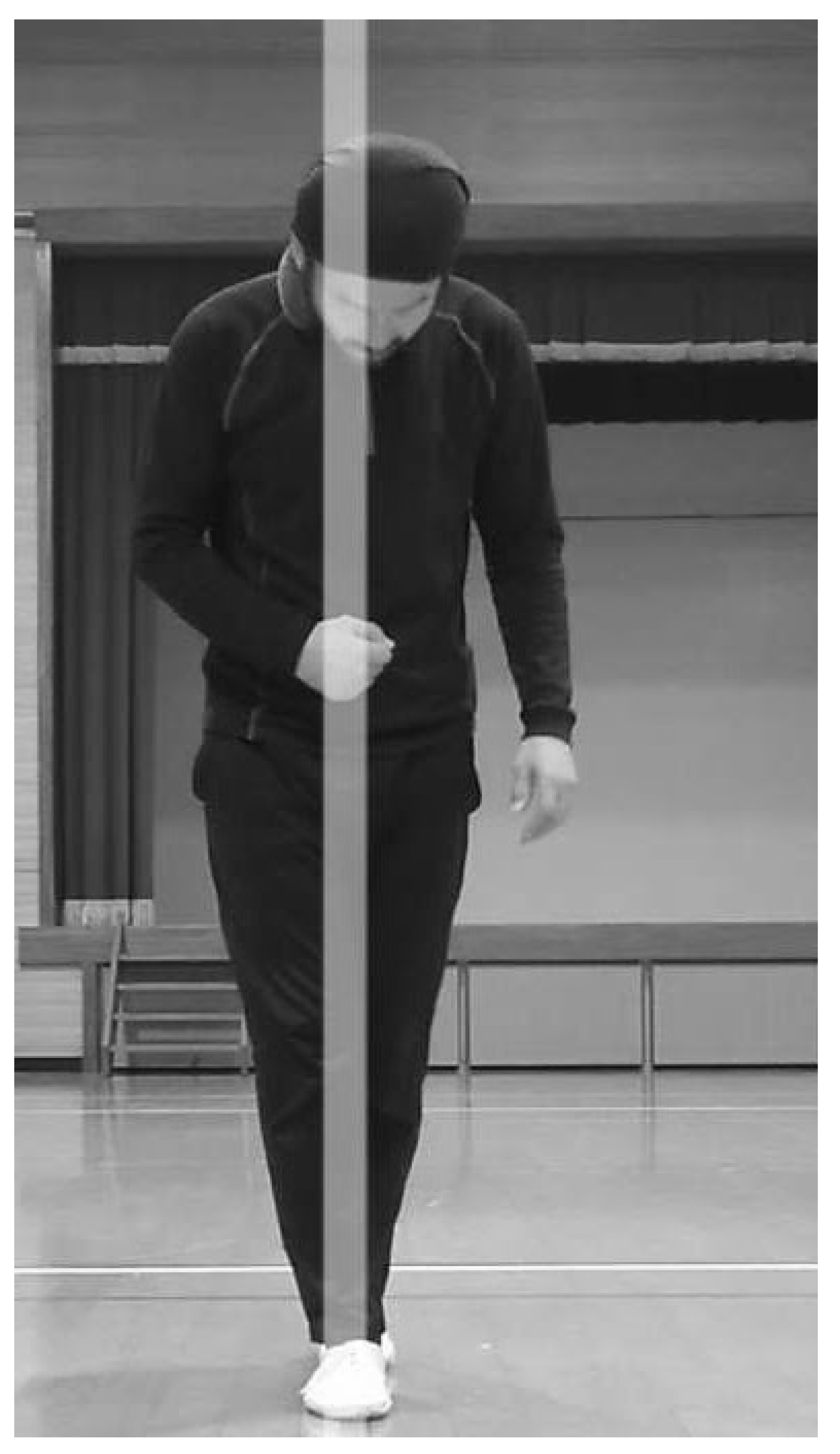
The method to eliminate the distance between two toes that touch the floor is to observe from a position where the two toes that touch the floor overlap as one. This means that if you observe from the extension of the straight line passing through the two toes that touch the floor, the two toes that touch the floor will overlap and appear as one. Then, a single center of gravity line will be fixed to the toes that touch the floor that has become one (Figure 4).
Drawing a straight line on the floor makes it easier to make the center of gravity line one line. By fixing the toes on the line and then observing from a point a little further along the line, you can make the center of gravity line one line.
Figure 3.
The range of movement of the center of gravity line before the center of gravity line is fixed.
Figure 3.
The range of movement of the center of gravity line before the center of gravity line is fixed.
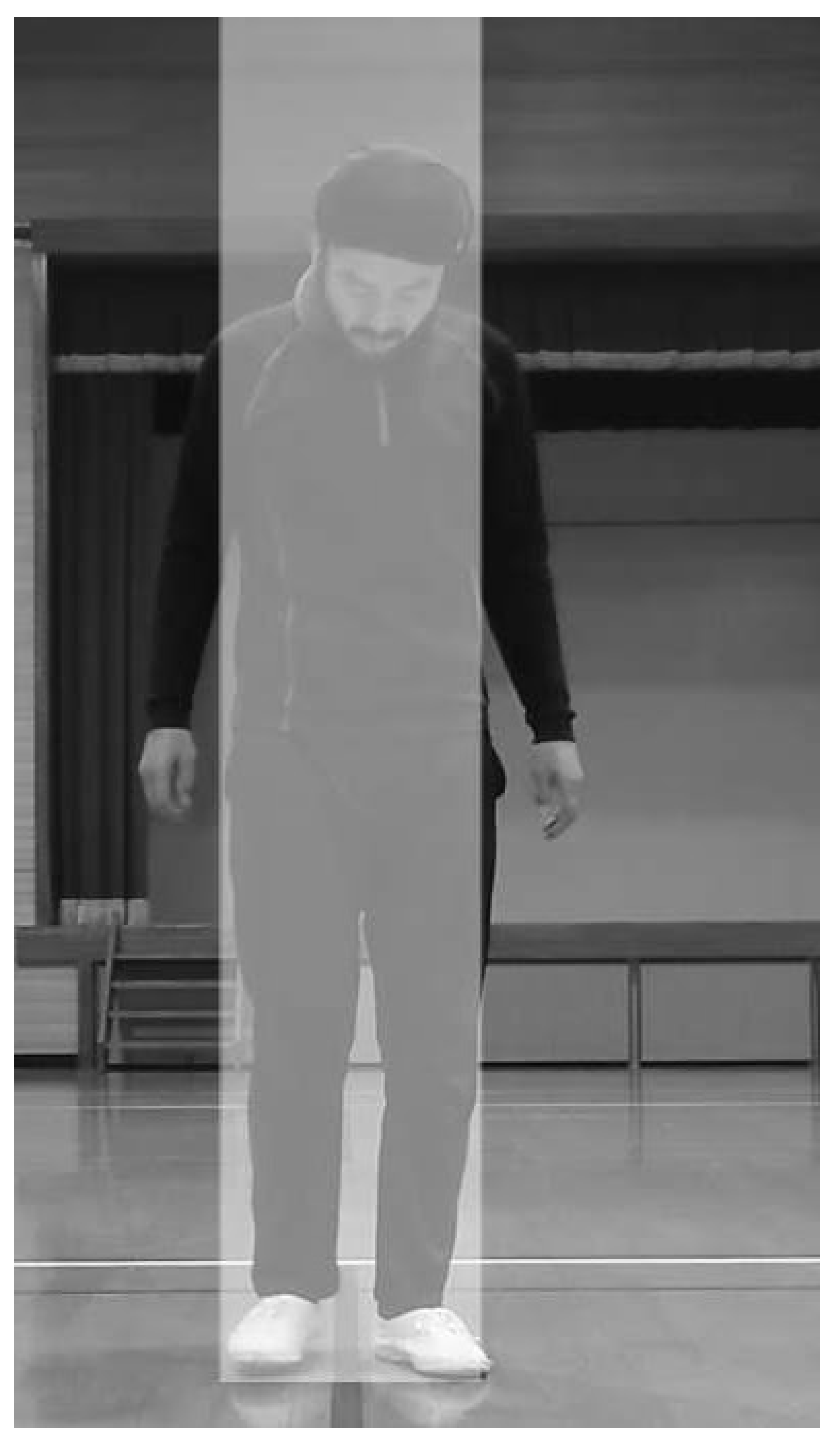
Figure 4.
The range of movement of the center of gravity line after the center of gravity line is fixed.
Figure 4.
The range of movement of the center of gravity line after the center of gravity line is fixed.
2.2.2. Move the Body Maintaining the Center of Gravity Line Fixed
Let’s move the body maintaining the center of gravity line fixed on the toes. The reason for moving the body is to find the place of the body that is not moving.
Look at a body that is not moving, we can not find the place where the body does not move.Because there are places that are moving, we can find the place that is not moving.
When the center of gravity line is fixed at the toes, we can find the place that does not move on the vertical line of the toes. This immovable place is the center of gravity. Since the center of gravity line is fixed at the toes, the center of gravity cannot move from directly above the toes. By moving the body significantly, the difference between moving and stationary places becomes clear, so move the body as much as possible.
In the case of the front-back direction center of gravity line fixation method, the center of gravity does not move front or back direction, so tilting the body front or back direction makes the center of gravity more visible.
In the case of the left-right direction center of gravity line fixation method, the center of gravity does not move left or right direction, so tilting the body left or right direction makes the center of gravity more visible.
2.2.3. Points to Keep in Mind When Moving
The center of gravity cannot be directly observed because it’s deep inside the body. Even if you find the center of gravity, you are seeing it through the body’s surface, and what you see is the apparent center of gravity.
The apparent center of gravity is the intersection of the straight line connecting the center of gravity of the subject and the viewpoint of the observer and the body surface of the subject.
When moving with a fixed center of gravity line, when a rotational movement occurs, the center of gravity does not move, but the apparent center of gravity on the body surface moves, creating a discrepancy between the center of gravity and the apparent center of gravity, making it difficult to accurately observe the center of gravity. Make sure not to rotate when moving your body, as this will prevent you from doing so.
In addition to rotation, in the front-back direction center of gravity line fixation method, please move without tilting left or right direction, and in the left-right direction center of gravity line fixation method, please move without tilting front or back direction, as the apparent center of gravity will shift for the same reasons as rotation.
2.2.4. Mark Your Body
It has been said that the center of gravity cannot be visualized, so even if the center of gravity line is fixed, it is difficult to pinpoint the location of the center of gravity.
Therefore, to avoid losing sight of your center of gravity, place a mark on your body. As a mark, make the fist with your hand and place it on your body. The movement of the mark will identify whether it is the center of gravity or not, so always place your fist in the same way and make sure it does not shift from your body.
Fix the center of gravity line, place your fist on your body, and move your body. If your fist deviates from the center of gravity line, the spot where the fist is placed is not the center of gravity. If the fist does not deviate from the center of gravity line, then the spot where the fist is placed is considered as the center of gravity.
2.3. How to Find the Center of Gravity
This section explains how to find the center of gravity using the front-back direction center of gravity line fixation method and the left-right direction center of gravity line fixation method.
2.3.1. How to Find the Center of Gravity for the Front-Back Direction Center of Gravity Line Fixation Method
In the case of the front-back direction center of gravity line fixation method, the position of the center of gravity as seen from the lateral side of the body can be determined (Figure 5).
First, the subject moves the body without rotating or tilting left or right direction, maintaining the front-back direction center of gravity line fixation method. At this time, the subject makes a fist and places it on the same side of the body as the fist.
The observer observes the subject from the extension of a straight line passing through both toes of the subject at the fist side. The observer checks that the subject’s fist does not move off the vertical line of the toe as the subject is moving. If the subject’s fist moves off the vertical line of the toes, ask the subject to change the position of the fist and check again. Repeat this until the subject’s fist no longer moves off the vertical line of the toes. If the subject’s fist does not move off the vertical line of the toes, the point where the subject places the fist is the center of gravity.
2.3.2. How to Find the Center of Gravity for the Left-Right Direction Center of Gravity Line Fixation Method
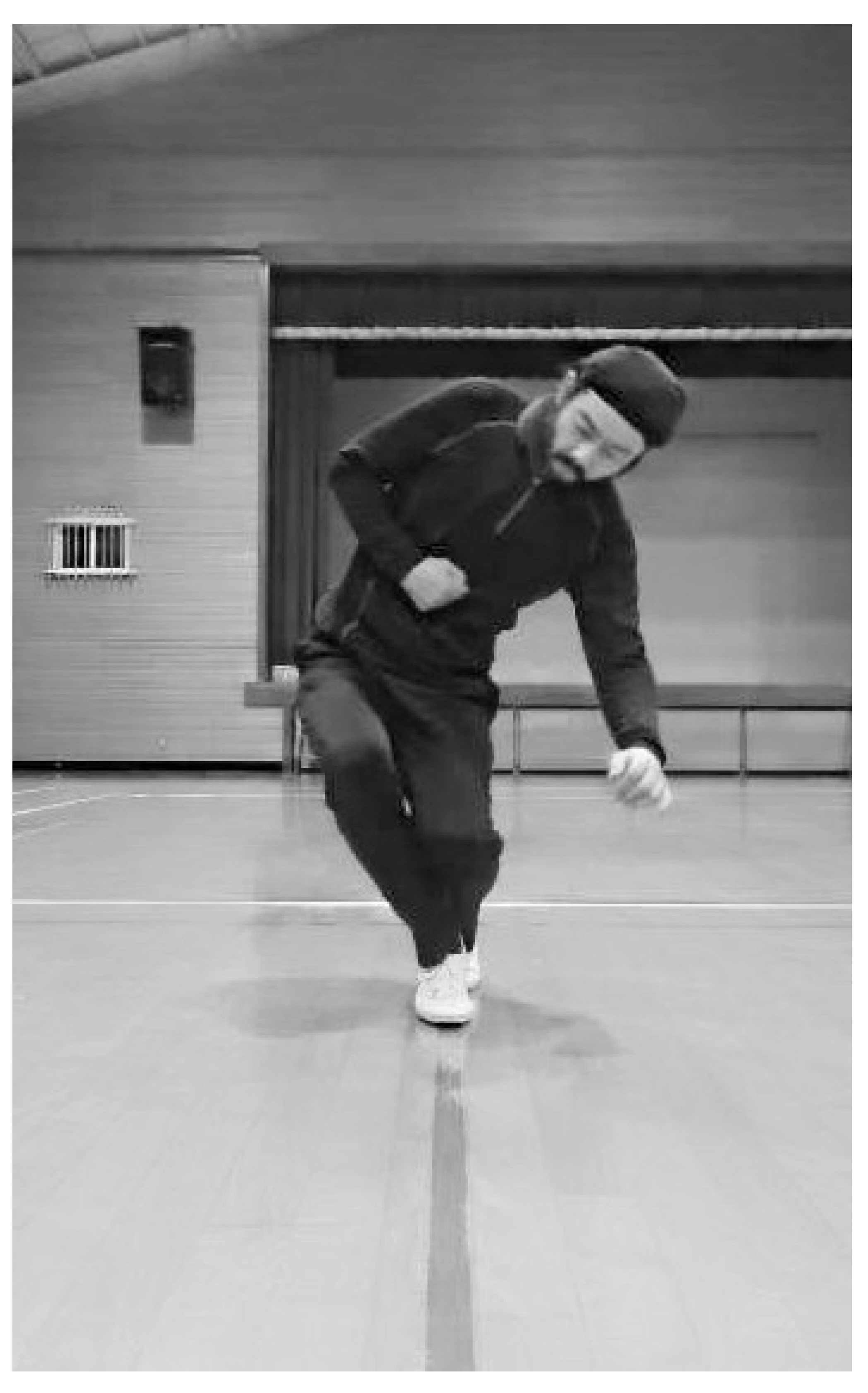
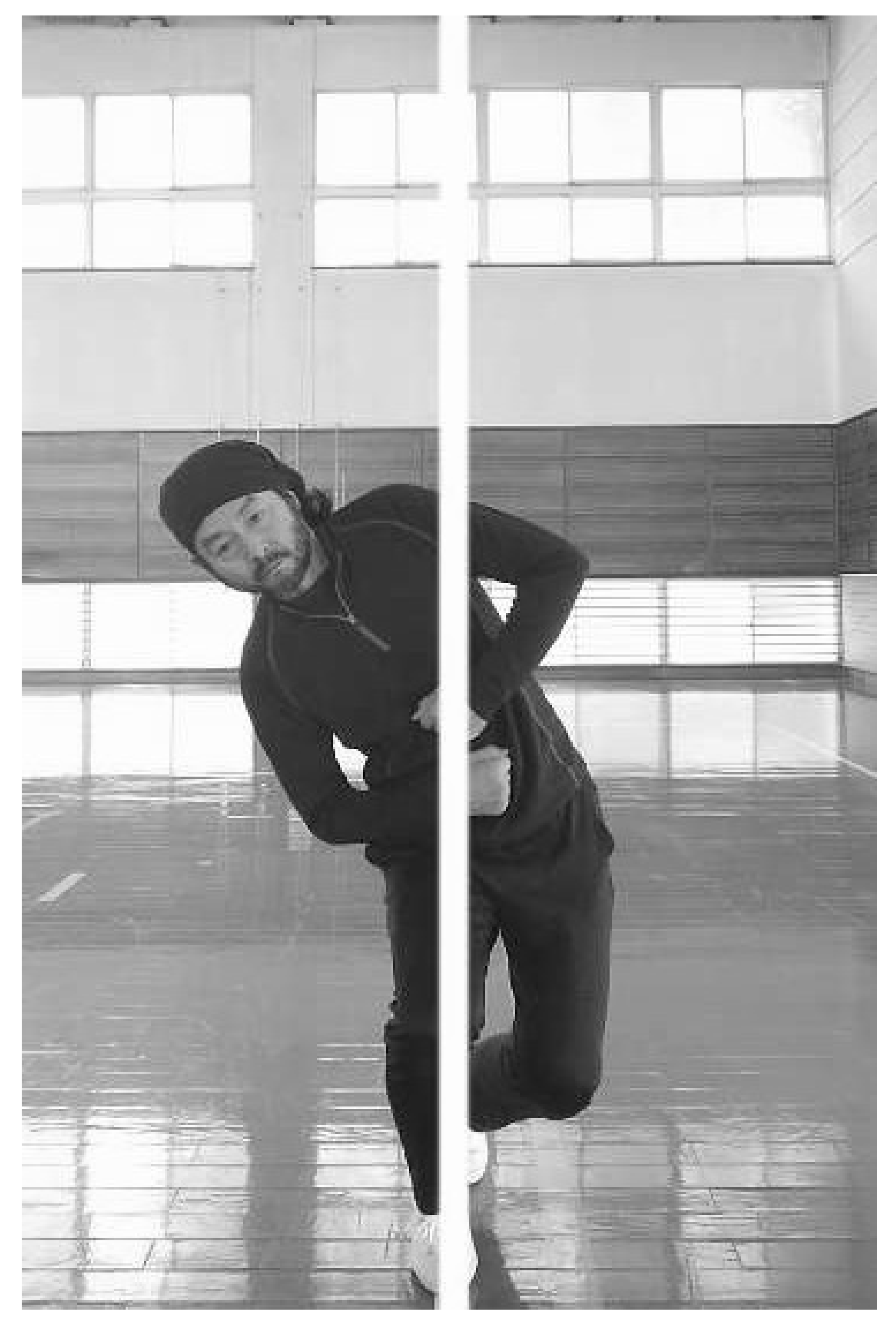
In the case of the left-right direction center of gravity line fixation method, the position of the center of gravity as seen from the front side of the body can be determined (Figure 6).
First, the subject moves the body without rotating or tilting front or back direction while maintaining the left-right direction center of gravity line fixation method. At this time, the subject makes a fist and places it on the front side of the body.
The observer observes the subject from the extension of a straight line passing through both toes of the subject at the fist side. The observer checks that the subject’s fist does not move off the vertical line of the toe as the subject is moving. If the subject’s fist moves off the vertical line of the toes, ask the subject to change the position of the fist and check again. Repeat this until the subject’s fist no longer moves off the vertical line of the toes. If the subject’s fist does not move off the vertical line of the toes, the point where the subject places the fist is the center of gravity.
Figure 6.
Observer’s point of view. The left-right direction center of gravity line fixation method
2.4. Identification of the Center of Gravity
The human center of gravity is located inside the body, so it cannot be seen directly.
Since we are looking at the center of gravity through the body surface, the center of gravity seen using the center of gravity line fixation method is the apparent center of gravity.
2.4.1. Position of the Center of Gravity Visualized Using the Front-Back Direction Center of Gravity Line Fixation Method
In the front-back direction center of gravity line fixation method, when the subject’s fist is placed in the midpoint between the front and back of the body at a height slightly above the midpoint between the navel and the pit of the stomach, the subject’s fist is no longer moves off the center of gravity line (Figure 7 and Figure 8).
Figure 7.
The movement of the fist when it is at the center of gravity.
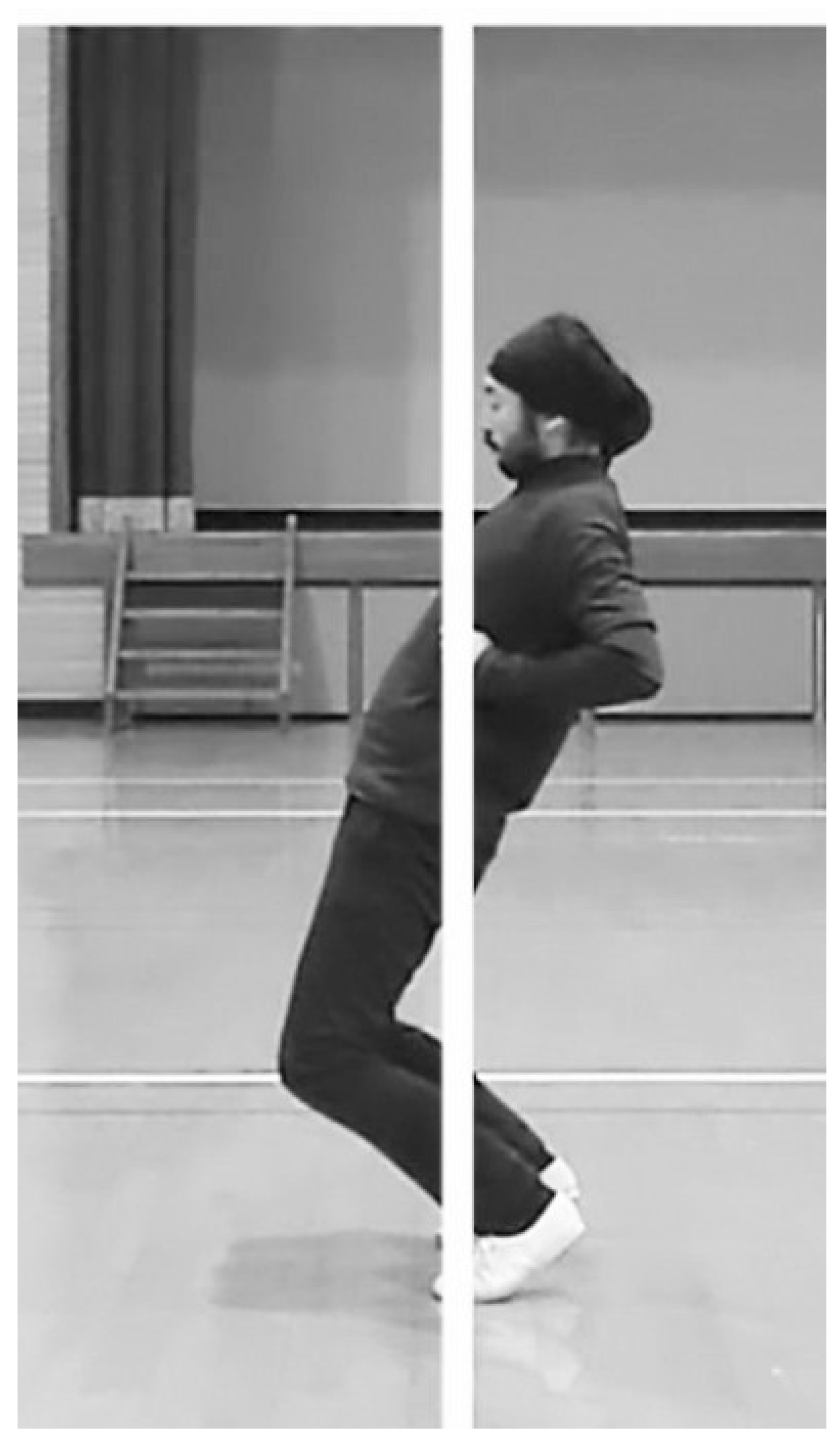
Figure 8.
The movement of the fist when it is at the center of gravity.
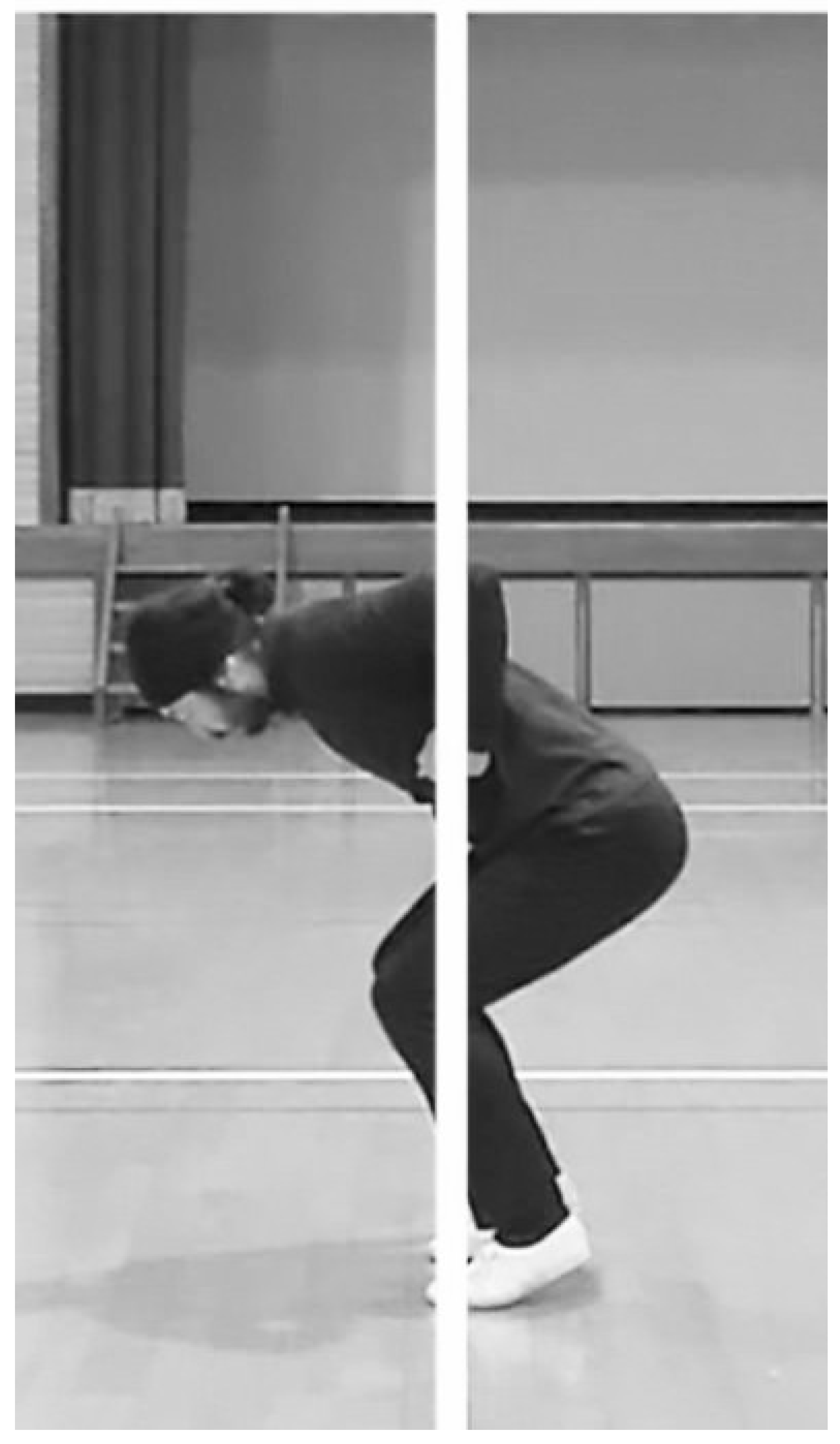
Figure 9.
The movement of the fist when it is at the level of the CCOG.
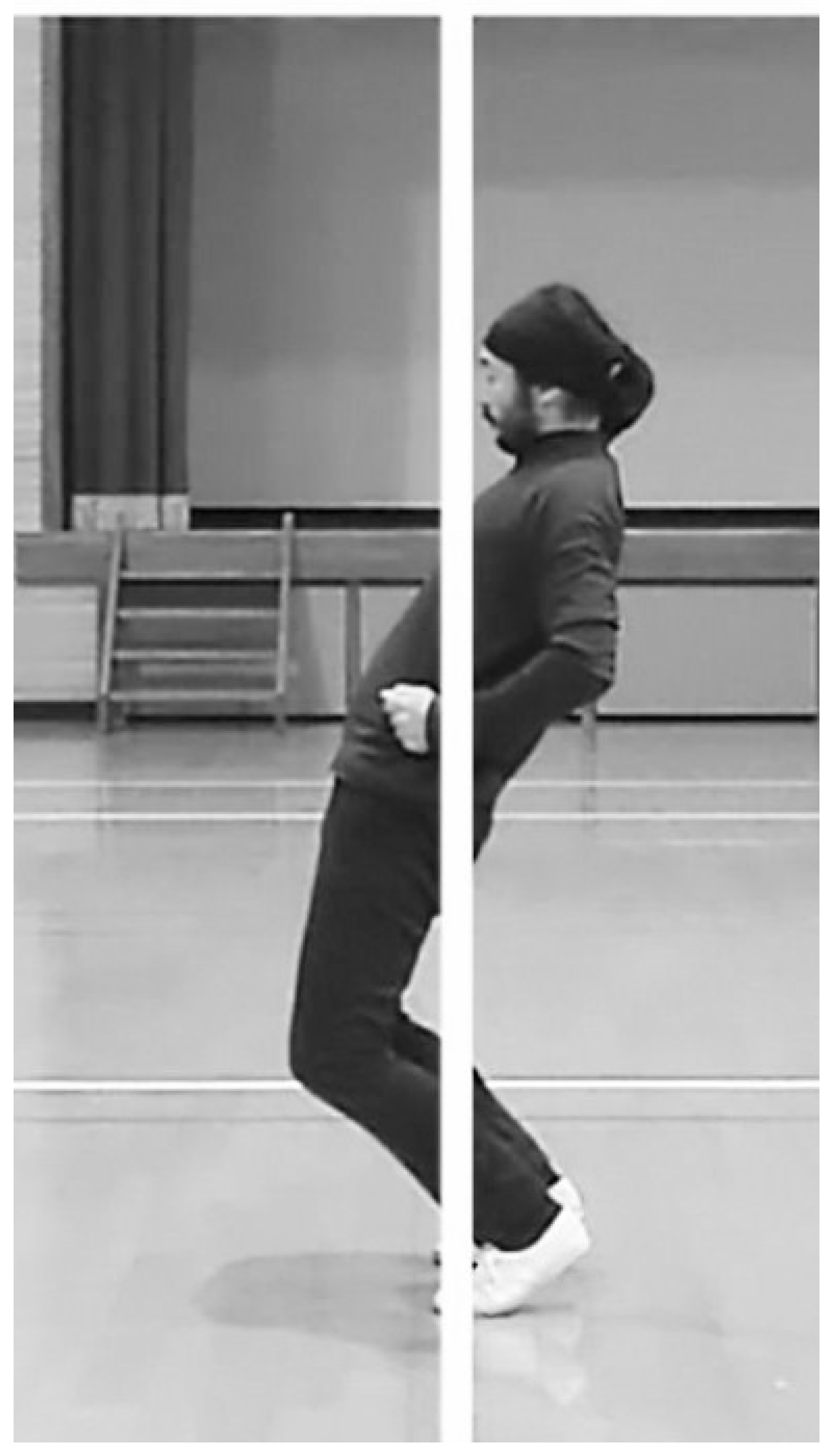
Figure 10.
The movement of the fist when it is at the center of gravity.
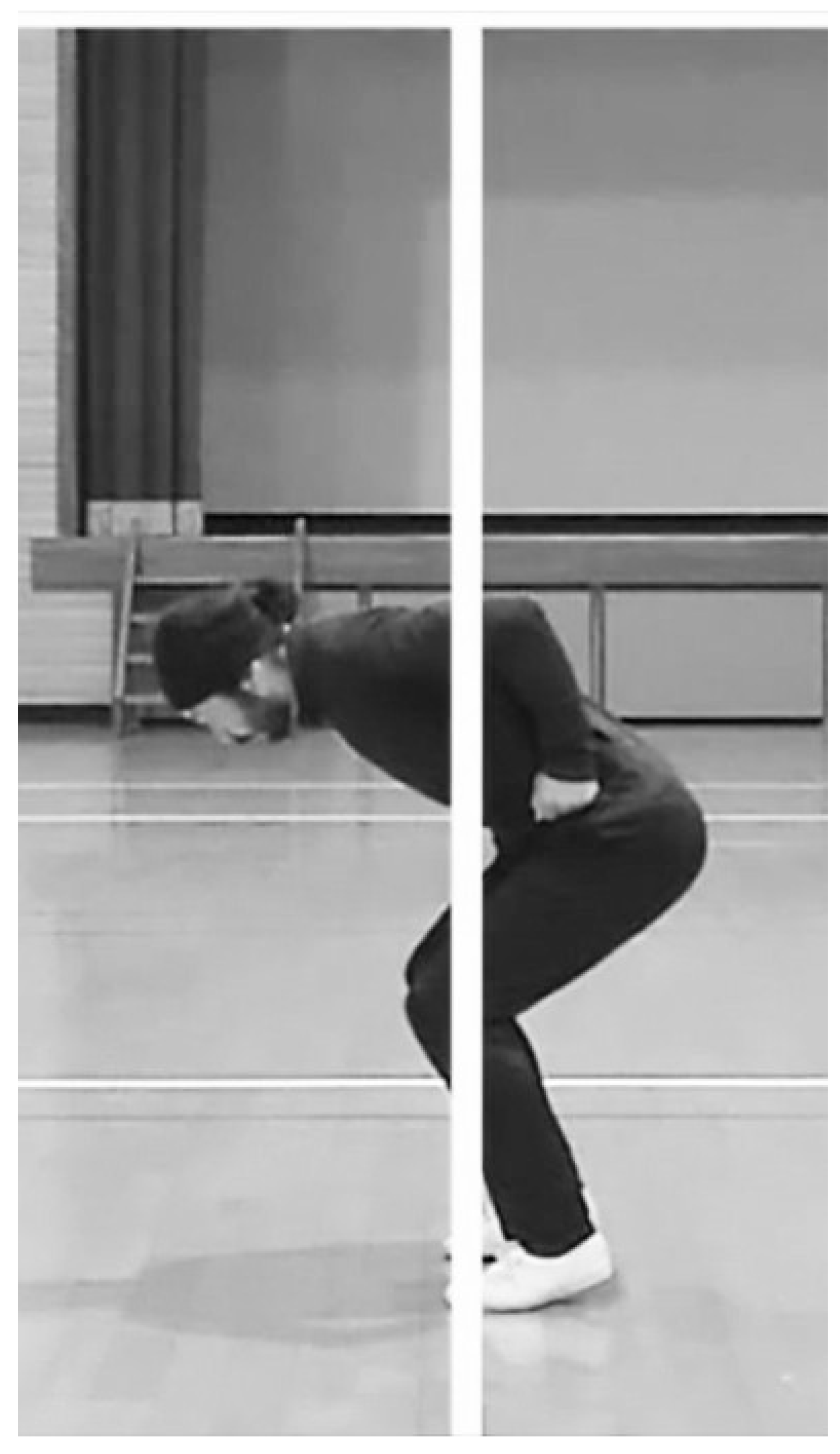
Therefore, the apparent center of gravity observed from the lateral side of the body is the midpoint between the front and back of the body at the level slightly above the midpoint between the navel and the pit of the stomach.
2.4.2. Position of the Center of Gravity Visualized Using the Left-Right Direction Center of Gravity Line Fixation Method
In the left-right direction center of gravity line fixation method, when the subject’s fist is placed on the midline of the body at a height slightly above the midpoint between the navel and the pit of the stomach, the subject’s fist is no longer moves off the center of gravity line (Figure 11 and Figure 12).
Therefore, the apparent center of gravity observed from the front side of the body is on the midline of the body at a height slightly above the midpoint between the navel and the pit of the stomach.
2.4.3. Location of the Center of Gravity
The human center of gravity is the spot inside the body where the apparent center of gravity viewed from the lateral side obtained by the front-back direction center of gravity line fixation method and the apparent center of gravity viewed from the front side obtained by the left-right direction center of gravity line fixation method intersect.
Therefore, the human center of gravity is Center of the trunk at a level slightly above the midpoint between the navel and the pit of the stomach.
3. Experiment
3.1. Experiment 1
3.1.1. Subjects
30 adults aged 22-41 years, Standard weight ± 5 kg
- 15 adult males (6: 160 cm to less than 170 cm, 7: 170 cm to less than 180 cm, 2: 180 cm to less than 190 cm )
- 15 adult females ( 1: 140 cm to less than 150 cm, 9: 150 cm to less than 160 cm, 5: 160 cm to less than 170 cm )
3.1.2. Objective
To confirm the reproducibility of the center of gravity line fixation method.
3.1.3. Experimental Procedure
Identify the center of gravity for all subjects using the front-back direction center of gravity line fixation method. Form pairs and take turns conducting the experiment and recording the position of the center of gravity. The use of the front-back direction center of gravity line fixation method was explained in detail in Chapter 2.
When measuring the center of gravity position, measure the length from the navel to the pit of the stomach as 7 sun for all subjects. If the center of gravity is between dimensions, select the closer value. Record whether the center of gravity was above or below the selected value.
- measurement standard
Since there are individual differences in people, the length from the navel to the pit of the stomach is measured as 7 sun. In other words, the length from the navel to the pit of the stomach is divided into seven equal parts. No matter how much individual differences exist, the length from the navel to the pit of the stomach is always 7 sun. This is a measurement method used by acupuncturist when measuring people, and it is very useful when dealing with individual differences.
3.1.4. Result
11 people were 5 sun and 19 people were 4 sun. The breakdown is as follows: 2 people with 5 sun, 9 people with below 5 sun, 14 people with above 4 sun, and 5 people with 4 sun.
| Position of the center of gravity (sun) | The number of people (people) |
| above 5 | 0 |
| 5 | 2 |
| below 5 | 9 |
| above 4 | 14 |
| 4 | 5 |
| below 4 | 0 |
3.2. Experiment 2
3.2.1. Subjects
1 male, 28 years old, weighing 59 kg, height 172 cm
The subject should check their own CCOG and Three-Fives before conducting the experiment and prepare to quickly place their fist on the center of gravity that the observer wants to see.
3.2.2. Objective
- Check the position of the center of gravity in the standing position.
- Observe the body’s features when standing or moving with CCOG as the center of gravity.
3.2.3. Experimental Procedure
In this experiment, to have CCOG as the center of gravity was defined as to keep CCOG on the center of gravity line. In this experiment, CCOG is defined at the level of the second sacral vertebra.
The subject first stands in the front-back direction center of gravity line fixation method . At this time, the subject stands with knees extended to confirm the position of the center of gravity in the standing position. Once the center of gravity is confirmed, the knees may be free.
Next, the subject places the fist at the level of the second sacral vertebra and stands so that the fist is directly above the toes. At this time, the subject should keep their position so that the fist placed at the level of the second sacral vertebra does not move away from being directly above the toes. In other words, stand while keeping CCOG on the center of gravity line. This way of standing is the state of standing with the CCOG as the center of gravity.
In the center of gravity line fixation method, the center of gravity line is fixed to the toes by limiting the base of support to the toes. Therefore, if the subject’s fist, placed at the level of the second sacral vertebra, stands so that it is directly above the toes, the fist will be on the center of gravity line.
The subject then moves so that the fist placed at the level of the second sacral vertebra does not deviate from directly above the toes. In other words, move while keeping CCOG on the center of gravity line. This way of moving is the state of moving with CCOG as the center of gravity.
When the subject moves, an important point to note is to move without twisting or tilting the body. All confirmations of the subject’s fist position are performed by the observer. The observer should confirm both Three-Fives and CCOG each time the subject changes posture.
3.2.4. Result
When the subject stood in the center of gravity line fixation method with knees extended, the body tilted slightly forward. At this time, Three-Fives was on the center of gravity line, but CCOG was not on the center of gravity line. CCOG was behind the center of gravity line.
When the subject moved CCOG forward and positioned it on the center of gravity line, the trunk of the body became vertical. At this time, both Three-Fives and CCOG were positioned on the center of gravity line. The subject attempted to move the body while keeping CCOG on the center of gravity line, but the trunk of the body remained vertical and could not be moved.
3.3. Experiment 3
3.3.1. Subjects
Same as Experiment 2
3.3.2. Objective
Prove that Three-Fives is the center of gravity.
3.3.3. Experimental Procedure
Based on the results of Experiment 2, when the subject stood using the front-back direction center of gravity line fixation method and positioned CCOG on the center of gravity line, the trunk of the body became vertical, and both Three-Fives and CCOG were positioned on the center of gravity line. Using this posture as the basic posture, Experiments 3, 4 and 5 will be conducted.
The subject places their fist at the position of Three-Fives and assumes the basic posture.
The subject then moves the body to move the fist, which is placed at the position of Three-Fives, off the center of gravity line. At this time, move the body with care so that the fist, which is placed at the position of Three-Fives, does not shift from where it is placed. When the fist placed at the position of the subject’s Three-Fives is moved off the center of gravity line, if the subject is unable to stand in place, it will be determined that Three-Fives is the center of gravity.
When the subject moves, an important point to note is to move without twisting or tilting the body.
All confirmations of the subject’s fist position are performed by the observer. The observer should confirm both Three-Fives and CCOG each time the subject changes posture.
3.3.4. Result
The subject was unable to stand in place when Three-Fives was moved off the center of gravity line.
For this reason, it can be said that humans can stand with Three-Fives on the center of gravity line. In other words, it can be said that Three-Fives is the center of gravity
3.4. Experiment 4
3.4.1. Subjects
Same as Experiment 2
3.4.2. Objective
Prove that CCOG is not the center of gravity.
3.4.3. Experimental Procedure
The subject places their fist at the position of CCOG and assumes the basic posture.
The subject then moves the body to move the fist, which is placed at the position of CCOG, off the center of gravity line. At this time, move the body with care so that the fist, which is placed at the position of CCOG, does not shift from where it is placed.
When the fist placed at the position of the subject’s CCOG is moved off the center of gravity line, if the subject is able to stand in place, it will be determined that CCOG is not the center of gravity.
When the subject moves, an important point to note is to move without twisting or tilting the body.
All confirmations of the subject’s fist position are performed by the observer. The observer should confirm both Three-Fives and CCOG each time the subject changes posture.
3.4.4. Result
The subject was able to stand in place when CCOG was moved off the center of gravity line.
Therefore, it can be said that CCOG is not the center of gravity.
The distance between the center of gravity line and the CCOG was widest when the subject’s trunk was tilted forward until it was horizontal.
At this time, the subject’s knee was flexed approximately 80 degrees. And Three-Fives was on the center of gravity line.
3.5. Experiment 5
3.5.1. Subjects
Same as Experiment 2
3.5.2. Objective
Identify the part that is moving with Three-Fives as the fulcrum.
3.5.3. Experimental Procedure
The subject places their fist at the position of Three-Fives, assumes a basic posture, and repeats forward and backward tilting.
At this time, the observer watches the subject’s movements and identifies the parts that are moving with Three-Fives as the fulcrum. This is because it was thought that by identifying the parts moving with Three-Fives as the fulcrum, the parts moving with Three-Fives as the center of gravity could be identified.
When the subject moves, an important point to note is to move without twisting or tilting the body.
All confirmations of the subject’s fist position are performed by the observer. The observer should confirm both Three-Fives and CCOG each time the subject changes posture.
3.5.4. Result
When CCOG was moved backward beyond the center of gravity line, the trunk of the body tilted forward with Three-Fives as the fulcrum. Three-Fives was always on the center of gravity line. The head tilted backward with the mandibular condyle(Anterior to the external acoustic pore) as the fulcrum. The lower limbs tilted forward with the greater trochanter of the femur as the fulcrum. The upper limbs tilted forward with the humeral head as the fulcrum.
When CCOG was moved forward beyond the center of gravity line, the trunk of the body tilted backward with Three-Fives as the fulcrum. Three-Fives was always on the center of gravity line. The head tilted forward with the mandibular condyle as the fulcrum. The lower limbs tilted backward with the greater trochanter of the femur as the fulcrum. The upper limbs tilted backward with the humeral head as the fulcrum.
For these reasons, the part of the body that is moving with Three-Fives as a fulcrum is the trunk of the body up to the mandibular condyle, humeral head, and greater trochanter of the femur. The mandibular condyle is the fulcrum of the head, the humeral head is the fulcrum of the upper limbs, and the greater trochanter of the femur is the fulcrum of the lower limbs.
Any part moved less as it got closer to its respective fulcrum and more as it got farther. The movement of the parts with Three-Fives as the fulcrum was largest at the mandibular condyle and the greater trochanter of the femur, and smallest at Three-Fives.
4. Consideration
As a result of Experiment 1, the reproducibility of the center of gravity line fixation method was sufficiently demonstrated.
The position of the subject’s center of gravity has been found to be within a range of 1 sun between 4 sun and 5 sun above the navel. It is located approximately at the center of the trunk of the body. The longest length of 1 sun for the subject was 3 cm. Therefore, the maximum error in the position of the human center of gravity is 3 cm. As a visual confirmation method, it can be considered to have achieved excellent results.
The error is thought to be caused by the width of the base of support at the toe fixation. With toe fixation, the ground surface is wider, and it is thought that the base of support can be narrowed only to the extent that the center of gravity line moves 3 cm. There are previous studies that used orthoses with a narrowed base of suppor, which we would like to reference. Additionally, it is necessary to consider the possibility of individual differences in the position of the center of gravity. This is a subject for future research.
CCOG is the center of mass of the entire body, so there is no specific position, its position changes with posture. In other words, there are as many centers of gravity as there are postures. The position of the human center of gravity in the standing position is at the bottom of the trunk of the body.
The position of Three-Fives was quite different from the position of CCOG. Three-Fives was located approximately in the center of the trunk of the body. Also, the position of Three-Fives did not change when the posture was changed. This can be determined by looking at the subject’s fist movement.
When the subject’s fist placed on the body is at the position of the apparent Three-Fives, that fist no longer moves horizontally and only moves vertically up and down. This means that because the center of gravity line was fixed by the center of gravity line fixation method, Three-Fives could no longer move horizontally, and could only move vertically up and down on a single fixed center of gravity line. The fact that the subject’s fist remains on the center of gravity line even when the posture is changed means that the position of Three-Fives has not changed even when the posture is changed. Therefore, it can be said that the Three-Fives is not the center of mass of the entire body.
In other words, Three-Fives is the center of mass that cannot be measured from the current human form or mass.
This suggests the human did not acquire the center of gravity after evolving into the human form, but rather acquired the center of gravity before evolving into the human form, and even now, after evolving into the human form, they have inherited the position of the center of gravity from that time passed down through generations.
As a result of Experiment 2, when the subject’s CCOG was placed on the center of gravity line, the trunk of the body stood vertically. Additionally,the subject attempted to move the body while keeping CCOG on the center of gravity line, but the trunk of the body remained vertical and could not be moved.
This is because when CCOG is placed on the center of gravity line, Three-Fives is also on the center of gravity line, so the trunk of the body is fixed on the center of gravity line at two points: CCOG and Three-Fives. From this, it can be considered that Three-Fives is always maintained on the center of gravity line. Therefore, if a point other than Three-Fives is used as the center of gravity, it will be fixed on the center of gravity line at two points: Three-Fives and the point chosen as the center of gravity other than Three-Fives, making it impossible to move the trunk of the body. Therefore, it can be said that the center of gravity for a human is solely at Three-Fives, and it is not possible to designate any other point as the center of gravity.
As a result of Experiment 3, when the subject’s fist, placed at the position of Three-Fives, was removed from the center of gravity line, the subject was unable to continue standing in place.
As a result of Experiment 4, even when the subject’s fist, placed at CCOG, was removed from the center of gravity line, the subject was able to continue standing in place. The subject’s fist, placed at Three-Fives, was always maintained on the center of gravity line.
As a result of Experiments 3 and 4, it can be said that humans are able to stand by using Three-Fives as the center of gravity.
As a result of Experiments 1, 2, 3, and 4, it can be said that the center of gravity line fixation method is a technique capable of accurately identifying the human center of gravity. Moreover, the center of gravity identified by the center of gravity line fixation method can be considered the only unique center of gravity specific to humans.
In Experiment 2, the center of gravity in the standing position with knees extended was confirmed to be Three-Fives (Experiment 2+).
In Experiment 4, the center of gravity in the standing position with the knee joint flexed 80 degrees was confirmed to be Three-Fives (Experiment 4+).
Based on the results of experiments 2+ and 4+, we can say that there is no correlation between the length of the lower limbs and the position of the center of gravity.
The postures in Experiment 2+ and when identifying the center of gravity with the person lying down are almost identical. However, the position of the center of gravity obtained is different. The unmoving point of a moving human is Three-Fives,the balancing point of weights of an unmoving human is CCOG. The former can be considered the center of gravity when maintaining its own balance and moving (Three-Fives), while the latter can be considered the center of gravity when not maintaining its own balance and remaining still (CCOG).
Because of this, it can be said that humans use two types of centers of gravity.
As a result of Experiment 5, it was revealed that the trunk of the body up to the mandibular condyle, the humeral head and the greater trochanter of the femur ( Former whole body: FWB ) is moving with Three-Fives as a fulcrum.
From this, we can assume that the human center of gravity is the center of mass of the FWB.
In other words , it can be thought that humans do not maintain the balance of the entire body, but maintain the balance of FWB.
Therefore, it can be considered that humans acquired their center of gravity before the head and limbs developed. This means, the shape and weight of the head and limbs are not factors in determining the human center of gravity position.
During development, organisms form their intestines along the cepahlic-caudal axis [8] (antrior-posterior axis, body axis). The head side of the intestine becomes the pharynx and the caudal side the anus [8].
When a human is viewed from the side of the body, the mandibular head and pharynx, as well as the anus and greater trochanter of the femur, are almost in an overlapping position.
This alignment suggests the possibility that the body axis and center of gravity are already established during the developmental stages.In other words, the upper end of the human body axis can be thought of as the pharynx and the lower end as the anus.
For this reason, gravity can be thought to be involved in the development of living organisms. In order for this to happen, the center of gravity, which is the reference point, must not move.From this, it can be said that the center of gravity that does not move(Three-Fives) can be involved in vital phenomena , while the center of gravity that moves (CCOG) cannot be involved in vital phenomena.
Furthermore, to prove that Three-Fives is the center of mass of FWB, it is necessary to identify the location where the weight balance of FWB is equal.
Among the previous studies on center of gravity, there is research that measured the weight of each segment of the human body [9,10,11,15]. By using this research data, we think it can be proven that Three-Fives is the center of mass of FWB.
In studies on the center of gravity of humans, it is a premise that the center of gravity is the center of mass of the entire body. However, no researchers have questioned this premise or attempted to prove it. In other words, this premise lacks scientific evidence.
In our view, the greatest barrier in the study of the human center of gravity is that humans are unable to perceive the position of their own center of gravity. Because humans are unable to perceive the position of the center of gravity, they cannot think of the center of gravity, which changes position with each posture, as it applies to their own body.
To keep balance with a center of gravity that moves when changing posture, the only way to keep balance is to remain still. In a moving center of gravity, humans cannot move.
However, there are studies and technologies that have developed precisely because of the inability to perceive the center of gravity.
That is posturography or force plate. These are devices that measure changes in the center of foot pressure. When the amplitude of the sway is small, the movement of the center of foot pressure is consistent with the movement of the center of gravity [16].
Therefore, even if the position of the center of gravity is unknown, it is possible to find the position of the center of gravity on the base of support. Because of this, posturography or force plate has become essential for research on the center of gravity [6] and understanding of diseases [30].
With the center of gravity line fixation method, the position of the center of gravity has been identified, so from now on, it will be possible to measure the center of gravity using posturography or force plate while actually observing the movement of the center of gravity. For this reason, it is believed that research on the center of gravity can further advance.
In studies involving posturography or force plate, it has been found that the location of the center of foot pressure when humans stand most stably is approximately 40 to 55 percent of the foot length from the heel [3]. The position of the axis of the ankle joint is located about 26 percent of the foot length from the heel [3], so when humans are standing most stably, the center of foot pressure is positioned in front of the ankle joint.
Therefore, when standing so that Three-Fives is positioned vertically above about 45 percent of the foot length from the heel, the body tilts slightly forward.
Additionally, electromyography measurements have revealed that when a human is standing most stably, the tension in the muscles of the posterior side of the body, such as triceps surae muscle, becomes stronger [1,17,20].
For this reason, the most stable way for humans to stand is not to stand straight, but rather to adopt a slightly forward-leaning posture.
Additionally, research using posturography or force plate has revealed that the center of gravity is constantly swaying [2,22].
For this reason, it can be considered that dynamic touch is involved in human posture maintenance. Dynamic touch is the process of obtaining sensations such as the overall size, length, shape, direction of force, holding position, and weight of an object by moving it without relying on visual perception, while holding it [27].
In other words, humans perceive various information about their entire body by causing the center of gravity to sway.
The study of the center of gravity is needed primarily in the field of sports and rehabilitation. This is because the center of gravity is the center of balance or the starting point of force.
In rehabilitation, it will be necessary to distinguish the use of the center of gravity. For patients who can move, use Three-Fives, and for patients who cannot move, CCOG must be used.
This is because if you search for the center of gravity of a person who is moving, you will find Three-Fives, and if you search for the center of gravity of a person who is not moving [9,15,29], you will find CCOG.
In sports, it is necessary to establish a movement theory that uses Three-Fives as the origin of force. Three-Fives is located at a specific position, making the origin of force clear, and the movement theory based on the Three-Fives as the origin of force becomes simple and straightforward. Human force is partially output through muscles and bones, but overall it is output from the center of gravity.
"The center of gravity is the central point of the weight of an object, and in a mass system, the center of gravity is the point of action of the resultant force of all the gravity acting on the mass point. When the center of gravity is used as the axis of rotation, the object does not rotate, so the sum of moments around the center of gravity is zero. In other words, at Three-Fives, the sum of all forces is zero."( Kanazawa Institute of Technology, 2024) [12]
If the CCOG is the origin of the force, since the CCOG is located below Three-Fives, the forces are not balanced, resulting in downward forces and moments.
Because of this, the area around the second sacral vertebra where the CCOG is located is compressed from above and further twisted. This force imbalance in the CCOG can be thought to be the cause of low back pain in modern sports.
Therefore, by using Three-Fives as the origin of force, the burden on the skeletal muscles will decrease, and the risk of injuries during exercise will also be reduced. The position of Three-Fives is exactly where the stomach is located. It may be easier to imagine if you think about exerting force from the area where the stomach is located.
Additionally, we believe that the fact that the stomach is located at the same position as the center of gravity has very important implications for living organisms. For humans, as heterotrophs, it is necessary to efficiently take in food and convert it into energy to survive [8].
In Experiment 5, it can be confirmed that body movements become smaller the closer they are to the center of gravity, and larger the farther they are from it.
Therefore, We believe that organisms first positioned the stomach at the center of gravity, where there is the least amount of sway in the body, and then evolved the body into a human shape in order to prevent the stomach from deviating from the center of gravity.
This is because the stomach’s ability to take in food is reduced when it is jolted [13]. Additionally, looking at the process of evolution and development, first the intestine and stomach are formed, and then the skeletal muscles are formed [24]
From these facts, it can be assumed that organ placement and physiological phenomena are based on the position of the center of gravity.
Nishihara(1997) [19] said that the life sciences need a physical perspective. We believed that clarifying human morphology and movement from a mechanical perspective would lead to an unravel of the center of gravity. As a result, we believe, we have created a center of gravity that is completely uninvolved in life phenomena. We needed a perspective from life sciences.
These experiments were conducted visually. This resulted in a maximum error of 3 cm. To determine a more accurate center of gravity, measurement with the latest instruments is required.
With this paper, we were able to show that Three-Fives may be involved in life phenomena. However, we believe that proof has not yet been reached.
5. Postscript
We introduced and conducted experiments on the center of gravity line fixation method, and corrected the position of center of gravity.
By receiving gravity at the unmoving center of gravity, humans are able to use gravity as a force for generation, evolution, or motion.
Originally, the center of gravity fixation method was developed for use at sports fields where no instruments are available. We hope that many people will use this method.
Conflicts of Interest
The authors declare no conflicts of interest.
References
- Allen, C. “ Muscle action potentials used in the study of dynamic anatomy”, British Journal of Physical Medicine, vol. 11, pp. 66-73, 1948.
- Demura, S., & Yamaji, S., et al. “Examination of Parameters Evaluating the Center of Foot Pressure in Static Standing Posture from the Viewpoints of Trial-to-trial Reliability and Interrelationships Among Parameters”, Equilibrium Research, vol. 60, no. 1, pp. 44-55, 2001. [CrossRef]
- Fujiwara, K., & Toyama, H., et al. “EFFECTS OF A SAGITTAL POSITION OF THE BODY GRAVITY CENTER AND MANUAL WEIGHT-LOAD ON POSTURAL CONTROL DURING RAPID ARM-LIFTING”, Japanese journal of physical fitness and sports medicine, vol. 40, no. 4, pp. 355-364, 1991.
- Hiiragi,Y. ”Measuring and Comparing the Base of Support and Movable Range of Center of Gravity”,Journal of Physical Therapy Science, vol.10, no. 4, pp. 207-214, 1995.
- Honma, S (1997), Des 14 Meridiens illustres, 13th edition, IDO NO NIPPON SHA, pp.173-174.
- Inamura, K.” Cross-Correlation of the Swaying Movements Between the Center of Gravity and the Various Parts of Human Body in Standing Posture”, Journal of the Anthropological Society of Nippon, vol. 87. no. 2, pp. 99-106, 1979. [CrossRef]
- Inoue,S., & Ehara,Y., & Tsurusaki,K. “Development of a kinetic method in determining the center of gravity during walking’’, Niigata journal of health and welfare, vol. 19, no. 2, pp. 1-8, 2019.
- Ishizuya-Oka,A."Molecular Mechanisms Underlying the Evolution and Development of the Digestive System",Journal of Nippon Medical School, vol. 11, no. 3, pp. 155-160, 2015. [CrossRef]
- Jensen,R.K."Estimation of the biomechanical properties of three body types using a photogrammetric method", Journal of Biomechanics, vol. 11, pp. 349-358, 1978. [CrossRef]
- Jensen,R.K."Body segment mass,radius and radius of gyration proportions of children", Journal of Biomechanics, vol. 19, pp. 359-368, 1986. [CrossRef]
- Jensen,R.K."Distribution of mass to the segments of elderly males and females", Journal of Biomechanics, vol. 27, pp. 89-96, 1994. [CrossRef]
- Kanazawa Institute of Technology, (2024) “Position of the center of gravity (two-mass system in two dimensions),” KIT Physics Navigation, https://w3e-kanazawa–it-ac-jp.translate.goog/math/trans/physics/high-school_index/mechanics/rigid_body/center_of_mass_two_dimention_two.html?_x_tr_sl=ja&_x_tr_tl=en&_x_tr_hl=ja, (2024-10-22).
- Kinoshita, F., & Takada, H., et al. ”The Effect of Acute Exercise on the Electrogastrogram”, DESCENTE SPORTS SCIENCE, vol. 139, pp. 103 -113, 2018. [CrossRef]
- Kubo,Y., & Yamaguchi,M., et al. ”Investigation of the Validity of Visual Assessment of Center of Gravity in the Analysis of Posture and Movement”, Japanese Physical Therapy Association, vol. 33, no. 3, pp. 112-117, 2006. [CrossRef]
- Matsui,H. ” Determination of center of gravity of human body in various postures”, Japanese society of physical education, vol.2, no.2, pp. 65-76, 1956.
- Murray, M. P., & Seireg, A., & Scholz, R.C. ’’Center of gravity, center pressure and supportive forces during human activities”, Journal of Applied Physiology, vol. 23, no. 6, pp. 831-838, 1967. [CrossRef]
- Nagayama, I. ”Measurement of Deviation Using Posturography”, Practica Oto-Rhino-Laryngologica, vol. 76, no. 2, pp. 197-222, 1983. [CrossRef]
- Nakamura,R & Saitou,H. (1992), Fundamental kinesiology, 4th edition, Ishiyaku Publishers, Inc, pp. 289-309.
- Nishihara, K. “Recent progress in skeletal biomaterials and the simple theory of life science: trilateral research to investigate vertebrate system using bioceramics”, Journal of Artificial Organs, vol.26, no. 4, pp. 840-848, 1997.
- Okada, M., “An electromyographic estimation of the relative muscular load in different human postures”, Journal of human ergology, vol. 1, pp. 75-93, 1972 . [CrossRef]
- Otten, E. “Balancing on a narrow ridge: biomechanics and control. Philosophical Transactions of the Royal Society B: Biological Sciences. 354(1385), pp. 869-75,1999. [CrossRef]
- Romberg, M. H (1853), A manual of the nervous diseases of man , Sydenham Society, London.
- Roux, W. (1895), Gesammelte Abhandlungen über Entwicklungsmechanik der Organismen, Leipzig.
- Sadler, T. W. (1995) Langman’s medical embryology, 7th edition, Williams & Wilkins, Baltimore: Yasuda, M., & Sawano, J. (Trans) (1996) Langman’s medical embryology, 7th edition, japanese edition, Igaku-Shoin MYW Ltd.
- Saito, H., & Ehara, Y., et al. “Quantitative Analysis of Balance Control on Narrow Base of Support: Balance can be Maintained even when Center of Mass Drifts Outside the Base of Support”, The Japanese journal of ergonomics, Vol. 46, No. 6, pp. 355-361, 2010.
- Shumway-Cook, A.,& Woollacott, M. (2001) Motor control. Theory and practical application. Edi. 2, Lippincott Williams & Wilkins.
- Solomon, H. Y., & Turvey, M. T. “Haptically perceiving the distances reachable with hand-held objects”, Journal of Experimental Psychology: Human Perception and Performance, vol. 14, no. 3, 404–427, 1988. [CrossRef]
- Tanino, Y. ”Stability from the Standpoint of Dynamics and Kinematics” Journal of Kansai physical therapy, vol. 3, pp. 59-62, 2003. [CrossRef]
- Teramoto, K., & Usui, N. ”Tracing of Center of Gravity during Center of Gravity Rotation : Comparison between Patients and Healthy Subjects”, Journal of Physical Therapy Science, vol. 10, no. 4, pp. 207-214, 1995. [CrossRef]
- Tokita, T., & Matsuoka, T., et al. ”Righting and Deviation Tests by Cephalography and Statography”, Practica Oto-Rhino-Laryngologica, vol. 65, no. 5, pp. 443-456, 1972.
- Wada, O.,& Takeuchi, H.,& Ichihashi, N., “Influence of Pelvic Alignment in the Sagittal Plane on Pelvic and Trunk Rotation and the Movement of the Center of Mass during Active Rotation in Standing”, Japanese Physical Therapy Association, vol. 36, no.7. pp. 356-362, 2009.
Figure 1.
The front-back direction center of gravity line toe fixation form
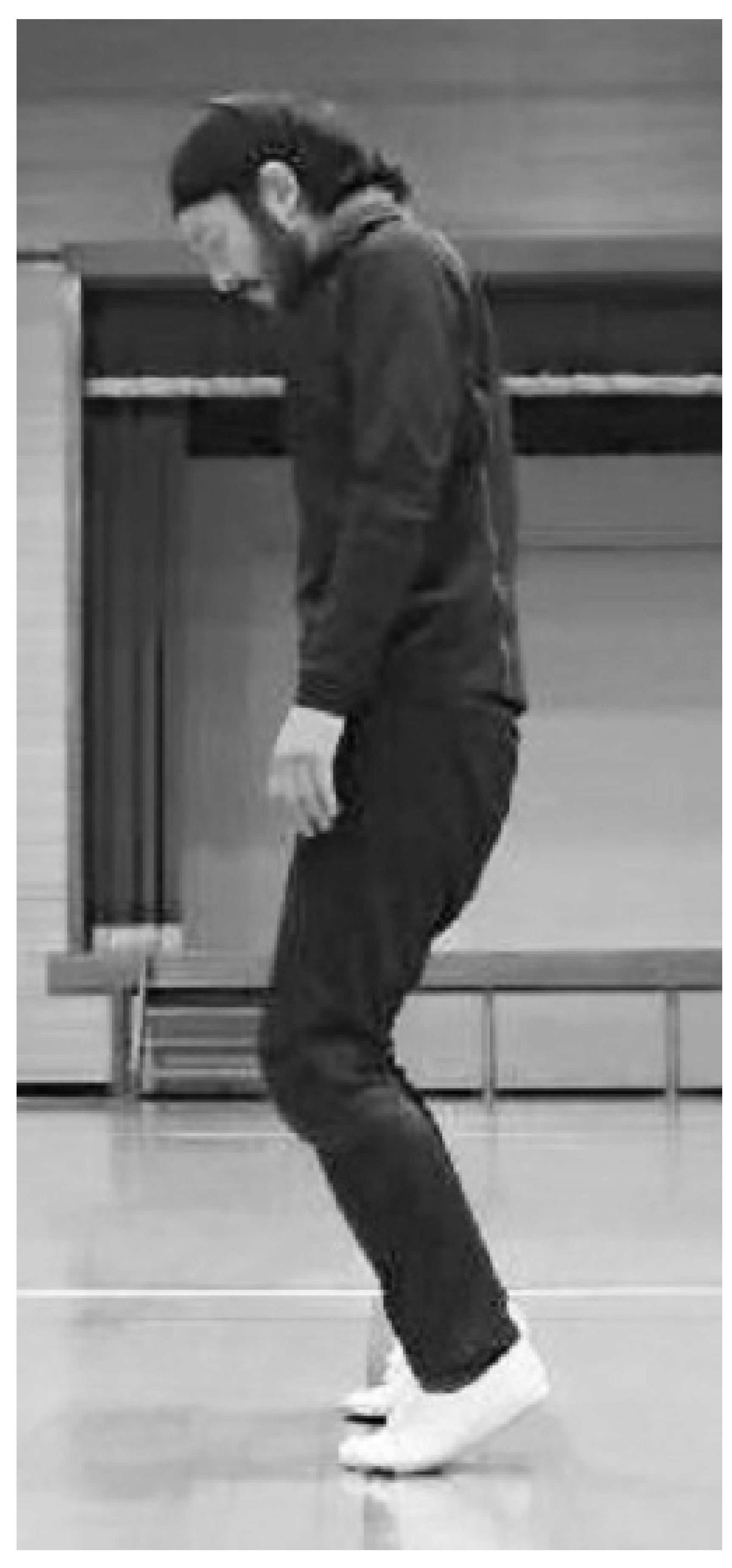
Figure 2.
The left-right direction center of gravity line toe fixation form
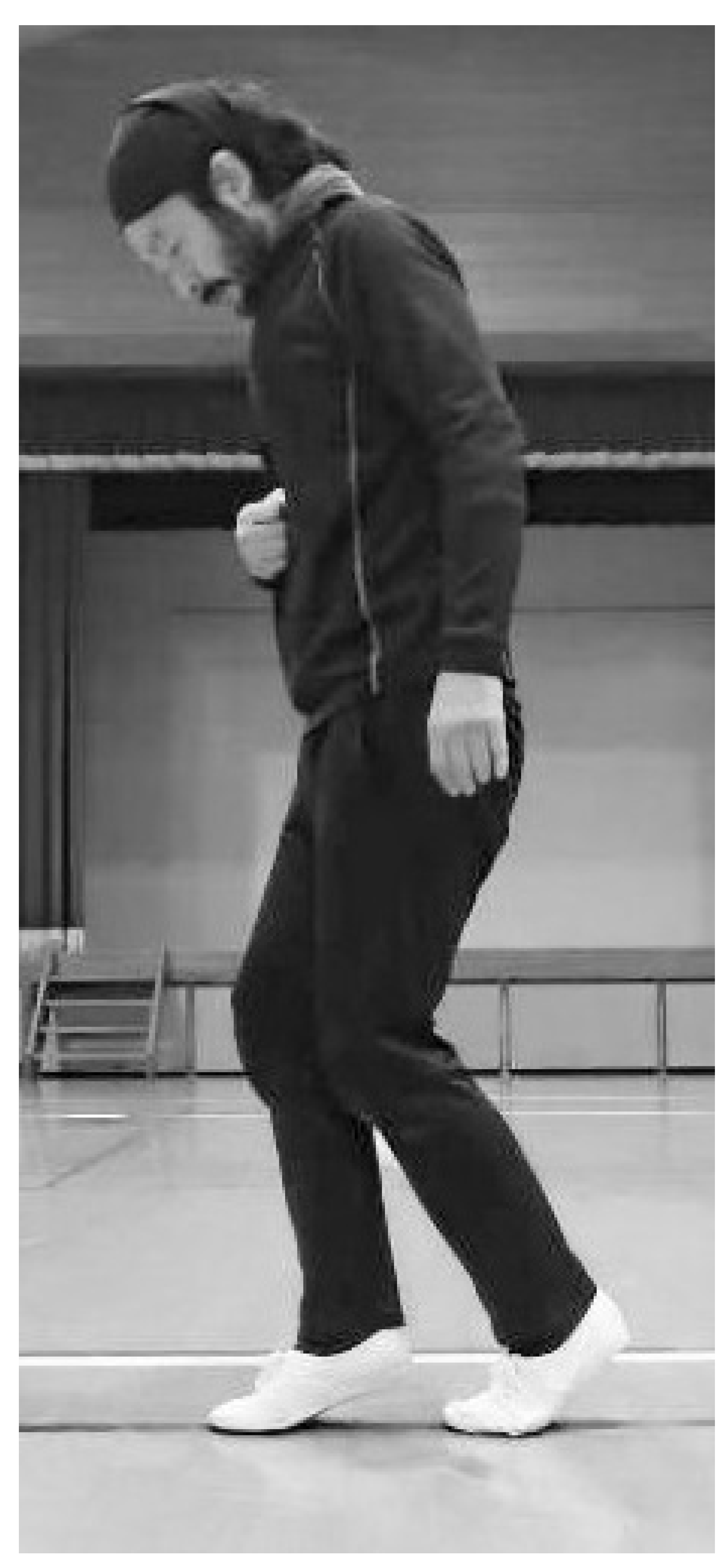
Figure 5.
Observer’s point of view. The front-back direction center of gravity line fixation method
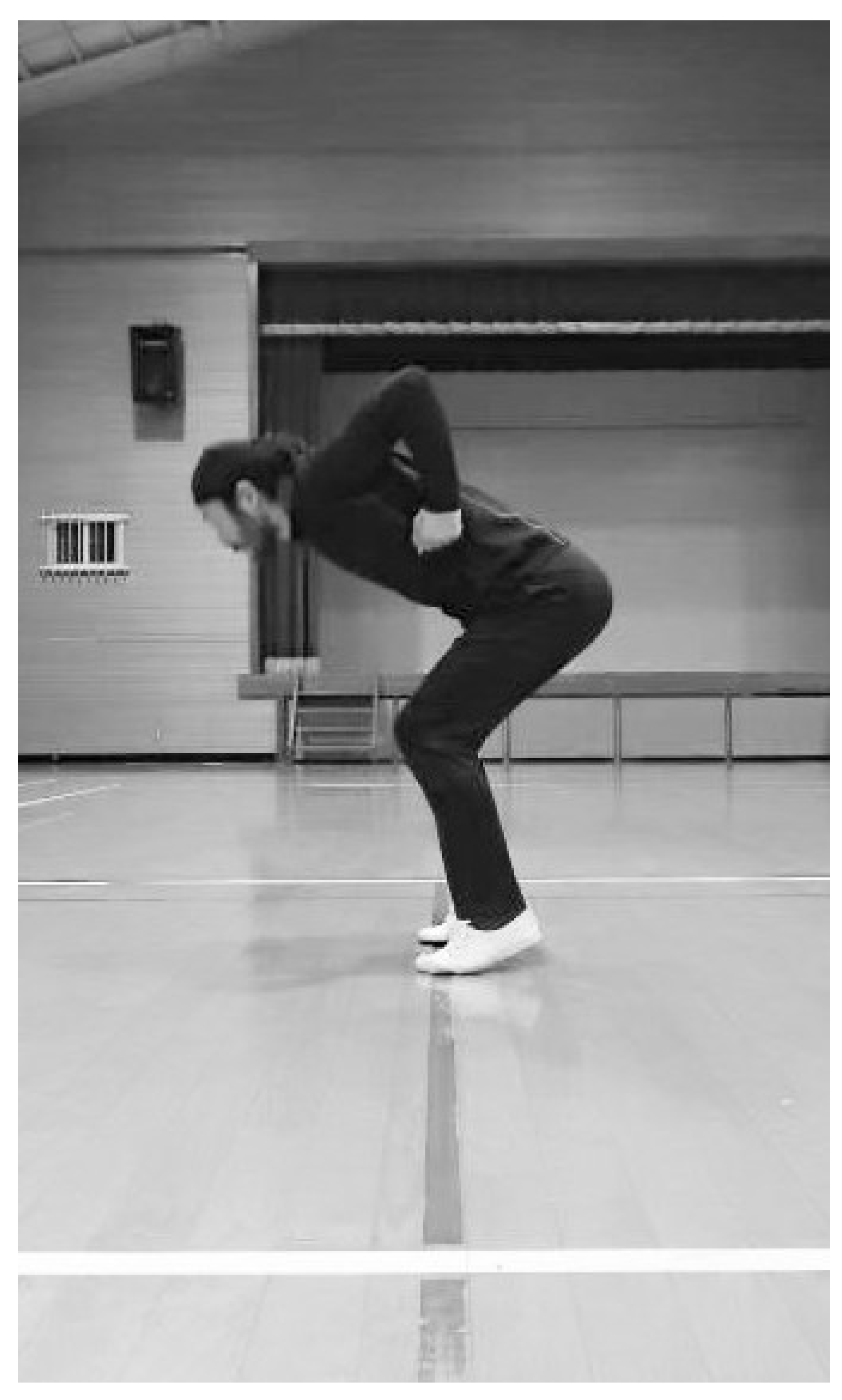
Figure 11.
The movement of the fist when the right fist is placed at the CCOG and the left fist is placed at the center of gravity. The left-right direction center of gravity line fixation method, with visualizing the center of gravity line.
Figure 11.
The movement of the fist when the right fist is placed at the CCOG and the left fist is placed at the center of gravity. The left-right direction center of gravity line fixation method, with visualizing the center of gravity line.
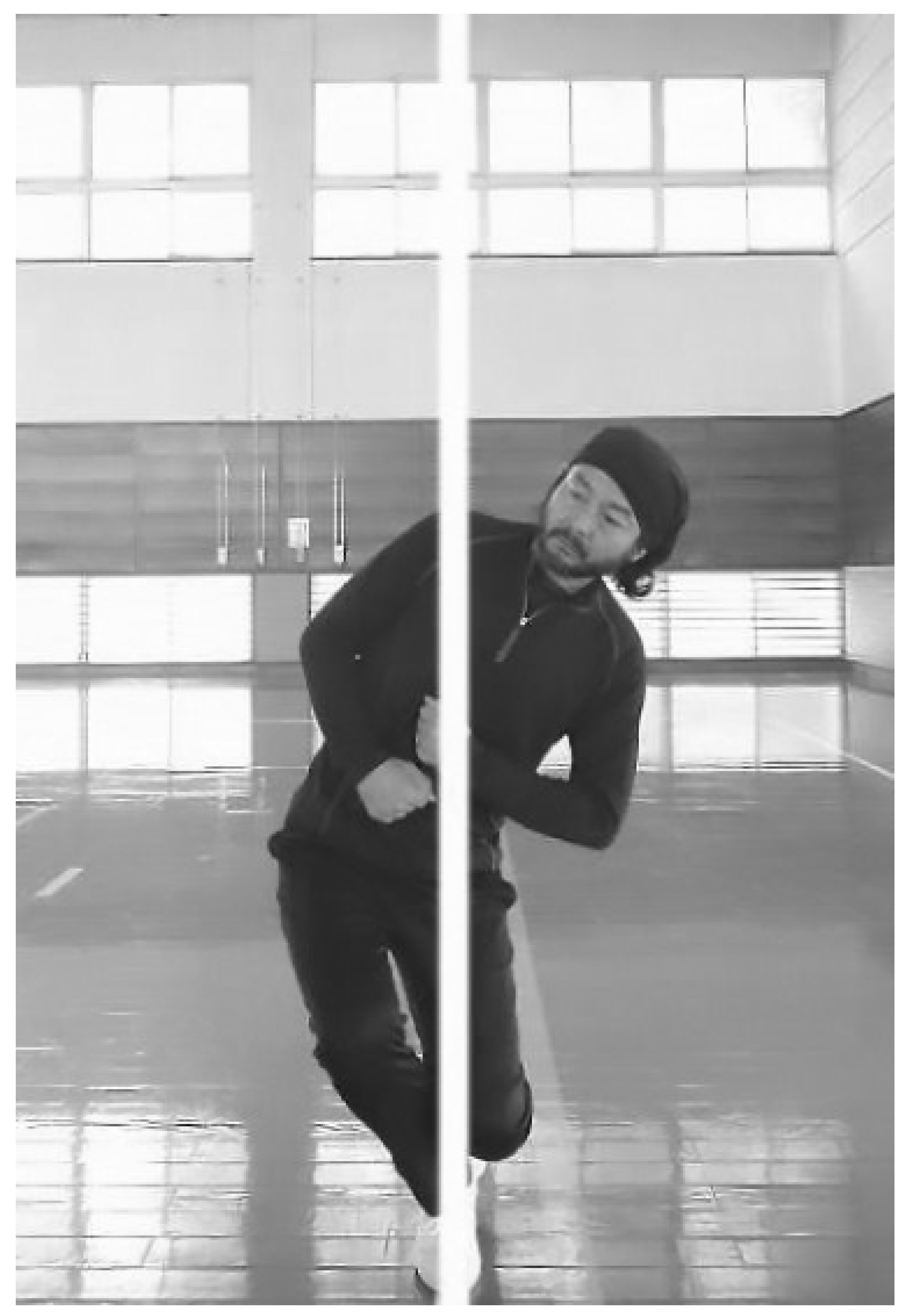
Figure 12.
The movement of the fist when the right fist is placed at the CCOG and the left fist is placed at the center of gravity. The left-right direction center of gravity line fixation method, with visualizing the center of gravity line.
Figure 12.
The movement of the fist when the right fist is placed at the CCOG and the left fist is placed at the center of gravity. The left-right direction center of gravity line fixation method, with visualizing the center of gravity line.
Disclaimer/Publisher’s Note: The statements, opinions and data contained in all publications are solely those of the individual author(s) and contributor(s) and not of MDPI and/or the editor(s). MDPI and/or the editor(s) disclaim responsibility for any injury to people or property resulting from any ideas, methods, instructions or products referred to in the content. |
© 2024 by the authors. Licensee MDPI, Basel, Switzerland. This article is an open access article distributed under the terms and conditions of the Creative Commons Attribution (CC BY) license (http://creativecommons.org/licenses/by/4.0/).
Copyright: This open access article is published under a Creative Commons CC BY 4.0 license, which permit the free download, distribution, and reuse, provided that the author and preprint are cited in any reuse.


