

Submitted:
06 November 2024
Posted:
06 November 2024
You are already at the latest version
Abstract
Agricultural food supplies, in particular raw vegetables for example with a preference of raw foods, are susceptible to contamination by several microorganisms, which may threaten human health. The regulation of the pathogenic load on foodstuffs has been a key element in food safety. Equipment such as ultraviolet radiation or microwave irradiation could effectively, easily, but partially resolve the problem of these contamination that cannot be achieved by traditional methods such as water washing at the consumer level. Ensuring the safety and quality of food through preservation is of extreme importance. However, the incomplete pasteurization might nonetheless contribute to the development of human health with a concept of hermetic effects. Here, an innovative and alternative approach for food sanitation would theoretically be introduced for the original evaluation of risks/benefits of microbiological cause related with food consumption.
Keywords:
Non-contact food decontamination
; food safety
; probiotics
; hormesis
; hermetic effect
; ultraviolet light irradiation
; microwave irradiation
1. Introduction
Leafy green vegetables such as lettuce, Cichorium endivia L., are popular plant-based foods, which could be bases of vitamins and/or other nutrients for the human life [1]. However, leafy green vegetables can be populated by various microorganisms including several pathogens. (Figure 1) The most rich bacteria of lettuce can possess about 106 colony-forming units (CFU) per gram of the raw weight [2]. In addition, E. coli, Salmonella, Cyclospora, and norovirus are harmful, for example [3]. (Figure 1 and Figure 2) The bacterial configurations may noticeably differ from that was detected at primary point because of the growth in abundance of definite bacterial taxa [4]. Furthermore, raw foods could possibly befall contaminated with several pathogens, resulting in foodborne disease upon the food consumption [5]. Contaminated foods may be an imperative cause of foodborne diseases worldwide. To diminish the risk of pathogen contamination to foods, disinfectant handlings are commonly employed [6], by which it could decrease the total microbial count on foods [7]. There are alterations of sanitation method accustomed to achieve a safe food. For example, washing with a pure clean water may be actual and vital to decrease the bacterial content on foods [8]. It has been shown that the plasma-treated water could efficiently achieve a furthermore reduction of the microbial quantity [9].
In general, fresh fruit and/or some vegetables are an imperative component of a healthy diet, which are habitually eaten raw. Because lettuce is also eaten raw, for example, a high level of food safety should be reached without damaging the raw food nutrition [10]. As some vegetables and fruits as well as their processed foodstuffs may frequently possess a considerable content of moistness, microorganisms could certainly grow for triggering worsen and/or rot [11]. So, many types of raw foods should be handled with sanitizer washes to reduce damaging organisms observed to the surface of foods [12], which may also be crucial for decreasing the risk of cross-contamination by some pathogens that may have been conveyed from human hands [13]. Developing machineries to ensure the safety of raw foods is an urgent matter from an economic and public health viewpoint. Several economic benefits could be achieved even if the used water can be reused within microbiologically safe situations [14]. Non-contact food cleansing technology characteristically employs various forms of energy to handle with foods without a physical or mechanical contact, which is frequently used for foods sterilization at the present time. For example, ultraviolet (UV) light irradiation, microwave irradiation, gamma ray irradiation, and ultrasound fields are Non-contact food cleansing technologies. Among them, UV light irradiation and microwave irradiation might be for the easy to use equipments at the consumer level. (Figure 1) In addition, refrigeration might reduce the bacterial quantity by growth inhibition except for the cold-adapted bacteria. The non-contact food cleansing technologies could also effectively inhibit the growth of microorganisms in foods, thereby extending the shelf life of food while preserving the nutrition and flavor of the foods.
In contrast, however, leaves of raw eaten herbs and/or vegetables may have good environments for many bacteria significant to human health and diseases, when eaten at mealtimes [15]. Leafy raw vegetables have been analyzed to understand the effect of microbiota composition [16]. Interestingly, probiotic bacteria such as strains of bifidobacteria and lactic acid bacteria are distinguished for their valuable effects on the gut microbiota and/or human health [17]. In addition to the health-promoting effects of probiotics, there have been some reports on their risk to develop an opportunistic pathogen [18]. One of the reason is that these species are known to get a risk of exchanging antibiotic resistant genes with other pathological microorganisms [18]. Remarkably, however, it has been shown that those Lactobacilli bacteria are determined occasionally to counteract for foodborne pathogens [19]. Here, an innovative approach for food sanitation is hypothetically introduced for the development of human health with raw foods consumption.
2. Ultraviolet Light Irradiation
Ultraviolet (UV) light is a kind of electromagnetic radiation with three forms of wavelength; UVA, 315–400 nm; UVB, 280–315 nm; UVC, 200–280 nm [20]. (Figure 1) In particular, biological action of the UVC irradiation has been recognized as a steady disinfection technique for confirming water safety [21]. Nowadays, UVC light-emitting diodes (LEDs) have opened to substitute the mercury UV lamps. Therefore, the UV LED treatment may characterize an alternative disinfection usage, which is believed sustainable, cost-effective, and friendly to environment [22]. Paralleled to biochemical disinfectant handling, the UV LED treatment guarantees a safe water supply without producing something unpleasant taste or odor [23]. In the disinfectant mechanism, dimerization of some DNA bases can obstruct their DNA replication and/or transcription, which might eventually lead to cell death. Active UVC can run through the cell membrane of various microorganisms, resulting in crosslinking between thymine and cytosine bases to the dimerization in DNA double strands [24]. Therefore, UV irradiation could instigate cell apoptosis and/or cell death in various microorganisms [25]. To increase the efficiency of the UVC-LED sterilization, it is well-known that environmental temperature and UV wavelength might be significant.
Again, the UVC is the most frequently used for removing microbial contamination from raw foods by their effectiveness [26]. In addition, UV light could degrade some toxins that might absorb UV light by photocatalytic degradation reactions [27]. Generally, the photocatalytic degradation can enhance with accumulative UV power and irradiation period [28]. In apple juice, for example, the degradation of patulin has been described at the UV power of 4500 J·cm−2 [29]. Remarkably, the antimicrobial outcome of UV irradiation usually depends on the species of microorganisms [30]. The moisture content and color of the coffee beans might stay unaffected after the UVC irradiation, but not for the pH alteration. UV light irradiation could extend the shelf life of foods by the killing efficacy to microorganisms. However, the UV light irradiation could also have some negative effects on the food itself. For example, long-term exposure to UV light could influence the flavor and/or taste of foods [31]. In addition, UV light can also abolish the natural nutrients in food, triggering it to fail its natural flavor and color [32]. Furthermore, UV light could occasionally initiate lipid peroxidation in foods, indorsing the creation of some carcinogens [33]. Remarkably, the UVC usage could obstruct the growth of lactic acid bacteria on foods, which contribute to food damage and/or rotten smells [34,35]. Therefore, applications of UV light irradiation might hold some limitations such as incomplete sterilization strength and patchy sterilization.
3. Microwave Irradiation
Microwaves are also a type of electromagnetic radiation with a wavelength range of about 1 mm–1 m and a frequency range of about 0.3–300 GHz [36]. (Figure 1) Microwave irradiation can destroy microorganisms in foods through thermal and non-thermal effects. The non-thermal effects include chemical and/or biochemical changes [37]. The thermal effect of microwave irradiation in foods performs to be prevailing, in which the mechanism of microwave irradiation generates heat [38]. Consequently, microwave heating can change the formation of proteins, enzymes, lipids, and nucleic acids, which could induce cell death [39]. Therefore, the microwave irradiation equipment is nowadays commonly employed not only for foods sterilization but also for various food processing applications [40]. In actual, microwave irradiation usage for 20 second usually decreases the spore amounts of A. parasiticus on brown rice [41]. Similarly, after 15 second of microwave irradiation, Microdochium nivale and Fusarium spp. in wheat reduced by about 70% [42]. In addition, microwave irradiation commonly declines the cell counts of various microorganisms in the irradiation handled samples [43].
In general, microwave irradiation has some benefits including controllability and eminent effectiveness, by which it has broadly been used in foods. The effect of microwave irradiation in the microwave recipient cavity may result in comparatively cold and/or hot spots allocations in the microwave heating [44]. In the rather cold places, it might happen to run to incomplete killing of several heat-resistant microorganisms in foods, putting a considerable risk of theoretically pathogenic restoration by the still living microorganism. In the relatively hot places, on the other hand, it could trigger to change or degrade the color, smell, and/or nutrition, decreasing the quality of foods by the microwave irradiation [45]. This inconvenience may be alleviated by changing the position or rotating with the food samples being handled for optimizing heat activity by the microwave irradiation. It is imperative to notice that hot and/or cold places instigated by patchy microwave heating could direct to lower quality of foods after the excess microwave irradiation [46]. Hence, selecting the proper time and power of microwave irradiation might be of great importance. Moreover, the temperature distribution in the recipient cavity of the microwave irradiation could be affected by the food individualities and the frequency of microwave [47]. As for the merits of microwave irradiation, it could relatively preserve some food ingredients such as phenols, chlorogenic acid and/or ascorbic acid rather than that by deep frying [48,49]. Therefore, again, applications of microwave irradiation might also retain some limitations such as incomplete sterilization strength and irregular sterilization.
4. Hormesis Concept with a Positive Gut Microbiota
The gut microbiota is a kind of complex system of various microorganisms in the gastrointestinal tract, which has been recognized for its contributions to human health and disease. Influenced by factors such as lifestyle, microbiota composition is subject to modification. Some bacterial species might contribute to the development of homeostasis during aging and the age-related diseases via the alteration in gut microbial communities [50]. The gastrointestinal tract accommodates the maximum number of microbes, being collectively called the gut microbiota [51]. The gut microbiota might have its own homeostasis. For example, diet and exercise could modify the gut microbiota. A positive modulation of microbiota could link to the good quality of life (QOL) [52]. In this meaning, raw green leafy vegetables could also contribute to the alteration of gut microbiota, as they may contain several microorganisms on their surface for the positive modification of gut microbiota. In addition, leafy green vegetables have inorganic nitrate, an anion with potential prebiotic effects on the microbiome [53]. The positive microbiota may serve as a safeguard against various pathologies such as inflammatory bowel disease and metabolic syndrome associated with gut dysbiosis [54]. It has been shown that several functional foods can support gut microbiota by promoting microbiota flexibility [53, 54].
The hormetic responses from dietary interventions may be of importance for improving gut resilience. The hormesis is a biphasic dose response phenomenon, wherein exposure to low levels of stressors induces adaptive responses that confer resistance to subsequent stressful challenges [55]. Harnessing the potential benefits of hormetic responses from dietary components may open avenues for developing strategies to prime the gut resilience and thus promote overall well-being of the host. (Figure 2) Probiotics are defined as “live microorganisms that can grant health benefits to the host” [56]. The most common probiotics include strains of bacteria, such as Lactobacillus and Bifidobacterium, and yeast like S. boulardii [57]. (Figure 1 and Figure 2) The proposed mechanisms underlying the effects of health benefits of probiotics involve alterations in the composition and function of the intestinal microbiome. A plant leaf surface may represent a microbial ecosystem of substantial mass, holding amazing diversity [58]. These phyllosphere-associated microbial populations could play roles not only for the well-being of plants but also for that of people who eat this vegetation including leafy green vegetables. Unfortunately, again, such consumption of raw vegetables occasionally conveys an increased risk of foodborne diseases due to excess incorporation of pathogenic microorganisms to humans [3,59]. As mentioned above, however, not all microorganisms on the vegetable are unsafe to humans. In fact, the concept of the edible microbiota is based on the idea that with the incorporation of raw plant foods. People could load our gut with positive microbes that attach to these foods which might possess probiotic abilities [60]. For example, the lactic acid bacteria are commonly found on the edible leaf surfaces [61]. Many of these bacteria confer health benefits to humans. In addition, the plant-associated bacterium Lactobacillus plantarum can survive gastrointestinal conditions and endure via adherence to gut epithelial cells [62]. While mild stress is beneficial in the form of the ability to adapt to the place, high levels of the stressors could cause cell death. This diffident amount of oxidative stress often occurs in the microbe environment [63], such as non-contact food sanitation. (Figure 2) In addition, nutrients or metabolites produced by the gut microbiota could also act for metabolic perturbations of gut epithelial cells [64]. Interestingly, a treatment with curcumin may significantly alter the ratio between positive and negative/pathogenic bacterial strains by increasing the growth of Bifidobacteria/Lactobacilli and reducing the masses of Enterobacteria/Enterococci in the gut microbiota [65]. The capacity of the lactobacilli to induce redox signaling in gut epithelial cells is a preserved hormetic adaptation to compel cellular acclimatizing to exogenous stimuli [66]. In addition, the hormetic effects for anti-inflammation have been noticed in various bioactive compounds [67], which could frequently be involved in the modification of gut microbiota [68]. The dynamic crosslinking between gut microbiota and inflammation has been shown during aging by the hormetic effects [50,69]. Further study into the edible microbiome may uncover additional probiotic strains which could have an impact of hormesis on human health [70].
5. Hormesis Beneficial for Human Health
The nutritional therapeutic approach by means of hormetic nutrients in synergy with probiotics is appealing huge interest to the scientific community for preventing inflammation associated to pathophysiological alterations in the gut dysbiosis [71,72]. For example, probiotics in combination with the use of polyphenols may bring a pliability to several inflammation [73]. Along with the hermetic effects, the dose is a critical factor for encouraging protective/positive or harmful/negative effects to the target with nutritional therapies. The hormesis is conveyed via the incidence of dose responses that are biphasic with a low dose boost and a high dose inhibition. Interestingly, the low dose stimulating responses may result in enhanced stress adaptive ability as an anti-inflammatory effect. Applicant species of alive bacteria on raw vegetables or foods could exhibit healthy effects to the host for an innovative nutritional approach via the modification of gut microbiota [74]. Remarkably, it has been shown that some bacteria such as Bifidobacterium sp. and/or Lactobacillus sp. could improve/enhance memory, cognition and/or some behaviors in a wide range of neurological diseases including anxiety and depression [75]. Through the activation of Nrf2 signaling in neuronal cells, a low amount of hormetic nutrients intake including probiotics can promote gut and/or brain healthy effects [76]. Hermetic nutritional therapy through probiotics that interact with DNAs as epigenetics could also represent a complementary and alternative approach for human health [77].
In general, many hormetic papers have subsequently been recognized via the use of different search strategies. For example, rosmarinic acid can broadly induce hormetic dose responses, which is found in numerous fruits and vegetables, and examined in clinical trials for therapeutic applications [78]. Besides, the evaluation of the hormetic effects from rosmarinic acid in their public health suggestions has been described [78]. Therefore, rosmarinic acid has become commonly used as a dietary supplement. The hormetic responses have noteworthy generalization, being independent of the molecules, microbes, plants, and animals [79], in addition to their specific mechanisms [80]. Many valuable hormetic effects including cell protection and lifespan extension have been associated with the low dose use of various chemical and/or biological agents [81]. Interestingly, the dose responses pattern with Crocus sativus L. (saffron), an anti-inflammation agent against oxidative stress, may be acting within the hormetic response framework [82]. Furthermore, several dietary nutrients including vitamins, polyphenols, and probiotics could follow the concept of this hormesis. According to this concept, low doses of food nutrients are cell protective by activating Nrf2 antioxidant pathways to induce anti-inflammatory activities, while high doses of nutrients may result in toxic and/or induce the inhibition of those protective pathways [83]. The hormesis may be able to orchestrate cellular flexibility to stress and/or inflammation for maintaining the cellular redox homeostasis [83]. The field of hormetic responses is now emerging as promising therapeutic and/or preventive approach in several diseases/disorders [83]. Consequently, hormetic probiotics can be considered promising therapeutic agents capable of reestablishing gut homeostasis and human health. A profound understanding of the function and composition of gut microbiota as well as their modulation through the hormetic responses could furthermore support human well-being.
6. Discussion
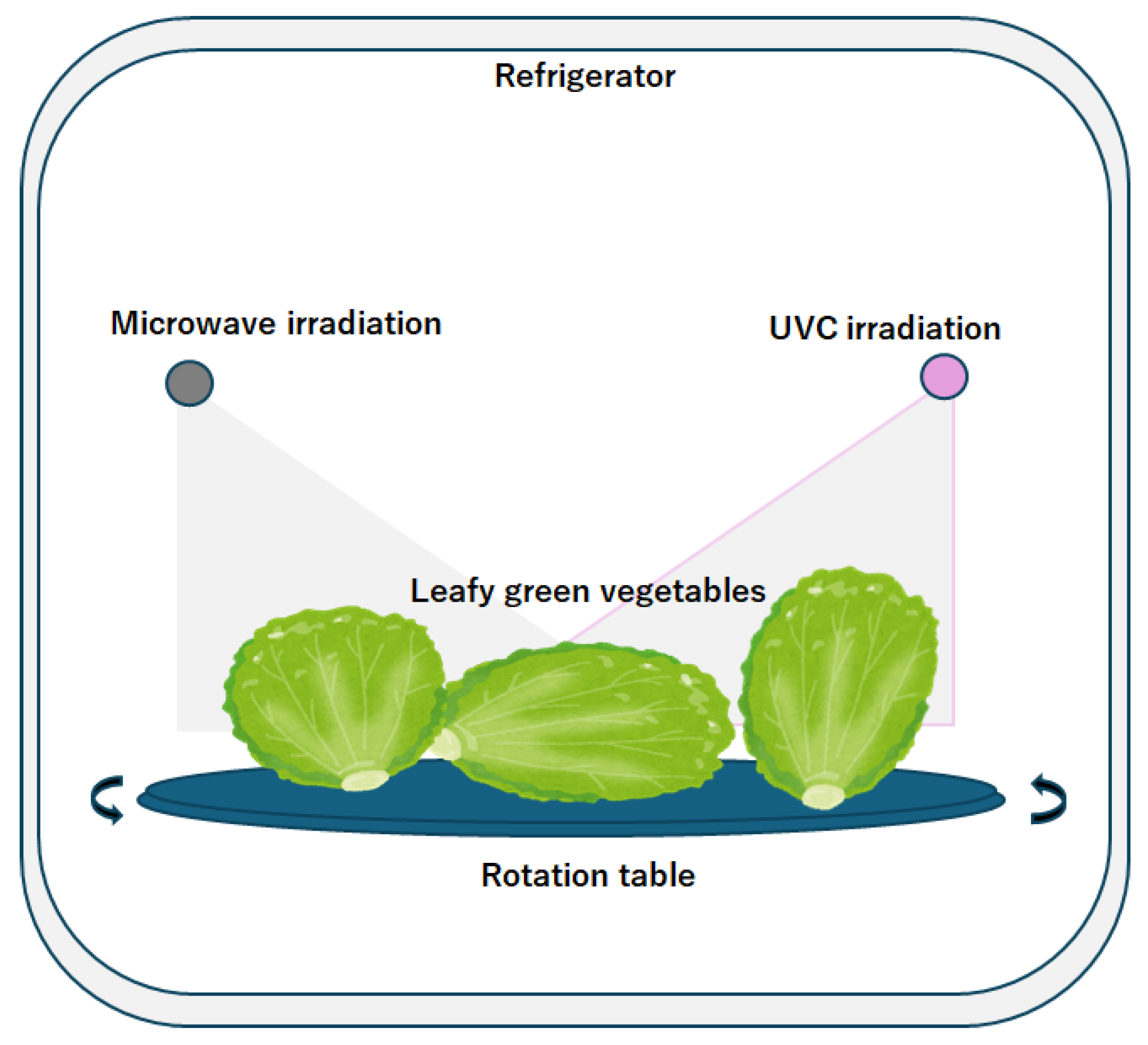
Food contamination by several negative microorganisms is a major challenge to food safety related to public health concern. The non-contact food decontamination methods such as ultraviolet irradiation and/or microwave irradiation have advantages of easy to use and considerable effectiveness compared with the conventional methods. Generally, ultraviolet irradiation is appropriate for decontaminating liquid products, whereas microwave irradiation may be effective for fruit, vegetables, and their processed products. The use of these devices should set for minimizing damage to the nutritional and sensory quality of the treated food. Taken together, a hypothetical device has been shown as a demonstration. (Figure 3) In the future, it would be required to explore the comprehensive treatment technology further combining non-contact sanitary methods for enhancing adaptability to different food matrices [84,85].
Hormetic nutrition is a new concept that developed from the wide-ranging research on the existence of hormesis in the biomedical and/or biochemical sciences, particularly in the fields of nutrition/diet science. Based on the concept of hormesis, high dose of positive probiotics could nevertheless be toxic to cell, animal and/or humans directing to the progression of several diseases/disorders linked with inflammation and oxidative stress. Some probiotics activating intracellular signaling molecules involved in the cellular stress responses could represent an innovative strategy to counteract the inflammation and oxidative stress. In fact, alterations in the gut microbiota due to the certain probiotic consumption can improve the stress responses in humans [86,87]. Therefore, it might be almost worthless to handle with raw foods for the complete sterilization in spite of considerable loss of nutrition, if the raw foods possibly possess beneficial substance/bacteria for positive prebiotics/probiotics. However, there are still many issues that require further investigation.
7. Conclusions
Some devices such as ultraviolet radiation or microwave irradiation could easily and partially resolve the problem of the contamination of various microorganisms. Although warranting the safety and quality of food is of importance, the incomplete pasteurization might nevertheless contribute to the development of human health with hermetic effects.
Author Contributions
Conceptualization, MN, AF, and SM; original draft preparation and editing, MN, AF, and SM; visualization, MN, and SM; supervision, SM. Each author (MN, AF, and SM) has participated sufficiently in this work of drafting the article and/or revising the article for the important rational content. Then, all authors gave final approval of the version to be submitted.
Funding
This research received no external funding.
Institutional Review Board Statement
Not applicable.
Informed Consent Statement
Not applicable.
Data Availability Statement
Not applicable.
Acknowledgments
A special thanks to all the members in Matsuda’s lab for sincerely assisting with the search of this meta-analysis and consultation in the drafting of this manuscript. The project was partially supported by Nara Women’s University of Japan.
Conflicts of Interest
The authors declare that they have no competing financial interests.
Abbreviations
| CFU | colony-forming units |
| LED | light-emitting diode |
| QOL | quality of life |
| ROS | reactive oxygen species |
| UV | ultraviolet |
| UVA | ultraviolet-A |
| UVB | ultraviolet-B |
| UVC | ultraviolet-C |
References
- Cardinale, M.; Grube, M.; Erlacher, A.; Quehenberger, J.; Berg, G. Bacterial networks and co-occurrence relationships in the lettuce root microbiota. Environ. Microbiol. 2015, 17, 239–252. [CrossRef]
- Williams, T.R.; Moyne, A.L.; Harris, L.J.; Marco, M.L. Season, irrigation, leaf age, and Escherichia coli inoculation influence the bacterial diversity in the lettuce phyllosphere. PLoS ONE. 2013, 8, e68642. [CrossRef]
- Machado-Moreira, B.; Richards, K.; Brennan, F.; Abram, F.; Burgess, C.M. Microbial contamination of fresh produce: what, where, and how? Compr Rev Food Sci Food Saf. 2019, 18, 1727–1750. [CrossRef]
- Shang, H.; Tan, B.Z.; Dakwa, V.; D’Agnese, E.; Stanley, R.A.; Sassi, H.; Lai, Y.W.; Deaker, R.; Bowman, J.P. Effect of pre-harvest sanitizer treatments on Listeria survival, sensory quality and bacterial community dynamics on leafy green vegetables grown under commercial conditions. Food Res Int. 2023, 173, 113341. [CrossRef]
- Olaimat, A.N.; Holley, R.A. Factors influencing the microbial safety of fresh produce: a review. Food Microbiol. 2012, 32, 1–19. [CrossRef]
- Paramithiotis, S.; Drosinos, E.H.; Skandamis, P.N. Microbial ecology of fruits and fruit-based products. In Sant’Ana ADS (ed), Quantitative microbiology in food processing: modeling the microbial ecology. 2016, 358–381.
- Rose, D.; Bianchini, A.; Martinez, B.; Flores, R. Methods for reducing microbial contamination of wheat flour and effects on functionality. Cereal Foods World. 2012, 57, 104. [CrossRef]
- Najafi, M.B.H.; Khodaparast, M.H. Efficacy of ozone to reduce microbial populations in date fruits. Food. Control. 2009, 20, 27–30. [CrossRef]
- Winter, H.; Wagner, R.; Ehlbeck, J.; Urich, T.; Schnabel, U. Deep Impact: Shifts of Native Cultivable Microbial Communities on Fresh Lettuce after Treatment with Plasma-Treated Water. Foods. 2024, 13, 282. [CrossRef]
- Schnabel, U.; Handorf, O.; Winter, H.; Weihe, T.; Weit, C.; Schäfer, J.; Stachowiak, J.; Boehm, D.; Below, H.; Bourke, P. The effect of plasma treated water unit processes on the food quality characteristics of fresh-cut endive. Front. Nutr. 2021, 7, 627483. [CrossRef]
- Ngolong, Ngea, G.L.; Qian, X.; Yang, Q.; Dhanasekaran, S.; Ianiri, G.; Ballester, A.R.; Zhang, X.; Castoria, R.; Zhang, H. Securing fruit production: Opportunities from the elucidation of the molecular mechanisms of postharvest fungal infections. Compr. Rev. Food Sci. Food Saf. 2021, 20, 2508–2533. [CrossRef]
- Gombas, D.; Luo, Y.; Brennan, J.; Shergill, G.; Petran, R.; Walsh, R.; Hau, H.; Khurana, K.; Zomorodi, B.; Rosen, J.; Varley, R.l.; Deng, K. Guidelines to validate control of cross-contamination during washing of fresh-cut leafy vegetables. J Food Prot. 2017, 80, 312–330.
- Luo, Y.G.; Nou, X.W.; Millner, P.; Zhou, B.; Shen, C.L.; Yang, Y.; Wu, Y.P.; Wang, Q.; Feng, H.; Shelton, D. A pilot plant scale evaluation of a new process aid for enhancing chlorine efficacy against pathogen survival and cross-contamination during produce wash. Int J Food Microbiol 2012, 158, 133–139. [CrossRef]
- Yoon, S.R.; Ha, S.; Park, B.; Yang, J.S.; Dang, Y.M.; Ha, J.H. Effect of Ultraviolet-C Light-Emitting Diode Treatment on Disinfection of Norovirus in Processing Water for Reuse of Brine Water. Front Microbiol. 2022, 13, 885413. [CrossRef]
- Patz, S.; Witzel, K.; Scherwinski, A.C.; Ruppel, S. Culture Dependent and Independent Analysis of Potential Probiotic Bacterial Genera and Species Present in the Phyllosphere of Raw Eaten Produce. Int J Mol Sci. 2019, 20, 3661. [CrossRef]
- Gil, M.I.; Selma, M.V.; Suslow, T.; Jacxsens, L.; Uyttendaele, M.; Allende, A. Pre- and postharvest preventive measures and intervention strategies to control microbial food safety hazards of fresh leafy vegetables. Crit. Rev. Food Sci. Nutr. 2015, 55, 453–468. [CrossRef]
- Kerry, R.G.; Patra, J.K.; Gouda, S.; Park, Y.; Shin, H.S.; Das, G. Benefaction of probiotics for human health: A review. J. Food Drug Anal. 2018, 26, 927–939. [CrossRef]
- Doron, S.; Snydman, D.R. Risk and safety of probiotics. Clin. Infect. Dis. 2015, 60, S129–S134. [CrossRef]
- Ayala D.I.; Cook, P.W.; Franco, J.G.; Bugarel, M.; Kottapalli, K.R.; Loneragan, G.H.; Brashears, M.M.; Nightingale, K.K. A systematic approach to identify and characterize the effectiveness and safety of novel probiotic strains to control foodborne pathogens. Front. Microbiol. 2019, 10, 1108. [CrossRef]
- Nguyen, T.; Palmer, J.; Loo, T.; Shilton, A.; Petcu, M.; Newson, H.L.; Flint, S. Investigation of UV light treatment (254 nm) on the reduction of aflatoxin M1 in skim milk and degradation products after treatment. Food Chem. 2022, 390, 133165. [CrossRef]
- Chatterley, C.; Linden, K. Demonstration and evaluation of germicidal UV-LEDs for point-of-use water disinfection. J. Water Health. 2010, 8, 479–486. [CrossRef]
- Korovin, E.; Selishchev, D.; Besov, A.; Kozlov, D. UV-LED TiO2 photocatalytic oxidation of acetone vapor: effect of high frequency controlled periodic illumination. Appl Catal B. 2015, 163, 143–149. [CrossRef]
- Ibrahim, M. A.; MacAdam, J.; Autin, O.; Jefferson, B. Evaluating the impact of LED bulb development on the economic viability of ultraviolet technology for disinfection. Environ.Technol. 2014, 35, 400–406. [CrossRef]
- Jiang, N.; Li, Z.; Wang, L.; Li, H.; Zhu, X.; Feng, X.; Wang, M. Effects of ultraviolet-c treatment on growth and mycotoxin production by Alternaria strains isolated from tomato fruits. Int. J. Food Microbiol. 2019, 311, 108333. [CrossRef]
- Jin, Z.; Wang, Y.C. Mitigating fungal contamination of cereals: The efficacy of microplasma-based far-UVC lamps against Aspergillus flavus and Fusarium graminearum. Food Res. Int. 2024, 190, 114550. [CrossRef]
- Sonntag, F.; Liu, H.; Neugart, S. Nutritional and physiological effects of postharvest UV radiation on vegetables: A review. J. Agric. Food Chem. 2023, 71, 9951–9972. [CrossRef]
- Akhila, P.P.; Sunooj, K.V.; Aaliya, B.; Navaf, M.; Sudheesh, C.; Sabu, S.; Sasidharan, A.; Mir, S.A.; George, J.; Mousavi Khaneghah, A. Application of electromagnetic radiations for decontamination of fungi and mycotoxins in food products: A comprehensive review. Trends Food Sci. Technol. 2021, 114, 399–409. [CrossRef]
- Mo, Z.M.; Chen, N.Z.; Ning, R.; Wang, J.; Wang, H.B.; Wei, L.M. Degradation of aflatoxin B1 in peanut oil by ultraviolet LED cold-light technology. China Oils Fats. 2019, 44, 83–88.
- Nicolau-Lapeña, I.; Rodríguez-Bencomo, J.J.; Colás-Medà, P.; Viñas, I.; Sanchis, V.; Alegre, I. Ultraviolet applications to control patulin produced by Penicillium expansum CMP-1 in apple products and study of further patulin degradation products formation and toxicity. Food Bioprocess Technol. 2023, 16, 804–823. [CrossRef]
- Byun, K.H.; Park, S.Y.; Lee, D.U.; Chun, H.S.; Ha, S.D. Effect of UV-C irradiation on inactivation of Aspergillus flavus and Aspergillus parasiticus and quality parameters of roasted coffee bean (Coffea arabica L.) Food Addit. Contam. Part A. 2020, 37, 507–518.
- Martin, N.; Carey, N.; Murphy, S.; Kent, D.; Bang, J.; Stubbs, T.; Wiedmann, M.; Dando, R. Exposure of fluid milk to LED light negatively affects consumer perception and alters underlying sensory properties. J. Dairy Sci. 2016, 99, 4309–4324. [CrossRef]
- Soro, A.B.; Shokri, S.; Nicolau-Lapeña, I.; Ekhlas, D.; Burgess, C.M.; Whyte, P.; Bolton, D.J.; Bourke, P.; Tiwari, B.K. Current challenges in the application of the UV-LED technology for food decontamination. Trends Food Sci. Technol. 2023, 131, 264–276. [CrossRef]
- Fan, L.; Liu, X.; Dong, X.; Dong, S.; Xiang, Q.; Bai, Y. Effects of UVC light-emitting diodes on microbial safety and quality attributes of raw tuna fillets. LWT. 2021, 139, 110553. [CrossRef]
- Peng, K.; Koubaa, M.; Bals, O.; Vorobiev, E. Recent insights in the impact of emerging technologies on lactic acid bacteria: A review. Food Res Int. 2020, 137, 109544. [CrossRef]
- Brugnini, G.; Rodríguez, S.; Rodríguez, J.; Rufo, C. Effect of UV-C irradiation and lactic acid application on the inactivation of Listeria monocytogenes and lactic acid bacteria in vacuum-packaged beef. Foods. 2021, 10, 1217. [CrossRef]
- Pankaj, S.K.; Shi, H.; Keener, K.M. A review of novel physical and chemical decontamination technologies for aflatoxin in food. Trends Food Sci. Technol. 2018, 71, 73–83. [CrossRef]
- Guo, C.; Wang, Y.; Luan, D. Study the synergism of microwave thermal and non-thermal effects on microbial inactivation and fatty acid quality of salmon fillet during pasteurization process. LWT. 2021, 152, 112280. [CrossRef]
- Cao, Y.R.; Wu, R.Z.; Rao, J.Y.; Yang, M.J.; Han, G.Q. Advances in the application of microwave and combined sterilization technology in foods. J. Microbiol. 2023, 43, 113–120.
- Cao, H.; Wang, X.; Liu, J.; Sun, Z.; Yu, Z.; Battino, M.; El-Seedi, H.; Guan, X. Mechanistic insights into the changes of enzyme activity in food processing under microwave irradiation. Compr. Rev. Food Sci. Food Saf. 2023, 22, 2465–2487. [CrossRef]
- Patil, H.; Shah, N.; Hajare, S.; Gautam, S.; Kumar, G. Combination of microwave and gamma irradiation for reduction of aflatoxin B1 and microbiological contamination in peanuts (Arachis hypogaea L.) World Mycotoxin J. 2019, 12, 269–280.
- Lee, H.J.; Ryu, D. Worldwide Occurrence of Mycotoxins in Cereals and Cereal-Derived Food Products: Public Health Perspectives of Their Co-occurrence. J. Agric. Food Chem. 2017, 65, 7034–7051. [CrossRef]
- Knox, O.G.G.; McHugh, M.J.; Fountaine, J.M.; Havis, N.D. Effects of microwaves on fungal pathogens of wheat seed. Crop Prot. 2013, 50, 12–16. [CrossRef]
- Popelářová, E.; Vlková, E.; Švejstil, R.; Kouřimská, L. The effect of microwave irradiation on the representation and growth of moulds in nuts and almonds. Foods. 2022, 11, 221. [CrossRef]
- Zhou, M.C.; Li, S.F. Multi-feed microwave heating temperature control system based on numerical simulation. IEEE J. Microw. 2019, 35, 92–96.
- Zheng, X.Z.; Zhang, Y.H.; Liu, C.H.; Shen, L.Y.; Zhao, X.L.; Xue, L.L. Research progress in the microwave technologies for food stuffs and agricultural products. TCSAE. 2024, 40, 14–28.
- Geedipalli, S.S.R.; Rakesh, V.; Datta, A.K. Modeling the heating uniformity contributed by a rotating turntable in microwave ovens. J. Food Eng. 2007, 82, 359–368. [CrossRef]
- Wang, R.; Zhang, M.; Mujumdar, A.S.; Jiang, H. Effect of salt and sucrose content on dielectric properties and microwave freeze drying behavior of re-structured potato slices. J. Food Eng. 2011, 106, 290–297. [CrossRef]
- Tian, J.; Chen, J.; Lv, F.; Chen, S.; Chen, J.; Liu, D.; Ye, X. Domestic cooking methods affect the phytochemical composition and antioxidant activity of purple-fleshed potatoes. Food Chem. 2016, 197, 1264–1270. [CrossRef]
- Fan, L.P.; Zhang, M.; Mujumdar, A.S. Vacuum frying of carrot chips. Dry. Technol. 2005, 23, 645–656. [CrossRef]
- Chaudhary, S.; Kaur, P.; Singh, T.A.; Bano, K.S.; Vyas, A.; Mishra, A.K.; Singh, P.; Mehdi, M.M. The dynamic crosslinking between gut microbiota and inflammation during aging: reviewing the nutritional and hormetic approaches against dysbiosis and inflammaging. Biogerontology. 2024, 26, 1. [CrossRef]
- Tap, J.; Mondot, S.; Levenez, F.; Pelletier, E.; Caron, C.; Furet, J.P.; Ugarte, E.; Muñoz-Tamayo, R.; Paslier, D.L.; Nalin, R. Towards the human intestinal microbiota phylogenetic core. Environ. Microbiol. 2009, 11, 2574–2584. [CrossRef]
- Strasser, B.; Wolters, M.; Weyh, C.; Krüger, K.; Ticinesi, A. The effects of lifestyle and diet on gut microbiota composition, inflammation and muscle performance in our aging society. Nutrients. 2021, 13, 2045. [CrossRef]
- du, Toit, L.; Sundqvist, M.L.; Redondo-Rio, A.; Brookes, Z.; Casas-Agustench, P.; Hickson, M.; Benavente, A.; Montagut, G.; Weitzberg, E.; Gabaldón, T.; Lundberg, J.O.; Bescos, R. The Effect of Dietary Nitrate on the Oral Microbiome and Salivary Biomarkers in Individuals with High Blood Pressure. J Nutr. 2024, 154, 2696-2706.
- Dogra, S.K.; Doré, J.; Damak, S. Gut Microbiota Resilience: Definition, Link to Health and Strategies for Intervention. Front. Microbiol. 2020, 11, 572921. [CrossRef]
- Mattson, M.P. Dietary factors, hormesis and health. Ageing Res. Rev. 2008, 7, 43–48. [CrossRef]
- Gibson, G.R.; Hutkins, R.; Sanders, M.E.; Prescott, S.L.; Reimer, R.A.; Salminen, S.J.; Scott, K.; Stanton, C.; Swanson, K.S.; Cani, P.D.; Verbeke, K.; Reid, G. Expert consensus document: The International Scientific Association for Probiotics and Prebiotics (ISAPP) consensus statement on the definition and scope of prebiotics. Nat. Rev. Gastroenterol. Hepatol. 2017, 14, 491–502. [CrossRef]
- Doar, N.W.; Samuthiram, S.D. Qualitative Analysis of the Efficacy of Probiotic Strains in the Prevention of Antibiotic-Associated Diarrhea. Cureus. 2023, 15, e40261. [CrossRef]
- Rangel, L.I.; Leveau, J.H.J. Applied microbiology of the phyllosphere. Appl Microbiol Biotechnol. 2024, 108, 211. [CrossRef]
- Pogreba-Brown, K.; Austhof, E.; Armstrong, A.; Schaefer, K.; Villa, Zapata, L.; McClelland, D.J.; Batz, M.B.; Kuecken, M.; Riddle, M.; Porter, C.K.; Bazaco, MC. Chronic Gastrointestinal and Joint-Related Sequelae Associated with Common Foodborne Illnesses: A Scoping Review. Foodborne Pathog Dis. 2020, 17, 67-86. [CrossRef]
- Soto-Giron, M.J.; Kim, J.N.; Schott, E.; Tahmin, C.; Ishoey, T.; Mincer, T.J.; DeWalt, J.; Toledo, G. The edible plant microbiome represents a diverse genetic reservoir with functional potential in the human host. Sci Rep. 2021, 11, 1–14. [CrossRef]
- Yu, A.O.; Leveau, J.H.J.; Marco, M.L. Abundance, diversity and plant-specific adaptations of plant-associated lactic acid bacteria. Environ Microbiol Rep. 2020, 12, 16–29. [CrossRef]
- Vitali, B.; Minervini, G.; Rizzello, C.G.; Spisni, E.; Maccaferri, S.; Brigidi, P.; Gobbetti, M.; Di, Cagno, R. Novel probiotic candidates for humans isolated from raw fruits and vegetables. Food Microbiol. 2012, 31, 116–125. [CrossRef]
- Bombaywala, S.; Purohit, H.J.; Dafale, N.A. Mobility of antibiotic resistance and its co-occurrence with metal resistance in pathogens under oxidative stress. J Environ Manage. Nov. 2021, 297, 113315. [CrossRef]
- Guerbette, T.; Boudry, G.; Lan, A. Mitochondrial function in intestinal epithelium homeostasis and modulation in diet-induced obesity. Mol. Metab. 2022, 63, 101546. [CrossRef]
- Zam, W. Gut microbiota as a prospective therapeutic target for curcumin: A review of mutual influence. J. Nutr. Metab. 2018, 2018, 1367984. [CrossRef]
- Tauffenberger, A.; Fiumelli, H.; Almustafa, S.; Magistretti, P.J. Lactate and pyruvate promote oxidative stress resistance through hormetic ROS signaling. Cell Death Dis. 2019, 10, 653. [CrossRef]
- Calabrese, E.J.; Dhawan, G.; Kapoor, R.; Agathokleous, E.; Calabrese, V. Hormesis: Wound healing and fibroblasts. Pharmacol. Res. 2022, 184, 106449. [CrossRef]
- Buljeta, I.; Pichler, A.; Šimunović, J.; Kopjar, M. Beneficial Effects of Red Wine Polyphenols on Human Health: Comprehensive Review. Curr Issues Mol Biol. 2023, 45, 782-798. [CrossRef]
- Chaudhary, S.; Kaur, P.; Singh, T.A.; Bano, K.S.; Vyas, A.; Mishra, A.K.; Singh, P.; Mehdi, M.M. The dynamic crosslinking between gut microbiota and inflammation during aging: reviewing the nutritional and hormetic approaches against dysbiosis and inflammaging. Biogerontology. 2024, 26, 1. [CrossRef]
- Wicaksono, W.A.; Reisenhofer-Graber, T.; Erschen, S.; Kusstatscher, P.; Berg, C.; Krause, R.; Cernava, T.; Berg, G. Phyllosphere-associated microbiota in built environment: do they have the potential to antagonize human pathogens? J Adv Res. 2023, 43, 109–121. [CrossRef]
- Qu, Y.; Li, X.; Xu, F.; Zhao, S.; Wu, X.; Wang, Y.; Xie, J. Kaempferol Alleviates Murine Experimental Colitis by Restoring Gut Microbiota and Inhibiting the LPS-TLR4-NF-κB Axis. Front. Immunol. 2021, 12, 679897. [CrossRef]
- Kurowska, A.; Ziemichód, W.; Herbet, M.; Piątkowska-Chmiel, I. The Role of Diet as a Modulator of the Inflammatory Process in the Neurological Diseases. Nutrients. 2023, 15, 1436. [CrossRef]
- Westfall, S.; Caracci, F.; Estill, M.; Frolinger, T.; Shen, L.; Pasinetti, G.M. Chronic Stress-Induced Depression and Anxiety Priming Modulated by Gut-Brain-Axis Immunity. Front. Immunol. 2021, 12, 670500. [CrossRef]
- Bambury, A.; Sandhu, K.; Cryan, J.F.; Dinan, T.G. Finding the needle in the haystack: Systematic identification of psychobiotics. Br. J. Pharmacol. 2018, 175, 4430–4438. [CrossRef]
- Mörkl, S.; Butler, M.I.; Holl, A.; Cryan, J.F.; Dinan, T.G. Probiotics and the Microbiota-Gut-Brain Axis: Focus on Psychiatry. Curr. Nutr. Rep. 2020, 9, 171–182. [CrossRef]
- Akbari, E.; Asemi, Z.; Daneshvar, Kakhaki, R.; Bahmani, F.; Kouchaki, E.; Tamtaji, O.R.; Hamidi, G.A.; Salami, M. Effect of Probiotic Supplementation on Cognitive Function and Metabolic Status in Alzheimer’s Disease: A Randomized, Double-Blind and Controlled Trial. Front. Aging Neurosci. 2016, 8, 256. [CrossRef]
- Blum, K.; Thanos, P.K.; Wang, G.J.; Febo, M.; Demetrovics, Z.; Modestino, E.J.; Braverman, E.R.; Baron, D.; Badgaiyan, R.D.; Gold, M.S. The Food and Drug Addiction Epidemic: Targeting Dopamine Homeostasis. Curr. Pharm. Des. 2018, 23, 6050–6061.
- Calabrese, E.J.; Pressman, P.; Hayes, A.W.; Dhawan, G.; Kapoor, R.; Agathokleous, E.; Baldwin, L.A.; Calabrese, V. The chemoprotective hormetic effects of rosmarinic acid. Open Med (Wars). 2024, 19, 20241065. [CrossRef]
- Hayes, A.W.; Kruger, C.L. (Eds.). Hayes' Principles and Methods of Toxicology (6th ed.). CRC Press. 2014, 89–140.
- Calabrese, E.J.; Kozumbo, W.J. The hormetic dose-response mechanism: Nrf2 activation. Pharm Res. 2021, 167, 105526. [CrossRef]
- Calabrese, E.J. Hormesis: Why it is important to toxicology and toxicologists. Environ Toxicol Chem. 2008, 27, 1451–1474. [CrossRef]
- Scuto, M.; Modafferi, S.; Rampulla, F.; Zimbone, V.; Tomasello, M.; Spano', S.; Ontario, M.L.; Palmeri, A.; Trovato, Salinaro, A.; Siracusa, R.; Di, Paola, R.; Cuzzocrea, S.; Calabrese, E.J.; Wenzel, U.; Calabrese, V. Redox modulation of stress resilience by Crocus sativus L. for potential neuroprotective and anti-neuroinflammatory applications in brain disorders: From molecular basis to therapy. Mech Ageing Dev. 2022, 205, 111686.
- Scuto, M.; Rampulla, F.; Reali, G.M.; Spanò, S.M.; Trovato, Salinaro, A.; Calabrese, V. Hormetic Nutrition and Redox Regulation in Gut-Brain Axis Disorders. Antioxidants (Basel). 2024, 13, 484. [CrossRef]
- Wang, Y.; Zhou, A.; Yu, B.; Sun, X. Recent Advances in Non-Contact Food Decontamination Technologies for Removing Mycotoxins and Fungal Contaminants. Foods. 2024, 13, 2244. [CrossRef]
- Rahmati, E.; Khoshtaghaza, M.H.; Banakar, A.; Ebadi, M.T.; Hamidi-Esfahani, Z. Continuous decontamination of cumin seed by non-contact induction heating technology: Assessment of microbial load and quality changes. Heliyon. 2024, 10, e25504. [CrossRef]
- Lee, Y.; Nguyen, T.L.; Roh, H.; Kim, A.; Park, J.; Lee, J.Y.; Kang, Y.R.; Kang, H.; Sohn, M.Y.; Park, C.I.; Kim, D.H. Mechanisms underlying probiotic effects on neurotransmission and stress resilience in fish via transcriptomic profiling. Fish Shellfish Immunol. 2023, 141, 109063. [CrossRef]
- Kim, C.S.; Jung, S.; Hwang, G.S.; Shin, D.M. Gut microbiota indole-3-propionic acid mediates neuroprotective effect of probiotic consumption in healthy elderly: A randomized, double-blind, placebo-controlled, multicenter trial and in vitro study. Clin. Nutr. 2023, 42, 1025–1033. [CrossRef]
Figure 1.
Schematic representation of non-contact food sanitation. For example, the UV light and microwave irradiation can inhibit the growth of microorganisms on leafy raw vegetables that contain several bacteria including E. coli and/or Lactobacillus sp.. Note that some of important activities such as reactive oxygen species (ROS) production for the cell death of microorganisms have been omitted for clarity.
Figure 1.
Schematic representation of non-contact food sanitation. For example, the UV light and microwave irradiation can inhibit the growth of microorganisms on leafy raw vegetables that contain several bacteria including E. coli and/or Lactobacillus sp.. Note that some of important activities such as reactive oxygen species (ROS) production for the cell death of microorganisms have been omitted for clarity.
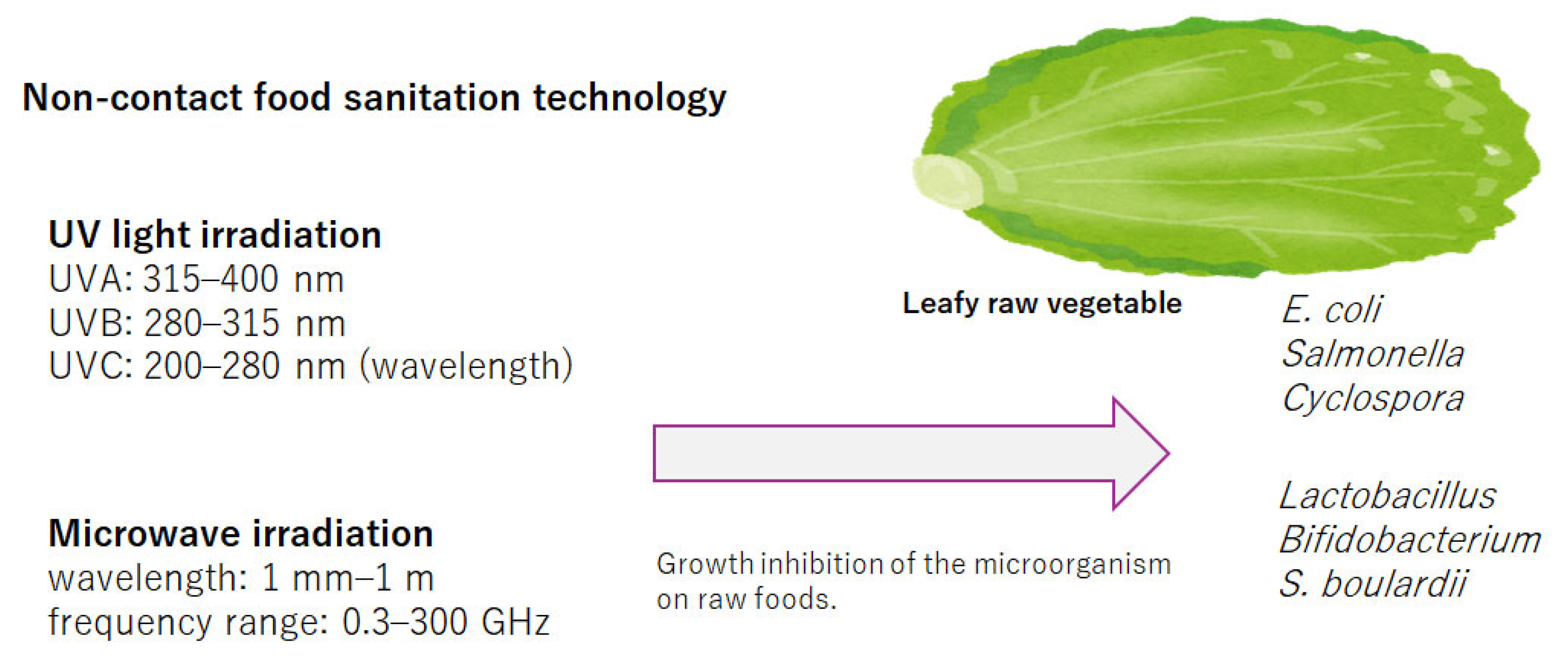
Figure 2.
Hypothetical image for the hermetic effects. The performance of the non-contact food sanitation such as UV light and microwave irradiation usually depends on their power and usage-duration. The stronger you use the sanitation, the less quantity both positive and negative bacteria on the raw foods becomes, although the negative effects such as nutritional loss and unpleasant smells increase. Hormetic effects with the hypothetical consumption of the handled raw foods are shown.
Figure 2.
Hypothetical image for the hermetic effects. The performance of the non-contact food sanitation such as UV light and microwave irradiation usually depends on their power and usage-duration. The stronger you use the sanitation, the less quantity both positive and negative bacteria on the raw foods becomes, although the negative effects such as nutritional loss and unpleasant smells increase. Hormetic effects with the hypothetical consumption of the handled raw foods are shown.
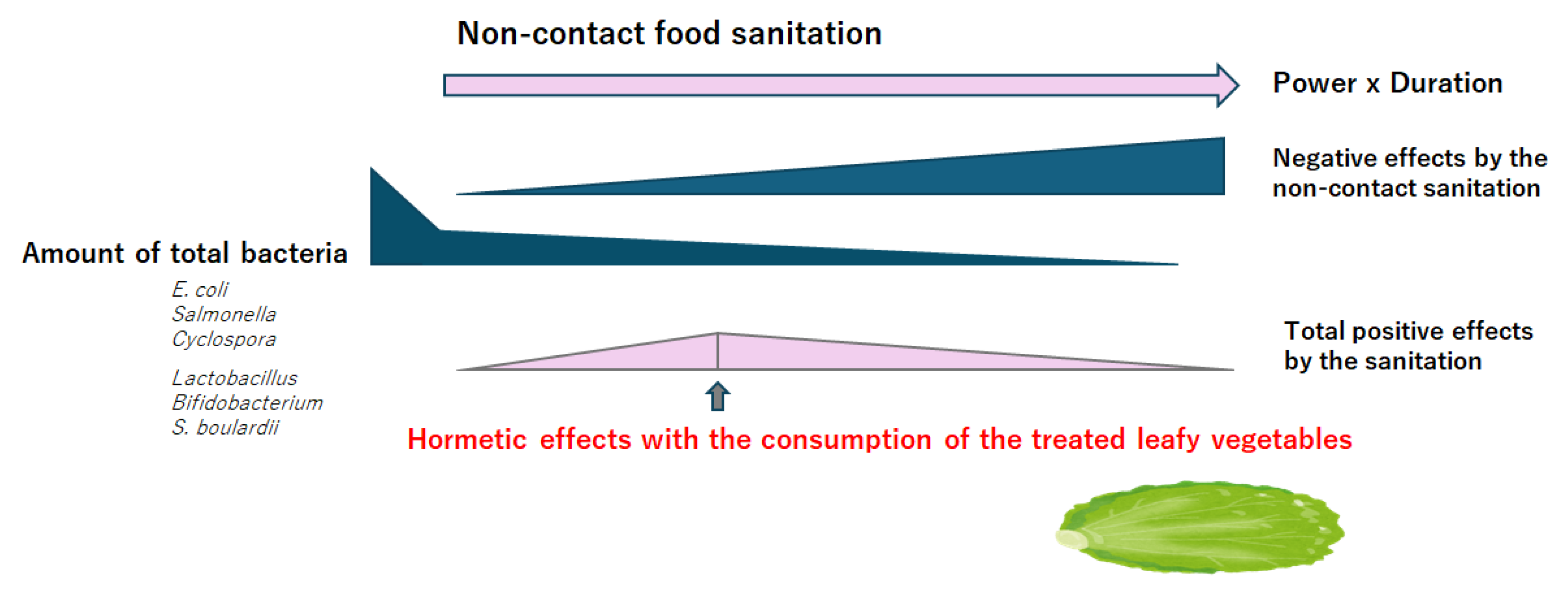
Figure 3.
Schematic demonstration of a theoretical equipment with possible hermetic effects. The non-contact food sanitation technologies such as UVC light and/or microwave irradiation might be employed, which would be operated for no more than 30 seconds to avoid getting the negative effects. The refrigeration inside the refrigerator might reduce the bacterial growth as well as the degeneration of nutrients in foods by sanitation irradiations.
Figure 3.
Schematic demonstration of a theoretical equipment with possible hermetic effects. The non-contact food sanitation technologies such as UVC light and/or microwave irradiation might be employed, which would be operated for no more than 30 seconds to avoid getting the negative effects. The refrigeration inside the refrigerator might reduce the bacterial growth as well as the degeneration of nutrients in foods by sanitation irradiations.
Disclaimer/Publisher’s Note: The statements, opinions and data contained in all publications are solely those of the individual author(s) and contributor(s) and not of MDPI and/or the editor(s). MDPI and/or the editor(s) disclaim responsibility for any injury to people or property resulting from any ideas, methods, instructions or products referred to in the content. |
© 2024 by the authors. Licensee MDPI, Basel, Switzerland. This article is an open access article distributed under the terms and conditions of the Creative Commons Attribution (CC BY) license (http://creativecommons.org/licenses/by/4.0/).
Copyright: This open access article is published under a Creative Commons CC BY 4.0 license, which permit the free download, distribution, and reuse, provided that the author and preprint are cited in any reuse.


