

Submitted:
05 November 2024
Posted:
06 November 2024
You are already at the latest version
Abstract
Field crops such as wheat, alfalfa, ryegrass, and corn play a vital role in agriculture and livestock production, particularly in the Kahramanmaras plain, irrigated by the Aksu River and the Sır Dam. Given the critical importance of irrigation water quality for optimal crop production, this study aimed to assess the impact of Karasu, Erkenez, and Oklu creeks on the water quality of the Aksu River and Sır Dam, and its subsequent effects on the germination and seedling growth of key field crop species grown in the region. The experiment was conducted in 2017 at the Field Crops Laboratory, Faculty of Agriculture, Kahramanmaras Sutcu Imam University, Turkey, using a completely randomized design (CRD) with four replications. Seeds were germinated using water samples collected from various locations within the dam basin, with tap water serving as the control. Before germination, the water samples were analyzed for concentrations of heavy metals, including copper (Cu), iron (Fe), lead (Pb), chromium (Cr), arsenic (As), nickel (Ni), and cadmium (Cd). Seeds exposed to different water treatments were germinated in a climate chamber at 20 ± 1°C. Over two weeks, daily germination counts were recorded, and at the end of the experiment, total germination and seedling growth were measured. The results demonstrated that irrigation water contaminated with heavy metals significantly affected seed germination and seedling growth. Notably, water from Karasu Creek exhibited the most pronounced negative impact on all germination and growth parameters in the tested crops.
Keywords:
Crop seed
; heavy metals
; irrigation water
; toxicity
; seed germination
1. Introduction
Environmental contamination still poses a regional and worldwide hazard to humans and animals as well as plants. The primary sources of organic and inorganic contaminants are industrial effluents [1]. Heavy metals present in nature can reach high levels due to anthropogenic activities and cause serious ecological and environmental problems. Heavy metals are irreversible, persistent, and toxic pollutants of great environmental concern [2]. Heavy metals are one of the factors that cause environmental pollution and are increasingly dangerous for the stability of ecosystems. Heavy metals such as silver (Ag), arsenic (As), cadmium (Cd), copper (Cu), iron (Fe), nickel (Ni), lead (Pb), zinc (Zn), molybdenum (Mo), cobalt (Co), and chromium (Cr) contribute to soil and water pollution, causing environmental damage that has become a major issue in many countries worldwide [3,4].
Rapid urbanization, industrialization, and extensive use of fertilizers and pesticides have contaminated numerous soil and water resources with harmful metals. The deposition of hazardous metals creates an imbalance in the ecosystem, and most toxic metals accumulate in large quantities throughout the development of natural ecosystems. This is transferred and accumulated throughout the food chain during the biological growth process. In addition, due to the high concentration of these metals in the food chain, human and animal health is constantly threatened [5].
Heavy metal phytotoxicity is known the main factors limiting germination and plant growth [6]. Seed germination is one of the most important stages in the life cycle of a plant [7], and is very sensitive to environmental conditions [8]. For this reason, seed germination and root elongation studies are considered one of the easiest methods of biologically tracking changes in the environment [9]. Accurate, simple, and inexpensive seed germination tests under different conditions are very helpful in determining the toxicological damage caused by the presence of various pollutants in the environment [10]. The most significant effects of heavy metals in the biological cycle occur in plants. They have an impact on seed germination, seedling growth, development, plant retardation, biomass production, flower, fruit set, yield, and product quality [11,12]. Furthermore, heavy metals have negative effects on various physiological processes of the plant on the intracellular level such as disrupting photosynthesis, nitrogen cycle, and binding, decreasing chlorophyll amount, leading to deterioration in enzyme systems, inhibition in the uptake of useful elements [13,14]. The practical solution to determining the tolerant species and varieties is considered a viable idea [14]. Early studies, such as germination and seedling, in determining the tolerance of different plant species and varieties to heavy metals may be much more useful and economical.
There are many studies on the effects of heavy metals on the development of radicle, hypocotyl, epicotyl, plumule, and seedling in germination and initial growth and development stages. In these studies, the presence of Co, Cu, and Zn in cucumber and wheat [15]; Zn in Nigella sativa and Triticum aestivum [16]; Co in wheat, clover, and tomato [17]; cause decreased germination rates and early development. Also, some researchers found that Al destroyed roots in wheat [18]; Hg, Cd, Co, Cu, Pb, and Zn in cucumber and wheat resulted in smaller root lengths, shorter root age, and lesser dry weight [15]; Co inhibited root growth in wheat, clover, and tomatillo [17]; Cd decreased root growth and root tolerance index in maize [19]. Levels of metals such as Cr, Cd, Zn, Cu or Pb can be found in streams, lakes and soils polluted by anthropogenic activities. While some heavy metals such as Cr, Cd, Mn and Zn are considered essential micronutrients for plant and animal growth at low doses, they cause toxic effects such as metabolic disorders and growth inhibition at high concentrations above the threshold value [20,21]. Although trace metals that have toxic effects on some plants have been studied for many years, there is a strong need in the literature to fully determine their phytotoxic effects [22]. For example, it has been reported that the growth of wheat (Triticum aestivum L.) was reduced by 50% at 0.5 μM Cu and 30 μM Cu concentrations [23,24].
The textile industry in Kahramanmaras is very extensive and is ever-expanding. The industrial effluents from the textile industry are discharged into the Aksu River and eventually find their way to Sır Dam, polluting further dam water besides domestic wastes. These industrial activities are one of the most important pollutants of the dam in the Aksu River. The Aksu River and the side branches feeding this river are the key pollutants loaded with domestic and industrial wastes to the brim. However, the waters of this river are frequently used for irrigating agricultural fields in this region.
Some field crops chosen as test plants for this study were subjected to germination and seedling growth tests. Because the germination stage, which is the first step of a plant's life cycle, is when they are most vulnerable to stress, it is crucial to provide optimal environmental conditions to ensure successful seedling establishment. Thus, alfalfa, ryegrass, wheat, and corn seeds, which are commonly grown around the Aksu River and the Sır Dam basin, were tested. Water samples from the dam basin and the several sources of the stream that supply the basin were used in the tests to assess the influence of water quality on the germination and early development of the primary crop seeds planted in the research region. The extent of contamination by heavy metals in Kahramanmaras and the nearby water resources was therefore examined, as well as the negative impacts of the irrigation water obtained from these sources on the grown crops in the region.
2. Materials and Methods
2.1. Analysis of Water Samples Used for Irrigation
The geographical coordinates of the locations from where water samples were acquired are presented in (Table 1). Water samples were collected as per the standard method of sampling techniques [25]. The water samples were taken in 1 L plastic bottles, and filtered and, solid impurities were removed. These water samples were used for the watering of crop seeds. The concentration of some pollutants heavy metals Cu, Fe, Ni, Pb, Cr, As, and Cd in the initial water samples was determined by Inductively Coupled Plasma Optical Emission Spectroscopy (Perkin Elmer ICP-OES-6000) in ÜSKİM (University, Industry, Public Cooperation Development, Application and Research Center).
Figure 1.
View of the study area (A; Oklu Creek, B; Karasu Creek, C; Erkenez Creek; D; Sır Dam).
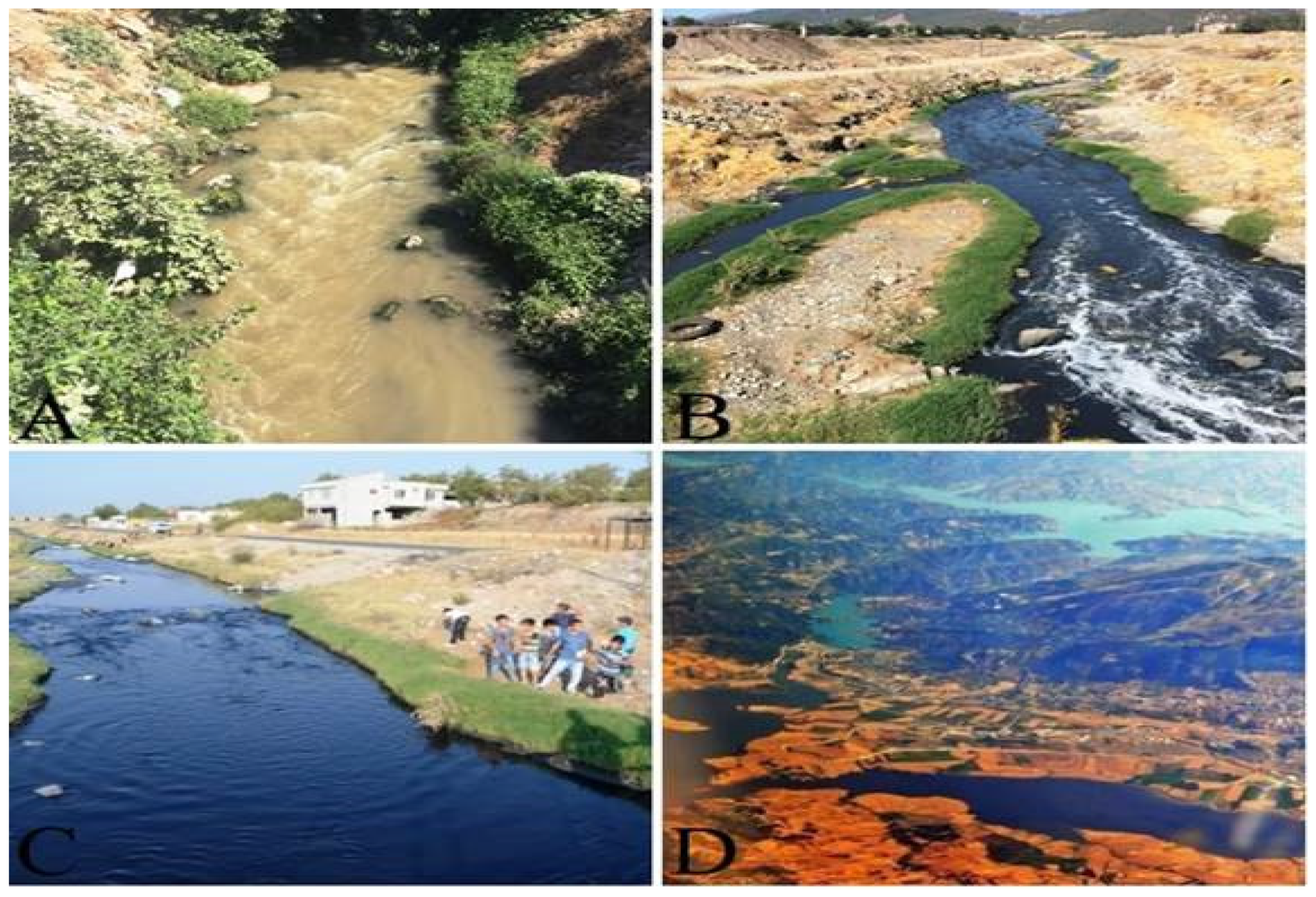
The pollution level of the water samples used for irrigation was assessed considering the maximum permissible limits summarized in (Table 2). The heavy metals concentration below or equal to these values in the irrigation waters does not pose any toxic effects for up to 24 years on clayey soils with a pH of 6.0-8.5.
2.2. Studies on Germination and Seedling Growth
This study was carried out from 01, March to 30, July 2017 in the laboratory of the Department of Field Crops of the Faculty of Agriculture, Kahramanmaras Sutcu Imam University. Irrigation waters containing heavy metals were collected from 4 different sources (Erkenez Creek, Oklu Creek, Karasu Creek, and Sır Dam ponds) of Aksu River and Sır Dam located in Kahramanmaras, Turkey. Four field crop seeds commonly grown in the Kahramanmaras region and around the dam were used as test plants. The seeds were germinated in water samples obtained from 4 different sources (Table 1) in comparison to tap water (control). Before sowing, the seeds were kept in a 5% NaClO (sodium hypochlorite) solution for 5 minutes and sterilized and rinsed with tap water. After putting the filter paper in Petri dishes (90 mm diameter), 25 seeds were sown by using 20 ml of irrigation water samples in each Petri dish according to the assigned treatments in a completely randomized design (CRD). The seeds were germinated in a room climate at the temperature of 20 ± 1 °C. The seed germination was monitored daily for 14 days. Germination rate, root length, plumage length, seedling length, seedling age, weight, seedling dry weight, and seedling vigor index values were measured daily. Percent germination was calculated as the ratio between the number of germinated seeds and the total number of seeds. Seedling length, radicle, and plumule were separated and measured with measuring tape. The fresh and dry biomass was determined gravimetrically, by weighing before and after drying (at 80℃ for 24 hours) [27]. For the vigor index, seedling length was multiplied by germination percentage. All obtained experimental results were statistically analyzed using the SAS Statistical Program [28]. Means were separated through the LSD test [29].
3. Results
The data provide a concise and precise the heavy metal concentration determined in all water samples used as irrigation water in the study was evaluated according to the permissible maximum values (Table 2) and is summarized in (Table 3). According to the results, in the Karasu Creek irrigation water, Cu is approximately 5 times higher than the maximum permissible limit, while Fe is about 3.7 times the maximum permissible limit (Table 2). A high concentration of Cu has been found also in the Oklu Creek water sample (approximately 8 times higher), in the Erkenez Creek water sample (5 times higher), and in the Sır Dam water sample (6 times higher) than the maximum permissible limit. In Sır Dam water samples, high concentrations of Fe were also obtained, but these values are only 1-2 times higher than the maximum permissible limit. In addition, Cd concentrations in EC and SD waters were found to be 20 and 23 times higher than the maximum acceptable Cd amount, respectively (Table 3).
Based on these results (Table 3) it can be stated that the analyzed water samples have a high content of Cu, Fe and Cd and, therefore their use as irrigation water can affect the plant growth in crops.
In order to see how the plant’s growth is influenced by water irrigation with a high content of such heavy metals, some important parameters have been determined in each case. The mean values of all the parameters examined are given in (Table 4). The statistical analysis of the obtained results indicates that all considered parameters are significantly affected by the irrigation of plants with water with a high content of heavy metals.
3.1. Germination Rate (%)
In terms of germination rate, cultivar, irrigation water, and cultivar × irrigation water interaction were statistically significant (Table 4). The highest germination rate was obtained in wheat with 98.20%, followed by clover with 96%. The lowest germination rate was obtained in corn at 72%. It is seen that wheat is the most resistant to heavy metals contained in irrigation water. The highest germination rate in terms of irrigation water was obtained from the control application at 95.25%, and the lowest germination rate was obtained from Karasu Creek water at 71.75%. It is observed that especially the heavy iron content of Karasu Creek irrigation water reaches very dangerous dimensions. This is because the iron heavy metal is well above the permissible limits. The highest germination rate in terms of cultivar x irrigation water interaction was obtained in alfalfa from Oklu Creek water at 100%, followed by wheat from Sır Dam and Oklu Creek irrigation water at 99%. The lowest germination rate was 44% with Italian ryegrass in the Karasu creek (Figure 2).
3.2. Radicle Length (cm)
In terms of radicle length, cultivar, irrigation water, and cultivar x irrigation water interaction were statistically significant (Table 4). The highest radicle length was obtained in wheat with 16.95 cm, followed by corn with 11.31 cm. The lowest radicle length was 9.31 cm in Italian ryegrass. In terms of irrigation water, the highest radicle length value was obtained from the Sır Dam irrigation water application with 13.54 cm and the lowest radicle length was obtained from Karasu Creek water with 8.46 cm. In terms of interaction x cultivation water, the highest radicle length was 20.19 cm in wheat from Oklu Creek water, followed by Sır Dam irrigation water in wheat at 19.46 cm. The lowest radicle length of 8.41 cm was obtained in alfalfa from the Oklu Creek irrigation water (Figure 3).
3.3. Plumule Length (cm)
Data regarding plumule length, cultivar, and irrigation water were statistically significant; cultivar x irrigation water interaction was non-significant (Table 4). The highest plumule length was obtained in wheat at 11.63 cm, followed by alfalfa at 7.25 cm. The lowest plumule length was obtained in Italian ryegrass 6.63 cm. It has been observed that wheat is the most resistant to heavy metal-containing irrigation water. The highest and lowest plumule length values were found to be consistent with the radicle length values. In terms of irrigation water, the highest plumule length value was obtained from the irrigation water application with 8.73 cm Sır Dam, and the lowest plumule length was obtained from 6.60 cm Karasu Creek water. The highest plumule length was obtained from Oklu Creek water in wheat at 12.83 cm. The lowest plumule length was obtained from irrigation water of Karasu Creek with Italian ryegrass as 4.70 cm (Table 4).
3.4. Seedling Length (cm)
In terms of seedling length, cultivar and irrigation water were statistically significant, and cultivar x irrigation water interaction was non-significant (Table 4). The highest seedling length was obtained in wheat at 28.58 cm, followed by corn at 17.99 cm. The lowest seedling length was obtained in Italian ryegrass 16.28 cm. It is seen that wheat is the most resistant to heavy metal-containing irrigation water. The highest and lowest seedling length values were found to be consistent with the radicle and plumule length values. In terms of irrigation water, the highest seedling length value was obtained from the Sır Dam irrigation water application at 22.28 cm and the lowest seedling length was obtained from 15.06 cm of Karasu Creek water. It is seen that seedling growth slows down in parallel with the negative effect of Karasu Creek irrigation water, especially iron heavy metal content on germination rate. The highest seedling length in terms of cultivar x irrigation water interaction was obtained from Oklu stream water in wheat at 33.02 cm, followed by Sır Dam irrigation water in wheat at 31.34 cm. The lowest seedling length was obtained in Italian ryegrass at 8.94 cm from the Karasu Creek irrigation water (Table 4).
3.5. Seedling Fresh Weight (g)
Regarding the seedling’s fresh weight, only the difference between cultivar means was statistically significant (Table 4). The highest seedling fresh weight was obtained in corn at 4.65 g, followed by wheat at 1.67 g. The lowest seedling fresh weight was obtained in Italian ryegrass at 0.27 g. In terms of irrigation water, the highest seedling fresh weight value was obtained from Oklu Creek irrigation water application with 2.45 g, and the lowest seedling fresh weight was obtained from Karasu Creek water with 1.60 g. The negative effects of Karasu Creek irrigation water on germination and seedling growth negatively affected the mass formation of the plant. This is due to the presence of iron heavy metal in Karasu Creek irrigation water well above the allowable limits. The highest seedling fresh weight was obtained from Oklu Creek water in corn at 6.07 g in terms of variety x irrigation water interaction, followed by control application in corn at 5.48 g. The lowest seedling fresh weight was obtained from Karasu Creek irrigation water in Italian ryegrass at 0.21 g (Table 4).
3.6. Seedling Dry Weight (g)
The cultivar, irrigation water, and cultivar x irrigation water interaction were all statistically significant factors for seedling dry weight (Table 4). The highest seedling dry weight was obtained in corn at 0.62 g, followed by alfalfa at 0.47 g. The lowest seedling dry weight was obtained in Italian ryegrass at 0.03 g. In terms of irrigation water, the highest seedling dry weight value was found to be 0.50 g from Erkenez Creek irrigation water, and the lowest seedling dry weight was obtained from Karasu Creek water at 0.26 g. The negative effects of Karasu Creek irrigation water on germination and seedling growth negatively affected the mass formation of the plant. This is due to the presence of iron heavy metal in Karasu Creek irrigation water well above the allowable limits. The highest seedling dry weight in terms of cultivar x irrigation water interaction was obtained from alfalfa in Erkenez Creek irrigation water at 1.03 g, followed by Oklu Creek irrigation water at 0.75 g. The lowest seedling dry weight value between 0.03-0.05 g was obtained in all applications in Italian ryegrass (Figure 4).
3.7. Vigor Index
In terms of vigor index cultivar, irrigation water, and cultivar x irrigation water interaction was statistically significant (Table 4). The highest vigor index was obtained in wheat at 2812, followed by clover at 1598. The lowest vigor index was obtained in maize as 1322. It was determined that the highest vigor index value in terms of irrigation waters was obtained from the Sır Dam irrigation water application in 1997 and the lowest vigor index was obtained from Karasu Creek water at 1177. In terms of cultivation x irrigation water interaction, the highest vigor index was obtained from Oklu Creek water in wheat as 3266, followed by Sır Dam irrigation water in wheat as 3107. The lowest vigor index value was obtained from Karasu Creek irrigation water application in Italian ryegrass as 429 (Figure 5).
4. Discussion
Germination and the early plant growth stage are critical for crops whose seeds are used as food [30,31]. Abundant production of high-yielding and high-quality seeds and germination success is essential for these species [30,31,32]. Germination and early seedling growth laboratory assays have been accepted as basic experiments that require minimum expense, time, and effort to evaluate the effect of any external intervention (such as fertilization or heavy metal pollution) during plants' early development period [12,33].
Quality water supply and irrigation frequency are very important for the germination of plant seeds and the continuation of biochemical processes [34,35]. The decrease in water potential during germination periods can negatively affect seed germination and cause osmotic stress. Since the Mediterranean region is one of the sensitive regions exposed to global climate change [36,37], irregularity in rainfall amount and regime causes water scarcity and encourages the use of alternative irrigation water sources. However, it should not be forgotten that the use of alternative irrigation waters containing heavy metals or having salinity problems is an important factor affecting the germination and plant growth parameters [38,39,40]. Germination and seedling development are as essential for a plant to survive and continue its generation as it is for the environment in which it grows to be free from heavy metal stress [33]. Some researchers have reported that heavy metal toxicity reduces the germination rate and seedling growth of different plants [41,42]. In contrast, it has been stated that the germination and early seedling growth parameters of Leucaena are not affected by water quality [43], and winter wheat and spring maize plants can develop resistance after the early growth stage [44].
Although most plants have phytotoxic tolerance to some heavy metals, some heavy metals can cause serious negative effects on that plant. For instance, Talebi et al. [45] reported in a study that triticale germination percentage and rate were significantly affected by heavy metals, especially Cd. From our data, it was observed that there was a significant decrease in germination percentage depending on the heavy metal concentration in irrigation waters. This may be due to the toxic effects of concentrated ions on the germination process [46,47].
The decrease in seed germination percentage due to the presence of heavy metals is consistent with the findings of other researchers. For example, Rahman Khan and Mahmud Khan [48] observed a decrease in seed germination in chickpeas treated with 50, 100, 200, and 400 ppm nickel and cobalt compared to the control. Similarly, Singh et al. [49] observed a decrease in germination percentage in wheat treated with copper at 5, 25, 50, and 100 ppm. Peralta-Videa [50] reported that alfalfa seed germination and seedling growth were adversely affected by heavy metals (Cd, Cr, Cu, and Ni). Azmat et al. [51] also reported that Lens culinaris seed germination was inhibited by Pb. Similarly, Talebi et al. [45] determined that Cu2+ and Cd concentrations applied at 1000 mg/L-1 were the highest inhibitory factors for the germination and seedling growth of triticale seeds. It has been reported that heavy metals physiologically inhibit the absorption of water by seeds and plants [52]. Tsamo et al. [41] reported that there was a significant decrease in the germination rates of corn and bean seeds irrigated with increased Cu2+ element and that there was no germination in beans in 600 μmol/L Cu2+ solution. In this study, Cu2+ concentration in all irrigation waters used; Fe concentration in KC and SD waters and Cd concentration in EC and SD waters being above the tolerable amount affected the germination of seeds of different crops and early seedling development. Cu is an essential micronutrient for the growth and development of plants and plays an important role in many biological processes such as photosynthesis, respiration, and response to oxidative stress [53,54]. Excessive Cu levels can cause several morphological and physiological disorders. In addition, excessive Cu can reduce germination rate, shoot elongation, plant biomass, and water content [33]. Likewise, Cadmium (Cd) is a very toxic heavy metal that causes oxidative stress in plants [55]. Cd is not essential for plant growth and can cause various phytotoxic symptoms, including leaf chlorosis, root rot, and growth inhibition [56].
The lowest radicle length measured from the early seedling development parameters of the seeds was obtained from Karasu Creek water. It is thought that the heavy metal content of Karasu Stream irrigation water slows down the radicle development in parallel with the negative effect on the germination rate. Similarly, it was stated that heavy metals used in irrigation caused a significant decrease in the radicle length of triticale [45]. There was a direct relationship between heavy metal concentration and radicle length because the radicle length decreases as the heavy metal concentration level increases [45]. Similarly, John et al. [57] reported a significant decrease in radicle length with increasing heavy metal concentrations in the growth environment. The heightened sensitivity of root length to heavy metals can be attributed to the plant root being the initial point of contact with toxic substances in the growth medium. Some studies have indicated that Cd application has negative effects on Triticum aestivum, Zea mays, Sorghum bicolor, and Cucumis sativus plants, especially on the root part first, making the root the most sensitive part of the plant [58,59]. Furthermore, some researchers have suggested that the inhibition of root elongation by heavy metals may result from interference with cell division, including the induction of chromosomal aberrations and abnormal mitosis [60,61], which could adversely affect seedling growth.
It is observed that Karasu Creek water, which contains high concentrations of Cu and Fe heavy metals, slows down plumule growth in parallel with its negative effect on germination rate, just like in radicle. Similarly, Talebi et al. [45] stated that the plumule length of triticale decreased with increasing concentration of heavy metals. In the same research, the highest plumule length was determined in the control application and the shortest plumule length was determined in the highest (1000 ppm) heavy metal concentration. At higher concentrations, it was thought that the presence of inhibitory chemicals could completely stop seedling growth [62]. Maity et al. [63] found that the lowest values of growth parameters of Cicer arietium were a result of the use of industrial wastewater. The increase in heavy metal concentration in wastewater can cause inhibition of enzyme activity by reducing enzyme dehydrogenase activity, which is considered to be one of the biochemical changes that negatively affect seedling biomass. Cd absorbed by plants accumulates in different parts of the plant, causing growth inhibition and changes in morphological, physiological, and biochemical properties in plants [64]. Cd reduces root and shoots growth by inhibiting cell division and cell growth or both [65,66]. Cd has been reported to inhibit plumule and radicle growth in rice [67].
In this study, it was observed that the highest and lowest seedling length values were compatible with the radicle and plumule length values. Seedling development was found to slow in parallel with the negative effects of heavy metals—particularly copper and iron—present in Karasu Creek irrigation water, which impacted the germination rate. Maity et al. [63] stated that industrial wastewater negatively affected the seedling length of Cicer arietium. The reduction in germination percentage, along with shorter radicle and plumule lengths in response to higher heavy metal concentrations in the irrigation water, also impacted overall seedling length. Athar and Ahmad [68] showed that the toxic effects of certain heavy metals on the seedling length and grain yield of wheat (Triticum aestivum L.) caused significant decreases in both parameters, and Cd was the most toxic metal, followed by Cu, Ni, Zn, Pb and Cr.
Talebi et al. [45] reported that the presence of heavy metals significantly reduced the fresh and dry weight of triticale seedlings compared to the control. The ability of heavy metals to reduce the fresh and dry weight of triticale was as follows: Cd > Cu > Pb. Zeng et al. [69] reported that Pb caused a decrease in rice biomass. The decrease in biomass was also attributed to the inhibition of chlorophyll synthesis and photosynthesis by heavy metals [49,70]. These researchers observed a significant reducing effect on wheat (T. aestivum) germination, plumule length, radicle length, lateral root number, fresh weight and dry weight with increasing Cu2+ concentrations. Tsamo et al. [41] found that the fresh and dry weight of plants with high heavy metal concentrations was very low compared to control experiments. Similarly, Athar and Ahmad [68] reported that exposure of wheat plants to heavy metals resulted in a decrease in the dry weight content and grain yield of the plants and a significant decrease in the protein content in plant tissues and grains. This indicates that heavy metals have a negative effect on the growth and yield of wheat plants and confirms the reported phytotoxicity of these metal ions [68]. The effect of the plant against environmental stress factors is generally determined by the responses of the organelles whose morphological and functional integrity are affected [71]. In another study, it was determined that the shoot length of maize and bean seedlings irrigated with different Cu2+ concentrations was shorter than the control [41]. The decrease in fresh and dry weight of plants may also be due to the concentration of heavy metals in water, protein degradation of amino acid metabolism at high concentrations [41], and a decrease in carotenoid and chlorophyll content [72].
There was a direct relationship between the heavy metal concentration and the decrease in the vigor index because the vigor index decreased as the heavy metal concentration level increased. Similar results were also observed by Channappagoudar [73] and Talebi et al. [45]. Also, Shaikh et al. [74] studied the phytotoxic effects of different concentrations of Cr, Cd, Mn, and Zn on seed germination, root, shoot, seedling growth, seedling vigor index and tolerance index of wheat (Triticum aestivum L.) and found that heavy metals adversely affected the normal growth of plants by reducing seed germination, root and shoot length compared to control. It was determined that the highest vigor index value in terms of irrigation waters was obtained from the Sır Dam water application and the lowest vigor index was from Karasu Creek water. The negative effects of Karasu Creek irrigation water on germination rate and seedling growth also decreased the vigor index values of the plant. This is due to the presence of iron heavy metal in Karasu Creek irrigation water well above the allowable limits.
Heavy metals such as Fe, Cu, Zn, and Mn are essential for plant growth at appropriate concentrations, but some are harmful to plants when exceeded above acceptable levels [41,75]. These include Cd, Hg, Pb, and As [76]. For example, high concentrations of Pb and Cu also cause oxidative stress in plants [77], which leads to the destruction of macromolecules and the disruption of metabolic pathways [78]. Vassilev et al. [79] showed in their study how copper toxicity affects the growth of barley plants. This toxicity caused leaf chlorosis by degrading photosynthetic elements. In our study, the Cu element was found to be a phytotoxic metal for plants in all water samples, Fe element in KC and SD waters, and Cd element in EC and SD waters. Athar and Ahmad [68] found that Cd was the most toxic metal for free-living nitrogen-fixing bacteria and wheat plants, causing significant decreases in the dry weight of shoot, root, and grain yield after Cu, Ni, and Zn, respectively. Kalyanaraman and Sivagurunathan [80] reported that Cd and Cu had higher phytotoxicity than other elements. Similarly, Tsamo et al. [41] reported that heavy metals Zn and Cu significantly affected other plant growth parameters such as germination, shoot length, leaf area index, and shoot circumference of bean plants and Pb of maize. However, the presence of more than one heavy metal concentration in the environment may also cause antagonistic effects [68]. For example, it has been reported that Cd antagonized the inhibitory effect of Zn on the total amount of mineralized carbon [81]. It has been reported that the decrease in seed germination and plant growth parameters is a reflection of the increase in industrial pollution [82]. The decrease in protein content in tissues exposed to heavy metals has been reported by many workers [83,84].
5. Conclusions
This study focused on germination and seedling growth because crop establishment depends on successful germination and seedling emergence. The results provided sufficient evidence for the effects of water sources used on seed germination and plant growth. The data showed that all irrigation waters contained significantly higher copper (Cu) than the "maximum acceptable level". In addition, the iron (Fe) concentrations in the Karasu Creek and Sır Dam irrigation waters and the cadmium (Cd) concentrations in the Erkenez Creek and Sır Dam were significantly above the threshold level. Sır Dam has the largest irrigation capacity among the water sources investigated. The contamination in the irrigation waters originates from the industrial factories which are located in the water basin. Therefore, the wastewater treatment systems of the factories should be regularly functional, and legal sanctions should be implemented in this regard. In addition, irrigation waters containing heavy metals have a significant statistical effect on seed germination and seedling growth. When the irrigation water contained heavy metals, the germination, and seedling growth traits were negatively affected. Among all the treatments, irrigation water from Karasu Stream was found to have the highest negative effects on the quality of the seeds used in the current study. According to this study, corn and Italian ryegrass seeds do not germinate as well as wheat and alfalfa seeds under heavy metal pollution conditions. The highest vigor index was recorded in wheat in comparison to other texted crops.
Author Contributions
For research articles with several authors, a short paragraph specifying their individual contributions must be provided. The following statements should be used “Conceptualization, Ö.S.U, O.G., A.R.K., A.E., H.K., E.B., M.F.S., D.O.W.; methodology, Ö.S.U, O.G., A.R.K., A.E.; software, Ö.S.U., M.F.S., D.O.W.; validation, A.E., H.K., E.B.; formal analysis, Ö.S.U, O.G., M.F.S., D.O.W.; investigation, Ö.S.U, O.G., A.R.K., A.E.; resources, Ö.S.U, O.G., A.R.K., A.E., H.K., E.B., data curation, Ö.S.U., M.F.S.; writing—original draft preparation, Ö.S.U, O.G., A.R.K., A.E., H.K., E.B., M.F.S.; writing—review and editing, E.B., D.O.W.; visualization, O.S.U., E.B., M.F.S.; funding acquisition, M.F.S., All authors have read and agreed to the published version of the manuscript.
Funding
This project was approved by the Researchers Supporting Project number (RSPD2024R751), King Saud University, Riyadh, Saudi Arabia for financial support of this study. In addition, the authors thank The Scientific Research Projects Coordinator (KSU BAP-2016/6-53M) Kahramanmaras Sutcu Imam University, Türkiye for financial support.
Acknowledgments
The authors thank The Scientific Research Projects Coordinator (KSU BAP-2016/6-53M) Kahramanmaras Sutcu Imam University, Türkiye for financial support.
Conflicts of Interest
The authors declare no conflicts of interest.
References
- Ogundele, D.T.; Oladejo, A.A.; Oke, C.O. Effect of pharmaceutical effluent on the growth of crops in Nigeria. Chem Sci Intern J 2018, 25, 1–7. [Google Scholar] [CrossRef]
- Huang, S.; Li, Q.; Yang, Y.; Yuan, C.; Ouyang, K.; You, P. Risk assessment of heavy metals in soils of a lead-zinc mining area in Hunan Province (China). Kemija u industriji: Časopis kemičara i kemijskih inženjera Hrvatske 2017, 66, 173–178. [Google Scholar] [CrossRef]
- Kabata-Pendias, A.; Pendias, H. Trace elements in soils and plants; CRC Press: London, UK, 2001. [Google Scholar]
- Lasat, M.M. Phytoextraction of toxic metals. A review of biological mechanism, J Environ Quality, 2002, 31, 109-120.
- Rai, U.N.; Tripathi, R.D.; Vajpayee, P.; Jha, V.; Ali, M.B. Bioaccumulation of toxic metals (Cr, Cd, Pb and Cu) by seeds of Euryale ferox Salisb (Makhana). Chemosphere. 2002, 46, 267–272. [Google Scholar] [CrossRef] [PubMed]
- Dindaroğlu, T.; Babur, E.; Laz, B. Determination of the ecology and heavy metal tolerance limits of Alyssum Pateri subsp. Pateri growing on ultramafic soils. J Soil Sci Plant Nut. 2019, 7, 110–120. [Google Scholar] [CrossRef]
- Kashmir, S.; Khan, M.A.; Shad, A.A.; Marwat, K.B.; Khan, H. Temperature and salinity affect the germination and growth of Silybum marianum Gaertn and Avena fatua L. Pak J of Botany. 2016, 48, 469–476. [Google Scholar]
- Kuriakose, S.V.; Prasad, M.N.V. Cadmium stress affects seed germination and seedling growth in Sorghum bicolor (L.) Moench by changing the activities of hydrolysing enzymes. Plant Growth Regul. 2008, 54, 143–156. [Google Scholar] [CrossRef]
- Wang, W.; Keturi, P.H. Comparative seed germination test using ten plant species for toxicity assessment of metals engraving effluent sample. Water, Air, Soil Poll. 1990, 52, 369–376. [Google Scholar] [CrossRef]
- Siddiqui, A.H.; Tabrez, S.; Ahmad, M. Validation of plant-based bioassays for the toxicity testing of Indian waters. Environ. Monit. Assess. 2011, 179, 241–253. [Google Scholar] [CrossRef]
- Bukhari, S.A.; Peerzada, P.H.; Javed, A.M.; Dawood, M.H.; Hussain, N.M.; Ahmad, S. Growth and development dynamics in agronomic crops under environmental stress. In Agronomic crops; Springer: Singapore, 2019; pp. 83–114. [Google Scholar]
- Uslu, O.S.; Babur, E.; Alma, M.H.; Solaiman, Z.M. Walnut shell biochar increases seed germination and early growth of seedlings of fodder crops. Agriculture 2020, 10, 427. [Google Scholar] [CrossRef]
- Pandey, N.; Sharma, C.P. Effect of heavy metals Co2+, Ni2+ and Cd2+ on growth and metabolism of cabbage. Plant Sci. 2002, 163, 753–758. [Google Scholar] [CrossRef]
- Belimov, A.A.; Safronova, V.I.; Tsyganov, V.E.; Borisov, A.Y.; Kozhemyakov, A.P.; Stepanok, V.V.; Tikhonovich, I.A. Genetic variability in tolerance to cadmium and accumulation of heavy metals in pea (Pisum sativum L.). Euphytica. 2003, 131, 25–35. [Google Scholar] [CrossRef]
- Munzuroğlu, O.; Geçkil, H. Effects of metals on seed germination, root elongation, and coleoptile and hypocotyl growth in Triticum aestivum and Cucumis sativus. Arch. Environ. Contam. Toxicol. 2002, 43, 203–213. [Google Scholar] [CrossRef] [PubMed]
- El-Ghamery, A.A.; El-Kholy, M.A.; Abou El-Yousser, M.A. Evaluation of cytological effects of Zn2+ in relation to germination and root growth of Nigella sativa L. and Triticum aestivum L. Mutat. Res. Genet. Toxicol. Environ. Mutagen. 2003, 537, 29–41. [Google Scholar] [CrossRef] [PubMed]
- King-Díaz, B.; Montes-Ayala, J.; Escartín-Guzmán, C.; Castillo-Blum, S.E.; Iglesias-Prieto, R.; Lotina-Hennsen, B.; Barba-Behrens, N. Cobalt (LI) coordination compounds of ethyl 4-methyl-5-imidazolecarboxylate: chemical and biochemical characterization on photosynthesis and seed germination. Bioinorg. Chem. Appl. 2005, 3, 93–108. [Google Scholar] [CrossRef]
- Pan, J.W.; Zhu, M.Y.; Chen, H. Aluminum-induced cell death in root-tip cells of barley. Environ. Exp. Bot. 2001, 46, 71–79. [Google Scholar] [CrossRef]
- Drazkiewicz, M.; Baszynski, T. Growth parameters and photosynthetic pigments in leaf segments of Zea mays exposed to cadmium, as related to protection mechanisms. J Plant Physiol. 2005, 162, 1013–1021. [Google Scholar] [CrossRef]
- Jarup, L. Hazard of heavy metal contamination, Br. Med. Bull. 2003, 68, 167–182. [Google Scholar] [CrossRef] [PubMed]
- Azevedo, R.A.; Lea, P.J. Toxic metals in plants, Braz. J. Plant Physiol. 2005, 17, 1. [Google Scholar]
- Babula, P.; Adam, V.; Opatrilova, R.; Zehnalek, J.; Havel, L.; Kizek, R. Uncommon heavy metals, metalloids and their plant toxicity: a review, Environ. Chem. Lett. 2008, 6, 189–213. [Google Scholar] [CrossRef]
- Taylor, G.J.; Foy, C.D. Differential uptake and toxicity of ionic and chelated copper in Triticum aestivum, Canad. J. Bot. 1985, 63, 1271–1275. [Google Scholar]
- Wheeler, D.M.; Power., I.L.; Edmeades, D.C. Effect of various metal ions on growth of two wheat lines known to differ in aluminium tolerance. Plant Soil. 1993, 155/156, 489–492. [Google Scholar] [CrossRef]
- APHA. Standard methods for the examination of water and wastewater, 20th ed.; APHA; AWWA; WPCF: New York, 1999. [Google Scholar]
- Anonymous. Anonymous. www.cygm.gov.tr/CYGM/Files/mevzuat/teblig/STYD1.doc. 1991. Date of access:18.11. 2017. Available online: www.cygm.gov.tr/CYGM/Files/mevzuat/teblig/STYD1.doc (accessed on 18 November 2017).
- Kacar, B.; Inal, A. Plant analysis. Nobel publication No. 1241; Nobel Publication Distribution Ltd.: Ankara, 2008; p. 892. [Google Scholar]
- SAS. SAS 9.3 User Guide, Copyright © 2013; SAS Institute Inc.: Cary, NC, USA, 2013. [Google Scholar]
- Steel, R.G.D.; Torrie, J.H. Principles and procedures of statistics.; McGraw-Hill: New York, 1980; p. 1980. [Google Scholar]
- Donohue, K.; de Casas, R.R.; Burghardt, L.; Kovach, K.; Willis, C.G. Germination, postgermination adaptation, and species ecological ranges. Annu. Rev. Ecol. Evol. Syst. 2010, 41, 293–319. [Google Scholar] [CrossRef]
- Gioria, M.; Pyšek, P. Early bird catches the worm: Germination as a critical step in plant invasion. Biol. Invasions 2017, 19, 1055–1080. [Google Scholar] [CrossRef]
- Badalamenti, E.; Militello, M.; la Mantia, T.; Gugliuzza, G. Seedling growth of a native (Ampelodesmos mauritanicus) and an exotic (Pennisetum setaceum) grass. Acta Oecol. 2016, 77, 37–42. [Google Scholar] [CrossRef]
- Ahsan, N.; Lee, D.G.; Lee, S.H.; Kang, K.Y.; Lee, J.J.; Kim, P.J.; Yoon, H.S.; Kim, J.S.; Lee, B.H. Excess copper induced physiological and proteomic changes in germinating rice seeds. Chemosphere. 2007, 67, 1182–1193. [Google Scholar] [CrossRef] [PubMed]
- Bai, M.J.; Tao, Q.B.; Zhang, Z.X.; Lang, S.Q.; Li, J.H.; Chen, D.L.; Wang, Y.R.; Hu, X.W. Effect of drip irrigation on seed yield, seed quality and water use efficiency of Hedysarum fruticosum in the arid region of Northwest China. Agric. Water Manag. 2023, 278, 108137. [Google Scholar] [CrossRef]
- Mircea, D.M.; Estrelles, E.; Al Hassan, M.; Soriano, P.; Sestras, R.E.; Boscaiu, M.; Sestras, A.F.; Vicente, O. Effect of Water Deficit on Germination, Growth and Biochemical Responses of Four Potentially Invasive Ornamental Grass Species. Plants 2023, 12, 1260. [Google Scholar] [CrossRef] [PubMed]
- Dindaroglu, T.; Babur, E.; Battaglia, M.; Seleiman, M.; Uslu, O.S.; Roy, R. Impact of Depression Areas and Land-Use Change in the Soil Organic Carbon and Total Nitrogen contents in a Semi-Arid Karst Ecosystem. CERNE. 2021, 27, e-102980. [Google Scholar] [CrossRef]
- Babur, E.; Dindaroğlu, T.; Riaz, M.; et al. Seasonal Variations in Litter Layers’ Characteristics Control Microbial Respiration and Microbial Carbon Utilization Under Mature Pine, Cedar, and Beech Forest Stands in the Eastern Mediterranean Karstic Ecosystems. Microb Ecol. 2022, 84, 153–167. [Google Scholar] [CrossRef]
- Hadinezhad, P.; Payamenur, V.; Mohamadi, J.; Ghaderifar, F. The effect of priming on seed germination and seedling growth in Quercus castaneifolia. Seed Sci. Technol. 2013, 41, 121–124. [Google Scholar] [CrossRef]
- Mundada, P.S.; Sonawane, M.M.; Shaikh, S.S.; Barvkar, V.T.; Kumar, S.A.; Umdale, S.D.; Suprasanna, P.; Barmukh, R.B.; Nikam, T.D.; Ahire, M.L. Silicon alleviates PEG-induced osmotic stress in finger millet by regulating membrane damage, osmolytes, and antioxidant defense. Not. Sci. Biol. 2022, 14, 11097. [Google Scholar] [CrossRef]
- Mahmoud, N.; Abdou, M.A.H.; Salaheldin, S.; Soliman, W.S. Lemongrass Growth, Essential Oil, and Active Substances as Affected by Water Deficit. Horticulturae 2022, 8, 250. [Google Scholar] [CrossRef]
- Tsamo, C.; Alanyuy, S.M.; Zama, E.F.; Tamu, C.C. Germination and survival of maize and beans seeds: effects of ırrigation with NaCl and heavy metals contaminated water. Open J Applied Sci. 2022, 12, 769–792. [Google Scholar] [CrossRef]
- Suvendran, S.; Johnson, D.; Acevedo, M.; Smithers, B.; Xu, P. Effect of Irrigation Water Quality and Soil Compost Treatment on Salinity Management to Improve Soil Health and Plant Yield. Water. 2024, 16, 1391. [Google Scholar] [CrossRef]
- Tadros, M.J.; AL-Mefleh, N.; Mohawesh, O. Effect of irrigation water qualities on Leucaena leucocephala germination and early growth stage. Int. J. Environ. Sci. Technol. 2012, 9, 281–286. [Google Scholar] [CrossRef]
- Pang, H.C.; Li, Y.Y.; Yang, J.S.; Laing, Y.S. Effect of brackish water irrigation and straw mulching on soil salinity and crop yields under monsoonal climatic conditions. Agri Water Manag. 2009, 97, 1971–1977. [Google Scholar] [CrossRef]
- Talebi, S.; Kalat, S.N.; Darban, A.S. The study effects of heavy metals on germination characteristics and proline content of Triticale (Triticoseale Wittmack). Inter J Farm Allied Sci. 2014, 3, 1080–1087. [Google Scholar]
- Khajeh-Hosseini, M.; Powell, A.A.; Bingham, I.J. The interaction between salinity stress and seed vigour during germination of soybean seeds. Seed Sci. Technol. 2003, 31, 715–725. [Google Scholar] [CrossRef]
- Kiran, Y.; Munzuroglu, O. The effects of lead on the seed germination and seedling growth of lens (Lens culinaris Medic.). Firat University, J. Sci. Eng. 2004, 16, 1–9. [Google Scholar]
- Rahman Khan, M.; Mahmud Khan, M. Effect of varying concentration of nickel and cobalt on the plant growth and yield of chickpea. Aust. J. Basic Appl. Sci. 2010, 4, 1036–1046. [Google Scholar]
- Singh, D.; Nath, K.; Kumar Sharma, Y. Response of wheat seed germination and seedling growth under copper stress. J. Environ. Biol. 2007, 28, 409–414. [Google Scholar]
- Peralta-Videa, J.R.; Gardea-Torresdey, J.L.; Gomez, E.; Tiermann, K.J.; Parsons, J.G.; Carrillo, G. Effect of mixed cadmium, copper, nickel and zinc at different pHs upon alfalfa growth and heavy metal uptake. Environ. Poll. 2002, 119, 291–301. [Google Scholar] [CrossRef]
- Azmat, R.; Haider, S.; Nasreen, H.; Aziz, F.; Riaz, M. A viable alternative mechanism in adapting the plants to heavy metal environment. Pakistan J. Bot. 2009, 41, 2729–2738. [Google Scholar]
- Azmat, R.; Haider, S.; Askari, S. Phyotoxicity of Pb: I. Effect of Pb on germination, growth, morphology and histomorphology of Phaseolus mungo and Lens culinaris. Pak. J. Biol. Sci. 2006, 9, 979–984. [Google Scholar] [CrossRef]
- Burkhead, J.L.; Gogolin Reynolds, K.A.; Abdel-Ghany, S.E.; Cohu, C.M.; Pilon, M. Copper homeostasis. New Phytol. 2009, 182, 799–816. [Google Scholar] [CrossRef] [PubMed]
- Martínez-Peñalver, A.; Graña, E.; Reigosa, M.J.; Sánchez-Moreiras, A.M. The early response of Arabidopsis thaliana to cadmium- and copper-induced stress. Environ. Exp. Bot. 2012, 78, 1–9. [Google Scholar] [CrossRef]
- Hasan, S.A.; Fariduddin, Q.; Ali, B.; Hayat, S.; Ahmad, A. Cadmium: Toxicity and tolerance in plants. J.Environ. Biol. 2009, 30, 165–174. [Google Scholar]
- Skórzyńska-Polit, E.; Drążkiewicz, M.; Krupa, Z. Lipid peroxidation and antioxidative response in Arabidopsis thaliana exposed to cadmium and copper. Acta Physiol Plant 2010, 32, 169–175. [Google Scholar] [CrossRef]
- John, R.; Gadgil, K.; Sharma, G. Heavy metal toxicity: Effect on plant growth, biochemical parameters and metal accumulation by Brassica juncea L. Inter. J. Plant Prod. 2009, 3, 66–70. [Google Scholar]
- Blum, W.H. Cadmium uptake by higher plants. In Proceedings of Extended Abstracts from the Fourth International Conference on the Biogeochemistry of Trace Elements, University of California, Berkeley, USA, 1997; pp. 109–110. [Google Scholar]
- An, Y.J. Soil ecotoxicity assessment using cadmium sensitive plants. Environ. Pollut. 2004, 127, 21–26. [Google Scholar] [CrossRef] [PubMed]
- Liu, D.; Jiang, W.; Meng, Q.; Zou, J.; Gu, J.; Zeng, M. Cytogenetical and ultrastructural effects of copper on root meristem cells of Allium sativum L. Biocell. 2009, 33, 25–32. [Google Scholar] [CrossRef] [PubMed]
- Radha, J.; Srivastava, S.; Solomon, S.; Shrivastava, A.K.; Chandra, A. Impact of excess zinc on growth parameters, cell division, nutrient accumulation, photosynthetic pigments and oxidative stress of sugarcane (Saccharum spp.). Acta Physiol. Plant 2010, 32, 979–986. [Google Scholar]
- Shukla, A.K.; Prasad, S.; Srivastava, S.K.; Singh, S.P.; Singh, R.P. Allelopathic effect of thatch grass (Imperata cylindrica L.) on various Kharif and Rabi season crops and weeds. Indian J. Weed Sci. 2003, 35, 163–166. [Google Scholar]
- Maity, M.; Chatterjee, G.; Banerjee, R. Water Quality Demonstrates Detrimental Effects on Two Different Seeds during Germination, Curr. Agri. Res. J. 2019, 7, 377–389. [Google Scholar]
- Benavides, M.P.; Gallego, S.M.; Tomaro, M.L. Cadmium toxicity in plants. Braz J Plant Physiol 2005, 17, 21–24. [Google Scholar] [CrossRef]
- Pal, M.; Horváth, E.; Janda, T.; Paldi, E.; Szalai, G. Physiological changes and defense mechanisms induced by cadmium stress in maize. J Plant Nutr Soil Sci. 2006, 169, 239–246. [Google Scholar]
- Eshghi, S.; Mahmoodabadi, M.R.; Abdi, G.R.; Jamali, B. Zeolite Ameliorates the Adverse Effect of Cadmium Contamination on Growth and Nodulation of Soybean Plant (Glycine max L.). J Biol Environ Sci. 2010, 4, 43–50. [Google Scholar]
- Jun-yu, H.; Yan-fang, R.; Cheng, Z.; De-an, J. Effects of cadmium stress on seed germination, seedling growth and seed amylase activities in rice (Oryza sativa). Rice Sci. 2008, 15, 319–325. [Google Scholar]
- Athar, R.; Ahmad, M. Heavy metal toxicity effect on plant growth and metal uptake by wheat, and on free-living Azotobacter. Water Air Soil Poll. 2002, 180, 138–165. [Google Scholar]
- Zeng, L.S.; Liao, M.; Chen, L.C.; Huang, Y.C. Effects of lead contamination on soil enzymatic activities, microbial biomass and rice physiological indices in soil-lead-rice (Oryza sativa L.) system. Ecotoxicol. Environm. Safety. 2007, 67, 67–74. [Google Scholar] [CrossRef]
- OnceOncel, I.; Kele, Y.; Ustun, A.S. Interactive effects of temperature and heavy metal stress on the growth and some biochemical compounds in wheat seedlings. Environ Sci. Technol. 2000, 29, 1232–1238. [Google Scholar]
- Ciamporova, M.; Mistrik, I. The ultra-structural response of root cells to stressful conditions. Environ. Exp. Bot. 1993, 33, 11–26. [Google Scholar] [CrossRef]
- Özkay, F.; Kiran, S.; Taş, B.I.; Kuşvuran, C.S. Effects of Copper, Zinc, Lead and Cadmium Applied with Irrigation Water on Some Eggplant Plant Growth Parameters and Soil Properties. Turk. J. Agri. Natur. Sci. 2014, 1, 377–383. [Google Scholar]
- Channappagoudar, B.B.; Jalager, B.R.; Biradar, N.R. Allelopathic effect of aqueous extracts of weed species on germination and seedling growth of some crops. Karnataka J. Agric. Sci. 2005, 18, 916–920. [Google Scholar]
- Shaikh, I.R.; Shaikh, P.R.; Shaikh, R.A.; Shaikh, A.A. Phytotoxic effects of heavy metals (Cr, Cd, Mn and Zn) on wheat (Triticum aestivum L.) seed germination and seedlings growth in black cotton soil of Nanded. Res J Chemical Sci 2013, 3, 14–23. [Google Scholar]
- Laz, B.; Babur, E.; Akpınar, D.M.; Avgın, S.S. Determination of biotic and abiotic pests observed in Kahramanmaraş-Elmalar green belt Annex-3 plantation area. KSÜ Agri. Nature J. 2018, 21, 926–935. [Google Scholar] [CrossRef]
- Chibuike, G.U.; Obiora, S.C. Heavy Metal Polluted Soils: Effect on Plants and Bioremediation Methods. Appl. Environ. Soil Sci. 2014, 752708, 12. [Google Scholar] [CrossRef]
- Reddy, A.M.; Kumar, S.G.; Jyonthsnakumari, G.; Thimmanaik, S.; Sudhakar, C. Lead Induced Changes in Antioxidant Metabolism of Horsegram (Macrotyloma uniflorum (Lam.) Verdc.) and Bengalgram (Cicemr arietinum L.). Chemosphere 2002, 60, 97–104. [Google Scholar] [CrossRef]
- Parida, A.K.; Das, A.B. Salt Tolerance and Salinity Effects on Plants: A Review. Ecotoxicol. Environ. Saf. 2005, 60, 324–349. [Google Scholar] [CrossRef]
- Vassilev, A.; Vangronsveld, J.; Yordanov, I. Cadmium Phytoremediation: present State, Biological Background and Research Needs. Bulg. J. Plant physiol. 2002, 28, 68–95. [Google Scholar]
- Kalyanaraman, S.B.; Sivagurunathan, P. Effect of cadmium, copper and zinc on the growth of blackgram, J. Plant Nutr. 1993, 16, 2029–2042. [Google Scholar] [CrossRef]
- Bewley, R.J.F.; Stotzky, G. Effects of cadmium and zinc on microbial activity in soil; Influence of clay minerals. Part II: Metal added simultaneously. Sci.Tot. Environ. 1983, 31, 57–69. [Google Scholar] [CrossRef]
- Salgare, S.A.; Acharekar, C. Effect of industrial pollution on growth and content of certain weeds. J.Nat.Conserve. 1992, 4, 1–6. [Google Scholar]
- Gupta, S.L. Copper uptake and inhibition of growth, photosynthetic pigments and macromolecules in the cyanobacterium Anacystis ridulans. Phytosynthetica 1986, 20, 447–452. [Google Scholar]
- Satayakala, G.; Jamil, K. Studies on the effect of heavy metal pollution on Pistia statiotes L., (Water lettuce). Indian. J. Environ. Health 1997, 39, 1–7. [Google Scholar]
Figure 2.
Effects of different irrigation water on seed germination rate.
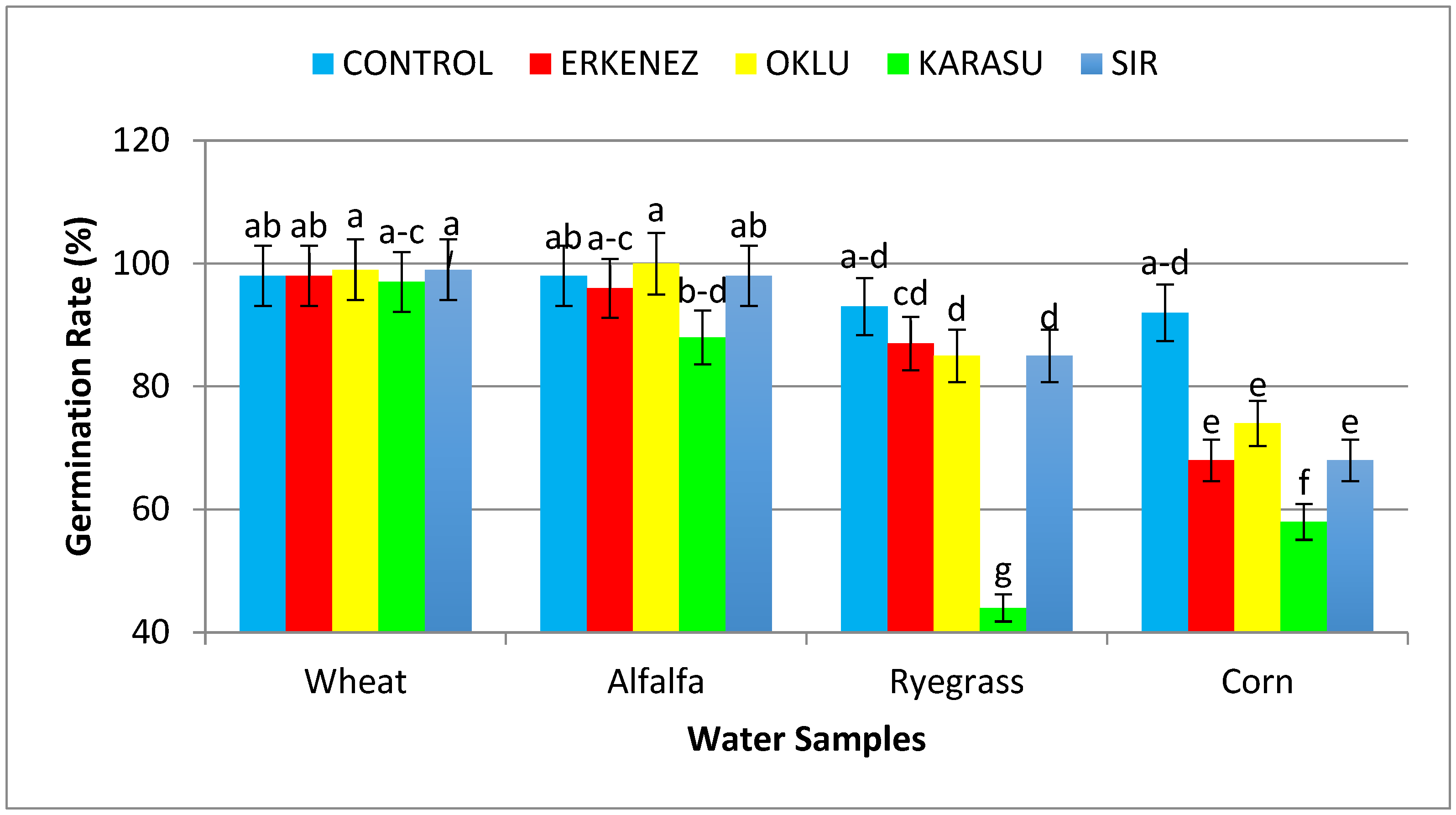
Figure 3.
Effects of different irrigation waters on radicle length of seeds (Error bars shows ± standard errors. Different letters stand for statistically significant differences at p<0.05 (Fisher LSD test)).
Figure 3.
Effects of different irrigation waters on radicle length of seeds (Error bars shows ± standard errors. Different letters stand for statistically significant differences at p<0.05 (Fisher LSD test)).
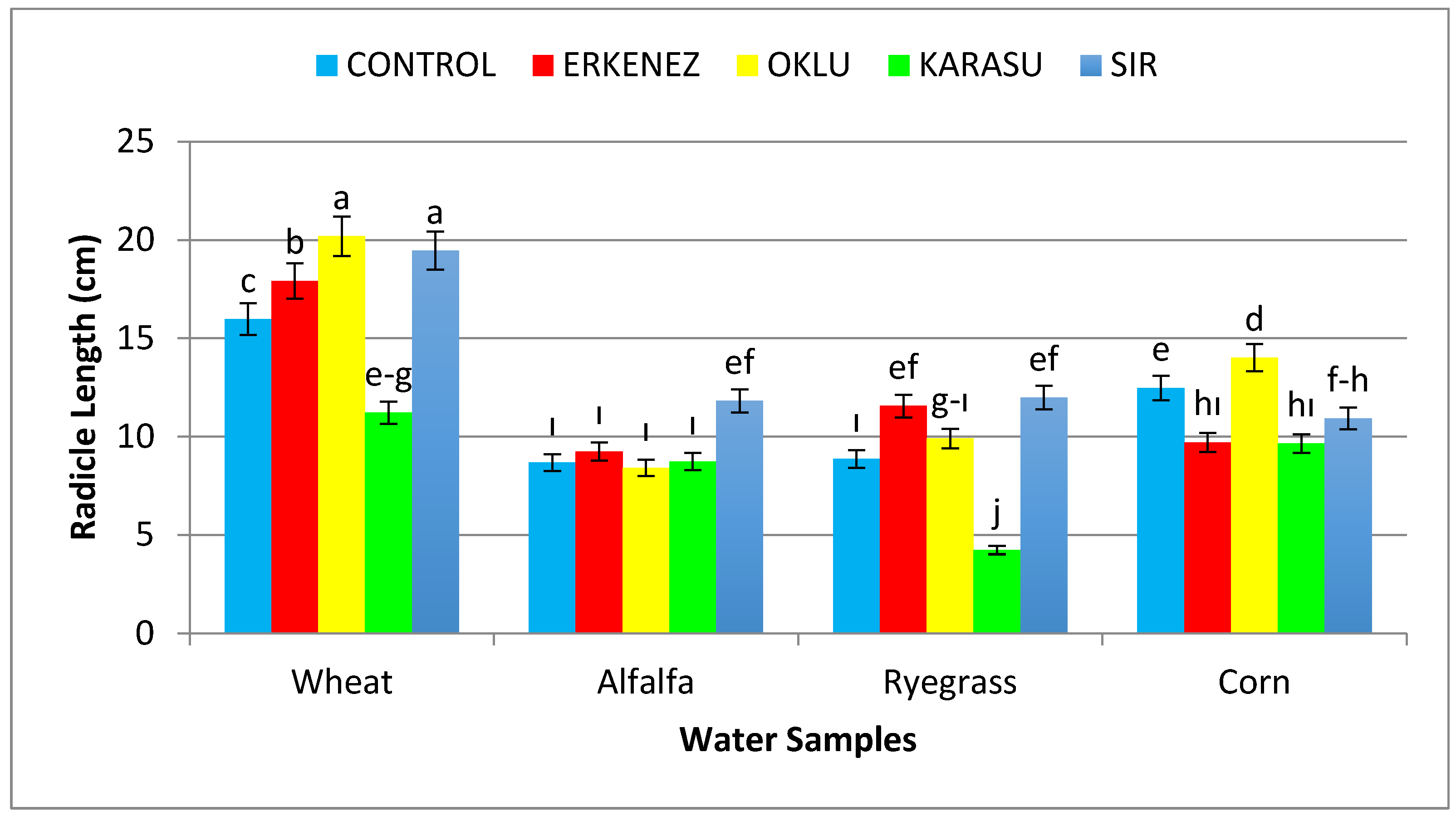
Figure 4.
Effects of different irrigation water on the seedling dry weight of seeds (Error bars shows ± standard errors. Different letters stand for statistically significant differences at p<0.05 (Fisher LSD test)).
Figure 4.
Effects of different irrigation water on the seedling dry weight of seeds (Error bars shows ± standard errors. Different letters stand for statistically significant differences at p<0.05 (Fisher LSD test)).
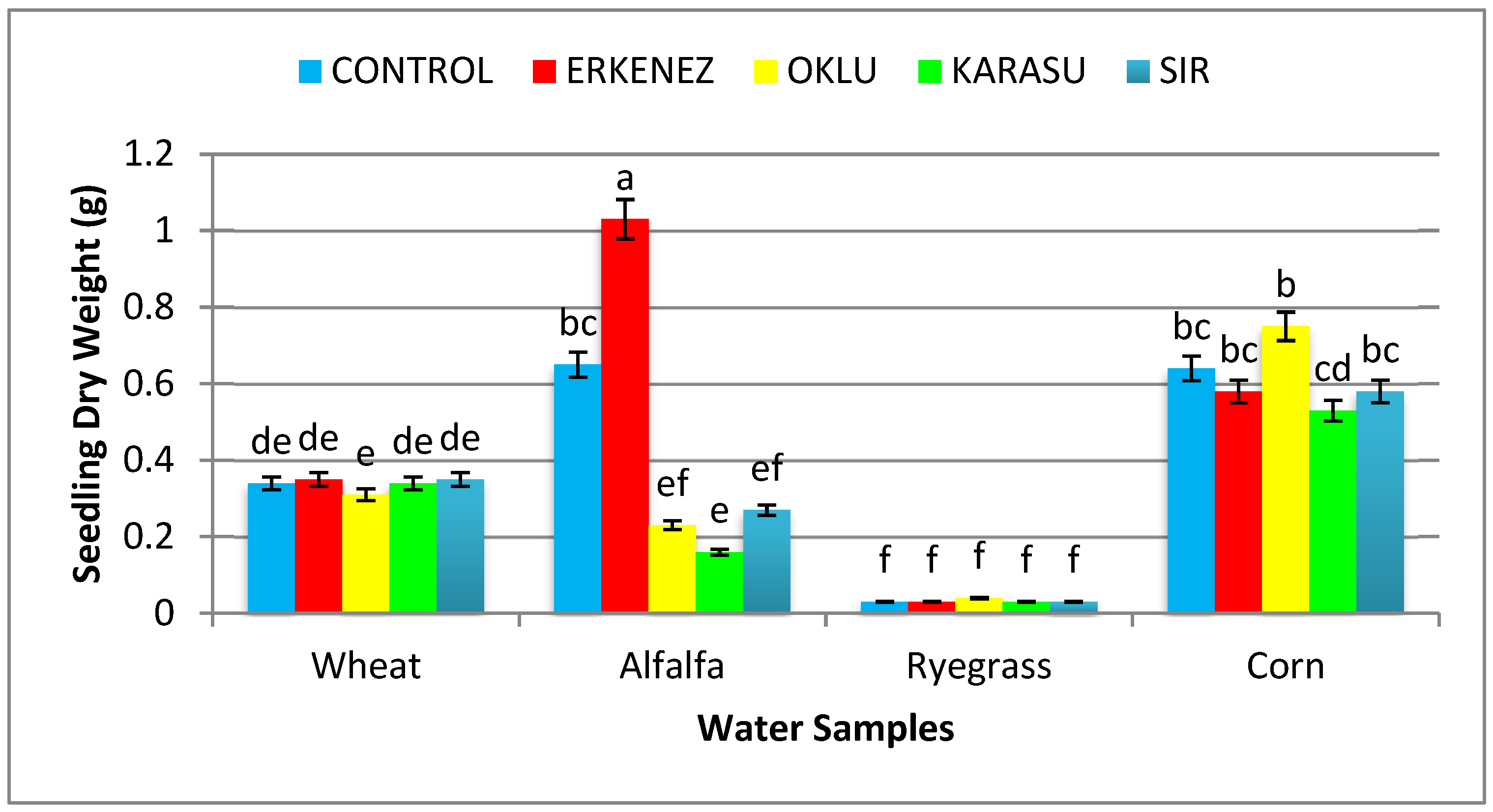
Figure 5.
Effects of different irrigation waters on vigor index values of seeds (Error bars shows ± standard errors. Different letters stand for statistically significant differences at p<0.05 (Fisher LSD test)).
Figure 5.
Effects of different irrigation waters on vigor index values of seeds (Error bars shows ± standard errors. Different letters stand for statistically significant differences at p<0.05 (Fisher LSD test)).
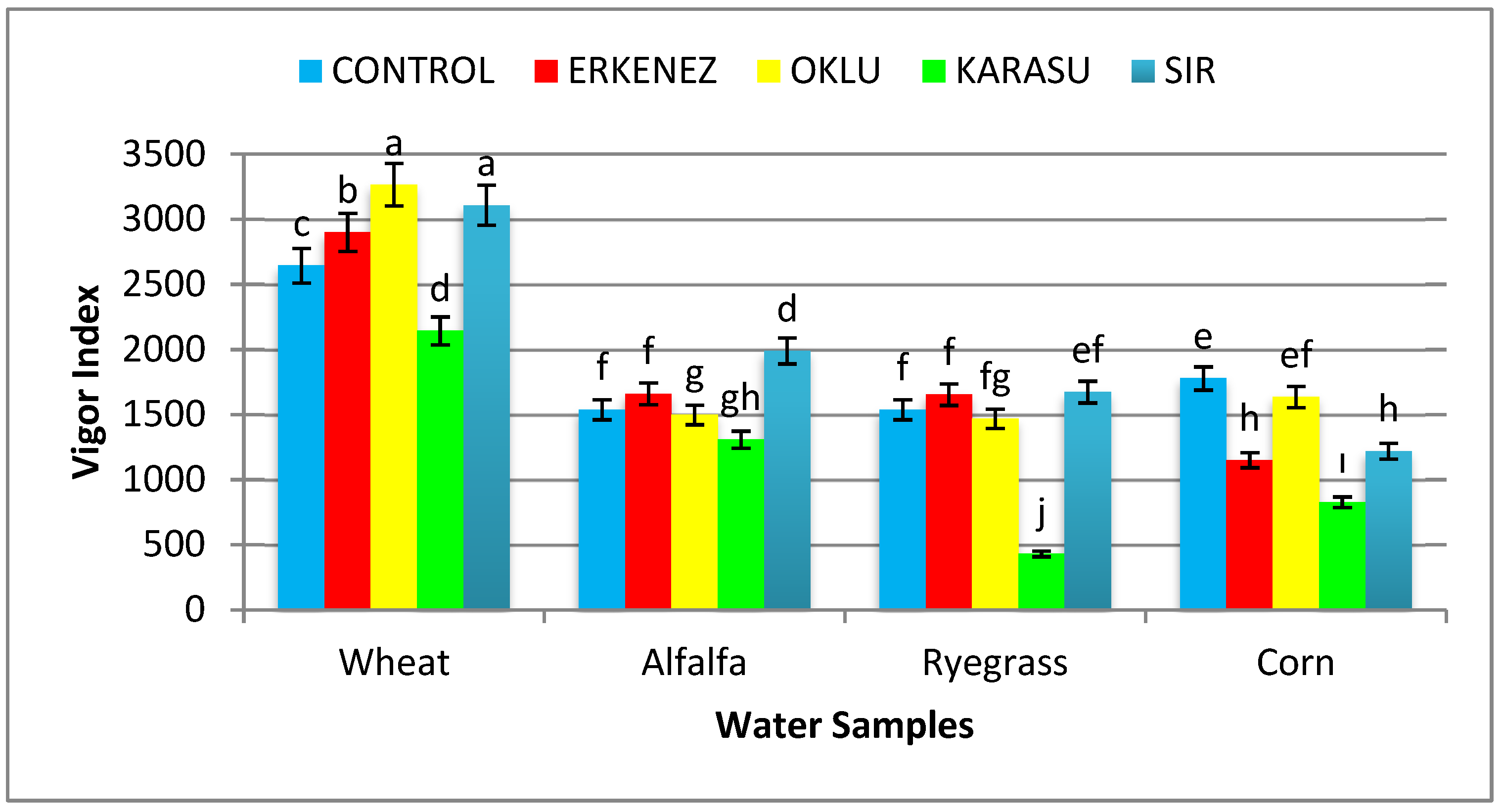

Table 1.
The geographical location of water sample collection points.
| Karasu Creek | Erkenez Creek | Oklu Creek | Sır Dam | |
|---|---|---|---|---|
| Latitude | 37°31'3.45"K | 37°32'25.56"K | 37°33'49.39"K | 37°34'30.35"K |
| Longitude | 36°56'0.85"D | 36°55'13.30"D | 36°54'42.67"D | 36°48'6.19"D |
Table 2.
Maximum permissible limits of heavy metals in irrigation waters [26].
Table 2.
Maximum permissible limits of heavy metals in irrigation waters [26].
| Elements | Maximum amount that can be given to the unit (kg ha-1) | Allowable Maximum Concentrations | |
| Boundary values in case of continuous irrigation of all kinds of soil (mg L-1) | When watering less than 24 years in clay soils with a pH value between 6.0-8.5 (mg L-1) | ||
| Arsenic (As) | 90 | 0.1 | 2.0 |
| Cadmium (Cd) | 09 | 0.01 | 0.05 |
| Chrome (Cr) | 09 | 0.1 | 1.0 |
| Copper (Cu) | 190 | 0.2 | 5.0 |
| Iron (Fe) | 4600 | 5.0 | 20.0 |
| Lead (Pb) | 4600 | 5.0 | 10.0 |
| Nickel (Ni) | 920 | 0.2 | 2.0 |
Table 3.
Heavy metals concentration in irrigation waters used in this study (mg L-1).
| AMC | KC | CS | OC | CS | EC | CS | SD | CS | |
|---|---|---|---|---|---|---|---|---|---|
| Cu | 0.2 | 0.98 | H | 1.627 | H | 0.945 | H | 1.218 | H |
| Fe | 5.0 | 18.69 | H | 0.555 | L | 2.395 | L | 8.89 | H |
| Pb | 5.0 | 0.00015 | L | 0.00056 | L | 4.5 | L | 0.013 | L |
| Cr | 5.0 | 0.097 | L | 0.00038 | L | 0.02 | L | 0.00013 | L |
| As | 1.0 | 0.206 | L | 0.171 | L | 0.165 | L | 0.132 | L |
| Ni | 0.5 | 0.00328 | L | 0.04 | L | 0.00067 | L | 0.00067 | L |
| Cd | 0.005 | 0.00068 | L | 0.00069 | L | 0.099 | H | 0.115 | H |
AMC: Allowable Maximum Concentration; KC: Karasu Creek; OC: Oklu Creek; EC: Erkenez Creek; SD: Sır Dam; CS: Current Situation; H: High; L: Low.
Table 4.
The Average GR, RL, PL, SL, SFW, SDW, and VI Values for Species and Irrigation Water and Interactions.
Table 4.
The Average GR, RL, PL, SL, SFW, SDW, and VI Values for Species and Irrigation Water and Interactions.
| GR (%) | RL (cm) | PL (cm) | SL (cm) | SFW (g) | SDW (g) | VI | ||
|---|---|---|---|---|---|---|---|---|
| ** | ** | ** | ** | ** | ** | ** | ||
| Species | Wheat | 98 a | 16.96 a | 11.63 a | 28.58 a | 1.68 b | 0.34 c | 2812 a |
| Alfalfa | 96 a | 9.38 c | 7.25 b | 16.64 b | 1.46 b | 0.47 b | 1598 b | |
| Ryegrass | 78 b | 9.31 c | 6.97 b | 16.28 b | 0.28 c | 0.04 d | 1352 c | |
| Corn | 72 b | 11.36 b | 6.63 b | 17.99 b | 4.66 a | 0.62 a | 1322 c | |
| LSD | 6.97 | 1.76 | 0.88 | 2.17 | 0.68 | 0.09 | 232.60 | |
| ** | ** | ** | ** | ns | ** | ** | ||
| Irrigation waters | Control | 95 a | 11.50 a | 8.16 a | 19.66 a | 2.17 | 0.42ab | 1874 a |
| Erkenez Creek | 87 a | 12.11 a | 8.55 a | 20.67 a | 2.02 | 0.50 a | 1841 a | |
| Oklu Creek | 89 a | 13.14 a | 8.55 a | 21.69 a | 2.45 | 0.34bc | 1967 a | |
| Karasu Creek | 71 b | 8.46 b | 6.60 b | 15.06 b | 1.61 | 0.27 c | 1177 b | |
| Sır Dam | 87 a | 13.55 a | 8.73 a | 22.28 a | 1.84 | 0.31 bc | 1997 a | |
| LSD | 7.98 | 1.97 | 0.98 | 2.43 | 0.76 | 0.11 | 260.10 | |
| ** | * | ns | Ns | ns | ** | * | ||
| Wheat | Control | 98ab | 15.99 c | 11.03 | 27.01 | 1.51 | 0.34de | 2643 c |
| Erkenez Creek | 98ab | 17.93 b | 11.63 | 29.56 | 1.62 | 0.36de | 2899 b | |
| Oklu Creek | 99a | 20.19 a | 12.83 | 33.02 | 2.04 | 0.32e | 3266 a | |
| Karasu Creek | 97abc | 11.22efg | 10.76 | 21.98 | 1.55 | 0.34de | 2143 d | |
| Sır Dam | 99a | 19.46 a | 11.88 | 31.34 | 1.67 | 0.35de | 3107 a | |
| Alfalfa | Control | 98ab | 8.69ı | 7.00 | 15.68 | 1.37 | 0.65bc | 1538 f |
| Erkenez Creek | 96abc | 9.23ı | 8.06 | 17.31 | 1.83 | 1.04a | 1659ef | |
| Oklu Creek | 100a | 8.42ı | 6.57 | 14.98 | 1.34 | 0.23ef | 1498fg | |
| Karasu Creek | 88bcd | 8.73ı | 6.18 | 14.91 | 1.09 | 0.17ef | 1306gh | |
| Sır Dam | 98ab | 11.83ef | 8.48 | 20.30 | 1.67 | 0.27e | 1988 d | |
|
Italian Ryegrass |
Control | 93abcd | 8.86ı | 7.65 | 16.51 | 0.33 | 0.04f | 1536 f |
| Erkenez Creek | 87cd | 11.56ef | 7.39 | 18.95 | 0.26 | 0.04f | 1653ef | |
| Oklu Creek | 85d | 9.91ghı | 7.40 | 17.31 | 0.36 | 0.05f | 1467fg | |
| Karasu Creek | 44g | 4.25 j | 4.70 | 8.95 | 0.21 | 0.03f | 429 j | |
| Sır Dam | 85d | 11.98ef | 7.69 | 19.67 | 0.23 | 0.04f | 1672ef | |
| Corn | Control | 92abcd | 12.48 e | 6.97 | 19.45 | 5.48 | 0.65bc | 1778 e |
| Erkenez Creek | 68e | 9.71 hı | 7.14 | 16.85 | 4.36 | 0.59bc | 1149 h | |
| Oklu Creek | 74e | 14.03 d | 7.41 | 21.44 | 6.08 | 0.76b | 1636ef | |
| Karasu Creek | 58f | 9.65 hı | 4.77 | 14.41 | 3.58 | 0.53cd | 827ı | |
| Sır Dam | 68e | 10.93fgh | 6.87 | 17.80 | 3.78 | 0.58bc | 1218 h | |
| LSD | 9.09 | 1.37 | 0.46 | 1.60 | 0.38 | 0.18 | 186.90 | |
| Mean | 86 | 11.75 | 8.12 | 19.87 | 2.02 | 0.37 | 1771 | |
| CV % | 12.77 | 23.64 | 17.04 | 17.24 | 53.28 | 41.27 | 20.74 | |
| **Significant at P<0.01; * Significant at P<0.05 ns: not significant; GR: Germination Rate; RL: Radicle length; PL: Plumule Length; SFW: Seedling Fresh Weight; SDW: Seedling Dry Weight; VI: Vigour Index (Different letters stand for statistically significant differences at p<0.05 (Fisher LSD test)). | ||||||||
Disclaimer/Publisher’s Note: The statements, opinions and data contained in all publications are solely those of the individual author(s) and contributor(s) and not of MDPI and/or the editor(s). MDPI and/or the editor(s) disclaim responsibility for any injury to people or property resulting from any ideas, methods, instructions or products referred to in the content. |
© 2024 by the authors. Licensee MDPI, Basel, Switzerland. This article is an open access article distributed under the terms and conditions of the Creative Commons Attribution (CC BY) license (http://creativecommons.org/licenses/by/4.0/).
Copyright: This open access article is published under a Creative Commons CC BY 4.0 license, which permit the free download, distribution, and reuse, provided that the author and preprint are cited in any reuse.


