

Submitted:
02 November 2024
Posted:
05 November 2024
You are already at the latest version
Abstract
Sheep farming thrives in diverse climates, with the Awassi breed well-suited for arid environments, though it faces challenges that necessitate selective breeding and innovative management to improve productivity and weight performance. This study, conducted in 2023 at Al-Fjaj Station in Jordan, analyzed the weights of Awassi sheep managed under a semi-intensive system, examining 2,263 records to evaluate the environmental and genetic factors influencing growth and utilizing statistical models to estimate heritability and breeding values. Variance analysis revealed that birth type, lamb sex, parity, and ewe age at lambing significantly influence birth, weaning, 6-month, and annual weights, with single-born lambs generally heavier than twins, males surpassing females, and younger ewes producing lighter lambs at birth that catch up in weight later. Lamb weights are correlated positively across various stages, especially between weaning, six-month, and yearling weights, while the influence of birth weight on later weights is comparatively weaker. Analysis of Variance (Type 3) indicates that rams have the greatest influence on lamb weights at all ages, while ewes primarily affect early weight, and genetic factors play a moderate role in weight variation, with maternal effects being more significant than paternal influences. There are significant positive genetic correlations among lamb weight traits, indicating that improvement in one trait can benefit others, while mean breeding values decrease with age due to increasing environmental influences, suggesting the use of index selection to enhance multiple traits in breeding programs. High correlation coefficients between breeding values and mean weights of Awassi sheep indicate that higher breeding values for specific weight traits are associated with greater actual weights, demonstrating that selection based on breeding values can effectively enhance genetic potential and predict future performance. The genetic performance and growth traits of rams' progeny indicate that selecting rams with higher breeding values can enhance weight gain in future generations, while mean weights serve as performance benchmarks to help breeders improve flock genetics and profitability. In conclusion, this study identifies key factors influencing lamb weights, such as birth type, lamb sex, ewe parity, and ewe age, emphasizing the importance of single lambs and males in achieving higher growth, while suggesting that an index selection approach combining genetic merit with environmental factors is vital for optimizing sustainable lamb production in arid environments.
Keywords:
Awassi sheep
; Growth
; Heritability
; Breeding Values
; Dry Lands
1. Introduction
Sheep farming thrives across a range of climates and geographical conditions, from humid highlands to arid landscapes, and is practiced successfully in both developed and developing nations. Arid regions, however, present specific health risks for sheep and goats, with both the dry and wet seasons bringing unique challenges to livestock well-being [1]. One notable breed well-suited to these conditions is the Awassi sheep, recognized for its distinctive fat tail and native to the Middle East spanning Jordan, Syria, Iraq, the West Bank, Egypt, Lebanon, and Turkey. This breed is herded traditionally across pastures in harsh environments, displaying a high level of adaptability. Their resilience has enabled successful introduction to other parts of the world, including Europe, Australia, New Zealand, and China, where they continue to perform well.
In the Middle East, boosting productivity in sheep farming begins with selecting ewes for high milk yield early in lactation [2]. Focusing on prime-aged ewes (3–7 years) and providing specialized nutrition can lead to faster-growing, healthier lambs [3]. Although environmental factors influence production, choosing superior rams and carefully selecting females can amplify yields even further [4]. Adding to this, enhanced prenatal nutrition and attentive care for newborn lambs can help unlock the full potential of each flock, creating a more robust and productive herd [5].
The Awassi breed is perfectly suited for arid environments, making it an economically valuable asset. However, it does face challenges, including limited prolificacy. Thanks to selective breeding programs, significant strides have been made in enhancing both milk production and body weight [6,7,8]. In Jordan, the productivity of Awassi sheep plays a crucial role in providing quality meat and milk. Yet, various factors, such as arid climate, water scarcity, limited pasture, high feed costs, economic pressures, disease management issues, and a lack of technological resources, can impact their performance [9]. By adopting innovative herd management practices and focusing on genetic improvements, the full potential of this remarkable breed can be unlocked.
This study examines the factors that affect weight in Awassi sheep at key developmental stages: birth, weaning, six months, and one year. The research analyzes environmental factors such as birth type, sex, and parity, as well as genetic factors, to identify the primary determinants of weight. Additionally, the study evaluates the potential for genetic improvement by estimating genetic parameters like heritability and breeding values. By ranking rams based on their genetic merit, the research aims to improve breeding strategies and enhance the overall weight performance of Awassi sheep.
2. Materials and Methods
2.1. the location
This study was conducted in 2023 at Al-Fjaj Station, part of the Al-Khanasri Center under the Animal Wealth and Range Research Department of the National Center for Agricultural Research in Jordan. Located 200 kilometers north of Amman in the northern part of the Mafraq Governorate, the station houses a herd of Awassi sheep in semi-open pens and operates under a semi-intensive management system. This center provides a suitable environment for examining the effects of environmental factors and genetic parameters on the weights of Awassi sheep (Figure 1).
2.2. The sheep care
Sheep were managed semi-intensively, grazing 4-3 hours daily. Pregnant ewes received 0.5 kg alfalfa hay and 1.5-1.8 kg concentrate. Lambs were weaned at 14 kg after a suckling program. Mature ewes grazed on pastures and received 250-500 g/head supplements. In winter, they received 0.5-1.0 kg/head mixed feed. Lambs were weighed at birth, weaning, 6 months, and annually.
During dry periods, ewes were fed forage legumes and cereals, while grazing on crop residues and shrubs at other times. In winter, they received concentrates, hay, and straw. Pregnant ewes were provided with a special concentrate mix including barley, wheat bran, soybean meal, and limestone, along with vitamins, salt, and minerals. The study tracked lamb weights at birth, weaning, 6 months, and annually, with both lambs and their mothers following a controlled lactation program and receiving supplementary feed to ensure optimal growth.
2.3. Data analyses
The dataset comprised 2,263 records of weights from Awassi sheep, including 111 rams, 1,714 ewes, and 1,908 lambs, offering a detailed view of growth and management patterns within this specific environment. Statistical analyses were conducted using the SAS program [10], applying the General Linear Model (GLM).
The fixed model was applied as follows.
Where, Birth weight, weaning weight, weight at 6 months, and annual weight of ijklth observations. µ= overall mean. Birth type (1= Single, 2= Twins). Sex of calf (1= Male, and 2= Female). Parity (1= First … 8= Eighth). = linear partial regression coefficient of the birth weight, weaning weight, weight at 6 months, and annual weight of ijklth observations on the ewe's age at lambing. = the kth ewe's age at lambing, = the grand mean of the ewe's age at lambing. = random error term associated with the observations with zero mean and variance Duncan's multiple-range test [11] was used to notice differences between means.
Partial correlation coefficients were estimated from the SSCP errors matrix with their corresponding probability values denoted by (Prob.>|r|) according to model (1).
Heritability values for weights were computed using the paternal half-sib method (Method = TYPE 3) according to [12]. The mixed model applied in this analysis was as follows.
Where, Birth weight, weaning weight, weight at 6 months, and annual weight of ijklth observations. Ram (i = 1, 2… 111). The prior model displays the remaining symbols and = Effect of environmental and genetic deviation related to individuals in a group of ram. Therefore, the equations are following:
Where, heritability value, Variance component of ram, Variance component of an individual, t and k are the constant, Standard error of heritability, Total number of progeny, Number of progeny per ram, and Number of rams.
Estimated breeding values (EBV) were computed with [13].
Where, breeding value, Number of progeny per ram, Root of heritability value, Average trait of progeny, and Average birth weight of the population. The previous models show the remaining symbols.
3. Results
The variance analysis for birth weight, weaning weight, 6-month weight, and annual weights (Model 1) demonstrates that birth type, lamb sex, parity, and ewe age at lambing are significant factors influencing these weight traits. Birth type and parity had the most pronounced effects across all stages of weights. Lamb sex was found to significantly affect birth, weaning, and annual weights, though it had no notable impact on 6-month weight. Additionally, ewe age played a particularly important role in determining wean-ing and 6-month weights.
Table 1 indicates that single-born lambs maintain a higher weight than twin-born lambs throughout their lives, with males generally surpassing females in weight. Lambs born to younger ewes are typically lighter at birth but catch up by reaching comparable annual weights. Interestingly, lambs from ewes with a higher number of offspring show higher birth weights but tend to be lighter at weaning. Weight variation is most pronounced at the weaning and six-month stages. All regression coefficients for lamb weights relative to ewe age at lambing are positive, though the influence of ewe age is especially evident at weaning and six months.
Table 2 highlights the correlations between lamb weights at various stages of age, revealing that lambs heavier at one stage are likely to remain heavier at subsequent stages. The data shows particularly strong correlations between weaning, six-month, and year-ling weights, indicating that lambs with higher weights at these weights tend to maintain a higher weight trajectory. While birth weight does have some influence on later weights, its correlation with subsequent stages is less pronounced.
Analysis of Variance (Type 3) of birth weight, weaning weight, weight at 6 months, and annual weight traits (Model 2) examines how rams, ewes, and lambs (random effects) influence lamb weight at different ages. It shows that rams have the biggest impact on lamb weight, regardless of age, highlighting their importance in breeding for heavier lambs. Ewes also matter, especially for early weight, but their influence decreases over time. The genetics of lambs only significantly affect their weight for one year of age.
Table 3 reveals that maternal factors exert a more significant influence on lamb weight variation than paternal genetics. This is evidenced by the greater weight differences observed among siblings from the same ram compared to those from different rams. While maternal factors play a crucial role, genetic factors also contribute to lamb weight. Heritability estimates suggest a moderate genetic influence, with a stronger impact on weight at 6 months and 1 year of age.
Table 4 reveals significant genetic correlations between various weight traits in lambs. Strong, positive associations exist between birth weight, weaning weight, 6-month weight, and annual weight. This indicates that selecting for improvement in one trait can positively influence others. The mean breeding values for these weight traits decrease with age, suggesting that environmental factors become increasingly influential on weight traits as lambs mature. To optimize breeding programs, an index selection approach can be employed to simultaneously improve multiple traits, considering both genetic and environmental factors.
Table 5 shows the correlation coefficients between various breeding values (BV) and mean weights of Awassi sheep. The high correlation coefficients for birth, weaning, 6-month, and annual weights indicate a strong positive relationship, meaning sheep with higher breeding values for a specific weight trait generally have higher actual weights. Furthermore, the significant correlation between total breeding value (TBV) and mean weights highlights a strong link between overall genetic merit and weight performance. These findings suggest that selecting animals based on breeding values can effectively enhance genetic potential for weight traits, accurately predict future performance, and drive genetic improvement over generations.
Table 6 provides valuable insights into the genetic performance and growth characteristics of rams' progeny. The breeding values (BV) for birth, weaning, six-month, and annual weights help identify rams with desirable genetics for weight gain. Farmers can select rams with higher BV scores to improve growth rates in future generations. The mean weights provide a benchmark for the average performance of each ram at various growth stages. By focusing on rams with higher TBV, breeders can enhance the overall genetic potential of their flock. Rams with higher mean weights and positive BVs could yield more profitable livestock, while those with negative BVs might be excluded from breeding programs to prevent introducing less productive traits.
4. Discussion
Lamb weight is influenced by various factors, including lambing type, sex, and ewe's age and parity. Single lambs often grow faster than twins due to better access to resources, leading to higher birth, weaning, and annual weights. Male lambs typically grow faster than females due to hormonal differences, resulting in higher weights at birth, weaning, and annually. Older ewes generally provide better growth conditions for lambs compared to younger ewes, leading to improved weight gain across all stages of development. These factors collectively influence lamb weight at birth, weaning, and throughout their life (Table 1).
Early lamb weight is crucial because it strongly predicts future growth, with weights at weaning, six months, and one year being particularly indicative. Heavier lambs at these stages typically maintain their advantage, leading to more efficient growth and productivity. While birth weight has some influence, later weights are more reliable for predicting growth potential, allowing for better management and breeding decisions that enhance overall flock performance. This understanding helps in selecting and nurturing lambs with the best prospects, ultimately improving productivity and profitability in sheep farming (Table 2).
Non-genetic factors, such as age at first calving, influence Galunki sheep productivity [14]. Furthermore, Avicalin sheep exhibit rapid initial growth, followed by a decline, highlighting the importance of environmental management [15]. Additionally, genetic and environmental factors influence lamb birth and weaning weights, with breed groups affecting only birth and weaning weights [16]. Consequently, improving management and health is crucial for pre-weaning performance and survival. Moreover, high-yielding Lacaune sheep require effective nutritional strategies, especially for maiden ewes carrying multiple lambs [17]. Similarly, for Pelibuey ewes, management improvements are more beneficial than genetic changes due to the low repeatability of reproductive traits and the significant effects of flock, and parity [18]. Likewise, Rahmani ewes in late pregnancy demonstrate increased nutrient requirements and weight loss in multiparous ewes, positively influencing lamb birth weight and growth, with high-protein diets further enhancing lamb performance [19]. In addition, body condition traits are vital for improving maternal performance and feed efficiency in genetic evaluations [20]. Yet, lamb weight is linked closely to dam's body weight, especially at 30 days and weaning, while sire's weight has minimal impact, suggesting other factors influence lamb growth [21]. Live weight and body measurements are key indicators of growth in Indigenous and crossbred sheep, with breed, birth type, and sex affecting these growth patterns [22].
Rams play a crucial role in enhancing lamb weight, as their genetic influence significantly influences growth across all stages. While ewes contribute to early weight through maternal care, the lamb's genetic potential becomes more pronounced later on. Prioritizing ram selection in breeding programs can optimize flock productivity and profitability. In Awassi sheep, both genetic and environmental factors influence weight variability. Heritability for weight increases with age, indicating a growing genetic influence. Rams contribute more to weight variation than ewes or lambs, making them a key target for selective breeding to improve weight-related traits in this breed (Table 3).
Strong correlations between breeding values for different weight traits in Awassi sheep rams indicate potential for simultaneous improvement through selective breeding. However, declining average breeding values, especially for annual weight (Table 4), suggest a need to focus on improving later-stage growth to optimize overall weight gain and production. While this suggests the potential for efficient genetic improvement through single-trait selection, a more nuanced approach is necessary. Prioritizing birth weight alone may compromise annual weight gain. A balanced selection strategy, considering multiple traits, could yield superior outcomes.
A strong correlation between breeding values (BVs) and actual weight in Awassi sheep suggests that BVs are reliable predictors of genetic potential for weight traits. The positive association between total breeding value (TBV) and mean weights further supports the use of BVs in selection decisions to improve genetic merit (Table 5). The high correlations between BVs and actual weights underscore their reliability in identifying superior individuals. Moreover, the strong link between total breeding value (TBV) and mean weights provides compelling evidence that BVs directly translate into improved productivity. Therefore, selecting animals based on BVs is not merely a promising strategy but an imperative for achieving consistent genetic progress and maximizing the economic value of Awassi sheep flocks.
Breeding values (BVs) for key weight measurements help identify top genetic rams. Consequently, prioritizing rams with higher Total-BVs enhances flock genetic potential, leading to increased productivity and profitability. Furthermore, careful selection of rams based on BVs ensures consistent genetic and economic gains. Table (6) proves the critical role of genetic performance data in maximizing ram progeny growth. BVs are essential for identifying elite rams. Therefore, prioritizing rams with higher Total-BVs is imperative for elevating flock genetic potential. Moreover, the deliberate selection of rams based on BVs is a necessity for sustained genetic and economic advancements.
Lambing number, lambing year, and ram effect influence litter size, birth weight, and weaning weight in hair sheep [23]. Crossbreeding Barki sheep with Awassi rams enhances crossbred lambs' weights, allowing them to reach puberty earlier and at heavier weights [24]. Improving ewe nutrition, especially for first-time lambs, boosts lamb growth [25]. Optimal nutrition and environment are crucial for sheep health, growth, and productivity. Ewe age influence birth weight [26]. Optimizing lamb growth requires attention to both environment and genetics [27]. A breeding program focused on genetic merit, coupled with sound management and selection, can improve Barki sheep [28]. Selecting sheep with superior genetic traits can further boost growth and weight.
Substantial additive genetic variability in Menz sheep suggests that selective breeding can significantly improve genetics, with high correlations between traits indicating the feasibility of earlier ram selection [29]. Gizaw [30] recommends a two-stage selection process, starting with selecting breeding values in nucleus centers, followed by farmers choosing the top rams. This method aligns with farmers' preferences, accelerates genetic progress, and is adaptable for participatory breeding programs in similar settings. Sustainable breeding strategies should integrate farmers' preferences and environmental conditions, as shown in Ethiopian sheep farming, to create more effective and adaptable programs [31]. Sánchez-Molano [32] identified sufficient genetic variation in meat sheep for improvement through selective breeding and recommended incorporating these traits into future breeding goals. Additionally, combining genomic selection and managing inbreeding significantly boosts genetic gain in sheep, with optimal contribution selection effectively balancing inbreeding and genetic gain [33].
Research has identified several factors influencing lamb and sheep growth. Vlahek [34] found birth type, sex, and birth number significantly affect Romanov lamb birth weight, while Al-Qasimi [35] observed minimal impact on overall production. Lupi [36] highlighted flock management and multiple births, and Nirban [37] and Singh [38] pointed to ram, sex, parturition period, parity, and maternal weight as key factors for body weight and pre-weaning traits. Vatankhah and Salehi [39] noted selecting for mating weight benefits Lori Bakhtiari sheep weight, while Assan and Makusa [40] found that singletons and males are typically heavier. These studies highlight the complex factors requiring targeted growth strategies.
However, the current research has not thoroughly analyzed the effects of nutrition and climate and has largely overlooked the interactions between environmental and genetic factors. Future studies should focus on gene-environment interactions and the impacts of selective breeding on genetic diversity and health. Effective management strategies, including environmental control and healthcare, are vital for reducing rearing stress and enhancing flock health, to improve productivity and profitability.
5. Conclusions
This study underscores the diverse factors that significantly influence lamb weights, particularly emphasizing birth type, lamb sex, ewe parity, and ewe age. The single lambs consistently achieve higher weights than twins, with male lambs exhibiting superior growth compared to females. Furthermore, the age of the ewe at lambing plays a crucial role, especially in determining weights at weaning and six months of age. The observed strong correlations among various weight traits suggest that early weight measurements serve as reliable predictors of future growth, providing essential guidance for effective breeding and management decisions. Additionally, the moderate heritability estimates highlight the importance of rams in breeding programs aimed at enhancing lamb growth. To optimize genetic improvement, it is essential to implement a selection strategy that considers multiple traits, as focusing solely on birth weight may limit overall growth potential. An index selection approach that integrates genetic merit with environmental factors will be vital for achieving sustainable lamb production. These insights are valuable for sheep farmers and breeders, offering a foundation for improving lamb growth and productivity through a better understanding of the genetic and environmental influences.
Funding
This research was conducted without any external financial support.
Institutional Review Board Statement
The study adhered to the guidelines of the Declaration of Helsinki and received approval from the Institutional Review Board of the Arab Center for the Studies of Arid Zones and Dry Lands, ACSAD (protocol code z2/12/25, approval date 30 December 2023).
Acknowledgments
The authors are grateful for the valuable contributions of the University of Turku, the Arab Center for the Studies of Arid Zones and Dry Lands (ACSAD), the University of Lapland, the National Center for Agricultural Research (NARC), and the General Commission for Scientific Agricultural Research (GCSAR), whose unwavering support was indispensable for the realization of this research.
Conflicts of Interest
The authors declare no conflict of interest.
References
- Al-Barakeh, F.; Khashroum, A.O.; Tarawneh, R.A.; Al-Lataifeh, F.A.; Al-Yacoub, A.N.; Dayoub, M.; Al-Najjar, K. Sustainable Sheep and Goat Farming in Arid Regions of Jordan. Ruminants 2024, 4, 241–255. [Google Scholar] [CrossRef]
- Kassem, R.; Al-Azzawi, W.; Al-Najjar, K.; Masri, Y.; Salhab, S.; Abdo, Z.; El-Herek, I.; Omed, H.; Saatci, M. Factors influencing the milk production of Awassi sheep in a flock with the selected lines at the Agricultural Scientific Research Centre. Kafkas Univ. Vet Fak Derg. 2010, 16, 425-430. Available online: https://vetdergikafkas.org/ uploads/pdf/pdf_KVFD_667.pdf.
- Al-Momani, A.; Ata, M.; Al-Najjar, K. Evaluation of Weight and Growth Rates of Awassi Sheep Lambs. Asian Journal of Research in Animal and Veterinary Sciences 2020, 5, 26-32. Available online: https://www.journalajravs.com/ index.php/ AJRAVS/article/view/114/227.
- Al-Najjar, K., A.Q. Al-Momani, A.N. Al-Yacoub, A. Elnahas, Reda Elsaid. Estimation of Genetic Parameters and Non-Genetic Factors for Milk Yield and Litter Size at Birth of Awassi Sheep in Drylands, 2022, Vol. 17, No. 2, P: 19-2. Available online: https://ejsgs.journals.ekb.eg/article_266898.html.
- Al-Najjar, K.; Al-Momani, A.; Al-Yacoub, A.; Elsaid, R. Evaluation of Some Productive Characteristics of Jordanian Awassi. International Journal of Livestock Research, /: 11, 1-6. https; 11.
- Alkass, J.E.; Hermiz, H.N.; Baper, M.I. Some aspects of reproductive efficiency in Awassi ewes: A review. Iraqi Journal of Agricultural Sciences 2021, 52, 20-27. 20-27. https. Available online: https://jcoagri.uobaghdad.edu.iq/index.php/intro/article/view/1232.
- Gootwine, E.; Zenu, A.; Bor, A.; Yossafi, S.; Rosov, A.; Pollott, G.E. Genetic and economic analysis of introgression of the B allele of the FecB (Booroola) gene into the Awassi and Assaf dairy breeds. Livest. Prod. Sci. 2001, 71, 49–58. [Google Scholar] [CrossRef]
- Galal, S.; Gürsoy, O.; Shaat, I. Awassi sheep as a genetic resource and efforts for their genetic improvement—A review. Small Ruminant Research 2008, 79, 99–108. [Google Scholar] [CrossRef]
- Al-Karablieh, E.K.; Jabarin, A.S. Different rangeland management systems to reduce livestock feeding costs in arid and semi-arid areas in Jordan. Quarterly Journal of International Agriculture 2010, 49, 91-109. Available online: https://ageconsearch.umn.edu/record/155543/?v=pdf.
- SAS, Institute Inc.: SAS/STAT User’s Guide: Version 9.1, 2003, SAS Institute Inc., and Cary, NC, USA. https://www.sas.com/en_us/software/stat.html.
- Duncan, D.B. Multiple range and multiple F tests. Biometrics, 1955, 11, 1-42. Available online: http://176.9.41.242/doc/statistics/1955-duncan.pdf.
- Becker, W.A. A Fortran Program for testing and analyzing multiple comparisons. Journal of Educational Statistics 1992, 17, 344–353. [Google Scholar]
- Hardjosubroto, P. Breeding value of sires based on offspring weaning weight as a recommendation for selecting kebumen ongole grade cattle. Journal of Animal Science 1994, 72, 3456–3463. [Google Scholar]
- Gbangboche, A.; Adamou-Ndiaye, M.; Youssao, A.; Farnir, F.; Detilleux, J.; Abiola, F.; Leroy, P. Non-genetic factors affecting the reproduction performance, lamb growth, and productivity indices of Djallonke sheep. Small Ruminant Research 2006, 64, 133–142. [Google Scholar] [CrossRef]
- Mahala, S.; Saini, S.; Kumar, A.; Prince, L.; Gowane, G. Effect of non-genetic factors on growth traits of Avikalin sheep. Small Ruminant Research 2019, 174, 47–52. [Google Scholar] [CrossRef]
- Hagan, B.A.; Salifu, S.; Asumah, C.; Yeboah, E.D.; Boa-Amponsem, K. Effects of genetic and non-genetic factors on body weight, pre-weaning growth, birth type and pre-weaning survivability of lambs in a sheep nucleus station. Department of Animal Production and Health 2022, 34. Available online: https://www.lrrd.cipav.org.co/lrrd34/4/3430bern.html.
- Luis, J.; Victoria, M.; Feyjoo, P.; Cáceres, E.; Hernández, F.; Vicente, J.; Astiz, S. Influence of Maternal Factors (Weight, Body Condition, Parity, and Pregnancy Rank) on Plasma Metabolites of Dairy Ewes and Their Lambs. Animals 2019, 9, 122. [Google Scholar] [CrossRef] [PubMed]
- Magaña-Monforte, J.G.; Huchin-Cab, M.; Ake-López, R.J.; et al. A field study of reproductive performance and productivity of Pelibuey ewes in Southeastern Mexico. Trop Anim Health Prod 2013, 45, 1771–1776. [Google Scholar] [CrossRef] [PubMed]
- Abd-Allah, M. Effects of parity and nutrition plane during late pregnancy on metabolic responses, colostrum production and lamb output of Rahmani ewes. Egyptian Journal of Animal Production 2013, 50, 132-142. Available online: https://ejap. journals.ekb.eg/article_93673_fefee43ee4a0271dfca101a8809e7527.pdf.
- Walkom, S.F.; Brown, D.J. Genetic evaluation of adult ewe bodyweight and condition: relationship with lamb growth, reproduction, carcass and wool production. Animal Production Science 2016, 57, 20-32. Available online: https://www. publish. csiro.au/AN/AN15091.
- Caro-Petrović, V.; Petrović, M.P.; Ružić-Muslić, D.; Maksimović, N.; Sycheva, I.N.; Cekić, B.; Ćosić, I. Interrelation between body weights of sire, dam and their lambs at early stage of growth. Biotechnology in Animal Husbandry 2020, 36, 205-214. Available online: https://doiserbia.nb.rs/Article.aspx?id=1450-91562002205C.
- Kader Esen, V. ; Elmacı; C. The Estimation of Live Weight from Body Measurements in Different Meat-Type Lambs. Journal of Agricultural Sciences 2021, 27, 469–475. [Google Scholar] [CrossRef]
- Sánchez-Dávila, F.; Bernal-Barragán, H.; Padilla-Rivas, G.; et al. Environmental factors and ram influence litter size, birth, and weaning weight in Saint Croix hair sheep under semi-arid conditions in Mexico. Trop Anim Health Prod. 2015, 47, 825–831. [Google Scholar] [CrossRef] [PubMed]
- Eissa, M.M.; El-wakeel, E.L.A.; Ahmed, M.H.; Zahran, S.M.; EL-Rewany, A.M. Effect of breed of ram on reproductive performance of Barki ewes and their lambs. Alexandria Science Exchange Journal 2013, 34, 222-227. Available online: https://journals.ekb.eg/article_3041_607f55a38b44d551da923d70fad00e79.pdf.
- Aktaş, A.H.; Dursun, Ş.; Doğan, Ş.; Kiyma, Z.; Demirci, U.; Halıcı; İ. Effects of ewe live weight and age on reproductive performance, lamb growth, and survival in Central Anatolian Merino sheep. Arch. Anim. Breed. 2015, 58, 451–459. Available online: https://aab.copernicus.org/articles/58/451/2015/aab-58-451-2015. pdf.
- Petrovic, M.P.; Muslic, D.R.; Petrovic, V.C.; Maksimovic, N. Influence of environmental factors on birth weight variability of indigenous Serbian breeds of sheep. African journal of Biotechnology 2011, 10, 4673-4676. Available online: https://www.ajol.info/index.php/ajb/article/view/94136.
- Kramarenko, A.S.; Markowska, A.V.; Salamatina, O.O.; Kravchenko, O.O.; Kramarenko, S.S. Genetic and environmental factors influenced the birth and weaning weight of lambs. Ukrainian Journal of Ecology 2021, 11, 195-201. Available online: https://cyberleninka.ru/article/n/genetic-and-environmental-factors-influenced-the-birth-and-weaning-weight-of-lambs.
- El-Wakil, S.I.; Elsayed, M. Genetic, phenotypic and environmental trends towards improving body weight in Barki sheep. Egyptian Journal of Sheep and Goats Sciences 2013, 8, 1-10. Available online: https://journals.ekb.eg/article_26769_ d92ae6e0a45a44fecc73b3aa1ce12cfc.pdf.
- Gizaw, S.; Lemma, S.; Komen, H.; Van Arendonk, J.A. Estimates of genetic parameters and genetic trends for live weight and fleece traits in Menz sheep. Small Ruminant Research 2007, 70, 145–153. [Google Scholar] [CrossRef]
- Gizaw, S.; Getachew, T.; Tibbo, M.; Haile, A.; Dessie, T. Congruence between selection on breeding values and farmers’ selection criteria in sheep breeding under conventional nucleus breeding schemes. Animal 2015, 5, 995–1001. [Google Scholar] [CrossRef] [PubMed]
- Gizaw, S.; Komen, H.; Van Arendonk, J.A. Participatory definition of breeding objectives and selection indexes for sheep breeding in traditional systems. Livestock Science 2010, 128, 67–74. [Google Scholar] [CrossRef]
- Sánchez-Molano, E.; Kapsona, V.V.; Oikonomou, S.; et al. Breeding strategies for animal resilience to weather variation in meat sheep. BMC Genet 2020, 21, 116. [Google Scholar] [CrossRef] [PubMed]
- Granleese, T.; Clark, S.A.; Swan, A.A.; et al. Increased genetic gains in sheep, beef and dairy breeding programs from using female reproductive technologies combined with optimal contribution selection and genomic breeding values. Genet. Sel. Evol. 2015, 47, 70. [Google Scholar] [CrossRef] [PubMed]
- Vlahek, I.; Ekert kabalin, A.; Menčik, S.; Maurić maljković, M.; Piplica, A.; Kabalin, H.; Šavorić, J.; Sušić, V. The effect of non-genetic factors on the birth weight of Romanov sheep. Vet. arhiv 2021, 91, 615-624. Available online: https://vetarhiv.vef. unizg.hr/ papers/2021-91-6-5.pdf.
- AL-Qasimi, R.H.; Shatha, M.A.; Allawi, L.D.K. Effect of Breed and Some Non-Genetic Factors on Milk Production and Some Proportions of Its Chemical Components in Two Breeds of Local Sheep. Al-Qadisiyah Journal for Agriculture Sciences (QJAS) 2020, 10, 227-231. Available online: http://qu.edu.iq/ jouagr/index.php/QJAS/index.
- Lupi, T.M.; Nogales, S.; León, J.M.; Barba, C.; Delgado, J.V. Analysis of the Non-Genetic Factors Affecting the Growth of Segureño Sheep. Italian Journal of Animal Science 2015, 14. [Google Scholar] [CrossRef]
- Nirban, L.K.; Joshi, R.K.; Narula, H.K.; Singh, H.; Bhakar, S. Genetic and non-genetic factors affecting body weights in Marwari sheep. Indian Journal of Small Ruminants 2015, 21, 106–108. [Google Scholar] [CrossRef]
- Singh, H.; Pannu, U.; Narula, H.K.; Chopra, A.; Murdia, C.K. Influence of genetic and non-genetic factors on pre-weaning growth in Marwari sheep. Indian Journal of Small Ruminants 2013, 19, 142-145. Available online: https://www. indianjournals.com/ijor.aspx?target=ijor:ijsr&volume=19&issue=2&article=z003.
- Vatankhah, M.; Salehi, S. Genetic and non-genetic factors affecting Lori-Bakhtiari ewe body weight and its relationship with productivity. Small Ruminant Research 2010, 94, 98–102. [Google Scholar] [CrossRef]
- Assan, N.; Makuza, S.M. The Effect of Non-genetic Factors on Birth Weight and Weaning Weight in Three Sheep Breeds of Zimbabwe. Asian-Australasian Journal of Animal Sciences 2005, 18, 151-157. [CrossRef]
Figure 1.
Map of Jordan showing the locations of Awassi sheep flocks in Mafraq Governorate, with the coordinates of the area (32.3045°N, 36.3173°E).
Figure 1.
Map of Jordan showing the locations of Awassi sheep flocks in Mafraq Governorate, with the coordinates of the area (32.3045°N, 36.3173°E).
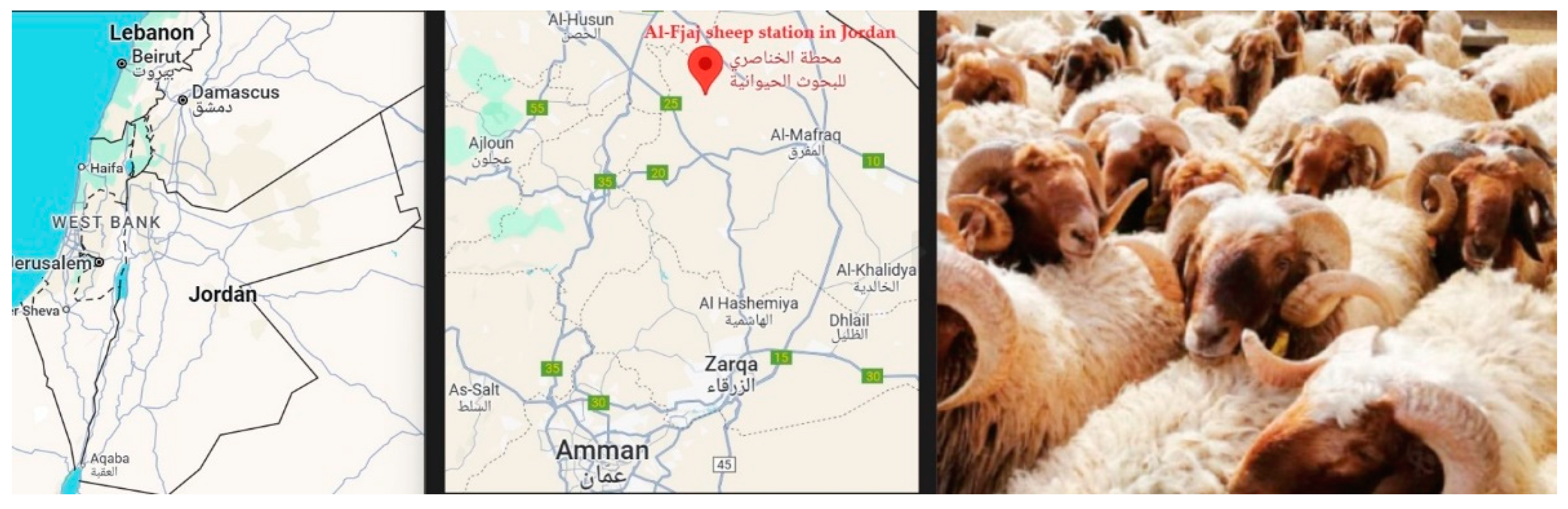

Table 1.
Least-square means of birth weight, weaning weight, weight at 6 months and annual weight traits (Model 1).
Table 1.
Least-square means of birth weight, weaning weight, weight at 6 months and annual weight traits (Model 1).
| Traits | Birth Weight |
Weaning Weight | Weight at 6 Months | Annual Weight | |
|---|---|---|---|---|---|
| Factors | |||||
| Overall mean | 3.83±0.17 | 16.34±0.93 | 30.15±1.84 | 64.75±2.66 | |
| Birth Type | Single | 4.75±0.03a | 18.30±0.20a | 34.86±0.41a | 60.79±0.59a |
| twins | 4.08±0.04b | 16.57±0.24b | 32.86±0.48b | 58.46±0.69b | |
| Lamb Sex | Male | 4.51±0.04a | 17.85±0.22a | 34.06±0.44a | 60.09±0.62a |
| Female | 4.31±0.04b | 17.03±0.21b | 33.67±0.43a | 59.16±0.63b | |
| Parity | 1st | 4.20±0.05b | 18.19±0.26b | 35.55±0.52b | 56.63±0.75c |
| 2nd | 4.32±0.04ab | 17.21±0.22b | 34.52±0.44c | 57.17±0.64c | |
| 3rd | 4.49±0.04a | 17.92±0.22b | 35.34±0.43b | 59.00±0.62c | |
| 4th | 4.62±0.05a | 16.98±0.29b | 33.49±0.58bc | 58.27±0.84c | |
| 5th | 4.49±0.07ab | 16.88±0.39b | 32.01±0.78bc | 58.28±1.12c | |
| 6th | 4.47±0.09ab | 16.94±0.49b | 29.11±0.97bc | 58.25±1.41c | |
| 7th | 4.51±0.13ab | 16.76±0.69b | 36.56±1.36a | 62.93±1.97b | |
| 8th | 4.20±0.12b | 18.63±0.66a | 37.30±1.31a | 66.45±1.89a | |
If two means share at least one identical letter, it indicates no significant difference between them. The regression coefficients of lamb weights on ewe age at lambing are as follows: birth weight = 0.023 ± 0.015, weaning weight = 0.263 ± 0.123, 6-month weight = 1.532 ± 0.243 and annual weight = 0.351 ± 0.020. The coefficients of variation for each weight stage are birth weight = 16.38%, weaning weight = 21.59%, 6-month weight = 21.71%, and annual weight = 18.98%.
Table 2.
Partial Correlation Coefficients of birth weight, weaning weight, weight at 6 months and annual weight traits from the Error SSCP Matrix / Prob. > |r|, (DF = 2251) (Model 1).
Table 2.
Partial Correlation Coefficients of birth weight, weaning weight, weight at 6 months and annual weight traits from the Error SSCP Matrix / Prob. > |r|, (DF = 2251) (Model 1).
| Traits | Weaning Weight | Weight at 6 Months | Annual Weight |
|---|---|---|---|
| Birth weight | 0.17** | 0.07** | 0.02ns |
| Weaning weight | 0.36** | 0.33** | |
| Weight at 6 months | 0.66** |
**= highly significant, ns= non-significant.
Table 3.
Variance component and heritability ± standard error for birth weight, weaning weight, weight at 6 months of age, and annual weight in Awassi rams (Model 2).
Table 3.
Variance component and heritability ± standard error for birth weight, weaning weight, weight at 6 months of age, and annual weight in Awassi rams (Model 2).
| Variance component | The weights | |||
|---|---|---|---|---|
| Birth | Weaning | 6 months | Annual | |
| Vs | 0.02326 | 0.694 | 18.9368 | 38.8642 |
| Vw | 0.53 | 14.55 | 40.96 | 85.48 |
| h2 ± SE | 0.17±0.08 | 0.18±0.07 | 0.32±0.04 | 0.31±.05 |
Vs= Variance component of ram, Vw= Variance component of individual within ram, h2= heritability. Mean of progeny for each ram= 20.34.
Table 4.
Average of breeding values of weights based on rams; and spearman correlation coefficients of breeding values for traits studies (birth, weaning, 6 months, and annual weights), N=110, Prob. > |r| under H0: Rho=0 (Model 2).
Table 4.
Average of breeding values of weights based on rams; and spearman correlation coefficients of breeding values for traits studies (birth, weaning, 6 months, and annual weights), N=110, Prob. > |r| under H0: Rho=0 (Model 2).
| Breeding Values | BVBW | BVWW | BVW6M | BVYW | TBV |
|---|---|---|---|---|---|
| BV(S) | 0.02±0.01 | -0.11±0.01 | -0.26±0.17 | -0.53±0.15 | -0.97±0.51 |
| BVBW | 0.96** | 0.97** | 0.96** | 0.64** | |
| BVWW | 0.92** | 0.98** | 0.62** | ||
| BVW6M | 0.93** | 0.63** |
BV= breeding values; BVBW, BVWW, BVW6M, and BVYW= breeding values for birth, weaning, 6-month, and annual weight, respectively; TBV = total of. Mean of progeny for each ram= 20.34
Table 5.
Spearman correlation coefficients among breeding and phenotypic values (weights) of Awassi Sheep, N = 111, Prob > |r| under H0: Rho=0.
Table 5.
Spearman correlation coefficients among breeding and phenotypic values (weights) of Awassi Sheep, N = 111, Prob > |r| under H0: Rho=0.
| BV(S) | BVBW | BVWW | BVW6M | BVYW | TBV | |
|---|---|---|---|---|---|---|
| Weights | ||||||
| MBW | 0.96** | 0.97** | ||||
| MWW | 0.97** | 0.98** | ||||
| MW6M | 0.99** | 0.99** | ||||
| MYW | 0.95** | 0.97** | ||||
BVBW, BVWW, BVW6M and BVYW = Breeding values of birth, weaning, 6 months and annual weights, respectively. TBV= Total breeding values. MBW, MWW, MW6M and MYW= Means of birth, weaning, 6 months and annual weights, respectively. Mean of progeny for each ram= 20.34.
Table 6.
Ranking of Awassi rams by genetic merit and performance.
| Rams Rank | 1st | 2nd | 3rd | and so on | 109th | 110th | 111th | |
|---|---|---|---|---|---|---|---|---|
| Traits | ||||||||
| MBW | 5.22 | 5.34 | 5.14 | … | 3.83 | 3.91 | 2.00 | |
| BVBW | 0.52 | 0.50 | 0.49 | … | -0.48 | -0.56 | -0.64 | |
| MWW | 20.99 | 20.83 | 20.39 | … | 15.50 | 15.39 | 15.52 | |
| BVWW | 2.29 | 2.21 | 1.99 | … | -2.06 | -2.30 | -2.34 | |
| MW6M | 43.19 | 42.89 | 42.93 | … | 27.70 | 15.50 | 26.24 | |
| BVW6M | 6.32 | 6.15 | 5.83 | … | -7.15 | -8.00 | -8.52 | |
| MYW | 71.68 | 71.60 | 71.90 | … | 43.78 | 43.89 | 40.54 | |
| BVYW | 10.97 | 10.78 | 10.52 | … | -11.33 | -11.70 | -13.48 | |
| TBV | 20.11 | 19.63 | 18.83 | … | -21.02 | -22.56 | -24.98 | |
MBW, MWW, MW6M and MYW= Means of birth, weaning, 6 months and annual weights, respectively. BVBW, BVWW, BVW6M and BVYW = Breeding values of birth, weaning, 6 months and annual weights, respectively; TBV= Total breeding values. Mean of progeny for each ram= 20.34.
Disclaimer/Publisher’s Note: The statements, opinions and data contained in all publications are solely those of the individual author(s) and contributor(s) and not of MDPI and/or the editor(s). MDPI and/or the editor(s) disclaim responsibility for any injury to people or property resulting from any ideas, methods, instructions or products referred to in the content. |
© 2024 by the authors. Licensee MDPI, Basel, Switzerland. This article is an open access article distributed under the terms and conditions of the Creative Commons Attribution (CC BY) license (http://creativecommons.org/licenses/by/4.0/).
Copyright: This open access article is published under a Creative Commons CC BY 4.0 license, which permit the free download, distribution, and reuse, provided that the author and preprint are cited in any reuse.


