

Submitted:
02 November 2024
Posted:
04 November 2024
You are already at the latest version
Abstract
Stakeholders and their dynamics are often neglected in innovation systems literature. The importance of bioeconomy is growing for its implications on addressing environmental challenges, shaping economic decisions, markets and sustainable development. This paper analyses stakeholders’ dynamics for knowledge creation and innovation to transit from unsustainable practices to the sustainable use of biological resources - bioeconomy. The originality of this paper is the creation of an analytical framework to characterise the interactions of stakeholders and how these interactions reshape the innovation systems to create a new narrative and a new knowledge base platform for innovation. Using a qualitative approach, data was collected through surveys between 2022 and 2024. We explored the dynamics of 29 stakeholders involved and collaborating in R&D activities from the biotechnology sector in Caldas, Colombia. Our findings show that dynamics towards bioeconomy are only at the discursive level. Stakeholders carry out research activities as a means to generate income rather than for innovative purposes, overlooking informal interactions which generate novel ideas that could translate into solutions, services, and products. We conclude that bioeconomy transition needs a systemic disequilibrium by a new institutional infrastructure that enables stakeholders, including civil society, to create a structural change for embracing innovation dynamics.
Keywords:
stakeholders
; bioeconomy
; biotechnology
; sustainability
; innovation systems
1. Introduction
Bioeconomy (BE) has been at the centre of sustainability discussions worldwide for the last twenty years, as a consequence of major environmental, social and economic challenges. These challenges and developmental trends require a radical change in the form of a modernisation of the global economy [1,2,3]. This discussion anchors around applying biological principles and processes based on technical innovation to maximise efficiency and derive high value from biobased resources in all sectors of the economy [4]. Bioeconomy emerged as an economic paradigm in science, technology and innovation (STI) policy with the purpose of minimising adverse environmental impacts of economic activities, thereby aiming to achieve important sustainable development goals (SDG) [5,6]. Transitioning to a bioeconomy involves efforts by a wide range of industries in the replacement of fossil fuel inputs by renewal carbon sources along with resource efficiency and preservation of the resource values in material circles [7,8].
European countries have shown significant progress by developing policy strategies. These policies promote structural changes towards a bioeconomy. For example, by replacing fossil-based raw materials with biobased resources and principles [9], sustainable management of natural resources, climate change mitigation, and energy and food security [2]. In Latin American countries (Latam), Colombia has championed a bioeconomy to cosmetically present bio-matters to render involved fields 'capitalisable' and 'rentier' [10,11]. From the political perspective, the policy-push pattern of bioeconomy has been similar across Latam geographies [11]. Innovations related to bioeconomy encompass a range of new products i.e. fuels, new food additives and biopolymer [12,13] novel processes i.e. biorefining [14] and industrial biotechnology [15].
We argue that the focus of bioeconomic promises is on the role of (bio and related) technological innovations, allowing the advancement of a sustainable way to manage renewable biological resources [11]. In this line of argument, bioeconomy still has to deliver its potential, and in the case of Colombia, transitions are deeply contested, involving multiple possible visions and transition pathways [16,17,18,19], fierce resistance from vested interests across sectors i.e. energy, petrochemical, agriculture, and forestry sectors [20,21].
Despite all the positive impacts of bioeconomy such as environmental benefits, innovation, creation of new economic opportunities, new business formation and the strengthening of knowledge-based sectors, recent research has addressed innovation barrier for segments of the bioeconomy using innovation systems (IS) approach, most at the national level [21,22,23,24,25]. Related assessments using IS approach in the context of Latam have addressed transition to bioeconomy [26,27,28]. These studies have mainly focused on system failures. Although IS in Latam, they may exhibit presence and coordination among actors to support innovation, in this research, we examine the dynamics of stakeholders in IS concerning innovation to transit to bioeconomy. By addressing this research gap, we aim to make a theoretical and empirical contribution to literature. Our theoretical contribution derives from introducing elements of IS, particularly Technological Innovation Systems (TIS) and linking them with stakeholders rather than actors. Our study reframes these elements in IS placing emphasis on the element of agency in stakeholders, which impacts on innovation and thus bieconomy transition. The empirical contribution comes from examining the dynamics of stakeholders of the biotechnology sector in Caldas, Colombia. We address the question as to why, despite the awareness amongst critical stakeholders of the importance of a bioeconomy for the sustainability of the Caldas economy, and the existence of institutions in the form of local and national laws, there still exists a lack of an effective transition from a fossil fuel economy to a bioeconomy.
This paper starts with the elaboration of the theoretical framework in Section 2. In Section 3 we elucidate the methodological approach to answer the research question. In Section 4 we present our results in light of the elements of the theoretical framework. In Section 5 we discuss the implications of the dynamics of stakeholders considering the literature on IS. And finally, in Section 6, we present the conclusions.
2. Theoretical Framework
We take the Technological Innovation System approach (TIS). A technological system may be defined as a network of agents interacting in a specific economic or industrial area under a particular institutional infrastructure or set of infrastructures and involved in the generation, diffusion, and utilization of technology [29]. Technological systems are defined in terms of knowledge competence flows rather than flows of ordinary goods and services [30]. From the TSI approach, the required changes in production processes, resource use and integration of civil society associated with Bioeconomy concepts, call for system innovation, including changes in the architecture, components of the entire sectoral (or sociotechnical) system [31]. One key aspect of TIS is that they are multi-dimensional. In most cases the constituent elements (knowledge/competence networks, industrial networks/development blocks, and institutional infrastructure) are specially correlated [30]. Although agents in innovation systems are often seen as key drivers of sustainability transitions, stakeholders, on the other hand are merely mentioned in innovation systems literature. Therefore, we argue that the field lacks of a systemic investigation of scientific knowledge for innovation, innovation barriers and drivers from the stakeholder perspective [32].
Conceptualised as one of the main functions of innovation systems [33] the dynamics of stakeholders activities, and their embeddedness in innovations systems still lacks of theoretical foundations [34]. Tracing ongoing transitions requires attention to the dynamics of interactions of stakeholders and other system components. To enable civil society, policy makers and stakeholders to assess the impacts of their dynamics on bioeconomy, a systemic assessment of dynamics of bioeconomy innovation is needed. So far, little is known about the stakeholders be them companies, universities, public and private research organisations, local government agencies about the attention to risk, synergies and trade-offs. To our knowledge, research needs to incorporate how stakeholders experience, i.e. their vested agency and how they shape the complex processes such as innovation and thus transformation.
Based on this background, we build our framework using studies of Technological Innovation Systems (TIS) at the stakeholder level. Studies of TIS have focused on agents, firms and entrepreneurs stating that innovation requires perception of opportunities to productively change existing routines, their willingness to undertake such changes and the ability to implement these changes [35]. For innovation to occur and produce changes, stakeholders are aware of their capabilities, values and continuously scan their environment for risk, opportunities and change with uncertain outcomes [36]. Furthermore, to effectively transit to bioeconomy innovation requires collaboration between firms, universities, research organistions and government agencies to produce knowledge to ultimately change the routines, as previously mentioned [37,38,39].
Previous research has examined factors that impact the collaboration between stakeholders. For example, analysis on universities as a factor for new knowledge generation and technology transfer with significant impact on entrepreneurs and companies at the regional level [40]. Likewise, research has examined the growing role that end users play in regional project-based innovations [41]. However, there is also evidence that show factors that impact innovation, such as actors that make up the innovation ecosystem, how these actors impact successful cases of knowledge transfer and the interrelationships between the factors leading to knowledge transfer [42].
Therefore, our framework examines Networks in SSI that indicate that successful innovation seems to require interaction among stakeholder with different competences. The nature of innovation is uncertain and complex; therefore networks provide other alternatives for governing innovation [29,30]. Institutional infrastructure refers to a set of institutional arrangements that directly or indirectly support, stimulate and regulate the process of innovation and the diffusion of technology [30,43]. Development blocks are dynamic in nature and incorporate the characteristics of disequilibrium. These blocks create tension within the technological system that varies in strength and composition over time and generates development potential for the system [43].
The TSI approach is useful because it makes it possible to describe, understand, and explain the process of innovation. It enables us to identify the factors that shape innovation [39]. It allows to map and explain interactions between stakeholders that generate knowledge, especially in a diverse range of stakeholders involved, including governmental organisations, businesses, non-governmental organisations, local communities, scientists, farmers, and civil society. These stakeholders assume distinct roles in policy formulation and implementation, research and development, and the production and consumption of biotechnology products. The contributions of each group of stakeholders are crucial in promoting and advancing the sector towards a bioeconomy.
However, in our research context, in the activities of the stakeholders, three distinctive elements interrelate with what constitutes an explanation of why the transition towards a bioeconomy has not been up to the global challenge. We identified three main categories: 1) importance, 2) influence and 3) interest. These three emerging categories were recurrent across all stakeholders, private and public organisations. The perception of every stakeholder regarding research activities undertakings, translate these research results into change and implement them, entails risk taking and long-term vision of innovation.
Our framework therefore depends on the Importance, Influence and Interest of stakeholders in light of the perceived innovation opportunities in the biotechnology sector of Caldas, Colombia. We explain these different elements in more detail below. The importance of specific stakeholders within the biotechnology sector lies in their ability to shape its trajectory. Stakeholders’ innovation is shaped by their importance. For example, Government organisations can create regulations and policies either facilitating or impeding investment in biotechnologies. Research reveals that innovation is shaped by preferences. For example, innovation in environment can be driven by genuine concerns [36,44]. In this line of argument, public and private universities, technical schools, and research centres, contribute to research and development with their wealth of knowledge and expertise.
In this article, Influence is the capacity of stakeholders to shape decisions and policies which impact the biotechnology sector. Stakeholders can exert their influence through various means, including political, economic, or social power. The structural properties of relevant ISs and STI policy can influence the prevalence of innovation among firms [45,46,47]. For instance, governments can establish regulations and policies fostering or hindering the transition towards a bioeconomy. Similarly, businesses can leverage their economic power and technological prowess to influence a bioeconomy. Influence in stakeholders indicate the ability to leverage, combine, and recombine knowledge and resources so that new products, technologies, and markets result [48]. Non-governmental organisations, alternatively, can mobilise public opinion and advocate for sustainable approaches.
The participants in bioeconomic activities are propelled by unique objectives and motivations, directly shaping their interests. Stakeholders' interests can diverge considerably, with commercial entities often prioritising profit maximisation and local communities emphasising public health and environmental protection. A meaningful understanding of these interests is indispensable for fostering productive collaboration among stakeholders. By recognising and comprehending the interests of all stakeholders, it is possible to establish a more cohesive and cooperative environment, leading to more effective outcomes.
In summary, our conceptual framework sheds light on the structural components (i.e. Stakeholders network, institutional infrastructure, and development blocks) of innovation are in continuous interaction with and therefore shaped by Importance, Influence and Interest. The intricate interplay between stakeholders' importance, influence, and interests can give rise to complex tensions. Stakeholders with significant importance and influence can often exert their interests at the expense of others. Achieving this balance is crucial to the long-term success of the bioeconomy, and it requires a strategic and collaborative approach that considers the diverse concerns and perspectives of all stakeholders involved. The conceptual framework highlights the embeddedness of stakeholders’ innovative behaviors and the related outcomes. Therefore, it is essential to recognise the various roles of these stakeholders in a bioeconomy and ensure that their interests align with long-term bioeconomy goals.
3. Materials and Methods
3.1. Sample Selection and Research Tools
We focused our research on Caldas department, Colombia and on the biotechnology sector. Caldas has set an agenda anchored around a comprehensive national STI programme to promote transition to bioeconomy [49]. For over 25 years, the National government of Colombia in partnership with Caldas Department and municipality government levels, have implemented a series of initiatives and projects to develop clusters in various sector, biotechnology being one of them. The biotechnology cluster developed through technical committees. These committees addressed issues such as identifying and summoning companies, government agencies and organisations related to biotechnology process and research that culminated in the foundation of the biotechnology cluster of Caldas in 2019 [50]. Therefore, the key objective of the study is to examine the dynamics of stakeholders in the creation of knowledge despite the institutional framework to support innovation based on science and technology by the biotechnology sector in Caldas (Colombia).
In 2019, The National Government of Colombia carried out an initiative to conduct a comprehensive technical assessment for a roadmap toward bioeconomy for the entire country. In 2020, shortly after this initiative, the Government of Caldas department, followed in the steps of the national government and conducted a similar but local technical assessment to further take Caldas towards bioeconomy and sustainable economic competitiveness. Bioeconomy is an area of strategic importance for the National and Department government levels in all productive sectors, in particular life-science and biotechnology. Hence, when looking at the agglomeration of the stakeholders of this cluster, it was logical to examine their dynamics based on the bioeconomy promotion. The stakeholders’ involvement in collaborative R&D and learning sheds light on efforts related to STI that ultimately impact on the bioeconomy transition.
The research was carried out between 2022 and 2024. The method used was qualitative research based on interviews. Qualitative interviews are the method that allow for understanding and meaning to be explored in depth because it helps examine the context [51]. Interviewing is a powerful way of helping people to make explicit things that have hitherto been implicit, to articulate their tacit perceptions, feelings and understanding (p. 32). Given the qualitative nature of this research, there was no need to establish a representative sample of stakholders for which statistical analysis would not be appropriate. This provided flexibility in terms of stakeholders to look at. The purpose of this was for participants to acknowledge themselves as a stakeholder. This involved initial informal discussions to establish a baseline and identify critical participants and their level of involvement.
3.2. Data Collection and Analysis
We conducted interviews by implementing surveys by using the virtual tool "Google Forms". The first survey was carried out in 2022, we invited 172 stakeholders, out of which 40 participated. The second survey in 2024, inviting 226 stakeholders, with 29 responding (see Table 1). The questionnaire of the survey combined the theoretical elements discussed in section 2, took about 40 minutes to answer given the open-ended questions and was conducted with owners, managing director and when existing, the director of research at the stakeholder’s place of work. The questionnaire also constructed the baseline for a qualitative mapping out of the stakeholders with the validation of other stakeholders in the sector.
Prior to sending the questionnaire, we approached stakeholders via email and phone call. This approach proved to be appropriate and enhanced professionalism on our side as researchers gave the level of assurance the stakeholder needed. This also allowed us to build up rapport as we explained more about the project, making it clear we were not interested in financial information, prices, customers and the like. In both email and phone calls, we provided participant information and enclosed informed consent. A brief leaflet was elaborated and also enclosed; on phone calls it was briefly introduced, containing information on the research i.e. objectives, the focus of the research, and an explanation on why their participation was important. It explained the topics that would and would not be covered i.e. money, financial statements and negotiation arrangements. We explained the data handling and privacy issues and reassured them they could withdraw from the research at any time.
The Thematic Analysis Approach (TA) was utilised given that it ensured the robustness of the methods used and the qualitative nature of this research and provided transparency in relation to the analytical process [52,53]. We read all answers and then used Nvivo software to create labels (indexing) and have a manageable way of looking at the data. The next stage then consisted of transforming the labels into codes, according to concepts of literature such as TIS, and three emerging categories: Importance, Influence and Interest. By using the TA, we organised analysis to the systematic requirements of this method. It provided with the possibility to trace the interconnectedness stages and links between accounts to explain and construct a thorough account of the case. TA enables the description of a analysis from initial management of data through the development of descriptive to explanatory accounts [52] (p.55). Finally, as part of the construction of the stakeholder map, three experts rated the stakeholders in three categories that explained the interactions taking places in the TSI: Interest, Importance, and Influence on a scale from 1 (very low) to 5 (very high). We then assessed the relative weight of each category within the network as follows: 45% (Importance), 30% (Influence), and 25% (Interest), and recalculated the ratings accordingly. During this step we ran a multivariate analysis using the principal component technique to examine the data exported to the statistical program SPSS (Statistical Package for Social Science). Subsequently, we performed cluster analysis and used a dendrogram to group stakeholders according to their interests, importance, and influence. Then, the stakeholders map was constructed, and each resulting group was characterised and typified.
4. Results
In this section, we present our findings from the empirical analysis and shed light on the research question:
Why, despite critical stakeholders' awareness of the importance of a bioeconomy for the sustainability of Caldas' economy and the existence of institutions in the form of local and national laws, does a lack of effective transition from a fossil fuel economy to a bioeconomy exist?
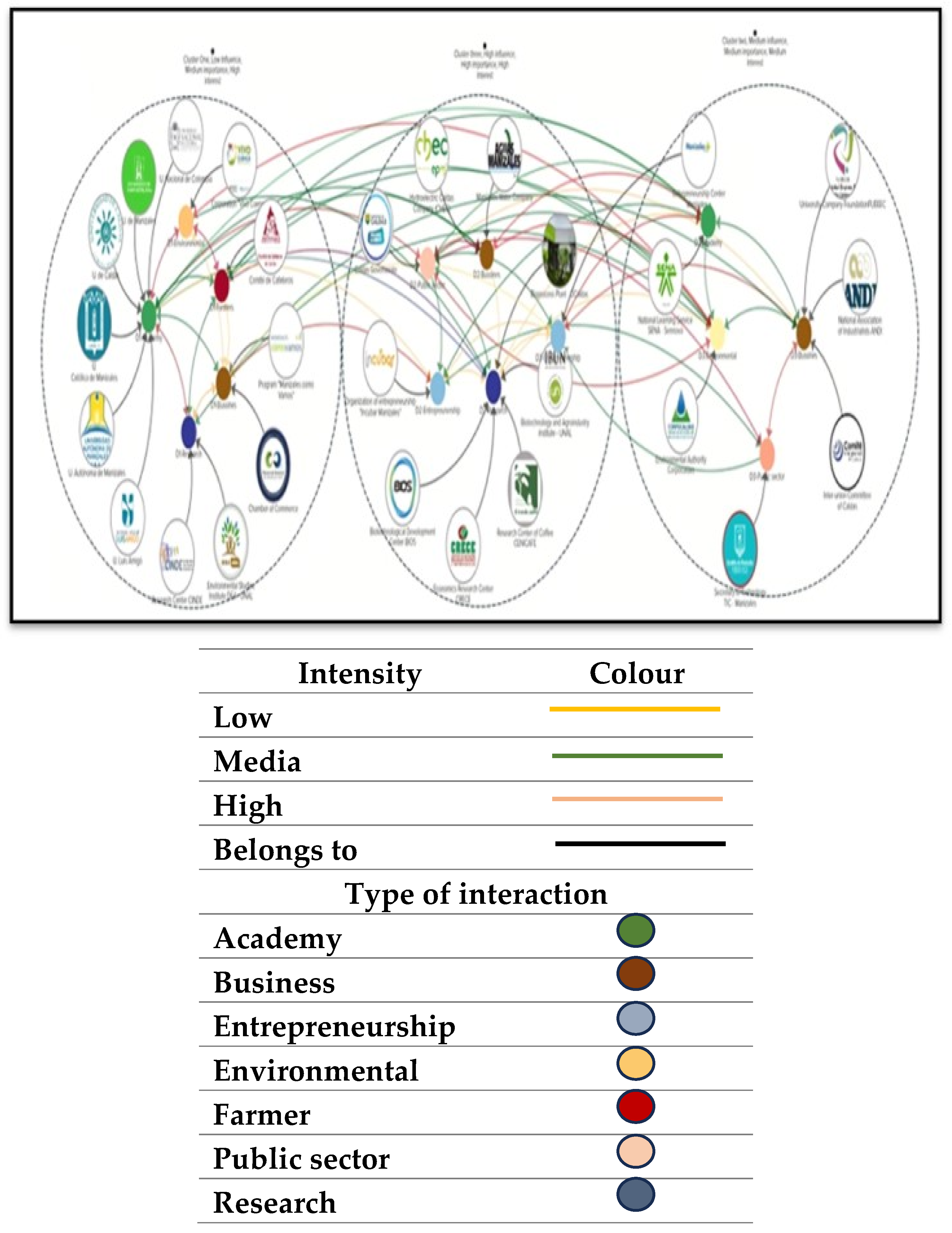
The examination of dynamics of stakeholders in the biotechnology sector of Caldas, has shown substantial public investment along with private efforts. The investment done during the past 25 years has geared towards the creation of the cluster with stakeholders (companies and public organistions) and clear perception of what bioeconomy and transition to it entail. Figure 1 illustrates the complex interplay between stakeholders of the biotechnology sector in Caldas. Acting upon the network, R&D collaboration among stakeholders is recurrent, showing activities based on STI. These collaborations create a knowledge pool with potential for innovation. In this line, the institutional infrastructure allows the creation of strategic alliances that affects positively the network in terms of blocks of stakeholders. When looking at the articulation of this TIS, the dynamics of stakeholders have developed based on their Importance, Influence and Interests, which nevertheless point to a cluster, it is less related innovation and more to a promotion of bioeconomy. Likewise, the institutional infrastructure is supportive of formal arrangements, it overlooks other possibilities that can translate into innovation. Furthermore, most stakeholders understand innovation and bioeconomy, but only few really embark in the risk-taking aspect of innovation. In the following sub-sections, we present the findings in more detail.
4.1. Networks of Research
Our analysis from interviews indicates that project management for research stands out as the most prevalent among the various forms of engagement. Stakeholders point out that research is of great importance. The maps shows that cluster 1, most stakeholders are universities, and only three NGOs are dedicated to the interests of businesses. The map shows stakeholders are highly interested in conducting scientific research. This is especially evident when stakeholders require context-based solutions which consider the local natural endowment and the sector's requirements. Stakeholders also assert that the biotechnology sector needs to show vision and imagination regarding the development of waste utilisation alternatives, as strategies to address environmental and climate change challenges. Most views highlight the importance of universities and business chambers advancing the sector toward bioeconomy.
Data indicates that national and local government administrations promote calls for funding various bioeconomy research projects. Universities engage with the productive sector in putting together bids for funding. This recurrent engagement involves supplementing scientific research capabilities, dividing work packages based on institutional expertise, and delivering reports, scientific articles, and patents. One clear example of research funding is the articulation of several higher education institutions engaged in biotechnology and environmental research and development such as "Implementation of a comprehensive strategy through biotechnological innovation for the utilisation of waste in the Department of Caldas," executed between 2013 and 2019.
Scientific infrastructure for project execution still needs improvement, being of medium importance to the outcomes of these research projects. The low influence stakeholders can exert even though public universities typically possess the most infrastructure, their decreased influence poses challenges related to financial resources. In this line of argument stakeholders identified two structural issues. Researchers reported hindering factors for innovation. For example, the lack of time to carry out significant research by reducing teaching hours and allowing academics greater flexibility to manage their schedules. With this, researchers can work more effectively towards patent production, innovation, and technological development.
Researchers and business associations also state that projects are a means of funding. This funding is a survival mechanism necessary to comply with academic performance indicators. Generally, universities dedicate significant time and human resources to comply with publications and formal collaborations with other universities and research centres. These indicators are based on the contractual arrangements universities have as an effect of participating in research projects.
4.2. The Formal and Informal Institutional Infrastructure
Research projects encompass practical solutions and interventions for the biotechnology sector in Caldas. For instance, the University of Caldas houses the Technological Development Centre in Bioprocess and the Agroindustry Plant, recognised by the Ministry of Science (Minciencias). Since its inception in 2012, this research centre has executed numerous research projects and currently possesses various bioproducts and processes ranging from three to nine in terms of Technology Readiness Levels (TRL). Examples include the production and distribution of mushroom seeds of several macrofungal species with medicinal attributes and nutritional properties to mushroom growers.
However, when we further explored interests with stakeholders regarding research and innovation, although they categorically stated it as necessary for the transition of the sector to bioeconomy, stakeholders repeatedly argued that alongside formal research, contractual mechanisms and relationships, the "real" innovation has a robust informal component. One university stakeholder said:
…"Alongside the (research) project we are currently undertaking, we have had several informal meetings that have arisen spontaneously to discuss specific matters of various issues. It turned out that as a result of these informal interactions, exciting ideas emerged, and it is what we have been concurrently working on" (Stakeholder A, Nov 2023)
The participation of universities and businesses in research bids is in line with calls to tackle issues which may or may not entirely address the contextual issues of Caldas. These formal mechanisms encourage these stakeholders to gather to think about the issues at hand. In this regard, stakeholders act tactically rather than critically to obtain funding and subsequently comply. According to our interviewees, "innovation encounters" in the form of informal meetings should be encouraged as a means for promoting innovation through research, and in fact such encounters already take place, with entrepreneurs and businesspeople from across Caldas, and from various value chains participating. This type of collaboration with research groups at universities should further explore how current research centres can be used to develop, enhance, or solve current value chain-related issues. What is clear is that informal interaction with entrepreneurs, some financial entities, and government bodies could allow a more flexible space for discussing issues and developing ideas to provide comprehensive and innovative solutions. Therefore, these significant interests give rise to exploration and a search for alternatives that can accelerate solutions and the transition to a bioeconomy.
4.3. Forging Strategic Alliances
One of the most interesting findings was the crosscutting nature of replicating trending discourses such as innovation, bioeconomy, and sustainability. In the map, Cluster 2 illustrates a structure which is predominantly comprised of private organisations oriented towards supporting biotechnology companies. Stakeholders believe it is vital to identify other companies involved in processing food and agriculture. When stakeholders were asked what their understanding of bioeconomy and sustainability was. What was apparent from the responses was a repeated discourse of wanting to sound and appear concerned about the future of the biotechnology sector and sustainability, as illustrated by some of the respondents below:
"When discussing with our counterparts in Bogota, we are always told that we dress up and smell very nice when we talk about this type of issue (biotechnology, bioeconomy and sustainability), but we do very little when it comes to transforming the sector" (Stakeholder B, Nov 2023)
Furthermore, there is interest from the stakeholders in beginning to mobilise towards a bioeconomy. The significance of these stakeholders lies in their efforts to forge alliances or agreements with research centres, companies, and business organisations for cooperation in training, mentoring, and research projects facilitated by local and departmental government intervention. However, based on the statement above, this interest does not translate into real action with regards to transforming the sector into a bioeconomy.
There are other specific examples where strategic alliances have forged benefits between companies in the biotechnology sector. For instance, Bilröst Craft Beer, a craft beer production company, supplies liquid yeasts, a by-product of beer brewing, to Ankor, specialising in plant nutrition. These liquid yeasts are vital for Ankor's production of organic acid products, amino acids, fulvic acids, soluble crystals, and plant extracts. In seeking to understand the influence of this cluster, one key stakeholder explained that when establishing strategic alliances that promote the value chain into a bioeconomy, the top management of organisations must address and support these initiatives. It should not solely originate from an engineering department, academics, or an innovation department, as these initiatives require resources and a full understanding from top management.
Moreover, stakeholders view their relationships with private companies, NGOs, research centres, and universities (both public and private) as favourably, characterised by bilateral communication facilitating the exchange of ideas and projects. Due to their perceived importance, this favourable view extends to departmental and municipal government levels. Notably, despite the private nature of these stakeholders, relationships with financial sources such as private banks have little influence, with stakeholders prioritising strengthening their ties with universities, research institutions, and government entities at various levels. Less frequent are informative, strategic alliances, and organisational relationships. Nonetheless, it is noteworthy that strategic relationships between sector companies can impact value-added processes, despite their infrequency.
4.4. Risk in Innovation and Development Blocks
Given the crosscutting and uncertain nature of innovation, it is unsurprising that all stakeholders have an aversive view towards embracing and investing in innovation. In response to this question, stakeholders highlighted how acutely aware they are of the need to invest in new technologies. This is especially highlighted amongst younger generations of leading companies. For example, there has been a slow growth of critical voices advocating for the acquisition and development of technologies to tackle issues such as nature conservation and water stewardship. This new wave of young adults is part of the generation of entrepreneurs who are beginning to take on the leadership of many prominent and influential companies. Many of them have pursued education opportunities abroad. This trend is partly facilitating a change, given what it takes to transition towards a bioeconomy and thus set an agenda which responds to territorial needs.
We explored various questions on the issue of risk management. Looking specifically at generational change, senior management were deemed to have a less forward-looking perspective in regard to decision-making. Most managers still require at least a basic grasp of, or better still, a complete understanding of innovation. The dominant view is one of wanting immediate returns on any investment in innovation, with innovation at the core of the territorial agenda. Overwhelmingly, all stakeholders are united in stating that if innovation were accessible and “easy to do”, it would not be innovation.
It is essential for the territory that business leaders comprehend the implications of innovation and understand what innovations could help to bolster a biotechnology sector. Linking back to our earlier discussion, cluster 3 holds significant sway over its relationships with other biotechnology companies and government agencies at department and municipal levels in that it can pave the way to manage risk among stakeholders. The influence of the Federación Nacional de Cafeteros (FNC) is significant in setting the progressive use of green technologies for coffee production. Along with coffee production, this group's influence over universities (both private and public) and scientific research organisations is considerable. Apart from the influence of FNC stakeholders, its importance resides in shaping how potential innovation prototypes and ideas are presented. According to them, adjusting business language is part of the need for a greater adoption of innovation.
A similar trend is discernible in the relationships between national and local governments, wherein influence is generally high. This influence is perceived as something which changes the survival pattern of other stakeholders, including research institutions, aligning resources with scientific projects, shifting the focus towards the territorial agenda, and tackling issues by developing actions, activities, or programmes. Stakeholders within cluster 3 endeavour to cultivate more extensive connections within the private sector, particularly with international corporations, universities, foundations, and research bodies. For example, stakeholders associated with Aguas de Manizales (water utility company), are notably prominent within the biotechnology cluster, capable of assuming risk and influencing risk-related policies.
5. Discussion
5.1. Integration of Stakeholders and Their Importance, Influence and Interest in TIS
At the theoretical level, our framework addresses an important gap that IS literature overlooks at the microlevel. By addressing stakeholders rather than agents and integrating the agency as Importance, Influence and Interests of stakeholders, we offer a new bottom-up perspective on innovation systems. The attention on IS research has been paid to systems failure [54]. In context such Latam, there exist a policy framework and discourse [11] specifically in Colombia’s case. Our results highlight that networks show dynamism among stakeholders with the purpose of creating knowledge for innovation, stakeholders’ interactions consider their importance, influence and interest. In this sense, by incorporating our framework allows to point out what stakeholders actually have at stake in light of belonging to a sector (networks) that is crucial for the sustainability of the department and connecting innovation research on bioeconomy.
Interaction patterns between stakeholders have revealed several key insights regarding complex dynamics. Despite the discourse on the importance of bioeconomy, stakeholders carry out activities in line with a bioeconomy transition. The structure of the biotechnology sector requires change to achieve an effective transition towards a bioeconomy. The biotechnology sector reminds us it is not only appropriate, but fundamental to design territorial agendas. Caldas shows that stakeholders are setting a pathway at a discourse level. This has moved financial, technology, and knowledge resources producing further scientific knowledge and data as repository for potential innovations. Contrary to what research examined in emerging economies, which was that Colombia has adopted a sectoral and more comprehensive national bioeconomy strategy, the analysis indicates that such a strategy has been insufficient to move forward, and places the emphasis in the need for a more territorial strategy [27].
5.2. Implications for TIS for Transitioning to Bioeconomy
Empirical results shed light on the implications of including these three emerging categories for explaining the innovation opportunities that require modernisation of material, product testing processes and standards, among others [35]. The departmental and territorial focus was reflected by stakeholders highlighting the hindering factors affecting the transition to a bioeconomy. Drawing from the experiences of developed economies, there is consistency in the idea of setting up territorial strategies addressing the needs and tackling the local issues of Biotechnology sector of Caldas. There are studies that indicate the importance of addressing sectoral issues for setting up bioeconomy agendas [55].
Other studies shed light on the essentiality of having regional perspectives and thus focusing stakeholders on identifying the challenges and taking on the opportunities associated with technological developments [56].
The territorial agenda could catalyse the implementation of sustainable bioeconomy regions by diversification. Research in European contexts such as discusses the case of Finland which illustrates a regional perspective where the forestry sector indicates companies must diversify their current network structure and create new opportunities for smaller-scale enterprises [23]. Thus, this network structure will open new opportunities for "niche" small-scale companies. In Caldas, however, biotech companies and organisations position themselves in relatively comfortable activities within the value chain, which poses less risk. The economic renewal or adaptation of the region and the creation of new developmental pathways can be seen as a combination of enterprise and system agency [57]. Such agency incorporates perspectives on enterprise dynamics and interactions within the productive and research systems, governmental entities, civil society, and other public and private institutions.
Caldas also indicates that territorial agendas are needed to solve issues such as (i) resistance to risk-taking and innovation, (ii) limited inter-stakeholder coordination and alignment, and (iii) the prevalence of a short-term focus on immediate returns rather than long-term sustainable development. Theoretical and practical notions suggest investigating the dynamic capabilities of various stakeholders to sense change, seize opportunities, restructure organisations, and examine the coherence of regional dynamic capabilities to forge new development paths [58]. However, our analysis illustrates that most stakeholders feel constrained by risk aversion, preferring proven, incremental innovations over more disruptive approaches. The bioeconomy endeavour necessitates thorough research into the capacities of business organisations, public institutions, and supporting bodies. It seeks to identify specific learning needs and new knowledge to acquire competencies, defining new organisational and institutional roles in response to the complex challenges of a knowledge-based Bioeconomy.
Additionally, our analysis suggests that many stakeholders are concerned with short-term financial gains rather than societal and environmental benefits of bioeconomy [59]. Green innovations are more complex than traditional innovations, involving a broader range of stakeholders and exhibiting more significant ambiguity, with stakeholders frequently presenting conflicting demands [60]. This reflects a need for a shared, long-term vision, and commitment to a bioeconomy development agenda. In this regard, there are excellent examples of how stakeholders are supporting deeper collaboration, and new knowledge dissemination that could decrease risk aversion [61]. A territorial bioeconomy strategy which engages all relevant stakeholders, aligns their interests and encourages collaboration and risk-taking is crucial to enhance collaboration and knowledge dissemination. In processes, regions provide resources and access to local and non-local information, influencing the accumulation, reproduction, and recombination of resources (especially tacit knowledge) and capabilities through the actions and interactions of local agents [62]. Such a strategy should be tailored to the specific context and resources of the Caldas region, drawing on its unique strengths and opportunities [63,64].
A redirection of focus, influence, and priorities is required to promote innovation in support of the transition and development of bioeconomy [23]. Participation in decision-making and interaction between diverse stakeholders become necessary preconditions for risk-taking and sharing in the end result. Additionally, research suggests that fomenting a territorial approach which facilitates social learning, and the generation of shared visions is critical for the sustainability transition. The case of Caldas indicates that transitioning towards a sustainable bioeconomy requires sectoral strategies and concerted territorial efforts to align stakeholder interests, foster collaboration, and promote long-term, sustainable development. This is supported by studies in which multiple interactive aims and stakeholder groups can be associated with considerable uncertainty [65].
Unlike the transition cases towards bioeconomy, particularly in Latin America, or like those seen in Brazil and Thailand [61,66,67,68,69]. Colombia lacks the presence of dominant stakeholders with large landholdings or a predominant economic presence dominate technological innovation such as the case palm oil plantations in Brazil [70]. However, when incorporating stakeholders into a call for proposals, the matrix of dominant power may include stakeholders who control and dominate economic resources such as loans or government support, public policy, whose influence is so significant that all public investment is directed towards these stakeholders. This is an issue that requires governance [71].
Finally, the biotechnology sector in Caldas has adopted a transition to bioeconomy not much different of other cases in Latin America in that it’s conservative in nature and generally reproducing unsustainable often disguise under the sustainable label. The evolving dynamics of stakeholder interests, influence, and importance are critical considerations. Over time, stakeholders' roles and interactions within the processes can transform. Future research must examine the shift of stakeholders’ interests, influence, and importance.
6. Conclusions
Our study explored the dynamics of stakeholders in the biotechnology sector in Caldas. In these interactions, we examined the creation of knowledge for innovation to transit to bioeconomy. In the theoretical framework, we introduced three emerging categories: Importance, Influence and Interests and reframed agents for stakeholders. The study takes IS analysis beyond its focus, predominantly failures, by considering stakeholder’s vested agency when it comes to knowledge creation, innovation and thus impacts on transition towards bioeconomy.
From our empirical results it becomes clear that stakeholders reveal a complex interplay between stakeholders' importance, influence, and interests. The development of a TIS in the biotechnology cluster of Caldas sheds light on the intervention and disequilibrium created by stakeholders such as National, Departmental and Municipality government levels. Furthermore, putting together companies, public and private organisations proofs that stakeholders can begin to create development blocks. Our analysis shows that stakeholders are on the pathway to Bioeconomy at the discursive level. In line with literature, these dynamics result in minimum structural change to allow tangible transition for the sector to bioeconomy. The analysis highlights the need for a more cohesive and cooperative environment to foster sustainable bioeconomic development. Some stakeholders are dedicated to the formulation and management of research projects mainly for the purpose of generating flow of income, veering off from carrying out research that result in innovations that enhance development of the biotechnology sector and boost productivity.
Our study also shows that few stakeholders have a real commitment to forging strategic alliances to enhance innovative capabilities and transform the current socio-ecological structure that leads to bioeconomy. We argue that there is a need to configure a governance system, i.e. a new institutional arrangement (institutional infrastructure) that places science, technology and innovation, civil society and a territorial agenda with bio prospective at its core to set the pathway for bioeconomy. It is evident, that stakeholders show a complex interaction based on the framework with emerging categories of Importance, influence and Interest. These interactions show little cohesiveness and cooperation that can result in innovation in accordance with a long-term vision, needed for bioeconomy.
Finally, we observe that Caldas Department has formulated initiatives, developed policies, and constructed institutions and organisations in the region. Despite this, there remains an absence of a strategic platform, i.e., a territorial agenda integrating all stakeholders, including genuine incorporation and participation of civil society. This inclusion can change the current dynamic structure of stakeholders and thereby enhance production processes towards a bioeconomy.
Author Contributions
Conceptualization, CHGE, JCGT and AOVR; methodology, CHGE, JCGT and AOVR; software, JCGT; validation, CHGE, JCGT and AOVR; formal analysis, CHGE, JCGT and AOVR.; investigation, CHGE, JCGT and AOVR.; resources, CHGE and JCGT; data curation, JCGT.; writing—original draft preparation CHGE, JCGT and AOVR.; writing— CHGE, JCGT and AOVR, ; visualization CHGE, JCGT and AOVR.; supervision, CHGE; project administration, CHGE.; All authors have read and agreed to the published version of the manuscript.
Funding
This research was funded by MINCIENCIAS (Ministerio de Ciencia, Tecnología e Innovación) and University of Manizales, grant number 903
Informed Consent Statement
Informed consent was obtained from all subjects involved in the study
Data Availability Statement
Due to privacy restrictions research data cannot be shared.
Acknowledgments
The authors want to thank Paula Andrea Salazar Sánchez, Ana María Durango Gómez and Oscar Fernando Gómez Morales for their invaluable collaboration in data collection and reaching out participants.
Conflicts of Interest
The authors declare no conflicts of interest/
References
- European Commission. Innovating for Sustainable Growth. A Bioeconomy for Europe. https://op.europa.eu/en/publication-detail/-/publication/1f0d8515-8dc0-4435-ba53-9570e47dbd51 (2012).
- European Commission. A Sustainable Bioeconomy for Europe: Strengthening the Connection between Economy, Society and the Environment Updated Bioeconomy Strategy. http://europa.eu (2018). [CrossRef]
- Sołtysik, M.; Urbaniec, M.; Wojnarowska, M. Innovation for Sustainable Entrepreneurship: Empirical Evidence from the Bioeconomy Sector in Poland. Adm. Sci. 2019, 9, 50. [Google Scholar] [CrossRef]
- Gawel, E.; Pannicke, N.; Hagemann, N. A Path Transition Towards a Bioeconomy—The Crucial Role of Sustainability. Sustainability 2019, 11, 3005. [Google Scholar] [CrossRef]
- Fritsche, U.; et al. Future Transitions for the Bioeconomy towards Sustainable Development and a Climate-Neutral Economy Knowledge Synthesis Final Report. https://ec.europa.eu/jrc (2020). [CrossRef]
- Robert, N.; Giuntoli, J.; Araujo, R.; Avraamides, M.; Balzi, E.; Barredo, J.I.; Baruth, B.; Becker, W.; Borzacchiello, M.T.; Bulgheroni, C.; et al. Development of a bioeconomy monitoring framework for the European Union: An integrative and collaborative approach. New Biotechnol. 2020, 59, 10–19. [Google Scholar] [CrossRef] [PubMed]
- Giampietro, M. On the Circular Bioeconomy and Decoupling: Implications for Sustainable Growth. Ecol. Econ. 2019, 162, 143–156. [Google Scholar] [CrossRef]
- Gottinger, A.; Ladu, L.; Quitzow, R. Studying the Transition towards a Circular Bioeconomy—A Systematic Literature Review on Transition Studies and Existing Barriers. Sustainability 2020, 12, 8990. [Google Scholar] [CrossRef]
- Dietz, T.; Börner, J.; Förster, J.J.; Von Braun, J. Governance of the Bioeconomy: A Global Comparative Study of National Bioeconomy Strategies. Sustainability 2018, 10, 3190. [Google Scholar] [CrossRef]
- Birch, K. & Tyfield, D. Theorizing the Bioeconomy: Biovalue, Biocapital, Bioeconomics or... What? Sci Technol Human Values 38, 299–327 (2013).
- Guzmán, A.B.; Centeno, J.P.; Rojas, C.M.P.; Jiménez, H.H.R. Is bioeconomic potential shared? An assessment of policy expectations at the regional level in Colombia. Innov. Dev. 2021, 13, 1–26. [Google Scholar] [CrossRef]
- Wydra, S. Value Chains for Industrial Biotechnology in the Bioeconomy-Innovation System Analysis. Sustainability 2019, 11, 2435. [Google Scholar] [CrossRef]
- Frisvold, G.B.; Moss, S.M.; Hodgson, A.; Maxon, M.E. Understanding the U.S. Bioeconomy: A New Definition and Landscape. Sustainability 2021, 13, 1627. [Google Scholar] [CrossRef]
- Dahiya, S.; Kumar, A.N.; Shanthi Sravan, J.; Chatterjee, S.; Sarkar, O.; Mohan, S.V. Food waste biorefinery: Sustainable strategy for circular bioeconomy. Bioresour. Technol. 2018, 248, 2–12. [Google Scholar] [CrossRef]
- Wohlgemuth, R.; Twardowski, T.; Aguilar, A. Bioeconomy moving forward step by step – A global journey. New Biotechnol. 2021, 61, 22–28. [Google Scholar] [CrossRef] [PubMed]
- Loorbach, D.; Rotmans, J. The practice of transition management: Examples and lessons from four distinct cases. Futures 2010, 42, 237–246. [Google Scholar] [CrossRef]
- Gamborg, C.; Anker, H.T.; Sandøe, P. Ethical and legal challenges in bioenergy governance: Coping with value disagreement and regulatory complexity. Energy Policy 2014, 69, 326–333. [Google Scholar] [CrossRef]
- Frow, E.; Ingram, D.; Powell, W.; Steer, D.; Vogel, J.; Yearley, S. The politics of plants. Food Secur. 2009, 1, 17–23. [Google Scholar] [CrossRef]
- Levidow, L.; Birch, K.; Papaioannou, T. EU agri-innovation policy: two contending visions of the bio-economy. Crit. Policy Stud. 2012, 6, 40–65. [Google Scholar] [CrossRef]
- Kern, F.; Smith, A. Restructuring energy systems for sustainability? Energy transition policy in the Netherlands. Energy Policy 2008, 36, 4093–4103. [Google Scholar] [CrossRef]
- Bosman, R.; Loorbach, D.; Frantzeskaki, N.; Pistorius, T. Discursive regime dynamics in the Dutch energy transition. Environ. Innov. Soc. Transitions 2014, 13, 45–59. [Google Scholar] [CrossRef]
- Bosman, R.; Rotmans, J. Transition Governance towards a Bioeconomy: A Comparison of Finland and The Netherlands. Sustainability 2016, 8, 1017. [Google Scholar] [CrossRef]
- Korhonen, J.; Giurca, A.; Brockhaus, M.; Toppinen, A. Actors and Politics in Finland’s Forest-Based Bioeconomy Network. Sustainability 2018, 10, 3785. [Google Scholar] [CrossRef]
- Bauer, F.; Hansen, T.; Hellsmark, H. Innovation in the bioeconomy – dynamics of biorefinery innovation networks. Technol. Anal. Strat. Manag. 2018, 30, 935–947. [Google Scholar] [CrossRef]
- Hellsmark, H.; Mossberg, J.; Söderholm, P.; Frishammar, J. Innovation system strengths and weaknesses in progressing sustainable technology: the case of Swedish biorefinery development. J. Clean. Prod. 2016, 131, 702–715. [Google Scholar] [CrossRef]
- Schiller, K.J.; Klerkx, L.; Poortvliet, P.M.; Godek, W. Exploring barriers to the agroecological transition in Nicaragua: A Technological Innovation Systems Approach. Agroecol. Sustain. Food Syst. 2020, 44, 88–132. [Google Scholar] [CrossRef]
- Johnson, F.X.; Canales, N.; Fielding, M.; Gladkykh, G.; Aung, M.T.; Bailis, R.; Ogeya, M.; Olsson, O. A comparative analysis of bioeconomy visions and pathways based on stakeholder dialogues in Colombia, Rwanda, Sweden, and Thailand. J. Environ. Policy Plan. 2022, 24, 680–700. [Google Scholar] [CrossRef]
- Hernández, V.L.; Schanz, H. Agency in actor networks: Who is governing transitions towards a bioeconomy? The case of Colombia. J. Clean. Prod. 2019, 225, 728–742. [Google Scholar] [CrossRef]
- Bergek, A.; Jacobsson, S.; Carlsson, B.; Lindmark, S.; Rickne, A. Analyzing the functional dynamics of technological innovation systems: A scheme of analysis. Res. Policy 2008, 37, 407–429. [Google Scholar] [CrossRef]
- Carlsson, B.; Stankiewicz, R. On the nature, function and composition of technological systems. J. Evol. Econ. 1991, 1, 93–118. [Google Scholar] [CrossRef]
- Geels, F. W. Technological Transitions and System Innovations: A Co-Evolutionary and Socio-Technical Analysis. (Edward Elgar, Cheltenham, 2005).
- Devaney, L.; Henchion, M. Consensus, caveats and conditions: International learnings for bioeconomy development. J. Clean. Prod. 2018, 174, 1400–1411. [Google Scholar] [CrossRef]
- Hekkert, M.; Suurs, R.; Negro, S.; Kuhlmann, S.; Smits, R. Functions of innovation systems: A new approach for analysing technological change. Technol. Forecast. Soc. Chang. 2007, 74, 413–432. [Google Scholar] [CrossRef]
- Coenen, L.; López, F.J.D. Comparing systems approaches to innovation and technological change for sustainable and competitive economies: an explorative study into conceptual commonalities, differences and complementarities. J. Clean. Prod. 2010, 18, 1149–1160. [Google Scholar] [CrossRef]
- Wilde, K.; Hermans, F. Innovation in the bioeconomy: Perspectives of entrepreneurs on relevant framework conditions. J. Clean. Prod. 2021, 314, 127979. [Google Scholar] [CrossRef]
- Wilden, R.; Gudergan, S.P. The impact of dynamic capabilities on operational marketing and technological capabilities: investigating the role of environmental turbulence. J. Acad. Mark. Sci. 2015, 43, 181–199. [Google Scholar] [CrossRef]
- Lundvall, B. National Systems of Innovation: Towards a Theorem of Innovation and Interactive Learning. (Pinter, London, 1992).
- Carlsson, B. Technological System and Economic Performance: A Case of Factory Automation. (Kluwer Academic, Dordrecht, 1995).
- Edquist, C. Systems of Innovation: Technologies, Institutions and Organizations. 1997.
- Cunningham, J.A.; O’reilly, P. Macro, meso and micro perspectives of technology transfer. J. Technol. Transf. 2018, 43, 545–557. [Google Scholar] [CrossRef]
- Carayannis, E.G.; Barth, T.D.; Campbell, D.F. The Quintuple Helix innovation model: global warming as a challenge and driver for innovation. J. Innov. Entrep. 2012, 1, 2. [Google Scholar] [CrossRef]
- Bacon, E.; Williams, M.D.; Davies, G.H. Recipes for success: Conditions for knowledge transfer across open innovation ecosystems. Int. J. Inf. Manag. 2019, 49, 377–387. [Google Scholar] [CrossRef]
- Chang, Y.-C.; Chen, M.-H. Comparing approaches to systems of innovation: the knowledge perspective. Technol. Soc. 2004, 26, 17–37. [Google Scholar] [CrossRef]
- Ploum, L.; Blok, V.; Lans, T.; Omta, O. Exploring the relation between individual moral antecedents and entrepreneurial opportunity recognition for sustainable development. J. Clean. Prod. 2018, 172, 1582–1591. [Google Scholar] [CrossRef]
- Díaz-García, C.; González-Moreno, A.; Sáez-Martíínez, F.J. Eco-innovation: insights from a literature review. Innovation 2015, 17, 6–23. [Google Scholar] [CrossRef]
- Mueller, V. , Rosenbusch, N. & Bausch, A. Success Patterns of Exploratory and Exploitative Innovation: A Meta-Analysis of the Influence of Institutional Factors. J Manage 39, 1606–1636 (2013).
- Yitshaki, R.; Kropp, F. Motivations and Opportunity Recognition of Social Entrepreneurs. J. Small Bus. Manag. 2016, 54, 546–565. [Google Scholar] [CrossRef]
- Iddris, F. Innovation Capability: A Systematic Review and Research Agenda. Interdiscip. J. Information, Knowledge, Manag. 2016, 11, 235–260. [Google Scholar] [CrossRef]
- Mision de Sabios por Caldas. MISIÓN DE SABIOS POR CALDAS: Equitativa, Productiva y Sostenible. Conocimiento Para El Desarrollo. (2020).
- Biotechnology Cluster. Tema: Primera plenaria Cluster del Conocimiento en biotecnología. (2019).
- Arksey, H and Knight, P. Why interviews? Interviewing for social scientists:an introductory resource with examples 32–42 (1999).
- Smith, J. & Frith, J. Qualitative Data Analysis : the framework approach. Nurse Res 18, 52–63 (2011).
- Maggs-Rapport, F. ‘Best research practice’: In pursuit of methodological rigour. J Adv Nurs 35, 373–383 (2001).
- Grillitsch, M. & Trippl, M. Innovation Policies and New Regional Growth Paths. in Innovation Systems, Policy and Management (ed. Niosi, J.) 329–358 (Cambridge University Press, New York, 2018). [CrossRef]
- Lühmann, M. Whose European bioeconomy? Relations of forces in the shaping of an updated EU bioeconomy strategy. Environ. Dev. 2020, 35, 100547. [Google Scholar] [CrossRef]
- Bezama, A.; Ingrao, C.; O’keeffe, S.; Thrän, D. Resources, Collaborators, and Neighbors: The Three-Pronged Challenge in the Implementation of Bioeconomy Regions. Sustainability 2019, 11, 7235. [Google Scholar] [CrossRef]
- Isaksen, A.; Jakobsen, S.-E.; Njøs, R.; Normann, R. Regional industrial restructuring resulting from individual and system agency. Innov. Eur. J. Soc. Sci. Res. 2018, 32, 48–65. [Google Scholar] [CrossRef]
- Labory, S.; Bianchi, P. Regional industrial policy in times of big disruption: building dynamic capabilities in regions. Reg. Stud. 2021, 55, 1829–1838. [Google Scholar] [CrossRef]
- Burkart, S.; Díaz, M.; Enciso, K.; Charry, A.; Triana, N.; Mena, M.; Urrea-Benítez, J.L.; Caro, I.G.; Van der Hoek, R. The impact of COVID-19 on the sustainable intensification of forage-based beef and dairy value chains in Colombia: a blessing and a curse. Trop. Grasslands - Forrajes Trop. 2022, 10, 237–248. [Google Scholar] [CrossRef]
- Hall, J. & Vredenburg, H. The challenges of innovating for sustainable development. Sloan Manage Rev 45, 61–68 (2003).
- nbsp; Bastos Lima, M. G. Corporate Power in the Bioeconomy Transition: The Policies and Politics of Conservative Ecological Modernization in Brazil. Sustainability 2021, 13, 6952. [Google Scholar] [CrossRef]
- Boschma, R. Relatedness as driver of regional diversification: a research agenda. Reg. Stud. 2017, 51, 351–364. [Google Scholar] [CrossRef]
- Tani, M.; Papaluca, O.; Sasso, P. The System Thinking Perspective in the Open-Innovation Research: A Systematic Review. J. Open Innov. Technol. Mark. Complex. 2018, 4, 38. [Google Scholar] [CrossRef]
- Bouchaut, B.; de Vriend, H.; Asveld, L. Uncertainties and uncertain risks of emerging biotechnology applications: A social learning workshop for stakeholder communication. Front. Bioeng. Biotechnol. 2022, 10, 946526. [Google Scholar] [CrossRef]
- Purkus, A.; Lüdtke, J. A systemic evaluation framework for a multi-actor, forest-based bioeconomy governance process: The German Charter for Wood 2.0 as a case study. For. Policy Econ. 2020, 113, 102113. [Google Scholar] [CrossRef]
- Afonso, S.R. Innovation Perspectives for the Bioeconomy of Non-Timber Forest Products in Brazil. Forests 2022, 13, 2046. [Google Scholar] [CrossRef]
- Kröger, M. Inter-sectoral determinants of forest policy: the power of deforesting actors in post-2012 Brazil. For. Policy Econ. 2017, 77, 24–32. [Google Scholar] [CrossRef]
- Hackfort, S. Unlocking sustainability? The power of corporate lock-ins and how they shape digital agriculture in Germany. J. Rural. Stud. 2023, 101. [Google Scholar] [CrossRef]
- Thazin Aung, M. , Nguyen, H. & Denduang, B. Power and Influence in the Development of Thailand’s Bioeconomy. A Critical Stakeholder Analysis. Stockholm Environment Institute (2020).
- Backhouse, M.; Lehmann, R. New ‘renewable’ frontiers: contested palm oil plantations and wind energy projects in Brazil and Mexico. J. Land Use Sci. 2020, 15, 373–388. [Google Scholar] [CrossRef]
- Larner, W. & Walters, W. Global Governmentality. Governing International Spaces. (Routledge, London, New York, 2004).

Table 1.
Profile of Stakeholders in the study.
| Sector | Division Name | Percentage % |
|---|---|---|
| Public | Departmental Government of Caldas | 8 |
| Secretary of Technology TIC's | ||
| Academy | University of Manizales | 25 |
| University of Caldas | ||
| Autonomous University of Manizales | ||
| National University of Colombia | ||
| Catholic University of Manizales | ||
| Luis Amigo University | ||
| National Learning Service SENA - SENNOVA | ||
| Research | Research Center CINDE | 25 |
| Environmental Studies Institute | ||
| Biotechnological Development Center "BIOS" | ||
| Economies Research Center "CRECE" | ||
| Research Center of Coffee "Cenicafé" | ||
| Biotechnology and Agroindustry Institute - UNAL | ||
| Bioprocess Plant of Caldas University | ||
| Business Chambers | Chamber of commerce | 25 |
| Program "Manizales como vamos" | ||
| Hydroelectric Caldas Company | ||
| Manizales Water Company | ||
| National Association of Industries "ANDI" | ||
| University - Company - State Foundation FUEEC | ||
| Inter Union Committee of Caldas | ||
| Agribusiness | Comité de Cafeteros de Caldas | 3 |
| Environment | "Vivo Cuenca" Corporation" | 7 |
| Environmental Authority Corpocaldas | ||
| Entrepreneurship | Organization of entrepreunership "Incubar" | 7 |
| Entrepeunership Center "Manizales +" |
Source: Own elaboration.
Disclaimer/Publisher’s Note: The statements, opinions and data contained in all publications are solely those of the individual author(s) and contributor(s) and not of MDPI and/or the editor(s). MDPI and/or the editor(s) disclaim responsibility for any injury to people or property resulting from any ideas, methods, instructions or products referred to in the content. |
© 2024 by the authors. Licensee MDPI, Basel, Switzerland. This article is an open access article distributed under the terms and conditions of the Creative Commons Attribution (CC BY) license (http://creativecommons.org/licenses/by/4.0/).
Copyright: This open access article is published under a Creative Commons CC BY 4.0 license, which permit the free download, distribution, and reuse, provided that the author and preprint are cited in any reuse.


