

Submitted:
04 November 2024
Posted:
05 November 2024
You are already at the latest version
Abstract
Hydrogen production by water splitting is one of the low-cost green hydrogen production technologies. The challenge is to develop inexpensive and highly active catalysts. Herein, we present the preparation of electrocatalysts based on cobalt-phosphorus (Co-P) coatings with different P contents for hydrogen and oxygen evolution reactions (HER and OER). The Co-P coatings were deposited on the copper (Cu) surface using the inexpensive and simple method of electroless metal deposition. The morphology, structure, and composition of the Co-P coatings deposited on the Cu surface were studied by scanning electron microscopy (SEM) and energy dispersive X-ray spectroscopy (EDX), while their activity for HER and OER in 1 M KOH was investigated by linear sweep voltammetry (LSVs) and chrono-techniques. It was found that the catalyst activity for both HER and OER depends on the P content of the catalyst and varies to the highest efficiency for each reaction. The Co-P coating with the 11 wt% of P exhibited the lowest overpotential value of –115.4 mV for the HER to obtain a current density of 10 mA cm-2 compared to the Co-P coatings with 8 wt% (–121.5 mV) and 5 wt% (–182.9 mV) of P. In contrast, the lowest OER overpotential (394 mV) was observed for the Co-P coating with the 8 wt% of P to obtain a current density of 10 mA cm-2 as compared to the Co-P coatings with 5 wt% (416 mV) and 11 wt% (432 mV) of P. These results suggest that the obtained catalysts are suitable for HER and OER in alkaline media.
Keywords:
cobalt
; phosphorous
; electroless deposition
; water splitting
1. Introduction
Growing concern over climate change and the energy crisis has led to considerable research efforts into alternative energy storage and conversion systems [1]. Hydrogen (H₂) is a green energy source with high energy density and can be converted into energy without releasing carbon dioxide. As a result, it has attracted significant attention from both academic researchers and industry professionals [2]. It is anticipated that electrolysis-based hydrogen production will become the predominant method for generating hydrogen, due to the efficiency and high controllability of this process [3]. The process of electrochemical water splitting (EWS) has the potential to offer a sustainable energy conversion method that does not result in environmental contamination [4]. EWS has been demonstrated to be the most promising approach for sustainable hydrogen production. It enables the conversion of intermittent and recyclable electrical energy, derived from sources such as solar, wind, and marine power, into chemical energy in the form of clean hydrogen fuel [5]. The EWS process can be divided into two principal stages: the hydrogen evolution reaction (HER) on the cathode and the oxygen evolution reaction (OER) on the anode. This offers an effective method for the production of high-purity hydrogen; however, the high cost and low efficiency of the process limit its practical applications (It is estimated that just 4% of the global hydrogen production is derived from water electrolysis) as commercial electrolyzers are typically operational at cell voltages within the 1.8 to 2.0 V range, which is considerably higher than the minimum value of 1.23 V as determined by theoretical calculation. However, electrocatalysts on both the cathode and anode electrodes can significantly reduce the overpotentials for the HER and OER reactions, thereby facilitating charge transfer between the electrodes and between the electrodes and the electrolytes [6,7,8].
Currently, the catalysts that exhibit the greatest efficiency for the HER and OER are platinum group metals, iridium, and rhodium-based compounds, respectively [9,10,11]. However, the scarcity and high cost of noble metal catalysts have resulted in their limited application on a widespread basis [12,13,14,15]. Therefore, it is essential to develop efficient, low-cost, and earth-abundant non-precious metal-based bifunctional electrocatalysts for HER and OER. Over the past decade, an enormous amount of research has been conducted in this area [16]. Many transition-metal-based compounds, including transition metal oxides [17], hydroxides [18], sulfides [19], phosphides [20], nitrides [21,22], and selenides [23,24] have been observed to exhibit excellent electrocatalytic properties in HER and OER, which has led to a significant surge in research activity in this area. Transition metal phosphides (TMPs) have recently been the subject of increased research interest due to their remarkable activity, stability, and conductivity [25]. Among transition metal phosphides (TMPs), cobalt-based catalysts have demonstrated superior activity [26].
The utilization of uncomplicated, cost-effective, and efficient techniques for the fabrication of catalysts can also serve to reduce the overall cost of hydrogen production through the electrolysis of water [27]. Cobalt-based coatings can be prepared by electroplating [28], vapor deposition [29], or magnetron sputtering methods [30], which require significant energy input and utilize complex apparatus. Electroless plating, also known as chemical or auto-catalytic plating, is a non-galvanic plating method that involves several simultaneous reactions in an aqueous solution [31]. As a well-established method for preparing coatings of metals and alloys, electroless plating appears to be a convenient and energy-saving method for preparing cobalt-based coatings, as it does not necessitate the use of complicated equipment or hazardous power sources [32]. In comparison with the processes of electroplating, vapor deposition, and magnetron sputtering, the method of electroless plating is also an inexpensive and convenient technique for the preparation of metallic coatings. Furthermore, the coatings produced by the electroless plating method demonstrate a notable degree of thickness uniformity on substrates with complex geometries. Since its initial description by Brenner and Riddell in 1947 [33], electroless cobalt plating has been the subject of extensive research. The majority of research in this field is focused on the development of plating solutions and the optimization of plating conditions, both of which can influence the composition, structure, and properties of cobalt-based coatings [34]. In the preparation of pure cobalt-phosphorus (Co-P) coatings, the corresponding electroless plating solutions are typically formulated with sodium hypophosphite [35] as the reducing agent. Additionally, the electroless plating solutions comprise various complexing agents, cobalt salts, pH regulators, buffering agents, and additives, along with the reducing agents [36]. The electroless Co-P plating process is typically conducted in alkaline plating solutions at elevated temperatures (above 60 °C). This results in a reduction in the stability of the electroless Co-P plating solutions and an increase in energy consumption. Moreover, the palladium activation step is essential for electroless Co-P plating on substrates such as copper, which are resistant to hypophosphite oxidation. Consequently, the complexity and cost of the plating process are increased [37].
The mechanism of cathodic HER in electrocatalytic water splitting comprises three principal steps: Volmer, Heyrovsky, and Tafel reactions. This sequence is illustrated below, with the asterisk (*) denoting the active sites on the surface of the electrocatalyst in an alkaline media [38].
Volmer reaction: H2O + e− + * ↔ H* + OH− (b ~ 120 mV dec-1)
Heyrovsky reaction: H* + H2O + e− ↔ H2 + OH− + * (b ~ 40 mV dec-1)
Tafel reaction: H* + H* ↔ H2 + 2* (b ~ 30 mV dec-1)
In this context, b represents the Tafel slope derived from the HER polarization curves.
In contrast, in alkaline electrolytes, the anodic OER mechanism involves the breaking of the O—H bond and the formation of the O—O bond, occurring through four-electron transfer steps. The mechanism of OER has been demonstrated in Equations (4) to (8) for an alkaline medium, as outlined in reference [39].
OH− + * → OH* + e−
OH* + OH− → O* + H2O + e−
2O* → 2* + O2(g)
O* + OH− → OOH* + e−
OOH* + OH− → * + O2(g) + H2O(l) + e−
Significant efforts have been dedicated to the development of Co-based electrocatalysts with diverse morphologies (including powders and nanostructures) and compositions for applications in HER and OER [40,41,42,43]. Typically, the particular surface area of the catalysts can be efficiently enhanced by modifying their morphologies and the electronic structure of the active center [44]. Furthermore, the doping of non-metallic elements enables the control of the conductivity of the catalysts, ultimately leading to an enhanced performance of electrocatalysts [45,46]. Co has been the subject of considerable research interest due to its exceptional catalytic activity for both HER and OER under alkaline conditions [47,48,49,50]. Cobalt phosphide (CoP) is regarded as one of the most active and stable HER catalysts [51,52,53,54]. It is crucial to enhance the HER and OER performance of transition-metal phosphides in alkaline solutions, as water splitting at alkaline conditions is the most promising technology. In alkaline media, it is challenging for HER to generate hydrogen intermediates (H*) (Volmer step) [55], and the metal on the surface of transition metal phosphides is readily oxidized to oxo/hydroxo species. Accordingly, our objective is to develop cobalt phosphide catalysts with enhanced HER and OER performance to facilitate water splitting in alkaline conditions. The EWS method allows the production of hydrogen and oxygen in an electrolytic cell. This process involves two half-cell reactions, which are of great significance for electrochemical water electrolysis: the cathodic reduction of water to hydrogen and the anodic oxidation of water to oxygen. The thermodynamic voltage for this process is 1.23 V.
This study presents an inexpensive and straightforward method for producing CoP electrocatalysts, which exhibit remarkable bifunctional electrocatalytic capabilities for the HER and the OER in alkaline media (1 M KOH).
2. Results and Discussion
2.1. Coatings, Microstructure and Morphology Studies
The principal aim of this study was to develop an effective catalyst for HER and OER in an alkaline (1.0 M KOH) medium using a straightforward methodology. Subsequently, two-component coatings comprising Co and P were deposited on Cu sheets via a simple electroless deposition process, using sodium hypophosphite as the reducing agent and varying its concentrations. Figure 1 illustrates the surface morphologies and EDS spectra of the Cu sheet-supported Co–P catalysts. The surface morphology of the coatings was examined by scanning electron microscopy (SEM). Figure 1 shows the SEM images of the prepared Co-P catalysts (a-c). The surface morphology of the Co-P is observed to be compact, smooth, and free of cracks where the Co particles appear to be uniformly distributed. A typical globular morphology consisting of smaller nodules can be seen in the top side views of the Co-P catalysts in Figure 1a. As the concentration of sodium hypophosphite on the catalyst increased, the formation of nodular structures was observed, which subsequently covered the surface of the substrate (Figure 1a,b).
The composition of the coating elements deposited onto the Cu substrate surface was determined by EDS analysis, the results of which are presented in Table 1. It can be observed that the fabricated Co-P/Cu electrocatalysts exhibited a Co content of approximately 95.13–88.87 wt% and a P content of approximately 4.87–11.13 wt%. The P content in the prepared catalysts was gradually enhanced with an increase of NaH2PO2 concentration from 0.75 M to 4.5 M in the plating bath.
The corresponding EDX spectra of all samples confirm the presence of Co and P in the coatings.
2.2. Electrocatalytic Activity towards HER
The electrocatalytic performance of the prepared catalysts for the hydrogen evolution reaction (HER) was investigated by recording linear sweep voltammograms (LSVs) in 1.0 M KOH solution at a potential scan rate of 2 mV·s⁻¹ from open circuit potential (OCP) up to -0.432 V (vs. reversible hydrogen electrode (RHE)), at room temperature (Figure 2).

Table 1.
Summarized parameters for HER on Co-P/Cu catalysts in alkaline media.
| Sample | Eonset, V at j = 1 mA cm−2 | η10*, mV | Tafel slope, mV dec−1 |
|---|---|---|---|
| −0.118 | 182.9 | 182.9 | |
| Co-P/Cu (8 wt% P) | −0.072 | 121.1 | 39.7 |
| Co-P/Cu (11 wt% P) | −0.068 | 115.4 | 40.3 |
* Overpotential at 10 mA cm−2.
As can be seen in Figure 2a, the catalyst activity for HER depends on the P content of the catalyst. The Co-P coating with the 11 wt% of P exhibited the lowest overpotential value of 115.4 mV for the HER to obtain a current density of 10 mA cm−2 compared to the Co-P coatings with 8 wt% (121.5 mV) and 5 wt% (182.9 mV) of P (Figure 2c). The reaction kinetics and mechanism of the as-prepared catalysts can be evaluated based on Tafel slopes. The plot of overpotential (η) versus log j represents the Tafel slope (Figure 2d). The calculated Tafel slopes were in the range from ca. 39.7 to 59.1 mV dec-1, indicating that HER might occur through the Volmer–Heyrovsky mechanism - which is for water molecules or H2 to adsorb onto an electrode to generate MHads species.
2.3. Electrocatalytic Activity towards OER
The activity for OER of Co-P/Cu catalysts was also evaluated. The obtained data are given in Figure 3 and Table 2. As can be seen from the LSVs recorded on Co-P/Cu catalysts with different content of P in a 1 M KOH solution, the lowest OER overpotential (394 mV) was observed for the Co-P coating with the 8 wt% of P to obtain a current density of 10 mA cm−2 as compared to the Co-P coatings with 5 wt% (416 mV) and 11 wt% (432 mV) of P. The Tafel slope of Co-P/Cu catalysts ranged from 75.2 to 82.8 mV dec−1 indicating superior OER kinetics (Table 2).
Table 2.
Electrochemical performance of Co-P/Cu catalysts for OER in alkaline media.
| Sample | Eonset, V at j = 1 mA cm−2 | ηonset, mV | E, V at j = 10 mA cm−2 | η10*, mV | Tafel slope, mV dec−1 |
|---|---|---|---|---|---|
| Co-P/Cu (5 wt% P) | 1.571 | 341 | 1.646 | 416 | 75.2 |
| Co-P/Cu (8 wt% P) | 1.546 | 316 | 1.624 | 394 | 77.9 |
| Co-P/Cu (11 wt% P) | 1.576 | 346 | 1.662 | 432 | 82.8 |
* Overpotential at 10 mA cm−2.
Electrochemically active surface areas (ECSAs) of Co-P/Cu catalysts were determined from the measurements of electrochemical double-layer capacitance (Cdl). The CV curves were recorded at different scan rates under the non-faradic region (Figure 4a–c), followed by the calculation of the slope of the curve obtained by plotting the difference in anodic and cathodic current versus scan rate (Figure 4d). The Cdl was found to be 3488.9, 3379.1, and 9716.9 µF for Co-P/Cu (5 wt% P), Co-P/Cu (8 wt% P), and Co-P/Cu (11 wt% P) (Figure 4d), whereas the calculated ECSA values were 87.2, 84.5, and 242.9 cm2 for Co-P/Cu (5 wt% P), Co-P/Cu (8 wt% P), and Co-P/Cu (11 wt% P), respectively. The higher ECSA of Co-P/Cu (11 wt% P) than Co-P/Cu (8 wt% P), and Co-P/Cu (5 wt% P) represents the higher number of active sites and, consequently the higher electrocatalytic activity of this catalyst for HER and OER.
Additionally, the Co-P/Cu (11 wt% P) catalyst was investigated using an accelerated degradation test (ADT) by recording 1000 cycles at a higher scan rate of 400 mV s−1 in N2-saturated 1 M KOH solution. The inset in Figure 5 shows the initial LSV and LSV after 1000 cycles recorded at 2 mV s−1. A very slight decrease was observed in the performance after 1000 cycles at a current density of 10 mA cm−2, indicating high stability for HER (the inset of Figure 5). Moreover, the SEM images present that the surface morphology is well-maintained without the catalyst separating from the substrate after the ADT test, indicating good adhesion (the insets of Figure 5c). Additionally, after the ADT test, the chronoamperometric curve was recorded at a constant potential of −0.261 V for 15 hours on Co-P/Cu (11 wt% P) (Figure 5). The Co-P/Cu catalyst containing 11 wt% of P possessed excellent stability with nearly an increase in current density over 15 hours of operation.
To confirm the bifunctional activity of the Co-P/Cu catalysts for overall water splitting, both cathodic (HER) (Figure 2a) and anodic (OER) (Figure 3a) polarization curves were replotted and are shown in Figure 4a.
The potential difference (Δη10) between HER and OER current density of ±10 mA cm−2 (η10OER – η10HER) for Co-P/Cu catalysts with the content of P of 5 wt% (Co-P5/Cu), 8 wt% (Co-P8/Cu), and 11 wt% (Co-P11/Cu) represent an expected full-cell potential window. The calculated values of full-cell potential Δη10 delivered from the corresponding HER and OER polarization curves are 1.83 V for Co-P5/Cu, 1.74 V for Co-P8/Cu, and 1.78 V for Co-P11/Cu (Figure 6a). The obtained values suggest the potential application of catalysts for a practical overall water splitting (OWS) device in an alkaline electrolyte, employing the same electrode materials as both the anode and the cathode. The overall catalytic performance in a two-electrode alkaline electrolyzer cell configuration using the same catalysts as both the anode and the cathode - Co-P5/Cu‖Co-P5/Cu, Co-P8/Cu‖Co-P8/Cu, and Co-P11/Cu‖Co-P11/Cu is presented in Figure 6b. The developed Co-P5/Cu, Co-P8/Cu, and Co-P11/Cu electrodes exhibit cell potentials of 1.850 V, 1.835, and 1.828 V, respectively, at 10 mA cm−2 (Figure 6b) comparable to other cell potential values reported in the literature - CoP/rGO-400‖CoP/rGO-400 (1.70 V) [56], Co-P/NC/CC‖Co-P/NC/CC (1.77 V) [57], Co-P/NC-CC‖Co-P/NC-CC (1.95 V) [57], and Co(OH)2@NCNTs@NF‖ Co(OH)2@NCNTs@NF (1.72 V) [44] as well as is comparable with the Pt/C‖IrO2 (1.71 V) and Pt/C‖Pt/C (1.83 V) [56]. The calculated energy efficiencies of the Co-P5/Cu, Co-P8/Cu, and Co-P11/Cu cells are 66.49%, 67.03%, and 67.29%, respectively.
3. Materials and Methods
3.1. Chemical Reagents
Cobalt(II) sulfate CoSO4·7H2O (99.5%, Chempur), sodium hypophosphate (NaH2PO2, 97%, Alfa Aesar), glycine (NH2CH2COOH, 99%, Chempur), palladium(II) chloride PdCl2 (59.5%, Alfa Aesar), hydrochloric acid (HCl, 35-38%, Chempur), potassium hydroxide KOH (98.8%, Chempur), Cu sheets (99%, Goodfellow), calcium magnesium oxide, known as “Vienna Lime” (50%–100%, Kremer Pigments GmbH & Co. KG, Aichstetten, Germany). All the chemicals were analytical grade and used without any further purification. The electrolytes were prepared using deionized water from a Millipore Milli-Q Ultra system with a resistivity of 18.2 MW-cm or greater.
3.2. Preparation of Co-P/Cu Catalysts
In this study, a Cu sheet with an exposed surface area of 1 x 1 cm was utilized as a substrate for the preparation of Co-P coatings by the electroless plating method (Figure 7).
The electroless plating process for the CoP coatings includes steps like treating the substrate first, decapitating it, activating it, and plating it (Figure 8).
Briefly, the Cu sheets were pre-treated with calcium magnesium oxide, followed by rinsing with deionized water. Next, the sheet was treated in a solution of HCl : H2O (1 : 1 vol) for 1 min at 25°C. This process was carried out to remove any residual inorganic impurities. It was then rinsed with distilled water and dried. Subsequently, the pre-treated Cu sheet was immersed in a solution of 0.5 g L–1 PdCl2 for 1 min for activation, following which it was washed with deionized water before the electroless deposition, dried and placed in a freshly prepared electroless plating solution containing 0.1 M CoSO4, 0.6 M NH2CH2COOH, and 0.75-4.5 M NaH2PO2 (pH 11). The plating bath operated at a temperature of 80 oC for 10 minutes. Then, the obtained Co-P/Cu sample (Figure 7b) was taken out, rinsed with deionized water, air-dried, and used without further treatment.
3.3. Characterization of Catalysts
A TM4000Plus scanning electron microscope with an AZetecOne detector (Hitachi, Tokyo, Japan) was used for the characterization of the sample’s morphology and the distribution of elements.
3.4. Evaluation of Catalysts Activity for HER and OER
The electrocatalytic activity of cobalt-phosphorus electrocatalysts towards HER and OER was evaluated by linear sweep voltammetry (LSV). This was conducted using a PGSTAT100 potentiostat/galvanostat (Metrohm Autolab B. V., Utrecht, The Netherlands) with a standard three-electrode electrochemical cell. The fabricated Co-P/Cu catalysts, with a geometric area of 2 cm², were employed as working electrodes. A Pt sheet was used as a counter electrode, and an Ag/AgCl (3 M KCl) electrode was used as a reference. All reported potential values in this work were converted to the reversible hydrogen electrode (RHE) scale under the following equation 9:
where EAg/AgCl (3 M KCl) = 0.210 V.
ERHE = Emeasured + 0.059·pH + EAg/AgCl (3 M KCl)
Linear sweep voltammograms (LSVs) were recorded in an N2-saturated 1 M KOH solution at room temperature. HER and OER polarization curves were obtained by measuring from the open circuit potential (OCP) to −0.432 V (vs. RHE) and from the OCP to 2.068 V (vs. RHE), respectively, at a potential scan rate of 2 mV s⁻¹. Additionally, to evaluate the long-term stability of the fabricated catalysts, the chronoamperometric curve was recorded at a constant potential of −0.261 V in 1.0 M KOH solution for 15 hours. The HER and OER current densities presented in this paper have been scaled to the geometric area of the catalysts.
Tafel slopes were determined from the following equation 10 [58]:
where η is the overpotential, b is the Tafel slope, j is the experimental current density, and j0 is the exchange current density. The plot of η versus log j represents the Tafel slope.
η = b · log j/j0
To evaluate the ECSA of catalysts, the double layer capacitance (Cdl) was determined by recording CVs at various scan rates under the non-faradaic region followed by the calculation of the slope of the curve obtained by plotting the difference in anodic and cathodic current against the scan rate [59,60,61]. From the CVs, the charging current, Ic, of the electrodes at each scan rate was determined via Equation (11):
Ic [A] = (Ianodic−Icathodic)OCP
Cdl values were evaluated by plotting a graph of charging current vs. scan rate and calculating the slope, as shown by Equation (12):
Slope = Cdl [F] = ΔIC [A]/Δν [V s−1]
Then, the ECSA values were calculated using the specific capacitance (Cs) of 40 μF cm−2 [59,60,61] and Equation (13):
ECSA [cm2] = Cdl [μF]/Cs [μF cm−2]
The accelerated degradation test (ADT) was performed for 1000 cycles at a constant scan rate of 400 mV s−1, after which the stable polarization curves were recorded at 2 mV s−1 for comparison with the initial curve.
Two-electrode water electrolysis cell was constructed using two of the same CoP/Cu electrodes as the anode and the cathode. The energy efficiency of the cell was calculated using the following equation 14:
where Eth = 1.23 V; Ve at j is the input voltage required to drive the electrolysis at the current density of interest. The energy efficiency calculated in this study was obtained at j = 10 mA cm−2.
ηelectrolyzer = Eth/Ve at j
5. Conclusions
The simple and inexpensive electroless metal deposition method was used for the preparation of efficient CoP/Cu catalysts for HER and OER. Using sodium hypophosphite as the reducing agent, the CoP coatings with P contents of 5, 8, and 11 wt% were deposited on the Cu substrate. The performance of the CoP coatings for the HER and OER was evaluated by linear sweep voltammetry in 1 M KOH solution.
It was found that the CoP coating with the 11 wt% of P exhibited the lowest overpotential value of 115.4 mV for the HER to obtain a current density of 10 mA cm-2 compared to the Co-P coatings with 8 wt% (121.5 mV) and 5 wt% (182.9 mV) of P. On the other hand, the lowest OER overpotential (394 mV) was observed for the Co-P coating with the 8 wt% of P to obtain a current density of 10 mA cm-2 as compared with the Co-P coatings with 5 wt% (416 mV) and 11 wt% (432 mV) of P. The obtained catalysts seem to be suitable candidates for HER and OER in alkaline media.
It was found that the lowest cell potential of 1.828 V at 10 mA cm−2 was achieved by employing the developed Co-P/Cu catalyst with the highest P content of 11 wt% as the anode and the cathode (Co-P11/Cu‖Co-P11/Cu). The exploration of the bifunctional electrocatalysts for overall water splitting by Co-P/Cu provides insights into the future design of non-noble metal electrocatalysts for the production of hydrogen via electrochemical water splitting.
Author Contributions
Conceptualization, L.T.-T. and E.N.; methodology, H.A.; validation, Z.S.; formal analysis, A.B., and Z.S.; investigation, H.A.; data curation, A.B.; writing—original draft preparation, E.N. and H.A.; writing—review and editing, L.T.-T.; visualization, H.A. and A.B.; supervision, L.T.-T.; project administration, L.T.-T.; funding acquisition, L.T.-T. All authors have read and agreed to the published version of the manuscript.
Funding
This research was funded by a grant (No. P-MIP-23-467) from the Research Council of Lithuania.
Data Availability Statement
Data are contained within the article.
Conflicts of Interest
The authors declare no conflicts of interest.
References
- Zai, S.F.; Zhou, Y.T.; Yang, C.C.; Jiang, Q. Al, Fe-codoped CoP nanoparticles anchored on reduced graphene oxide as bifunctional catalysts to enhance overall water splitting. Chemical Engineering Journal 2021, 421, 127856. [Google Scholar] [CrossRef]
- Liu, M.; Li, J. Cobalt phosphide hollow polyhedron as efficient bifunctional electrocatalysts for the evolution reaction of hydrogen and oxygen. ACS Applied Materials & Interfaces 2016, 8, 2158–2165. [Google Scholar]
- Younas, M.; Shafique, S.; Hafeez, A.; Javed, F.; Rehman, F. (2022). An overview of hydrogen production: current status, potential, and challenges. Fuel 2022, 316, 123317. [Google Scholar] [CrossRef]
- Yoon, S.; Kim, J.; Lim, J. H.; Yoo, B. Cobalt iron-phosphorus synthesized by electrodeposition as highly active and stable bifunctional catalyst for full water splitting. Journal of The Electrochemical Society 2018, 165, H271. [Google Scholar] [CrossRef]
- Zhang, W.; Cui, L.; Liu, J. Recent advances in cobalt-based electrocatalysts for hydrogen and oxygen evolution reactions. Journal of alloys and compounds 2020, 821, 153542. [Google Scholar] [CrossRef]
- Vilekar, S.A.; Fishtik, I.; Datta, R. Kinetics of the hydrogen electrode reaction. Journal of the electrochemical society 2010, 157(7), B1040. [Google Scholar] [CrossRef]
- Li, X.; Hao, X.; Abudula,, A.; Guan, G. Nanostructured catalysts for electrochemical water splitting: current state and prospects. Journal of Materials Chemistry A 2016, 4, 11973–12000. [Google Scholar] [CrossRef]
- Greeley, J.; Jaramillo, T.F.; Bonde, J.; Chorkendorff, I.B.; Nørskov, J.K. Computational high-throughput screening of electrocatalytic materials for hydrogen evolution. Nature materials 2006, 5, 909–913. [Google Scholar] [CrossRef]
- Sun, H.; Xu, X.; Yan, Z.; Chen, X.; Jiao, L.; Cheng, F.; Chen, J. Superhydrophilic amorphous Co–B–P nanosheet electrocatalysts with Pt-like activity and durability for the hydrogen evolution reaction. Journal of Materials Chemistry A 2018, 6, 22062–22069. [Google Scholar] [CrossRef]
- Lv, Y.; Wang, X. Nonprecious metal phosphides as catalysts for hydrogen evolution, oxygen reduction and evolution reactions. Catalysis Science & Technology 2017, 7, 3676–3691. [Google Scholar]
- Bose, R.; Jothi, V.R.; Karuppasamy, K.; Alfantazi, A.; Yi, S.C. High performance multicomponent bifunctional catalysts for overall water splitting. Journal of Materials Chemistry A 2020, 8, 13795–13805. [Google Scholar] [CrossRef]
- Ashraf, M.A.; Li, C.; Pham, B.T.; Zhang, D. Electrodeposition of Ni–Fe–Mn ternary nanosheets as affordable and efficient electrocatalyst for both hydrogen and oxygen evolution reactions. International Journal of Hydrogen Energy 2020, 56, 24670–24683. [Google Scholar] [CrossRef]
- Ma, J.; Wei, H.; Liu, Y.; Ren, X.; Li, Y.; Wang, F.; Wei, S. Application of Co3O4-based materials in electrocatalytic hydrogen evolution reaction: a review. International Journal of Hydrogen Energy 2020, 45, 21205–21220. [Google Scholar] [CrossRef]
- Xie, L.; Qu, F.; Liu, Z.; Ren, X.; Hao, S.; Ge, R.; Chen, L. In situ formation of a 3D core/shell structured Ni3N@ Ni–Bi nanosheet array: an efficient non-noble-metal bifunctional electrocatalyst toward full water splitting under near-neutral conditions. Journal of Materials Chemistry A 2017, 5, 7806–7810. [Google Scholar] [CrossRef]
- Ma, J.; Cai, A.; Guan, X.; Li, K.; Peng, W.; Fan, X.; Li, Y. Preparation of ultrathin molybdenum disulfide dispersed on graphene via cobalt doping: a bifunctional catalyst for hydrogen and oxygen evolution reaction. International Journal of Hydrogen Energy 2020, 45, 9583–9591. [Google Scholar] [CrossRef]
- Hu, G.; Tang, Q.; Jiang, D.E. CoP for hydrogen evolution: implications from hydrogen adsorption. Physical Chemistry Chemical Physics 2016, 18, 23864–23871. [Google Scholar] [CrossRef]
- Gerken, J.B.; McAlpin, J.G.; Chen, J.Y.; Rigsby, M.L.; Casey, W.H.; Britt, R.D.; Stahl, S.S. Electrochemical water oxidation with cobalt-based electrocatalysts from pH 0–14: the thermodynamic basis for catalyst structure, stability, and activity. Journal of the American Chemical Society 2011, 133, 14431–14442. [Google Scholar] [CrossRef]
- Rosen, J.; Hutchings, G.S.; Jiao, F. Ordered mesoporous cobalt oxide as highly efficient oxygen evolution catalyst. Journal of the American Chemical Society 2013, 135(11), 4516–4521. [Google Scholar] [CrossRef]
- Faber, M.S.; Dziedzic, R.; Lukowski, M.A.; Kaiser, N.S.; Ding, Q.; Jin, S. High-performance electrocatalysis using metallic cobalt pyrite (CoS2) micro-and nanostructures. 2014, 136, 10053–10061. [Google Scholar] [CrossRef]
- Popczun, E.J.; Read, C.G.; Roske, C.W.; Lewis, N.S.; Schaak, R.E. Highly active electrocatalysis of the hydrogen evolution reaction by cobalt phosphide nanoparticles. Angewandte Chemie International Edition 2014, 53(21), 5427–5430. [Google Scholar] [CrossRef]
- Chen, P.; Xu, K.; Fang, Z.; Tong, Y.; Wu, J.; Lu, X.; Xie, Y. Metallic Co4N porous nanowire arrays activated by surface oxidation as electrocatalysts for the oxygen evolution reaction. Angewandte Chemie 2015, 127(49), 14923–14927. [Google Scholar] [CrossRef]
- Zhang, Y.; Ouyang, B.; Xu, J.; Jia, G.; Chen, S.; Rawat, R.S.; Fan, H.J. Rapid synthesis of cobalt nitride nanowires: highly efficient and low-cost catalysts for oxygen evolution. Angewandte Chemie 2016, 128, 8812–8816. [Google Scholar] [CrossRef]
- Suntivich, J.; May, K.J.; Gasteiger, H.A.; Goodenough, J.B.; Shao-Horn, Y. A perovskite oxide optimized for oxygen evolution catalysis from molecular orbital principles. Science 2011, 334, 1383–1385. [Google Scholar] [CrossRef] [PubMed]
- Kong, D.; Cha, J.J.; Wang, H.; Lee, H.R.; Cui, Y. First-row transition metal dichalcogenide catalysts for hydrogen evolution reaction. Energy & Environmental Science 2013, 6, 3553–3558. [Google Scholar]
- Xu, J.; Li, J.; Xiong, D.; Zhang, B.; Liu, Y.; Wu, K.H.; Liu, L. Trends in activity for the oxygen evolution reaction on transition metal (M= Fe, Co, Ni) phosphide pre-catalysts. Chemical science 2018, 9, 3470–3476. [Google Scholar] [CrossRef]
- Kumaravel, S.; Karthick, K.; Sam Sankar, S.; Karmakar, A.; Madhu, R.; Bera, K.; Kundu, S. Recent advances in engineering of Ni and Co based phosphides for effective Electrocatalytic water splitting. ChemElectroChem 2021, 8(24), 4638–4685. [Google Scholar] [CrossRef]
- Chen, Z.; Wei, W.; Ni, B.J. Cost-effective catalysts for renewable hydrogen production via electrochemical water splitting: Recent advances. Current Opinion in Green and Sustainable Chemistry 2021, 27, 100398. [Google Scholar] [CrossRef]
- Liu, C.; Su, F.; Liang, J. Producing cobalt–graphene composite coating by pulse electrodeposition with excellent wear and corrosion resistance. Applied Surface Science 2015, 351, 889–896. [Google Scholar] [CrossRef]
- Kouotou, P.M.; Tian, Z.Y. CVD synthesis of cobalt spinel for bio-butanol combustion. Surface and Coatings Technology 2017, 326, 11–17. [Google Scholar] [CrossRef]
- Pandey, N.; Gupta, M.; Gupta, R.; Chakravarty, S.; Shukla, N.; Devishvili, A. Structural and magnetic properties of Co-N thin films deposited using magnetron sputtering at 523 K. Journal of Alloys and Compounds 2017, 694, 1209–1213. [Google Scholar] [CrossRef]
- Cho, J.; Moon, J.; Jeong, K.; Cho, G. Application of PU-sealing into Cu/Ni electroless plated polyester fabrics for e-textiles. Fibers and Polymers 2007, 8, 330–334. [Google Scholar] [CrossRef]
- Zhang, X.; Wang, F.; Zhou, Y.; Liang, A.; Zhang, J. Aluminum-induced direct electroless deposition of Co and Co-P coatings on copper and their catalytic performance for electrochemical water splitting. Surface and Coatings Technology 2018, 352, 42–48. [Google Scholar] [CrossRef]
- Brenner, A.; Riddell, G.E. Deposition of nickel and cobalt by chemical reduction. Journal of Research of the National Bureau of Standards 1947, 39, 385–395. [Google Scholar] [CrossRef]
- Stankevičienė, I.; Jagminiene, A.; Tamasauskaite-Tamasiunaite, L.; Norkus, E. Electroless Co-B Deposition Using Dimethylamine Borane as Reducing Agent in the Presence of Different Amines. ECS Transactions 2015, 64, 17. [Google Scholar] [CrossRef]
- Yu, Y.; Song, Z.; Ge, H.; Wei, G. Preparation of CoP films by ultrasonic electroless deposition at low initial temperature. Progress in Natural Science: Materials International 2014, 24, 232–238. [Google Scholar] [CrossRef]
- Vitry, V.; Bonin, L. Increase of boron content in electroless nickel-boron coating by modification of plating conditions. Surface and Coatings Technology 2017, 311, 164–171. [Google Scholar] [CrossRef]
- Liang, M.W.; Yen, H.T.; Hsieh, T.E. Investigation of electroless cobalt-phosphorous layer and its diffusion barrier properties of Pb-Sn solder. Journal of Electronic materials 2006, 35, 1593–1599. [Google Scholar] [CrossRef]
- Luo, W.; Wang, Y.; Cheng, C. Ru-based electrocatalysts for hydrogen evolution reaction: Recent research advances and perspectives. Materials Today Physics 15, 100274. [CrossRef]
- Gong, Y.; Yao, J.; Wang, P.; Li, Z.; Zhou, H.; Xu, C. Perspective of hydrogen energy and recent progress in electrocatalytic water splitting. Chinese Journal of Chemical Engineering 2022, 43, 282–296. [Google Scholar] [CrossRef]
- Li, R.; Zhou, D.; Luo, J.; Xu, W.; Li, J.; Li, S.; Yuan, D. The urchin-like sphere arrays Co3O4 as a bifunctional catalyst for hydrogen evolution reaction and oxygen evolution reaction. Journal of Power Sources 2017, 341, 250–256. [Google Scholar] [CrossRef]
- Bai, C.; Wei, S.; Deng, D.; Lin, X.; Zheng, M.; Dong, Q. A nitrogen-doped nano carbon dodecahedron with Co@ Co3O4 implants as a bi-functional electrocatalyst for efficient overall water splitting. Journal of Materials Chemistry A 2017, 5, 9533–9536. [Google Scholar] [CrossRef]
- Guo, M.; Liu, Y.; Dong, S.; Jiao, X.; Wang, T.; Chen, D. Co9S8-Catalyzed Growth of Thin-Walled Graphite Microtubes for Robust, Efficient Overall Water Splitting. ChemSusChem 2018, 11, 4150–4155. [Google Scholar] [CrossRef]
- Chen, X.; Zhen, X.; Gong, H.; Li, L.; Xiao, J.; Xu, Z.; Yang, R. Cobalt and nitrogen codoped porous carbon as superior bifunctional electrocatalyst for oxygen reduction and hydrogen evolution reaction in alkaline medium. Chinese Chemical Letters 2019, 30(3), 681–685. [Google Scholar] [CrossRef]
- Gao, W.; Yan, M.; Cheung, H.Y.; Xia, Z.; Zhou, X.; Qin, Y.; Qu, Y. Modulating electronic structure of CoP electrocatalysts towards enhanced hydrogen evolution by Ce chemical doping in both acidic and basic media. Modulating electronic structure of CoP electrocatalysts towards enhanced hydrogen evolution by Ce chemical doping in both acidic and basic media 2017, 38, 290–296. [Google Scholar] [CrossRef]
- Al-Naggar, A.H.; Shinde, N.M.; Kim, J.S.; Mane, R.S. Water splitting performance of metal and non-metal-doped transition metal oxide electrocatalysts. Coordination Chemistry Reviews 2023, 474, 214864. [Google Scholar] [CrossRef]
- Ha, D.H.; Han, B.; Risch, M.; Giordano, L.; Yao, K.P.; Karayaylali, P.; Shao-Horn, Y. Activity and stability of cobalt phosphides for hydrogen evolution upon water splitting. Nano Energy 2016, 29, 37–45. [Google Scholar] [CrossRef]
- Wang, J.; Cui, W.; Liu, Q.; Xing, Z.; Asiri, A.M.; Sun, X. Recent progress in cobalt-based heterogeneous catalysts for electrochemical water splitting. Advanced materials 2016, 28, 215–230. [Google Scholar] [CrossRef]
- Ma, J.; Wei, H.; Liu, Y.; Ren, X.; Li, Y.; Wang, F.; Wei, S. Application of Co3O4-based materials in electrocatalytic hydrogen evolution reaction: a review. International Journal of Hydrogen Energy 2020, 45, 21205–21220. [Google Scholar] [CrossRef]
- Li, X.; Zhang, R.; Luo, Y.; Liu, Q.; Lu, S.; Chen, G.; Sun, X. A cobalt–phosphorus nanoparticle decorated N-doped carbon nanosheet array for efficient and durable hydrogen evolution at alkaline pH. Sustainable Energy & Fuels 2020, 4, 3884–3887. [Google Scholar]
- Liu, T.; Xie, L.; Yang, J.; Kong, R.; Du, G.; Asiri, A.M.; Chen, L. Self-standing CoP nanosheets array: a three-dimensional bifunctional catalyst electrode for overall water splitting in both neutral and alkaline media. ChemElectroChem 2017, 4, 1840–1845. [Google Scholar] [CrossRef]
- Li, Z.; Sui, J.; Zhang, Q.; Yu, J.; Yu, L.; Dong, L. CoP@NC electrocatalyst promotes hydrogen and oxygen productions for overall water splitting in alkaline media. International Journal of Hydrogen Energy 2021, 46, 2095–2102. [Google Scholar] [CrossRef]
- Xie, Y.; Chen, M.; Cai, M.; Teng, J.; Huang, H.; Fan, Y.; Su, C.Y. Hollow cobalt phosphide with N-doped carbon skeleton as bifunctional electrocatalyst for overall water splitting. Inorganic Chemistry 2019, 58, 14652–14659. [Google Scholar] [CrossRef] [PubMed]
- Ji, L.; Wang, J.; Teng, X.; Meyer, T.J.; Chen, Z. CoP nanoframes as bifunctional electrocatalysts for efficient overall water splitting. ACS Catalysis 2019, 10(1), 412–419. [Google Scholar] [CrossRef]
- Beltrán-Suito, R.; Menezes, P.W.; Driess, M. Amorphous outperforms crystalline nanomaterials: surface modifications of molecularly derived CoP electro (pre) catalysts for efficient water-splitting. Journal of Materials Chemistry A 2019, 7, 15749–15756. [Google Scholar] [CrossRef]
- Yang, H.; Zhang, Y.; Hu, F.; Wang, Q. Urchin-like CoP nanocrystals as hydrogen evolution reaction and oxygen reduction reaction dual-electrocatalyst with superior stability. Nano letters 2015, 15, 7616–7620. [Google Scholar] [CrossRef]
- Jiao, L.; Zhou, Y.X.; Jiang, H.L. Metal-organic framework-based CoP/reduced graphene oxide: high-performance bifunctional electrocatalyst for overall water splitting. Chem. Sci. 2016, 7, 1690–1695. [Google Scholar] [CrossRef]
- Liu, X.; Dong, J.; You, B.; Sun, Y. Competent overall water-splitting electrocatalysts derived from ZIF-67 grown on carbon cloth. RSC Adv. 2016, 73336–73342. [Google Scholar] [CrossRef]
- Zhu, G.X.; Lu, T.L.; Han, L.; Zhan, Y.Z. Graphitic carbon nitride (g–C3N4) as an efficient metal-free Fenton-like catalyst for degrading organic pollutants: The overlooked non-photocatalytic activity. Water Sci. Technol. 2020, 81, 518–528. [Google Scholar] [CrossRef]
- Anantharaj, S.; Ede, S.R.; Karthick, K.; Sam Sankar, S.; Sangeetha, K.; Karthik, P.E.; Subrata, K. Precision and correctness in the evaluation of electrocatalytic water splitting: Revisiting activity parameters with a critical assessment. Energy Environ. Sci. 2018, 11, 744–771. [Google Scholar] [CrossRef]
- Cossar, E.; Houache, M.S.E.; Zhang, Z.; Baranova, E.A. Comparison of electrochemical active surface area methods for various nickel nanostructures. J. Electroanal. Chem. 2020, 870, 114246. [Google Scholar] [CrossRef]
- Niyitanga, T.; Kim, H. Time-dependent oxidation of graphite and cobalt oxide nanoparticles as electrocatalysts for the oxygen evolution reaction. J. Electroanal. Chem. 2022, 914, 116297. [Google Scholar] [CrossRef]
Figure 1.
SEM views of CoP coatings with the content of P of 11 (a), 8 (b), and 5 (c) wt.% deposited on Cu surface. (a’-c’) The corresponding EDX spectra.
Figure 1.
SEM views of CoP coatings with the content of P of 11 (a), 8 (b), and 5 (c) wt.% deposited on Cu surface. (a’-c’) The corresponding EDX spectra.
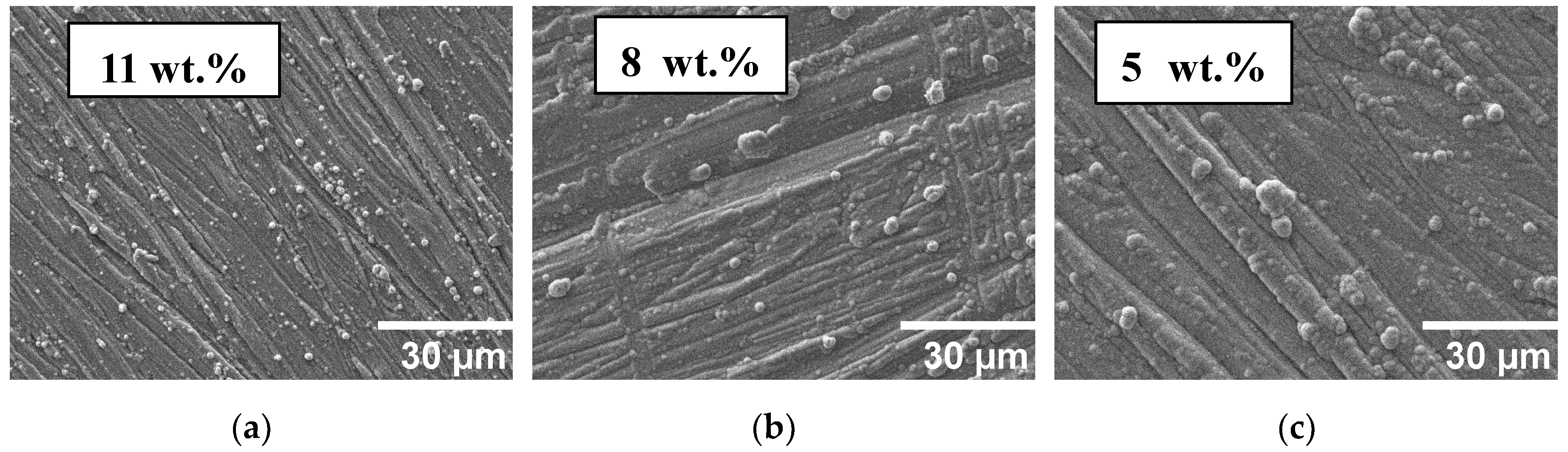
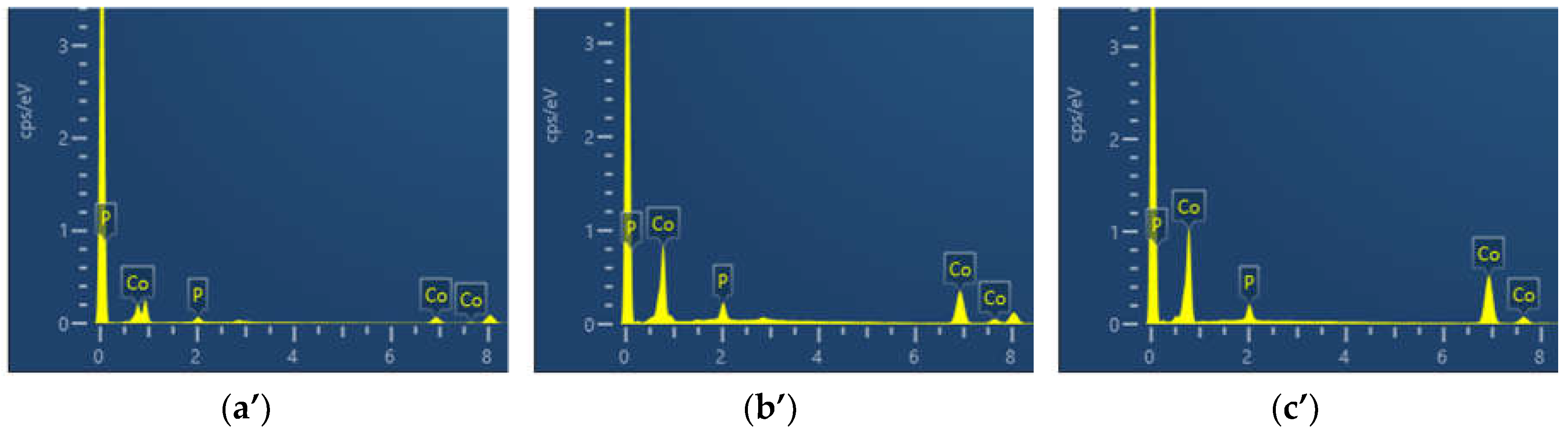
Figure 2.
(a) HER polarization curves of the Co-P/Cu catalyst in N2-saturated 1 M KOH solution at a potential scan rate of 2 mV s−1; (b) The corresponding Tafel slopes. Bar columns of the corresponding overpotentials (c) and Tafel slopes (d).
Figure 2.
(a) HER polarization curves of the Co-P/Cu catalyst in N2-saturated 1 M KOH solution at a potential scan rate of 2 mV s−1; (b) The corresponding Tafel slopes. Bar columns of the corresponding overpotentials (c) and Tafel slopes (d).
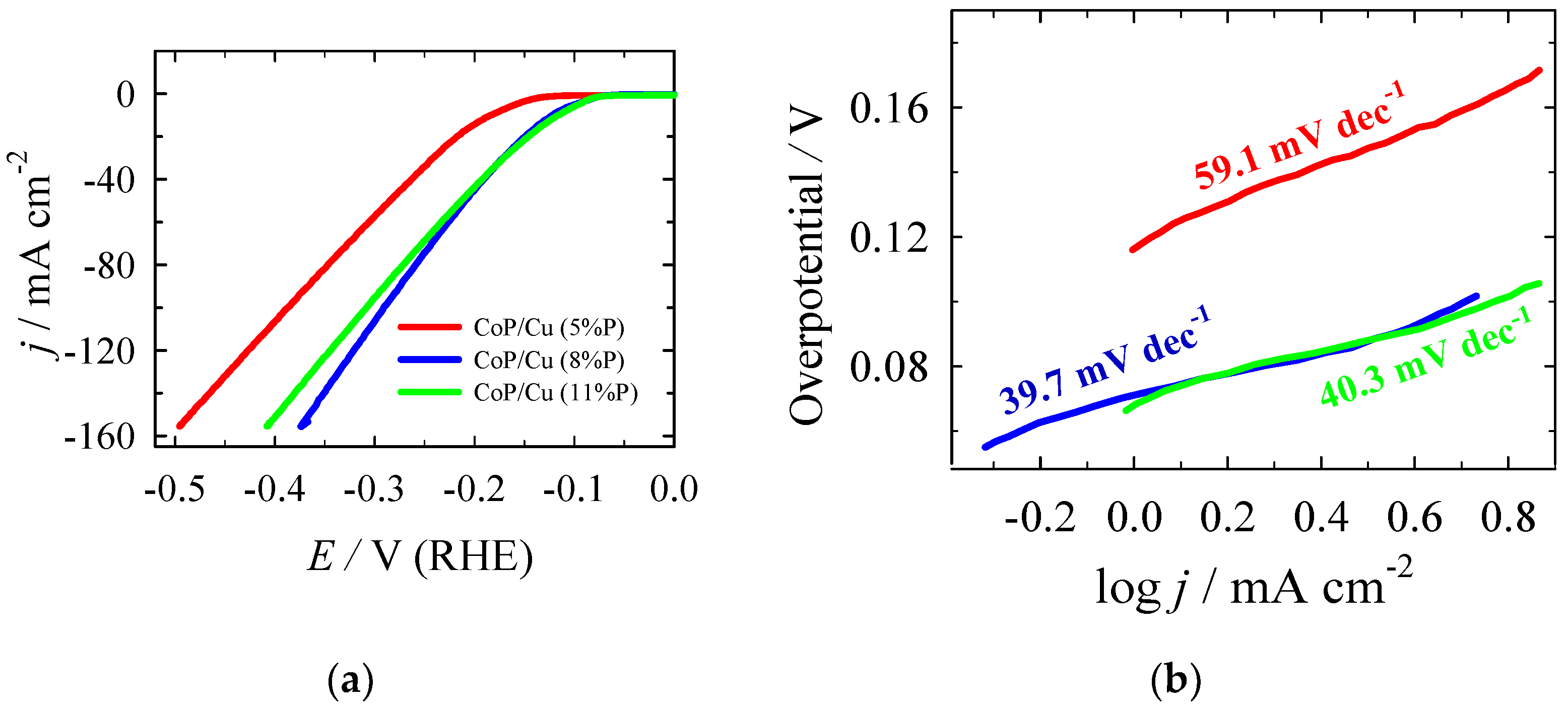
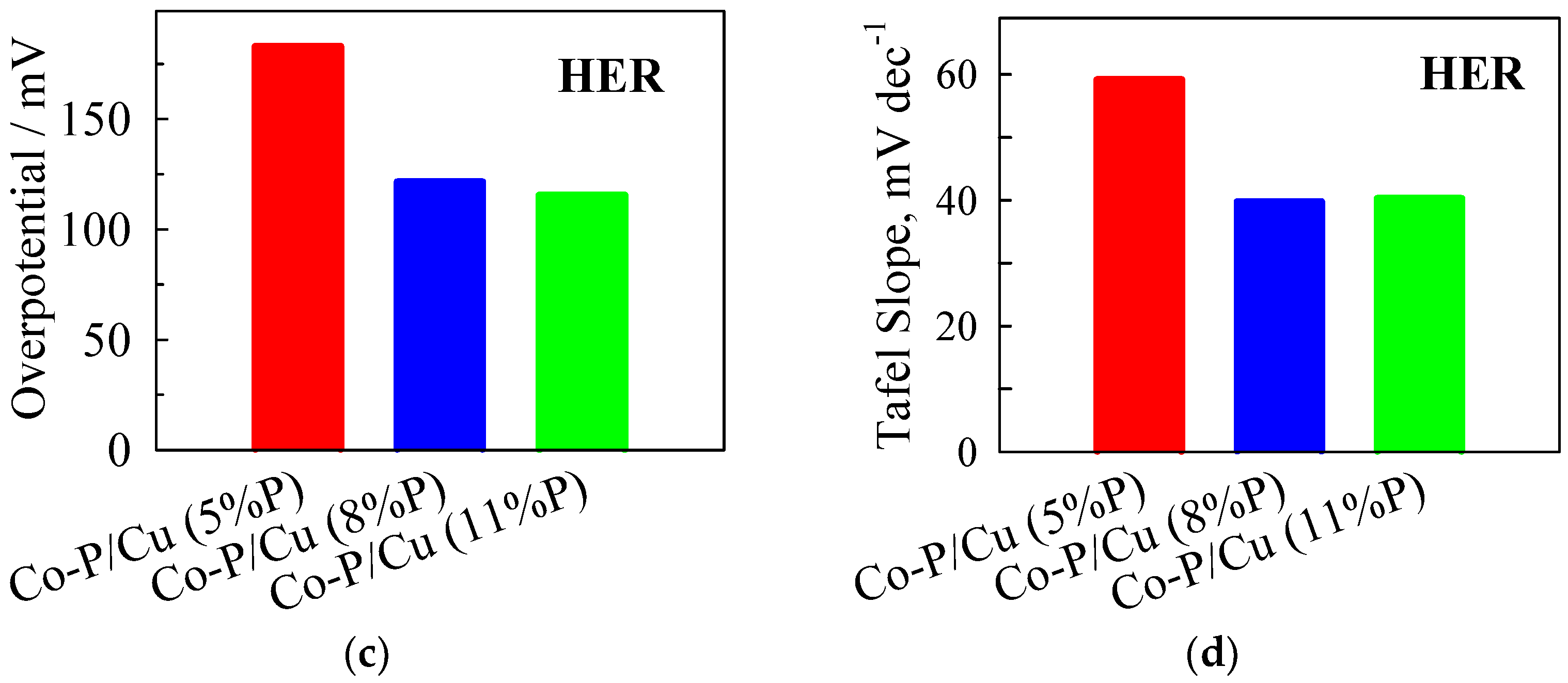
Figure 3.
(a) OER polarization curves of the Co-P/Cu catalyst in N2-saturated 1 M KOH solution at a potential scan rate of 2 mV s−1; (b) The corresponding Tafel slopes. Bar columns of the corresponding overpotentials (c) and Tafel slopes (d).
Figure 3.
(a) OER polarization curves of the Co-P/Cu catalyst in N2-saturated 1 M KOH solution at a potential scan rate of 2 mV s−1; (b) The corresponding Tafel slopes. Bar columns of the corresponding overpotentials (c) and Tafel slopes (d).
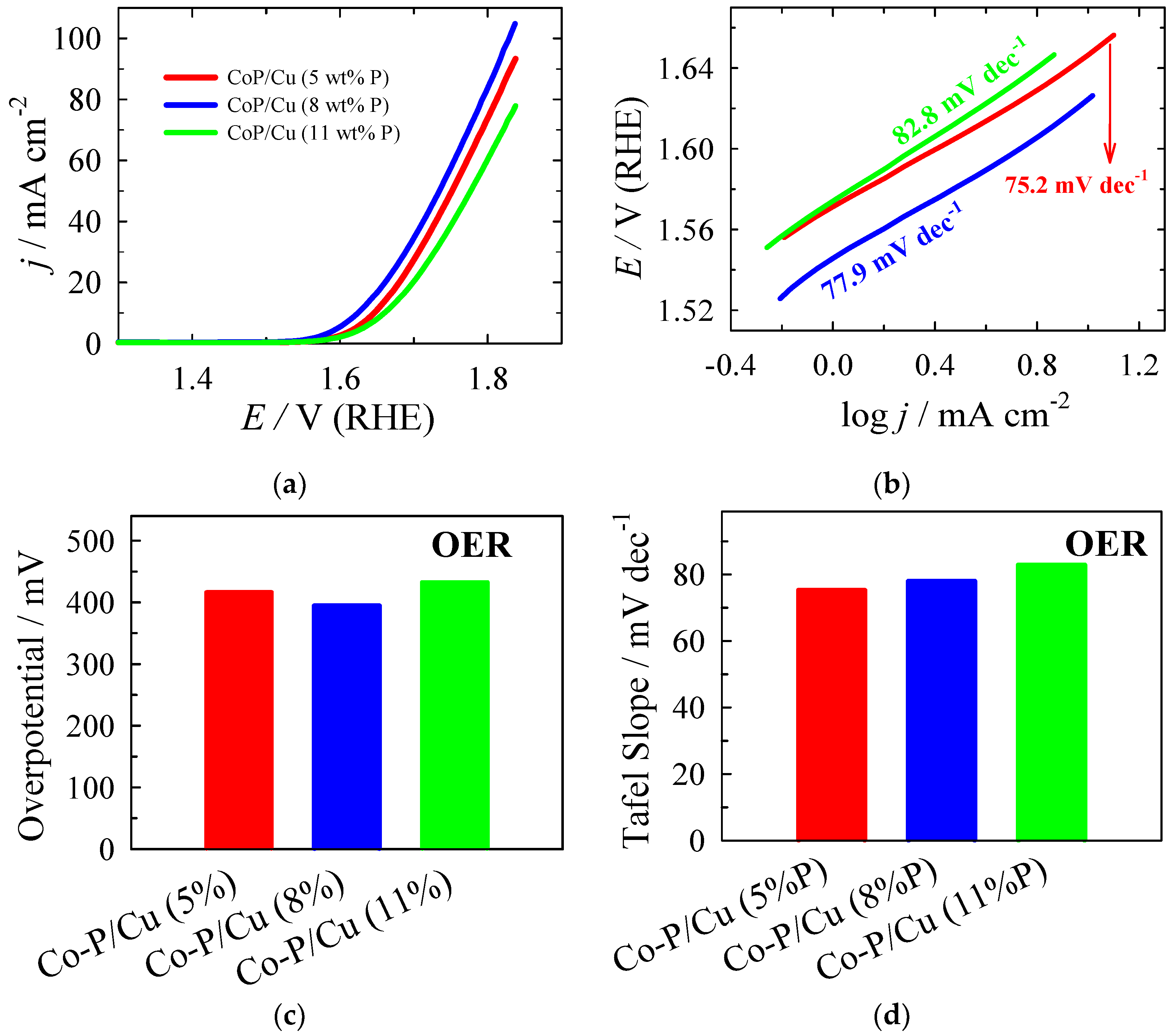
Figure 4.
CVs of (a) Co-P/Cu (5 wt% P), (b) Co-P/Cu (8 wt%), and (c) Co-P/Cu (11 wt%) in N2-saturated 1 M KOH in the non-faradaic potential region at different scan rates. (d) Capacitive current as a function of scan rate.
Figure 4.
CVs of (a) Co-P/Cu (5 wt% P), (b) Co-P/Cu (8 wt%), and (c) Co-P/Cu (11 wt%) in N2-saturated 1 M KOH in the non-faradaic potential region at different scan rates. (d) Capacitive current as a function of scan rate.
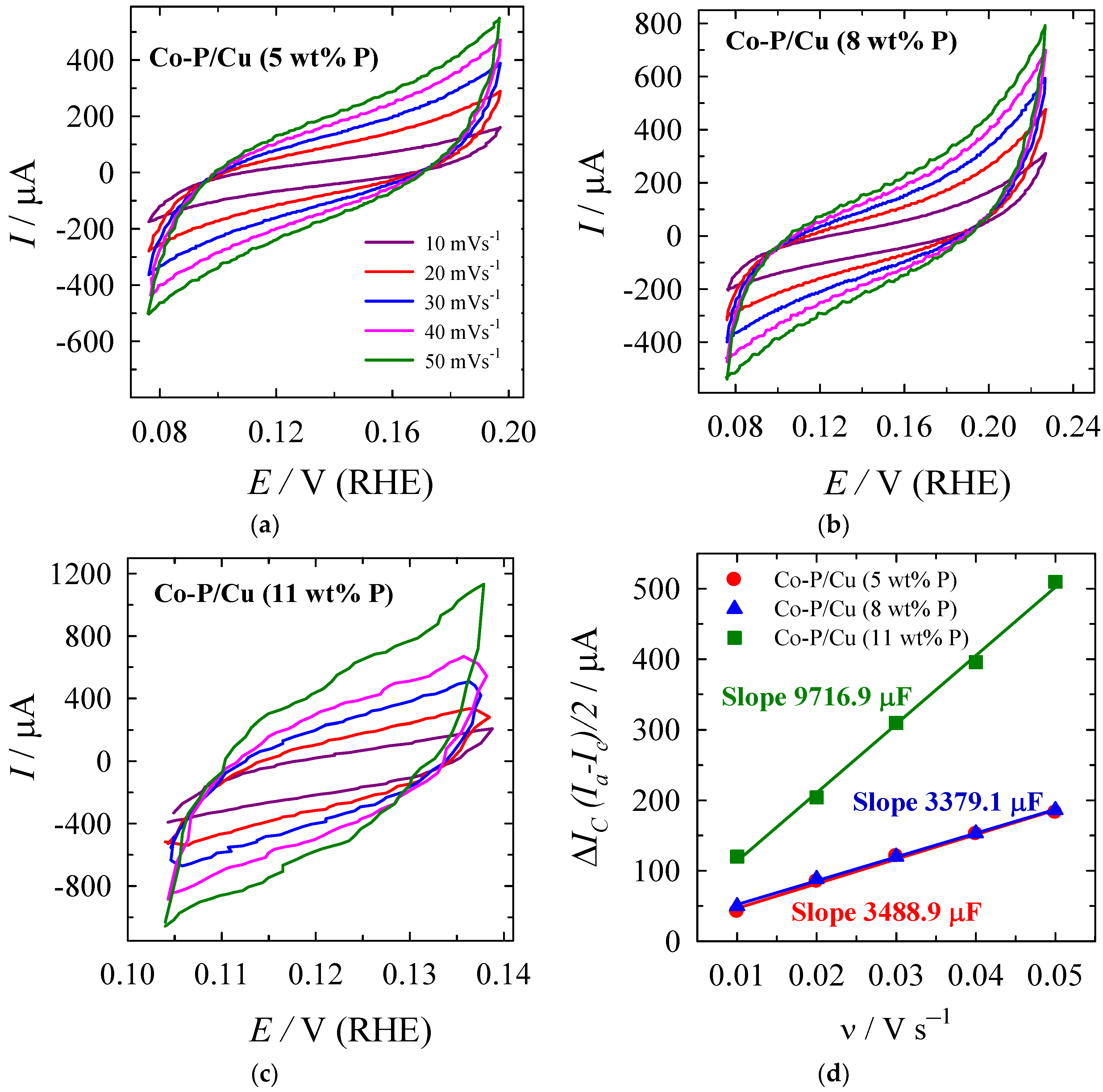
Figure 5.
(a) Chronoamperometric curve of the Co-P/Cu (11 wt% P) catalyst in N2-saturated 1 M KOH solution at a constant potential of -0.261 V for 15 hours. The insets show SEM views of the initial and after the 1000 cycles test of the same catalyst.
Figure 5.
(a) Chronoamperometric curve of the Co-P/Cu (11 wt% P) catalyst in N2-saturated 1 M KOH solution at a constant potential of -0.261 V for 15 hours. The insets show SEM views of the initial and after the 1000 cycles test of the same catalyst.
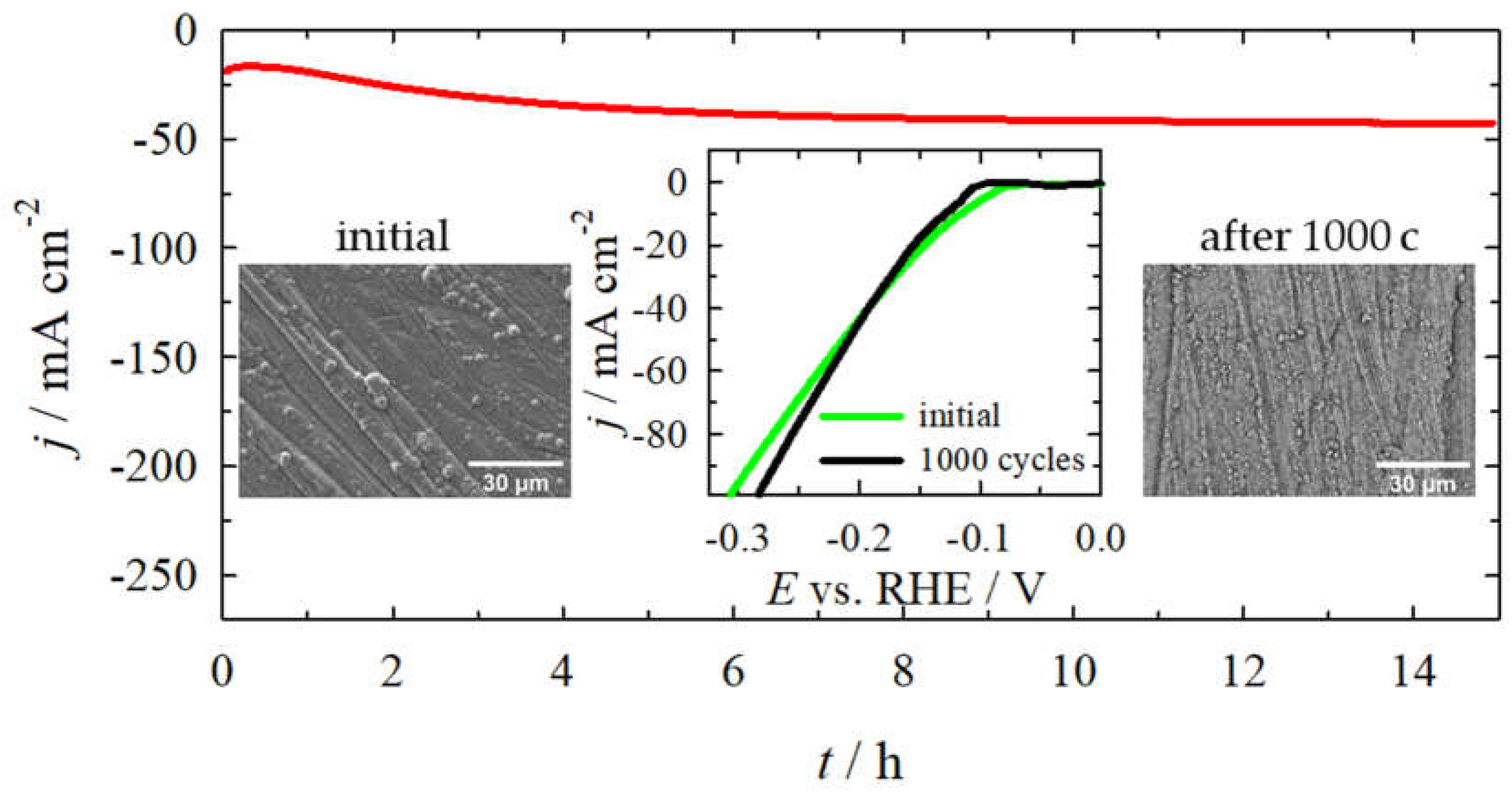
Figure 6.
(a) Predicted bifunctional activity of Co-P/Cu catalysts: values of full-cell potential Δη10 calculated from the difference between overpotential values (η10) at ±10 mA cm−2 obtained from the corresponding HER and OER LSVs in Figure 2a and 3a. (b) LSVs for different Co-P/Cu catalysts as both anode and cathode electrocatalytic water splitting in 1 M KOH solution. (c) Photograph of OWS on Co-P/Cu as cathode and anode electrode.
Figure 6.
(a) Predicted bifunctional activity of Co-P/Cu catalysts: values of full-cell potential Δη10 calculated from the difference between overpotential values (η10) at ±10 mA cm−2 obtained from the corresponding HER and OER LSVs in Figure 2a and 3a. (b) LSVs for different Co-P/Cu catalysts as both anode and cathode electrocatalytic water splitting in 1 M KOH solution. (c) Photograph of OWS on Co-P/Cu as cathode and anode electrode.
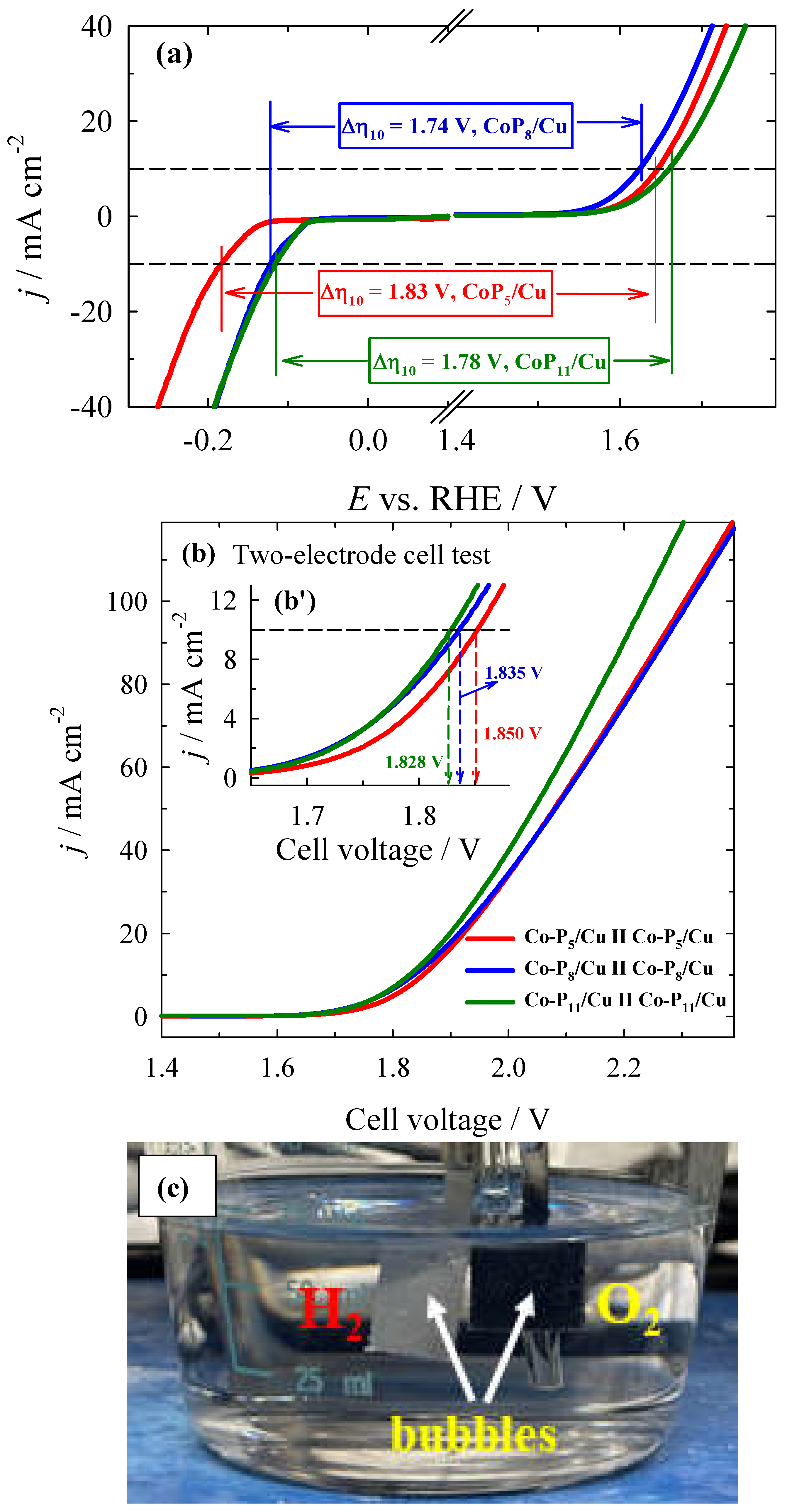
Figure 7.
The digital photographs of the copper sheet sample both before (a) and after it has been plated in a Co-P plating solution for 10 minutes (b). The digital photograph of the Co-P coating plating solution is shown in (c).
Figure 7.
The digital photographs of the copper sheet sample both before (a) and after it has been plated in a Co-P plating solution for 10 minutes (b). The digital photograph of the Co-P coating plating solution is shown in (c).
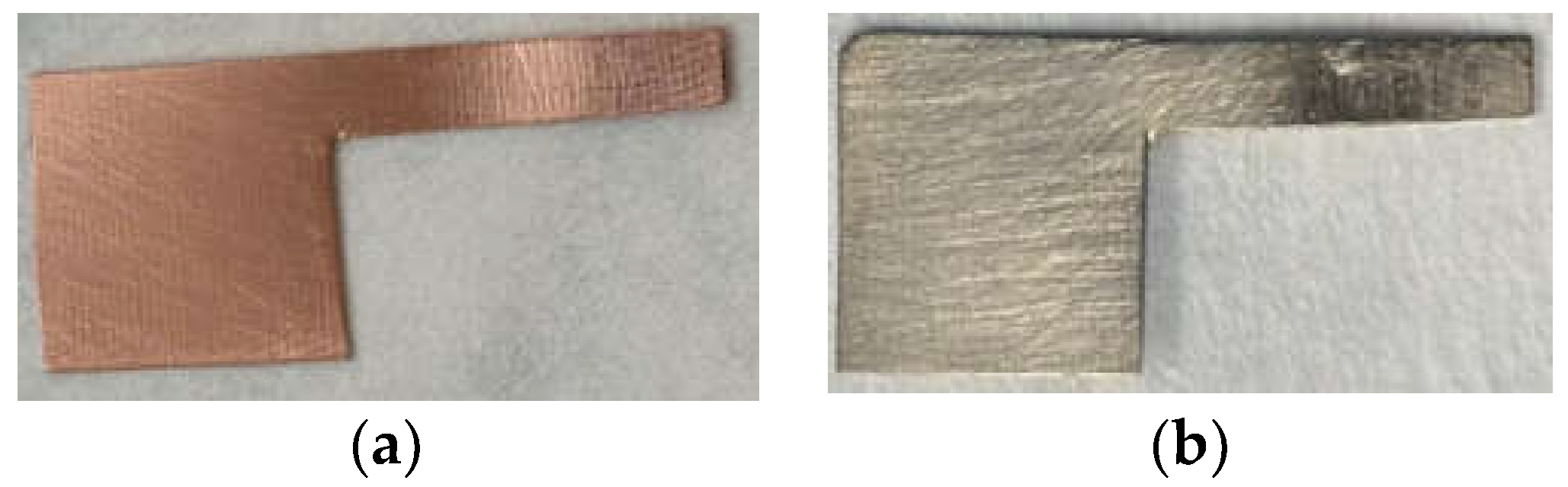
Figure 8.
The electroless deposition scheme of CoP coatings on the Cu surface.
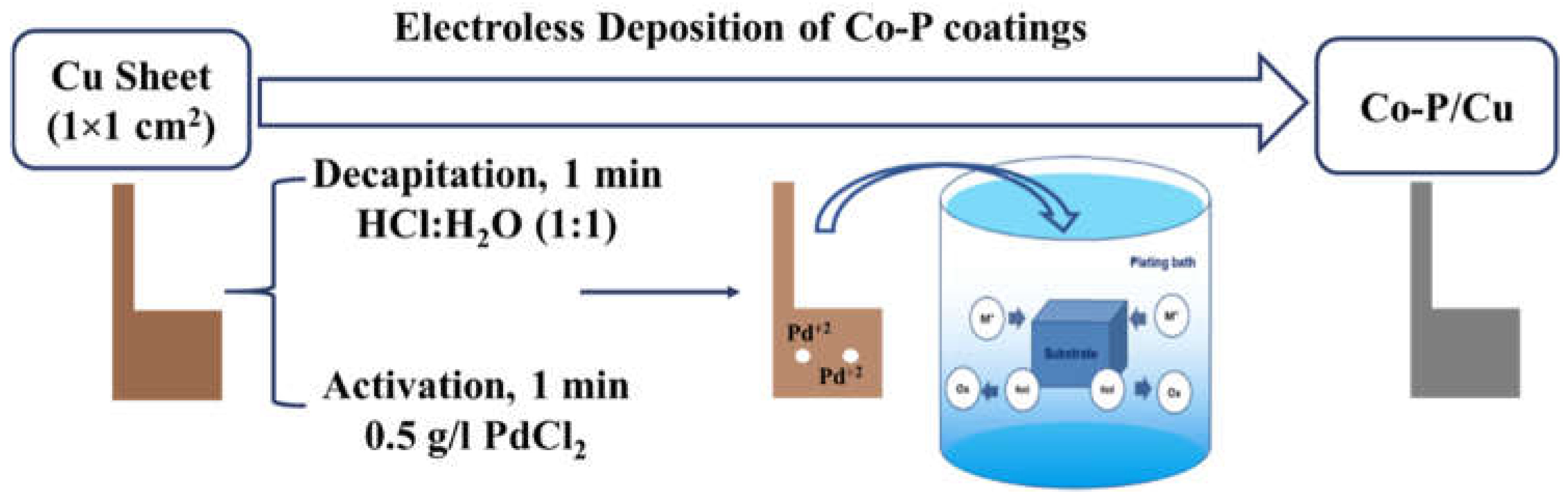
Table 1.
Composition of CoP coatings deposited on Cu surface by EDS analysis.
| Sample | Element, wt% | |
|---|---|---|
| Co | P | |
| CoP5/Cu | 95.13 | 4.87 |
| CoP8/Cu | 92.02 | 7.98 |
| CoP11/Cu | 88.87 | 11.13 |
* Overpotential at 10 mA cm-2.
Disclaimer/Publisher’s Note: The statements, opinions and data contained in all publications are solely those of the individual author(s) and contributor(s) and not of MDPI and/or the editor(s). MDPI and/or the editor(s) disclaim responsibility for any injury to people or property resulting from any ideas, methods, instructions or products referred to in the content. |
© 2024 by the authors. Licensee MDPI, Basel, Switzerland. This article is an open access article distributed under the terms and conditions of the Creative Commons Attribution (CC BY) license (http://creativecommons.org/licenses/by/4.0/).
Copyright: This open access article is published under a Creative Commons CC BY 4.0 license, which permit the free download, distribution, and reuse, provided that the author and preprint are cited in any reuse.