

Submitted:
07 October 2025
Posted:
08 October 2025
You are already at the latest version
Abstract
Developing highly efficient and stable electrocatalysts from inexpensive and earth-abundant elements represents a significant advancement in the overall water splitting (OWS) process. This study focuses on the synthesis and evaluation of palladium-modified cobalt-phosphorus (PdCoP) and cobalt-iron-phosphorus (PdCoFeP) coatings for use as electrocatalysts in the HER, OER and OWS in alkaline media. For this purpose, a facile electroless plating method is adopted to deposit the CoP and CoFeP coatings onto a copper surface (Cu sheet), with sodium hypophosphite (NaH2PO2) acting as the reducing agent. Incorporating Pd crystallites on the CoP and CoFeP coatings using the galvanic displacement method has been shown to significantly improve catalytic performance. Accordingly, Pd modified CoFeP and CoP catalysts exhibited the lower overpotentials of 207 and 227 mV, respectively, for HER and 396 mV for OER at a current density of 10 mA cm−2 compared to the unmodified CoFeP and CoP catalysts. Simultaneously, the assembled electrolyzer comprising PdCoFeP as the cathode and the anode demonstrated a cell voltage of 1.69 V to achieve 10 mA cm−2. This study demonstrates that all the synthesized catalysts (CoP, CoFeP, PdCoP, and PdCoFeP) are effective and stable electrocatalysts for overall alkaline water splitting.
Keywords:
palladium
; cobalt
; iron
; phosphorous
; electroless deposition
; galvanic displacement
; hydrogen evolution
; oxygen evolution
; overall water splitting
1. Introduction
The increasing demand for clean and sustainable energy sources has been driven by two key factors: the overuse of fossil fuels and the rapid growth of environmental problems [1,2,3]. Hydrogen has been regarded as a potentially viable alternative fuel, primarily due to its clean and sustainable characteristics. Currently, the predominant method of producing hydrogen is through fossil fuel reforming, which results in carbon dioxide emissions. On the other hand, water electrolysis is regarded as the most environmentally friendly technique for hydrogen production, and it can address the intermittent nature of renewable electricity [4,5,6]. Electrochemical water splitting, comprising a hydrogen evolution reaction (HER) at the cathode and an oxygen evolution reaction (OER) at the anode, has been identified as a promising technology for large-scale hydrogen production. This is due to low energy consumption and high hydrogen purity, among other advantages [7,8,9]. As Van Troost Wijk and Deiman first reported in 1789, water electrolysis still required a large overpotential more than 200 years later, due to the relatively sluggish kinetics of both cathodic HER and anodic OER. It is well established that the thermodynamic potential of water electrolysis is 1.23 V [10,11]. However, to achieve a practical rate of water dissociation, it is necessary to apply an overpotential to the water electrolyzer. It has been demonstrated that both HER and OER demand significant overpotentials to surpass the kinetic barriers that arise from the high activation energies necessary for the formation of reaction intermediates on the electrode surface [12,13,14]. Furthermore, these overpotentials are required to drive the reaction at a specific current density, which is typically a geometric current density of 10 mA cm-2. The use of an active catalyst is of great importance in reducing the overpotential requirements of these two half-reactions, thereby increasing the reaction rate. Ideally, a catalyst should exhibit high activity (large current density at low overpotentials) and durable performance over an extended period [15]. The efficient water splitting process necessitates using electrocatalysts characterized by high efficiency, stability, and corrosion resistance. These catalysts must facilitate both the HER at the cathode surface and the OER at the anode surface, with both reactions occurring simultaneously and exhibiting high rates of reaction [16,17]. This will enhance efficiency, lower the cost of developing an electrolysis system, and simplify the system [18,19,20,21,22]. Various catalysts have been synthesized to enhance the reaction rate and reduce the overpotential for HER and OER. Currently, noble metals and noble metal oxides, including Pt [23,24], RuO2 [25], and IrO2 [26], are regarded as the most effective catalysts for both HER and OER. However, the high cost and scarcity of noble metal catalysts have raised concerns regarding economic viability. Consequently, a strong research focus has emerged on developing low-cost, high-efficiency, and non-precious electrocatalysts, which serve as an alternative to precious-based materials and exhibit high activity towards OER and HER [27,28,29,30,31].
Nowadays, earth-abundant transition metal compounds, principally Co-, Fe-, Mn-, and Ni-based either as oxides or hydroxides, are utilized for the OER. These metals are often combined with other non-metallic elements, including C, N, S, P, Se, and B, to form binary or ternary compositions. These compositions are employed in both the HER and the OER [32,33,34,35,36,37,38,39]. Significant research has been dedicated to investigating the potential of these compounds as electrocatalysts, owing to their remarkable durability, particularly cobalt-based compounds such as sulfides [40,41,42], borides [43], (oxy)hydroxides [44,45,46] and phosphides [47,48], which have been evidenced as remarkable electrolyzed water catalysts. Researchers have highlighted transition-metal phosphides (TMPs) as a promising class of catalysts for electrolyzing water. TMPs such as Co-P [49,50], Fe-P [51,52], Ni-P [53,54] and Mo-P [55,56], have been identified as highly attractive catalysts due to the superior conversion of their oxidation states, cost-effectiveness and high activity. A significant number of studies have been conducted on the catalytic role of transition metal phosphide in HER. These studies have resulted in the development of a variety of catalysts that exhibit high activity in hydrogen evolution. This enhancement in activity has been achieved through the adjustment of catalyst morphology and surface modification [57]. Following the calculation results of density functional theory (DFT), it is hypothesized that the P atom in the phosphide catalyst has electronegativity, facilitating the adsorption and capture of protons, and enabling part of the charge of Co to be transferred to the P atom. The modification of the electronic structure has been demonstrated to be an effective strategy for reducing the Gibbs hydrogen adsorption free energy, resulting in enhanced catalytic activity of the hydrogen evolution [58,59]. A considerable number of monometallic phosphides are employed in electrolytic water and have demonstrated considerable success, exhibiting high catalytic activity during the reaction. Among these, cobalt phosphide catalyst has been shown to exhibit low overpotential, long-term stability, and other advantageous properties, and is regarded as the most promising catalyst candidate for HER [60,61,62].
Despite the high catalytic activity of the cobalt phosphide catalyst in hydrogen evolution reactions, a comparative analysis reveals a performance deficit in terms of comprehensive performance when benchmarked against precious metal Pt-based catalytic materials. To enhance the activity of the catalyst, researchers have pursued a multifaceted approach involving the doping of one or more metal atoms into the single metal phosphating process. This strategy is aimed at regulating the electronic structure and optimizing surface properties, to achieve enhanced catalytic functionality. For instance, Yang et al. synthesized Fe-doped three-dimensional Co-based phosphate FexCo3-x(PO4)2 on a copper wire using the electrodeposition method as an electrochemical catalyst. In an alkaline solution, a current density of 10 mA cm-2 required only 48.9 mV of overpotential for HER, and the catalytic performance was maintained after 100 hours of operation. This study thus demonstrates the crucial role of Fe doping in enhancing the catalytic performance of the FexCo3-x(PO4)2 catalyst for HER [63]. As research has progressed, it has become evident that transition metal phosphide exhibits not only exceptional performance for HER but also noteworthy catalytic performance for OER. The catalytic effect of cobalt-based phosphide materials on OER is attributable to the adsorption of OOH species by positively charged cobalt ion centers, whilst negatively charged P centers facilitate surface oxygen removal. It is therefore anticipated that transition metal phosphating will function effectively as a bifunctional catalyst for both HER and OER. The development of bifunctional electrocatalysts within the same electrolyte has attracted significant attention due to their numerous advantages, including the simplification of the fabrication process, the reduction in cost, and the enhancement of hydrogen productivity. The majority of catalysts composed of Co or Ni-based materials are capable of catalyzing a single reaction (OER or HER). Consequently, it is essential to identify an efficient bifunctional catalyst that exhibits robust stability for the overall water splitting process in an alkaline environment [64]. The incorporation of transition metal Fe into cobalt phosphide has been demonstrated to enhance its oxygen evolution activity, while simultaneously exhibiting an optimizing effect on hydrogen evolution electrocatalysis [65,66]. The enhanced HER/OER performance of the FeCo-P catalyst is primarily attributable to the synergistic effect of Fe, Co, and P, as well as the robust interaction between ions [67].
The majority of bimetallic phosphides have been synthesized through the utilization of hydrothermal, solid-phase, and gas-phase phosphating methodologies [68]. Even though these methodologies have been employed to prepare transition bimetallic phosphides of various morphological structures, which have been shown to have superior properties, it is still necessary to simplify the preparation of bimetallic phosphides further to meet the requirements of their practical applications [69]. As indicated in the relevant literature, the conventional phosphating reaction still has many disadvantages, including high reaction temperatures, the requirement for inert gas protection, and the usage of hazardous phosphorus resources [70]. These methods demand considerable energy input and rely on complicated apparatus. The use of straightforward, economical, and effective techniques for catalyst fabrication has the potential to decrease the overall expense of hydrogen production through the electrolysis of water [71]. Consequently, electroless deposition has emerged as a highly efficient, cost-effective, eco-friendly, and straightforward catalyst preparation method. Electroless plating, also referred to as chemical or autocatalytic plating, is a non-galvanic plating method involving multiple reactions occurring simultaneously in an aquatic solution [72] and it does not require the use of complex equipment or hazardous power sources [73].
The present study investigates the fabrication and evaluation of palladium–modified cobalt–phosphorus (PdCoP) and cobalt–iron–phosphorus (PdCoFeP) coatings as electrocatalysts for HER and OER in alkaline media. The CoP and CoFeP coatings were deposited on the copper surface using a straightforward and highly efficient electroless metal plating technique, with sodium hypophosphite (NaH2PO2) as the reducing agent. The incorporation of Pd crystallites on the CoP and CoFeP coatings using the galvanic displacement method has been shown to result in significant improvements in catalytic performance. Evaluations and characterizations of the PdCoP and Pd-CoFeP were conducted regarding their chemical state, catalytic activity, and stability during the HER and OER. In further research, the catalytic mechanisms of PdCoP and PdCoFeP catalysts for overall water splitting were investigated. The findings of this research suggest that the synthesized catalysts have the potential to be promising candidates for utilization in alkaline media for water splitting, which could result in a more environmentally sustainable and economical method for hydrogen production.
2. Results and Discussion
2.1. Coatings, Microstructure and Morphology Studies
The primary objective of the present study was the development of an effective catalyst for HER and OER in an alkaline medium (1.0 M KOH) employing a straightforward methodology. Consequently, Co-based coatings containing Co, Fe and P were deposited on Cu substrates via a facile electroless deposition process, where sodium hypophosphite was utilized as the reducing agent. The galvanic displacement method was used to incorporate palladium crystallites into the CoP and CoFeP coatings, and it was demonstrated that this enhanced the catalytic activity of the resulting coatings. Scanning electron microscopy (SEM) and energy-dispersive X-ray analysis (EDX) were employed to investigate the surface morphology and composition of the coatings. Figure 1 illustrates the SEM images of the fabricated Co-based coatings with different compositions such as CoP (a), CoFeP (b), PdCoP (c), and PdCoFeP (d). The presence of Pd, Co, Fe, and P in the coatings is confirmed by the corresponding EDX spectra of all the samples. The results of the EDX analysis are outlined in Table 1, which shows that the fabricated CoP/Cu, CoFeP/Cu, PdCoP/Cu, and PdCoFeP electrocatalysts demonstrated a Pd content ranging from 3.54 to 8.36 at%, Co content ranging from 64.08 to 90.22 at%, Fe content ranging from 9.96 to 12.49 at%, and a P content ranging from 6.26 to 15.07 at%.
The SEM analysis demonstrates distinct morphological variations induced by compositional modifications in the electrolessly deposited coatings. The CoP coating exhibited a compact and relatively homogeneous surface composition, characterised by densely packed grains [74,75], indicative of stable nucleation and uniform growth (Figure 1a). It is noteworthy that the incorporation of Fe into the CoFeP structure results in a significant structural transformation, giving rise to a porous and heterogeneous morphology [76]. This substantial modification underscores the considerable impact of Fe on nucleation kinetics, surface energy, and phosphorus incorporation during electroless deposition (Figure 1b). The addition of Pd to CoP leads to the surface becoming rougher and more fragmented. This is characterised by the presence of finer clusters and an increase in grain boundaries, indicative of an enhanced nucleation density. The PdCoFeP coating exhibits the most irregular and nanostructured surface, characterised by textured characteristics and fine crystallites (see Figure 1c and d). This observation indicates a synergistic effect of Pd and Fe in inducing high nucleation rates and complex growth pathways. The obtained results demonstrate the extreme sensitivity of electroless deposition processes to even minor compositional variations, which can dramatically alter the resulting microstructure.
2.2. Electrocatalytic Activity Towards HER
The electrocatalytic performance of the prepared catalysts for the hydrogen evolution reaction (HER) was investigated by recording linear sweep voltammograms (LSVs) in 1.0 M KOH solution at a potential scan rate of 5 mV·s−1 at room temperature (Figure 2a). Summarized parameters for HER on the investigated catalysts in alkaline media at 25 oC are also given in Table 2. The corresponding overpotential values at 10, 20, 50, and 100 mA cm−2 are given in Figure 2b.
Among the catalysts investigated, the CoP catalyst exhibited the lowest overpotential value of 239 mV for the HER compared to CoFeP (245 mV), PdCoP (250 mV), and PdCoFeP (259 mV) to attain a current density of 10 mA cm−2 at 25 oC (see Figure 2a and Table 2). However, a higher current density is delivered on PdCoFeP, indicating more efficient hydrogen generation at higher load conditions. In addition, the incorporation of Fe into the CoP catalyst results in lower overpotential values compared with pure CoP and that decorated with Pd crystallites to achieve a current density of 10 mA cm−2 at a temperature of 25 oC (Table 2). The undecorated CoFeP showed a slightly lower overpotential of 232 mV in comparison to CoP, with an observed value of 239 mV, whereas the PdCoFeP catalyst exhibited the lower overpotential value of 207 mV compared to PdCoP, which showed 227 mV to attain a current density of 10 mA cm−2 at 25 oC. These improvements are attributed to the synergistic interactions between Co, Fe, P, and Pd, which enhance electron transfer and facilitate HER kinetics. Moreover, the overpotential of PdCoFeP at 100 mV cm−2 is 385 mV dec−1 which is smaller than that of PdCoP (420 mV dec−1), CoFeP (428 mV dec−1), and CoP (458 mV dec−1) (Figure 2d).
The reaction kinetics and mechanism of the catalysts can be evaluated based on Tafel slopes. Tafel slopes were determined from the following equation 1 [77]:
where η is the overpotential, b is the Tafel slope, j is the experimental current density, and j0 is the exchange current density. The plot of η versus log j represents the Tafel slope. In alkaline media, the HER process involves three main steps, as shown in Equations (2) to (4) [77]:
η = b · log j/j0
* + H2O + e– ↔ *Hads + OH– (Volmer step, 120 mV dec−1)
*Hads + e– + H2O ↔ H2 + OH– + * (Heyrovsky step, 40 mV dec−1)
2*Hads ↔ H2 + * (Tafel step, 30 mV dec−1)
Hads denotes the H2 adsorbed to the metal sites, where * represents the metal sites. Figure 2c displays the plots of η versus log j for each catalyst. The Tafel slopes calculated were found to be within the range of approximately 76 to 83 mV dec−1 (Table 2), whereas the CoFeP/Cu and PdCoP/Cu catalysts show the lowest Tafel slope (ca. 76 mV dec−1) relative to CoP/Cu (78.1 mV dec−1) and PdCoFeP/Cu (82.8 mV dec−1) (Figure 2c). This finding indicates that the HER may occur through the Volmer–Heyrovsky mechanism, in which water molecules or H2 adsorbs onto an electrode to generate MHads species.
The activation energy (Ea) is a critical factor in the evaluation of the performance of the catalyst. This energy can be estimated by employing the LSVs curves at varying temperatures. The obtained HER LSVs for each catalyst at temperatures from 25 to 55 oC are shown in Figure S1 and Table S1. The results obtained outline that the HER activity of the CoP, CoFeP, PdCoP, and PdCoFeP catalysts is enhanced as the temperature of electrolyte increases, whereas the overpotentials to achieve the current density of 10 mA cm−2 decrease with the increase in temperature for each catalyst (Table S2, Supplementary Material). Furthermore, the obtained Tafel slope values are in the range from approximately 72 to 94 mV dec−1. These results indicate that the HER kinetic process is closely related to temperature according to the following formula (equation 5):
where i is the current (mA), T - temperature (K), and R is the gas constant (8.314 J mol−1 K−1 [78]. Figure 2d shows the Arrhenius profiles derived by plotting the current against the measured temperature for the CoP, CoFeP, PdCoP, and PdCoFeP catalysts. The current value and temperature value of the catalysts at –0.40 V (vs. RHE) are extracted from the LSV profiles (Figure S1, Supplementary Material). PdCoP, CoFeP, CoP, and PdCoFeP catalysts have the Ea values of 4.7, 6.0, 11.3, and 11.4 kJ mol−1, respectively (Figure 2d). The low activation energies implied that the small reaction kinetic barrier is required.
∂logi/∂(1/T) = -Ea/2.3R
2.3. Electrocatalytic Activity Towards OER
The activity of the Co-based catalysts in the OER was also evaluated. The obtained data are given in Figure 3 and Table 3.
As can be seen from the LSVs recorded for the aforementioned catalysts in a 1 M KOH solution, the lowest OER overpotential of 396 mV was observed for the Pd-modified CoP/Cu and CoFeP/Cu, achieving a current density of 10 mA cm−2, as compared to the unmodified CoP/Cu (431 mV) and CoFeP/Cu (435 mV) (Table 3). The lower values of Tafel slope in the range of 70.5 to 77.8 mV dec−1 were obtained for PdCoFeP/Cu, CoFeP/Cu, and PdCoP/Cu catalysts compared to the CoP/Cu catalyst (120.3 mV dec−1). These results indicated superior OER kinetics (Table 3). It can be highlighted that higher current density values for OER are obtained on the Pd-modified CoP and CoFeP catalysts compared with the unmodified CoP and CoFeP catalysts (Figure 3b). The overpotential of PdCoFeP at 100 mV cm−2 is 549 mV dec−1 which is smaller than that of PdCoP (595 mV dec−1), CoFeP (747 mV dec−1), and CoP (778 mV dec−1).
The obtained OER LSVs for each catalyst at temperatures from 25 to 55 oC are shown in Figure S2 and Table S2. The OER activity of the CoP, CoFeP, PdCoP, and PdCoFeP catalysts is also enhanced as the temperature of electrolyte increases. Increase in the temperature for each catalyst also results in the decrease of the overpotential values which are required to attain 10 mA cm−2 (Table S2, Supplementary Material). The obtained Tafel slope values are also decreased with the increase in temperature for each catalyst are in the range from approximately 120 to 95 mV dec−1 for CoP, from 74 to 60 mV dec−1 for CoFeP, 78 to 77 mV dec−1 for PdCoP, and from 70 to 65 mV dec−1 for PdCoFeP at a temperature of 25 and 55 oC, respectively (Table S2, Supplementary Material). For the determination of Ea for the OER, the current value and temperature value of the catalysts at 1.8 V (vs. RHE) are extracted from the LSV profiles (Figure S2, Supplementary Material). PdCoFeP, PdCoP, CoP, and CoFeP catalysts have the Ea values of 11.8, 12.2, 20.7, and 21.2 kJ mol−1, respectively (Figure 3d). In addition, the PdCoFeP has the lowest activation energy of 11.8 kJ mol−1, implying that it has the smallest reaction kinetic barrier.
Comparison of OER performance of the investigated catalysts with some previously reported Co-P-based and most advanced noble - metal catalysts is shown in Table 4. It can be seen that the obtained overpotential values of 396 mV for the PdCoP/Cu and PdCoFeP/Cu catalysts are lower compared to CoOx (423 mV) [79], Co2P2O7 (490 mV) [80], CoP hollow polyhedron (400 mV) [81], reduced mesoporous Co3O4 nanowires (400 mV) [82], but higher compared to overpotential values for CoP-MNA/Ni foam (390 mV] [83], CoP film (350 mV) [18], CoSi-P (309 mV) [84], CoP (300 mV) [85], Mn-CoP (288 mV) [86], RuO2/CF catalyst (360 mV) [87], RuO2 on NF (290 mV) [88], IrO2 commercial (339 mV) [89], and Ir/C (254 mV) [90].
2.4. Determination of Electrochemically Active Surface Areas
The electrochemically active surface areas (ECSAs) of the unmodified and Pd-modified CoP/Cu and CoFeP/Cu catalysts were determined from measurements of the electrochemical double-layer capacitance (Cdl). The CV curves were recorded at different scan rates under the non-faradaic region (Figure 4a–d), which was followed by the calculation of the slope of the curve obtained by plotting the difference in the anodic and cathodic current versus the scan rate (Figure 4e). The Cdl was found to be 2458.5, 11652.2, 10858.9, and 56291.2 µF for CoP/Cu, CoFeP/Cu, PdCoP/Cu, and PdCoFeP/Cu (Figure 4e), whereas the calculated ECSA values were 61.5, 291.3, 271.5, and 1407.3 cm2 for CoP/Cu, CoFeP/Cu, PdCoP/Cu and PdCoFeP/Cu, respectively. The high ECSA of PdCoFeP/Cu can be due to the higher number of active sites, which contributes to the higher OER electrocatalytic activity. Incorporation of Fe to the CoP coating, followed by its modification with Pd crystallites allow achieve the lowest OER overpotential, Tafel slope, as well as the Ea and suggests that factors beyond active site availability are influencing OER performance. Other factors, such as electronic structure and conductivity, a high ECSA also significantly influence catalyst performance. This catalyst with 8.36 at% of Pd performed the best activity for the OER.
2.5. Investigation of Stability of Catalysts
Additionally, the stability of the most promising Pd-modified CoP/Cu and CoFeP/Cu catalysts was investigated using chronoamperometry by recording the chronoamperometric curves at a constant potential of −0.26 V for 10 hours on the PdCoP/Cu and PdCoFeP/Cu catalysts (Figure 5). The PdCoFeP/Cu catalyst possessed excellent stability with current retention of 96.02% during 10 h compared to the PdCoP/Cu catalyst.
Figure 6 shows the chronopotentiometric curves recorded on the PdCoP (a) and PdCoFeP (b) catalysts in a 1 M KOH solution at a constant current density of –10 mA cm–2 at 25 oC. It is evident that the potential required to attain –10 mA cm–2 slightly increased from –0.1945 V to –0.2131 V for PdCoP (Figure 6a) and from –0.1551 V to –-0.1740 V for PdFeCoP (Figure 6b) over 10 h, demonstrating the good stability of the both catalysts.
2.6. Investigation of Overall Water Splitting
To confirm the bifunctional activity of the unmodified and modified with Pd the CoP and CoFeP catalysts, a two-electrode water electrolysis cell was constructed using two of the same investigated catalysts as the anode and the cathode. Figure 7 shows the overall catalytic performance of a two-electrode alkaline electrolyzer cell configuration using the same catalysts for both the anode and the cathode: CoP/Cu‖CoP/Cu, CoFeP/Cu‖CoFeP/Cu, and PdCoP/Cu‖PdCoP/Cu, and PdCoFeP/Cu‖PdFeCoP/Cu.
The developed CoP/Cu, CoFeP/Cu, PdCoP/Cu, and PdFeCoP/Cu electrodes exhibit cell potentials of 1.86 V, 1.81 V, 1.78 V, and 1.69 V, respectively, at 10 mA cm−2 (Figure 7), which are comparable to cell potential values for Pt/C‖IrO2 (1.71 V), Pt/C‖Pt/C (1.83 V) [91], CoP/rGO-400‖CoP/rGO-400 (1.70 V) [91], Co(OH)2@NCNTs@NF‖Co(OH)2@NCNTs@NF (1.72 V) [92], Co-P/NC/CC‖Co-P/NC/CC (1.77 V) [93], and Co-P/NC-CC‖Co-P/NC-CC (1.95 V) [93] as well as for others reported in the literature (Table 5).
The energy efficiency of the cell was calculated. The energy efficiencies of the CoP/Cu, CoFeP/Cu, PdCoP and PdCoFeP/Cu cells were calculated to be 66.13%, 67.96%, 69.10%, and 72.78%, respectively. These catalysts appear to be promising candidates for practical overall water splitting applications.
3. Materials and Methods
3.1. Chemical Reagents
Cobalt(II) sulfate CoSO4·7H2O (99.5%, Chempur, Piekary Śląskie, Poland), sodium hypophosphite (NaH2PO2, 97%, Alfa Aesar, Kandel, Germany), glycine (NH2CH2COOH, 99%, Chempur, Piekary Śląskie, Poland), palladium(II) chloride PdCl2 (59.5%, Alfa Aesar, Ward Hill, MA, USA), hydrochloric acid (HCl, 35-38%, Chempur, Piekary Śląskie, Poland), potassium hydroxide KOH (98.8%, Chempur, Piekary Śląskie, Poland), Cu sheets (99%, Goodfellow Cambridge Limited, Huntingdon, England), and calcium magnesium oxide, known as “Vienna Lime” (50%–100%, Kremer Pigments GmbH & Co. KG, Aichstetten, Germany) were used. All the chemicals were analytical grade and used without any further purification. The electrolytes were prepared using deionized water from a Millipore Milli-Q Ultra system with a resistivity of 18.2 MW-cm or higher.
3.2. Preparation of Catalysts
In this study, a Cu sheet with an exposed surface area of 1 x 1 cm was utilized as a substrate for the preparation of the CoP and CoFeP coatings by the electroless plating method. The electroless plating process for the CoP or CoFeP coatings includes steps such as treating the substrate first, decapitating it, activating it, and plating it (Figure 8).
Briefly, the Cu sheets were pretreated with calcium magnesium oxide, followed by rinsing with deionized water. Next, the sheet was treated in a solution of HCl: H2O (1: 1 vol) for 1 min at 25°C. This process was carried out to remove any residual inorganic impurities. It was then rinsed with distilled water and dried. Subsequently, the pretreated Cu sheet was immersed in a solution of 0.5 g L–1 PdCl2 for 1 min for activation, following which it was washed with deionized water before the electroless deposition, dried and placed in a freshly prepared electroless plating solutions (Table 6).
The modification of the prepared CoP and CoFeP coatings by Pd crystallites was performed by their immersing in a 1 mmol L–1 PdCl2 solution for 1 min at 20 oC. Then, the obtained electrodes were taken out, rinsed with deionized water, air-dried, and used without further treatment.
3.3. Characterization of Catalysts
An FEI Helios Nanolab 650 (Hillsboro, OR, USA) dual beam system with an energy dispersive X-ray (EDX) spectrometer INCA Energy 350 (Oxford Instruments, Abingdon, Oxfordshire, UK) and X-Max 20 mm2 (Oxford Instruments, Abingdon, Oxfordshire, UK) detector was used to observe the surface morphology by scanning electron microscopy.
3.4. Evaluation of Catalysts Activity for HER and OER
The electrocatalytic activity of the prepared catalysts towards HER and OER was evaluated by linear sweep voltammetry (LSV). This was conducted using a PGSTAT100 potentiostat/galvanostat (Metrohm Autolab B. V., Utrecht, The Netherlands) with a standard three-electrode electrochemical cell setup. The fabricated catalysts with a geometric area of 2 cm2 were employed as working electrodes. A Pt sheet was used as a counter electrode, and an Ag/AgCl (3 M KCl) electrode was used as a reference. All reported potential values in this work were converted to the reversible hydrogen electrode (RHE) scale under the following equation 6:
where EAg/AgCl (3 M KCl) = 0.210 V.
ERHE = Emeasured + 0.059·pH + EAg/AgCl (3 M KCl)
Linear sweep voltammograms (LSVs) were recorded in an N2-saturated 1 M KOH solution at room temperature. HER and OER polarization curves were obtained by measuring from the open circuit potential (OCP) to ca. −0.5 V (vs. RHE) and from the OCP to ca. 2.1 V (vs. RHE), respectively, at a potential scan rate of 5 mV s−1. Additionally, to evaluate the long-term stability of the fabricated catalysts, chronoamperometric curves were recorded at a constant potential of −0.26 V in a 1.0 M KOH solution for 10 hours. Chronopotentiometric curves were also recorded at a constant current density of 10 mA cm-2 for 10 hours.
The HER and OER current densities presented in this paper have been scaled to the geometric area of the catalysts.
To evaluate the ECSA of the catalysts, the double layer capacitance (Cdl) was determined by recording the CVs at various scan rates under the non-faradaic region followed by the calculation of the slope of the curve obtained by plotting the difference in the anodic and cathodic current against the scan rate [94,95,96]. From the CVs, the charging current, Ic, of the electrodes at each scan rate was determined via Equation (7):
Ic [A] = (Ianodic−Icathodic)OCP.
The Cdl values were evaluated by plotting a graph of the charging current vs. the scan rate and calculating the slope, as shown by Equation (8):
Slope = Cdl [F] = ΔIC [A]/Δν [V s−1].
Then, the ECSA values were calculated using the specific capacitance (Cs) of 40 μF cm−2 [94,95,96] and Equation (9):
ECSA [cm2] = Cdl [μF]/Cs [μF cm−2].
A two-electrode water electrolysis cell was constructed using two of the same Co-based catalysts as the anode and the cathode. The energy efficiency of the cell was calculated using the following equation 10:
where Eth = 1.23 V; Ve at j is the input voltage required to drive the electrolysis at the current density of interest. The energy efficiency calculated in this study was obtained at j = 10 mA cm−2.
ηelectrolyzer = Eth/Ve at j,
5. Conclusions
In summary, Pd-decorated CoP and CoFeP coatings were successfully fabricated on Cu substrate via a two-step process involving electroless deposition followed by galvanic displacement. Structural and morphological characterization using techniques such as scanning electron microscopy (SEM) and energy dispersive X-ray spectroscopy (EDS) confirmed the successful formation of uniform surface coverage. The synthesized catalysts showed significant activity for both the HER and the OER, which are essential half-reactions in OWS. Specifically, in the context of HER, the PdCoFeP catalyst exhibited the lowest overpotential value of 207 mV compared to PdCoP, which showed 227 mV to attain a current density of 10 mA cm−2 at 25 oC. However, it delivered a higher current density, indicating more efficient hydrogen generation at higher load conditions. In addition, the OER performance of the PdCoFeP and PdCoP catalysts demonstrated a marginally elevated overpotential value of 396 mV at a current density of 10 mA cm−2 at 25 °C as compared to the unmodified CoP and CoFeP catalysts, which exhibited an overpotential of 431 and 435 mV, respectively. These improvements are attributed to the synergistic interactions between Co, Fe, P, and Pd, which enhance electron transfer and facilitate HER/OER kinetics. Meanwhile, the assembled electrolyzer with PdCoFeP as the cathode and anode presented a cell voltage of 1.69 V to achieve 10 mA cm−2. This study demonstrates that all synthesized catalysts CoP, CoFeP, PdCoP, and PdCoFeP are effective and stable electrocatalysts for overall alkaline water splitting. Among these catalysts, PdCoFeP exhibits particular promise for applications requiring high current densities. Overall, these materials have significant potential for use in large-scale hydrogen production, renewable energy storage, and clean fuel cell technologies to support the transition to a sustainable energy future.
Supplementary Materials
The following supporting information can be downloaded at the website of this paper posted on Preprints.org, Figure S1: HER Polarization curves recorded on CoP (a), CoFeP (b), PdCoP (c), and PdCoFeP (d) catalysts in an N2-saturated 1 M KOH solution at a potential scan rate of 5 mV s−1 and a temperature range from (25-55◦C); Figure S2: OER Polarization curves recorded on CoP (a), CoFeP (b), PdCoP (c), and PdCoFeP (d) catalysts in an N2-saturated 1 M KOH solution at a potential scan rate of 5 mV s−1 and a temperature range from 25 to 55◦C; Table S1: Electrochemical performance of catalysts for the HER in alkaline media; Table S2: Electrochemical performance of catalysts for OER in alkaline media.
Author Contributions
Conceptualization, L.T.-T. and E.N.; methodology, H.A., G.S. and Z.M.; validation, V.K. and G.S.; formal analysis, A.B.; investigation, H.A., V.K. and Z.M.; data curation, A.B.; writing—original draft preparation, E.N. and H.A.; writing—review and editing, L.T.-T.; visualization, H.A. and A.B.; supervision, L.T.-T.; project administration, L.T.-T.; funding acquisition, L.T.-T. All authors have read and agreed to the published version of the manuscript.
Funding
This research was funded by a grant (No. P-MIP-23-467) from the Research Council of Lithuania.
Data Availability Statement
Data are contained within the article.
Conflicts of Interest
The authors declare no conflicts of interest.
References
- Xiao, Z.; Wang, Y.; Huang, Y.C.; Wei, Z.; Dong, C.L.; Ma, J.; Shen, S.; Li, Y.; Wang, S. Filling the oxygen vacancies in Co3O4 with phosphorus: an ultra-efficient electrocatalyst for overall water splitting. Energy Environ. Sci. 2017, 10, 2563–2569. [Google Scholar] [CrossRef]
- Wang, J.; Cui, W.; Liu, Q.; Xing, Z.; Asiri, A.M.; Sun, X. Recent progress in cobalt-based heterogeneous catalysts for electrochemical water splitting. Adv. Mater. 2016, 28, 215–230. [Google Scholar] [CrossRef] [PubMed]
- Liu, H.; He, P.; Wang, S.; Gao, J.; Zhou, L.; Li, C.; Zhang, Y.; Yang, D.; He, M.; Jia, L.; et al. Facile one-step fabrication of bimetallic Co–Ni–P hollow nanospheres anchored on reduced graphene oxide as highly efficient electrocatalyst for hydrogen evolution reaction. Int. J. Hydrogen Energy 2019, 44, 24140–24150. [Google Scholar] [CrossRef]
- Pilavachi, P.A.; Chatzipanagi, A.I.; Spyropoulou, A.I. Evaluation of hydrogen production methods using the analytic hierarchy process. Int. J. Hydrogen Energy 2009, 34, 5294–5303. [Google Scholar] [CrossRef]
- Kim, H.; Oh, S.; Cho, E.; Kwon, H. 3D porous cobalt–iron–phosphorus bifunctional electrocatalyst for the oxygen and hydrogen evolution reactions. ACS Sustain. Chem. Engineer. 2018, 6, 6305–6311. [Google Scholar] [CrossRef]
- Balat, M. Potential importance of hydrogen as a future solution to environmental and transportation problems. Int. J. Hydrogen Energy 2008, 33, 4013–4029. [Google Scholar] [CrossRef]
- 7 Wang, S.; He, P.; Jia, L.; He, M.; Zhang, T.; Dong, F.; Liu, M.; Liu, H.; Zhang, Y.; Li, C.; et al. Nanocoral-like composite of nickel selenide nanoparticles anchored on two-dimensional multi-layered graphitic carbon nitride: a highly efficient electrocatalyst for oxygen evolution reaction. Appl. Catal. B: Environ. 2019, 243, 463–469. [Google Scholar] [CrossRef]
- Wang, Y.; Xie, C.; Liu, D.; Huang, X.; Huo, J.; Wang, S. Nanoparticle-stacked porous nickel–iron nitride nanosheet: a highly efficient bifunctional electrocatalyst for overall water splitting. ACS Appl. Mater. Interf. 2016, 8, 18652–18657. [Google Scholar] [CrossRef]
- Zhang, J.; Wang, Y.; Zhang, C.; Gao, H.; Lv, L.; Han, L.; Zhang, Z. Self-supported porous NiSe2 nanowrinkles as efficient bifunctional electrocatalysts for overall water splitting. ACS Sustain. Chem. Engineer. 2018, 6, 2231–2239. [Google Scholar] [CrossRef]
- Yu, F.; Yu, L.; Mishra, I.K.; Yu, Y.; Ren, Z.F.; Zhou, H.Q. Recent developments in earth-abundant and non-noble electrocatalysts for water electrolysis. Mater. Today Phys. 2018, 7, 121–138. [Google Scholar] [CrossRef]
- Sun, H.; Xu, X.; Kim, H.; Jung, W.; Zhou, W.; Shao, Z. Electrochemical water splitting: Bridging the gaps between fundamental research and industrial applications. Energy Environ. Mater. 2023, 6, e12441. [Google Scholar] [CrossRef]
- Zhang, K.; Zou, R. Advanced transition metal-based OER electrocatalysts: current status, opportunities, and challenges. Small 2021, 17, 2100129. [Google Scholar] [CrossRef] [PubMed]
- Mahmood, N.; Yao, Y.; Zhang, J.W.; Pan, L.; Zhang, X.; Zou, J.J. Electrocatalysts for hydrogen evolution in alkaline electrolytes: mechanisms, challenges, and prospective solutions. Adv. Sci. 2018, 5, 1700464. [Google Scholar] [CrossRef] [PubMed]
- Huang, G.; Xiao, Z.; Chen, R.; Wang, S. Defect engineering of cobalt-based materials for electrocatalytic water splitting. ACS Sustain. Chem. Eng 2018, 6, 15954–15969. [Google Scholar] [CrossRef]
- You, B.; Tang, M.T.; Tsai, C.; Abild-Pedersen, F.; Zheng, X.; Li, H. Enhancing electrocatalytic water splitting by strain engineering. Adv. Mater. 2019, 31, 1807001. [Google Scholar] [CrossRef]
- Wu, D.; Wei, Y.; Ren, X.; Ji, X.; Liu, Y.; Guo, X.; Liu, Z.; Asiri, A.M.; Wei, Q.; Sun, X. Co (OH)2 nanoparticle-encapsulating conductive nanowires array: room-temperature electrochemical preparation for high-performance water oxidation electrocatalysis. Adv. Mater. 2018, 30, 1705366. [Google Scholar] [CrossRef]
- Liu, Q.; Xie, L.; Liu, Z.; Du, G.; Asiri, A.M.; Sun, X. A Zn-doped Ni3 S2 nanosheet array as a high-performance electrochemical water oxidation catalyst in alkaline solution. Chem. Commun. 2017, 53, 12446–12449. [Google Scholar] [CrossRef]
- Jiang, N.; You, B.; Sheng, M.; Sun, Y. Electrodeposited cobalt-phosphorous-derived films as competent bifunctional catalysts for overall water splitting. Angew. Chemie 2015, 127, 6349–6352. [Google Scholar] [CrossRef]
- Gao, X.; Zhang, H.; Li, Q.; Yu, X.; Hong, Z.; Zhang, X.; Liang, C.; Lin, Z. Hierarchical NiCo2O4 hollow microcuboids as bifunctional electrocatalysts for overall water-splitting. Angew. Chemie Int. Ed. 2016, 55, 6290–6294. [Google Scholar] [CrossRef]
- Ouyang, T.; Ye, Y.Q.; Wu, C.Y.; Xiao, K.; Liu, Z.Q. Heterostructures composed of N-doped carbon nanotubes encapsulating cobalt and β-Mo2C nanoparticles as bifunctional electrodes for water splitting. Angew. Chemie Int. Ed. 2019, 58, 4923–4928. [Google Scholar] [CrossRef]
- Yu, F.; Yu, L.; Mishra, I.K.; Yu, Y.; Ren, Z.F.; Zhou, H.Q. Recent developments in earth-abundant and non-noble electrocatalysts for water electrolysis. Mater. Today Phys. 2018, 7, 121–138. [Google Scholar] [CrossRef]
- Zhang, J.; Shang, X.; Ren, H.; Chi, J.; Fu, H.; Dong, B.; Liu, C.; Chai, Y. Modulation of inverse spinel Fe3O4 by phosphorus doping as an industrially promising electrocatalyst for hydrogen evolution. Adv. Mater. 2019, 31, 1905107. [Google Scholar] [CrossRef] [PubMed]
- Esposito, D.V.; Hunt, S.T.; Stottlemyer, A.L.; Dobson, K.D.; McCandless, B.E.; Birkmire, R.W.; Chen, J.G. Low-cost hydrogen-evolution catalysts based on monolayer platinum on tungsten monocarbide substrates. Angew. Chemie Int. Ed. 2010, 51, 9859–9862. [Google Scholar] [CrossRef] [PubMed]
- Huang, X.; Zeng, Z.; Bao, S.; Wang, M.; Qi, X.; Fan, Z.; Zhang, H. Solution-phase epitaxial growth of noble metal nanostructures on dispersible single-layer molybdenum disulfide nanosheets. Nat. Commun. 2013, 4, 1444. [Google Scholar] [CrossRef] [PubMed]
- Voiry, D.; Yamaguchi, H.; Li, J.; Silva, R.; Alves, D.C.; Fujita, T.; Chen, M.; Asefa, T.; Shenoy, V.B.; Eda, G.; et al. Enhanced catalytic activity in strained chemically exfoliated WS2 nanosheets for hydrogen evolution. Nat. Mater. 2013, 12, 850−855. [Google Scholar] [CrossRef]
- Li, L.; Wang, B.; Zhang, G.; Yang, G.; Yang, T.; Yang, S.; Yang, S. Electrochemically modifying the electronic structure of IrO2 nanoparticles for overall electrochemical water splitting with extensive adaptability. Adv. Energy Mater. 2020, 10, 2001600. [Google Scholar] [CrossRef]
- Fan, J.; Qi, K.; Zhang, L.; Zhang, H.; Yu, S.; Cui, X. Engineering Pt/Pd interfacial electronic structures for highly efficient hydrogen evolution and alcohol oxidation. ACS Appl. Mater. Interf. 2017, 9, 18008–18014. [Google Scholar] [CrossRef]
- Nsanzimana, J.M.V.; Peng, Y.; Xu, Y.Y.; Thia, L.; Wang, C.; Xia, B.Y.; Wang, X. An efficient and earth-abundant oxygen-evolving electrocatalyst based on amorphous metal borides. Adv. Energy Mater. 2018, 8, 1701475. [Google Scholar] [CrossRef]
- Shang, X.; Zhang, X.Y.; Xie, J.Y.; Dong, B.; Chi, J.Q.; Guo, B.Y.; Yang, M.; Chai, Y.M.; Liu, C.G. Double-catalytic-site engineering of nickel-based electrocatalysts by group VB metals doping coupling with in-situ cathodic activation for hydrogen evolution. Appl. Catal. B: Environ. 2019, 258, 117984. [Google Scholar] [CrossRef]
- Du, C.F.; Liang, Q.; Dangol, R.; Zhao, J.; Ren, H.; Madhavi, S.; Yan, Q. Layered trichalcogenidophosphate: a new catalyst family for water splitting. Nano-micro Lett. 2018, 10, 1–15. [Google Scholar] [CrossRef]
- Anantharaj, S.; Ede, S.R.; Sakthikumar, K.; Karthick, K.; Mishra, S.; Kundu, S. Recent trends and perspectives in electrochemical water splitting with an emphasis on sulfide, selenide, and phosphide catalysts of Fe, Co, and Ni: a review. ACS Catal. 2016, 6, 8069–8097. [Google Scholar] [CrossRef]
- Wang, T.; Wang, C.; Jin, Y.; Sviripa, A.; Liang, J.; Han, J.; Huang, Y.; Li, Q.; Wu, G. Amorphous Co–Fe–P nanospheres for efficient water oxidation. J. Mater. Chem. A 2017, 5, pp–25378. [Google Scholar] [CrossRef]
- Gao, M.R.; Cao, X.; Gao, Q.; Xu, Y.F.; Zheng, Y.R.; Jiang, J.; Yu, S.H. Nitrogen-doped graphene supported CoSe2 nanobelt composite catalyst for efficient water oxidation. ACS nano 2014, 8, 3970–3978. [Google Scholar] [CrossRef]
- Masa, J.; Barwe, S.; Andronescu, C.; Sinev, I.; Ruff, A.; Jayaramulu, K.; Elumeeva, K.; Konkena, B.; Roldan Cuenya, B.; Schuhmann, W. Low overpotential water splitting using cobalt–cobalt phosphide nanoparticles supported on nickel foam. ACS Energy Lett. 2016, 1, pp.1192–1198. [Google Scholar] [CrossRef]
- Xu, K.; Chen, P.; Li, X.; Tong, Y.; Ding, H.; Wu, X.; Chu, W.; Peng, Z.; Wu, C.; Xie, Y. Metallic nickel nitride nanosheets realizing enhanced electrochemical water oxidation. J. Am. Chem. Soc. 2015, 137, pp.4119–4125. [Google Scholar] [CrossRef]
- Stern, L.A.; Feng, L.; Song, F.; Hu, X. Ni2P as a Janus catalyst for water splitting: the oxygen evolution activity of Ni2P nanoparticles. Energy Environ. Sci. 2015, 8, 2347–2351. [Google Scholar] [CrossRef]
- Masa, J.; Weide, P.; Peeters, D.; Sinev, I.; Xia, W.; Sun, Z.; Somsen, C.; Muhler, M.; Schuhmann, W. Amorphous cobalt boride (Co2B) as a highly efficient nonprecious catalyst for electrochemical water splitting: oxygen and hydrogen evolution. Adv. Energy Mater. 2016, 6, p.1502313. [Google Scholar] [CrossRef]
- Guan, M.; Fu, S.; Qin, F.; Zuo, P.; Shen, W. Urchin-like bifunctional CoP/FeP electrocatalyst for overall water splitting. Int. J. Hydrogen Energy 2024, 93, pp.147–157. [Google Scholar] [CrossRef]
- Ashraf, M.A.; Li, C.; Pham, B.T.; Zhang, D. Electrodeposition of Ni–Fe–Mn ternary nanosheets as affordable and efficient electrocatalyst for both hydrogen and oxygen evolution reactions. Int. J. Hydrogen Energy 2020, 45, 24670–24683. [Google Scholar] [CrossRef]
- Guo, Y.; Guo, D.; Ye, F.; Wang, K.; Shi, Z. Synthesis of lawn-like NiS2 nanowires on carbon fiber paper as bifunctional electrodes for water splitting. Int. J. Hydrogen Energy 2017, 42, 17038–17048. [Google Scholar] [CrossRef]
- Liu, Y.; Xie, X.; Zhu, G.; Mao, Y.; Yu, Y.; Ju, S.; Shen, X.; Pang, H. Small sized Fe–Co sulfide nanoclusters anchored on carbon for oxygen evolution. J. Mater. Chem. A 2019, 7, pp.15851–15861. [Google Scholar] [CrossRef]
- Li, F.; Zhang, L.; Li, J.; Lin, X.; Li, X.; Fang, Y.; Huang, J.; Li, W.; Tian, M.; Jin, J.; et al. Synthesis of Cu–MoS2/rGO hybrid as non-noble metal electrocatalysts for the hydrogen evolution reaction. J. Power Sources 2015, 292, 15–22. [Google Scholar] [CrossRef]
- Gupta, S.; Patel, N.; Fernandes, R.; Kadrekar, R.; Dashora, A.; Yadav, A.K.; Bhattacharyya, D.; Jha, S.N.; Miotello, A.; Kothari, D.C. Co–Ni–B nanocatalyst for efficient hydrogen evolution reaction in wide pH range. Appl. Catal. B: Environ. 2016, 192, 126–133. [Google Scholar] [CrossRef]
- Chen, M.; Xie, Y.; Wu, J.X.; Huang, H.; Teng, J.; Wang, D.; Fan, Y.; Jiang, J.J.; Wang, H.P.; Su, C.Y. Cobalt (oxy) hydroxide nanosheet arrays with exceptional porosity and rich defects as a highly efficient oxygen evolution electrocatalyst under neutral conditions. J. Mater. Chem. A 2019, 7, pp.10217–10224. [Google Scholar] [CrossRef]
- Babar, P.; Lokhande, A.; Shin, H.H.; Pawar, B.; Gang, M.G.; Pawar, S.; Kim, J.H. Cobalt iron hydroxide as a precious metal-free bifunctional electrocatalyst for efficient overall water splitting. Small 2018, 14, 1702568. [Google Scholar] [CrossRef]
- Liu, W.; Liu, H.; Dang, L.; Zhang, H.; Wu, X.; Yang, B.; Li, Z.; Zhang, X.; Lei, L.; Jin, S. Amorphous cobalt–iron hydroxide nanosheet electrocatalyst for efficient electrochemical and photo-electrochemical oxygen evolution. Adv. Funct. Mater. 2017, 27, p.1603904. [Google Scholar] [CrossRef]
- Wang, K.; She, X.; Chen, S.; Liu, H.; Li, D.; Wang, Y.; Zhang, H.; Yang, D.; Yao, X. Boosting hydrogen evolution via optimized hydrogen adsorption at the interface of CoP3 and Ni2P. J. Mater. Chem. A 2018, 6, pp.5560–5565. [Google Scholar] [CrossRef]
- Beltrán-Suito, R.; Menezes, P.W. , & Driess, M. Amorphous outperforms crystalline nanomaterials: surface modifications of molecularly derived CoP electro (pre) catalysts for efficient water-splitting. J. Mater. Chem. A 2019, 7, 15749–15756. [Google Scholar]
- Amber, H.; Balčiūnaitė, A.; Sukackienė, Z.; Tamašauskaitė-Tamašiūnaitė, L.; Norkus, E. Electrolessly deposited cobalt–phosphorus coatings for efficient hydrogen and oxygen evolution reactions. Catalysts 2024, 15, 8. [Google Scholar] [CrossRef]
- Duan, D.; Feng, J.; Liu, S.; Wang, Y.; Zhou, X. MOF-derived cobalt phosphide as highly efficient electrocatalysts for hydrogen evolution reaction. J. Electroanal. Chem. 2021, 892, 115300. [Google Scholar] [CrossRef]
- Son, C.Y.; Kwak, I.H.; Lim, Y.R.; Park, J. FeP and FeP 2 nanowires for efficient electrocatalytic hydrogen evolution reaction. Chem. Commun. 2016, 52, 2819–2822. [Google Scholar] [CrossRef]
- Wang, F.; Yang, X.; Dong, B.; Yu, X.; Xue, H.; Feng, L. A FeP powder electrocatalyst for the hydrogen evolution reaction. Electrochem. Commun. 2018, 92, 33–38. [Google Scholar] [CrossRef]
- Jiang, P.; Liu, Q.; Sun, X. NiP2 nanosheet arrays supported on carbon cloth: an efficient 3D hydrogen evolution cathode in both acidic and alkaline solutions. Nanoscale 2014, 6, 13440–13445. [Google Scholar] [CrossRef] [PubMed]
- Jiang, N.; You, B.; Sheng, M.; Sun, Y. Bifunctionality and mechanism of electrodeposited nickel–phosphorous films for efficient overall water splitting. ChemCatChem 2016, 8, 106–112. [Google Scholar] [CrossRef]
- Wang, T.; Du, K.; Liu, W.; Zhu, Z.; Shao, Y.; Li, M. Enhanced electrocatalytic activity of MoP microparticles for hydrogen evolution by grinding and electrochemical activation. J. Mater. Chem. A 2015, 3, 4368–4373. [Google Scholar] [CrossRef]
- Chen, N.; Zhang, W.; Zeng, J.; He, L.; Li, D.; Gao, Q. Plasma-Engineered MoP with nitrogen doping: Electron localization toward efficient alkaline hydrogen evolution. Appl. Catal. B: Environ. 2020, 268, 118441. [Google Scholar] [CrossRef]
- Xiao, L.; Bao, W.; Zhang, J.; Yang, C.; Ai, T.; Li, Y.; Wei, X.; Jiang, P.; Kou, L. Interfacial interaction between NiMoP and NiFe-LDH to regulate the electronic structure toward high-efficiency electrocatalytic oxygen evolution reaction. Int. J. Hydrogen Energy 2022, 47, pp.9230–9238. [Google Scholar] [CrossRef]
- Liu, P.; Rodriguez, J.A. Catalysts for hydrogen evolution from the [NiFe] hydrogenase to the Ni2P (001) surface: the importance of ensemble effect. J. Am. Chem. Soc. 2005, 127, 14871–14878. [Google Scholar] [CrossRef]
- Sirisomboonchai, S.; Kitiphatpiboon, N.; Chen, M.; Li, S.; Li, X.; Kongparakul, S.; Samart, C.; Zhang, L.; Abudula, A.; Guan, G. Multi-hierarchical porous Mn-doped CoP catalyst on nickel phosphide foam for hydrogen evolution reaction. ACS Appl. Energy Mater. 2021, 5, pp.149–158. [Google Scholar] [CrossRef]
- Huang, X.; Xu, X.; Li, C.; Wu, D.; Cheng, D.; Cao, D. Vertical CoP nanoarray wrapped by N, P-doped carbon for hydrogen evolution reaction in both acidic and alkaline conditions. Adv. Energy Mater. 2019, 9, p.1803970. [Google Scholar] [CrossRef]
- Liu, Q.; Tian, J.; Cui, W.; Jiang, P.; Cheng, N.; Asiri, A.M.; Sun, X. Carbon nanotubes decorated with CoP nanocrystals: a highly active non-noble-metal nanohybrid electrocatalyst for hydrogen evolution. Angew. Chemie Int. Ed. 2014, 53, 6710–6714. [Google Scholar] [CrossRef] [PubMed]
- Wu, L.; Yu, L.; McElhenny, B.; Xing, X.; Luo, D.; Zhang, F.; Bao, J.; Chen, S.; Ren, Z. Rational design of core-shell-structured CoPx@ FeOOH for efficient seawater electrolysis. Appl. Catal. B: Environ. 2021, 294, p.120256. [Google Scholar] [CrossRef]
- Yang, C.; He, T.; Zhou, W.; Deng, R.; Zhang, Q. Iron-tuned 3D cobalt–phosphate catalysts for efficient hydrogen and oxygen evolution reactions over a wide pH range. ACS Sustain. Chem. Engineer. 2020, 8, 13793–13804. [Google Scholar] [CrossRef]
- Lu, S.S.; Zhang, L.M.; Dong, Y.W.; Zhang, J.Q.; Yan, X.T.; Sun, D.F.; Shang, X.; Chi, J.Q.; Chai, Y.M.; Dong, B. Tungsten-doped Ni–Co phosphides with multiple catalytic sites as efficient electrocatalysts for overall water splitting. J. Mater. Chem. A 2019, 7, pp.16859–16866. [Google Scholar] [CrossRef]
- Muthurasu, A.; Ojha, G.P.; Lee, M.; Kim, H.Y. Integration of cobalt metal–organic frameworks into an interpenetrated prussian blue analogue to derive dual metal–organic framework-assisted cobalt iron derivatives for enhancing electrochemical total water splitting. J. Phys. Chem. C 2020, 124, 14465–14476. [Google Scholar] [CrossRef]
- Zhang, Q.; Yan, D.; Nie, Z.; Qiu, X.; Wang, S.; Yuan, J.; Su, D.; Wang, G.; Wu, Z. Iron-doped NiCoP porous nanosheet arrays as a highly efficient electrocatalyst for oxygen evolution reaction. ACS Appl. Energy Mater. 2018, 1, pp.571–579. [Google Scholar] [CrossRef]
- Tang, C.; Gan, L.; Zhang, R.; Lu, W.; Jiang, X.; Asiri, A.M.; Sun, X.; Wang, J.; Chen, L. Ternary FexCo1–x P nanowire array as a robust hydrogen evolution reaction electrocatalyst with Pt-like activity: experimental and theoretical insight. Nano letters 2016, 16, pp.6617–6621. [Google Scholar] [CrossRef]
- Li, C.; Zhu, D.; Cheng, S.; Zuo, Y.; Wang, Y.; Ma, C.; Dong, H. Recent research progress of bimetallic phosphides-based nanomaterials as cocatalyst for photocatalytic hydrogen evolution. Chin. Chem. Lett. 2022, 33, 1141–1153. [Google Scholar] [CrossRef]
- Zhou, M.; Sun, Q.; Shen, Y.; Ma, Y.; Wang, Z.; Zhao, C. Fabrication of 3D microporous amorphous metallic phosphides for high-efficiency hydrogen evolution reaction. Electrochim. Acta 2019, 306, 651–659. [Google Scholar] [CrossRef]
- Shi, Y.; Zhang, B. Recent advances in transition metal phosphide nanomaterials: synthesis and applications in hydrogen evolution reaction. Chem. Soc. Rev. 2016, 45, 1529–1541. [Google Scholar] [CrossRef]
- Chen, Z.; Wei, W.; Ni, B.J. Cost-effective catalysts for renewable hydrogen production via electrochemical water splitting: Recent advances. Curr. Opin. Green Sustain. Chem. 2021, 27, 100398. [Google Scholar] [CrossRef]
- Cho, J.; Moon, J.; Jeong, K.; Cho, G. Application of PU-sealing into Cu/Ni electroless plated polyester fabrics for e-textiles. Fiber. Polym. 2007, 8, 330–334. [Google Scholar] [CrossRef]
- Zhang, X.; Wang, F.; Zhou, Y.; Liang, A.; Zhang, J. Aluminum-induced direct electroless deposition of Co and Co-P coatings on copper and their catalytic performance for electrochemical water splitting. Surf. Coat. Technol. 2018, 352, 42–48. [Google Scholar] [CrossRef]
- Lin, C.C.; Chuang, C.C.; Li, X.H.; Chin, T.S.; Chang, J.Y.; Sung, C.K.; Wang, S.C. Ultrasound-assisted electroless deposition of Co-P hard magnetic films. Surf. Coat. Technol. 2020, 388, p. [Google Scholar] [CrossRef]
- Zhang, X.; Wang, F.; Zhou, Y.; Liang, A.; Zhang, J. Aluminum-induced direct electroless deposition of Co and Co-P coatings on copper and their catalytic performance for electrochemical water splitting. Surf. Coat. Technol. 2018, 352, 42−48. [Google Scholar] [CrossRef]
- Du, Y.; Qu, H.; Liu, Y.; Han, Y.; Wang, L.; Dong, B. Bimetallic CoFeP hollow microspheres as highly efficient bifunctional electrocatalysts for overall water splitting in alkaline media. Appl. Surf. Sci. 2019, 465, 816−823. [Google Scholar] [CrossRef]
- Zahra, R.; Pervaiz, E.; Baig, M.M.; Rabi, O. Three-dimensional hierarchical flowers-like cobalt-nickel sulfide constructed on graphitic carbon nitride: Bifunctional non-noble electrocatalyst for overall water splitting. Electrochim. Acta 2022, 418, 140346. [Google Scholar] [CrossRef]
- Kong, F.; Zhang, W.; Sun, L.; Huo, L.; Zhao, H. Interface electronic coupling in hierarchical FeLDH(FeCo)/Co(OH)2 arrays for efficient electrocatalytic oxygen evolution. ChemSusChem 2019, 12, 3592–3601. [Google Scholar] [CrossRef]
- Trotochaud, L.; Ranney, J.K.; Williams, K.N.; Boettcher, S.W. Solution-cast metal oxide thin film electrocatalysts for oxygen evolution. J. Am. Chem. Soc. 2012, 134, 17253–17261. [Google Scholar] [CrossRef]
- Chang, Y.; Shi, N.E.; Zhao, S.; Xu, D.; Liu, C.; Tang, Y.J.; Dai, Z.; Lan, Y.Q.; Han, M.; Bao, J. Coralloid Co2P2O7 nanocrystals encapsulated by thin carbon shells for enhanced electrochemical water oxidation. ACS Appl. Mater. Interf. 2016, 8, 22534–22544. [Google Scholar] [CrossRef]
- Liu, M.; Li, J. Cobalt phosphide hollow polyhedron as efficient bifunctional electrocatalysts for the evolution reaction of hydrogen and oxygen. ACS Appl. Mater. Interfaces 2016, 8, 2158–2165. [Google Scholar] [CrossRef]
- Wang, Y.; Zhou, T.; Jiang, K.; Da, P.; Peng, Z.; Tang, J.; Kong, B.; Cai, W.B.; Yang, Z.; Zheng, G. Reduced mesoporous Co3O4 nanowires as efficient water oxidation electrocatalysts and supercapacitor electrodes. Adv. Energy Mater. 2014, 4, 1400696. [Google Scholar] [CrossRef]
- Zhu, Y.P.; Liu, Y.P.; Ren, T.Z.; Yuan, Z.Y. Self-supported cobalt phosphide mesoporous nanorod arrays: A flexible and bifunctional electrode for highly active electrocatalytic water reduction and oxidation. Adv. Funct. Mater. 2015, 25, 7337–7347. [Google Scholar] [CrossRef]
- Ding, C.; Yu, Y.; Wang, Y.; Mu, Y.; Dong, X.; Meng, C.; Huang, C.; Zhang, Y. Phosphate-modified cobalt silicate hydroxide with improved oxygen evolution reaction. J. Colloid. Interface Sci. 2023, 648, 251–258. [Google Scholar] [CrossRef] [PubMed]
- Yang, Y.; Fei, H.; Ruan, G.; Tour, J.M. Porous cobalt-based thin film as a bifunctional catalyst for hydrogen generation and oxygen generation. Adv. Mater. 2015, 27, 3175–3180. [Google Scholar] [CrossRef] [PubMed]
- Liu, Y.; Ran, N.; Ge, R.; Liu, J.; Li, W.; Chen, Y.; Feng, L.; Che, R. Porous Mn-doped cobalt phosphide nanosheets as highly active electrocatalysts for oxygen evolution reaction. Chem. Eng. J. 2021, 425, 131642. [Google Scholar] [CrossRef]
- Huang, G.; Liang, W.; Wu, Y.; Li, J.; Jin, Y.Q.; Zeng, H.; Zhang, H.; Xie, F.; Chen, J.; Wang, N.; et al. Co2P/CoP hybrid as a reversible electrocatalyst for hydrogen oxidation/evolution reactions in alkaline medium; J. Catal. 2020, 390, 23–29. [Google Scholar] [CrossRef]
- Tang, C.; Asiri, A.M.; Luo, Y.; Sun, X. Electrodeposited Ni-P alloy nanoparticle films for efficiently catalyzing hydrogen- and oxygen-evolution reactions. ChemNanoMat 2015, 1, 558–561. [Google Scholar] [CrossRef]
- Wang, X.; Xiao, X.; Yan, H.; Chen, C.; Zhang, D.; Sun, D.; Xu, X. The defect-rich porous CoP4/Co4S3 microcubes as robust electrocatalyst for clean H2 energy production via alkaline overall water splitting. Appl. Catal. A-Gen. 2023, 668, 119461. [Google Scholar] [CrossRef]
- Zhao, S.; Li, C.; Huang, H.; Liu, Y.; Kang, Z. Carbon n+anodots modified cobalt phosphate as efficient electrocatalyst for water oxidation. J. Mater. 2015, 1, 236–244. [Google Scholar]
- Jiao, L.; Zhou, Y.X.; Jiang, H.L. Metal-organic framework-based CoP/reduced graphene oxide: High-performance bifunctional electrocatalyst for overall water splitting. Chem. Sci. 2016, 7, 1690–1695. [Google Scholar] [CrossRef]
- Guo, P.; Wu, J.; Li, X.-B.; Luo, J.; Lau, W.-M.; Liu, H.; Sun, X.-L.; Liu, L.-M. A highly stable bifunctional catalyst based on 3D Co(OH)2@NCNTs@NF towards overall water-splitting. Nano Energy 2018, 47, 96–104. [Google Scholar] [CrossRef]
- Liu, X.; Dong, J.; You, B.; Sun, Y. Competent overall water-splitting electrocatalysts derived from ZIF-67 grown on carbon cloth. RSC Adv. 2016, 6, 73336–73342. [Google Scholar] [CrossRef]
- Niyitanga, T.; Kim, H. Time-dependent oxidation of graphite and cobalt oxide nanoparticles as electrocatalysts for the oxygen evolution reaction. J. Electroanal. Chem. 2022, 914, 116297. [Google Scholar] [CrossRef]
- Luo, W.; Wang, Y.; Cheng, C. Ru-based electrocatalysts for hydrogen evolution reaction: Recent research advances and perspectives. Mater. Today Phys. 2020, 15, 100274. [Google Scholar] [CrossRef]
- Cossar, E.; Houache, M.S.E.; Zhang, Z.; Baranova, E.A. Comparison of electrochemical active surface area methods for various nickel nanostructures. J. Electroanal. Chem. 2020, 870, 114246. [Google Scholar] [CrossRef]
Figure 1.
SEM images of CoP (a), CoFeP (b), PdCoP (c), and PdCoFeP (d) deposited on the Cu surface. (a’-e’) The EDX spectra corresponding to the aforementioned SEM images.
Figure 1.
SEM images of CoP (a), CoFeP (b), PdCoP (c), and PdCoFeP (d) deposited on the Cu surface. (a’-e’) The EDX spectra corresponding to the aforementioned SEM images.
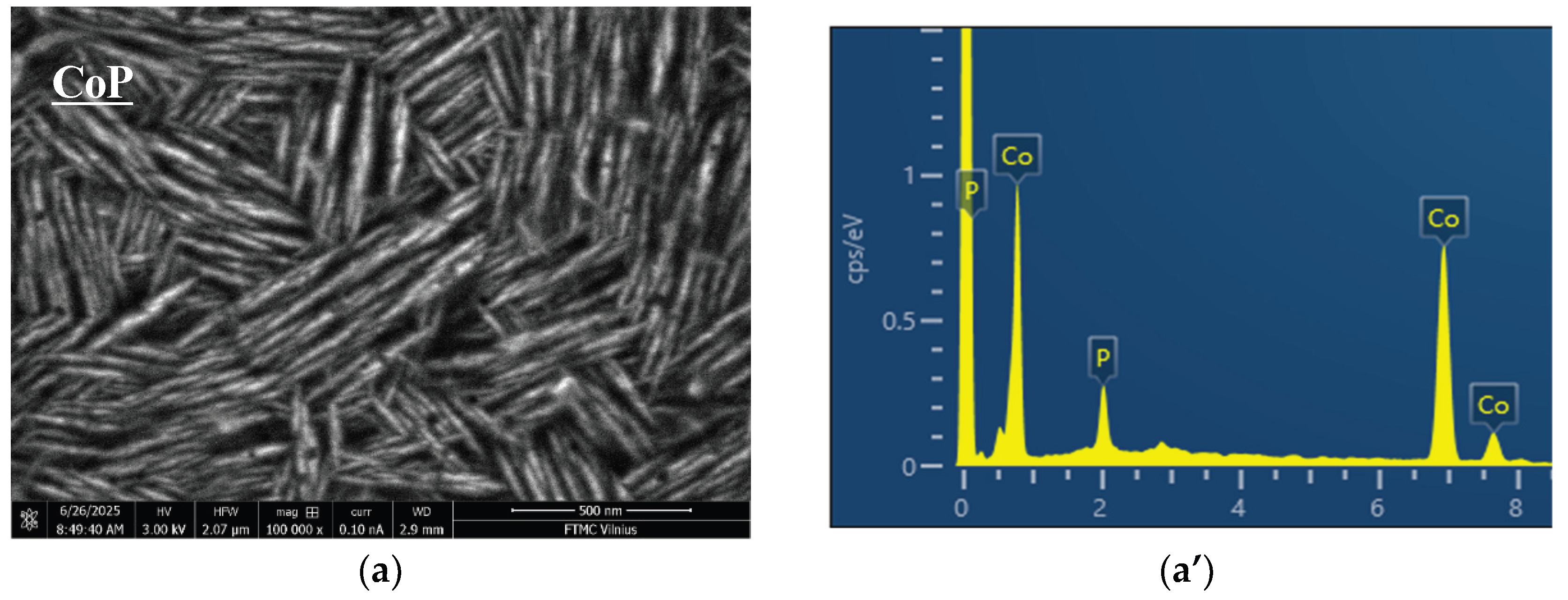
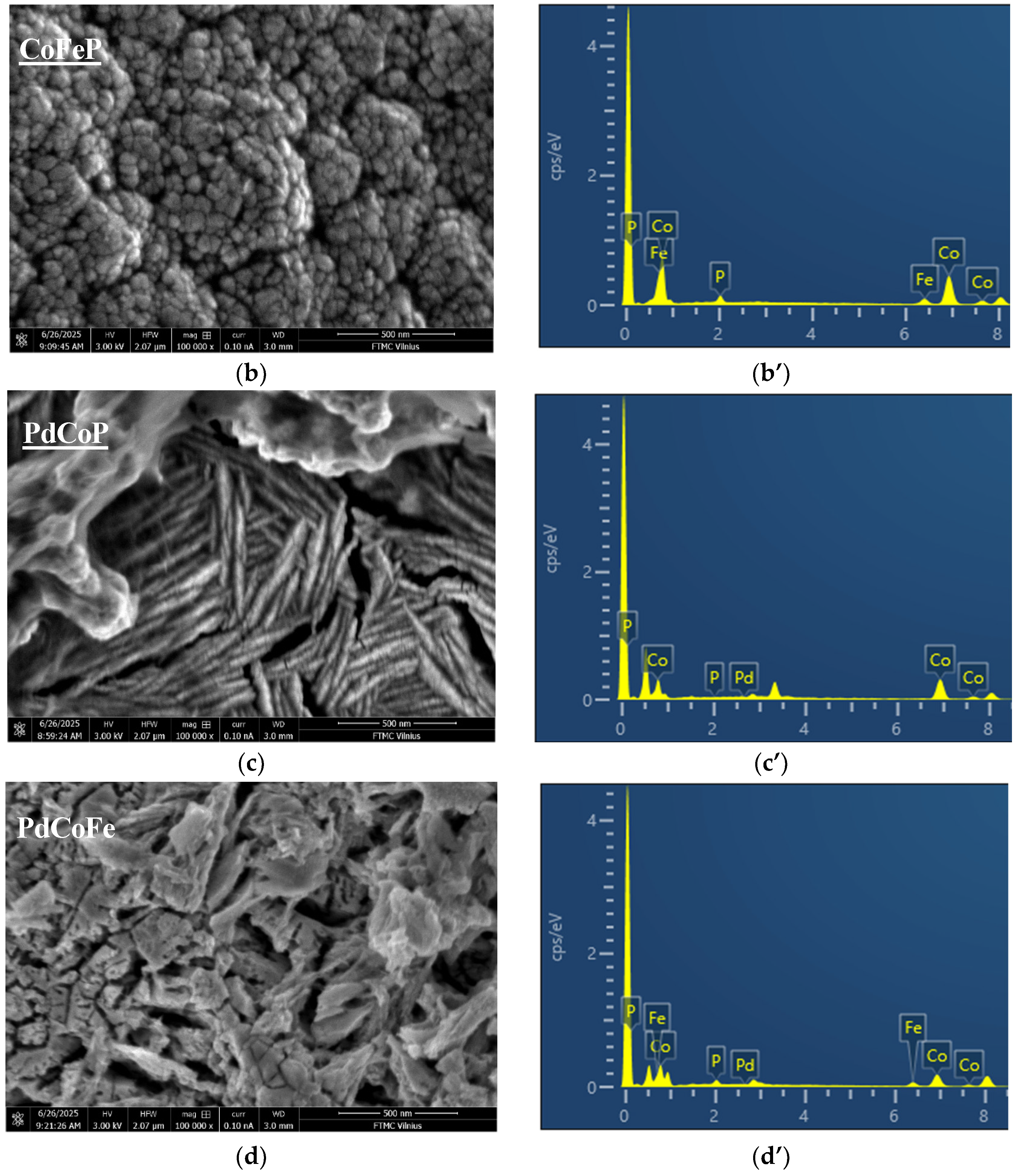
Figure 2.
(a) HER Polarization curves in an N2-saturated 1 M KOH solution at a potential scan rate of 5 mV s–1 and 25 oC temperature. (b) Bar columns of the corresponding overpotentials at current densities of 10, 20, 50, and 100 mA cm−2. (c, d) The corresponding Tafel slopes and Arrhenius plots of the current at -0.40 V versus RHE for each catalyst.
Figure 2.
(a) HER Polarization curves in an N2-saturated 1 M KOH solution at a potential scan rate of 5 mV s–1 and 25 oC temperature. (b) Bar columns of the corresponding overpotentials at current densities of 10, 20, 50, and 100 mA cm−2. (c, d) The corresponding Tafel slopes and Arrhenius plots of the current at -0.40 V versus RHE for each catalyst.
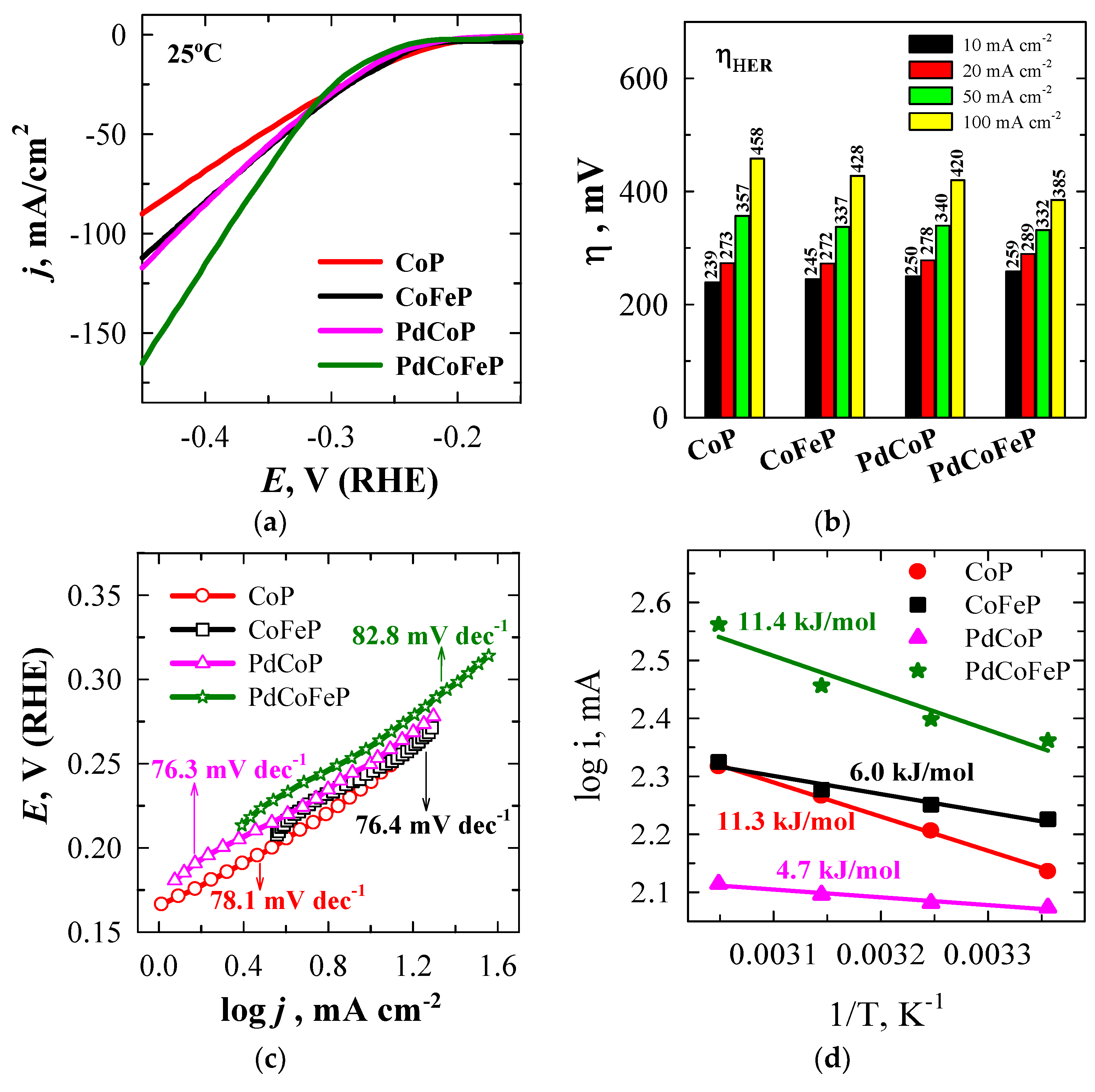
Figure 3.
(a) OER Polarization curves in an N2-saturated 1 M KOH solution at a potential scan rate of 5 mV s−1 and 25 oC temperature. (b) Bar columns of the corresponding overpotentials at 10, 20, 50, and 100 mA cm−2. (c,d) The corresponding Tafel slopes and Arrhenius plots of the current at 1.8 V versus RHE for each catalyst.
Figure 3.
(a) OER Polarization curves in an N2-saturated 1 M KOH solution at a potential scan rate of 5 mV s−1 and 25 oC temperature. (b) Bar columns of the corresponding overpotentials at 10, 20, 50, and 100 mA cm−2. (c,d) The corresponding Tafel slopes and Arrhenius plots of the current at 1.8 V versus RHE for each catalyst.
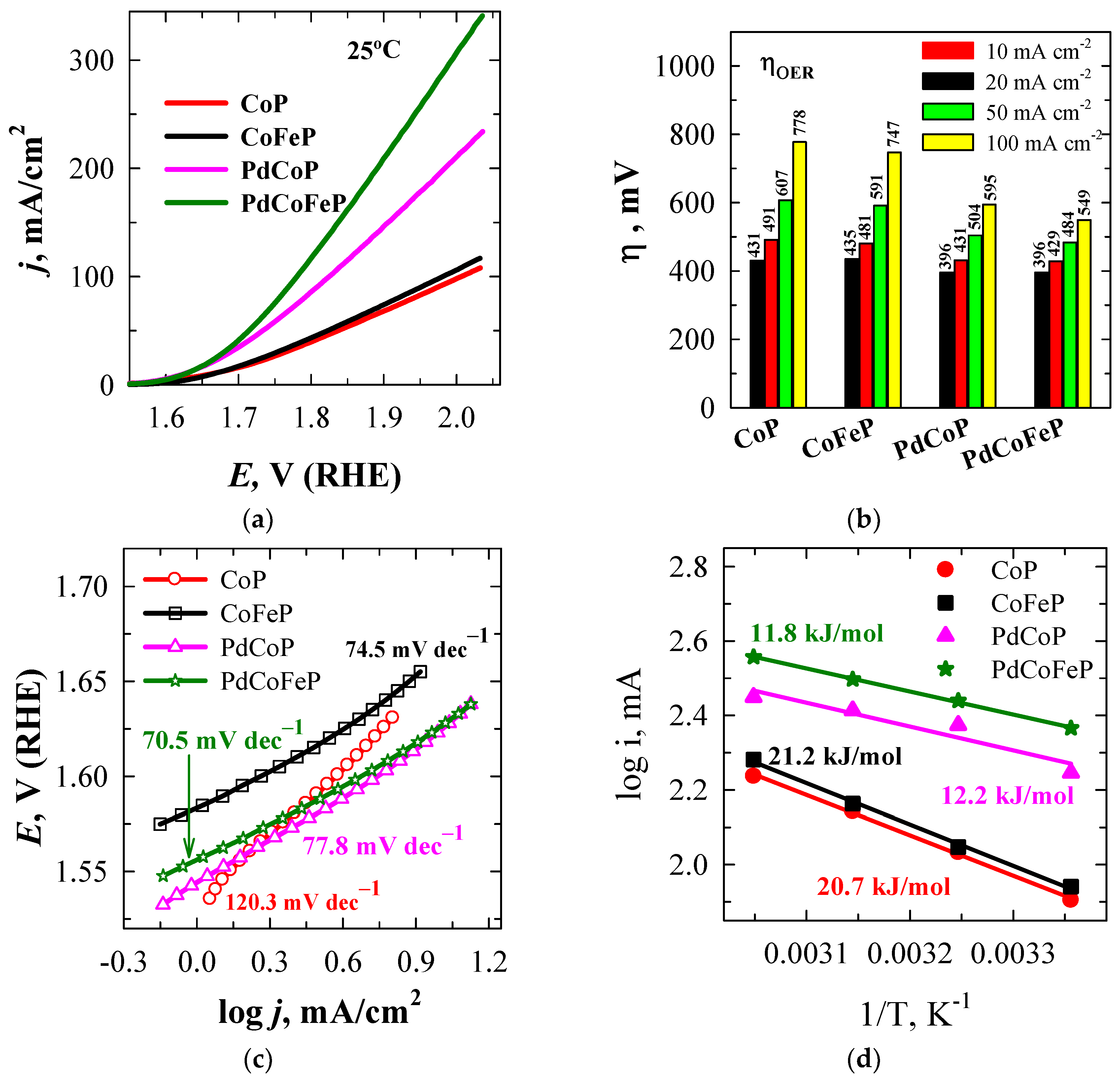
Figure 4.
CVs of (a) CoP, (b) CoFeP, (c) PdCoP, and (d) PdCoFeP in an N2-saturated 1 M KOH solution in the non-faradaic potential region at different scan rates (10–50 mV s–1). (e) Capacitive current as a function of scan rate.
Figure 4.
CVs of (a) CoP, (b) CoFeP, (c) PdCoP, and (d) PdCoFeP in an N2-saturated 1 M KOH solution in the non-faradaic potential region at different scan rates (10–50 mV s–1). (e) Capacitive current as a function of scan rate.
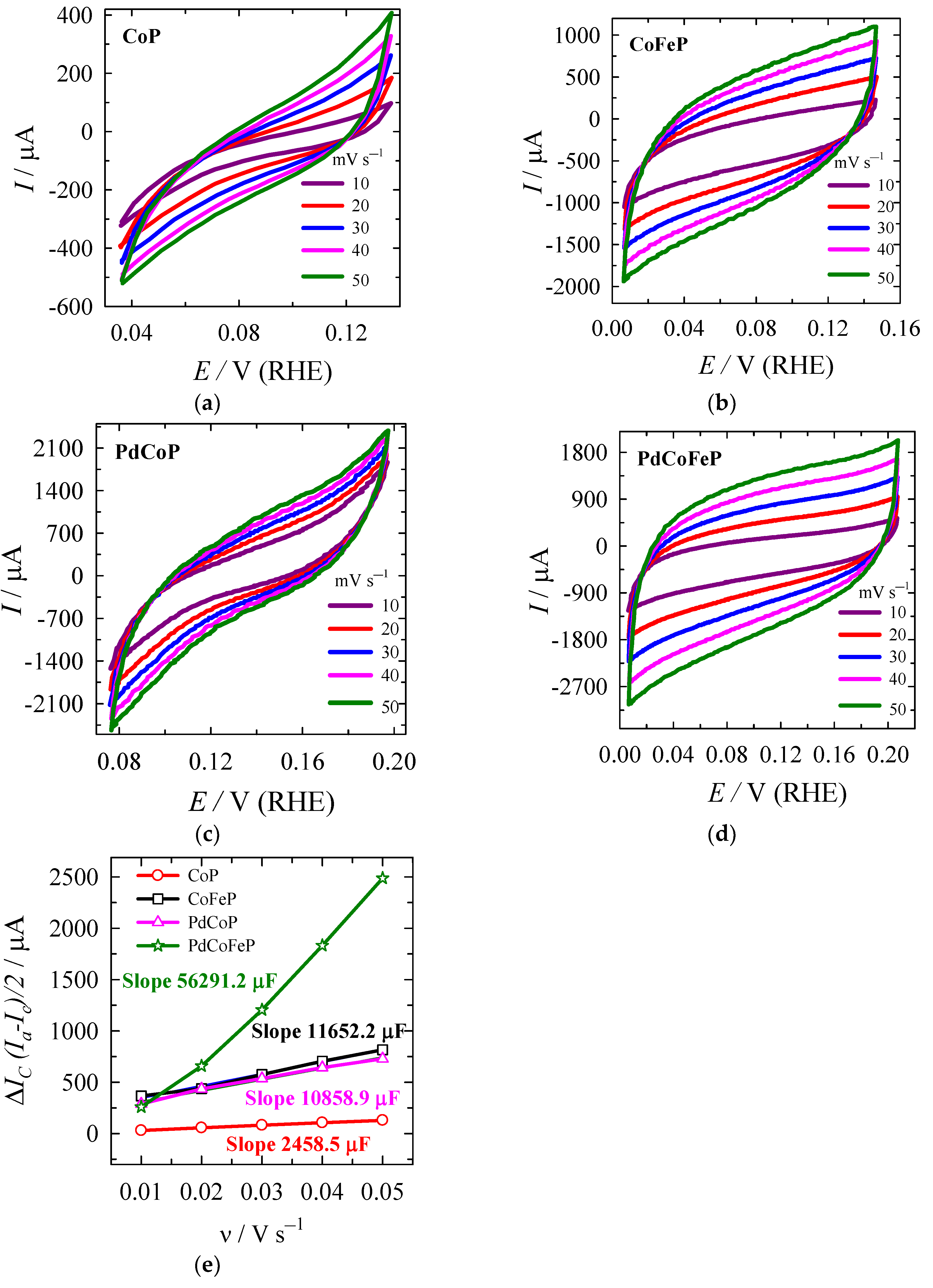
Figure 5.
CA curves of the investigated PdCoP (a) and PdCoFeP (b) catalysts in a 1 M KOH solution at 25 oC at the potential value of -0.26 V (vs. RHE).
Figure 5.
CA curves of the investigated PdCoP (a) and PdCoFeP (b) catalysts in a 1 M KOH solution at 25 oC at the potential value of -0.26 V (vs. RHE).
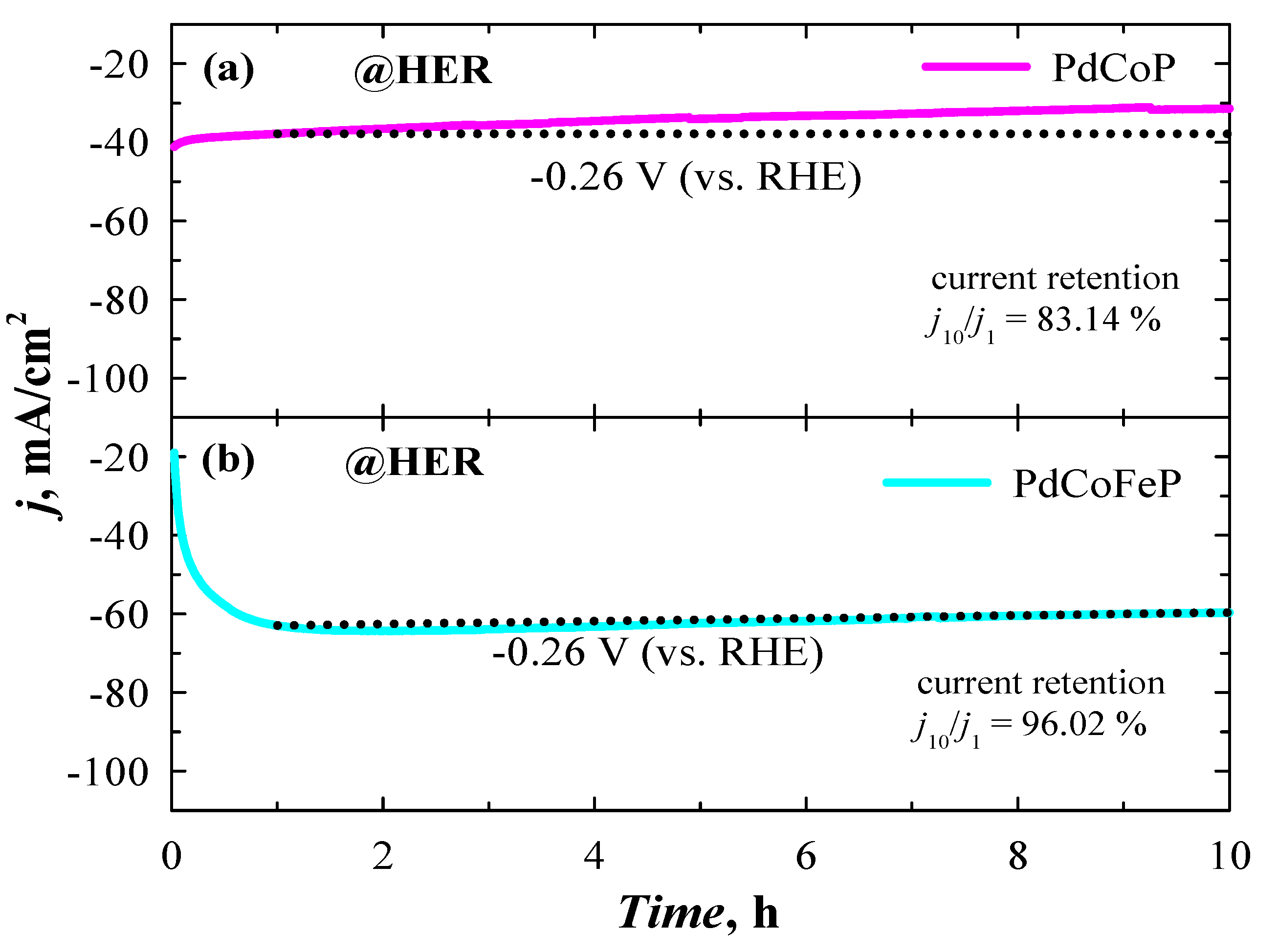
Figure 6.
CP curves of the investigated PdCoP (a) and PdCoFeP (b) catalysts in a 1 M KOH solution at a constant current density of –10 mA cm–2 at 25 oC.
Figure 6.
CP curves of the investigated PdCoP (a) and PdCoFeP (b) catalysts in a 1 M KOH solution at a constant current density of –10 mA cm–2 at 25 oC.
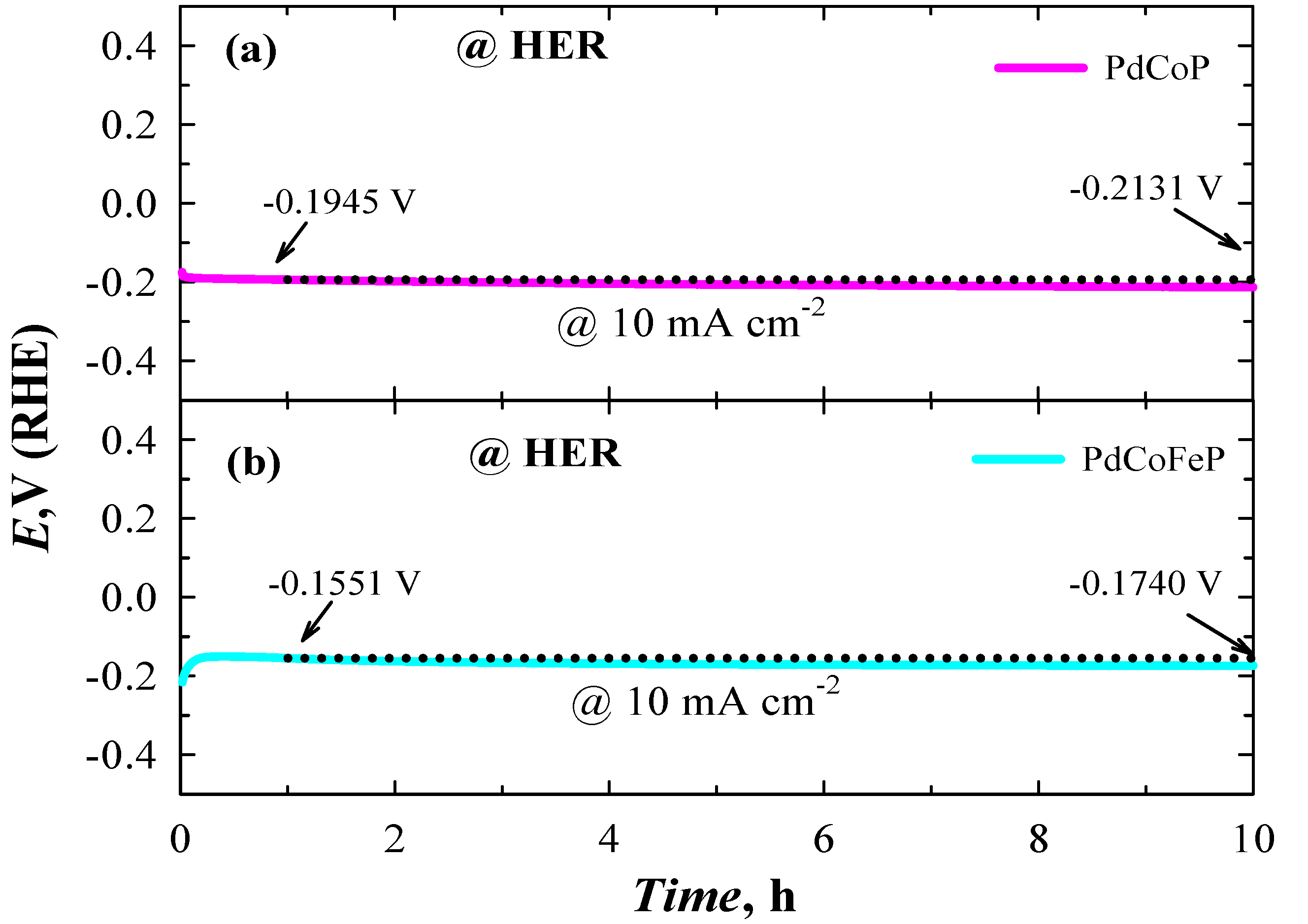
Figure 7.
Polarization curves of CoP, CoFeP, PdCoP, and PdCoFeP catalysts used as both anode and cathode for overall water splitting performance in the two-electrode setup at the scan rate of 5 mV s−1.
Figure 7.
Polarization curves of CoP, CoFeP, PdCoP, and PdCoFeP catalysts used as both anode and cathode for overall water splitting performance in the two-electrode setup at the scan rate of 5 mV s−1.
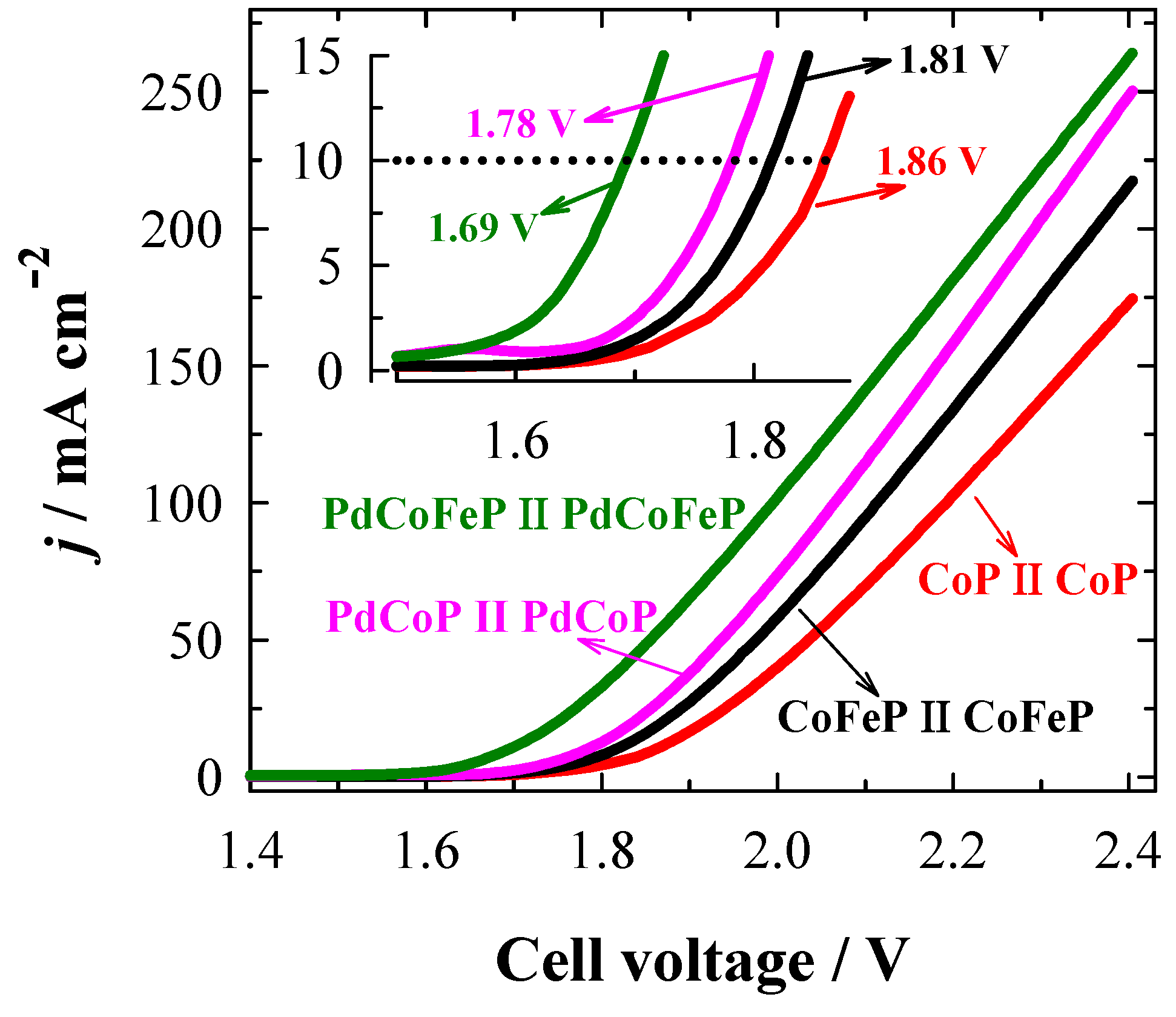
Figure 8.
Schematic representation of the synthesis of Co-based coatings via electroless deposition and modification with Pd by galvanic displacement.
Figure 8.
Schematic representation of the synthesis of Co-based coatings via electroless deposition and modification with Pd by galvanic displacement.
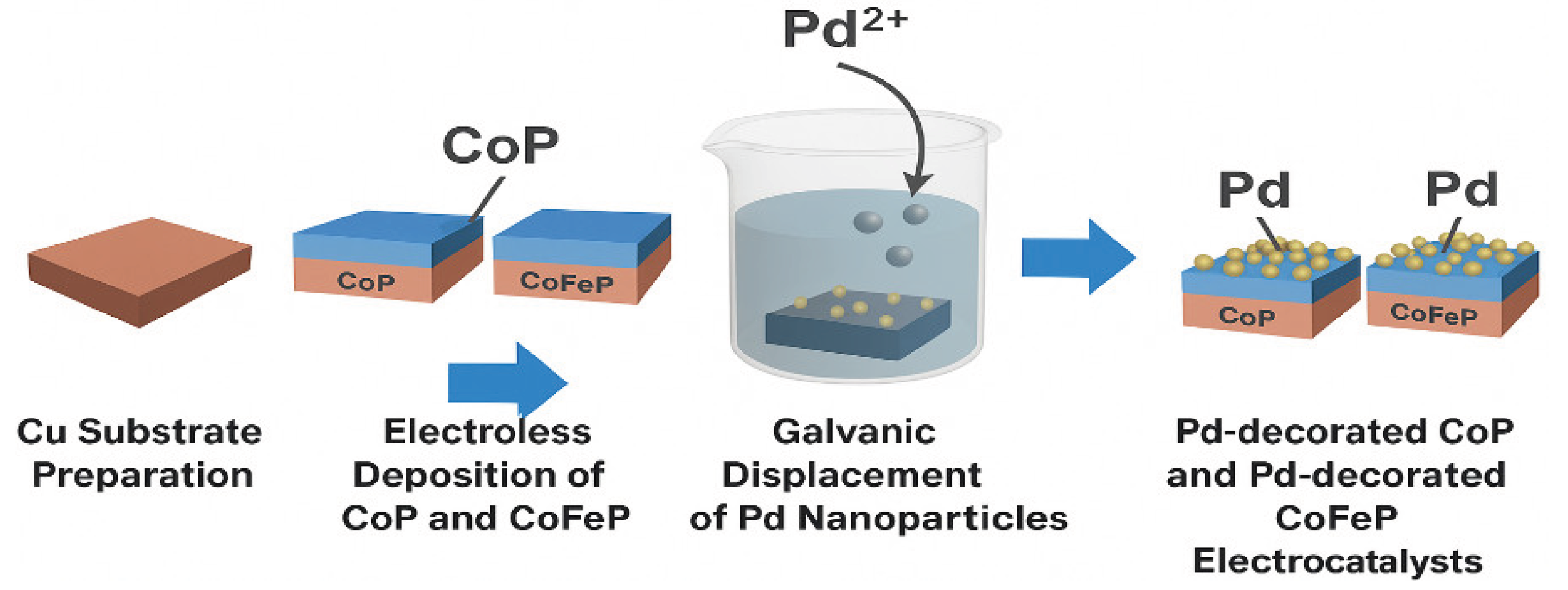

Table 1.
Composition of coatings deposited on Cu surface determined by EDX analysis.
| Sample | Element, at% | |||
| Pd | Co | Fe | P | |
| CoP/Cu | - | 90.22 | - | 9.78 |
| CoFeP/Cu | - | 83.78 | 9.96 | 6.26 |
| PdCoP/Cu | 3.54 | 83.72 | - | 12.74 |
| PdCoFeP/Cu | 8.36 | 64.08 | 12.49 | 15.07 |
Table 2.
Summarized parameters for HER on the investigated catalysts in alkaline media.
| Sample | Eonset*, V | η10**, mV |
Tafel slope, mV dec−1 |
Ea, kJ mol−1 |
| CoP/Cu | 0.166 | 239 | 78.1 | 11.3 |
| CoFeP/Cu | 0.188 | 245 | 76.4 | 6.0 |
| PdCoP/Cu | 0.171 | 250 | 76.3 | 4.7 |
| PdCoFeP/Cu | 0.213 | 259 | 82.8 | 11.4 |
* Potential at −1 mA cm−2. ** Overpotential at 10 mA cm−2.
Table 3.
Electrochemical performance of the investigated catalysts for OER in alkaline media at 25 oC.
Table 3.
Electrochemical performance of the investigated catalysts for OER in alkaline media at 25 oC.
| Sample | Eonset*, V | ηonset, mV | E**, V | η10**, mV |
Tafel slope, mV dec−1 |
Ea, kJ mol−1 |
| CoP/Cu | 1.5205 | 290 | 1.6607 | 431 | 120.3 | 20.7 |
| CoFeP/Cu | 1.5846 | 355 | 1.6650 | 435 | 74.5 | 21.2 |
| PdCoP/Cu | 1.5426 | 313 | 1.6255 | 396 | 77.8 | 12.2 |
| PdCoFeP/Cu | 1.5577 | 328 | 1.6256 | 396 | 70.5 | 11.8 |
* Values at 1 mA cm−2. ** Values at 10 mA cm−2.
Table 4.
Comparison of OER performance of the investigated catalysts with some previously reported Co-P-based and most advanced noble – metal catalysts.
Table 4.
Comparison of OER performance of the investigated catalysts with some previously reported Co-P-based and most advanced noble – metal catalysts.
| Catalyst | η10*, mV |
Tafel slope, mV dec−1 |
Electrolyte | Ref. |
| PdCoFeP/Cu | 396 | 70.5 | 1 M KOH | This study |
| PdCoP/Cu | 396 | 77.8 | 1 M KOH | This study |
| CoOx | 423 | 42 | 1 M KOH | [79] |
| Co2P2O7 | 490 | 86 | 1 M KOH | [80] |
| Co(PO3)2 nanosheets | 574 | 106 | 1 M KOH | [80] |
| CoP hollow polyhedron | 400 | 57 | 1 M KOH | [81] |
| Reduced mesoporous Co3O4 nanowires | 400 | 72 | 1 M KOH | [82] |
| CoP-MNA/Ni foam | 390 | 65 | 1 M KOH | [83] |
| CoP | 350 | 47 | 1 M KOH | [18] |
| CoSi-P | 309 | 121 | 1 M KOH | [84] |
| CoP | 300 | 65 | 1 M KOH | [85] |
| Mn-CoP | 288 | 77.2 | 1 M KOH | [86] |
| RuO2/CF | 360 | 164 | 1 M KOH | [87] |
| RuO2 on NF | 290 | 81 | 1 M KOH | [88] |
| IrO2 commercial | 339 | 94.5 | 1 M KOH | [89] |
| Ir/C | 254 | 71.9 | 1 M KOH | [90] |
* Values at 10 mA cm−2.
Table 5.
Comparison with various electrocatalysts for overall water splitting.
| Anode II Cathode | Cell voltage, V | Electrolyte | Ref. |
| PdCoFeP/Cu‖PdCoFeP/Cu | 1.69 | 1 M KOH | This study |
| PdCoP/Cu‖PdCoP/Cu | 1.78 | 1 M KOH | This study |
| Pt/C‖IrO2 | 1.71 | 1 M KOH | [91] |
| Pt/C‖Pt/C | 1.83 | 1 M KOH | [91] |
| CoP/rGO-400‖CoP/rGO-400 | 1.70 | 1 M KOH | [91] |
| Co(OH)2@NCNTs@NF‖ Co(OH)2@NCNTs@NF | 1.72 | 1 M KOH | [92] |
| Co-P/NC/CC‖Co-P/NC/CC | 1.77 | 1 M KOH | [93] |
| Co-P/NC-CC‖Co-P/NC-CC | 1.95 | 1 M KOH | [93] |
Table 6.
The composition of plating baths and the deposition parameters for the deposition of CoP and CoFeP coatings.
Table 6.
The composition of plating baths and the deposition parameters for the deposition of CoP and CoFeP coatings.
| Sample | Composition of the plating bath, mol L–1 | T, oC | t, min | pH | |||
| CoSO4 | FeSO4 | Glycine | NaH2PO2 | ||||
| CoP | 0.1 | - | 0.6 | 0.75 | 60 | 30 | 11 |
| CoFeP | 0.1 | 0.01 | 0.6 | 0.75 | 60 | 30 | 11 |
Disclaimer/Publisher’s Note: The statements, opinions and data contained in all publications are solely those of the individual author(s) and contributor(s) and not of MDPI and/or the editor(s). MDPI and/or the editor(s) disclaim responsibility for any injury to people or property resulting from any ideas, methods, instructions or products referred to in the content. |
© 2025 by the authors. Licensee MDPI, Basel, Switzerland. This article is an open access article distributed under the terms and conditions of the Creative Commons Attribution (CC BY) license (http://creativecommons.org/licenses/by/4.0/).
Copyright: This open access article is published under a Creative Commons CC BY 4.0 license, which permit the free download, distribution, and reuse, provided that the author and preprint are cited in any reuse.


