

Submitted:
29 October 2024
Posted:
31 October 2024
You are already at the latest version
Abstract
As modern technology enables instant access to virtually limitless information, students may perceive memorization of information as lacking in practical importance. The current study investigated the relationship between attitudes toward remembering and metamemory as well as objective memory performance. University students completed the Importance of Remembering questionnaire (IORQ) as a measure of attitudes toward remembering. Subjective components of memory were measured by immediate and delayed judgements of learning (JOLs), global judgements of learning (global JOLs), retroactive confidence judgements (RCJs), as well as subjective mental workload. Objective memory performance was measured using a cued recall test. The IORQ was only significantly correlated with absolute accuracy of delayed judgements of learning for words and pictures such that higher IORQ ratings were associated with less accurate judgments about how well they learned the items. No other correlations were significant. This suggests that a student’s lack of belief in the importance of remembering, at least as conceptualized on the IORQ, may not affect most aspects of memory performance, including those related to academic outcomes.
Keywords:
Importance of memory
; Judgments of learning
; Mental workload
; Cued recall
; College students
1. Introduction
According to Yates (1968) [1], Socrates was distressed with the invention of written language, which he worried would cause people to neglect the practice of the art of memory. Even before the ancient Greek era, memory was highly valued by orators whose job was to deliver a lengthy speech without making any errors, “to tell the truth and testify the divinity of the soul” (p. 59, Yates, 1968) [1]. In the 20th century, literature that investigated the development of expertise established that memory of domain-specific knowledge is the main difference between novices and experts (see Ericsson & Kintsch, 1995, for extensive review) [2]. In the information technology age, people have become increasingly reliant on internet connected devices for instant access to information as an aide to thinking and remembering (Finley, et al. 2018) [3], and use of these devices is changing our cognitions (Marsh & Rajaram, 2019) [4]. Further, research conducted in the smartphone age has found that individuals are often unaware whether they had used a smartphone to access a particular piece of information just one week prior (Siler, et al., 2022) [5]. These same technological advances may also reduce the perceived importance of remembering information and subsequently impede academic performance. Accordingly, the purpose of the present study was to determine whether attitudes toward remembering would be associated with both metamemory (subjective component) and memory performance (objective component).
1.1. Attitudes & Remembering
Several previously published studies suggest that an individual’s attitudes toward remembering would be associated with actual memory performance. In one experiment, Sparrow et al. (2011) [6] asked participants to type a series of trivial information (e.g., “An ostrich’s eye is bigger than its brain.”) into a computer. Then, half of the participants were told to save the statements (essentially priming participants with the idea that they would be able to search the computer for the information if they needed it) and the other half of the participants were told to erase the statements. Subsequently, participants were asked to recall the statements. Participants were able to recall more statements in the erased condition than in the saved condition, presumably because participants who saved the statements thought that they would be able to search the computer later, and therefore, they put less effort in remembering the statements.
In another experiment reported in the same article, participants were asked to type trivial statements into a computer, and after typing each statement, they were told either that (1) the statement was saved, (2) the statement was saved in the folder X, or (3) the statement was erased. Subsequently, participants were asked to take a recognition test in which they were asked to judge whether (1) the statement was the same as before, (2) the statement was saved or erased, and (3) the statement was saved in a particular folder X. The results showed that recognition performance was the best for the statements that they were told would be erased. Further, when they were asked whether the statement was saved or erased, they were more accurate in making this judgment for the statements that they were told were saved. Additionally, when they were asked to judge whether the statement was saved in a particular folder, they were more accurate in judging that the statement was erased.
In a third experiment in the same article, participants were asked to type trivial statements into a computer and save each statement in a particular folder X. Subsequently, they were asked to recall the statements, followed by a task in which they were given a part of each statement and asked to identify which folder they saved the statement. The results showed that participants were more accurate in identifying the folder than recalling the statements. These experiments showed that remembering is impaired when one believes that information is accessible later via a computer, a phenomenon that the authors called “the Google effect.”
Subsequent research on the Google effect has shown that it is especially reliable when individuals are confident in the reliability with which information can be saved and retrieved (Schooler & Storm, 2021) [7]. A meta-analysis on the Google effect showed that, among other things, the effect is stronger among participants in the United States and among participants with high internet usage (Gong & Yang, 2024) [8], both of which are factors that make American college students an ideal sample.
Based on these considerations, it is possible that negative attitudes toward remembering fostered by the use of the internet would be detrimental to one’s ability to remember information as measured by a cued recall test.
1.2. Metamemory
Metamemory, a type of metacognition, includes the control and monitoring of activities specific to memory (Nelson & Narens, 1990; Nelson & Narens, 1994) [9, 10]. In the present study, metamemory will be examined in four ways: judgments of learning (JOL), global judgments of learning (global JOLs), retrospective confidence judgments (RCJ), and subjective mental workload.
The first measure is JOLs, which are the judgments one makes at the encoding stage in order to influence decisions as to how much to study (Nelson & Narens, 1990; Nelson & Dunlosky, 1991; Nelson & Narens, 1994) [9 - 11]. Dunlosky and Nelson (1992) [12] showed that JOLs are predictive of subsequent recall, even though the accuracy is far from perfect. Further, introducing a delay between studying a word pair and making a JOL would increase the accuracy, referred to as the delayed JOL effect (Begg et al., 1989; Kelemen & Weaver, 1997) [13, 14]. Over the years, several theories have been proposed to explain the delayed JOL effect (Dunlosky & Nelson, 1997; Metcalfe & Finn, 2008) [15, 16], including a proposal that the effect is an artifact of reactivity created by asking participants to make the judgments (e.g., Senkova & Otani, 2021) [17]. Whatever the reason for the effect, the delayed JOL effect has been replicated by many studies (see Rhodes & Tauber, 2011 for meta-analysis and review) [18], and therefore, the present study investigated whether negative attitudes toward remembering would influence this well-established effect.
The second measure is global JOLs. For this measure, participants are asked to make a prediction about their performance on a memory test which they are about to take. Unlike an item-by-item measure of JOLs, this measure is focused on the entire test and is another way of assessing participants’ confidence in their memory. Note that the accuracy of global JOLs is calculated by subtracting actual performance from predicted performance. This means that higher scores indicate lower accuracy.
The third measure is RCJ, which are judgments one makes at the retrieval stage in order to decide whether the answer one has retrieved is correct or incorrect (Eakin & Moss, 2019) [19]. This type of judgments has not been studied extensively in the literature of metacognition, and instead, it has been mainly investigated in the literature of recognition memory because one’s confidence in response would reflect one’s response bias (i.e., willingness to say ‘yes’) in the context of signal detection theory. Nevertheless, one’s attitudes toward remembering might be associated with one’s confidence in one’s memory.
The fourth measure is mental workload or psychological costs, which is defined as the perceived difficulty of a task and one’s perceived ability to complete the task (Hart & Staveland, 1988) [20]. Believing that a task, such as remembering, is more difficult than it actually is, may impair one’s willingness to do that task. This may in turn reduce one’s tendency to practice that task, leading to an actual difficulty with the task (Knoll, 2015) [21]. This is another way that an attitude toward remembering may affect actual memory performance.
Subjective mental workload has been extensively studied in the human factors field using a subjective rating scale such as the NASA Task Load Index (NASA-TLX, Hart & Staveland, 1988; see Johnson & Proctor, 2004) [20, 22]. This measure is based on five dimensions of mental workload: mental demand, physical demand, effort, performance, and frustration. For a cognitive task, physical demand is irrelevant. This dimension was included in the scale in order to measure mental workload of physical tasks that astronauts are often asked to perform. The NASA-TLX has been shown to have a strong test-retest reliability (r = .83; Kirby et al., 1988) [23], and it correlates well with other measures of mental workload, Workload Profile (WP) and Subjective Workload Assessment Technique (SWAT; Rubio et al., 2004) [24], with correlations ranging from .97 to .98. In the present study, the NASA-TLX will be used to measure subjective mental workload in order to determine whether negative attitudes toward remembering would make a memory task more mentally taxing to perform.
1.3. Overview
The purpose of the present study was to determine whether attitudes toward remembering would be associated with metamemory and memory performance. Participants’ attitudes toward remembering were assessed using a questionnaire (Importance of Remembering questionnaire or IORQ), which asked participants to rate the importance of remembering 15 types of specific information related to personal, school, and work. In this measure, higher ratings indicated that remembering a particular item is important. Further, IORQ included an item (#16) that asked participants to rate their general attitudes toward remembering (“Remembering isn’t important). This item was reverse scored to make it consistent with other items.
Memory performance was assessed by asking participants to study a list of word pairs as well as picture pairs (e.g., apple – orange or line drawings of apple and orange) and subsequently testing their memory using a cued-recall test (e.g., apple - ?? or a line drawing of apple). Two aspects of memory were investigated: subjective and objective. To examine the subjective aspect of memory, in the present study, participants were asked to make JOLs while studying the word/picture pairs, and the accuracy of JOLs was examined. Both immediate and delayed JOL effects were examined by asking participants to make JOLs immediately after studying a pair for some items and make JOLs after a delay for other items. The second measure was global JOLs in which prior to a cued recall test, participants were asked to predict the number of items (out of 30 items) they would be able to recall. The third measure of the subjective aspect of memory was RCJ. This measure was administered during the cued recall test, such that after recalling a target word, participants were asked to rate the confidence in the accuracy of their response. The fourth measure was subjective rating of mental workload, which was assessed at the end of the study by administering the NASA TLX. To examine the objective aspect of memory, participants were asked to take a cued-recall test. In this test, participants were presented with the cue side of the pair (the left side) and asked to recall the target side of the pair (the right side).
The following hypotheses were proposed:
Hypothesis 1:
There would be a positive correlation between the scores of IORQ and the accuracy of JOLs (for both immediate and delayed judgments), indicating that participants with positive attitudes toward remembering show higher accuracy of JOLs or conversely, participants with negative attitudes toward remembering show lower accuracy of JOLs.
Hypothesis 2:
There would be a negative correlation between the scores of IORQ and the accuracy of global JOLs, indicating that participants with positive attitudes toward remembering show higher accuracy of global JOLs. (Note: Higher scores of global JOLs indicate lower accuracy).
Hypothesis 3:
There would be a positive correlation between the scores of IORQ and RCJs, indicating that participants with positive attitudes toward remembering show higher RCJs ratings indicating higher confidence in their recall.
Hypothesis 4:
There would be a negative correlation between the scores of IORQ and the ratings of the NASA TLX, indicating that participants with positive attitudes toward remembering rate subjective mental workload lower compared to participants with negative attitudes toward remembering.
Hypothesis 5:
There would be a positive correlation between the scores of IORQ and the scores on the cued-recall test, indicating that participants with positive attitudes toward remembering show higher memory performance, or conversely, participants with negative attitudes toward remembering show lower memory performance.
2. Materials and Methods
2.1. Participants
Participants were 108 students, 25 men and 83 women, in undergraduate psychology courses at Central Michigan University. These students were recruited from the Psychology Subject Pool. Participants were given extra credit for their participation, as decided by their professors. This experiment was conducted with approval from the Central Michigan University Institutional Review Board (IRB 2023-841, November 10, 2023).
2.2. Materials
Measure of attitudes toward remembering. The Importance of Remembering questionnaire (IORQ) was developed to measure participants’ attitudes toward remembering (see Appendix A). The questionnaire consisted of 15 items such as multiplication tables and safety instructions. Participants responded to each item using a 5-point scale (1 – not very important; 5 – very important). In addition, one item, the 16th item, was used to measure their overall attitudes toward remembering (“Remembering isn’t important”), and participants were asked to rate their response using a 5-point scale (1 – strongly disagree, 5 – strongly agree). This item was reversed-scored for the analysis to make it such that the higher scores would indicate higher importance of remembering (Cronbach’s alpha = .69).
Learning materials. The materials were the same as those used by Knoll et al. (2017) [21]. Each participant learned two lists, one consisting of 30 cue-target word pairs and the other consisting of 30 cue-target picture pairs. These lists were presented on a computer screen with words in lowercase letters and pictures as line drawings. These words and pictures were selected from the Snodgrass and Vanderwart (1980) [25] picture norms by first selecting 120 names of common objects and animals (e.g., cat). These items had moderately high mean percentage name agreement (M = 89.08, SD = 12.79) as well as image agreement (M = 3.73, SD = .56). Next, these names were divided into two sets of 60 items each (Set A and Set B), and for each set, 30 pairs were created by randomly pairing the items. Using these sets, the word list and the picture list were counterbalanced across participants.
Measure of mental workload. To measure subjective mental workload of the memory task, the NASA Task Load Index (NASA TLX) was administered (Hart & Staveland, 1988) [20]. This instrument consists of six subscales, each with a line that shows 21 vertical tick marks. The left most side of the line is anchored ‘very low,’ and the right most side of the line is anchored ‘very high.’ The five subscales are mental demand, physical demand, temporal demand, performance, effort, and frustration. For the purpose of this study, the subscale of physical demand was omitted because the task did not include physical activities. Also, the performance question was reverse-scored to make higher ratings to indicate higher performance. According to Kirby et al. (1988) [23], this instrument has strong test/retest reliability (r = .83). Further, this instrument was found to have high convergent validity, showing correlation between .97 and .98 with other workload measures, the Workload Profile (WP) and the Subjective Workload Assessment Technique (SWAT; Rubio et al., 2004) [24].
2.3. Procedure
Participants, tested individually, were asked to learn two lists (a word list and a picture list counterbalanced across participants). For each list, participants went through three phases: study, filler task, and test. During the study phase, they were presented with a list via a Powerpoint presentation. Each pair was presented at the center of a computer screen for six seconds. Participants were asked to memorize as many pairs as possible. Also, as Knoll et al. (2017) [20] did, for each pair, participants were asked to make a JOL using a procedure similar to Dunlosky and Nelson (1992) [12]. After a pair is presented, participants were asked to judge how likely they would be able to remember the target (the right side of the pair) in the test phase when the left side of the pair is presented for cued recall. To make these JOLs, participants were shown the cue item (e.g., cat - ???) and were asked to rate on a scale of 0 to 100 (0 being a 0% chance of recall and 100 being a 100% chance of recall) how likely they would be able to recall the target item in the testing phase. Participants made the judgment at their own pace and wrote the rating on a response sheet. In addition, for half of the pairs (15 items randomly selected), participants made a JOL immediately after a pair was presented (immediate JOL) and for the other half of the pairs (15 items randomly selected), they made a JOL after several pairs had been presented (delayed JOL). These immediate and delayed JOL pairs were randomly ordered with a restriction that no more than three consecutive items were assigned for the same JOL type. Further, all the delayed JOLs were made after the last immediate JOL pair was presented and judged, such that at least 10 items separated between the exposure of a pair and making a delayed JOL. After all items in a list were presented, participants were asked to give a global JOL, which was a prediction of how many items they would be able to recall in the test phase. After the study phase, participants completed a two-minute distractor task, crossing out the numbers that are divisible by three. Then, during the test phase, participants completed a cued-recall test in which they were shown a cue word or picture one at a time on the computer screen and asked to recall the target word or picture. They then wrote their responses on a sheet of paper and made an RCJ (retroactive confidence judgment) on a 5-point scale (1 – not very confident; 5 – very confident). Once the first list was studied and tested, participants completed the first NASA TLX, and additional distractor items as a filler task. Then, they learned the second list, going through the three phases (study, filler task, and test) once more.
Once the memory test of the second list was over, participants completed the second NASA TLX. In both instances, they were asked to reflect on the learning phase of the experiment and rate each subscale of the TLX, except for the physical demand subscale. Rating was done by placing an “X” along the line from very low to very high. After completing the TLX, participants completed the IOR measure, a smartphone use questionnaire, an Information Technology use questionnaire, and lastly, they were asked to respond to demographics questions.
3. Results
3.1. ANOVAs to Compare Memory and Metamemory Outcomes Across Conditions (These Analyses Are Not Related to Study Hypotheses But Are Included for Demonstrating the Validity of Our Data)
Recall. Table 1 shows the mean scores from the memory test. As shown, performance was low for both the word list (M = 8.47, SD = 6.60, 28.23%) and the picture list (M = 9.97, SD = 7.20, 33.23%). Nevertheless, recall was higher for the pictures than for the words, showing a well-established phenomenon referred to as the picture superiority effect (e.g., Paivio & Csapo, 1973) [26]. A reason for the low recall level was that there were participants with zero recall. Because excluding these participants did not make a difference in the subsequent correlational analyses, these participants were kept. These participants with zero recall were evenly distributed across conditions: 11 for immediate word recall, 17 for delayed word recall, 11 for immediate picture recall, and 12 for delayed picture recall. A 2 (list type: words and pictures) x 2 (judgment type: immediate and delayed) repeated- measures ANOVA showed that the main effect of list type was significant, F(1, 106) = 4.38, p = .04, ηp2 = .04, indicating that recall was higher for the pictures (M = 4.94, SD = 3.58) than for the words (M = 4.23, SD = 3.30). Further, the main effect of judgment type was significant, F(1, 106) = 17.72, p < .001, ηp2 = .14, indicating that recall was higher for the immediate (M = 4.94, SD = 3.15) than for the delayed judgment type (M = 4.24, SD = 3.03). The interaction was not significant F(1, 106) = 0.01, p = .93, ηp2 = .00.
JOLs. Next, JOL ratings were analyzed in terms of actual ratings, relative accuracy, and absolute accuracy for immediate and delayed judgments. As Table 1 shows, the mean JOL ratings were higher for the immediate than for the delayed judgments for both the words (immediate = 54.28 SD = 22.53 versus delayed = 33.57, SD = 19.08) and pictures (immediate = 56.85, SD = 20.38 versus delayed = 39.58, SD = 20.13). A 2 (list type: words and pictures) x 2 (judgment type: immediate and delayed) repeated-measures ANOVA showed that the main effect of list type was significant, F(1, 107) = 11.14, p = .001, ηp2 = .09, indicating that the ratings were higher for the pictures (M = 48.22, SD = 15.91) than for the word list (M = 43.93, SD = 17.13). Further, the main effect of judgment type was significant, F(1, 107) = 99.50, p < .001, ηp2 = .48, indicating that the ratings were higher for the immediate (M = 55.57, SD = 18.85) than for the delayed judgment (M = 36.58, SD = 17.26). The interaction was not significant F(1, 107) = 1.54, p = .22, ηp2 = .01.
The relative accuracy was computed by Goodman-Kruskal gamma correlation between JOL ratings and recall for each participant, which measured whether higher JOL ratings were associated with higher recall regardless of the actual ratings. For example, gamma can be similar regardless of whether an item is rated 30% or 60% as long as recall of this item is higher than other items that are rated lower; that is, what is important is that higher ratings are associated with higher recall whereas lower ratings are associated with lower recall. Similar to other correlational measures, gamma scores range from - 1 to + 1, with + 1 indicating the perfect calibration. Additionally, one weakness of gamma correlation is that gamma sometimes becomes undefined because the denominator of the formula becomes zero, and therefore, participants with undefined gamma have to be excluded from the analysis.
As shown in Table 1, gamma was higher for the delayed JOLs than for the immediate JOLs for both the words (immediate = .33, SD = .49 versus delayed = .82, SD = .41) and the pictures (immediate = .39, SD = .36 versus delayed = .86, SD = .24), showing a well-established phenomenon referred to as the delayed JOL effect (e.g., Dunlosky & Nelson, 1992) [28]. A 2 (list type: words and pictures) x 2 (judgment type: immediate and delayed) repeated-measures ANOVA showed that the main effect of list type was not significant, F(1, 70) = 1.19, p = .28, ηp2 = .02, indicating that gamma was similar between the words (M = .57, SD = 0.28) and the pictures (M = .62, SD = 0.22). The main effect of judgment type was significant, F(1, 70) = 95.83, p < .001, ηp2 = .58, indicating that gamma was higher for the delayed (M = .84, SD = 0.24) than for the immediate judgment (M = .36, SD = 0.29). The interaction was not significant F(1, 70) = 0.04, p = .84, ηp2 = .001.
The absolute accuracy was measured by averaging JOL ratings (0 to 100%) for each participant and subtracting the mean percent recall from the mean JOLs (which was based on 0% to 100%). If the value is zero, this means that calibration was perfect (that is, the JOL rating matched recall). Note that this way of measuring absolute accuracy is problematic. That is, if one participant overestimates recall but another participant underestimates recall, it may give an appearance of good accuracy as a group when averaged across participants. To avoid this shortcoming, absolute values were used to compare different conditions to avoid positive and negative values canceling out each other. Table 2 shows mean absolute JOL accuracy, and as shown, absolute accuracy was higher (i.e., a lower mean closer to zero) for the delayed judgments than for the immediate judgments for both the words (immediate = 36.45, SD = 23.83 versus delayed = 14.31, SD = 13.06) and the pictures (immediate = 33.72, SD = 24.26 versus delayed = 14.34, SD = 11.37), again showing the delayed JOL effect. A 2 (list type: words and pictures) x 2 (judgment type: immediate and delayed) repeated-measures ANOVA showed that the main effect of list type was not significant, F(1, 106) = 0.80, p = .37, ηp2 = .01, indicating that absolute JOL accuracy was similar between the words (M = 25.48, SD = 15.45) and the pictures (M = 24.03, SD = 15.02). The main effect of judgment type was significant, F(1, 106) = 160.26, p < .001, ηp2 = .60, indicating that accuracy was higher for the delayed (M = 14.33, SD = 9.96) than for the immediate judgment (M = 35.19, SD = 19.24). The interaction was not significant F(1, 106) = 0.99, p = .32, ηp2 = .01.
Global JOLs. For global JOL ratings, participants were asked to predict how many items they would recall out of 30 items. Note that for the global judgments, the items used for immediate and delayed JOLs were not separated. Table 2 shows that global JOL ratings were similar between words (M = 8.81, SD = 5.04) and pictures (M = 9.28, SD = 5.74), t(107) = 0.91, p = .37, d = 0.09. Accuracy of global JOLs was measured by subtracting the number of correct recall from the global JOLs for each participant and converting the values to absolute values to eliminate the sign. The results showed that accuracy was similar between the words (M = 4.74, SD = 4.05) and pictures (M = 5.06, SD = 3.94), t(106) = 0.63, p = .53, d = 0.06.
RCJ. RCJ ratings were higher for the pictures (M = 2.40, SD = 0.87) than for the words (M = 2.18, SD = 0.78), t(107) = 2.86, p < .01, d = 0.28, reflecting the picture superiority effect (see Table 2).
3.2. Correlations Between IORQ and Memory and Metamemory Outcomes
Correlations. The following variables were correlated with the IORQ overall scores (based on 15 items) to examine whether there is a relationship between attitudes toward remembering and other memory/metamemory variables: (1) word recall on immediate test, (2) word recall on delayed test, (3) picture recall on immediate test, (4) picture recall on delayed test, (5) immediate JOL ratings on words, (6) delayed JOL ratings on words, (7) immediate JOL ratings on pictures, (8) delayed JOL ratings on pictures, (9) gamma scores for immediate JOL for words, (10) gamma scores for delayed JOL for words, (11) gamma scores for immediate JOL for pictures, (12) gamma scores for delayed JOL for pictures, (13) absolute accuracy for immediate JOL for words, (14) absolute accuracy for delayed JOL for words, (15) absolute accuracy for immediate JOL for pictures, (16) absolute accuracy for delayed JOL for pictures, (17) global JOL for words, (18) global JOL for pictures, (19) global JOL accuracy for words, (20) global JOL accuracy for pictures, (21) RCJ ratings for words, and (22) RCJ ratings for pictures.
The correlation matrix for these variables is illustrated in Table 3, which is included in supplemental materials due to its size. Only two variables, absolute accuracy for JOL for delayed words and absolute accuracy for JOL for delayed pictures, showed significant relationships with the IORQ scores. For both variables, the correlations were positive and significant: for the words, r(105) = .23, p = .02, and the pictures r(106) = .23, p = .02. Scatter plots are shown in Figure 1 (for the words) and Figure 2 (for the pictures). Both figures show that absolute accuracy of JOL becomes lower (i.e., the score deviates more from zero) as IORQ scores increase. In other words, absolute accuracy of JOL ratings became lower as participants rated the importance of remembering higher. Nevertheless, overall, the results of these correlational analyses fail to support Hypotheses 1 thru 3 and 5. That is, higher IORQ scores would be positively correlated with higher accuracy and performance.
3.3. Mental Workload Results
The NASA TLX was used to measure subjective mental workload. This scale is based on a 21-point, measuring 6 dimensions: mental demand, physical demand, temporal demand, performance, effort, and frustration. Because the tasks in this study did not involve physical activities, physical demand was omitted. The ratings for mental demand showed a higher mean for the words (M = 14.86, SD = 4.23) than for the pictures (M = 13.47, SD = 4.70), t(107) = 3.65, p < .001, d = 0.35. The ratings for temporal demand also showed a higher mean for the words (M = 10.46, SD = 4.83) than for the pictures (M = 9.67, SD = 4.81), t(107) = 2.28, p = .03, d = 0.22. The dimension of performance was reverse-scored to make a higher score to be associated with higher performance, and the means were similar between the words (M = 13.13, SD = 5.43) and pictures (M = 12.82, SD = 5.51), t(107) = 0.47, p = .64, d = 0.05. The ratings for effort showed a higher mean for the words (M = 13.49, SD = 4.52) than for the pictures (M = 12.80, SD = 4.73), t(107) = 2.14, p = .04, d = 0.21. Lastly, the ratings for frustration was higher for the words (M = 11.10, SD = 5.63) than for the pictures (M = 10.82, SD = 5.56). The differences were consistent with the notion that the pictures were easier to remember than the words. The reliability of NASA TLX was modest for both the words (α = .64) and the pictures (α = .73). Table 4 shows the correlation between the IORQ ratings and the ratings on each dimension. As shown, none of the correlations were significant, failing to support Hypothesis 4.
4. Discussion
The purpose of this study was to investigate the relationship between attitudes towards remembering and both objective and subjective aspects of memory. Hypothesis 1 stated that there would be a positive correlation between the IORQ scores and JOL ratings and accuracy for both immediate and delayed judgments. Hypothesis 2 predicted that there would be a negative correlation between the IORQ scores and global JOL accuracy. Hypothesis 3 predicted that there would be a positive correlation between the IORQ scores and RCJ ratings. Hypothesis 4 stated that there would be a negative correlation between IORQ scores and mental workload ratings on the NASA TLX. Hypothesis 5 predicted that there would be a positive correlation between IORQ scores and cued recall performance.
Results failed to support these hypotheses. The only two significant correlations involving IORQ indicated that contrary to the expectation, higher scores on the IORQ (i.e., believing that remembering is important) were associated with lower absolute accuracy of JOLs for delayed judgments for both words and pictures. The results showed that contrary to the hypotheses of this study, attitudes toward remembering were mostly unrelated to actual behavior of remembering.
Possible explanations for the lack of support for hypotheses could include that the IORQ does not tap into the components of attitudes toward remembering most relevant to the specific measures of memory performance included in this study. The questionnaire’s items ask about the importance of remembering a wide range of everyday general information, but memory and metamemory were assessed using paired associations unrelated to everyday life. In addition, it is possible that these phenomena would have been better examined using a directed forgetting paradigm, such that participants would have to exercise cognitive control of which items to remember and which items to forget (e.g., Franks et al., 2023) [27]. Finally, in social psychology, there has been a debate dating back to 1930’s regarding the role of attitudes in determining behaviors. In particular, Wicker (1967) [28] conducted an extensive review of the literature and concluded that there is “little evidence” (p.75) to support the notion that there exist attitudes inside of a person which would influence behaviors in both verbal and actual actions. The debate about the attitudes-behavior relation is still on-going, and it has been shown that the relation is complex (see Ajzen et al., 2018) [29]. Accordingly, given the complexity of the relation, just because one has negative attitudes about remembering, it is not simple to show how these attitudes are actually connected to their actual behavior of remembering.
Nevertheless, there were two correlations that were significant, showing that attitudes have some influence (albeit small) on behavior. These correlations showed that participants who rated higher on importance of remembering showed lower absolute JOL accuracy for delayed judgments for both words and pictures. These results were contrary to the hypotheses that valuing remembering would make one’s judgments about learning more accurate. It is not clear the reason for the unexpected results. However, these results are consistent with the notion that JOLs are based on inferential processes rather than the process of directly accessing memory traces. That is, in the literature of metacognition, there have been two theories that were proposed to explain how one would make judgments about their own memory (see Metcalfe, 2000) [30]. The first one is referred to as the direct access theory, which assumes that one would directly access memory traces (albeit unconsciously) to make judgements regarding the existence of memory (e.g., Burke et al., 1991) [31]. The second theory is referred to as the inferential theory, which assumes that one would make judgments based on any evidence that can be used to infer that the memory exists (e.g., Koriat, 1997) [32]. An example of such evidence is processing fluency, or how quickly one would be able to process information such as when a word is printed with a large font size (i.e., the font size effect; e.g., McDonough & Gallo, 2012) [33]. When a word is easy to read (i.e., processing is fluent), one may conclude that it is because this word is stored in memory, even though this may not be the case (such as when one has an illusory tip-of-the-tongue experience). The results of the present study were consistent with the inferential theory of metacognition because JOLs were influenced by one’s belief about the importance of remembering information. That is, lower absolute accuracy shown by those who had higher scores on the IOR questionnaire indicated that JOLs can be distorted by one’s belief about remembering. A similar distortion was found by Knoll et al. (2017) [34] that one’s beliefs about their own learning style influence JOLs such that those who scored high on a visualizer or verbalizer scale showed higher JOL ratings on words or pictures regardless of their actual memory performance.
Outside of the focal hypotheses, other aspects of the present results were highly consistent with well-established phenomena in human memory literature. First, recall was higher for pictures than words, demonstrating the picture superiority effect (Paivio & Csapo, 1973). Second, delayed JOLs were more accurate than immediate JOLs, replicating the delayed JOL effect (e.g., Nelson & Dunlosky 1991) [9]. The replication of these previous findings confirms the validity of the present data.
There are a number of weaknesses in the present study. First, while college students are a relevant sample for investigating these memory phenomena, both the IORQ and the materials used for the recall test could have been modified to better reflect measures of attitudes and performance in real educational situations. As such, it is possible that selection of measures needs to be refined in future studies. Second, the instruction was an intentional learning instruction, which did not give participants a choice about remembering the presented materials. Future studies need to adopt a paradigm that is best suited for bringing out a bias such as a directed forgetting paradigm used by Franks et al. (2023) [27]. Third, attitudes and behavior may not be aligned due to lack of clear motivations and specific links between attitudes and behaviors in this study. Future research should attempt to increase ecological validity of measures and tasks.
In conclusion, the present results failed to provide support for the notion that negative attitudes toward remembering are detrimental to actual memory performance. Believing that remembering is not important did not hinder memory or metamemory. However, it continues to be important that researchers be vigilant about harmful effects of modern technology on a variety of domains, from mental health to cognition.
Supplementary Materials
The following supporting information can be downloaded at the website of this paper posted on Preprints.org. Table 3 available at https://osf.io/x3zrp/
Author Contributions
Conceptualization, J.A.P., H.O., and A.S.F; methodology, J.A.P. and H.O. with notes from A.S.F; data analysis and formal analysis, J.A.P.; writing—original draft preparation, J.A..P.; writing—review and editing, H.O. and A.S.F..; visualization, J.A.P..; supervision, H.O. and A.S.F. All authors have read and agreed to the published version of the manuscript.
Funding
This research received no external funding.
Institutional Review Board Statement
The study was conducted in accordance with the Declaration of Helsinki, and approved by the Institutional Review Board (or Ethics Committee) of Central Michigan University (protocol code 2023-841 and date of approval November 10, 2023 ).
Informed Consent Statement
Informed consent was obtained from all subjects involved in the study.
Data Availability Statement
Data are available at https://osf.io/x3zrp/
Conflicts of Interest
The authors declare no conflicts of interest.
Appendix A
Instruction: In your daily life, you need to use many different types of information. You can rely on your memory to remember these, or you can look up on your smartphone when you need it. For each item below, please rate on a 5-point scale how important it is for you to commit the item to your memory rather than relying on your smartphone to access it later.
1 - Not very important 2 - Not important 3 - Unsure 4 - Important 5 - Very important
- Telephone numbers of your friends and family
- Driving directions to go places
- Lyrics of your favorite songs
- Birthdays of your friends and family
- Shopping list
- Names of your classmates
- Assignment due dates and test dates
- Student identification number
- Basic math knowledge/rules (examples: multiplications, fractions, simple algebra)
- Information in the textbook that was not mentioned in the lecture
- Names of people you work with
- Important future dates (e.g., appointments, meetings)
- Street address of your work
- Your work schedule
- Safety rules at your workplace
- Remembering isn’t important (1 = Strongly Disagree, 5 Strongly Agree)
References
- Yates, F. A. Architecture and the art of memory. Architectural Design 1968, 38, 573. [Google Scholar]
- Ericsson, K. A. , & Kintsch, W. Long-term working memory. Psychological Review 1995, 102, 211–245. [Google Scholar] [CrossRef] [PubMed]
- Finley, J. R. , Naaz, F., & Goh, F. W. (2018). Memory and technology. Springer. [CrossRef]
- Marsh, E. J. , & Rajaram, S. The digital expansion of the mind: Implications of internet usage for memory and cognition. Journal of Applied Research in Memory and Cognition 2019, 8, 1–14. [Google Scholar] [CrossRef]
- Siler, J. , Hamilton, K. A., & Benjamin, A. S. Did you look that up? How retrieving from smartphones affects memory for source. Applied Cognitive Psychology 2022, 1–10. [Google Scholar] [CrossRef]
- Sparrow, B. , Liu, J., & Wegner, D. M. Google effects on memory: Cognitive consequences of having information at our fingertips. Science 2011, 333, 476–478. [Google Scholar] [CrossRef]
- Schooler, J. N. , & Storm, B. C. Saved information is remembered less well than deleted information, if the saving process is perceived as reliable. Memory 2021, 29, 1101–1110. [Google Scholar] [CrossRef] [PubMed]
- Gong, C. , & Yang, Y. Google effects on memory: a meta-analytical review of the media effects of intensive Internet search behavior. Frontiers in Public Health 2024, 12, 1332030. [Google Scholar]
- Nelson, T. O. , & Narens, L. (1990). Metamemory: A Theoretical Framework and New Findings. In Psychology of Learning and Motivation (Vol. 26, Issue C, pp. 125–173). Elsevier Science & Technology. [CrossRef]
- Nelson, T. O. , & Narens, L. (1994). Why investigate metacognition? In J. Metcalfe & A. P. Shimamura (Eds.), Metacognition: Knowing about knowing (pp. 1–25). The MIT Press.
- Nelson, T. O. , & Dunlosky, J. When people's judgments of learning (JOLs) are extremely accurate at predicting subsequent recall: The "delayed-JOL effect." Psychological Science 1991, 2, 267–270. [Google Scholar] [CrossRef]
- Dunlosky, J. , & Nelson, T.O. Importance of the kind of cue for judgments of learning (JOL) and the delayed-JOL effect. Memory & Cognition 1992, 20, 374–380. [Google Scholar] [CrossRef]
- Begg, I. , Duft, S., Lalonde, P., Melnick, R., & Sanvito, J. Memory predictions are based on ease of processing. Journal of Memory and Language 1989, 28, 610–632. [Google Scholar] [CrossRef]
- Kelemen, W. L. , & Weaver, C. A. III. Enhanced memory at delays: Why do judgments of learning improve over time? Journal of Experimental Psychology: Learning, Memory, and Cognition 1997, 23, 1394–1409. [Google Scholar] [CrossRef]
- Dunlosky, J. , & Nelson, T. O. Similarity between the cue for judgments of learning (JOL) and the cue for test is not the primary determinant of JOL accuracy. Journal of Memory and Language 1997, 36, 34–49. [Google Scholar] [CrossRef]
- Metcalfe, J. , & Finn, B. Evidence that judgments of learning are causally related to study choice. Psychonomic Bulletin & Review 2008, 15, 174–179. [Google Scholar] [CrossRef]
- Senkova, O. , & Otani, H. Making judgments of learning enhances memory by inducing item-specific processing. Memory & Cognition 2021, 49, 955–967. [Google Scholar] [CrossRef]
- Rhodes, M. G. , & Tauber, S. K. The influence of delaying judgments of learning on metacognitive accuracy: a meta-analytic review. Psychological bulletin 2011, 137, 131–148. [Google Scholar] [CrossRef]
- Eakin, D. K. , & Moss, J. M. (2019). The methodology of metamemory and metacomprehension. In H. Otani & B.L. Schwartz (Eds.), Handbook of research methods in human memory. New York: Routledge.
- Hart, S. G. , & Staveland, L. E. (1988). Development of NASA-TLX (Task Load Index): Results of empirical and theoretical research. In P. A. Hancock & N. Meshkati (Eds.), Human mental workload (pp. 139–183). North-Holland. [CrossRef]
- Knoll, A. R. , Otani, H., Skeel, R. L., & Van Horn, K. R. Learning style, judgements of learning, and learning of verbal and visual information. British journal of psychology 2017, 108, 544–563. [Google Scholar] [CrossRef]
- Johnson, A., & Proctor, R. W. (2004). Attention: Theory and practice. Sage Publications, Inc. [CrossRef]
- Kirby, J. R. , Moore, P. J., & Schofield, N. J. Verbal and visual learning styles. Contemporary Educational Psychology 1988, 13, 169–184. [Google Scholar] [CrossRef]
- Rubio, S. , Díaz, E., Martín, J., & Puente, J. M. Evaluation of subjective mental workload: A comparison of SWAT, NASA-TLX, and workload profile methods. Applied Psychology: An International Review 2004, 53, 61–86. [Google Scholar] [CrossRef]
- Snodgrass, J. G. , & Vanderwart, M. A standardized set of 260 pictures: Norms for name agreement, image agreement, familiarity, and visual complexity. Journal of Experimental Psychology: Human Learning and Memory 1980, 6, 174–215. [Google Scholar] [CrossRef]
- Paivio, A. , & Csapo, K. Picture superiority in free recall: Imagery or dual coding? Cognitive Psychology 1973, 5, 176–206. [Google Scholar] [CrossRef]
- Franks, A. , Otani, H. , & Roupe, G. T. (A)symmetries in memory and directed forgetting of political stimuli. Experimental Psychology 2023, 70, 68–80. [Google Scholar] [CrossRef]
- Wicker, A. W. (1969///Oct 1969 - Dec). Attitudes versus actions: The relationship of verbal and overt behavioral responses to attitude objects. Journal of Social Issues, 25, 41-78. [CrossRef]
- Ajzen, I. , Fishbein, M., Lohmann, S., & Albarracin, D. (2019). The Influence of Attitudes on Behavior. In D. Albarracin & B. T. Johnson (Eds.), The handbook of attitudes. essay, Routledge.
- Metcalfe, J. (2000). Metamemory. In E. Tulving & F. I. M. Craik (Eds.), The Oxford handbook of memory (pp. 197-211), Oxford; Oxford University Press.
- Burke, D. M. , MacKay, D. G., Worthley, J. S., & Wade, E. On the tip of the tongue: What causes word finding failures in young and older adults? Journal of Memory and Language 1991, 30, 542–579. [Google Scholar] [CrossRef]
- Koriat, A. Monitoring one’s own knowledge during study: A cue-utilization approach to judgments of learning. Journal of Experimental Psychology: General 1997, 124, 349–370. [Google Scholar] [CrossRef]
- McDonough, I. M. , & Gallo, D. A. Illusory expectations can affect retrieval-monitoring accuracy. Journal of Experimental Psychology. Learning, Memory, and Cognition 2012, 38, 391–404. [Google Scholar] [CrossRef]
- Knoll, A. R. , Otani, H., Skeel, R. L., & Van Horn, K. R. Learning style, judgements of learning, and learning of verbal and visual information. British journal of psychology 2017, 108, 544–563. [Google Scholar]
Figure 1.
Correlation between absolute accuracy of delayed JOLs for words and IORQ ratings. Notes: The plot shows that as the IORQ ratings increased, absolute accuracy of JOL for words deviated more from zero (i.e., became less accurate). IORQ refers to Importance of Remembering, JOL refers to Judgements of Learning.
Figure 1.
Correlation between absolute accuracy of delayed JOLs for words and IORQ ratings. Notes: The plot shows that as the IORQ ratings increased, absolute accuracy of JOL for words deviated more from zero (i.e., became less accurate). IORQ refers to Importance of Remembering, JOL refers to Judgements of Learning.
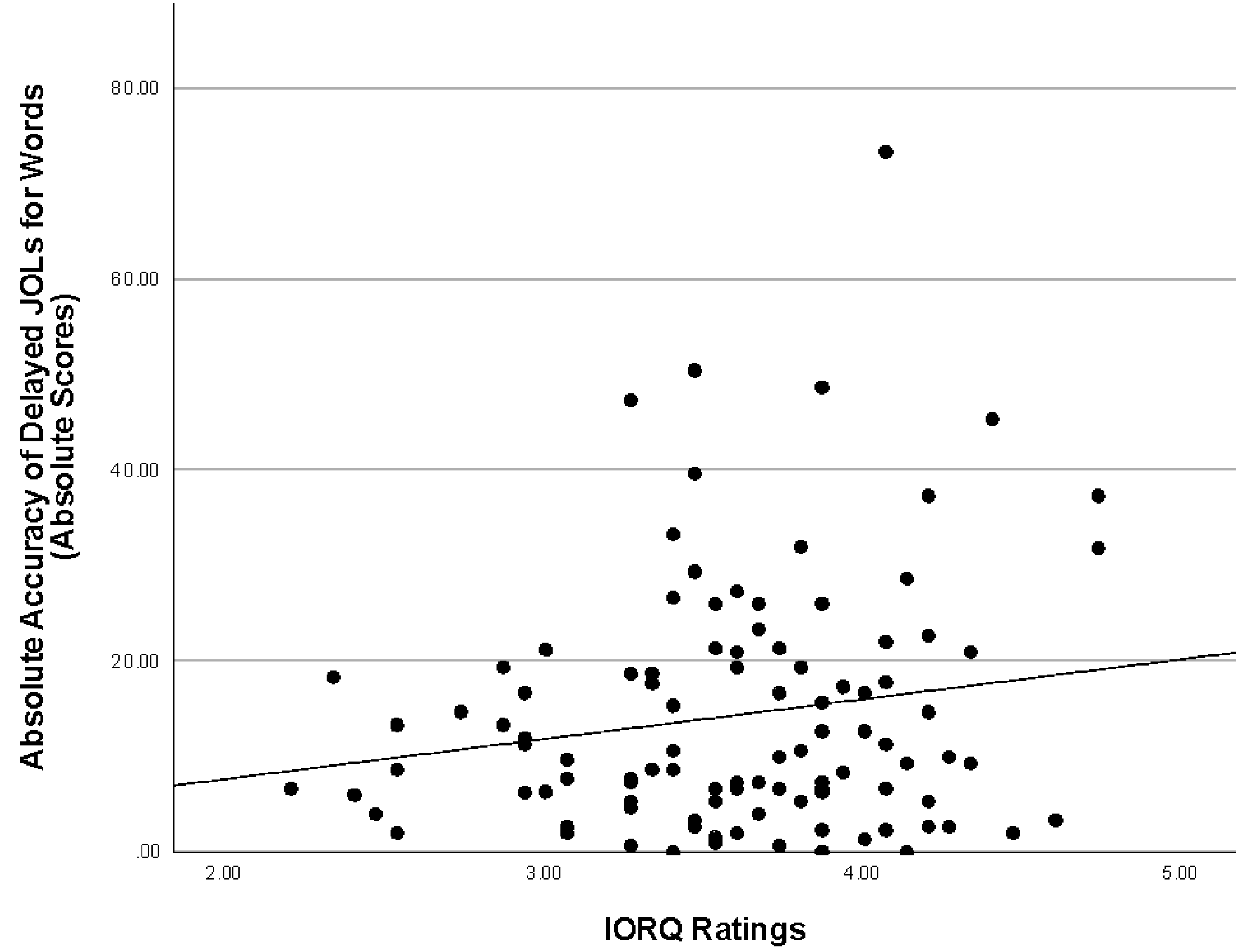
Figure 2.
Correlation between absolute accuracy of delayed JOLs for pictures and IORQ ratings. Notes. The plot shows that as the IORQ ratings increased, absolute accuracy of JOLs for pictures deviated more from zero (i.e., became less accurate). IORQ refers to Importance of Remembering, JOLs refers to Judgements of Learning.
Figure 2.
Correlation between absolute accuracy of delayed JOLs for pictures and IORQ ratings. Notes. The plot shows that as the IORQ ratings increased, absolute accuracy of JOLs for pictures deviated more from zero (i.e., became less accurate). IORQ refers to Importance of Remembering, JOLs refers to Judgements of Learning.
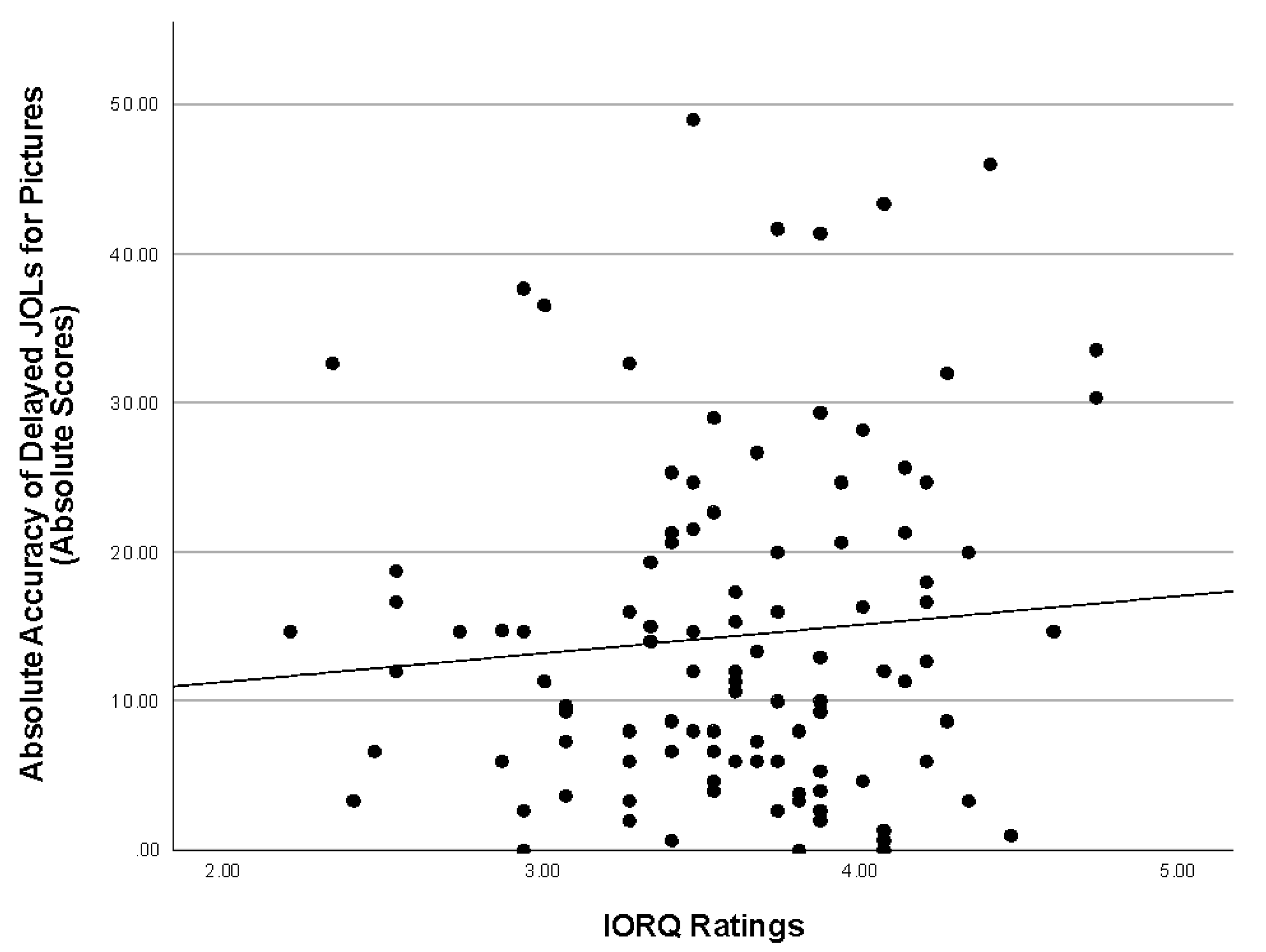

Table 1.
Mean Recall, JOL Ratings, JOL Relative Accuracy, and JOL Absolute Accuracy.
| Words | Pictures | |||
| Immediate | Delayed | Immediate | Delayed | |
| Recall | ||||
| M | 4.56 | 3.87 | 5.31 | 4.66 |
| SD | 3.64 | 3.46 | 3.85 | 3.65 |
| JOL Ratings | ||||
| M | 54.28 | 33.57 | 56.85 | 39.58 |
| SD | 22.53 | 19.08 | 20.36 | 20.13 |
| JOL Relative Accuracy (Gamma) | ||||
| M | 0.37 | 0.83 | 0.38 | 0.84 |
| SD | 0.47 | 0.38 | 0.39 | 0.26 |
| JOL Absolute Accuracy (Absolute Value) | ||||
| M | 23.88 | 8.71 | 22.63 | 8.37 |
| SD | 36.48 | 17.34 | 35.01 | 16.22 |
Note. JOL refers to Judgments of Learning.
Table 2.
Mean Global JOL Ratings, Global JOL Accuracy, and RCJ Ratings.
| Words | Pictures | ||
| Global JOL Ratings | |||
| M | 8.81 | 9.28 | |
| SD | 5.04 | 5.74 | |
| Global JOL Accuracy | |||
| M | 4.74 | 5.10 | |
| SD | 4.03 | 3.95 | |
| RCJ | |||
| M | 2.18 | 2.40 | |
| SD | 0.78 | 0.86 |
Note: JOL refers to Judgment of Learning.
Disclaimer/Publisher’s Note: The statements, opinions and data contained in all publications are solely those of the individual author(s) and contributor(s) and not of MDPI and/or the editor(s). MDPI and/or the editor(s) disclaim responsibility for any injury to people or property resulting from any ideas, methods, instructions or products referred to in the content. |
© 2024 by the authors. Licensee MDPI, Basel, Switzerland. This article is an open access article distributed under the terms and conditions of the Creative Commons Attribution (CC BY) license (http://creativecommons.org/licenses/by/4.0/).
Copyright: This open access article is published under a Creative Commons CC BY 4.0 license, which permit the free download, distribution, and reuse, provided that the author and preprint are cited in any reuse.


