

Submitted:
29 October 2024
Posted:
30 October 2024
You are already at the latest version
Abstract
The Amazon region, with its vast biodiversity and rich natural resources, presents a unique opportunity for the development of sustainable polymeric composites reinforced with residues from both the timber and agro-extractive industries. This article explores the potential of these Amazonian residues, such as sawdust, wood shavings, and agro-industrial by-products like açaí seeds and Brazil nut shells, to enhance the mechanical, thermal, and environmental properties of polymer composites. By integrating these natural materials into polymer matrices, significant improvements in composite performance have been achieved, including increased tensile strength, thermal stability, and biodegradability. The study also highlights the environmental and economic benefits of utilizing these residues, promoting waste reduction and supporting a circular economy in the region. Through case studies and detailed analyses, the article demonstrates the feasibility and advantages of incorporating Amazonian residues into composites for a wide range of applications, from construction materials to consumer goods. This approach not only adds value to the by-products of the Amazonian industries but also contributes to the global effort towards sustainable material development.
Keywords:
Amazonian residues
; lignocellulosic materials
; bioactive compounds
; polymeric composites
; timber industry
; agro-extractive industry
; sustainability
; circular economy
; mechanical properties
1. Introduction
The Amazon region, with its vast biodiversity and rich natural resources, supports numerous economic activities, particularly in timber extraction and agro-extrativism industries [1,2]. However, these industries generate significant amounts of waste, primarily in the form of underutilized or discarded residues from wood processing. These residues present not only an environmental challenge but also an opportunity to promote a circular economy [3]. By integrating these Amazonian residues into polymeric composites, it is possible to enhance material properties while simultaneously advancing sustainable practices, thereby reducing waste and creating value from what would otherwise be discarded. This approach not only contributes to environmental sustainability but also fosters a circular economy, where resources are continuously repurposed and reused [4,5,6].
This vast Amazonian region, spanning several South American countries, is a significant producer of various organic residues from timber extraction and agro-extrativism activities, including the harvesting of açaí [7], Brazil nut (also known as Pará nut or Amazon nut) [8], Maçaranduba [9], and other native products. These processes generate a significant number of lignocellulosic by-products, which are often underutilized or discarded. These residues, rich in cellulose, hemicellulose, and lignin, have great potential for incorporation into polymeric composites, where they can enhance mechanical and thermal properties while also contributing to the biodegradability of the final material. By effectively utilizing these by-products, not only is waste reduced, but the overall environmental impact is minimized, supporting sustainable practices and advancing the circular economy [10,11,12].
Several worldwide studies have explored have been exploring the use of agricultural and industrial residues in polymer composites in different applications, highlighting their potential to enhance material properties and promote environmental sustainability. For example, eucalyptus sawdust [13], oil palm fibers [14], rice husk or straw [15,16], coconut coir [17], sugarcane bagasse [18], and wheat straw fibers [19] have been widely studied for their potential in reinforcing polymer composites, demonstrating substantial improvements in tensile strength and impact resistance. Given these successful applications of residues in polymer composites across the globe, similar strategies can be effectively applied to the abundant and underutilized residues from the Amazon region, such as by-products from the extensive timber industry and agro-extrativism sector, to create sustainable and high-performance materials [20,21].
The use of polymeric matrices in composites is crucial due to their ability to bind reinforcement materials, such as natural fibers or industrial residues, into a cohesive structure that exhibits enhanced mechanical, thermal, and chemical properties [22,23]. These polymer matrices can broadly be classified into thermoset and thermoplastic types, each with distinct advantages depending on the application. Thermoset matrices, such as epoxy resins, provide excellent thermal stability and resistance to chemical attack but are generally more brittle and cannot be remolded once cured. In contrast, thermoplastic matrices, like polyethylene (PE) and polypropylene (PP), offer superior impact resistance and the ability to be reshaped with heat, making them highly versatile for various applications. For instance, polyethylene and polypropylene are commonly used in packaging and automotive parts due to their toughness and ease of processing, while biodegradable polymers like polybutylene adipate-co-terephthalate (PBAT) are favored in sustainable applications [24,25]. The choice of matrix significantly influences the composite’s overall performance, including its resistance to environmental factors like moisture absorption, chemical exposure, and high temperatures. The incorporation of reinforcement materials into these matrices can lead to significant improvements in tensile strength, stiffness, impact resistance, and thermal stability, making them suitable for a wide range of applications, from automotive parts to medical devices [26]. Additionally, by utilizing natural or industrial residues as fillers, the environmental impact of polymer composites is reduced, supporting sustainability and the principles of a circular economy. This not only adds value to waste materials but also reduces reliance on non-renewable resources, positioning polymeric composites as a key focus in the development of next-generation materials [27,28].
This study aims to investigate the potential of Amazonian residues, particularly those from the timber and agro-extrativism industries, as reinforcement in polymeric composites. By examining the types, sources, and characteristics of these residues, the research seeks to identify their suitability for enhancing the mechanical, thermal, and environmental properties of polymer matrices. Furthermore, this work explores the environmental impact and economic viability of utilizing these residues, highlighting their role in promoting a circular economy within the Amazon region.
2. The Amazonian Timber and Agro-Extrativism Bioindustries
2.1. General Description of the Bioindustry in the Amazon
The history of humanity shows that civilizations have always sought products from nature for various purposes [29]. As new lands were explored, more natural resources were discovered [30,31]. When the Amazon was discovered by European explorers, there was a great effort to uncover its riches, not only mineral but also in its flora and fauna. The exploitation of rubber is a historical example of the Amazon’s potential, which can be considered the beginning of bioindustry in the region [32]. In the Amazonian context, bioindustry is defined as industries with commercial potential using natural resources from the Amazonian biodiversity in areas such as energy, environment, agriculture, food, animal and human health. These industries develop products and processes through biotechnology (both old and current), bioscience-related activities (such as consulting, laboratories, research, etc.), at any technological level [33,34]. In the state of Amazonas, Brazil, there are only 44 registered enterprises involved in production, processing, and biotechnological studies, including 40 companies and 4 research institutes. The companies include seven medium-sized, six small, and twenty-seven microenterprises, employing around 4,000 workers in total and generating approximately R$ 700 million in revenue. These enterprises operate in sectors such as food, biorefinery, bioinputs, cosmetics, environment, bioenergy, pharmaceuticals, chemicals, and innovation, with 34 enterprises in the modern third-generation implementation phase [35].
The Amazon forest area comprises nine countries (Bolivia, Colombia, Ecuador, Peru, Venezuela, Suriname, Guyana, French Guiana, and Brazil), with 66% of this area located in Brazilian territory [36]. Approximately 1 billion people depend, in part, on native species from nature, including animal meat, edible insects, and plants with traditional healing effects. The area that the Amazon occupies holds the greatest biodiversity on our planet, with about 13% of the species already described in the literature, within approximately 0.5% of the total land area. This biodiversity includes approximately 50,000 plant species, 2.5 million insects, 350 primates, 800 amphibians and reptiles, 1,300 birds, and 3,000 fish species. Just 1 hectare of the Amazon rainforest contains more tree species than the entire area of Western Europe. These characteristics make the Amazon a field of high biodiversity value [37].
In the central region of the Amazon, there are about 303 Brazilian cities involved in the production of Amazonian fruits and seeds, such as açaí, andiroba, Brazil nuts, cumaru, and cupuaçu. Among these, only 39 cities carry out industrial processing of these raw materials [38]. The use of Amazonian products has stimulated research on the residues of raw materials, turning them into bioinputs for other products such as composites, making the cycle of the original raw materials more sustainable. Composites with the addition of biological materials become biocomposites, which can include fungi found in guaraná residues that act as binders for lignocellulosic material substrate particles [39], cassava starch with tururi fiber to produce biopolymers [40], jute fiber with wood residues [41], mango kernel to produce a biopolymer [42], and pirarucu fish scales [43]. The potential of Amazonian origin biocomposites is promising and needs to be increasingly studied.
The potential of biocomposites derived from Amazonian bioinputs is promising and needs to be increasingly studied as sustainable alternatives due to the significant environmental concerns related to the disposal of plastic materials [44,45]. Amazonian bioinputs for composites are diverse, and they can be produced from the raw material itself or from by-products or residues. This diversification is due to the variety of properties and purposes that one seeks to achieve. Some composites have one or more bioinputs. A primary class of bioinputs is vegetable oils, such as copaiba, andiroba, and palm oil. Rodrigues et al. [46] incorporated copaiba oil (Copaifera sp.), in both direct and microencapsulated forms, into Xanthosoma mafaffa Schott starch-based films, resulting in a biocomposite with higher hydrophobicity, lower tensile strength and elongation, and inhibition of tested gram-positive bacteria. Silva et al. [47] developed a biomimetic material for wound treatment using poly(e-caprolactone) and andiroba seed oil.
Several studies have been performed on composite formation from natural fibers. They have been developed with raw materials produced in the Amazon region, particularly sisal [48], jute [49], and malva [50]. However, other fibers are gaining interest in research, using both the raw material and the residue. The latter class contributes to reducing the environmental impacts caused by conventional polymers. Rojas-Bringas et al. [51] used Brazil nut husks with starch from three different sources to produce a biocomposite, in which the Brazil nut fibers acted as a natural filler with good ecological quality. Inamura et al. [52] prepared a biocomposite of gelatin with Brazil nut husks, including acrylamide as a copolymer in glycerin, to test the effect of electron beam irradiation, observing that crystallinity decreased with increased irradiation. Curauá is a plant that has been extensively tested as an alternative natural fiber. Souza et al. [53] investigated the autogenous self-healing capacity of a curauá fiber-reinforced cement biocomposite, which showed high self-healing capacity. Castro et al. [54] produced a biocomposite with curauá fiber, hydroxylated polybutadiene, and high-density bio polyethylene, where curauá fiber improved the mechanical properties of the biocomposite. Frollini et al. [55] performed mechanical tests, water absorption tests, and a morphology study of a biocomposite using poly (butylene succinate) (PBS) as the polymer matrix and curauá fiber molded by compression, yielding better results than using the individual components.
2.2. Production and Economic Impact
The production of wood in the Brazilian Amazon is predominantly concentrated on a small group of commercially valuable species, despite the vast biological diversity of the region. Between 2007 and 2020, the 20 most exploited species accounted for approximately 52% of the total volume of roundwood, amounting to about 81 million cubic meters [56]. Among these, the Maçaranduba (Manilkara huberi) stood out as the most exploited species [57,58], with an accumulated volume of approximately 11.2 million cubic meters, corresponding to about 7.2% of the total produced during the period. Following the Maçaranduba, the Cedrinho (Erisma uncinatum) [59] and the Cupiúba (Goupia glabra) [60] were also widely exploited, with accumulated volumes of approximately 8.9 million and 8.6 million cubic meters, respectively, representing about 5.8% and 5.6% of the total production. The average annual production of roundwood in the Brazilian Amazon has varied between 10 and 13 million cubic meters in recent years [56,61].
The average annual production of roundwood in the Brazilian Amazon has varied significantly, ranging from 14.9 million cubic meters in 2012 to 11.2 million cubic meters in 2023, according to data from the Brazilian Institute of Geography and Statistics (IBGE) [62]. This trend reflects a gradual decline over the years, influenced by economic, environmental, and regulatory factors affecting the timber industry. Consequently, the generation of residues, including sawdust and wood shavings, has also followed this trend, decreasing from 8.2 million cubic meters in 2012 to 6.2 million cubic meters in 2023. These residues can constitute up to 55% of the total wood processed, which represents a substantial volume of underutilized biomass [63]. For instance, in years where total wood production reached approximately 12 million cubic meters, around 6.6 million cubic meters of residues were generated [62,63]. This consistent proportion of residues highlights a stable opportunity for reusing this material in polymer chemistry. This significant volume of by-products highlights the potential environmental impact of timber processing if these residues are not adequately managed or repurposed. Moreover, the economic impact of these residues should not be underestimated. The integration of sawdust and other wood residues into polymeric composites not only adds value to these by-products but also represents a significant opportunity for the bioeconomy. The utilization of timber industry residues contributes to both environmental sustainability and economic growth by reducing waste and creating high-performance, sustainable materials that can be used in various applications, from construction to consumer goods. This approach aligns with the principles of the circular economy, positioning the Amazon region as a leader in sustainable material innovation.
In addition to the timber industry, other agro-extrativism industries play a fundamental role in the Amazon economy, significantly contributing to the supply of residues that can be used in the development of polymeric composites. Among these industries, non-timber forest products (NTFP) such as açaí [64], Brazil nuts [65], and oils such as copaiba and andiroba [66] stand out. The annual production of açaí in Brazil has grown significantly in recent years, reflecting the increasing demand in both domestic and international markets. According to data from the Brazilian Institute of Geography and Statistics (IBGE), in 2022, Brazil produced approximately 1.7 million tons of açaí fruits, generating a revenue of 6.17 billion Brazilian reais (more than 1 billion US$) [62,67]. This growth is driven by the expansion of cultivation areas and the intensification of palm management, especially in the main producing regions of the Eastern Amazon, which continue to be the largest producing areas in the country.
Another highly exploited activity in the Amazon NTFP is the extraction of Brazil nuts, which is currently being called Amazon nut. The annual production of this nut is a vital economic activity for many communities in the Amazon, as well as generating lignocellulosic residues that present great potential for the development of reinforced polymeric composites [68]. Bolivia remains the top producer of Brazil nuts, accounting for 79% of global production in the 2022/23 season, with a production of 22,000 metric tons. Peru and Brazil follow, contributing 16% (4,500 metric tons) and 5% (1,500 metric tons) of the global production, respectively, according to data from the International Nut and Dried Fruit Council (INC) [69]. These countries, all located within the Amazon rainforest, not only produce significant quantities of Brazil nuts but also generate substantial residues. These residues offer valuable opportunities for sustainable applications, such as incorporation into polymer composites. In addition to Brazil nuts and açaí, whose residues have been studied for application in composites, the extractive industry in the Amazon encompasses a wide range of natural products that are fundamental to the local and national economy. In 2022, other notable Amazon NTFP included babassu (almond), with a production of 148,635 tons; erva-mate, with 35,964 tons; pequi (fruit), with 3,657 tons; and urucum (seed), with 989 tons [62].
The interconnected relationship between these diverse agro-extrativism activities and the development of polymeric composites can be visually represented through the conceptual model depicted in Figure 1. This model illustrates how Amazonian residues, such as those from Brazil nuts, açaí, and other natural products, are integrated into polymeric matrices to create high-performance materials. These composites, in turn, contribute to the broader bioeconomy by offering sustainable and economically valuable alternatives to traditional materials. The central portion of Figure 1 illustrates the interconnectedness of key elements involved in the development of polymeric composites using Amazonian residues. At the core, the human figure symbolizes the role of human activities—such as research, innovation, and development—in the sustainable utilization of natural by-products. Surrounding this central figure, the icons represent various critical components: chemical processes (molecular structure icon), sustainable waste management (recycling icon), valorization of natural resources (leaf icon), and the transformation of these resources into high-performance materials (plant growth icon). These interconnected elements emphasize the cyclical relationship between agro-extractivism, material development, and bioeconomic advancement.
In addition to environmental impacts, the Amazon bioindustry is a significant source of employment and income for local communities. The production and processing of products such as açaí and Brazil nuts employ thousands of workers, often in regions where economic opportunities are limited. The export of these products to international markets, such as Europe and the United States, also contributes substantially to the local economy [70]. In 2022, the production of copaiba oil (Copaifera sp) in Brazil reached 265 tons, generating a production value of approximately 10.188 million reais, demonstrating the economic importance of these products [62]. However, the bioindustry faces significant challenges related to sustainability and efficient waste management. The lack of adequate infrastructure and the need for more advanced technologies for the processing and reuse of by-products are barriers that need to be overcome. Nonetheless, with the increasing demand for sustainable products, there is a clear opportunity to expand the use of residues in polymeric composites, as illustrated in Figure 1, promoting a bioeconomy in the region and enhancing the economic and environmental benefits of the Amazon bioindustry [70,71].
2.3. Chemical Composition Impact on Polymeric Composite Properties
The chemical composition of lignocellulosic residues, such as seeds, shells, and fibers, directly influences the performance of polymeric composites in various ways. High cellulose and hemicellulose content in the residues enhances the stiffness and mechanical strength of the composites, as these components provide strong interactions with the polymer matrix, promoting a more homogeneous dispersion of the reinforcement [72,73]. However, the presence of lignin and extractives can have mixed effects. While lignin can improve thermal stability and barrier properties, excessive amounts may hinder the adhesion between the matrix and the residues, reducing the cohesion of the composite [74]. Similarly, extractives, including phenolic compounds and fatty acids, can affect the interfacial properties [75].
Residues rich in non-polar extractives, such as those found in certain seeds and shells, can reduce chemical interaction with polar polymers, resulting in composites with lower cohesion and structural strength. In contrast, residues with higher levels of polar components, such as cellulose and hemicellulose, tend to exhibit better compatibility with hydrophilic polymer matrices, enhancing the overall performance of the material [76,77].
In addition to lignocellulosic materials, other components found in agro-extractivism residues contribute to the specific properties of polymeric composites. Acai seeds (Euterpe oleracea) are another valuable agro-extractivism residue that can be effectively utilized in polymeric composites. According to Murillo-Franco et al. [78], acai seeds contain 11.58% cellulose, 37.88% hemicellulose, and 14.12% lignin, while Buratto et al. [79] report slightly different values of 8.5%, 48.1%, and 16.4%, respectively. These components are crucial for the mechanical properties of composites, with hemicellulose playing a significant role in improving flexibility and lignin contributing to increased stiffness and thermal stability. Additionally, the presence of extractives (water-soluble at 4.09% and ethanol-soluble at 11.76% in Murillo-Franco et al. [78]) and fats (2.64%–3.5%) can affect the interaction of the matrix with the reinforcement, further enhancing the composite’s performance. An interesting aspect of açaí is its high content of mannan, which has been highlighted in several recent studies, such as Monteiro et al. [80], who investigated the high concentration and yield of mannose from açaí seeds through mannanase-catalyzed hydrolysis. For example, Rambo et al. [81] reported that mannan accounts for approximately 53.8% of the seed’s carbohydrates. This high mannan content, which can have a crystalline structure, potentially contributes to the mechanical properties of composites by enhancing their dimensional stability and strength, although further applied studies in the field of materials science are still needed [82,83].
Studies on palm kernel shell (PKS), a residue from the extensive palm oil industry, reveal its potential for use in polymeric composites. Authors such as Fuadi et al. [84] and Okoroigwe et al. [85] found that PKS contains a high lignin content, ranging from 53.40% to 53.85%, which enhances thermal stability but may decrease compatibility with polar matrices, leading to reduced mechanical strength. Additionally, the cellulose (up to 29.70%) and hemicellulose (26.11% to 47.70%) contents provide reinforcement but can increase water absorption, affecting dimensional stability. The porosity (up to 28%) can aid in better matrix impregnation, improving mechanical interlocking, though it might also contribute to brittleness [86]. This composition highlights PKS as a promising yet challenging material for composite applications. Similarly, palm kernel cake, other by-product of the palm oil extraction process, has a high content of oily compounds such as triglycerides and fatty acids [87]. These oily components can act as natural plasticizers within the polymer matrix, improving the flexibility and impact resistance of the composite [88].
Sawdust from Manilkara huberi (Maçaranduba) shows potential for polymeric composites due to its 69.41% holocellulose and 34.68% lignin content [89]. The high holocellulose enhances strength and stiffness, while the lignin improves thermal stability [71,72,73]. Overall, Maçaranduba sawdust could improve both mechanical and thermal properties in composites.
In summary, the chemical makeup of Amazonian timber and agro-extractivism residues directly impacts the performance of polymeric composites. In addition to the well-established effects of cellulose, hemicellulose, and lignin, compounds such as mannan, oils, and phenolic compounds also play significant roles in enhancing the mechanical, thermal, and chemical properties of the composites. A better understanding of these materials’ composition, detailed in Table 1, is essential for optimizing the design of high-performance, sustainable composites.
In addition to cellulose, hemicellulose, and lignin, other components present in the lignocellulosic residues we discussed play crucial roles in enhancing the properties of polymeric composites. Extractives, such as phenolic compounds and fatty acids, can act as natural plasticizers or antioxidants, improving flexibility and durability [74]. Additionally, components like waxes and proteins found in some seeds and shells can improve the interfacial adhesion between the polymer matrix and the reinforcement, leading to stronger, more cohesive composites [96,97]. However, studies focusing specifically on the role of these components in polymeric composites are still limited, highlighting the need for further research to fully understand and optimize their potential contributions to composite performance.
3. Types of Polymer Matrices Applicable in Composites with Residues
In the development of polymeric composites reinforced with Amazonian agro-extrativism and timber industry residues, the choice of polymer matrix is crucial for the performance and sustainability of the final material [98,99]. This is because the polymer matrix not only binds the reinforcement materials together, providing structural integrity, but also significantly influences the mechanical properties, thermal stability, and environmental impact of the composite [100]. For instance, thermoplastics offer recyclability and ease of processing, which are advantageous for applications requiring durability and environmental responsibility [101]. Thermosets, on the other hand, provide superior thermal and chemical resistance, making them suitable for high-performance applications, though they are more challenging to recycle [102]. Biodegradable polymers enhance sustainability by being compostable, reducing long-term environmental impact [103]. Each type of polymer matrix thus presents unique benefits that must be carefully matched to the specific requirements of the intended application [104].
The Figure 2 illustrates how conventional and biodegradable polymers contribute to the formation of polymeric composites, highlighting how different types of polymers impact the mechanical properties, manufacturing efficiency, and environmental impact of composites. Conventional polymers such as polypropylene (PP), polyethylene (PE), and epoxy resins are often chosen for their durability and robustness in a wide range of industrial applications. However, as the demand for sustainable materials grows, biodegradable polymers such as PLA and PBAT are attractive alternatives because they degrade in specific environmental conditions.
Conventional polymers like polypropylene (PP) and polyethylene (PE) are widely used due to their high durability, impact resistance, and low production cost [105]. Studies show that polypropylene (PP) and polyethylene (PE) can take hundreds of years to decompose in landfills. For instance, PP exhibits high resistance to degradation, and even after five years in a landfill, it only shows initial signs of deterioration, such as the formation of microplastics and biofilms of microorganisms on the material’s surface [106]. In terms of environmental impact, the production of 1 kg of PP emits approximately 1.58 kg of CO₂ equivalent, highlighting a considerable carbon footprint [107]. These factors underscore the complexity of managing conventional plastic waste.
On the other hand, biodegradable polymers like polylactic acid (PLA) and polybutylene adipate-co-terephthalate (PBAT) offer a more sustainable solution. Danyluk et al. [108], for example, observed that PLA bottles without caps and labels were completely composted after four weeks in an industrial composting environment. The study also documented the complete degradation of PLA bottles with HDPE and PP caps and labels by the eighth week, with only small residues found inside the caps and labels, which acted as barriers, limiting microbial access to the PLA. By week 12, no significant PLA residue was found in the samples, indicating that the material had nearly fully decomposed.
However, in terms of costs, conventional polymers like PP are significantly cheaper compared to biodegradable ones. As highlighted in the European Commission’s report on the sugars platform for biofuels and biochemicals, PP, for example, costs around $1,500 per ton, while polyhydroxybutyrate (PHB), a biodegradable polymer, can cost up to $6,500 per ton, making it 4 to 5 times more expensive than PP. Polylactic acid (PLA), another biodegradable polymer, has an average cost of $2,000 to $2,200 per ton, still more affordable than PHB but approximately 30% more expensive than PP. PS and PE also have lower costs compared to biodegradable polymers. The price of PS is around $2,100 per ton, while PE, depending on the grade, costs about $1,500 per ton. In comparison, PLA, priced between $2,000 and $2,200 per ton, is more expensive than both. PHB, at up to $6,500 per ton, is significantly more expensive than PS and PE, being approximately 3 to 4 times the cost of PS and up to 5 times the cost of PE [109].
Other aspects are also important. Conventional polymers, such as polypropylene (PP), exhibit high mechanical strength, with studies reporting tensile strength of up to 38 MPa [110], as well as high impact and fatigue resistance, making them ideal for durable structural applications. Similarly, high-density polyethylene (HDPE) has shown tensile strength of up to 31 MPa [111]. However, as mentioned earlier, both PP and HDPE have a low biodegradability rate [106]. On the other hand, biodegradable polymers present highly variable characteristics. PLA, for instance, has good tensile strength but low elongation at break. According to the findings of Gigante et al. [112], pure PLA exhibited an elastic modulus of 3.04 GPa, a yield strength of 63.6 MPa, and an elongation at break of only 7.1%, making it relatively stiff and brittle. In contrast, PBAT is a much more flexible polymer. In the study by Tsou et al. [113], PBAT showed a tensile strength of 30 MPa, yield strength of 13 MPa, and elongation at break of 1200%, indicating high ductility. Therefore, while PLA tends to be more brittle, PBAT enhances the elasticity of blends. Technological advances, such as the modification of polymer matrices and the addition of reinforcing fillers, have improved these mechanical properties, making biopolymers more competitive in engineering applications. Thus, the choice between these types of polymers involves balancing technical performance and environmental impact, with biodegradable polymers becoming increasingly viable in applications that require sustainable solutions.
Thermoplastic polymers are widely utilized in composite formulations due to their ability to be repeatedly melted and reshaped, offering significant processing flexibility and adaptability in various applications [114]. These polymers are favored for their excellent chemical resistance and mechanical robustness, making them ideal candidates for integrating natural fillers [115,116]. In the context of composites reinforced with Amazonian residues, thermoplastics like polypropylene (PP) and polyethylene (PE) are particularly effective, as they can be processed at lower temperatures and molded into complex shapes, allowing for the efficient incorporation of natural materials such as wood fibers, seeds, and shells [117]. This adaptability not only enhances the mechanical properties and thermal stability of the resulting composites but also aligns with sustainable practices by utilizing abundant and underused natural resources [118].
Polypropylene (PP) has been extensively studied in combination with natural fillers such as wood fibers and agricultural residues. The incorporation of these fillers enhances the mechanical properties of the composite, particularly its tensile strength and stiffness, while also contributing to environmental sustainability by reducing the dependency on virgin polymer materials [119]. In a similar vein, high-density polyethylene (HDPE), which is often derived from post-consumer recycled sources, further bolsters the sustainability profile of composites when combined with Amazonian lignocellulosic residues. This synergy not only enhances the performance characteristics of the material but also aligns with the principles of a circular economy, supporting the efficient use of natural resources within the region [120]. In addition to PP and HDPE, other thermoplastics such as polystyrene (PS) and polyvinyl chloride (PVC) can also be used in composites reinforced with natural waste.
Several studies have shown that the incorporation of natural residues into polymer matrices like polyethylene results in significant improvements in the mechanical properties of composites compared to pure polymers. Campos et al. [121] used Brazil nut pod fibers as reinforcement in high-density polyethylene (HDPE) composites and observed a substantial increase in the tensile strength and flexural modulus of the composites compared to pure HDPE, with up to a 20% increase in tensile strength and even greater improvement in the flexural modulus. On the other hand, Souza et al. [122] investigated the use of textile fiber residues in HDPE composites and found impressive increases of 53.5% in tensile strength and 112.5% in the modulus of elasticity when 10% fibers were added to the composite compared to pure HDPE. Additionally, Gomes et al. [123] studied recycled low-density polyethylene (LDPE) composites reinforced with jupati particles, observing a 17.9% increase in the modulus of elasticity (MOE) with the addition of 15% jupati particles, although the modulus of rupture (MOR) showed a decrease.
Thermosetting polymers are characterized by their irreversible curing process, which results in materials with high rigidity, chemical resistance, and thermal stability. These properties make thermosets ideal for applications requiring structural integrity and long-term durability [102]. When reinforced with Amazonian residues, such as wood shavings and bark, thermosetting matrices can produce composites that not only exhibit superior mechanical properties but also contribute to waste valorization by utilizing by-products that would otherwise be discarded [116,124]. The integration of these natural fillers can enhance the mechanical strength and stiffness of the composites, making them more robust while promoting sustainable practices in material design [125]. Among the most commonly used thermosetting polymers are epoxy resins, unsaturated polyester resins, phenolic resins, and others, each offering distinct advantages depending on the application.
Epoxy resins, like other thermosets, have been extensively studied in the context of polymeric composites. Epoxy resins are known for their strong adhesive properties and compatibility with various reinforcement materials [126]. The incorporation of Amazonian residues into epoxy matrices can lead to the development of high-performance composites suitable for a wide range of industrial applications, from construction to automotive components. For example, Mendes et al. [127] used sawdust from a non-Amazonian species as reinforcement in epoxy composites, resulting in an approximately 43.5% increase in tensile strength compared to pure epoxy resin, with the addition of 10% by weight of sawdust to the matrix. Although this study used sawdust from a non-Amazonian species, the approach could be similarly applied to residues from the Amazon timber industry, such as local wood sawdust.
In line with the growing demand for environmentally friendly materials, biodegradable polymers like polylactic acid (PLA) and polybutylene adipate terephthalate (PBAT) have gained significant attention in the development of sustainable composites. PLA is derived from renewable resources such as corn starch or sugarcane, and is capable of degrading under specific environmental conditions, making it an attractive choice for applications where environmental impact is a primary concern [128]. On the other hand, PBAT, although fossil-based, is biodegradable and can break down more rapidly in natural environments compared to conventional plastics [129,130].
To address these challenges, current research has increasingly focused on developing 100% eco-sustainable composites. This involves replacing non-biodegradable polymers with biodegradable alternatives derived from renewable resources. By integrating Amazonian agro-extrativism residues with these biodegradable matrices, it is possible to create composites that not only retain desirable mechanical properties but also enhance the biodegradability of the final product. For example, Ferreira et al. [131] investigated biodegradable composites based on polybutylene adipate-co-terephthalate (PBAT) reinforced with three different natural fibers from the Amazon forest: Croton lanjouwensis, Malvastrum tomentosum, and Trema micrantha. The study with these species showed that all composites presented a significant increase in modulus of elasticity compared to pure PBAT, ranging from 48% to 72%. In another study, Pinheiro et al. [132] explored PBAT composites reinforced with fibers from Munguba (Pseudobombax munguba), a tree abundant in the flooded areas of the Amazon. The addition of Munguba fibers resulted in a significant increase in the modulus of elasticity of the composites, from 51.0 MPa in pure PBAT to up to 97.0 MPa in composites with 20% fibers, representing an approximately 90% increase. However, it was observed that the addition of fibers reduced tensile strength and elongation at break, due to the weak interaction between the fibers and the polymer matrix.
4. Polymeric Composites with Amazonian Timber Industry Residues
4.1. Types and Sources of Timber Residues
The diversity of exploited species is reflected in the variety of residues available, including sawdust, shavings, chips, and other by-products of wood processing [133]. Among the most exploited species in the Amazon is Maçaranduba (Manilkara huberi), known for its dense and durable wood, which generates significant quantities of sawdust during processing [56]. Other widely exploited species include Cedrinho (Erisma uncinatum), Cupiúba (Goupia glabra), and Jatobá (Hymenaea courbaril), each contributing specific residues that can be valorized in composite manufacturing [56,134]. For instance, Maçaranduba sawdust is an abundant and underutilized by-product that can be incorporated into polymer matrices to enhance their mechanical and thermal properties. Similarly, residues from Cupiúba and Jatobá also possess characteristics that make them promising candidates for reinforced composite production. Utilizing these residues not only contributes to environmental sustainability by reducing waste and promoting material recycling but also offers economic benefits by adding value to timber industry by-products [135,136].
Another significant residue is wood shavings, also known as planing chips, produced during the planing of wood in sawmills or carpentry shops. Shavings are coarser and longer compared to sawdust and can be used as filler in composites. Firewood, including bark, trimmings, and offcuts, is typical of the larger volume residues generated during log cutting and planing [137,138]. Additionally, bark removed during log preparation constitutes another significant type of residue. Often considered of low value, bark is rich in organic compounds and can be used for energy generation or as raw material in wood panel production [139]. Proper classification of these residues is essential to optimize their use in composite manufacturing, ensuring better material valorization and minimizing waste [140].
Figure 3 illustrates the industrial wood processing chain, where only 15-25% of the original volume of processed logs results in a final product, while the remainder is converted into waste such as bark, shavings, sawdust, and offcuts [141]. These residues, which would normally be discarded, can be reintegrated into the production chain by incorporating them into polymer matrices, adding value by transforming by-products into useful materials for the fabrication of polymer composites.
Beyond the types of residues already mentioned, it is essential to consider the chemical composition and specific properties of these materials, determining their potential use in polymer composites [142]. Sawdust, for example, is not only a voluminous residue but also a rich source of cellulose, hemicellulose, and lignin. These chemical components confer high mechanical strength and good thermal stability to sawdust, making it ideal for producing reinforced composites [143]. The cellulose present in materials such as sawdust also contributes significantly to the mechanical properties of composites, enhancing tensile strength and stiffness, especially when combined with appropriate chemical modifications [144].
As an illustration, Nobre et al. [89] highlighted that the sawdust from Maçaranduba (Manilkara huberi) is particularly noteworthy for its high lignin content (34.68%) and holocellulose levels (69.41%), which significantly enhance the mechanical performance of composites by providing increased rigidity and thermal stability. Similarly, their study found that other Amazonian woods like Cedrinho (Erisma uncinatum) and Jatobá (Hymenaea courbaril) exhibit lignin content ranging from 16-24% and holocellulose content from 65-82%, making them promising candidates for enhancing the structural properties of polymer composites. Bimestre et al. [145], in a comprehensive study of Amazonian woods, found that Amescla (Trattinnickia sp.) exhibited the highest lignin content at 33.86%, while Mandioqueira (Ruizterania albiflora) had the highest cellulose content at 55.90%. Likewise, Mamica de Porca (Fagara sp.) was noted for its high hemicellulose content, reaching 17.00%. These findings underscore the suitability of these species for composite applications due to their robust chemical compositions.
4.2. Residue Availability and Environmental Impact in the Timber Industry
The availability of waste generated by the timber industry in the Amazon varies considerably, depending on the locality and the wood species being processed. It is estimated that 30 million tons of wood waste are generated annually in Brazil, of which 91% come from sawmills and lumber industries [146,147]. According to the DOF (Document of Forest Origin) report by IBAMA (Brazilian Institute of Environment and Natural Resources) in 2017, approximately 938,000 m³ of wood residues were produced in the Amazon (Northern) region of Brazil alone. The timber industry in the Amazon continues to generate large volumes of waste [61]. Figueira et al. [148] reported that in 2020, local sawmills processed about 69,300 m³ of wood, achieving a production yield of 55%, which left a significant amount of waste with no specific destination. Moreover, Mendoza et al. [137] revealed that about 50% of the volume of logs processed is considered waste, raising environmental concerns due to the lack of alternatives for utilizing these residues. Numerous studies have explored the percentages of waste generated by sawmill companies, highlighting significant variations in the volumes of waste produced. According to Ramos et al. [136], in a key urban area of the Eastern Amazon, companies generate an average of 398.9 m³ per month of timber waste, with a total of 12.3 thousand cubic meters per month produced by the 31 companies evaluated. The amount of waste generated varies between 0.63 and 919 m³ per month, influenced by the consumption of raw materials and the production of each company.
As illustrated in Figure 4, which presents the main export and import routes of sawdust and wood residues from Brazil in 2022, several countries stand out for their significant growth in this trade. According to COMTRADE (United Nations Commodity Trade Statistics Database) [149], Brazil plays a substantial role in the global trade of sawdust and wood residues, contributing approximately 1.5% to this market, translating to a total trade flow of USD 118 million. These residues are directed to multiple destinations, with the top five importing countries demonstrating significant demand. The leading importing country is Italy, with a substantial value of USD 68.8 million. The United Kingdom follows with imports valued at USD 37.6 million, reflecting a strong demand for wood residues. In third place, the Netherlands imports USD 5.6 million, showcasing the diversity of the European market. France, in fourth place, acquires USD 2.5 million, representing a significant fraction of the trade, while Belgium, in fifth place, imports USD 1.6 million, contributing to the commercial dynamics in the region.
When analyzing the trade flows of Brazilian exports to Latin America (Figure 5), it is observed that Brazil also exports wood residues to neighboring countries. The following data illustrate this dynamic within the top five countries: Uruguay imported USD 404,000 worth of wood residues, showing a notable growth of 135% from 2017 to 2022. Brazil, with a share of less than 0.1% in the global trade of sawdust and wood residues, registered a total export value of USD 593,000, evidencing a growth of 126% over the same period. The top five importing countries of these products were Chile, with an import value of USD 102,000, indicating a developing potential market; Mexico, in third place, with USD 28,500; Paraguay, in fourth place, with USD 26,300; and Ecuador, in fifth place, with USD 14,200 worth of sawdust and wood residues [149]. However, while Brazil is exporting wood residues, such as sawdust, at significant values, there is untapped potential to add even more value to these residues. Instead of merely exporting the raw material, these residues could be utilized domestically to produce high value-added products, such as advanced polymer composites. This would not only increase the economic value generated from these residues but also contribute to the development of a more sustainable and circular economy in the Amazon region.
4.3. Applications of Residues from the Amazon Timber Industry in Polymeric Composites
Numerous studies in the literature have explored the application of Amazonian timber industry residues in polymeric composites, highlighting their potential to enhance the mechanical, thermal, and environmental properties of these materials [150,151]. Researchers have investigated a wide range of wood residues, such as sawdust, shavings, and bark, incorporating them into various polymer matrices to create composites with improved performance and sustainability [152,153]. A summary of key examples from the literature, illustrating the significant improvements in mechanical properties, such as increased tensile strength and modulus of elasticity, is provided in Table 4.3. While this table offers selected examples, it reflects broader trends observed across multiple studies [154].
Santos et al. [151] conducted a study on the impact of moisture content in mercerized wood residues on the modulus of rupture of thermopressed polyurethane-based composites. The research focused on tropical wood residues from the Amazon, specifically Louro Itaúba, Louro Gamela, and Maçaranduba, investigating the effects of different NaOH concentrations (5% and 10%) and moisture levels (3% and 12%) during the thermopressing process. The study evaluated residues from Louro Itaúba, Louro Gamela, and Maçaranduba, showing notable increases in the modulus of rupture of the composites. For Louro Gamela, the modulus of rupture increased from 12 MPa to 16 MPa, while for Louro Itaúba, it increased from 2 MPa to 9 MPa. In the case of Maçaranduba, the modulus of rupture rose from 3 MPa to 11 MPa. These results indicate that the incorporation of Amazonian wood residues enhances the strength of the composites, improving their rupture resistance and making them more suitable for various industrial applications. The study highlights the potential of these residues to improve the mechanical properties of composites while promoting a sustainable solution for the use of by-products from the Amazonian timber industry.
The development of biodegradable composites using natural fiber residues as reinforcement faces challenges due to incompatible interfaces between fillers and matrices. Rocha et al. [155] studied the use of a starch coating as a natural coupling agent to improve the compatibility between lignocellulosic residues — including sugarcane bagasse, maçaranduba, and pinus — and a polylactic acid (PLA) matrix. The mechanical properties table shows that the starch coating significantly improved the stiffness and strength of the composites reinforced with maçaranduba and pinus residues. The PLA-Pinus composite exhibited the greatest increase in Young’s modulus, with a 34% increment (from 2.6 GPa to 3.5 GPa), while maintaining almost the same tensile strength, whereas the PLA-Maçaranduba composite showed a 15% increase in Young’s modulus (from 2.6 GPa to 3.0 GPa). On the other hand, the sugarcane bagasse demonstrated less efficiency in the starch coating, with a reduction in Young’s modulus to 2.1 GPa, suggesting that the larger surface area of the bagasse hindered the formation of a uniform coating. In terms of impact absorption, the PLA-Maçaranduba composite also stood out, with a significant increase from 0.193 J/m to 0.357 J/m. Additionally, the thermal properties of the composites were evaluated, showing that the initial decomposition temperature (T10%) of all composites was slightly lower than that of pure PLA, with a reduction of about 10°C, which is associated with the lower thermal stability of the lignocellulosic residues and starch compared to PLA.
Surdi et al. [152] investigated the effective use of wood residues from the mechanical processing of Amazonian species for high-density particleboard production, offering a sustainable solution to waste management challenges in the timber industry. The study used residues from Caryocar villosum, Hymenolobium excelsum, Mezilaurus lindaviana, Erisma uncinatum, Tachigali myrmecophyla, and Qualea paraensis to manufacture panels with a nominal density of 850 kg/m³ and a thickness of 15.7 mm, utilizing 8% phenol-formaldehyde adhesive. The results showed that particleboards produced with residues from Caryocar villosum, Hymenolobium excelsum, and Tachigali myrmecophyla exhibited superior mechanical properties compared to the others, meeting or exceeding the minimum requirements of the ANSI A208.1 standard for high-density panels (H-1 classification) and floor production (PBU classification). Specifically, panels made with Caryocar villosum residues had a modulus of rupture of 9.39 MPa and a modulus of elasticity of 1616.74 MPa, while panels with Tachigali myrmecophyla residues showed the highest modulus of rupture at 10.04 MPa. Additionally, the panels made with Hymenolobium excelsum exhibited the highest internal bonding strength at 1.41 MPa, making them the best option for structural applications. These findings highlight the potential of transforming wood processing residues into high-value engineered materials, contributing to resource efficiency and environmental sustainability within the timber industry.
The utilization of jatobá wood (Hymenaea courbaril) residues combined with short malva fibers in polymeric composites presents an innovative approach to material recycling. As Costa et al. [156] demonstrated, the mechanical properties of these composites highlight the influence of fiber length on tensile strength. The study found that composites reinforced with 15 mm malva fibers achieved a tensile strength of 25.09 MPa, while hybrid composites with a 75/25 ratio of 15 mm fibers and jatobá wood residues exhibited a slightly higher tensile strength of 26.06 MPa. The microstructural characterization indicated that the incorporation of jatobá wood residues did not significantly affect the tensile strength, but the presence of fewer voids and the good rigidity in the hybrid composites contributed to their performance. These results suggest that the inclusion of a small percentage of wood residues can be a viable strategy for developing high-performance hybrid composites while promoting the reuse of wood waste.
Another study by Ferreira et al. [157] evaluated jatobá (Hymenaea courbaril) wood powder as a reinforcement in polypropylene (PP) composites, focusing on the influence of PP viscosity on thermal, mechanical, thermomechanical, and morphological properties. The addition of jatobá powder improved the mechanical performance of the composites, particularly in terms of elastic modulus, with an increase of 59% for composites with 40% jatobá powder in the PP H103 matrix (rising from 800 MPa to approximately 2000 MPa) and 50% in the PP H503 matrix. Thermal properties were also enhanced, as the composites exhibited increased heat deflection temperature (HDT) with the highest value recorded at 138°C for PP H103 with 40% jatobá powder, compared to 89°C for neat PP H503. Vicat softening temperature (VST) and Shore D hardness also improved with higher filler content, indicating better thermomechanical stability. However, there was a slight reduction in tensile strength (up to 23% lower for PP H103 with 40% jatobá powder) and elongation at break, likely due to poor interfacial adhesion and wood powder agglomeration observed in the SEM images. Despite these decreases, the study confirmed that jatobá powder enhances the overall stiffness and thermal resistance of the PP composites, making them suitable for applications requiring high dimensional stability at elevated temperatures.
5. Polymeric Composites with Agro-Extrativism Industry Residues from the Amazon
5.1. Types and Sources of Agro-Extrativism Residues
The Amazon region produces an extensive array of agro-extrativism residues, each with distinct characteristics that make them valuable for enhancing polymer composites. These residues are by-products of the processing of various Amazonian plants and include a wide variety of materials such as seeds, shells, leaves, and bagasse [158]. These materials, often overlooked or underutilized, represent a significant untapped resource that can be harnessed to improve the properties of polymer composites. Figure 6 illustrates the application of residues from the Amazonian agro-extrativism industry in polymer composites, highlighting the diversity of materials available for this purpose. Brazil nut shells, açaí seeds, and the epicarp, mesocarp, and endocarp of babassu coconut, as well as palm fibers and palm kernel cake, are examples of traditionally underutilized by-products that present new opportunities for composite development. The integration of these residues into polymer matrices not only adds value to agro-industrial by-products but also contributes to sustainability and the circular economy in the Amazon region. By utilizing these abundant renewable materials, it is possible to create composites with enhanced properties for various industrial applications.
Each type of residue offers a unique combination of physical and chemical properties that can be strategically leveraged to enhance the mechanical strength, thermal stability, and biodegradability of composites [131,159]. For example, seeds and shells, typically rich in lignin and cellulose, can provide structural reinforcement when incorporated into polymer matrices, resulting in composites with superior durability and strength. Leaves and bagasse, which are often fibrous and contain bioactive compounds, can improve the flexibility, impact resistance, and environmental sustainability of the composites [160,161,162]. A notable example is the Brazil nut shell (Bertholletia excelsa). This material has excellent mechanical strength and thermal stability, making it ideal for use in construction materials and automotive parts. Research has shown that the thick mesocarp of the Brazil nut, composed of fibers and sclereids, provides high compressive strength and toughness [163]. Additionally, the mesocarp’s unique microstructural properties, including a high lignin content, contribute to its ability to withstand high mechanical forces, further highlighting its potential in creating durable and impact-resistant materials [90]. Another valuable by-product is the açaí seed from the Euterpe palm. Often discarded during the processing of açaí fruits, these seeds are rich in lignin and cellulose, making them suitable for reinforcement in biodegradable polymers. The incorporation of açaí seed residues in polymer composites can improve mechanical properties and biodegradability, contributing to waste reduction and adding value to the agro-extrativism industry [164].
Tucumã seeds, from the fruit of the Astrocaryum aculeatum palm, are rich in fatty acids and antioxidants. These seeds can improve the thermal and mechanical properties of polymeric composites [165,166]. Additionally, corn fiber, derived from harvest residues, can be used in biocomposite films. The addition of corn fiber improves the tensile strength and Young’s modulus of the films, as well as reducing moisture adsorption, making them suitable for biodegradable packaging [167]. Likewise, coir fiber, derived from the husk of coconuts, is a lignocellulosic material known for its high lignin content and durability. When incorporated into polymer matrices, coir fiber enhances mechanical properties such as tensile strength and thermal stability [168]. In a similar vein, palm kernel cake, a by-product of the palm oil industry, serves as an effective filler in polymer composites. Its lignocellulosic composition enhances tensile and flexural strength, especially when treated to improve bonding within the composite matrix [169].
5.2. Residue Availability and Environmental Impact in the Agro-Extrativism Industry
The açaí (Euterpe oleracea) industry is a significant contributor to the agro-extrativism sector in the Amazon region. In 2022, the processing of açaí fruits primarily for pulp and juice generated a substantial number of seed residues, which are estimated to constitute approximately 70% of the fruit’s total weight. This translates to more than 1.19 million tons of açaí seed waste being produced [62,170]. These residues, often underutilized, represent a significant biomass resource with potential applications in various industries. The vast availability of açaí seeds offers an excellent opportunity for their incorporation into polymer composites, which can enhance the mechanical properties of these materials and contribute to more sustainable manufacturing practices. By valorizing these residues, the açaí industry can mitigate environmental impacts, reduce waste, and promote a circular economy within the region [171,172].
The Brazil nut (Amazon nut) (Bertholletia excelsa) industry also produces a considerable amount of waste. Brazil’s annual production of Brazil nuts is estimated to be around 40.3 thousand tons. For every ton of cleaned nuts, approximately 1.4 tons of residues, including shells and the fruit’s outer casing (known as the ouriço), are generated. Consequently, the total amount of shells and ouriços produced exceeds 56 thousand tons per year [141,173]. This high generation of residues is due to the fruit being enclosed within the pericarp (ouriço) and the disposal of the mesocarp (shell), as well as broken nuts that do not meet commercial standards, as noted by Santos [174] in his research. This abundance of Brazil nut residues offers a valuable opportunity for sustainable material applications. Their properties make them ideal for incorporation into polymer composites, as they can reduce environmental impact, lower waste management costs, and contribute to eco-friendly composite development.
Another residue comes from the African oil palm (Elaeis guineensis, Jacq.), which was introduced into Brazil for oil extraction. The processing of oil palm fruits generates a variety of products and by-products, including crude palm oil, palm kernel oil, palm kernel cake, empty fruit bunches, press fiber, shells, and significant amounts of liquid effluent. As highlighted by Chavalparit et al. [175], for every ton of fresh fruit bunches processed, approximately 23% are empty fruit bunches, 14% are fiber, 5.5% are shells, 3.2% are decanter cake, and 5% are boiler ash. Based on these percentages, the annual production of 2.8 million tons of fresh fruit bunches in the Eastern Amazon results in approximately 640,000 tons of empty fruit bunches, 390,000 tons of fiber, 150,000 tons of shells, 90,000 tons of decanter cake, and 140,000 tons of boiler ash [62,175]. These residues, when incorporated into polymer composites, reduce environmental impact, lower waste costs, and promote a circular economy, adding value to the oil palm industry.
The Amazon region is rich in oil-producing industries, such as those of buriti, andiroba, and copaiba, which generate residues that can be effectively utilized in polymer composites, adding value to what would otherwise be waste. A prime example of this is the babassu coconut industry. After oil extraction, the remaining 93% of the fruit comprises 13% epicarp (rich in fibers), 20% mesocarp (high in starch), and 60% endocarp [176]. In 2022, babassu nut extraction in Brazil reached 30,478 tons, resulting in approximately 3,963 tons of epicarp, 6,096 tons of mesocarp, and 18,287 tons of endocarp residues [62]. Babassu residues constitute a significant biomass resource with diverse application potential. Despite their abundance, improper disposal has led to environmental concerns [141].
5.3. Applications of Agro-Extrativism Industry Residues in Polymeric Composites
Researchers across the globe are exploring innovative ways to incorporate these materials into polymeric matrices, aiming to create sustainable and high-performance composites. In this context, several case studies have emerged, highlighting the practical applications and benefits of these composites in various industries. Table 5.3 presents a selection of examples from the literature, illustrating the improvements in mechanical properties, such as increased tensile strength and modulus, as well as reduced water absorption. These examples represent broader findings in the field, demonstrating the significant potential of agro-extractivism residues for enhancing composite performance.
One such example is the study by Kieling et al. [177], which investigated a novel wood-plastic composite (WPC) made from recycled polypropylene (PP) and Tucumã endocarp powder (TEP), addressing both social and environmental issues. The study highlights the significant potential of using TEP, a lignocellulosic residue abundantly produced in Manaus, Brazil, to enhance the properties of WPCs. Composites were produced with varying TEP content (10, 20, 30, 40, and 50 wt%) through injection molding and were characterized using techniques such as SEM, FTIR, and mechanical testing. The incorporation of TEP increased the elastic modulus by up to 28% (from 0.73 GPa to 0.94 GPa) and the dynamic friction coefficient but reduced tensile strength by 59% (from 23.06 MPa to 9.36 MPa) and impact resistance by 76% (from 149 J/m to 35 J/m) as TEP content increased to 50 wt%. Despite these reductions in strength, the composites exhibited minimal water absorption (up to 1.6%) and maintained physical integrity after aging, making the WPCs promising candidates for sustainable engineering applications. The study demonstrates the feasibility of producing WPCs without coupling agents, utilizing waste materials that would otherwise contribute to environmental pollution. Composites with 20 wt% TEP showed an optimal balance of mechanical properties, suggesting their potential for eco-friendly engineering solutions.
Barbosa et al. [164] investigated the use of açaí seed residue (Euterpe oleracea Mart.) as a reinforcement material in polymeric composites, motivated by the substantial amount of agro-waste generated from açaí processing. The study focused on two main factors: the particle size (granulometry) of the açaí seed residues and the percentage of resin used in the composite formulations. The results indicated that particle size significantly influenced water absorption and thickness swelling, with larger particles exhibiting lower water absorption rates. For example, the composite with larger particles and higher resin content showed the lowest water absorption after 24 hours at 21.11%, compared to 56.65% for the composite with smaller particles and lower resin content. Additionally, the mechanical properties, such as screw withdrawal and internal bonding, were assessed. Although the screw withdrawal results did not meet the NBR 14810–2:2018 standard, the internal bonding test showed that composites with larger particle sizes performed better, with the largest particle size composite exhibiting the highest internal bonding strength. This suggests that larger particle sizes and lower resin weight fractions enhance bonding performance. The results highlighted the potential of açaí seed residues in creating sustainable composites, particularly for non-structural indoor applications like partitions and ceilings.
Palm kernel cake (PKC), a byproduct of the palm oil extraction industry, has shown significant potential as a filler material in polymer composites. Although underutilized in the Amazon region, Cionita et al. [169] demonstrated its effectiveness in reinforcing epoxy composites. The study incorporated PKC filler into epoxy resin at varying concentrations, with the best mechanical properties achieved at 30 wt% filler loading. At this concentration, the composite exhibited a tensile strength of 31.20 MPa and a flexural strength of 39.70 MPa. When the filler loading increased to 40 wt%, both tensile and flexural strengths decreased due to weaker interfacial bonding, reaching values of 22.90 MPa and 30.50 MPa, respectively. Additionally, a 5 wt% alkaline treatment using NaOH further enhanced the mechanical properties, improving the tensile strength by 23% and the tensile modulus by 15%, demonstrating that palm kernel cake, widely available in the Amazon due to the palm oil industry, could be a valuable and sustainable reinforcement material for polymer composites, supporting its broader adoption in the region.
6. Conclusions
This perspective highlights the immense potential of agro-extrativism and timber industry residues from the Amazon in the development of sustainable and high-performance polymeric composites. By integrating these natural residues into polymer matrices, can enhance both the mechanical and thermal properties, but more sustainable practices that contribute to the circular economy in the region can also be promoted. Composites made from residues like açaí seeds, Brazil nut shells, and wood sawdust demonstrate significant potential in improving tensile strength, thermal stability, and biodegradability. These materials provide a viable solution for waste management in the Amazon, transforming previously underutilized by-products into valuable resources for the industry.
Nevertheless, challenges remain, such as enhancing matrix-reinforcement compatibility and developing more efficient, low-impact manufacturing processes. Continued exploration in this area may address these issues by investigating new methods of chemical modification and the use of natural additives to further enhance composite properties. In summary, the incorporation of agro-extrativism and timber industry residues from the Amazon into polymeric composites not only contributes to the valorization of these residues but also offers a promising pathway for developing more sustainable materials. This approach benefits local industries and supports global efforts toward sustainable and responsible development.
Author Contributions
Conceptualization, O.L.-B.; methodology, O.L.-B.; software, O.L.-B.; validation, O.L.-B., C.C.O.P., J.M.L.-d.-S., and E.M.M.M.A.; formal analysis, O.L.-B.; investigation, O.L.-B.; resources, V.F.V.-J.; data curation, O.L.-B.; writing—original draft preparation, O.L.-B., V.F.V.-J; writing—review and editing, C.C.O.P., J.M.L.-d.-S., and E.M.M.M.A.; visualization, C.C.O.P. and J.M.L.-d.-S.; supervision, V.F.V.-J.; project administration, V.F.V.-J.; funding acquisition, V.F.V.-J. All authors have read and agreed to the published version of the manuscript.
Funding
This work was financially supported by FAPERJ (Grant Numbers E-26/200.512/2023 and E-26/211.315/2021), and CNPq (Grant number 310782/2022-8).
Data Availability Statement
Not applicable.
Conflicts of Interest
The authors declare no conflict of interest.
References
- NEPSTAD:, D.; AZEVEDO-RAMOS, C.; LIMA, E.; McGRATH, D.; PEREIRA, C.; MERRY, F. Managing the Amazon Timber Industry. Conservation Biology 2004, 18, 575–577. [Google Scholar] [CrossRef]
- Zaman, K. Environmental cost of deforestation in Brazil’s Amazon Rainforest: Controlling biocapacity deficit and renewable wastes for conserving forest resources. Forest Ecology and Management 2022, 504, 119854. [Google Scholar] [CrossRef]
- Azevedo, F.P.M.; Oliveira, M.A.d.; Rocha, L.L.; Cardoso, A.; Veroneze, G.d.M. The circular economy in the perspective of sustainable joinery: a case study in the Amazon / A economia circular na perspectiva da carpintaria sustentável: um estudo de caso na Amazônia. Brazilian Journal of Development 2022, 8, 45482–45504. [Google Scholar] [CrossRef]
- Väisänen, T.; Haapala, A.; Lappalainen, R.; Tomppo, L. Utilization of agricultural and forest industry waste and residues in natural fiber-polymer composites: A review. Waste Management 2016, 54, 62–73. [Google Scholar] [CrossRef]
- Das, O.; Babu, K.; Shanmugam, V.; Sykam, K.; Tebyetekerwa, M.; Neisiany, R.E.; Försth, M.; Sas, G.; Gonzalez-Libreros, J.; Capezza, A.J.; et al. Natural and industrial wastes for sustainable and renewable polymer composites. Renewable and Sustainable Energy Reviews 2022, 158, 112054. [Google Scholar] [CrossRef]
- Shanmugam, V.; Mensah, R.A.; Försth, M.; Sas, G.; Ágoston Restás. ; Addy, C.; Xu, Q.; Jiang, L.; Neisiany, R.E.; Singha, S.; et al. Circular economy in biocomposite development: State-of-the-art, challenges and emerging trends. Composites Part C: Open Access 2021, 5, 100138. [Google Scholar] [CrossRef]
- Lopes, E.; Soares-Filho, B.; Souza, F.; Rajão, R.; Merry, F.; Carvalho Ribeiro, S. Mapping the socio-ecology of Non Timber Forest Products (NTFP) extraction in the Brazilian Amazon: The case of açaí (Euterpe precatoria Mart) in Acre. Landscape and Urban Planning 2019, 188, 110–117. [Google Scholar] [CrossRef]
- Ribeiro, M.B.N.; Jerozolimski, A.; de Robert, P.; Magnusson, W.E. Brazil nut stock and harvesting at different spatial scales in southeastern Amazonia. Forest Ecology and Management 2014, 319, 67–74. [Google Scholar] [CrossRef]
- Andrade, F.W.C.; Pinto, T.I.; Moreira, L.d.S.; da Ponte, M.J.M.; Lobato, T.d.C.; de Sousa, J.T.R.; Moutinho, V.H.P. The Legal Roundwood Market in the Amazon and Its Impact on Deforestation in the Region between 2009–2015. Forests 2022, 13. [Google Scholar] [CrossRef]
- Satyanarayana, K.G.; Arizaga, G.G.; Wypych, F. Biodegradable composites based on lignocellulosic fibers—An overview. Progress in Polymer Science 2009, 34, 982–1021. [Google Scholar] [CrossRef]
- Samaniego-Aguilar, K.; Sánchez-Safont, E.; Rodríguez, A.; Marín, A.; Candal, M.V.; Cabedo, L.; Gamez-Perez, J. Valorization of Agricultural Waste Lignocellulosic Fibers for Poly(3-Hydroxybutyrate-Co-Valerate)-Based Composites in Short Shelf-Life Applications. Polymers 2023, 15. [Google Scholar] [CrossRef] [PubMed]
- Platnieks, O.; Barkane, A.; Ijudina, N.; Gaidukova, G.; Thakur, V.K.; Gaidukovs, S. Sustainable tetra pak recycled cellulose / Poly(Butylene succinate) based woody-like composites for a circular economy. Journal of Cleaner Production 2020, 270, 122321. [Google Scholar] [CrossRef]
- Vallejos, M.E.; Felissia, F.E.; Area, M.C.; Ehman, N.V.; Tarrés, Q.; Mutjé, P. Nanofibrillated cellulose (CNF) from eucalyptus sawdust as a dry strength agent of unrefined eucalyptus handsheets. Carbohydrate Polymers 2016, 139, 99–105. [Google Scholar] [CrossRef] [PubMed]
- Shinoj, S.; Visvanathan, R.; Panigrahi, S.; Kochubabu, M. Oil palm fiber (OPF) and its composites: A review. Industrial Crops and Products 2011, 33, 7–22. [Google Scholar] [CrossRef]
- Fávaro, S.L.; Lopes, M.S.; Vieira de Carvalho Neto, A.G.; Rogério de Santana, R.; Radovanovic, E. Chemical, morphological, and mechanical analysis of rice husk/post-consumer polyethylene composites. Composites Part A: Applied Science and Manufacturing 2010, 41, 154–160. [Google Scholar] [CrossRef]
- Low, J.H.; Andenan, N.; Rahman, W.A.W.A.; Rusman, R.; Majid, R.A. Evaluation of rice straw as natural filler for injection molded high density polyethylene bio-composite materials. Chemical Engineering Transactions 2017, 56, 1081–1086. [Google Scholar] [CrossRef]
- Singh, Y.; Singh, J.; Sharma, S.; Lam, T.D.; Nguyen, D.N. Fabrication and characterization of coir/carbon-fiber reinforced epoxy based hybrid composite for helmet shells and sports-good applications: influence of fiber surface modifications on the mechanical, thermal and morphological properties. Journal of Materials Research and Technology 2020, 9, 15593–15603. [Google Scholar] [CrossRef]
- Monteiro, S.N.; Candido, V.S.; Braga, F.O.; Bolzan, L.T.; Weber, R.P.; Drelich, J.W. Sugarcane bagasse waste in composites for multilayered armor. European Polymer Journal 2016, 78, 173–185. [Google Scholar] [CrossRef]
- Ghaffar, S.H.; Fan, M. An aggregated understanding of physicochemical properties and surface functionalities of wheat straw node and internode. Industrial Crops and Products 2017, 95, 207–215. [Google Scholar] [CrossRef]
- Branciforti, M.C.; Marinelli, A.L.; Kobayashi, M.; Ambrosio, J.D.; Monteiro, M.R.; Nobre, A.D. Wood Polymer Composites Technology Supporting the Recovery and Protection of Tropical Forests: The Amazonian Phoenix Project. Sustainability 2009, 1, 1431–1443. [Google Scholar] [CrossRef]
- Marques, M.; Nascimento, C.C.d.; Araujo, R.D.d. Ecological panels as an alternative for waste from mechanical processing of Amazonian species. International Journal for Innovation Education and Research 2020, 8, 458–470. [Google Scholar] [CrossRef]
- Thoppul, S.D.; Finegan, J.; Gibson, R.F. Mechanics of mechanically fastened joints in polymer–matrix composite structures—A review. Composites Science and Technology 2009, 69, 301–329. [Google Scholar] [CrossRef]
- Dang, Z.M.; Yuan, J.K.; Zha, J.W.; Zhou, T.; Li, S.T.; Hu, G.H. Fundamentals, processes and applications of high-permittivity polymer–matrix composites. Progress in Materials Science 2012, 57, 660–723. [Google Scholar] [CrossRef]
- U. S. Congress, Office of Technology Assessment. Advanced Materials by Design; Number OTA-E-351 in OTA Reports, U.S. Government Printing Office: Washington, DC, 1988. [Google Scholar]
- Rajak, D.K.; Pagar, D.D.; Kumar, R.; Pruncu, C.I. Recent progress of reinforcement materials: a comprehensive overview of composite materials. Journal of Materials Research and Technology 2019, 8, 6354–6374. [Google Scholar] [CrossRef]
- Huang, S.; Fu, Q.; Yan, L.; Kasal, B. Characterization of interfacial properties between fibre and polymer matrix in composite materials—A critical review. Journal of Materials Research and Technology 2021, 13, 1441–1484. [Google Scholar] [CrossRef]
- Rahman, M.A.; Haque, S.; Athikesavan, M.; et al. A review of environmental friendly green composites: production methods, current progresses, and challenges. Environmental Science and Pollution Research 2023, 30, 16905–16929. [Google Scholar] [CrossRef] [PubMed]
- Taurino, R.; Bondioli, F.; Messori, M. Use of different kinds of waste in the construction of new polymer composites: review. Materials Today Sustainability 2023, 21, 100298. [Google Scholar] [CrossRef]
- Todorov, S.D.; Pieri, F.A. Tropical fruits: from cultivation to consumption and health benefits, fruits from the Amazon; Nova Publishers: New York, USA, 2017. [Google Scholar]
- Almeida, N.A. Óleos essenciais e desenvolvimento sustentável na Amazônia: uma aplicação da matriz de importância e desempenho. Reflexões Econômicas 2016, 2, 136–158. [Google Scholar]
- da, S. Santos, A. Óleos essenciais: uma abordagem econômica e industrial; Interciências: Rio de Janeiro, Brasil, 2011. [Google Scholar]
- Galúcio, A.V.; Prudente, A.L. Museu Goeldi: 150 anos de ciências na Amazônia; Museu Paraense Emílio Goeldi: Belém, Brasil, 2019. [Google Scholar]
- Mafra, R.Z.; Medeiros, R.L. Estudos da Bioindústria Amazonense: sustentabilidade, mercado e tecnologia; Edua: Manaus, Brasil, 2017. [Google Scholar]
- dos Santos, J.D.; Medeiros, R.L.; Kuwahara, N.; Pauly, P.R.; Pierre Filho, M.d.Q.; Ferreira, M.A.C.; da Rocha, S.D.; da Costa, E.B.S. Selection of suppliers in a bioindustry in the Amazon using the saw, topsis and promethee II methods combined with fuzzy logic. Revista de Gestão e Secretariado 2023, 14, 20863–20890. [Google Scholar] [CrossRef]
- Oliveira, R.; Lasmar, D.; Mafra, R.; Kieling, A.; Albuquerque, A.; Oliveira, L.; Oliveira, S. Mapeamento das empresas e institutos de pesquisas que utilizam a biotecnologia Industrial no Estado do Amazonas. Peer Review 2023, 5, 157–176. [Google Scholar] [CrossRef]
- Souza, N.S. Boletim Científico ESMPU. Boletim Científico ESMPU 2010, 9, 199–235. [Google Scholar]
- GUAYASAMIN, J.M.; RIBAS, C.C.; CARNAVAL, A.C.; CARRILLO, J.D.; HOORN, C.; LOHMANN, L.G.; RIFF, D.; ULLOA ULLOA, C.; ALBERT, J.S. Evolution of Amazonian biodiversity: A review. Acta Amazonica 2024, 54, e54bc21360. [Google Scholar] [CrossRef]
- Brandão, D.O. Desmatamento na Amazônia e influência nos produtos florestais não-madeireiros de uso econômico local. Tese de doutorado, Instituto Nacional de Pesquisas Espaciais (INPE), São José dos Campos, SP, Brasil, 2023. Coordenação de Ensino, Pesquisa e Extensão (COEPE), Divisão de Biblioteca (DIBIB).
- Rocha, M.I.; Benkendorf, S.; Gern, R.M.M.; Riani, J.C.; Wisbeck, E. Desenvolvimento de biocompósitos fúngicos utilizando resíduos industriais. Matéria (Rio de Janeiro) 2020, 25, e–12840. [Google Scholar] [CrossRef]
- de Sousa Matos, T.; de Sousa de Matos, T.; da Silva, A.C.R.; Monteiro, S.N.; Candido, V.S. Obtenção e Caracterização de Biocompósitos de Resíduo de Amido Mandioca Reforçados com Fibra de Tururi. In Proceedings of the 76º Congresso Anual da ABM—Internacional, São Paulo, Brasil; 2023; pp. 1750–1763. [Google Scholar] [CrossRef]
- de Araújo Ribeiro, K.C.; da Silva, C.A.; Freire, L.H.C. ECODESIGN VIA BIOCOMPÓSITOS POLIMÉRICOS: ENVELHECIMENTO, ANÁLISE ESTRUTURAL E RECICLAGEM. Mix Sustentável 2019, 5, 35–42. [Google Scholar] [CrossRef]
- de Aragão, D.I.; Cardoso, P.H.M.; Lima, E.M.B.; da S., M. Thiré, R.M. Caracterização de biocompósitos de poli(3-hidroxibutirato-co-3-hidroxivalerato) (PHBV)/coproduto da agroindústria do suco de manga. Journal of Agricultural and Food Industrial Technology 2016, 5, 123–130. [Google Scholar]
- Meazza, K. Avaliação do beneficiamento de resíduos do pirarucu para a produção de biocompósitos a base de hidroxiapatita e fibra de colágeno. Dissertação de mestrado, Universidade Federal do Amazonas, Manaus, Brasil, 2019. Mestrado em Ciência e Engenharia de Materiais. [CrossRef]
- Vinod, U.; Sanjay, M.; Siengchin, S.; Parameswaranpillai, J. A comprehensive review on the sustainable approach for recycling of textiles and apparel for production of biocomposites. Journal of Cleaner Production 2020, 248, 120978. [Google Scholar] [CrossRef]
- Manu, T.; Nazmi, A.R.; Shahri, B.; Emerson, N.; Huber, T. Mechanical and morphological properties of banana fiber reinforced polylactic acid biocomposites. Materials Today Communications 2022, 32, 103308. [Google Scholar] [CrossRef]
- Rodrigues, G.d.M.; Filgueiras, C.T.; Garcia, V.A.d.S.; Carvalho, R.A.d.; Velasco, J.I.; Fakhouri, F.M. Antimicrobial activity and GC-MS profile of copaiba oil for incorporation in Xanthosoma mafaffa Schott starch-based films. Polymers 2020, 12, 2883. [Google Scholar] [CrossRef] [PubMed]
- Silva, T.R.d.; Matos, P.R.d.; Tambara Júnior, L.U.D.; Marvila, M.T.; Azevedo, A.R.G.d. Development of a biomimetic material for wound healing using poly(e-caprolactone) and andiroba seed oil. Journal of Building Engineering 2021, 35, 106481. [Google Scholar] [CrossRef]
- Santos, R.P.d.O.; Castro, D.O.; Ruvolo-Filho, A.C.; Frollini, E. Preparation and properties of curaua fiber-reinforced polypropylene composites. Journal of Applied Polymer Science 2014, 132, 40386. [Google Scholar] [CrossRef]
- Reddy, N.; Jiang, J.; Yang, Y. Biodegradable composites containing chicken feathers as matrix and jute fibers as reinforcement. Journal of Polymers and the Environment 2014, 22, 310–317. [Google Scholar] [CrossRef]
- Costa, U.O.; Nascimento, L.F.C.; Garcia, J.M.; Bezerra, W.B.A.; Monteiro, S.N. Development and characterization of wood-plastic composite produced with high wood residue content. Journal of Materials Research and Technology 2020, 8, 6350–6358. [Google Scholar] [CrossRef]
- Rojas-Bringas, P.M.; et al. Synthesis and characterization of biocomposites based on Brazil nut shell waste and different starch sources. Science of the Total Environment 2020, 144869. [Google Scholar] [CrossRef]
- Inamura, P.Y.; et al. Effects of electron beam irradiation on gelatin-based biocomposites reinforced with Brazil nut shell powder. Radiation Physics and Chemistry 2011, 81, 1006–1011. [Google Scholar] [CrossRef]
- Souza, L.; Souza, L.; Silva, F. Autogenous self-healing capacity of curauá fiber-reinforced cement biocomposite. Procedia Engineering 2017, 200, 123–129. [Google Scholar] [CrossRef]
- Castro, D.; Ruvolo-Filho, A.; Frollini, E. Preparation and characterization of a biocomposite using hydroxylated polybutadiene, high-density bio-polyethylene and curauá fiber. Polymer Testing 2012, 31, 628–634. [Google Scholar] [CrossRef]
- Frollini, E.; Bartolucci, N.; Sisti, L.; Celli, A. Mechanical properties, water absorption, and morphology of a biocomposite using poly(butylene succinate) (PBS) and curauá fiber. Polymer Testing 2015, 43, 51–57. [Google Scholar] [CrossRef]
- Andrade, M.; dos Santos, H.; Nunes, F.; Costa, J.; Lentini, M. Produção de madeira e diversidade de espécies arbóreas exploradas na Amazônia Brasileira: Situação atual e recomendações para o setor florestal. IMAFLORA, 2022. No. 08. Acesso em: Produzido pelo IMAFLORA em abril de 2022 no âmbito do projeto Forest Legality and Transparency in the Brazilian Amazon, apoiado pela Good Energies Foundation.
- Dionísio, L.F.S. Mid-term effects of selective logging on the growth, mortality, and recruitment of Manilkara huberi (Ducke) A. Chev. in an Amazonian rainforest. Scientia Forestalis 2020.
- Castro, T.d.C.; Carvalho, J.O.P.d. DINÂMICA DA POPULAÇÃO DE <b><i>Manilkara huberi</i></b> (DUCKE) A. CHEV. DURANTE 26 ANOS APÓS A EXPLORAÇÃO FLORESTAL EM UMA ÁREA DE TERRA FIRME NA AMAZÔNIA BRASILEIRA. Ciência Florestal 2014, 24, 161–169. [Google Scholar] [CrossRef]
- Melo, R.R.d.; Dacroce, J.M.F.; Rodolfo Junior, F.; Lisboa, G.d.S.; França, L.C.d.J. Lumber Yield of Four Native Forest Species of the Amazon Region. Floresta e Ambiente 2019, 26, e20160311. [Google Scholar] [CrossRef]
- Siliprandi, N.C.; Nogueira, E.M.; Toledo, J.J.; Fearnside, P.M.; Nascimento, H.E.M. Inter-site variation in allometry and wood density of <i>Goupia glabra</i> Aubl. in Amazonia. Brazilian Journal of Biology 2016, 76, 268–276. [Google Scholar] [CrossRef]
- IBAMA. Report on Timber Industry Waste in the Amazon. Brazilian Institute of Environment and Natural Resources, 2024.
- IBGE. Systematic Survey of Agricultural Production. https://sidra.ibge.gov.br, 2022. Acesso em: 15 agosto 2024.
- Figueira, J.; Almeida, M.; Silva, R. Waste Production in Amazonian Sawmills. Journal of Environmental Management 2020, 254, 109837. [Google Scholar] [CrossRef]
- Muñiz-Miret, N.; Vamos, R.; Hiraoka, M.; Montagnini, F.; Mendelsohn, R.O. The economic value of managing the açaí palm (Euterpe oleracea Mart.) in the floodplains of the Amazon estuary, Pará, Brazil. Forest Ecology and Management 1996, 87, 163–173. [Google Scholar] [CrossRef]
- Kainer, K.A.; Wadt, L.H.O.; Staudhammer, C.L. The evolving role of Bertholletia excelsa in Amazonia: contributing to local livelihoods and forest conservation. Desenvolvimento e Meio Ambiente 2018, 48, 477–497. [Google Scholar] [CrossRef]
- Santos, A.; Guerra, F. Aspectos econômicos da cadeia produtiva dos óleos de andiroba (Carapa guianensis Aubl.) e copaíba (Copaifera multijuga Hayne) na Floresta Nacional do Tapajós—Pará. Floresta 2010, 40. [CrossRef]
- Ferreira, S.F.; Buller, L.S.; Maciel-Silva, F.W.; Sganzerla, W.G.; Berni, M.D.; Forster-Carneiro, T. Waste management and bioenergy recovery from açaí processing in the Brazilian Amazonian region: a perspective for a circular economy. Biofuels, Bioproducts and Biorefining 2021, 15, 37–46. [Google Scholar] [CrossRef]
- da Silva, A.S.O.; de Campos Paraense, V. Production chain for brazil-nuts (Bertholletia excelsa Bonpl.) at Ipaú-Anilzinho extractive reserve, municipality of Baião, Pará, Amazonian Brazil. Revista Agro@mbiente On-line 2019, 13, 68–80. [Google Scholar] [CrossRef]
- International Nut and Dried Fruit Council (INC). INC NUTS & DRIED FRUITS STATISTICAL YEARBOOK 2022/23, 2023. Available online: https://inc.nutfruit.org/wp-content/uploads/2023/05/Statistical-Yearbook-2022-2023.pdf (accessed on 23 August 2024).
- Mafra, R.Z.; Lasmar, D.J.; Vilela, D.C. Relacionamentos Interorganizacionais na Bioindústria Amazonense na Percepção dos Empresários. Revista de Administração Contemporânea 2019, 23, 672–695. [Google Scholar] [CrossRef]
- Machado, M.; Rocha, A.; Tartarotti, N. Sustainable Development as a Wicked Problem: The Case of the Brazilian Amazon Region. European Journal of Sustainable Development 2023, 12, 1. [Google Scholar] [CrossRef]
- Rao, J.; Lv, Z.; Chen, G.; Peng, F. Hemicellulose: Structure, chemical modification, and application. Prog. Polym. Sci. 2023, 140, 101675. [Google Scholar] [CrossRef]
- Abolore, R.S.; Jaiswal, S.; Jaiswal, A.K. Green and sustainable pretreatment methods for cellulose extraction from lignocellulosic biomass and its applications: A review. Carbohydr. Polym. Technol. Appl. 2024, 7, 100396. [Google Scholar] [CrossRef]
- Zhang, C.W.; Nair, S.S.; Chen, H.; Yan, N.; Farnood, R.; Li, F.Y. Thermally stable, enhanced water barrier, high strength starch bio-composite reinforced with lignin containing cellulose nanofibrils. *Carbohydr. Polym.* **2020**, *230*, 115626. [CrossRef]
- Zhang, C.; Xue, J.; Yang, X.; Ke, Y.; Ou, R.; Wang, Y.; Madbouly, S.A.; Wang, Q. From plant phenols to novel bio-based polymers. Prog. Polym. Sci. 2022, 125, 101473. [Google Scholar] [CrossRef]
- Belgacem, M.N.; Gandini, A. The surface modification of cellulose fibres for use as reinforcing elements in composite materials. Compos. Interfaces 2005, 12, 41–75. [Google Scholar] [CrossRef]
- Colson, J.; Pettersson, T.; Asaadi, S.; Sixta, H.; Nypelö, T.; Mautner, A.; Konnerth, J. Adhesion properties of regenerated lignocellulosic fibres towards poly(lactic acid) microspheres assessed by colloidal probe technique. J. Colloid Interface Sci. 2018, 532, 819–829. [Google Scholar] [CrossRef] [PubMed]
- Murillo-Franco, S.L.; Galvis-Nieto, J.D.; Orrego, C.E. Physicochemical characterization of açaí seeds (Euterpe oleracea) from Colombian pacific and their potential of mannan-oligosaccharides and sugar production via enzymatic hydrolysis. Biomass Convers. Biomass Convers. Biorefin. 2023. [CrossRef]
- Buratto, R.T.; Cocero, M.J.; Martín, Á. Characterization of industrial açaí pulp residues and valorization by microwave-assisted extraction. Chem. Eng. Process. Process Intensif. 2021, 160, 108269. [Google Scholar] [CrossRef]
- Monteiro, A.F.; Miguez, I.S.; Silva, J.P.R.B.; Silva, A.S. High concentration and yield production of mannose from açaí (Euterpe oleracea Mart.) seeds via mannanase-catalyzed hydrolysis. Sci. Rep. 2019, 9, 10939. [Google Scholar] [CrossRef]
- Rambo, M.K.D.; Schmidt, F.L.; Ferreira, M.M.C. Analysis of the lignocellulosic components of biomass residues for biorefinery opportunities. Talanta 2015, 144, 696–703. [Google Scholar] [CrossRef]
- Millane, R.P.; Hendrixson, T.L. Crystal structures of mannan and glucomannans. Carbohydr. Polym. 1994, 25, 245–251. [Google Scholar] [CrossRef]
- Várdai, R.; Schäffer, Á.; Ferdinánd, M.; Lummerstorfer, T.; Jerabek, M.; Gahleitner, M.; Faludi, G.; Móczó, J.; Pukánszky, B. Crystalline structure and reinforcement in hybrid PP composites. J. Therm. Anal. Calorim. 2022, 147, 145–154. [Google Scholar] [CrossRef]
- Fuadi, N.A.; Ibrahim, A.S.; Ismail, K.N. Review study for activated carbon from palm shell used for treatment of waste water. In Proceedings of the Conference on Waste Water Treatment, 2012. Available online: https://api.semanticscholar.org/CorpusID:136130824 (accessed on 23 October 2024); Available online: https://api.semanticscholar.org/CorpusID:136130824 (accessed on 23 October 2024).
- Okoroigwe, E.C.; Saffron, C.M.; Kamdem, P.D. Characterization of palm kernel shell for materials reinforcement and water treatment. J. Chem. Eng. 2014, 5, 1–6. [Google Scholar]
- Zhao, J.; Duan, K.; Zhang, J.W.; Lu, X.; Weng, J. The influence of polymer concentrations on the structure and mechanical properties of porous polycaprolactone-coated hydroxyapatite scaffolds. Appl. Surf. Sci. 2010, 256, 4586–4590. [Google Scholar] [CrossRef]
- Costa, W.A.; Bezerra, F.W.F.; Oliveira, M.S.; Andrade, E.H.A.; Santos, A.P.M.; Cunha, V.M.B.; Santos, D.C.S.; Banna, D.A.D.S.; Teixeira, E.; Carvalho Junior, R.N. Supercritical CO2 extraction and transesterification of the residual oil from industrial palm kernel cake with supercritical methanol. J. Supercrit. Fluids 2019, 147, 179–187. [Google Scholar] [CrossRef]
- Dominici, F.; Samper, M.D.; Carbonell-Verdu, A.; Luzi, F.; López-Martínez, J.; Torre, L.; Puglia, D. Improved toughness in lignin/natural fiber composites plasticized with epoxidized and maleinized linseed oils. Materials 2020, 13, 600. [Google Scholar] [CrossRef] [PubMed]
- Nobre, J.; Napoli, A.; Bianchi, M.; Silva, M.; Numazawa, S. *Use of Residues of Manilkara huberi the State of Para in the Production of Activated Carbon*; 2014.
- Sonego, M.; Fleck, C.; Pessan, L.A. Mesocarp of Brazil nut (Bertholletia excelsa) as inspiration for new impact resistant materials. Bioinspir. Biomim. 2019, 14, 056002. [Google Scholar] [CrossRef]
- Leandro, R.I.M.; Abreu, J.J.C.; Martins, C.S.; Santos, I.S.; Bianchi, M.L.; Nobre, J.R.C. Elementary, Chemical and Energy Characteristics of Brazil Nuts Waste (Bertholletia excelsa) in the State of Pará. Floresta Ambiente 2019, 26. [Google Scholar] [CrossRef]
- Marasca, N.; Brito, M.R.; Rambo, M.C.D.; Pedrazzi, C.; Scapin, E.; Rambo, M.K.D. Analysis of the potential of cupuaçu husks (Theobroma grandiflorum) as raw material for the synthesis of bioproducts and energy generation. Food Sci. Food Sci. Technol. 2022, 42. [Google Scholar] [CrossRef]
- Medeiros, D.T. Avaliação de Propriedades Tecnológicas da Madeira de Quatro Espécies da Amazônia. Bachelor’s Thesis, Universidade Federal Rural do Semi-Árido, Mossoró, Brazil, 2020. Available online: https://repositorio.ufersa.edu.br/handle/prefix/8280. Available online: https://repositorio.ufersa.edu.br/handle/prefix/8280 (accessed on 23 October 2024).
- Bimestre, T.A.; Silva, F.S.; Tuna, C.E.; dos Santos, J.C.; de Carvalho, J.A.; Canettieri, E.V. Physicochemical Characterization and Thermal Behavior of Different Wood Species from the Amazon Biome. Energies 2023, 16, 2257. [Google Scholar] [CrossRef]
- Almeida, A.P.S.; Rodrigues, D.A.; Castelo, P.A.R. Determination of Chemical Properties of Woods from Southern Amazon. Sci. Electron. Arch. 2014, 8, 1–4. [Google Scholar] [CrossRef]
- Brahmakumar, M.; Pavithran, C.; Pillai, R.M. Coconut fibre reinforced polyethylene composites: Effect of natural waxy surface layer of the fibre on fibre/matrix interfacial bonding and strength of composites. Compos. Sci. Technol. 2005, 65, 563–569. [Google Scholar] [CrossRef]
- Yue, H.; Zheng, Y.; Zheng, P.; Guo, J.; Fernández-Blázquez, J.P.; Clark, J.H.; Cui, Y. On the improvement of properties of bioplastic composites derived from wasted cottonseed protein by rational cross-linking and natural fiber reinforcement. Green Chem. 2020, 22, 8642–8655. [Google Scholar] [CrossRef]
- La Mantia, F.; Morreale, M. Green composites: A brief review. Composites Part A: Applied Science and Manufacturing 2011, 42, 579–588. [Google Scholar] [CrossRef]
- Maraveas, C. Production of Sustainable and Biodegradable Polymers from Agricultural Waste. Polymers 2020, 12. [Google Scholar] [CrossRef] [PubMed]
- Hsissou, R.; Seghiri, R.; Benzekri, Z.; Hilali, M.; Rafik, M.; Elharfi, A. Polymer composite materials: A comprehensive review. Composite Structures 2021, 262, 113640. [Google Scholar] [CrossRef]
- Khatami, M.; Bairwan, R.; Khalil, H. The Role of Natural Fiber Reinforcement in Thermoplastic Elastomers Biocomposites. Fibers Polym 2024, 25, 3061–3077. [Google Scholar] [CrossRef]
- Wu Klingler, W.; Bifulco, A.; Polisi, C.; Huang, Z.; Gaan, S. Recyclable inherently flame-retardant thermosets: Chemistry, properties and applications. Composites Part B: Engineering 2023, 258, 110667. [Google Scholar] [CrossRef]
- Song, J.H.; Murphy, R.J.; Narayan, R.; Davies, G.B.H. Biodegradable and compostable alternatives to conventional plastics. Philos. Trans. R. Soc. B Biol. Sci. 2009, 364, 2127–2139. [Google Scholar] [CrossRef]
- Samir, A.; Ashour, F.; Hakim, A. Recent advances in biodegradable polymers for sustainable applications. npj Mater Degrad 2022, 6, 68. [Google Scholar] [CrossRef]
- Gopanna, A.; Rajan, K.P.; Thomas, S.P.; Chavali, M. Chapter 6—Polyethylene and polypropylene matrix composites for biomedical applications. In Materials for Biomedical Engineering; Grumezescu, V., Grumezescu, A.M., Eds.; Elsevier: 2019; pp. 175–216. [CrossRef]
- Potrykus, M.; Redko, V.; Głowacka, K.; Piotrowicz-Cieślak, A.; Szarlej, P.; Janik, H.; Wolska, L. Polypropylene structure alterations after 5 years of natural degradation in a waste landfill. Sci. Total Environ. 2021, 758, 143649. [Google Scholar] [CrossRef]
- Alsabri, A.; Tahir, F.; Al-Ghamdi, S.G. Life-Cycle Assessment of Polypropylene Production in the Gulf Cooperation Council (GCC) Region. Polymers 2021, 13, 3793. [Google Scholar] [CrossRef]
- Danyluk, C.; Erickson, R.; Burrows, S.; Auras, R. Industrial Composting of Poly(Lactic Acid) Bottles. J. Test. Eval. 2010, 38, 717–723. [Google Scholar] [CrossRef]
- Taylor, R.; Nattrass, L.; Alberts, G.; Robson, P.; Chudziak, C.; Bauen, A.; Libelli, I.M.; Lotti, G.; Prussi, M.; Nistri, R.; Chiaramonti, D.; López-Contreras, A.M.; Bos, H.L.; Eggink, G.; Springer, J.; Bakker, R.; van Ree, R. From the Sugar Platform to Biofuels and Biochemicals: Final Report for the European Commission Directorate-General Energy. European Commission, 2015. Available online: https://edepot.wur.nl/360244 (accessed on 23 October 2024).
- Khan, R.A.; Khan, M.A.; Sultana, S.; Nuruzzaman Khan, M.; Shubhra, Q.T.H.; Noor, F.G. Mechanical, Degradation, and Interfacial Properties of Synthetic Degradable Fiber Reinforced Polypropylene Composites. J. Reinf. Plast. Compos. 2010, 29, 466–476. [Google Scholar] [CrossRef]
- Yin, S.; Tuladhar, R.; Shanks, R.A.; Collister, T.; Combe, M.; Jacob, M.; Tian, M.; Sivakugan, N. Fiber preparation and mechanical properties of recycled polypropylene for reinforcing concrete. J. Appl. Polym. Sci. 2015, 132, 41866. [Google Scholar] [CrossRef]
- Gigante, V.; Canesi, I.; Cinelli, P.; Coltelli, M.B.; Lazzeri, A. Rubber Toughening of Polylactic Acid (PLA) with Poly(butylene adipate-co-terephthalate) (PBAT): Mechanical Properties, Fracture Mechanics and Analysis of Ductile-to-Brittle Behavior while Varying Temperature and Test Speed. European Polymer Journal 2019, 115, 125–137. [Google Scholar] [CrossRef]
- Tsou, C.-H.; Chen, Z.-J.; Yuan, S.; Ma, Z.-L.; Wu, C.-S.; Yang, T.; Jia, C.-F.; De Guzman, M.R. The preparation and performance of poly(butylene adipate) terephthalate/corn stalk composites. Current Research in Green and Sustainable Chemistry 2022, 5, 100329. [Google Scholar] [CrossRef]
- Bourban, P.E.; Bögli, A.; Bonjour, F.; Månson, J.-A.E. Integrated processing of thermoplastic composites. Compos. Sci. Technol. 1998, 58, 633–637. [Google Scholar] [CrossRef]
- Chan, C.M.; Vandi, L.J.; Pratt, S.; Halley, P.; Richardson, D.; Werker, A.; Laycock, B. Composites of Wood and Biodegradable Thermoplastics: A Review. Polymer Reviews 2018, 58, 444–494. [Google Scholar] [CrossRef]
- Arif, Z.U.; Khalid, M.Y.; Sheikh, M.F.; Zolfagharian, A.; Bodaghi, M. Biopolymeric sustainable materials and their emerging applications. Journal of Environmental Chemical Engineering 2022, 10, 108159. [Google Scholar] [CrossRef]
- Pedras, X.; Piñeiro, G.; Castilla, M. Application of agroforestry residues in polymeric composite materials. Materiales Compuestos 2020, 04, 119. [Google Scholar]
- Oladele, I.O.; Okoro, C.J.; Taiwo, A.S.; Onuh, L.N.; Agbeboh, N.I.; Balogun, O.P.; Olubambi, P.A.; Lephuthing, S.S. Modern Trends in Recycling Waste Thermoplastics and Their Prospective Applications: A Review. Journal of Composites Science 2023, 7. [Google Scholar] [CrossRef]
- Vaidya, U.K.; Chawla, K.K. Processing of fibre reinforced thermoplastic composites. International Materials Reviews 2008, 53, 185–218. [Google Scholar] [CrossRef]
- Norizan, M.N.; Rahmah, M. A Review: Fibres, Polymer Matrices and Composites. Pertanika Journal of Science and Technology 2017, 25, 1085–1102. [Google Scholar]
- Campos, R.D.; et al. (2015). Effect of Mercerization and Electron-Beam Irradiation on Mechanical Properties of High Density Polyethylene (HDPE) / Brazil Nut Pod Fiber (BNPF) Bio-Composites. In: Carpenter, J.S., et al. Characterization of Minerals, Metals, and Materials 2015. Springer, Cham. [CrossRef]
- Souza, P.; Rodrigues, E.; Prêta, J.; Goulart, S.; Mulinari, D. Mechanical properties of HDPE/textile fibers composites. Procedia Engineering 2011, 10, 2040–2045. [Google Scholar] [CrossRef]
- Gomes, D.A.C.; de Novais Miranda, E.H.; de Araújo Veloso, M.C.R.; da Silva, M.G.; Ferreira, G.C.; Mendes, L.M.; Júnior, J.B.G. Production and characterization of recycled low-density polyethylene/amazon palm fiber composites. Industrial Crops and Products 2023, 201, 116833. [Google Scholar] [CrossRef]
- Ortega, F.; Versino, F.; López, O. Biobased composites from agro-industrial wastes and by-products. Emergent Materials 2022, 5, 873–921. [Google Scholar] [CrossRef] [PubMed]
- Yadav, R.; Singh, M.; Shekhawat, D.; Lee, S.Y.; Park, S.J. The role of fillers to enhance the mechanical, thermal, and wear characteristics of polymer composite materials: A review. Composites Part A: Applied Science and Manufacturing 2023, 175, 107775. [Google Scholar] [CrossRef]
- Zhao, X.; Long, Y.; Xu, S.; Liu, X.; Chen, L.; Wang, Y.Z. Recovery of epoxy thermosets and their composites. Materials Today 2023, 64, 72–97. [Google Scholar] [CrossRef]
- Mendes, C.P.; Fleming, R.; Goncalves, A.M.B.; da Silva, M.J.; Prataviera, R.; Cena, C. Mechanical and microstructural characterization of epoxy/sawdust (Pinus elliottii) composites. Polymers and Polymer Composites 2021, 29, 1135–1142. [Google Scholar] [CrossRef]
- Rajeshkumar, G.; Arvindh Seshadri, S.; Devnani, G.; Sanjay, M.; Siengchin, S.; Prakash Maran, J.; Al-Dhabi, N.A.; Karuppiah, P.; Mariadhas, V.A.; Sivarajasekar, N.; et al. Environment friendly, renewable and sustainable poly lactic acid (PLA) based natural fiber reinforced composites—A comprehensive review. Journal of Cleaner Production 2021, 310, 127483. [Google Scholar] [CrossRef]
- Moshood, T.D.; Nawanir, G.; Mahmud, F.; Mohamad, F.; Ahmad, M.H.; AbdulGhani, A. Sustainability of biodegradable plastics: New problem or solution to solve the global plastic pollution? Current Research in Green and Sustainable Chemistry 2022, 5, 100273. [Google Scholar] [CrossRef]
- Scaffaro, R.; Maio, A.; Sutera, F.; Gulino, E.F.; Morreale, M. Degradation and Recycling of Films Based on Biodegradable Polymers: A Short Review. Polymers 2019, 11. [Google Scholar] [CrossRef]
- Ferreira, F.V.; Pinheiro, I.F.; Mariano, M.; Cividanes, L.S.; Costa, J.C.; Nascimento, N.R.; Kimura, S.P.; Neto, J.C.; Lona, L.M. Environmentally friendly polymer composites based on PBAT reinforced with natural fibers from the amazon forest. Polymer Composites 2019, 40, 3351–3360. [Google Scholar] [CrossRef]
- Pinheiro, I.; Morales, A.; Mei, L. Polymeric biocomposites of poly (butylene adipate-co-terephthalate) reinforced with natural Munguba fibers. Cellulose 2014, 21, 4381–4391. [Google Scholar] [CrossRef]
- Campos, E.; Punhagui, K.; John, V. CO2 footprint of Amazon lumber: A meta-analysis. Resources, Conservation and Recycling 2021, 167, 105380. [Google Scholar] [CrossRef]
- Richardson, V.; Peres, C. Temporal Decay in Timber Species Composition and Value in Amazonian Logging Concessions. PLOS ONE 2016, 11, 1–22. [Google Scholar] [CrossRef] [PubMed]
- Morais, P.; Reis, A.; Moraes, M.; Christoforo, A.; Nascimento, M.; Lahr, F.; Silva, M. Determinação do processo produtivo de painéis homogêneos de partículas com resíduos amazônicos com identificação anatômica da biomassa. Caderno Pedagógico 2024, 21, e4389. [Google Scholar] [CrossRef]
- Ramos, W.; Ruivo, M.; Jardim, M.; Sousa, L. Geração de resíduos madeireiros do setor de base florestal na região metropolitana de Belém, Pará. Ciência Florestal 2018, 28, 1823–1830. [Google Scholar] [CrossRef]
- Mendoza, Z.M.d.S.H.d.; Evangelista, W.V.; Araújo, S.d.O.; Souza, C.C.d.; Ribeiro, F.D.L.; Silva, J.d.C. Análise dos resíduos madeireiros gerados nas marcenarias do município de Viçosa—Minas Gerais. Revista Árvore 2010, 34, 755–760. [Google Scholar] [CrossRef]
- Grantham, J.; Ellis, T. Potentials of Wood for Producing Energy. Journal of Forestry 1974, 72, 552–556. [Google Scholar] [CrossRef]
- Manhães, J. Uso da Biomassa Florestal como Fonte de Energia. Floresta e Ambiente 1994, 1, 108–115. [Google Scholar]
- Sommerhuber, P.; Welling, J.; Krause, A. Substitution potentials of recycled HDPE and wood particles from post-consumer packaging waste in Wood–Plastic Composites. Waste Management 2015, 46, 76–85. [Google Scholar] [CrossRef]
- Dias, J. M. C. de S., Santos, D. T. dos, Braga, M., Onoyama, M. M., Miranda, C. H. B., Barbosa, P. F. D., & Rocha, J.D. Produção de briquetes e péletes a partir de resíduos agrícolas, agroindustriais e florestais (1ª ed., 130 p.). Embrapa Agroenergia. Brasília, DF: Embrapa Agroenergia. (Documentos / Embrapa Agroenergia, ISSN 2177-4439; n. 013). Disponível em: https://ainfo.cnptia.embrapa.br/digital/bitstream/item/78690/1/DOC-13.pdf. 2012. [Google Scholar]
- Cárdenas-Zapata, R.; Palma-Ramírez, D.; Flores-Vela, A.; Romero-Partida, J.; Paredes-Rojas, J.; Márquez-Rocha, F.; Bravo-Díaz, B. Structural and thermal study of hemicellulose and lignin removal from two types of sawdust to isolate cellulose. MRS Advances 2022, 7, 49–55. [Google Scholar] [CrossRef]
- Mendes, C.; Fleming, R.; Goncalves, A.; da Silva, M.; Prataviera, R.; Cena, C. Mechanical and microstructural characterization of epoxy/sawdust (Pinus elliottii) composites. Polymers and Polymer Composites 2021, 29, 1135–1142. [Google Scholar] [CrossRef]
- Venkatarajan, S.; Subbu, C.; Athijayamani, A.; Muthuraja, R. Mechanical properties of natural cellulose fibers reinforced polymer composites—2015–2020: A review. Materials Today: Proceedings 2021, 47, 1017–1024. [Google Scholar] [CrossRef]
- Bimestre, T.; Silva, F.; Tuna, C.; dos Santos, J.; de Carvalho, J.; Canettieri, E. Physicochemical Characterization and Thermal Behavior of Different Wood Species from the Amazon Biome. Energies 2023, 16, 2257. [Google Scholar] [CrossRef]
- Tuoto, M. Levantamento sobre a geração de resíduos provenientes da atividade madeireira e proposição de diretrizes para políticas, normas e condutas técnicas para promover o seu uso adequado. Projeto PNUD BRA 00/20—Apoio às Políticas Públicas na Área de Gestão e Controle Ambiental, 2009.
- da Silva Luz, E.; Soares, A.A.V.; Goulart, S.L.; Carvalho, A.G.; Monteiro, T.C.; de Paula Protásio, T. Challenges of the lumber production in the Amazon region: relation between sustainability of sawmills, process yield and logs quality. Environment, Development and Sustainability 2021, 23, 4924–4948. [Google Scholar] [CrossRef]
- Figueira, J.; Almeida, M.; Silva, R. Waste Production in Amazonian Sawmills. Journal of Environmental Management 2020, 254, 109837. [Google Scholar] [CrossRef]
- United Nations. UN Comtrade database, 2016. Accessed on: 23 August 2024.
- Phiri, R.; Mavinkere Rangappa, S.; Siengchin, S.; Oladijo, O.P.; Dhakal, H.N. Development of sustainable biopolymer-based composites for lightweight applications from agricultural waste biomass: A review. Advanced Industrial and Engineering Polymer Research 2023, 6, 436–450. [Google Scholar] [CrossRef]
- dos Santos, G.M.; de Araújo, A.B.S.; Giacon, V.M.; Faez, R. Does the moisture content of mercerized wood influence the modulus of rupture of thermopressed polyurethane-based composites? Industrial Crops and Products 2023, 206, 117585. [Google Scholar] [CrossRef]
- Surdi, P.G.; Bortoletto Júnior, G.; Castro, V.R.d.; Brito, F.M.S.; Berger, M.d.S.; Zanuncio, J.C. PARTICLEBOARD PRODUCTION WITH RESIDUES FROM MECHANICAL PROCESSING OF AMAZONIAN WOODS. Revista Árvore 2019, 43, e430102. [Google Scholar] [CrossRef]
- Ramli, R.A. A comprehensive review on utilization of waste materials in wood plastic composite. Materials Today Sustainability 2024, 27, 100889. [Google Scholar] [CrossRef]
- Cintra, S.C.; Braga, N.F.; Morgado, G.F.d.M.; Montanheiro, T.L.d.A.; Marini, J.; Passador, F.R.; Montagna, L.S. Development of new biodegradable composites materials from polycaprolactone and wood flour. Wood Material Science & Engineering 2021, 17, 586–597. [Google Scholar] [CrossRef]
- Rocha, D.B.; de Souza, A.G.; Szostak, M.; Rosa, D.d.S. Polylactic acid/Lignocellulosic residue composites compatibilized through a starch coating. Polymer Composites 2020, 41, 3250–3259. [Google Scholar] [CrossRef]
- da Costa, D.S.; Banna, W.R.E.; Fujiyama, R.T. Wood Residue of Jatobá (Hymenaea courbaril) and Short Fiber of Malva in Composites. Revista de Gestão Social e Ambiental 2023, 18, e04194. [Google Scholar] [CrossRef]
- Ferreira, E.S.B.; Luna, C.B.B.; Araújo, E.M.; Siqueira, D.D.; Wellen, R.M.R. Polypropylene/wood powder composites: Evaluation of PP viscosity in thermal, mechanical, thermomechanical, and morphological characters. J. Thermoplast. Compos. Mater. 2019, 35, 71–92. [Google Scholar] [CrossRef]
- Ferreira-Leitão, V.; Gottschalk, L.M.F.; Ferrara, M.A.; Nepomuceno, A.L.; Molinari, H.B.C.; Bon, E.P.S. Biomass Residues in Brazil: Availability and Potential Uses. Waste and Biomass Valorization 2010, 1, 65–76. [Google Scholar] [CrossRef]
- Sun, J.; Pang, Y.; Yang, Y.; Zhao, J.; Xia, R.; Li, Y.; Liu, Y.; Guo, H. Improvement of Rice Husk/HDPE Bio-Composites Interfacial Properties by Silane Coupling Agent and Compatibilizer Complementary Modification. Polymers 2019, 11. [Google Scholar] [CrossRef]
- wei Zhang, C.; Nair, S.S.; Chen, H.; Yan, N.; Farnood, R.; yi Li, F. Thermally stable, enhanced water barrier, high strength starch bio-composite reinforced with lignin containing cellulose nanofibrils. Carbohydrate Polymers 2020, 230, 115626. [Google Scholar] [CrossRef] [PubMed]
- Lala, S.D.; Deb, P.; Barua, E.; Deoghare, A.B.; Chatterjee, S. A comparative study on mechanical, physico-chemical, and thermal properties of rubber and walnut seed shell reinforced epoxy composites and prominent timber species. Proceedings of the Institution of Mechanical Engineers, Part C: Journal of Mechanical Engineering Science 2023, 237, 1165–1177. [Google Scholar] [CrossRef]
- Naduparambath, S.; Sreejith, M.P.; Jinitha, T.V.; Shaniba, V.; Aparna, K.B.; Purushothaman, E. Development of green composites of poly (vinyl alcohol) reinforced with microcrystalline cellulose derived from sago seed shells. Polymer Composites 2018, 39, 3033–3039. [Google Scholar] [CrossRef]
- Soares, C.; Moura, E.; Arenhardt, V.; Deliza, E.E.V.; Pedro Filho, F.d.S. Biotechnology management in the Amazon and the production of polypropylene / Brazil Nut Shell fiber biocomposite. Revista de Gestão e Secretariado 2023, 14, 10734–10748. [Google Scholar] [CrossRef]
- de Melo Barbosa, A.; dos Santos, G.M.; de Melo, G.M.M.; Litaiff, H.A.; Martorano, L.G.; Giacon, V.M. Evaluation of the use of açaí seed residue as reinforcement in polymeric composite. Polymers and Polymer Composites 2022, 30, 09673911221108307. [Google Scholar] [CrossRef]
- Rayssa, S. Lima, A.P.A.d.C.; Conte-Junior, C.A. Health from Brazilian Amazon food wastes: Bioactive compounds, antioxidants, antimicrobials, and potentials against cancer and oral diseases. Critical Reviews in Food Science and Nutrition 2023, 63, 12453–12475. [Google Scholar] [CrossRef]
- Fonseca, A.S.; Raabe, J.; Dias, L.M.; Baliza, A.E.R.; Costa, T.G.; Silva, L.E.; Vasconcelos, R.P.; Marconcini, J.M.; Savastano, H.; Mendes, L.M. Main Characteristics of Underexploited Amazonian Palm Fibers for Using as Potential Reinforcing Materials. Waste and Biomass Valorization 2019, 10, 3125–3142. [Google Scholar] [CrossRef]
- Lenhani, G.C.; dos Santos, D.F.; Koester, D.L.; Biduski, B.; Deon, V.G.; Machado Junior, M.; Pinto, V.Z. Application of Corn Fibers from Harvest Residues in Biocomposite Films. Journal of Polymers and the Environment 2021, 29, 2813–2824. [Google Scholar] [CrossRef]
- Adeniyi, A.G.; Onifade, D.V.; Ighalo, J.O.; Adeoye, A.S. A review of coir fiber reinforced polymer composites. Composites Part B: Engineering 2019, 176, 107305. [Google Scholar] [CrossRef]
- Cionita, T.; Siregar, J.P.; Shing, W.L.; Hee, C.W.; Fitriyana, D.F.; Jaafar, J.; Junid, R.; Irawan, A.P.; Hadi, A.E. The Influence of Filler Loading and Alkaline Treatment on the Mechanical Properties of Palm Kernel Cake Filler Reinforced Epoxy Composites. Polymers 2022, 14. [Google Scholar] [CrossRef]
- Lemos, C.; Cardoso, F.; Neumann, F.; Felix, J.; Teixeira, L. Valorização de resíduos da indústria do açaí: oportunidades e desafios. Report prepared by the SENAI Institute for Innovation in Biosynthetics and Fibers, 2021. Prepared on December 13, 2021, 2021, Rio de Janeiro.
- Araújo, S.; Santos, G.; Tolosa, G.; Hiranobe, C.; Budemberg, E.; Cabrera, F.; Silva, M.; Paim, L.; Job, A.; dos Santos, R. Acai Residue as an Ecologic Filler to Reinforcement of Natural Rubber Biocomposites. Materials Research 2023, 26. [Google Scholar] [CrossRef]
- Silva, T.O.M. Compostos voláteis, perfil de aroma, de ácidos graxos e potencial antioxidante de óleo extraído por prensagem a frio de resíduo agroindustrial de açaí (Euterpe oleracea Mart.). Master’s thesis, Universidade Federal de Sergipe, São Cristóvão, SE, Brasil, 2017. Dissertação de Mestrado.
- Santos, J.P.; Braga, L.F.; Ruedell, C.M.; Seben Júnior, G.d.F.; Ferbonink, G.F.; Caione, G. Caracterização física de substratos contendo resíduos de cascas de amêndoas de castanha-do-brasil (Bertholletia excelsa H. B.K.). Revista de Ciências Ambientais 2018, 12, 2813–2824. [Google Scholar] [CrossRef]
- Santos, M.J.T.d. Aproveitamento de resíduos da indústria de óleos vegetais produzidos na Amazônia. Master’s thesis, Federal University of Pará, Belém, Brazil, 2014. Master’s thesis.
- Chavalparit, O.; Rulkens, W.H.; Mol, A.P.J.; Khaodhair, S. Options for Environmental Sustainability of the Crude Palm Oil Industry in Thailand Through Enhancement of Industrial Ecosystems. Environment, Development and Sustainability 2006, 8, 8–271. [Google Scholar] [CrossRef]
- Machado, N.A.F.; Andrade, H.A.F.d.; Parra-Serrano, L.J.; Furtado, M.B.; Silva-Matos, R.R.S.d.; Farias, M.F.d.; Furtado, J.d.L.B. Technological Characterization and Use of Babassu Residue (Orbygnia phalerata Mart.) in Particleboard. Journal of Agricultural Science 2017, 9, 47. [Google Scholar] [CrossRef]
- Kieling, A.C.; Santana, G.P.; Santos, M.C.D.; Neto, J.C.D.M.; Pino, G.G.D.; Santos, M.D.D.; Duvoisin, S.; Panzera, T.H. Wood-plastic Composite Based on Recycled Polypropylene and Amazonian Tucumã (Astrocaryum aculeatum) Endocarp Waste. Fibers and Polymers 2021, 22, 2834–2845. [Google Scholar] [CrossRef]
- Araújo, S.S.; Santos, G.T.A.; Tolosa, G.R.; Hiranobe, C.T.; Budemberg, E.R.; Cabrera, F.C.; Silva, M.J.; Paim, L.L.; Job, A.E.; Santos, R.J. Acai Residue as an Ecologic Filler to Reinforcement of Natural Rubber Biocomposites. Mater. Res. 2023, 26. [Google Scholar] [CrossRef]
- Wataya, C.H.; Lima, R.A.; Oliveira, R.R.; Moura, E.A.B. Mechanical, Morphological and Thermal Properties of Açaí Fibers Reinforced Biodegradable Polymer Composites. In Characterization of Minerals, Metals, and Materials 2015; Carpenter, J.S., et al., Eds.; Springer: Cham, Switzerland, 2015. [Google Scholar] [CrossRef]
- Beber, V.C.; De Barros, S.; Banea, M.D.; Brede, M.; De Carvalho, L.H.; Hoffmann, R.; Costa, A.R.M.; Bezerra, E.B.; Silva, I.D.S.; Haag, K.; et al. Effect of Babassu Natural Filler on PBAT/PHB Biodegradable Blends: An Investigation of Thermal, Mechanical, and Morphological Behavior. Materials 2018, 11, 820. [Google Scholar] [CrossRef] [PubMed]
- Portela, T.G.R.; Costa, L.L.; Monteiro, S.N. Resistência à Tração de Compósitos Poliméricos Reforçados com Fibras Alinhadas de Buriti. In Proceedings of the 65º Congresso ABM, Rio de Janeiro, Brazil; 2010; pp. 3154–3161. [Google Scholar] [CrossRef]
Figure 1.
Interconnections between Amazonian Residues, Polymeric Composites, and Bioeconomy. The central portion represents the role of human activities in sustainable development, with icons symbolizing key elements such as chemical interactions, sustainable resource management, material reuse, and the creation of innovative materials.
Figure 1.
Interconnections between Amazonian Residues, Polymeric Composites, and Bioeconomy. The central portion represents the role of human activities in sustainable development, with icons symbolizing key elements such as chemical interactions, sustainable resource management, material reuse, and the creation of innovative materials.
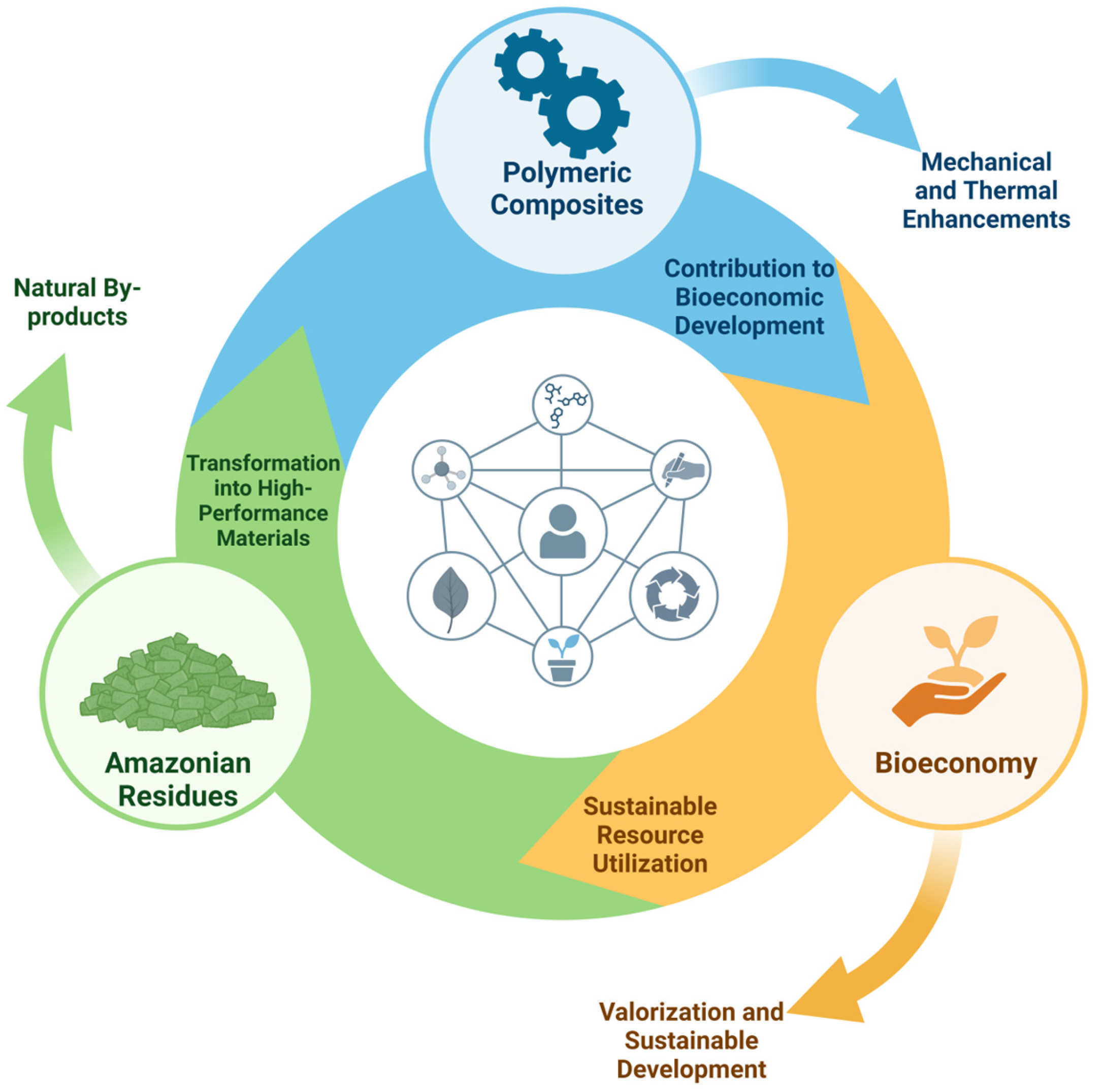
Figure 2.
Contribution of conventional and biodegradable polymers in polymeric composites.
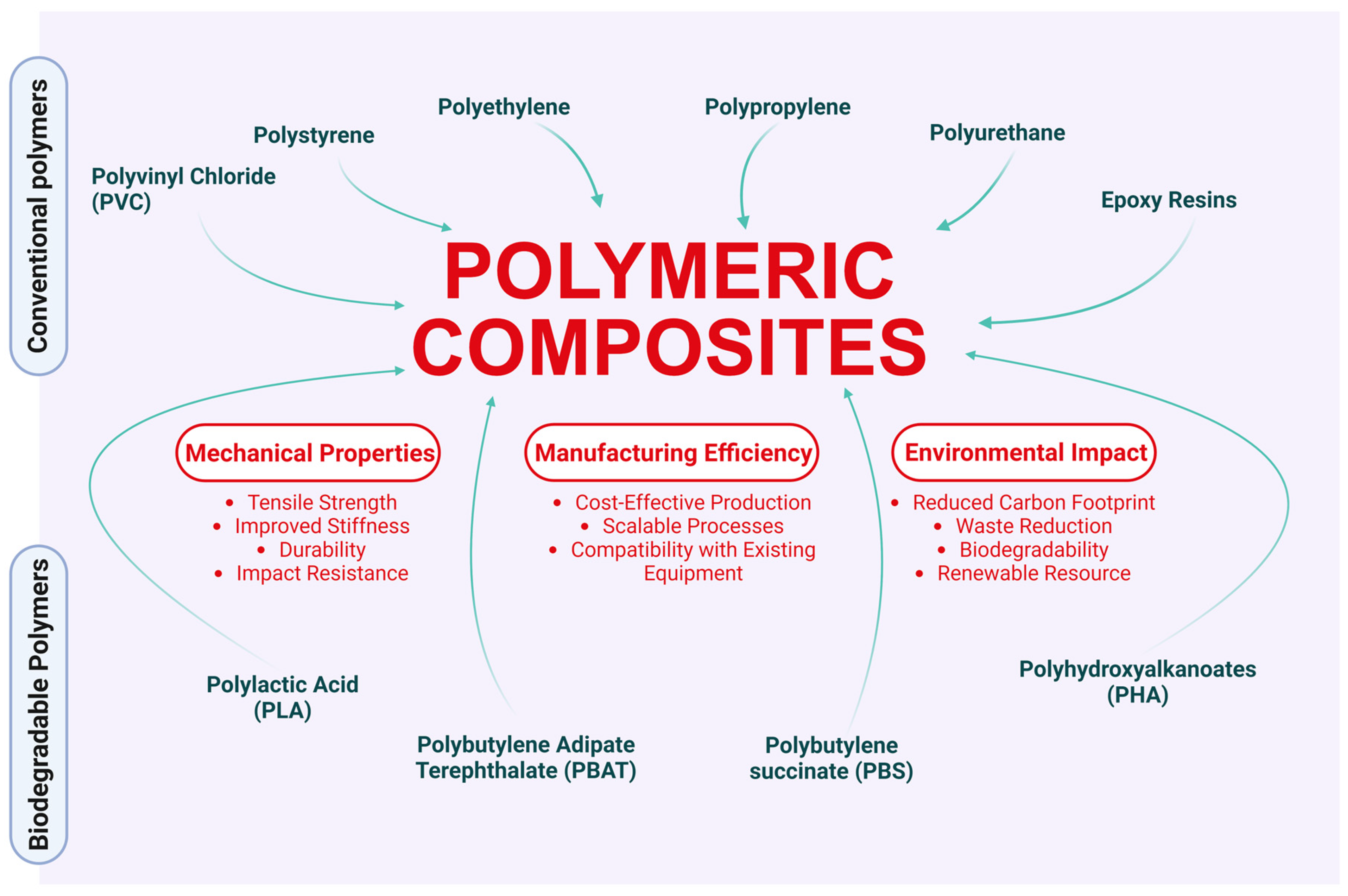
Figure 3.
Flowchart illustrating the production process in the wood industry, from the cultivation of planted forests to the generation of residues such as bark, shavings, sawdust, and offcuts.
Figure 3.
Flowchart illustrating the production process in the wood industry, from the cultivation of planted forests to the generation of residues such as bark, shavings, sawdust, and offcuts.
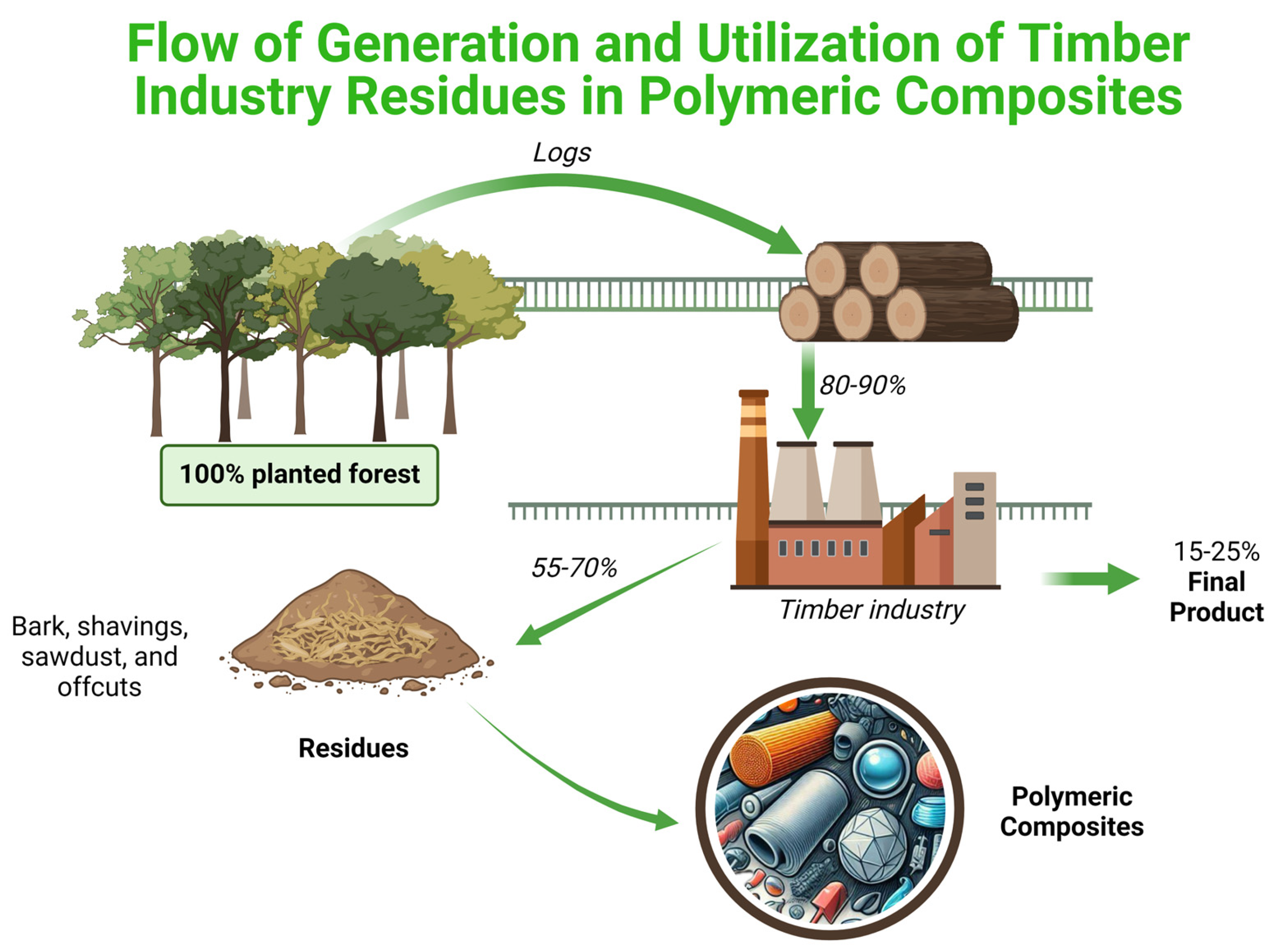
Figure 4.
Main export and import routes of sawdust and wood residues from Brazil (2017-2022).
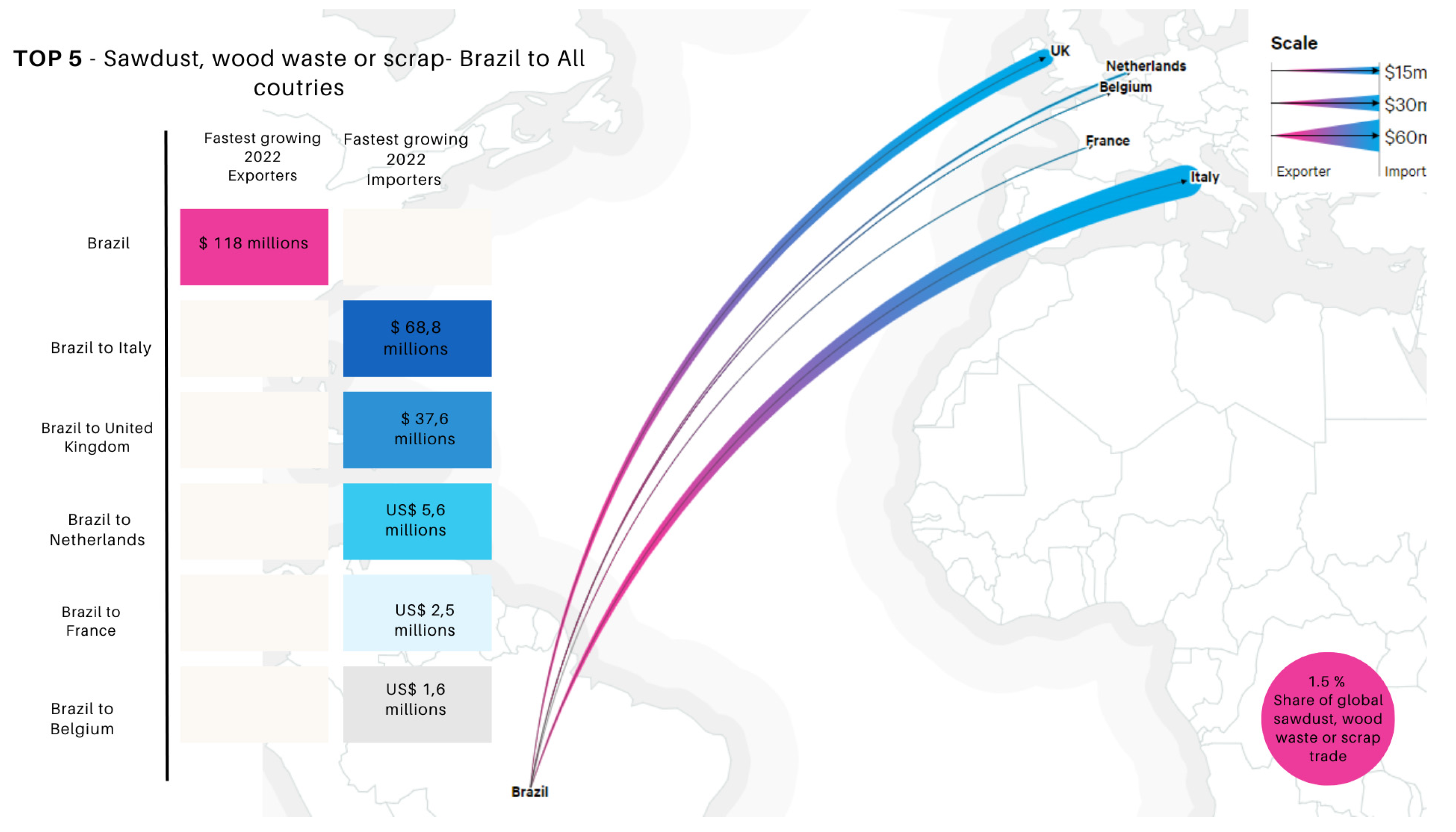
Figure 5.
Main export and import routes of sawdust and wood residues from Brazil (2017-2022).
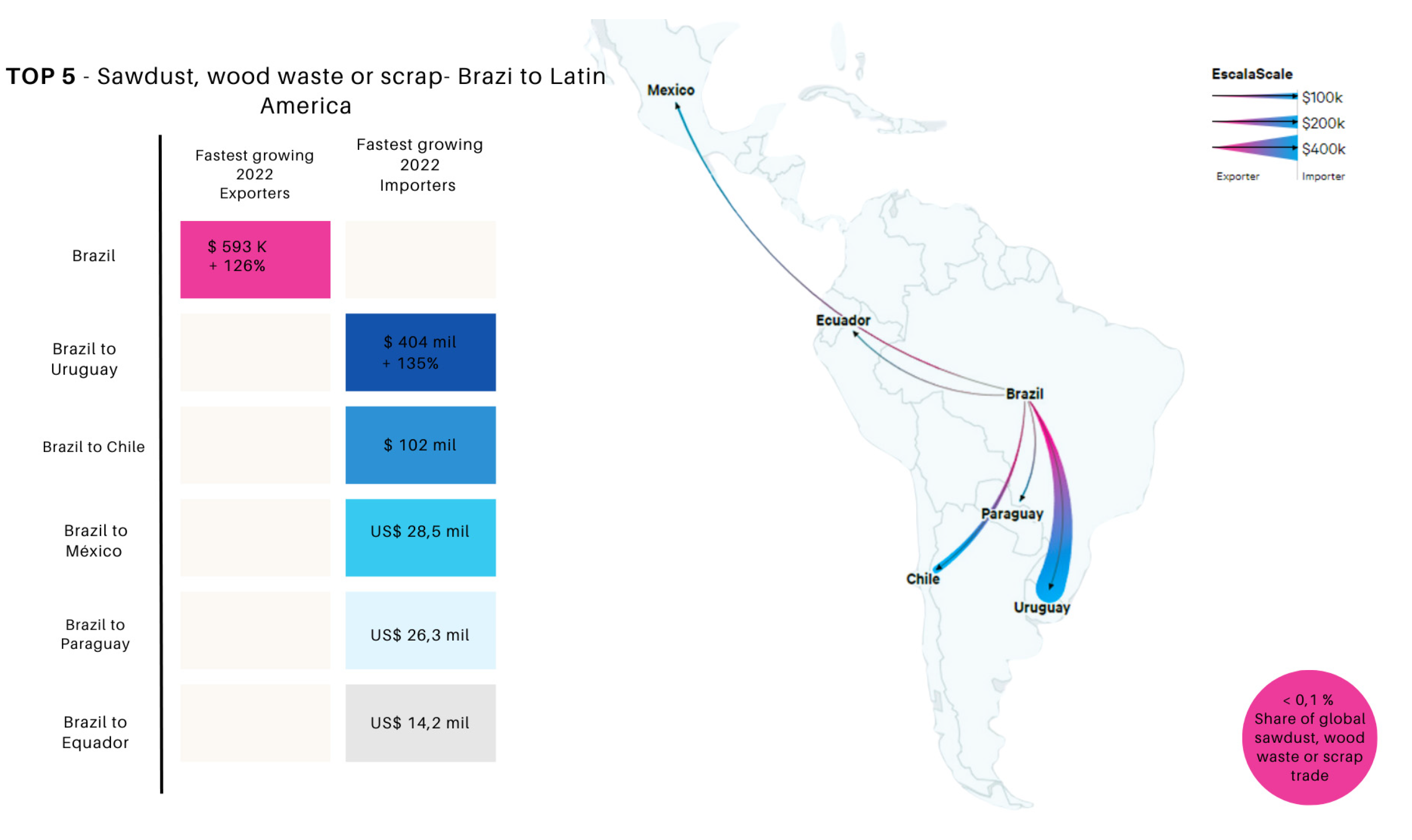
Figure 6.
Agro-extrativism industry residues applied in polymer composites: Examples include Brazil nut shells, açaí seeds, babassu coconut components (epicarp, mesocarp, and endocarp), palm fibers, and palm kernel cake.
Figure 6.
Agro-extrativism industry residues applied in polymer composites: Examples include Brazil nut shells, açaí seeds, babassu coconut components (epicarp, mesocarp, and endocarp), palm fibers, and palm kernel cake.
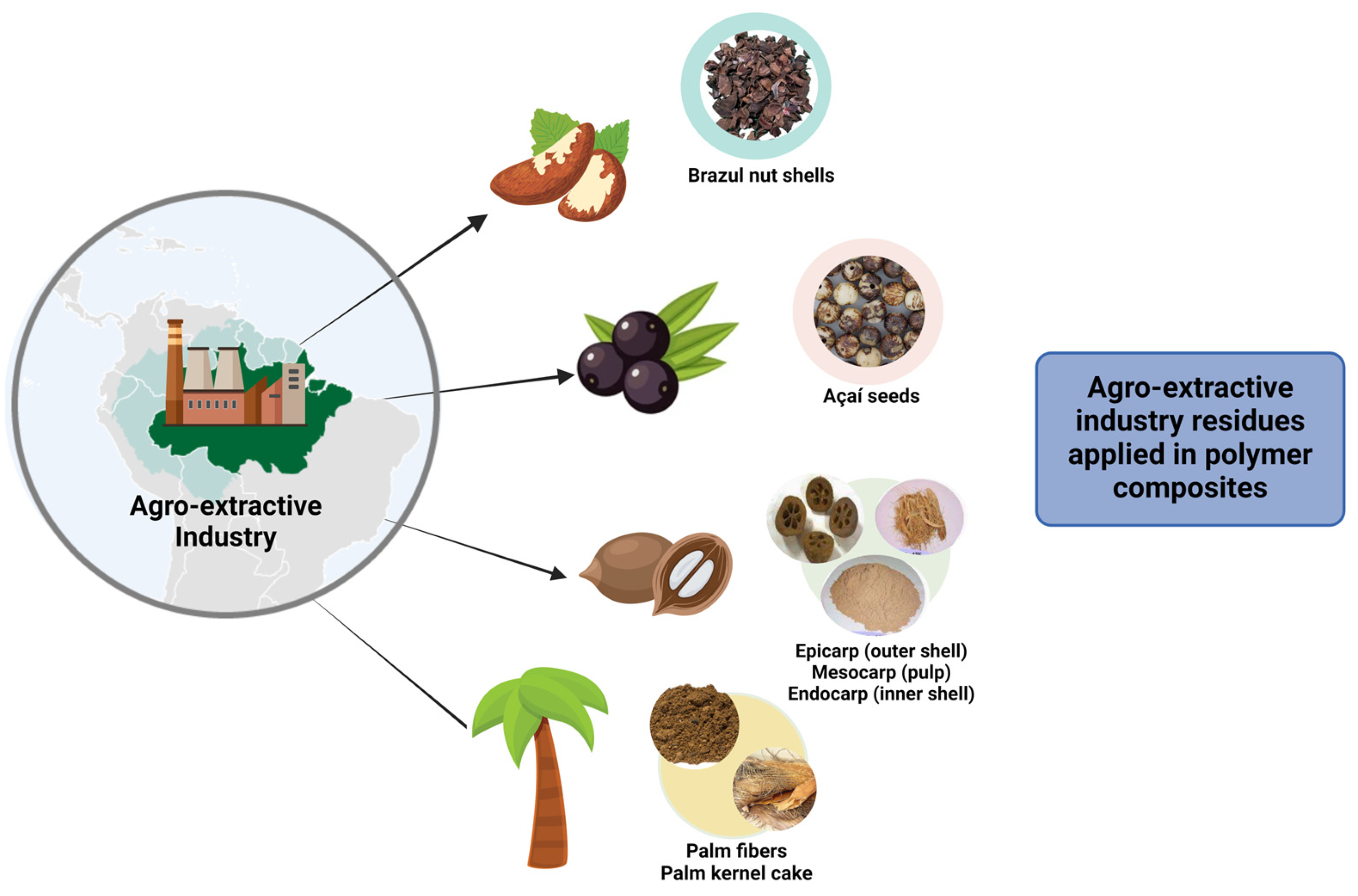

Table 1.
Chemical Composition of Amazonian Agro-Industrial and Wood Residues.
| Common Name (Scientific Name) | Reference | Cellulose (%) | Hemicellulose (%) | Lignin (%) | Extractives (%) | Ash (%) |
|---|---|---|---|---|---|---|
| Palm Kernel Shell (PKS) | Fuadi et al. [85] | 29,7 | 47,7 | 53,4 | - | 1,1 |
| Palm Kernel Shell (PKS) | Okoroigwe et al. [86] | 6,92 | 26,11 | 53,85 | - | 8,68 |
| Açaí Seeds (Euterpe oleracea) | Murillo-Franco et al. [78] | 11,58 | 37,88 | 14,12 | 4,09 | 1,57 |
| Açaí Seeds (Euterpe oleracea) | Buratto et al. [79] | 8,5 | 48,1 | 16,4 | 13,1 | 0,96 |
| Brazil Nut Mesocarp (Bertholletia excelsa) | Sonego et al. [90] | 15,9 | 15,7 | 56 | 2,5 | 6,2 |
| Brazil Nut Waste (Bertholletia excelsa) | Leandro et al. [91] | - | 37,09 | 55,76 | 4,54 | 2,61 |
| Cupuaçu Husk (Theobroma grandiflorum) | Marasca et al. [92] | 49,43 | 10,13 | 11,36 | 13,94 | 2,36 |
| Maçaranduba Sawdust (Manilkara huberi) | Nobre et al. [89] | 69,41* | - | 34,68 | 7,36 | 0,33 |
| Maçaranduba Sawdust (Manilkara huberi) | Medeiros [93] | 66* | - | 29 | 5 | 0 |
| Mandioqueira Wood (Ruizterania albiflora) | Bimestre et al. [94] | 55,9 | 9,23 | 28,71 | 3,29 | 1,12 |
| Cambará Wood (Vochysia sp.) | Bimestre et al. [94] | 49,5 | 12,56 | 32,28 | 0,18 | 3,9 |
| Amescla Wood (Trattinnickia sp.) | Bimestre et al. [94] | 45,18 | 13,38 | 33,86 | 0,71 | 1,72 |
| Angelim-pedra (Hymenolobium petraeum) | Almeida et al. [95] | 73,15* | - | 23,84 | 3,01 | - |
* Represent holocellulose, which is the sum of cellulose and hemicellulose.
Table 2.
Comparative Analysis of Mechanical Properties of Polymeric Composites Reinforced with Timber Industry Residues.
Table 2.
Comparative Analysis of Mechanical Properties of Polymeric Composites Reinforced with Timber Industry Residues.
| Study | Timber Residue | Composition | Improved Properties | Original Values | Improvement (%) |
|---|---|---|---|---|---|
| Santos et al. [151] | Louro Itaúba, Louro Gamela, Maçaranduba |
5-10% NaOH-treated wood residue |
Modulus of Rupture: Louro Gamela (16 MPa), Louro Itaúba (9 MPa), Maçaranduba (11 MPa) |
Louro Gamela (12 MPa), Louro Itaúba (2 MPa), Maçaranduba (3 MPa) |
Gamela: +33%, Itaúba: +350%, Maçaranduba: +266% |
| Rocha et al. [155] | Maçaranduba, Pinus, Sugarcane Bagasse |
PLA with 20% Maçaranduba/ Pinus residues |
Young’s Modulus: Pinus (+34%), Maçaranduba (+15%). Impact Absorption: Maçaranduba (+0.357 J/m) |
Young’s Modulus: 2.6 GPa, Impact Absorption: 0.193 J/m |
+34% (Pinus), +15% (Maçaranduba) |
| Surdi et al. [152] | Caryocar villosum, Hymenolobium excelsum, Tachigali myrmecophyla |
8% Phenol-formaldehyde resin with wood residues |
Modulus of Rupture (10.04 MPa), Modulus of Elasticity (1616.74 MPa) |
Modulus of Rupture: 8.5 MPa, Modulus of Elasticity: 1400 MPa |
Rupture: +18%, Elasticity: +15% |
| Costa et al. [156] | Jatobá + Malva Fibers | 75% Jatobá wood + 25% Malva fibers |
Tensile Strength: 26.06 MPa | Tensile Strength: 25.09 MPa | +4% |
| Ferreira et al. [157] | Jatobá Wood Powder | 40% Jatobá wood powder in PP |
Elastic Modulus: 2000 Mpa | Elastic Modulus: 800 MPa | +59% |
Table 3.
Comparative Analysis of Mechanical Properties of Polymeric Composites Reinforced with Agro-extractivism Industry Residues.
Table 3.
Comparative Analysis of Mechanical Properties of Polymeric Composites Reinforced with Agro-extractivism Industry Residues.
| Study | Timber Residue | Composition | Improved Properties | Original Values | Improvement (%) |
|---|---|---|---|---|---|
| Barbosa et al. [164] | Açaí Seed | Polymer composite with 30% açaí seed | Lower water absorption (21.11%) with larger particles, better bonding strength |
Water absorption: 56.65% | -63% water absorption |
| Cionita et al. [169] | Palm Kernel Cake | Epoxy with 30% PKC | Tensile Strength: 31.20 MPa, Flexural Strength: 39.70 MPa |
Tensile Strength: 22.90 MPa, Flexural Strength: 30.50 MPa |
Tensile: +36%, Flexural: +30% |
| Kieling et al. [177] | Tucumã Endocarp | Recycled PP with 0–50 wt% Tucumã endocarp powder (TEP) | Increased tensile and flexural modulus (+28% to +30%), improved compressive strength (+134%) with 40 wt% TEP | Tensile Modulus: 0.73 GPa (PP100) Flexural Modulus: 1.13 GPa (PP100) |
Modulus: +28% (0.94 GPa with 50 wt% TEP) Flexural Modulus: +30% (1.48 GPa with 50 wt% TEP) |
| Araújo et al. [178] | Açaí Seed | Natural rubber with 0–50 phr açaí seed | Increased tensile strength, Increased Elastic Modulus | Tensile Strength: 5.2 MPa (0 phr) Elastic Modulus: 0.8 MPa (0 phr) | Tensile Strength: +65% (at 50 phr) Young’s Modulus: +127.5% (at 50 phr, 1.82 MPa) |
| Wataya et al. [179] | Açaí Seed Fiber | PBAT/PLA (50/50 wt%) with 30% açaí seed fiber | Increased elongation at break (+17%) | Elongation: 12.8% (PBAT/PLA blend) | Elongation: +17% (15.02%) |
| Beber et al. [180] | Babassu Mesocarp | PBAT/PHB (25/75, 50/50, 75/25) with 20% Babassu | Increased Young’s Modulus (+19.4%), slight increase in stiffness | Young’s Modulus: 334 MPa (50/50 blend) | Young’s Modulus: +19.4% (for 25/75 blend with Babassu) |
| Portela et al. [181] | Buriti Fiber | Epoxy (DGEBA/TETA) with 0%, 10%, 20%, 30% buriti fiber | Increased tensile strength (+22.8%), improved modulus (+57%) with 30% fiber content | Tensile Strength: 61.94 MPa (0% fiber) Modulus: 0.97 GPa (0% fiber) |
Tensile Strength: +22.8% (76.07 MPa with 30% fiber) Modulus: +57% (1.52 GPa with 30% fiber) |
Disclaimer/Publisher’s Note: The statements, opinions and data contained in all publications are solely those of the individual author(s) and contributor(s) and not of MDPI and/or the editor(s). MDPI and/or the editor(s) disclaim responsibility for any injury to people or property resulting from any ideas, methods, instructions or products referred to in the content. |
© 2024 by the authors. Licensee MDPI, Basel, Switzerland. This article is an open access article distributed under the terms and conditions of the Creative Commons Attribution (CC BY) license (http://creativecommons.org/licenses/by/4.0/).
Copyright: This open access article is published under a Creative Commons CC BY 4.0 license, which permit the free download, distribution, and reuse, provided that the author and preprint are cited in any reuse.


