
Submitted:
29 October 2024
Posted:
29 October 2024
You are already at the latest version
Abstract
As global food demand continues to grow, enhancing rice seed setting rate and yield has emerged as a crucial research topic. The stigma exsertion rate in rice, a pivotal determinant of the outcrossing seed setting rate in sterility lines, is essential for facilitating the propagation and efficient seed production of hybrid rice varieties. This article reviews the research progress on stigma exertion rate in rice, systematically analyzing the latest molecular biology and genetics findings to uncover the key genes and molecular mechanisms regulating stigma exertion. Furthermore, it explores the application of molecular marker-assisted selection technology in rice breeding, aiming to optimize stigma exertion traits to enhance the stigma exertion rate and outcrossing habit of rice sterility lines. By integrating existing research outcomes, this article not only provides researchers with a theoretical foundation for a deeper understanding of the regulatory mechanisms of stigma exertion but also offers practical strategies for rice breeding practices.
Keywords:
rice
; setting rate
; stigma exsertion
; sterility line
; molecular mechanism
; outcrossing habit
1. Introduction
Rice is the primary food source for about half of the world's population. However, facing the dual pressures of population growth and decreasing cultivated land, food security issues have become increasingly prominent. In recent decades, rice yields have significantly increased through the utilization of semi-dwarf alleles and hybrid advantage [1,2]. Particularly in hybrid rice, as compared to inbred parent lines, there is a demonstrated yield advantage of 10%-20%. It has been cultivated and promoted in over 40 countries worldwide, with a cumulative cultivated area exceeding 500 million hectares, resulting in a total increase in production of 6.25 million tons [3,4,5]. Despite these advancements, various challenges persist in hybrid rice production, notably the low seed production yield. To address this issue, methods such as gibberellin spraying and pollen driving have been widely used to improve seed setting rates [6,7]. However, these measures simultaneously increase production costs. Therefore, cultivating sterile lines with high outcrossing seed setting rate has become one of the key methods. China and India, as the world's largest rice producers and consumers, account for 50% of the world's rice production and consumption. Through the research and efforts of scientists, hybrid rice has been transformed from theory to reality and widely promoted, which has significantly increased yields and made a significant contribution to global food security [1,5]. However, one of the primary obstacles to increasing seed production is the low outcrossing ability of male sterile lines. Fundamental measures to enhance seed production lie in improving the cultivation management of the sterile lines and modifying their outcrossing traits, such as increasing stigma exposure rate (SER).
In hybrid rice breeding research, there is a significant positive correlation between the stigma exposure rate of sterile lines and the outcrossing seed set rate. The selection of highly efficient sterile lines in breeding not only involves a comprehensive evaluation of their male sterility and combining ability but also necessitates consideration of the stigma exposure rate. When sterile lines exhibit a higher stigma exposure rate, the extent of stigma exposure is increased, thereby enhancing the likelihood of contact with pollen and facilitating outcrossing. By elevating the stigma protrusion rate in male sterile lines, not only is the probability of pollen fertilization increased, but it can also effectively address the issue of asynchrony in flowering times between parents, thereby enhancing pollination efficiency [8]. Hence, optimizing the stigma characteristics of sterile lines during the breeding process of hybrid rice is pivotal to enhancing the seed production yield of hybrid rice. This not only reduces the cost of seed production but also facilitates the widespread promotion of hybrid rice.
A systematic study on the variation patterns and influencing factors of stigma exsertion in rice holds profound theoretical significance and practical breeding value for elucidating the regulatory mechanisms underlying rice reproductive growth, as well as for creating hybrid rice male-sterile lines with high outcrossing ability, thereby enhancing the propagation efficiency and seed production yield of hybrid rice. This research aims to provide an overview of the latest advancements in the study of stigma exsertion in rice, and through the analysis of existing research findings, explore its practical application value in agricultural production. Furthermore, this review intends to provide scientific theoretical underpinnings for the production practices of hybrid rice and serve as a vital reference for further investigations in this field, thereby fostering innovation and advancement in hybrid rice technology.
2. Rice Stigma Exposed
The phenomenon of stigma exsertion in rice refers to the stigma of the pistil remaining on the outer surface of the glumes after the glumes have finished blooming and the palea and lemma have reclosed. The stigma exsertion is further classified into single-stigma exsertion, dual-stigma exsertion, and non- stigma exsertion, based on the the specific number of exposed bristles (Figure 1). Stigma exsertion is not only a crucial agronomic trait in rice but also serves as a significant indicator for the classification between wild and cultivated rice. In cultivated rice, the phenomenon of stigma exsertion is relatively infrequent, typically exhibiting a low rate of exsertion. This trait reveals two distinct reproductive strategies, wild rice employs outcrossing to enhance genetic diversity and adaptability to environmental variations, whereas cultivated rice maintains genetic stability and enhances yield through selfing [9]。Therefore, the physiological mechanism changes during the domestication process of wild rice towards cultivated rice, specifically the transition from outcrossing to selfing, possess immense research value. This shift markedly reduces the genetic segregation in offspring of cultivated rice, profoundly impacting crop stability and yield enhancement. Concurrently, investigating the exsertion rate of stigmas holds significance for elucidating the domestication mechanisms of floral traits. In crop genetics and agricultural production practices, harnessing heterosis has been proven as one of the pivotal strategies to elevate crop yields. Nevertheless, increasing the seed production yield of hybrid rice remains a primary challenge in this field. To overcome this bottleneck, researchers are actively exploring effective methods to enhance seed production. Among these, elevating the outcrossing seed setting rate of rice male sterile lines is considered a crucial strategy, with the exsertion rate of stigmas offering a novel research perspective. Studies indicate that a higher exsertion rate of stigmas in male sterile lines often coincides with enlarged stigma size and enhanced vigor, subsequently boosting their outcrossing ability, ultimately resulting in increased hybrid seed yields. Consequently, a highly significant positive correlation exists between the exsertion rate of stigmas and the enhancement of hybrid rice seed production yields [10,11].
3. Genetic Studies on Stigma Traits in Rice
The floral organ traits in rice, such as stigma size, anther size, and stigma exsertion rate, are quantitative traits that generally exhibit high broad-sense heritability. Studies have indicated that these traits are collectively governed by multiple QTL (quantitative trait loci), with their phenotypes displaying a normal continuous distribution, suggesting not only a rich genetic diversity but also a prominent influence by environmental factors (e.g., temperature, humidity, light intensity, and water availability). For instance, Yang et al. [12] analyzed nine floral organ traits in indica rice varieties and discovered that the heritability of stigma exsertion rate, stigma length, spikelet length, and spikelet length-to-width ratio approached or exceeded 90%, and that the heritability of anther length was also more than 80%. Furthermore, studies by Li et al. [13] and Wu et al. [14] concurred with this observation, emphasizing the high heritability of most floral organ traits. Notably, in the genetic effects governing stigma exsertion rate, additive effects were the most prominent, followed by dominance and epistasis, with no evidence of cytoplasmic inheritance. Shen et al. [15] proposed that stigma exsertion rate was jointly influenced by additive, maternal, and dominant effects. Mahalingam et al. [16] conducted study on 11 floral organ traits in five cytoplasmic male sterile lines (CMSLs) and 51 test varieties, revealing high heritability for anther length, stigma length, style width, glume opening angle, and stigma exsertion rate. The research conducted by Uga et al. [18] revealed that the total length and area of rice stigmas, as well as the style, are primarily influenced by additive effects, with no maternal effects present. Virmani and Athwal (1973) analyzed the genetic effects of stigma length, both dominant and additive effects were important, but the dominant effect was greater than the additive effect, and among the epistatic effects, the additive effect was the largest. This discovery underscores the ubiquitous and relatively stable nature of high heritability in floral organ traits, which are resilient to environmental fluctuations. These research findings not only unravel the genetic potential of rice floral organ traits but also provide a robust scientific basis and abundant genetic resources for the genetic improvement of floral organ traits in hybrid breeding parents. Ultimately, they guide breeding practices and enhance breeding efficiency in rice.
4. Correlation of Floral Organs and Stigma in Rice
Virmani et al. [17] discovered a significant positive correlation between stigma exsertion rate and stigma length through detailed analysis of floral traits in 29 cultivated and wild rice species in Asia. Similarly, Uga et al. [18] utilized a recombinant inbred line population derived from the cross between the cultivated rice variety Pei-kuh and the wild rice W1944, and found that stigma exsertion was not only significantly positively correlated with stigma length, style length, glume opening angle, and length of lemma and palea, but also negatively correlated with stigma width and thickness of lemma and palea. Li et al. [13] further validated this conclusion, noting positive correlations between stigma exsertion rate and stigma length, grain length, stigma angle, and ovary length, while observing a negative correlation with grain width. Yu et al. [19] found in the DH population constructed from the hybrid combination of " Zhaiyeqing 8 and Jingxi 17 that the stigma exposure rate was closely related to the stigma length and width, and was also influenced by the length-to-width ratio of the spikelet and the length of the style. Additionally, Yan et al. [20] observed a significant positive correlation between stigma exsertion rate and both single- and double-stigma exsertion rates among 90 core germplasm resources. Moreover, Miyata et al. [21] analysed F2 populations of the japonica varieties Koshihikari and IR24 and found that stigma exsertion rate was positively correlated with grain length-to-width ratio, but not significantly correlated with panicle length. These studies collectively underscore stigma exsertion as a complex phenotype influenced by multiple traits, with stigma length, spikelet length, style length, and their proportions being the primary agronomic traits contributing to an enhanced stigma exsertion rate. This finding holds significant implications for rice genetic improvement, facilitating the targeted selection and breeding of high-yielding rice varieties.
5. Interspecific Variation and Stigma Exsertion in Rice
As a naturally occurring species without artificial domestication, wild rice exhibits distinct traits during its natural selection process. It possesses large and long stigmas, as well as a high stigma exsertion rate [22]. This characteristic is particularly prominent in most wild rice germplasm, with stigma exsertion rates commonly fluctuating between 50.0% and 100.0%, significantly enhancing population reproduction and genetic diversity. In contrast, the stigma exsertion rate of African wild rice is relatively low, ranging from 3.2% to 19.7% [23]. Notably, the natural outcrossing rates of long-stamened wild rice and common wild rice approach or reach 100.0%, demonstrating their high level of outcrossing [24,25].
Compared to wild rice, cultivated rice has demonstrated diverse distribution patterns of stigma exsertion rates after prolonged periods of artificial domestication and natural evolution. Ying et al. [26] conducted analysis of 2065 rice accessions, revealing significant differences in stigma exsertion rates among various accessions. Specifically, wild rice has the highest stigma exertion rate, and African cultivated rice contains a notably greater number of accessions with high stigma exertion compared to Asian cultivated rice [26]. Further research has shown significant inter-subspecies differences within Asian cultivated rice: Indica rice exhibits higher stigma exertion rates than Japonica rice. Among Japonica rice, tropical Japonica has a higher stigma exertion rate than temperate Japonica [17,27]. Additionally, Xu et al. [28] conducted a study on stigma exsertion among 435 rice varieties cultivated domestically and internationally. Their findings underscored the substantial impact of different cultivation types and geographical origins on stigma exertion rates. Notably, indica rice displayed higher stigma exertion rates than japonica rice, and terrestrial rice varieties exhibited significantly higher stigma exertion rates than aquatic rice varieties. Particularly intriguing was the observation that Yunnan Plateau japonica rice had a significantly higher stigma exertion rate than its counterparts in the Taihu Lake region [28].
In breeding practice, sterile lines and their maintainers commonly exhibit a relatively high stigma exsertion rate, a trait that varies significantly, ranging from 11.2% to 65.3% [10,29]. Notably, compared to japonica sterile lines, indica sterile lines demonstrate a more pronounced stigma exsertion rate [30,31,32]. In a specific study focusing on Thai rice germplasm, Khumto et al. [33] reported an average stigma exsertion rate of 35.6%, with extreme variations spanning from 0.0% to 75.0%, further affirming the extensive diversity of stigma exsertion traits in rice. Given that wild rice harbors superior genes such as high stigma exsertion rate and large stigma, it presents significant potential for genetic improvement of stigma exsertion traits and germplasm resource innovation [34]. Therefore, future breeding research may consider integrating molecular marker-assisted technology with traditional breeding methods, aiming to introduce elite genes from wild rice into sterile line hybrid seed production, thereby enhancing hybrid seed yield.
6. Identified QTL for Stigma Exsertion in Rice
The mapping populations employed for the localization of QTLs related to stigma exsertion exhibit considerable diversity and complexity, encompassing a broad spectrum of genetic resources such as recombinant inbred line (RIL), Near isogenic line (NIL), doubled haploid (DH) populations, F2 segregating populations, backcross populations (BC), chromosome segment substitution line (CSSL), cytoplasmic male sterile line (CMSL), and association mapping population (AMP). The genetic architecture of these populations significantly impacts the precision of quantitative trait localization. To date, researchers have identified over 100 QTLs associated with unilateral, bilateral, and total stigma exsertion in rice, which are extensively distributed across 12 chromosomes, with variations observed in their localization outcomes. The majority of these QTLs originate from indica maintainers or sterile lines, wild rice, and indica subspecies among conventionally cultivated rice (Table 1). Given that stigma exsertion is a trait governed by multiple minor-effect genes and is highly susceptible to environmental fluctuations, most of QTLs contribute little to the phenotype. Nevertheless, it is noteworthy that a few QTLs demonstrate notable contributions. For instance, Miyata et al. [21] identified qES3 on chromosome 3 within the D83726-T86 marker interval, with a remarkable contribution rate of 32%. Furthermore, Li et al. [44] localized qPES-9 between RM105 and RM566 markers on chromosome 9, exhibiting an exceptionally high contribution rate of 76.6%. In contrast, the rest of the identified QTLs had a contribution rate of around 10%.
The positioning populations, marker densities, and analytical methods employed by different scholars vary significantly, leading to the identification of numerous and complex QTLs that are difficult to directly summarize into general patterns. However, overlaps between some QTLs have been observed. For instance, the qPES-1 identified by Li et al. [44] overlaps with the qTSE-1 identified by Li et al. [50] within the RM1247-RM7383 interval. Similarly, the qPES-2 identified by Li et al. [37] and Deng et al. [42] on chromosome 2 also exhibits an overlap within the RM1285-G1327 interval. Furthermore, the qPES-3 reported by Qiao et al. [40] overlaps with the qTSE-3a identified by Li et al. [50]. Zou et al. [66] utilized single segment substitution lines (SSSLs) derived from three AA-genome wild rice species (O. barthii, O. meridionalis, and O. rufipogon) to identify a total of 36 QTLs related to stigma exsertion on 11 chromosomes. By comparing the chromosomal intervals of these QTLs with previously reported ones, they found that 12 were novel, while 24 were either identical or overlapped with previously reported QTLs [66]. Notably, the chromosomal segment covered by qSERb3-1 coincides with the qES3 region identified by Miyata et al. [21] using a segregating population derived from Koshihikari and IR24 [66].
The further analysis of QTLs jointly identified by multiple researchers, focusing on their overlapping or covered regions, and the subsequent implementation of fine mapping, hold significant academic value. These QTLs exhibit notable differences in their contribution rates to stigma exsertion, which could stem from various factors such as differences in mapping populations, the choice and density of marker types, as well as factors intimately tied to the researchers' threshold settings and the genetic backgrounds of the parental lines used in QTL identification. Given the intricate interplay between stigma exsertion and numerous floral traits along with environmental factors, the fine mapping of this trait and its subsequent applications face numerous challenges. Consequently, breeding research urgently necessitates broadening the scope of exploration and actively tapping into rice germplasm resources with high stigma exsertion characteristics.
7. Localization of QTL for Other Traits in Rice Stigma
Numerous studies have revealed a significant positive correlation between the stigma exsertion rate of rice and its stigma length, stigma width, as well as style length [17,76]. The stigma length, stigma width, and style length of rice are relatively less influenced by environmental factors and are primarily quantitative traits controlled by multiple genes. Increasing the length and width of stigmas, as well as the length of styles, can enhance the outcrossing seed-setting rate of male sterile lines, thereby improving the yield of hybrid seed production. The research on the traits of stigma length, stigma width, and style length in rice stigma characteristics has been relatively late compared to the stigma exsertion rate, and thus, there are fewer QTLs identified for these traits. The reported QTLs are distributed across 12 chromosomes (Table 2). Uga et al. [77] performed QTL analysis for stigma-related traits using five mapping populations (including Milyang23/Akihikar RILs, Asominori/IR24 RILs, Nipponbare/Kasalath BC populations, IR64/Azucena DH populations, and IR64/Kinandang Patong F2 populations), identifying 18 QTLs for stigma length, 15 for stigma width, and 10 for style length. Beyond traditional mapping methods, researchers have also employed genome-wide association studies (GWAS) to locate QTLs for rice stigma traits. For instance, Yan et al. [20] identified two QTLs associated with stigma length through GWAS using 90 mini-core collections from the United States Department of Agriculture. Dang et al. [79] conducted a GWAS on 227 rice varieties, identifying six QTLs related to stigma length. Additionally, Marathi et al. [22] performed SNP genotyping on 48 cultivated and wild rice varieties, successfully identifying six QTLs related to stigma length on chromosomes 3, 4, 7, and 10. Interestingly, some studies have found that the intervals of QTLs for certain traits in rice, such as stigma length and style length, overlap with the intervals of QTLs for stigma exsertion rate. For example, qPES-10, qSTL-10, and qTSSL-10 identified on chromosome 10 overlapped in the interval RM171-RM1108 by Jiang et al. [67]. Therefore, studying the QTLs that control these traits is of great significance. By localizing the genes that control various stigma traits, we can significantly enhance the improvement of the outcrossing characteristics of male sterile lines.
8. Gene Cloning for Stigma Exsertion in Rice
The stigma exsertion trait in rice, as a complex genetic characteristic co-regulated by multiple genes, has made significant scientific progress in gene cloning, functional verification, and its genetic regulatory mechanisms in recent years. Extensive research has revealed a shared genetic regulatory network between stigma exsertion and grain shape traits in rice. These genes can directly or indirectly affect grain shape or stigma size by delicately regulating cellular development processes, ultimately influencing the extent of stigma exposure.
Zhou et al. [57] conducted a genome-wide association analysis utilizing approximately 6.5 million single nucleotide polymorphisms (SNPs) across 533 distinct rice cultivars, aimed at investigating the characteristics of stigma exposure and related floral organs. The analysis successfully identified 23 genomic regions significantly associated with stigma exposure and its correlated traits. Notably, three loci were found to be tightly co-localized with the major grain shape genes GS3, GW5, and GW2. Furthermore, research by Zhu et al. [83] demonstrated that simultaneous knockout of three grain shape genes, GS3, GW8, and GS9, led to a remarkable enhancement in the length-to-width ratio of spikelets, as well as increased stigma and style lengths, thereby increasing the rate of stigma exposure without adversely affecting other agronomic traits. Specifically, in japonica rice variety Hua11 and the indica male-sterile line Zhu6S, precise manipulation of these grain morphology genes significantly improved both stigma exsertion and outcrossing rates [83].
Miyata et al. [21] named a main effector QTL detected on chromosome 3 as qES3, which was later verified to be the cloned gene GS3. [47]. A nonsense mutation in the second exon of the GS3 results in an increase in the number of cells in the non-bristled region of the stigma, thereby enhancing stigma length and facilitating stigma exsertion [47]. Through GWAS of 533 diverse rice varieties, Zhou et al. [57] revealed that the influence of the GS3 on stigma length is significantly more pronounced in indica rice compared to japonica rice. In the indica cultivar Minghui 63, overexpression of GS3 in negative transgenic plants exhibited a stigma exsertion rate that was 66% to 76% higher than that in positive plants. Furthermore, GS3 overexpression led to a reduction in style length and an increase in stigma width, imparting a shorter and wider characteristic to the stigma morphology [57].
The GW5 gene is a major QTL controlling grain width and grain weight in rice, while also exerting a notable influence on stigma exsertion [84]. In the japonica rice variety Kongyu 131, overexpression of GW5 markedly enhanced the length and width of the style and stigma, resulting in a 17%-24% increase in stigma exsertion rate compared to control plants. This process primarily occurs through GW5 altering the number of glume cells vertical to the style, rather than directly acting on the length of the style or stigma itself [57]. GW2 is another key QTL that affects both grain width and thousand grain weight in rice [85]. In the japonica rice variety Zhonghua 11, when GW2 expression is suppressed, the stigma length, width, and style length of the plants all significantly increase, ultimately elevating stigma exsertion rate by 5%-10% [57].
qSTL3 is another well-known stigma exsertion gene. Liu et al. [78] constructed a CSSL using the Kasalath as the donor and the Nipponbare as the recipient. They discovered that there were significant differences in stigma length and exsertion rate between SSSL14 and Nipponbare. This QTL that controls stigma length was designated as qSTL3. Subsequently, an F2 population was generated through the crossing of SSSL14 with Nipponbare, and qSTL3 was fine-mapped to a 19.8 kb region containing three genes. Further analysis revealed a polymorphism in the gene LOC_Os03g14850 between Kasalath and Nipponbare. Experimental validation using a T-DNA insertion mutant showed that the mutant exhibited an 8.62% increase in stigma length compared to the wild type, indicating that this gene is a negative regulator of stigma length. Additionally, this gene also significantly influenced grain length in rice, revealing its potential pleiotropic effects [78].
In addition to genes associated with grain shape, there are many genes that are closely related to rice stigma traits and their development. For example, Dang et al. [86] found that the qSYL3-k gene, which belongs to the MADS-box family of transcription factors, had a significant effect on style length by map cloning. The qSYL3-k gene extends the overall length of the style by increasing the length of cells within the style, a process closely associated with elevated levels of GA4 in the pistil. Analysis of the qSYL3 locus across 136 varieties revealed that the qSYL3AA, qSYL3AG, and qSYL3GA haplotypes of the alleles contribute to an increase in style length, whereas the qSYL3GG haplotype leads to a reduction [86]. Furthermore, Guo et al. [70] successfully constructed NIL using the japonica rice male sterile line DaS with high stigma exsertion and D50 with low stigma exsertion. They localized qSE4 to a specific region on chromosome 4. Their investigation revealed a nucleotide substitution in the promoter region of the ARF10 gene between DaS and D50. Further experimentation demonstrated that knockout of the ARF10 in the DaS background resulted in arf10 mutants with significantly lower stigma exsertion rates than the wild type, accompanied by significant changes in auxin content and the expression of auxin signaling-related genes [70]. Moreover, overexpression of miR167d resulted in obstructed elongation of the filaments, enlarged stigmas, and altered lemma morphology. Its target genes, ARF6, ARF12, ARF17, and ARF25, exhibited overlapping functions in flower opening and stigma size regulation. Specifically, any single mutation in ARF12 combined with mutations in ARF6, ARF17, or ARF25 presented defective phenotypes reminiscent of miR167d overexpression [87]. Although some QTLs or genes associated with stigma traits have been finely mapped or cloned, the underlying genetic mechanisms remain incompletely understood. Current research on rice stigma exposure primarily remains at the preliminary mapping stage, necessitating further precise mapping of overlapping or co-localized QTLs and early identification of target genes through genetic experiments to advance functional analyses.
9. Breeding Utilization of QTLs for Rice Stigma Exsertion
In the field of crop genetic improvement, traditional breeding methods mainly rely on techniques such as hybridisation, backcrossing and recrossing combined with external phenotypic selection aimed at improving the genetic characteristics of plants. For the use of major QTL controlling stigma exclosure, hybridisation and multi-generation backcrossing techniques, combined with phenotypic selection, can be used to introduce the primary QTL into materials with low stigma exclosure, thereby improving their stigma exclosure. For example, Li et al. [49] successfully introduced the qSe1 gene, which regulates stigma exsertion rate in Chinese aromatic rice, into the parent of Chuanxiang 29B, which significantly improved stigma exsertion rate to 16.4%. On the other hand, Li et al. [88] significantly improved the traits of the low stigma excursion rate maintenance line Hukuang 1B through hybridisation and multi-generation backcrossing using the high stigma excursion rate maintenance line K17B as a donor, and further transferred the line through backcrossing to produce an improved sterile line with stigma excursion rate of more than 60.0%.
In addition, important progress has been made in the research of Wu et al. [89], who successfully introduced QTLs for high stigma exclosure rate in Yue Tai and II-32B into maintenance lines with low stigma exclosure rate, which not only improved the stigma exclosure rate of maintenance and sterile lines, but also enhanced the seed production yield of hybrid rice through a series of improvement measures. However, it is important to note that unfavourable agronomic traits in many germplasm resources tend to be closely interlinked with high stigma exsertion rate traits. Long-term practice has shown that molecular marker-assisted selection (MAS) is an effective means to improve breeding efficiency. The fundamental principle of MAS is to use molecular markers that are closely linked or cosegregating with the target gene, enabling the early-stage screening of target traits controlled by these genes during hybridization. This approach minimizes linkage drag, expedites the acquisition of desired individuals, and consequently, significantly elevates breeding efficiency [90]. For instance, Miyata et al. [21] successfully introgressed the allele qES3, which notably enhances stigma exsertion rate in IR24, into Koshihikari through MAS, resulting in a 36% increase in stigma exsertion rate. Similarly, Wang et al. [8] also employed MAS to integrate multiple QTLs for high stigma exsertion rate from indica rice into japonica rice maintainer lines, significantly elevating the stigma exsertion rate of japonica sterile lines from an initial level below 30.0% to over 80.0%. Moreover, Cai et al. [91] utilized QTLs (qPES3, qPES9, and qPES12) associated with high stigma exsertion rate from the indica sterile line 50S. Through a combined approach of hybridization, backcrossing, and marker-assisted selection, these QTLs were introgressed into japonica rice maintainer lines, leading to a 30%-60% increase in stigma exsertion rate in the introgressed lines compared to the control group [91].
10. Future Perspectives
Despite significant progress has been made in the study of the stigma exsertion trait in rice, complete elucidation of these traits remains elusive due to the intricacies of their genetic attributes, polygenic control, and the vast genetic regulatory networks involved. Therefore, the primary research direction should focus on the application of high-throughput sequencing and gene editing technologies to identify the key genes affecting stigma exsertion rate and development, and to elucidate their genetic regulatory networks. In addition, environmental factors, such as temperature, humidity, and light, have important effects on stigma exsertion rate and its size. Based on this, future studies should adopt a more detailed experimental design to explore in depth how these environmental factors affect these traits by regulating the physiological and biochemical processes of plants to further understand their environmental adaptations. Currently, the measurement of stigma exsertion rate and size mainly relies on manual observation, which is not only time-consuming but also susceptible to subjective results. As technology advances, the application of image processing and machine learning algorithms will make phenotypic evaluation more efficient and automated. Finally, marker-assisted selection or gene editing of key genes, combined with modern agricultural technologies, such as precision agriculture and intelligent systems, can enable precise improvement of rice varieties and fine management of cultivation, thereby enhancing the yield potential of hybrid rice and ensuring food security and production sustainability. Through comprehensive and in-depth research, the research on rice stigma exposure and development will be effectively promoted in the future at both theoretical and practical application levels, providing scientific support for the sustainable improvement of rice yield and quality.
Author Contributions
H.G. wrote this manuscript. G.R. and F.G. participated in the writing and modification of this manuscript. Y.L., J.L., and X.S. conceptualized the idea. All authors have read and agreed to the published version of the manuscript.
Funding
This study was supported by grants from the Scientific Research Fund for High-level Talents of Sichuan Academy of Agricultural Sciences (NKYRCZX2024003), the earmarked fund for China Agriculture Research System (CARS-01), the Independent Innovation Project of Sichuan Finance (2022ZZCX001).
Conflicts of Interest
The authors declare no conflicts of interest.
References
- Cheng, S.; Zhuang, J.; Fan, Y.; Du, J.; Cao, L. Progress in research and development on hybrid rice: a super-domesticate in China. Ann Bot. 2007, 100, 959–966. [Google Scholar] [CrossRef] [PubMed]
- Li, S.; Yang, D.; Zhu, Y. Characterization and Use of Male Sterility in Hybrid Rice Breeding. J. Integr. Plant Biol. 2007, 49, 791–804. [Google Scholar] [CrossRef]
- Huang, X.; Yang, S.; Gong, J.; Zhao, Q.; Feng, Q.; Zhan, Q.; Zhao, Y.; Li, W.; Cheng, B.; Xia, J. Genomic architecture of heterosis for yield traits in rice. Nature 2016, 537, 629–633. [Google Scholar] [CrossRef]
- Li, L.; Zhang, Y. The Advantages, Challenges and Internationalization Strategies of China’s Hybrid Rice. China Rice 2019, 25, 1–4. [Google Scholar]
- Ashraf, H.; Ghouri, F.; Baloch, F.S.; Nadeem, M.A.; Fu, X.; Shahid, M.Q. Hybrid Rice Production: A Worldwide Review of Floral Traits and Breeding Technology, with Special Emphasis on China. Plants 2024, 13, 578. [Google Scholar] [CrossRef]
- Wang, X.; Zheng, H.; Tang, Q.; Mo, W.; Ma, J. Effects of Gibberellic Acid Application after Anthesis on Seed Vigor of Indica Hybrid Rice (Oryza sativa L.). Agronomy 2019, 9, 861. [Google Scholar] [CrossRef]
- ElShamey, E.A.; Hamad, H.S.; Alshallash, K.S.; Alghuthaymi, M.A.; Ghazy, M.I.; Sakran, R.M.; Selim, M.E.; ElSayed, M.A.; Abdelmegeed, T.M.; Okasha, S.A. Growth regulators improve outcrossing rate of diverse rice cytoplasmic male sterile lines through affecting floral traits. Plants 2022, 11, 1291. [Google Scholar] [CrossRef] [PubMed]
- Wang, Y.; Hua, Z.; Zhang, Z.; Quan, Y.; Ru, H.; Yu, A.; Yao, J.; Wang, Z. Breeding and application of japonica male sterile lines with high stigma exsertion rate in rice. Hybrid Rice 2008, 23, 4–8. [Google Scholar]
- Purugganan, M.D.; Fuller, D.Q. The nature of selection during plant domestication. Nature 2009, 457, 843–848. [Google Scholar] [CrossRef]
- Sidharthan, B.; Thiyagarajan, K.; Manonmani, S. Cytoplasmic male sterile lines for hybrid rice production. J. Appl. Sci. Res. 2007, 3, 935–937. [Google Scholar]
- Long, L.; She, K. Increasing Outcrossing Rate of Indica Hybrid Rice. J. Hunan Agric. Univ. 2000, (03), 167–170. [Google Scholar]
- Yang, R.; Li, W.; Lu, H. Combining ability of floral characters in rice. Acta Agron. Sin. 1987, (03), 223–227. [Google Scholar]
- Li, T.; Chen, Y. Genetic study on stigma extrusion of rice. Acta Agron. Sin. 1987, (04), 314–321. [Google Scholar]
- Wu, S.; Li, C.; Wang, S.; Yang, R.; Zhang, S. Heritable and Correlation Analysis of Several Restore Line’s Floral Character. J. Anhui Agric. Sci. 2003, 31, 171–172. [Google Scholar]
- Shen, S.; Yan, J.; Zhang, N.; Xue, Q. Genetic analysis for some floral characters in hybridization between india and japonica rice. Acta Agric. Zhejiangensis. 1994, 6, 222–225. [Google Scholar]
- Mahalingam, A.; Saraswathi, R.; Ramalingam, J.; Jayaraj, T. Genetics of floral traits in cytoplasmic male sterile (CMS) and restorer lines of hybrid rice (Oryza sativa L.). Pak. J. Bot. 2013, 45, 1897–1904. [Google Scholar]
- Virmani, S.S.; Athwal, D.S. Genetic variability in floral characteristics influencing outcrossing in Oryza sativa L. Crop Sci. 1973, 13, 66–67. [Google Scholar] [CrossRef]
- Uga, Y.; Fukuta, Y.; Cai, H.; Iwata, H.; Ohsawa, R.; Morishima, H.; Fujimura, T. Mapping QTLs influencing rice floral morphology using recombinant inbred lines derived from a cross between Oryza sativa L. and Oryza rufipogon Griff. Theor. Appl. Genet. 2003, 107, 218–226. [Google Scholar] [CrossRef]
- Yu, T.; Zhang, L.; Hu, Z.; Song, W.; Liu, S.; Zhang, Z.; Zhu, Y. Genetic Analysis of Floral Characters in A DH Population Derived from An indica/japonica Cross of Rice. J. Wuhan Bot. Res. 2003, 21, 559–563. [Google Scholar]
- Yan, W.; Li, Y.; Agrama, H.A.; Luo, D.; Gao, F.; Lu, X.; Ren, G. Association mapping of stigma and spikelet characteristics in rice (Oryza sativa L.). Mol Breed. 2009, 24, 277–292. [Google Scholar] [CrossRef]
- Miyata, M.; Yamamoto, T.; Komori, T.; Nitta, N. Marker-assisted selection and evaluation of the QTL for stigma exsertion under japonica rice genetic background. Theor. Appl. Genet. 2007, 114, 539–548. [Google Scholar] [CrossRef] [PubMed]
- Marathi, B.; Ramos, J.; Hechanova, S.L.; Oane, R.H.; Jena, K.K. SNP genotyping and characterization of pistil traits revealing a distinct phylogenetic relationship among the species of Oryza sativa L. Euphytica 2015, 201, 131–148. [Google Scholar] [CrossRef]
- Morishima, H.; Hinata, K.; Oka, H.I. Comparison of modes of evolution of cultivated forms from two wild rice species, Oryza breviligulata and O. perennis. Evolution 1963, 17, 170–181. [Google Scholar] [CrossRef]
- Sakai, K.I.; Narise, T. Studies on the breeding behavior of wild rice. Annu. Rep. Natl. Inst. Genet. 1959, 2, 64–65. [Google Scholar]
- Oka, H.I.; Morishima, H. Variations in the breeding systems of a wild rice, Oryza perennis. Evolution 1967, 21, 249–258. [Google Scholar] [CrossRef]
- Ying, C.; Zhang, S. Studies on the Character of Stigma Exsertion Among Some of Oryza Species (in English). Chin J. Rice Sci. 1989, 3, 62–66. [Google Scholar]
- Uga, Y.; Fukuta, Y.; Ohsawa, R.; Fujimura, T. Variations of floral traits in Asian cultivated rice (Oryza sativa L.) and its wild relatives (O. rufipogon Griff.). Breed Sci. 2003, 53, 345–352. [Google Scholar] [CrossRef]
- Xu, Y.; Shen, Z.; Yang, Z.; Ying, C. Study on improving percentage of cross pollination in rice I. Analysis on variation of stigma exertion in Coryza sativa L. Acta Agric. Univ. Zhejiangensis. 1986, (04), 3–12. [Google Scholar]
- Sheeba, A.; Vivekanandan, P.; Ibrahim, S.M. Genetic variability for floral traits influencing outcrossing in the CMS lines of rice. Indian J. Agric. Res. 2006, 40, 272–276. [Google Scholar]
- Xu, K.; Li, Z.; Li, C. Studies on the fertility and flowering Habits of photoperlod (thermo-) sensitive genic male-sterile rice. J. Anhui Agric. Sci. 1992, 20, 293–301. [Google Scholar]
- Wang, W.; Zhou, K.; Wen, H.; Luo, W. Analysis on cytoplasm-nucleus-interaction of outcrossing traits in indica rice (O. sativa L. Sip indica). J. Sichuan Agric. Univ. 1995, 13, 451–455. [Google Scholar]
- Shu, Z.; Chen, Y.; Liu, Z.; Yuan, L.; Xiong, C.; Zhang, H. Correlation Between Outcrossing Characteristics and Stigma Feature of 5 PTGMS Lines. Crop Res. 2015, 29, 343–347. [Google Scholar]
- Khumto, S.; Sreethong, T.; Pusadee, T.; Rerkasem, B.; Jamjod, S. Variation of floral traits in Thai rice germplasm (Oryza sativa). Genet. Resour. Crop Evol. 2018, 65, 1123–1132. [Google Scholar] [CrossRef]
- Marathi, B.; Jena, K.K. Floral traits to enhance outcrossing for higher hybrid seed production in rice: Present status and future prospects. Euphytica 2015, 201, 1–14. [Google Scholar] [CrossRef]
- Xiong, L.; Liu, K.; Dai, X.; Xu, C.; Zhang, Q. Identification of genetic factors controlling domestication traits of rice using an F2 population of a cross between Oryza sativa and O.rufipogon. Theor. Appl. Genet. 1999, 98, 243–251. [Google Scholar] [CrossRef]
- Li, C.; Sun, C.; Mu, P.; Chen, L.; Wang, X. QTL analysis of anther Length and ratio of stigma exertion, two key traits of classification for cultivated rice (Oryza sativa L.) and common wild rice (O.rufipogon Griff.). Acta Genet. Sinica 2001, 28, 746–751. [Google Scholar]
- Li, W.; Dong, G.; Hu, X.; Teng, S.; Guo, L.; Zeng, D.; Qian, Q. QTL Analysis forPercentage of Exserted Stigma in rice (Oryza sativa L.). Acta Genet. Sinica 2003, 30, 637–640. [Google Scholar]
- Yamamoto, T.; Takemori, N.; Sue, N. QTL analysis of stigma exsertion in rice. Rice Genet. Newsl. 2003, 10, 33–34. [Google Scholar]
- Yu, X.; Mei, H.; Luo, L.; Liu, G.; Liu, H.; Zou, G.; Hu, S.; Li, M.; Wu, J. Dissection of additive, epistatic effect and Q×E interaction of quantitative trait loci influencing stigma exsertion under water stress in rice. Acta Genet. Sinica 2006, 33, 542–550. [Google Scholar] [CrossRef]
- Qiao, B.; Huang, L.; Jiang, J.; Hong, D. Mapping QTLs for four traits relating to outcrossing in rice(Oryza sativa L.). J. Nanjing Agric. Univ. 2007, 30, 1–5. [Google Scholar]
- Yue, G.; Mei, H.; Pan, B.; Lou, J.; Li, M.; Luo, L. Mapping of QTLs affecting stigma exsertion rate of Huhan1B as a CMS maintainer of upland hybrid rice. Acta Agric. Zhejiangensis. 2009, 21, 241–245. [Google Scholar]
- Deng, Y.; Ying, J.; Shi, Y.; Xiao, C.; Zhang, H. Mapping of QTLs for percentage of exserted stigma in rice. J. Hunan Agric. Univ. 2010, 36, 373–376. [Google Scholar] [CrossRef]
- Feng, L.; Jing, Y.; Huang, C.; Xu, Z.; Chen, W. QTL Analysis of Percentage of Exserted Stigma in Rice (Oryza sativa L.). North Rice. 2010, 40, 20–22. [Google Scholar]
- Li, H.; Gao, F.; Zeng, L.; Li, Q.; Lu, X.; Li, Z.; Ren, J.; Su, X.; Ren, G. QTL Analysis of Rice Stigma Morphology Using an Introgression Line from Oryza Longistaminata L. Mol. Plant Breed. 2010, 8, 1082–1089. [Google Scholar]
- Chen, A.; Hua, Z.; Wang, L.; Li, Z.; Su, Y.; Xiao, Y.; Wang, Y. Inheritance Analysis and Detection of QTLs for Exserted Stigma Rate in Rice. J. Shenyang Agric. Univ. 2011, 42, 142–146. [Google Scholar]
- Deng, Y.; Xiao, C.; Deng, H.; Zhang, H.; Deng, X.; Liu, Y. Detection of QTL Related to Stigma Exsertion Rate (SER) in Rice (Oryza sativa L.) by Bulked Segregant Analysis. Res. Agric. Modern. 2011, 32, 230–233. [Google Scholar]
- Takano-Kai, N.; Doi, K.; Yoshimura, A. GS3 participates in stigma exsertion as well as seed length in rice. Breed. Sci. 2011, 61, 244–250. [Google Scholar] [CrossRef]
- Yin, C.; Li, P.; Gao, G.; Zhang, Q.; Luo, L.; He, Y. QTL Analysis of Percentage of Exserted Stigma in Rice. Mol. Plant Breed. 2014, 12, 43–49. [Google Scholar]
- Li, P.; Feng, F.; Zhang, Q.; Chao, Y.; Gao, G.; He, Y. Genetic mapping and validation of quantitative trait loci for stigma exsertion rate in rice. Mol. Breed. 2014, 34, 2131–2138. [Google Scholar] [CrossRef]
- Li, P.; Su, G.; Feng, F.; Wang, P.; Yu, S.; He, Y. Mapping of minor quantitative trait loci (QTLs) conferring fertility restoration of wild abortive cytoplasmic male sterility and QTLs conferring stigma exsertion in rice. Plant Breed. 2014, 133, 722–727. [Google Scholar] [CrossRef]
- Lou, J.; Yue, G.; Yang, W.; Mei, H.; Luo, L.; Lu, H. Mapping QTLs influencing stigma exertion in rice. Bulg. J. Agric. Sci. 2014, 20, 1450–1456. [Google Scholar]
- Rahman, M.H.; Yu, P.; Zhang, Y.; Sun, L.; Wu, W.; Shen, X.; Zhan, X.; Chen, D.; Cao, L.; Cheng, S. Quantitative trait loci mapping of the stigma exertion rate and spikelet number per panicle in rice (Oryza sativa L.). Genet. Mol. Res. 2016, 15, gmr15048432. [Google Scholar] [CrossRef] [PubMed]
- Guo, L.; Qiu, F.; Gandhi, H.; Kadaru, S.; De Asis, E.J.; Zhuang, J.; Xie, F. Genome-wide association study of outcrossing in cytoplasmic male sterile lines of rice. Sci. Rep. 2017, 7, 3223. [Google Scholar] [CrossRef] [PubMed]
- Rahman, M.H.; Zhang, Y.; Zhang, K.; Rahman, M.S.; Barman, H.N.; Riaz, A.; Chen, Y.; Wu, W.; Zhan, X.; Cao, L. Genetic dissection of the major quantitative trait locus (qSE11), and its validation as the major influence on the rate of stigma exsertion in rice (Oryza sativa L.). Front. Plant Sci. 2017, 8, 1818. [Google Scholar] [CrossRef]
- Rahman, M.H.; Zhang, Y.; Sun, L.; Zhang, K.; Rahman, M.S.; Wu, W.; Zhan, X.; Cao, L.; Cheng, S. Genetic mapping of quantitative trait loci for the stigma exsertion rate in rice (Oryza sativa L.). J. Integr. Agric. 2017, 16, 1423–1431. [Google Scholar] [CrossRef]
- Li, W.; Sheng, Z.; Zhu, Z.; Wei, X.; Shi, L.; Wu, Y.; Tang, S.; Wang, J.; Hu, P. QTL Mapping of japonica Rice Stigma Exsertion Rate. Chin. J. Rice Sci. 2017, 31, 3–30. [Google Scholar]
- Zhou, H.; Li, P.; Xie, W.; Hussain, S.; Li, Y.; Xia, D.; Zhao, H.; Sun, S.; Chen, J.; Ye, H. Genome-wide Association Analyses Reveal the Genetic Basis of Stigma Exsertion in Rice. Mol. Plant 2017, 10, 634–644. [Google Scholar] [CrossRef]
- Ma, X.; Zheng, Z.; Lin, F.; Ge, T.; Sun, H. Genetic analysis and gene mapping of a low stigma exposed mutant gene by high-throughput sequencing. PLoS ONE 2018, 13, e0186942. [Google Scholar] [CrossRef]
- Zhang, H.; Zhu, Q.; Li, G.; Zhou, X.; Yuan, S. QTL Analysis of Exsertion Rate and Color of Stigma in Rice (Oryza sative L.). Shandong Agric. Sci. 2018, 50, 19–24. [Google Scholar]
- Zhang, K.; Zhang, Y.; Wu, W.; Zhan, X.; Anis, G.B.; Rahman, M.H.; Hong, Y.; Riaz, A.; Zhu, A.; Cao, Y.; et al. qSE7 is a major quantitative trait locus (QTL) influencing stigma exsertion rate in rice (Oryza sativa L.). Sci. Rep. 2018, 8, 14523. [Google Scholar] [CrossRef]
- Bakti, C.; Tanaka, J. Detection of dominant QTLs for stigma exsertion ratio in rice derived from Oryza rufipogon accession 'W0120'. Breed. Sci. 2019, 69, 143–150. [Google Scholar] [CrossRef] [PubMed]
- Liu, Y.; Zhang, A.; Wang, F.; Kong, D.; Li, M.; Bi, J.; Zhang, F.; Wang, J.; Luo, X.; Pan, Z.; Yu, X.; Liu, G.; Luo, L. Fine mapping a quantitative trait locus, qSER-7, that controls stigma exsertion rate in rice (Oryza sativa L.). Rice 2019, 12, 46. [Google Scholar] [CrossRef] [PubMed]
- Xu, S.; Zheng, Y.; Liu, Y.; Guo, X.; Tan, Y.; Qian, Q.; Shu, Q.; Huang, J. Identification of a major quantitative trait locus and its candidate underlying genetic variation for rice stigma exsertion rate. Crop J. 2019, 7, 350–359. [Google Scholar] [CrossRef]
- Su, X. QTL Mapping of High Percentage of Stigma Exsertion in Rice Maintainer Line 58B. Hybrid Rice 2020, 35, 81–85. [Google Scholar]
- Tan, Q.; Zou, T.; Zheng, M.; Ni, Y.; Luan, X.; Li, X.; Yang, W.; Yang, Z.; Zhu, H.; Zeng, R.; Liu, G.; Wang, S.; Fu, X.; Zhang, G. Substitution Mapping of the Major Quantitative Trait Loci Controlling Stigma Exsertion Rate from Oryza glumaepatula. Rice 2020, 13, 37. [Google Scholar] [CrossRef]
- Zou, T.; Zhao, H.; Li, X.; Zheng, M.; Zhang, S.; Sun, L.; He, N.; Pan, X.; Liu, Z.; Fu, X. QTLs detection and pyramiding for stigma exsertion rate in wild rice species by using the single-segment substitution lines. Mol. Breed. 2020, 40, 74. [Google Scholar] [CrossRef]
- Jiang, J.; Xu, L.; Xiao, M.; Hu, C.; Dang, X. Genetic analysis and QTLs identification of stigma traits in japonica rice (Oryza sativa L.). Euphytica 2021, 217, 82. [Google Scholar] [CrossRef]
- Tan, Q.; Wang, C.; Luan, X.; Zheng, L.; Ni, Y.; Yang, W.; Yang, Z.; Zhu, H.; Zeng, R.; Liu, G. Dissection of closely linked QTLs controlling stigma exsertion rate in rice by substitution mapping. Theor. Appl. Genet. 2021, 34, 1253–1262. [Google Scholar] [CrossRef]
- Chen, Y.; Zhang, X.; Tai, D.; Zhang, P.; Gao, G.; Zhang, Q.; He, Y. Mapping QTLs for Rice Stigma Exsertion Rate using Recombinant Inbred Line Population. Mol. Plant Breed. 2022, 20, 1198–1205. [Google Scholar]
- Guo, N.; Wang, Y.; Chen, W.; Tang, S.; An, R.; Wei, X.; Hu, S.; Tang, S.; Shao, G.; Jiao, G. Fine mapping and target gene identification of qSE4, a QTL for stigma exsertion rate in rice (Oryza sativa L.). Front. Plant Sci. 2022, 13, 959859. [Google Scholar] [CrossRef]
- Liu, Y.; Fu, D.; Kong, D.; Ma, X.; Zhang, A.; Wang, F.; Wang, L.; Xia, H.; Liu, G.; Yu, X. Linkage mapping and association analysis to identify a reliable QTL for stigma exsertion rate in rice. Front. Plant Sci. 2022, 13, 982240. [Google Scholar] [CrossRef] [PubMed]
- Tan, Q.; Zhu, H.; Liu, H.; Ni, Y.; Wu, S.; Luan, X.; Liu, J.; Yang, W.; Yang, Z.; Zeng, R. Fine Mapping of QTLs for Stigma Exsertion Rate from Oryza glaberrima by Chromosome Segment Substitution. Rice Sci. 2022, 29, 55–66. [Google Scholar]
- Tan, Q.; Bu, S.; Chen, G.; Yan, Z.; Chang, Z.; Zhu, H.; Yang, W.; Zhan, P.; Lin, S.; Xiong, L. Reconstruction of the High Stigma Exsertion Rate Trait in Rice by Pyramiding Multiple QTLs. Front. Plant Sci. 2022, 13, 921700. [Google Scholar] [CrossRef] [PubMed]
- He, X.; Wan, H.; Gao, J.; Gu, W.; Xie, Z.; Zhao, Z.; Wan, J. Mapping of QTL qTSE4 for stigma exsertion rate in rice. J. Nanjing Agric. Univ. 2023, 46, 217–225. [Google Scholar]
- Cao, L.; Dan, J.; Li, X.; Tan, Q.; Zhang, S.; Song, R.; Fu, X. Fine-Mapping and Candidate Gene Analysis of qSERg-1b from O. glumaepatula to Improve Stigma Exsertion Rate in Rice. Agronomy 2024, 14, 323. [Google Scholar] [CrossRef]
- Virmani, S.S. Heterosis and hybrid rice breeding. (Springer, Berlin). 1994.
- Uga, Y.; Siangliw, M.; Nagamine, T.; Ohsawa, R.; Fukuta, Y. Comparative mapping of QTLs determining glume, pistil and stamen sizes in cultivated rice (Oryza sativa L.). Plant Breed. 2010, 129, 657–669. [Google Scholar] [CrossRef]
- Liu, Q.; Qin, J.; Li, T.; Liu, E.; Fan, D.; Edzesi, W.M.; Liu, J.; Jiang, J.; Liu, X.; Xiao, L. Fine Mapping and Candidate Gene Analysis of qSTL3, a Stigma Length-Conditioning Locus in Rice (Oryza sativa L.). PLoS ONE 2015, 10, e0127938. [Google Scholar] [CrossRef]
- Dang, X.; Liu, E.; Liang, Y.; Liu, Q.; Breria, C.M.; Hong, D. QTL Detection and Elite Alleles Mining for Stigma Traits in Oryza sativa by Association Mapping. Front. Plant Sci. 2016, 7, 1188. [Google Scholar] [CrossRef]
- Ryo, I.; Takafumi, W.; Ryo, N.; Pham, T.; Takashige, I. Identification of Quantitative Trait Loci Controlling Floral Morphology of Rice Using a Backcross Population between Common Cultivated Rice, Oryza sativa and Asian Wild Rice, O. rufipogon. Am. J. Plant Sci. 2017, 8, 734–744. [Google Scholar]
- Khumto, S.; Pusadee, T.; Olsen, K.M.; Jamjod, S. Genetic relationships between anther and stigma traits revealed by QTL analysis in two rice advanced-generation backcross populations. Euphytica 2018, 214, 5. [Google Scholar] [CrossRef]
- Prahalada, G.; Marathi, B.; Vinarao, R.; Kim, S.-R.; Diocton, R.; Ramos, J.; Jena, K.K. QTL Mapping of a Novel Genomic Region Associated with High Out-Crossing Rate Derived from Oryza longistaminata and Development of New CMS Lines in Rice, O. sativa L. Rice 2021, 14, 80. [Google Scholar] [CrossRef] [PubMed]
- Zhu, X.; Gou, Y.; Heng, Y.; Ding, W.; Li, Y.; Zhou, D.; Li, X.; Liang, C.; Wu, C.; Wang, H. Targeted manipulation of grain shape genes effectively improves outcrossing rate and hybrid seed production in rice. Plant Biotechnol. J. 2023, 21, 381–390. [Google Scholar] [CrossRef] [PubMed]
- Weng, J.; Gu, S.; Wan, X.; Gao, H.; Guo, T.; Su, N.; Lei, C.; Zhang, X.; Cheng, Z.; Guo, X. Isolation and initial characterization of GW5, a major QTL associated with rice grain width and weight. Cell Res. 2008, 18, 1199–1209. [Google Scholar] [CrossRef] [PubMed]
- Song, X.; Huang, W.; Shi, M.; Zhu, M.; Lin, H. A QTL for rice grain width and weight encodes a previously unknown RING-type E3 ubiquitin ligase. Nat. Genet. 2007, 39, 623–630. [Google Scholar] [CrossRef]
- Dang, X.; Zhang, Y.; Li, Y.; Chen, S.; Liu, E.; Fang, B.; Liu, Q.; She, D.; Dong, Z.; Fan, Z. SYL3-k increases style length and yield of F1 seeds via enhancement of endogenous GA4 content in Oryza sativa L. pistils. Theor. Appl. Genet. 2022, 135, 321–336. [Google Scholar] [CrossRef]
- Zhao, Z.; Yin, X.; Li, S.; Peng, Y.; Yan, X.; Chen, C.; Hassan, B.; Zhou, S.; Pu, M.; Zhao, J. miR167d-ARFs Module Regulates Flower Opening and Stigma Size in Rice. Rice 2022, 15, 40. [Google Scholar] [CrossRef]
- Li, M.; Liu, Y.; Yang, X.; Fu, Q.; Liu, G.; Yu, X.; Luo, L.J. Improvement of Rice CMS Line Huhan 1A with Drought Tolerance and Water Saving in Stigma Exsertion Rate. Hybrid Rice 2016, 31, 17–20. [Google Scholar]
- Wu, J.; Sun, Y.; Zhang, R.; Li, J.; Wang, X.; Yan, S.; Ma, Z.; Sun, L.; Su, J.; Wang, S. Investigation of Characters Related to Stigma Exserted Rate in Rice and Establishment of Male Sterile Line with High Stigma Exposure. Tianjin Agric. Sci. 2017, 23, 55–60. [Google Scholar]
- Mohan, M.; Nair, S.; Bhagwat, A.; Krishna, T.; Yano, M.; Bhatia, C.; Sasaki, T. Genome mapping, molecular markers and marker-assisted selection in crop plants. Mol. Breed. 1997, 3, 87–103. [Google Scholar] [CrossRef]
- Cai, Z.; Li, J.; Zhou, D.; Fu, H. Improving the Percentage of Exerted Stigma in CMS Lines of Japonica Hybrid Rice by Molecular Marker-assisted Selection. Biotechnol Bull. 2016, 32, 52–57. [Google Scholar]
Figure 1.
Rice stigma exsertion and related traits. A. Stigma exsertion includes no stigma exsertion, single stigma exsertion and dual stigma exsertion. B. Stigma-related traits. “SYL’’ means style length, “STL'’ means stigma length, “STB” means stigma breadth.
Figure 1.
Rice stigma exsertion and related traits. A. Stigma exsertion includes no stigma exsertion, single stigma exsertion and dual stigma exsertion. B. Stigma-related traits. “SYL’’ means style length, “STL'’ means stigma length, “STB” means stigma breadth.
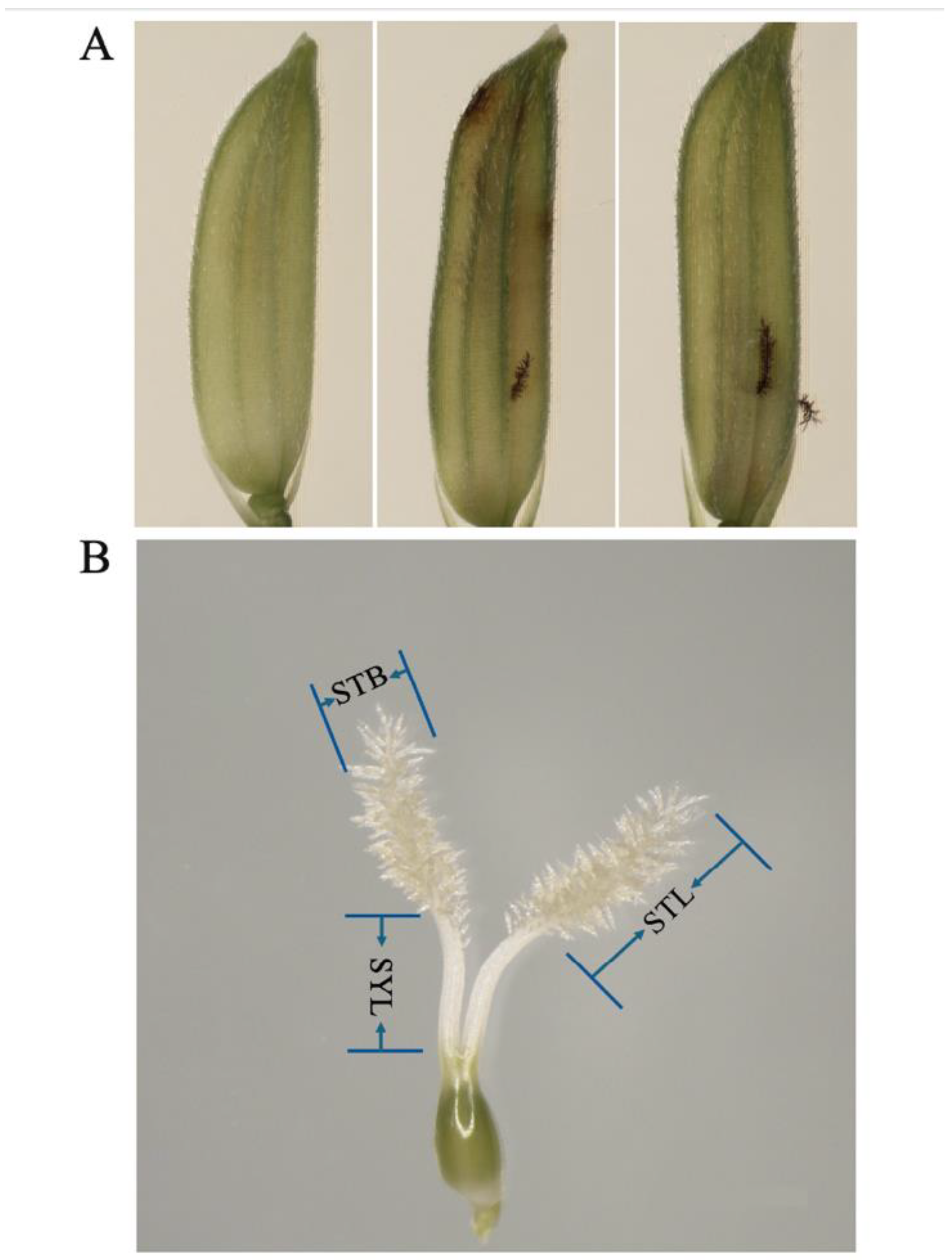

Table 1.
Identified QTL for stigma exsertion previously in rice.
| Source of mapping population | Population | chromosomes | QTLs | References |
|---|---|---|---|---|
| Aijiao Nante/P16 | F2 | Chr. 6 | es-1 | [35] |
| Dongxiang/Guichao2 | BC1 | Chr. 5, 8 | qPEST-5, 8 | [36] |
| Pei- kuh/W1944 | RIL | Chr. 5, 10 | qRES-5, 10 | [18] |
| Zaiyeqing8/ Jingxi17 | DH | Chr. 2, 3 | qPES-2, 3 | [37] |
| Asominori/IR24 | RIL | Chr. 3, 4, 6, 8, 11, 12 | qES-3, 4 | [38] |
| Zhenshan97B/IRAT109 | RIL | Chr. 1, 2, 4, 5, 8, 9, 12 | qPSES-1, 2, 5, 10, 12, qPDES-1a, 1b, 2, 4, 5, 8, 9, qPES-1a, 1b, 2, 5, 9, 12 | [39] |
| Nipponbare/Kasalath | BIL | Chr. 3, 4, 5 | qPES-3, 4, 5 | [40] |
| Hoshinohikari / IR24 | F2 | Chr. 3 | qES3 | [21] |
| 90 accessions | AMP | Chr. 1, 5, 6, 7, 8, 9, 10, 11 | qSSE-1, 6, 9, 10, qDSE-1, 5, 7, 8, 11, qPES-5, 7, 8, 9, 10 | [20] |
| Huhan1B/Ⅱ-32B | F2 | Chr. 3, 4, 7, 9 | qPSES-3, 7, 9, qPDES-3, 9, qPES-3, 4, 7, 9 | [41] |
| Nuo5/YouⅠB | F2 | Chr. 2, 5, 8 | qPES-2, 5, 8, qPES-2, 5, 8 | [42] |
| 50S/LianB | F2 | Chr. 3, 9, 12 | qSPES3, qPES-3, 9, 12 | [43] |
| T821B/G46B | F2 | Chr. 1, 2, 3, 7, 9 | qPES-1, 3, 7, 9, qPDES-2, 9, qPSES-1-1, 1-2, 9 | [44] |
| 60B/Liaojing9 | F2 | Chr. 1, 2, 5, 8, 9 | qPGCS-1, 8, qPGCD-8, 9, qPGCES-2,8 | [45] |
| II-32B/G46B | F2 | Chr. 1, 2, 5, 8 | qPES1, 2, 5, 8 | [46] |
| IR24/Asominori | Chr. 3 | GS3 | [47] | |
| Yuezaoxian6/II-32B | RIL | Chr. 1, 3, 5, 6, 7, 9 | qPDES-1, 3, 6, 7-1, 7-2, 9-1, 9-2, 9-3, qPSES-1, 5, 6, 7, 9-1, 9-2, 9-3 | [48] |
| ZX/CX29B | RIL | Chr. 1, 3, 6, 7, 9, 10, 12 | qDSE-1, 6a, 6b, 10, qSSE-1, 3, 6a, 6b, 7, 9, 12 | [49] |
| Zhenshan97B/9311 | BIL | Chr. 1, 2, 3, 5, 7, 8, 9 | qSSE-1, 5, 9, qDSE-1, 3, 5, 7, 8, qTSE-1, 2, 3a, 3b, 5a, 5b, 7, 8, 9 | [50] |
| HuhanlB/K17B | F2 | Chr. 5, 6, 7 | qPSES-5, qPDES-5, 6, 7, qPES-6 | [51] |
| XieqingzaoB / Zhonghui9308 | RIL | Chr. 1, 6, 10, 11 | qSSE-6, 11, qDSE-1a, 1b, 10, 11, qTSE-1, 11 | [52] |
| 217 CMS line | AMP | Chr. 3, 5, 6, 8, 10, 11, 12 | qDSE-5, 8, 10, 11, qTSE-3.1, 3.2, 6.1, 6.2, 8.1, 8.2, 8.3, 11, 12 | [53] |
| XieqingzaoB / Zhonghui9309 | NIL | Chr. 11 | qSSE11, qDSE11, qTSE11 | [54] |
| XieqingzaoB / Zhonghui9308 | CSSL | Chr. 5, 6, 10, 11 | qSSE-5, 10, 11, qDSE-10, 11, qTSE-5, 6, 10, 11 | [55] |
| DaS/D50 | F2 | Chr. 1, 2, 3, 4, 6, 7, 12 | qPSES-1, 2, 3.1, 3.2, 4, 12, qPDES-1, 2.1, 2.2, 4, 6.1, 6.2, 12, qPES-2.1, 2.2, 3, 4, 6.1, 6.2, 7, 12 | [56] |
| 533 accessions | AMP | Chr. 2, 3, 5, 8, 9 | qSSE-3, 5, 9, qDSE-5, 8, qTSE-2, 3, 5 | [57] |
| 115S/93S | F2 | Chr. 10 | qLESR10 | [58] |
| Gui 2136S/Nipponbare | F2 | Chr. 3 | qPES-3, qPDES-3, qPES-3 | [59] |
| XieqingzaoB/Zhonghui9308 | CSSL | Chr. 7 | qSSE7, qDSE7, qTSE7 | [60] |
| Akidawara/W0120 | F2 | Chr. 3, 8 | qSER-3, 8 | [61] |
| Huhan1B/II-32B | NIL | Chr. 7 | qSER-7 | [62] |
| ZS616/DS552 | F3 | Chr. 3, 4, 5, 6, 8, 11 | qSER-3.1, 3.2, 4.1, 5.1, 6.1, 8.1, 11.1 | [63] |
| 58B/Nipponbare | F2 | Chr.1, 2, 3, 4, 5, 7, 8, 10, 12 | qSPES-1, 2, 3, 4, 10, qDPES-1, 2, 5, 8, qPES-2, 7, 8, 12 | [64] |
| IRGC104387 | SSSL | Chr. 1, 3, 5, 9, 10 | qSER-1a, 1b, 3a, 3b, 5, 9, 10 | [65] |
| HJX74/O. rufipogon | SSSL | Chr. 3, 5, 6, 8, 10, 12 | qSERb3-1, 5-1, 6-1, 8-1, 12-1, qSERm5-1, 6-1, 8-1, 10-1 | [66] |
| Xiushui79/C Bao | RIL | Chr. 1, 6, 8, 9, 10, 12 | qPES-1, 6.1, 6.2, 8, 9, 10, 12.1, 12.2 | [67] |
| IR66897B | SSSL | Chr. 2, 3 | qSER-2a, 2b, 3a, 3b | [68] |
| 1892S/Yangdao6-xuan | RIL | Chr. 1, 2, 3, 4, 5, 7, 8 | qSSE-1, 2-1, 2-2, 4, 5, 7, 8, qDSE-1, 3, 4, 7, qTSE-1, 2, 3, 4, 7 | [69] |
| DaS/D50 | NIL | Chr. 4 | qSE4 | [70] |
| Zhenshan 97B/IRAT109 | RIL | Chr. 1, 2, 8 | qSSE-1, 2, 8, qDSE-1, 8, qTSE-1, 2, 8 | [71] |
| O. glaberrima | SSSL | Chr. 1, 3, 5, 8, 12 | qSER-1a, 1b, 3, 5, 8a, 8b, 12 | [72] |
| HJX74 | SSSL | Chr. 3 | qSER3a-sat | [73] |
| 02428/ZH464 | F2 | Chr. 2, 4 | qTSE-2, 4 | [74] |
| SG22/HJX74 | s-SSSL | Chr. 1 | qSERg-1b | [75] |
Table 2.
Identified QTL for stigma traits previously in rice.
| Source of mapping population | Population | chromosomes | QTLs | References |
|---|---|---|---|---|
| Pei-kuh/W1944 | RIL | Chr. 4, 6, 12 | qSTL-4, 6, qSTB-4, 12, qSYL-6 | [18] |
| 90 accessions | AMP | Chr. 3, 10 | qSTL-3, 10 | [20] |
| T821B/G46B | F2 | Chr. 1, 2, 3, 7, 9 | qSTB-6, 12, qSTL-3, 6, 7, 9-1, 9-2, qSYL-3, 6 | [44] |
| Milyang23/Akihikari | RIL | Chr. 1, 2, 3, 4, 6, 7, 10, 12 | qSTL-1, 3, 10, 12, qSTB-1, 2, 3, 4, 6, 12, qSYL-1, 4, 7 | [77] |
| Asominori/IR24 | RIL | Chr. 3, 4, 5, 7, 12 | qSTL-3-1, 3-2, 7, 12, qSTB-3, 5, 7, qSYL-3, 4 | [77] |
| Nipponbare/Kasalath | BIL | Chr. 2, 3, 7 | qSTL-2, 3, qSTB7, | [77] |
| IR64/Azucena | DHL | Chr. 1, 2, 3, 5, 9 | qSTL-3, 5, 9, qSTB-3, 5, 9, qSYL-1, 2, 3 | [77] |
| IR64 · Kinandang Patong | F2 | Chr. 1, 2, 3, 5 | qSTL-3-1, 3-2, 3-3, 5-1, 5-2, qSTB-2, 3, qSYL-1, 3 | [77] |
| Nipponbare/Kasalath | CSSL | Chr. 3 | qSTL3 | [78] |
| 48 accessions | AMP | Chr. 3, 4, 7, 10 | qSTL-3-1, 3-2, 3-3, qSYL10, qSSL-3, 7 | [22] |
| 227 accessions | AMP | Chr. 1, 2, 4, 6 | qSTL-1, 2-1, 2-2, 4, 6-1, 6-2 | [79] |
| Nipponbare/W630 | BRIL | Chr. 7, 8 | qSGL-7, 8, qSYL8 | [80] |
| 533 accessions | AMP | Chr. 3, 4, 8 | qSTL8, qSYL-3, 4 | [57] |
| SPR1/O. rufipogon Griff | BIL | Chr. 3, 8, 10 | qSTL-3A, 3S, 8A, 8S, 10S, qSTW-3S, 8S, 10S, qSTYL-8A, 10S | [81] |
| Xiushui79/C Bao | RIL | Chr. 1, 2, 3, 6, 7, 9, 10, 11, 12 | qSTL-2, 3, 6, 7, 9, 10, 11, 12, qTSSL-1, 2.1, 2.2, 3, 7, 9, 10, 11, 12 | [67] |
| IR64/OL | BIL | Chr. 1, 2, 3, 5, 8, 11 | qSTGL-2-1, 5-1, 8, 11-1, 11-2, qSTYL-1-1, 5-2, 8-1, qSTGB-1-1, 3-1 | [82] |
Disclaimer/Publisher’s Note: The statements, opinions and data contained in all publications are solely those of the individual author(s) and contributor(s) and not of MDPI and/or the editor(s). MDPI and/or the editor(s) disclaim responsibility for any injury to people or property resulting from any ideas, methods, instructions or products referred to in the content. |
© 2024 by the authors. Licensee MDPI, Basel, Switzerland. This article is an open access article distributed under the terms and conditions of the Creative Commons Attribution (CC BY) license (http://creativecommons.org/licenses/by/4.0/).
Copyright: This open access article is published under a Creative Commons CC BY 4.0 license, which permit the free download, distribution, and reuse, provided that the author and preprint are cited in any reuse.


