

Submitted:
28 October 2024
Posted:
30 October 2024
You are already at the latest version
Abstract
This study describes the efficient synthesis of five dinitrochalcones (DNCH) using an ultrasonic bath as an unconventional method to improve reaction yields and reduce reaction times. The Claisen-Schmidt condensation of nitroacetophenones and nitrobenzaldehydes was carried out in a cyclohexane-methanol solvent system under ultrasonic irradiation, achieving yields between 56% and 92%. The application of ultrasound not only accelerated the reaction but also improved the overall efficiency compared to conventional methods such as magnetic stirring. Characterization of the synthesized compounds was performed by NMR spectroscopy, confirming the consistency of their structures. Thus, it is confirmed that obtaining DNCH with a nitro group in ortho provide by ultrasonic irradiation is an energetically efficient and environmentally friendly alternative.
Keywords:
Dinitrochalcones
; Ultrasound
; Claisen-Schmidt Condensation
1. Introduction
The synthesis of organic compounds with relevant biological and pharmacological properties is an area of great interest in synthetic chemistry [1]. Chalcones, a type of α,β-unsaturated compounds, have been shown to have a wide range of biological activities, including anti-inflammatory, antioxidant, and antitumor properties, among others [2,3,4,5]. These biological activities are determined by the type of substituent these molecules possess [6].
Among the substituents is the nitro group (NO2), which is a functional group that attracts electrons due to the positive charge of nitrogen. In aromatic rings, resonance with the nitro group deactivates certain positions and alters the polarity of the molecules, which can favor interaction with nucleophilic sites of enzymes, inhibiting their activity [7]. In this context, the synthesis of chalcones containing the nitro group in the rings of the structure is of particular interest, since these compounds may exhibit improved biological properties compared to their analogs that do not possess substituents [8]. However, the synthesis of these compounds often requires drastic reaction conditions, such as the use of strong acids or bases, which can limit their applicability [9]. This has led researchers to try alternative routes of synthesis, among which are methods that apply green chemistry paradigms, an example of which is ultrasound [10,11].
Ultrasound is a technique that has gained popularity in organic synthesis due to its ability to accelerate and improve the efficiency of chemical reactions [12]. Ultrasound is a form of energy produced when a pressure wave propagates through a medium, such as a liquid or gas. When ultrasound energy is applied to a chemical system, physical and chemical phenomena are generated that can influence the reaction. These phenomena include the formation of gas bubbles, the generation of free radicals, and the creation of more favorable reaction conditions, such as the dissolution of insoluble substances and the reduction of the reaction temperature [13,14]. In this context, ultrasound-induced chemistry can be accurately defined as cavitation chemistry. Cavitation involves the formation of micrometer-sized voids or bubbles in a liquid when a sufficient pressure drop occurs that alters its cohesive forces. The violent collapse of these bubbles to re-establish intermolecular interactions releases a large amount of energy, which explains the effects mentioned above. Although there are several methods for generating cavitation, acoustic cavitation is the most widely recognized [15,16,17,18,19,20,21].
The application of ultrasound in organic synthesis has proven to be effective in improving the efficiency and selectivity of reactions, as well as reducing reaction times and eliminating toxic residues. In addition, ultrasound can be used for the synthesis of compounds that cannot be obtained by conventional methods, such as the synthesis of compounds that require extreme reaction conditions or the synthesis of compounds that are unstable under normal conditions [22,23,24].
In previous work, we reported the synthesis of three chalcone isomers using conventional mechanical stirring conditions, as well as the use of a strong base such as sodium hydroxide in methanol at 0 °C (Figure 1) [25].
The objective of this work was to perform the synthesis of five dinitrosubstituted chalcones in rings A and B (compounds 3a-e) (Figure 2) through Claisen-Schmidt condensation between o, m and p-nitroacetophenones (1a-c) and the corresponding o, m and p-nitrobenzaldehydes (2a-c) using a nonconventional method by irradiation with an ultrasound bath. This approach seeks to decrease the drastic reaction conditions and to be aligned with the green chemistry paradigm.
2. Materials and Methods
2.1. General
All the reagents used in the synthesis and spectroscopic characterization of DNCH were of analytical and spectroscopic grade respectively (Sigma Aldrich) and were used without prior purification. Thin layer chromatography (TLC) was used to monitor the reactions, which were performed on a Merck silica gel 60 chromatofold with fluorescent indicator 254 nm, with a thickness of 0.2 mm. The melting points were determined in SMP 10 equipment, of the STUART brand, using the capillary technique and are not corrected. The NMR spectra were performed on a Bruker AscendTM 600 MHz NMR spectrometer. Chemical shifts are expressed in parts per million (ppm) and are referenced to TMS as an internal standard, coupling constants (J) are expressed in Hertz. The ultrasonic irradiation generator with a power of 100 W was a Cole Parmer ultrasonic cleaner model 08891-21.
2.2. Procedure for the Synthesis of Dinitrochalcones (DNCH)
The procedure for synthesis of DNCH was carried out by Claisen-Schmidt condensation between the respective o-nitroacetophenone (1a), m-nitroacetophenone (1b), p-nitroacetophenone (1c) and the respective o-nitrobenzaldehyde (2a), m-nitrobenzaldehyde (2b), p-nitrobenzaldehyde (2c). All nitroacetophenones and nitrobelzaldehydes were added equimolar in all reactions.
The technique employed consisted of adding 10 mmol of the corresponding nitroacetophenones together with their carbonate equivalents. The mixture was then solubilized with 10 mL of methanol in a 50 mL flask until the nitroacetophenones were completely dissolved. Next, 10 mmol of the corresponding benzaldehyde was added. Subsequently, 1 mL of cyclohexane was added and subjected to ultrasound irradiation for the time and at the temperature specified in the results table. Once the reaction was finished, the solid obtained was filtered and washed with cold water. Finally, the product was purified.
3a (E)-1,3-bis(2-nitrophenyl)prop-2-en-1-one. (56%) was obtained as a white solid; mp: 140–142 ◦C [lit. 136–137 ◦C][26]; 1H NMR (600 MHz, DMSO-d6) δ = 8.25 (d, J = 8.2 Hz, 1H), 8.08 (d, J = 8.1 Hz, 1H), 8.01 (d, J = 7.8 Hz, 1H), 7.95 (t, J = 7.5 Hz, 1H), 7.83 (m, 2H), 7.76 (d, J = 7.5 Hz, 1H), 7.69 (t, J = 7.9 Hz, 1H), 7.66 (d, J = 16.1 Hz, 1H), 7.24 (d, J = 16.1 Hz, 1H); DEPTQ NMR (150 MHz, DMSO-d6) δ = 193.3, 149.3, 147.4, 142.1, 135.8, 135.5, 134.9, 132.7, 132.4, 130.5, 130.1, 125.8, 125.5, 124.3, 124.1.
3b (E)-1-(2-nitrophenyl)-3-(3-nitrophenyl)prop-2-en-1-one. (92%) was obtained as a white solid; mp: 145–147 ◦C [lit. 143–145 ◦C][26]; 1H NMR (600 MHz, DMSO-d6) δ = 8.64 (s, 1H), 8.29 (m, 3H), 7.97 (t, J = 7.5 Hz, 1H), 7.88 (t, J = 7.8 Hz, 1H), 7.79 (d, J = 7.5 Hz, 1H), 7.76 (d, J = 8.0 Hz, 1H), 7.63 (d, J = 16.3 Hz, 1H), 7.56 (d, J = 16.3 Hz, 1H); DEPTQ NMR (150 MHz, DMSO-d6) δ = 193.1, 149.3, 147.5, 144.1, 136.9, 136.1, 135.4, 132.5, 131.3, 130.0, 129.1, 125.9, 125.5, 124.5, 123.9.
3c (E)-1-(2-nitrophenyl)-3-(4-nitrophenyl)prop-2-en-1-one. (86%) was obtained as a yellow solid; mp: 175–177 ◦C [lit. 168–169 ◦C][26]; 1H NMR (600 MHz, DMSO-d6) δ = 8.23 (m, 3H), 8.03 (d, J = 8.8 Hz, 2H), 7.93 (t, J = 7.5 Hz, 1H), 7.84 (t, J = 7.7 Hz, 1H), 7.76 (d, J = 7.5 Hz, 1H), 7.53 (d, J = 16.2 Hz, 1H), 7.48 (d, J = 16.2 Hz, 1H); DEPTQ NMR (150 MHz, DMSO-d6) δ = 193.0, 149.3, 147.5, 143.6, 141.3, 135.9, 135.5, 132.6, 130.8, 130.2, 130.0, 125.6, 124.9.
3d (E)-3-(2-nitrophenyl)-1-(3-nitrophenyl)prop-2-en-1-one. (65%) was obtained as a white solid; mp: 160 – 162 °C [lit. 159–161 ◦C] [26]; 1H NMR (600 MHz, DMSO-d6) δ 9.35 (t, J = 1.9 Hz, 1H), 9.09 (m, 1H), 9.02 (m, 1H), 8.73 (dd, J = 7.9, 1.3 Hz, 1H), 8.62 (dd, J = 8.2, 1.1 Hz, 1H), 8.57 (d, J = 15.5 Hz,1H), 8.46 (d, J = 15.5 Hz, 1H), 8.38 (m, 2H), 8.24 (m, 1H); RMN DEPTQ (150 MHz, DMSO-d6 ) δ = 188.6, 149.7, 149.2, 140.9, 139.2, 135.8, 134.7, 132.2, 131.6, 130.6, 130.4, 128.6, 126.8, 125.7, 124.6.
3e (E)-1,3-bis(3-nitrophenyl)prop-2-en-1-one. (88%) was obtained as a yellow solid; p.f. 214 – 216 °C [lit. 210 – 211 ◦C] [27]; 1H NMR (600 MHz, DMSO-d6): δ 8.87 (s, 1H), 8.81 (s, 1H), 8.64 (d, J = 7.7 Hz, 1H), 8.52 (m, 1H), 8.38 (d, J = 7.7 Hz, 1H), 8.30 (m, 1H), 8.22 (d, J = 15.7 Hz, 1H), 7.94 (d, J = 15.7 Hz, 1H), 7.90 (d, J = 6 Hz, 1H), 7.77 (t, J = 8.0 Hz, 1H); RMN DEPTQ (150 MHz, DMSO-d6) δ = 188.6, 149.4, 149.2, 143.8, 139.4, 137.3, 136.2, 135.8, 131.6, 131.3, 128.5, 125.9, 125.2, 124.2, 123.9.
3. Results
Initially, we proceeded to optimize the reaction conditions avoiding drastic conditions taking as a starting point the reaction of m-nitroacetophenone (1b) and m-nitrobenzaldehyde (2b) to obtain m,m-dinitrochalcone (3e) reported by [27], for the optimization of the reaction several variations in the reaction conditions were tested, which are summarized in Table 1.
By way of comparison, a protocol was established where conventional conditions were established, using reflux (experiments 2 and 3). On the other hand, the effect of the base was tested by comparing the effectiveness of the reaction in the presence of NaOH, K2CO3, Na2CO3, Li2CO3, Ce2CO3, and Ca2CO3.
The same methanol/cyclohexane mixture was employed as the reaction medium for the synthesis of the remaining isomeric DNCH. However, experimental modifications in temperature were necessary to optimize the yield of the reactions. The optimum conditions for obtaining each product are summarized in Figure 2 and Table 2.
4. Discussion
The synthesis of DNCH using ultrasound, presented in this work, stands out for avoiding drastic reaction conditions, aligning with principle 6 of green chemistry (energy efficiency) [28]. The optimization of experimental conditions, detailed in Table 1 and Table 2, showed several observations regarding reaction efficiency and factors influencing yields. Although experiments initially included both magnetic stirring and refluxing (Table 1), conventional synthesis methods, to establish a point of comparison with ultrasonic activation. Magnetic stirring, performed at room temperature, and refluxing at elevated temperatures, are widely used in organic synthesis due to their ability to efficiently promote chemical reactions under controlled conditions. However, these methods often require long reaction times and can result in low yields, confirmed in this work. For example, magnetic stirring with NaOH did not produce any quantifiable yields, while refluxing, although slightly increasing yields, kept them at low values (25% and 29% with NaOH and K₂CO₃, respectively, in 240 min). These results reflect the limitations of conventional methods.
In contrast, ultrasound irradiation allowed a significant reduction of the reaction time to 60 min or less, increasing the yields in most of the experiments carried out by this non-conventional technique. Ultrasonic cavitation and the generation of free radicals may explain this improvement in efficiency [29]. These effects facilitate the cleavage and formation of bonds, promoting Claisen-Schmidt condensation between nitroacetophenones and nitrobenzaldehydes.
The use of different bases also had a crucial impact on the reaction yields. Optimization showed that the most effective base was Na₂CO₃, with a yield of 88% (experiment 7), while other bases such as K₂CO₃ and Li₂CO₃ resulted less efficient, with yields of 49% and 48%, respectively. This behavior may be related to the strength and solubility of the bases in the reaction system. Thus, Na₂CO₃ appears to provide an optimal balance between the catalysis of the reaction and the formation of undesired side products, a critical aspect to ensure the selectivity of the synthesis.
The solvent played a crucial role in optimizing the yields. The combination of methanol and cyclohexane markedly increased the yields compared to using methanol alone, as observed when comparing experiments 4 and 5 (22% vs 49%). Cyclohexane probably acted as a co-solvent, enhancing the solubilization of carbonates and facilitating better interaction between the reagents and the base. Something similar has been reported previously, where cyclohexane, in solvent mixtures, is used as a surfactant to improve the efficiency of reactions by increasing the accessibility of the substrate to the catalysts [30,31]. This surface effect is a concrete example of how solvents not only dilute the reactants but also directly influence the reaction dynamics.
On the other hand, Table 2 presents the yields of DNCH synthesized under optimal ultrasound conditions. An analysis of these data reveals a remarkable influence of the position of the nitro groups in the aromatic rings on the yields and reaction conditions. Chalcones with at least one nitro group in ortho position (3a-3d) show yields between 56% and 92%, while chalcone (3e), with nitro groups in meta position on both rings, reached a yield of 88%, although it required a higher temperature (60 °C) to optimize the reaction in only 30 min. This behavior can be attributed to the inductive effect of the nitro group, which increases the electrophilic character of the carbonyl carbon, favoring condensation, while the higher temperature required for (3e) could be related to a lower reactivity of the target positions.
In particular, compound (3b), with a nitro group in the ortho position on one ring and meta on the other, presented the highest yield (92%). This structural configuration may generate a favorable combination of inductive and steric effects that optimize the reactivity of the reagents. The reactivity also seems to be influenced by the possibility that the nitro groups in the ortho position facilitate the formation of intramolecular interactions, reducing the energetic barriers of the reaction.
5. Conclusions
The synthesis of five isomers of DNCH (3a-e) was achieved, decreasing the drastic reaction conditions, using ultrasound and with the addition of a co-solvent that optimizes the interaction of the organic phase with the basic catalyst. The spectroscopic characterization of the obtained products agrees with the expected structures. Differences were found in the reaction conditions necessary to optimize the synthesis of each of the compounds, which is attributed, in principle, to the electroattracting effect exerted by the nitro group on the electronic cloud of the aromatic systems and which depends on the relative position of the nitro group concerning the corresponding carbonyl.
Supplementary Materials
The following supporting information can be downloaded at the website of this paper posted on Preprints.org, Figure S1: title; Table S1: title; Video S1: title.
Author Contributions
Conceptualization, A.Y.H. and N.R.C; methodology, C.E.L.G.; software, Q.T.S.; validation, M.A.V.R., C.E.L.G., and N.R.C.; formal analysis, A.G.R.; investigation, A.Y.H.; resources, O.H.A; data curation, E.M.R.R.; writing—original draft preparation, A.Y.H; writing—review and editing, L.F.R.F.; visualization, E.A.M.; supervision, N.R.C; project administration, A.G.R; funding acquisition, C.E.L.G.
Funding
This research received no external funding.
Data Availability Statement
The data presented in the study is available in the article.
Acknowledgments
We thank CONAHCyT for a postdoctoral fellowship for AYH.
Conflicts of Interest
The authors state that they have no financial interests or personal relationships that could have influenced the research presented in this paper.
References
- Campos, K. R.; Coleman, P. J.; Alvarez, J. C.; Dreher, S. D.; Garbaccio, R. M.; Terrett, N. K.; Tillyer, R. D.; Truppo, M. D.; Parmee, E. R. The Importance of Synthetic Chemistry in the Pharmaceutical Industry. Science (80-. ). 2019, 363, eaat0805. [Google Scholar] [CrossRef] [PubMed]
- Rajendran, G.; Bhanu, D.; Aruchamy, B.; Ramani, P.; Pandurangan, N.; Bobba, K. N.; Oh, E. J.; Chung, H. Y.; Gangadaran, P.; Ahn, B.-C. Chalcone: A Promising Bioactive Scaffold in Medicinal Chemistry. Pharmaceuticals 2022, 15, 1250. [Google Scholar] [CrossRef] [PubMed]
- Narwal, S.; Devi, B.; Dhanda, T.; Kumar, S.; Tahlan, S. Exploring Chalcone Derivatives: Synthesis and Their Therapeutic Potential. J. Mol. Struct. 2024, 137554. [Google Scholar] [CrossRef]
- Salehi, B.; Quispe, C.; Chamkhi, I.; El Omari, N.; Balahbib, A.; Sharifi-Rad, J.; Bouyahya, A.; Akram, M.; Iqbal, M.; Docea, A. O. Pharmacological Properties of Chalcones: A Review of Preclinical Including Molecular Mechanisms and Clinical Evidence. Front. Pharmacol. 2021, 11, 592654. [Google Scholar] [CrossRef]
- Michalkova, R.; Mirossay, L.; Kello, M.; Mojzisova, G.; Baloghova, J.; Podracka, A.; Mojzis, J. Anticancer Potential of Natural Chalcones: In Vitro and in Vivo Evidence. Int. J. Mol. Sci. 2023, 24, 10354. [Google Scholar] [CrossRef]
- Salem, M. S.; Hussein, R. A.; El-Sayed, W. M. Substitution at Phenyl Rings of Chalcone and Schiff Base Moieties Accounts for Their Antiproliferative Activity. Anti-Cancer Agents Med. Chem. (Formerly Curr. Med. Chem. Agents) 2019, 19, 620–626. [Google Scholar] [CrossRef]
- Noriega, S.; Cardoso-Ortiz, J.; López-Luna, A.; Cuevas-Flores, M. D. R.; Flores De La Torre, J. A. The Diverse Biological Activity of Recently Synthesized Nitro Compounds. Pharmaceuticals 2022, 15, 717. [Google Scholar] [CrossRef]
- Gómez-Rivera, A.; Aguilar-Mariscal, H.; Romero-Ceronio, N.; Roa-de la Fuente, L. F.; Lobato-García, C. E. Synthesis and Anti-Inflammatory Activity of Three Nitro Chalcones. Bioorg. Med. Chem. Lett. 2013, 23, 5519–5522. [Google Scholar] [CrossRef]
- Leitão, E. Chalcones: Retrospective Synthetic Approaches and Mechanistic Aspects of a Privileged Scaffold. Curr. Pharm. Des. 2020, 26, 2843–2858. [Google Scholar] [CrossRef]
- Marotta, L.; Rossi, S.; Ibba, R.; Brogi, S.; Calderone, V.; Butini, S.; Campiani, G.; Gemma, S. The Green Chemistry of Chalcones: Valuable Sources of Privileged Core Structures for Drug Discovery. Front. Chem. 2022, 10, 988376. [Google Scholar] [CrossRef]
- Rosa, G. P.; Seca, A. M. L.; Barreto, M. do C.; Pinto, D. C. G. A. Chalcone: A Valuable Scaffold Upgrading by Green Methods. ACS Sustain. Chem. Eng. 2017, 5, 7467–7480. [Google Scholar] [CrossRef]
- Mason, T. J. Ultrasound in Synthetic Organic Chemistry. Chem. Soc. Rev. 1997, 26, 443–451. [Google Scholar] [CrossRef]
- Suslick, K. S.; Price, G. J. Applications of Ultrasound to Materials Chemistry. Annu. Rev. Mater. Sci. 1999, 29, 295–326. [Google Scholar] [CrossRef]
- Yao, Y.; Pan, Y.; Liu, S. Power Ultrasound and Its Applications: A State-of-the-Art Review. Ultrason. Sonochem. 2020, 62, 104722. [Google Scholar] [CrossRef]
- Cravotto, G.; Cintas, P. Power Ultrasound in Organic Synthesis: Moving Cavitational Chemistry from Academia to Innovative and Large-Scale Applications. Chem. Soc. Rev. 2006, 35, 180–196. [Google Scholar] [CrossRef]
- Luche, J.-L. Sonochemistry: From Experiment to Theoretical Considerations. Adv. sonochemistry 1993, 3, 85–124. [Google Scholar]
- Cravotto, G.; Cintas, P. Introduction to Sonochemistry: A Historical and Conceptual Overview. Handb. Appl. Ultrasound 2011, 23–40. [Google Scholar]
- Chen, C.; Anchecta, K.; Lee, Y.-D.; Dahlgaard, J. J. A Stepwise ISO-Based TQM Implementation Approach Using ISO 9001: 2015. In Manag. Prod. Eng. Rev.; 2016; 4. [Google Scholar]
- McNamara III, W. B.; Didenko, Y. T.; Suslick, K. S. Sonoluminescence Temperatures during Multi-Bubble Cavitation. Nature 1999, 401, 772–775. [Google Scholar] [CrossRef]
- Flannigan, D. J.; Suslick, K. S. Inertially Confined Plasma in an Imploding Bubble. Nat. Phys. 2010, 6, 598–601. [Google Scholar] [CrossRef]
- Martínez, R. F.; Cravotto, G.; Cintas, P. Organic Sonochemistry: A Chemist’s Timely Perspective on Mechanisms and Reactivity. J. Org. Chem. 2021, 86, 13833–13856. [Google Scholar] [CrossRef]
- Brahmachari, G.; Nayek, N.; Mandal, M.; Bhowmick, A.; Karmakar, I. Ultrasound-Promoted Organic Synthesis-A Recent Update. Curr. Org. Chem. 2021, 25, 1539–1565. [Google Scholar] [CrossRef]
- Gharat, N. N.; Rathod, V. K. Ultrasound-Assisted Organic Synthesis. In Green sustainable process for chemical and environmental engineering and science; Elsevier; pp. 1–41.
- Draye, M.; Chatel, G.; Duwald, R. Ultrasound for Drug Synthesis: A Green Approach. Pharmaceuticals 2020, 13, 23. [Google Scholar] [CrossRef] [PubMed]
- Hidalgo, A. Y.; Velasco, M.; Sánchez-Lara, E.; Gómez-Rivera, A.; Vilchis-Reyes, M. A.; Alvarado, C.; Herrera-Ruiz, M.; López-Rodríguez, R.; Romero-Ceronio, N.; Lobato-García, C. E. Synthesis, Crystal Structures, and Molecular Properties of Three Nitro-Substituted Chalcones. Crystals 2021, 11, 1589. [Google Scholar] [CrossRef]
- Kinkle, P.; Gibian, H. Uber Chalkone. Chem. Ber 1961, 94, 26–38. [Google Scholar]
- Wei, W.; Qunrong, W.; Liqin, D.; Aiqing, Z.; Duoyuan, W. Synthesis of Dinitrochalcones by Using Ultrasonic Irradiation in the Presence of Potassium Carbonate. Ultrason. Sonochem. 2005, 12, 411–414. [Google Scholar] [CrossRef]
- Anastas, P.; Eghbali, N. Green Chemistry: Principles and Practice. Chem. Soc. Rev. 2010, 39, 301–312. [Google Scholar] [CrossRef]
- Merouani, S.; Hamdaoui, O.; Rezgui, Y.; Guemini, M. Modeling of Ultrasonic Cavitation as an Advanced Technique for Water Treatment. Desalin. Water Treat. 2015, 56, 1465–1475. [Google Scholar] [CrossRef]
- Andrade, S. M.; Costa, S. M. B.; Pansu, R. Structural Changes in W/O Triton X-100/Cyclohexane-Hexanol/Water Microemulsions Probed by a Fluorescent Drug Piroxicam. J. Colloid Interface Sci. 2000, 226, 260–268. [Google Scholar] [CrossRef]
- Cheng, S.; Han, F.; Wang, Y.; Yan, J. Effect of Cosurfactant on Ionic Liquid Solubilization Capacity in Cyclohexane/TX-100/1-Butyl-3-Methylimidazolium Tetrafluoroborate Microemulsions. Colloids Surfaces A Physicochem. Eng. Asp. 2008, 317, (1–3). [Google Scholar] [CrossRef]
Figure 1.
Dinitrochalcones (DNCH).
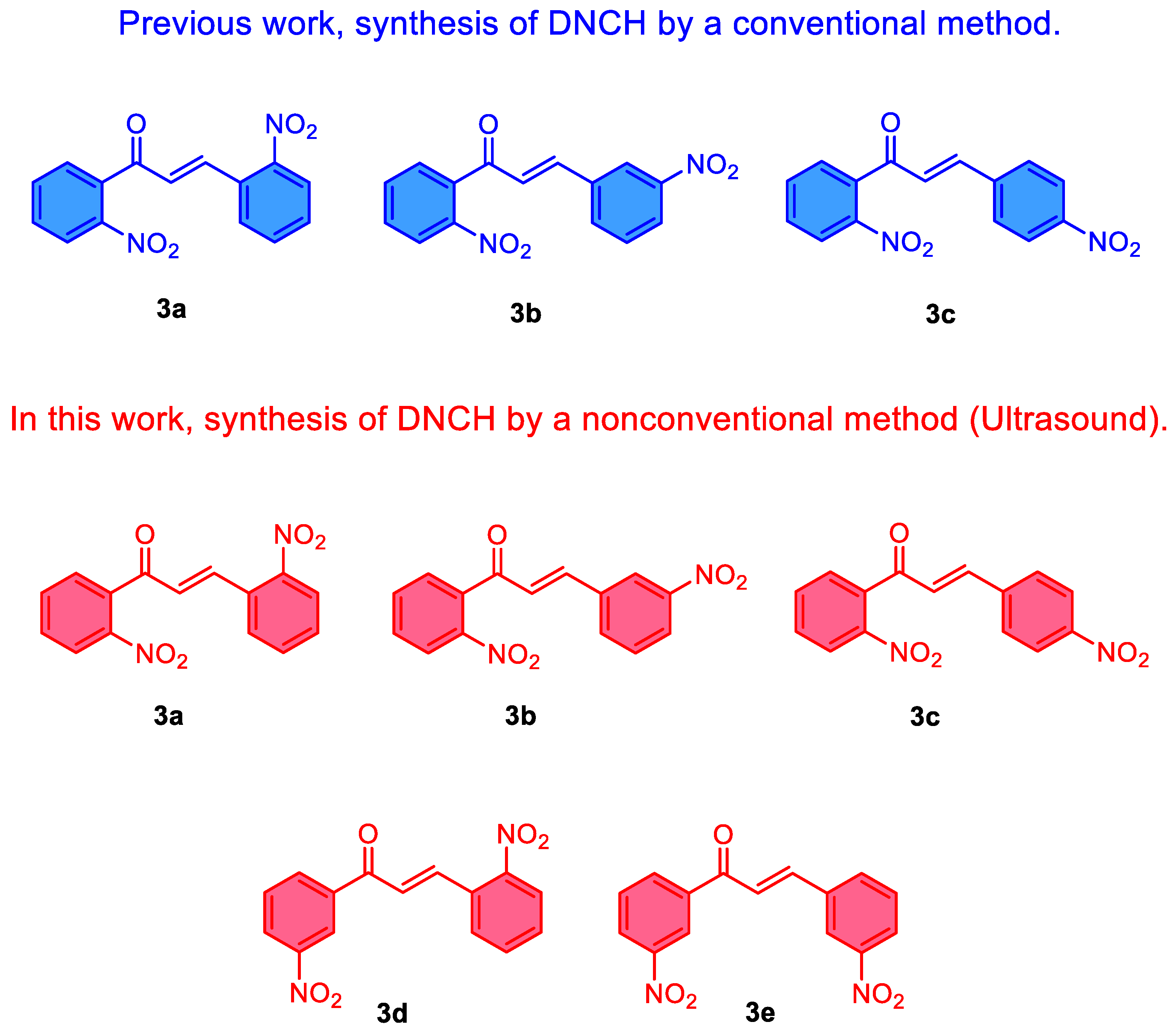
Figure 2.
General reaction scheme for obtaining the 3a-e compounds.


Table 1.
This is a table. Tables should be placed in the main text near to the first time they are cited.
Table 1.
This is a table. Tables should be placed in the main text near to the first time they are cited.
| Entry* | Activation method | Base | Solvent | Time | Yield* | |
|---|---|---|---|---|---|---|
| 1** | Magnetic stirring | NaOH (2 Eq.) | Methanol | 120 | ---- | |
| 2 | Reflux | NaOH (2 Eq.) | Methanol | 240 | 25 | |
| 3 | Reflux | K2CO3 (0.3 Eq.) | Methanol | 240 | 29 | |
| 4 | Ultrasound | K2CO3 (0.3 Eq.) | Methanol | 60 | 22 | |
| 5 | Ultrasound | K2CO3 (0.6 Eq.) | Methanol/ cyclohexane |
60 | 49 | |
| 6 | Ultrasound | K2CO3 (0.9 Eq.) | Methanol/ cyclohexane |
60 | 44 | |
| 7 | Ultrasound | Na2CO3 (0.4 Eq.) | Methanol/ cyclohexane |
30 | 88 | |
| 8 | Ultrasound | Li2CO3 (0.4 Eq.) | Methanol/ cyclohexane |
30 | 48 | |
| 9 | Ultrasound | Cs2CO3 (0.4 Eq.) | Methanol/ cyclohexane |
15 | 80 | |
| 10 | Ultrasound | Ca2CO3 (0.4 Eq.) | Methanol/ cyclohexane |
60 | ---- | |
* The experiment was conducted at a temperature of 60 °C. ** The experiment was conducted at room temperature.
Table 2.
DNCH synthesized by ultrasonication.
| DNCH | Time (min) | Temperature (°C) | Yield (%) | m.p (°C) |
|---|---|---|---|---|
| 3a | 60 | 0 | 56 | 140-142 |
| 3b | 60 | 0 | 92 | 145-147 |
| 3c | 60 | 0 | 86 | 175-177 |
| 3d | 60 | 0 | 65 | 160-162 |
| 3e | 30 | 60 | 88 | 214-216 |
Disclaimer/Publisher’s Note: The statements, opinions and data contained in all publications are solely those of the individual author(s) and contributor(s) and not of MDPI and/or the editor(s). MDPI and/or the editor(s) disclaim responsibility for any injury to people or property resulting from any ideas, methods, instructions or products referred to in the content. |
© 2024 by the authors. Licensee MDPI, Basel, Switzerland. This article is an open access article distributed under the terms and conditions of the Creative Commons Attribution (CC BY) license (http://creativecommons.org/licenses/by/4.0/).
Copyright: This open access article is published under a Creative Commons CC BY 4.0 license, which permit the free download, distribution, and reuse, provided that the author and preprint are cited in any reuse.


