
Submitted:
26 October 2024
Posted:
28 October 2024
You are already at the latest version
Abstract
The study is part of the research on the advanced envelope systems aimed at the interaction with the principles of the environmental sustainability at a functional and energetic level, of the reduction of consumption and of polluting emissions. The purpose of the study concerns the analysis of the multi-layer façade systems defined, in general, by the execution of double-skin façades integrated by the devices capable of gaining and transforming the external and internal environmental loads. The methodology concerns the detection of the main functional modes and the proposal of a scientific categorization of the types of multi-layer façade systems, through the examination of experimental case studies. The objective is to determine, as a result of the study, a reference contribution for researchers, manufacturers and expert designers engaged in the field of sustainability combined with the advanced façade systems, detecting the analysis criteria focused on the constructive and functional aspects, transferable also to situations of diffuse character and with different uses. In addition, the results of the study are oriented to provide a scientific reference for subsequent research on the analytical evaluation with respect to the reduction of energy consumption and environmental comfort conditions.
Keywords:
building sustainability
; advanced façade systems
; envelope technical skins
; environmental interaction
; component design
; technology transfer
1. Introduction
The study under investigation examines the potentialities of the advanced envelope systems with respect to the principles of sustainability aimed at environmental interaction procedures, directed at the calibration of the climatic stresses, the containment of dissipation and the aid of renewable energy sources. The advanced envelope systems under investigation, expressed as an evolution of the façade systems (as an evolved configuration of the curtain wall, within the geometric and material continuity of the light façades), are carried out with respect to the contemporary buildings of an experimental nature (with especially tertiary and commercial uses), in customized forms and in analogy with the notion of the machine-envelope [1]. The analysis considers the advanced envelope systems as mechanical bodies, active diaphragms and membranes that promote or hinder exchanges (luminous, thermal, aeriform and acoustic) with the external environment, playing a role in energy regulation. Furthermore, the analysis observes the construction and use of techniques, components and functional devices aimed at both the reduction of losses or the accumulation of heat (resulting from radiation), and the dynamic selection of sunlight and the calibration of natural light. Therefore, the study of the envelope makes explicit the physical, material and performance contents according to the criteria of action towards both energy and environmental conditions, and ergonomic conditions through the procedures of reflection, capture and diffusion of the stresses external or internal to the built spaces [2]. The research focuses on the passive type of transformation, aimed at accumulating and distributing the energy produced by solar radiation without the use of plant equipment and without the contribution of devices (in the form of collectors) aimed at integrating and conveying heat, natural light or convection phenomena related to the airflows. The applied technologies and, in particular, the components and devices of the envelope are assumed with respect to the processes of eco-efficient interaction and permeability towards thermo-hygrometric, light and air stresses (determining the criteria of energy and environmental control of a selective and dynamic type), with the possibility of regulating the flows and conveying them in the overall functioning of the construction. In this experimental scenario, the advanced envelope systems are studied as mediating and reacting apparatuses towards external loads, in accordance with settlement needs and requirements (as an environmentally conscious design activity) [3]. Specifically, the study focuses on multi-layer envelope systems (understood as multiple-skin façades), whereby the combination of the planar surfaces generates equipment with greenhouse effect, chimney effect and natural ventilation (in the form of double-skin façades): then, performance is concretized on the basis of treatment practices (thermal, chemical and surface), layering and coating (acting on the transmission of visible, solar and thermal radiation, especially with reference to the infrared spectral field) and deposition on the perimeter enclosures [4]. With respect to the enclosure elements, the application focuses on the physic of the glazed, combined and multi-layered surfaces, which experimental research tends to transform into dense, intelligent systems interfaces: and the main materials constituting the external surfaces are composed according to their processes of change from stable entities to designable entities according to a particular performance program [5] (p. 42). In this case, the application of the materials of the envelope, in the form of projectable entities, is structured with respect to the outcomes of the solutions in which functions tend to become complex (in a controlled and managed manner) and articulated with each other, realizing multiple performances through the correlation of different agents and layers. The methodological structure of the study intends to examine the advanced envelope systems towards the principles of the environmental and energy sustainability through:
- the drafting of an explanatory and operational reference contribution, in the absence of cognitive and instrumental supports (within the international scientific and academic literature) capable of exposing the typological, functional and constructive configuration of the systems under examination on the basis of the investigation around the experimental applications towards new buildings;
- the use of the executive re-elaboration of the systems as a technical tool for understanding and knowledge of the functional modes and sustainable procedures;
- the drafting of a technical guide to understanding the construction and functional modes, focusing the analysis on the design and construction aspects;
- the definition of the main functional typologies, established on the basis of the analysis conducted on the experimental case studies, with the aim of achieving at a categorization of the performance and executive potentialities;
- the possibilities of technology transfer towards common construction, with the aim of increasing environmental and energy sustainability also through applications on the external perimeter enclosures of the existing buildings;
2. Materials and Methods
2.1. Scientific Framework: Environmental Constitution of the Multi-Layer Façade Systems
The advanced envelope systems are specified in the constitution of integrated functional components with the objective of receiving, guiding and selecting the environmental loads to realize calibrated ergonomic conditions in the built spaces. For this, the systems are endowed with engineering performances (such as multiple environmental performances), are articulated in the form of environmentally responsive walls (capable of actively responding to environmental stresses through perceptual and organic contact with the climatic conditions) and as engineered walls (such as equipment that can be operated by mechanical devices), aimed at regulating the transmission of heat, light and natural ventilation, along with the attenuation of wind and acoustic loads [8]. The multi-layer façade systems (such as multiple-skin façades), as in the form of double-skin façades, are determined by the cavity between the inner curtain and the outer screen, for thermal and acoustic insulation, for ventilation and for the insertion of functional devices (such as sunscreens) and, also, plant ducts. The cavity between the two enclosures constitutes a ventilated cavity that can be used according to certain modes of functioning aimed at controlling external climatic and environmental stresses in order to regulate the conditions of the interior spaces [9]. In this regard, the environmental and adaptive strategy processes the envelope systems according to their metabolic efficacy and instinctual reactive capacity, configuring them as intelligent skins endowed with automatic performance (by means of functional criteria of autonomous regulation) and membranes defined as biological skins (active against external agents by means of sensors and protective devices). In particular, the use of elements with dynamic and reactive behaviour assumes the use of the surfaces for the control of solar radiation, consisting of filtering or screening sections capable of modulating their transparency according to the level and distribution of natural luminosity in interior spaces [10].
The development of the systems thus exposes the techno-organic qualities directed at the functioning of vertically developed buildings, through the interpretation and assimilation of environmental conditions in a manner combined with the use of evolved techniques (in organi-tech form): the study includes experimentation around artificial (or organic) systems integrated with natural systems, as tools for the accumulation, conveyance, protection and calibration of the passive energies that can provide buildings with forms of heating, air conditioning and ventilation (Figure 1).
The multiple-skin façades are realized as an apparatus of mediation and reaction towards environmental loads, according to the needs of well-being and reduction of energy consumption. In general, the systems offer the functioning in the form of a passive solar system, assuming the use and accumulation of solar radiation for the regulation of indoor thermal comfort conditions, and the functioning for the capture and input of airflows. The calibration of the solar radiation is integrated with the use of shading devices in order to achieve diffuse lighting conditions in interior spaces. In addition, the application of the double glass surface reduces the thermal losses from the interior spaces by decreasing the speed of the airflow in contact with the inner curtain and increasing thermal insulation [11]. The system foresees that the ventilated cavity performs various integrated functions (for the definition of complex mechanisms of dynamic interaction with the external climatic conditions), both permanent (e.g. for the increase of thermal inertia and acoustic insulation relative to the internal curtain) and temporary (e.g. for the cooling of the same spaces during periods of high temperature). The multiple-skin façades constitution provides the use of a screen (or second skin, in general, made of glass) outside the vertical enclosure, with the aim of optimizing the functions allowed in the cavity: this is through the additional application of a glass enclosure in front of the curtain wall or the external building curtain (in general, equipped with openable frames), in the form of a ventilated cavity that can be used according to certain modes of operation aimed at controlling the external climatic and environmental loads to regulate the conditions of the internal spaces [12]. The study detects the prospects of the dynamic interaction between the multiple-skin façades and the external environment, observing:
- the criteria aimed at realizing built spaces in a stable and balanced manner, with the possibility of transmitting, modifying or rejecting the climatic stresses;
- the development of an interchange tool for the ability to respond to the external loads through the different functional levels and the use of means of regulation to manipulate the interactions with the environment (Figure 2).
2.2. Scientific Analysis: Functional Constitution of the Multi-Layer Façade Systems
The sustainable methods of the multiple-skin façades systems are analyzed as a mediating and reacting apparatus, specifying the sensitive type of functioning that acts with the adaptive and control capacities, according to the needs of well-being and reduction of the energy consumption. These systems are intended as programmable surfaces, capable of interpreting the functions and needs of users in an eco-efficient, selective and multi-purpose form, with respect to the control of temperature, humidity and ventilation levels, perception towards the outside and lighting levels. The technical and typological definition of these systems can be calibrated with respect to the activities inside the built spaces, referring to the main external environmental and micro-climatic parameters (such as, for example, the intensity of the solar radiation and its distribution) and internal ones (such as the temperature of the air and the perimeter vertical curtains, relative humidity, air speed and its quality) [13]. The composition of the multiple-skin façades considers the functioning in the form of a passive solar system (in general, through the capture of radiant energy, the reduction of heat dispersion, the possibility of heat accumulation in the form of a thermo-insulating air chamber and, therefore, of heating the air section by the greenhouse effect, the increase in lighting performance), based above all on the thermo-building principles related to the control of the airflows in the cavity (by means of the parieto-dynamic transfer processes). In this regard, the systems assume the use and accumulation of the solar radiation for the regulation of the indoor thermal comfort conditions, together with the possibility of a reduction in the use of the heating systems (Figure 3).
The functioning in the form of a system for capturing and injecting the airflows (whereby the amount of air exchanged between the external environment and the cavity depends on the temperature gradient, wind pressure and the size of the ventilation slots) considers, in general, the passive type. This typology captures the convective flows close to the façade plane (by means of profiles and devices with aerodynamic geometry and openings) and introduces them into the cavity between the internal and external enclosures, conducting the convective flows by the chimney effect (due to the rise in temperature because of the solar radiation) in an upward direction until they reach the internal spaces (considering the possibility of reducing the use of air-conditioning systems for cooling). Moreover, the systems of the passive type are characterized by the absence of electro-commanded equipment to generate the aeration of the convective flows in the cavity between the internal and external enclosures (such as, for example, the fans for the conduction of airflows) [14]. The calibration of the solar radiation, in an integrated manner with the use of shading or diffusing devices, is directed to obtain diffused lighting conditions in interior spaces (capable of limiting the use of artificial light). These devices, placed in the cavity (protected from the atmospheric pollution and bad weather), keep the heat absorbed by solar radiation outside the built spaces and determine the accumulation of the heat aimed at increasing the temperature of the air in the cavity, the flow of which is directed upwards, until it is expelled (through the ventilation devices) [15]. Moreover, this application allows the accumulation of the heat outside the built space, reducing the air conditioning loads and reducing the need for cooling. In addition, the calibration of solar radiation can be specified by the use of the devices capable of transmitting, reflecting and diffusing the natural lighting in the interior spaces (Figure 4).
The application of the double-glazed surface makes it possible to reduce the thermal losses from the internal spaces, by reducing the speed of the airflow in contact with the internal curtain, increasing the thermal insulation: therefore, the reduction in thermal transmission makes it possible to maintain the glass surfaces at a temperature close to the values of the average internal ambient temperature, so as to make the adjoining spaces more comfortable. The change of the air inside the cavity increases in direct proportion to the solar radiation, since the airflows that lap the façade are heated by the elements that make it up (the glazed panels and metal profiles): therefore, the convective circulation and the amount of evacuated heat increase according to the intensity of the solar radiation, so that the interior spaces are ventilated even in difficult climatic conditions.
During the winter season, the cavity inside the multiple-skin façades systems acts as a passive heating device through the accumulation of heat (due to the solar radiation), sheltering the internal surface from the effects of low temperatures and improving the thermal insulation of the curtain wall. Moreover, the solar shading devices (in an adjustable form) are placed inside the cavity and, therefore, protected from the atmospheric agents and the external pollutants: these devices reduce the heat input according to the external temperature and solar radiation conditions, being particularly effective when the external temperature is lower than the temperature of the internal spaces and for low values of total radiation [16,17].
The external screen, in the form of a totally or partially transparent façade, are made up of monolithic tempered or double-glazed glass panels: this screen, in addition to allowing the creation of a ventilated cavity or as a buffer strip for the thermal accumulation and insulation, reduces the wind pressure and allows the opening of windows related to the internal curtain (even at high levels of the building, allowing the exchange of air by natural ventilation) (Figure 5 and Figure 6).
The functioning of the multiple-skin façades systems, for example, provides that:
- during the summer season, by the day, the vertical passive ventilation conducts upwards the heat generated in the external cavity, recalling (through the opening of the window related to the external curtain) the flow of air consequent to the opening of the window in the opposite and parallel curtain;
- during the summer season, by the night, the vertical passive ventilation recalls the flow of air resulting from the opening of the window in the opposite and parallel curtain and conducts it up to the cavity, cooling the internal spaces;
The constitution of multiple-skin façade systems is combined with the typological and constructive characters of the prefabricated façade systems, in the module type (defined as unit system). In this regard, the profile sections of the mullions and transoms are extended (by means of the longitudinal tubular cavities) up to the projection of the retaining devices of the external glazing screens. In this way, the main operation of the ventilation modes is mainly passive, considering the activation of the convective airflows for each module (provided, on the internal surface, with the opening windows) (Figure 7).
2.3. Scientific Analysis: Typological and Construction Classification of the Multi-Layer Façade Systems
2.3.1. Methodology of Identification and Analytical Classification
The study of the sustainable methods of the multiple-skin façades systems is based on the scientific classification, on a functional, typological and constructive basis, of the main constitutive and environmental interaction modes of the external and internal loads. The scientific classification is achieved through:
- the analysis of the experimental and in prototype form applications, often realized according to customized solutions;
- the examination of the components, technical elements and interfaces between the systems and the environmental loads;
In particular, the study of the sustainable methods considers the implementation of the controlled ventilation according to the in-depth study of the airflows regulation devices, through the identification of:
- the opening and closing elements of the ventilation devices, which allow the regulation of the temperature and speed of the air inside the cavity;
- the transversal partitions, placed horizontally or vertically, which functionally delimit the contiguous components that make up the multiple-skin façades systems;
- the aerodynamic control for the input, conduction and output of the airflows;
- the separation between the component units, in order to prevent the outflow of air from one unit from being reintroduced into the ventilation duct of the contiguous unit, assuring the inflow of air from the outside without the risk of it being affected by the air expelled from the interior spaces [23,24].
The analytical research with respect to the experimental applications and in the form of prototypes leads to the identification of the main functional and construction types constituted by:
- the sustainable methods in the form of the box-windows systems (2.3.2);
- the sustainable methods in the form of the multistory systems (2.3.3);
- the sustainable methods in the form of the shaft-box systems (2.3.4);
- the sustainable methods in the form of the corridor systems (2.3.5).
2.3.2. Sustainable Methods in the Form of the Box-Windows Systems
The composition of the multiple-skin façades systems according to this category is specified through:
- the application of the internal façade curtain, the external glazing screen and the interposed cavity;
- the location of the lower and upper openings for each module, which allow the entry of external airflows and the exit of the exhausted airflows, providing the ventilation both inside the cavity and in the internal spaces;
- the horizontal division of the cavity between the internal façade curtain and the external glass screen;
- the vertical division both between two contiguous modules and with respect to the vertical development (where the continuous divisions provide to avoid the acoustic transmission).
The process by which natural ventilation occurs involves the air induced from outside being diverted and forced into a circular convective motion by the flow generated by the solar radiation transmitted inside. In this way:
- part of the radiation is reflected and diverted by the sunshade foils;
- the upward rotational flow is sucked in and conveyed outside through the opening at the top of the window frame [25].
In addition, the application of the shading device inside the ventilated cavity allows the thermal load to be conveyed towards the outside, preventing it from affecting the cooling and air exchange processes of the internal spaces. The functioning of the system involves the passive vertical ventilation of the cavity between the continuous internal façade curtain and the outer glazed panel: the ventilation is achieved by capturing the airflows (due to the chimney effect) through the open joints between the outer glass panels and at the fixing devices (Figure 8).
The system type includes, according to the sustainable passive functioning:
- the internal façade curtain, realized by the steel sheet (acting as a vapour barrier and fire barrier element), the thermal insulation layer and the aluminium sheet cladding, together with the window with aluminium frame and double-glazing, which can be opened with a tilt and turn mechanism;
- the external screen (supported by the aluminium brackets), made from the individual glass modules with the open joints for the ventilation of the cavity (Figure 9).
The composition of the multiple-skin façades systems according to this category considers the application of the continuous transparent screen (as second skin) placed before the façade curtain, made of thermal break aluminium profiles and insulation glass (as first skin). At the modular axis, the vertical steel blades cross the fire resistant insulation which is suitably insulated and fire resistant. These blades hold the glass of the second skin façade and divide it into independent units. The natural ventilation of the hollow space of each unit is achieved by means of the fire resistant insulation together with the shape of the front grid, which will allows the airflows. Moreover, the venetian blinds does not effect the change of air, while keeping its characteristics of sun screen (Figure 10).
The type of the box-windows system with a horizontal and vertical division is also articulated through the unit façade typology, defined by prefabricated modules that are independent of each other both on a functional level (as far as the ventilation of the cavity is concerned) and on a production and construction level. The units are equipped with air inflow and outlet openings, in which the ventilation flaps are placed to prevent incoming and outgoing air currents from mixing. The application of the unit systems is defined according to the objective of regulating thermal, lighting and internal ventilation conditions, balancing the environmental comfort in the inner spaces and controlling the energy consumption: the functioning allows the regulation of the ventilation, heat loss, solar radiation and natural lighting by the use of the sun shading in the cavity. Specifically, the systems provide, through the opening of the internal window frame, for the regulation of air inflow and outflow, according to the aerodynamic action performed by the wing profiles:
- for the capture of the convective flows (in the lower position) from outside the façade towards the inside of the ventilated cavity;
- for outflow (in the upper position) from inside the façade towards the outside [26].
The unit system type is formed by the vertical ventilation components, made up of two main sections:
- the internal panel defined by the opaque section (in front of the horizontal structures) with the thermal insulation layer and the tilt-and-turn window with double-glazing;
- the external screen in tempered glass (minimum thickness = 6 mm);
- the two extruded aluminium wing profiles for capturing the convective airflows (in the lower position) from the outside towards the inside of the ventilated cavity and, subsequently, for the outflow (in the upper position) towards the outside [27].
The functioning of the system provides, through the opening of the internal frame (hinged at the bottom and opening towards the inside), the regulation of the air intake and outflow acting, in a combined manner, with the ventilated cavity. The air is drawn in from the cavity towards the interior spaces, at a level slightly above the floor level, and is expelled through the vent at the top of the façade module (Figure 11).
The processing of the multiple-skin façades in the form of the box-windows systems also considers the type capable of achieving the vertical ventilation driven by the interstitial intake of the external convective airflows (through the circular sections located in the profiles of the external vertical mullions). The system consists of unit system components defined by two pre-assembled main sections, which constitute a single functional module realized by:
- the internal façade made up of two opaque sections, a lower one (on which the aluminium frame of the tilt and turn window, with double glazing, is grafted) and an upper one (interfacing with the external profile of the horizontal structure and with the ventilation device), contained internally by an (aluminium) layer and covered externally by a glass panel;
- the external shading composed of the single panel of toughened glass, supported by the double perforated profile mullions (in aluminium) and connected to the façade plane including, at each inter-floor level, the ventilation devices (Figure 12).
The functioning of the passive ventilation is by the chimney effect and involves the intake of the external convective flows by means of the ventilation device that introduces the air into the cavity and, through the opening of the window frames, into the interior spaces. The component is completed by the presence of the solar shading (electrically operated with a centralized control), made of aluminium with an external anti-glare coating, which allows the absorption of part of the incident solar radiation, expelled through the airflow before it can be transferred into the interior spaces through the opening of the windows. The ventilation of the cavity between the two curtains is achieved through:
- the inflow of air through the circular holes (60 mm in diameter) located on both profiles of the external mullions;
- the outflow of the air through the ventilation devices (at least 450 mm high), which are characterized by two deflecting wings (inclined, functional with respect to the weather protection) that guide the ventilation inside the cavity towards the outside.
2.3.3. Sustainable Methods in the Form of the Multistory Systems
The composition of the multiple-skin façades systems according to this category is specified through:
- the application of the intermediate space between the inner and outer layers that is adjoined vertically and horizontally, where the cavity may extend around the entire envelope without any intermediate divisions;
- the ventilation (air-intake and extract) of the intermediate space that occurs via large openings near the ground floor and the roof;
- the possibility to close the cavity at the top and bottom, during the heating periods, to exploit the conservatory effect and optimize the solar-energy gains;
- the arrangement of the casement opening light that depends on the ventilation and cleaning concept chosen for the façade;
- the application of the external skin that is set independently in front of the inner façade, where the cavity can be ventilated in all the directions [28].
The multiple-skin façades systems with continuous cavity is composed according to the homogeneous and progressive development of the space interposed between the internal enclosure and the external skin, considering, with respect to the traditional ventilated wall configuration, the possibility of segmenting and articulating the façade by means of adjustable openings: this for the introduction and for the expulsion, even partial, of the convective flows contained during the upward airflow (in any case generated by the chimney effect), on the basis of appropriate geometric adjustments aimed at confirming the dynamic continuity and avoiding the occurrence of intermediate turbulence. The application of the multiple-skin façades systems, in the case of the continuous cavity, is determined with respect to the development of functional and adjustable equipment by means of the activation of mechanical devices, aimed at regulating the transmission of the heat, light and natural ventilation, together with the attenuation of external wind and acoustic loads. The system, by means of the re-radiation phenomena in the cavity (resulting from the absorbed solar radiation), realizes the homogeneous upward convective flows, which drive the ventilation of the enclosed air upwards.
The composition of the multiple-skin façades according to the multistory system, characterized by the external constitution of adjustable glass sheets, provides that:
- during the winter period, the glass blades are closed (resulting in a sound-absorbing cavity): solar radiation, by heating the air in the cavity, generates a heat-insulating layer (due to the greenhouse effect) that contributes to maintaining heat in the interior spaces and reducing energy consumption for heating;
- during the summer period and depending on the outside temperature level, the glass blades are open, allowing the ventilation of the cavity and the night cooling of the buildings, acting in combination with the opening of the windows [29].
Even in the open position, the blades of the external membrane act as a filter against the wind loads, the speed of which is high at the upper levels, allowing the windows of the internal façade to open (Figure 13).
The multiple-skin façades systems operate with respect to two functioning models:
- the winter functioning, with the aim of exploiting the heating of the air mass present in the cavity to transfer the heat to the interior spaces; that is, with the objective of directly distributing the accumulated heat, through the natural thermo-circulation established by the vertical convective flows;
- the summer functioning, with the aim of avoiding the overheating of the indoor air by removing the heat and transferring it outside.
The cavity of reduces the need for heating and mechanical cooling. This equipment generates an upward airflow, which is also increased by the thermal gradient between the temperature in the cavity, the temperature of the incoming air and the chimney effect produced by the transparent curtain at the perimeter: this with respect to the objective of reducing the heat during the hot periods and controlling the energy losses, water vapour flows and frost formations on the façade plane during the cold periods.
The construction of the external screen equipment contemplates the integration of the secondary frame extending beyond the internal façade: the vertical supports hold up the horizontal sections formed by the grids, which in turn form the assembly base for the mullions onto which the adjustment pivots of the glass blades engage. At the same time, the vertical supports of the outer screen are stiffened by the diagonal and horizontal profiles that react to the vertical and horizontal loads (Figure 14).
The application of the multiple-skin façades in the form of the multistory system considers the insertion of the cavity for the purpose of insulating, filtering or absorbing the external climatic loads (above all, of a thermal nature): the envelope, in the form of an instrument of environmental interchange (of a natural, or passive type), is thus added to the perimeter enclosures to increase the capacity for controlling the internal conditions, capable of interpreting the needs of users in an eco-efficient manner. Specifically, the constitution of the double-skin façade provides for the use of shading with the possibility of establishing the air changes and the thermal compensation effect of the façade. The application of the multiple-skin façades contemplates:
- the constitution of the internal curtain wall in the unit system typology, detecting the composition of the fixed modules alternating with the modules that can be opened both for wasistas (for the climatic regulation of the internal spaces) and for maintenance requirements. The façade components in the unit system typology are provided with the bracket elements for the connection to the rods aimed at supporting the external shading and grid;
- the positioning, contiguous to the floor perimeter sections, of the mechanically adjustable elements capable of raising (up to a height of 90°) to enhance the natural ventilation conditions of the cavity;
- the constitution of the external shading realized by the mechanically adjustable glazing blades, applied with respect to the vertical profiles. In particular, the functioning of the louvres is connected to the needs relating to both bioclimatic and fire prevention formulation, opening up to favour the passage of ventilation into the interior spaces in the event of fire [30].
The construction of the external screen equipment contemplates the configuration of a space capable of including the vertical elevation structures, without interfering with the typological organization of the interior environments (Figure 15).
The composition of the multiple-skin façade is achieved by means of the assembly of the unit system according to the mechanical application to the brackets, detecting the inter-floor form and the combined aggregation of the mullions and transoms (on the basis of the axial and specular jointing in an integrated manner to the inclusion of the linear gaskets). The profiles of the basic system are realized by:
- the longitudinal tubular section, between the two open cavities for the interface with the gaskets;
- the front chamber, for the aggregation of the couple of polyamide thermal break profiles in connection with the outer chamber;
- the outer chamber, articulated by the ribs aimed at supporting the central sealing gasket couple;
- the glazing bead, fitted with the housing for the external grip gasket on the double-glazing enclosures and the spandrel panel;
- the external front section, fitted with the housing for the external gripping gasket on the double-glazing fasteners and the spandrel stringer panel [31].
The composition of the multiple-skin façade is configured according to the construction of the internal façade, through the application of the unit system with respect to the assembly to the horizontal structures (by means of the galvanized steel brackets applied to the perimeter), considering the bayonet coupling methods of the mullion profiles. Moreover, the system provides for the aggregation to the mullion profiles of the shaped brackets for the assembly of the external frame. The construction of the external shading takes place by means of the assembly of the pre-assembled components (on the basis of the insertion of the tempered glass panels in the linear cavities included on the outside of the profiles), through the connection of the external framework (Figure 16 and Figure 17).
The functional coordination between the double-skin system, the main structures and the plant equipment is expressed with respect to:
- the execution of the fan coils at the perimeter interface towards the stringcourse sections, with the inclusion of the thermal and sound-insulating layers enclosed by the aluminium sheets directed towards the internal vertical partitions of the transoms;
The roller blind type shading, positioned in the cavity, is operated automatically, with the aim of preventing the direct solar radiation, ensuring the comfort conditions in interior spaces and reducing the consumption for summer air conditioning. For situations where there is no direct solar radiation (in the morning for the west elevation and in the afternoon for the south elevation, or in the case of cloudy skies) the shading retracts to accentuate the light radiation inside the building, leading to:
- an increase in visual comfort and savings in consumption for the artificial lighting;
- the exploitation, during the winter season, of the heat inputs due to solar radiation, in the case of situations that exclude an excessive increase in internal temperature and visual interference (Figure 20).
2.3.4. Sustainable Methods in the Form of the Shaft-Box Systems
The composition of the multiple-skin façades systems according to this category is specified through:
- the application of the box-window components with continuous vertical shafts that extend over a number of stories to generate a stack effect (as an alternation of the box-window components and vertical shafts segments);
- the connection of the vertical shafts, on every storey, to the adjoining box-windows by means of a bypass opening: the stack effects draws the airflows from the box-windows into the vertical shafts and from there up to the top, where it is emitted. As a means of supporting the thermal uplift, the airflows can also be sucked out mechanically via the vertical shafts;
- the require of few openings in the external skins, since it is possible to exploit the stronger thermal uplift within the stack (by contributing to the insulation against the external noise). Since the height of the stacks is limited, this type of envelope is suited to lower-rise buildings [32].
The multiple-skin façades in the form of the shaft-box systems determine the horizontal-vertical division, in which the cavity is divided by vertical separating elements, which alternate the internal sections in closed wall modules and in wall modules equipped with ventilation openings. The temperature difference generated in the areas of the vertical partitions and the resulting convective airflows are used to increase the air exchange between the cavity and the interior spaces. The supply of the outside airflows takes place at the curtain modules equipped with the ventilation openings: the expulsion devices are located at the top of the side modules dividing the cavity. In this way, a depression is created that draws the exhaust air and allows the entry of outside air. The device that encloses the modules behaves in the form of an environmentally responsive wall, capable of responding actively and organically to the climatic loads: it operates differently during the winter period, distributing the heat accumulated by the mass of the air in the cavity, and during the summer period, with the aim of preventing the overheating in the internal spaces by removing the heat and transferring it outside (Figure 21).
The passive ventilation is of the vertical-diagonal type, through the integrated and functional constitution of three contiguous components, laterally enclosed by the transverse toughened glass partitions in order to conduct the air upwards and to prevent the internal flow from being reintroduced into the interspace. The double envelope units composed in this manner provide for side-to-side joining between the components and, therefore, between the ventilation devices:
- the first and third box-window components (integrated, laterally, by the vertical separation panel) provide for the ventilation devices to be in the open condition towards the outside, by means of the downward rotation of the concave wing element;
- the intermediate component is open to the reception of the airflows extracted from the internal spaces (by means of the opening of the windows related to the two lateral components), by diagonal conduction and through the bypass openings arranged at the top of the vertical separation panels. It provides for the ventilation devices to be in the closed condition, by means of the upward rotation of the concave wing element, so that the inflow of the external air is prevented and the outflow of the internal air into the cavity (coming from the diagonal conduction from the two side components) is prevented.
The functioning of the double envelope system is realized through the regulation of the ventilation devices, which realize the passive ventilation for cooling or heating of the internal spaces (combined with the reduction of the heat loss by transmission): the opening and closing of these devices regulates the ventilation flow with respect to the temperatures of the air outside and inside the inner environments, to the micro-climatic conditions (especially in relation to the solar radiation) and to the wind loads, affecting the energy use for air conditioning and heating of the internal spaces (Figure 22).
In particular, the central component creates a continuous ventilated façade in which, according to the re-radiation phenomena in the cavity (resulting from the absorbed solar radiation), ascending convective airflows take place due to the chimney effect: these drive the ventilation of the air upwards, transporting the heat generated inside and the air contained in the internal spaces to the top, where it is expelled. During the winter period, the system cavity acts as a passive heating device for the heat accumulation (by the greenhouse effect, due to the solar radiation), improving the insulation of the curtain walls and also acting as a sound insulation barrier. The functioning observes:
- in the case of the opening of the wing devices (in the down position) and of the frames of the lateral components, the introduction of the airflows, conducted in a circle and capable of conveying the internal air upwards to the ascending convective airflows in the cavity of the intermediate components;
- in the case of closing both the wing devices (in the up position, which is also necessary for safety reasons for wind loads with a speed greater than 8 m/s) and the internal window frames, a ventilated façade is obtained.
The multiple-skin façades in the form of the shaft-box systems are defined by two main sections:
- the internal enclosure, realized by an opening frame at floor height. The frames related to the central band (equipped with the components in which the airflows intake take place) can only be opened for maintenance operations;
- the external screen, assembled to the mullions and transoms framing of the unit, made of a single sheet of laminated glass at floor height.
The construction of the multiple-skin façades in the form of the shaft-box systems is composed of pre-assembled components, with the addition of natural ventilation devices, defined by two main sections:
- the internal façade executed by the openable window frame at the floor height, with the aluminium frame and the double-glazing enclosures; the window frame related to the central layer (corresponding to the ventilated façade with continuous intake of airflows) can only be opened for maintenance operations;
- the external screen executed by the laminated glass pane at the floor height.
The passive ventilation involves the uptake of the external convective airflows by means of the ventilation devices (such as aluminium wing flaps) placed at the level of the horizontal structures. The elements that carry out the ventilation can be composed of:
- the two wing flaps, which guide the external convective airflows towards the regulating equipment;
- the regulation equipment, electrically operated with a control system and based on the rotation of the devices, which guide the closing and opening of the cavities;
- the ventilation grid (walkable for maintenance and repair work inside the cavity).
The concave airflow inlet wing, in its open position, relates to the profile in support of the opaque rear portion of the component. The profile ends with the lower aluminium wing deflector, mirrored by the upper wing deflector, which forms the support profile for the ventilation grid. Both wing deflectors run between the vertical mullions, supporting the joints that hold the external glazed enclosures (Figure 23).
2.3.5. Sustainable Methods in the Form of the Corridor Systems
The composition of the multiple-skin façades systems according to this category is specified through:
- the application of the intermediate space between two contiguous components closed at the level of each floor. The divisions are foreseen along the horizontal length of the corridor where it is necessary for acoustic, fire-protection or ventilation needs;
- the application of the air-intake and extract openings in the screen placed near the floor and the ceiling: they are usually laid out in staggered form from bay to bay to prevent vitiated air extracted on one floor entering the space on the floor above.
In particular, the multiple-skin façades with discontinuous cavity are composed by the horizontal-type division or the horizontal-vertical division. The corridor type has the cavity segmented by the horizontal connective elements. The outside air is introduced in the lower strip of each inter-floor curtain module, while inside the exhausted air is expelled from the corridor in the upper strip. At the functional level, the ventilation flaps (also of the adjustable type) are staggered laterally or spaced vertically to prevent incoming and outgoing air currents from mixing [33]. The functioning involves the diagonal passive ventilation inside the cavity through the intake of the airflows into the interior spaces (with the opening of the windows): the airflows contribute to increase in temperature (as it is heated, in the cavity, by the incident solar radiation) and to the cooling of the interior spaces, considering also that the heat absorbed by the solar shading is extracted before it can affect the temperature of the airflows entering the interior spaces (Figure 24).
During the winter period, the external glazed screen increases the effective thermal resistance, while during the summer period the temperature difference between the inside of the cavity and the outside produces a flow of air with a consequent decrease in the amount of the heat entering the building. In addition, the space between the two skins is used as a greenhouse element (to utilize the pre-heated air in the building during the winter season), put in communication with the interior through a pronounced part of the horizontal structures that act as thermal accumulators. Specifically, the system in the corridor type is composed of prefabricated single-element components divided by the vertical partitions. These floor-height components (which include the cavity and sunshade device) are applied to the external surface of the horizontal structures and are made up of two main sections. The internal panelling is realized by the double-glazed frame at floor level, while the external panelling is realized by a panel of toughened glass connected to the vertical load-bearing profiles of the internal frame (Figure 25).
The passive ventilation works by the stack effect, triggered by the heat radiated by the shading towards the interspace between the two panels, and involves capturing the external convective airflows through the louvers (located at the horizontal connection sections between the components) and through the aerodynamic action of the deflectors (especially, in anodized aluminium) which leads them towards the ventilation devices. These ventilation devices, with a double specular configuration, consist of wing profiles, convex downwards (Figure 26).
Therefore, the functioning of the system is realized through the regulation of the ventilation devices, which generates the passive ventilation for cooling or heating of the interior spaces (in this case, in combination with the reduction of the heat loss by transmission): the calibration of these devices allows the adaptation of the overall operating conditions with respect to the temperatures of the air outside and inside the built environments, to the solar radiation and wind loads, reducing the energy consumption necessary for air conditioning and heating of the interior spaces. The system consists of components defined by two main sections:
- the internal enclosure realized by a double-glazed frame at floor height, with sections that can be opened outwards;
- the external screen realized by a single tempered glass panel, connected, at each inter-floor level, to the apparatus including the external ventilation devices [34].
The system realizes the diagonal passive ventilation through the integrated and functional constitution of two contiguous components, laterally enclosed by the transverse device of tempered glass panels in order to realize the air conduction in a diagonal manner, upwards (so as to prevent the internal airflow from being reintroduced into the ventilation circle inside the cavity). The functioning of the passive ventilation takes place by means of the chimney effect, activated by the heat radiated by the internal glass panels in the cavity, and involves the capture of the external convective flows by means of a louver by means of the aerodynamic action of the deflectors that leads them towards the ventilation devices. The ventilation devices of the corridor type consist of:
- a series of deflecting wings, facing outside the façade, which guide the external convective airflows towards the regulating equipment;
- the regulation apparatus, electrically operated with centralized control;
- a series of deflecting wings inside the devices, located in the lower section, necessary to direct the airflows, in a vertical direction, inside the cavity (Figure 27).
The envelope units composed according to this category provide for the lateral approach between two components (and, therefore, ventilation devices) of which:
- the left component provides for the inflow of the convective airflows, by lowering the regulating element, and the airflows, first vertical and then diagonal, towards the cavity; the lower and upper sections of the ventilation device are open;
- the right component provides for the outflow of the air from the cavity to the outside, by lifting the regulation element; the lower section is open and has deflecting wings that guide the airflows in the cavity to the outside, and the upper section is closed.
The simplified application of the system typology observes the composition through the internal curtain walling section realized by two thermal break modules, equipped with the double-glazed units (solar controlled and characterized by the thermal transmittance value UW = 1,20 W/m2.K). The curtain walling section assumes the location of the automatically adjustable opening window frames, which are active in a synergetic manner with the arrangement of the deflector elements which, during the opening, reduce the possible formation of undesired airflows. The type of façade with horizontal corridors makes it possible to maintain the fire-protection between the floors and, by means of the openings on the external façade, the evacuation of smoke. The external shading is composed of two fixed modules of laminated glass with solar control, including the stringcourse portion configured according to the louvres aimed at the introduction of the convective airflows. Within the cavity of the components, the integrated installation of the sunscreens in the venetian blind type (with convex shaped slats) is detected, leading to:
- the effectiveness against the direct and reflected solar radiation, with the opportunity to direct the incident sun rays towards the internal ceiling surfaces increasing the diffusion conditions of the natural light;
- the supply of the heat depending on the external temperature and solar radiation conditions, being particularly effective when the external temperature is lower than the temperature of the internal spaces and for low overall radiation values;
- the conditions of easy management (through automatic regulation), as the devices are protected from the wind loads and external climatic conditions (Figure 28).
3. Results
3.1. Scientific and Executive Perspectives: Potential and Criticality of Development and Application
The study of the multi-layer façade systems, with respect to the scientific analysis concerning both the functional constitution (2.2) and the typological and construction classification (2.3), on the basis of the specific methodology of identification (with respect to the experimental and in prototype form applications, of the components, technical elements and interfaces towards the environmental loads), is determined through:
- the detection of the sustainable methods directed towards the formulation of the physical and passive procedures of natural ventilation, light radiation calibration and thermal storage;
- the detection of the specific methods of activation, transformation and acquisition of the environmental loads;
- the detection of the opportunities and criticalities of replication, diffusion and technology transfer to the buildings of common character of new construction or subject to technological requalification [35].
In this regard, the use of the executive re-elaboration of the systems as a technical and research tool for modelling and functional reproduction, constructive understanding and sustainable methods allows the identification of potential developments of the multi-layer façade systems. The research results, supported by the identification and explanation of several case studies, consider:
-
the development of the potential of sustainable methods in the form of the box-windows systems (2.3.2), through:
- -
- the constitution of systems and components of reduced geometries, dimensions and functionality, understood as system evolution and in the form of technical hybridization with respect to the reference typologies (3.2);
- -
- the constitution of systems and components aimed at the technological requalification of the pre-existing buildings (with frame structure and vertical development), through the replacement of the vertical enclosures with interactive systems with respect to the external and internal environmental loads (3.3);
- -
- the constitution of systems and components through the use of standard, mass and non-customized products, in the form of technology transfer (3.4);
-
the development of the potential of sustainable methods in the form of the multistory (2.3.3) and of the corridor systems (2.3.5), through:
- -
- the constitution of systems and components of calibrated geometries, dimensions and functionalities with respect to the vertical and horizontal elevation structures of new and pre-existing buildings;
- -
- the detection of multiple applications, for specific sectors or for complete envelope extensions for the activation of upward convective airflows by the chimney effect;
- -
- the possibility of establishing calibrated applications with respect to the performance-enhancing functions at thermo-hygrometric, lighting and acoustic levels in combined or specific form, even with respect to the façade sections with openings;
- -
- the possibility of applying the screen components in the form of modules or in the form of prefabricated unit systems;
- -
- the adaptability of the shading solutions either by means of customized or standard and non-customized types of framing, or by means of different layering of glass surfaces or other cladding components (3.5);
-
the criticality related to the development of the sustainable methods in the form of the shaft-box systems (2.3.4), as it determines:
- -
- the need for a vertical extension of the façade such as to allow the combined aggregation of two types of components with different functioning and according to three types of execution (i.e., the series of central modules for the convection of the airflows relative to the exhaust air and the side modules both for the acquisition of the external airflows and for the conduction towards the central modules)
- -
- the need for complex design and production of the devices for acquiring external airflows, which require specific aerodynamic calibration against the environmental conditions of the context [36].
3.2. Technical Hybridization: Sustainable Methods Through System Calibration
The evolution of the contemporary experimental research around the multiple-skin façade systems (e.g., in the box-window type) is determined according to the thick surface envelope, often applied for the technological requalification and energy transformation of existing buildings for tertiary and commercial uses. The envelope is defined in the form of a double-skin façade, characterized by the cavity that allows both natural ventilation and the external shading against the solar radiation and the acoustic loads (Figure 29).
The functional and environmental conception in the use of the multiple-skin façade (in the box-windows form, made up of the components in the unit system type) is established in accordance with the aim of placing the internal spaces in a climatic, perceptive and sensorial balance with the external context, focusing on the need for natural and passive climate control [37]: the envelope system applied to the Mac567 Sector of the Maciachini Center in Milan, designed by Matthias Sauerbruch and Louisa Hutton (produced by AluK Group using structural aluminium profiles, with thermal break, and realized by Pichler Projects) consists of two glass panels divided by the cavity in which the convective ventilation flows. The windows are protected by the skin formed by the adjustable sunshades, which are automatically adjusted according to the incidence of solar radiation. The panels and sunscreens are made from the same type of glass, treated with the coloured opaque printing, which allows a high level of transparency (even when the screens are closed) and a high level of solar protection (Figure 30).
The brise soleil are mechanically adjustable in order to reduce the sun’s rays and deflect their direct incidence. The enclosures of the multiple-skin façade consist of:
- for the internal façade, the double-glazing panels (with thickness = 6+6 mm and with air gap thickness = 18 mm), HST-tempered and transparent, of low-emissivity type (with the thermal transmittance coefficient UW = 1,40 W/m².K);
- for the external sunshades, the screen-printed single-glazing panels (thickness = 12 mm), adjustable around the vertical axis (Figure 31).
The passive functioning (by the chimney effect, with the ascension of the convective airflows) is combined with the internal mechanized ventilation system, reducing the energy consumption compared to the traditional façade systems section (especially in summer and winter). For example, in the case of Giovanni Vaccarini Architetti’s project for the Société Privée de Gérance (SPG) Headquarters in Geneva, the choices related to the thick surface of the envelope are aimed at improving the lighting quality of the interior spaces, also to the benefit of containing the energy consumption. The low thermal transmittance of the façade (equal to UW = 0,60 W/m2.K) is combined with the solutions designed to eliminate the perimeter thermal bridges, where the sections of the horizontal elevation structures are covered by the insulating layer (made of rock wool; thickness = 20 cm). Specifically, the envelope system is defined in the unit system type (1.500 × 3.150 mm in size) and with the components made up of modular elements with the internal opening and the external fixed wings, based on the thermal break aluminium profile framing. The aluminium profile frame, proceeding from the inside to the outside, supports:
- the internal enclosure composed of the triple glazing with two chambers of the Guardian Extraclear Tempered float type (according to the values expressed by FS = 50%; RL = 16%; TL = 67%; thermal transmittance coefficient UW = 0,60 W/m2.k);
- the interposed ventilated cavity containing the micro-perforated venetian blind device for the regulation of the light radiation (for the overall width of 130 mm);
- the simple extra-clear tempered HST glass (thickness = 10 mm) of the external screen, defined by the selective section of type SunGuard Solar SiverLite 70 HD (according to the values expressed by FS = 69,5%; RL = 26,9%; TL = 69,6%; Rw = 33 db; thermal transmittance coefficient UW = 0,60 W/m2.k).
The position of the elevation and vertical substructures establishes the connection interfaces between the mullions of the double-skin façade components, according to:
- the combination of the extended triple tubular section profiles, provided with the double specular cavities for the insertion of the internal gaskets, on the assembly axis, and the perimeter frame profiles, for the rebate of the opening sashes;
- the projection, perpendicular to the triple tubular profiles, of the frame with the first extended tubular cavity and the external tubular cavity to support the frame profiles for the connection (by means of structural silicone) of the external shading glass panels beyond the ventilated cavity;
- the insertion, in the air gap, of the venetian blind devices made of micro-perforated aluminium louvres (Figure 32).
3.3. Technological Requalification: Replacement of Previous Curtains with Sustainable Systems
The procedures for the technological requalification of the envelope systems are developed in a combined way to:
- the concept and application of the multiple-skin façade in accordance with the different solar exposure situations in order to optimize the energy behaviour;
- the dynamic interaction with the thermo-hygrometric, light and air loads, with the possibility of regulating their flows and conducting them in the overall functioning: in this way, the requalification procedures consider the fine-tuning of the cell components as mediating devices towards the climatic stresses [38,39].
The procedures for the technological requalification are applied especially to vertical buildings, as in the case of the conservative restoration work for the new functionalization of the twin office towers (23 storeys high) conceived by Progetto CMR for the Garibaldi Headquarters in Milan. The architectural, productive and executive formulation of the segmented components, which characterizes the east and west elevations of both towers, is achieved through the adoption of the unit system type, realized by the internal façade modules with double-glazed panels (with openable internal windows), the ventilated cavity and the external screen in laminated glass.
The components are made from the load-bearing structure of aluminium profiles with thermal break supporting the external frame of variable thickness and capable of providing the different faces on the curtain wall plane (Figure 33).
The horizontal section takes over the enclosure of the assembly band between the structure and the components by means of the two extensions in aluminium sheet metal, containing both the Fireboard type sheets and the thermal insulating layer. The façade components are defined in relation to:
- the lower and upper interfaces, configured by the profile geometries of the transoms being laid in accordance with the interposition of the wing elements, ribs and gaskets;
- the (fixed) profile sections supporting the double-glazing enclosures;
- the pronounced portion on the outside, of box-shaped composition and of variable dimensions with respect to the curtain at inter-floor level, to support the laminated glass screen, in accordance with the geometry of the cavity thickness.
3.4. Technology Transfer: Sustainable Methods Through Mass Production Components
The study of the multiple-skin façades systems, with integrated and passive functioning, approaches the experimental analysis of the dynamic interaction procedures with respect to the environmental loads, external and internal to the built spaces. In this regard, the study aimed at the activation of the natural ventilation, thermo-insulating barrier effects and acoustic protection modalities is directed to the simplified, mass production, adaptable to multiple situations of use starting from tertiary and commercial uses, calibrated according to particular needs [40]. The composition of the system, called Technical Skin (designed and produced by Carlo Nobili Serramenti in Architettura with Massimiliano Nastri), is provided for the adoption by means of prefabricated components in the module type (unit system), with the assembly to the horizontal elevation structures: the system involves the dynamic functioning with different cycles of air circulation in the cavity enclosed between the glazed surfaces (selected by means of the opening and closing of the flaps on the external screen, the aerator and the windows on the internal façade). Specifically, the air circulation is ensured by the two external flaps, one lower and one upper, which connect the external environment with the cavity; through the right regulation of the internal opening frames, it is possible to capture the loads in the cavity. The functioning according to the physical principles of the solar chimney is achieved through the space interposed between the translucent panel and the perimeter wall that represents the massive accumulation element. The operating principle is that the solar radiation impacts the translucent panel and is then directed towards the external vertical enclosure: the wall increases in temperature and conveys the resulting heat to the air contained in the cavity, increasing the speed of the convective airflows.
Therefore, the functioning in the solar chimney type is obtained as a result of the presence of the natural radiation, even with the exclusion of the shading curtain provided in an external position with respect to the translucent panel: the natural temperature differences between the internal spaces, the cavity and the external spaces (together with the difference in pressure caused by the wind) result in ascensional airflows. The overall functioning of the system is then analyzed in relation to different assets concerning the winter and summer cycles, conceiving the components in the form of real organic envelopes, almost an epidermic technical protection: the technical skin is designed to follow the criteria of action towards the external climatic stresses and the needs of well-being in built spaces. In general, the system is designed to reduce discomfort from the solar radiation in the rooms and to control both the low temperature transmissions and the internal heat loss. Furthermore, the system integrates these principles with the benefits offered by the solar chimney during the winter season.
In the case of the outside/inside winter cycle, the functioning is based on the assumption that the air temperature outside does not reach extremely low values. The solar radiation transmitted through the translucent panel results in the conversion of the radiation into thermal energy; therefore, the heated air gives up part of its heat to the structure of the slab, the ceiling (by charging the thermal accumulator) and the rooms it passes through. A further amount of heat is provided by the converted solar radiation through the transparent upper wall. The lower-temperature air that passes through the lower flap is heated by both the directly converted radiation and the accumulated heat, and rises by a decrease in density from the lower to the upper part of the cavity; the wasistas opening in the inner wall, in the upper position, allows the entrance of the higher-temperature air that contributes to the overall heating of the interior spaces. The aerator in the lower part of the inner wall remains open so that the air at a lower temperature, at the extrados level, is extracted into the cavity, leaving space for the air at a higher temperature that is introduced through the upper flap.
In the case of the indoor/outdoor winter cycle, the functioning considers the presence of very low outside temperatures. By closing the outer flaps, the temperature inside the cavity is kept higher than the outside temperature. During solar radiation, the translucent screen captures the radiation, which is converted into thermal energy that can be used to heat the air circulating in the cavity; if this configuration is used during the night period, a heat accumulation could occur, which, being slowly released, would allow a higher air temperature than the outside temperature. The air buffer reduces the heat loss due to heat transmission between the internal and external environments: for this configuration the external flaps are closed, while the internal upper wasistas window and aerator are opened. In the case of the daytime outdoor/outdoor summer cycle, the functioning requires that the outdoor temperature is much higher than the indoor temperature and there is high solar radiation. That is, the solar radiation transmitted through the transparent front of the outer façade is converted into thermal energy. The air entering through the lower outer flap increases in temperature and rises upwards, being expelled through the upper outer flap: the greater the air circulation in the façade cavity, the greater the amount of heat extracted from the surface of the shading system and the inner wall. The solar shading effect increases with increasing radiation, as the amount of air passing through the cavity and removing heat increases. In this way, all the internal flaps must be in the closed position and the translucent panel is rendered inactive by the solar shading device related to the glazing: the use of the central shading device also decreases the air temperature in the cavity and prevents glare and direct radiation.
Finally, in the case of the outdoor/indoor/outdoor summer night cycle, the functioning observes a configuration to be implemented when the outside temperature is lower than the inside temperature. The opening of the external vents, as in the daytime position, allows the air in the cavity to cool down: the opening of the central window allows a high air exchange that, by generating cooling of the internal spaces, can offer the opportunity to reduce the use of the air conditioning system.
The physical and productive calibration of the system (in accordance with mass customization methods) involves a reduction in the use of materials: the profile used is designed for the construction of vertical curtain walls with the outward-opening, with the mullion and transom type (with an architectural cross-section equal to h = 75 mm). The component consists of four modules, two fixed and two openable (the upper and lower outward-opening panels have height dimensions of h = 200 mm, while the middle and lower modules are fixed and have height dimensions of h = 1,100 mm and h = 750 mm). In the lower module, the translucent thermal insulation panel (type Kapilux-H, produced by Okalux) is inserted behind the monolithic glass (thickness = 4 mm). This panel is protected by the Isolux solar screen (in metallized and micro-embossed polymeric film, thickness = 75 microns), used to make the system inactive during the summer; the screen is also used in the cavity in correspondence of the fixed central window (with winter thermal insulation performance quantifiable at around 26% compared to the traditional blinds and with a light transmission value ranging between 3÷18%).
In particular, in the two vertical profiles, corresponding to the translucent panel, the external fin is removed in order to ensure the necessary ventilation of the cavity created between the two panels of glass; the external cladding consists of transparent laminated glass with differentiated thickness, with a plastic laminate in between. The outer cladding layer (placed at a distance d = 250 mm from the inner layer) is provided for anchoring to the horizontal supporting structures by means of brackets (Figure 34).
3.5. Technology Transfer: Potential for Sustainable Methods by Means of External Screens
The study of the multiple-skin façades systems, in the form of the multistory or of the corridor façades, includes the application for the new buildings or for the technological requalification of the pre-existing buildings. The execution of the external screen, either continuous and homogeneous or in prefabricated modules, makes it possible to determine the internal ergonomic conditions in equilibrium with respect to the climatic loads: in this case, especially to mediate the thermal and radiant flows, to reduce the heat dispersion (during the periods of reduced environmental temperature) and to reduce the acoustic loads. The application also involves the implementation of an intermediate buffer zone between the external and internal climate, allowing the opening of the windows referring to the main façade and maintaining the glass surfaces at a temperature close to the values of the average internal environmental temperature, so as to make the adjoining spaces more comfortable [41].
In this regard, the passive functioning of the systems provides for the ventilated cavity to perform various integrated functions (for the definition of complex mechanisms of dynamic interaction with the external environmental conditions): these are both permanent (e.g. for the increase of the thermal inertia and acoustic insulation related to the internal curtain) and temporary (e.g. for the disposal of the water vapour accumulated in the internal spaces during the periods of low environmental temperature or for the cooling of the same spaces during the periods of high environmental temperature), as exemplified by the applications on common buildings. In general, the horizontal structures perform the load-bearing surface of the horizontal framing, which provides both the contained levels between the internal curtain and the screen, and the connections for the corresponding frames: the perimeter technical skin is supported at the end of the frame by the anchoring of the mullions and transoms to the brackets (Figure 35 and Figure 36).
The use of the corridor type beyond the façade sections contemplates above all the implementation of the suspended façade typology (or structural glass façade or fixed curtain wall) defined by fixing points with mechanical supports: the typology is aimed at constituting a functional aggregate for the environmental control at a thermo-hygrometric and acoustic level. The assembly of the envelope takes place according to the joining of the mullion profiles (integrated with each other in a specular form and provided with the hooking methods for the horizontal beams), assuming the coordination of the interface bands (and, at a performance level, of ventilation) inherent in the components realized on two levels (Figure 37 and Figure 38).
4. Discussion
The scientific study, in its thematic framework and dissertation on the subject, intends to analyze and support the application of the multiple-skin façades systems as devices for increasing the sustainable performance of (new and pre-existing) buildings in a passive manner. The study assumes the objective of identifying and detecting, through the analysis of case studies (especially addressed through the procedures of knowledge and functional understanding by means of executive re-elaboration), the potentialities and criticalities of the applications under examination: this within a scenario that still lacks an all-encompassing scientific contribution, even if synthetic, of the main types of multiple-skin façades and the possibilities of their development.
The scientific study is developed in two main areas of research:
- the analysis of the main functional and construction modes of the multiple-skin façades, proposing their classification with respect to the executive constitution and control of the airflows within the cavities;
- the analysis of the opportunities and criticalities with respect to their diffusion also by means of non-customized components, technical elements and devices [42].
Therefore, the scientific study (the results of which are interpreted from the point of view of previous research), aspires to become a possible reference on the basic theoretical and constructive knowledge, in the form of a technical guide, for the analysis of the multiple-skin façades and their subsequent development through:
- the detection of a series of construction and functional methods that can be the object of diffusion, technology transfer and improvement for their serial production;
- the constitution of a document in which the graphic diagrams, the executive models (also with the support of clear, selected and focused illustrations of real cases) and applications of technology transfer, system evolution and technical hybridization can constitute a reference for the interaction between expert skills in the design, production and construction fields and expert skills in the physical field, in the modelling and simulation of the actual functional criteria: this is in order to calibrate the dimensions of the cavities, to optimize the types of transparent surfaces related to the internal façades and external shading, to proceed with the component design of the devices directed to the capture and conduction of the airflows;
- the constitution of a basic document for learning, observing and subsequently setting up the technical interfaces between the building structures (new or pre-existing) and sustainable applications of the multiple-skin façades;
- the formulation of methodological knowledge aimed at creating the cognitive and applicative basis for the theoretical and professional training of the façade designer or façade manager (often performed by structural engineers or technical-professionals within the production and construction companies) [43,44].
References
- Banham, R. Megastructure. In Urban futures of the recent past; Thames & Hudson: London, 1976. [Google Scholar]
- Daniels, K. The Technology of Ecological Building; Birkhäuser: Basel-Boston-Berlin, 1994. [Google Scholar]
- Slessor, C. Eco-Tech. In Sustainable Architecture and High Technology; Thames & Hudson: London, 1997. [Google Scholar]
- Herzog, T.; Krippner, R.; Lang, W. Fassaden Atlas; Institut für Internationale Architektur–Documentation: Munich, 2004. [Google Scholar]
- Altomonte, S. L’involucro architettonico come interfaccia dinamica; Alinea: Florence, 2004. [Google Scholar]
- Paoletti, I.; Nastri, M. Executive Design of the Façade Systems. In Typologies and Technologies of the Advanced Building Envelopes; Springer: Cham, 2023. [Google Scholar]
- Paoletti, I.; Nastri, M. Construction of the Façade Systems. In Production and Assembly Procedures of the Advanced Building Envelopes; Springer: Cham, 2023. [Google Scholar]
- Schittich, C. (Ed.) Building Skins; Birkhäuser: Basel-Boston-Berlin, 2001. [Google Scholar]
- Eren, Ö.; Erturan, B. Sustainable Buildings with Their Sustainable Facades. IACSIT International Journal of Engineering and Technology 2013, 5, 725–730. [Google Scholar]
- Lovell, J. Building Envelopes. An Integrated Approach (Architecture Briefs); Princeton Architectural Press: New York, 2010. [Google Scholar]
- Schmid, F.; Cseh, X.; Rohrer, E.; Teich, M. Double-Skin Façades: Boundary Conditions, Challenging Examples and Developments. Glass in Architecture and Structural Engineering 2018, 2, 103–112. [Google Scholar] [CrossRef]
- Hausladen, G.; de Saldanha, M.; Liedl, P. ClimateSkin. In Building-skin Concepts that Can Do More with Less Energy; Birkhäuser: Basel, 2008. [Google Scholar]
- Aksamija, A. Sustainable façades: Design methods for high-performance building envelopes; John Wiley & Sons: Hoboken, NJ, 2013. [Google Scholar]
- Nastri, M. Future Façade Systems. Technological Culture and Experimental Perspectives. In Material Balance. A Design Equation; Paoletti, I., Nastri, M., Eds.; Springer: Cham, 2021; pp. 83–103. [Google Scholar] [CrossRef]
- Yonghuort, L.; Mohd, R.I. Aptitudes of Double Skin Façade Toward Green Building within Built Environment. Journal of Advanced Research in Fluid Mechanics and Thermal Sciences 2022, 100, 146–170. [Google Scholar] [CrossRef]
- Boswell, K. Exterior Building Enclosures. Design Process and Composition for Innovative Facades; Wiley & Sons: Hoboken, NJ, 2013. [Google Scholar]
- Daniels, K. Advanced Building Systems. A Technical Guide for Architects and Engineers; Birkhäuser: Basel, 2003. [Google Scholar]
- Wasiska, I.; Surjamanto, W.; Aswin, I. Natural Airflow Performances of Double-Skin Facade Types. Journal of Architecture and Built Environment 2014, 41, 65–72. [Google Scholar] [CrossRef]
- Omrani, H.; Ghaffarianhoseini, A.; Ghaffarianhoseini, A.; Raahemifar, K.; Tookey, J. Application of passive wall systems for improving the energy efficiency in buildings. Renewable and Sustainable Energy Reviews 2016, 62, 1252–1269. [Google Scholar] [CrossRef]
- Oesterle, E.; Lieb, R.-D.; Lutz, M.; Heusler, W. Double-Skin Facades; Prestel: Munich, 2001. [Google Scholar]
- Gelesz, A.; Reith, A. Classification and re-evaluation of double-skin facades. International Review of Applied Sciences and Engineering 2011, 2, 129–136. [Google Scholar] [CrossRef]
- Bostancioglu, E.; Onder, N.P. Applying analytic hierarchy process to the evaluation of double skin façades. Architectural Engineering and Design Management 2019, 5, 66–82. [Google Scholar] [CrossRef]
- Al-awag, E.A.N.; Wahab, I.A. Perspectives in double-skin façade (DSF) advantages and disadvantages. In Proceedings of the IOP Conference Series: Earth and Environmental Science, 6th International Conference on Civil and Environmental Engineering for Sustainability (IConCEES 2021), Online, 15 November 2021; pp. 1–9. [Google Scholar] [CrossRef]
- Shameri, M.A.; Alghoul, M.A.; Sopian, K.; Fauzi, M.; Zain, M.; Elayeb, O. Perspectives of double skin façades systems in buildings and energy saving. Renewable and Sustainable Energy Reviews 2011, 15, 1468–1475. [Google Scholar] [CrossRef]
- Ding, W.; Hasemi, Y.; Yamada, T. Natural ventilation performance of a double-skin façade with a solar chimney. Energy and Buildings 2005, 37, 411–418. [Google Scholar] [CrossRef]
- Khoshbakht, M.; Gou, Z.; Dupre, K.; Altan, H. Thermal environments of an office building with double skin façade. Journal of Greenbuilding 2017, 12, 3–22. [Google Scholar] [CrossRef]
- Chou, S.K.; Chua, K.J.; Ho, J.C. A study on the effects of double skin façades on the energy management in buildings. Energy Conversion and Management 2009, 50, 2275–2281. [Google Scholar] [CrossRef]
- Ahmed, M.M.S.; Abel-Rahman, A.K.; Ali, A.H.H.; Suzuki, M. Double Skin Façade: The State of Art on Building Energy Efficiency. Journal of Clean Energy Technologies 2016, 4, 84–89. [Google Scholar] [CrossRef]
- Safer, N.; Woloszyn, M.; Roux, J.J.; Kuznik, F. Modeling of the double-skin facades for building energy simulations: Radiative and convective heat transfer. Building Simulation 2005, 1067–1074. [Google Scholar]
- Feng, X.; Yang, H.; Feng, X.Y.; Jin, F.Y.; Xia, G.Q. A Review of Research Development of Ventilated Double-Skin Façade. Applied Mechanics and Materials 2014, 587–589. [Google Scholar] [CrossRef]
- Hensen, J.; Bartak, M.; Drkal, F. Modeling and simulation of a double-skin façade system. ASHRAE Transactions 2002, 108, 1251–1259. [Google Scholar]
- Roth, K.; Lawrence, T.; Brodrick, J. Double-skin facades. ASHRAE Journal 2007, 49. [Google Scholar]
- Baldinelli, G. Double skin façades for warm climate regions: Analysis of a solution with an integrated movable shading system. Building and Environment 2009, 44, 1107–1118. [Google Scholar] [CrossRef]
- Aksamija, A. Sustainable façades: Design methods for high-performance building envelopes. Journal of Façade Design & Engineering 2018, 6, 1–39. [Google Scholar] [CrossRef]
- Musa, B.T.; Alibaba, H.Z. Evaluating the Use of Double Skin Facade Systems for Sustainable Development. Journal of Medical and Applied Biosciences 2017, 9, 55–72. [Google Scholar]
- Høseggen, R.; Wachenfeldt, B.J.; Hanssen, S.O. Building simulation as an assisting tool in decision making: Case study: With or without a double-skin façade? Energy and Buildings 2008, 40, 821–827. [Google Scholar] [CrossRef]
- Syed, A. Advanced Building Technologies for Sustainability; Wiley & Sons: Hoboken, NJ, 2012. [Google Scholar]
- Hamid, A.A. Design and Retrofit of Building Envelope; Bookbaby: Pennsauken, NJ, 2012. [Google Scholar]
- Kim, G.; Schaefer, L.; Kim, J.T. Development of a Double-Skin Façade for Sustainable Renovation of Old Residential Buildings. Indoor and Built Environment 2012, 22, 180–190. [Google Scholar] [CrossRef]
- Mohsen, A. Design to Manufacture of Complex Building Envelopes; Springer: Cham, 2020. [Google Scholar]
- Knaack, U.; Klein, T.; Bilow, M.; Auer, T. Façades. In Principles of Construction; Birkhäuser: Basel, 2007. [Google Scholar]
- Stazi, F. Advanced Building Envelope Components; Elsevier: Amsterdam, 2019. [Google Scholar]
- Abrantes, V.; Rangel, B.; Amorim Faria, J.M. (Eds.) The Pre-Fabrication of Building Facades; Springer: Cham, 2017. [Google Scholar]
- Gunawardena, T.; Mendis, P. Prefabricated Building Systems. Design and Construction. Encyclopedia 2022, 2, 70–95. [Google Scholar]
Figure 1.
Multiple-skin façade typology applied to the Float Building in Düsseldorf, designed by the Renzo Piano Building Workshop. Source: RPBW, Carla Baumann.
Figure 1.
Multiple-skin façade typology applied to the Float Building in Düsseldorf, designed by the Renzo Piano Building Workshop. Source: RPBW, Carla Baumann.
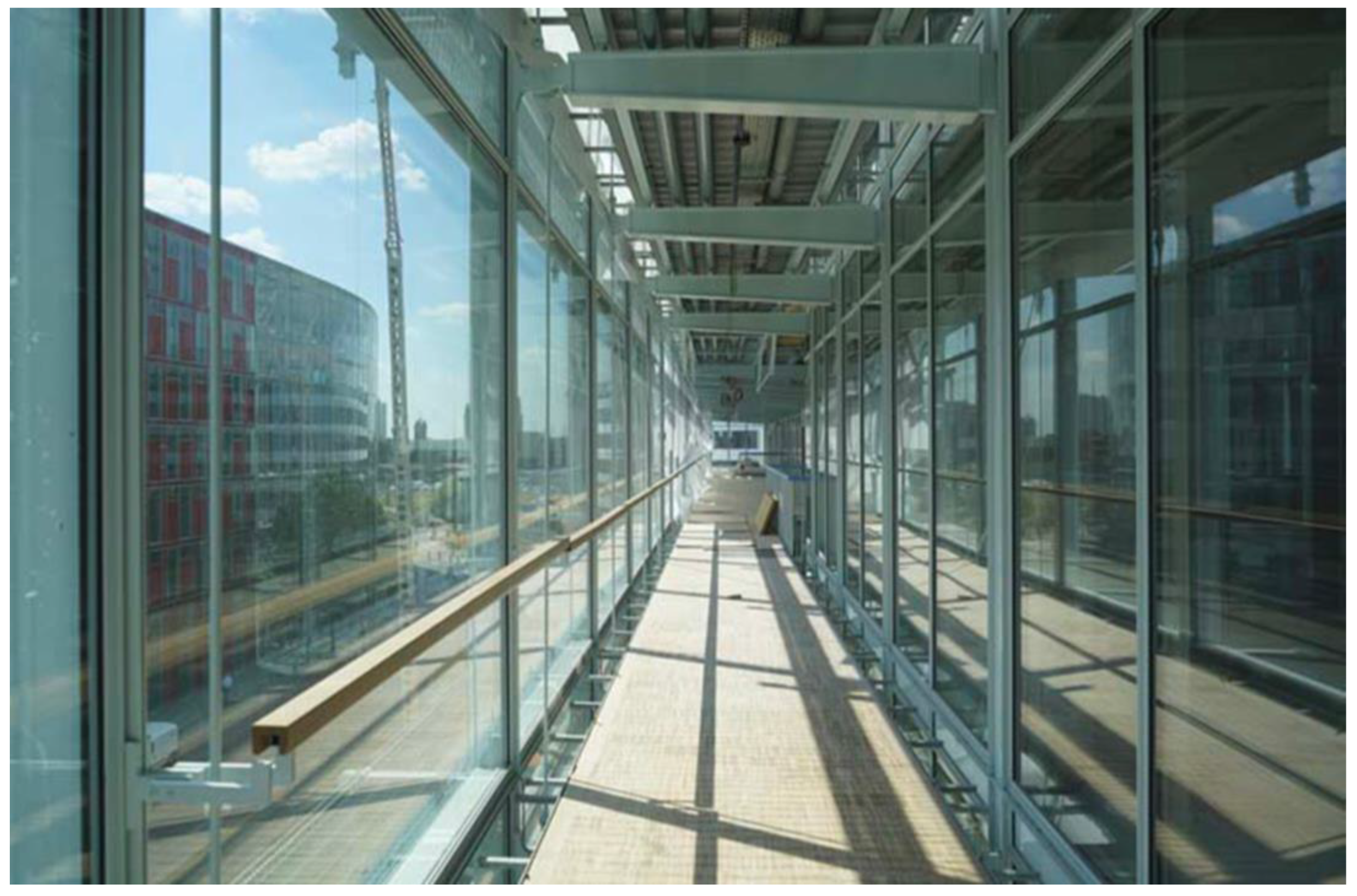
Figure 2.
Configuration of the cavity between the façade system and the external membrane applied to the Marks & Spencer shopping centre in Manchester, designed by BDP (Building Design Partnership). Source: Focchi, Charlotte Wood.
Figure 2.
Configuration of the cavity between the façade system and the external membrane applied to the Marks & Spencer shopping centre in Manchester, designed by BDP (Building Design Partnership). Source: Focchi, Charlotte Wood.
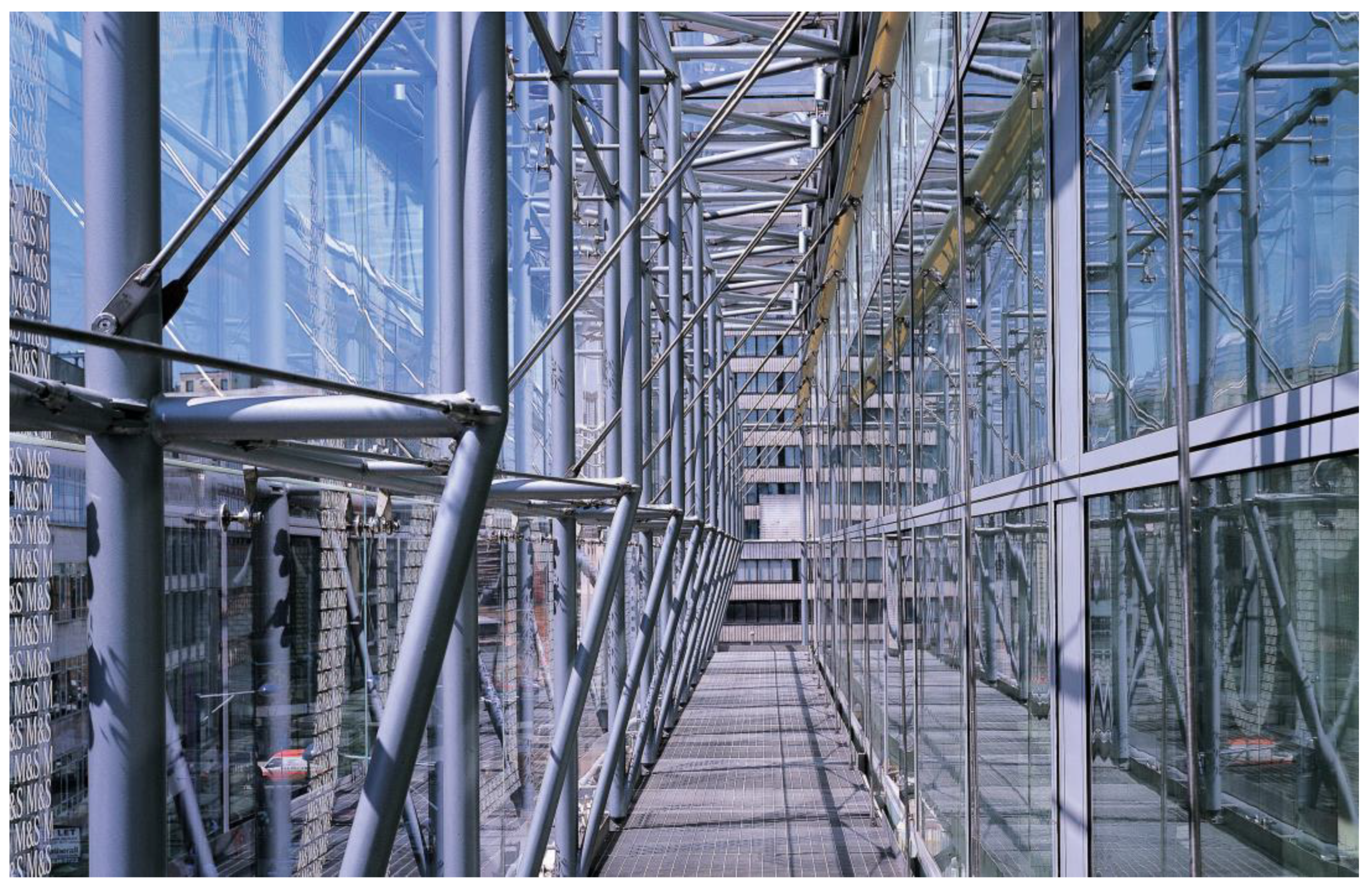
Figure 3.
Activation of airflows in the cavity determined by the external screen, detecting: (a) The calibration of the air changes compared to the traditional surface with window opening; (b) The contribution of the adjustable openings in the cavity to convey incoming and outgoing airflows.
Figure 3.
Activation of airflows in the cavity determined by the external screen, detecting: (a) The calibration of the air changes compared to the traditional surface with window opening; (b) The contribution of the adjustable openings in the cavity to convey incoming and outgoing airflows.
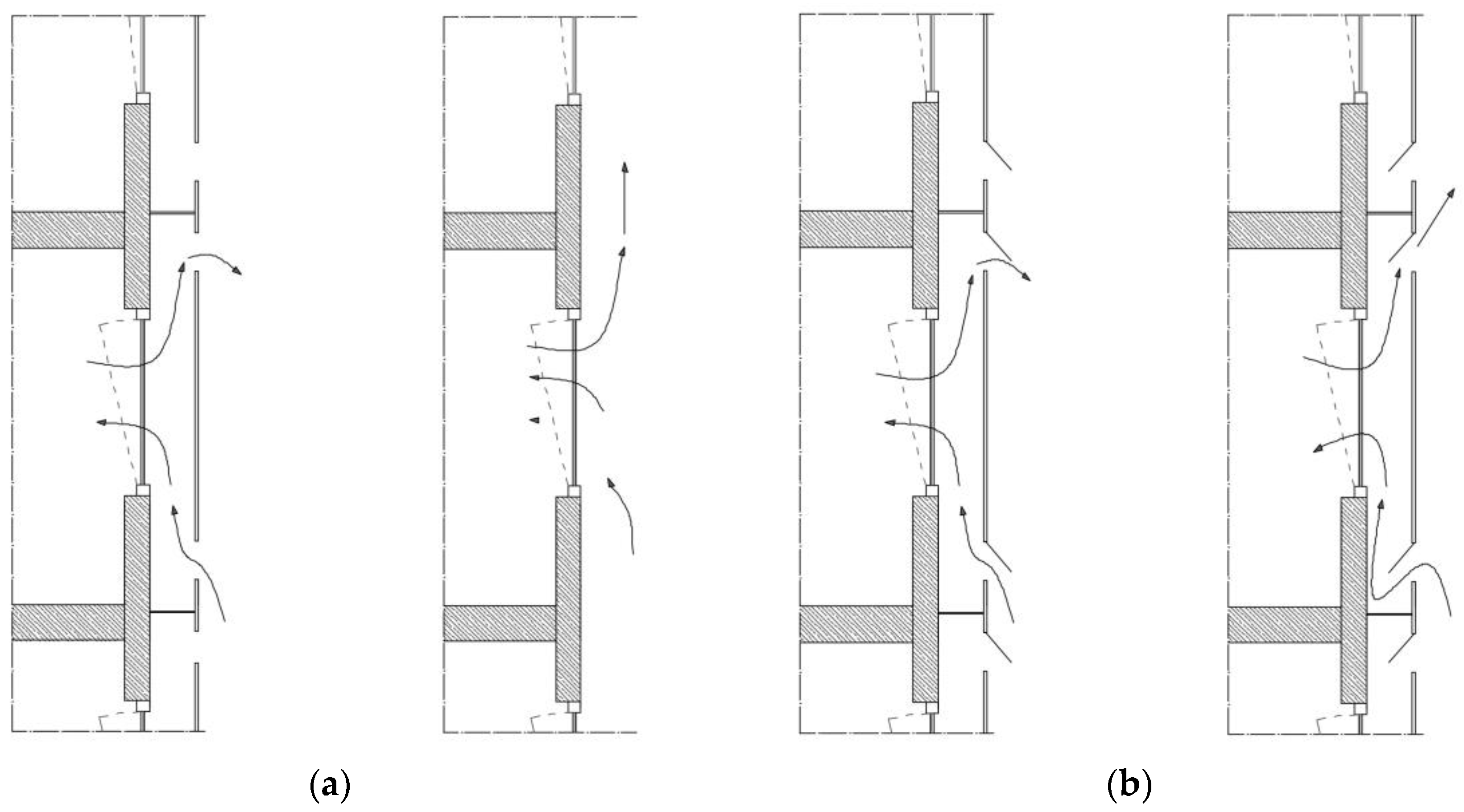
Figure 4.
Activation of airflows in the cavity determined by the external screen, detecting: (a) The application of the aerodynamic devices (fixed, passively operating, or adjustable, actively operating); (b) The ventilation of sections in passive form without aerodynamic devices; (c) The ventilation of sections in passive form by chimney effect.
Figure 4.
Activation of airflows in the cavity determined by the external screen, detecting: (a) The application of the aerodynamic devices (fixed, passively operating, or adjustable, actively operating); (b) The ventilation of sections in passive form without aerodynamic devices; (c) The ventilation of sections in passive form by chimney effect.
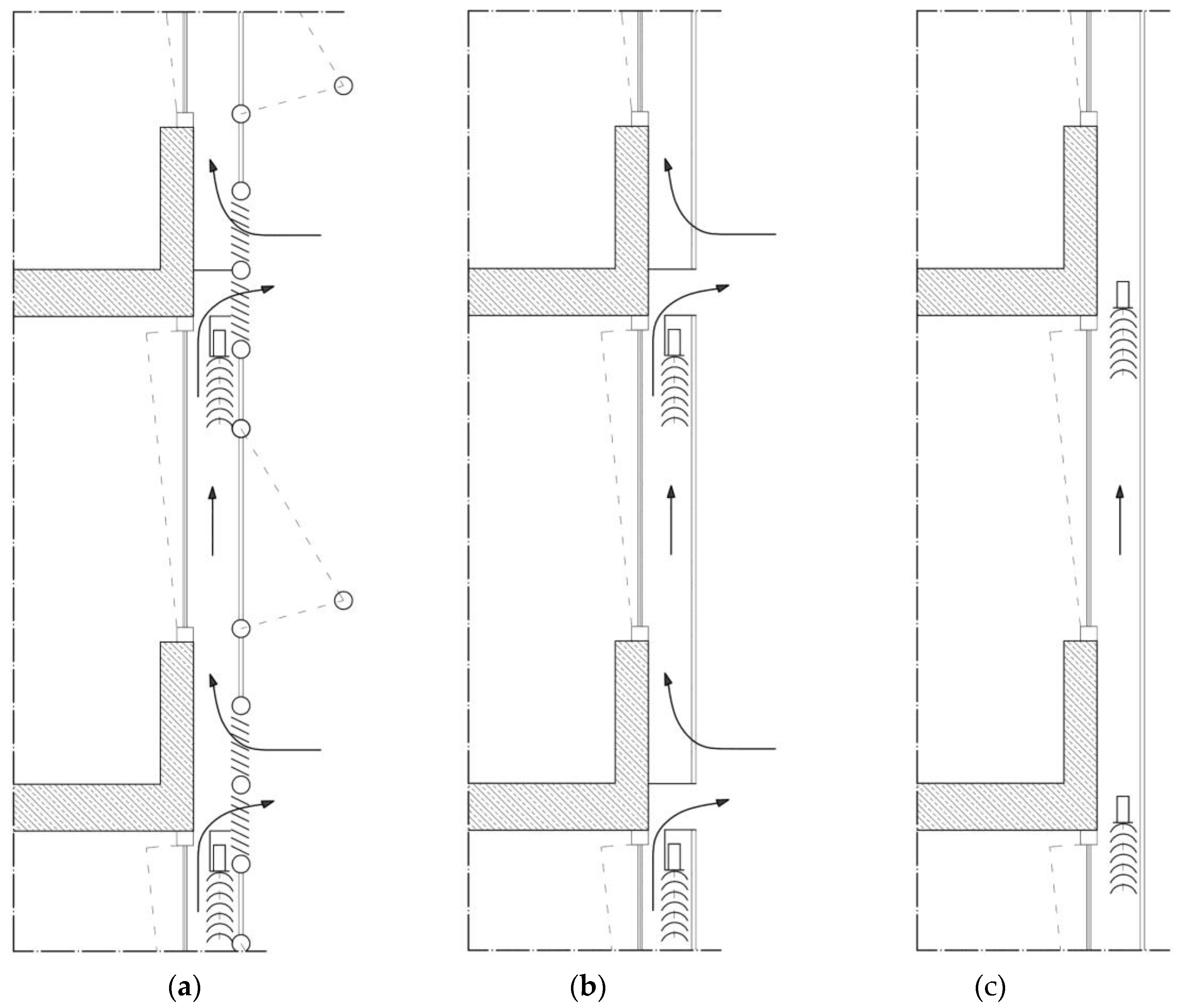
Figure 5.
Functioning of the multiple-skin façades system: (a) The ventilation is guided by the regulating wing devices and by the opening-closing of the in-door frames: the combined opening generates the inflow of airflows (as convective circulation) and the natural exchange of air, supported by the upward motion in the cavity of the intermediate components; (b) The enclosure of the air inflow elements realizes the system as a ventilated façade, with the simultaneous thermal-insulating action of the buffer zone. Source: Gartner.
Figure 5.
Functioning of the multiple-skin façades system: (a) The ventilation is guided by the regulating wing devices and by the opening-closing of the in-door frames: the combined opening generates the inflow of airflows (as convective circulation) and the natural exchange of air, supported by the upward motion in the cavity of the intermediate components; (b) The enclosure of the air inflow elements realizes the system as a ventilated façade, with the simultaneous thermal-insulating action of the buffer zone. Source: Gartner.
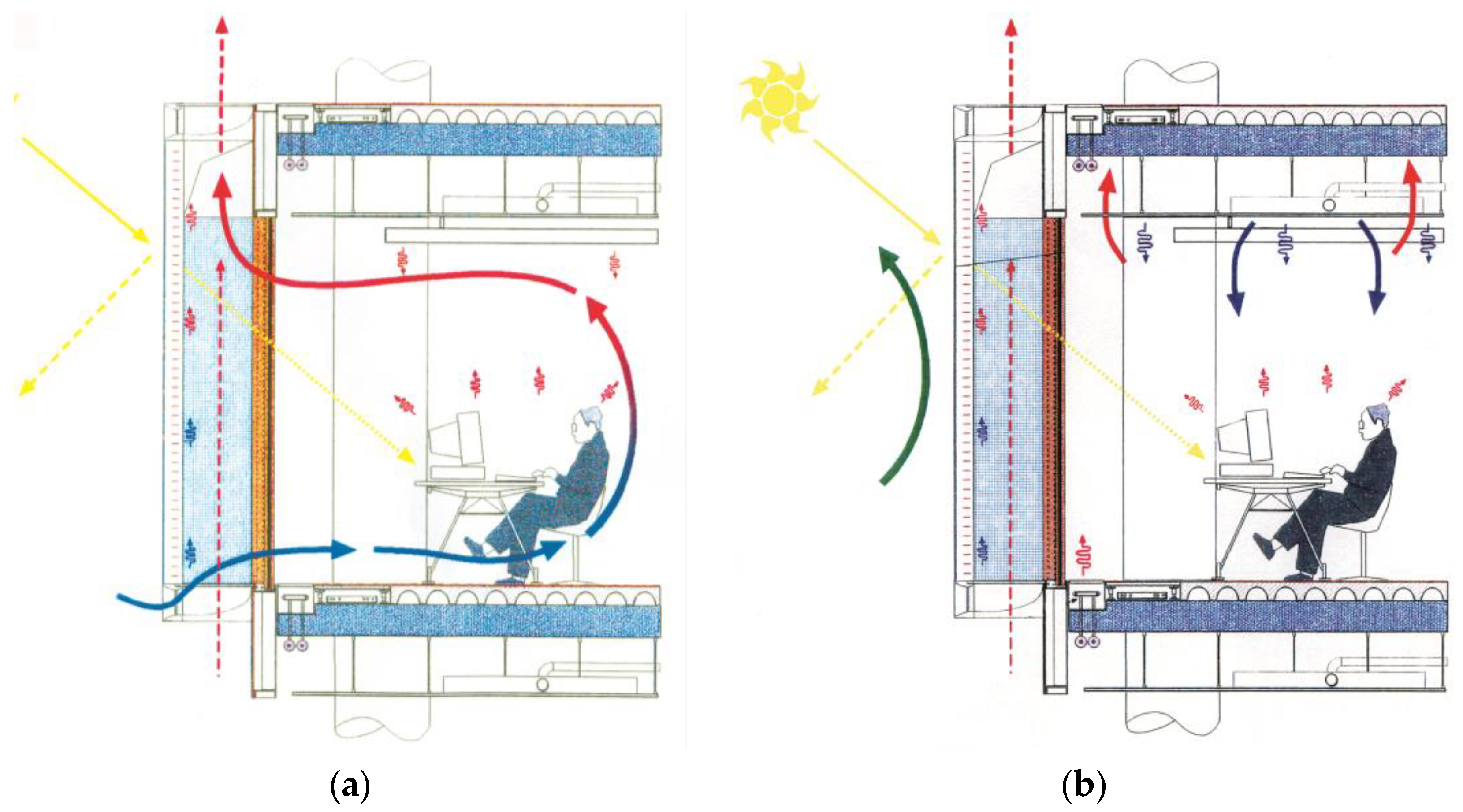
Figure 6.
Application of the external glazing screen and functional procedures: (a) The configuration of the flaps for the ventilation is passive; (b) The configuration of the flaps for ventilation is calibrated; (c) The flap configuration for the ventilation is hybrid, with the lower inlet section fixed and the upper outlet section adjustable. Source: Hydro.
Figure 6.
Application of the external glazing screen and functional procedures: (a) The configuration of the flaps for the ventilation is passive; (b) The configuration of the flaps for ventilation is calibrated; (c) The flap configuration for the ventilation is hybrid, with the lower inlet section fixed and the upper outlet section adjustable. Source: Hydro.
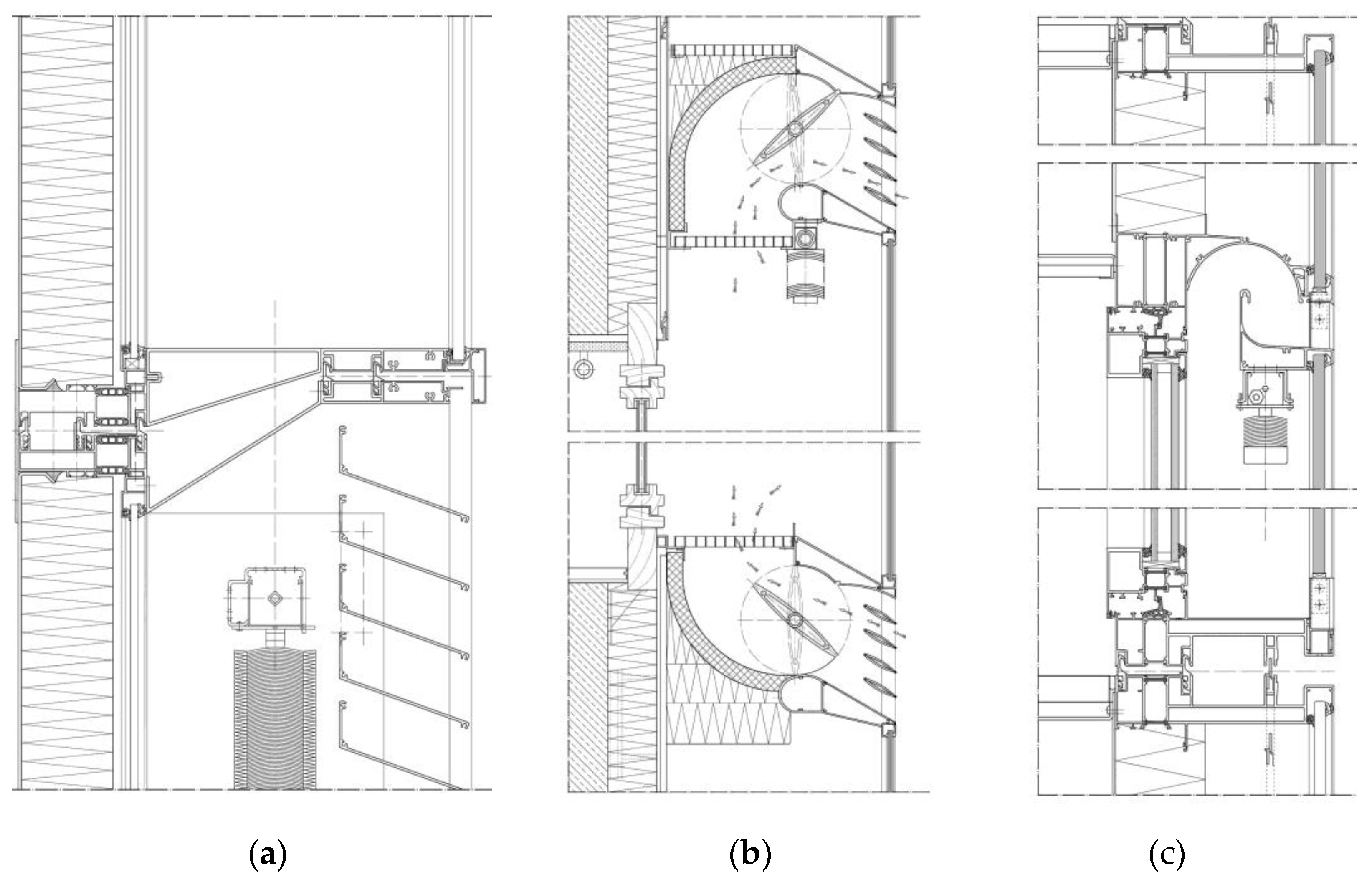
Figure 7.
Application of the external glazing screen: (a) The connection of the ventilated cavity is achieved through the double section with the mirror joints between the mullions, which are supported externally by the brackets attached to the internal façade; (b) The mullions and transoms are extended up to the projection of the devices supporting the external glazing screens. Source: Hydro.
Figure 7.
Application of the external glazing screen: (a) The connection of the ventilated cavity is achieved through the double section with the mirror joints between the mullions, which are supported externally by the brackets attached to the internal façade; (b) The mullions and transoms are extended up to the projection of the devices supporting the external glazing screens. Source: Hydro.
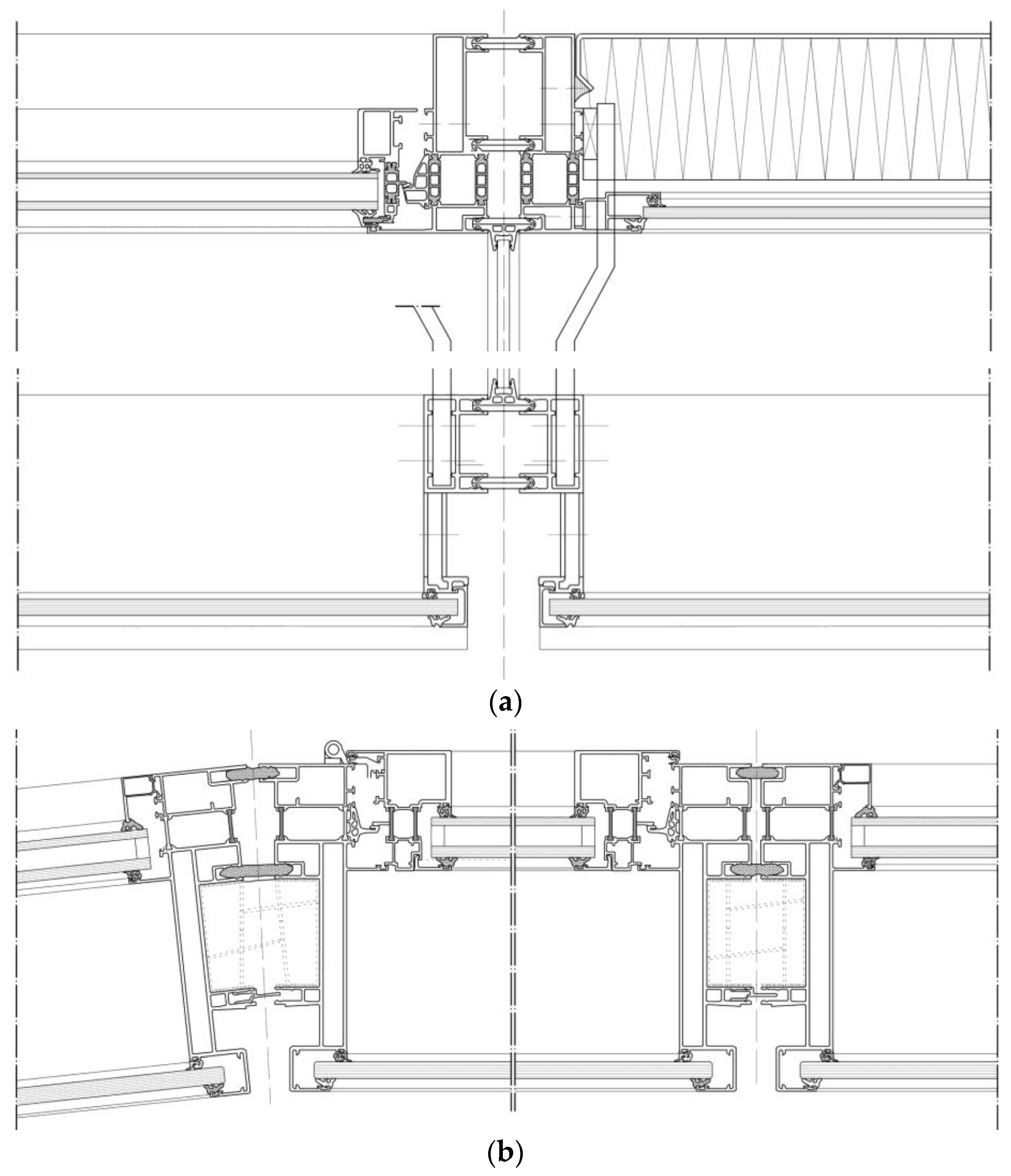
Figure 8.
Sustainable methods of the box-windows systems: (a) The external glazed screen is applied at the level of the opening windows; (b) The module includes the thermal insulation layer and the outer cladding to enhance the laminar airflows; (c) The cavities are divided by vertical partitions.
Figure 8.
Sustainable methods of the box-windows systems: (a) The external glazed screen is applied at the level of the opening windows; (b) The module includes the thermal insulation layer and the outer cladding to enhance the laminar airflows; (c) The cavities are divided by vertical partitions.
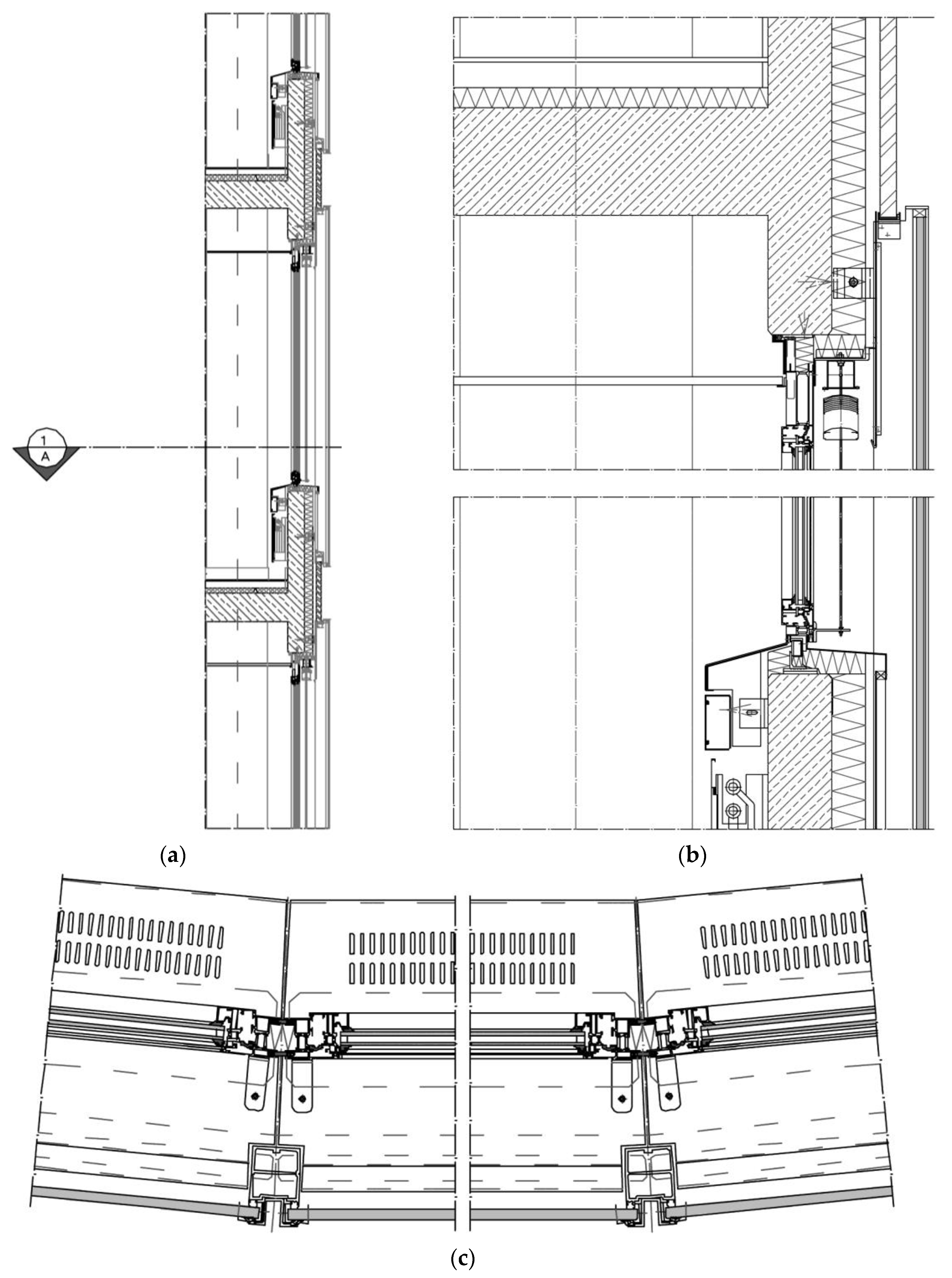
Figure 9.
Sustainable methods of the box-windows systems (Wilhelm Holzbauer, Andromeda Tower, Wien): (a) The external glazed screen is applied at the full inter-floor level; (b) The module includes the thermal insulation layer and the outer cladding to enhance the laminar airflows; (c) The cavities are divided by two vertical partitions; (d) The cavities are placed on the multilayer sections.
Figure 9.
Sustainable methods of the box-windows systems (Wilhelm Holzbauer, Andromeda Tower, Wien): (a) The external glazed screen is applied at the full inter-floor level; (b) The module includes the thermal insulation layer and the outer cladding to enhance the laminar airflows; (c) The cavities are divided by two vertical partitions; (d) The cavities are placed on the multilayer sections.
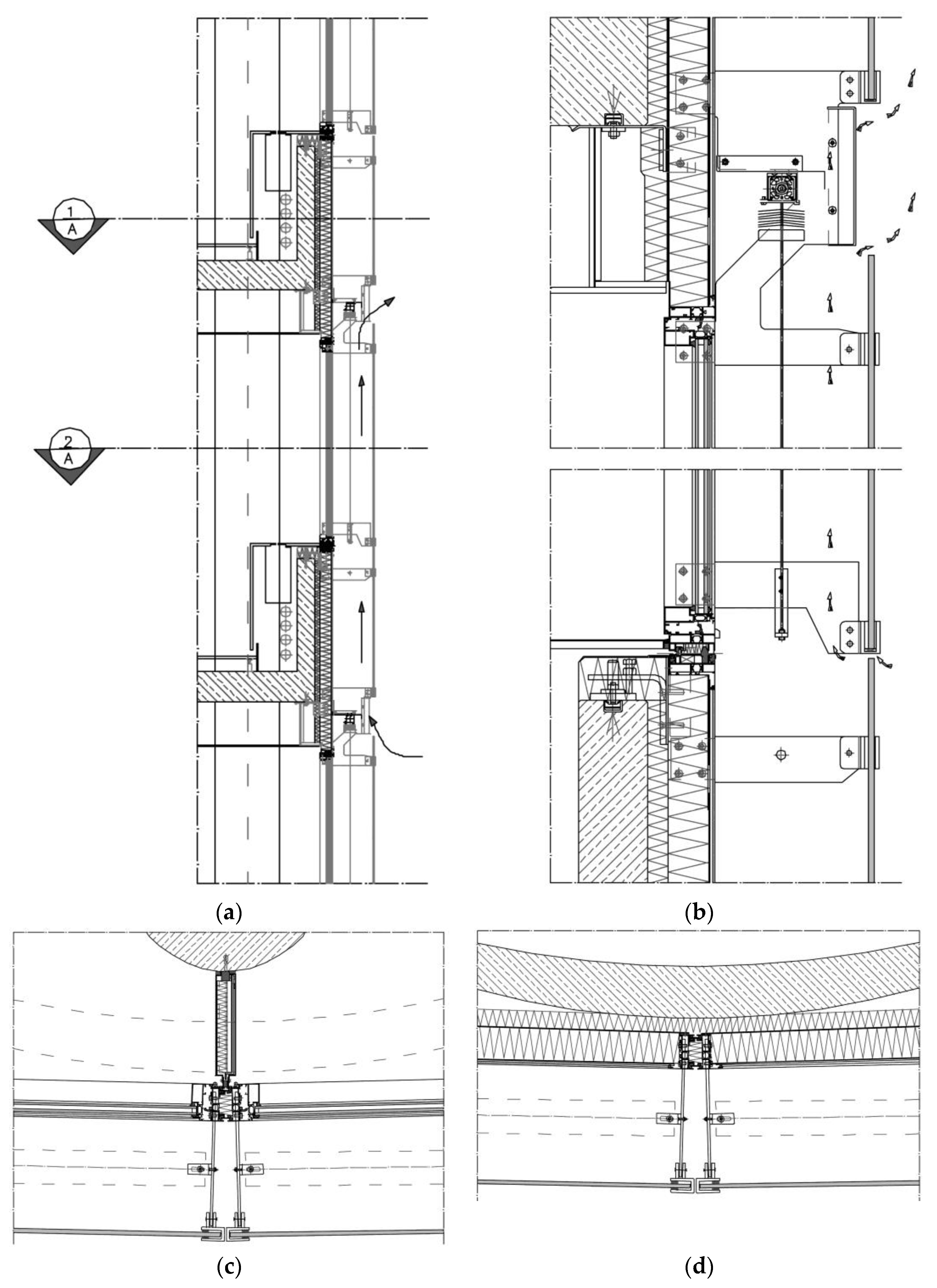
Figure 10.
Sustainable methods of the box-windows systems (Kleihues + Kleihues, Triangel Building, Berlin): The functional and construction model includes the opening windows to the inner curtain, fire-resistant layering, external glass screen and aerodynamic flaps to guide the airflows.
Figure 10.
Sustainable methods of the box-windows systems (Kleihues + Kleihues, Triangel Building, Berlin): The functional and construction model includes the opening windows to the inner curtain, fire-resistant layering, external glass screen and aerodynamic flaps to guide the airflows.
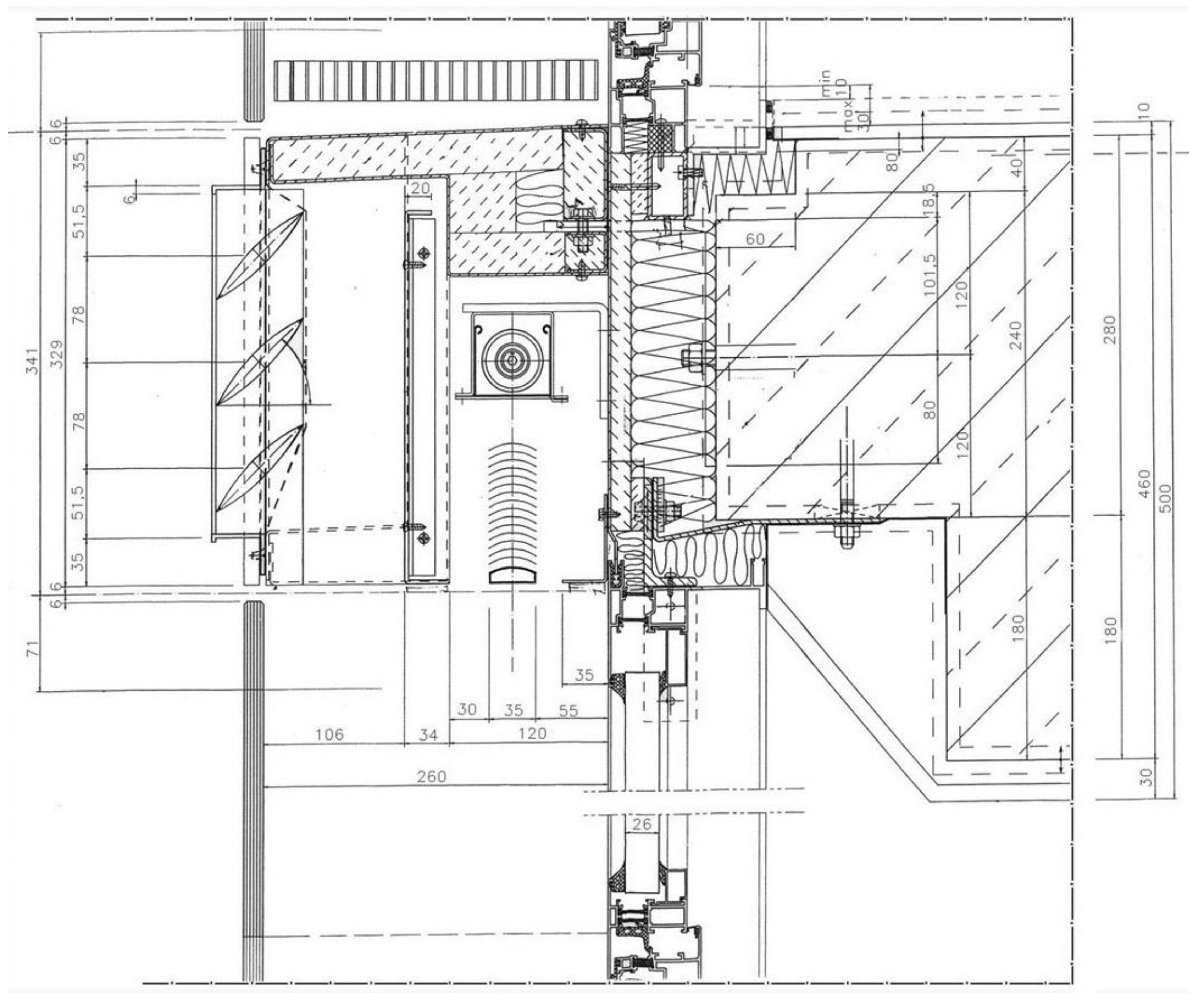
Figure 11.
Sustainable methods of the box-windows systems (Foster + Partners, Commerzbank Headquarter, Frankfurt): (a) The convective airflows are captured and conducted along the interspace of each module; (b) The flaps are shaped according to the aerodynamic interaction with the external airflows; (c) The cavities are divided by vertical partitions.
Figure 11.
Sustainable methods of the box-windows systems (Foster + Partners, Commerzbank Headquarter, Frankfurt): (a) The convective airflows are captured and conducted along the interspace of each module; (b) The flaps are shaped according to the aerodynamic interaction with the external airflows; (c) The cavities are divided by vertical partitions.
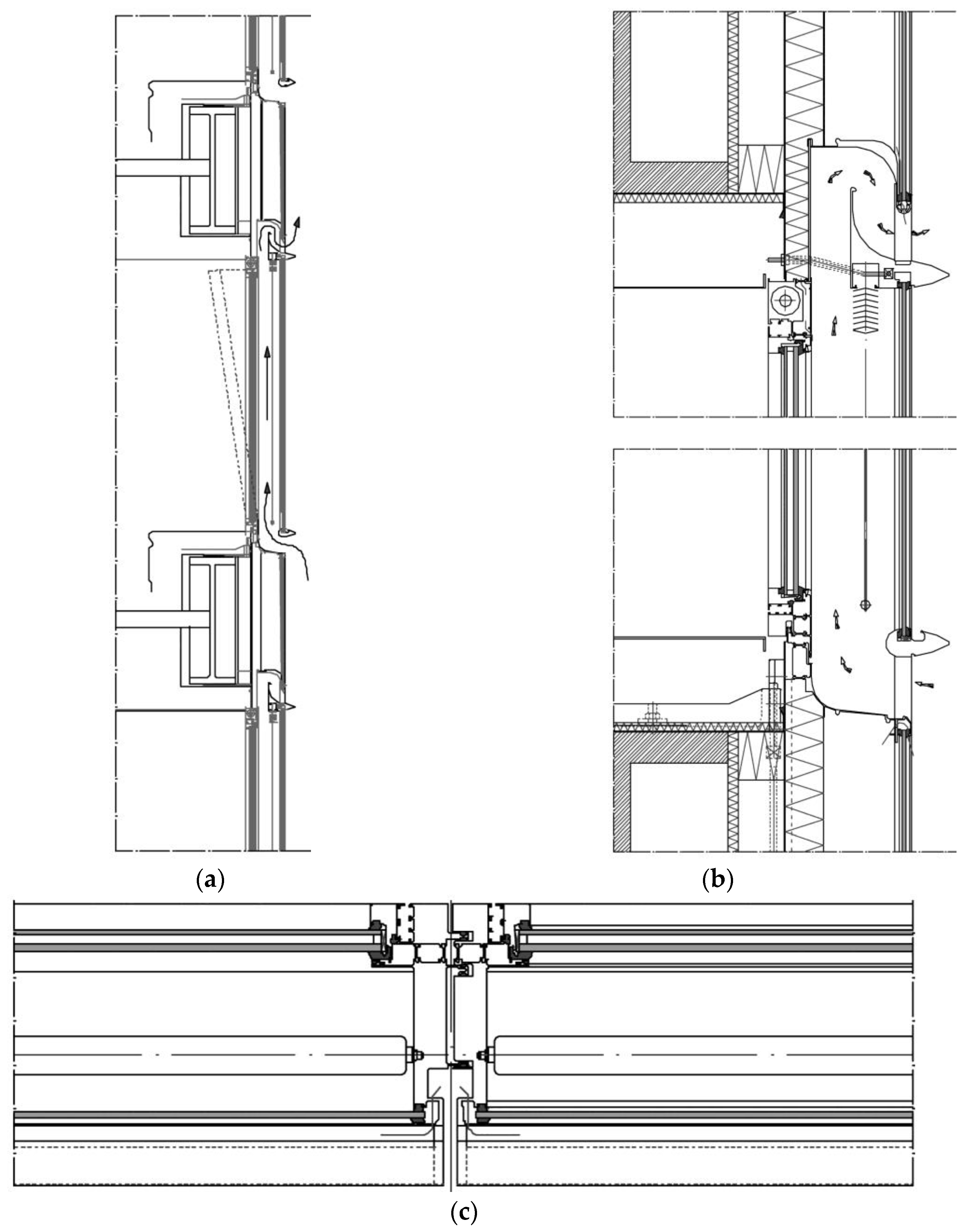
Figure 12.
Sustainable methods of the box-windows systems (Hentrich, Petschnigg & Partner, Victoria Headquarter, Düsseldorf): (a) The ventilation of the cavity is achieved by the intake of the external convective flows through the openings in the vertical mullions; (b) The airflows are extracted from the cavity by the aerodynamic flaps; (c) The cavities are divided by vertical partitions.
Figure 12.
Sustainable methods of the box-windows systems (Hentrich, Petschnigg & Partner, Victoria Headquarter, Düsseldorf): (a) The ventilation of the cavity is achieved by the intake of the external convective flows through the openings in the vertical mullions; (b) The airflows are extracted from the cavity by the aerodynamic flaps; (c) The cavities are divided by vertical partitions.
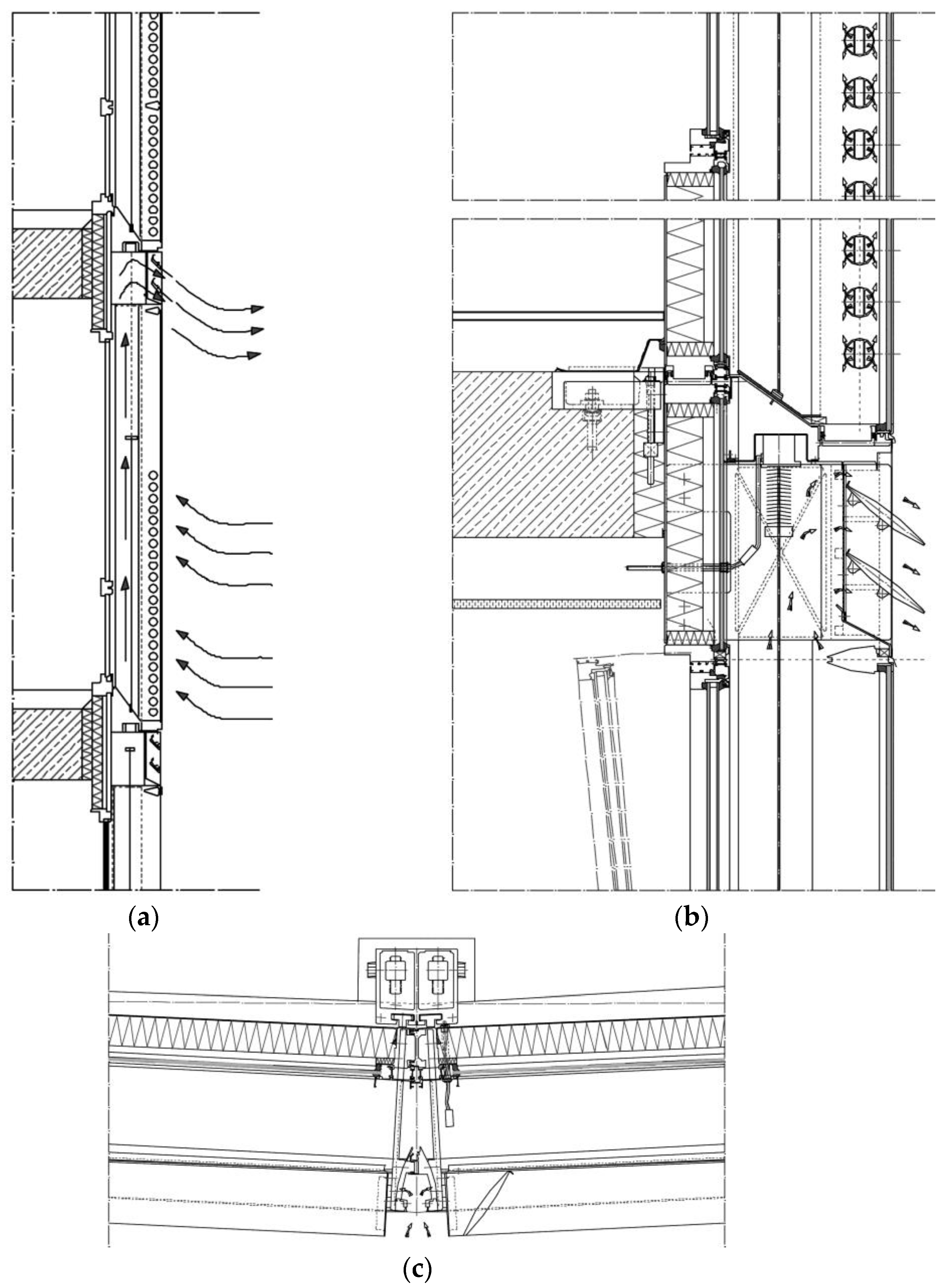
Figure 13.
Sustainable methods of the multistory systems (Renzo Piano Building Workshop, Debis-C1 Building, Potsdamer Platz sector, Berlin): functioning of the outer blades, pivoted to the mullions (connected by the brackets to the profiles outside the façade plane), according to the adjustment guided by the electrically-operated vertical control rod.
Figure 13.
Sustainable methods of the multistory systems (Renzo Piano Building Workshop, Debis-C1 Building, Potsdamer Platz sector, Berlin): functioning of the outer blades, pivoted to the mullions (connected by the brackets to the profiles outside the façade plane), according to the adjustment guided by the electrically-operated vertical control rod.
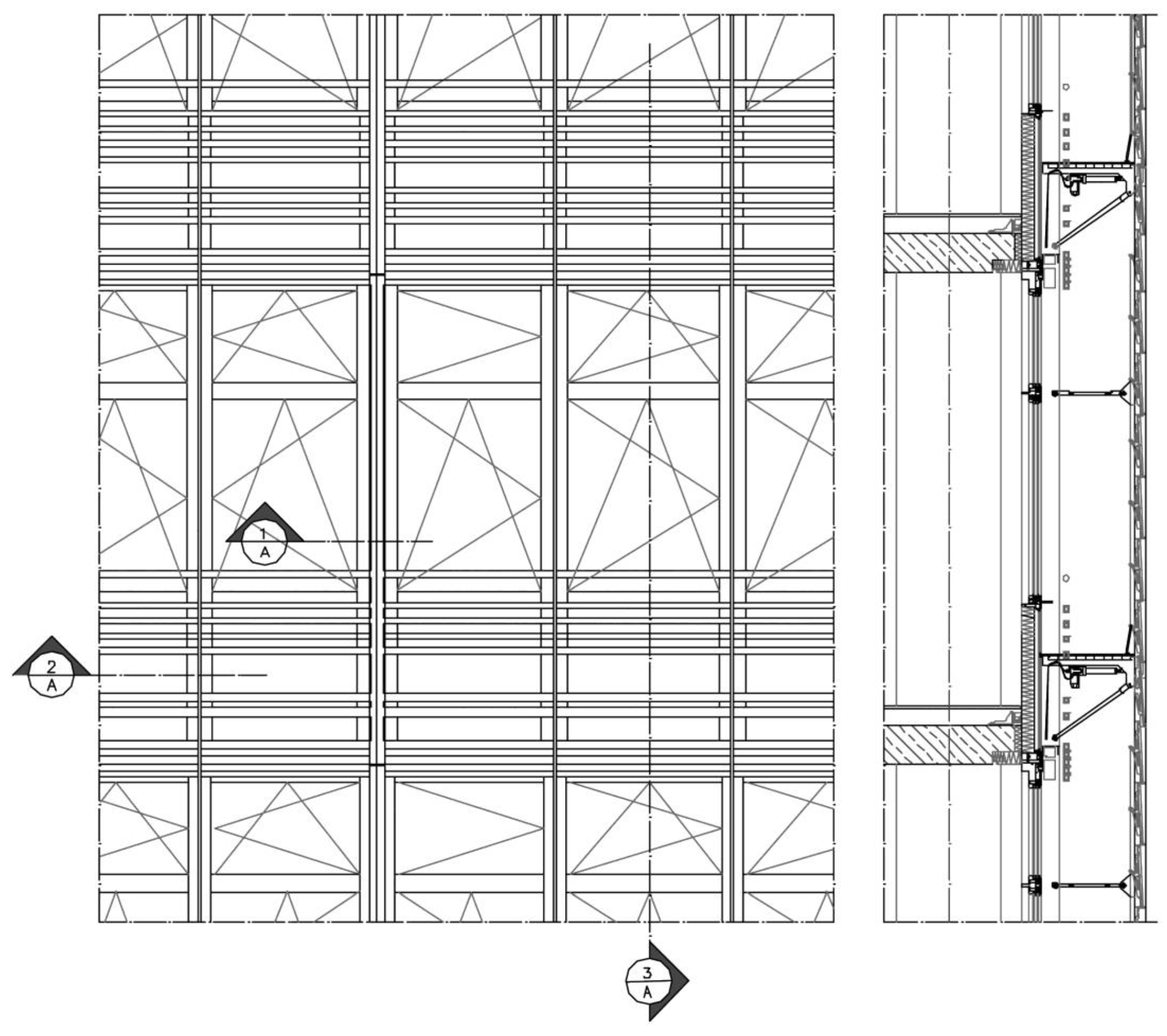
Figure 14.
Sustainable methods of the multistory systems (Renzo Piano Building Workshop, Debis-C1 Building, Potsdamer Platz sector, Berlin): (a) The internal panels constitute the curtain wall and window frames with the double-glazing (thickness = 38 mm, gas-filled in the cavity, thermal transmittance coefficient UW = 1,1 W/m2.k); (b) The cavity includes the walkable grid.
Figure 14.
Sustainable methods of the multistory systems (Renzo Piano Building Workshop, Debis-C1 Building, Potsdamer Platz sector, Berlin): (a) The internal panels constitute the curtain wall and window frames with the double-glazing (thickness = 38 mm, gas-filled in the cavity, thermal transmittance coefficient UW = 1,1 W/m2.k); (b) The cavity includes the walkable grid.
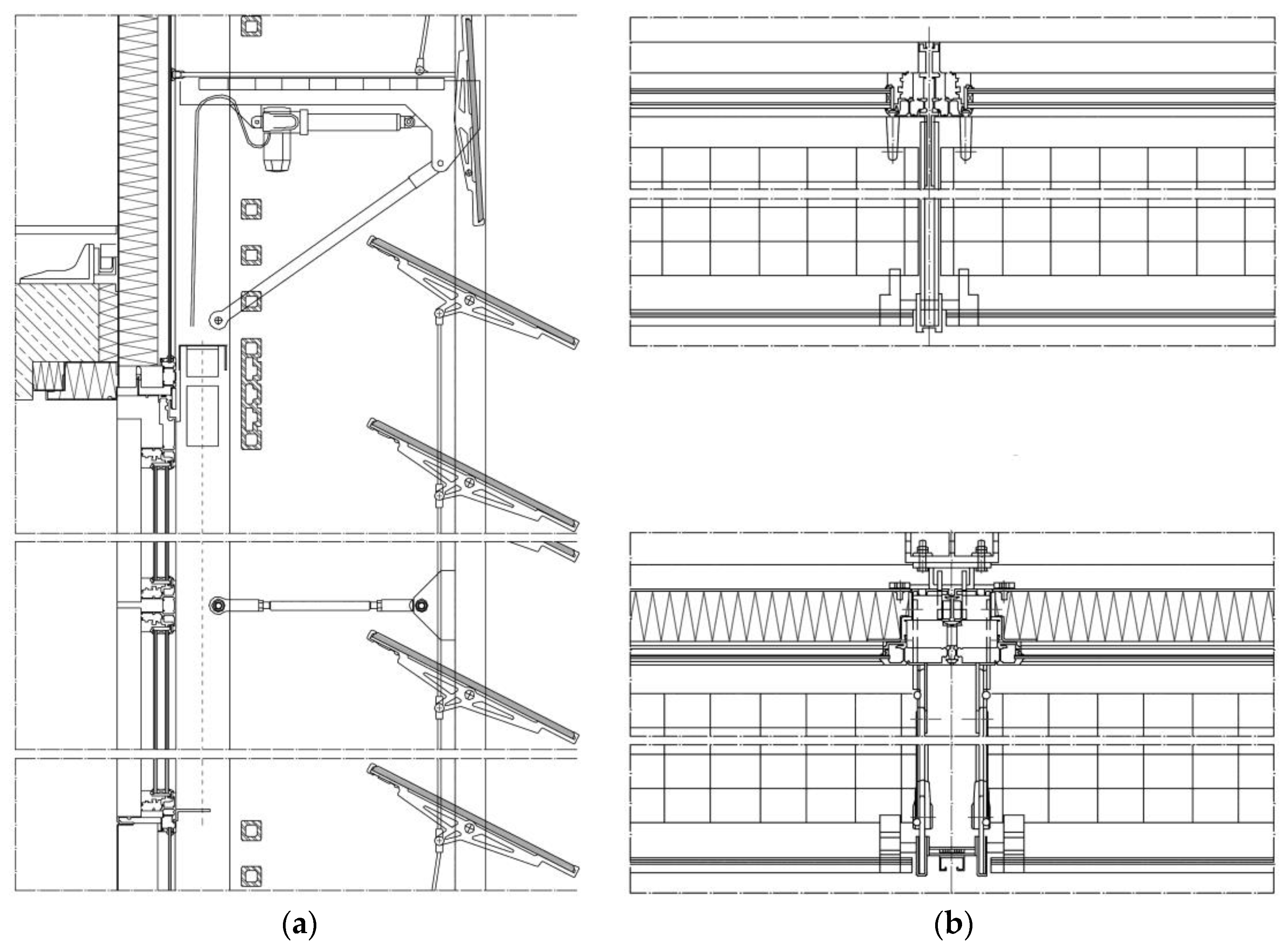
Figure 15.
Sustainable methods of the multistory systems (Renzo Piano Building Workshop, Intesa Sanpaolo Headquarter, Turin): the technical skin provides a cavity to insulate, filter or absorb the external environmental loads, operating on the ergonomic control of the spatial conditions, air exchange and thermal compensation of the façade. Source: Renzo Piano Building Workshop.
Figure 15.
Sustainable methods of the multistory systems (Renzo Piano Building Workshop, Intesa Sanpaolo Headquarter, Turin): the technical skin provides a cavity to insulate, filter or absorb the external environmental loads, operating on the ergonomic control of the spatial conditions, air exchange and thermal compensation of the façade. Source: Renzo Piano Building Workshop.
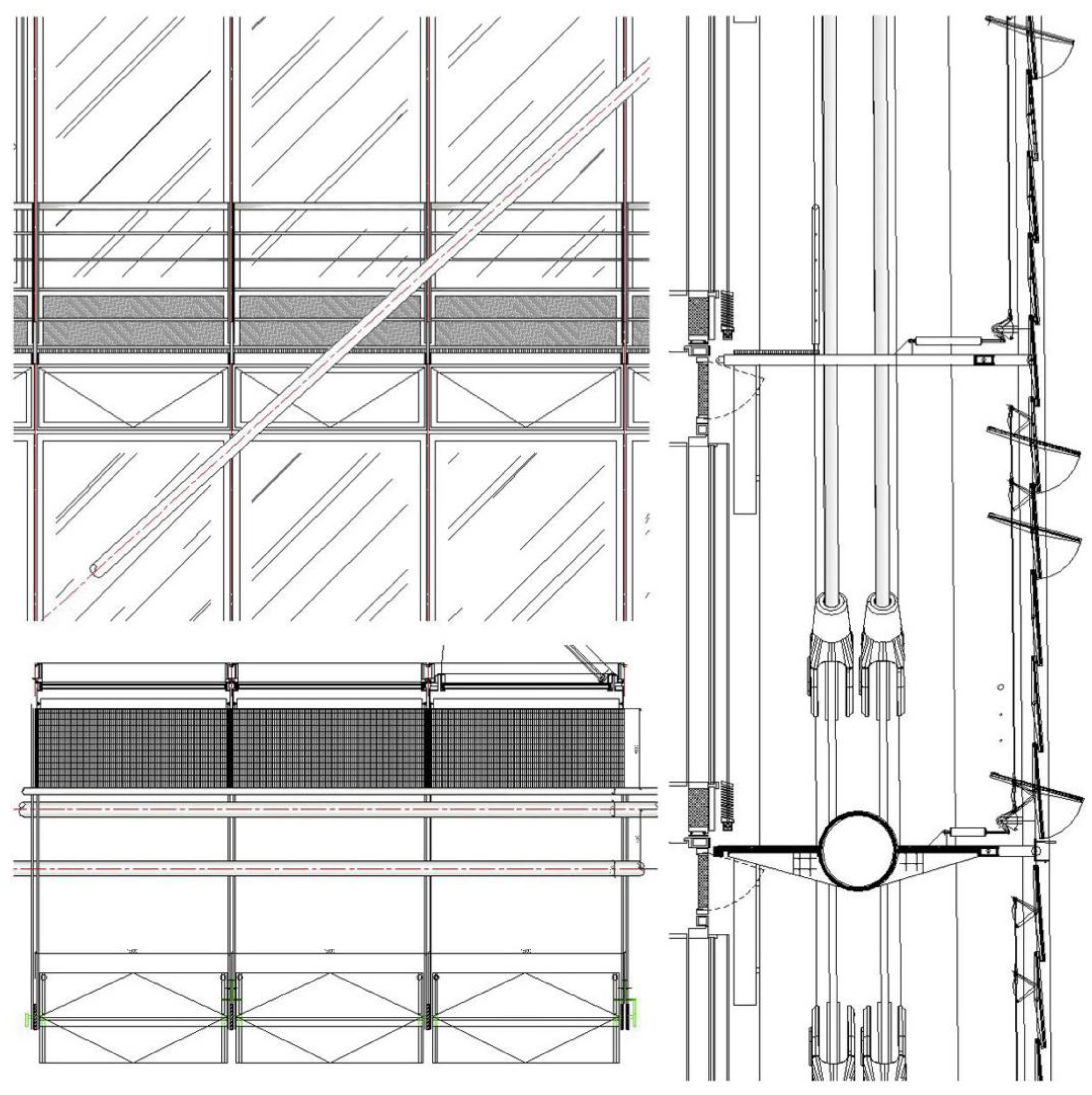
Figure 16.
Sustainable methods of the multistory systems (Maurizio Varratta, iGuzzini Lab, Recanati). Composition of the envelope according to the direct gain functional procedures and cavity ventilation. Source: Pichler Projects.
Figure 16.
Sustainable methods of the multistory systems (Maurizio Varratta, iGuzzini Lab, Recanati). Composition of the envelope according to the direct gain functional procedures and cavity ventilation. Source: Pichler Projects.
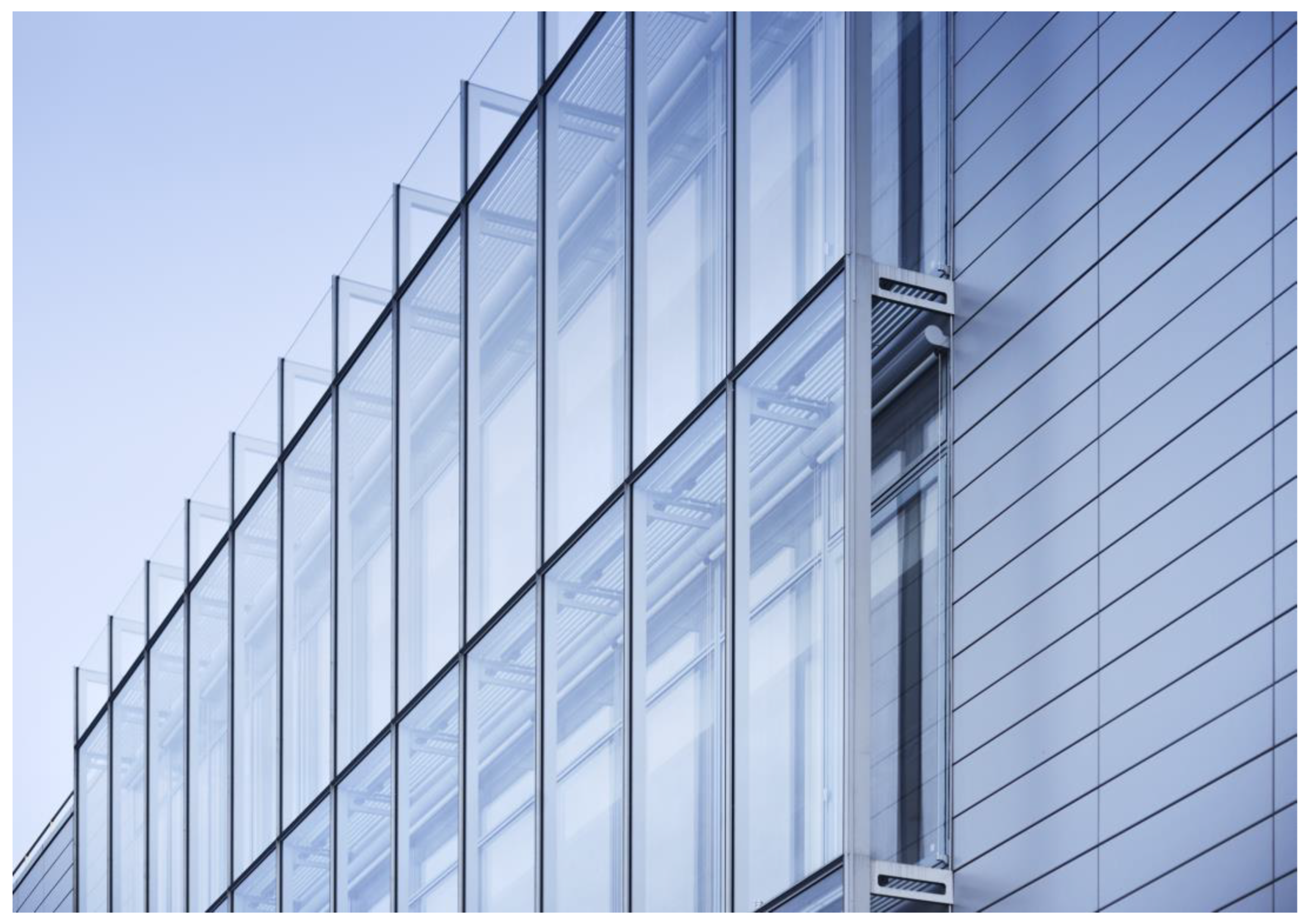
Figure 17.
Sustainable methods of the multistory systems (Maurizio Varratta, iGuzzini Lab, Recanati). Functioning of the double skin: activation of the natural ventilation (summer period) and inclusion of the heat-insulating layer for greenhouse effect (winter period). Source: Pichler Projects.
Figure 17.
Sustainable methods of the multistory systems (Maurizio Varratta, iGuzzini Lab, Recanati). Functioning of the double skin: activation of the natural ventilation (summer period) and inclusion of the heat-insulating layer for greenhouse effect (winter period). Source: Pichler Projects.

Figure 18.
Sustainable methods of the multistory systems (Maurizio Varratta, iGuzzini Lab, Recanati). Assembly procedures between the unit system components and the external screen, detecting the modalities integrated with the internal climate control systems. Source: Pichler Projects.
Figure 18.
Sustainable methods of the multistory systems (Maurizio Varratta, iGuzzini Lab, Recanati). Assembly procedures between the unit system components and the external screen, detecting the modalities integrated with the internal climate control systems. Source: Pichler Projects.
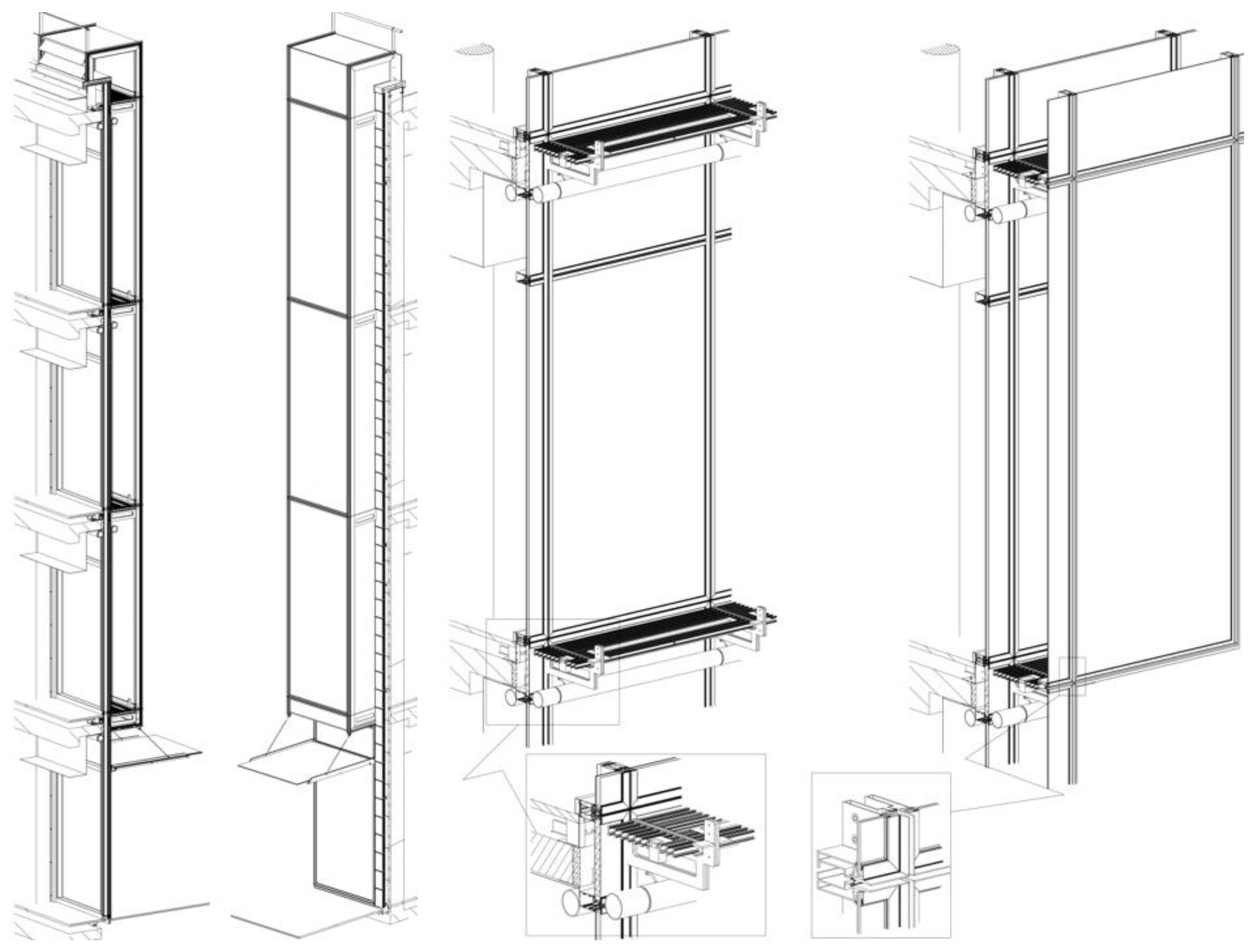
Figure 19.
Sustainable methods of the multistory systems (Maurizio Varratta, iGuzzini Lab, Recanati). Construction of the curtain and brackets facing the outer screen. Source: Pichler Projects.
Figure 19.
Sustainable methods of the multistory systems (Maurizio Varratta, iGuzzini Lab, Recanati). Construction of the curtain and brackets facing the outer screen. Source: Pichler Projects.
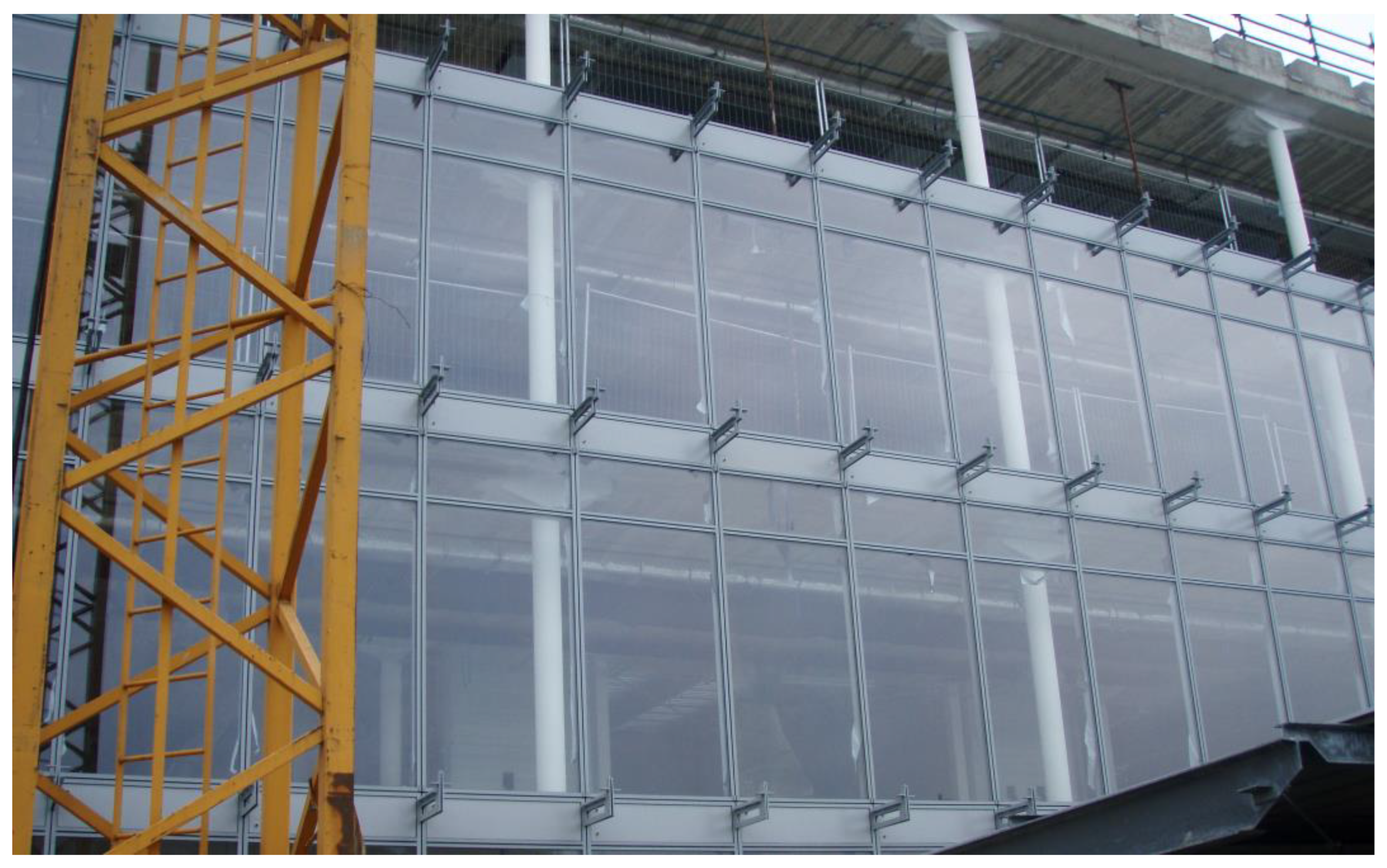
Figure 20.
Sustainable methods of the multistory systems (Maurizio Varratta, iGuzzini Lab, Recanati): (a) The outer screens are raised to the height of the façade modules; (b) The outer screens are assembled to the brackets attached to the façade modules. Source: Pichler Projects.
Figure 20.
Sustainable methods of the multistory systems (Maurizio Varratta, iGuzzini Lab, Recanati): (a) The outer screens are raised to the height of the façade modules; (b) The outer screens are assembled to the brackets attached to the façade modules. Source: Pichler Projects.
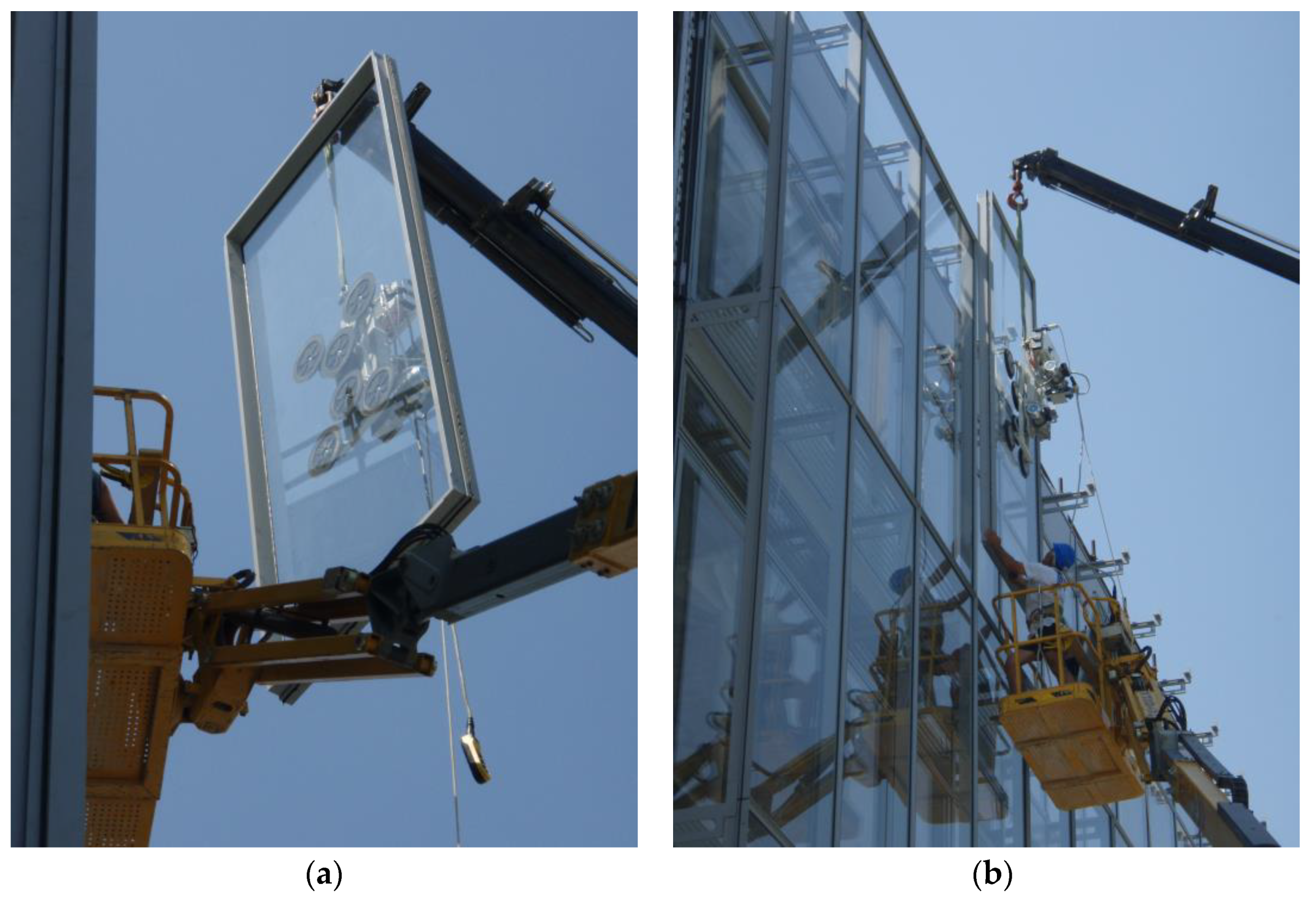
Figure 21.
Sustainable methods of the multistory systems (Foster + Partners with Rhode, Kellermann and Wawrowsky, Arag Headquarter, Düsseldorf). The system is determined by the horizontal-vertical division, where the intermediate component is open to the reception of the airflows extracted from the internal spaces.
Figure 21.
Sustainable methods of the multistory systems (Foster + Partners with Rhode, Kellermann and Wawrowsky, Arag Headquarter, Düsseldorf). The system is determined by the horizontal-vertical division, where the intermediate component is open to the reception of the airflows extracted from the internal spaces.
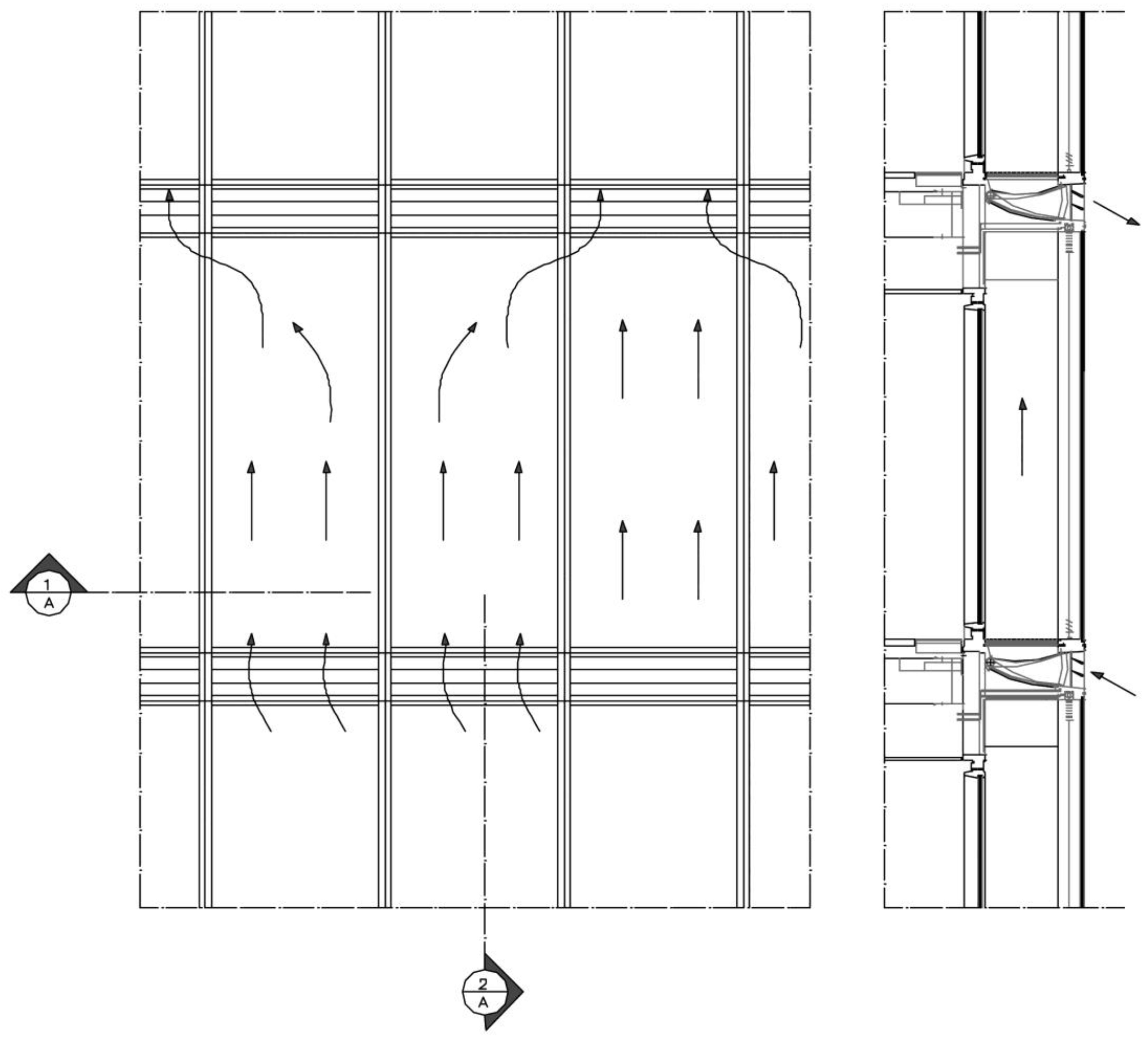
Figure 22.
Sustainable methods of the multistory systems (Foster + Partners with Rhode, Kellermann and Wawrowsky, Arag Headquarter, Düsseldorf): (a) The ventilation involves the uptake of the convective airflows by means of the wing flaps characterized by a convex aerodynamic shape; (b) The functioning observes, with the opening of the wing devices and of the frames of the lateral components, the introduction of the airflows.
Figure 22.
Sustainable methods of the multistory systems (Foster + Partners with Rhode, Kellermann and Wawrowsky, Arag Headquarter, Düsseldorf): (a) The ventilation involves the uptake of the convective airflows by means of the wing flaps characterized by a convex aerodynamic shape; (b) The functioning observes, with the opening of the wing devices and of the frames of the lateral components, the introduction of the airflows.
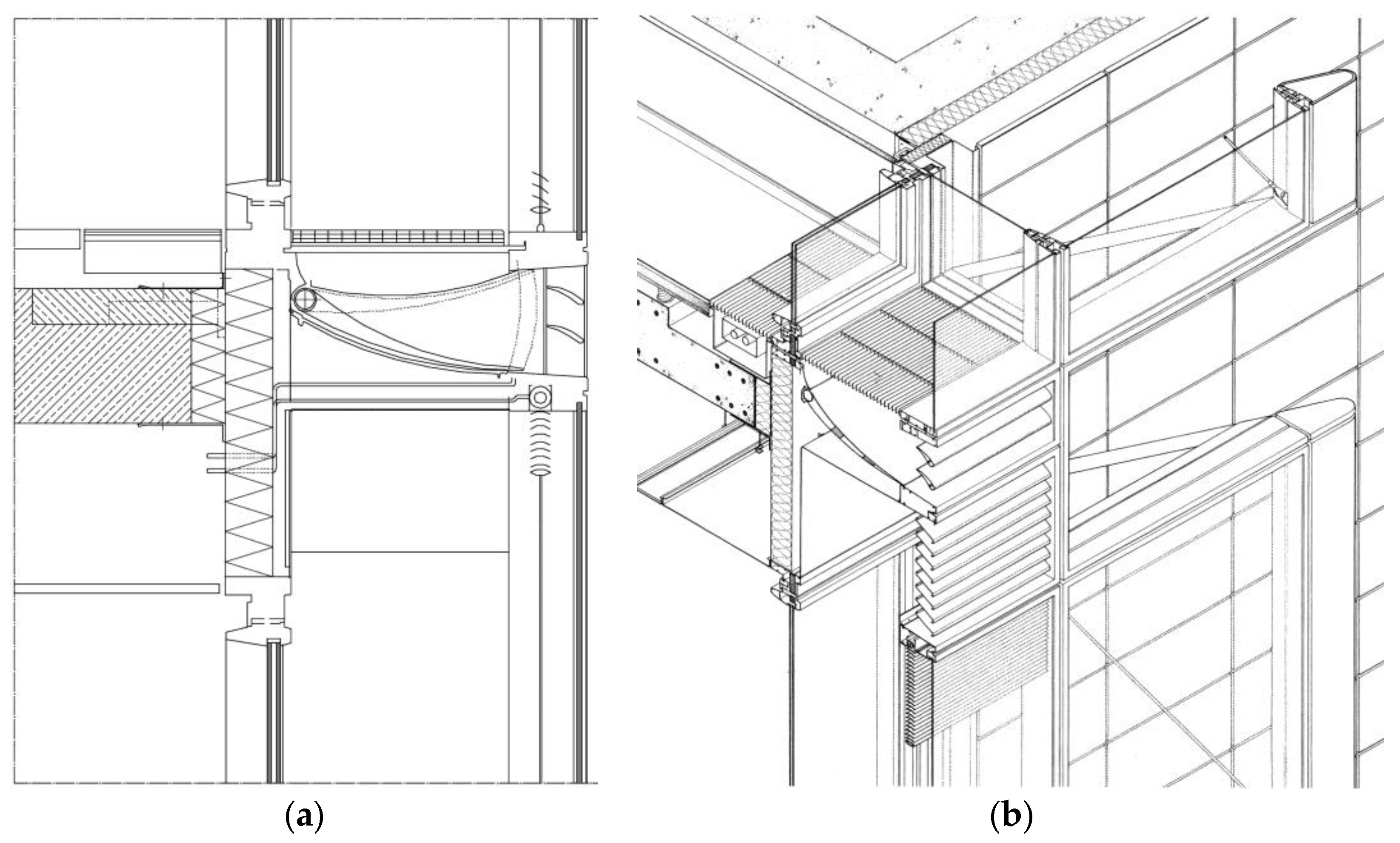
Figure 23.
Sustainable methods of the multistory systems (Foster + Partners with Rhode, Kellermann and Wawrowsky, Arag Headquarter, Düsseldorf). Construction sequences: (a) The execution involves the lifting of the components by means of ropes attached to the profiles; (b) The operators engage in the slots from the brackets and the telescopic connection. Source: Gartner.
Figure 23.
Sustainable methods of the multistory systems (Foster + Partners with Rhode, Kellermann and Wawrowsky, Arag Headquarter, Düsseldorf). Construction sequences: (a) The execution involves the lifting of the components by means of ropes attached to the profiles; (b) The operators engage in the slots from the brackets and the telescopic connection. Source: Gartner.
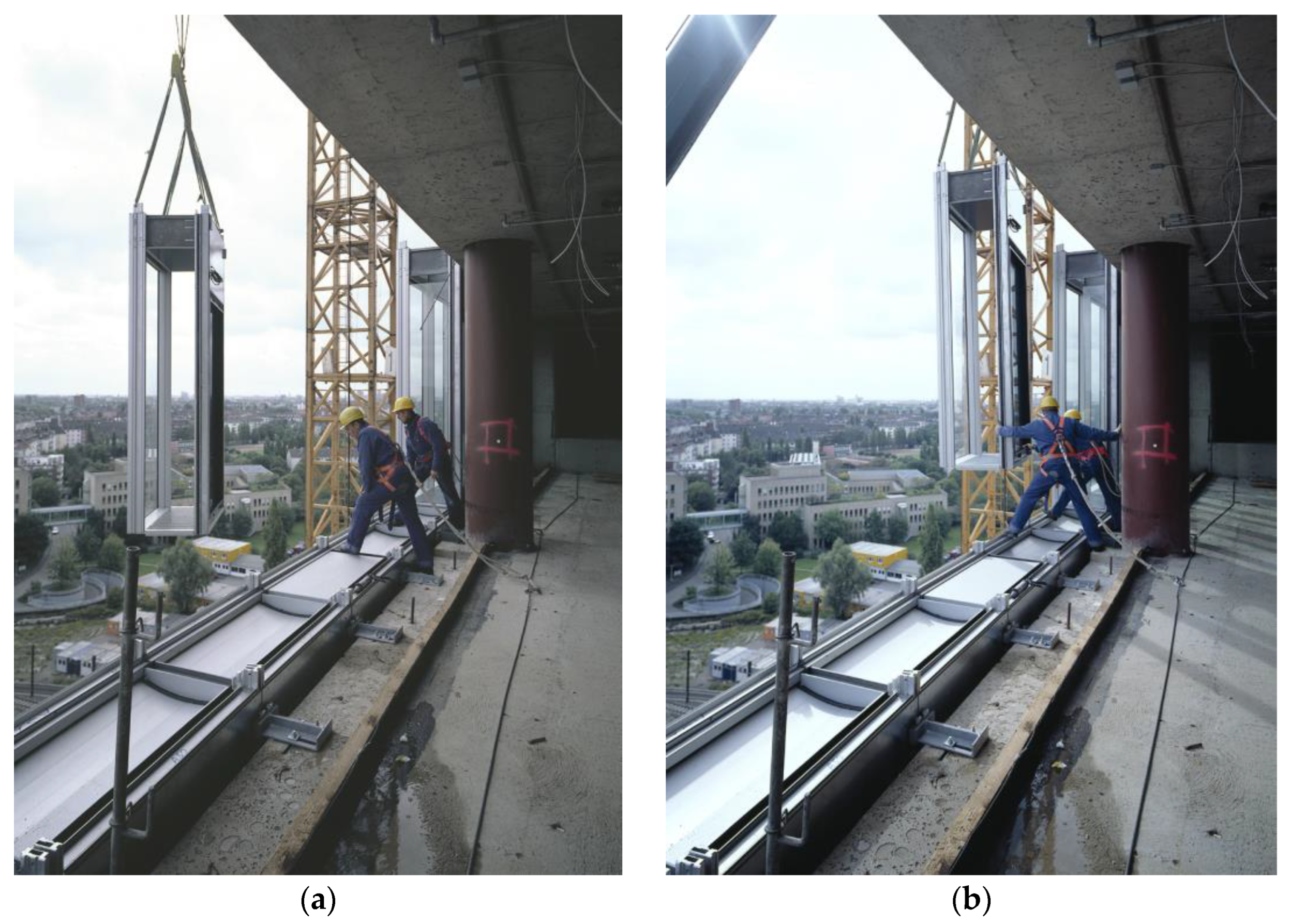
Figure 24.
Sustainable methods of the corridor systems (Ingenhoven, Overdiek und Partner, RWE AG Headquarter, Essen). Passive ventilation procedures, through the integrated and functional constitution of two contiguous components, laterally enclosed by the transverse disposition of toughened glass partitions, in order to achieve the diagonal air conduction.
Figure 24.
Sustainable methods of the corridor systems (Ingenhoven, Overdiek und Partner, RWE AG Headquarter, Essen). Passive ventilation procedures, through the integrated and functional constitution of two contiguous components, laterally enclosed by the transverse disposition of toughened glass partitions, in order to achieve the diagonal air conduction.
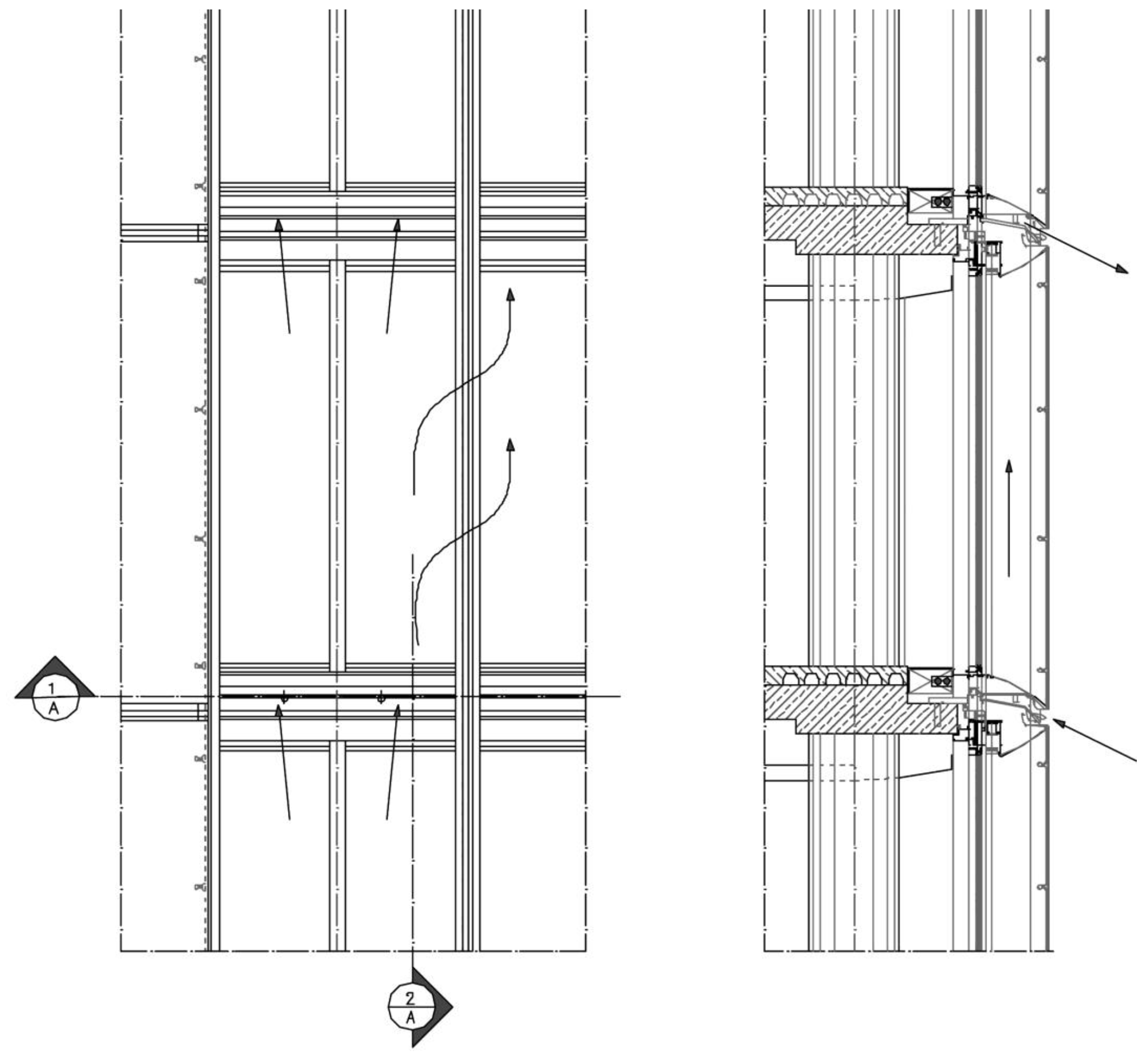
Figure 25.
Sustainable methods of the corridor systems (Ingenhoven, Overdiek und Partner, RWE AG Headquarter, Essen): (a) The interface section between the modules detects the external convective airflows through the louvers; (b) The deflectors, developed in the ventilation devices, are defined with a double specular wing configuration; (c) The units provide for side-to-side coupling between two components and the ventilation devices. Source (b): Gartner.
Figure 25.
Sustainable methods of the corridor systems (Ingenhoven, Overdiek und Partner, RWE AG Headquarter, Essen): (a) The interface section between the modules detects the external convective airflows through the louvers; (b) The deflectors, developed in the ventilation devices, are defined with a double specular wing configuration; (c) The units provide for side-to-side coupling between two components and the ventilation devices. Source (b): Gartner.
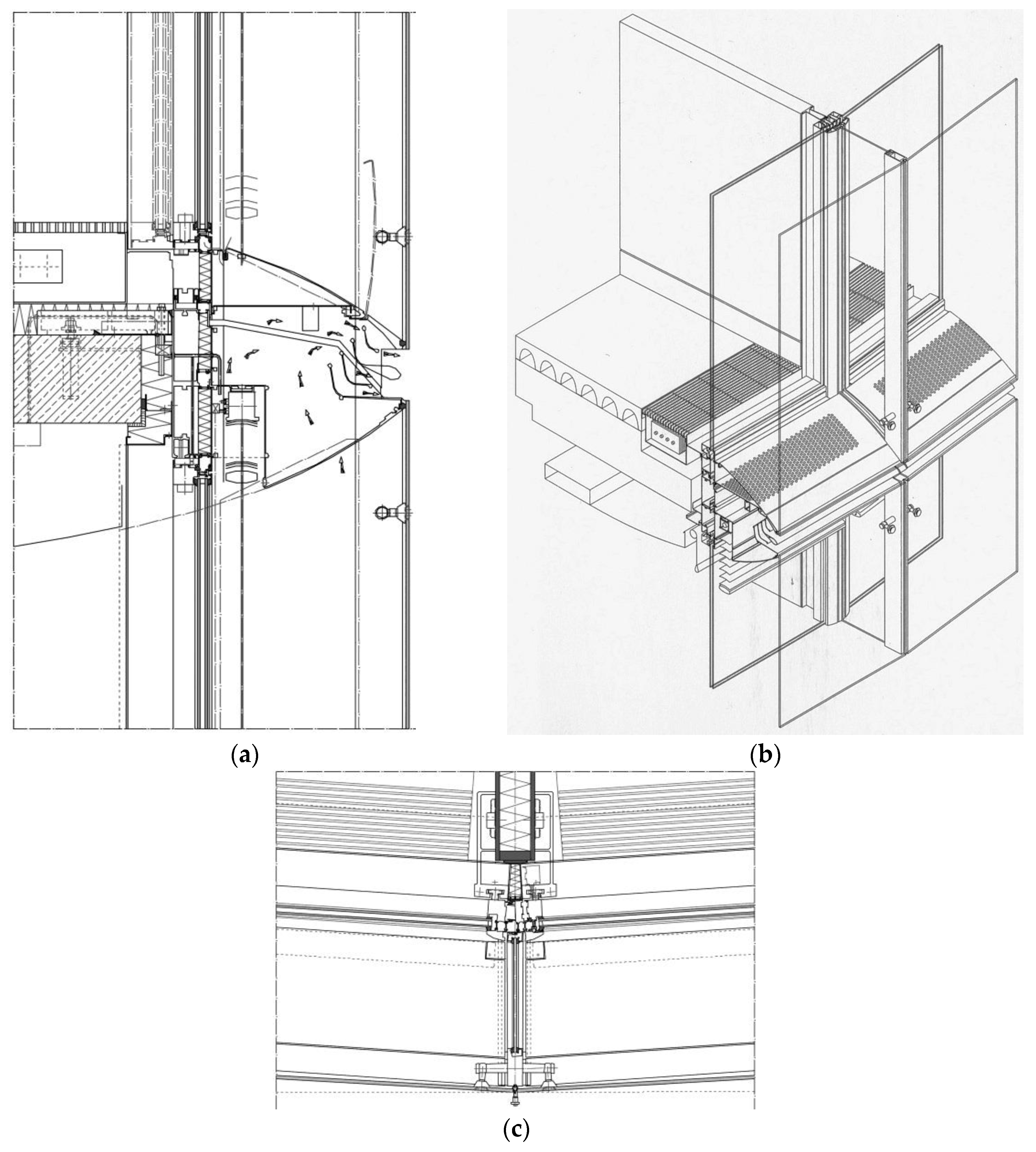
Figure 26.
Sustainable methods of the corridor systems (Karl-Heinz Petzinka and Partners, Düsseldorfer Stadttor, Düsseldorf): the left component provides for the inflow of convective flows, by lowering the regulating element, and the flow, first vertical and then diagonal, towards the cavity; the right component provides for the outflow of air from the cavity to the outside.
Figure 26.
Sustainable methods of the corridor systems (Karl-Heinz Petzinka and Partners, Düsseldorfer Stadttor, Düsseldorf): the left component provides for the inflow of convective flows, by lowering the regulating element, and the flow, first vertical and then diagonal, towards the cavity; the right component provides for the outflow of air from the cavity to the outside.
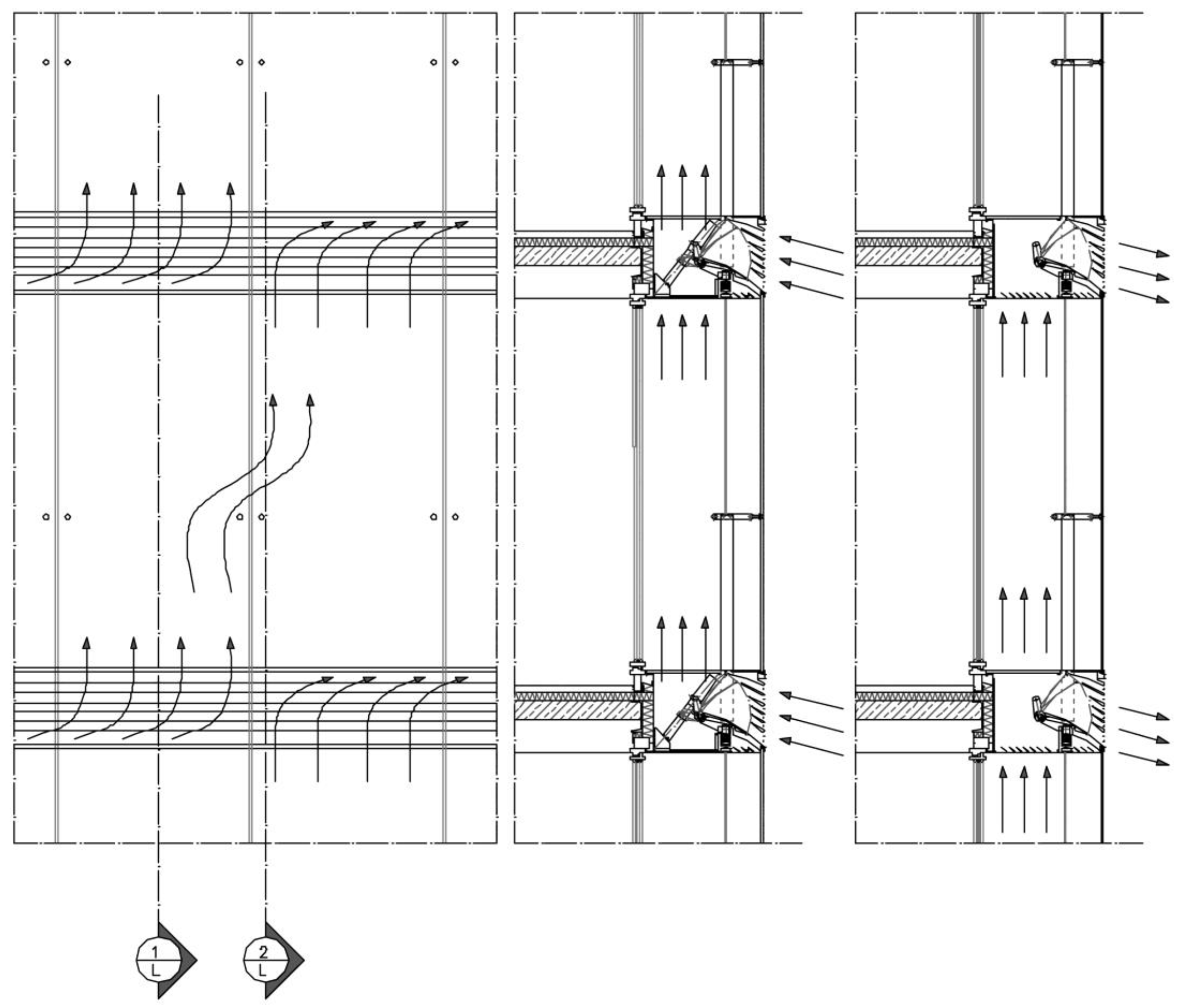
Figure 27.
Sustainable methods of the corridor systems (Karl-Heinz Petzinka and Partners, Düsseldorfer Stadttor, Düsseldorf): (a) The simulation of the intake airflows allows to calibrate the shapes of the deflectors; (b) The aerodynamic deflectors are aimed at the intake of the airflows close to the façade plane. Source: Gartner.
Figure 27.
Sustainable methods of the corridor systems (Karl-Heinz Petzinka and Partners, Düsseldorfer Stadttor, Düsseldorf): (a) The simulation of the intake airflows allows to calibrate the shapes of the deflectors; (b) The aerodynamic deflectors are aimed at the intake of the airflows close to the façade plane. Source: Gartner.
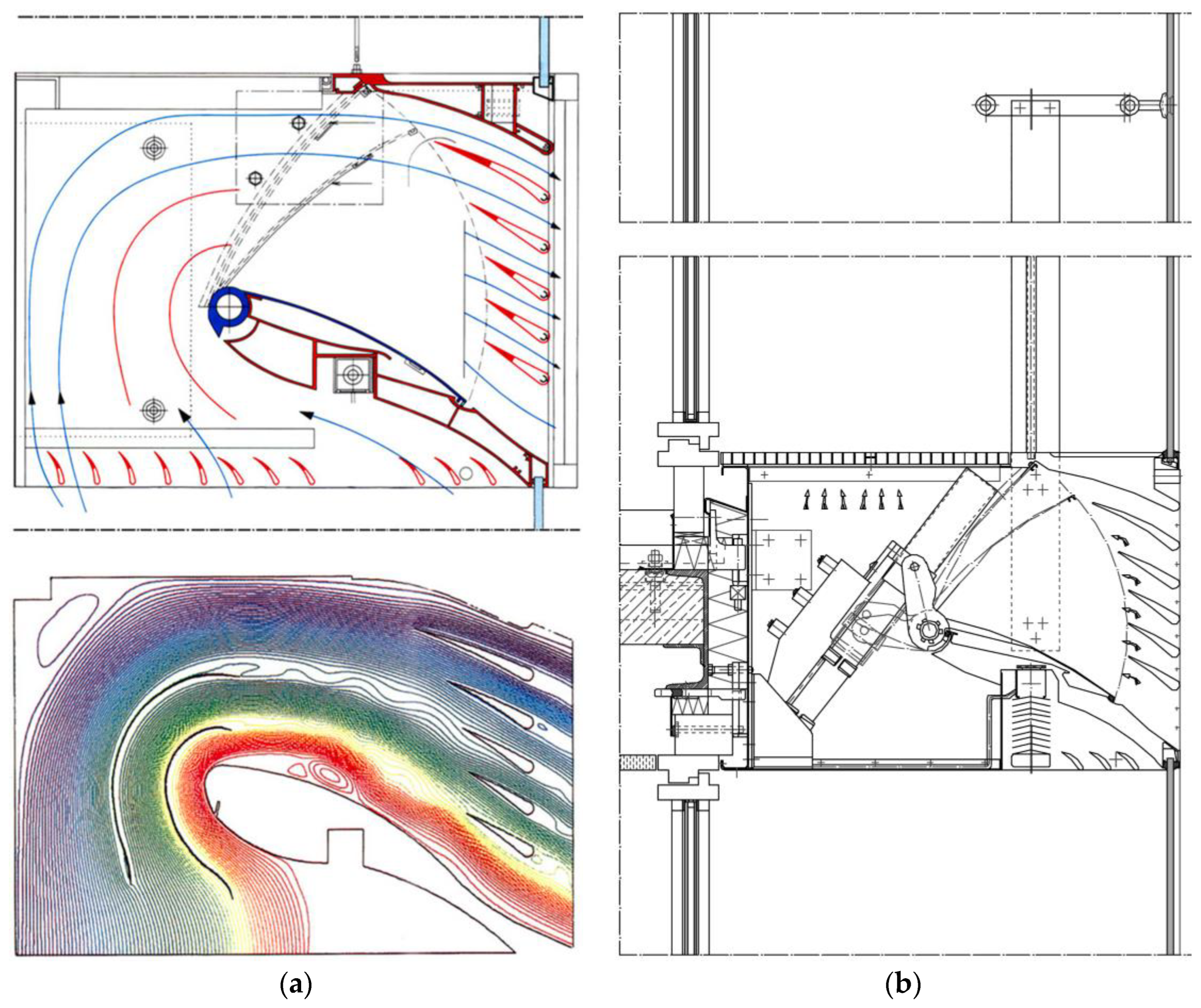
Figure 28.
Sustainable methods of the corridor systems (Open Project, Unipol Headquarter, Bologna): (a) The configuration provides for the fixed deflectors and the adjustable internal fanlight panel; (b) The external screen and cavity partitions are assembled to the unit system. Source: Schüco.
Figure 28.
Sustainable methods of the corridor systems (Open Project, Unipol Headquarter, Bologna): (a) The configuration provides for the fixed deflectors and the adjustable internal fanlight panel; (b) The external screen and cavity partitions are assembled to the unit system. Source: Schüco.
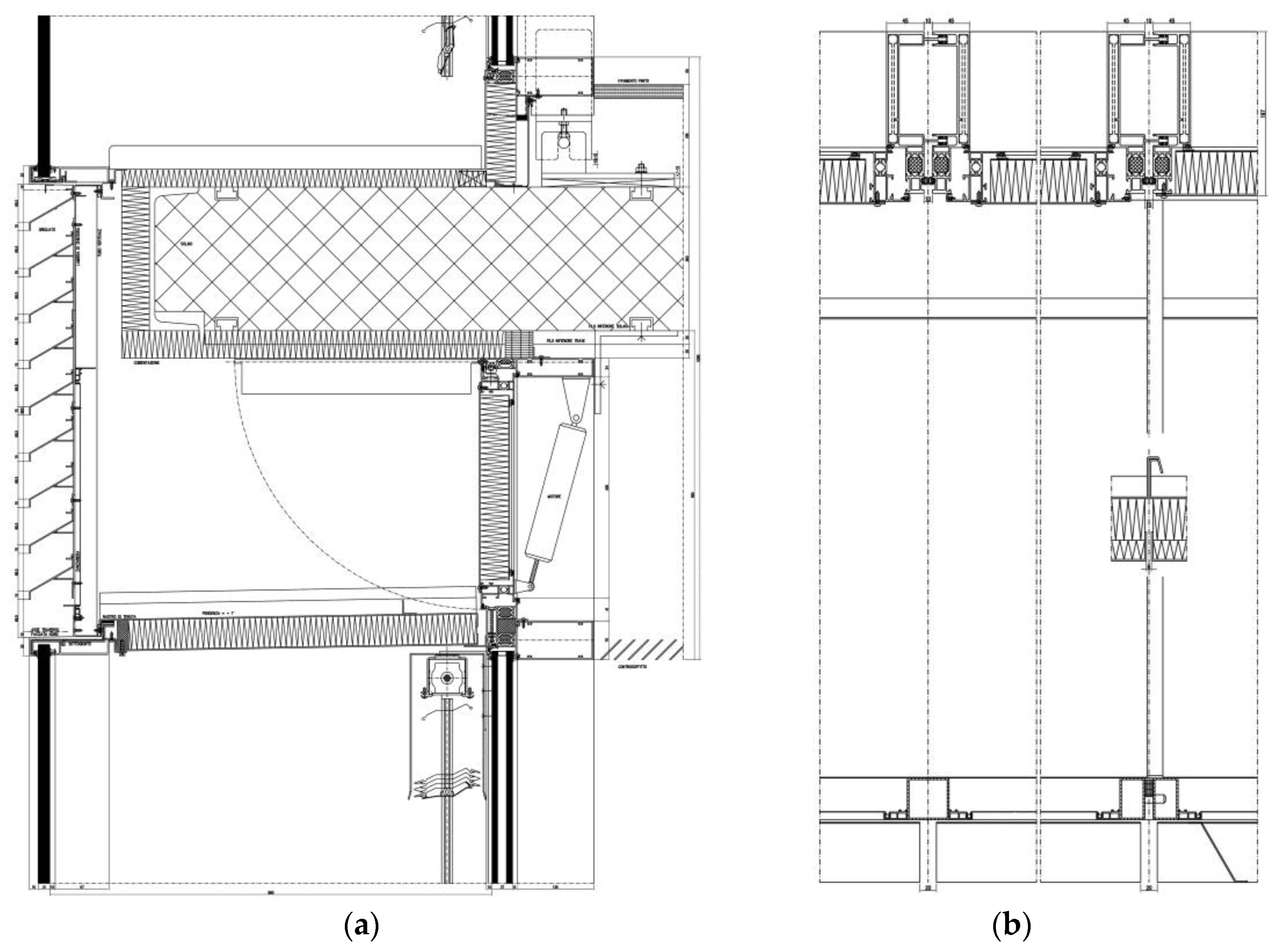
Figure 29.
Application of glass screen directed to form a box-window façade. Source: Author.
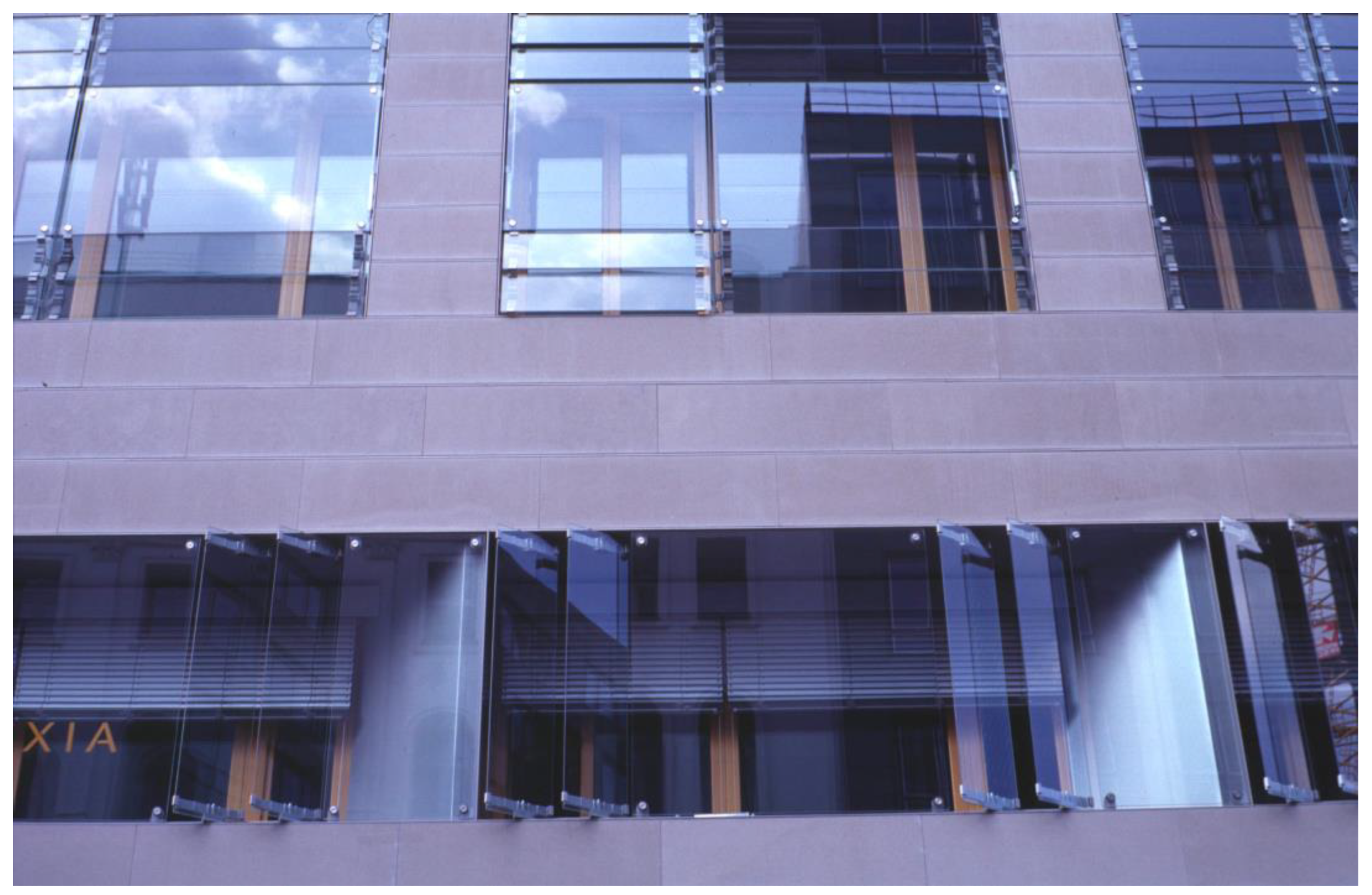
Figure 30.
The curtain, made of double-envelope components according to the unit system, involves the assembly of the two glass panels that include the naturally ventilated cavity (protected by the sunshades that can be oriented according to the solar incidence). Source: AluK Group.
Figure 30.
The curtain, made of double-envelope components according to the unit system, involves the assembly of the two glass panels that include the naturally ventilated cavity (protected by the sunshades that can be oriented according to the solar incidence). Source: AluK Group.
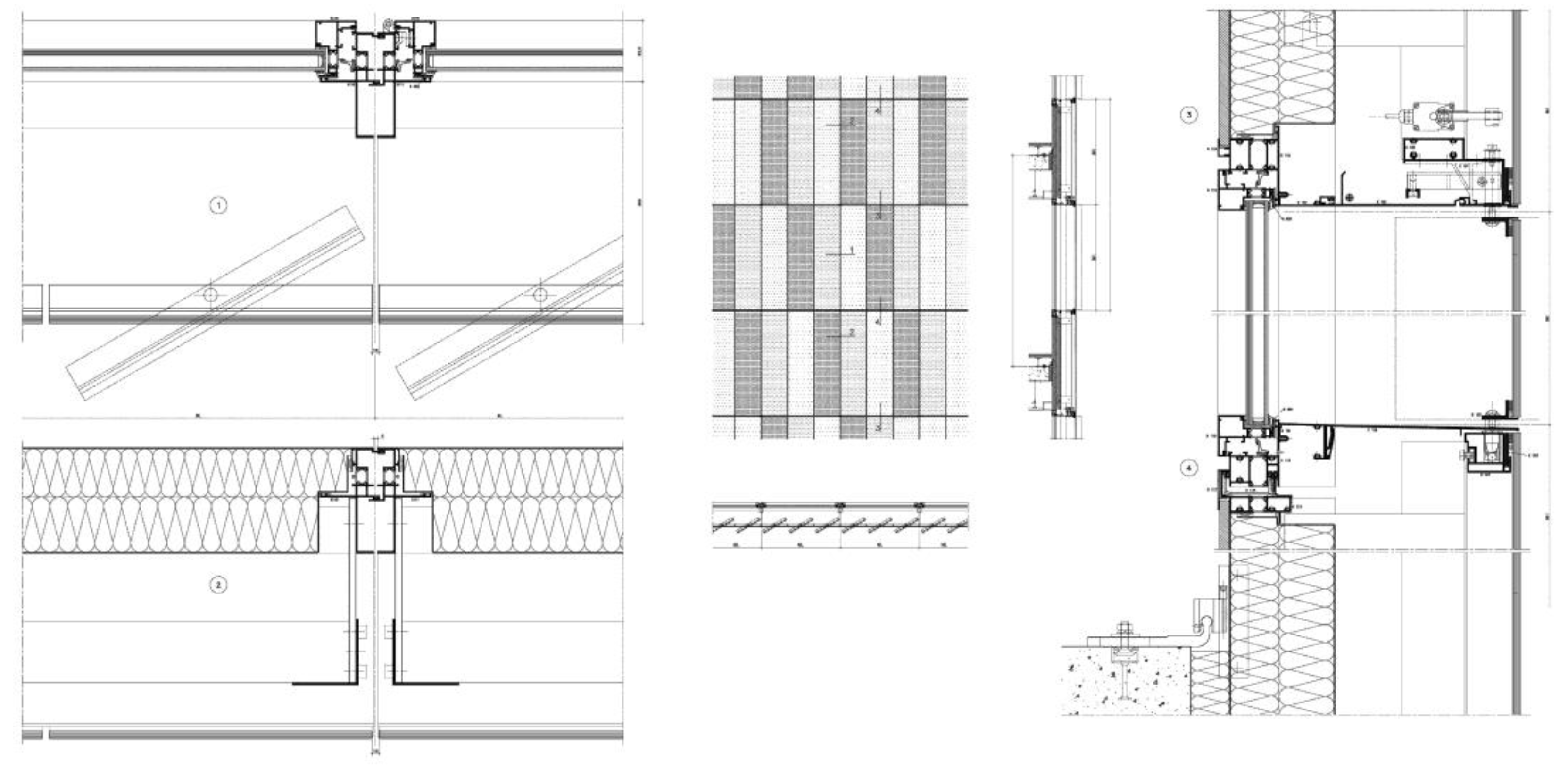
Figure 31.
The composition of the box-window observes the application of the screens on the fixed frame (a) or on the pivots for the regulation of the natural ventilation (b). Source: AluK Group.
Figure 31.
The composition of the box-window observes the application of the screens on the fixed frame (a) or on the pivots for the regulation of the natural ventilation (b). Source: AluK Group.
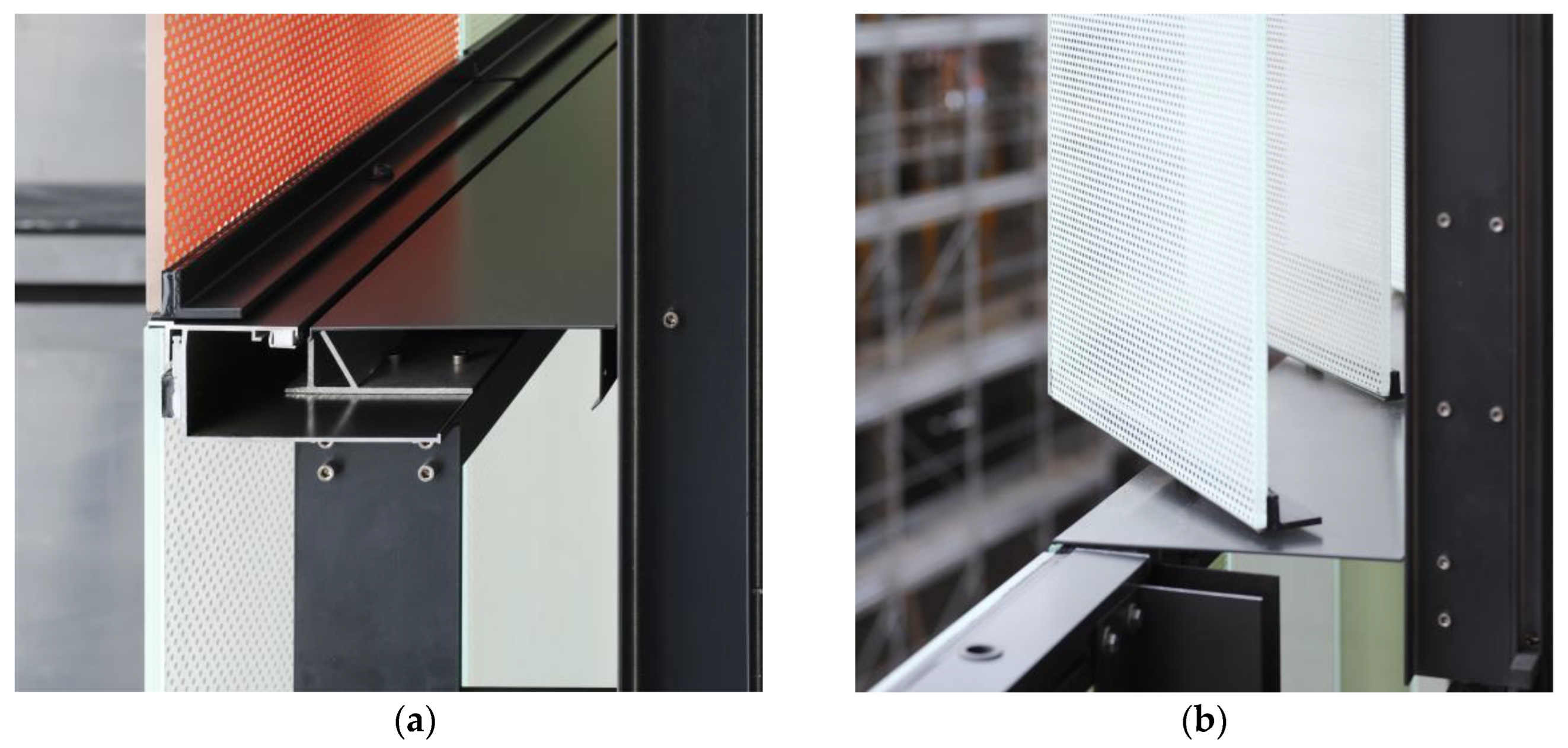
Figure 32.
Constitution of the box-window façade based on the openings on the inner curtain and the ventilation sections arranged in the outer screen (a), overlaid with the texture of the glass fins (b), according to the unit system typology (c). Source: Pichler Projects.
Figure 32.
Constitution of the box-window façade based on the openings on the inner curtain and the ventilation sections arranged in the outer screen (a), overlaid with the texture of the glass fins (b), according to the unit system typology (c). Source: Pichler Projects.
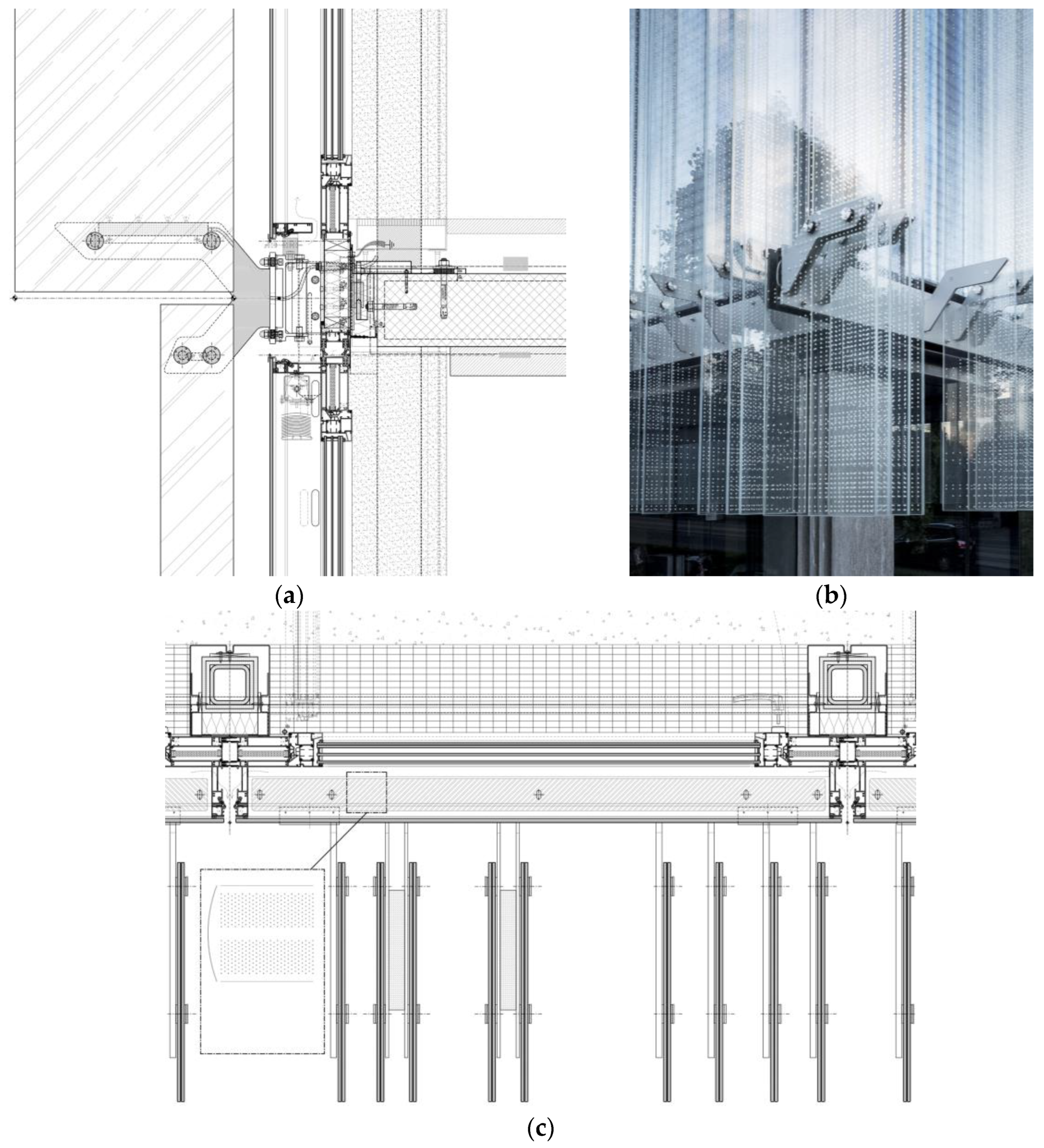
Figure 33.
Constitution of the box-window façade used to replace the previous curtain: (a) The application of the components is achieved according to the unit system type; (b) The geometrical and functional configuration of the independent ventilated cavities is established for each floor, with the airflows through the opening of the windows related to the internal façade. Source: Progetto CMR.
Figure 33.
Constitution of the box-window façade used to replace the previous curtain: (a) The application of the components is achieved according to the unit system type; (b) The geometrical and functional configuration of the independent ventilated cavities is established for each floor, with the airflows through the opening of the windows related to the internal façade. Source: Progetto CMR.
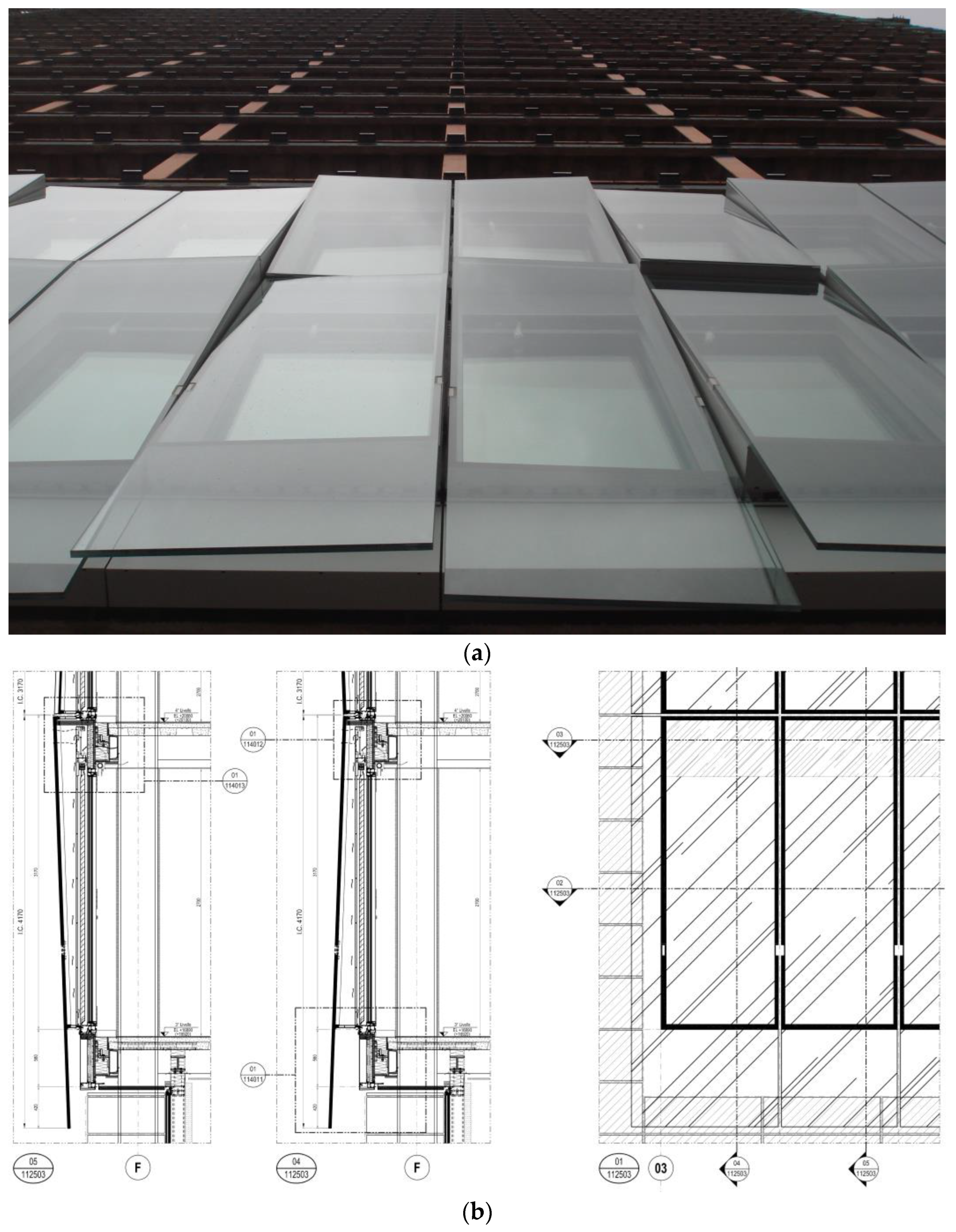
Figure 34.
Sustainable functional methodology of the Technical Skin system: (a) Outside/inside and inside/inside system winter functioning modes; (b) Outside/outside and outside/inside system summer functioning modes. Source: Carlo Nobili Serramenti in Architettura.
Figure 34.
Sustainable functional methodology of the Technical Skin system: (a) Outside/inside and inside/inside system winter functioning modes; (b) Outside/outside and outside/inside system summer functioning modes. Source: Carlo Nobili Serramenti in Architettura.
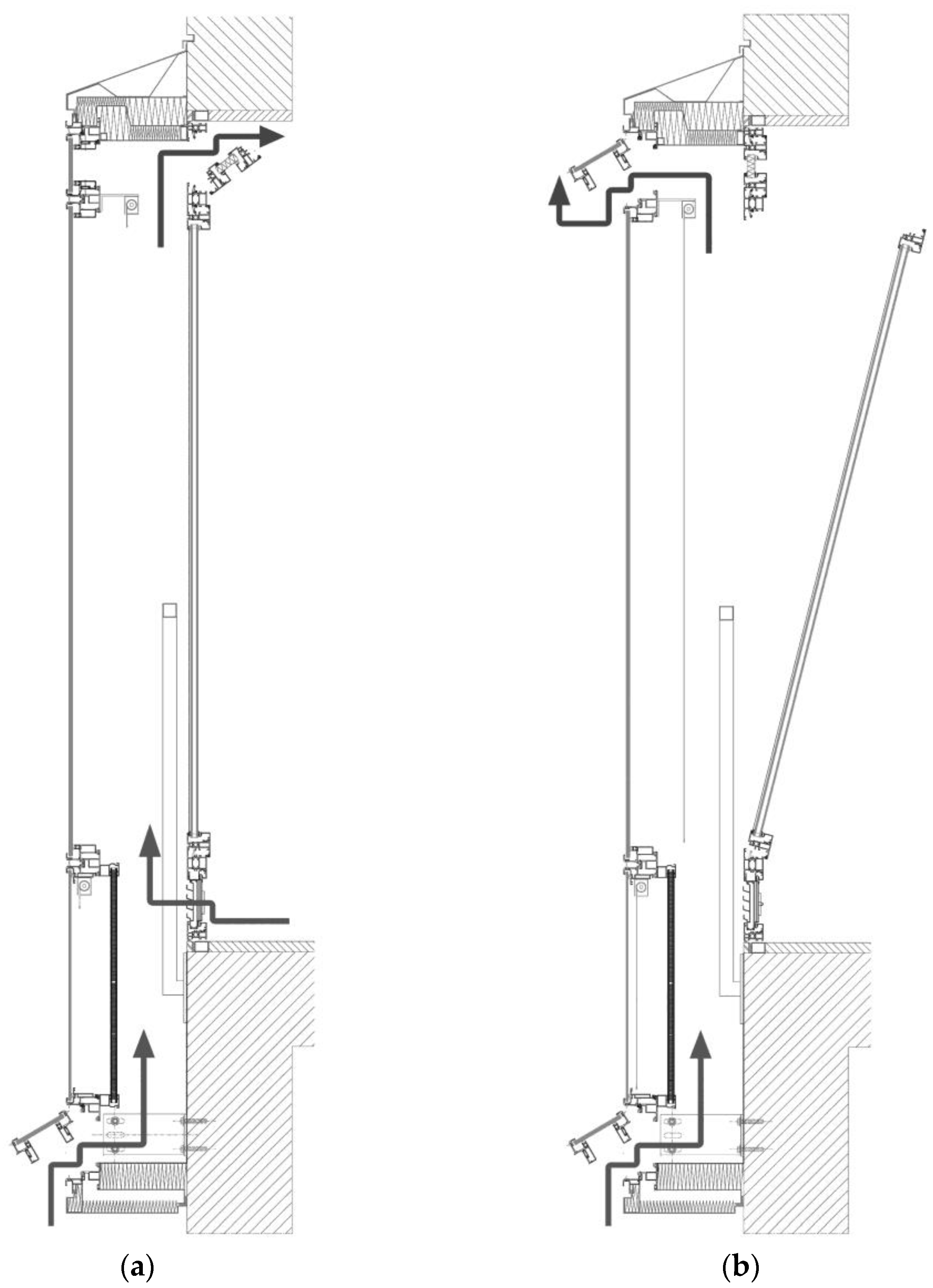
Figure 35.
Application of a multistory screen made of glass modules assembled to the existing curtain using aluminium frames and mechanical fixing points. Source: Author.
Figure 35.
Application of a multistory screen made of glass modules assembled to the existing curtain using aluminium frames and mechanical fixing points. Source: Author.
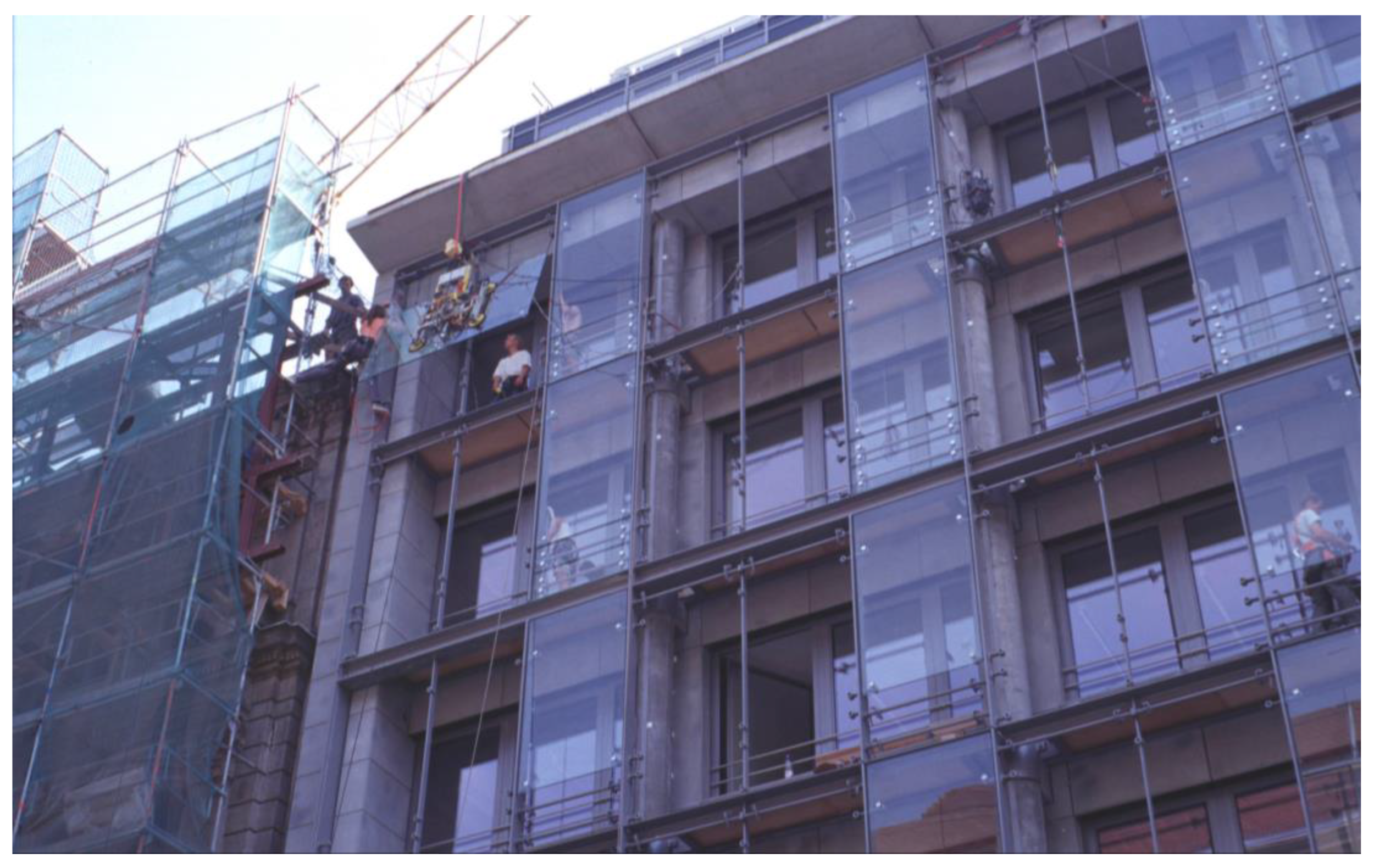
Figure 36.
Application of a multistory screen made of glass modules assembled to the projecting horizontal structural sections with mechanical fixing points (Gregotti Associati International, Pirelli Tyres Research and Development Centre, Milan). Source: Author.
Figure 36.
Application of a multistory screen made of glass modules assembled to the projecting horizontal structural sections with mechanical fixing points (Gregotti Associati International, Pirelli Tyres Research and Development Centre, Milan). Source: Author.
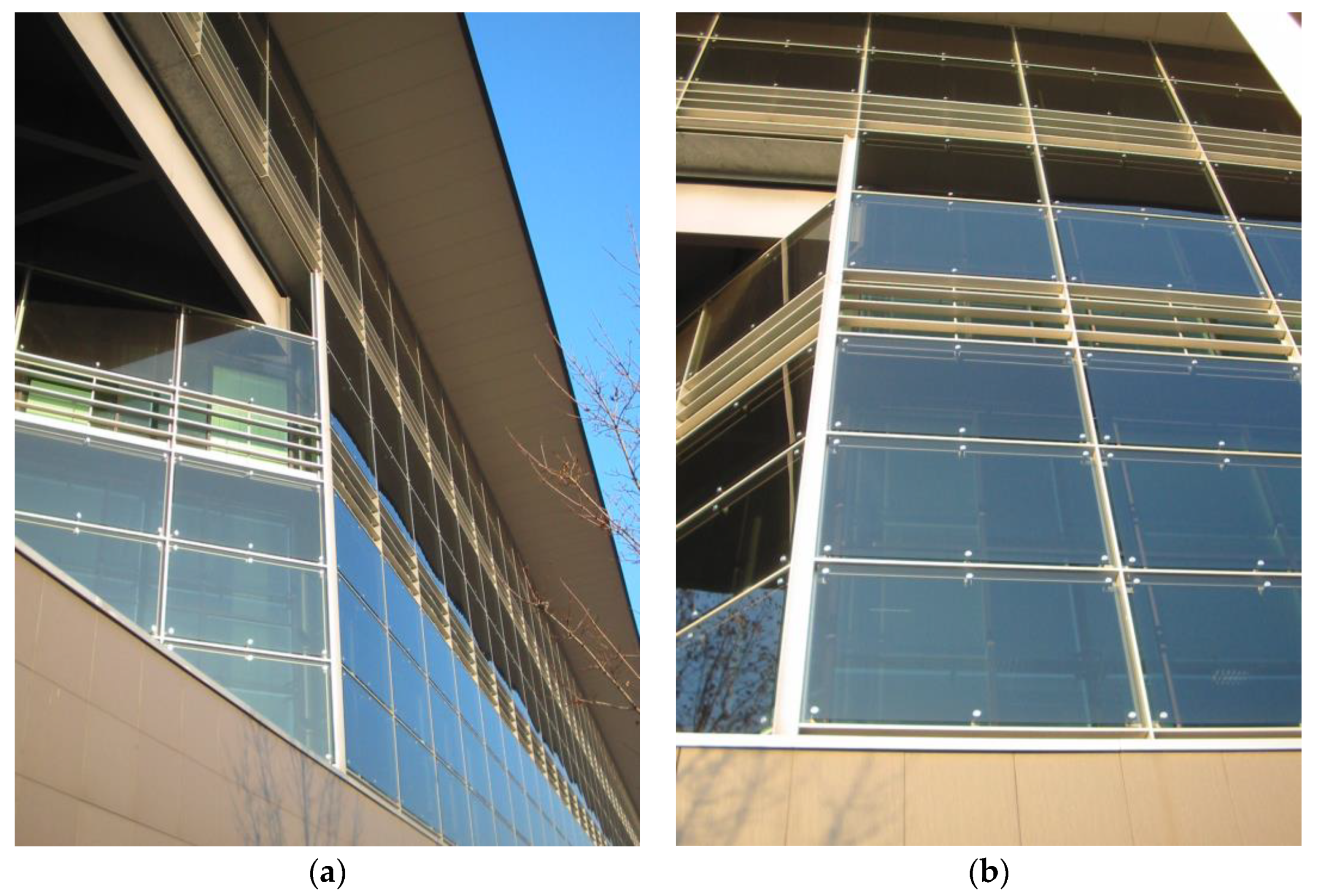
Figure 37.
Application of a multistory screen made of glass modules assembled to the steel vertical profiles (a) supporting the connections of the mechanical fixing points (b) (Studio 44, Almazova Medical Centre, Saint Petersburg). Source: Lilli Systems.
Figure 37.
Application of a multistory screen made of glass modules assembled to the steel vertical profiles (a) supporting the connections of the mechanical fixing points (b) (Studio 44, Almazova Medical Centre, Saint Petersburg). Source: Lilli Systems.
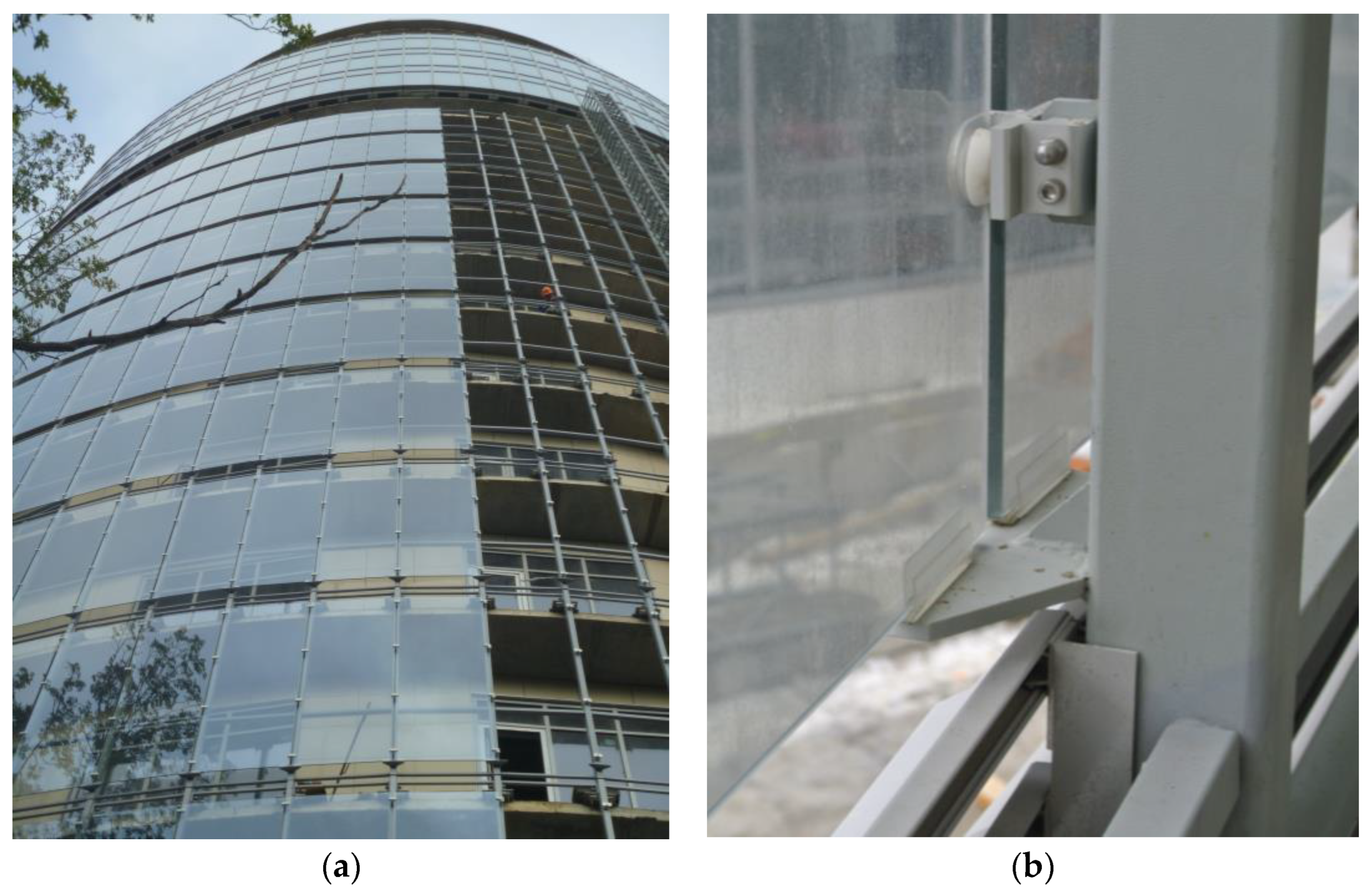
Figure 38.
Assembly of the corridor type to a building with the unit system components (a) jointed to the horizontal structures (b) (Hof Associati, Palazzo Grossi, Perugia). Source: Hof Associati.
Figure 38.
Assembly of the corridor type to a building with the unit system components (a) jointed to the horizontal structures (b) (Hof Associati, Palazzo Grossi, Perugia). Source: Hof Associati.
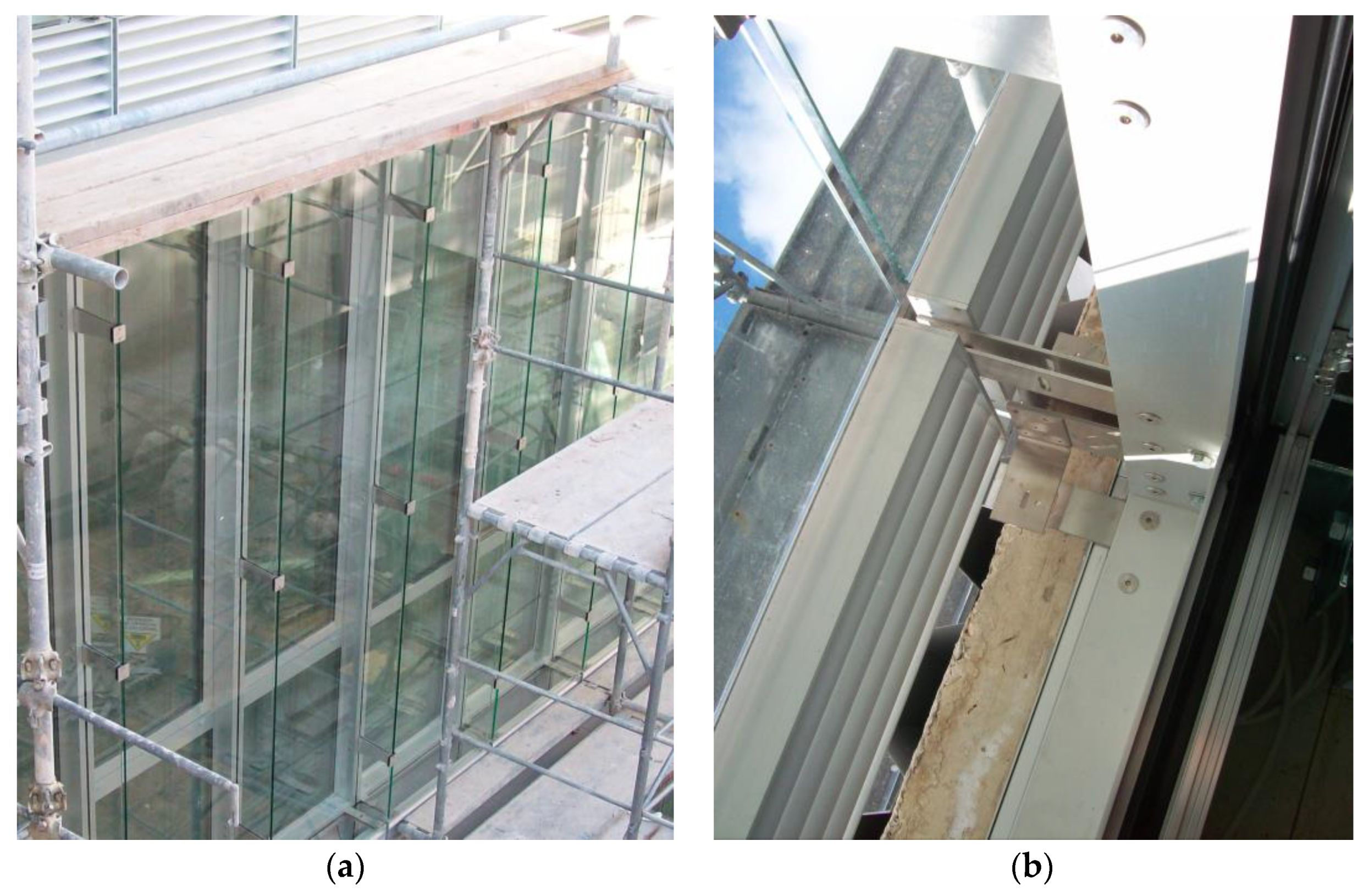
Disclaimer/Publisher’s Note: The statements, opinions and data contained in all publications are solely those of the individual author(s) and contributor(s) and not of MDPI and/or the editor(s). MDPI and/or the editor(s) disclaim responsibility for any injury to people or property resulting from any ideas, methods, instructions or products referred to in the content. |
© 2024 by the authors. Licensee MDPI, Basel, Switzerland. This article is an open access article distributed under the terms and conditions of the Creative Commons Attribution (CC BY) license (http://creativecommons.org/licenses/by/4.0/).
Copyright: This open access article is published under a Creative Commons CC BY 4.0 license, which permit the free download, distribution, and reuse, provided that the author and preprint are cited in any reuse.


