

Submitted:
21 October 2024
Posted:
24 October 2024
You are already at the latest version
Abstract
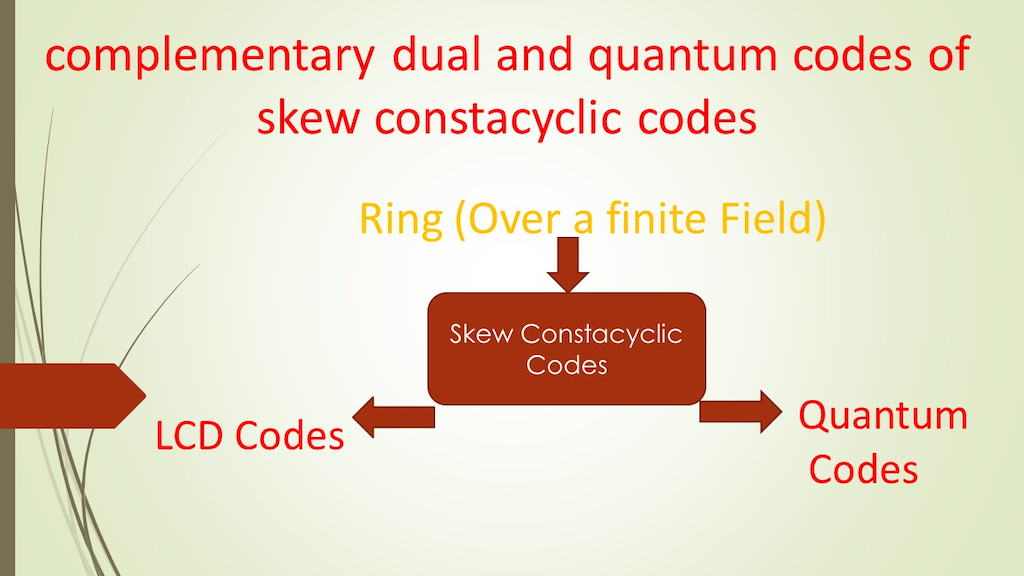
Consider the ring Be=Fq+uFq+⋯+ue−1Fq, ue=u (e≥2), where Fq denotes the finite field having q=pm elements (for m≥1 and a prime p), and q≡1(mode−1). Skew constacyclic codes over Be are studied in this paper. We present their generator polynomial and describe the criteria for their complementary duality. Moreover, we derive criteria for these codes to contain their dual and obtain quantum codes. Additionally, we establish a Gray map that preserves duality and investigate its properties. We also take into account additive skew constacyclic codes for this purpose and also derive criteria for the complementary duality of these codes. Finally, we provide several LCD and quantum codes (MDS/ near MDS). The latter are compared with the quantum codes obtained in the recent literature.
Keywords:
Constacyclic codes
; Skew constacyclic codes
; LCD codes
; Quantum codes
; Gray map
MSC: 94B05; 94B15; 94B60
1. Introduction
Rich algebraic structures and ease of practical application are two of the most well-known attributes of cyclic codes. On identifying a vector by a polynomial, one can consider any cyclic code over as a submodule of the -module for the length n. Further, these codes can also be considered as ideals generated by divisors of . It is worth noting that is a unique factorization domain, a fact which restricts the divisors of in . As an extension of these codes, constacyclic codes may be regarded as ideals of for some non-zero element . Further, these codes were examined over some finite commutative rings [1,2]. Later, by relaxing the linearity condition, additive codes were considered over mixed alphabets [3,4].
On the other hand, in the desire to obtain more factorizations of than over a factorial ring, skew cyclic codes [5,6] were introduced with the notion of skew polynomial rings [7]. These codes over a finite field are basically left submodules of the module for an automorphism of . Later, these codes were investigated by Abualrub and Seneviratne [8] over , where . Additionally, Gao [9], and Gursoy et al. [10] presented skew cyclic codes by considering different automorphisms. Later, as a continuation of these efforts, skew constacyclic codes were examined [11,12].
In 1992, Massey [13] proposed LCD codes (). It was demonstrated that these codes were the best linear coding solution to 2-BAC. Sufficient and necessary condition for the complementary duality of cyclic codes over finite fields was derived in 1994 by Yang and Massey [14]. Additionally, they deduced a relationship among the reversible and LCD cyclic codes. Later, DNA applications made full use of the former idea [15,16]. On the other hand, the Gilbert-Varshamov bound is satisfied by LCD codes, as demonstrated by Sendrier [17] in 2004. Subsequently, these codes were examined over chain rings in [18]. In 2016, these codes were shown to have applications in cryptosystems [19]. Afterwards, LCD codes were studied over different commutative rings in [20,21,22,23,24,25,26] , and applications of these codes were presented in Multi-secret Sharing Schemes [27]. Recently, LCD codes were studied in [28,29] using the skew polynomial rings. Besides, additive codes were investigated for the complementary duality over the structure in [30], and they were called additive complementary dual (ACD) codes.
In the last decades of the 20th century, it was noticed that quantum mechanics might improve the complexity of certain classical algorithms, like the DFT transform, list searching, or integer factorization. This last algorithm is a key ingredient in the RSA cryptosystem. For this reason, quantum computation got the attention of many researchers. To securitize quantum computation, Shor [31] introduced Quantum Error-Correcting Codes (QECCs) in 1995. In 1998, classical error-correcting codes were employed to obtain QECCs via some constructions such as CSS construction [32]. Afterwards, linear codes over different commutative rings were used to obtain good QECCs in [33,34,35,36]. As an extension of these works, additive codes over the commutative structure were also utilized [37]. Recently, cyclic and constacyclic codes using non-commutative rings have been employed for obtaining QECCs due to more possibility of factorization of a polynomial. Many good QECCs were obtained from cyclic and constacyclic codes [38,39,40,41] . Motivated by these works, we consider skew constacyclic and additive codes for obtaining new and better LCD and quantum codes.
This paper has been arranged as follows: Firstly, the structure of linear codes over is presented in Section 2. Section 3 presents skew constacyclic codes over , defines a Gray map and analyzes its properties. In Section 4, we derive some results for LCD codes. Further, we derive quantum codes by utilizing CSS construction in Section 5. Section 6 presents the structure and properties of additive skew constacyclic codes over . In Section 7, we present various LCD codes as well as new quantum codes. Our work is concluded in Section 8.
2. Preliminaries
Let us suppose that denotes a finite field having cardinality q. Let us consider a ring , , with (). We represent the collection of units in by .
Consider a primitive element and take . Following [42], consider
Then, we have and each has a unique representation , . Moreover, any linear code over with length n has a representation
for some linear codes over () and the dual code of is . Subsequently, the following result holds.
Theorem 1.
Let us assume that is any γ-constacyclic code over (). Then has as its generator polynomial, where each has as their generator polynomial ().
3. Skew Constacyclic Codes over
The current section presents the generator polynomials for skew constacyclic codes over and the dual codes. In order to proceed with the investigation, we first require an automorphism of as defined below.
Define an automorphism by
for . Using this, the definition for skew constacyclic codes is as mentioned below.
Definition 2.
Suppose is an automorphism of the ring , . Then a linear code over is called a skew constacyclic (or skew - constacyclic) code over , if , where is the skew -constacyclic shift given by
For (resp. ), these codes are said to be skew negacyclic (resp. skew cyclic) codes, respectively. Further, for identity automorphism and (resp. ), these codes are said to be negacyclic (resp. cyclic) codes with the corresponding negacyclic and cyclic shifts represented by and , respectively.
Consider the skew-polynomial ring
in which the multiplication is given by . Then the center of (which will be used to study skew constacyclic codes) can be obtained by the below-mentioned result.
Lemma 3.
Let us assume that such that , where is an automorphism of . The order of divides n iff lies in .
Proof.
It implies that for all . Therefore, we conclude that order of divides n. □
Let and order of divides n, i.e., . Then, for any , we have
and
That is, and hence .
Conversely, assume that . Then , for all and . Now,
As we have already seen that for an automorphism of whose order divides n and such that is fixed by , we have . Therefore, is a ring. On the contrary, if n is not divisible by order of then doesn’t form a ring but a left -module and any skew constacyclic code is characterized by the result given below.
Lemma 4.
Any linear code over having length n is a skew -constacyclic code iff forms a left -submodule of .
Theorem 5.
Suppose and is a linear code over . Then is a skew -constacyclic code iff each is skew -constacyclic code ().
Proof.
Let us suppose that is a skew -constacyclic code over and for every j lying in the set . Then , where for each i lying in the set . As is a skew -constacyclic code, we have . Note that
It implies that for each . Consequently, is a skew -constacyclic code for each j lying in the set .
For the other side, assume that is skew -constacyclic code over and , where for each j lying in the set . Then for each i lying in the set as . Since are skew -constacyclic codes, we have for each which further implies that . Now,
Consequently, is a skew -constacyclic code as . □
From [12], any skew -constacyclic code having length n over for is principally generated by a polynomial as a left -submodule of the module and , where divides on the right and regarded as the generator polynomial of the code . Using these arguments and Theorem 5, the below mentioned conclusion can be derived.
Theorem 6.
Suppose and is a skew -constacyclic code over with , where each divides on the right (i lying in the set ). Then , where divides on the right.
We now consider a Gray map defined as
where for each i lying in the set and a square matrix M satisfies for the identity matrix I and . Then is a bijective linear map, and the following result can be deduced.
Lemma 7.
Let us suppose that is a linear code over having dual code . Then
Proof.
Suppose and , where and for each i lying in the set . Then
which implies that for all . Now,
and
i.e., . Therefore, . Moreover, as is a bijective map. Hence □
4. LCD Codes
This section first presents the dual of a skew constacyclic code, and then obtains conditions under which these codes must be LCD. Further, we study their Gray images.
For any of degree r with , its left monic skew reciprocal polynomial is defined as . The polynomial is called as self-reciprocal iff . This monic skew reciprocal polynomial is useful for the investigation of dual code . If and n is divisible by order of , then the dual of a skew -constacyclic code over is a skew -constacyclic code over , which is given by , where for the length n of . Now, under the same conditions on n and considering ( ) fixed by , we obtain the following result.
Theorem 8.
Suppose and is a skew -constacyclic code over having the generator polynomial , where is the generator polynomial of and for each . Then the generator polynomial of is , where for .
Definition 9
(LCD codes). If for any linear code over , then the code is considered as LCD (or complementary dual).
In order to check the complementary duality of skew constacyclic codes over , we first need a criterion for evaluating the complementary duality of a skew constacyclic code over finite field.
Lemma 10.
[28, Theorem 4.1] Suppose that n is divisible by order of , such that and is a skew -constacyclic code over finite field with skew generator polynomial . Choose in order to ensure . Then is a Euclidean LCD code iff , where denotes the greatest common right divisor of and .
Once we get a link among the complementary duality of a linear code over with its constituent codes, we can get requirements for complementary duality of any skew -constacyclic code over . So, first we establish that link which is presented in the below mentioned result.
Proposition 11.
Suppose is a linear code over . Then is an LCD code iff each is an LCD code over .
Proof.
Suppose is a linear code over . The dual code is and
Consequently, it is evident that iff for every . □
From now onwards, we work under the assumption that ’s are fixed by for , and the order of divides n. Using the Proposition 11 and Lemma 10, we now obtain requirements for skew -constacyclic code over to be complementary dual, where for .
Theorem 12.
Suppose for and n is a multiple of order of . Then a skew -constacyclic code having length n over is an LCD code iff , where denotes the greatest common right divisor of and for each .
Proof.
Suppose is a skew constacyclic code over and is such that for . Then, by Lemma 10, is an LCD code iff for each . Therefore, is an LCD code iff for each . □
Next, we present a relation between the Gray image of the intersection of a code and its dual with the intersection of their Gray images, which can be proved by using Lemma 7.
Lemma 13.
Suppose is a linear code having length n over . Then , where Φ is the Gray map defined in Section 3.
Proof.
Suppose . Then there exist and such that as by Lemma 7. But is injective, so we have and hence . Therefore, .
Conversely, assume that . Then for some . Further, . Using Lemma 7, we get as . Therefore, and the result follows. □
By applying this lemma, we are able to derive a relationship between the complementary duality of a linear code over and its Gray image under the map .
Theorem 14.
Suppose is a linear code over . Then is an LCD code iff is an LCD code over .
Proof.
As is injective, the proof follows using Lemma 13. □
5. Quantum Codes
In this section, we consider to be a unit in which is fixed by and n be divisible by order of . We obtain the dual containing conditions for a skew -constacyclic code over and then establish the existence of a quantum code by applying the CSS construction on their Gray images. In this direction, we first recall some preliminary definitions and results.
Following [34], for a Hilbert space of dimension q over the field of complex numbers , is also a Hilbert space of dimension . Further, any -dimensional subspace of the Hilbert space is called a quantum code denoted by , where d is the minimum distance of the code. Further, for the comparison of two quantum codes with parameters and , we have the following conditions:
- and
- and
- and .
If any one of the above conditions is satisfied, then we say that the quantum code with the parameters is better than the one with the parameters . Now, we recall the condition for a skew constacyclic code over to contain its dual.
Lemma 15.
[41, Lemma 5.3] Suppose is a skew -constacyclic code having length n over , where for and n be a multiple of the order of . Then iff is right divisible by .
The following result presents a relation between the dual containing property of a skew constacyclic code over in terms of its constituent codes in the decomposition.
Lemma 16.
Suppose is a skew -constacyclic code having length n over . Then iff for .
Proof.
Suppose is a skew -constacyclic code having length n over , be its dual code such that . Then multiplying by in the equation
we get for each . As ’s are codes over , it further implies that for each .
Conversely, assume that for each . Then , i.e., which completes the proof. □
Using this relation and Lemma 15, we now obtain conditions for skew constacyclic code over to contain its dual code.
Theorem 17.
Suppose is a skew -constacyclic code having length n over , where n is a multiple of the order of , for , such that for . Then iff is right divisible by for each .
Proof.
Suppose is right divisible by for each . Then by Lemma 15, where for . It implies that
Conversely, assume that , i.e.,
Then multiplying by on both the sides, we get
It further implies that as ’s are linear codes over and hence is right divisible by for each . □
To obtain quantum codes from dual containing codes, we use the CSS construction [35, Theorem 3], which is given below.
Lemma 18
(CSS construction). Suppose and are linear codes over with . Assume that . Then there exists a QECC with parameters . In particular, if and let , then there exists a QECC with parameters .
Now, we employ the above CSS construction to obtain quantum codes from the dual containing skew -constacyclic codes over , where for .
Theorem 19.
Suppose is a skew -constacyclic code over such that and have the parameters . Then, the existence of a quantum code over having the parameters is guaranteed.
Proof.
Suppose is a skew -constacyclic code over with . Then is a linear code over with . By using Lemma 18, the existence of a quantum code over having the parameters is guaranteed. □
6. Complementary Dual and Quantum Codes from -Additive Skew Constacyclic Codes
In this section, we examine -additive codes. We first obtain dual containing conditions for an additive skew constacyclic code over and establish the existence of a quantum code with certain parameters. Further, we obtain conditions for an additive skew constacyclic code to be ACD (additive complementary dual) in some instances. Throughout this section, we consider to be a unit in which is fixed by and n is divisible by the order of .
Consider the set which forms a group under componentwise addition. Define a projection map as , where for . Further, we define a multiplication as , where and for . Then, it can be checked that the set defined as
forms a -module under the componentwise addition and the multiplication defined by ‘*’. Further, we recall that any -additive code having length is a non-empty subset of such that forms a -submodule of the module . The dual code of an -additive code , which is defined as
where
for and , is also a -additive code having length . We say that an -additive code is an additive complementary dual (ACD) code if . Now, we define an -additive skew constacyclic code.
Definition 20.
For a unit element and an automorphism , an -additive code having length is said to be an -additive skew -constacyclic code if for every where , are the cyclic and the skew -constacyclic shifts, respectively.
For a unit element , consider the set . We identify an element by the polynomials where and . Now, we define the corresponding multiplication as
where for any and . The set forms a -module with respect to the usual componentwise addition of polynomials and the multiplication defined by *. Now, under the above identification of vectors by polynomials and considering the above module structure of , an -additive skew constacyclic code can be seen as a -submodule of as given below.
Theorem 21.
Suppose is an -additive code having length . Then, it is an -additive skew -constacyclic code having length iff is a -submodule of the module .
Proof.
Suppose is an -additive skew -constacyclic code having length and with the vector representation . Then . Note that
which corresponds to . It implies that and hence for any non-negative integer i. Also, using the polynomial identification, we get for any as is a -submodule of the module . Therefore, is a -submodule of the module .
Conversely, assume that is a -submodule of the module and with the polynomial representation . Then . Note that the polynomial representation of is . Therefore, and hence is an -additive skew -constacyclic code. □
Now, we define a Gray map as
where and is the map defined in Section 3. It can be checked that is a linear map, which is also bijective. Further, preserves duality as stated in the next result which can be proved on similar lines to [37, Lemma 6].
Lemma 22.
Suppose is an -additive code having length with its dual code . Then .
Now, we define two projection maps , as where and . Then, for any -additive code having length , and are linear codes having lengths over and , respectively. Further, we call an -additive code to be a separable code if it can be written in terms of the codes and as given below.
Definition 23.
An -additive code having length is said to be a separable code, if .
If is a separable code then its dual code is . Further, the below result can classify a separable -additive skew constacyclic code.
Theorem 24.
Suppose is a separable -additive code having length . Then, it is an -additive skew -constacyclic code having length iff , are cyclic and skew -constacyclic codes over and , respectively.
Proof.
Suppose is a separable -additive skew -constacyclic code having length , and . Then and . That is, and . Therefore, , are cyclic and skew -constacyclic codes, respectively.
Conversely, assume that , be cyclic and skew -constacyclic codes and . Then and . Therefore, and as , are cyclic and skew -constacyclic codes, respectively. Hence, , i.e., is an -additive skew -constacyclic code. □
The above classification is later used to obtain quantum codes from separable -additive skew -constacyclic codes. For achieving this, we first derive the necessary and sufficient conditions for a separable -additive code to contain its dual code.
Lemma 25.
Suppose is a separable -additive code having length . Then iff and .
Proof.
As is a separable code, we have . Therefore, iff and . □
The following result obtains the condition for constacyclic code over to contain its dual code.
Lemma 26.
[32] Suppose is an α-constacyclic code having length m over for . Then iff .
Proposition 27.
Suppose is a separable -additive skew -constacyclic code having length , where for . Assume that and . Choose for such that and for . Then iff is right divisible by for each and .
Proof.
From Lemma 25, iff , where , are cyclic and skew -constacyclic codes having lengths over and , respectively. Rest of the result follows using Lemma 26 and Theorem 17. □
Proposition 27 gives the necessary and sufficient condition for a separable -additive skew -constacyclic code to contain its dual. Using the CSS construction and Proposition 27, we now present the construction of quantum codes from separable -additive skew -constacyclic codes in the next theorem.
Theorem 28.
Suppose is a separable -additive skew -constacyclic code having length such that , where for . Assume that the parameters of the code be . Then, there exists a quantum code with the parameters over .
Proof.
Suppose is a separable -additive skew -constacyclic code such that . Then which implies that as by Lemma 22. That is, is a linear code over which contains its dual. Therefore, by Lemma 18, there exists a quantum code with the parameters over . □
Besides getting quantum codes from additive codes over , these codes can be investigated to obtain conditions for complementary duality. In particular, we obtain conditions for an -additive skew constacyclic code to be ACD for which we need two basic results which are given below.
Lemma 29.
[14] Suppose is a cyclic code over with generator polynomial . Then is an LCD code iff , where denotes the greatest common divisor of and .
Proposition 30.
Suppose is a separable -additive code having length . Then is an ACD code iff and are LCD codes over and , respectively.
Proof.
Suppose is an ACD code and its dual code be . If and then . Therefore, which implies that and are LCD codes over and , respectively.
Conversely, assume that , be LCD codes over and , respectively. For any , we have and . That is, which implies that is an ACD code. □
Using the above classification for complementary duality, we now present necessary and sufficient conditions for a separable -additive skew constacyclic code to be ACD.
Theorem 31.
Suppose is a separable -additive skew -constacyclic code having length , where for . Assume that and . Choose such that and for . Then is an ACD code iff the following conditions hold:
- , where denotes the greatest common divisor of and .
- , where denotes the greatest common right divisor of and , for .
Proof.
It can be verified by using Lemma 29, Theorems 12 and 24. □
7. Examples
In the present section, we derive several LCD and quantum codes in support of our study. Most of the codes are either MDS or near MDS. Moreover, a comparison is made between the resulting quantum codes and the codes found in recent literature.
To obtain the Gray image of any skew constacyclic code over under , we consider the matrix . Notably, all linear codes over a finite field having parameters satisfy the Singleton bound, which is determined by . If , it is considered as an MDS code; if , it is considered as near MDS. In case of an quantum code, we have the Singleton bound. The quantum code satisfying the equality is called as an MDS code, and the code satisfying is called a near MDS code. Now, we go through a few examples of codes in detail.
Example 32.
Take , . Consider the factorization of over given by
and take . Further, consider the factorization
and take . Then is a cyclic code over and is an LCD code with the parameters which is a near MDS code.
Example 33.
Take , . Consider the factorization of over given by
and take . Further, consider the factorization
and take . Then is a skew negacyclic code over and the parameters of are . By using Theorem 19, we obtain a quantum code having the parameters which is better than the code given in [40].
Example 34.
Take , . Consider the factorization of over given by
and take . Further, consider the factorizations
and
and take and . Then, the code given by Proposition 27 is a additive skew constacyclic code containing its dual. The Gray image of the code is a code which contains its dual. Therefore, a quantum code having the parameters is obtained by using Theorem 28.
In Table 1 and Table 2, we present LCD and quantum codes obtained from skew -constacyclic code over , respectively. In both the tables, the first column represents the length of the code , and the second column represents such that . The third column represents the polynomials such that is generated by while the parameters of are presented in the fourth column. In Table 2, the parameters of the quantum codes obtained from the code (using Theorem 19) are presented in the fifth column. In the sixth column, the comparison of these obtained codes is made with the known quantum codes that have been reported recently in the literature.
Further, we obtain quantum codes from -additive skew -constacyclic codes having length where . In Table 3, we tabulate , the polynomials such that and where and is a right divisor of for . The parameters of the code are presented in the fifth column, whereas the parameters of the derived quantum codes are presented in the sixth column by using Theorem 28.
Remark:
In the tables, the polynomials are represented by their coefficients in increasing powers of x. For instance, represents the polynomial , where t is the primitive element of the corresponding field .
8. Conclusions
In this article, we have investigated skew -constacyclic codes over the ring and obtained requirements for these codes to be LCD for some specific values of . Further, we have obtained requirements for a skew constacyclic code over to satisfy the dual containing property, motivated by the CSS construction for quantum codes. We also defined a duality-preserving Gray map. This yielded several (MDS/near MDS) LCD codes and new quantum codes over finite fields. Moreover, we have also considered additive skew constacyclic codes, and obtained conditions for complementary duality and dual containing property.
Author Contributions
Supervision, O.P.; Resources, O.P.; project administration, O.P.; funding acquisition, P.S.; conceptualization, S.Y.; methodology, S.Y.; software, A.S.; validation, O.P., P.S., S.Y. and A.S.; formal analysis, S.Y. and A.S.; investigation, S.Y.; data curation, A.S.; writing—original draft preparation, S.Y.; writing—review and editing, O.P., P.S.; visualization, S.Y., A.S. All authors have read and agreed to the published version of the manuscript.
Funding
This research received no external funding.
Data Availability Statement
The original contributions presented in the study are included in the article, further inquiries can be directed to the corresponding author.
Acknowledgments
The authors are thankful to the Indian Institute of Technology Patna for providing research facilities.
Conflicts of Interest
The authors declare that there is no conflict of interest regarding the publication of this manuscript.
References
- H. Islam, T. Bag, O. Prakash, A class of constacyclic codes over 4[u]/〈uk〉, J. Appl. Math. Comput., 60 (2019), 237–251. [CrossRef]
- M. Shi, L. Qian, L. Sok, N. Aydin, P. Solé, On constacyclic codes over 4[u]/(u2 − 1) and their Gray images, Finite Fields Appl., 45 (2017), 86–95. [CrossRef]
- I. Aydogdu, T. Abualrub, I. Siap, On 22[u]-additive codes, Int. J. Comput. Math., 92 (2015), 1806–1814. [CrossRef]
- O. Prakash, S. Yadav, H. Islam, P. Solé, On 44[u3]-additive constacyclic codes, Adv. Math. Commun., 17 (2023), 246–261. [CrossRef]
- D. Boucher, W. Geiselmann, F. Ulmer, Skew cyclic codes, Appl. Algebra Engrg. Comm. Comput., 18 (2007), 379–389. [CrossRef]
- D. Boucher, F. Ulmer, Coding with skew polynomial rings, J. Symb. Comput., 44 (2009), 1644–1656. [CrossRef]
- O. Ore, Theory of non-commutative polynomials, Ann. Math., 34 (1933), 480–508. [CrossRef]
- T. Abualrub, P. Seneviratne, Skew codes over rings, Hong Kong, IMECS, 2 (2012), 846–847. Available online: https://www.iaeng.org/publication/IMECS2010/IMECS2010_pp846-847.pdf.
- J. Gao, Skew cyclic codes over p + vp, J. Appl. Math. Inform., 31 (2013), 337–342. [CrossRef]
- F. Gursoy, I. Siap, B. Yildiz, Construction of skew cyclic codes over q + vq, Adv. Math. Commun., 8 (2014), 313–322. [CrossRef]
- D. Boucher, P. Solé, F. Ulmer, Skew constacyclic codes over Galois rings, Adv. Math. Commun., 2 (2008), 273–292. [CrossRef]
- J. Gao, F. Ma, F. Fu, Skew constacyclic codes over the ring q + vq, Appl. Comput. Math., 16 (2017), 286–295. Available online: https://www.researchgate.net/publication/292205358.
- J. L. Massey, Linear codes with complementary duals, Discrete Math., 106/107 (1992), 337–342. [CrossRef]
- X. Yang, J. L. Massey, The condition for a cyclic code to have a complementary dual, Discrete Math., 126 (1994), 391–393. [CrossRef]
- O. Prakash, S. Patel, S. Yadav, Reversible cyclic codes over some finite rings and their application to DNA codes, Comput. Appl. Math., 40 (2021), Article no. 242. [CrossRef]
- O. Prakash, S. Yadav, P. Sharma, Reversible cyclic codes over a class of chain rings and their application to DNA codes, Int. J. Inf. Coding Theory, 6 (2022), 52–70. [CrossRef]
- N. Sendrier, Linear codes with complementary duals meet the Gilbert-Varshamov bound, Discrete Math., 285 (2004), 345–347. [CrossRef]
- X. Liu, H. Liu, LCD codes over finite chain rings, Finite Fields Appl., 34 (2015), 1–19. [CrossRef]
- C. Carlet, S. Guilley, Complementary dual codes for counter-measures to side-channel attacks, Adv. Math. Commun., 10 (2016), 131–150. [CrossRef]
- Z. Liu, J. Wang, Linear complementary dual codes over rings, Des. Codes Cryptogr., 87 (2019), 3077–3086. [CrossRef]
- O. Prakash, S. Yadav, R. K. Verma, Constacyclic and Linear Complementary Dual codes over q + uq, Defence Sci. J., 70 (2020), 626–632. [CrossRef]
- O. Prakash, S. Yadav, H. Islam, P. Solé, Self-dual and LCD double circulant codes over a class of non-local rings, Comput. Appl. Math., 41 (2022), Article no. 245. [CrossRef]
- M. Shi, D. Huang, L. Sok, P. Solé, Double circulant LCD codes over 4, Finite Fields Appl., 58 (2019), 133–144. [CrossRef]
- M. Shi, H. Zhu, L. Qian, L. Sok, P. Solé, On self-dual and LCD double circulant and double negacirculant codes over q + uq, Cryptogr. Commun., 12 (2020), 53–70. [CrossRef]
- S. Yadav, H. Islam, O. Prakash, P. Solé, Self-dual and LCD double circulant and double negacirculant codes over q + uq + vq, J. Appl. Math. Comput., 67 (2021), 689–705. [CrossRef]
- S. Yadav, A. Singh, O. Prakash, Complementary dual skew polycyclic codes and their applications to EAQECCs, Eur. Phys. J. Plus, 138 (2023), Article no. 637. [CrossRef]
- A. Alahmadi, A. Altassan, A. AlKenani, S. Çalkavur, H. Shoaib, P. Solé, A Multisecret-Sharing Scheme Based on LCD Codes, Mathematics, 8 (2020), Article no. 272. [CrossRef]
- R. Boulanouar, A. Batoul, D. Boucher, An overview on skew constacyclic codes and their subclass of LCD codes, Adv. Math. Commun., 15 (2021), 611–632. [CrossRef]
- L. Hui, H. Peng, L. Xiu-sheng, Skew cyclic and LCD codes over q + uq + vq, J. of Math., 38 (2018), 459–466.
- X. Hou, X. Meng, J. Gao, On 22[u3]-Additive Cyclic and Complementary Dual Codes, IEEE Access, 9 (2021), 65914–65924. [CrossRef]
- P. Shor, Scheme for reducing decoherence in quantum computer memory, Phys. Rev. A, 52 (1995), Article no. 2493. [CrossRef]
- A. R. Calderbank, E. M. Rains, P. M. Shor, N.J.A. Sloane, Quantum error-correction via codes over GF(4), IEEE Trans. Inf. Theory, 44 (1998), 1369–1387. [CrossRef]
- A. N. Alkenani, M. Ashraf, G. Mohammad, Quantum codes from the constacyclic codes over the ring q[u1,u2]/〈 − u1, − u2,u1u2 − u2u1〉, Mathematics, 8 (2020), 781(1–11). [CrossRef]
- M. Ashraf, G. Mohammad, Quantum codes over p from cyclic codes over p[u,v]/〈u2 − 1,v3 − v,uv − vu〉, Cryptogr. Commun., 11 (2019), 325–335. [CrossRef]
- M. Grassl, T. Beth, M. Roetteler, On optimal quantum codes, Int. J. Quantum Inf., 2 (2004), 55–64. [CrossRef]
- M. Shi, X. Huang, Q. Yue, Construction of new quantum codes derived from constacyclic codes over q2 + uq2+⋯+ur − 1q2, Appl. Algebra Engrg. Comm. Comput., 32 (2021), 603–620. [CrossRef]
- H. Islam, O. Prakash, New quantum codes from constacyclic and additive constacyclic codes, Quantum Inf. Process., 19 (2020), Article no. 319. [CrossRef]
- T. Bag, H. Q. Dinh, A. K. Upadhyay, R. Bandi, W. Yamaka, Quantum codes from skew constacyclic codes over the ring q[u,v]/〈u2-1,v2-1,uv − vu〉, Discrete Math., 343 (2020), Article no. 111737. [CrossRef]
- O. Prakash, H. Islam, S. Patel, P. Solé, New quantum codes from skew constacyclic codes over a class of non-chain rings Re,q, Int. J. Theor. Phys., 60 (2021), 3334-3352. [CrossRef]
- R. K. Verma, O. Prakash, A. Singh, Quantum codes from skew constacyclic codes over pm + vpm + v2pm, Algebraic and Combinatorial Coding Theory (ACCT), (2020), 156–161. [CrossRef]
- R. K. Verma, O. Prakash, A. Singh, H. Islam, New quantum codes from skew constacyclic codes, Adv. Math. Commun., 17 (2023), 900–919. [CrossRef]
- M. Goyal, M. Raka, Duadic codes over the ring q[u]/〈um − u〉 and their Gray images, J. Comp. Comm., 4 (2016), 50–62. [CrossRef]

Table 1.
LCD codes obtained from skew -constacyclic code over .
| n | Remark | |||
| 8 | , | near MDS | ||
| 12 | , | near MDS | ||
| 12 | , | near MDS | ||
| 8 | , | MDS | ||
| 12 | , | near MDS | ||
| 12 | , | near MDS | ||
| 12 | , | near MDS | ||
| 20 | , | near MDS |
Table 2.
Quantum codes obtained from dual containing skew -constacyclic code over .
| n | Existing/Remark | ||||
| 8 | − | ||||
| 8 | − | ||||
| 30 | − | ||||
| 48 | [41] | ||||
| 8 | − | ||||
| 48 | [41] | ||||
| 8 | MDS | ||||
| 30 | [40] | ||||
| 30 | [40] |
Table 3.
Quantum codes obtained from -additive skew -constacyclic codes.
Disclaimer/Publisher’s Note: The statements, opinions and data contained in all publications are solely those of the individual author(s) and contributor(s) and not of MDPI and/or the editor(s). MDPI and/or the editor(s) disclaim responsibility for any injury to people or property resulting from any ideas, methods, instructions or products referred to in the content. |
© 2024 by the authors. Licensee MDPI, Basel, Switzerland. This article is an open access article distributed under the terms and conditions of the Creative Commons Attribution (CC BY) license (http://creativecommons.org/licenses/by/4.0/).
Copyright: This open access article is published under a Creative Commons CC BY 4.0 license, which permit the free download, distribution, and reuse, provided that the author and preprint are cited in any reuse.


