
Submitted:
19 October 2024
Posted:
21 October 2024
You are already at the latest version
Abstract
By combining a lattice subgroup diagram of Z_m with a weighted poset metric, we introduce a new weighted coordinates poset metric for codes over Z_m , called LS-poset metric. When I is an ideal in a poset, the concept of I-perfect codes with LS-poset metric is investigated. We obtain a Singleton bound for codes with LS-poset metric and define MDS codes. When the poset in poset metric is a chain, we provide sufficient conditions for a code with LS-poset metric to be r-perfect for some r ∈ N .
Keywords:
MDS codes
; poset codes
; pomset codes
; perfect codes
MSC: 94B05; 06A06; 15A03
1. Introduction
The concept of poset metric codes over a finite field was introduced by Brualdi (see [2]) in 1995. Over the past two decades, coding theory has seen significant developments through the study of codes in the poset metric. This generalization of classical coding metrics has opened up new avenues for research and applications, particularly in scenarios where traditional metrics like the Hamming or Lee distance are not sufficient to model the complexities of error patterns. We refer to [1,3,5,6,7] for some results on poset metric spaces such as packing radius, the existence of r-error-correcting codes, perfect codes, and group of isometries. In 2018, the pomset metric was introduced by the authors in [8] to accommodate Lee metric for codes over . This metric is a further generalization of the poset metric and is based on the concept of pomsets, or partially ordered multisets. In both the poset and pomset metrics, the Singleton bound, MDS and I-perfect property for codes are studied (see [4,9]).
Both the poset and pomset metrics are constructed based on the structure of posets. The structure of a poset serves as the foundation for defining these metrics, as it establishes the relationships and dependencies between the elements of the codeword positions. In the present paper, we introduces a weighted poset metric based on subgroups diagram of . By using the poset of the power set of a multiset, we can effectively visualize the subgroup relationships in . The poset captures the inclusion relationships between subgroups, while the multiset represents the different ways subgroups can be generated based on the divisors of m. This approach is especially powerful for cyclic groups where the subgroup structure is tightly related to the divisors of the group’s order.
1.1. Poset Metrics
Let be a poset on the set of coordinates of a vector in (or ). For , I is called an (order) ideal of P if , imply that . For a subset S of P, we denote the smallest ideal containing S. Given a vector , the support of is . The poset weight of is defined as
For , the poset distance between and is
It was shown in [2] that is a metric on . Notice that the poset metric simplifies to the Hamming metric when the poset P is an antichain.
1.2. Multisets and Pomsets
For given a nonempty set X and a map , an mset M is considered as a pair . We write (or ), if , (i.e., a occurs in M at least n times).
An mset , drawn from , is represented as
where for . If , then for all . The cardinality of an mset is defined as .
For , we denote as the (regular) mset of height m drawn from the set X such that all elements of X occur with the same multiplicity m, i.e., . The mset space is the set of all msets drawn from X such that no element in an mset occurs more than m times.
A submultiset (or submset) of an mset is a multiset such that for all . For an mset , the set is called the root set of M.
For two msets and , we list some definitions of operatations in msets [8] as follows:
-
The addition(sum) of and is the mset , wherefor all .
-
The subtraction (difference) of from is the mset , wherefor all .
-
The union of and is the mset , wherefor all .
-
The intersection of and is the mset , wherefor all .
For , the mset sum, where for all . Given a submset of an mset , the complement of S is an mset , where for all .
For two msets drawn fron a set X, we define the cartesian product by A submset of is said to be an mset relation on M if .
An mset relation R on M is called a partially ordered mset relation (or pomset relation) R on M if the following properties are all satisfied:
- (1)
- [reflexivity] ,
- (2)
- [antisymmetry] if , and
- (3)
- [transitivity] if .
Notice that if , then for all .
For given a poset , we define the pomset relation on having P-shape by
The pair is known as a partially ordered multiset (pomset), denoted by .
The dual pomset of the pomset , denoted by , is the pomset on having -shape, where is the dual poset of P. That is, in if and only if in .
Let S be a submset of in a pomset . An element is said to be a maximal element in S if there is no element such that . An element is said to be a minimal element in S if there is no element such that .
Let be the pomset of height k having P-shape where the poset . An ideal in is a submset with the property that if and then . Given a submset S of , we denote by the smallest ideal containing S.
An ideal I of is called an ideal with full count if ; otherwise, it is called an ideal with partial count.
Example 1.
From the poset as in Figure 1, we consider the pomset . Let and be ideals with full count and partial count in , respectively. Then the complements and are ideals with full count and partial count in , respectively. Observe that whereas .
Notice that if I is an ideal with full count in , then is a partition of , that is and . However, for given any submset J of , .
1.3. Pomset Metrics
In the space with the pomset . For a vector , the support of with respect to Lee weight is defined to be
The pomset weight of is defined to be , and the pomset distance between two vectors in is defined by . It is known that the pomset distance is a metric on (see [8]), and it is called a pomset metric. When the pomset is an antichain, there is no hierarchical structure to influence the weight calculation, making the pomset metric equivalent to the Lee metric in terms of how the weight of the codeword is computed.
2. An Ordinal Product
Let be an mset with . Then . Let be the power set of the mset A. With a slight change of notation, we will use for the mset . Here we let .
Note that we may write to indicate that does not appear. For , which and , define the mset sum , where for all .
For each with , the dual of is
which .
Under the submset relation , is a partially ordered set, denoted by . For each , we denote the ideal in having as its maximum element. It is clear that . For example, let . Then , and .
Remark 1.
For , we have .
Given a poset , we define a relation on by
It is clear that is a poset, denoted by . By the property of any ideal in a poset that contains every element smaller than or equal to some of its elements, we have that if and I is an ideal in , then .
An ideal I in is called an ideal with full count if ; otherwise, it is also called an ideal with partial count. Let be the set of all ideal in . For , we denote
Given an ideal with partial count I in and for , we let . An ideal I in is called normal if , for some . We denote by the collections of normal ideals in .
The dual poset with respect toP of is the poset , where is the dual poset of P. Let . The complement of I, denoted by , is a normal ideal in the dual poset which satisfies:
- (i)
- and , and
- (ii)
- for , , where for some .
Example 2.
Consider the poset as in Figure 1, and the mset . Let be defined by
It can see that , , and . We have and are ideals with partial count such that and , and is an ideal with full count such that . Clearly, and are normal, but is not normal. For the complements of and , we have
For , where the mset and for , we define
The following result is directly obtained.
Proposition 1.
Given an mset and , we have that
- 1.
- If , such that and .
- 2.
- If , such that and .
- 3.
- For , if , then there is a unique such that .
- 4.
- If for all , then there is no such that .
Define a map by
Observe that for all . Moreover, if , then for all . For , let
Then , where .
With Proposition 1 and by deleting a maximal element of a normal ideal I in , it gives a way to construct a normal ideal . The next result is directly obtained.
Proposition 2.
Consider an mset and the poset .
- 1.
- For each , there exists an ideal J with full count such that .
- 2.
-
Let be such that .(2.1) If , then for each there exists suchthat and .(2.2) If , then for each with , there existssuch that and .
3. Supports and Weights
Suppose that , where are distinct prime numbers and are positive integers. By considering the mset , it can see that the lattice of subgroups of and the poset structure of under are the same.
Let be the set of all subgroups of . The map defined by , where for , is an order-isomorphism.
Let be a poset. Given , we define the support of x associated with the lattice of subgroups of as
a subset of . By considering as the smallest ideal in containing , the -poset weight of is defined to be , and the -poset distance between is . Now we prove that the -poset distance is a metric on .
Theorem 1.
Let be a poset and where are distinct primes. Under the poset with the mset , the -poset distance is a metric on .
Proof.
It is clear that . As a group , we have iff . Moreover, for any , , which implies that is symmetric. To show that the triangle inequality of holds, we let . By applying the fundamental theorem of finite cyclic groups, we assume that and for some nonnegative integers . Then and . Suppose that for some . It is clear that . Then . Observe that . If , it follows that . Now, we suppose . From , this forces which means for all i. It is clear for the case . Next, assume that . It follows that if for , then which implies and . Consequently, . This completes the proof. □
The metric on is called as the -poset metric. Let C be a submodule of with the -poset metric . Then C is called an -poset code of length n over . The minimum -poset distance is the smallest -poset distance between two distinct codewords of C. The dual of an -poset code C is defined as
To obtain more information on each element of which is placed on the poset structure of , we let
Example 3.
Consider with the mset . We have the following table:
| 1 | ||
| 2 | 10 | |
| 2 | ||
| 3 | ||
| 3 |
Recall some properties of the Euler -function as follows:
- If p is a prime, then and for all .
- For , if , then .
Remark 2.
Suppose , where are distinct primes. Consider the mset . We have that
- If for all i, then and .
- If for all i, then for ,
Example 4.
In the space , we consider the poset where the mset and the poset is as shown in Figure 1. Consider the vector . We have
- (Poset weight) .
- (Pomset weight)
-
(-poset weight)
Notice that for a space with prime p, the poset metric and the -poset metric are the same, while the pomset metric and the -poset metric are equivalent when . The diagram in Figure 2 illustrates these facts.
4. r-Balls and I-Balls
Let be a vector in the space with -poset metric and . With center at and radius r, the r-ball and the r-sphere, respectively, are as follows:
It is clear that .
Definition 1.
Let C be a code of with -poset metric . Then C is said to be a r-perfect -poset code if the r-balls centered at the codewords of C are pairwise disjoint and their union is .
Let be such that and has exactly s maximal elements. We let . Given a vector of , we rewrite it as
where for each , is an element in satisfying:
- (i)
-
If ,,where for some ;
- (ii)
- If , ;
- (iii)
- If ,.
Observe that . Now, letting the collection of all vectors in such that , we have
Obviously, for two distinct ideals I and J in , . Now, we denote by the set of all ideals such that , and I has exactly s maximal elements. Then the number of vectors in an r-ball with center equals
Given an ideal , the I-ball centered at and the I-sphere centered at , respectively, are defined as
Definition 2.
Let C be a code of with -poset metric and I be an ideal in . Then C is called an I-perfect -poset code if the I-balls centered at the codewords of C are pairwise disjoint and their union is .
Under pomset metric in , it was shown in [9] that I-balls are no more linear subspaces of if I is an ideal with partial count in . On the other hand, with -poset metric, the I-ball centered at the zero vector is a submodule of .
Proposition 3.
Let . Then is a submodule of .
Proof.
Clearly, if I is an ideal with full count in , then is a submodule of with dimension . Now, suppose that I is an ideal with partial count. Then . For each , let for some . By considering as a subgroup of such that for , for , we have for all . It follows that for . Hence, is a submodule of . □
For , let denote the -ball centered at under the poset .
Proposition 4.
Let . Then the following statements hold:
- 1.
- For , .
- 2.
-
For , and are either identical or disjoint. Moreover,.
- 3.
- .
Proof.
(1) Let . It follows that , and . For , we have . Hence .
(2) For each , we let be a subgroup of such that , where . For , suppose . We have and . If , then , so . For the case , we have , which implies . That is, for all . Consequently, , which means that .
(3) If I is an ideal with full count in , then is also an ideal with full count in . Since and , we derive the result.
Next, suppose that , where are distinct primes, and the mset . Let be an ideal with partial count. From , for each , we let for some , where , and let and be subgroups of such that and . Then and . Let and . Then , where for each i, and . It follows that is congruent to 0 modulo m. That is, . Now, we assume that there is . Since for all , we can, without loss of generality, write , where and . Then , where and for some . Choosing , defined by for all , and , it follows that modulo m, which is a contradiction. □
Example 5.
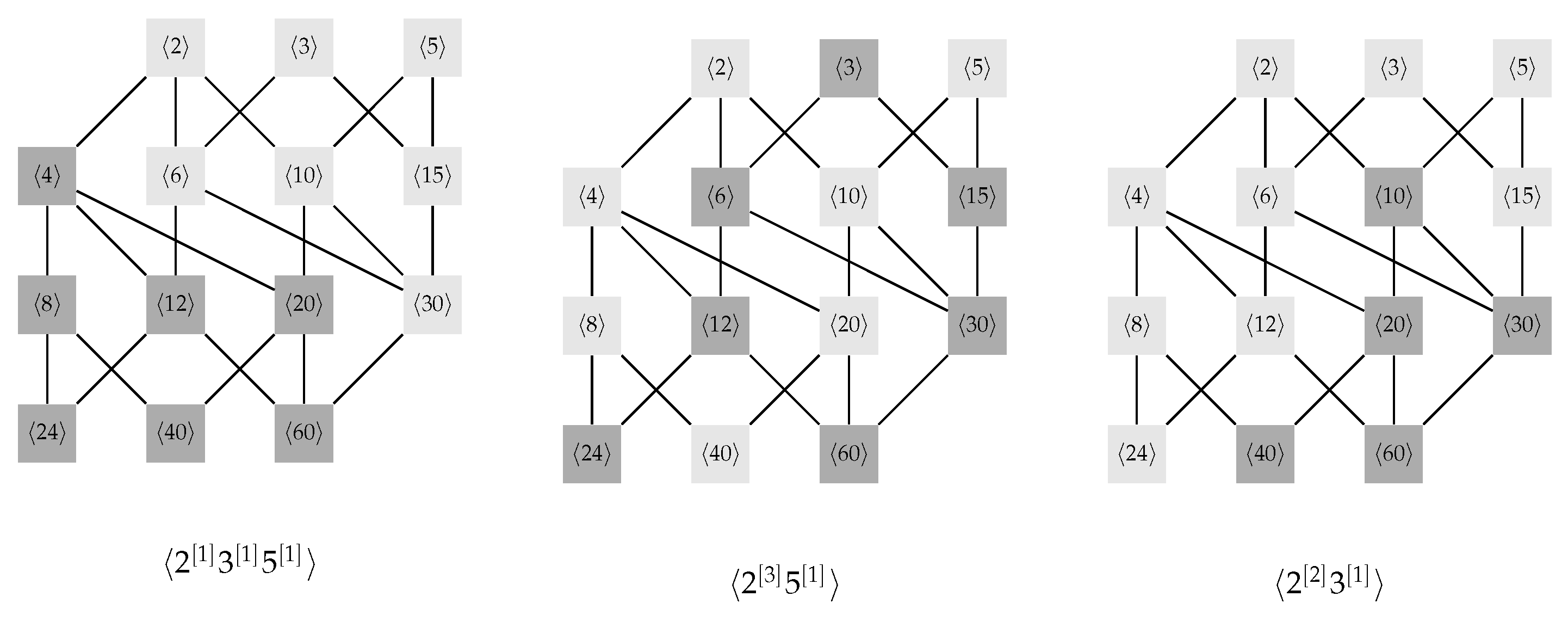
Consider and the mset . On , we choose . The structure of each when , is demonstrated via the lattice of nontrivial subgroup for (see in Figure 3) in which , , and . Now let us consider the poset , where the poset is as shown in Figure 1. Let . Then I is an ideal with partial count. It is easy to see that , whereas .
Observe that the I-ball centered at the zero vector can be considered as a direct product of cyclic subgroups of . If m is a prime power, the following result is directly obtained.
Proposition 5.
In the space , let .Then
- 1.
- If , then and .
- 2.
-
If , thenand ,where for each , for some .
From Proposition 3 and 4, the following theorem shows the existence of an I-perfect code with -poset metric when I is an ideal with full count.
Theorem 2.
For any ideal I with full count in , we have
- 1.
- is an I-perfect -poset code for the poset .
- 2.
- is an -perfect -poset code for the poset .
In the case of ideals I with partial count, the I-ball centered at the zero vector is not always I-perfect. The next lemma is a key for the existence of I-perfect code with -poset metric.
For each , let be such that if , and .
Lemma 1.
Let with . For each , let be a nontrivial subgroup of such that . Then the following statements hold:
- 1.
- If there is such that , then there is no I-perfect -poset code.
- 2.
- Suppose C is an I-perfect -poset code of . Then for each , there is a maximal subgroup of such that . Moreover, and .
Proof.
(1) Suppose that . Choose , where . Then . It follows that . Suppose there is an I-perfect -poset code C of . Then for some . That is, . This implies that which means . From , there is such that and . Consequently, . As a submodule of , we have , which is a contradiction to the I-perfect of C.
(2) Suppose C is an I-perfect -poset code of . Let . From (1), . Then there is a maximal subgroup of such that . Let . Consider . Then . We choose such that . Since , it follows that and . Indeed, by proceeding as before, we have . That is, . Since , we have which means . Then for some . From , we have . Then there is such that and modulo m. Thus, modulo m. These force . Hence, . That is, . Since C is I-perfect, by a similar technique, it can be shown that . □
Given an mset A, let .
Theorem 3.
Let with . Then is an I-perfect -poset code of if and only if for each , for some .
Proof.
Suppose is I-perfect. By Proposition 4(3), . For the necessary condition, let . We have and , where two subgroups are as in Lemma 1. Then .
For each , we have that and . These imply that and . Hence, the converse is proved. □
Corollary 1.
There is no I-perfect -poset code of if I is an ideal with partial count in .
Example 6.
In Example 5, we have with , but . Consider the poset as in Figure 1. In the space with -poset metric, we let as an ideal with partial count. By Theorem 3, we have is an I-perfect -poset code of .
5. MDS -Poset Codes and Codes in Chain Poset Structure
Theorem 4.
(Singleton Bound) Let be the poset on and be an -poset code. Then
Proof.
Choose such that . Consider the ideal I generated by . We have . From Proposition 2, there is a normal ideal J with full count of such that . Then . That is, there is no codeword in C such that , and any two distinct codewords of C will not coincide in all position . These imply that . So we have . □
Definition 3.
An -poset code C of length n over is said to be amaximum distance separable -poset code(or simply MDS -poset code) if it attains the Singleton bound as in (3).
Theorem 5.
In the space with the poset , let be an -poset code such that . Then C is an MDS -poset code if and only if C is an I-perfect -poset code for all ideals with full count such that .
Proof.
Let I be an ideal with full count in such that . It is clear that . Suppose that C is an MDS -poset code. From (3), it follows that . Then , that is, for two distinct elements . By , we have C is I-perfect.
To show that C is MDS, we choose such that . Let . Suppose . By Proposition 2, we can construct an ideal I with full count in containing J such that . But this would imply that , which is impossible since C is I-perfect. This forces that . Then . By Theorem 4, we have C is MDS. □
Example 7.
Let with . Consider , and .
- Under the poset , where as in Figure 1, it is clear that and . Then and are MDS. Moreover, the poset has exactly one ideal such that , and has exactly one ideal such that . Clearly, and are I-perfect and J-perfect, respectively.
- Under the poset , where as in Figure 1, it is clear that and . Then and are not MDS. In addition, there are two ideals and such that and in which is not -perfect, and is not -perfect.
Observe that with the full count property of ideals in , it was a main tool to study the MDS -poset code where , .
Next, we denote by the chain poset with . Observe that every ideal I with full count in has a unique maximal element. Suppose for some . There is only one ideal I with full count such that . It follows that for all .
The following results are some immediate consequences.
Proposition 6.
In the space with the poset , given an ideal I with full count in , let C be an I-perfect -poset code of . Then
- 1.
- C is an -perfect -poset code.
- 2.
- C is an MDS -poset code.
Recall that the cardinality of an r-ball with center as in (2). By considering m as a prime power, we obtain the following result.
Proposition 7.
In the space with the poset , if , the cardinality of is , where for .
Proof.
As , we have the poset becomes a chain. This implies that every ideal I in contains a unique maximal element. Since , . We write , where . From (2), we have
□
From above Proposition, although divides , by Corollary 1, there is no r-perfect -poset code of if does not divide r.
Next, we have thus established the sufficient condition of ideals with partial count in for an -poset code of to be an r-perfect.
Theorem 6.
For with , in the space with the poset , if there is a unique such that , then there is an -perfect -poset code of for .
Proof.
By the assumption, we have , and is the unique element of such that . Let . By applying Proposition 2 (2.1), there is a unique ideal I with partial count in such that . Since , by Theorem 3, it follows that becomes an -perfect -poset code. □
Example 8.
In the space with the poset and the mset , we consider . Observe that . Then we have , , , and . It can see that C is an 7-perfect -poset code. Moreover, C is also an I-perfect -poset code when the ideal with .
In the space with the poset and the mset , let . By Theorem 3, it can see that D is an J-perfect -poset code, where the ideal such that . Observe that . However, the space is not covered by the union of r-balls centered at the codewords of D for any .
Funding
This research received no external funding.
Data Availability Statement
No new data were created or analyzed in this study. Data sharing is not applicable to this article.
Conflicts of Interest
The authors declare no conflicts of interest.
References
- Ahn, J; Kim, H.K.; Kim, J.S.; Kim, M. Classification of perfect linear codes with crown poset structure. Discrete Math. 2003, 268, 21–30. [CrossRef]
- Brualdi, R.A; Graves, J.S; Lawrence, M. Codes with a poset metric. Discrete Math. 1995, 147, 57–72.
- D’Oliveira, R.G.L.; Firer, M. The packing radius of a code and partitioning problems: the case for poset metrics on finite vector spaces. Discrete Math. 2015, 338, 2143–2167. [CrossRef]
- Hyun, J.Y.; Kim, H.K. Maximum distance separable poset codes. Des. Codes Cryptogr. 2008, 48(3), 247–261. [CrossRef]
- Kim, H.K.; Krotov, D.S. The poset metrics that allow binary codes of codimension m to be m-, (m − 1)-, or (m − 2)-perfect. IEEE Trans. Inf. Theory 2008, 54(11), 5241–5246.
- Panek, L.; Firer, M.; Kim, H.K.; and Hyun, J.Y. Groups of linear isometries on poset structures. Discrete Math. 2008, 308(18), 4116–4123. [CrossRef]
- Panek, L.; Pinheiro, J.A. General approach to poset and additive metrics. IEEE Trans. Inf. Theory 2020, 66(11), 6823–6834. [CrossRef]
- Sudha, I.G.; Selvaraj, R.S. Code with a pomset metric and constructions. Des. Codes Cryptogr. 2018, 86, 875–892. [CrossRef]
- Sudha, I.G.; Selvaraj, R.S. MDS and I-perfect codes in pomset metric. IEEE Trans. Inf. Theory 2021, 67(3), 1622–1629. [CrossRef]
Figure 1.
The posets .
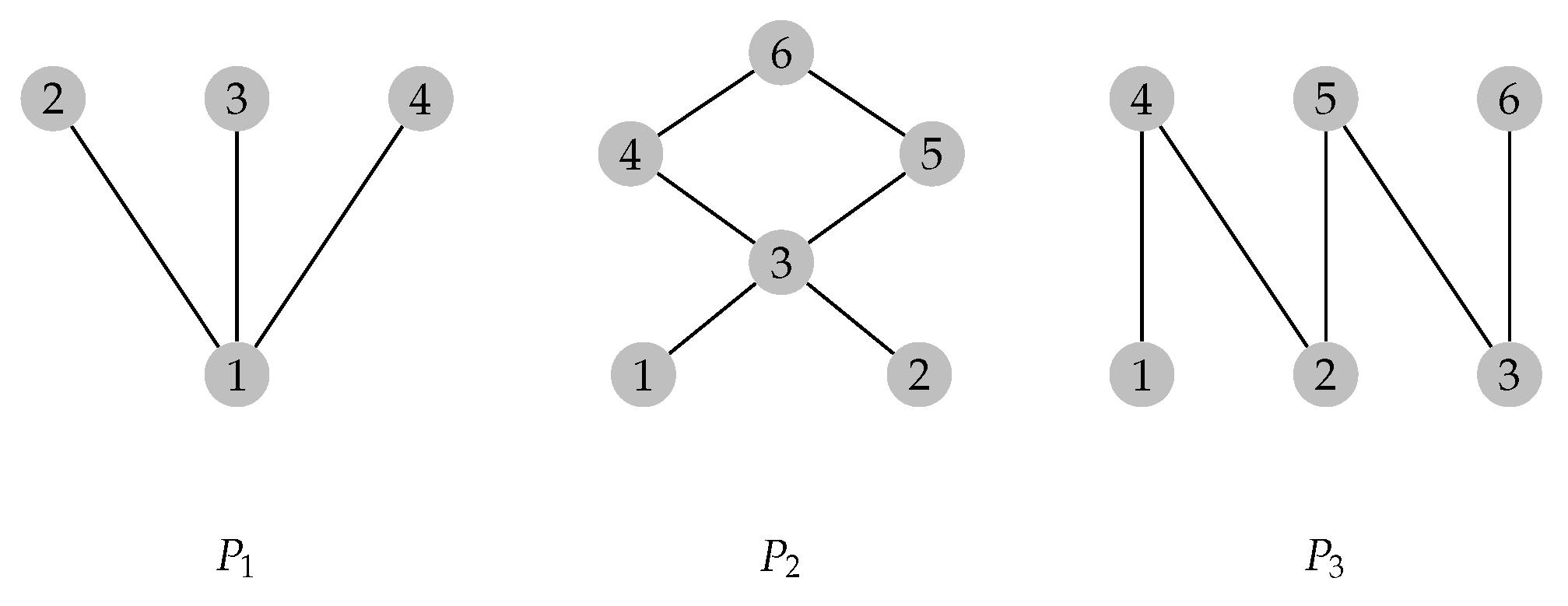
Figure 2.
Weight relationship tree
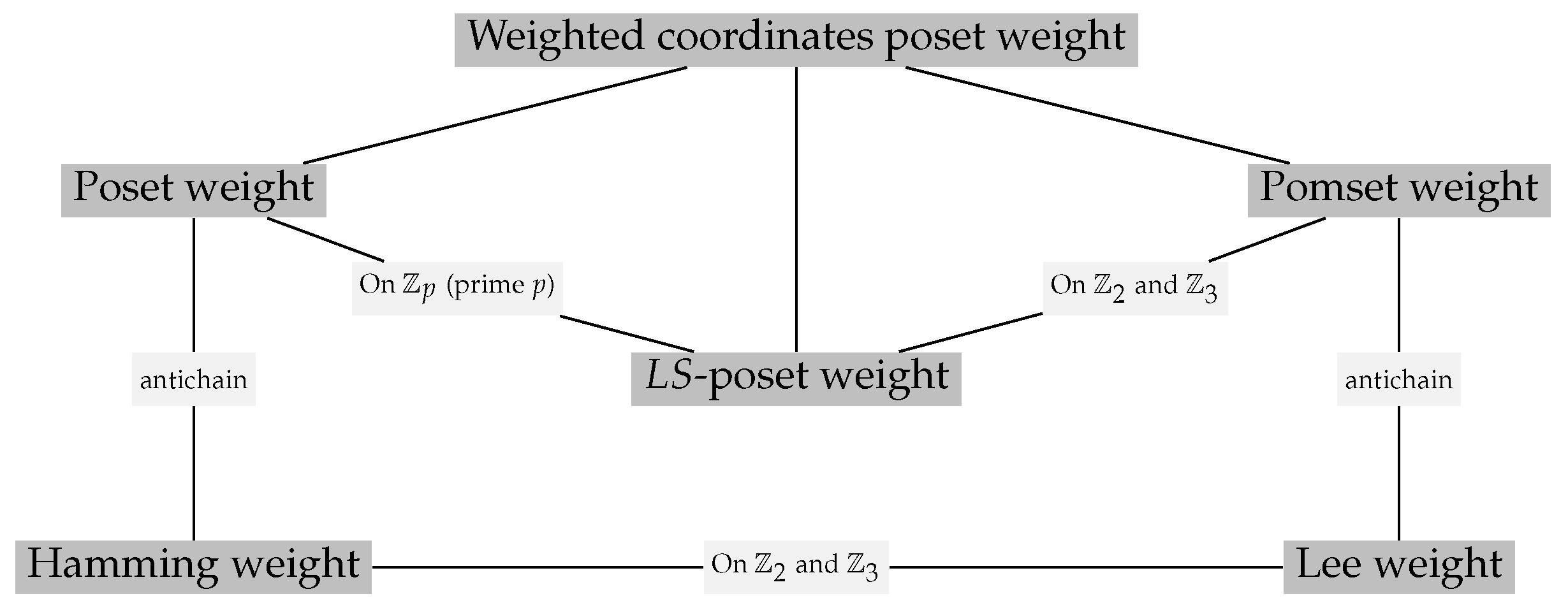
Figure 3.
The lattice of nontrivial subgroups for
Disclaimer/Publisher’s Note: The statements, opinions and data contained in all publications are solely those of the individual author(s) and contributor(s) and not of MDPI and/or the editor(s). MDPI and/or the editor(s) disclaim responsibility for any injury to people or property resulting from any ideas, methods, instructions or products referred to in the content. |
© 2024 by the authors. Licensee MDPI, Basel, Switzerland. This article is an open access article distributed under the terms and conditions of the Creative Commons Attribution (CC BY) license (http://creativecommons.org/licenses/by/4.0/).
Copyright: This open access article is published under a Creative Commons CC BY 4.0 license, which permit the free download, distribution, and reuse, provided that the author and preprint are cited in any reuse.


