

Submitted:
21 October 2024
Posted:
24 October 2024
You are already at the latest version
Abstract
Objectives: early identification of infection-causing microorganisms through multiplex PCR panels enables prompt and targeted antibiotic therapy. The study aimed to assess the performance of the BioFire® Joint Infection Panel (BF-JIP) in analysing non-synovial fluid samples. Methods: we conducted a retrospective cohort study at Trieste University Hospital, Italy, on hospitalised adults with non-synovial fluid samples tested by both BF-JIP and traditional culture methods (November 2022-April 2024). Results: we evaluated 48 samples from 45 patients, including 24 abscess drainage fluids and 10 biopsies. The BF-JIP showed high concordance (85.4%) and enhanced detection (4.3%) compared to culture methods. The BF-JIP excelled in CSF (100% accuracy and concordance) and in abscess drainage fluids (accuracy: 95.8%; concordance: 91.7%), and maintained high performance in patients under antibiotics. Conclusions: these findings suggest that BF-JIP is a valuable tool for accurate pathogen detection in various clinical samples, offering the additional advantage of being a rapid method.
Keywords:
Biofire Joint Infection panel
; multiplex PCR panels
; diagnosis
; culture-based diagnosis
; diagnostic microbiology
1. Introduction
Early identification of the microorganisms responsible for infections allows targeted antibiotic therapy to be initiated promptly, which can favourably influence patient outcomes and preserve the efficacy of currently available antibiotics [1,2]. Conventional culture methods, however, can take several hours (or days) and are affected by factors like previous antibiotic treatment, difficult-to-grow pathogens, and poor sample quality, making aetiological identification difficult and often leading to empirical treatment [3,4]. Therefore, culture-independent methods, such as nucleic acid amplification tests, are increasingly being used to diagnose a variety of infectious diseases [1].
Multiplex PCR is a widely used culture-independent method that extends conventional PCR by amplifying multiple target sequences in a single reaction. This technique incorporates several primer pairs, each specific to different targets, allowing simultaneous detection of multiple DNA fragments while saving time and resources [5]. The BioFire® FilmArray® system is a multiplex PCR with a total run time of approximately one hour. It simultaneously detects a wide range of pathogens—bacteria, viruses, yeast, parasites, and antimicrobial resistance genes—through comprehensive panels tailored to specific pathogen groups [6]. Available panels include those for meningitis/encephalitis, gastrointestinal infections, respiratory infections, and sepsis [7].
However, for the purpose of this study, we have chosen to focus on the Biofire® Joint Infection panel (BF-JIP) (bioMérieux, Marcy-l’Etoile, France), which detects 39 targets (including fungi, bacteria, and common resistance genes) from synovial fluid obtained from individuals suspected to have a joint infection (Table 1) [8,9]. The BF-JIP showed high concordance with traditional culture, along with excellent sensitivity and specificity in detecting joint infections; it has also demonstrated a superior turnaround time compared to standard culture systems [9].
The study aimed to evaluate the performances of the BF-JIP in analysing non-synovial fluid samples and compare it with traditional culture methods to identify its potential advantages.
2. Results
2.1. Study Population
A total of 48 samples, corresponding to 45 patients, were included. The cohort comprised predominantly male patients (n=24), with a median age of 63 years (IQR 45-74) and a median Charlson Comorbidity Index of 3 (IQR 1-5). Most patients were admitted to surgical wards (n=21). Notably, in 32 cases (67%), patients were undergoing antibiotic therapy at the time of microbiological sample collection. Most of the patients had been diagnosed with a skin and soft tissue infection (n=9) or a bone and joint infection (n=7). The other final diagnoses were: abdominal abscesses (n=6), pleural empyema (n=5), breast implant infections (n=5), and meningitis (n=5). In four cases infection was ruled out. Population characteristics and final diagnoses are listed in Table 2.
2.2. Samples
The samples analysed included 24 abscess drainage fluids (e.g. cerebral, abdominal, skin and soft tissue abscesses, as well as infections related to breast implants), 10 biopsies (mainly bone tissue samples collected during surgical procedures), 6 pleural fluid samples, 5 cerebrospinal fluid (CSF) samples, 2 ascitic fluid samples, and 1 vitreous/aqueous humor sample (Table 3).
2.3. Microbiology
BF-JIP detected 42 bacteria and two fungi. Among the Gram-positive bacteria, the most frequently isolated were Staphylococcus aureus (n=6), Streptococcus spp. (n=5), and Enterococcus faecium (n=4). The most frequently isolated among Gram-negatives were Escherichia coli (n=5) and Haemophilus influenzae (n=2). Candida albicans was isolated in two samples.
Polymicrobial flora was identified in six cases, all of which matched at least one microorganism from culture. In five out of six of these cases, the BF-JIP identified at least one anaerobic bacterium. Traditional culture did not detect any anaerobes identified by the BF-JIP.
Antimicrobial resistance genes were detected six times. In two cases resistance profiles were not confirmed by traditional susceptibility tests.
The detailed results of the BF-JIP and standard cultures are shown in the Table 4.
BF-JIP results compared to culture are shown in Figure 1.
In particular 22 TP, 21 TN, 2 FP, and 3 FN were identified. Two FN were due to pathogens not covered by the panel but identified by traditional culture (Staphylococcus epidermidis and Brevibacterium casei). The remaining FN was due to the BF-JIP's lack of performance. Among TP cases, two showed a match between BF-JIP results and cultures from alternative specimens. We reported two FP: one in a patient without a final diagnosis of infection and the other in a patient with an infection caused by a pathogen not detected by the BF-JIP.
We assessed the BF-JIP performance as follows: concordance 85.4%, PPA of 88.0%, NPA of 91.3%, PPV of 91.7%, and NPV of 87.5%. The overall accuracy was 89.6%. In addition, we determined that the BF-JIP method had a 4.3% higher detection rate compared to traditional culture methods. Sub-analyses of the most common sample types are detailed in Table 5. The BF-JIP demonstrated its highest performance with cerebrospinal fluid (concordance, accuracy, PPA, NPA, PPV and NPV of 100%). Abscess drainage fluids were the majority of the analysed samples. For this group we reported an accuracy of 95.8%, a concordance with culture of 91.7%, a PPA of 100%, a NPA of 90.9%, a PPV of 92.9%, and a NPV of 100%.
A further sub-analysis was conducted to evaluate the BF-JIP performance in patients undergoing antibiotic therapy (n=32). The concordance with culture was 87.5%. In this context, BF-JIP showed strong performance with a PPA of 89.5%, NPA of 92.3%, PPV of 94.4%, and NPV of 85.7%.
3. Discussion
The BF-JIP demonstrated strong performance in detecting pathogens in non-synovial fluid samples, showing high concordance (85.4%) and enhanced detection (4.3%) when compared to traditional culture methods. In 5 cases, the panel results did not agree with the culture results, and only one case was due to a missed detection (Figure 1). In parallel, PPA (88.0%) and overall accuracy (89.6%) were high for the BF-JIP. Our results are consistent with previous studies regarding multiplex PCR panels on synovial fluid, which have confirmed that the BF-JIP has high concordance with traditional culture, excellent sensitivity/PPA and specificity/NPA [9,10,11,12]. It has also been demonstrated that the BF-JIP has a superior turnaround time, when compared to standard culture [9,10]. In the setting of joint infections the BF-JIP established itself as a complementary diagnostic method that can accelerate diagnoses.
Our study is not the first that evaluates the BF-JIP for samples other than synovial fluid. Hoffman et al. evaluated the BF-JIP performances on 23 tissue samples of patients with suspected bone and joint infections, showing a diagnostic power comparable to that of traditional culture [10]. However, the strength of our study lies in the fact that, to our knowledge, it is the first to evaluate the BF-JIP in the context of infections beyond those affecting bone, joint, and soft tissue. Some authors have explored the “off-label” use of other multiplex PCR panels. Micó et al. investigated the use of the blood FilmArray panel on non-blood samples (e.g. cerebrospinal, joint, pleural, ascitic and abscesses fluids) [13], finding an overall concordance with culture-based methods of 75%. Hirai et al. evaluated the blood FilmArray panel for bone and joint infections [14], showing a sensitivity of 100% when considering only pathogens that are included in the panel. Techniques like 16S rRNA gene next-generation sequencing could also help improve diagnostic capacity in many settings [2], but unfortunately, they are not available in all centers and, most importantly, do not provide results as quickly as multiplex PCR panels.
Traditional culture did not detect any anaerobes identified by the BF-JIP. Given the increase in antibiotic resistance among anaerobic bacteria and the frequent difficulty in performing susceptibility testing [15], we can consider possible applications of the panel when an anaerobic pathogen is suspected as the cause of infection.
Considering the types of samples analysed, abscess drainage fluids were the most represented. In this group, concordance, accuracy, as well as PPA, NPA, and NPV were higher compared to the overall group. This is consistent with previous findings and is likely due to the higher bacterial load present in abscesses compared to, for example, ascitic [16] or pleural fluid [13,16]. The best performance of the BF-JIP was observed with cerebrospinal fluid, particularly in five cases of meningitis, three of which were post-surgical. In two cases, the BF-JIP detected the pathogen before the standard culture, helping clinicians to promptly initiate the correct antibiotic therapy. Interestingly, in both cases the BF-JIP was performed after the Multiplex PCR panel for meningitis/encephalitis returned negative results. Given the small sample size, the use of BF-JIP in this setting warrants further investigation.
We performed an additional sub-analysis in order to evaluate the BF-JIP performance in patients undergoing antibiotic therapy. The performance remains high, but the panel doesn't show clear superiority over traditional culture. This result may have been affected by the small sample size and sample heterogeneity. Additionally, we did not stratify for the number of days of therapy prior to sampling.
Our study has limitations. First, it is a single-centre study with a relatively small sample size. Second, it is retrospective. Another limitation is the relatively poor variety of samples tested. The last and most significant limitation is the lack of a comprehensive assessment of the real clinical impact of BF-JIP on antibiotic treatment decisions. This gap makes it difficult to draw definitive conclusions about its practical value in guiding therapy. Collectively, these factors limit the generalizability of our results.
4. Methods
4.1. Study Design
We conducted a retrospective cohort study at Trieste University Hospital, Italy, including all hospitalised adult patients (aged > 18 years) with at least one non-synovial fluid sample submitted for both culture and BF-JIP testing. The study period ranges from November 2022 to April 2024.
4.2. Data Collection
Data collected from electronic medical records included demographics (age, gender), comorbidities, admission date, hospital ward, type of sample analysed, pathogens identified by BF-JIP and culture, ongoing antimicrobial treatment, and final diagnosis. All data were pseudonymised via a web-based central, password-protected clinical database management system.
4.3. Microbiology
BF-JIP was used according to the manufacturer’s instructions, but for clinical samples other than synovial fluids. Briefly, 200 µL of each sample was pipetted into the provided injection tube. After reconstituting the reaction wells, the sample was applied to the cartridge and the run started using the BioFire® software. All panels were equipped with all necessary reagents for lysis, nucleic acid extraction, PCR amplification reagents, as well as internal controls.
Each sample was submitted in parallel to traditional culture testing. Bacterial identification was performed by MALDI-TOF mass spectrometry (bioMérieux) and susceptibility tests by the Vitek2 system (bioMérieux). For fastidious organisms and anaerobes, we used the disc diffusion method. Susceptibility results were interpreted according to EUCAST criteria.
4.4. Data Analysis
To compare the BF-JIP and the culture test (considered the gold standard), the following definitions were employed:
True Negatives (TN): cases where both methods were negative.
True Positives (TP): cases with at least one matching microorganism between BF-JIP and culture.
False Positives (FP): cases where BF-JIP was positive but culture was negative.
False Negatives (FN): cases where BF-JIP was negative but culture was positive.
A multidisciplinary panel, comprising two Infectious Diseases physicians (V.Z. and S.D.B.) and two microbiologists (L.P. and M.B.), re-evaluated all cases using cultures from alternative specimens and conducted a comprehensive evaluation of the patients' clinical courses as documented in their medical records.
To assess the performance of the BF-JIP, a suite of statistical metrics was calculated, including percentage of positive agreement (PPA), percentage of negative agreement (NPA), positive predictive value (PPV), negative predictive value (NPV), enhanced detection, concordance (C), and accuracy (A). Concordance was determined by evaluating instances of positive agreement (at least one microorganism detected by both culture and BF-JIP) and negative agreement (both tests yielding negative results). Accuracy was defined as the proportion of true results (both true positives and true negatives) among the total number of cases examined.
For continuous variables (such as age and the Charlson Comorbidity Index) the median and relative interquartile range (IQR) were calculated.
4.5. Ethics Approval
The planning, conduct and reporting of this study was in line with the Declaration of Helsinki. The study was approved by the Trieste University Ethical Committee (n°V3_2703_24). Consent to participate was assessed according to the Ethical Committee.
5. Conclusions
The BF-JIP demonstrated strong performance in detecting pathogens in non-synovial fluid samples, showing high concordance with traditional culture methods. Particularly notable was its effectiveness in identifying pathogens in abscess drainage fluids. Additionally, BF-JIP maintained high performances in patients undergoing antibiotic therapy. These findings suggest that BF-JIP can be a valuable tool for accurate pathogen detection in a variety of clinical samples, offering the additional advantage of being a rapid method. Further studies are warranted to confirm our findings.
Author Contributions
SDB conceived the idea of and designed the study with VZ; NB, DL, JC, VC, MDS and MB contributed to investigation and data collection; NB, RL and VZ analysed the data; NB, SDB, LP and VZ wrote the first draft; NB, SDB, LP, RL and VZ contributed to the interpretation of the data, writing and reviewing of the first draft of the manuscript. All authors reviewed and commented on subsequent versions of the manuscript. All authors approved the submitted version of the manuscript.
Funding
this research did not receive any specific grant from funding agencies in the public, commercial, or not-for-profit sectors.
Data Availability Statement
the datasets used and/or analysed during the current study are available from the corresponding author on reasonable request.
Conflicts of Interest
the authors declare that they have no known competing financial interests or personal relationships that could have appeared to influence the work reported in this paper.
References
- Muzzi M., Viaggi B., Fabbri S., Bechi L., Scirè-Calabrisotto C., Villa G., et al. The Impact of Fast Microbiology in Intensive Care Units in the Era of Antibiotic Resistance: An Observational Retrospective Study. Curr. Microbiol. [Internet] 2022 31;79:79. [CrossRef]
- Botan A., Campisciano G., Zerbato V., Di Bella S., Simonetti O., Busetti M., et al. Performance of 16S rRNA Gene Next-Generation Sequencing and the Culture Method in the Detection of Bacteria in Clinical Specimens. Diagnostics (Basel) [Internet] 2024 21;14. [CrossRef]
- Lagier J.-C., Edouard S., Pagnier I., Mediannikov O., Drancourt M., Raoult D. Current and Past Strategies for Bacterial Culture in Clinical Microbiology. Clin. Microbiol. Rev. [Internet] 2015 [cited 2024 21]. [CrossRef]
- Miller J.M., Binnicker M.J., Campbell S., Carroll K.C., Chapin K.C., Gonzalez, et al. Guide to Utilization of the Microbiology Laboratory for Diagnosis of Infectious Diseases: 2024 Update by the Infectious Diseases Society of America (IDSA) and the American Society for Microbiology (ASM). Clin. Infect. Dis. [Internet] 2024 5 [cited 2024 21]. [CrossRef]
- Hawkins S.F.C., Guest P.C. Multiplex Analyses Using Real-Time Quantitative PCR. Methods Mol. Biol. [Internet] 2017 [cited 2024 21];1546. [CrossRef]
- Trotter A.J., Aydin A., Strinden M.J., O’Grady J. Recent and emerging technologies for the rapid diagnosis of infection and antimicrobial resistance. Curr. Opin. Microbiol. [Internet] 2019;51:39–45. [CrossRef]
- FilmArray® Panels—Infectious Disease Diagnostics [Internet]. BioFire Diagnostics 2016 2 [Accessed 21 July 2024]; https://www.biofiredx.com/products/the-filmarray-panels/.
- BIOFIRE® Joint Infection (JI) Panel [Internet]. bioMérieux Website [Accessed 21 July 2024]; https://www.biomerieux.com/us/en/our-offer/clinical-products/biofire-joint-infection-panel.html.
- Esteban J., Salar-Vidal L., Schmitt B.H., Waggoner A., Laurent F., Abad L., et al. Multicenter evaluation of the BIOFIRE Joint Infection Panel for the detection of bacteria, yeast, and AMR genes in synovial fluid samples. J. Clin. Microbiol. [Internet] 2023 21;61:e0035723. [CrossRef]
- Hoffman T., Kriger O., Cohen S., Gefen-Halevi S., Yahav D., Amit S. Real-Life Experience and Diagnostic Utility of the BioFire Joint Infection PCR Panel in Bone and Joint Infections: Analysis of a Prospective Validation Study. Infect Dis Ther [Internet] 2023;12:1437–43. [CrossRef]
- Gaillard T., Dupieux-Chabert C., Roux A.-L., Tessier E., Boutet-Dubois A., Courboulès C., et al. A prospective multicentre evaluation of BioFire® Joint Infection Panel for the rapid microbiological documentation of acute arthritis. Clin. Microbiol. Infect. [Internet] 2024;30:905–10. [CrossRef]
- Moran A., Arellano J., Bregman K., McElvania E. Evaluation of a BioFire multiplex PCR panel for detection of joint infections using retrospective and prospectively collected specimens. J. Clin. Microbiol. [Internet] 2024 17;e0018224. [CrossRef]
- Micó M., Navarro F., de Miniac D., González Y., Brell A., López C., et al. Efficacy of the FilmArray blood culture identification panel for direct molecular diagnosis of infectious diseases from samples other than blood. J. Med. Microbiol. [Internet] 2015;64:1481–8. [CrossRef]
- Hirai J., Mori N., Sakanashi D., Morishita Y., Kuge Y., Kishino T., et al. Usefulness of the FilmArray blood culture identification panel for identifying causative pathogens of bone and joint infections. J. Infect. Chemother. [Internet] 2023 [cited 2024 21];29. [CrossRef]
- Di Bella S., Antonello R.M., Sanson G., Maraolo A.E., Giacobbe D.R., Sepulcri C., et al. Anaerobic bloodstream infections in Italy (ITANAEROBY): A 5-year retrospective nationwide survey. Anaerobe [Internet] 2022;75:102583. [CrossRef]
- Soriano G., Esparcia O., Montemayor M., Guarner-Argente C., Pericas R., Torras X., et al. Bacterial DNA in the diagnosis of spontaneous bacterial peritonitis. Aliment. Pharmacol. Ther. [Internet] 2011 [cited 2024 22];33. [CrossRef]
Figure 1.
BF-JIP results.
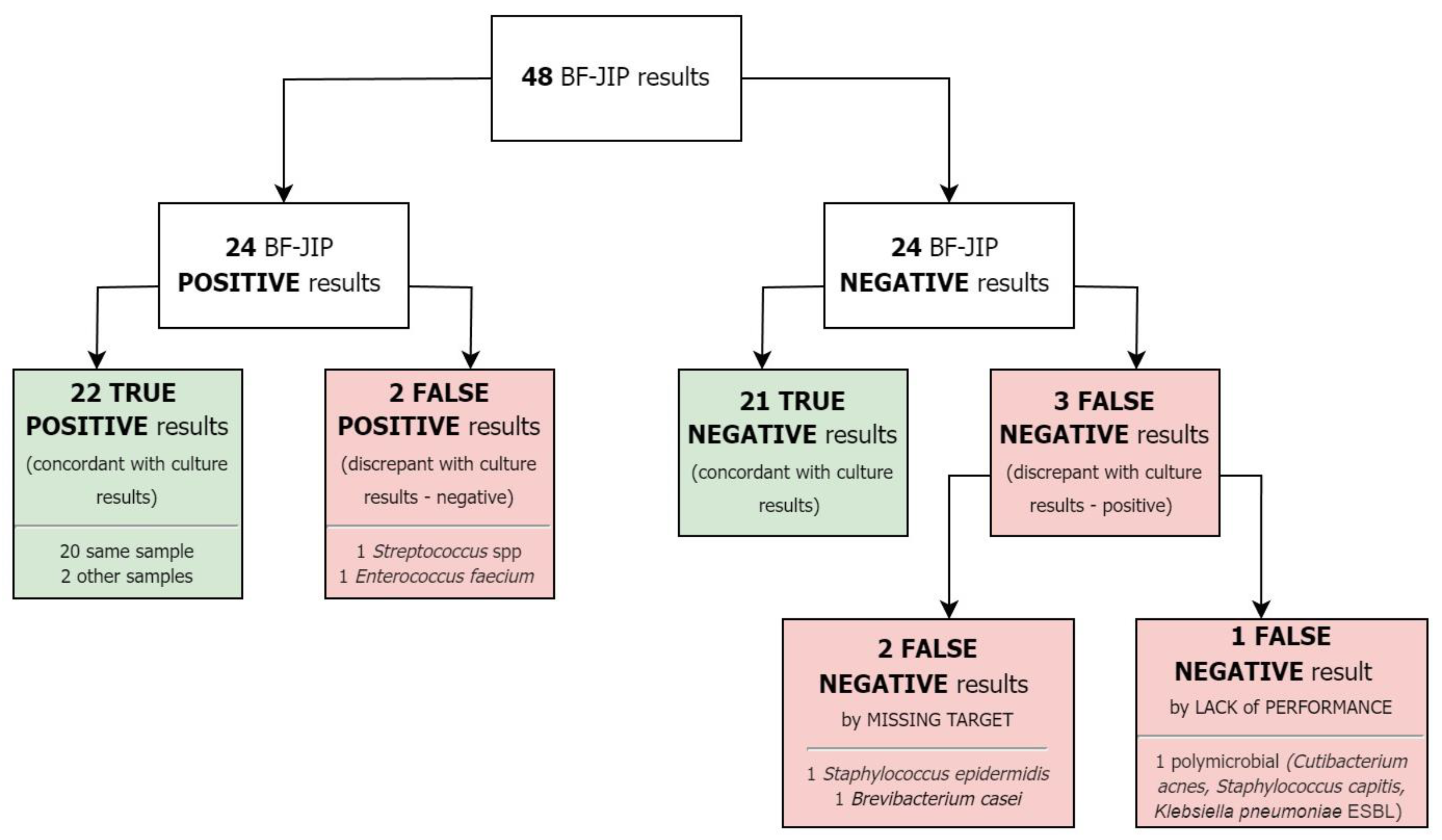

Table 1.
Biofire® Joint Infection panel (BF-JIP).
| MICROORGANISMS DETECTED BY BF-JIP | ||
|---|---|---|
| Gram + | Gram - | Yeasts |
| Anaerococcus prevotii/vaginalis | Bacteroides fragilis | Candida |
| Clostridium perfringens | Citrobacter | Candida albicans |
| Cutibacterium avidum-granulosum | Enterobacter cloacae complex | |
| Enterococcus faecalis | Escherichia coli | |
| Enterococcus faecium | Haemophilus influenzae | |
| Finegoldia magna | Kingella kingae | |
| Parvimonas micra | Klebsiella aerogenes | |
| Peptoniphilus | Klebsiella pneumonia group | |
| Peptostreptococcus anaerobius | Morganella morganii | |
| Staphylococcus aureus | Neisseria gonorrhoeae | |
| Staphylococcus lugdunensis | Proteus spp. | |
| Streptococcus spp. | Pseudomonas aeruginosa | |
| Streptococcus agalactiae | Salmonella spp. | |
| Streptococcus pneumonia | Serratia marcescens | |
| Streptococcus pyogenes | ||
| Resistance genes: CTX-M, IMP, KPC, mecA/C and MREJ (MRSA), NDM, OXA-48 like, vanA/B, VIM | ||
CTX-M = cefotaximase-Munich; IMP = Imipenemase; KPC = Klebsiella pneumoniae carbapenemase; MRSA = methicillin-resistant Staphylococcus aureus NDM = New-Delhi metallo-β-lactamase; OXA = oxacillinase; VIM = Verona integron-encoded metallo-β-lactamase.
Table 2.
Population characteristics.
| POPULATION CHARACTERISTICS | |
|---|---|
| N° samples | 48 |
| N° patients | 45 |
| Age (median) | 63 (IQR 45-74) |
| Sex | |
| Male | 24 (53%) |
| Female | 21 (47%) |
| Setting | |
| Surgical ward | 21 (44%) |
| Medical ward | 14 (29%) |
| ER | 6 (13%) |
| Outpatients | 6 (13%) |
| ICU | 1 (<1%) |
| Antimicrobial therapy | |
| Yes | 32 (67%) |
| No | 15 (33%) |
| Non known | 1 (<1%) |
| CCI (median) | 3 (IQR 1-5) |
| Final diagnosis | |
| SSTI | 9 (19%) |
| BJI | 7 (15%) |
| Abdominal abscess | 6 (13%) |
| Pleural empyema | 5 (10%) |
| Breast implant infection | 5 (10%) |
| Meningitis | 5 (10%) |
| No evidence of infection | 4 (8%) |
| Others | 7 (15%) |
BJI = bone and joint infection; CCI = Charlson Comorbidity Index; ER = emergency room; ICU = intensive care unit; IQR = interquartile range; SSTI = skin and soft tissue infection.
Table 3.
Samples on which the BF-JIP was performed.
| SAMPLE TYPES | |
| Abscess drainage fluid | 24 (50%) |
| Biopsy | 10 (21%) |
| Pleural fluid | 6 (13%) |
| CSF | 5 (10%) |
| Ascitic fluid | 2 (<1%) |
| Vitreous humor/aqueous humor | 1 (<1%) |
CSF = cerebrospinal fluid.
Table 4.
Comparison between cultures and BF-JIP.
| BF-JIP AND CULTURES COMPARISON | |||||
|---|---|---|---|---|---|
| N° | SAMPLE | BF-JIP | CULTURE (same sample) | OTHER CULTURES | FINAL DIAGNOSIS |
| 1 | Biopsy | Parvimonas micra; Peptostreptococcus anaerobius; Streptococcus spp | Streptococcus anginosus | SSTI | |
| 2 | Abscess drainage liquid |
Staphylococcus aureus mecA/B and MREJ |
Staphylococcus aureus | Brain abscess | |
| 3 | Ascitic fluid | Peritonitis | |||
| 4 | Abscess drainage liquid | Streptococcus spp | No infection | ||
| 5 | Abscess drainage liquid | Escherichia coli | Escherichia coli | BJI | |
| 6 | Abscess drainage liquid | Anaerococcus prevotii; Finegoldia magna; Peptoniphilus; Proteus spp | Proteus mirabilis | SSTI | |
| 7 | Abscess drainage liquid | Staphylococcus aureus | Staphylococcus aureus | BJI | |
| 8 | Pleural fluid | Pulmonary aspergillosis | |||
| 9 | Pleural fluid | Streptococcus pyogenes | Streptococcus pyogenes | Pleural empyema | |
| 10 | Ascitic fluid |
Enterococcus faecium; Candida albicans VanA/B |
Candida albicans | Peritonitis | |
| 11 | Pleural fluid | Staphylococcus aureus | Staphylococcus aureus (blood culture and BAL) | Pleural empyema | |
| 12 | Abscess drainage liquid | Escherichia coli; Peptoniphilus | Escherichia coli | Abdominal abscess | |
| 13 | Pleural fluid | Pleural empyema | |||
| 14 | Biopsy | Staphylococcus epidermidis | SSTI | ||
| 15 | Abscess drainage liquid | Abdominal abscess | |||
| 16 | CSF | Meningitis | |||
| 17 | Abscess drainage liquid |
Anaerococcus prevotii; Enterococcus faecium; Finegoldia magna; Parvimonas micra; Streptococcus spp; Bacteroides fragilis; Citrobacter; Enterobacter cloacae; Escherichia coli; Haemophilus influenzae; Klebsiella pneumoniae; Candida albicans CTX-M, vanA/B, VIM |
Pseudomonas aeruginosa; Klebsiella pneumoniae; Candida albicans | Abdominal abscess | |
| 18 | Biopsy | Pseudomonas aeruginosa | Pseudomonas aeruginosa | SSTI | |
| 19 | Pleural fluid | Enterococcus faecium | Pleural empyema | ||
| 20 | Biopsy | Bacteroides fragilis | Bacteroides fragilis | SSTI | |
| 21 | Abscess drainage liquid | Escherichia coli | Escherichia coli | Abdominal abscess | |
| 22 | Abscess drainage liquid | Streptococcus pyogenes | Streptococcus pyogenes | Necrotizing fasciitis | |
| 23 | Abscess drainage liquid | Staphylococcus aureus | Staphylococcus aureus | Muscle hematoma | |
| 24 | Abscess drainage liquid | SSTI | |||
| 25 | Abscess drainage liquid | No infection | |||
| 26 | Biopsy | BJI | |||
| 27 | Abscess drainage liquid | Escherichia coli | Candida glabrata (abscess drainage fluid and blood culture); Escherichia coli (blood culture); Pseudomonas aeruginosa (abscess drainage fluid); Klebsiella pneumoniae (abscess-drainage fluid) | Abdominal abscess | |
| 28 | Abscess drainage liquid | BJI | |||
| 29 | Abscess drainage liquid | No infection | |||
| 30 | Abscess drainage liquid | Abdominal abscess | |||
| 31 | CSF | Meningitis | |||
| 32 | vitreous umor/aqueus umor | Endophthalmitis | |||
| 33 | CSF | Streptococcus spp | Streptococcus salivarius | Meningitis | |
| 34 | Biopsy | Cutibacterium acnes; Staphylococcus capitis; Klebsiella pneumoniae | BJI | ||
| 35 | Biopsy | Enterococcus faecalis | Enterococcus faecalis | SSTI | |
| 36 | Pleural fluid | Pleural empyema | |||
| 37 | Abscess drainage liquid | Breast implant infection | |||
| 38 | Abscess drainage liquid | Breast implant infection | |||
| 39 | CSF | Meningitis | |||
| 40 | Abscess drainage liquid | Parvimonas micra; Streptococcus spp | Streptococcus anginosus | SSTI | |
| 41 | Abscess drainage liquid | No infection | |||
| 42 | Abscess drainage liquid | Staphylococcus aureus | Staphylococcus aureus | Breast implant infection | |
| 43 | Abscess drainage liquid | Staphylococcus aureus | Staphylococcus aureus | SSTI | |
| 44 | Biopsy | BJI | |||
| 45 | CSF | Haemophilus influenzae | Haemophilus influenzae | Meningitis | |
| 46 | Biopsy | BJI | |||
| 47 | Biopsy | Enterococcus faecium | Brevibacterium casei | Breast implant infection | |
| 48 | Abscess drainage liquid | Parvimonas micra; Peptostreptococcus anaerobius; Streptococcus spp | Breast implant infection | ||
BAL = broncho-alveolar lavage; BJI = bone and joint infection; CSF = cerebrospinal fluid; CTX-M = cefotaximase-Munich; MREJ = methicillin resistance-encoding gene junction; SSTI = skin and soft tissue infection; VIM = Verona integron-encoded metallo-β-lactamase.
Table 5.
Performances of the BF-JIP.
| BF-JIPPERFORMANCES | ||||||
|---|---|---|---|---|---|---|
| PPA | NPA | PPV | NPV | C | A | |
| All samples (n=48) | 88.0% | 91.3% | 91.7% | 87.5% | 85.4% | 89.6% |
| Abscess drainage fluid (n=24) | 100% | 90.9% | 92.9% | 100% | 91.7% | 95.8% |
| Biopsy (n=10) | 57.1% | 100% | 100% | 50% | 70.0% | 70.0% |
| Pleural fluid (n=6) | 100% | 75% | 66.7% | 100% | 66.7% | 83.3% |
| Cerebrospinal fluid(n=5) | 100% | 100% | 100% | 100% | 100% | 100% |
A = accuracy; C = concordance; NPA = percentage of negative agreement; NPV = negative predictive value; PPA = percentage of positive agreement; PPV = positive predictive value.
Disclaimer/Publisher’s Note: The statements, opinions and data contained in all publications are solely those of the individual author(s) and contributor(s) and not of MDPI and/or the editor(s). MDPI and/or the editor(s) disclaim responsibility for any injury to people or property resulting from any ideas, methods, instructions or products referred to in the content. |
© 2024 by the authors. Licensee MDPI, Basel, Switzerland. This article is an open access article distributed under the terms and conditions of the Creative Commons Attribution (CC BY) license (http://creativecommons.org/licenses/by/4.0/).
Copyright: This open access article is published under a Creative Commons CC BY 4.0 license, which permit the free download, distribution, and reuse, provided that the author and preprint are cited in any reuse.


