

Submitted:
16 October 2024
Posted:
18 October 2024
Read the latest preprint version here
Abstract
Light is too important to say. It can be said that light fills the universe, and light also creates the universe. However, what is the origin of the light? What is the real essence of the light? In fact, these questions have not been answered clearly until now. This paper introduces an answer to these questions based on a novel understanding of the light, that is, the photon is composed of a pair of a positron and an electron, and so the photon is an extremely tiny electric dipole. The introduced electric dipole model of the photon has strong supports by observed phenomena, and can explain electromagnetic wave property of the light simply and accurately. In addition, many observed phenomena of the light, which have confused people for a long time, can also be explained by this novel understanding easily and effectively, such as “wave-particle duality of the photon”, “light bending”, “wavelength redshift”, “light pressure” and so-called “Light speed in vacuum is constant”, and so on. The author wrote this paper for helping to fine the natural truth earlier.
Keywords:
light
; photon
; wave-particle duality
; light bending
; wavelength redshift
; light speed
1. Introduction
Light is too important for nature. It is the most basic carrier for energy transmission and information delivery. Furthermore, according to new understand-ing, light is also basic building block of the universe. Light fills the universe. Light creates the universe.
However, what is the origin of the light? What is the real physical essence of the light? In fact, these fundamental questions have not been answered very clearly. Faraday and Maxwell made great contribu-tions to human being by their excellent experimental and theoretical works. They revealed important truth that the light is electromagnetic wave, and the electric field and magnetic field can induce each other. Their great works have driven the birth of the modern society.
However, why light is the electromagnetic wave and how the light wave is produced are still the questions. The effective and essential answers to these fundamental questions will give great benefits to the world.
This paper introduces a novel understanding of the light. The author has inferred that the photon is a pair of a positron and an electron. In other words, the photon is an extremely tiny electric dipole consisting of two point electric charges with equal magnitude and opposite signs. Huge amount photons compose the light wave.
2. Electric Dipole Model of Photon
In high-energy collision experiment, a photon can split into a pair of positron and electron after hitting by a microscopic particle. It is also observed that a photon appears after electron-positron annihilation. These well-known phenomena strongly hint that the photon just consists of a pair of positron and electron. In fact, in event of electron-positron annihilation, a pair of electron and positron didn’t disappear as common understandings. They are just combined into a photon. Both of the electron and positron are still there in the photon.
Because of intense electric forces with opposite signs, a positron and an electron can be combined closely. The positron and electron are the most basic and most abundant elements in the universe, which is the reason that the light wave fills the universe.
When a photon is formed, because the sizes of the positron and electron are extremely tiny and the distance between the positron and electron is extremely short, thus as long as the distance from the photon is not very close, the positive electric field generated by the positron can almost completely cover the negative electric field generated by the electron as shown in Figure 1.
In Figure 1, the spherical positive electric field distribution generated by the positron is drawn by red dotted line, and the spherical negative electric field distribution produced by the electron is drawn by blue solid line. is the electric charge of the positron, and is the electric charge of the electron. The interval between the positive and negative point electric charges is τ.
In Figure 1, we can see that, even not very far from the photon core, the strength of the net synthetic electric field of the positron and electron is almost zero, so the photon is regarded as no electric field, that is, the photon is regarded as electrically neutral. It is the reason that the positron and electron seem disappearing in electron-positron annihilation since no any electric field can be detected no longer.
In a sisterly paper titled “Origins and Unifying of Four Fundamental Forces of Nature”, the author explained in detail that the gravitational force is the electric force in essence, and both of the gravitational mass and the inertial mass of an object are quantitative expressions of the received external electric force strengths on that object. The object gravitational mass expresses the attractive force strength exerting on the object by the synthesized electric field of total earth electric charges when the object is motionless relative to the earth. The object inertial mass expresses the attractive force strength exerting on the object by the synthesized electric field of the total electric charges distributing in the space in which the object is moving. Therefore, the photon gravitational mass and inertial mass are “zero” as it has “no” net electric filed even in the range which is relatively close to the photon, and so the photon almost can’t felt any external electric force.
However, it is only an approximation to say that the photon has “no” net electric field, although it is an extremely high approximation. Because the positron and electron after all have their non-zero volumes, their point charge centers can’t be concentric with each other exactly. In addition, the random thermal motions certainly make the positron and electron combined with an interval. Therefore, there will be an extremely tiny but not zero distance τ between the charge centers of the positron and electron as shown in Figure 2.
From Figure 2, we can see that the photon has a non-uniform electric field distribution within an extremely small region around the photon. In this extremely small region, the net electric field is positive in half of the region, and the net electric field is negative in another half of the region. In Figure 2, the spherical positive electric field distribution drawn by red dotted line can’t cover the spherical negative electric field distribution drawn by blue solid line obviously. Such photon electric field distribution makes the photon have unique physical property and produce plentiful behaviors.
In Figure 2, starting from the center of two point charges on the x-axis, the net electric field is positive along the positive x direction, and the net electric field is negative along the negative x direction. Thus, the photon is an extremely tiny electric dipole. The direction of the dipole moment is from electron to the positron. The length of the dipole moment is , so the expression of the photon dipole moment is
where q is the absolute value of the electric charge of the positron or electron.
Both positron and electron have their rotational angular momentums and magnetic moments. Thus, the electric fields of the positron and electron are rotational. When the positron and electron are com-bined to become a photon, because of their magnetic interaction forces, their magnetic moment directions must be reversed. Because the positron and electron are as close as possible since their strong attractive forces, their magnetic moments are only arranged in the parallel and side by side manner with opposite directions, that is, the central axes of the rotational positive and negative fields of the positron and electron are parallel to each other. Thus, the electric fields of the positron and electron rotate synchro-nously with the same rotational directions. Therefore, the photon is not only an extremely tiny electric dipole, but also a rotational electric dipole.
When the photon moves in space, the angular momentums of the positron and electron must be conserved, and so the photon can only move forward along the direction which is perpendicular to the directions of the angular momentums of the positron and electron.
The photon is an extremely tiny electric dipole with straight line and rotational motions. A lot of such photons compose the light wave. This physical model can explain various puzzles about the photon and light wave effectively.
3. Explanations and Origins of the Properties and Behaviors of Light
In the following, the origins of unique properties and peculiar behaviors of the light are explained in detail, separately. They include:
- Light electromagnetic wave property,
- Light frequency,
- Light wavelength,
- Light polarization,
- Light coherent length,
- Light wavelength redshift,
- Cosmic microwave radiation background,
- Light bending,
- Wave-particle duality of the photon and other microscopic particles,
- Photoelectric effect,
- Compton effect,
- Light pressure, and
- Truth of the light speed.
3.1. Origin of the Light Electromagnetic Wave Property
Supposing a photon is moving along the x-axis, this photon also rotates around its central axis which is parallel to the z-axis. The top section of Figure 3 shows photon movement towards the x-direction with rotation on the xy-plane.
In Figure 3, the photon is represented by an electric dipole consisting of a positron (small red circle) and an electron (small blue circle). When the photon goes to the spot a, the direction of the dipole moment is perpendicular to the y-axis, so the electric field of the dipole is zero in the y-direction at the spot a. When the photon goes to the spot b, the direction of the dipole moment points to the positive y-axis, and so the electric field of the dipole is positive and the maximum in the y-direction at the spot b. When the photon goes to the spot c, the direction of the dipole moment is perpendicular to the y-axis again, so the electric field is zero again in the y-direction at the spot c. When the photon goes to spot d, the direction of the dipole moment points to the negative y-axis, and so the electric field of the dipole is negative and the minus maximum in the y-direction at the spot c.
From the spot a to the spot b, the strength of the electric field increases from zero to the positive maximum gradually. Then, from the spot b to the spot c, the strength of the electric field decreases from the positive maximum to zero gradually. From the spot c to the spot d, the strength of the electric field decreases from zero to the minus maximum gradually. Then, from the spot d to the spot e, the strength of the electric field increases from the minus maximum to zero gradually.
When the photon moves forward continually from the spot e to the spots f and g, the changes of the electric field are the same as those happened in the paths from the spot a to the sports b and c, that is, the electric field of the photon will repeat previous changes. These periodical strength changes of the photon electric field in the y-direction will be repeated again and again with photon movement along the x-direction.
Of course, the change of the photon electric field in the x-direction is also periodically repetitive with photon motion and rotation along the x-direction. For example, when the photon is at the sport a, its electric field is negative maximum in the x-direction. When the photon is at the sport c, its electric field is the positive maximum in the x-direction. However, the change of its electric field in the x-direction is different from the change of its electric field in the y-direction. Because the photon moves along the x-axis, so in the positive x-direction, the photon negative electric field distribution at a previous sport (for example, at the sport a) will be cancelled by the photon positive electric field at a latter sport (for example, at the sport c). Please note, both of the sport a and the sport c are on the x-axis. Due to extremely tiny size and very fast rotational speed, the photon electric field in the x-direction is almost zero.
Because the point charge centers of the positron and electron are always located on the xy-plane, there are no changes of the electric fields of the positron and electron in the z-direction.
When the photon moves with rotation along the x-direction, the changes of the photon electric field in the y-direction can’t be cancelled. It is different from the changes of the photon electric field in the x-direction. For example, at a previous moment, the photon produces a positive electric field in the y-direction at the sport b, and then, at a later moment, the photon produces a negative electric field in the y-direction at the sport d. Because the sports b and d are located on different positions on the x-axis, so the positive electric field in the y-direction at the sport b can’t be cancelled by the negative electric field in the y-direction at the sport d.
Thus, the straight line motion along the x-direction and the rotation in the xy-plane of the photon creates the periodic vibration of its electric field in the xy-plane as shown in the bottom section of Figure 3. Because this periodic vibration is caused by the electric field, so the light wave is the periodic vibration of the electric field strength. Because this periodic vibration is also caused by the rotation of the electric field, so the light wave is also the periodic vibration of the magnetic field strength. In addition, this periodic vibration is caused by circle rotation of the photon electromagnetic fields, so the photon electromagnetic field change rate curves have sine shape.
3.2. Origin of the Light Frequency
As shown in Figure 3, because the photon electric fields rotate continually and the photon electric field strength in the y-direction repeats periodically, the change rate of the photon electric field in the unit time determines the frequency of the photon or light wave. The origin of the light frequency is rotational angular velocity of the photon.
There is a problem needs further discussion. The angular momentum value of the photon rotation should be related to the values of the positron and electron magnetic moments. The values of the positron and electron magnetic moments are quantized in observations, that is, the values of the positron and electron magnetic moments are discontinuously discrete values. However, the light frequency distribution is continuous.
The key to defuse this contradiction is that the photon actually has zero net magnetic moment. Because the values of the positron and electron magnetic moments are equal but with opposite directions, the net magnetic moment of the photon is zero. Thus, as a microscopic particle, since photon net magnetic moment is zero, the quantized requirement for the magnetic moment is not applicable to the photon. In other words, the requirements asking the values of the positron and electron magnetic moments to be discrete are removed, or the circumstances causing the positron and electron magnetic moment values to be discrete no longer exist.
Therefore, the photon can rotate at any angular speed, that is, the photon can have any frequency. Of course, the photon frequency can’t be too high and too low. The photon can’t have too high frequency is because that the photon rotational energy can’t be infinity. The photon can’t have too low frequency is because that the temperature of any substance in the universe can’t be absolute zero.
3.3. Origin of the Light Wavelength
Supposing the speed of the photon moving along the x-axis is , and the photon frequency is , the photon wavelength is , then
In vacuum, the light speed becomes .
3.4. Origin of the Light Polarization
As described above, the photon electric field vibrate periodically only in the two-dimensional plane, such as in the xy-plane shown in Figure 3, and the electric field strength just change in one direction, such as in the y-direction. There are no electric field strength changes in other two directions, such as in the x-direction and z-direction. Therefore, the photon electric field is the linear polarized electromagnetic field. Thus, the light wave is the polarized electromagnetic wave.
3.5. Origin of the Light Coherent Length
As shown in Figure 2 and Figure 3, the synthetic non-uniform electric field of the photon dipole just has very short effective interaction distance, that is, out a very small discus-like spatial region the strength of the non-uniform electric field distribution of the photon becomes undetectable. Since the photon moves along one direction, such as the x-direction, so the small discus-like spatial region, in which the photon net electric field can be detectable, moves along this direction, such as the x-direction too. This electric field detectable and small discus-like spatial region has a two-dimensional symmetric plane, such as the xy-plane. With moving of the photon along one direction, this small discus-like spatial region becomes a long cylindrical spatial region which cross section shape is a skinny ellipse. Also because the photon net electric field has very short effective interaction distance, so the length of this long elliptically cylindrical spatial region has a limit. The limited length of this long elliptically cylindrical spatial region is the coherent length of the photon. Sometimes, this limited long elliptically cylindrical spatial region, in which the photon net electric field can be detected, is called as the “wave packet”. The length of the “wave packet” along the photon moving direction is coherent length of the photon. In this “wave packet”, the frequency of the electric field vibration is the same, that is, the electric field in this “wave packet” is coherent. Out this “wave packet”, there is no detectable electric field, or the detected electric field is from another photon with different frequency, and so the light coherence of this photon disappears.
The photons emitted from the laser seem to have much longer coherent lengths than the natural photons, but it is not true. The reason is that some techniques are adopted including optical resonator and mode-locking. These techniques make the photons emitted from the laser have the same frequencies. Furthermore, the phases of the photons from the laser are synchronized, that is, the vibration electric field of a photon emitted earlier from the laser can be accurately connected by the vibration electric field of a photon emitted later from the laser. Thus, the laser light seems to have much longer coherent length.
3.6. Origin of the Light Wavelength “Redshift”
In space, there are various electric fields since every celestial body has its electric field (Please also see author paper titled “Origins and Unifying of Four Fundamental Forces of Nature). Compared with rapid rotation of the photon electric field, most of the spatial electric fields are almost stationary. The most of the directions of these relatively stationary electric fields are not the same as the directions of the photon straight line motion or rotation. Thus, both speeds of the photon straight line motion and rotation will be reduced, especially the photon rotation.
When the photon rotation speed decreases, the photon frequency decreases too. Thus, the waveleng-th of the photon will increase, which results in light wavelength redshift.
In addition, for the most celestial bodies in space, their moving speeds are much slower than the light speed, so the most of these celestial bodies will exert towing or resisting electric forces to the photon straight line motion, due to the “Doppler Effect”, this will also reduce the photon frequency and make the light wavelength “redshift”.
Because the photon net electric field is extremely weak and has very short effective interaction distance, the influences of the external electric fields in the space to the photon are extremely small, so only after extremely long distance traveling from the faraway stars, the photon wavelength “redshift” can be observed obviously.
The light wavelength “redshift” can be considered as a photon fatigue phenomenon, which is the result of the photon straight line motion and rotation speed decreases. The light wavelength “redshift” can’t be used as the key evidence to support the “big bang theory”.
3.7. Origin of the Cosmic Microwave Radiation
Generally speaking, the speeds of the straight line motions and rotations of the most photons traveling in space will be gradually reduced by the external electric fields. However, when reaching very slow speeds, the bottom energy of the universe will make the photon straight line motion and rotation speeds not decrease further. The photons having the slowest speeds of the straight line motion and rotation form cosmic microwave radiation (CMB) background. Because of the relation between the thermal energy and the motion energy, the temperature of any substance in the universe can’t be absolute zero, and so the photon straight line motion and rotation speeds can’t be zero too.
The heat death of the universe will not happen even if the most photons in the universe will become cosmic microwave radiation background eventually. Because the gravitational force will constantly gather the gases, dusts and celestial bodies including the cosmic microwave radiation photons to form new stars, galaxies and so on. These new stars and galaxies will emit huge amount of new photons and other various microscopic particles into the space again, such as the “gamma-ray bursts” from the black holes.
3.8. Origin of the Light Bending
As described above, both of the gravitational mass and inertial mass of an object are the quantitative expressions of the strengths of the external electric fields exerting on that object. Since any celestial body can be regarded as an electric dipole (Please see author paper titled “Origins and Unifying of Four Fundamental Forces of Nature”), if a celestial body has a huge mass, that celestial body can generate extremely strong electric field. When a photon travels by the side of that celestial body, the photon dipole is attracted by that celestial body. Thus, the traveling route of the photon will be changed by attractive force from that celestial body. The light bending will happen.
In most cases, as the photon net electric field is extremely weak and has very short effective interaction distance, the attractive electric force from other celestial body on the photon may be neglected, so the photon moving route is straight in space. But if the mass of a celestial body is extremely huge, and so that celestial body electric field is extremely strong, and the photon is close to that celestial body, the attractive force of that celestial body to the photon can’t be ignored, the phenomenon of light bending will be observed.
The phenomenon of light bending doesn’t need puzzling ideas of “Four-Dimensional Spacetime” and “Curved Spacetime” to explain it.
3.9. Explanations of Wave-Particle Duality of the Photon and other Microscopic Particles
The electric dipole model of the photon can easily explain the wave-particle duality of the photon.
First, the photon electric dipole has rotational electric fields, and so has a set of characteristics including frequency, wavelength and polarization. Thus, the light wave composed of the photons can have diffraction, interference and other typical wave properties, which are the necessary and sufficient conditions for producing wave-like behaviors of the light.
Second, the core of the photon is an electric dipole consisting of a pair of positron and electron, which are the real physical particles. Thus, the photon can make physical events happen that require real physical particle to participate in, such as the photoelectric effect and the Compton effect.
The wave-particle duality is not only possessed by the photon, but also possessed by other microscopic particles.
The fundamental reason for wave-particle duality of the microscopic particles is that, compared with the particle mass and volume, the particle electric field or magnetic field are very large, that is, the influences of the particle electric field or magnetic field are so large that the influences of the particle mass and volume can be ignored. In other words, in some cases, the particle may be regarded as having no mass and no volume. Thus, only the particle electric or magnetic field plays the role. In these cases, the particle just shows its wave property.
However, in some other cases, the non-zero mass or/and volume of the microscopic particle will play indispensable role. Thus, the microscopic particles show their property of inherent particle because although the microscopic particle mass and volume are very small, they are ultimately not zero.
The behavior characteristics of the microscopic particles are significantly different from those of the macroscopic objects. The macroscopic objects contain huge amount of the microscopic particles. The behavior characteristics of a macroscopic object are the synthetic result of the huge amount of the microscopic particles. In a macroscopic object, there are huge amount of the microscopic particles, many of them have strong electric and magnetic fields. However, the most of these electric and magnetic fields are offset each other, the synthetic net electric field and synthetic net magnetic field of the macroscopic object are commonly very weak, and so the macroscopic object becomes approximately electrical neutral or magnetically neutral, that is, the macroscopic object has almost no net electric or magnetic field, and so can’t show wave property.
If a microscopic particle just has the electric field or the magnetic field, such a particle still can’t show its wave property. The particle electric field or magnetic field must change periodically, that particle can show its wave property.
Apart from the photon, other basic microscopic particles, such as the electrons, protons and neutrons, also have magnetic moments, so their electric fields or net electric field are rotational. Thus, the electric fields of these particles all have periodic vibrations. The wave property of these particles can be expressed by De Broglie wavelength formula
where, is De Broglie wavelength, is Planck constant, is the mass of the particle, and is the velocity of the straight line motion of the particle. Because the masses of the proton and neutron are much larger than the electron, the De Broglie wavelengths of the proton and neutron are much shorter than the electron.
3.10. Explanation of the Photoelectric Effect
The observations show that the electrons can escape from the metal surface when the light wave irradiates the metal, which is called as the photoelectric effect or external photoelectric effect. In addition, when the light wave irradiates some semiconductors, the semiconductor conductivity can be enhanced, and the number of the free-moving electrons in the semiconductor can be increased too, which means that the light wave causes the electrons to leave the atoms in the semiconductor. This phenomenon is called as the internal photoelectric effect. In the external photoelectric effect, the detached electrons may leave the metal completely and fly into the space. In the internal photoelectric effect, the detached electrons just leave the atoms and travel in the semiconductor.
The observations also show that when the frequency of the light wave is lower than a threshold value, no matter how strong the intensity of the light wave, no electrons fly out from the metal, or increase conductivity of the semiconductor. The observations also show that the metal has a stopping potential for emitting the electrons out. When an external electric field produces a potential higher than the stopping potential to the metal surface, no electrons fly out from the metal too, and no matter how strong the intensity of the light wave. The existences of the threshold frequency and stopping potential in the photoelectric effect can’t be explained by the wave property of the light.
It is very easy to explain the photoelectric effect by using electric dipole model of the photon. In this model, the photon has waved electric field and real particle core. Because the photon has a core composed of the positron and electron, the photon dipole will collide with the electron of the atom, or even the nucleus of the atom in the metal or semiconductor. After collision, the electron in the atom in the metal or semiconductor leaves its atom, or more likely, the photon dipole is split into a positron and an electron. The knocked out electrons or the split positrons and electrons go to anode and cathode through space in the external photoelectric effect or through circuit in the internal photoelectric effect. Thus, the electric current flows from anode to cathode via space and circuit or only circuit continually.
However, in order to make the electrons leave its atom and to make the photon dipole be split successfully, the photon must have enough energy to collide with the electrons or the nucleuses in the atoms in the metal or semiconductor. The photon energy is composed of the straight line motion and rotation energies. Because light speed is a constant in most circumstances on the earth, that is, the photon straight line motion speed is fixed (In fact, the light speed is just approximately invariant. See more descriptions below), so its straight line motion energy is fixed. The different photons just have different rotational energies. Obviously, the faster the rotation is, the higher the photon total energy. Thus, in order to make the electron in the atom leave its atom in the collision, or make the photon dipole be split in the collision, the rotational speed of the photon must the same as or higher than the rotational speed of the hit electron in the atom (including in the nucleus) in the metal or the semiconductor. In other words, the rotational speed of the photon must be the same as or higher than the rotational speed of the hit electron, the collision can become “effective” collision, and the photon can hit the electron to leave its atom or the photon can be split into the positron and electron. This is the reason why a photon can hit an electron out or a photon can be split when the photon frequency is the same as or higher than the threshold frequency.
The stopping potential is due to that the knocked out or the split electrons by the collision have certain straight line motion energy. The external electric field exerts an electric force on the metal surface and so produces an electric potential to the metal surface. If the straight line motion energy of the knocked out or the split electron is less than the stopping potential energy produced by the external electric field, the electron can’t be emitted out from the metal. Please note that the different metals have different surface electric potentials, such metal surface electric potentials will affect the electric stopping potential for the knocked out or split electron to go out of the metal.
When the split positrons and electrons travel in the metal or semiconductor, their motion energies will decrease by the interactions with the electric fields of the electrons and protons in the atoms in the metal or semiconductor. Some of the lost energies will become the potential energy between the anode and cathode. When the split positrons and electrons meet again in the metal or semiconductor including in the circuit, they will combine each other and become new photons again. However, because their motion energies have been reduced, and especially their rotational energies have been reduced, these new photons will become the thermal radiation photons with lower energies. They are the main source of the circuit heat.
3.11. Explanation of the Compton Effect
The Compton Effect describes such a physical phenomenon: when a high-energy light beam, such as X-ray, is scattering by certain materials, some of the scattered light will have lower frequency than the incident light beam. The change of the frequency depends on the scattered angle. If the wavelength of the incident light beam is , and the wavelength of the scattered light beam is λ, then . In addition, the wavelength difference increases with the increase of the scattering angle θ, the intensity of the light beam with wavelength of decreases with the increase of the scattering angle θ.
In fact, the Compton Effect is a proof for electric dipole model of the photon, which indicates that the photon has straight line motion energy and rotational energy. When a photon collides with the atom in the scattering material, the direction of the photon straight line motion will change, and so the scattered light beams go along different scattering angles of θ. In addition, in the collisions, the rotational energies of some photons will change too, and the more violent the collision, the larger the photon rotational energy changes. Thus, the wavelength difference of the scattering light beam increases with the increase of the scattering angle θ. In addition, the more violent collision will change the photon motion direction larger, and because there are less photons participating in the more violent collisions, the intensity of the light beam with wavelength of decreases with the increase of the scattering angle θ.
3.12. Origin of the Light Pressure
According to current theory, the photon “gravita-tional mass” and “inertial mass” are zero, and so the phenomenon of the light pressure is difficult to be understood.
However, as described above, the photon has its net synthetic electric field, which can exert an electric force on other object. Thus, the photon can produce a real physical pressure on other object. In other words, the light pressure can be produced since that the photon “inertial mass” is not zero.
3.13. Truth of the Light Speed
The light speed is one of the most basic parameters describing the universe. The most famous measurement of the light speed is Michelson-Morley experiment. Its result is well known to the world: the light speed in vacuum has the same magnitude relative to all inertial reference frames, no matter what their velocity may be relative to each other.
First, the Michelson-Morley experiment shows that there is no “Ether” in the universe, or that the earth is not running in the “Ether”. It shows that there is no medium for light wave propagation. It is different from the propagation of the water wave or acoustic wave. The medium transmitting the water wave is the water, and the medium transmitting the acoustic wave is the air. The propagation speeds of the water and the acoustic waves depend on the transmission mediums. The water wave speed relative to an observer is the sum of the water wave speed in the water and the water peed relative to the observer. In the same way, the acoustic wave speed is the sum of the acoustic wave speed in the air and the air speed relative to the observer.
As described above, the propagation of the light wave is just the movement of the photon itself, which is the real physical particle moving in the space, and no any transmission medium is needed. In the Michelson-Morley experiment, because there is no medium “Ether” in the space to transmit the light wave, so the light speed can’t be changed by the “Ether”, and so the measured light speed is fixed.
The real terrible thing revealed by the Michelson-Morley experiment is that the light speed in vacuum has the same magnitude relative to all inertial reference frames, no matter what their velocity may be relative to each other. Too many people tried their best to get the answer for this challenge, but with no satisfied result.
Now, the electric dipole model of the photon can give a totally unexpected and very reasonable answer to solve this terrible problem.
As described above, the photon has straight line and rotational motions, and the change of its straight line motion speed doesn’t affect its rotational motion speed. In other words, the change of the straight line motion speed of the photon can’t change photon frequency. Of course, if the speed of one reference frame relative to another reference frame reaches an excessive value, the observed photon frequency in two reference frames may be different since “Doppler Effect”. Thus, in most cases, the frequency of the photon is completely determined by its rotational speed.
Because the photon frequency has no relation with its straight line motion speed, when the observer is in anyone of the inertial reference frames, no matter what the velocity of that reference frame is relative to another reference frame, the frequency of the photon observed by that observer is the same.
For example, there are two observers in two inertial reference frames A and B. The frame A moves at a speed of relative to the frame B.
If a photon with frequency of is observed by the first observer in the frame A, and if the straight line motion speed of the photon is relative to the frame A. Then, for the second observer in the frame B, the straight line motion speed of the photon becomes . However, the photon frequency is still for the second observer because the observed rotational speeds of the photon are the same for two observers in two inertial reference frames A and B.
In many measurements of the light speed, the obtained light speed value is deduced from measured light frequency value, such as in the Michelson-Morley experiment, thus, the obtained light speed seems invariant. The traditional concept that the light speed and the light frequency are closely related is wrong, which has confused people thoroughly and blocked people to recognize the truth of the light speed completely.
In fact, there are many factors need consideration for light speed measurement. For example, apart from the speed of the light source itself, what are other causes affecting the initial speed of the photon when the photon leaves its light source? Please note that not only in the macroscopic light source, but also even in every atom of the light source, because the most space of each atom is empty, the different electrons, protons and neutrons are moving with different speeds and directions. It is a too simple thought that the initial speeds of the different photons must add a same speed of their macroscopic light source when these different photons leave their macroscopic light source. In fact, one should ask a question why the initial speeds of the different photons emitted from the different atoms in the light source are same or approximately same. To answer this question, one needs to know more details about the structure and characteristics of the atoms. The author also can't give a reasonable answer now.
But it is sure that the light speed in vacuum is not a constant. According to the electric dipole model of the photon, when the electric field of the photon interacts with an external attractive or repulsive electric field, the speeds of the photon straight line motion and rotation will be decelerated or accelerated, thus making the light speed change.
In fact, this inference has been indirectly proved by astronomical observation. As mentioned above, when the light beam passes by the side of a celestial body with a huge mass, the traveling route of the beam, that is, the flying route of the photons will be bent. Thus, the light bending occurs. It indicates that the photon speed changes in the tangent direction of the straight line motion.
If the photon speed may be changed in the tangent direction of its straight line motion, then if a celestial body with huge mass is located in the normal direction of the photon straight line motion, such as a massive black hole, why can’t the photon speed along the normal direction of its straight line motion be changed? The answer should be yes without any doubt. The astronomical observations seem to have seen some signs of the “accelerated collapse” of any object including photon towards the center of a massive galaxy.
There are two possible reasons for so-called “light speed is a constant in vacuum” until now. One reason is that the photon synthetic net electric field is very weak and has a very short effective interaction distance, which makes to find light speed change be very difficult. Another reason is that some phenomena showing light speed change have been misunderstood, such as the light wavelength “redshift” and light bending.
4. Calculation of Electric Field of the Photon
Since the photon is inferred as an extremely tiny electric dipole. According to current electromagnetic theory, the electric field strength of the electric dipole at the distance of R is [1]
In Eq. (4), is unit distance vector along R direction. is electric constant. is the electric dipole moment of the photon, and
where is the absolute value of the electric charge of the positron or electron, and is the distance between the positron and electron. direction is from electron to positron. r is the absolute value of .
From Eq. (4), we know that when the direction of changes, the electric field strength changes too. When the direction of is the same as or opposite to the direction of , the electric field strength becomes or ,
The in Eq. (6) is positive, which expresses a repulsive force away from the dipole to a positive point charge. The in Eq. (7) is negative, which expresses an attractive force towards the dipole to a positive point charge. And when the direction of the dipole moment is perpendicular to the direction of , the electric field strength becomes .
The in Eq. (8) is negative, but it is a deflective force, because the direction of is perpendicular to the R direction.
From the Eqs. (6), (7) and (8), we can see that the electric filed strength of the electric dipole is anisotropic. When the direction of is the same as or opposite to the direction of , the electric field strength becomes the strongest (positive maximum) and weakest (minus maximum).
The Eqs. (4), (6), (7) and (8) are deduced from Coulomb’s law
Thus, there is a problem should be mentioned. Coulomb’s law expresses the change rate of the electric filed strength expanded with the distance from the point electric charge. Because the electric filed strength is expanded from a point charge towards all directions in the three-dimensional space, according to energy conservation law, the total energy distributing on every spatial sphere with different radiuses from the point charge should be equal.
Because the area of every spatial sphere is proportional to the cube of its radius, thus, the strength change of the electric field in any direction should be inversely proportional to the cube of the distance R from the point charge. Such cognition can consistent with the physical intuition. However, now that the electric field from a point charge expands in the three-dimensional space, how can Coulomb’s law have a two-dimensional expansion rate of ?
Coulomb’s law has been proved countless times. How to explain the incompatibility between the practical observations and physical intuition? The possible reason might come from the Coulomb experiment. In the experiment, two big metal balls were used in torsion balance test for electric force strength measurements. Thus, the distributions of the net electric charges in two big metal balls are more like two electric dipoles than two point electric charges. Thus, the measured rate of the electric field change is the change rate of electric field of the electric dipole, and so has two-dimensional change rate. There are more descriptions about expansion property of the electric field of the electric dipole in the author another paper titled “Origins and Unifying of Four Fundamental Forces of Nature”. Please read it.
Therefore, to express the change of the electric field of a real point electric charge, Coulomb’s law should be revised as
In Eq. (10), is unit distance vector along the distance R direction. is the amount of the point electric charge. is revised electric constant.
Without any doubt, Coulomb is greatest scientist in history. He made great contribution to the human being. Here, author just discusses the pure scientific problem, which doesn’t reduce author’s great respect to him.
When using the revised Coulomb’s law, the Eqs. (4), (6), (7) and (8) become below Eqs. (11), (12), (13) and (14), respectively
Please note that, base on the revised Coulomb’s law, the electric field of the photon is still an anisotropic field. But, the field strength reduces with distance more quickly.
Using Eqs. (6) and (7), or Eqs. (12) and (13), the repulsive or attractive electric field strengths of the photon can be calculated. The absolute values the repulsive and attractive electric field strengths of the photon are the same. Here, Eq. (7) is used to calculate the attractive electric field strength of the photon.
The nuclear diameter is in the range of for hydrogen to for uranium () [2,3]. Because there are multiple protons and neutrons (from 1 to dozens) in the nucleus, the diameters of the protons and neutrons should be less than (). The proton or neutron mass is about 1836 times the mass of an electron [4]. Thus, there should be several hundred photons in each proton or neutron because the positron and electron have approximately same masses. The upper bound of the electron diameter has been estimated as about [5], and a researcher estimated that the photon size is about () [6]. Considering that there are relatively large deviations in the measurements or calculations of the electron and photon sizes, the dipole moment length of the photon should be taken with a wide range in the calculations for possible deviations. Thus, the moment length of the photon dipole is taken from to . Then, by substituting the electron electric change of coulombs into the Eq. (7), the attractive electric field strength of the photon dipole are calculated. Table 1 shows the calculated results. In Table 1, is the distance from the photon center. is the length of the photon dipole moment. The unit of the electric field strength is V/m (Volt/meter).
From the Table 1, we can see that in the vicinity of the photon, the attractive electric field strength of the photon is extremely large. For example, at the site with the distance of from the photon center, the electric field strength is from V/m to V/m for photons with dipole moment lengths of to . Such large electric field can bind the photons tightly within a small range certainly in the way that the negative end of one
photon connects the positive end of another photon. With the increase of the distance , the electric field strength of the photon drops fast. For example, at the site with the distance of from the photon center, the electric field strength drops to from V/m to V/m for photons with dipole moment lengths of to . Therefore, to measure electric field strength of the photon is very difficult. It is the reason that the photon is regarded as no electric field. When using Eq. (13), the electric field strength of the photon will drop faster.
from the photon center. is the length of the Photon Dipole Moment.
5. Suppositions of Structures of Proton and Neutron
It is known that the proton net electric charge amount is the same as the charge amount of a positron, and a proton plus an electron may become an electrically neutral neutron. It is also known that when the neutron removes an electron, the neutron will become a proton again. Furthermore, considering a proton mass is 1836 times the electron mass and the electric dipole model of the photon, it may be supposed that the proton and neutron are composed of the positrons and electrons, that is, the proton and neutron are composed of the multiple photons.
First, the photon is inferred as an extremely tiny electric dipole, and so the multiple photons can attract each other and can be gathered together in an extremely small region to form a proton or a neutron. Perhaps, the multiple photons may compose a photon shell or several photon shells in the proton or neutron. The possible distribution of the photon on a partial photon shell is shown in Figure 4 and Figure 5. In Figure 4 and Figure 5, each photon is still represented by a positron (small red circle) and an electron (small blue circle). Since the photons have rotational angular momentums, they rotate on the photon shell.
The electric field of the photon is rotational, and since the synthetic net electric fields of the proton and neutron are the sums of the multiple photons electric fields, the proton and neutron have a net rotational angular momentum and a net magnetic moment, respectively. Please note that the most of the angular momentums and the magnetic moments of the photons in the proton and neutron are offset each other. Especially, the neutron has equal number of the positrons and electrons, and so the synthetic net electric field of the neutron has only extremely short effective distance and is regarded as no net electric field, which is different from the proton.
According to the mass ratio of the proton to the electron, and because the mass magnitudes of the positron and electron should be equal, there should be no more than 918 photons in the proton or neutron. Please note that the mass magnitudes of the proton and neutron should contain the combination energies of the multiple photons.
The number of the photons in every proton is the same. The number of the photons in every neutron is the same too. Each proton or each neutron should have its particular photon structure, which determines the number of the photons.
Also as mentioned above, the strong “gamma-ray burst” in nuclear fissions or fusions, and strong “gamma-ray emissions” from black holes are strong evidences of that the proton and neutron consist of the photons.
Because the photons compose the proton and neutron, the protons and neutrons compose the atoms, and the atoms compose any object in the universe, thus, everything in the universe are composed of the light.
Since the light can only be seen and can’t be touched, many people believe that the light is not a real substance. Furthermore, due to the hypothesis that any substance is composed of the light, perhaps many people will have a sense of nothingness for the physical world. Here, the author emphasizes that such feeling is wrong. The photon is composed of a positron and an electron. Both positron and electron are real substance. They have strong electric fields which are the basic sources of almost all powers driving and forming the real world. The world made of the light is the most real existence.
6. Conclusions
In this paper, the author introduces electric dipole model of the photon. For a long time, it is difficult to understand the essence and behaviors of the photon and light wave. However, according to the electric dipole model of the photon, the essence and behaviors of the photon and the light wave can be explained easily.
The various confused physical phenomena of the light can be explained clearly and effectively in detail by a simple model, which can’t be a coincidence. It just indicates two things: first, the model is correct; second, the nature is simple inherently.
The introduced understanding is author inferences and has no direct experimental evidences now. The author opens this understanding just for attracting the discussions for finding the natural truth earlier.
Although this new understanding has not been tested by experiment, and seems no possibility to do the experiment in the foreseeable future, a few astronomical and experimental observations have proved the inference indirectly. The author has good confidence in this new understanding.
Disclosure
This paper is written partially based on the specifications recorded in the following patent applications:
1. Canada patent application titled “Methods of Changing Gravitational Force and Producing Electric Current”, which was filed on August 8, 2024 with Transmission Identifier:
pef_sqliuicuc1_20240808071752421_20240808071014316_360517263_16901557;
2. USA patent application titled “Methods of Changing Gravitational Force and Producing Electric Current”, which was filed on August 9, 2024 (Project Publication Date: 02/12/2026) with application number: 18/799,600.
Conflicts of Interest
The author declares no competing interests in this work.
References
- D. J. Griffiths, 2012, Introduction to Electrodynamics, Addison-Wesley, New York, USA, pp.158-160.
- D. Castelvecchi, 2019, How Big is the Proton? Particle-size Puzzle Leaps Closer to Resolution, Nature, 575 (7782), pp.269-270. [CrossRef]
- I. Angeli, K. P. I. Angeli, K. P. Marinova, 2013, Table of Experimental Nuclear Ground State Charge Radii: An Update, Atomic Data and Nuclear Data Tables, 99 (1), pp.69-95. [CrossRef]
- CODATA value: Proton-electron Mass Ratio, 2006 CODATA Recommended Values, National Institute of Standards and Technology, 2019, USA.
- G. Gabrielse, 2016, Electron Structure, Physics, Harvard University, USA.
- R. A. Hutchin, 2021, The Size of a Photon, Optics and Photonics Journal, 11, pp.121-131. [CrossRef]
Figure 1.
The positive and negative electric fields of the positron and electron of the photon observed by a distant observer.
Figure 1.
The positive and negative electric fields of the positron and electron of the photon observed by a distant observer.
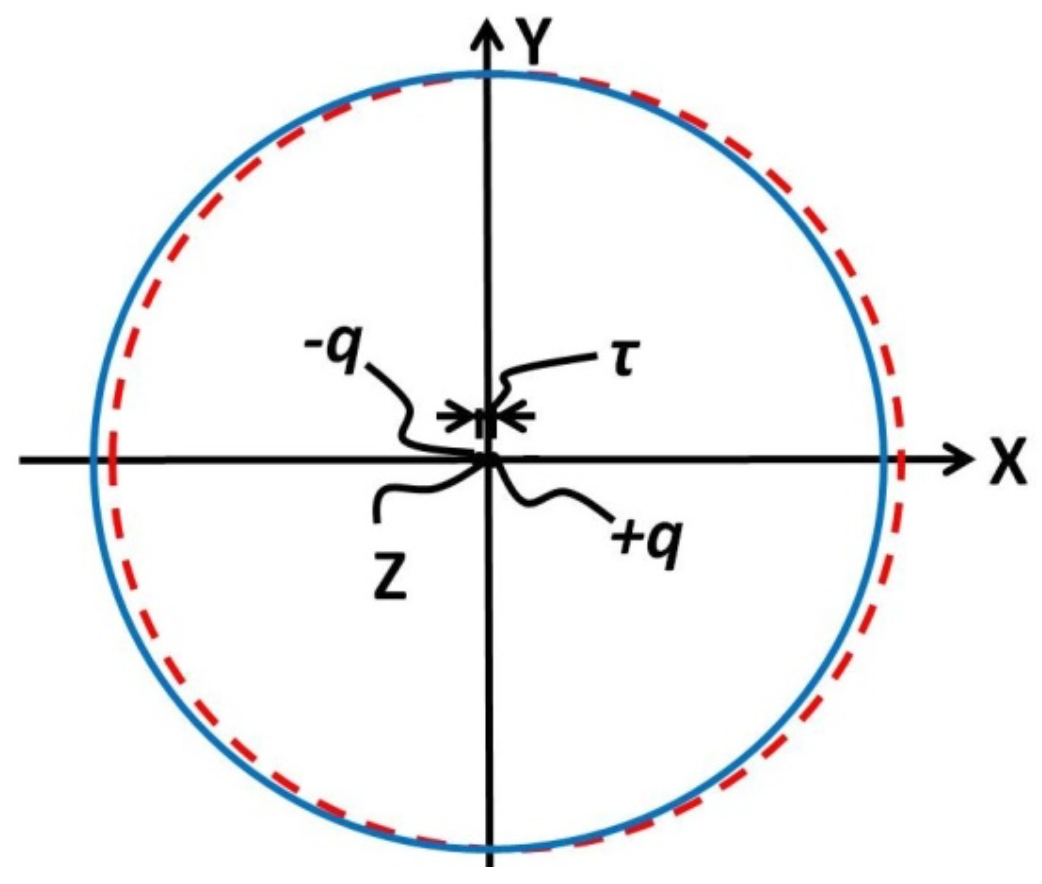
Figure 2.
The positive and negative electric fields of the positron and electron of the photon observed by a nearby observer.
Figure 2.
The positive and negative electric fields of the positron and electron of the photon observed by a nearby observer.
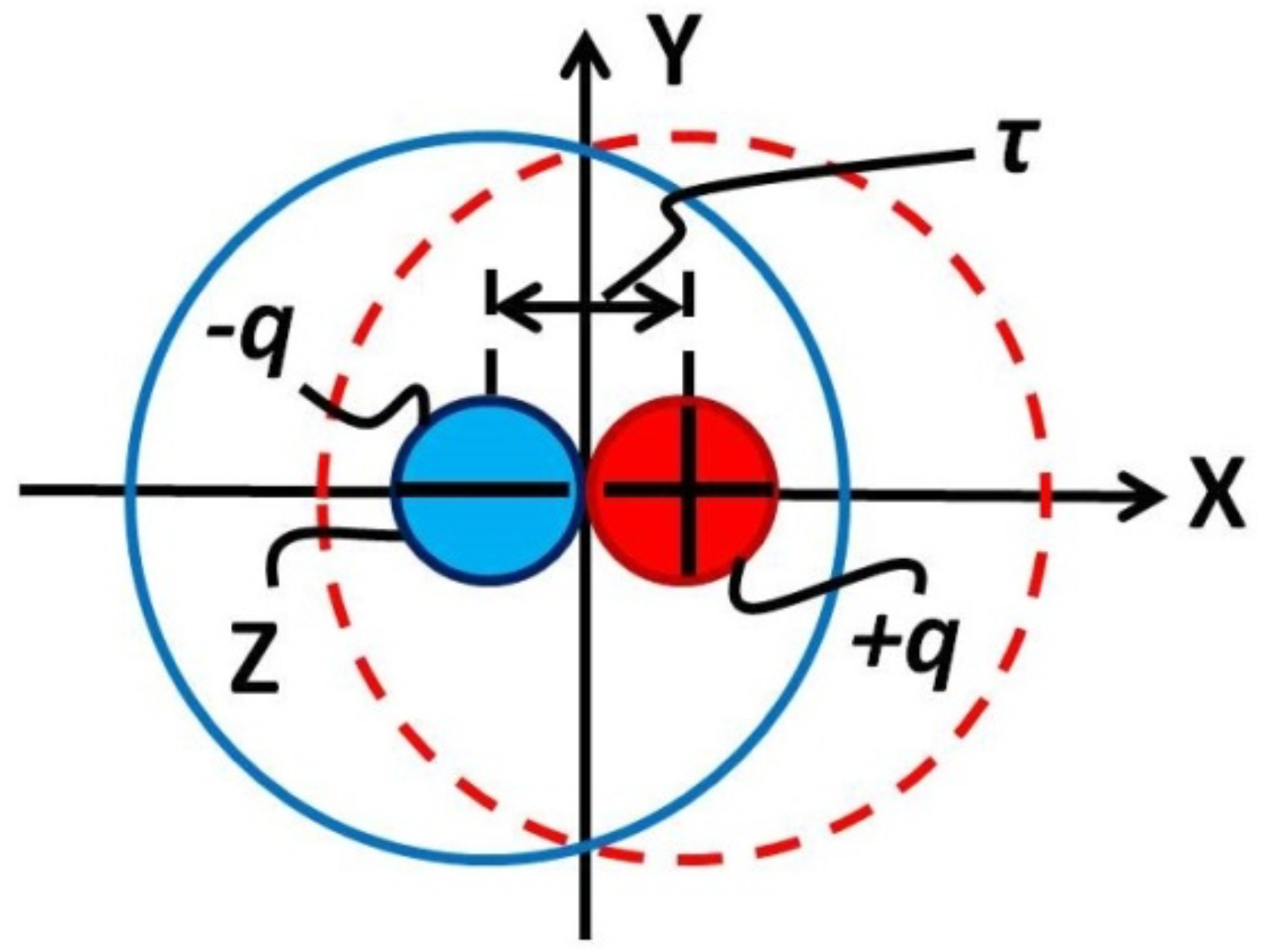
Figure 3.
The top section shows photon movement towards the x-direction with rotation on the xy-plane. The bottom section shows periodic vibration of the electric field induced by the photon motion and rotation with change rate of sine shape.
Figure 3.
The top section shows photon movement towards the x-direction with rotation on the xy-plane. The bottom section shows periodic vibration of the electric field induced by the photon motion and rotation with change rate of sine shape.
Figure 4.
The photon distribution on the partial photon shell. In the left section, the photon dipole moment directions are parallel to the shell surface. The right section shows that the photon dipole moments rotate to perpendicular to the shell surface.
Figure 4.
The photon distribution on the partial photon shell. In the left section, the photon dipole moment directions are parallel to the shell surface. The right section shows that the photon dipole moments rotate to perpendicular to the shell surface.
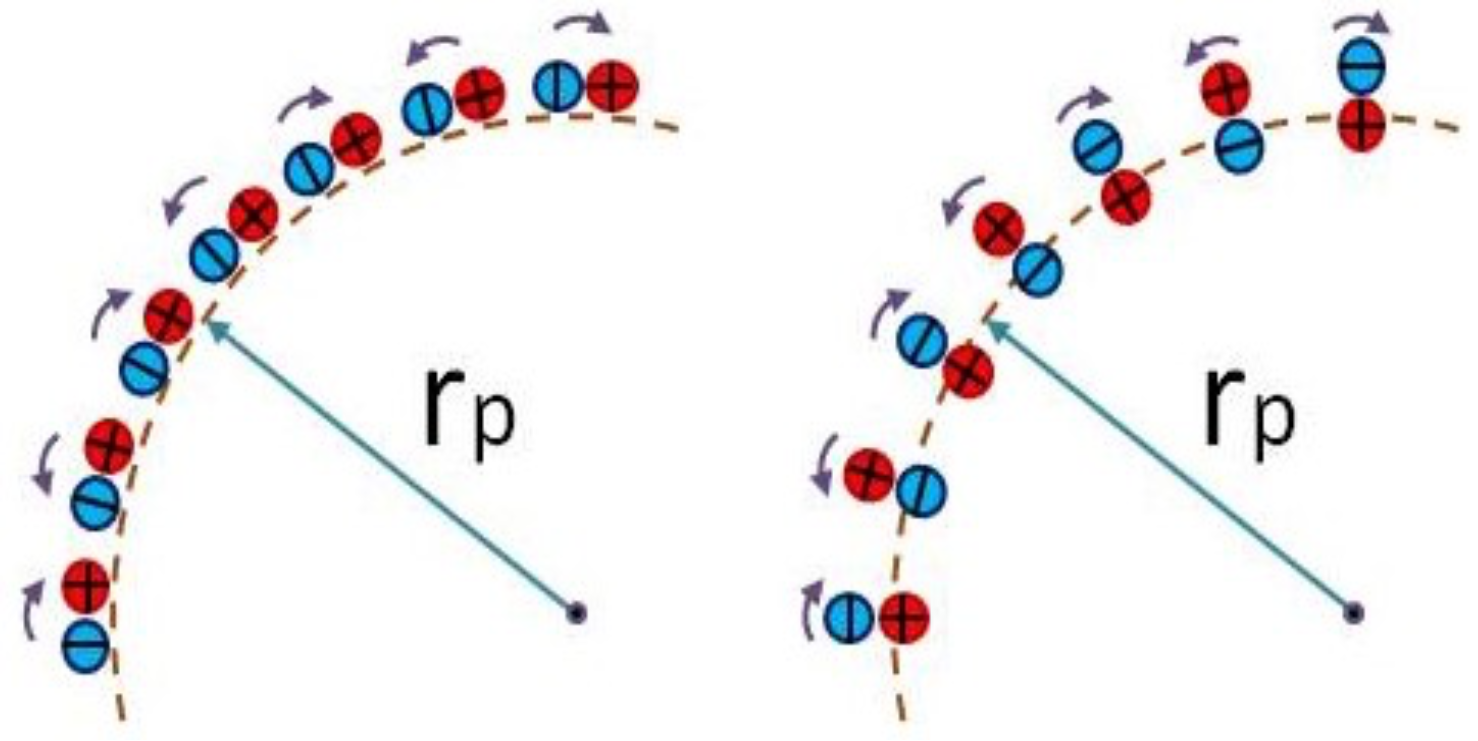
Figure 5.
The photon distribution on the partial photon shell. The photon dipole moments rotate to parallel to the shell surface in the left section, and then rotate to perpendicular to the shell surface again in the right section.
Figure 5.
The photon distribution on the partial photon shell. The photon dipole moments rotate to parallel to the shell surface in the left section, and then rotate to perpendicular to the shell surface again in the right section.
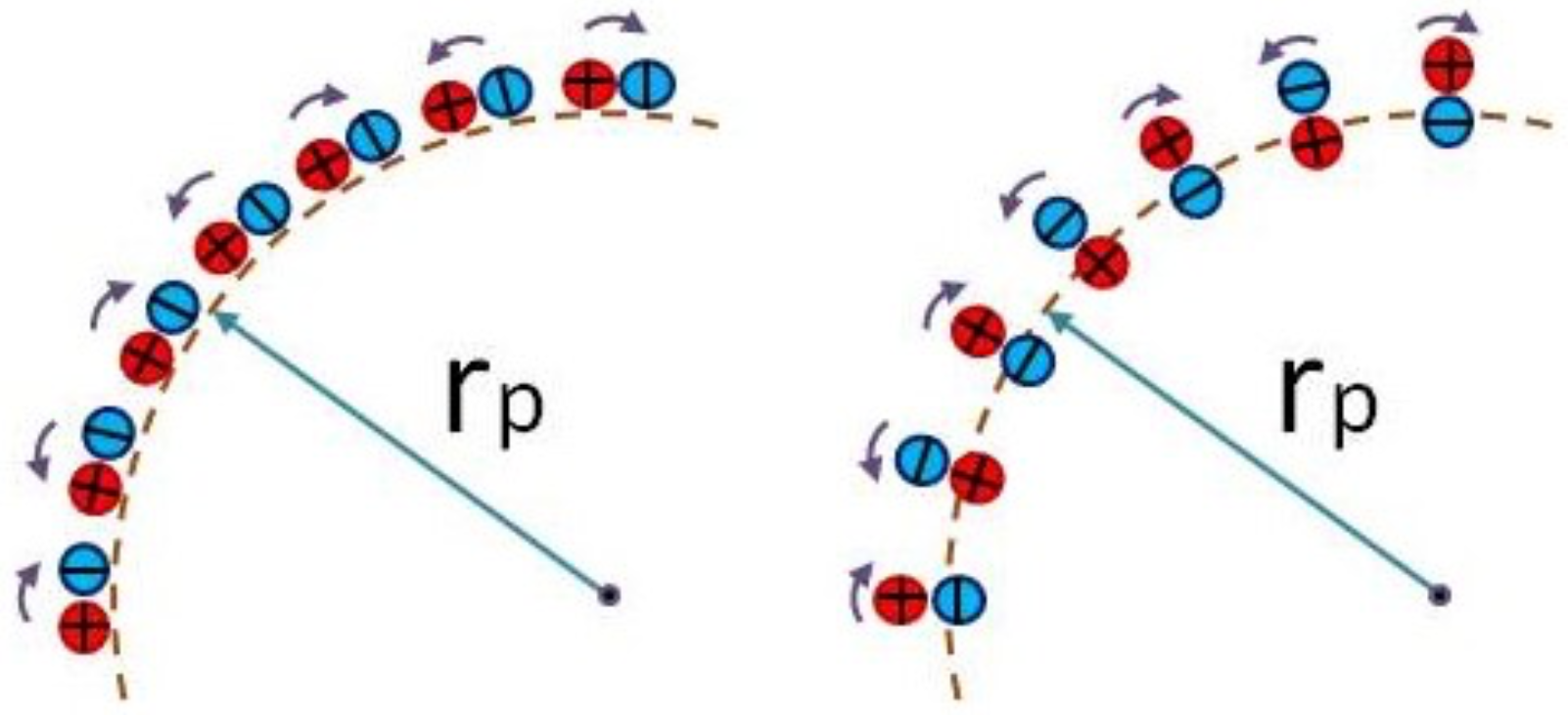

Table 1.
Electric Field Strength (V/m) Change of the Photon Dipole Moment with Distance
|
|
R=1zm | R=1am | R=1fm | R=1pm | R=1nm | R=1μm | R=1mm | R=1m |
|---|---|---|---|---|---|---|---|---|
| r=1zm | 2.9E+33 | 2.9E+24 | 2.9E+15 | 2.9E+06 | 2.9E-03 | 2.9E-12 | 2.9E-21 | 2.9E-30 |
| r=10zm | 2.9E+34 | 2.9E+25 | 2.9E+16 | 2.9E+07 | 2.9E-02 | 2.9E-11 | 2.9E-20 | 2.9E-29 |
| r=100zm | 2.9E+35 | 2.9E+26 | 2.9E+17 | 2.9E+08 | 2.9E-01 | 2.9E-10 | 2.9E-19 | 2.9E-28 |
| r=1am | 2.9E+36 | 2.9E+27 | 2.9E+18 | 2.9E+09 | 2.9E+00 | 2.9E-09 | 2.9E-18 | 2.9E-27 |
Disclaimer/Publisher’s Note: The statements, opinions and data contained in all publications are solely those of the individual author(s) and contributor(s) and not of MDPI and/or the editor(s). MDPI and/or the editor(s) disclaim responsibility for any injury to people or property resulting from any ideas, methods, instructions or products referred to in the content. |
© 2024 by the authors. Licensee MDPI, Basel, Switzerland. This article is an open access article distributed under the terms and conditions of the Creative Commons Attribution (CC BY) license (http://creativecommons.org/licenses/by/4.0/).
Copyright: This open access article is published under a Creative Commons CC BY 4.0 license, which permit the free download, distribution, and reuse, provided that the author and preprint are cited in any reuse.