

Submitted:
09 October 2024
Posted:
10 October 2024
You are already at the latest version
Abstract
This paper proposes a novel blockchain-based system designed to revolutionize transparency, traceability, and reliability within the organic food supply chain. Addressing persistent challenges such as certification fraud, opaque supply chains, and the high costs associated with organic food production, stakeholders including farmers, processors, distributors, retailers, and consumers stand to benefit from the system’s innovative approach. By leveraging blockchain technology and a robust system architecture, the proposed system offers enhanced transparency, improved traceability, and streamlined certification processes. Through detailed exploration of key components such as user interfaces, smart contracts, consensus mechanisms, IoT integration, and governance frameworks, the paper illustrates the practical application of blockchain technology in improving transparency and traceability throughout the food supply chain. A case study focusing on the organic Tofu supply chain further demonstrates the system’s potential to enhance sustainability, efficiency, and integrity in organic food production and distribution networks. The paper concludes by discussing potential implementation challenges and suggesting areas for future research and development to advance the impact of blockchain technology on the food supply chain.
Keywords:
Organic Food
; Supply chain
; Blockchain
; Transparency
; Traceability
0. Introduction
Over the recent ten years, there has been a notable surge in the popularity of organic foods, driven largely by a growing trend towards healthier living and environmental sustainability. Organic farming practices are known for their lower carbon footprint, reducing greenhouse gas emissions by approximately 48% to 66% compared to conventional farming methods. This data, highlighted by the Food and Agriculture Organization (FAO), underscores the environmental benefits of organic agriculture [1]. In terms of market value, the organic food sector has seen remarkable growth, with its worth estimated at USD 183.35 billion in 2022 and projections suggesting it could reach around USD 546.97 billion by 2032, as reported by Precedence Research [2].
This increase in organic food consumption necessitates an effective and transparent supply chain, ensuring the traceability of food quality, conditions, and origins. This is crucial as some manufacturers may misuse the organic label for profit. Consumer preference for organic food (OF) stems from concerns over nutrition, health, environmental impact, and overall food quality. These concerns are supported by various studies [3,4,5].
Organic food buyers rely on certification bodies to guarantee the quality and origin of these products. However, challenges such as label inaccuracies, certification fraud, and lack of transparent food information persist. The global food supply chain faces demand for environmental impact data, food fraud prevention, and quality and safety assurance [6]. High-profile food crises have amplified consumer demands for quality food and accessible information [7]. The globalization of the food ecosystem means food travels longer distances from farm to fork [8], making origin information crucial in the organic food sector. This information can reveal pesticide use, genetically modified organism (GMO) presence, fair trade practices, and environmental impact. The World Health Organization [9] highlights ongoing concerns about pesticide toxicity and its health and environmental effects. Incidents where organic products were found to be non-organic can have severe repercussions for supply chain entities. An example is the Dutch mushroom scandal, which led to the bankruptcy of a local grower following the withdrawal of their organic certification by Skal [10] . The European Food Safety Authority (EFSA) reports indicate the occasional presence of pesticides in organic food, though generally below maximum levels compared to conventional food [11]. Despite EFSA’s assurance of minimal health risks, the presence of pesticides in certified organic food remains a concern [11]. Consumer worries about food sources have been on the rise, perhaps fueled by such scandals [12]. The need for enhanced traceability in the food supply chain is evident, and blockchain technology is emerging as a promising solution, offering transparency, fraud prevention, and improved information access [13,14,15,16,17,18].
Blockchain’s potential as a disruptive technology in various sectors has been recognized by the World Economic Forum [19]. Numerous studies indicate that health considerations are a major factor in organic food purchases, with consumers valuing the absence of chemicals and the perceived wholesomeness of these products [20,21,22,23,24]. However, marketing strategies and information asymmetry can influence consumers’ health-related decisions [25]. The organic quality of a product is often tied to its production process rather than measurable qualities observable before purchase [26]. In this context, big data is becoming crucial in guiding decisions within agri-food supply chains [27], particularly in verifying the authenticity of organic products [28,29]. The big data revolution is reshaping consumer and producer perspectives on food purchasing and production, with an expectation for clear and accurate product information [30]. The organic label is commonly associated with health benefits, influencing consumer perceptions [24,31,32].
For producers practicing organic farming, the decision to obtain certification is influenced by their assessment of the associated costs and benefits. The expense of international certification and inspection can be prohibitive, especially for small-scale suppliers [33,34]. Studies have shown that while large farms often opt for certification, smaller farms tend to avoid it due to cost considerations [35,36]. Certification initiatives, mostly private, pose financial challenges for small producers with limited capital access [37]. For instance, many suppliers meet organic standards but often forego certification, except when targeting large, anonymous markets or state-supervised markets [34]. Supermarkets, which dominate the food market, set high standards often unreachable for smallholders [38]. Thus, suppliers must strategically balance the health benefits and financial costs of certification. Retailers, dealing with intense competition, face decisions about sourcing from multiple suppliers and setting prices based on suppliers’ certification strategies [39,40,41,42]. The retailer’s choice on product sourcing and pricing is crucial in the competitive food industry, underlining the importance of certification strategy decisions by food suppliers.
This paper aims to contribute to the ongoing dialogue surrounding the challenges faced by the organic food supply chain and explores how blockchain technology might offer viable solutions. We propose a practical model that could be implemented to address these challenges effectively. This model is designed to leverage the unique capabilities of blockchain to improve transparency, traceability, and reliability within the organic food supply chain, potentially revolutionizing the way organic food is produced, certified, and distributed.
1. Organic Food Supply Chain Challenges
The decision-making challenge in the organic food supply chain encompasses several critical areas, including consumer trust, traceability, certification, cost, and sustainability, each with its unique set of challenges and considerations.
1.0.1. Trust Challenge
Generally, the significance of trust in modern food markets is paramount. In this context, trust is often perceived as a preferable alternative to individual judgment, effectively assuming the food’s safety. This concept is explored in depth by [43], in their work on consumer behavior. Which emphasizes how consumers rely on various cues and information sources to verify food quality and safety, highlighting the role of food labels, certifications, and the reputation of food producers and retailers in building this trust.
In response to the potential risks involved in consuming products, consumers adopt a variety of risk mitigation strategies, including reliance on the reputations of brands and stores, as well as the information provided on product labels [44,45,46,47,48].
Such strategies play a vital role in the development of trust in products. The study conducted by [49] on the consumption of organic food revealed two main types of trust: one based on the quality indicators of the product, and another based on the reputation of the entities involved, such as brands, labels, and producers. The concept of trust has been recognized as a key strategic factor in the food industry [50]. A deep understanding of these trust dynamics is essential for defining the market strategy for organic products, including their distribution channels and the role of certifying bodies. The increase in the consumption of organic foods has been closely linked to how consumers perceive and value trust, particularly in aspects like the authenticity of certification labels, the origin of the product, and the methods of distribution [51].
1.0.2. Traceability Challenge
The literature on organic food traceability has gained significant attention in recent years, shedding light on a multitude of issues that have far-reaching implications throughout the entire supply chain. Researchers such as Mireille van Hilten, Guido Ongena, and Pascal Ravesteijn in their work from 2020, have highlighted various challenges and concerns that plague the organic food industry from containers to individual products. Issues in this domain encompass accuracy in labeling, fraud in third-party certification systems, and the interoperability of traceability systems.
These issues range from the containers used to transport products to the individual items themselves, encompassing a wide spectrum of problems that demand urgent attention and resolution.
One of the foremost concerns in organic food traceability is the accuracy of labeling. Accurate labeling is essential to ensure that consumers can trust the organic claims made by producers and suppliers. Mislabeling can occur at any stage of the supply chain, leading to consumers unknowingly purchasing non-organic products or products with misleading claims. Such misrepresentations not only harm consumer trust but also have economic and ethical ramifications [52].
Fraud within third-party certification systems is another critical issue identified in the literature. Organic products often rely on third-party certification bodies to verify their authenticity and adherence to organic standards. However, fraudulent practices, such as falsely certifying non-organic products as organic, can undermine the integrity of the entire organic industry. This issue has prompted calls for increased scrutiny, transparency, and accountability within certification processes to prevent fraudulent activities [53].
Interoperability of traceability systems is also a significant challenge that hampers the effectiveness of organic food traceability. Different actors in the supply chain may use diverse traceability systems that do not seamlessly communicate with each other. This lack of interoperability can lead to data discrepancies, delays in information sharing, and inefficiencies in tracking and tracing organic products [54,55].
1.0.3. Certification Cost and Efficiency Challenge
The economic implications of organic certification costs and their efficiency are a significant concern in the organic food industry [56]. One of the primary challenges faced by organic producers is the inherently higher cost of their products compared to conventionally grown alternatives [33]. This cost disparity is attributed to several factors, including the more labor-intensive nature of organic farming practices, generally lower yields, and the relatively smaller scale of many organic farming operations. Additionally, the cost of obtaining and maintaining organic certification, which is crucial for market access and consumer trust, adds a substantial financial burden to organic producers [37].
The high cost of organic certification is a key factor contributing to the higher prices of organic products in the market. This scenario often limits the consumer base to those who are willing or able to pay a premium for organic products, thus restricting the market’s growth and accessibility. To address this challenge, strategies to reduce the cost of organic certification are essential.
To provide a clear overview, we present the Organic Food Certification Standards Comparison Table 1 below:
2. Blockchain Application in the Food Supply Chain
The genesis of blockchain technology traces back to Nakamoto in 2009, gaining prominence with the introduction of the peer-to-peer Bitcoin cryptocurrency platform [57]. This revolutionary distributed ledger system boasts immutability and transparency, offering secure, swift, and reliable solutions. Transactions recorded “on the blockchain” are encapsulated within blocks, each stamped with a timestamp and a hash connecting it to the preceding block, forming an immutable chain. Distinguished by its decentralized, peer-to-peer structure, blockchain technology stands in stark contrast to centralized networks. While centralized networks rely on a single entity for governance, blockchain operates as a distributed and shared database, encompassing all network transactions. The creation of new blocks hinges on various verification methods within the distributed network, dictated by blockchain protocols like Bitcoin, Ethereum, and Hyperledger. These protocols, constituting the consensus mechanism, rely on computer algorithms to validate transactions’ authenticity. Consensus mechanisms such as proof of work and proof of stake serve as the cornerstone of blockchain technology, ensuring the credibility of recorded transactions.
Different types of blockchains govern access control and data management, categorized into public and private authentication [58], and permissioned and permissionless authorization solutions [59]. Described as immutable, transparent, available, consistent, and privacy-enabling, blockchain technology encapsulates a spectrum of attributes essential for modern data management.
Integrating smart contracts into blockchain solutions facilitates the execution of business processes across organizational boundaries, diminishing reliance on trusted third parties for transaction verification [60]. The advent of smart contracts also reshapes the intermediary landscape, diminishing the role of traditional intermediaries like notaries or certification bodies [61]. Traceability ontologies have been instrumental in enhancing blockchain designs, enabling provenance traceability and minimizing fraud in various sectors, including the organic food industry [62]. Two crucial and highly relevant areas, agriculture, and the food supply chain, are intricately linked, as agricultural products are commonly utilized as inputs in various multi-actor distributed supply chains, with consumers typically serving as the final clients [63,64]. In the agricultural sector, blockchain emerges as a fundamental technology, complementing other innovations such as the Internet of Things (IoT), big data analytics, and artificial intelligence in the cyber-physical management cycle of food production [65]. There is evidence that blockchain applications began to be utilized in supply chain management shortly after the technology’s emergence [66]. A blockchain-based network fosters fair trading and a circular economy, offering crucial support to farmers in enhancing food quality throughout the supply chain. In this framework, the concept of smart farming, as discussed by [67], facilitates monitoring, analysis, and control of farming practices, enabling informed decision-making. [68] examined various traceability systems based on blockchain and other technologies across different agri-food value chains different and suggest the need to embed blockchain technology in the current traceability system to create more agile value chains and closer customer relationship.
Blockchain-based traceability systems, augmented with technologies like RFID, IoT, NFC, cloud computing, and big data, offer promising solutions for enhancing transparency and combating certification fraud in the agri-food supply chain [69,70]. Concerning organic food traceability criteria, the immutability and decentralization of data using blockchain emerge as paramount factors in addressing certification fraud, enhancing transparency, and standardizing data elements throughout the supply chain [71]. However, despite its potential applications, blockchain’s adoption in sectors like the food supply chain still faces hurdles related to technical implementation and collaboration [72]. The proposed models remain largely theoretical, necessitating further research before practical implementation [73].
To better illustrate the potential benefits of implementing blockchain technology in the organic food supply chain, Table 2 provides a summary of the key advantages, including improved traceability, enhanced trust, reduced certification costs, increased efficiency, and fraud prevention.
3. Blockchain for Organic Food Supply Chain
3.1. Enhancing Trust and Traceability
Blockchain technology (BT) offers a robust platform for reliable traceability by collecting, sharing, and transferring authentic data at various stages of the supply chain, including sourcing, processing, warehousing, distribution, and sales [74,75]. This technology ensures that information about each product can be accurately traced back through each block in the blockchain, thanks to the use of timestamps [76]. The inherent features of BT, such as a secure, shared, and decentralized database, foster a high level of trust. This is achieved through the transparent and traceable transactions of goods, data, and financial resources, ensuring a reliable and trustworthy supply chain [77].
Blockchain technology emerges as a pivotal solution for bolstering trust and traceability in the organic food supply chain. This innovative approach involves the utilization of decentralized, secure databases. These databases play a crucial role in preserving data integrity, thereby promoting food safety and enhancing security [78]. A notable advantage of blockchain is the elimination of intermediaries, which streamlines the supply chain, integrates processes, and mitigates risks associated with product recalls [1,79]. Additionally, the implementation of smart contracts in blockchain systems significantly contributes to traceability. Smart contracts facilitate meticulous tracking of agricultural products, enabling precise verification of their origins and quality [1,80].
3.2. Certification Cost and Efficiency
Blockchain technology significantly enhances the cost-efficiency and effectiveness of certification processes in supply chains [81]. Its auditable, trust-free, tamper-proof, and self-regulating nature, as described by [13], underpins its capacity for facilitating auditability and maintaining a fault-free audit trail [82]. This transparency ensures that all transactions on the blockchain are visible to all participants, increasing auditability and trust [83]. The implementation of blockchain across supply chains not only improves accountability by guaranteeing data integrity [84] but also establishes an authoritative record for trade data. This allows for the automatic reconciliation of invoices, further enhancing accountability and efficiency [85]. Furthermore, the decentralized database structure, cryptographic signature protection, and reduced reliance on intermediaries inherent in blockchain technology contribute to a significant reduction in transaction costs [86,87]. The use of smart contracts in trade transactions also aids in developing a multi-supplier base, effectively minimizing these costs [85]. These combined features of blockchain make it a powerful tool for reducing certification costs while simultaneously increasing efficiency in various transactional processes.
4. Blockchain System for Organic Food Supply Chain
To facilitate a comprehensive understanding of the proposed blockchain system for the organic food supply chain, this section aims to provide a high-level summary, a breakdown of system architecture components, and a brief discussion on potential limitations or challenges in its implementation.
4.1. High-Level Overview
The proposed blockchain system for the organic food supply chain aims to revolutionize transparency, traceability, and reliability within the organic food industry. By leveraging blockchain technology, the system seeks to address persistent challenges faced by stakeholders, including farmers, processors, distributors, retailers, and consumers.
4.1.1. Key Objectives
- Enhanced Transparency: The system strives to provide stakeholders with unprecedented transparency into the entire supply chain, from farm to fork. By recording all transactions and data on an immutable blockchain ledger, participants can access real-time information about product origins, certifications, and movement.
- Improved Traceability: One of the primary objectives of the system is to enhance traceability throughout the supply chain. By utilizing IoT devices and smart contracts, stakeholders can accurately track the journey of organic food products, ensuring compliance with organic standards and regulations.
- Streamlined Certification: The system aims to streamline the certification process for organic products, reducing administrative burdens and costs associated with traditional certification methods. Through automated verification processes and smart contracts, farmers and processors can obtain digital certification tokens, simplifying the certification process.
4.1.2. Potential Benefits for Stakeholders
- Farmers and Processors: The blockchain system offers farmers and processors greater visibility and control over their products’ certification status and supply chain movement. By reducing certification costs and administrative complexities, stakeholders can focus on sustainable production practices and market competitiveness.
- Distributors and Retailers: Distributors and retailers benefit from increased trust and credibility in their product offerings. With access to transparent and verifiable information about product origins and certifications, they can assure consumers of the quality and authenticity of organic food products, thereby enhancing brand reputation and customer loyalty.
- Consumers: Consumers stand to gain the most from the blockchain system, as it empowers them with unprecedented transparency and trust in the food they purchase. By scanning product QR codes and accessing detailed information about product origins, certifications, and supply chain journeys, consumers can make informed choices aligned with their values and preferences.
Overall, the proposed blockchain system holds the promise of transforming the organic food supply chain by fostering trust, accountability, and sustainability throughout the industry.
4.2. System Architecture Components
4.2.1. User Interfaces (Web Interface)
A user-friendly web interface serves as the participants’ gateway to interact with the blockchain system. Beyond basic transaction functionalities, this interface facilitates real-time data access, analytics, and transaction history. Participants can not only initiate and verify transactions but also delve into detailed product information and view certifications. The intuitive design and functionality of the web interface can contribute to improved transparency, enabling stakeholders to make informed decisions based on data insights.
4.2.2. Smart Contracts Layer
The system’s backbone includes two crucial smart contracts: the Product Certification Smart Contract and the Supply Chain Smart Contract.
Product Certification Smart Contract
This smart contract plays a pivotal role in streamlining the certification process for organic products. Upon receiving a certification request from farmers or processors, it verifies compliance with organic standards. If the criteria are met, the smart contract issues a digital certification token, indicating that the tofu batch, for example, is now certified organic. This certification status is communicated in real-time to the Supply Chain Smart Contract, ensuring seamless integration of certification data into the broader supply chain network.
Supply Chain Smart Contract
Acting as the overarching governing mechanism, this smart contract orchestrates the entire supply chain flow. It enforces predefined rules for transactions and data validation, ensuring consistency in both certification and general supply chain processes. Additionally, the Supply Chain Smart Contract communicates with other smart contracts to maintain a unified system, fostering trust and accountability across the network.
4.2.3. Consensus Mechanism
The proposed Proof of Authority (PoA) consensus mechanism plays a pivotal role in ensuring the integrity and reliability of the blockchain network. Unlike Proof of Work (PoW) or Proof of Stake (PoS) mechanisms, PoA relies on a set of pre-approved validators to confirm transactions and secure the network. This approach enhances transaction agreement and expedites confirmation processes within the consortium, thereby optimizing efficiency and scalability while maintaining a robust level of security.
4.2.4. Blockchain Network
Operated by participating entities such as farmers, processors, distributors, and retailers, the blockchain network serves as the decentralized ledger that records all transactions and data exchanges. Nodes within the network communicate with each other to propagate transactions, update the ledger, and guarantee data consistency across the entire network. By decentralizing data storage and validation, the blockchain network ensures transparency, resilience, and trust in the supply chain ecosystem.
4.2.5. Identity Management
A decentralized identity management system assigns unique identifiers to participants, enhancing secure and tamper-resistant identity verification. By leveraging cryptographic techniques, this system prevents identity theft and unauthorized access to sensitive information, fostering a trustworthy environment conducive to transparent interactions and transactions.
4.2.6. Data Encryption
Employing asymmetric encryption techniques, the system ensures the privacy and security of sensitive data such as certifications and personal information. Only authorized parties possessing corresponding keys can access encrypted data, mitigating the risk of unauthorized access or data tampering. This robust security measure instills confidence in stakeholders and safeguards the integrity of the supply chain ecosystem.
4.2.7. Interoperability Layer
Application Programming Interfaces (APIs) provide interfaces for seamless integration with existing systems and databases. This integration enables data exchange with external supply chain management tools, fostering interoperability between the blockchain system and other business processes. By facilitating smooth data flow and communication between disparate systems, the interoperability layer enhances operational efficiency and collaboration among stakeholders.
4.2.8. Internet of Things (IoT) Integration
Strategically integrated IoT devices, equipped with sensors to monitor temperature and humidity, play a crucial role in ensuring product traceability and quality assurance. These devices collect real-time data on environmental conditions during product transportation, communicating directly with nodes to record this data securely on the blockchain. By providing verifiable information about the conditions products undergo, IoT integration enhances transparency and enables stakeholders to make informed decisions based on reliable data insights.
4.2.9. Data Storage
A distributed file system is employed to store large files such as images and documents associated with products. This approach ensures decentralized and redundant storage for resilience, preventing data loss.
4.2.10. Off-Chain Database
An off-chain database is employed for storing metadata related to transactions, such as product details and batch numbers. This database acts as a quick reference for information retrieval without the need to access the entire blockchain.
4.2.11. Oracles
External data feeds, known as oracles, connect the blockchain to real-world data sources such as market prices, CO2 emissions, and weather conditions. These oracles feed relevant information to smart contracts, ensuring the accuracy of on-chain data.
4.2.12. Governance and Compliance
A Governance Smart Contract manages decision-making within the consortium, facilitating voting on protocol upgrades and changes. This smart contract communicates with other smart contracts to enforce governance rules, ensuring a democratic and transparent decision-making process. By embedding governance mechanisms into the blockchain system, stakeholders can collectively govern the network’s operations and ensure compliance with industry regulations and standards.
4.2.13. Monitoring and Reporting
Analytics tools are integrated to access blockchain data for real-time monitoring and analytics. These tools generate reports on traceability, compliance, and overall supply chain performance, empowering participants with data-driven insights for informed decision-making. By leveraging data analytics, stakeholders can identify trends, detect anomalies, and optimize supply chain processes to enhance efficiency and sustainability.
4.2.14. User Authentication
The implementation of Two-Factor Authentication (2FA) enhances the security posture of the platform, ensuring secure user access to the blockchain system.
4.2.15. Integration with External Systems
Enterprise Resource Planning (ERP) integration allows seamless integration with existing ERP systems for smooth business operations. This integration facilitates the exchange of data seamlessly with external systems, ensuring consistency and accuracy in overall data management. By synchronizing data between the blockchain system and external ERP systems, stakeholders can streamline workflows, minimize data silos, and enhance operational efficiency across the supply chain.
4.2.16. Consumer-Facing Applications
Mobile apps serve as consumer-facing interfaces, allowing consumers to scan product QR codes and access detailed information about product origins, certifications, and supply chain journeys. By providing transparent and verifiable information, consumer-facing applications empower consumers to make informed choices aligned with their values and preferences. This increased transparency builds trust and loyalty among consumers, thereby enhancing brand reputation and market competitiveness.
4.2.17. Audit Trail
The use of an immutable ledger ensures that once data is recorded, it cannot be altered or tampered with. This provides an auditable history of all transactions, facilitating traceability and accountability throughout the supply chain. By maintaining a transparent and immutable audit trail, stakeholders can track the flow of products and verify the authenticity of transactions, thereby reducing the risk of fraud and ensuring compliance with regulatory requirements.
4.2.18. Scalability and Performance Optimization
To address scalability concerns, the system incorporates sharding and side chains. Sharding enhances scalability by partitioning the blockchain network into smaller shards, each capable of processing transactions independently. Similarly, side chains handle specific use cases, reducing the load on the main blockchain and ensuring efficient performance. By leveraging sharding and side chains, the system can accommodate growing transaction volumes and maintain optimal performance levels, even as the network expands.
4.2.19. Legal and Regulatory Compliance
Smart Contracts for Compliance embed legal and regulatory requirements into the system, automating compliance-related processes and ensuring adherence to industry standards. By automating compliance checks and enforcement mechanisms, smart contracts streamline regulatory compliance and reduce the risk of non-compliance penalties. This automated approach enhances transparency, accountability, and trust among stakeholders, thereby fostering a regulatory-compliant and sustainable supply chain ecosystem.
In order to provide a comprehensive overview of the system architecture and its underlying workflow, Figure 1 presents a diagram outlining the key components and their interactions within the blockchain-based supply chain management system. This diagram illustrates how various elements, including user interfaces, smart contracts, consensus mechanisms, and integration layers, work together to ensure transparency, security, and efficiency throughout the supply chain ecosystem.
As depicted in the diagram, the end-to-end workflow within this architecture exemplifies the integration of blockchain technology to enhance traceability and trust in the supply chain. To better understand the end-to-end workflow, let us delve deeper into the journey of a batch of organic tofu, which vividly demonstrates the practical implementation of this innovative approach to supply chain management.
The end-to-end workflow starts with a farmer initiating a transaction through the user-friendly web interface, submitting a request for organic certification for their soybean crop. The Product Certification Smart Contract is then invoked, verifying compliance with organic standards by cross-referencing data such as cultivation practices, soil health, and absence of chemical inputs. Once the criteria are met, the smart contract issues a digital certification token, indicating the organic status of the soybeans. Simultaneously, the Supply Chain Smart Contract activates, orchestrating the product’s journey through the supply chain. The certified soybeans are then processed into tofu by a manufacturer, with each step recorded transparently on the blockchain. Throughout transportation, IoT devices integrated into shipping containers monitor temperature and humidity, ensuring optimal conditions for product quality. These IoT devices are connected to the blockchain network, allowing real-time data collection and recording of transportation conditions. As the tofu reaches distributors and retailers, the immutable ledger provides real-time access to certification status and supply chain provenance through consumer-facing applications. Consumers, upon scanning a QR code, can trace the tofu’s journey back to its origin, viewing details such as the farm where the soybeans were grown and the processing facility where tofu was manufactured. This end-to-end workflow demonstrates how blockchain technology enhances transparency, traceability, and consumer trust in the organic food supply chain, ultimately fostering a more sustainable and accountable ecosystem.
Building upon this understanding, the proposed blockchain system for the organic food supply chain incorporates various components, each playing a crucial role in ensuring the integrity and efficiency of the supply chain. As seen in this paper, these components work synergistically to enhance transparency, traceability, and efficiency throughout the supply chain. While the system’s architecture offers significant advantages over traditional supply chain management approaches, it’s essential to provide a comparative analysis to underscore its superiority.
In the following Table 3, we compare the proposed blockchain system with traditional supply chain management methods in terms of key metrics such as transparency, traceability, cost-effectiveness, and scalability. This comparison highlights the transformative potential of blockchain technology in revolutionizing the organic food supply chain.
4.3. Limitations and Challenges
While the proposed blockchain system offers significant advantages, potential challenges may arise during its implementation. These could include concerns related to scalability, security, and real-world adoption. Ensuring seamless integration with existing systems and overcoming any resistance to change within the industry may also pose challenges. Ongoing research and development are necessary to address these potential limitations and refine the system for practical implementation in the organic food supply chain.
4.4. Use Case: Certified Organic Tofu in the Organic Food Supply Chain
The following use case illustrates the practical application of the proposed blockchain system to the end-to-end journey of certified organic tofu within the organic food supply chain. By providing a tangible example, this use case aims to demonstrate how the proposed system enhances transparency, traceability, and reliability, ultimately revolutionizing the organic food industry.
4.4.1. Product Certification
Initiation
TofuCo, a tofu processor, initiates the certification process by submitting a request through the system’s user-friendly web interface. This request includes comprehensive details regarding the production process and ingredients used in the tofu batch.
Smart Contract Execution
The Product Certification Smart Contract receives the request, meticulously verifying the compliance of TofuCo’s production process with organic standards. If compliant, a digital certification token is generated, indicating that the tofu batch is certified organic.
4.4.2. Supply Chain Movement
Blockchain Transaction
TofuCo records the certification status and initiates the tofu’s journey within the supply chain by executing a transaction in the Supply Chain Smart Contract. This transaction encompasses crucial details such as batch numbers, production dates, and the digital certification token, all securely added to the blockchain.
Node Communication
The transaction is propagated across all nodes within the blockchain network, where validators engage in the consensus process using the Proof of Authority (PoA) mechanism. Through this consensus, unanimous agreement on the certification status and subsequent supply chain movements is ensured.
4.4.3. IoT Data Collection
Sensors and Devices
IoT devices equipped with CO2 emissions, temperature, and humidity sensors are attached to both the tofu production process in farms and the packaging used for the entire journey.
Data Recording
Environmental data, including CO2 emissions, temperature, and humidity, is collected in real-time by IoT devices. This information is securely recorded on the blockchain, creating an immutable record of transportation conditions. Stakeholders can access this data to verify compliance with specific environmental requirements during transit.
4.4.4. Retailer Integration
ERP System Integration
Retailers seamlessly integrate their ERP systems with the proposed blockchain system via APIs. As the certified organic tofu batch traverses the supply chain, the ERP system receives automatic updates regarding its certification status and other pertinent information. This integration ensures smooth data exchange and enhances operational accuracy for retailers.
4.4.5. Consumer Verification
Mobile App Interaction
A consumer purchases the certified organic tofu from a retailer and scans the QR code on the tofu packaging using the proposed mobile app.
Blockchain Query
The mobile app queries the proposed system blockchain for information about the tofu batch. Details such as origin, certifications, and the entire supply chain journey are retrieved and displayed to the consumer, fostering transparency and building consumer trust.
4.4.6. Governance and Compliance
Decision-Making
A consortium member proposes a protocol upgrade to enhance traceability features within the proposed system.
Voting
Consortium members, including TofuCo and the retailer, participate in a vote through the Governance Smart Contract. The smart contract tallies the votes, and if the majority agrees, the protocol upgrade is accepted.
Enforcement
The Governance Smart Contract enforces the protocol upgrade across the system network, improving traceability features for all participants.
4.4.7. Traceability and Audit
Immutable Ledger
The entire journey of the certified organic tofu, from TofuCo to the retailer, is recorded on the immutable system ledger. Any stakeholder, including regulators, can trace and audit the product’s origin, certifications, and all transactions, ensuring accountability and adherence to standards.
4.4.8. Legal Compliance
Smart Contracts for Compliance
Legal and regulatory compliance are inherently embedded in system smart contracts. The system automatically ensures adherence to organic certification standards and relevant regulations, providing a reliable mechanism for regulatory compliance.
This use case aims to showcase how the proposed blockchain system enhances transparency, traceability, and reliability within the organic food supply chain. By providing verifiable data at each stage of the tofu’s journey, stakeholders can ensure compliance with organic standards, build consumer trust, and ultimately improve the integrity of the organic food industry.
4.5. Discussion of Future Research
While the proposed blockchain system for the organic food supply chain shows immense promise, several areas warrant further investigation to ensure its scalability, security, and successful real-world implementation.
4.5.1. Scalability
As the system expands to accommodate a larger network of participants and an increasing volume of transactions, scalability becomes a critical concern. Future research could explore innovative solutions such as sharding, or off-chain protocols to enhance the system’s scalability without compromising its efficiency or security. Additionally, exploring the implications of scalability on consensus mechanisms and network governance models could provide valuable insights into scaling blockchain solutions sustainably.
4.5.2. Security
Maintaining the security and integrity of the blockchain system is paramount, especially considering the sensitive nature of food supply chain data. Future research efforts could focus on developing robust security mechanisms, including advanced encryption techniques, consensus algorithms, and identity management systems, to mitigate potential vulnerabilities and protect against cyber threats. Additionally, investigating the impact of security measures on system performance and user experience would be instrumental in designing security frameworks tailored to the unique challenges of the food supply chain.
4.5.3. Real-World Implementation Challenges
Transitioning from conceptualization to real-world implementation often presents various challenges, including regulatory compliance, interoperability with existing systems, and stakeholder buy-in. Future research could delve into strategies for overcoming these implementation hurdles, such as regulatory sandbox testing, industry-wide collaboration frameworks, and incentive mechanisms to encourage participation. Studying the socioeconomic implications of blockchain adoption in the food industry could offer valuable insights into fostering inclusive and sustainable deployment strategies.
4.5.4. Sustainability
The sustainability of blockchain technology itself, particularly in terms of energy consumption and environmental impact, is another area ripe for exploration. Future research could explore eco-friendly consensus mechanisms, energy-efficient protocols, and renewable energy sources to minimize the environmental footprint of blockchain-based systems in the food supply chain.
4.5.5. Governance and Standardization
Establishing robust governance frameworks and industry-wide standards is essential for ensuring the long-term viability and interoperability of blockchain-based solutions in the food supply chain. Future research could focus on developing governance models, standard protocols, and certification mechanisms to promote transparency, accountability, and trust among all stakeholders.
5. Conclusion
The proposed blockchain-based system presents a groundbreaking approach to revolutionizing the organic food supply chain, offering unparalleled transparency, traceability, and reliability. By leveraging blockchain technology, stakeholders can navigate the complexities of certification processes, supply chain management, and consumer trust with newfound efficiency and confidence.
Through the analysis of the system architecture, key components, and use case scenarios, this paper has illustrated the transformative potential of blockchain in fostering a more sustainable and accountable ecosystem for organic food production and distribution. By enhancing transparency at every stage of the supply chain, from farm to fork, the system empowers stakeholders to make informed decisions aligned with their values and preferences.
Moreover, the comparative analysis presented in this paper underscores the superiority of blockchain-based solutions over traditional supply chain management methods, particularly in terms of transparency, traceability, cost-effectiveness, and scalability. The proposed system not only streamlines certification processes and reduces administrative burdens but also enhances consumer trust and brand reputation, ultimately driving market competitiveness and sustainability within the organic food industry.
While the proposed system holds immense promise, it is essential to acknowledge the challenges and limitations inherent in its implementation. Ongoing research and development efforts are necessary to address scalability concerns, ensure robust security measures, and facilitate seamless integration with existing systems and regulatory frameworks.
In conclusion, the proposed blockchain system for the organic food supply chain represents a significant step forward in realizing a more transparent, traceable, and sustainable food ecosystem.
Conflicts of Interest
The authors declare no conflicts of interest.
Abbreviations
The following abbreviations are used in this manuscript:
| Application Programming Interfaces | APIs |
| EFSA | European Food Safety Authority |
| FAO | Food and Agriculture Organization |
| GMO | Genetically Modified Organism |
| IFAD | International Fund for Agricultural Development |
| IFOAM | International Federation of Organic Agriculture Movements |
| IoT | Internet of Things |
| NFC | Near Field Communication |
| RFID | Radio Frequency Identification |
| WEF | World Economic Forum |
References
- Food and Agriculture Organization of the United Nations (FAO). The State of Food and Agriculture; 2019.
- Research, P. Organic Food Market (By Product: Fruits and vegetables, Dairy products, Meat, fish and poultry, Frozen foods, Others; By Distribution Channel: Online, Offline) - Global Industry Analysis, Size, Share, Growth, Trends, Regional Outlook, and Forecast 2023-2032. Report, 2023. Report Code: 1843, Category: Food and Beverages, Number of Pages: 150+, Format: PDF/PPT/Excel, Historical Year: 2021-2022, Base Year: 2023, Estimated Years: 2024-2033.
- Fotopoulos, C.; Krystallis, A. Purchasing motives and profile of the Greek organic consumer: a countrywide survey. British Food Journal 2002, 104, 730–765. [CrossRef]
- Larue, B.; West, G.E.; Gendron, C.; Lambert, R. Consumer response to functional foods produced by conventional, organic, or genetic manipulation. Agribusiness 2004, 20, 155–166. [CrossRef]
- Shepherd, R.; Magnusson, M.; Sjödén, P.O. Determinants of Consumer Behavior Related to Organic Foods. AMBIO: A Journal of the Human Environment 2005, 34, 352 – 359. [CrossRef]
- Langelaan, H.; Pereira da Silva, F.; Thoden van Velzen, U.; Broeze, J.; Matser, A.; Vollebregt, M.; Schroën, K. Technology options for feeding 10 billion people Options for sustainable food processing. STOA Research Administrator: Brussels, Belgium 2013, 1.
- Schleenbecker, R.; Hamm, U. Consumers’ perception of organic product characteristics. A review. Appetite 2013, 71, 420–429. [CrossRef]
- Lehtinen, U. Sustainable supply chain management in agri-food chains: a competitive factor for food exporters. Sustainability Challenges in the agrofood sector 2017, pp. 150–174.
- Bodnaruk, K. Pesticide residues in food 2018 - Report 2018 - Joint FAO/WHO Meeting on Pesticide Residues.
- van Hilten, M.; Ongena, G.; Ravesteijn, P. Blockchain for organic food traceability: Case studies on drivers and challenges. Frontiers in Blockchain 2020, 3, 43. [CrossRef]
- (EFSA), E.F.S.A. The 2017 European Union report on pesticide residues in food. EFSA Journal, 17, e05743. [CrossRef]
- Bitcoin Magazine. Innovation Percolates When Coffee Meets the Blockchain. Nasdaq 2017.
- Atzori, M. Blockchain technology and decentralized governance: Is the state still necessary? Available at SSRN 2709713 2015. [CrossRef]
- Underwood, S. Blockchain beyond bitcoin. Communications of the ACM 2016, 59, 15–17. [CrossRef]
- Cai, Y.; Zhu, D. Fraud detections for online businesses: a perspective from blockchain technology. Financial Innovation 2016, 2, 1–10. [CrossRef]
- Kraft, D. Difficulty control for blockchain-based consensus systems. Peer-to-peer Networking and Applications 2016, 9, 397–413. [CrossRef]
- Swan, M. Blockchain: Blueprint for a new economy; " O’Reilly Media, Inc.", 2015.
- Yu, Y.; He, Y. Information disclosure decisions in an organic food supply chain under competition. Journal of Cleaner Production 2021, 292, 125976. [CrossRef]
- World Economic Forum. Fourth Industrial Revolution for the Earth Series: Building Block(chain)s for a Better Planet; World Economic Forum, 2018. In collaboration with PwC and Stanford Woods Institute for the Environment.
- Bauer, H.H.; Heinrich, D.; Schäfer, D.B. The effects of organic labels on global, local, and private brands: More hype than substance? Journal of Business Research 2013, 66, 1035–1043. [CrossRef]
- Vega-Zamora, M.; Torres-Ruiz, F.J.; Murgado-Armenteros, E.M.; Parras-Rosa, M. Organic as a heuristic cue: What Spanish consumers mean by organic foods. Psychology & Marketing 2014, 31, 349–359.
- Popa, M.E.; Mitelut, A.C.; Popa, E.E.; Stan, A.; Popa, V.I. Organic foods contribution to nutritional quality and value. Trends in Food Science & Technology 2019, 84, 15–18.
- Sazvar, Z.; Rahmani, M.; Govindan, K. A sustainable supply chain for organic, conventional agro-food products: The role of demand substitution, climate change and public health. Journal of cleaner production 2018, 194, 564–583. [CrossRef]
- Schifferstein, H.N.; Ophuis, P.A.O. Health-related determinants of organic food consumption in the Netherlands. Food quality and Preference 1998, 9, 119–133. [CrossRef]
- Marotta, G.; Simeone, M.; Nazzaro, C. Product reformulation in the food system to improve food safety. Evaluation of policy interventions. Appetite 2014, 74, 107–115. [CrossRef]
- Dabbert, S.; Lippert, C.; Zorn, A. Introduction to the special section on organic certification systems: Policy issues and research topics. Food Policy 2014, 49, 425–428. [CrossRef]
- Ahearn, M.C.; Armbruster, W.; Young, R. Big data’s potential to improve food supply chain environmental sustainability and food safety. International Food and Agribusiness Management Review 2016, 19, 155–171.
- Barbosa, R.M.; de Paula, E.S.; Paulelli, A.C.; Moore, A.F.; Souza, J.M.O.; Batista, B.L.; Campiglia, A.D.; Barbosa Jr, F. Recognition of organic rice samples based on trace elements and support vector machines. Journal of Food Composition and Analysis 2016, 45, 95–100. [CrossRef]
- de Lima, M.D.; Barbosa, R. Methods of authentication of food grown in organic and conventional systems using chemometrics and data mining algorithms: A review. Food Analytical Methods 2019, 12, 887–901. [CrossRef]
- Pollard, S.; Namazi, H.; Khaksar, R. Big data applications in food safety and quality 2019.
- You taste what you see: Do organic labels bias taste perceptions? Food Quality and Preference 2013, 29, 33–39. [CrossRef]
- Ellison, B.; Duff, B.R.; Wang, Z.; White, T.B. Putting the organic label in context: Examining the interactions between the organic label, product type, and retail outlet. Food Quality and Preference 2016, 49, 140–150. [CrossRef]
- Barrett, H.R.; Browne, A.W.; Harris, P.; Cadoret, K. Organic certification and the UK market: organic imports from developing countries. Food policy 2002, 27, 301–318. [CrossRef]
- Veldstra, M.D.; Alexander, C.E.; Marshall, M.I. To certify or not to certify? Separating the organic production and certification decisions. Food Policy 2014, 49, 429–436. [CrossRef]
- Klonsky, K.; Tourte, L. Organic agricultural production in the United States: Debates and directions. American Journal of Agricultural Economics 1998, 80, 1119–1124. [CrossRef]
- Snider, A.; Gutiérrez, I.; Sibelet, N.; Faure, G. Small farmer cooperatives and voluntary coffee certifications: Rewarding progressive farmers of engendering widespread change in Costa Rica? Food Policy 2017, 69, 231–242. [CrossRef]
- Clark, P.; Martínez, L. Local alternatives to private agricultural certification in Ecuador: Broadening access to ‘new markets’? Journal of Rural Studies 2016, 45, 292–302. [CrossRef]
- Hazell, P.; Poulton, C.; Wiggins, S.; Dorward, A. The future of small farms: trajectories and policy priorities. World development 2010, 38, 1349–1361. [CrossRef]
- Krishna, A. The normative impact of consumer price expectations for multiple brands on consumer purchase behavior. Marketing Science 1992, 11, 266–286. [CrossRef]
- Baltas, G. A model for multiple brand choice. European Journal of Operational Research 2004, 154, 144–149. [CrossRef]
- Teng, L.; Laroche, M.; Zhu, H. The effects of multiple-ads and multiple-brands on consumer attitude and purchase behavior. Journal of consumer marketing 2007, 24, 27–35. [CrossRef]
- Luo, Z.; Chen, X.; Chen, J.; Wang, X. Optimal pricing policies for differentiated brands under different supply chain power structures. European Journal of Operational Research 2017, 259, 437–451. [CrossRef]
- Wu, W.; Zhang, A.; Van Klinken, R.; Schrobback, P.; Muller, J. Consumer Trust in Food and the Food System: A Critical Review. Foods 2021, 10, 2490. [CrossRef]
- Mitchell, V.W.; McGoldrick, P.J. Consumer’s risk-reduction strategies: a review and synthesis. International Review of Retail, Distribution and Consumer Research 1996, 6, 1–33. [CrossRef]
- Mitchell, V.W. Consumer perceived risk: conceptualisations and models. European Journal of marketing 1999, 33, 163–195. [CrossRef]
- Boksberger, P.E.; Melsen, L. Perceived value: a critical examination of definitions, concepts and measures for the service industry. Journal of services marketing 2011, 25, 229–240. [CrossRef]
- Uncertainty risks and strategic reaction of restaurant firms amid COVID-19: Evidence from China. International Journal of Hospitality Management 2021, 92, 102752. [CrossRef]
- Shin, H.; Kang, J. Reducing perceived health risk to attract hotel customers in the COVID-19 pandemic era: Focused on technology innovation for social distancing and cleanliness. International Journal of Hospitality Management 2020, 91, 102664. [CrossRef]
- Sirieix, L.; Pontier, S.; Schaer, B. Orientations de la confiance et choix du circuit de distribution: le cas des produits biologiques. Proceedings of the 10th FMA International Congres, St. Malo, France, 2004.
- The development and validation of a toolkit to measure consumer trust in food. Food Control 2020, 110, 106988. [CrossRef]
- Rampl, L.V.; Eberhardt, T.; Schütte, R.; Kenning, P. Consumer trust in food retailers: conceptual framework and empirical evidence. International Journal of Retail & Distribution Management 2012, 40, 254–272.
- Aung, M.M.; Chang, Y.S. Traceability in a food supply chain: Safety and quality perspectives. Food control 2014, 39, 172–184. [CrossRef]
- Munteanu, A.R. The third party certification system for organic products. Network Intelligence Studies 2015, 3, 145–151.
- Charlebois, S.; Sterling, B.; Haratifar, S.; Naing, S.K. Comparison of global food traceability regulations and requirements. Comprehensive reviews in food science and food safety 2014, 13, 1104–1123. [CrossRef]
- Mainetti, L.; Patrono, L.; Stefanizzi, M.L.; Vergallo, R. An innovative and low-cost gapless traceability system of fresh vegetable products using RF technologies and EPCglobal standard. Computers and electronics in agriculture 2013, 98, 146–157. [CrossRef]
- Yu, Y.; He, Y.; Zhao, X.; Zhou, L. Certify or not? An analysis of organic food supply chain with competing suppliers. Annals of Operations Research 2019, pp. 1–31.
- Nakamoto, S. Bitcoin: A peer-to-peer electronic cash system. Decentralized business review 2008.
- Yang, R.; Wakefield, R.; Lyu, S.; Jayasuriya, S.; Han, F.; Yi, X.; Yang, X.; Amarasinghe, G.; Chen, S. Public and private blockchain in construction business process and information integration. Automation in construction 2020, 118, 103276. [CrossRef]
- Helliar, C.V.; Crawford, L.; Rocca, L.; Teodori, C.; Veneziani, M. Permissionless and permissioned blockchain diffusion. International Journal of Information Management 2020, 54, 102136. [CrossRef]
- Shi, P.; Wang, H.; Yang, S.; Chen, C.; Yang, W. Blockchain-based trusted data sharing among trusted stakeholders in IoT. Software: practice and experience 2021, 51, 2051–2064. [CrossRef]
- Monkkonen, P. Are civil-law notaries rent-seeking monopolists or essential market intermediaries? Endogenous development of a property rights institution in Mexico. In An Endogenous Theory of Property Rights; Routledge, 2018; pp. 104–128.
- Rejeb, A.; Keogh, J.G.; Zailani, S.; Treiblmaier, H.; Rejeb, K. Blockchain Technology in the Food Industry: A Review of Potentials, Challenges and Future Research Directions. Logistics 2020, 4. [CrossRef]
- Dujak, D.; Sajter, D. Blockchain applications in supply chain. SMART supply network 2019, pp. 21–46.
- Tripoli, M.; Schmidhuber, J. Emerging Opportunities for the Application of Blockchain in the Agri-food Industry 2018.
- Andronie, M.; Lăzăroiu, G.; Iatagan, M.; Hurloiu, I.; Dijmărescu, I. Sustainable cyber-physical production systems in big data-driven smart urban economy: a systematic literature review. Sustainability 2021, 13, 751. [CrossRef]
- Tribis, Y. Abdelali El Bouchti, and Houssine Bouayad.". Supply Chain Management Based on Blockchain: A Systematic Mapping Study." Edited by B. Abou El Majd and H. El Ghazi. MATEC Web of Conferences, 2018, Vol. 200, p. 00020.
- Wolfert, S.; Bogaardt, M.; Splinter, G. Towards Data-Driven Agri-Food Business, 2018.
- Zhao, G.; Liu, S.; Lopez, C.; Lu, H.; Elgueta, S.; Chen, H.; Boshkoska, B.M. Blockchain technology in agri-food value chain management: A synthesis of applications, challenges and future research directions. Computers in industry 2019, 109, 83–99. [CrossRef]
- Bhat, R.; Jõudu, I. Emerging issues and challenges in agri-food supply chain. Sustainable food supply chains 2019, pp. 23–37.
- Dos Santos, R.B.; Torrisi, N.M.; Pantoni, R.P. Third party certification of agri-food supply chain using smart contracts and blockchain tokens. Sensors 2021, 21, 5307. [CrossRef]
- Kamilaris, A.; Fonts, A.; Prenafeta-Boldύ, F.X. The rise of blockchain technology in agriculture and food supply chains. Trends in food science & technology 2019, 91, 640–652.
- Li, K.; Lee, J.Y.; Gharehgozli, A. Blockchain in food supply chains: A literature review and synthesis analysis of platforms, benefits and challenges. International Journal of Production Research 2023, 61, 3527–3546. [CrossRef]
- Balakrishna Reddy, G.; Ratna Kumar, K. Quality improvement in organic food supply chain using blockchain technology. Innovative Product Design and Intelligent Manufacturing Systems: Select Proceedings of ICIPDIMS 2019. Springer, 2020, pp. 887–896.
- Tian, F. An agri-food supply chain traceability system for China based on RFID & blockchain technology. 2016 13th international conference on service systems and service management (ICSSSM). IEEE, 2016, pp. 1–6.
- Jeppsson, A.; Olsson, O. Blockchains as a solution for traceability and transparency 2017.
- Sharples, M.; Domingue, J. The blockchain and kudos: A distributed system for educational record, reputation and reward. Adaptive and Adaptable Learning: 11th European Conference on Technology Enhanced Learning, EC-TEL 2016, Lyon, France, September 13-16, 2016, Proceedings 11. Springer, 2016, pp. 490–496.
- Abeyratne, S.A.; Monfared, R.P. Blockchain ready manufacturing supply chain using distributed ledger. International journal of research in engineering and technology 2016, 5, 1–10.
- Kshetri, N. 1 Blockchain’s roles in meeting key supply chain management objectives. International Journal of information management 2018, 39, 80–89. [CrossRef]
- Wang, W.; Xu, H.; Alazab, M.; Gadekallu, T.R.; Han, Z.; Su, C. Blockchain-based reliable and efficient certificateless signature for IIoT devices. IEEE transactions on industrial informatics 2021, 18, 7059–7067. [CrossRef]
- White, B. Rural youth, today and tomorrow. In Rural Development Reports; IFAD International Fund for Agricultural Development: Rome, Italy, 2019.
- Wang, Z.J.; Chen, Z.S.; Xiao, L.; Su, Q.; Govindan, K.; Skibniewski, M.J. Blockchain adoption in sustainable supply chains for Industry 5.0: A multistakeholder perspective. Journal of Innovation & Knowledge 2023, 8. [CrossRef]
- Wijaya, D.A.; Liu, J.K.; Suwarsono, D.A.; Zhang, P. A new blockchain-based value-added tax system. Provable Security: 11th International Conference, ProvSec 2017, Xi’an, China, October 23-25, 2017, Proceedings 11. Springer, 2017, pp. 471–486.
- Fanning, K.; Centers, D.P. Blockchain and its coming impact on financial services. Journal of Corporate Accounting & Finance 2016, 27, 53–57.
- Making sense of blockchain technology: How will it transform supply chains? International Journal of Production Economics 2019, 211, 221–236. [CrossRef]
- Hofmann, E.; Streew, e.a. Supply Chain Finance and Blockchain Technology: The Case of Reverse Securitisation; Softcover Springer Buiefs, 2018.
- Iansiti, M.; Lakhani, K.R.; others. The truth about blockchain. Harvard business review 2017, 95, 118–127.
- Kshetri, N. Blockchain’s Roles in Strengthening Cybersecurity and Protecting Privacy. Telecommunications Policy 2017, 41, 1027–1038. [CrossRef]
Figure 1.
System Architecture Overview: Key Components and Interactions in Blockchain-based Supply Chain Management
Figure 1.
System Architecture Overview: Key Components and Interactions in Blockchain-based Supply Chain Management
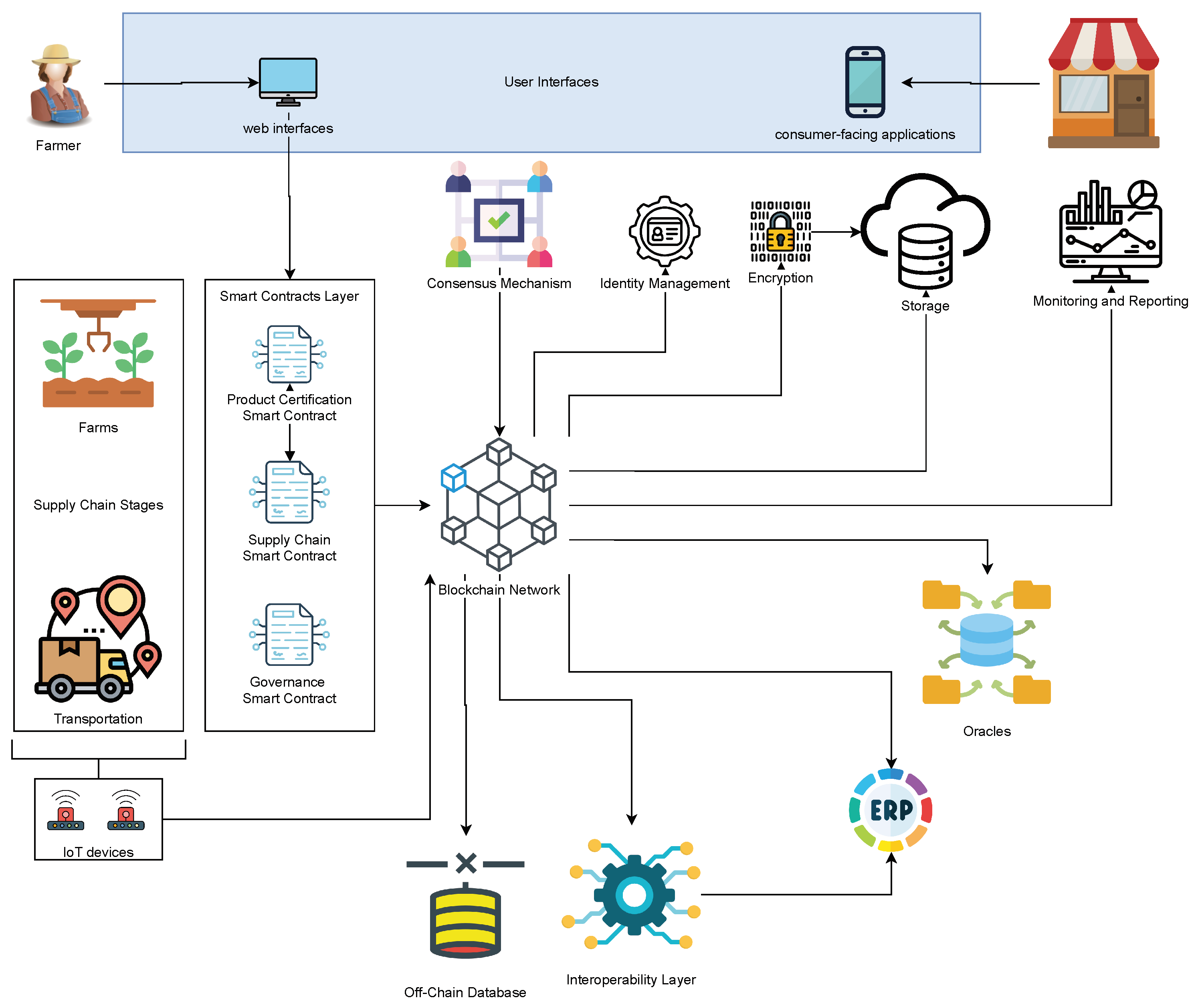

Table 1.
Organic Food Certification Standards Comparison Table
| Certification Standard | Allowed Inputs | Labeling Requirements | Inspection Procedures |
|---|---|---|---|
| USDA Organic | Organic inputs only, no synthetic pesticides or GMOs | USDA Organic seal, ingredient list with organic content | Annual on-site inspections, periodic residue testing |
| EU Organic | Organic inputs only, restricted use of synthetic pesticides | EU Organic logo, indication of organic status | Annual inspections, random sampling and testing |
| IFOAM Organic | Organic inputs only, no GMOs, biodiversity conservation | IFOAM Organic seal, clear labeling of organic ingredients | Regular inspections, risk-based audits |
| Other Regional Standards | Varies by region, typically similar to USDA or EU standards | Varies by region | Varies by region, but often include on-site inspections and residue testing |
Table 2.
Benefits of Blockchain in the Organic Food Supply Chain
| Benefit | Explanation |
|---|---|
| Improved Traceability | Blockchain technology enables the recording of every transaction in the supply chain, providing a transparent and immutable record of product movement from farm to fork. This enhances traceability by allowing stakeholders to track the origin, journey, and handling of organic products, reducing the risk of contamination and facilitating rapid recalls if necessary. |
| Enhanced Trust | The decentralized and tamper-proof nature of blockchain technology instills trust among stakeholders by ensuring the integrity and transparency of data. With every transaction recorded on the blockchain, consumers, producers, retailers, and certifying bodies can verify the authenticity of organic products and certifications, fostering trust in the supply chain. |
| Reduced Certification Costs | Blockchain streamlines the certification process by eliminating redundant paperwork, manual audits, and intermediary fees. The transparent and auditable nature of blockchain technology reduces the need for costly third-party verification, making organic certification more accessible and affordable for producers, particularly small-scale farmers. |
| Increased Efficiency | Blockchain automates and streamlines administrative tasks, such as record-keeping, auditing, and compliance management, reducing paperwork, human error, and processing time. Smart contracts enable automatic execution of agreements and transactions, facilitating faster payments, settlements, and supply chain coordination, thereby increasing overall efficiency. |
| Fraud Prevention | Blockchain’s immutable ledger and cryptographic security mechanisms make it highly resistant to fraud, tampering, and counterfeit products. By recording every transaction in a transparent and traceable manner, blockchain technology deters fraudulent activities, such as mislabeling, counterfeit certifications, and product adulteration, protecting the integrity of the organic food supply chain. |
Table 3.
Comparison of Blockchain System vs. Traditional Supply Chain Management
| Metric | Blockchain System | Traditional Supply Chain Management |
|---|---|---|
| Transparency | Utilizes a decentralized and immutable ledger, providing real-time visibility into transactions and data across the entire supply chain. Transparency is inherent in the system architecture, enabling stakeholders to access accurate and up-to-date information about product origins, certifications, and movement. | Relies on centralized databases and manual record-keeping processes, which may lack transparency and lead to discrepancies or delays in accessing information. Limited visibility into the entire supply chain may hinder stakeholders’ ability to track product provenance effectively. |
| Traceability | Employs blockchain technology to create a transparent and auditable record of product movement from farm to fork. Each transaction is securely recorded on the blockchain, enabling stakeholders to trace the journey of products and verify their authenticity and compliance with organic standards. | Relies on traditional record-keeping methods such as paper-based documents or centralized databases, which may lack real-time traceability and are susceptible to errors or manipulation. Tracking product provenance may be challenging, leading to difficulties in verifying product authenticity and compliance. |
| Cost-effectiveness | Streamlines certification processes, reduces administrative burdens, and eliminates intermediary fees through automation and smart contracts. Reduces overall certification costs for stakeholders, particularly small-scale farmers and processors. | Involves manual certification processes, paperwork, and intermediary fees, which can be time-consuming and costly. Requires extensive administrative efforts and third-party verification, leading to higher certification expenses for stakeholders. |
| Scalability | Utilizes innovative approaches such as sharding and side chains to enhance scalability and accommodate growing transaction volumes. Can scale efficiently to meet the demands of a expanding network of participants and transactions. | May face scalability limitations due to centralized databases and legacy systems, particularly when handling large-scale supply chain operations or rapid growth in transaction volumes. Scaling traditional supply chain management approaches may require significant investments in infrastructure and technology upgrades. |
Disclaimer/Publisher’s Note: The statements, opinions and data contained in all publications are solely those of the individual author(s) and contributor(s) and not of MDPI and/or the editor(s). MDPI and/or the editor(s) disclaim responsibility for any injury to people or property resulting from any ideas, methods, instructions or products referred to in the content. |
© 2024 by the authors. Licensee MDPI, Basel, Switzerland. This article is an open access article distributed under the terms and conditions of the Creative Commons Attribution (CC BY) license (http://creativecommons.org/licenses/by/4.0/).
Copyright: This open access article is published under a Creative Commons CC BY 4.0 license, which permit the free download, distribution, and reuse, provided that the author and preprint are cited in any reuse.


