

Submitted:
09 October 2024
Posted:
10 October 2024
You are already at the latest version
Abstract
Several environmental and economic issues have been brought about by mass accumulations of Sargassum along the coastlines in Trinidad and Tobago, and the wider Caribbean region. Though there are massive environmental issues associated with this seaweed biomass, there is also a chance to make innovations, thereby making this problem into a solution. The holopelagic species such as S. natans and S. fulitans have considerably high amounts of beneficial compounds which can be leveraged for agriculture. The value chain transformation of Sargassum from a nuisance to a resource for agricultural production is narrated in the following report. Details of the application of products from Sargassum including composts, soil amendments, and liquid biostimulants are given. A case study is presented for OJA1 biostimulant, which was developed from Sargassum biomass at the University of the West Indies, St. Augustine, Trinidad. This biostimulant has shown increased productivity and resistance to diseases of several cash crops. The valorization of Sargassum contributes to sustainable agriculture and propels economic development in coastal communities. The Caribbean could lead with the adoption of the circular economy, turning environmental adversity into a lever for sustainable development.
Keywords:
Sargassum valorization
; holopelagic Sargassum
; agricultural biostimulants
; sustainable agriculture
; Caribbean coastal management
; Sargassum composting
; environmental sustainability
; organic soil amendments
Understanding Holopelagic Sargassum: Biology and Ecology
For more than a decade now, the Caribbean, including Trinidad and Tobago has been confronted at its doorstep with huge incursions of Sargassum seaweed washing up on its immaculate beaches. This golden tide of Sargassum algae has caused significant environmental and economic issues annually for the region. However, in the face of adversity, scientists are harvesting hope from these golden tides as potential agents in agriculture. The excerpt explores how this marine nuisance is being transformed into a valuable resource for Caribbean farmers, offering a sustainable solution to both waste management and agricultural productivity. Sargassum, a genus of brown macroalgae, in the phylum Phaeophyta, is documented as one of the most species-rich in comparison to other brown macroalgae, with over 350 species (Guiry and Guiry 2019). Most of these documented species, however, are benthic, meaning they are attached to some type of substrata using a holdfast. However, there are currently only two species of Sargassum which are holopelagic (S. natans and S. fulitans) which means that the entirety of their life is spent floating in the ocean and reproduction is through vegetative fragmentation (Butler and Stoner 1984; Gulick et al. 2023). The Atlantic’s floating “golden rainforest,” comprise primarily of three Sargassum genotypes, S. natans I, S. natans VIII, and S. fulitans III and they serve as a crucial habitat fostering biodiversity (Alleyne et al. 2023). Its golden mats are home to many fishes and invertebrates (Coston-Clements et al. 1991; Niermann 1986), a nursey for even sea turtles (Wells and Rooker 2004; Laffoley et al. 2011), a home for endemic species (Hemphill 2005; Laffoley et al. 2011), and also plays a vital role in carbon sequestration (Hu et al. 2021; Gouvêa et al. 2020). However, since 2011, significant changes have occurred regarding the behaviour of holopelagic Sargassum whereby there have been record-breaking accumulations of this seaweed on the coasts of the Caribbean, the United States, Brazil, and Africa. These large-scale accumulations pose multiple threats including imbalance to the local biodiversity and disruptions in the natural ecological settings in the regions, distress to economies, and destabilizing coastlines in affected areas (Smetacek and Zingone 2013; Partlow and Martinez 2015; van Tussenbroek et al. 2017). This new phenomenon represents a notable shift in the ecological dynamics of Sargassum and its interaction with coastal environments. Moreover, the rotting Sargassum biomass on the beaches leads to the accumulation of significant quantities of hydrogen sulfide, which can cause several human health complications (Resiere et al. 2020; Devault et al. 2021). The tourism industry is also disrupted by the invading Sargassum and this leads to significant profit loss thus harming the region’s economy. There have been some hypotheses to explain Sargassum blooms and have been termed the Great Atlantic Sargassum Belt which is associated with the North Equatorial Recirculation Region (NERR) (Wang et al. 2019). One theory suggests that the unprecedented accumulations of holopelagic Sargassum are fueled by increased nutrient runoff from the Amazon, resulting from a combination of deforestation, agricultural expansion, and urban growth in these river basins (Djakouré et al. 2017; Oviatt et al. 2019). An alternative theory suggests that rising sea surface temperatures in the NERR could boost holopelagic Sargassum growth, either directly by providing more optimal temperature conditions, or indirectly by increasing nutrient availability through enhanced rainfall and subsequent runoff (Djakouré et al. 2017; Brooks et al. 2018). Furthermore, irregularities in the North Atlantic Oscillation (NAO) may have shifted holopelagic Sargassum from its usual habitat in the Sargasso Sea to the NERR, potentially establishing a seed population that led to the subsequent massive blooms (Johns et al. 2020). The established scientific consensus indicates that the recent unprecedented accumulations of holopelagic Sargassum are primarily driven by climate change-related factors, amplified by boosted nitrate and phosphate inputs from nearby river systems. While the theories are still debated, one aspect remains clear, that the effect of these golden mats of macroalgae is damaging to the regions, and further exacerbates economies during ongoing hardships.
From Problem to Opportunity: Inputs for Agricultural Applications
With all these negatives about the “golden tides,” there remained opportunities for scientific innovations. Sargassum and most seaweeds are nutrient-dense and contain a plethora of beneficial bioactive compounds. These “golden tides” therefore pave the way for innovative valorization of this rich biomass into usable products for use in agriculture and industries. Sargassum seaweed possesses great potential when properly collected and valorised to be explored as an inexpensive sustainable solution for farmers in the Caribbean as biostimulants, soil amendments and composts, to name a few. When efficiently processed, Sargassum seaweed can be transformed into a potent bioelicitor, with the capabilities of enhancing soil fertility and improving crop yields. Sargassum is currently being utilized in Caribbean countries such as Barbados, St. Lucia, and Trinidad for its valorization into sustainable agricultural inputs, whether in the form of compost, soil amendment, or liquid biostimulant. In order to first utilize Sargassum seaweed for agricultural inputs, the alga must be washed thoroughly to remove all excess salt and debris. For composting, the properly washed biomass can be then mixed with organic materials such as manure and plant waste to start the composting process, which eventually turns into a rich compost. The application of Sargassum compost can improve soil structure, increase water retention and overall, can cause improvement in soil health. This can become especially helpful in places with poor soil quality and low water availability. The Sargassum products can even transform infertile soils, into productive agricultural land.
Case Study: UWI’s OJA1 Sargassum Biostimulant
We at the University of the West Indies, St. Augustine, Trinidad and Tobago, Plant-Microbe Biotechnology Research lab have realized the potential of Sargassum and have been conducting research to produce a Sargassum-derived liquid biostimulant (coded as “OJA1”). Our OJA1 Sargassum biostimulant shows significant promise as our results from numerous greenhouse and field studies, demonstrated the positive impact on plant productivity in crops such as tomato, sweet pepper, cucumber, cow pea, lettuce, cabbage, etc. We have worked and continue to work with leading farmers in the area to test the efficacy of OJA1. One farmer said (anonymous) “I was surprised to see the size of the pepper plants and fruits when I used OJA1.” Aside from increased plant growth and yields (>80% increase), our trail data sets showed that plants treated with OJA1 had lower levels of plant diseases (< 50%) which are dominant and devastating to these tested crops. Aside from using traditional geoponic systems, OJA1 was also tested in hydroponics systems, and to our excitement, plants had over 50% in their weights when foliar treated with OJA1. Another major milestone with using our OJA1 product is that farmers were able to reduce the application of toxic chemical pesticides by > 50% which are constantly promoted by our outreach efforts to promote sustainable intergraded disease management strategies. Our work with this OJA1 biostimulant is however still requires funding support to test on multiple crops other than vegetables to validate its full efficiency and wider use.
Challenges in Sargassum Valorization
All the above claims show the great promise that can come out of valorising the “golden tides” into sustainable agricultural inputs. However, adopting this is not without challenges. A major concern with holopelagic Sargassum is that it acts as a sponge in the ocean and accumulates heavy metals and other contaminants that may cause more harm than good in the long run. It should be noted however that our formulated OJA1 possess miniscule levels of pollutants, well below the permissible levels according to the water pollution rules and the US EPA regulations. Therefore, with any plan to valorise Sargassum, careful testing and processing are necessary to ensure that these harmful elements are not introduced into the food chain which would lead to significant harm to the environment and human health. Additionally, the logistics of collecting, transporting, and processing large quantities of Sargassum present significant obstacles, especially for smaller islands with inadequate resources.
Future Outlook: A Model for Coastal Regions
The positive usage of the Sargassum seaweed outweighs the negatives as it offers a new avenue by repurposing this large amount of biomass which would otherwise rot or be ineffectively disposed. The different methods of Sargassum usage in agriculture will also further support local agricultural systems and decrease the heavy reliance on chemical and inorganic inputs which are unfavourable to both the environment and humans. Furthermore, the introduction of a Sargassum-related agricultural industry could open new economic ventures for the coastal communities through the collection and processing to the production and sale of Sargassum products. The Caribbean’s outlook for Sargassum as a terrible curse to the recognition of it as a valuable resource is witness to the region’s strength and innovative mind. It exemplifies a circular economy approach, where a waste product is transformed into a valuable input, creating environmental, and economical balance. The continuing effects of research and best practices in agriculture are also likely to grow in the Caribbean as it relates to Sargassum valorisation. The issue of seaweed buildup will be tackled through these innovations, aligning with the region’s broader goals of promoting sustainable development and addressing climate change challenges in the Caribbean. When adversity hits, Caribbean innovators take the forefront to valorise this challenge of Sargassum and use it as a springboard for development, catalysing this perceived curse and using it as a prominent opportunity for sustainable growth. Over the years, other coastal regions facing the “Sargassum curse” will use this current knowledge as a model to also promote Sargassum valorization in their respective areas. Through the transformation of Sargassum from a coastal menace to an agricultural marvel, the Caribbean demonstrates that with innovation and perseverance, even our most daunting challenges can become the cornerstones of a greener, more successful future.
Figure 1.
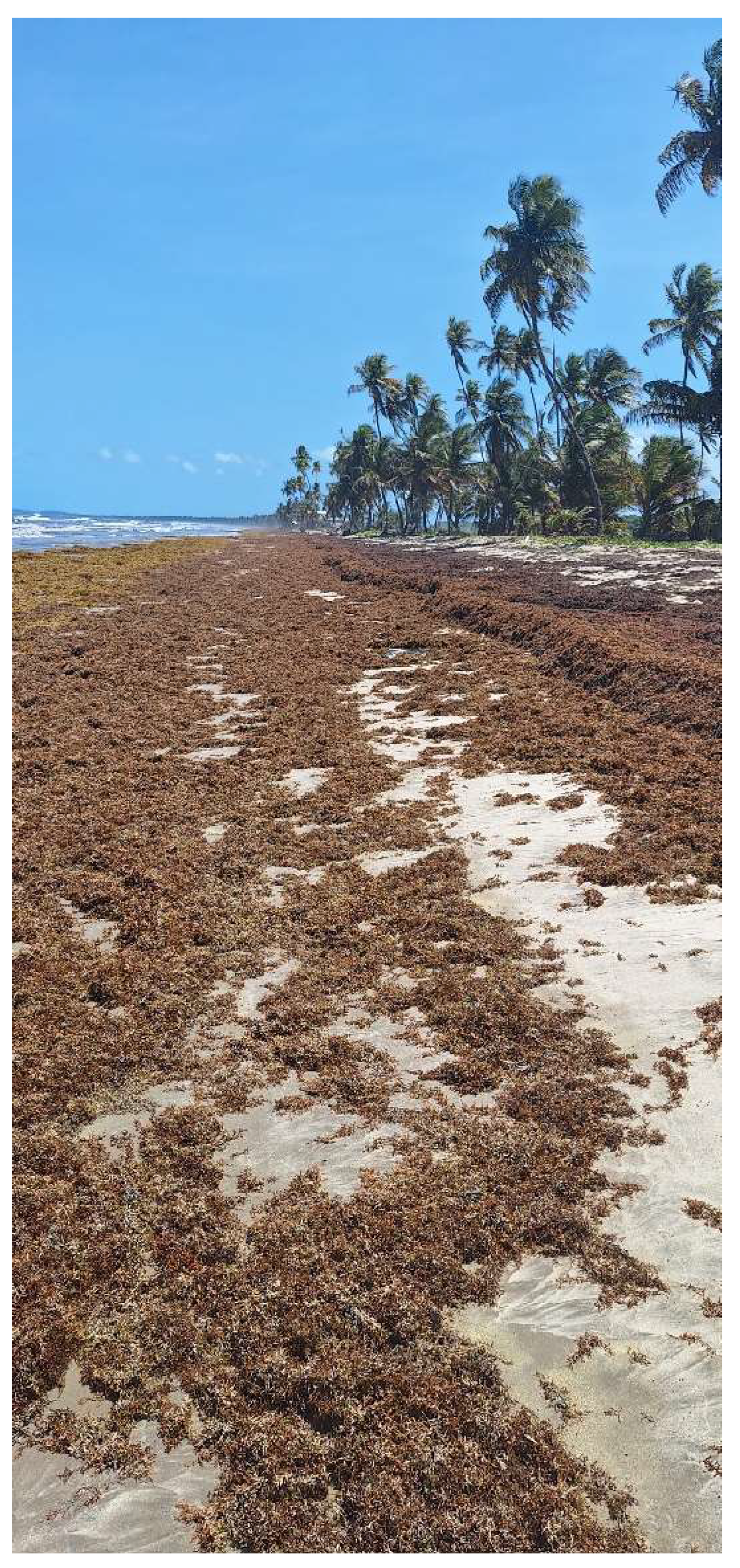
Sargassum Invasion at Manzanilla Beach, Trinidad. Photo by Dr. Omar Ali (all rights reserved).
Figure 1.
Sargassum Invasion at Manzanilla Beach, Trinidad. Photo by Dr. Omar Ali (all rights reserved).
Conflicts of Interest
The authors declare no conflicts of interest.
Autobiographical Note
Dr. Omar Ali (Ph.D. Microbiology) – Research Scientist, Professor Jayaraj Jayaraman (Ph.D. Plant Pathology) - Professor of Biotechnology & Plant Microbiology, and Professor Adesh Ramsubhag (Ph.D. Microbiology) – Professor of Microbiology are core members of the Plant-Microbe Biotechnology Research Group at the Department of Life Sciences, The University of the West Indies, St. Augustine, Trinidad and Tobago. Professor Marie-Ange Arsène – Professor of Chemistry at the Université des Antilles, Guadeloupe. Their skills encompass a large suite including but not limited to Microbiology, Biotechnology, Plant pathology, Bioinformatics, Chemistry, and Engineering which have all been utilized in their efforts to valorise Sargassum. Their combined expertise allows for a complete Sargassum valorisation approach, ranging from understanding the macroalgae, their chemical and biological properties and development of organic inputs and their applicability in agriculture. Their work highlights the huge potential for novel and practical solutions to address both the Sargassum problem and agricultural challenges faced in the Caribbean region.
References
- Alleyne, Kristie S.T., Donald Johnson, Francis Neat, Hazel A. Oxenford, and Henri Vallѐs. 2023. “Seasonal Variation in Morphotype Composition of Pelagic Sargassum Influx Events Is Linked to Oceanic Origin.” Scientific Reports 13 (1). https://doi.org/10.1038/s41598-023-30969-2. [CrossRef]
- Brooks, Maureen T., Victoria J. Coles, Raleigh R. Hood, and Jim F.R. Gower. 2018. “Factors Controlling the Seasonal Distribution of Pelagic Sargassum.” Marine Ecology Progress Series 599. [CrossRef]
- Butler, James N., and Allan W. Stoner. 1984. “Pelagic Sargassum: Has Its Biomass Changed in the Last 50 Years?” Deep Sea Research Part A, Oceanographic Research Papers 31 (10). [CrossRef]
- Coston-Clements, L, L.R. Center, D.E. Hoss, and F.A. Cross. 1991. “Utilization of the Sargassum Habitat by Marine Invertebrates and Vertebrates: A Review.” NOAA Technical Memorandum NMFS-SEFSC-296.
- Devault, Damien A., Ronan Pierre, Hélène Marfaing, Franck Dolique, and Pascal Jean Lopez. 2021. “Sargassum Contamination and Consequences for Downstream Uses: A Review.” Journal of Applied Phycology. [CrossRef]
- Djakouré, Sandrine, Moacyr Araujo, Aubains Hounsou-Gbo, Carlos Noriega, and Bernard Bourlès. 2017. “On the Potential Causes of the Recent Pelagic Sargassum Blooms Events in the Tropical North Atlantic Ocean.” Biogeosciences Discussions, no. September.
- Gouvêa, Lidiane P., Jorge Assis, Carlos F.D. Gurgel, Ester A. Serrão, Thiago C.L. Silveira, Rui Santos, Carlos M. Duarte, et al. 2020. “Golden Carbon of Sargassum Forests Revealed as an Opportunity for Climate Change Mitigation.” Science of the Total Environment 729. [CrossRef]
- Guiry, M.D., and G.M. Guiry. 2019. “AlgaeBase. World-Wide Electronic Publication. National University of Ireland, Galway.” Http://Www.Algaebase.Org/. 2019.
- Gulick, Alexandra G., Nerine Constant, Alan B. Bolten, and Karen A. Bjorndal. 2023. “Holopelagic Sargassum Aggregations Provide Warmer Microhabitats for Associated Fauna.” Scientific Reports 13 (1). [CrossRef]
- Hemphill, ARLO H. 2005. “Conservation on the High Seas-Drift Algae Habitat as an Open Ocean Cornerstone.” High Seas Marine Protected Areas. Parks 15 (3).
- Hu, Chuanmin, Mengqiu Wang, Brian E. Lapointe, Rachel A. Brewton, and Frank J. Hernandez. 2021. “On the Atlantic Pelagic Sargassum’s Role in Carbon Fixation and Sequestration.” Science of the Total Environment 781. [CrossRef]
- Johns, Elizabeth M., Rick Lumpkin, Nathan F. Putman, Ryan H. Smith, Frank E. Muller-Karger, Digna T. Rueda-Roa, Chuanmin Hu, et al. 2020. “The Establishment of a Pelagic Sargassum Population in the Tropical Atlantic: Biological Consequences of a Basin-Scale Long Distance Dispersal Event.” Progress in Oceanography 182. [CrossRef]
- 13. Laffoley, D d’A., H S J Roe, M V Angel, J Ardon, N R Bates, I L Boyd, S Brooke, et al. 2011. The Protection and Management of the Sargasso Sea: The Golden Floating Rainforest of the Atlantic Ocean. Summary Science and Supporting Evidence Case. Sargasso Sea Alliance: The Golden Floating Rainforest of the Atlantic Ocean.
- Niermann, U. 1986. “Distribution of Sargassum Natans and Some of Its Epibionts in the Sargasso Sea.” Helgoländer Meeresuntersuchungen 40 (4). [CrossRef]
- Oviatt, Candace A., Kristin Huizenga, Caroline S. Rogers, and W. Jeff Miller. 2019. “What Nutrient Sources Support Anomalous Growth and the Recent Sargassum Mass Stranding on Caribbean Beaches? A Review.” Marine Pollution Bulletin. [CrossRef]
- Partlow, J, and G Martinez. 2015. “Mexico Deploys Its Navy to Face Its Latest Threat: Monster Seaweed.” Washington Post 28.
- Resiere, Dabor, Hossein Mehdaoui, Jonathan Florentin, Papa Gueye, Thierry Lebrun, Alain Blateau, Jerome Viguier, et al. 2020. “Sargassum Seaweed Health Menace in the Caribbean: Clinical Characteristics of a Population Exposed to Hydrogen Sulfide during the 2018 Massive Stranding.” Clinical Toxicology. [CrossRef]
- Smetacek, Victor, and Adriana Zingone. 2013. “Green and Golden Seaweed Tides on the Rise.” Nature 504 (7478): 84–88.
- Tussenbroek, Brigitta I. van, Héctor A. Hernández Arana, Rosa E. Rodríguez-Martínez, Julio Espinoza-Avalos, Hazel M. Canizales-Flores, Carlos E. González-Godoy, M. Guadalupe Barba-Santos, Alejandro Vega-Zepeda, and Ligia Collado-Vides. 2017. “Severe Impacts of Brown Tides Caused by Sargassum Spp. on near-Shore Caribbean Seagrass Communities.” Marine Pollution Bulletin 122 (1–2): 272–81. [CrossRef]
- Wang, Mengqiu, Chuanmin Hu, Brian B. Barnes, Gary Mitchum, Brian Lapointe, and Joseph P. Montoya. 2019. “The Great Atlantic Sargassum Belt.” Science 364 (6448). [CrossRef]
- Wells, R. J.David, and Jay R. Rooker. 2004. “Spatial and Temporal Patterns of Habitat Use by Fishes Associated with Sargassum Mats in the Northwestern Gulf of Mexico.” Bulletin of Marine Science 74 (1).
Disclaimer/Publisher’s Note: The statements, opinions and data contained in all publications are solely those of the individual author(s) and contributor(s) and not of MDPI and/or the editor(s). MDPI and/or the editor(s) disclaim responsibility for any injury to people or property resulting from any ideas, methods, instructions or products referred to in the content. |
© 2024 by the authors. Licensee MDPI, Basel, Switzerland. This article is an open access article distributed under the terms and conditions of the Creative Commons Attribution (CC BY) license (http://creativecommons.org/licenses/by/4.0/).
Copyright: This open access article is published under a Creative Commons CC BY 4.0 license, which permit the free download, distribution, and reuse, provided that the author and preprint are cited in any reuse.


