

Submitted:
08 October 2024
Posted:
09 October 2024
You are already at the latest version
Abstract
Jute fiber reinforced composites have become a very promising alternative to synthetic fiber composites because of their favorable environmental characteristics, cost efficiency, and good mechanical properties. The present review provides a comprehensive examination of the manufacturing processes and mechanical properties of composites reinforced with jute fibers. This study investigates the influence of several fabrication methods, such as hand lay-up, compression molding, injection molding, pultrusion, etc. on the mechanical properties of the composites. It also provides the SWOT analysis of various manufacturing processes of jute fiber reinforced composites. The important aspects including fiber orientation, fiber-matrix adhesion, and the effects of different surface treatments on improving mechanical characteristics such as tensile strength, flexural strength, and impact resistance are discussed. The difficulties associated with moisture absorption, degradation, and the lack of uniformity in jute fibers, as well as approaches to alleviate these problems are presented. The goal of this study is to establish a basis for future investigation and advancement in enhancing the mechanical properties of jute fiber reinforced composites.
Keywords:
Jute fiber reinforced composites
; Jute fiber
; Epoxy
; Manufacturing process
; Mechanical properties
1. Introduction
Jute fiber is an organic fiber obtained from the bark of the jute plant, which is classified under the genus Corchorus. It is mainly cultivated in Bangladesh, India, and China. It is a highly cost-effective natural fiber and ranks second in terms of production volume, just after cotton. Jute mostly consists of cellulose (60-70%), hemicellulose (12-14%), and lignin (5-10%) [1, 2]. Due to its lustrous and smooth texture, it has been given the tag of "the golden fiber". Jute fiber is highly significant due to its renewable nature, capacity to decompose naturally, and positive impact on the environment. This makes it a viable and sustainable substitute for synthetic fibers [3]. Despite benefits like affordability, high strength-to-weight ratio, and good insulation properties, it has drawbacks, such as moisture absorption and quality variability [4-6].
Due to its numerous environmental, economic, and performance benefits, jute fiber is progressively being preferred over synthetic fibers, metals, and alloys. The main factor in selecting jute fiber is its sustainability. Contrary to synthetic fibers that come from non-renewable petroleum sources, jute fiber is renewable, biodegradable, and compostable. This characteristic of jute helps reduce its impact on the environment [7]. Furthermore, the manufacturing process of jute fiber requires considerably less energy and releases fewer greenhouse emissions in comparison to the production of synthetic fibers and metal processing [8]. From an economic standpoint, jute is a cost-effective option, offering a more affordable alternative to pricier synthetic fibers and metals. Affordability is essential for enterprises seeking to decrease material expenses while upholding quality and performance. Jute fibers has excellent performance characteristics, such as a high specific strength and stiffness, which make them well-suited for reinforcing polymer matrices in composite materials. These materials provide sufficient mechanical qualities that make them suitable for various applications, such as the automotive [9-11], construction [12-14], and packaging sectors [15, 16]. In addition, jute fibers provide exceptional thermal and acoustic insulation characteristics, which enhance the functional capabilities of composites [6]. Jute fibers have exceptional resistance to corrosion and numerous chemicals, rendering them highly durable under diverse environmental situations [17]. The increasing favor for jute fiber over synthetic alternatives and metals in various industrial applications highlights the significance of research to develop jute fiber-based composites.
Jute fiber reinforced composites (JFRCs) are materials in which jute fibers are incorporated into a polymer matrix to improve mechanical qualities. These composites utilize the robustness and rigidity of jute fibers, while also taking advantage of the polymer matrix's capacity to evenly distribute stresses and shield the fibers from harm caused by the environment [18]. Research and study of JFRCs are crucial because of the increasing need for sustainable and environmentally friendly materials. Utilizing natural fibers such as jute in polymer matrix composites presents a sustainable substitute for traditional glass or carbon fiber composites, hence diminishing the ecological impact of composite materials. Moreover, JFRCs offer a cost-efficient alternative that possesses adequate mechanical characteristics for a wide range of engineering uses [19]. The positive features and environmental benefits of jute fiber-based composites make them suitable for various sectors. JFRCs are utilized in the automobile sector to produce interior components including door panels, dashboards, and seat backs. This application helps to decrease weight and enhance fuel efficiency [20, 21]. JFRCs are commonly used in the construction industry to manufacture lightweight and long-lasting building materials such as partition boards, panels, and roofing sheets [5]. The furniture sector also utilizes JFRCs to produce visually appealing and eco-friendly furniture pieces. In addition, JFRCs are employed in packaging materials as a substitute for traditional plastics, so aiding in the reduction of plastic waste [22]. The wide range of applications and increasing adoption of JFRCs highlight their significance and promise for further advancement.
The production method of jute fiber reinforced composites plays a major role in defining their mechanical properties and overall performance. The choice of manufacturing procedures can have a substantial impact on the adhesion between fibers and matrix, the distribution of fibers, and the presence of voids in the composite. These factors directly influence the strength, stiffness, and durability of the material [23]. Comprehending and enhancing these procedures are crucial for creating top-notch JFRCs that fulfill certain application prerequisites. Processes such as resin transfer molding (RTM) and compression molding can enhance the mechanical characteristics of composites by improving fiber wetting and ensuring uniform resin distribution. Conversely, more straightforward techniques like hand lay-up might yield composites with reduced strength as a result of uneven distribution of fibers and increased presence of voids [24]. Hence, examining the manufacturing procedures aids in determining the most effective methods for fabricating JFRCs with exceptional mechanical characteristics.
Despite the abundance of studies on natural fiber composites, there is a notable gap in research concerning different manufacturing processes for jute fiber-based composites and their effects on the mechanical properties of these composites. This work attempts to present a concentrated review of JFRCs, focusing on the distinct benefits and difficulties related to various manufacturing procedures. This paper aims to achieve two main objectives. Firstly, it seeks to investigate various manufacturing processes of JFRCs along with their strengths, weaknesses, opportunities, and threats. Secondly, it aims to analyze the mechanical properties, such as tensile strength, flexural strength, impact resistance, and fatigue performance, for each of these manufacturing processes. The study seeks to attain these objectives to offer a thorough comprehension of the correlation between manufacturing procedures and the resultant attributes of JFRCs. This will, in turn, provide guidance for future research and industry practices in the advancement of high-performance, sustainable composites. Thoroughly examining these subjects will not only enhance the current state of knowledge on JFRCs but also offer valuable insights into improving manufacturing procedures to produce high-quality composite materials.
2. Manufacturing Processes
For manufacturing jute fiber composite materials, the major steps are fiber preparation, matrix impregnation, molding, curing, etc. Fiber preparation varies depending on the state at which the fibers are used e.g., roving, yarn, woven mat, chopped, randomly distributed, etc. The properties of the jute fiber reinforced composites are highly dependent on these states during manufacturing. The methods of fiber treatment, resin impregnation process, molding technique, and curing condition greatly influence the properties of the manufactured composites [25]. The modification or cleaning of the fiber surface using alkaline solutions is usually done during the fiber preparation [26-29]. The methods of matrix impregnation, molding, and curing are the most significant part of manufacturing fiber reinforced composites. The oldest method of manufacturing fiber reinforced composites is hand lay-up which is also used for fabricating jute fiber reinforced composites. Mostly, the composites are made using the hand lay-up method. However, with the advancement of technology, various easier processes of molding have been introduced like injection molding, compression molding, etc. Other processes including kinetic mixing, pultrusion, etc. are also common [30].
2.1. Hand Lay-up Method
Hand lay-up as shown in Figure 1 is one of the oldest open mold techniques for manufacturing natural fiber reinforced composite [31]. Long and staple natural fiber reinforced composite materials can be manufactured easily with the help of this method [32]. Wide variations in hand lay-up allow fibers to be oriented in a variety of ways, including unidirectional, inclined, or woven.
Due to its reduced directional dependence and tolerance to many forms of stress, hybrid composites are manufactured gradually according to the procedure that is attracting attention from the composite manufacturing sector [35]. In this procedure, the mold surface is coated with an anti-adhesive chemical to prevent composites from sticking to the mold and to facilitate its release [36]. Sometimes a plastic sheet is inserted at the bottom and top portions of the mold plate to create a smooth surface [33]. The matrix material’s gel coat is applied to the lower mold surface and the fiber is placed. Then, a roller applies a small amount of pressure to release any trapped air bubbles and simultaneously the matrix material is applied [37]. The solid product is removed from the mold cavity once the material is completely cured [38].
The hand lay-up procedure in composite manufacturing entails the physical placement of prepreg fibers onto a mold, relying on the skill and expertise of the operator [39]. One of the main challenges of this conventional technique is to achieve uniform pressure distribution across the surface and prevent the occurrence of flaws, such as wrinkles, when placing the material. In order to tackle these problems, researchers have adopted robotic layup systems to automate the process and enhance consistency and excellence in sectors such as aerospace and automotive [40, 41]. In these works, an end-effector capable of replicating the human movements during the hand layup of fibrous tissues or fabrics has been conceptualized, which can be used in the manufacturing of complex-shaped surfaces.
In most of the works, normal curing at room temperature was followed for the hand layup method. But there are other processes for short time and more effective curing at higher temperature. The curing stage of the process involves using techniques like UV-curable resin impregnation and curing with UV lamps [42], or using tools with heated surfaces to cure composite part layups [43]. This stage ensures that the resin matrix is consolidated and hardened, resulting in the formation of a robust and long-lasting composite structure. In addition, employing methods such as wet-process hand lay-up molding of prepreg to eliminate bridging helps to maintain the integrity and quality of the end product [44]. Effective curing not only improves the mechanical strength and ability to be machined of the composite panel but also helps to decrease energy usage and increase the overall stability and appearance of hand lay-up products [45].
A SWOT analysis in Figure 2 highlights the hand lay-up technique's strengths, including its simplicity, cost-effectiveness, and suitability for small-scale tasks and educational settings. It allows customization of layer arrangement, which can yield a polished surface when done correctly [46]. Nevertheless, the procedure is demanding in terms of labor and time, therefore restricting both productivity and scalability. The inherent artisanal nature of the procedure may result in discrepancies in the end product, including uneven dispersion of fibers and resin concentration. Furthermore, it is most suitable for uncomplicated forms, therefore restricting its use to more intricate designs. Exposure to resins and solvents poses substantial health hazards, necessitating the implementation of appropriate protective measures [44].
Despite these challenges, the hand lay-up method has promising prospects for custom small-scale components, particularly in the aerospace, automotive, and marine industries. Advances in resins and fibers may enhance composite performance [47]. This technique is ideal for education and prototyping, allowing quick idea development before moving to advanced production. However, it faces competition from more automated methods like resin transfer molding (RTM) and automated fiber placement (AFP), which offer higher quality and efficiency. Environmental regulations and the need for skilled labor also pose challenges, potentially making hand lay-up less viable for large-scale industrial applications [48].
2.2. Injection Molding Method
When it’s about casting a complex shape, injection molding is a better option, even when it’s about manufacturing a natural fiber composite as shown in Figure 3. Moreover, manufactured parts need less machining which decreases labor costs. In this process, at first, materials of matrix-like, resins, hardener, etc. are mixed and poured into a container named hooper. Then these are conveyed with the help of a screw and injected into the mold through a nozzle where already fibers are present. However, through conveying, sometimes heat needs to be applied according to the type of matrix. If these are solid named pallets, heat is necessary to melt them. After cooling, the composite is ready [49].
In this process, appropriate fiber length is important so that entire stress can be transferred from matrices to fiber which can be found from the equation (i).
where, Lc = critical length of fiber, d = fiber diameter, τ = shear stress at the interface of fiber and matrix and σuf = ultimate tensile strength of fiber respectively [33, 50].
In this process, the interfaces of fibers and matrix face imperfect bonding. So, maintaining the optimum length of fibers found from this equation is important [51].
A SWOT analysis of the injection molding is shown in Figure 4. Injection molding is instrumental in enhancing the strength of jute composites by optimizing various process parameters. Research indicates that the mechanical properties of jute-reinforced composites can be significantly improved through specific injection molding techniques such as Direct Fiber Feeding Injection Molding (DFFIM) [52]. By controlling temperature, pressure, and molding time, the mechanical performance of jute/polypropylene (jute/PP) composites can be improved [53]. Moreover, the incorporation of maleic anhydride grafted polypropylene serves to enhance the interfacial bonding between the jute fibers and the PP matrix [54]. Additionally, the application of Six Sigma methodology within the injection molding process allows for the identification and optimization of processing and material parameters,[55]. Injection molding can be used to customize the strength of jute composites. Research has shown that the mechanical characteristics of composites reinforced with jute fibers can be tailored using different injection molding methods. Direct fiber feeding injection molding (DFFIM) [52], twin-screw extrusion, and injection molding [54] have been used to improve the bond between jute fibers and the polymer matrix. This has led to increased tensile strength and modulus of the composites. Furthermore, producing long jute fiber reinforced polylactic acid (LJF/PLA) pellets for injection molding improves bending strength and stiffness [56]. Overall, controlling molding process parameters is important for achieving improved mechanical performance in jute-reinforced composites [53].
Injection molding process has several advantages such as accuracy and uniformity, allowing for the manufacture of different parts with consistent quality and very few flaws. Its scalability makes it ideal for large-scale production, reducing costs. The process is highly adaptable, compatible with various composite materials, and allows for customizing material properties to meet specific needs. Additionally, it can minimize material waste, enhancing cost-effectiveness and environmental sustainability. It has the ability to create components with intricate details and complex geometries that are difficult to achieve with other methods [57].
However, this process has various weakness such as higher initial investment in machines, molds, and tooling, posing challenges for small businesses. The complexity of the process demands skilled personnel and advanced equipment, leading to higher operational costs. Material limitations also exist, as some composites may struggle with high temperatures and durability, limiting their use in high-performance applications. Additionally, the process can be time-consuming, which can affect overall manufacturing efficiency. Regular maintenance of equipment and molds is required, and any downtime can lead to significant costs and disrupt production schedules [58].
Continual research to develop injection molding process can yield novel composite materials with enhanced characteristics and various application scopes. Advancement in automation, process control, and mold design can improve efficiency, precision, and cost-effectiveness. This process can be used in various applications such as automotive, aerospace, healthcare, and consumer electronics to stimulate growth and enhance diversity [59]. However, the process is confronted with several threats despite the available prospects. The presence of competitive production methods and materials, such as additive manufacturing and traditional metalworking, may potentially restrict the market share. Volatility in the price of primary resources, such as fibers and polymers, can have a significant influence on the profitability and pricing tactics of a business. The implementation of more rigorous environmental rules for industrial processes and material disposal may result in higher expenses and operational difficulties. Fluctuations in the economy and volatility in the global market might impact the demand for composite products and the investment in manufacturing facilities. Ultimately, the rapid progress in alternative manufacturing technologies, like as 3D printing, may potentially endanger the conventional injection molding business by providing more adaptable and economical options [60-62].
2.3. Compression Molding Method
Being one of the ancient processes, compression molding is very useful for manufacturing both thermoplastic and thermosetting composites made of natural fibers. This process is quite popular in industries [63]. In this process, there are two mold sections: upper and lower as shown in Figure 5. The fibers and the matrix are loaded in the lower section of the mold whereas the upper section is pressed with appropriate pressure and temperature during the molding process to achieve the desired shape inside the mold cavity. The combined autoclave and hot press process is known as the compression molding process. This method can deal with both short and long fibers. In the autoclave process, the reinforcing fibers of thermoplastic material are placed up in a certain order on the mold. The laminate is then sealed in a negative pressure bag and placed in the autoclave. After going through a heat and pressure cycle, the laminate is cured, and the desired composite is made [64]. In the hot press procedure, however, the mold does not need to be closed. Certain amount of natural fibers are piled and placed in cavity within a tight mold [33, 65].
Compression molding is used to improve the strength of jute fiber composites by optimizing process parameters. Research has shown that the mechanical characteristics of jute fiber reinforced polypropylene composites can be greatly improved by optimizing multiple parameters during the compression molding process [53]. The incorporation of long, intermittent fiber platelets and continuous fiber preforms in compression molding has demonstrated significant enhancements in strength. This emphasizes the possibility of enhanced structural features and long-lasting quality in various uses [67]. Additionally, the production of hybrid composites using epoxy-based glass and jute fibers has been improved by employing compression molding process. This process includes altering the arrangement of the fibers which results in improved tensile strength, flexural strength, and resistance to water absorption [68]. Multiple studies confirmed the effectiveness of compression molding in producing JFRCs with improved mechanical and structural properties [69-71].
This process has various advantages, such as superior mechanical performance, cost efficiency, flexibility in material selection, waste reduction, and consistent product quality. This procedure is highly effective in forming robust and long-lasting composites by optimizing parameters and utilizing a range of fiber types and matrices. However, this process has several drawbacks, including extended cycle durations, restrictions in manufacturing intricate shapes, demanding high-pressure conditions, necessitating additional post-processing procedures, and encountering difficulties in working with materials such as long fibers [72, 73].
The increasing need for sustainable materials, technological progress, the broadening range of market uses, and the emergence of hybrid composites are the main opportunities of this process. These characteristics can optimize process efficiency, minimize costs, and create new opportunities for use in diverse sectors. However, various dangers could potentially hinder the efficiency of compression molding. The factors encompassed in this list are material unpredictability, supply chain disruptions, technology obstacles, and environmental effect concerns. To optimize the use of compression molding for composite fabrication, it is important to address these threats and take advantage of the strengths and possibilities [74, 75]. A SWOT analysis of this process is summarized in Figure 6.
2.4. Resin Transfer Molding Method
For thermosetting composites, the resin transfer molding method as shown in Figure 7, is a quiet good option which is a verified type of injection molding. Normally, this process is used to deal with long fibers or woven fibers [76]. Various criteria like, injection pressure, temperature, structure of fiber, resin viscosity, fiber mat permeability, and mold configuration are important to notice in this process. This method supports production on a large scale which is relatively cost-effective to other methods [51]. The requirement of lower temperature and abstinence from thermomechanical degradation makes this process a better choice than many other methods. However, natural fibers are less compact than glass fibers, which results in natural fiber composites having a lower density in this process [77].
RTM is almost similar to Injection molding. In this process, to let fibers deform, a little clearance is needed to be maintained between mold edges. The velocity difference is greater at the start of the injection procedure and decreases as the time difference increases. This velocity differential is decreased by the flow resistance [78]. Utilizing numerous injection gates, resin flow can be accelerated without raising injection pressure. However, many gates make the process more complicated and result in a high number of bubbles at the meeting point of flow fronts. This empty content area significantly lowers the mechanical characteristics. The injection pot and mold must stay vacuumed before beginning the injection process to minimize the void in the final product [33]. Additionally, a higher flow resistance obstructs the flow path, causing the flow to enter a channel with lower resistance to apply injection pressure, which escalates the effect. As a result, the amount of time needed at the bottom’s edge flow increases, which has a negative impact on format spillage and dry areas [79]. The local velocity field might vary from point to point at a microscopic scale, despite the average velocity field of resin flow being smooth. Local velocity field roughness is primarily caused by local capillary pressure, permeability, and non-uniform microstructures [80].
A SWOT analysis of the resin transfer molding is shown in Figure 8 This process significantly improves the mechanical properties of jute fiber composites. Studies indicate enhancements in tensile strength and modulus for jute fiber reinforced composites using RTM. Research on jute/PLA composites shows that surface treatments like NaOH and silane coupling agents, when combined with RTM, notably boost tensile performance [52]. Moreover, a comparison between polyester and vinyl ester resins in jute/aramid hybrid composites fabricated by RTM revealed that polyester resin exhibited significantly greater tensile strength and microhardness [81]. In addition, optimizing fiber size and percentage can further enhance the strength of jute-based composites, as shown in the study on jute fiber reinforced polypropylene composites [82].
The advantages of RTM include its capacity to generate superior surface finishes and meticulous control over resin flow and fiber positioning, resulting in consistent product quality. The procedure additionally reduces resin waste and is capable of handling intricate geometries, hence enhancing the mechanical qualities of the composites. Nevertheless, RTM exhibits many limitations, including high upfront costs for molds and equipment, which can be a barrier for smaller businesses. The process often involves longer cycle times and is primarily limited to thermosetting resins, restricting material options [83, 84].
RTM benefits from developments in materials and technology, which can improve its uses and efficiency. The increasing demand for sophisticated composites in the aerospace and automotive sectors, along with a shift toward sustainability, creates favorable conditions for RTM. Automation advancements can enhance process efficiency and reduce costs, while tailored solutions meet the specific needs of specialized markets. However, RTM faces competition from alternatives that may offer lower costs or faster production times. Economic fluctuations and regulatory constraints can affect its cost-effectiveness and compliance. Additionally, the need for skilled operators and potential market oversaturation may pose challenges to profitability and operational effectiveness [85, 86].
2.5. Pultrusion Method
Pultrusion is a straightforward procedure for manufacturing composite materials with constant cross-sectional area, which is shown in Figure 9. Since this process uses a continuous processing method, the process has a low labor content and a high raw material conversion efficiency. Before using the pultruded items in service, there is hardly any necessity for any further finishing activities because of their consistent quality [87]. Several things need to be considered like the mutual interactions between heat transfer, resin flow and cure reaction, variation in the material properties, and stress evolutions. These affect the process advancement together with the mechanical properties and the geometrical accuracy of the final product [88].
In this process, an exothermic reaction takes place and so, it is slightly difficult to handle [89]. In this process, various types of fibers can be used like roving, woven, etc. First of all, fibers are pulled out with the help of a guide and soaked with matrixes. This soaking can be done variously like by open bath or in resin injection chamber. Then soaked fibers are pulled out with the help of a pulling mechanism through the heating die [90]. The temperature of the center of the soaked die is lesser than that of the side as low thermal conductivity. That is why, the heating process should take enough time. Various catalysts can be used for that reason [89]. An electrical heater can also be used. Consequently, the liquid portion turns to gels then on the verge of being solid as a result of the chemical reaction caused by the catalyst. For these reactions, the matrix shrinks which develops the property. Finally, after solidification, the composite is pulled out and cut into the desired shape [88, 91].
Pultrusion significantly enhances the strength of composite materials made from jute, as mentioned in Figure 10. Investigation into the process of thermoplastic pultrusion demonstrates that fine-tuning molding parameters, such as the speed at which the material is pulled and the temperature at which it is processed, has a beneficial impact on the mechanical characteristics of the material, but only up to a certain limit. Past this threshold, the qualities of the materials may deteriorate as a result of factors such as the formation of empty spaces and the breakdown of fibers [92]. Incorporating zinc oxide filler in jute-epoxy composites through compression molding improves mechanical strength. The highest improvement is seen when using 25% filler content, suggesting stronger bonding between the fibers and the matrix [93]. Additionally, the use of pultruding jute fabrics with a polymeric matrix enhances the bonding between natural fibers and cement, resulting in heightened strength, resilience, flexural strength, and bending stiffness of fiber cement sheets [94]. Using the pultrusion method for jute fiber-reinforced polyester composites with hybrid fillers results in a significant tensile strength increase, reaching an optimal 73.14 MPa with the ideal filler composition [95].
The pultrusion method can improve the mechanical characteristics of composites, such as tensile strength and stiffness, which makes it well-suited for structural applications. The precise control over resin impregnation and fiber alignment ensures excellent quality and homogeneity in this process. It is a very efficient process that allows the manufacturing of long, continuous profiles at high rates. This system allows for the use of different types of fibers and resins and it reduces waste by applying resin with precision. However, this process needs initial high investment that troubles smaller production. The process is suited for long, uniform profiles and may not be ideal for complex designs. There is a limited option to choose material in this process to specific resin systems and fiber types, and achieving optimal process parameters is challenging. It requires considerable setup time to develop new products impacting production adaptability [96-98].
Improved performance and expand range of applications are the main opportunities of this process. The increasing demand for composites in construction, automotive, and aerospace offers growth opportunities. Technological advancements in automation and process optimization have the potential to enhance efficiency and decrease expenses of this process. The use of natural fibers and recyclable resins are well-suited for the pultrusion process. This technique is capable of meeting the demands of specialized markets by generating customized profiles and hybrid composites. However, it faces competition from alternative processes like resin transfer molding and filament winding, which may offer greater versatility or lower costs. Economic volatility and fluctuating raw material prices can affect cost-effectiveness, while regulatory challenges may increase complexity and expenses. Rapid developments in alternative composite technologies could outpace improvements in pultrusion, and market saturation may lead to heightened competition, downward pressure on prices, and decreased profit margins [99, 100].
2.6. Vacuum Molding Method
Being one of the classic and cost-effective processes, vacuum molding is being broadly used in nowadays industrial applications. Besides, the speed and efficiency of repetition make this process more acceptable. However, it has a huge drawback of not having consistency of thickness throughout [101, 102]. Besides, the finishing of open surfaces is not so good [103].
This process is done in four stages: lay-up, pre-filling, filling, and post-filling [105, 106]. During the lay-up stage, a fabric preform is placed on the mold’s solid side and covered with peel-ply for easy separation from consumables as shown in Figure 11. A distribution medium may be added over the peel-ply to enhance resin flow. After installing the resin inlet and vacuum vent tubes, the mold is closed with a vacuum bag sealed with tape. At the pre-filling stage, the preform is compacted after the cavity has been sealed and the inlet has been clamped. The inlet is opened at the ending of the pre-filling cycle, allowing the resin to seep into the preform. The pressure inside the cavity changes throughout the filling stage. The inlet is typically clamped once the resin flow front reaches the preforms end to stop the resin from flowing into the cavity. During this post-filling stage, excess resin is removed to balance laminate thickness and resin pressure. After proper curing, the composites were released from the mold [107].
Vacuum-assisted resin transfer molding (VARTM is used for improving the strength of jute composites. By utilizing double-bag air cushioning [108], vacuum degassing [109], and sophisticated VARTM procedures with pressure control [110], the performance of resin infusion is enhanced, resulting in less void content and enhanced mechanical characteristics. Studies have showed that fine-tuning the vacuum infusion parameters, such as supply pressure and soaking time, significantly enhances the flexural strength and modulus of jute composites [111]. The incorporation of short jute fibers into epoxy resin composites by vacuum infusion has been shown to enhance tensile strength, particularly when the fibers are aligned in the direction of the applied force [112].
2.7. Autoclave Molding Method
To create high-value composites from prepregs, autoclave molding is widely applied, especially in the aerospace sector. High-quality consistent moldings may be manufactured in this process. However, the procedure is labor and capital-intensive [113].
In this process, a membrane, known as the bag, separates the laminate from the autoclave's interior, with a pressure line connecting the enclosed area to the outside as shown in Figure 12. A porous membrane inside the bag ensures constant gas flow. A porous release layer is placed over the prepreg laminae on the molding tool, allowing for resin absorption. The laminate typically has release layers and absorbers on both sides, with a dam around the edges to prevent rounding from bag tension. A top plate may be added to the exterior of flat laminates for a more uniform finish. The final laminate’s quality will be affected by two of these components, in particular, the prepreg and absorber [114].
The pressure and temperature within the autoclave are then independently adjusted to give even control of pressure throughout the surface and to thermally control cure before a vacuum is drawn inside the cover membrane which is needed to eliminate volatiles and porosity. Dry laminates, which often result from applying pressure too early and forcing out low viscosity matrix, and porous laminates, which result from applying pressure too late with high viscosity cured resins, can both be avoided by optimizing the application of pressure and vacuum [33, 113].
2.8. Extrusion Molding Method
Extrusion molding is a similar kind of process to injection molding except for the fact that extrusion is semi-restrictive molding by an extrusion die, whereas injection molding is extremely restrictive molding by an injection mold [115]. Here, like injection molding a hopper is used to feed pelletized resin into an extruder. The material is then pushed through a die [116]. A screw continuously extrudes resin through a mold to create a molded object as shown in Figure 13 [117].
2.9. Palsule Process
The palsule process is a kind of extrusion molding that involves compounding, heating, and drying [118, 119].
2.10. Heating in Hollow Cylindrical Glass Tube
In this process, a hollow cylindrical glass tube has been used as mold as the name suggested and resin-wetted heated fiber prepreg is pulled through [120].
3. Mechanical Properties
3.1. Hand Lay-up Process
3.1.1. Tensile properties
Tensile properties of jute fiber composite material have been studied by various researchers from many aspects as mentioned in Table 1. Gopinath et al. [25] tested jute fiber composites that were reinforced in two different resins, epoxy, and polyester where two different treated fibers were used, by 5% and by 10% NaOH while the fiber and resin weight ratio was 18:82. They showed that epoxy composite had better mechanical properties than that of polyester one, as well as 5% NaOH treated fiber composite, had better tensile properties than that of 10% one. Hand lay-up molding was also used by Mishra and Biswas [121] with 12%, 24%, 36% and 48% wt. jute reinforced in epoxy which showed an increment in fiber loading decreased void fraction as well as increased tensile properties and other properties. This technique was also used by Venkateshwaran and ElayaPerumal [122] for reinforcing woven jute in epoxy and compared with banana-jute hybrid composites where it was shown that banana/jute/banana composite performed better in terms of tensile properties. Sen and Reddy [123] reinforced heat-treated main and cross-directional woven textile jute mats in epoxy with the help of a hand lay-up process and compared to carbon and jute textile composite as well as RC beam concrete while strengthened by natural fiber composites in terms of properties each other. Chandramohan et al. [124] used this method to reinforce the 5-layer fabric of continuous jute fiber (50%) in polyester resin and compared it to hybrid fiber composites. Das and Bhowmick [125] prepared jute fiber reed and jute silver from raw jute with the help of 30% jute batching oil in water emulsion and then reinforced in unsaturated polyester resin by hand layup technique and compared each other which showed the tensile properties of jute fiber reed composite is higher than those of jute silver one as well as increment in fiber weight percentage had positive effect on tensile properties. Manik et al. [126] reinforced jute fiber (70% wt.) in epoxy using the hand lay-up method and compared it with coconut and human hair composite while jute composite showed better tensile properties than the other two composites. Deieu et al. [127] reinforced 0.4% NaOH treated jute fiber in Poly-propylene by hand lay-up method and compared with the same composite but a compatibilizer as coupling agent maleic anhydride Poly-propylene (MAPP) was used which showed that MAPP had a positive effect on tensile properties. With fiber loading 8%, 10%, 12% wt. or respectively 7%, 8.5%, and 10% vol., Wang et al. [128] reinforced untreated and chemically treated long unidirectional jute fibers in epoxy by hand lay-up technique which showed an increment in fiber loading increased tensile properties as well as chemical treatment on fibers had a positive effect on those properties. Reinforced biaxial woven jute fabric (44.3 ± 2.2% in vol.) in epoxy resin by hand layup technique, Bambach [129] compared with other natural fiber composites in terms of properties where increment in fiber layers had a positive effect on properties.
Hand lay-up molding technique in low pressure was applied by Dobah et al. [130] for reinforcing novel woven jute fabric plies (25% in volume) in polyester being laminated under uniaxial, multi-axial static loading test which showed higher values for uniaxial loading.
Hand lay-up technique followed by light compression molding technique was used by Boopalan et al. [131] for reinforcing cross-plied jute fibers in epoxy and compared with banana jute hybrid fiber composites in different compositions in terms of tensile properties where 50:50 jute and banana fiber turned out to be the best. Singh et al. [132] reinforced combed unidirectional untreated and treated by 5% NaOH jute fibers (40% vol) in epoxy by Hand layup followed by compression molding method which showed surface treatment increased tensile strength as well as jute composite showed higher tensile strength than other fiber composite used. Untreated and 20% NaOH treated jute mat was reinforced in epoxy by Boopalan et al. [133] with the help of hand lay-up followed by light compression molding and compared to sisal composite in terms of tensile properties where jute fiber composite showed better properties, as well as treated fibers composite, did better than untreated one.
Hand lay-up technique with the help of a compression molding machine was used by Mache et al. [134] to reinforce bidirectional untreated woven jute in Polyester to make squared and double-hat shaped sectioned specimens with 3 and 4-ply and compared with 4-ply glass composite in terms of tensile properties which showed better performance by glass one but the increment in jute fiber volume fraction had a positive effect on properties. Cavalcanti et al. [135] also used hand lay-up technique with a hydraulic press to reinforce twine form fabric weaved in a bidirectional mat of untreated, treated with NaOH and mixed treated (alkalized + silanized) jute having 30% volume fraction in epoxy matrix and compared with hybrid fiber composites in terms of mechanical properties which showed different effects of treatment on various hybridization like chemical treatments having positive effect on jute/sisal composite but negative on jute/curaua composite.
Joseph et al. [136] reinforced untreated and alkali-treated jute fabric in epoxy while hand layup process was used for composite preparation, and compression molding for curing process which showed alkali treatment had positive effect on tensile properties.
Using hand lay-up technique followed by static compression, Gupta [137] reinforced jute fiber (16% wt.) in polyester while fibers were 5% NaOH treated, poly lactic acid coated and both treated which showed treated fiber composite had higher tensile properties than raw fibers one as well as alkali treated and PLA coated ones had the highest vales. Pawar et al. [138] reinforced 5% wt. NaOH treated matted jute (10%-50% wt.) in epoxy by hand lay-up technique followed by static compression which showed a positive effect of fiber increment on tensile properties but while adding granite powder as filler, filler content increment had a negative impact on property.
Singh et al. [139] used hand lay-up technique followed by hot pressing to reinforce long jute fiber in epoxy which showed an increment in fiber layer increased tensile properties but while comparing with hemp composite, hemp one had better properties. By hand layout technique followed by hydraulic hot press, Kakati et al. [140] reinforced non-woven/fabric jute in a mixture of soy flour-based resin, unsaturated polyester resin and R. heudelotii oil-based alkyd Resin which showed that increment in alkyd resin increased the values of tensile properties.
3.1.2. Compressive Properties
The compressive properties of jute fiber-based composites fabricated by hand layup method is mentioned in Table 2. Bambach et al. [129] reinforced biaxial woven jute fabric (44.3 ± 2.2% in vol.) in epoxy resin by hand layup technique compared with other natural fiber composites in terms of properties where increment in fiber layers had a positive effect on properties. Untreated, 4%, 5%, 7% NaOH treated woven jute fabric (25%wt.) was reinforced by Kabir et al. [141] in unsaturated polyester resin applying hand lay-up method which showed an increment in fiber matrix bonding with the increment in percentage of NaOH concentration which resulted in increment of compression properties.
By using Hand lay-up technique with the help of a compression molding machine, Mache et al. [134] reinforced bidirectional untreated woven jute in polyester to make squared and double-hat shaped sectioned specimens with 3 and 4-ply and compared the outcomes to a 4-ply glass composite in terms of compressive properties, with the glass composite outperforming the jute fiber one in terms of performance but increment in jute fiber volume fraction had negative effect on properties.
3.1.3. Flexural Properties
Table 3 shows the flexural properties of jute-based composites manufactured by hand layup method. Jute fiber being treated by NaOH was reinforced in epoxy and polyester by Gopinath et al. [25] with the help of hand lay-up method keeping the fiber resin weight percentage ratio 18:82 which showed a 5% treated jute composite had better flexural properties like tensile properties than that of 10% one but in terms of resin used, polyester composite had better flexural properties than that of epoxy one unlike tensile ones. Kabir et al. [141] reinforced untreated, 4%, 5%, 7% NaOH treated woven jute fabric (25%wt.) in unsaturated polyester resin by hand lay-up method which showed an increment in flexural properties with the increment in percentage of NaOH concentration. Mishra and Biswas [121] used hand lay-up method to reinforce bidirectional jute fiber mat (12%, 24, 36%, 48% wt.) in epoxy and results shown that when fiber loading increased, the void fraction dropped and the flexural properties and other parameters rose. Using similar technique, Venkateshwaran and Elaya [122] reinforced woven jute in epoxy and compared with hybrid banana jute composites which showed banana/jute/banana composite showed better flexural properties. This technique also was utilized by Chandramohan et al. [124] to reinforce a five-layer continuous jute fabric (50%) made of polyester resin and compare it to hybrid fiber composites. Sen and Reddy [123] used a hand lay-up technique to reinforce heat-treated main and cross-directional woven textile jute mats in epoxy and compared the mechanical properties to those of carbon and jute textile composites as well as RC beam concrete strengthened by those fiber composites each other. Manik et al. [126] used hand lay-up method to reinforce jute fiber (70% wt.) in epoxy and compared with coconut and human hair composite which showed jute composite had better flexural properties than other two ones. With the help of 30% jute batching oil in water emulsion, Das and Bhowmick [125] prepared jute fiber reed and jute silver from raw jute which was reinforced in unsaturated polyester resin by hand layup technique and compared each other which resulted in better flexural properties of jute fiber reed composite than those of jute silver one as well as increment in fiber weight percentage had increased flexural properties. By hand lay-up method, reinforcing 0.4% NaOH treated jute fiber in Poly-propylene and comparing it to the same composite but using a compatibilizer MAPP as the coupling agent, Deieu et al. [127] demonstrated that MAPP had a positive impact on flexural characteristics.
Boopalan et al. [131] compared cross-plied jute fiber composite with banana jute hybrid fiber composites in different compositions in terms of tensile qualities and found that the ratio of 50:50 in weight jute and banana fiber was the best while the hand lay-up approach followed by light compression molding technique was used to reinforce the fibers in epoxy. Using hand layup followed by compression molding method, Singh et al. [132] reinforced combed unidirectional untreated and treated by 5% NaOH jute fibers (40% in volume) in epoxy which revealed that applying a surface treatment to a composite made of jute increased its flexural strength as well as jute composite showed higher flexural strength than other fiber composite used. Boopalan et al. [133] reinforced untreated and 20% NaOH treated jute mat in epoxy by hand lay-up followed by light compression molding while comparing sisal composite in terms of flexural properties, treated fiber composite showed better properties but sisal fiber composite outperformed jute ones.
Hand lay-up technique with a hydraulic press was employed by Cavalcanti et al. [135] to reinforce a bidirectional mat of untreated, treated with NaOH, and mixed-treated (alkalized + silanized) jute with a 30% volume fraction in an epoxy matrix and the flexural properties of the composites were also compared to those of hybrid fiber composites, which revealed various treatment effects on various hybridization like alkali treatments having a positive effect on jute/curaua composite but negative on jute/sisal composite whereas mixed treatments having a positive effect on jute/curaua one but negative on jute/sisal composite.
Joseph et al. [136] reinforced untreated and alkali-treated jute fabric in epoxy while using hand layup procedure for composite preparation and compression molding for curing process, showing that alkali treated fiber composite had better flexural properties.
Gupta [137] reinforced polyester with jute fibers (16%wt.) that were 5% NaOH treated, poly lactic acid coated, or both treated which showed that treated fiber composites had higher flexural properties than raw fibers one, with alkali treated and PLA coated ones having the greatest values. Using hand lay-up technique followed by static compression, Pawar et al. [138] reinforced 5% wt. NaOH treated matted jute (10%-50% wt.) in epoxy showed a positive effect of fiber increment on flexural properties and while adding granite powder as filler, filler had a positive impact on properties but filler content increment had a negative impact on the property.
By hand lay-up method followed by hot pressing, Singh et al. [139] reinforced long jute fiber in epoxy which showed that fiber layer increment had positive effect on flexural properties but while comparing with hemp composite, hemp showed higher values. Kakati et al. [140] used hand layout technique followed by hydraulic hot press to reinforce non-woven/fabric jute in mixture of soy flour based resin, unsaturated polyester resin and R. heudelotii oil-based alkyd Resin which demonstrated increment in alkyd resin increased flexural properties.
3.1.4. Impact Properties
Gopinath et al. [25] reinforced NaOH treated jute fibers in epoxy and polyester resin with a weight percentage ratio 18:82 by hand lay-up method and tested Charpy impact test which showed the same trend like flexural strength in terms of the resin utilized, polyester composite had a greater impact strength than epoxy one, whereas 5% treated jute composite had a better impact strength than 10% one though neither was relatively high like the values for metal. Mishra and Biswas [121] employed the hand lay-up technique to reinforce bidirectional jute fiber mat (12.4%, 24.4%, 36.6%, 48%wt.) in epoxy which showed an increment in fiber weight percentage increased the impact strength because the more fiber volume, the more energy requirement to break the interlaced fiber bundles. Venkateshwaran and ElayaPerumal [122] reinforced woven jute in epoxy with same technique and compared with jute banana hybrid composite while jute/banana/jute showed better impact strength after doing Izod impact test. Using this method, Chandramohan et al. [124] reinforced a five-layer continuous jute cloth (50%) in polyester resin and compared it to hybrid fiber composites. Manik et al. [126] reinforced 70% wt. jute fiber in epoxy while using hand lay-up method and compared with coconut and human hair composite with the help of Charpy and Izod impact test which showed jute composite had higher impact properties than the other two composites in both test cases. Using hand lay-up method, Deieu et al. [127] reinforced 0.4% NaOH treated jute fiber in Poly-propylene and compared with same composite but a compatibilizer as coupling agent maleic anhydride Poly-propylene (MAPP) was used with Charpy impact test which showed that MAPP had hardly any effect on impact strength.
Boopalan et al. [131] employed the hand lay-up technique followed by light compression molding for reinforcing cross-plied jute fibers in epoxy and compared it to banana jute hybrid fiber composites in various ratios after the Izod impact test, where 50:50 jute and banana fiber performed the best. Singh et al. [132] reinforced combed unidirectional untreated and 5% NaOH treated jute fibers (40% in volume) in epoxy by hand layup followed by compression molding technique which showed the negative impact of treatment while untreated jute composite had higher impact strength but lower if treated than other fiber composites used while Charpy impact test was done.
Hand lay-up technique with hydraulic press was employed by Cavalcanti et al. [135] to reinforce a twine form fabric weaved in a bidirectional mat of untreated, treated with NaOH and mixed-treated (alkalized + silanized) jute with a 30% volume fraction in epoxy matrix and the flexural properties of the composites were also compared to those of hybrid fiber composites, which revealed various treatment effects on various hybridization like alkali treatments having positive effect on jute/curaua composite but negative on jute/sisal composite whereas mixed treatments having positive effect on jute/curaua one but negative on jute/sisal composite.
Joseph et al. [136] reinforced untreated and alkali-treated jute fabric in epoxy using a hand layup method for composite preparation and compression molding for the curing process and Izod impact testing was done which demonstrated that the alkali-treated fiber composite showed better impact strength.
Gupta [137] reinforced jute fiber (16%wt) in polyester using the hand lay-up technique and static compression when the fibers were 5% NaOH treated, poly lactic acid coated and both treated and tested Izod impact test which showed raw jute composite had higher impact strength than alkali treated as well as PLA coated but lower than alkali-treated and PLA-coated one. By hand lay-up technique and static compression, Pawar et al. [138] reinforced 5% wt. NaOH treated matted jute (10%-50% wt.) in epoxy which showed positive effect of fiber increment on impact strength and while adding granite powder as filler, filler had positive impact overall. The impact properties are summarized in Table 4.
3.1.5. Hardness
Reinforcing NaOH treated fibers in epoxy and polyester resin with weight percentage ratio 18:82 by hand lay-up method, Gopinath et al. [25] tested Rockwell hardness test and which resulted 5% NaOH treated fiber composite had greater hardness value than that of 10% one but no significant effect of changing resin. In order to reinforce bidirectional jute fiber mat (12%, 24%, 36%, 48%wt.) in epoxy, Mishra and Biswas [121] used the hand lay-up method and tested Rockwell hardness test which showed increment in fiber weight percentage resulted increment in hardness because the more fiber, the more increment in modulus and so the hardness. Manik et al. [126] used hand lay-up method while reinforcing jute fiber (70% wt.) in epoxy and it was shown with the help of Rockwell hardness test that jute composite had higher hardness than coconut one but lower than human hair one.
Kakati et al. [140] using hand layout technique followed by hydraulic hot press, reinforced non-woven/fabric jute in mixture of soy flour based resin, unsaturated polyester resin and R. heudelotii oil-based alkyd Resin which showed that, the more alkyd resin percentage, the more hardness value achieved. The hardness properties are summarized in Table 5.
3.2. Vacuum Molding
3.2.1. Tensile Properties
By vacuum molding method, Biswas et al. [142] reinforced unidirectional jute fiber (52% wt.) in epoxy and the composite was compared with bamboo one which showed bamboo one had greater tensile properties. By vacuum infusion technique, Rodriguez et al. [143] reinforced untreated and 5% NaOH treated bi-directional woven jute fabric in epoxy vinylester resin and compared those composite each other which showed untreated composite had better tensile properties than that of treated one. They investigated the effects of fibers' alkali treatment on the resin transfer molding processing and mechanical properties of jute-vinylester composites. The composites were made using bi-directional jute fibers (20 mm), epoxy vinylester resin, and various chemicals such as NaOH, detergent, methyl ethyl ketone peroxide, and sulfuric acid. The manufacturing method used was injection molding and the specimens had dimensions of 11 mm × 3 mm × 80 mm. The results showed that the untreated composites had a tensile strength of 505 ± 165 MPa and a Young's modulus of 30 ± 14 GPa, while the treated composites had a tensile strength of 326 ± 150 MPa and a Young's modulus of 326 ± 150 GPa. This suggests that the alkali treatment of the fibers had a negative effect on the tensile properties of the composites. These findings may have implications for the design and optimization of jute-vinylester composites for specific applications. The tensile properties are summarized in Table 6.
3.2.2. Flexural Properties
Biswas et al. [142] reinforced unidirectional (longitudinal and transverse oriented) jute fiber (52% wt.) in epoxy by vacuum molding method and the composite was compared with bamboo one which showed bamboo one had greater flexural properties as well as longitudinal orientation showed positive effect on flexural properties. Rodriguez et al. [143] reinforced untreated and 5% NaOH treated bi-directional woven jute fabric in epoxy vinylester resin using the vacuum infusion process and compared the composites which showed that the untreated composite had better Flexural Properties than the treated composite. They measured the flexural or bending properties of the jute-vinylester composites. The results showed that the untreated composites had a flexural strength of 103 ± 6 MPa and a flexural modulus of 6.6 ± 0.5 GPa, while the treated composites had a flexural strength of 83 ± 6 MPa and a flexural modulus of 5.5 ± 0.02 GPa. This indicates that the alkali treatment of the fibers had a negative effect on the flexural properties of the composites as well. These results follow same trend with the mechanical behavior of these composites under flexural loading. The flexural properties are summarized in Table 7.
3.2.3. Impact Properties
Rodriguez et al. [143] fabricated untreated and 5% NaOH treated bi-directional woven jute fiber reinforced epoxy vinylester composite by using this method. The results showed the untreated composite exhibited better impact energy than treated one which were 56.5 ± 2.4 J/m and 47.2 ± 4.2 J/m respectively. They investigated the impact strength of the jute-vinylester composites. The results showed that the untreated composites had an impact strength of 56.5 ± 2.4 J/m, while the treated composites had an impact strength of 47.2 ± 4.2 J/m. This suggests that the alkali treatment of the fibers had a negative impact on the impact resistance of the composites. These results provide valuable information on the ability of the composites to withstand sudden, high-energy loads and can inform the selection of these materials for various applications where impact resistance is important.
3.3. Palsule Process
3.3.1. Tensile Properties
3.3.2. Flexural Properties
3.4. Heating in Hollow Cylindrical Glass
3.4.1. Flexural Properties
3.4.2. Impact Properties
Ray et al. [120] reinforced untreated and 5% NaOH treated white jute fibers (35% vol.) in vinylester while heating was applied as well as hollow cylinder as a mold was used which showed the more time in alkali treatment, the less toughness than untreated one while the principle was based on Charpy impact tester, as summarized in Table 11.
3.5. Extrusion Method
3.5.1. Tensile Properties
3.5.2. Impact Properties
Cabral et al. [144] reinforced uniaxial jute yarn with various vol. fractions in Poly-propylene by extrusion process completed Izod impact test which showed that increment in vol. fraction had positive effect on impact strength up-to 18% fiber vol. fraction and negative afterward, as summarized in Table 13.
3.6. Injection Molding Method
3.6.1. Tensile Properties
Mubarak et. al. [145] investigated the mechanical properties of hybrid composites made from a combination of jute and man-made cellulose fibers with Poly-propylene, as summarized in Table 14. The manufacturing method used was pultrusion and injection molding, and the materials included a Poly-propylene block copolymer with ethylene, maleic acid anhydride, and 25% jute by weight. The results showed that the untreated composites had a tensile strength of 71.9 ± 0.4 MPa and a Young's modulus of 3.18 ± 0.05 GPa, while the treated composites had a tensile strength of 71 ± 0.6 MPa and a Young's modulus of 3.39 ± 0.06 GPa.
The addition of jute and synthetic cellulose fibers to poly-propylene has a positive effect on the mechanical properties of the resulting hybrid composites. The tensile strength and Young’s modulus of the composites increased compared to pure poly-propylene. The hybrid composites of jute and synthetic cellulose fibers with poly-propylene can be effectively produced using pultrusion and injection molding and have improved mechanical properties compared to pure Poly-propylene.
Zhili et. al. [146] investigated the effect of different adhesive resin solutions on the tensile properties of composites fabricated from unidirectional carbon fiber and jute fiber. The jute fabric and carbon fiber fabric were cut into 360 mm × 160 mm and layered together. The jute fabric was being placed in the outermost layer and four layers of carbon fiber were used as inner layer. The tensile strength was found within the range of 192.65 MPa to 225.89 MPa. The results indicated that the dosage of Polyamide203# and methyl silicone oil influenced the mechanical properties of the composites.
Rahman et. al. [147] investigated the effect of post-treatment on the tensile properties of jute fiber reinforced poly-propylene composites. They used jute fibers, poly-propylene and sodium periodate, and formic acid as materials and injection molding method as the manufacturing method. The results showed that the tensile strength and Young's modulus of the composites increased after pretreatment and post-treatment. The untreated composites had a tensile strength of 25.35 ± 0.45 MPa and Young's modulus of 1.7 ± 0.05 GPa. After pretreatment, the tensile strength increased to 26.4 ± 1.1 MPa and the Young's modulus to 2 ± 0.05 GPa. The highest improvement in tensile properties was observed after pretreatment and post-tresatment, with a tensile strength of 29.35 ± 0.65 MPa and Young's modulus of 2.3 ± 0.05 GPa. The study demonstrated that post-treatment can significantly improve the tensile properties of jute fiber reinforced Poly-propylene composites, making them more suitable for various applications.
Hong et. al. [148] described the manufacture and testing of composite materials made from jute fibers and Poly-propylene. The jute fibers were treated with a silane solution to improve the bonding between the fibers and the polymer matrix. The composites were produced using injection molding. The results of the mechanical testing show that the treated composites have a slightly lower tensile strength and the same tensile modulus as the untreated composites. This indicates that the silane treatment did not have a significant effect on the overall mechanical properties of the composites. The tensile strength of the untreated composites was 39.85 ± 0.05 MPa, while the treated composites had a tensile strength of 35.60 ± 0.05 MPa. The tensile modulus was 8.24 ± 0.03 GPa for the untreated composites and 8.25 ± 0.04 GPa for the treated composites.
The results suggest that while the silane treatment may improve the interfacial adhesion between the jute fibers and the polymer matrix, it does not have a significant impact on the overall mechanical properties of the composites. Further research is needed to determine the optimal conditions for salinization and to understand the full impact of the treatment on the mechanical properties of these composites.
3.6.2. Flexural Properties
Mubarak et. al. [145] also investigated the flexural/bending properties of the hybrid composites. The results showed that the untreated composites had a flexural strength of 68.5 ± 1.5 MPa and a flexural modulus of 2.72 ± 0.05 GPa, while the treated composites had a flexural strength of 71.5 ± 0.4 MPa and a flexural modulus of 2.77 ± 0.04 GPa, as summarized in Table 15. This indicates that the addition of jute and man-made cellulose fibers to Poly-propylene has a positive effect on the flexural properties of the composites. The treatment process also improved the flexural strength and modulus of the composites compared to the untreated composites. These findings suggest that the hybrid composites of jute and man-made cellulose fibers with Poly-propylene may have potential for applications requiring good flexural properties.
Zhili et. al. [146] conducted the orthogonal test on jute-reinforced epoxy resin matrix composites showed a range of values for the flexural/bending properties. The study was based on the three factors: A: content of T31 curing agent, B: content of polyamide203#, and C: content of methyl silicone oil. The results showed that the maximum flexural strength was 236.19 MPa and the minimum flexural strength was 196.26 MPa. Similarly, the maximum flexural modulus was 1.992 GPa and the minimum flexural modulus was 1.640 GPa. These results suggest that the combination of different levels of the three factors had an impact on the flexural properties of the jute-reinforced epoxy resin matrix composites.
Rahman et. al. [147] also evaluated the effect of post-treatment on the flexural properties of jute fiber reinforced Poly-propylene composites. The results showed that both flexural strength and flexural modulus increased after pretreatment and post-treatment compared to untreated composites. The flexural strength of untreated composites was 25.35 ± 0.45 MPa, which increased to 26.4 ± 1.1 MPa after pretreatment and to 29.35 ± 0.65 MPa after pretreatment and post-treatment. Similarly, the flexural modulus increased from 1.7 ± 0.05 GPa for untreated composites to 2 ± 0.05 GPa after pretreatment and to 2.3 ± 0.05 GPa after pretreatment and post-treatment.
3.6.3. Impact Properties
Mubarak et. al [145] found that the untreated composites had a Charpy impact strength of 79 ± 0.2 kJ/m2, while the treated composites had a Charpy impact strength of 72 ± 0.4 kJ/m2, as summarized in Table 16. This suggests that the addition of jute and man-made cellulose fibers to Poly-propylene has a positive effect on the impact strength of the composites, although the treatment process slightly decreased the impact strength compared to the untreated composites. Zhili et. al. [146] also investigated the impact of different adhesive resin solutions on the impact strength of composites manufactured from unidirectional carbon and jute fiber. The maximum impact strength of the composites was found to be in the range of 1.6038 Mpa to 1.9262 Mpa
Rahman et. al. [147] also studied the effect of post-treatment on the impact properties of jute fiber reinforced poly-propylene composites. The Charpy impact strength of jute fiber reinforced poly-propylene composites were found to have improved significantly through pretreatment and post-treatment. The untreated composite had a Charpy impact strength of 39.83 ± 0.17 J/m, while the pretreated composite had strength of 41.75 ± 0.25 J/m.
3.6.4. Thermal Properties
Mubarak et. al. [145] also measured the heat distortion temperature (HDT). The results showed that the untreated composites had an HDT of 106 ± 0.3 °C, while the treated composites had an HDT of 112 ± 0.4 °C. This indicates that the addition of jute and man-made cellulose fibers to Poly-propylene has a positive effect on the thermal stability of the composites and that the treatment process further improved the HDT compared to the untreated composites.
3.6.5. Hardness
Rahman et. al. [147] also evaluated the effect of post-treatment on the hardness of jute fiber reinforced poly-propylene composites. The Rockwell hardness of the jute fiber reinforced poly-propylene composites was tested and found to increase with pretreatment and post-treatment. The untreated composite had a Rockwell hardness of 80, while the pretreated composite had a Rockwell hardness of 80.65 ± 0.35. The pretreated and post-treated composite showed the highest Rockwell hardness of 91 ± 0.25, which represents an improvement in hardness compared to the untreated and pretreated composites. These results indicate that pretreatment and post-treatment have a positive effect on the hardness of jute fiber reinforced Poly-propylene composites.
3.6.6. Water Absorption Properties
Rahman et. al. [147] also investigated the effect of pretreatment and post-treatment on the water absorption properties of jute fiber reinforced poly-propylene composites. The results show that the water absorption increased from 0.68 ± 0.02% for the untreated composite to 0.76 ± 0.02% for the pretreated composite and further increased to 0.81 ± 0.02% for the pretreated and post-treated composite. These results indicate that both pretreatment and post-treatment have a significant impact on the water absorption properties of the composite, resulting in an increased water absorption. Further studies are needed to understand the reasons behind this increase and to optimize the process parameters to achieve optimal water resistance in jute fiber reinforced Poly-propylene composites.
3.7. Hot Press Method/ Compression Molding Method
3.7.1. Tensile Properties
Nabila et. al. [149] produced jute fiber reinforced composites using a hot-press method and contained 40% jute fibers in weight. The jute fibers were treated with 5% NaOH to improve the bonding between the fibers and the polymer matrix. The results showed the composites had a tensile strength of 38.2 ± 4.9 MPa and a Young's modulus of 3.2 ± 0.26 GPa, as summarized in Table 17. The tensile strength of the composites was found to be influenced by the weight fraction of jute fibers in the composite. These results suggest that there is an optimum level of jute fibers content into poly-propylene composites for highest tensile strength and Young's modulus.
Subrata et. al. [150] studied the mechanical properties of composites made of poly-propylene and woven jute fabric. The composites were manufactured using a hot-pressing molding method and the jute fabric was present at a weight percentage of 50%. The results showed that the tensile strength of the composites was 67.23 ± 1.88 MPa, while the Young's modulus was 2.95 ± 0.55 GPa. These results indicate that the jute fiber reinforcement had a positive effect on the mechanical properties of the Poly-propylene composites. Arifuzzaman [151] reported the results of a study on the tensile properties of composites made of woven jute fabric and poly(L-lactic acid), manufactured using a hot press molding method. The results showed that the tensile properties of the composites varied based on the type of jute reinforcement and the treatment applied to the jute fabric. The tensile strength of unidirectional jute was 55 ± 11.5 MPa, with a Young's modulus of 0.867 ± 0.02 GPa and a strain of 6.01%. For untreated woven jute in the wrap direction, the tensile strength was 81 ± 13.5 MPa, with a Young's modulus of 1.12 ± 0.034 GPa and a strain of 3.8%. The tensile properties of treated woven jute in the wrap direction showed a higher tensile strength of 87 ± 8.5 MPa, a Young's modulus of 1.42 ± 0.047 GPa, and a strain of 5.1%. For untreated woven jute in the weft direction, the tensile strength was 71 ± 8.7 MPa, with a Young's modulus of 0.78 ± 0.063 GPa and a strain of 4.1%. The treated woven jute in the weft direction had a tensile strength of 79.2 ± 9 MPa, a Young's modulus of 0.91 ± 0.057 GPa, and a strain of 4.2%.
The results show that the tensile properties of the woven jute fabric reinforced poly (L-lactic acid) composites are influenced by the type of jute reinforcement and the treatment applied to the jute fabric. The treated woven jute in the wrap direction showed the best tensile properties, with the highest tensile strength and modulus. These results suggest that the treated woven jute in the wrap direction is a promising reinforcement for poly (L-lactic acid) composites for applications requiring high tensile strength and modulus. Arobindo et. al. [152] aimed to determine the mechanical properties of jute fiber reinforced Poly-propylene (PP) laminate composite. The composite was manufactured by the hot press molding method using jute fibers with concentrations of 5% and 10% and lengths of 3 cm and 6 cm, along with Poly-propylene.
The results showed that the tensile strength of the composite was affected by both the jute fiber concentration and the length of the fibers. The highest tensile strength was observed in the composite with 10% jute fibers and a length of 3 cm, with a range of 10.23-17.86 MPa. The tensile strength of the composite with 5% jute fibers and a length of 6 cm was the lowest, with a range of 10.09-11.88 MPa. The results indicate that the use of higher jute fiber concentration and shorter fiber length can lead to a stronger composite. The results of this study suggest that the use of jute fiber reinforcement in Poly-propylene laminate composite can significantly improve the tensile strength of the composite.
Shen et. al [153] showed that the tensile strength of Jute fiber-reinforced Poly-propylene composites increases with the increase of fiber content up to 20%. The maximum tensile strength of 26.78 ± 0.64 MPa is achieved at 20% fiber content. Beyond this, the tensile strength starts to decrease, with a value of 27.42 ± 0.59 MPa at 35% fiber content and 24.96 ± 0.39 MPa at 50% fiber content. The results suggest that the addition of Jute fiber to Poly-propylene enhances its tensile strength up to a certain limit. Beyond this limit, the tensile strength starts to decrease, which could be due to fiber clustering, fiber-matrix incompatibility, and reduced mobility of the matrix in the composite.
The Jute fiber-reinforced Poly-propylene composite was manufactured by Keya et. al. [154]using a heat pressing method. The results of the mechanical testing showed that the composite had a tensile strength of 45 MPa, a tensile modulus of 2.2 GPa, and an elongation at break of 11%. They found that the pineapple/pp composite has higher tensile strength than the jute/pp and okra/pp composites. Miah et. al. [155] focused on the study of the mechanical and dielectric properties of composites made from low-density polyethylene (LDPE) and jute fabric. The composites were manufactured using heat press molding, and various concentrations of jute fiber were used (10%, 15%, 20%, 25% and 30% wt). The jute fibers were treated with a solution of 3% 2-hydroxyl ethyl methacrylate and 2% benzol peroxide in methanol.
The results show that the tensile strength of the composites increased with increasing jute fiber concentration and the treated fibers resulted in higher tensile strengths compared to the untreated fibers. The maximum tensile strength of 25.12 MPa was observed at 25% wt of treated jute fiber. Similarly, the elongation at break also increased with increasing jute fiber concentration, and the treated fibers resulted in higher elongation compared to the untreated fibers. The highest elongation of 50% was observed at 25 wt.% of treated jute fiber. Overall, the results suggest that the addition of jute fibers to LDPE significantly improves the mechanical properties of the composites. The treatment of the jute fibers with a solution of 2-hydroxyl ethyl methacrylate and benzol peroxide in methanol further enhances these properties.
By using hot press method with chopped jute fiber in various lengths and weight fractions, Plateau [156] reinforced them while untreated or 20% NaOH treated in Poly-propylene which showed a positive effect of fiber weight percentage increment till a limit (10% wt.) and reverse effect after that as well as increment in length had positive effect but neutral effect by treatment in terms of tensile properties. Sudha and Thilagavathi [157] evaluated the effect of alkali treatment on the tensile properties of jute fabric reinforced composites manufactured through handloom compression molding using vinyl-ester resin. The results showed that the pull-out strength of the composites decreased after alkali treatment ( 5% NaOH), with a pull-out strength of 505 ± 165 MPa for untreated composites and 326 ± 150 MPa for treated composites.
Ranganathan et. al [158] investigated how long jute fiber reinforced Poly-propylene composites made through compression molding responded to the addition of regenerated cellulose fibers as an impact modifier. Twisted jute yarn (30% in weight) and Poly-propylene made up the composites. Tension, flexure, and Izod impact tests were used to assess the composites' mechanical characteristics. The composite has a tensile strength of 29.1 1.1 MPa, Young's modulus of 2.7 0.103 GPa, and an elongation to break of 3.3 1.0%, according to the data.
Rashed et. al [159] examined the tensile strength of jute fiber reinforced Poly-propylene composite in relation to process parameters. The composites were made using hot compression molding and jute fibers that had been 20% NaOH treatment. Testing of the mechanical characteristics involved tensile loading. The findings demonstrated that at lower fiber loadings (5% and 10%), untreated composites exhibited higher tensile strength than treated composites. Nevertheless, treated composites displayed marginally greater tensile strength at higher fiber loadings (15%). Moreover, the tensile strength of the composites was affected by their thickness, with thicker composites (4 mm) having lower tensile strength than thinner composites (1 mm and 2 mm).
Shajin et. al. [160] investigated the impact of fiber length on the mechanical characteristics of jute fiber reinforced polymer composites. Compression molding was used to create the composites from polyester and chopped jute fibers. Tensile strength declined with increasing fiber length, peaking at 29 MPa for 5 mm-long fibers and falling to 1.675 MPa for 25 mm-long fibers. The break load also decreased as fiber length increased. These findings imply that increasing the mechanical characteristics of jute fiber reinforced composites is best accomplished by using shorter fiber lengths.
Prasad et. al. [161] examined the mechanical properties of polyester composites made by compression molding with banana and jute fiber reinforcement. Variable fiber volumes (5–25%) and fiber lengths were used to measure tensile strength (3mm and 5mm). The outcomes demonstrated that the tensile strength rose as the fiber volume increased. The composite with 25% fiber volume and 5mm fiber length had the maximum tensile strength, measuring 43.94 MPa. For all fiber volumes examined, an increase in fiber length was observed to increase tensile strength.
Razera et. al. [47] looked at how ionized air and alkali treatments affected the mechanical characteristics of phenolic composites reinforced with jute fibers. According to the findings, jute fibers treated with alkali had tensile strengths and tensile moduli that were 26% and 21% higher than those of untreated fibers. In comparison to untreated fibers, ionized air treatment increased the tensile strength by 17% and the tensile modulus by 41%. Yet, compared to individual treatments, the alkali and ionized air treatment resulted in a minor reduction in tensile strength but an increase in tensile modulus. The elimination of hemicellulose and lignin from the fibers, which increased crystallinity and cellulose microfibril alignment, may be the cause of the increase in tensile strength and modulus of jute fibers treated with alkali or ionized air. The study contends that jute fiber surface modification can improve the mechanical characteristics of jute-phenolic composites.
3.7.2. Flexural Properties
Subrata et. al. [150] also reported on the bending properties of the composites. The composites were made of 50% woven jute fabric and Poly-propylene, and were manufactured using a hot-pressing molding method. The results showed that the bending strength of the composites was 93.16 ± 5.92 MPa, while the bending modulus was 4.8 ± 0.31 GPa, as summarized in Table 18. These results indicate that the addition of jute fiber to Poly-propylene has a positive effect on the bending properties of the composites. The improvement in the bending strength and modulus suggests that the composites may have a higher resistance to deformation under bending loads, making them suitable for various applications that require high strength and stiffness.
Arifuzzaman et. al [151] evaluated the flexural properties of woven jute fabric reinforced poly(L-lactic acid) composites. The results show that the flexural strength and modulus of the composites are influenced by both the type of jute reinforcement (unidirectional or woven) and the treatment applied to the jute fabric. For unidirectional jute, the flexural strength was found to be 67 ± 8.4 MPa and the flexural modulus was 2.83 ± 1.1 GPa. The flexural strength and modulus of the untreated woven jute in the wrap direction were 82 ± 12.0 MPa and 4.3 ± 0.10 GPa, respectively. The treatment applied to the woven jute in the wrap direction improved the flexural strength and modulus, resulting in 121 ± 13.4 MPa and 5.3 ± 0.10 GPa, respectively. Similarly, the untreated woven jute in the weft direction had a flexural strength of 81 ± 9.4 MPa and a flexural modulus of 3.62 ± 0.08 GPa. After treatment, the flexural strength and modulus increased to 111 ± 8.1 MPa and 4.72 ± 0.05 GPa, respectively.
When comparing the results of unidirectional jute and woven jute in both the untreated and treated forms, it was found that the treated woven jute fibers in the wrap direction had the highest flexural strength (121 ± 13.4 MPa) and flexural modulus (5.3 ± 0.10 GPa), while the untreated woven jute fibers in the weft direction had the lowest values. Overall, the results suggest that the treatment applied to the woven jute can significantly improve the flexural properties of the composites, making them more suitable for applications where high strength and stiffness are required.
Shen et. al [153] showed that the flexural strength of Jute fiber-reinforced Poly-propylene composites increases with the increase of fiber content up to 20%. The maximum flexural strength of 35.46 ± 0.78 MPa is achieved at 20% fiber content. Beyond this, the flexural strength starts to decrease slightly, with a value of 36.40 ± 0.12 MPa at 35% fiber content and 35.02 ± 0.78 MPa at 50% fiber content. The results suggest that the addition of Jute fiber to Poly-propylene enhances its flexural strength up to a certain limit. Beyond this limit, the flexural strength starts to decrease, which could be due to fiber clustering, fiber-matrix incompatibility, and reduced mobility of the matrix in the composite. Keya [154] also showed that the flexural strength of the Jute fiber-reinforced Poly-propylene composite is 54 MPa and the flexural modulus is 4.1 GPa. They found that the okra/pp composites have much more bending strength than the jute/pp and pineapple/pp composites.
Miah et. al. [155] also studied flexural properties which show a similar trend as the tensile properties. The flexural strength of the composites increased with increasing jute fiber concentration and the treated fibers resulted in higher flexural strengths compared to the untreated fibers. The maximum flexural strength of 77.07 MPa was observed at 20% wt of treated jute fiber. However, it is noted that the flexural strength decreased at 30% wt of both treated and untreated jute fibers. This indicates that the addition of a high concentration of jute fibers may lead to reduced flexural strength. The results suggest that the addition of jute fibers to LDPE can significantly improve the flexural properties of the composites. The treatment of the jute fibers with a solution of 2-hydroxyl ethyl methacrylate and benzol peroxide in methanol further enhances these properties. However, it is important to consider the optimum concentration of jute fibers to balance the flexural strength and elongation at break.
Ranganathan et. al. [158] also investigated that the flexural strength and modulus were, respectively, 47.1 7.1 MPa and 5.269 0.482 GPa for the long jute fiber reinforced Poly-propylene composites made by compression molding. Jute fiber reinforced polymer composites' flexural strength was examined by Shajin et. al. [160] at different fiber lengths, ranging from 5 mm to 25 mm. The findings indicate that the flexural strength diminishes as fiber length increases. As the fiber length rose, the flexural strength values declined, with the lowest value of 21.5 MPa being recorded for the largest fiber length of 25 mm. The flexural strength values were found to be highest for the shortest fiber length of 5 mm, with a value of 64.66 MPa.
Prasad et. al [161] showed that with an increase in fiber volume fraction, the polyester composite reinforced with banana and jute fibers becomes more flexible. For the composite with a 20% fiber volume fraction, the maximum flexural strength was attained for both a 3 mm and a 5 mm thickness. Flexural strength for all thicknesses somewhat decreased at 25% fiber volume percentage. The composite with a 20% fiber volume fraction and 3 mm thickness has a maximum flexural strength of 55.89 MPa.
3.7.3. Impact Properties
Subrata et. al. [150] also reports on the impact strength of the composites. The results showed that the impact strength of the composites was 14.59 ± 1.7 kJ/m2, as summarized in Table 19. This result indicates that the jute fiber reinforcement had a positive effect on the impact resistance of the Poly-propylene composites. The improvement in impact strength suggests that the composites may have a higher resistance to damage under impact loads, making them suitable for various applications that require high impact resistance.
Charpy impact strength of the woven jute fabric reinforced poly (L-lactic acid) composites was evaluated by G.M. Arifuzzaman Khan et. al [151]. The results showed that the unidirectional jute had an impact strength of 12.98 ± 1.1 kJ/m2, while the untreated woven jute in the wrap direction had an impact strength of 16.4 ± 1.8 kJ/m2. The treated woven jute in the wrap direction had a slightly higher impact strength of 18.1 ± 2.3 kJ/m2. The untreated woven jute in the weft direction had an impact strength of 14.3 ± 1.5 kJ/m2, while the treated woven jute in the weft direction had an impact strength of 16.6 ± 1.8 kJ/m2.
The results indicate that the treated woven jute in both the wrap and weft directions had higher impact strength compared to the untreated woven jute in both directions. The results also suggest that the use of woven jute fabric as reinforcement in poly (L-lactic acid) composites can improve their impact strength properties. The impact strength of the Jute fiber-reinforced Poly-propylene composite was determined by Keya et. al. [154] to be 0.61 kJ/m2. This value indicates that the composite has moderate resistance to impact, which means it can withstand a certain amount of energy when subjected to a sudden load, such as a drop or a hit.
Ranganathan et. al [158] also investigated that the impact strength, J = 24.4 ± 3.1 J/m for the long jute fiber reinforced Poly-propylene composites made by compression molding. Shajin et. al. [160] also investigated the impact properties of jute fiber reinforced polymer composites with varying fiber lengths. The impact value decreased with increasing fiber length, with the highest impact value of 0.61 J observed for 5 mm fiber length and the lowest value of 0.39 J observed for 25 mm fiber length.
3.7.4. Water Absorption Test
Subrata et. al. [150] reported on the water absorption properties of woven jute fiber reinforced polypropylene composites. The results showed that the water uptake of the composites in 24 hours was 12.50 ± 0.50 %. This result indicates the degree to which the composites absorbed water, which can have a significant effect on their properties and performance. A high-water uptake rate can lead to dimensional instability, reduced strength, and a decrease in the overall durability of the composites.
3.7.5. Thermal Properties
Nabila et. al [149] also reported on the thermal properties of jute fiber/Poly-propylene composites. The composites were produced using a hot-press method and contained 40% jute fibers in weight. The jute fibers were treated with 5% NaOH to improve the bonding between the fibers and the polymer matrix. The results showed that the heat deflection temperature of the composites was 143.3 ± 1.14°C. The heat deflection temperature is an important measure of a material's resistance to deformation under a load at elevated temperatures. A higher heat deflection temperature indicates a material that can withstand higher temperatures before deformation occurs.
The results show that the jute fiber/Poly-propylene composites have a high heat deflection temperature, indicating that they have good thermal stability and may be useful in applications where elevated temperatures are encountered. Further research is needed to fully understand the thermal behavior of these composites and to determine their suitability for use in a range of high-temperature applications.
Sudha and Thilagavathi [157] investigated the effect of alkali treatment on the thermal conductivity of jute fabric reinforced composites manufactured through handloom compression molding using vinyl-ester resin. The results showed that the thermal conductivity of the treated composites increased significantly compared to the untreated composites, with a thermal conductivity of 106 ± 16 W/m.K for treated composites, and 68 ± 17 W/m.K for untreated composites. This suggests that the alkali treatment can improve the thermal conductivity of jute fabric reinforced composites.
3.7.6. Compression Properties
Sudha and Thilagavathi [157] also evaluated the effect of alkali treatment on the compressive properties of jute fabric reinforced composites manufactured through handloom compression molding using vinyl-ester resin. The compressive strength increased twice after the alkali treatment.
4. Recommendation and Future Research Direction
JFRCs have garnered significant attention as an environmentally friendly alternative to conventional synthetic composites in many industries. However, barriers remain in optimizing their physical and thermo-mechanical properties and suitability across various sectors. In the following sections, some recommendations are made for future research to enhance the properties of jute fiber composites.
4.1. Fiber Treatment and Surface Alteration Techniques
An essential determinant of the mechanical characteristics of JFRCs is the interfacial adhesion between the jute fibers and the polymer matrix. Numerous studies [162-166] have demonstrated that surface treatments, including alkali treatment, silane coupling agents, and other chemical modifications, can greatly augment the adhesion between fibers and the matrix. This, in turn, results in enhanced mechanical characteristics, namely in terms of tensile and flexural strength. Subsequent investigations should priorities the optimization of these treatment procedures to achieve a harmonious equilibrium between enhancing the integration of fibers with the matrix and preserving the intrinsic characteristics of jute fibers.
Advanced surface modification methods, including plasma treatment [167] and enzymatic treatment [168], also offer opportunities to enhance JFRC performance. Plasma treatment increases functional groups on the fiber surface, boosting reactivity with the matrix, while enzymatic treatment removes non-cellulosic components, improving compatibility without compromising structural integrity. Investigating the synergistic effects of these treatments could lead to composites with superior composites with enhanced mechanical characteristics.
4.2. Fiber Hybridization
Hybrid composites, comprising jute fibers with other natural or synthetic fibers, have demonstrated promise in addressing some constraints exhibited by single-fiber composites [169-172]. Synthesizing jute fiber with glass or carbon fibers can greatly enhance the mechanical properties of the composites, Moreover, hybridization enables the customization of composite characteristics to fulfill certain application criteria for industrial applications. Further studies are needed to evaluate the advancement of hybrid composites that not only boost mechanical properties but also preserve the ecological advantages associated with the use of natural fibers. This may involve using bio-derived synthetic fibers or incorporating alternative natural fibers like hemp or flax. Additionally, studies should focus on optimizing fiber content and combinations to maximize the performance of the hybrid composites.
4.3. Manufacturing Process Optimization
Manufacturing process has a great importance in determining the final characteristics of jute-based composites. Each fabrication process (hand layup, compression molding, injection molding, RTM, etc.) has their own pros and cons. Compression molding is renowned for its ability to manufacture composites with excellent mechanical characteristics. However, it needs meticulous regulation of production parameters to minimize flaws such as porosity, agglomeration and uneven distribution of fibers.
Although injection molding is suitable for mass manufacturing, it frequently encounters difficulties associated with the length and orientation of fibers, which can affect the mechanical properties of the composites. Direct fiber feeding injection molding show promise in improving fiber dispersion and matrix saturation [173]. Future research should focus on optimizing these processes to reduce defects and enhance fiber distribution within the matrix. Additionally, improvement in autonomous production methods, such as robotic lay-up systems and automated curing techniques, can improve the quality of JFRCs while reducing the labor-intensive characteristics of traditional manufacturing processes, therefore improving the scalability and cost-effectiveness of JFRCs production.
4.4. Utilization of Bio-based Resins
JFRCs can be made more environmentally friendly by substituting bio-based resins with traditional petroleum-based resins. Bio-based resins, such as polylactic acid (PLA) and bio-polyethylene, are organic compounds obtained from renewable sources that have comparable or even better mechanical characteristics than conventional resins. Extensive research is required to determine the compatibility of jute fibers and bio-based resins to guarantee robust interfacial bonding and achieve the best possible composite performance. Future research should priorities the development and characterization of novel bio-based resin systems tailored for the integration with natural fibers such as jute. This entails examining the extended-term resilience, heat resistance, and capacity to break down naturally of these composites in different environmental circumstances. The incorporation of bio-based resins with sophisticated fiber treatments has the potential to facilitate the creation of completely sustainable composite materials including improved performance properties.
4.5. Exploration of Nanotechnology in JFRCs
The application of nanotechnology presents promising opportunities for augmenting the characteristics of JFRCs. The integration of nanomaterials, including nano clays, carbon nanotubes, and graphene, into the polymer matrix or as external layers on jute fibers, can greatly enhance the mechanical, thermal, and barrier characteristics of the composites [174-177]. Furthermore, these improvements have the potential to broaden the scope of uses for JFRCs, especially in high-performance domains like the aerospace and automotive industries. Subsequent investigations should priorities the comprehension of the interactions between nanoparticles and jute fibers, together with their influence on the general characteristics of the composite. Furthermore, research should investigate the feasibility of integrating nanomaterials into JFRCs and the possible ecological and health consequences of employing nanotechnology in composite production.
4.6. Assessment of Life Cycle and Studies on Environmental Impact
Although the environmental advantages of employing natural fibers such as jute are well-established, it is necessary to conduct thorough life cycle evaluations of JFRCs to measure their cumulative environmental effect in comparison to conventional composites. These investigations should include the complete lifespan of the composite, starting from the extraction and processing of raw materials to the disposal or recycling at the end of its useful life. The aims of future research should be to establish uniform LCA approaches for natural fiber composites, considering energy use, greenhouse gas emissions, water usage, and waste generation. Additionally, the possibility of recycling JFRCs after their lifespan, including the practicality of repurposing jute fibers and the retrieval of the polymer matrix can be investigated.
4.7. Development of Smart JFRCs
The incorporation of smart technologies into JFRCs may be a recent field for further investigation. By integrating sensors, actuators, or other functional materials, smart composites can provide supplementary capabilities including self-healing, damage detection, and environmental monitoring. For instance, the integration of piezoelectric materials into JFRCs has the potential to facilitate the advancement of composites that produce electrical energy when subjected to mechanical stress. Studies may include the identification of appropriate smart materials that exhibit compatibility with jute fibers and can be smoothly incorporated into the composite matrix. Additionally, the progress of smart JFRCs will heavily depend on the development of manufacturing methods that enable the incorporation of these materials without compromising the mechanical characteristics of the composites.
4.8. Customization for Particular Applications
JFRCs can be customized for particular uses by modifying the fiber content, orientation, and matrix composition. Further investigation is needed to evaluate the advancement of application-specific JFRCs, with an emphasis on enhancing the composite characteristics for certain sectors including automotive, construction, and packaging. This may need the application of sophisticated modeling and simulation methods to forecast the performance of JFRCs under different loading conditions and environmental variables. Additionally, partnerships among academia, industry, and government agencies can play a important role to promote the commercialization of tailored JFRCs. This has the potential to expedite the establishment of industry standards and certification procedures for natural fiber composites.
5. Concluding Remarks
Theis studies present a comprehensive analysis of the fabrication process of JFRCs and their effects on the mechanical properties. Based on the through literature review, several concluding remarks can be summarized as
- The mechanical properties of JFRCs are greatly influenced by fiber treatment, matrix type, fiber orientation, and the particular production technique employed. Experimental research shows that alkali treatment enhances jute fibers' affinity for the polymer matrix, which improves mechanical properties of the composites. However, careful regulation of alkali treatment is essential to prevent fiber degradation.
- Manufacturing processes have a significant role in determining the quality and performance of JFRCs. Each process, including hand lay-up, compression molding, injection molding, and RTM, has unique benefits and constraints. Although the hand layup process is economical and adaptable, it is labor-intensive and susceptible to variations that may lead to flaws such as voids and inadequate fiber or matrix distribution.
- Compression molding and RTM shows better fiber dispersion and resin impregnation. Nevertheless, these processes need meticulous regulation of processing parameters, and any deviations might result in substantial material defects. Improvements in automated and scalable production methods are essential for improving the industrial feasibility of JFRCs.
- Although JFRCs have vast potential, they encounter several obstacles that must be resolved to enable their broader implementation in industrial applications. The major obstacles are the absorption of moisture, the quality of fibers, and the significant duration of the production process cycle. Moisture absorption is a major concern, as it can result in the degradation of the composite material over time. These obstacles can be mitigated by using proper treatment or hybridization with other fibers or particles.
- In order to save production time without sacrificing the mechanical and thermal properties of the composites, future studies should focus on the optimization of the process parameters.
References
- Shah, S.S.; Shaikh, M.N.; Khan, M.Y.; Alfasane, A.; Rahman, M.M.; Aziz, A. Present Status and Future Prospects of Jute in Nanotechnology: A Review. Chem. Rec. 2021, 21, 1631–1665. [Google Scholar] [CrossRef] [PubMed]
- Song, H.; Liu, J.; He, K.; Ahmad, W. A comprehensive overview of jute fiber reinforced cementitious composites. Case Stud. Constr. Mater. 2021, 15, e00724. [Google Scholar] [CrossRef]
- Bambach, M.R. Direct Comparison of the Structural Compression Characteristics of Natural and Synthetic Fiber-Epoxy Composites: Flax, Jute, Hemp, Glass and Carbon Fibers. Fibers 2020, 8, 62. [Google Scholar] [CrossRef]
- Dev, B.; Rahman, A.; Repon, R.; Rahman, M.M.; Haji, A.; Nawab, Y. Recent progress in thermal and acoustic properties of natural fiber reinforced polymer composites: Preparation, characterization, and data analysis. Polym. Compos. 2023, 44, 7235–7297. [Google Scholar] [CrossRef]
- Kumar, T.S., S. S. Kumar, and L.R. Kumar, Jute fibers, their composites and applications, in Plant fibers, their composites, and applications. 2022, Elsevier. p. 253-282.
- Wang, Y.; Du, T.; Ma, W.; Song, P.; Chen, Y. Research on mechanics and acoustic properties of Jute fiber composite material. Heliyon 2024, 10, e33869. [Google Scholar] [CrossRef]
- Gonzalez, V.; Lou, X.; Chi, T. Evaluating Environmental Impact of Natural and Synthetic Fibers: A Life Cycle Assessment Approach. Sustainability 2023, 15, 7670. [Google Scholar] [CrossRef]
- Tariq, M. , et al., Fiber crops in changing climate, in Global Agricultural Production: Resilience to Climate Change. 2023, Springer. p. 267-282.
- Elseify, L.A.; Midani, M.; El-Badawy, A.; Jawaid, M. Manufacturing Automotive Components from Sustainable Natural Fiber Composites; Springer Nature: Dordrecht, GX, Netherlands, 2021; ISBN 9783030830243. [Google Scholar]
- Natrayan, L. , et al., Dynamic Mechanical and Thermal Properties of Polymer-Coated Jute Fibers for Enhanced Automotive Parts. 2024, SAE Technical Paper.
- Parra, J.A.V.; Valencia, B.A.R.; Espinosa, W.J.M. Mechanical characterization of jute fiber based biocomposite to manufacture automotive components. J. Appl. Res. Technol. 2021, 19, 472–491. [Google Scholar] [CrossRef]
- Affan, M.; Ali, M. Experimental investigation on mechanical properties of jute fiber reinforced concrete under freeze-thaw conditions for pavement applications. Constr. Build. Mater. 2022, 323, 126599. [Google Scholar] [CrossRef]
- Majumder, A. , et al. Sustainable building material: recycled Jute fiber composite mortar for thermal and structural retrofitting. in International Conference on Computational Science and Its Applications. 2022. Springer.
- Majumder, A.; Stochino, F.; Frattolillo, A.; Valdes, M.; Mancusi, G.; Martinelli, E. Jute fiber-reinforced mortars: mechanical response and thermal performance. J. Build. Eng. 2023, 66. [Google Scholar] [CrossRef]
- Ali, H.T.; Alghtani, A.H.; Felemban, B.F.; El-Aziz, K.A.; Saber, D.; Ahmed, E.M.; Megahed, M.; Fotouhi, M. Multivariable analysis for selection of natural fibers as fillers for a sustainable food packaging industry. Mater. Res. Express 2021, 8, 095504. [Google Scholar] [CrossRef]
- Hamouda, T.; Aly, N.M. Circular Economy of Composite Materials Using Waste Jute Fibers and Recycled Polyester Fibers as a Reinforcement for Packaging Applications. Egypt. J. Chem. 2022, 65, 81–93. [Google Scholar] [CrossRef]
- Turjo, S.K.S.; Hossain, F.; Rana, M.S.; Ferdous, S. Mechanical characterization and corrosive impacts of natural fiber reinforced composites: An experimental and numerical approach. Polym. Test. 2023, 125. [Google Scholar] [CrossRef]
- Gogna, E. , et al., A comprehensive review on jute fiber reinforced composites. Advances in industrial and production engineering: select proceedings of FLAME 2018, 2019: p. 459-467.
- Pradeep, P. , et al., Mechanical Characterization of jute fiber over glass and carbon fiber reinforced polymer composites. International Journal of Applied Engineering Research, 2015. 10(11): p. 10392-10396.
- Alves, C.; Ferrão, P.; Silva, A.; Reis, L.; Freitas, M.; Rodrigues, L.; Alves, D. Ecodesign of automotive components making use of natural jute fiber composites. J. Clean. Prod. 2009, 18, 313–327. [Google Scholar] [CrossRef]
- de Queiroz, H.F.M.; Banea, M.D.; Cavalcanti, D.K.K. Adhesively bonded joints of jute, glass and hybrid jute/glass fibre-reinforced polymer composites for automotive industry. Appl. Adhes. Sci. 2021, 9, 1–14. [Google Scholar] [CrossRef]
- Gon, D. , et al., Jute Composites as Wood Substitute. International Journal of Textile Science, 2012. 1: p. 84-93.
- Rajak, D.K.; Pagar, D.D.; Menezes, P.L.; Linul, E. Fiber-Reinforced Polymer Composites: Manufacturing, Properties, and Applications. Polymers 2019, 11, 1667. [Google Scholar] [CrossRef]
- Kerni, L.; Singh, S.; Patnaik, A.; Kumar, N. A review on natural fiber reinforced composites. Mater. Today Proc. 2020, 28, 1616–1621. [Google Scholar] [CrossRef]
- Gopinath, A.; Kumar, M.S.; Elayaperumal, A. Experimental Investigations on Mechanical Properties Of Jute Fiber Reinforced Composites with Polyester and Epoxy Resin Matrices. Procedia Eng. 2014, 97, 2052–2063. [Google Scholar] [CrossRef]
- Das, S.C.; Paul, D.; Fahad, M.M.; Das, M.K.; Rahman, G.M.S.; Khan, M.A. Effect of Fiber Loading on the Dynamic Mechanical Properties of Jute Fiber Reinforced Polypropylene Composites. Adv. Chem. Eng. Sci. 2018, 08, 215–224. [Google Scholar] [CrossRef]
- RAO, P.R.T.M.Y.P. , Study the Mechanical Properties of Jute and Sisal fiber reinforced Hybrid Composite Materials. International Research Journal of Engineering and Technology (IRJET), 2019. 6(10): p. 741 - 749.
- Rezaur Rahman, M. , et al., Physico-Mechanical Properties of Jute Fiber Reinforced Polypropylene Composites. Journal of Reinforced Plastics and Composites, 2009. 29(3): p. 445-455.
- Singhal, P. and S. K. Tiwari. Effect of Various Chemical Treatments on the Damping Property of Jute Fibre Reinforced Composite. 2014.
- RAO, P.R.T.M.Y.P. , Study the Mechanical Properties of Jute and Sisal fiber reinforced Hybrid Composite Materials. International Research Journal of Engineering and Technology (IRJET), 2019. 6(10): p. 741 - 749.
- Davidovits, J. , Geopolymer Chemistry and Applications. Vol. 171. 2008.
- Sanjay; Yogesha, B. Studies on Natural/Glass Fiber Reinforced Polymer Hybrid Composites: An Evolution. Mater. Today: Proc. 2017, 4, 2739–2747. [Google Scholar] [CrossRef]
- Billah, M.; Rabbi, S.; Hasan, A. A Review on Developments in Manufacturing Process and Mechanical Properties of Natural Fiber Composites. J. Eng. Adv. 2021, 2, 13–23. [Google Scholar] [CrossRef]
- Raji, M. , et al., Prediction of the cyclic durability of woven-hybrid composites, in Durability and life prediction in biocomposites, fibre-reinforced composites and hybrid composites. 2019, Elsevier. p. 27-62.
- Khanam, P.N.; Reddy, M.M.; Raghu, K.; John, K.; Naidu, S.V. Tensile, Flexural and Compressive Properties of Sisal/Silk Hybrid Composites. J. Reinf. Plast. Compos. 2007, 26, 1065–1070. [Google Scholar] [CrossRef]
- Kornmann, X.; Rees, M.; Thomann, Y.; Necola, A.; Barbezat, M.; Thomann, R. Epoxy-layered silicate nanocomposites as matrix in glass fibre-reinforced composites. Compos. Sci. Technol. 2005, 65, 2259–2268. [Google Scholar] [CrossRef]
- Li, X.; Tabil, L.G.; Panigrahi, S. Chemical Treatments of Natural Fiber for Use in Natural Fiber-Reinforced Composites: A Review. J. Polym. Environ. 2007, 15, 25–33. [Google Scholar] [CrossRef]
- Sreekumar, P.; Joseph, K.; Unnikrishnan, G.; Thomas, S. A comparative study on mechanical properties of sisal-leaf fibre-reinforced polyester composites prepared by resin transfer and compression moulding techniques. Compos. Sci. Technol. 2007, 67, 453–461. [Google Scholar] [CrossRef]
- Jatmiko, A.; Handayani, I.P.; Suhendi, A. Speed Controlled Composite Fabrication Using DC Motor. J. Meas. Electron. Commun. Syst. 2021. [Google Scholar] [CrossRef]
- Arslan, E.; Ayaz, E. The Usage of a Force Controlled Delta Manipulator for Composite Hand Lay-Up Fiber Placement Process. 2023 5th International Congress on Human-Computer Interaction, Optimization and Robotic Applications (HORA). LOCATION OF CONFERENCE, COUNTRYDATE OF CONFERENCE; pp. 01–06.
- Gambardella, A.; Esperto, V.; Tucci, F.; Carlone, P. Defects Reduction in the Robotic Layup Process. Key Eng. Mater. 2022, 926, 1437–1444. [Google Scholar] [CrossRef]
- Barletta, M.; Vesco, S.; Puopolo, M.; Tagliaferri, V. Graphene reinforced UV-curable epoxy resins: Design, manufacture and material performance. Prog. Org. Coatings 2016, 90, 414–424. [Google Scholar] [CrossRef]
- Cooley, J. , An introduction to common hand-layup methods with composite materials. 2018, Brigham Young University-Idaho.
- Elkington, M. , et al., Studying effects of preshearing on hand layup. Advanced Manufacturing: Polymer & Composites Science, 2015. 1(2): p. 80-93.
- Collinson, M.; Bower, M.; Swait, T.J.; Atkins, C.; Hayes, S.; Nuhiji, B. Novel composite curing methods for sustainable manufacture: A review. Compos. Part C: Open Access 2022, 9. [Google Scholar] [CrossRef]
- Elkington, M. , et al., Hand layup: understanding the manual process. Advanced manufacturing: polymer & composites science, 2015. 1(3): p. 138-151.
- Kikuchi, T.; Koyanagi, T.; Hamada, H.; Nakai, A.; Takai, Y.; Goto, A.; Fujii, Y.; Narita, C.; Endo, A.; Koshino, T. Biomechanics Investigation of Skillful Technician in Hand Lay Up Fabrication Method. ASME 2012 International Mechanical Engineering Congress and Exposition. LOCATION OF CONFERENCE, USADATE OF CONFERENCE; pp. 533–539.
- Abdurohman, K. , et al. A comparison process between hand lay-up, vacuum infusion and vacuum bagging method toward e-glass EW 185/lycal composites. in Journal of Physics: Conference Series. 2018. IOP Publishing.
- Leong, Y.W. , et al., 8 - Compression and injection molding techniques for natural fiber composites, in Natural Fibre Composites, A. Hodzic and R. Shanks, Editors. 2014, Woodhead Publishing. p. 216-232.
- Geethamma, V.G., R. Joseph, and S. Thomas, Short coir fiber-reinforced natural rubber composites: Effects of fiber length, orientation, and alkali treatment. Journal of Applied Polymer Science, 1995. 55(4): p. 583-594.
- Ho, M.-P.; Wang, H.; Lee, J.-H.; Ho, C.-K.; Lau, K.-T.; Leng, J.; Hui, D. Critical factors on manufacturing processes of natural fibre composites. Compos. Part B Eng. 2012, 43, 3549–3562. [Google Scholar] [CrossRef]
- Sarasook, P.; Uawongsuwan, P.; Memon, A.; Hamada, H. Jute Fiber Reinforced Thermoplastic Composites Fabricated by Direct Fiber Feeding Injection Molding (DFFIM) Process. Key Eng. Mater. 2020, 856, 268–275. [Google Scholar] [CrossRef]
- He, L.; Xia, F.; Chen, D.; Peng, S.; Hou, S.; Zheng, J. Optimization of molding process parameters for enhancing mechanical properties of jute fiber reinforced composites. J. Reinf. Plast. Compos. 2022, 42, 446–454. [Google Scholar] [CrossRef]
- Pailoor, S.; Murthy, H.N.N.; Hadimani, P.; Sreenivasa, T.N. Effect of chopped/continuous fiber, coupling agent and fiber ratio on the mechanical properties of injection-molded jute/polypropylene composites. J. Nat. Fibers 2017, 16, 126–136. [Google Scholar] [CrossRef]
- Gong, G.; Chen, J.C.; Guo, G. Enhancing tensile strength of injection molded fiber reinforced composites using the Taguchi-based six sigma approach. Int. J. Adv. Manuf. Technol. 2017, 91, 3385–3393. [Google Scholar] [CrossRef]
- Fujiura, T. , et al., A study on preparation and mechanical properties of long jute fiber reinforced polylactic acid by the injection molding process. WIT Trans. Built Environ, 2008. 97: p. 231-240.
- Fu, H.; Xu, H.; Liu, Y.; Yang, Z.; Kormakov, S.; Wu, D.; Sun, J. Overview of Injection Molding Technology for Processing Polymers and Their Composites. ES Mater. Manuf. 2020. [Google Scholar] [CrossRef]
- Rabbi, M.S.; Islam, T.; Islam, G.M.S. Injection-molded natural fiber-reinforced polymer composites–a review. Int. J. Mech. Mater. Eng. 2021, 16, 1–21. [Google Scholar] [CrossRef]
- Singh, G.; Verma, A. A Brief Review on injection moulding manufacturing process. Mater. Today: Proc. 2017, 4, 1423–1433. [Google Scholar] [CrossRef]
- Boros, R.; Rajamani, P.K.; Kovacs, J.G. Combination of 3D printing and injection molding: Overmolding and overprinting. Express Polym. Lett. 2019, 13, 889–897. [Google Scholar] [CrossRef]
- Dizon, J.R.C.; Valino, A.D.; Souza, L.R.; Espera, A.H.; Chen, Q.; Advincula, R.C. 3D Printed Injection Molds Using Various 3D Printing Technologies. Mater. Sci. Forum 2020, 1005, 150–156. [Google Scholar] [CrossRef]
- Fuenmayor, E.; O'Donnell, C.; Gately, N.; Doran, P.; Devine, D.M.; Lyons, J.G.; McConville, C.; Major, I. Mass-customization of oral tablets via the combination of 3D printing and injection molding. Int. J. Pharm. 2019, 569, 118611. [Google Scholar] [CrossRef] [PubMed]
- Adekunle, K.; Åkesson, D.; Skrifvars, M. Biobased composites prepared by compression molding with a novel thermoset resin from soybean oil and a natural-fiber reinforcement. J. Appl. Polym. Sci. 2010, 116, 1759–1765. [Google Scholar] [CrossRef]
- Mallick, P.K. , Fiber-Reinforced Composites: Materials, Manufacturing and Design. iii ed. 2007, Boca Raton: CRC Press. 638.
- Hu, R.; Lim, J.-K. Fabrication and Mechanical Properties of Completely Biodegradable Hemp Fiber Reinforced Polylactic Acid Composites. J. Compos. Mater. 2007, 41, 1655–1669. [Google Scholar] [CrossRef]
- Tatara, R.A. , 14 - Compression Molding, in Applied Plastics Engineering Handbook (Second Edition), M. Kutz, Editor. 2017, William Andrew Publishing. p. 291-320.
- Barocio, E. , et al., FIBER REINFORCED THERMOPLASTICS: Compression Molding of Hybrid Continuous and Discontinuous Fiber Reinforced Thermoplastics for Enhancing Strength Characteristics. SAMPE Journal, 2023. 59(5).
- Alam, M.J. , et al., Investigation of jute and glass fibre reinforced hybrid composites manufactured through compression molding process. International Journal of Engineering Materials and Manufacture, 2022. 7(1): p. 35-46.
- Khalid, M.Y.; Arif, Z.U.; Sheikh, M.F.; Nasir, M.A. Mechanical characterization of glass and jute fiber-based hybrid composites fabricated through compression molding technique. Int. J. Mater. Form. 2021, 14, 1085–1095. [Google Scholar] [CrossRef]
- Reddy, S.R.T.; Prasad, A.R.; Ramanaiah, K. Tensile and flexural properties of biodegradable jute fiber reinforced poly lactic acid composites. Mater. Today: Proc. 2021, 44, 917–921. [Google Scholar] [CrossRef]
- Yallew, T.B.; Kassegn, E.; Aregawi, S.; Gebresias, A. Study on effect of process parameters on tensile properties of compression molded natural fiber reinforced polymer composites. SN Appl. Sci. 2020, 2, 338. [Google Scholar] [CrossRef]
- Jaafar, J.; Siregar, J.P.; Tezara, C.; Hamdan, M.H.M.; Rihayat, T. A review of important considerations in the compression molding process of short natural fiber composites. Int. J. Adv. Manuf. Technol. 2019, 105, 3437–3450. [Google Scholar] [CrossRef]
- Tatara, R.A. , Compression molding, in Applied plastics engineering handbook. 2024, Elsevier. p. 389-424.
- Park, C. and W.I. Lee, Compression molding in polymer matrix composites, in Manufacturing techniques for polymer matrix composites (PMCs). 2012, Elsevier. p. 47-94.
- Verma, N.; Singh, M.K.; Zafar, S.; Pathak, H. Comparative study of in-situ temperature measurement during microwave-assisted compression-molding and conventionally compression-molding process. CIRP J. Manuf. Sci. Technol. 2021, 35, 336–345. [Google Scholar] [CrossRef]
- Rouison, D.; Sain, M.; Couturier, M. Resin-transfer molding of natural fiber-reinforced plastic. I. Kinetic study of an unsaturated polyester resin containing an inhibitor and various promoters. J. Appl. Polym. Sci. 2003, 89, 2553–2561. [Google Scholar] [CrossRef]
- Francucci, G.; Rodríguez, E.S.; Vázquez, A. Experimental study of the compaction response of jute fabrics in liquid composite molding processes. J. Compos. Mater. 2011, 46, 155–167. [Google Scholar] [CrossRef]
- Idicula, M.; Sreekumar, P.; Joseph, K.; Thomas, S. Natural fiber hybrid composites—A comparison between compression molding and resin transfer molding. Polym. Compos. 2009, 30, 1417–1425. [Google Scholar] [CrossRef]
- Richardson, M.; Zhang, Z. Experimental investigation and flow visualisation of the resin transfer mould filling process for non-woven hemp reinforced phenolic composites. Compos. Part A: Appl. Sci. Manuf. 2000, 31, 1303–1310. [Google Scholar] [CrossRef]
- Rodriguez, E.; Giacomelli, F.; Vazquez, A. Permeability-Porosity Relationship in RTM for Different Fiberglass and Natural Reinforcements. J. Compos. Mater. 2004, 38, 259–268. [Google Scholar] [CrossRef]
- Karacor, B.; Özcanli, M. Characterization Of Jute/Aramid Hybrid Composite Materials with Using Different Resins. Sak. Univ. J. Sci. 2022, 26, 915–930. [Google Scholar] [CrossRef]
- Plateau, T.P. Evaluation of Tensile Strength of Jute Fiber Reinforced Polypropylene Composite. Adv. Mater. 2017, 6, 149. [Google Scholar] [CrossRef]
- Ageyeva, T.; Sibikin, I.; Kovács, J.G. A Review of Thermoplastic Resin Transfer Molding: Process Modeling and Simulation. Polymers 2019, 11, 1555. [Google Scholar] [CrossRef]
- Okabe, T.; Oya, Y.; Yamamoto, G.; Sato, J.; Matsumiya, T.; Matsuzaki, R.; Yashiro, S.; Obayashi, S. Multi-objective optimization for resin transfer molding process. Compos. Part A: Appl. Sci. Manuf. 2017, 92, 1–9. [Google Scholar] [CrossRef]
- Crawford, B.; Rashif, K.M.S.; Rashidi, A.; Sadiq, R.; Milani, A.S. A Bayesian belief approach to quality control of resin transfer molding process. Int. J. Adv. Manuf. Technol. 2020, 109, 1953–1968. [Google Scholar] [CrossRef]
- Campos, B.M.; Bourbigot, S.; Fontaine, G.; Bonnet, F. Thermoplastic matrix-based composites produced by resin transfer molding: A review. Polym. Compos. 2022, 43, 2485–2506. [Google Scholar] [CrossRef]
- Baran, I.; Akkerman, R.; Hattel, J.H. Modelling the pultrusion process of an industrial L-shaped composite profile. Compos. Struct. 2014, 118, 37–48. [Google Scholar] [CrossRef]
- Carlone, P.; Baran, I.; Hattel, J.H.; Palazzo, G.S. Computational Approaches for Modeling the Multiphysics in Pultrusion Process. Adv. Mech. Eng. 2013, 5. [Google Scholar] [CrossRef]
- Han, C.D.; Lee, D.S.; Chin, H.B. Development of a mathematical model for the pultrusion process. Polym. Eng. Sci. 1986, 26, 393–404. [Google Scholar] [CrossRef]
- Gutowski, T.G. , Advanced Composites Manufacturing. Vol. i. 1997, New York: Wiley New York.
- Liu, X.L.; Crouch, I.; Lam, Y. Simulation of heat transfer and cure in pultrusion with a general-purpose finite element package. Compos. Sci. Technol. 2000, 60, 857–864. [Google Scholar] [CrossRef]
- Tipboonsri, P.; Pramoonmak, S.; Uawongsuwan, P.; Memon, A. Optimization of Thermoplastic Pultrusion Parameters of Jute and Glass Fiber-Reinforced Polypropylene Composite. Polymers 2023, 16, 83. [Google Scholar] [CrossRef]
- Sathishkumar, T.P.; Rajeshkumar, L.; Sanjay, M.R.; Siengchin, S.; Thakrishnan, N.; Rajeshkumar, G. Improving the mechanical properties of jute fiber woven mat reinforced epoxy composites with addition of zinc oxide filler.CONFERENCE NAME, LOCATION OF CONFERENCE, COUNTRYDATE OF CONFERENCE; p. 02006.
- ElMessiry, M., S. El Tarfawy, and R. El Deeb, Mechanical performance of cementitious composites reinforced with pultruded jute/polymeric matrix fabric. J Material Sci Eng, 2015. 4(173): p. 2169-0022.1000173.
- Gupta, A.; Singh, H.; Walia, R.S. Hybrid filler composition optimization for tensile strength of jute fibre-reinforced polymer composite. Bull. Mater. Sci. 2016, 39, 1223–1231. [Google Scholar] [CrossRef]
- Minchenkov, K.; Vedernikov, A.; Safonov, A.; Akhatov, I. Thermoplastic Pultrusion: A Review. Polymers 2021, 13, 180. [Google Scholar] [CrossRef] [PubMed]
- Talabi, S.I.; Tobin, J.; Strom, B.; Brownstein, I.; Kunc, V.; Hassen, A.A. Recent and future developments in pultrusion technology with consideration for curved geometries: A review. Compos. Part B: Eng. 2024, 283. [Google Scholar] [CrossRef]
- Volk, M.; Yuksel, O.; Baran, I.; Hattel, J.H.; Spangenberg, J.; Sandberg, M. Cost-efficient, automated, and sustainable composite profile manufacture: A review of the state of the art, innovations, and future of pultrusion technologies. Compos. Part B: Eng. 2022, 246. [Google Scholar] [CrossRef]
- Correia, J.R. , Pultrusion of advanced composites, in Advanced fiber-reinforced polymer (FRP) composites for structural applications. 2023, Elsevier. p. 137-177.
- Vedernikov, A.; Safonov, A.; Tucci, F.; Carlone, P.; Akhatov, I. Pultruded materials and structures: A review. J. Compos. Mater. 2020, 54, 4081–4117. [Google Scholar] [CrossRef]
- Yenilmez, B.; Senan, M.; Sozer, E.M. Variation of part thickness and compaction pressure in vacuum infusion process. Compos. Sci. Technol. 2009, 69, 1710–1719. [Google Scholar] [CrossRef]
- Yang, J.; Xiao, J.; Zeng, J.; Jiang, D.; Peng, C. Compaction Behavior and Part Thickness Variation in Vacuum Infusion Molding Process. Appl. Compos. Mater. 2011, 19, 443–458. [Google Scholar] [CrossRef]
- Hammami, A.; Gebart, B.R. Analysis of the vacuum infusion molding process. Polym. Compos. 2000, 21, 28–40. [Google Scholar] [CrossRef]
- Yunus, S.; Salleh, Z.; Aznan, M.; Berhan, M.; Kalam, A.; Rashid, A.; Wong, F.R. Impacted of Vacuum Bag Woven Kenaf/Fiberglass Hybrid Composite. Appl. Mech. Mater. 2014, 660, 572–577. [Google Scholar] [CrossRef]
- Govignon, Q.; Bickerton, S.; Kelly, P. Simulation of the reinforcement compaction and resin flow during the complete resin infusion process. Compos. Part A: Appl. Sci. Manuf. 2009, 41, 45–57. [Google Scholar] [CrossRef]
- Simacek, P.; Heider, D.; Gillespie, J.W.; Advani, S. Post-filling flow in vacuum assisted resin transfer molding processes: Theoretical analysis. Compos. Part A: Appl. Sci. Manuf. 2009, 40, 913–924. [Google Scholar] [CrossRef]
- Yang, J.; Xiao, J.; Zeng, J.; Jiang, D.; Peng, C. Compaction Behavior and Part Thickness Variation in Vacuum Infusion Molding Process. Appl. Compos. Mater. 2011, 19, 443–458. [Google Scholar] [CrossRef]
- Chang, C.-Y.; Huang, J.-T. VARTM process of composites using double-bag air cushion method. Trans. Can. Soc. Mech. Eng. 2023, 47, 131–142. [Google Scholar] [CrossRef]
- Bhatt, A.T.; Gohil, P.P.; Chaudhary, V. Degassing and layers variation effect on composite processing by vacuum assisted resin transfer moulding. J. Eng. Res. 2021, 9, 184–192. [Google Scholar] [CrossRef]
- Shen, R.; Liu, T.; Liu, H.; Zou, X.; Gong, Y.; Guo, H. An Enhanced Vacuum-Assisted Resin Transfer Molding Process and Its Pressure Effect on Resin Infusion Behavior and Composite Material Performance. Polymers 2024, 16, 1386. [Google Scholar] [CrossRef]
- Shen, R.; Liu, T.; Liu, H.; Zou, X.; Gong, Y.; Guo, H. An Enhanced Vacuum-Assisted Resin Transfer Molding Process and Its Pressure Effect on Resin Infusion Behavior and Composite Material Performance. Polymers 2024, 16, 1386. [Google Scholar] [CrossRef]
- Valášek, P. and M. Müller. Tensile characteristics of epoxy/jute biocomposites prepared by vacuum infusion. in Innovation, Engineering and Entrepreneurship. 2019. Springer.
- Halley, P.J. , 4 - Rheology of thermosets: the use of chemorheology to characterise and model thermoset flow behaviour, in Thermosets, Q. Guo, Editor. 2012, Woodhead Publishing. p. 92-117.
- Purslow, D.; Childs, R. Autoclave moulding of carbon fibre-reinforced epoxies. Composites 1986, 17, 127–136. [Google Scholar] [CrossRef]
- What is the Difference between Injection Molding & Extrusion? 2020 [cited 2023 ]; Available from: http://www.veejayplastic.com/blog/top-5-key-difference-between-extrusion-injection-molding/#:~:text=Injection%20molding%20is%20suitable%20for,can%20be%20achieved%20by%20extrusion. 1 April.
- Kopeliovich, D. Extrusion of polymers. 2014 [cited 2023 ]; Available from: https://www.substech.com/dokuwiki/doku.php?id=extrusion_of_polymers#:~:text=Extrusion%20is%20a%20process%20of,an%20extruder%20through%20a%20hopper. 1 April.
- Kulkarni, G.S. , 1 - Introduction to Polymer and Their Recycling Techniques, in Recycling of Polyurethane Foams, S. Thomas, et al., Editors. 2018, William Andrew Publishing. p. 1-16.
- Singh, A.A.; Palsule, S. Jute fiber reinforced chemically functionalized polypropylene self-compatibilizing composites by Palsule process. J. Compos. Mater. 2015, 50, 1199–1212. [Google Scholar] [CrossRef]
- Biswas, K.; Palsule, S. Bamboo Fibre-reinforced Self-compatibilizing Functionalized Polypropylene Composites by Palsule Process. Polym. Polym. Compos. 2016, 24, 663–674. [Google Scholar] [CrossRef]
- Ray, D.; Sarkar, B.; Bose, N. Impact fatigue behaviour of vinylester resin matrix composites reinforced with alkali treated jute fibres. Compos. Part A: Appl. Sci. Manuf. 2002, 33, 233–241. [Google Scholar] [CrossRef]
- Mishra, V.; Biswas, S. Physical and Mechanical Properties of Bi-directional Jute Fiber Epoxy Composites. Procedia Eng. 2013, 51, 561–566. [Google Scholar] [CrossRef]
- Venkateshwaran, N.; ElayaPerumal, A. Mechanical and water absorption properties of woven jute/banana hybrid composites. Fibers Polym. 2012, 13, 907–914. [Google Scholar] [CrossRef]
- Sen, T.; Reddy, H.J. Strengthening of RC beams in flexure using natural jute fibre textile reinforced composite system and its comparative study with CFRP and GFRP strengthening systems. Int. J. Sustain. Built Environ. 2013, 2, 41–55. [Google Scholar] [CrossRef]
- Chandramohan, D. , et al., Mechanical, Moisture Absorption, and Abrasion Resistance Properties of Bamboo–Jute–Glass Fiber Composites. Journal of Bio- and Tribo-Corrosion, 2019. 5(3): p. 66.
- Das, S. and M. Bhowmick, Mechanical Properties of Unidirectional Jute-Polyester Composite. Journal of Textile Science & Engineering, 2015. 05.
- Manik, M.K.; Gajghat, R.H.; Joseph, A. Mechanical Properties of Epoxy Resin Matrix Composites Reinforced with Jute Fiber, Coconut Coir and Human Hair. Int. J. Eng. Adv. Technol. 2019, 9, 1270–1275. [Google Scholar] [CrossRef]
- Dieu, T.V.; Phai, L.T.; Ngoc, P.M.; Tung, N.H.; Thao, L.P.; Quang, L.H. Study on Preparation of Polymer Composites Based on Polypropylene Reinforced by Jute Fibers. JSME Int. J. Ser. A 2004, 47, 547–550. [Google Scholar] [CrossRef]
- Wang, H.; Memon, H.; Hassan, E.A.M.; Miah, S.; Ali, A. Effect of Jute Fiber Modification on Mechanical Properties of Jute Fiber Composite. Materials 2019, 12. [Google Scholar] [CrossRef]
- Bambach, M. Compression strength of natural fibre composite plates and sections of flax, jute and hemp. Thin-Walled Struct. 2017, 119, 103–113. [Google Scholar] [CrossRef]
- Dobah, Y.; Bourchak, M.; Bezazi, A.; Belaadi, A.; Scarpa, F. Multi-axial mechanical characterization of jute fiber/polyester composite materials. Compos. Part B: Eng. 2016, 90, 450–456. [Google Scholar] [CrossRef]
- Boopalan, M.; Niranjanaa, M.; Umapathy, M. Study on the mechanical properties and thermal properties of jute and banana fiber reinforced epoxy hybrid composites. Compos. Part B: Eng. 2013, 51, 54–57. [Google Scholar] [CrossRef]
- Singh, J.I.P.; Dhawan, V.; Singh, S.; Jangid, K. Study of Effect of Surface Treatment on Mechanical Properties of Natural Fiber Reinforced Composites. Mater. Today: Proc. 2017, 4, 2793–2799. [Google Scholar] [CrossRef]
- Boopalan, M.; Umapathy, M.J.; Jenyfer, P. A Comparative Study on the Mechanical Properties of Jute and Sisal Fiber Reinforced Polymer Composites. Silicon 2012, 4, 145–149. [Google Scholar] [CrossRef]
- Mache, A.; Deb, A.; Gupta, N. An experimental study on performance of jute-polyester composite tubes under axial and transverse impact loading. Polym. Compos. 2019, 41, 1796–1812. [Google Scholar] [CrossRef]
- Cavalcanti, D.K.K.; Banea, M.D.; Neto, J.S.S.; Lima, R.A.A.; da Silva, L.F.M.; Carbas, R.J.C. Mechanical characterization of intralaminar natural fibre-reinforced hybrid composites. Compos. Part B Eng. 2019, 175, 107149. [Google Scholar] [CrossRef]
- Joseph, B.G.; Rajan, J.A.; Jeevahan, J.; Mageshwaran, G. Influence of Alkaline Treatment on Improving Mechanical Properties of Jute Fiber-Reinforced Epoxy (LY556) Composites. FME Trans. 2019, 47, 83–88. [Google Scholar] [CrossRef]
- Gupta, M. Investigations on jute fibre-reinforced polyester composites: Effect of alkali treatment and poly(lactic acid) coating. J. Ind. Text. 2018, 49, 923–942. [Google Scholar] [CrossRef]
- Pawar, M.J.; Patnaik, A.; Nagar, R. Investigation on mechanical and thermo-mechanical properties of granite powder filled treated jute fiber reinforced epoxy composite. Polym. Compos. 2015, 38, 736–748. [Google Scholar] [CrossRef]
- Singh, S.P.; Dutt, A.; Hirwani, C.K. Mechanical, Modal and Harmonic Behavior Analysis of Jute and Hemp Fiber Reinforced Polymer Composite. J. Nat. Fibers 2022, 20. [Google Scholar] [CrossRef]
- Kakati, N.; Assanvo, E.F.; Kalita, D. Synthesis and Performance Evaluation of Unsaturated Polyester Blends of Resins and Its Application on Non-woven/Fabric Jute Fibers Reinforced Composites. J. Polym. Environ. 2019, 27, 2540–2548. [Google Scholar] [CrossRef]
- Kabir, M.; Islam, M.; Wang, H. Mechanical and Thermal Properties of Jute Fibre Reinforced Composites. J. Multifunct. Compos. 2013, 1, 71–76. [Google Scholar] [CrossRef]
- Biswas, S.; Shahinur, S.; Hasan, M.; Ahsan, Q. Physical, Mechanical and Thermal Properties of Jute and Bamboo Fiber Reinforced Unidirectional Epoxy Composites. Procedia Eng. 2015, 105, 933–939. [Google Scholar] [CrossRef]
- Rodriguez, E.S.; Stefani, P.M.; Vazquez, A. Effects of Fibers' Alkali Treatment on the Resin Transfer Molding Processing and Mechanical Properties of Jute—Vinylester Composites. J. Compos. Mater. 2007, 41, 1729–1741. [Google Scholar] [CrossRef]
- Cabral, H.; Cisneros, M.; Kenny, J.M.; Vazquez, A.; Bernal, C.R. Structure–Properties Relationship of Short Jute Fiber-reinforced Polypropylene Composites. J. Compos. Mater. 2005, 39, 51–65. [Google Scholar] [CrossRef]
- Khan, M.A.; Ganster, J.; Fink, H.-P. Hybrid composites of jute and man-made cellulose fibers with polypropylene by injection moulding. Compos. Part A: Appl. Sci. Manuf. 2009, 40, 846–851. [Google Scholar] [CrossRef]
- Zhong, Z.; Li, M.; Liao, Z.; Lu, L. The impact of adhesive resin solution on carbon fibers cloth and jute-reinforced epoxy resin matrix composites. J. Text. Inst. 2015, 107, 1264–1267. [Google Scholar] [CrossRef]
- Rahman, M.R. , et al., Improvement of physico-mechanical properties of jute fiber reinforced polypropylene composites by post-treatment. Composites Part A: Applied Science and Manufacturing, 2008. 39(11): p. 1739-1747.
- Hong, C.; Hwang, I.; Kim, N.; Park, D.; Hwang, B.; Nah, C. Mechanical properties of silanized jute–polypropylene composites. J. Ind. Eng. Chem. 2008, 14, 71–76. [Google Scholar] [CrossRef]
- Nabila, S.; Juwono, A.L.; Roseno, S. Effect of Weight Fractions of Jute Fiber on Tensile Strength and Deflection Temperature of Jute Fiber/Polypropylene Composites. IOP Conf. Series: Mater. Sci. Eng. 2017, 196, 012029. [Google Scholar] [CrossRef]
- Das, S.C.; Paul, D.; Fahad, M.M.; Das, M.K.; Rahman, G.M.S.; Khan, M.A. Effect of Fiber Loading on the Dynamic Mechanical Properties of Jute Fiber Reinforced Polypropylene Composites. Adv. Chem. Eng. Sci. 2018, 08, 215–224. [Google Scholar] [CrossRef]
- Khan, G.A.; Terano, M.; Gafur, M.; Alam, M.S. Studies on the mechanical properties of woven jute fabric reinforced poly(l-lactic acid) composites. J. King Saud Univ. - Eng. Sci. 2016, 28, 69–74. [Google Scholar] [CrossRef]
- Chatterjee, A.; Kumar, S.; Singh, H. Tensile strength and thermal behavior of jute fibre reinforced polypropylene laminate composite. Compos. Commun. 2020, 22, 100483. [Google Scholar] [CrossRef]
- Shen, J.; Li, X.; Yan, X. Mechanical and Acoustic Properties of Jute Fiber-Reinforced Polypropylene Composites. ACS Omega 2021, 6, 31154–31160. [Google Scholar] [CrossRef]
- Keya, K.N.; Kona, N.A.; Khan, R.A. Comparative Study of Jute, Okra and Pineapple Leaf Fiber Reinforced Polypropylene Based Composite. Adv. Mater. Res. 2019, 1155, 29–40. [Google Scholar] [CrossRef]
- Miah, M.; Ahmed, F.; Hossain, A.; Khan, A.; Khan, M. Study on Mechanical and Dielectric Properties of Jute Fiber Reinforced Low-Density Polyethylene (LDPE) Composites. Polym. Technol. Eng. 2005, 44, 1443–1456. [Google Scholar] [CrossRef]
- Plateau, T.P. Evaluation of Tensile Strength of Jute Fiber Reinforced Polypropylene Composite. Adv. Mater. 2017, 6, 149. [Google Scholar] [CrossRef]
- Sudha, S.; Thilagavathi, G. Analysis of electrical, thermal and compressive properties of alkali-treated jute fabric reinforced composites. J. Ind. Text. 2017, 47, 1407–1423. [Google Scholar] [CrossRef]
- Ranganathan, N.; Oksman, K.; Nayak, S.K.; Sain, M. Regenerated cellulose fibers as impact modifier in long jute fiber reinforced polypropylene composites: Effect on mechanical properties, morphology, and fiber breakage. J. Appl. Polym. Sci. 2014, 132. [Google Scholar] [CrossRef]
- Rashed, H.; Islam, M.; Rizvi, F. Effects of Process Parameters on Tensile Strength of Jute Fiber Reinforced Thermoplastic Composites. J. Nav. Arch. Mar. Eng. 1970, 3, 1–6. [Google Scholar] [CrossRef]
- Sajin, J.; Aurtherson, P.B.; Binoj, J.; Manikandan, N.; Saravanan, M.S.; Haarison, T. Influence of fiber length on mechanical properties and microstructural analysis of jute fiber reinforced polymer composites. Mater. Today: Proc. 2020, 39, 398–402. [Google Scholar] [CrossRef]
- Easwara Prasad, G., B. Megha, and B. Keerthi Gowda. Study of mechanical characteristics of banana and jute fiber reinforced polyester composites. in Mechanics of Composite, Hybrid and Multifunctional Materials, Volume 5: Proceedings of the 2018 Annual Conference on Experimental and Applied Mechanics. 2019. Springer.
- Liu, J.; Xue, Y.; Dong, X.; Fan, Y.; Hao, H.; Wang, X. Review of the surface treatment process for the adhesive matrix of composite materials. Int. J. Adhes. Adhes. 2023, 126. [Google Scholar] [CrossRef]
- Mohammed, M.; Rahman, R.; Mohammed, A.M.; Adam, T.; Betar, B.O.; Osman, A.F.; Dahham, O.S. Surface treatment to improve water repellence and compatibility of natural fiber with polymer matrix: Recent advancement. Polym. Test. 2022, 115. [Google Scholar] [CrossRef]
- Mylsamy, B.; Shanmugam, S.K.M.; Aruchamy, K.; Palanisamy, S.; Nagarajan, R.; Ayrilmis, N. A review on natural fiber composites: Polymer matrices, fiber surface treatments, fabrication methods, properties, and applications. Polym. Eng. Sci. 2024, 64, 2345–2373. [Google Scholar] [CrossRef]
- RajuAhammad, M.A. and M.S. Isalm, Effect of Alkali Treatment on Mechanical Properties of Non-woven Jute Fiber Reinforced Epoxy Composite.
- Seisa, K.; Chinnasamy, V.; Ude, A.U. Surface Treatments of Natural Fibres in Fibre Reinforced Composites: A Review. Fibres Text. East. Eur. 2022, 30, 82–89. [Google Scholar] [CrossRef]
- Ivanovska, A.; Milošević, M.; Obradović, B.; Svirčev, Z.; Kostić, M. Plasma Treatment as a Sustainable Method for Enhancing the Wettability of Jute Fabrics. Sustainability 2023, 15, 2125. [Google Scholar] [CrossRef]
- Naik, R.; Allu, S.G.; Purnima, D. PP/Jute Fiber Composites: Effect of Biological Route of Surface Treatment and Content of Jute on Composites. Appl. Biochem. Biotechnol. 2023, 196, 2869–2880. [Google Scholar] [CrossRef]
- Alshahrani, H.; A Sebaey, T.; Allah, M.M.A.; El-Baky, M.A.A. Jute-basalt reinforced epoxy hybrid composites for lightweight structural automotive applications. J. Compos. Mater. 2023, 57, 1315–1330. [Google Scholar] [CrossRef]
- Kurien, R.A.; Arshad, A.; Joseph, A.; Sunil, A.; Cherian, B.T.; Rangappa, S.M.; Suttiruengwong, S.; Kannan, G.; Siengchin, S. Agave-jute fiber–reinforced hybrid composite for lightweight applications: effect of hybridization. Biomass- Convers. Biorefinery, 14. [CrossRef]
- Kurien, R.A.; Biju, A.; Raj, A.K.; Chacko, A.; Joseph, B.; Koshy, C.P.; Paul, C. Comparative Mechanical Properties of Duck Feather–Jute Fiber Reinforced Hybrid Composites. Trans. Indian Inst. Met. 2023, 76, 2575–2580. [Google Scholar] [CrossRef]
- Prasad, M.; Maneengam, A.; Siddique, M.J.; Selvaraj, R. Static and dynamic characteristics of jute/glass fiber reinforced hybrid composites. Structures 2023, 50, 954–962. [Google Scholar] [CrossRef]
- Ahmed, K.; Qin, X.; Yuqiu, Y.; Yu, L.; Hamada, H. Physiochemical and thermodynamic mechanical behavior of injection molded sized and de-sized CF/PP composites. Compos. Interfaces 2022, 30, 123–145. [Google Scholar] [CrossRef]
- G. , V.; Chohan, J.S.; A., M.A.S.; R., S.; S., S.M.; M., N.; S., S.K.; V., S.S.; D., E.R. Investigation of Nano SiO2 Filler Loading on Mechanical and Flammability Properties of Jute-Based Hybrid Polypropylene Composites. Silicon 2023, 15, 7247–7263. [Google Scholar] [CrossRef]
- Dejene, B.K. Exploring the Potential of ZnO Nanoparticle-Treated Fibers in Advancing Natural Fiber Reinforced Composites: A Review. J. Nat. Fibers 2024, 21. [Google Scholar] [CrossRef]
- Rashid, A.B. , et al., Nanotechnology-enhanced fiber-reinforced polymer composites: Recent advancements on processing techniques and applications. Heliyon, 2024.
- Tasnim, T.; Rabbi, M.S.; Adil, M.; Hasib, A. An experimental study on jute/banana fiber reinforced poly(vinyl alcohol) composites with nanofiller. J. Vinyl Addit. Technol. 2024. [Google Scholar] [CrossRef]
Figure 1.
Hand lay-up schematic diagram [33, 34].
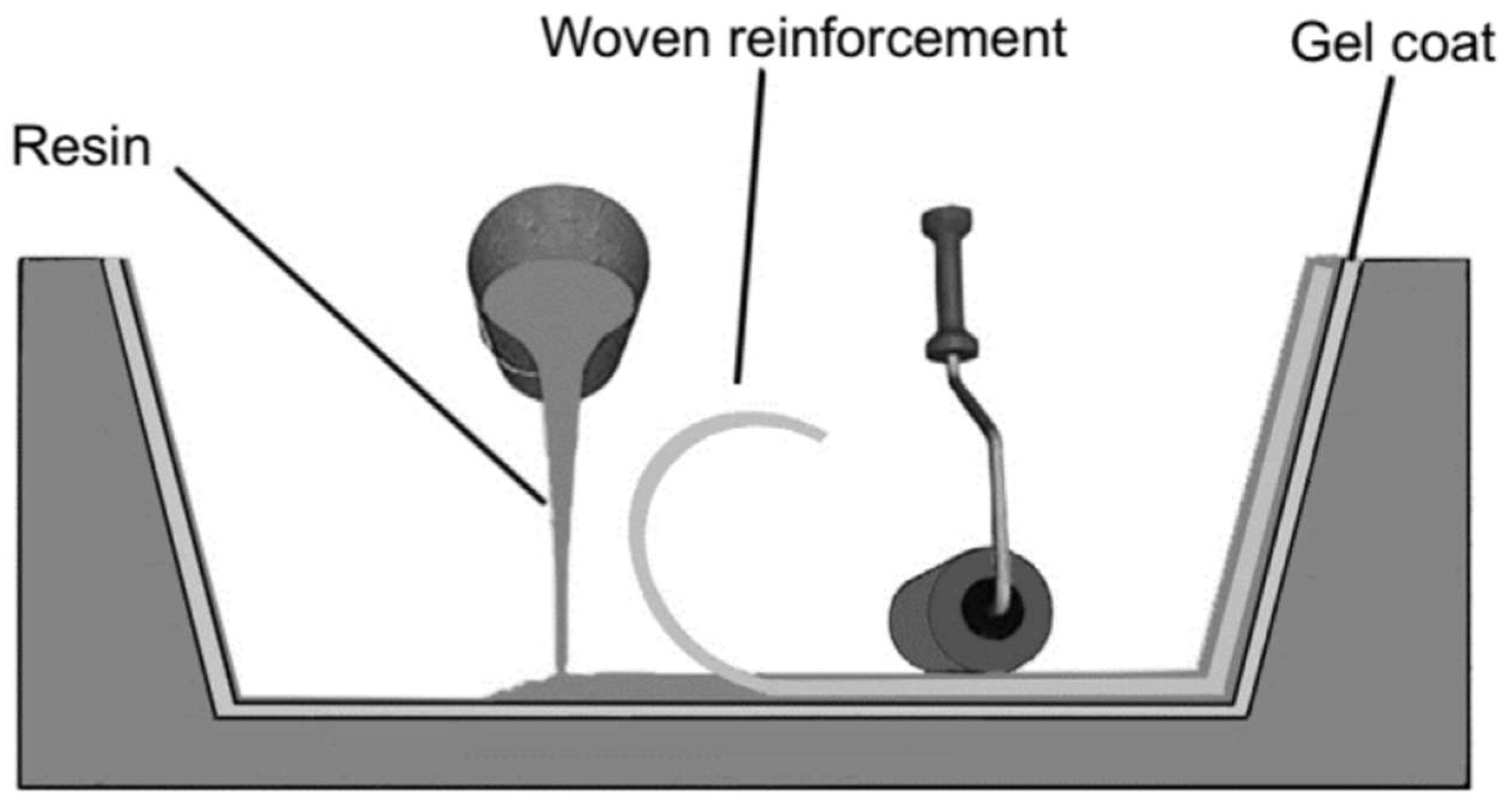
Figure 2.
SWOT analysis of the hand layup process.
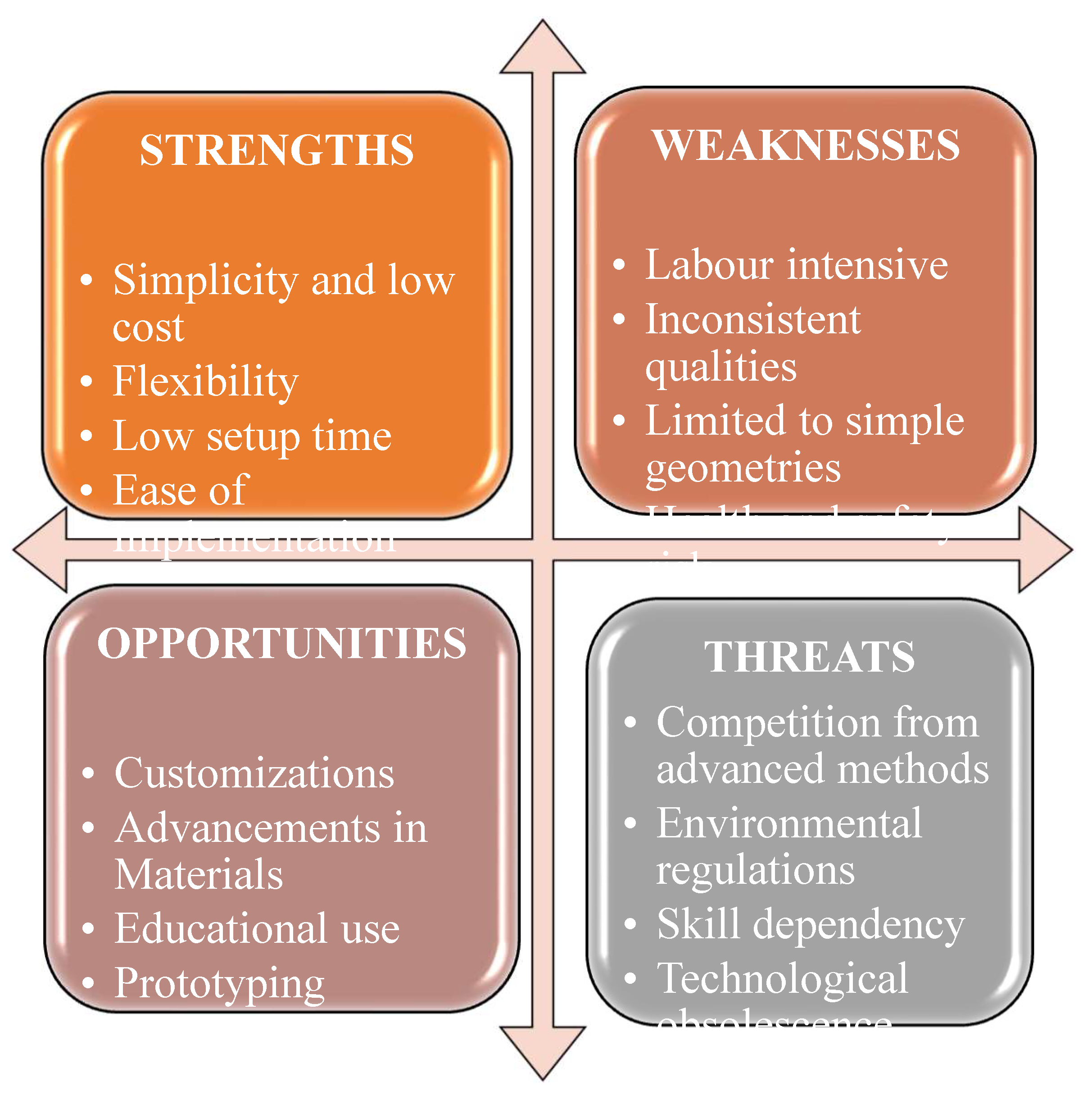
Figure 3.
Injection molding schematic diagram [49].
Figure 3.
Injection molding schematic diagram [49].
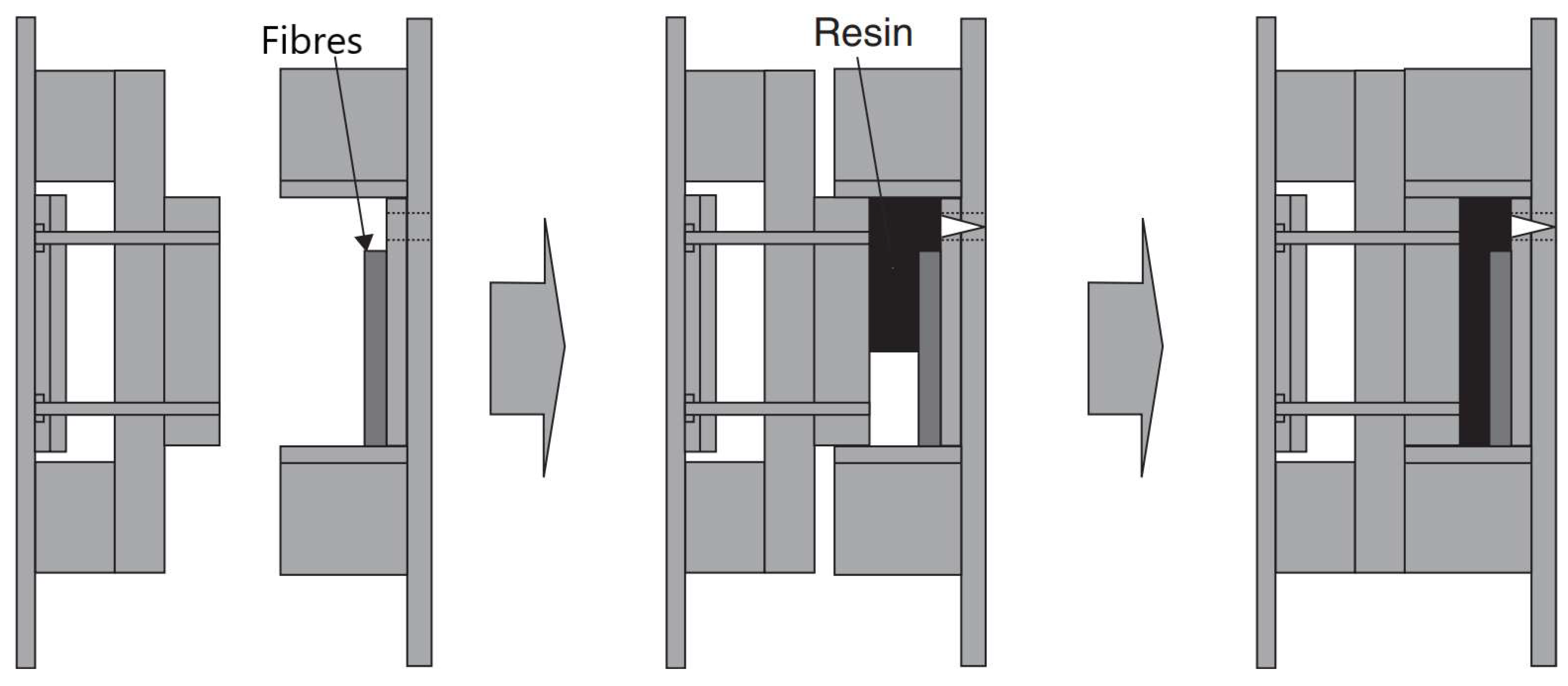
Figure 4.
SWOT analysis of injection molding process.
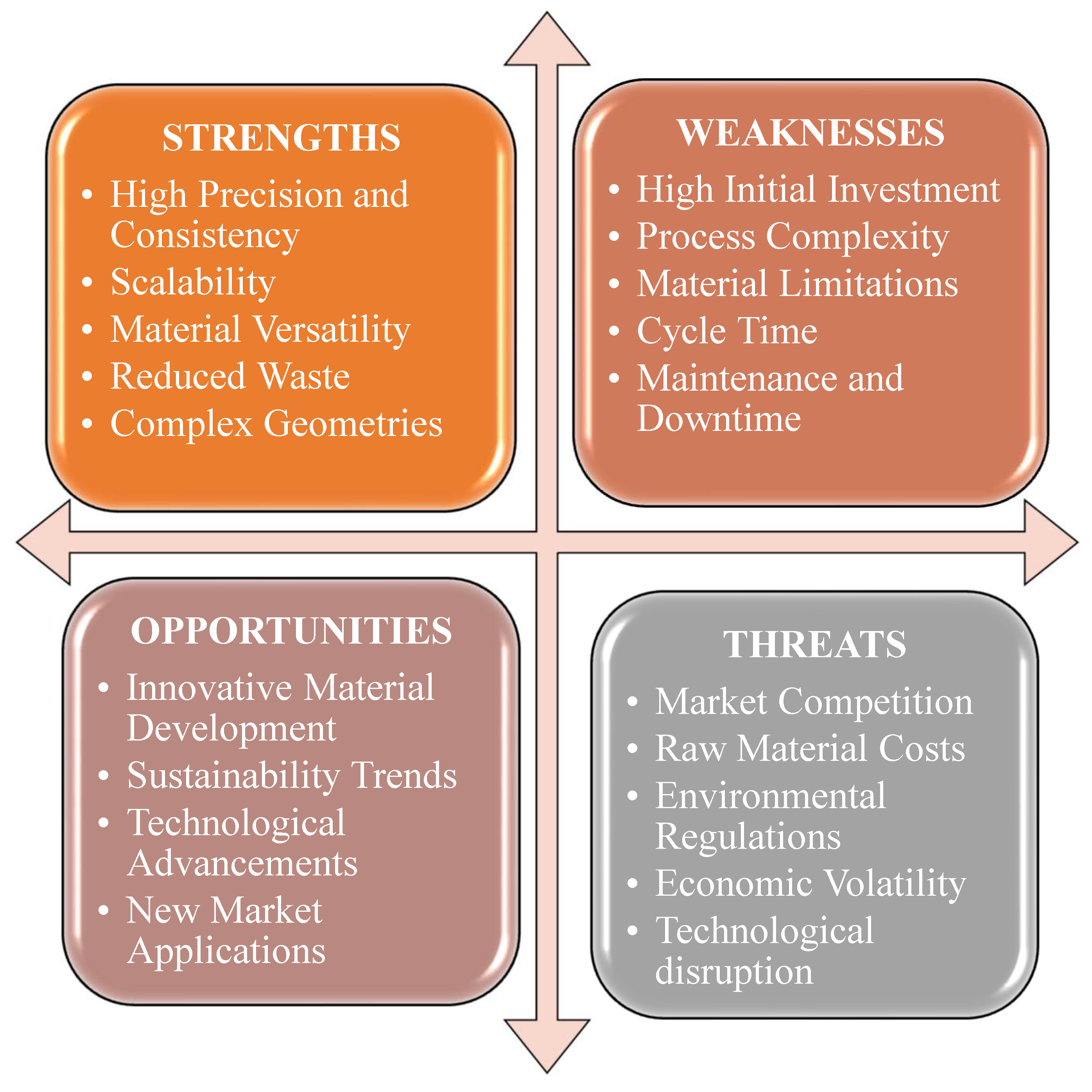
Figure 5.
Compression molding schematic diagram [33, 66].
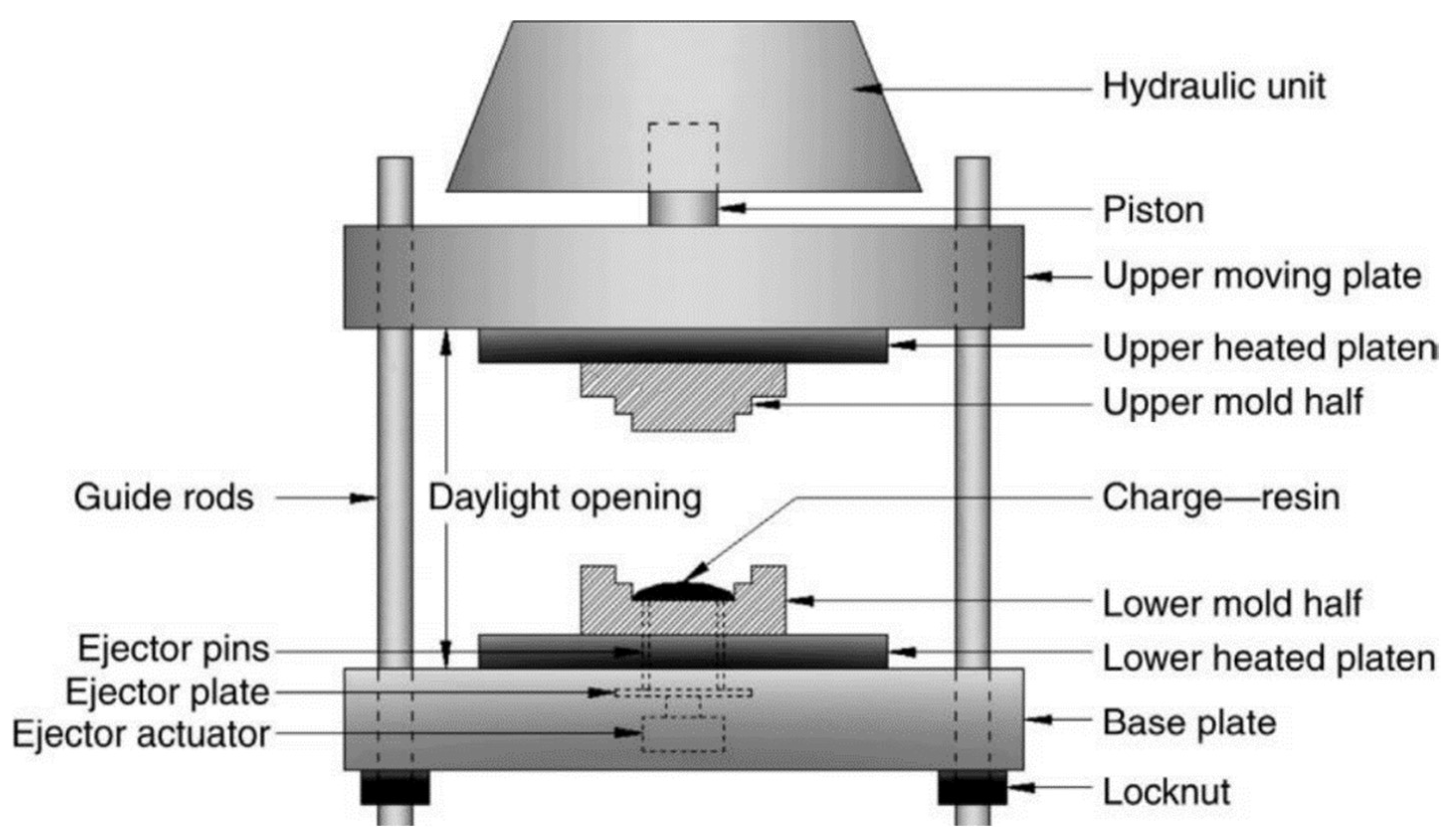
Figure 6.
SWOT analysis of the compression molding process.
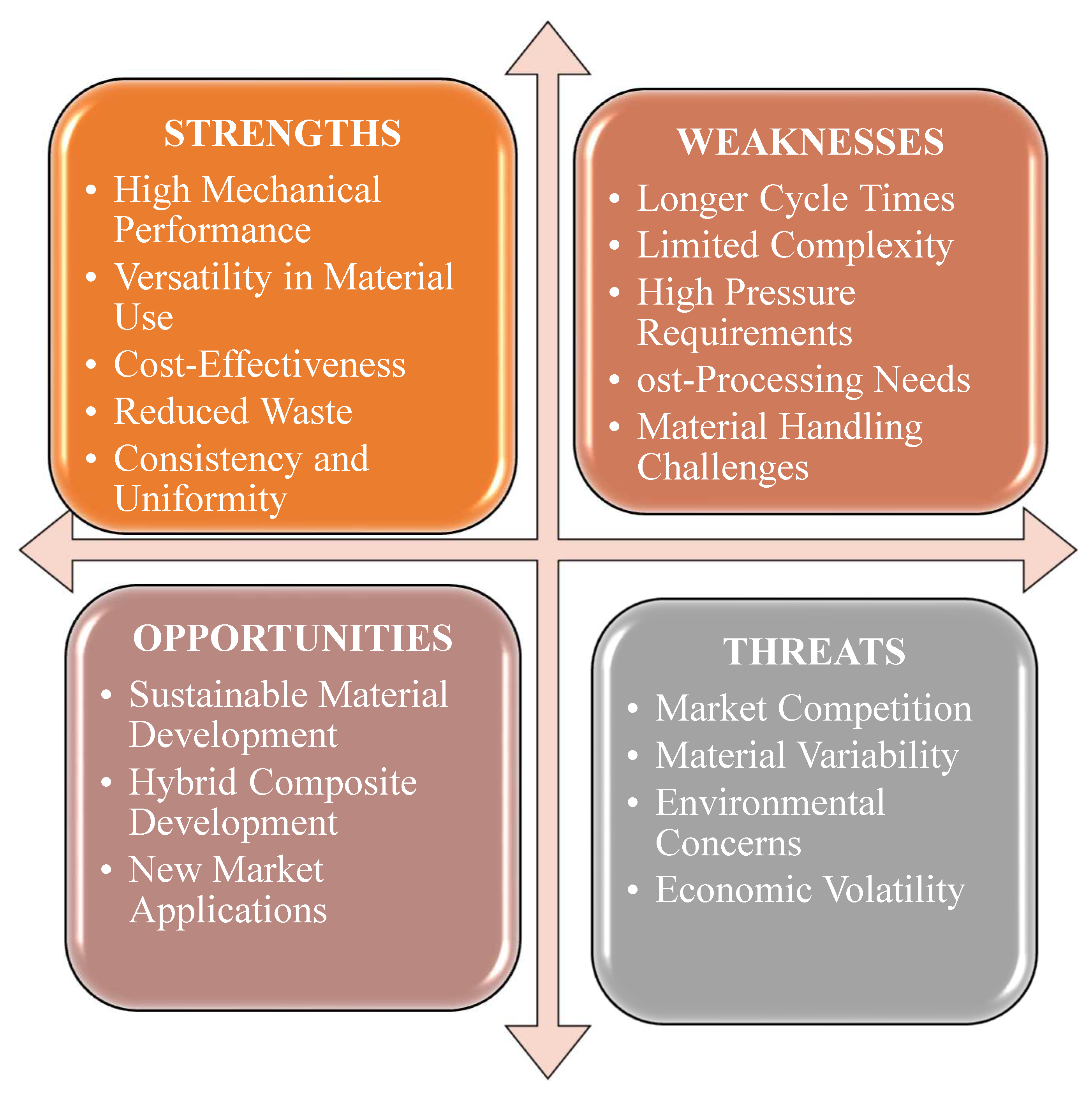
Figure 7.
Resin transfer moulding schematic diagram [33, 76].
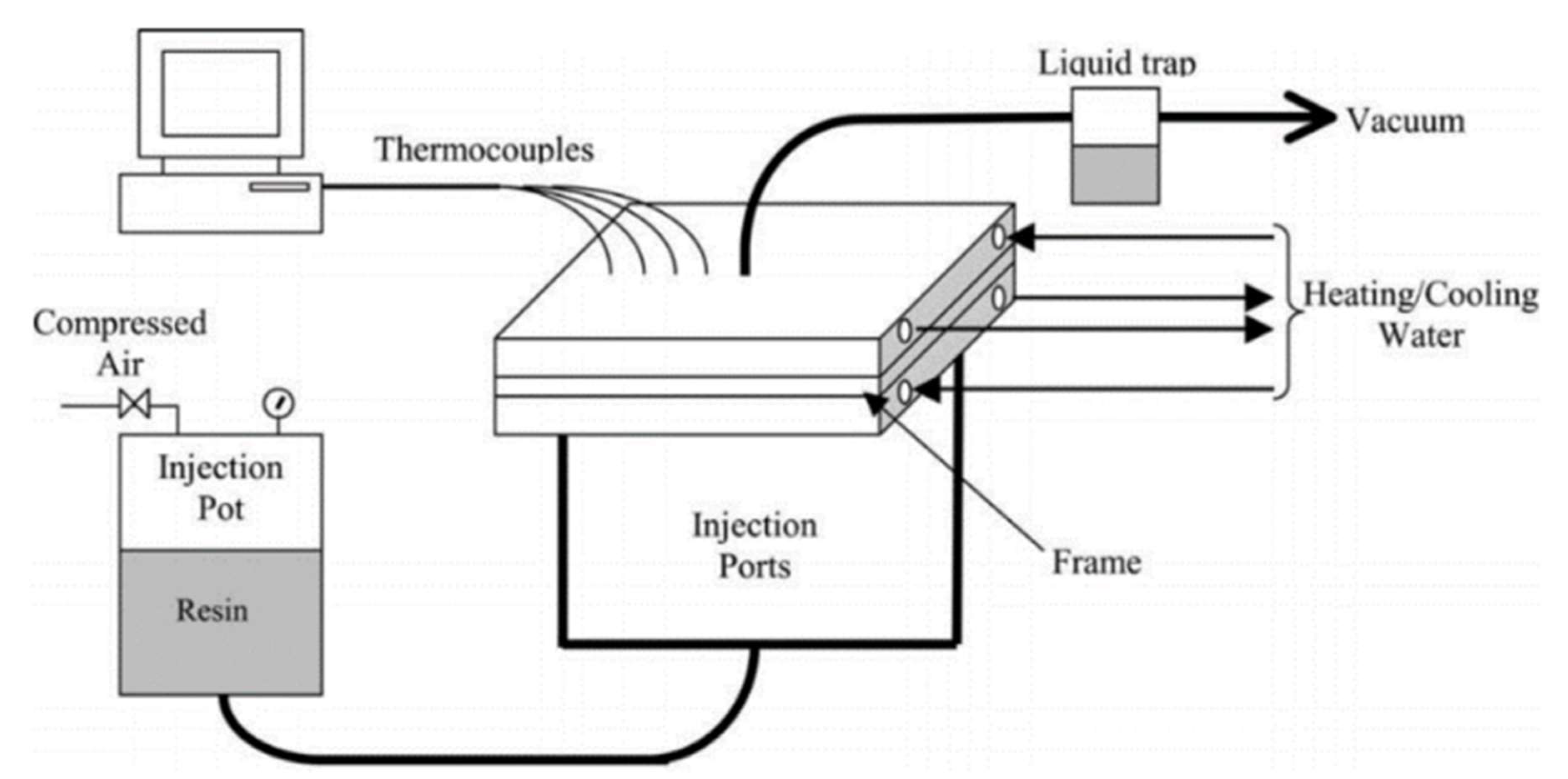
Figure 8.
SWOT analysis of resin transfer molding.
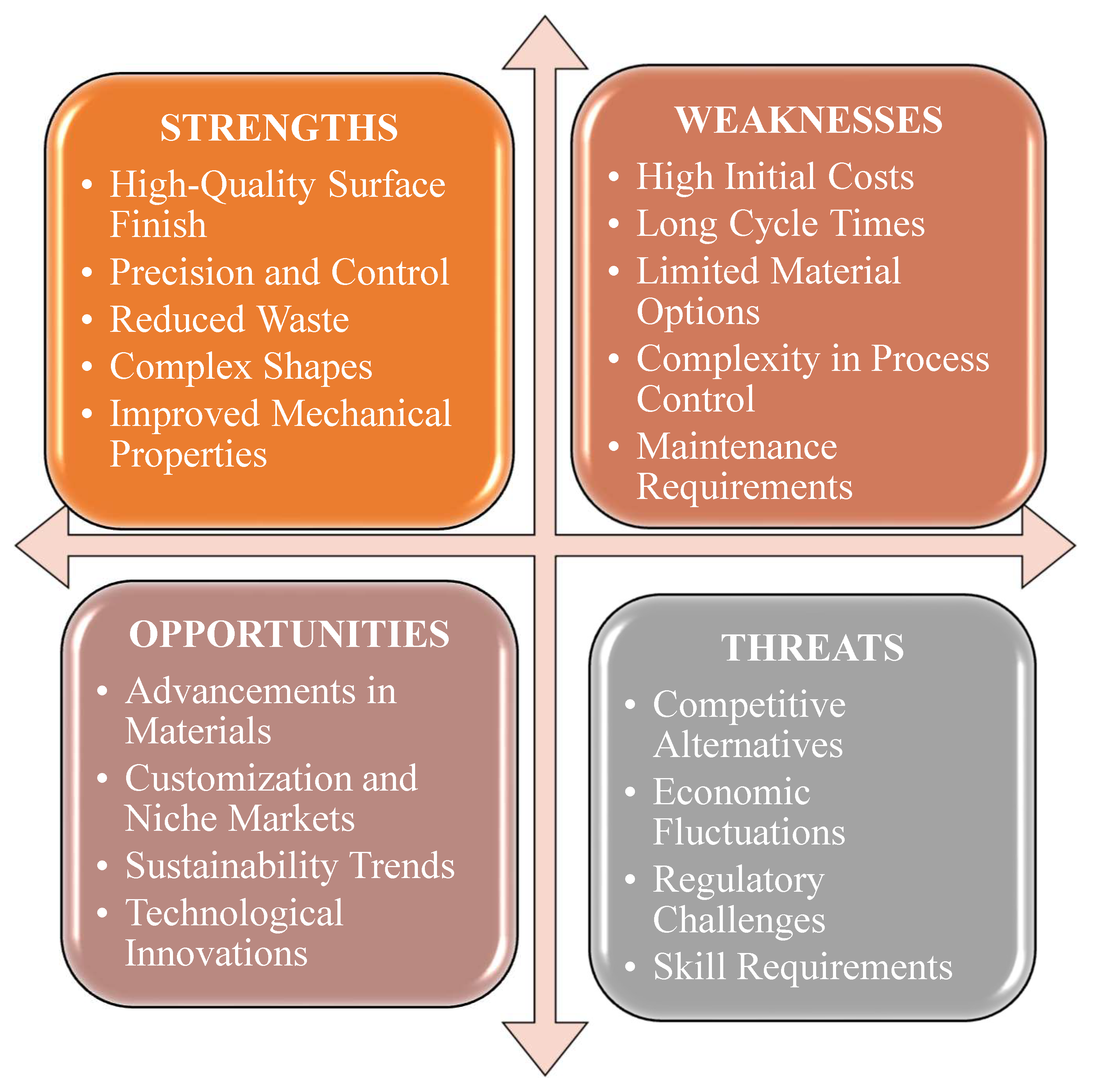
Figure 9.
Pultrusion process schematic diagram [88].
Figure 9.
Pultrusion process schematic diagram [88].
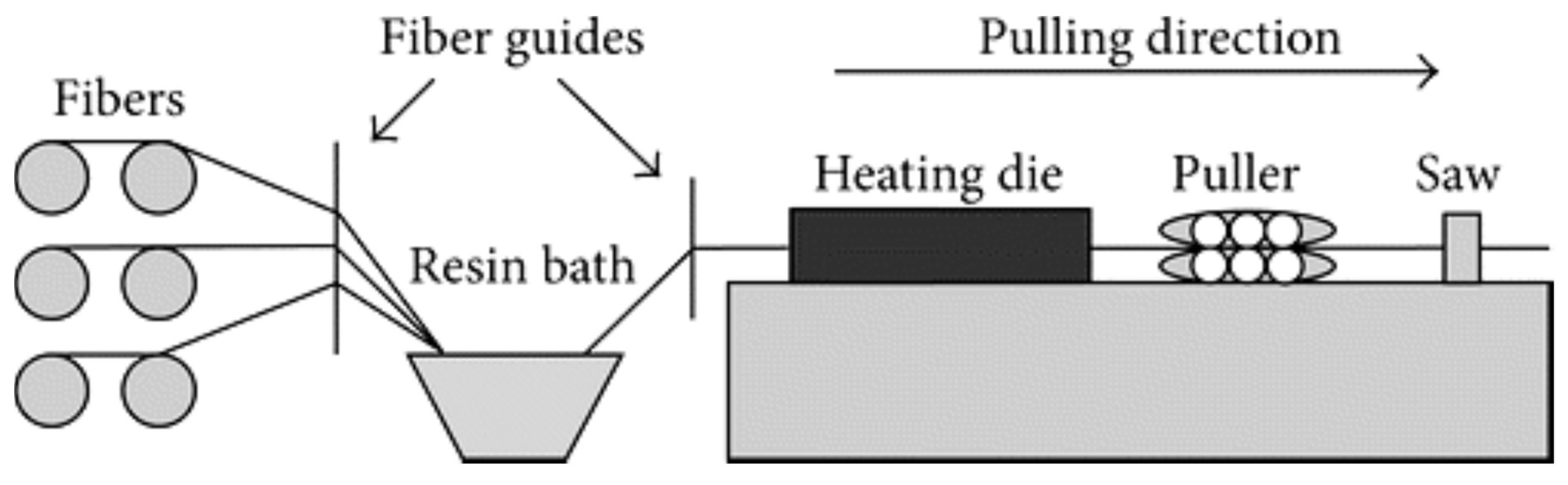
Figure 10.
SWOT analysis of the pultrusion process.
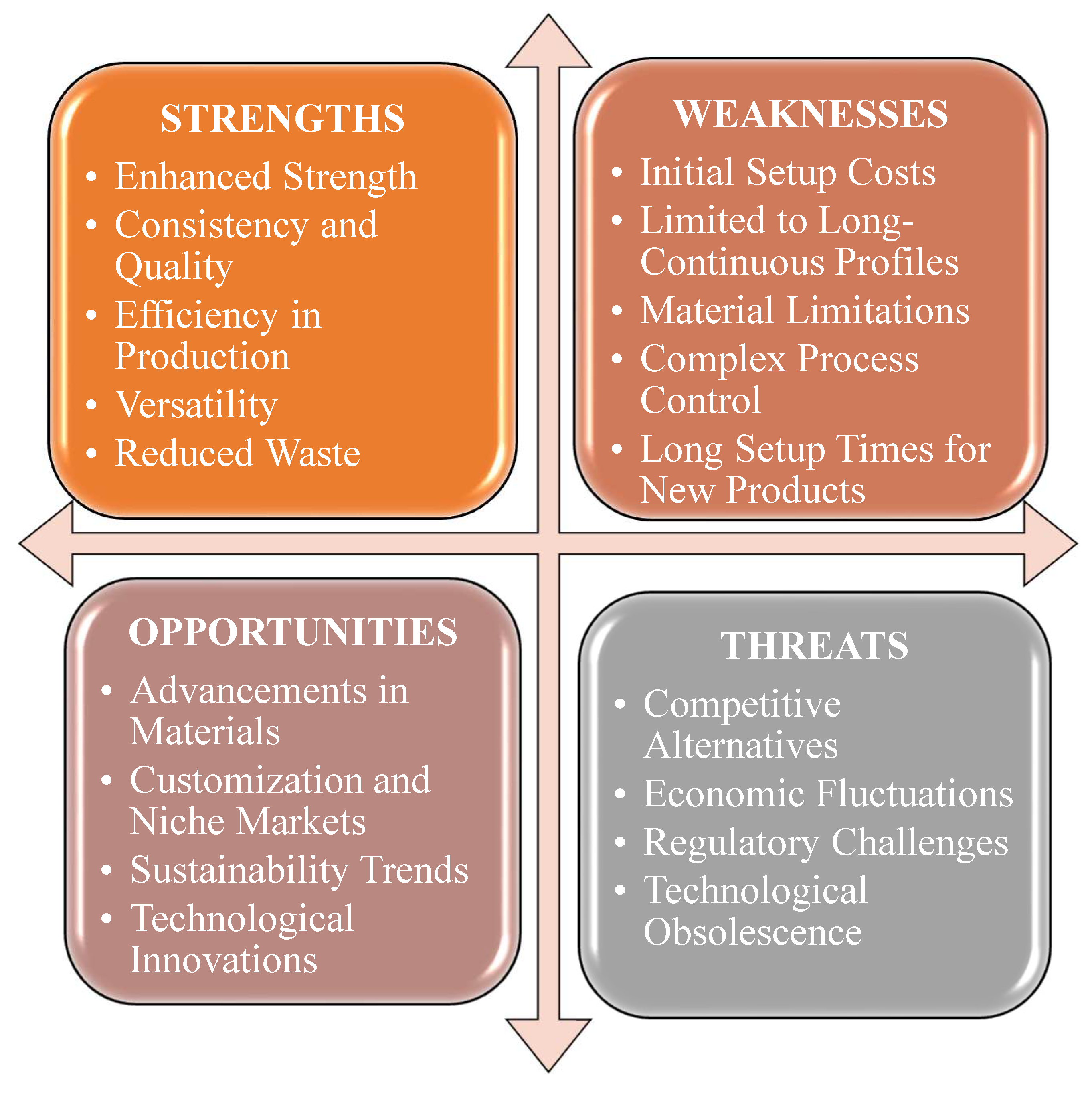
Figure 11.
A vacuum molding process schematic diagram [104].
Figure 11.
A vacuum molding process schematic diagram [104].
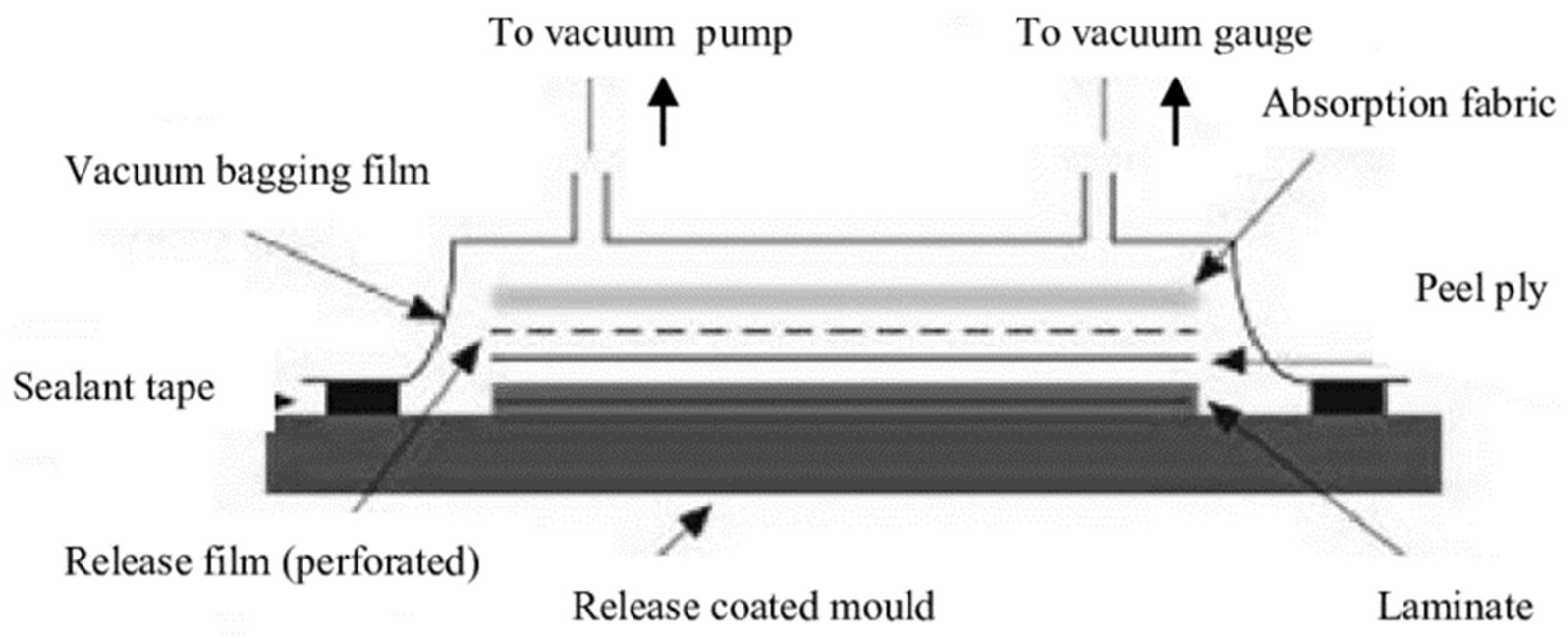
Figure 12.
Autoclave molding process schematic diagram [33, 113].
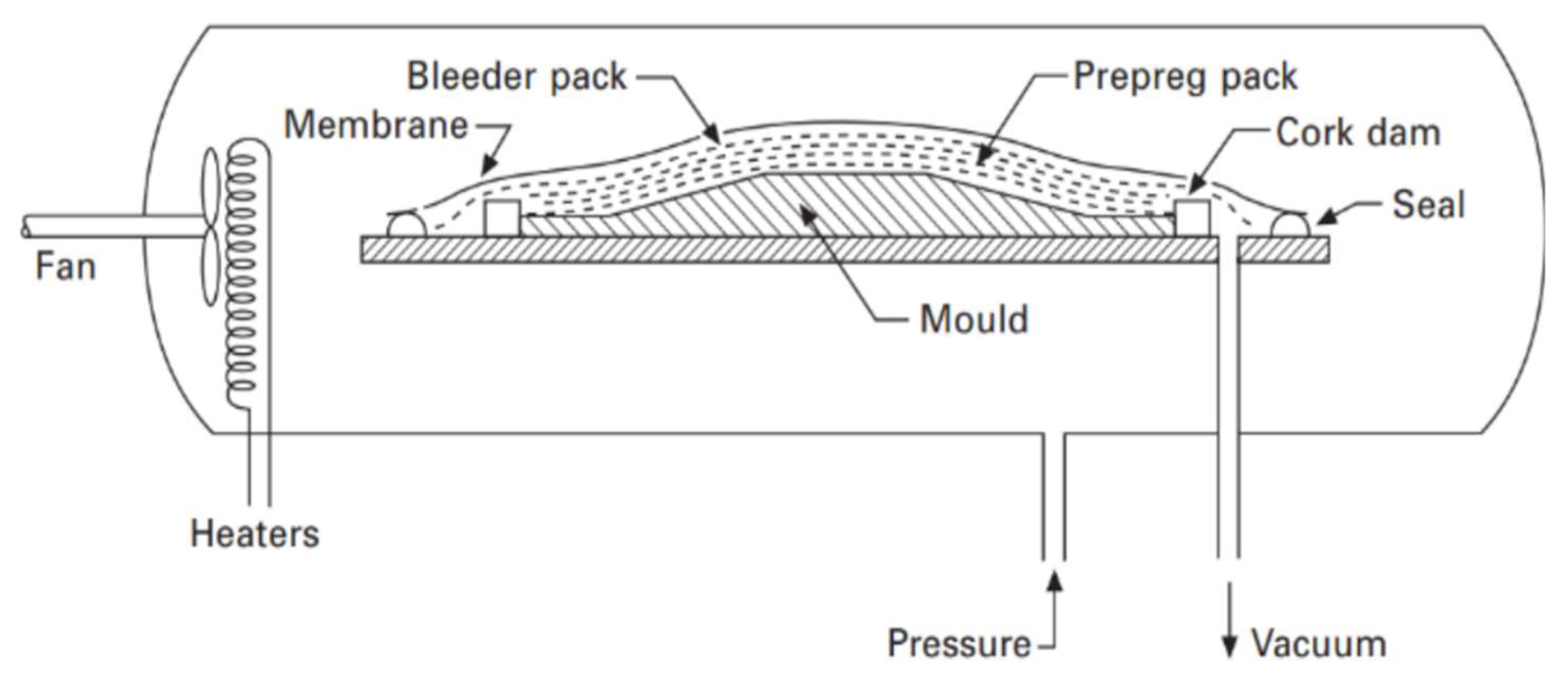
Figure 13.
Schematic diagram of Extrusion molding [116].
Figure 13.
Schematic diagram of Extrusion molding [116].
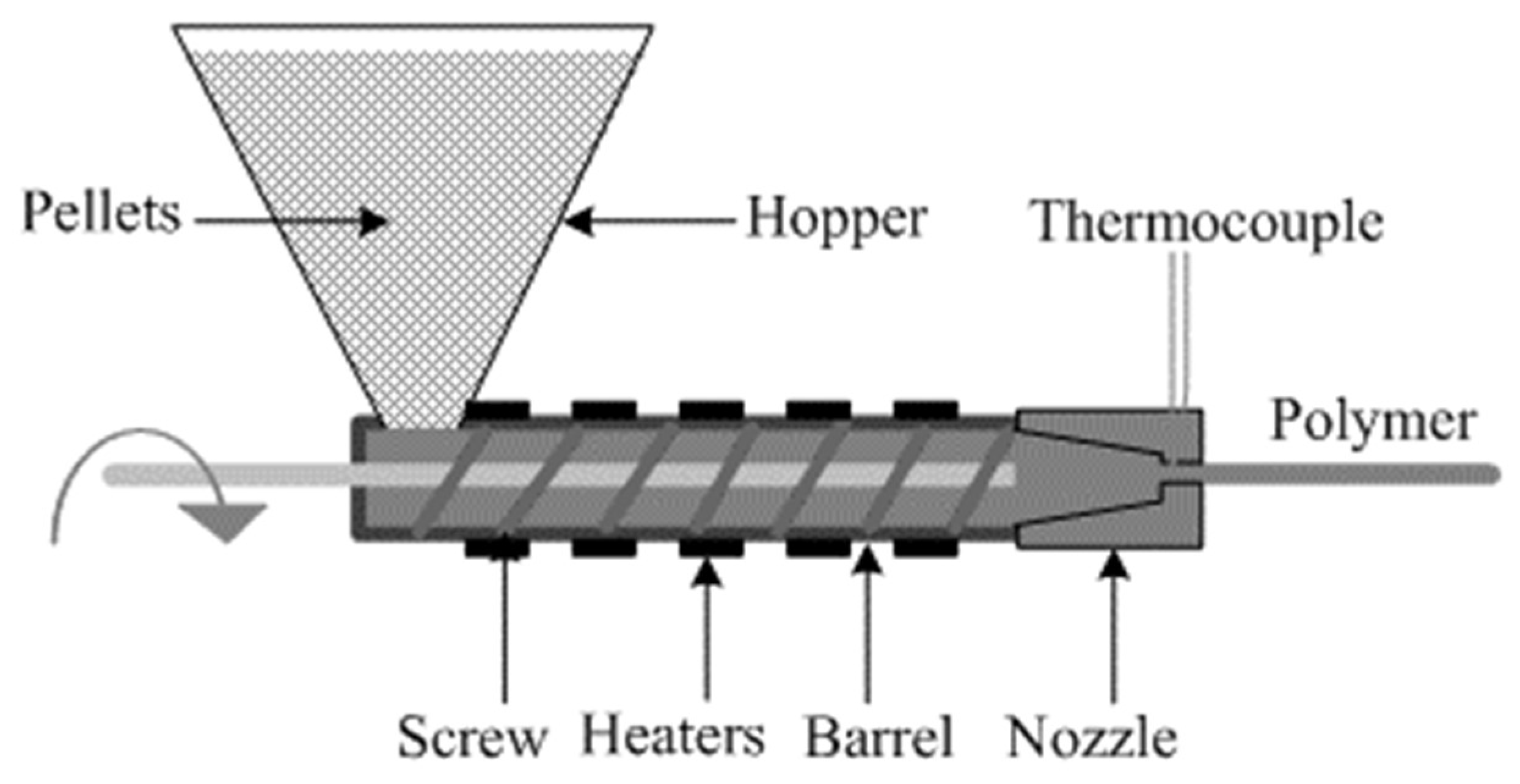

Table 1.
Tensile properties (Hand layup method).
| Ref. | Jute Fiber/ Fabric type | Resin | Treatment | Percentage of Fiber in Composites | Tensile Strength, MPa | Tensile Modulus, GPa | Tensile Elongation | ||
| [25] | Fiber length 5-6 mm |
Polyester | 5% NaOH | 18% wt. | 9.24 | 0.811 | 1.14 mm | ||
| 10% NaOH | 7.92 | - | - | ||||||
| Epoxy | 5% NaOH | 12.46 | 1.064 | 1.17 mm | |||||
| 10% NaOH | 10.5 | - | - | ||||||
| [121] | Bi-directional jute fiber mat | Epoxy | Untreated | 12% wt. | 71.67 | 0.96 | - | ||
| 24% wt. | 88.87 | 3.03 | - | ||||||
| 36% wt. | 97.99 | 3.81 | - | ||||||
| 48% wt. | 110 | 4.45 | - | ||||||
| [122] | Woven fabric | Epoxy | Untreated | 25% wt. | 26.53 | 6.32 | - | ||
| [123] | Main and cross directional Woven textile | Epoxy | Heat treatment | 189.479 | |||||
| [124] | Continuous jute fibers (5 layers) | Polyester | Dry | 50% wt. | 34.87 | 1.989 | - | ||
| Wet - water | 35.23 | 2.23 | - | ||||||
| [125] | Raw jute fiber reed | Un-saturates polyester |
30% jute batching oil in water emulsion | 25% wt. | 80 ± 13.39 | 3.68 ± 0.48 | 4.5 ± 0.55 % | ||
| 35% wt. | 106 ± 16.30 | 4.83 ± 0.63 | 5.2 ± 0.83 % | ||||||
| 44% wt. | 122 ± 31.11 | 5.56 ± 0.67 | 4.8 ± 0.54 % | ||||||
| Jute silver | 25% wt. | 71 ± 11.93 | 3.24 ± 0.65 | 4.8 ± 0.59 % | |||||
| 35% wt. | 89 ± 9.74 | 4.46 ± 0.45 | 5.4 ± 0.48 % | ||||||
| 44% wt. | 109 ± 16 | 4.89 ± 0.55 | 4.7 ± 0.54 % | ||||||
| [126] | Long jute fibers | Epoxy | Untreated | 70% wt. | 419 | - | - | ||
| [127] | Plain weave jute fabrics | Poly-propylene | 0.4% NaOH | 30% wt. | 16.73 | - | - | ||
| 40% wt. | 22.31 | - | - | ||||||
| 45% wt. | 24.21 | - | - | ||||||
| 50% wt. | 21.55 | - | - | ||||||
| 60% wt. | 20.15 | - | - | ||||||
| 65% wt. | 18.50 | - | - | ||||||
| [128] | Unidirectional jute fiber | Epoxy | Untreated | 8% wt. | 45.28 ± 0.45 | 3.18 ± 0.40 | - | ||
| 10% wt. | 54.35 ± 4.88 | 5.66 ± 0.65 | - | ||||||
| 12% wt. | 78.38 ± 1.01 | 9.9 ± 1.61 | - | ||||||
| Chemically treated | 8% wt. | 51.25 ± 4.88 | 11.9 ± 0.55 | - | |||||
| 10% wt. | 67.97 ± 2.99 | 12.38 ± 1.38 | - | ||||||
| 12% wt. | 84.46 ± 4.99 | 13 ± 0.67 | - | ||||||
| [129] | Bi-axial woven jute fabric | Epoxy | Untreated | 44.3 ± 2.2 % vol. | 52.1 | 5.184 | 1.6% | ||
| [130] | Woven jute fiber plies | Polyester | Untreated | 20% vol. | Uni | 42.236 | 3.973 | 0.011 m/m | |
| Multi | 21.685 | - | 0.529 m/m | ||||||
| [131] | Cross-plied | Epoxy | Untreated | - | 16.62 | 0.664 | - | ||
| [132] | Combed unidirectional | Epoxy | Untreated | 40% vol. | 179 | - | - | ||
| 5% NaOH | 432 | - | - | ||||||
| [133] | Matted Jute fabric | Epoxy | Untreated | - | 46.7 | - | - | ||
| 20% NaOH | 97.5 | - | - | ||||||
| [134] | Bidirectional woven jute | Polyester | Untreated | 30% vol. | 30 | 2.1 | - | ||
| 33% vol. | 35 | 2.5 | - | ||||||
| 37% vol. | 46 | 3 | - | ||||||
| 40% vol. | 60 | 4 | - | ||||||
| [135] | Twine form fabric weaved in bidirectional mat | Epoxy | Untreated | 30% vol. | 39.75 ± 0.97 | 39.75 ± 0.97 | - | ||
| Alkalized | 39.08 ± 3.35 | 3.60 ± 0.24 | - | ||||||
| Alkalized + Silanized | 43.07 ± 3.80 | 3.77 ± 0.23 | - | ||||||
| [136] | Jute fabric | Epoxy | Untreated | 30% vol. | 45.628 | - | - | ||
| Alkalized | 50.19 | - | - | ||||||
| [137] | Short jute fibers | Polyester | Untreated | 16% wt. | 30.6 ± 2.30 | 3.368 ± 0.18 | 1.209 ± 0.08 % | ||
| 5% NaOH | 34.2 ± 2.91 | 3.946 ± 0.22 | 1.221 ± 0.09 % | ||||||
| PLA-coated | 31.6 ± 2.83 | 3.489 ± 0.19 | 1.212 ± 0.07 % | ||||||
| Alkalized + PLA-coated | 36.6 ± 3.12 | 3.991 ± 0.23 | 1.324 ± 0.08 % | ||||||
| [138] | Matted jute | Epoxy | 5% wt. NaOH | 10% wt. | 28.33 ± 1.05 | 0.6246 ± 0.0325 | - | ||
| 20% wt. | 31.71 ± 2.11 | 0.8486 ± 0.0516 | - | ||||||
| 30% wt. | 33.04 ± 0.46 | 1.0453 ± 0.0379 | - | ||||||
| 40% wt. | 33.72 ± 1.73 | 1.2284 ± 0.0846 | - | ||||||
| 50% wt. | 34.26 ± 2.59 | 1.1785 ± 0.1085 | - | ||||||
| [139] | Long Jute fiber | Epoxy | Untreated | 1 layer | 11.02 | 0.90 | - | ||
| 2 layers | 42.73 | 1.06 | - | ||||||
| 3 layers | 53.69 | 1.40 | - | ||||||
| [140] | Non-woven + Fabric + non-woven fibers with Unsaturated polyester, Soy Flour Resin | no Alkyd Resin | Un-treated | - | 2.83 | - | 1.57% | ||
| 5% Alkyd Resin | 24.87 | - | 3.46% | ||||||
| 10% Alkyd Resin | 25.79 | - | 5.27% | ||||||
Table 2.
Compression properties (Hand layup method).
| Ref. | Jute fiber/ fabric type | Resin | Treatment | Percentage of Fiber in Composite | Compressive Strength, MPa | Compressive Modulus, GPa | Strain, % |
|---|---|---|---|---|---|---|---|
| [129] | Bi-axial woven | Epoxy | Untreated | 44.3 ± 2.2 % vol. | 40.2 | 3.523 | - |
| [141] | Woven jute fabric | Un-saturated polyester | Untreated | 25% wt. | 56.09 | 0.75 | 4.72 |
| 4% NaOH | 57.42 | 0.44 | 12.97 | ||||
| 5% NaOH | 69.01 | 0.88 | 7.77 | ||||
| 7% NaOH | 55.63 | 0.65 | 8.59 | ||||
| [134] | Bi-directional woven jute | Polyester | Untreated | 30% vol. | 58 | - | - |
| 33% vol. | 54 | - | - | ||||
| 37% vol. | 49 | - | - | ||||
| 40% vol. | 40 | - | - |
Table 3.
Flexural properties (Hand layup method).
| Ref. | Fiber type | Resin | Treatment | Percentage of Fiber | Flexural Strength, MPa | Flexural Modulus, GPa | Flexural Elongation |
| [25] | Fiber length 5-6 mm | Polyester | 5% NaOH | 18% wt. | 44.71 | 1.91 | 5.5 mm |
| 10% NaOH | 40.5 | - | - | ||||
| Epoxy | 5% NaOH | 39.08 | 3.08 | 2.1 mm | |||
| 10% NaOH | 32.5 | - | - | ||||
| [121] | Bi-directional jute fiber mat | Epoxy | Untreated | 12% wt. | 28.61 | 0.59 | - |
| 24% wt. | 34.79 | 0.73 | - | ||||
| 36% wt. | 51.22 | 1.24 | - | ||||
| 48% wt. | 55.8 | 3.02 | - | ||||
| [122] | Woven fabric | Epoxy | Untreated | 25% wt. | 66.67 | 5.78 | - |
| [123] | Main and cross directional Woven textile | Epoxy | Heat treatment | 208.705 | - | - | |
| [124] | Continuous Jute fibers (5 layers) | Polyester | Dry | 50% wt. | 67.56 | 2.59 | - |
| Wet by water | 68.89 | 3.121 | - | ||||
| [125] | Raw jute fiber reed | Un-saturates polyester |
30% jute batching oil in water emulsion | 25% wt. | 102 ± 16.23 | 9.42 ± 1.31 | 2.27 ± 0.15 % |
| 35% wt. | 124 ± 17.97 | 11.6 ± 1.65 | 3.49 ± 0.28 % | ||||
| 44% wt. | 145 ± 21.94 | 15.41 ± 2.22 | 3.18 ± 0.31 % | ||||
| Jute silver | 25% wt. | 85 ± 20.16 | 7.56 ± 1.36 | 2.61 ± 0.60 % | |||
| 35% wt. | 103 ± 14.64 | 10.64 ± 1.41 | 2.66 ± 0.57 % | ||||
| 44% wt. | 112 ± 17.30 | 13.24 ± 2.12 | 2.57 ± 0.48 % | ||||
| [127] | Plain weave jute fabrics | Poly-propylene | 0.4% NaOH | 30% wt. | 34.75 | - | - |
| 40% wt. | 42.49 | - | - | ||||
| 45% wt. | 44.26 | - | - | ||||
| 50% wt. | 39.31 | - | - | ||||
| 60% wt. | 38.05 | - | - | ||||
| 65% wt. | 36.14 | - | - | ||||
| [141] | Woven jute fabric | Un-saturated polyester | Untreated | 25% wt. | 39.63 | 1.56 | 2.52% |
| 4% NaOH | 47.91 | 1.77 | 2.70% | ||||
| 5% NaOH | 57.16 | 1.49 | 3.81% | ||||
| 7% NaOH | 56.75 | 2.13 | 2.66% | ||||
| [131] | Cross-plied | Epoxy | Untreated | - | 57.22 | 8.956 | |
| [132] | Combed unidirectional | Epoxy | Untreated | 40% vol. | 85 | - | - |
| 5% NaOH | 89 | - | - | ||||
| [133] | Matted Jute fabric | Epoxy | Untreated | - | 62.4 | - | - |
| 20% NaOH | 80.1 | - | - | ||||
| [135] | Twine form fabric weaved in bidirectional mat | Epoxy | Untreated | 30% vol. | 64.30 ± 5.50 | 4.63 ± 0.42 | - |
| Alkalized | 56.31 ± 5.68 | 3.53 ± 0.34 | - | ||||
| Alkalized + Silanized | 50.62 ± 2.31 | 3.53 ± 0.34 | - | ||||
| [136] | Jute fabric | Epoxy | Untreated | 30% vol. | 81.12 | - | - |
| Alkalized | 90.89 | - | - | ||||
| [137] | Short jute fibers | Polyester | Untreated | 16% wt. | 58.17 ± 3.14 | 3.931 ± 0.17 | 1.861 ± 0.11 % |
| 5% NaOH | 78.27 ± 4.12 | 5.872 ± 0.25 | 2.414 ± 0.12 % | ||||
| PLA-coated | 67.68 ± 3.26 | 4.420 ± 0.19 | 2.090 ± 0.12 % | ||||
| Alkalized + PLA-coated | 79.76 ± 4.67 | 6.231 ± 0.31 | 2.512 ± 0.14 % | ||||
| [138] | Matted jute | Epoxy | 5% wt. NaOH | 10% wt. | 44.2 ± 2.65 | 0.7363 ± 0.0458 | - |
| 20% wt. | 49.6 ± 4.32 | 1.0248 ± 0.0276 | - | ||||
| 30% wt. | 68.8 ± 4.49 | 1.2906 ± 0.0241 | - | ||||
| 40% wt. | 81.8 ± 6.78 | 1.2583 ± 0.0546 | - | ||||
| 50% wt. | 97.8 ± 5.25 | 1.0133 ± 0.179 | - | ||||
| [139] | Long Jute fiber | Epoxy | Untreated | 1 layer | 31.3 | 1.42 | - |
| 2 layers | 56.32 | 2.03 | - | ||||
| 3 layers | 76.52 | 3.02 | - | ||||
| [140] | Non-woven + Fabric + non-woven fibers with Unsaturated polyester, Soy Flour Resin | no Alkyd Resin | Un-treated | - | 2.83 | - | - |
| 5% Alkyd Resin | 24.87 | - | - | ||||
| 10% Alkyd Resin | 25.79 | - | - |
Table 4.
Impact strength (Hand layup method).
| Ref. | Fiber type | Resin | Treatment | Percentage of Fiber in Composites | Type of Impact Test | Impact strength |
| [25] | Fiber length 5-6 mm | Polyester | 5% NaOH | 18% wt. | Charpy | 3.25 J |
| 10% NaOH | 2.75 J | |||||
| Epoxy | 5% NaOH | 2.63 J | ||||
| 10% NaOH | 2 J | |||||
| [121] | Bi-directional jute fiber mat | Epoxy | Untreated | 12% wt. | - | 3.048 J |
| 24% wt. | 3.929 J | |||||
| 36% wt. | 4.528 J | |||||
| 48% wt. | 4.875 J | |||||
| [122] | Woven fabric | Epoxy | Untreated | 25% wt. | 80 J/m2 | |
| [124] | Continuous Jute fibers (5 layers) | Polyester | Dry | 50% wt. | Charpy | 6.14 J |
| Wet by water | 7.23 J | |||||
| [126] | Long jute fibers | Epoxy | Untreated | 70% wt. | Charpy | 3 J |
| Izod | 2 J | |||||
| [127] | Plain weave jute fabrics | Poly-propylene | 0.4% NaOH | 30% wt. | Charpy | 54.42 kJ/m2 |
| 40% wt. | 61.27 kJ/m2 | |||||
| 45% wt. | 61.78 kJ/m2 | |||||
| 50% wt. | 51.62 kJ/m2 | |||||
| 60% wt. | 49.09 kJ/m2 | |||||
| 65% wt. | 44.39 kJ/m2 | |||||
| [131] | Cross-plied | Epoxy | Untreated | - | Izod | 13.44 kJ/m2 |
| [132] | Combed unidirectional | Epoxy | Untreated | 40% vol. | Charpy | 480.76 kJ/m2 |
| 5% NaOH | 76.92 kJ/m2 | |||||
| [135] | Twine form fabric weaved in bidirectional mat | Epoxy | Untreated | 30% vol. | - | 143.06 ± 22.39 J/m |
| Alkalized | 171.68 ± 18.28 J/m | |||||
| [136] | Jute fabric | Epoxy | Untreated | 30% vol. | Izod | 69.5 J/cm2 |
| Alkalized | 88.5 J/cm2 | |||||
| [137] | Short jute fibers | Polyester | Untreated | 16% wt. | Izod | 5.10 ± 0.32 kJ/m2 |
| 5% NaOH | 2.29 ± 0.16 kJ/m2 | |||||
| PLA-coated | 3.95 ± 0.21 kJ/m2 | |||||
| Alkalized + PLA-coated | 5.30 ± 0.29 kJ/m2 | |||||
| [138] | Matted jute | Epoxy | 5% wt. NaOH | 10% wt. | - | 20.35 ± 0.2 kJ/m2 |
| 20% wt. | 20.98 ± 0.24 kJ/m2 | |||||
| 30% wt. | 21.84 ± 0.05 kJ/m2 | |||||
| 40% wt. | 22.65 ± 1.1 kJ/m2 | |||||
| 50% wt. | 23.87 ± 1.36 kJ/m2 |
Table 5.
Rockwell hardness (Hand layup method).
| Ref. | Fiber type | Resin | Treatment | Percentage of Fiber in Composites | Rockwell hardness Value | |
|---|---|---|---|---|---|---|
| [25] | Fiber length 5-6 mm | Polyester | 5% NaOH | 18% wt. | 44 | |
| 10% NaOH | 41.67 | |||||
| Epoxy | 5% NaOH | 42 | ||||
| 10% NaOH | 41 | |||||
| [121] | Bi-directional jute fiber mat | Epoxy | Untreated | 12% wt. | 70.68 | |
| 24% wt. | 74.01 | |||||
| 36% wt. | 78.54 | |||||
| 48% wt. | 85.5 | |||||
| [126] | Long jute fibers | Epoxy | Untreated | 70% wt. | 40 | |
| [140] | Non-woven + Fabric + non-woven fibers with Unsaturated polyester, Soy Flour Resin | no Alkyd Resin | Un-treated | - | 44.6 | |
| 5% Alkyd Resin | 63 | |||||
| 10% Alkyd Resin | 66.60 | |||||
Table 6.
Tensile properties (Vacuum molding).
| Ref. | Jute Fiber/ Fabric type | Resin | Treatment | Percentage of Fiber in Composites | Tensile Strength, MPa | Tensile Modulus, GPa | Tensile Elongation |
|---|---|---|---|---|---|---|---|
| [142] | Unidirectional | Epoxy | - | 52% wt. | 216 ± 1.02 | 31 ± 1.34 | 0.78 ± 0.05 %. |
| [143] | Bi-directional woven | Epoxy vinylester | Untreated | - | 505 ± 165 | 30 ± 14 | - |
| 5% NaOH | 326 ± 150 | 12.2 ± 5.2 | - |
Table 7.
Flexural properties (Vacuum molding).
| Ref. | Jute Fiber/ Fabric type | Resin | Treatment | Percentage of Fiber in Composites | Flexural Strength, MPa | Flexural Modulus, GPa | Flexural Elongation |
|---|---|---|---|---|---|---|---|
| [142] | Unidirectional longitudinal | Epoxy | - | 52% wt. | 158 ± 18.90 | 18 ± 1.92 | - |
| Unidirectional transverse | 25.7 ± 2.17 | 2.73 ± 0.28 | - | ||||
| [143] | Bi-directional woven | Epoxy vinylester | Untreated | - | 103 ± 6 | 6.6 ± 0.5 | - |
| 5% NaOH | 83 ± 6 | 5.5 ± 0.02 | - |
Table 8.
Tensile properties (Palsule process).
| Ref. | Fiber type | Resin | Treatment | Percentage of Fiber in Composites | Tensile Strength, MPa | Tensile Modulus, GPa | Tensile Elongation |
|---|---|---|---|---|---|---|---|
| [118] | 3 - 6 mm chopped jute | Poly-propylene | Untreated | 10% wt. | 43.03 | 1.27 | 6.9% |
| 20% wt. | 46.58 | 1.46 | 6.1% | ||||
| 30% wt. | 56.71 | 1.82 | 5.2% |
Table 9.
Flexural properties (Palsule process).
| Ref. | Fiber type | Resin | Treatment | Percentage of Fiber in Composites | Flexural Strength, MPa | Flexural Modulus, GPa | Flexural Elongation |
|---|---|---|---|---|---|---|---|
| [118] | 3 - 6 mm chopped jute | Poly-propylene | Untreated | 10% wt. | 61.85 | 2.72 | - |
| 20% wt. | 69.21 | 3.27 | - | ||||
| 30% wt. | 77.32 | 4.34 | - |
Table 10.
Flexural properties (Heating in hollow cylindrical glass).
| Ref. | Fiber type | Resin | Treatment | Percentage of Fiber in Composites | Flexural Strength, MPa | Flexural Modulus, GPa | Flexural Elongation |
|---|---|---|---|---|---|---|---|
| [120] | White jute fibers | Vinyl-ester | Untreated | 35% vol. | 199.10 ± 7.6 | 11.89 ± 0.62 | - |
| 5% NaOH for 4 hours | 238.90 ± 17.60 | 14.69 ± 0.85 | - | ||||
| 5% NaOH for 8 hours | 204.20 ± 1.20 | 12.32 ± 0.35 | - |
Table 11.
Impact properties (Heating in hollow cylindrical glass).
| Ref. | Fiber type | Resin | Treatment | Percentage of Fiber in Composites | Type of Tester | Toughness |
|---|---|---|---|---|---|---|
| [120] | White jute fibers | Vinyl-ester | Untreated | 35% vol. |
Charpy |
22.10 ± 2.79 kJ/m2 |
| 5% NaOH for 4 hours | 21.92 ± 3.84 kJ/m2 | |||||
| 5% NaOH for 8 hours | 19.97 ± 0.78 kJ/m2 |
Table 12.
Tensile properties (Extrusion process).
| Ref. | Jute Fiber/ Fabric type | Resin | Treatment | Percentage of Fiber in Composites | Tensile Strength, MPa | Tensile Modulus, GPa | Tensile Elongation |
|---|---|---|---|---|---|---|---|
| [144] | Uniaxial jute yarn | Poly-propylene | - | 6% vol. | 28.11 | 1.32 | - |
| 12% vol. | 29.24 | 1.61 | - | ||||
| 18% vol. | 27.31 | 1.87 | - | ||||
| 23% vol. | 27.98 | 2.04 | - | ||||
| 29% vol. | 33.12 | 2.03 | - | ||||
| 34% vol. | 33.56 | 2.18 | - | ||||
| 45% vol. | 34.46 | 2.28 | - |
Table 13.
Impact properties (Extrusion process).
| Ref. | Fiber type | Resin | Treatment | Percentage of Fiber in Composites | Type of Impact Test | Impact strength |
|---|---|---|---|---|---|---|
| [144] | Uniaxial jute yarn | Poly-propylene | - | 6% vol. | Izod | 25.77 kJ/m2 |
| 12% vol. | 28.40 kJ/m2 | |||||
| 18% vol. | 29.33 kJ/m2 | |||||
| 23% vol. | 17.89 kJ/m2 | |||||
| 29% vol. | 17.47 kJ/m2 | |||||
| 34% vol. | 13.19 kJ/m2 | |||||
| 45% vol. | 11.46 kJ/m2 |
Table 14.
Tensile properties (Injection molding).
| Ref. | Jute Fiber/ Fabric type | Resin | Treatment | Percentage of Fiber in Composites | Tensile Strength, MPa | Tensile Modulus, GPa | Tensile Elongation |
|---|---|---|---|---|---|---|---|
| [145] | Yearned Jute | Poly-propylene | Untreated | 25 % wt. | 71.9 ± 0.4 | 3.18 ± 0.05 | - |
| Maleic Acid Anhydride | 71 ± 0.6 | 3.39 ± 0.06 | - | ||||
| [146] | Jute fiber | Epoxy, Polyamide Resin, | Untreated | - | 192.65 -225.89 | - | - |
| [147] | Chopped jute fibers | Poly-propylene | Untreated | 20% wt. | 25.726 | 1.682 | - |
| 25% wt. | 25.359 | 1.71 | - | ||||
| 30% wt. | 24.18 | 2.137 | - | ||||
| 35% wt. | 23.536 | 2.221 | - | ||||
| Oxidized | 20% wt. | 27.092 | 1.714 | - | |||
| 25% wt. | 26.374 | 1.999 | - | ||||
| 30% wt. | 25.158 | 2.234 | - | ||||
| 35% wt. | 24.33 | 2.313 | - | ||||
| Oxidized & post-treated | 20% wt. | 29.473 | 1.864 | - | |||
| 25% wt. | 29.365 | 2.03 | - | ||||
| 30% wt. | 28.998 | 2.29 | - | ||||
| 35% wt. | 27.201 | 2.398 | - | ||||
| [148] | Short jute fiber | Poly-propylene | Untreated | 1% wt. | 26.778 | 0.807 | 5.429 mm |
| 5% wt. | - | 1.189 | - | ||||
| 10% wt. | - | 1.766 | - | ||||
| 15% wt. | 35.856 | 2.153 | 2.102 mm | ||||
| Silanized | 1% wt. | 29.162 | 0.844 | 5.811 mm | |||
| 5% wt. | - | 1.158 | - | ||||
| 10% wt. | - | 1.819 | - | ||||
| 15% wt. | 37.049 | 2.193 | 1.957 mm |
Table 15.
Flexural properties (Injection molding).
| Ref. | Fiber type | Resin | Treatment | Percentage of Fiber in Composites | Flexural Strength, MPa | Flexural Modulus, GPa | Flexural Elongation |
|---|---|---|---|---|---|---|---|
| [145] | Yearned Jute | Poly-propylene | Untreated | 25 % wt. | 68.5 ± 1.5 | 2.72 ± 0.05 | - |
| Maleic Acid Anhydride | 71.5 ± 0.4 | 2.77 ± 0.04 | - | ||||
| [146] | Jute fiber | Epoxy, Polyamide Resin, | Untreated | - | 196.26 - 236.19 | 1.640 - 1.992 | - |
| [147] | Chopped jute fibers | Poly-propylene | Untreated | 20% wt. | 45.499 | 1.928 | - |
| 25% wt. | 47.145 | 2.136 | - | ||||
| 30% wt. | 47.191 | 2.246 | - | ||||
| 35% wt. | 45.515 | 2.404 | - | ||||
| Oxidized | 20% wt. | 49.459 | 2.406 | - | |||
| 25% wt. | 49.665 | 2.487 | - | ||||
| 30% wt. | 49.689 | 2.521 | - | ||||
| 35% wt. | 47.175 | 2.553 | - | ||||
| Oxidized & post-treated | 20% wt. | 53.979 | 2.532 | - | |||
| 25% wt. | 54.385 | 2.766 | - | ||||
| 30% wt. | 54.350 | 2.995 | - | ||||
| 35% wt. | 45.499 | 3.101 | - |
Table 16.
Impact strength (Injection molding).
| Ref. | Fiber type | Resin | Treatment | Percentage of Fiber | Type of Impact Test | Impact strength |
|---|---|---|---|---|---|---|
| [145] | Yearned Jute | Poly-propylene | Untreated | 25 % wt. | Charpy | 79 ± 0.2 kJ/m2 |
| Maleic Acid Anhydride | 47.2 ± 4.2 kJ/m2 | |||||
| [146] | Jute fiber | Epoxy, Polyamide Resin, | Untreated | - | - | 1.6038 - 1.9262 MPa |
| [147] | Chopped jute fibers | Poly-propylene | Untreated | 20% wt. | Charpy | 18.513 MPa |
| 25% wt. | 31.199 MPa | |||||
| 30% wt. | 31.245 MPa | |||||
| 35% wt. | 19.307 MPa | |||||
| Oxidized | 20% wt. | 23.426 MPa | ||||
| 25% wt. | 34.435 MPa | |||||
| 30% wt. | 34.480 MPa | |||||
| 35% wt. | 23.261 MPa | |||||
| Oxidized & post-treated | 20% wt. | 39.243 MPa | ||||
| 25% wt. | 48.694 MPa | |||||
| 30% wt. | 48.379 MPa | |||||
| 35% wt. | 31.11 MPa |
Table 17.
Tensile properties (Hot press method/ Compression Molding).
| Ref. | Jute Fiber/ Fabric type | Resin | Treatment | Percentage of Fiber in Composites | Tensile Strength, MPa | Tensile Modulus, GPa | Tensile Elongation | |||||||
|---|---|---|---|---|---|---|---|---|---|---|---|---|---|---|
| [149] | Matted Jute | Poly-propylene | 5% NaOH | 30 % in weight | 33.5 | 2.8 | 3.09 % | |||||||
| 40% in weight | 38.2 | 3.2 | 2.95 % | |||||||||||
| 50 % in weight | 36.38 | 3.17 | 2.84 % | |||||||||||
| [150] | Woven Jute Fabric | Poly-propylene | Untreated | 40 % in weight | 53.12 | 2.51 | - | |||||||
| 45 % in weight | 58.40 | 2.79 | - | |||||||||||
| 50 % in weight | 68.27 | 2.94 | - | |||||||||||
| 55 % in weight | 56.29 | 2.77 | - | |||||||||||
| [151] |
Uni-directional | Poly L-lactic acid |
- | - | 55 ± 11.5 | 0.867 ± 0.02 | 6.01% | |||||||
| Woven jute fabric-Wrap |
Un-treated | 52 yarns per 100 mm | 81 ± 13.5 | 1.12 ± 0.034 | 3.8% | |||||||||
| Treated | 87 ± 8.5 | 1.42 ± 0.047 | 5.1% | |||||||||||
| Woven jute fabric- Weft | Un-treated | 44 yarns per 100 mm | 71 ± 8.7 | 0.78 ± 0.063 | 4.1% | |||||||||
| Treated | 79.2 ± 9 | 0.91 ± 0.057 | 4.2% | |||||||||||
| [152] | Chopped-3 cm-1 Ply | Poly-propylene | Un-treated | 5% | 10.44 ± 0.62 | - | - | |||||||
| Chopped-3 cm-2 Ply | 12.01 ± 1.66 | - | - | |||||||||||
| Chopped-3 cm-4 Ply | 11.54 ± 2.86 | - | - | |||||||||||
| Chopped-6 cm-1 Ply | 10.09 ± 1.34 | - | - | |||||||||||
| Chopped-6 cm-2 Ply | 11.88 ± 2.51 | - | - | |||||||||||
| Chopped-6 cm-4 Ply | 10.16 ± 2.8 | - | - | |||||||||||
| Chopped-9 cm-1 Ply | 9.68 ± 2.48 | - | - | |||||||||||
| Chopped-9 cm-2 Ply | 11.36 ± 2.73 | - | - | |||||||||||
| Chopped-9 cm-4 Ply | 10.34 ± 3.40 | - | - | |||||||||||
| Chopped-3 cm-1 Ply | 10% | 10.23 ± 1.61 | - | - | ||||||||||
| Chopped-3 cm-2 Ply | 17.86 ± 0.62 | - | - | |||||||||||
| Chopped-3 cm-4 Ply | 12.47 ± 3.05 | - | - | |||||||||||
| Chopped-6 cm-1 Ply | 10.21 ± 1.61 | - | - | |||||||||||
| Chopped-6 cm-2 Ply | 13.48 ± 1.48 | - | - | |||||||||||
| Chopped-6 cm-4 Ply | 12.16 ± 2.30 | - | - | |||||||||||
| Chopped-9 cm-1 Ply | 9.92 ± 2.22 | - | - | |||||||||||
| Chopped-9 cm-2 Ply | 13.65 ± 2.16 | - | - | |||||||||||
| Chopped-9 cm-4 Ply | 11.93 ± 4.12 | - | - | |||||||||||
| [153] | Chopped Jute Fiber | Poly-propylene | NaOH | 5% wt. | 23.08 ± 0.94 | - | - | |||||||
| 20% wt. | 26.78 ± 0.64 | - | - | |||||||||||
| 35% wt. | 27.42 ± 0.59 | - | - | |||||||||||
| 50% wt. | 24.96 ± 0.3 | - | - | |||||||||||
| [154] | Bleached jute fabric | Poly-propylene | Untreated | 45% wt. | 45 | 2.2 | 11% | |||||||
| [155] | Jute fabric | low-density poly-ethylene | Untreated | 10% wt. | 15.05 | - | 30.51 % | |||||||
| 15% wt. | 17.23 | - | 33.02 % | |||||||||||
| 20% wt. | 19.05 | - | 35.38 % | |||||||||||
| 25% wt. | 20.05 | - | 36.06 % | |||||||||||
| 30% wt. | 19.09 | - | 26.02 % | |||||||||||
| 3% 2-hydroxyl ethyl methacrylate & 2% benzol peroxide treated | 10% wt. | 17.11 | - | 32.17 % | ||||||||||
| 15% wt. | 21.26 | - | 35.23 % | |||||||||||
| 20% wt. | 23.68 | - | 41.32 % | |||||||||||
| 25% wt. | 25.12 | - | 50 % | |||||||||||
| 30% wt. | 23.43 | - | 48.10 % | |||||||||||
| [156] | Chopped jute fibers- 1 mm long | Poly-propylene | Untreated | 5% wt. | 23.5 | - | - | |||||||
| 10% wt. | 26 | |||||||||||||
| 15% wt. | 20.4 | |||||||||||||
| Treated 20% NaOH |
5% wt. | 19 | ||||||||||||
| 10% wt. | 25 | |||||||||||||
| 15% wt. | 24 | |||||||||||||
| Chopped jute fibers- 2 mm long | Untreated | 5% wt. | 33 | - | - | |||||||||
| 10% wt. | 26 | |||||||||||||
| 15% wt. | 26.4 | |||||||||||||
| 20% NaOH | 5% wt. | 30 | ||||||||||||
| 10% wt. | 32.4 | |||||||||||||
| 15% wt. | 26 | |||||||||||||
| Chopped jute fibers- 4 mm long | Untreated | 5% wt. | 26 | - | - | |||||||||
| 10% wt. | 25.04 | |||||||||||||
| 15% wt. | 25.04 | |||||||||||||
| 20% NaOH | 5% wt. | 33 | ||||||||||||
| 10% wt. | 28 | |||||||||||||
| 15% wt. | 27 | |||||||||||||
| [157] | Plain woven Jute fibers | Vinyl-ester resin | Untreated | 4.5 ± 0.2 | - | - | ||||||||
| 5% NaOH | = 8.3 ± 0.6 | - | - | |||||||||||
| [158] | Twisted Jute Yarn | Poly-propylene | Untreated | 30% in wt. | 29.1 ± 1.1 | 2.7 ± 0.103 | 3.3 ± 1.0% | |||||||
| [159] | Chopped jute fiber- 1 mm | Poly-propylene | Untreated | 5% wt. | 23.29 ± 0.34 | - | - | |||||||
| 10% wt. | 26.39 ± 0.34 | - | - | |||||||||||
| 15% wt. | 22.13 ± 0.34 | - | - | |||||||||||
| 20% NaOH | 5% wt. | 18.99 ± 0.11 | - | - | ||||||||||
| 10% wt. | 25.24 ± 0.11 | - | - | |||||||||||
| 15% wt. | 24.42 ± 0.11 | - | - | |||||||||||
| Chopped jute fiber- 2 mm | Untreated | 5% wt. | 26.55 ± 0.34 | - | - | |||||||||
| 10% wt. | 31.71 ± 0.34 | - | - | |||||||||||
| 15% wt. | 27.05 ± 0.34 | - | - | |||||||||||
| 20% NaOH | 5% wt. | 30.52 ± 0.11 | - | - | ||||||||||
| 10% wt. | 33.15 ± 0.11 | - | - | |||||||||||
| 15% wt. | 26.58 ± 0.11 | - | - | |||||||||||
| Chopped jute fiber- 4 mm | Untreated | 5% wt. | 25.13 ± 0.34 | - | - | |||||||||
| 10% wt. | 26.11 ± 0.34 | - | - | |||||||||||
| 15% wt. | 25.13 ± 0.34 | - | - | |||||||||||
| 20% NaOH | 5% wt. | 32.77 ± 0.11 | - | - | ||||||||||
| 10% wt. | 28.05 ± 0.11 | - | - | |||||||||||
| 15% wt. | 27.41 ± 0.11 | - | - | |||||||||||
| [160] | Chopped jute fiber- 5 mm | Polyester | Untreated | 30% wt. | 29 | - | - | |||||||
| Chopped jute fiber- 10 mm | 9.46 | - | - | |||||||||||
| Chopped jute fiber- 15 mm | 8.68 | - | - | |||||||||||
| Chopped jute fiber- 20 mm | 2.08 | - | - | |||||||||||
| Chopped jute fiber- 25 mm | 1.675 | - | - | |||||||||||
| [161] | Chopped jute fiber- 3 mm | Polyester | - | 5% wt | 17.09 | - | - | |||||||
| 10% wt. | 22.49 | - | - | |||||||||||
| 15% wt. | 23.45 | - | - | |||||||||||
| 20% wt. | 35.15 | - | - | |||||||||||
| 25% wt | 43.94 | - | - | |||||||||||
| Chopped jute fiber- 5 mm | 5% wt | 10.68 | - | - | ||||||||||
| 10% wt. | 14.93 | - | - | |||||||||||
| 15% wt. | 16.59 | - | - | |||||||||||
| 20% wt. | 24.88 | - | - | |||||||||||
| 25% wt. | 39.28 | - | - | |||||||||||
Table 18.
Flexural properties (hot press method/ Compression molding).
| Ref. | Fiber type | Resin | Treatment | Percentage of Fiber in Composites | Flexural Strength, MPa | Flexural Modulus, GPa | Flexural Elongation |
| [150] |
Woven Jute Fabric |
Poly-propylene |
untreated |
40 % in weight | 74.83 | ||
| 45 % in weight | 78.77 | ||||||
| 50 % in weight | 94.43 | ||||||
| 55 % in weight | 77.32 | ||||||
| [151] |
Uni-directional | Poly L-lactic acid |
- | 67 ± 8.4 | 2.83 ± 1.1 | ||
| Woven jute fabric-Wrap |
Un-treated | 52 yarns per 100 mm | 82 ± 12.0 | 4.3 ± 0.10 | |||
| Treated | 121 ± 13.4 | 5.3 ± 0.10 | |||||
| Woven jute fabric- Weft | Un-treated | 44 yarns per 100 mm | 81 ± 9.4 | 3.62 ± 0.08 | |||
| Treated | 111 ± 8.1 | 4.72 ± 0.05 | |||||
| [153] | Chopped jute fiber | Poly-propylene | NaOH | 5% wt. | 31.16 ± 1.89 | - | - |
| 20% wt. | 35.46 ± 0.78 | - | - | ||||
| 35% wt. | 36.40 ± 0.12 | - | - | ||||
| 50% wt. | 35.02 ± 0.78 | - | - | ||||
| [154] | Bleached jute fabric | Poly-propylene | Untreated | 45% wt. | 54 | 4.1 | - |
| [155] | Jute fabric | low-density poly-ethylene | Untreated | 10% wt. | 22.23 | - | - |
| 15% wt. | 39.81 | - | - | ||||
| 20% wt. | 48.62 | - | - | ||||
| 25% wt. | 48.01 | - | - | ||||
| 30% wt. | 47.14 | - | - | ||||
| 3% 2-hydroxyl ethyl methacrylate & 2% benzol peroxide treated | 10% wt. | 27.07 | - | - | |||
| 15% wt. | 61.14 | - | - | ||||
| 20% wt. | 77.07 | - | - | ||||
| 25% wt. | 73.05 | - | - | ||||
| 30% wt. | 20.15 | - | - | ||||
| [158] | Twisted Jute Yarn | Poly-propylene | Untreated | 30% in wt. | 47.1 ± 7.1 | = 5.269 ± 0.482 | - |
| [160] | Chopped jute fiber- 5 mm | Polyester | Untreated | 30% wt. | 64.66 | - | - |
| Chopped jute fiber- 10 mm | 30.46 | - | - | ||||
| Chopped jute fiber- 15 mm | 25.56 | - | - | ||||
| Chopped jute fiber- 20 mm | 22.86 | - | - | ||||
| Chopped jute fiber- 25 mm | 21.5 | - | - | ||||
| [161] | Chopped jute fiber- 3 mm | Polyester | - | 5% wt. | 15.75 | - | - |
| 10% wt. | 26.16 | ||||||
| 15% wt. | 42.51 | ||||||
| 20% wt. | 55.89 | ||||||
| 25% wt. | 53.65 | ||||||
| Chopped jute fiber- 5 mm | - | 5% wt. | 12.12 | - | - | ||
| 10% wt. | 21.90 | ||||||
| 15% wt. | 24.87 | ||||||
| 20% wt. | 41.23 | ||||||
| 25% wt. | 38.15 |
Table 19.
Impact strength (hot press method/ Compression molding).
| Ref. | Fiber type | Resin | Treatment | Percentage of Fiber in Composites | Type of Impact Test | Impact strength |
|---|---|---|---|---|---|---|
| [150] | Woven Jute Fabric |
Poly-propylene |
untreated |
40 % in weight | Not specified | 8.997606253 |
| 45 % in weight | 13.07566584 | |||||
| 50 % in weight | 14.59758961 | |||||
| 55 % in weight | 11.92773381 | |||||
| [151] |
Uni-directional | Poly L-lactic acid |
- | Charpy | 12.98 ± 1.1 kJ/m2 | |
| Woven jute fabric-Wrap |
Un-treated | 52 yarns per 100 mm | 16.4 ± 1.8 kJ/m2 | |||
| Treated | 18.1 ± 2.3 kJ/m2 | |||||
| Woven jute fabric- Weft | Un-treated | 44 yarns per 100 mm | 14.3 ± 1.5 kJ/m2 | |||
| Treated | 16.6 ± 1.8 kJ/m2 | |||||
| [154] | Bleached jute fabric | Poly-propylene | Untreated | 45% wt. | Izod | 0.61 kJ/m2 |
| [158] | Twisted Jute Yarn | Polypropylene | Untreated | 30% in wt. | Izod | 24.4 ± 3.1 J/m |
| [160] | Chopped jute fiber- 5 mm | Polyester | Untreated | 30% wt. | Izod |
0.61 J |
| Chopped jute fiber- 10 mm | 0.51 J | |||||
| Chopped jute fiber- 15 mm | 0.48 J | |||||
| Chopped jute fiber- 20 mm | 0.45 J | |||||
| Chopped jute fiber- 25 mm | 0.39 J |
Disclaimer/Publisher’s Note: The statements, opinions and data contained in all publications are solely those of the individual author(s) and contributor(s) and not of MDPI and/or the editor(s). MDPI and/or the editor(s) disclaim responsibility for any injury to people or property resulting from any ideas, methods, instructions or products referred to in the content. |
© 2024 by the authors. Licensee MDPI, Basel, Switzerland. This article is an open access article distributed under the terms and conditions of the Creative Commons Attribution (CC BY) license (https://creativecommons.org/licenses/by/4.0/).
Copyright: This open access article is published under a Creative Commons CC BY 4.0 license, which permit the free download, distribution, and reuse, provided that the author and preprint are cited in any reuse.