

Submitted:
07 October 2024
Posted:
08 October 2024
You are already at the latest version
Abstract
Designing novel biologically active compounds with anti-inflammatory properties based on condensed quinazolines is a significant area of interest in modern medicinal chemistry. In the present study, we describe the development of promising new bioactive molecules through the bioisosteric replacement of a carbon atom with a sulfur atom in anti-inflammatory agents, specifically 3-methyl-2-oxo-2H-[1,2,4]triazino[2,3-c]quinazolin-6-yl)butanoate. Design and synthetic studies have led to the series of previously unknown substituted 2-[((3-R-2-oxo-2H-[1,2,4]triazino[2,3-c]quinazolin-6-yl)methyl)thio]carboxylic acids and their esters. These compounds were synthesized by reacting 6-chloroalkyl-3-R-2H-[1,2,4]triazino[2,3-c]quinazolin-2-ones with mercaptoalkyl carboxylic acids and their functional derivatives. The purity and structure of the obtained compounds were confirmed using a set of physicochemical methods, including elemental analysis, HPLC-MS, and 1H NMR spectroscopy. Molecular modeling, predicted toxicity, drug-likeness and pharmacokinetics data were used to select compounds for evaluation of their effects on acute aseptic inflammation (carrageenan-induced paw edema test) and on markers of the inflammatory process. The compound 2-((1-(3-methyl-2-oxo-2H-[1,2,4]triazino[2,3-c]quinazolin-6-yl)ethyl)thio)acetic acid (compound 2.5) was identified as the most active anti-inflammatory agent, demonstrating significant inhibition of both paw edema development and the generation of pro-inflammatory cytokines and mediators. Results from docking studies and analysis of "structure-affinity" correlations revealed that these compounds are promising candidates for further modification and detailed investigation of their anti-inflammatory activity
Keywords:
bioisosteric replacement
; molecular docking
; anti-inflammatory activity
; inflammation markers
; ADME-analysis
1. Introduction
Quinazoline is a privileged scaffold in medicinal chemistry and a unique pharmacophore that exhibits a wide range of biological activities and is present in numerous approved and investigational drugs [1,2,3,4,5,6,7,8,9,10]. Condensed quinazolines are of high importance as subjects of studies aimed at the creation of novel bioactive compounds [11,12,13,14,15]. The chemical nature of quinazolines and their condensed derivatives determines the tremendous variety of synthetic approaches that allow elaboration of novel original compounds, expanding the chemical and pharmacological space [10,12,15,16,17,18,19,20]. Thus, compounds with high anticancer [2,5,10,21,22,25], antitubercular [2,5,7,23], antibacterial [2,5,7,10,11,25], antimalarial [7,25], anticonvulsant [2,5,24,25], and other types of biological activities [2,5,7,10,11,25] have been identified.
Recently, the remarkable role of condensed quinazolines in the development and study of novel promising non-steroidal anti-inflammatory drugs (NSAIDs) has been highlighted [25,26,27,28,29,30,31,32,33,34,35,36,37]. Among the diversity of condensed quinazolines (Figure 1), substituted 5,6-dihydrobenzo[h]quinazolin-2-amines (I) [26] and derivatives of pyrazolo [1,5-a]quinazoline (II) [27] have been identified as nuclear factor kappa B (NF-κB) inhibitors with anti-inflammatory properties (Figure 1). 2-(4,5-Dihydroxycyclohexa-1,3-dien-1-yl)pyrazolo [5,1-b]quinazolin-9(1H)-one (III) [28] and substituted 2,3-dihydroimidazo [1,2-c]quinazoline-7-carboxamides (IV) [29] inhibit aseptic carrageenan-induced inflammation, competing with “Indomethacin” and “Diclofenac,” respectively. N-acyl-([1,2,4]triazolo [1,5-c]quinazolin-2-yl)alkyl-(alkaryl-, aryl-)amines (V) have demonstrated high anti-inflammatory activity in formalin-induced inflammation in rats [30].
Among [1,2,4]triazolo [1,5-c]quinazolines with carboxyalkyl substituents in the 2nd position (VI), compounds with anti-inflammatory effects comparable to the activity of “Sodium diclofenac” in conditions of carrageenan-induced inflammation have been identified [31]. Anti-inflammatory activity is also characteristic of mono- and di-carboxy-containing triazolo [1,5-c]quinazolines (VII). In this study, it was found that the aforementioned compounds inhibited carrageenan-induced rat paw edema by affecting inflammatory mediators (iNOS activation, decreasing levels of nitrotyrosine, COX-2, and IL-1b) [32]. 2-Benzylidene-3-(R-ylidenehydrazineylidene)-2,3,6,7,8,9-hexahydro-5H-thiazolo [2,3-b]quinazolines (VIII) with a 2-hydroxyphenyl substituent in the 5th position also exhibit high anti-inflammatory activity along with a low ulcerogenicity index [33]. It was reported that triazolo[a]quinazolines could be effective for the treatment of inflammatory processes, rheumatoid arthritis, gastritis, etc. [25,34]. Furthermore, the effects of 5-chloro-2-methylsulfanyl [1,2,4]triazolo [1,5-a]quinazoline (IX) on the level of inflammatory mediators (TNF-α, PGE-2) were evaluated. Novel [1,2,4]triazino [2,3-c]quinazolines were described as carriers of anti-inflammatory activity (X-XII) [35,36,37]. Thus, substituted sodium (3-R-2-oxo-2Н-[1,2,4]triazino [2,3-c]quinazolin-6-yl)alkycarboxylates (X), derivatives of 10-R-3-aryl-6,7-dihydro-2H-[1,2,4]triazino [2,3-c]quinazolin-2-ones of spiro-fused cyclic frameworks (XI), and 3-R-2,8-dioxo-7,8-dihydro-2H-pyrrolo [1,2-a][1,2,4]triazino [2,3-c]quinazoline-5a(6H)carboxylic acids and their salts (XII) inhibit carrageenan-induced rat paw edema. Moreover, some of the described compounds surpass sodium diclofenac in terms of anti-inflammatory activity. For example, water-soluble sodium (3-methyl-2-oxo-2Н-[1,2,4]triazino [2,3-c]quinazoline-6-yl)butanoate (compound X, Figure 1) exceeds the activity of sodium diclofenac (ED50: 4 mg/kg compared to 8 mg/kg) [35]. Additionally, the aforementioned compound exhibits antipyretic, antiproliferative, and antisclerogenic effects with low toxicity levels [38,39,40]. It has also been shown that compounds XII are LOX-15 inhibitors, which could serve as a basis for new directions in the search for innovative anti-inflammatory agents [41]. Bioisosteric replacement is an important instrument in the development of novel non-steroidal anti-inflammatory drugs (NSAIDs) [42,43,44]. It is commonly known that bioisosteric replacement significantly changes the properties of molecules, including their size, shape, electron density distribution, chemical reactivity, lipophilicity, and ability to form hydrogen bonds, among other characteristics. These changes have a significant impact on biological activity, selectivity for biomolecular targets, and toxicity. It should be noted that different chemotypes often exhibit similar patterns of biological activity [45]. In continuation of our previous studies, in the present research, we attempted to improve the anti-inflammatory activity of (3-methyl-2-oxo-2Н-[1,2,4]triazino [2,3-c]quinazoline-6-yl)butanoic acid (MTB) via bioisosteric replacement of a carbon atom with a sulfur atom, additional introduction of substituents to the alkylcarboxylic fragment, and modification of position 3 of the heterocyclic system as a method of lipophilicity modification (Figure 2).
We believe that the introduction of a sulfur atom results in new interactions that stabilize the “ligand-target” complex through additional fixation of the alkylthiocarboxylic fragment and changes the selectivity for biological targets. The presence of a sulfur atom also modifies the lipophilicity of compounds and consequently their pharmacokinetic parameters. Among other effects, it could modify distribution in tissues, particularly in the blood-brain barrier, even if water solubility would be decreased. Thus, in the present study, we describe the synthetic approaches to the synthesis of previously described substituted [1,2,4]triazino [2,3-c]quinazoline alkylthiocarboxylic acids and their esters as bioisosteric analogues of known anti-inflammatory agents, as well as the evaluation of their pharmacological potential.
2. Results and Discussion
2.1. Molecular Docking
Molecular docking studies targeting COX-1 and COX-2 have been conducted to substantiate the rationale for synthetic studies, optimize further in vivo experiments, and evaluate possible mechanisms of pharmacological activity. Predicted affinity values in kcal/mol and descriptions of interactions with amino acid moieties are shown in Table 1. It was found that almost all studied ligands revealed low predicted affinity towards COX-1, with an affinity range of -2.7 to -6.6 kcal/mol for the studied compounds, while sodium diclofenac showed an affinity of -8.5 kcal/mol. It should be noted that the bioisosteric replacement of carbon by sulfur significantly decreases the calculated affinity towards COX-1; for example, the calculated affinity of MTB is -7.7 kcal/mol. The conformation of the key triazino [2,3-c]quinazoline fragment was identical for all studied ligands within the active site of the enzyme. The ligands occupy the position of the phenylacetate moiety of diclofenac (Figure 3b). The ligand molecules are much larger than the diclofenac molecule and therefore form numerous interactions with amino acid moieties that do not belong to the enzyme’s active site and do not participate in the fixation of diclofenac. Furthermore, only for compound 2.5, as well as its analogue MTB, were interactions predicted with two key amino acids for enzyme-inhibiting properties, namely tyrosine (Tyr385) and serine (Ser530). However, as shown in Figure 3a, these moieties interact with the carbonyl group and triazine ring of compound 2.5, but not with the carboxylic group like classic COX-1 inhibitors [46] and compound MTB. Compound 2.5 forms interactions with arginine (Arg120) and tyrosine (Tyr355), which are not experimentally identified moieties of the active site. Thus, COX-1 inhibition by compound 2.5 is probable, unlike all other studied compounds. Therefore, it can be concluded that, according to in silico studies, the bioisosteric replacement of a carbon atom by a sulfur atom resulted in a decrease in affinity towards COX-1.
The calculated affinities of the studied ligands towards the COX-2 active site are quite high (-9.4 to -10.8 kcal/mol), though slightly lower than the affinity of the reference drug celecoxib (-12.2 kcal/mol). It should be noted that compound MTB also has a high predicted affinity towards COX-2 (-9.9 kcal/mol). The lowest affinity was predicted for compound 2.3 (-8.7 kcal/mol), which can be explained by the absence of an interaction between the methylthiopropionic acid moiety and phenylalanine (Phe504) (Figure 4a).
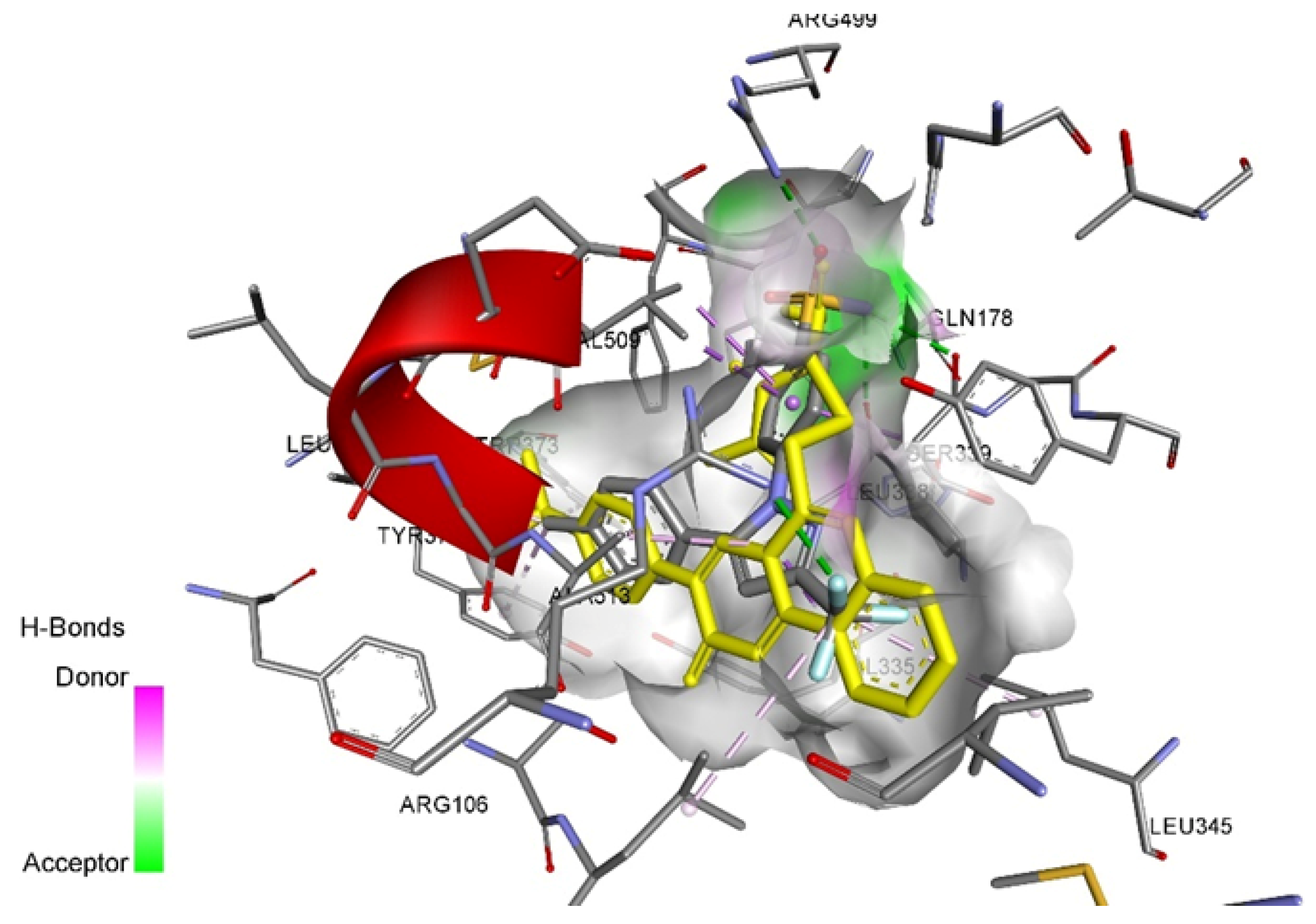
An interaction with this amino acid via a Pi-Sulfur bond was predicted for all other studied ligands (Figure 4b). The formation of the additional Pi-Sulfur bond with Phe504 indicates the relevance of bioisosteric interactions. At the same time, the formation of such a bond is impossible for compound MTB, for which anti-inflammatory activity has been proven experimentally (Figure 4c). The compound forms a complex with the active site of the enzyme via a hydrogen bond. Amino acids phenylalanine (Phe504) and methionine (MET508) are not experimentally identified as part of the active site; hence, their role in the manifestation of anti-inflammatory activity is not obvious. At the same time, the interaction between the methylpropionic acid fragment and glutamine (Gln178) via a hydrogen bond supports the possibility of forming a stable ligand-enzyme complex. Analysis of amino acid interactions reveals the possibility of forming hydrophobic interactions with non-polar amino acid moieties such as valine (Val509, Val335), alanine (Ala513), and leucine (Leu338), which are essential for the formation of stable complexes and the manifestation of the anti-inflammatory activity of coxibs [47]. Additionally, there are hydrogen bonds characteristic of celecoxib with glutamine (Gln178). Visualization of the joint conformations of compound 3.2 and celecoxib (the most stable complexes) (Figure 5) reveals a significant similarity in their spatial arrangement within the active site of the enzyme. The obtained data further support the localization of the ligand in the hydrophobic pocket of the COX-2 active site.
2.2. Chemistry
6-(Chloro(R2)methyl)-3-R1-2H-[1,2,4]triazino [2,3-c]quinazolin-2-ones [48] (1.1-1.5) were used as initial compounds for the synthesis of bioisosteric analogues 2 and 3. Target products 2.1-2.9 were obtained by reacting compounds 1.1-1.5 with corresponding thiol-containing carboxylic acids and their functional derivatives (2-mercaptoacetic acid, 2-mercaptopropionic acid, ethyl 2-mercaptoacetate, N-acetylcysteine) in propanol-2 in the presence of sodium hydroxide.
The structure and purity of synthesized compounds 2.1-2.9, 3.1 and 3.2 were confirmed using 1H NMR and HPLC-MS spectra. The signal of molecular ions with m/z values that correspond to the molecular mass of synthesized compounds were observed in their HPLC-MS spectra.
In the 1H NMR spectra of compounds 2 and 3, the protons of the triazine ring are registered as an ABCD system consisting of two doublet (H-8 at 7.88-7.82 ppm, H-11 at 8.64-8.57 ppm) and two triplet (H-9 at 8.05-7.92 ppm and H-10 at 7.80-7.64 ppm) [36]. Besides, in 1H NMR spectra of compounds 2 and 3 have been registered signals of protons of substituents in 6th position that have multiplicities and chemical shifts that correspond to chemical surrounding. Thus, methylene protons of -СН2SCH2СООН fragment in molecules of compounds 2.1, 2.7-2.9 have been registered as two-proton singlets at the 4.42-4.34 ppm and 3.48-3.40 ppm correspondingly. At that time the presence of methyl group at α- (2.5, 2.6) or γ- (2.2-2.4) position of abovementioned fragment results the significant changes in spectral pattern due to additional splitting caused by effect of asymmetric carbon atom. Thus in 1H NMR-spectra of compounds 2.2-2.4 signals of -СН2SСН(СН3)-group protons have been registered as two-proton singlet or doublet of doublets at the 4.42-4.35 ppm, quadruplet or multiplets at the 3.61-3.35 ppm and doublets at the 1.42-1.36 ppm correspondingly. Spectral patterns of compounds 2.5 and 2.6 are characterized by the signals of СН(СН3)SСН2-group`s protons that were registered in reverse sequence, namely quadruplet at the 5.13-5.04 ppm, doublet of doublets or multiplets at the 3.45-3.22 ppm and doublets at the 1.85-1.77 ppm correspondingly. Signals of -СН2SCH2CH(NHAc)-fragment in 1H NMR spectra of compounds 3.1 and 3.2 are specifically split due to the presence of chiral center. Signal of protons in abovementioned fragment have been registered as doublet. The protons of -СОOH-groups of compounds 2.1-2.3 and 3.2 were registered as singlet at 13.55-11.45 ppm, respectively. In other compounds of this class, the proton carboxylic group have not been observed due to the H/D exchange. 1H NMR spectra of esters 2.7-2.9 are characterized by the signals of an ethoxy-group (quadruplet at 3.95-3.93 ppm and triplet at 1.16-1.14 ppm). The signals that correspond to the substituents in position 3 of heterocyclic system have been observed with appropriate chemical shifts and multiplicities [49].
2.3. Pharmacology
The toxicity prediction has been conducted for synthesized compounds at the initial stage of biological activity screening. This procedure allowed to select substances for the further studies and estimate the experimental dosage for in vivo studies. It has been found that obtained compounds belong to the III-VI class of toxicity and have low predicted side effects (Hepatotoxicity, Carcinogenicity, Immunotoxicity, Mutagenicity and Cytotoxicity). As it shown in Table 2 synthesized compounds are characterized by more auspicious toxicity parameters than reference compound Diclofenac Sodium.
Considering the satisfactory levels of predicted toxicity and molecular docking results, three compounds were selected for in vivo studies. Compounds 2.5 and 2.3 were chosen due to their high predicted affinity to the key molecular targets COX-1 and COX-2. Compound 3.2, with a low predicted affinity value, was also selected for in vivo study to evaluate the possible effect of the binding of the ligand with the phenylalanine (PHE504) moiety on the anti-inflammatory activity of the studied compounds.
Considering the satisfactory levels of predicted toxicity and molecular docking results, three compounds were selected for in vivo studies. Compounds 2.5 and 2.3 were chosen due to their high predicted affinity to the key molecular targets COX-1 and COX-2. Compound 3.2, with a low predicted affinity value, was also selected for in vivo study to evaluate the possible effect of the binding of the ligand with the phenylalanine (PHE504) moiety on the anti-inflammatory activity of the studied compounds. It should be noted that all synthesized compounds, except 2.3, form a Pi-Sulfur interaction with the phenylalanine (PHE504) moiety, which necessitated the study of its impact on the level of pharmacological activity. Additionally, we included compound MTB in the study to verify the reasonableness of using bioisosteric replacement to search for biologically active molecules among the studied series. It was revealed that the studied compounds inhibited the development of the acute phase of inflammation to varying degrees (Table 3). Thus, compound MTB inhibited carrageenan-induced paw edema in rats by 45.77%. At the same time, the product of bioisosteric replacement, 2.3, with a methylthiopropionate fragment in the 6th position of the triazinoquinazoline system, inhibited inflammation by only 3.61%. The replacement of the methylthiopropionate fragment with ethylthioacetate (compound 2.5) resulted in significant anti-inflammatory activity (AA = 53.41%), which is comparable to the effect of the reference drug sodium diclofenac. The introduction of the methylenecysteine fragment was also interesting from the standpoint of improving biological activity (3.2) (Table 3). Thus, N-acetyl-S-((3-(4-i-propylphenyl)-2-oxo-2H-[1,2,4]triazino [2,3-c]quinazolin-6-yl)methyl)сysteine (3.2) inhibited the development of paw edema by 51.81% compared with the control group. It should be mentioned that the results of the anti-inflammatory activity study agree with the molecular docking data. Compound 2.3, with low predicted activity towards COX-1 (-4.9 kcal/mol) and COX-2 (-8.7 kcal/mol), shows low anti-inflammatory activity. At the same time, compounds MTB, 2.5, and 3.2, with high predicted affinity towards COX-2, demonstrate high pharmacological effects. Therefore, novel substituted [1,2,4]triazino [2,3-c]quinazolinalkylthiocarboxylic acids are promising candidates for further studies aimed at the creation of innovative drugs with anti-inflammatory activity.
Further the effects of the most active anti-inflammatory agents, 2.5 and 3.2, on the level of biochemical markers under conditions of exudative inflammation were studied. Injection of carrageenan into a rat paw led to the development of a typical inflammatory process cascade (Table 4). These processes resulted in an increase in C-reactive protein levels by 6.45 times. C-reactive protein, as a mediator of the acute phase of inflammation, activates the production of cytokines, including interleukin IL-1β, the level of which increased 11.5 times compared to the control group. Additionally, C-reactive protein binds with phospholipids formed as a result of damaged cells, which activates the complement system and subsequent phagocytosis. IL-1β initiates intracellular signal cascades of apoptosis, activates the expression of iNOS, and starts the formation of toxic NO-metabolites. These, in turn, enhance nitrosative oxidative stress, initiate intracellular signaling pathways, and promote the expression of pro-inflammatory genes responsible for the synthesis of COX-2 and lipophosphoglycans (LPG). This triggers mechanisms of endothelial dysfunction and apoptosis. Inflammation resulted in an increase in the iNOS level by 9.45 times, leading to subsequent increases in nitrotyrosine and COX-2 levels by 8.37 and 19.29 times, respectively. Also, an increase in VEGF levels by 4.61 times was observed in the blood of animals. VEGF is expressed by IL-1 and COX-2, and its overexpression represents neovascularization in cases of inflammation with a clearly defined inflammatory phase.
The treatment of the studied animals with compounds 2.5 and 3.2 led to the inhibition of inflammatory processes (Table 3). It has been shown that the studied compounds, along with reducing paw edema, significantly decrease the levels of specific markers that characterize the inflammatory process (COX-2, IL-1β, C-reactive protein), as well as markers of oxidative stress (iNOS, nitrotyrosine) and angiogenesis (VEGF). The most active compound, 2.5, significantly decreased COX-2 expression by 82.5%, IL-1β by 89.5%, and C-reactive protein by 77.1%, confirming its anti-inflammatory properties. Additionally, compound 2.5 inhibited the overexpression of VEGF by 62.3%, iNOS by 45.6%, and nitrotyrosine by 70.3%. It should be noted that the effects of compound 2.5 on the levels of iNOS and nitrotyrosine exceed those of the reference compound, sodium diclofenac. This finding suggests that compound 2.5 has a significant effect on NO-dependent mechanisms involved in the cascade of inflammation development. This is particularly interesting due to the resistance of these mechanisms to pharmacotherapy [50] According to some reports [51], NO-associated mechanisms are central to the development of inflammation and apoptosis [52]. Thus, it has been ascertained that the anti-inflammatory activity of the studied compounds is apparently associated with the disruption of NO-dependent mechanisms, such as the nitrosylation of glutathione and the reduction of glutathione peroxidase activity. The latter controls the synthesis of pro-oxidant metabolites of arachidonic acid, inhibits lipoperoxidation in the cyclooxygenase pathway, and increases COX-2 expression under the action of iNOS [53,54,55]. All of the aforementioned facts support the potential for further study of these compounds.
2.4. ADME Prediction
The criteria for “drug-likeness” are crucial in the process of discovering new medicinal agents, providing valuable recommendations in the early stages of drug discovery and increasing the chances of success in clinical trials. These characteristics influence pharmacokinetics (absorption, distribution, metabolism, and excretion) and, consequently, the pharmacological activity and efficacy of the investigated medicinal agents. The “drug-likeness” criteria for the compounds 2.5, 3.2, and MTB are presented in Table 5.
Compound 2.3, as well as MTB, complies with the drug-likeness criteria: MW (Da) (< 500), n-HBA (< 10), n-HBD (≤ 5), TPSA (< 140 Ų), and logP (≤ 5). The satisfactory value of TPSA (> 140 Ų) for compound 2.5 correlates well with passive molecular transport through membranes. Compound 2.5 has a high ability to pass through the blood–brain barrier and flexibly interact with molecular targets. The studied compound reveals high predicted bioavailability (0.56). Moreover, compound 2.5, unlike compound 3.2, passes all commonly used filters (Lipinski, Veber, Muegge, Ghose, Egan). Additionally, compound 2.5 is lead-like and suitable for further modification.
3. Materials and Methods
3.1. Chemistry
Melting points were determined in open capillary tubes in a «Mettler Toledo МР 50» apparatus and were uncorrected. The elemental analyses (C, H, N) were performed using the ELEMENTAR vario EL cube analyzer (USA). Analyses were indicated by symbols of the elements or functions within ±0.3% of the theoretical values. 1H NMR spectra (500 MHz) were recorded on a Varian-Mercury 500 (Varian Inc., Palo Alto, CA, USA) spectrometers with TMS as internal standard in DMSO-d6 solution. LC-MS were recorded using chromatography/mass spectrometric system which consists of high-performance liquid chromatography «Agilent 1100 Series» (Agilent, Palo Alto, CA, USA) equipped with diode-matrix and mass-selective detector «Agilent LC/MSD SL» (atmospheric pressure chemical ionization – APCI). The purity of all obtained compounds was checked by 1H-NMR and LC-MS.
General procedure for the synthesis of 2-[((3-R-2-oxo-2H-[1,2,4]triazino [2,3-c]quinazolin-6-yl)methyl)thio]carboxylic acid (2.1-2.6).
25 mM of the corresponding mercaptocarboxylic acid is placed in a round bottom flask, 5 ml of 1 M sodium hydroxide solution (50 mM) and 25 ml of propanol-2 are added, stirred and left for 2 minutes. 25 mM of the starting substance (1.1-1.4) is added to the prepared solution and reflux for 2 hours. The reaction mixture is cooled, acidified with 1M hydrochloric acid to pH 4, the precipitate was filtered of and dried.
2-(((2-oxo-3-phenyl-2H-[1,2,4]triazino [2,3-c]quinazolin-6-yl)methyl)thio)acetic acid (2.1).
Yield: 74%; M.p. 227-229oC; 1H NMR (500 MHz, DMSO-d6) δ 11.45 (s, 1H, COOH), 8.63 (d, J = 7.8 Hz, 1H, H-11), 8.33 (d, J = 6.8 Hz, 2H, 3 Ar H-2,6), 7.97 (t, J = 7.6 Hz, 1H, H-9), 7.87 (d, J = 7.9 Hz, 1H, H-8), 7.74 (t, J = 7.5 Hz, 1H, H-10), 7.64 – 7.49 (m, 3H, 3 Ar H-3,4,5), 4.37 (s, 2H, -CH2S-), 3.40 (s, 2H, -SCH2-); LC-MS (m/z) = 379 (M+H); Calculated for C19H14N4O3S: C, 60.31; H, 3.73; N, 14.81; S, 8.47; Found: C, 60.35; H, 3.75; N, 14.83; S, 8.45.
2-(((2-oxo-3-phenyl-2H-[1,2,4]triazino [2,3-c]quinazolin-6-yl)methyl)thio)propanoic acid (2.2).
Yield: 54%; M.p. 222-224 oC; 1H NMR (500 MHz, DMSO-d6) δ 12.53 (s, 1H, COOH), 8.63 (d, J = 7.4 Hz, 1H, H-11), 8.33 (d, J = 6.8 Hz, 2H, 3 Ar H-2,6), 8.05 – 7.93 (m, 1H, H-9), 7.87 (d, J = 8.0 Hz, 1H, H-8), 7.74 (t, J = 7.5 Hz, 1H, H-10), 7.63 – 7.45 (m, 3H, , 3 Ar H-3,4,5), 4.42 (s, 2H, -CH2S-), 3.61 (q, J = 7.1 Hz, 1H, -SCH(CH3)-), 1.42 (d, J = 7.2 Hz, 3H, -SCH(CH3)-); LC-MS (m/z) = 393 (M+H); Calculated for C20H16N4O3S: C, 61.21; H, 4.11; N, 14.28; S, 8.17; Found: C, 61.20; H, 4.07; N, 14.31; S, 8.21
2-(((3-(4-i-Propylphenyl)-2-oxo-2H-[1,2,4]triazino [2,3-c]quinazolin-6-yl)methyl)thio)propanoic acid (2.3).
Yield: 49%; M.p. 206-207 oC; 1H NMR (500 MHz, DMSO-d6) δ 12.37 (s, 1H, COOH), 8.59 (d, J = 8.0 Hz, 1H, H-11), 8.25 (d, J = 8.3 Hz, 2H, 3-Ar H-2,6), 7.94 (t, J = 8.2 Hz, 1H, H-9), 7.84 (d, J = 8.0 Hz, 1H, H-8), 7.70 (t, J = 7.6 Hz, 1H, H-10), 7.35 (d, J = 8.3 Hz, 2H, 3-Ar H-3,5), 4.38 (s, 2H, -CH2S-), 3.58 (q, J = 7.2 Hz, 1H, -SCH(CH3)-), 2.99 (dt, J = 13.7, 6.8 Hz, 1H, -CH(CH3)2), 1.40 (d, J = 7.2 Hz, 3H, -SCH(CH3)-), 1.29 (d, J = 6.9 Hz, 6H, -CH(CH3)2).; LC-MS (m/z) = 435 (M+H); Calculated for C23H22N4O3S: C, 63.58; H, 5.10; N, 12.89; S, 7.38; Found: C, 63.62; H, 5.09; N, 12.93; S, 7.35.
2-(((3-(4-Fluorophenyl)-2-oxo-2H-[1,2,4]triazino [2,3-c]quinazolin-6-yl)methyl)thio)propanoic acid (2.4).
Yield: 50%; M.p. 235-236 oC; 1H NMR (500 MHz, DMSO-d6) δ 8.61 (d, J = 8.1 Hz, 1H, H-11), 8.45 (dd, J = 8.3, 5.9 Hz, 2H, 3-Ar H-2,6), 8.01 – 7.92 (m, 1H, H-9), 7.88 (d, J = 8.3 Hz, 1H, H-8), 7.79 – 7.64 (m, 1H, H-10), 7.27 (t, J = 8.7 Hz, 2H, 3-Ar H-3,5), 4.35 (dd, J = 58.9, 13.9 Hz, 2H, -CH2S-), 3.51 – 3.35 (m, 1H, -SCH(CH3)-), 1.36 (d, J = 7.1 Hz, 3H, -SCH(CH3)-. LC-MS (m/z) = 411 (M+H); Calculated for C20H15FN4O3S: C, 58.53; H, 3.68; N, 13.65; S, 7.81 Found: C, 58.55; H, 3.71; N, 13.67; S, 7.83.
2-((1-(3-Methyl-2-oxo-2H-[1,2,4]triazino [2,3-c]quinazolin-6-yl)ethyl)thio)acetic acid (2.5).
Yield: 71%; M.p. 260-262 oC; 1H NMR (500 MHz, DMSO-d6) δ 8.57 (d, J = 8.1 Hz, 1H, H-11), 7.92 (t, J = 7.6 Hz, 1H, H-9), 7.82 (d, J = 8.1 Hz, 1H, H-8), 7.68 (t, J = 8.0 Hz, 1H, H-10), 5.04 (q, J = 6.8 Hz, 1H, -CH(CH3)S-), 3.30 (dd, J = 42.1, 15.7 Hz, 2H, -SCH2-), 2.43 (s, 3H, -CH3), 1.77 (d, J = 7.0 Hz, 3H, -CH(CH3)S-); LC-MS (m/z) = 331 (M+H); Calculated for C15H14N4O3S: C, 54.54; H, 4.27; N, 16.96; S, 9.70; Found: C, 54.57; H, 4.29; N, 17.01; S, 9.72.
2-((1-(2-oxo-3-phenyl-2H-[1,2,4]triazino [2,3-c]quinazolin-6-yl)ethyl)thio)acetic acid (2.6).
Yield: 45%; M.p. 213-215 oC; 1H NMR (500 MHz, DMSO-d6) δ 8.62 (d, J = 7.3 Hz, 1H, H-11), 8.34 (d, J = 6.6 Hz, 2H, 3 Ar H-2,6), 7.97 (t, J = 7.1 Hz, 1H, H-9), 7.87 (d, J = 8.0 Hz, 1H, H-8), 7.73 (t, J = 7.2 Hz, 1H, H-10), 7.55 (t, J = 7.5 Hz, 3H, 3 Ar H-3,4,5), 5.13 (q, J = 6.1 Hz, 1H, -CH(CH3)S-), 3.45 – 3.22 (m, 2H, -SCH2-), 1.85 (d, J = 6.9 Hz, 3H, -CH(CH3)S-); LC-MS (m/z) = 393 (M+H); Calculated for C20H16N4O3S: C, 61.21; H, 4.11; N, 14.28; S, 8.17; Found: C, 61.20; H, 4.15; N, 14.31; S, 8.20.
General procedure for the synthesis of 2-[((3-R-2-oxo-2H-[1,2,4]triazino [2,3-c]quinazolin-6-yl)methyl)thio]acetates (2.7-2.9).
0,3 g (25 mM) ethyl mercaptoacetate is placed in a round bottom flask, 2,5 ml of 1 M sodium hydroxide solution (25 mM) and 20 ml of propanol-2, stirred and left for 2 minutes. Add 25 mM of the starting substances (1.2-1.4) to the prepared solution and was refluxed 2 hours. Cool the reaction mass. The precipitate that was formed was filtered of and dried.
Ethyl 2-(((2-oxo-3-phenyl-2H-[1,2,4]triazino [2,3-c]quinazolin-6-yl)methyl)thio)acetate (2.7).
Yield: 65%; M.p. 220-222 °C; 1H NMR (500 MHz, DMSO-d6) δ 8.64 (d, J = 7.2 Hz, 1H, H-11), 8.32 (d, J = 6.7 Hz, 2H, 3 Ar H-2,6), 7.97 (t, 1H, H-9), 7.85 (d, J = 7.9 Hz, 1H, H-8), 7.75 (t, J = 7.5 Hz, 1H, H-10), 7.63 – 7.38 (m, 3H, 3 Ar H-3,4,5), 4.37 (s, 2H, -CH2S ), 3.95 (q, J = 7.1 Hz, 2H, -OCH2CH3), 3.48 (s, 2H, -SCH2--), 1.16 (t, J = 7.1 Hz, 3H, -OCH2CH3) ; LC-MS (m/z) = 407; Calculated for C21H18N4O3S: C, 62.06; H, 4.46; N, 13.78; S, 7.89; Found: C, 62.08; H, 4.49; N, 13.81; S, 7.90.
Ethyl 2-(((3-(4-i-propylphenyl)-2-oxo-2H-[1,2,4]triazino [2,3-c]quinazolin-6-yl)methyl)thio)acetate (2.8).
Yield: 62%; M.p. 150-151 °C; 1H NMR (500 MHz, DMSO-d6) δ 8.61 (d, J = 7.9 Hz, 1H, H-11 Hz), 8.24 (d, J = 8.2 Hz, 2H, 3-Ar H-2,6), 7.94 (t, J = 7.6 Hz, 1H, H-9), 7.82 (d, J = 8.1 Hz, 1H, H-8), 7.72 (t, J = 7.3 Hz, 1H, H-10), 7.35 (d, J = 8.2 Hz, 2H, 3-Ar H-3,5), 4.34 (s, 2H, -CH2S-), 3.93 (q, J = 7.1 Hz, 2H, -OCH2CH3), 3.45 (s, 2H, -SCH2-), 3.01 – 2.93 (m, 1H, -CH(CH3)2), 1.30 (d, J = 6.8 Hz, 6H, -CH(CH3)2), 1.16 (t, J = 7.1 Hz, 3H, -OCH2CH3); LC-MS (m/z) = 449 (M+H); Calculated for C24H24N4O3S: C, 64.27; H, 5.39; N, 12.49; S, 7.15; Found: C, 64.24; H, 5.38; N, 12.54; S, 7.14.
Ethyl 2-(((3-(4-fluorophenyl)-2-oxo-2H-[1,2,4]triazino [2,3-c]quinazolin-6-yl)methyl)thio)acetate (2.9).
Yield: 90%; M.p. 149-151 °C; 1H NMR (500 MHz, DMSO-d6) δ 8.62 (d, J = 8.0 Hz, 1H, H-11), 8.42 (dd, J = 8.6, 5.7 Hz, 2H, 3-Ar H-2,6), 7.95 (t, J = 7.6 Hz, 1H, H-9), 7.83 (d, J = 8.1 Hz, 1H, H-8), 7.73 (t, J = 7.6 Hz, 1H, H-10), 7.25 (t, J = 8.7 Hz, 2H, 3-Ar H-3,5), 4.35 (s, 2H, -CH2S-), 3.92 (q, J = 7.1 Hz, 2H, -OCH2CH3), 3.45 (s, 2H, -SCH2-), 1.14 (t, J = 7.1 Hz, 3H, -OCH2CH3); LC-MS (m/z) = 425 (M+H); Calculated for C21H17FN4O3S: C, 59.43; H, 4.04; N, 13.20; S, 7.55; Found: C, 59.45; H, 4.05; N, 13.25; S, 7.57.
General procedure for the synthesis of N-acetyl-S-((2-oxo-3-R-2H-[1,2,4]triazino [2,3-c]quinazolin-6-yl)methyl)cysteines (3.1, 3.2).
0.408 g (25 mM) of acetylcysteine is placed in a round bottom flask, 5 ml of 1 M sodium hydroxide solution (50 mM) and 20 mL of propanol-2, stirred and left for 2 minutes. Add 25 mM of the corresponding starting substances (1.2-1.4) to the prepared solution and was refluxed 2 hours. The reaction mixture is cooled, acidified with 1M hydrochloric acid to pH 4, the precipitate formed is filtered off, washed with water and alcohol and dried.
N-acetyl-S-((2-oxo-3-phenyl-2H-[1,2,4]triazino [2,3-c]quinazolin-6-yl)methyl)cysteine (3.1).
Yield: 72%; M.p. 238-239 oC; 1H NMR (500 MHz, DMSO-d6) δ 8.60 (d, J = 7.9 Hz, 1H, H-11), 8.31 (d, J = 7.8 Hz, 2H, 3-Ar H-2,6), 8.03 – 7.92 (m, 1H, H-9), 7.88 (s, 1H, -NHAc), 7.80 – 7.65 (m, 1H, H-10), 7.61 – 7.43 (m, 3H, 3-Ar H-3,4,5), 7.27 (d, J = 6.9 Hz, 1H, H8), 4.24 (s, 2H, -CH2S-), 4.16 – 4.00 (m, 1H, -SCH2CH(NHAc)-), 3.26 – 2.91 (m, 2H, -SCH2CH(NHAc)-), 1.77 (s, 3H, -COCH3). LC-MS (m/z) = 450; Calculated for C22H19N5O4S: C, 58.79; H, 4.26; N, 15.58; S, 7.13; Found: C, 58.82; H, 4.27; N, 15.63; S, 7.15.
N-acetyl-S-((3-(4-i-propylphenyl)-2-oxo-2H-[1,2,4]triazino [2,3-c]quinazolin-6-yl)methyl)–cysteine (3.2).
Yield: 89%; M.p. 190-191 oC; 1H NMR (500 MHz, DMSO-d6) δ 13.55 (s, 1H, COOH), 8.57 (d, J = 8.0 Hz, 1H, H-11), 8.24 (d, J = 8.2 Hz, 2H, 3-Ar H-2,6), 7.91 (t, J = 7.4 Hz, 1H, H-9), 7.86 (d, J = 7.9 Hz, 1H, H-8), 7.68 (t, J = 7.5 Hz, 1H, H-10), 7.55 (d, J = 7.1 Hz, 1H, -NHAc), 7.35 (d, J = 8.2 Hz, 2H, 3-Ar H-3, 5), 4.37 – 4.05 (m, 3H, -СН2SCH2CH(NHAc)-), 3.16 – 3.06 (m, 2H, -SCH2CH(NHAc)-), 3.04 – 2.86 (m, 1H, -CH(CH3)2), 1.78 (s, 3H, -COCH3), 1.29 (d, J = 6.9 Hz, 6H, -CH(CH3)2); LC-MS (m/z) = 492; Calculated for C25H25N5O4S: C, 61.09; H, 5.13; N, 14.25; S, 6.52; Found: C, 61.07; H, 5.10; N, 14.27; S, 6.50.
3.2. Pharmacological/Biological Assays
3.2.1. Anti-Inflammatory Studies
Animals. Adult Wistar white rats (weighing 150-160 g) were attained from the animal house facility of the «Institute of Pharmacology and Toxicology of Ukraine» (Kyiv) and were handled under controlled temperature (25°C ± 3°C), humidity (50–60%) and illumination (12 h light and 12 h dark cycles, lights on at 08:00) conditions. Before starting the experiment, the rats were given water ad libitum and standard pellet diet for 1 week. All experimental procedures and treatment were carried out according to the European Convention and «Regulations on the use of animals in biomedical research» [56].
Anti-inflammatory activity. Screening of synthesized compounds with estimated anti-inflammatory activity began with the study of their effect on exudative phase of acute aseptic inflammation («carrageenan» test). Phlogogen (1% aqueous solution of carrageenan (Sigma, USA)) was subplantally injected in a dose of 0.1 ml in the rats’ back right paw [57]. The left one was used as a control. Intragastric administration of studied compounds was conducted using atraumatic probe as water solution or finely dispersed suspension stabilized by Tween - 80 in a dose of 25 mg/kg 1 hour before the injection of phlogogen. The reference drug «Diclofenac sodium» was administered intragastrically in a recommended dose of 8 mg/kg for pre-clinical studies. Measurement of paws volume was conducted before the experiment and in 3 hours after injection of phlogogen using the described methods. The activity of these substances was determined by their ability to reduce the swelling compared with control group and was expressed in percentage. Using a water displacement plethysmometer (Ugo Basile, Comerio, Italy) paw volume was measured. It showed how the substance inhibited carrageenane swelling in relation to control swelling where the value was taken as 100%. The activity of the studied compounds was calculated as following (1):
A=100%-((Vse-Vhe)/(Vsc-Vhc)*100%),
where A - antiexudative activity, %; Vse - the volume of swollen paw in the experiment; Vhe - the volume of healthy paw in the experiment; Vsc - the volume of swollen paw in control; Vhc - the volume of healthy paw in control.
3.2.2. Study of Molecular Markers of Inflammation
At the end of the experiment, 3 hours after the last dose of treatment, blood samples were collected from the tail vein with a special syringe with a heparinized needle. Blood samples were centrifuged for 15 min at 2500 rpm, “sa53q 11” was used to determine the level of C-reactive protein, intelleukin-1b (IL-1β), inducible NO-synthase (iNOS), cyclooxygenase-2 (COX-2), vasculoendothelial growth factor (VEGF) and nitrotyrosine. Content of С-reactive protein has been evaluated by solid-phase immunosorbent sandwich method ELISA, ELISA Kit Biomerica (ReF:7033,Lot 2349) and expressed in ng/l. Interleukin-1b (IL-1b) has been evaluated by solid-phase immunosorbent sandwich method ELISA, ELISA Kit Bioscience (ReF: BMS224 HS, Lot 105505000) and expressed in pg/ml. Inducible NO-synthase (iNOS) has been evaluated by solid-phase immunosorbent sandwich method ELISA, (Elabscience) - enzyme immunoassay (analyzer Immunochem-2200, USA ELISA Kit (E-EL-R0520) and expressed in pg/ml. Cyclooxygenase-2 (COX2) has been evaluated by solid-phase immunosorbent sandwich method ELISA, (Cloud-Clone Corporation) - enzyme immunoassay (analyzer – Immunochem-2200, США) ELISA Kit (SEA699Ra) and expressed in pg/ml. Nitrotyrosine - has been evaluated by solid phase enzyme immunoassay (ELISA) on full-plate enzyme immunoassay analyzer (SIRIO S, Italy) with application of test kit «Nitrotirosine ELISA Kit»(«HyCult biotechnology» ELISA Kit HK501-02) and expressed in nM/ml. Vascular endothelial growth factor - has been evaluated by solid phase enzyme immunoassay (ELISA) on full-plate enzyme immunoassay analyzer (SIRIO S, Italy) with application of test kit Rat VEGF ELISA Kit is a sandwich (quantitative) ELISA abcam № ab 100738 and expressed in pg/ml. Statistical data processing was performed using a license program «STATISTICA® forWindows 6.0» (StatSoftInc., № AXXR712D833214FAN5) and «SPSS 16.0», «Microsoft Office Excel 2003». The results were presented as mean ± standard error of the mean. Arithmetic mean and standard error of the mean were calculated for each of the studied parameters. During verification of statistical hypothesis, null hypothesis was declined if statistical criterion was p<0.05 [58].
4.3. Molecular Docking
Research was conducted by flexible molecular docking, as an approach of finding molecules with affinity to a specific biological target. Macromolecules from Protein Data Bank (PDB) were used as biological targets, namely COX-1 enzyme in complex with diclofenac (PDB ID - 3N8Y) [46] and COX-2 enzyme in complex with celecoxib (PDB ID – 3LN1) [47]. The software used and the molecular docking parameters are described earlier. Validation of the native ligand docking methodology, calculation of RMSD between reference and native conformations of diclofenac and celecoxib, respectively, also described previously [32].
4.4. Toxicity Prediction
The ProTox-II site (https://tox-new.charite.de/protox_II/index.php?site=compound_input) was used to pre-dict the toxicity criteria of molecules [59]. It incorporates molecular similarity, fragment propensities and machine-learning, based on a total of 33 models for the prediction of various toxicity endpoints such as acute toxicity, hepatotoxicity, cytotoxicity, carcinogenicity, mutagenicity, immunotoxicity, adverse outcomes (Tox21) pathways and toxicity targets.
4.5. SwissADME Prediction
The SwissADME site was used to calculate physicochemical descriptors, as well as to predict ADME parameters, pharmacokinetic properties, and drug similarity. The basic approaches and basic methodology of SwissADME, as a free web-based tool for evaluating pharmacokinetics and drug-likeness, are described in recent publications [60,61,62].
4. Conclusions
Bioisosteric replacement of carbon by sulfur proved to be an efficient approach for the purposeful search of anti-inflammatory agents among carboxyl-containing [1,2,4]triazino [2,3-c]quinazolines. 2-[((3-R-2-oxo-2H-[1,2,4]triazino [2,3-c]quinazolin-6-yl)methyl)thio]alkylcarboxylic acids, designed according to the abovementioned approach, are available through the interaction of 6-(chloro(R2)methyl)-3-R1-2H-[1,2,4]triazino [2,3-i]quinazolin-2-ones with mercaptocarboxylic acids. Molecular docking studies revealed the role of the introduced sulfur atom in the formation of binding between the ligand and the biomolecular target complex. According to the obtained results, the sulfur-containing compounds form an additional Pi-Sulfur interaction which, as we consider, enhances their anti-inflammatory properties. According to in vivo studies, compounds 2.5 and 3.2 reveal anti-inflammatory activity comparable with the pharmacological effect of the reference compound sodium diclofenac. Additionally, the studied compounds significantly modify the content of inflammation markers and mediators in the serum of experimental animals. The established inhibition of COX-2 expression by the obtained com-pounds agrees with the results of docking studies, which additionally supports COX-2 inhibition as a probable mechanism of their anti-inflammatory activity. Compound 2.5 has been identified as lead-like and suitable for further modification aimed at the crea-tion of innovative anti-inflammatory agents.
Author Contributions
Conceptualization, K.S. and O.V.; methodology, K.S. and O.V.; software, H.S. and V.R.; validation, O.G., K.S. and O.V..; formal analysis, O.G.; investigation, O.G.; resources, O.G., K.S. and O.V.; data curation, I.B. and S.K.; writing—original draft preparation, O.G.; writing—review and editing, O.V. and S.K.; visualization, H.S and V.R.; supervision, S.K. and I.B.; project administration, V.O. and O.K.; funding acquisition, V.O. and O.K. All authors have read and agreed to the published version of the manuscript.
Funding
This research received no external funding.
Informed Consent Statement
Not applicable.
Data Availability Statement
All the data generated during this research are included in the manuscript.
Conflicts of Interest
The authors declare no conflicts of interest.
References
- Drugbank; https://go.drugbank.com/unearth/q?searcher=drugs&query=quinazolines&button=.
- Alagarsamy, V.; Chitra, K.; Saravanan, G.; Solomon, V.R.; Sulthana, M.T.; Narendhar, B. An overview of quinazolines: Pharmacological significance and recent developments. Eur. J. Med. Chem. 2018, 151, 628-685. [CrossRef]
- Al-kaf, A. G. Quinazolinone and Quinazoline Derivatives, BoD – Books on Demand, 2020.
- Dash, B. A Review on Quinazolines Heterocycles: A Pharmacophoric Scaffold, Booksclinic Publishing, 2021.
- Karan, R.; Agarwal, P.; Sinha, M.; Mahato, N. Recent Advances on Quinazoline Derivatives: A Potential Bioactive Scaffold in Medicinal Chemistry. ChemEngineering 2021, 5, 73. [CrossRef]
- Gomaa, H. A. M. A comprehensive review of recent advances in the biological activities of quinazolines. Chem. Biol. Drug Des. 2022, 100, 5, 639-655. doi.:10.1111/cbdd.14129.
- Naman, J.; Tanvi, G.; Snehal, T.; Madhav, J.; Deepali, B. An Explicative Review on the Progress of Quinazoline Scaffold as Bioactive Agents in the Past Decade. Med. Chem. 2023, 19, 3, 211-245. [CrossRef]
- Kumar, D. Role of quinazoline in biological activity: a review. Eur. Chem. Bull. 2023, 12, 4, 281-307. [CrossRef]
- Al-Kaf, A. G. Recent Advances on Quinazoline, IntechOpen, 2024.
- Hui, Z.; Xiaoxia, H.; Yue, Z.; Chunlei, T.; Bainian, F. Progress in Synthesis and Bioactivity Evaluation of Pyrazoloquinazolines. Lett. Drug Des. Discov. 2020, 17, 2, 104-113. [CrossRef]
- Saleh, E.A.M.; AL Dawsari, A.M.; Husain, K.; Kutty, I.H.; Rai, K.M.L. Synthesis, Antibacterial, and Antioxidant Evaluation of Novel Series of Condensed Thiazoloquinazoline with Pyrido, Pyrano, and Benzol Moieties as Five- and Six-Membered Heterocycle Derivatives. Molecules 2021, 26, 357. [CrossRef]
- Ettahiri, W.; Salim, R.; Adardour, M.; Ech-chihbi, E.; Yunusa, I.; Alanazi, M.M.; Lahmidi, S.; Barnossi, A.E.; Merzouki, O.; Iraqi Housseini, A. Synthesis, Characterization, Antibacterial, Antifungal and Anticorrosion Activities of 1,2,4-Triazolo [1,5-a]quinazolinone. Molecules 2023, 28, 5340. [CrossRef]
- Kassem, A. F.; Alshehrei, F.; Abbas, E.M.H.; Farghaly, T. A. Synthesis of Azoloquinazolines and Substituted Benzothiazepine as Antimicrobial Agents. Mini-Rev. Med. Chem. 2023, 20, 5, 418-429. [CrossRef]
- Krasovska, N.I.; Koptieva, S. D.; Posudiievska, O. R.; Kyrylakha, S. V.; Vosokoboynik, O. Yu.; Okovytyy, S. I.; Kovalenko, S. I. Methods of synthesis of quinazolines and their condensed analogues – potential anti-inflammatory agents (review). J. Chem. Technol. 2023, 31, 2, 385-410. [CrossRef]
- Nosova, E. V.; Lipunova, G. N.; Permyakova, Y. V.; Charushin, V. N. Quinazolines annelated at the N(3)-C(4) bond: Synthesis and biological activity. Eur. J. Med. Chem. 2024, 271, 116411. [CrossRef]
- Mohammadkhani, L.; Heravi, M.M. Microwave-Assisted Synthesis of Quinazolines and Quinazolinones: An Overview. Front. Chem. 2020, 8, 80086. [CrossRef]
- Sharma, V.K.; Barde, A.; Rattan, S. A short review on synthetic strategies towards quinazoline based anticancer drug. Arkivoc, 2021, ix, 150-176. [CrossRef]
- Faisal, M.; Saeed, A. Chemical Insights Into the Synthetic Chemistry of Quinazolines: Recent Advances. Front. Chem. 2021, 8, 594717. [CrossRef]
- Kumar, P.; Tomar, V.; Joshi, R. K.; Nemiwal, M. Nanocatalyzed synthetic approach for quinazoline and quinazolinone derivatives: A review (2015–present). Synth. Commun. 2022, 52, 6, 795–826. [CrossRef]
- Tamatam, R.; Kim, S-H.; Shin, D. Transition-metal-catalyzed synthesis of quinazolines. Front. Chem. 2023, 11, 1140562. [CrossRef]
- Bansal, R.; Malhotra, A. Therapeutic progression of quinazolines as targeted chemotherapeutic agents. Eur. J. Med. Chem. 2021, 211, 113016. [CrossRef]
- Grover, P.; Bhardwaj, M.; Kapoor, G.; Mehta, L.; Ghai, R.; Nagarajan, K. Advances on Quinazoline Based Congeners for Anticancer Potential. Curr. Org. Chem. 2021, 25, 6, 695-723. [CrossRef]
- Dutta, A.; Sarma, D. Recent advances in the synthesis of Quinazoline analogues as Anti-TB agents. Tuberculosis, 2020, 124, 101986. [CrossRef]
- Cheke, R. S.; Shinde, S. D.; Ambhore, J. P.; Chaudhari, S. R.; Bari, S. B. Quinazoline: An update on current status against convulsions. J. Mol. Struct. 2022, 1248, 131384. [CrossRef]
- Abuelizz, H. A.; Al-Salahi, R. An overview of triazoloquinazolines: Pharmacological significance and recent developments. Bioorg. Chem. 2021, 115, 105263. [CrossRef]
- Luan, M-Z.; Zhang, X-F.; Yang, Y.; Meng, Q-G.; Hou, G-G. Anti-inflammatory activity of fluorine-substituted benzo[h]quinazoline-2-amine derivatives as NF-κB inhibitors. Bioorg. Chem. 2023, 132, 106360. [CrossRef]
- Crocetti, L.; Khlebnikov, A.I.; Guerrini, G.; Schepetkin, I.A.; Melani, F.; Giovannoni, M.P.; Quinn, M.T. Anti-Inflammatory Activity of Pyrazolo [1,5-a]quinazolines. Molecules 2024, 29, 2421. [CrossRef]
- Hussein, M. A. Synthesis, anti-inflammatory, and structure antioxidant activity relationship of novel 4-quinazoline. Med. Chem. Res. 2013, 22, 10, 4641–4653. [CrossRef]
- Balakumar, C.; Lamba, P.; Pran Kishore, D.; Lakshmi Narayana, B.; Venkat Rao, K.; Rajwinder, K.; Raghuram Rao, A.; Shireesha, B.; Narsaiah, B. Synthesis, anti-inflammatory evaluation and docking studies of some new fluorinated fused quinazolines. Eur. J. Med. Chem. 2010, 45, 11, 4904–4913. [CrossRef]
- Martynenko, Yu.; Antypenko, O.; Nosulenko, I.; Berest, G.; Kovalenko, S. Directed Search of Anti-inflammatory Agents Among (3HQuinazoline- 4-ylidene)hydrazides of N-protected Amino acids and their Heterocyclization Products. Anti-Inflammatory & Anti-Allergy Agents in Med. Chem. 2020, 19, 1, 60-71. [CrossRef]
- Krasovska, N.; Stavytskyi, V.; Nosulenko, I.; Karpenko, O.; Voskoboinik, O.; Kovalenko, S. Quinazoline-containing Hydrazydes of Dicarboxylic Acids and Products of Their Structural Modification – A Novel Class of Anti-inflammatory Agents. Acta Chim. Slov. 2021, 68, 2, 395-403. [CrossRef]
- Krasovska, N.; Berest, G.; Belenichev, I.; Severina, H.; Nosulenko, I.; Vosokoboinik, O.; Okovytyy, S.; Kovalenko, S. 5+1-Heterocyclization as preparative approach for carboxy-containing triazolo [1,5-c]quinazolines with anti-inflammatory activity. Eur. J. Med. Chem. 2024, 266, 116137. [CrossRef]
- Selvam, T.P.; Kumar, P.V. Synthesis of Novel 6,7,8,9-Tetrahydro-5H-5-hydroxyphenyl-2-benzylidine- 3-substituted Hydrazino Thiazolo (2,3-b) Quinazoline as Potent Antinociceptive and Anti-inflammatory Agents. Bull. Korean Chem. Soc. 2010, 31, 11, 3265-3271. [CrossRef]
- Zayed, M.F. Medicinal Chemistry of Quinazolines as Analgesic and Anti-Inflammatory Agents. ChemEngineering 2022, 6, 94. [CrossRef]
- Yakubovska, V.V.; Seredinska, N.М.; Voskoboynik, О.Y.; Stepanyuk, G.І.; Kovalenko, S.І. Purposeful search and characteristic of anti-inflammatory activity of sodium (3-R-2-oxo-2Н-[1,2,4]triazino [2,3-c]quinazolin-6-yl)alkylcarboxylates and their halogen containing analogues. Current issues in pharmacy and medicine: science and practice. 2016, 1, 60-66. [CrossRef]
- Kolomoets, O.; Voskoboynik, О.; Antypenko, O.; Berest, G.; Nosulenko, I.; Palchikov, V.; Karpenko, O.; Kovalenko, S. Design, Synthesis and Anti-inflammatory Activity of Derivatives 10-R-3-Aryl-6,7-dihydro-2H-[1,2,4] triazino [2,3-c]quinazolin-2-ones of Spiro-fused Cyclic Frameworks. Acta Chim. Slov. 2017, 64, 4, 902-910. [CrossRef]
- Stavytskyi, V.; Antypenko, O.; Nosulenko, I.; Berest, G.; Voskoboinik, O.; Kovalenko, S. Substituted 3-R-2,8-Dioxo-7,8-dihydro-2H-pyrrolo [1,2-a][1,2,4] triazino [2,3-c]quinazoline-5a(6H)carboxylic Acids and their Salts-a Promising Class of Anti-inflammatory Agents. Anti-Inflammatory & Anti-Allergy Agents in Med. Chem. 2021, 20, 1, 75-88. [CrossRef]
- Hryb, V.V.; Doroshenko, O.M.; Zaichko, N.V.; Stepaniuk, N.H. Comparative characteristics of the influence of the sodium salt of 4-(3-methyl-2-oxo-2H-[1,2,4]triazino [2,3-c]quinazolin-6-yl)butanoic acid and diclofenac on the dynamics of hematological parameters and safety in rats with adjuvant arthritis. Pharmacology and Drug Toxicology. 2015, 6, 46, 53–57.
- Hryb, V.V.; Vernyhorodskyi, S.V.; Stepaniuk, H.I. Comparative analysis of morphological changes in joints when using the sodium salt of 4-(3-methyl-2-oxo-2H-[1,2,4]triazino [2,3-c]quinazolin-6-yl)butanoic acid (compound DSK-38) and diclofenac sodium in the model of adjuvant arthritis. Reports of Morphology. 2015, 2, 340-343.
- Yakubovska, V.V. Effect of sodium salt of 4-(3-methyl-2-oxo-2H-[1,2,4]triazino [2,3-c]quinazolin-6-yl)butanoic acid (DSK-38) on proliferative, alterative phases of inflammation reactions and evaluation of the antipyretic effect in the experiment. Reports of Vinnytsia National Medical University. 2017, 1, 8–11.
- Krasovska, N.I.; Stavytskyi, V.V.; Kholodniak, O.V.; Antypenko, O.M.; Voskoboinik, О.Yu.; Kovalenko, S.I. Pyrrolo[1,2-a]azolo-(azino-)[c]quinazolines and their derivatives as 15-LOX inhibitors: Design, in vitro studies and QSAR-analysis. J. Res. Pharm. 2021, 25, 5, 1-9. [CrossRef]
- Lima, L.M.; Barreiro, E.J. Beyond Bioisosterism: New Concepts in Drug Discovery in Comprehensive Medicinal Chemistry III (Eds: Samuel Chackalamannil, David Rotella, Simon E. Ward), Elsevier, 2017.
- C. D. Gamarra-Sánchez, C. N. Rodriguez-Silva, A. Cordova-Muñoz, L. Asmad-Cruz, C. R. Silva-Correa, V.E. Villarreal-La Torre, In silico design of new ketorolac bioisosteres as anti-inflammatory agents. J. Appl. Pharm. Sci. 2024, 14, 04, 155-162. [CrossRef]
- Chandna, N.; Kumar, S.; Kaushik, P.; Kaushik, D.; Roy Somendu, K.; Girish, G.K.; Jachak Sanjay, M.; Kapoor Jitander, K.; Sharma Pawan, K. Synthesis of novel celecoxib analogues by bioisosteric replacement of sulfonamide as potent anti-inflammatory agents and cyclooxygenase inhibitors. Bioorg. Med. Chem. 2013, 21, 15, 4581-4590. [CrossRef]
- Ju, Z.; Li, M.; Xu, J.; Howell, D. C.; Li, Z.; Chen, F-E. Recent development on COX-2 inhibitors as promising anti-inflammatory agents: The past 10 years. Acta Pharm Sin B. 2022, 12, 6, 2790-2807. [CrossRef]
- Sidhu, R.S.; Lee, J.Y.; Yuan, C.; Smith, W.L. Comparison of Cyclooxygenase-1 Crystal Structures: Cross-Talk between Monomers Comprising Cyclooxygenase-1 Homodimers. Biochemistry. 2010, 49, 33, 7069-7079. [CrossRef]
- Wang, J.L.; Limburg, D.; Graneto, M.J.; Springer, J.; Hamper, J.R.; Liao, S.; Pawlitz, J.L.; Kurumbail, R.G.; Maziasz, T.; Talley, J.J. ;Kiefer, J.R.; Carter, J. The novel benzopyran class of selective cyclooxygenase-2 inhibitors. Part 2: The second clinical candidate having a shorter and favorable human half-life. Bioorg. Med. Chem. Lett. 2010, 1, 20, 23, 7159-63. [CrossRef]
- Grytsak, O.A.; Moskalenko, O.S.; Voskoboinik, O.Yu.; Kovalenko, S.I. Synthesis of 6-chloro(dichloro-, trichloro-)-methyl-3-R-6,7dihydro-2H-[1,2,4]triazino [2,3-c]quinazolin-2-ones and their modification in reactions with nucleophilic and non-nucleophilic bases. Vopr. Khimii Khimicheskoi Tekhnologii. 2021, 6, 3-10. [CrossRef]
- Breitmaier E. Structure elucidation by NMR in organic chemistry: a practical guide, third edition, Wiley, 2002.
- Suschek, C.V.; Schnorr, O.; Kolb-Bachofen, V. The role of iNOS in chronic inflammatory processes in vivo: is it damage-promoting, protective, or active at all? Curr Mol Med. 2004, 4, 7, 763-75. [CrossRef]
- Sugita, M.; Sugita, H.; Kim, M.; Mao, J.; Yasuda, Y.; Habiro, M.; Shinozaki, S.; Yasuhara, S.; Shimizu, N.; Martyn, J. A.; Kaneki, M. Inducible nitric oxide synthase deficiency ameliorates skeletal muscle insulin resistance but does not alter unexpected lower blood glucose levels after burn injury in C57BL/6 mice. Metabolism. 2012, 61, 1, 127-36. [CrossRef]
- Nakazawa, H.; Chang, K.; Shinozaki, S.; Yasukawa, T.; Ishimaru, K.; Yasuhara, S.; Yu, Y.; M Martyn, J. A.; Tompkins, R. G.; Shimokado, K.; Kaneki, M. iNOS as a Driver of Inflammation and Apoptosis in Mouse Skeletal Muscle after Burn Injury: Possible Involvement of Sirt1 S-Nitrosylation-Mediated Acetylation of p65 NF-κB and p53. PLoS One. 2017, 18, 12, 1, e0170391. [CrossRef]
- Belenichev, I.; Popazova, O.; Bukhtiyarova, N.; Savchenko, D.; Oksenych, V.; Kamyshnyi, O. Modulating Nitric Oxide: Implications for Cytotoxicity and Cytoprotection. Antioxidants 2024, 13, 504. [CrossRef]
- Kamyshna, I.I.; Pavlovych, L.B.; Maslyanko, V.A.; Kamyshnyi, A.M. Analysis of the transcriptional activity of genes of neuropeptides and their receptors in the blood of patients with thyroid pathology. J. Med. Life 2021, 14, 243–249. [CrossRef]
- Repchuk, Y.; Sydorchuk, L.P.; Sydorchuk, A.R.; Fedonyuk, L.Y.; Kamyshnyi, O.; Korovenkova, O.; Plehutsa, I.M.; Dzhuryak, V.S.; Myshkovskii, Y.M.; Iftoda, O.M.; et al. Linkage of blood pressure, obesity and diabetes mellitus with angiotensinogen gene (AGT 704T>C/rs699) polymorphism in hypertensive patients. Bratisl. Lek. Listy 2021, 122, 715–720.
- European convention for the protection of vertebrate animal used for experimental and other scientific purposes. Council of Europe, Strasbourg, 1986.
- Fehrenbacher, J. C.; Vasko, M. R;. Duarte, D. B. Models of Inflammation: Carrageenan- or Complete Freund’s Adjuvant (CFA)–Induced Edema and Hypersensitivity in the Rat. Curr. Protoc. Pharmacol. 2012, 56, 5.4.1-5.4.7. [CrossRef]
- Lapach, S. N.; Chubenko, A. V.; Babich P.N. Statistical methods in biomedical research using EXCEL. Morion, Kyiv, 2001.
- Banerjee, P.; Eckert, A. O.; Schrey, A. K.; Preissner, R. ProTox-II: a webserver for the prediction of toxicity of chemicals. Nucleic Acids Res. 2018, 46, 1, 257–263. [CrossRef]
- Daina, A.; Michielin, O.; Zoete, V. SwissADME: a free web tool to evaluate pharmacokinetics, drug-likeness and medicinal chemistry friendliness of small molecules. Sci. Rep. 2017, 7, 1. [CrossRef]
- Daina, A.; Michielin, O.; Zoete, V. iLOGP: A Simple, Robust, and Efficient Description of n-Octanol/Water Partition Coefficient for Drug Design Using the GB/SA Approach. J. Chem. Inf. Model. 2014, 54, 12, 3284–3301. [CrossRef]
- Daina, A.; Zoete, V.A BOILED-Egg To Predict Gastrointestinal Absorption and Brain Penetration of Small Molecules. ChemMedChem. 2016, 11, 11, 1117–1121. [CrossRef]
Figure 1.
Condensed quinazolines – promising class of anti-inflammatory agents.
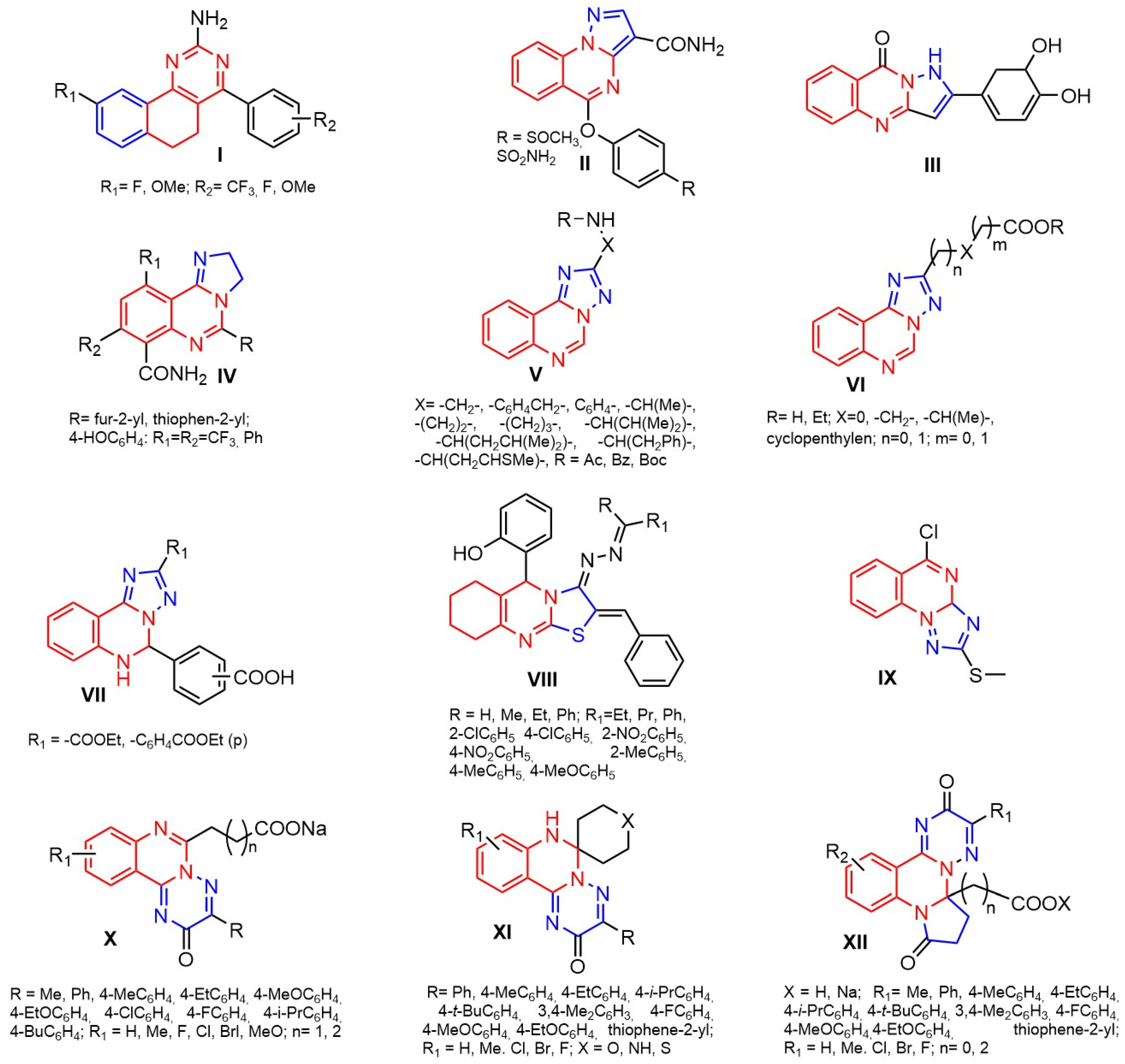
Figure 2.
Bioisosteric sulphur-substitutions and modification in the search for anti-inflammatory agents.
Figure 2.
Bioisosteric sulphur-substitutions and modification in the search for anti-inflammatory agents.
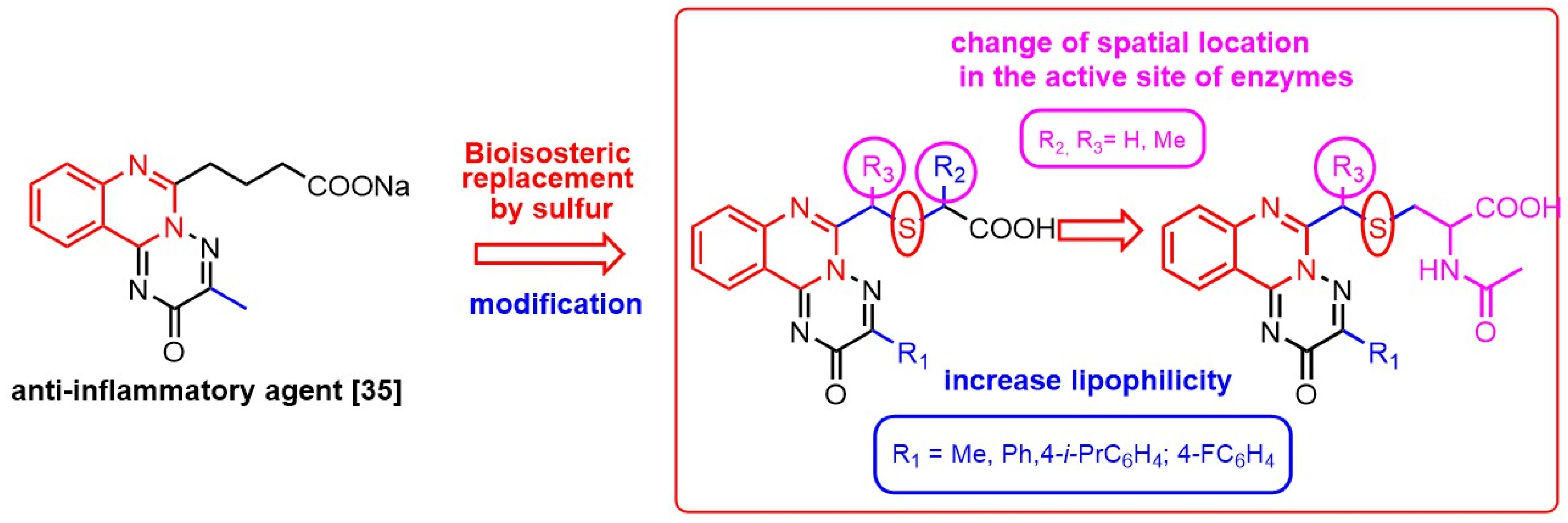
Figure 3.
Interaction of compound 2.5 (a) with amino-acid moieties of COX-1 active site and (b) conformation overlaid on sodium diclofenac (yellow molecule).
Figure 3.
Interaction of compound 2.5 (a) with amino-acid moieties of COX-1 active site and (b) conformation overlaid on sodium diclofenac (yellow molecule).
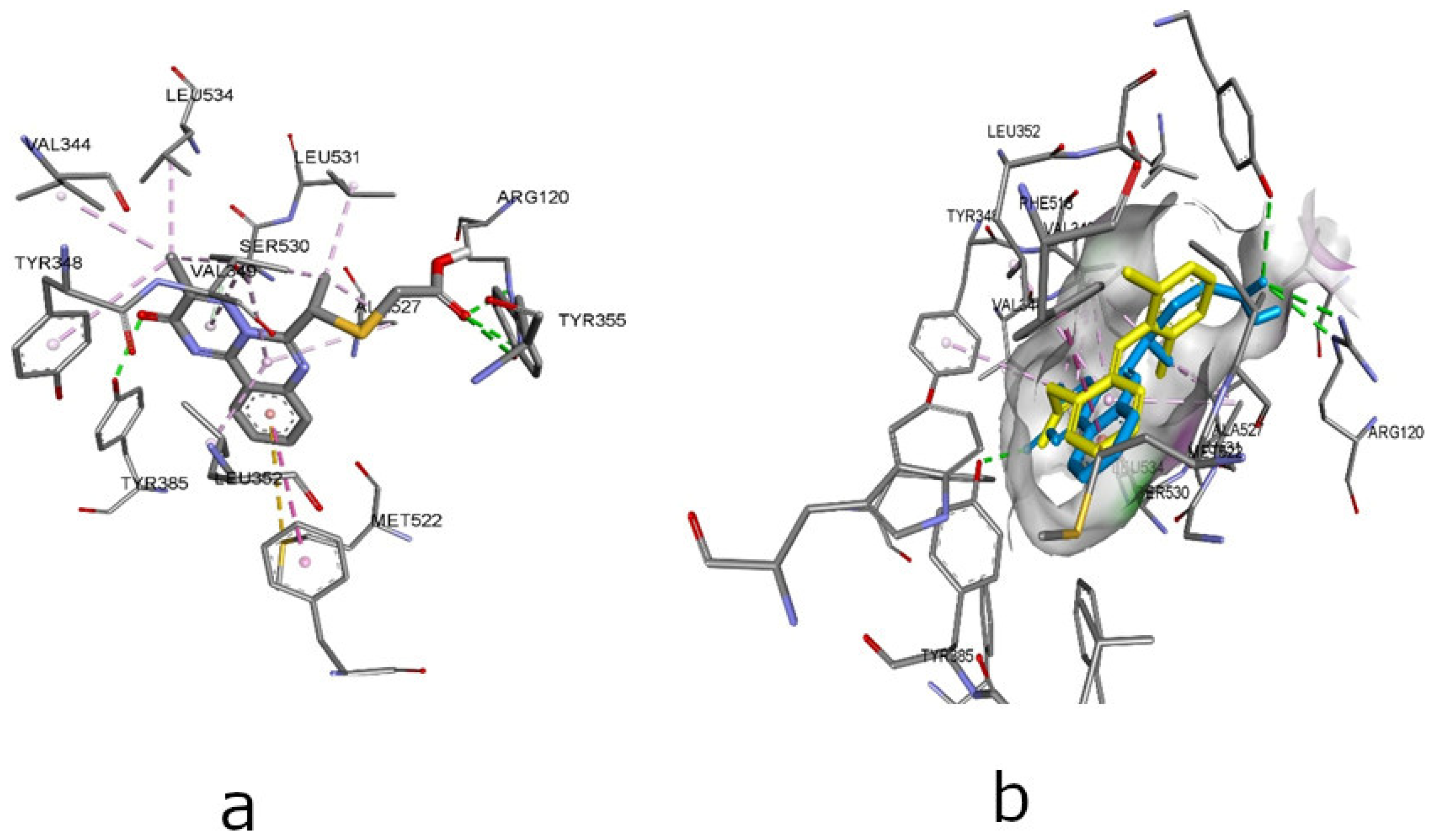
Figure 4.
Interaction of compound 2.3 (а), 2.2 (b) and МТВ (с) with amino-acid moieties of COX-2 active site.
Figure 4.
Interaction of compound 2.3 (а), 2.2 (b) and МТВ (с) with amino-acid moieties of COX-2 active site.
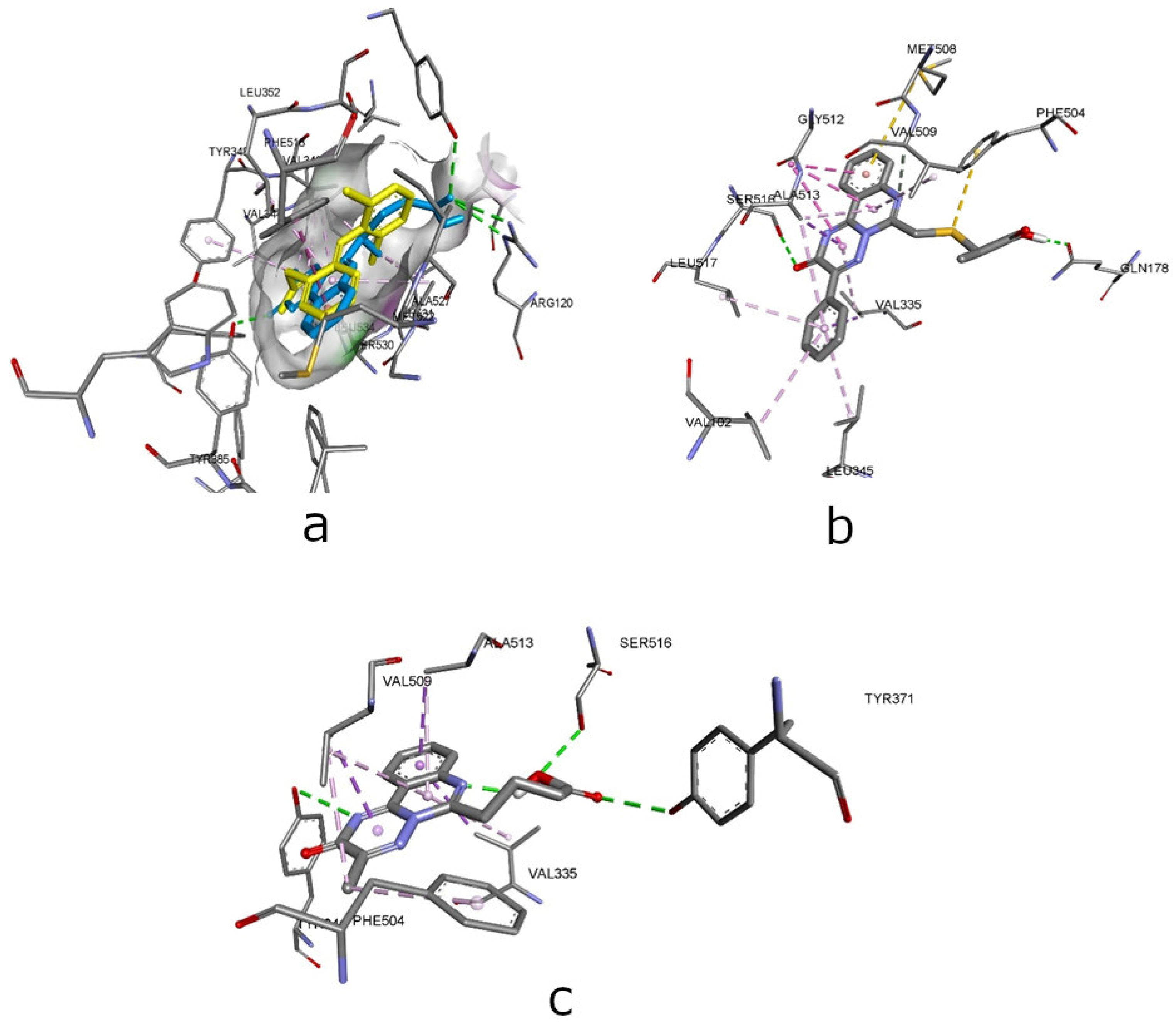
Figure 5.
Joined placing of celecoxib (grey molecule) and compound 3.2 in COX-2 active site.
Scheme 1.
Approaches to synthesis 3-R-2-oxo-2H-[1,2,4]triazino [2,3-c]quinazolin-6-ylalkylthiocarboxylic acid and their esters.
Scheme 1.
Approaches to synthesis 3-R-2-oxo-2H-[1,2,4]triazino [2,3-c]quinazolin-6-ylalkylthiocarboxylic acid and their esters.
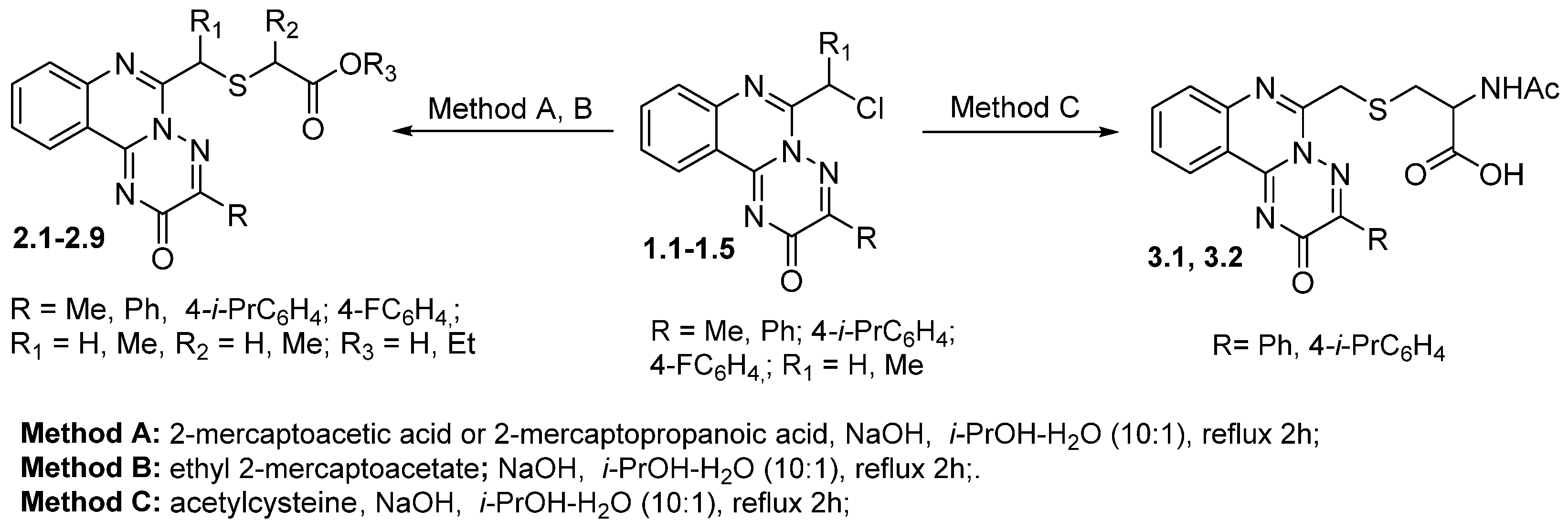

Table 1.
This is a table. Tables should be placed in the main text near to the first time they are cited.
Table 1.
This is a table. Tables should be placed in the main text near to the first time they are cited.
| Compounds | Affinity (kcal/mol) to COX-1 (PDB ID - 3N8Y) | Amino acid moiety and bonding type | Affinity (kcal/mol) to COX-2 (PDB ID – 3LN1) | Amino acid moiety and bonding type |
|---|---|---|---|---|
| Diclofenac | -8.5 | a: Tyr385, Ser530 b: Ala527(3), Leu352(3), Ile523(2), Val349(2), Leu531 |
– | - |
| Celecoxib | – | - | -12.2 | a: Arg106, Arg499, Gln178, Leu338, Ser339 b: Val335, Ser339, Val509(2), Leu370, Val335, Leu345, Leu517, Tyr371, Trp373, Ala513(2) |
| MTB# | -7,7 | a: Ser530, Tyr385, Met522 b: Val349(3), Ala527(3), Leu352(2), Tyr348*, Tyr385, Trp387*, Leu531, Ile523 |
-9,3 | а: Tyr341(2), Ser516, b: Val335, Tyr371, Val509(3), Ala513(2), Phe504, Val335 |
| 2.1 | -6.3 | a: Tyr355*, Tyr385, VAL349; b: Leu352, Ala527(4), Met522*, Tyr348*, Gly526(3)*, Val349, Leu352, Ile523(2); С: met113 |
-10.2 | a: Arg499, Ser516*, Ser339 b: Val509(2), Val335(3), Ala513(5), Leu517, Gly512(2)*, Val102*, Leu345 c: Met508*, Phe504* |
| 2.2 | -5.6 | a: Tyr355*, Val116* b: Val349, Leu352(2), Ala527(6), Met113*, Met522*, Tyr348*, Gly526(3)*, Val349(2), Ile523(2), Leu359*, Leu531 |
-10.2 | a: Ser516*, Gln178, Val509 b: Val335(2), Ala513 (6), Gly512 (3)*, Val509, Val102*, Leu345, Leu517 c: Met508*, Phe504* |
| 2.3 | -4.9 | a: Arg120*, Tyr355* b: Ile89(2*), Leu93*, Val116(3)*, Tyr355*, Ala527 (3), Val349(2), Leu531, Ile523 |
-8.7 | a: Phe504, Gln178 b: Tyr341(4)*, Val335(2), Leu338, Ala513(3), Leu78(2)*, Val102(3)*, Leu345(2), Phe343, Leu338, Val509 |
| 2.4 | -5.3 | a: Tyr355* b: Val116*, Leu352(2), Ala527(5), Gly526(3)*, Val349(3), Ile523(2), Leu359*, Leu531 c: Met113*, Met522*, Tyr348* |
-10.1 | a: Ser516*, Val509 b: Arg106, Ala513, Gly512(3)*, Ala513(5), Val509, Val335(4), Val102*, Leu345, Leu517 c: Met508*, Phe504* |
| 2.5 | -6.6 | a: Arg120(2), Tyr355, Tyr385, Ser530; b: Phe518*, Ala527(2), Val349(4), Leu531, Val344*, Leu534,* Tyr348*, Leu352 c: Met522* |
-9.4 | a: Arg499, Ala513, Ser516* b: Leu338, Val509(3), Trp373, Phe504 (2), Val335(2), Ala513(3), Leu517 c: Phe504, Met508 |
| 2.6 | -6.1 | a: Tyr355*, Tyr385 b: Leu352, Ala527(4), Met522*, Tyr348*, Gly526(3)*, Val349, Leu352, Ile523(2) |
-10.0 | a: Tyr371, Ser516*, Val335, Val509, Ala513; b: His75*, Met508, Val509(3), Phe504*, Val335, Ala513, Leu517, Arg499, Ala 502 c: Trp373 (Pi-Sulfur) |
| 2.7 | -6.2 | a: Tyr355*, Tyr385(2) b: Val116*, Val349(3), Leu352(2), Ala527(4), Met113*, Met522*, Tyr348*, Tyr385, Gly526(2)*, Ile523(2), Leu359*, Leu531 |
-10.1 | a: Arg499, Ser516*, His75* b: Val335, Gly512(3)*, Ala513 (5), Val509, Val335, Val102*, Leu345, Leu517 c: Phe504*, Met508* |
| 2.8 | -2.7 | a: Tyr385(2) b: Ala527(4), Phe518*, Tyr385*, Gly526*, Met113*, Val116(2)*, Leu359(2)*, Tyr355*, Leu352, Val349(2), Ile523, Leu384, Leu531 c: Met522*, Phe205*, Tyr348* |
-10.5 | a: Arg499, His75*; b: Ala513(6), Gly512(3)*, Leu78*, Val102(2), Leu345 (2), Tyr341(2)*, Phe343, Val509, Val335(3), Val102*, Leu517 c: Phe504*, Met508* |
| 2.9 | -4.2 | a: Tyr385(2) b: Ala527(6), Phe518*, Gly526 (3)*, Val349(2), Leu352(2), Ile523, Val116*, Leu359*, Leu531 c: Met522*, Tyr348* |
-10.1 | a: Arg499, Ser516* b: Arg106, Ala513, Gly512(3), Ala513(5), Val509, Val335(2), Val102*, Leu345, Leu517 c: Met508*, Phe504* |
| 3.1 | -5.3 | a: Tyr355*; b: Val349, Leu352(2), Ala527(6), Met113*, Met522*, Tyr348*, Gly526(3)*, Val349(2), Ile523(2) |
-9.3 | a: Ser516*, Val509 b: Arg106, Ala513(6); Gly512(3)*, Val509, Val335(2), Val102*, Leu345, Leu517 c: Met508*, Phe504* |
| 3.2 | -5.8 | a: Arg120* b: Ser530, Val349(3), Leu531(3), Val116(2), Ile345, Leu359(2)*, Ala527(2) c: Met113*, Tyr355* |
-10.8 | a: Ser516*, Gln178 b: Arg106, Ala513, Gly512(3)*, Ala513(5), Val509, Val335(3), Val102*, Val335, Leu345, Leu517 c: Met508*, Phe504* |
# – MTB - (3-methyl-2-oxo-2Н-[1,2,4]triazino [2,3-c]quinazolin-6-yl)butanoic acids; a - Hydrogen Bond; b - Hydrophobic; c – other; () – the number of bonds is given in parentheses, * The amino acids which do not interact with native ligand in the experiment.
Table 2.
This is a table. Tables should be placed in the main text near to the first time they are cited.
Table 2.
This is a table. Tables should be placed in the main text near to the first time they are cited.
| Compounds | Oral toxicity | Prediction: active, probability from (yes/no)** | ||||||
|---|---|---|---|---|---|---|---|---|
| Toxicity Index* |
LD50, mg/kg |
Prediction accuracy, % |
HT | CG | IT | MG | CT | |
| 2.1 | IV | 800 | 54.26 | 0.50/no | 0.54/no | 0.99/no | 0.60/no | 0.75/no |
| 2.2 | IV | 800 | 54.26 | 0.50/no | 0.56/no | 0.99/no | 0.59/no | 0.80/no |
| 2.3 | III | 300 | 54.26 | 0.52/no | 0.59/no | 0.96/no | 0.58/no | 0.81/no |
| 2.4 | III | 300 | 54.26 | 0.52/no | 0.55/no | 0.99/no | 0.58/no | 0.80/no |
| 2.5 | IV | 800 | 54.26 | 0.50/no | 0.56/no | 0.99/no | 0.58/no | 0.80/no |
| 2.6 | III | 300 | 54.26 | 0.53/no | 0.57/no | 0.99/no | 0.59/no | 0.79/no |
| 2.7 | IV | 800 | 54.26 | 0.52/no | 0.57/no | 0.99/no | 0.57/no | 0.76/no |
| 2.8 | III | 300 | 54.26 | 0.54/no | 0.61/no | 0.97/no | 0.59/no | 0.77/no |
| 2.9 | IV | 400 | 23,0 | 0.54/no | 0.64/no | 0.95/no | 0.58/no | 0.74/no |
| 3.1 | VI | 10000 | 23,0 | 0.51/no | 0.54/no | 0.99/no | 0.59/no | 0.69/no |
| 3.2 | VI | 10000 | 23,0 | 0.52/no | 0.58/no | 0.99/no | 0.61/no | 0.68/no |
| МТВ# | III | 300 | 54.26 | 0.54/yes | 0.52/no | 0.99/no | 0.57/no | 0.82/no |
| DS#* | III | 53 | 100,0 | 0.81/yes | 0.64/no | 0.99/no | 0.78/no | 0.74/no |
* – Class I: fatal if swallowed (LD50 ≤ 5); Class II: fatal if swallowed (5 < LD50 ≤ 50); Class III: toxic if swallowed (50 < LD50 ≤ 300); Class IV: harmful if swallowed (300 < LD50 ≤ 2000); Class V: may be harmful if swallowed (2000 < LD50 ≤ 5000); Class VI: non-toxic (LD50 > 5000); ** – Toxicity Model Report illustrates the confidence of positive toxicity results compared to the average of its class in HT (Hepatotoxicity), CG (Carcinogenicity), IT (Immunotoxicity), MG (Mutagenicity) and ,CT (Cytotoxicity); МТВ# – 3-methyl-2-oxo-2Н-[1,2,4]triazino [2,3-c]quinazolin-6-yl)butanoic acid; DS#* – Diclofenac Sodium.
Table 3.
Anti-inflammatory activity of the compounds (M±m, n=6)*.
| Compounds | Acute aseptic inflammation («carrageenan» test) | ||
|---|---|---|---|
| The healthy paw volume, ml | Edema paw volume on 4h h of exp., ml | АА, % | |
| Control | 1,586±0,058 | 2,416±0,104 | – |
| 2.3 | 1,47±0,08 | 2,27±0,101 | 3,61 |
| 2.5 | 1,49±0,047 | 1,876±0,119 | 53,41 |
| 3.2 | 1,536±0,087 | 1,936±0,088 | 51,81 |
| MТВ | 1.34±0.06 | 2.03±0.05 | 45.77 |
| DS*# | 1,31±0,116 | 1,693±0,049 | 53,82 |
Notes: * – n – number of animals; ** – reliable relative to control group (p <0,05); МТВ# – 4-(3-methyl-2-oxo-2H-[1,2,4]triazino [2,3-c]quinazolin-6-yl)butanoic acid; DS#* – Diclofenac Sodium.
Table 4.
This is a table. Tables should be placed in the main text near to the first time they are cited.
Table 4.
This is a table. Tables should be placed in the main text near to the first time they are cited.
| Biochemical markers | Intact | Control | 2.5 | 3.2 | MTB** |
|---|---|---|---|---|---|
| VEGF, pg/mL | 3,65±0,59 | 3,65±0,59 | 6,34±0,27*# | 12,03±0,47*# | 6,72±0,33*# |
| COX-2, (ng/ml) | 0,97±0,05 | 0,97±0,05 | 3,26±0,20*# | 12,74±0,43*# | 2,36±0,27*# |
| iNOS, (pg/ml) | 1,17±0,14 | 1,17±0,14 | 6,01±0,29*# | 9,87±0,78*# | 7,44±0,28*# |
| nitrotyrosine, (nM/ml) | 2,09±0,20 | 2,09±0,20 | 5,19±0,24*# | 8,31±0,39*# | 8,19±0,24*# |
| IL-1b, pg/ml | 0,33±0,02 | 0,33±0,02 | 0,40±0,01*# | 1,3±0,05*# | 0,51±0,02*# |
| C-reactive protein, (ng/ml) | 1,65±0,14 | 1,65±0,14 | 2,43±0,15*## | 7,04±0,19*# | 2,10±0,23# |
Notes: * – reliable changes relative to intact group (p <0,05); # - reliable changes relative to control group (p <0,05); n – number of animals in group; ** – DS (Diclofenac Sodium).
Table 5.
Physicochemical descriptors and pharmacokinetic properties of compounds 2 provided by SwissADME.
Table 5.
Physicochemical descriptors and pharmacokinetic properties of compounds 2 provided by SwissADME.
| Physicochemical descriptors & predicted pharmacokinetic properties* | Compound | ||
|---|---|---|---|
| 2.5 | 3.2 | MTB | |
| MW (Da) (< 500) | 330.36 | 491.56 | 298.30 |
| n-ROTB (< 10) | 4 | 9 | 4 |
| n-HBA (< 10) | 6 | 7 | 6 |
| n-HBD (≤ 5) | 1 | 2 | 1 |
| TPSA (< 140, Ų) | 122.75 | 151.85 | 97.45 |
| logP (≤ 5) | 1.72 | 3.15 | 1.45 |
| Molar refractivity | 88.27 | 135.94 | 80.68 |
| Gastrointestinal absorption | High | Low | High |
| Blood–brain barrier permeation | no | no | no |
| Lipinski filter | yes | yes | yes |
| Veber filter | yes | no | yes |
| Muegge filter | yes | no | yes |
| Ghose filter | yes | no | yes |
| Egan filter | yes | no | yes |
| Bioavailability Score | 0.56 | 0.11 | 0.56 |
| Lead-likeness | yes | no | yes |
Notes: * – MW: molecular weight, n-ROTB: number of rotatable bonds, n-HBA: number of hydrogen bond acceptors, n-HBD: number of hydrogen bonds donors, TPSA: topological polar surface area.
Disclaimer/Publisher’s Note: The statements, opinions and data contained in all publications are solely those of the individual author(s) and contributor(s) and not of MDPI and/or the editor(s). MDPI and/or the editor(s) disclaim responsibility for any injury to people or property resulting from any ideas, methods, instructions or products referred to in the content. |
© 2024 by the authors. Licensee MDPI, Basel, Switzerland. This article is an open access article distributed under the terms and conditions of the Creative Commons Attribution (CC BY) license (http://creativecommons.org/licenses/by/4.0/).
Copyright: This open access article is published under a Creative Commons CC BY 4.0 license, which permit the free download, distribution, and reuse, provided that the author and preprint are cited in any reuse.


