

Submitted:
03 October 2024
Posted:
05 October 2024
You are already at the latest version
Abstract
Sustainable development and climate change are related challenges for humanity because a good quality of life in the present and the future for human, natural, and economic systems must be achieved through the capacity to face climate change. In this context, this research aimed to identify the climate change adaptation measures contribution to the sustainable development aspects: environmental, social, and economic, applied to a case study, "The Coastal Watershed Conservation Project in the Context of Change Climate (C6)" through the Sustainable Development Goals (SDG) evaluation framework. The primary data collection was carried out directly from the project reports and the reports of 29 interventions in the communities. The results indicate that the adaptation actions implemented through the C6 project did contribute to sustainable development, to a greater extent, in the social aspect, followed by environmental aspects and later by economic ones; therefore, it can be concluded that one way to achieve sustainable development can be through the implementation of adaptation actions to face climate change.
Keywords:
sustainable development goals
; climate change
; Mexico
; sustainable development evaluation
1. Introduction
1.1. Reference Framework
Climate change and sustainable development are challenges for humanity that go hand in hand. Climate change is a transversal element that influences all aspects of sustainable development since this can only be reached by reducing the generation of greenhouse gases and adapting societies to the impacts of climate variations. These impacts exist in all natural and human systems. Consequently, they affect sustainable development since they influence economic development inequities and are also transversal to agriculture, food crisis, migration, water supplies, transportation, city planning, and social and economic infrastructure. That is why the appropriate framework to approach climate change should be through sustainable development [1,2,3,4,5,6].
Sustainable development, as stated in "Our Common Future" ([7], is "the lasting development, the one that satisfies the present needs without compromising the capacity of future generations to satisfy their own." This definition has two implicit terms: 1) needs in terms of social and economic sectors and 2) limitations referring to the ability of the environment to absorb the effects of human activities. Since this concept of sustainable development has surged, there has been debate about its meaning. Authors like Cortes and Penia [8] indicate that development is "sustainable" when it maintains a balance in the social, economic, and environmental aspects and stays in time without affecting future generations. This research will use the term sustainable since it encompasses both aspects.
Sustainable development should then achieve the equilibrium between the sustainability of society, economy, and environment, considering health, peace, human rights, gender equality, education, and an adequate approach to production, distribution, and consumption. It also refers to the convenient planning of the territory for the conservation of biodiversity so that a good quality of life can be reached in the present, as well as in future times, through improvements in life standards without risking ecosystems and avoiding environmental impacts that could reverberate in problems such as climate change [3].
Sustainable development is a worldwide priority to face the current situation, prevent it, and move towards more straightforward and sustainable lifestyles. Therefore, we need to increase the capacities for adaptation and renewal. Still, we must consider all species' values and rights to transmit this capital to future generations [8,9,10]. Regarding public policies, the UNDP Sustainable Development 2030 Agenda places in its center not only the concept of sustainability but also the struggle against climate change and the need to act, considering the mutual impact of both concepts [4,11].
To confront climate change, we need to act in two directions: to reduce the emissions of greenhouse gases and to carry out actions that allow adaptation to its impacts. In this sense, sustainable development is needed to reduce vulnerability and improve the adaptation capacity of human, natural, and economic systems to this phenomenon. Climate change, a negative impact of the current development model, obligates us to act with a more sustainable lifestyle and requires local and immediate attention by increasing local adaptive capacities [2,12,13].
Regarding climate change, it is necessary to mention that any system's vulnerability (whether economic, social, or environmental) relates to components such as exposure, sensibility, and lack of feedback and adaptation. [14]. Exposure refers to the type and degree to which a system is exposed or affected by significant climate variations1. Sensitivity is the degree to which one system may be affected, positively or negatively, due to variability or climate change. Adaptability and responsiveness capacity is a system's capacity to resist or respond successfully to climate change. A system is vulnerable when it has high exposure, sensitivity, and adaptability capacity. For this reason, the system should reduce its exposure and sensibility or increment its adaptative capacities to reduce vulnerability. [15,16,17,18,19,20].
The adaptation to climate change is the adjustment of the ecological, social, or economic systems to respond to the effects of climate variability, that is to say, the adjustment process to the actual or projected climate and its impacts to moderate the damages or take advantage of the beneficial opportunities of climate change [21]. Adaptation is the number of changes, practices, or structures to moderate or compensate for potential climate change damages or benefit of its related opportunities. The interventions of adaptations and developments may reduce the vulnerability to climate change and improve the capacity of persons to adapt to it. Some examples of adaptation interventions are the measurements to conserve soil and water, agricultural diversification through agro silviculture, the introduction of multi-harvests, and widening access to financial services, such as credits and insurance [15,16,17,18,19,20].
Adaptation to climate change implies carrying out actions that guarantee the security of the population, its belongings, the ecosystems, and environmental services based on observed or projected climate change impacts. These necessities and adaptation options may be divided into four categories: i) physical, structural, and environmental needs: solutions based on nature (adaptation and risk disasters reduction based on ecosystems); technological and service options; ii) social needs: educational, informative, behavioral and community-based adaptations) institutional needs related to economic subjects, laws, political regulations, government programs, and governance; and iv) needs for information, training, and resources [22].
In this context, Mexico has promoted actions in different states of the Mexican Republic to reduce the impact of climate change, such as the Conservation of Coastal Basins in the Context of Climate Change (C6) project, through which climate change mitigation and adaptation actions were promoted (INECC, 2018c).
1.2. Problematic and Justification
When actions are taken to face climate change in communities, particularly regarding adaptation measures, some questions arise: How much do they contribute to sustainable development? Which aspect of sustainable development do these adaptation measures contribute to? Is it possible to evaluate the contribution of those adaptation actions to sustainable development? Which indicators of sustainable development or adaptation to climate change may be used to recognize the relationship between climate change adaptation measures and sustainable development?
This research took as a case study the C6 project implemented through local civil societies organizations, which promoted actions to face the effects of climate change in its territories and had an essential role and capacity in the adaptation to climate change [23] to answer the questions mentioned above. Therefore, this analysis searched for the relationship between adaptation measures to climate change executed in the Gulf of Mexico under the C6 project and sustainable development. The objective was to identify the contribution of the adaptation measures to climate change in this project to environmental, social, and economic aspects of sustainable development that may be used as a base for future evaluations in projects to confront climate change from territorial and regional focuses (through hydrological basins)
2. Materials and Methods
2.1. Theoretical Methodological Framework
To evaluate the support to sustainable development, starting from the application of the adaptations interventions to climate change, we considered that these interventions affect the economic, social, and natural systems, studying the result of these interactions with the components of each system, according to Bertalanffy's General Systems Theory [24]. Besides, they are considered open systems since the three mentioned systems have interexchange with the environment, generating alterations to the system's components [25,26], with the expectation that this case study may contribute to the adaptation to climate change as well as to sustainable development [27] (Figure 1). We also start from the fact that, since sustainable development is a complex concept, it requires an international policy such as the Sustainable Development Goals (SDGs) 2030 Agenda, which is complex in itself, as we can appreciate through the interactions of the 17 SDGs [28].
This proposal is based on the analysis of the relationship between the adaptation to climate change and sustainable development and all involved aspects, starting as indicated by Garro-Gil [26] and Ros Codoner [29] related to Pierpaolo Donati's Relational Theory on the importance of the social aspects. These should be analyzed from relations and effects on the system (not only from the structure or the individual) since these relations are more important than the individual or structural impacts.
Due to the abovementioned, this analysis aims to identify the relationship between the adaptation measures performed by civil society organizations and their contribution to the SDGs and build a methodology that might visualize the interaction between sustainable development and climate change.
Accordingly, we take into consideration that sustainable evaluation may be achieved through three mechanisms:1) through a list of sustainability indicators, 2) through evaluation methodologies based on sustainable indexes, which include several indicators, and 3) through flexible evaluation frameworks [30].
2.2. Indicators for the Evaluation of Sustainable Development
The indicators are used to evaluate achievements, objectives, and impacts, and, in the case of sustainability, they focus on the three dimensions: environmental, economic, and social. According to Ibanez Perez [31], these indicators may be classified as follows: 1) the dimension of sustainable development on which they're focused (whether environmental, economic, or social), 2) theoretical sense and objective and subjective data collection, 3) evaluation framework, and 4) approach (ecologic print, cargo capacity). Related to the indicators designs and according to the subjects, [32] mentions three types of initiatives: 1) indicators that support sustainable development through a broad approach with concepts such as sustainable communities or quality of life; 2) those which only consider topics related to contamination and environmental impact without including development, and 3) those which take into consideration more specific subjects like human development, hydrology, green production, and environmental accountability.
2.3. Evaluation Frames of Sustainable Development and Adaptation to Climate Change
According to Galvan Miyoshi, Masera, and Lopez Ridaura [33], the evaluation frames for sustainable development may be directed to objectives or be systematics. Those oriented to objectives consider systems general aspects such as conservation of the resources and biodiversity performance, economic viability, efficiency, and intergenerational security, among others. Referred to systemic frames, these focus more on functions and dependence on the different aspects of sustainability.
Referred to evaluation frameworks of climate change adaptation, Brooks [34] proposes the framework "Follow up of Adaptation and Development Evaluation" (TAMD ̶ Tracking Adaptation and Measurement Development), which presents four categories of indicators: 1) indicators of climate risks to evaluate changes, political institutions, and capacities, 2) resilience indicators to measure the feedback capacities of homes, communities, and systems to climate change; 3) indicators of human well-being which might be development indicators, valued with the climate indexes to detect changes in the long term; and 4) climate indexes such as the duration of dry episodes, the maximum intense of rains and the beginning of the rainy season.
This research used a framework oriented to objectives, mainly through the 17 SDGs.
2.4. Case Study: Vulnerability, Climate Change Impacts, and Adaptative Capacity in the Veracruz and Tabasco States of Mexico
Mexico is a country that, through the years, has been affected by hydrometeorological phenomena that have caused several disasters [35], and some of the most affected territories are the States of Veracruz and Tabasco. Veracruz has registered 182 harmful events occasioned by hydrometeorological phenomena from 2002 to 2012 [36]. Tabasco had the most significant economic impacts associated with excessive rainfall in 2000-2012 [37]. Besides," the center of Veracruz and Tabasco have had the highest risk indexes due to floods" associated with hurricanes or intense rains [38].
The climate variations in Veracruz in the 1964-1993 period showed an increase of 1 Celcius (°C) in extreme minimum temperatures, and the percentage of warm days increased in the last 15 years of that period. In precipitation, no changes were detected in that period's averages [39]. In the case of Tabasco, climate variations observed from 1991 to 2010 showed that annual media temperature increased by 0.9 °C, and, in that same period, precipitation increased by 0.5%.
Buenfil Friedman [38] observes that the coastal zone of the Gulf of Mexico has a high vulnerability to climate change that will have repercussions on its natural and economic resources. Still, adaptation measures may help reduce the current risks and promote sustainable community development.
The climate change scenarios for the Gulf of Mexico towards the end of the 20th century show that the temperature will have minor changes to 3° Celcius, and precipitation will diminish by less than 10% [38]. The climate scenarios for Veracruz indicate an increase of temperatures between 0.6 and 1 Centigrade in 2030 and 1.2 to 1.8 °C (2050). Regarding precipitation, a diminishing of 11% is forecast for the month with less rain. These conditions might increase the magnitude of the impacts of natural disasters [35].
An analysis of the climate change scenarios at the Antigua watershed in Veracruz shows that the temperature will tend to increase even at the lowest one. In the most extreme scenario, the temperature increase would rise above 6° C. Referring to precipitation; the scenarios show that the space distribution might register variations according to the climate base, higher in some months and lower in others [40].
In such climate change scenarios, the most affected sectors will be agricultural, hydric, ecosystems, and biodiversity. In the case of agriculture, there is a risk of low productivity in most harvests. In the case of the hydric sector, there will be an increase in the water demand and, on the other hand, the risk of floods. And finally, the ecosystems will be affected by the loss of species associated with the increase in temperature (INECC.2018c).
2.5. Basis of the Conservation Project of the Coastal Basins in the Context of Climate Change (C6)
This project was executed in the states of Veracruz and Tabasco, both located in the Gulf of Mexico, with a territorial approach in the hydrological basins at 1) Tuxpan, 2) Antigua, 3) Jamapa, 4)Huazuntlan, 5)Temoloapa and 6) Usumacinta [41,42,43]. The watershed characteristics are shown in Table 1. Its objective was to promote the selected coastal basins' role in keeping biodiversity, contributing to climate change mitigation, and improving soil use. The direct beneficiaries were the local coastal basin communities and the organizations that worked with them, rendering technical assistance, training, and financial support. One of the project components was the promotion of sustainability in the watersheds [44]. The Organizations of Civil Society and the communities executed 29 interventions in agricultural ecosystems and sustainable forests. Six of them were executed in the basin of Tuxpan River, seven in the Antigua River watershed, five in the basin of Jamaca, six in the basin Huazuntlan and Temoloapa, four in the Usmacinta basin and one transversal intervention in all the watersheds.
2.6. Selection of Evaluation Framework and Analysis Indicators
The identification of the contribution of sustainable development through adaptation interventions applied in the Gulf of Mexico was executed through an evaluation framework oriented to objectives, in this case, through the 17 SDGs [4,33,51]. Each SDG had indicators associated with the 2030 Agenda Goals, which helped relate to the results of the interventions adapted to climate change performed in each case study. The indicators considered the risk management indicators within the adaptation TAMD frame (Brooks, 2014). The indicators to be used in this investigation are shown in Table 2 and were selected based on one study of the Program of the United Nations for Development 2016 (PUND), which shows the results of the climate change programs and project portfolios executed in more than 140 countries with an amount of 2,800 million dollars in donations, There they state that 37% of those resources was for adaptation, 30% for mitigation and 30% and the rest in actions for transversalities and forests. It is also highlighted that around 39 of those projects have contributed to SDG 1, 45% to SDG 7, 100% to SDG 13, 42% to SDG 16, and 38% to SDG 17.
This research aims to identify the contribution of sustainable development as a result of adaptation interventions to climate change, and this was done by examining the contribution to the indicators in each of the 17 SDGs. This analysis does not pretend to evaluate the C6 project and its contribution to sustainable development. It only identifies the contribution to the SDGs and the dimensions of sustainability from there. This research could be the first approach to determine the relationship between adaptation measures and actions that lead to sustainable development.
In this research, we considered a frame based on ONU [52], Mozas Moral [53], Pérez et al. [28], Bórquez Polloni and Lopicich Catalán [54], Canaza-Choque [55] and Rijnhout y Meymen [56] (Figure 4.2), to identify the SDGs into five areas: persons (social) planet (environmental), prosperity (economic) peace and partnerships (alliances) for the goals.
Perez et al. [28,57,58] share the idea that two more dimensions—peace and partnerships—should be considered to establish the programs, projects, and actions that contribute to the SDGs in the three dimensions of sustainable development. Therefore, this research analysis was conducted using the classification of the 17 SDGs in the three dimensions of sustainable development as a base (Figure 2).
2.7. Data Collection
The primary data collection was made directly from the reports of the C6 project [44], The Mexican Gulf Fund [42,59], and the advance reports of the interventions made in the communities for 2015, 2016, 2017, and 2018, and the Mexican Fund for the Conservation of Nature and Gulf of Mexico A. C [60]. This research also considered data on evaluating capacities from the civil society organizations involved in executing actions to address climate change [23] and those civil society organizations' role in adapting to climate change [41].
2.8. Data Analysis
To identify the contribution of the interventions performed through the C6 project to the SDGs, we analyzed the contribution from the interventions and their adaptive actions to the environmental, social, and economic dimensions of sustainable development through descriptive statistics with the frequencies related to the variable amount of interventions for each dimension: 1) environmental (planet), 2) social (persons), 3) economic (prosperity), 4) peace, and 5) (alliances), for each watershed: 1) Tuxpan, 2) La Antigua, 3)Jamapa, 4)Huazuntlan-Temoloapa, and 5) Usmacinta (Equations 1,2,3,4,5, and 6).
ISDGn = ∑i
Where: ISDGn represents the number of interventions contributing to one of the 17 SDGs, and ∑i the sum of all the interventions of each dimension.
Equation 2 indicates the sum of the social dimension.
Equation 3 indicates the sum of the economic dimension.
Equation 4 indicates the sum of the economic dimension.
Equation 5 indicates the sum of the peace dimension.
Equation 6 indicates the sum of the dimension alliances.
Besides this ponderation, an analysis of the variance of two factors (watersheds and dimensions) (two-way ANOVA) was executed to learn the differences between the percentages per basin and the dimensions. This same variance analysis was made on two factors (basins and SDGs) to determine differences in the number of interventions per basin and SDGs. A 0.05 significance level was used for these analyses with the Microsoft Excel for Mac version 16.49 program.
3. Results
3.1. Adaptation Actions to Climate Change in the C6 Project
According to The National Institute of Ecology and Climate Change [42] and the Mexican Fund for the Conservation of the Nature [60], the core adaptation actions to climate change implemented through the interventions made on the C6 project were: 1) management of agroecosystems and reduction of change pressures in the use of the soil through forest conservation, restoration and sustainable management, (cornfield modules with fruit trees, generation of riparian corridors); 2) Management of habitat and corridors around nature protected areas; 3) conservation of forest fragments suffering deforestation pressure; 4) livefences, restoration of soils, sustainable coffee growing and meliponiculture for the conservation; 5) interinstitutional coordination activities (networks, forums and learning communities) with different actors; 6) Installation of nurseries for endangered species and creation of nurseries networks with seed banks; 7) agroecological modules; 8) reforestation actions; and 9) Design of Action Plans for the Integrated Management of Watersheds (PAMIC) for the Tuxpan, La Antigua, Xamapa and the Gulf of Mexico basins. These actions respond to the communities' necessities to prepare the agricultural and climate systems for climate change and use the ecosystems as natural barriers to confront the extreme hydrometeorological phenomena. They also act as providers of environmental services and contribute to reducing vulnerability in climate change scenarios (increase of temperature, reduction or excess of rain and its impacts).
3.2. Contribution of the C6 Project to the SDGs and Sustainable Development
The C6 project, by its nature, contributed mainly to three SDGs: SDG 6 (clean water and sanitation), SDG 13 (climate action), and SDG 15 (Life of earth ecosystems). However, in this section, we will present the contributions of the interventions referred to other SDGs, which might be identified as additional benefits to the project and collateral contribution to the SDGs
Figure 3 shows the 29 adaptation interventions to climate change performed in the five territories. These interventions supported 14 of the 17 DSGs. There were 24 interventions to SDG 13, 20 to SDG 15, and seven to SDG 6. The collateral SDGs that received significant support were SDG 4, with 26 interventions; SDG 1, with 24; and SDG 16, with 23.
From the number of adaptation actions executed during interventions that contributed to some of the SDGs, and considering the SDGs globally in each one of its dimensions (environmental, economic, and social), the social dimension (persons) was the one with more actions support, since 41% of the total actions performed are related with the SDGs 1, SDG 2, SDG 3, SDG 4 and SDG 5 (Figure 3). The results of the social dimension are 1.5 times superior to those of the environmental dimension (planet) and 2.5 superior to the contribution to the economic dimension (prosperity).
3.3. Identification of the SDGs and Their Impact on Sustainable Development through Interventions Performed in Each One of the Watersheds of the C6 Project
The Civil Society Organizations executed the 29 SDGs interventions performed through the C6 project in five watersheds. In general terms, the interventions supported 14 of the 17 SDGs. The project C6 objectives that did not receive support (through interventions) were SDG 9 (industry, innovations, and infrastructure), SDG 11 (cities and sustainable communities), and SDG 14 (sea life). Figure 4 shows the contribution of the interventions in each one of the watersheds to the dimensions of sustainable development.
When comparing the dimensions of sustainable development on the five hydrological basins where interventions were performed through the C6 project, we observe that on the social dimension, the Tuxpan basin stands since it was there where the highest climate change actions (CCA) (47%) focused on social dimension were applied. This social dimension is formed by SDG 1 (end of poverty), SDG 2(zero hunger), SDG 3(Health and well-being), SDG 4(Quality education), and SDG 5 (Gender Equality). This watershed was the one that contributed with the highest number of hectares (155 Ha) of agriculture through good practices (SDG 2) and with the most significant amount of efficient technologies to reduce the contamination of close spaces through the installation of 769 wood-saving stoves (SDG 3).
Referring to the economic dimension when comparing the five watersheds, the actions performed on the Huatzuntlan-Temoloapa watershed were the ones of higher support to this dimension with a 21% total of actions contributing to the following SDGs: SDG 7 (accessible and not contaminant energy), SDG 8 (decent work and economic growth) and SDG 10 (reduction of inequalities). Referring to SDG 7, it was in this watershed where the highest quantity of biodigesters was installed (87). Within the frame of SDG 8, the highest number of honey modules were installed (59), together with the highest intercrop fruit-corn modules (38). Interestingly, this watershed was where the largest indigenous population was involved (9,957 persons).
Referring to the environmental dimension, the highest actions were executed in the La Antigua and Jamapa watersheds (31 and 32%, respectively), corresponding to SDG 6 (clean water and sanitation), SDG 12 (responsible production and consumption), SDG 13 (climate actions), and SDG 15 ( life of the earthly ecosystems). In terms of SDG 12, it was in the Jamapa watershed where most of the demonstratives' modules of agroecological coffee were installed (79 modules). In the Antigua watershed, the highest amount of organic maneuver modules was implemented (250 modules). Referred to SDG 15, the highest number of species favoring connectivity between vegetation fragments was established in the La Antigua watershed. (4,810.86 Ha).
In what refers to the peace dimension, 100% of the interventions performed in the Jamapa and Usmacinta watersheds were through actions aimed at SDG 16 (peace, justice, and solid institutions) supported by local institutions.
Regarding partnerships or alliances, the watersheds of La Antigua and Usmacinta were the ones that mainly contributed to SDG 17 (alliances to achieve the objectives). In the case of La Antigua, the alliances that supported the interventions were: 1) the Coalition of the Bioregion Organizations Jamapa and La Antigua (COBIJA), 2) The Monitoring Community Water networks, 3) melipona honey growers and beekeeping networks (Tabasco), and 4) the Biodiversity Nurseries network.
The analysis of the variance of two factors (basins and dimensions) did not find significative differences in the support percentages to the dimension of sustainable development per watershed (P=1, F=2.09E-14). Still, significant differences in the mean support percentages for sustainable development among dimensions (P = 01.096E-18, F = 47.61) were found. As regards the result of the two factors (basins and SDGs), significant differences were found in the number of interventions per watershed (P = 0,005; F = 4.80) and for each SDG (P = 2.46E-08; F = 7.49).
4. Discussion
Since the appearance of the Action Plan To Transform Our World: 2030 Agenda for Sustainable Development, with its 169 goals and 17 Sustainable Development Objectives as an international agenda to lead countries to sustainable development [52], the 17 SDGs have become a conceptual and a normative reference frame under which environmental, social and economic policies are designed. The SDGs are an input to the sustainable development concept [61], through which the input to these dimensions can be visualized. In the case of the Government of Mexico in the current policy to confront climate change, both at the Mexico National Level Determined Contribution Actualized Version 2020 (MNLDC) [62] and the Special Program for Climate Change 2021-2024 (SPCC) [63] the action lines and priority objectives respectively relay to the 17 SDGs as a way to visualize the synergy between the climate and sustainable development agendas (2030 Agenda). The 27 action lines of the MNDC and the objectives of the SPCC are closely related to the 17 SDGs.
In this context, the relation between the 17 SDGs, the environmental, social, and economic dimensions of sustainable development, and the adaptation actions to climate change were executed through the C6 project interventions. Therefore, although the C6 project was conceived to support only three SDGs: SDG 6 (clean water and sanitation), SDG 13 (climate action), and SDG 15 (Life of Earthy Ecosystems), the results of this research show that the actions performed contributed to 14 SDGs. According to authors like Pérez et al. [28], this additional support is a collateral result.
To support the relationship between the SDGs and the social and economic dimensions of sustainability, we considered what authors like Gómez-Gil [58], Díaz-Barrado [61], and Pérez et al. [28] expressed: that the SDGs integrate and balance the three dimensions of sustainable development, in such manner that if a project supports the SDGs in different dimensions, then it is contributing to sustainable development.
An essential aspect of the SDGs is that their general terms give the possibility of considering an infinity of actions in each of them, adapting them as a reference frame to identify different actions in local contexts. However, this same characteristic has been criticized by those who consider the SDGs as ambiguous, rhetorical, idealists, and of short viability [54,58].
In terms of the C6 project, through adaptation interventions performed by the Civil Societies Organizations in the watersheds of La Antigua, Jamapa, Huatzuntlan-Temoloapa, and Usmacinta, changes in the social and natural systems of those territories were achieved to allow gaining larger adaptation capacities that enable them to reduce vulnerability to climate change. These interventions supported 14 environmental, social, and economic SDGs.
The analysis that related the intervention aspects of climate change with the SGGs showed that the interventions within the C6 project frame contributed to the DSGs in the three dimensions of sustainable development. Such identification was possible by analyzing the change factors (interventions) and the impacts on the systems (measured through indicators).
The CCA performed by the C6 project supported the SDGs in the social, economic, and environmental dimensions of sustainability. This situation can be explained by Yim [6], who reveals that climate change's economic, social, and environmental aspects are widely interlinked with sustainable development considerations since the CCA and sustainable development share many of the objectives of reducing vulnerability. These considerations also agree with what authors like Simonet and Fatoric [12] and Vranic and Milutinovic [5] mention: the CCA is a tangible application of sustainable development to adopt a better quality of life. Therefore, adaptation strategies have become a practical way to achieve sustainable development.
The support for sustainable development through the execution of adaptation measures to climate change can be observed in Objective 1 of the Special Climate Change Program 2021-2024 (SCCP) [63], referred to: "Reduce the population, ecosystems, and biodiversity vulnerability to climate change, as well as the productive systems and the strategic infrastructure through the impulse and strengthening of the adaptation processes and increase of resilience." This situation is related to 10 of the SDGs divided into these dimensions: environmental(5), social (2), economic(1), Peace (1) and Alliances (1).
The CCA performed through the C6 project contributed more significantly to the five SDGs within the social dimension (end of poverty, zero hunger, health and well-being, quality education, and gender equality). This result could be explained because adaptation needs are related to social systems to reduce poverty and inequality, improve the conditions of life resources and sub-existence strategies, and access to education and information.
In some cases, the adaptation actions executed through the C6 project directly supported only one indicator. For instance, the indicator resilience to climate change was achieved in the case of agriculture and cattle under good practices. However, we could also consider that it impacts SDG 2 (zero hunger). In this case, it is essential to clarify that this situation indicates that this practice may add up to achieving zero hunger. Nevertheless, it may be questionable whether food security could be achieved only by promoting familiar vegetable gardens, which would aim to end poverty. This indicator exemplifies that applying different actions through the adaptation focus may help fulfill the other SDGs and, thus, the dimensions of sustainable development.
On the other hand, the CCA strategies are closely related to subjects such as social and food security, health, and education [10]. The social sector must be considered to achieve consensus on the need and benefits of the CCA to reduce short- and long-term disasters [64]. However, it might also be because the SDGs are more centered on social than environmental inclusion [65]. In the case of the Tuxpan basin, which was the one that most contributed to the social dimension compared to the other basins, this may be explained by the need to improve health in the population of the high basin by using wood stoves at the same time that the pressure on the natural vegetation in the mesophile mountain woods is reduced. [45]. On the other hand, there is also the necessity to perform better agriculture practices since rainfed agriculture, such as orange cultivation, has generated intense pressure on the basin [45].
On the other hand, the CCAs performed within the C6 frame contributed to four of the five SDGs of the environmental dimension since physical actions were performed to 1) keep the ecosystemic services, 2) reduce the vulnerability to climate change in water scarcity situations, 3) stop the loss of biodiversity, and 4) diminish the damages caused by the frequency and seriousness of natural disasters [10,66,67]. In the case of the Antigua and Jamapa basins, which contributed the most to the environmental dimension, we could explain why, in the Jamapa basin, the actions performed responded to the agricultural sector (coffee growth) [60]. In the case of La Antigua, the performed activities respond to keep the natural coverage, favoring connectivity between vegetation fragments.
In a minor but still relevant proportion, the CCA performed within the C6 project frame contributed to the economic dimension of sustainability by contributing to three of the five SDGs in this dimension. This result is significant since a successful adaptation should help the livelihoods and the production means to be more resilient to climate change and reduce vulnerability through the sector mobility of those in poverty [27,68]. Besides, climate change involves different aspects of the economy and society, such as production, finances, work, consumption, and politics, to set up production changes and consumption and promote more sustainable lifestyles [69]. Furthermore, since the population with fewer economic resources has a double inequity: poverty and climate change, the adaptation measures must be placed at the center of decisions for this population affected by inequalities [70]. The particular case of the Huazuntlan-Temoluapa basins in the C6 project was the one that most contributed to the economic dimension compared with other basins due to the need to generate income through entrepreneurship with environmentally friendly solutions to reduce pressures on the ecosystems.
Regarding the Partnerships, more than half of the interventions were involved in some alliance to empower its action potential to confront climate change, which confirms what [71] and Monterroso and Conde [72] affirmed on the importance of having alliances to access information, training, share knowledge and widen the impact of the actions. These results are also explained because those actions are part of the social capital of Civil Society Organizations [73,74]. These organized interventions in the communities enabled them to widen their knowledge in other areas [73], helped them to increase their adaptation capacity to climate change, and, thus, transferred them to the communities [75,76].
The results of this research explain the effects that Civil Society Organizations have on the communities to achieve capacities of adaptation to climate change and, at the same time, how these interventions have incidence in the natural and social systems so that they may adapt to this phenomena and also to the 17 SDGs leading towards sustainable development. As Garro-Gil [26] indicated, the interventions performed in any territory should be studied from an open-view approach to capture all relations and effects in the whole system.
The resultant information from this research was contrasted with the Determined Contribution at the National Level (DCNL) for Mexico (2020) [62], which refers to the adaptation component (conformed by five axes and 27 action lines). In this respect, these action lines of the adaptation component contribute to the social dimension in the following proportion: 27% to the economic, 44% to the environmental, 3% to peace, and 2% to Alliances. Thus, the DCNL contributed mainly to the environmental dimension, and the C6 project, even if it is a project that faces climate change, primarily contributed to the social dimension. It is essential to mention that the DCNL for Mexico, besides considering climate change, also promotes sustainable development, lining up both policies [77].
According to Vranic and Milutinovic [5], climate change adaptation and sustainable development policies are mainly performed isolated. However, as stated in the present research, it is necessary to create integrated policies that focus simultaneously on climate change and development. In this sense, the visualization of SDGs input in Mexico's climate change policy is already advanced. However, coordination between institutions to achieve the climate change policy may impact economic and social factors and environmental areas, which is really required.
Lessons learned by the C6 project will help guide new actions to increase the adaptive capacities in the communities, as stated in Article 11 of the Paris Agreement [78]. We also have to highlight what the UNO (2020) [67] indicates about considering all the challenges humanity has had regarding development. For instance, the recent world crisis due to the COVID-19 pandemic [79] should prepare humanity for significant climate change crises. In this sense, the concept of human development based on nature could help to face the critical challenges of our times: to reduce the climate change impacts and adapt to it, at the same time that biodiversity is protected and human well-being is guaranteed for all persons [4].
5. Conclusions
The study of the interventions performed by the Civil Society Organizations within the C6 project framework in different territories from a systemic perspective enabled the identification of changes that may be achieved and how these changes help to increase the adaptative capacities that support the SDGs and have an incidence on the sustainable development of a region. Using an evaluation frame oriented to the system's general aspects contributed to understanding and relating the climate change actions performed through interventions with the indicators for each one of the SDGs.
Through the performed analysis, we could prove that the adaptation solutions to climate change applied through their C6 Project contributed not only to the SDGs considered in the project design but also to the additional or collateral SDGs in the three dimensions of sustainable development.
On average, its most outstanding input was the social dimension, followed by the environmental and economic one, considering the five hydrological watersheds of the states of Veracruz and Tabasco. Therefore, we may conclude that one way to lead to sustainable development could be through implementing actions to confront climate change, particularly adaptation.
When performing the analysis of the different intervention territories (hydrological watersheds), the one in Tuxpan contributes mainly to the social dimension, the watershed Huazuntlan-Temoloapa to the economic dimension, the ones from Jamapa and Antigua to the environmental dimension, while the La Antigua and Usumacinta to the Alliances dimension. This result has to do with the natural vocation of the usage of the soil, the natural and transformed vegetation coverage, the principal agriculture and livestock sector activities, and, in general, the characteristics of the population, as, for instance, the presence of the Indigenous population, as well as the characteristics of the Civil Society Organizations that supported the communities to implement their actions.
In future projects to support climate change, it is advisable to identify the indicators supporting each SDG to instrument the corresponding evaluations within the sustainable development framework.
Author Contributions
"Conceptualization, Del Valle and Valdés-Rodríguez; Del Valle; software, Del Valle; Del Valle and Valdés-Rodríguez; formal analysis, Conde; investigation, Del Valle; resources, Del Valle; data curation, Del Valle, Valdés Rodríguez, Conde, and Zavaleta-Lizárraga; writing—original draft preparation, Del Valle and Valdés-Rodríguez; writing—review and editing, Del Valle, Valdés-Rodríguez, Conde, and Zavaleta-Lizárraga; visualization, Del Valle, Valdés-Rodríguez, Conde, and Zavaleta-Lizárraga; supervision, Valdés-Rodríguez and Conde; project administration, Del Valle.; funding acquisition, CONAHCYT. All authors have read and agreed to the published version of the manuscript."
Funding
This research was funded by CONAHCYT by a doctoral scholarship.
Informed Consent Statement
Informed consent was obtained from all subjects involved in the study.
Data Availability Statement
Data Availability Statements are available in the "MDPI Research Data Policies" section at https://www.mdpi.com/ethics.
Acknowledgments
The authors want to acknowledge the economic support provided by the CONAHCYT to the first author and the English translation Dr. Olga G Reyes provided.
Conflicts of Interest
The authors declare no conflicts of interest. The funders had no role in the study's design, in the collection, analyses, or interpretation of data, in the writing of the manuscript, or in the decision to publish the results.
References
- Drolet, J.L.; Sampson, T. Addressing Climate Change from a Social Development Approach: Small Cities and Rural Communities’ Adaptation and Response to Climate Change in British Columbia, Canada. International Social Work 2017, 60, 61–73. [Google Scholar] [CrossRef]
- Galindo, L.M.; Samaniego, J.L.; Alatorre, J.E.; Carbonell, J.F.; Reyes, O.; Sánchez, L. Ocho Tesis Sobre El Cambio Climático y El Desarrollo Sostenible En América Latina; Estudios de Cambio Climático en América Latina: Santiago, Chile, 2015. [Google Scholar]
- Mensah, J. Sustainable Development: Meaning, History, Principles, Pillars, and Implications for Human Action: Literature Review. Cogent Social Sciences 2019, 5, 1–21. [Google Scholar] [CrossRef]
- PNUD, (Programa de las Naciones Unidas para el Desarrollo) Panorama General. Informe Sobre Desarrollo Humano 2020. La Próxima Frontera. El Desarrollo Humano y El Antropoceno; Nueva York, USA., 2020; ISBN 978-92-1-126444-9.
- Vranic, P.; Milutinovic, S. From Local Sustainable Development towards Climate Change Adaptation: A Case Study of Serbia. International Journal of Sustainable Development and World Ecology 2016, 23, 71–82. [Google Scholar] [CrossRef]
- Yim, H. Incorporating Climate Change Adaptation into Sustainable Development. Journal of International Development Cooperation 2017, 12, 139–171. [Google Scholar] [CrossRef]
- Brundtland, G.H. Informe de La Comisión Mundial Sobre Medio Ambiente y El Desarrollo: Nuestro Futuro Común; Unidas, N., Ed. Oslo, 1987. [Google Scholar]
- Cortés Mura, H.G.; Peña Reyes, J.I. De La Sostenibilidad a La Sustentabilidad. Modelo de Desarrollo Sustentable Para Su Implementación En Políticas y Proyectos. Revista Escuela de Administración de Negocios, 2015; 40–54. [Google Scholar] [CrossRef]
- Burns, T.; Machado Des Johansson, N. Disaster Risk Reduction and Climate Change Adaptation—A Sustainable Development Systems Perspective. Sustainability 2017, 9, 293. [Google Scholar] [CrossRef]
- Rinaudo Mannucci, M.E. Enfoques Sostenibles En El Estudio Del Cambio Climático En América Latina. Revista Científica En Ciencias Ambientales Y Sostenibilidad 2014, 1, 50–68. [Google Scholar]
- Volenzo, T.E.; Odiyo, J.O. Linking Risk Communication and Sustainable Climate Change Action: A Conceptual Framework. Jàmbá Journal of Disaster Risk Studies 2019, 11. [Google Scholar] [CrossRef] [PubMed]
- Simonet, G.; Fatorić, S. Does “Adaptation to Climate Change” Mean Resignation or Opportunity? Regional Environmental Change 2016, 16, 789–799. [Google Scholar] [CrossRef]
- Lo, A.Y.; Liu, S.; Cheung, L.T.O.; Chan, F.K.S. Contested Transformations: Sustainable Economic Development and Capacity for Adapting to Climate Change. Annals of the American Association of Geographers 2020, 110, 223–241. [Google Scholar] [CrossRef]
- IPCC, (Grupo Intergubernamental de Expertos sobre el Cambio Climático). Cambio Climático 2021: Bases Físicas; Genéva, 2021. [Google Scholar]
- Conde-Álvarez, C.; Enríquez-Hernández, G.; Esquivel-Esquivel, N.; López-Blanco, J.; López-Díaz, F.; Montes-Rojas, R.; Nava-Assad, Y.; Ruiz-Bedolla, K. Variabilidad Climática y Escenarios de Cambio Climático. Herramientas Para Los Estudios de Impactos Potenciales y Vulnerabilidad Actual y Futura. Ejemplos Para México, Centroamérica y El Caribe. In Variabilidad y Cambio climático. Impactos, Vulnerabilidad y Adaptación al Cambio Climático en América Latina y el Caribe Propuesta para Métodos de Evaluación.; CondeÁlvarez, C., López Blanco, J., Eds.; Instituto Nacional de Ecología y Cambio Climático (INECC).: Ciudad de México, 2016; pp. 25–70. ISBN 978-980-7644-61-7. [Google Scholar]
- IPCC Anexo I: Glosario. In Calentamiento global de 1.5 oC, Informe especial del IPCC sobre los impactos del calentamiento global de 1.5oC con respecto a los niveles preindustriales y las trayectorias correspondientes que deberían seguir las emisiones mundiales de gases de efecto in; Matthews, J.R.R., Ed.; 2018; p. 24 ISBN 9783540773405.
- Monterroso-Rivas, A.I.; Conde-Álvarez, A.C.; Gómez-Díaz, J.D.; Gay-García, C.; Villers-Ruiz, L.; López-García, J. Sensitivity of Mexico’s Farmers: A Sub National Assessment of Vulnerability to Climate Change. In Climate Change - Socioeconomic Effects; Dr. Houshan Kheradmand (Ed.)., Ed.; 2011; pp. 325–340 ISBN 978-953-307-411-5.
- Monterroso-Rivas, A.I.; Conde-Álvarez, A.C.; Pérez-Damian, J.L.; López-Blanco, J.; Gaytan-Dimas, M.; Gómez-Díaz, J.D. Multi-Temporal Assessment of Vulnerability to Climate Change: Insights from the Agricultural Sector in Mexico. Climatic Change 2018, 147, 457–473. [Google Scholar] [CrossRef]
- Monterroso, A.; Conde, C. Adaptive Capacity: Identifying the Challenges Faced by Municipalities Addressing Climate Change in Mexico. Climate and Development 2017, 0, 1–13. [Google Scholar] [CrossRef]
- Adger, W.N.; Agrawala, S.; Mirza, M.M.Q.; Conde, C.; O’Brien, K.; Pulhin, J.; Pulwarty, R.; Smit, B.; Takahashi, K. Assessment of Adaptation Practices, Options, Constraints and Capacity. In Climate Change 2007: Impacts, Adaptation and Vulnerability. Contributions of Working Group II to the Fourth Assessment Report of the Intergovernmental Panel on Climate Change.; Parry, M.L., Canziani, O.F., Palutikof, J.P., van der Linden, P.J., Hanson, C.E., Eds.; Cambridge University: Cambridge, UK, 2007; pp. 717–743. [Google Scholar]
- IPCC, (Intergovernmental Panel on Climate Change). Climate Change 2022; 2022. [Google Scholar]
- Berbés-Blázquez, M.; Mitchell, C.L.; Burch, S.L.; Wandel, J. Understanding Climate Change and Resilience: Assessing Strengths and Opportunities for Adaptation in the Global South. Climatic Change 2017, 141, 227–241. [Google Scholar] [CrossRef]
- Del Valle Cárdenas, B.; Valdés-Rodríguez, O.A.; Conde Álvarez, A.C.; Zavaleta Lizárraga, L. Organizaciones de La Sociedad Civil En El Golfo de México y Sus Capacidades Para La Adaptación Al Cambio Climático. Sociedad y Ambiente 2022, 25, 1–31. [Google Scholar] [CrossRef]
- Conde Flores, A.; Ortiz Báez, P.A.; Delgado Rodríguez, A.; Gómez Rábago, F. Naturaleza-Sociedad Reflexiones Desde La Complejidad; Primera Ed.; Universidad Autónoma de Tlaxcala.: Tlaxcala, México, 2013; ISBN 978-607-7698-XX-X. [Google Scholar]
- Martínez Romero, E.; Esparza Olguín, L.G. Teorías de Sistemas Complejos: Marco Epistémico Para Abordar La Complejidad Socioambiental. Intersticios Sociales 2021, 373–398. [Google Scholar] [CrossRef]
- Garro-Gil, N. Relación, Razón Relacional y Reflexividad: Tres Conceptos Fundamentales de La Sociología Relacional. Revista Mexicana de Sociologia 2017, 79, 633–660. [Google Scholar] [CrossRef]
- Valdés-Rodríguez, O.A.; Perez-Vazquez, A. Sustainable Livelihoods: An Analysis of the Methodology. Tropical and Subtropical Agroecosystems 2011, 14, 91–99. [Google Scholar]
- Pérez, Ó.I.; Romero, M.C.; Vargas González, P. Interacciones y Sinergias Entre ODS: Un Análisis Desde La Responsabilidad Social En Colombia. Desarrollo y Sociedad 2020, 2020, 191–244. [Google Scholar] [CrossRef]
- Ros Codoñer, J. Hacia Una Sociedad Más Humana. El Paradigma Relacional de Pierpaolo Donati. Ánfora 2017, 24, 165–187. [Google Scholar] [CrossRef]
- Galván-Miyoshi, Y.; Masera, O.; López-Ridaura, S. Las Evaluaciones de Sustentabilidad. In Evaluación de sustentabilidad. Un enfoque dinámico y multidimensional; Astier, M., Masera, O., Galván-Miyoshi, Y., Eds.; SEAE / CIGA / ECOSUR / CIEco / UNAM / GIRA / Mundiprensa / Fundación Instituto de Agricultura Ecológica y Sustentable, España: Valencia, España, 2008 ISBN 978-84-612-5641-9.
- Ibáñez Pérez, R.M. Indicadores de Sustentabilidad: Utilidad y Limitaciones. Teoría y Praxis 2012, 8, 102–126. [Google Scholar] [CrossRef]
- Nieto-Caraveo, L.M. Pulso, Diario de San Luis. San Luis Potosí 2000, pp. 1–15.
- Galván-Miyoshi, Y.; Masera, O.; López-Ridaura, S. Evaluación de Sustentabilidad. Un Enfoque Dinámico y Multidimensional; Astier, M., Masera, O., Galván-Miyoshi, Y., Primera, Eds.; Primera; Universidad Nacional Autónoma de México, Centro de Investigaciones en Geografía Ambiental, Sociedad Española de Agricultura Ecológica: España, 2008; ISBN 9788461256419. [Google Scholar]
- Brooks, N. Indicadores Para El Monitoreo y Evaluación de La Adaptación. Briefing 2014, 1–4. [Google Scholar]
- Travieso Bello, A.C.; Ochoa-Martínez, C. Desastres, Hidrometeoros Extremos y Cambio Climático. In Veracruz, una década ante el cambio climático; Tejeda-Martínez, A., Del Valle-Cárdenas, B., Welsh-Rodríguez, C., Ochoa-Martínez, C., Méndez-Pérez, I., Eds.; Editora de Gobierno del Estado de Veracruz.: Xalapa, Veracruz, México, 2020; pp. 141–148. ISBN 978-607-8489-70-1. [Google Scholar]
- García, A.N.N.; Marín, C.R.R.; Méndez, E.K.K.; Reyes, R.R.R. Características e Impacto Socioeconómico de Los Principales Desastres Ocurridos En La República Mexicana En El Año 2012; Centro Nacional de Prevención de Desastres - Secretaría de Gobernación.: México, 2014; ISBN 9786077558286. [Google Scholar]
- SEMARNAT- DGPCC Versión de Difusión Del Programa Especial de Cambio Climático 2014-2018; Primera Ed. ; Secretaría de Medio Ambiente y Recursos Naturales (SEMARNAT) / Subsecretaría de Planeación y Política Ambiental / Dirección General de Políticas para el Cambio Climático (DGPCC): México D.F, 2014.
- SEMARNAT-INECC Adaptación a Los Impactos Del Cambio Climático En Los Humedales Costeros Del Golfo de México; Buenfil Friedman, J. , Ed.; Primera Ed.; Secretaría de Medio Ambiente y Recursos Naturales (SEMARNAT), Instituto Nacional de Ecología y Cambio Climático (INECC).: México, D.F, 2009; ISBN 978-968-817-928-4. [Google Scholar]
- Vázquez Aguirre, J.L.; Brunet India, M.; Jones, P. Cambios Observados En Los Extremos Climáticos de Temperatura y Precipitación En El Estado de Veracruz, México a Partir de Datos Diarios. Asociación Española de Climatología 2008, A, 447–456. [Google Scholar]
- Nava-Assad, Y.S. Comparación de Escenarios de Cambio Climático En La Cuenca Hidrográfica Del Río La Antigua, Universidad Nacional Autónoma de México, 2020.
- Del Valle-Cárdenas, B.; Valdés-Rodríguez, O.A.; Conde, C.; Zavaleta-Lizárraga, L. Las Organizaciones de La Sociedad Civil y Su Papel En La Adaptación Al Cambio Climático En México. Revista Mexicana de Investigación Educativa 2020, 25, 1149–1182. [Google Scholar]
- INECC-FGM. Plan de Acción Para El Manejo Integral de Cuencas Hídricas: Cuenca Del Río Tuxpan; Instituto Nacional de Ecología y Cambio Climático (INECC) / Fondo del Golfo de México (FGM), 2018. [Google Scholar]
- INECC-FGM Plan de Acción Para El Manejo Integral de Cuencas Hídricas: Cuenca Del Río La Antigua. Proyecto: Conservación de Cuencas Costeras En El Contexto de Cambio Climático; Primera Ed.; Instituto Nacional de Ecología y Cambio Climático, Fondo Mexicano para la Conservación de la Naturaleza (FMCN) y Banco Mundial. 2023.
- WB, (The Word Bank). Mexico - Coastal Watersheds Conservation in the Context of Climate Change Project (P131709). World Bank Group: Washington, D.C, United States of America, 2013. [Google Scholar]
- INECC-FGM Plan de Acción Para El Manejo Integral de Cuencas Hídricas: Cuenca Del Río Tuxpan. Proyecto: Conservación de Cuencas Costeras En El Contexto de Cambio Climático; Ciudad de México, México. 2018.
- SEMARNAT-INECC México. Sexta Comunicación Nacional y Segundo Reporte Bienal de Actualización Ante La Convención Marco de Las Naciones Unidas Sobre El Cambio Climático; Primera Ed.; Secretaría de Medio Ambiente y Recursos Naturales (SEMARNAT) / Instituto Nacional de Ecología y Cambio Climático (INECC): México, 2018. [Google Scholar]
- Robles, C.; Pacheco, A. Diagnóstico de La Microcuenca Del Arroyo Texizapa Huazuntlán y Propuesta Derivada: Áreas Riparias; Desarrollo Comunitario de los Tuxtlas A C. 2009. [Google Scholar]
- March Mifsut, I.J.; Castro, M. La Cuenca Del Usumacinta: Perfil y Perspectivas Para Su Conservación y Desarrollo Sustentable. In Las cuencas hidrográficas de México. Diagnostico y Priorización.; Cotler Avalos, H., Ed.; SEMARNAT, INE, 2010; pp. 1–28.
- Peralta-Carreta, C.; Gallardo-Cruz, J.A.; Solórzano, J. V.; Hernandez-Gómez, M. Clasificación Del Uso de Suelo y Vegetación En Áreas de Pérdida de Cobertura Arbórea (2000–2016) En La Cuenca Del Río Usumacinta. Madera y Bosques 2019, 25. [Google Scholar] [CrossRef]
- Cotler-Ávalos, H. Las Cuencas Hidrográficas de México. Diagnóstico y Priorización; Primera Ed.; INECC-SEMARNAT: México, D.F, 2010; ISBN 978-607-7655-07-7. [Google Scholar]
- ONU, (Organización de las Naciones Unidas) Objetivos y Metas de Desarrollo Sostenible. Available online: https://www.un.org/sustainabledevelopment/es/objetivos-de-desarrollo-sostenible/ (accessed on 10 January 2022).
- ONU, (Organización de las Naciones Unidas). Transformar Nuestro Mundo: La Agenda 2030 Para El Desarrollo Sostenible; 2015; Vol. 15900. [Google Scholar]
- Mozas Moral, A. Contribución de Las Cooperativas Agrarias Al Cumplimiento de Los Objetivos de Desarrollo Sostenible. Especial Referencia Al Sector Oleico; CIREC-España. Centro Internacional de Investigaciones e Información sobre la Economía Pública, S. y C., Ed.; Centro Internacional de Investigación e Información sobre la Economía Pública, Social y Cooperativa (CIRIEC-España): Valencia, España, 2019; ISBN 978-84-949483-4-3. [Google Scholar]
- Bórquez Polloni, B.; Lopicich Catalán, B. La Dimensión Bioética de Los Objetivos de Desarrollo Sostenible (ODS). Revista de Bioética y Derecho 2017, 41, 121–139. [Google Scholar]
- Canaza-Choque, F.A. De La Educación Ambiental Al Desarrollo Sostenible: Desafíos y Tensiones En Los Tiempos Del Cambio Climático. Revista de Ciencias Sociales 2019, 155–172. [Google Scholar] [CrossRef]
- Rijnhout, L.; Meymen, N. La Dimensión Medioambiental de Los Objetivos de Desarrollo Sostenible (ODS). In Transformar Nuestro Mundo, ¿realidad o ficción? Reflexiones sobre la Agenda 2030 para el Desarrollo Sostenible; Uria, A., Villalba, A., Viota, N., Eds.; 2017; pp. 77–92.
- Díaz Barrado, C.M. Los Objetivos de Desarrollo Sostenible: Un Principio de Naturaleza Incierta y Varias Dimensiones Fragmentadas. Anuario Español de Derecho Internacional 2017, 32, 9–48. [Google Scholar] [CrossRef]
- Gómez-Gil, C. Objetivos de Desarrollo Sostenible (ODS): Una Revisión Crítica. Papeles de relaciones ecosociales y cambio global 2018, 107–118. [Google Scholar]
- FG, (Fundación Golfo) Fundación Del Golfo Available online: https://delgolfo.org/.
- FMCN, (Fondo mexicano para la conservación de la naturaleza) Sustentar Nuestro Tesoro Natural Available online: https://fmcn.org/es.
- Díaz-Barrado, C.M. Los Objetivos de Desarrollo Sostenible: Un Principio de Naturalez Incierta y Varias Dimensiones Fragmentadas. Anuario Español de Derecho Internacional 2016, 32, 9–48. [Google Scholar] [CrossRef]
- SEMARNAT - INECC. Contribución Determinada a Nivel Nacional: México. Versión Actualización 2020; Secretaría de Medio Ambiente y Recursos Naturales (SEMARNAT) / Instituto Nacional de Ecología y Cambio Climático (INECC), 2020. [Google Scholar]
- SEMARNAT, (Secretaría de Medio Ambiente y Recursos Naturales) Programa Especial de Cambio Cimático 2021-2024; Secretaría de Medio Ambiente y Recursos Naturales: Ciudad de México, México, 2021; p. 64;
- Schmidt-Thomé, P. Towards Applying Climate Change Adaptation. Investigaciones Geográficas 2017, 49–60. [Google Scholar] [CrossRef]
- Gupta, J.; Vegelin, C. Sustainable Development Goals and Inclusive Development. International Environmental Agreements: Politics, Law and Economics 2016, 16, 433–448. [Google Scholar] [CrossRef]
- Magrin, G. Adaptación Al Cambio Climático En América Latina y El Caribe; Estudios de Cambio Climático en América Latina; Naciones Unidas: Santiago, Chile, 2015. [Google Scholar]
- ONU Informe de Los Objetivos de Desarrollo Sostenible 2020; 1st ed.; Bonn, Alemania, 2020; ISBN 978-92-1-004963-4.
- Castells-Quintana, D.; Lopez-Uribe, M. del P.; McDermott, T.K.J. Adaptation to Climate Change: A Review through a Development Economics Lens. World Development 2018, 104, 183–196. [Google Scholar] [CrossRef]
- De Lisio, A. Cambio Climático, Desarrollo Sostenible y Gobernanza Ambiental. Retos de La Integración Latinoamericana - Caribeña. Pensamiento Propio 2017, 22, 93–136. [Google Scholar]
- Pelling, M.; Garschagen, M. Put Equity First in Climate Adaptation. Nature 2019, 569, 327–329. [Google Scholar] [CrossRef] [PubMed]
- Velasco, M. Colaboración y Transferencia de Conocimiento En Redes de OSC Mexicanas. In Proceedings of the Décima Conferencia Regional de América Latina y El Caribe Desigualdad. Inclusión e innovación social; International Society for the Third-Sector Research: San Juan y Ponce, 2015; pp. 1–21. [Google Scholar]
- Monterroso, A.; Conde, C. Adaptive Capacity: Identifying the Challenges Faced by Municipalities Addressing Climate Change in Mexico. Climate and Development 2018, 10, 729–741. [Google Scholar] [CrossRef]
- Rodríguez Domínguez, E. Campo Político, Capital Social y Participación: Un Análisis de Sus Diversos Posicionamientos En El Debate Del Desarrollo. Pueblos y fronteras digital 2012, 7, 8–36. [Google Scholar] [CrossRef]
- Gaete Fiscella, J.M.; Mena Martínez, L. Los Roles de Los Actores de La Sociedad de Acogida En La Integración de Las Asociaciones de Inmigrantes: Una Aproximación Desde El Análisis de Redes Sociales. Migraciones 2016, 39, 149–182. [Google Scholar] [CrossRef]
- Adger, W.N. Social Capital, Collective Action, and Adaptation to Climate Change. Economic Geography 2003, 79, 387–404. [Google Scholar] [CrossRef]
- Ingold, K. How to Create and Preserve Social Capital in Climate Adaptation Policies: A Network Approach. Ecological Economics 2017, 131, 414–424. [Google Scholar] [CrossRef]
- Dzebo, A.; Janetschek, H.; Brandi, C.; Iacobuta, G. Connections between the Paris Agreement and the 2030 Agenda; The Case for Policy Coherence: Stockholm, Sweden, 2019. [Google Scholar]
- UN, (United Nations). Acuerdo de París Naciones Unidas 2015, Naciones Unidas, 2015.
- OMS Brote de Enfermedad Por Coronavirus (COVID-19): Orientaciones Para El Público. Sitio Web Mundial 2022, 1.
Figure 1.
Components involved in climate change adaptation.
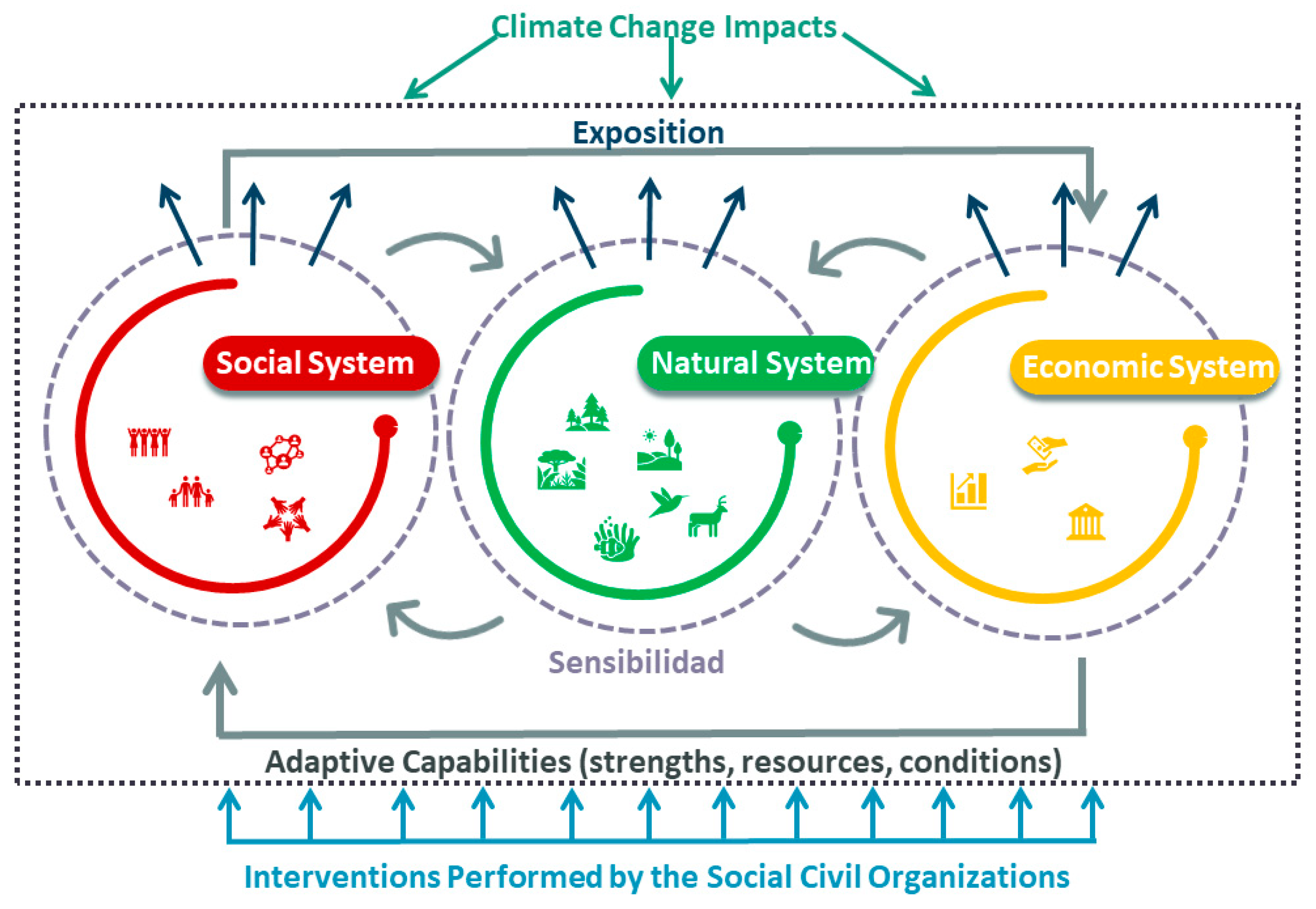
Figure 2.
Sustainable Development Goals and sustainable development.
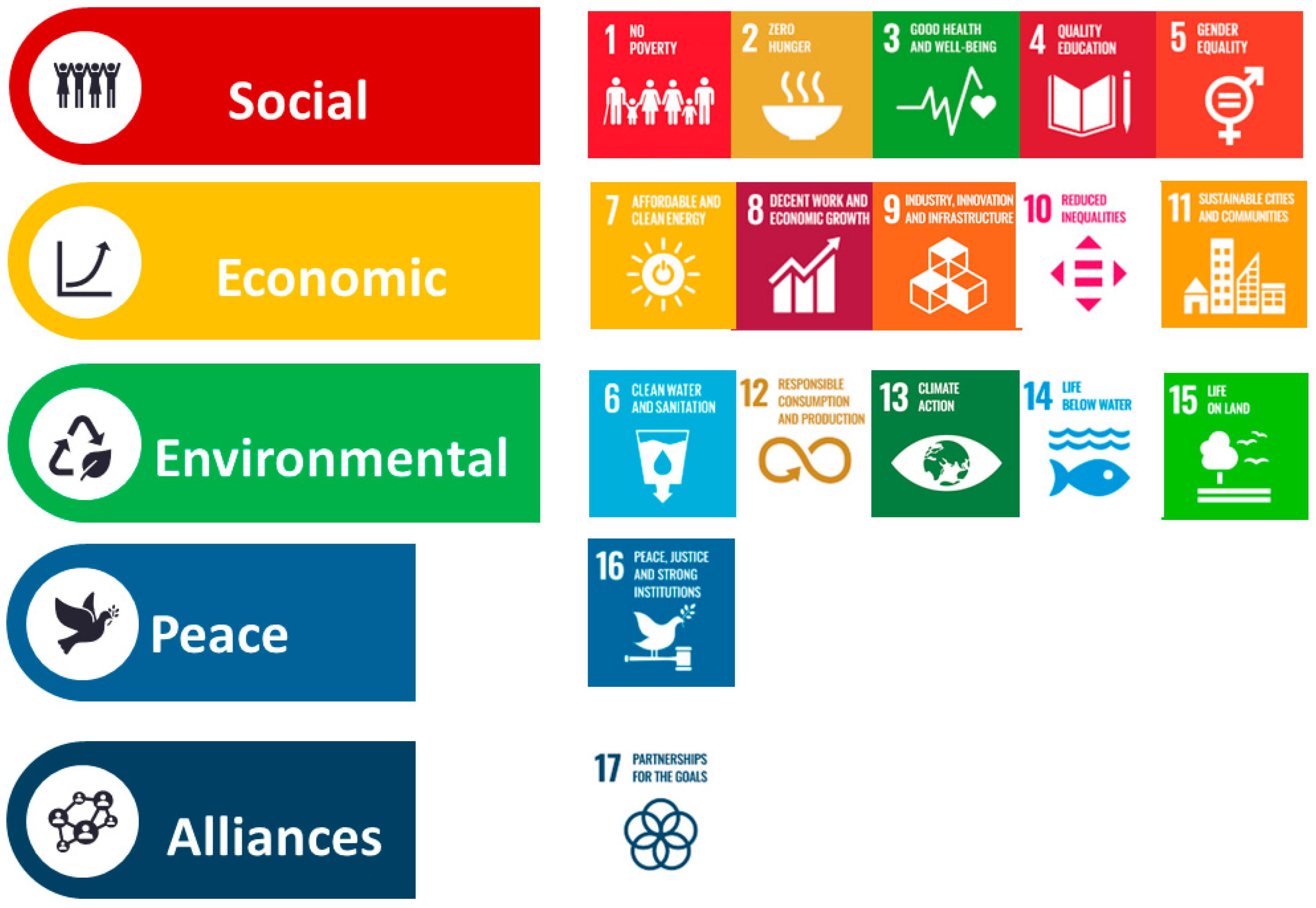
Figure 3.
Percentages of contributions to the sustainable development goals of the project C6.
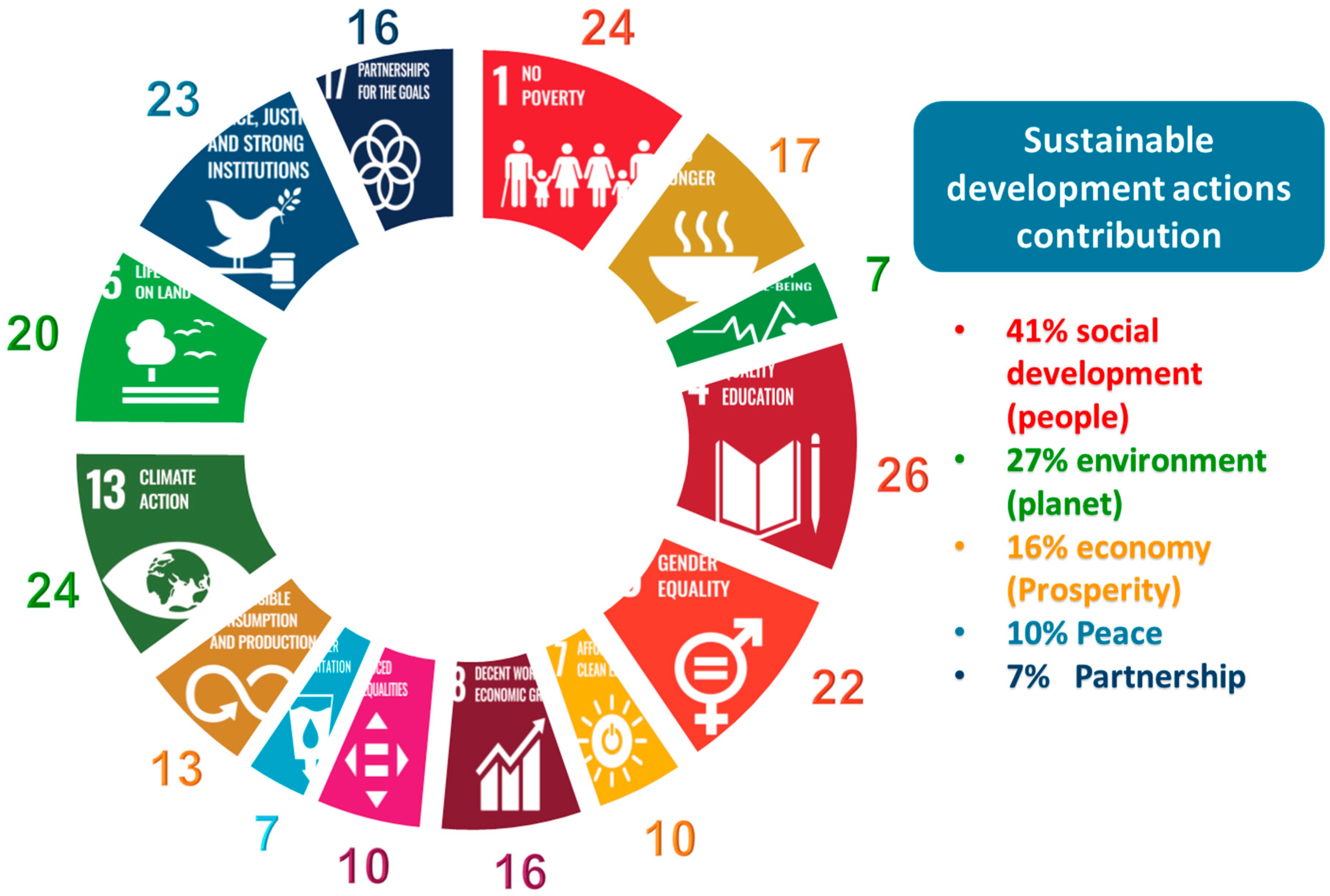
Figure 4.
Interventions by watershed to the sustainable development goals.
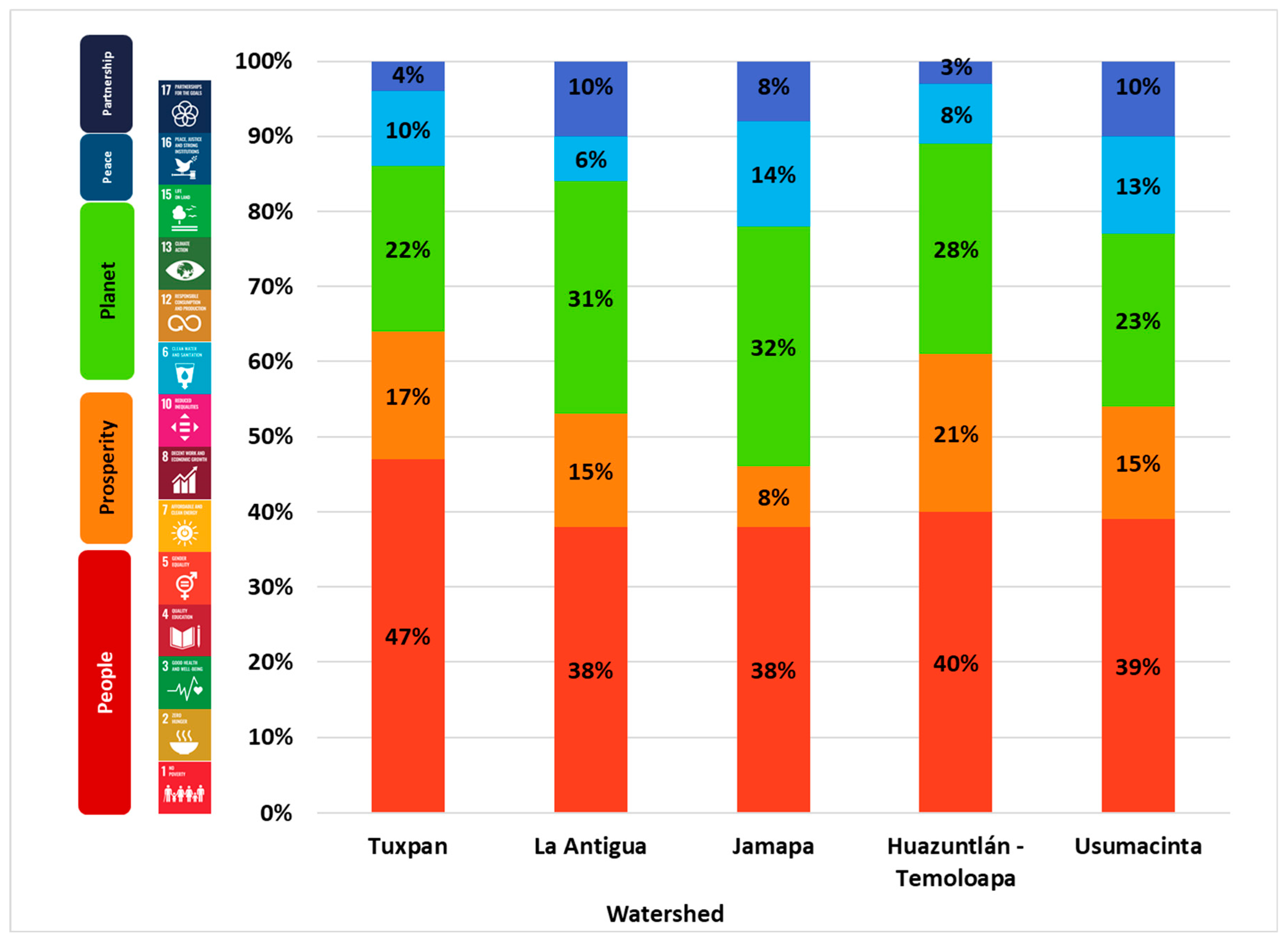

Table 1.
Characteristics of the coastal basins involved in the C6 project.
| Title 1 Characteristics |
Basins | ||||
|---|---|---|---|---|---|
| Tuxpan | La Antigua | Jamapa | Huazuntlán - Temoloapa | Usumacinta | |
| Surface (km2) | 6,755 | 2,176 | 3,918 | 562 | 4,883 |
| Communal surface (km2) | 2,702 | 778 | 1,179 | ||
| Plant cover | |||||
| Natural cover | 27% | 28% | 14.5% | 10% | 61.2% |
| Transformed surface | 73% | 72% | 85.5% | 36% | |
| Soil uses | |||||
| Agriculture | 42.90% | 50.45% | 57.4% | ||
| Livestock | 28.90% | 19.85% | 26.3% | ||
| Forestry | 0.04% | ||||
| Urban and human settlements | 0.80% | 1.32% | 1.2% | ||
| Water bodies | 0.50% | 0.07% | 0.6% | ||
| Inhabitants | 537,960 | 316,983 | 521,621 | 201,548 | |
Table 1.
Selected indicators according to the sustainable development frame for Agenda 2030.
| SDG | Indicator | Targets for the 2030 Agenda |
|---|---|---|
| 1. No poverty | Resilience livelihoods (1.5) | To build the resilience of people with low incomes and those in vulnerable situations and reduce their exposure and vulnerability to climate-related extreme events and other economic, social, and environmental shocks and disasters. |
| 2. Zero hunger | Double the productivity and incomes of small-scale food producers (2.3) | To double the agricultural productivity and incomes of small-scale food producers, in particular women, Indigenous peoples, family farmers, pastoralists, and fishers, including through secure and equal access to land, other productive resources and inputs, knowledge, financial services, markets, and opportunities for value addition and non-farm employment. |
| 3. Ensure healthy lives | Reduce illnesses and death from hazardous chemicals and pollution (3.9) | To substantially reduce the number of deaths and illnesses from hazardous chemicals and air, water, and soil pollution and contamination. |
| 4. Quality education | Education for sustainable development (4.7) | To ensure that all learners acquire the knowledge and skills needed to promote sustainable development, including education for sustainable development and sustainable lifestyles, human rights, gender equality, promotion of a culture of peace and non-violence, global citizenship, and appreciation of cultural diversity and culture's contribution to sustainable development. |
| 5. Gender equality | Ensure full participation in leadership and decision-making (5.5) | To ensure women's full and effective participation and equal opportunities for leadership at all levels of decision-making in political, economic, and public life. |
| 6. Clean water and sanitation | Implement integrated water resources management (6.5) | To implement integrated water resources management at all levels, including through transboundary cooperation. |
| 7. Affordable and clean energy | Increase the percentage of renewable energy (7.2) | To increase substantially the share of renewable energy in the global energy mix. |
| 8. Decent work and economic growth | Promote policies to support job creation and growing enterprises (8.3) | To promote development-oriented policies that support productive activities, decent job creation, entrepreneurship, creativity, and innovation, and encourage the formalization and growth of micro, small, and medium-sized enterprises. |
| 9. Industry, innovation and infrastructure | Develop sustainable, resilient and inclusive infrastructures (9.1) | To develop quality, reliable, sustainable, and resilient infrastructure, including regional and transborder infrastructure, to support economic development and human well-being, focusing on affordable and equitable access for all. |
| 10. Reduce inequalities | Promote universal, social, economic and political inclusion (10.2) | To empower and promote the social, economic, and political inclusion of all, irrespective of age, sex, disability, race, ethnicity, origin, religion, or economic or other status. |
| 11. Sustainable cities and communities | Reduce the adverse effects of natural disasters (11.5) | To significantly reduce the number of deaths and the number of people affected and substantially decrease the direct economic losses relative to the gross domestic product caused by disasters, including water-related disasters, focusing on protecting the poor and people in vulnerable situations. |
| 12. Responsible consumption and production | Responsible management of chemicals and waste (12.4) Substantially reduce waste generation and (12.5) |
To achieve the environmentally sound management of chemicals and all wastes throughout their life cycle, per agreed international frameworks, and significantly reduce their release to air, water, and soil to minimize their adverse impacts on human health and the environment. To substantially reduce waste generation through prevention, reduction, recycling, and reuse. |
| 13. Climate action | Strengthen resilience and adaptive capacity to climate-related disasters (13.1) | To strengthen resilience and adaptive capacity to all countries' climate-related hazards and natural disasters. |
| 14. Life below water | Protect and restore ecosystems (14.2) | To sustainably manage and protect marine and coastal ecosystems to avoid significant adverse impacts, including by strengthening their resilience and taking action for their restoration to achieve healthy and productive oceans. |
| 15. Life on land | Conserve and restore terrestrial and freshwater ecosystems (15.1) | To ensure the conservation, restoration, and sustainable use of terrestrial and inland freshwater ecosystems and their services, particularly forests, wetlands, mountains, and drylands, in line with obligations under international agreements. |
| 16. Peace, justice, and strong institutions | Strengthen national institutions to prevent violence and combat terrorism and crime (16.8) | To strengthen relevant national institutions, including through international cooperation, for building capacity at all levels, particularly in developing countries, to prevent violence and combat terrorism and crime. |
| 17. Partnerships for the goals | Enhance the global partnership for sustainable development (17) | Enhance the Global Partnership for Sustainable Development, complemented by multi-stakeholder partnerships that mobilize and share knowledge, expertise, technology, and financial resources, to support the achievement of the Sustainable Development Goals in all countries, particularly developing countries. |
Source: Information obtained from the United Nations [51].
Disclaimer/Publisher’s Note: The statements, opinions and data contained in all publications are solely those of the individual author(s) and contributor(s) and not of MDPI and/or the editor(s). MDPI and/or the editor(s) disclaim responsibility for any injury to people or property resulting from any ideas, methods, instructions or products referred to in the content. |
© 2024 by the authors. Licensee MDPI, Basel, Switzerland. This article is an open access article distributed under the terms and conditions of the Creative Commons Attribution (CC BY) license (http://creativecommons.org/licenses/by/4.0/).
Copyright: This open access article is published under a Creative Commons CC BY 4.0 license, which permit the free download, distribution, and reuse, provided that the author and preprint are cited in any reuse.


