

Submitted:
03 October 2024
Posted:
04 October 2024
You are already at the latest version
Abstract
We assembled and annotated the complete mitochondrial genomes of Lycalopex vetulus (hoary fox), Cerdocyon thous (bush dog), Tayassu pecari (white-lipped peccary), and Tadarida brasiliensis (Brazilian free-tailed bat). The mitogenomes exhibited typical vertebrate structures, containing 13 protein-coding genes, 22 tRNA genes, two ribosomal RNA genes, and a D-loop region. Phylogenetic reconstruction using the 13 protein-coding genes revealed robust relationships among species within Carnivora, Chiroptera, and Artiodactyla, corroborating previous studies. Secondary structure analysis of tRNAs and ribosomal genes showed slight variations among species of the same order. This research highlights the importance of mitochondrial genomics in understanding the evolutionary relationships and genetic diversity of Cerrado mammals, contributing to conservation efforts for this unique ecosystem.
Keywords:
Mitogenomes
; mtDNA
; Biodiversity
; Brazilian Savanna
; phylogenetics
1. Introduction
The Brazilian Cerrado is one of the largest tropical savanna ecosystems in the world, covering approximately 25% of the national territory and parts of countries like Bolivia and Paraguay [1,2]. In Brazil, the Cerrado spans about 2 million km², ranking as the second largest among the main biomes (Figure 1), and encompasses the states of Goiás, Tocantins, Mato Grosso, Mato Grosso do Sul, Minas Gerais, Bahia, Maranhão, Piauí, Rondônia, Paraná, São Paulo, and the Federal District, as well as enclaves in Amapá, Roraima, and Amazonas [1,3].
The Cerrado's biodiversity is greatly favored by its location. It houses the headwaters of major South American river basins, including the Paraná-Paraguay, Araguaia-Tocantins, and São Francisco [4]. Additionally, it encompasses the upper catchments of significant Amazon River tributaries, such as the Xingu and Tapajós. This unique positioning ensures the resources for diverse living organisms inhabiting the region [4].
The Cerrado exhibits distinct phytophysiognomies, including "campo limpo" (open pasture), "campo sujo" (sparsely wooded cerrado), "cerradão" (dense forest), and "cerrado sensu stricto" (typical savanna), and boasts the highest flora richness among savannas, with approximately 10,000 native species already cataloged [5,6]. Considered a biodiversity hotspot similar to the Atlantic Forest, the Cerrado possesses up to 1,500 plant species; however, it persists with only 34% of its original vegetation [5,6,7].
One of the greatest threats to the biome is the expansion of the agricultural frontier, resulting in the conversion of natural areas into pastures. Land use change alters soil cover, increasing temperatures and reducing humidity [1,3]. This climate alteration tends to trigger anthropogenic fires that pose a risk to local biodiversity, affecting everything from small invertebrates to large mammals. One of the predominant characteristics of the Cerrado is its natural fires during the rainy season, in which the biome faces no threat [8,9].
Of the 751 mammal species described in Brazil [10], approximately 28% reside in the Cerrado, totaling an average of 211 species [10,11]. Considered "Umbrella Species," they include the Panthera onca (Linnaeus, 1758) and the giant river otter Pteronura brasiliensis (Zimmermann, 1780), while Hydrochoerus hydrochaeris (Linnaeus, 1766) is classified as a "flagship species" [12,13]. Due to their charisma, these species protect others and can be used as cultural emblems, assisting in conservation campaigns. By conserving these species, others less known to the public also benefit [1].
The identification and classification of species play a fundamental role in biological research. While traditional morphological characteristics have been widely used for species delimitation, molecular markers have gained significant prominence recently due to their enhanced precision, objectivity, and ability to handle taxonomic uncertainties [14,15,16]. The identification and classification of species through molecular data, including the mitochondrial genome, have emerged as valuable resources to assist classical taxonomy in effectively elucidating the vast diversity of species.
Despite the conservation of gene composition among vertebrate mitochondrial genomes, which typically consist of 13 protein-coding genes (PCGs), 22 transfer RNA genes (tRNA), and two ribosomal RNA genes (rRNA), variations in gene order, tRNA composition, and the presence of repetitive regions in the D-loop have been observed. Some of these variations have been associated with specific taxonomic groups, making studying mitochondrial genomes an intriguing research area, particularly in conducting studies of phylogenetic relationships, biogeography, evolution, and ecology [17,18,19]. Therefore, conducting studies involving assembling and describing mitochondrial genomes is crucial.
A complete mitochondrial genome can be assembled through conventional Sanger sequencing, where overlapping mitochondrial fragments are sequenced and subsequently aligned to construct the circular genome. However, with next-generation sequencing techniques, vast amounts of data encompassing nuclear genomic and mitochondrial sequences can now be generated. Bioinformatics tools have facilitated the identification of mitochondrial sequences and expedited the assembly process, resembling the assembly of a puzzle. Subsequently, annotation is performed to discern the composition and order of mitochondrial genes within the mitogenome [20].
In this study, we present four new complete mitochondrial genomes of mammals living in the Brazilian Cerrado and conduct a comprehensive survey based on the latest lists of mammalian species in Brazil, their respective status on the IUCN’s (International Union for Conservation of Nature) Red List, and the availability of complete mitochondrial sequences in the GenBank. The ultimate goal is to provide valuable contributions and insights to guide future research and conservation efforts related to Cerrado mammals.
2. Materials and Methods
2.1. Data Collection
We searched the literature, including Fauna Surveys, Biogeography Studies, Lists of Threatened Species, Fauna Inventories, and the Red Book of Threatened Brazilian Fauna, to obtain a list of mammal species distributed in the Cerrado. After compiling the list, we researched the status of each species on the IUCN’s Red List. Each species' conservation status is defined by five criteria: historical reduction and decline/population fluctuation, geographic distribution and habitat loss, population distribution, and risk of extinction [21]. Next, we searched GenBank for each species' complete mitochondrial genomes. For species that did not have described mitochondrial genomes, we searched DNA-seq sequencing libraries of these species in the Sequence Read Archive (SRA) repository in the National Center for Biotechnology Information (NCBI) database.
2.2. Assembly and Annotation of Mitogenome Sequences
Raw data libraries from mammal species distributed in Cerrado were imported into the Galaxy Europe platform [22]. We used the NOVOPlasty V. 4.3.1 tool [23] with standard configuration to assemble the mitochondrial genomes with cytochrome oxidase B (Cyt B) or 12S ribosomal gene as seed. We used the MitoAnnotator tool, available in the MitoFish database V.3.89 [24], for annotating Tayassu pecari, Cerdocyon thous, and Tadarida brasiliensis. As for Lycalopex vetulus, the annotation was conducted using the Mitoz 3.6 [25].
We used the RNAfold web server [26] to identify the structures of the 22 tRNAs and ribosomal genes (rRNA) from the mitochondrial genomes of L. vetulus, C. thous, T. pecari, and T. brasiliensis.
We conducted the Relative Synonymous Codon Usage (RSCU) analysis using the concatenated sequences of the 13 protein-coding genes of the four previously stated species using MEGA 11 [10.1093/molbev/msab120] and an in-house Python and R script [27].
The assembled and annotated mitochondrial genomes are deposited in GenBank under the following codes (to be added with the manuscript's acceptance): L. vetulus, C. thous, T. pecari, and T. brasiliensis.
2.3. Phylogenetic Analysis
We used the sequences of the 13 protein-coding genes from all species. Subsequently, the genes were individually aligned using the MAFFT V. 7.526 tool on the Galaxy Europe platform [28]. Afterward, we concatenated the genes using the Concatenator software [29]. We recover the phylogeny of three taxa (Carnivora, Artiodactyla, and Chiroptera) using Maximum Likelihood on IQ-TREE web server software [30], with parameters set to 10,000 replicates for Ultrafast Bootstrap, Iterations, and Replicates.
3. Results and Discussion
3.1. Bibliographic Survey of Species
We started with the papers by Marinho-Filho et al. [10] and the update by Gutierrez and Marinho-Filho [11]. However, some of the species in these papers do not occur in the Brazilian Cerrado, such as Lasiurus borealis [31], Pteronotus parnellii [32], Lycalopex vetulus [33], and Platyrrhinus helleri [34], among others. Other species marked as endemic are distributed in different biomes, such as Thrichomys apereoides [35,36] and Carterodon sulcidens [37].
So, we identified 205 mammal species in the Cerrado biome [1,4,6,7,11,21,38,39,40,41,42,43], with 14 endemic (Table 1). Almost all cataloged species have a conservation status classification assigned by the IUCN or ICMBio (Chico Mendes Institute for Biodiversity Conservation, Ministry of Environment, Brazil) (Table A1). Taking into account the official red list created by the IUCN, most species are classified as Least Concern (LC), with 144 species in this category (70.24% of the total), followed by 7 Near Threatened (NT) (3.41%), 9 Vulnerable (VU) (4.39%), 7 Endangered (EN) (3.41%), two Critically Endangered (CR) (0.97%), one Extinct (EX) (0.48%), and 13 Data Deficient (DD) (6.34%). Among the endemic, the percentages concerning the total species in each conservation category are as follows: LC (30.4%), NT with 4.3%, VU with 4.3%, EN with 17.4%, DD with 30.4%, EX with 4.3%, CR with 0.0%, and NE with 8.7%.
Considering that the Cerrado is the second largest Brazilian biome, covering 24% of the Brazilian territory and hosting a wide diversity of endemic species, the obtained data are alarming indicators that highlight the biome's great importance and its conservation. It is crucial to emphasize that species with restricted distributions are susceptible to extinction. Factors such as abrupt and drastic changes in habitats, trophic guilds, and ecosystems directly influence the survival of these species [40,44].
Although the survey focused on species endemic to the Cerrado, we also recorded some species with occurrences in other biomes, such as the Atlantic Forest, the Amazon Rainforest, the Pantanal, and the Caatinga. The species with these records are: Thylamys velutinus (Wagner, 1842), Thrichomys apereoides (Lund, 1839), Trinomys moojeni (Pessôa, Oliveira & Reis, 1992), and Lonchophylla bokermanni (Sazima, Vizotto & Taddei, 1978).
3.2. Assembling, Annotation, and Analysis of Mitochondrial Genomes
About 42.7% of the species occurring in Cerrado have their mitochondrial genomes described. Among the endemics is 21.7%. We have found available libraries of four mammal species that lack mitochondrial genomes described and that occur in Cerrado and use them to assemble and annotate the mitogenomes: Tayassu pecari (SRX2888090), Cerdocyon thous (SRR18911047), Tadarida brasiliensis (SRR7704833), and Lycalopex vetulus (SRR18911045). We obtained the mitochondrial genomes of L. vetulus with 16,536 bp, C. thous with 16,851 bp, T. pecari with 16,741 bp, and T. brasiliensis with 16,840 bp (Figure 2). All species exhibited the expected pattern for vertebrate mitochondrial genomes, including the 13 protein-coding genes (PCGs), 22 transfer RNAs (tRNAs), two ribosomal RNAs (12S and 16S), and the control region (D-loop), The sizes of the mitochondrial genomes were similar and quite close [17]. The GC content also showed slight variation among the species, with values of 37% for T. brasiliensis, 38% for L. vetulus, 39% for C. thous, and 40% for T. pecari.
L. vetulus, C. thous, T. pecari, and T. brasiliensis presented 22 tRNAs, one for each amino acid, except for Leucine and Serine, which had two tRNAs each. All studied species had 21 tRNAs with a cloverleaf secondary structure, while the tRNA-SER exhibited a different structure from the conventional one. We can observe the same situation in other works, indicating a pattern in some metazoans' tRNAs (Appendix A) [45,46].
We can observe that the size variation of the ribosomal 12S subunit genes was not significant, with the 12S gene for L. vetulus being 956 bp, C. thous 955 bp, T. pecari 950 bp, and T. brasiliensis 965 bp. The ribosomal 16S subunit gene also showed little size variation, with 1578 bp for L. vetulus, 1579 bp for C. thous, 1569 bp for T. pecari, and 1574 bp for T. brasiliensis.
Using the RNAfold tool, we obtained the secondary structures of the 12S and 16S genes from the four species. The structures of the 12S and 16S genes for L. vetulus and C. thous are virtually identical for both species. However, T. brasiliensis and T. pecari exhibit a secondary structure of the 12S and 16S genes that differ from all other target species in the study. All secondary structures exhibit high complexity, featuring helices, hairpin loops, and loops with many branches, pockets, and protrusions. T. brasiliensis and T. pecari show a more significant number of branches and pockets in both genes than L. vetulus and C. thous, indicating that the secondary structure of ribosomal genes will vary according to the group under study.
Regarding the RSCU, we observed that the most used codon in the four species was CTA (Leu), with a higher RSCU value in T. pecari (3.33), while in C. thous, L. vetulus and T. brasiliensis these values were 2.331, 2.33 and 2.69, respectively (Figure 3). The RSCU analysis indicated an overall conserved codon usage, with minor differences between the four species. However, the RSCU was more similar between C. thous and L. vetulus than the others. This is expected since they are closely related species belonging to Cerdocyonina (Canidae).
3.2. Phylogenetic Analysis
To avoid mistakes due to a large number of valid species but little information about complete mitochondrial genomes to recover a comprehensive phylogeny of mammals, we decided to make the phylogenetic analysis by Order of the species we assembled, using all available information for each one. All species used in the phylogeny reconstruction are described in Supplementary Materials. For L. vetulus and C. thous, we included 23 mitochondrial genomes from representatives of the order Carnivora (Table A2). For T. pecari, we utilized 14 mitogenomes from individuals of the order Artiodactyla (Table A3), while for T. brasiliensis, we included 30 mitochondrial genomes of species belonging to the order Chiroptera in the analysis (Table A4).
The query of the phylogenetic tree of the order Carnivora was partitioned by genes, obtaining a total of 39 partitions each with a model obtained (Table A5)). When analyzing the phylogenetic relationships, we identified five distinct structured clades: Felidae, Canidae, Mephitidae, Mustelidae, and Procyonidae (Figure 4). Remarkably, the species L. vetulus and C. thous showed a robust relationship, suggesting a sisterhood between these two genera, corroborating previous findings in phylogenetic reconstructions from other studies conducted with both groups [47,48].
Other significant clades were observed in the tree, such as between Speothos venaticus and Chrysocyon brachyurus, indicating a relationship with a reliability of 84%. However, an additional representative may be necessary to complete the history of this phylogeny. Also noteworthy is the positioning of the species Vulpes chama (Vulpini), which emerges as the sister group of Canini in the Canidae family, as pointed out by other phylogenetic studies [48].
The reconstruction of the phylogenetic tree of the order Chiroptera was partitioned by genes, obtaining 39 models as the best model for each (Table A7). Upon analyzing the phylogenetic relationships, we identified the presence of six structured clades representing six different families: Molossidae, Vespertilionidae, Furipteridae, Noctilionidae, Mormoopidae, and Phyllostomidae (Figure 5). T. brasiliensis and Molossus molossus appear as sister species, demonstrating a robust relationship with a reliability of 100%. This grouping among species of the Molossidae family is supported by previous studies, such as that of Gregorin & Cirranello 2015, highlighting the proximity between these two genera, thus explaining the high reliability observed [49]. Furthermore, upon analyzing the other clades in the phylogenetic tree, we found that almost all groupings exhibit significant reliability, with the lowest reliability recorded at 79% for the alignment of Lonchorhina aurita with the other species within the Phyllostomidae family. This lower reliability suggests the possibility of additional representatives that could be included in the Phyllostomidae family clade to improve the accuracy of the phylogeny [50].
The reconstruction of the phylogenetic tree of the order Artiodactyla was partitioned by genes, obtaining 39 models as the best model for each (Table A6). We identified three distinct families through analyses: Suidae, Camelidae, and Cervidae. Notably, the focal species of the group, T. pecari, demonstrated a highly reliable grouping with Pecari tajacu (Figure 6). This relationship is consistent with previous findings, such as the study by Parisi Dutra et al., 2017, which revealed that T. pecari and P. tajacu are sister groups, justifying the high reliability observed [51]. Additionally, it is worth noting that the grouping of Sus scrofa with T. pecari and P. tajacu also shows high reliability, suggesting a close relationship among the three species. S. scrofa emerges as the sister group of all other species of the Suidae family in Artiodactyla, adding an exciting aspect to understanding phylogenetic relationships within the group [52].
5. Conclusions
The analysis of the studied species' mitochondrial genomes revealed notable similarities in size, composition, and nucleotide proportion despite their taxonomic differences. These findings underscore the importance of mitochondrial genomes in understanding the molecular evolution of metazoans, even though the results had shown conservative trends. Further studies exploring additional data sources, such as nuclear analysis, can complement the natural history of the group in this outstanding Brazilian biome, mainly if applied to population studies, to assess inbreeding in threatened species, aiding in planning conservation strategies.
Supplementary Materials
The following supporting information can be downloaded at the website of this paper posted on Preprints.org, Appendix A: The appendix A contains images of the secondary structure of the 22 tRNA genes and the 2 ribosomal RNA genes of Lycalopex vetulus (Figure A1), Cerdocyon thous (Figure A2), Tayassu pecari (Figure A3), and Tadarida brasiliensis (Figure A4). Appendix B: Appendix B contains tables showing only the endemic mammals of the Cerrado, including their conservation status and access to available mitochondrial genomes. It also includes tables with only the species used in the phylogenetic reconstructions of Carnivora, Artiodactyla, and Chiroptera. Additionally, there are tables with the best models for the 39 partitions obtained by the IQTree software during the reconstruction of phylogenetic trees for Carnivora (Table A1), Artiodactyla (Table A2), and Chiroptera (Table A3). The tables are divided into two sections: one listing the partition and the other indicating the corresponding gene and the best-fitting model.
Author Contributions
Conceptualization and methodology: R.P, L.G.P.P., R.A.S.S., I.B.S., I.G.R.O., V.G.M.; validation: R.P., L.G.P.P., L.L.B., I.G.R.O., I.B.S., R.R.R.; formal analysis: L.G.P.P., R.A.S.S., P.M.A., I.B.S., I.G.R.O.; investigation: L.G.P.P., I.G.R.O., P.M.A., I.B.S., V.G.M.; resources: R.P.; data curation: L.G.P.P.. and F.B.M.; writing - original draft preparation: L.G.P.P., K.F.K., I.G.R.O., I.B.S., P.M.A., L.L.B.; writing - review and editing, visualization: C.G., K.F.K., R.P., L.G.P.P., I.G.R.O., I.B.S., P.M.A.; supervision: R.P., K.F.K; project administration: R.P. All authors have read and agreed to the published version of the manuscript.
Funding
This research received no external funding.
Institutional Review Board Statement
Not applicable.
Informed Consent Statement
Not applicable.
Data Availability Statement
The mitochondrial genomes assembled in this study will be available in the Third Party Annotation Section of the DDBJ/ENA/GenBank databases, in the future under a TPA accession number. The data are currently under review by the GenBank team and TPA accession codes will be added after editorial review. All data and Supplementary Materials are available in the article and in Appendix A and B.
Acknowledgments
We thank the Federal University of Viçosa—Campus Rio Paranaíba for the technical support in carrying out this study, together with the team from the Laboratory of Ecological and Evolutionary Genetics and the Laboratory of Bioinformatics and Genomics of the Federal University of Viçosa for assisting in all stages of this project.
Conflicts of Interest
The authors declare no conflict of interest.
References
- Klink, C.A.; Machado, R.B. Conservation of the Brazilian Cerrado. Conserv. Biol. 2005, 19, 707–713. [Google Scholar] [CrossRef]
- Vieira, L.T.A.; Azevedo, T.N.; Castro, A.A.J.F.; Martins, F.R. Reviewing the Cerrado’s Limits, Flora Distribution Patterns, and Conservation Status for Policy Decisions. Land Use Policy 2022, 115, 106038. [Google Scholar] [CrossRef]
- Rodrigues, A.A.; Macedo, M.N.; Silvério, D.V.; Maracahipes, L.; Coe, M.T.; Brando, P.M.; Shimbo, J.Z.; Rajão, R.; Soares-Filho, B.; Bustamante, M.M.C. Cerrado Deforestation Threatens Regional Climate and Water Availability for Agriculture and Ecosystems. Glob. Change Biol. 2022, 28, 6807–6822. [Google Scholar] [CrossRef] [PubMed]
- Latrubesse, E.M.; Arima, E.; Ferreira, M.E.; Nogueira, S.H.; Wittmann, F.; Dias, M.S.; Dagosta, F.C.P.; Bayer, M. Fostering Water Resource Governance and Conservation in the Brazilian Cerrado Biome. Conserv. Sci. Pract. 2019, 1, e77. [Google Scholar] [CrossRef]
- L.t.a, V.; T.n, A.; A.a.j.f, C.; F.r, M. Reviewing the Cerrado’s limits, flora distribution patterns, and conservation status for policy decisions. 2022.
- Strassburg, B.B.N.; Brooks, T.; Feltran-Barbieri, R.; Iribarrem, A.; Crouzeilles, R.; Loyola, R.; Latawiec, A.E.; Oliveira Filho, F.J.B.; Scaramuzza, C.A. de M.; Scarano, F.R.; et al. Moment of Truth for the Cerrado Hotspot. Nat. Ecol. Evol. 2017, 1, 1–3. [Google Scholar] [CrossRef]
- The Fire Factor. In The Cerrados of Brazil; Oliveira, P., Marquis, R., Eds.; Columbia University Press, 2002; pp. 51–68 ISBN 978-0-231-52939-6.
- Medeiros, M.B. de; Fiedler, N.C. Incêndios florestais no parque nacional da Serra da Canastra: desafios para a conservação da biodiversidade. Ciênc. Florest. 2004, 14, 157–168. [Google Scholar] [CrossRef]
- Durigan, G. Zero-Fire: Not Possible nor Desirable in the Cerrado of Brazil. Flora 2020, 268, 151612. [Google Scholar] [CrossRef]
- Marinho-Filho, J.; Rodrigues, F.H.G.; Juarez, K.M. 14. The Cerrado Mammals: Diversity, Ecology, and Natural History. In The Cerrados of Brazil: Ecology and Natural History of a Neotropical Savanna; Oliveira, P.S., Marquis, R.J., Eds.; Columbia University Press, 2002; pp. 266–284 ISBN 978-0-231-50596-3.
- Gutiérrez, E.E.; Marinho-Filho, J. The Mammalian Faunas Endemic to the Cerrado and the Caatinga. ZooKeys 2017, 644, 105–157. [Google Scholar] [CrossRef]
- Roberge, J.-M.; Angelstam, P. Usefulness of the Umbrella Species Concept as a Conservation Tool. Conserv. Biol. 2004, 18, 76–85. [Google Scholar] [CrossRef]
- Jepson, P.; Barua, M. A Theory of Flagship Species Action. Conserv. Soc. 2015, 13, 95. [Google Scholar] [CrossRef]
- Vitecek, S.; Kučinić, M.; Previšić, A.; Živić, I.; Stojanović, K.; Keresztes, L.; Bálint, M.; Hoppeler, F.; Waringer, J.; Graf, W.; et al. Integrative Taxonomy by Molecular Species Delimitation: Multi-Locus Data Corroborate a New Species of Balkan Drusinae Micro-Endemics. BMC Evol. Biol. 2017, 17, 129. [Google Scholar] [CrossRef] [PubMed]
- Grabowski, M.; Wysocka, A.; Mamos, T. Molecular Species Delimitation Methods Provide New Insight into Taxonomy of the Endemic Gammarid Species Flock from the Ancient Lake Ohrid. Zool. J. Linn. Soc. 2017, 181, 272–285. [Google Scholar] [CrossRef]
- Pinacho-Pinacho, C.D.; Sereno-Uribe, A.L.; García-Varela, M.; Pérez-Ponce de León, G. A Closer Look at the Morphological and Molecular Diversity of Neoechinorhynchus (Acanthocephala) in Middle American Cichlids (Osteichthyes: Cichlidae), with the Description of a New Species from Costa Rica. J. Helminthol. 2018, 94, e23. [Google Scholar] [CrossRef]
- Boore, J.L. Animal Mitochondrial Genomes. Nucleic Acids Res. 1999, 27, 1767–1780. [Google Scholar] [CrossRef] [PubMed]
- Zhong, H.-M.; Zhang, H.-H.; Sha, W.-L.; Zhang, C.-D.; Chen, Y.-C. Complete Mitochondrial Genome of the Red Fox (Vuples Vuples) and Phylogenetic Analysis with Other Canid Species: Complete Mitochondrial Genome of the Red Fox (Vuples Vuples) and Phylogenetic Analysis with Other Canid Species. Zool. Res. 2010, 31, 122–130. [Google Scholar] [CrossRef]
- Formenti, G.; Rhie, A.; Balacco, J.; Haase, B.; Mountcastle, J.; Fedrigo, O.; Brown, S.; Capodiferro, M.R.; Al-Ajli, F.O.; Ambrosini, R.; et al. Complete Vertebrate Mitogenomes Reveal Widespread Repeats and Gene Duplications. Genome Biol. 2021, 22, 120. [Google Scholar] [CrossRef]
- Smith, D.R. The Past, Present and Future of Mitochondrial Genomics: Have We Sequenced Enough mtDNAs? Brief. Funct. Genomics 2016, 15, 47–54. [Google Scholar] [CrossRef]
- ICMBio Lista Oficial de Espécies Da Fauna Brasileira Ameaçadas de Extinção.; 2014.
- Jalili, V.; Afgan, E.; Gu, Q.; Clements, D.; Blankenberg, D.; Goecks, J.; Taylor, J.; Nekrutenko, A. The Galaxy Platform for Accessible, Reproducible and Collaborative Biomedical Analyses: 2020 Update. Nucleic Acids Res. 2020, 48, W395–W402. [Google Scholar] [CrossRef]
- Dierckxsens, N.; Mardulyn, P.; Smits, G. NOVOPlasty: De Novo Assembly of Organelle Genomes from Whole Genome Data. Nucleic Acids Res. 2017, 45, e18. [Google Scholar] [CrossRef]
- Iwasaki, W.; Fukunaga, T.; Isagozawa, R.; Yamada, K.; Maeda, Y.; Satoh, T.P.; Sado, T.; Mabuchi, K.; Takeshima, H.; Miya, M.; et al. MitoFish and MitoAnnotator: A Mitochondrial Genome Database of Fish with an Accurate and Automatic Annotation Pipeline. Mol. Biol. Evol. 2013, 30, 2531–2540. [Google Scholar] [CrossRef]
- Meng, G.; Li, Y.; Yang, C.; Liu, S. MitoZ: A Toolkit for Animal Mitochondrial Genome Assembly, Annotation and Visualization. Nucleic Acids Res. 2019, 47, e63. [Google Scholar] [CrossRef] [PubMed]
- Gruber, A.R.; Lorenz, R.; Bernhart, S.H.; Neuböck, R.; Hofacker, I.L. The Vienna RNA Websuite. Nucleic Acids Res. 2008, 36, W70–W74. [Google Scholar] [CrossRef] [PubMed]
- da Silva, I.B.; Menegídio, F.B.; Garcia, C.; Kavalco, K.F.; Pasa, R. Genetic Chronicle of the Capybara: The Complete Mitochondrial Genome of Hydrochoerus Hydrochaeris. Mamm. Biol. 2024, 104, 459–465. [Google Scholar] [CrossRef]
- Katoh, K.; Misawa, K.; Kuma, K.; Miyata, T. MAFFT: A Novel Method for Rapid Multiple Sequence Alignment Based on Fast Fourier Transform. Nucleic Acids Res. 2002, 30, 3059–3066. [Google Scholar] [CrossRef] [PubMed]
- Vences, M.; Patmanidis, S.; Kharchev, V.; Renner, S.S. Concatenator, a User-Friendly Program to Concatenate DNA Sequences, Implementing Graphical User Interfaces for MAFFT and FastTree. Bioinforma. Adv. 2022, 2, vbac050. [Google Scholar] [CrossRef]
- Trifinopoulos, J.; Nguyen, L.-T.; von Haeseler, A.; Minh, B.Q. W-IQ-TREE: A Fast Online Phylogenetic Tool for Maximum Likelihood Analysis. Nucleic Acids Res. 2016, 44, W232–235. [Google Scholar] [CrossRef]
- Baker, R.J.; Patton, J.; Genoways, H.; Bickham, J. Genic Studies of Lasiurus (Chiroptera, Vespertilionidae) /; Texas Tech University Press,: Lubbock, Tex. :, 1988. [Google Scholar]
- Pavan, A.C.; Marroig, G. Integrating Multiple Evidences in Taxonomy: Species Diversity and Phylogeny of Mustached Bats (Mormoopidae: Pteronotus). Mol. Phylogenet. Evol. 2016, 103, 184–198. [Google Scholar] [CrossRef]
- Olifiers, N.; Delciellos, A. New Record of Lycalopex Vetulus (Carnivora, Canidae) in Northeastern Brazil. Oecologia Aust. 2013, 17, 533–537. [Google Scholar] [CrossRef]
- VELAZCO, P.M.; GARDNER, A.L.; PATTERSON, B.D. Systematics of the Platyrrhinus Helleri Species Complex (Chiroptera: Phyllostomidae), with Descriptions of Two New Species. Zool. J. Linn. Soc. 2010, 159, 785–812. [Google Scholar] [CrossRef]
- Mares, M.A.; Willig, M.R.; Lacher, T.E. The Brazilian Caatinga in South American Zoogeography: Tropical Mammals in a Dry Region. J. Biogeogr. 1985, 12, 57–69. [Google Scholar] [CrossRef]
- Nascimento, F.F.; Lazar, A.; Menezes, A.N.; Durans, A. da M.; Moreira, J.C.; Salazar-Bravo, J.; D′Andrea, P.S.; Bonvicino, C.R. The Role of Historical Barriers in the Diversification Processes in Open Vegetation Formations during the Miocene/Pliocene Using an Ancient Rodent Lineage as a Model. PLOS ONE 2013, 8, e61924. [Google Scholar] [CrossRef] [PubMed]
- Bezerra, A.M.R.; Marinho-Filho, J.; Carmignotto, A.P. A Review of the Distribution, Morphometrics, and Habit of Owl’s Spiny Rat Carterodon Sulcidens (Lund, 1841) (Rodentia: Echimyidae).
- Miotto, R.A.; Rodrigues, F.P.; Ciocheti, G.; Galetti Jr, P.M. Determination of the Minimum Population Size of Pumas (Puma Concolor) Through Fecal DNA Analysis in Two Protected Cerrado Areas in the Brazilian Southeast. Biotropica 2007, 39, 647–654. [Google Scholar] [CrossRef]
- Janis, C.M.; Pough, F.H.; Heiser, J.B. A Vida Dos Vertebrados; Atheneu, 2007; ISBN 978-85-7454-095-5.
- Hofmann, G.S.; Cardoso, M.F.; Alves, R.J.V.; Weber, E.J.; Barbosa, A.A.; de Toledo, P.M.; Pontual, F.B.; Salles, L. de O.; Hasenack, H.; Cordeiro, J.L.P.; et al. The Brazilian Cerrado Is Becoming Hotter and Drier. Glob. Change Biol. 2021, 27, 4060–4073. [Google Scholar] [CrossRef] [PubMed]
- ICMBio Cerrado - Plano de Ação Nacional Para Conservação Dos Mamíferos Do Cerrado; 2019.
- ICMbio Plano de Ação Nacional Para Pequenos Mamíferos de Áreas Abertas; 2024.
- Quintela, F.M.; Da Rosa, C.A.; Feijó, A. Updated and Annotated Checklist of Recent Mammals from Brazil. An. Acad. Bras. Ciênc. 2020, 92, e20191004. [Google Scholar] [CrossRef]
- Magnusson, W.E. Neotropical Rainforest Mammals: A Field Guide. Environ. Conserv. 1998, 25, 175–185. [Google Scholar] [CrossRef]
- Skorupski, J. Characterisation of the Complete Mitochondrial Genome of Critically Endangered Mustela Lutreola (Carnivora: Mustelidae) and Its Phylogenetic and Conservation Implications. Genes 2022, 13, 125. [Google Scholar] [CrossRef] [PubMed]
- Wei, Q.; Wang, X.; Dong, Y.; Shang, Y.; Sun, G.; Wu, X.; Zhao, C.; Sha, W.; Yang, G.; Zhang, H. Analysis of the Complete Mitochondrial Genome of Pteronura Brasiliensis and Lontra Canadensis. Animals 2023, 13, 3165. [Google Scholar] [CrossRef]
- Tchaicka, L.; Freitas, T.R.O. de; Bager, A.; Luengos Vidal, S.; Lucherini, M.; Iriarte, A.; Novaro, A.; Geffen, E.; Garcez, F.S.; Johnson, W.E.; et al. Molecular Assessment of the Phylogeny and Biogeography of a Recently Diversified Endemic Group of South American Canids (Mammalia: Carnivora: Canidae). 2016.
- Zhao, C.; Zhang, H.; Liu, G.; Yang, X.; Zhang, J. The complete mitochondrial genome of the Tibetan fox (Vulpes ferrilata) and implications for the phylogeny of Canidae. C. R. Biol. 2016, 339, 68–77. [Google Scholar] [CrossRef]
- Gregorin, R.; Cirranello, A. Phylogeny of Molossidae Gervais (Mammalia: Chiroptera) Inferred by Morphological Data. Cladistics 2016, 32, 2–35. [Google Scholar] [CrossRef]
- Tsagkogeorga, G.; Parker, J.; Stupka, E.; Cotton, J.A.; Rossiter, S.J. Phylogenomic Analyses Elucidate the Evolutionary Relationships of Bats. Curr. Biol. CB 2013, 23, 2262–2267. [Google Scholar] [CrossRef]
- Parisi Dutra, R.; Casali, D.D.M.; Missagia, R.V.; Gasparini, G.M.; Perini, F.A.; Cozzuol, M.A. Phylogenetic Systematics of Peccaries (Tayassuidae: Artiodactyla) and a Classification of South American Tayassuids. J. Mamm. Evol. 2017, 24, 345–358. [Google Scholar] [CrossRef]
- Zurano, J.P.; Magalhães, F.M.; Asato, A.E.; Silva, G.; Bidau, C.J.; Mesquita, D.O.; Costa, G.C. Cetartiodactyla: Updating a Time-Calibrated Molecular Phylogeny. Mol. Phylogenet. Evol. 2019, 133, 256–262. [Google Scholar] [CrossRef] [PubMed]
Figure 1.
Illustration of a map of Brazil showing the distribution of the Cerrado in yellow. The arrowhead indicates north.
Figure 1.
Illustration of a map of Brazil showing the distribution of the Cerrado in yellow. The arrowhead indicates north.
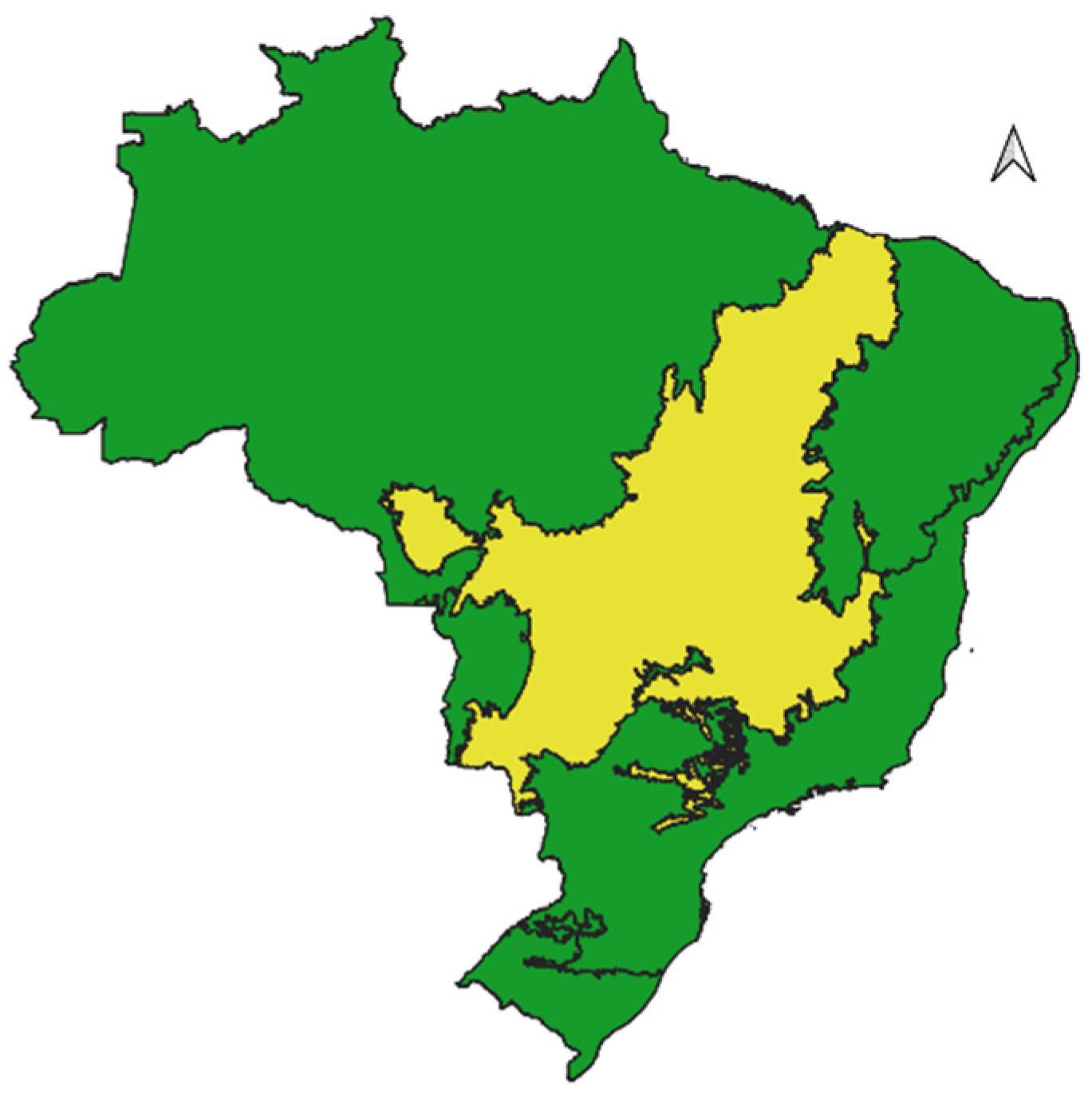
Figure 2.
Comparison of the four mitochondrial genomes of cerrado mammals assembled in the present study. Following from the inner to the outer part of the ring we have, in blue, L. vetulus, in green, C. thous, in beige, T. pecari and in purple, T. brasiliensis.
Figure 2.
Comparison of the four mitochondrial genomes of cerrado mammals assembled in the present study. Following from the inner to the outer part of the ring we have, in blue, L. vetulus, in green, C. thous, in beige, T. pecari and in purple, T. brasiliensis.
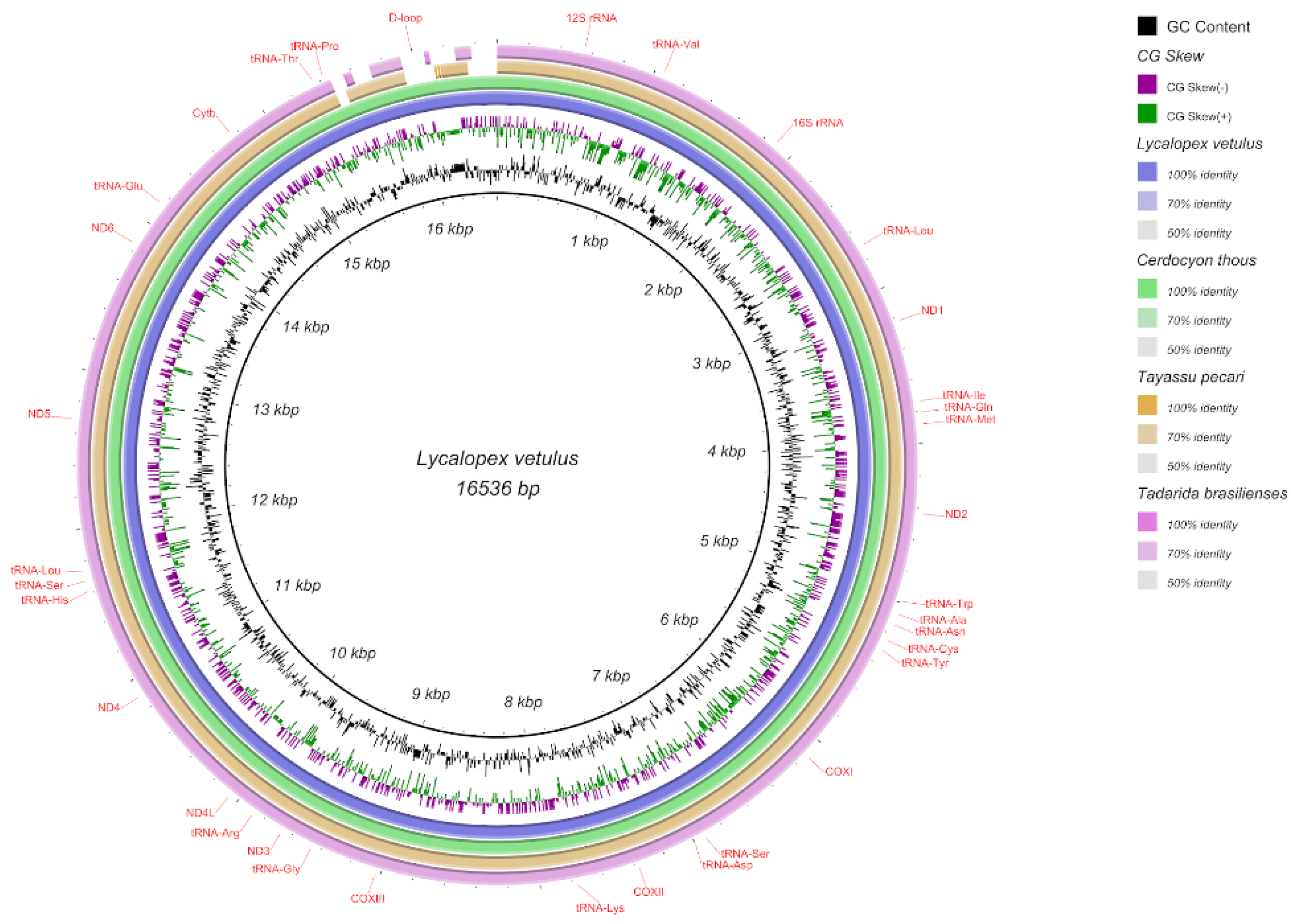
Figure 3.
The graph shows the most frequent codons in mitochondrial genes, highlighting the variations in the use of synonymous codons among the mammalian species analyzed. Codons with RSCU values greater than 1 are used more frequently, indicating a greater preference.
Figure 3.
The graph shows the most frequent codons in mitochondrial genes, highlighting the variations in the use of synonymous codons among the mammalian species analyzed. Codons with RSCU values greater than 1 are used more frequently, indicating a greater preference.
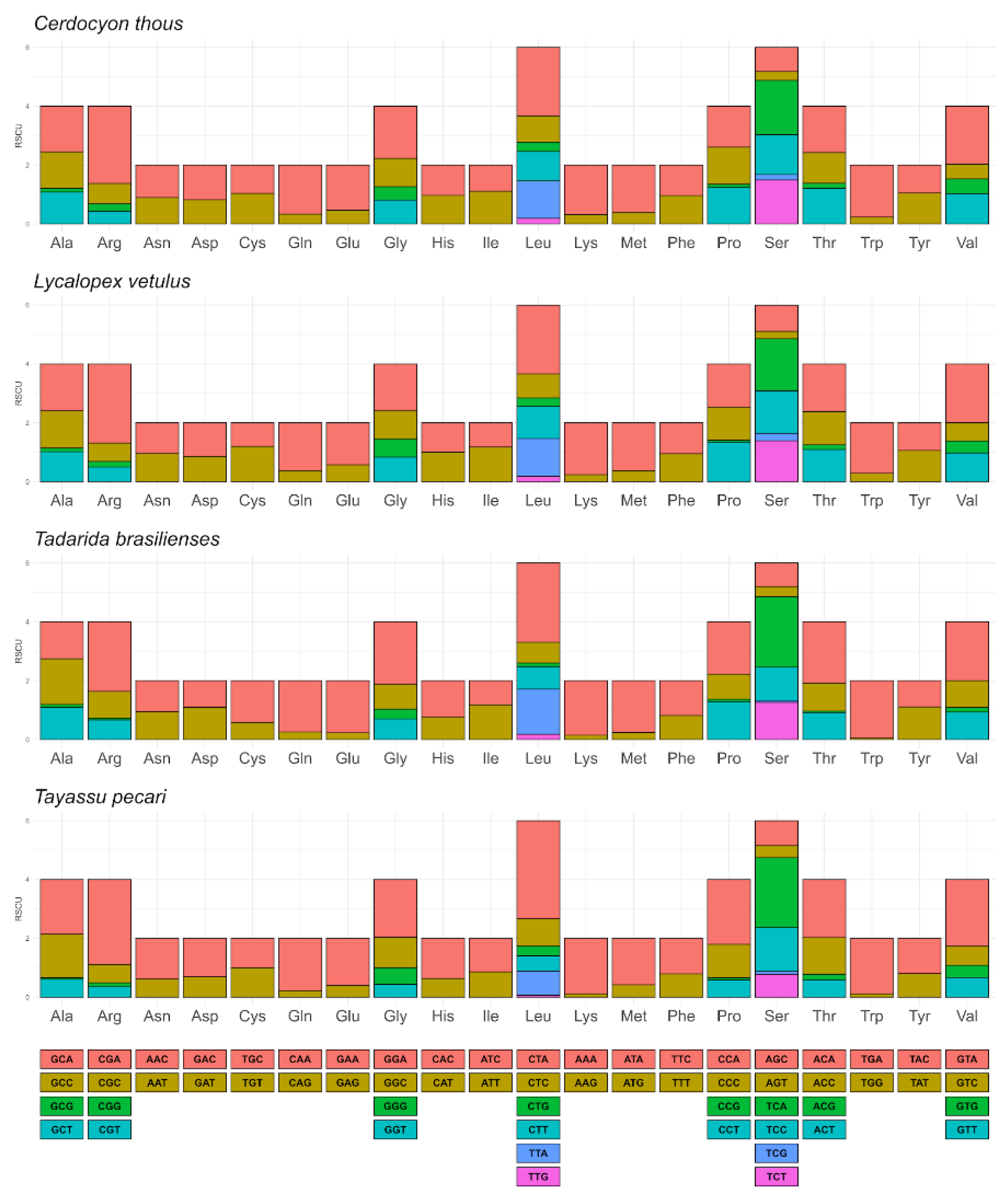
Figure 4.
Reconstruction of the phylogenetic tree of the order Carnivora, clades were formed with the families Felidae, Canidae, Mephitidae, Mustalidae and Procyonidae. Tapirus terrestris was used as an outgroup.
Figure 4.
Reconstruction of the phylogenetic tree of the order Carnivora, clades were formed with the families Felidae, Canidae, Mephitidae, Mustalidae and Procyonidae. Tapirus terrestris was used as an outgroup.
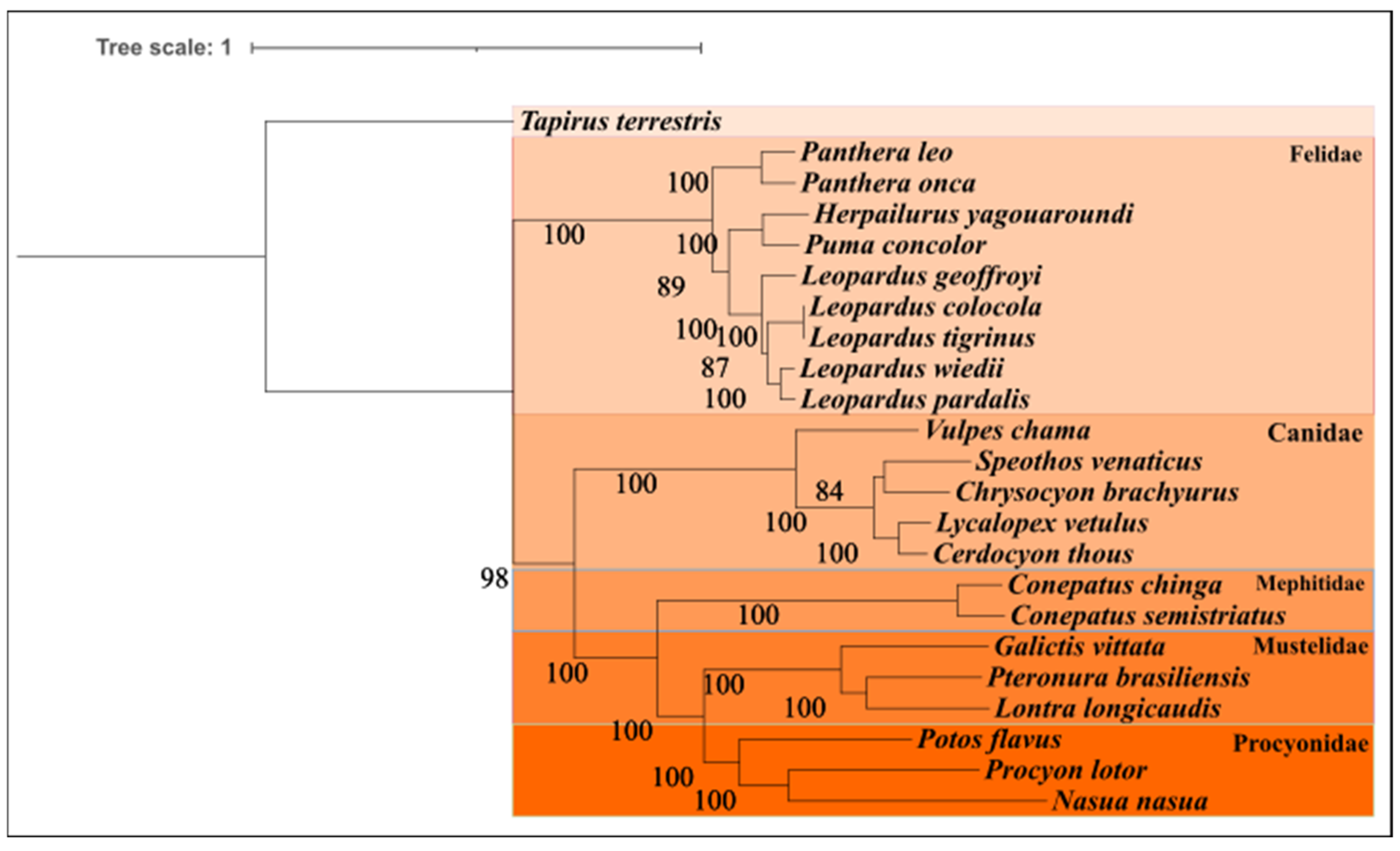
Figure 5.
Reconstruction of the phylogenetic tree of the order Chiroptera, clades were formed with the families Molossidae, Vespertilionidae, Furipteridae, Noctilionidae, Mormoopidae and Phyllostomidae. Tapirus terrestris was used as an outgroup.
Figure 5.
Reconstruction of the phylogenetic tree of the order Chiroptera, clades were formed with the families Molossidae, Vespertilionidae, Furipteridae, Noctilionidae, Mormoopidae and Phyllostomidae. Tapirus terrestris was used as an outgroup.
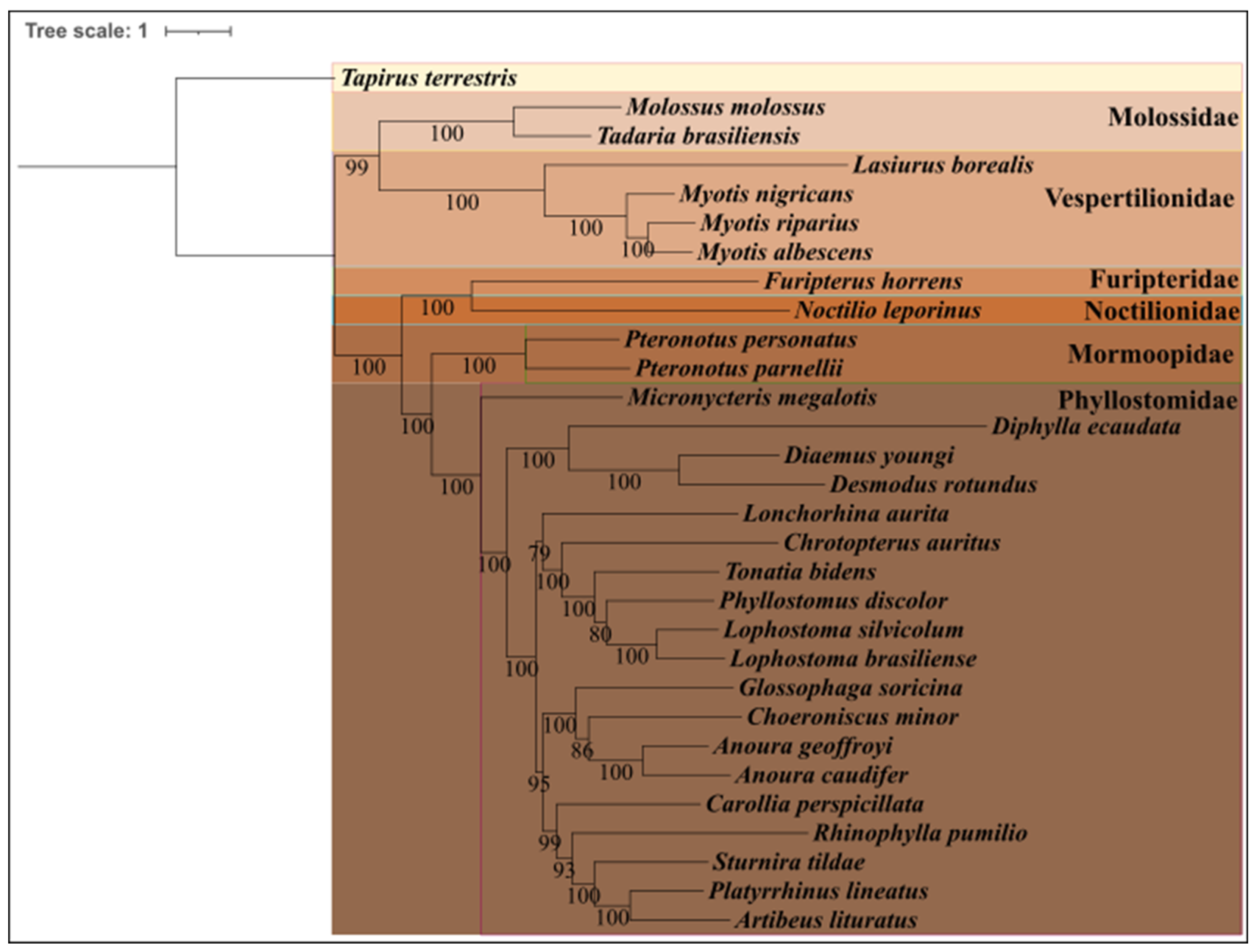
Figure 6.
Reconstruction of the phylogenetic tree of the order Artiodactyla, clades were formed with the families Suidae, Camelidae and Cervidae. Tapirus terrestris was used as an outgroup.
Figure 6.
Reconstruction of the phylogenetic tree of the order Artiodactyla, clades were formed with the families Suidae, Camelidae and Cervidae. Tapirus terrestris was used as an outgroup.
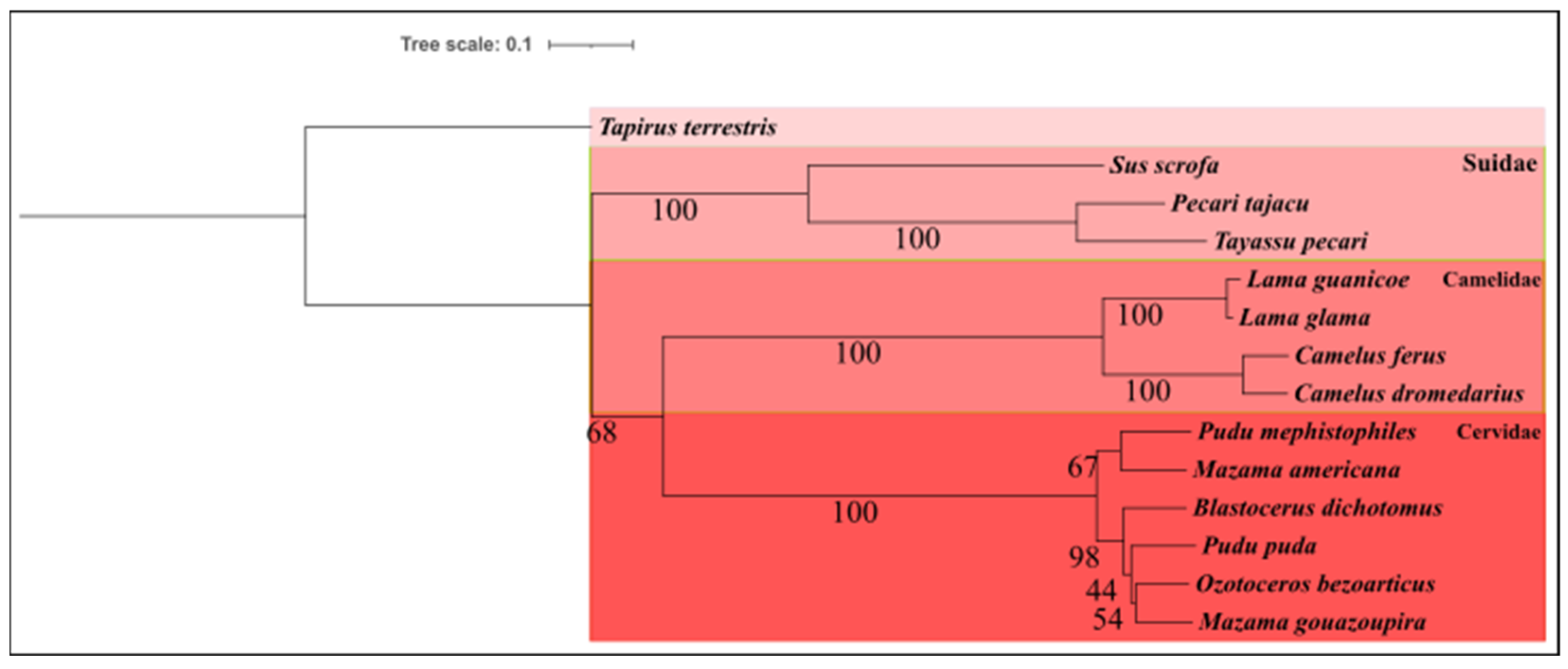

Table 1.
List of species occuring in Brazilian Cerrado, its conservation status in the IUCN Red List and in the ICMBio Red List, and access to GenBank of mitochondrial genomes when available.
Table 1.
List of species occuring in Brazilian Cerrado, its conservation status in the IUCN Red List and in the ICMBio Red List, and access to GenBank of mitochondrial genomes when available.
| Family | Species | Status and Year IUCN | Status and Year ICMBio | GenBank access |
|---|---|---|---|---|
| Bradypodidae | Bradypus variegatus (Schinz, 1825) | LC (2022) | LC (2018) | NC_028501.1 |
| Callithrichidae | Callithrix penicillata (É. Geoffroy Saint-Hilaire, 1812) | LC (2015) | LC (2019) | NC_030788.1 |
| Callithrichidae | Mico melanurus (É. Geoffroy in Humboldt, 1812) | LC (2016) | LC (2019) | - |
| Canidae | Cerdocyon thous (Linnaeus, 1766) | LC (2015) | LC (2018) | - |
| Canidae | Chrysocyon brachyurus (Illiger, 1815) | NT (2015) | VU (2023) | NC_024172.1 |
| Canidae | Lycalopex vetulus (Lund, 1842) | NT (2019) | VU (2023) | - |
| Canidae | Speothos venaticus (Lund, 1842) | NT (2011) | VU (2023) | NC_053974.1 |
| Caviidae | Cavia aperea (Erxleben, 1777) | LC (2016) | LC (2020) | NC_046949.1 |
| Caviidae | Galea spixii (Wagler, 1831) | LC (2016) | LC (2021) | - |
| Caviidae | Kerodon acrobata (Moojen, Locks & Langguth, 1997)* | DD (2016) | VU (2023) | - |
| Cebidae | Alouatta caraya (Humboldt, 1812) | NT (2015) | NT (2012) | NC_064185.1 |
| Cebidae | Aotus infulatus (Kühl, 1820) | - | LC (2012) | KC592390.1 |
| Cebidae | Sapajus apella (Linnaeus, 1758) | LC (2015) | LC (2019) | NC_064167.1 |
| Cebidae | Sapajus libidinosus (Spix, 1823) | NT (2015) | NT (2012) | NC_087899.1 |
| Cervidae | Blastocerus dichotomus (Illiger, 1815) | VU (2016) | VU (2023) | NC_020682.1 |
| Cervidae | Mazama americana (Erxleben, 1777) | DD (2015) | DD (2018) | NC_020719.1 |
| Cervidae | Subulo gouazoubira (Smith,1827) | LC (2015) | LC (2018) | NC_020720.1 |
| Cervidae | Ozotoceros bezoarticus (Linnaeus, 1758) | NT (2015) | VU (2023) | NC_020766.1 |
| Chlamyphoridae | Euphractus sexcinctus (Linnaeus, 1758) | LC (2013) | LC (2018) | NC_028571.1 |
| Chlamyphoridae | Tolypeutes tricinctus (Linnaeus, 1758) | VU (2013) | EN (2023) | NC_028576.1 |
| Cricetidae | Akodon cursor (Winge, 1887) | LC (2016) | LC (2020) | - |
| Cricetidae | Akodon lindberghi (Hershkovitz, 1990) | DD (2016) | LC (2021) | - |
| Cricetidae | Akodon montensis (Thomas, 1913) | LC (2016) | LC (2020) | NC_025746.1 |
| Cricetidae | Bibimys labiosus (Winge, 1887) | LC (2016) | LC (2021) | - |
| Cricetidae | Calassomys apicalis (Pardiñas, Lessa, Teta, Salazar-Bravo & Camara, 2014)* | - | NT (2021) | - |
| Cricetidae | Calomys callosus (Rengger, 1830) | LC (2016) | LC (2020) | - |
| Cricetidae | Calomys expulsus (Lund, 1840) | LC (2016) | LC (2021) | - |
| Cricetidae | Calomys laucha (G. Fischer, 1814) | LC (2016) | LC (2020) | - |
| Cricetidae | Calomys tener (Winge, 1887) | LC (2016) | LC (2020) | - |
| Cricetidae | Calomys tocantinsi (Bonvicino, Lima & Almeida, 2003) | LC (2016) | LC (2020) | - |
| Cricetidae | Cerradomys marinhus (Bonvicino, 2003) | LC (2017) | LC (2020) | - |
| Cricetidae | Cerradomys subflavus (Wagner, 1842) | LC (2016) | LC (2020) | - |
| Cricetidae | Oecomys roberti (Thomas, 1904) | LC (2016) | LC (2021) | NC_065749.1 |
| Cricetidae | Euryoryzomys lamia (Thomas, 1901)* | VU (2017) | EN (2023) | - |
| Cricetidae | Gyldenstolpia planaltensis (Avila-Pires, 1972)* | - | EN (2023) | - |
| Cricetidae | Holochilus brasiliensis (Desmarest, 1819) | LC (2016) | LC (2021) | - |
| Cricetidae | Holochilus sciureus (Wagner, 1842) | LC (2016) | LC (2021) | NC_061914.1 |
| Cricetidae | Juscelinomys candango (Moojen, 1965)* | EX (2019) | CR (PEX) (2023) | - |
| Cricetidae | Kunsia tomentosus (Lichtenstein, 1830) | CR (2018) | LC (2021) | - |
| Cricetidae | Microakodontomys transitorius (Hershkovitz, 1993)* | EN (2018) | EN (2023) | - |
| Cricetidae | Necromys lasiurus (Lund, 1841) | LC (2016) | LC (2020) | - |
| Cricetidae | Nectomys rattus (Pelzeln, 1883) | LC (2016) | LC (2020) | - |
| Cricetidae | Oecomys bicolor (Tomes, 1860) | LC (2016) | LC (2021) | - |
| Cricetidae | Oecomys cleberi (Locks, 1981) | DD (2019) | LC (2020) | - |
| Cricetidae | Oecomys concolor (Wagner, 1845) | LC (2016) | LC (2021) | - |
| Cricetidae | Oligoryzomys moojeni (Weksler & Bonvicino, 2005)* | DD (2017) | LC (2020) | - |
| Cricetidae | Oligoryzomys nigripes (Olfers, 1818) | LC (2016) | LC (2020) | - |
| Cricetidae | Oligoryzomys rupestris (Weksler & Bonvicino, 2005)* | DD (2017) | EN (2023) | - |
| Cricetidae | Oligoryzomys stramineus (Bonvicino & Weksler, 1998) | LC (2017) | LC (2020) | NC_039723.1 |
| Cricetidae | Hylaeamys megacephalus (G. Fischer, 1814) | LC (2016) | LC (2020) | - |
| Cricetidae | Oxymycterus delator (Thomas, 1903) | LC (2016) | LC (2020) | - |
| Cricetidae | Pseudoryzomys simplex (Winge, 1887) | LC (2016) | LC (2020) | - |
| Cricetidae | Rhipidomys emiliae (J. A. Allen, 1916) | LC (2016) | LC (2021) | - |
| Cricetidae | Rhipidomys macrurus (Gervais, 1855) | LC (2016) | LC (2020) | - |
| Cricetidae | Sooretamys angouya (G. Fischer, 1814) | LC (2016) | LC (2020) | - |
| Cricetidae | Thalpomys cerradensis (Hershkovitz, 1990)* | LC (2017) | VU (2023) | - |
| Cricetidae | Thalpomys lasiotis (Thomas, 1916)* | LC (2017) | EN (2023) | - |
| Cricetidae | Wiedomys cerradensis (Gonçalves, Almeida & Bonvicino, 2005) | DD (2017) | LC (2020) | NC_025747.1 |
| Cuniculidae | Cuniculus paca (Linnaeus, 1766) | LC (2016) | LC (2021) | NC_079967.1 |
| Cyclopedidae | Cyclopes didactylus (Linnaeus, 1758) | LC (2013) | LC (2018) | NC_028564.1 |
| Dasypodidae | Cabassous tatouay (Desmarest, 1804) | LC (2013) | LC (2018) | NC_028558.1 |
| Dasypodidae | Cabassous unicinctus (Linnaeus, 1758) | LC (2013) | LC (2018) | NC_028559.1 |
| Dasypodidae | Dasypus novemcinctus (Linnaeus, 1758) | LC (2013) | LC (2018) | NC_001821.1 |
| Dasypodidae | Dasypus septemcinctus (Linnaeus, 1758) | LC (2013) | LC (2018) | NC_028569.1 |
| Dasypodidae | Priodontes maximus (Kerr, 1792) | VU (2013) | VU (2023) | NC_028573.1 |
| Dasypodidae | Tolypeutes matacus (Desmarest, 1804) | NT (2013) | NT (2018) | NC_028575.1 |
| Dasypodidae | Tolypeutes tricinctus (Linnaeus, 1758) | VU (2013) | EN (2023) | NC_028576.1 |
| Dasyproctidae | Dasyprocta azarae (Lichtenstein, 1823) | DD (2016) | LC (2021) | - |
| Didelphidae | Caluromys lanatus (Olfers, 1818) | LC (2015) | LC (2019) | - |
| Didelphidae | Caluromys philander (Linnaeus, 1758) | LC (2015) | LC (2019) | - |
| Didelphidae | Chironees minimus (Linnaeus, 1758) | LC (2019) | - | |
| Didelphidae | Cryptonanus agricolai (Moojen, 1943) | DD (2016) | LC (2019) | - |
| Didelphidae | Didelphis albiventris (Lund, 1840) | LC (2015) | LC (2019) | - |
| Didelphidae | Didelphis aurita (Wied-Neuwied, 1826) | LC (2015) | LC (2019) | NC_057515.1 |
| Didelphidae | Didelphis marsupialis (Linnaeus, 1758) | LC (2016) | LC (2019) | NC_057518.1 |
| Didelphidae | Gracilinanus agilis (Burmeister, 1854) | LC (2015) | LC (2019) | NC_054268.1 |
| Didelphidae | Lutreolina crassicaudata (Desmarest, 1804) | LC (2016) | LC (2019) | NC_057520.1 |
| Didelphidae | Marmosa murina (Linnaeus, 1758) | LC (2015) | LC (2019) | - |
| Didelphidae | Marmosops incanus (Lund, 1840) | LC (2015) | LC (2019) | - |
| Didelphidae | Marmosops ocellatus (Tate, 1931) | LC (2016) | DD (2019) | - |
| Didelphidae | Metachirus nudicaudatus (É. Geoffroy, 1803) | LC (2015) | LC (2019) | NC_006516.1 |
| Didelphidae | Micoureus constantiae (Thomas, 1904) | LC (2016) | LC (2019) | - |
| Didelphidae | Micoureus demerarae (Thomas, 1905) | LC (2015) | LC (2019) | - |
| Didelphidae | Micoureus paraguayanus (Tate, 1931) | LC (2015) | LC (2019) | - |
| Didelphidae | Monodelphis americana (Müller, 1776) | LC (2016) | LC (2019) | - |
| Didelphidae | Monodelphis domestica (Wagner, 1842) | LC (2016) | LC (2019) | NC_006299.1 |
| Didelphidae | Monodelphis kunsi (Pine, 1975) | LC (2015) | LC (2019) | - |
| Didelphidae | Monodelphis rubida | LC (2016) | - | |
| Didelphidae | Monodelphis umbristriata (Müller, 1776) | LC (2015) | LC (2019) | - |
| Didelphidae | Monodelphis unistriata (Wagner, 1842)* | CR (2016) | DD (2019) | - |
| Didelphidae | Philander opossum (Linnaeus, 1758) | LC (2016) | LC (2019) | - |
| Didelphidae | Thylamys karimii (Petter, 1968) | VU (2016) | LC (2019) | - |
| Didelphidae | Thylamys macrurus (Olfers, 1818) | NT (2014) | LC (2019) | - |
| Didelphidae | Thylamys velutinus (Wagner, 1842) | NT (2016) | LC (2019) | - |
| Echimyidae | Carterodon sulcidens (Lund, 1838)* | DD (2016) | DD (2021) | KU892752.1 |
| Echimyidae | Clyomys bishopi (Thomas, 1909) | LC (2016) | LC (2020) | - |
| Echimyidae | Clyomys laticeps (Thomas, 1909) | LC (2016) | LC (2020) | KU892753.1 |
| Echimyidae | Dactylomys dactylinus (Desmarest, 1817) | LC (2016) | LC (2020) | NC_029876.1 |
| Echimyidae | Phyllomys brasiliensis (Lund, 1840)* | EN (2016) | EN (2023) | - |
| Echimyidae | Proechimys longicaudatus (Rengger, 1830) | LC (2016) | LC (2020) | NC_020657.1 |
| Echimyidae | Proechimys roberti (Thomas, 1901) | LC (2016) | LC (2020) | NC_039420.1 |
| Echimyidae | Thrichomys apereoides (Lund, 1839) | LC (2016) | LC (2020) | KU892773.1 |
| Echimyidae | Trinomys albispinus (I. Geoffroy, 1838) | LC (2016) | LC (2021) | KU892761.1 |
| Echimyidae | Trinomys minor (Reis & Pessôa, 1995) | - | - | - |
| Echimyidae | Trinomys moojeni (Pessôa, Oliveira & Reis, 1992) | EN (2016) | EN (2023) | KX650080.1 |
| Emballonuridae | Peropteryx kappleri (Peters, 1867) | LC (2016) | LC (2018) | - |
| Emballonuridae | Peropteryx macrotis (Wagner, 1843) | LC (2015) | LC (2018) | - |
| Emballonuridae | Rhynchonycteris naso (Wied-Neuwied, 1820) | LC (2016) | LC (2018) | CM073095.1 |
| Emballonuridae | Saccopteryx bilineata (Temminck, 1838) | LC (2015) | LC (2018) | CM072282.1 |
| Emballonuridae | Saccopteryx leptura (Schreber, 1774) | LC (2015) | LC (2018) | NC_036421.1 |
| Erethizontidae | Coendou prehensilis (Linnaeus, 1758) | LC (2016) | NT (2021) | - |
| Felidae | Herpailurus yagouaroundi (É. Geoffroy Saint-Hilaire, 1803) | LC (2014) | VU (2023) | NC_028311.1 |
| Felidae | Leopardus pardalis (Linnaeus, 1758) | LC (2014) | LC (2018) | NC_028315.1 |
| Felidae | Leopardus tigrinus (Schreber, 1775) | VU (2016) | EN (2023) | NC_028317.1 |
| Felidae | Leopardus wiedii (Schinz, 1821) | NT (2014) | VU (2023) | NC_028318.1 |
| Felidae | Panthera onca (Linnaeus, 1758) | NT (2016) | VU (2023) | NC_022842.1 |
| Felidae | Puma concolor (Linnaeus, 1771) | LC (2014) | NT (2018) | NC_016470.1 |
| Furipteridae | Furipterus horrens (Cuvier, 1828) | LC (2016) | VU (2023) | NC_048476.1 |
| Hydrochaeridae | Hydrochaeris hydrochaeris (Linnaeus, 1766) | LC (2016) | LC (2020) | BK066995.1 |
| Leporidae | Sylvilagus brasiliensis (Linnaeus, 1758) | EN (2018) | DD (2021) | - |
| Molossidae | Eptesicus diminutus (Osgood, 1915) | LC (2016) | LC (2018) | - |
| Molossidae | Eptesicus furinalis (d’Orbigny e Gervais, 1847) | LC (2015) | LC (2018) | - |
| Molossidae | Eumops auripendulus (Shaw, 1800) | LC (2015) | LC (2018) | - |
| Molossidae | Eumops bonariensis (Peters, 1874) | LC (2016) | LC (2018) | - |
| Molossidae | Eumops glaucinus (Wagner, 1843) | LC (2016) | LC (2018) | - |
| Molossidae | Eumops hansae (Sanborn, 1932) | LC (2015) | LC (2018) | - |
| Molossidae | Eumops perotis (Schinz, 1821) | LC (2015) | LC (2018) | - |
| Molossidae | Histiotus velatus (I. Geoffroy, 1824) | DD (2016) | LC (2018) | - |
| Molossidae | Lasiurus cinereus (Palisot de Beauvois, 1796) | LC (2015) | LC (2018) | - |
| Molossidae | Lasiurus ega (Gervais, 1856) | LC (2016) | LC (2018) | - |
| Molossidae | Cynomops abrasus (Temminck, 1826) | DD (2016) | LC (2018) | - |
| Molossidae | Neoplatymops mattogrossensis (Vieira, 1942) | LC (2019) | LC (2018) | - |
| Molossidae | Cynomops planirostris (Peters, 1866) | LC (2015) | LC (2018) | - |
| Molossidae | Molossops temminckii (Burmeister, 1854) | LC (2015) | LC (2018) | - |
| Molossidae | Molossus rufus (É. Geoffroy, 1805) | LC (2015) | LC (2018) | - |
| Molossidae | Molossus molossus (Pallas, 1766) | LC (2015) | LC (2018) | NC_065689.1 |
| Molossidae | Nyctinomops aurispinosus (Peale, 1848) | LC (2019) | LC (2018) | - |
| Molossidae | Nyctinomops laticaudatus (É. Geoffroy, 1805) | LC (2015) | LC (2018) | - |
| Molossidae | Nyctinomops macrotis (Gray, 1840) | LC (2015) | LC (2018) | - |
| Molossidae | Promops nasutus (Spix, 1823) | LC (2015) | LC (2018) | - |
| Molossidae | Rhogeessa tumida (Genoways e Baker, 1996) | LC (2016) | LC (2018) | - |
| Molossidae | Tadarida brasiliensis (I. Geoffroy, 1824) | LC (2015) | LC (2018) | CM061282.1 |
| Mormoopidae | Pteronotus gymnonotus (Wagner, 1843) | LC (2018) | LC (2018) | - |
| Mormoopidae | Pteronotus personatus (Wagner, 1843) | LC (2016) | LC (2018) | NC_033353.1 |
| Mustelidae | Eira barbara (Linnaeus, 1758) | LC (2016) | LC (2018) | - |
| Mustelidae | Galictis cuja (Molina, 1782) | LC (2015) | LC (2018) | - |
| Mustelidae | Galictis vittata (Schreber, 1776) | LC (2015) | LC (2018) | NC_053973.1 |
| Mustelidae | Lontra longicaudis (Olfers, 1818) | NT (2020) | LC (2018) | NC_079649.1 |
| Mustelidae | Pteronura brasiliensis (Zimmermann, 1780) | EN (2020) | VU (2023) | NC_071787.1 |
| Myrmecophagidae | Myrmecophaga tridactyla (Linnaeus, 1758) | VU (2013) | VU (2023) | NC_028572.1 |
| Myrmecophagidae | Tamandua tetradactyla (Linnaeus, 1758) | LC (2013) | LC (2018) | NC_004032.1 |
| Natalidae | Natalus macrourus (Gervais, 1856) | LC (2008) | VU (2018) | - |
| Noctilionidae | Noctilio albiventris (Desmarest, 1818) | LC (2015) | LC (2018) | - |
| Noctilionidae | Noctilio leporinus (Linnaeus, 1758) | LC (2015) | LC (2018) | NC_037137.1 |
| Phyllostomidae | Anoura caudifer (É. Geoffroy, 1818) | LC (2019) | LC (2018) | NC_022420.1 |
| Phyllostomidae | Anoura geoffroyi (Gray, 1838) | LC (2016) | LC (2018) | NC_065676.1 |
| Phyllostomidae | Dermanura cinerea (Gervais, 1856) | LC (2016) | LC (2018) | - |
| Phyllostomidae | Artibeus concolor (Peters, 1865) | LC(2016) | LC (2018) | - |
| Phyllostomidae | Artibeus lituratus (Olfers, 1818) | LC (2015) | LC (2018) | NC_016871.1 |
| Phyllostomidae | Artibeus planirostris (Spix, 1823) | LC (2015) | LC (2018) | - |
| Phyllostomidae | Carollia perspicillata (Linnaeus, 1758)) | LC (2015) | LC (2018) | NC_022422.1 |
| Phyllostomidae | Chiroderma trinitatum (Goodwin, 1958) | LC (2016) | LC (2018) | - |
| Phyllostomidae | Chiroderma villosum (Peters, 1860) | LC (2015) | LC (2018) | - |
| Phyllostomidae | Choeroniscus minor (Peters, 1868) | LC(2016) | LC (2018) | NC_065683.1 |
| Phyllostomidae | Chrotopterus auritus (Peters, 1856) | LC (2015) | LC (2018) | NC_037132.1 |
| Phyllostomidae | Desmodus rotundus (É. Geoffroy, 1810) | LC (2015) | LC (2018) | NC_022423.1 |
| Phyllostomidae | Diaemus youngii (Jentnik, 1893) | LC (2015) | LC (2018) | NC_037133.1 |
| Phyllostomidae | Diphylla ecaudata (Spix, 1823) | LC (2016) | LC (2018) | NC_037138.1 |
| Phyllostomidae | Glossophaga soricina (Pallas, 1766) | LC (2015) | LC (2018) | NC_065682.1 |
| Phyllostomidae | Lonchophylla bokermanni (Sazima, Vizotto e Taddei, 1978) | EN (2016) | VU (2023) | - |
| Phyllostomidae | Lonchophylla dekeyseri (Taddei, Vizzotto e Sazima, 1983)* | EN (2016) | EN (2023) | - |
| Phyllostomidae | Lonchorhina aurita (Tomes, 1863) | LC (2015) | NT (2018) | NC_037135.1 |
| Phyllostomidae | Macrophyllum macrophyllum (Schinz, 1821) | LC (2015) | LC (2018) | - |
| Phyllostomidae | Glyphonycteris behnii (Peters, 1865) | DD (2016) | DD (2018) | - |
| Phyllostomidae | Micronycteris megalotis (Gray, 1842) | LC (2015) | LC (2018) | NC_022419.1 |
| Phyllostomidae | Micronycteris minuta (Gervais, 1856) | LC (2015) | LC (2018) | - |
| Phyllostomidae | Micronycteris sanborni (Simmons, 1996) | LC (2017) | LC (2018) | - |
| Phyllostomidae | Mimon bennettii (Gray, 1838) | LC (2018) | LC (2018) | - |
| Phyllostomidae | Gardnerycteris crenulatum (É. Geoffroy, 1803) | LC (2018) | LC (2018) | - |
| Phyllostomidae | Phylloderma stenops (Peters, 1865) | LC (2015) | LC (2018) | - |
| Phyllostomidae | Phyllostomus discolor (Wagner, 1843) | LC (2015) | LC (2018) | NC_065690.1 |
| Phyllostomidae | Phyllostomus elongatus (É. Geoffroy, 1810) | LC (2015) | LC (2018) | - |
| Phyllostomidae | Phyllostomus hastatus (Pallas, 1767) | LC (2015) | LC (2018) | - |
| Phyllostomidae | Platyrrhinus lineatus (É. Geoffroy, 1810) | LC (2015) | LC (2018) | ON357734.1 |
| Phyllostomidae | Rhinophylla pumilio (Peters, 1865) | LC (2015) | LC (2018) | NC_022426.1 |
| Phyllostomidae | Sturnira lilium (É. Geoffroy, 1810) | LC (2016) | LC (2018) | - |
| Phyllostomidae | Sturnira tildae (de la Torre, 1959) | LC (2016) | LC (2018) | NC_022427.1 |
| Phyllostomidae | Tonatia bidens (Spix, 1823) | DD (2016) | LC (2018) | MZ391834.1 |
| Phyllostomidae | Lophostoma brasiliense (Peters, 1866) | LC (2016) | LC (2018) | NC_065678.1 |
| Phyllostomidae | Lophostoma silvicola (d’Orbigny, 1836) | LC(2016) | LC (2018) | NC_022424.1 |
| Phyllostomidae | Trachops cirrhosus (Spix, 1823) | LC (2015) | LC (2018) | NC_086900.1 |
| Phyllostomidae | Uroderma bilobatum (Peters, 1866) | LC (2019) | LC (2018) | - |
| Phyllostomidae | Uroderma magnirostrum (Davis, 1968) | LC (2015) | LC (2018) | - |
| Phyllostomidae | Vampyressa pusilla (Wagner, 1843) | DD (2016) | LC (2018) | - |
| Procyonidae | Nasua nasua (Linnaeus, 1766) | LC (2015) | LC (2018) | NC_020647.1 |
| Procyonidae | Potos flavus (Schreber, 1774) | LC (2015) | LC (2018) | NC_053977.1 |
| Procyonidae | Procyon cancrivorus (G. Cuvier, 1798) | LC (2015) | LC (2018) | PP999026.1 |
| Tapiridae | Tapirus terrestris (Linnaeus, 1758) | VU (2018) | VU (2023) | NC_053962.1 |
| Tayassuidae | Pecari tajacu (Linnaeus, 1758) | LC (2011) | LC (2018) | NC_012103.1 |
| Tayassuidae | Tayassu pecari (Link, 1795) | VU (2012) | VU (2023) | - |
| Vespertilionidae | Eptesicus brasiliensis (Desmarest, 1819) | LC (2015) | LC (2018) | - |
| Vespertilionidae | Myotis albescens (É. Geoffroy, 1806) | LC (2015) | LC (2018) | NC_036327.1 |
| Vespertilionidae | Myotis nigricans (Schinz, 1821) | LC (2019) | LC (2018) | NC_036318.1 |
| Vespertilionidae | Myotis riparius (Handley, 1960) | LC (2015) | LC (2018) | NC_036317.1 |
| Status abbreviations—DD: Data Deficient; LC: Least Concern; NT: Near Threatened; EN: Endangered; CR: Critically Endangered; *Brazilian Cerrado endemic species | ||||
Disclaimer/Publisher’s Note: The statements, opinions and data contained in all publications are solely those of the individual author(s) and contributor(s) and not of MDPI and/or the editor(s). MDPI and/or the editor(s) disclaim responsibility for any injury to people or property resulting from any ideas, methods, instructions or products referred to in the content. |
© 2024 by the authors. Licensee MDPI, Basel, Switzerland. This article is an open access article distributed under the terms and conditions of the Creative Commons Attribution (CC BY) license (http://creativecommons.org/licenses/by/4.0/).
Copyright: This open access article is published under a Creative Commons CC BY 4.0 license, which permit the free download, distribution, and reuse, provided that the author and preprint are cited in any reuse.


