

Submitted:
01 October 2024
Posted:
02 October 2024
Read the latest preprint version here
Abstract
In 1935, Einstein and Rosen (ER), in their seminal paper "Particle Problem in General Relativity" proposed that "a particle in the physical Universe has to be described by mathematical bridges connecting two sheets of spacetime" in order to achieve a consistent understanding of quantum fields in curved spacetime. We discuss similar conclusions independently arrived at by Schr\"{o}dinger in 1956 and 't Hooft in 2016 in the context of cosmological and black hole spacetimes. Quantum effects at gravitational horizons involve inverse harmonic oscillators. We demonstrate that an analogous ER proposal of a mathematical bridge is envisioned by Berry and Keating for the description of a quantum inverse harmonic oscillator that has horizons in its phase space. Recently proposed direct-sum quantum theory reconciles the ER's vision by expressing a single quantum state in the physical space as a direct-sum of two components in the parity conjugate regions with opposite arrows of time. We discuss the implications of this framework for offering a new understanding of the ER bridges, promising a unitarity description of quantum fields in curved spacetime along with observer complementarity. Furthermore, we present compelling evidence for our new understanding of ER bridges in the form of large-scale parity asymmetric features in the cosmic microwave background. We finally discuss the implications of this new understanding for our endeavors in combining gravity and quantum mechanics.
Keywords:
gravity and quantum mechanics
; black holes
; early universe cosmology and cosmic microwave background
1. Introduction
The key highlights of this investigation are
- Parity () and Time () reversal symmetries are fundamental aspects of quantum theory, and we present a new formulation of quantum theory where a single quantum state is described in a direct-sum Hilbert space defined by based geometric superselection sectors. We demonstrate that this construction brings an enhanced understanding of Berry and Keating’s quantum inverse harmonic oscillator [4], whose spectrum is given by the zeros of the Riemann zeta function on . We explain the quantum effects in gravity mimic various aspects of inverse harmonic oscillator.
- Combining gravity and quantum mechanics requires a new understanding of ’time’, and the direct-sum quantum theory brings that, and the framework resonates well with Einstein-Rosen’s mathematical ’bridges’ (see Figure 1).
- Achieving unitarity and observer complementarity is the first step in building a consistent understanding of quantum fields in curved spacetime. Direct-sum quantum theory is a promising approach to achieve this by creating geometric superselection sectors of Hilbert space describing components of a quantum state in regions of spacetime related by discrete transformations.
- The ER bridges realized via direct-sum quantum theory, when applied to inflationary quantum fluctuations, predict parity asymmetry in the primordial spectra on large scales. We showed this explains the parity asymmetry observed in the cosmic microwave background (CMB) on large angular scales and also resolves CMB anomalies.
- Our new and fundamental understanding of ER bridges brings a new understanding of quantum gravity, potentially opening new doors of investigations from early Universe cosmology to black hole physics. We also elucidate how the action of gravity and quantum mechanics involve inverse harmonic oscillators and how our quantum framework brings a novel understanding of them.
Beyond the standard model (SM) of particle physics and the General Theory of Relativity (GR), the immediate new physics one can think of is quantum field theory in curved spacetime (QFTCS). Even after decades of research and numerous explorations of Planck scale quantum gravity1, the fundamental questions about QFTCS, such as the loss of unitarity and black hole information paradox, still loom around. In this paper, we highlight the crucial observations of Einstein-Rosen (ER) in an attempt to combine GR and quantum mechanics (QM) [1]. The basic essence of ER investigation is the incompatibility between gravity and quantum theory due to the possibility of two arrows of time describing one physical world. ER demanded that there should only be one physical world, but they were not in favor of choosing an arrow of time by hand. Since the QM requires fixing the arrow of time (or the arrow of causality), to solve the particle problem in GR, ER conjectured description of the particle (quantum field) in one physical world has to be described by mathematical bridges between two sheets of spacetime. A similar conclusion was obtained independently by Schrödinger in 1956 [2] and ’t Hooft [3] in 2016 in the context of cosmological (de Sitter) and black hole (BH) spacetimes. The occurrence of two arrows of time in an attempt to describe one physical world is not only limited to the (quantum) physics at the gravitational horizons but also bound to occur in the context of phase space horizons of an Inverse Harmonic Oscillator (IHO). The seminal work of Berry and Keating (BK) in 1999 uncovered the intricacies in the quantum physics of IHO. As a way out, they proposed the identification of phase space regions. There is an intriguing similarity between BK’s proposal in the context of quantum IHO phase space and Schrödinger and ’t Hooft’s proposals in the context of quantum physics at gravitational horizons. In other words, the first quantization of IHO and the second quantization in curved spacetime are fundamentally related. The purpose of the paper is to juxtapose all these foundational developments that independently emerged across decades and observe the universal features connecting them.
We discuss the relations between ER bridges and analogous proposals in different contexts with the recently developed framework of direct-sum quantum theory and its applications to early Universe cosmology, and BH physics [11,12,13,14,15]. The direct-sum quantum theory is based on the discrete spacetime (such as parity () and time reversal ()) (a)symmetries of the physical system to formulate a description of the quantum state as a direct-sum of two components corresponding to (geometric) superselection sectors (SSS) of Hilbert space. Geometric SSS are Hilbert spaces that describe quantum states corresponding to a finite region of physical space. If a Hilbert space is a direct-sum geometric SSS, a state vector in that Hilbert space becomes a direct-sum of components corresponds to geometric SSS. The same applies to operators in the Hilbert space. This is called the geometric superselection rule. We show that the "direct-sum" is the mathematical bridge that matches the expectations of ER bridges in describing one physical world with two arrows of time. The two arrows of time here operate at the parity conjugate regions of physical space embedded with the geometric construction of SSS. This framework restores unitarity in curved spacetime, and it is tested against the latest observations of the cosmic microwave background from the Planck satellite data.
The paper is organized as follows. In Section 2, we discuss the origins of ER’s proposal of mathematical bridges, which has links with later discoveries by Schrödinger and ’t Hooft. In Section 3, we discuss the connections between the quantum physics of IHO and quantum effects at the gravitational horizons and the non-trivial zeros of the Riemann zeta function. In Section 4, we present the basic elements of direct-sum quantum field theory (QFT) and demonstrate the new understanding of spacetime with geometric SSS. In Section 5, we study the implications of direct-sum quantum theory for understanding IHO and show how the construction resonates well with the BK’s quantization proposal. In Section 6, we uncover the relation between ER bridges and the direct-sum QFTCS in the contexts of Rindler, de Sitter, and Schwarzschild spacetimes. In Section 7, we provide observational support for our new understanding of ER bridges with early Universe cosmology that leads to temperature fluctuations in the cosmic microwave background (CMB). In Section 8, we summarize by highlighting important aspects of our studies, which have non-trivial implications for the open challenges we have in all the theories of Planck scale quantum gravity [16,17].
Throughout the paper we follow the units and metric signature .
2. A Brief History of Quantum Field Theory in Curved Spacetime
ER paper [1] of 1935 is the first work in history that looked for quantum effects in curved spacetime. ER worried about the appearance of two identical sheets of spacetime when one aims to describe a quantum field in the exterior of the Schwarzschild BH (SBH). The SBH metric in its original form is described by
where describes two dimensional sphere, are time and radial cordinates. There is a coordinate singularity at the Horizon , and the physical singularity is at . The Kruskal-Székers (KS) coordinates
which obey
remove the . With the redefinition
The SBH becomes
From (3) we can notice that
This implies there are two arrows of time , to describe the exterior (interior) of the SBH related by discrete transformations. If we consider one arrow of time, say , to do quantum physics with positive energy states, then one ends up with another physical spacetime with the opposite arrow of time and negative energy states 2. As a way out of this conundrum and demanding only one physical world, ER, conjectured 3:
A quantum field in physical space has to be described by mathematical bridges between two sheets of spacetime
After 20 years, Schrödinger in 1956 encountered a similar conundrum in the context of "Expanding Universes" in de Sitter (dS) spacetime [2]. We can understand this by the following dS metric in the flat Friedmann-Lamaître-Robertson-Walker (FLRW) coordinates
where R is the curvature scalar of de Sitter space and being the conformal time. One thumb rule in physics is to make use of symmetries. The origin of physical conundrums often occurs, throwing away any symmetries by hand. Similar to SBH, dS spacetime too (7) described the physical world with two possible arrows of time given by
Schrödinger demanded there cannot be two expanding Universes; there should only be one Universe, which is similar to ER who demanded one physical world. There cannot be two exteriors to SBH. Analogous to ER bridge Schrödinger proposed the so-called antipodal identification (i.e., and to represent a single physical event), often called the Elliptic interpretation of de Sitter space. Schrödinger’s conjecture is:
Every event in dS has to be described by thin, rigid rods connecting the antipodal ( conjugate) points in spacetime
We notice the one-to-one correspondence between ER bridges and Schrödinger’s rods. After 60 years, following the seminal works of Norma G. Sanchéz and Whiting [19], Gerard ’t Hooft, too, arrived at a similar idea in the context of SBH [3] i.e., to identify and together with parity conjugate points and . All these developments spanned over 90 years, have a common goal of achieving unitary quantum physics in curved spacetime defined by:
An imaginary observer bounded by a gravitational horizon has to witness pure states evolving into pure states.
Another concept called observer complementarity is tied to the unitarity definition above, which requires different observers in curved spacetime to share complementary information in the form of pure states. This leads to information reconstruction beyond the spacetime horizons that the observer cannot causally access. Both unitarity and observer complementarity are the essential requirements for QFTCS and quantum gravity.
All the investigations over the decades majorly admitted the inevitability of unitarity loss in curved spacetime unless a new physics is built from a yet unknown theory of quantum gravity at Planck scales. Even then, the particle description problem initiated by ER remains unsolved, and it remains one of the deepest problems in theoretical physics [20].
With all the significant developments in cosmology and astrophysics, both in theoretical and observational aspects, the importance of discovering the true nature of quantum fields in curved spacetime is the need of the hour. Every development of this subject, starting from Zel’dovich and Starobinsky’s revelation of particle production in cosmological backgrounds [21], Starobinsky’s later formulation of cosmic inflation and the generation of quantum fluctuations [22,23,24], Hawking’s BH radiation (that was followed from Starobinsky’s work on Kerr BHs [25]) [26] has pushed significantly the field of theoretical and observational physics.
ER’s proposal of the mathematical bridge later evolved into classical possibilities and interpretations of wormholes connecting different universes or space-like distances in a single universe with the need for exotic matter or modifications of gravity [5,6,7,18,27]. However, the paper of ER is majorly concerned with gravity and quantum mechanics in the sense of QFTCS in the vicinity of gravitational horizons. The exact realization of "a mathematical bridge" (quantum mechanically) to represent a physical Universe has been unclear over these decades. Our recent attempts in this direction show a promising outcome both from theoretical and observational points of view, which forms the crux of this paper.
3. Inverse Harmonic Oscillator, Quantum Gravitational Physics, and Riemann Hypothesis
In the context of early Universe cosmology, the inflationary quantum fluctuations manifestly appear in terms of canonical quantum variables (known as Mukhanov-Sasaki variables) [28] can be understood through QFT of inverse harmonic oscillators (IHOs). Even in the context of Black Hole physics, IHOs are found to be the fundamental building blocks to describe Hawking radiation [29,30,31]. The role of IHOs even extends to the Rindler spacetime and also in the context of the quantum Hall effect, molecular physics, and even in biophysics (See [31,32] and references therein). The quantum aspects of IHO are found to occur in the context of the zeros of the Riemann zeta function [33]. In 1999, M. V. Berry and J. Keating (BK) found a remarkable relation between the energy spectrum of the IHO and the zeros of the Riemann zeta function [4] along . This is in line with Hilbert-Pólya’s conjecture [34]. The following classical Hamiltonian describes the IHO
The Hamiltonian equations of motion are
Like the Harmonic oscillator case, the IHO is symmetric under , i.e., with a crucial difference that the Energy is not bounded from below, which tempts us to see it as instability. The classical solutions of (10) can be written as
where and characterize the energy of the physical system, which can be both positive () and negative ().4 Since the physical system can take infinitely positive and infinitely negative energies, the Hamiltonian of the IHO is said to be unbounded from below. This is a clear contrast with the usual quantum mechanics, where we always deal with physical systems whose energies are bounded from below (even when we have situations where the potential is negative). Since the potential of IHO is unbounded from below (can take infinite negative values), there are conceptual limitations to treating IHO as a scattering problem [35]. The phase space trajectories in Figure 2 define four regions separated by phase space horizons or separatrices [30,35]
where we can notice the behavior of position and momentum swap when changing from a region of negative energy to positive energy and vice versa. The arrows of time in (13) define that arrows of phase space trajectories in Figure 2.
One can rewrite (9) in terms of the so-called canonically rotated coordinates
which is known as the Berry-Keating Hamiltonian [4] whose equations of the system give the following solutions
From the phase space trajectories of IHO Figure 2, we may conclude that the Hamiltotian is unbounded and the system is highly unstable. Depending on the initial conditions, the phase space indicates doubly degenerate positive and negative energy time evolutions separated by phase space horizons or separatrices [30,35] . Furthermore, we can also notice that the doubly degenerate trajectories can be associated with opposite arrows of time ( and ) together with the following discrete transformations
that leaves the Hamiltonian (14) invariant. It is worth noting that (16) with in (15) becomes the transformation in our notation. Furthermore, the positive and negative energy regions in Figure 2 are related by
As a consequence of Heisenberg’s uncertainty relation, we have
Notice in Figure 2 that the parity conjugate regions of physical space with opposite arrows of time are separated by the lines of phase space horizons or separatrices . Quantum mechanically, IHO has been understood in two ways [36]: (i) With the BK’s quantization: by applying the identification for doubly degenerate points in phase space and along with boundary conditions based on the dilatation symmetries. Interestingly, these lead to matching the spectrum of IHO with the non-trivial zeros of the Riemann zeta function along the line . (ii) Considering the IHO as a scattering problem with incoming and outgoing states. This allows the quantum states to reflect and tunnel from one region to another region. But this consideration has fundamental issues from the foundational point of view due to the presence of phase space horizons [35]. Furthermore, the connection between IHO and the Riemann zeta function is unclear in the scattering approach. By the analysis of IHO’s Wigner function and the corresponding conditions for scattering, it was found in [35] that the tunneling from the left () to the right region () of phase space depicted in Figure 2 is not possible unless one invokes an evolution of quantum states from negative to positive energy. QM does not allow this because the and regions of phase space involve distinct time evolutions. On the other hand, BK’s quantum description of IHO suffers from issues related to quantum chaos [37] because Hamiltonian is unbounded with regions of phase space containing different arrows of time. Furthermore, BK’s identification and boundary conditions lack physical and (phase space) geometrical understanding.
The position Q and momentum P wavefunctions of the IHO Hamiltonian operator (for the region and ) are [4,30,34]
which satisfy the orthogonal and completeness properties [30,32]. The wavefunctions as a function of can be found explicitly along with the detailed discussion of probability densities without any singularities at the phase space horizons can be found in [30,32,38]. The wave function of IHO becomes delocalized with time evolution. Thus, one cannot have the usual interpretation of a particle. This resonates with the situation in describing quantum fields in curved spacetime where we cannot have usual particle interpretations.
Notable features of quantum IHO are
- With the quantum mechanical limitation and such that , the energy spectrum of IHO becomes discrete. Counting the number of states between 0 and one getswhich matches with the average number of non-trivial zeros of the Riemann zeta function for with the identification .
-
The relation between IHO energy eigenstates and Riemann zeros was shown to be more than a coincidence with the analysis of scale transformations and the discrete symmetries of the IHO’s phase space, which form the dihedral group [39] of order 8. These symmetries render a boundary condition (for either or )
- The wavefunction is also an Eigen function of Weyl reflected Laplace-Beltrami operatorwith positive definite Eigenvalues .
- BK proposes identifying the discrete set of points in phase space, which are , and . This is very much similar to the antipodal identification in dS spacetime proposed by Schrödinger and the one of ’t Hooft in the context of Schwarzschild spacetime [2,3]. As discussed earlier, the antipodal identification is similar to the ER’s mathematical bridge. Thus, what BK proposes is another "mathematical bridge" to join the IHO’s phase space regions with opposite arrows of time.
As mentioned at the beginning of this section, inflationary quantum (scalar) fluctuation in terms of the Mukhanov-Sasaki variable () is equivalent to QFT of inverse harmonic oscillators with time-dependent mass [28]
where are the slow-roll parameters during inflationary expansion. Over-dot denotes differentiation with respect to cosmic time, and over-prime represents differentiation with respect to conformal time. The MS variable where is the curvature perturbation that determines the super-horizon metric fluctuation and eventually seed the temperature fluctuations in the cosmic microwave background (CMB), is the inflaton field which sources the inflationary cosmic expansion and is the Hubble parameter during inflation [14,28]. Similarly, graviton fluctuations during inflation are also described by inverse harmonic oscillators.
In the context of Black hole physics, the appearance of IHO can be intuitively seen through the behavior of Kruskal coordinates (2), which scale similar to of IHO (15). ’t Hooft has explicitly derived the gravitational backreaction effects between in going state (at position and out going state (at position ) near the horizon of SBH and applied first quantization, which yielded [40,41]
where is called the Schwarzschild radius. The above result is obtained from equations of motion GR with the partial wave expansion
where ’s are the spherical harmonics. From (24) and (2), one can deduce that the following Hamiltonian, which is analogous to IHO, describes the quantum effects in the Black hole horizon (See [29,30] for more details)
Eqns. (23) and (26) establish the connection between IHO and quantum effects in gravity and the need for understanding ER bridges. In the next section, we focus on establishing direct-sum quantum theory, which emerges from the necessity of incorporating two arrows in time to describe one physical world.
4. Quantum State with a Mathematical Bridge Connecting Parity Conjugate Regions of Physical Space: Direct-Sum Quantum Theory
In the previous section, we discussed how SBH and dS spacetimes can allow a description of one physical world with two arrows of time. Similar realization occurs even with the Schrödinger equation, which is an order differential equation in time
where here is assumed to be time-independent parity symmetric Hamiltonian for simplicity. The Schrödinger equation (27) sets the definition of positive energy state with a presumption on the arrow of time
Suppose one assumes an opposite arrow of time; an equivalent definition of a positive energy state becomes
This would emerge from the Schrödinger equation with a sign change of the complex number, which is obvious because we reversed the arrow of time.
The entire QFT is built on the definition of a positive energy state. Thus, one must define an arrow of time before specifying the quantum theory. Thus, there is an ambiguity in fixing the arrow time, which is associated with whether to have "" or "" in the description of the Schrödinger equation. Nature does not distinguish between "" and ""; Quantum theory (without gravity) is known to be time-symmetric. Thus, it does not matter what convention we use for the arrow of time; we would arrive at the same physics. This is what a recent work by J. Donoghue and G. Menezes shows [42], that is, the entire QFT can be reconstructed with convention with opposite arrow time by replacing everywhere with .
This crucial observation is the basis for building a direct-sum quantum theory, which removes the requirement of defining an arrow of time to declare a positive energy state. We formulate here the description of a quantum state by (geometric) superselection rule [11,12,13,14,43] involving .
Figure 3.
The picture depicts the new understanding of quantum harmonic oscillator in a direct-sum Hilbert space. Time is a parameter in quantum theory. In contrast, the spatial position is an operator. A quantum state here is described by a direct-sum of two components in parity conjugate points in physical space.
Figure 3.
The picture depicts the new understanding of quantum harmonic oscillator in a direct-sum Hilbert space. Time is a parameter in quantum theory. In contrast, the spatial position is an operator. A quantum state here is described by a direct-sum of two components in parity conjugate points in physical space.
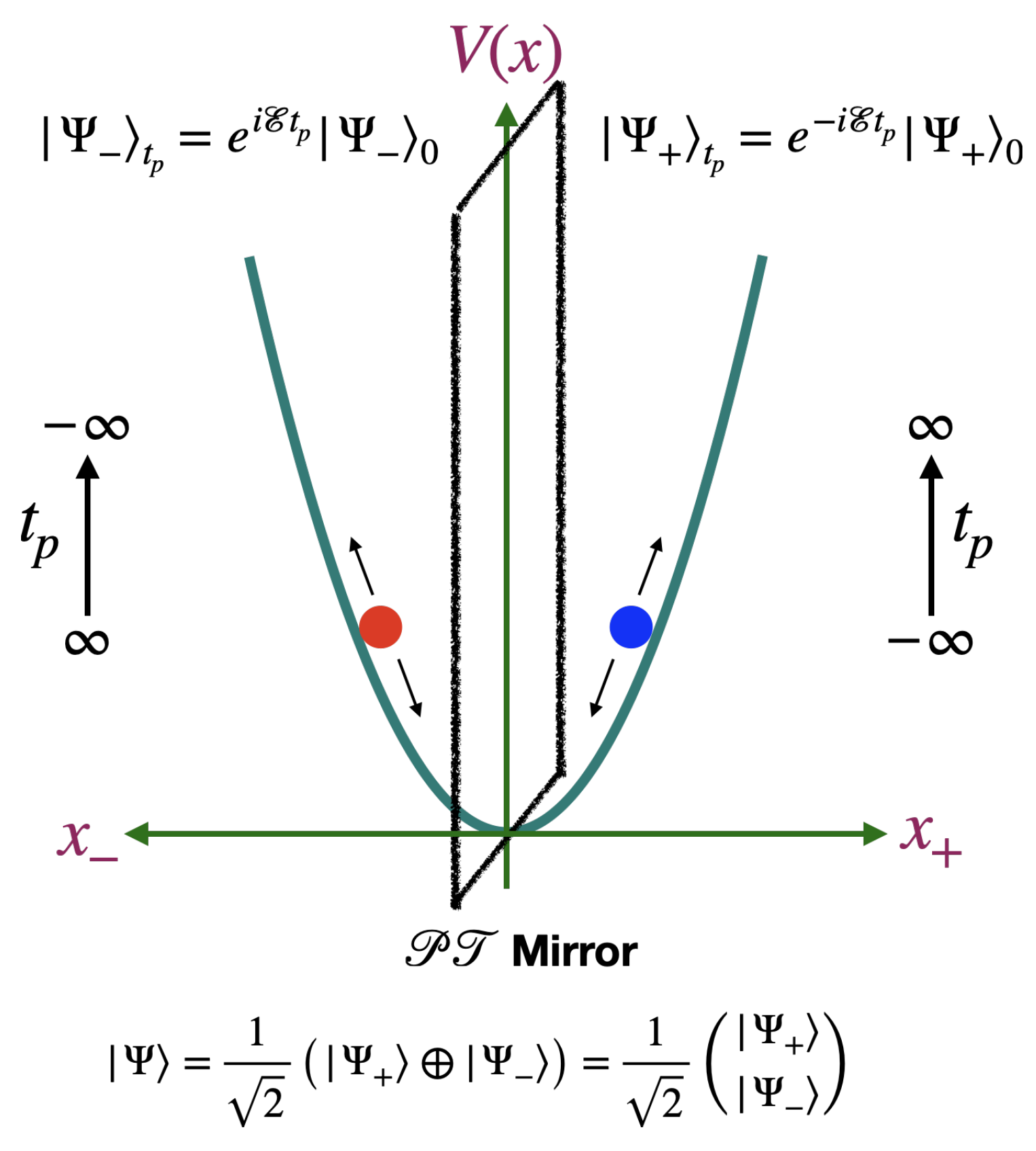
Here, we formulate a quantum state as a direct-sum of two orthogonal components5
that are positive energy states with opposite arrows of time at parity conjugate points in physical space governed by the direct-sum Schrödinger equation [12]
defined in a direct-sum Hilbert space . The Hilbert spaces are called geometric superselection sectors (SSS) describing quantum states in the parity conjugate regions.
With direct-sum QM, we describe the wave function and the probabilities as
and
The position operator here becomes with eigen values being and . Similarly, the momentum operator becomes with . The canonical commutation relations are
We note that operations remain the same irrespective of any coordinate translations. Thus, one can shift the origin , but the direct-sum quantum theory is unaltered. Once we divide the quantum state by the above direct-sum operation into sectorial Hilbert space, we can still perform individually and operations in . The operation in each SSS turns the positive energy states to negative ones and changes the direction of momenta, whereas the operation changes only the direction of momenta.
4.1. Direct-Sum QFT in Minkowski Spacetime
Minkowski spacetime is symmetric ( and ). Thus, extending the first quantization approach by direct-sum Schrödinger equation to the second quantization is straightforward, and we call it direct-sum quantum field theory (DQFT) [11,13]. For example, the Klein-Gordon (KG) field operator now becomes a direct-sum of two components as a function of conjugate points
where
where and the creation and annihilation operators obey
This gives a new causality condition
along with the standard condition, which demands the operators to commute for space-like distances
Note that the are field operators exclusively defined for parity conjugate points in physical space with positive energy states defined with opposite arrows of time. The direct-sum of these two operators results in the description of the quantum field (36) everywhere in Minkowski spacetime. The construction here is based on and any Lorentz transformations and translations on (36) preserve symmetric feature of DQFT Minkowski vacuum6
Correspondingly, the Fock space of DQFT is a direct-sum of geometric superselection sectors (SSS) describing quantum states in parity conjugate regions of Minkowski space7. The two-point function in DQFT is given by
A similar structure is followed for the propagator, which is a time-ordered product of two field operators. Thus, the propagator of a quantum field between any two points in Minkowski becomes the sum of two terms, each describing the field propagation in parity conjugate regions of physical space. In DQFT, all the interactions are divided into direct-sum; for example, a cubic interaction would look like
This means we will never have any mixing between and . As a consequence, all the standard QFT calculations extended to DQFT give the same results, which is obvious because of symmetry of Minkowski spacetime (See [11,13] for more details). According to DQFT, the standard model degrees of freedom, such as particles () and antiparticles ( get represented according to the direct-sum split of the SM vacuum.
Note that the geometric superselection rule is the same for all Fock spaces of the SM degrees of freedom, i.e., the parity conjugate regions are uniquely defined for all states of the SM. We provided DQFT quantization of a real scalar field, but construction is very straightforward for the complex scalar, fermion, and gauge fields. Every quantum field is written as direct-sum of two components which are mirror images of each other spanning the entire Minkowski spacetime. Thus we can easily extend the standard quantization [44] to DQFT as follows:
- Complex scalar field operator in DQFT is expanded aswhere and are canonical creation and annihilation operators of the parity conjugate regions (denoted by subscripts ) attached with geometric SSS. All the cross commutation relations of and vanish.
- Fermionic field operator in DQFT becomeswhere correspond to the two independent solutions of and corresponding to spin-. The creation and annihilation operators of geometric SSS of Fock space here satisfy the anti-commutation relations leading to the new causality condition .
- The vector field operator in DQFT expressed aswhere is the polarization vector satisfying the transverse and traceless conditions. The creation and annihilation operators satisfy the similar relations as (38).
All the SM calculations remain the same because all the interaction terms are split into direct-sum in the following way.
Here, is an arbitrary operator involving any SM fields and their derivatives.8 Evidently, the DQFT framework does not alter the QFT calculations in Minkowski due to the spacetime being symmetric. If we compute any scattering amplitude, say, N particles to M particles, the DQFT gives
where with and represent the 4-momenta of all the states involved in the scattering. represent amplitudes as a function of 4-momenta of initial and final states computed in both vacuums . Notice that the in (out) states in come with the opposite sign, which is due to the arrow of time being opposite in both the vacuums. The amplitudes are equal at any order in perturbation theory due to the symmetry of Minkowski spacetime. The famous (charge conjugation, Parity, and Time reversal) invariance of scattering amplitudes [45] also holds in both vacuums, which means
This is attributed to the fact that the CPT operation of any scattering process would turn the outgoing anti-particles into in-going particles and vice-versa [45].
In summary, we presented a new understanding of quantum (field) theory with a direct-sum (mathematical bridge) between conjugate sheets of spacetime. Using the geometric superselection rules formulated by parity conjugate regions of physical space, we have successfully incorporated two arrows of time in a single quantum state description. DQFT does not change the practical results in SM particle physics, but it gives a new feature of understanding the role of "time" in quantum theory. We will witness in the next sections that this structure will lead us to a novelty of building the connection between gravity and quantum mechanics and tackle the new challenges associated with problems like IHO.
5. Geometric Quantization of Berry and Keating IHO
This section aims to elucidate how we can build a new construction of quantum IHO with direct-sum operation, which echoes consistently with the absolutely crucial observations made by Berry and Keating, B. Aneva [4,39]. As discussed in Section 3 and as we can see in Figure 2, the regions of phase space are related by the following discrete group of transformations, which form the dihedral group [39] of order 8
along with and that include transformations in (16) and (17). These transformations include dilatations and preserve the quantization conditions , and discussed in Section 3. Due to the presence of regions related by discrete operations, we formulate quantum theory with geometric superselection sectors in the phase space. This observation was also recently made in a work on generalized the Born oscillator, which contains BK IHO as a special case [46]. The relation between IHO Hamiltonian (9) and the Weyl reflected Laplace-Beltrami operator (22) motivate us to write positive () and negative energy () quantum states as direct-sum of two components corresponding to direct-sum Hilbert space ()
The doubly degenerate trajectories in phase space imply further direct-sum split of the above states into the respective components as
The rules of direct-sum quantum theory rely on dividing the physical space by parity operation, which we do separately for all the regions of the phase space. In particular, the regions III and IV of the phase space individually contain parity conjugate regions () (See Figure 2). But in contrast, the regions I and together cover .
We split the position and momentum operators of the entire phase space as
with the only non-zero commutation relations
which can be realized with four commuting sets of creation and annihilation operators. With (54) the Hamiltonian of IHO (9) split into direct-sum of four components describing the four regions of the phase space in Figure 2. Finally, the quantization of IHO is governed by the direct-sum Schrödinger equation of the following
which describes the evolution of positive and negative energy quantum states. Due to the doubly degenerate regions I () and () related by (16) in the separatrix phase space (Figure 2), the states would then be governed by
where the Hamiltonians correspond to each region are functions of corresponding position and momentum operators (54). Since the positive and negative energy regions are related by the transformations (17), the position and momentum wave functions in the region I () and () swap with each other (i.e., Fourier transform in the region I () becomes inverse Fourier transform in the region () and vice versa). Working out (56) we obtain
which generates the zeros of the Riemann zeta function . The above relations (58), though they seem similar to the BK’s quantum boundary condition (21), there is a significant difference, which is "geometrical interpretation". With our direct-sum quantization using phase space geometric SSS, we obtain the geometric interpretation, which is a drawback in Berry and Keating’s proposal [4,39]. Our direct-sum quantization, by splitting the full phase-space Hilbert space geometrically into SSS, would bring a resolution to the issue of quantum chaos in describing the quantum dynamics of IHO [4,37]. In short, what we achieved here is a description of the IHO quantum state (See (52) and (53)) by mathematical bridges (direct-sum) between various sheets of phase space with different arrows of time.
6. Quantum ER Bridges in Schwarschild, de Sitter, and Rindler Spacetimes
In this section, we further witness the implications of direct-sum quantum theory for the description of quantum fields in curved spacetime as well as the so-called Rindler spacetime, which is Minkowski spacetime with respect to an accelerated observer [13]. Remarkably, ER’s work also discusses quantum physics in Rindler spacetime and highlights the need for "mathematical" bridges [1].
6.1. The Mathematical Bridges in Rindler Spacetime
Starting with 1+1 dimensional Minkowski spacetime
The Rindler spacetime can be realized as
We can express the whole Rindler spacetime in a coordinate system defined by
where
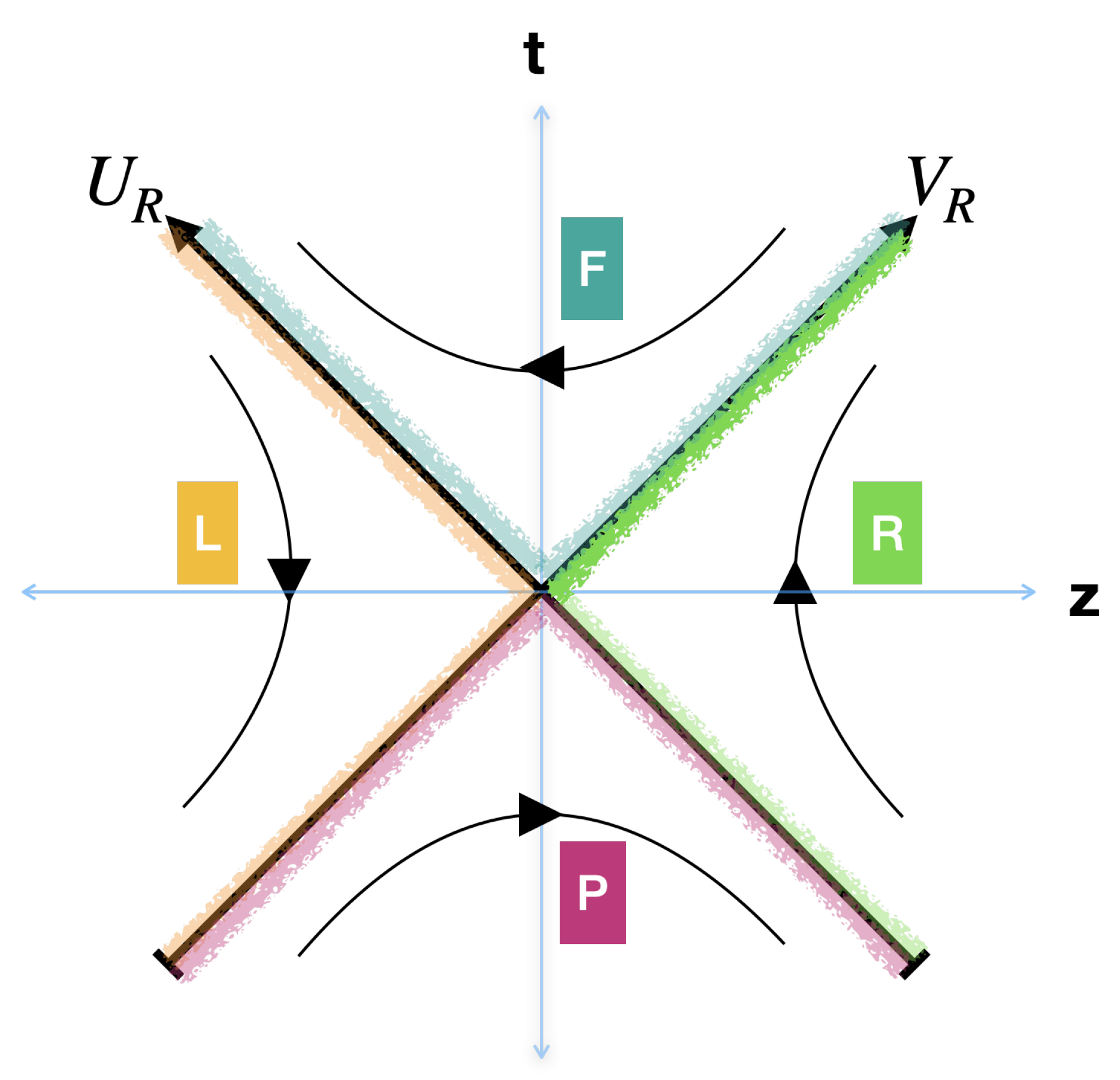
We can visually see the structure of Rindler spacetime in Figure 4. Similar to how phase space horizons of IHO form a basis for geometric quantization with SSS, the Rindler horizons form the basis for DQFT in Rindler spacetime. A KG operator in Rindler spacetime is split into 4 components
with respect to a direct-sum Fock space corresponding to a direct-sum vacuum defined by a commuting set of canonical creation and annihilation operators (details can be found in Ref. [13])
If we quantize a field in (59), according to DQFT, the Minkowski vacuum is a direct-sum of two as we split the quantum field into two components by parity and time reversal similar to the 4-dimensional case (36). As a consequence of this construction, the Minkowski vacuum () looks like a pair of quantum states in Rindler spacetime that follows from the Bogoliubov transformations. For example, in the context of Left and Right Rindler regions, the Minkowski vacuum can be written as
Here and Bogoliubov coefficients, and are creation and annihilation operators corresponding to the Right and Left regions of Rindler spacetime. Thus in this framework any maximally entangled state (pure state) is split into two pure state components corresponding to the SSS Hilbert spaces of Left and Right Rindler regions ().
This means the density matrix of the pure state is split into direct-sum of two pure-state density matrices
The Von Neumann entropies of the Left and Right states vanish because the Left and Right are described by geometric SSS Hilbert spaces. Therefore,
The Von Neumann entropy for vanishes too since
This confirms the state is a globally a pure state whereas and are pure states of a local Rindler observer. Note that since the quantum theory on the Left and Right are constructed in SSS corresponding to causally separated spacetime regions, an observer on the Left cannot access any information on the right. However, the Left and Right regions are conjugates of each other but separated by Rindler horizons. Though the Left observer cannot access the Right region causally, by observing the pure states , the observer can reconstruct the pure states of the Right region. Thus, both observers share complementary pieces of information in the form of pure states. In this respect, the Rindler horizon acts like a " mirror". We can further extend this to the entire Rindler space, which includes both Future and Past, along with Left and Right. Following (63), any maximally entangled pure state now becomes a direct-sum of 4 pure state components whose individual Von Neumann entropy vanishes; thus, we have a unitary description of QFT in Rindler spacetime.
Figure 4.
The figure represents the Left, Right () and Future, Past () regions of Rindler spacetime. The curved lines in the Left and Right regions are constant acceleration curves with arrows of time (Left) and (Right). Future and Past Rindler with arrows arrows indicate changing , . The Fuzzy colored lines indicate the Rindler Horizons for Left (Yellow), Right (Green), Future (Cyan), and Past (Pink).
Figure 4.
The figure represents the Left, Right () and Future, Past () regions of Rindler spacetime. The curved lines in the Left and Right regions are constant acceleration curves with arrows of time (Left) and (Right). Future and Past Rindler with arrows arrows indicate changing , . The Fuzzy colored lines indicate the Rindler Horizons for Left (Yellow), Right (Green), Future (Cyan), and Past (Pink).
6.2. The Mathematical Bridges in Quantum Black Hole
Here, we have come to a new understanding of quantum fields in SBH metric with direct-sum mathematical bridges between two sheets of spacetime. First of all, let us recall the fact that the interior and exterior are not of the same kind because we cannot treat the time in the same way in the interior and the exterior. Since, in quantum theory, time is a parameter (not an operator), we cannot do the same quantum theory everywhere. Furthermore, we can notice that the interior and the exterior are related by discrete operation , which takes us from region I to in Figure 5, whereas the transformation takes us from region to . What this all mean is switching or respectively. All of this indicates that the Hilbert spaces of the interior and exterior of SBH are geometric superselection sectors (SSS), suggesting the KG field operator becomes a direct-sum of two components according to the rules of DQFT. For quantizing a scalar field in SBH spacetime, we first perform expansion of the KG field in spherical harmonics
where are spherical harmonics. Upon integrating out the and considering a sufficiently large BH, we can realize that effectively becomes a massless field in two dimensions , which we quantize promoting it to be an operator as
where and subscripts indicate the components of the field operator correspond to exterior and interior regions of SBH as defined in (6). In Hawking’s 1974 paper [26], the quantum field operator is written as a summation of interior and exterior parts, which means making a superposition of interior and exterior quantum states. Since the concept of time is not the same as we discussed earlier, one cannot write a superposition of quantum states. Our direct-sum operation separates the Hilbert space geometrically into SSS, which avoids completely any superposition. This follows from the fundamental meaning of time in quantum theory. The second assumption from the Hawking computation is that the interior and exterior components of fields commute based on the intuition that the ingoing state should be independent of the outgoing state. This intuitive argument also led to the initial formulation of the information paradox, which has evolved into many intuitive interpretations in the theories of quantum gravity [47,48]. However, ’t Hooft’s calculation of gravitational backreaction from GR and QM implies a non-commutativity of the QFT operators
which is extension of (24) in the context of second-quantization (DQFT) [12,43]. This consideration would modify the initial formulation of information loss. The question of extracting what has formed the BH requires a microscopic (quantum) picture of gravitational collapse, which is an open question still now due to the lack of a concrete way to quantize fields in a dynamical (collapsing) geometry and lack of Planck scale quantum gravity to explain final stages (high curvature regime) of the collapse. The relation (72) is the most fundamental relation that joins gravity and quantum mechanics at the horizon scale, and it is the key to progress in understanding BH physics. Computing the Bogoliubov transformation between the Kruskal vacuum and the asymptotic Minkowski vacuum gives us the Hawking radiation given by the number density [12,43]
where the surface gravity term which appears in Bekenstein’s Black hole thermodynamics [49] gives the temperature of Hawking radiation to be .
The result is the same even when calculating Bogoliubov transformation between vacuums of an infinitely long time before and after SBH formation [50].
With DQFT, we achieve Hawking radiation in the form of pure states [43] because the density matrix of the maximally entangled pure state is the direct-sum of the pure state components () corresponding to exterior and interior regions of SBH, that define geometric SSS. Thus, any observer who may only access one of the regions in the conformal diagram (Figure 5) access the information in the form of pure states; thus, there is no unitarity loss. Each observer accesses complementary information because fixing a vacuum in any one of the geometric SSS uniquely fixes a vacuum in the rest because of the discrete spacetime transformations that relate to different SSS. This is called observer complementarity [9] that is consistent in the framework of DQFT.
6.3. The Mathematical Bridges in de Sitter Spacetime
Together with the symmetry (8), the metric (74) can cover the entire dS spacetime. Similar to SBH and Rindler spacetime, the dS spacetime too has four regions related through discrete coordinate transformations
where and with . DQFT in dS spacetime is analogous (by the construction of geometric SSS) to Rindler and SBH spacetime, and it can be understood through the conformal diagram of quantum dS spacetime depicted in Figure 6. Similar to the SBH case, we achieve unitarity and observer complementarity in dS space due to the geometric construction of quantum theory with SSS Hilbert space.
Quantizing fields in flat FLRW dS spacetime (7) is widely used in understanding physics related to early Universe cosmology (cosmic inflation in particular). Often taken assumption in the literature is fixing the arrow of time before quantization. In DQFT treatment, we preserve the discrete symmetry of spacetime and at the quantum level by writing the KG field operator as a direct-sum of the two components which belong to the parity conjugate points of the physical space. For quantizing KG field, we rescale the field with the scale factor such that the KG action into the form of IHO with time-dependent mass [28]
Then, in DQFT we promote the field to an operator as
In the above relation, the creation and annihilation operators satisfy preserving causality and locality. The dS vacuum is chosen such that we recover the direct-sum Minkowski vacuum (41) in the short-distance limit or sub-horizon , which we can call it as direct-sum Bunch-Davies vacuum. This construction joins mathematically the quantum field components such that we have one expanding Universe with two arrows of time (quantum mechanically). Thus, we create mathematical bridges a lá ER and Schrödinger’s thin rods we described in Section 2.
7. ERBs, Direct-Sum Inflation and CMB
In this section, we present the first observational test of DQFT in the context of primordial cosmology, which is responsible for the temperature fluctuations in the CMB. Probes of CMB such as COBE, WMAP, and Planck have measured the angular correlations of temperature fluctuations which can formally be written as the sum of its symmetric (even parity) and its antisymmetric (odd parity) components that can be expanded in spherical harmonics as:
where
where is parity conjugate of . Note that , and are modeled as stochastic random fields and are therefore per se neither a scalar nor a pseudo-scalar under transformations or isotropic under rotations R. By construction, given in Equation (79), the decomposition into and of the particular realization of the random field has a defined parity, but they are not scalar or pseudo scalars. Assuming ergodicity, we can instead search for statistical (an)isotropy or statistical parity (a)symmetry in specific statistical quantities measured from the CMB maps. For instance, we can define the directional two-point function as:
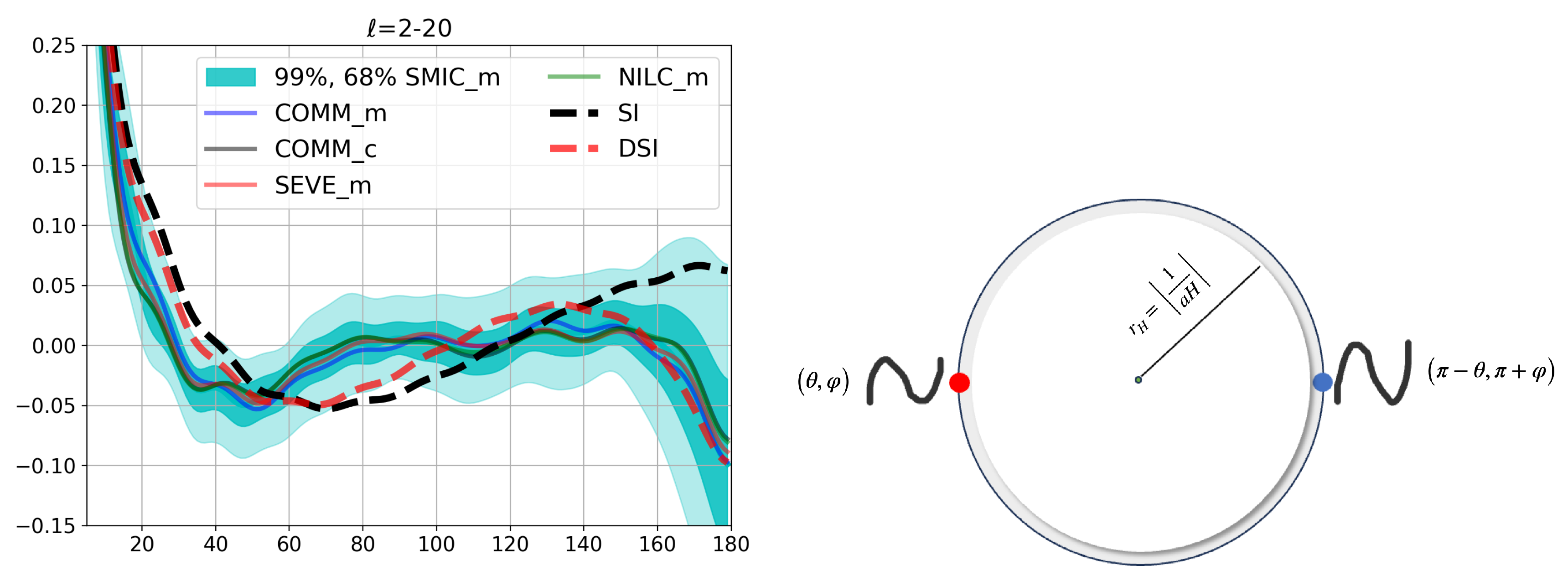
where the expectation value is taken over all pairs of directions. We can then examine if is statistically (an)isotropic, meaning whether it remains invariant (or not) within sampling errors under rotations R of . Furthermore, we can investigate if is parity symmetric or antisymmetric—that is, whether , within sampling errors. From the latest CMB data, we can deduce that and (See a left panel of Figure 7).
Because (parity) and R (rotation) are independent symmetries—no combination of R transformations can reproduce —statistical parity symmetry is entirely distinct from statistical isotropy, despite recurring claims to the contrary in the literature (see, e.g., [52] and references therein).
Here, following standard CMB analysis, we assume statistical rotational (R) isotropy to focus on testing statistical parity (). Under statistical isotropy, the two-point function and power spectrum are defined as:
where and is called the angular TT-power spectrum whose even-odd contributions are given by
or in other words, the S and A maps correspond to the even and odd multipoles ℓ of the total map :
Decades of analysis of CMB data [53,54,55] with the following quantity
indicates there is more power ( 20%) in the odd-multipoles compared to even ones for corresponding to . The result is significant at more than 3.5 standard deviations. This means the scale invariance feature of CMB is only statistically accurate for () that corresponds to the so-called pivot scale . The even-odd power asymmetry is related to parity, which is a discrete transformation, not anisotropy. Unfortunately, it is interpreted as anisotropy in the literature, which resulted in wrong deductions such as hemispherical or dipolar anisotropy or violation of cosmological principle [56,57]. A severe drawback of these deductions is the lack of sharp definitions of statistical anisotropy and mistaking parity with anisotropy. It was shown in [14] that the Universe is statistically homogeneous, isotropic, but parity asymmetric.
The statement CMB is scale-invariant associated with the observational fit of
convoluted with CDM model for small angular scales . Here is called the primordial power spectrum amplitude, and the scalar spectral index (Planck TT+TE+EE) at from the Planck data [55] and is related to the distance from the CMB surface of last scattering, and are Bessel functions.
Often, many cosmologists dismiss the importance of understanding large-scale features of the CMB with a statement that the data falls within the cosmic variance
of the standard cosmological model with (near) scale-invariance (85). This sampling variance errors results directly from assuming gaussian statistics in the definition of Equation (82). In (86) is the portion of the CMB sky considered in the analysis; usually, one masks the signals from our own galaxy to avoid data contamination from local sources. This dismissal actually means the incompatibility of (85) with the data, and it is necessary to search for a theory that gives low-cosmic variance and, as such, fits the data better. The in (84) indicates CMB angular power spectra oscillate between even-odd ℓ with decreasing amplitude. The literature of theoretical (and phenomenological models) often ignored half of the multipoles (i.e., (odd)-ℓ) and interpreted data as indicating power suppression at low multipoles [58,59]. This misinterpretation has led to numerous works of building speculative models of inflation in the last decades. In a nutshell, both the theoretical and observational studies have corroborated with mutual wrong interpretations over the last two decades and left the CMB anomalies as an unresolved mystery.
Application of DQFT to single-field inflationary scalar fluctuations (Direct-sum Inflation (DSI)) gives [14]
where
And is the Hankel functions of the first kind, and is the cut-scale that corresponds to the largest angular scales in the CMB or and the first modes that exit the horizon during inflation. Inflationary background by definition quasi-dS expansion and it breaks the symmetry (8) by the time-dependent slow-roll parameters and as a result the MS-variable (23) when promoted to operator in DQFT becomes a direct-sum of two components
where and . We impose conditions of the vacuum such that we recover the DQFT Bunch-Davies vacuum in the limit . The DQFT treatment gives two-point correlations for parity conjugate points in physical space, which are unequal due to the time reversal asymmetry induced by the inflationary expansion
According to DQFT, inflationary quantum fluctuations evolve in asymmetric vacuum () leads to a single quantum fluctuation to evolve asymmetrically at parity conjugate points. During inflationary expansion, these fluctuations become classical and leave their parity asymmetric imprints as cold and hot structures in the two-dimensional CMB. This is nothing but holography, the imprints of quantum gravity in the bulk on the boundary. This supports ’t Hooft original idea of quantum gravity in two dimensions that was propagated to the frameworks of string theory [8,9] This is schematically depicted in Figure 7, and the actual data can be visualized in the bottom panel of Figure 1. Computing the two-point correlations of MS-variable , we obtain
where and . This results in a power spectrum of curvature perturbation that leads to parity asymmetric CMB sky (87)
where is the Heaviside step function. Note that the power spectrum is the Fourier transform of the two-point function of curvature perturbation that is proportional to (91), which contains two unequal contributions due to symmetry of dS (7) is broken during inflation (i.e., is asymmetric. It is shown that the DSI power spectra [14] (87) 650 times more probable to fit the data better than the standard scale-invariant inflation (SI), and furthermore, the direct-sum mathematical bridges (ER bridges) between quantum field components at parity conjugate points explains 20% excess of power in the odd-multipoles (84). Similarly, even-odd power asymmetry is derived for inflationary graviton fluctuations, which serves as a test for DSI with future primordial gravitational wave probes [15]. Towards the small angular scales in CMB, parity asymmetry becomes insignificant because high-frequency modes are less affected during inflationary expansion compared to low-frequency modes. Finally, we depict our observationally consistent new understanding of quantum fields in curved spacetime in analogy with ER bridges in Figure 1. Note that the parity asymmetry we found in the CMB is different from the other recent parity-related investigations [60], which are about small-scale effects due to specific modifications of gravity involving beyond SM degrees of freedom. Parity asymmetry in our context is much more generic due to the combined action of gravity and quantum mechanics. It is attributed to large (angular) scales and found to be insignificant at small (angular) scales in CMB.
Figure 7.
The left panel is for which highlights the temperature correlations at large angular scales , the CMB data lines are coloured lines with with 68% and 99% errors in the SMIC data [55]. It is very clear that the direct-sum inflationary (DSI) quantum fluctuations fit better (red-dashed line) than the standard inflation (SI), which is a black dashed line, in particular the anticorrelation at . The right panel presents the physical (schematic) picture of quantum fluctuations in DSI evolving asymmetrically at parity conjugate points in physical space and leaving their imprints in the CMB when they leave the horizon.
Figure 7.
The left panel is for which highlights the temperature correlations at large angular scales , the CMB data lines are coloured lines with with 68% and 99% errors in the SMIC data [55]. It is very clear that the direct-sum inflationary (DSI) quantum fluctuations fit better (red-dashed line) than the standard inflation (SI), which is a black dashed line, in particular the anticorrelation at . The right panel presents the physical (schematic) picture of quantum fluctuations in DSI evolving asymmetrically at parity conjugate points in physical space and leaving their imprints in the CMB when they leave the horizon.
8. Conclusions
Nature’s (classical) laws of physics are governed by second-order differential equations in time, whereas the counter-intuitive quantum world is governed by first-order differential equations in time. Understanding gravitational horizons and the associated quantum effects play a key role in deciphering the origin and evolution of the Universe from the Big Bang to the present accelerated expansion [61,62,63,64]. The dynamics of spacetime resulting from Einstein’s GR are found to be incompatible with quantum mechanics due to the possibility of two arrows of time in describing one physical world. Einstein-Rosen noticed this in 1935 and conjectured that a consistent quantum gravitational theory that describes the physical world should emerge by the construction of mathematical bridges between two sheets of spacetime. Similar deductions independently came from two more prominent scientists, Erwin Schödinger (1956) and Gerard ’t Hooft (2016), in the contexts of cosmology and black hole physics. It is not a coincidence because all of these revelations emerged from one principle of "describing one physical world with two arrows of time".
In this paper, we discussed all these historical coinciding thoughts with fundamental reasoning. We also found the importance of quantum theory with two arrows of time in the context of understanding inverse harmonic oscillators based on the seminal investigations by Berry and Keating (1999). We discussed and conjectured that the quantum fields in curved spacetime are fundamentally connected to inverse harmonic oscillators. It is important to note that even after nearing a century since ER’s 1935 paper, quantum gravity investigations are still pondering around the ER’s initial thoughts (See, for example, ER=EPR conjecture from Susskind and Maldacena [65]). Unlike the many present generation physicists working on various formulations of quantum gravity, ER, Schödinger, and ’t Hooft were tied to the single thought of explaining "One Universe" or "One physical spacetime" with unitary quantum physics instead of creating multiple possibilities of parallel worlds. If one sticks to this principle, the only way is to re-understand quantum theory, reformulate it, and re-position it for a consistent embedding within the rules of GR. Almost all the fundamental questions we have in understanding the Universe, including Planck scale quantum gravity9, require filling the gaps in our understanding of quantum fields in curved spacetime. In addition to the ever-growing endeavors of Planck scale quantum gravity to fix problems that emerge at the level of QFT in curved spacetime, we position ourselves by delving into the foundational thoughts that can still provide us fruitful answers.1011
In this paper, we established a new connection between ER mathematical bridges and recently found direct-sum quantum field theory (DQFT) in curved spacetime. DQFT builds the understanding of quantum theory by formulating geometric superselection sectors (SSS) of Hilbert space based on discrete spacetime transformations. Gravitational horizons are the key to understanding the interplay between GR and QM. Geometric SSS is vital to building local quantum theory bounded by gravitational horizons. Crossing the horizon changes the concept of time. Thus, quantum theory with geometric SSS is a promising way to combine the spacetime geometry from GR with the notion of Hilbert spaces in QM. This foundational restructure of quantum theory not only brings a new understanding of time but also reiterates the unitarity in curved spacetime that was thought to be lost after Hawking’s seminal paper of 1974. Along with the unitarity, we also bring back the observer complementarity, which helps to start addressing the information-loss paradox. We have shown how the framework of DQFT explains the long-standing anomalies in the cosmic microwave background and brings a new interpretation of ER’s mathematical bridges. To be specific, we uncover for the first time compelling evidence for parity asymmetry of CMB due to the quantum gravitational physics, which could open new doors of understanding open challenges in quantum gravity research [16,17]. It is worth to recall the parity asymmetry in beta decay observed by Wu experiment in 1957 [69] has shaped the SM model of particle physics; finding the parity-related signatures in gravity could potentially uncover new phenomena in gravitational physics [70]. The direct-sum QFTCS we establish here and its application to inflationary cosmology via DSI is a promising beginning; further developments of the theory, along with future astrophysical, cosmological, and gravitational wave observations, could open new doors to understanding the Universe. Direct-sum quantum theory also clarifies the conceptual conundrums in quantizing inverse harmonic oscillators, setting the stage for new developments in other related areas such as condensed matter, quantum chemistry, and biophysics. In particular, recent developments related to the observation of phase space horizons with BH analog systems, such as surface gravity water waves, open new arenas for exploring laboratory our new understanding of ER bridges [71].
Acknowledgments
The authors thank Obinna Umeh, Mathew Hull, and Paulo V. Moniz for useful discussions. KSK would like to thank the support from the Royal Society for the Newton International Fellowship. EG acknowledges grants from Spain Plan Nacional (PGC2018-102021-B-100) and Maria de Maeztu (CEX2020-001058-M). This research was funded by Fundação para a Ciência e a Tecnologia grant number UIDB/MAT/00212/2020.
References
- Einstein, A.; Rosen, N. The Particle Problem in the General Theory of Relativity. Phys. Rev. 1935, 48, 73–77. [Google Scholar] [CrossRef]
- Schrödinger, E. Expanding Universe; Cambridge University Press, 1956.
- ’t Hooft, G. Black hole unitarity and antipodal entanglement. Found. Phys. 2016, arXiv:gr-qc/1601.03447]46, 1185–1198. [Google Scholar] [CrossRef]
- Berry, M.V.; Keating, J.P. , I.V.; Keating, J.P.; Khmelnitskii, D.E., Eds.; Springer US: Boston, MA, 1999; pp. 355–367. doi:10.1007/978-1-4615-4875-1_19.Zeros. In Supersymmetry and Trace Formulae: Chaos and Disorder; Lerner, I.V., Keating, J.P., Khmelnitskii, D.E., Eds.; Springer US: Boston, MA, 1999; Springer US: Boston, MA, 1999; pp. 355–367. [Google Scholar] [CrossRef]
- Misner, C.W.; Wheeler, J.A. Classical physics as geometry: Gravitation, electromagnetism, unquantized charge, and mass as properties of curved empty space. Annals Phys. 1957, 2, 525–603. [Google Scholar] [CrossRef]
- Morris, M.S.; Thorne, K.S. Wormholes in space-time and their use for interstellar travel: A tool for teaching general relativity. Am. J. Phys. 1988, 56, 395–412. [Google Scholar] [CrossRef]
- Morris, M.S.; Thorne, K.S.; Yurtsever, U. Wormholes, Time Machines, and the Weak Energy Condition. Phys. Rev. Lett. 1988, 61, 1446–1449. [Google Scholar] [CrossRef]
- ’t Hooft, G. Dimensional reduction in quantum gravity. Conf. Proc. C 1993, 930308, 284–296. [Google Scholar]
- Susskind, L.; Thorlacius, L.; Uglum, J. The Stretched horizon and black hole complementarity. Phys. Rev. D 1993, 48, 3743–3761. [Google Scholar] [CrossRef]
- Maldacena, J.M. The Large N limit of superconformal field theories and supergravity. Adv. Theor. Math. Phys. 1998, 2, 231–252. [Google Scholar] [CrossRef]
- Kumar, K.S.; Marto, J. Towards a unitary formulation of quantum field theory in curved spacetime: the case of de Sitter spacetime 2023. arXiv:hep-th/2305.06046].
- Kumar, K.S.; Marto, J. Towards a unitary formulation of quantum field theory in curved space-time: the case of Schwarzschild black hole 2023. arXiv:hep-th/2307.10345].
- Kumar, K.S.; Marto, J. Revisiting quantum field theory in Rindler spacetime with superselection rules. Universe 2024, arXiv:gr-qc/2405.20995]10, 320. [Google Scholar] [CrossRef]
- Gaztañaga, E.; Kumar, K.S. Finding origins of CMB anomalies in the inflationary quantum fluctuations. JCAP 2024, arXiv:astro-ph.CO/2401.08288]06, 001. [Google Scholar] [CrossRef]
- Kumar, K.S.; Marto, J. Parity asymmetry of primordial scalar and tensor power spectra 2022. arXiv:gr-qc/2209.03928].
- de Boer, J. ; others. Frontiers of Quantum Gravity: shared challenges, converging directions 2022. arXiv:hep-th/2207.10618].
- Loll, R.; Fabiano, G.; Frattulillo, D.; Wagner, F. Quantum Gravity in 30 Questions. PoS 2022, arXiv:hep-th/2206.06762]CORFU2021, 316. [Google Scholar] [CrossRef]
- Visser, M. Lorentzian wormholes: From Einstein to Hawking; 1995.
- Sanchez, N.G.; Whiting, B.F. Quantum Field Theory and the Antipodal Identification of Black Holes. Nucl. Phys. B 1987, 283, 605–623. [Google Scholar] [CrossRef]
- Giddings, S.B. The deepest problem: some perspectives on quantum gravity 2022. arXiv:hep-th/2202.08292].
- Zel’dovich, Y.B.; Starobinsky, A.A. Rate of particle production in gravitational fields. JETP Lett. 1977, 26, 252. [Google Scholar]
- Starobinsky, A.A. A New Type of Isotropic Cosmological Models Without Singularity. Phys. Lett. B 1980, 91, 99–102. [Google Scholar] [CrossRef]
- Sasaki, M. Large Scale Quantum Fluctuations in the Inflationary Universe. Prog. Theor. Phys. 1986, 76, 1036. [Google Scholar] [CrossRef]
- Mukhanov, V.F. Quantum Theory of Gauge Invariant Cosmological Perturbations. Sov. Phys. JETP 1988, 67, 1297–1302. [Google Scholar]
- Starobinsky, A.A. Amplification of waves reflected from a rotating ”black hole”. Sov. Phys. JETP 1973, 37, 28–32. [Google Scholar]
- Hawking, S.W. Particle Creation by Black Holes. Commun. Math. Phys. 1975, 43, 199–220. [Google Scholar] [CrossRef]
- Cramer, J.G.; Forward, R.L.; Morris, M.S.; Visser, M.; Benford, G.; Landis, G.A. Natural wormholes as gravitational lenses. Phys. Rev. D 1995, 51, 3117–3120. [Google Scholar] [CrossRef]
- Albrecht, A.; Ferreira, P.; Joyce, M.; Prokopec, T. Inflation and squeezed quantum states. Phys. Rev. D 1994, 50, 4807–4820. [Google Scholar] [CrossRef]
- Betzios, P.; Gaddam, N.; Papadoulaki, O. Black holes, quantum chaos, and the Riemann hypothesis. SciPost Phys. Core 2021, arXiv:hep-th/2004.09523]4, 032. [Google Scholar] [CrossRef]
- Ullinger, F.; Zimmermann, M.; Schleich, W.P. The logarithmic phase singularity in the inverted harmonic oscillator. AVS Quantum Sci. 2022, 4, 024402. [Google Scholar] [CrossRef]
- Subramanyan, V.; Hegde, S.S.; Vishveshwara, S.; Bradlyn, B. Physics of the Inverted Harmonic Oscillator: From the lowest Landau level to event horizons. Annals Phys. 2021, arXiv:cond-mat.mes-hall/2012.09875]435, 168470. [Google Scholar] [CrossRef]
- Sundaram, S.; Burgess, C.P.; O’Dell, D.H.J. Duality between the quantum inverted harmonic oscillator and inverse square potentials. New J. Phys. 2024, arXiv:quant-ph/2402.13909]26, 053023. [Google Scholar] [CrossRef]
- Schumayer, D.; Hutchinson, D.A.W. Physics of the Riemann Hypothesis. Rev. Mod. Phys. 2011, arXiv:math-ph/1101.3116]83, 307–330. [Google Scholar] [CrossRef]
- Sierra, G. The Riemann zeros as spectrum and the Riemann hypothesis. Symmetry 2019, arXiv:math-ph/1601.01797]11, 494. [Google Scholar] [CrossRef]
- Balazs, N.; Voros, A. Wigner’s function and tunneling. Annals of Physics 1990, 199, 123–140. [Google Scholar] [CrossRef]
- Sierra, G. H = xp with interaction and the Riemann zeros. Nucl. Phys. B 2007, 776, 327–364. [Google Scholar] [CrossRef]
- Berry, M.V. Riemann’s Zeta function: A model for quantum chaos? Quantum Chaos and Statistical Nuclear Physics; Seligman, T.H., Nishioka, H., Eds.; Springer Berlin Heidelberg: Berlin, Heidelberg, 1986; pp. 1–17. [Google Scholar]
- Barton, G. Quantum mechanics of the inverted oscillator potential. Annals of Physics 1986, 166, 322–363. [Google Scholar] [CrossRef]
- Aneva, B. Symmetry of the Riemann operator. Phys. Lett. B 1999, arXiv:nlin.CD/0804.1618]450, 388–396. [Google Scholar] [CrossRef]
- ’t Hooft, G. Diagonalizing the Black Hole Information Retrieval Process 2015. arXiv:gr-qc/1509.01695].
- ’t Hooft, G. The Firewall Transformation for Black Holes and Some of Its Implications. Found. Phys. 2017, arXiv:gr-qc/1612.08640]47, 1503–1542. [Google Scholar] [CrossRef]
- Donoghue, J.F.; Menezes, G. Arrow of Causality and Quantum Gravity. Phys. Rev. Lett. 2019, arXiv:hep-th/1908.04170]123, 171601. [Google Scholar] [CrossRef] [PubMed]
- Kumar, K.S.; Marto, J. Hawking radiation with pure states. 2024; arXiv:gr-qc/2407.18652]. [Google Scholar]
- Buchbinder, I.L.; Shapiro, I. Introduction to Quantum Field Theory with Applications to Quantum Gravity; Oxford Graduate Texts, Oxford University Press, 2023. [CrossRef]
- Coleman, S. Lectures of Sidney Coleman on Quantum Field Theory; WSP: Hackensack, 2018. [Google Scholar] [CrossRef]
- Giordano, F.; Negro, S.; Tateo, R. The generalized Born oscillator and the Berry-Keating Hamiltonian. JHEP 2023, arXiv:hep-th/2307.15025]10, 099. [Google Scholar] [CrossRef]
- Almheiri, A.; Mahajan, R.; Maldacena, J.; Zhao, Y. The Page curve of Hawking radiation from semiclassical geometry. JHEP 2020, arXiv:hep-th/1908.10996]03, 149. [Google Scholar] [CrossRef]
- Almheiri, A.; Hartman, T.; Maldacena, J.; Shaghoulian, E.; Tajdini, A. The entropy of Hawking radiation. Rev. Mod. Phys. 2021, arXiv:hep-th/2006.06872]93, 035002. [Google Scholar] [CrossRef]
- Bekenstein, J.D. Black holes and entropy. Phys. Rev. D 1973, 7, 2333–2346. [Google Scholar] [CrossRef]
- Mukhanov, V.; Winitzki, S. Introduction to quantum effects in gravity; Cambridge University Press, 2007.
- Griffiths, J.B.; Podolsky, J. Exact Space-Times in Einstein’s General Relativity; Cambridge Monographs on Mathematical Physics, Cambridge University Press: Cambridge, 2009. [Google Scholar] [CrossRef]
- Samandar, A. ; others. Cosmic topology. Part IIIa. Microwave background parity violation without parity-violating microphysics 2024. arXiv:astro-ph.CO/2407.09400].
- Schwarz, D.J.; Copi, C.J.; Huterer, D.; Starkman, G.D. CMB Anomalies after Planck. Class. Quant. Grav. 2016, arXiv:astro-ph.CO/1510.07929]33, 184001. [Google Scholar] [CrossRef]
- Muir, J.; Adhikari, S.; Huterer, D. Covariance of CMB anomalies. Phys. Rev. D 2018, arXiv:astro-ph.CO/1806.02354]98, 023521. [Google Scholar] [CrossRef]
- Akrami, Y.; others. Planck 2018 results. VII. Isotropy and Statistics of the CMB. Astron. Astrophys. 2020, arXiv:astro-ph.CO/1906.02552]641, A7. [Google Scholar] [CrossRef]
- Jones, J.; Copi, C.J.; Starkman, G.D.; Akrami, Y. The Universe is not statistically isotropic 2023. arXiv:astro-ph.CO/2310.12859].
- Smith, A.; Copi, C.J.; Starkman, G.D. Cosmological constraints on anisotropic Thurston geometries 2024. arXiv:astro-ph.CO/2409.03008].
- Contaldi, C.R.; Peloso, M.; Kofman, L.; Linde, A.D. Suppressing the lower multipoles in the CMB anisotropies. JCAP 2003, 07, 002. [Google Scholar] [CrossRef]
- Sinha, R.; Souradeep, T. Post-wmap assessment of infrared cutoff in the primordial spectrum from inflation. Phys. Rev. D 2006, 74, 043518. [Google Scholar] [CrossRef]
- Koh, S. Wigner Function of a Time-dependent Inverted Harmonic Oscillator. New Phys. Sae Mulli 2023, 73, 74–78. [Google Scholar] [CrossRef]
- Gibbons, G.W.; Hawking, S.W. Cosmological Event Horizons, Thermodynamics, and Particle Creation. Phys. Rev. D 1977, 15, 2738–2751. [Google Scholar] [CrossRef]
- Ashtekar, A.; De Lorenzo, T.; Schneider, M. Probing the Big Bang with quantum fields. Adv. Theor. Math. Phys. 2021, arXiv:gr-qc/2107.08506]25, 1651–1702. [Google Scholar] [CrossRef]
- Gaztanaga, E. The Black Hole Universe, Part I. Symmetry 2022, 14, 1849. [Google Scholar] [CrossRef]
- Gaztañaga, E. The mass of our observable Universe. Mon. Not. Roy. Astron. Soc. 2023, 521, L59–L63. [Google Scholar] [CrossRef]
- Maldacena, J.; Susskind, L. Cool horizons for entangled black holes. Fortsch. Phys. 2013, arXiv:hep-th/1306.0533]61, 781–811. [Google Scholar] [CrossRef]
- Witten, E. Quantum gravity in de Sitter space. Strings 2001: International Conference, 2001, [hep-th/0106109].
- ’t Hooft, G. Quantum Foundations as a Guide for Refining Particle Theories. 3: Windows on the Universe, 2023; arXiv:hep-th/2312.09396]. [Google Scholar]
- Peebles, P.J.E. Status of the LambdaCDM theory: supporting evidence and anomalies. 2024; arXiv:astro-ph.CO/2405.18307]. [Google Scholar]
- Wu, C.S.; Ambler, E.; Hayward, R.W.; Hoppes, D.D.; Hudson, R.P. Experimental Test of Parity Conservation in β Decay. Phys. Rev. 1957, 105, 1413–1414. [Google Scholar] [CrossRef]
- Komatsu, E. New physics from the polarized light of the cosmic microwave background. Nature Rev. Phys. 2022, arXiv:astro-ph.CO/2202.13919]4, 452–469. [Google Scholar] [CrossRef]
- Rozenman, G.G.; Ullinger, F.; Zimmermann, M.; Efremov, M.A.; Shemer, L.; Schleich, W.P.; Arie, A. Observation of a phase space horizon with surface gravity water waves. Commun. Phys. 2024, 7, 165. [Google Scholar] [CrossRef]
| 1 | Throughout this paper, our reference to Planck scale quantum gravity aligns with the conventional expectation of a renormalizable, ultraviolet (UV) complete quantum theory of gravity, applicable up to and beyond Planck length scales, where the graviton is typically treated as a fluctuation around Minkowski spacetime. However, if one aims to develop a Planck scale quantum gravity framework within a curved spacetime context (i.e., treating graviton fluctuations around a curved background such as de Sitter space), it becomes crucial to address the foundational issues of quantum fields in curved spacetime, which is the central focus of this paper |
| 2 | Note that Einstein-Rosen uses a different coordinate system to write the Schwarzschild metric non-singular at . However, the sheets of spacetime describing are similar to what we describe here in terms of KS coordinates. Most importantly, the two sheets representing the same physical world (outside the SBH) are related by discrete coordinate transformation (). One can interpret the ER concerns as the appearance of a (quantum mechanically) negative energy state that comes by reversing the arrow of time ( i.e, in the (naive writing of) Schrödinger equation (in the approximation) . Thus, we have both positive and negative energies possible due to the discrete symmetry (6). In the later sections, we shall return to the new conception of time reversal that can describe the same positive energy state with the opposite arrow of time. |
| 3 | Einstein-Rosen paper is literally about the quantum mechanical understanding of Schwarzschild horizon, but the paper is differently understood and often classically interpreted (with GR modifications) in the literature [5,7,18]. In this paper, we stick to uncovering the original motivations and deriving new (quantum) interpretations. |
| 4 | In the case of a Harmonic oscillator the position and momentum are harmonic functions of time and the energy of the physical system becomes a positive definite
|
| 5 | Note that direct-sum operation is different from superposition |
| 6 | Positive energy state in vacuum is whereas in it is . Here in this notation and . |
| 7 | In spatial 3D, parity is a discrete transformation totally different from rotation. In spherical coordinates, parity operation takes a point at a radiatial distance r to its antipode i.e., which can never be achieved by rotations. |
| 8 | Remember that any derivative operators must be split into components joined by direct-sum operation. |
| 9 | Analoguous to (68) the VonNeumannentropycorrespondingtothedensitymatrices ρint and ρext vanishes, thus ρP is the density matrixofapurestate. |
| 10 | even if we consider quantum gravity in curved spacetimes like de Sitter [66] |
| 11 | At this juncture, we would like to acknowledge and re-call ’t Hooft’s continued efforts in guiding the new generation on understanding the Universe: as he writes in a recent article [67], "The Standard Model of the sub-atomic particles is often presented as a theoretical description of all known particles that only has two basic shortcomings. First, the gravitational force cannot be added without generating uncertainties in the renormalization procedure, and secondly, it seems that the gravitational effects observed in galaxies and groups of galaxies cannot be accounted for in terms of all particles that are observed; something basic, possibly invisible and unknown forms of matter, is missing. Naturally, it is attempted either to add as yet unknown particles to the set of elementary particles known or to add new terms to the equations, in particular, those of the gravitational force. But if the history of science has taught us one thing, it is that guessing does not often provide for the correct answers and that the best procedure for improving our understanding consists of systematic studies of imperfections that can easily have been overlooked". |
| 12 | A recent article by James Peebles [68] also urges us to look for a consistent understanding of quantum fields in curved spacetime and their essential role in the present understanding of astrophysics and large-scale structure. |
Figure 1.
Einstein-Rosen Bridges (ERB): "A particle in the physical universe must be described by a mathematical bridge between two sheets of spacetime" (Einstein and Rosen, 1935 [1]). Top: Wormhole Interpretation of ERBs- Two configurations of wormholes by classical considerations of gravity: (1) connecting distinct sheets of spacetime (top right) or (2) linking space-like separated regions within a single sheet (top left). [5,6,7]. Middle: Direct-Sum Quantum Field Theory (DQFT) interpretation of ERBs- Quantum theory describes ERBs with two opposing arrows of time, connecting any two antipodal (parity-conjugate) points within the same spacetime and inside the gravitational horizon. Instead of having a single bridge between two separate horizons, there are infinitely many (discrete) bridges within the same horizon. Bottom: Observational Evidence for DQFT Interpretation of ERBs- CMB temperature fluctuations ( normalized by its root mean square ), measured by the Planck SMICA 2018 map (smoothed and normalized to unit variance), reveal a significant antisymmetric mirror pattern at antipodal points (See also Figure 7). This pattern, 650 times more probable than in scenarios without ERBs by direct-sum quantum theory, demonstrates the imprints of a continuous ensemble of ERBs connecting parity-conjugate points. This supports the DQFT treatment of inflationary quantum fluctuations, which follow the dynamics of a quantum inverse harmonic oscillator and become classical on superhorizon scales. It reveals quantum gravitational effects within the bulk 4D spacetime, leaving classical imprints on the 2D CMB surface. These observations align with the principles of quantum gravity and holography [8,9,10].
Figure 1.
Einstein-Rosen Bridges (ERB): "A particle in the physical universe must be described by a mathematical bridge between two sheets of spacetime" (Einstein and Rosen, 1935 [1]). Top: Wormhole Interpretation of ERBs- Two configurations of wormholes by classical considerations of gravity: (1) connecting distinct sheets of spacetime (top right) or (2) linking space-like separated regions within a single sheet (top left). [5,6,7]. Middle: Direct-Sum Quantum Field Theory (DQFT) interpretation of ERBs- Quantum theory describes ERBs with two opposing arrows of time, connecting any two antipodal (parity-conjugate) points within the same spacetime and inside the gravitational horizon. Instead of having a single bridge between two separate horizons, there are infinitely many (discrete) bridges within the same horizon. Bottom: Observational Evidence for DQFT Interpretation of ERBs- CMB temperature fluctuations ( normalized by its root mean square ), measured by the Planck SMICA 2018 map (smoothed and normalized to unit variance), reveal a significant antisymmetric mirror pattern at antipodal points (See also Figure 7). This pattern, 650 times more probable than in scenarios without ERBs by direct-sum quantum theory, demonstrates the imprints of a continuous ensemble of ERBs connecting parity-conjugate points. This supports the DQFT treatment of inflationary quantum fluctuations, which follow the dynamics of a quantum inverse harmonic oscillator and become classical on superhorizon scales. It reveals quantum gravitational effects within the bulk 4D spacetime, leaving classical imprints on the 2D CMB surface. These observations align with the principles of quantum gravity and holography [8,9,10].
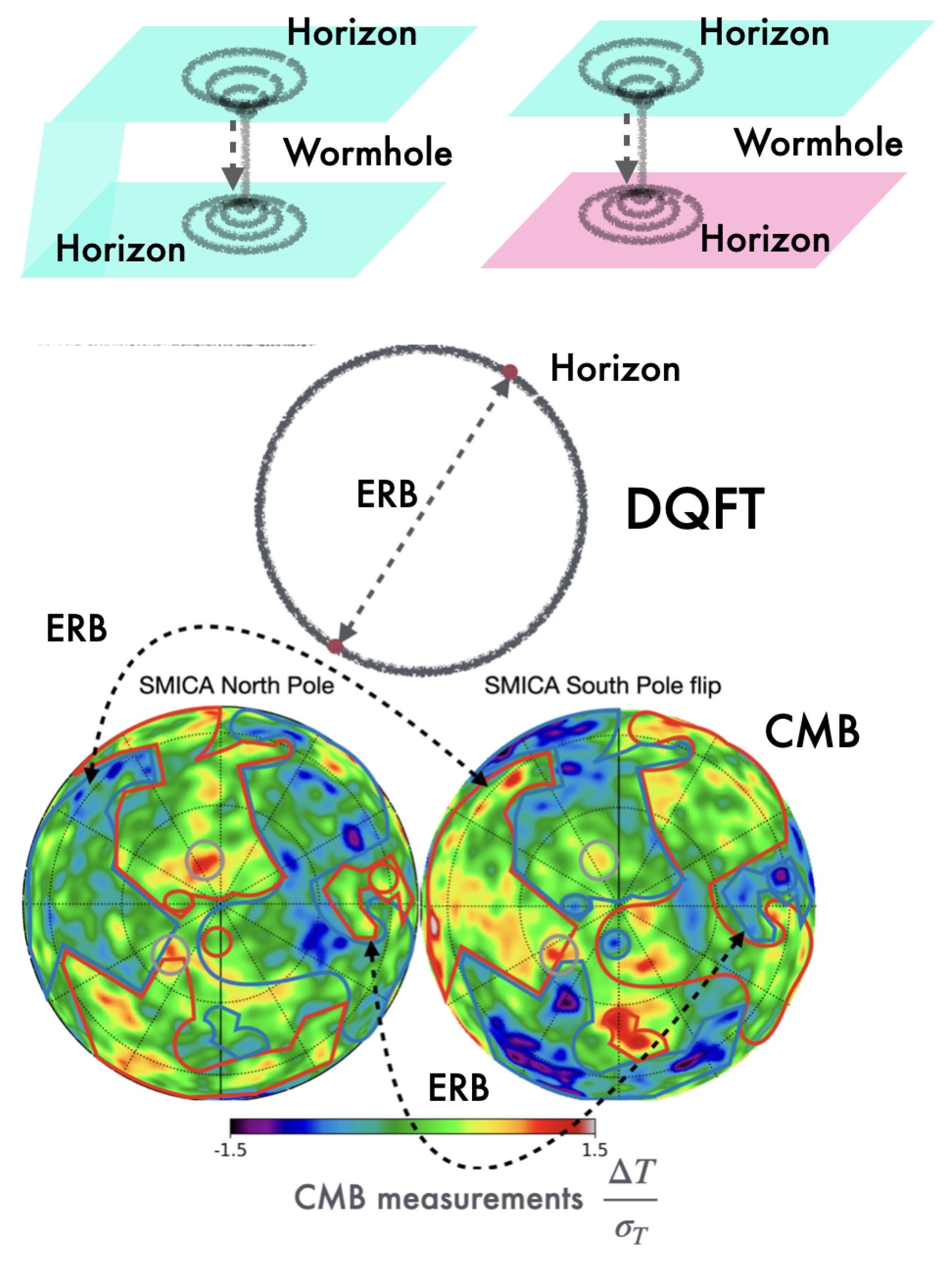
Figure 2.
Phase space of Inverse Harmonic Oscillator representing doubly degenerate positive and negative energy solutions in (11) and (15). The negative energy trajectories are given by and whereas the positive energy trajectories are and . These double degenerate trajectories are related by (16) whereas the positive and negative energy regions are related by (17).
Figure 2.
Phase space of Inverse Harmonic Oscillator representing doubly degenerate positive and negative energy solutions in (11) and (15). The negative energy trajectories are given by and whereas the positive energy trajectories are and . These double degenerate trajectories are related by (16) whereas the positive and negative energy regions are related by (17).
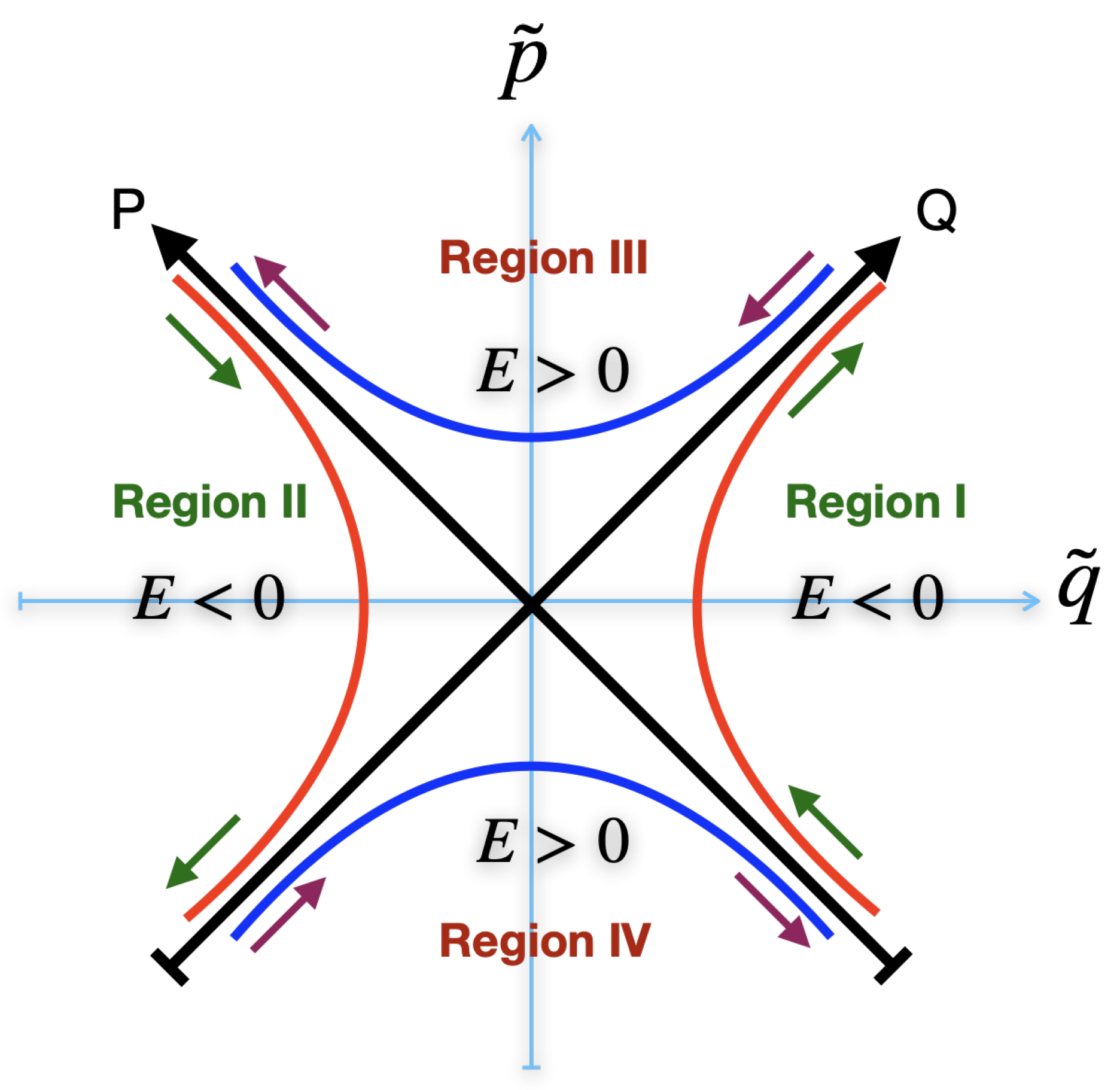
Figure 5.
The picture represents the spacetime conformal diagram of quantum SBH according to DQFT. It contains four regions , which define geometric SSS to describe quantum fields in Schwarzschild spacetime (applying the near horizon approximation ). In this picture, the region I () and () are parity conjugates of each other in the exterior (interior) regions of SBH with opposite arrows of time T.
Figure 5.
The picture represents the spacetime conformal diagram of quantum SBH according to DQFT. It contains four regions , which define geometric SSS to describe quantum fields in Schwarzschild spacetime (applying the near horizon approximation ). In this picture, the region I () and () are parity conjugates of each other in the exterior (interior) regions of SBH with opposite arrows of time T.
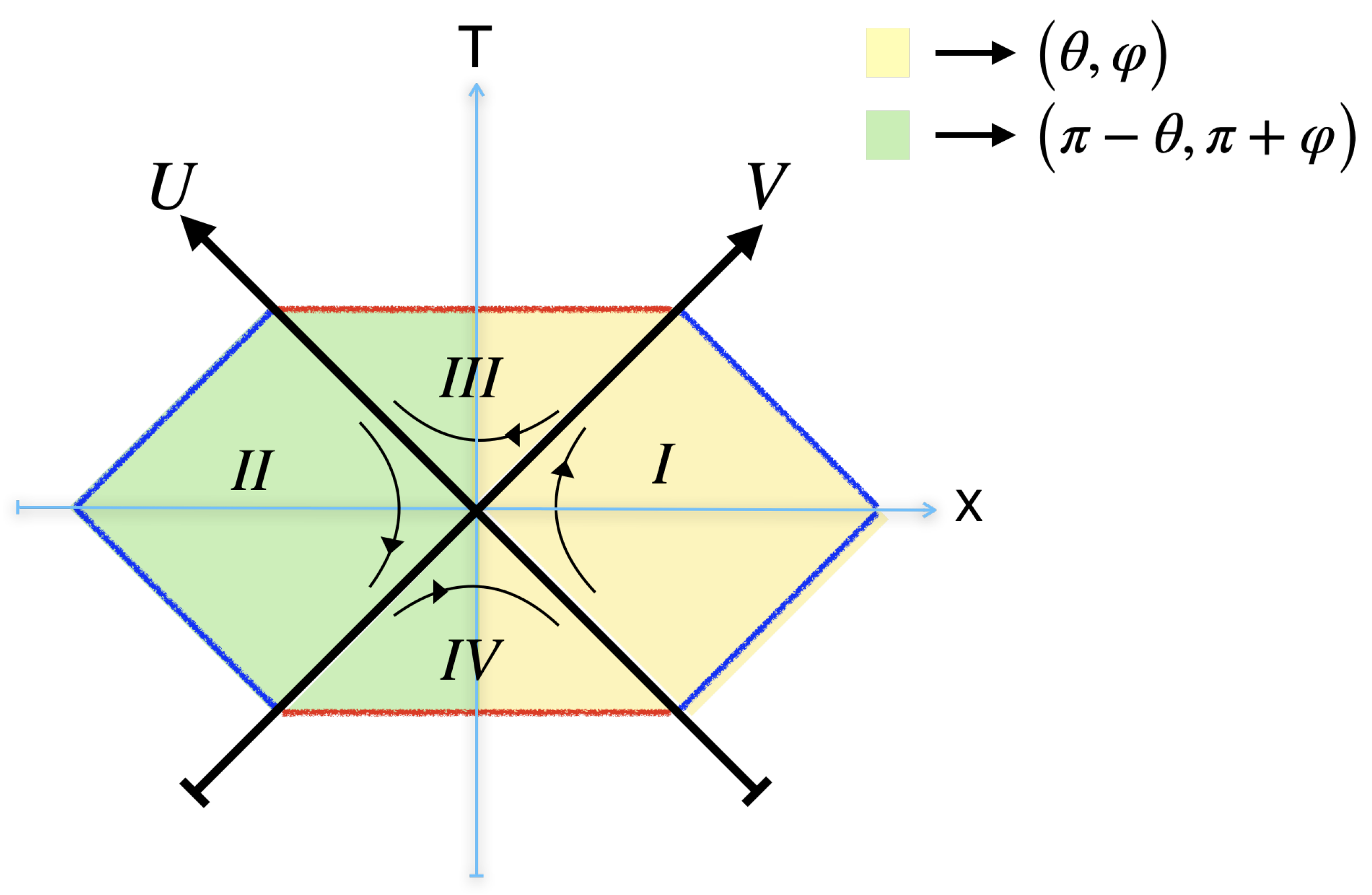
Figure 6.
This is a conformal spacetime diagram that represents quantum dS spacetime where a quantum field operator is expressed as direct-sum four components corresponding to geometric SSS corresponding to regions I, II, III, IV. The regions I(III) and II(IV) are parity conjugate regions with opposite arrows of time-related by .
Figure 6.
This is a conformal spacetime diagram that represents quantum dS spacetime where a quantum field operator is expressed as direct-sum four components corresponding to geometric SSS corresponding to regions I, II, III, IV. The regions I(III) and II(IV) are parity conjugate regions with opposite arrows of time-related by .

Disclaimer/Publisher’s Note: The statements, opinions and data contained in all publications are solely those of the individual author(s) and contributor(s) and not of MDPI and/or the editor(s). MDPI and/or the editor(s) disclaim responsibility for any injury to people or property resulting from any ideas, methods, instructions or products referred to in the content. |
© 1996 by the authors. Licensee MDPI, Basel, Switzerland. This article is an open access article distributed under the terms and conditions of the Creative Commons Attribution (CC BY) license (https://creativecommons.org/licenses/by/4.0/).
Copyright: This open access article is published under a Creative Commons CC BY 4.0 license, which permit the free download, distribution, and reuse, provided that the author and preprint are cited in any reuse.