
Submitted:
27 September 2024
Posted:
29 September 2024
You are already at the latest version
Abstract
The increasing demands on global resources due to technological development driven by consumer expectations and demands have resulted in significant problems with ecological sustainability and material availability. The creation of biocomposites has resulted in notable advancements in the green industry within the materials science area this century, owing to concerns regarding sustainability and the environment. Globally, there is a surge in the creation of highly efficient materials derived from natural resources. In aviation applications, plant-fiber-supported polymer composite materials are becoming increasingly popular. Aerospace materials are typically used in aircraft construction as structural materials to support loads throughout different flight phases. There are many diverse mechanical qualities of natural fibres; therefore, selecting one for the interior parts of an aircraft cabin based only on its attributes leads to a multiple-attribute decision-support issue. In this paper, the effective natural fibre and polymer choice for use as reinforcing materials in composite materials is represented for the composite materials’ improvement to aircraft cabin luggage for aerospace implementations. This study can guide material designers in investigating different hybrid materials with the most effective natural fiber and polymer obtained by hierarchical strategy by elucidating the effective material choice to meet the criteria determined for the aircraft cabin luggage. For this purpose, the definitive rankings of the twelve polymers and sixteen natural fibers in terms of performance score were assessed using hierarchical strategy methodology.
Keywords:
natural fibre
; polymer
; composite material
; green material
; aviation application
1. Introduction
To protect nature from numerous challenges, worldwide consciousness has spurred humankind to action in recent years. These dangers include the depletion of natural resources, water contamination, and air pollution, which fuel global warming. Because of this, a lot of people are pushing for new kinds of development and behavior through regulations designed to make natural materials more effective. The idea of sustainable development has emerged as a result of this movement [1,2,3].
A renewed focus on creating completely biodegradable materials with acceptable qualities has resulted from public awareness of the rise in non-biodegradable solid waste and its effects on the environment. Biodegradable materials have garnered significant global attention in recent times. In relation to energy consumption, raw material costs, and manufacturing efficiency, the materials now in use are highly challenging. In consequence, endeavors are being made to locate appropriate substitute material sources, with regional, readily sustainable resources being the preferred option, provided that processing them later on uses little energy [4]. From the perspective of material resource sustainability, easily accessible renewable resources are crucial. Using naturally occurring fibre resources from agriculture is one of the solutions. Using recycled or industrial waste materials is another viable approach. Obtaining the requirements of structures primarily involves using high-quality structural materials, designing materials energy-friendly, and healthy existing structures. Additional benefits occur in these kinds of constructions when plant fibres are employed, including weather protection, heat regulation of the structure, and protection from direct sunlight, among other benefits that are corroborated by several research studies and findings. To fully utilize these systems’ benefits, it is necessary to take into consideration the appropriateness of the structures, the kind of plants, and where they are located inside the plant, as well as issues related to plant maintenance [5,6,7,8,9,10,11,12,13,14]. Natural fibres have appeared as an important class of reinforcing materials lately [15,16,17]. It is anticipated that the global markets for material consumption will be dominated by biodegradable material consumption, which is predicted to increase at an average yearly ratio of around 0.13 [18]. Plant fibres are increasingly being utilized in plastic composite materials as reinforcers and fillers. However, the degradable materials' restricted qualities and high costs prevent them from being used in a variety of ways. Thus, various initiatives aimed at creating biodegradable materials have lately surfaced in an effort to address these issues and slow down the natural sources’ depletion. It is widely anticipated that these materials will play a crucial role in overall sectors in the centuries to come. Polymer fiber-supported composite materials are materials of a particular kind that are typically made of a matrix consisting of biodegradable polymers and plant fibre. Because they have the potency to substitute conventional fibre-supported composite materials, particularly glass fiber-supported composite materials, polymer-fibre composites have garnered a lot of attention lately. According to forecasts, the plant-sourced fibres in reinforcement materials’ market portion is expected to reach up to 38% by 2030 [19].
Through appropriate choices of additives, matrix, fibres, and production techniques, these composite materials’ features can be customized for various implementations. The fibre's pretreatment procedure is crucial since it regulates all connections between surface characteristics and, consequently, the resulting composite materials’ effective stress transfer. Because they are not biodegradable, garbage wastes such as containers, bottles, food packaging, plastic shopping bags, and so on are mostly to blame for environmental impurities in urban fields. It is imperative that we utilize less of these pollution-causing waste products in order to maintain a clean and safe environment [20]. That is why a lot of nations have outlawed plastic shopping bags, which are thought to be the cause of "white pollution." Because biodegradable plastics break down quickly in landfills, alternative uses for them and their plant-fibre biocomposites have grown in popularity. As a result, it could result in one of the fixes for the depletion of disposal grounds problem [21,22]. In order to meet this goal, current research is being used to combine plant fibre with biodegradable polymers to create a new class of entirely biodegradable composites [23]. Potency implementations of fibre-supported polymer composites are given in Table 1.
Aerospace materials are typically used in aircraft construction as structural materials to support loads throughout different flight phases. Many vital aircraft parts, including the landing gears, engine, elevator, airframes, rudder, fuselage, and wings, are vulnerable to structural harm as a consequence of the extreme strain. Strength in structure is the first consideration when choosing materials for an aircraft because of the safety risk. Any aerospace vehicle's design must prioritize weight reduction because it has a direct impact on fuel economy and cost. Research has demonstrated that a 1 kg weight reduction in a Boeing747 aircraft—which is commonly utilized for freight conveyance—reduces carbon emissions through 940 g and aeronautics energy source consumption through over 300 g [24]. For aeronautical applications, it is important to choose materials with maximum durability but less weightage. The need for developed composites that allow for important aircraft weightage degradation without sacrificing structural integrity is currently rising in the aerospace sector. These days, polymer matrix composites make up a sizable portion of aircraft materials. Because of their renewability, less cost, and high ratio of strength to weight, natural fibres have become an effective replacement for artificial fibres in the manufacturing of composite materials like carbon fibres and E-glass. However, because there are so many diverse kinds of plant fibres that can be hybridized with diverse matrix materials, choosing the best natural fibre for an aircraft implementation can be hard. The reinforced polymer material with fibre has drawn numerous considerations in aviation implementations because natural fibre has benefits over artificial fibres, like being relatively light, inexpensive, less likely to damage operational tools, having high notional mechanical features like flexural and tensile strengths, developing superficies finish of composite’s molded areas, being abundant in sustainable sources, being flexible throughout treatment, being biodegradable, and posing few health risks. The addition of strong and lightweight plant fibre to polymers (thermoplastic and thermoset) can result in plant fibre polymer composite materials with maximum stiffness and strength [6]. Nonetheless, there are several issues with natural fibers, and they lack some important qualities. Some plants’ structure allows the fiber to absorb moisture from its environment, which results in fragile bonds between the polymer and fiber. Moreover, couplings between natural fibers and the matrix and polymers are considered challenging due to their dissimilar chemical structures. These are the reasons behind the inefficient strength sent through the window between the composite materials. Plant fibre changes through particular processes are therefore unquestionably required. Utilizing functional groups as reagents, which can respond to fiber structures and alter their structure, is typically at the core of these alterations. Therefore, fiber changes result in a decrease in the natural fibers' ability to absorb moisture, which greatly improves the fiber's incompatibility with the polymer material [7]. Features of an aircraft structure are given in Table 2 [25].
It must be acknowledged that materials having a unique property set are required to satisfy the requirements listed in Table 2. These kinds of factors have significantly driven the usage of composites. Several of these features are provided by the composites, as listed below [25]:
- -
- Lightweight because of stiffness and high specific strength
- -
- High degree of optimization capability, including directional strength and stiffness customization;
- -
- Ability to mold big complicated shapes in short cycle times, minimizing part count and assembly times
- -
- Good for construction with extensive curvature or thin walls
- -
- Able to retain dimensions and alignment stability in space
- -
- May have minimal dielectric loss in radar transparency
- -
- The potential for a low radar cross-section
- -
- There are certain intrinsic flaws in these composites as well.
- -
- Weakly interfaced laminated structure: inadequate resistance to tensile pressures applied out of plane
- -
- Absorption of moisture and ensuing deterioration of high temperature performance
- -
- High potential for impact damage and a high likelihood of interior damage remaining undetected
- -
- Variability in material properties and several manufacturing faults
An appropriate candidate material choice for a given application has grown in importance in advanced materials research in order to achieve both eco-friendly design and consumer satisfaction. The process of multicriteria decision-making is commonly employed to determine which materials are best suited for a certain application [26,27]. AHP was the most often utilized multiple attribute decision support mechanism in a variety of material selection scenarios, along with TOPSIS, WPIM, and AHP, according to Mansor et al. [28]. Thomas invented it in the 1970s [29]. The commercially available "Expert Choice" software is an effective way to apply AHP Chang et al. used sensitivity analysis to assess their choice. Sensitivity analysis uses several criterion weights to validate the AHP results [30]. AHP is typically used to determine which alternative is best suited for a given project or application. Establishing objectives is the primary stage in the AHP strategy, followed by choosing criteria and options. The weighting of the attribute and the alternatives' respective notional significance determine the ultimate ranking of the options. By combining AHP and TOPSIS, Kumar et al. focused on a calculational framework for choosing the ideal aspirant cloud service [31]. The material selection of optimal matrix for aluminium integrated metal matrix composite materials via AHP was examined by Babu et al.. Their attention was on aluminium integrated metal matrix composite materials [32]. In order to overcome the specification problem of weighting components and gather various design criteria into a single composite, Sun suggested an improved multi-criteria decision analysis technique [33]. An index was proposed by Sun and Gollnick to assess a technique's effectiveness in the method selection process [34]. After doing a thorough analysis of MCDM approaches, Ogrodnik came to the conclusion that AHP is one of the most broadly utilized methodologies available today [35]. The novel AHP-sourceed method for choosing construction materials according to performance was presented by Lee et al. and used on a concrete formwork system case study [36]. Using AHP, Dinh et al. ranked 18 maintainability attributes’ a list that apply to the choice of maintainable materials in Vietnam according to their level of significance for the nation's building industry [37]. Stainless steel and aluminum integrated panel were the two materials that Ruslan et al. determined to be the most sustainable for usage as façade materials using Value-based Analysis and AHP [38]. AHP was used by Mayhoub et al. to create a new evaluation framework for choosing sustainable façade materials that is depend on 4 green constructin rating mechanisms [39]. For post-tension bridges, a related approach was demonstrated through Renkas-Janowska et al., who chose the optimal high-efficiency concrete using FEAHP and Fuzzy-TOPSIS [40]. Singh and colleagues combined TOPSIS and FAHP while choosing composite materials for use in structural components [41]. AHP and gray-correlation TOPSIS were integrated by Tian et al. to choose eco-friendly décor materials [42]. Akadiri et al. used the Analytic Hierarchy Process (fuzzy extended) to select maintainable construction materials [43]. A framework for decision-making utilizing FAHP was presented by Figueiredo et al. to help with the selection of building materials [44]. In the automobile business, TOPSIS has been used to choose the most advantageous strategic fuel cell technology [45]. In order to choose the finest roofing materials for the UK property market, Rahman et al. used TOPSIS [46]. Lee used ANP to assess the competing types for airport development [47]. Materials were chosen by Liu et al. using the VIKOR method [48]. VIKOR was used by Khodabakhshi et al. to pick the best materials [49]. Using a hybrid MCRAT, LOPCOW, MEREC, and PSI modelling, Ulutas et al. determined the most performance bio-fiber for popular construction isolation materials. They then selected the insulation materials using the PSI-CRITIC based CoCoSo technique [50,51]. A novel hybrid MCDM model was presented by Aksakal [52] for the evaluation of insulation materials in a healthier environment. Balo was assessed for utilizing an AHP in the ecological insulation materials’ manufacturing of [53]. Using AHP, Dweiri et al. suggested a decision-making modelling to find the automobile industry's most efficient supplier [54]. For Greek road transportation, the optimum alternative fuel was chosen using AHP by Tsita et al., taking into account both economic and policy considerations [55]. In order to select the most suitable ceramic waste to substitute ordinary concrete in terms of compressive strength and environmental effects, some research has combined AHP and TOPSIS by Rashid et al. [56]. During the selection process, they took the natural fiber's mechanical and physical qualities into account. AHP was applied in addition to material selection to determine which of the creative planning notions for the polymer composite materials intended for lever implatations of car brakes was the best design by Mansor et al. [57]. The 14 plant fibres and 7 attributes were considered. For the vehicle spall liner, they have selected kenaf as a feasible plant fibre to hybridize with Kevlar. AHP was utilized to choose the natural fiber for the dash board used in automobiles by Hani et al. [58]. Dalalah et al. were utilized to select the natural fibre for the car fracture liner using AHP [59]. Balo et al. analyzed energy-effective natural fibers for green building external walls [60,61,62]. AHP is used for wind turbine material choice by Sagbansua and Balo [63,64].
There are a number of characteristics to consider when selecting component materials for a combined material, but deciding which to select in order to get the greatest result out of the available options can be challenging [65]. Multiple-attribute decision-support strategies can be used to select the factors of combined materials since they provide decision-makers with a reasonable suggestion from a restricted number of options, too. Many multiple-attribute decision-making models evaluate the performance of options and provide the best possible resolution among a variety of options. Amarnath et al. investigated the best solution for flax components in composite materials using the TOPSIS methodology [66]. For the nutrient pack, AHP modeling was used to select the best fibre among 9 plant fibres. The authors also ran a sensitivity test on the modelling and found that the AHP model's system of priorities was stable, according to Salwa et al. [67]. Rocchi et al. identified economic and environmental criteria groups to evaluate the ecological and financial suitability of sustainable isolation [68]. Kumar et al. suggested an optimisation schema for comparing the features of different insulation materials, with a focus on lifecycle cost, comfort, operational energy, embodied energy, and carbon [69]. In Lithuania, Ruzgys et al. investigated modernized building planning resolutions. Utilizing the connected TODIM-SWARA method, the researchers ranked 6 external wall isolation options for consturiction modernization (mineral wool and fibercement panels; polystyrene foam; and thin plaster). A ventilated mechanism with fibro-cement panels and mineral wool insulating material with 0.13 m thickness was discovered to be the most effective option for residence modernization [70]. Bringezu and Sameer demonstrated the assessment of material resources and the importance of indicators, such as performance indicators, criteria, parameters, and inputs, in material choice to deal with maintainability [71]. TOPSIS Grey method utilized to arrange 5 modern isolating materials to support historically based constructions (hemp/flax fibre, thermo wool, eco wool, aerogel, and vacuum panel) by Zagorskas et al. The best insulating material was determined to be wool. Nonetheless, the findings of the other alternatives are very associated [72]. Through a comparative lifecycle analysis of defined insulating materials oriented toward maintainability in construction, Llantoy et al. demonstrated that insulating materials decrease building effects and energy usage [73]. For constructional implementations, Patnaik et al. utilized the analytical hierarchy methodology to define the attributes’ weight values for choosing hybrid material [74]. Civic and Vucijak evaluated eight insulation materials using the VIKOR technique. The authors chose 7 attributes to display technical and environmental factors. Both the selection of attributes and their weightiness in this research depend on the choice of researchers. The results display that wood wool is the third alternative, glass wool is the second alternative, and styrofoam is the most favored option [75].
Azari discussed various methodologies for accountancy ecological matters, programs for life-cycle analyses, and energy analysis programs to raise user consciousness of the importance of energy-efficient buildings [76]. Robati et al. detailed the materials’ environmental impacts of C-emissions embodied and prediction faults, which finally give rise to all energy usage [77]. TOPSIS methodology was used to assess and rank the maintainability of natural and artificial insulating construction materials by Streimikiene et al. The sensitivity analysis was executed by the authors using 4 diverse frameworks (balanced, equal, environmental, and technological) with diverse weightages for the chosen attributes. According to the evaluation, recycled glass is the most effective option among the 3 alternatives (balanced, technological, and equal). With reference to the evaluation, sheep wool is the most efficient alternative in terms of the environment [78].
In brief, biofiber composites have seen incredible metamorphosis in the past few decades. With the thorough investigation, development, and subsequent application of novel compositions and techniques, these materials have grown increasingly sufficient. Biocomposites gained considerable importance due to the petroleum crisis and are now widely used as engineering materials with a variety of characteristics. But like other materials, they are always under pressure from the worldwide market to compete, which means that ongoing research is required. Dealing with plant fiber-supported polymer composite materials presents a significant challenge owing to their wide-ranging qualities and characteristics. Many factors, such as the kind of fibre, the processing techniques, the location of the plant fibres' source, and any fiber alteration, affect a biocomposite's characteristics. Therefore, as new procedures and goods are developed, the growing utilization of natural resources becomes significant for these nations. This in turn contributes to higher living standards and the creation of jobs, especially in the rural sector, as well as preventing environmental degradation that will result from the improper disposal of these resources.
In this research, an overview is first given of the general attributes of the reinforcing fibers utilized in biocomposites, including their source, kind, structure, content, and mechanical properties. And then the analysis was made by following the steps below.
- -
- To conduct an in-depth investigation of the mechanical properties of twelve polymers and sixteen natural fibers in terms of tensile strength, Young’s modulus, density, and elongation at a break from existing literature.
- -
- To examine and gather the chemical (micro-fibrillar angle, lignin, hemicellulose, cellulose, and moisture content) and physical (width of lumen, fiber length, thickness of single cell wall, and fiber diameter) characteristics of sixteen natural fibers
- -
- To determine the influence of data variation on the obtained mechanical properties on the performance score of each polymer.
- -
- To determine the influence of data variation on the obtained mechanical, physical, and chemical properties on the performance score of each natural fibre.
- -
- To assign weights to the criteria using the hierarchical strategy methodology to indicate the relative importance of the criteria.
- -
- To assess the performance scores of all the variants of the twelve polymers and sixteen natural fibers.
2. Materials and Methods
The methodology of hierarchical strategy is a methodical approach to material selection. The hierarchical approach methodology, as previously noted, can be utilized to identify appropriate natural fiber and polymer materials for aviation cabin luggage covers. Rather of dictating the "right decision," people deal with complex decisions; the hierarchical approach technique assists them in making one. Developed by Saaty (1980), it is based on human psychology and mathematics and has undergone substantial research and development since then. The hierarchical strategy approach is a way for the decision maker to organize complex problems into a hierarchy, or a series of integrated levels, and is useful for prioritizing alternatives when various factors need to be taken into account. The objective, the criteria, and the options are typically the first three tiers of the hierarchy. The objective of the material selection problem is to choose the best material overall. Physical, chemical, mechanical, and other criteria are all possible. This approach serves to streamline and expedite the natural process of decision-making and offers a framework for making wise choices in challenging circumstances (like material selection, for example).
In this study, we shall refer to the hierarchical strategy technique as previously discussed. It is credited to Saaty and is commonly referred to as the Saaty method.
The approach finds application across all hierarchical levels. Each component of the quantitative features is given a value based on its importance using Saaty's technique. These assessments are synthesized to determine the component with the highest priority. To find a solution to the choice dilemma, the decision maker concentrates on them. More experts are involved in the decision-making process. The degree of soundness of the objective and criteria is shown by the weights assigned to them by the assessors, who are experts in their field. Any expert who is familiar with his subordinates (e.g., job expertise, work experiences, and results) can be verified by the responsible supervisor. Expert soundness can be expressed as a weight vector:
where: v1 is the first expert's weight; vr is the third expert's weight;
Saaty's approach has been selected to determine the weights of the criteria. This approach considers the varying preferences among the criteria and determines a broad point scale for assessment (Formula 3). As a result, even minute variations in the criteria's preferences can be found and taken into consideration when determining the weights:
The values 2, 4, 6, and 8 are meant to assess transitional phases. Every pair of criteria, i and j, is compared using this procedure. The following guidelines are followed when writing their evaluation in accordance with the Saaty's matrix:
The normalized geometric average of the lines in the Saaty matrix is used to calculate the weights vi in this five-step approach [79,80,81,82,83,84]. In order to determine if the ith criterion is preferred over the jth criterion, Saaty's matrix must first be filled in such a way that the diagonal values equal one (s_{ij}=1). Next, the proper value of Saaty's point scale (Formula 3) must be chosen. Inverse values must be expressed if the jth criterion is chosen above the ith criterion:
For every i, the value
was calculated;
For every i, the value
was calculated;
where: R is geometric average; k is total number of criteria;
In the next step, the value
was calculated;
The criteria weights are determined during the last step according to the following formula:
Weights of criteria are determined if we multiply all elements for each row and determine the nth root of this product, when n is the number of elements. Then we standardize resulting geometric averages of each Saaty’smatrix row (we divide geometric averages of each row by the sum of all geometric averages).
This procedure gives estimate weights of each criterion, which can be written in the form of weight vector:
3. Results and Discussion
3.1. Data
This section provides information about the data used as part of our methodology. The world's largest producers of natural fibers for commerce are given in Table 4. The chemical features, mechanical features and physical features of natural fibers are presented in Table 5, Table 6, and Table 7, respectively.
3.1. Results
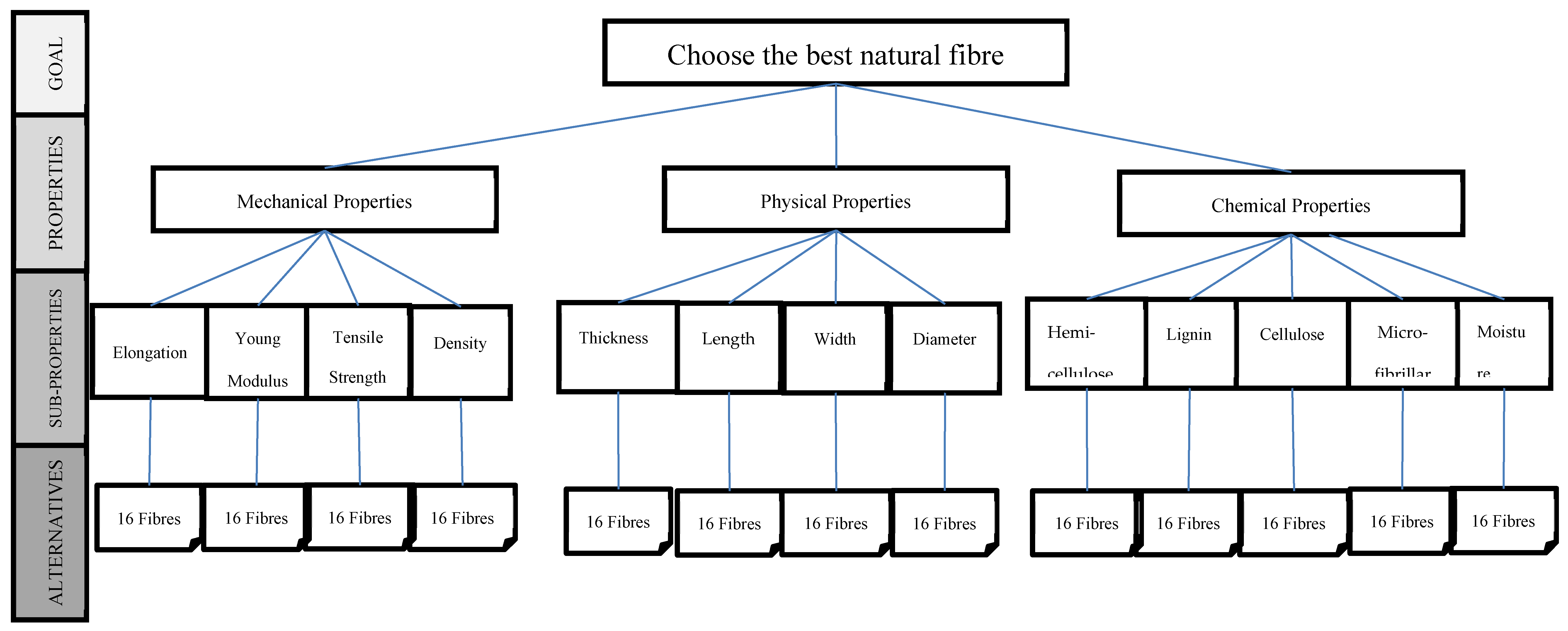
This article discusses the most widely used matrices in biofiber-reinforced composites that are derived from renewable and petrochemical resources. The first step involves developing the decision hierarchy involving mechanical, physical, and chemical features as the main criteria. The features listed in Table 5, Table 6, and Table 7 are added to the hierarchy as the sub-criteria. Figure 1 in the Appendix A illustrates the final hierarchy composed of main and sub-criteria. Application of Eq. 1-10 results in the weights provided in Table 8 for the main criteria.
The next step involves pairwise comparison of sub-criteria under each main criteria. Table 9 presents the decision matrices using Saaty’s comparison scheme and the resulting weights.
Figure 2 illustrates the weights of the selected sub-criteria.
Sub-criteria weights are multiplied with their associated values given in Table 5, Table 6, and Table 7, followed by a normalization of the resulting values due to the various scales. The top half of Table 10 provides the resulting normalized values. The final step of the methodology involves multiplying the weights of the main criteria with the associated normalized values under each sub-criteria. The bottom half of Table 10 provides the weighted score of each sub-criteria. Calculating the total scores for each natural fiber alternative shows the contribution of each alternative toward the overall goal of choosing the best natural fiber.
Total weighted scores presented in the last row of Table 10 and Figure 3 show that Areca is the optimum fiber type with a total weight score of wt = 0.313.
Table 11 presents the characteristics of polymers commonly utilized for producing composite materials with natural fibers.
Applying the same steps in comparing the polymer alternatives result in the values provided in Table 12.
5. Conclusions
The sectoral use of composite materials supported with polymer materials and containing biofibers has garnered significant attention in recent times. The usage of polymer materials as bindings for composites supported by biofibers has increased significantly. In this study, a methodical process was followed in the most efficient natural fibre and polymer selection for use in aerospace implementations. First, this research presents a thorough investigation of the literature on the natural fibres and polymers that are most commonly used. To improve comprehension, information on the natural fibres’ chemical (micro-fibrillar angle, lignin, hemicellulose, cellulose, and moisture content), mechanical (elongation at break, Young’s modulus, tensile strength, and density), physical (width of lümen, fiber length, thickness of single cell wall, and fiber diameter) characteristics, and polymer's technical characteristics (elongation at break, modulus of elasticity, tensile strength, and density) were gathered and examined prior to the selection process starting. For the purpose of this study, criteria and sub-criteria were assessed by experts. A hierarchical strategy methodology was performed to identify the weightages assigned to the attributes based on the notional significance of each of the criteria. Using the process, the best variation of each fiber and polymer was chosen for use in applications. Based on the ranking and performance scores of these chosen polymers and fibers, the optimal substitute was evaluated. This analysis can help researchers, designers, and decision-makers in future research endeavors for aviation material applications.
Author Contributions
Conceptualization, F.B.; methodology, L.S.; software, L.S.; validation, F.B., L.S.; formal analysis, LS.; investigation, F.B.; resources, L.S.; data curation, F.B.; writing—original draft preparation, F.B. and L.S..; writing—review and editing, F.B. and L.S.; All authors have read and agreed to the published version of the manuscript.
Funding
This research received no external funding.
Data Availability Statement
Data will be made available upon request.
Conflicts of Interest
The authors declare no conflicts of interest.
References
- M. Habibi, L. Laperri`ere, H.M. Hassanabadi, Replacing stitching and weaving in natural fiber reinforcement manufacturing, part 2: mechanical behavior of flax fiber composite laminates, J. Nat. Fibers 17 (3) (2020) 388–397. [CrossRef]
- M. Habibi, L. Laperri`ere, H. Mahi Hassanabadi, Replacing stitching and weaving in natural fiber reinforcement manufacturing, part 1: mechanical behavior of unidirectional flax fiber composites, J. Nat. Fibers 16 (7) (2019) 1064–1076.
- S. Selmi, M. Habibi, L. Laperri`ere, S. Kelouwani, Characterisation of natural flax fibers honeycomb: compression damage analysis using acoustic emission, J. Nat. Fibers 19 (3) (2022) 1084–1093.
- Drochytka R, Zach J, Korjenic A, Hroudova J. Improving the energy efficiency in buildings while reducing the waste using autoclaved aerated concrete made from power industry waste. Energy Build 2013;58:319–23.
- Wong NH, Cheong DKW, Yan H, Soh J, Ong CL, Sia A. The effects of rooftop garden on energy consumption of a commercial building in Singapore. Energy Build 2003;35:353–64.
- Stec WJ, Paassen AH, Maziarz A. Modelling the double skin facade with plants. Energy Build 2005;37:419–27.
- Ottele M, Perini K, Fraaij ALA, Haas EM, Raiteri R. Comparative life cycle analysis for green facades and living wall systems. Energy Build 2011;43:3419–29.
- Perez G, Rincon L, Vila A, Gonzales JM, Cabeza LF. Behaviour of green facades in Mediterranean Continental climate. Energy Convers Manag 2011;52:1861–7.
- Perez G, Rincon L, Vila A, Gonzales JM, Cabeza LF. Green vertical system for buildings as passive systems for energy savings. Appl Energy 2011;88:4854–9.
- Sheweka SM, Mohamed NM. Green facades as a new sustainable approach towards climate change. Energy Proc 2012;18:507–20.
- Suklje T, Medved S, Arkar C. An experimental study on a microclimatic layer of a bionic facade inspired by vertical greenery. J Bionic Eng 2013;10:177–85.
- Wong NH, Tang AYK, Tan PY, Wong NCh. Energy simulation of vertical greenery systems. Energy Build 2009;41:1401–8.
- Nadia S, Noureddine S, Hichem N, Djamila D. Experimental study of thermal performance and the contribution of plant-covered walls to the thermal behaviour of building. In: TerraGreen 13 international conference 2013 –advancements in renewable energy and clean environment. Energy Proc; 2013, 36. p. 995–1001.
- Ismail, MR. Quiet environment: acoustics of vertical green wall systems of the Islamic urban form. Front Archit Res 2013;2:162–77.
- Ray D, Sengupta S, Sengupta SP, Mohanty AK, Misra M. A study of the mechanical and fracture behaviour of jute–fabric–reinforced clay-modified thermoplastic starch-matrix composites. Macromol Mater Eng 2007;292:1075–84.
- Pietak A, Korte S, Tan E, Downard A, Staiger MP. A novel technique for characterizing the surface of natural fibres. Appl Surf Sci 2007;253:3627–35.
- Leduc S, Urena JRG, Gonzalez-Nunez R, Quirarte JR, Riedl B, Rodrigue D. LDPE/Agave fibre composites: effect of coupling agent and weld line on mechanical and morphological properties. Polym Polym Compos 2008;16:115–24. [CrossRef]
- Global Biomaterial Market (2009–2014), Markets and Markets, 2009.
- Shah, D. Developing plant fibre composites for structural applications by optimising composite parameters: a critical review. J Mat Sci 2013;48(18):6083–107.
- Velmurugan R, Manikandan V. Mechanical properties of palmyra/glass fibre hybrid composites. Compos Part A-Appl S 2007;38:2216–26.
- Bledzki AK, Zhang W, Chate A. Natural-fibre-reinforced polyurethane microfoams. Compos Sci Technol 2001;61:2405–11.
- Rashdi AAA, Sapuan SM, Ahmad MMHM, Khalina A. Combined effects of water absorbtion due to water immersion, soil buried and natural weather on mechanical properties of kenaf fibre unsaturated polyester composites (KFUPC). Int J Mech Manuf Eng 2010; 5:11–7.
- Baghaei B, Skrifvars M, Berglin L. Manufacture and characterization of thermoplastics composites made from PLA/hemp co-wrapped hybrid yarn prepregs. Compos Part A-Appl S 2013;50:93–101.
- A. Mitra, A. Majumdar, A. Ghosh, P.K. Majumdar, D. Bannerjee, Selection of hand- loom fabrics for summer clothing using multi-criteria decision making techniques, J. Nat. Fibres 12 (1) (Jan. 2015) 61–71.
- Reena antil, Amit Garvit Ritesh, Applications of composite materials in aerospace, International Journal of Science Technology and Management Vol: 4, Issue:11, November 2015.
- Al-oqla, F. M. , Salit, M. S., Ishak, M. R., and Aziz, N. A.. Selecting natural fibers for bio-based materials with conflicting criteria. Am. J. Appl. Sci. 12, 64–71.
- Al-oqla, F. M. , Sapuan, S., Ishak, M., and Nuraini, A.. Decision making model for optimal reinforcement condition of natural fiber composites. Fiber. Polym. 16, 153–163.
- Mansor, M. R., Sapuan, S., Zainudin, E. S., Nuraini, A., and Hambali, A. (2013). Hybrid natural and glass fibers reinforced polymer composites material selection using analytical hierarchy process for automotive brake lever design. Mater. Des. 51, 484–492.
- Da silva neves, A. J., and Camanho, R. (2015). The use of ahp for it Project priorization–a case study for oil & gas company. Proc. Comput. Sci. 55, 1097–1105.
- Chang, C.W., Wu, C.R., Lin, C.T., and Chen, H.C. (2007). An application of ahp and sensitivity analysis for selecting the best slicing machine. Comput. Ind. Eng. 52, 296–307.
- R.R. Kumar, S. Mishra, and C. Kumar, “A Novel Framework for Cloud Service Evaluation and Selection Using Hybrid MCDM Methods,” Arabian Journal for Science and Engineering, Vol. 43, pp. 7015–7030, 2018.
- A. K. Babu, P. Venkataramaiah, and S. Yerrathota, S. “Material Selection for Preparation of Aluminium Hybrid Mmcs”, Materials Today: Proceedings, Vol. 5, pp. 12209–12222, 2018.
- X. Sun, “Incorporating multicriteria decision analysis techniques in aircraft conceptual design process,” Journal of Aircraft, Vol. 51 No.3 pp. 861–869, 2014.
- X. Sun, and V. Gollnick V., “Intelligent Multicriteria Decision Support System for Systems Design,” Journal of Aircraft, Vol. 51 No. 1, pp. 1–11, 2014. [CrossRef]
- Ogrodnik, K. Multi-criteria analysis of design solutions in architecture and engineering: Review of applications and a case study. Buildings 2019, 9, 244. [Google Scholar] [CrossRef]
- Lee, D.; Lee, D.; Lee, M.; Kim, M.; Kim, T. Analytic hierarchy process-based construction material selection for performance improvement of building construction: The case of a concrete system form. Materials 2020, 13, 1738. [Google Scholar] [CrossRef] [PubMed]
- Dinh, T.H.; Dinh, T.H.; Götze, U. Integration of sustainability criteria and life cycle sustainability assessment method into construction material selection in developing countries: The case of Vietnam. Int. J. Sustain. Dev. Plann. 2020, 15, 1145–1156. [Google Scholar] [CrossRef]
- Ruslan, A.A.B.; Al-atesh, E.A.; Rahmawati, Y.; Utomo, C.; Zawawi, N.A.W.A.; Jahja, M.; lmansoury, A. A value-based decision making model for selecting sustainable materials for buildings. Int. J. Adv. Sci. Eng. Inf. Technol. 2021, 6, 2279–2286. [Google Scholar] [CrossRef]
- Mayhoub, M.M.G.; El Sayad, Z.M.T.; Ali, A.A.M.; Ibrahim, M.G. Assessment of green building materials’ attributes to achieve sustainable building façades using AHP. Buildings 2021, 11, 474. [Google Scholar] [CrossRef]
- Janowska-Renkas, E.; Jakiel, P.; Fabianowski, D.; Matyjaszczyk, D. Optimal selection of high-performance concrete for posttensioned girder bridge using advanced hybrid MCDA method. Materials 2021, 14, 6553. [Google Scholar] [CrossRef] [PubMed]
- Singh, A.K.; Avikal, S.; Kumar, N.; Kumar, M.; Thakura, P. A fuzzy-AHP and M-TOPSIS based approach for selection of composite materials used in structural applications. Mater. Today Proc. 2020, 26, 3119–3123. [Google Scholar] [CrossRef]
- Tian, G.; Zhang, H.; Feng, Y.; Wang, D.; Peng, Y.; Jia, H. Green decoration materials selection under interior environment characteristics: A grey-correlational based hybrid MCDM method. Renew. Sustain. Energy Rev. 2018, 81, 682–692. [Google Scholar] [CrossRef]
- Akadiri, P.O.; Olomolaiye, P.O.; Chinyio, E.A. Multi-criteria evaluation model for the selection of sustainable materials for building projects. Autom. Constr. 2013, 30, 113–125. [Google Scholar] [CrossRef]
- Figueiredo, K.; Pierrot, R.; Hammad, A.W.A.; Haddad, A. Sustainable material choice for construction projects: A life cycle sustainability assessment framework based on BIM and fuzzy-AHP. Build. Environ. 2021, 196, 107805. [Google Scholar] [CrossRef]
- Sadeghzadeh, K. , & Salehi, M. B. (2011). Mathematical analysis of fuel cell strategic Technologies development solutions in the automotive industry by the TOPSIS multi-criteria decision making method. International Journal of Hydrogen Energy, 36, 13272–13280.
- Rahman, S. , Odeyinka, H., Perera, S., & Bi, Y. (2012). Product-cost modelling approach for the development of a decision support system for optimal roofing material selection. Expert Systems with Applications, 39, 6857–6871.
- Lee, K.-L. (2010). Two-phase fuzzy approach for evaluating service strategies in an airport’s international logistic system. Journal of the Chinese Institute of Industrial Engineers, 27, 209–225.
- Liu, H.-C. , Liu, L., & Wu, J. (2013). Material selection using an interval 2-tuple linguistic VIKOR method considering subjective and objective weights. Materials & Design, 52, 158–167.
- Jahan, A. , Mustapha, F., Ismail, M. Y., Sapuan, S., & Bahraminasab, M. (2011). A comprehensive VIKOR method for material selection. Materials & Design, 32, 1215–1221.
- Alptekin Ulutaş, Figen Balo, Ayşe Topal, Identifying the most efficient natural fibre for common commercial building insulation materials with an integrated PSI, MEREC, LOPCOW and MCRAT model, Polymers (MDPI), 15(6), 1500, pages:1-23, 2023.
- Alptekin Ulutaş, Figen Balo, Lutfu S. Sua, Darjan Karabasevic, Dragisa Stanujkic, Gabrijela Popovic, Selection of Insulation Materials with PSI-CRITIC based CoCoSo Method, Vol. 20 No. 2 (2021): Revista de la Construcción. Journal of Construction.
- Berrak Aksakal, Alptekin Ulutaş, Figen Balo and Darjan Karabasevic, A New Hybrid MCDM Model for Insulation Material Evaluation for Healthier Environment, Buildings (MDPI), 13.5.2022, 12(5), 655, 1-23.
- Figen Balo, Evaluation of Ecological Insulation Material Manufacturing with Analytical Hierarchy Process (Ekolojik yalıtım malzemesi üretiminin analitik hiyerarşi prosesi ile değerlendirilmesi), Journal of polytechnic (Politeknik Dergisi) 20(3): 733-742.
- Dweiri, F., Kumar, S., Khan, S. A., and Jain, V. (2016). Designing an integrated ahp based decision support system for supplier selection in automotive industry. Expert Syst. Appl. 62, 273–283.
- Tsita, K. G., and Pilavachi, P. A. (2012). Evaluation of alternative fuels for the greek road transport sector using the analytic hierarchy process. Ener. Policy 48, 677–686.
- Rashid, K., Razzaq, A., Ahmad, M., Rashid, T., and Tariq, S. (2017). Experimental and analytical selection of sustainable recycled concrete with ceramic waste aggregate. Constr. Build Mater. 154, 829–840.
- Mansor, M. R. , Sapuan, S., Zainudin, E. S., Nuraini, A., and Hambali, A. (2014). Conceptual design of kenaf fiber polymer composite automotive parking brake lever using integrated triz–morphological chart–analytic hierarchy process method. Mater.
- Hani, A. , Roslan, A., Mariatti, J., and Maziah, M. (2012). Body armor technology: a review of materials, construction techniques and enhancement of ballistic energy absorption. Adv. Mat. Res. 806–812.
- Dalalah, D., Al-oqla, F., and Hayajneh, M. (2010). Application of the analytic hierarchy process (ahp) in multi-criteria analysis of the selection of cranes. jordan, J. Mech. Indust. Eng. 4, 567–578.
- Figen Balo, Lutfu S.Sua, CRC press 2023 Book series on Handbook of Sustainable Materials: Modelling, Characterization, and Optimization, Chapter 1: Strategic Evaluation and Selection for Energy-Effective Natural Fibers as Alternative Sustainable Insulation Materials for Green Building Envelope, ISBN: 9781032286327, 2023, pages: 1-17.
- Figen Balo, Lutfu S.Sua, EMERALD Publishing 2023 Book Series on Pragmatic Engineering and Lifestyle - Responsible Engineering for a Sustainable Future, Chapter 2: Application of expert decision system at the optimal fiber selection for green building design components, ISBN: 978-1-80262-998-9, Emerald Publishing Limited, 217 pages, 21-38, 2023.
- Figen Balo, Lutfu Sua, Hierarchical Model for Optimizing Natural Fiber Selection Process for Eco-design of Buildings, Journal of Natural Fibers, 19(15), Page:10897-10909 ISSN: 1544-0478.
- Lütfü Şağbanşua, Figen Balo, Multi-Criteria Decision Making for 1.5 MW Wind Turbine Selection, Procedia Computer Science, Pages: 403-409, 111 (2017).
- Aynur Uçar, Figen Balo, “Investigation of wind energy potential in Kartalkaya -Bolu, Turkey”, International Journal of Green Energy, 6(4), 401-412, 2009.
- C. Fragassa , Lightening structures by metal replacement: from traditional gym equipment to an advanced fiber-reinforced composite exoskeleton, Facta Univ. Ser. Mech. Eng. (2021).
- K. Amarnath, K.J. Babu, M.V.S. Kumar, Selection of optimal flax fiber reinforced components for experimental investigation by using TOPSIS method, IOP Conf. Ser. 1057 (1) (2021) 12055. [CrossRef]
- H.N. Salwa, S.M. Sapuan, M.T. Mastura, M.Y.M. Zuhri, Analytic hierarchy process (AHP)-based materials selection system for natural fiber as reinforcement in biopoly- mer composites for food packaging, Bioresources 14 (4) (2019) 10014–10046.
- Rocchi, L.; Kadzinski, M.; Menconi, M.E.; Grohmann, D.; Miebs, G.; Paolotti, L.; Boggia, A. Sustainability evaluation of retrofitting solutions for rural buildings through life cycle approach and multi-criteria analysis. Energy Build. 2018, 173, 281–290. [Google Scholar] [CrossRef]
- Kumar D, Alam M, Zou PX, Sanjayan JG and Memon RA. Comparative analysis of building insulation material properties and performance. Renewable and Sustainable Energy Reviews. 2020 Oct 1; 131:110038.
- Ruzgys, A.; Volvaciovas, R.; Ignatavicius, C.; Turskis, Z. Integrated evaluation of external wall insulation in residential buildings using SWARA-TODIM MCDM method. J. Civ. Eng. Manag. 2014, 20, 103–110. [Google Scholar] [CrossRef]
- Sameer H, Bringezu S. Life cycle input indicators of material resource use for enhancing sustainability assessment schemes of buildings. Journal of Building Engineering. 2019 Jan 1; 21: 230-42.
- Zagorskas, J.; Zavadskas, E.K.; Turskis, Z.; Burinskiene, M.; Blumberga, A.; Blumberga, D. Thermal insulation alternatives of historic brick buildingsin Baltic Sea Region. Energy Build. 2014, 78, 35–42. [Google Scholar] [CrossRef]
- Llantoy N, Chafer M, Cabeza LF. A comparative life cycle assessment (LCA) of different insulation materials for buildings in the continental Mediterranean climate. Energy and Buildings. 2020 Jul 23: 110323.
- P.K. Patnaik, P.T.R. Swain , S.K. Mishra , A. Purohit , S. Biswas , Composite material selection for structural applications based on AHP-MOORA approach, Mater. Today Proc. 33 (2020) 5659–5663.
- Civic, A.; Vucijak, B. Multi-criteria Optimization of Insulation Options forWarmth of Buildings to Increase Energy Efficiency. Procedia Eng. 2014, 69, 911–920. [Google Scholar] [CrossRef]
- Azari, R. Life Cycle Energy Consumption of Buildings; Embodied+ Operational. In Sustainable construction technologies 2019 Jan 1 (pp. 123-144). Butterworth-Heinemann.
- Robati M, Daly D, Kokogiannakis G. A method of uncertainty analysis for whole-life embodied carbon emissions (CO2-e) of building materials of a net-zero energy building in Australia. Journal of Cleaner Production. 2019 Jul 10; 225:541-53.
- Streimikiene, D.; Skulskis, V.; Balezentis, T.; Agnusdei, G.P. Uncertain multi-criteria sustainability assessment of green building insulation materials. Energy Build. 2020, 219, 110021. [Google Scholar] [CrossRef]
- Saaty, Thomas L.; Peniwati, Kirti (2008). Group Decision Making: Drawing out and Reconciling Differences. Pittsburgh, Pennsylvania: RWS Publications. ISBN 978-1-888603-08-8.
- Saaty, Rozann, ed. (2009). "Participant Names and Papers". Proceedings of the 10th International Symposium on the Analytic Hierarchy/Network Process. Pittsburgh, Pennsylvania: ISAHP.
- Saaty, Thomas L. (2008). Decision Making for Leaders: The Analytic Hierarchy Process for Decisions in a Complex World. Pittsburgh, Pennsylvania: RWS Publications. ISBN 978-0-9620317-8-6.
- Saaty, Thomas L. (2010). Principia Mathematica Decernendi: Mathematical Principles of Decision Making. Pittsburgh, Pennsylvania: RWS Publications. ISBN 978-1-888603-10-1.
- Saaty, Thomas L. (June 2008). "Relative Measurement and its Generalization in Decision Making: Why CiteSeerX 10.1.1.455.3274.
- Roman Hruška, Petr Průša, Darko Babić, The use of ahp method for selectıon of supplıer, Transport 2014 Volume 29(2): 195–203.
- Jabbarzadeh, A. (2018). Application of the AHP and TOPSIS in project management. Journal of Project Management, 3(2), 125-130.
- Kuo, R. J., Chi, S. C., & Kao, S. S. (1999). A decision support system for locating convenience store through fuzzy AHP. Computers & Industrial Engineering, 37(1-2), 323-326.
- Jalaliyoon, N. , Bakar, N. A., Taherdoost, H. (2012). Accomplishment of Critical Success Factor in Organization; Using Analytic Hierarchy Process. International Journal of Academic Research in Management, Helvetic Editions Ltd, 1(1); 1-9.
- Lee. M. C. (2007). A Method of Performance Evaluation by Using the Analytic Network Process and Balanced Score Card, International Conference on Convergence Information Technology.
- Ansah, R. H. , Sorooshian, S., and Mustafa, S, 2015, Analytic Hierarchy Process Decision Making Algorithm. Global Journal of Pure and Applied Mathematics. Vol. 11, No. 4, pp. 2393-2400.
- E. Aprianti, P. Shafigh, S. Bahri, Supplementary cementitious materials origin from agricultural wastes—a review, Construct. Build. Mater. 74 (2015) 176–187. [CrossRef]
- R. Arjmandi, A. Hassan, K. Majeed, Rice husk filled polymer composites, Int J Polym Sci (2015) 1–32.
- www.pig333.com.
- F. Asdrubali, et al., A review of unconventional sustainable building insulation materials, (2015).
- O. Faruk, A.K. Bledzki, S.H.-P. Fink, Biocomposites reinforced with natural fibers: 2000–2010, Prog. Polym. Sci. 37 (11) (2012) 1552–1596.
- M. N. M. A. L. Mohammed, G. Pua, M. Jawaid, and M. S. Islam, A Review on Natural Fiber Reinforced Polymer Composite and its Applications, International Journal of Polymer Science2015, (2015) 243947.
- K. Rohit, S. DiXit, November, A Review - Future Aspect of Natural Fiber Reinforced Composite, 2015.
- M.P.S.N. Tucker, Natural-fiber composites in structural applications, in: K. Pickering (Ed.), Properties and Performance of Naturalfibre Composites, Woodhead Publishing, Cambridge, UK, 2008.
- S.K. Ramamoorthy, S. M, A. Persson, A review of natural fibers used in biocomposites: plant, animal and regenerated cellulose fibers, Polym. Rev. 55 (1) (2015) 107–162.
- S.D. K Rohit, A review-future aspect of natural fiber reinforced composite, Polym. Renew. Resour. 7 (2) (2016) 43–60.
- M. Thiruchitrambalam, A. Athijayamani, S. Sathiyamurthy, and A.A. Thaheer, "A Review on the Natural Fiber-Reinforced Polymer Composites for the Development of Roselle Fiber-Reinforced Polyester Composite" ed.
- S.B.K.N. Bharath, Applications of biocomposite materials based on natural fibers from renewable resources: a review, in: Materials Science, Science and Engineering of Composite Materials, 2015.
- V. Chauhan, T. Ka¨rki, J. Varis, Review of natural fiber-reinforced engineering plastic composites, their applications in the transportation sector and processing techniques, J. Thermoplast. Compos. Mater. 35 (8) (2022) 1169–1209.
- H.R. T Sen, Various industrial applications of hemp, kenaf, flax and ramie natural fibres, Int J Innov Manage Technol 2 (3) (2011) 192–198.
- L.Y. Mwaikambo, Review of the history, properties and application of plant fibres, Afr. J. Sci. Technol. 7 (2) (2006) 120–133.
- J. Holbery, D. Houston, Natural-fiber-reinforced polymer composites in automotive applications, J. Miner. Met. Mater. Soc. 58 (11) (2006) 80–86.
- S.H. Shuit, K.T. Tan, K.T. Lee, Oil palm biomass as a sustainable energy source: a Malaysian case study, Energy 34 (9) (2009) 1225–1235.
- S. Shinoj, R. Visvanathan, S. Panigrahi, Oil palm fiber (OPF) and its composites: a review, Ind. Crop. Prod. 33 (1) (2011) 7–22.
- S.S. D Verma, Green biocomposites: a prospective utilization in automobile industry, in: M. Jawaid, S. MS, O.Y. Alothman (Eds.), Green Biocomposites: Design and Applications, Springer, Cham, 2017, pp. 167–191.
- https://www.fao.org/3/cc9120en/cc9120en.pdf.
- A.K.B.J. Gassan, Composite reinforced with cellulose based fibers, Prog », Pol. Sci. 24 (1999) 221–274.
- Y. Li, Y.W. Mai, L. Ye, "Sisal fibre and its composites: a review of recent developments »," (in pt), Compos. Sci. Technol. 60 (11) (2000) 2037–2055.
- Y.Y. N Reddy, Biofibers from agricultural byproducts for industrial applications, Trends Biotechnol. 23 (1) (2005) 22–27.
- H.R. T Sen, Application of sisal, bamboo, coir and jute natural composites in structural upgradation, Int J Innov Manage Technol 2 (3) (2011) 186–191.
- M. Jawaid, H. Khalil, Cellulosic/synthetic fibre reinforced polymer hybrid composites: a review, Carbohydr. Polym. 86 (1) (2011) 1–18.
- A.S. C Alves, L.G. Reis, M. Freitas, Ecodesign of automotive components making use of natural jute fiber composites, Journal of cleaner 18 (4) (2010) 313–327.
- Z. Chen, X. Y, S. Shivkumar, Microstructure and tensile properties of various varieties of rice husk, J. Sci. Food Agric. 98 (3) (2018) 1061–1070.
- Y.Y. N Reddy, Properties of high-quality long natural cellulose fibers from rice straw, J. Agric. Food Chem. 54 (21) (2006) 8077–8081.
- https://worldpopulationreview.com/country-rankings/coconut-production-by-country.
- A.S. Singha, V. Thakur, Mechanical properties of natural fiber reinforced polymer composites, Bull. Mater. Sci. 31 (2008) 791–799.
- W. Hoareau, W.G. Trindade, B. Siegmund, Sugar cane bagasse and curaua linens oXidized by chlorine di oXide and reacted with furfuryl alcohol: characterization and stability, Polym. Degrad. Stabil. 86 (2004) 567–657. [CrossRef]
- Bio-composite Materials: a Short Review of Recent Trends, Mechanical and Chemical Properties, and Applications," ed.
- C.M. Yeng, S. Husseinsyah, S.S. Ting, A comparative study of different crosslinking agent-modified chitosan/corn cob biocomposite films, Polym. Bull. 72 (4) (2015) 791–808.
- M.A. Fuqua, S. Huo, C.A. Ulven, Natural fiber rein-forced composites, Polym. Rev. 52 (3) (2012) 259–320.
- F. Ahmad, H.S. Choi, M.K. Park, A review: natural fiber composites selection in view of mechanical, light weight, and economic properties, Macromol. Mater. Eng. 300 (2015) 10–24.
- R.K.S.O.A. Sharma, Chemical Modifications of Natural Fiber for Composite Material, Pelagia Research Library, january, 2011.
- L.G. Angelini, M. Scalabrelli, S. Tavarini, P. Cinelli, I. Anguillesi, A. Lazzeri, Ramie fibers in a comparison between chemical and micro biological retting proposed for application in biocomposites, Ind. Crop. Prod. 75 (2015) 178–184.
- A.K. Mohanty, M. Misra, G. Hinrichsen, Biofibers, biodegradable polymers andbiocomposites, Macro, Mater. Eng. (Modena, Italy) 276 (277) (2000) 1–24.
- M. Ramesh, P. K, K.H. Reddy, Plant fibre based bio-composites: sustainable and renewable green materials, Renew. Sustain. Energy Rev. 79 (2017) 558–584.
- H.M. Akil, M.F. Omar, A.A.M. Mazuki, Kenaf fiber reinforced composites: a review, Mater. Des. 32 (8) (2011) 4107–4121.
- X. Li, L.G. Tabil, S. Panigrahi, Chemical treatments of natural fiber for use in natural fiber-reinforced composites: a review, J. Polym. Environ. 15 (1) (2007) 25–33.
- A.S. Singha, V. Thakur, Mechanical properties of natural fiber reinforced polymer composites, Bull. Mater. Sci. 31 (2008) 791–799.
- L.R.S. Julinawati, Preparation of chitosan composite film reinforced with cellulose isolated from oil palm emp ty fruit bunch and application in cadmium ions removal from aque ous solutions, Carbohydr. Polym. 170 (2017) 226–233.
- N. Jauhari, M. R, H. Thakur, Natural fibre reinforced composite laminates—a review, Mater. Today Proc. 2 (4) (2015) 2868–2877.
- V.S. Srinivasan, S.R. Boopathy, D. Sangeetha, Evaluation of mechanical and thermal properties of banana–flax based natural fibre composite, Mater. Des. 60 (2014) 620–627.
- R.M. Rowell, A.R. Sanadi, D.F. Caulfield, R.E. Jacobsen, in: A.L. L, F.X. Carvalho, E. Frollini (Eds.), Utilization of Natural Fibers in Plastic Composite: Problems and Opportunities. Lignocellulosic-Plastic Composites, Brazil, USP and UNESP, 1997.
- T. Gurunathan, S. Mohanty, S.K. Nayak, A review of the recent developments in biocomposites based on natural fibres and their app lication perspectives, Composer Part Appl. Sci. Manufa cturing 77 (2015) 1–25.
- M.E. Boustani, G. Lebrun, F. Brouillette, A. Belfkira, Effect of a solvent-free acetylation treatment on reinforcements permeability and tensile behaviour of flax/epoXy and flax/wood fibre/epoXy composites, Can. J. Chem. Eng. 95 (6) (2017) 1082–1092. [CrossRef]
- R. Sun, M. Fang, G. J, Fractionation and characterization of polysaccharides from abaca fibre, M. L. A., J. B. J., and A, Car bohydrate Polym 37 (4) (1998) 351–359.
- J. Biagiotti, D. Puglia, J.M. Kenny, J. Nat. Fibers 1 (3) (2008).
- M.S. Huda, L.T. Drzal, A.K. Mohanty, M. Misra, Chopped glass and recycled newspaper as reinforcement fibers in injection molded poly(lactic acid) (PLA) composites: a comparative study, Sci. Technol. 66 (2006).
- S.B.R.D.S. Biswas, Physical and mechanical behavior of unidirectional banana/ jute fiber reinforced epoXy based hybrid compo sites, Polym. Compos. 38 (7) (2017) 1396–1403.
- J. Biagiotti, D. Puglia, J.M. Kenny, J. Nat. Fibers 1 (2) (2008).
- U.S. Bongarde, V. Shinde, Review on natural fiber reinforcement polymer composites, Int J Eng Sci Inn Tech 3 (2) (2014) 431–436.
- K. Senthilkumar, N. Saba, N. Rajini, Mechanical properties evaluation of sisal fiber reinforced polymer composites: a review, Construct. Build. Mater. 174 (2018) 713–729.
- S. Bouzouita, Optimisation des interfaces fibre/matrice de composites `a renfort naturel, in: Th`ese de doctorat, E´cole Centrale de Lyon. France, 2011, p. 179.
- G.R.T. Sundararajan, Studies on the durability of natural fibres and the effect of corroded fibres on the strength of mor tar, Cem. Concr. Compos. 27 (5) (2005) 575–582.
- S. Loiacono, G. Crini, B. Martel, G. Chanet, C. Cosentino, M. Raschetti, Simultaneous removal of Cd, Co, Cu, Mn, Ni, and Zn from synthetic solutions on a hemp-based felt. II, Chem. Modif. J. Appl. Polym. Sci 134 (32) (2017), 45138.
- R. Sun, M. Fang, G. J, Frac tionation and characterization of polysaccharides from abaca fibre, M. L. A., J. B. J., and A, Car bohydrate Polym 37 (4) (1998) 351–359.
- B.S. Santucci, J. Bras, M.N. Belgacem, A.A.S. Curvelo, M.T.B. Pimenta, Evaluation of the effects of chemical composition and refining treatments on the properties of nanofibrillated cellulose films from sugarcane bagasse, Ind. Crop. Prod. 91 (2016) 238–248.
- O. Faruk, A. K. Bledzki,H.-P.Fink, andM. Sain, “Biocomposites reinforced with natural fibers: 2000–2010,” Progress in Polymer Science, vol. 37, no. 11, pp. 1552–1596, 2012.
- K.S. Prado, M. Spinac´e, Characterization of fibers from pineapple’s crown, rice husks and cotton textile residues, Mater. Res. 18 (3) (2015) 530–537.
- R.M.V. K, Y.S. Negi, Recent development in natural fiber reinforced polypropylene composites, J. Reinforc. Plast. Compos. 28 (10) (2009) 1169–1189.
- R.V.A. Krishnamoorthy, Review on natural fiber reinforced composites, Mater. Today: Proc.16 (2019) 897–906.
- L.G.T. X Li, S. Panigrahi, W.J. Crerar, The Influence of Fiber Content on Properties of Injection Molded Flax Fiber-HDPE Biocomposites, American Society of Agricultural and Biological Engineers, St. Joseph, Michigan, 2006.
- J.I.P. Wambua, I. Verpoest, Natural fibres: can they replace glass in fibre reinforced plastics? Compos. Sci. Technol. 63 (9) (2003) 1259–1264.
- F.A. O, International Year of Natural Fibers, International year of Natural Fibers Coordinating Unit, Trade and Markets Division, 2009.
- J.J. Dn Saheb, Natural Fiber Polymer Composites: a Review, Advance Polymer Technology, 1999.
- H.-y. M, F. DavidHui, Natural fibre-reinforced composites for bioengineering and environmental engineering applications, Compos. B Eng. 40 (7) (2009) 655–663. [CrossRef]
- M. N, N.H. M M, Treatments of Natural Fibre as Reinforcement in Polymer Composites-Short Review, researchgate, May 2021.
- J.K. Pandey, S.H. Ahn, C.S. Lee, “Recent advances in the application of natural fiber based composites”, Macromol. Mater. Eng. 295 (11) (2010) 975–989.
- S. Oztürk, “ Effect of fibre loading on the mechanical properties of kenaf and fiberfrax fibre-reinforced phenol-formaldehyde composites”, J. Compos. Mater. 44 (2010) 2265–2288.
- R.D. Anandjiwala, S. Blouw, Composites from bast fibres—prospects and potential in the changing market environment, J. Nat. Fibers 4 (2) (2007 2007) 91–901.
- M.R. Sanjay, A. Gr, B. Yogesha, Study on mechanical properties of natural—glass fibre reinforced polymer hybrid composites: a review, Mater. Today Proc. 2 (4) (2015) 2959–2967.
- K.N.B.S. Basavarajappa, Applications of biocomposite materials based on natural fibers from renewable resources: a review, Sci. Eng. Compos. Mater. 23 (2) (May 2015).
- M.R. Hss Shekar, Green composites: a review, Mater. Today Proc. 5 (1) (2018) 2518–2526.
- S. S. Kamatha, D. Sampathkumarb, and B. Bennehallia, "A Review on Natural Areca Fibre Reinforced Polymer Composite Materials," ed.
- Natural fibre-reinforced polymer composites and nanocomposites for automotive applications », in: J. Njuguna, P. Wambua, K. Pielichowski, S. Kalia, K. BS, I. Kaur (Eds.), Cellulose Fibers: Bio- and Nano-Polymer Composites: Green Chemistry and Technology, Springer-Verlag, Berlin Heidelberg, 2011, pp. 661–700.
- N.K. T Mukherjee, PLA based biopolymer reinforced with natural fibre: a review, J. Polym. Environ. 19 (3) (2011) 714–725.
- L. Mohammed, M.N.M. Ansari, G. Pua, M. Jawaid, M.S. Islam, A review on natural fiber reinforced polymer composite and its applications, International Journal of Polymer Science 2015 (2015), 243947.
- S. Jayavani, H. Deka, T.O. Varghese, Recent development and future trends in coir fiber reinforced green polymer composites: review and evaluation, Polym. Compos. 37 (11) (2016) 3296–3309.
- M.F. D Dai, Wood fibres as reinforcements in natural fibre composites: structure, properties, processing and applications, in: H.A. S R (Ed.), Natural Fibre Composites, Woodhead, Cambridge, 2014, pp. 3–65.
- M.J. John, B. Francis, K.T. Varughese, Effect of chemical modification on properties of hybrid fiber biocomposites, Composer A 39 (2) (2008) 352–363.
- C. Baley,, AM, Fibres naturelles de renfort pour mat´eriauX composites ». Techniques de l’Inge´nieur, 5 130, 2005, pp. 1–12.
- F.M.A. L, O.M. Omari, Sustainable Biocomposites: Challenges, Potential and Barriers for Development, vol. 11, Chapter Green Energy Technol. , 2017.
- Material profiles », in: M.F. Ashby, M.F. Ashby (Eds.), Materials and the Environment, second ed., Butterworth-Heinemann, Boston, 2013, pp. 459–595.
- Azom, "Polybutylene Terephthalate (PBT)—Properties and Applications—Supplier Data by Goodfellow," ed.
- H. Ku, H. Wang, N. Pattarachaiyakoop, M. Trada, A review on the tensile properties of natural fiber reinforced polymer composites, Composer Part B 42 (2011 2011) 856–873.Author 1, A.; Author 2, B. Title of the chapter. In Book Title, 2nd ed.; Editor 1, A., Editor 2, B., Eds.; Publisher: Publisher Location, Country, 2007; Volume 3, pp. 154–196.
Figure 2.
Sub-criteria weights.
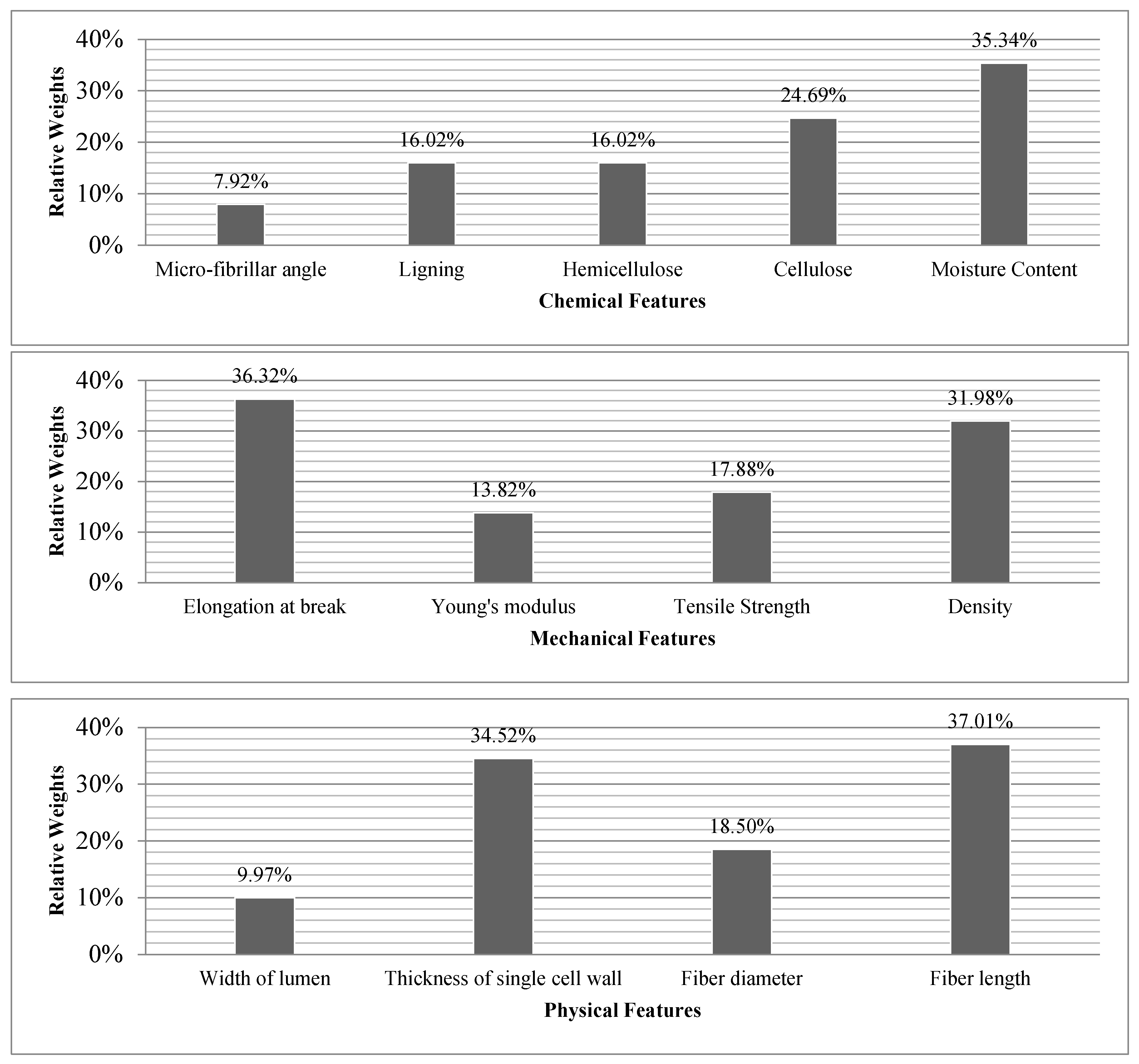
Figure 3.
Weighted Scores.
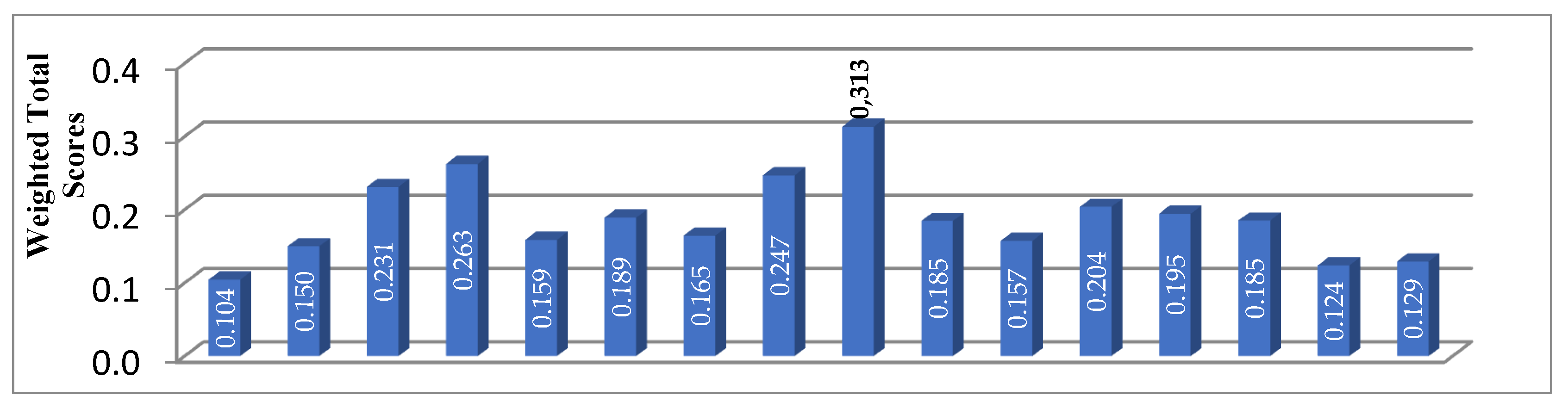
Figure 4.
Polymer scores
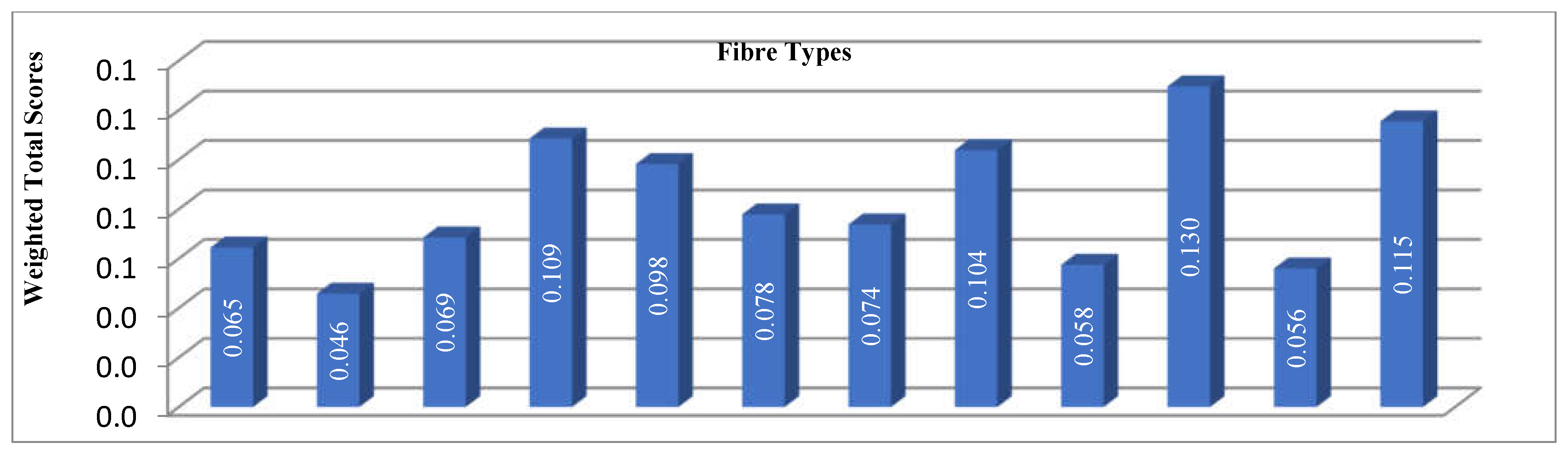

Table 1.
Potential implementations of fibre-supported polymer composites.
| Samples | Implementation |
|---|---|
| Storage silos, biogas containers, fuel containers, post boxes, etc. | Storage devices |
| Snowboards, frames, bicycle, ball, tennis racket, | leisure and sport goods |
| Laptops cases mobile cases, | Electronics appliances |
| Carpet, mats, sacking, hessians, bags, ropes, pipes, covers, units, bath, shower, helmets, paperweights, helmets, suitcases, lampshades, partitions, food trays, Profiles of door-frame, interior paneling, door panels, Fencing elements, chairs, and tables |
Utility and household products |
| Panel for false and partition ceiling, door and window frames, floor, wall, partition boards, roof tiles, bridge, railing, transportable buildings that are resilient to natural disasters. | Construction and building sector |
| Architectural moldings, interior paneling, boats, railway and automobile coach interior, spare-wheel pan, spare tyre covers, parcel shelves, decking, trunk liners, pallets, car door, dash boards, headliners, seat backs, door panels | Aviation, transportation and automobile sector |
Table 2.
Features of an aircraft structure.
| Applicability | Requirement | Effect | ||
|---|---|---|---|---|
| *Overall programs for aerospace | *Less weightage | * Use of low density materials * Stiffened structures or thin-walled box * Semi-monocoque construction * Composites * Al-alloys * Wood * High weight strain and weight/stiffness |
||
| *Every space program | • Elevated dependability | * Certification: evidence of design * Ensure accurate data Tight quality control * Extensive testing to |
||
| * Vehicles for passengers | * Safety of passengers | * Comprehensive testing: Reliability * Using materials that are fire retardant |
||
| Reusable Spacecraft Aircraft | *Durability: Corrosion and fatigue Vacuum Radiation Thermal Degradation |
* High-integrity thin materials * Thorough testing in the necessary setting * Damage and safe-life, life extension issues * Issues with damage, safe life, and life extension * There is no fatigue limit for al-alloys. * Thorough fatigue testing and analysis |
||
| Spaceships Reusable aircraft |
Performance in aerodynamics |
*Machinability: N/C Milling and Molding *Intricately curved shapes *Dynamics *Extremely intricate loading *Deformed shape-aeroelasticity *Control surfaces and flexible, thin, wings |
||
| *Every Aerospace initiative |
*Multiple functions or roles |
*Application: composites with useful characteristics *Effective design |
||
| Airplanes, primarily fighters but some passenger |
*Fly-by-wire | *EMI protection *Prolonged usage of devices and computers *Elevator-servo-elevator *Arrangement-Control Relationships |
||
| *Particular use in military aerospace | *Stealth | *Stealth coatin *Aircraft shape and Specific surface |
||
| *Aircraft | *Weather-Related Operations | *Erosion resistance, lightning protection | ||
Table 3.
Frequently used polymeric matrices in the aerospace industry.
| Thermosets | Thermo-plastics | |||
| Creates cross-linked networks during heating-curing polimerization | No alteration in composition | |||
| Polyimides | Polyester | Phenolics | Epoxies | PPS, PEEK |
| * Brittle *Complicated to handle *3000C high temperature application |
* Recommended for general use at room temperature * Simple to employ *Low cost |
* Difficult to obtain composites of high quality * Reduced viscosity *High temperature consumption * Simple to operate *Less expensive |
*Comparatively expensive *Moderately high temperature* Most often used (80% of all composites) | *Process is challenging since a high temperature of 400–3000C is needed. *High resilience to damage |
| High shrinkage (about 7.5 percent) | Volatiles released while curing More shrinkage |
*No volatiles are released when curing *Less shrinkage |
||
|
*Low Temperature *Brittle *Broad spectrum of propetiles, albeit less so than epoxies *Natural stability in the face of oxidation * Strong resilience to chemicals |
*More brittle than epoxy *Good resistance to fire and naming *Natural stability in the face of Oxidations |
May be polymerized in a number of ways, yielding a wide range of structures, morphologies, and characteristics. | ||
| Challenging to prepare | *Less stable storage and challenging preparation | Sufficient storage stability for preparing | Endless existence in storage. But challenging to prepare | |
| Less moisture-sensitive than epoxy | • Absorbs moisture, but molasses has no discernible impact on its operational range. | Long-term ultra violet degradation. Complete wetness (5–6%), which causes temperature pastries to expand and degrade | Absence of moisture absorption | |
Table 4.
The world's largest producers of natural fibers for commerce.
| Fibers | Global Production (×103 t) |
Country | Reference |
|---|---|---|---|
| Rice | 16000000 | China, India, Indonesia, Malaysia, Bangladesh | [90,91] |
| Corn | 122080 | USA, China, brazil, Argentina, India, | [92] |
| Cotton | 21400000 | Asia, USA | [93] |
| Ramie | 10000 | India, China, Brazil, Philippines | [94,95,96,97,98,99,100,101,102,103,104] |
| Kenaf | 97000 | India, Bangladesh, United States | [94,95,96,97,98,99,100,101,102,105] |
| Bamboo | 3000 | India, China, Indonesia, Malaysia, Philippines | [94,95,96,97,98,99,100,101,102] |
| Oil palm | 4000 | Malaysia, Indonesia | [94,95,98,99,106,107] |
| Flax | 83000 | Canada, France, Belgium | [94,95,96,97,98,99,100,101,102,103] |
| Abaca | 7000 | Philippines, Ecuador, Costa Rica | [94,95,96,97,98,99,108] |
| Banana | 1920 | Latin America and the Caribbean Asia Africa | [109] |
| Jute | 230000 | India, China, Bangladesh | [94,95,96,97,98,99,100,101,102,110] |
| Pineapple | 7400 | Philippines, Thailand, Indonesia | [94,95,98,99,100,101,102,104] |
| Sisal | 37800 | Tanzania, Brazil, Kenya | [94,95,96,97,98,99,100,101,102,104,108,110,111] |
| Coir | 10000 | India, Sri Lanka, Philippines, Malaysia | [94,95,96,97,98,99,100,101,102,112,113,114,115,116,117] |
| Coconut | 7700 | Indonesia, Philippines, India, Sri Lanka | [118] |
| Sugar can bagasse | 7500000 | India, Brazil, China | [94,95,96,97,98,99,100,101,102] |
Table 5.
The chemical features of natural fibers.
| Fibre Code | Fibres | Micro-fibrillar angle [◦] | Lignin (wt%) | Hemicellulose (wt%) | Cellulose (wt%) | Moisture content (%) | Reference |
| NF 1 | Rice | 20 | 19–28 | 35–45 | 7,9 | [94,95,96,98,99,100,101,102,108,119,120] | |
| NF 2 | Corn | - | 7,4 | 46 | 41,7 | 8,5 | [121,122] |
| NF 3 | Cotton | 82,7–92 | 9,8 | [121,123] | |||
| NF 4 | Ramie | 61,85–85 | 3–7,58 | 0,5–9,06 | 69–83 | 9 | [94,95,96,100,101,119,120,121,124,125,126] |
| NF 5 | Kenaf | 2 2–6,2 | 9 8–21 | 20–33 | 31–72 | 9,2 | [94,95,96,98,99,100,101,102,108,114,119,120,121,124,125,127,129,130] |
| NF 6 | Bamboo | - | 21–31 | 17,2–43,8 | 22,8–56,7 | 8,9 | [94,95,96,100,101,102,119,120,121,130] |
| NF 7 | Oil palm | 24,45–29 | 19,06 | 47,91–65 | 11 | [94,95,96,119,120,121,138] | |
| NF 8 | Flax | 5–10 | 2–5 | 10,37–20,6 | 64,1–75 | 7 | [94,95,96,98,99,100,101,102,108,114,121,122,124,127,128,129,133,134,135,136,137] |
| NF 9 | Abaca | 20–25 | 7–12,4 | 20–25 | 56–63 | 15 | [94,95,96,98,99,100,101,102,108,119,120,121,123,124,128,129,138,139] |
| NF 10 | Banana | 11–12 | 5–10 | 10–24 | 60–65 | 12,1 | [100,101,121,124,140,141] |
| NF 11 | Jute | 8 | 5–13 | 13–20,4 | 61–71 | 12 | [94,95,96,98,99,100,101,102,108,114,119,120,121,124,127,128,129,133,136,142,143] |
| NF 12 | Pineapple | 5-12,7 | 18 | 70–82 | 13 | [94,95,96,101,102,112,119,120,121] | |
| NF 13 | Sisal | 10–25 | 8–14 | 10–38,2 | 60–78 | 11 | [94,95,96,98,99,100,101,102,108,114,119,120,121,127,128,129,133,143,144,145,146] |
| NF 14 | Coir | 30,45 | 40–45 | 0,15–0,25 | 32–43 | 10 | [94,95,96,98,99,100,101,102,108,114,119,120,121,124,125,127,128,129,143,147] |
| NF 15 | Coconut | 8–13,1 | 4–20 | 70–77,6 | 8,2 | [121,123,148] | |
| NF 16 | Sugar can bagasse | 22,3–25,3 | 16,8–31,8 | 41,1–55,2 | 8,8 | [94,95,96,119,120,121,149,150] |
Table 6.
The mechanical features of the plant fibres.
| Fibre Code | Fiber source | Elongation at break (%) | Young’s modulus (GPa) | Tensile strength | Density (g/cm3) |
References |
| NF 1 | Rice | 2,2 | 0,3–2,6 | 19–135 | 1,4 | [100,101,102,116,151] |
| NF 2 | Corn | 3–4,7 | 10,1–16,3 | 355–580 | 1,2–1,4 | [95,96,105,115,121,152,153,154,155,156,157,158] |
| NF 3 | Cotton | 3–10 | 5,5–12,6 | 45,5–1000 | 1,5–1,6 | [95,96,105,114,121,152,153,154,155,156,157] |
| NF 4 | Ramie | 1,2–8 | 24,5–128 | 348–938 | 1,45–1,5 | [94,96,105,114,121,152,153,154,155,156,157,158] |
| NF 5 | Kenaf | 1,6–6,9 | 2,86–60 | 215,4–1191 | 0,6–1,5 | [94,95,96,98,99,100,101,102,103,114,121,128,129,152,153,154,155,156,157,158,159,160,161,165,166] |
| NF 6 | Bamboo | 1,5-11 | 11–17 | 140–230 | 0,6–11 | [121,159] |
| NF 7 | Oil palm | 8–25 | 1–9 | 92-1200 | 0,7–1,55 | [121] |
| NF 8 | Flax | 1,2–10 | 24–80 | 88–1600 | 0,6–1,5 | [94,95,96,105,110,114,128,129,134,143,152,153,154,155,156,157,158,159,160,161,162,163,164,166,167,168] |
| NF 9 | Abaca | 3–10 | 3–12 | 220–980 | 1,5 | [96,99,105,107,112,113,114,121,152,153,154,155,156,157,160,169,170] |
| NF 10 | Banana | 3–53 | 12–33,8 | 350–980 | 1,35 | [96,105,114,121,152,153,154,155,156,157,158,169] |
| NF 11 | Jute | 1,16–8 | 10–55 | 385–850 | 1,3–1,5 | [96,105,114,121,152,153,154,155,156,157,158,169] |
| NF 12 | Pineapple | 1–14,5 | 60–82 | 170–1672 | 0,8–1,6 | [95,96,105,114,121,152,153,154,155,156,157,158] |
| NF 13 | Sisal | 2–25 | 9–38 | 80–840 | 1,3–1,5 | [94,95,96,99,100,101,102,105,110,114,115,121,127,128,129,143,144,152,166,167,168,171,172] |
| NF 14 | Coir | 14,21–59,9 | 1,27–6 | 106–593 | 1,1–1,6 | [94,96,105,110,114,115,121,127,128,129,143,144,152,166,167,168,172] |
| NF 15 | Coconut | 10-23 | 21,1 | 150 | 0,43 | |
| NF 16 | Sugar can bagasse | 1,1 | 17–27,1 | 20–290 | 1,2–1,5 | [95,96,105,114,121,152,153,154,155,156,157,158,159] |
| Fibre Code | Fibers | Width of lumen (micron) |
Thickness of single cell wall (micron) |
Fiber diameter (mm) |
Fiber length (mm) |
| NF 1 | Rice | 8,7 | 1,2 | 15,5 | 8,7 |
| NF 2 | Corn | 20,1 | 1,4 | 26,7 | 20,1 |
| NF 3 | Cotton | 16,4 | 56,0 | 45,0 | 16,4 |
| NF 4 | Ramie | 13,0 | 60,4 | 80,0 | 13,0 |
| NF 5 | Kenaf (core) | 22,7 | 1,1 | 37,0 | 22,7 |
| NF 6 | Bamboo | 8,6 | 9,0 | 17,8 | 3,0 |
| NF 7 | Oil palm | 9,8 | 11 | 25,0 | 1,4 |
| NF 8 | Flax | 6,42 | 20,0 | 38,0 | 65,0 |
| NF 9 | Areca | 18,1 | 1,2 | 476 | 60 |
| NF 10 | Banana | 22,4 | 1,5 | 30,0 | 4,2 |
| NF 11 | Jute | 7,6 | 11,3 | 30,0 | 6,0 |
| NF 12 | Pineapple | 3 | 18,3 | 80,0 | 9,0 |
| NF 13 | Sisal | 12,0 | 25,0 | 47,0 | 8,0 |
| NF 14 | Coir | 21 | 0,06 | 12,0 | 0,3 |
| NF 15 | Coconut | 3,2 | 8,0 | 14,0 | 1,0 |
| NF 16 | Sugar can bagasse | 19,1 | 9,4 | 40,0 | 2,8 |
Table 8.
Main Criteria Weights.
| Criteria | % |
| Physical | 16,98 |
| Mechanical | 44,29 |
| Chemical | 38,73 |
Table 9.
Decision Matrices.
| Micro-fibrillar angle | Lignin | Hemicellulose | Cellulose | Moisture content | Normalized Principal Eigenvector | |||
| Chemical Features | 1 | 2 | 3 | 4 | 5 | |||
| Micro-fibrillar angle | 1 | 1/3 | 1/3 | 1/4 | 1/2 | 7,92% | ||
| Lignin | 3 | 1 | 1 | 1/2 | 1/2 | 16,02% | ||
| Hemicellulose | 3 | 1 | 1 | 1/2 | 1/2 | 16,02% | ||
| Cellulose | 4 | 2 | 2 | 1 | 1/3 | 24,69% | ||
| Moisture content | 2 | 2 | 2 | 3 | 1 | 35,34% | ||
| Mechanical Features | Elongation at break | Young's modulus | Tensile strength | Density | Normalized Principal Eigenvector | |||
| Elongation at break | 1 | 2 | 3 | 1 | 36,32% | |||
| Young's modulus | 1/2 | 1 | 1/2 | 1/2 | 13,82% | |||
| Tensile strength | 1/3 | 2 | 1 | 1/2 | 17,88% | |||
| Density | 1 | 2 | 2 | 1 | 31,98% | |||
| Physical Features | Width of lumen | Thickness of single cell wall | Fiber diameter | Fiber length | Normalized Principal Eigenvector | |||
| Width of lumen | 1 | 1/3 | 1/2 | 1/4 | 9,97% | |||
| Thickness of single cell wall | 3 | 1 | 2 | 1 | 34,52% | |||
| Fiber diameter | 2 | 1/2 | 1 | 1/2 | 18,50% | |||
| Fiber length | 4 | 1 | 2 | 1 | 37,01% | |||
Table 10.
Weighted Scores of Natural Fibers.
| Normalized | ||||||||||||||||
|---|---|---|---|---|---|---|---|---|---|---|---|---|---|---|---|---|
| Micro-fibrillar angle | 0,062 | 0,062 | 0,062 | 0,224 | 0,013 | 0,062 | 0,062 | 0,023 | 0,069 | 0,035 | 0,025 | 0,027 | 0,054 | 0,093 | 0,062 | 0,062 |
| Ligning | 0,081 | 0,030 | 0,062 | 0,021 | 0,060 | 0,105 | 0,107 | 0,014 | 0,039 | 0,030 | 0,036 | 0,062 | 0,044 | 0,171 | 0,042 | 0,094 |
| Hemicel. | 0,073 | 0,144 | 0,062 | 0,016 | 0,083 | 0,094 | 0,060 | 0,047 | 0,070 | 0,053 | 0,052 | 0,056 | 0,075 | 0,001 | 0,038 | 0,076 |
| Cellulose | 0,042 | 0,044 | 0,091 | 0,080 | 0,054 | 0,041 | 0,059 | 0,073 | 0,062 | 0,066 | 0,069 | 0,080 | 0,072 | 0,039 | 0,077 | 0,050 |
| Moisture Content | 0,049 | 0,053 | 0,061 | 0,056 | 0,057 | 0,055 | 0,068 | 0,043 | 0,093 | 0,075 | 0,074 | 0,081 | 0,068 | 0,062 | 0,051 | 0,055 |
| Elong. | 0,013 | 0,023 | 0,039 | 0,027 | 0,025 | 0,037 | 0,098 | 0,033 | 0,039 | 0,166 | 0,053 | 0,046 | 0,080 | 0,218 | 0,098 | 0,007 |
| Young's modulus | 0,004 | 0,033 | 0,022 | 0,188 | 0,076 | 0,036 | 0,012 | 0,128 | 0,018 | 0,055 | 0,080 | 0,175 | 0,058 | 0,009 | 0,052 | 0,054 |
| Tensile Strength | 0,010 | 0,061 | 0,010 | 0,085 | 0,081 | 0,024 | 0,085 | 0,111 | 0,096 | 0,087 | 0,083 | 0,121 | 0,060 | 0,046 | 0,020 | 0,020 |
| Density | 0,057 | 0,053 | 0,063 | 0,060 | 0,042 | 0,235 | 0,045 | 0,042 | 0,061 | 0,055 | 0,057 | 0,049 | 0,057 | 0,055 | 0,017 | 0,055 |
| Width of lumen | 0,041 | 0,095 | 0,077 | 0,061 | 0,107 | 0,041 | 0,046 | 0,030 | 0,085 | 0,106 | 0,036 | 0,014 | 0,057 | 0,099 | 0,015 | 0,090 |
| Thicknes | 0,005 | 0,006 | 0,238 | 0,257 | 0,005 | 0,038 | 0,047 | 0,085 | 0,005 | 0,006 | 0,048 | 0,078 | 0,106 | 0,000 | 0,034 | 0,040 |
| Fiber D. | 0,015 | 0,026 | 0,044 | 0,079 | 0,036 | 0,018 | 0,025 | 0,037 | 0,469 | 0,030 | 0,030 | 0,079 | 0,046 | 0,012 | 0,014 | 0,039 |
| Fiber length | 0,036 | 0,083 | 0,068 | 0,054 | 0,094 | 0,012 | 0,006 | 0,269 | 0,248 | 0,017 | 0,025 | 0,037 | 0,033 | 0,001 | 0,004 | 0,012 |
| Priorities | ||||||||||||||||
| Micro-fibrillar angle | 0,005 | 0,005 | 0,005 | 0,018 | 0,001 | 0,005 | 0,005 | 0,002 | 0,005 | 0,003 | 0,002 | 0,002 | 0,004 | 0,007 | 0,005 | 0,005 |
| Ligning | 0,013 | 0,005 | 0,010 | 0,003 | 0,010 | 0,017 | 0,017 | 0,002 | 0,006 | 0,005 | 0,006 | 0,010 | 0,007 | 0,027 | 0,007 | 0,015 |
| Hemicel. | 0,012 | 0,023 | 0,010 | 0,003 | 0,013 | 0,015 | 0,010 | 0,008 | 0,011 | 0,009 | 0,008 | 0,009 | 0,012 | 0,000 | 0,006 | 0,012 |
| Cellulose | 0,010 | 0,011 | 0,023 | 0,020 | 0,013 | 0,010 | 0,015 | 0,018 | 0,015 | 0,016 | 0,017 | 0,020 | 0,018 | 0,010 | 0,019 | 0,012 |
| Moisture Content | 0,017 | 0,019 | 0,021 | 0,020 | 0,020 | 0,019 | 0,024 | 0,015 | 0,033 | 0,026 | 0,026 | 0,028 | 0,024 | 0,022 | 0,018 | 0,019 |
| Elong. | 0,005 | 0,008 | 0,014 | 0,010 | 0,009 | 0,013 | 0,036 | 0,012 | 0,014 | 0,060 | 0,019 | 0,017 | 0,029 | 0,079 | 0,036 | 0,002 |
| Young's modulus | 0,000 | 0,005 | 0,003 | 0,026 | 0,011 | 0,005 | 0,002 | 0,018 | 0,003 | 0,008 | 0,011 | 0,024 | 0,008 | 0,001 | 0,007 | 0,007 |
| Tensile Strength | 0,002 | 0,011 | 0,002 | 0,015 | 0,014 | 0,004 | 0,015 | 0,020 | 0,017 | 0,016 | 0,015 | 0,022 | 0,011 | 0,008 | 0,004 | 0,004 |
| Density | 0,018 | 0,017 | 0,020 | 0,019 | 0,014 | 0,075 | 0,014 | 0,014 | 0,019 | 0,017 | 0,018 | 0,016 | 0,018 | 0,017 | 0,006 | 0,017 |
| Width of lumen | 0,004 | 0,009 | 0,008 | 0,006 | 0,011 | 0,004 | 0,005 | 0,003 | 0,009 | 0,011 | 0,004 | 0,001 | 0,006 | 0,010 | 0,002 | 0,009 |
| Thicknes | 0,002 | 0,002 | 0,082 | 0,089 | 0,002 | 0,013 | 0,016 | 0,029 | 0,002 | 0,002 | 0,017 | 0,027 | 0,037 | 0,000 | 0,012 | 0,014 |
| Fiber D. | 0,003 | 0,005 | 0,008 | 0,015 | 0,007 | 0,003 | 0,005 | 0,007 | 0,087 | 0,005 | 0,005 | 0,015 | 0,009 | 0,002 | 0,003 | 0,007 |
| Fiber length | 0,013 | 0,031 | 0,025 | 0,020 | 0,035 | 0,005 | 0,002 | 0,100 | 0,092 | 0,006 | 0,009 | 0,014 | 0,012 | 0,000 | 0,002 | 0,004 |
| Weighted Score | 0,104 | 0,150 | 0,231 | 0,263 | 0,159 | 0,189 | 0,165 | 0,247 | 0,313 | 0,185 | 0,157 | 0,204 | 0,195 | 0,185 | 0,124 | 0,129 |
Table 11.
The technical characteristics of polymers.
| Polymer code | Polymer material |
Elongation at break (%) |
Modulus of elasticity(GPa) | Tensile strength (MPa) | Density (g/cm3) | References |
| P 1 | Vinyl ester resin | 2 | 2–4,5 | 40–90 | 1,2–1,5 | [175,176,177] |
| P 2 | Polystyrene | 1–3,6 | 1,2–2,6 | 35,9–56,6 | 1,04–1,06 | [100,101,102,142] |
| P 3 | Epoxy | 1–6 | 3–6 | 35–100 | 1,1–1,4 | [175,176,177] |
| P 4 | Polybutylene terephthalate | 250 | 1,93–3 | 50–60 | 1,30–1,38 | [139] |
| P 5 | Polyethylene terephthalate | 30–300 | 2,76–4,14 | 48,3–72,4 | 1,29–1,40 | [100,101,102,142] |
| P 6 | Polycarbonate | 70–150 | 2–2,44 | 60–72,4 | 1,14–1,21 | [100,101,102,142] |
| P 7 | Nylon 6 | 20–150 | 2,9 | 43–79 | 1,12–1,14 | [175,176,177] |
| P 8 | Polyamide | 30–100 | 1,2–3,2 | 90–165 | 1,12–1,14 | [100,101,102,142] |
| P 9 | High density polyethylene (HDPE) | 2,0–130 | 0,4–1,5 | 14,5–38 | 0,94–0,96 | [175,176,177] |
| P 10 | Low-density polyethylene (LDPE) | 90–800 | 0,055–0,38 | 40–78 | 0,910–0,925 | [175,176,177] |
| P 11 | Acrylonitrile b utadiene styrene | 1,5–100 | 1,1–2,9 | 27,6–55,2 | 1–1,2 | [100,101,102,142] |
| P 12 | PP | 15–700 | 0,95–1,77 | 26–41,4 | 0,899–0,920 | [175,176,177] |
Table 12.
Normalized and weighted scores of polymer alternatives.
| Normalized | |||||||||||||
|---|---|---|---|---|---|---|---|---|---|---|---|---|---|
| Elongation at break | 0,001 | 0,001 | 0,002 | 0,143 | 0,094 | 0,063 | 0,049 | 0,094 | 0,066 | 0,254 | 0,029 | 0,204 | |
| Young's modulus | 0,115 | 0,067 | 0,159 | 0,088 | 0,123 | 0,078 | 0,102 | 0,078 | 0,032 | 0,007 | 0,067 | 0,085 | |
| Tensile Strength | 0,092 | 0,064 | 0,092 | 0,078 | 0,085 | 0,094 | 0,087 | 0,181 | 0,038 | 0,084 | 0,058 | 0,048 | |
| Density | 0,099 | 0,077 | 0,092 | 0,096 | 0,099 | 0,086 | 0,083 | 0,083 | 0,070 | 0,067 | 0,081 | 0,066 | |
| Priorities | |||||||||||||
| Elongation at break | 0,000 | 0,000 | 0,001 | 0,052 | 0,034 | 0,023 | 0,018 | 0,034 | 0,024 | 0,092 | 0,010 | 0,074 | |
| Young's modulus | 0,016 | 0,009 | 0,022 | 0,012 | 0,017 | 0,011 | 0,014 | 0,011 | 0,004 | 0,001 | 0,009 | 0,012 | |
| Tensile Strength | 0,016 | 0,011 | 0,016 | 0,014 | 0,015 | 0,017 | 0,015 | 0,032 | 0,007 | 0,015 | 0,010 | 0,009 | |
| Density | 0,032 | 0,025 | 0,029 | 0,031 | 0,032 | 0,028 | 0,027 | 0,027 | 0,022 | 0,021 | 0,026 | 0,021 | |
| Total Weighted Score | 0,065 | 0,046 | 0,069 | 0,109 | 0,098 | 0,078 | 0,074 | 0,104 | 0,058 | 0,130 | 0,056 | 0,115 | |
Disclaimer/Publisher’s Note: The statements, opinions and data contained in all publications are solely those of the individual author(s) and contributor(s) and not of MDPI and/or the editor(s). MDPI and/or the editor(s) disclaim responsibility for any injury to people or property resulting from any ideas, methods, instructions or products referred to in the content. |
© 2024 by the authors. Licensee MDPI, Basel, Switzerland. This article is an open access article distributed under the terms and conditions of the Creative Commons Attribution (CC BY) license (http://creativecommons.org/licenses/by/4.0/).
Copyright: This open access article is published under a Creative Commons CC BY 4.0 license, which permit the free download, distribution, and reuse, provided that the author and preprint are cited in any reuse.