

Submitted:
25 September 2024
Posted:
26 September 2024
You are already at the latest version
Abstract
Basic education is a foundational component of the national education system and human resource development, providing crucial support for the sustainable development of various aspects of human society, including economy, social welfare, and technology. The advancement of basic education is intrinsically linked to national innovation, the well-being of the populace, and the sustainable high-quality development of society. Enhancing the ecological carrying capacity of basic education at the provincial level is critical and pragmatically significant for the coordinated, sustainable, and high-quality development of the region's socioeconomic landscape.Based on panel data from the Guangxi Zhuang Autonomous Region (hereinafter referred to as Guangxi) from 2013 to 2022, and utilizing the DPSIR theoretical model, a comprehensive evaluation index system has been established. Through statistical analysis and spatial analysis methods, this study explores the temporal and spatial evolution characteristics of the ecological carrying capacity of basic education in various regions under Guangxi's jurisdiction. A multiple linear regression model is employed to analyze the differential impacts of changes in economic structure on the ecological carrying capacity of basic education.The findings reveal a steady upward trend in the ecological carrying capacity of basic education across the municipal districts of Guangxi. The development of five subsystems—Pressure, Driving-force, and others—has also become increasingly balanced; however, the impact of each subsystem on the overall carrying capacity varies. From a formation mechanism perspective, the ecological carrying capacity of basic education in Guangxi is the result of the complex interactions of multiple factors, with notable differences in influencing factors at various stages of development.Therefore, to bridge the regional disparities in the ecological carrying capacity of basic education across the different areas of Guangxi, it is essential to adopt a range of measures that promote coordinated, balanced, and high-quality educational development among regions, effectively ensuring the long-term sustainable development of Guangxi's economy and society.
Keywords:
Municipal Administrative Districts
; Basic Education
; Ecological Carrying Capacity of Education
; DPSIR Model
; Temporal and Spatial Differences
; Differences in Impact
1. Introduction
With the long-term stable and rapid development of China's economy since the 20th century, the urbanization rate of the resident population increased from 53.10% in 2012 to 66.16% in 2023. Over the past decade, a cumulative total of 165 million rural-to-urban migrants have settled in towns, resulting in a significant enhancement of China's level of urbanization [1,2,3]. The coverage of basic public services in urban areas has significantly expanded. With a substantial influx of school-age children into the region, the pressure on the supply of education in the area has greatly increased [4]. To achieve the sustainable, healthy, and long-term development of Chinese society, it is essential to ensure that the capacity for providing basic education aligns with the needs arising from population growth. Additionally, it is crucial to consider the limited ecological carrying capacity of education faced by regional administrators, focusing on the key issue of how supply matches demand. The elements involved include: the number of school-age children migrating with their families, the scale of public funding for basic education, effective mechanisms for continuously increasing educational funding in line with GDP growth, the quantity and quality of basic education teachers, and the supply of land for educational use, among various other factors [5,6,7].Currently, Chinese society is confronted with the rapid development of urbanization and a significant increase in the population of school-age children in urban areas. It is essential to conduct research and assessment on the carrying capacity of basic education to meet the needs of China’s modernization and satisfy the growing aspirations and demands of the people for a better life. The ecological carrying capacity of education relies on the overall educational ecology of the region, integrating and supporting educational demands; therefore, it holds more practical value compared to resource and environmental carrying capacities. The concept of "educational ecological carrying capacity" studied by the author refers to the supportive ability of the regional complex system, generated around education, to provide high-quality education to students within a specific temporal and spatial context [8].
The expansion of educational scale must be grounded in the ecological carrying capacity of the education system. This capacity not only depends on the existing resources, institutions, and structural foundations within the system but also relies on external resource inputs. It is imperative to timely establish and refine mechanisms for monitoring student sources and crisis early warning to promote the alignment of enrollment scale with ecological carrying capacity, thereby achieving a dynamic balance between educational resources and educational demands at a higher level.
From the perspective of the inherent regulatory nature of educational ecological carrying capacity, it is necessary to consider both educational equity and quality, while also taking into account the temporal and spatial closure and openness, to achieve a unified and coordinated development of static and dynamic elements. This necessitates the scientific collection and management of data across education, economy, society, and other domains, fostering the high-quality development of Chinese education through an ecological and sustainable mindset [9,10,11,12].
In terms of human activities, three elements—human environment (ecology), social relationships and norms (society), and resource allocation (economy)—are interconnected in various scopes and locations [13,14,15].Educational activities exist within specific social systems and environments. The improvement of educational quality requires support from diverse resources to achieve its educational objectives and to continue enhancing the sustainability and developmental capacity of the education system [16,17].The focus of the development of basic education in China is gradually shifting from scale expansion to an intrinsic and sustainable development model.
The sustainable development of basic education encompasses two aspects: on one hand, it signifies the harmonious integration of basic education with human development, social progress, and environmental sustainability; on the other hand, it implies that the development of basic education is characterized by continuity, including the sustainability of resource investment, the continuity of development, and resilience in the face of challenges [18,19,20].Researching the connotations and indicator systems of ecological carrying capacity in basic education, along with measurement methods and influencing factors, holds significant practical importance. In recent years, many scholars have focused their studies on the field of resource carrying capacity related to educational systems. Some scholars have employed carrying capacity index models to conduct quantitative analyses of regional higher education resource carrying capacity [21].Additionally, some scholars have constructed an evaluation index system for higher education resource carrying capacity and introduced the concept of maturity to conduct quantitative assessments [22], An evaluation index system for the comprehensive carrying capacity of higher education has been constructed, and empirical analyses of the comprehensive carrying capacity and matching degree of higher education across various regions in China have been conducted [23].In terms of evaluation methods, some scholars have employed the entropy weight method along with the TOPSIS model for basic education to conduct empirical research on the higher education resource carrying capacity and its proximity across 37 regions in China [24].Additionally, some scholars have constructed an evaluation index system for educational resource carrying capacity and employed principal component analysis to conduct quantitative evaluations and analyses of the basic education resource carrying capacity in different provinces of China [25].Moreover, some scholars have employed the entropy method and geographic detection techniques to analyze the spatial-temporal differences and influencing factors of basic education resources in China [26]. At the same time some scholars have combined GIS spatial analysis techniques, ownership analysis, and quality educational service carrying capacity analysis to conduct an in-depth exploration of the changes in and layout of basic education resource carrying capacity in a specific region [27].A review of the research history on educational ecological carrying capacity reveals that it first emerged in the field of higher education [28].Educational ecological carrying capacity is a comprehensive feedback regulation system, constrained and influenced by temporal and spatial conditions [29], It profoundly influences the sustainable development of education and pertains to the entire system of human production, life, and interaction. Within the author's research perspective, first, the ecological carrying capacity of basic education is not only an important indicator for measuring the speed and scale of educational development but also a quantitative evaluation metric for determining the scale of educational development planning at a specific stage. Second, the ecological carrying capacity of basic education can be based on the realities of educational resources and environments, including the analysis of systemic influencing factors on educational development, accurately describing the supporting dimensions of high-quality and balanced educational development, altering the allocation patterns of educational resources, and maximizing the level of educational ecological carrying capacity to construct an ideal environment for cyclical educational ecological development [30].
Some scholars argue that the ecological carrying capacity of education encompasses three aspects: resource carrying capacity, contextual support capacity, and management resilience capacity. Among these, resource carrying capacity is considered hard support, while contextual support capacity and management resilience capacity are viewed as soft support. The effectiveness of soft support relies on its integration with hard support [31].By reviewing existing research, it becomes evident that there are still shortcomings in the study of regional ecological carrying capacity in basic education. In light of this, the present study aims to conduct a quantitative evaluation of the ecological carrying capacity of basic education in Guangxi, with the intention of providing a referential evaluation index system and calculation methods for assessing the ecological carrying capacity of basic education across various regions. This research seeks to establish a scientific basis for evaluating the foundational conditions and supportive capacities of the surrounding environment for the development of basic education, allowing for the rational planning of the scale, speed, structure, and quality of regional basic education development. To this end, the author has constructed a comprehensive evaluation system based on the DPSIR model to measure the level of educational ecological carrying capacity in Guangxi's urban areas and attempts to address the following questions through statistical and spatial analysis: (1) What are the overall temporal dynamic changes in the educational ecological carrying capacity across the various administrative regions of Guangxi? (2) What are the spatial distribution characteristics of Guangxi’s educational ecological carrying capacity? (3) What role does economic restructuring play in the spatiotemporal evolution of the basic education ecological carrying capacity across Guangxi’s administrative regions? Answering these questions holds dual research value. From a macro perspective, considering the realities of each administrative region in Guangxi, it enables a comprehensive assessment of spatial disparities in educational carrying capacity, the analysis of its formation mechanisms, and the formulation of corresponding educational policies. From a micro perspective, by aligning with the developmental needs of education and the socio-economic environment in each administrative region of Guangxi, an in-depth analysis of the carrying scale of educational resources and environments can lay the groundwork for accelerating resource allocation, addressing shortcomings, balancing regional strengths and weaknesses, and enhancing both educational carrying capacity and governance capabilities.
2. Materials and Methods
2.1. Study Area and Data Sources
Guangxi, located in the southwestern part of inland China, is a coastal provincial-level administrative region (Figure 1). Guangxi is the only coastal autonomous region for ethnic minorities in China and serves as an important gateway and frontier for China's opening-up to the outside world. It provides the most convenient access to the sea for the greater southwestern region of China. Guangxi borders Guangdong, Hunan, Yunnan, and Guizhou provinces, is backed by the southwestern hinterland of China, faces the Guangdong-Hong Kong-Macao region, and is separated from Hainan Province by the sea. As a critical hub along the Belt and Road, Guangxi holds a unique position within the strategic framework of the Western Development Plan and China's broader opening-up efforts.
As of 2023, Guangxi Zhuang Autonomous Region's administrative divisions comprise 14 prefecture-level cities, under which there are 10 county-level cities, 60 counties, and 41 districts. The land area covers 237,600 km², with a permanent population of 50.27 million. Guangxi boasts comprehensive educational and cultural infrastructure, including 116 public libraries, 125 cultural centers, 142 museums, and 21 state-owned performing arts troupes. In 2023, Guangxi's gross domestic product (GDP) reached 2,720.239 billion yuan, an increase of 4.1% over the previous year based on comparable prices.
Guangxi has a total of 91 radio and television stations, with 7.9466 million cable radio and television subscribers and 7.9466 million digital television users. By the end of 2023, the comprehensive population coverage rate of radio programs was 99.28%, and that of television programs was 99.62%.
Throughout 2023, Guangxi saw the enrollment of 24,100 postgraduate students, with 69,000 postgraduates currently enrolled and 18,800 graduates. The enrollment in regular higher education institutions reached 469,200 students, with 1.4832 million students enrolled and 369,200 graduates. For various types of secondary vocational education (excluding technical schools), there were 195,400 enrolled students, 510,900 currently enrolled, and 161,200 graduates. The number of students enrolling in regular senior high schools was 445,000, with 1.292 million students enrolled and 394,700 graduates. In regular junior high schools, 845,600 students were enrolled, with 2.4559 million students in total and 756,600 graduates. Regular primary school enrollment stood at 838,800, with 5.1629 million students enrolled and 836,800 graduates. Special education saw the enrollment of 7,600 students, with 44,200 students currently enrolled and 7,600 graduates. The retention rate for nine-year compulsory education was 96.8%, while the gross enrollment rate at the senior high school level was 92.9%.
However, Guangxi’s dualistic urban-rural economic and social structure is marked, resulting in significant urban-rural and regional disparities throughout the course of its development.
This paper takes the 14 prefecture-level cities of Guangxi as the units of analysis, focusing on basic education, specifically primary, junior high, and senior high school education. The development data mainly come from relevant statistical yearbooks on Guangxi's education. However, as the data is updated only up to 2022, and prior to 2013, there were differences in statistical standards, resulting in the absence of relevant indicator data. Thus, an empirical study was conducted based on the collected data from 2013 to 2022. The economic and social data were primarily sourced from the Guangxi Statistical Yearbook and the statistical yearbooks of each city for the respective years, as well as national economic and social development statistical bulletins. All data sources are authentic and reliable.
2.2. Methods
2.2.1. Bearing Capacity Index System and Comprehensive Evaluation Model
The concept of carrying capacity originally stems from the field of mechanics, referring to the maximum load that an object can bear without incurring any damage. Environmental carrying capacity is an extension of this concept, developed in conjunction with related ideas such as resource carrying capacity and ecological carrying capacity, and has been widely applied to the study of the sustainable use of natural resources and the sustainable development of environmental systems. Environmental carrying capacity refers to the ability of a regional environmental system, within a certain period and area, to support various human socio-economic activities, under the condition that the structural integrity of the regional environment remains unchanged and its functions do not deteriorate into harmful directions [32].From the perspective of system operation, it can be divided into three components: the "resource system," which drives the operation of the system; the "pressure system," which exerts stress on the system's functioning; and the "environment system," which interacts with the resource system and imposes constraints upon it [33].As a subsystem of the broader social system, education similarly relies on the support of the regional environmental system for its existence and development. Once the scale, speed, and quality of basic education development exceed the carrying capacity of its resources and corresponding environment, it will disrupt the operation of basic education, leading to system imbalance and ultimately jeopardizing sustainability [34].In summary, environmental carrying capacity refers to the ability of the environment to withstand pressure; it is the foundation, condition, and threshold that the environment provides for the existence and development of entities. The regional basic education environmental carrying capacity denotes the foundation, conditions, and thresholds that ensure the sustainable development of basic education within a specific timeframe and geographical area.The Driving-force—Pressure—State—Impact—Response framework model, commonly referred to as the DPSIR model, was proposed by the OECD in 1993 as an evaluation model that organizes relevant indicators based on causal relationships. It was developed by integrating the strengths of the PSR (Pressure—State—Response) model and the DSR (Driving force—State—Response) model. The DPSIR model has been widely applied in the assessment of environmental systems and has gradually become an effective tool for evaluating the state of environmental systems and the causal relationships of environmental issues. The DPSIR model classifies the indicators used to assess a natural system into five aspects: Driving force, Pressure, State, Impact, and Response [35,36].Applying the DPSIR model to the construction of an evaluation indicator system for regional basic education environmental carrying capacity helps clarify the processes and causal relationships involved in the operation of the regional basic education environmental system. Based on this foundation, a more scientifically sound and rational evaluation indicator system can be established, thereby facilitating a better understanding of the current state of regional basic education environmental carrying capacity and its influencing factors [37].This study is primarily based on the framework of the DPSIR model, combining the realities of basic education environments with the causal relationships within regional environmental systems to select various influencing factors and indicators that reflect the carrying capacity of basic education environments. This approach aims to construct an evaluation indicator system for basic education environmental carrying capacity that aligns with regional characteristics. The application of the DPSIR model in developing the evaluation indicator system for regional basic education environmental carrying capacity reveals the causal chain of the regional environmental system's operation, which manifests as five types of factors: Driving force, Pressure, State, Impact, and Response. These five types of factors reflect the various aspects of the operational process of the basic education regional environmental system and are characterized through specific evaluation indicators [38].
Among these, all indicators that exert pressure during the operation of the basic education system are considered negative indicators. This means that the larger the values, the greater the pressure on the education system, such as population size and the number of enrolled students. Additionally, the student-to-teacher ratio indicates the number of students corresponding to each teacher, while class size represents the average number of students in each class; smaller values are preferable, thus the improvement in the student-to-teacher ratio and class size are also classified as negative indicators. In the selection of indicators, the principles of scientific validity, representativeness, purposefulness, and effectiveness are followed. A comprehensive consideration of economic, social, resource, and educational factors in Guangxi is undertaken. Through theoretical and systematic analysis, as well as consultations with five experts in related fields such as educational resource management, an evaluation indicator system composed of 24 specific indicators is ultimately constructed.(Table 1).
The evaluation of the educational ecological carrying capacity in various regions is the result of the combined influence of multiple factors. This paper fully draws upon existing relevant research and adopts both the entropy weight method and the coefficient of variation method to establish a comprehensive evaluation model for educational ecological carrying capacity. The specific steps are as follows:
Step 1: Data selection
Select m indicators for a total of n samples, where the value of the j-th indicator for the i-th sample is denoted as , i = 1, 2, 3, ... n; j = 1, 2, 3, ... m.
Step 2: Data Standardization
Due to potential issues in the original data for each indicator, such as: A) inconsistency in units, B) differing directional trends, and C) varying forms of expression, these factors may compromise the credibility of the evaluation. Therefore, to eliminate the impact of these discrepancies on the comprehensive evaluation results, it is necessary to standardize the original data. After standardization, the weight and entropy are unique. Since the indicators include both positive and negative types, the formulas for standardization differ accordingly. Below are the formulas for data standardization:
For positive indicators (where a higher value leads to a better evaluation result):
For negative indicators (where a smaller value leads to a better evaluation result):
It is required that all indicator values must be greater than zero. Therefore, for values that equal zero after standardization, the author assigns a small positive amount, selecting 0.001 as the translation value to incorporate into the calculation process.
Step 3: Calculate the proportion of the i-th sample under the j-th indicator, i.e., the indicator weight. The larger the weight value of an indicator, the more important the indicator is, and the greater its significance in the evaluation.
The formula is expressed as follows:
Step 4: Calculate the entropy value of the j-th indicator :
where n represents the number of samples.
Step 5: Calculate the utility value of the j-th indicator :
is the difference between 1 and the entropy value of the indicator, which directly impacts the weight. The larger the value, the more important the indicator is for the evaluation. The calculation formula is as follows:
Step 6: Calculate the weight of the evaluation indicators:
The weight of each indicator is determined by the value coefficient derived from information entropy. The higher the value coefficient, the greater the weight of the indicator. The formula for calculating the weight of the j-th indicator is as follows:
Step 7: Calculate the comprehensive evaluation value. The formula is as follows:
represents the comprehensive evaluation value of the basic education ecological carrying capacity in the i-th region, where m represents the number of indicators, and represents the weight of the j-th indicator. In the final evaluation result, the larger the value of , the higher the score of the indicator.After obtaining the comprehensive evaluation values of basic education ecological carrying capacity across different regions for various years, the author then applies the coefficient of variation method for comparative analysis.
Step 8: Calculate the coefficient of standard deviation. The coefficient of standard deviation is the ratio of the standard deviation to the arithmetic mean, forming a relative number. The formula is as follows:
Step 9: Calculate the Range Coefficient. The Range Coefficient is the ratio of the range to the arithmetic mean, forming a relative number. The formula is as follows:
By calculating the coefficients of standard deviation and range, the discrepancies caused by different dimensions of the indicators can be eliminated, creating an advantage for comparative analysis of basic education ecological carrying capacity across different regions.
2.2.2. Analysis of the Influencing Factors
Educational ecological carrying capacity is a vital pillar for the high-quality development of regional education and serves as a crucial safeguard for the sustained and stable functioning of the economy and society. [39].Exploring the factors influencing the educational ecological carrying capacity across regions and determining its formation mechanisms can provide theoretical support for promoting the sustainable development of education and spatial regulation in various areas. The educational ecological carrying system in each region is a typical dynamic and complex system, influenced by factors such as the economy, society, population, industry, technology, and resources. [40,41,42].In the process of rapid urbanization, population and resource factors gradually flow into and migrate to regional spaces, and the influx of a floating population inevitably creates a continuous rigid demand for the areas they move into. The larger the region, the more severe the challenges to the carrying capacity of educational resources. Internal institutional factors, the level of investment and allocation methods of educational resources, and the constraints on those resources will directly determine the carrying capacity of local education. In this paper, the following factors related to economic structural adjustment and their impact on the educational ecological carrying capacity in various regions are considered:
(1) Industrial structure refers to the composition of various industries and the proportional relationship between industries. The adjustment of industrial structure usually brings about changes in labor transfer and talent demand structure, because agriculture, as a relatively inefficient sector in the industrial structure, will greatly improve its efficiency, resulting in a large transfer of employment population to other industries such as industry and service industry, which in turn leads to a substantial increase in the urbanization rate, which can directly promote the large-scale expansion of the service industry. And promote the development of industry. Therefore, the urbanization rate is not only the result of industrial structure adjustment, but also can be used for industrial structure adjustment, so that the two promote each other. Education is an important condition to ensure the large-scale transfer of agricultural population to industry, service industry and other industries. Without proper scale and high quality basic education, the above-mentioned transfer is difficult to succeed. Therefore, the development of the education system can ensure the transformation and upgrading of the industrial structure.
(2)Educational investment is a form of redistribution and reutilization of national income, and it serves as the material foundation determining educational development. Investment in assets provides the necessary teaching elements and environments for educational advancement. Increasing the level of educational investment directly enhances the quality of existing human capital, thereby improving labor productivity.
(3)Fiscal structure refers to the expansion of different fiscal components, changes in their proportions, and the patterns of interaction. Its impact on social and economic development is primarily realized through financial intermediaries, financial markets, and financial services.
(4)There is a significant gap in urban-rural income distribution and consumption structure in Guangxi. The urban regions possess stronger economic influence and a higher level of public infrastructure. Educational resources are unevenly distributed, with urban areas holding a clear advantage in educational resources.
After fully considering the availability of indicators and their relevance to educational ecological carrying capacity, this paper selected 11 indicators to analyze their differing impacts on the basic educational ecological carrying capacity across various regions (Table 2).
A multiple linear regression method was employed to determine the differences in the impact of economic structural adjustments on the basic educational ecological carrying capacity across regions, using the given values of several explanatory variables [43], Through regression analysis, the linear relationship between the dependent variable and the independent variables was revealed. The general form of the model is as follows:
In Formula (11): i is the sample size, that is, the number of districtss; bji is the variable coefficient of the equation, j = 1, 2, ..., i; Ui is the residual term.
3. Analysis
3.1. The Temporal Evolution of Educational Ecological Carrying Capacity in Various Regions
Specifically, the ecological carrying capacity of basic education in Guangxi increased from 0.0879 in 2013 to 0.1092 in 2022, reflecting a high growth rate with an annual average growth rate of 2.41% (as shown in Figure 3). The annual changes in growth rates are illustrated in Figure 2, where significant fluctuations are evident, exhibiting a wave-like progression. Notably, the growth rates for 2017 and 2022 turned negative, indicating that the pace of increase in Guangxi's basic education ecological carrying capacity is not constant, but varies considerably with socio-economic development.
Overall, however, the ecological carrying capacity of basic education in Guangxi is generally in a state of steady improvement. In summary, over the decade from 2013 to 2022, the level of ecological carrying capacity in basic education has gradually and steadily increased in tandem with socio-economic development. This trend signifies an increasing emphasis by the Guangxi government and its people on basic education, transitioning from a state of educational underdevelopment to a sustainable state of balanced educational development. Investment from the government, society, and families in education has consistently risen, leading to a steady enhancement of the ecological carrying capacity of basic education.
This aligns with the broader context of East Asian countries, particularly China, which have increasingly recognized their status as developing nations, prioritizing educational quality, the cultivation of the next generation, and the objective realities of sustainable development. Additionally, considering Guangxi's status as a border region with a diverse population and relatively weak developmental foundation, which lags behind the national advanced level, there is an even greater need to increase investment in basic education, improve educational quality and accessibility, and lay the groundwork for the long-term sustainable development of Guangxi.

Table 1.
Ecological Carrying Capacity of Basic Education in Various Regions of Guangxi from 2013 to 2022.
Table 1.
Ecological Carrying Capacity of Basic Education in Various Regions of Guangxi from 2013 to 2022.
| year | 2022 | 2021 | 2020 | 2019 | 2018 | 2017 | 2016 | 2015 | 2014 | 2013 | Standard Deviation Coefficient | Range Coefficient |
| Nanning | 0.011079 | 0.011058 | 0.010703 | 0.010496 | 0.01005 | 0.009764 | 0.008911 | 0.008716 | 0.008127 | 0.007828 | 0.12 | 0.34 |
| Liuzhou | 0.008746 | 0.008971 | 0.008928 | 0.008881 | 0.00855 | 0.008243 | 0.007809 | 0.008051 | 0.007197 | 0.007481 | 0.08 | 0.21 |
| Guilin | 0.008205 | 0.008232 | 0.007785 | 0.007948 | 0.007579 | 0.00764 | 0.007327 | 0.007374 | 0.006996 | 0.006985 | 0.06 | 0.16 |
| Wuzhou | 0.007204 | 0.007337 | 0.007031 | 0.006972 | 0.006355 | 0.006591 | 0.006489 | 0.00643 | 0.006059 | 0.006078 | 0.07 | 0.19 |
| Beihai | 0.007871 | 0.007932 | 0.007261 | 0.007136 | 0.007361 | 0.006891 | 0.006779 | 0.006889 | 0.00705 | 0.005484 | 0.1 | 0.35 |
| Fangcheng-gang | 0.007803 | 0.007835 | 0.00814 | 0.008137 | 0.007606 | 0.00761 | 0.007262 | 0.007308 | 0.007088 | 0.006637 | 0.06 | 0.2 |
| Qinzhou | 0.007793 | 0.007489 | 0.00703 | 0.006835 | 0.006818 | 0.0072 | 0.006471 | 0.006398 | 0.006573 | 0.005859 | 0.08 | 0.28 |
| Guigang | 0.007247 | 0.007144 | 0.007137 | 0.006853 | 0.006752 | 0.00623 | 0.005888 | 0.006023 | 0.005595 | 0.005583 | 0.1 | 0.26 |
| Yulin | 0.00775 | 0.007869 | 0.007489 | 0.007523 | 0.007173 | 0.00685 | 0.006888 | 0.006838 | 0.006262 | 0.006045 | 0.09 | 0.26 |
| Baise | 0.007867 | 0.007874 | 0.007886 | 0.007609 | 0.007002 | 0.007496 | 0.006831 | 0.006908 | 0.006391 | 0.006478 | 0.08 | 0.21 |
| Hezhou | 0.006773 | 0.007081 | 0.006564 | 0.00671 | 0.006209 | 0.005856 | 0.006052 | 0.006089 | 0.005704 | 0.005656 | 0.08 | 0.23 |
| Hechi | 0.007421 | 0.0073 | 0.00632 | 0.006838 | 0.006514 | 0.006484 | 0.006326 | 0.006289 | 0.006219 | 0.006146 | 0.07 | 0.19 |
| Laibin | 0.006595 | 0.006867 | 0.006357 | 0.005812 | 0.005914 | 0.005746 | 0.005692 | 0.005607 | 0.005467 | 0.005555 | 0.08 | 0.23 |
| Chongzuo | 0.006878 | 0.006912 | 0.006523 | 0.006556 | 0.006221 | 0.006122 | 0.010362 | 0.005791 | 0.006105 | 0.006131 | 0.19 | 0.68 |
| StandardDeviation Coefficient | 0.14 | 0.14 | 0.16 | 0.16 | 0.15 | 0.15 | 0.18 | 0.13 | 0.11 | 0.12 | ||
| Range Coefficient | 0.58 | 0.53 | 0.58 | 0.63 | 0.58 | 0.57 | 0.66 | 0.46 | 0.41 | 0.37 | ||
| Guangxi | 0.109231 | 0.109901 | 0.105153 | 0.104306 | 0.100104 | 0.098725 | 0.099087 | 0.094711 | 0.090835 | 0.087946 | 0.07 | 0.22 |
Through the analysis of the data in Table 1, the following conclusions can be drawn: Horizontally, from 2013 to 2022, the ecological carrying capacity of basic education in the entire Guangxi region shows a trend of annual increase, indicating an improvement in the overall educational environment and a better fulfillment of the public's rights to quality basic education. The Standard Deviation Coefficient for the entire region is 0.07, and the Range Coefficient is 0.22, suggesting a slow and stable growth. Regions such as Guilin, Wuzhou, Fangcheng-gang, and Hechi have coefficients of variation that are below or equal to the regional average, indicating their growth is also slow and stable. Notably, the Chongzuo region exhibits a pattern of initially increasing carrying capacity followed by a decline, with a Standard Deviation Coefficient of 0.19 and a Range Coefficient of 0.68.
Other regions show relatively stable and rapid growth compared to the regional average, with the fastest growth occurring in the capital city, Nanning. Vertically, from 2013 to 2022, the disparity in ecological carrying capacity for basic education across Guangxi presents a stable trend. In 2013 and 2014, the disparities were relatively small, while the maximum disparity occurred in 2016. The remaining years fell within a moderate range. Overall, Nanning continues to maintain the highest ecological carrying capacity for basic education in the region.
Figure 3.
Time Series Variation of the Comprehensive Evaluation Indicators of Ecological Carrying Capacity for Basic Education in Guangxi from 2013 to 2022.
Figure 3.
Time Series Variation of the Comprehensive Evaluation Indicators of Ecological Carrying Capacity for Basic Education in Guangxi from 2013 to 2022.
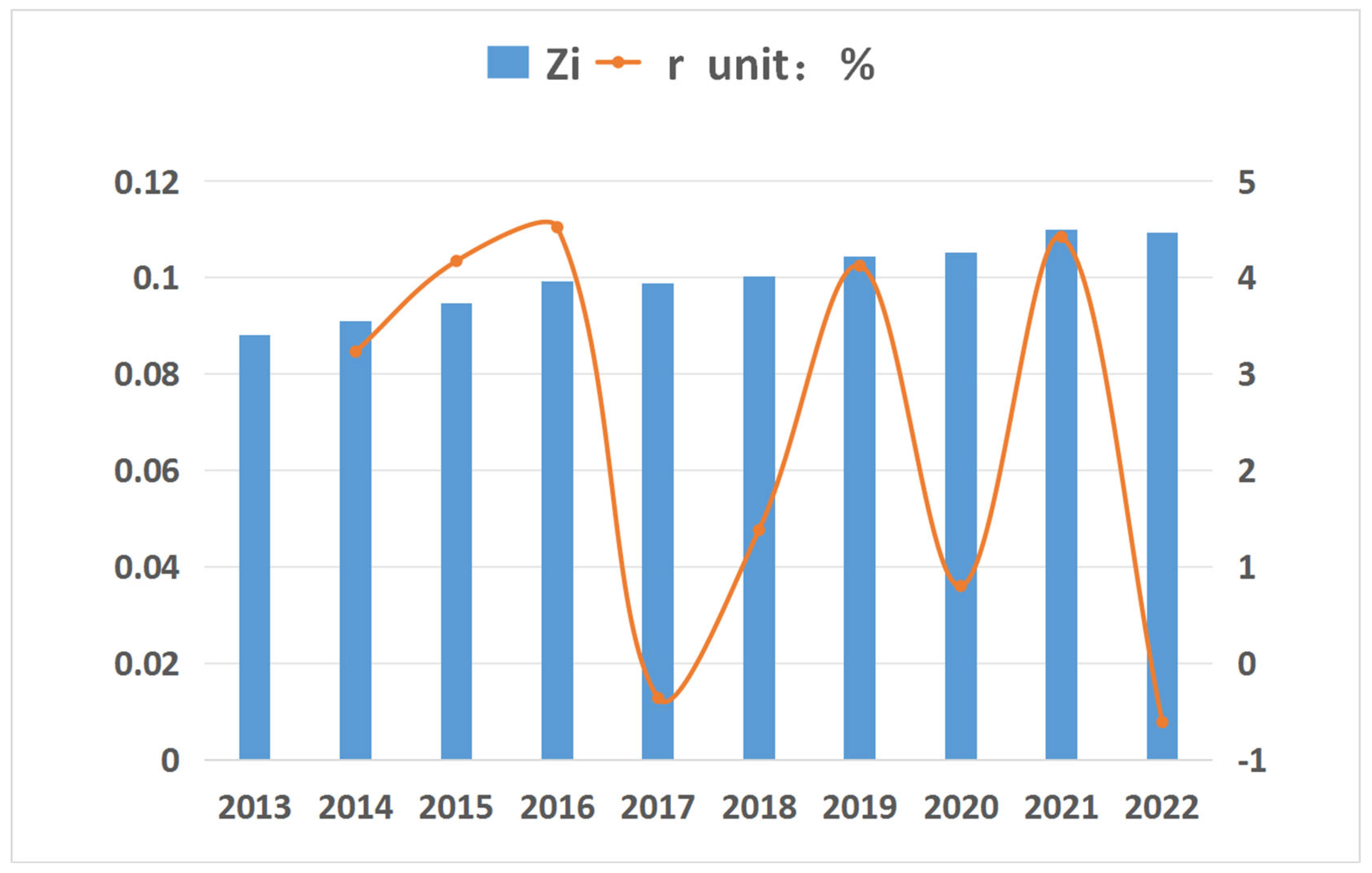
Figure 4.
Comparison of Standard Scores for Ecological Carrying Capacity of Basic Education in Various Regions of Guangxi from 2013 to 2022.
Figure 4.
Comparison of Standard Scores for Ecological Carrying Capacity of Basic Education in Various Regions of Guangxi from 2013 to 2022.
3.2. Spatial Analysis Method of Ecological Carrying Capacity in Basic Education in Guangxi
In Guangxi, significant disparities exist among different regions in terms of economic development foundations, social development conditions, industrial policy environments, educational resource endowments, and public facility infrastructure. These differences result in notable regional variations in educational ecological carrying capacity. This article conducts a comparative analysis based on two time periods, 2013 and 2022, employing spatial visualization methods. Using ArcGIS software, the ecological carrying capacity of various regions under Guangxi's jurisdiction is classified and a heat map (Figure 5 and Figure 6) is generated.
In 2013, the educational ecological carrying capacity of the majority of regions under Guangxi's jurisdiction was relatively low, with evident regional imbalances. Among these, 64.2% of the regions had a basic education ecological carrying capacity of less than 0.006147. The regions with the highest educational ecological carrying capacity were Nanning and Liuzhou, while Beihai had the lowest. Aside from Nanning and Liuzhou, regions with higher carrying capacities were primarily concentrated in Beihai and Fangcheng-gang, bordering Nanning, and in Guilin, adjacent to Liuzhou, exhibiting significant clustering characteristics. In that year, the overall performance of Guangxi's western regions surpassed that of the southern regions. The common characteristics of high-carrying-capacity areas include a solid foundation for industrial and mining development, a historically strong socio-economic development base, and the advantages of abundant educational resources, excellent social services, and comprehensive infrastructure, resulting in relatively high carrying capacities.
By 2022, the levels of basic educational ecological carrying capacity across Guangxi's regions had generally improved. Notably, the proportion of urban areas with a carrying capacity below 0.006147 dropped to zero, with Laibin having the lowest capacity at 0.006595. Based on the previously mentioned calculations of standard deviation and Range Coefficient, the cities that experienced the fastest growth in carrying capacity over the decade were Chongzuo (first in growth) and Nanning (second). Chongzuo, located on the China-Vietnam border, possesses a unique locational advantage, achieving rapid and stable economic development through its engagement in border trade between China and Vietnam. This has led to swift improvements in social governance and service levels, as well as advancements in educational infrastructure. As the capital of Guangxi, Nanning enjoys investment advantages not available to other regions. As a major beneficiary of the Strong Capital Policy, Nanning's educational carrying capacity has rapidly increased, surpassing other cities such as Liuzhou and Guilin, which have fallen to the second and third tiers.
Overall, during this decade, the Guangxi Autonomous Regional Government implemented measures to improve school conditions, enhance school standardization, and execute various poverty alleviation and support initiatives for basic education. They provided educational technology and equipment in remote areas, yielding significant results. By 2022, Guangxi's educational carrying capacity levels were notably higher than in 2013, and the development among various regions became increasingly balanced, with Nanning clearly standing out as a unique capital city superior to other areas.
3.3. Trend of Spatial Expansion of Ecological Carrying Capacity in Basic Education in Guangxi
To further explore the spatial pattern and formation mechanisms of basic educational ecological carrying capacity across various regions, this study reveals the developmental process of basic educational ecological carrying capacity in Guangxi from the perspective of regional spatial gradient evolution. The author utilizes ArcGIS software and employs spatial analysis methods on trend surfaces to illustrate the development trend lines for 2013 and 2022, conducting a comparative analysis (Figure 7 and Figure 8).
From 2013 to 2022, notable changes occurred in the trends of ecological carrying capacity. Overall, the central region exhibited a higher basic educational ecological carrying capacity, while the regions on the eastern and western sides fell below that of the central region. The northern region's educational ecological carrying capacity surpassed that of the southern region. The trend map for 2013 can be characterized as follows: high in the central north and low in the southeast, displaying an inverted U-shaped distribution from north to south. The trend map for 2022 can be described as: high in the central area and low in the east and west, also exhibiting an inverted U-shaped distribution from north to south, but noticeably smoother than in 2013. High-value points are concentrated in the capital city of Nanning, with a prominent spatial directionality; urbanized metropolitan areas demonstrate significant educational advantages.
Specifically, in 2013, the Nanning region in central Guangxi and the Liuzhou region in the north had the highest basic educational ecological carrying capacity, placing them in the first tier. In contrast, the eastern regions of Hezhou, Guigang, and Laibin exhibited the lowest ecological carrying capacity, placing them in the fifth tier. Guilin, Baise, and Fangcheng-gang were categorized in the second tier; Hechi, Chongzuo, Yulin, and Wuzhou fell into the third tier; while Qinzhou was in the fourth tier.
By 2022, the Nanning region continued to hold the highest basic educational ecological carrying capacity, remaining in the first tier. The eastern regions of Hezhou and Laibin, along with the western border region of Chongzuo, had the lowest ecological carrying capacity, placing them in the fifth tier. The Liuzhou region dropped to the second tier; Guilin, Qinzhou, Yulin, Beihai, and Fangcheng-gang were placed in the third tier; and Wuzhou and Guigang were in the fourth tier. Compared to 2013, the curve in 2022 is notably smoother, indicating a trend towards diminishing disparities in basic educational ecological carrying capacity. However, the carrying capacity rankings of Liuzhou and Guilin have significantly declined. This suggests that, on one hand, with the rapid and stable socio-economic development, the overall basic educational carrying capacity in Guangxi is tending toward a balanced state. On the other hand, the Strong Capital Policy and metropolitan socio-economic development policies inevitably create a siphoning effect on the region's economy and educational resources, causing educational professionals to flow towards the capital, Nanning, in alignment with shifts in economic development focus. Furthermore, as the capital, Nanning benefits from well-established infrastructure and greater educational investment, naturally establishing a new situation where its basic educational carrying capacity stands out.
3.4. Impact of Economic Reform on the Ecological Carrying Capacity of Basic Education in Guangxi
During the process of multiple linear regression analysis, the R² values for the models in 2013 and 2022 were 0.632 and 0.675, respectively. This indicates a year-on-year improvement in the fit of the linear regression model, signifying that the explanatory variables increasingly enhance the explanatory power over the dependent variable.
Table 3.
Results of the multiple linear regression equations.
| Year | B | Std. | β | t | Sig. | |
| 2013 | Constant | 28.636 | 26.927 | 1.063 | 0.313 | |
| see | 0.186 | 0.541 | 0.097 | 0.344 | 0.738 | |
| stf | 0.398 | 0.345 | 0.381 | 1.152 | 0.276 | |
| pur | 0.757 | 0.283 | 1.106 | 2.671 | 0.023 | |
| 2022 | Constant | 54.796 | 7.386 | 7.419 | 0.000 | |
| see | 0.001 | 0.121 | 0.002 | 0.011 | 0.992 | |
| stf | 0.064 | 0.197 | 0.080 | 0.323 | 0.753 | |
| pur | 0.317 | 0.086 | 0.865 | 3.681 | 0.004 |
Through the aforementioned multiple regression analysis, it is evident that in 2013, the factor "Share of education expenditure" held significant importance. However, by 2022, its influence had markedly diminished compared to 2013. In contrast, the factor "Population urbanization rate" continued to exert considerable impact, with all three independent variables in both 2013 and 2022 showing positive effects. Overall, regarding basic educational carrying capacity, the factors "Population urbanization rate" and "Proportion of public fiscal budget expenditure to regional GDP" in Guangxi had a more substantial and enduring influence. This indicates that to comprehensively enhance the basic educational carrying capacity across Guangxi's regions, simply increasing financial allocations for education is insufficient. It is essential to elevate the level of economic development, solidify the economic foundation, and improve the quality of development. A comprehensive development strategy for both urban and rural areas, alongside the implementation of a uniquely Chinese urbanization strategy, is necessary to lay the groundwork for the sustainable and long-term development of basic educational carrying capacity.
The author employed "Share of education expenditure" (see), "Share of total local financial expenditure" (stf), and "Population urbanization rate" (pur) as independent variables, with the "Carrying capacity index" (Zi) as the dependent variable, conducting a multiple regression analysis which led to the following conclusions: In both 2013 and 2022, the variables see and stf did not have a significant impact on the dependent variable, as their significance coefficients (Sig.) were well above 0.05, and their standardized regression coefficients were low, indicating that they lacked significant explanatory power in the regression model (Table 3). In 2013, all variables exerted positive influences, with pur having the most substantial impact, evidenced by a standardized regression coefficient of β=1.106 and a significance coefficient of Sig.=0.023<0.05. In 2022, all variables again demonstrated positive influences, with pur remaining the most impactful, showing a standardized regression coefficient of β=0.865 and a significance coefficient of Sig.=0.004, far less than 0.05. Clearly, both coefficients affirm that pur had the greatest influence.
During this period, the overall ecological carrying capacity levels across Guangxi's cities were relatively low. Influenced by historical factors of regional development and geographical location, the northern regions of Guangxi, such as Liuzhou and Guilin, benefit from a long history of urban construction and a solid foundation, while the capital, Nanning, has received considerable investment, resulting in well-developed infrastructure and a rich accumulation of talent. This enables greater investment in educational resources, thereby elevating the educational ecological carrying capacity of these areas relative to others.
From 2013 to 2022, despite being affected by the COVID-19 pandemic, countercurrents of globalization, trade disputes, and economic imbalances, the overall trend has been towards increasing equilibrium. The factors influencing basic educational resources across various regions continue to shift and concentrate, leading to a wave-like change in disparities between 2022 and 2013. Between 2013 and 2019, disparities grew relatively larger, whereas from 2020 to 2023, they contracted again, as verified by the standard deviation and Range Coefficients calculated in Table 1.
Combining the results of multiple regression analysis and spatial data analysis, it is evident that the regional disparities in 2022 diminished compared to 2013. Furthermore, the rise of the central region centered around Nanning is an undeniable fact. Over the past decade, the construction of beautiful new rural areas, the establishment of a well-off society, steady improvements in urban infrastructure, and educational investments in Guangxi have played an indispensable role. The basic educational carrying capacity across the region has shown a clear upward trend. Despite the aforementioned adverse factors, this upward trajectory has remained unbroken and continues to progress steadily. The regional educational imbalance in Guangxi, as a southern border province of China, has been gradually rectified, leading to an enhancement in overall educational capability.
The author also conducted a multiple regression analysis of the overall educational carrying capacity in Guangxi. Using "Social consumption structure" (scs), "Share of education expenditure" (see), and "Population urbanization rate" (pur) as independent variables, with the "Carrying capacity index" (Zi) as the dependent variable, the analysis yielded the following conclusions:
Table 4.
Results of the multiple linear regression equations.
| Year | B | Std. | β | t | Sig. | ||
| 2013-2022 | Constant | -69.386 | 32.939 | -2.106 | 0.080 | ||
| scs | 0.684 | 0.447 | 0.120 | 1.529 | 0.177 | ||
| see | 1.638 | 0.658 | 0.193 | 2.489 | 0.047 | ||
| pur | 2.239 | 0.154 | 1.110 | 14.550 | 0.000 |
scs: Although it exhibits a certain level of influence (standardized regression coefficient β=0.120), its significance is low (Sig.=0.177>0.05), indicating that its impact on the dependent variable is not significant.see: This factor shows a certain degree of influence (standardized regression coefficient β=0.193) and has a significant effect on the dependent variable (Sig.=0.047<0.05).pur: This variable exerts a highly significant positive impact on the dependent variable (Sig.=0.000<0.05), with the strongest influence in the model (standardized regression coefficient β=1.110).
From this table, it is clear that pur is the most crucial factor affecting the educational carrying capacity across Guangxi, while see is relatively important among the three influencing factors, and scs is the least influential. All three independent variables exert positive effects on carrying capacity. In other words, when seeking to enhance the educational carrying capacity of Guangxi, the effect of increasing the Population urbanization rate is evident, whereas the impact of improving social consumption expenditure is the weakest.
Moreover, considering the habit of Chinese residents, whether urban or rural, to save for unforeseen needs, the author conducted a multiple regression analysis using Financial structure (fi), Consumption structure of urban and rural residents (csr), and Population urbanization rate (pur) as independent variables, with the Carrying capacity index (Zi) as the dependent variable, yielding the following conclusions:
Table 5.
Results of the multiple linear regression equations.
| Year | B | Std. | β | t | Sig. | ||
| 2013-2022 | Constant | 72.071 | 83.870 | 0.859 | 0.423 | ||
| fi | -0.152 | 0.231 | -0.091 | -0.659 | 0.534 | ||
| csr | -1.445 | 1.678 | -0.374 | -0.861 | 0.422 | ||
| pur | 1.397 | 0.776 | 0.693 | 1.799 | 0.122 |
From the regression results, it is evident that the regression coefficients of the independent variables fi and csr are both not significant and negative, indicating that they exert a detrimental influence on the regional educational carrying capacity. The significance values are relatively high (both greater than 0.05), suggesting that they do not have a significant impact on the dependent variable.
The independent variable pur shows a strong positive influence, with a standardized regression coefficient of β=0.693; however, its significance value is 0.122, still exceeding 0.05, necessitating further data support to confirm its significance. It can be concluded that both fi and csr negatively affect the ecological carrying capacity of basic education in Guangxi, with only the Population urbanization rate serving as a positive factor for enhancing this capacity.
Notably, csr exhibits the greatest negative impact, highlighting the necessity of improving consumer levels, particularly by reducing the consumption disparity between urban and rural populations. This entails transforming the dual economic structure of urban and rural areas, dismantling various barriers to economic development, and addressing the unreasonable and inequitable aspects of the economic development structure. It is essential to promote a domestic economic cycle as the primary focus, alongside an integration of both domestic and international economic cycles, ensuring that all residents, whether in urban or rural settings, can benefit from the fruits of economic and social reforms and development. Only through these measures can we steadily enhance the level of carrying capacity and achieve long-term, sustainable development.
4. Discussion
4.1. The Complexity and Variability of Factors Influencing Educational Ecological Carrying Capacity
From 2013 to 2022, Guangxi, as a border region with a significant ethnic minority population, witnessed a steady and rapid improvement in its basic educational ecological carrying capacity. Guided by the DPSIR model, the author employed data collection, analysis, induction, and synthesis, alongside various software tools, to objectively and comprehensively understand the development and evolution of Guangxi's basic educational ecological carrying capacity over this decade.
In this process, the Driving-force is identified as the fundamental power and key factor that propels the enhancement of regional educational carrying capacity, serving as the very foundation upon which its growth is built. Without the Driving-force, there can be no discussion of the development of educational carrying capacity.
In Guangxi’s decade of development, rapid socio-economic progress, continual improvements in development quality, accelerated industrialization, and an ongoing urbanization process have created an urgent demand for a large, well-qualified labor force, thus necessitating the provision of high-quality basic education. Furthermore, urbanization has driven the migration of a substantial rural population into cities, leading to a pressing need for basic educational resources in urban areas. However, existing rural educational resources cannot simply be transferred to cities. This is due not only to the relatively poor quality of rural educational resources but also to their insufficient quantity.
These factors have inevitably led to severe imbalances in regional educational development, particularly in the provision of resources such as teachers, schools, and educational facilities. The result is an acute shortage in the supply of educational resources, exacerbating disparities in the field of education.
The core of enhancing the carrying capacity of basic educational resources lies in achieving sustainable, long-term economic and social development. Unlike the indirect influence exerted by the Driving-force, Pressure serves as the direct catalyst that compels transformation within the regional basic education system. This pressure demands immediate solutions from the education system, setting specific requirements for educational resources and the environment.
As a crucial component of the social system, the basic education ecosystem must fully adapt to the evolving needs of socio-economic development, meet the educational demands of the people, and ensure the accessibility and equity of basic education. To achieve this, public fiscal investment must be significantly increased to guarantee the necessary teacher resources, land, educational facilities, and equipment required by the system. Moreover, these resources must be strategically planned and allocated in advance, based on the actual needs of population growth and social development.
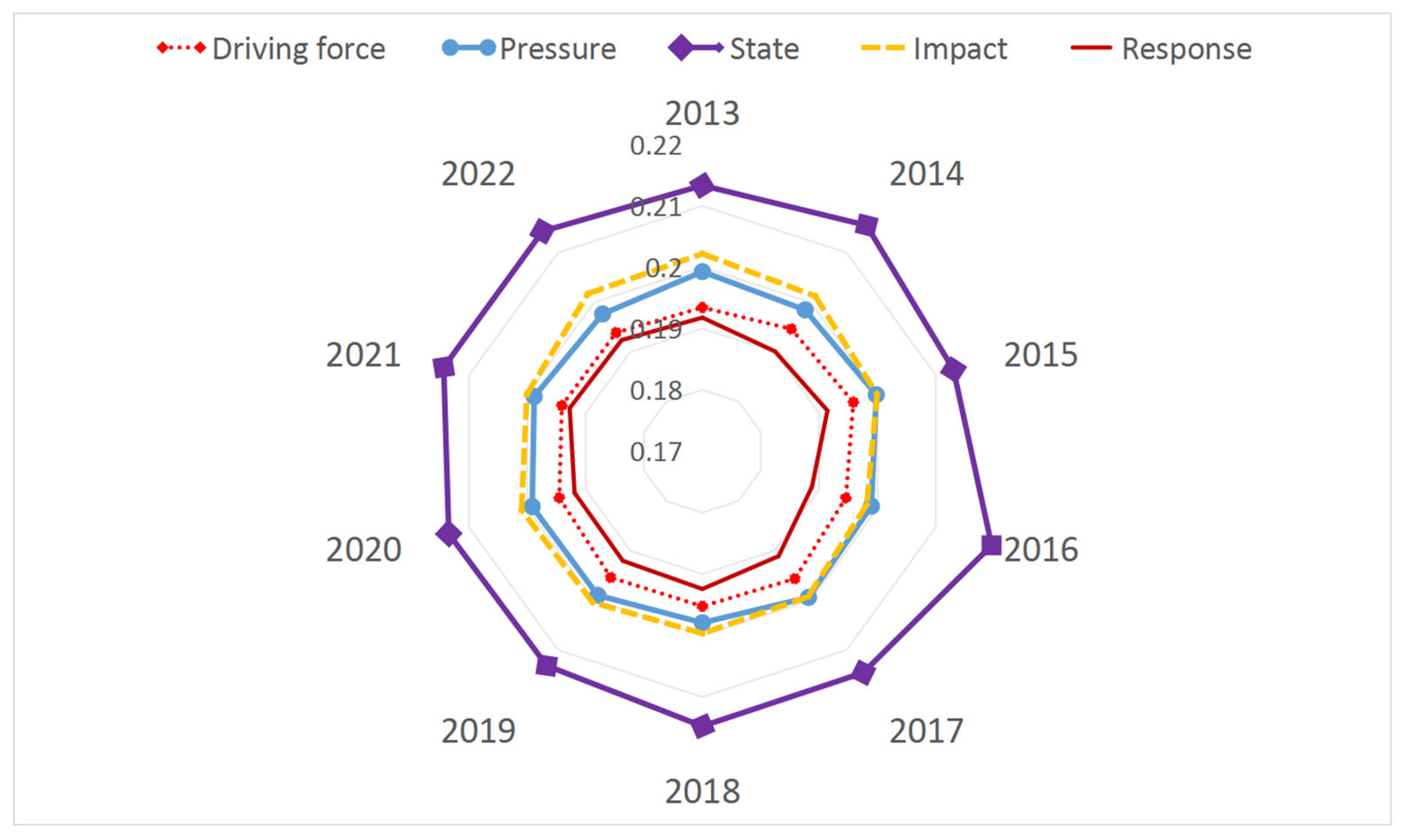
Pressure not only impacts but also constrains the Driving-force, imposing limitations on regional development as a whole and exerting a negative influence on the State of the regional basic education system.State is the direct reflection of the Driving-force, representing the condition of the regional educational ecological system as it responds to Pressure. It manifests the state of the carrying capacity through various indicators, such as the educational environment, the level of resource provision, financial support for education, and the teacher-student ratio.Impact refers to the gradual influence and consequences arising from the continuous changes in the regional basic educational ecological carrying capacity. It embodies the dynamic role that the basic education system plays in the broader socio-economic context, shaped by the combined effects of the Driving-force, Pressure, and State subsystems.
Response refers to the measures taken by the social system at a comprehensive level to address changes in the ecological carrying capacity of basic education. This includes the formulation and implementation of laws by legislative bodies, as well as policy adjustments and specific plans by government departments. The goal is to enhance the ecological carrying capacity of education by increasing investments in cultural and sports education, improving urban public service facilities, upgrading infrastructure construction, and strengthening medical services and related living ecological environments. This approach aims to elevate the level of social security that supports the basic education system [42].Through multiple rounds of multiple linear regression analysis, it was found that the Social consumption structure (scs), Share of education expenditure (see), Population urbanization rate (pur), Share of total local financial expenditure (stf), and Consumption structure of urban and rural residents (csr) have a significant impact on the level of basic educational carrying capacity, though the intensity of their effects varies considerably. Some factors exert a positive influence, while others have a negative effect.Before conducting the multiple regression analysis, the author believed that the Share of education expenditure (see) would play a decisive role; however, after extensive analysis, it was revealed that the most significant factor influencing the level of basic educational carrying capacity is the Population urbanization rate (pur). This implies that the most effective long-term strategy for enhancing the carrying capacity of the basic education system is to promote the process of urbanization, whereas reliance solely on educational funding yields short-term and limited results.Additionally, attention must be given to the balanced development of rural and urban areas, reducing the income gap between urban and rural residents, and establishing comprehensive social security. This will alleviate residents' concerns about future living conditions, thereby stimulating overall consumption, which is conducive to the sustainable enhancement of basic educational carrying capacity.The transformations and changes in society have profound impacts on the nature, objectives, content, structure, and management systems of education. The development of productive forces not only determines the scale and speed of educational advancement but also constrains the selection of teaching methods, organizational forms, and standards for talent cultivation. Technological progress alters the thinking patterns of educators and learners, providing necessary intellectual resources and technical support for the renewal and development of educational content. Furthermore, population size determines the scale of education, while population quality affects educational quality, and population structure is closely related to educational structure. The disparities in regional economic and social development levels inevitably lead to differences in educational development.The author has preliminarily explored the spatial differentiation patterns of educational carrying capacity through data analysis; however, the complexity of the driving mechanisms necessitates further research supported by additional data.
4.2. The Pathways to Co-Construction and Shared Development in Enhancing Educational Ecological Carrying Capacity and Addressing Potential Issues in Resource Development
Since the implementation of China's Western Development Policy and the national strategy to establish a gateway to ASEAN, the rapid economic growth of the Guangxi Zhuang Autonomous Region and the steady improvement in urbanization levels have contributed to the swift rise in regional basic education standards.
However, the education level in rural areas, where the population is relatively high, lags far behind that of urban areas, particularly in the development of basic education, presenting a severe imbalance. The first reason is the inadequate and uneven allocation of educational funding. The primary source of rural basic education funding is local government finances, which are limited, resulting in financial shortages and substandard school conditions, far below the standards of urban areas. Secondly, core urban regions possess many high-quality schools and teacher resources, while rural areas suffer from a significant loss of excellent teachers. Outstanding teachers and students often choose schools with rich educational resources, leading to a continued divergence in education development between urban and rural areas.
Additionally, during the process of rapid urbanization, as rural labor migrates to cities and large-scale population movements occur, the educational needs of migrant children pose significant challenges to urban areas. The objective resource constraints of cities and internal administrative factors easily result in imbalances between the supply and demand for educational resources, limiting the city's capacity to expand educational resources. Furthermore, there is an urgent need to improve the rational spatial allocation of educational resources.
In the context of the new era, addressing the imbalance of urban and rural educational resources requires continuously improving the adaptability and flexibility of the educational resource supply structure to meet changing demands. Achieving a spatial match between the educational population and resources is key. The quality of regional educational carrying capacity improvements depends on fair and inclusive access to educational resources for school-age populations, active financial investment in education, and scientifically sound educational land-use planning.
On this basis, it is essential to coordinate the supply and demand between the regional school-age population and educational resources at a practical level, and to timely adjust the educational management mechanisms according to jurisdictional needs. Exploring mechanisms for information exchange, resource sharing, talent development, and achievement sharing, with a focus on improving the regional educational ecosystem, will strengthen the timely supplementation of educational resources and the sustainable endogenous driving force for development.Many regions worldwide face similar challenges of educational imbalances and deficiencies, as seen in Guangxi. Based on the DPISR model, this study examines the evolution of Guangxi's educational ecological carrying capacity, finding that Guangxi has effectively improved regional education development and narrowed intra-regional educational gaps through a series of measures, providing valuable experience and examples for educational development and management in less developed areas.
5. Conclusion and Future Prospects
5.1. Research Conclusion
(1) The ecological carrying capacity of education in Guangxi's jurisdiction has steadily increased over time, with all five subsystems showing stable development characteristics, though their impacts on overall carrying capacity vary. The steady growth of Guangxi's regional economic development, the improvement of the social security system, the continuous innovation in educational concepts, and the sustained investment in educational infrastructure have all contributed to the steady enhancement of the region's educational ecological carrying capacity, with an average annual growth rate of 2.41%. Among the subsystems, the State subsystem has the strongest impact on the increase in carrying capacity, followed by the Impact subsystem, while the Response subsystem has the weakest influence. Overall, in the process of improving the ecological carrying capacity of education in Guangxi, effective measures have been implemented across five dimensions: internal driving force, pressure, state, impact, and response.(2) There is a noticeable regional imbalance in the ecological carrying capacity of education in Guangxi. The areas with higher carrying capacity are mainly distributed in the central core regions, predominantly urban areas. From 2013 to 2022, the regional differences in the ecological carrying capacity of education have shown a narrowing trend, with regional balance continuously improving, though at a slow pace.(3) The ecological carrying capacity of education in Guangxi is the result of a multi-factor composite system, with significant differences in influencing factors at different stages of development. Overall, Population urbanization rate (pur), Share of education expenditure (see), Social consumption structure (scs), and Share of total local financial expenditure (stf) are positively correlated with the improvement of educational ecological carrying capacity across different periods, while Consumption structure of urban and rural residents (csr) and Financial structure (fi) are negatively correlated with its improvement, with a noticeable impact.
5.2. Research Prospects
This study also has certain limitations. Due to constraints in obtaining statistical and foundational data, particularly the limited data available for multivariate regression analysis and the short span of years covered, several issues have not been solved wonderfully. The time series data presented in this paper is relatively short, making it difficult to compare with longer cycles and insufficient to fully reveal the spatiotemporal evolution of educational ecological carrying capacity. Currently, research on educational carrying capacity is mainly qualitative, with few studies available for reference. The development of the indicator system requires further refinement and optimization. For instance, education development is closely related to government governance, social management levels, economic system reforms, local cultural prosperity, technological advancement, and population structure, but some of these factors are difficult to quantify due to the lack of relevant indicators. Additionally, the level of educational carrying capacity is also influenced by micro-level factors, such as school management and individual teacher capabilities. More on-site investigations are needed to conduct further micro-level empirical research.
Author Contributions
Conceptualization, L.F. and B.Q.; data curation, L.F. and B.Q.; formal-analysis, L.F. and B.Q.; funding acquisition, L.F. and B.Q.; methodology, L.F. and B.Q.; project administration, L.F. and B.Q.; software, B.Q.; validation, L.F.; visualization, B.Q.; writing—original draft, L.F. and B.Q.; writing—review and editing,B.Q. All authors have read and agreed to the published version of the manuscript.
Funding
This research was funded by (1) International Chinese Language Education Collaboration Mechanism Project,Center for Language Education and Cooperation,2023; (2)Theoretical and Practical Research on Guangxi's International Chinese Language Education Collaboration Mechanism (23YHXZ1010); (3)Innovation Project of Guangxi Graduate Education(XYCBZ2024005).
Institutional Review Board Statement
Not applicable.
Informed Consent Statement
Not applicable.
Data Availability Statement
The data presented in this study are available on request fromthe author.
Acknowledgments
Thanks to everyone who contributed to this study.
Conflicts of Interest
The authors declare no conflict of interest
References
- Lin,S.; Sun,J.; Marinova,D.; Zhao,D. Effects of Population and Land Urbanization on China’s Environmental Impact: Empirical Analysis Based on the Extended STIRPAT Model. Sustainability 2017,9,825. [CrossRef]
- Lv,T.; Wang,L.; Zhang,X.; Xie,H.; Lu,H.; Li,H.; Liu,W.; Zhang,Y. Coupling Coordinated Development and Exploring Its Influencing Factors in Nanchang,China: From the Perspectives of Land Urbanization and Population Urbanization. Land 2019, 8, 178. [CrossRef]
- Zhang,S.L.; Zheng,H.Q.; Zhou,H.Y.; Shao,Q.; Wu,Q. Sustainable land urbanization,urban amenities,and population urbanization: Evidence from city-level data in China. Soc. Sci. Q. 2021, 102, 1686–1698. [CrossRef]
- Liu,J.; Shen,Y.F. Population Mobility and Re allocation of Educational Resources—Based on the Perspective of Educational Carrying Capacity. J. Educ. Dev. 2017, 2, 18–23. [CrossRef]
- Ding,X.S.; Qin,Y.Y.; Xue,C.Y. Coordinating and Promoting the Improvement of the Carrying Capacity of Compulsory Ed-ucation Resources in Big Cities: Problem Analysis and Policy Suggestions. Mod. Educ. Manag. 2020, 1, 78–84. [CrossRef]
- Lu,W.; Li,Y.C.; Zhao,R.K.; Wang,Y. Using Remote Sensing to Identify Urban Fringe Areas and Their Spatial Pattern of Ed-ucational Resources: A Case Study of the Chengdu-Chongqing Economic Circle. Remote Sens. 2022, 14, 3148. [CrossRef]
- Guo,Y.-Z.; Zhou,Y.; Liu,Y.-S. The inequality of educational resources and its countermeasures for rural revitalization in southwest China. J. Mt. Sci. 2020, 17, 304–315. [CrossRef]
- Liu,H.M.;Xu,Z.M. Educational Ecological Carrying Capacity: A Necessary Support for High-Quality Regional Education Development. Modern Educational Management 2020, 12, 1–6. [CrossRef]
- Liu,H.M.;Xu,Z.M. Educational Ecological Carrying Capacity: A Necessary Support for High-Quality Regional Education Development. Modern Educational Management 2020, 12, 1–6. [CrossRef]
- Pei,R. The Issues and Countermeasures of the Scale Expansion of Higher Education Popularization in China from the Perspective of Ecological Carrying Capacity. Heilongjiang Researches on Higher Education 2023, 41, 14–21. [CrossRef]
- Li,X. ; Liu,L.Y.; Li,Y. Optimization and Improvement of Ecological Factors in Higher Vocational Education under the Background of Mixed Ownership. Vocational and Technical Education 2020, 11, 46–50. [CrossRef]
- Zhang,T.X.; Wen,H.M. Theoretical Exploration of the Ecological Carrying Capacity of College Physical Education. Bulletin of Sports Science and Technology 2016, 02, 172–175. [CrossRef]
- Frances,D.C.; Jessica,D.K. Furthering critical institutionalism. Int. J. Commons 2015, 9, 1–18. [CrossRef]
- Di Baldassarre,G.; Sivapalan,M.; Rusca,M.; Cudennec,C.; Garcia,M.; Kreibich,H.; Konar,M.; Mondino,E.; Mård,J.; Pande,S.; et al. Sociohydrology: Scientific Challenges in Addressing the Sustainable Development Goals. Water Resour. Res. 2019, 55, 6327–6355. [CrossRef]
- Ji,M.; Zhi,J.D.; Liu,W. ResearchE on the Balance of University Education Reform from the Perspective of Supply-Side Reform. Rev. De Cercet. Si Interv. Sociala. 2021, 72, 72–92. [CrossRef]
- Stukalina,Y. The Management of Integrated Educational Environment Resources: The factors to be considered. Eur. J. Educ. 2010, 45, 345–361. [CrossRef]
- Tel,A.; Maria,R.D.; Celso,J.D. Building Open Policy through Open Educational Resources: An analysis of the Open University of Brazil System. Rev. Latinoam. De Tecnol. Educ.-Relatec. 2017, 16, 161–176. [CrossRef]
- Gong,X.;Qu,H.Y. High-Quality Preschool Education System: Basic Structure,Main Characteristics,and Construction Path. Modern Educational Management. 2021, 11, 34–42. [CrossRef]
- NAIDU, S. Building resilience in education systems post-COVID-19[J]. Distance Education 2021, 01, 1–4. [Google Scholar] [CrossRef]
- Zhu,Z.T;Peng,H.C. Resilient Education Systems Empowered by Technology: New Directions for Post-Pandemic Educational Digital Transformation. Modern Educational Management 2020, 05, 40–50. [CrossRef]
- Ma,P.Y;Mi,H. Quantitative Analysis of Higher Education Resources Carrying Capacity at Provincial Level. China Higher Education Research 2015, 09, 48–52. [CrossRef]
- SHI,L; CHEN,W.M. Research on Maturity of Higher Education Resources Carrying Capacity in China. Journal of Higher Education 2017, 09, 21–29. [CrossRef]
- Peng,N.Y. An Empirical Study on the Comprehensive Carrying Capacity and the Matching Degree of China's Higher Education. Research in Educational Development 2017, 09, 37–44. [CrossRef]
- Ke,W.J.;Wang,J. Evaluation of Urban Higher Education Resources Carrying Capacity Based on Entropy Weight TOPSIS Model. Statistics & Decision 2020, 18, 50–53. [CrossRef]
- Xu,Z.C. Study on preschool education resources carrying capacity. PhD Dissertation of Northeast Normal University 2020, 105–147. [CrossRef]
- Wang, Z.; Zhao, L. Spatio-temporal Pattern and Influencing Factors of the Carrying Capacity of Basic Education Resources in China. Resour. Dev. Mark. 2021, 37, 5–11. [Google Scholar] [CrossRef]
- He, Y.Y.; Guo, J.X.; Zheng, Q.; Zhang, Y.Z.; Ji, C.J.; Liu, T.; Xie, H.J. Analysis on the service carrying capacity of preschool education resources Based on GIS: taking the main urbanarea of Hangzhou as an example. Journal of Hangzhou Normal University (Natural Science Edition) 2024, 04, 369–377. [Google Scholar] [CrossRef]
- He,Z.B.; Lin,M.C. On the Controlling Model for the Ecological Bearing Capacity for Higher Education System. J. Guangxi Teach. Educ. Univ. 2012, 33, 60–65. [CrossRef]
- Peng,N.Y. An Empirical Study on the Comprehensive Carrying Capacity and the Matching Degree of China’s Higher Edu-cation. Res. Educ. Dev. 2017, 37, 37–44. [CrossRef]
- Hrynevych,L.M.; Morze,N.V.; Vember,V.P.; Boiko,M.A. The Role of Digital Technologies in the Development of the STEM Education Ecosystem. Inf. Technol. Learn. Tools 2021, 83, 1–25. [CrossRef]
- Liu,H.M.;Xu,Z.C. Educational Ecological Carrying Capacity: A Necessary Support for High-Quality Regional Education Development. Modern Educational Management 2020, 12, 1–6. [CrossRef]
- Zhao, D.S.; Zhang, X.M.; Deng, S.Q.; Yu, G.R. Discussion on Evaluation Theory and Method of Regional Resource and Environmental Carrying Capacity. China Population, Resources and Environment 2022, 32(3), 203-212. [CrossRef]
- Lei, X.P.; Qiu, G.H. An Empirical Study on Regional Resource and Environmental Carrying Capacity Evaluation Based on the Entropy-Weighted TOPSIS Model. Environmental Science 2015, 36(12), 4674–4681. [Google Scholar] [CrossRef]
- HE, Z.B.; LIN, M.C. On the Controlling Model for the Ecological Bearing Capacity for Higher Education System. Journal of Guangxi Teachers Education University(Social Science Edition) 2012, 33(4), 60-65. [CrossRef]
- SUN, X.R.; SHAO, C.F. Study on the Variation Trends of Regional Environmental Risk for Tianjin Binhai New Area Based on DPSIR Model. Research of Environmental Sciences 2010, 23(1), 68–73. [Google Scholar] [CrossRef]
- LI, T.X.; FU, Q.; PENG, S.M. Evaluation of water and soil resources carrying capacity based on DPSIR frame work. Journal of Northeast Agricultural University 2012, 43(8), 128–134. [Google Scholar] [CrossRef]
- WANG, X.W.; SHAO, J.L.; CUI, Y.L.; ZHAO, H.; GUO, X.H.; SUN, Q. Evaluation of water resources carrying capacity of Fukang based on DPSIR and principal component analysis. South-to-North Water Transfers and Water Science & Technology 2017, 15(3), 37-42, 48. [CrossRef]
- GAO, C.; MEI, Y.D.; LV, S.Y.; WANG,Y.; YUAN, J.B. Assessment and Prediction of Water Resources Carrying Capacity Based on AHP-Fuzzy Method: A Case Study on Hanjiang River Basin. Journal of Yangtze River Scientific Research Institute 2010, 23(1), 68-73. [CrossRef]
- Hu, C.L.; Huang, W.L. On the development strategy of university disciplines from the perspective of ecological carrying ca-pacity. Acad. Forum 2013, 36, 228–230. [Google Scholar] [CrossRef]
- Zhou, R.; Lee, N. The Reception of Education for Sustainable Development (ESD) in China: A Historical Review. Sustainability 2022, 14, 4333. [Google Scholar] [CrossRef]
- Xue, E.; Li, J. Exploring the education power in China: The basic connotation, key index, and strategic pathway. Educ. Philos. Theory 2022, 20, 11–18. [Google Scholar] [CrossRef]
- Li, G.; Xi, Y.; Zhu, Z. The way to sustainability: Education for sustainable development in China. Asia Pac. Educ. Rev. 2022, 23, 611–624. [Google Scholar] [CrossRef]
- Wang, W.X.; Yang, Q.Y.; Su, K.C.; Bi, G.H.; Zhang, Z.X. Evolution of Yangtze River Economic Belt Development Zone and Its Industrial Spatial Pattern. Resour. Environ. Yangtze Basin 2021, 30, 519–533. [Google Scholar] [CrossRef]
Figure 1.
The location of Guangxi on the map of China (light green area). Note: Based on the standard map from the Standard Map Service website (scale 1:25,000,000), Map Review Number GS (2024) 0650. The base map has not been modified. The standard names of the provinces, municipalities, and autonomous regions on the map are sourced from the standardized full map of China (English), supervised by the Ministry of Natural Resources of China, Map Review Number GS (2022) 4316.
Figure 1.
The location of Guangxi on the map of China (light green area). Note: Based on the standard map from the Standard Map Service website (scale 1:25,000,000), Map Review Number GS (2024) 0650. The base map has not been modified. The standard names of the provinces, municipalities, and autonomous regions on the map are sourced from the standardized full map of China (English), supervised by the Ministry of Natural Resources of China, Map Review Number GS (2022) 4316.
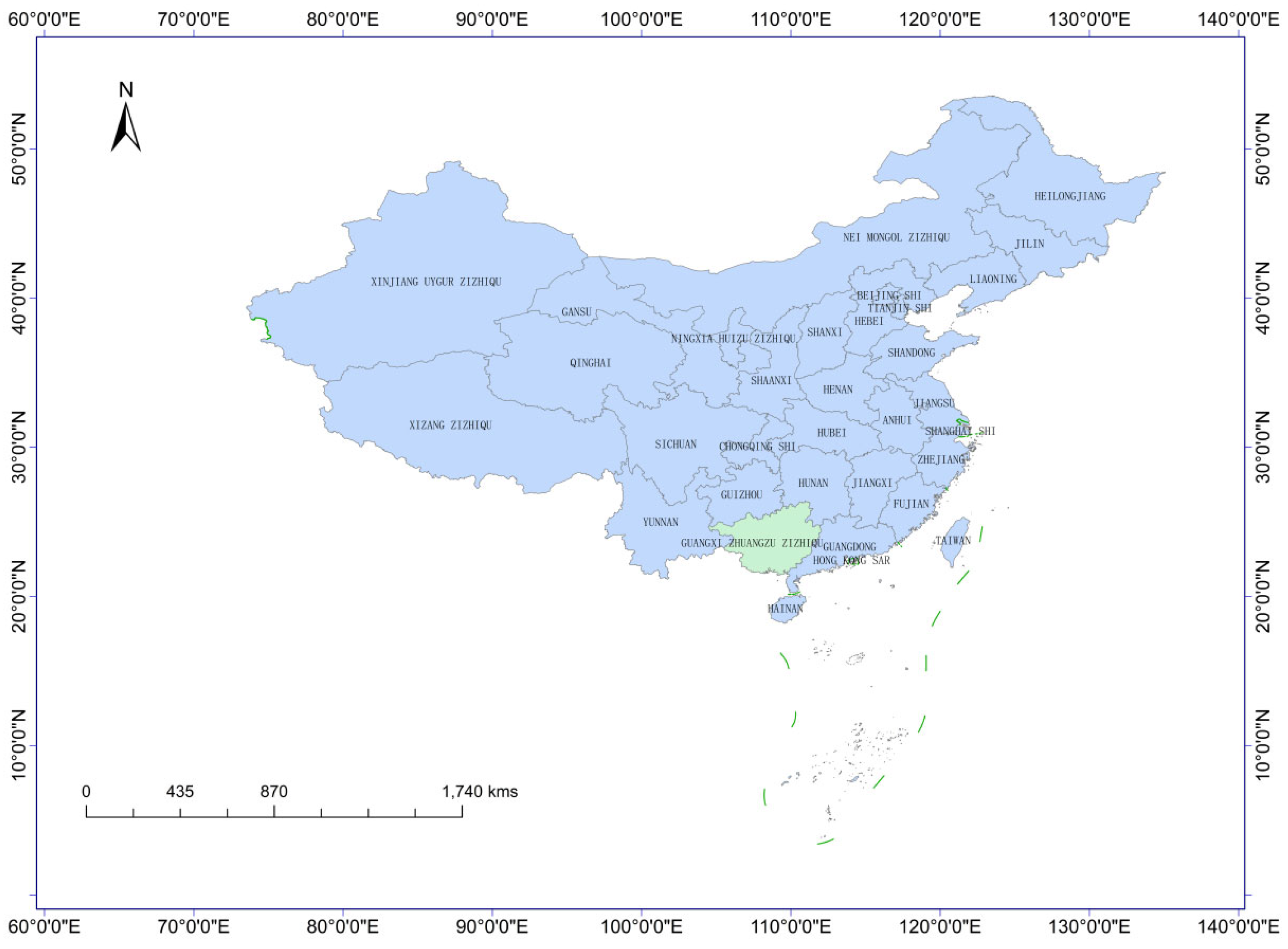
Figure 2.
The geographical distribution of the cities under the jurisdiction of Guangxi Zhuang Autonomous Region. Note: Based on the standard map from the Standard Map Service website (scale 1:25,000,000), Map Review Number GS (2024) 0650. The base map has not been modified.
Figure 2.
The geographical distribution of the cities under the jurisdiction of Guangxi Zhuang Autonomous Region. Note: Based on the standard map from the Standard Map Service website (scale 1:25,000,000), Map Review Number GS (2024) 0650. The base map has not been modified.
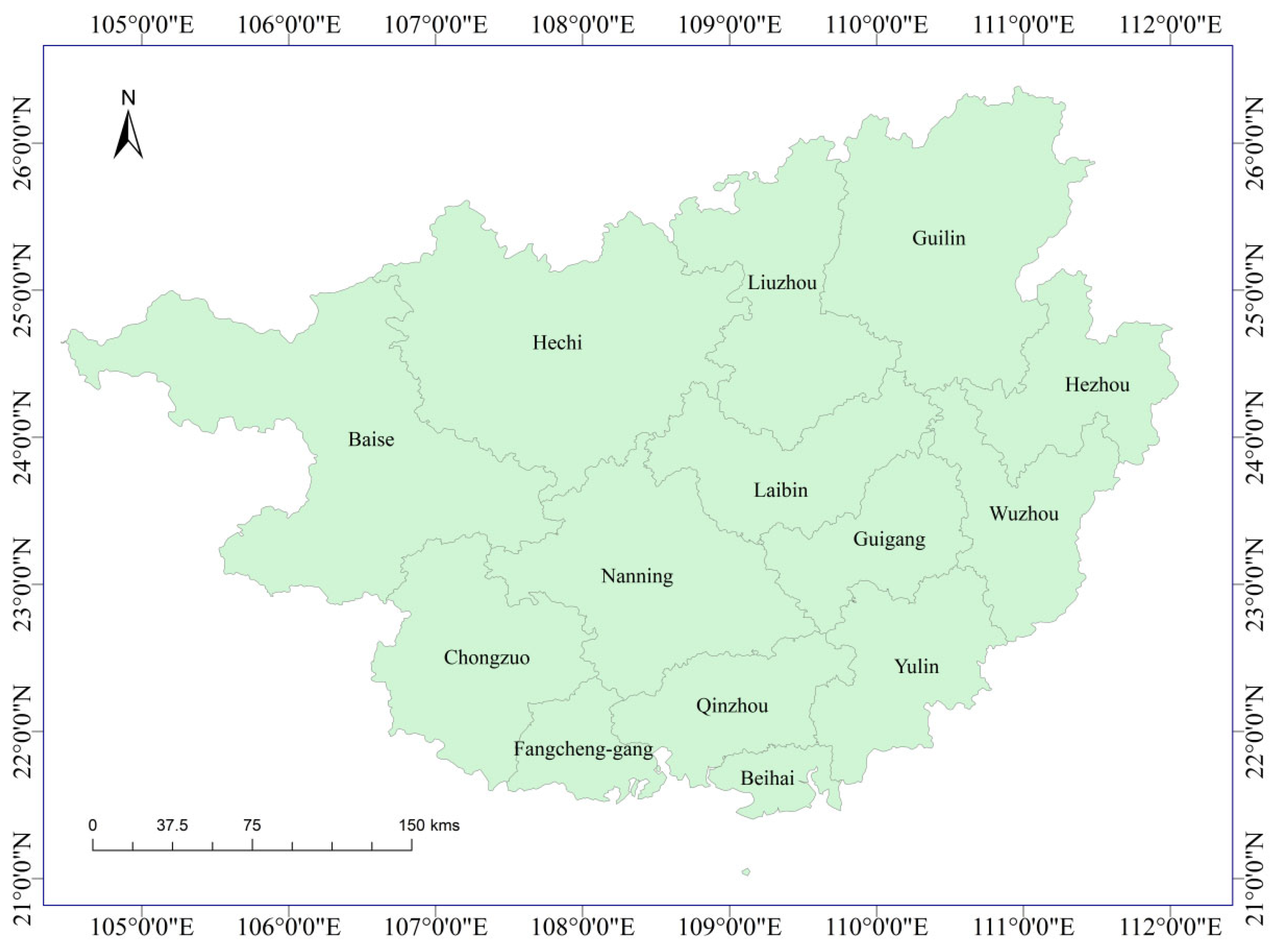
Figure 5.
Spatial Differentiation Pattern of Ecological Carrying Capacity in Guangxi's Jurisdictional Regions in 2013. Note: Based on standard maps from the Standard Map Service website (scale 1:25,000,000), with review number GS (2024) 0650. The base map has not been modified. The standard names of the regions under Guangxi's jurisdiction on the map are sourced from the Guangxi Statistical Yearbook 2021 edition.
Figure 5.
Spatial Differentiation Pattern of Ecological Carrying Capacity in Guangxi's Jurisdictional Regions in 2013. Note: Based on standard maps from the Standard Map Service website (scale 1:25,000,000), with review number GS (2024) 0650. The base map has not been modified. The standard names of the regions under Guangxi's jurisdiction on the map are sourced from the Guangxi Statistical Yearbook 2021 edition.
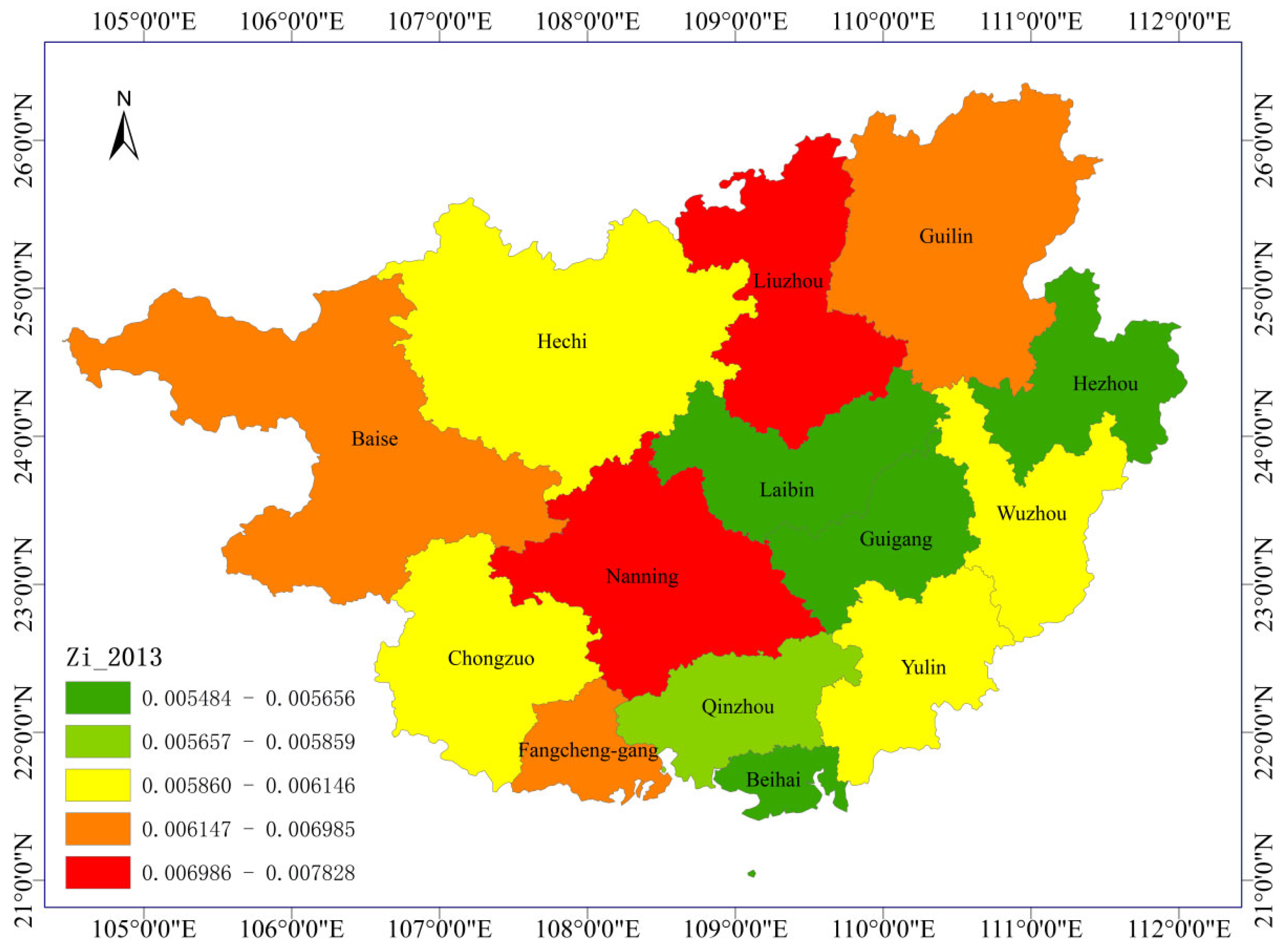
Figure 6.
Spatial Differentiation Pattern of Ecological Carrying Capacity in Guangxi's Jurisdictional Regions in 2022. Note: Based on standard maps from the Standard Map Service website (scale 1:25,000,000), with review number GS (2024) 0650. The base map has not been modified. The standard names of the regions under Guangxi's jurisdiction on the map are sourced from the Guangxi Statistical Yearbook 2021 edition.
Figure 6.
Spatial Differentiation Pattern of Ecological Carrying Capacity in Guangxi's Jurisdictional Regions in 2022. Note: Based on standard maps from the Standard Map Service website (scale 1:25,000,000), with review number GS (2024) 0650. The base map has not been modified. The standard names of the regions under Guangxi's jurisdiction on the map are sourced from the Guangxi Statistical Yearbook 2021 edition.
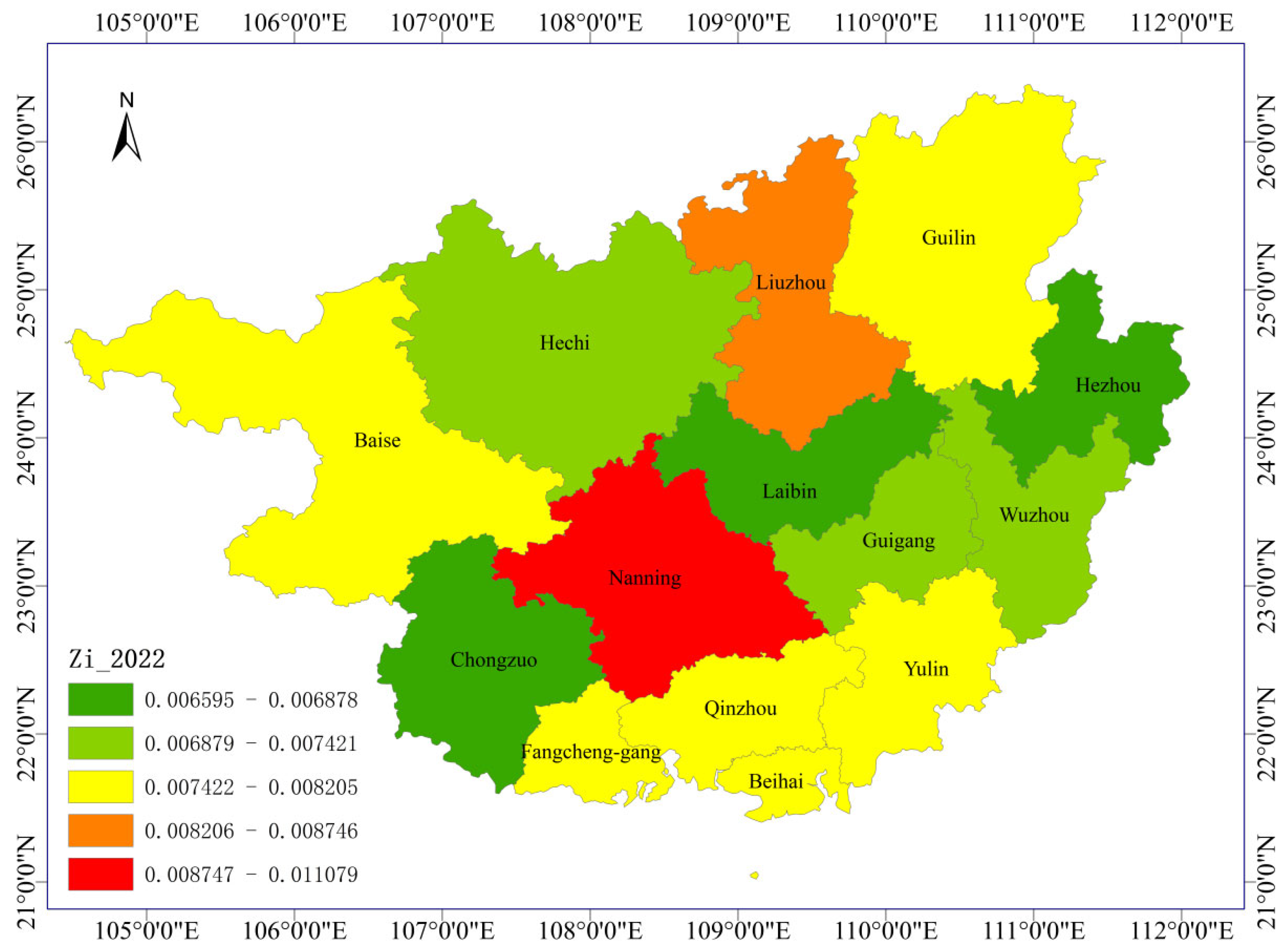
Figure 7.
Development Trend of Educational Ecological Carrying Capacity in Guangxi's Jurisdictional Regions in 2013.
Figure 7.
Development Trend of Educational Ecological Carrying Capacity in Guangxi's Jurisdictional Regions in 2013.
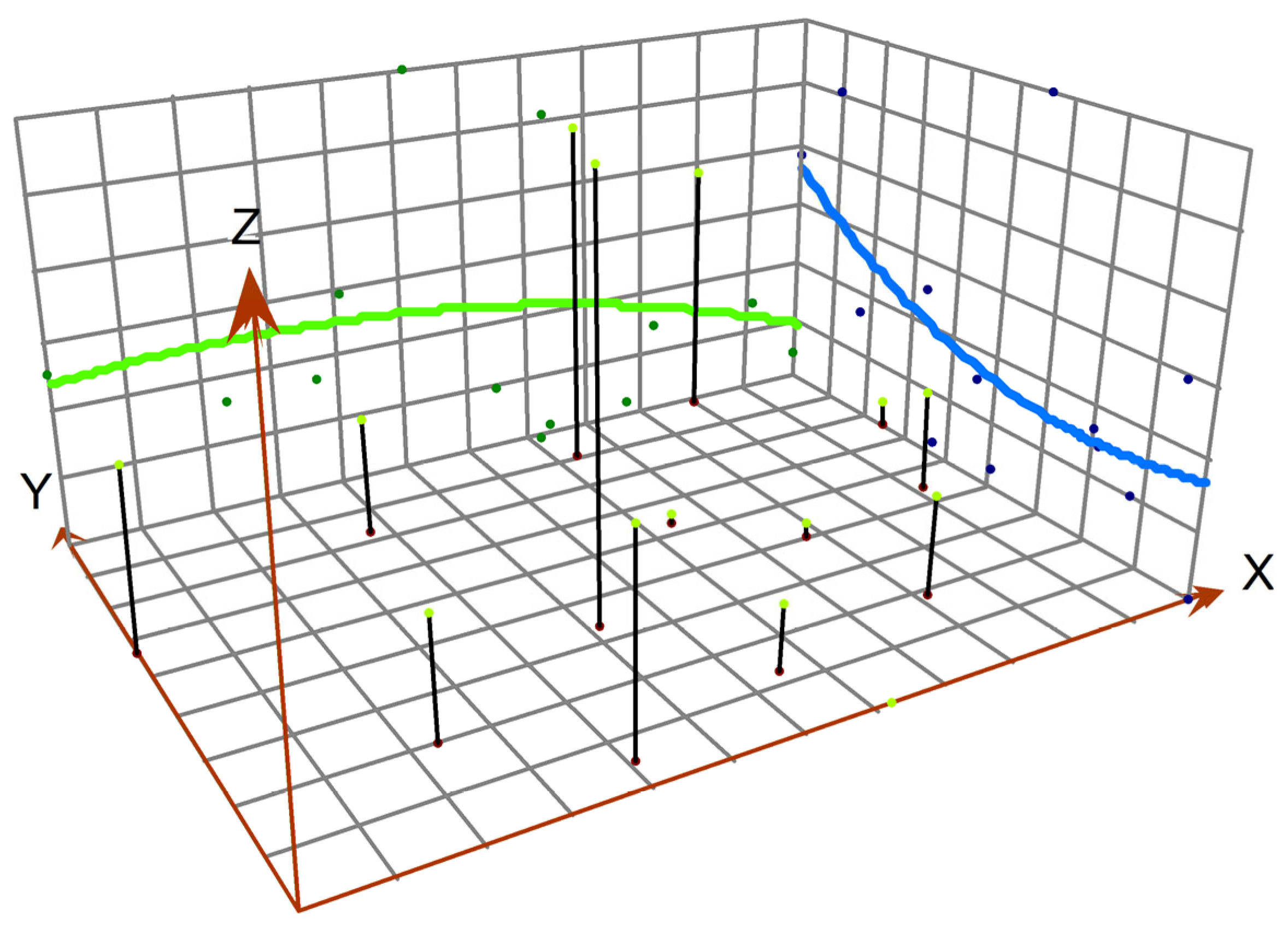
Figure 8.
Development Trend of Educational Ecological Carrying Capacity in Guangxi's Jurisdictional Regions in 2022.
Figure 8.
Development Trend of Educational Ecological Carrying Capacity in Guangxi's Jurisdictional Regions in 2022.
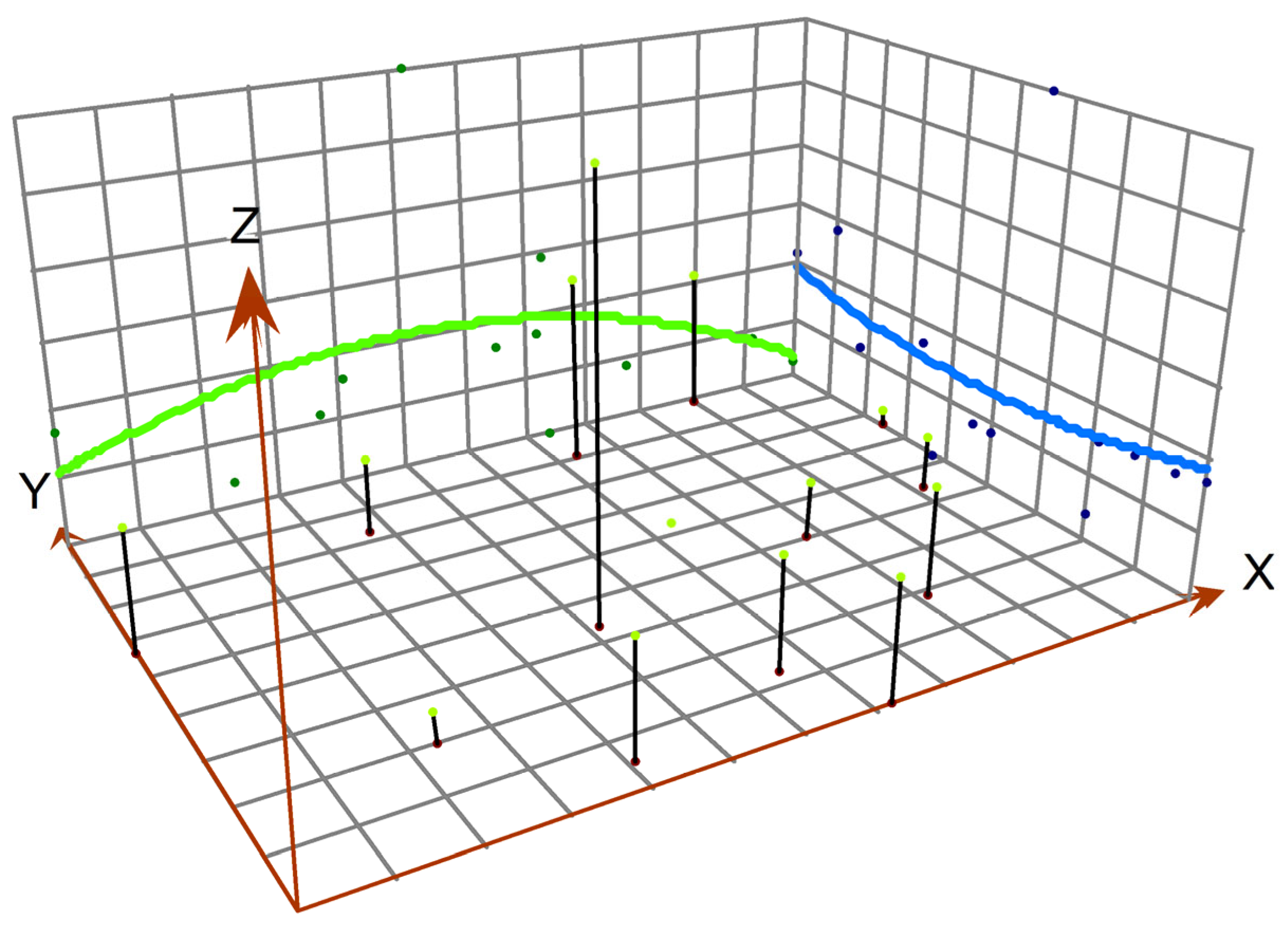
Table 1.
Evaluation Indicator System for Basic Education Ecological Carrying Capacity.
| Factor | Indicator | Implication | Positive/Negative |
| Driving-force | Educational Fiscal Expenditure X1 | Represents the driving force of special fiscal investment on educational ecological carrying capacity | + |
| Gross Regional Product X2 | Represents the driving force of economic total on educational ecological carrying capacity | + | |
| Per Capita Gross Regional Product X3 | Represents the driving force of economic development on educational ecological carrying capacity | + | |
| Per Capita Disposable Income of Urban Residents X4 | Represents the driving force of economic development on educational ecological carrying capacity | + | |
| Per Capita Living Consumption Expenditure of Urban Residents X5 | Represents the driving force of economic development on educational ecological carrying capacity | + | |
| Public Fiscal Budget Revenue X6 | Represents the driving force of overall fiscal revenue on educational ecological carrying capacity | + | |
| Public Fiscal Budget Expenditure X7 | Represents the driving force of overall fiscal investment on educational ecological carrying capacity | + | |
| Pressure | Population Size X8 | Represents the overall demand of social population on the pressure of basic education ecological carrying capacity | - |
| Natural Population Change X9 | Represents the overall changes in social population on the pressure of basic education ecological carrying capacity | - | |
| Total Number of Households X10 | Represents the household demand on the pressure of basic education ecological carrying capacity | - | |
| Number of Enrolled Students X11 | Represents the demand for education from the school-age population on the pressure of basic education ecological carrying capacity | - | |
| State | Number of Students per Million Population X12 | Represents the enrollment situation of the school-age population | + |
| Number of Schools per Hundred Thousand Population X13 | Represents the development level of primary and secondary schools | + | |
| Per Capita Fiscal Expenditure X14 | Represents the current level of fiscal investment in basic education | + | |
| Teacher-Student Ratio X15 | Represents the degree of alignment between the current number of teachers and basic education needs | + | |
| Impact | GDP Growth Rate X16 | Represents the impact of basic education on overall economic development | + |
| Population Urbanization Rate X17 | Represents the impact of basic education on social development | + | |
| Total Retail Sales of Consumer Goods X18 | Represents the impact of basic education on social consumption and domestic trade | + | |
| Average Annual Wage of Urban Employees X19 | Represents the influence of educational attainment on income | + | |
| Response | Growth Rate of Fiscal Expenditure Compared to Previous Year X20 | Represents the response of fiscal investment to the carrying capacity of basic education | + |
| Growth Rate of Per Capita Fiscal Expenditure Compared to Previous Year X21 | Represents the response of per capita fiscal investment to the carrying capacity of basic education | + | |
| Average Public Library Collection per Ten Thousand People X22 | Represents the response of social cultural services to the carrying capacity of basic education | + | |
| Per Capita Regional Road Area X23 | Represents the response of social public transportation services to the carrying capacity of basic education | + | |
| Average Number of Health Technicians per Ten Thousand People X24 | Represents the response of social medical services to the carrying capacity of basic education | + |
Table 2.
Variables index system of multiple linear regression model.
| Variables | Symbols | Definitions |
| Carrying capacity index | Zi | Educational ecological carrying capacity |
| Financial structure | fi | Year-end balance of savings deposits of urban and rural residents/GDP |
| Urban and rural income distribution structure | urs | Urban per capita annual income/Rural per capita annual income |
| Consumption structure of urban and rural residents | csr | Urban per capita consumption expenditure/Rural per capita consumption expenditure |
| Social consumption structure | scs | Total retail sales of consumer goods/GDP |
| Employment structure | es | Number of non-private sector workers/total population |
| Share of education expenditure | see | Education expenditure/total local financial expenditure |
| Share of science and technology expenditure | sst | Science and technology expenditure/total local financial expenditure |
| Share of expenditure on culture, sports and media | sec | Expenditure on culture, sports and media/Total local financial expenditure |
| Population urbanization rate | pur | Urban population/total population |
| Share of total local financial expenditure | stf | total local financial expenditure/GDP |
Disclaimer/Publisher’s Note: The statements, opinions and data contained in all publications are solely those of the individual author(s) and contributor(s) and not of MDPI and/or the editor(s). MDPI and/or the editor(s) disclaim responsibility for any injury to people or property resulting from any ideas, methods, instructions or products referred to in the content. |
© 2024 by the authors. Licensee MDPI, Basel, Switzerland. This article is an open access article distributed under the terms and conditions of the Creative Commons Attribution (CC BY) license (https://creativecommons.org/licenses/by/4.0/).
Copyright: This open access article is published under a Creative Commons CC BY 4.0 license, which permit the free download, distribution, and reuse, provided that the author and preprint are cited in any reuse.


